Chapter XXV · BIOGRAPHICAL HISTORY (continued 3)
Reading edition
Mr. Harwi is an independent in politics. He was one of the organizers of the Atchison Commercial Club and served as president of this thriving organization in 1913, and is at present a member of its board of directors. He is a member of the board of trustees of Midland College and is a member of the Atchison city board of education. He has likewise been one of the trustees of the Atchison city hospital since its establishment. While the responsibilities connected with the conduct of the great business establishment thrust upon his shoulders at the demise of his father have been such as would probably daunt the young man of average ability, Mr. Harwi has shown that 421he fully measures up to the requirements of his important position in the mercantile world and has made a reputation on his own individual account as a business head of decided executive ability of a high order.
JOSEPH TROMPETER.
When Joseph Trumpeter departed this life Effingham lost one of its best and most-highly respected citizens and his family suffered the lost of a kind and industrious husband and father, whose sole ambition in life was to provide well for his kindred and those dependent upon him for a livelihood, and to accomplish his purpose in the most honorable and upright manner possible. To him fell the task of erecting the first county high school building in Effingham, and many of the most pretentious dwellings of the city were built by him. He was one of the widely known and successful contractors of the county, whose operations extended over a wide stretch of territory, and whose work was always strictly up to a certain high standard and honestly performed.
Mr. Trompeter was born June 15, 1857, in Prussia, Germany, and when ten years of age he accompanied his parents to America. His father was Maurice Trompeter, who settled on a farm in Illinois and who went from Illinois to Texas, but after a short residence in that State returned to Illinois, where he passed the remainder of his days. Joseph was reared to young manhood in Illinois and there married Hannah Sowers. He also went to Texas and removed from there to Horton, Kan. His father before him was a carpenter and Joseph learned his trade and followed it, becoming a contractor and builder when a young man. He erected several court houses in Texas, and built several school buildings and church edifices in Kansas. His first wife died in Horton, Kan., eight children being born to this union, of whom two are living, namely: Mrs. Tina Demmer, of Effingham. Kan.; Mrs. Bertha Wallace, also residing in Effingham. Mr. Trumpeter removed to Effingham, and at once engaged in building and contracting on an extensive scale. He erected all the buildings on the main street of the town, on the north side of the street, running from the banners and Merchants Bank building to the newspaper office, at the end of the block. He also built the greater part of the finer residences in Effingham and it is due to his handiwork and taste that the city presents such an attractive appearance to the visitor. In the spring of 1912 he and the family moved to his farm of 160 acres southeast 422of Effingham on which with his own hands Mr. Trompeter erected a handsome farm dwelling and fitted it with all modern improvements, adding an attractive barn at the same time. He did not live to enjoy the comforts of his new home long, however, as illness brought on by overwork, caused him to take to his bed and his demise occurred August 19, 1915.
His second marriage was with Louise Richter, on November 8, 1892, at Effingham. Four children were born of this marriage, namely: Amelia, John, James and Mary, all of whom are at home with their mother. Mrs. Trompeter was born in Austria, in 1874, a daughter of John, born September 2, 1852, and Amelia (Wohletz) Richter, born May 31, 1849. The Richters are of German birth and immigrated to America in 1882, first residing in Atchison and then coming to Effingham. For twenty-eight years Mr. Richter was employed in railroad work on the Central Branch of the Missouri Pacific railroad. Mr. and Mrs. Richter now make their home with their daughter, Mrs. Trompeter, and assist in the farming operations. The Richter children are as follows: Mrs. Joseph Trompeter; Domineck, conducting a meat market in Effingham; Leapold, living at Tacoma, Wash., also a builder and contractor; Mrs. Amelia Hansen, residing in Texas; Mrs. Anna Royer, Tacoma, Wash. There are eleven grand children in the Richter family.
Mr. Trompeter was affiliated with the Democratic party, but was never a seeker after political preferment. He was a member of the Catholic church, and was fraternally connected with the Knights of Columbus and the Modern Woodmen. Throughout his life he was an industrious and hard-working citizen who did his duty as he saw it and lived an upright and honest life. He was prominently identified with the civic life of Effingham and was highly respected for his many excellent qualities.
JOSEPH N. ARTHUR.
Joseph N. Arthur, automobile salesman and garage proprietor, of Effingham, Kan., is one of the progressive and enterprising business men of the second city of Atchison county. Signal success has attended his efforts during the years he has been a resident of Atchison county. He embarked in the automobile business and established a garage in Effingham, despite the fact that predictions were made that the venture would not be a success, and Mr. Arthur as a result is the recognized pioneer automobile man of his part of the county. Since taking the agency for the Ford cars in 1912, he has sold over half the total of Ford cars sold in the county and vicinity. 423Mr. Arthur first started in business in 1910 and established a small garage in the rear of his real estate office. His business grew to such an extent that larger quarters became necessary, and in 1913 he erected a large concrete building, forty by eighty feet in extent, in which is incorporated his office, display and repair rooms. He employs a skilled mechanic, assistant and driver. Mr. Arthur handles the Dodge Brothers, the Maxwell, and Ford automobiles.
J. N. Arthur was born June 3, 1869, near Corning, Adams county, Iowa, and is a son of John and Martha Arthur, natives of Ohio. Both parents were reared in the old Buckeye State, and were early pioneer settlers in Iowa, coming from Bucyrus, Ohio, in 1855, and driving overland via the ox team route, with all their movable possessions loaded on wagons en route from St. Joseph, Mo., to their destination in Adams county, Iowa. John Arthur homesteaded Government land in Adams county and preëmpted along the river where timber and water were plentiful. He prospered as the years went on and the country became more and more settled, and he became the owner of over 800 acres of excellent Iowa farm lands. He resided in Adams county, Iowa, until his demise, in 1907.
John Arthur settled on the banks of a river for the purpose of having timber, fuel and water, three essentials in keeping alive in the then sparsely settled country in the southwestern part of Iowa. He built a log cabin of logs hewn from trees chopped down with his own hands and chinked the cracks and crevices with mud. When he preëmpted his first tract of land in Iowa he had a yoke of oxen, $10 in money and a favorite bull-dog, things which he was fond of telling about as he grew older and more prosperous. During his fifty-two years of residence in Iowa he accumulated 800 acres of land and had money loaned out to the amount of $10,000. He was the father of eleven children, nine of whom grew to maturity, each of whom as he married was assisted by the father to settle on a farm of his own, and all have prospered—an enviable record for a pioneer family to make.
Joseph N., with whom this review is directly concerned, was reared on the Iowa farm, and knew something about the hardships of the pioneer days in his boyhood. He attended the district school in his neighborhood, and followed farming until he engaged in the implement business in his home county for some years, with a fair degree of success. He left his native State in 1904 and came to Effingham, Kan., purchasing 120 acres of land about one and one-half miles distant from Effingham in Atchison county. One year later he embarked in the real estate business, in partnership with B. F. Snyder. This partnership lasted for two years and then Mr. Arthur 424engaged in the business for himself. He also began to write insurance, and was reasonably successful in both the real estate and insurance business. He erected a brick building for his office quarters, and, when automobile owners multiplied in Effingham and vicinity he foresaw the need of a repair shop and established one in the rear of his real estate office. He soon afterward rented an abandoned garage and hired a mechanic to do the repair work. It was not long until larger quarters became necessary, and he built as told in a preceding chapter. In July of 1915, Mr. Arthur disposed of his insurance business, and has since devoted his energies entirely to the automobile business.
He was married in 1892 to Lillie M. Ramsey, daughter of Newton Ramsey, a pioneer settler of Adams county, Iowa, and a Union veteran of the Civil war. Four children have blessed this union: Pearl, aged twenty-one years; Jennie, aged eighteen years, and a teacher of music, and an accomplished musician; Le Roy, nine years of age; Charles, three years old. Three children are deceased: Chester A. died at the age of eight years; Milton died at the age of eighteen months; Blanche died at the age of nine months.
Mr. Arthur is a Republican in politics, and has identified himself more or less with the civic life of his adopted community, and is considered as one of Effingham’s best boosters and live wires. He is a member of the Methodist Episcopal church, contributes to the support of the same, and is affiliated with the Odd Fellows lodge and the Knights and Ladies of Security.
DON CARLOS NEWCOMB.
It is a pleasure for the biographer to write a story of the life of a man who has arrived at the evening of life and be able to record something really worth while for the benefit of posterity. The life annals of a man who has succeeded in making a name for himself, achieving a well deserved competence, and been of some use to his community, and has arrived at the time of life when he can look back over the vista of the busy years that have passed, is interesting to a high degree. In D. C. Newcomb, pioneer merchant and patriarch, of Atchison, we find embodied that spirit of the West which enabled men to build up this great country and to achieve things of importance in the business and civic world. Mr. Newcomb loves his home city, its people and prestige and is proud of its standing among the cities of the West. He has had no small part in the upbuilding of Atchison, and it would have been better in the days gone by if the city had more men like him to assist its growth. Ever ready to contribute to any enterprise which might help the growth of the city, his liberality and boosting proclivities became proverbial, and it has oft been a saying of his that Atchison could just as well have been a city of fifty or sixty thousand inhabitants as to be its present size. Such men as he are of decided benefit to any community.
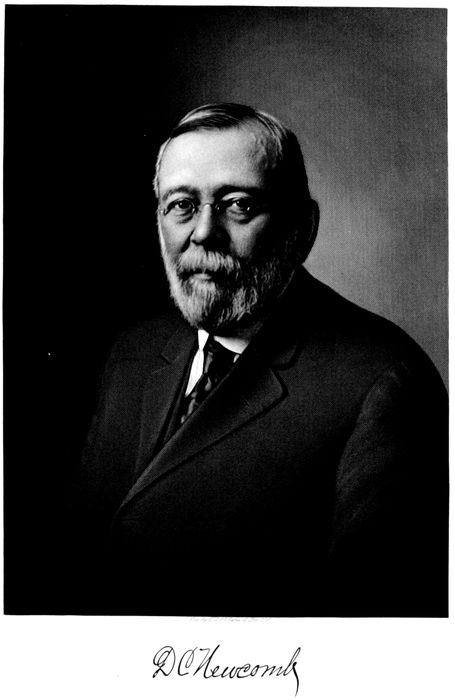
Eng. by E. G. Williams & Bro. N. Y. D. C. Newcomb
425D. C. Newcomb, a pioneer merchant of Atchison, perhaps has had as much to do with the commercial development of Atchison county for the past half century as any other man within its borders. When Mr. Newcomb came to Atchison county in 1858 it was a difficult matter to tell whether Atchison, or its rival town, Sumner, was to be the chief town of the county. Sumner was a thriving frontier town, but Mr. Newcomb picked Atchison as the winner and time has demonstrated that his judgment was sound. D. C. Newcomb was born in Washington county, Vermont, on Friday, July 13, 1836, and is a son of Hosea and Harriet (Bixby) Newcomb, the former a native of New Hampshire and the latter a native of Roxbury, Mass., born in 1805. Hosea Newcomb was born in 1803 and came from a prominent New England family of English descent. The Newcomb family was founded in New England in 1635 by Francis Newcomb and his wife, who came from England and located in New England at that time. It is recorded that they made the voyage on a sailing vessel named “Planter.” Hosea Newcomb, the father of D. C., was prominent in the affairs of his native town, Waitsfield, Vt., where he remained until 1859, when he came to Kansas, settling at the new town of Sumner, now extinct, in Atchison county. He took an active part in the early-day development of that promising frontier town and served as postmaster there. However, he returned to Vermont in 1873, where he died in 1889, at the age of eighty-six, and his wife passed away March 17, 1903, age ninety-seven years, eight months and one day.
426
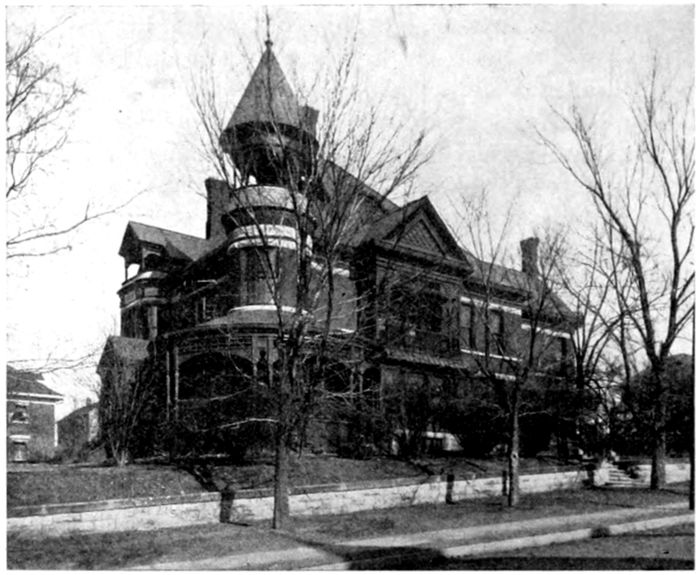
Residence of D. C. Newcomb, Atchison, Kan.
D. C. Newcomb was one of a family of five children and is now the only one living, except a sister, Mrs. Lydia M. Shephard, of Minneapolis. A brother, Dan J. Newcomb, was a very early settler in Atchison county, coming here some time before D. C. arrived. He was prominent in the organization of Atchison county and was the first register of deeds of the county, D. C. serving as his deputy. D. C. Newcomb was reared in the town of Waitsfield, Vt., where he attended the public schools and later was a student at Newbury Seminary. In early life he clerked in a store at Johnson, Vt., and also clerked for a time in Montpelier, Vt. In 1858 he came to Atchison county and first landed at Sumner, but immediately went to Atchison, and, although the latter town was also in its early stages of development, the location impressed Mr. Newcomb so favorably that he determined to locate there. Soon after coming here he was appointed deputy register of deeds and served in that capacity for three years. He then engaged in clerking in a store, and in 1864 entered into partnership with Samuel Gard, who had been a fellow clerk of his, and they organized the firm of Gard & Newcomb and engaged in the mercantile business. Their capital was limited, perhaps less than $2,500, but they were two industrious young men and had a reputation for honesty and square dealing, which was an important asset. Mr. Newcomb went to New York and bought a stock of goods valued at about $15,000, mostly on credit, and at the end of the first year they had paid for every dollar’s worth of goods which they had bought in the meantime and had a stock of about $15,000 worth on hand. The partnership arrangement continued about four years, when Mr. Newcomb purchased his partner’s interest, who desired to dispose of his business on account of failing health. Mr. Newcomb continued in business alone and conducted the great Newcomb department store, the business of which developed far beyond his most fanciful dreams. Mr. Newcomb continued in the mercantile business until 1905, and for years was the 427leading merchant of Atchison. He sold his business to Ed Lake, who has conducted it since 1905.
Mr. Newcomb has not only been a merchant prince in northeastern Kansas, but has been identified with the growth and development of Atchison from many standpoints. He was one of the organizers of the First National Bank and was closely identified with that financial institution for fifteen years. He served successively as director, vice-president and president, but when he went out of business he disposed of his banking interests.
Mr. Newcomb was united in marriage in 1866 with Miss Anna E., daughter of Capt. George W. Bowman, an early-day steamboat captain, but later engaged in the mercantile business at Atchison. He was a native of Brownsville, Pa. To Mr. and Mrs. Newcomb have been born two children: Hattie May, now the wife of Maj. Harry A. Smith, U. S. A., a graduate of West Point Military Academy. During the Spanish-American war he held the rank of major in the Twenty-first regiment, Kansas infantry, and is now major in the Twenty-eighth regiment, United States infantry, doing duty on the Mexican border. To Major Smith and wife have been born two children: Newcomb, a cadet in the United States Military Academy, West Point, N. Y., and William A., a graduate of Shattick’s school, Fairibault, Minn., now a student in the University of Minnesota. George Edgar, the youngest child born to Mr. and Mrs. Newcomb, born March 19, 1869, died March 25, 1909, aged forty years. He was married in October, 1895, to Miss Dorothy Jones, a native of Wisconsin, and three children were born to this union: Clara Forest, D. C., and Charles Jones. Mr. Newcomb has been a life-long Republican and has always supported the policies and principles of that party. He has had many flattering inducements to enter politics, but has refused to accept, preferring to follow his commercial career in which he has been so successful. Mr. and Mrs. Newcomb are members of the Methodist Episcopal church, and for years have been active in the work of their congregation and both have lived exemplary Christian lives. Mr. Newcomb has held every office within the gift of the church, all of which have come to him without solicitation. In fact, every preferment has come to him unsolicited. In 1896 and 1900 he was elected a lay delegate to the general conference of the Methodist Episcopal church held at Omaha in 1896 and Chicago in 1901.
WILSON R. SMITH.
Wilson R. Smith, of the firm of Snyder, Smith & Company, Effingham, Kan., is an admirable type of a successful business man who has been a resident of Effingham for the past six years, and has so identified himself with 428the life of the community that it seems to the average citizen that Mr. Smith has been a resident of the city and county all of his natural life. The firm, of which he is an active member, handles hardware, implements, grain, coal and feed, and is composed of G. M. Snyder, W. R. Smith and U. B. Sharpless, present county treasurer. This firm was organized in February of 1915 and took over the business of Sharpless & Snyder. The concern also operates a grain elevator of 10,000 bushel capacity, and has two large warehouses and coal-yards, in addition to the business room on Main street.
Mr. Smith is a Virginian by birth, and was born at Salt Sulphur Springs, Monroe county, W. Va., on April 28, 1856. He is a son of Granville and Caroline (Clark) Smith, both of whom were born and reared in Virginia, and were descended from colonial ancestors. A direct ancestor of Wilson R. was the first settled in Monroe county, and headed a long line of tillers of the soil, the parents of Wilson R. living on their farm in Virginia until their deaths.
Wilson R. left his ancestral home in Virginia in April of 1884 and journeyed to the town of Craig, Holt county, Missouri, purchasing a farm in the neighborhood of Mounty City, which he cultivated with considerable success for ten years, and then engaged in the grain and stock business for a period of nine years. He resided in Holt county until 1909 and then came to Effingham, Kan. His first venture here was in the grain and elevator business, which he conducted for a period of four years, and then sold out to the Farmers’ Elevator Company. In February of 1915, he purchased an interest in the business in which he is now engaged. Continuous success has followed Mr. Smith’s efforts, and practically every business venture in which he has embarked has proved to be uniformly successful. His methods of transacting business are above reproach and are such as to commend him to the public in general.
He was married in 1885 to Mrs. Celia C. Zachary, a widow, who was the mother of one child, Edith Belle, by a former marriage. Two children have blessed this marriage: Alberta, wife of Ross Meador, living on a farm, five miles southwest of Effingham; Jennie, wife of C. A. Hawk, residing three miles north of Effingham on a farm.
Mr. Smith is a stanch Republican in his political affiliations, and is a member of the Modern Woodmen and the Brotherhood of American Yeoman. He is one of Effingham’s substantial and enterprising citizens, who is ever ready to assist his adopted community to better the conditions of things in general and readily lends a hand when needed to assist the growth and well being of the city.
429
GEORGE E. HENDEE.
Mr. Hendee is an automobile salesman, machinist and garage proprietor, is one of Atchison’s hustling business men who has made good in the automobile business. Seven years in the motor industry in Atchison has seen him advance in his chosen work until he now owns the largest and best equipped garage in the city, and has a plant including equipment and cars in stock valued at over $15,000. Mr. Hendee is salesman for the Regal, Chalmers and the White automobiles.
He was born on a farm in Lancaster county, Nebraska, July 31, 1872, being a son of George and Loretta (Kistler) Hendee, who were the parents of five children: William, deceased; Mrs. Margaret Bennethy, of Logansport, Ind.; George E.; Delbert, of Logansport, Ind., and Leona, at home with her parents. George Hendee, Sr., was born in Canada, in 1846, removing from his native country to Indiana with his parents when a boy. He was reared to young manhood in Indiana and served as a soldier in Company G, Twenty-first regiment, Indiana infantry, until the close of the war, in 1865. After the Civil war he migrated to Lancaster county, Nebraska, and homesteaded on 160 acres of Government land. He built up a splendid farm from the raw and unbroken prairie and prospered as he deserved, living on his acreage until 1891, at which time he started a general store at Panama, Neb. He retired from active pursuits in 1898 and moved to Royal Center, Ind., where he is now living. The Hendee family is of French origin, and the founders of the family first settled in the Dominion of Canada. The mother of George E. was born in Pennsylvania in 1842, a daughter of Pennsylvania Dutch parents.
He of whom this review is written was reared on the Nebraska farm and received his elementary schooling at Panama and York, that State. Early in life he displayed an aptitude for machinery and determined to fit himself to become an expert machinist. Accordingly, in 1895, he enrolled as student in the State University at Lawrence, and pursued the machinist’s course, having previously studied electrical engineering at York, Neb. When thirteen years of age, George started out to make his own way, educate himself and at the same time earn his living. While a student in the York Technical School, he worked nights in the electric light plant. For a period of three years he was a fireman on the Chicago, Burlington & Quincy railroad and the Santa Fe System, being promoted to the post of railway engineer while in the employ of the latter system, He was then employed by the General Electric Company, of Chicago, in the installation of and erecting mining machinery. 430his duties requiring him to travel in the South for over a year. He was employed by the Chalmers company for one year erecting heavy engines, and was employed as engineer of the Pearsons’ Flouring Mills at Lawrence, Kan., for seven years. For a time he served as master mechanic at the Leavenworth coal shaft on the Government grounds at Leavenworth, Kan. In the year 1901 he built and operated a machine shop at Cripple Creek, Colo., but his plant was destroyed by fire in 1902. He then moved to Grand Junction, Colo., where he worked in the oil fields and was round house foreman for the railroads in that city until he resigned his position and located in Denver, Colo., where he worked as a machinist in the Missouri Pacific shops until he took employment as engineer on the Colorado & Southern railway. After this he was employed as a machinist in the shops of the Santa Fe railroad, but resigned this place to become foreman in the plant of the Locomotive Finished Material Foundry in Atchison. Following this he was chief engineer for the Blair Milling Company, resigning to take employment as an expert machinist with the Atchison Motor Company until 1908. In that year he engaged in business, and has made a name for himself in the motor and business world of Atchison. Mr. Hendee is looked upon as one of the rising and successful young business men of Atchison, and justly deserves all of the success which has come to him.
His marriage with Laura Hall, of Lawrence, Kan., occurred in 1902 and gave him a faithful helpmate who has assisted him in every way to achieve his present success. Two children were born of this marriage, Velva and Kenneth, both deceased. Mrs. Hendee was born in August, 1879, in Wisconsin, a daughter of John and Nettie (Crow) Hall, natives of Wisconsin. She is a well educated lady and is a graduate of the college at Burlington, Kan. Mr. Hendee is an independent in political affairs, and is fraternally allied with the Ancient Free and Accepted Masons, Independent Order of Odd Fellows, and the Modern Woodmen of America.
WILLIAM D. KISTLER.
William D. Kistler, prosperous farmer of Shannon township, is descendant of good old Pennsylvania Dutch stock, and has lived in Atchison county for thirty-six years. He came to this county from his ancestral home in Pennsylvania, in moderate circumstances, if not actually a poor man, and during that time has accumulated a fine farm of 200 acres which ranks among the best and most productive farms of the county. The little shack 431in which he and his family lived when they first came to Kansas has been superseded by a handsome and comfortable residence and great shade trees have grown up around it. The modest “eighty” in which Mr. Kistler invested all of his small capital on his arrival here has grown steadily with substantial additions from time to time as he was enabled to purchase adjoining tracts. A large red barn alike shows evidence of thrift and good management on the part of the proprietor.
W. D. Kistler was born in Lehigh county, Pennsylvania, December 5, 1853, a son of Nathan J. and Catharine (Dietrich) Kistler, both of whom were born in the adjoining county near Lehigh county. Nathan J. Kistler was born April 6, 1811, and died September 11, 1878. He was a son of Jacob S., who was a son of Samuel Kistler, whose father, John George Kistler, emigrated with his wife, Dorothia, from Germany and settled in Pennsylvania early in the eighteenth century, arriving in Philadelphia October 5, 1737. Nathan J. Kistler was a captain of State militia and died at the old home in Lehigh county. Two brothers of W. D. and a sister out of a family of nine children settled in the West. After his public school training Mr. Kistler attended the Kutztown, Pennsylvania, Normal School and prepared himself for the teaching profession. He taught school in his native State for four years, after which he clerked in a general store for four years, previous to migrating to Kansas. He left the old home in Pennsylvania in 1879 and came to Atchison county, Kansas, investing in an eighty-acre tract in Shannon township which he gradually improved. The small house which he first erected was gradually enlarged as the needs of his family demanded more room and his means permitted. In 1883 he erected the present handsome home, which is one of the most attractive places in the township. Mr. Kistler raises cattle, horses and hogs and feeds his grain products to the live stock on his farm, thus managing to keep up the fertility of his acres and being able to market his farm products in the most profitable manner.
He was married in 1876 to Ellen Brobst, who was born in Lehigh county, Pennsylvania, in 1853, a daughter of Daniel and Lydia (Kunken) Brobst, of Lehigh county, and whose ancestry came from Germany. They are the parents of five children: Mrs. Alice Bunnell, of Lancaster township, this county: Anna, wife of Samuel Du Bois, also of Shannon township; Calvin, a farmer, residing at the Du Bois home, and assisting in the management of the farm; Bertha, wife of James Dooley, residing in Shannon township; William, at home, married Catharine Wolters.
Mr. Kistler is a Republican in politics, but he has never been an office 432seeker, or sought preferment at the hands of his fellow citizens. He is affiliated with the Ancient Order of United Workmen. He and the members of his family stand well among their neighbors and are highly esteemed by all who know them.
ANDREW KEITHLINE.
The late Andrew Keithline enjoyed the distinction of being one of the oldest, if not the oldest living pioneer resident of Atchison. Fifty-six years of his four score and seven years of life were spent in Atchison and vicinity. In the fulness of his years, and satisfied in the reflections concerning a long and useful life well spent he lived a quiet, retired life in his comfortable home at 1121 Santa Fe street until the Death Angel called him. He loved to meet his many friends and speak reminiscently of the days when Atchison was in the embryo stage, and of the stirring scenes during the days when Kansas was in the throes of becoming an integral part of the great American Union. He was one of the city’s grand old men who was universally loved and respected by all who knew him. He came of that sturdy Pennsylvania German stock, noted the country over for their sterling qualities of endurance and the ability to do their share in the transformation of a wilderness to a land of homes and plenty.
Andrew Keithline was born on a farm in Luzerne county, Pennsylvania, a son of John and Mary (Neyhart) Keithline. The first Keithline to come to America was Colonel Keithline, who figures prominently in Revolutionary annals and who accompanied Baron De Kalb to this country in 1775. Andrew Keithline’s grandfather, Joseph Keithline, was born in Northhampton county, Pennsylvania, served in the War of 1812, and died in 1850. He was a tailor by trade and contracted to make buckskin breeches for the Government, to be worn by the soldiers during the war. Joseph’s children wore buckskin breeches made by their father. John Keithline, the father of Andrew, operated a wagon shop which also served as the family residence for some years, in fact, Andrew was born in his father’s wagon shop. He prospered, in the course of time and came west in 1863 and invested in eighty acres of land, south of Atchison and later owned 320 acres west of Atchison on the Parallel road. This tract was partly fenced at the time of purchase and cost John Keithline $25 per acre. He made his home thereon and was joined by his family in 1864. The mother of Andrew died in 1865 and John returned to the old home in Pennsylvania where he died in 1868. Nine children were born to John Keithline and wife: Samuel, Catharine, Andrew, Julia, Sarah, Priscilla, John, Peter and Mary E. Of these, Samuel, Sarah and Andrew came to Atchison county.
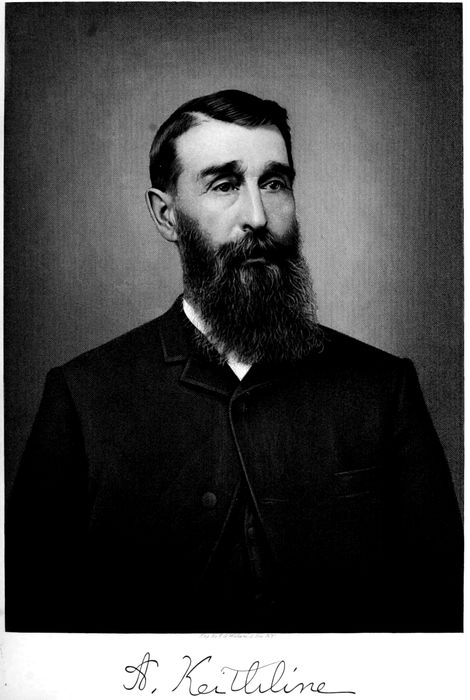
A. Keithline
433Andrew left the parental home in December of 1857, and went to Michigan, remaining until 1859, when he came to Atchison, where he resided until the fall of 1864. His first employment was with the firm of Walters & Roswell, who conducted a general store and wanted a clerk familiar with the German tongue. For the two years previous to his locating in Atchison he conducted a coöperative store in Michigan. His first trip to the Far West was taken in 1860, when he went to Denver and disposed of a stock of goods for his firm. He made another trip across the plains later than this. In 1864 he was called out with the Kansas State militia to repel the Price invasion. On October 31, 1864, he moved to his farm west of Atchison, and remained there tilling his acreage until September 1, 1898, and made his permanent home in Atchison until his death. His fine farm consisted originally of 220 acres and when he removed to Atchison he still owned 190 acres of the original farm. Mr. Keithline bought a handsome brick residence on Santa Fe street and by wise investments and carefully husbanding his resources accumulated a comfortable competence for the support of his declining years. He was considered a well-to-do citizen. He was married on November 5, 1854, to Rose Varner, born in 1832 in Luzerne county, Pennsylvania, a daughter of George Varner, whose father was a soldier in the Revolution. Two children were born to this well respected couple, namely: Gilbert, born in 1855, died in Jackson county in the spring of 1915. He was the father of seven children, Herschell, Sydney, Rose, Emma, Mary, Andrew and Laura. Mrs. Cora Warters, a daughter of Mr. Keithline, lives in Atchison. She is the mother of four children: Bessie, Andrew, Cora Willis and Lorene.
Mr. Keithline was one of the original Free State men of Kansas, and was induced to come here by the fact that men in favor of making Kansas a free State were needed in the Territory. He consistently espoused the principles of the Republican party, taking an active part in politics during his younger days and served for two years as justice of the peace. One of the bright spots in his memory of bygone days was his warm friendship for Senator John J. Ingalls, which friendship was reciprocated by the illustrious senator. He always adhered to the Lutheran religious denomination, which was the faith of his fathers. The evening of life must come to us all and happy is the man who can calmly wait for the last call to summon him to his just reward in the world to come, at peace with all mankind and cared for by capable hands; 434such was the life of this fine old gentleman of whom it has been a pleasure to write this brief review.
Andrew Keithline departed this life December 14, 1915. The end came peacefully, as he had wished. The worn-out body of this grand old patriarch ceased to be able to hold the immortal soul of one of the grandest and best loved men of the early pioneer days of Atchison county. Mr. Keithline was a good and honest citizen whose upright and sturdy character will long prove an inspiration and guidance for the present and future generations of Kansans who may peruse these pages. He was a prominent factor in the building up of Atchison county, and was intimate with the great men of his day and generation. When his time came and the Angel of Death called him to the long rest he was content to go and had no regrets. Death had no terrors for him as his life was unspotted and clean, and in keeping with the attributes of the man himself.
ABRAM STEVER.
Abram Stever, one of the early settlers of Benton township, Atchison county, and now deceased, was born November 3, 1837, and departed this life on July 27, 1881. He was born in Schoharie county, New York, a son of Abram and Nancy Stever, both of whom were born and reared in New York State, the father being a son of German parents, who were founders of the family in this country. Two brothers emigrated from Germany, one of whom settled in New York and the other made his home in Ohio. Abram was reared to young manhood in his native State and when twenty years of age migrated to the new State of Wisconsin, then in process of settlement. He became a farmer in Walworth county and cleared a home from the timber. Five years later he was married, and in 1867 came to Kansas, driving his movable possessions across the country, his wife and children coming by train to St. Joseph, Mo., where they crossed the Missouri river by ferry. The first location of the family was in Brown county, Kansas, where they lived until 1874 and then came to Atchison county, where Mr. Stever purchased 160 acres of wild prairie land in Benton township, one and three-fourths miles northwest of Effingham. He improved his farm, erected a good home and beautified the premises with fine shade trees and shrubbery. After his demise in 1881, Mrs. Stever made her home on the farm until 1893, when she removed to Effingham, and has since resided 435here, with the exception of a few years’ residence in Mankato, Jewell county, Kansas, with her daughter, maintaining a permanent home in Effingham.
Abram Stever was married December 24, 1862, to Sarah Elecia Bailey, of Walworth county, Wisconsin. To this union have been born the following children: Leona May, died at the age of fifteen years; Jennie Bailey, died at the age of thirteen; Joseph Warren, died when twenty-two years old; Arthur Carlton, a clothing merchant at Wetmore, Kan., who married Maud Hawk, of Effingham, and they have one daughter, Leona May; Carrie Adella Stever, at home with her mother, a graduate of the county high school, and taught for seven years in the Effingham schools, and is a specialist in music, having graduated from Bethany Conservatory at Lindsborg, Kan., in 1906. She pursued a post-graduate course at Lindsborg during winter vacation, and studied during one winter under William H. Sherwood, America’s greatest pianist. She was for five years a successful teacher of music at Mankato, Kan. Returning to Effingham in 1911, she became music director in the Atchison County High School, but resigned to take up studio work entirely; Ray Howard, conducting a suitatorium at Frankfort, Kan., married Inez McFarlan; Ralph Roy Stever, a teamster at Nevada, Mo., married Treva Spell, and has had four children: Lloyd Orr, Warren Clayton, Ralph Vern, Lola Esther, deceased; Ernest Clayton, a graduate of the county high school, proprietor of a suitatorium at Macon, Mo., married Charlotte Henderson, and has one child, Roy Estell; Frank Abram Stever, county high school graduate, located on the family estate in Benton township, married Daisy McFarlan, and is the father of three children: Coral Nadine, Geneva Fay, and Mildred Lorene. Mrs. Stever was born January 10, 1843, on a farm in Walworth county, Wisconsin, a daughter of Joseph and Sarah (Perry) Bailey, natives of Maryland and Dundee, Ill., respectively. An uncle, Amos Bailey, was one of the first surveyors in the city of Chicago, and run the first line in what is now the city. Joseph Bailey was one of the first settlers in Walworth county, Wisconsin, at a time when there were very few people in the State and neighbors were twelve miles distant from one another. It was a common custom for a number of settlers to band together and market their produce together in the city of Chicago. Amos Bailey was the owner of several sections of land near Lake Geneva, Wis., which is now the great millionaires’ resort, near Chicago. Joseph Bailey was twice married, his second wife being Mary Catharine Sipperly. It is also worth recording that a brother of Abram Stever, named Washington Stever, was a soldier in the Union army and fought in the Army of the Potomac from the beginning to the end of the war. At the time of Mr. 436Stever’s death, the oldest son was only thirteen years of age, and Mrs. Stever was left with a large family, the youngest of whom was six months old.
Abram Stever was a Republican in his political affiliations, but will best be remembered for his activity in behalf of the organization of the Presbyterian church in Effingham. He was one of three men who raised the fund to pay for the building of the First Presbyterian Church erected in Effingham, and was a deacon and trustee, having been one of the only two deacons ever installed in the early church. He was active in church work during his entire life and was a thoroughly honest, religious gentleman, who carried his belief into his daily life and in all his undertakings. He was a good husband, a kind parent and an excellent citizen, and loved by everyone who knew him.
REV. Z. S. HASTINGS.
Few pioneer citizens of Atchison county have lived more useful or cleaner lives than Rev. Z. S. Hastings, retired minister and farmer, of Effingham, Kan. During his nearly fifty years of residence in Kansas as a farmer, educator, preacher, and statesman, he has worked continually for the well-being of his neighbors and friends. Without fear of contradiction it can be stated that Rev. Hastings has performed a greater number of marriage ceremonies and officiated at the funerals of more deceased residents than any minister in Atchison county. Despite his three score and seventeen years this grand old patriarch bears his age lightly and takes an active interest in the affairs of his community.
Rev. Z. S. Hastings was born March 15, 1838, on a farm near Bedford, Lawrence county, Indiana, a son of Howell and Edith (Edwards) Hastings, natives of North Carolina. On his father’s side the family is of Quaker origin and a very old one in America. The first Hastings having been a follower of William Penn, came from England to settle in the Quaker colony in Pennsylvania. A descendant of the first American Hastings, Joshua by name, migrated to North Carolina and there founded another branch of the family. Here in the Southland, Howell Hastings was reared and married, and with his wife and two sons migrated to Indiana to become one of the pioneer settlers of the Hoosier State. He died at his home in Indiana December 25, 1854, leaving seven children: Joshua Thomas, deceased; William Henry, John Arthur, Nancy Elizabeth, deceased; Zachariah Simpson, with whom this review is concerned; Charlotte Ann, deceased; Rufus Wiley, living 437in Arkansas. Of the foregoing, Joshua Thomas and William Henry fought in the Union army during the late rebellion of the Southern States; Joshua first fought in the Home Guards of Missouri, and, returning to Indiana he raised a company for service in the war, after fighting under General Lyons at the battle of Springfield. He taught school for a time in Missouri, but returned to Indiana. He died in Kentucky. William Henry enlisted in a Missouri regiment.
Z. S. Hastings was educated in the common schools of his native State, studied in Indianapolis, and also pursued a course at Hiram College, in preparation for the Christian ministry. In 1857 he went to Missouri and taught school for five years, studying in the meantime while teaching. In 1862 he returned to his native State and began preaching the Gospel in the Christian denomination. He taught and preached at the same time while preparing himself further for the ministry. His first experience in the ministry was obtained in 1860 while in Missouri. In 1867 Mr. Hastings came to Kansas, resided in Leavenworth county for one year and in 1868 came to Atchison county and located on a farm near Farmington. He taught the Farmington school for five years and preached in the vicinity of his home during this time. He cultivated his farm of 130 acres and preached at the Farmington church and in the surrounding country for a period of twenty-five years. In 1895 he removed to Effingham and continued preaching until 1903 when he retired from active work in the ministry. Mr. Hastings was an excellent farmer as well as minister and made a success of his farming operations, having the distinction of selling an eighty acre tract of farm land, the first for $100 an acre ever sold in the county up to that time. This farm was located east of Effingham, and was the first tract near the town to bring the price of $100 an acre.
He was married on June 28, 1870, to Miss Rosetta Butler, and to this union have been born seven children: Harry Howell, an electrical engineer, located at St. Louis, and who was educated in Holton College and Kansas University; Paul Pardee, assistant freight and passenger agent of the Santa Fe railroad, with headquarters at San Francisco; Otho Ono, a graduate of the Atchison county high school, taught school for ten years, served as county superintendent of Atchison county four years, and graduated from the Atchison Business College, and is at present bookkeeper for Urich’s planing mill at Independence, Kan.; Wiley Wyatt died in infancy; Clara Charlotte, deceased, formerly a teacher, wife of Charles Sprong, of Potter, Kan.; Edith Eliza, deceased, who was also a public school teacher; Milo Milton, a journalist and author, of New York City. Milo graduated 438from the Atchison county high school, the State Agricultural College at Manhattan, and pursued a post-graduate course in the State university. The mother of these children was born August 5, 1844, in Sandusky Plain, Ohio, a daughter of the Rev. Pardee Butler, a famous figure in Kansas history, and who was an outspoken advocate of the anti-slavery principles during the struggle which made Kansas a free State. He was so frank and fearless in the expression of his views and so strenuous in the support of the anti-slavery doctrine that his utterances brought him frequently in contact with the pro-slavery men and border ruffians, and on one occasion when in Atchison he was captured by ruffians and sent down the Missouri river on a raft. Complete details of the life and activities of Pardee Butler are given in another chapter in this volume. “Pardee Butler’s Own Book,” begun during the latter part of his life, and finished and published by Mrs. Hastings, tells of his life and adventures in Kansas. Speaking biographically, Mr. Butler was born March 9, 1816, and died October 20, 1888. He first saw the light of day at Skaneateles, N. Y., and immigrated with his parents, Phineas Butler and wife, who came to Ohio in 1818. Phineas Butler was born in New York State. Pardee Butler was reared to young manhood in Ohio and there married Sybil Carlton, of Sullivan, Ohio, who was born July 4, 1823, and died August 7, 1898. She was a daughter of Joseph Carlton, a native of Massachusetts, who immigrated to Ohio in an early day. In his boyhood, Pardee herded sheep on Sandusky Plain, and after his father’s death resided in Sullivan, Ohio. In 1850 he removed to Iowa and settled on a farm in Cedar county, where he lived for five years. While a resident of Iowa he preached in Illinois for two years. In May of 1855 he set out for Atchison county, Kansas, on horseback and settled on a farm at Farmington. For many years he served as a Christian minister and conducted farming operations. He had a remarkably retentive memory, which enabled him to memorize the whole of the New Testament while herding sheep in Ohio. Rev. Butler was the first State evangelist of the Christian denomination to visit Iowa and was also the first State evangelist to take up the work of his church in Kansas. Practically all of his traveling while engaged in missionary work was accomplished on horseback. Night coming on he would picket his horse in a grassy spot and use his saddle for a pillow. Pardee Butler was one of the notable figures in the history of Kansas, and will be remembered as long as history endures, as a brave, useful and faithful patriot, and minister, whose life was full of good deeds and who always stood for the right. He was the father of seven 439children: Mrs. Rosetta Hastings, Clara Louise, Eugene Pardee, Maria Corintha, all of whom died in infancy; Charles Pardee on the home farm; Ernest, died in infancy; George, living at White City, Kan.
Rev. Hastings has always been a steadfast advocate of prohibition, but has generally allied himself politically with the Republican party principles. In 1876 he was selected by the Republican party in the county as their candidate for the legislature, although at the time he was an avowed Prohibitionist, and was elected, serving in the Kansas legislature during the ensuing session. For eighteen years he served as a member of the school board in his home district, and was for six years a member of the Atchison County High School Board. He believes in education for the young to the fullest and is heart and soul in favor of giving young men and women every opportunity to acquire a higher education, as is attested by the splendid training which he was enabled to give each of his own offspring. Rev. Hastings has baptized hundreds of converts during his ministerial career and started them onward in the better life. His whole life has been dedicated for good.
KNUD G. GIGSTAD.
Knud G. Gigstad, farmer and breeder of fine cattle, was born in Norway September 28, 1856, and is a son of Gulick and Anna Gigstad. He was one of seven children one of whom is now dead. Four of the boys and one daughter are living in the United States. The father was a native of Norway and spent his life in that country.
Knud G. Gigstad left Norway at the age of twenty to try his luck in America. He came without funds and went to work as a farm hand in Brown county, Kansas. He remained at that place two years and then rented 160 acres from his uncle, Benedict Mutson. This was a profitable venture and before long he was able to buy eighty acres of unimproved land in section 28, Lancaster township, Atchison county, for which he paid $16.25 an acre. Mr. Gigstad worked hard to get his farm in workable shape, each year finding him a little more prosperous, and finally he added 320 acres to the farm, besides 436 acres of rice land in Liberty county, near Houston, Texas. Eighteen years ago he built a large house on the farm and has since erected a large barn and other substantial buildings. Mr. Gigstad is a breeder of Shorthorn cattle and has made exhibits at the American Royal stock show in Kansas City, Mo., and in 1913 was awarded the prize as grand champion of 440America on his Shorthorns. This is a high honor and is ample testimony of the quality of Mr. Gigstad’s stock. He is an extensive shipper to all parts of the United States. His reputation as a breeder is firmly established among cattle men all over the country. He is almost sure of one or two first prizes whenever he enters his cattle in a fair. Mr. Gigstad also has a fine three acre orchard. He is a hard working man and has succeeded despite great handicaps, and his financial success has not caused him to neglect the welfare of his county, as he has always been active in supporting measures for the good of Atchison county.
He is married to Lena Olsen, a native of Atchison county, and a daughter of Herrol and Julia Olsen. She was born in 1866. Her parents are natives of Norway and her father was an early settler of Atchison county. Mr. and Mrs. Gigstad have eleven children: Anna Flattre, of Lancaster township; Mrs. Julia Henz, of Lancaster, Kan.; Harry, Clara, Gena, Gilbert, Matilda, Lillian, Gladis, Carl, Charles, all living at home. Mr. Gigstad is a Republican and a member of the Lutheran church.
ALBERT BARNES HARVEY.
The memory of a good and noble man lingers long after his demise in the hearts and minds of those who knew him best. The late Albert Barnes Harvey, of Muscotah, Kan., during the course of a long and notable career, covering ever forty years in Atchison county, accomplished much in a material sense and left behind him an unimpeachable record for integrity and upright living which will long endear his memory to his former mortal associates. He lived in the days when men were more closely drawn together in the great struggle to create a State from a wilderness of prairie and unpeopled waste, and did his part in the development of his adopted county, of which he was one of the real pioneers. Soldier, farmer, banker and religious worker who lived true to his ideals as a man and citizen, he walked with the leaders of the great State which he assisted in upbuilding.
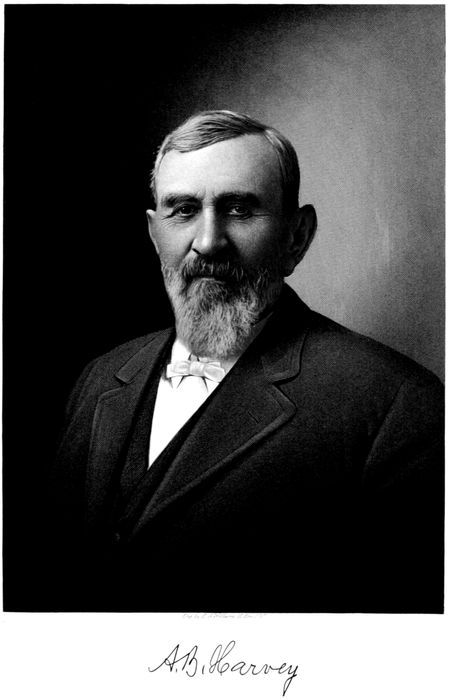
Eng. by E. G. Williams & Bro. N. Y. A. B. Harvey
441Albert Barnes Harvey was born May 12, 1841, at Williamsport, Pa., a son of Samuel and Margaret Harvey. His parents went from their native State to Illinois in the early days of the settlement of that State, developing a fine farm in Henderson county, Illinois. Samuel Harvey prospered in the State of his adoption, reared a fine family, and in his later days retired to a comfortable home in Monmouth, Ill., removing to the city for the purpose primarily, of giving his children the advantages afforded there for obtaining a good school education. He died at the home of his son in Henderson county after a long and useful life. The subject of this review, Albert Barnes, when a young man twenty years of age, hearkened to the first call of President Lincoln for troops with which to quell the rebellion of the Southern States and enlisted in Company G, Tenth infantry, regiment of Illinois volunteers, and served faithfully throughout the Civil war. He was engaged with his regiment in many great battles, such as Corinth, Island Number Ten, Missionary Ridge, Lookout Mountain, Chickamauga, Siege of Vicksburg, and Capture of Atlanta, and took part in Sherman’s famous march from Atlanta to the sea and the subsequent taking of Savannah. He marched in the Grand Review at Washington, D. C., and was mustered out of the service July 12, 1865. He then returned home and engaged in the peaceful pursuit of farming until 1874, when he came to Kansas and settled on a farm southwest of Muscotah. This farm was only partially improved at the time of his purchase and he improved and cultivated it until 1880, at which time he came to Muscotah and engaged in the hardware business in partnership with A. J. Harwi; later he was in partnership with F. S. Roberts, who was succeeded by W. C. Allison. In 1890 he became associated with J. H. Calvert in the banking business at Muscotah, he and his partner purchasing the bank founded by George Storch and changing the name to the Muscotah Exchange Bank. This bank was later changed to the Muscotah State Bank and is one of the thriving financial concerns of Atchison county, now incorporated with the Farmers State Bank. Mr. Harvey was in the banking business for twenty years and served as president of the Muscotah State Bank, and was successful in his business ventures to such an extent that he became one of the wealthy citizens of the county. During his later years he and Mrs. Harvey enjoyed traveling about the country, the condition of his health becoming such that it was practically necessary for him to spend his winters in the Southland. He and Mrs. Harvey spent many happy days in visiting the battlefields of the South over which his regiment had fought and they enjoyed life to the utmost during those later years.
Mr. Harvey was married October 25, 1871, at Stronghurst, Ill., to Miss Viola Allison, who was born October 25, 1841, in Washington county, Pennsylvania, a daughter of John and Margaret (Carter) Allison. John Allison was born in Pennsylvania and was a second cousin of President William McKinley, whose mother was an Allison. Margaret Carter Allison was born in Scotland and accompanied her parents to this country when twelve years of age, where they settled in Henderson county, Illinois. Both of Mrs. 442Harvey’s parents died in Illinois, and a brother, John C, who enlisted in the Union army at the age of seventeen years, died at Ft. Donelson. An older brother, Hugh, also served in the Union army, and a half brother, W. C. Allison, now of Horton, resided in Muscotah for many years and was one of the pioneer business men of the city. The Allison family is a very old and numerous one of Scotch descent. No children came to bless this happy wedded life of Albert H. and Viola Harvey, but they reared two adopted daughters, who are now established in comfortable homes of their own, namely: Lela, wife of A. P. Bishop, of Topeka, now a farmer living southwest of Muscotah, and Lula, wife of E. H. Purdy, of Kansas City, Mo. Mrs. Bishop has four children: Albert, George, Dorothy and Ruth. Mrs. Harvey spends the spring and summer seasons in her beautiful residence in Muscotah and invariably travels in the South during the winter. Mr. Harvey retired from active banking pursuits in 1910.
Mr. Harvey was a member of the Congregational church at Muscotah and served as deacon of the church from 1898 until his demise, on Monday, July 22, 1912. For many years he was superintendent of the Sunday school and was very fond of young people, nothing giving him more pleasure than to gather about him a group of intelligent young folks with whom he was always at his best. He took a keen interest in church and Sunday school work and endeavored to follow the precepts of the Greatest of All Teachers during all the days of his long and useful life. He was prominent in Masonic and Odd Fellows lodge circles and served as worshipful master of the Muscotah Masons on two occasions. He was a member of the Grand Army of the Republic. He was a Republican in politics and took a keen interest in the political and civic affairs of Atchison county, serving three terms as a member of the Atchison County High School board and a term as mayor of his home city. Many of the distinguished men of Atchison and the State of Kansas were his personal friends, among them being the late Governor George W. Glick, with whom he spent a winter in Florida, Ex-Governor W. J. Bailey, and the late Judge Horace M. Jackson, of Atchison. He was, withal, a home and church man above everything else. He loved his home and his family and was hospitable to the core of his being, always ready to entertain friends or even strangers at his board, jolly and big-hearted, always.
MARTIN KLEIN.
Martin Klein, living a retired life in the town of Potter, Atchison county, Kansas, at the advanced age of four score and two years, is one of the oldest of the Kansas pioneers, who for over sixty-one years of his long life has 443lived in the Sunflower State, and has seen the steam railway take the place of the overland freight trains, hauled by oxen and mules, and has witnessed the automobile superseding the farm wagon and horse and buggy as a means of transportation. On his lonely claim in the north part of Leavenworth county, near Potter, he could see the great trains passing along the Ft. Riley road from Leavenworth to Salt Lake; he remembers the dread visitation of the grasshoppers in the seventies, when the “hoppers” came in dense clouds, ate up all the growing crops and left devastation and desolation in their wake. Martin Klein is one of the best known of the old-timers in this section of Kansas and took an active part in the slavery contest which was bitterly waged on Kansas soil, and nearly gave his life in defense of his principles, later to shoulder a musket in defence of his adopted country.
Martin Klein was born March 2, 1833, in Alsace-Lorraine, a son of Peter and Teresa (Miers) Klein, both of whom were born and reared in Alsace-Lorraine, and were of ancient French extraction. When Martin was fourteen years of age, his parents in 1847, left their native land and immigrated to Oneida county, New York, where they settled on a farm near Rome. The elder Klein prospered in the land of his adoption and Martin grew up imbued with American ideals, along with the other five children of the Klein family. Martin was the youngest of a family of six children born to Peter and Teresa Klein. Three brothers of Mrs. Klein, Joseph Miers, and two others, were soldiers, who served under Napoleon Bonaparte, and were members of the Grand Army of Napoleon which marched to the siege of Moscow. Two of the brothers were killed at Moscow, and Joseph was one of the few out of the many thousands of soldiers who lived to return home and tell about the ill-fated expedition which cost Napoleon his grand army.
In the fall of 1854, Martin Klein left his old home in New York and set out for Kansas, to grow up with the country. He arrived in Leavenworth on September 18 of that year, and lost no time in taking up a claim in Leavenworth county, which served as his home until 1900, when he retired to a comfortable home in the town of Potter. Six years after his arrival in Kansas he married Miss Paulina Hawley, whom he espoused on March 29, 1860. She was a daughter of Francis H. and Louise Hawley, both of whom were natives of old Virginia, and were early settlers in Kentucky, where Mrs. Klein was born November 12, 1826. She departed this life January 4, 1907, in Potter, Kan. She was a loving and faithful helpmeet to Mr. Klein for forty-seven years, and endured with him many hardships incident to the pioneer life in Kansas.
444When Mr. Klein first came to Kansas in 1854, the turmoil and the border warfare waged between the pro- and anti-slavery forces, was just beginning, and he, being a pronounced anti-slavery man, was thrown into the thick of the fight. He was an accurate marksman with the revolver, and often found occasion to make use of his ability with the pistol. He was so active in his work in behalf of the Free State party that he was marked for vengeance by border ruffians. An occasion which is memorable, and marked the savagery of this warfare, is worth recording: “On a Sunday in the spring of 1856, when Mr. Klein was at church, three strangers came to church, ostensibly to buy corn from him. After the bargain had been struck, and he had agreed to sell the men the corn wanted, they insisted on him accompanying them to Easton, Kan., in order to get his pay for the corn. This Klein refused to do. During the parley one of the men had kept a hand hid under his coat on the plea that he had a sore member. The wind blowing the coat flap to one side, Klein noticed that the man was concealing a revolver in his hand. They finally showed him a warrant for his arrest. He then knew that his life was in danger, and again refused to accompany the men to Easton. He turned to go back to the church and they opened fire on him, firing eight shots in all, four of which took effect in his body, one shot striking him in the head, one in the side, and one in the hip. He fell to the ground and the ruffians rode away, leaving him for dead. Happily, the wounds were not fatal, and he recovered, and lived to see the final triumph of the cause which he loved, and for which he had sacrificed his peace and nearly lost his life in advocating. During those early days Mr. Klein served as constable and deputy sheriff and was constantly in danger of his life. In the fall of 1856, he and others of the Free State men deemed it prudent to leave their homes and go to Lawrence, Kan., where they joined the citizen army, which was being organized in defense of Free State principles. He took part in several incipient battles and scraps with the pro-slavery advocates during those years, and when the war broke out he enrolled in the Kansas militia and fought in Captain Baird’s company when it marched to battle against General Price’s army of invasion.
Mr. Klein has a keen remembrance of his first day in Kansas, when he walked a distance of twenty-four miles from Ft. Leavenworth to find his brother-in-law, Charles C. Foster. He was all day finding Foster’s claim. Starting out without his breakfast, he lost his way, and it was 8 o’clock that night before he arrived at his destination, footsore, weary and hungry. The prairie grass in those days grew as high as a man’s head in the bottom lands, and was knee high on the uplands, and the richness of the soil was 445apparent to a man brought up on a farm. From his cabin door Mr. Klein could look out in the distance and see the old Ft. Riley trail which led from Ft. Leavenworth to Salt Lake. One morning on arising he saw eighty covered wagons standing on the trail, each of which had hitched to it six yoke of oxen. This was a sight worth seeing and entertaining to a plainsman, being an indication of the onward march of civilization as it moved ever westward. On one occasion while serving as an officer of the law, Mr. Klein was sent to the cabin of Jim Foster, a noted border desperado, to effect his arrest, but Foster was absent at the time from his home on the bluffs overlooking Big Stranger creek. After the war was over, Mr. Klein settled down to farming and peacefully tilled his acres until his retirement to Potter. He took an active and influential part in the affairs of his community, and has always been allied with the Republican party, never, however, having been a seeker after political preferment, and never held office except the post of school director in his district.
BARNEY CUMMINS.
Barney Cummins, farmer and trustee of Mt. Pleasant township, Atchison county, was born in Atchison December 17, 1859, a son of Patrick and Mary (Faulkner) Cummins, the former a native of Roscommon county, and the latter a native of County Caven, Ireland. Both came to America from their native land when young, and met, and were married in Philadelphia. After their marriage they went to Wisconsin and lived there one year and then came to Atchison, Kan. Patrick was employed on a Missouri river steamboat for a time, saved his money and moved to a farm, which he rented for about ten years, accumulating sufficient capital to then purchase a quarter section of school land in Mt. Pleasant township, the tract now known as the old Cummins homestead. Patrick Cummins succeeded in his farming venture and became prosperous as the years passed. During the Civil war he was enrolled as a member of the Kansas State militia. He was known as a Free State Democrat, and was a member of the Catholic church. He died in 1871, and the widowed mother of Barney Cummins is still living at the age of seventy-six years, on the old home farm. There were six children in the Cummins family, namely: Barney; Charles, on the home place; John, a farmer in Atchison county; Kathrine, living with her mother; Mary, wife 446of William Rogers, of Nortonville, Kan.; Sophia, wife of Thomas Cavanaugh, of St. Joseph, Mo.
Barney was about four years of age when the family removed from Atchison to the farm in Mt. Pleasant township. He received his education in the district school, near his home, and has lived on the farm all of his life, excepting one year spent in Atchison. Mr. Cummins recollects with sadness the severity of the early-day teachers as compared with the teachers of today. He recalls that he was frequently given his choice of punishments, which included either having his ears cut off, or take a sound whipping with a great gad. This badly frightened him, and he also remembers how the teacher jerked a big boy from his seat and threw him unconscious to the floor of the school room. Happily, the days of brute strength control of pupils in the schools is past, and a new and better era of kindness and forbearance has dawned, years since. Mr. Cummins is the owner of 100 acres of well improved land and is a progressive farmer.
He was married January 9, 1882, to Sarah Maylen, a daughter of Joseph and Elizabeth Maylen. The father was a native of Canada, and the mother was born in Liverpool, England, their children being a product of the intermarriage of French, English and Welsh ancestry. Joseph Maylen was a French Canadian and his wife was of Welsh and English descent. They came to Kansas in the early days and settled on a farm in Doniphan county. Four children have been born to Mr. and Mrs. Cummins: William, living at Potter, Kan.; Ella, wife of Luther Blodgett, a farmer in Atchison county; Anna, wife of Harry Linsey, living in Atchison county; Joseph, at home with his parents. Mr. and Mrs. Cummins have reared all of their children on the farm upon which they have lived continuously since their marriage.
Mr. Cummins is affiliated with the Modern Woodmen lodge of Potter, and is a member of the Catholic church. He is a Democrat of the old school, and since attaining his majority he has taken a more or less active part in political affairs. He has served several terms as trustee of Mt. Pleasant township, and it can be said of him that no man ever filled the office more capably or administered the affairs of the township to better advantage or more economically and honestly than Barney Cummins. He was first elected to the office in 1892, again in 1907, then in 1908 and again in 1912, being re-elected in 1914. As trustee, Mr. Cummins has the supervision of eight schools in his township, including the graded high school of Potter. He is a faithful and conscientious public official in whom the people impose every trust.
447
ALVA CLAPP.
Alva Clapp, president of the retail hardware company which bears his name, has been engaged in business on Commercial street in Atchison since May, 1907. At that time he purchased the retail store of a local wholesale firm, and has made a pronounced success of the venture. It is one of the most attractive and well stocked stores of the city and is well patronized. Mr. Clapp is popular with his patrons and the citizens of Atchison generally. He takes an active part in city affairs and is especially interested in the public school system. Having been a teacher before he became a merchant, he has never lost interest in the schools, and is now the president of the Atchison city board of education.
Mr. Clapp was born August 23, 1868, at Carthage, Mo. He is a son of Isaac and Susan B. (Eckler) Clapp, natives of North Carolina and Illinois, respectively. Isaac Clapp emigrated from North Carolina to Danville, Ill., when a young man, and married in his adopted State. His parents were slave owners in the southland, and he himself owned slaves, but having a pronounced distaste for the institution of slavery he disposed of his human chattels and moved to the North. After a residence of some years in Illinois, he located in Carthage, Mo., and owned a farm in Jasper county which he cultivated. In 1875 he removed to Cherryvale, Kan., and invested in a tract of land near that city. Here he resided until his death in October, 1913.
Alva Clapp received his education in the schools of Cherryvale, Kan., and began teaching school when a very young man. He taught two terms in a district school and served for two years as high school principal. He had a liking for business and obtained his first experience in the retail hardware trade in a store at Conway Springs, Kan., from 1891 to 1900, or a period of ten years. He then traveled for two years in the interest of a local wholesale hardware company and was then employed for five years in the various departments of the local concern. In 1907 he organized the Alva Clapp Hardware Company and purchased the retail department of the Blish, Mize & Silliaman Company of Atchison. Mr. Clapp has given evidence of a pronounced aptitude for business affairs, and faithfully attends to the numerous details which require the undivided attention of the proprietor of a thriving concern, such as is in his charge.
He was married in September of 1896 to Beatrice Kathrine De Haven, of Wichita, Kan. They had one child, Harold De Haven, who died at the age of one and one-half years. Mr. Clapp refers to Mrs. Clapp as his partner in the business and his best and most competent assistant. Mrs. Clapp is 448not only a good wife and socially active in the city, but she takes a just pride in assisting her husband in making a success of his business. Mr. Clapp is politically allied with the Republican party and has served for fourteen years as a member of the school board. During his period of service as a member of the board the school system of Atchison has made its greatest advances, and the high school has achieved considerable prestige. New buildings have been erected to accommodate the growing needs of the school system, and others are in course of erection. All of these improvements have received the hearty support of Mr. Clapp and he enjoys the respect and esteem of his brother members to such an extent that when the presidency of the board became vacant he was elected to the position. He was also recently elected treasurer of the Commercial Club of Atchison, another city boosting organization in which he is a prominent figure. Mr. Clapp is affiliated with the Modern Woodmen and the Elks lodges.
HON. GEORGE STORCH.
One of the notable and influential figures of the first and second decades in the history of Atchison county was the late George Storch, of Atchison. He came to Kansas when the State was in its infancy of development and was a pioneer merchant of old Kennekuk, becoming in turn a merchant, banker, statesman, and was, withal, one of the most useful citizens of Atchison county of whom the reviewer has had opportunity to write. Mr. Storch was a pioneer with a vision which enabled him to see far ahead into the future. This vision, coupled with faith in the eventual prosperity of Kansas, led him to invest heavily in farm lands which made him one of the wealthy citizens of Kansas prior to his demise. For nearly half a century, Mr. Storch was closely identified with the financial and civic life of Atchison county, and twice represented the county in the halls of the State legislature, each time acquitting himself with credit and honor.
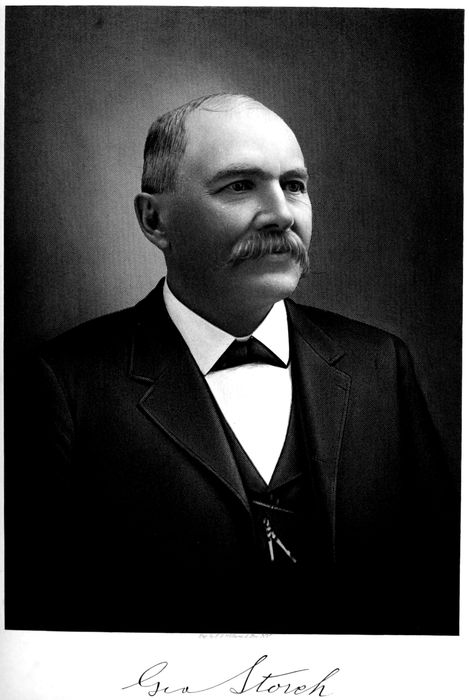
Geo Storch
449George Storch was born near Poppen-Hausen, Bavaria, Germany, February 22, 1835, and was a son of Thomas and Margaret (Breitung) Storch. Thomas, the father, was a farmer and linen dealer in his native locality and was considered fairly well to do. George was reared to young manhood in his native land and received a good common school education. When seventeen years of age he determined to cross the seas and seek his fortune in America. In accordance with this determination he embarked on a sailing vessel which landed him at New Orleans. From this southern city he made his way by river steamer up the Mississippi and Missouri rivers to Herman, Mo. Here he joined a brother who was farming in the neighborhood and who assisted George in securing employment on a nearby farm. He worked at farm labor in Missouri for some years and in April, 1859, he came to Atchison, Kan. This city did not offer much inducement for the ambitious young man and he was desirous of engaging in the mercantile business. Kennekuk, in the north central part of the county, was then in the heyday of its prosperity and seemed to offer a better location than Atchison. After a few months’ stay in Atchison he went to Kennekuk and opened a general merchandise store with the capital which he had saved while working on the farms in Missouri. He was successful from the start and his judgment in the matter of Kennekuk being an excellent business location proved correct. Kennekuk was at that time a prosperous and thriving village located on the overland mail and emigrant route and the Storch store made money for its owner to such an extent that he was enabled to branch out and invest in lands and engage in the banking business. Mr. Storch justified his faith in his adopted State by investing heavily in lands which have greatly increased in value since his original purchase of the same. In the early days of the development of the West, the railroad companies were granted large tracts of farm lands along the right of way by the Federal Government. These tracts were placed on sale by the railroads, and were sold for very low prices and easy terms in order to induce settlers to locate in the regions being developed. Mr. Storch took advantage of the low prices of the farm lands and invested heavily. This property comprised many thousands of acres which have since increased enormously in value over and above the original purchase price. Kennekuk had its day, and the time came when the decline of the village was inevitable owing to the building of the Central Branch railway out of Atchison, and which passed to the southward of Kennekuk. Mr. Storch saw the time coming when the once flourishing inland village would be no more, and in 1867 he removed to Atchison and managed his large farming interests from this city.
Upon his removal to Atchison he immediately became identified with the leading financial interests of the city and in 1873 organized the German Savings Bank which was for many years one of the strong financial institutions of the city. He was also identified with the first bank established in Muscotah, Kan. He engaged in the real estate and farm loan business in Atchison and organized the Eastern Kansas Land and Loan Company, a concern which is still doing business and of which his daughter, Mrs. Louisa J. Lips, 450is president. Mr. Storch served as president of the German Savings Bank until its stock was purchased by the United States National Bank, and also filled the office of president of this bank during the period of its existence. He was engaged in banking pursuits for a period of eighteen years.
He was married in 1859 to Miss Elizabeth Fox, a daughter of John and Elizabeth Fox, who removed from Evansville, Ind., where Mrs. Storch was born, to Carroll county, Missouri, and settled on a farm. Two children blessed this union of George and Elizabeth Storch: George H., who will be remembered as a bright, intelligent and capable Atchison citizen and who was associated with his father in business for several years, and died in July, 1911, and Louisa Justina, widow of Oscar Lips. Mrs. Storch died in February, 1905, and almost three years later followed the demise of the husband and father, who departed this life in January, 1908. Oscar Lips and Louisa Justina Storch were married in 1891, and that union was blessed with a son, Charles, born in October, 1896. Charles Lips received his primary education in the public schools of Atchison, his preparatory work in the Culver, Ind., Military Academy, and is now pursuing a collegiate course in the Kansas University at Lawrence. Oscar Lips was born in St. Louis, Mo., a son of Dr. Charles August Lips, a former practicing physician of St. Louis, and who was of German descent. Oscar was reared and educated in his native city, and when a young man engaged in the wholesale drug business. His demise occurred in Atchison, August, 1905.
George Storch was a Republican in politics and took an active and influential part in political affairs during his long years of residence in Kansas. Not long after establishing himself in business at Kennekuk he became postmaster of the town, and assisted in establishing the first union school in the village, serving as a member of the board of education which had charge of this school. The Horton Headlight has the following historical account of this school in an issue of August, 1905, in part: “The old stone school house was not the first school building in the Kennekuk neighborhood, but it was the first substantial one in this part of the country and marks an important epoch in its development. It was built in 1867. It was a joint district, eight miles north and south. The west line was the road between Atchison and Jackson counties. A strip of country two miles wide and eight miles long was in Atchison county and a corresponding trip of country was just over the line in Brown county. The school house was quite a structure to be builded in that early day, but the settlers did not complain at the high taxes, since their children had a good place to attend school. The cost was about $3,000, quite a good sized sum for early settlers to expend, but it shows their determination 451to provide an education for their children. The first school board was composed of George Storch, Squire Willis and Henry Claunch....”
Mr. Storch was always greatly interested in the cause of education and after his removal to Atchison he served as a member of the Atchison board of education and was president of this body for a time. While a resident of Kennekuk he was elected to represent Atchison county in the Kansas legislature in 1864. During the ensuing session he voted for Gen. James H. Lane for United States senator and voted to ratify the fourteenth amendment to the National constitution. In 1876 he was elected a member of the legislature from the city of Atchison, and during the session following his election he was a member of the ways and means committee and voted for P. B. Plumb for United States senator. Mr. Storch made an excellent record as an able and honest legislator, who had the best interests of his State at heart. He was active in civic and political affairs in Atchison and served as a member of the city council of which body he was president for one year, declining re-election when his term of office expired. The following tribute to his ability as a city father appeared in the Atchison Champion of April 6, 1873: “One of the best councilmen our city has ever had leaves that body after two years’ service in it. We refer to Hon. George Storch, chairman of the committee on improvements. He has been industrious, independent, and energetic. Having the chairmanship of the most important and laborious committee, he has given his time and attention to the discharge of the duties devolving upon him, and in the decision of all questions in the council he has exhibited a clearness of judgment and a carefulness in guarding the interests of the city that entitle him to general commendation. He declined re-election.”
Mr. Storch served for three years as city treasurer and exhibited the same judgment and careful management of the city’s affairs in this important capacity that has marked the performance of his official duties as a councilman and school trustee. It is worthy of record that in 1865, while in Kennekuk, he was elected a member of the board of county commissioners and served as chairman of that body.
Few pioneer citizens of Atchison lived a more useful or busier life than he of whom this review is written. The name of George Storch figures prominently in the historical annals of Atchison county as a builder and creator and an honorable and upright citizen, who left behind him when his soul winged its way beyond the knowledge of mortal ken, a record imperishable, and a name unblemished and untarnished of which his descendants may well be proud. While opportunities for achieving fortune and fame may not be as great at this day as they were in George Storch’s time and era, the story of 452this poor German emigrant boy who made his own way in Kansas from poverty to affluence and won an honored place in the history of his adopted county and State is well worth reading and may serve as an inspiration and guidance to others of the present and rising generations.
THOMAS BROWN.
There is considerable satisfaction in writing the life story of a man who has worked his way upward from poverty to a position of wealth and influence in the space of a lifetime, and accomplished it all with his own strong arms and mind. When one adds to this accomplishment the rearing of a large family to lives of usefulness, and to bring up a bevy of young men and women to comfort their parents in their declining years, there is not much for any one individual to wish for. Thomas Brown, retired farmer, of Effingham, Kan., has done all of this and is the proud father of one of the largest families in Atchison county. Had he done no more than to bring into the world his thirteen children, he would have been worthy of praise and been entitled to honorable mention in this volume, as a patriotic and sturdy American citizen. A native of the Emerald isle, he came to America in his youth, and now ranks as one of the Kansas and Atchison county pioneers.
Thomas Brown was born in the little village of Altone, Ireland, and is a son of John and Mary (Dalton) Brown. His birth occurred on February 10, 1847. His father was a farmer in his native country, and made a good living for his family, later moving to the town of Altone and engaging in the transfer business, in which occupation he was fairly successful and enabled to provide for his family in comfort. He was the father of ten children, seven of whom came to America to seek their fortunes in the land of opportunity. The seven who came across the Ocean were: J. P. Brown, a pioneer merchant and capitalist, of Atchison, now deceased; Mrs. Bridget Norton, who died in 1913 at her home in Pittsfield, Mass.; Mrs. Mary Scully, of Troy, N. Y.; Mrs. Anna Elkhorn, of Troy, N. Y.; Mrs. Margaret Hewitt, of Independence, Mo.; Mrs. Kate Waters, deceased, who was the wife of a soldier in the British army. The father of these children died in Ireland, and the mother died in Troy, N. Y.
Thomas Brown emigrated from his native land to this country in 1865, and hired out to a farmer in Orange county, New York, at $20 per month. The farm where he was employed was located seventeen miles north of Newburg, 453on the Hudson river. He worked there for two years and carefully saved his earnings until he had $300. With this capital he set out for the West and joined his brother, J. P. Brown, who was then located in Atchison. His first employment was on his brother’s stock farm, located north of Monrovia. Unfortunately, he was taken ill not long after his arrival, and lay sick for a long time with typhoid, all of his savings going to pay for medical services and nursing. He remained on his brother’s farm for ten years and laid by another stake during that time. During this period he cultivated three farms, owned by J. P. Brown, who did not require him to pay any rental fees. Even the taxes were paid by his brother who was only anxious to keep the land in cultivation and give his brother, Tom, a start in the world. In the year 1877, Thomas, having saved enough money to buy a farm of his own, invested his savings in a tract of 160 acres of high prairie land, northwest of Effingham, in Benton township. His first land investment cost him $2,250. The land had on it only a small shack which was soon replaced by a comfortable home. It is now one of the best improved places in this section of Kansas, and the Brown farms are among the most productive in the whole State of Kansas. A handsome white farm house graces the home place, which can be seen for miles around, and it is quite imposing. Mr. Brown prospered as he deserved and increased his holdings to the grand total of 640 acres of good Kansas land. The remarkable part about his purchases of land is that he paid cash for every tract of land which he bought and never went in debt for a single acre. This land, purchased at varying prices, is now easily worth $125 an acre. Mr. Brown carried on general farming and live stock raising until February of 1911, when he turned over the management of the home farm to his son, and removed to Effingham, where he has a beautiful and comfortable residence in the west part of the city.
He, of whom this review is written, was married on October 20, 1869, to Miss Anna Neely, born in Ohio in 1846, a daughter of Samuel Neely, who migrated to Atchison county, Kansas, in 1868. Sixteen children have been born of this marriage, thirteen of whom are living, all of whom are married excepting one daughter and a son: John, a farmer, living near Blue Rapids, Kan.; Mrs. Ida Fishburn, living on a farm near Meriden, Kan.; William, Charley, Frank, and Edward, who are located on their father’s ranch; George lives at Effingham; Richard, a successful farmer, living south of Muscotah; Mrs. Pearl Dunn, of Oklahoma; Mrs. Ethel Smith, residing in Oklahoma; Edith, at home with her parents; Mrs. Julia Wagner, living near 454Mortimer, Kan.; Mrs. Mary Kemp, on a farm near Vermilion, Kan. This worthy couple have thirty-six grandchildren.
Mr. Brown is a Republican in politics, but is decidedly independent in his voting and making up his mind concerning political questions of the day. He believes in supporting the man best qualified to serve the people in a civic capacity, rather than blindly following the dictates of political leaders or so-called bosses, a characteristic of the man in all of his conduct through life. He is a member of the Effingham Catholic church and is a liberal supporter of this denomination, having contributed liberally toward the building of the local church. He is a member of the Ancient Free and Accepted Masons lodge and became a member of this lodge in 1871. It is a matter of historical record that Mr. Brown, Willis Walker and Hump. Henderson, of Effingham, are the three oldest living Masons in Atchison county in point of years of membership in the order. What more honor does a man wish than has befallen this Atchison county pioneer?
ALBERT H. BLAIR.
Albert H. Blair, farmer, of Center township, Atchison county, was born March 6, 1862, near Astoria, Ill., and is a son of William and Alcinda (McCormack) Blair. He was one of five children, Daisy being the only other survivor. She resides in Center township and is now Mrs. Warner. Two other children died in infancy, and William died while living on the farm which Bert now owns. The father was born May 18, 1833, in Brownsville, Fayette county, Pennsylvania. He was a son of William Blair, and was a glass cutter while living in the East, but when he went to Illinois, he engaged in farming. Later, he farmed in Fulton county, Illinois. In 1863 he came to Kansas and engaged in freighting between Atchison and Denver, with his brother, Edward. They followed this exciting occupation about three years, and in that short time had many experiences which they related with great delight in after years. They were never attacked by the Indians, for the reason that they drove in large numbers, with 100 wagons to the train, and the Indians were shy of such a large force. However, one night they thought that their luck had changed. Mr. Blair can just barely remember the incident, although his father has told it over so many times that it seems to him as if he remembered the original incident. One night the party camped on the trail between Atchison and Denver, lying asleep 455under their wagons. Indians had been seen that day and the freighting party was a little uneasy, and some of the more nervous members feared an attack. Late in the night the mules became frightened and woke up Mr. Blair. William jumped up, and off in the dark he could see a white object approaching. The cry of “Indians” went out and rifles were aimed. William shot, but could not hit the object. No one else could, for it was very dark and the object could not be seen distinctly. The white object kept approaching, and finally took a definite outline in the darkness. It was a white steer. One night when Indians stampeded the mules of the train, William and a comrade set out in pursuit of the Indians by flaying the mules with arrows and drove them so fast that the pursuers caught up with them by hard exertion and recaptured the horses. These are typical of many narratives which the elder Blair related of his early-day experiences on the plains. After quitting the freighting business, he and his brother engaged in milling in Atchison, Kan. Three years later William sold his interest to his brother, and started a livery business. A year later he went to farming in Doniphan county, Kansas, and moved from one farm to another for several years. In 1882 he was elected sheriff of Atchison county on the Democratic ticket, and his first term was so successful that he was re-elected. After his term expired he continued to live in Atchison for some time. He then bought 160 acres of land in Center township and remained there until 1891, when he removed to Effingham, where he lived in retirement until his death in 1899. The mother of Bert Blair was born January 11, 1842, in Brownsville, Pa. She is a daughter of Alonza and Sarah J. (Hibbs) McCormack, who were natives of Pennsylvania. They came west in the early days and farmed in Illinois and Iowa. The mother is now living with her daughter, Mrs. Daisy Warner, in Center township, Atchison county.