Chapter XXV · BIOGRAPHICAL HISTORY (continued 10)
Reading edition
Mr. Thompson has always taken an active and influential part in the political affairs of Kansas, and has been a life-long Democrat. He has the unique distinction of having voted for but one candidate who was elected President, and that was Franklin Pierce in 1852. This is probably due to the fact that he has always been independent in his voting, and acted upon his own convictions when it came time to cast his ballot. His last vote was cast for Theodore Roosevelt. When Populism was in vogue in Kansas he voted for the Populist candidate for President. It was only natural that he himself become a candidate for office on account of his education and the inherent gift for leadership. He served as a member of the Kansas legislature at the sessions of 1867, 1868 and 1869, and has been a candidate a few times since. At another time, early in his career, he was elected superintendent of public instruction in Atchison county, but refused to serve, and sent in his resignation. His last candidacy for the legislature was given him by the fusion of the Populists and Democrats, but he was defeated by White by a very small majority. During the campaign of 1866, he was asked to become a candidate for the legislature by many Republican friends and upon the advice of his many friends in the county, he cast his votes for both Ross and Pomeroy for the positions in the United States Senate. It is a matter of history that both Ross and Pomeroy were elected to represent Kansas in the United States Senate, Ross subsequently making himself very conspicuous by voting against the impeachment of Andrew Johnson.
This fine old pioneer was also a soldier in the Civil war, and served as first lieutenant of the company commanded by Capt. Asa Barnes in the battle of Westport. Mrs. H. T. Keats, daughter of Mr. Thompson, has in her possession a number of interesting souvenirs of this battle, among them being the belt buckle, and bayonet worn by her father in the battle, and the company’s flag, Captain Barnes’ shoulder straps, and James Binkley’s cap box, in addition to having some of the Government scrip, with which the soldiers were paid. The colonel of the Twelfth regiment was Colonel Louis 668L. Treat, another member of the company being T. L. Cline. Very few of the members of this company or regiment are now living.
On October 8, 1915, this noted old pioneer was eighty-eight years old and still vigorous, mentally. His power of thinking is not much diminished, and he is still a reader and student. Constant reading and thinking, we are told, is conducive to longevity and Mr. Thompson has always been a great reader and student of history and philosophy. He is a man, self-made and self-taught, and is blessed with a keenness of intellect far above the average. His life has been a well rounded and useful one, and he has had a career of which he and his children and grandchildren can well be proud. His long life has been clean and for years he has been a stern advocate of temperance and has practiced his own belief. In his younger days he was a noted and powerful orator who had the ability to thrill and sway his hearers. Few men can look back over a longer vista of years, well spent in honest pursuits, and in behalf of his fellow men than George W. Thompson. All honor to him as the oldest and most distinguished living pioneer of Atchison today.
B. F. TOMLINSON.
B. F. Tomlinson, deceased, was a pioneer merchant and meat packer of Atchison, and left behind him an imperishable record for honesty and fair dealing, which has never been surpassed in the mercantile history of the city. He was born December 25, 1838, in Covington, Ky., a son of Leroy Tomlinson, who was also a native of Kentucky. The mother of B. F. Tomlinson died when he was a small boy, and as a consequence little is known regarding her antecedents. The Tomlinsons are a very old American family. Leroy Tomlinson was a commission merchant and meat packer, who later removed from Covington to Louisville, Ky., and became prominently identified with the business interests of that city. He conducted a large packing establishment and handled as high as 100 beeves at one time in his abattoirs, wholesaling the product of his packing houses to meat merchants in the cities and towns bordering the Ohio river.
B. F. Tomlinson, with whose career this review is directly concerned, was reared and educated in the city of Louisville, Ky., and when he was but fifteen years of age his father died, his stepmother dying one year later. Being an only child, he was left with the responsibility of his father’s extensive business. The excellent training which his father had given him, here came 669into good stead, and he carried on the packing business successfully, paying, in the course of time, a considerable indebtedness which his father had incurred. After his marriage in Louisville in 1860, he continued to conduct his business in Louisville until 1870, at which time he disposed of his possessions and came to Atchison. Here he engaged in the butcher and packing business, and soon held a prominent place in the mercantile life of the city.
B. F. Tomlinson was married September 11, 1860, to Miss Elizabeth Alexander, who was born May 11, 1840, in Bedford, Ind. She was a daughter of Robert M. and Emily (Legrant) Alexander. Her father was a coach-maker by trade, and removed from Bedford, Ind., to Louisville, Ky., where he died in 1900, at the age of eighty-nine years. Much interesting history can be narrated concerning the mother of Mrs. Tomlinson, who was born in New Orleans, and was one of three children born to her parents, who were of French origin. The elder Legrant was a drygoods merchant in the southern city, and the story goes, that on one of his regular trips to Cincinnati, Ohio, to buy a stock of goods for his store, he left two of the children at home, and on arriving in Cincinnati he placed Emily in charge of a Scotch family by the name of McDonald, and with whom he had been in the habit of stopping while on business in Cincinnati. Emily at that time was twelve years of age, and was a prime favorite with the McDonald’s who begged her parents to leave her at their home during the time which would elapse until Mr. and Mrs. Legrant made their next trip from New Orleans to Cincinnati. They did so, but sad to relate, the little girl never saw nor heard from her parents again, and what became of them she never learned, and she was consequently reared to womanhood by the kind foster parents. In an earlier year than this at New Orleans, and at a time when Emily’s father was very sick with rheumatism, a band of over one hundred Indians was encamped near the Legrant home at New Orleans. One of the other children was also afflicted with cancer of the face. The medicine men of the Indian tribe effected a cure of both the cancer and the father’s rheumatism. The Indians were very affectionate toward Emily and called her the “pretty squaw,” which was only natural, as she grew up to become a very beautiful woman, eventually becoming the wife of Robert M. Alexander, and after her husband’s demise, made her home with her daughter at Atchison, where she died in November of 1904, at the advanced age of eighty-nine years.
B. F. Tomlinson died in January, 1895. Mr. and Mrs. Tomlinson were the parents of eight children: Martha J., wife of Louis Nelson, of St. Joseph, Mo., and mother of one child, Frank B.; Emma T. Bosanko, deceased, left 670one son, Harry; Lydia, wife of Frank Russell, of St. Paul, Minn., and mother of one son, Clarence Russell; Alice, wife of W. L. Johnson, of Atchison; Anna A., wife of Charles Robertson, of Chicago; Robert, a resident of Columbia, Mo., and who has one daughter, Ecce Tomlinson; Franklin, deceased; Birdie died in infancy. The mother of these children is now three score and fifteen years of age, but does not appear to be over fifty years old. She is remarkably well preserved and has a keen mind, and is especially proud of her husband’s record and fine family of children.
Mr. Tomlinson was a member of several fraternal societies, among them being the Modern Woodmen, the Knights of Honor, and the Ancient Order of United Workmen. He was politically allied with the Democratic party, but never sought political preferment. He was well and favorably known and highly respected in business circles in Atchison, his greatest and kindliest trait being his generosity in giving assistance to the poor and deserving of the city. He was always ready to listen to the call of the suffering and improvident, and never turned away a supplicant in dire need empty handed. It might be said of him that he was too generous for his own financial welfare, but he sincerely believed in the wholeness of his nature in giving of his sustenance to those whom he deemed in need. The indulgence of this Christian trait of giving naturally endeared his memory to a host of friends, who will long remember him. Few men were more liberal or kinder than this upright gentleman.
JOHN D. HAWK.
In the science of agriculture, as well as the learned professions, there are always men who are naturally endowed with the powers of leadership, and are so progressive and energetic that they lead in the van of better and more productive farming where others follow. Atchison county has its quota of these progressive agriculturists who are not content to be just common, every-day farmers, but are ambitious to become specialists in agricultural work. John D. Hawk, of Benton township, Atchison county, holds a place in the front rank of successful and enterprising farmers in Atchison county, and is the owner of one of the most productive and best equipped agricultural plants in the county, or northeast Kansas. His farm comprises 170 acres, located in section 2, range 618, Benton township. A good farm home sets well back from the road, in the rear of which is a large red barn. 86×46 feet, hip roofed and flanked by a modern silo, built in 1910, 671and which is the first wood silo erected in Atchison county. Mr. Hawk is beginning the breeding of thoroughbred Jersey cattle, and at the present time has a fine dairy herd of twenty-five head, among which is a number of pure breds. Leading this herd is “Shawan Majesty,” a pure bred bull. He also specializes in Poland China hogs, and is meeting with success in the breeding and raising of live stock. Mrs. Hawk keeps a pure strain of Black Langshan poultry and handles this end of the farm work with profit and satisfaction.
John D. Hawk was born November 19, 1875, on a farm in Coshocton county, Ohio, a son of Lafayette T. Hawk, of Benton township, a sketch of whom appears in this volume. He was seven years of age when his parents removed to Atchison county, Kansas, from their Ohio home. Here he attended the district school, and had the advantage of one year’s study in the county high school. He worked on the home farm with his father until 1898, when he began for himself in the spring of that year on the McClennon farm which he rented for two years. After his marriage he removed to his present place which is the old Law homestead. He erected the present barn and the large poultry house on the place and made various other improvements including the building of the silo.
Mr. Hawk was married March 15, 1899, to Miss Alice M. Law, who has borne him eight children, of whom seven are living: Walter Gale, born January 12, and died February 1, 1900; Herbert, aged fifteen years; Kenneth, born November 19, 1902; Dorothy, aged ten; Mateel, nine years old; John, aged six years; and twins, Vera and Veda, born December 12, 1911. The mother of these children was born in Toronto, Canada, a daughter of Edwin and Mary Alice Law, both of whom were born in England. Edwin Law comes of a family of singers, and it is a matter of record that his mother sang before Queen Victoria on one occasion, and was noted throughout England as a singer of note. The Laws immigrated from England and first settled in Canada, going from there to Ohio, and after a short residence in the Buckeye State, migrated to Doniphan county, Kansas, from whence they came to Atchison county and purchased the farm where Mr. and Mrs. Hawk now reside. There were five children in the family: Alfred Law, Ella, Alice, Walter, and one died in infancy. Mrs. Law died on the farm, and Mr. Law died in Canon City, Colo. After his first wife’s death, Mr. Law again married, and had one daughter, Lillie, by his second marriage.
Mr. Hawk is a Republican, but his activities do not tend to political affairs. For several years he has been actively identified with agricultural affairs in Atchison county, and his influence has ever been exerted in behalf 672of better farming. He is president of the Atchison County Farm Bureau, of which institution he is one of the organizers. In connection with Fred Sutter, Alexander McClennon, he assisted in the promotion of the Farm Bureau and its establishment, and the consequent employment of County Agent Taylor as a skilled farm instructor. This is now considered as one of the finest and most beneficial moves ever made in the county in behalf of the farmers of the county, and even the most incredulous who were unwilling to support the movement are now coming into line and becoming enthusiastic over the possibilities for bettering farm conditions in the county as the result of the efforts put forth by its zealous supporters. This committee during the winter of 1914–1915 visited every part of the county, in the preliminary organization and missionary work, and enrolled 200 farmers as supporters of the project. Mr. Hawk is likewise president of the Atchison county Farmers’ Institute. He attends the Christian church, of which Mrs. Hawk is a member, and is fraternally affiliated with the Central Protective Association.
HERBERT J. BARBER.
A man’s standing in the community where he resides or transacts his business affairs is usually gauged by his usefulness to society and his activities in behalf of the general good of his fellows. If he be of the class of citizens who are seeking to benefit the community in which he is engaged in business, he is a decided benefit to that community. Such an individual is Herbert J. Barber, banker of Cummings, Kan. Mr. Barber is a native of the Sunflower State, and is a son of one of the early pioneers. The story of Moses Barber, his father, Union veteran, Kansas pioneer, and one of the first successful fruit growers of Atchison county, is interesting and borders on the romantic to a considerable degree. Over fifty years ago, directly after his honorable discharge from the Union service at Leavenworth, Moses Barber set out on horseback to find a place for a home in Atchison county. He found the homestead, and at the same time found a sweetheart who later became his wife and fought the good fight with him through the lean years and good ones until he attained to the realization of his ambitions to obtain a competence. He became widely known as the “Apple King” of Kansas as a result of his remarkable success as a grower of apples, and cultivated what was in all probability the largest apple orchard in existence in the State of Kansas in his day. His son, Herbert, has followed in his father’s footsteps and is fast making a name for himself in the field of finance. Speaking in a biographical sense, Herbert J. Barber was born on the old homestead of his father in Mt. Pleasant township, April 11, 1871, a son of Moses and Mary (Hubbard) Barber, the former a native of Rhode Island, and the latter a native of Virginia.
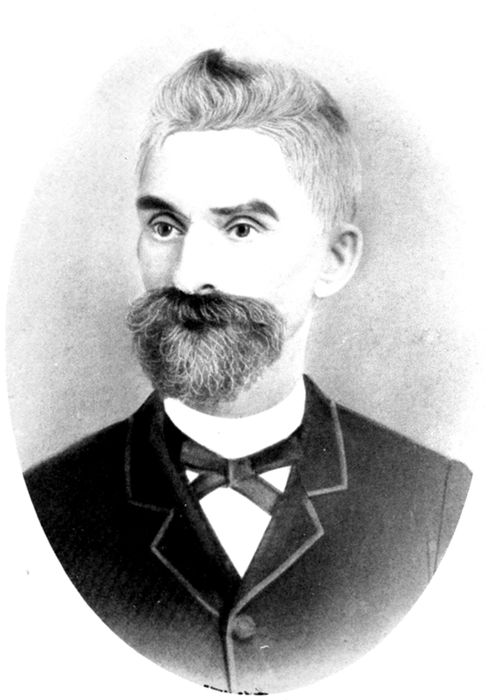
Moses Barber
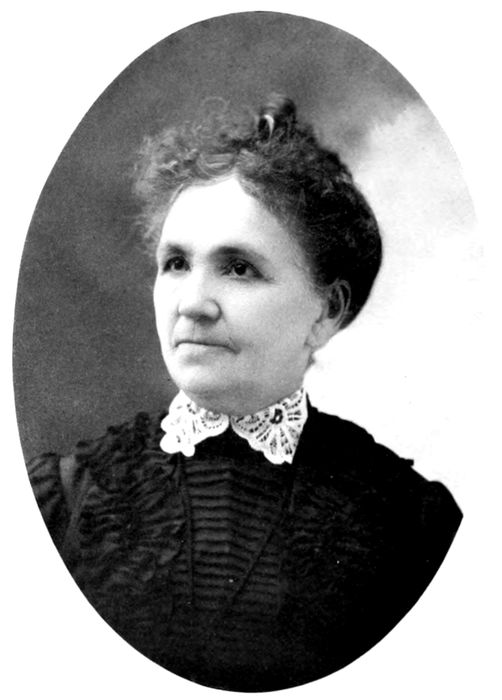
Mrs. Mary (Hubbard) Barber
673Moses Barber was born in South Kingston, Rhode Island, April 22, 1833, a son of James and Elizabeth Barber, natives of Rhode Island, of colonial ancestry and English descent. A brother of James was Colonel Barber, who served in the War of 1812, and the grandfather of Moses Barber was a Revolutionary soldier. Moses was reared to young manhood on his father’s farm in Rhode Island, and then migrated westward to Illinois. After a residence of a few years in Illinois he came to Kansas and was a resident of the State upon the outbreak of the rebellion of the Southern States. He enlisted in Company I, Second regiment, Kansas cavalry, in 1861, and was soon promoted to ranking sergeant of his company. He served his country well and faithfully and took part in several hard fought engagements with his regiment, and received his honorable discharge at the close of the war at Leavenworth, Kan. After receiving his discharge from the service he set out on horseback in search of a homestead, riding the faithful cavalry horse which had carried him through the strenuous days of the Civil war. His route led him in a northwesterly direction from Ft. Leavenworth through Atchison county. He stopped for sustenance and rest at the home of a family named Hubbard at Parnell, Kan. Mr. Hubbard was a pro-slavery and State rights man who had removed from the Southland in 1855 after two years in Missouri, a State rights advocate, and although Mr. Barber was his guest, they had frequent clashes over the troubles of the South and war incidents. The bitterness of the great conflict had not yet been obliterated, and it was only natural that the Union veteran and State’s rights man should have disagreements. This was not all of their troubles, as time soon developed. Mr. Hubbard had an attractive daughter, and thereby hangs a tale of romance. Mary Hubbard was the acme of beauty in the eyes of young Barber and he purposely stayed around in the neighborhood that he could be near Mary and do his courting despite the evident antipathy of Father Hubbard. In fact, Moses often said later, “That was the reason I stayed there.” The attraction between Mary and Moses grew into friendship, friendship ripened into love, and the son of the North and the daughter of the South were married. The parental opposition to this natural outcome of the meeting of two young souls who were evidently destined for each other was so great 674that a quiet marriage was necessary. Moses and Mary quietly departed one day and returned to the parental roof as man and wife. Mr. and Mrs. Hubbard soon afterwards decided to accept the inevitable and become fond of their son-in-law. Time and subsequent events proved that Moses and Mary were well mated and the marriage, if a hasty one, proved to be very happy in the years to come. Mr. Hubbard soon afterward went west to satisfy the gold fever which obsessed him and Moses Barber settled down on his father-in-law’s farm which he purchased, thus beginning a highly successful career as an agriculturist. The first home of him and his young wife was a little log cabin which formerly belonged to the Hubbards, but as prosperity came as the reward of years of careful husbandry, he erected a handsome farm residence of thirteen rooms which still stands on the place, built in 1882. Mr. Barber was one of the first men in Kansas to see the possibilities in fruit growing and early began to develop that part of the farming avocation. He planted four or five acres of apple trees as a start in his horticultural experiments, and his success with his first orchard was so gratifying that he increased his apple orchards to sixty acres of bearing trees. He became widely known as the “Apple King of Kansas.” While managing his immense fruit orchard he did not neglect the other side of the farm work and cultivated assiduously and successfully his large farm of 320 acres of land in Mt. Pleasant township. In the early days he was a large cattle feeder and made large shipments to the stock markets.
Moses Barber was married May 15, 1865, to Miss Mary Hubbard and this union was blessed with two children: Mrs. Abigail Brayman, of Wickford. R. I., and Herbert J., with whom this review is directly concerned. Mr. Barber departed this life July 3, 1896, after having lived a long and useful life which was profitable as well as happy. Mrs. Mary (Hubbard) Barber, his surviving widow, was born May 7, 1845, in Roanoke county, Virginia, and was a daughter of Clark and Rebecca Hubbard, both of whom were born and reared in Virginia and came to Kansas in 1855. Mrs. Barber resides with her son, Herbert J., in Atchison, Kan.
Herbert J. Barber attended the district school of his neighborhood in Mt. Pleasant township and later pursued a course in the Atchison Business College. After finishing his business course he returned to his father’s farm and took charge of the fruit growing and general farming. Later he spent three years in Colorado in the employ of a Denver wholesale book and stationery house. In 1894 he returned to the home farm and successfully managed it until 1908. He then removed to Cummings, Kan., and assisted in the 675organization of the Cummings State Bank. He became the cashier of this institution and has given evidence of decided financial and business ability of a high order in his vocation. Besides his banking interests Mr. Barber has land holdings in Colorado and western Kansas. He makes his residence at 1020 Santa Fe street in Atchison.
The marriage of H. J. Barber and Miss Eva Wertz was solemnized in February 19, 1902. Mrs. Barber was born the twenty-sixth of May, 1878, in Pennsylvania, a daughter of David and Eliza Wertz, both of whom were born and reared in the Keystone State. David Wertz was for many years a merchant at Parnell, Kan., and is now living in retirement at that place. The mother of Mrs. Barber is now deceased. One child, Mary Reta, born August 13, 1904, has blessed the marriage of Herbert J. and Eva Barber.
Politically, Mr. Barber is a Republican, and has held the office of trustee of Mt. Pleasant township for four years. He and his family are religiously affiliated with the Baptist church. He is a member of the Ancient Free and Accepted Masons, Washington lodge, No. 5, of Atchison, and the Modern Woodmen of America. Mr. Barber is a booster and public-spirited citizen by nature and is always ready and willing to support anything for the good of the community and the people. Every civic program which will have a tendency to benefit the whole of the people finds him as one of its warmest supporters.
ROBERT PINDER.
Robert Pinder, the efficient and capable manager of the Effingham Lumber Company, while having been a resident of Effingham but a few years, has so identified himself with the life of the community and taken such an active part in the city’s affairs, that his citizenship is an important and component part of the body politic. He is a hustler in both thought and deed, and strives to advance his city as well as managing his business at profit, and so as to gain increasing prestige for the lumber company’s business, which has been under the present management since 1912. The company conducts a general lumber business, and sells all kinds of building material, such as farm gates, Crown and Tulsa silos, of superior make, tiling, roofing and roof paints, etc. The sheds and yards cover six lots, and Mr. Pinder employs two men to care for the business. The president of the company is W. C. Alexander, of Atchison; the vice president is T. 676B. Pinder, of Clifton, Kan., and the general manager and secretary-treasurer is Robert Pinder, with whom this narrative is directly concerned.
Robert Pinder was born September 5, 1872, in Timberland, England, a son of John and Anna (Burton) Pinder, who were farmers in their native country, and about 1894 immigrated to this country and settled on a farm near Everest, Kan., where they died. In 1886 Robert was indentured at Martindales, England, for three years and one and one-half years at Horncastle, to grocery and provision merchants, with the understanding that he was to receive his board and lodging, and his father was to provide for other necessaries, such as wearing apparel, and medicine, in case of sickness. His periods of indenture required both day and night service and to play no games, or frequent taverns or dice tables, or contract matrimony, or buy and sell. For an American boy to be required to do anything of this sort would be considered the rankest injustice, and he would rebel at being compelled seemingly to sacrifice his liberty and become a bound employe for so long a time. But such is the custom in England, and the training which Robert Pinder received during his four and one-half years of indenture proved exceedingly valuable lo him in later years. After serving his time as an apprentice he continued in the provision business for three and one-half years longer, and then came to America, journeying direct to Doniphan county in 1894. In the spring of the following year he moved out on the farm owned by his father, who had brought the entire family, with the exception of one brother, to this country. He assisted his father in the cultivation of the farm for four years, and then accepted a position in the lumber business of E. L. Alexander, at Everest, Kan., in the spring of 1899. Three months later he became manager of the Purcell Lumber Company, at Purcell, Kan., and remained in this position for three years, following which employment he was manager of the Alexander Lumber Company at Havensville, Kan., for over ten years. In the spring of 1912 Mr. Pinder came to Effingham and took charge of the Effingham Lumber Company. His success in the lumber business has been marked and rapid, and is an indication of true and tireless business ability of a high order. He is secretary and a stockholder of the Alexander Lumber Company, a large concern: secretary of the Harrison Lumber Company, of Garnett, Kan., and is interested in this concern as a stockholder. Mr. Pinder also administered the family estate after his father’s death in 1909, and his mother’s demise in the year following. There were eight children in the family: Frederick died in infancy; John W., living, in England; Edith Mary, wife of William 677Pinder, of Huron, Kan.; Robert; Charles, a farmer living near Huron: Henrietta died at Everest; Emma A., wife of Arthur Harris, of Everest; Thomas Benton, in the lumber business at Clifton, Kan.
Mr. Pinder was married November 1, 1900, to Harriet M. Pinder, who was born in Denton, a daughter of A. G. Pinder, a farmer, residing near Huron, Kan. Four children have blessed this union: Ruth Mary, born in November, 1901; Cecil Francis, born in 1903; Leslie Benton, born in 1906; John Sylvester, born in 1909.
Mr. Pinder is a progressive Republican, and has pronounced and decided views upon independence in politics, and believes in “a government of the people and by the people,” and not for the benefit of the favored few. He is affiliated with the Methodist Episcopal church, and is fraternally allied with the Knights and Ladies of Security, and the Lumberman’s “Hoo-Hoo” society.
THOMAS J. POTTER.
For twenty-four years Thomas J. Potter has served the people well and faithfully as postmaster of the town which was named in honor of his father. Joseph Potter, one of the distinguished pioneer settlers of Atchison county, Kansas. Thomas J. Potter was born January 29, 1856, on a farm which later became the townsite of Potter, Kan., and was settled upon by his father in 1854. Mr. Potter probably holds the record for long and continuous residence in Atchison county as a native son of this county. He was a son of Joseph and Minerva (Wiley) Potter, natives of Kentucky and descendants of colonial ancestry. Thomas Potter, father of Joseph, tracing his ancestry direct to a member of the colony founded at Jamestown, Va., by Capt. John Smith, in 1607. Thomas Potter, grandfather of T. J., was born in old Virginia, and was a pioneer settler in Lincoln county, Kentucky.
Joseph Potter was born in 1819 in Kentucky, married there and reared a family. When Kentucky began to take on a crowded condition, which was inimical to a great many of the early settlers of the Daniel Boone class, Thomas Potter conceived the idea of migrating westward, as Boone had done. Accordingly, he sent his son, Joseph, to the wild country of Saline county, Missouri, to find out about the fertility of the land, and to determine whether or not the country was suitable for settlement. Joseph made the trip in safety and made a favorable report on his arrival home. The family, thereupon, 678disposed of their land holdings in Kentucky and made the overland trip to Missouri, finally locating in Buchanan county of that State, near the town of DeKalb, in 1846. Here Joseph Potter was married in 1851 to Minerva Wiley, whose parents had migrated from the old home in Kentucky to Buchanan county, Missouri, about the same time the Potter family had settled there. Three years later, in 1854, Joseph Potter and his wife removed to Atchison county and filed upon an 160 acre claim, on part of which acreage the town of Potter is now built. This was some years before Kansas became a State, and about the time the great struggle between the pro- and anti-slavery men was beginning for the control of Kansas. Joseph Potter was a strong anti-slavery man, who was not afraid to voice his convictions in unmistakable language at any and all times. He was firm in his belief that slavery was an evil which should be abolished, and his aggressiveness led him into frequent conflicts with the pro-slavery advocates. He was one of the able and fearless leaders of the anti-slavery contingent in Atchison county, and many times he was threatened with physical violence. At the time of one of the territorial elections, only three Free State votes were cast in Joseph Potter’s precinct. Four thousand votes, a number far in excess of the actual number of voters in the territory, were cast at this election, and pro-slavery men came from Missouri, and even from Kentucky, and voted several times in favor of making Kansas a slave State.
Joseph Potter was a Mexican war veteran. He enlisted in 1846 as a private soldier in the regular army of the United States, and served throughout the Mexican conflict under Col. Sterling Price. When the Civil war broke out he was appointed recruiting officer for the Federal Government, and later served as a captain in the Kansas State militia. Joseph Potter served one term as a member of the State legislature. In the year 1886 the town of Potter was established and named in his honor.
One of the most cherished of the friendships of this hardy pioneer was that of the late Senator John J. Ingalls, a friendship which began in the troublous days preceding the Civil war, and endured until death parted them, long afterward. Mr. Potter’s first impression of John J. Ingalls was obtained at an anti-slavery meeting held in Mount Pleasant township, and he was fond of relating the occurrence after the Senator became a Nation-wide character of prominence. Joseph Potter was the political leader of the anti-slavery party in that section of the State at the time, and Mr. Ingalls, then a young man of twenty-five, had opened his law office a few weeks previously in the old town of Sumner, Kan. Ingalls spoke at this meeting, and it is recalled, 679that as he arose to speak, a tall young man, pale and slender, the impression that he made upon his audience was small, and there were those present who even sneered when he began to speak. It was not long, however, as the future senator swung into his theme, until he convinced his auditors that he had a thorough knowledge of Kansas conditions, and could speak with an eloquence and honesty of delivery that was convincing. The listeners who came to scoff, left the meeting as warm admirers of Mr. Ingalls, and Mr. Potter was forever afterward his warm supporter.
Joseph Potter and his wife were the parents of eight children, as follows: Celia J., wife of T. Lawler, of Cowles, Neb.; Francis, living on the old home place in Walnut township; Alice P., residing on the home farm; Josephine P., wife of J. W. Miller, of Atchison; Thomas J.; Samuel L., a banker, living at Cutbank, Mont.; John J., also living on the old homestead.
Thomas J. Potter was born and reared on the old home farm of the Potter family, and followed the occupation of a tiller of the soil until he was twenty-seven years of age. He was appointed postmaster of the town of Potter, and was re-appointed in 1898, and has held the office continuously ever since. He was married in 1882 to Fannie M. Brown, a daughter of John Brown, of Missouri. Two children bless this union: George Potter, in the United States mail service in Chicago, Ill., and Garland J., wife of Charles Pruitt, of Sioux Falls, S. D. The mother of these children died in February, 1906. In the year 1913 Mr. Potter took for his second wife, Mrs. Estella Everhardt, widow of Charles Everhardt, and a daughter of N. D. West, a native of New Jersey, who settled in Kansas in the early territorial days.
Mr. Potter is politically allied with the Republican party and is a supporter of Republican principles. He belongs to the Christian church, and is fraternally affiliated with the Modern Woodmen of America.
BENJAMIN F. SHAW.
Benjamin F. Shaw, hardware merchant, of Potter, Kan., is a native of Atchison county, and is one of Potter’s younger successful business men. He was born October 11, 1882, on a farm in this county. He is a son of Henry and Martha (Nelson) Shaw, the former a native of Roodhouse, Ill., and the latter of Missouri. Both parents are of English ancestry. Henry Shaw came to Kansas in 1867 when a young man twenty years of age. When he came here he had a cash capital of about $100. He was of a saving disposition, 680however, and it was not long until he became the owner of a fine farm of 320 acres in Leavenworth county, Kansas. He is now residing in Leavenworth, living on a small farm of twenty acres within the city limits.
Benjamin F. is the fourth of six children born to Henry and Martha Shaw, and is the only son. He spent his boyhood days on his father’s farm and attended the district school in his neighborhood. When nineteen years of age he came to Potter and entered the employ of L. M. Jewell, in his general merchandise store. He began working for a salary of sixteen dollars per month. When Mr. Jewell took charge of the Potter State Bank as cashier, Mr. Shaw was placed in charge of the Jewell lumber yard and furniture store. Shortly afterward he was enabled to purchase a half interest in the furniture store. Within a year he sold his interest in the furniture business and bought a half interest in the hardware store of J. C. Helvey. Upon Mr. Helvey’s death, three years later, Mr. Shaw purchased his former partner’s interest, and has since conducted the business entirely in his own name, as the sole proprietor. Mr. Shaw has met with signal success in his business venture, and has grown with the town of Potter. He has increased the value of the hardware stock in his establishment from $2,200 to over $7,000. In addition to his business he is the owner of farm lands near the town of Potter. This is a considerable accomplishment for a young man who began his career with practically no capital, but a willingness to do the best he could, and endowed with plenty of energy and intelligence.
Mr. Shaw was married in November of 1904 to Miss Louise Bessler, of Leavenworth, Kan. His political affiliations are with the Democratic party, and he is fraternally connected with the Modern Woodmen lodge.
LAWRENCE GRIFFIN.
A review of the life of the late Lawrence Griffin, of Effingham, Kan., is the story of a poor Irish lad who left his native land, served his adopted country in the Civil war, became a pioneer in Kansas, and was a railroad builder and successful farmer, and in the course of years realized in full his boyhood dream of wealth and position in the great, free land of America.
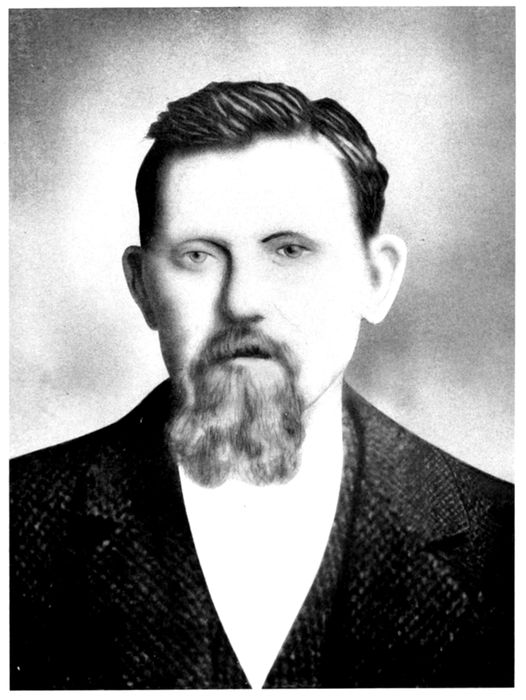
L. Griffin
681Lawrence Griffin was born in County Galway, Ireland, in 1838, a son of poor Irish parents. When a boy in his teens he immigrated to America and joined his brother, Michael, in Ohio, and there engaged in farm work for a living. He worked his way westward, and at the outbreak of the Civil war was driving a stage coach out of Springfield, Ill., where he enlisted August 3, 1862, in Company C, Twenty-seventh regiment, Illinois infantry, and served until his honorable discharge, September 20, 1864. He fought in many important battles, among them being Belmont, Mo., Union City, siege and capture of Island No. 10, Farmington Mills, siege and capture of Vicksburg, Lookout Mountain, Mission Ridge, and the battle of Chattanooga. After the war he went to St. Louis, Mo., and from that city made his way to Atchison, where he took a contract under J. P. Brown for building a portion of the grade of the Central Branch railroad, at that time under course of construction. His first job was the grading of one mile of road called section 20 in partnership with a Mr. Keean. In partnership with James Brady he then graded two miles of road near Wetmore, Kan. He saved his money which he made from his grading operations and in 1867 was married and purchased a farm of eighty acres near Arrington on the creek bottoms. He was compelled to leave this place after one year on account of ague and invested in 160 acres of land north of Arrington, which he later sold and bought 160 acres of higher land four miles west of Effingham. This was prairie land which he at once began to improve and made into a permanent home for his family. He and his wife first lived in a small house and were often discouraged and faced failure many times, but persistence and fortitude finally won out and they became the possessors of 400 acres of well improved land on which were erected two sets of farm buildings. Three hundred and twenty acres yet remain intact of the original holdings, which are rented to tenants. In 1908 Mr. and Mrs. Griffin left the farm and purchased a handsome residence in Effingham where Mrs. Griffin now resides.
Mr. Griffin was married November 25, 1865, in the old St. Benedict’s Church in Atchison, to Miss Ellen Gallagher, the marriage ceremony being performed by Father Timothy. Ten children have blessed this union, as follows: Michael died in infancy; Martin Lawrence, a farmer at Wetmore, Kan.; Ellen, wife of James Bergen, Graham county, Kansas; Elizabeth, wife of Michael Murphy, Dallas, Texas; Anna, at home with her mother; Patrick Henry, conducting a livery business at Effingham; John J., cultivating the home farm; Frank, agent for the Southern Life Insurance Company, Wichita Falls, Texas; Walter L., a traveling salesman, Dallas, Texas, and who graduated from the Atchison County High School, and studied two years at St. Benedict’s College; James Ambrose, also a graduate of the Atchison County High School, and now a stenographer in the office with his brother at Dallas, Texas. The mother of these children was born September 15, 1850, at La Salle, Ill., a daughter of Martin and Anne (Corcoran) Gallagher, both of 682whom were born in County Mayo, Ireland. They came to this country when young and Mr. Gallagher took up a homestead in Illinois and also engaged in freighting from La Salle to Chicago. He died in 1851, and the widow, accompanied by Ellen and two sons, came to Atchison county in 1860 and made their home here. Mrs. Gallagher married again, her second husband being Frank Cullen, who preëmpted land near Muscotah, upon which the family moved from Atchison in 1863. Mr. Cullen died in 1888. The mother of Mrs. Griffin died in 1890, at the age of sixty-six years.
Lawrence Griffin was a member of the Catholic church and was always a liberal contributor to the support of that denomination, giving substantially in aid of the building of the Catholic church in Effingham. While he was a rough and ready type of man who took the world as he found it, he was very moral and believed in living according to the golden rule. He was very charitable to the poor and worthy and was a kind husband, and a loving and indulgent father, whose sole aim in amassing a comfortable fortune was to provide well for his wife and children. In this aim he succeeded.
CHARLES E. BARKER.
The Nation owes a debt to the veterans of the Civil war, who gave the best years of their young lives to the defense of the Union, and marched under the star-spangled banner under the leadership of such heroes as Grant, Sherman and Sheridan, which can never be fully repaid. The ranks of the grand army of brave and true men who have worn the blue are gradually thinning out, and where once they were numbered in hundreds and thousands throughout this broad land, there are now but few in each community. These veterans were of the salt of the earth, and no better type of manhood ever trod the earth or marched to the strains of martial music than the old guard, which saved the Union, at the call of Abraham Lincoln. Living on a farm, in the northwest part of Benton township, Atchison county, Kansas, is a survivor of General Sherman’s victorious “march to the sea.” Comrade Charles E. Barker gave three years of his life in the defense of the Union and flag, and has a war record which has been equalled or surpassed by but few men who shouldered a musket to save the Union from dissolution.
Charles E. Barker, well-to-do farmer, of Atchison county, Kansas, was born in Fulton county, Illinois, April 4, 1842, a son of John and Eleanor (Rutledge) Barker. The father of Charles was born in Virginia July 20, 6831786, and learned the blacksmith’s trade when yet a boy. He migrated to Fulton county, Illinois, as early as 1826, and there operated a blacksmith shop. He was twice married, his second wife being Eleanor Rutledge, who bore him three children: George R., deceased; James Lee, deceased: Charles E. The four children by the first marriage were Joseph, John W., Sarah, and Elizabeth, deceased. The mother of Charles E. was born in Greenbrier county, Virginia, November 28, 1801, and died September 3, 1873. John Barker died in Fulton county, Illinois, in September of 1861.
Charles E. Barker grew up on his father’s farm, and helped in the shop and on the farm until his enlistment, at the age of twenty years. At the outbreak of the war he harkened to Lincoln’s call for volunteers to quell the rebellion of the Southern States, and went to Vermont, Ill., where he enlisted in Company F, One Hundred and third regiment, Illinois infantry, August 14, 1862, under the command of General Sherman, and Mr. Barker acted as commissary sergeant in Tennessee and the South. He participated in the following engagements: Vicksburg, Mission Ridge, Kenesaw Mountain, Resaca, Ga., Peachtree Creek, Ga., Dallas, Gristleville, November 26, 1864, and many others, his regiment being in twenty-seven battles in all. He marched under Sherman’s banner from Atlanta to the sea, and then marched in the Grand Review at Washington, D. C. He was honorably discharged at Chicago, Ill., July 7, 1865. He returned home after his discharge, and remained in Fulton county, Illinois, until 1883, when he disposed of his holdings there and went to Dade county, Missouri, where he bought a farm. He remained in Dade county for several years, living on various farms which he bought and sold. In August, 1887, he went to Furnace county, Nebraska, and purchased a half section of land, to which he added 160 acres later, which he sold in 1903 to his son, Harry. On March 1, 1891, he went to Brown county, Kansas, and lived there until his removal to Atchison county. In 1894 he came to Atchison county, Kansas, and bought 160 acres of land in the northwest corner of Benton township. He improved this farm and cultivated it with profit to himself. He maintains good graded live stock on his acreage and is considered one of the really successful agriculturists of the county. Nearly all of his land is sown to alfalfa and grasses.
On April 19, 1866, Mr. Barker was married to Mary E. Pontious, who has borne him six children, as follows: Leonard, a farmer, of Norton county, Kansas; Ira C., of Gooding, Idaho; Harry E., living in Brown county, Kansas; William L., a farmer, of Kapioma township, Atchison county, Kansas; Perry, residing in Stanford, Neb.; Nora, deceased. The mother of these 684children was born in Ohio, a daughter of Andrew and Ann (Bear) Pontious, natives of Germany.
Mr. Barker is a Democrat of the old school, and is a firm believer in Democratic principles. He belongs to the Grand Army of the Republic, Effingham Post, and numbers among the members of this organization many warm friends and comrades. He has taken his place in the community as a representative citizen, who enjoys the respect and esteem of all who know him. He can look back over his three score and thirteen years of life with satisfaction and realize with complacency that it has been well spent, and he has accomplished all that any good American could wish for on this earth.
JOHN E. SULLIVAN.
If a man has the inherent ability and energy in his makeup to enable him to succeed, he is going to do it. The life stories of all successful, self-made men bear out this contention, and there are numberless instances of success among the younger generation in the West which are well worth recounting. John E. Sullivan, real estate dealer, loan and insurance agent, of Effingham, Kansas, is a representative example of the class referred to in the foregoing statement. Mr. Sullivan was destined to succeed in his farming and business ventures, and, while a young man, he has already made his mark in the world, and is one of the substantial and influential citizens of Atchison county.
John E. Sullivan was born on a farm, near Rulo, Richardson county, Nebraska, January 20, 1873. He is a son of Murty and Mary (Rawley) Sullivan, substantial and well respected citizens of Effingham. The former was born in Ireland in 1847, and the latter is a native of Canada, born of Irish parents in 1852. Murty Sullivan left Ireland in 1865, immigrated to America and settled near Rulo, Neb. He made his own way in this country, and accumulated a large farm in Nebraska, on which he resided until 1910, when he removed to Effingham and purchased a farm adjoining the town on the south. Murty and Mary Sullivan are the parents of the following children: James and Murty, Jr., living at Hardin, Mont.; Daniel D., a farmer, of Benton township, Atchison county, Kan.; John E., the subject of this review; Mrs. John Vogel, of Falls City, Neb.; Sister M. Teresa, a sister of the Ursuline Convent, of York, Neb., and a teacher in St. Angela’s Academy there. The family are all members of the Catholic church.
685John E. received his primary education in the common schools of his native county in Nebraska, and finished his education in St. Benedict’s College, Atchison, Kan., graduating from the commercial department of that institution in 1894. He then took a special teachers’ course at the Lincoln, Neb., Normal School. He taught school for seven years in Richardson county, Nebraska, and practically all of his teaching was done in two schools of his home county. Upon his marriage in 1897 he engaged in farming in Nebraska, and it is a matter of pride with Mr. Sullivan that he earned more money in two years of farming operations than he had in all of his seven years of teaching, another reason why the farm is the best place for a young and ambitious man to make money. His success as a farmer determined his future career, and he decided to stick to the agricultural country for all time, imbued with the belief that there is money to be earned in farming, or in handling farm lands. He left Nebraska in December of 1901, and came to Atchison county, Kansas, where he purchased a farm, one and one-half miles south of Effingham, his first farm being the northwest quarter of section 34–618. He is at present the owner of 400 acres of well improved land which is kept in a high state of cultivation by improved methods of farming. Mr. Sullivan raises considerable live stock on his acreage and aims to feed all the grain raised on the land to live stock. He specializes in Hereford cattle and Poland China hogs and aims to keep only good grade of stock of all kinds. At the time of his purchase of the farm land in Atchison county, the land itself was in poor condition, and the soil had become impoverished by continual cropping of a single staple. Through the modern method of crop rotation Mr. Sullivan is reviving the fertility of the soil, and at the present time the greater portion of his farm is planted to clover and grasses, for the purpose of renewing the strength of the soil, the process being assisted by the raising and feeding of live stock on the place. The Sullivan farm has splendid improvements, which were placed on it by Mr. Sullivan, who erected a modern eight-room house and a good barn. In 1907 Mr. Sullivan was induced to take up insurance work as a side line, in the interest of a Nebraska insurance company, and met with great success in his new line of work. He later took up the real estate business and the handling of loans, and has been likewise successful in establishing a permanent business which requires his attention and necessitates an office in Effingham. The Sullivan real estate and loan office is well located in the Farmers and Merchants State Bank, of which concern Mr. Sullivan served as cashier and a director for several years.
686He was married February 16, 1897, to Mary Majerus, a native born resident of Richardson county, Nebraska, and a daughter of Jacob and Elizabeth (Wilker) Majerus, the former a native of Germany, and the latter of Ohio, of German parents. Seven children have blessed this union, namely: P. Justin, aged seventeen, and a student of St. Benedict’s College, class of 1916; Leo, aged thirteen years; Nellie, ten years old; Elizabeth, aged eight; Edward, six years old; Agnes, three years of age; and Mary, born January 28, 1915.
Mr. Sullivan is a Democrat who takes an active and influential part in the affairs of his party in Atchison county, having been the candidate of the party for county treasurer in 1914. He is fraternally affiliated with the Modern Woodmen, of Effingham, the Knights of Columbus, of Atchison, and the Central Protective Association.
SAMUEL L. LOYD.
Samuel L. Loyd, an enterprising and successful farmer, of Shannon township, was born June 11, 1860, in Brown county, Ohio, a son of Thomas F. and Celina (McGinness) Loyd, natives of Kentucky and Ohio, respectively. His paternal ancestors were of Welsh extraction. William Loyd, grandfather of Samuel Loyd, after making a home for his family in this country, started on a return trip to his native land, in order to secure a legacy which had been willed to him by a deceased relative, and on the way was afflicted with cholera, and died. With his death, practically all knowledge of the family in the old country passed away, and his widow and two children were left to get along as best they could. Two years later the widow died. Thomas F. Loyd was reared by a Mr. Boyd, and removed from Kentucky to Brown county, Ohio, when he became of age, and there married Celina McGinness. About 1865 he set out for the western country to obtain cheaper land, and make a permanent home for his family. After living for one year in Clark county, Missouri, he loaded his effects on a covered wagon, and with his wife and children crossed the Missouri river at St. Joseph, and settled on a farm in Doniphan county, Kansas, April 14, 1866. Thomas F. Loyd was a member of the Home Guard in Brown county, Ohio, during the Civil war. He was born in 1825, and died in 1910. His wife, Celina, was born in 1829, and died in 1906. They were the parents of ten children, seven of whom are 687living: William, Mollie, deceased, Charles, deceased, Samuel L., Anna, George, Effie, Otis, Oscar, and Celina, deceased.
Samuel L. Loyd was six years of age when his parents located in Doniphan county, and consequently knows a great deal about the early days in Kansas, and the struggles of the early settlers to make homes on the prairie. He was brought up on the farm, and attended the district school when possible, and learned very early in life to do farm work. After his marriage he farmed in Doniphan county until 1899, when he came to Shannon township in Atchison county, and purchased 160 acres of fine land, which he has brought to a high state of cultivation. During his sixteen years of residence here he has improved his farm to a considerable extent, and has spent over $5,000 in the erection of a handsome brick residence which sets far back on a rise of ground and is reached from the highway by a private driveway. Other improvements on the place in the way of buildings and fences have cost him over $1,500. A severe storm, which swept this section May 3, 1903, did damage to the extent of over $500 to his buildings, and he found it necessary to repair all of this.
Mr. Loyd was married September 2, 1896, to Miss Lulu Voelker, born and brought up in Atchison county, a few miles north of the city of Atchison. To this union five children have been born: Myrtle Ceina, Edna Lula, good educations by their ambitious parents. Mrs. Loyd is a sister of Conrad Voelker, a wealthy and prominent farmer residing on one of the finest farms in the county, about four miles north of Atchison, and who earned the title of “Cabbage King” of Kansas, because of his wonderful success in growing that vegetable some years ago. Mrs. Loyd was born July 14, 1872, and is a daughter of Karl Voelker, who immigrated to this country from Germany in 1861, and operated a dairy and truck farm in Shannon township for several years. The mother of Mrs. Loyd was Christina Neuhaus, of German parents. Further details of the history of the Voelker family are found elsewhere in this volume. Conrad M., a nephew of Mrs. Loyd, is county clerk of Atchison county.
Mr. Loyd is a Republican, but gives little or no attention to political affairs, other than to vote as his conscience dictates. He is affiliated with the Central Protective Association, and is a member of Good Intent lodge, of Shannon township. While Mrs. Loyd was reared in the Lutheran faith, the members of the Loyd family attend the Methodist church. For a man who was forced to make his own way in the world, Mr. Loyd, with the 688assistance of his faithful wife, has accomplished a great deal, for which he deserves credit and honor among his neighbors.
JULIUS KAAZ.
The life story of Julius Kaaz, founder and proprietor of the manufacturing concern which bears his name, is an account of the achievements of a self-made man who left his native land to seek opportunity and fortune in Atchison, and found it. During the period of thirty-four years of his life which has been spent in his adopted city, Mr. Kaaz has succeeded even beyond his expectations and has made a place for himself an enviable one in the city. He arrived in Atchison in 1881 without a dollar, but endowed with a willingness to do whatever came to hand, imbued with a desire to succeed where the opportunity awaited him. The Julius Kaaz Manufacturing Company is a monument to his industry and ambition. This is one of the thriving and important establishments in the city of Atchison, and is widely known as one of the city’s leading industries. The extensive plant covers two floors of a building, 52×130 feet, and from eighteen to twenty men are employed in the mill proper, and from five to thirty-five men are given employment at outside work. The factory is conveniently located at 1200–1208 Main street and is fully equipped with all modern machinery to facilitate the manufacture of the high grade products which consist principally of bank, church and store fixtures, made to the order of the purchaser. An example of the high grade work turned out by the Kaaz plant can be seen in the interior fixings and furniture of the German-American State Bank of Atchison. Mr. Kaaz ships his output to Kansas and Nebraska cities and all parts of the United States, and it is unsurpassed in quality and finish.
Julius Kaaz was born March 26, 1854, in Prussia, German Empire, a son of Daniel and Christina (Schroeder) Kaaz, who were the parents of four children: Wilhelmina Loeproeck, a widow residing in Atchison county; Ernest, Atchison; Mrs. Christina Schmeling, deceased; Julius, the youngest of the family. Daniel Kaaz was a carpenter by trade and came to Atchison from Germany with his family in 1881. He resided with his son Julius upon his retirement from active labor until his death in 1902. His wife, Christina, was born in 1821, and died in 1895.
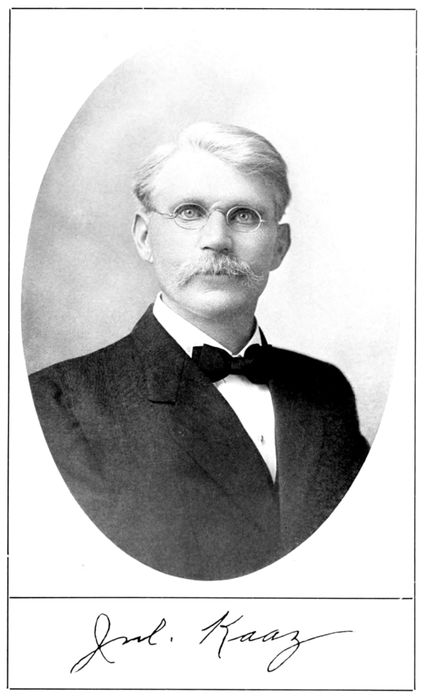
Jul. Kaaz
689Julius Kaaz attended the schools of his native land and studied architecture. He learned the trade of carpenter under his father, but could not content himself to settle down in his native land and follow in the footsteps of his forebears. When still a young man the germ of ambition called him to other lands, and his goal was America. His desire to better his condition led him to set sail for this country in 1881, arriving in Atchison, where he at once sought employment. His first work was cutting cordwood in the timber land, south of the city, during the winter, and in the spring of the following year he worked on the Missouri river, making and placing riprap. Soon afterward he was given a job working at his trade for $1.50 per day. For one year he worked for wages, and at length decided to embark in business for himself and began taking contracts at a time when he had no capital worth speaking of. It was even necessary for him to borrow the saw and hammer which he used in his work. In 1885 he formed a partnership with Henry Braun in the contracting business which continued until 1909, when they dissolved partnership. In 1907 Mr. Kaaz erected his first planing mill which has grown into his present extensive establishment consisting of plant, yards and warerooms.
He was married to Ida Schmeling in 1883, and to this union have been born nine children, as follows: Emil, Lena, Robert, Lydia, Julius E., Otto, Fred, Arthur, Martha. Of these children Martha is deceased, Lydia is her father’s secretary, Fred is also employed in the office, and Otto H. is employed in the mill. Mrs. Kaaz was born September 6, 1856, in Prussia, German Empire, and is a daughter of August and Ernestine (Polzien) Schmeling. She left her native land when sixteen years of age and came to Atchison.
Mr. Kaaz, while politically allied with the Republican party, is an independent voter who believes in voting for the individual who seems to be most capable of serving the people, rather than supporting an avowed politician. He and the members of his family are affiliated with the German Lutheran church and are liberal supporters of this denomination.
GEORGE W. REDMOND, M. D.
A greater service in behalf of mankind than a life devoted to healing the sick and curing the halt and the lame can not be considered, and when this service has been rendered far from the comforts of the city and during the storms of many seasons in the open country from the pioneer era in Kansas down to the present time, the value of such service to humanity is inestimable. The unsung heroes of the medical fraternity are the large class of country 690practitioners who go their way year after year, uncomplainingly and satisfied with the good they are doing for their fellow creatures. Great fortune is not theirs, but the inevitable reward and the satisfaction of a task well and faithfully done is theirs to have. Of this great class the biographer is pleased to record the facts concerning the life and career of George W. Redmond, the second oldest physician in Atchison county, and one of the oldest medical men in Kansas. For nearly half a century Dr. Redmond has practiced his profession among the tillers of the soil in the neighborhood of Potter, and the southeastern part of Atchison county, and in the northeast part of Leavenworth county, Kansas. During all this time he has remained true to his calling, and resisted the call of the towns and cities, where an easier life might be lived. He has likewise progressed with the profession and endeavored to keep abreast of the wonderful developments in the science of medicine, arriving at the point in his career where he is a specialist in his profession.
Dr. George W. Redmond was born in Bourbon county, Kentucky, October 19, 1849, a son of Oscar Redmond and Susan (Orr) Redmond, the former a native of Bourbon county, and the latter a native of Nicholas county, Kentucky. Both were born in the same year, 1820, and the mother of Dr. Redmond was a daughter of William Orr, a captain in the American army in the War of 1812. William migrated to Kentucky from Pennsylvania shortly after peace was declared between England and the United States, and was one of the pioneers of that State. Oscar F. Redmond, father of George W., was a son of William Redmond, was also one of the pioneers in the settlement of old Kentucky. Both the Orr and Redmond families were of that sturdy Scotch Presbyterian stock, who were prominent in the early history of Kentucky, and were noted as true pioneers in several of the middle Western States. Oscar F. Redmond was a farmer in Kentucky, and reared a family of twelve children, of whom George W. was the fourth child. In 1856 the Redmond family removed to Cooper county, Missouri, where they remained until 1858, and then settled in Platte county, Missouri, where the father made a permanent home for many years, afterwards ending his days in Muscotah, Atchison county, Kansas. The mother of Dr. Redmond died in Kansas City in 1892.
When the Redmond family left Kentucky, George W. was five years of age. He received his primary education in the district schools of Platte county, Missouri, and graduated from the Gaylord Institute, after which he began the study of medicine with his uncle, Dr. H. B. Redmond, in Saline 691county, Missouri, with whom he studied one year. He then entered the St. Louis Medical College, of St. Louis, Mo., completed the prescribed two years course, and graduated therefrom in 1869. While trying to decide upon a location, and almost having his mind set upon a city location, he received a letter from his sister, Mrs. Samuel E. King, in Atchison county, informing him that Dr. John Parsons, of Mt. Pleasant, was in need of a young assistant and partner, and he could have the place if he came to Kansas. This letter decided his course, and he came at once to Atchison county and began his practice with Dr. Parsons. At this period Mt. Pleasant was an important inland town, but it has long since passed into the realm of “disappeared cities.” Dr. Redmond remained in Mt. Pleasant a little over two years, and then located in Oak Mills, where he owned a farm, and built up an enormous medical practice in the village and surrounding countryside. He practiced in Oak Mills for thirty years, although prevailed upon by his many admirers in Atchison to remove to the larger city and open an office. During the winter of 1903 and 1904 he pursued a post-graduate course in the post-graduate school of Chicago, and upon his return to Kansas, in the spring of 1904, he located in Potter, Atchison county. Of late years Dr. Redmond has become a specialist in the diseases of women, and it is in this branch of practice that he is achieving his greatest successes. Obstetrics has long been his specialty, and he undoubtedly holds the record in Kansas for the number of successful confinement cases at which he has officiated, and it can be said of him, that in all of his many years of practice he has never lost a confinement case, although there have been times in his career when he has had three and four cases of this character in one day.
Dr. Redmond has been twice married, his first marriage occurring in 1874 with Anna Douglass, a daughter of J. M. and Sarah Douglass, who were among the earliest of the Atchison county pioneers. Four children blessed this union: Ethel, of Leavenworth, Kan.; Edith, wife of Charles Munger, of Atchison county, Kansas; Virginia, living in Leavenworth, Kan.; Georgia Redmond, also residing in Leavenworth. Dr. Redmond’s second marriage took place in 1906 with Carrie A. Sprong, a daughter of D. H. Sprong, an early pioneer settler of Kansas, a sketch of whom appears in this volume.
While Dr. Redmond is a Democrat in politics, he has never found the time to take an active part in political affairs. For the past thirty-five years he has been a contributor to various medical journals, among them being the Medical World, of Philadelphia, one of the oldest and most widely read medical 692publications in the United States. He is a member of the Atchison County Medical Society, the Kansas State Medical Society, and the American Medical Association, and was one of the organizers of the county society in 1869, and is the only surviving original member of the society. He is a member of Kickapoo Lodge, No. 4, Ancient Free and Accepted Masons.
FREDERICK W. LINCOLN.
From small beginnings larger things very often naturally grow. The candy and soft drink manufactory of Frederick W. Lincoln on South Fifth street, Atchison, had its inception in a very modest beginning. In fact, Mr. Lincoln first began manufacturing his fine candies at his residence, corner of Seventh and S streets, but the constant growth of the concern soon required larger quarters, and his present factory, erected in 1893, is the result of his enterprise, a building 20×60 feet in extent, with the basement in use. He employs ten people the year round, and is his own traveling salesman, his son, Edward, having charge of the business during his father’s absence on the road. The products of the Lincoln factory are in demand, and are noted for their excellency. In 1912 the manufacture of soda and soft drinks was added to supply a demand in Atchison and the surrounding territory. The manufactured goods of the Lincoln factory are distributed to all points in Kansas and western Missouri.
Frederick W. Lincoln was born in England January 29, 1852, a son of Edmund B. and Jane (Barrell) Lincoln, the father being born in Norfolk, Intwood county, England, and the mother being a native of County Clingford, England. They were the parents of four children: Edward, a veteran of the Civil war, and inmate of the National Soldiers’ Home at Sandusky, Ohio; Mrs. Mary King, of Michigan; Mrs. Emily S. Moffit, deceased; Frederick W., with whom this review is directly concerned, and who was reared by an uncle, Mr. Barrell, who taught him the baker’s trade. The Lincoln family immigrated to America in 1853, and settled in Ohio, where Frederick was reared to manhood in the home of his uncle. He worked at his trade of baker until 1875, when he came to Atchison, and was employed in the hardware store of W. W. Marlborough for a few years, after which he worked in a candy shop for W. B. Howe, who taught him the candy maker’s trade. About 1880 he embarked in the manufacture of candies with T. L. 693White, with whom he was associated for a short time, and eventually engaged in business for himself, starting in his home, making a very modest beginning. His first shop was near his residence, but the business soon outgrew the demands made upon the little shop, and larger quarters soon became necessary. The business is the direct outcome of the persistence, integrity and industry of the proprietor, and the future of this flourishing concern is bright with promise, as the years see it extend its natural field, and it achieves a natural and deserving growth.
Mr. Lincoln was married January 26, 1879, to Laura Averill, born July 20, at Cooper, Maine, a daughter of Joseph and Julia A. (Whitney) Averill, natives of England and Scotland respectively. Mrs. Lincoln came to Atchison with her mother and resided with her stepfather and mother until her marriage with Mr. Lincoln. To Mr. and Mrs. Lincoln have been born the following children: Mrs. Leona Andrews, of Atchison; Edward E., born May 11, 1883, educated in the public and high schools of Atchison and brought up with his father in the business, married in 1903 to Freda Spatz, who was born November 9, 1896, in Atchison, a daughter of Jacob and Josephine (Latenser) Spatz, natives of Germany and St. Joseph, Mo., respectively; the third child being Frank, a machinist, employed at Horton, Kan.
Mr. Lincoln is a Republican, and is fraternally allied with the Ancient Order of United Workmen, the United Commercial Travelers, and the Modern Woodmen of America. He and the members of his family belong to the Christian church. Mr. Lincoln’s career is an exemplification of the adage, “Success never comes to him who waits,” and his standing in the commercial life of Atchison today is due to the fact that he made his opportunity and is justly entitled to proper recognition as one of the city’s leading factors.
JOHN C. VALENTINE.
John C. Valentine, owner and proprietor of the Northern Kansas Telephone Company of Effingham, for more than forty years has been a resident of Atchison county. The Northern Kansas Telephone Company, of which he is the head, was organized in 1903 as a coöperative concern, but is now owned and operated by Mr. Valentine and his son, A. G. Valentine. The lines of the company cover a section of country within a radius of six to ten miles of Effingham. Twenty-six lines are supplied with good service, 694and the company has over 435 subscribers at the present time. The plant is well equipped and is noted for the excellent service given the patrons.
John C. Valentine is a native of Dearborn county, Indiana, and was born in the Hoosier State July 28, 1845, a son of George and Sarah (Cornforth) Valentine. His father was born in New Jersey, and accompanied his parents to the Middle West, locating in Cincinnati when George was a child. He was reared in Cincinnati, and later settled in Indiana. His mother was the daughter of pioneer stock of English descent, and was connected with the Eubanks family, which figured in the early history of Indiana. Sarah Valentine died in 1863, and George married again, after which he settled in Illinois, and died near Xenia, that State. He was a soldier in the Civil war, and served in an Ohio cavalry regiment throughout the conflict. John C. Valentine enlisted in the 134th regiment, Indiana infantry, in the spring of 1864, and served until his honorable discharge in the fall of the same year. His health became poor while serving in Tennessee, and he was transferred to Louisville, Ky., and sent home from that city. He was kept on the reserve force while serving in Alabama, and was in the breastworks at Decatur, Ala. At this place he was exposed to a hot fire, and recalls that it was a very uncomfortable place in which to be. During the winter of 1866 he taught school in Decatur county, Indiana. He remained at home with an uncle, William Sawdon, at Aurora, Ind., after returning from the war, until September, 1867, at which time he went to Ft. Madison, Iowa, and there met some friends. He worked on farms in the neighborhood until Christmas of that year, and then left for Kansas, arriving at Leavenworth January 1, 1868.
During his first year in Kansas he broke prairie land for a living; the next year he sold sewing machines, and made good at that avocation; the second year, winter of 1868–69, he taught school in Leavenworth county, and two years after coming to this State he was married. He and his brother, Charles, broke prairie with their two teams in Jefferson county, and for four years after his marriage, Mr. Valentine had great success in farming in that county, raising immense crops of wheat. In the year 1874 he came to Atchison county and settled on a farm four miles northwest of Effingham on the south side of the Parallel road. He at first bought a tract of eighty acres and erected a small house on his land, erecting other buildings as he was able. Mr. Valentine has prospered in the years following his first purchase of land in this county, and he and his son now own a total of 200 acres of well improved land. He resided on the farm until January of 1896, then turned over the farm to the management of his son, and came to Effingham. 695For ten years following he traveled as salesman, and in 1905 engaged in the telephone business by the purchase of the coöperative company which formerly owned the lines he is now operating.
Mr. Valentine was married April 7, 1870, to Miss Lena Smith, of Johnson county, Kansas, who was born in 1855. The children born to this union are: Albert G., on the home farm, married Alice Frame, and is the father of one son and five daughters; Mrs. Mattie Stevenson, of near Beloit, Kan.; Edward died at the age of twenty-two years, and Robert died at the age of thirteen years.
Mr. Valentine is a Republican in politics, and has always remained loyal and steadfast to the party of Abraham Lincoln. He has served as city councilman and mayor of Effingham. He is an Odd Fellow, and a member of the Grand Army Post, No. 176, Effingham.
GUSTAVE STUTZ.
Gustave Stutz, farmer and stockman, of Atchison county, Kan., was born April 20, 1867, in Lancaster township, this county, and is the son of Christian and Katherine (Schweitzer) Stutz. Seven children were born to them, as follows: Caroline (Demel), of Central City, Neb.; Katherine (Wilkins), Atchison, Kan.; Frederick, policeman, Atchison, Kan.; Christopher W., Center township, Atchison county; Gustave, subject of this sketch; John, Center township; and one child died in infancy. The father of Gustave Stutz was born March 25, 1825, in Germany. He left there in 1855, and settled in Jackson county, Missouri, and in 1859 came to Atchison county, where he bought eighty acres of land in Lancaster township. The land was timber and prairie country, and he employed a man to break it up with oxen. Mr. Stutz made extensive improvements on his farm, and added more land from time to time. When he died, December 28, 1898, he owned 380 acres of land. The mother of the subject of this sketch was born in Germany, in February, 1829. She died in Lancaster township in December, 1888. She is buried in Maple Grove cemetery.
Gustave Stutz was reared on his father’s farm and attended the public schools of Lancaster. In 1893 he rented a farm from his father for a year, and then bought 160 acres in Center township. Five years later he sold that and bought eighty acres near the Madison school house. Having made a 696number of improvements, he sold this farm and bought the present one of 160 acres. When he took this land there were only a few ramshackle buildings on it, but he has made it one of the most modern farms in the State. He built a large seven-room house at a cost of $4,500, which is fitted with all modern conveniences, including hot and cold water, electric lights, bath, and a basement fitted up as a laundry. The house is lighted by electricity, which is generated from a private plant located on the farm. Mr. Stutz was the first to install one in Atchison county. In 1912 he built a barn, 52×46 feet, for general purposes. Mr. Stutz is a breeder of Shorthorn cattle and takes great pride in his herd. He has a herd of thirty fine Shorthorn cattle, including four pure breds, and has been gradually improving his herd for the purpose of embarking in the business of breeding Shorthorns for the trade. He is a stockholder in the Independent Harvester Company, of Plano, Ill. He is a Democrat in politics, and was for a time road supervisor of Lancaster township.
Mr. Stutz was married October 10, 1893, to Margaret Waltz, who was born April 30, 1875, in Shannon township, Atchison county. She is a daughter of Charles and Margaret (Diesback) Walz, both natives of Germany. The father died February 4, 1890, at the age of sixty-two. He immigrated from Germany in 1847. The mother is living in Atchison county. Mr. and Mrs. Stutz are the parents of three children: Albert, born June 2, 1895; Edward, born January 3, 1898, and Pearl, born June 24, 1899, all living at home. Mr. Stutz attends the Presbyterian church, and is a member of the Independent Order of Odd Fellows.
THOMAS O. PLUMMER.
There is some distinction in being a pioneer in the State of Kansas, and there is certainly considerable distinction coming to the man who can justly lay claim to being the first white child born of pioneer parents in a component part of a great county like Atchison. Thomas O. Plummer, prosperous farmer and stockman of Grasshopper township, Atchison county, is the first white child born within the borders of his township, and has lived all of his fifty-nine years within the borders of the township.
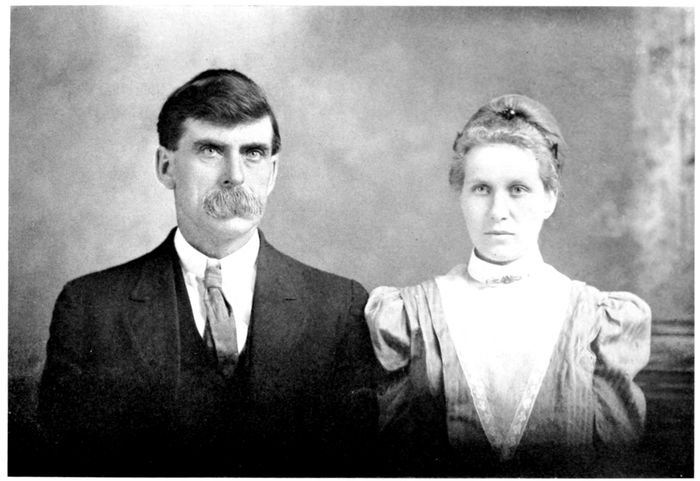
T. O. Plummer and wife
697T. O. Plummer was born December 6, 1857, a son of Leven Vincent and Matilda (Norman) Plummer, both of whom were born in Kentucky. Leven Vincent was a son of Lewis Plummer, a native of Germany, who immigrated to America when quite young and married a Miss Vincent in Kentucky. She (his wife) was a daughter of English parents and was a large woman. The fact that her descendants are all men of large physique is explanatory of the inheritance of strength and size which predominates in the men of the Plummer family. The mother of Thomas O. was a daughter of Lewis Norman, a Kentucky pioneer and expert blacksmith, who was of French-English descent. He (Lewis) was a maker of plows and farming implements which he would manufacture in his shop, load on a river boat and sell in the towns and villages on the banks of the Ohio river. On one of his trading expeditions he was shot by the crew of a rival trading boat.
Leven Vincent Plummer was the father of eight children, as follows: Mary Elizabeth Baker, Oklahoma; Dempsey died at the age of sixteen years; Charles died in 1907; Thomas O. and Benjamin F., (twins), Arrington, Kan.; Leonidas, Atchison; Commodore, Oklahoma; Harriet Ratley, Cowley county, Kansas; Lucullus, on old home place.
In the year 1854 he left Kentucky and migrated to Platte county, Missouri, where he resided until 1855 and then made a settlement in Grasshopper township, Atchison county. He was the first white settler on Brush creek in the Kickapoo Indian reservation lands. He did his trading at old Kennekuk. It is recalled that the old Mormon trail passed by his home and Mr. Plummer remembers the story of a large party of Mormon immigrants being stricken with the cholera and over 100 of them died as a result of the terrible attack of the dread disease. The dead bodies of the victims were hurriedly buried in shallow graves, but, unfortunately were rooted up by hogs owned by the Indians. Inasmuch as the white settlers were afraid to bury the bodies again the hogs were permitted to eat the bodies. Leven Plummer was on extremely good terms with the Indians of the neighborhood and several of them worked for him at different times. When the Indians disposed of their land holdings to the Government and moved to a new reservation, he purchased of them 100 of their “razorback” hogs and 10,000 fence rails at a cost of ten cents a hundred rails. He hauled the rails to his place in immense wagon loads, hauled by two yoke of oxen and a team of horses. He became fairly well to do and was a large feeder of live stock, frequently feeding as high as 100 head of cattle, four-year-old steers and 400 head of hogs. He died in 1867, at the age of forty-seven years, leaving eight children to the care of his widow. Leven Plummer was noted as one of the strongest men of his day and was a man of large stature who could perform feats of strength which would appall the average man.
698Thomas O. Plummer attended the district school of his neighborhood and when twenty-one years of age began for himself. His first employment away from home was for six months with Martin W. Ham. He then worked for a bachelor neighbor at ten dollars per month. In 1879 he began renting land on his own account. From boyhood he has always had to hustle for himself and has made good. He made his first purchase of land in 1893 and has accumulated a total of 241 acres of well improved farm lands in Grasshopper township.
In 1884 Mr. Plummer was united in marriage with Mary Ratley, and the union was blessed with one son, James Oliver Plummer, who is now the efficient superintendent of highways in the township. Mary (Ratley) Plummer was the daughter of John and Hannah Ratley, and departed this life in September 15, 1887. In September of 1893, Mr. Plummer was again married to Miss Mary E. Clark, who has borne him one child, Thomas McKinley Plummer, who as a youth attended the agricultural college at Manhattan, Kan., and is much interested in scientific farming. Mrs. Mary (Clark) Plummer died March 13, 1908. She was a daughter of P. J. Clark, a very early settler of Atchison county, and formerly a member of the Atchison city police force. The third marriage of Thomas O. Plummer occurred March 2, 1909, with Mrs. Bessie May De Bord (Floyd), widow of James Floyd, a native of Kentucky, and to this union have been born two children: Theodore Ole, and Calvin Vincent Plummer. By her first marriage, Mrs. Plummer has one child, Ruby Jewell Floyd, born September 30, 1905.
Mr. Plummer is one of Atchison county’s best known and successful self-made men and everything he owns has been earned by hard labor and diligence, combined with good management. Besides his farming interests he is a stockholder in the Farmers Grain Elevator and the Mutual Telephone Company, at Muscotah. He is a Republican in politics, and is a member of the Mystic Workers and the Modern Woodmen of America.
HOWARD E. NORTH.
Howard E. North, farmer, of Lancaster township, Atchison county, was born January 25, 1867, in Walnut township, this county, and is a son of Edwin T. and Elizabeth (McCully) North, natives of New Jersey. Of the eight children born to them six are living, as follows: Walter M., Atchison, Kan.; Joseph H., of Kansas City, Mo.; Percy, of Ottawa, Kan.; Claude, Lancaster, 699Kan., and Mrs. Sadie Dunkle, of Los Angeles, Cal., besides Howard E. North, subject of this sketch. The father was born April 23, 1830, in Burlington county, New Jersey, of English descent. Leaving there about 1865, he came west and settled in Atchison county, Kansas, living one year in Walnut township, and then bought a farm in Lancaster township. He made improvements, and later sold the farm to his son, Howard E., and retired in 1896. In December, 1912, he died, after having lived a long and useful life. The mother was born in New Jersey, as was her husband, and was born in the same year, 1830, of Scotch descent, and died in March, 1902.
Howard E. North was reared on his father’s farm, and attended the public school at Lancaster, and also the Bell district school, No. 59. He was born on the place which he now owns, and it has been his home since boyhood. It consists of 180 acres, and is exceptionally well improved. Extra attention has been given to stock raising facilities. Mr. North takes a great deal of interest in fine cattle, hogs and horses, and has some excellent Shorthorns and some valuable Poland China hogs. Mr. North has a graded stock of horses, some of which are the best in this part of the country. He is a stockholder in the German-American Bank at Atchison, Kan. Politically, he is a Republican, and has always been a loyal citizen, taking keen interest in the welfare of his community and his county. He is a member of the school board of Bell district.
In 1896 Mr. North was married to Alice Guyer, who was born October 1, 1866, in Union county, Pennsylvania. Mrs. North was a daughter of Israel and Catharine (Brown) Guyer, natives of Pennsylvania, and who lived and died in the land of their nativity. Mrs. Alice North came to Kansas in August of 1893, and joined her sister, Mrs. Annie Gemberling, who now resides in a home on the Parallel road, near Lancaster, Kan. One child, Emlin E., has been born to Mr. and Mrs. North. Mr. North is a member of the Methodist church, and of the Independent Order of Odd Fellows, and Modern Woodmen of America.
NICHOLAS BOOS.
Nicholas Boos, proprietor of one of the best improved farms in Shannon township, has resided on the land which he now owns for over fifty years, and is widely known as a progressive farmer who has applied his accurate knowledge of the best farming methods to such good account that 700he is now the owner of 250 acres of good land, upon which he erected in 1912 a handsome brick residence, modern throughout, at a cost of $4,500. Mr. Boos installed his own light and water plant, and in the rear of his handsome home he has built a large and commodious bank barn. His residence faces the main highway running northward from Atchison, and presents a substantial evidence of the enterprise of its owner.
Mr. Boos was born November 11, 1862, in Germany, a son of Nicholas and Catharine Boos, who left their native land with their two children and came to Atchison county, Kansas, in July of 1865. After one month’s stay in the city they removed to a point in Shannon township, about three miles north of Atchison, and settled upon eighty acres of land which the elder Boos purchased. Nicholas Boos and his wife reared their children here, and lived on the farm until death called them away. Nicholas Boos, Sr., was born in 1833, and died in October of 1899. Catharine, his wife, was born in 1833, and died in November of 1898. Their two children are: Nicholas, with whom this narrative is directly concerned, and Catharine, now known as Sister Hilda of the Order of St. Benedict’s, Mt. St. Scholastica Academy, Atchison.
Upon the death of their parents, Nicholas Boos and his sister inherited the eighty acre farm upon which they had been reared. Nicholas bought his sister’s share of the estate, and by dint of hard, unremitting labor, and the exercise of frugality and good financial judgment, has added 170 acres to the original tract. There are 205 acres in the home farm on the east side of the highway and forty-five acres on the west side, some distance from his home.
Mr. Boos was married May 1, 1889, to Mary Wolters, born in Atchison county, and daughter of Matthew and Catharine Wolters, both of whom were natives of Germany, Matthew being now deceased and his widow residing in Mr. Boos’ home. Ten children have been born to this estimable couple, namely: William, aged twenty-five years; Albert, aged twenty-three, employed by Dolan Mercantile Company; Nicholas, aged seventeen years; Edward, twelve years of age; Harold, aged eight years; Hilda, twenty-three years of age, and a dressmaker; Marie, aged twenty-one, second bookkeeper for John J. Intfen, grocer; Frances, aged eighteen, bookkeeper for Byrnes’ drug store; Bertha, aged fourteen, and Rosa, aged ten years: William, an employee of the Symns Grocer Company, married Marie McGraff. Mr. and Mrs. Boos have endeavored to give all of their children good school and college educations, and have succeeded in rearing a fine and worthy family, of which they have a good and just right to be proud.
Mr. Boos is a member of St. Benedict’s Catholic Church and is a liberal 701supporter of Catholic institutions. He is affiliated with the Modern Woodmen lodge. While a Democrat in politics, he endeavors to exercise the right of suffrage in a manner befitting his own ideas, and supports such candidates for office as come the nearest to his ideal of a good man and official regardless of political protestations.
JUNE E. MOORE.
June E. Moore, president of the Symns Grocer Company, of Atchison, Kan., is a native of Cincinnati, Ohio, and a son of Thomas H. and Lydia Ann (Gordon) Moore, the former a native of Virginia, and the latter of New Jersey. The Moore family came to Kansas in 1865, and the father engaged in the mercantile business at Iowa Point, Doniphan county. He was engaged in business there about ten years, or until 1876, when he sold his business and removed to Kansas City, where he remained until his death, in 1889. His wife died in 1886. June Moore, the subject of this sketch, received a good common school education, and remained at home, at Iowa Point, until 1873, when he came to Atchison and accepted a position as bookkeeper in the grocery house of A. B. Symns. About three months later he went on the road as traveling salesman for Mr. Symns, and was the first man to represent Mr. Symns in that capacity. After remaining in Mr. Symns’ employ for about three years, he went to Falls City, Neb., and engaged in the mercantile business for himself, and conducted a business there for seven years. He then returned to Atchison, and in 1879 engaged in the grocery business for himself. Mr. Moore continued in the grocery business in Atchison from 1879 to 1887, when he again became connected with the Symns Grocer Company, which had been reorganized in the meantime. Since that time Mr. Moore has been connected with the Symns Grocer Company, which is one of the leading institutions of the kind in the State. From 1889 until 1907 Mr. Moore had charge of their Topeka branch. During the year of 1907, M. S. Peterson, who had been the buyer of the company for a number of years, died, and Mr. Moore was obliged to return to Atchison to assume the responsibilities in connection with the purchasing department. He looked after the purchasing department of the company for one year, when he became president of the company, and has since capably filled that responsible position. Mr. Moore is a stockholder in the company, and is one of the men who have contributed many 702of the best days of their lives to the upbuilding and development of this great commercial institution, of which the people of Atchison are justly proud.
Mr. Moore was united in marriage July 27, 1871, to Miss Rebecca Armstrong, a native of North Carolina. Mrs. Moore was a daughter of Francis K. Armstrong, of Virginia, who moved to North Carolina, and there married Jerusha Eliza Belt, and returned to Virginia, and in 1859 migrated to Missouri, remaining in St. Joseph until the fall of 1860, and then settled on a farm in Doniphan county, Kansas, where he died in November, 1861. Mr. Moore is a member of the Masonic lodge, and one of the substantial business men of Atchison.
W. PERRY HAM.
The powers of leadership are inherent in some individuals, and there are in every community such men who seem naturally gifted to lead their fellows in political affairs. In reviewing the life career of W. Perry Ham, the official head of the Republican party in Atchison county, the fact is brought out that his natural gifts have tended to lead him to activity in political affairs, and that he is gifted with ability of a high order, which is universally recognized by the men of his party who look to him for leadership. Mr. Ham is a thorough American, whose ancestry goes back to the earliest days of the foundation of the Republic.
W. Perry Ham was born October 11, 1861, at Flemingsburg, Fleming county, Kentucky, a son of James P. and Eliza (Jones) Ham, both of whom were born and reared in Kentucky, and were children of pioneer parents. James P. was the son of William and Mary E. Ham, and the great-grandfather of W. Perry was John Ham, better known as “Jackie,” a native of Greenbrier county, Virginia, who married a Miss Woods, and migrated to Kentucky in the days of the illustrious Daniel Boone, the famous hunter. These were troublous times in Kentucky, and the Indians fiercely disputed the advent of the white settlers into their favorite hunting grounds. The mother and two sisters of “Jackie” Ham were captured by the Indians, killed and scalped, and their bodies burned in the cabin fireplace by blood-thirsty Indians. The Ham family is of Welsh extraction. James P. Ham, although a southerner by birth and breeding, was a strong Union man, who was opposed to the institution of slavery. While still residing in Kentucky, in the year 1865, he received a telegram from his brother. Joseph, calling him to 703Buchanan county, Missouri, where his life was in danger from Union men. Joseph kept a general store at DeKalb, and was forced to go in hiding to preserve his life, he being a southern sympathizer. It was his desire that James P. come to Missouri and take charge of his store until times were better, and it was safe for him to appear. James made all haste to comply with his brother’s request, and with his wife and family made a hasty trip to Buchanan county, only to find on his arrival that his brother’s store at DeKalb had been burned to the ground. The wife of James P. was overcome by the excitement, and her strength overtaxed by the trials of the family, and she died in 1865. This left the father with three children to care for, and he removed to Atchison in 1866. Here he engaged in market gardening, and took more or less interest in political affairs until his demise, November 2, 1894, at the age of sixty-six years, in Rural township, Jefferson county, Kansas, where he removed a few years after coming to Atchison.