Chapter XXV · BIOGRAPHICAL HISTORY (continued 5)
Reading edition
Judge Jackson has a reputation for fairness and impartiality in his judicial decisions which has gone far beyond the borders of his county. The Atchison Daily Champion in its issue of September 25, 1913, has this to say of his high honor and integrity:
“In these days of alleged lawless lawyers and corrupted courts it is a good thing to know that Atchison county has an honest and efficient judge to administer justice from the district bench. Many big men,—men of splendid qualifications and sterling integrity—have occupied the important position now held by Judge Jackson, but never before has this county had a judge whose service on the bench commanded more universal satisfaction than that rendered by Judge Jackson. It is the unanimous opinion of the Atchison bar that he is the best district judge in the State. Absolutely fair, impartial, capable, he performs the functions of his office with a high sense of duty 491and responsibility to the law and to his fellow men, a duty and responsibility which precludes all other results, save only unqualified justice for each case that comes under his supervision.”
The supreme test which could be applied to a man in his position came on an occasion when the father and brother of Judge Jackson appeared for the defendant in a case which was tried in the Atchison court with Judge Jackson on the bench, and he was not found wanting. Quoting from the Atchison Daily Champion in its issue of April 19, 1909, concerning this unique situation and the conduct of Judge Jackson during the course of the trial of the case:
“Many people have attended court the past week as witnesses, jurors and spectators in the Norris-Mapes trial, and the fact was freely commented upon that the appearance in the trial of father and son as attorneys for the defendant and another son was on the bench, presented a situation that was quite unusual. Some at first indulged in unfriendly criticism of the circumstances and it is therefore a pleasure for the Champion to say that it has heard nothing but the most universal praise for the fairness, the impartiality and the splendid integrity of purpose Judge Jackson displayed in his rulings on every disputed question of law and evidence in the case. It is a fact worthy of comment that the Champion takes pleasure at this time in giving public recognition to so important a matter. There is nobody in Atchison who has a stronger following of loyal friends than Will Jackson, and it is because of his manhood, his honesty and fine sense of honor that he has earned them and retains them.”
William Anthony Jackson was trundled in a home-made baby-cart and dressed in clothing spun and made by his devoted mother. Few were the luxuries in which he was indulged; the plainest of fare was his sustenance during his childhood days. In 1870 he was placed in school at Marysville, Mo., and after coming to Atchison with his parents he attended the city schools. He attended the Monroe Institute and later entered Kansas University at Lawrence, graduating therefrom in 1888. He was admitted to the bar and in 1889 was made a member of the law firm of Jackson & Jackson. His success in the practice of his profession has been marked and he is widely known as a capable lawyer and jurist. His first public office was that of city attorney, to which he was elected in April, 1905, and served until 1909. During the four years of his incumbency of the office of city attorney he lost but one case which came up for trial under his care for the city. He was elected judge of the district court, second judicial district, in November of 1908, and resigned the office of city attorney to take up his duties on the bench in order to qualify in January, 1909. His career on the bench speaks 492for itself and the fairness of his decisions is proverbial. Judge Jackson is remarked frequently for his kindness of heart, and soon after he was admitted to the bar the opportunity came to him to “return good for evil” in one particular case. A lad with whom he had come into contact on the school ground at Marysville, and who had tried to impose on him, with the result that strained feeling existed for many years between them was the beneficiary of his goodness. This lad, then grown to man’s estate, came to the judge in Atchison and asked him to assist him in getting employment. The judge did so and earned the thanks of his boyhood enemy.
Judge Jackson’s wedded life began April 26, 1894, when he was united in marriage with Edith Fox, of Atchison. To this union have been born two children: Jared Fox Jackson, born November 19, 1895, and now a student in the law department of Kansas University; Edward Valentine Jackson, born June 6, 1900, a student in the Atchison High School. The mother of these children is a daughter of Jared Copeland. (See sketch of Jared Copeland Fox elsewhere in this volume.)
Judge Jackson is fraternally affiliated with the Masonic Lodge, Washington, No. 5, of Atchison, the Knights of Pythias, the Elks, the Fraternal Order of Eagles, and the Phi Gamma Delta fraternity of the Kansas State University. He is a liberal contributor to charitable and religious denominations, and is usually found in the van of all projects which have for their purpose the betterment of his home city and county.
ROY C. TRIMBLE.
In Roy C. Trimble, sheriff of Atchison county, the people have an efficient and capable public official, who believes that his duties are paramount over all other considerations, and he has shown by his steadfast and unswerving loyalty to the ethics of his office that he is a man eminently fitted for high public office. Mr. Trimble is a young man to hold such an important office, but is old in ability and experience. He is a native of Atchison county, and a son of James M. and Margaret E. (McCreary) Trimble.
Roy C. Trimble was born August 11, 1877, on a farm, four miles southwest of Atchison. His father, James M. Trimble, was born September 10, 1843, in Buchanan county, Missouri, and died in January, 1910, in Atchison county. He was the son of Benjamin F. Trimble, a native of Kentucky, who immigrated to DeKalb, Mo., where he conducted a blacksmith and wagon repair shop, and later removed to Texas. After a residence of some years in 493Texas he settled in Atchison county, where the son, James M., bought a farm which he cultivated until 1905, when he disposed of his land and invested in a livery business. He was thus engaged until his death. During the Civil war, Mr. Trimble was enrolled in the State militia. Benjamin F. Trimble was one of the early pioneer settlers of Atchison county and owned a farm near Effingham. The children of James M. Trimble are J. P., a railway mail clerk on the Central Branch railroad; A. F., a rural mail carrier; K. S., a farmer, south of Atchison; E. S., a resident of Lake Ballinger, Wash.; Roy C., and T. O., a ranchman, near Seattle. Wash.
The mother of the foregoing children was Margaret E. McCreary, born in 1850 and died in 1890. She was a daughter of Solomon McCreary, a pioneer settler of Atchison county, who had a farm eight and one-half miles south of Atchison. Solomon McCreary was born in Clay county, Missouri, in 1822, and died in July, 1911. He was a son of Elijah McCreary, and was the youngest of a family of thirteen children. The family is of Scotch-Irish ancestry, and originally settled in South Carolina. S. K. came to Kansas in 1854, first settling in Leavenworth county, and four years later moving to Atchison county. He bought a land patent from a Mexican war veteran, and made his home on the pioneer farm until his death. His children were as follows: Mrs. B. Frank Trimble, Mrs. Margaret Trimble, deceased; Mrs. Nellie Adams; Cora, deceased; W. S., deceased; Mrs. Nettie Perkins, Leavenworth; S. K., and Mrs. Grace Salmon, of Los Angeles.
Roy C. Trimble was educated in the district school No. 5, located south of the city, and resided on the farm until 1905 when he was engaged in the livery business with his father, continuing until the latter’s death, after which he conducted the business for a few years and then traded it for some real estate. He was first a candidate for sheriff in 1912 on the Republican ticket, but lost out by 288 votes. He was again a candidate in 1914 and won by the considerable margin of 700 votes.
Sheriff Trimble was married November 2, 1904, to May Florence Hartman, who was born near Purcell, seven miles southwest of Atchison, and is a daughter of Ex-Sheriff F. C. Hartman, now deceased. To Mr. and Mrs. Trimble have been born the following children: Guy Roy, born August 7, 1905; Cynthia Grace, born May 2, 1907; Clara May, born May 10, 1913, and Henrietta Gale, born June 4, 1915.
Mr. Trimble and wife are members of the Presbyterian church. He is fraternally affiliated with the Independent Order of Odd Fellows and the Fraternal Aid. Mr. Trimble is likeable, and has a winning personality which goes far toward making him a successful and popular official. Such encomiums 494and praise as have come to him for his conduct of the duties of the sheriff’s office are well deserved and he is constantly widening his circle of friends.
CHARLES J. CONLON.
Charles J. Conlon, a prominent attorney of Atchison, who is now serving his second term as county attorney, is a native of the Empire State. He was born at Orwell, Oswego county, New York, October 31, 1860, and is a son of James and Anna (Bowen) Conlon, the former a native of New York and the latter of Ireland. Anna Bowen, the mother, came to America with her parents, William and Nancy Bowen, when she was thirteen years of age. James Conlon was born in Oneida county, New York, and was a son of Charles Conlon, a native of Ireland, who immigrated to America in 1814 and settled in Oneida county, New York, where he spent the remainder of his life. James Conlon grew to manhood in Oneida county, and in 1859 was married and about a year later removed to Oswego county, bought a farm and followed farming there until 1867. He then returned to Oneida county, where he remained until 1870, when he came to Kansas, locating in Atchison county. He bought a farm about a mile and one-half southwest of the city of Atchison, where he was successfully engaged in farming and stock raising until about a year prior to his death, November 1, 1899, at the age of seventy-three. He was a very successful farmer and a highly respected citizen, and at the time of his death owned 200 acres of valuable land, which is still owned by the Conlon family. He was a life-long Democrat and a member of the Catholic church. His wife died September 22, 1898, aged sixty-three years. They were the parents of the following children: Anna M. married Peter Donovan, now deceased, and three children were born to this union, Peter, Fredrick and Charles, and after the death of her first husband, Anna M. married John McInteer, who is also now deceased and she resides in Atchison; Charles J., the subject of this sketch; William H. resides on the old homestead; John F., farmer, Atchison; James D., plumber, St. Louis, Mo.; Letitia M. McKenna, Denver, Colo., and Fred J. died in Atchison at the age of thirty-three years. He was a machinist and well and favorably known in Atchison county. Charles J. Conlon was educated in the public schools, St. Benedict’s College, Atchison, Kan., and Whitestown Seminary, Whitestown, N. Y., graduating from the latter institution in the class of 1882. He then entered the law department of the University of Michigan, at Ann Arbor, Mich., and was 495graduated in the class of 1884 with the degree of Bachelor of Laws. He then engaged in the practice of his profession at Atchison, Kan., and has continued in the practice to the present time. He was elected county attorney of Atchison county in 1912 and reëlected to succeed himself in 1914. Mr. Conlon is a capable lawyer and is a fair and fearless prosecutor. Mr. Conlon was united in marriage February 14, 1903, to Miss Mae Flanigan, a native of Oswego county, New York.
JOHN F. CONLON.
John F. Conlon, farmer, was born October 15, 1865, in the town of Orwell, Oswego county, New York. He was educated in the common schools of his native town and later attended the Whitestown Seminary at Whitestown, N. Y. After coming to Atchison county, Kansas, in 1885 with his parents, he studied at St. Benedict’s College. He remained with his parents on the home farm southwest of Atchison until their death, and managed the estate for several years thereafter successfully.
THOMAS O. GAULT.
Personal achievements of the individual are always worth recounting when he has accomplished something worth while. There is considerable satisfaction in the latter years of the life of an industrious couple, who, having begun at the foot of the ladder of success and having climbed upward by degrees, have attained to a state of wealth and comfort by the time middle age has been reached. Thomas O. Gault and his wife, residing in a beautiful farm home in the northeast part of the city of Effingham, are among the most respected citizens of Atchison county. Mr. Gault is one of the large land owners of the county, and while not an old resident he can lay claim to the fact that he was a homesteader in Kansas back in the “grasshopper” era, and has had as many ups and downs as the average western pioneer.
Thomas O. Gault was born November 7, 1849, in Wycomico county, Maryland, a son of Archibald and Eliza (Littleton) Gault, natives of Maryland, and descendants of old American colonial families. The ancestry of the Gault and Littleton families dates back to the earliest days of the settlement of the eastern coast of America. Archibald was the son of Obid Gault, who was a soldier in the War of 1812, and was an early pioneer settler of Indiana. Eliza Littleton was a daughter of Thomas Littleton, and died when Thomas O. was seven years of age. Archibald Gault emigrated from Maryland 496to Ripley county, Indiana, about 1859, and settled on a farm south of Pierce City, or near Stringtown. This was in a timbered country, and he lived there only three years, returning to Maryland during the dark days of the Civil war, where he remained until the war was over. In 1865 he returned to his farm in Ripley county, and cultivated his Indiana farm until old age overtook him, and he finally returned to the old home in Maryland, there spending his declining years, dying in 1900, at the age of eighty years.
Thomas O. Gault was educated in the district schools of Ripley county, Indiana, and began working at the hardest kind of farm labor when yet a boy. When he attained his majority he came to the great West, where opportunity seemed to beckon with a more lavish hand than among the hills and forests of his native county and State. He located in Jasper county, Iowa, and worked at farm labor until twenty-five years of age, then came to Kansas and homesteaded a Government claim in Phillips county. This was a sad experience, however, as the grasshoppers came along soon afterwards and “cleaned out” the crops of the homesteaders in his neighborhood, and he abandoned his claim and left the country. He returned to Jasper county, Iowa, in 1873, where he remained for three years, after which he remained in Iowa, locating in Pottawattamie county in 1878, where he had purchased a farm. He and his wife developed the farm and prospered for a period of fourteen years. Selling out their Iowa farm at a good round price in 1903, they located in Effingham, where they have resided since March of 1903. Mr. Gault invested his capital in Kansas and Missouri lands and has made money since he came to Kansas. Being gifted with the moneymaking instinct and capacity, he has dealt somewhat in land and been successful in his farming operations in Atchison county. He is the owner of an eighty acre tract of valuable land, purchased in 1902, adjoining Effingham, Kan., on the northeast, and has one of the most attractive modern farm homes in the county. He owns at the present time a total of 582.5 acres of land, 262.5 acres of which is located in Grundy county, Missouri, and the rest in Atchison county. He has a large farm of 240 acres near Pardee in Center township, which is one of the best improved tracts in the vicinity. This farm was purchased in 1902 and is equipped with excellent buildings, including a house of twelve rooms and three good barns.
He was married on March 4, 1888, to Miss Melissa Drury, of the town of Drury, Rock Island county, Illinois. They are the parents of two children: Essie, at home with her parents, and Pearl, wife of William Thomas, a son of Robert M. Thomas, of Effingham. Mrs. Gault was born March 4, 1861, 497in Drury, Rock Island county, Illinois, a daughter of Eli and Margaret (Hubbard) Drury, natives of Wayne county, Indiana, and Bedford county, Pennsylvania, respectively. Mr. Drury served as postmaster of the village named in his honor in Rock Island county for thirty-five years, and was filling the office at the time of his death, in 1892.
Mr. Gault is a stockholder in the Farmer’s Mercantile Company of Effingham. He is a Republican in politics, but is an independent voter, who believes in doing his own thinking as regards the merits of respective candidates for office and the principles which influence good government. He became an Odd Fellow in Marshall county, Iowa, in the early eighties, and has continued in good standing in the order to the present time. One of the incidents of his early career which left an impression on Mr. Gault’s memory, which time has never been able to eradicate, was his first Kansas experience. He was so thoroughly cleaned out during the great grasshopper scourge in the seventies, in Phillips county, Kansas, that he was forced to walk the entire distance from Blue River, Kan., to Atchison.
WILFULL A. STANLEY.
Wilfull A. Stanley, a Civil war veteran, who perhaps has had more military experience than any other man in Atchison county, is a native of New Jersey. He was born at Salem, November 26, 1838, and is a son of Joseph C. and Rebecca D. (Gosline) Stanley, both natives of New Jersey and descendants of colonial ancestors, who trace their family genealogy back for several generations in this country. The first white child born in the English colony that settled in New Jersey, opposite Egg Harbor, was an ancestor of Wilfull A. Stanley. Joseph C. Stanley, the father of Wilfull A., was a son of Friend Richard Stanley, who was a soldier in the War of 1812. The Stanley’s were Quakers, but there were a great many fighting Quakers distributed along the line of descent. Friend Richard was a son of John Stanley, who was a Revolutionary soldier and served in Lighthorse Harry Lee’s cavalry. He was captured and confined in a British prison ship for some time. He lived to be a very old man and died in 1845, at the age of 102. He was very active physically and mentally to a very old age. Wilfull A. Stanley was reared in New Jersey and received a common school education. On December 22, 1860, he enlisted as a private in the United States marine; and after making a trip around the world was detailed in 1861 as orderly to Admiral Dahlgren at Washington, D. C. He also served as orderly to Commanding 498Officer C. R. P. Rogers. Mr. Stanley was at the taking of Hatteras Inlet and the operations on Roanoke Sound in conjunction with General Burnside’s expedition. He was at the engagement of Port Royal and served as orderly to Capt. C. R. P. Rogers there. He was also at the engagement at Ft. Walker. The “Wabash,” upon which he was serving then, joined Admiral Farragut’s fleet at New Orleans. Here Mr. Stanley was transferred to the “Hartford,” Admiral Farragut’s flag ship, and served as orderly to Farragut and participated in the engagements at Fts. Jackson and Phillip, and was at the capture of New Orleans when he was again detailed to the “Wabash.” Shortly after that he was taken sick with a fever and sent to the marine hospital at Brooklyn, N. Y. After recovering he was discharged, and with his discharge received a very complimentary letter from Admiral Rogers. After remaining home a short time he enlisted in the Second regiment, New Jersey cavalry. He participated in the battle of Nashville and was at the siege of Mobile. He went from there to Montgomery, Ala. About this time the war closed, but Mr. Stanley’s regiment was kept in the South for nearly a year during the reconstruction period, and in 1866 he was discharged and returned to his New Jersey home. Mr. Stanley had learned the plasterer’s trade when he was a young man and at the close of the war worked at it for some time, when the military spirit took possession of him again and he enlisted at Philadelphia, Pa., and was assigned to Troop L, Seventh United States cavalry, and was sent from Ft. Leavenworth to Ft. Morgan on the Platte river. Capt. Michael V. Sheridan, a brother of “Little Phil,” commanded this troop and they were mobilized at Ft. Hayes for a winter campaign against the Indians in the Wichita mountains. This campaign was against the Arapahoes, Comanches and some other tribes. After an engagement with Lone Wolf’s band the soldiers were forced to retreat, but soon after were re-inforced at Big Timber by a Kansas regiment, and after that captured Lone Wolf and Satanta, chief of the Kiawas, and returned the Indians who had been on the war path to the Ft. Sill reservation. After that Mr. Stanley returned to Ft. Leavenworth and had charge of the hospital stores for two years, when he was transferred to Wingate, N. M., where he also had charge of the hospital stores until 1872, when he was discharged and returned to New Jersey. In 1889 he came to Kansas, locating in Atchison, where he has since worked at his trade most of the time. He had lived in Philadelphia for some time and in Georgetown, S. C. before coming to Kansas, and came to this State on account of his wife’s health. Mr. Stanley was married in 1877 to Mrs. Mary E. (Ingram) Fpuntain, a widow. She is a native of Bellefont, Pa., born June 25, 1842, 499a daughter of Isaac D. and Deborah (Grant) Ingram, natives of Pennsylvania and descendants of old Pennsylvania stock. Joshua Bloomfield Williams, a major in the Revolutionary war, and at one time colonial governor of New Jersey, was a grand-uncle of Mrs. Stanley’s mother, and Mrs. Stanley is a Daughter of the American Revolution. She is a member of the Ladies’ Corps of the Grand Army of the Republic, and is past department president of Kansas, and National press correspondent, and has filled all the offices from the local circle to the National. Mr. and Mrs. Stanley have one child, Leon Glen, born in 1881. He served in Troop B, Sixth United States cavalry. He was in China at the rescue of the foreign legations and suppression of the Boxer uprising and later served in the Phillipine Islands, and after three years’ service he was honorably discharged. He was the first post printer at Ft. Leavenworth, and is now in the employ of the Atchison Globe, in the capacity of pressman and mailing clerk. He married Sadie Wiggins, and two children have been born to them, as follows: Inez Leona and Richard. Wilfull A. Stanley is a member of the Grand Army of the Republic and has been adjutant of the Atchison post for ten years and is past commander.
CHRISTIAN W. STUTZ.
Christian W. Stutz, a substantial farmer of Center township, Atchison county, was born and reared in Lancaster township, this county, and is a son of pioneer settlers of the county. The Stutz family came to Kansas from Missouri in 1859. Christian W. is a son of Christian and Catharine (Schweitzer) Stutz, both of whom were born in Germany from whence they came to America in 1855, and first settled in Jackson county, Missouri, coming from there to Lancaster township in Atchison county four years later. Christian, the father, was born in Germany, March 25, 1825, and when thirty years of age decided to locate in the new country where there were better opportunities for gaining a livelihood and laying up a competence. Accordingly, we find that after a residence of four years in Jackson county, Missouri, he came to Atchison county, and with his savings invested in eighty acres of timber and prairie land in Lancaster township. He hired a man to break this land with ox teams, and proceeded to cultivate his land. He made extensive improvements on his farm from time to time as he was able, and added to his acreage to such an extent that at the time of his death, December, 1898, he was the owner of 380 acres of land. Christian Stutz was the father of 500seven children as follows: Mrs. Caroline Demel, of Central City, Neb.; Mrs. Katherine Wilkins, of Atchison, Kan.; Frederick, a member of the Atchison police force; Christian W.; Gustave, a prosperous farmer of Lancaster township; John, a farmer in Center township; one child died in infancy. The mother of these children was born in Germany in February of 1829, and died in Lancaster township, in December, 1888.
Christian W. Stutz, whom this review directly concerns, was reared on the old home place of the Stutz family in Lancaster township, and educated in the Lancaster school. He assisted his father in the operation of the home farm until he was twenty-three years of age, and then began farming for himself on land which he rented from his father. He continued to till the rented land for four years, all the time saving his earnings, with a view of eventually owning a farm of his own. He made his first investment in 1891 when he purchased and inherited, partly, eighty acres of improved farm land in section 8, Center township. He at once began to remodel the home and make extensive improvements, and it might be said that he has never ceased to improve his surroundings. In 1908 he erected a new barn, 50×50 feet, and now has one of the attractive places of his township and county. Mr. Stutz has continued to add to his land holdings until he is now the owner of 393 acres of land, all of which he has secured through his own efforts. During 1915 he had planted 160 acres to corn which gave him an excellent crop. He keeps good graded stock and maintains a herd of Shorthorn cattle. He has made quite a reputation as a breeder, and in 1914 exhibited a “Mahrath Jack” at the Atchison county fair which was awarded the second prize. In addition to his farming interests he is a share holder in a copper mine located in Arizona.
Mr. Stutz was married in 1891 to Kathrine Walz, and of this union have been born ten children, as follows: Charles F., William, John E., Clara, a graduate of the Atchison County High School; Arthur, Mary and Margaret (twins), the latter deceased; Francis, Nora B., Reidel, all of whom are at home with their parents. Mrs. Stutz was born September 8, 1868, in Atchison, Kan., a daughter of Charles and Kathrine (Reidel) Walz, both natives of Germany. Charles Walz emigrated from Germany to Cincinnati, Ohio, and there learned the butcher business and trade. When nineteen years of age he left Germany to seek his fortune in America, and about 1857 came to Atchison and worked in the first butcher shop ever operated in that city. He later bought the shop of Phillip Link, and after operating it for a time bought a farm in Shannon township, where he lived until his death, in 1891, at the age of sixty-one years. Kathrine, his wife, was born 501in 1842, and died on the old home place in Shannon township.
Mr. Stutz is a Democrat, but has never sought political preferment, having no time other than for the management of his large farming interests. He is fraternally connected with the Odd Fellows and the Fraternal Order of Eagles.
MICHAEL JOSEPH HORAN.
In observing the management of the leading commercial houses of Atchison, the fact is determined that, invariably, the executive departments are in charge of young men who have practically grown up with the business. The Dolan Mercantile Company is one of the oldest wholesale institutions of the city, and one of the most successful and substantial. Its affairs are conducted by young men who entered the employ of its founder when boys, and have advanced, step by step, in the management of the concern. M. J. Horan, the president of the Dolan Mercantile Company, began his career in a humble capacity in the business of which he is now the chief executive, and has become an honored and able member of the body of commercial men who have made Atchison preëminent among the cities of the West. The story of a self-made man is always interesting and this review is a story of a self-made man.
Michael Joseph Horan is a native of Atchison, born November 12, 1875. He is a son of Michael Frank Horan, a native of Bir, Kings county, Ireland, born in 1824. The elder Horan left his native heath when a young man, with his young wife, who died later in Atchison. He first located in Peru, Ind., and there met William Dolan in 1840. He came to Kansas in 1865 and located some land at Wetmore, proved up on his homestead, and one year afterward located in Atchison. Here he engaged in the real estate business, and became fairly well to do. For years he was a well known figure in Atchison and took an active interest in Democratic politics. He died in 1888. His second wife was Anna Dean, whom he married in her native county of Queens, Ireland. She was born in 1844 and died in February, 1910. They were the parents of the following children: Mrs. John A. Reynolds, Atchison; Miss Bridget Horan, Atchison; Anna, at home; Michael Joseph, Atchison; Frank, Marshalltown, Iowa; Charles L., secretary of the Dolan Mercantile Company, and in charge of the shipping department.
M. J. Horan was educated in the parochial schools and St. Benedict’s College, of Atchison. At the age of sixteen years, or in 1892, he entered the 502employ of the Dolan Mercantile Company, as office boy. He applied himself diligently to his duties and promotion step by step followed, as a matter of course. His next position was that of bill clerk. This was followed by his promotion to the post of bookkeeper and then buyer. When the company was incorporated in 1900, he was elected vice-president. He succeeded Mr. Dolan as president of the company, upon the latter’s death in 1913.
Mr. Horan was united in marriage in Kansas City, Mo., with Martha Emma Malone in 1909. To them have been born four children: Michael Joseph, Mary Ann, Francis and William. Mrs. Horan is a daughter of Edward Malone, formerly a resident of Atchison, and who died here, after which the mother and all of the family except Martha Emma removed to Chicago. In political affairs Mr. Horan is an independent Democrat, who favors good and efficient government, and believes that it can best be obtained by good and capable officials regardless of their political adherence. He is a member of St. Benedict’s Catholic Church, and is affiliated with the Benevolent and Protective Order of Elks and the United Commercial Travelers. Mr. Horan is recognized as one of the substantial and progressive business men of the city, and he and his wife have many warm friends among the best families of the city, who esteem them for their many excellent qualities of mind and heart. Mr. Horan’s dignified and courteous demeanor in the conduct of his business affairs has won him universal respect and esteem both of patrons and employes of the concern of which he is the head.
RINHOLD FUHRMAN.
Rinhold Fuhrman, farmer and stockman, of Lancaster township, Atchison county, Kansas, was born in Germany February 11, 1863. He is a son of Ernest and Johanna (Gerlach) Fuhrman, and was one of twelve children born to them. The others are as follows: Caroline Deaking, Dodge City, Kan.; Louise Repstein, Jefferson county, Kansas; William, St. Joseph, Mo.; Julius, Doniphan county, Kansas; Trauget, Center township, Atchison county; Herman, Lancaster township, Atchison county; Paul, Center township, Atchison county; Emma Schwope, Center township, Atchison county; Ernest, Atchison, Kan., and two children who died in infancy. The father by an earlier marriage to Louise (Heine) Fuhrman had one son, Charles, a farmer and stockman of Lancaster township, Atchison county.
Ernest Fuhrman was born in Germany July 8, 1826, and immigrated to 503America in 1872, settling in Atchison county, Kansas, where he bought 160 acres of land in section 16, Lancaster township. This was timber and prairie land and had only a small, poorly built house on it at the time, but during the twenty years that he owned it he built several substantial buildings and made numerous other improvements. He eventually sold the place to his son, Herman, and then bought 160 acres in Doniphan county, where Julius lives, and moved into Lancaster where he lived in retirement. He bought eighty acres in Center township. Five years later he went to live with his son, Paul, to whom he sold the eighty acre tract, in Center township. He died on Paul’s second farm of 160 acres in Center township September 2, 1915. The mother, Johanna (Gerlach) Fuhrman, was born in Germany and resides with her daughter, Emma, in Center township, Atchison county, at the age of eighty-five years.
In 1872 Rinhold Fuhrman left Germany with his parents who came to Atchison county, Kansas. He was reared on his father’s farm and attended school at Rock district No. 59, and when eighteen years of age began life for himself as a farm hand for $15 a month and proved himself a capable worker and later was given $20 a month, which was more than the average farm hand was paid at that time. He worked three years as a hired hand and then rented his father’s farm for five years, and later bought it. The farm consisted of 160 acres in section 20, Lancaster township. He improved it considerably after he took charge of it in 1899, erecting a house at a cost of $1,000, and he also built a barn which cost $500. He has built sheds and other improvements since and did most of this work with his own hands. He has always been a hard worker and obtained all that he now owns by hard labor. He has a fine little orchard which is in a thrifty condition. He keeps graded stock and takes great care to keep his animals up to the standard.
On October 8, 1890, he married Emma Kammer, a native of Lancaster township, who was born April 18, 1868. She attended school at Rock district and is a daughter of Karl and Johanna Kammer. She has a brother, Karl, who is a farmer in Atchison county. Mr. and Mrs. Fuhrman are the parents of three children, as follows: Mrs. Laura August Poos, Lee’s Summit, Mo.; Edna and Karl, both living at home. Mr. Fuhrman is a Republican and he and his wife are members of the Evangelical church. He is a conscientious, hard working farmer who has deservedly attained success. In March, 1916, Mr. and Mrs. Fuhrman left the farm and retired to a home in Lancaster, where Mr. Fuhrman purchased a residence. He has rented his farm after accumulating a competence which will enable him to live in comfort the remainder of his days.
504
JOHN E. REMSBURG.
The past half century has witnessed the transformation of the section of Kansas known to the world as Atchison county from wilderness to a smiling and peaceful land of thriving towns and cities and checkered with fertile farms, a development which has been duplicated many times over in the great State of Kansas. While this wonderful transformation was going on as the handiwork of man—particular individuals from out of the mass of men who were working wonders in giving to this Nation a new commonwealth, were likewise developing mental attributes with which they had been gifted—statesmen, soldiers, and men of letters were in the making. Atchison county, Kansas, has been made famous by several illustrious sons who have achieved more than ordinary renown in the world of letters, as well as in other lines of endeavor. John E. Remsburg, editor and publisher of the Potter Kansan, educator, author and lecturer, during nearly a half century of residence in the county, has become as widely known in the realm of literature as any Kansan citizen. He has achieved a reputation as a writer and lecturer of force which is world-wide and deserved by the recipient. Mr. Remsburg came to Kansas from his native State of Ohio in 1868. Two years after his arrival in Atchison county he was married to Miss Nora M. Eiler, of Walnut township, this county, who came with her parents from Missouri to Kansas in 1855. Seven children were born to this marriage: George J., John J., Reullura R., Wirt A., Charles B., and Claude A., all of whom are living, and Eugene, deceased.
“The International Who’s Who,” printed in English, German, French and Italian, and published in London, Paris and New York, contains the following biographical sketch of Mr. Remsburg:
“John E. Remsburg. Teacher, lecturer, author; born near Fremont, Ohio, U. S. A., January 7, 1848. Of German-English descent, his paternal ancestors emigrating from Germany to Maryland about 1760; his maternal ancestors emigrating from England to Boston in 1640. His father was George J. Remsburg, son of John P. Remsburg, who removed from Maryland to Ohio in 1831; his mother was Sarah A. (Willey) Remsburg, daughter of Eleazer Willey, who removed from New York to Ohio about the same time. Educated in the public schools of Ohio and at Fort Edward Collegiate Institute, New York, continuing his studies after leaving school. Entered Union army at 16, serving until close of Civil war. For fifteen years engaged in educational work in Ohio and Kansas, serving as superintendent of public instruction of Atchison county, Kansas, four years (1872 to 1876). Married in 1870 Nora M. Eiler, daughter of Jacob Eiler, a Free State pioneer of Kansas. In 1880 became a lecturer and writer in support of free thought and State secularization. Delivered over 3,000 lectures, speaking in fifty-two States, Territories and Provinces, and in 1,250 different cities and towns, including every large city of United States and Canada. In the performance of this work traveled over 360,000 miles. Author: ‘Life of Thomas Paine,’ 1880; ‘The Image Breaker,’ 1882; ‘False Claims,’ 1883; ‘Bible Morals,’ 1884; ‘Sabbath Breaking,’ 1885; ‘The Fathers of Our Republic,’ 1887; ‘Abraham Lincoln,’ 1893; ‘The Bible,’ 1903; ‘Six Historic Americans,’ 1906. Portions of his writings have been translated into French, Italian, German, Dutch, Swedish, Norwegian, Bohemian, Bengali, Singalese and Japanese.”
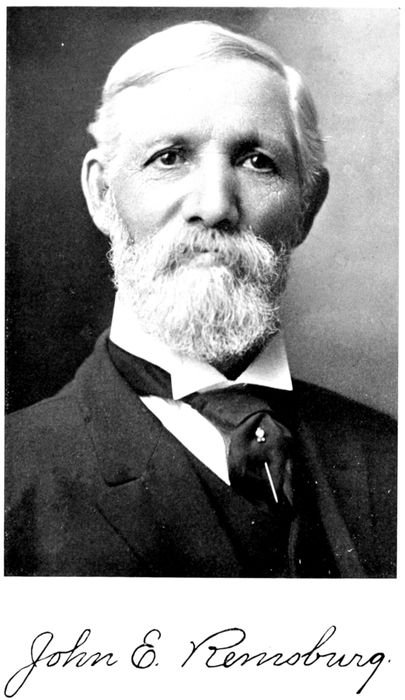
John E. Remsburg.
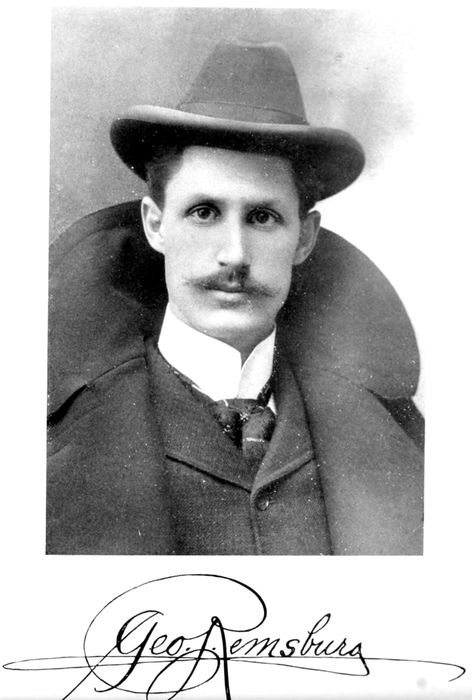
Geo. Remsburg.
505It may interest Mr. Remsburg’s Atchison county friends to know in what esteem he is held as a speaker and writer by the world at large. From the hundreds of reviews and commendatory notices of his lectures and books which have appeared a volume of testimonials like the following could be compiled:
“One of the best speakers and writers to be found in the West, if not in the whole country.”—Charles Robinson, first governor of Kansas.
“His lectures are models of logic and good sense.”—Arnold Krekel, LL. D., Judge United States District Court, Missouri.
“Mr. Remsburg’s address was given with great eloquence and power.”—E. W. Howe.
“A brilliant lecture.”—San Francisco Chronicle.
“Most eloquent words.”—Boston Globe.
“An interesting and eloquent address.”—Rev. J. F. Wilcox, Chicago.
“It is lit up with such flashes of genius, it is so poetical and picturesque that one never wearies of hearing it.”—E. M. Macdonald, New York, President American Secular Union.
“He retired with the reward of loud and long continued applause.”—Kansas City Star.
“Came in for his full meed of praise today.”—New York Herald.
“J. E. Remsburg was paid at the rate of two dollars a minute for his New York address; probably the highest price yet paid for a Kansas talk.”—Noble L. Prentiss, 1882.
“A noble lecture.”—Ernestine L. Rose, noted reformer, London.
“He has given to the world several volumes of priceless worth.”—L. K. Washburn, editor Boston Investigator.
“This volume of 600 pages is a digest of all that is known on the subject.”—Franklin Steiner, author, New York.
“Nothing equal to it has been published within my recollection either 506in America or Great Britain.”—Charles Watts, President British Secular Union.
“It is indeed excellent—nothing could be better.”—Sir Hiram Maxim, London.
“In many respects the most important volume on the subject that has yet appeared.”—Le Pensee, Brussels.
“Excellent, bold, direct, unanswerable.”—James Parton.
“Mr. Remsburg is an orator of high and wide reputation.”—Washington Post.
“One of America’s noted orators.”—Montreal Times.
“A most able lecturer and writer.”—Charles Bradlaugh, M. P., noted orator and statesman of England.
“My translations of Bradlaugh’s and Remsburg’s writings have an enormous circulation in this country.”—Kedarnath Basu, India.
“His [Remsburg’s] lectures have an immense circulation in India.”—Calcutta Gazette.
“One of the most promising orators in America.”—Secular Review, London.
“His style is simple, earnest and attractive, and in these qualities he is eloquent.”—W. H. Herndon, law partner of Abraham Lincoln.
“I have listened to all of our great orators from Clay to Ingersoll, but I have never heard a more polished oration than Remsburg delivered last night.”—Hon. William Perkins, associate counsel of Lincoln in several important cases.
“A graphic, yet concise sketch.”—Rev. S. Fletcher Williams, Liverpool, England.
“Imparted in language clear and forcible and not seldom with grace and beauty.”—Thomas Gray, author, Edinburgh, Scotland.
“I have never heard the case so fairly and so ably stated as he has stated it tonight.”—Richard B. Westbrook, D. D., LL. D., Philadelphia.
“I have asked a bookseller to order twenty copies of Remsburg’s work.”—U. Dhammaloka, President Buddhist Tract Society of Burmah.
“Such an admirable book is always welcome.”—Rev. J. Lloyd Jones, LL. D., Chicago.
“This effort to right the wrongs of Thomas Paine is, in my opinion, a service to mankind.”—Andrew D. White, LL. D., first president of Cornell University, minister to Russia and ambassador to Germany.
“The most fair and honest of all the biographies which have yet appeared of the great iconoclast.”—Boston Herald.
507“It will help restore to honor a much abused name and forward the cause of human rights the country over.”—Rev. Charles Wendt, D. D., Ex-President Taft’s pastor at Cincinnati.
“May this brilliant work bring its author the praise of posterity.”—Der Freidenker.
“A very strong case.”—Public Opinion.
“A valuable contribution to literature.”—Wm. McDonald, author, Canada.
“His lectures have as large a circulation in Europe, India and Australia as in this country.”—S. P. Putnam, author, New York.
“A most interesting lecture.”—New Orleans Delta.
“A large audience and frequent applause.”—Baltimore Sun.
“Skillfully and vigorously written.”—Unitarian Herald, Manchester, England.
“His style is pleasing and his arguments incontrovertible.”—The Universe, Berhampur, India.
“A noble and eloquent work.”—Charles Bright, lecturer, Australia.
“It is really a remarkable work.”—Yoshira Oyama, President Japanese Rationalist Association, Japan.
“Clearly, Mr. Remsburg has done his duty as he sees it, and has had the fairness to present at the outset the opposite view of the question.”—New York World.
“Given in evident fairness and remarkable completeness.”—Chicago Times.
“J. E. Remsburg, of Kansas, who addressed the Congressional Committee on the Sunday question at the Capitol yesterday, made a good impression. Every member heartily applauded him.”—Washington Star.
“My views are well expressed by him.”—Hon. George W. Julian, one of the founders of the Republican party and a prominent leader in Congress.
“I will gladly contribute to his work.”—Rear Admiral George W. Melville.
“I have the pleasure to inform you that at the meeting of the Committee held this day (January 5, 1910) you were elected an ‘Oversea’ member of the Authors’ Club.”—Reginald H. B. Giller, Secretary Authors’ Club, London.
“Member Authors’ Club, London; National Geographic Society (Washington); life member American Secular Union (president three years).—Who’s Who In America.
“I have watched with interest his growing influence.”—Hon. John J. Ingalls, president pro-tem United States Senate.
508“Ably and well have you done your work.”—Parker Pillsbury, noted Anti-Slavery leader.
“When truth and freedom triumph at last your name will be known and honored by all men.”—Eugene V. Debs, four times the nominee of his party for President of the United States.
GEORGE J. REMSBURG.
George J. Remsburg was born in Atchison county, Kansas, September 22, 1871. His life has been devoted mainly to horticultural, journalistic, archaeological and historical work. He spent many years on a fruit farm, removing to Atchison in 1892, where he engaged in newspaper work on the Daily Champion, the oldest newspaper in Kansas; he was a reporter, city editor, and even did editorial work on that paper up to 1900, when he returned to the farm on account of ill health. In 1894–95 he was editor of the Missouri Valley Farmer, now the leading agricultural journal west of the Mississippi. During the winter of 1905–6 he was on the reportorial staff of the Leavenworth Daily Post, and editor of Western Life, published in that city. He has also acted as special correspondent of the Leavenworth Times, St. Joseph Gazette, Kansas City Journal, Topeka Mail and Breeze, Topeka Capital, Atchison Globe, and other well known western newspapers, besides having been an editorial contributor to many different magazines and other publications.
He has spent many years in archaeological explorations, principally in northeastern Kansas and northwestern Missouri, has opened a number of ancient mounds and identified and explored old village sites of the Kansa Indians, visited by Bourgmont in 1724, and Lewis and Clark in 1804, on the Missouri river. He has published a pamphlet describing one of the more important of these old villages, entitled, “An Old Kansas Indian Town on the Missouri.” In all, he has discovered and examined more than 100 old Indian village, camp, workshop and grave sites in the region mentioned and gathered one of the most extensive private archaeological collections ever assembled in Kansas.
In 1897 he was elected a corresponding member of the Western Historical Society upon the unsolicited recommendation of United States Senator George G. Vest, of Missouri. In 1901 he became associated with Hon. J. V. Brower, of St. Paul, Minn., in important archaeological investigations relative 509to the ancient Indian province of Quivira, visited by Coronado in 1541, and upon the organization of the Quivira Historical Society by Mr. Brower, he was made a life member. In 1905 he was elected president of this society to succeed Mr. Brower, deceased. The Quivira Historical Society erected a number of costly monuments to commemorate historical events of Coronado’s time in Kansas.
At the annual meeting of the McLean Historical Society of Illinois at Bloomington in 1909 he was elected an honorary member in recognition of his researches regarding the Kickapoo Indians, of which tribe the McLean society is making a special study. He has thoroughly explored the old village of the Kickapoos near Ft. Leavenworth, occupied from 1832 to 1854, and visited these Indians on their reservation in Brown county, Kansas, on several occasions, gathering a vast amount of ethnologic and historic material pertaining to the tribe. He is also a member of the Kickapoo Club, of Bloomington, Ill.
Mr. Remsburg is a member of the National Geographical Society, having been elected at the annual meeting of the society in Washington in 1911. He has been a member of the International Society of Archaeologists since its organization in 1909; was appointed an associate editor of the Archaeological Bulletin, official organ of this society, in 1910, and elected vice-president of the same society in the same year. In 1901 he was elected a member of the American Society of Curio Collectors; was elected vice-president of the same in 1902, and appointed a contributing editor of the society’s official organ in 1906. He is also an active member of and contributor to the Kansas State Historical Society, and is a member of its committees on archaeology and Indian history.
Brower’s “Memoirs of Explorations in the Basin of the Mississippi,” Volume VII, contains a summary account of Mr. Remsburg’s archaeological work, and says of him: “He has long been a capable and painstaking archaeological explorer in the Missouri Valley.” Chappell’s “History of the Missouri River” says he is an acknowledged authority on early western history and the archaeology of the Missouri valley.
He has held a number of local offices, such as justice of the peace, member of school board, and secretary of various clubs and societies. He was at one time a member of the Kansas National Guards. He is now connected with the staff of the Potter Weekly Kansan and doing special correspondence for several newspapers. His home is at Potter, in this county. He is a son of John E. Remsburg, whose sketch appears elsewhere.
510
WIRT HETHERINGTON.
Heredity, undoubtedly has an important bearing upon the choice of a life vocation for the individual citizen, and it is evident that this maxim governing the destiny of man himself holds good in the life of Wirt Hetherington, cashier of the Exchange National Bank of Atchison. In the city of Atchison, three generations of bankers from the Hetherington family have toiled in the financial activities of the city, the first of whom was William Hetherington, grandfather of W. Wirt, the present scion of the family, engaged in banking. Following William, the pioneer banker of Atchison, and who established the first banking concern in the city, came Webster Wirt Hetherington, father of him whose name heads this review.
William Hetherington, the first of the line in Kansas, was born in the town of Milton, Penn., May 10, 1821, and was there reared and received his education. When he became of age he was married, at Pine Grove, Penn., to Miss Annie M. Strimphfler, who was born in Womelsdorf, Berks county, Pennsylvania, September 24, 1827. This marriage occurred May 9, 1848, and William and his bride, shortly afterwards, became residents of Pottsville, Penn., where he engaged in the operating of a flouring mill. Three children were born to them in this city, namely: Mrs. Balie P. Waggener, of Atchison; Webster Wirt and C. S. Hetherington. In 1859 they removed to Atchison and the youngest child of the family, Mrs. William A. Otis, was born here. Mr. Hetherington first located in St. Louis, when he came west, later going to Kansas City, and from there to Leavenworth, Kan., where he purchased a bankrupt stock of goods, which he hauled by wagon to Atchison in 1859. He at once established the Exchange Bank, which absorbed the Kansas Valley Bank, at that time owned by Robert L. Pease. When Mr. Hetherington came into possession of the bank it was located in a basement at the corner of Third and Commercial streets. A short time later he moved it to the building now occupied by the water works company, and it was here that an attempt was made by the outlaw Cleveland to rob the bank, but the attempt was unsuccessful, Cleveland being frightened away by some freighters who were working nearby. Some years later, Mr. Hetherington erected a bank building at the northwest corner of Fourth and Commercial streets, which was the home of the bank until the erection of the handsome Exchange National Bank Building, two blocks further west, in 1885. In 1882 the Hetherington bank was merged into a national bank, and it was known as the Exchange National Bank, one of the successful banking concerns of the State of Kansas. Mr. Hetherington was a man of considerable ability, whose 511efforts to advance the growing city of Atchison were worth a great deal, and he became a leading factor in the material advancement of the city. His influence on public thought and movement was marked and it was the more powerful, for he was largely unbiased in his judgments. He died in 1890.
Webster Wirt Hetherington, father of the subject of this review, was born in Pottsville, Penn., December 19, 1850. He was educated in Gambier College in Ohio, and came directly from his studies in that institution to enter the Exchange National Bank of Atchison, of which his father was the founder and president. He became cashier of the bank, and upon his father’s demise, in 1890, he became the president of the bank, remaining in this position until his death, January 28, 1892. Mr. Hetherington, during his financial career, became widely known in banking circles, and had many valuable acquaintances among New York financial men, with whom he had many transactions in western securities. When the Rock Island road was building in Kansas and Nebraska, Mr. Hetherington made arrangements to purchase all the municipal bonds the road received from the counties and townships through which it passed. The deal was successful, and won him the confidence of the New York brokers through whom he sold the bonds. In 1889 he received, as a reward from W. P. Rice, of New York City, $10,000 in cash and also traveling expenses for himself and wife on a tour in Europe, in payment for his services in going to London and assisting Mr. Rice in interesting English capitalists in investing in American enterprises. Mr. Hetherington was married November 18, 1875, to Miss Lillie Miller, the oldest daughter of Dr. John G. and Anna B. (Bennett) Miller, both natives of Pennsylvania. This marriage was blessed with five children as follows: Ruthanna, wife of Dr. L. A. Todd, of St. Joseph; Mary Louise, wife of Lieut. J. G. Pillow, U. S. A., of Honolulu; Webster Wirt, cashier of the Exchange National Bank of Atchison; Gail, wife of B. R. Allen, of Atchison; Harry Hale, Seattle, Wash.
Wirt Hetherington, third in line of the bankers of this estimable family, was born in Atchison, February 21, 1881, and received his education in the public schools of the city, after which he became a student in the Military School at Orchard Lake, Mich., from which institution he was graduated in 1900. Soon after his graduation, he entered the Exchange National Bank in the capacity of receiving teller and bookkeeper, and since that time he has advanced to higher positions of trust and responsibility in this important banking institution, learning the banking business in a thorough and painstaking manner as he passed from one position to a higher one. In 1905 he became assistant cashier, a position which he held until February, 1914, when 512he became cashier of the bank, of which he is also a director. Mr. Hetherington is unmarried and makes his home with his widowed mother.
Politically, Wirt Hetherington is a Democrat as were his father and grandfather before him. He is a communicant of the Episcopalian church, which is the church of his forefathers, who were of English origin. He is affiliated with the Ancient Free and Accepted Masons and the Benevolent and Protective Order of Elks. Mr. Hetherington is destined to follow in the footsteps of his able and distinguished father and grandfather, and has already given decided evidence that he has inherited and is developing marked financial ability of a high order. His demeanor in the conduct of the duties of his important position is commendatory and his pleasant and courteous manner of greeting those with whom his duties bring him in daily contact betokens the innate gentlemanly attributes which he possesses to a considerable degree.
HARRY L. SHARP.
Harry L. Sharp, secretary of the Atchison Commercial Club, is one of the “live wires” of the city and has given evidence of great ability in his chosen profession. He is industrious, frugal, sincere and unpretending. His accurate knowledge as to the departmental matters is a constant surprise to those who have occasion to consult him with reference to any branch of public service. He realizes that facts, and not theories, must be the working forces in this organization. He is not only able, intelligent and practical in the discharge of his duties as secretary of the Commercial Club, but is thoroughly conscientious and always shows the courage of his convictions.
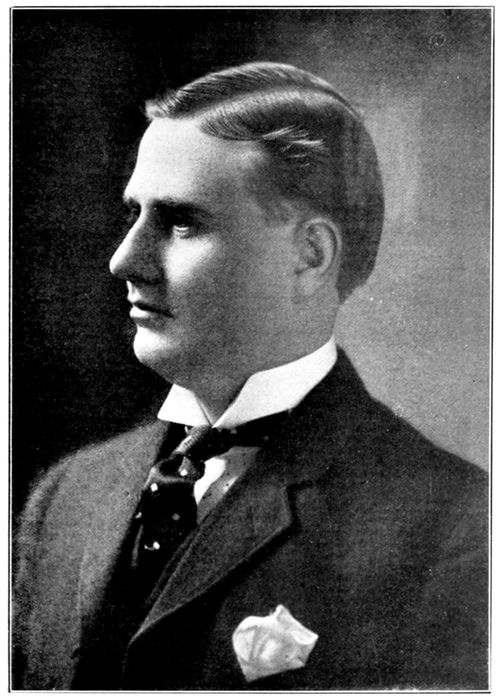
Harry Sharp, Sec’y Atchison Commercial Club.
513Harry L. Sharp was born in Moravia, Iowa, January 14, 1883, a son of John Wilson and Cora Wright Sharp, who trace their ancestry to Thomas Brown and Col. William Crawford, of Pennsylvania. Thomas Brown was one of the early pioneers in western Pennsylvania and founded the town of Brownsville, that State, in the year 1776. Col. William Crawford was a confrere of George Washington. Colonel Crawford married a daughter of Thomas Brown, which closely related both sides of Mr. Sharp’s family, his father’s people being the Crawfords and his mother’s the Browns. He was graduated from the Moravia High School, after which he entered the restaurant and bakery business for himself, conducting the same for a period of three years. Disposing of this business, he came to Atchison and was for a time associated with Sawin & Douglass in the undertaking business, qualifying and obtaining a license to do embalming in the State of Kansas. Following this, he was clerk at the Byram Hotel for a period of three years. During the following year he wrote life insurance and resided in Hiawatha, Kan. Returning from Hiawatha, he took a position as yard clerk in the Missouri Pacific railroad yards. From this position he worked up to that of claim clerk for that company, which position he resigned to become traffic manager for A. J. Harwi Hardware Company. Upon the death of A. J. Harwi, Mr. Sharp succeeded F. E. Harwi, as buyer of the house furnishings goods department of this concern, continuing his traffic work. He held this position until he was tendered and accepted the secretaryship of the Atchison Commercial Club. While Mr. Sharp is a Democrat, he has always been inclined to be independent in his views of things political. He is a Royal Arch Mason and a member of the Elks and Eagles and other fraternal societies. In December, 1906, Mr. Sharp was married to Mary, daughter of Edward C. Wolters, a native of Germany, and a resident of Atchison, where Mr. Wolters was a contractor for many years. Mr. and Mrs. Sharp have one child, LeRoy Edward, born May 31, 1909.
Mr. Sharp is one of the most capable and efficient experts in his particular vocation that can be found in the West. He seems to be naturally adapted for the difficult and exacting position which he holds, and is gifted with rare tact and diplomacy which is so necessary in handling the various affairs which are placed in his hands in the interest of Atchison and the Commercial Club. He is possessed also of decided literary ability, evidence of which talent will be readily seen in the perusal of the chapter on Atchison Industries which was written and compiled for this volume by Mr. Sharp.
HENRY KUEHNHOFF.
Henry Kuehnhoff, farmer and stockman, of Lancaster township, Atchison county, was born August 3, 1869, in Lancaster township. He is a son of Charles and Caroline Kuehnhoff, who were the parents of nine children, six of whom are living. The father was born in Germany in 1841 and left there when a boy of sixteen years, sailing for New York. He remained there a short time and then went west, arriving at St. Joseph, Mo., where he enlisted in Company B of the Volunteer infantry, serving in the Civil war. He was discharged at Lexington, Mo., at the close of the war, having made a good military record.
514He returned to civil life and worked at St. Joseph, Mo., as a laborer for $8 a month. Shortly afterward he came to Atchison county, Kansas, and bought eighty acres of land in section 10, Lancaster township. Using oxen, he broke the ground on his newly acquired farm and began to improve it as far as his resources would permit. In 1894 he retired and went to the National Soldiers’ Home at Leavenworth, where he died in 1903. The mother was born in Germany, in 1845, and died in 1899. Henry Kuehnhoff grew to manhood on his father’s farm and attended the Eden district school No. 37, and also attended No. 3 school for one term. He worked on the farm until he was twenty-one, and, then with his brother, William, rented the old home place. At the death of his father he became heir to a share of the place, and in 1905 bought the farm where he now lives in section 9, Lancaster township, Atchison county. He now owns 157 acres of well improved land and has a large amount of graded stock, and is a stockholder in a telephone company.
In 1901 he was married to Caroline Kloepper, who was born July 20, 1882, in Atchison county. She is a daughter of Crist and Caroline (Dorssom) Kloepper, natives of Germany and Atchison county, respectively. The mother is now dead, but her father resides at DeKalb, Mo. Mr. and Mrs. Kuehnhoff have one child, John, who lives at home. Mr. Kuehnhoff is a Republican and a member of the Independent Order of Odd Fellows lodge. He is a member of the school board of district No. 3, Lancaster township.
MRS. D. N. WHEELER.
The average woman, left penniless, destitute, and even burdened with debt at the hour of her greatest sorrow in life, the demise of a loved husband, is very likely to throw herself upon the more or less doubtful mercies of friends or relatives, and make no attempt to take up the burden of gaining a livelihood by her own exertions. However, this may be the case in many instances, but the exact opposite has been the career of Mrs. D. N. Wheeler, one of the wealthiest real estate proprietors in Atchison, who, during the thirty-four years that have elapsed since the demise of her husband which left her with a small home burdened with debt, and otherwise penniless, has amassed a competence which has placed her in the ranks of the largest individual taxpayers in the city of Atchison.
She was born in Chautauqua county, New York, a daughter of Ezekiel 515and Almirah (Trowbridge) Rooks, both of whom were natives of New York. Her father died when she was four years of age, and she was reared in Erie county, Pennsylvania, where her mother removed after her father’s death. Rooks county, Kansas, is named in honor of the Rooks family of New York, who formed one of the first settlements in Rooks county, during the pioneer days of the early sixties in Kansas. While a student in the academy at Erie, Penn., she met her future husband, who was then traveling passenger agent for the Chicago & Northwestern railway. After their marriage in Erie in 1869, they went to Omaha, Neb., where Mr. Wheeler was connected with the Union Pacific railway. They had the honor of being the guests of George Pullman of the Pullman Car Manufacturing Company, as passengers on the first Pullman train run over the Union Pacific tracks, en route from Omaha to San Francisco. Upon their arrival in San Francisco they attended a reception at the Occidental Hotel, after which Mr. and Mrs. Wheeler traveled in California visiting points of interest. They had some interesting experiences during their travels over the country while Mr. Wheeler was engaged in his duties in connection with the Union Pacific railroad. S. H. H. Clark, president of the Union Pacific railroad, was a very dear and warm friend of the Wheelers, and after Mr. Wheeler’s death, she accompanied the Clark family to San Francisco and was domiciled at the Palace Hotel as their guest. She was with the Clarks at St. Louis when the Union Pacific railroad was sold for $60,000,000, and she was in New York when Mr. Clark signed this transfer. Mrs. Wheeler still retains the friendship of the Clark family and frequently visits them.
Mr. Wheeler had charge of the expedition to North Platte when Generals Grant and Sherman made the treaty with the Indians, and Mr. and Mrs. Wheeler became personally acquainted with the famous generals. A souvenir of this experience is a pack of playing cards which General Sherman gave Mrs. Wheeler when the party was on the return trip, and which was used in playing Bezique by the two generals to while away the time. Mr. Wheeler was the conductor of the train which brought in the survivors of the Plum Creek, Neb., Indian massacre, in which many of the settlers were killed and scalped by Indians. Mr. Wheeler died in 1881, leaving his young wife practically destitute, in the little three room house which they had undertaken to buy in Atchison for $600. At the time of his death there was an incumbrance of $400 on this house, and Mrs. Wheeler was so poor that a load of coal which she had ordered for delivery at the home was returned because it was thought she would be unable to pay for it. She at once began to display the spirit which has enabled her to triumph over all difficulties, and 516earned her living by teaching drawing and painting in the old Monroe Institute, supplementing her salary by giving private lessons at her home on Saturdays. She managed by dint of the strictest economy to pay off the mortgage on her little home, and has since remodeled it into one of the most attractive places in Atchison. This beautiful home is situated high up on the bluffs, bordering the Missouri river, and offers a view from the east windows over broad reaches of the Missouri which is unsurpassed for beauty and distance anywhere in the West. Mrs. Wheeler, while without business experience of any kind whatever, at the time of her husband’s demise, embarked upon a career of investing her savings in residence properties until she is now the owner of twenty fairly valuable pieces of real estate in Atchison. She followed the time tried plan of the cumulative method of buying houses, which she would place in good repair for rental purposes, going in debt for a house and then gradually paying out, and eventually buying another and so on, until she is now paying taxes on a property valuation of over $40,000, her taxes alone amounting to $2.00 per day, or over $730 yearly. At the same time she has gained a valuable knowledge of real estate, she has learned to know and accurately judge human nature, a combination of wisdom which is irresistible in achieving success. She is a saleswoman of great ability, and has frequently been pitted against some of the shrewdest traders in Atchison, and has never been worsted in an encounter. Endowed with a keen observant mind and a remarkable memory, she has made many prominent friends during her career, and has often been called upon to assist them in various capacities, an instance of which is found in the aid which she gave Bishop Tuttle in the preparation of his reminiscences of the Old Santa Fe Trail. To quote the words of a prominent friend of hers, who has known her for many years and witnessed her struggles to attain affluence, “Mrs. Wheeler is a very remarkable woman.”
NAPOLEON B. PIKE.
Napoleon B. Pike, farmer and stockman, was born May 10, 1856, in Washington county, Iowa, and is a son of Charles and Maria (Salers) Pike, and was one of eleven children, seven of whom are living. The father of Napoleon Pike was born in New York State, November 13, 1826. He came to Ohio with his parents and after his marriage went to Iowa. For a time he was engaged in a small mercantile business in Iowa, but later engaged in 517farming. He also farmed a place of his own near Atchison, Kan., where he removed in 1882, but his larger holdings were in Iowa. He died in 1903. The mother was born in New Jersey in 1836, and died in Atchison county, Kansas, in 1898. Both were members of the Methodist church.
Napoleon Pike grew up on his father’s Iowa farm. He was married there and came to Kansas with his father in 1882. For a year he rented land in Doniphan county, Kansas, when he came to Atchison county, and rented a farm in Lancaster township. In 1907 he bought the forty-acre farm which he now works. When he took the place it had few improvements, but he has invested $8,000 since then, and made a modern farm and keeps graded stock.
In 1878 he married Julia Utterback, who was born in Lancaster, Iowa, July 17, 1856. She is a daughter of Nels and Matilda Utterback, both natives of Indiana. To Mr. and Mrs. Pike have been born five children, as follows: Charles, Center township; Alta (Higley) Lancaster township; Walter, farmer, Lancaster township; Willard, farmer, Center township, and Warren, deceased. Mr. Pike is a Republican and a member of the Christian church of Atchison. He belongs to the Modern Woodmen of America at Atchison.
JOHN A. SCHOLZ.
During the thirty-seven years in which the Scholz family has resided in Atchison county, its members have made a record for each and every one which is a credit to their parents and themselves, individually and collectively. John and August Scholz, farmers and live stock breeders of Lancaster township, take high rank in the county as enterprising and successful agriculturists, and have both achieved success, and attained a reputation as specialists, being well known breeders of Shorthorn cattle. Their father, the late August Schulz, was wise in his day and generation, in that when he came to Atchison county, a comparatively poor man, he secured enough land which would require that his sons remain at home and become farmers. He was successful in his plan, and the result is seen in the enterprising sons whom he trained to till the soil in the best manner possible, and who have been successful, as their father had wished. John Scholz is a native son of Kansas, and was born and brought up on the farm where he now resides. He has one of the attractive country places in the county, nicely located, with a well built farm residence, good barns and out-buildings for housing his live stock and storing the harvests of the Scholz fields. He and his brother, August, have 518long held their land in common, and worked together on a partnership basis in a manner satisfactory to both and productive of good results.
John A. Scholz was born November 27, 1879, in Atchison county, and is a son of August and Johanna (Seidel) Scholz, who were the parents of the following children: Mrs. Pauline McCowin, Renton, Wash.; Herman, Doniphan county, Kansas; Charles, Lancaster township; Mrs. Louise Thoren, Los Angeles, Cal.; Caroline, wife of J. W. Louthian, Lancaster township, Atchison county; George, Lancaster township; Paul, living near Lancaster, Kan; Mrs. Anna Stockebrand, Yates Center, Kan.; August, farming in partnership with his brother, John, in Lancaster township; John A., farmer, Lancaster township; Robert, Lancaster township. The family was reared on the father’s farm and the sons were all taught farming. The father was born in Schlesien, Germany, November 25, 1835. He learned the blacksmith trade from his father, and worked at the trade until he left Germany in 1870. He was a son of George Frederick Scholz. His mother died when he was an infant. Coming to America with his family of six children, August Scholz resided in St. Joseph, Mo., for a time when he bought a farm of 160 acres in Doniphan county, Kansas, which he operated about six years. He broke the soil on this place with oxen and made all necessary improvements himself. After leaving Doniphan county he rented a farm in Atchison county, and then bought 480 acres of prairie and timber land in Lancaster township, Atchison county, in 1882. He bought the farm of Morgan Osborne, and paid $15,000 for it. The place is known as the “Three Springs Farm” and is located on the northwest quarter of section 9. This name comes from the fact that the farm has a fine natural water supply coming from springs located on it. The springs furnish water enough for the stock on the farm even in the longest drought and supplies the neighborhood when necessary. The father bought an unusually large farm for a special purpose. He wanted his boys to grow up with him, and did not want to see them go out as hired hands for other farmers, so he went into debt to buy enough land so that the boys could work it themselves and make a living on it. He had very little capital, but he was industrious and his family was also industrious. This enabled them to go in debt for the farm without fear of not being able to pay for it. The farm was paid for in due time and improvements were made constantly. The father farmed until his death, in 1901. The mother of John Scholz was a daughter of Godfred and Rosanna (Schwartzer) Seidel. She was born in Schlesien, Germany, April 10, 1840. The father was a farmer in his native land. The mother lives with John Scholz. John Scholz attended the Atchison County High School at Effingham, Kan., having previously gone to 519school in District No. 3, of Lancaster township. He remained at home after leaving high school, and helped his father on the farm. When the father died John was married and began life for himself. He and his brother, August, bought 160 acres each from the heirs, and engaged in farming. They bought 320 acres comprising the old home. March 1, 1915, they bought eighty acres additional in Lancaster township, making 400 acres in all. John and his brother began to take a fancy to high grade stock and they are now breeding fine Shorthorn cattle. They have a herd of twelve head of thoroughbreds. They have a graded stock of horses and breed Poland China hogs also. John A. especially takes great interest in mules, and at one time had the largest span in the county. These sold for $600. They were five years old and weighed 3,300 pounds.
John Scholz married Ida R. Meyer, October 1, 1913. She was born March 3, 1882, in Center township, Atchison county, and is a daughter of John and Caroline (Schroeder) Meyer. John Meyer was born in Switzerland, and came to Atchison county when he was four years old, with his parents, John and Verena (Slaughter) Meyer, natives of Switzerland. They were early settlers in Center township where they died. John Meyer was born May 8, 1854, and his wife, Caroline (Schroeder) Meyer, was born in Elgin, Ill., April 2, 1859. Mrs. Meyer was the daughter of Nicholas and Katherine Schroeder, natives of Germany. Mr. and Mrs. Scholz have one child, Ralph Edward, born August 17, 1914. Mr. Scholz is a Democrat, and he and his wife belong to the Evangelical church.
WALTER E. BROWN.
Walter E. Brown, of the law firm of Waggener, Challiss & Crane, and the present city attorney of Atchison, is a native son of Kansas. He was born at Whiting, Jackson county, Kansas, November 17, 1887, and is a son of William E. and Martha W. (Gilmore) Brown, natives of Pennsylvania. William E. Brown, the father, came to Kansas with his parents in 1872 at the age of sixteen. He is a son of Michael Brown, a native of Ireland. The Brown family settled in Brown county, Kansas, where the parents spent their lives.
In 1879 William E. Brown removed to Jackson county and engaged in the lumber business at Holton, where he is still an extensive lumber dealer and one of the substantial business men. To William E. and Martha W. 520(Gilmore) Brown were born three children, as follows: Walter E., the subject of this sketch; Bernice and Harold.
Walter E. Brown was reared in Holton and educated in the public schools, graduating from the high school there. He then entered Kansas University, Lawrence, Kan., and was graduated in the class of 1909 with the degree of Bachelor of Laws. He then came to Atchison and became associated with the law firm of which he is now a member. Some few changes have taken place in the personnel of the firm of Waggener, Challiss & Crane within the last few years, but it substantially remains the same.
Mr. Brown is a Republican and since coming to Atchison has taken an active part in political matters. He was elected city attorney in 1913 and reëlected to succeed himself in 1915. He is a Knights Templar and Royal Arch Mason and a member of the Benevolent and Protective Order of Elks, Loyal Order of Moose, and the Fraternal Order of Eagles. Mr. Brown is a very capable attorney and has a wide acquaintance in northeastern Kansas.
E. G. BURBANK.
E. G. Burbank, proprietor of the Burbank printshop, is a native son of Atchison county. In 1905 Mr. Burbank founded this printing establishment in a very humble way, which within ten years has developed into one of the leading printing plants of eastern Kansas. The phenomenal success of this enterprise is, no doubt, due to the fact that Mr. Burbank was an expert job and edition printer when he embarked in the business for himself. Burbank’s printshop catered to high class printing from the start, which has been its specialty and in which it has made a clean record. They do a large amount of high class catalog printing and other high grade work of a kindred nature. They are also well known as book printers and binders and printers of high class stationery. The plant has a floor space, 30×50 feet and is equipped with all modern machinery and methods for up-to-date printing.
When Mr. Burbank started in business for himself he was able to do most of his work alone, but he now has ten people on his payroll, and the plant is now one of the most prosperous concerns of Atchison.
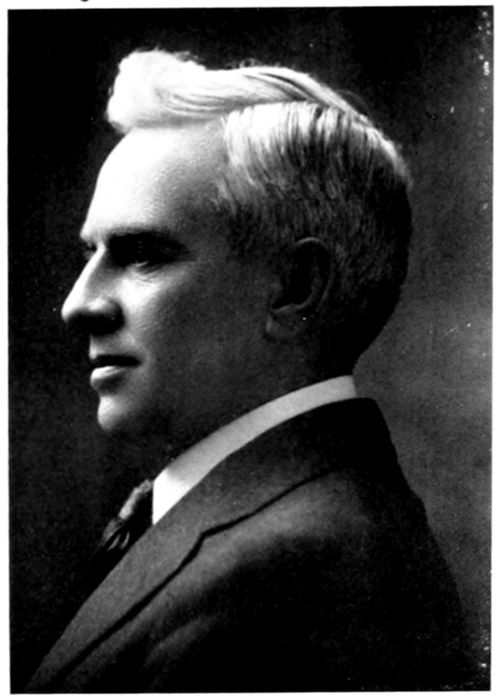
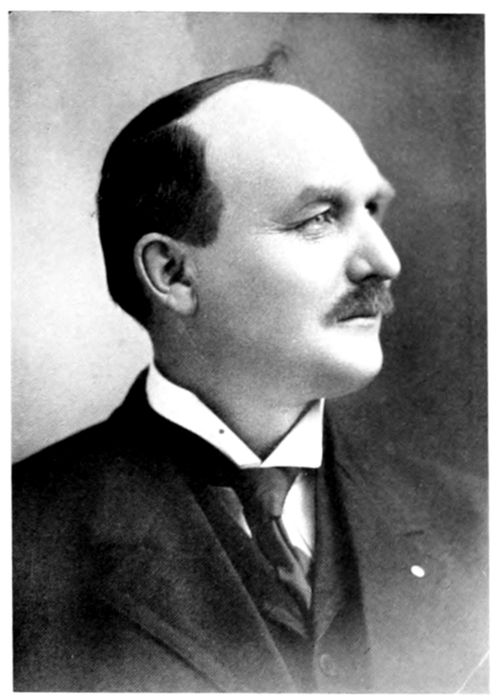
S. W. ADAMS, Aetnea Life Insurance Co.
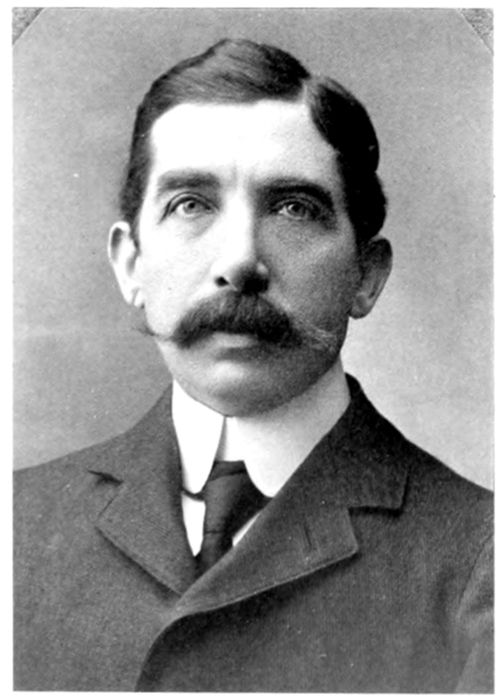
H. C. HANSEN, Penn Mutual Life Insurance Co.
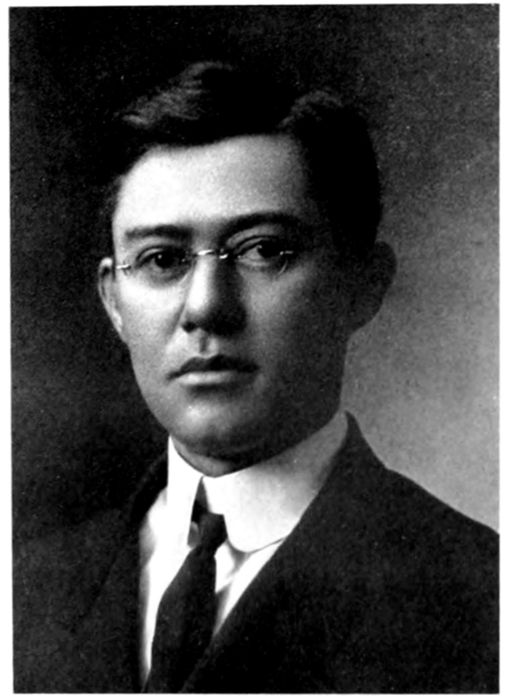
JULIUS DEUTSCH
E. G. BURBANK.
521E. G. Burbank was born at Muscotah, Kan., January 17, 1881, and is a son of Henry N. and Mina S. (Hazlett) Burbank. Henry N. Burbank, his father, was a native of Vermont and came to Atchison county with his father, George S. Burbank, in the pioneer days of Atchison county. He died in 1913, and his wife now resides at Billings, Mont. E. G. Burbank was reared in Muscotah, and after receiving a high school education began his printing career as “devil” in the office of the Muscotah Record. Shortly afterwards, he entered the office of the Atchison Globe and was connected with that paper as a printer for four years, when he organized the plant which now bears his name.
Mr. Burbank was married in 1908 to Miss Millie Anderson, and they have two children: Millie Ervin, born in December, 1910, and John Maxwell, born in July, 1912. Mr. Burbank is of the type of business men who are making Atchison the commercial and center that it is. He is a member of Washington Lodge, No. 5, Ancient Free and Accepted Masons, and the Benevolent and Protective Order of Elks.
H. C. HANSEN.
The story of a young man who has been successful in his chosen field through sheer force and energy and aptitude is always interesting. Consequently, it is fitting that the biography of one of the most successful life insurance men of northeast Kansas have a proper place in the pages of the history of Atchison county. The rise of H. C. Hansen in the insurance field has been rapid and substantial until his high place among the business men of his home city is assured. Born in the little kingdom of Denmark and reared on American soil, he has given evidence of possessing the sturdy qualities peculiar to the Danish people which have led them to the forefront in America wherever they have settled. It is probable that no people coming here from foreign shores and speaking an alien tongue have shown greater adaptability and more acumen in being assimilated into the great American body of citizens than those who have come from Denmark.
H. C. Hansen was born in Denmark January 17, 1867. His parents were Hans and Anna Hansen, who left their native land to seek their fortunes in America in 1869. Hans Hansen was a blacksmith, and the family first located in Atchison. From here they went to Brown county, and a few years afterward settled in Doniphan county. Mr. Hansen operated a blacksmith and wagon-shop at Severance, Kan., until 1890. He then removed to Graham county and settled on a farm where he still resides. His first wife, Anna, died in 1875, leaving four children, as follows: Mrs. Mary Kellenberg, of Brown county; Mrs. Minnie Knoop, of Canton, Okla.; Mrs. Ellen Moore, of Cottonwood Falls, Chase county, Kansas, and Hans Christian.
522H. C. Hansen was reared in Doniphan county and was forced by circumstances to look after his own education. When still a boy he learned the blacksmith’s trade and also worked as a farm hand. He had little opportunity to secure an education and received no encouragement from his parents to acquire knowledge. It was necessary for him to earn money to support himself while attending school. He studied for two years in the Christian Brothers College of St. Joseph after he became of age. Beginning with December 20, 1892, he served twelve years as salesman for the Edward Heeney Hardware Company, of Severance, Kan. He then became local agent for the Penn Mutual Life Insurance Company at Severance. So successful was Mr. Hansen in his new vocation that in a short period of eighteen months he was tendered the position of general agent of the company, with headquarters in Atchison. He has written as high as $200,000 in life insurance policies yearly and his success still continues. A strong and amiable personality combined with energy and persistence have been factors in enabling him to advance with such rapid strides in a field which is full of able competitors. In addition to his duties as general agent of the Penn Mutual Insurance Company, he looks after his farm of 120 acres, located five and one-half miles east of Potter. Mr. Hansen has purchased this farm with money earned in selling life insurance, and he is displaying the same energy in developing his farm acreage that placed him to the forefront in the life insurance field. An old, rundown orchard of about ten acres was located on his farm. He had this orchard placed in shape for fruit bearing by trimming the trees and spraying with a power sprayer. The results are seen in the fine quality of fruit which the trees have yielded. He has been awarded three first prizes at the Atchison county horticultural display.
Mr. Hansen was married August 20, 1891, to Katie Browning, a daughter of Frank Browning, an early pioneer settler of Doniphan county. To them have been born the following children: Anna, a graduate of the public school and high school, and now a teacher in the schools of Sparks, Kan.; Bettie, a trained nurse, who graduated from the Sisters of Charity Hospital, at St. Joseph, in October of 1915; Crystelle, a milliner in the Ramsey store; and William Penn or “Pat,” the youngest of the family.
Politically, Mr. Hansen is an independent Republican, inclined to be progressive in his ideas of government by the people, and favoring those candidates for office who seem to be capable of serving the people to the best advantage of all. He is a member of St. Benedict’s Catholic Church, and is fraternally connected with the Knights of Columbus.
523
JULIUS DEUTSCH.
Julius Deutsch, retired merchant and capitalist, of Atchison, is a citizen who has made his own way in the world, and achieved a satisfactory measure of success in the mercantile field. He was born in Lorraine, the French province of Germany, November 27, 1858, a son of Molling and Melanie Deutsch, who were born and reared in Lorraine. Molling Deutsch was a wholesale grain and flour merchant in his native town. Melanie Deutsch was a daughter of M. Friend, a soldier in the Napoleonic wars, and who was awarded the Medal of St. Helena for bravery on the field of battle. Both parents lived their lives and died in the land of their nativity.
When Julius Deutsch had completed his education at the age of fourteen years, in 1872, he immigrated to America, coming direct to Atchison, where he made his home for a short time with an uncle, L. Friend. Later, he entered the employ of another uncle, I. Friend, a merchant, doing business in Seneca. He worked in the store at Seneca for two years, sold goods in Atchison for another year, spent one year in a mercantile establishment at Topeka, and then embarked in business for himself. Mr. Deutsch established a general store at Muscotah in 1878, which was a successful venture. Prosperity attended his efforts, and it was not long until he and his brothers embarked in the mercantile business at Horton, Kan., and established a store which they still own. He was associated in his business ventures with his brothers, Sylvain, Maurice, Simon, and Isaac. Simon is now a resident of Cleveland, Ohio. Isaac is deceased. The brothers established a chain of stores and operated them at Beloit, Atchison, Valley Falls, Muscotah, and Concordia, which were generally successful, and made money on the investments. Mr. Deutsch continued in active mercantile pursuits until his retirement to Atchison in 1902. He first came to Atchison from Muscotah in 1885, turned over the business at Muscotah to his brother, and then engaged in business in this city. His brother, Maurice, now operates the store at Horton, Kan. Sylvain Deutsch makes his home principally in Kansas City. During later years the Deutsch brothers have disposed of a number of their various stores, and now operate the Horton concern only. Their capital is mainly invested in real estate, consisting of city property and farm lands in Kansas and the West. Isaac Deutsch was the first of the family to come to America to seek his fortune, and his brothers followed, and a community of interests which held them together at all times, resulted in all becoming well-to-do.
Mr. Deutsch and his brothers are interested in a number of financial 524institutions, and he has many friends among the substantial citizens of his home city. He took an active part in the incorporation of the town of Muscotah, serving as city councilman. He is of the Jewish faith, and is prone to assist all religious denominations to the extent of his ability, being tolerant and broad-minded in this respect. He is fraternally allied with the Odd Fellows and the Elks. Mr. Deutsch possesses a likable personality, which, coupled with a kindly and courteous demeanor at all times, makes him well liked by his associates and esteemed for his many excellent qualities.
STARK WILBOR ADAMS.
Stark Wilbor Adams, general manager for the Aetna Life Insurance Company, with offices in the new Masonic Temple, and secretary of the Atchison County High School board, is a native of the Buckeye State, born in May, 1866, at Huron, Ohio, and a scion of an old American family which traces its lineage back to the colonial days of New England. His father, Stark Adams, and his mother, Mary (Chandler) Adams, were born in Milan, Ohio, and Birmingham, Ohio, respectively. Stark Adams was a son of Philo, a son of Daniel Adams, of Vermont, who was a soldier in the Continental army during the American war of independence, and was a brother-in-law of Ethan Allen, of Vermont. Daniel was second in command of the “Green Mountain Boys” at the capture of Crown Point and Ticonderoga. In recognition of his services in behalf of the new nation, he was given a grant of land in the Western Reserve. His son, Philo, rode horseback from Middlebury, Vt., to the Huron river valley in 1816 and took possession of the tract which had been granted to the family by the Government. He also traded a horse for an eighty-acre tract in addition to his own grant. He and three brothers settled on the land lying along the course of the Huron river, Philo locating at the mouth of the river where it flows into Lake Erie, and upon which the town of Huron was eventually built. The brothers became the owners of about 600 acres of land in the neighborhood. They cleared the land of standing timber, planted corn, harvested and shelled it during the first season, then crossed the lake to Buffalo to trade grain for supplies, which they again traded with the Indians for furs. They conducted a general trading business and the settlement grew from this beginning, in course of time to be of considerable importance. Philo Adams was a first cousin of John Quincy Adams, and was appointed the first collector of the Port of Huron. The first of the family to come to America was Henry 525Adams, who came to Plymouth on the “Mayflower,” when the good ship made its second voyage to bring over the Puritans, and he settled at Mt. Wolaston, (now Quincy, Mass.) in 1638. Joseph Adams II was the son of Henry, the founder of the family in America; Joseph III, son of Joseph Adams, was next in line, and was the father of Daniel and President John Adams, second President of the United States. Daniel Adams was the father of Philo Adams, and direct ancestor of the Adams family.
Stark Adams, accompanied by his family, left the old home in Ohio in 1878, crossed the country to Hays City, Kan., and there homesteaded on 160 acres of land, taking up a timber claim of the same number of acres at the same time. Settlers were few and far between in that part of Kansas in those days, and the country was settling up slowly because of the droughts and other vicissitudes with which the farmers had to contend. Ten years after locating near Hays City, Mr. Adams came to Atchison and eventually bought a farm four miles south of the city, on which he lived until his retirement to a residence on the corner of Q and Sixth streets in Atchison. He was born October 14, 1827, and died August 30, 1909. His children are: Augusta J., at home; C. B., of 714 Park street; James Otis, on a farm, eight miles southwest of the city; Stark Wilbor; Margaretta L., at home, associated with S. W. in the office located on the second floor of the new Masonic Temple; J. D., at the family home in Atchison at 517 South Seventh street.
S. W. Adams and family came to Atchison from the farm in February, 1908, and engaged in the insurance business, the mother and father and family coming to the city in December of the same year. He opened his present office May 1, 1914, when Mr. Adams was appointed manager of the Aetna Life Insurance Company for northeast Kansas. His career as an insurance solicitor and manager has been very successful. The real estate and loan business conducted in the same office is in charge of Jay D. Adams.
Mr. Adams was married December 25, 1899, to Miss Mary Speck, who was born on a pioneer farm in Atchison county on Stranger creek in Mt. Pleasant township. She was a daughter of Archimides S. and Sarah E. Speck, natives of Kentucky and North Carolina, respectively, who emigrated from Indiana to Kansas, driving a team the entire distance, during the year 1855. (Further data concerning Mr. and Mrs. Speck will be found elsewhere in this volume.) To this union have been born, Dorothy M., Sarah E., Mildred J., Lorena Wilberta, Wilbor Speck.
Mr. Adams is a Republican in politics and has taken a more or less active part in political and civic affairs. For the past five years he has served the county as secretary of the Atchison County High School board. He and the 526members of his family are affiliated with the Presbyterian church. Fraternally he is allied with the Odd Fellows, Knights of Pythias and the Benevolent and Protective Order of Elks.
GEORGE SCHOLZ.
George Scholz, farmer and stockman of Lancaster township, Atchison county, Kansas, was born in Germany, April 22, 1870, and is a son of August and Johanna (Seidel) Scholz, who were the parents of seven children: Mrs. Pauline (McCowin), Renton, Wash.; Herman, Doniphan county, Kansas; Charles, Lancaster township, farmer; Louise, wife of C. Thoren, Los Angeles, Cal.; Caroline, wife of J. W. Louthian, Lancaster township; Paul, living near Lancaster, Kansas; Mrs. Anna Stockebrand, Yates Center, Kan.; August, farming with his brother, John, in Lancaster township, and John, farmer, Lancaster township; Robert, Lancaster township. The family was reared on the father’s farm where all the sons were taught farming. The father was born November 25, 1835, in Schlesien, Germany, and learned the blacksmith trade from his father, and worked at that trade until he left Germany in 1870. He was a son of George Frederick Scholz. His mother died when he was an infant. Coming to America with his family of six children, August Scholz resided in St. Joseph, Mo., for a time and then bought a farm of 160 acres in Doniphan county, Kansas, which he worked about six years. He broke this place with oxen and made all necessary improvements himself. After leaving Doniphan county he bought 480 acres of prairie and timber land in Atchison county, Kansas. This was in 1882. He bought the farm of Morgan Osborne and paid $15,000 for it. The place is known as the “Three Springs Farm.” It is located on the northwest quarter of section 9. The name comes from the fact that the farm has a fine natural water supply from springs located on it. The springs supply water for the stock on the farm even in the longest drought.
The father bought an unusually large farm for the reason that he wanted his boys to grow up on his own farm. He did not want to see them go out and work for strangers. His capital was limited but he and his sons were industrious, and they were able to go into debt to acquire more land, and the farm was paid for in due time and improvements were made as rapidly as possible. The father farmed his place until his death, in 1901. The mother of George Scholz was a daughter of Godfred and Rosanna (Schwartzer) Seidel, 527and was born in Schlesien, Germany, April 10, 1840, and is now living with her son, John. The father was a farmer in his native land.