Chapter XXV · BIOGRAPHICAL HISTORY (continued 13)
Reading edition
D. ANNA SPEER.
The public owes much to the teachers who have made a life work of their chosen profession. While the teaching profession is used to some extent as a stepping-stone to something supposedly higher and better, or as an opportunity on the part of young people to earn some money in preparation for embarking in some other vocation, there are in the ranks of the profession a considerable number of efficient and painstaking educators who through a deep and abiding love of the work of teaching the youth of the land and a desire to advance themselves high in their profession, have made themselves indispensable members of the community, and have shown by application and actual practice that they are fitted above the rank and file to hold executive positions. D. Anna Speer, county superintendent of schools for Atchison county, is a capable and successful educator whose marked ability has received due recognition from the people of the community in which she was reared.
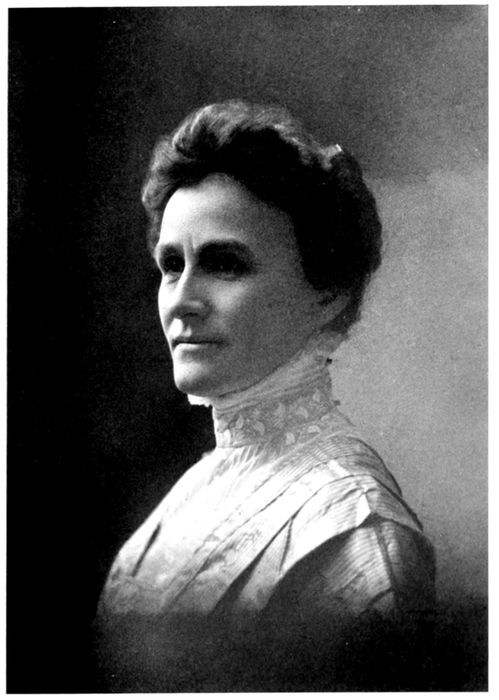
Miss D. Anna Speer.
777She was born in Atchison county, a daughter of Joseph and Mary (Fountain) Speer. Her father, Joseph Speer, was born March 4, 1834, in Leesville, Ind., and was the son of Andrew and Dicie (Kirby) Speer, both natives of Kentucky. Miss Speer’s mother was a daughter of Stephen Fountain and Mary (Clark) Fountain, natives of North Carolina. The ancestors on the side of each parent were pre-Revolutionary colonists of Virginia and the Carolinas. The Speers were among the earliest settlers of Kentucky and the great-great-grandfather of Miss Speer on the maternal side was a signer of the Declaration of Independence. Joseph and Mary Speer were married in Indiana and came west in 1859, settling on a farm near Muscotah in the spring of 1860. Mr. Speer invested in a partly improved farm of 160 acres on which they lived until old age required that they leave the farm for a town home in Muscotah. During the Civil war Mr. Speer served in the Kansas State militia and took part in the expedition against the Price invasion. Joseph Speer died March 5, 1900. His wife was born in September, 1833, and departed this life June 19, 1909. To them were born six sons and three daughters: William F., who resides on the home farm; Mrs. Mary J. Long, of Fowler, Kan.; Andrew, present county commissioner and farmer residing near Muscotah; James R., one of the pioneer settlers of Guthrie, Okla.; John W., a farmer of Morrison, Okla.; George T., a resident of Guthrie, Okla., and auditor of the Arkansas Lumber Company; D. Anna; Jesse A., engaged in the livery business at Medford, Okla.; Sadie E., wife of E. S. Woodworth, of Muscotah, a son of Major Woodworth. The Speers are a family of pioneers and are found to be leading citizens of their respective communities. Joseph and Mary Speer reared their large family of children to become useful and influential members of society and God-fearing men and women. Before death called them to the eternal rest they had the satisfaction of seeing the county where their earliest and most arduous labors had been accomplished grow to become a prosperous and populous community.
D. Anna Speer was educated in the rural school of her home neighborhood and the Muscotah public school. She completed a teachers’ course in Campbell College and was graduated, receiving a life diploma from the State Normal College at Emporia, Kan., in 1893. She then taught school for a number of years. During the summer vacations she did post-graduate work in the University of Chicago, Kansas University and Colorado College, at Colorado Springs, Colo., and received the degree of Bachelor of Arts in 1911.
She entered the University of California at Berkeley and received the degree of Master of Arts in 1913. Miss Speer is self-educated, having worked her way through college and university while teaching school to earn money for tuition and expenses. She began her teaching career with a few years’ service in the rural schools and in 1893 became a teacher in the Effingham County High School, where she taught continuously for seventeen years. She was then an instructor for two years in the State Normal School at Emporia, Kan., after which she spent one year as a student in the University of California. 778After receiving her degree from the University of California she served as instructor in Grass Valley, Cal., High School. This was a delightful experience in one of the most beautiful spots on the globe, but she returned home, and on July 1, 1915, entered upon her new duties as county superintendent of public instruction of her home county. That she will make a success of her work is assured.
Miss Speer is affiliated with the Methodist Episcopal church, the Eastern Star lodge and is a member of the County and State Teachers’ associations, and is a member of the National Educational Association. She is a deep and capable student: a thorough and progressive educator, who is familiar with the most advanced methods of teaching and is destined to achieve marked success in her present important position.
JOSEPH C. GREENAWALT.
Joseph C. Greenawalt, retired lawyer, Muscotah, Kan., was born April 17, 1840, on a farm in Montgomery county, Pennsylvania. He comes of old Holland Dutch stock and the progenitors of the Greenawalt family emigrated from Holland to America in 1665. He is a son of George and Sarah (Conner) Greenawalt, natives of Pennsylvania. George Greenawalt was a son of John, and his wife’s father was John Conner, a native of England. Joseph C. was eighteen months old when his father died, leaving a widow with six children to rear, namely: Mary Amanda, Sarah Ann and Margaret, now deceased; Samuel C., deceased, who served as captain in a company in the Seventy-third regiment, New York infantry, in the Union army, and was a wanderer from choice, having gone to sea for several years, his first service in the Union army being as a scout; Elmina C., deceased, and Joseph C., with whom this review is directly concerned, and who was reared in eastern Ohio at the home of his aunt. He lived at his aunt’s home until he attained the age of sixteen years, attended school and learned the trade of carpenter and cabinet maker in a shop operated by his uncle.
As a boy Joseph C. Greenawalt had been ambitious to acquire an education and was not content with the idea of spending his days at the carpenter’s bench. Accordingly, at the age of sixteen, we find that he started out to make his own way in the world and to educate himself by partly working his way through college. He entered Mt. Union College, at Alliance, Ohio, and was one of the first students enrolled in this college when it was advanced 779from a seminary to a regular college. He worked during the summer seasons and was thus enabled to pay his way through the college course. When he was eighteen years of age, he also taught one term of school. He studied languages for one year in the Hayesville Institute at Ashland, Ohio. After studying for three years at Mt. Union, he matriculated at the University of Michigan in Ann Arbor, Mich., entering the junior class of this university in 1860. In 1862 he received his bachelor’s degree from the University of Michigan, but did not acquire his master’s degree until five years later, in 1867. In May of 1862 Mr. Greenawalt enlisted in Company I, Eighty-sixth regiment, Ohio infantry, and served for four months, when he was commissioned a lieutenant of the Ohio Sharpshooters, but resigned his commission and took charge of the Canton, Ohio, Union School for the ensuing six months. He then served as deputy clerk of the circuit court, studied law in the meantime and was admitted to the bar at Ravenna, Ohio. In the spring of 1864 Mr. Greenawalt went to Colorado and engaged in mining engineering in the mountains, forty miles west of Denver. After a stay in the West he settled in Platte City, Mo., and practiced law there until 1871, and after a trip to the Pacific coast, he located permanently in the city of Atchison in August of 1871. He practiced law successfully for twenty-five years in Atchison, and held the office of city attorney in 1875.
Mr. Greenawalt has always been a great lover of horses, and more to gratify his love of horse flesh than anything else he established in 1882, the famous Greenview Stock Farm, near Atchison, now owned by B. P. Waggener. He erected the residence and several of the buildings now on the farm and engaged in the breeding of fast trotting horses. For some years he made his home on the farm and practiced his profession in the city, going to and fro from his law office and giving the farm work his personal supervision. The Greenview Stock Farm became famous for the many fast horses bred there, one of the most noted of which was Samuel G., record 2:29, and who made a trial record of 2:18¼ when a four-year-old. He made a practice of breeding two-year-olds for speed and succeeded, shipping horses to buyers in eastern and southern points where racers were desired for the tracks. In 1900 Mr. Greenawalt removed to Muscotah and continued his horse breeding until 1912, when he practically retired from the pursuit of his favorite hobby. He is the owner of a fine farm of 160 acres adjoining Muscotah on the east.
Mr. Greenawalt has been twice married, his first wife being Sophia E. Bowers, of Cleveland, Ohio, and who died May 26, 1870, at the age of twenty-seven years, leaving an infant daughter, Maude Mary, born February 11, 1870, and died August 2, 1870. He married Mary C. Bowers, of Stark 780county, Ohio, in September of 1882. This marriage was blessed with one son, Samuel O., born November 6, 1885, and died March 1, 1902. Mrs. Greenawalt was born December 15, 1845, in Stark county, Ohio, a daughter of Elijah and Mary Bowers, natives of Pennsylvania. In politics, Mr. Greenawalt is an independent. Mrs. Greenawalt is a member of the Congregational church of Muscotah. For many years Mr. Greenawalt has been a Mason and served as eminent commander of Washington Commandery, No. 1, at Atchison for two years, and also served as worshipful master of Active lodge of Masons, and is a member of the Knights of Pythias.
HENRY NIEMANN.
Wherever members of the German race have settled in the agricultural sections of the Middle West, we find that they have been uniformly successful, and it is only natural to find that certain individuals achieve greater success than others. Henry Niemann, of Center township, Atchison county, is an American citizen of German birth, who came to this country a poor emigrant lad, and has made a wonderful success since he purchased his first eighty acre tract in this county, nearly forty years ago. He is now one of the largest landed proprietors of the county, and one of the best known stockmen of northeast Kansas.
Henry Niemann was born February 14, 1853, in Minden, Germany, a son of Christian and Mary (Krouse) Niemann, who lived and died in the Fatherland. They were the parents of seven children as follows: Crist, deceased; Henry, whom this review directly concerns; Fred, a farmer of Center township; Mrs. Christena Krouse, deceased; Charles, a farmer of Atchison county; William, living in Germany, and Augustav, deceased. Henry was educated in the schools of his native land and at the age of eighteen years left the Fatherland and immigrated to America in search of his fortune, which he was eventually to find in Kansas. He first settled in Madison county, Illinois, and worked there as a farm hand for five years. He saved his money carefully while working on the farms of Illinois, and in 1876 came to Kansas and invested in a tract of eighty acres of land in Center township. He erected a small two-room cabin on his land and a barn to house his team of horses. He broke his land gradually and at first was able to farm only a small portion of it. The neighbors tried to discourage him by telling him that the strong winds might wreck his home at any time and advised him to find a better and safer 781location. He failed to find a place which suited him as well as his first choice, and although he has lived for forty years on the farm his buildings have never yet been blown away by the Kansas zephyrs. Mr. Niemann has prospered as he deserved and by the exercise of economy, hard work and good financial judgment, has become the owner of 615 acres of land in several farms, all of which are well improved and highly productive. Mr. Niemann is an extensive feeder of hogs and raises large numbers annually for the market. He believes in feeding the grain products of his farm to live stock on the place and thus reaps greater benefits than the ordinary methods of farming would yield. He is a stockholder in a prosperous mercantile concern at Nortonville, Kan.
Mr. Niemann was married in 1897 to Louise Frommer, and to this marriage have been born ten children, namely: Mrs. Mary Dietrich, a widow, who lives with her parents; Rosa, widow of George Moeck, also living with her parents; Christena, deceased; Dena, deceased; William, a farmer living in Center township; Mrs. Dora Dietrich, deceased; Harry, Henry and Julius, living at home, and Mrs. Lillie Poos, Nortonville, Kan. The mother of these children was born in Wurtemberg, Germany, in 1858, a daughter of John and Kathrine (Markley) Frommer, natives of Germany, who were early settlers of Atchison county.
Mr. Niemann is an independent Republican voter, who refuses to wear the collar of any one set of political bosses, and votes as his judgment indicates. He and his family are members of the German Lutheran church. Henry Niemann is a fine type of successful German-American farmer and is a tiller of the soil first and last; he lays claim to no ambition beyond tilling his broad acres and making his land yield the maximum of sustenance for man and beast; his great success lays in the fact that he has confined his energies to the soil and its cultivation and he has managed to get a good slice of the best land obtainable.
FRED W. KAUFMAN.
Fred W. Kaufman, merchant, Cummings, Kan., was born in Nortonville, Kan., February 18, 1879. He is a son of Frank and Louise (Baker) Kaufman, who were the parents of thirteen children. Frank Kaufman was born in Servia, Germany, in 1833. When a youth, in his native land he learned the shoemaker’s trade which he followed there until eighteen years of age, and he then emigrated from Germany to America in 1851. He came to Atchison, 782Kan., and worked as a cobbler. When the town of Pardee, Kan., was founded, Mr. Kaufman opened a shoe shop in that town and conducted it for about four years, after which he located in Nortonville and worked at his trade until his demise in 1911. The children of Frank and Louise Kaufman were as follows: Charles, deceased, merchant of Nortonville, born 1866, died 1908; Edward, a merchant, Nortonville; Fred, a merchant of Cummings, Kan., the subject of this review; Mrs. Anna Coon, of Rock Creek, Kan.; Mrs. Flora Hilderbrand, Independence, Kan.; Walter, a farmer, living near Cleveland, Okla.; Grace, residing at Nortonville. The mother of these children was born near the city of Atchison, and is now living in Nortonville.
Fred Kaufman was reared in Nortonville and attended the public schools of his native city after which he studied in the Atchison Business College. At the age of fifteen years he was employed as clerk in a general merchandise store in his home city. In 1900 he went to St. Joseph, Mo., where he was employed in the wholesale department of the Wheeler & Motter Mercantile Company for a period of nine years, and served in the capacity of mail order clerk in this establishment. He was then given a traveling position as salesman with his firm and for three years sold goods in the surrounding territory with considerable success. His ambitions led him to undertake things in his own behalf, however, and in 1912 Mr. Kaufman located in Colorado, where he was engaged in ranching for three years. Three years’ hard work enabled him to develop his Colorado farm into a good piece of salable property and he then disposed of his holdings and came to Cummings where he invested his cash capital in a general merchandise store which he is conducting with considerable success. His previous commercial experience has proven to be invaluable to him since entering the mercantile field in his own behalf, and he has developed a splendid business in Cummings. Besides his large store in Cummings, Mr. Kaufman has invested in 210 acres of land in Colorado and Oklahoma.
Mr. Kaufman was married September 6, 1905, to Carrie E. Hackney, and this marriage has been blessed with two children: Fred, Jr., and Maxine C., both of whom are at home with their parents. Mrs. Kaufman was born October 27, 1884, at Agency, Buchanan county, Missouri, and is a daughter of Alfred and Pauline (Slover) Hackney, natives of Wisconsin and Missouri, respectively. Alfred Hackney was a son of Thomas and Mary (Saxton) Hackney, the former a native of England. Thomas was an early pioneer settler in Doniphan county, Kansas, coming there about 1852, and also operated a drug store at Wathena, Doniphan county. Mrs. Thomas Hackney is still 783living at the age of eighty-eight years, born August, 1827. Alfred is now living in retirement at St. Joseph, Mo., and has attained the age of sixty-five years. Mrs. Kaufman’s mother died in 1904, at the age of forty years.
Mr. Kaufman is a Republican in politics and is affiliated with the United Commercial Travelers’ lodge at Hastings, Neb. He and Mrs. Kaufman attend religious worship at the Baptist church, of which Mrs. Kaufman is a member. Mr. Kaufman is a splendid type of self-made man whose success in the mercantile field is certain to continue in the years to come. His business methods are such as to commend him favorably to the many patrons of his store; he is likewise a good citizen who has the best interest of his town and county at heart.
ARNOLD LANGE.
Lancaster township, Atchison county, is rightly considered as one of the genuine garden spots of the State of Kansas, because of the fertility of the soil, the well kept appearance of the fields, and the excellent improvements on the farms, the owners of which seem to vie with each other as to who can have the nicest looking and most productive farm. This township has a large German population, or rather, American citizen farmers, of German birth or descent, and it is a proverb in this land that, wherever you see a community of thrifty farmers of German descent, there you will find enterprise, thrift and progress. Arnold Lange, of this township, is a successful farmer and breeder, of German birth who has made good in his adopted country and holds a high place in the citizenship of the county.
Arnold Lange was born in Westphalia, Prussia, German Empire, December 23, 1853, and is a son of Herman and Charlotte (Mittendorf) Lange, who were born and reared in the Fatherland. Herman Lange was a farmer and coal dealer, and also conducted a grocery store for a time. He was born in 1824, lived all of his life in his native land and died in 1907. His wife, Charlotte, died in 1899, at the age of seventy-six years. They were the parents of twelve children, six of whom are living.
Arnold Lange received his schooling in Germany and worked as farmer and teamster until his emigration from Germany to America in 1882. He settled in Atchison county and invested his capital in eighty acres of land north of Huron, which he cultivated for nine years with fair success. He then sold the farm at an increase over the purchase price and bought the farm which now constitutes his home place and which contains 240 acres of good land. The 784improvements on the land when Mr. Lange purchased the tract were indifferent and included a small house. Naturally one of his thrift and pride could not remain long content with poor accommodations and he has built a commodious farm residence and a very fine barn and improved the looks of his place with shrubbery and trees until it presents a handsome appearance. He has also set out an orchard of six acres. Mr. Lange has specialized in his live stock raising with considerable success and his efforts in breeding thoroughbred Percheron horses have met with reward commensurate with his efforts. He has bred and raised some very fine animals of this class and in 1906 was awarded first prize on Percheron draft animals at the county fair held in Effingham. His interest is given to breeding fine cattle and his herd of shorthorns are as good as can be found in the county.
Mr. Lange was married in 1883 to Miss Minnie Kloepper, who has borne him three children: Herman, of Huron, Kan.; William, a farmer, of Grasshopper township, and Arnold, a graduate of the Huron schools and at home assisting his father in the farm work. The mother of these children was born December 14, 1865, in Illinois, and is a daughter of Mr. and Mrs. Christian Kloepper deceased. Mr. Lange is a Democrat, and is a member of the German Lutheran church. He is fraternally connected with the Modern Woodmen lodge.
WILLIAM H. GRANER.
“The Graner Farm.”
According to competent authority there are in Atchison county a number of pure bred live stock breeders, who, if they received the recognition to which they are rightly entitled, would take high rank among the leading live stock men of the country. Among these specialists are William H. and Henry C. Graner, sons of one of the pioneer pure bred live stock breeders of the county who are following in their father’s footsteps and have made a name and fame for themselves which extend far beyond the borders of this county and beyond the borders of the State of Kansas. William H. Graner, proprietor of the “Graner Farm,” which is the old homestead of the Graner family, is one of the most successful agriculturists of the county and is deserving of special credit for his progressiveness and decided ability as a breeder of fine live stock. The “Graner Farm” is one of the best stocked and best equipped ranches in the West and is noted for its fine Shorthorn cattle and standard bred Percheron horses. Mr. Graner learned the breeding business from his father and has made a success of the undertaking. His farm consists of 160 acres, which was formerly owned and developed by his father, Gottlieb Graner. On this farm are some very fine animals of the pure bred Shorthorn type which will compare most favorably in breeding and appearance with anything of the kind in the country. His herd of Percherons include twenty registered mares which have won many prizes at county fairs and live stock exhibits in Kansas. Mr. Graner has owned and used two grandsons of “Brilliant,” the sons of “Old Brilliant,” and sire of these animals, the “Colored Gentleman,” was awarded first and championship over all draft horses at the world’s exhibit of live stock at the Chicago international exhibition in 1893. All of his mares’ ancestry is traced back to “Old Brilliant” and this strain predominates in his drove of fine Percherons.
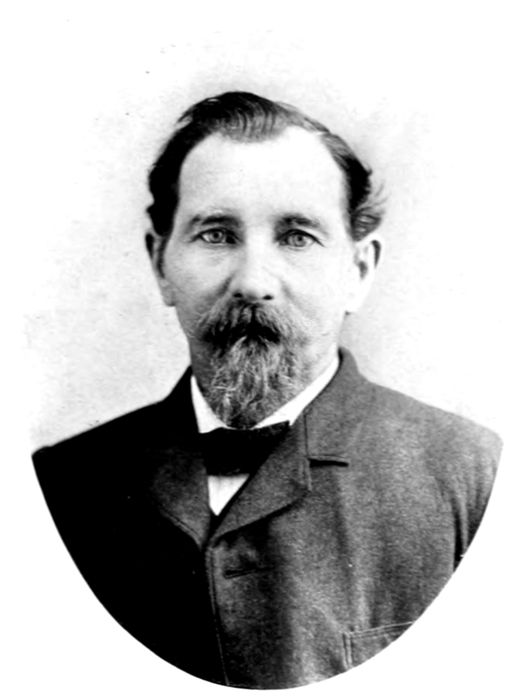
Gottlieb Graner
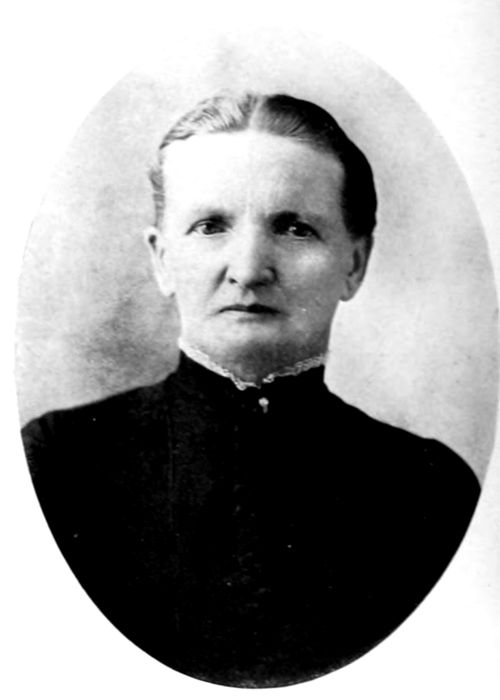
Mrs. Martha (Hauck) Graner
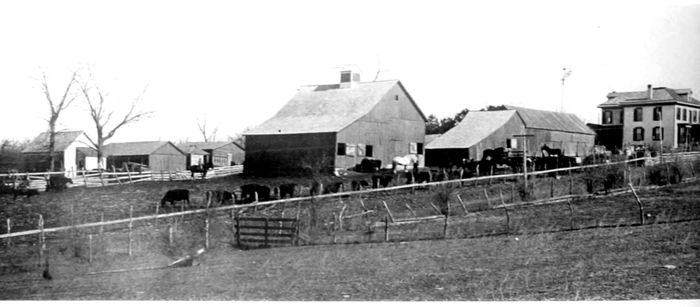
The Old Graner Homestead, W. H. Graner, Owner.
785
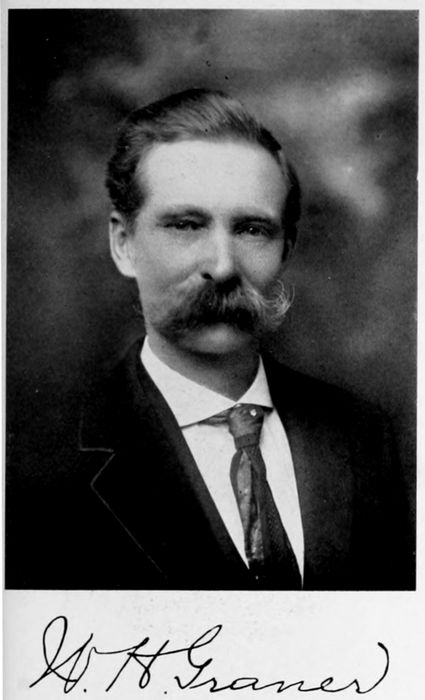
W. H. Graner.
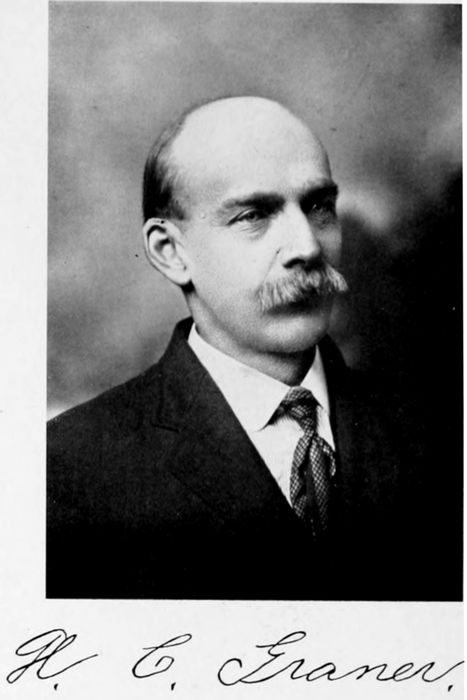
H. C. Graner.
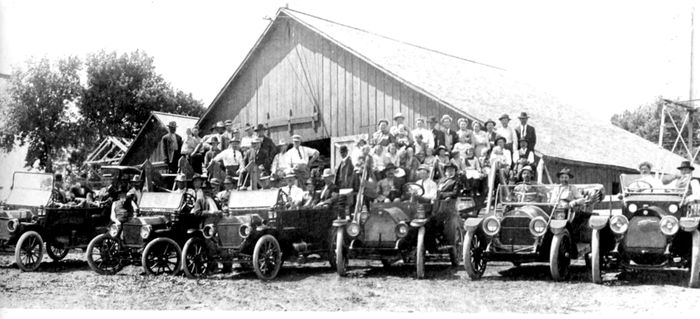
Crowd of prosperous Kansas farmers at H. C. Graner’s Annual Sale of Large Type Poland China Sows, May 27, 1913. Pleasant Hill Stock Farm, Lancaster, Kansas.
In the breeding of Shorthorn cattle he has used such sires as a son of the imported cow, “Ballechin,” “Charming Maid,” V67–616, “Sire Ceremonious Archer,” 171479. A number of the cows in Mr. Graner’s herd are sired by “Victor Archer,” 223102, a pure Victoria, and one of the finest strains of Shorthorn cattle known. Mr. Graner has not shown any of his fine stock cattle outside of Atchison county. He has six large cattle barns for the housing of his live stock and ships the product of his farm to buyers and fanciers in all parts of the United States.
Gottlieb Graner, founder of the “Graner Farm,” and father of William H. and Henry C. Graner, of Lancaster township, was born in Germany in 1835, and immigrated from the Fatherland to America at the age of sixteen years. He first settled in Illinois where he worked as a farm hand, and a few years later came west to Kansas City, Mo. In this city he invested his savings in a city lot which is now in the heart of the most valuable business district of the southwest metropolis, but he eventually let the lot go for taxes. From Kansas City he made his way to the city of Atchison where he found employment in a brewery at a salary of $100 per month. He saved his money and in 1868 purchased 160 acres of raw prairie land in Lancaster township, for which he paid five dollars an acre. He became a breeder of Shorthorn cattle and Percheron horses and succeeded in this undertaking, being one of the pioneer breeders of the western country. At the time of his demise, in 1894, he was the owner of 560 acres of well improved farm lands.
Gottlieb Graner married Martha Hauck, also a native of Germany, and who died in 1905. To this well and favorably known pioneer couple were born the following children: Mrs. Matilda Stansburger, a widow, residing in California; William H., with whose career this review is directly concerned; 786Henry C., a farmer and stockman, living near William H.; Ferdinand, living in New York, and Adolph, residing in California. Mr. and Mrs. Gottlieb Graner were Lutherans, and honest, industrious, God-fearing people.
William H. Graner was born June 13, 1869, on the farm which he now owns in Lancaster township. He was reared on his father’s farm and attended the Bell district school and also studied in the Monroe Institute at Atchison, after which he pursued a course in the Atchison business college. His commercial course occupied a period of four years and has proven to be invaluable to him in the management of his extensive farming interests. After completing his commercial course Mr. Graner went to work on the home farm with his father. After his father’s demise in 1894 he took charge of the farm and managed it until all the children became of age. The estate left by his father was then divided, and William bought the interests of the other heirs in the home farm and came into possession of the homestead place of 160 acres which he has improved with several barns and modern farm buildings. He has prospered and is now the owner of 560 acres of land, two farms, each of which is well equipped with good buildings. One of these farms is tilled by a tenant, and Mr. Graner had planted in 1915 140 acres of corn.
Mr. Graner was married in 1898 to Miss Clara Matthias, and to this union have been born four children, namely: Martha, deceased; Louis, Marguerite and Esther, at home with their parents. Mrs. Graner was born February 6, 1871, in Lancaster township, a daughter of Fred and Agnes (Bodendoerfer) Matthias, both of whom were natives of Germany and immigrated from the Fatherland to America and became early pioneer settlers in Atchison county. Mrs. Graner attended the Rock district school in her youth and is an excellent helpmeet to her husband and a kind mother to her children.
Mr. Graner is an independent in politics and prefers to vote for the man, regardless of party affiliations. He is a member of the Lutheran church, Independent Order of Odd Fellows, and Modern Woodmen of America. He is a well educated and versatile citizen and a capable and successful business man, as well as farmer and breeder. He has achieved a considerable measure of prominence in the county and State because of his decided ability. Besides his farming interests he is a stockholder of the Independent Harvester Company of Plano, Ill., of which concern he is the county agent, a large warehouse having keen erected on the “Graner Farm” for the purpose of housing the implement stock sold to farmers in the neighborhood. Mr. Graner is a member and stockholder of the Percheron Society of America, the Importers and Breeders, and the American Percheron Registry Association, and is a member of the American Shorthorn Breeders’ Association. He is a director in the 787Brown County Mutual Fire Insurance Company, of which prosperous concern he has been a director for fifteen years.
HENRY C. GRANER.
“Pleasant Hill Stock Farm.”
Situated on a hillside within sight of the old Graner homestead in Lancaster township, Atchison county, is the “Pleasant Hill Stock Farm,” owned and managed by Henry C. Graner, one of the most successful and best known farmers and breeders of northeast Kansas. Mr. Graner is a son of Gottlieb Graner, a pioneer in the pure bred live stock industry of Atchison county, whose biography appears in the review of the life of William H. Graner on the preceding pages of this history of their home county. The “Pleasant Hill Stock Farm” is unquestionably one of the best equipped modern breeding plants in the State of Kansas and is famed over the West for the product of its fields and barns. This farm consists of 240 acres of well tilled and well improved land, situated two miles north of the town of Lancaster and only a quarter of a mile from the birthplace of Henry C. Graner. In addition to his home place, Mr. Graner is the owner of 160 acres of land which he uses for pasturing his live stock. The home farm is well equipped with two farm dwellings and five well built barns and granaries with other conveniences to facilitate the handling of live stock. The owner has given special attention to equipping his farm for the breeding of fine cattle and hogs. He pays a great deal of attention to his Poland China hogs and is a breeder of the Big Type Poland China swine, which are among the best in the United States. Mr. Graner ships the product of his breeding pens to all parts of the country and has annual sales of thoroughbred hogs which are a feature of the countryside. To show the prices obtained from his sales in 1914, one small sow sold for $500. He handles the Big Type Poland China breed exclusively and is a regular exhibitor at county fairs and has frequently taken first prizes and many blue ribbons. His drove of fine hogs exceeded 300 in 1915, all pure bred stock.
Mr. Graner’s herd of Shorthorn cattle is of the Scotch pure bred strain and bred to “Choice Goods,” a famous strain known the world over for quality. He has also shown his fine cattle at the county fairs and live stock exhibits and carried off many first prizes. His herd of pure bred Shorthorns numbers fifty head at the present time, all registered stock. In addition to being a breeder of hogs and cattle Mr. Graner breeds standard Percheron horses of the imported strain sired by “Brilliant,” of which he has usually from twenty-five to thirty head of fine stock on the place.
788Henry C. Graner was born April 19, 1871, on the old Graner homestead in Lancaster township, on which he was reared to young manhood. When a small boy he attended school in the village of Lancaster, and after the school house was erected in the neighborhood he went to the district school. He was one of the first students to enter Midland College in Atchison and there completed his education. He remained on the home farm until 1901 and then bought the farm which he now owns, first consisting of 160 acres, to which lie afterwards added an eighty. He later invested in another quarter section which he uses for pasture.
He was married June 6, 1901, to Miss Mary K. Meck, who has borne him five children, as follows: Lillian, born October 11, 1902; Matilda, born April 21, 1904; Louise, born June 1, 1907; Henrietta, born March 11, 1910; and Frederick, born April 8, 1913. The mother of these children was born in Center township August 31, 1874, a daughter of Fred Meck, now living on a farm in Center township, Atchison county. Mrs. Graner is a capable woman, a devoted wife and mother, and the Graner home is a very happy one at all times.
Mr. Graner is a Democrat in politics, but has little time to devote to the political game other than to vote for his favorite candidates at election time. He and Mrs. Graner are members of the Lancaster Presbyterian church, of which institution Mr. Graner is a trustee. He is affiliated with the Ancient Free and Accepted Masons, the Independent Order of Odd Fellows, and the Modern Woodmen of America. He is also a member of the Standard Bred Poland China Record Association, and the Percheron Society of America. Mr. Graner’s success has been mainly due to hard work, close application to his affairs and keen financial judgment.
RICHARD E. KING.
Richard E. King, farmer of Oak Mills, Walnut township, Atchison county, was born in this county, January 11, 1876. He was a son of Richard M. King, pioneer, farmer, merchant and early-day freighter, who was born in Smith county, Tennessee, January 23, 1837. Richard M. was a son of Abraham and Mahaley (James) King, natives of Virginia, who came to Tennessee in 1833. They migrated from Tennessee to Buchanan county, Missouri, in 1851, and one year later moved to a farm in Platte county, Missouri, where Abraham King and his wife eventually died. Richard M. King crossed the plains with a freighting outfit which started from Ft. Leavenworth en route Ft. Laramie in Wyoming, and met with considerable adventure on the long 789trip, which consumed ninety days going and returning. The Indians molested them frequently, and one time a mischievous band stole all the tongue pins from their wagons. Another time, when they were in camp, a band of hundreds of Pawnees swarmed around the train and tried to intimidate the men. One big Pawnee buck, uttering a loud “woof,” stuck a spear in Mr. King’s stomach. On account of the Indian force being of superior number to the whites, they did not dare take offense at anything they did, or seem offended at any of their pranks for fear of massacre. Richard M. King followed freighting four years and made his last trip to the far West in 1862, from Ft. Leavenworth, Kan., to Ft. Union, N. M. He came back from this trip, and with his savings bought a tract of land on the Missouri river in Walnut township. Unhappily, this land was eventually cut off from the mainland by the freakish Missouri, when it once more changed its course, and, although the deed to the land is still held by Richard M. King the muddy waters of the Missouri flow over it. In 1866 he bought forty acres of land in the hills, back from the river. He was married November 22, 1863, to Mary Frances Hottle, a daughter of David and Frances (Creal) Hottle, both of whom were natives of Brook county, Virginia. They too, came to Kansas in the early days, and settled in Leavenworth county, in 1855. David Hottle was a butcher by trade and bought and killed the first beef ever slaughtered in the historic town of Kickapoo, Leavenworth county. Kickapoo was a hotbed of the pro-slavery element in those days and woe betide the man who opposed their wishes. Two children were born to Richard M. King and wife: Lucy Ann, born August 27, 1864, deceased wife of Thomas Reagan, a passenger conductor on the Missouri Pacific railway. To Mr. and Mrs. Reagan were born two children, Thomas D., born March 8, 1889, and John M., born August 7, 1905; Richard E., the subject of this review.
Richard E. King grew to manhood on the home farm and was educated in the common schools of his native county and the high school at Kansas City, Kan. He was married in 1895 to Mary Sacks, a daughter of Henry Sacks, of Atchison county. She died in 1898, and after her death, Mr. King went to Kansas City, Kan., to reside and was there engaged in various pursuits. He married Miss Sue Allen in Kansas City, Kan., January 16, 1900. Mrs. King is a daughter of James T. and Jane (McCampbell) Allen, both natives of Woodford county, Kentucky, whose people removed from the ancestral home of the family in Virginia to Kentucky. The old Allen homestead, built of natural stone is still standing in the latter State, a picturesque and beautiful reminder of ante-bellum days. In 1885 James T. Allen and family left Kentucky and went to Cass county, Missouri, where they resided 790on a farm until 1903, and then removed to Harrisonville, Mo., where they now live. One child has been born to Mr. and Mrs. Richard E. King, Richard Allen King, born July 12, 1903, a bright and intelligent boy and is an excellent student in school.
The King home, situated on a bluff overlooking the reaches of the old Missouri river, is noted for its hospitality and good cheer. Their home has been named “Che-me-o-kah,” a Kaw Indian term, meaning “Lodge of the Rising Sun,” or “Sunrise Cottage.” The Kaw Indians had a village on this farm in ancient times. Mr. and Mrs. King are a fine young couple who are highly esteemed by all who know them. Mrs. Richard M. King has one of the most remarkable collections of family heirlooms in Kansas.
JOHN MOECK.
John Moeck, farmer, of Center township, Atchison county, was born in Wurtemberg, Germany, March 17, 1869. He is a son of Henry and Eva (Heinz) Moeck, who were the parents of the following children: Mrs. Kathrine Younger, living near Potter, Kan.; Anna, deceased; Henry, farmer, Germany; John, subject of this sketch; Karl, Osborne county, Kansas; Regina, Atchison, Kan.; and George, deceased. The father was born April 3, 1839, in Germany, where he spent his life. He was a son of Henry Moeck, also a native of Germany. His wife, Eva, was born December 1, 1841. She is a native of Germany, and is now living on a farm in that country. John Moeck, the subject of this sketch, attended the schools in Germany, and in 1883 immigrated to the United States, settling in Atchison county, Kansas, where he worked on a farm for his board and clothing. He attended the district schools of Center township until he was twenty-one years old. During this time he was living with his uncle, Fred Moeck, and the following five years he worked as a farm hand. He was then married, and settled down on the farm which he now owns. He rented it for a time, until he was able to accumulate enough to buy it. He bought the place in 1898, and has owned it since that time. The farm consists of 145 acres of fine land, which the owner has improved extensively. Two acres of the place is planted with fine fruit-bearing trees. Mr. Moeck keeps high grade stock on his farm.
The career of Mr. Moeck shows what one can do by hard work. When he arrived in Atchison county he had only four dollars, and every cent that he now owns has been earned by hard work since he came to Atchison county. 791Mr. Moeck is a self-made man, who has won a desirable place for himself in his community. That his fellow citizens hold him in high regard, is shown by the fact that they elected him to the office of township treasurer for two terms. He has been road overseer, and is now a member of the school board.
In 1895 Mr. Moeck married Kathrine Ziegler, who was born April 5, 1875. She is a native of Germany, and the daughter of George and Agnes (Frommer) Ziegler. When a child five years old Mrs. Moeck came to America with her parents, who settled in Center township, Atchison county. Mr. and Mrs. Moeck have four children: Eva, Louise, Frieda, and Walter, living at home. Mr. Moeck is a Republican. He is an elder in the German Lutheran church. In reviewing his life, it is only fair to say that he is one of those self-made citizens who form the solid foundation of our democracy. By his own efforts he has climbed to the top, and has shown by his life what the man who will try can accomplish.
JOHN O. A. MILLER.
John O. A. Miller, farmer and stockman, of Kapioma township, Atchison county, was born January 1, 1872, in Kapioma township. He is a son of James and Eliza (Russell) Miller, who were the parents of eight children, one of whom is dead. The father, James Miller, was born in Clay county, Missouri, August 3, 1831, and was a son of Moses Miller, a native of Kentucky. James Miller grew up on his father’s farm and at the age of eighteen crossed the wild western plains to New Mexico, working for the Government. He found a few years of the strenuous life enough and settled down to farming in Atchison county in 1854. He bought 160 acres of land from a land company. The farm was composed of good bottom land and he made extensive improvements on the profitable returns which his large crops brought. He was a large breeder of cattle, especially Shorthorns, and his judgment on cattle was regarded as authoritative. He was known throughout that part of the country as the “cattle king.” He farmed 700 acres until his death. During his life time he held a number of township offices. His successful career ended September 12, 1913, with his death at Muscotah, Kan. His wife, who was a native of Iowa, died in 1879.
John Miller grew up on his father’s farm. He attended the Atchison County High School at Effingham, Kan., and after working a short time he went to the State Normal School at Emporia, Kan. To earn his way 792through college he worked as a farm hand until he had saved enough money to carry him through school. After leaving the State Normal School he rented the farm which he now owns, and in 1912 bought it. The place consists of 160 acres. In 1914 he built a fine barn, which is one of the best in the State for its size. It is 40×52 feet and has a smaller wing, 26×14 feet, with a capacity of seventy-five tons of hay. It is strongly constructed and is a model barn. Mr. Miller maintains that stock as fine as his ought to have a good barn in which to live. He makes a specialty of Percheron horses and Chester White hogs. He is also a breeder of Shorthorn cattle and has maintained the same strain which his father kept. In addition to his activities in the rural life of his neighborhood Mr. Miller is active in the business affairs of Muscotah. He is a director and stockholder in the State Bank at Muscotah, Kan., and has an interest in the Farmers’ Grain and Elevator Supply Company and the Mutual Telephone Company.
In 1903 he married Jane Ernst, who was born November 6, 1871, in Kapioma township, Atchison county. She is a daughter of John and Eliza (Lewis) Ernst. The father is a native of Germany and the mother of Norway, and both came to Atchison county, Kansas, in the early days. Mr. and Mrs. Miller have two children: Alice E. and Mary E., twins, who are living at home. Mr. Miller is a Democrat and has been treasurer of Kapioma township. He is a member of the Ancient Free and Accepted Masons.
CHARLES CARLTON HART.
For a Kansas citizen and pioneer settler to spend the better part of a lifetime in building up a fine and highly productive farm, and then to enter the banking business at a time when most men are ready to retire and live a life of ease, is rather out of the ordinary, but such has been the experience of C. C. Hart, banker, of Muscotah, Kan. Mr. Hart has lived in Kansas for forty-seven years and has been successively farmer and banker during that time. He is a descendant of one of the old families in America and comes of a family of ministers and teachers.
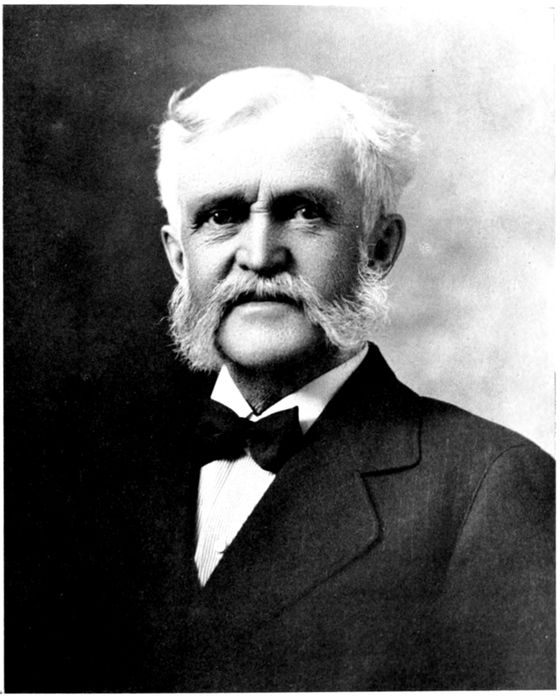
C. C. Hart
793C. C. Hart was born December 6, 1842, in Sandusky, Ohio, and was a son of Rev. Ichabod and Harriet (Whitcomb) Hart, the former a native of New York, and the latter was born in Templeton, Mass., April 22, 1819, and died in Chicago, Ill., April 30, 1889. The Hart family is a very old one in America and is descended from two English immigrants who settled in Connecticut in the colonial period of our Nation’s history, and from whom the city of Hartford took its name in the seventeenth century. Several descendants of these early pioneers fought for the cause of American independence in the American Revolution and also in the War of 1812. Two brothers of C. C. Hart served in the Union army in the late Civil war. The father of C. C. Hart was educated for the Presbyterian ministry and later became a Congregational minister. He received his college training in Princeton University and migrated to Ohio in 1840; resided at Sandusky until 1843, and then took charge of a church at Medina, Ohio, until 1844, when he removed to Kenosha, Wis. After several years’ ministerial work in Wisconsin he located in Illinois, and died at Wheaton, that State, in 1870, at the ripe old age of eighty-four years. Rev. Hart was the father of eight children: Edwin R. received a college education and served in the Union army; Rev. Walter O. Hart, a Union veteran, now located in North Carolina; Eliza born in Kenosha, Wis., January 23, 1847, married George W. Phillips, and died September 15, 1875, at Llano, Texas, one and one-half years after her marriage. While carrying on his ministerial work the Rev. Ichabod Hart also conducted a farm in the neighborhood of his work. Edwin R. Hart was educated in Oberlin College, Ohio, and Walter O. received a college and theological institute education and is now living in retirement with his son who also is a minister.
C. C. Hart, with whom this review is directly concerned, was reared to young manhood on his father’s farm and attended the schools of Genoa, Wis. During the Civil war lie remained at home and assisted his father in the farm work. In 1868 he decided to strike out for himself and try his fortunes in the West. He came to Kansas and located in Jackson county, on the western border of Atchison county, where he purchased 160 acres of railroad owned land, at a cost of five dollars and forty cents per acre. He at once began improving this tract which was raw prairie at the time of purchase and in the course of time developed it into a fine and highly productive farm. The Hart farm is one of the most productive and best improved in the State of Kansas and is widely known for the excellent shape in which the grounds and improvements are kept. Mr. Hart added eighty acres adjoining in Atchison county to the original quarter section and now has 240 acres in all. He remained on the farm until 1905, in the meantime having become interested in the Muscotah State Bank as a stockholder and director. In that year he removed to the town of Muscotah, where he has since made his residence in an attractive home. Mr. Hart was elected cashier of the bank January 1, 1910, and served in this capacity until August 1, 1915. While cashier he also served 794as vice-president of the institution and is now connected with the bank in that capacity.
Mr. Hart was married in 1867 to Miss Emma A. Olden, who has borne him the following children: Arthur C., born in 1873, married Bertie Stockton, and has one child, Dorothy, residing in Bakersfield, Cal.; Dwight Hart died in youth. Mrs. Emma A. (Olden) Hart, the mother, was born in Wisconsin in 1846, and is a daughter of Enos Olden, a native of New York State, and a descendant of an old eastern family.
The Republican party has always claimed the allegiance of Mr. Hart, and he has taken an active part in political affairs during his long residence in Grasshopper township and Muscotah. While living on the farm he held various township offices, and was always found in the forefront of civic movements which had for their intention the ultimate good of all the people. He filled the post of mayor of Muscotah for four years and was a good official. In church work he has been very active and is at present the treasurer of the Congregational church. His work in the interest of the young people of Muscotah has endeared him to all of the residents and for twenty-five years he has served as the superintendent of the Sunday school of his church. Mr. Hart was secretary of the Atchison County Sunday School Association for ten years. Although this grand old pioneer has passed the allotted three score and ten years of age. He is still active, mentally and physically, and rarely a day passes which does not find him at his desk attending to his duties in the bank or working about the grounds of his attractive, well kept home. Mr. Hart is a courteous and kindly gentleman of the old school whom one can not help but admire for his many sterling qualities.
WILLIAM YOUNG.
A native born Kansan, who became a successful agriculturist and banker, and left an indelible imprint upon the business and social life of Atchison county, was the late William Young, of Arrington, Kan. The Young family was one of the real pioneer families of the county, and the late Mr. Young was born on a pioneer farm in Mt. Pleasant township May 20, 1858. He was a son of William Johnson Young, whose wife was Mrs. Martha (Wamach) Snowden, widow, born in Virginia, a daughter of Abraham Wamach, an early pioneer settler of Atchison county, who came to this county in 1854 and settled on adjoining homesteads with W. J. Young. W. J. Young, the 795father of William, was born in Tennessee in 1815, and was the first judge of Atchison county. He settled on a farm in Walnut township, two and one-half miles northeast of Potter, Kan., which farm is now owned by Peter C. Griner. The elder Young was a natural born leader of men, and took an active and influential part in the political affairs of the county in the early days. He was a religious man, whose home was a meeting place for the politicians and ministers of the Gospel, and he was very hospitable. His father was the Rev. Duke Young, a native of Tennessee, who came to Kansas in 1854, and preached the first sermon in the county, on the doctrine of the Christian denomination. The Rev. Mr. Young was about sixty years of age when he came to Atchison county, and he had been preaching the Gospel for many years in Tennessee. J. W. Young became a member of the Christian church when sixteen years of age. The Young family was of Scotch-Irish ancestry.
William Young, with whom this review is directly concerned, was one of a family of fourteen children reared by his parents. He grew to manhood on his father’s farm, and after his marriage, in 1880, he and his wife located on a farm in Mt. Pleasant township, near the town of Potter, and developed it into a fine and productive tract. He continued in agricultural pursuits until 1908, when he went to Arrington, Kan., and purchased the Arrington State Bank, which he operated until his demise, January 12, 1910. After Mr. Young’s death, his widow disposed of the bank and the Arrington property, and removed to Atchison, where she has since made her home at 419 Kearney street.
William Young was married February 5, 1880, to Miss Angie Cooley, and to this union were born the following children: Maude, wife of Earl Stapler, Atchison; Duff D. Young, born April 8, 1901. The mother of these children was born November 9, 1861, a daughter of James and Cassendania (Waddle) Cooley, both of whom were born and reared in Kentucky. James Cooley, her father, migrated to Kansas in 1854 and settled on a homestead south of Potter, in Leavenworth county. His wife, Cassendania, came to Kansas to reside with her sister, Mrs. Masterson, who lived in Mt. Pleasant township, and she was married in 1860 to James Cooley. Eight children were born to them, of whom Mrs. Young was the fifth in order of birth. James Cooley took an active and prominent part in political affairs in Kansas in the early days, and served as the representative to the State legislature from Leavenworth county for two terms, from 1868 to 1872, inclusive. He died in 1876.
796William Young was a member of the Ancient Free and Accepted Masons, the Odd Fellows, and the Fraternal Aid Union. He was a man who lived his life according to Christian precepts, and was a regular attendant at church and Sunday school of the Christian denomination. His start in life was at the foot of the ladder, and he was successful in his undertakings, building for himself and his family, and leaving behind him on this earth the memory of a life well spent, and to his family a heritage of industry, honesty, straightforwardness and right living which will long be remembered by those who knew him best.
JAMES E. BEHEN.
In the compilation of the biographical department of this history of Atchison county, Kansas, the fact is frequently brought to the mind of the reviewer that the really successful men of this county are essentially self-made, and began at the foot of the ladder of success, working their way upward by various means, all of which were honest and based upon hard and painstaking labor at the outset of their careers. Very few were well educated, or had been blessed with opportunities in their youth such as are the heritage of the youth of the present day. James Edward Behen, successful farmer, of Center township, Atchison county, is one of those citizens who are deserving of credit for what they have accomplished. Starting out as a boy of twelve, he has made his own way in the world, and after he attained manhood, with the assistance of a good and faithful helpmeet, he has accomplished results which are really creditable. Starting with a tract of eighty acres of land in 1900, which he found necessary to improve, he soon added another eighty, then another eighty, and now has a fine farm of 240 acres, which is one of the most fertile tracts of land in the county, practically all of which is in cultivation. Mr. Behen has the right idea of farming, inasmuch as he sells the product of his farm “on the hoof,” and has become an extensive feeder of cattle and hogs. This plan insures the fertility of the soil, and his farm is steadily improving as the result of a wise method of cultivation.
Mr. Behen is a native son of Kansas, who was born and brought up on Kansas soil, and will not admit that there is any better place under the sun for a man to acquire a fortune than right here in Atchison county, and, judging by what he has done in Kansas, the writer is prone to agree with him. James E. Behen was born March 28, 1864, at Leavenworth, and is a 797son of Michael and Mary Behen, who had six children. The father was of Irish descent. He followed bridge building. James, the subject of this sketch, started out to make his own way at the age of twelve years, and went to work on the farm of Edward Whalen, in Doniphan county, Kansas, and stayed there eight years. Meanwhile, he attended the district school, receiving a rudimentary education. He then worked as a farm hand until he was twenty-two years old. For several years following he rented land in Atchison and Doniphan counties. In 1900 he bought eighty acres in Center township, and five years later bought the eighty acres adjoining his farm on the west. Now he owns 240 acres, which he has improved considerably. He built a modern barn, 32×35 feet in size, and also built a fine cattle barn, forty feet square. He does a large feeding business, handling a carload of cattle each year. He keeps graded stock of all kinds on his farm.
In 1888 he was married to Lizzie Pauly, who was born March 30, 1862, in Doniphan county, Kansas. She is the daughter of John and Anna (Hartzinger) Pauly, natives of Germany. The parents were early settlers in Illinois, and moved to Doniphan county, Kansas, in 1857. Mr. and Mrs. Behen have eight children: Mrs. Agnes McCibben, Atchison, Kan.; Alice, deceased; Mary, graduate of Atchison High School, living at home; Thomas, living at home; Joseph, at home; John, whereabouts unknown; Roy and Fred, living at home. Mr. Behen is a Democrat. He is a member of the Roman Catholic church.
FRED HARTMAN.
It is meet that considerable space be devoted to the valiant old pioneers of Kansas who assisted in the settlement of the country, and had much to do with its development. Not all of them figured prominently, and it was given to a very few to be honored above their fellows. In the latter class the reviewer must of necessity and choice place the late Fred Hartman, pioneer, successful farmer, Union veteran and well known public official, who for more than two decades was a well known and highly esteemed citizen of Atchison county.
Fred Hartman was born in Franklin county, Indiana, December 7, 1844, a son of Jonathan and Christina (Wolking) Hartman. His paternal grandfather was Henry Hartman, a native of Pennsylvania, of German extraction, and his wife, Alice Case, whom he married in Pennsylvania, migrated to Indiana in the early days of the settlement of the Hoosier State. Jonathan 798Hartman, father of the subject, was born in Franklin county, Indiana, January 22, 1822, and was reared to young manhood among the rugged hills of his native county, learning the carpenter’s trade, and then moving to Platte county, Missouri, with his family in 1846. Nine years after settling in Platte county, he removed to Port William, at that time a thriving settlement on the banks of the Missouri river in Atchison county. Here he erected one of the first sawmills in Atchison county and the State of Kansas, and furnished all the sawed lumber for the settlers for many miles around. The year 1856 saw the beginning of the struggle between the Free State and pro-slavery men for possession of Kansas, and the summer of that year witnessed some lively times. History records the fact that a man named Bob Gibson, leader of the Kickapoo Rangers, came from the headquarters of the gang with a squad of men for the purpose of mobbing Jonathan Hartman on account of his opposition to slavery. Mr. Hartman was a man of high courage and assumed a defiant attitude toward the Rangers who finally left without doing the damage which they had boasted was their intent. About this time the noted Pardee Butler was set afloat on a raft down the Missouri river by the pro-slavery men of Atchison, and Butler appealed to Hartman for aid after landing, near Port William. Mr. Hartman gave Butler every assistance possible, in getting him to his home. In 1857 Jonathan Hartman sold his sawmill and settled on a farm in Mt. Pleasant township, near the old military road which ran from Ft. Leavenworth to Denver, and the Far Western points. Great trains of thirty or more heavily laden wagons drawn by six and twelve yoke of oxen were constantly passing the home of the Hartmans. Mrs. Hartman recalls the great drought of 1860 and the great snows of the following winter. During the year of the great drought the settlers did not raise any crops and were forced to journey to Atchison for provisions, on the return trip stopping at the Andrew Parnell farm for assistance in their dire need. Two of the drivers on a wagon train that terrible winter had their feet frozen, one of the men afterwards losing both feet as a result of the hardships undergone. The Parnell home was a welcome and hospitable place of refuge for the starving and suffering settlers, during that winter. Mrs. Hartman also recalls the beautiful and inspiring sights made by the troops of United States cavalry which were frequently seen from her home in those days.
Fred Hartman hearkened to the call of the Union in the second year of the great civil conflict and enlisted in Company F, of the famous Thirteenth Kansas volunteer regiment, under Captain Hayes, Major Woodworth and Colonels Bowen and Speck. He was engaged chiefly in scout duty, and was stationed at Ft. Smith and other points in the Southwest during his 799term of service, which lasted for three years, and was finally mustered out at Ft. Leavenworth in 1865. He then came home and resumed the farm work on his father’s farm. He was married January 21, 1866, to Cynthia Parnell. To this union were born the following children: Henrietta, wife of R. H. Ripple, died in 1896; Hannah Ann, wife of James Iddings, both of whom are deceased, and who left one child, Geneva Iddings, of Topeka, Kan.; Dora, wife of Joseph Speck, died in 1896, leaving one daughter, Dora, who lives with her grandmother; Jonathan, a salesman of Kansas City; Josephine, wife of John Putman, of Atchison; May Florence, wife of Roy Trimble, sheriff of Atchison county, has four children; Birdie, wife of Henry Barr, died in 1906; Frederick, died in 1911, was married to Blanche Baker, daughter of Captain Baker. The mother of these children was born January 14, 1849, in Buchanan county, Missouri, a daughter of Andrew and Mirah (Wilson) Parnell natives of Kentucky and Indiana, respectively. Andrew and Mirah Parnell began their wedded life in Franklin county, Indiana, where they were reared and then migrated to Arkansas, and from there to Missouri in the early forties. In 1859 the family left Buchanan county and settled in Mt. Pleasant township, Atchison county, where they figured prominently in the early history of the county. The little Parnell was named after Andrew Parnell and the old town of the same name took its appellation from the family which settled in the neighborhood. Mr. Parnell spent his last days in Jefferson county, Kansas, where he died in 1872. He became very well-to-do and prospered. He was one of the original Free State men and suffered considerable loss at the hands of the Jayhawkers and border ruffians. Andrew Parnell was the father of eleven children, six sons and five daughters, and sent three of his sons to serve their country in the Thirteenth Kansas regiment, one son being killed. Mrs. Hartman is the youngest child of this large family.
When Mr. and Mrs. Fred Hartman were married they settled on a farm near Parnell, which Mrs. Hartman still owns. They developed this farm and cultivated it successfully until 1896, when they removed to Atchison, where Mr. Hartman died October 25, 1909. Mr. Hartman was a life-long Republican and began taking an active part in political and civic affairs when he had attained his majority. He was elected sheriff of the county in the fall of 1895, and served four years in all, in this important office. Previous to his removal to Atchison, he had capably filled the office of trustee of Mt. Pleasant township. He became identified with the civic life of Atchison and served as a member of the city council and was held in high esteem for his ability and capabilities as a citizen. Mr. Hartman was prominent in Odd Fellow and Masonic circles during his long life in the county.
800Fred Hartman was one of those pioneer citizens of Atchison county which are distinguished for their qualities of leadership, and his descendants are proud of his record as a citizen and public official. He was, during his whole life, a reader and student who believed in keeping abreast of the times and made a hobby of gathering historical data, being much interested in the history of his adopted State. His mind remained keen to the end of his days and he will always be fondly remembered by those who knew him. To him and his comrades who laid the foundation of the prosperous and happy community of Atchison, this volume is respectfully dedicated.
OSCAR A. SIMMONS.
Successful banking calls for qualifications somewhat different from those required in other pursuits or professions. It calls for a keen mind, decisive action, ability to pass judgment upon a proposition and its merits, and the power to judge and gauge human nature, and determine upon the honesty or sincerity of those with whom the banker is constantly doing business. Oscar A. Simmons, active vice-president and manager of the First National Bank of Atchison, possesses the qualifications of a successful banker to a considerable degree. He is unquestionably one of the rising financiers of Kansas with an ever increasing prestige in financial circles. He is one of those broad-minded men who keep abreast of progress and have the faculty of adapting their capabilities to the advanced needs of the times. Although a comparatively young man, as years measure a man’s age, his experience in banking has been such as to eminently fit him for the important position which he holds.
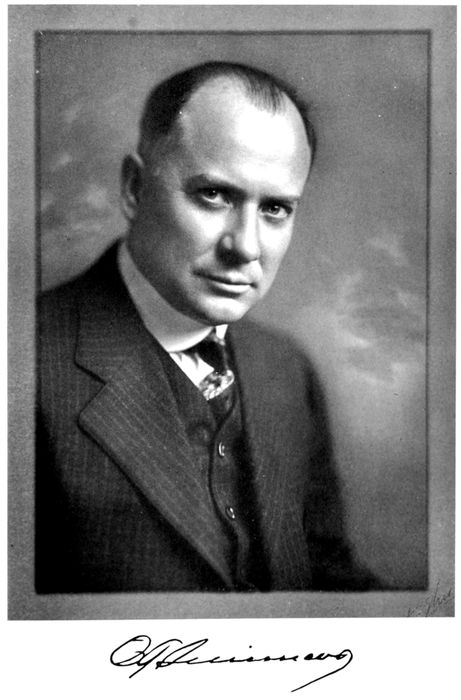
O A Simmons
801O. A. Simmons is a native of Kansas, and was born in Jefferson county February 11, 1874. His father was Joshua Simmons, a native of Indiana, and his mother was Susan Pitcher Simmons, born and partly reared in Missouri. The parents of both Joshua and Susan Simmons were among the pioneer settlers in Jefferson county, and it is probable that they located there in about 1855. Both the Simmons and Pitcher families were prominent in the affairs of Jefferson county in the early days of the county’s growth, and were highly respected. Joshua Simmons and Susan Pitcher were married in Jefferson county. At the outbreak of the Civil war, Joshua Simmons offered his services in behalf of the Union, and enlisted in Company A, Eleventh regiment, Kansas infantry, at the age of seventeen years, and was under the command of Colonels Moonlight and Plumb. Mr. Simmons took part in some hard campaigns during his enlistment, the Eleventh regiment being a part of the division which fought General Price’s army of invasion throughout Missouri and Arkansas. On a number of occasions he showed his personal bravery in volunteering for scout duty in the Southwest. He was mustered out at the close of the war, returned home, and was married shortly afterward. After a long and successful career as a farmer and merchant, he is now living a retired life at Brondon, Colo., at the ripe age of seventy-one years. Eight children were born to Joshua and Susan Simmons, five of whom are living, as follows: Mrs. J. W. Faubion, of Anthony, Kan.; Oscar A.; Mrs. P. H. Scales, of Birmingham, Ala.; W. C. and C. T. Simmons, of Los Angeles, Cal. The mother of these children departed this life in 1886. She was a good wife and a kind and loving mother.
O. A. Simmons attended the common and high schools of his native county and town, after which he was employed in a general store at Winchester, Jefferson county, until 1899. He was then employed in charge of the gents’ furnishing department of a large department store at Leavenworth for one year. His ambitions had always been headed toward entering the field of banking, inasmuch as he believed that he could make a success as a banker. Opportunity naturally beckoned; he saw the need of a bank in the town of Potter, Atchison county. Taking what funds he could muster he went to Potter and organized the Potter State Bank, serving as the cashier of this institution for two years. He then sold his holdings in the Potter bank and organized the Exchange State Bank at Nortonville. For a period of five years he was in charge of this flourishing bank, and here had the opportunity of demonstrating his inherent ability as a financier. A wider and larger field beckoned to him and he came to Atchison in 1906. Here his genius as an organizer has had full opportunity for exercise and he organized the Commercial State Bank, which later bought control of, and was consolidated with, the First National of Atchison. Mr. Simmons was elected vice-president of the bank at the time of the reorganization and was installed as the bank manager. He has since taken an active part in the organization of other banking concerns, having organized the Farmers State Bank of Anthony, Kan., in 1910, of which his brother-in-law, J. W. Faubion, is the cashier. In 1901 he organized the Jarbalo State Bank at Jarbalo, Kan., of which T. J. Mains is cashier. Mr. Simmons disposed of his interests in the Jarbalo bank in 1911, and bought the Farmers State Bank at Effingham, selling control of this bank in 1912. His next venture was the purchase of 802the controlling interest in the State Savings Bank at Leavenworth, of which Mr. Mains is now the vice-president. He reorganized the Arrington State Bank at Arrington, Kan., in 1903, and is still interested in its affairs. He organized the Citizens State Bank at Elmo, Mo., in 1913, and is the principal owner of this bank, and a stockholder in the Union State Bank at McLouth, Kan. It is a noteworthy fact that every financial institution with which Mr. Simmons has been connected has prospered, and is in sound condition. In every bank in which he has been interested he has displayed ability of a high order as a financier and manager.
Mr. Simmons has been twice married, his first wife being Margaret Mains, whom he espoused in 1902, being a daughter of James Mains, of Oskaloosa, Kan. She died in 1907. His second marriage, in 1910, was with Mary Frances, daughter of J. H. Barry, a substantial and well known citizen of Atchison (see biography of J. H. Barry). Two children have blessed this union: John Barry, born December 17, 1911, and O. A. Simmons, junior, born March 9, 1913.
From farmer boy to banker and capitalist in the short period of a little over forty years, with no initial capital to begin with, but a keen mind and strong body, is the gist of the career of him of whom this review is written. When a boy he worked for fifty cents per day in Jefferson county. Coming from the soil, and being reared on the farm, he has never entirely lost a love for the land itself, and is heavily interested in various tracts of good farm land, and owns 400 acres of Atchison county farm land, and 700 acres in eastern Colorado, which, together with holdings in Missouri and Texas, will aggregate over 1,500 acres. His financial interests are varied, and in Atchison are of such nature as to be of distinct benefit to the welfare of the city. He holds stock in several of the city’s leading mercantile concerns. His first work was as a farm laborer at $10 per month. His commercial career practically began in a general store at Winchester, Kan., at a salary of $17 per month, and during the twenty-three years following, he has amassed a fortune of over $100,000. Yet, there are those who say that opportunity for attaining wealth and position are gone, and that a young man has no chance to succeed because of the great competition of the financial trusts of the country. The life story of O. A. Simmons is a direct contradiction to the wail of the pessimist, and furnishes a decided inspiration to any young fellow blessed with mentality and strength to go and do likewise in his favorite line of endeavor. While Mr. Simmons is a stanch Republican, he does not take an active part in political affairs, and has declined political preferment.
803
H. B. WALTER.
H. B. Walter, of Benton township, Atchison county, Kansas, is one of the most widely known and successful live stock breeders in Kansas, and has made a signal success as a breeder of Poland China hogs during the past ten years. He first began the breeding of fine live stock in Republic county, Kansas, and while he has been a resident of Atchison county only since 1909, he has become known the length and breadth of the county for his fine live stock production. Mr. Walter did not venture in the breeding department of specialized agriculture for the purpose of producing show animals, but began his work purely as a commercial venture, and has succeeded even beyond his most sanguine expectations. He is the owner of 160 acres of fine farm land, located three and one-half miles northwest of Effingham, on which are excellent improvements. His farm is headquarters for supplying breeders with registered stock in all parts of the country, and he has the distinction of having developed the world beater of big type litters, and has produced and sold a world’s record type of Poland China swine of the big variety. For the past four years he has made the sales record for the State of Kansas in the numbers produced and the prices obtained. His farm produces 200 head of registered Big Type Poland China swine annually, and he holds two sales each year, in the months of October and February. In February of 1915, Mr. Walter sold fifty head of hogs, at an average price of sixty dollars per head, to buyers who attended the sale from all parts of the West. In February of the preceding year he sold at his regular sale fifty head, which brought an average price of seventy dollars each. The output of his breeding pens is shipped to points as far west as Oregon, and to places ranging from Minnesota to the Gulf States. In July of 1915 he filled an order for three high priced hogs sent in from Connecticut. He has done no exhibiting except at the local stock shows.
H. B. Walter was born on a farm in Jay county, Indiana, July 31, 1871, a son of Thomas S. and Sarah (Sherman), the former a native of Indiana, and the latter a native of Ohio. The family migrated from Indiana to Republic county, Kansas, in 1892, and settled on a farm in that county, where Thomas S. still resides. H. B. received his education in the public schools of his native county and State, and studied at Ridgeville College, Indiana. He prepared himself for the teaching profession, and taught school in Indiana for one year, and taught for nine years in Republic county, after moving to Kansas. He held the highest average grade possible to obtain in his teacher’s certificate, and met with considerable success in his profession, 804but abandoned teaching to engage in farming, in which avocation he began with the same determination to succeed as he had been imbued with when he began to teach. He purchased a farm in Republic county, which he cultivated, later buying a place in Brown county, Kansas, which he sold in 1909, and made the purchase of his present farm.
He was married in 1895 to Fanny Kunkel, a daughter of Noah and Caroline Kunkel, who were residents of Republic county, Kansas, from 1867 until their death. Mrs. Walter was also a teacher for eight years, and lived in Republic county over forty years. Mr. and Mrs. Walter have two living children: Frank, born in 1898, and Ruth, born in October, 1902.
Mr. and Mrs. Walter are members of the Methodist Episcopal church. Politically, Mr. Walter is an independent voter, who is not tied to the principles of any political party or leader. He is a member of the Central Protective Association.
HEKELNKAEMPER BROTHERS.
This firm has the distinction of operating the oldest soda and vinegar manufactory in Kansas, which was founded by William H. Hekelnkaemper, father of the present proprietors, in 1863. The first factory was located in a little shed, 14×14 feet, one door east of the A. J. Harwi hardware store on Commercial street, Atchison, Kan. Mr. Hekelnkaemper operated the business for ten years, and gradually enlarged his quarters as much as his limited means would allow, and about 1873 removed the plant to the present location on the corner of Ninth and Laramie streets. He erected a brick structure, 22×50 feet, and also built an ice house. His business prospered from the start when he moved to his new location, and was confined to the trade in Atchison with the exception of supplying the towns within a radius of fifty miles in northeast Kansas, and western Missouri. In the old days patrons drove in wagons for a distance of fifty miles and more to purchase the products of the factory, and many of the former patrons are still buying from the sons. After the founder’s death in 1881, the business was allowed to languish to some extent owing to the enforcement of the State prohibition law, for the reason that the products of the factory, while not intoxicating, were largely purchased by saloons. Trade naturally fell off for a time until conditions were adjusted to the new regime, and new demands were created in other retail circles than the saloon business. The plant was closed for about a year and the widow then leased the buildings for ten years to M. L. 805Greenhut, who later retired. The sons then took charge in 1900, and it has since been operated by F. W. and G. A. Hekelnkaemper. The boys had no capital to begin with, but had a wonderful amount of determination and perseverance which stood them in good stead and enabled them to make good. The business had to be built over again, but fortunately paid a small profit during the first years. In time other additions were made to the plant and the capacity has been increased to over 15,000 bottle of soda water per day. This is the main product of the factory which also produces fruit syrups and flavoring extracts of a superior grade and quality, in addition to fifty thousand gallons of high grade vinegar each year. During the busy season fourteen men are employed and Hekelnkaemper Brothers has grown to become one of the important manufacturing concerns of Atchison. During the past eight years the business has practically doubled itself over that of each preceding year.
William H. Hekelnkaemper, Sr., was born in April of 1837, in Westphalia, Germany, and emigrated from his native land when a young man. He landed at New Orleans from a sailing vessel and then came by river boat to St. Louis where he lived for a number of years and engaged in the grocery business. His store was burned and he left St. Louis and came to the town of Rollin, Mo., where he again established a grocery store about 1861. In the spring of 1863, he came to Atchison, Kan., and opened and operated the first pool and billiard room in the city. One year later he disposed of part of his equipment and moved a part to Seneca, Kan., where after operating a pool room for a time, he sold out and returned to Atchison. In about 1863 he embarked in the soda manufactory as stated in the preceding paragraph. While a resident of St. Louis, Mr. Hekelnkaemper was married to Theresa Houk, who was born in St. Louis, Mo., of German parents, who both died during the great cholera epidemic when Theresa was about three years of age. The children born to this union are as follows: Gustave A., Frederick W.; William G., Frank V., Laura, Edith, Emma and Anna.
F. W. Hekelnkaemper was married September 17, 1901, to Pauline Ostertag, a daughter of George Ostertag, one of the pioneer wagon makers of Atchison, and to this union have been born two children: Irene and Lucille. He is a Democrat and is a member of the Elks, Eagles and the Moose.
G. A. Hekelnkaemper is associated with F. W. in the business as above mentioned. He was married in August, 1901, to Lydia Weik, a daughter of Christian Weik, an Atchison county pioneer, and to this union have been born two children: Marie and Louise. G. A. is a Democrat in politics.
806William H. Hekelnkaemper died August 20, 1881. He was politically allied with the Republican party during his life, and was a member of the Atchison city council for a number of years, having been a particular and close friend and admirer of the late Senator John J. Ingalls. He was one of the founders of the famous Turner Society, and was its first president. He was prominently identified with the affairs of the society and the civic affairs of Atchison until his demise. He was a man of great resourcefulness which aided him in making a new start on occasions when everything looked darkest for his future. He had many warm friends in Atchison and was universally respected by all who knew him.
CLEM P. HIGLEY.
Clem P. Higley, farmer and stockman of Center township, Atchison county, was born there March 25, 1869. He is a son of Russell and Carrie (Hooper) Higley, who were the parents of nine children, as follows: William, deceased; Otto, deceased; Emma Winsor, Las Vegas, N. M.; Hallie Nelson, Las Vegas, N. M.; Theodore, a traveling man; Clem, the subject of this sketch; Frank, farming the old home place, and Gilbert and Mina, both deceased. The father was born just west of New York City, January 3, 1833. In his early manhood he followed the blacksmithing trade, and at the age of twenty went to Illinois, where he remained for two years. Coming to Atchison county, he preëmpted 160 acres of land in section 3, Center township, and sold it shortly afterward and bought 80 acres in section 35, a mile east of old Pardee, Kan. He made extensive improvements on this place and farmed it until he retired in 1895. He now lives with his son, Clem. Russell Higley’s life did not run as smoothly as it might seem from this account of it. In his early days in Kansas the drought destroyed his crops one year. He gathered only one bushel of corn from his field that year. Having started out with no capital, this misfortune was a serious one. He and his twin brother, Russell, worked for Pardee Butler, while he returned to Illinois. They worked for Mr. Butler all summer and in the fall of 1856 started to walk back to Illinois, so as to be home during the winter. A winter in Kansas was a serious thing in those days, and with the best of provisions, it was a fierce ordeal. In the spring of 1857 they returned to Kansas, having the confidence in this country to develop into a prosperous district. Russell was a son of Francis Higley, and his mother died when he was a very 807small boy. Carrie Higley, the mother of Clem, was born in Tennessee in 1837. Her father was a freighter from Missouri to Santa Fe, N. M. Mrs. Higley died in 1899.
Clem Higley, the subject of this sketch, attended school at Pardee, Kan., and when twenty-one years old, started out to work by the month. A year later he rented a farm in Benton township, five miles south of Effingham, Kan. Then for a period of nine years he rented in Benton township, and the following three years rented his father’s farm and in 1903 bought 105 acres. The place was not well improved and he set to work erecting buildings, and now has a large two-story home and two barns, one 24×50 feet and the other 40×42 feet. The latter has a cement basement. Higley’s total holdings now number 185 acres of land. He keeps graded stock, including fine Poland China hogs. In 1896 he was married to Margaret Hawk, who was born March 21, 1877, in Ohio. She is a daughter of Lafayette and Hattie (Pitt) Hawk, both natives of Ohio. Mr. and Mrs. Higley have had six children born to them, the second child dying in infancy. The others are, Newell, Wilber, Morris, Marie, Dale. All are living with their parents. Mr. Higley is a Republican and is a member of the Christian church.
WILLIAM E. HUBBARD.
William E. Hubbard, farmer and stockman, Kapioma township, Atchison county, was born September 8, 1861, in Henderson county, Illinois. He is a son of Simeon and Mary Ann (Pence) Hubbard, who were the parents of the following children: Mrs. Lillie O’Connor, widow living in Muscotah; Mrs. Cora Routh, Kapioma township; Lewis, farmer, Kapioma township; William, the subject of this sketch, and two children who died in infancy. Simeon Hubbard, the father of William, was born March 10, 1840, in Indiana. He was a farmer in his young manhood, and on coming to Kansas in 1874, followed the same occupation. Settling near Muscotah, he rented land for four years, and during this time saved his earnings for future investment. At the end of four years he had accumulated enough to buy the farm, and he became a landowner and led a prosperous career as a farmer. He fed stock for the market as well as grew crops. He now resides in Muscotah, Kan. The mother of William Hubbard is also living.
William E. Hubbard grew up on his father’s farm in Illinois and attended the district school in Kapioma township, Atchison county. When he was 808of age he began farming in partnership with his father. At the age of twenty-eight he was married and located on a rented farm near his father’s place. He lived there until 1895, when he bought 180 acres just south of where he had rented. After working this place seven years, he sold it and bought the 160–acre farm which he now owns. On this place William has invested a considerable sum in improvements which include a fine granary. He is a stockholder in the Grange elevator at Muscotah, Kan. It should also be mentioned that William keeps graded stock on his farm.
In 1889 he married Martha Routh, who was born near Leavenworth, Kan., in 1869. They are the parents of seven children as follows: Jesse, Atchison county; Mrs. Bessie Roberts, Kapioma township; Fred, Lola, Ollie, Mabel and Frank, all living at home. Mr. Hubbard is a Democrat and is now serving as a member on the school board in his district, Rose Valley, No. 49. He is a member of the Mission church. Mr. Hubbard is a citizen interested in the welfare of his community and is always active in any project that will improve his neighborhood.
DRENNAN L. DAWDY.
Drennan L. Dawdy is a stockman first, last and always. Pedigrees and prices are his stock in trade, and to talk with Mr. Dawdy without hearing about his fine stock is impossible. Next to his family his stock is his pride. Mr. Dawdy confines his stock raising to the best strains. It is his theory that it never pays to bring up a scrub. The same amount of feed and the same amount of care, if intelligently applied to registered animals, will bring in double and treble returns, Mr. Dawdy believes, and it is his policy not to waste time on inferior breeds. Mr. Dawdy has a cow that cost him $75. The former owner of the cow did not see any marks of good blood in the animal, but Mr. Dawdy did, and he has made $4,000 out of that one cow in the last seven years. The buying of this cow at the price, however, was simply a very fortunate investment, as Mr. Dawdy says, generally speaking, “The highest priced cattle were much the best investments, and he has paid as high as $800 and $900 for cows and $1,000 for a bull. He sold one of the calves for $755 and another for $500. He learned his business well, for he learned it in the best way possible, from his father. The father, John W. Dawdy, was a breeder of fine cattle in Illinois and probably inherited that trait from his parents, who were Kentuckians. The father was born in the blue grass 809country March 30, 1840, but at the age of seven was taken by his parents, Jefferson and Elizabeth (Amos) Dawdy, to Illinois, where he remained until 1910. While he was living at Abingdon, Ill., he met Sarah J. Latimer, to whom he was married May 7, 1847. She was a daughter of Alexandria and Julia Ann (Hart) Latimer, natives of Tennessee, and was the mother of six children, three of whom are living. Drennan, the subject of this sketch, is the oldest. The others are Norval M. and Daisy E., who live in California. In 1910 the parents removed to Napa, Cal., where the father is now living. The mother died August 12, 1915.
After attending the country school near his Illinois home, Drennan attended Hedding College at Abingdon and later went to business college at Chicago. But he was a natural born stockman and could not resist the lure. So he went back to his father and joined him in the livestock business and became associated with his father in the breeding of Shorthorn cattle under the firm name of J. W. Dawdy & Son. In the latter part of 1889 he and Walter Latimer purchased the entire herd of cattle known as the Shannon Hill herd owned by the late Ex-Governor George W. Glick, of Atchison, Kan. This herd was the largest collection of pure Bates cattle in America at that time, and were dispersed by D. L. Dawdy & Co., at auction in Kansas City, Mo., April 11–12, 1900, the ninety-one head bringing a total of $20,460, which was considered a remarkable sale for an entire herd, which included a number of aged cows, the general average of the sale being $225 per head with a top price of $800 for the “Second Dutchess” of Atchison, the buyer of whom was the late W. R. Nelson, of the Kansas City Star. Mr. Nelson bought fifteen head of cattle at this sale at an average price of $415 per head. In June of the same year this firm bought the entire herd of Scotch and Scotch topped Shorthorns of J. T. Kinmouth & Son, Columbus Junction, Iowa, paying $11,000 cash for the 100 head. This was one of the most notable private deals in registered cattle of recent years. In 1901 they bought sixty-five head of registered cattle in one lot. D. L. Dawdy & Co. have made many successful sales both private and public. In 1899 Mr. Dawdy came to Atchison county, Kansas, and took charge of the George W. Glick farms, near Atchison, Kan. This position gave him charge of a herd of registered Shorthorns. In 1901 he bought the farm which he now owns, consisting of 405 acres, lying one-half mile north of Arrington, Kan. On this place he has devoted himself to the breeding of fine cattle and has made that his principal work. His exhibits have taken high honors at the stock shows in Kansas City and Chicago. A number of years ago he bought “Sunshine,” a fine cow in the herd owned by Senator W. A. Harris, paying $225 for her. Four of 810her calves have brought him $1,365. He has owned three cows which sold for $800 each, and in 1902 he sold thirty head of cattle at $266.66 each.
On May 15, 1901, Mr. Dawdy married Nellie B. Prim, who was born on a farm near Atchison, Kan., April 3, 1881. Her father, Charles S. Prim, was a native of Tennessee, while the mother, Sophia (Christian) Prim, came from the Isle of Man. Both parents are now dead. Mr. and Mrs. Dawdy have four children, all of whom are living at home: Ruth, John, Helen and Glenn. Two died in infancy. Mrs. Dawdy carries her husband’s hobbies into the domestic end of the farm. She makes a specialty of raising fine turkeys, raising the bronze variety. She sells eggs from her turkeys for fifty cents apiece, and often gets as high as $7.50 for a turkey. She saved $150 from the sale of eggs and bought a Shorthorn calf which is worth $300 today. Mr. Dawdy is working to make his home an ideal country place. His house is on one of the finest locations in the county. By installing 15,000 feet of drainage, at a cost of $1,200, he has reclaimed fifty-two acres of soil, which previous owners of the place had thought to be too wet to cultivate, but since installing the drainage system Mr. Dawdy has raised annually fine crops of corn and wheat on it. The Delaware has a habit of overflowing and Mr. Dawdy was one of the first farmers to suggest the organization of County Drainage District, Number One, comprising 8,300 acres, and is nine miles in length as the crow flies, while the Delaware river course is at present nineteen and one-half miles, and the drainage system shortens the run seven and one-half miles, doubles the velocity of the stream and increases its carrying capacity four and one-half times. The expense or total cost of the ditch will be $100,000 and will increase land values tremendously. Mr. Dawdy is one of the directors of the enterprise. Mr. Dawdy owns 405½ acres of land which has a fine large residence on it. The location is one of the most beautiful in Atchison county. On a clear day Horton, fifteen miles north, can be plainly seen; Holton looms up twelve miles west, Muscotah, seven miles north, Valley Falls, twelve miles southeast, Larkin, two and a half miles west, and Arrington, one-half mile south. Mr. Dawdy has a complete set of volumes of American herd books, and knows the pedigree of every animal on his place. He is a member of the American Shorthorn Breeders’ Association of Chicago, and knows the latest facts about the cattle business. His home is highly improved with silos and drainage facilities. He is a Democrat in politics and a member of the district school board and the drainage district No. 1, of Atchison county, Kansas. He belongs to the Ancient Free and Accepted Masons, of Muscotah.