Chapter XXV · BIOGRAPHICAL HISTORY (continued 12)
Reading edition
WILLIAM M. NITZ.
America is proud of her citizens of German birth, and glories in their accomplishments, their successes, and affluence, wherever they are located. It is an undisputable fact that the farmers of German birth or ancestry in Kansas today are rated as among the most prosperous of this great commonwealth. Atchison county has its quota of successful German agriculturists, and William M. Nitz, of Center township, is one who is deserving of special mention. It is a noteworthy rise from a poor German immigrant boy to become one of the large landed proprietors of the county, but Mr. Nitz has accomplished all this. His 400 acres or more of land in Center township were all obtained by hard labor, economy, intelligence and good financial judgment. The rearing of his large family of nine children, and their gift to the county and country as sturdy and upright citizens, is alone a matter for praiseworthy mention.
William M. Nitz was born in Germany, March 26, 1864, and is a son of Ludwig and Johanna Louisa (Linstad) Nitz, who were the parents of eleven children, eight of whom are living. The father was born in Germany, in August, 1836, and left his native land in 1883 with his wife and one child, coming to America. He came west and worked a year as a laborer, and then bought eighty acres of land in Doniphan county, Kansas, where he farmed until 1911. He then removed to Kansas City, Mo., where he and his wife now live. His wife, the mother of William Nitz, was also born in Germany, in 1845. William N. Nitz immigrated to America when he was fifteen years of age. He worked in Pennsylvania as a farm hand for a year, then he came to Doniphan county, Kansas, where he also worked as a farm hand. He then rented land in Lancaster township, Atchison county, for two years, when he returned to Doniphan county, where he bought eighty acres of land. In 1902 he sold out and bought 307 acres in Center township. This farm was 741poorly improved, the house and barn being old and dilapidated. Mr. Nitz proceeded to rebuild and improve the buildings. He is now located in section 11, and owns 427 acres of land. He is a fancier of good mules and keeps graded stock on his farm. Mr. Nitz, together with several other farmers in his neighborhood, hold stock in a thresher outfit which they operate jointly.
In 1890 Mr. Nitz married Miss Lena Lawson, a native of Kansas, born February 27, 1873. Mr. and Mrs. Nitz are the parents of eleven children: George, born January 12, 1893, farmer, Center township; Charles, born November 11, 1891, on his father’s farm of 120 acres; Otto, born August 28, 1894, living at home; Johanna and Nava, deceased; Edward, born June 26, 1898, living at home; Oscar, born January 28, 1903; Irvin, born October 22, 1906, and Ida, born March 5, 1913, living at home, and two children died in infancy. Mr. Nitz is an independent in politics and he and his wife are members of the Lutheran church, as are Charles and George. Though Mr. Nitz could not read or write the English language very well when a young man, he has always been a student of new conditions, and was quick to learn the customs and language of his adopted country and has proved himself to be a useful member of his community. Of late years he has become very proficient in reading English and keeps abreast of the times by reading the daily newspapers.
HENRY GLATTFELDER.
Henry Glattfelder, farmer, Center township, Atchison county, Kansas, was born in the township where he now lives, September 16, 1871, and is a son of Henry and Margaret (Kuntz) Glattfelder. They were the parents of seven children: Elizabeth married J. Meyers, died in Atchison. Kan.; Maggie married widower of her deceased sister, and he is a baker and merchant, Atchison; Anna, wife of J. Kuhn, Atchison, Kan.; Fannie married H. H. Severs, Manning, Iowa; Mary married M. L. Dilgert, Atchison; Bertha married W. A. Dilgert, Mt. Pleasant township, and Henry, the subject of this sketch. The father was born in Switzerland, January, 1827. He came to America and settled in Atchison county, on a rented farm in Mt. Pleasant township. He worked this from 1863 until his death in 1871. The mother was also born in Switzerland, December 18, 1832, and died in Atchison, Kan., in 1904.
Henry Glattfelder, the subject of this sketch, attended the district schools 742of Center township, and grew up on his mother’s farm and began farming for himself when he was twenty-two years old. He bought 125 acres of land in Center township, and now owns 130 acres. He has made many improvements on his place since taking possession of it, and keeps graded stock. In 1894, the year in which he started out for himself, he was united in marriage with Miss Anna Cline, a daughter of Peter J. and Bersheba Cline. Mrs. Glattfelder was born March 21, 1877, in Mt. Pleasant township, Atchison county, Kansas. Her father was a native of Iowa, and her mother of Missouri. To Mr. and Mrs. Glattfelder have been born six children: Leona, Ellsworth, Harold, Kennith, Lucile, all living at home. One child, Henry, is deceased. Mr. Glattfelder is an independent voter. He attends church but does not profess any creed. He is a practical farmer and is a liberal giver to all movements for the benefit of the community. Never has Mr. Glattfelder allowed his selfish interests to stand in the way of the community’s progress and he has proven himself a patriotic citizen of the commonwealth.
THOMAS W. TUCKER.
Thomas W. Tucker, live stock dealer, Effingham, Kan., is a native of Atchison county, and has lived all of his life in Benton township. He was born on a farm three and one-half miles northeast of Effingham, November 27, 1872. His parents were J. Martin and Polly (Cummings) Tucker, both of whom were born in Crawford county, Indiana. J. M. Tucker was the son of Sloan Tucker, also a native of Indiana, who emigrated to Kansas in 1860. When he attained young manhood the father of Thomas W. rented land for a few years in Doniphan county, and then bought a farm in Atchison county. He prospered and became the owner of two farms in Benton township, aggregating 280 acres. When old age came he and Mrs. Tucker retired to a home in Effingham, where they spent the remainder of their days in peace and comfort. J. M. Tucker was born in 1831 and died in 1896, and his wife was born in 1838 and died in October, 1910. Mr. Tucker served in the Kansas State militia during the Civil war. The following children survive J. Martin and Polly Tucker: John R., a farmer living west of Effingham; Mrs. C. C. Anderson, of Atchison, Kan.; Thomas W.; Albert, a resident of Atchison.
Thomas W. Tucker attended the Maple Grove school when a boy and lived on the home farm, assisting in its operation, until he attained the age of 743twenty-two years. In 1894 he engaged in the livery business in Effingham and continued operating the same until 1898, when he sold out and spent one year cultivating the home farm. After his marriage in 1898, he removed to the Noffsinger farm, east of Effingham, and managed it for six years, returning to Effingham in 1905. While on the farm he became interested in the buying and selling of live stock, and since taking up a permanent residence in Effingham, he has devoted his entire time and attention to this business with signal success. His live stock dealings embrace the purchase and shipment of over seventy-five carloads of stock yearly, which is no inconsiderable item and involves transactions requiring capital of several thousands of dollars. He is also interested in real estate and farm lands and has made several profitable deals in this line. Mr. Tucker owns one of the best residences in Effingham and is the owner of some town lots.
He was married in 1898 to Miss Maude Noffsinger, who was born and reared on a farm, four miles southeast of Effingham, a daughter of Peter and Margaret Noffsinger, residing on their home place, east of Effingham. Both Peter and Margaret Noffsinger are deceased, Mrs. Noffsinger dying in September, 1915. Mr. and Mrs. T. W. Tucker are the parents of two children: Ramona, aged fifteen years, and Maurice, aged eleven.
Mr. Tucker is a Republican in politics and is prominent in the affairs of his party, at present being the central committeeman of the Effingham precinct, being a part of the county organization. He and his family are members of the Christian church. He is fraternally affiliated with the Ancient Free and Accepted Masons, the Benevolent and Protective Order of Elks, the Modern Woodmen, and the Knights and Ladies of Security.
J. F. FLYNN.
J. F. Flynn, farmer, resides on the old Flynn homestead in Mt. Pleasant township, Atchison county, of which he is the owner and upon which his father settled in March. 1855. Mr. Flynn was born on this farm, October 8, 1855, and has lived all of his sixty years of life on the place. During this time he has simply grown up with Atchison county, and his earliest recollections were of the vast stretches of prairie in Atchison county, which were awaiting the homesteaders and settlers who have since transformed the unpeopled wilderness into a land of homes and plenty. His father was Jeremiah Flynn, who 744was born in County Cork, Ireland, and left his native land when a young man and immigrated to America, locating after a time in Kentucky, where he met Julia Sullivan, who was born in his own native county in Ireland. The acquaintance ripened into love and culminated in their marriage at Frankfort, Ky., September 24, 1854. In March, 1855, they came to Kansas and settled on a tract of part prairie and part timber in Mt. Pleasant township where both lived and died.
J. F. Flynn was the first born of ten children of Jeremiah and Julia Flynn. He received a common school education, supplemented with a course in bookkeeping at St. Patrick’s common school, district No. 14, after which he settled down to farming the home place, coming into possession of the homestead by inheritance and purchase after his father’s demise. For several years he was a successful fruit grower, but of late has devoted all of his time and activities to general farming.
Mr. Flynn was married March 31, 1880, to Mary Desmond, of Missouri, and to this union have been born five children: Kathrine, wife of John Begley, of Kansas City, Kan.; John E., at home, assisting his father in the farm work; Joseph J., in Kansas City, Mo.; Julia and Mary, at home with their parents.
Mr. Flynn is a Democrat in national politics, but is inclined to be an independent voter who votes for the best man who seems qualified for the office regardless of his political affiliations. He and all of his family are members of the Catholic church, which was the faith of his parents.
ERNEST C. HAZEL.
Industry and effort are generally rewarded. The successful man is usually found filling the niche for which he was designed. It affords some satisfaction to chronicle the facts in the life of a self-made man who has won an enviable place in the commercial and manufacturing life in his home city. Ernest C. Hazel, vice-president and general manager of the Lockwood-Hazel Printing and Stationery Company, of Atchison, has achieved his position by industrious application of talents which have enabled him to rise above the mediocre and general station of the average man. Considerable credit is due him for having been a potent factor in building up the extensive business which his firm enjoys.
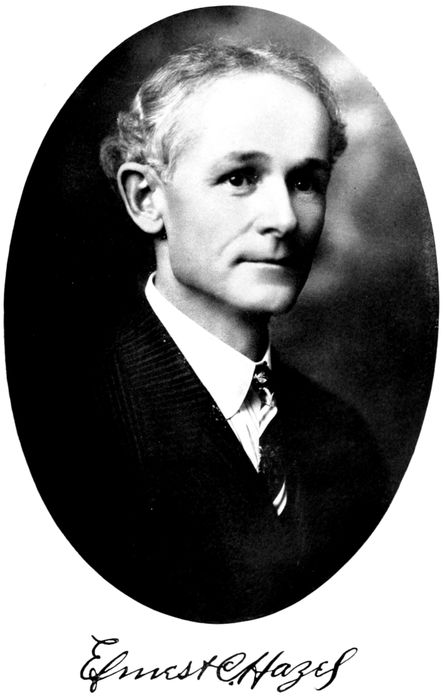
Ernest C. Hazel
745The Lockwood-Hazel Printing and Stationery Company was established in 1912. It originated as the Trade Printing Company in 1903. This was a small concern but grew constantly until the business reached its present proportions. The business is housed in the handsome new Masonic Temple on Fifth and Kansas avenues, and occupies the first floor and basement of the building. The arrangements and equipment are the most modern which can be obtained and are especially adapted for a high grade quality of printing which this firm turns out. The greatest progress of the firm has been made since its organization as the Lockwood-Hazel Co., in 1912. The firm is composed of C. A. Lockwood, president and treasurer, and E. C. Hazel, secretary and general manager. The firm manufactures blank books and does general printing of the highest grade. The line of printing includes county and bank supplies, loose leaf systems, and embossed stationery. They supply leading banks with their outfits and deal extensively in wood and steel office furniture and equipments, and also vault accessories. C. A. Rowe is manager of the sales department which employs three traveling salesmen and the firm conducts a large mail order business in eight states. So excellent is the product turned out and so fair is the treatment accorded a patron that a first order supplied by this enterprising establishment leads to constant repetitions from the purchaser when in need of supplies of the character furnished.
Ernest C. Hazel was born March 30, 1875 in Newman, Ill. His parents were Thomas and Lydia (Kinney) Hazel, natives of Virginia and Ohio, respectively. Thomas Hazel was born in Page county, Virginia, a son of Richard and Elizabeth Hazel. He was a veteran of the Union army, and served his country faithfully during the Civil war in Company E, of the Twelfth regiment, Illinois infantry. He served for two years under General Grant and was under General Sherman’s command for two years and six months. His first engagements were at Ft. Henry and Ft. Donelson. He fought in the battles of the Wilderness, Lookout Mountain, Mission Ridge, Siege of Vicksburg, and was with Sherman on his victorious march from Atlanta to the sea. He enlisted at Springfield, Ill., at the first call for volunteers and served until the end of the war. To the end of his days he was a member of the Grand Army of the Republic. A brother, John, also fought in the Union army and like many other southern families it was a house divided against itself and three brothers, Richard, Benjamin and William, fought on the side of the confederacy. Lydia Hazel was born in Muskingum county, Ohio, and was the daughter of Thomas C. and Levina Kinney.
In 1876 the family emigrated from Newman, Ill., and settled on a farm near Pawnee Rock, Kan., which the father had homesteaded. After spending 746some years in developing the farm Thomas Hazel removed to Missouri, from where he came to Atchison in the year 1888. Here he lived a retired life, dying November 19, 1904, at the age of sixty-seven years. Mrs. Lydia Hazel resides with her daughter in Leavenworth, Kan. The Hazels are descendants from a fine old Virginian family and their ancestry traces back to the colonial days.
To Lydia and Thomas Hazel were born six children, as follows: Mrs. Elnora Allen, of Atchison; Mrs. Ida Stucker, of Leavenworth; Marion Hazel, of Leavenworth; Ernest C. Hazel, of Atchison. Two children died in infancy.
Ernest C. Hazel was educated in the public schools of Atchison and learned the trade of bookbinding with Mr. Caldwell, beginning at the age of fourteen years. After serving an apprenticeship of three years, he was employed by the Haskell Show Printing Company. This concern was succeeded by the Home Printing Company, and he was employed by them until 1901. For a period of two years he was a traveling salesman for the Western Paper Company. In 1903 he entered the employ of the Trade Printing Company, which was succeeded by the present firm in 1912. He purchased an interest in the firm in 1908.
The married life of Mr. Hazel has been a happy one, and has been in keeping with his success in the business world. He was married March 30, 1897, to Mary Elizabeth Semple, of Atchison, a daughter of Andrew and Jennie Semple, both of whom were natives of Glasgow, Scotland. Andrew Semple was one of the pioneer contractors of Atchison. His last contract was the Atchison county court house. Mr. Semple is deceased and his widow still resides in Atchison.
To Mr. and Mrs. Ernest Hazel have been born five children, namely: Ernest C., Jr., seventeen years of age, and a student of Midland College; Robert R., fourteen years of age, and also a student at Midland College; Constance Marie, who died in infancy; Kenneth C., nine years of age, a pupil in the public schools, and Neola Christine, aged five years.
Mr. Hazel finds time in the midst of his busy life to give considerable attention to civil and social affairs and is an active member of the Christian church of Atchison, in which thriving religious institution he and his wife are warmly appreciated for their good qualities. He is a Republican in politics, and is fraternally affiliated with the Ancient Free and Accepted Masons, the Ancient Order of United Workmen, and the Fraternal Aid Union, and also the United Commercial Travelers. Pronounced ability, combined with an engaging personality, have won him this high place in his home city.
747
ALEXANDER H. CALVERT.
Alexander H. Calvert, lumber and grain dealer, Muscotah, Kan., was born on his father’s farm in Platte county, Missouri. He is a son of Warren Calvert, a native of Kentucky, whose ancestors were among the earliest settlers in America. It is a matter of tradition that he was a descendant of the original Lord Baltimore, or Cecil Calvert, who founded the State of Maryland, in the seventeenth century. The father of Warren Calvert was a pioneer settler in Kentucky and was the owner of a large plantation. Warren Calvert was born in 1815 and died in 1875. With his wife, Lucy Calvert, he migrated from Kentucky, accompanied by his retinue of slaves, to form a part of the Kentucky colony which settled Platte county, Missouri, in 1835. He was one of the original settlers in Platte county, and operated a large tract of land. He and his wife, Lucy, reared a family of nine children, namely: Presley Hawkins, a retired farmer of Muscotah; James Harvey, deceased banker of Muscotah, who was a soldier in the Confederate army; Mrs. Anne May Buford, deceased; John Hawkins, who died on his farm near Arrington in 1910; Ambrose Owens, living in California, near Los Angeles; Mrs. Ella (Burt) Jackson, died in 1903.
A. H. Calvert came to Kansas in the spring of 1878 and settled on a farm south of Muscotah in Atchison county. Three brothers came at this time, Presley H., James H. and himself. For a number of years Mr. Calvert rented land in Kapioma township and then purchased the farm of 220 acres, which he owns. He rented land for over fifteen years and then began to buy land. His first farm of 135 acres was purchased in 1903, and he has continued to invest heavily in farm lands in the vicinity of Muscotah until he is now the owner of 700 acres, besides a small tract in Leavenworth county, Kansas.
Mr. Calvert resided on his farm until 1897 and then removed to Muscotah where he engaged in the lumber business under the firm name of Calvert & Sharp. This partnership continued until 1902 when he purchased his partner’s interest in the business, which he has since operated. In November of 1905 he formed a partnership with M. E. Bevin, of Muscotah, and they purchased the grain elevator and engaged in the buying and shipping of grain. This firm also does an extensive live stock business, buying and shipping several carloads of live stock during each year. In addition to his extensive business affairs, Mr. Calvert is a stockholder in the Muscotah State Bank.
748His first marriage was with Miss Nora Rice in 1881. Two children (twins) were born of this union, namely: Ella, wife of Will Warren, of Muscotah, who served for seventeen years as assistant cashier of the Muscotah State Bank; Alma, a highly educated lady who studied in the Camden Point Young Ladies’ Seminary, the Emporia Normal College, and received her degree of Bachelor of Arts from Washburn College, at Topeka, now a teacher of mathematics in the Atchison city high school. The mother of these children was a daughter of D. Rice, a native of Illinois, and a pioneer settler of Atchison county. She died in 1883, at the age of twenty-six years. In 1889 Mr. Calvert was united in marriage with Miss Hattie Burt, of Platte county, Missouri, a daughter of John Burt, who came from Indiana to Platte county. Three children have been born to this marriage: George, conducting a garage at Effingham, Kan.; Marguerite, aged twenty-one years, a teacher, at present studying in Washburn College; Charles Cecil, aged fifteen years, a student in the Atchison County High School.
Mr. Calvert is an old-line Democrat and takes considerable interest in local and county political matters. He is a member of the Modern Woodmen and the Knights and Ladies of Security. A man of good education and attainments, he has succeeded in making his own way in the world and has risen from comparative poverty to become one of the substantial and best known citizens of the county.
JOHN STODDARD.
John Stoddard, a late resident of Muscotah, was born in Allegheny county, Pennsylvania, in 1833, and departed this life February 18, 1901. He was the son of Robert and Margaret (Jordan) Stoddard. On the Stoddard side of the family the lineage is Scotch-Irish. John Stoddard grew to young manhood on the Pennsylvania farm, and received a good common school education in his youth. When twenty years of age, fired by the stories of the riches being obtained in the gold fields of California, he boarded a vessel in New York harbor. It carried him to Aspenwall, on the east coast of the Isthmus, which he crossed on mule back. He then boarded the vessel, “Golden Rule,” which carried him to San Francisco, Cal., from which city he journeyed to Sacramento, where he equipped himself with a prospecting outfit, and for ten years followed the trail of the elusive metal. He spent this time in various mining campaigns and prospecting for gold. He returned home by re-tracing the same route which he had traveled on his way to California, 749and arrived in Pennsylvania, not rich, but with considerable gold in his possession, and the remembrances of a wonderful experience.
Soon after his return to his Pennsylvania home he removed to Iowa and purchased a farm, and was married there in 1869, after which he lived five years on his first farm in Iowa, and then moved to another farm, on which he resided for seven years. In 1881 he came to Muscotah, Kan., and invested in 320 acres of land near that city. Mr. Stoddard looked after his farming interests and lived a retired life while in Muscotah, and died there in 1901. Mr. Stoddard was married October 20, 1869, to Miss Martha Piggott, a native of Harrison county, Ohio, and a daughter of Israel and Liddie (Goodwin) Piggott, the former a native of Belmont county, Ohio, and the latter a native of Westchester, Pa. The Piggott family originally came from Virginia, where the founder of the family in America settled in early colonial days. Israel P. was an early settler in Iowa. To Mr. and Mrs. Stoddard were born four children: Grace, the wife of Dr. J. O. Ward, Horton, Kan,; Guy, a railway mail clerk, Los Angeles, Cal.; Alice V., the wife of J. C. Thurman, Los Angeles, Cal.; Eva, wife of Carl Young, of Kansas City. Guy Stoddard, the son, who is located at Los Angeles, Cal., is a bright young man of more than ordinary ability. After completing the course of study in the public schools of Muscotah, he graduated from the Atchison County High School at Effingham. Later, he attended college for a while. After completing his education he became the owner and editor of the Muscotah Record. The newspaper gained a wide prestige and was prosperous. After his marriage to Miss Pearl Knox, of Muscotah, he and his wife removed to Los Angeles, where he became a member of the reportorial staff of the Los Angeles Times. He later entered the United States railway mail service at Los Angeles. John Stoddard, the subject of this review, was a Democrat during the latter years of his life, and served two terms as mayor of Muscotah. Mrs. Stoddard is a member of the Congregational church of Muscotah, and spends a portion of her time each year in California.
AARON B. EVANS.
Aaron B. Evans, pioneer auctioneer and livery proprietor, of Muscotah, Atchison county, was born April 16, 1857, in Union county, Tennessee, He was a son of George W. and Orlena (Wolfenbarger) Evans. His mother was a native of Granger county, Tennessee, and was of German extraction. 750George W. Evans, the father, was the owner of a large farm on the south side of Clinch river, in Union county, Tennessee, just opposite the old home of the Vansell family. A. B. Evans and M. C. Vansell, of Grasshopper township, were boys and play-mates together in Tennessee, and are first cousins. Like most boys living in the South, during that period, and in the time of the Civil war, their early education was sadly neglected. In fact, during the war the school system of Tennessee was entirely destroyed. When Aaron B. Evans was twenty years of age he left home and came direct to Kansas. He had no means wherewith to pay his transportation, and borrowed sufficient money from a neighbor to pay his railroad fare to Atchison. When he arrived at Atchison he had no money with which to pay for a meal or hotel accommodation. He and M. C. Vansell, who accompanied him on the trip, walked from Atchison to Kennekuk, where they stopped at the home of their uncle, M. C. Willis, for a few days.
Mr. Evans’ first employment in Kansas was on the farm of Dave Moore, located three and one-half miles northeast of Kennekuk, in Atchison county. He worked for various farmers in the county until he saved sufficient money to buy his first farm. For two years previous to his marriage, in 1881, he was in the employ of George Storch, who at that time was engaged in the general mercantile business at Muscotah, Kan. In 1881 Mr. Evans moved to a farm three miles northeast of Kennekuk, where he resided for three years, and was very successful in his farming operations. He then bought ninety-six acres of land near Kennekuk, which he cultivated for two years, when he sold it at a good profit. After selling his first farm he moved to a rented farm west of Muscotah, which he operated for one year, and invested in partnership with M. C. Vansell, and divided the land in a quarter section of raw prairie land, three miles northwest of Muscotah. He erected improvements on this farm and resided upon it for eighteen years. He sold his farm in 1901, and in May of the same year invested in a livery barn, and also entered upon his career of auctioneer, which he has followed since that time with considerable success. Mr. Evans also maintains a breeding stable, for the equipment of which he went to Lexington, Ky., in 1906 and purchased the best jack to be had in the Lexington market, and shipped him to Muscotah. This animal is the first high class jack ever brought to this section of Kansas. During this same year Mr. Evans also bought a pure bred black Percheron stallion, which he lost during the first year of his ownership. At the present time the Evans barn stands two high class jacks and one pure bred grey Percheron stallion.
751On January 27, 1881, Mr. Evans was united in marriage with Recy Tannyhill, who was born in Marion county, Ohio, a daughter of William and Nancy Tannyhill, both of whom were natives of the Buckeye State, and emigrated to Kansas when Mrs. Evans was but eight years of age, and settled on a farm in Grasshopper township, Atchison county. Mr. and Mrs. Evans are the parents of seven children: Elizabeth, the wife of J. L. Morgan, St. Joseph, Mo.; William George, a farmer, Grasshopper township; Fred, who is associated with his father in the livery business; Orlena, the wife of Bert Annis, Chicago, Ill.; Nannie, living in Des Moines, Iowa; Nora, St. Joseph, Mo., and Frank, at home.
Mr. and Mrs. Evans are members of the Christian Advent church of Muscotah. He is a stanch and true Republican of the uncompromising variety, and has been one of the political leaders of his section of Atchison county for many years, serving as delegate several times to the Republican county conventions. He has always been an advocate of educational advancement, and has offered his children every opportunity to acquire a good common school education. He was one of the pioneers in the auctioneering profession in Atchison county, and was the second man to enter the business of crying sales.
RALPH A. ALLISON.
Ralph A. Allison, the capable, efficient and obliging cashier of the Muscotah State Bank, was born and reared in the town where he resides. He was born July 1, 1889, at Muscotah, Kan., a son of Webster C. and Irene (Alexander) Allison, the former a native of Illinois, and the latter of Wisconsin. Webster C. Allison was born in 1861 on his father’s farm in Illinois, and was the son of John Allison, who was born and reared in Pennsylvania, and immigrated to Illinois in the pioneer days of that State. Webster C. Allison attended the district schools of his native State, and assisted his father on the home farm until he was eighteen years of age. He then came to Kansas, where his first employment was on a farm west of Muscotah, owned and operated by A. B. Harvey. He worked for Mr. Harvey for one year, and then went to Jackson county, Kan., where he broke up and developed a tract of prairie land which he purchased. He improved his farm and cultivated it with profit until 1888, when he came to Muscotah and established a hardware store which he conducted successfully for twenty-five 752years. In 1913 Mr. Allison disposed of his interests in Muscotah, and removed to Horton, Kan., where he is now conducting a hardware and implement business.
To Webster C. and Irene Allison were born the following children: Lola, wife of Luther Cortelyou, assistant cashier of the First National Bank of Parsons, Kan.; Minnie, wife of Charles Hail, an oil operator, LeRoy, Kan.; Jennie, wife of William McClennon, Owasa, Iowa; Ralph A., with whom this review is directly concerned. Ralph A. received his primary education in the public schools of Muscotah, after which he completed a course in the Atchison County High School at Effingham, from which institution he graduated in 1907. For one year following his graduation he served as stenographer for a wholesale fruit company, and then entered his father’s hardware store in Muscotah, where he remained until the stock was sold in 1913. In 1914 be became manager of the Farmers Elevator Company of Muscotah. He became cashier of the Muscotah State Bank July 1, 1914, and is filling this responsible position to the satisfaction of the bank patrons, and in a manner which reflects credit upon himself and the bank’s officials and stockholders. Mr. Allison was married in April, 1912, to Miss Ella Ellson, who was born in Muscotah, a daughter of Charles Ellson, proprietor of the local meat market. Mr. and Mrs. R. A. Allison are the parents of one daughter, Priscilla, born April 17, 1913.
Mr. Allison is a Republican in politics, and is a member of the Methodist Episcopal church. He is affiliated with the Ancient Free and Accepted Masons and the Modern Woodmen of America.
FRED SUTTER.
Fred Sutter, president of the Farmers and Merchants State Bank of Effingham, is a native son of Atchison county and prominently identified with the affairs of his county. Mr. Sutter is rightly considered as one of the real leaders of the county, and it can be said of him that he has met with unusual success in anything which he has undertaken. To him and his influence, more than any other individual, the farmers of the county are indebted for the inauguration of a skilled county farm expert. Kindred things of this character in behalf of the welfare of the county have been Mr. Sutter’s hobby for several years past.
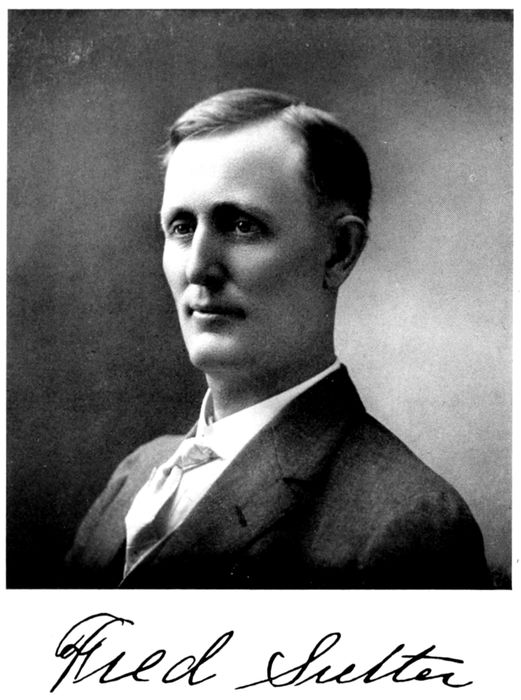
Fred Sutter
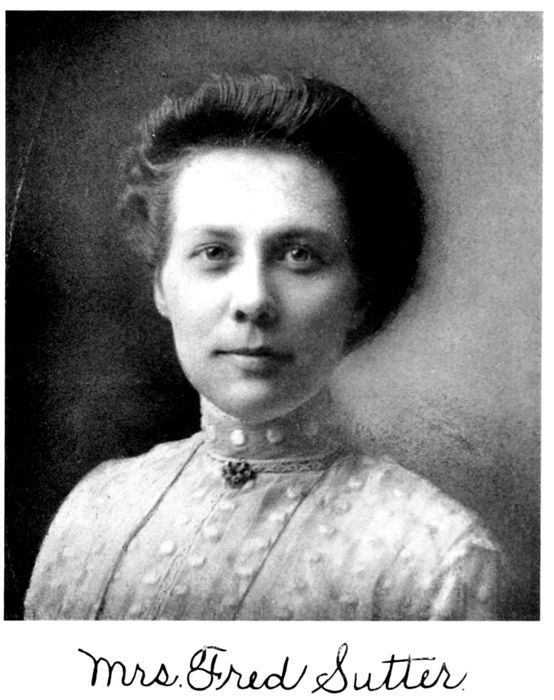
Mrs. Fred Sutter
753
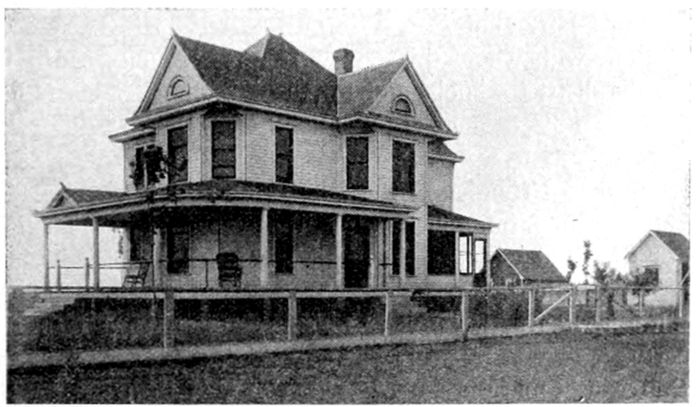
Fred Sutter’s Residence.
Fred Sutter was born July 20, 1869, on a pioneer farm in Walnut township, and is a son of Fred Sutter, who was born in Bath, Germany, in 1827, and immigrated to America about 1844, and died in Atchison county in September of 1887. Fred Sutter, Sr., landed at New York City and made his way from there to St. Louis, Mo., where he married Fredericka Miller, who was born at Bath, Germany, September 23, 1837. She died in Atchison county September 10, 1914. The elder Sutter had learned the trade of carpenter in his youth and he plied his trade in St. Louis until 1857, when he came up the Missouri river by steamer to old Sumner, then in the heyday of its brief glory and prosperity. He found plenty to occupy his talents at Sumner and helped to build a great many of the first houses there. It might be well to add here, however, that the first home of the family in Kansas was at old Port William, where one or two of the children were born. From Port William the family removed to Sumner, and in the course of time Fred Sutter, Sr., made his home on a farm in the northwestern part of Walnut township, near the Mt. Pleasant and Walnut line. The family lived there until the spring of 1880, during which time he worked at his trade. In 1880 he moved to Benton township, and for the first seven years of his residence there he rented the A. G. Otis farm, about two miles west of Effingham and then purchased the farm. The next investment was made by his sons in the Osborn tract of 480 acres of school land. Two years after buying this an additional quarter section was added, making 640 acres in all, which was owned by this enterprising family. During all these years in which he was accumulating 754valuable farm lands, the elder Sutter had the assistance of his sons, and the greater part of the estate is still tilled and owned by the children of this pioneer. Fred Sutter, Sr., came to this country a poor man and worked in a planing mill and furniture factory at St. Louis until he heard of the opening of the Kansas territory, when he determined to be one of the first to settle in the new State. He was farseeing, and by the practice of rigid economy and the better plan of holding his family together, was able to leave a considerable estate at his demise. He was an honored and respected member of the community and was well known throughout the county. The children born to Frederick and Fredericka Sutter were as follows: Kate, deceased wife of H. W. Barkow, of the Kessler-Barkow Saddlery Company, of Atchison; Mrs. Augusta McAdam, of Effingham; Fannie, housekeeper for her brother, William, who resides on the old home place; Mrs. Anna Shannon, of Effingham; Carl F., of Kipp, Kan.; William and Fred, and Frank, on a farm one-half mile west of Effingham.
Fred Sutter, with whom this review is directly concerned, received his education in the district schools, and for three years after his father’s death lived on the home place, or until 1890. He settled on part of the family estate, consisting of 640 acres held jointly by the Sutter sons, improving the property until his removal to Effingham, where he resided for three years, and then purchased his present farm, which is just at the edge of Effingham. He has 160 acres of fine land within sight of the town upon which he has erected (in 1909) one of the handsomest, modern ten-room farm houses in the county. He also built a new barn, 40×40 feet, which is in keeping with the rest of his farm property.
Mr. Sutter was married May 20, 1908, to Sarah, daughter of Robert McPhilimy, and to this union have been born the following children: Mabel, aged five years, and Geneva, aged three years. He has been connected with the Farmers and Merchants State Bank since 1905 and was elected president of this thriving financial institution in 1906. Mr. Sutter is a Republican and is one of the wheel horses of the party in Atchison county. He was appointed a member of the Atchison County High School board in September of 1913, reëlected to the office in the fall of 1914 and is now serving as treasurer of this board. He is a member and trustee of the Presbyterian church of Effingham and is a liberal contributor to the support of this religious denomination. He is affiliated fraternally with the Ancient Free and Accepted Masons, the Benevolent and Protected Order of Elks of Atchison, and the Central Protective Association, being one of the original members of Effingham Lodge, 755No. 158, Central Protective Association, and has been its treasurer for the past four years.
While Mr. Sutter is connected with the Presbyterian church of Effingham, his ideal of a church for a small town is the community church which can be used by the entire population of the town for public and social purposes. To this end he was the prime mover in the erection of the handsome Presbyterian church building in Effingham, at a cost of $14,000, which was dedicated in June, 1913. This church building is used for many public purposes and has been a decided benefit to Effingham in many ways. Mr. Sutter started the movement for the building of this church and headed the subscription list, never desisting in his work until the church was erected and dedicated. Another monument to his enterprise is the farmers’ institute, with which he was connected for five years and assisted materially in organizing. His energy and influence kept the institute going in fine shape for the five years with which he was connected with the movement. Mr. Sutter has a likable personality and is one of the forceful and influential men of Atchison county.
EDMOND W. ALLEN.
Edmond W. Allen, merchant, of Muscotah, Kan., is a leading and successful retailer of his city, and one of the hustling citizens of Muscotah. The grocery and meat market of which Mr. Allen is proprietor was first established by Jacob P. Sprang, with whom Mr. Allen became a partner in 1902. He became the sole owner of the business in 1910. Allen’s store is nicely located in one of the large business rooms, 80×25 feet in extent, on the main street of Muscotah, supplemented with an ice house and a ware house for feed and flour. In addition to conducting the grocery and meat market, Mr. Allen is a retailer of ice and conducts a produce exchange, which enabled him to ship eggs and poultry in considerable quantity to distant markets.
Edmond W. Allen was born January 29, 1868, on a farm adjoining the present county farm on the northwest corner, consisting of eighty acres, in Mt. Pleasant township, Atchison county. He was the son of M. L. Dunlap and Amanda (Walker) Allen, natives of Kentucky. Amanda (Walker) Allen was the daughter of Philip Walker, who immigrated to Kansas from Kentucky, settled on the prairies of Atchison county, but later moved to Missouri. 756M. L. Dunlap Allen moved from Kentucky to Missouri, and came from that State to Atchison county, Kansas, in 1863. He purchased the farm of 130 acres on which he erected a small house, built out of native sawed lumber. In this house of two rooms several of his children were born, and as the family increased in size, he added four rooms to the residence. He was born in 1830, and died in March, 1886. He was the father of eight children, as follows: Mrs. Francis J. Bucknum, of Oklahoma City; Emily, deceased; William H., living at Saugatuck, Mich.; Robert M., former traveling salesman, who died at Holdredge, Neb., in 1913; Edmond W., the subject of this review; Mrs. Etta M. Hubbard, living in Michigan; Mrs. Addie Myrtle Latta, of Oklahoma City, and Dudley M., deceased. The mother of these children died in 1881. The senior Allen was again married in 1883 to Ruth Robinson, who now resides in Wyandotte county, near the town of Piper. One child, Ethel, was born of this marriage.
Edmond W. Allen was reared on the pioneer farm of his father’s, near Atchison, Kan., and received his primary education in the district schools of his neighborhood, and completed his schooling at Beloit, Kan. When his father died, in 1886, William H. Allen, the oldest son, was appointed administrator of the estate, and guardian of the minor children. He removed all of them to his home at Beloit, where he was engaged in the implement business. This was done in order that William might properly care for the younger children and look after their education. Edmond W., after finishing his schooling, was employed for two years in his brother’s store at Beloit, following which he worked for one year in a grocery store and meat market in Kansas City, Kan., owned by Robert Robinson. His brother, William H., in the meantime, sold out his stock in Beloit and removed to Hoxie, Kan., and was employed in a bank for a year and one-half. Financial disaster overtook the bank, and he then spent one year in Kansas City, Kan., after which, in 1891, he went to western Nebraska and entered the employ of Harris Bros., a firm of grain dealers with headquarters in Lincoln, Neb. Mr. Allen was located in the town of Stamford, Lebanon, and Republican City, Neb., in the employ of Harris Bros. and was then transferred to the main office of the firm of Lincoln, Neb., where he remained until 1893. From 1893 to 1895, he was in the employ of Hathaway & Williams, fire insurance agents, of Lincoln, and when this firm sold out he traveled for a period of six months in the interests of an Omaha fire insurance company. After his marriage, in 1895, he resided in Michigan for one year, and in 1896 he again entered the employ of the Harris Bros. Grain Company, which firm was later incorporated 757as the Central Granaries, a very rich corporation. He remained with this concern until 1898, when he entered the employ of the McCormick Harvester Company as bookkeeper, with headquarters at Lincoln, Neb. He was in the employ of the McCormick people until 1903. In the meantime he had formed a partnership with his father-in-law, Jacob P. Sprang, in the grocery and meat market business in Muscotah, where Mr. Allen has resided permanently since 1903.
Edmond W. Allen was married in 1895 to Miss Lucie Sprang, and their children are as follows: Una L., born in 1896, and is a senior in the fine arts and music department of Kansas University. Miss Una is a teacher of piano and violin, and has a large class of pupils. Mrs. Allen was born on a farm in Benton township, Atchison county, five miles south of Effingham, and is a daughter of Jacob P. Sprang, who built up a fine farm in Atchison county, and established the business which is now owned by Mr. Allen. While Mr. Allen is a Republican, he votes independently on local and county matters. He was formerly a member of the Methodist Episcopal church, but since coming to Muscotah has united with the Congregational church of this place. He is a member of the Knights and Ladies of Security.
LUTHER CORTELYOU.
For a citizen of a small Kansas city to achieve State-wide prominence, and to become the official head of the body of mercantile men with whom he became affiliated during a long and successful career, is somewhat out of the ordinary, and is decided evidence that the recipient of such honors has received them solely because of pronounced ability of a high order. For several years, Luther Cortelyou, farmer, grain merchant, and banker, of Muscotah, Kan., was the recognized leader among the grain men of Kansas, attaining to his position by virtue of executive ability and powers of leadership. He is one of the first and best known citizens of Muscotah and Atchison county, who for more than twenty-seven years has been active in civic affairs in the county.
Luther Cortelyou was born December 23, 1851, in Somerset county, New Jersey, and is a son of James G. and Cornelia (Polhemus) Cortelyou. James Garretson Cortelyou, the father, was the son of Abraham Cortelyou, who was descended from French Hugenot colonists, who first settled on Long Island in 1624. The original ancestor of the family fled from France to a 758safe refuge in Holland during the persecution of the Huguenots in France. Jaques Cortelyou was the founder of the family in America and was prominent in the affairs of the colony on Long Island. His son, Peter, was a governor of the borough in which is now located Brooklyn. The descendants of Jaques Cortelyou figured in Revolutionary history.
James G. was reared in New Jersey, and there married Cornelia, a daughter of C. Polhemus, also of an old Holland family. He was the father of three children: John Gardner, deceased; Luther, of this review; and Peter J., now deceased, formerly a resident of Corning, Nemaha county, Kansas. The father died in Middlesex county, New Jersey.
Luther Cortelyou was reared to young manhood on his father’s farm, and received his primary education in the public schools of Somerset county, New Jersey. He received his academic education in Rutgers College, a Dutch Reformed college, at New Brunswick, N. J., and then attended Eastman’s Business College, at Poughkeepsie, N. Y. After his marriage he removed to Maryland, where he lived on a farm which he purchased and cultivated for twelve years. In 1889 Mr. Cortelyou sold his Maryland property and came to Kansas and located in Muscotah, Atchison county. He invested his capital in the M. J. Walsh grain elevator, and for eighteen years was engaged in the buying and shipping of grain. He extended his operations, and owned an elevator at Corning, Kan., which he sold in 1909. Mr. Cortelyou amassed a considerable competence during the many years in which he was engaged in the grain business, and became prominent in mercantile circles in the State of Kansas. For seven years he served as president of the Kansas Grain Dealers’ Association, and gained a wide acquaintance among grain dealers throughout the State and Nation. He served for one year as second vice-president of the National Grain Dealers’ Association, and also filled the post of first vice-president of the national body for one year. He disposed of his elevator in Muscotah in 1907, and has since retired from active business pursuits other than his farming and banking interests. Mr. Cortelyou is the owner of a fine farm of 250 acres in Grasshopper township, and was one of the organizers of the Farmers State Bank of Muscotah, of which thriving institution he is the president.
Mr. Cortelyou was first married in New Jersey in 1876 to Miss Gertrude Stelle, of Middlesex county, New Jersey, and this union was blessed with four children, namely: Luther, Jr., assistant cashier of the First National Bank at Parsons, Kan., married Miss Lola Allison, a daughter of Webb Allison, of Nortonville, Kan.; Stelle, formerly an engineer in the United States Government service, died in Panama of yellow fever, in 1905, at the age of 759twenty-two, having been the last victim to die from yellow fever on the Isthmus; Peter J., postmaster of Muscotah; Frank Morgan, born in 1886, a talented engineer, who was graduated from Kansas University engineering department, and is connected with the engineering firm of Waddell & Harrington, of Kansas City, Mo., and is now located in Vancouver, Wash., in charge of the construction of an immense bridge across the Columbia river, costing $1,750,000; this bridge connects Vancouver, Wash., and Portland, Ore., and is a link in the Pacific highway. It has twenty-nine steel-spans, and is over 17,200 feet in length. The largest dredges and pile-driving machinery in the world are required in its construction. The permanent roadway of this great structure is thirty-five feet wide with sidewalks five feet in width. Frank M. married Miss Marney Burney, of Green Forest, Ark. The mother of these children was born March 19, 1856, in New Jersey, a daughter of Peter and Sarah J. Stelle, and she departed this life February 5, 1905. Mr. Cortelyou was again married to Mrs. Alice T. Calvert, widow of J. H. Calvert, deceased merchant and banker of Muscotah, February 19, 1907.
The Democratic party has always had the allegiance of Mr. Cortelyou, and he has been prominently identified with the affairs of his party in Atchison county, and was the candidate of his party for county treasurer in 1896. He is a warm admirer of President Wilson and a supporter of the President’s policies. He was elected mayor of Muscotah in April, 1900, and served one term, and also has served as a member of the school board of Muscotah. Mr. Cortelyou is a member of the Congregational church of Muscotah, to which denomination he has been a liberal contributor: he assisted in the building of the church edifice, and has served as trustee of the church for several years. For the past thirty years or more he has been a member of the Ancient Free and Accepted Masons, and he also is affiliated with the Modern Woodmen.
WILLIAM S. HUBBARD.
Living in comfortable retirement in Muscotah is one of the pioneer settlers of Atchison county, who fought the good fight with grasshoppers and hot winds in the old days of hardships on the prairies over forty years ago. William S. Hubbard is one of the fine old gentlemen of Muscotah who came to Kansas a poor man, has reared a fine family of prosperous sons and daughters, and achieved a competence sufficient to support him in comfort during his declining years.
760W. S. Hubbard was born March 10, 1839, on a farm near Cloverdale, Putnam county, Indiana, a son of Asa and Melinda (Holland) Hubbard, natives of Kentucky, who founded a pioneer home in the forests of Putnam county, Indiana. Asa Hubbard, the father, died when William S. was a child, and his mother married W. Davis. In 1844 the family moved to Illinois, where the mother and stepfather died in later years. The Davis farm was located in Henry county, Illinois. Here W. S. was reared to young manhood, and knew very few luxuries in those early days of privation and struggle. After a two years’ residence on a farm near Burlington, Iowa, he decided to come farther west to find a home and fortune where lands were cheap and opportunities seemed to be much better than in Illinois. In 1874 he set out with his wife and five children to find a home in Atchison county, Kansas. All of his worldly possessions consisted of a team of horses, a cow, and twelve dollars in cash. His first year on a rented farm in Grasshopper township was a disastrous one, and the “hoppers” got his crops, even to a fine crop of cabbage, which he harvested and tried to cover up by piling hay upon the cabbages to keep the greedy “hoppers” from eating them. Sad to relate, the grasshoppers burrowed down through the hay and ate the cabbage. The following year was much better, Mr. Hubbard raising a fine crop of corn. During his first year he raised a good flax crop which he sold for one dollar and forty cents per bushel. He was eventually able to invest in 220 acres of rich bottom land, bordering the Delaware river, at a cost of fifteen dollars an acre. Mr. Hubbard had saved $800 to make the initial payment on this tract, and in nine years succeeded in lifting the debt. During the period in which he was paying off the indebtedness on his land he was also paying interest on the money at the rate of ten per cent, annually. He sold his first farm some years after this and invested in the fine tract of seventy-two acres which he now owns. On June 12, 1913, he and Mrs. Hubbard decided that they had worked long enough, and left the farm for a home in Muscotah.
Mr. Hubbard was married January 29, 1861, to Miss Mary Ann Pence, a native of Lycoming county, Pennsylvania. Six children have been born to this worthy couple, namely: William Elsworth, a farmer, of Kapioma township, Atchison county, and the owner of 160 acres of well improved farm land; he married Mattie Roth, and they have six children: Lewis Henry Hubbard, a farmer of this county, owner of 160 acres of land: he married Ann Hinxton, and they have two children: Lillie Jane, wife of Malcolm Connor, residing on a homestead in South Dakota, and they have three children: Cora May, wife of Simeon Routh, Atchison county; they have six children. The 761other children are deceased. All of Mr. and Mrs. Hubbard’s children are prosperous and highly respected citizens of their respective communities, and are a credit and comfort to their aged parents, who are proud of the family. Mrs. Hubbard was born December 27, 1839.
Few people in Atchison county can point to a better record than Mr. and Mrs. Hubbard, or can look back with greater satisfaction over long years well spent in achieving a livelihood and rearing a fine family to maturity. They came to Atchison county at a time when Indians still roamed the prairies, and very little of the prairie land was improved.
Mr. Hubbard is an old-line Democrat, and, while he has taken an active interest in political affairs in his township and county, he has never been an aspirant for office, preferring to play the game for the pure love and fun of it rather than to become an aspirant for political honors. He and Mrs. Hubbard are members of the Second-Day Adventist church of Muscotah.
O. O. BARKER, M. D.
O. O. Barker, M. D., is one of the younger members of the medical profession in Atchison county, located at Muscotah, Kan. During the nine years which he has been located in Muscotah, he has built up an excellent practice in his profession, and has demonstrated that he has an accurate knowledge of the art and science of medicine. Dr. Barker was born March 30, 1885, in the town of True, Sumner county, West Virginia. He is a son of J. Lee and Anna (Milburn) Barker, the former having been born in 1860, and the latter in 1862, in Virginia. Both parents still reside at True, W. Va. J. Lee Barker was a son of M. Calloway Barker, also a native of Virginia, and a descendant of an old Virginia family. The history of the Barker family dates back to the birth of Chaplain Barker, of Liverpool, England, who was born in 1750, and immigrated to Virginia in 1785. David Barker, a son of Chaplain Barker, distiller, in Richmond, Va. William Barker, the son of David, was a tanner by trade, and had three sons: William A., Joseph, and Isaac. Of these sons, Joseph was killed by Indians; Isaac lives at Liberty, Va., and reared the following children: James M. Calloway, Mary E., A. L., Thomas J., Francis, and Joseph G. Thomas J. Barker immigrated to Kansas and became a wealthy citizen of Kansas City, where he died. M. Calloway Barker lived at True, W. Va., and reared a family of twelve children: William A., who died in the 762Confederate service during the Civil war; Mary E., deceased; R. J., residing in Kansas City, Kan.; J. W., deceased; Thomas B., living near Hinton, W. Va.; James L., deceased; Dr. Joseph L.; J. Lee, father of Dr. Barker; David M., of Parsons, Kan.: Francis I.; Ollie, living at True, W. Va., and Maria, deceased. J. Lee Barker has always been a farmer, and has made a success of his life’s vocation. He is one of the prominent and well known citizens of his section of West Virginia, and for several years has served as president of the school board of True, W. Va. He has reared three children: Orus O., with whom this review is directly concerned; Mrs. Grace M. Skaggs, Topeka, Kan., and Mrs. Nellie B. Deeds, of Hinton, W. Va.
Dr. Barker received his primary education in the public schools of his native town in West Virginia, and then decided to take up the study of medicine. He studied for two years in the medical department in the University of Maryland, and completed his medical education in the University of Louisville, Ky., from which institution he received his degree of Doctor of Medicine in 1906. After his graduation he came to Kansas, visited for a few months with an uncle in Kansas City, Kan., and after passing an examination given by the state board of medical examiners of Topeka, he opened an office at Muscotah, Kan., October 1, 1906. Dr. Barker is a member of the Northeast Kansas Medical Society, the Kansas State Medical Association, and the Country Doctors’ Business and Social Club. He endeavors at all times to keep abreast of the latest advancement in medical science, and has built up an excellent practice in Muscotah and the surrounding country. He was married June 2, 1906, to Miss Ethel M. Morton, a daughter of G. W. Morton, of Columbus, Ohio. Dr. Barker is a fraternal member of the Knights and Ladies of Security, Modern Woodmen of America, and Mystic Workers of the World.
DR. CHARLES M. LUKENS.
Charles M. Lukens, dentist, Muscotah, Kan., is a fine type of professional man who is self-made, and has achieved success in his profession, which is gratifying and worthy of mention in a favorable manner. Dr. Lukens was born June 28, 1872, in Harrison county, Ohio, and is a son of William Ellis and Margaret (McLaughlin) Lukens, both of whom were born and reared in Ohio. William Ellis Lukens was born in 1849, and was a son of Moses Lukens, born in Lycoming county, Pennsylvania, in 1812, 763and was an uncompromising abolitionist. He was an early settler of Harrison county, Ohio, where he conducted a station on the famous “Underground Railway.” He lived to a great age, and it is a fact that longevity is a characteristic of both the Lukens and the McLaughlin families. The Lukens family was of Quaker origin, and the founder of the family in America was one of the original followers of William Penn. Another characteristic of the Lukens family is the fact that a brother of William Ellis Lukens was a dentist, and Dr. Lukens has five cousins who are practicing dentistry.
William Ellis Lukens migrated to Holt county, Missouri, in 1882, where he resided for four years, and in 1886 he settled in Nemaha county. He was one of the early pioneers in Nemaha county, and first engaged in the live stock business at Corning, Kan., where he conducted a grain elevator, and bought and shipped live stock. He has become well-to-do, and is the owner of two large farms in Nemaha and Jackson counties. Mr. and Mrs. Lukens now make their home on a farm in Jackson county, Kansas, south of Netawaka. Their children are: Dr. C. M. Lukens, of Muscotah; Chester W., a farmer, living south of Netawaka, and Kinney E., a farmer, living in the northwest corner of Jackson county, Kansas. The mother of these children was born in 1850.
Charles M. Lukens received his primary education in the public schools of Corning, Kan., and then decided to work his way through college. His ambition was to become a dentist, and for a period of five years he did all kinds of honest labor in order to pay for his tuition and expenses while attaining his collegiate education. He not only earned his way through college, but saved money in the meantime. He followed farming and railroad bridge work during this time, and eventually graduated from the Western Dental College of Kansas City, Mo., on May 6, 1905. He located in Muscotah, June 29, 1905, and has made a signal success in the practice of his profession. Dr. Lukens also maintains an office at Whiting, Kan., and divides his time between the two towns, Whiting and Muscotah.
Dr. Lukens was married April 10, 1901, at Corning, Kan., to Miss Hallie A. Graham, a daughter of Dr. J. W. Graham, of Wetmore, Kan. They have one child, Graham St. Clair Lukens, born June 21, 1902. The Republican party claims the allegiance of Dr. Lukens, and he has always been active in political affairs in Atchison county, being one of the leaders and “wheel-horses” of the party in the county. He is affiliated with the Ancient Free and Accepted Masons of Muscotah, and the Fraternal Order of Eagles of Horton, Kan., and is a member of the Modern Woodmen. Dr. Lukens 764is possessed of a likable and generous personality, which enables him to make friends easily, and to retain them for all time. He is a good provider for his family, and is fast accumulating a comfortable competence. He is a member in good standing of the Northeast Kansas Dental Association.
JAMES M. TRIMBLE.
J. M. Trimble, deceased, was born September 10, 1843, in Buchanan county, Missouri, a son of Benjamin F. Trimble, a native of Kentucky and early pioneer settler of De Kalb, Mo., where he conducted a blacksmith and wagon shop for a number of years, until his removal to Texas. After living in Texas for some years, he finally located in Atchison county, Kansas. James M. Trimble purchased a farm in this county and cultivated it until 1905 and then removed to Atchison and engaged in the livery business, continuing the same until his demise in January of 1910. The first wife of James M. Trimble was Margaret McCreary, a daughter of Solomon McCreary, a pioneer settler of Atchison county. To this first marriage were born the following children: J. P. Trimble; A. F. Trimble; K. S. Trimble; Ed. Henry; Roy C., sheriff of Atchison county, and T. O. Trimble.
Mr. Trimble was married the second time, to Mrs. Emma A. (Hayden) Gallup, widow of Frank Gallup, January 21, 1892. She is a daughter of Levi and Martha Hayden, natives of Kentucky, and pioneer settlers of Coffey county, Kansas. The Hayden family were settlers in Coffey county, Kansas, at a time when the county was largely populated by Indians. At one time, while a resident of this county, Levi Hayden and a number of other settlers were hunting buffalo and were surrounded by hostile red-men, who robbed the hunting party of their provisions and horses and left the hunters on the plains destitute. A terrible snow storm came up, and several of the party perished from cold and starvation, Mr. Hayden being among the number lost. After his death his widow reared the family of seven children with the exception of two sons and a daughter, Emma, who went to reside with an uncle, John Hayden, in Iowa. This uncle was a very prominent resident of Taylor county, Iowa, and served as county clerk and county surveyor. He ran a survey line from his farm in Taylor county, Iowa, to a place later named Hayden Junction, near Council Bluffs. He was a school teacher and a man of more than ordinary ability and reared his adopted children to become good 765citizens. Emma lived at her uncle’s home until January 1, 1874, and while attending high school at Bedford, Iowa, she met Frank Gallup, whom she married. Mr. Gallup died August 11, 1888. To this union were born children as follows: Nellie M., wife of Gale Trimble, of Atchison county; Jennie B. married Edwin E. Buchanan, now deceased, and she lives in Atchison; Clara Maude, wife of Ed. Trimble, residing near Seattle, Wash.; Samuel D., of Atchison; Agnes Gertrude, wife of Blake Balaock, of Memphis, Tenn.
At the time of the marriage of Mr. Trimble and Mrs. Gallup, Mr. Trimble was serving as superintendent of the Atchison county poor farm. They had charge of this institution for over six years and then moved to Mr. Trimble’s farm, which is now owned by John M. Price, in Mt. Pleasant township. They resided on the farm until their removal to Atchison in 1905. After another short period of residence on the farm they finally purchased the property which is the family home at 1206 South Seventh street, Atchison. Mr. Trimble conducted a livery and horse trading business in Atchison until his demise. He dealt extensively in horses and cattle, and frequently conducted farm and real estate deals to advantage.
James M. Trimble was a life-long Republican and took an active and influential part in the affairs of his party. He was well and favorably known throughout Atchison county. He and Mrs. Trimble were affiliated with the Presbyterian church, and Mr. Trimble belonged to the Grand Army of the Republic by virtue of having enlisted for service in a Kansas regiment during the Civil war, at the time of the Price invasion. It can be said of him that he was an honest, upright citizen, who cared well for those who depended upon him and he was, according to those who knew him best, a good man.
JOHN EDWARD SULLIVAN.
For fifty-five years John Edward Sullivan has resided in Atchison county, Kansas, and can be readily classed with the old-timers of the county. His parents came from Iowa to Kansas when he was but one year old, and his father, with the assistance of his sons, Roger P. and John Edward, was enabled to rise from poverty to become the owner of half a section of land in Grasshopper township. The account of this family is similar to that of several other prosperous Irish families in Atchison county.
John E. Sullivan was born May 15, 1859, in Keokuk, Iowa, a son of 766Michael and Bridget (Tobin) Sullivan, both of whom were born in Ireland. Michael Sullivan was born in 1826 in Ireland, and lived in his native land until he was twelve years of age, and then made his way, alone and unaided, to America. His travels for seeking fortune in the new country took him ever onward, and he was married in Keokuk, Iowa, to Bridget Tobin, who was his faithful helpmeet when he was rising from poverty to affluence. Mr. Sullivan came to Atchison, Kan., in 1860, and for some time was engaged in the railroad contract work, and assisted in the grading of the Central Branch railroad. With the money saved in his railroad contract work he became the owner of a home in Atchison, which he exchanged for eighty acres of land in Grasshopper township, upon which he settled and soon developed into a fine farm. Mr. Sullivan, in the course of a few years, was enabled to buy an additional quarter section, and with the help of his sturdy sons, he increased his holdings to 320 acres of well improved farm land. When old age crept upon Michael Sullivan and his wife they turned the farm over to their two sons, who cared for them in their declining years, which were spent in peace and comfort. Mr. Sullivan died at the home of his son, John Edward, December 24, 1904. He was the father of three children: John Edward, the subject of this review; Roger Patrick, a prosperous farmer of Benton township, Atchison county, and Mary, deceased.
John Edward Sullivan attended the public schools of Atchison until he was fourteen years of age, and after his parents removed to the farm in Grasshopper township he remained at home and assisted his father on the home farm until he was thirty years old. He then purchased his present farm of 160 acres, made improvements upon it, and has brought the land up to a high state of cultivation. Mr. Sullivan has his farm stocked with well graded horses and cattle, and has frequently exhibited his fine draft colts and mules at the county fairs, held at Effingham, Kan.
Mr. Sullivan was married in 1890 to Anna Small, and to this union were born eight children, namely: Mary E., deceased: Anna, John, Lauretta, Leo, and Lucy, all at home with their parents; Grace, deceased; one child died in infancy. Mrs. Sullivan was born October 29, 1864, in Ireland, a daughter of Patrick and Elizabeth (McVay) Small, who immigrated to America, settling in Pennsylvania, and came to Atchison, Kan., in 1879; they were engaged in farming for some years, and are now living at Effingham, Kan. Mrs. Sullivan died November 23, 1906. She was a well educated woman, being an accomplished musician and a teacher of music. Mr. Sullivan is a stockholder and director of the Farmers State Bank of Muscotah. He is 767not allied with any political parties, and casts his vote independently at election time for the candidates of his choice, who seem best fitted to perform the duties of the office sought. He is a member of the Catholic church, and is fraternally allied with the Knights of Columbus of Atchison.
RIENZI M. DUNLAP.
Rienzi M. Dunlap, editor and publisher of the Muscotah Record, Muscotah, Kan., was born in Illinois, February 25, 1850. He is the son of John M. and Nancy (Fletcher) Dunlap, the former a native of Maine, and the latter a native of Illinois. John M. Dunlap was a descendant from Scotch-Irish ancestry, who immigrated from North of Ireland to America. His wife was of English descent, and a daughter of Kentucky parents, who emigrated from Kentucky to Illinois in the early days. John M. received his education in his native State, and was engaged in teaching school, a profession which he followed for twenty-five years. He taught school in Illinois, southern Wisconsin, and also in the State of Iowa. He finally located on a farm in northern Iowa, near Nashua, which he developed into a fine productive plant. He became well known as a skilled horticulturist, and originated several different kinds of fruits. He died at his home near Nashua, Iowa, in 1909. His widow still lives on the home place.
Rienzi M. Dunlap was educated in the schools of northeastern Iowa, and entered college with the intention of completing a college course, but his eyesight failing him, he was unable to complete his classical studies. Later, he prepared himself for the teaching profession by self-study, and received a teacher’s certificate. He taught school for fifteen years at various places in Iowa, Minnesota and South Dakota. The last five years of his teaching was of a professional character, with the backing of a professional certificate. During all this time he had been preparing himself by hard study to enter the ministry, and on September 1, 1893, went to Wisconsin and began preaching in an Advent Christian church. He preached for four years in Wisconsin in the interest of the Advent Christian denomination, and later engaged in the market gardening business for the benefit of his health at Baraboo, Wis., where he resided until 1909, in the meantime preaching in the churches of the nearby towns. From 1909 until 1910 he had charge of a church at Linn, Kan. Mr. Dunlap, while engaged in teaching, managed to obtain considerable 768journalistic experience by working in various newspaper offices, among them being that of his uncle. Consequently, it is not surprising that in 1910 he came to Muscotah, Kan., and purchased the Muscotah Record. He is operating an excellent newspaper, which is noted for its clean, moral and fearless stand on all public questions.
Mr. Dunlap was married at Mendota, Ill., August 23, 1893, to Miss Retta Morris, of Ohio, who was also a public school teacher, who taught school fifteen terms previous to her marriage, several years of which were in Iowa. Mr. and Mrs. Dunlap are the parents of three children: Morris O., a student of journalism in the Advent Christian College, Aurora, Ill., which course is to be followed by two years in the university; Ella M., a pupil in the eighth grade in the Muscotah school; Mary, a pupil in the sixth grade in the public school. Mr. Dunlap is an independent in politics, who has not allied himself in any form of politics, and believes that the best government results from the independent voting of its citizens. His newspaper is also noted for its independence.
LEWIS P. Du BOIS.
Lewis P. Du Bois has the distinction of being the oldest living pioneer settler of Atchison county residing in Shannon township. The story of his life since coming to the great West in search of health reads like a romance and is well worth recounting in the pages of this history of the county which he has helped to create during the past fifty-seven years or more. The last days of his eventful life are being peacefully spent in the beautiful country home which he erected several years ago, which sets far back in a park created by his own hands and shaded by great trees planted in years gone by on the barren prairie which he broke and brought to a high state of cultivation. Mr. Du Bois can look out over the broad acres which he and his good and faithful wife have accumulated, and be well content that providence has been kind to them and theirs.
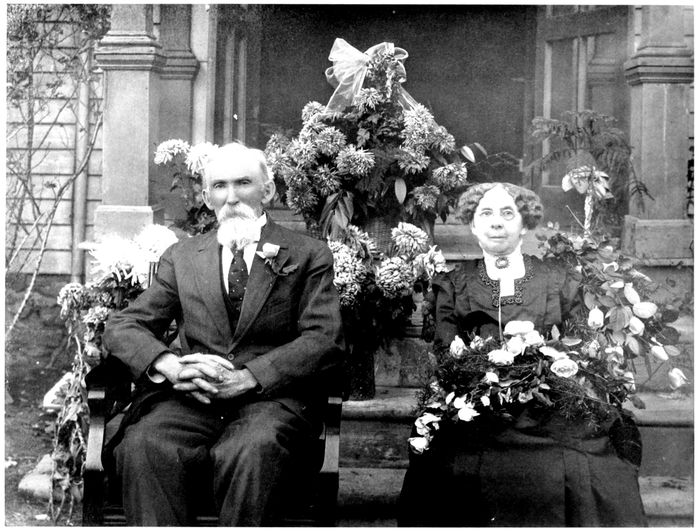
Mr. and Mrs. Lewis Du Bois—Golden Wedding Anniversary.
769Lewis P. Du Bois is a descendant of an old American family. He was born March 23, 1834, in Salem county, New Jersey, a son of Samuel and Mary (Johnson) Du Bois, both of whom were natives of New Jersey. Louis Du Bois, a Frenchman, who came to America in about 1660, and established the French settlement of New Palz, was the original founder of the family in this country. His children were as follows: Jacob, Abraham, Sarah, Isaac, David, Solomon, Rebecca, Rachel and Matthew. Samuel Du Bois was the son of Matthew, a great-grandson of the first Louis Du Bois. Lewis Du Bois, direct ancestor of Lewis, and son of Mathias, was a soldier in the Revolution and served for seven years under General Washington, and was engaged in all of the battles in which Washington’s army participated. Matthias’ children were: Sarah, Lewis, Anna, Rachel, Cornelius, Matthew and Benjamin. Lewis Du Bois, the Revolutionary patriot, married Rebekah Craig and was the father of the following children: John, Matthew, Polly, Lewis, Rebekah, Benjamin, Elizabeth, and Samuel, father of the subject of this review. Samuel Du Bois was born September 26, 1800, and died in May, 1873. He married Mary Johnson, who was born January 17, 1824, and died January 28, 1879.
To Samuel and Mary Du Bois were born children as follows: Rebecca, who became the wife of Clarence Struper, and is now-deceased; Adaline, wife of Jacob Kaeley, deceased; Mary Jane, wife of John Du Bois, of Fairfield, Iowa; Lewis, with whom this review is directly concerned; Emeline, wife of Daniel Hitchner, Nemaha county, Kansas; Eliza, wife of A. Hitchner, deceased; Samuel Johnson, Salem county, New Jersey. Mr. Du Bois has an old Bible over 150 years old and also has in his possession genealogical works concerning the Du Bois, Patterson and the Ewing families which can be consulted for further genealogical data if need be. Samuel Du Bois was a farmer and his father, Lewis, was a paymaster in the American army of defense during the War of 1812. Both lived and died on the old ancestral farm which has been in the family for many generations. Lewis donated one farm of 160 acres to the Daretown Presbyterian church and practically endowed it. Samuel was a very prominent citizen in his neighborhood and held several important offices and was one of the twelve free holders of Salem county, New Jersey.
Lewis P. Du Bois was educated in the common schools of his native county and when twenty years of age was employed as clerk in a store at Bridgeton, Cumberland county, New Jersey, for three years, after which he spent one year assisting his father farm the old homestead. His health failing, he was told by the family doctor that he must go west or he could live but a short time. Leaving the old home, his sweetheart and all associations behind him, he set out and arrived in Atchison in April, 1858, with only $50 in cash in his pockets. For the first year he made his home with Dr. Challiss, on the doctor’s farm. Dr. Challiss advised him to spend one year near the river and then go to the mountains for an indefinite stay until he was cured. 770At the end of his first year’s residence in the West he set out for the mountain country as assistant to Eli Mason, the first sheriff of Atchison county, in the conduct of a wagon train en route to Ft. Kearney. His first trip to the West and the outdoor life proved beneficial and upon his return he clerked in the store of P. R. King until November of 1859, and again crossed the plains with Henry Macey, of Weston, Mo. This was a very hard and long trip, taken in the winter time, but he gained rapidly in strength and general health and accumulated weight until he tipped the scales at 158 pounds. Upon his arrival in Denver, Colo., the mining excitement was at its height and he was seized with the gold fever. He took up a mining claim in the mountains, but left it and went further into the mountainous country. He spent all of his money on developing another claim, building a sluice and dam and turning the course of a stream in order to get a sufficient flow of water for placer mining. All of his efforts came to naught and his mining fixtures were washed away by a disastrous flood and he was left in debt over $1,000. He and his associates then went to Georgia gulch and bought another claim which yielded sufficiently to enable him to pay off his debts and then the gold gave out entirely. News came to the camp during his first winter in the mountains that a number of men were snow bound over the divide and were starving for food. The snow was from seven to ten feet deep on the level and twenty feet deep on the ranges. Mr. Du Bois and another man were the only men brave enough to volunteer to carry succor to the destitute prospectors and had the distinction of being the first men to cross the Rockies in the dead of winter. From Colorado he went to Wyoming and then returned to Atchison in 1861, meeting the fast pony express on his way and learning of Abraham Lincoln’s election to the Presidency.
From Atchison he returned to the old home in New Jersey and there married the sweetheart who had been waiting for him to come back, restored to vigorous health and strength. He followed farming in New Jersey for three years, suffering in the meantime from rheumatism and sickness, brought on from too much exposure to the elements. In 1865 he and his wife again returned to Atchison with a cash capital of $500 and he took charge of a farm owned by his friend, Dr. Challiss, on the share plan for a period of three years. His farming experience for those three years was not at all profitable, and he was left at the end of the time with practically no funds. Jayhawkers took practically all that he made, and one time, after he had fattened a lot of hogs on corn which cost him $1.10 per bushel, thieves stole the porkers and he was left without a dollar. He then ventured to sell fruit trees to the settlers in Colorado on the route to Denver and was very successful in taking many 771orders. The delivery of this consignment consisting of two wagon loads cost over $1,850 by overland freight train in the fall of the year. The Indians were troublesome at the time and during one eventful night which demonstrated that the biggest braggarts with the train were the greatest cowards, the Indians tried to run off their mules but were finally driven off. This venture resulted in replenishing his store of funds and he bought his first farm with the proceeds, paying cash for it. Like many others during those early days, Mr. Du Bois herded cattle on the great free ranges but was unfortunate in having fifty head die of Texas fever contracted from an infected herd of Texas cattle which were being pastured over the range on the way to market. Many, indeed, were the discouragements which beset his attempts to secure a livelihood, at one time having purchased a horse from a Mr. Galbreath, it developed that the beast was afflicted with glanders in a contagious form. This necessitated the killing of all of his horses and the consequent restocking of his farm. Prosperity eventually smiled upon him and his, however, and better times came and he became the owner of 320 acres of exceedingly fine land in Shannon township. He is a director of the Bank of Vliets, Kan.
Mr. Du Bois was married November 3, 1863, to Sarah Jane Jones and to this union have been born children as follows: Mrs. Carrie C. Buck, born in 1865, and residing at Vliets, Kan.; Lewis P. died in infancy; Samuel T., born July 7, 1876, operates the home farm, married Anna Katharine Kistler, daughter of William D. Kistler, and has two children, Lewis P., Jr., and Kathryn Ellen. The mother of these children was born April 5, 1835, in Salem county, New Jersey, daughter of Joseph and Mary Ann (Van Meter) Jones. The Jones family of which she is a descendant is a very old one in America, and a history of the family is being now published. The Van Meter family had its origin in this country as far back as 1660 and they were members of the new Palz settlement in New Jersey. Her grandfather, Samuel Van Meter, married Lady Anna Bishop, a titled English lady who was a member of a noble English family. Several of her ancestors served in the war of independence.
On November 3, 1913, there was celebrated at the hospitable and beautiful Du Bois home, the fiftieth or golden wedding anniversary of this widely known and well loved pioneer couple. Guests to the number of 500 came to congratulate them from far and near, among them being the notable men and women of Atchison county, who are proud of the friendship of Mr. and Mrs. Du Bois. The tables groaned with good things to eat and the day was spent happily in merrymaking, the wedding ceremony of Lewis and Sarah being again duplicated for the edification of the interested guests. No invitations 772were issued for the occasion, but a general country-wide notice printed in the Atchison newspapers caused a perfect hegira to the Du Bois home of old and new friends of this worthy couple, who wished to be in line to grasp their hands and wish them many more happy years of wedded life which have been unmarred by a single serious discord. The fifty-three years of wedded life have been replete with happiness and blessings for Mr. and Mrs. Du Bois, in the main, while tinged with sorrows which are the inevitable lot of all mankind.
Mr. Du Bois and the members of his family are affiliated with the Presbyterian church. He is a member of the Masonic lodge, the Independent Order of Odd Fellows and the Central Protective Association, having been one of the founders of the Good Intent lodge of the Central Protective Association. He has been a life-long Democrat, and, while never having sought political preferment and not having filled any office but that of trustee of Shannon township, he has always taken in other years a very active part in county, State and National politics. He was a great personal friend of Governor Glick.
EDWIN S. WOODWORTH.
The name Woodworth is a noted one, not only in Kansas, but in American history. A long line of distinguished men have descended from the original founders of the family in America, and the men of each successive generation have added additional luster to the family name by deeds of valor and statesmanship which stand out prominently in the annals of their respective abiding places. Edwin S. Woodworth, farmer and live stock breeder, of Kapioma township, is a well and favorably known member of the civic body of Atchison county, and a son of Maj. Caleb A. Woodworth, who was one of the famous figures in the early period of the making Kansas into a great State. His grandfather, Caleb A. Woodworth, Sr., was one of the earliest of the Kansas pioneers.
Major Caleb A. Woodworth was born in Wilkesbarre, Pa., April 14, 1838, and was a son of Caleb Woodworth, a native of Tyre, N. Y., whose father, also named Caleb, was a captain of artillery under General Scott in the War of 1812. Gresham Woodworth, the great-grandfather of Major Woodworth, was a colonel in the Continental army during the American Revolution, and fought at the battle of Saratoga. The Woodworth family is of English origin, the progenitors of the family having emigrated from the Isle 773of Man early in the seventeenth century. The father of Major Woodworth was a farmer by occupation, and married Miss Ellen Gordon, of Goshen, N. Y., a cousin of Gen. Gordon, of Goshen, and a daughter of Cornelius Gordon, who was born in Ireland, of Scotch-Irish parents, and settled in Virginia. The elder Woodworth died at the age of seventy-four years, and the wife and mother died in December, 1898, at the age of eighty-six years. Caleb, Sr., immigrated to Kansas in 1857, and settled at Muscotah, Atchison county. Both Caleb Woodworth and his wife were members of the Congregational church, and Caleb was an Odd Fellow. He was well educated, and in his younger days was a school teacher, becoming a farmer in later life. The line of Woodworths in America tells of many men of letters and distinction, and many soldiers who have shed luster on the family name in the successive generations.
There were five children born to Caleb, Sr., and wife, namely: Caleb A., father of Edwin S.; Gilbert M., who came to Kansas at an early day, and served three years in a Kansas regiment during the Civil war, first as corporal, then as sergeant, and later was captain of a company of the Fourth Arkansas infantry, and was made lieutenant-colonel of the Twelfth Kansas militia in 1864. He became prominent in political life, and served as State senator in Colorado, and died while marching in the G. A. R. reunion parade in Philadelphia, September 8, 1899; eighty veterans succumbed to the heat. He left one son, Charles G., of Onanga, Okla.; Ben F., a resident of Downs, Okla., served three years in the Union army, part of the time as bugler of Company A, Fifth regiment, Kansas infantry, and later as captain in the Fourth Kansas regiment; David G., a graduate of Monroe Institute, a teacher, and a Kansas militiaman. David Woodworth assisted in the survey of Oklahoma, moved to the new State in 1889, and settled at Downs. He was a successful farmer, but is now postmaster at Kingfisher, Okla. The mother accompanied him to Oklahoma, and died there; Sarah Elizabeth, deceased, was the wife of B. A. Colville, and left one son, Dr. Frank Colville, who died in St. Joseph, Mo.
Major Caleb A. Woodworth came to Kansas in 1857, from Virginia, and engaged in farming near Muscotah until 1859, when he entered the University of Chicago, and pursued his collegiate education until the outbreak of the Civil war. He then returned to Kansas and offered his services in defense of the Union. His first enlistment was for a period of nine months in Company B, Fourth regiment, Kansas infantry. He then assisted in organizing the Thirteenth Kansas regiment, and was a member of Company F of that 774regiment, which he joined September 20, 1862. He rose rapidly in rank, was commissioned major of his regiment, and served for three years, or until the close of the war. He served directly under Colonel Bowen, and under Generals Blount, Schofield, Steele, and Reynolds. He participated in the battles around Springfield, Mo., and in Arkansas. At the battle of Prairie Grove, in 1862, his horse was shot from under him. Three times his mount was killed in battle, but he seemed to bear a charmed life, and was never wounded. After the close of the war he returned to Atchison, Kan., and engaged in freighting across the plains, making three trips in all with a freighting outfit. He was the first man to telegraph money from Denver, Colo., to Atchison. He operated a livery barn where the union depot now stands in Atchison. About 1868 he again turned his attention to farming, and settled in Kapioma township, where his father had preëmpted half a section of land. Major Woodworth farmed the home tract, and erected the house where Edwin S. now lives. He became an extensive cattle feeder, and was very successful in his farming operations.
Major Woodworth was married in June, 1867, to Miss Margaret Shaw, of Valley Falls, Kan. Three children were born of this union, namely: Nora, wife of E. M. Wilcox, Kamaloops, British Columbia; Edwin S.; Jennie, living in Wood, S. D. The mother of these children was born in Akron, Ohio, January 21, 1850, a daughter of William and Louise (Fletcher) Shaw, natives of Ohio. She is now residing with her daughter at Wood, S. D.
The civic and political career of Major Woodworth was a distinguished one. He was elected State senator from Atchison county on the Republican ticket in 1876, and served for four years. During his term as senator he wrote the bill and presented the same to the State legislature, organizing the Kansas State Historical Society. In 1892 he was chosen to represent the third district in the lower house of the legislature, this time being elected on the Democratic ticket. In 1895 he removed to Effingham, Kan., and resided in that city until 1897, when he removed to Atchison to take up his duties as superintendent of the State Soldiers’ Orphans’ Home. He filled the duties of this position until 1900, when he resigned and retired to a home in Muscotah, Kan. Major Woodworth died October 24, 1908. His demise marked the passing of one of the most noted of the Kansas pioneers, a distinguished soldier and statesman. He left a heritage of honorable and upright service to the people of the State, of which his descendants can well be proud.
Edwin S. Woodworth was born April 20, 1874, on the farm where he now resides. He was educated in the common schools of his native county, and studied in Bolton University, after completing a course in the high school 775at Effingham, Kan. After his marriage, in 1895, he began farming the home place of the Woodworth family. He is the owner of 163 acres of rich farm land, which is well improved. Mr. Woodworth is a well known breeder of registered Shorthorn cattle, and ships the product of his farm in this respect to all parts of the country. He is a member of the American Shorthorn Breeders’ Association. During 1915 he had a herd of fifty thoroughbred Shorthorns, but has sold to buyers at excellent prices until he has depleted his herd.
Mr. Woodworth was married May 29, 1895, to Miss Sadie E. Speer, born June 11, 1875, and reared on a farm three miles east of Muscotah. (See biography of D. Anna Speer for details concerning the Speer family.) Four children have been born to Edwin S. and Sadie E. Woodworth, namely: Mrs. Marguerite Mulligan, of Benton township; Mabel, a student in the county high school at Effingham; Isabelle and Mildred, at home.
Politically, Mr. Woodworth is allied with the Democratic party. He attends the Methodist Episcopal church, and is affiliated with the Knights of Pythias, the Modern Woodmen of America and the Central Protective Association. There is no doubt in the minds of those who know Mr. Woodworth and esteem him for his many excellent qualities, that he will keep alive the traditions of the Woodworth family and endeavor to follow in the footsteps of his illustrious ancestors as regards right living and doing his duty to his county and State.
HAL C. LOW.
Hal C. Low, of the firm of Johnson-Low Clothing Company, of Atchison, was born in 1879 in Doniphan county, Kansas. His parents were J. W. and Mary (Collins) Low, natives of the Buckeye State, the father’s home having been at West Milton, Ohio. The grandfather of Hal C. was Ansel Low, who was one of the earliest pioneer settlers of Kansas, first coming to Atchison in 1852, following which he located in Doniphan, where he kept the first hotel, or tavern, and also operated a general store. To the home of this pioneer came in the fall of 1860, Abraham Lincoln, who was then touring the country in his first campaign for the presidency. Lincoln’s visit and stay at the Low hostelry was an event which awakened a great deal of pride with J. W. Low and he was fond of relating the circumstance and describing in detail how Mrs. Low served the simple wants of the greatest of all Americans. 776He was always a stanch supporter of the martyred President and gave direct evidence of his loyalty to the Union by his enlistment in Company I, Seventh regiment, Kansas cavalry, serving under Generals Rosecrans and Grant successively, and was in active service throughout the entire war.
Hal C. Low was educated in the common and high schools of Atchison, and then entered his father’s dry goods store, where he spent several years profitably, absorbing the details of the business and in becoming a proficient salesman and buyer. This experience stood him in good stead, and in 1905 he organized the Johnson-Low Clothing Company and has made an unqualified success of the venture. The store is one of the most complete in this section of the State, and carries high grade goods of the best workmanship and design. The ever increasing trade, which flows to this establishment, is the best evidence of its continued success.
Mr. Low was married in 1905 to Miss Jane Pollock, daughter of S. M. Pollock, an early pioneer settler of Iowa, later a resident of Kansas, and now residing in Atchison. Mr. Low is a Republican.