Chapter XXV · BIOGRAPHICAL HISTORY
Reading edition
GEORGE WASHINGTON GLICK.
George W. Glick, ninth governor of Kansas, was born at Greencastle, Fairfield county, Ohio, July 4, 1827. His great-grandfather, Philip Glick, a Revolutionary soldier, was one of five brothers who came to Pennsylvania from Germany. His grandfather, George Glick, served in the War of 1812, as did also his mother’s father, Capt. George Sanders. Governor Glick’s father, Isaac Glick, was a man of influence in the community in which he lived, took an active interest in State and local politics, and held many positions of public trust. His mother, Mary Sanders, was of Scotch parentage. Both parents lived to a good old age.
George W. Glick was reared on his father’s farm near Fremont, Ohio, and there acquired the habits of industry, economy and self-reliance that made his later life so successful. At the age of twenty-one he entered the office of Bucklin & Hayes as a law student, and was admitted to the bar two years later at Cincinnati by the supreme court. He began practice at Fremont, and soon won an enviable reputation as a hard-working and successful lawyer. He fully sustained this reputation after coming to Kansas.
Locating at Atchison in the spring of 1859, he formed a partnership with Hon. Alfred G. Otis, which lasted until 1874, when an affection of the throat compelled him to abandon the practice of law. Mr. Glick soon took a leading place at the Kansas bar. His practice extended to all the courts. He was a salaried attorney for two railroads and a number of corporations.
Mr. Glick was a natural leader and began early in life to take an active part in politics. When but thirty-one years of age he was nominated for Congress by the Democracy of his district in Ohio, but declined the nomination. The same year he was nominated for State senator and made the race against Gen. R. P. Bucklin, his former law preceptor. He was elected to the 352Kansas legislature in 1862 without opposition, and reëlected in 1863, ’64, ’65, ’66, ’68, ’76 and ’82.
During his service as a legislator, he secured the passage of many needed and important laws which have settled and fixed the policy of the State on matters of vast interest, that have stood the test of time and experience. In 1876 Mr. Glick was made speaker pro tem. of the house of representatives, although that body was strongly Republican. He was a delegate to Democratic National conventions in 1856, 1868, 1884 and 1892. The Kansas delegation in the Democratic National convention at Chicago in 1892 presented his name to that convention as its candidate for vice-president, after the nomination of Grover Cleveland for President, and, although not the nominee of the convention for that office, he received many votes. He was nominated for governor in 1868 and made the race in obedience to his party’s call, though his defeat was inevitable. In 1882 he was again the unanimous choice of his party for governor and made a memorable campaign, speaking in nearly every county in the State; and, though fighting against great odds, among them being a Republican majority of over 52,000, he defeated that distinguished Republican and Prohibitionist, John P. St. John, by 8,079 votes. Governor Glick was inaugurated January 8, 1883, and his administration was marked by dignity, intelligence, and a careful and discreet management of the material and financial interests of the State. His long experience as a legislator gave him an intimate knowledge of its needs, and many valuable reform measures recommended in his message to the legislature were accomplished. He entered an earnest protest against the burdens imposed upon the agricultural classes by the railroads and asked that legislation be enacted to prevent these exactions. A law creating a railroad commission, and embodying substantially all the improvements asked by him, was passed, and proved of great benefit to the people of the State.
In 1885 he was appointed by President Cleveland pension agent at Topeka and re-appointed when Mr. Cleveland again came into office. During Mr. Glick’s two terms as pension agent at the Topeka agency, he received and disbursed over $85,000.00.
In 1857 he married Elizabeth Ryder, of Massillon, Ohio, a lady descended from a distinguished colonial ancestry. Her ancestors were among the first settlers of Concord, Mass., and she derived her name from forbears who were well known among the early colonists of New York City. For fifty years and more this noble matron, having with her the best traditions of American life, presided over the hospitable home of George W. Glick, with the grace 353and dignity inherited from a fine ancestry. She added to the success of his public life the greater blessings of domestic happiness. Two children were born to this union: Frederick H. Glick and Mrs. James W. Orr, of Atchison, Kan. He died at Atchison, Kan., April 13, 1911, aged eighty-four years; his wife and children survive him.
Each State is entitled to place in Statuary Hall at the capitol in Washington, statues of two of its citizens renowned in literature, art, war or civil life, and several years ago one of such places was filled by the State of Kansas with a statue of John James Ingalls, of Atchison, Kan. The regular session of the 1913 legislature of Kansas adopted a concurrent resolution and made an appropriation for the purchase of a suitable statue as a tribute to the memory of George Washington Glick, to be placed in Statuary Hall, where the Nation has granted to its people the privilege of placing it. The statue was designed and executed by Charles H. Niehaus and accepted by Congress as a gift from Kansas, with suitable ceremonies, and is now in Statuary Hall. A cut representing it precedes this sketch. Sixteen thousand five hundred copies of a volume containing the proceedings in Congress, and a plate of the statue, were, by authority of Congress, printed and distributed.
HORACE MORTIMER JACKSON.
He who leaves behind him, when he passes beyond the goal from which no mortal man has ever returned, a pleasant and abiding memory of his existence on this earth, and has bequeathed to his progeny and posterity a heritage of right living and right thinking, has accomplished much. His memory will be revered long after that of the individual who has done nothing but accumulate wealth and has made no effort to leave this earthly abiding place a better place to live than when he came upon it. Judge Horace Mortimer Jackson, deceased, was a man who lived an upright life, and was accorded the universal respect of his fellow men and was a legal practitioner of high rank, whose honorable methods of practice and manner of living were such as to commend him for most favorable mention in the archives of his adopted county of Atchison.
Judge Horace M. Jackson was born near Albion, Penn., July 11, 1839, a son of Lyman Jackson, who was the son of Michael Jackson, whose father was also named Michael, and was a native of Ireland. Michael Jackson, 354the founder of the family in America, came from Ireland and settled near Hartford, Conn. He went to the coast to trade and was not thereafter heard from and was supposed to have been killed by Indians. He had three sons, one of whom, Ebenezer, died in service as a soldier during the French and Indian war. Another son went south, and the third was Michael Jackson, the direct ancestor of Horace M. Jackson. Michael was born March 28, 1735 and on June 4, 1755, was married to Susanna Willcocks, who was born April 19, 1732. They settled in Windham county, Connecticut, later removing to Pownal, near Bennington, Vt. Michael Jackson was a soldier in the colonial army during the French and Indian war, and was a member of Company Ten, First regiment. He was discharged December 12, 1759. He also enlisted in the Seventh Company of the Third regiment of volunteers, Army of Independence, May 5, 1775, and was discharged December 15, 1775. He later volunteered for service in Col. Samuel Herrick’s regiment of “Alarm Men.” Lyman, the son of Michael, also served in the Revolution on the American side. He was born February 29, 1755, at Simsbury, Hartford county, Connecticut. He enlisted eight different times in the American army. Lyman married Deidama Dunham on January 3, 1782. This couple lived at Albany, Otsego and Wyoming, N. Y., at different times. To them were born thirteen children. About 1805, Lyman Jackson settled in Erie county, Pennsylvania, and obtained a dense tract of timber land in the Holland Purchase from which he cleared a farm. Seven sons and a son-in-law of this redoubtable patriot fought in the War of 1812.
Lyman Jackson died March 20, 1835. David Bardsley Jackson, a son of Lyman, born May 29, 1797, at Richfield, Otsego county, New York, married Lucy Hendryx, on April 11, 1822, near Albion, Penn. He was the ninth child of Lyman Jackson and cleared a farm of forty acres in the Holland Purchase on which he resided until the year 1830. He then sold his land, loaded his effects in a farm wagon, drove to Pittsburgh, and took passage down the Ohio river and thence up the Mississippi to Warsaw, Ill., from which landing place on December 15, 1839 he drove to Knoxville, Ill., and bought a farm ten miles west of the village. He returned to Pennsylvania in 1841, driving overland with his team 1,000 miles each way accompanied by his wife and two youngest children. In the year 1846 he removed to a residence in Knoxville and engaged in the grocery business. In 1854 he settled on a farm one-half mile west of Cambridge, Henry county, Illinois. He lived here until 1876, then sold out and made his home at Gilson, for the remainder of his days. This sturdy pioneer died January 18, 1879. His children were: Mrs. Elizabeth Ruth Pierce, Zaremba, Obadiah H., Gershom, 355David, Francis Marion, Charles Wilmer De Loss, Horace Mortimer, and Mrs. Annie Lucelia Wing.
Horace Mortimer Jackson was reared on the farm, attended the schools of Knoxville, Ill., clerked in his father’s grocery store, sawed wood for forty cents per cord, and did the hardest kind of farm work while yet a boy. During 1860–61, he taught school for $28 per month. On August 7, 1861, he started for De Soto, Neb., by way of Hannibal and St. Joseph. On April 12, 1861, he boarded a steamer at St. Joseph en route for Omaha. Arriving there he joined his brother Zaremba on his farm in Nebraska. He worked here for some time and assisted his brother in tilling the farm with oxen in the most primitive way. He saved his money and in 1862 returned to Cambridge, Ill., taught school during the winter and read law at night. He followed farming, served as deputy sheriff of the county and finally located at Versailles, Mo., in the practice of law. He was a member of the board of education which gave the first public school to the town of Versailles. He married Lavanchia Isabelle Valentine, December 12, 1865. She was the eldest daughter of John O. Valentine. For a time the newly wedded couple were in very poor circumstances.
Their furniture was of crude workmanship, made from store boxes. It was here that the future judge made the friendship of Anderson W. Anthony, a good lawyer whom he esteemed highly, who became his first law partner. He made a journey to Wichita, Kan., in August, 1870, but located at Marysville, Mo., in September of the same year. He became a partner of D. L. Palmer, who later went to Jewell City, Kan. He then formed a partnership with Judge Thomas J. Johnston, and served as prosecuting attorney of the county. In December of 1878 he started for Beloit, Kan., with the intention of locating in that city, but stopped at Atchison where he met W. S. Greenleaf and Gen. W. W. Guthrie. He remained in their law offices during the ensuing winter. General Guthrie at that time was a member of the State senate. He formed a partnership with Mr. Greenlea on March 17, 1879, which continued until Mr. Greenlea’s death in September, 1880. His wife died March 26, 1883, and he later, on February 11, 1886, married Matilda (Adams) Rook, who had one daughter by a former marriage, Effie, now the wife of C. A. Chandler, of Atchison. Matilda Adams Rook was a daughter of Peter and Martha Adams, of England, and sister of J. P. Adams, of Atchison. Horace M. Jackson was appointed judge of the district court on March 1, 1887, and continued as judge until his successor was elected. He and his son, William A., conducted the law business and served as the local attorneys for the Santa Fe and the Burlington railroads until his death, which occurred 356December 11, 1910. Judge Jackson left two sons, William Anthony and Zaremba Edward. He was a member of the Masonic fraternity, the Elks, Modern Woodmen and the Ancient Order of United Workmen. He bequeathed to his children and posterity a heritage of an honorable, upright life without stain or blemish and will long be remembered as one of the honored citizens of Atchison.
ZAREMBA E. JACKSON.
The measure of a living citizen is his genuine worth to his community. If he unselfishly strives to make his home city a better place in which to live, and does something by which he will long be remembered, as of lasting good, he has accomplished a task well worth while. While every town and city can boast of such individuals who are striving to do things in behalf of the public welfare, there are not a great number who can act without any ulterior motive and without desire to bring pecuniary reward to themselves. Of the class of better citizens mentioned as doing things for the betterment of the condition of the citizenry, Z. E. Jackson, attorney of Atchison, occupies a prominent place in the city. Gifted as an attorney, upright in all of his dealings with his fellow men, interested to a high degree in the welfare of his fellow citizens, he has striven unselfishly to do good. Jackson Park, named after this gentleman, represents the culmination of one of his dreams and years of endeavor to create a breathing place of woodland beauty and a public playground of which the city may well be proud.
Z. E. Jackson was born in Maryville, Mo., September 23, 1872, and is a son of Judge Horace Mortimer Jackson, late of Atchison, and a review of whom appears in this work. He came to Atchison with his parents when six years of age. He received his primary education in the public schools of Atchison and afterward studied for two years in Midland College. He then matriculated in the University of Illinois, with the intention of preparing himself to become an electrical engineer. After studying for two years in the Illinois university, he abandoned his original intention and returning to Atchison, entered his father’s law office in 1893. He studied stenography without a regular instructor and prepared himself to take dictation, filling the post of stenographer in his father’s office while reading law. He studied law under his gifted father’s tutelage and was admitted to the bar in 1899, being later admitted to practice in the higher State and federal courts. At first he practiced alone and was then made a member of the law firm of 357Jackson & Jackson. This firm was at first composed of Judge Horace M. Jackson, and his son, William A., and when William A., was elected to the position of judge of the district court, it was composed of Horace M. and his son, Z. E. Jackson. Mr. Jackson is local attorney for the Home Building and Loan Association, and a director of the same concern. He is the local attorney for the Santa Fe Railroad System and the Burlington Railroad Company. He is also the legal adviser for several of Atchison’s corporations. Mr. Jackson has the reputation of being one of the ablest and cleanest practitioners of the Atchison county bar who has followed in the footsteps of his illustrious father in never refusing counsel or advice to a public official, religious denomination or to a charitable organization, whether or not any fee was forthcoming—in fact, his office has always been ready to give advice to applicants of the character of the foregoing without charge or recompense of any kind. Mr. Jackson has never turned away a client who had a meritorious cause, because of lack of funds, and in this respect resembles his father in his manner of conducting his legal practice. While Mr. Jackson is not a member of any particular religious denomination, he has always been a liberal contributor to all movements which have had for their intent the betterment of the community. He is owner of Atchison real estate and farm lands in Jackson county, Kansas, to which he gives his personal attention.
Mr. Jackson’s career as a public official began in 1901, when he was elected police judge of the city and again elected in 1903, after which he declined to again become a candidate for the office. His career as police judge was marked by uniform fairness and impartiality, tempered with kindness in dealing with the city’s minor malefactors who were brought before him for judgment in his official capacity. From 1905 to 1909 he was assistant city attorney, and in 1912 was elected to the office of city attorney to fill the unexpired term of Daniel S. Hooper, deceased. He served out the unexpired term and declined to become a candidate in 1913, because of the growing demands of his large law practice. While serving as city attorney many important problems came up before the city for solution, such as the telephone merger, and the renewal of the city’s contract with the Atchison Light and Power Company. His wise advice and counsel steered the city government safely over the shoals, incidental to the settlement of these questions. Mr. Jackson found the city finances in bad shape, as related to the renewal of the lighting contract, a condition of affairs brought about by his predecessor’s long illness preventing him from attending to business, and he immediately set to work to unravel the tangle and brought order out of 358chaos to the advantage of the city. Another matter to which he gave considerable attention while city attorney was the intercepting sewer problem which he handled satisfactorily.
Mr. Jackson is a pronounced Republican in his political views, having become a convert to Republican principles when he became of age, a decision which he was influenced to make by the panic of 1893. He is affiliated with the Knights of Pythias.
He was united in marriage with Miss Maud K. Smith, April 30, 1903. Mrs. Jackson was born in Burlington, Iowa, a daughter of Lewis T. and Theresa June (Chadwick) Smith, the former a native of Pennsylvania, and the latter a native of Canada. Lewis T. Smith was born in 1846 in West Lebanon, Pa., and is one of the old-time railroad men of the early days.
Mr. Jackson’s creed of living is best expressed in his own words, “I believe that every man should do something for the community in which he lives, besides getting a living out of it.” It was the practice of his creed which led to the beautiful park in the southeast part of the city being named in his honor, over his personal objections. The Atchison Globe says of his connection with the building and equipping of the park in the issue of August 18, 1913, in part, after quoting Mr. Jackson’s creed, as above given:
“That explains the principal reason why he (Z. E. Jackson) has taken such an interest in the park which now bears his name. Another reason is he likes to dig in the ground, and investigate things as he finds them in the woods and wild places. He is also handy at improving on Nature here and there without spoiling the general effect.
“Seven or eight years ago, after spending many of his boyhood and young manhood days in Jackson Park, he saw the possibilities of it for a beautiful playground for young and old. He invited several of his South Atchison neighbors to meet in his law office one night and a park improvement association was formed. In order to start a fund for improvements in the park each member present put up five dollars. Other citizens were invited to contribute and thus a small fund was raised.
“That proved to be the redemption of City Park, a tract of fifty-six acres of woodland which cost the city $7,500 about thirty years ago.
“With the few hundred dollars raised by private subscription it was shown what might be accomplished if the necessary funds were forthcoming. From the sale of a park bond, issued when the city was trying to put the coal mine on its feet, the committee secured $500 which was used in replacing the dam which makes the lake and other improvements.
359“If effective service is to be rewarded, then the city council made no mistake when it acted on the petition presented to it, asking that the name of City Park be changed to Jackson Park in honor of Z. E. Jackson, a young man who decided that the making of a park was the debt he owed the community where he makes his living.”
The action referred to in the foregoing was taken August 1, 1913, when the official name of Jackson Park was given to the tract in honor of Mr. Jackson. Besides his work of superintending the park and bringing about its redemption with the assistance of other public spirited men, Mr. Jackson and others secured a ten-acre tract of land lying between the original fifty-six acres and the Missouri river, which has been added to and is now a part of the park.
THOMAS FRABLE.
Thomas Frable, retired farmer, of Benton township, is one of the oldest living pioneer citizens of Atchison county, both in age and number of years of residence in the county. He was one of the old-time freighters who conducted his own freighting outfit across the plains in the days of the Civil war, and before the advent of the trans-continental railroads. Mr. Frable was born in March, 1832, and has spent fifty-six of his four score and four years of life in Atchison county and Kansas. He was born on a farm in Pennsylvania, a son of Thomas Frable, who died when the subject was three years of age, leaving his widow in such poor circumstances that she was unable to rear her children in comfort. Thomas was given a home by a man named Queen, who owned a large farm, and he lived with Queen until attaining his majority. Queen owned a farm of 300 acres, and Thomas was started to work when still a small boy, learning to guide a plow across the fields when he was but eleven years of age. When he became of age and was free to do as he liked, the germ of adventure and ambition seized him and he decided to try his fortunes in the great West. In line with this resolve, he crossed the country to Kansas in 1859, in company with another young fellow named Reuben Ferguson, with whom he finally bought a tract of land which they farmed in common for a time, and then made a division. Mr. Frable still owns eighty acres of the original tract which he and Ferguson purchased. Mr. Frable engaged in the freighting business and made considerable money in the old days. He became the owner of two teams which he drove with the great trains which were constantly leaving Atchison in the early sixties, 360en route to the far West, and transported blasting powder to Denver and mining points in Colorado for the use of the gold and silver miners. He also carried corn for the United States Government. During the Civil war Mr. Frable was enrolled as a member of the Kansas State militia, and served at the battle of Westport in the expedition against the rebel, General Price. After the war he settled down to farming in Benton township, and has prospered exceedingly, he and his son, Harry, now owning over 560 acres of fine land. The Frable home is one of the most imposing and best built farm residences in the county, and Harry Frable recently erected a large barn in which the live stock of this extensive farm is housed. Mr. Frable and Harry have been life-long Republicans.
Thomas Frable was married in 1862 to Rebecca Graham, a daughter of Richard Graham, who came from Pennsylvania with his family to Atchison county in the early days, and was one of the well known pioneers of this county. Mrs. Frable was born October 5, 1835, and died in November, 1908. Five children were born to Mr. and Mrs. Thomas Frable, namely: Clara, deceased; Margaret, dying in infancy: two died in infancy; and Harry was born January 22, 1865.
JAMES W. ORR.
The reviewer, in attempting to write a comprehensive and truthful biography of an individual, must take into consideration the related facts as to birth and subsequent career, the success attained, the underlying principles which have combined to assist him in achieving his desires and ambitions, and to lay particular stress upon the special talent which has been developed in the life of the subject under review. In reviewing the life career of James W. Orr, a leading member of the Atchison county bar, the fact is determined that he is truly an able and distinguished lawyer, whose reputation for success at the bar, for having a profound knowledge of the law, and his ability to successfully practice in the courts of the land, arrayed against the brightest minds of the legal profession of the country, is recognized, not only by the people of the State of Kansas and his profession generally, but by the United States Government, in whose employ he now is as special assistant to the attorney general of the United States.
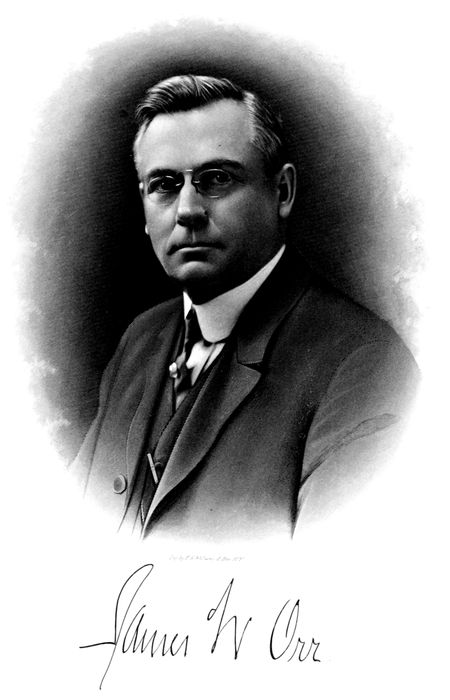
Eng. by E. G. Williams & Bro. N. Y. James W Orr.
361James W. Orr was born September 14, 1855, in the town of Reading, Hillsdale county, Michigan. In his boyhood days, and during the struggle to educate himself for the practice of his chosen profession, he knew what adversity meant and has the satisfaction of knowing that his education was obtained through his own unaided efforts. He is a son of James and Mary Elizabeth (Underhill) Orr, both of whom were natives of New York City. His father was of Scotch-Irish descent, his forebears emigrating from Scotland to the north of Ireland in the days of old to escape religious persecution. His paternal grandfather left Ireland in an early day and made his home in New York. The Underhill family is of English origin and a very old one in America, several generations of whom have been born and reared in this country. His maternal grandfather was Daniel Underhill, a goldsmith in New York City. James Orr, the father, was a merchant in New York till about 1848, when he left his native city and engaged in merchandising in Rome, Syracuse and Utica, N. Y., (three stores), following which he engaged in wholesale business in Toledo, Ohio. While a resident of Toledo he became identified with some of the enterprises of that day and was a stockholder, director and one of the builders of the Erie & Dunkirk railroad. In 1861 he removed to Coldwater, Mich., and conducted a merchandise business there until 1868, when, in broken health, he settled in Niles, Mich., where he died.
When James W. Orr was fourteen years of age he began earning his own living and educating himself. He and his brother, Louis C. Orr, the present postmaster of Atchison, worked together for several years, sharing their work with each other and pooling their earnings. The boys were fortunate in having a wise and ambitious mother who was well educated and who taught them at home, thus giving them the education they were financially unable to obtain at school. At the age of seventeen years while employed in a drug store he was reading law at nights and at odd times when his work was not pressing. By persistent endeavor he managed to secure two years of study at Michigan University, at Ann Arbor. He then took his examination for admission to the bar in open court, and was admitted to practice when but twenty years of age. His first employment in his new profession was with the McCormick Harvester Company, settling claims, etc., in behalf of that company. He remained in this position until 1880, and in January, 1881, came to Atchison where he has since continuously resided. It was necessary for him to begin the upward climb of the ladder to fame and success without assistance from any individual or friend. How well Mr. Orr has succeeded during the past thirty-four years is attested by his present high position in the ranks of the legal profession and the competence he has accumulated. He was first employed in Atchison by the New England Loan & Trust Company as attorney to examine abstracts of titles, etc., at a salary of forty 362dollars per month. It was not long until he was receiving a salary of $150 per month and a share of the profits in the employ of the same concern. When the concern moved to Kansas City and became known as the Equitable Loan & Trust Company, Mr. Orr remained in Atchison. In 1883 he was married to Miss Jennie Glick, the only daughter of Governor George W. Glick, of Atchison. He took up the practice of law, purchasing the interest of Judge W. D. Webb in the firm of Webb & Martin, and entered into partnership with A. F. Martin, which partnership existed from 1882 until April, 1887. During the five years he had been in Atchison he had been extending his acquaintance over the county, and in November, 1866, was a successful candidate for county attorney on the Democratic ticket, being elected over W. D. Gilbert by a substantial majority, despite the fact that the county was then normally Republican by over 800 majority. In April, 1887, he formed a law partnership with B. P. Waggener and Judge David Martin, the firm having previously been known as Everest & Waggener. Judge Martin resigning the position of judge of the Atchison district court to join the firm, which was known as Waggener, Martin & Orr. In the year 1895 Judge Martin retired from the firm, and Judge A. H. Horton, then chief justice of the supreme court of Kansas, resigned his office of chief justice, a position he had held continuously for nineteen years, to become a member of the firm. Judge Dawn Martin was appointed to the vacancy so made on the supreme bench. Judge Horton remained a member of the firm until his death, when ex-Chief Justice Frank Doster became a member of the firm known as Waggener, Doster & Orr. During Mr. Orr’s association with B. P. Waggener in the practice of law they had charge of the legal business for the Gould system of railroads in Kansas and Nebraska; the Western Union Telegraph Company; express companies, and the Pullman Palace Car Company. They were associated in partnership with three ex-chief justices of the supreme court of Kansas during this period. In June, 1910, Mr. Orr resigned his position as attorney for the Missouri Pacific Railway Company, and his connection with B. P. Waggener, which had then continued for twenty-three years, was also terminated. The position of special assistant to the attorney-general of the United States was proffered him by Attorney-General McReynolds in October, 1913, while Mr. Orr was engaged in the trial of a case in St. Louis. He accepted and was given charge of the suit of the Government against the Southern Pacific Company and others, including the Central Pacific Railway, to dissolve the relations between those companies. Mr. Orr conducts his cases for the Government in addition to his private practice. His rise has been steady and consistent during the years he has been practicing his profession in Atchison, and it is true that the youth who began his career in the city of Atchison for the modest salary of forty dollars per month now enjoys a lucrative private law practice, in addition to his income from the Government and not supplemented by corporation salaries. Mr. Orr has accumulated a comfortable fortune during the years of his practice and has what is considered the most beautiful home in Atchison. In his home he has his private library of several hundred volumes, including the standard works of literature. His law library lines the walls of his down-town offices and exceeds 2,000 volumes in number.
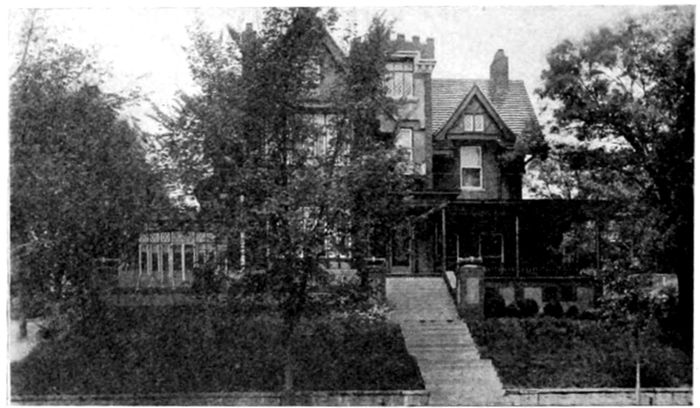
Residence of J. W. Orr.
363Mr. and Mrs. Orr had but one child, a son, George Glick Orr, who was drowned while bathing in the Pacific ocean, near San Diego, Cal., on July 21, 1909, at the age of twenty-five years. The loss of this talented young man saddened the lives of his parents for years. At the age when most young men are just beginning to gain a higher education, George Glick Orr could read, write and speak six different languages. For seventeen years of his life he was a student, graduated at the University of Kansas, and had been admitted to the bar, showing great promise in his chosen profession and being frequently entrusted with important legal matters.
Mr. Orr has received all the Masonic degrees except the thirty-third, and is a member of several fraternal societies. He attends and contributes to the support of the Christian Science Church, of which Mrs. Orr is a member.
In politics and as a public official and law-maker, Mr. Orr has a record of which any man may well be proud. He became a member of the Kansas Democratic State central committee in 1884 and remained such continuously 364until 1908, and in point of service was its oldest member. He has attended, as a delegate, six National Democratic conventions, and on three occasions was a member of the notification committee appointed to officially notify the presidential candidate of his nomination by the convention, including Cleveland in 1892; Parker in 1904, and Woodrow Wilson in 1912. His exceptional career in politics began as early as 1880, when he served as assistant secretary of the committee chosen to notify General Hancock at Governor’s Island, N. Y., of his nomination for the Presidency. Mr. Orr was an original Wilson man and one of the committee of five having the floor management of the Wilson forces at the Baltimore convention in 1912 which nominated Mr. Wilson for the Presidency. From 1901 to 1907 Mr. Orr served three terms successively as mayor of the city of Atchison and gave the city one of the best administrations in its history. He served two terms in the State legislature as representative from the Atchison city district, the sessions of 1911 and 1913. During the 1911 session he was one of the three legislators selected by the house to draft and did prepare the present public utilities law, under which all railroads and public utilities in this State are now managed and controlled; he was the author of the present comprehensive drainage laws; the law requiring the attorney-general to pay into the State treasury all fees received by him in the prosecution of State cases; the so-called “Orr viaduct law,” which requires railroads to construct and maintain at their expense all necessary viaducts over or tunnels under their tracks in cities, and under which the Fourteenth street viaduct in this city and viaducts in many other cities have been built and then maintained by the railroads, also many other laws of public interest and importance. In the session of 1913 he was chairman of the judiciary committee and was elected majority leader of the house. At the close of the legislative session of 1913 Mr. Orr was presented with a resolution, unanimously adopted by the members of the house, beautifully engraved in India ink, artistically framed and containing a reproduction of the great seal of Kansas. This resolution thanks Mr. Orr for the assistance he had given individual members of the house and for his service to the State, both as chairman of the judiciary committee and as majority house leader, and is signed by every member. It follows:
“HOUSE RESOLUTION, NO. 51—BY MR. RIDDLE.
“Resolved. That the members of the house extend to the Hon. James W. Orr their sincere thanks for the splendid service he has given to them and to the State during the present session. In addition to his work as floor leader 365of the majority party, and his work as chairman of the judiciary committee, he has been tireless, patient, and industrious in giving to individual members the benefit of his learning and ability by helping them in their work. His help has been extended alike to members of all political parties, and has been especially beneficial to members who have had little experience in legislative work. He has the confidence, esteem and love of all the members.
“Done in the city of Topeka, this eighth day of March, 1913.”
ANDREW B. SYMNS.
When the late A. B. Symns passed beyond mortal ken on April 9, 1905, Atchison suffered a loss from its business circles which could never be replaced. He left behind him a monument in the A. B. Symns Grocer Company, one of the largest of the wholesale establishments of the city and State, which was the product of his brain and ability. He was one of the noted pioneer figures of a decade which produced great and strong men. From a modest beginning he rose to become a national character in the business world of the great West and realized his ambition during a long and useful life. He not only succeeded in accumulating a comfortable fortune but left a reputation for integrity and upright citizenship which has never been surpassed by any of his compeers of the building age in Atchison and Kansas. From boyhood to the time he had passed the age of three score years and ten, Mr. Symns was an indefatigable worker and never relaxed except for much needed recreation and rest, occasionally. Early in his career he had great faith in the future of Atchison and that faith was fully justified by his own success in the jobbing field.
A. B. Symns was born in Monroe county. West Virginia, March 27, 1831, and was a son of John and Elizabeth (Peters) Symns, natives of old Virginia, of Scotch-Irish descent.
As a boy he worked on his father’s farm, attending school three months each winter. At the age of eighteen he clerked in a store at Petertown and later on attended Lewisburg Seminary one year. He also worked at White Sulphur Springs before coming west in 1853. He listened to the call of the great unpeopled western country for young and ambitious men to develop her dormant resources, and in 1853 crossed the country to St. Joseph. Mo., where he clerked in a store for two years and then went to St. Louis. After clerking in St. Louis for one year he became an eighth owner of the steamboat 366“Hesperian” and served as clerk aboard the steamer. This boat made its first trip on the Missouri trade in 1856 and it was while passing up and down the Missouri river that he was attracted to the then flourishing town of Doniphan. It far overshadowed Atchison at that time and he determined to locate in Doniphan. During the time he was connected with the steamboat service he had many interesting experiences. He opened a grocery store in 1858, but during the same year the land office was removed to Atchison and Doniphan lost ground, but the Symns store grew in size and importance and was the nucleus around which his great business was subsequently builded. He removed the store to Atchison in 1872, and began wholesaling in a small way in connection with his retail business. In 1877 he was doing business in the corner store room at Sixth and Commercial streets, on the southeast corner. While located in this building he closed out his retail business and engaged in jobbing exclusively. With the impetus given by his splendid business mind and his remarkable energy the business grew rapidly, and he soon found himself at the head of one of the largest wholesale grocery houses in the western country. Thirty men are employed as traveling salesmen by the Symns Grocer Company alone, and the Symns Utah Grocer Company, which he established, has its own force. Customers of Mr. Symns over Kansas, Nebraska, Oklahoma, Missouri, Texas, Colorado and Utah have always agreed that A. B. Symns was the fairest man with whom they ever did business. He had faith in Atchison as a great jobbing center, and the success of his business fully justified that belief. The immense jobbing house of the Symns Grocer Company on Main street of Atchison was built from plans prepared by Mr. Symns himself and is one of the most complete establishments of the kind to be found anywhere. So extensive did the business become, however, that it was necessary to erect an addition in 1903. The capitalization of the Symns Grocer Company at the time of the demise of Mr. Symns was $300,000 and that of the Utah concern at Salt Lake City was $80,000. Mr. Symns was president of both companies and had a controlling interest in each. He left an estate valued at over $300,000.
One of the interesting episodes of Mr. Symns’ mercantile career was the looting of his Doniphan store by Cleveland’s band of outlaws, who made Atchison their headquarters in the winter of 1861–62. At the time Mr. Symns was absent in St. Joseph, but his brothers, Sam and William Symns, were in charge when it was surrounded one evening by Cleveland and his gang. They forced William Symns to open the safe and took what money there was on hand in addition to clothing, saddles, etc. While the robbery was 367in progress, Mrs. Symns ran out to arouse the neighbors, but no help was forthcoming because of the fact that everybody was afraid of Cleveland and his gang, and the thieves got away with their booty unmolested.
A. B. Symns was married in 1858, returning to Old Virginia for his bride, Miss Elizabeth Tiffany, who was his boyhood sweetheart. Mrs. Symns was a member of an excellent Virginia family and bore him the following children: Mrs. A. S. Rowan, who died December 31, 1903; Miss Effie Symns, of Atchison; Charles, Atchison, and Guy. The mother of these children departed this life September 12, 1900, at the age of sixty-four years, having been born in 1836. Six children were born and died in infancy at Doniphan: John, Joseph, Lee, Hugh, Edna and Louis. Mr. Symns died April 9, 1905, at Hot Springs, Ark. He was sincerely mourned and Atchison business circles suffered a loss which could hardly be estimated.
While Mr. and Mrs. Symns were on their wedding trip on the steamer “Carrier” en route up the Missouri river from St. Louis to Doniphan, the boat sank near Hermann, Mo. They easily escaped drowning because the “Carrier” sank slowly, but they lost their newly purchased household goods and a large amount of supplies with which Mr. Symns intended to stock the Doniphan store. Mrs. Symns continued to Doniphan on another boat, while Mr. Symns returned to St. Louis to lay in another stock of household goods and provisions for his store.
The Symns family came of old Scotch Presbyterian stock. Although a southerner by birth, he was a Union man in Kansas. He was an independent Democrat in politics.
Mr. Symns was in active pursuits even after attaining the age of three score years and ten, and was always found early at his desk. He was not only the active head of the business but closely watched the details. He was always hurrying and was ever busy, and it was his custom to walk daily to the postoffice for his mail so as to have the benefit of the exercise. Having always been a man of correct habits he belied his years and his demise came unexpectedly at Hot Springs. He was accidentally killed by a locomotive on a railroad crossing at Hot Springs, where it had been his custom to go for his health during the latter ten years of his life. He was fond of his family and dearly loved his home life. He was quiet, unassuming, and was one of the kindest and gentlest of men, probably no man being more universally admired and beloved in Atchison during his day. His life story furnishes a decided inspiration for any one who may read of his success in Atchison.
368
BALIE PEYTON WAGGENER.
It is not difficult to classify Balie P. Waggener so as to determine his position in the civic body of Atchison, but it is not easy to write a review comprehensive enough to give a proper estimate of this distinguished citizen who has been honored in his home city and in the State of Kansas. When one thinks of Atchison it is only natural to refer to the city as the home of Balie Waggener, who is indisputably grouped among the prominent and widely known figures who have shed fame and luster upon their home city. A leading attorney, statesman, progressive citizen, builder, farmer and stockman, friend of all children, capitalist, and public benefactor are some of the terms which might be applied to him without fear of contradiction from the mass of the people who know him best.
He was born in Platte county, Missouri, July 18, 1847, a son of Peyton R. and Sophronia Briseis (Willis) Waggener, who were American born and descended from old American families. The great-grandfather of Mr. Waggener served in the Continental army as a lieutenant-colonel during the American war of independence, and his grandfather was a major in the United States army during the War of 1812. Balie Waggener attended the public schools until he attained the age of fourteen years and then obtained a situation as toll-gate keeper on the old Platte City & Western turnpike. He was ambitious to become a lawyer and during the interims of his duties in attending the toll-gate, and after his day’s work was done, he read his law books. The next step in his preparation to become a member of the legal profession was to enter the law office of Otis & Glick, in Atchison. This was in 1866, and so assiduously did the young man apply himself to his studies that he was admitted to the bar June 10, 1867. Three years later he formed a partnership with Albert H. Norton, then United States district attorney, under the firm name of Horton & Waggener, which lasted until the election of Judge Horton to the office of chief justice of the Kansas supreme court in 1876. In 1887 Mr. Waggener formed a partnership under the firm name of Waggener, Martin & Orr, which continued until April 30, 1895, when the firm was dissolved and the firm became Waggener, Horton & Orr, Chief Justice Horton having resigned his position and again entered the firm. David Martin, Mr. Waggener’s former partner, became chief justice of the supreme court of Kansas to succeed Chief Justice Horton. In 1902 Judge Horton died, and later his place in the firm was taken by Ex-Chief Justice Frank Doster, under the firm name of Waggener, Doster & Orr. It will thus be seen that Mr. Waggener has been associated in the practice of law with three chief justices of the supreme court of Kansas. In 1913 Mr. Orr withdrew from the firm to become special assistant to the attorney-general of the United States, and the firm is now known as Waggener, Challiss & Crane, being composed of W. P. Waggener, James Challiss and Albert Crane. Mr. Waggener now devotes his time and legal talents almost exclusively to his duties as general solicitor for the Missouri Pacific railway.
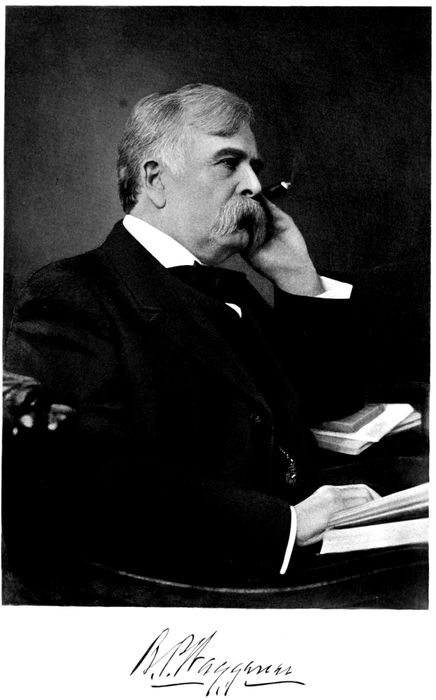
B. P. Waggener
369The ability of a lawyer having the calibre of Mr. Waggener was bound to attract attention, and on January 4, 1876, he was appointed general attorney of the Missouri Pacific railway for the State of Kansas, and on May 1, 1910, he was made general solicitor for that company for the States of Kansas, Nebraska, and Colorado, his son, W. P. Waggener, succeeding him as general attorney for Kansas. During the forty-four years Mr. Waggener has been engaged in the practice of law he has won an enviable position at the bar through his own personal efforts. He has never ceased to be a student of all subjects pertaining to that most jealous of professions, and it is worthy of note that he is the possessor of one of the most complete law libraries in the United States, containing upward of 10,000 volumes on every conceivable legal subject. He keeps his library at his residence, which is one of the handsomest and best appointed in the city of Atchison, and he prepares most of his cases in the study of his home where privacy is possible.
Naturally, a man of Mr. Waggener’s vigor and broad-mindedness would engage in enterprises outside of the practice of his profession, and he has done so in such a manner as to profit himself and the community. In 1892 he was elected president of the Exchange National Bank of Atchison, which position he has since held. He perfected and put into operation the Atchison Railway, Light and Power Company in the city, and is the owner of the famous “Green View Stock Farm,” comprising 500 acres, beautifully located a short distance west of Atchison, and which is one of the best equipped and most modern farms in Kansas. Through experimentation and adapting modern methods of agriculture to the cultivation of his land and the breeding of fine live stock, Mr. Waggener has become a recognized authority on agriculture and animal husbandry. The annual sales of fine live stock which are produced on his farm have become an annual event in this section of Kansas and the West, and are largely attended by buyers from all parts of the country.
In addition to his professional and business interests, Mr. Waggener has manifested a public spirit in matters pertaining to the political conditions of his city and State. Firmly grounded in Democratic principles, he has become one of the foremost leaders of his party and occupies a high place in its councils. In 1869 he was elected to the Atchison city council when he had barely 370attained his majority. In the year 1872 he was the nominee of his party for the office of attorney-general of the State of Kansas, and in 1873 was made city attorney. From 1889 to 1891 and again in 1895–97 he was mayor of the city. In 1902 he was elected a member of the lower branch of the State legislature, which had a large Republican majority, and during the term held the important position of chairman of the judiciary committee. It is generally conceded that he influenced much of the legislation at that session, and his record so commended him to his constituents that in 1904 he was elected to the State senate from a strong Republican district, carrying the district by a majority of 1,500 votes, although at the same election Theodore Roosevelt, the Republican candidate for President, carried the same district by over 3,600, an indisputable testimonial to Mr. Waggener’s personal popularity and his ability. Mr. Waggener served in the senate of the Kansas State legislature in the sessions of 1905 and 1907, and was reëlected by a handsome majority of over 2,000 in November of 1912. He is now holding the position of State senator from this district.
Mr. Waggener is a member of many secret orders, and is prominent in Masonic circles, being a Knights Templar and a Thirty-second degree member of the Scottish Rite, and a member of the Mystic Shrine.
On May 27, 1869, Mr. Waggener married Miss Emma L., daughter of William W. Hetherington, one of Atchison’s prominent citizens, now deceased, a review of whose life and career is given elsewhere in this volume. Two children were born to this union: William Peyton Waggener, a “chip off the old block,” and present general attorney of the Missouri Pacific railway for the State of Kansas, and president of the Exchange State Bank of Atchison; Mabel L., wife of R. K. Smith, vice-president and general manager of the Mississippi Central railway.
Perhaps the trait of character that most endears Mr. Waggener to the people of Atchison county is that liberality which led him in 1897 to inaugurate the system of giving an annual picnic to the children. Every year, at his own personal expense, he furnishes free transportation, free entertainment, and free refreshments to all the children of Atchison county who can attend his picnic, and the larger the crowd the greater is his delight. These picnics are not given for the purpose of increasing his popularity or for any self-aggrandizement whatever, but solely that he may steal at least one day from his business cares and derive a wholesome recreation in contributing to the amusement of the young people. This innovation has occasioned at various times favorable and commendatory comment in the press of the State, and a record of these picnics has been placed in the annals of the Kansas State Historical 371Society. The report of the secretary of the historical society for the year 1911 has considerable to say concerning the visit of President Taft to Kansas in that year and his attendance upon Balie Peyton Waggener’s picnic to the children of the neighborhood. The President left Topeka on September 27, about one hour after laying the cornerstone of the Memorial Hall building and reached Atchison in time for Mr. Waggener’s twelfth annual picnic. The President spoke words of high praise of Mr. Waggener and presented him with a silver loving cup in behalf of the people of Atchison county. Mr. Taft’s words in making the presentation were: “A token is this, Mr. Waggener, that carries real sincerity of friendship. I present this beautiful vase of silver in the name of the people here assembled as a sign of love and esteem. I congratulate you on the eminence you have attained.” Mr. Waggener responded: “This is a distinction unmerited. I have no words to express my grateful acknowledgment.” Balie Waggener’s picnic has become a feature of Kansas history of a most pleasant nature. He is a life member of the State Historical Society, and has always been an ardent and most liberal friend of the society.
When Mr. Waggener was forced by illness to go to Rochester, Minn., for the purpose of having a surgical operation performed, his safe return to his home was made the occasion of a time of great rejoicing by the children of the city, and a reception was given him, such as has never been given an Atchison citizen before nor since, and which occasioned State-wide comment on the part of the press as a fitting testimonial of the great love and esteem in which he was held by the children and people of his home city. During the time he was at Rochester undergoing a surgical operation and his subsequent recovery, the children of the city had been praying for his restoration to health and his safe return to their midst. It was their great friend who was ill, and, when the word came that he would arrive home on a certain evening the children prepared to receive him in an appropriate manner. All the children of Atchison turned out to give him welcome, and hundreds formed in line, through which Mr. Waggener passed on his way to his home. He and his automobile were pelted with flowers and tears filled his eyes, and he was unable to express his heart-felt appreciation of the reception which his people had given him. It has been described as the most beautiful and touching thing that has ever happened in the life of Mr. Waggener. To quote briefly from the Kansas City Journal, which described the incident: “Few men in this world were so fortunate as to enjoy such an ovation. Men who have done important things have been received by town bands and by citizens covered with fluttering badges. Men have come back to their home 372people to be received in the opera house, and cheers have echoed in their receptive ears. But it must be understood that no such home-coming as Mr. Waggener’s could come to an ordinary man. It was the tribute of sincere devotion and genuine friendship. It couldn’t be bought with money or earned by material success. These Atchison children didn’t care a rap for Waggener, the railroad attorney, nor Waggener, the politician, nor even for Waggener, the exemplary citizen. It was Mr. Waggener, the good, kind friend they loved, to whom the welcome was given, and it sprung from sheer joy that he had recovered his health and was with them once more. And who can say that the earth holds a more splendid triumph as the crowning glory of a life than this? All other laudations and exclamations are tame compared with the flushed enthusiasm of hundreds of happy children shouting from their hearts:
“‘Waggener, Waggener sis boom ah!
Our friend, our friend, rah! rah! rah!’”
ALBERT E. MAYHEW.
Personal achievement on the part of the individual who accomplishes things worth while for himself and in behalf of his fellow men, is always worth recording. The inherent qualities possessed by an able man will develop and become pronounced in decided results if he be given the proper opportunity. Albert E. Mayhew, legislative representative from the Atchison county district, and a successful merchant, belongs to that type of men who by force of intellect and sheer ability to do things have placed themselves in the forefront of affairs and taken their proper places as leaders in their respective communities. Forty-five years of his life have been spent in Kansas, and he can properly be classed as one of the pioneers of the State. Mr. Mayhew established himself in business in Effingham January 1, 1899, and his success since his advent into Atchison county has been marked and rapid. He began at first with a capital of $3,000 invested in a hardware and implement business. With characteristic energy and enterprise he developed his business to the extent that his extensive stock of goods now requires a capital of $10,000. In 1912 he purchased a lot at the corner of the two principal streets of Effingham and erected a handsome two-story brick building and a warehouse at the same time. This building measures 84×60 feet, including the warehouse and two splendid show rooms, filled with high class goods. 373The stock of goods in the Mayhew establishment embraces hardware, farming implements and wagons, paints, furniture, and he also conducts an undertaking establishment. Three men are employed to attend to the extensive trade of this store, which is the most important institution of its kind in this section of the county.
Albert E. Mayhew was born March 17, 1866, at St. Mary’s, Ontario, Canada, a son of William, born in 1833, died in March, 1906, and Mary (Lancaster), born in 1833, died December 25, 1878, Mayhew, both of whom were born in England and immigrated to Canada when in their youth. William Mayhew ran away from home and made his way to Canada where he became a farmer and married. William Mayhew and his wife resided in Canada until May, 1870, when they immigrated to Kansas, settling in Nemaha county. They purchased a farm near the town of Centralia, developed it and Mr. Mayhew made a success of farming and stock raising. He began with a large tract of land at first, but soon ascertained that it were better to have a smaller farm, and accordingly reduced his acreage to 160 acres, upon which he prospered. Mrs. Mayhew, the mother of Albert E., died on the home place in Nemaha county. William, as old age crept upon him, removed to San Diego, Cal., where his demise occurred. He is buried in the cemetery of the California city. Five sons and a daughter were born to William Mayhew and wife, namely: John, a merchant, of Denver, Colo.; Robert, a retired farmer and merchant, living in Topeka. Kan.; George, a merchant, of Denver, Colo.; Eliza, wife of A. B. Clippinger, Kansas City, Mo.; Albert E., the subject of this review, and Leonard, of Los Angeles, Cal.
Albert E. was reared to young manhood on the home farm in Nemaha county, and received his education in the public schools of Centralia, Kan., and the Seneca, Kan., high school, completing his education in the normal school at Emporia, Kan. He taught school for a number of years in his home county, saved his earnings and in 1887 embarked in the hardware and implement business at Vermilion, Kan. He conducted this business with fair success until 1897, and then sold out, coming to Effingham soon afterward and engaging in the same line of business in this city. In addition to his extensive business Mr. Mayhew is the owner of two excellent farms in Marshall county, Kansas, aggregating 640 acres in all, which has his attention. He has a beautiful, modern residence in the south part of Effingham.
Mr. Mayhew was married in September, 1887, to Anna J. Tinker, of Vermilion, Kan., born in Humboldt county, Kansas, a daughter of Avery and Ellen Tinker, natives of New York State, born at Hastings Center, that State. Two children have blessed this union of Albert E. and Anna Mayhew: 374Avery, born in 1889, and died June 2, 1901; Carl H., born January, 1891 and associated with his father in business. Carl H. married Miss Vera Snyder, and has one daughter, Lucille, aged two years.
Mr. Mayhew is a stanch Republican in his political affiliations and has taken an active and influential part in the affairs of his party since coming to Atchison county. In November, 1914, he was the candidate of his party for the high office of State representative from this district and was elected, subsequently serving in the 1915 session of the Kansas legislature with such marked ability as a legislator that his course and activities conferred distinction upon himself and his constituents. During this session he was a member of the committees on insurance, education, legislative appointments, mines and mining, and judicial apportionments. Having always taken a keen interest in educational affairs, his position as a member of the committee on education gave him an opportunity to support and advocate legislation which would enhance the cause of education throughout the State. He succeeded in having passed through the house an act requiring the school moneys of the State to be loaned to farmers. There was plenty of precedence behind an act of this character, and the fairness of its provisions is very evident, although it was opposed by the banking interests of the State. The act, however, failed to take its regular course through the senate, because of the adjournment of the legislative body. It is probable that the act will be finally passed at the next session and it is morally certain to have strong support, if Mr. Mayhew is again representative from Atchison county. He also introduced and successfully fathered an act, allowing districts to levy higher taxes to provide more amply for bridge building and road improvements, two provisions, which were of direct benefit to the farming interests of the State, inasmuch as the movement for better highways is fast gaining ground in Kansas. Mr. Mayhew also assisted in the passing of better automobile laws, and took an active part in all the deliberations of the legislative body, specializing, however, in legislation which had for its ultimate object the betterment of the school system of the State. He is a member and trustee of the Presbyterian church, of Effingham, and is fraternally associated with the Odd Fellows and the Modern Woodmen. It is probable that no citizen is more widely or more favorably known throughout Atchison county than A. E. Mayhew, and his course as a successful merchant and public official has been such as to favorably commend him to the masses of the people, who are always found appreciative of honesty and square dealing on the part of men 375in public life, whom they honor with their political preference. He is well worthy of the confidence and trust which have been bestowed upon him by the people.
JOSEPH COUPE.
Joseph Coupe, late of Benton township, was born December 6, 1852, in Utica, N. Y., and was a son of James and Jane (Latus) Coupe, both of whom were born in England. James emigrated from his native land when a young man and located in New York, where he married and reared a family, cultivating a farm located one mile from the limits of Utica. He died on his farm. Joseph was reared on the family farm and attended the Utica public schools, receiving an excellent education, after which he took up the study of law and was admitted to practice in his home city. He practiced his profession in Utica until 1881 and then came west and located at Falls City, Neb., where he continued his practice with considerable success until 1906, when he removed with his family to his farm, west of Effingham. Failing health induced him to make the change, and it was thought by his physicians that the open air life would be beneficial to him. He died February 10, 1908.
Judge Coupe was married in 1890 to Miss Anna Mooney, and to this union were born six children: Margaret, a graduate of the county high school, and a teacher in the Effingham public schools; James, who is managing the home farm with his mother; Richard, a graduate of the county high school; Anna, likewise a high school graduate; Mary, a junior in the high school; and Joseph, a pupil in the Sisters’ school at Effingham. The mother of these children was born in Atchison, Kan., confirmed and baptized in St. Benedict’s church, and was a daughter of James, born in 1833, and Julia (Ryan) Mooney, born in 1837, both of whom were natives of Ireland. James Mooney emigrated from Ireland when a youth, was first a resident of Buffalo, N. Y., and in 1857 moved to Nebraska, and was later employed at the nursery in Atchison, Kan. From Atchison he removed to Rulo, Neb., where he still lives. He was married in 1860, and the family lived in Atchison during the Civil war. James and Julia Mooney were the parents of five children, namely: Thomas, deceased in March, 1908; John and James, farmers: Margaret, at home in Rulo with her parents; Mrs. Joseph Coupe.
Previous to locating in Kansas, Mr. Coupe had resided on a farm near Falls City, but was induced to remove to Effingham and here purchased a farm of 194 acres west of the city in Benton township, this farm consisting 376of 160 acres of excellent tillable land and thirty-four acres of pasture. He was prominently identified with civic and political affairs in Falls City and Richardson county, Nebraska, and had built up a large and lucrative law practice. He was a Democrat in politics and was one of the leaders of his party in Nebraska, serving four years as county judge and was successful in re-election to a third term, but resigned on account of poor health. He was popular with the masses of the people and well liked by all who knew him, being universally admired for his many excellent qualities of mind and heart.
JOHN SEATON.
The name and accomplishments of the late John Seaton appear prominently in the history of the constructive period of the development of Kansas and the city of Atchison. Destiny and natural endowments designed Mr. Seaton to become a creator and builder; inherent ability also made him a statesman and leader of men; design and inducement led him to locate his enterprise, which was the work of his own hands and brain, in the city of Atchison. In the course of time he was the gainer, becoming one of the first citizens of Kansas, and Kansas and Atchison were doubly gainers, because of him and his great work. What John Seaton wrought, in an industrial sense, will live long as a monument to his energy and enterprise; the record of right doing, honesty, plain living and his work in behalf of his fellowmen in the halls of the State legislature will live in the minds and hearts of his fellow citizens in the long years to come.
John Seaton was a builder whose vision of a great industrial enterprise in the city of the great bend of the Missouri came true in a material sense, inasmuch as Atchison will continue to benefit through the continued whirring of the industrial wheels which his genius set going. While the evidence of his handiwork is visible, and the smoke of the factory which he built will continue to be seen day after day as time goes on, the greatest reminder of Mr. Seaton’s life on this earth will be the lesson which his manner of living and his strict attention to the highest duties of citizenship have left to posterity. Atchison suffered a sincere loss when his demise occurred and his departure from the realms of mortal ken created a void which could never be filled, although Mr. Seaton’s work continues to exist after him.
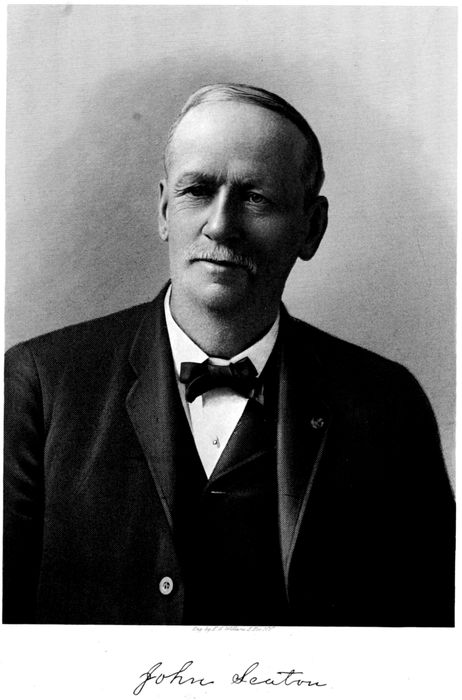
Eng. by E. G. Williams & Bro. N. Y. John Seaton
377John Seaton was born in Cincinnati, Ohio, June 11, 1834, a son of John M., and Elizabeth (Jones) Seaton, the former a native of Virginia and the latter having been born in Vermont. John M. Seaton, the father, was a soldier in the Mexican War and was killed in battle at the storming of the heights of Cerro Gordo, Old Mexico. When John was three weeks old his parents removed from Cincinnati to Louisville, Ky., where his boyhood days were spent. He was eleven years of age when his father was killed on the field of battle. He attended school until he was fifteen years of age, and then began learning the trade of a machinist. A few years later finds him working as a journeyman machinist in St. Louis, Mo. In 1856 with a cash capital of two dollars and fifty cents, John Seaton started a foundry at Alton, Ill. A natural aptitude for mechanics and machinery appliances, combined with pluck, energy and perseverance, enabled him to make a success of his first undertaking and the enterprise prospered.
At the outbreak of the Civil war Mr. Seaton offered his services in defense of the Union, and was commissioned a captain of Company B, Twenty-second regiment, Illinois infantry. His first engagement was the battle of Belmont under General Grant, and Captain Seaton was in command of the skirmish line that opened this engagement. One of the precious possessions of his family at this day is the personal letter he received from the famous commander, commending him for the efficient manner in which he performed the task allotted to his command. He served for one year and then resigned his commission and returned to Alton to take charge of his business. After the war Mr. Seaton remained in Alton in charge of his foundry until 1872, when he removed to Atchison with his entire force of fifty employees. He was induced to remove westward by the fact that six months previous to the time of his removal to Atchison, the city had voted $10,000 in bonds to any man who would establish a foundry. He accepted the offer and the result was one of the most beneficial industries ever located in Atchison. The Seaton foundry gave employment to over 200 men, and he built up an industry which today stands without a peer in its line in the West. The secret of Mr. Seaton’s success lay in the fact that every detail of his business received his direct supervision, and he insisted that only first class work be turned out by his factories. For over eighteen years this captain of industry carried his dinner pail with him to the foundry and worked side by side with his men. He continued doing this after he had attained to a position of wealth and affluence which enabled him to own a home at the seashore at Orient, L. I., and could have retired from active work at any time he chose. None but the finest finished products were allowed to leave his establishment, and the name of Seaton and the output of his plant are noted over the West for the excellence of the finished manufactured materials and for their absolute reliability. In addition to general architectural work, he filled orders 378for the Santa Fe, Missouri Pacific and Ft. Scott and Gulf railroads, such as casting locomotive wheels, smoke stacks, steam cylinders, etc., all known as locomotive finished material products. The business of his large establishment in Atchison was built up until it amounted to over $250,000 annually, and the plant covered an area of 700×400 feet. Mr. Seaton was in business continually from 1856 until the time of his demise, January 12, 1912.
The activities of this noted citizen of Atchison were not confined entirely to his business, but he took an active and influential part in civic and political affairs after his advent in Atchison. His career showed that he possessed statesmanship ability of a high order. For a period of eighteen years Mr. Seaton was a member of the Kansas State legislature, and so great was his influence in the house, and so long and distinguished was his service that he became known throughout the State as the “Father of the House.” His name is associated with many of the important measures enacted into law by the State legislature, among them being the binding twine factory law, which act is responsible for the establishment of a plant for the manufacture of binder twine at the State penitentiary. He probably did more for the success of the “Douglass House,” during the legislative trouble of 1893 than any other member of the Republican body. As a citizen and a legislator he enjoyed the respect and esteem of the people of Kansas without regard to political affiliations. He was opposed to the dominance of “trusts and monopoly,” and it was his firm conviction that the great corporations were devoid of feeling of a personal nature.
April 9, 1857, Mr. Seaton was married to Miss Charlotte E. Tuthill, of Alton, Ill., and this marriage was blessed with five children: Mrs. Lillie M. Hendrickson, of Atchison; John C. in California; Mary, wife of Dr. W. H. Condit, of Kansas City; Mrs. Nellie Taber (Seaton) Byram, deceased, and George L., married Amy Cox, of Weston, Mo., and resides on South Fourth street, Atchison; John C. Seaton married Gertrude Hickman, of Coffeyville, Kan. and resides in Kansas City and Los Angeles, Cal.; Mrs. Charlotte E. (Tuthill) Seaton was born in Alton, Ill., November 10, 1840, a daughter of Pardon Taber Tuthill, who was born and reared on Long Island, N. Y., and was a scion of one of the oldest American families. The great-great-grandfather of Mrs. Seaton, John Tuthill, known as Pilgrim John Tuthill, came from England with early settlers to Long Island. The home built by Pilgrim John on Long Island in the early part of the eighteenth century is still standing in a good state of preservation. The ancestral home of the Tuthills is located in the village of Orient, Long Island. On the maternal side an ancestor of Mrs. Seaton, named Capt. Andrew Englis, commanded a 379company in the Revolution and was a great patriot. Pardon Taber Tuthill was a pioneer in Alton, Ill. He was a contractor and builder and in his later years devoted his time and talents to horticulture. He was continually experimenting and developed several new varieties of fruit. He was blessed with a scientific mind and became famous as a horticulturist.
John Seaton was a member of John A. Martin Post, No. 93, Grand Army of the Republic, the Loyal Legion and the Knights of Pythias lodges. Through him the Enterprise theater was rebuilt and remodeled in Atchison, and he was always found in the forefront of public movements to advance the interests of his home city. Socially Mr. Seaton was a genial, approachable, unassuming gentleman, whose pride was manifest concerning his Civil war record and the fact that he had amassed wealth and attained a leading position in the civic life of his adopted State through his own efforts, and built up his fortunes from the ground. He was a man of undoubted integrity and was a noble character whose demise was sincerely mourned by the whole city of Atchison. He was a kind and indulgent husband and father. In his passing Kansas lost one of her best and most widely known statesmen and Atchison one of her most useful citizens. His was a life well spent in behalf of the city and State where his name will long be remembered and revered as one of the honored pioneers of a widely known city and great State which he helped to create.
AARON S. BEST.
It is meet that considerable space in this history of Atchison county be devoted to the stories of the lives of real pioneers of the county. The old pioneers were the salt of the earth, and a stronger or more vigorous race of men, never conquered a wilderness. In the class of the real, old pioneer settlers, comes Aaron S. Best, retired farmer, of Effingham, Kan. Captain Best has lived in Atchison county for nearly fifty-five years, and has seen the country transformed from a vast tract of pasture and grazing land to a region of fertile and productive farms, and well built towns and cities. During all these years he has taken an active and prominent part in county affairs, and in his younger days was a political leader in his own neighborhood.
Aaron S. Best was born June 27, 1839, in Clinton county, Pa., a son of John W. and Catharine (Schaefer) Best, of German descent, and native born and reared in Pennsylvania. John W. Best was born in 1809 and died in 1881. He was the son of Peter Best, a native of Pennsylvania, of German parentage. In the year 1860, John W. Best, accompanied by his wife and 380seven children, crossed the country to find a new home in Kansas. He had made a trip to Atchison county in the previous year, and, after carefully looking over the ground, made up his mind that the country had a great future, and he decided to move his family so as to make a permanent home in Kansas. The Best family arrived in Atchison in March of 1861, and at once moved to a farm in old Monrovia. In June of the same year, the wife and mother died, at the age of forty-five years. The following children were born to John W. Best and wife: Mary and Elvina, deceased, in Pennsylvania; Henry, living at Parr, Tex.; Louis, Luther and Reuben, deceased; Mrs. Henrietta Lamberson, of Argentry, Ark.; and Michael, deceased.
Aaron Best was twenty-one years of age when the family removed to Atchison county. Being a Free State advocate, it was only natural that he take some part in the struggle which finally made Kansas a free State. When General Price’s threatened invasion of Kansas seemed imminent, he assisted in raising a company of militia among his neighbors and was chosen captain. This company marched to Westport, and took part in the famous engagement which resulted in Price’s retreat to the southward. Captain Best was in command of Company F, Twelfth regiment, Kansas cavalry. Only two companies of the Twelfth regiment were under fire, and Company F was one of these, Capt. Asa Barnes’ company being the other actively engaged. Captain Best’s horse was shot from under him and badly crippled.
After coming to Kansas, he spent one year assisting his father on the home farm, and then moved to a farm of his own, south of Monrovia, which he developed from raw prairie land to a very productive farm, residing on until 1907, when he rented his land holdings and retired to a comfortable home in Effingham. The first land which Mr. Best owned was bought by his father for $750, and he farmed this on the share plan for six years, after which he paid his father $2,000 for 140 acres. His next purchase was eighty acres of land nearby, and he continued to add to his land possessions until he was the owner of 275 acres in all. In the spring of 1914 Mr. Best sold his farm land for $21,000. His farm was one of the best improved in Atchison county, and naturally brought a good, round price, because of the good condition of the buildings and of the fertility of the soil.
Mr. Best was married in February, 1860, to Malinda Bricker, and to this union have been born one son and three daughters, as follows: Mrs. Ella Rebecca Sharp, living at Helena, Mo., and mother of two children, Albert and Twila; Mrs. Mary C. Bonnell, living on a farm southeast of Effingham, and who has eight children, Nellie, Edith, Grace, Ruth, Catharine, Lea, Claude, Malinda; Mrs. Emma Wood, of Council Grove, Kan., and mother 381of four children, Clara, Beulah Morris, Ralph, Esther; John a merchant, of Monrovia, Kan., father of three children, Leota, Hazel, and Blanche. The mother of these children was born in Hanover township, Daulphin county, Pennsylvania, December 15, 1837, and was a daughter of Joseph and Rebecca (Lohs) Bricker, both of whom were of Pennsylvania German ancestry, and died in their Pennsylvania home.
Mr. Best has always been allied with the Republican party, and has been a stanch advocate of Republican principles for a long period of years. He and his wife are members of the Methodist Episcopal church and contribute generously to the support of that denomination. He is fraternally affiliated with the Odd Fellows Lodge and Encampment, No. 5, and the Modern Woodmen. Physically and mentally, Mr. Best is a remarkably well preserved man, when one considers his age and the fact that he endured so many hardships in his first struggles to attain to the position of affluence and comfort which he enjoys at present.
LOUIS C. ORR.
Faithfulness to duty on the part of public officials is always appreciated by the people, and an official who regards his office as other than a sinecure, is recognized as honest, capable and well meaning. In Louis C. Orr, postmaster of the city of Atchison, Kan., the patrons and citizens of Atchison have a capable and conscientious public servant, whose sole interest is to see that the affairs of this important Government office are conducted smoothly, and for the convenience of the patrons of the postoffice. Although, in times past, the Atchison postoffice has been looked upon as a sinecure, operated as a well oiled piece of Government machinery with an efficient and well trained force, Mr. Orr, since taking over the duties of his position, has demonstrated that he can work as hard and efficiently as any of the many employees making up the postoffice force. Probably no postoffice in the State of Kansas is better conducted, or the welfare of the patrons more carefully looked after than the Atchison postoffice, and credit is due Mr. Orr for his diligent application to the duties of his office since his appointment.
Louis C. Orr, postmaster of Atchison, was born August 3, 1857, in McGregor, Iowa, a son of James and Man Elizabeth (Underhill) Orr, concerning whom further mention will be found in the biography of James W. Orr, brother of Louis C., in this volume. When Louis C. was eight years of age 382the family removed from Iowa to Niles, Mich. Louis C. and his brother James W. knew what poverty was in their youthful days, and shared their hardships in common. Louis C. was ambitious to obtain an education, and at an early age was compelled, by force of circumstances over which he had no control, to practically earn his own living and the wherewithal to obtain an education. For some years he and James W. pooled their earnings and worked together for their mutual benefit, and to this day this trait of brotherly devotion is present. Louis C. attended school until he had attained the age of eighteen years, and he then entered a drug store at Niles, Mich., in the capacity of clerk. He remained in Michigan until 1885, when he came to Atchison. Kan., where his brother, James W., had preceded him in 1881. Mr. Orr entered the Government railroad mail service, and was employed in this capacity on the Santa Fe Railway System, on the run from Atchison to Topeka, during Grover Cleveland’s first administration. He then left the railway mail service and was employed as clerk in the drug store of A. W. Stevens for the following period of eight years. For the six years following he was in charge of the paint department of the McPike Drug Company, a wholesale drug firm then operating in Atchison, and since removed to Kansas City, Mo. For four years, from 1907 to 1911, he served as city collector of Atchison. He was engaged in the real estate and fire insurance business until January, 1915. Mr. Orr was appointed postmaster of Atchison December 29, 1914, by President Wilson, to take effect January 4, 1915, although Mr. Orr did not begin his duties until January 15, 1915.
Mr. Orr was married in 1886 to Mary Isabelle Smith, of Richmond, Ind., a daughter of John P. and Mary (Sedgwick) Smith, residents of Richmond, Ind. One son has been born to this marriage, Richard Sedgwick Orr, born in 1888, and at present employed as manager for the Standard Oil Company in Atchison.
Louis C. Orr is a Democrat and is affiliated with the Christian Scientist church. For the past twenty-five years he has been a member of Lodge No. 127, Ancient Order of United Workmen. It can be said of him that he is courteous, efficient and obliging to all with whom he is brought in contact.
CARL LUDWIG BECKMAN.
Successful as an agriculturist, and again achieving success as a live stock buyer and shipper, is a summary of the life and accomplishments of Carl Ludwig Beckman, one of the best known and progressive citizens of Effingham, 383Kan. Mr. Beckman’s live stock operations invoke the buying and shipping of over fifty carloads of live stock yearly. In addition to his business dealings, he also looks after his fine farm of 200 acres in Benton township.
Mr. Beckman was born April 2, 1861, in Quincy, Ill. As the name indicates, he is the son of German parents, his father, William Beckman, having been born in Germany, in 1830, and was unfortunately killed by a stroke of lightning in Burlington, Iowa, in 1863. When a young man, William Beckman left his native land to seek his fortune in this country. He located at Quincy, Ill., where he married Elizabeth Kipp, who bore him four children, and was also born in Germany in 1824. William Beckman removed his family to Burlington, Iowa, in about 1862. The four children born to this couple were: William, a resident of Parnell, Atchison county, Kansas; Mrs. Hannah Buhrmaster, living on a farm in Benton township; Minnie, and Carl Ludwig, with whom this review is directly concerned. The mother of these children later married Henry Vollmer, a farmer, in Iowa, who gave her and the children a good home and left his widow well provided for. Mrs. Vollmer, mother of C. L., resides at Mediapolis, Iowa.
When Carl was twenty years of age he left the farm in Iowa, and came to Kansas in 1881, and in partnership with his brother, William, rented a farm near Effingham for thirteen years, dissolving partnership in 1894. Through purchase and by inheritance, on his wife’s part, Mr. Beckman and his wife came into possession of 200 acres of land in 1894, upon which they resided until 1908. In that year they bought a small farm of thirty-five acres, one mile west of Effingham, upon which they resided for three years, and then made a permanent home in Effingham. Since 1908 Mr. Beckman has been engaged in the buying and shipping of live stock, with Robert M. Thomas as a partner in the enterprise, and has been very successful in this business, being an accurate judge of live stock and keeping abreast of market conditions.
He was married in 1894 to Miss Lebeldine Gersbach, born in Atchison county in 1863, a daughter of Samuel and Catharine Gersbach, both of whom were natives of Germany, and, after emigrating from their native country to America, settled in Atchison county as early as 1854, and were among the earliest pioneers of Kansas. Mr. Gersbach preëmpted land and built up a fine farm which is now owned by Mr. and Mrs. Beckman. Two children were born of this marriage: Rosa, aged twenty years, and a student in the Atchison county high school, class of 1916; and Pearl, aged seventeen, also a student in the high school, class of 1916.
384Mr. Beckman is a Republican in politics, and takes an interest in the civic and political affairs of his home town and county. He is a member of the Odd Fellows and the Modern Woodmen. Mrs. Beckman and daughters are members of the Methodist Episcopal church. Mr. Beckman is a stockholder of the Farmers’ Mercantile Association of Effingham, and is generally found in the forefront of all undertakings which are intended for the betterment and progress of conditions in his home city.
JAMES GRANVILLE MORROW.
We are taught that life is eternal; that when the course of man has been run upon this earth and his work is done, his spirit returns to his Maker and he is judged according to his deeds while a mortal among his fellow creatures. This thought and belief is comforting alike to the dying and the bereaved ones left behind to mourn their earthly loss for the time being. Longfellow has written: “Life is real, life is earnest, and the grave is not its goal; dust thou art, to dust returneth, was not written of the soul.” So thought and so lived the late Capt. James Granville Morrow, who at the time of his demise was the oldest living pioneer resident of Atchison, and a man famed for his upright life and beloved for his good and kindly deeds. Life was very “real and earnest” to Captain Morrow and he enjoyed his earthly existence to the fullest extent, the latter years of his residence in Atchison being the fullest and best of all, in the sense that he indulged his taste and talents to doing things which he loved, all the while being surrounded by a loving wife and children whose respect and love he had to comfort him through the greater part of his long and useful life. Captain Morrow lived in such a manner as to endear him to all of his associates and he will long be remembered as one of the noted figures of the pioneer and the present era of Kansas development. It is meet that the life story of this truly noble citizen be recorded in these annals of his county and city for the inspiration and encouragement of the present and coming posterity for all time to come.
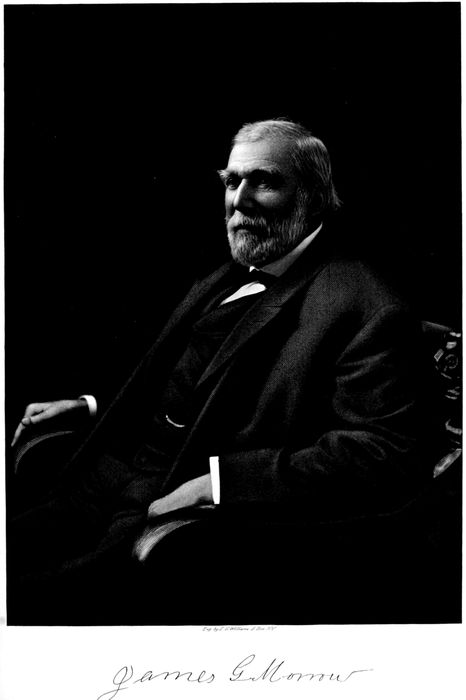
Eng. by E. G. Williams & Bro. N. Y. James G. Morrow
385James Granville Morrow was born on a farm in Wayne county, Kentucky, June 27, 1827, a son of Jeremiah and Lydia (Holder) Morrow, both of whom were born and reared in Kentucky. Jeremiah Morrow was the son of Matthew Morrow, a native of Virginia, who was one of the early pioneers of Kentucky, and of Scotch descent, his ancestors having emigrated from Scotland to America in the early colonial period of American history. Jeremiah Morrow, father of James G., was born in 1802, and after his removal to Kentucky married Lydia Holder. Six sons and two daughters were born to Jeremiah Morrow and wife, only one of whom survives, Mrs. W. H. Crisp, residing in Kentucky. Their children were as follows: Mahala, wife of Rev. W. H. Crisp, of Kentucky; Floyd, deceased; James Granville, the subject of this review; Nimrod, deceased; Riley, William, Nancy, deceased wife of John Pennington; Percy, deceased. Granville Morrow spent his boyhood days on the family farm in Wayne county, Kentucky, and at the age of sixteen years was sent to a select school. He made his home with his parents until he attained his majority and then set out to make his own way in the world. He dealt quite extensively in horses which he drove from Kentucky to Georgia. He was also associated with his brothers in raising, purchasing and selling hogs, which they drove 400 miles into Georgia, where they were sold to the Georgia planters. Sometimes a single planter would buy 500 head and the price ranged from eight to nine dollars per 100 pounds, live weight. The Morrow brothers frequently drove as high as 13,000 head, traveling only seven miles a day. There were no railroads in those days, but the country was dotted with stations. Hog cholera did not bother swine in those days and it was Captain Morrow’s frequent expression that hog cholera was a product of civilization and high breeding, and, although the hogs were driven as far as 400 miles they did not lose weight on the trip. The business of the Morrow brothers was not always profitable, however, and they lost money on some of the trips. Mr. Morrow abandoned the business in 1850, and in 1854 arrived in Atchison en route to California, but he did not go any farther. On April 5, 1854, he arrived at Rushville Landing, now East Atchison. This was shortly before Kansas was opened for settlement, and the only man living at that time on the townsite of Atchison was George Million, who operated a rope ferry across the Missouri river. Mr. Morrow found on landing at Atchison that the overland train which he expected to join en route to the far West had left, and, as he was ill he decided to wait for the next train. Captain Morrow ate his first dinner in Kansas with Samuel Dixon at Dixon Spring, now included in the city of Atchison. The food was ladled out of a common kettle to which all the diners had access without style or invitation other than “help yourself.” A tree trunk sawed off smooth answered the purpose of a table on which the meal was served. While waiting he found a job with Million and decided to remain in Kansas. In the fall of 1854, he, with John Alcorn, bought out Portumous Lamb’s ferry boat which was operated by horse power and a tread-mill, and from 386that time on for seventeen consecutive years Mr. Morrow plied his ferry between Atchison and Winthrop. In the fall of 1855 he began operating a side-wheel steam ferry which had been brought here from Brownsville, Pa. In 1857 he became captain of the steam ferry, “Ida,” later running the steam ferry, “Pomeroy,” after which he went to Brownsville, Pa., where he built the transfer boat, “William Osborne,” remaining there eight months while the work was in progress. When he brought the “William Osborne” to Atchison it was loaded with 300 tons of rails for the Central Branch of the Missouri Pacific railroad, now the Northern Kansas Division. This boat also conveyed across the Missouri river the first locomotives used on the road after its construction.