Chapter XXV · BIOGRAPHICAL HISTORY (continued 14)
Reading edition
811
JOHN M. PRICE.
John M. Price, deputy county treasurer, farmer and stockman, of Mt. Pleasant township, Atchison county, is a native born Kansan, and son of John M. Price, deceased, who was one of the most distinguished members of the Kansas bar, and who practiced his profession in the city of Atchison for forty years.
John M. Price, the father, was born in Richmond, Madison county, Kentucky, in October, 1829, a son of Thomas S. and Sarah (Jarman) Price. His paternal grandfather was Moses M. Price, and his maternal grandfather was John Jarman. Moses M. married Catherine Broadus, and John Jarman married Elizabeth Broadus, the two women being distant relatives. Moses M. Price and wife were both natives of Virginia, and removed to Madison county, Kentucky, in the early part of the nineteenth century, with their respective parents. After his marriage in Kentucky, Moses M. made his home in Estill county, Kentucky. He was the father of ten children, the fourth of whom was Thomas M. Price, father of John M., the elder, and who married Sarah Jarman in 1828. Sarah (Jarman) Price was a daughter of John and Elizabeth (Broadus) Jarman. This marriage was blessed with three children: Thomas E., John M., and Mary W. The mother died in 1836, and in 1838 Thomas M. Price married Miss Elizabeth Combs, of Clark county, Kentucky, and the following fall removed to a home in Johnson county, Missouri. From Johnson county he removed to Pettis county, Missouri, and farmed there until 1845, after which he returned to Estill county, Kentucky. In 1853 Thomas S. and family started for Texas, where he resided until his demise at Mt. Pleasant, Titus county, in 1857.
John M. Price, father of the present deputy county treasurer, returned from Missouri to Kentucky with his father, and remained at the home of his uncle, Morgan M. Price, whom he assisted in his farm work, and also attended school at Irvine, the county seat of Estill county. In 1845 and 1846 he was employed in a drygoods store at Irvine, and in the fall of 1847 he accepted a home with Col. Walter Chiles, a prominent lawyer and politician of Mt. Sterling, Ky., who had married Jane Price, an aunt of John M. Price. After attending school in the fall and winter, Mr. Price became a clerk in the office of the county clerk of Montgomery county, Kentucky. While performing his duties in the county clerk’s office he read law in the office of Colonel Chiles and was admitted to the practice of his profession in March, 1848. He first opened a law office at Irvine, and in 1851 was elected county attorney of Estill county; reëlected in 1855, and continued to serve until 812July, 1858, when he resigned in order to remove to Kansas. He determined on Atchison as his future abiding place, and accordingly, located in this city September 1, 1858.
Kansas was then a territory, and for forty-one years of the development of the State, Mr. Price was an important factor in promoting its interests and welfare. He soon built up an extensive law practice in the growing city of the great bend on the Missouri, and took an active and influential part in political affairs, allying himself with the newly formed Republican party. He early identified himself with the controlling organization of his party, and for twenty years prior to his demise he was a delegate to every Republican county convention, and to many State conventions. In 1859, when Judge Otis resigned the office of county attorney, Mr. Price was appointed to fill the vacancy by the board of county commissioners, and served until Kansas was admitted into the Union, when he was nominated and elected to the office at the first general election under the State constitution. In 1861 he was elected police judge of the city and re-elected in 1862 and 1863. He was elected a member of the city council in 1864 and served for three years in succession as a member of that body. He was elected mayor of the city without opposition in 1867. In the fall of 1866 he was elected State senator from Atchison county for a two years’ term, and while serving as State senator he was appointed by Governor Crawford as one of the commissioners to revise the general laws of the State. Mr. Price was chairman of the commission, which was composed of himself, Samuel A. Riggs, of Lawrence, and James McCahon, of Leavenworth. The revision thus made was adopted by the legislature without much amendment, and the general statutes of 1868 were printed and published during that year under the supervision of this commission. In the same year Mr. Price was made chairman of the judiciary committee of the senate, to which body he was reëlected in 1870, and served during the sessions of 1871 and 1872, and on the organization of the senate, he was chosen president of the body. He was a candidate for governor of the State before the Republican convention in the fall of 1872, and was a leading candidate until the tenth and last ballot, when all the opposing candidates threw their support to Thomas A. Osborne. In the memorable contest for the United States senatorship in 1873, Mr. Price’s friends presented him as a candidate before the anti-Pomeroy caucus, and for the first nineteen ballots Mr. Price was the leading candidate, and then John J. Ingalls was chosen by the convention on a unanimous vote. In 1892 he was again elected to the State senate and served in the memorable sessions of 1893 and 1895.
813On January 10, 1854, John M. Price was married in Irvine, Ky., to Eliza Jarman Park, the only daughter of Elihu and Mary Park. This marriage was blessed with the following children: Mollie F., born in Irvine, October 12, 1854, married Charles B. Singleton, of Atchison, for twenty-seven years assistant postmaster, and now bookkeeper for the Exchange National Bank; Nannie B., born in Irvine August 28, 1856, wife of F. L. Vandergrift, editor of the Santa Fe publications, Kansas City, Mo.; John M. died in January, 1875; John M., Jr., with whom this review is directly concerned, and Eliza P. The mother of these children was born in Irvine, Ky., August 22, 1832, and resides at present in Kansas City, Mo.
John M. Price, Sr., died October 19, 1898. He was one of the distinguished Masons of Kansas. He served as the grand high priest of the Grand Royal Arch Chapter of Kansas, and was secretary of that body: he was president of the council of the Holy Order of High Priesthood; grand treasurer of the Grand Council of Royal and Select Masters of the State; also president of the Kansas Masons’ Protective Association; was a thirty-second degree Mason, and a member of Medina Temple, No. 31, of the Mystic Shrine, and was also a member of Shiloh Conclave, No. 1, Knights of the Red Cross of Constantine, Knights of the Holy Sepulchre, and Knights of St. John the Evangelist. He served one term as grand master of the most worthy grand lodge of the Odd Fellows, and was twice elected a grand representative to the grand lodge of the United States. He served one term as grand chancellor of the grand lodge, and of the Knights of Pythias was the supreme representative to the supreme lodge of the world for four years. He was the grand master workman of the grand lodge of the Ancient Order of United Workmen of Kansas; was a member of the grand lodge of the Knights of Honor, served as assistant director, and as president of the Atchison lodge of the Independent Order of Mutual Aid. For years a distinguished and able member of the legal profession, he was one of the most respected and useful citizens of Atchison and the State of Kansas.
John M. Price, whose career naturally follows that of his distinguished parent, was born March 27, 1876, in Atchison. He was educated in the public schools, and graduated from Midland College in 1894. After completing the course in Midland College, he entered Wittenberg University, at Springfield, Ohio, and was graduated from that institution in 1897, with the degree of Master of Arts. For some time he was engaged in the profession of teaching, and was assistant professor of chemistry and physics at Midland College from 1894 until 1895. For two years he filled the post of buyer at the Kansas State penitentiary, at Lansing, and then located on his farm in 814Mt. Pleasant township, near the city of Atchison. He followed farming and stock raising with success. He was appointed deputy county treasurer under U. B. Sharpless in the fall of 1915, and is now filling the duties of his office faithfully and conscientiously.
Mr. Price was married August 12, 1903, to Miss Fan Ballew, who has borne him one child, Jane Ballew Price, born June 2, 1911. Mrs. Price was born in Madison county, Kentucky, March 19, 1885, a daughter of George W. and Jennie (Francis) Ballew, both of whom were descended from old Kentucky families It is a matter of history that the grandfather of Mrs. Price, Francis, by name, owned the slaves which escaped from the Kentucky plantation across the Ohio river, and from whom the character, Eliza, in “Uncle Tom’s Cabin” was taken.
Undoubtedly, John M. Price is one of the rising young men of Atchison county, who is at the beginning of a career which is destined to reflect credit upon the memory of his illustrious father. He is a member of the Benevolent and Protective Order of Elks, and is the present exalted ruler of that body, and is a prominent member of the Ancient Order of United Workmen, and the Fraternal Aid Union.
BOYD ROYER.
Boyd Royer, farmer and stockman, of Kapioma township, Atchison county, Kansas, has reason to be proud of his family tree. His mother was the first white child to be born in Kapioma township, Atchison county. She was Emma Hammond before her marriage to George Royer, and was born in 1861 to William and Lena (Brutton) Hammond, who came over from Missouri and settled in Kansas a short time before her birth. Her ancestors were Kentuckians. The father of Boyd Royer was a Pennsylvanian, having been born in Union county, that State, in 1859. He grew up with the common schooling of the time and learned the blacksmith’s trade. Coming to Kansas in 1879, he worked by the month near Effingham for a while and later engaged in farming in Kapioma township, where he rented a farm until his retirement in 1910. when he moved to Valley Falls, Kan.
Boyd Royer, the subject of this sketch, was born May 13, 1881, four miles east of Arrington, Kan. He was the oldest child of four children. The other children are: Walter, with the J. I. Case Company, Kansas City, Mo.; Miles, a Government employee, Washington, D. C, and George, Kansas 815City, Mo. The mother died in 1905. Boyd Royer grew up on his father’s farm and attended school in district No. 31 of Kapioma township. In 1901 he rented land near Arrington, Kan., and in 1909 bought 160 acres, and built a fine barn, 36×36 feet, on this place and has a large eight-room house on the place. All buildings are well painted and kept in excellent condition, and everything around the place is kept in neat order.
In 1905 Boyd Royer married Mabel Beyer, who was born June 26, 1882, in Kapioma township, Atchison county. She is a daughter of Asa and Susan Beyer, both natives of Pennsylvania, who came to Atchison county in the early days. Mr. Royer is a Republican. He is a steward in the Methodist Episcopal church. Mr. and Mrs. Royer have no children.
LEWIS H. HUBBARD.
Lewis H. Hubbard, farmer and stockman, of Kapioma township, Atchison county, was born March 13, 1872, in Cass County, Missouri. He is a son of Simeon and Mary Ann (Pence) Hubbard, who were the parents of the following children: William, Kapioma township, Atchison county, Kansas; Lillie O’Conner, widow, Muscotah, Kan.; Cora Routh, Kapioma township; Lewis, subject of this sketch, and two children who died in infancy. The father of Lewis Hubbard was born March 10, 1840, in Indiana, and grew up as a farmer, following that occupation after coming to Kansas in 1874. He settled near Muscotah and rented land for a period of four years and during that time he saved his money carefully. When he came to Kansas he was without funds, but at the end of four years he had accumulated enough to enable him to buy a farm. In addition to growing his crops he fed stock and did a hustling business in that line. He is still living and resides at Muscotah, Kan. The mother of Lewis Hubbard is also living. Lewis Hubbard went to school in the Rose Valley district. He received a common school education and worked with his father on the latter’s farm until 1909, when he bought a farm of his own and became his own manager. The place consisted of 160 acres of fine tillable soil and is located in section 16, southeast quarter of Muscotah township. Mr. Hubbard has devoted considerable attention to improving the appearance of his farm and has constructed a fine seven-room cottage, and has built a large barn to provide shelter for his stock and hay. He keeps the best Jersey cows and milks eight to twelve of them for 816the dairy. Mr. Hubbard is a stockholder in the farmers’ grain elevator at Muscotah, Kan.
In 1897 Mr. Hubbard married Anna Hinkston, who was born May 5, 1880, in Doniphan county, Kansas. She is a daughter of Frank and Dorinda (Tate) Hinkston, who now live in Jackson county, Kansas. Mr. and Mrs. Hubbard are the parents of two children, as follows: Ethel, aged sixteen, who attends the Atchison County High School at Effingham, and Leslie, aged seven, living with his parents. The daughter is also studying music, and her father hopes to give her a thorough education in that subject. Mr. Hubbard is a Democrat of an independent stamp. He is a member of the Adventist church and is a deacon in that denomination. If there is one thing that Mr. Hubbard takes pride in more than another it is in his children’s education. He realizes the value of an education and desires that his children have every advantage of education that he can give them.
ARTHUR S. SCHURMAN.
Atchison county is principally an agricultural community, and not unlike most sections of the great Middle West, the general wealth and standing of the community is commensurate with the thrift, enterprise and industry of the individual farmers. He whose name introduces this sketch is a representative of that type of men whose efforts have placed Atchison county in the foremost rank of the 110 political sub-divisions of the great state of Kansas.
Arthur S. Schurman is one of the substantial and enterprising agriculturists in Benton township, and has been a resident of the township for the past thirty years. He is the owner of 202 acres of well improved land, which is noted for its excellent yields of grain. For the past ten years Mr. Schurman has been one of the most successful wheat growers in Atchison county, or even in the State. He has produced the great yield of 2,330 bushels of wheat on a tract of eighty acres. A handsome farm residence, tastefully painted a clean white, presents an attractive appearance on a rise of land fronting the highway, which passes east and west in front of his land. This fine home was built by Mr. Schurman in 1911, and comprises eleven rooms in 817all, with a heating and water pressure system, which completely modernizes the home. The residence is nicely situated in the midst of a fine grove, which affords a generous shade in summer. Mr. Schurman carries on diversified farming and raises a considerable amount of live stock.
Arthur S. Schurman was born January 11, 1864, in Prince Edward Island, Dominion of Canada, and is a son of Caleb Schurman, who was born December 8, 1829, on Prince Edward Island, a son of English parents, who left their native land and settled on the island many years ago. The great-grandfather of Arthur Schurman was a German by birth, who established a home in England. The mother of Arthur S. was Sarah Creswell before her marriage. She was born May 15, 1835, and died on the home place in Benton township, November 15, 1889. When but a child she went from England to Prince Edward Island with her parents. The Schurman family lived on their native island until 1876, and then immigrated to the United States, going first to Des Moines, Iowa, in search of a suitable location. After a residence of eight months in Des Moines, the family came to Atchison, Kan., where Arthur Schurman was employed in a harness shop for three years, and also drove a coal wagon for a retail coal dealer for a time. Caleb Schurman rented a farm south of Atchison, and later bought the farm now owned by his son, Arthur. Four children were born to Caleb and Sarah Schurman, namely: Mrs. J. B. O’Connell, Denver, Colo.; Frederick Robert, a resident of Effingham, Kan.; Percy Ernest, who died in September, 1896, and Arthur S., the oldest of the family.
Arthur Schurman was twelve years of age when the family came to the United States, and received a portion of his schooling in his native land. He remained with his father, and assisted him in developing his Atchison county farm, purchasing the land from his father when he came to man’s estate. Caleb Schurman makes his home with his son, Arthur S., who married in August of 1890, to Emma Pruitt, of Atchison, Kan., a daughter of James Pruitt. This marriage has been blessed with the following children: Sadie Mary, born October 5, 1892, the wife of Fred Dooley, of Lancaster township; Martha, born April 3, 1893: George Herbert, born September 21, 1895; Arthur Ernest, born June 3, 1899, and died October 19, 1900: Ralph, born March 25, 1902.
Mr. Schurman is a Republican, but has never found time to take an active part in political affairs. He was reared in the Episcopalian faith. 818but the members of his family attend the Christian church at Effingham. He is a member of the Masonic lodge and the Central Protective Association.
C. A. LILLY, M. D.
C. A. Lilly, M. D., a well known member of the medical profession of Atchison county, is a native of the Buckeye State. He was born at Mansfield, Ohio, and is a son of S. and Clara (Beard) Lilly. The father was a lumberman. Dr. Lilly was reared and educated in Mansfield, Ohio, and Chicago, Ill., and after obtaining a good academic and classical education, he entered the Chicago Medical College in 1897 and was graduated in the class of 1901 with the degree of Doctor of Medicine. He then came to Kansas and engaged in the practice of his profession at Seneca. After remaining there about one year and a half he returned to Chicago and took a post-graduate course in Rush Medical College, and did considerable hospital work. In 1904 he located in Atchison, where he has since been successfully engaged in the practice of medicine and has one of the extensive practices of Atchison county. He has been division surgeon for the Missouri Pacific railroad since 1911.
Dr. Lilly was united in marriage in 1902 to Miss Isabel Smith, of Hiawatha, Kan. Dr. Lilly is a member of the Northeastern Kansas and the Missouri Valley Medical associations and also belongs to the County, State and American Medical association.
FRANK J. WATOWA.
Frank T. Watowa, a successful farmer of Shannon township, Atchison county, was born in Jefferson county, Wisconsin, October 3, 1854, and is a son of Joseph and Catherine Watowa, natives of Austria, who emigrated from their native land to Wisconsin where they resided until 1860, when they came to Missouri, locating in Buchanan county. About 1870 the family came 819to Atchison and located on a farm in Shannon township where his son, Joseph H. Watowa, now resides. The father died in 1895. Frank J. Watowa is one of a family of seven children, born to Joseph and Catherine Watowa, as follows: Mary, Henry, Joseph H., Mollie, Earnest, Paullina and Frank.
Frank J. Watowa was married in 1879 to Miss Anna Falk, who died in 1885, leaving three children, as follows: Mary, the wife of Antone Lutz, of Lancaster township; Josephine resides in Colorado Springs, Colo., and Anna, deceased. On June 24, 1892, Mr. Watowa was united in marriage to Amanda Smith, and four children have been born to this union, as follows: Sarah, Frances, Frank and Lawrence.
Mr. Watowa is one of the extensive farmers of Atchison county. He has 280 acres of land, nicely located and very productive. In 1895 he built a handsome stone residence, which is one of the finest farm homes to be found in the county. Politically he is a Democrat, and he and his family are members of the Catholic church. He is a progressive and public spirited citizen and one of the substantial men of Atchison county.
LEWIS BRADLEY.
Lewis Bradley, farmer and stockman, of Kapioma township, Atchison county, was born February 24, 1857, in Henderson county, Illinois, and is a son of Hamilton J. and Sarah E. (Pence) Bradley. The father was born in Steuben county, New York, October 27, 1834. He followed the stonemason’s trade. Coming to Atchison county, Kansas, several years later, in 1880, bought the farm of 160 acres which his son now owns. He came to Kansas with very little capital, but was able to save enough money to buy 160 acres in Canadian county, Oklahoma. His death occurred May 24, 1914. The mother, who died March 8, 1908, was born in Lycoming county, Pennsylvania, May 14, 1837. Lewis Bradley, the subject of this sketch, spent the first few years of his life in Illinois, Missouri and Iowa, and then was brought to Kansas by his parents in 1874. He farmed with his father until 1898, when he bought the home farm and built a fine nine-room house on the place, a two-story dwelling. In 1913 he erected a large barn, 48×60 feet, and keeps the best graded stock. Mr. Bradley was married September 5, 1881, to Minnie Streeter, who was born in Boone county, Illinois, October 28, 1865. She is a daughter of Rev. William H. and Hanna (Vandicar) Streeter, both natives of Watertown, N. Y. Mr. Streeter came to Kansas in 1870. He was a Methodist 820minister and established churches all over Kansas. He was born September 16, 1825, and died February 28, 1911. Hanna, his wife, was born May 16, 1826, and died July 29, 1879. Mr. and Mrs. Bradley have four children as follows: Maud married Albert Williams, railroad contractor, Muscotah, Kan., who is a graduate of the county high school and taught for fourteen years; Bessie, deceased; Henry, living at home, graduate of business college of Kansas City, Mo.; Leslie married Miss Mabel Swisher, and has three children, Elberta, Clarence and Bessie. Mr. Bradley is a Republican, and belongs to the Modem Woodmen of America and to the Mystic Workers of the World. He and his wife were charter members of the Advent Christian church at Muscotah. Mr. Bradley is the oldest living of a family of eleven children; the others living are: Lavelle Green, Levi, Ellen Sheets, Elmer, May Sommers, and Mary Raasch.
ALFRED J. HAMON.
Alfred J. Hamon, farmer, stockman and builder, is one of those self-made men whose careers demonstrate to our growing youths the possibilities of industry and good management. Born with no unusual gifts and of parents who were only in moderate circumstances, he has, by his own efforts, built up a worthy name for himself in the community in which he lives. Mr. Hamon was born in Kapioma township, Atchison county, Kansas, July 10, 1863. He was one of five children born to William and Leanah (Brutton) Hamon. Emma Royer, the oldest child, is dead; Alfred, the subject of this sketch, is the second in order of birth. The others are: Nancy Heimbach, Effingham, Kan.; John, Jefferson county, Kansas: Samuel, Kapioma township. The father was a Kentuckian, born in 1835, and during part of his young manhood he farmed in his native State. Coming to Kansas in the early days, he homesteaded 160 acres in Kapioma township, Atchison county. This land was covered with timber, and rather than attempt to clear it, he traded it for prairie land which composed the farm on which he lived until his death in 1873, and his widow is living on the farm in Kapioma township, at the age of seventy-six years.
Alfred Hamon grew up on the farm and attended school at Cole Creek district a few months each year, and at the age of twenty-one he started out for himself, renting a farm. Three years later he bought the place and owned 821it three years. He then worked at the carpenters’ trade in Atchison for three years and during this time he worked in many places around Atchison and helped erect some of the more important buildings, which were constructed during that time. Another two years was spent on the farm in Kapioma township, and Mr. Hamon returned again to Atchison to work at his trade. Carpenter work appealed to him more than farming and he spent twenty-three years handling the plane and the saw. For thirteen years of this time he did contracting and supervised the erection of many buildings. Meanwhile he accumulated considerable property in Atchison, and in 1906, the exacting work of carpentry became tedious to Mr. Hamon, and he returned to farming, after twenty-three years in Atchison. He had eighty acres of well improved land in Kapioma township, section 23. He built a fine house and barn, utilizing his experience in construction work to put up the best buildings that the money would afford. His improvements cost $4,000. Mr. Hamon was a real farmer as well as a carpenter. In 1911 he won first prize with an exhibit of yellow corn at the Muscotah fair.
In 1884 he married Emma Tull, who was born in October, 1863, in Kapioma township, Atchison county. She is a daughter of John and Hanna H. (Rust) Tull, Virginians, who settled in Atchison county at an early date. Mr. and Mrs. Hamon have five children as follows: Effie, deceased; Edna Piper, California: Susan Clark, of Kansas City, Kan.; Roy and Ruth, living at home. Mr. Hamon is a member of the Christian church. He is a Republican and has been a member of the school board in his township.
JOHN GRIFFIN.
John Griffin, farmer and stockman, of Kapioma township, Atchison county, Kansas, is a native of Kansas, having been born on the farm where he now lives March 25, 1882. His parents, Lawrence and Ellen Griffin, lived on the farm in Kapioma township. John Griffin was brought up on the farm and when a small boy divided his time between chores and school at district No. 60, Kapioma township, and later attended St. Benedict’s College at Atchison, Kan. Considering the time spent in school, John started out in life remarkably early, making his first venture at the age of eighteen, renting a farm from his father. He continues to work the farm rented from his mother at the present time.
822On October 15, 1912, John Griffin married Christena Hanson. Mrs. Griffin was born November 12, 1885, in Doniphan county, Kansas. Her parents, Nels and Christena (Henderson) Hanson, were natives of Denmark, who came to Doniphan county, Kansas, about 1870, where they engaged in farming. The father died in 1892, at the age of fifty. The mother is living with her son, Crist Hanson, in Kapioma township, Atchison county, and is sixty-three years old. Mrs. Griffin attended the district schools in Doniphan county, Kansas. Mr. Griffin is a member of the Catholic church, and politically, has affiliated himself with the Democratic party. Mr. Griffin is a conscientious citizen and a hard worker.
DAVID BEYER.
David Beyer, farmer and stockman of Kapioma township, Atchison county, was born August 29, 1866, in Clearfield county, Pennsylvania. He was the fourth child born to Asa and Susan Beyer, who were the parents of eleven children, ten of whom are living, as follows: Mary Lewton, Benton township; Samuel, Kapioma township; Christena High, Texas; David, the subject of this sketch; Jane, living on the home place; Clarissa, deceased; Martha Schiffbauer, Sumner county, Kansas; John, banker, Arrington, Kan.; Albert, Caldwell, Kan.; Luctria Dodson, Kapioma township; Mabel B. Royer, Kapioma township, Atchison county.
Asa Beyer, the father of David, was a carpenter by trade; he was born in Pennsylvania in 1835, and after following his trade in his young manhood, came to Kansas in 1868, and bought an eighty-acre farm in Kapioma township, Atchison county. He gradually increased his holdings to 340 acres, which he owned at the time of his death in 1898. The mother of David Beyer is a Pennsylvanian also and is now living on the home place in Kapioma township. David attended district school in Pennsylvania and started out to shift for himself at the age of twenty-one. When he came to Kansas and bought the eighty-acre farm, there were no improvements on the place. In 1892, he built a substantial house and in 1907, he built a fine two-story, ten-room house, and modern in every respect. In 1911 he built a large barn, 36×52 feet. Mr. Beyer now owns 258 acres of land which were formerly owned by his father.
In 1897 Mr. Beyer married Anna Cawley, who was born in Atchison, Kan., June 30, 1862. She is a daughter of John and Margaret (Welch) 823Cawley, both natives of Ireland. They were early settlers in Atchison, having come here in 1858. Later they came to Kapioma township. Mr. and Mrs. Beyer are the parents of three children, as follows: Asa, Marie and Margaret, all living at home. Mr. Beyer attends church regularly though he is not a member of any denomination. He belongs to the Independent Order of Odd Fellows. He is a Republican, and has served as township treasurer.
GEORGE W. GIBSON.
George W. Gibson, farmer, of Kapioma township, Atchison county, was born May 16, 1855, in Clearfield county, Pennsylvania. He is a son of Jacob and Leah (High) Gibson, who were the parents of eleven children, eight of whom are living. The father was born in Maryland, and the mother in Pennsylvania. They came to Kansas in 1871 and settled in Kapioma township, Atchison county. Here the father bought 160 acres of land and erected a small house on it. In the early days when he was just getting on his feet financially, he had to economize at every point and to begin with built a straw barn. Later, he improved the farm until it was a modernly equipped place. Mr. Gibson lived on this farm until his death in 1900, at the age of seventy-six years. The mother died the following year at the age of seventy.
George Gibson, the subject of this sketch, attended the district schools in Pennsylvania, Illinois and Kansas. At the age of twenty-one years he started out to farm for himself. He rented land for a year when he engaged in teaching at Larkinburg, Jackson county, Kansas. Later he taught at Arrington, Atchison county, and, altogether, Mr. Gibson taught school for three years. He then bought eighty acres of unimproved prairie land, which he broke and improved. Mr. Gibson used good judgment in his investments and was successful in every venture. He now owns 840 acres of land in Kansas and Texas. The farm on which he lives, is modern in every respect and he has built an especially fine barn on it.
In 1880 Mr. Gibson was married to Elizabeth Miller, who was born May 9, 1860, in Atchison county, Kansas. She is a daughter of James and Eliza (Russell) Miller. The father was born in Clay county, Missouri, August 3, 1831, and was a son of Moses Miller, a Kentuckian. James Miller spent his early days in the West, working for the Government. Later he became a large cattle breeder in Atchison county and came to be known as the “Cattle King” because of his extensive activities in the cattle business. He died at 824Mscotah, Kan., September 12, 1913, and the mother of Mrs. Gibson died in 1879. She was a native of Iowa. Mr. and Mrs. Gibson have nine children: Daisy M. Anderson, of Muskogee, Okla., who was graduated from the Kansas Western Business College, and later taught school in Kansas and Colorado; Dr. Frank C. Gibson, a graduate of the Physicians’ and Surgeons’ School of Chicago, now practicing in Bovill, Idaho, where he is surgeon for a railroad company and has charge of a hospital; Charles R., farmer, Kapioma township, Atchison county; Lucy M. Irwin, Dallas, Texas; Harry L., farmer on the home place; Ruth, attending Kansas University, Lawrence; George W., Jr., John and William, living at home. Mr. Gibson is an independent progressive Republican. He has held the township offices of clerk, treasurer and trustee.
FRANK J. HUNN.
Frank J. Hunn has combined the activities of banker, public citizen, farmer, and stockman, with the refinements of education, and lives today as an example of an all around man of influence. Mr. Hunn is a native Kansan, having been born in Garfield township, Jackson county, Kansas, March 2, 1860. He comes of parentage of the sturdy pioneer type, brave, but God-fearing. The father, Joseph Hunn, was born in 1815, of English descent, being a son of a London minister. He was a native of Connecticut and lived there until he was of middle age. Coming to Kansas in 1857, he preëmpted a claim one mile east and a mile north of Arrington, Atchison county, Kansas. Here he constructed a cabin home and lived in the rough life of the frontier. But this was not new to Joseph Hunn, for he had been one of that vast army of adventurers who crossed the western plains in “forty-nine,” to seek gold in California. For four years he had undergone the hardships of prospecting and the rigors of Kansas winters weighed less heavily on him than they did on many settlers. After two years on the Atchison county place, he sold out and removed to Larkin, Jackson county, Kansas, living there until 1865, when he took possession of the farm now owned by his son, Frank J. The father died two years later, leaving his wife, Elizabeth, with two children, Frank, and a daughter, Bessie, since married to Mr. Kathrens, a merchant, of Arrington, Kan.
Elizabeth Hunn, whose maiden name was Redman, is of English and German descent, coming from a line of religious ancestors, all of her family being of a devout nature. She was born in 1825, and died December 16, 1912, having 825lived a long and useful career. After the death of her husband she was occupied with the management of the farm, but in her younger days she led a life full of service to others. She worked as a nurse among the sick in the early times, when medical attention was expensive and hard to get, and her efforts saved untold suffering and expense to many settlers. She was a school teacher in Iowa for some time, and always took a great deal of interest in the affairs of the church and Sunday school. Until two years before her death Mrs. Hunn taught a Sunday school class at the Arrington Methodist church, and, although she was eighty-five years old, her age never kept her away from her class. She was always on time and in her place and constantly set a good example for younger persons.
With such persons for parents it is to be expected that Frank Hunn would develop into a good citizen. With the high ideals instilled in his young mind, Frank when a boy was encouraged to study hard at school, and when he finished the graded courses at the Arrington school, he went to Campbell College, at Holton, Kan. Here he spent a short time, and at the age of twenty-two years began farming for himself. In 1893 he bought his father’s old place and has since increased it to 250 acres. But his activities do not stop at the limits of his farm. He has broken the isolation of the farmer and has taken an active part in affairs for the good of the community. He is recognized as a conservative, shrewd business man, and now is president of the Arrington Bank, a position of trust and responsibility. The fact that his fellow-shareholders in the enterprise were willing to place such an honor upon him is proof of his character and achievements. He takes a great deal of interest in Shorthorn cattle and is recognized as a breeder of fine strains. He also keeps graded horses and hogs.
In 1894 Mr. Hunn was married to Susie Gibson. (A sketch of her brother, George W. Gibson, appears elsewhere in this volume.) Mrs. Hunn was born in January, 1860, in Pennsylvania, and was a teacher in the district school of Kapioma township before her marriage. Mr. and Mrs. Hunn are the parents of three children, the oldest of whom is Frank, a graduate of Effingham high school, now living at home; Edna and Mildred, the other two children, also live with their parents. Mr. Hunn attends the Methodist church, although he is not a member. He is an independent voter, preferring to cast his ballot for the man whom he thinks will make the best official regardless of party affiliations. He has held the office of township clerk, township trustee, and township treasurer, which positions he filled in a praiseworthy manner. At present Mr. Hunn is a member of the school board of Kapioma township.
826
AUGUST J. WOLF.
August J. Wolf, farmer and stockman, of Atchison county, was born October 17, 1862, in Doniphan county, Kansas. He is a son of Gottlieb and Joehanna Wolf, who were the parents of fourteen children, seven of whom are living. The parents of August Wolf were born in Germany and both grew up there and were married in the capital city. In 1860 they left the Fatherland with their five children and came to Doniphan county, Kansas, where they engaged in farming. In 1880, they came to Atchison county, Kansas, and bought the farm of 240 acres which is now owned by their son, August, the subject of this sketch. Five years later they moved to Atchison, Kan., where the father died in 1904, at the age of eighty-five years. The mother died in 1914, at the age of eighty-one. August Wolf grew up on his father’s farm and at the age of twenty-seven started out to shift for himself. He rented his father’s farm, and also helped his father in the threshing business. While feeding a thresher he had his right hand torn off. This, of course, disabled him greatly, but he kept up courage and after his injury had healed engaged in threshing again. In 1902 he bought his father’s farm, and kept up both farming and threshing until 1905, when he gave all of his attention to farming. Just after this a storm destroyed many of the buildings on his place and he rebuilt them better than they were before and made several additions. He now owns 320 acres of land, seventy of which he plants in corn each year. In 1910 he retired from active work on the farm, and his son-in-law, Will Graham, now has actual charge of the place. Mr. Wolf has been twice married, his first wife being Mary Walsh, a native of Germany, to whom he was married in 1890. No children were born to them and the wife died in 1912. Mr. Wolf later married Dorothea Hoffman, who was born in Atchison county, April 15, 1870, and is the daughter of Frederick and Katharena (Scheu) Hoffman. Her parents are of German birth, both having left their native country when quite young. They were married in Illinois and came to Kansas about 1860, where nine children were born to them. Three had been born to them while they were living in Illinois. The father engaged in farming in Center township and worked the place which Frank Hubbard now farms and was also a blacksmith in Atchison, Kan., for a few years. He died in July, 1887, at the age of fifty-six years. No children were born to Mr. and Mrs. Wolf, and the wife died in July, 1913, at the age of seventy-six years. Mr. Wolf is a Republican. He is a member of the Fraternal Order of Eagles and belongs to the Evangelical church. Mr. Wolf has striven under the greatest difficulties, having lost his right hand when a 827young man, he has been immeasurably handicapped through the greater part of his life. This is especially true in view of the fact that he followed farming, where, if anywhere, the use of both hands is necessary. Though it was a great disadvantage that Mr. Wolf was placed under, he made a success of his career by hard work and good management.
FRANK J. WAGNER.
Frank J. Wagner, farmer and stockman, of Center township, Atchison county, was born July 16, 1864, in Austria. He is a son of Frank J. and Louise (Frennar) Wagner, and was one of seven children, four of whom are living. The parents were born in Austria and the father remained there until his death in 1870. He was a farmer and was seventy-eight years old when he died. In 1888 the mother left Austria and came to Atchison, Kan., where she is now living. She was married a second time and this husband is also dead. She will be seventy-six years old in August, 1916. Frank J. Wagner, the subject of this sketch, was educated in his native land and after attending the Austrian schools learned the trade of wagon maker. Until 1884 he worked at this trade in Austria. He then immigrated to America and came to Atchison, Kan., where he worked for a lumber company for some time. Three years later he went to work on a farm, and after five years he returned to Atchison and worked two years. He then rented land in Shannon township, Atchison county, and in 1905 bought 160 acres in Center township. He bought this place just in time to have his buildings torn to pieces by the storm of 1905. Most of the buildings were blown down by the wind and it was necessary to rebuild practically all of them. In doing this he made some $5,000 worth of improvements. Mr. Wagner takes a great deal of interest in the breeding of fine Poland China hogs.
He was married to Amelia Wonder, March 5, 1890. She is a daughter of Wenzel and Amelia Wonder, and was born in Austria in August, 1873. She came to America with her mother in 1888, and later settled in Atchison county. Mr. and Mrs. Wagner are the parents of the following children: Frank, farming with his father; Karl, living with his father; Frances, married to M. Mudice; Ada, deceased: John, Albert and George, living at home. Mr. Wagner is an independent Democrat in politics. He is a member of the Catholic church and of the Fraternal Order of Eagles.
828
WILLIAM WEHKING.
William Wehking, farmer and stockman, of Center township, Atchison county, was born in Westphalia, Germany, November 26, 1866. He is a son of Christian and Christena (Ruhe) Wehking, who were the parents of seven children, one of whom is dead. The parents both died in their native land. William Wehking worked in a flour-mill in Germany until 1886, when he immigrated to America. He thought that the West offered the best opportunity to a poor boy, and came to Kansas, settling in Cummings, Atchison county. He began working on a farm at thirteen dollars a month. Eight years later he rented land near Nortonville, Kan. In 1894 he bought eighty acres in Jefferson county, Kansas, where he farmed eight years. Later, he sold this place and bought the farm of 150 acres which he now owns. He erected a fine silo on this place and is especially prepared to raise fine stock. He has since increased his holdings to 190 acres and has ventured into the dairy business fine Durham cattle and Poland China hogs in which he takes great pride. Mr. Wehking is a stockholder in a mercantile enterprise in Nortonville, Kan.
In 1895 Mr. Wehking married Minnie (Giesking), who was born in Germany August 31, 1876. When sixteen years old she came to America and settled at Lancaster, Kan. Mr. and Mrs. Wehking have eight children: Martha, Edward, Clara, William, Alma, Ernst, Frederick and Henry, all living at home. Mr. Wehking is an independent voter and is a member of the Lutheran church. He is a shrewd business man and has been successful primarily because of his conservative judgment in handling his business ventures.
WILLIAM HARTMAN.
William Hartman, prosperous farmer, of Mt. Pleasant township, Atchison county, was born in Platte county, Missouri, in 1851, a son of Jonathan and Christina (Wolking) Hartman, the latter a native of Hanover, Germany, and emigrated from her native land with her parents when ten years of age, locating in Cincinnati, Ohio. Jonathan Hartman was born in 1821, at Brookville, Franklin county, Indiana, and was a son of Henry Hartman, who was born in Pennsylvania, and was among the first settlers of Franklin county, Indiana. In 1842 Henry left Indiana and settled in Platte county, Missouri, 829and was among the early pioneers of that county. He died on his farm in Missouri in 1860. Jonathan, the father of William, was reared to young manhood in Indiana and was married there. In 1847, he with his wife and two children followed his father to Platte county, Missouri, and there followed his trade of millwright in Platte City until 1849, when he made the overland trip to California with ox teams, remaining on the coast for two years. He made some money while in the gold fields and returned home by way of Cape Horn, paying $500 for his passage. Captain Fulger was in command of the ship and he lost his vessel on the coast of Central America, the vessel striking the rocks and breaking in pieces. All aboard were rescued except the first mate. There were 500 passengers on this vessel who were compelled to wait on the west coast for five weeks before an opportunity presented itself to cross the mountains to the eastern shore. They were eventually taken across the mountains, but several died from the hardships they endured during the trip. Mr. Hartman secured passage to New Orleans, and from that city came up the Mississippi river to St. Louis, arriving there in December of 1850. From St. Louis the returned argonaut went to his home at Platte City. Three years later he set out with five wagons in partnership with his brother-in-law, R. D. Johnson, en route to Salt Lake City, Utah. The wagons were heavily loaded with provisions, drygoods and liquor. When the expedition arrived at the south fork of Green river they left three wagonloads at that point and pressed onward to their destination to the north fork of the river. They traded with the Indians and Mormons and made considerable money. Prices were fabulous in the far West in those days, flour bringing $100 per hundred weight; common work shirts sold for five dollars each, whiskey brought five dollars per pint, and the prices of other commodities were in proportion. Returning home from this trip Mr. Hartman lived in Platte City until 1854, and then came to Kansas with the first steam sawmill ever erected in Atchison county, and one of the first to be placed in operation in Kansas. He established his mill at old Port William and operated it successfully until 1857. He then came to Mt. Pleasant township and preëmpted a claim now known as the Howe farm which he sold for fifty dollars. He traded his sawmill for a farm near Parnell, Kan., now owned by Robert Volk. Jonathan was personally acquainted with Pardee Butler, and met and conversed with Butler after he had been set adrift on a raft on the Missouri river by pro-slavery men. He took Butler to his home and gave him his supper. He hid the refugee at the home of a neighbor until the next day and then accompanied him to Weston, from which point Mr. Butler made his way to his old home in Ohio, where 830he remained in safety for nine months before he returned to Kansas. Jonathan Hartman was a Free State man and a Republican in politics, who took a prominent and influential part in the affairs of his locality. He was appointed guardian for the war widows and was selected by the Civil war veterans of the county to distribute the money apportioned to the war widows. On account of defective hearing, contracted as a result of an attack of mountain fever, he was not eligible for service in the Union army, but lent his moral support to the Union. He died on the farm January 24, 1897. He was the father of nine children, three of whom are living, as follows: R. D. Hartman, born in Missouri in 1847; William Hartman, the subject of this review; and Henry Hartman, born in Indiana; Frederick Hartman, former sheriff of the county; Elijah Hartman, born in Atchison county, Kansas, in 1856, and died in 1890; Alice, wife of E. N. Eshom, of Atchison county.
William Hartman grew up on his father’s farm and was educated in the district school of his neighborhood. He was married in 1883 to Florence A. Good, a daughter of Daniel Good, an early settler of Atchison county, and originally from New York State. Mr. Hartman is the owner of 140 acres of very fine and productive land near old Parnell. The children of William and Florence Hartman are as follows: Morris, Jonathan H., Nelson, Mariwillie, wife of H. W. Gilbert, of Horton, Kan.; and Flossie, wife of J. C. Cartmille, of Atchison county; Warren, the youngest of the family, was born November 11, 1901.
Mr. Hartman is a stanch Republican in politics, is a member of the Christian church, and is affiliated with the Independent Order of Odd Fellows.
ROYAL BALDWIN.
Near the old village of Kennekuk, in the northeast corner of Grasshopper township, Atchison county, Kansas, stands the old home of Maj. Royal Baldwin, Indian agent. This home was built sixty years ago by Major Baldwin and is at present the home of Mrs. Jennie L. Dollinds, the last of the race of Baldwins in Atchison county. This narrative, therefore, will deal principally with the life career of Royal Baldwin, United States Indian agent, who was widely known in all of northeast Kansas as Major Baldwin.
Royal Baldwin was born in Litchfield, Conn., June 22, 1817, and was a descendant of ancestors who came over from England in the Mayflower. Three brothers, Ira, Julius, and Thomas, landed at Plymouth Rock with the 831party of Pilgrims who sought homes in the forbidding wilderness of New England in 1620. Julius Baldwin was the founder of the family of which Royal Baldwin descended, and he finally settled in Connecticut, where Royal was born and reared to young manhood. Royal Baldwin received a good education in the public schools and academy of his neighborhood in Connecticut, and when fifteen years of age he began teaching school. Later, the spirit of adventure moved him and he went to Ohio, where he became a boatman on the Muskingum river. While living in Ohio he married Miss Ann Campbell, who was born February 15, 1820, in Belmont county, Ohio, and died July 16, 1894. She was a daughter of Joseph Campbell, of Scotch parents, and who married a lady of Welsh parentage. After his marriage Royal Baldwin settled in Meigs county, Ohio, where their three children were born. In 1856 Mr. Baldwin was appointed Indian agent by the United States Government and sent to northeast Kansas to take charge of the moving of the four tribes, the Kickapoos, Sacs, Foxes and Pottawatomies to their Kansas reservations. When he received his appointment he removed with his family overland to St. Joseph, Mo., and immediately began his duties of settling the Indians on their reservations. He remained as Indian agent for twelve years and then resigned his position on account of poor health, but was again appointed and held the office for three years, after which he resigned, but was re-appointed by the Government, and died October 3, 1878, soon after the acceptance papers were sent back to Washington. Major Baldwin also conducted the Indian trading post at old Kennekuk in Grasshopper township. During the border ruffian days a party of Jayhawkers called at the home of the Baldwins one night when the major was absent, and, knocking loudly upon the door, gave the information that Government authorities had sent them to get arms and ammunition from the stores with which to fight against General Price’s army, which was about to invade Kansas. Jennie L. Baldwin was then a young girl of sixteen years. Mrs. Baldwin met the men at the door, and by the exercise of tact and diplomacy induced them to move on and let them alone. During his career as Indian agent Major Baldwin accumulated several hundred acres of land. He was a shrewd trader, and during the early days before the building of the trans-continental railroads he became interested in the freighting of goods across the plains to Denver and western points. He was a brilliant success as an Indian agent and never had trouble with his proteges. His first interpreter was Peter Kadgue, and his second interpreter was John Chawkickey. The old Indian mission was also built by Major Baldwin, and the old Baldwin 832home which he erected in 1856 is still standing. His duties as Indian agent were arduous and exacting, but he was equal to the emergencies which arose. He was a small, wiry man of slight build, blue-eyed and had light hair. Three children were born to Royal Baldwin and wife, of whom two died in infancy. Jennie L., widow of John S. Dollinds, was born January 9, 1851, in Meigs county, Ohio, and was married in 1883 to Mr. Dollinds.
John S. Dollinds was born in New Orleans January 1, 1832, of French-Spanish parents. When he was a small boy his parents removed to Pittsburgh, Pa., where he was reared to young manhood. At the outbreak of the Civil war he enlisted in Company A of the Sixty-second regiment, Pennsylvania infantry, serving in the Fifth army corps and participated in many hard-fought battles, among them being the battles of the Wilderness and Gettysburg. He was wounded at the battle of Antietam, but remained in the service until the close of the war, after recovering from his wound. After the war closed Mr. Dollinds became a river boatman on the Ohio and Mississippi rivers for sixteen years, plying between Pittsburgh and New Orleans. He then came to Kansas and settled in Pottawatomie county. He invested in land, but never actively farmed to any extent. He was a gifted individual of great versatility of mind and was a photographer of more than ordinary ability. He died June 1, 1914. Mr. Dollinds was a member of the Odd Fellows, and of the Grand Army of the Republic, Black Eagle Post, Horton, Kan.
Mrs. Dollinds was formerly a member of the ladies’ aid auxiliary of the grand army post at Horton, and was invited by the Grand Army of the Republic to attend the National grand encampment at Washington. She is an honorary member of the Grand Army of the Republic, and had served as a delegate to the grand encampment held at Pittsburgh, Pa.
DAVIS W. COLLINS.
Davis W. Collins, M.D., a prominent physician, of Arrington, Atchison county, Kansas is one of the leading professional men of his town. He is a Pennsylvanian, having been born in Fayette county, Pennsylvania, March 9, 1875. His parents, James C. and Phoebe (Woodward) Collins, were the parents of four children, as follows: Eliza Rowland, Lane, Kan.; Effie Mocherman, Wellsville, Kan.; Davis, the subject of this sketch; Roy, operator, Yale, Okla. The father was born in Ohio and spent his early years on the 833farm. In 1878 he came to Kansas and settled in Franklin county, where he is now engaged in farming at the advanced age of seventy, an example of good health through right living. The mother was born in Pennsylvania and lives with her husband on the farm.
Dr. Collins grew up on his father’s farm in Kansas and attended the district school near the home place. Later, he attended the high school at Wellsville, Kan., and then took a business course at Dixon, Ill. In 1894 he entered the Kansas City Medical College and was graduated from that institution with the degree of Doctor of Medicine in 1898. He was at Baldwin, Kan., a short time and then came to Arrington, where he has built up a large practice by his excellent skill and high ethical standards. He owns stock in the Arrington bank and holds considerable property in the vicinity of Arrington.
In 1900 he was united in marriage with Minnie Case, who was born November 20, 1880, in Atchison county, Kansas. She is the daughter of Frank and Anna (High) Case, early settlers of Kansas. The father was a merchant in Arrington. Both parents are now dead. Mr. and Mrs. Collins have two children: Claire and Carmen, both living at home. Mr. Collins is a Republican and belongs to the Independent Order of Odd Fellows and Modern Woodmen of America. Although he is not a church member, he is a regular attendant at church and contributes liberally to the support of religious activities.
GEORGE GOODWIN.
George Goodwin, one of the pioneer settlers of Atchison county, and farmer of Grasshopper township, was born in 1857, in Illinois, a son of Thomas and Helen (Bevens) Goodwin, both of whom where born at Gravesend, England, about thirty miles from the city of London on the Thames river. They were reared to maturity in England, there married and immigrated to America, first settling in New York, where they resided for a short time, and then made a home in Illinois. In 1860 the parents of George, with the family, came to Kansas. For a short time they lived at Ft. Leavenworth, and then came to the city of Atchison, where Thomas Goodwin became a manufacturer of brick in partnership with Henry Bevens, his brother-in-law. They made the first kiln of brick ever burned in Atchison county, and soon afterward sold the brick kiln and moved onto a farm owned by John Russell, the banker. 834After working for Mr. Russell for a few years, Thomas moved on to a farm of his own, where he spent the remainder of his days. He became quite prominent among the early pioneers of the county, was a Republican in politics, and was an Odd Fellow. Seven children were born to this pioneer couple, of whom George, the subject of this review, was the youngest.
George Goodwin was eighteen months of age when the family came to Kansas, and he was reared in the city of Atchison and on the farm where his parents settled. He received his education in the public schools, and is residing on his eighty acre farm in Grasshopper township. When he became of age he married Hester Adams, to this union have been born two children, namely: Thomas N. Goodwin, who is cultivating the old Goodwin homestead, and Edmund E. died at the age of eight years. The mother of these children was born in Iowa, a daughter of Nathan Adams, a native of New York State, and an early settler of Iowa. He was of English parentage, and his wife was a daughter of French-Canadian parents.
While Mr. Goodwin is allied with the Republican party, he prefers to vote independent of party dictation and makes up his own mind concerning the qualifications of respective candidates regardless of their political qualifications. He is a member of the Knights and Ladies of Security.
RICHARD B. CLEVELAND.
Richard B. Cleveland, retired farmer and old settler, of Muscotah, Kan., was born December 29, 1830, in New York State. He was a son of Richard and Elizabeth (Mead) Cleveland, who left New York when Richard was a small boy and settled in Illinois. The Cleveland family are of English descent and can trace their ancestry back to the settlement and colonial days of New England. Richard, the father, was a successful merchant in New York, who suffered considerable losses on account of an absconding partner, who left after looting the business. Richard then decided to make a new start in the West, and again succeeded in rehabilitating his fortunes on the rich farm lands of Illinois in Cook county. When he first went to Illinois he was too poor to do otherwise than to rent land, but as time went on he gradually got on his feet and became a prosperous land owner.
Richard B. Cleveland was reared to young manhood in Cook county, Illinois, and was married there. In 1862 he left Illinois and came to Kansas 835with his wife and family, first living for a few years on a farm in Jackson county, north of Holton. He then bought 160 acres of land in Grasshopper township which was unimproved. Before he built his home on this tract he lived for a time at New Eureka on the old Salt Lake trail and operated a small grocery store. All of Mr. Cleveland’s worldly goods when he came to Kansas in company with Isaac Gordon, an old Englishman, consisted of a team and wagon and a few household goods. He bought 160 acres of unimproved land, his mother’s watch being applied on this deal. In 1863 he enlisted in the Second regiment, Nebraska infantry, and was engaged in fighting the Sioux Indians on the border for over nine months. He was mustered out of the service at Falls City, Neb., late in the winter of 1864, at a time when a deep snow covered the ground and he had difficulty in reaching his home after his long absence. He then took a job of carrying the mail for a Government contractor named Darlington. The route which he traveled extended from Falls City, Neb., to Indianola and Mr. Cleveland received the munificent salary of twelve dollars per month for carrying the mail on horseback between these two cities and furnished his own horse. The farm which he purchased near Eureka was located on Straight creek, and there was plenty of timber growing on the banks of this stream which was a favorite camping ground of the Indians of the Pottawatomie tribe. Sometimes a large band of over 100 would camp in the timber along the stream. An incident which occurred is well worth recording. Mrs. Cleveland had a fine flock of turkeys which were running in the woods and prairies. One day she heard the sound of a gun, and looking out of the doorway of the cabin she saw an Indian buck going toward one of her turkeys which he had shot. This incensed her and she ran toward the Indian. A neighbor woman also started toward the Indian with a gun in her hands, ready to shoot him if it became necessary. She shook her fist at the buck, who said in explanation: “Me thought prairie chicken.” Mrs. Cleveland replied: “You thieving rascal, that was my turkey, now you get.” The Indian sulkily moved on and the Cleveland family feasted on turkey the next day. In the spring of 1864 the soldier returned to his family and began building up his farm, settling down to farm life and endeavoring to make good. He succeeded and is the owner of a fine farm of rich land. By the exercise of thrift and industry he accumulated a competence and reared a fine family. Like the other farmers of his neighborhood he had to go through the experience of the “grasshopper” years, and it is recalled that he was very skeptical of the news of the coming of the “hoppers” when travelers and grasshopper victims came through his country. He “pooh-poohed” 836the idea that the “hoppers” were coming in vast clouds and would not believe it, but he soon had serious reason to change his mind when they came in vast swarms and ate up his crops. Mr. Cleveland was married in Lockport, Ill., to Rhoda A. Perrin, who was born November 21, 1832, and departed this life July 11, 1907. Three children were born to Mr. and Mrs. Cleveland, as follows: Orrin Almeron, a farmer of Atchison county; Mead Cleveland, a farmer in Oklahoma, and Hattie, at home with her father.
In politics, Mr. Cleveland has always been a Republican of the stalwart variety. He is a member of the Congregational church of Muscotah, and is one of the highly respected citizens of his township and city, and is one of the last of the old-time Indian fighters and pioneers who paved the way in the wilderness for the thousands of settlers who have come to this great land after him and his fellows had endured the hardships necessary for the redemption of the unpeopled prairie. It is to such men as he that this volume of historical annals is respectfully dedicated.
GEORGE V. ANDERSON.
George V. Anderson, farmer and stockman, of Arrington, Kapioma township, Atchison county, Kansas, was born February 3, 1876, on a farm in Platte county, Missouri, son of Vincent and Mathelda (Pitts) Anderson. Vincent Anderson was a native of Tennessee, farmer by vocation, immigrated from Tennessee to Missouri, where he became the owner of a farm, and during the late fifties was a shipper and freighter across the plains. Vincent Anderson was married to Mathelda Pitts, and the following children were born to this marriage: Mrs. Mary Dyer, deceased; Eliot, deceased; and George V., the subject of this sketch. The mother of these children was born April 17, 1845, in Fleming county, Kentucky, a daughter of James and Anna (Eliot) Pitts. James Pitts was a native-born Kentuckian who immigrated to Missouri, and died at the age of seventy-four years. He became an extensive land owner in Missouri. A few years after the death of Vincent Anderson his widow married John H. Calvert, who is also deceased. Mrs. Calvert, the mother of George V. Anderson, still resides in Kapioma township.
George V. Anderson was reared on a farm and when twenty years of age started to work at twenty-two dollars a month. His stepfather, John Calvert, migrated from Platte county, Missouri, to Kansas in 1883 and settled on a 837farm near Muscotah, where he rented land for a few years, and in 1892 bought an eighty-acre farm in Kapioma township. He improved this farm and erected a six-room residence which presents a good appearance. He died June 24, 1913. In 1897 George V. Anderson rented a tract of land which he cultivated for three years, saved his money in the meantime, and made his first investment in eighty acres of land in Jackson county, Kansas. He improved this tract and sold it at a good profit in 1902. A few years later he purchased 160 acres of land in Kapioma township. This tract he at once began to improve, built a house and erected a nice barn. Mr. Anderson has added to his acreage from time to time until he now owns 252 acres of well improved land. He keeps sufficient graded stock on his place to consume the grain which is raised, enabling him to market his farm products in a convenient manner and keep up the fertility of the land.
Mr. Anderson was married in 1892 to Frances Brosig, and to this union have been born four children: Carl, Minnie, Vernon, and Scott, all of whom are at home with their parents. Mrs. Anderson was born August 13, 1865, in Germany. She is a daughter of Carl and Theresa Anderson, who immigrated to America when Frances was a child and settled in Kansas. Mr. Anderson is a Democrat in politics, a member of the Christian church, and affiliated with the Modern Woodmen lodge.
GEORGE L. BROWN.
George L. Brown, one of the younger members of the Atchison county bar and an able attorney, is a native of Chattanooga, Tenn. He was born March 25, 1890, and is a son of George T. and Mary E. (Scott) Brown. The father was a native of Washington, D. C., born in 1860. He was reared to manhood in the vicinity of Washington and studied civil engineering in Maryland. He came to Kansas in the capacity of civil engineer on the construction of the Rock Island railroad in the eighties and while there met and married Mary E. Scott. She is a native of Doniphan county, Kansas, and is a daughter of Benjamin and Frances (Helm) Scott; the former is now deceased and the latter resides in Atchison with her daughter. The Scott family were early settlers in Kansas, locating in Doniphan county in 1857.
After their marriage George T. Brown and his wife located in Chattanooga, Tenn., where he was engaged in business for a time when he removed 838to St. Louis and was engaged in business there until the time of his death which occurred in November, 1900. After the death of her husband Mrs. Brown returned to Kansas with her two children, George L., the subject of this sketch, and Donald Scott, now aged fifteen years. Mrs. Brown located in Atchison and engaged in teaching which had been her profession prior to her marriage. She is one of the most successful teachers of Atchison county and is now engaged in her work in the Ingalls school, Atchison.
George L. attended the public schools of Atchison and was graduated from the Atchison High School in the class of 1909. He then entered the law department of Kansas University, Lawrence, Kan., and was graduated in the class of 1914 with the degree of Bachelor of Laws. Mr. Brown did not attend the university continuously from the time that he entered until his graduation. He was employed for a year in the meantime as clerk in the offices of the Missouri Pacific shops at Atchison and in this way helped pay his way through the university. He was admitted to the bar in June, 1914, and immediately engaged in the practice of his profession with offices at 304 Simpson building. He has a very satisfactory practice for the short time that he has been engaged in his professional work and is recognized as a young man with considerable more than ordinary ability who gives close attention to his profession. Politically, he is a Democrat and comes from a long line of Democratic ancestors. He is a member of the Presbyterian church and his fraternal affiliations are with the Phi Alpha Delta law fraternity, and the Loyal Order of Moose.
JOHN A. REYNOLDS.
Time and experience have demonstrated that if an individual remain for a number of years in an avocation and devote his energies and mind to becoming proficient in his particular profession he is certain to become a valued citizen of his community and amass a competence. John A. Reynolds, railroad engineer, is a citizen of this type, who for forty years has been in the employ of the Missouri Pacific railroad, and has arisen to become one of the substantial and well respected citizens of Atchison. Mr. Reynolds is a director of two of the most important banking concerns of northeast Kansas and has taken a leading part in city affairs for many years.
Speaking in a biographical sense. Mr. Reynolds was born in the city of St Louis, Mo., June 7, 1858. a son of Thomas and Bridget (Glancy) Reynolds, both of whom were natives of Roscommon county, Ireland. Thomas 839Reynolds, after his immigration to America became wharf clerk for a navigation company at St. Louis, where he resided until July 28, 1861, at which time he came to Atchison, Kan., and entered the employ of Theodore Barkow as bookkeeper. He remained in this position until his demise, on April 1, 1870. The mother of John A. Reynolds died February 25, 1915, at the great age of ninety-six years. It is to the everlasting credit of John that when his father died he at once began doing his share of supporting the family and cared tenderly for his mother until her death. Mrs. Reynolds, the widow, was left with very few resources, and John was but twelve years of age at the time. Seven children were born to Thomas Reynolds and wife, of whom John was the only survivor at the time of his father’s death.
John A. Reynolds received his education in the public schools of Atchison, attended a private school, and also studied in St. Benedict’s College. At the age of sixteen years he entered the employ of the Missouri Pacific Railway Company as a fireman and brakeman and remained with the railroad at Atchison until January 1, 1881, when he entered the service of the Missouri Pacific at Sedalia, Mo., as engineer of a freight run for a period of five years. He was then (1886) promoted to the passenger service, in which department he has since been employed as one of the most trusted and reliable engineers of the system. Mr. Reynolds’ first experience as an engineer, however, was in the passenger service of the road, and it came about in this wise: The engineer for whom he was firing (George W. Slade) had been promised a vacation and a trip to New York State. This promise had been made to Mr. Slade time and time again, and at his suggestion the master mechanic of the yards placed young Reynolds, then twenty-two years old, in charge of the engine on the run between Kansas City and Atchison, Kan. Mr. Slade took the responsibility of any errors or mistakes that Reynolds would make, but the young engineer ran his train successfully without mishap for a period of six weeks and was then promoted to the post of locomotive engineer on the freight run as stated above. Mr. Reynolds at this time is in charge of the through passenger run between Atchison and Downs, Kan.
Mr. Reynolds was married in 1898 to Kathrine Horan, and the following children have blessed this happy marriage: Mary Anna, John, Kathrine, Ruth, Ellen, Marselene, all of whom are at home with their parents. The mother of these children is a daughter of Michael and Anna (Dean) Horan, both of whom were born in Tipperary, Ireland. (See biography of M. J. Horan.)
Mr. Reynolds is a member of the Locomotive Engineers’ Union, the Ancient Order of United Workmen, the Elks lodge, the Fraternal Order of 840Eagles, and is affiliated with the Democratic party in politics. For the past six years Mr. Reynolds has been connected with the Atchison Savings Bank and is a director of this financial concern, as well as being a stockholder of the First National Bank of Atchison. One of the finest things which can be said of Mr. Reynolds concerning his career as a railway engineer is that during all his long experience and constant work he has never had a serious accident, and no passengers have been killed or injured who were intrusted to his charge, and he has had but two trifling rear-end collisions to account for, which did very little damage and resulted in no injuries to persons. This record is a remarkable one and is in keeping with the character of the man himself, who from his earliest boyhood has known what it is to shift for himself and learned the art of being self-reliant and cool-headed in any emergency. A brother of Mr. Reynolds, Andrew by name, was a Union soldier who served in the cavalry and was wounded, later dying at home from the effects of his wound. Another brother, James, was also a soldier in the Union army.
WILLIAM SUTTER.
William Sutter resides on the old home place of the Sutter family in Benton township, about two miles west of Effingham. This farm is one of the finest and best cultivated farms in Atchison county, and the residence grounds and farm buildings are among the most attractive and best kept in the State of Kansas. The farm is widely known as the “Maple Lawn Stock Farm,” and is noted for its production of fine live stock. Mr. Sutter is an able farmer, having been well schooled in the art of agriculture by his capable father. The Sutter family erected the handsome farm residence of seven rooms in 1892, all modernized with hot and cold running water and electric lights. The barn is an immense affair and well built, in dimensions, 60×70 feet and erected with an eye to appearance as well as convenience. Mr. Sutter has long been a breeder of Percheron horses and keeps pure bred stock of this variety. He generally has about thirty head of horses and mules on the farm and aims to feed all of the grain which he produces to live stock on the place. He keeps only full bred Poland China hogs and good grades of cattle. When the Sutter estate was apportioned among the children of the late Frederick Sutter, William received 160 acres, the home place, as his share, and afterwards bought an additional quarter section, making 320 acres in all. Which he owns. He formerly owned 160 acres south of the home place, but sold it.
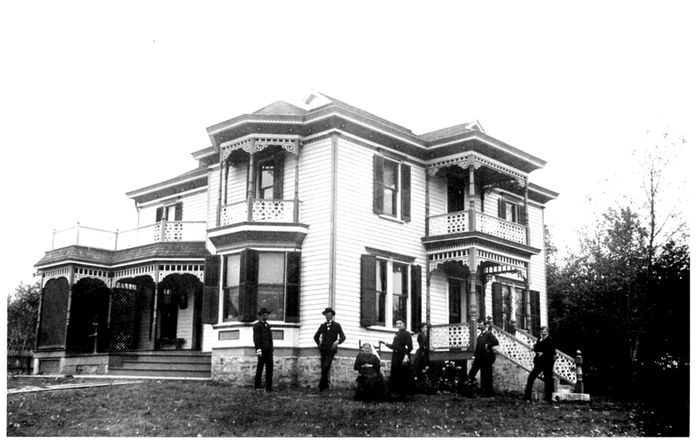
THE SUTTER HOMESTEAD William A. Sutter, Owner.
841William Sutter was born October 18, 1856, on a farm in Walnut township, a son of Frederick and Fredericka Sutter, natives of Germany, and pioneer settlers in the town of old Sumner. (See biography of Fred Sutter for further details.) William Sutter accompanied his parents to Benton township in 1880, and assisted his father in the accumulation of his large estate and cared for his parents until their deaths. After his father’s death he continued to reside on the old home place and tilled the farm of which he is now the sole owner.
He was married October 18, 1915, to Miss Dorothy Nickle, of Muscotah, Atchison county, a daughter of William Nickle, an old resident of Atchison county. After a honeymoon trip to the Panama-Pacific Exposition and Pacific coast points extending into old Mexico, covering a period of nearly two months, Mr. and Mrs. Sutter returned to the home farm, near Effingham.
Mr. Sutter is a Republican in politics, is a member of the Presbyterian church and is affiliated with the Central Protective Association and the Independent Order of Odd Fellows. He is truly a product of the pioneer days in Atchison county, and in his youth knew what real hardships were and assisted in the struggle to achieve a comfortable competence for the Sutter family in common, and has had the satisfaction of seeing the family fortunes increase as the years have passed, and seeing his home county improve with age and gain in prestige and wealth. He is a genial, popular gentleman, who has a deep and abiding love for the county which he has helped to develop and is proud of the fact that he was one of those who assisted in its upbuilding.
JAMES ISHAM HOLMES.
James Isham Holmes, of Shannon township, Atchison county, is a pioneer of eastern Kansas and western Missouri, and for seventy-three years has lived within a radius of twelve miles from Atchison. He is a native of Indiana and was born in Putnam county March 22, 1841. He is a son of William and Nancy (Hartsock) Holmes, the former a native of England, born in 1812, and the latter a native of Germany. William Holmes, the father, immigrated from England with his parents when he was a small boy. The family located in Kentucky, where they remained but a short time when they removed to 842Indiana, and in 1842 they removed to Buchanan county, Missouri, and located near St. Joseph. The father was a cooper and worked at his trade for a short time at Rushville, Mo., and in the spring of 1843 he settled one mile south of Dekalb, where he conducted a cooper shop for eight years. He then bought a farm three miles north of Dekalb, where he followed farming for twelve years, or until 1863, when he traded his place for a farm in Doniphan county, Kansas. Three years later he sold his Doniphan county farm and removed to Atchison, where he spent the remainder of his life in retirement.
William and Nancy (Hartsock) Holmes were the parents of the following children: John William, Eliza Ann, Peter, Alfred; James Isham, the subject of this sketch; John, Francis, Marion, Loma, Ann, Perry, Praeter B., Isaac, Susan Ann, Lethia Maria, Joseph, and Henry.
James Isham Holmes was reared amid the pioneer surroundings of the times and received such education as was available under the conditions, and when twenty-two years old went to Doniphan county, Kansas, where he worked in a flouring mill one year. He was then engaged in various vocations, including farming, cutting cordwood, railroading and lumbering, when he engaged in breaking prairie in the vicinity of Atchison. He followed that vocation for some time when he engaged in farming in Atchison county. He sold his farm in 1868 and shortly afterwards bought another place of eighty acres, and bought more land as the opportunity offered, and now owns a fine farm of 240 acres, where he has resided for the past forty years. He is one of the successful farmers of Atchison county and has prospered.
Mr. Holmes has been twice married. His first wife was Rose Ann Wood, to whom he was married in 1861. She died February 9, 1862, leaving one child, William H., who resides in Atchison. His second marriage took place September 17, 1863, to Jemima E. Pruitt, a Missouri girl, born in 1844. Three children were born to this union: Perry, a railroad man, residing in Salt Lake City, Utah; Nancy Emily, now deceased; Minnie married Mr. Bisel, and is now deceased. She was the mother of three children, Lawrence, Milburn, and Othello.
Mr. Holmes has been a student of men and affairs all his life. He has read extensively during his entire life and is one of the best posted men on general topics in Atchison county. He is a typical representative of the American pioneer who courageously conquered the wild and unbroken West and made of it the great agricultural and commercial empire that it is. He and his accomplished wife, who has been his helpmate and companion for more than a half century, are now spending the sunset of their lives in peace and comfort in their beautiful home which their industry has provided.
843
EDWIN TAYLOR SHELLY, M. D.
For thirty-five years Dr. Edwin Taylor Shelly has been a successful medical practitioner in the city of Atchison. Dr. Shelly was born in Quakertown, Pa., February 6, 1859, and is a son of William N. and Anna (Taylor) Shelly, both of whom were natives of Bucks county, Pennsylvania. Rev. William N. Shelly, the father, was a United Brethren minister, whose ancestors came originally from Saxony, Germany, in 1765 and settled in Montgomery county, Pennsylvania. He departed this life in 1893, at the age of seventy-nine years. Mrs. Anna (Taylor) Shelly died in 1881, at the age of sixty-four years.
Edwin Taylor Shelly was the only child by the second marriage of Rev. William N. Shelly. He received his early education in the Quakertown high school and then taught school for two years. He began the study of medicine in the medical department of the University of Pennsylvania in 1878, graduating therefrom in 1881. After practicing his profession for a few months in his home county Dr. Shelly removed to Eden, Kan., where he practiced for three years. He then moved to Huron, Kan., where he remained for two years, previous to locating in Atchison in May, 1886, where he has since maintained offices.
Dr. Shelly is a member of the Missouri Valley Medical Society, the Atchison County Medical Society, the Kansas State, and the American Medical associations, and is a member of the Kansas Academy of Science and the American Association for the Advancement of Science. He has twice served as president of the Northeastern Kansas Medical Association. He has endeavored to keep pace with the progress made in his life profession and has pursued post-graduate courses in the University of Pennsylvania, the Post-Graduate School of Chicago, and the Sloan Maternity Hospital of New York City. Dr. Shelly has been an occasional contributor to the various medical journals, and articles from his pen have appeared in the Journal of the American Medical Association, the New York Medical Record, and other medical publications. He has always devoted himself exclusively to the practice of his profession. In politics, the Doctor is an independent Democrat, and has always taken a great deal of interest in civic and economic questions.
Dr. Shelly has been twice married, his first marriage occurring in 1885 with Miss Mary A. Schletzbaum, of Eden, who died in 1897, leaving two sons, namely: William L., a farmer, residing on rural route No. 1, south of Atchison, and who is a graduate of the Manhattan Agricultural College; Ralph A., a graduate of the engineering department of Manhattan College, and now 844employed in the Buick automobile factory at Flint, Mich. His second marriage was with Miss Lillie E. Allen, of Atchison, in 1899. To this union have been born two children, Esther, aged thirteen years, and Allen Parker, seven years old.
EDGAR WATSON HOWE.
Edgar Watson Howe, journalist and author, was born at Treaty, Wabash county, Indiana, May 3, 1854, a son of Henry and Elizabeth (Irwin) Howe. In 1857 the Howe family moved to Harrison county, Missouri, where Edgar was educated in the common schools until twelve years of age, when he began working in his father’s printing office. Henry Howe, a Methodist minister, was described as a “fierce abolitionist,” and published a paper at Bethany, Mo. At the age of fourteen the strict discipline of his erratic father became too much for the spirit of the boy and he left home. E. W. Howe is next heard of in Golden, Colo., as editor and publisher of the Weekly Globe, at the age of eighteen. A year or so afterward he was connected with a paper at Falls City, Neb., where in 1875 he married Miss Clara L. Frank. Five children were born to this union, and three are living. In 1877 Mr. Howe came to Atchison, Kan., where he established the Atchison Globe. This paper was not long in finding its way to recognition among the newspapers of Kansas on account of the personality injected into it by its editor, and for more than thirty years it has been one of the most widely quoted publications in the whole country. The recent edition of the Encyclopedia Brittanica refers to it. Mr. Howe has the happy faculty of being personal in his comments without giving offense. The informal way of dealing with matters in his paper has always been relished by Kansans and has attracted favorable comment in the more conventional parts of the country. The magazines, in reproducing some of his refreshing paragraphs, have referred to “Ed” Howe as the best country-town newspaper reporter in America. He has the faculty of seeking the points overlooked by the majority and of working them up into paragraphs having a combination of sarcasm and good humor that is irresistible.
Mr. Howe’s first work of fiction was “The Story of a Country Town,” published in 1882, which has been for more than a quarter of a century among the standard books of America. It has been classed by such eminent critics as William Dean Howells as one of the ten best American novels. This book did not run its course as the average popular novel does; its human interest 845has taken lasting hold on the public. Other works of fiction which Mr. Howe has since written are: “The Moonlight Boy,” “The Mystery of the Locks,” “An Ante-mortem Statement,” “The Confession of John Whitlock.” His “Lay Sermons” contain a great deal of good, sound philosophy of life, and from the pages of this book may he deducted a very practical code of ethics. In 1900, at the time Dr. Sheldon edited the Daily Capital in Topeka for a week in the way he thought Christ would do, Mr. Howe added to the gayety of Nations by accepting an invitation from the Topeka State Journal and running it for a week the way he thought the devil would run a newspaper.
In 1906 Mr. Howe made a long trip abroad, which resulted in “Daily Notes of a Trip Around the World,” in two volumes, which has been praised as highly as any book of travels in recent years. Two years later he wrote “The Trip to the West Indies,” as a result of a winter cruise. His latest book is “Country Town Sayings,” a collection of his paragraphs in the Atchison Globe.
Mr. Howe’s country home at Atchison is one of the most carefully and artistically arranged homes in the State. It is a bungalow, overlooking what is said to be one of the three finest views in Kansas. It was built by its owner as a place to retire when he became old, as he believes that too many people stand around in other people’s way. True to his instinct of the unusual he named it “Potato Hill.” At the age of fifty-six years he retired from active management of the Globe. It was predicted by those familiar with his tireless energy as a newspaper man that he would soon be back at his desk in the Globe office, but such was not the case. After revising the “Story of a Country Town” for the stage he began the publication of Howe’s Monthly, which, within a few months became the western rival of the Phillistine, published at East Aurora, N. Y., and is considered by many to have out-classed Elbert Hubbard’s magazine. The Edward Howe paragraphs have been syndicated, and appear in the leading dailies of the country. In an attempt to account for the popularity of these paragraphs and the other writings of Mr. Howe, Walt Mason in the American Magazine, says: “There is always, in everything Ed. Howe writes, the element of the unexpected. It is present in all his books—one of which ranks with the best in American fiction—and it is in his briefest paragraphs, and that is why he is inimitable. Others may adopt his style and mannerisms, but they can’t borrow the strange, original intelligence that eternally ignores the obvious and seizes upon the bizarre, showing how much of the bizarre there is in every-day commonplace life.”
846The personality of Mr. Howe as described by those who know him best, is that of a quiet, courteous gentleman, amiable and kind to all. His patience in teaching the young reporter and his indulgent ignoring of the mistakes of his office force, have been frequently remarked upon. It is said that he never discharged anyone, but always assisted them to make good. To those who have been associated with him he is a greater man than he is to those who only know him through the printed page, and the longer and closer the acquaintance, the more remarkable seems his genius.
WILLIAM F. SPEER.
William F. Speer showed his good judgment in coming to Kansas. It was not his fault that he was not born in the great Sunflower State, but he immediately recognized that the next best thing to being a native born “Jayhawker” was to spend as many years as possible in the prosperous State, and although he was only three months old at the time he has never had occasion to reverse his judgment. In fact, he likes it better every year, and in all the fifty-five years he has lived in Kansas he has always held to his first preference for Kansas territory.
William F. Speer was born January 8, 1860, but when spring came his parents, Joseph and Mary (Fountain) Speer, whose history is written under the name of Anna D. Speer, a sister, came to Atchison county, Kansas, from their former home in Madison county, Iowa. The parents settled on the farm which William Speer now owns and brought him up in the way he should go, including some schooling at the district school house. His meagre time in school was only a breathing spell for the heavier duties which awaited him on his father’s farm, and William was early drafted for service and had to help along with his eight brothers and sisters. When the father’s estate was divided he bought the home place of 160 acres, which he has improved a great deal since that time.
In 1889 Mr. Speer married Cora Spangler, who was born March 6, 1866, in Malden, Ill. She was the daughter of LeRoy and Lucendia (Smith) Spangler, both natives of Ohio, who came to Brown county, Kansas in 1870, where they remained until 1876, when they moved to Grasshopper township, Atchison county. They moved to Edmond, Okla., in 1900. The father died in 1913, at the age of seventy-four years, and the mother passed away in 1906, at the age of sixty-seven years. Mr. and Mrs. Spangler had six children, 847as follows: Alfred, of Marion county, Kansas; George, of Edmond, Okla.; Cora, the wife of William Speer; Joseph, deceased; Curtis and Irvin, of Kansas City, Mo. Mr. and Mrs. Speer have seven children, all of whom are living at home, with the exception of Ralph, who is manager of the Muscotah farmers’ elevator. The children living at home are: Lela, LeRoy, Lucy, Anna Belle, Frank, and Marjorie.
EDMUND BULLOCK.
Edmund Bullock, late of Muscotah, Kan., was born in January, 1838, at Cornwall, England, and departed this life July 27, 1892. He was a son of Frank Bullock, who with his family immigrated to Canada in 1846, and crossed the border to become a resident of the United States in 1853, finally settling in Wisconsin. Edmund was reared to young manhood in Wisconsin, and married there in 1869. Three years later, in 1872, he and his young wife came to Kansas, settling in Muscotah, Atchison county. Edmund Bullock was a skilled tinsmith, and his first work in Muscotah was the opening of a small shop which served as a place to ply his trade, and also as their home for some time. He prospered as time went on and added a stock of stoves and tinware, and later established a larger store and carried hardware of all kinds in stock. For several years after coming to Muscotah he made all of the tinware sold from his shop. For the first five years of their residence in Muscotah the tin shop was divided and half of it served as a residence for Mr. and Mrs. Bullock. A sister of Mrs. Bullock lived with them and conducted a millinery store in the living room. Mr. Bullock first worked in Greenleaf, Kan., when he came west, and Mrs. Bullock stayed with friends in Frankfort. He heard of Muscotah and decided to locate here.