Chapter XXV · BIOGRAPHICAL HISTORY (continued 7)
Reading edition
562Mr. Sharpless is affiliated with the Ancient Free and Accepted Masons, Blue Lodge, No. 48, and is a Knights Templar and Royal Arch Mason. He is past noble grand of Spartan Lodge, No. 250, Independent Order of Odd Fellows, of Effingham, Kan., and is a member of the Modern Woodmen of America, of the latter city. He is also fraternally allied with the Benevolent and Protective Order of Elks, the Fraternal Order of Eagles, and the Fraternal Aid Union of Atchison.
CONRAD M. VOELKER.
It is certainly a distinction to be known as the youngest county clerk, and in all probability the youngest county official ever elected in the State of Kansas. Such is C. M. Voelker, the efficient and justly popular county clerk of Atchison county. Political honors and preferment rarely come to a really young man, unless he is especially qualified for the work, and has a host of friends who are willing and able to support him and his candidacy. Although young in years, Mr. Voelker is performing his duties in a manner which would reflect distinct credit upon an older individual.
Conrad M. Voelker is a native of Atchison county, having been born May 20, 1889, on a farm, four miles north of Atchison, in Shannon township. His father is Conrad Walker, who was born in Germany November 20, 1856, a son of Karl and Christiana Voelker, who immigrated to America in 1861, and settled on a farm, two miles north of the city, where he operated a dairy and truck farm until his demise. To Karl and Christiana Voelker were born the following children: Conrad; Mrs. Joseph Biddle, of Atchison; Henry, residing in New Orleans; Karl Voelker was twice married, Mrs. S. L. Loyd, of Shannon township, being a daughter of the second marriage. Conrad, father of C. M. Voelker, was reared to manhood in Atchison county, and when he became of age, settled on a 160 acre farm, four miles north of Atchison, which is now one of the best improved farms in the State of Kansas. For a number of years he specialized in the cultivation of cabbage, making a success of the venture, and accumulated considerable money. He became known far and wide as the “Cabbage King” of Kansas, always having the first cabbage on the market, and shipped the product of his fields to points in Kansas and Nebraska in carload lots. The Voelkers have a beautiful, well appointed home, with excellent out buildings. Conrad Voelker married Jennie Mueller, who was born in Cooper county, Missouri, November 56315, 1862, a daughter of German parents. To Conrad Voelker and wife were born the following children: Fred C. W., a farmer, living north of Atchison; Conrad M. The Voelkers are members of the Lutheran church.
Conrad M., with whom this narrative is directly concerned, was educated primarily in the district schools, his education being supplemented with one year’s study in the German school in Atchison, and a course in Midland College, where he was graduated with the degree of Bachelor of Science in 1909. He then completed a course in commerce and bookkeeping in the Atchison Business College. While a sophomore of Midland College he won first honors in the oratorical contest, and represented his alma mater at the State oratorical contest, held in Salina, Kan. While yet a student he received the appointment of deputy county clerk under Edward Iverson, March 13, 1910. He was elected to the office on the Republican ticket in November, 1912, and again elected without any opposition in the fall of 1914.
A more intimate personal view of this rising young man was published in the Atchison Champion just previous to assuming the duties of his office after his election:
“Conrad M. Voelker, county clerk elect, when he takes office January 1, 1913, will have the distinction of being the youngest man ever elected to the office of county clerk in Kansas. Mr. Voelker, while he appears to be much older, is but twenty-three years old. He is popular; this was proven by the fact that he was elected by a majority of 955 votes.
“Mr. Voelker is the son of Conrad Voelker. He was born four miles north of Atchison. He never passes up an opportunity to learn something. When four years old Mr. Voelker started to school. He was graduated from the eighth grade at ten years of age, and in 1909 he was graduated from Midland College. When he finished the common schools he studied in a German school for one year; so he both reads and writes German. He completed a double course at the Atchison Business College in five months, graduating in March, 1910, and a few days later he was appointed deputy county clerk. When Mr. Voelker was eighteen years of age he took part in the Kansas intercollegiate oratorical contest, which was held at Salina. There were nineteen other contestants, several of them being men twice the age of Voelker, who were going through college for the second time. Voelker won fourth place in the contest, which in addition to being quite an honor, demonstrated that he has great ability as a public speaker.
“There is no doubt that he will be re-elected two years hence. He undoubtedly will prove to be one of the most efficient county clerks in the history of the county.”
564The last paragraph was prophetic, as Mr. Voelker’s second election to the office in 1914 will testify. His re-election was the best evidence of his success and strong personal popularity. Mr. Voelker is affiliated with several fraternal societies, an active party worker, what is known as a good mixer, and a rising young citizen of the county, whose future career will be well worth watching, inasmuch as he is bound to gain greater honors in the years to come, and to climb to a still higher place in the civic life of his home county and State.
SAMUEL S. KING.
Samuel S. King, a member of the board of county commissioners of Atchison county, was born in Moorestown, N. J., May 16, 1856. One year later, in 1857, he came to Atchison with his parents, John and Violet King, on a boat owned by Dr. Challiss. The King family arrived at Atchison in April of 1857. John King soon afterward settled on a farm six miles southwest of Atchison, where Samuel S. lived until he was fifteen years of age. He then came to Atchison for the purpose of attending the city schools. During vacations he worked for McPike & Allen (later McPike & Fox). After finishing his public school education Mr. King was employed as bookkeeper for some time by White, Washer & King, now the S. R. Washer Grain Company. He was also employed as bookkeeper by McPike & Fox, W. F. Dolan and others until 1881. In that year he was appointed by Senator John J. Ingalls to a position in the United States railway mail service and was sent to New Mexico and Arizona as railway mail agent. Here he remained in the United States Government service for about two years and then resigned to enter the employ of P. B. Brannen & Company as bookkeeper and manager at Flagstaff, Ariz. This firm conducted a jobbing house at Flagstaff which was then the largest town on the railroad between Albuquerque, N. M., and Los Angeles, Cal. In June, 1886, he and his family returned to Atchison and Mr. King became the confidential bookkeeper of McPike & Fox, wholesale druggists, and remained with this concern until the fall of 1897, when he resigned to take up his duties as county clerk.
Mr. King had always been more or less interested in politics and he was elected to the office of county clerk on the Republican ticket in the fall of 1897. He was subsequently reëlected and held the office for nine years, or until January, 1907. He then engaged in the real estate and insurance business which he still follows with offices at 106 North Fifth street. Mr. 565King was elected mayor of the city of Atchison in April, 1907, and served as the city executive for two years, and later was appointed city clerk to fill out the unexpired term of C. A. Hawk, who resigned. In the fall of 1914 he was elected county commissioner, an office which he is at present filling in a capable and efficient manner.
Mr. King was married April 14, 1885, at Flagstaff, Ariz., to Miss Sarah Hawks, of Newton, Kan. Two children have been born of this marriage, namely, Grace and Victor. Mr. King is affiliated with the Ancient Free and Accepted Masons, the Benevolent and Protective Order of Elks, the Fraternal Order of Eagles, of which lodge he is a trustee, the Modern Woodmen of America, the Ancient Order of United Workmen, the Mystic Workers, and the Central Protective Association. There are few citizens who are more highly esteemed, and Atchison county has not a more popular public official than S. S. King.
CHARLES T. GUNDY.
This history of Atchison county is issued not only for the purpose of inscribing a record of those who have built up the county and were here during the pioneer days and endured the hardships of the pioneer life, but for recording as well the life stories of those who came later and have won places of merit and distinction in the affairs of the city and county of Atchison. It is probable that few men have attained such eminence as Judge Charles T. Gundy of the city court of Atchison during his brief residence here. The esteem in which he is held and the successful manner in which he has performed the duties of his judicial position are decided evidences of his ability. His standing among the members of the legal fraternity is high and he well merits the confidence of his fellow citizens. The conduct of his court is marked for the fairness of his decisions in suits of equity and the settlement of such cases as come under his jurisdiction have been accomplished to the satisfaction of the parties concerned.
Judge Charles T. Gundy is a native of Scotland county, Missouri, and he was born and reared on his father’s farm, eight miles northwest of the thriving and progressive city of Memphis. He evinces much of the characteristics of the good people of Scotland county, who are noted for their hospitality and kindliness. He was born February 10, 1878, and is a son of George M. and Margaret M. (Needham) Gundy, natives of Illinois and Missouri, respectively. George M. Gundy was born in 1845 and is a son of Jacob Gundy, a native of Holland, who settled in Scotland County, Missouri, as early 566as 1846. George M. still resides on the old home place of the Gundy family. This farm consists of 160 acres of well tilled land on which have been reared six children out of a family of seven, as follows: Charles T., with whom this review is directly concerned; Louis W. and Jacob R., farmers of Scotland county, Missouri; Mrs. Corda Crawford, of Scotland county; Gladys, deceased; Pearl and Merl at home with their parents. The mother of these children is a native of Scotland county, and was born in 1858, a daughter of David Needham, a veteran of the Civil war and a scion of an old Kentucky family. He served three years as a soldier in the late rebellion, and after returning home met an accidental death by a falling tree. The ancestral home of the Needhams is near Frankfort, Ky. The Gundy family is held in high esteem in their home county and the members of the family are well respected by their friends and acquaintances.
Charles T. Gundy was educated in the rural schools and attended the Memphis Academy for one year. Circumstances were such that he found it necessary to do considerable studying at home and “burned the midnight oil” in the pursuit of an education. He fitted himself for teaching and taught for four years in the schools of his native county. In the meantime he read law and was successful in being admitted to the bar in 1902. For three years thereafter he practiced his profession in Memphis. He then secured a Government position in the postoffice department at Washington, D. C., and pursued his law studies in the National University at Washington. He graduated from that institution May 30, 1908. Having small desire to become a mere cog in a great machine, as seemed to be the lot of thousands of Government employes, he resigned his position in October of the same year and located in Keokuk, Iowa, and had charge of the farm loan department of the State Central Savings Bank. He resigned this position in March of 1910 and came to Atchison, opening an office in the Auld building on Commercial street. Since this time he has built up an excellent practice. He was appointed city judge in December of 1910 to fill a vacancy caused by the resignation of Judge J. P. Adams. He was elected to the office in 1912 and again elected in 1914.
Judge Gundy was united in marriage with Eleanor M. McCormick on August 12, 1909. Mrs. Gundy was a resident of Washington, D. C., and is a daughter of John McCormick, who died in 1905. Judge Gundy is a member of the Baptist church and he and Mrs. Gundy have a wide circle of friends who esteem them for their many likable qualities.
The Republican party has always claimed the allegiance of Judge Gundy and he takes an active and influential interest in political affairs.
567
LOUIS R. KUEHNHOFF.
Louis R. Kuehnhoff, farmer and stockman, of Lancaster township, Atchison county, Kansas, was born January 1, 1880, on the farm where he now resides. He is a son of Charles and Caroline Kuehnhoff, and is one of nine children, six of whom are living. The father was born in Germany in 1841, and left there when a boy of sixteen years and sailed for New York. He remained there a short time when he went west, arriving at St. Joseph, Mo. He had not been there very long when the Civil war broke out and he enlisted at St. Joseph in Company B of the Volunteer infantry. After the war was over he was mustered out at Lexington, Mo., having won a praiseworthy military record in his country’s service. He then returned to civil life in St. Joseph, Mo., where he worked for a time as a laborer, receiving eight dollars a month. Shortly afterward he came to Atchison county, Kansas, and bought eighty acres of land in section 10, Lancaster township. Using oxen, he broke the ground on his newly acquired farm and began to improve it as rapidly as his resources would permit. In 1894 he retired and went to live at the National Soldiers’ Home at Leavenworth, Kan., where he died in 1903. The mother was born in Germany in 1845, and died in 1899.
Louis R. Kuehnhoff grew up on his father’s farm, and attended Eden district school, and also District No. 3, Lancaster township. He remained at home until he was nineteen years of age, and the next five years worked as a farm hand, and then he bought the old home place of 200 acres. Louis Kuehnhoff is an industrious worker. He keeps graded stock of all kinds and takes a special interest in fine mules. He always attends the county fairs in Atchison county and occasionally makes entries. On April 26, 1905, he was married to Lena Werner, who was born in Germany November 2, 1881. Her parents were John and Marie (Earhart) Werner. The father was born in Germany in 1815. He belonged to the Masonic lodge in Germany. In 1889, when he was quite an old man, he came to America and settled at Leavenworth, where he died in 1891. The mother was born in Germany January 17, 1843, and is now living with her children, of whom there are six, as follows: Adam, teamster, Leavenworth, Kan.; Martha Nolan, deceased; Lizzie Loman, Bowling, Kan.; Katherine Weimer, Wallula, Wyandotte county, Kansas; Lena, wife of Mr. Kuehnhoff, of this review. Mrs. Kuehnhoff attended the Pleasant Ridge school and the German school, north of Potter, Kan. She is a good, loyal, hard-working mother, and has three children: Marie, Edna and Edwin. The last two are twins and are three years old. In politics Mr. Kuehnhoff is independent. He is a member of the Independent 568Order of Odd Fellows. He is a progressive farmer and is constantly on the lookout for improvements in agricultural methods. He has a fine eight-room house and a large barn equipped with modern conveniences. He also has a stone milk-house which was built by his father years ago. He has a small but thriving orchard and has twelve head of fine cattle. Besides these, he has four horses and a span of excellent mules. Mr. Kuehnhoff takes a lively interest in his stock and in his farm generally.
BENJAMIN FRANKLIN SANDERS.
All honor to the pioneer settlers of Kansas. It was they who broke the way in the unpeopled wilderness and endured the hardships and privations on the frontier of advancing civilization in order that the path of empire might be pushed steadily westward, ever onward toward the setting sun. Their work is done; the halcyon pioneer days when this broad land was but a vast unbroken wilderness of waving prairie grass, dotted here and there with belts of timber along the streams, is no more; towns and cities have sprung up; the locomotive shrieks its way over the ribbon-like rails, hauling the products of the land to the millions in need of sustenance, where once the hardy freighters drove their mule teams and guarded the precious freight overland to the homes of the settlers in the West. Benjamin Franklin Sanders is one of the few remaining members of the “old guard,” who sixty years ago began the task of reclaiming a wilderness. He is one of the ranking old pioneer settlers of Atchison county and has lived a record which is thrilling and interesting to a high degree. He is the only living “ye old time fiddler” in Atchison county, who with his comrade was wont to play at the old-time dances and “hoe downs” in northeast Kansas fifty years and more ago.
Benjamin Franklin Sanders is now living retired in Center township, Atchison county. He was born August 8, 1833, in Franklin county, Missouri, and is a son of George and Elizabeth (Graham) Sanders, who were the parents of the following children: Nancy married William McQuillan, and by her second marriage became Mrs. William Burns, and died in Benton county, Missouri; Robert, deceased; Oliver died in Jewell county, Kansas; Lydia married Fred Wilming, and died in Shannon township, Atchison county; William died in Franklin county, Missouri; and Benjamin, the subject of this sketch. Benjamin F. Sanders was sent to the country school in Franklin county, Missouri, but the school was poor and the roads were bad in the winter time, and, altogether, he had little opportunity to learn. His whole time in school, he estimates, did not amount to more than three months. His father was a Kentuckian and followed farming all of his life, and died in 1856, at the age of fifty-five years. The mother was a native of Missouri and of Scotch descent. She died in Kansas, in 1872, at the age of seventy-six years.
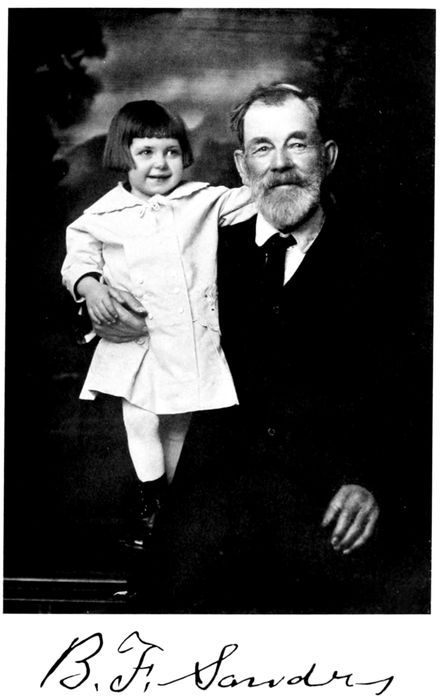
B. F. Sanders B. F. Sanders and His Great-Granddaughter, Gail Maxine Keirns, Daughter of Mr. and Mrs. Art Keirns.
569At the age of twelve Benjamin F. Sanders was apprenticed to a carriage and wagon-maker in St. Louis, Mo. He remained there twelve years, coming to Kansas in 1856. He returned to Missouri for a short time and then came back to Kansas the following year. He opened a wagon-maker’s shop at Monrovia, Atchison county, which he operated for two years. He then engaged in farming, taking up a claim near where Effingham now stands. This was ten miles from any settlement then and Mr. Sanders, fearing that the district would not be settled, gave up his claim and preëmpted eighty acres one and one-half miles north of where he now lives, in Center township, and began his life as a real farmer. He hired a man from Iowa who had six yoke of oxen to break up his land. He lived in the most primitive way during the first years on this place. Coffee, for one thing, was very high in price at that time, and there also was very little money in the territory, so a substitute for coffee was used. They mixed wheat and rye, calling it essence of coffee, and used this as a beverage in place of the regular coffee. It was the same way with flour. When he needed flour he would take a quantity of wheat to the gristmill where it would be ground into coarse flour, nearest mills being at Valley Falls and Kickapoo. His nearest postoffice was at Oceana, just north of Pardee, where the postoffice was located later. In 1860 Mr. Sanders bought more land. At one time he owned as high as 400 acres of land in Center township, Atchison county, Kansas. He went through the whole evolution of civilization, beginning in a little log house on his first eighty acres of land and passed through the wild days of the border war. In 1863 he was a member of Captain Whittaker’s company of Colonel McQuigg’s regiment of the Kansas State militia. He participated in several skirmishes and was honorably discharged at Ft. Leavenworth in 1864.
In 1859 Mr. Sanders married Margaret Ramsey in Putnam county, Ohio, who was born in 1840. She was a daughter of John and Elizabeth (Dorothy) Ramsey, natives of Ohio. She died in 1868, leaving the following children: Ira, farmer, Whiting, Kan.; Bertha (Mrs. C. G. Moore), deceased; William and Little Joy, both deceased. Mr. Sanders was married a second time in 1870 to Mrs. Elizabeth (Ramsey) Keirns, a sister of his first wife. She died 570in May, 1904. She was the widow of Rufus Keirns, and by her last marriage three children were born: Henry R., farmer, Pardee, Kan.; Mrs. Etta C. Browne, Pardee, Kan.; Benjamin, Jr., died when seventeen years of age.
Mr. Sanders is a Republican and a member of the Methodist Episcopal church. He is now living with Arthur Keirns, a son of his step-son. In these days his life is rather quiet compared with the early-day existence which he passed through. Indians camped near his farm when he first came to Kansas. The trail to the Kickapoo reservation passed near his farm and the Indians were constantly traveling back and forth along it. He has a hobby of “fiddling.” He calls himself a “fiddler” in distinction from a violinist. He played at the first corn carnival held in Atchison and won a prize. He used to play with Samuel King, a well known “fiddler,” and they played for all the old “hoe down” or “break down” dances. Although he is eighty-three years old, he still plays his “fiddle” with as much vim as ever and his ear is just as ready as it was when he was a young man. In addition to being a farmer, Mr. Sanders has done a large amount of carpenter work in Kansas. He has built a number of barns and other buildings. Mr. Sanders was elected to the office of township trustee and held the office two terms, having been reëlected at the close of his first term.
KARL AUGUST KAMMER.
Karl August Kammer, farmer and stockman, Lancaster township, Atchison county, Kansas, was born on the farm where he now lives, October 12, 1869, and is a son of Karl and Joehanna (Hida) Kammer. He is one of six children: Joehanna (Gutzman), deceased; Emma (Fuhrman), Lancaster township; Karl, subject of this sketch; Julius, Lancaster township; Bertha H. (Buttron), Lancaster township; one child who died in infancy. The father was born in Germany in 1840. Leaving there in 1862, he came to Atchison county, Kansas, where he worked in a vineyard for two years. The following four years he was employed in a brewery at Atchison, and then farmed two years in Lancaster township. At that time he had a chance to buy 160 acres in section 16 of Lancaster township, and with the aid of a partner, the land was bought. He built a one-room shanty and a thatched barn, and broke prairie with the oxen and planted the first crop. Later a better house and barn were built, and gradually, other improvements were added and a fine orchard planted. At the time of his death, in October, 1910, Mr. Kammer 571owned 240 acres of land. The mother was born in Germany, February 20, 1840, and married in her native land just before coming to America. She died in 1904.
Karl Kammer, the subject of this sketch, was reared on his father’s farm in Lancaster township. He attended High Prairie district school, No. 3, and remained on the home farm until he was twenty-six years old, when he rented some land from his father, and six years later he was able to buy the land he had been renting. He improved the farm considerably and stocked it with graded cattle, and now has an excellent farm, modern in every respect, consisting of 160 acres of land, and also has a fine orchard of two acres.
Mr. Kammer was married October 23, 1895, to Emma Buttron, a native of Lancaster township, Atchison county, born August 14, 1870. She is a daughter of Henry and Rosa (Scheu) Buttron, the father a native of Germany, born in 1833. When a young man he left his native land and came to America, locating in Pennsylvania where he worked as a blacksmith. From there he went to Elgin, Ill., and continued at his trade, and in 1857, he moved to Atchison, Kan., following blacksmithing for a short time. He then preëmpted 160 acres of land in Lancaster township, where he built a house. The first crop was destroyed by grasshoppers, and he was forced to return to his trade during the following winter. When spring came, he went back to his farm and that year was successful and his start was assured. Mr. Buttron bought more land and continued to make improvements, and after a long and prosperous career he died in 1914. Mr. and Mrs. Kammer are the parents of three children: Katherine, Rosa and Henrietta, all living at home with their parents. Mr. Kammer is a Republican, and is a member of the Independent Order of Odd Fellows. Mr. and Mrs. Kammer and family are members of the Evangelical Lutheran church of High Prairie neighborhood.
MARSHALL J. CLOYES.
The demise of Marshall J. Cloyes May 5, 1915, marked the passing of one of the sturdy figures who assisted in developing Atchison county, and was one of the grand old men of the city. At the time of his death he was probably the oldest living pioneer settler of Atchison county, in point of age and years of residence in the county. For over half a century he had been one of the well known and distinguished characters whom people trusted and respected. In the days when strong men were required to redeem a wilderness 572and make it habitable for men and their progeny, Marshall Cloyes was one of those who never gave up the fight. During the terrible drought of 1860, when scores of families deserted their homes and left the State, he and his family were among those who decided to remain and win out over the vagaries of nature. His faith in the future of Kansas was amply justified as the years rolled on and ever increasing prosperity came to him and his, as a just and equitable reward for a faith and confidence bestowed upon the new country during a time which tried men’s souls and caused weaker mortals to give up the fight.
He was born at Salisbury, Vt., October 24, 1826, and descended from sturdy New England ancestry. His parents were Elijah and Mary (Beach) Cloyes. On his father’s side his ancestry can be traced back in the centuries to two brothers who settled in New England in the seventeenth century. His grandfather was William Cloyes, who fought for his country in the War of 1812. The boyhood days of Marshall were spent in the town of Salisbury, where he attended the public schools and later pursued his education in a private school. He learned the trade of shoemaker but did not follow it to any great extent. In 1847 he engaged in the lumber business at Ripton, Vt., and was there for twelve years prior to coming to Kansas. From the town in which he was born he came to Kansas, arriving here in Atchison June 2, 1859. The following autumn his wife and sons followed him and during the ensuing winter the family lived in a two room hut, on the rear of the lots where Mrs. Jacob Leu’s residence now stands. On February 21, 1860, they loaded all their goods in a wagon, and with an ox team moved to a farm north of Lancaster. During the night an old-time Kansas blizzard gave them a cold reception in their new home. When Mr. Cloyes had agreed to pay $650 for his first quarter section of land he was still shy $2.50 of the necessary amount, and was forced to borrow this small sum from a kind neighbor. During the following summer he worked in Oliver Davis’ sawmill and got enough lumber to build a shanty on his farm. While this was building the family lived in two rooms in the home of John S. Rust. In the fall of the bad year of 1860, Mr. Cloyes decided to try to cash in on the reputation he had left behind him in Vermont, and applied to an uncle for a loan of $400. The uncle readily responded with the statement in his letter, “If you are ever able, I know you will pay it back; if you are never able to pay it back I can get along without it.” During the summer Mr. Cloyes put in his spare time cutting prairie hay and stacking it. When fall and winter came on, the returning freighters from Pike’s Peak were willing to sell their oxen and wagons for almost any price. Mr. Cloyes invested a part of his $400 capital in these outfits, wintered the 573cattle on the hay, and in the spring was able to dispose of the oxen for more than double the purchase prices. During the next two years he was enabled to pay off all of his debts, and prosperity attended his efforts from that time on. By the hard work and good management of himself and his two sons he increased his holdings to an entire section of land. He remained on the farm until 1872, then gave the farm to his sons and removed to a home at 417 North Seventh street in Atchison.
On July 5, 1848, Mr. Cloyes was married to Miss Betsy Henderson, of Middlebury, Vt., who died in Atchison in 1893, leaving two sons, Frank E. and Mark S. On September 15, 1909, he took a second wife, the bride being this time Mrs. Matilda Franke, of Atchison. She was born at Thuringen, Germany, November 16, 1855, a daughter of John and Christiana (Temme) Franke, who immigrated to America in 1858, making the long sea voyage in a sailing vessel which took six long weeks to make a trip, which is now made in six days. From New York City the Frankes came directly to St. Louis, and there made their home until their removal to Atchison. At the outbreak of the Civil war, John Franke volunteered his services in defense of the Union which had given him a home. He served in a Missouri regiment of volunteers for one year, and was then discharged on account of serious disability, caused by the hardships which he had undergone. He was never the same man afterwards, and died in 1865 as a direct result of his disabilities incurred in behalf of his adopted country. The mother and family lived in St. Louis until 1883 when they removed to Atchison. Mrs. Franke died some years later at the home of her daughter, Mrs. Cloyes. Matilda Franke was first married to Theo A. Franke, a native of Saxony, Germany, in 1879, and who came to America when a youth of eighteen years of age, and settled in Pittsburgh, Penn. Theo A. Franke was also a veteran of the Civil war, having enlisted in 1861 in Company D, Seventy-fourth regiment, Pennsylvania infantry. He served throughout the great conflict and was wounded several times while participating in the battles fought by the Army of the Potomac. He enlisted again, after being discharged on account of a serious wound, and was a brave and valiant soldier who fought for sheer love of his adopted country. Mr. Franke’s first trip to Atchison was made in 1859, but he returned to Pittsburg upon the outbreak of the Civil war and there proffered his services as stated above. He returned to Atchison after the close of the war and here met, in the course of years, Matilda, who was visiting friends in Atchison. Their acquaintance ripened into a warm friendship which gave place to love and they were married March 10, 1879. A happy wedded life endured until Mr. Franke’s death in 1882. Children blessed this union as 574follows: Rose M., wife of Bert Gilmore, an electrician of Atchison; Elsa, wife of Fred Moore, a railway engineer of Falls City, Neb.; Theo Franke, of Pierce, Ariz. During Mr. Franke’s first year of residence in Atchison he was a freighter across the plains. Upon his return in 1865 he entered the grocery business and prospered, accumulating considerable property interests. He was well known in Atchison and was considered to be one of the city’s most substantial men.
Mr. Cloyes was prominently identified with the political affairs of the county and was an influential leader of the Republican party for many years. Even before coming to Atchison from the farm he had taken an active interest in politics in his home township and county. He was elected to represent his district in the State legislature in 1867, leaving the impress of his individuality upon laws passed in the following session. For eight years he served in the Atchison city council and in 1891 was elected mayor. Two years later he was reëlected. Honorable and thoroughly upright in all his dealings, his administrations were characterized by integrity, sound judgment and an unusual amount of good sense. He was a member of Washington Lodge, No. 5, Ancient Free and Accepted Masons, and all who knew him respected him for his sterling worth.
MARK D. SNYDER.
Mark D. Snyder, retired farmer, living in Monrovia, Atchison county, Kansas, is a native son of Kansas, having been born in Atchison county November 2, 1858. He is a son of Hon. Solomon J. H. Snyder, one of the influential figures of the early pioneer days of Kansas, and who was a stanch and uncompromising adherent of the Free State principles. The father of Mark D. was born in Washington county, Maryland, February 7, 1812, and died at Monrovia, Atchison county, November 28, 1873. When eight years of age he accompanied his father to Tuscarawas county, Ohio, where he was educated in the district schools and a graded school at Canton, Ohio. Between 1830 and 1833 he cleared a farm of 160 acres of heavily timbered land. In 1838 he married Susan Winklepleck and then cleared and cultivated a tract of timber land which he purchased until 1848. His wife died in that year, leaving him with three small children. He sold all of his holdings, placed his children with neighborhood families and then traveled 4,000 miles in an endeavor to forget his great loss and overcome his grief over 575the death of his wife. Later, he married Eliza Fisher, and in 1852 removed to Indiana, and then came west to Ft. Leavenworth in 1854. On the morning of May 4, 1854, he made the first legal homestead claim ever entered in the State of Kansas, comprising the land upon which the southern part of the city of Leavenworth now stands, and then returned to Indiana for his family. On his return to his homestead he found his claim “jumped” and the country in the hands of border ruffians. He was driven from the polls at the first election held in the Territory on account of his Free Soil principles. Two other claims which he bought were wrested from him by a pro-slavery “squatter court,” his life threatened, and he sought refuge in an unsettled part of the State where Monrovia now stands. Here he made his home and became prominently identified with the politics of the new State of Kansas. In 1862 Mr. Snyder was elected to the State legislature and served for two terms in the house of representatives, and one in the senate, where he did faithful and conscientious work in behalf of the people of Kansas.
Solomon J. H. Snyder was a devoted Christian, and was one of the organizers of the first Lutheran church organization in the State, at Monrovia, of which he remained a member until his demise. He was a great Sunday school worker and wrote two very interesting and valuable Sunday school books, “The Lost Children” and “Scenes in the Far West,” and at the time of his death was engaged in the preparation of a work entitled, “The Evidences of Christianity.” His influence was ever in behalf of the betterment of mankind and his Christianity was of the practical kind which introduces helpfulness, kindness and forbearance into our daily lives. The children of S. J. H. and Eliza (Fisher) Snyder were as follows: Angeline (Conley), deceased; Mrs. Sarah Dunn, of Anadarko, Okla.; Mrs. Cora Shifflet, deceased; and Mark D. The three children by his first wife were: Mrs. Susan Reck, deceased; Mrs. Anna Berndt, of Mexico City; and J. H., San Diego, Cal. The mother of these children was born in Ohio in 1838, and died at her home near Monrovia, in 1896.
Mark D. Snyder, with whom this review is directly concerned, was born, reared, and reared his own family in Atchison county. He is one of the real native born citizens of the county. Upon the death of his father he took charge of the old home place, and when his mother died he purchased the family estate. By the exercise of industry and economy, aided by good financial judgment, he has become the owner of 240 acres of excellent land which is well improved and one of the most productive tracts of land in northeast Kansas. He cultivated his broad acres assiduously until 1909, when he 576turned over the management of his farm to his son, and retired to Monrovia, where he now resides.
Mr. Snyder was married November 30, 1881, to Helen M. Maxfield, and this union has been blessed with eight children, namely: Elsie and Minnie, deceased; John, who is farming the home place; Mark, living in Omaha, Neb.; Mildred, deceased; Margaret and Marguerette, twins, deceased; James, a boy twelve years old, living with John on the home farm. The mother of these children was born in Henry county, Illinois, a daughter of David and Anna (Freeze) Maxfield, who first emigrated from Illinois to Sedgwick county, Kansas, and in 1873 came to Atchison county. Mrs. Snyder died in 1909. Mr. Snyder has always been a loyal supporter of the Republican party, is an attendant of the Lutheran church, and is a member of the Ancient Order of United Workmen, of Effingham, Kan.
EDWARD PERDUE.
Edward Perdue, president of the First National Bank of Atchison, and extensive farmer, of Huron, Kan., has been a resident of Atchison county for the past forty-five years. Like other successful men who were pioneers in Kansas, he arrived here from Canada when a young man of twenty years of age without money, but possessed of strength, a willingness to work at honest labor and an ambition to succeed. How well he has succeeded is seen in the substantial fortune which he has accumulated and the honors which have been conferred upon him by his fellow citizens.
Mr. Perdue was born on a farm in Peterboro county, Ontario, Canada, June 27, 1850, a son of Thomas and Catharine Perdue, natives of Ireland, who left the Emerald Isle in their youth and settled in Canada. Edward Perdue was reared to sturdy young manhood on the parental farm and attended the country school in the vicinity of his home as opportunity afforded. In March of 1870 he arrived in Atchison, and during his first year worked at any odd jobs which were presented, including labor on the streets and harvesting on the nearby farms. During the following five years he was employed as a construction foreman on the grading and building of the Santa Fe railroad from Atchison to the Colorado-Kansas State line. He saved his money and by the exercise of strict economy, which meant the denial to himself of all but the actual necessities of life, he was enabled to accumulate sufficient funds to invest in a farm near the town of Huron, on which he resided for the next five years. He then sold this farm and bought another one about one and one-half miles east from Huron, which remains his home to the present time. Mr. Perdue has given his attention mostly to the raising and feeding of live stock in his farming operations and has succeeded in amassing a comfortable fortune during the forty years he has been an agriculturist. He has increased his land holdings until at the present time he is the owner of 1,040 acres of splendid farm lands in Lancaster township. His home farm is one of the best improved tracts of farm land in the county and all of his farms show the results obtained from soil conservation and advanced methods of farming.
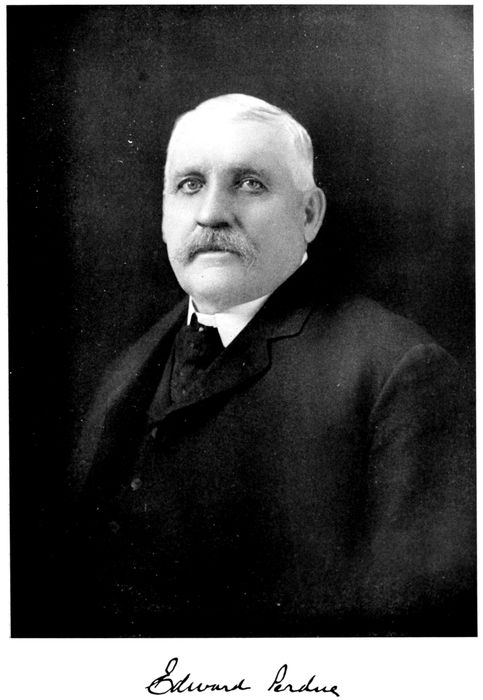
Edward Perdue
577While Mr. Perdue has been primarily a farmer, he has given his attention to other matters as betokens a man of influence and substance. In the year 1891 he assisted in the organization of the Huron State Bank and is president of this thriving concern. In 1906 he took part in the organization of the Commercial State Bank of Atchison, which was succeeded later by the First National Bank, of which banking institution he has served as president since 1900. He is also a stockholder of the State Savings Bank of Leavenworth, Kansas.
Mr. Perdue was married in 1878 to Mary Viola Davey, of Brown county, Kansas, a daughter of Charles Davey, which marriage has resulted in the birth of seven children, as follows: Mrs. Maria Walters, living on a farm near Huron; Edna, wife of J. M. Delaney, merchant, of Huron, Kan.; Mrs. Mabel Schmidt, wife of the assistant cashier of the Huron State Bank; Charles, who is cultivating the home farm; Thomas Hendricks, at home; George, a farmer in North Dakota; and Edward, Jr.
Mr. Perdue has been a life-long Democrat, who has always taken a more or less active part in the political affairs of the county. He was elected county commissioner in 1897 and served one term. In 1904 he served one term as a member of the State legislature, representing this district, declining reëlection when his term of office expired. While he was reared in the Catholic belief, Mr. Perdue is tolerant of all creeds and takes a broad-minded view of religious matters. He belongs to the Ancient Order of United Workmen and the Modern Woodmen.
DR. CHARLES L. HIXON.
Dr. Charles L. Hixon, a leading dental practitioner of Atchison is a native son of Kansas and comes of a pioneer family of the State. He was born on a farm in Jackson county, Kansas, January 14, 1872, and is a 578son of John S. and Alice (Clark) Hixon. His father, John S. Hixon, was born in Ohio in 1850, a son of Jacob and Cassandra (Stonebraker) Hixon, who resided in Ashland county, Ohio, until their removal to Putnam county, Indiana, in the early pioneer days when that part of the Hoosier State was being settled by large numbers of Ohio people. Alice Clark Hixon, mother of Dr. Hixon, was likewise born in 1850 in Putnam county, Indiana, a daughter of Andrew Jackson and Harriet (Mann) Clark, natives of New York State, and also pioneer settlers of Putnam county, Indiana. While John S. Hixon and Alice Clark were attending the district school in the neighborhood of their respective homes, they became great friends, and the warm friendship ripening into love which culminated in their marriage several years later in Jackson county, Kansas.
The Hixons and Clarks were essentially pioneers, and the history of the family for generations shows that some member of the family, or several of them, have been continually pushing westward and settling in the newer countries. Jacob Hixon was one of the first men in his neighborhood to hearken to the call of the West, and, after disposing of his land holdings in Putnam county, Indiana, he with all of his family migrated to Kansas, settling in Jackson county. They arrived in Atchison during the stormy days of the Civil war, and at a time when the local vigilance committee was in control of community affairs and were naturally very suspicious of all strangers. There had been considerable lawlessness in Atchison and neighboring towns and many outrages had been perpetrated by border ruffians and outlaws. The vigilance committee had taken charge of the affairs and had summarily lynched three men on the banks of White Clay creek just previous to the arrival of the Hixon family. Mr. Hixon was interrogated as to his loyalty to the Union and asked his intentions. His replies being satisfactory to the members of the committee, he was allowed to proceed on his way to Jackson county and arrived at Holton, Kansas, without further delay. Jacob Hixon settled on a fine farm near Holton, developed it and prospered as the years rolled on and the country became more and more settled. He died in 1905, at the advanced age of eighty-four years, his wife, Cassandra, departing this life in 1885.
The Clark family came to Kansas from Indiana in 1868, and Andrew Jackson Clark naturally settled in that part of Jackson county where his old friend and neighbor had chosen his place of residence. The intimacy which had existed between the two families in Putnam county, Indiana, was renewed, and as time went on, John S. Hixon and Alice Clark grew to maturity and were united in marriage. Their married life has been a happy 579and prosperous one, and five children have blessed this union: Dr. Charles L. Hixon, with whom this review is directly concerned; Mrs. J. C. Neeley, of Weiser, Idaho; Ernest H. Hixon, of Kansas City, Mo.; one child died in infancy. John S. Hixon became prominently identified with the civic life of Jackson county and is serving his county well and faithfully as treasurer for two terms, having been elected on the Republican ticket in 1912 and again in 1914. Mr. and Mrs. John S. Hixon reside in Holton, in Jackson county, and are prosperous and well respected in the neighborhood.
Dr. C. L. Hixon spent his boyhood days on the farm and early learned to assist in the farm work. He received his elementary education in the district schools, and was ambitious to secure a higher education. He has practically educated himself, and after learning all that was possible for him to learn in the country school, he attended Campbell College, at Holton, Kan., for two years. His ambition was to become a dentist, and with this end in view he matriculated in the University of Iowa in 1895. After spending two profitable years in this institution in the study of dentistry he returned home, and a short time later opened an office in Atchison, where he has practiced continuously for the past eighteen years. After seven years of practice in his first location, he opened well equipped offices at 519 Commercial street, and remained there until his removal to his present location at 613 Commercial street, where he has offices equipped with all the latest appliances for facilitating his work. Dr. Hixon is kept very busy attending to the calls made upon him in the practice of his profession, and during the many years he has been located in Atchison, he has built up an extensive and lucrative practice. He finds time, however, to keep abreast of the latest developments made in his profession, and is ever seeking to better his skill and knowledge of dentistry. He has been distinctly honored by the members of his profession, having served as president of the Northeast Kansas Dental Association, and is at present an active member of this association. He is a leading member of the Atchison Dental Association, and ranks high in his profession, not only as a successful practitioner, but as a citizen who has the best interests of his home city at heart. He is a member of the Ancient Free and Accepted Masons, Washington Lodge, No. 5, and is fraternally affiliated with the Odd Fellows, the Modern Woodmen of America, the Rebekah and Eastern Star lodges.
Dr. Hixon was united in marriage with Miss Inez B. Horn in 1902, and one child has been born to this union, Charles Horn Hixon, born May 25, 1907. Mrs. Inez B. Hixon was born in Atchison county, a daughter of J. H. 580and Catharine (Wallick) Horn, who reside at 1126 North Third street, Atchison. Mrs. Horn is a daughter of Benjamin Wallick, who served as sheriff of the county during the time of the Civil war.
LOUIS KLOEPPER.
Louis Kloepper, farmer and stockman of Lancaster township, Atchison county, was born January 18, 1888, on the farm where he now lives. He is a son of William and Fredericka (Von Derahe) Kloepper, who were the parents of four children as follows: Louis, subject of this sketch; Emma, deceased; William, deceased; Pauline, living at home. The father was born in Germany, December 14, 1853. He left there in 1883 and came directly to Atchison county, Kansas, where he bought eighty acres of land in section 27, Lancaster township. He farmed this one year, and in 1885 returned to Germany to be married. In 1886 he returned to his farm and began to improve it, building a large eight-room house in 1899 in place of the little three-room affair which stood on the place. In 1903 he built a fine 32×40 feet granary, and in 1904 he erected a large barn, 40×48 feet. The following year he bought more land and put up additional buildings, building in 1908 another barn, 32×40 feet. At the time of his death, February 7, 1913, he owned 240 acres of well improved land under cultivation, and thirteen acres of fine timber land. This achievement is the more remarkable in view of the fact that he landed with only $1,200. But he was industrious, and worked faithfully to improve his farm. He was a member, trustee and steward of the German Lutheran church. His wife was born in Germany, February 15, 1858, and is a daughter of Henry and Fredericka (Von Behren) Von Derahe, natives of Germany. The mother is now living with her son, Louis.
Louis Kloepper attended the old Huron school of Lancaster township, and grew to manhood on the farm which he now operates. Since the death of his father he has had charge of the farm and has worked to the extent of his ability in installing modern improvements on his place. He owns 160 acres in section 27, Lancaster township, in addition to the home place, and has three acres of orchard and grove. He also has a vineyard which was the feature of the place which Louis, and his father before him, always loved most. Special attention has been given to the vineyard when other things had to be neglected, perhaps. It is the pride of Mr. Kloepper’s place. He 581keeps graded stock and is a practical farmer. He now is operating 400 acres of land, 114 acres of which are in corn, and ninety-three acres are in cloves, the latter having been unusually successful. He owns a threshing outfit and two clover hullers, a corn shredder, and three gas engines. He utilizes these engines in numerous ways, including pumping and threshing and plowing. Mr. Kloepper has a modern farm in every way and has all up-to-date improvements of a labor and time saving kind, as well as an automobile. He is a stockholder in the Farmers’ Mercantile Association of Effingham, Kan. He is a practical farmer, of the progressive type.
In 1911 he married Marie Meier, a native of Germany, born July 3, 1888. She is a daughter of Henry and Fredericka (Finke) Meier, and was educated in Germany and left her native land at the age of seventeen. Mr. and Mrs. Kloepper have two children, Fredia, born November 13, 1911, and Emma, born April 21, 1913. Mr. Kloepper is an independent voter. He belongs to the German Lutheran church.
CHARLES W. FERGUSON.
Charles W. Ferguson, vice-president of the Atchison Savings Bank, is one of the best known men in financial circles of northeastern Kansas, and he is equally as well known over a large section of western Missouri. Mr. Ferguson was born at Plattsburg, Mo., December 29, 1862, and is a son of William L. and Fannie A. (Carpenter) Ferguson, both natives of Kentucky, whose parents were Virginians and very early settlers of the Blue Grass State. The Ferguson family removed from Kentucky to Missouri about 1851. They came up the Missouri river by boat as far as Liberty Landing, and later located in Clinton county, Missouri. The father was a merchant and also engaged in the grain business, and was an all around progressive business man. He was a Republican, and in 1862 was elected sheriff of Clinton county, being the first Republican elected to office in that county within a period of twenty-five years. During the Civil war he was captain of the Home Guards. He died in 1893, age 64 years. Charles W. Ferguson is one of a family of six children, as follows: John L., assistant general passenger agent of the Chicago & Northwestern railroad, Chicago, Ill.; Mary F., widow of M. B. Riley, and resides in St. Joseph, Mo.; Adelia M., Plattsburg, Mo.; Katherine, Plattsburg, Mo.; Charles W., the subject of this sketch, and Louis, a conductor on the Chicago & Northwestern railroad, resides at Highland Park, Ill. Charles 582W. Ferguson attended the public schools in Plattsburg until he was thirteen years old, and at that early age went to work in the express office at Plattsburg, where he remained about five years. He then entered the employ of Stonum Brothers, remaining with that company two years. He then accepted a position in the Plattsburg Bank, as bookkeeper and assistant cashier, remaining with that institution for seven years. He then went with the Schuster-Hax National Bank, St. Joseph, Mo., as receiving teller, and served in that capacity for four years. He resigned that position in June, 1894, to become bookkeeper of the Exchange National Bank of Atchison. He served with that institution in the capacity of paying teller, assistant cashier and cashier, resigning the latter position February 1, 1914. In November, 1914, he accepted a position with the Federal Reserve Bank, of Kansas City, Mo., and was with that institution for eight months, and in July, 1915, became vice-president of the Atchison Savings Bank. Mr. Ferguson has had a vast experience in the field of banking, and is well posted on the intricate problems of finance, and possesses the keen discriminating qualities of the successful banker. Mr. Ferguson was married April 28, 1892, to Miss Sallie Clay, of Plattsburg, Mo. She is a daughter of James M. Clay, a member of the Kentucky branch of the Clay family. Mr. Ferguson is a member of the Masonic lodge, the Benevolent and Protective Order of Elks and the Modern Woodmen of America.
EARL V. JONES.
Signal success in any one field of endeavor is worthy of recognition by the public, whether it be professional, inventive, mercantile or of an industrial nature. Some men are naturally gifted with the ability to become successful in the industrial and manufacturing field, and are mentally equipped with a certain amount of mechanical genius, along with decided business ability to take hold of a proposition, and makes it succeed, despite difficulties. E. V. Jones, treasurer and manager of the Bailor Plow Company, of Atchison, is one of the latter type who is fast climbing to a place of eminence in his chosen field of endeavor, and holds a high place among the manufacturing and mercantile interests of Atchison and the Middle West.
Mr. Jones was born in Livingston county, Missouri, January 21, 1878, a son of Charles Jones, a building contractor, who was a native of Kentucky and a son of William Jones, owner of a large plantation in Kentucky, which was lost as one of the misfortunes which befell the family as a result of the Civil 583war’s ravages in Kentucky. Desirous of making a new start in a land further removed from internecine strife, and where opportunities for success seemed greater, William Jones removed to Missouri, and here Charles, the father of E. V., was reared and became successful in agricultural pursuits, the son, Earl V., being reared on the family estate in Livingston county, Missouri. The Jones family is originally of Scotch-Irish stock, the founder of the family emigrating from the north of Ireland to this country several generations ago. Charles Jones married Miss Jennie Wills, a daughter of John Wills, native of the east coast of England, and who immigrated to this country with his brother, George, and followed his trade of wagon maker successfully. John Wills owned and operated an extensive blacksmith and wagon maker’s shop at Chillicothe, Mo., which did a large business and made moderate wealth for its proprietor.
Earl V. Jones, with whom this review is directly concerned, was educated in the common and high schools of his native county, and attended the military school at Palmyra, Mo., supplementing his academic education with one year’s study in business college at Atchison, Kan. For some years before the outbreak of the Spanish-American war, he had been a member of the Missouri State militia, Company H, Fourth infantry regiment. When the war broke out and troops were called for to fight the Spaniards in Cuba and the Philippines, he responded with his company and regiment, and went to the front immediately, serving at Camp Alger, near Washington, D. C., on the Potomac river, and Camp Meade, at Harrisburg, Pa., and at Greenville, S. C. After the close of the war, and receiving his honorable discharge at Greenville, S. C., and being mustered out of the service, he returned to his home city, Chillicothe, and entered the employ of the Jackson Woodenware Company as a workman in 1899. His capacity for work and an inherent genius for detail and management here asserted itself and his rise in this concern was rapid and substantial. It was not long until his faithfulness and decided ability was recognized by his employers and he was promoted to the post of superintendent of the factory. When the Jackson Woodenware Company was removed to Atchison in 1902, Mr. Jones came along in the capacity of shipping clerk, and later served as superintendent of the company until its dissolution in 1910. During this time Mr. Jones had made a reputation as a manufacturer and organizer, which had become generally recognized throughout this section of the country, and, although many flattering offers came to him to accept executive positions of importance, he decided to cast his lot with the Bailor Plow Company as treasurer and manager in 1910, when a company was organized for the purpose of locating the factory in 584Atchison. His judgment in this respect was essentially sound, inasmuch as the Bailor Plow Company, under his management, is one of the flourishing manufacturing concerns of the city. The company and Mr. Jones, the manager, have made good, the large payroll, and the constantly increasing output of the plant having fully justified the decision of the Atchison men who were instrumental in locating the plant in this city. A great future is decidedly in store for the Bailor Plow Company and its manager.
Mr. Jones was united in marriage with Katherine Barton, of Livingston county, in 1901. To this union have been born two sons: Raymond and Earl. Mrs. Jones is a daughter of Prof. John W. Barton, widely known educator of Missouri, who formerly served as city superintendent of various schools, and was formerly a member of the faculty of the University of Missouri.
Mr. Jones finds time, aside from his duties as manager of the factory, to take an active part in the social and civic life of Atchison, and has identified himself with the city’s institutions in a substantial manner, as befitting a man of his position and attainments. He is a member of the Masonic lodge, the Benevolent and Protective Order of Elks, the Knights of the Maccabees, and is affiliated with the United Commercial Travelers.
MRS. JULIA E. ADAMS BOYINGTON.
Mrs. Julia E. Adams Boyington comes of parents who were important factors in the early history of Atchison county. Her father, William Adams, came to Kansas in the fifties for the purpose of helping make Kansas a free State. He was a leader of the Cayuga settlement and he was intimately connected with the making of Kansas history for many years. Mrs. Boyington was born May 15, 1849, in Skaneateles, Onondaga county, New York. Her parents, William and Mary Ann (Ellsbury) Adams, were both born in England. The father was born October 6, 1820, in Summersetshire, England, and was a son of George Adams, who married Miss Thayer, also a native of England.
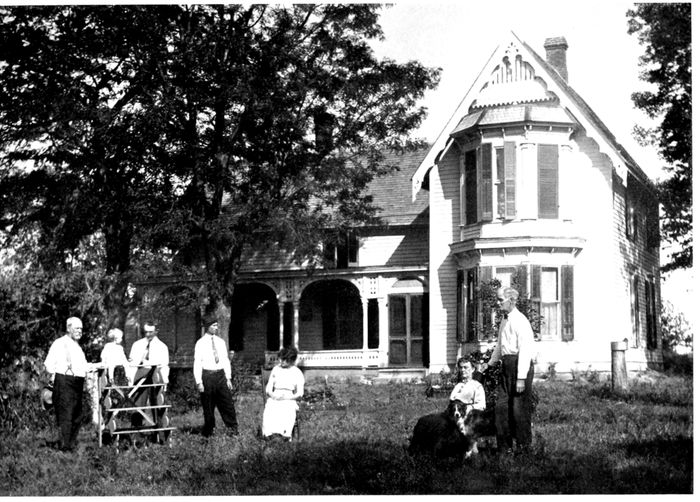
Home of Frank W. and Julia (Adams) Boyington Extreme Left—SAMUEL ADAMS Right—MRS JULIA E. BOYINGTON FRANK W. BOYINGTON
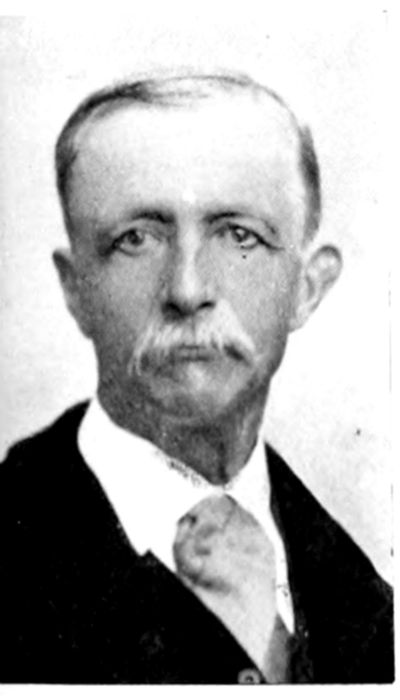
WILLIAM ADAMS.
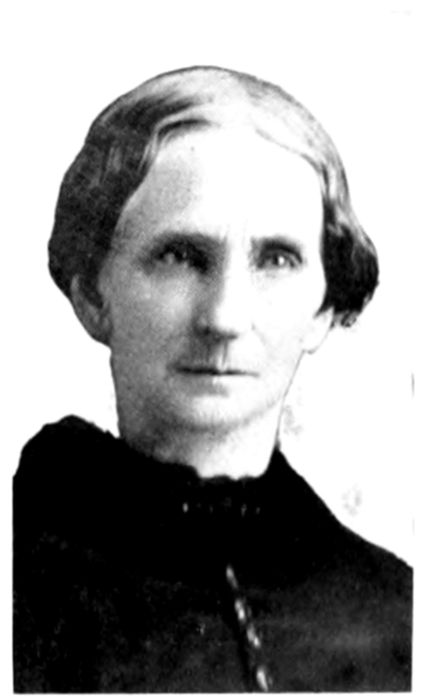
MARY ANN ADAMS.
585At the age of seventeen, William Adams left his native country and came to New York. He farmed there until 1856, when he came to Kansas and settled in Atchison county for the express purpose of helping John Brown in his fight along the border, and assisting the Free State party. He passed through many thrilling experiences during these troubled years and though he was often subjected to great bodily danger, he never wavered in his convictions and was always ready to fight for his convictions. He preëmpted eighty acres of land which he increased to 800 acres during his life time. When he took his first land the country was wild and undeveloped, and he built a log cabin on his place and used a yoke of oxen in breaking the land. He was a great stockman and kept a large number of animals and farmed until his death in 1889, remaining in active life until within a short time of his death. Mr. Adams was a Republican and was loyally devoted to the welfare of his party. He always took a great deal of interest in the activities of his party and helped it at every opportunity, though he never desired an office as a reward for his work, and never held a political job.
On July 4, 1848, Mr. Adams was married to Mary A. Ellsbury, also a native of Summersetshire, England. She was born October 19, 1825, and died December 15, 1895. Mrs. Boyington, though a small girl when she came to Kansas, remembers many incidents of that early life with remarkable vividness. She still keeps a rifle and an old shot gun which her father brought from New York, and prizes them very highly. They were the means of protecting her and her mother many times from the depredations of the Indians, who were numerous in that section then, and lived on a reservation only four miles from the Adams home. They passed the little Adams cabin when they went after whiskey. As they would return completely intoxicated, they would quarrel and disturb the neighborhood, often frightening the women whose husbands were working out in the fields. The Cayuga settlement numbered about forty people during the early days. The township elections in Grasshopper township were always held in the Adams house, and Mr. Adams was always generous in helping public affairs along.
Mr. and Mrs. Adams were parents of five children: Julia, the subject of this sketch; Georgia Anna, deceased; Samuel, of Grasshopper township; Millicent, who died in infancy; Julia, born a twin, but the other child died in infancy. Samuel, married Mrs. Ida Hitchcock, a native of Scranton, Penn., in California, May 31, 1887. By her marriage to Mr. Adams she was the mother of two children: William J., who was born March 19, 1890, and Earl, who was born October 10, 1891. These two children were partly reared by their aunt, Mrs. Boyington, and she is very fond of them. Though she has no children of her own, she has made these two nephews her favorites and has treated them as though they were her own children. Frank W. Boyington, the husband of Julia E. Adams Boyington, was born February 15, 1845, in Pennsylvania, and was a son of Edwin C. and Susan (Smith) Boyington, the former a native of Litchfield, Conn., and the latter a native of Pennsylvania. In their old age they came to Kansas and lived with their son, Frank W., and 586died here. The father died 1872, and the mother died in 1875. He left there in 1867 and settled in Grasshopper township, Atchison county, where Samuel Adams was reared to manhood in Grasshopper township; lived for ten years in California and returned to his farm in Grasshopper township in 1913. He was married to Mrs. Julia Bartlet before his marriage to Miss Adams. His first wife was a school teacher in Grasshopper township before her marriage. Three children were born to them. Edward, of Atchison, United States mail clerk, Alice Spangler, Marion county, Kansas, and one deceased. After her death in 1899, he was married to Miss Julia E. Adams, the subject of this sketch.
Mr. Boyington was an early settler in Kansas and has been a successful farmer. His wife owns 480 acres of land which once was a part of the old home place. Mr. Boyington owns 160 acres in Marion county, Kansas. He has lived in Kansas since 1867 and has seen much history made during that time. Mr. Boyington is a Republican and is a member of the Ancient Free and Accepted Masons. Although he is not a church member, he attends services. Mr. Boyington is one of the most successful farmers of Atchison county, and with his wife, who is also a good manager, has made a financial success of farming.
JOHN L. BLAIR.
The historian must ever take cognizance of the facts concerning the lives of those who have contributed most to the upbuilding and the welfare of their community. In looking backward over the half century, and more, which has elapsed since the Kansas Territory was thrown open to settlement, it is found that there are quite a number of men and women who are deserving of more than mere casual mention in the history of Atchison county. Among these are John L. and Amanda (Meeker) Blair, whose names will go down in history as having taken a very prominent part in the social, political and intellectual development of Doniphan and Atchison counties. Mrs. Blair has the honored distinction of having been the first public school teacher in Atchison and she and her husband were prominently identified with the historical course of events in northeast Kansas for a long period of years.
John L. Blair, deceased, was born in Fayette county, Pennsylvania, April 25, 1833, a son of Alexander and Rachel (Lynch) Blair. The family is of Irish origin. Alexander Blair was a minister of the Methodist Episcopal church in Pennsylvania. He died in Pennsylvania, and in 1860 the widow 587joined John L., who had come to Kansas in 1858. They settled in Doniphan county, near the Atchison-Doniphan line. Mr. Blair developed a fine farm and made quite a reputation as a breeder of fine live stock, being one of the pioneer stock breeders of Kansas. In 1863 he was united in marriage with Amanda Meeker. This was after he had served some time in the Civil war as a member of Company D, Seventh regiment, Kansas cavalry, as a sergeant, enlisting at the beginning of the war and serving for two years. After being mustered out, he returned home and was married in June of 1863. Mr. and Mrs. Blair immediately moved to a farm in Doniphan county, Kansas, and were successful from the start. Both being endowed with more than ordinary intelligence and thrift, they foresaw the inevitable rise in land values and invested all of their earnings in land, accumulating over 600 acres of land which was located in Doniphan county and since Mr. Blair’s demise Mrs. Blair has purchased 320 acres in Lyon county, Kansas. Mr. Blair was an active and influential figure in the civic and political life of Doniphan county, and frequently stumped the county in the interest of the Republican party candidates. He was a public speaker of power and ability, and was a warm adherent of the cause of women suffrage, stumping Atchison and Doniphan counties in 1884 in the interest of the suffrage movement in Kansas. He filled the office of county commissioner of Doniphan county for two terms, and was at one time a candidate for State senator. During the years 1873 and 1874, when the Grange movement was spreading over Kansas, Mr. Blair was the official organizer for Atchison and Doniphan counties. He had a good knowledge of parliamentary law and this came in very useful in his work among the different granges. It was in the Grange meetings that the movement for woman suffrage first gained headway in Kansas, and the women learned how to vote. Mr. Blair died in 1891, February 4. To Mr. and Mrs. Blair were born the following children: Mamie, widow of James Hunter, of Doniphan county, and mother of two children; Alexander, a farmer in Doniphan county and father of seven children; Kate, wife of Thomas Evans, a breeder of fine Hereford cattle, hackney horses and pure bred hogs, in Lyon county, and who is the owner of the famous hackney mare formerly owned by Jay Gould. Mrs. Evans was educated in the schools of Doniphan county, and the old Monroe Institute of Atchison, and is a graduate of Holton University, at Holton, Kan., and graduated from the Kansas State University at Lawrence in 1893. Mr. and Mrs. Evans have one daughter, Mary Frances. Mrs. Blair has ten grandchildren and seven great-grandchildren. Mr. and Mrs. Blair belonged to the Methodist Episcopal Church and he was an Odd Fellow.
Mrs. Amanda (Meeker) Blair was born in Franklin county, Ohio, near 588the city of Columbus, June 24, 1837. She was a daughter of Caleb and Mary (Grant) Meeker, her mother being a relative of Gen. U. S. Grant, and her father being a member of the famous Meeker family of America. Ezra Meeker, who crossed the continent en route to Oregon with an ox team, was a second cousin of Caleb Meeker. Caleb Meeker was born in New Jersey, a son of Aaron, who was born in New Jersey, of German origin. Caleb Meeker was born in Essex county, New Jersey, August 9, 1807, a son of Aaron Meeker, also of New Jersey, who had eight sons and four sons-in-law in the Meeker, also of New Jersey. Aaron was a brother of Timothy Meeker, who had eight sons and four sons-in-law in the American army during the Revolutionary war. Mary Grant Meeker was born in Pennsylvania. In 1808 the Meeker family migrated from New Jersey to Ohio and resided there until 1857, when they went to Fulton county, Illinois, stopping for one year. In November of 1858 Amanda Meeker came to Atchison to take a position as teacher in the first public school in Atchison. Caleb came in January of 1859 to visit his daughter and invested in a tract of land near Huron, Kan., moving his family in March, 1859. He lived on his farm all the rest of his life, dying in September, 1886. Amanda was educated in the district schools of her native county in Ohio and received a certificate to teach school when but fifteen years of age. She taught three months in 1852 for $9.00 per month and then attended school for the remainder of the season. The following year she taught six months for $20 per month, after which she studied for two years in the Ohio Wesleyan University, at Delaware, Ohio. Her teaching experience embraced six years in Ohio, five months in Illinois and three years in Atchison and six months in Hiawatha, Kan. Mrs. Blair was a very successful teacher, and had the faculty of exercising great control over her pupils.
A brother, Jeptha Meeker, served in the Union army during the Civil war. Mrs. Blair kept the postoffice at Huron, Atchison county, when the village was one of the stations on the old Military road, from Ft. Leavenworth to Denver and Pike’s Peak, Colo.
Mrs. Blair is distinguished among the pioneer women of Atchison county as having been the first public school teacher in the county appointed by a board of education, duly organized and elected. During the summer of 1858, this board was organized in the office of F. G. Adams in Atchison, and the members of the board were Dr. William Grimes, treasurer; F. G. Adams, clerk; James A. Coulter, director; Philip D. Plattenburg, principal of the schools at Lewistown, Ill., had been engaged as superintendent of the Atchison schools and this board elected Amanda Meeker as his assistant. This was the 589first public school in the city of Atchison, and was located over a grocery store in a frame building, where the Y. M. C. A. edifice now stands at the corner of Fourth and Commercial streets. The school term began on November 1, 1858, and lasted for seven month, ending July 1, 1859. The following year the school term was extended to nine months. Miss Meeker taught for three years without a certificate. The first teacher’s certificate in Atchison county was issued to W. D. Rippey, a young man who came from Valparaiso, Ind. Mrs. Blair recalls that Mr. Rippey had no intention of teaching when he came to Atchison, and remained here for about five months and then went to Doniphan county, where he became quite wealthy in the course of years. Applicants for teacher’s certificates had little or no trouble in passing, the whole procedure of examining being conducted verbally and the chief requisite apparently being the one dollar fee which was required from the applicant.
Few Kansas pioneer women at this day occupy the honored position in history which is held by Mrs. Blair. To have taught the first public school in Atchison is a great honor, and to have been one of the pioneers of a great State in such a capacity is a great honor which is claimed by very few people. Mrs. Blair, despite her age, is possessed of a keen mentality and is remarkably well preserved, her long life being best attributed to her mental vigor and student powers which she has kept nourished these many years.
ALFRED SHORTRIDGE.
Alfred Shortridge, deceased pioneer of Atchison, was born in Milton, Ind., February 27, 1834. When twenty-three years of age he listened to the admonition of his elders to come to the great West, where opportunities for amassing a competence were much better for a young man than in his home community. He came by train to St. Louis and after stopping a few days at the Planter’s Hotel, he boarded a Missouri river steamer which brought him to Atchison. His intention was to get a farm from the Government, and he accordingly took up a claim one-half mile south of Monrovia. He developed his homestead, sold it and later bought a farm, ten miles south of Atchison, in Walnut township, near Potter. He added to this first farm of 120 acres until he became the owner of a finely developed farm of 200 acres, which he still owned at the time of his demise.
Mr. Shortridge was one of the early day freighters and during the years 590of 1862 and 1863 he freighted from Atchison to Denver, and in 1863 made two trips overland to Denver and return with Pardee Butler, with whom he was on intimate terms. He enlisted in the company of soldiers which was formed in his neighborhood for the purpose of repelling Price’s invasion of Kansas in 1864 and was present at Westport when Price’s army of invasion was driven southward. After he had made his last trip to Denver in 1863, he sold his wagon and four mules for $1,500, and then engaged in farming. He resided on his farm near Potter until the year 1912, and then removed to a home in Atchison.
He was married February 23, 1867, to Miss Catherine Elizabeth Clasby, of DeKalb, Buchanan county, Missouri, and to this union five children were born as follows: Mrs. J. A. Edwards, Fairmount. Kan.; J. T. Shortridge, W. O. Shortridge, and Mrs. C. N. Faulkner, of Potter, Kan., and Miss Florence Shortridge, at home. The mother of these children was born March 20, 1843, a daughter of John D. and Sarah Ann (Ellison) Clasby. John D. Clasby was a native of Virginia, whose mother was a member of the Dunlap family of Virginia, one of the old colonial families of America. One of the Dunlaps, a direct ancestor of Mrs. Shortridge, served in the Continental army in the Revolutionary war. He was a pioneer settler of Buchanan county, Missouri, and is buried on a hill within sight of Atchison.
Mrs. Shortridge’s mother, Sarah Ann (Ellison) Clasby, was born in Missouri, a daughter of James and Elizabeth (Dunlap) Ellison, who were residents of Kentucky, and who were among the pioneer settlers in Buchanan county, Missouri. There were nine children in the Clasby family, as follows: James T., Robert, Orlando, Joseph, Franklin, Julian, deceased; Mrs. Ann Eliza (Stewart), and Mrs. Alfred Shortridge.
Alfred Shortridge departed this life on July 17, 1915, and was sincerely mourned by a host of friends and acquaintances who had known him for many years in Atchison county. During his life, after attaining his majority he was affiliated with the Republican party, and was always active in the affairs of his party, although he was never a seeker after political preferment. He was a member of the Christian church, and lived according to the precepts of his religious belief, as nearly as mortal man could. He carried his religion into his daily life and believed implicitly in the golden rule, which admonishes mankind to treat his neighbor as he would have his neighbor do unto him.
On February 23, 1911, Mr. and Mrs. Shortridge celebrated their forty-fourth wedding anniversary at the old Shortridge homestead, and it was a fitting culmination of one of the happiest life unions on record. Mr. Shortridge 591was deeply devoted to his noble wife and family and was always kind and considerate, not only with the members of his immediate family, but with his many friends and acquaintances. He was never known to complain or find fault but took things as he found them and made the best of every occasion. One of the last of the old guard of Atchison pioneers, he was a fitting example of the type which did so much to develop the Sunflower State and make Atchison county one of the garden spots of the country. One by one the old pioneers are passing to the great beyond from which no man returneth; it is fitting that we record in imperishable print the record of their lives and their deeds and accomplishments while on earth in order that it all may live after them forever and their memories be kept continually green and fresh in the minds of succeeding generations which will know them not except through the pages of these Atchison county historical annals.
O. M. BABCOCK.
O. M. Babcock, of the Babcock-Avensberg Shoe Company, is one of the most progressive merchants of Atchison. He is a native of the Empire State, and was born at Adams Center, Jefferson county, New York, in November, 1872, and is a son of M. S. and Amy (Green) Babcock, both natives of New York and of English descent.
The Babcock family was founded in America by Capt. James Babcock, who settled in Rhode Island during the seventeenth century. M. S. Babcock came to Kansas with his family in 1883 and settled on a farm in Benton township, one mile north of Nortonville in Atchison county. Here he bought 160 acres of unimproved land, which he developed to a high state of cultivation and followed farming there successfully until he and his wife removed to Battle Creek, Mich., where they now reside. O. M. Babcock, the subject of this sketch, was eleven years old when he came to Atchison county with his parents. He was educated in the district schools and the Atchison County High School at Effingham. After completing school he taught in Atchison county about two years when he accepted a position in a general merchandise store at Nortonville and later at Effingham. He remained at Effingham one year and then came to Atchison and entered the shoe department of D. C. Newcomb’s general store, where he remained about three years. He then accepted a position as traveling salesman for a wholesale shoe house, and for three years was a successful knight of the grip with St. Joseph, Mo., as his 592headquarters. He then came to Atchison as general sales manager for a retail shoe establishment, and four years later, in 1902, organized the Babcock Shoe Company, which he still conducts. This is Atchison’s leading shoe store.
Mr. Babcock was united in marriage in 1903 to Miss Edith L. Hooper, a daughter of George R. Hooper, of Atchison, a personal sketch of whom appears in this volume. Mr. Babcock takes a keen interest and an active part in the welfare and development of Atchison and is one of its booster citizens. He is a member of the Masonic lodge and active in the work of that organization. He is also a member of the Elks and belongs to the Commercial Club. He is president of the Kansas Retail Shoe Dealers’ Association, and politically, is a supporter of the policies and principles of the Republican party.
JULIUS KUHN.
Julius Kuhn, deceased pioneer merchant of Atchison, was a man of sterling worth, industry and purpose who achieved a success in the commercial life of his adopted city which ranked with the greatest accomplishments of those who figured most prominently in the early civic life of Atchison. He was born in Bavaria, Germany, May 10, 1831, and received an excellent education in the famous university at Munich, where he fitted himself to become an architect. He was gifted with more than ordinary talent as a draughtsman and architect and to this day many of his best drawings and designs are hanging on the walls of the art room in St. Benedict’s College. When twenty years of age he took passage on a sailing vessel for America, then as now, the land of promise for the poor and ambitious youth of the old world. After a stay of a few years in New York City and points in Connecticut, he journeyed to St. Louis where he was married, his wife, Lucetta, dying in Atchison in the spring of 1881. To this union one son was born, Gustave, who died July 15, 1883. While in St. Louis Mr. Kuhn heard tales of the opportunities waiting for industrious young men in the new State of Kansas and came hither to seek his fortune in the year 1859. He had some means which he had saved and at once invested in a lot on the corner of Eighth and Commercial streets, upon which he built a story and a half frame building, which for many years was a well known landmark in Atchison. He installed a stock of groceries in his new building, and from the start met with success. His store soon became the outfitting point for the freighters who were crossing the plains to the far western points and he prospered in excess even of his expectations. Mr. Kuhn’s store was rarely closed in those early days and it was his wont to retire at 1 o’clock a. m. and was often called out of bed at 3 o’clock in the morning to assist some freighter just arriving from the trail half frozen, or, perchance, to trade with some farmer who had traveled a long distance to transact business with him and exchange his produce for groceries and necessities.
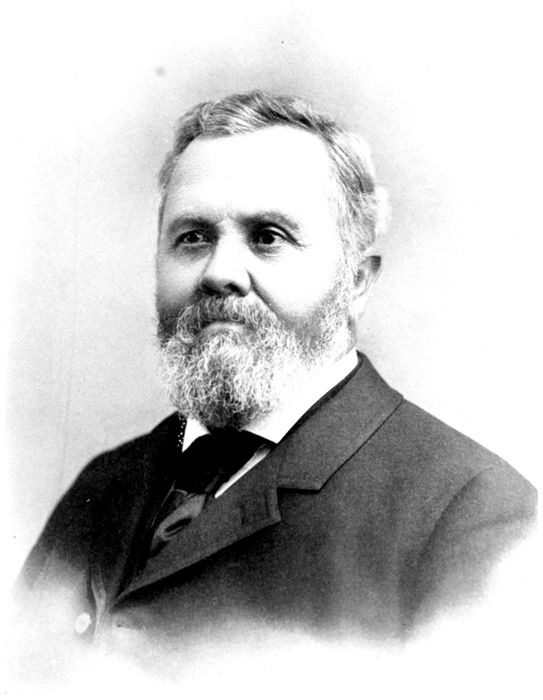
Julius Kuhn
593During the Civil war he served in the commissary department of the Union army, called out to repel the invasion of Kansas, threatened by General Price. He established himself in the wholesale business in 1870 as he foresaw that Atchison was to become an important distributing point for the northeastern part of the State as the country grew more and more settled with the influx of immigrants from all parts of the compass. In time the little frame store, which he had erected when he first came to Atchison, was replaced by the pretentious brick structure which bears his name. He invested his surplus profits in real estate in Atchison and Kansas points and left a substantial fortune on his demise. In the early sixties he purchased for his family residence the old Judge Gilham house, at that time the only house on the hill, from his store northwestward. For a number of years the Kuhn store was the only business house west of Third street, but in time the business center gradually moved westward from the river, and encompassed his business place. Speaking reminiscently of those early days a few incidents showing conditions at that time are worth recording. When Mr. Bartholow first came to Atchison, at the outbreak of the Civil war when business was in a state of paralysis, he had on hand over $2,000 worth of tobacco, for which he could not find storage. He approached Mr. Kuhn and asked him to either buy the stock or store it until such a time as it would be marketable. Mr. Kuhn took a chance and when tobacco soared to an extremely high price toward the last days of the war, he disposed of it at a profit of $1.00 per pound. Flour rose to the high price of $7.00 per sack during those troublous days, while beef was very cheap, a “half of beef” often selling for ten cents.
Mr. Kuhn was married the second time, September 30, 1883, to Anna Glattfelter, and to this union were born two sons, Julius Otto, at home with his mother, and Gustave Adolphus, living in Kansas City, married Irene King, and is the father of one child, Ruth Kuhn. Mrs. Anna Glattfelter Kuhn was born in Glattfelter, Switzerland, a daughter of Henry and Margaret Glattfelter, who immigrated to America in 1864, and located on a farm in Atchison county. Henry Glattfelter died in 1867, and his wife died in Atchison in 1903. They were the parents of Mrs. W. A. Dilgert, living on a farm in Walnut township; Mrs. Martin Dilgert, residing on Ninth street; Margaret, wife 594of Mr. John Meyer, living on Seventh street; Fannie, wife of Dr. Sievers, of Manning, Iowa; Henry, on the old home farm, near Cummings. Mrs. Kuhn resides in the family residence at 1029 Atchison street, and looks after the interest of the Kuhn estate. She is a keen, intelligent lady, who has shown marked business ability in caring for the property interests left in her charge. Mr. Kuhn retired from active mercantile pursuits in 1889, and died October 30, 1902, universally respected and loved by all who knew him. He was a Republican in politics and took an active part in the civic and political affairs of Atchison, serving as a member of the city council, and filling several important city offices of trust during his long residence here. He was always a consistent and unremitting booster for Atchison, and had a deep love for the city and his home life. He was a member of the Elks and a social member of the Turner Society. Mr. Kuhn was not a member of any religious denomination but was a friend and liberal supporter of all denominations which sought his aid. While not a professed Christian he lived a blameless and upright life, and was ever ready to assist a needy acquaintance when his aid would do the most good.
PETER WEBER.
Peter Weber, retired farmer, residing at 921 North Sixth street, Atchison, Kan., is one of the real pioneer residents of the county. He has lived in the county for over fifty-six years, and recalls many of the incidents of the old days when the settlement of the county was in the embryo stage. Like most of the prosperous and successful men in the county he has worked his way upward from a small beginning to a state of affluence, which reflects credit upon his industry and his capabilities. Times, fifty years ago, and the present, give opportunity for making contrasts which are striking and very interesting. When Mr. Weber was a boy it was the family custom to go to church on Sundays via the ox wagon route, father, mother and all of the children seating themselves in a big farm wagon, and going to church at the rate of two miles per hour, the trip requiring almost the entire day to go and return. Now, Mr. Weber cranks the engine of his fine automobile, and in an incredibly short space of time he travels from his city home to his country estate, can spend hours in looking over the farming operations, and return to his own home in time for the next meal.
Peter Weber was born in Kenosha, Wis., March 8, 1859, and came to Atchison county with his parents a few weeks later. His father, John Weber, 595was a native of Luxemburg, Germany, and his mother was Mary (Penning) Weber, also a native of Luxemburg, and a daughter of Nicholas Penning, who emigrated from his native country to Wisconsin. John Weber was married in Wisconsin, after coming to this country. He migrated to Atchison county, Kansas, from Wisconsin in 1859, and was equipped with a cash capital of nearly $300. He attended a lot sale in the boom days of Old Sumner, and invested nearly all of his savings in lots, purchasing 275 lots in all, at prices varying from $5 for the first one bought, to a price as low as twenty-five cents. This was more or less a speculation on his part, and the price of lots in Sumner fell rapidly after the county seat election which selected Atchison as the seat of government for the county. Real estate values naturally deteriorated in Sumner, and John Weber later sold seventy-five of his lots for $15 and allowed the greater part of his initial Kansas investment to be sold for taxes, inasmuch as the property had no real value. His next investment was a much better one, however, and he purchased 160 acres of land in Walnut township for $360, on which he erected a home and proceeded to develop it into a fine farm. He became well to do, and was highly respected throughout the neighborhood in which he resided. Originally John Weber had been a wheelwright by trade, and his skill as a wood worker and wagon maker stood him in good stead when he took up agricultural pursuits in Atchison county. During the Civil war John Weber was enrolled in the State militia and was called away to serve his country at Independence, Mo., leaving his wife and young children at home in mortal fear of their lives while the father and his comrades were in battle array to repel the Price invasion of Kansas. The movable property of the family was kept hidden in the drawers. Mr. Weber had over $800 in gold buried in the cellar in an empty peach can. He reared a fine family of sons and daughters as follows: Peter, the eldest of the family and with whom this review is directly concerned; Mathias, who is cultivating the old home place in Mt. Pleasant township, and Mrs. Katherine Keefer, a widow residing near Nortonville, Kan., are the surviving children of a family of six born, three of whom died in infancy. John Weber died in 1905, his wife preceding him to the great beyond in 1901.
Peter Weber, when a boy, attended the district school of his neighborhood in Mt. Pleasant township, and was reared to become an agriculturist. He was married in 1881 and then began doing for himself, renting land in Mt. Pleasant township for a time and carefully husbanding his resources and saving his money with a view to eventually owning a farm of his own. He was enabled to purchase his first farm of 160 acres in 1895 in Walnut township. He still owns this fine farm, which is one of the best in Atchison county, and is now 596being cultivated by his son. Mr. Weber retired from active agricultural pursuits in May, 1912, and removed to Atchison, where he owns real estate and lives comfortably, as befitting a man who has earned the right to enjoy home comforts. He was married in 1881 to Mary Weinmann, and to this union have been born the following children: Mary, wife of Theo Vanderweide, of Atchison county; Katherine, wife of John Wagner, residing in Walnut township, Atchison county; Jacob, living on the home farm; Ida, wife of Charles Harrison, a foreman in the A. J. Harwi Hardware Store, in Atchison; Annie, wife of Gustave Boehme, Rulo, Neb., where Mr. Boehme conducts a bakery. The mother of these children was born August 9, 1860, in Salt Creek Valley, Leavenworth county, Kansas, a daughter of Jacob and Katherine Weinmann, natives of Germany, who came to Leavenworth county, Kansas, as early as 1858. She was one of sixteen children born to these parents, thirteen of whom were reared, and five came to America and died here.
Mr. Weber has always been a Democrat, but is more or less independent in his political views and believes in voting for the candidate who seems best fitted to perform the duties of the office, regardless of his political affiliations. While a resident of Mt. Pleasant township he took an active part in the civic affairs of the township and served nine years as treasurer and then served as trustee in 1895. Later when he took up a permanent residence in Walnut township, in 1896, he was selected as township treasurer by the people in 1906 and filled the office to the satisfaction of everybody for six years. He and the members of his family are members of the St. Benedict’s Catholic Church, and have always been liberal contributors to the support of this institution. He is also affiliated with the Knights of Columbus, and takes a keen interest in city and county affairs as befitting a man of broad general attainments, who has lived in Atchison county for over half a century and watched its evolution from a wilderness to become one of the fairest divisions of the great State of Kansas.