LAFCADIO HEARN (continued 3)
Reading edition
Such an experience first gave me the idea of making a collection of songs containing Buddhist expressions or allusions. But in view of the extent of the subject I could not at once decide where to begin. A bewildering variety of Japanese songs—a variety of which the mere nomenclature would occupy pages—offers material of this description. Among noteworthy kinds may be mentioned the Utai, dramatic songs, mostly composed by high priests, of which probably no ten lines are without some allusion to Buddhism;—the Naga-uta, songs often of extraordinary length;—and the Jōruri, whole romances in verse, with which professional singers can delight their audiences for five or six hours at a time. The mere dimension of such compositions necessarily excluded them from my plan; but there remained a legion of briefer forms to choose among. I resolved at last to limit my undertaking mainly to dodoitsu,—little songs of twenty-six syllables only, arranged in four lines (7, 7, 7, 5). They are more regular in construction than the street-songs treated of in a former paper; but they are essentially popular, and therefore more widely representative of Buddhist influences than many superior kinds of composition could be. Out of a very large number collected for me, I have selected between forty and fifty as typical of the class.
*
Perhaps those pieces which reflect the ideas of preëxistence and of future rebirths will prove especially interesting to the Western reader,—much less because of poetical worth than because of comparative novelty. We have very little English verse of any class containing fancies of this kind; but they swarm in Japanese poetry even as commonplaces and conventionalisms. Such an exquisite thing as Rossetti's "Sudden Light,"—bewitching us chiefly through the penetrative subtlety of a thought anathematized by all our orthodoxies for eighteen hundred years,—could interest a Japanese only as the exceptional rendering, by an Occidental, of fancies and feelings familiar to the most ignorant peasant. Certainly no one will be able to find in these Japanese verses—or, rather, in my own wretchedly prosy translations of them—even a hint of anything like the ghostly delicacy of Rossetti's imagining:—
I have been here before,— But when or how I cannot tell: I know the grass beyond the door, The sweet, keen smell, The sighing sound, the lights along the shore. You have been mine before,— How long ago I may not know: But just when at that swallow's soar Your neck turned so, Some veil did fall,—I knew it all of yore.
Yet what a queer living difference between such enigmatically delicate handling of thoughts classed as forbidden fruit in the Western Eden of Dreams and the every-day Japanese utterances that spring directly out of ancient Eastern faith!—
Love, it is often said, has nothing to do with reason. The cause of ours must be some En in a previous birth.[1]
Even the knot of the rope tying our boats together Knotted was long ago by some love in a former birth.
If the touching even of sleeves be through En of a former existence, Very much deeper must be the En that unites us now![2]
Kwahō[3] this life must be,—this dwelling with one so tender; —I am reaping now the reward of deeds in a former birth!
Many songs of this class refer to the customary vow which lovers make to belong to each other for more lives than one,—a vow perhaps originally inspired by the Buddhist aphorism,—
Oya-ko wa, is-sé; Fūfu wa, ni-sé; Shujū wa, san-zé.
"The relation of parent and child is for one life; that of wife and husband, for two lives; that of master and servant, for three lives." Although the tender relation is thus limited to the time of two lives, the vow—(as Japanese dramas testify, and as the letters of those who kill themselves for love bear witness)—is often passionately made for seven. The following selections show a considerable variety of tone,—ranging from the pathetic to the satirical,—in the treatment of this topic:
I have cut my hair for his sake; but the deeper relation between us Cannot be cut in this, nor yet in another life.[4]
She looks at the portrait of him to whom for two lives she is promised: Happy remembrances come, and each brings a smile to her face.[5]
If in this present life we never can hope for union, Then we shall first keep house in the Lotos-Palace beyond.[6]
Have we not spoken the vow that binds for a double existence? If we must separate now, I can only wish to die.
There!—oh, what shall we do?... Pledged for a double existence,— And now, as we sit together, the string of the samisen snaps![7]
He woos by teaching the Law of Cause and Effect for three lives, And makes a contract for two—the crafty-smiling priest![8]
Every mortal has lived and is destined to live countless lives; yet the happy moments of any single existence are not therefore less precious in themselves:—
Not to have met one night is verily cause for sorrow; Since twice in a single birth the same night never comes.
But even as a summer unusually warm is apt to herald a winter of exceptional severity, so too much happiness in this life may signify great suffering in the next:—
Always I suffer thus!... Methinks, in my last existence. Too happy I must have been,—did not suffer enough.
Next in point of exotic interest to the songs expressing belief in preëxistence and rebirth, I think I should place those treating of the doctrine of ingwa, or Karma. I offer some free translations from these, together with one selection from a class of compositions more elaborate and usually much longer than the dodoitsu, called hauta. In the original, at least, my selection from the hauta—which contains a charming simile about the firefly—is by far the prettiest:—
Weep not!—turn to me!... Nay, all my suspicions vanish! Forgive me those words unkind: some ingwa controlled my tongue!
Evidently this is the remorseful pleading of a jealous lover. The next might be the answer of the girl whose tears he had caused to flow:
I cannot imagine at all by what strange manner of ingwa Came I to fall in love with one so unkind as you!
Or she might exclaim:—
Is this the turning of En?—am I caught in the Wheel of Karma? That, alas! is a wheel not to be moved from the rut![9]
A more remarkable reference to the Wheel of Karma is the following:—
Father and mother forbade, and so I gave up my lover;— Yet still, with the whirl of the Wheel, the thought of him comes and goes.[10]
This is a hauta:—
Numberless insects there are that call from dawn to evening, Crying, "I love! I love!"—but the Firefly's silent passion, Making its body burn, is deeper than all their longing. Even such is my love ... yet I cannot think through what ingwa I opened my heart—alas!—to a being not sincere![11]
If the foregoing seem productions possible only to our psychological antipodes, it is quite otherwise with a group of folk-songs reflecting the doctrine of Impermanency. Concerning the instability of all material things, and the hollowness of all earthly pleasures, Christian and Buddhist thought are very much in accord. The great difference between them appears only when we compare their teaching as to things ghostly,—and especially as to the nature of the Ego. But the Oriental doctrine that the Ego itself is an impermanent compound, and that the Self is not the true Consciousness, rarely finds expression in these popular songs. For the common people the Self exists: it is a real (though multiple) personality that passes from birth to birth. Only the educated Buddhist comprehends the deeper teaching that what we imagine to be Self is wholly illusion,—a darkening veil woven by Karma; and that there is no Self but the Infinite Self, the eternal Absolute. In the following dodoitsu will be found mostly thoughts or emotions according with universal experience:—
Gathering clouds to the moon;—storm and rain to the flowers: Somehow this world of woe never is just as we like.[12]
Almost as soon as they bloom, the scented flowers of the plum-tree By the wind of this world of change are scattered and blown away.
Thinking to-morrow remains, thou heart's frail flower-of-cherry? How knowest whether this night the tempest will not come?[13]
Shadow and shape alike melt and flow back to nothing: He who knows this truth is the Daruma of snow.[14]
As the moon of the fifteenth night, the heart till the age fifteen: Then the brightness wanes, and the darkness comes with love.[15]
All things change, we are told, in this world of change and sorrow; But love's way never changes of promising never to change.[16]
Cruel the beautiful flash,—utterly heartless that lightning! Before one can look even twice it vanishes wholly away![17]
His very sweetness itself makes my existence a burden! Truly this world of change is a world of constant woe![18]
Neither for youth nor age is fixed the life of the body; —Bidding me wait for a time is the word that forever divides.[19]
Only too well I know that to meet will cause more weeping;[20] Yet never to meet at all were sorrow too great to bear.
Too joyful in union to think, we forget that the smiles of the evening Sometimes themselves become the sources of morning-tears.
Yet, notwithstanding the doctrine of impermanency, we are told in another dodoitsu that—
He who was never bewitched by the charming smile of a woman, A wooden Buddha is he—a Buddha of bronze or stone![21]
And why a Buddha of wood, or bronze, or stone? Because the living Buddha was not so insensible, as we are assured, with jocose irreverence, in the following:—
"Forsake this fitful world"!— {Lord Buddha's} that was or teaching! {upside-down } And Ragora,[22] son of his loins?—was he forgotten indeed?
There is an untranslatable pun in the original, which, if written in Romaji, would run thus:—
Uki-yo we sutéyo t'a {Shaka Sama} Sorya yo {saka-sama } Ragora to iū ko we Wasurété ka?
Shakamuni is the Japanese rendering of "Sakyamuni;" "Shaka Sama" is therefore "Lord Sakya," or "Lord Buddha." But saka-sama is a Japanese word meaning "topsy-turvy," "upside down;" and the difference between the pronunciation of Shaka Sama and saka-sama is slight enough to have suggested the pun. Love in suspense is not usually inclined to reverence.
Even while praying together in front of the tablets ancestral, Lovers find chance to murmur prayers never meant for the dead![23]
And as for interrupters:—
Hateful the wind or rain that ruins the bloom of flowers: Even more hateful far who obstructs the way of love.
Yet the help of the Gods is earnestly besought:—
I make my hyaku-dō, traveling Love's dark pathway. Ever praying to meet the owner of my heart.[24]
The interest attaching to the following typical group of love-songs will be found to depend chiefly upon the Buddhist allusions:—
In the bed of the River of Souls, or in waiting alone at evening, The pain differs nothing at all: to a mountain the pebble grows.[25] Who furthest after illusion wanders on Love's dark pathway Is ever the clearest-seeing,[26] not the simple or dull.
Coldly seen from without our love looks utter folly: Who never has felt mayoi never could understand!
Countless the men must be who dwell in three thousand worlds; Yet among them all is none worthy to change for mine.[27]
However fickle I seem, my heart is never unfaithful: Out of the slime itself, spotless the lotos grows.[28]
So that we stay together, even the Hell of the Blood Lake— Even the Mountain of Swords—will signify nothing at all?[29]
Not yet indeed is my body garbed in the ink-black habit; —But as for this heart bereaved, already it is a nun.[30]
My hair, indeed, is uncut; but my heart has become a religious; A nun it shall always be till the hour I meet him again.
But even the priest or nun is not always exempt from the power of mayoi:—
I am wearing the sable garb,—and yet, through illusion of longing, Ever I lose my way,—knowing not whither or where!
So far, my examples have been principally chosen from the more serious class of dodoitsu. But in dodoitsu of a lighter class the Buddhist allusions are perhaps even more frequent. The following group of five will serve for specimens of hundreds:—
Never can be recalled the word too quickly spoken: Therefore with Emma's face the lover receives the prayer.[31]
Thrice did I hear that prayer with Buddha's face; but hereafter My face shall be Emma's face because of too many prayers.
Now they are merry together; but under their boat is Jigoku.[32] Blow quickly, thou river-wind,—blow a typhoon for my sake!
Vainly, to make him stay, I said that the crows were night crows;[33]— The bell of the dawn peals doom,—the bell that cannot lie.
This my desire: To kill the crows of three thousand worlds, And then to repose in peace with the owner of my heart![34]
I have cited this last only as a curiosity. For it has a strange history, and is not what it seems,—although the apparent motive was certainly suggested by some song like the one immediately preceding it. It is a song of loyalty, and was composed by Kido of Chō-shū, one of the leaders in that great movement which brought about the downfall of the Shōgunate, the restoration of the Imperial power, the reconstruction of Japanese society, and the introduction and adoption of Western civilization. Kido, Saigō, and Ōkubo are rightly termed the three heroes of the restoration. While preparing his plans at Kyōto, in company with his friend Saigō, Kido composed and sang this song as an intimation of his real sentiments. By the phrase, "ravens of the three thousand worlds," he designated the Tokugawa partisans; by the word nushi (lord, or heart's-master) he signified the Emperor; and by the term soiné (reposing together) he referred to the hoped-for condition of direct responsibility to the Throne, without further intervention of Shōgun and daimyō. It was not the first example in Japanese history of the use of popular song as a medium for the utterance of opinions which, expressed in plainer language, would have invited assassination.
*
While I was writing the preceding note upon Kido's song, the Buddhist phrase, San-zen sékai (twice occurring, as the reader will have observed, in the present collection), suggested a few reflections with which this paper may fitly conclude. I remember that when I first attempted, years ago, to learn the outlines of Buddhist philosophy, one fact which particularly impressed me was the vastness of the Buddhist concept of the universe. Buddhism, as I read it, had not offered itself to humanity as a saving creed for one inhabited world, but as the religion of "innumerable hundreds of thousands of myriads of kôtis[35] of worlds." And the modern scientific revelation of stellar evolution and dissolution then seemed to me, and still seems, like a prodigious confirmation of certain Buddhist theories of cosmical law.
The man of science to-day cannot ignore the enormous suggestions of the new story that the heavens are telling. He finds himself compelled to regard the development of what we call mind as a general phase or incident in the ripening of planetary life throughout the universe. He is obliged to consider the relation of our own petty sphere to the great swarming of suns and systems as no more than the relation of a single noctiluca to the phosphorescence of a sea. By its creed the Oriental intellect has been better prepared than the Occidental to accept this tremendous revelation, not as a wisdom that increaseth sorrow, but as a wisdom to quicken faith. And I cannot but think that out of the certain future union of Western knowledge with Eastern thought there must eventually proceed a Neo-Buddhism inheriting all the strength of Science, yet spiritually able to recompense the seeker after truth with the recompense foretold in the twelfth chapter of the Sutra of the Diamond-Cutter. Taking the text as it stands,—in despite of commentators,—what more could be unselfishly desired from any spiritual teaching than the reward promised in that verse,—"They shall be endowed with the Highest Wonder"?
IX
NIRVANA
A STUDY IN SYNTHETIC BUDDHISM
I
"It is not possible, O Subhûti, that this treatise of the Law should be heard by beings of little faith,—by those who believe in Self, in beings, in living beings, and in persons."—The Diamond-Cutter.
There still widely prevails in Europe and America the idea that Nirvana signifies, to Buddhist minds, neither more nor less than absolute nothingness,—complete annihilation. This idea is erroneous. But it is erroneous only because it contains half of a truth. This half of a truth has no value or interest, or even intelligibility, unless joined with the other half. And of the other half no suspicion yet exists in the average Western mind.
Nirvana, indeed, signifies an extinction. But if by this extinction of individual being we understand soul-death, our conception of Nirvana is wrong. Or if we take Nirvana to mean such reabsorption of the finite into the infinite as that predicted by Indian pantheism, again our idea is foreign to Buddhism.
Nevertheless, if we declare that Nirvana means the extinction of individual sensation, emotion, thought,—the final disintegration of conscious personality,—the annihilation of everything that can be included under the term "I,"—then we rightly express one side of the Buddhist teaching.
*
The apparent contradiction of the foregoing statements is due only to our Occidental notion of Self. Self to us signifies feelings, ideas, memory, volition; and it can scarcely occur to any person not familiar with German idealism even to imagine that consciousness might not be Self. The Buddhist, on the contrary, declares all that we call Self to be false. He defines the Ego as a mere temporary aggregate of sensations, impulses, ideas, created by the physical and mental experiences of the race,—all related to the perishable body, and all doomed to dissolve with it. What to Western reasoning seems the most indubitable of realities, Buddhist reasoning pronounces the greatest of all illusions, and even the source of all sorrow and sin. "The mind, the thoughts, and all the senses are subject to the law of life and death. With knowledge of Self and the laws of birth and death, there is no grasping, and no sense-perception. Knowing one's self and knowing how the senses act, there is no room for the idea of or the ground for framing it The thought of 'Self' gives rise to all sorrows,—binding the world as with fetters; but having found there is no 'I' that can be bound, then all these bonds are severed."[1]
The above text suggests very plainly that the consciousness is not the Real Self, and that the mind dies with the body. Any reader unfamiliar with Buddhist thought may well ask, "What, then, is the meaning of the doctrine of Karma, the doctrine of moral progression, the doctrine of the consequence of acts?" Indeed, to try to study, only with the ontological ideas of the West, even such translations of the Buddhist Sutras as those given in the "Sacred Books of the East," is to be at every page confronted by seemingly hopeless riddles and contradictions. We find a doctrine of rebirth; but the existence of a soul is denied. We are told that the misfortunes of this life are punishments of faults committed in a previous life; yet personal transmigration does not take place. We find the statement that beings are reindividualized; yet both individuality and personality are called illusions. I doubt whether anybody not acquainted with the deeper forms of Buddhist belief could possibly understand the following extracts which I have made from the first volume of "The Questions of King Milinda:"—
*
The King said: "Nagasena, is there any one who after death is not reindividualized?" Nagasena answered: "A sinful being is reindividualized; a sinless one is not." (p. 50.)
"Is there, Nagasena, such a thing as the soul?" "There is no such thing as soul." (pp. 86-89.) [The same statement is repeated in a later chapter (p. 111), with a qualification: "In the highest sense, O King, there is no such thing."]
"Is there any being, Nagasena, who transmigrates from this body to another?" "No: there is not." (p. 112.)
"Where there is no transmigration, Nagasena, can there be rebirth?" "Yes: there can."
"Does he, Nagasena, who is about to be reborn, know that he will be reborn?" "Yes: he knows it, O King." (p. 113.)
Naturally the Western reader may ask,—"How can there be reindividualization without a soul? How can there be rebirth without transmigration? How can there be personal foreknowledge of rebirth without personality?" But the answers to such questions will not be found in the work cited.
It would be wrong to suppose that the citations given offer any exceptional difficulty. As to the doctrine of the annihilation of Self, the testimony of nearly all those Buddhist texts now accessible to English readers is overwhelming. Perhaps the Sutra of the Great Decease furnishes the most remarkable evidence contained in the "Sacred Books of the East." In its account of the Eight Stages of Deliverance leading to Nirvana, it explicitly describes what we should be justified in calling, from our Western point of view, the process of absolute annihilation. We are told that in the first of these eight stages the Buddhist seeker after truth still retains the ideas of form—subjective and objective. In the second stage he loses the subjective idea of form, and views forms as external phenomena only. In the third stage the sense of the approaching perception of larger truth comes to him. In the fourth stage he passes beyond all ideas of form, ideas of resistance, and ideas of distinction; and there remains to him only the idea of infinite space. In the fifth stage the idea of infinite space vanishes, and the thought comes: It is all infinite reason. [Here is the uttermost limit, many might suppose, of pantheistic idealism; but it is only the half way resting-place on the path which the Buddhist thinker must pursue.] In the sixth stage the thought comes, "Nothing at all exists." In the seventh stage the idea of nothingness itself vanishes. In the eighth stage all sensations and ideas cease to exist. And after this comes Nirvana.
The same sutra, in recounting the death of the Buddha, represents him as rapidly passing through the first, second, third, and fourth stages of meditation to enter into "that state of mind to which the Infinity of Space alone is present,"—and thence into "that state of mind to which the Infinity of Thought alone is present,"—and thence into "that state of mind to which nothing at all is specially present,"—and thence into "that state of mind between consciousness and unconsciousness,"—and thence into "that state of mind in which the consciousness both of sensations and of ideas has wholly passed away."
For the reader who has made any serious attempt to obtain a general idea of Buddhism, such citations are scarcely necessary; since the fundamental doctrine of the concatenation of cause and effect contains the same denial of the reality of Self and suggests the same enigmas. Illusion produces action or Karma; Karma, self-consciousness; self-consciousness, individuality; individuality, the senses; the senses, contact; contact, feeling; feeling, desire; desire, union; union, conception; conception, birth; birth, sorrow and decrepitude and death. Doubtless the reader knows the doctrine of the destruction of the twelve Nidanas; and it is needless here to repeat it at length. But he may be reminded of the teaching that by the cessation of contact feeling is destroyed; by that of feeling, individuality; and by that of individuality, self-consciousness.
*
Evidently, without a preliminary solution of the riddles offered by such texts, any effort to learn the meaning of Nirvana is hopeless. Before being able to comprehend the true meaning of those sutras now made familiar to English readers by translation, it is necessary to understand that the common Occidental ideas of God and Soul, of matter, of spirit, have no existence in Buddhist philosophy; their places being occupied by concepts having no real counterparts in Western religious thought. Above all, it is necessary that the reader should expel from his mind the theological idea of Soul. The texts already quoted should have made it clear that in Buddhist philosophy there is no personal transmigration, and no individual permanent Soul.
II
"O Bhagavat, the idea of a self is no idea; and the idea of a being, or a living person, or a person, is no idea. And why? Because the blessed Buddhas are freed from all ideas."—The Diamond-Cutter.
And now let us try to understand what it is that dies, and what it is that is reborn,—what it is that commits faults and what it is that suffers penalties,—what passes from states of woe to states of bliss,—what enters into Nirvana after the destruction of self-consciousness,—what survives "extinction" and has power to return out of Nirvana,—what experiences the Four Infinite Feelings after all finite feeling has been annihilated.
It is not the sentient and conscious Self that enters Nirvana. The Ego is only a temporary aggregate of countless illusions, a phantom-shell, a bubble sure to break. It is a creation of Karma,—or rather, as a Buddhist friend insists, it is Karma. To comprehend the statement fully, the reader should know that, in this Oriental philosophy, acts and thoughts are forces integrating themselves into material and mental phenomena,—into what we call objective and subjective appearances. The very earth we tread upon,—the mountains and forests, the rivers and seas, the world and its moon, the visible universe in short,—is the integration of acts and thoughts, is Karma, or, at least, Being conditioned by Karma.[1]
The Karma-Ego we call Self is mind and is body;—both perpetually decay; both are perpetually renewed. From the unknown beginning, this double—phenomenon, objective and subjective, has been alternately dissolved and integrated: each integration is a birth; each dissolution a death. There is no other birth or death but the birth and death of Karma in some form or condition. But at each rebirth the reintegration is never the reintegration of the identical phenomenon, but of another to which it gives rise,—as growth begets growth, as motion produces motion. So that the phantom-self changes not only as to form and condition, but as to actual personality with every reëmbodiment. There is one Reality; but there is no permanent individual, no constant personality: there is only phantom-self, and phantom succeeds to phantom, as undulation to undulation, over the ghostly Sea of Birth and Death. And even as the storming of a sea is a motion of undulation, not of translation,—even as it is the form of the wave only, not the wave itself, that travels,—so in the passing of lives there is only the rising and the vanishing of forms,—forms mental, forms material. The fathomless Reality does not pass. "All forms," it is written in the Kongō-hannya-haramitsu-Kyō,[2] "are unreal: he who rises above all forms is the Buddha." But what can remain to rise above all forms after the total disintegration of body and the final dissolution of mind?
Unconsciously dwelling behind the false consciousness of imperfect man,—beyond sensation, perception, thought,—wrapped in the envelope of what we call soul (which in truth is only a thickly woven veil of illusion), is the eternal and divine, the Absolute Reality: not a soul, not a personality, but the All-Self without selfishness,—the Muga no Taiga,—the Buddha enwombed in Karma. Within every phantom-self dwells this divine: yet the innumerable are but one. Within every creature incarnate sleeps the Infinite Intelligence unevolved, hidden, unfelt, unknown,—yet destined from all the eternities to waken at last, to rend away the ghostly web of sensuous mind, to break forever its chrysalis of flesh, and pass to the supreme conquest of Space and Time. Wherefore it is written in the Kegon-Kyō (Avatamsaka-Sutra): "Child of Buddha, there is not even one living being that has not the wisdom of the Tathâgata. It is only because of their vain thoughts and affections that all beings are not conscious of this.... I will teach them the holy Way;—I will make them forsake their foolish thoughts, and cause them to see that the vast and deep intelligence which dwells within them is not different from the wisdom of the very Buddha."
*
Here we may pause to consider the correspondence between these fundamental Buddhist theories and the concepts of Western science. It will be evident that the Buddhist denial of the reality of the apparitional world is not a denial of the reality of phenomena as phenomena, nor a denial of the forces producing phenomena objectively or subjectively. For the negation of Karma as Karma would involve the negation of the entire Buddhist system. The true declaration is, that what we perceive is never reality in itself, and that even the Ego that perceives is an unstable plexus of aggregates of feelings which are themselves unstable and in the nature of illusions. This position is scientifically strong,—perhaps impregnable. Of substance in itself we certainly know nothing: we are conscious of the universe as a vast play of forces only; and, even while we discern the general relative meaning of laws expressed in the action of those forces, all that which is Non-Ego is revealed to us merely through the vibrations of a nervous structure never exactly the same in any two human beings. Yet through such varying and imperfect perception we are sufficiently assured of the impermanency of all forms,—of all aggregates objective or subjective.
The test of reality is persistence; and the Buddhist, finding in the visible universe only a perpetual flux of phenomena, declares the material aggregate unreal because non-persistent,—unreal, at least, as a bubble, a cloud, or a mirage. Again, relation is the universal form of thought; but since relation is impermanent, how can thought be persistent?... Judged from these points of view, Buddhist doctrine is not Anti-Realism, but a veritable Transfigured Realism, finding just expression in the exact words of Herbert Spencer:—"Every feeling and thought being but transitory;—an entire life made up of such feelings and thoughts being also but transitory;—nay, the objects amid which life is passed, though less transitory, being severally in the course of losing their individualities, whether quickly or slowly,—we learn that the one thing permanent is the Unknowable Reality hidden under all these changing shapes."
Likewise, the teaching of Buddhism, that what we call Self is an impermanent aggregate,—a sensuous illusion,—will prove, if patiently analyzed, scarcely possible for any serious thinker to deny. Mind, as known to the scientific psychologist, is composed of feelings and the relations between feelings; and feelings are composed of units of simple sensation which are physiologically coincident with minute nervous shocks. All the sense-organs are fundamentally alike, being evolutional modifications of the same morphological elements;—and all the senses are modifications of touch. Or, to use the simplest possible language, the organs of sense—sight, smell, taste, even hearing—have been alike developed from the skin! Even the human brain itself, by the modern testimony of histology and embryology, "is, at its first beginning, merely an infolding of the epidermic layer;" and thought, physiologically and evolutionally, is thus a modification of touch. Certain vibrations, acting through the visual apparatus, cause within the brain those motions which are followed by the sensations of light and color;—other vibrations, acting upon the auditory mechanism, give rise to the sensation of sound;—other vibrations, setting up changes in specialized tissue, produce sensations of taste, smell, touch. All our knowledge is derived and developed, directly or indirectly, from physical sensation,—from touch. Of course this is no ultimate explanation, because nobody can tell us what feels the touch. "Everything physical," well said Schopenhauer, "is at the same time meta-physical." But science fully justifies the Buddhist position that what we call Self is a bundle of sensations, emotions, sentiments, ideas, memories, all relating to the physical experiences of the race and the individual, and that our wish for immortality is a wish for the eternity of this merely sensuous and selfish consciousness. And science even supports the Buddhist denial of the permanence of the sensuous Ego. "Psychology," says Wundt, "proves that not only our sense-perceptions, but the memorial images that renew them, depend for their origin upon the functionings of the organs of sense and movement.... A continuance of this sensuous consciousness must appear to her irreconcilable with the facts of her experience. And surely we may well doubt whether such continuance is an ethical requisite: more, whether the fulfillment of the wish for it, if possible, were not an intolerable destiny."
III
"O Subhûti, if I had had an idea of a being, of a living being, or of a person, I should also have had an idea of malevolence.... A gift should not be given by any one who believes in form, sound, smell, taste, or anything that can be touched."—The Diamond-Cutter.
The doctrine of the impermanency of the conscious Ego is not only the most remarkable in Buddhist philosophy: it is also, morally, one of the most important. Perhaps the ethical value of this teaching has never yet been fairly estimated by any Western thinker. How much of human unhappiness has been caused, directly and indirectly, by opposite beliefs,—by the delusion of stability,—by the delusion that distinctions of character, condition, class, creed, are settled by immutable law,—and the delusion of a changeless, immortal, sentient soul, destined, by divine caprice, to eternities of bliss or eternities of fire! Doubtless the ideas of a deity moved by everlasting hate,—of soul as a permanent, changeless entity destined to changeless states,—of sin as unatonable and of penalty as never-ending,—were not without value in former savage stages of social development. But in the course of our future evolution they must be utterly got rid of; and it may be hoped that the contact of Western with Oriental thought will have for one happy result the acceleration of their decay. While even the feelings which they have developed linger with us, there can be no true spirit of tolerance, no sense of human brotherhood, no wakening of universal love.
Buddhism, on the other hand, recognizing no permanency, no finite stabilities, no distinctions of character or class or race, except as passing phenomena,—nay, no difference even between gods and men,—has been essentially the religion of tolerance. Demon and angel are but varying manifestations of the same Karma;—hell and heaven mere temporary halting-places upon the journey to eternal peace. For all beings there is but one law,—immutable and divine: the law by which the lowest must rise to the place of the highest,—the law by which the worst must become the best,—the law by which the vilest must become a Buddha. In such a system there is no room for prejudice and for hatred. Ignorance alone is the source of wrong and pain; and all ignorance must finally be dissipated in infinite light through the decomposition of Self.
*
Certainly while we still try to cling to the old theories of permanent personality, and of a single incarnation only for each individual, we can find no moral meaning in the universe as it exists. Modern knowledge can discover no justice in the cosmic process;—the very most it can offer us by way of ethical encouragement is that the unknowable forces are not forces of pure malevolence. "Neither moral nor immoral," to quote Huxley, "but simply unmoral." Evolutional science cannot be made to accord with the notion of indissoluble personality; and if we accept its teaching of mental growth and inheritance, we must also accept its teaching of individual dissolution and of the cosmos as inexplicable. It assures us, indeed, that the higher faculties of man have been developed through struggle and pain, and will long continue to be so developed: but it also assures us that evolution is inevitably followed by dissolution,—that the highest point of development is the point likewise from which retrogression begins. And if we are each and all mere perishable forms of being,—doomed to pass away like plants and trees,—what consolation can we find in the assurance that we are suffering for the benefit of the future? How can it concern us whether humanity become more or less happy in another myriad ages, if there remains nothing for us but to live and die in comparative misery? Or, to repeat the irony of Huxley, "what compensation does the Eohippus get for his sorrows in the fact that, some millions of years afterwards, one of his descendants wins the Derby?"
But the cosmic process may assume quite another aspect if we can persuade ourselves, like the Buddhist, that all being is Unity, —that personality is but a delusion hiding reality,—that all distinctions of "I" and "thou" are ghostly films spun out of perishable sensation,—that even Time and Place as revealed to our petty senses are phantasms,—that the past and the present and the future are veritably One. Suppose the winner of the Derby quite well able to remember having been the Eohippus? Suppose the being, once man, able to look back through all veils of death and birth, through all evolutions of evolution, even to the moment of the first faint growth of sentiency out of non-sentiency;—able to remember, like the Buddha of the Jatakas, all the experiences of his myriad incarnations, and to relate them like fairy-tales for the sake of another Ananda?
We have seen, that it is not the Self but the Non-Self—the one reality underlying all phenomena.—which passes from form, to form. The striving for Nirvana is a struggle perpetual between false and true, light and darkness, the sensual and the supersensual; and the ultimate victory can be gained only by the total decomposition of the mental and the physical individuality. Not one conquest of self can suffice: millions of selves must be overcome. For the false Ego is a compound of countless ages,—possesses a vitality enduring beyond universes. At each breaking and shedding of the chrysalis a new chrysalis appears,—more tenous, perhaps, more diaphanous, but woven of like sensuous material,—a mental and physical texture spun by Karma from the inherited illusions, passions, desires, pains and pleasures, of innumerable lives. But what is it that feels?—the phantom or the reality?
All phenomena of Self-consciousness belong to the false self,—but only as a physiologist might say that sensation is a product of the sensiferous apparatus, which would not explain sensation. No more in Buddhism than in physiological psychology is there any real teaching of two feeling entities. In Buddhism the only entity is the Absolute; and to that entity the false self stands in the relation of a medium through which right perception is deflected and distorted,—in which and because of which sentiency and impulse become possible. The unconditioned Absolute is above all relations: it has nothing of what we call pain or pleasure; it knows no difference of "I" and "thou,"—no distinction of place or time. But while conditioned by the illusion of personality, it is aware of pain or pleasure, as a dreamer perceives unrealities without being conscious of their unreality. Pleasures and pains and all the feelings relating to self-consciousness are hallucinations. The false self exists only as a state of sleep exists; and sentiency and desire, and all the sorrows and passions of being, exist only as illusions of that sleep.
But here we reach a point at which science and Buddhism diverge. Modern psychology recognizes no feelings not evolutionally developed through the experiences of the race and the individual; but Buddhism asserts the existence of feelings which are immortal and divine. It declares that in this Karma-state the greater part of our sensations, perceptions, ideas, thoughts, are related only to the phantom self;—that our mental life is little more than a flow of feelings and desires belonging to selfishness;—that our loves and hates, and hopes and fears, and pleasures and pains, are illusions;[1]—but it also declares there are higher feelings, more or less latent within us, according to our degree of knowledge, which have nothing to do with the false self, and which are eternal.
Though science pronounces the ultimate nature of pleasures and pains to be inscrutable, it partly confirms the Buddhist teaching of their impermanent character. Both appear to belong rather to secondary than to primary elements of feeling, and both to be evolutions,—forms of sensation developed, through billions of life-experiences, out of primal conditions in which there can have been neither real pleasure nor real pain, but only the vaguest dull sentiency. The higher the evolution the more pain, and the larger the volume of all sensation. After the state of equilibration has been reached, the volume of feeling will begin to diminish. The finer pleasures and the keener pains must first become extinct; then by gradual stages the less complex feelings, according to their complexity; till at last, in all the refrigerating planet, there will survive not even the simplest sensation possible to the lowest form of life.
But, according to the Buddhist, the highest moral feelings survive races and suns and universes. The purely unselfish feelings, impossible to grosser natures, belong to the Absolute. In generous natures the divine becomes sentient,—quickens within the shell of illusion, as a child quickens in the womb (whence illusion itself is called The Womb of the Tathâgata). In yet higher natures the feelings which are not of self find room for powerful manifestation,—shine through the phantom-Ego as light through a vase. Such are purely unselfish love, larger than individual being,—supreme compassion,—perfect benevolence: they are not of man, but of the Buddha within the man. And as these expand, all the feelings of self begin to thin and weaken. The condition of the phantom-Ego simultaneously purifies: all those opacities which darkened the reality of Mind within the mirage of mind begin to illumine; and the sense of the infinite, like a thrilling of light, passes through the dream of personality into the awakening divine.[2]
But in the case of the average seeker after truth, this refinement and ultimate decomposition of self can be effected only with lentor inexpressible. The phantom-individuality, though enduring only for the space of a single lifetime, shapes out of the sum of its innate qualities, and out of the sum of its own particular acts and thoughts, the new combination which succeeds it,—a fresh individuality, another prison of illusion for the Self-without-selfishness.[3] As name and form, the false self dissolves; but its impulses live on and recombine; and the final destruction of those impulses—the total extinction of their ghostly vitality,—may require a protraction of effort through billions of centuries. Perpetually from the ashes of burnt-out passions subtler passions are born,—perpetually from the graves of illusions new illusions arise. The most powerful of human passions is the last to yield: it persists far into superhuman conditions. Even when its grosser forms have passed away, its tendencies still lurk in those feelings originally derived from it or interwoven with it,—the sensation of beauty, for example, and the delight of the mind in graceful things. On earth these are classed among the higher feelings. But in a supramundane state their indulgence is fraught with peril: a touch or a look may cause the broken fetters of sensual bondage to reform. Beyond all worlds of sex there are strange zones in which thoughts and memories become tangible and visible objective facts,—in which emotional fancies are materialized,—in which the least unworthy wish may prove creative. It may be said, in Western religious phraseology, that throughout the greater part of this vast pilgrimage, and in all the zones of desire, the temptations increase according to the spiritual strength of resistance. With every successive ascent there is a further expansion of the possibilities of enjoyment, an augmentation of power, a heightening of sensation. Immense the reward of self-conquest; but whosoever strives for that reward strives after emptiness. One must not desire heaven as a state of pleasure; it has been written, Erroneous thoughts as to the joys of heaven are still entwined by the fast cords of lust. One must not wish to become a god or an angel. "Whatsoever brother, O Bhikkus,"—the Teacher said,—"may have adopted the religious life thinking, to himself, 'By this morality I shall become an angel;' his mind does not incline to zeal, perseverance, exertion." Perhaps the most vivid exposition of the duty of the winner of happiness is that given in the Sutra of the Great King of Glory. This great king, coming into possession of all imaginable wealth and power, abstains from enjoyments, despises splendors, refuses the caresses of a Queen dowered with "the beauty of the gods," and bids her demand of him, out of her own lips, that he forsake her. She, with dutiful sweetness, but not without natural tears, obeys him; and he passes at once out of existence. Every such refusal of the prizes gained by virtue helps to cause a still more fortunate birth in a still loftier state of being. But no state should be desired; and it is only after the wish for Nirvana itself has ceased that Nirvana can be attained.
*
And now we may venture for a little while into the most fantastic region of Buddhist ontology,—since, without some definite notion of the course of psychical evolution therein described, the suggestive worth of the system cannot be fairly judged. Certainly I am asking the reader to consider a theory about what is beyond the uttermost limit of possible human knowledge. But as much of the Buddhist doctrine as can be studied and tested within the limit of human knowledge is found to accord with scientific opinion better than does any other religious hypothesis; and some of the Buddhist teachings prove to be incomprehensible anticipations of modern scientific disco very,—can it, therefore, seem unreasonable to claim that even the pure fancies of a faith so much older than our own, and so much more capable of being reconciled with the widest expansions of nineteenth-century thought, deserve at least respectful consideration?
IV
"Non-existence is only the entrance to the Great Vehicle." —Daibon-Kyōi.
"And in which way is it, Siha, that one speaking truly could say of me: 'The Samana Gotama maintains annihilation;—he teaches the doctrine of annihilation'? I proclaim, Siha, the annihilation of lust, of ill-will, of delusion; I proclaim the annihilation of the manifold conditions (of heart) which are evil and not good."—Mahavagga, vi. 31. 7.
"Nin mité, hō tokê" (see first the person, then preach the law) is a Japanese proverb signifying that Buddhism should be taught according to the capacity of the pupil. And the great systems of Buddhist doctrine are actually divided into progressive stages (five usually), to be studied in succession, or otherwise, according to the intellectual ability of the learner. Also there are many varieties of special doctrine held by the different sects and sub-sects,—so that, to make any satisfactory outline of Buddhist ontology, it is necessary to shape a synthesis of the more important and non-conflicting among these many tenets. I need scarcely say that popular Buddhism does not include concepts such as we have been examining. The people hold to the simpler creed of a veritable transmigration of simpler The people understand Karma only as the law that makes the punishment or reward of faults committed in previous lives. The people do not trouble themselves about Nehan or Nirvana;[1] but they think much about heaven (Gokuraku,) which the members of many sects believe can be attained immediately after this life by the spirits of the good. The followers of the greatest and richest of the modern sects—the Shinshū—hold that, by the invocation of Amida, a righteous person can pass at once after death to the great Paradise of the West,—the Paradise of the Lotos-Flower-Birth. I am taking no account of popular beliefs in this little study, nor of doctrines peculiar to any one sect only.
But there are many differences in the higher teaching as to the attainment of Nirvana. Some authorities hold that the supreme happiness can be won, or at least seen, even on this earth; while others declare that the present world is too corrupt to allow of a perfect life, and that only by winning, through good deeds, the privilege of rebirth into a better world, can men hope for opportunity to practice that holiness which leads to the highest bliss. The latter opinion, which posits the superior conditions of being in other worlds, better expresses the general thought of contemporary Buddhism in Japan.
*
The conditions of human and of animal being belong to what are termed the Worlds of Desire (Yoku-Kai),—which are four in number. Below these are the states of torment or hells (Jigoku,) about which many curious things are written; but neither the Yoku-Kai nor the Jigoku need be considered in relation to the purpose of this little essay. We have only to do with the course of spiritual progress from the world of men up to Nirvana,—assuming, with modern Buddhism, that the pilgrimage through death and birth must continue, for the majority of mankind at least, even after the attainment of the highest conditions possible upon this globe. The way rises from terrestrial conditions to other and superior worlds,—passing first through the Six Heavens of Desire (Yoku-Ten);—thence through the Seventeen Heavens of Form (Shiki-Kai);—and lastly through the Four Heavens of Formlessness (Mushiki-Kai), beyond which lies Nirvana.
The requirements of physical life—the need of food, rest, and sexual relations—continue to be felt in the Heavens of Desire,—which would seem to be higher physical worlds rather than what we commonly understand by the expression "heavens." Indeed, the conditions in some of them are such as might be supposed to exist in planets more favored than our own,—in larger spheres warmed by a more genial sun. And some Buddhist texts actually place them in remote constellations,—declaring that the Path leads from star to star, from galaxy to galaxy, from universe to universe, up to the Limit of Existence.[2] In the first of the heavens of this zone, called the Heaven of the Four Kings (Shi-Tennō-Ten), life lasts five times longer than life on this earth according to number of years, and each year there is equal to fifty terrestrial years. But its inhabitants eat and drink, and marry and give in marriage, much after the fashion of mankind. In the succeeding heaven (Sanjiu-san-Ten,) the duration of life is doubled, while all other conditions are correspondingly improved; and the grosser forms of passion disappear. The union of the sexes persists, but in a manner curiously similar to that which a certain Father of the Christian Church wished might become possible,—a simple embrace producing a new being. In the third heaven (called Emma-Ten), where longevity is again doubled, the slightest touch may create life. In the fourth, or Heaven of Contentment (Tochita-Ten,) longevity is further increased. In the fifth, or Heaven of the Transmutation of Pleasure (Keraku-Ten,) strange new powers are gained. Subjective pleasures become changed at will into objective pleasures;—thoughts as well as wishes become creative forces;—and even the act of seeing may cause conception and birth. In the sixth heaven (Také-jizai-Ten,) the powers obtained in the fifth heaven are further developed; and the subjective pleasures trans-muted into objective can be presented to others, or shared with others,—like material gifts. But the look of an instant,—one glance of the eye,—may generate a new Karma.
The Yoku-Kai are all heavens of sensuous life,—heavens such as might answer to the dreams of artists and lovers and poets. But those who are able to traverse them without falling—(and a fall, be it observed, is not difficult)—pass into the Supersensual Zone, first entering the Heavens of Luminous Observation of Existence and of Calm Meditation upon Existence (Ujin-ushi-shōryo, or Kak-kwan). These are in number three,—each higher than the preceding,—and are named The Heaven of Sanctity, The Heaven of Higher Sanctity, and The Heaven of Great Sanctity. After these come the heavens called the Heavens of Luminous Observation of Non-Existence and of Calm Meditation upon Non-Existence (Mūjin-mushi-shōryo). These also are three; and the names of them in their order signify, Lesser Light, Light Unfathomable, and Light Making Sound, or, Light-Sonorous. Here there is attained the highest degree of supersensuous joy possible to temporary conditions. Above are the states named Riki-shōryo, or the Heavens of the Meditation of the Abandonment of Joy. The names of these states in their ascending order are, Lesser Purity, Purity Unfathomable, and Purity Supreme. In them neither joy nor pain, nor forceful feeling of any sort exist: there is a mild negative pleasure only,—the pleasure of heavenly Equanimity.[3] Higher than these heavens are the eight spheres of Calm Meditation upon the Abandonment of all Joy and Pleasure (Riki-raku-shōryo.) They are called The Cloudless, Holiness-Manifest, Vast Results, Empty of Name, Void of Heat, Fair-Appearing, Vision-Perfecting, and The Limit of Form. Herein pleasure and pain, and name and form, pass utterly away. But there remain ideas and thoughts.
He who can pass through these supersensual realms enters at once into the Mushiki-Kai,—the spheres of Formlessness. These are four. In the first state of the Mushiki-Kai, all sense of individuality is lost: even the thought of name and form becomes extinct, and there survives only the idea of Infinite Space, or Emptiness. In the second state of the Mushiki-Kai, this idea of space vanishes; and its place is filled by the Idea of Infinite Reason. But this idea of reason is anthropomorphic: it is an illusion; and it fades out in the third state of the Mushiki-Kai, which is called the "State-of-Nothing-to-take-hold-of," or Mū-sho-ū-shō-jō. Here is only the Idea of Infinite Nothingness. But even this condition has been reached by the aid of the action of the personal mind. This action ceases: then the fourth state of the Mushiki-Kai is reached,—the Hisō-hihisō-shō, or the state of "neither-namelessness-nor-not-namelessness." Something of personal mentality continues to float vaguely here,—the very uttermost expiring vibration of Karma,—the last vanishing haze of being. It melts;—and the immeasurable revelation comes. The dreaming Buddha, freed from the last ghostly bond of Self, rises at once into the "infinite bliss" of Nirvana.[4]
*
But every being does not pass through all the states above enumerated: the power to rise swiftly or slowly depends upon the acquisition of merit as well as upon the character of the Karma to be overcome. Some beings pass to Nirvana immediately after the present life; some after a single new birth; some after two or three births; while many rise directly from this world into one of the Supersensuous Heavens. All such are called Chō,—the Leapers,—of whom the highest class reach Nirvana at once after their death as men or women. There are two great divisions of Chō,—the Fu-Kwan, or Never-Returning-Ones,[5] and the Kwan, Returning Ones, or revenants. Sometimes the return may be in the nature of a prolonged retrogression; and, according to a Buddhist legend of the origin of the world, the first men were beings who had fallen from the Kwō-on-Ten, or Heaven of Sonorous Light. A remarkable fact about the whole theory of progression is that the progression is not conceived of (except in very rare cases) as an advance in straight lines, but as an advance by undulations,—a psychical rhythm of motion. This is exemplified by the curious Buddhist classification of the different short courses by which the Kwan or revenants may hope to reach Nirvana. These short courses are divided into Even and Uneven;—the former includes an equal number of heavenly and of earthly rebirths; while in the latter class the heavenly and the earthly intermediate rebirths are not equal in number. There are four kinds of these intermediate stages. A Japanese friend has drawn for me the accompanying diagrams, which explain the subject clearly.
Fantastic this may be called; but it harmonizes with the truth that all progress is necessarily rhythmical.
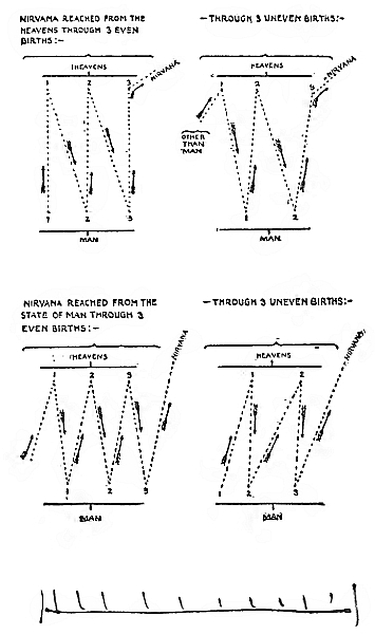
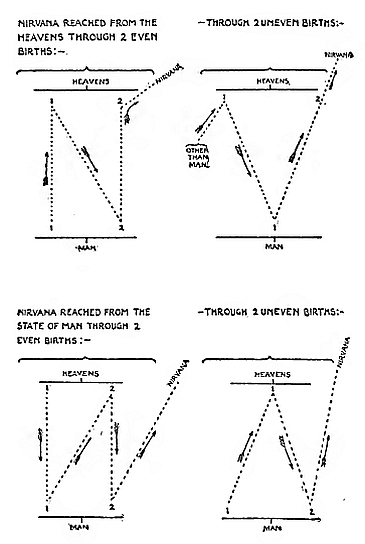
Though all beings do not pass through every stage of the great journey, all beings who attain to the highest enlightenment, by any course whatever, acquire certain faculties not belonging to particular conditions of birth, but only to particular conditions of psychical development. These are, the Roku-Jindzū (Abhidjnâ), or Six Supernatural Powers:[6] (1) Shin-Kyō-Tsu, the power of passing any-whither through any obstacles,—through solid walls, for example;—(2) Tengen-Tsū, the power of infinite vision;—(3) Tenni-Tsū, the power of infinite hearing;—(4) Tashin-Tsū, the power of knowing the thoughts of all other beings;—(5) Shuku-jū-Tsū, the power of remembering former births;—(6) Rojin—Tsū, infinite wisdom with the power of entering at will into Nirvana. The Roku-jindzū first begin to develop in the state of Shōmon (Sravaka), and expand in the higher conditions of Engaku (Pratyeka-Buddha) and of Bosatsu (Bodhisattva or Mahâsattva). The powers of the Shōmon may be exerted over two thousand worlds; those of the Engaku or Bosatsu, over three thousand;—but the powers of Buddhahood extend over the total cosmos. In the first state of holiness, for example, comes the memory of a certain number of former births, together with the capacity to foresee a corresponding number of future births;—in the next higher state the number of births remembered increases;—and in the state of Bosatsu all former births are visible to memory. But the Buddha sees not only all of his own former births, but likewise all births that ever have been or can be,—and all the thoughts and acts, past, present, or future, of all past, present, or future beings.... Now these dreams of supernatural power merit attention because of the ethical teaching in regard to them,—the same which is woven through every Buddhist hypothesis, rational or unthinkable,—the teaching of self-abnegation. The Supernatural Powers must never be used for personal pleasure, but only for the highest beneficence,—the propagation of doctrine, the saving of men. Any exercise of them for lesser ends might result in their loss,—would certainly signify retrogression in the path.[7] To show them for the purpose of exciting admiration or wonder were to juggle wickedly with what is divine; and the Teacher himself is recorded to have once severely rebuked a needless display of them by a disciple.[8]
This giving up not only of one life, but of countless lives,—not only of one world, but of innumerable worlds,—not only of natural but also of supernatural pleasures,—not only of selfhood but of godhood,—is certainly not for the miserable privilege of ceasing to be, but for a privilege infinitely outweighing all that even paradise can give. Nirvana is no cessation, but an emancipation. It means only the passing of conditioned being into unconditioned being,—the fading of all mental and physical phantoms into the light of Formless Omnipotence and Omniscience. But the Buddhist hypothesis holds some suggestion of the persistence of that which has once been able to remember all births and states of limited being,—the persistence of the identity of the Buddhas even in Nirvana notwithstanding the teaching that all Buddhas are one. How reconcile this doctrine of monism with the assurance of various texts that the being who enters Nirvana can, when so desirous, reassume an earthly personality? There are some very remarkable texts on this subject in the Sutra of the Lotos of the Good Law: those for instance in which the Tathâgata Prabhûtarâtna is pictured as sitting "perfectly extinct upon his throne" and speaking before a vast assembly to which he has been introduced as "the great Seer who, although perfectly extinct for many kôtis of æons, now comes to hear the Law." These texts themselves offer us the riddle of multiplicity in unity; for the Tathâgata Prabhûtarâtna and the myriads of other extinct Buddhas who appear simultaneously, are said to have been all incarnations of but a single Buddha.
A reconciliation is offered by the hypothesis of what might be called a pluristic monism,—a sole reality composed of groups of consciousness, at once independent and yet interdependent,—or, to speak of pure mind in terms of matter, an atomic spiritual ultimate. This hypothesis, though not doctrinably enunciated in Buddhist texts, is distinctly implied both by text and commentary. The Absolute of Buddhism is one as ether is one. Ether is conceivable only as a composition of units.[9] The Absolute is conceivable only (according to any attempt at a synthesis of the Japanese doctrines) as composed of Buddhas. But here the student finds himself voyaging farther, perhaps, beyond the bar of the thinkable than Western philosophers have ever ventured. All are One;—each by union becomes equal with All! We are not only bidden to imagine the ultimate reality as composed of units of conscious being,—but to believe each unit permanently equal to every other and infinite in potentiality.[10] The central reality of every living creature is a pure Buddha: the visible form and thinking self, which encell it, being but Karma. With some degree of truth it might be said that Buddhism substitutes for our theory of a universe of physical atoms the hypothesis of a universe of psychical units. Not that it necessarily denies our theory of physical atoms, but that it assumes a position which might be thus expressed in words: "What you call atoms are really combinations, unstable aggregates, essentially impermanent, and therefore essentially unreal. Atoms are but Karma." And this position is suggestive. We know nothing whatever of the ultimate nature of substance and motion: but we have scientific evidence that the known has been evolved from the unknown; that the atoms of our elements are combinations; and that what we call matter and force are but different manifestations of a single and infinite Unknown Reality.
There are wonderful Buddhist pictures which at first sight appear to have been made, like other Japanese pictures, with bold free sweeps of a skilled brush, but which, when closely examined, prove to have been executed in a much more marvelous manner. The figures, the features, the robes, the aureoles,—also the scenery, the colors, the effects of mist or cloud,—all, even to the tiniest detail of tone or line, have been produced by groupings of microscopic Chinese characters,—tinted according to position, and more or less thickly massed according to need of light or shade. In brief, these pictures are composed entirely out of texts of Sutras: they are mosaics of minute ideographs,—each ideograph a combination of strokes, and the symbol at once of a sound and of an idea.
Is our universe so composed?—an endless phantasmagory made only by combinations of combinations of combinations of combinations of units finding quality and form through unimaginable affinities;—now thickly massed in solid glooms; now palpitating in tremulosities of light and color; always and everywhere grouped by some stupendous art into one vast mosaic of polarities;—yet each unit in itself a complexity inconceivable, and each in itself also a symbol only, a character, a single ideograph of the undecipherable text of the Infinite Riddle?... Ask the chemists and the mathematicians.
V
... "All beings that have life shall lay Aside their complex form,—that aggregation Of mental and material qualities That gives them, or in heaven or on earth, Their fleeting individuality." The Book of the Great Decease.
In every teleological system there are conceptions which cannot bear the test of modern psychological analysis, and in the foregoing unfilled outline of a great religious hypothesis there will doubtless be recognized some "ghosts of beliefs haunting those mazes of verbal propositions in which metaphysicians habitually lose themselves." But truths will be perceived also,—grand recognitions of the law of ethical evolution, of the price of progress, and of our relation to the changeless Reality abiding beyond all change.
The Buddhist estimate of the enormity of that opposition to moral progress which humanity must overcome is fully sustained by our scientific knowledge of the past and perception of the future. Mental and moral advance has thus far been effected only through constant struggle against inheritances older than reason or moral feeling,—against the instincts and the appetites of primitive brute life. And the Buddhist teaching, that the average man can hope to leave his worse nature behind him only after the lapse of millions of future lives, is much more of a truth than of a theory. Only through millions of births have we been able to reach even this our present imperfect state; and the dark bequests of our darkest past are still strong enough betimes to prevail over reason and ethical feeling. Every future forward pace upon the moral path will have to be taken against the massed effort of millions of ghostly wills. For those past selves which priest and poet have told us to use as steps to higher things are not dead, nor even likely to die for a thousand generations to come: they are too much alive;—they have still power to clutch the climbing feet,—sometimes even to fling back the climber into the primeval slime.
Again, in its legend of the Heavens of Desire,—progress through which depends upon the ability of triumphant virtue to refuse what it has won,—Buddhism gives us a wonder-story full of evolutional truth. The difficulties of moral self-elevation do not disappear with the amelioration of material social conditions;—in our own day they rather increase. As life becomes more complex, more multiform, so likewise do the obstacles to ethical advance,—so likewise do the results of thoughts and acts. The expansion of intellectual power, the refinement of sensibility, the enlargement of the sympathies, the intensive quickening of the sense of beauty,—all multiply ethical dangers just as certainly as they multiply ethical opportunities. The highest material results of civilization, and the increase of possibilities of pleasure, exact an exercise of self-mastery and a power of, ethical balance, needless and impossible in older and lower states of existence.
The Buddhist doctrine of impermanency is the doctrine also of modern science: either might be uttered in the words of the other. "Natural knowledge," wrote Huxley in one of his latest and finest essays, "tends more and more to the conclusion that 'all the choir of heaven and furniture of the earth' are the transitory forms of parcels of cosmic substance wending along the road of evolution from nebulous potentiality,—through endless growths of sun and planet and satellite,—through all varieties of matter,—through infinite diversities of life and thought,—possibly through modes of being of which we neither have a conception nor are competent to form any,—back to the indefinable latency from which they arose. Thus the most obvious attribute of the Cosmos is its impermanency."[1]
And, finally, it may be said that Buddhism not only presents remarkable accordance with nineteenth century thought in regard to the instability of all integrations, the ethical signification of heredity, the lesson of mental evolution, the duty of moral progress, but it also agrees with science in repudiating equally our doctrines of materialism and of spiritualism, our theory of a Creator and of special creation, and our belief in the immortality of the soul. Yet, in spite of this repudiation of the very foundations of Occidental religion, it has been able to give us the revelation of larger religious possibilities,—the suggestions of a universal scientific creed nobler than any which has ever existed. Precisely in that period of our own intellectual evolution when faith in a personal God is passing away,—when the belief in an individual soul is becoming impossible,—when the most religious minds shrink from everything that we have been calling religion,—when the universal doubt is an ever-growing weight upon ethical aspiration,—light is offered from the East. There we find ourselves in presence of an older and a vaster faith,—holding no gross anthropomorphic conceptions of the immeasurable Reality, and denying the existence of soul, but nevertheless inculcating a system of morals superior to any other, and maintaining a hope which no possible future form of positive knowledge can destroy. Reinforced by the teaching of science, the teaching of this more ancient faith is that for thousands of years we have been thinking inside-out and upside-down. The only reality is One;—all that we have taken for Substance is only Shadow;—the physical is the unreal;—and the outer-man is the ghost.
X
THE REBIRTH OF KATSUGORŌ
I
The following is not a story,—at least it is not one of my stories. It is only the translation of an old Japanese document—or rather series of documents—very much signed and sealed, and dating back to the early part of the present century. Various authors appear to have made use of these documents: especially the compiler of the curious collection of Buddhist stories entitled Bukkyō-hyakkwa-zenshō, to whom they furnished the material of the twenty-sixth narrative in that work. The present translation, however, was made from a manuscript copy discovered in a private library in Tōkyō. I am responsible for nothing beyond a few notes appended to the text.
Although the beginning will probably prove dry reading, I presume to advise the perusal of the whole translation from first to last, because it suggests many things besides the possibility of remembering former births. It will be found to reflect something of the feudal Japan passed away, and something of the old-time faith,—not the higher Buddhism, but what is incomparably more difficult for any Occidental to obtain a glimpse of: the common ideas of the people concerning preëxistence and rebirth. And in view of this fact, the exactness of the official investigations, and the credibility of the evidence accepted, necessarily become questions of minor importance.
II
1.—COPY OF THE REPORT OF TAMON DEMPACHIRŌ.
The case of Katsugorō, nine years old, second son of Genzō, a farmer on my estate, dwelling in the Village called Nakano-mura in the District called Tamagōri in the Province of Musashi.
Some time during the autumn of last year, the above-mentioned Katsugorō, the son of Genzō, told to his elder sister the story of his previous existence and of his rebirth. But as it seemed to be only the fancy of a child, she gave little heed to it. Afterwards, however, when Katsugorō had told her the same story over and over again, she began to think that it was a strange thing, and she told her parents about it.
During the twelfth month of the past year, Genzō himself questioned Katsugorō about the matter, whereupon Katsugorō declared,—
That he had been in his former existence the son of a certain Kyūbei, a farmer of Hodokubo-mura, which is a village within the jurisdiction of the Lord Komiya, in the district called Tamagōri, in the province of Musashi;—
That he, Katsugorō, the son of Kyūbei, had died of smallpox at the age of six years,—and
That he had been reborn thereafter into the family of the Genzō before-mentioned.
Though this seemed unbelievable, the boy repeated all the circumstances of his story with so much exactness and apparent certainty, that the Headman and the elders of the village made a formal investigation of the case. As the news of this event soon spread, it was heard by the family of a certain Hanshirō, living in the village called Hodokubo-mura; and Hanshirō then came to the house of the Genzō aforesaid, a farmer belonging to my estate, and found that everything was true which the boy had said about the personal appearance and the facial characteristics of his former parents, and about the aspect of the house which had been his home in his previous birth. Katsugorō was then taken to the house of Hanshirō in Hodokubo-mura; and the people there said that he looked very much like their Tōzō, who had died a number of years before, at the age of six. Since then the two families have been visiting each other at intervals. The people of other neighboring villages seem to have heard of the matter; and now persons come daily from various places to see Katsugorō.
*
A deposition regarding the above facts having been made before me by persons dwelling on my estate, I summoned the man Genzō to my house, and there examined him. His answers to my questions did not contradict the statements before-mentioned made by other parties.
Occasionally in the world some rumor of such a matter as this spreads among the people. Indeed, it is hard to believe such things. But I beg to make report of the present case, hoping the same will reach your august ear,—so that I may not be charged with negligence.
[Signed] TAMON DEMPACHIRŌ.
The Fourth Month and the Sixth Year of Bunsei [1823].
2.—COPY OF LETTER WRITTEN BY KAZUNAWO TO TEIKIN, PRIEST OF SENGAKUJI.
I have been favored with the accompanying copy of the report of Tamon Dempachirō by Shiga Hyoëmon Sama, who brought it to me; and I take great pleasure in sending it to you. I think that it might be well for you to preserve it, together with the writing from Kwan-zan Sama, which you kindly showed me the other day.
[Signed] KAZUNAWO.
The twenty-first day of the Sixth Month. [No other date.]
3.—COPY OF THE LETTER OF MATSUDAIRA KWANZAN [DAIMYŌ] TO THE PRIEST TEIKIN OF THE TEMPLE CALLED SENGAKUJI.
I herewith enclose and send you the account of the rebirth of Katsugorō. I have written it in the popular style, thinking that it might have a good effect in helping to silence those who do not believe in the doctrines of the Buddha. As a literary work it is, of course, a wretched thing. I send it to you supposing that it could only amuse you from that point of view. But as for the relation itself, it is without mistake; for I myself heard it from the grandmother of Katsugorō. When you have read it, please return it to me.
[Signed] KWANZAN.
Twentieth day. [No date.]
[COPY.]
RELATION OF THE REBIRTH OF KATSUGORŌ.
4.—(Introductory Note by the Priest Teikin.)
This is the account of a true fact; for it has been written by Matsudaira Kwanzan Sama, who himself went [to Nakano-mura] on the twenty-second day of the third month of this year for the special purpose of inquiring about the matter.
After having obtained a glimpse of Katsugoro, he questioned the boy's grandmother as to every particular; and he wrote down her answers exactly as they were given.
Afterwards, the said Kwanzan Sama condescended to honor this temple with a visit on the fourteenth day of this fourth month, and with his own august lips told me about his visit to the family of the aforesaid Katsugorō. Furthermore, he vouchsafed me the favor of permitting me to read the before-mentioned writing, on the twentieth day of this same month. And, availing myself of the privilege, I immediately made a copy of the writing.
[Signed] TEIKIN SŌ Sengaku-ji Facsimile of the priest's kakihan, or private sign-manual,made with the brush.
The twenty-first day of the Fourth Month of the Sixth Year of Bunsei [1823]
[COPY.]
5.—[NAMES OF THE MEMBERS OF THE TWO FAMILIES CONCERNED.]
[Family of Genzō.]
KATSUGORŌ.—Born the 10th day of the 10th month of the twelfth year of Bunkwa [1815]. Nine years old this sixth year of Bunsei [1823].[1] Second son of Genzō, a farmer living in Tanitsuiri in Nakano-mura, district of Tamagōri, province of Musashi.—Estate of Tamon Dempachirō, whose yashiki is in the street called Shichikenchō, Nedzu, Yedo.—Jurisdiction of Yusuki.
GENZŌ.—Father of Katsugorō. Family name, Koyada. Forty-nine years old this sixth year of Bunsei. Being poor, he occupies himself with the making of baskets, which he sells in Yedo. The name of the inn at which he lodges while in Yedo is Sagamiya, kept by one Kihei, in Bakuro-chō.
SEI.—Wife of Genzō and mother of Katsugoro. Thirty-nine years old this sixth year of Bunsei. Daughter of Murata Kichitarō, samurai,—once an archer in the service of the Lord of Owari. When Sei was twelve years old she was a maid-servant, it is said, in the house of Honda Dainoshin Dono. When she was thirteen years old, her father, Kichitarō was dismissed forever for a certain cause from the service of the Lord of Owari, and he became a rōnin.[2] He died at the age of seventy-five, on the twenty-fifth day of the fourth month of the fourth year of Bunkwa [1807]. His grave is in the cemetery of the temple called Eirin-ji, of the Zen sect, in the village of Shimo-Yusuki.
TSUYA.—Grandmother of Katsugoro. Seventy-two years old this sixth year of Bunsei. When young she served as maid in the household of Matsudaira Oki-no-Kami Dono [Daimyō].
FUSA.—Elder sister of Katsugoro. Fifteen years old this year.
OTOJIRŌ.—Elder brother of Katsugoro. Fourteen years old this year.
TSUNÉ.—Younger sister of Katsugoro. Four years old this year.
[Family of Hanshirō.]
TŌZŌ.—Died at the age of six in Hodo-kubo-mura, in the district called Tamagori in the province of Musashi. Estate of Nakané Uyemon, whose yashiki is in the street Ata-rashi-bashi-dōri, Shitaya, Yedo. Jurisdiction of Komiya.—[Tōzō] was born in the second year of Bunkwa [1805], and died at about the fourth hour of the day [10 o'clock in the morning] on the fourth clay of the second month of the seventh year of Bunkwa [1810]. The sickness of which he died was smallpox. Buried in the graveyard on the hill above the village before-mentioned,—Hodokubo-mura.—Parochial temple: Iwōji in Misawa-mura. Sect: Zen-shū. Last year the fifth year of Bunkwa [1822], the jiū-san kwaiki[3] was said for Tōzō.
HANSHIRŌ.—Stepfather of Tōzō. Family name: Suzaki. Fifty years old this sixth year of Bunsei.
SHIDZU.—Mother of Tōzō. Forty-nine years old this sixth year of Bunsei.
KYŪBEI (afterwards TOGŌRŌ).—Real father of Tōzō. Original name, Kyūbei, afterwards changed to Togōrō. Died at the age of forty-eight, in the sixth year of Bunkwa [1809], when Tözö was five years old. To replace him, Hanshirō became an iri-muko.[4]
CHILDREN: TWO BOYS AND TWO GIRLS.—These are Hanshirō's children by the mother of Tōzō.
6.—[COPY OF THE ACCOUNT WRITTEN IN POPULAR STYLE BY MATSUDAIRA KWANZAN DONO, DAIMYŌ.]
Some time in the eleventh month of the past year, when Katsugorō was playing in the rice-field with his elder sister, Fusa, he asked her,— "Elder Sister, where did you come from before you were born into our household?"
Fusa answered him:—
"How can I know what happened to me before I was born?"
Katsugoro looked surprised and exclaimed:
"Then you cannot remember anything that happened before you were born?"
"Do you remember?" asked Fusa.
"Indeed I do," replied Katsugorō. "I used to be the son of Kyūbei San of Hodo-kubo, and my name was then Tōzō—do you not know all that?"
"Ah!" said Fusa, "I shall tell father and mother about it."
But Katsugorō at once began to cry, and said:—
"Please do not tell!—it would not be good to tell father and mother."
Fusa made answer, after a little while:—
"Well, this time I shall not tell. But the next time that you do anything naughty, then I will tell."
After that day whenever a dispute arose between the two, the sister would threaten the brother, saying, "Very well, then—I shall tell that thing to father and mother." At these words the boy would always yield to his sister. This happened many times; and the parents one day overheard Fusa making her threat. Thinking Katsugorō must have been doing something wrong, they desired to know what the matter was, and Fusa, being questioned, told them the truth. Then Genzō and his wife, and Tsuya, the grandmother of Katsugorō, thought it a very strange thing. They called Katsugorō, therefore; and tried, first by coaxing, and then by threatening, to make him tell what he had meant by those words.
After hesitation, Katsugorō said:—"I will tell you everything. I used to be the son of Kyūbei San of Hodokubo, and the name of my mother then was O-Shidzu San. When I was five years old, Kyūbei San died; and there came in his place a man called Hanshirō San, who loved me very much. But in the following year, when I was six years old, I died of smallpox. In the third year after that I entered mother's honorable womb, and was born again."
The parents and the grandmother of the boy wondered greatly at hearing this; and they decided to make all possible inquiry as to the man called Hanshirō of Hodokubo. But as they all had to work very hard every day to earn a living, and so could spare but little time for any other matter, they could not at once carry out their intention.
Now Sei, the mother of Katsugorō, had nightly to suckle her little daughter Tsuné, who was four years old;[5]—and Katsugorō therefore slept with his grandmother, Tsuya. Sometimes he used to talk to her in bed; and one night when he was in a very confiding mood, she persuaded him to tell her what happened at the time when he had died. Then he said:—"Until I was four years old I used to remember everything; but since then I have become more and more forgetful; and now I forget many, many things. But I still remember that I died of smallpox; I remember that I was put into a jar;[6] I remember that I was buried on a hill. There was a hole made in the ground; and the people let the jar drop into that hole. It fell pon!—I remember that sound well. Then somehow I returned to the house, and I stopped on my own pillow there.[7] In a short time some old man,—looking like a grandfather—came and took me away. I do not know who or what he was. As I walked I went through empty air as if flying. I remember it was neither night nor day as we went: it was always like sunset-time. I did not feel either warm or cold or hungry. We went very far, I think; but still I could hear always, faintly, the voices of people talking at home; and the sound of the Nembutsu[8] being said for me. I remember also that when the people at home set offerings of hot botamochi[9] before the household shrinen [butsudan], I inhaled the vapor of the offerings.... Grandmother, never forget to offer warm food to the honorable dead [Hotoké Sama], and do not forget to give to priests—I am sure it is very good to do these things.[10] ... After that, I only remember that the old man led me by some roundabout way to this place—I remember we passed the road beyond the village. Then we came here, and he pointed to this house, and said to me:—'Now you must be reborn,—for it is three years since you died. You are to be reborn in that house. The person who will become your grandmother is very kind; so it will be well for you to be conceived and born there.' After saying this, the old man went away. I remained a little time under the kaki-tree before the entrance of this house. Then I was going to enter when I heard talking inside: some one said that because father was now earning so little, mother would have to go to service in Yedo. I thought, "I will not go into that house;" and I stopped three days in the garden. On the third clay it was decided that, after all, mother would not have to go to Yedo. The same night I passed into the house through a knot-hole in the sliding-shutters;—and after that I stayed for three days beside the kamado.[11] Then I entered mother's honorable womb.[12] ... I remember that I was born without any pain at all.—Grandmother, you may tell this to father and mother, but please never tell it to anybody else."
*
The grandmother told Genzō and his wife what Katsugorō had related to her; and after that the boy was not afraid to speak freely with his parents on the subject of his former existence, and would often say to them: "I want to go to Hodokubo. Please let me make a visit to the tomb of Kyūbei San." Genzō thought that Katsugorō, being a strange child, would probably die before long, and that it might therefore be better to make inquiry at once as to whether there really was a man in Hodokubo called Hanshirō. But he did not wish to make the inquiry himself, because for a man to do so [under such circumstances?] would seem inconsiderate or forward. Therefore, instead of going himself to Hodokubo, he asked his mother Tsuya, on the twentieth day of the first month of this year, to take her grandson there.
Tsuya went with Katsugorō to Hodokubo; and when they entered the village she pointed to the nearer dwellings, and asked the boy," Which house is it?—is it this house or that one?" "No," answered Katsugorō,—"it is further on—much further,"—and he hurried before her. Reaching a certain dwelling at last, he cried, "This is the house!"—and ran in, without waiting for his grandmother. Tsuya followed him in, and asked the people there what was the name of the owner of the house. "Hanshirō," one of them answered. She asked the name of Hanshirō's wife. "Shidzu," was the reply. Then she asked whether there had ever been a son called Tōzō born in that house. "Yes," was the answer; "but that boy died thirteen years ago, when he was six years old."
Then for the first time Tsuya was convinced that Katsugorō had spoken the truth; and she could not help shedding tears. She related to the people of the house all that Katsugorō had told her about his remembrance of his former birth. Then Hanshirō and his wife wondered greatly. They caressed Katsugorō and wept; and they remarked that he was much handsomer now than he had been as Tözö before dying at the age of six. In the mean time, Katsugorō was looking all about; and seeing the roof of a tobacco shop opposite to the house of Hanshirō, he pointed to it, and said:—"That used not to be there." And he also said,—"The tree yonder used not to be there." All this was true. So from the minds of Hanshirō and his wife every doubt departed [ga wo orishi].
On the same day Tsuya and Katsugorō returned to Tanitsuiri, Nakano-mura. Afterwards Genzō sent his son several times to Hanshirō's house, and allowed him to visit the tomb of Kyūbei his real father in his previous existence.
Sometimes Katsugorō says:—"I am a Nono-Sama:[13] therefore please be kind to me." Sometimes he also says to his grandmother:—"I think I shall die when I am sixteen; but, as Ontaké Sama[14] has taught us, dying is not a matter to be afraid of." When his parents ask him, "Would you not like to become a priest?" he answers, "I would rather not be a priest."
The village people do not call him Katsugoro any more; they have nicknamed him "Hodokubo-Kozō" (the Acolyte of Hodokubo).[15] When any one visits the house to see him, he becomes shy at once, and runs to hide himself in the inner apartments. So it is not possible to have any direct conversation with him. I have written down this account exactly as his grandmother gave it to me.
I asked whether Genzō, his wife, or Tsuya, could any of them remember having done any virtuous deeds. Genzō and his wife said that they had never done anything especially virtuous; but that Tsuya, the grandmother, had always been in the habit of repeating the Nembutsu every morning and evening, and that she never failed to give two mon[16] to any priest or pilgrim who came to the door. But excepting these small matters, she never had done anything which could be called a particularly virtuous act.
(—This is the End of the Relation of the Rebirth of Katsugorō.)
7.—(Note by the Translator.) The foregoing is taken from a manuscript entitled Chin Setsu Shū Ki; or, "Manuscript-Collection of Uncommon Stories,"—made between the fourth month of the sixth year of Bunsei and the tenth month of the sixth year of Tempo [1823-1835]. At the end of the manuscript is written,—"From the years of Bunsei to the years of Tempo.—Minamisempa, Owner: Kurumachō, Shiba, Yedo" Under this, again, is the following note:—"Bought from Yamatoya Sakujirō Nishinohubo: twenty-first day [?], Second Year of Meiji [1869]." From which it would appear that the manuscript had been written by Minamisempa, who collected stories told to him, or copied them from manuscripts obtained by him, during the thirteen years from 1823 to 1835, inclusive.
III
Perhaps somebody will now be unreasonable enough to ask whether I believe this story,—as if my belief or disbelief had anything to do with the matter! The question of the possibility of remembering former births seems to me to depend upon the question what it is that remembers. If it is the Infinite All-Self in each one of us, then I can believe the whole of the Jatakas without any trouble. As to the False Self, the mere woof and warp of sensation and desire, then I can best express my idea by relating a dream which I once dreamed. Whether it was a dream of the night or a dream of the day need not concern any one, since it was only a dream.
XI
WITHIN THE CIRCLE
Neither personal pain nor personal pleasure can be really expressed in words. It is never possible to communicate them in their original form. It is only possible, by vivid portrayal of the circumstances or conditions causing them, to awaken in sympathetic minds some kindred qualities of feeling. But if the circumstances causing the pain or the pleasure be totally foreign to common human experience, then no representation of them can make fully known the sensations which they evoked. Hopeless, therefore, any attempt to tell the real pain of seeing my former births. I can say only that no combination of suffering possible to individual being could be likened to such pain,—the pain of countless lives interwoven. It seemed as if every nerve of me had been prolonged into some monstrous web of sentiency spun back through a million years,—and as if the whole of that measureless woof and warp, over all its shivering threads, were pouring into my consciousness, out of the abysmal past, some ghastliness without name,—some horror too vast for human brain to hold. For, as I looked backward, I became double, quadruple, octuple;—I multiplied by arithmetical progression;—I became hundreds and thousands,—and feared with the terror of thousands,—and despaired with the anguish of thousands,—and shuddered with the agony of thousands; yet knew the pleasure of none. All joys, all delights appeared but mists or mockeries: only the pain and the fear were real,—and always, always growing. Then in the moment when sentiency itself seemed bursting into dissolution, one divine touch ended the frightful vision, and brought again to me the simple consciousness of the single present. Oh! how unspeakably delicious that sudden shrinking back out of multiplicity into unity!—that immense, immeasurable collapse of Self into the blind oblivious numbness of individuality!
*
"To others also," said the voice of the divine one who had thus saved me,—"to others in the like state it has been permitted to see something of their preëxistence. But no one of them ever could endure to look far. Power to see all former births belongs only to those eternally released from the bonds of Self. Such exist outside of illusion,—outside of form and name; and pain cannot come nigh them.
"But to you, remaining in illusion, not even the Buddha could give power to look back more than a little way.
"Still you are bewitched by the follies of art and of poetry and of music,—the delusions of color and form,—the delusions of sensuous speech, the delusions of sensuous sound.
"Still that apparition called Nature—which is but another name for emptiness and shadow—deceives and charms you, and fills you with dreams of longing for the things of sense.
"But he who truly wishes to know, must not love this phantom Nature,—must not find delight in the radiance of a clear sky,—nor in the sight of the sea,—nor in the sound of the flowing of rivers,—nor in the forms of peaks and woods and valleys,—nor in the colors of them.
"He who truly wishes to know must not find delight in contemplating the works and the deeds of men, nor in hearing their converse, nor in observing the puppet-play of their passions and of their emotions. All this is but a weaving of smoke,—a shimmering of vapors,—an impermanency,—a phantasmagory.
"For the pleasures that men term lofty or noble or sublime are but larger sensualisms, subtler falsities: venomous fair-seeming flowerings of selfishness,—all rooted in the elder slime of appetites and desires. To joy in the radiance of a cloudless day,—to see the mountains shift their tintings to the wheeling of the sun,—to watch the passing of waves, the fading of sunsets,—to find charm in the blossoming of plants or trees: all this is of the senses. Not less truly of the senses is the pleasure of observing actions called great or beautiful or heroic,—since it is one with the pleasure of imagining those things for which men miserably strive in this miserable world: brief love and fame and honor,—all of which are empty as passing foam.
"Sky, sun, and sea;—the peaks, the woods, the plains;—all splendors and forms and colors,—are spectres. The feelings and the thoughts and the acts of men,—whether deemed high or low, noble or ignoble,—all things imagined or done for any save the eternal purpose, are but dreams born of dreams and begetting hollowness. To the clear of sight, all feelings of self,—all love and hate, joy and pain, hope and regret, are alike shadows;—youth and age, beauty and horror, sweetness and foulness, are not different;—death and life are one and the same; and Space and Time exist but as the stage and the order of the perpetual Shadow-play.
"All that exists in Time must perish. To the Awakened there is no Time or Space or Change,—no night or day,—no heat or cold,—no moon or season,—no present, past, or future. Form and the names of form are alike nothingness:—Knowledge only is real; and unto whomsoever gains it, the universe becomes a ghost. But it is written:—'He who hath overcome Time in the past and the future must be of exceedingly pure understanding.'
"Such understanding is not yours. Still to your eyes the shadow seems the substance,—and darkness, light,—and voidness, beauty. And therefore to see your former births could give you only pain."
*
I asked:—
"Had I found strength to look back to the beginning,—back to the verge of Time,—could I have read the Secret of the universe?"
"Nay," was answer made. "Only by Infinite Vision can the Secret be read. Could you have looked back incomparably further than your power permitted, then the Past would have become for you the Future. And could you have endured even yet more, the Future would have orbed back for you into the Present."
"Yet why?" I murmured, marveling.... "What is the Circle?"
"Circle there is none," was the response;—"Circle there is none but the great phantom-whirl of birth and death to which, by their own thoughts and deeds, the ignorant remain condemned. But this has being only in Time; and Time itself is illusion."