ETHNOLOGICAL RESULTS OF THE POINT BARROW EXPEDITION.
Reading edition
By John Murdoch.
SKIN-WORKING.
Scrapers (ikun).—
For removing bits of flesh, fat, etc., from a “green” skin, and for “breaking the grain” and removing the subcutaneous tissue from a dried skin, the women, who appear to do most if not all of this work, use a tool consisting of a blunt stone blade, mounted in a short, thick haft of wood or ivory, fitting exactly to the inside of the hand and having holes or hollows to receive the tips of the fingers and thumb. The skin is laid upon the thigh and thoroughly scraped with this tool, which is grasped firmly in the right hand and pushed from the worker. This tool is also used for softening up skins which have become stiffened from being wet and then dried. The teeth appear to be less often used for such purposes than among the eastern Eskimo.
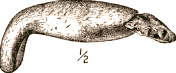
Fig. 289.—Skin scraper.
We obtained eighteen such scrapers, some without blades, and two unmounted blades. Every woman owns one of these tools. While they are all of the same general model, they vary a good deal in details. Four different forms or subtypes have been recognized in the series collected, all modifications of the form seen in Fig. 289, No. 89313 [955], which may be called the type. The blade is of brown jasper, rather coarsely flaked, 1.1 inches long. It is wedged with pieces of skin, into a deep slot in the tip of the handle, which is of fossil ivory, slightly yellowed from handling. The left side against which the thumb rests is slightly flattened, and the right slightly excavated to receive the third and fourth fingers, which are bent round under the lobe, their tips pressing against the concave under surface of the latter. The fore and middle fingers rest upon the upper surface.
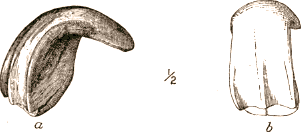
Fig. 290.—Skin scrapers—handles only.
No. 89320 [1171] from Utkiavwĭñ, without a blade, is of the same general pattern, but is slightly excavated on the left as well as the right side so as to make a sort of shank. It is of fossil ivory, stained a dingy orange from age and grease. The two incised circles and dots on the upper surface close to the slot make the end of the handle look like the head of a Lophius, which it is perhaps meant to represent. No. 89321 (858), an old fossil ivory handle, has the left side slightly hollowed to receive the tip of the thumb, and a median keel on the upper surface with a barely perceptible hollow on each side of it for the tips of the fingers. This is a step toward the second subtype as shown in Fig. 290 (No. 89317 [748] from Utkiavwĭñ, which has no blade). This is of fossil ivory, thicker and more strongly arched than the type described, deeply excavated below so as to form a broad lobe at the butt, with the upper surface deeply grooved to receive the tips of the fore and middle fingers, and a slight hollow on the left side for the thumb. This specimen is very neatly made and polished, and all the edges are rounded off. One-half of the handle (lengthwise) and the outer quarter of the other half are stained with age and grease a beautiful amber brown. This specimen was said to be as old as the time when men wore but one labret.
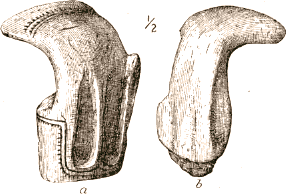
Fig. 291.—Skin scrapers.
The only essential difference between this subtype and the preceding is that the former has deep grooves or hollows for the thumb and two fingers. We collected five specimens of this pattern, all but one with handles of fossil ivory. The single exception, which came from Sidaru, has a handle of walrus ivory, yellowed with age and grease. This specimen (Fig. 291a, No. 89322 [1426]) has an unusually short blade (only 0.4 inch long), and is much cut out on the right side so as to make a sort of nick. Fig. 291b (No. 89314 [1780]) is a nearly new handle of this pattern, which was bought of the “Nunatañmiun,” who came to Pernyû in 1883. It is very highly ornamented, both with incised patterns, colored black, and by carving the space between the unusually deep thumb hollow and those for the fingers into what seems to be meant for an ear, in high relief, colored red inside.
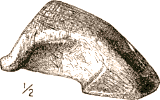
Fig. 292.—Skin scraper.
The third subtype has the lobe separated from the body on the right side only, leaving the left side unexcavated, except by the thumb-hollow, as is shown in Fig. 292 (No. 89316 [1177] from Utkiavwĭñ) which has a handle of yellowed fossil ivory and a black flint blade. No. 89310 [1071] Fig. 293, from Utkiavwĭñ, is a rather unusual modification of this pattern, with a wooden handle, in which the bottom is not cut out. The thumb groove is deepened into a large hole which opens into the excavation on the right side, while a large oblong slot on top, opening into these cavities, takes the place of the two finger hollows. The blade was of gray flint and rather longer than usual.
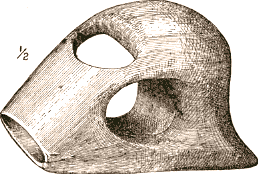
Fig. 293.—Peculiar modification of scraper.
The last subtype which, according to my recollection, is the one most frequently seen in use at the present day, has the butt produced horizontally into a broad, flat lobe. The excavation of the right side may be continued through to the left in the form of a notch, as shown in Fig. 294 (No. 89315 [1365] from Sidaru) which has a blade of black flint and a handle of fossil ivory, with hollows for the thumb and fingers; or the left side may be unexcavated except for the thumb groove as in Fig. 295 (No. 89309 [1135] from Utkiavwĭñ). This specimen has a rather large wooden handle, with the grooves as before. It appears, however, to have been remodeled to fit a smaller hand than that of the original owner, as the thumb groove has been deepened for about two-thirds of its original length, and there is a deep, round hole in the middle of the groove for the second finger. The peculiarity of this specimen, however, is that it has a blade of sandstone, flat and rather thin, with a smooth, rounded edge. The natives told us that scraper blades of sandstone were the prevailing form in old times.
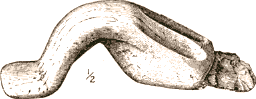
Fig. 294.—Skin scraper.
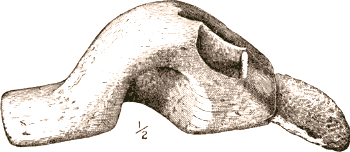
Fig. 295.—Skin scraper.
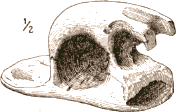
Fig. 296.—Skin scraper.
Fig. 296 (No. 89312 [1336] from Utkiavwĭñ) is another wooden handle, in which the excavation for the third and fourth fingers is merely a large round hole on the right side, while in front the handle is cut into two short lobes, between which in a deep groove the forefinger fits. There is a hollow for the thumb under the left lobe and one on the right for the middle finger. No. 89311 [1079] from the same village is almost exactly similar. These are the only two specimens of the kind which I recollect seeing. A rather large flint-bladed scraper with a wooden handle very much the shape of that of No. 89309 [1135] is the tool most generally used at the present day. The blades are all of the same general shape and vary in size from the little one above mentioned (No. 89322 [1426], Fig. 291a), only 0.4 inch long, to blades like No. 89612 [820], Fig. 297, from Utkiavwĭñ. This is newly made from light gray translucent flint and is 5 inches long. The name kibûgû, applied to this specimen by the native from whom it was purchased, appears to refer either to the material or the unusual size. The blade is ordinarily called kuki, “a claw.” With the ivory handles a blade about 1 or 1½ inches is commonly used and with the wooden ones a considerably larger one, 2 to 3 inches in length. The handles vary in size to fit the hands of the owners, but are all too small for an average white man’s hand. All that we collected are for the right hand.
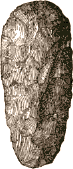
Fig. 297.—Flint blade for skin scraper.
This pattern of skin scraper which appears from the Museum collections to be the prevailing one from Point Barrow to Norton Sound, is evidently the direct descendant of the form used still farther south, which consists of a stone or bone blade of the same shape, mounted on a wooden handle often a foot or 18 inches long, which has the other end bent down into a handle like the butt of a pistol. Shortening this handle (a process shown by specimens in the Museum) would bring the worker’s hand nearer to the blade, thus enabling him to guide it better. Let this process be continued till the whole handle is short enough to be grasped in the hand and we have the first subtype described, of which the others are clearly improvements.
A still more primitive type of scraper is shown by Fig. 298, No. 89651 [1295] from Utkiavwĭñ, the only specimen of the kind seen. This has a flint blade, like those of the modern scrapers, inserted in the larger end of a straight haft of reindeer antler, 5½ inches long. We did not learn the history of this tool in the hurry of trade, but from the shape of the blade it is evidently a scraper. Its use as a skin scraper is rendered still more probable by the fact that the scrapers used by some of the eastern Eskimo (there are specimens in the Museum from Cumberland Gulf and Pelly Bay) have straight handles, though shorter than this.
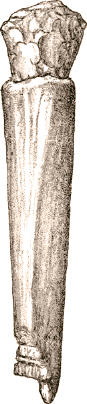
Fig. 298.—Straight-hafter scraper.
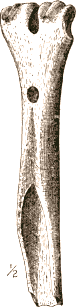
Fig. 299.—Bone scraper.
The Siberian natives use an entirely different form of scraper which has a long handle like that of a spoke-shave with a small blade of stone or iron in the middle and is worked with both hands.411 Fig. 299 (No. 89488 [1578] from Utkiavwĭñ) is a tool which we never saw in use but which we were told was intended for scraping skins. It is probably an obsolete tool, as a knife would better serve the purpose of removing the subcutaneous tissue, etc., while the stone scrapers just described are better for softening the skin.
It is the distal end of the “cannon” bone or metacarpal, of a reindeer, 6.2 inches long, with the two condyles forming the handle. At the other end the posterior face of the shaft is chamfered off so as to expose the medullary cavity for about 2½ inches, leaving a sharp edge on each side. The tip is roughly broken off. The tool appears to be old but the two condyles have been recently carved rudely into two human faces, one male (with marks for labrets) and the other female. There is a somewhat similar tool in the Museum brought by Mr. Nelson from Norton Sound.
Scraper cups (óhovwĭñ).—
In removing the last of the blubber from the skins of seals or walruses when they wish to save the oil, they scrape it off with a little oblong cup of walrus ivory with a sharp edge at one or both ends. The cup, of course, catches the oil which is transferred to a dish. These cups are sometimes, I believe, also used for dipping oil. We collected ten of these cups, of which No. 89251 [1287], Fig. 300a, will serve as the type. This is 3.7 inches long, carved out of a single piece of walrus ivory, and worked down from the inside to a sharp edge on each end. The carving is smoothly done on the outside, but more roughly within, where it is somewhat hacked. It is stained a dark yellow with oil and polished on the outside, probably by much handling. Fig. 300b (No. 89258 [1090] also from Utkiavwĭñ) is a similar cup, but has a sharp edge only at one end which is cut out in a concave curve.
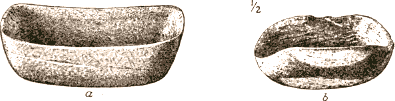
Fig. 300.—Scraper cups.
The ten cups in the collection are all about the same shape and size and all of walrus ivory, stained yellow with oil. The largest is 4 inches long and 2¾ wide, and the smallest, 3 by 2.1 inches. The majority are about 3½ by 2½ inches. Five of the ten have sharp edges at both ends, the rest at one only. Mr. Nelson brought home specimens of this implement from Point Hope and St. Lawrence Island, but I do not find it mentioned elsewhere.
With these tools and their knives, they do all the work of preparing skins for clothing, boat covers, etc. I had no opportunity of seeing the process in all its stages, and can therefore give only a general account of it. Deerskins are always dressed as furs, with the hair on. The skin is rough-dried in the open air, with considerable subcutaneous tissue adhering to it, and laid aside until needed. When wanted for use, a woman takes the skin and works it over carefully with a stone scraper on the flesh side, removing every scrap of subcutaneous tissue and “breaking the grain” of the skin, which leaves a surface resembling white chamois leather and very soft. This is then rubbed down with a flat piece of sandstone or gypsum, and finally with chalk, so that when finished it seems like pipeclayed leather. All furs are prepared in the same way. Small seal skins to be worn with the hair on are scraped very clean and, I think, soaked in urine, before they are spread out to dry. The black waterproof seal skin has the hair shaved off close to the skin, great care being taken to leave the epidermis intact, and also has a certain amount of tanning in urine. It is probable that a little of the blubber is left on these skins, to make them oily and waterproof.
When, however they wish to prepare the white-tanned seal skin, the skins are brought into the warm house, thawed out or dampened and then rolled up and allowed to ferment for several days, so that when they are unrolled hair and epidermis are easily scraped off together. The skin is then soaked in urine, stretched on a large hoop, and put out to dry in the sun and air. Many of these skins are prepared during the first sunny weather in the early spring. The skins of the large seal, walrus or bear when used for boat-covers or boot soles appear to be sweated in the same way, as the epidermis is always removed. We did not learn whether urine was employed on these skins, but I think from their ordinary appearance that they are simply stretched and dried in their own fat, as appears to be the case with the skin of the beluga, from which the epidermis is easily scraped without sweating.412
Combs for deerskins.—
The loosened hairs on a deerskin garment are removed by means of a comb made of a section of the beam of an antler, hollowed out and cut into teeth on the end. This instrument probably serves also to remove vermin, as its name “kúmotĭn” looks very much as if derived from kúmûk, louse. I must say, however, that the natives whom I asked if kúmotĭn had anything to do with kúmûk said it had not. When vermin get troublesome in a garment, it is taken out on the tundra, away from the houses, and beaten with rods like a carpet. Very old garments when much infested with lice are taken out back of the village, cut into small pieces, and burned. It is no uncommon sight in the spring to see an old woman sitting out on the tundra, busy with her knife cutting up old clothes.
We brought home nine of these combs, of which No. 89354 [1879], Fig. 301a, has been selected as the type. It is 4¼ inches long and has sixteen teeth about 1 inch long. The small holes near the other end are for a lanyard to hang it up by.
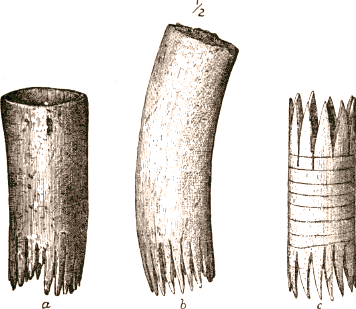
Fig. 301.—Combs for cleaning deerskins.
Six of these combs have teeth at one end only, the other three at both ends. These teeth are generally about fifteen in number, and 1 inch or a little over long. No. 89781 [1005], a very small comb only 2.9 inches long, which belonged to the “inland” native Ilûbw’ga, has twenty teeth 0.6 inch long. These combs are usually about 4 or 4½ inches long. No. 89556 [1017], Fig. 301b, from Utkiavwĭñ is an unusually long comb, 5.3 inches long, which is peculiar in being solid except at the end which is cut into teeth.
Fig. 301c (No. 89359 [993]), from Utkiavwĭñ is a double-ended comb, having ten teeth on one end and thirteen on the other. It is 4.1 inches long and made with considerable care, being ornamented with incised rings colored with red ocher. This is a common implement at Point Barrow, but seems unusual elsewhere. There is a single specimen from the Diomedes in Mr. Nelson’s collection.
MANUFACTURE OF LINES OF THONG.
No tools are used for this purpose except a knife. I have seen a small jackknife used for cutting the fine seal skin lines. The workman takes a wet skin from which the hair and epidermis have been removed and sits down cross-legged on the ground with somebody else to hold the skin stretched for him. Then holding the knife vertically up with the edge away from him, he starts at one corner of the skin and cuts a narrow strip in one continuous piece, going round and round the skin, gathering and stretching the strip with the left hand. They do this work quite rapidly and with great skill, cutting single lines upward of 90 feet long and only one-eighth inch in diameter, almost perfectly even. These fine lines of seal-skin thong, which serve a great variety of purposes, are usually made when they are in the summer camps, before the breaking up of the ice. They are dried by stretching them between stakes 6 inches or a foot high, driven into the ground.
The stout thongs of the hide of the bearded seal, walrus, or beluga are usually made in the winter and stretched to dry between posts of whales’ bones set up in the village, about breast high. While they are drying, the maker carefully trims and scrapes the edges with his knife, so as to make an almost round line.413 The usual diameter is about 0.3 inch. These lines are not always made with such care, being often merely flat thongs. Fine deer-skin twine, or “babiche,” as it is called by the voyageurs, for making the nettings of snow shoes, is made in the same way. A deer skin is dampened, rolled up, and put up over the lamp for a day or two to remove the hair by sweating, and then cut into a single long piece of fine thong.
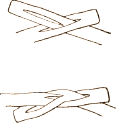
Fig. 302.—Double-slit splice for rawhide lines.
All the men do not appear able to do this fine work. For instance, our friend Mû´ñialu had the babiche for his new snowshoes made by his house-mate, the younger Tuñazu. When it is desired to fasten together two pieces of the stouter kinds of thong, what I have so often referred to as the “double-slit splice” is generally employed. This is made as follows: The two ends to be joined together are each slit lengthwise, and one is passed through the slit in the other. The other end of this piece is then passed through the slit in the first piece, and drawn through so that the sides of each slit interlace like the loops of a square knot (see diagrams, Fig. 302). The splice is often further secured by a seizing of sinew braid. Most writers on the Eskimo have not gone sufficiently into the details of their arts to describe their methods of splicing. One writer,414 however, in describing some Eskimo implements from East Greenland, describes and figures several splices somewhat of this nature, and one in particular especially complicated by crossing the sides of the slits and passing the end through several times. This method of uniting thongs is probably very general among the Eskimo and is also common enough among civilized people.
BUILDERS’ TOOLS.
For excavating.—
At the present day they are very glad to use white men’s picks and shovels when they want to dig in the gravel or clean out the ice from their houses. They, however, have mattocks and pickaxes (síkla) of their own manufacture, which are still in use. These are always single-pointed and have a bone or ivory head, mounted like an adz head on a rather short haft. The haft, like those of the mauls and adzes already described, is never fitted into the head, but always applied to the under surface of the latter and held on by a lashing of thong.
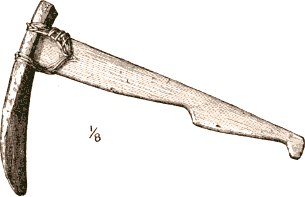
Fig. 303.—Mattock of whale’s rib.
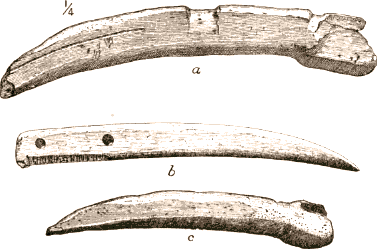
Fig. 304.—Pickax heads of bone, ivory, and whale’s ribs.
The only complete implement of the kind which we obtained is No. 73574 [297], Fig. 303. The head is of whale’s rib, 17¾ inches long. The butt is shouldered on the under surface to receive the haft and roughened with crosscuts to prevent slipping, with two shallow rough transverse notches on the upper surface for the lashings. The haft is of pine, 24½ inches long. The lashing is of stout thong of bearded seal hide, in two pieces, one of four turns passing through the hole, round the front edge of the haft, over the lower notch in the head, and back across the haft to the hole again. The ends are knotted together on top of the head by becket-hitching one end into an eye in the other, made by slitting it close to the tip and passing a bight of the standing part through this slit. The other part is of seven turns, put on in the same way, but crossing back of the haft, and started by looping one end round the head and through the eye by means of an eye at the end made as before. It is finished off by winding the end three or four times round these turns, so as to tighten them up, and hitching it round two of them on one side. This method of hafting differs in no essential respect from that used on the mauls and adzes above described.
We have also two heads for such mattocks, which hardly differ from the one described, except the No. 56494 [285] has the notches for the lashings on the side of the head instead of on the upper surface. It is 16 inches long. The other, No. 89843 [1043], Fig. 304a, is a very rude head made of an almost cylindrical piece of rib. This is a very old tool, which from its oily condition has evidently been long laid away in some blubber room at Utkiavwĭñ. It is 15.2 inches long.
These blunt-pointed mattocks are not so much used at present as picks with a sharp point mounted in the same way, and specially adapted for working in ice or hard frozen soil. I have, however, never seen them used for cutting holes in the ice for fishing, which some authors have supposed to be what they were meant for. Their shape makes them very inconvenient for any such a purpose, except when the ice is very thin.
The ice pick, like those carried on the butt of the spear, is under any circumstances a more serviceable tool. These sharp pickax heads are generally made of a walrus tusk, the natural shape of which requires very little alteration to fit it for the purpose. We collected three of these ivory heads, all very nearly alike, of which No. 56539b [96], Fig. 304b, will serve as the type. This is the tip of a good-sized walrus tusk, 14.2 inches long, preserving very nearly the natural outline of the tusk except at the point, where it is rounded off rather more abruptly above. It is keeled along the upper edge and on the lower edge at the point, so that the latter is four-sided, and the sides of the butt are flattened. On the under side the butt is cut off flat for about 3½ inches, leaving a low flange or ridge, and roughened with crosscuts to fit the end of the haft, and the butt is perforated with two large transverse eyes for the lashing. The other two heads are almost exactly like this and very nearly the same size.
Sharp-pointed pick heads of whale’s bone appear also to have been used, probably at an earlier date than the neatly finished ivory ones, as we collected three such heads, all very old and roughly made, and having notches or grooves for the lashings instead of eyes. Fig. 304c is one of these, No. 89844 [1315], from Utkiavwĭñ, very rudely cut from a piece of whale’s rib, 12 inches long.
I do not recollect seeing any of these bone-headed picks in use, while the ivory-headed one was one of the commonest tools. This Eskimo tool is in use at Pitlekaj, a village supposed to be wholly inhabited by sedentary Chukches.415
TOOLS FOR SNOW AND ICE WORKING.
Snow knives.—
For cutting the blocks of snow used in building the apu´ya, or snow hut, they at the present day prefer a saw or a large steel knife (for instance, a whaleman’s boarding knife), if they can procure it, but they still have many of the large saber-shaped ivory knives so commonly used by the Eskimo everywhere for this purpose. These are, however, more generally used for scraping snow off their clothing, etc., at present. We brought home two of these knives, which do not differ in any important respect from the many specimens collected by other explorers in Alaska.

Fig. 305.—Ivory snow knife.
No. 89478 [759], Fig. 305, is one of these—saviu´ra, “like a knife.” It is of walrus ivory (following the natural outline of the tusk), 16½ inches long. The blade is double-edged, the haft rounded on the edges and laced along the lower edge for 3¼ inches with a double piece of sinew braid. The object of this is to give the hand a firmer grip on the haft. These knives are also used for cutting the blocks of snow to supply the house with water.
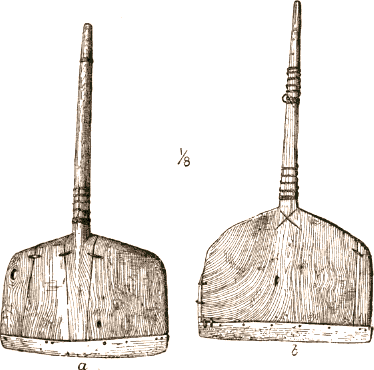
Fig. 306.—Snow shovels.
Snow shovels.—
The broad, short-handled snow shovel of wood with a sharp edge of ivory is the tool universally employed whenever snow is to be shoveled, either to clear it away or for excavating houses or pitfalls in the snowdrifts, or “chinking” up the crevices in the walls of the snow house, and is an indispensable part of the traveler’s outfit in winter. The shovels (pĭ´ksun) are all made on essentially the same pattern, which is well shown by Fig. 306a, No. 56739 [30]. The blade is 14 inches broad and 11 long. The whole upper surface of the shovel is flat. The handle is beveled off on the side to a rounded edge below, and is quite thick where it joins the blade, tapering off to the tip. The blade is thick and abruptly rounded off on the upper edge below and gradually thinned down to the edge. The edge of the wood is fitted with a tongue into a groove in the top of the ivory edge, which is 1½ inches deep. It is fastened on by wooden tree-nails at irregular intervals, and at one end, where the edge of the groove has been broken, by a stitch of black whalebone. The wooden part of the shovel is made of four unequal pieces of spruce, neatly fitted and doweled together and held by the ivory edge and three stitches of black whalebone close to the upper edge, and countersunk below the flat surface. The whippings of sinew braid on the handle are to give a firm grip for the hands.
No. 56738 [27], Fig. 306b, is a similar shovel of the same material and almost exactly the same dimensions, figured to show the way it has been pieced together and mended. The maker of this shovel was able to procure a broad piece of wood which only had to be pieced out with a narrow strip on the left side, which is fastened on as before. It was, however, not long enough to make the whole of the handle, which has a piece 8½ inches long, neatly scarfed on at the end and secured by six stout treenails of wood; three at each end of the joint, passing through the thin part of the scarf into the thick, but not through the latter. Nearly the whole handle was seized with sinew braid put on as before, but much of this seizing is broken off. At the right side of the blade the grain takes a twist, bringing it parallel to the ivory edge, and rendering it liable to split, as has happened from the warping of the ivory since the shovel has been in the Museum. The owner sought to prevent this by fastening to the edge a stout “strap” of walrus ivory 4½ inches, which appears to be an old bird spear point. The lower end of this fitted into the groove of the ivory edge, and it was held on by three equidistant lashings of narrow whalebone, each running through a hole in the edge of the wood and round the ivory in a deep transverse groove.
This pattern of snow shovel is very like that from Iglulik, figured by Capt. Lyon,416 but the handle of the latter is so much shorter in proportion to the blade that there is an additional handle like that of a pot lid near the head of the blade on the upper surface. The ivory edge also appears to be fastened on wholly with stitches.
Fig. 307 (No. 89775 [1250] from Utkiavwĭñ) is a peculiar implement, the only one of the kind that we saw. It is a shovel, 17 inches long, made of a whale’s scapula, with the anterior and posterior borders cut off straight so as to make it 13¼ inches broad, and the superior margin beveled off to an edge. The handle is made by flattening the neck of the scapula and cutting through it a large horizontal elliptical slot, below which the end of the scapula is worked into a rounded bar 1 inch in diameter. The cutting around this slot appears new, and red ocher has been rubbed into the crevices. On the other hand, the beveling of the digging edge appeared to be old. Though colored with red ocher, the edge is gapped as if from use, and there are fragments of tundra moss sticking to it. It is probably an old implement “touched up” for sale. We did not learn whether such tools were now generally used. This may have been a makeshift or an individual fancy.
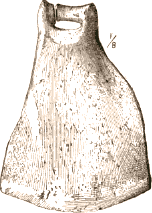
Fig. 307.—Snow shovel made of a whale’s scapula.
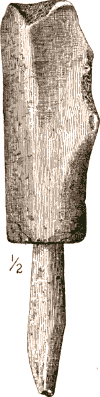
Fig. 308.—Snow pick.
Fig. 308 (No. 89521 [1249] from Utkiavwĭñ) is another peculiar tool of which we saw no other specimen. It appears to be really an old implement and was said to have been used for digging or picking in the snow. It is a stout sharp-pointed piece of bone, 3 inches long, inserted in the end of a piece of a long bone of some animal, 4.7 inches long and about 1½ wide, which serves as a haft.

Fig. 309.—Snow drill.
Ice picks.—
The ivory ice pick (tu´u) always attached to the seal-harpoon has been already described. This differs from the tôk of the Greenlanders and other eastern Eskimo in having a sharp bayonet point, while the latter is often chisel-pointed. All the men now have iron ice picks which they use for cutting the holes for fishing, setting seal nets, and such purposes. These are made of some white man’s tool which has a socket, like a harpoon iron, a whale lance, a boarding knife or bayonet, and usually have a rather slender blade about a foot long, mounted on a pole 6 or 8 feet long. The point is sharp and polygonal, generally four-sided. The tool is managed with both hands and used to split off fragments of ice by rather oblique blows. In other words, it is used in precisely the same way as the little single-handed pick which we use in refrigerators. For chiseling off projecting corners of ice when making a path out through the ice pack, they often use whale spades, of which they have obtained a great many from wrecks.
No. 89483 [1313] from Utkiavwĭñ, is a very old pick made of a piece of reindeer antler, 11¼ inches long, split lengthwise, and tapered to a sharp curved point. The butt is cut into a sort of tang with a low shoulder. The split face is concave, the soft interior tissue having been removed by decay and perhaps also intentionally. Another peculiar tool is shown in Fig. 309 (No. 89479 [1064] from Utkiavwĭñ). This was called kăkaiyaxion, and is a rounded piece of antler 10.4 inches long, tapering from the butt where there is a low shoulder and the broken remains of a rounded tang to be fitted to a shaft. One side is cut off flat from the shoulder to the tip, gradually becoming concave. The concavity is deepest near the middle. The tip is slightly expanded, rounded, and somewhat bent toward the convex side. The specimen is smoothly and neatly made and dark brown from age. No other specimens were seen. We were told that this tool was mounted on a long pole and used for drilling holes in the ice by making the pole revolve with the hands.
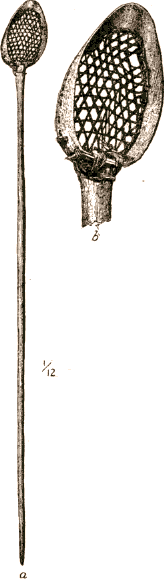
Fig. 310.—Ice scoop.
Ice scoops.—
When picking a hole through the ice they use a long-handled scoop, made of a piece of antler bent round into a hoop, and netted across the bottom with strips of whalebone, so that the water may drain off in dipping pieces of ice out of the water. We brought home one specimen of this universal implement (No. 89903 [1696], Fig. 310). The handle is of oak, 5 feet 1¾ inches long and elliptical in section. The rim of the bowl is a long thin strip of antler, apparently from the “palm,” bent round into a pointed oval, 8½ inches long and 5¾ wide, with the ends of the strip overlapping about 3 inches at the broader end. The ends are sewed together with two vertical stitches of whalebone. The left end has been broken across obliquely near the joint and mended with whalebone stitches. Round the lower edge of the rim runs a row of twenty-seven pairs of small holes 0.2 inch from the edge. The holes of each pair are connected by a deep channel, and a narrow shallow groove, probably for ornament, joins the pairs. On the left side are eight extra holes between the pairs, which are not used. Through these holes, omitting the first two pairs in the right-hand end, is laced a piece of seal thong, thus: Starting at the point of the oval, the two ends of the thong are passed through the pair of holes there from the outside and the bight drawn home into the channel; the ends are crossed, the left end going to the right, and vice versa, and passed out through the farther hole of the next pair and in through the nearer, and so on till the ends meet at the broad end of the oval where they are tied together, thus making twenty-five loops on the inside of the rim into which the netting is fastened. This is made of strips of thin whalebone, interwoven, over and under each other, passing up through one loop and down through the next. There are eleven longitudinal strands passing obliquely from right to left, the same number from left to right, and eleven transverse strands, making a network with elongated hexagonal apertures. The strips are not one continuous piece. The bowl thus made is fastened to the handle by three pieces of stout seal thong. The whole lashing was put on wet, and allowed to shrink.
Nordenskiöld mentions and figures a scoop of almost identically the same pattern, but smaller, in general use for the same purposes at Pitlekaj.417 A smaller scoop or skimmer (ĕlauatĭn) is also universally used. We inadvertently neglected to preserve a specimen of this very common implement, though we had two or three about the station for our own use. I shall therefore have to describe it from memory. The handle is a flat, straight stick with rounded edges, about 18 inches or 2 feet long, 1½ inches broad, and three-fourths inch thick. The bowl is made of two pieces of antler “palm” of such a shape that when they are fastened together on the end of the stick they make a shallow cup about 3½ inches long by 3 wide, with a longitudinal crevice along the middle which allows the water to drain off. The tip of the handle is beveled off on both sides so as to fit into the inside of this cup, along the junction of the two pieces, each of which is fastened to it by one or two neat stitches of whalebone. The two pieces are fastened together in front of the handle with a stitch.
In addition to the use of these scoops for skimming the fishing holes, and reeling up the line, as already described, they also serve as scrapers to remove snow and hoar frost from the clothing. In the winter most of the men and boys, especially the latter, carry these skimmers whenever they go out doors, partly for the sake of having something in their hands, as we carry sticks, and partly for use. The boys are very fond of using them to pick up and sling snowballs, bits of ice, or frozen dirt, which they do with considerable force and accuracy.
IMPLEMENTS FOR PROCURING AND PREPARING FOOD.
Blubberhooks (nĭ´ksĭgû).—
For catching hold of pieces of blubber or flesh when “cutting in” a whale or walrus, or dragging them round on shore or on the ice, or in the blubber rooms, they use hooks made by fastening a backward-pointing prong of ivory on the end of a wooden handle, which is bent into a crook at the other end. Those specially intended for use in the boats have handles 7 or 8 feet long, while those for shore use are only 2 or 3 feet long. These implements, which are common all along the Alaskan coast, may sometimes be used as boathooks, as appears to be the case farther south, though I never saw them so employed. We brought home two short hooks and one long one, No. 56766 [126], Fig. 311. This has a prong of walrus ivory fastened to a spruce pole, 7 feet 7¾ inches long, to the other end of which is fastened a short crook of antler. The pole is elliptical in section. The crook is a nearly straight “branch” of an antler with a transverse arm at the base made by cutting out a piece of the “beam” to fit against the pole, and is held on by three neat lashings of whalebone of the usual pattern. The upper two of these are transverse lashings passing through corresponding holes in the pole and crook. The lowest, which is at the tip of the arm, is at right angles to these, passing through wood and antler. The lashing of whalebone close to the tip of the crook, passing through a hole and round the under side of the latter, is to keep the hand from slipping off. The prong is held on by two lashings of small seal thong, each passing through a large transverse hole in the prong and a corresponding one in the pole. The upper pair of holes do not exactly match. There are also two unused holes, one in the pole below the upper hole and one above the upper hole in the prong. These holes and the new appearance of the lashings indicate that the prong is part of another hook recently fitted to this pole. The two lashings are made by a single piece of thong. The whole is old and weathered and rather greasy about the prong and the tip of the pole.

Fig. 311.—Long blubber hook.
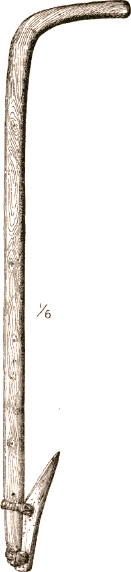
Fig. 312.—Short-handled blubber hook.

Fig. 313.—Fish scaler.
Fig. 312 (No. 89836 [1203] from Utkiavwĭñ) is a similar hook with a short handle, 34 inches long, for use on land. The crook is made by bending the handle. The prong, of walrus ivory as before, is 7 inches long, and held on by two stout lashings of whalebone, which pass round the end of the handle instead of through it. The prong and tip of the handle are very greasy.
No. 89837 [1353], from the same village, is a similar hook rather rudely made. The crook is bent only at an angle of about 45°, and there is somewhat of a twist to the whole handle. The prong, which is of antler, is 7¾ inches long and shouldered at the butt like that of the long hook described. It is fastened on by two thick lashings of stout seal thong passing around prong and handle and kept from slipping by notches in the latter, and on the butt end of the former and by a large flat-headed brass stud driven into the prong below the upper lashing.
Fish scaler.—
Fig. 313 (No. 89461 [1279] from Utkiavwĭñ) represents a little implement which we never saw in use, but which we were told was intended for scraping the scales off a fish. The specimen does not appear to be newly made. It is a piece of hollow “long” bone, 8 inches long, cut into the shape of the blade of a case knife, flat on one face with a broad, shallow, longitudinal groove on the other.
MAKING AND WORKING FIBER.
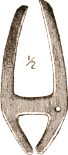
Fig. 314.—Ivory shuttle.
Twisting and braiding.—
We had no opportunity of seeing the process of twisting the sinew twine, which is sometimes used in place of the braid so often mentioned but more generally when an extra strong thread is desired, as in sewing on boot soles. Fig. 314 (No. 89431 [1332] from Utkiavwĭñ) is a little shuttle of walrus ivory, 3 inches long and 1⅓ broad, which we were told was used in this process. The body of this shuttle is reduced to a narrow crosspiece, and the prongs at one end are twice as long as those at the other. The tips of the long prongs are about ¼ inch apart, while those of the short ones nearly meet. There is a small round hole in one side of the body. This specimen was made for sale. As well as I could understand the seller, the ends of several strands of fine sinew were fastened into the hole in the shuttle and twisted by twisting it with one hand, while the other end was held perhaps by the other hand. The part twisted was then wound on the shuttle and a fresh length twisted. This would be a very simple form of spinning with a spindle.
No special implements for twisting have been described among other Eskimo. Mr. E. W. Nelson (in a letter to the writer) says that the natives of Norton Sound informed him that the cable twisters (kaputa—kíbu´tûk at Norton Sound) were also used for making twisted cord. He describes their use as follows: “The ends of the sinew cord are tied to the center holes in the two ivory pieces, one of the latter at each end of the cord, and then they are twisted in opposite directions, thus getting the hard-laid sinew cord used on the bows.”

Fig. 315.—Netting needle.
The sinew twine used at Point Barrow is generally braided, almost always in a three-ply braid, usually about the size of stout packthread, such as is found on many Eskimo implements from all localities represented in the Museum collections. That they also know how to braid with four strands is shown by the hair line already described (No. 56545 [410]). They also have a special word (which I can not recall) for braiding with four strands in distinction from braiding with three (pidrá).

Fig. 316.—Mesh stick.
Netting.—
Two implements are used as usual in netting, a needle or long flat shuttle for carrying the twine (Fig. 315, No. 56570 [101]), and a mesh stick for gauging the length of the mesh. The knot is the universal “fisherman’s knot” or becket hitch made in the usual manner. The method of using the mesh stick, however, is rather peculiar, and somewhat clumsy compared with that used by civilized net-makers, as it serves only to measure the mesh and not also to hold the successive meshes as they are made. It is a long flat piece of bone or antler, shaped like a case knife, with a blade square at heel and point. There is often also a little blunt hook (as in Fig. 316, No. 56581 [1021]) at the point, bending upward or toward the back of the blade. The blade is the part of the stick which measures the mesh, and its length from heel to point is always precisely half the length of the mesh to be made. It is used as follows: The workman, holding the mesh stick by the handle in his left hand, with the blade downward, catches the mesh into which the knot is to be made with the hook, and holds it while the twine is carried down the left side of the blade, round the heel and through the mesh as usual, and drawn up till the preceding knot comes just to the point of the blade. This makes a loop of the proper length for a mesh round the stick. The point where the next knot is to be made is now caught between the thumb and finger of the right hand and the mesh stick taken out of the loop. The left thumb and finger, while the other fingers of this hand still hold the handle of the stick, relieve the fingers of the right hand, which goes on to make the knot in the usual manner.418
We collected thirteen needles of different patterns and sizes. No. 56570 [101], Fig. 315, has been selected as the type (ĭ´nmuvwĭñ, mû´kutĭn.) It is of walrus ivory, 11.9 inches long. The small hole near the tip of one prong is for a lanyard to hang it up by when not in use. This needle could be used only for making a large meshed net, perhaps a seal net.
We collected seven needles of almost the same pattern as this, varying a little in proportions. The faces are usually more deeply hollowed out and the ends usually sinuate instead of being straight. Three of these are of reindeer antler and the rest of ivory. The longest is 9.9 inches long and the shortest 4½. This needle (No. 56574 [24], from Utkiavwĭñ) is rather broad in proportion, being nearly 1 inch wide. It is of walrus ivory. No. 89433 [942] is better suited for netting a small mesh, being only 0.7 inch broad at the widest part. It is made of reindeer antler and is 7.3 inches long. These needles sometimes have a small hole through one end of the body for fastening the end of the twine, and most have some arrangement for fastening on a lanyard, either a hole as in the type or a groove round the tip of one prong as in No. 56574 [24].
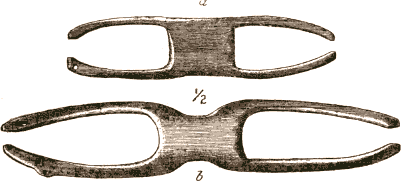
Fig. 317.—Netting needles.
No. 89427 [1283], from Utkiavwĭñ, is a needle of a slightly different pattern, being rather thick and not narrowed at the middle. It is of reindeer antler, 8.7 inches long and 1 wide. No. 89430 [1286], Fig. 317a, from Utkiavwĭñ, is a very broad needle, with short body and long prongs, one of which is expanded at the tip and perforated for a lanyard. It is a piece of the outside hard tissue of a reindeer antler, 5.4 inches long and 1.2 broad. It is but slightly narrowed at the middle, while No. 89428 [1381], Fig. 317b, from Utkiavwĭñ, a somewhat similar broad needle of the same material is deeply notched on each side of the body. This is made from antler of smaller diameter than the preceding, and consequently is not flat, but strongly convex, on one face and correspondingly concave on the other. It is 8.2 inches long and 1½ wide.

Fig. 318.—Netting needle for seal net.
For making the seal nets a very large needle is used. The one in the collection, No. 56581 [102], Fig. 318, from Utkiavwĭñ, is 20½ inches long and only 1½ wide. It is made of two nearly equal pieces of antler, which are nearly flat, and lap over each other about 3¾ inches near the middle. They are strongly fastened together by five whalebone stitches, one at each corner of the splice and one in the middle. The corner stitches run round the edge of the two parts, and through a hole through both parts. The prongs are stout and curved, nearly meeting at the tips. They are about 3 inches long. The lateral distortion appears to be due to warping.
A peculiar netting needle is shown in Fig. 319 (No. 89429 [1333], from Utkiavwĭñ), which is new and rather carelessly made from very coarse walrus ivory. The tips of the prongs, after nearly meeting, diverge again in the form of the letter U. This needle, which is 9½ inches long, was said by the maker to be of the pattern used by the “Kûñmû´d’lĭñ.” There are no specimens resembling it in the museum collections, though it curiously suggests certain implements from Norton Sound, labeled “reels for holding fine cord,” consisting of slender rods of antler, terminating at each end in similar shallow U-shaped forks.

Fig. 319.—Netting needle.
The mesh stick (kú´brĭn) belonging to the large netting needle, No. 56581 [102], may be taken as the type of this implement. It is a piece of the hard outside tissue of a reindeer antler. The three notches on the lower edge of the haft are for the fingers. The incised line along one face of the blade is probably a mark to which the twine is to be drawn in making a mesh. The blade is just the proper length, 7½ inches, for the large mesh of the seal net. The remaining four mesh sticks are all small, and intended for making fish nets. Three are of reindeer antler and the fourth of hard bone, with a wooden haft.
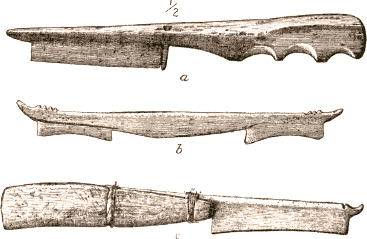
Fig. 320.—Mesh sticks.
Fig. 320a (No. 89436 [1284], from Utkiavwĭñ) is of antler, 7.2 inches long, with a blade of 2.7 inches, protected from splitting by a stout round peg of hard bone, driven through the handle so as to lie against the heel of the blade. It terminates in a blunt point instead of a hook, and has three finger notches in the haft. No. 89437 [942], also from Utkiavwĭñ, is of the same material, 5.2 inches long, without a hook and with a blade only 1 inch long. There are two finger notches in the haft. The last of the antler mesh sticks (No. 89439 [983], from Utkiavwĭñ, Fig. 320b) is double ended, having a hook and a short blade at each end. The blades are respectively 1.5 and 1.6 inches long, and the total length is 6.6 inches. Fig. 320c (No. 89435 [1019], also from Utkiavwĭñ) has a blade, with a small hook, of white compact bone, and what would be the handle lashed to one side of a haft of soft wood, which is shouldered to receive it. The haft is 4.3 inches long, and the two parts are held together by two lashings of fine sinew, kept from slipping by notches. The total length is 7.3 inches, that of the blade 2.7. Netting needles and mesh sticks of essentially the same type as those just described, but varying in material and dimensions, are in general use from the Anderson River to Bristol Bay, as is shown by the Museum collections.
Netting weights.—
We collected 16 little ivory implements, each, when complete, consisting of the image of a fish about 3½ to 4 inches long, suspended by a string about 4 inches long to a little ivory spring hook. We never happened to see these implements in use, but we were told that they were used in netting to keep the meshes in proper shape. They generally were made in pairs. The only way of using them that I can think of is first to hook one into the bight of the first mesh made in starting the net. This would make the successive meshes, as they were netted, hang down out of the way. On starting the next row in the opposite direction, the second weight hooked into the first mesh of this row would draw the successive meshes down on the left-hand side of the stick, while the other weight would keep the meshes of the first row stretched so that one could be easily caught at a time. On beginning the third row the first weight would be transferred to the first mesh of this, and so on. Fig. 321a is one of a pair of these nĕpĭtaúra (No. 56596 [207]) which has been selected as the type. It is a rather rude figure of a salmon or trout 4 inches long, neatly carved out of walrus ivory. The string is of braided sinew and the hook of walrus ivory.
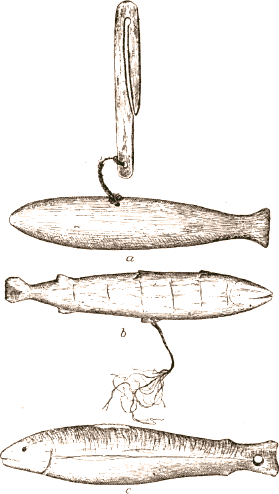
Fig. 321.—Netting weights.
Fig. 321b (No. 89442 [899] from Nuwŭk) is a weight without the hook and made of compact whale’s bone. It is 4.1 inches long, and very neatly carved, having all the fins in relief, the gill openings, mouth, and eyes incised. No. 56582 [173] from Utkiavwĭñ is one of a pair very rudely carved out of a piece of snow-shovel edge. The mouth and gill openings are indicated by incised and blackened lines, the latter fringed with short lines, each ending in a dot, perhaps to represent the gill filaments. It is 4.2 inches long, and hastily made for sale. Fig. 321c (No. 56578 [201] from Utkiavwĭñ) seems to be intended for a polar cod, and has the hole drilled through the root of the tail. The lateral line is marked by a scratch, colored with black lead, and the dark color of the back is represented by curved, transverse scratches also colored with black lead. When the carving is sufficiently good to show what sort of a fish is meant, it is generally a salmon or trout. Only 3 out of the 16 are of anything but walrus ivory. These 3 are of compact whale’s bone, and one had small blue glass beads inlaid for eyes, of which one still remains. The shortest is 3.4 inches long, and the longest 4.3, but most of them are almost exactly 4 inches long.
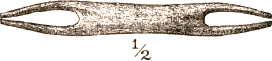
Fig. 322.—Shuttle belonging to set of feather tools.
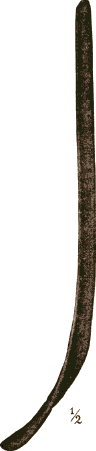
Fig. 324.—“Sword” for feather weaving.
Weaving.—
A set of little tools made of bone and reindeer antler were brought over for sale, which were said to be those used in weaving the feather belts. I had no opportunity of seeing a belt made, but the work evidently does not require all three of these tools. The little netting needle or shuttle of bone (Fig. 322, No. 89434 [1338]) can not be used in feather weaving, because, as already mentioned, the strips of feather are not fastened together into a continuous cord which could be carried on a shuttle. It is 5.9 inches long and 0.7 wide. There is also a little mesh stick of antler (Fig. 323, No. 89438 [1338]) 6.7 inches long, with a blade 1.9 inches in length, and a little hook, which appears to be fitted for nothing except netting a small net. The lower edge of the handle, however, is cut into 10 deep rounded notches, which perhaps serve the purpose of a rude “frame” for keeping apart the strands of the warp, while the woof of feather is passed through with the fingers. It would be held with this edge up, and the beginning of the belt being fastened to the wall, the warp strands would be stretched over this, as over a violin bridge, each resting in one of the notches. The last tool of the set (Fig. 324, No. 89462 [1338]) is undoubtedly a “sword” for pushing home the woof, and probably also serves to separate the strands of the warp into a “shed.” It is a flat, thin piece of antler, 9 inches long and three-fourths wide, of which about 6½ inches forms a straight blade 6½ inches long, and the rest is bent round to one side and slightly down, forming a handle. When the strands of the warp are stretched over the bridge as above described, pushing this horizontally through them alternately over and under the successive strands, would make a “shed” through which the end of the woof could be thrust with one motion, and pushed up against the preceding strand of the woof by sliding the sword forward. It would then be withdrawn and passed through again, going over the strands it went under before and vice versa, so as to open a “shed” for the next strand of the woof.

Fig. 323.—Mesh stick.
Sewing.—
For sewing furs and leather they always use thread made by stripping off thin fibers from a piece of dried sinew of the reindeer, as is usual with Eskimo. Cotton or linen thread of civilized manufacture is now often used for sewing the cotton frocks, etc., and sometimes for making an ornamental seam on the waterproof gut shirts. The stitches employed have already been described under the head of clothing (which see). They hold the needle between the thumb and middle finger, with the thimble on the forefinger (both are called by the same name, tĭ´kyǝ) and sew toward them. This appears to be the regular Eskimo method of sewing.419
At the present day they are well supplied with steel needles (miksun) of all sizes and patterns, but formerly they used bone needles made from the fibula (amĭlyĕrûñ) of the reindeer. We collected sixty of these needles, eighteen of which appear to be old and genuine. The rest were more or less carefully made for sale. Nĭkawáalu told us that once when he and a young man were out deer hunting a long distance from camp their boots gave out. Having killed a deer he made thread from the sinew, a needle from the bone, and with pieces of the skin repaired their boots, so that they got home in comfort.
No. 89389 [1191], Fig. 325 will serve as the type of these needles. This is a case 3½ inches long, made of the butt of a large quill, closed with a plug of walrus hide, and contains 6 needles. One is 1.8 inches long, stout, and round-pointed, with a large eye. It is much discolored from age. The second is also round-pointed but more slender, 1.9 inches long, and flattened and expanded at the butt. The third is 2.4 inches long, and has a four-sided point like a glover’s needle. All three of these are very neatly made and appear old. The other three are stout, roughly made, and flat, respectively 2.1, 2.2, and 2.5 inches long. Two of them look suspiciously new. This set was said to have been the property of the wife of Puka, Nĭkawáalu’s father.
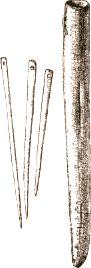
Fig. 325.—Quill case of bone needles.
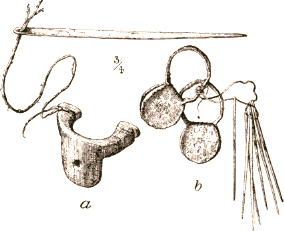
Fig. 326.—Needles and thimbles: (a) large bone needle and peculiar thimble; (b) leather thimbles with bone needles.
Fig. 326a is a peculiarly large and flat needle (No. 89392 [1195] from Utkiavwĭñ) 3.2 inches long, with a round, sharp point and a large eye, with little grooves running to the butt on each side for the thread to lie in. This needle was perhaps specially meant for sewing boat skins. With this needle belongs a peculiar large bone or ivory thimble. The remaining needles are all very much alike, though some are more roughly made than the others. Three of them have the butt square instead of rounded, and half of them, including some which are undoubtedly old, are four-sided at the point like a glover’s needle. The longest is 3 inches long and the shortest 1.4 inches, but the commonest length is about 2 or 2½ inches. Similar bone needles are mentioned by various authors.420
Nearly all the women now use ordinary metal thimbles, obtained in trade, but they wear them in the old-fashioned way, on the tip of the forefinger. Some of the older women, however, still prefer the ancient leather thimble. There are two patterns of these: one intended for the fore-finger only, and the other of such a shape that it may also be worn on the other fingers as a guard against chafing in pulling stout thread through thick leather. It is often so used at the present day.
We collected three of the first-mentioned pattern, which is represented by Fig. 326b (No. 89396 [1202,1246]). It is made by cutting out a narrow ring of raw sealskin 0.7 inch in diameter, with a circular flap 0.5 inch in diameter on the outside of the ring and a corresponding one on the inside of the same size, cut out of the middle of the ring. The flaps are doubled over so as to make a pad on the inside of the forefinger when the tip of the latter is inserted into the ring. The butt of the needle presses against this pad.
The third thimble, which belongs with the needlecase (No. 89371 [1276]), is of precisely the same form and dimensions.
There appeared to be little if any variation among those which we saw. Capt. Lyon421 figures two similar thimbles from Iglulik, which are described on page 537 of the same work as being made of leather. The flaps, however, seem to be only semicircular and not folded over, so that the shield consists of only one thickness of leather.
A similar thimble with the flap also not folded is used at Cumberland Gulf.422
The other pattern, of which we brought home nine specimens, is represented by No. 89389 [1191], which belongs with the set of bone needles of the same number. It is a tube, open at both ends, one of which is larger than the other, made by bending round a strip of split walrus hide and sewing the ends together. It is 0.4 inch long and 2.1 in circumference at the larger end. It is worn smooth with handling, and impregnated with grease and dirt and marked with small pits where it has been pressed against the butt of the needle in use.
Four other old thimbles (No. 89393 [1194], from Utkiavwĭñ, are made in the same way, but are a trifle larger. As they show no needle-marks, they were probably used only as finger guards. The remaining four are similar to the above, but newly made, for sale.
A most peculiar thimble, the only one of the kind seen, is shown in Fig. 326a (No. 89392 [1195] from Utkiavwĭñ, belonging with the large bone needle of the same number already described and figured). This is made of a single piece of walrus ivory, browned with age, and the round shallow socket is for the butt of the needle. The ends of the half ring are slightly expanded and notched on the outside to receive a string to complete the ring so that it can be fitted round the finger, with the flange in the same position as the pad of a leather thimble.
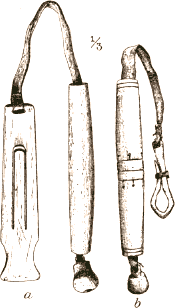
Fig. 327.—Needle cases with belt hooks.
Needles are kept in a case (ujyami), consisting of a tube of bone or ivory about 5 or 6 inches long, through which is drawn a broad strap of leather furnished with a knot at one end to keep it from slipping wholly through. Into one side of this strap the needles are thrust obliquely, so that when the strap is pulled in they are covered by the tube. To the other end of the strap is usually attached an ivory snap hook for fastening the needle case to the girdle of the pantaloons. These needle cases are made of two slightly different patterns, of which the first is represented by No. 89365 [1277], Fig. 327a. It is of white walrus ivory, 4½ inches long, and the strap is of seal thong about 11 inches long and 0.3 inch wide. At one end of this is a pear-shaped knob of walrus ivory, which is shouldered off at the small end and worked into a short flattened shank perforated with a large eye, through which the end of the strap, which is cut narrow, is thrust. It is fastened by doubling it back and sewing it to the standing part. A sky-blue transparent glass bead is inlaid in the large end of the knob. The other end of the strap is fastened in the same way into a tranverse slot in the end of the belt hook (tĭ´tkĭbwĭñ) of ivory, 4.7 inches long.
This pattern appears to be usually made of walrus ivory. Only one of the six brought home is of bone, and this is an unusually small one, only 3.6 inches long, made for sale. The usual length is 4½ to 5 inches. No. 89363 [1105], Fig. 327b, from Utkiavwĭñ, is a tube very much like the one described, but is ornamented with an incised pattern colored with red ocher, and has a differently shaped belt hook. When the latter is hooked over the girdle the ring is pushed up the shank over the point of the hook till it fits tight, and thus keeps the hook from slipping off the belt.
Fig. 328a (No. 89364 [1243] from Utkiavwĭñ) is another ivory needle case, 4.7 inches long. The tube was once ornamented with incised patterns, but these are almost wholly worn off by constant handling. The knob is carved into an ornamental shape, having a circle of six round knobs round the middle. It has been suggested that this is meant to represent a cloud-berry (Rubus chamæmorus), a fruit known to the “Nunatañmiun” though not at Point Barrow. The hook is a snap hook very much like those described in connection with the netting weights, but larger (3 inches long) and very broad at the upper end, which is made into a broad ring. The point of a steel needle still sticking in the flesh side of the strap shows how the needles are carried with the points toward the knob.
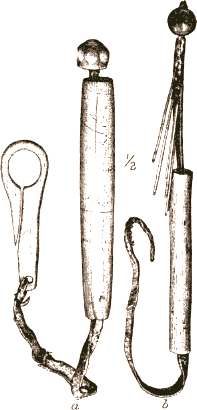
Fig. 328.—Needle cases: (a) case with belt hook; (b) case open, showing bone needles.
No. 89370 [1033], also from Utkiavwĭñ, has no knob, but the end of the strap is kept from slipping through by rolling it up transversely and catching it with a stitch of sinew. It has a broad flat snap hook similar to the last, but cut on the edges into ornamental scallops. The tube is ornamented with an incised pattern colored red with ocher, and is 5.2 long. No. 56575 [7] is an old tube of brown walrus ivory, enlarged into a knob at one end. It has no knob or hook, but a new strap of white seal skin, in the lower end of which is tied a large knot. The other pattern has the cylinder made of a hollow “long” bone, in its natural shape. This bone appears to be almost always the humerus of some large bird, probably a swan. The strap has usually no knob, but is kept from slipping through by knotting the end or tying on a large bead or a bear’s toe, or some such object too large to go through the tube. None of these have belt hooks except one new and roughly made specimen.
These bone tubes are apparently older than the neat ivory cylinders, and it is not unlikely that the belt hook was not invented till the former was mostly out of fashion. No. 89361 [1239], Fig. 328b from Utkiavwĭñ, is one of these which has for knob one of the large dark blue glass beads which used to bring such enormous prices in the early days of Arctic trading, and which are still the kind most highly prized. The end of the strap is cut narrow, passed through the bead, and knotted on the end. This case carries a half-dozen of the old-fashioned bone needles, which appear to be genuine. It is 3.7 inches long and, roughly speaking, 0.4 in diameter. No. 89369 [1201], also from Utkiavwĭñ, resembles the above, but has a wolverine’s toe sewed to the end of the strap. No. 89371 [1276], from Utkiavwĭñ, also has the toe of a wolverine for a knob, and has a belt hook with two tongues made of reindeer antler. No. 89366 [1137], from Utkiavwĭñ, is a highly ornamented case of this pattern, which has a short cylindrical knob, also ornamented. No. 89368 [1089], from Utkiavwĭñ, is not made of bird’s bone, but is a piece of a long bone from some mammal, and has a brown bear’s toe for a knob. No. 89367 [1339], from the same village, is roughly made of a branch of antler, 3.9 inches long and 0.8 wide, hollowed out. It has a knob of whale’s bone, but no belt hook, the end of the strap being knotted into a leather thimble of the first pattern. Of the six specimens of this pattern in the collection only the first is a genuine old implement. All the others are merely commercial imitations rather carelessly made.
This kind of needle case is very commonly used throughout Alaska, as is shown by the enormous collections in the National Museum brought home by various explorers, Nelson, Turner, Dall and others. The needle case from Iglulik, figured by Capt. Lyon,423 resembles the second or older pattern, being of bone, not tapered at the ends, and having neither knob nor belt hook. To the ends of the strap are hung thimbles “and other small articles liable to be lost.”424 Dr. Simpson425 speaks of the needle case in use at Point Barrow, but merely describes it as “a narrow strip of skin in which the needles are stuck, with a tube of bone, ivory, or iron to slide down over them, and kept from slipping off the lower end by a knob or large bead.” This appears to refer only to the second or older pattern.
The old-fashioned ring thimbles were usually carried on the belt hook of the needlecase, but modern thimbles require a box. These boxes (kigiunɐ), which are usually small and cylindrical, also serve for holding thread, beads, and all sorts of little trinkets or knickknacks, and many of them are so old that they were evidently used for this purpose long before the introduction of metal thimbles. Little tin canisters, spice boxes, etc., are also used for the same purpose nowadays. We brought home thirteen of these boxes, of which No. 89407 [1158] Fig. 329a has been chosen as the type. It is a piece of the beam of a stout antler, 4.3 inches long, cut off square on the ends and hollowed out. Into the large end is fitted a flat bottom of thin pine, fastened in by four little treenails of wood. The cover is of the same material. It is held on by a string of sinew braid about 11 inches long, which passes out through the lower of the two little holes on one side of the box, being held by a knot at the end, in through the upper, then out and in through two similar holes in the middle of the cover, and out through a hole on the other side of the box. Pulling the end of this string draws the cover down snugly into its place.
Some of the remaining boxes are made of antler, and vary in length from 4.7 to 8 inches. The last is, however, unusually large, most of the others being about 5 inches long. The covers are generally held on by strings much in the manner described, and the ends are both usually of wood, though two old boxes have both ends made of antler, and one has a top of hard bone. The last is a specimen newly made for sale. These boxes are sometimes ornamented on the outside with incised lines, colored red or blackened, either conventional patterns as in Fig. 329b (No. 89405 [1335], from Utkiavwĭñ) or figures of men and animals as in Fig. 329c (No. 56615 [41] from the same village). The former is a new box, 4.7 inches long, and has the wooden ends both shouldered to fit tightly. The cover is worked with a string.
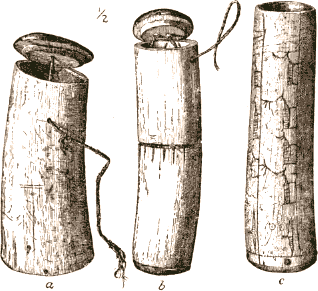
Fig. 329.—Trinket boxes.
No. 56615 [41] on the other hand is very old, and has lost its cover. The wooden bottom is shouldered and held in with treenails. The surface is elaborately ornamented with incised and blackened figures. It is divided by longitudinal lines into four nearly equal panels, on which the figures are disposed as follows (the animals all being represented as standing on the longitudinal lines, and facing toward the right, that is, toward the open end of the box): On the first panel are 4 reindeer, alternately a buck and a doe, followed by a man in a kaiak, and over his head two small “circles and dots,” one above the other. All the deer on this box are represented strictly in profile, so as to show only two legs and one antler each. On the second panel are 4 deer, all does, followed by a man with a bow slung across his back. On the third, a man in the middle appears to be calling 2 dogs, who, at the left of the panel, are drawing a railed sled. Reversed, and on the upper border of the panel, is a man pushing behind a similar sled drawn by 3 dogs. The head dog has stopped and is sitting down on his haunches. The dogs, like the reindeer, are all strictly in profile and rather conventionalized. In the fourth panel are 3 reindeer followed by a man in his kaiak, and upside down, above, a deer without legs, supposed to be swimming in the water, and a very rude figure of a man in his kaiak. These figures probably represent actual occurrences, forming a sort of record.
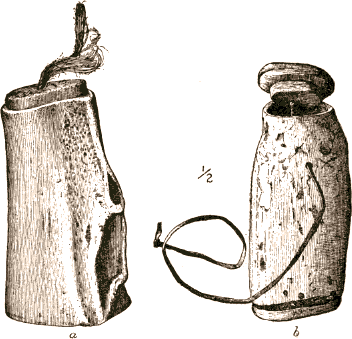
Fig. 330.—Trinket boxes.
Fig. 330a (No. 89408 [1371] from Sidaru) is a piece of stout antler, 4.7 inches long, which has the bottom of pine fitted tightly in without fastenings. The cover is of wood, covered, to make it fit tight, with parchment, apparently shrunk on and puckered on the upper surface. A thick hank of untwisted sinew is fastened as a handle through the middle of the cover. This box is old and dirty, and contains an unfinished flint arrow-head. No. 56505 [59] from Utkiavwĭñ, is a new box, closed at the ends with thick shouldered plugs of pine wood. The tube is 8 inches long and ornamented with a conventional pattern of incised lines colored with red ocher.
Fig. 330b (No. 89402 [1359] also from Utkiavwĭñ), is peculiar from the material of which it is made. It is of about the same pattern as the common antler boxes, but is made of the butt end of the os penis of a large walrus, cut off square and hollowed out, and has ends of hard whale’s bone. Its length is 4.2 inches. No. 89403 [1425] Fig. 331 from Sidaru, is made of the hollow butt of a good-sized walrus tusk, 3.2 inches long. It has a neatly fitted wooden bottom, held in with 6 treenails, two of ivory and four of wood. The box has been cracked and split and mended with stitches of sinew and whalebone. Peculiar conventional patterns are incised on the box and cover. A peculiar box is shown in Fig. 332 (No. 56583 [37] from Utkiavwĭñ). This is of compact white bone, with a flat wooden bottom. I do not recollect seeing any other boxes of the same sort.
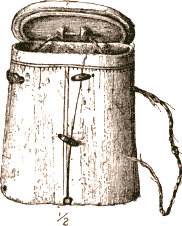
Fig. 331.—Ivory box.
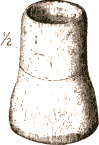
Fig. 332.—Bone box.
Fig. 333 (No. 89409 [1372]) is the tip of a walrus tusk cut off and hollowed out into a sort of flask, 3.8 inches long, closed at the large end by a flat wooden bottom, fastened in with treenails and at the small end by a stopper of soft wood.
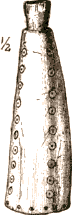
Fig. 333.—Little flask of ivory.
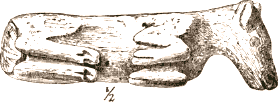
Fig. 334.—Box in shape of deer.
The most peculiar box of all, however, is shown in Fig. 334 (No. 56512 [2] from Utkiavwĭñ), the only specimen of the kind seen. It is 5.5 inches long, made of reindeer antler, and very neatly carved into a most excellent image of a reindeer lying on its left side, with the head, which has no antlers, turned down and to the left. The legs are folded up against the belly, the forelegs with the hoofs pointing backward, the hind hoofs pointing forward. The eyes are represented by small sky-blue glass beads, and the mouth, nostrils, and navel neatly incised, the last being particularly well-marked. The tips of the hoofs are rounded off, which, taken in connection with the attitude and the well marked navel, lead me to believe that the image is meant to represent an unborn fetus. The whole of the body is hollowed, the aperture taking up the whole of the buttocks, and closed by a flat, thick plug of soft wood. A round peg of wood is driven in to close an accidental hole just above the left shoulder. The box is old and discolored, and worn smooth with much handling.
Rarely these little workboxes are made of basketwork. We obtained four specimens of these small baskets, of which No. 56564 [88] Fig. 335, workbasket (águma, áma, ipiáru), will serve as the type. The neck is of black tanned sealskin, 2½ inches long, and has 1 vertical seam, to the middle of which is sewed the middle of a piece of fine seal thong, a foot long, which serves to tie up the mouth. The basket appears to be made of fine twigs or roots of the willow, with the bark removed, and is made by winding an osier spirally into the shape of the basket, and wrapping a narrow splint spirally around the two adjacent parts of this, each turn of the splint being separated from the next by a turn of the succeeding tier. The other basket from Utkiavwĭñ (No. 56565 [135]) is almost exactly like this, but larger (3.5 inches in diameter and 2.2 high), and has holes round the top of the neck for the drawstring.
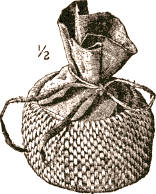
Fig. 335.—Small basket.
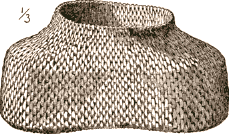
Fig. 336.—Small basket.
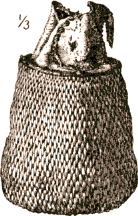
Fig. 337.—Small basket.
Two baskets from Sidaru are of the same material and workmanship, but somewhat larger and of a different shape, as shown in Fig. 336, No. 89801 [1366], and Fig. 337, No. 89802 [1427]. This was the only species of basketwork seen among these people and is probably not of native manufacture.
Prof. O. T. Mason, of the National Museum, has called my attention to the fact that the method of weaving employed in making these baskets is the same as that used by the Apaches and Navajos, who have been shown to be linguistically of the same stock as the Athabascan or Tinné group of Indians of the North. The first basket collected, No. 56564 [88], was said by the owner to have come from the “great river” in the south. Now, the name Kuwûk or Kowak, applied to the western stream flowing into Hotham Inlet, means simply “great river,” and this is the region where the Eskimo come into very intimate commercial relations with Indians of Tinné stock.426 Therefore, in consideration of the Indian workmanship of these baskets, and the statement that one of them came from the “great river, south,” I am well convinced that they were made by the Indians of the region between the Koyukuk and Silawĭk Rivers, and sold by them to the Kuwûñmiun, whence they could easily find their way to Point Barrow through the hands of the “Nunatañmiun” traders.
The Eskimo of Alaska south of Bering Strait make and use baskets of many patterns, but east of Point Barrow baskets are exceedingly rare. The only mention of anything of the kind will be found in Lyon’s Journal.427 He mentions seeing at Iglulik a “small round basket composed of grass in precisely the same manner as those constructed by the Tibboo, in the southern part of Fezzan, and agreeing with them also in its shape.” Now, these Africans make baskets of precisely the same “coiled” work (as Prof. Mason calls it) as the Tinné, so that in all probability what Lyon saw was one of these same baskets, carried east in trade, like other western objects already referred to. The name áma applied to these baskets at Point Barrow (the other two names appear to be simply “bag” or receptacle) corresponds to the Greenlandic amåt, the long thin runners from the root of a tree, “at present used in the plural also for a basket of European basketwork,” (because they had no idea that twigs could be so small)—Grønlandske Ordbog.
No. 89799 [1329] from Utkiavwĭñ, is a peculiar bag, the only one of the kind seen, used for the same purpose as the boxes and baskets just described. It is the stomach of a polar bear, with the muscular and glandular layers removed, dried and carefully worked down with a skin scraper into something like goldbeater’s skin. This makes a large, nearly spherical bag 7½ inches in diameter, of a pale brownish color, soft and wrinkled, with a mouth 6 inches wide. A small hole has been mended by drawing the skin together and winding it round tightly on the inside with sinew.
MEANS OF LOCOMOTION AND TRANSPORTATION.
TRAVELING BY WATER.
Kaiaks and paddles.—
Like all the rest of the Eskimo race, the natives of Point Barrow use the kaiak, or narrow, light, skin-covered canoe, completely decked over except at the middle, where there is a hole or cockpit in which the man sits. Although nearly every male above the age of boyhood owns and can manage one of these canoes, they are much less generally employed than by any other Eskimo whose habits have been described, except the “Arctic highlanders,” who have no boats, and perhaps those of Siberia and their Chuckche companions. The kaiak is used only during the season of open water, and then but little in the sea in the neighborhood of the villages. Those who remain near the villages in the summer use the kaiak chiefly for making the short excursions to the lakes and streams inland, already described, after reindeer, and for making short trips from camp to camp along the coast. At Pernyû they are used in setting the stake-nets and also for retrieving fowl which have fallen in the water when shot.
According to Dr. Simpson428 the men of the parties which go east in the summer travel in their kaiaks after reaching the open water “to make room in the large boat for the oil-skins.” We obtained no information regarding this. It is at this time, probably, that the kaiak comes specially in play for spearing molting fowl and “flappers”, and for catching seals with the kúkiga. They manage the kaiak with great skill and confidence, but we never knew them to go out in rough weather, nor did we ever see the practice, so frequently described elsewhere, of tying the skirts of the waterproof jacket round the coaming of the cockpit so as to exclude the water.
It should, however, be borne in mind that from the reasons above stated our opportunities for observing the use of the kaiak were very limited. At all events it is certain that the people depend mainly on the umiak, not only for traveling, but for hunting and fishing as well, which places them in strong contrast with the Greenlanders, who are essentially a race of kaiakers and have consequently developed the boat and its appendages to a high state of perfection.
We brought home one complete full-sized kaiak, with its paddle, No. 57773 [539], Fig. 338a and b, which is a very fair representative of the canoes used at Point Barrow. This is 19 feet long and 18 inches wide amidships. The gunwales are straight, except for a very slight sheer at the bow, and the cockpit is 21 inches long and 18½ inches wide. It has a frame of wood, which appears to be all of spruce, held together by treenails and whalebone lashings, and is covered with white-tanned sealskins with the grain side out. The stoutest part of the frame is the two gunwales, each 3¼ inches broad and ½-inch thick, flat, and rounded off on the upper edge inside, running the whole length of the boat and meeting at the stem and stern, gradually tapered up on the lower edge at each end. The ribs, of which there are at least forty-three, are bent into nearly a half-circle, thus making a U-shaped midship section, and are ¾-inch wide by ⅓-inch thick, flat on the outer side and round on the inner. Their ends are mortised into the lower edge of the gunwale and fastened with wooden treenails. They are set in about 3 inches apart and decrease gradually in size fore and aft. Outside of these are seven equidistant streaks running fore and aft, ¾ inch to 1 inch wide and ¼ inch thick, of which the upper on each side reaches neither stem nor stern. These are lashed to the ribs with a strip of whalebone, which makes a round turn about one rib, above the streak, going under the rib first, and a similar turn round the next rib below the streak (Fig. 339).
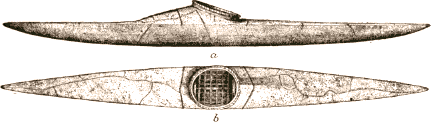
Fig. 338.—Kaiak.
There is a stout keelson, hemi-elliptical in section, under the cockpit only. This is 4½ feet long, about 2 inches deep, and 1½ inches wide, and is fastened in the middle and about 1 foot from each end by a strip of whalebone, which passes through a transverse hole in the keelson, round the rib on one side, back through the keelson, and round the rib on the other side twice. The end is wrapped spirally round the turns on one side and tucked into the hole in the keelson. The deck beams are not quite so stout as the ribs and are mortised into the upper edge of the gunwales a little below the level of the deck. The ends are secured by lashings or stitches of some material which are concealed by the skin cover. They are about as far apart as the ribs, but neither exactly correspond nor break joints with the latter.
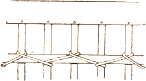
Fig. 339.—Method of fastening together frame of kaiak.
At the after end of the cockpit is an extra stout beam or thwart to support the back, 1¾ inches wide and three-quarters inch thick, with rounded edges, the ends of which are apparently lashed with thong. The first beam forward of the cockpit is rounded, and appears to be a natural crook forming a U-shaped arch, and is followed by seven V-shaped knees, thickest in the middle and enlarged a little at the ends, successively decreasing in height to the seventh, which is almost straight. This makes the rise in the deck forward of the cockpit.
Every alternate deck beam is braced to the gunwale at each end by an oblique lashing of whalebone, running from a transverse hole in the beam about 1 inch from the gunwale to a corresponding hole in the gunwale, three-quarters inch from the lower edge. The lashing makes three or four turns through these holes and around the lower edge of the gunwale, and the end is wrapped spirally round these turns for their whole length. Above these beams a narrow batten runs fore and aft amidships from cockpit to stem and stern, mortised into the two beams at the cockpit, and lashed to the others with whalebone. The coaming of the cockpit is made of a single flat piece of wood, 1¾ inches broad and one-quarter inch thick, bent into a hoop with the ends lapping about 6 inches and “sewed” together with stitches of whalebone. Round the upper edge of this, on the outside, is fitted a “half-round” hoop, which appears to be made of willow, three-quarters by one-third inch, with its ends lapped about 4 inches, this lap coming over the joint of the larger hoop. It is fastened on by short stitches of whalebone about 5 or 6 inches apart, leaving room enough between the two hoops to allow a lacing of fine whalebone to pass through. The coaming is put on over the edge of the skin cover, which is drawn up tight inside of the coaming and over its upper edge and fastened by a lacing of whalebone, which runs spirally round the outer hoop and through holes about one-half inch apart in the edge of the cover.

Fig. 340.—Double kayak paddle.
The coaming fits over the crown of the arch of the forward deck beam and rests on the middle of the thwart aft, and is secured by lashings of whalebone, which pass through holes in the coaming and over its upper edge. The forward lashing makes three turns, which pass round the beam with the end wrapped spirally round the parts between beam and coaming; the after lashing, four similar turns, which pass through a hole in the thwart and around its forward edge. On each side is a stout vertical brace of wood 3¼ inches long, 1 inch wide, and one-half inch thick, with rounded edges and corners. The ends are cut out parallel to the breadth, so that one end fits on to the upper edge of the gunwale, while the other receives the lower edge of the coaming, protruding on the outside through a hole in the cover.
The cover is of six sealskins, put together heads to tails, so that there is only one longitudinal seam, which runs irregularly along the deck. The transverse seams, which run obliquely across the bottom are double and sewed with a blind stitch, like the seams already described on the waterproof boots, from the inside. These seams are nearly 2 inches wide. The longitudinal seam is sewed in the same way from the outside, but not so broadly lapped, with the edge turned over into a roll. There are two pieces of stout thong stretched across the deck, one forward of the cockpit and the other aft, which serve to fasten articles to the deck. The thong passes out through a hole in the gunwale, one-half inch from the upper edge and 6 inches from the cockpit, on the starboard side forward and on the port side aft, and is secured by a knot in the end inboard. The other end passes in through a corresponding hole in the other gunwale and is loosely knotted to the deck beams, so that the line can be slackened off or tautened up at pleasure. Three feet from the bow is a becket for holding spears, etc., fastened into two little holes bored diagonally outward through the edge of the gunwales. It is of two parts of seal thong, one part twisted round the other, but is broken in the middle, so that only one-half of it is left. The weight of this kaiak in its present dry condition is 32 pounds.
This is about the ordinary pattern of kaiak used at Point Barrow, and is a medium-sized one. These boats are made to fit the size of the owner, a youth or small man using a much smaller and lighter kaiak than a heavy adult. They are never made to carry more than one person, and I have never heard of their being used by the women. In carrying the kaiak across the land from lake to lake, it is held horizontally against the side with the bow pointing forward, by thrusting the forearm into the cockpit. We never saw them carried on the head, in the manner practised at Fury and Hecla Straits.429
In entering the canoe the man takes great care to wipe his feet clean of sand and gravel, which would work down under the timbers and chafe the skin. The canoe is launched in shoal water, preferably alongside of a little bank, and the man steadies it by sticking down his paddle on the outer side and holding it with his left hand, while he balances himself on his right foot, and with his free hand carefully wipes his left foot. He then steps with his left foot into the kaiak, and still balancing himself with the help of the paddle, lifts and wipes his right foot before he steps in with that. He then pushes his feet and legs forward under the raised deck, settles himself in a proper position for trimming the boat, and shoves off. As elsewhere, the kaiak is always propelled with a paddle.
No. 89246 [539], Fig. 340, is the paddle which belongs to the kaiak just described. It is 7 feet long. The shaft joining the blades is elliptical in section, with its greatest width at right angles to the plane of the blades so to present the greatest resistance to the strain of paddling. The shape of the blade, with rounded tip and thin rounded edges is admirably adapted to give the blade a clean entry into the water. The whole is very neatly and smoothly made, and the blades are painted with red ocher. This is a much more effective paddle than those used by the Greenlanders and other eastern Eskimo, the blades of which, probably from the scarcity of wood430 are very narrow, not exceeding 4 inches in width. In Greenland and Labrador, also, the blades are square at the ends like those of ordinary oars, and are usually edged with bone to prevent them from splitting. The absence of this bone edging on the paddles from Point Barrow perhaps indicates that they are meant for summer use only and not for working among the ice. In accordance with the general custom in northwestern America, the double-bladed paddle (páutĭñ) is used only when great speed is desired, as in chasing game. It is handled in the usual way, being grasped with both hands near the middle, and dipped alternately on opposite sides. For ordinary traveling they use a single-bladed paddle (áñun), of the same shape as those used in the umiak but usually somewhat smaller, of which we neglected to procure a specimen. With this they make a few strokes on one side, till the boat begins to sheer, then shift it over and make a few strokes, on the other side. They do this with very great skill, getting considerable speed, and making a remarkably straight wake. The use of this single paddle appears to be universal along the coast of Alaska, from Point Barrow southward, and it is also used at the Mackenzie and Anderson rivers, as shown by the models collected by MacFarlane in that region. It is, however, unknown among the eastern Eskimo about whom we have any definite information on the subject, namely, the Greenlanders, the people of Baffin Land, Hudson Strait, and Labrador.431