ETHNOLOGICAL RESULTS OF THE POINT BARROW EXPEDITION. (continued 2)
Reading edition
NATURAL RESOURCES.
ANIMALS.
These people are acquainted with the following animals, all of which are more or less hunted, and serve some useful purpose.
Mammals.—
The wolf, amáxo (Canis lupus griseo-albus), is not uncommon in the interior, but rarely if ever reaches the coast. Red and black foxes, kaiă´ktûk (Vulpes fulvus fulvus and argentatus), are chiefly known from their skins, which are common articles in the trade with the eastern natives, and the same is true of the wolverine, ka´vwĭñ (Gulo luscus), and the marten, kabweatyía (Mustela americana). The arctic fox, tĕrĭgûniɐ (Vulpes lagopus), is very abundant along the coast, while the ermine (Putorius erminea) and Parry’s spermophile (Spermophilus empetra empetra) are not rare. The last is called sĭksĭñ. Lemmings, a´vwĭñɐ, of two species (Cuniculus torquatus and Myodes obensis) are very abundant some years, and they recognize a tiny shrewmouse (Sorex forsteri). This little animal is called ugrúnɐ, a word corresponding to the name ugssungnaĸ given to the same animal in Labrador, which, according to Kleinschmidt,91 is an ironical application of the name of the largest seal, ugssuk (ugru at Point Barrow), to the smallest mammal known to the Eskimo. The same name is also applied at Point Barrow to the fossil ox, whose bones are sometimes found. The most abundant land animal, however, is the reindeer, tŭ´ktu (Rangifer tarandus grœnlandicus), which is found in winter in great herds along the upper waters of the rivers, occasionally coming down to the coast, and affords a very important supply of food.
The moose, tŭ´ktuwŭñ, or “big reindeer” (Alce machlis), is well known from the accounts of the Nunatañmiun, who bring moose skins to trade. Some of the natives have been east to hunt the mountain sheep, i´mnêɐ (Ovis canadensis dalli), and all are familiar with its skin, horns, and teeth, which they buy of the eastern natives. The musk ox, umĭñmau (Ovibos moschatus), is known only from its bones, which are sometimes found on the tundra. Inland, near the rivers, they also find a large brown bear, ă´kqlak, which is probably the barren ground bear, while on the ice-pack, the polar bear, nä´nu (Thalassarctos maritimus), is not uncommon, sometimes making raids on the provision storehouses in the villages.
The most important sea animal is the little rough seal, nĕtyĭĸ (Phoca fœtida), which is very abundant at all seasons. Its flesh is the great staple of food, while its blubber supplies the Eskimo lamps, and its skin serves countless useful purposes. The great bearded seal, úgru (Erignathus barbatus), is less common. It is especially valued for its hide, which serves for covering the large boats and making stout harpoon lines. Two other species of seal, the harbor seal, kasigía (Phoca vitulina), and the beautiful ribbon seal, kaixólĭñ (Phoca fasciata), are known, but both are uncommon, the latter very rare.
Herds of walrus, ai´bwêk (Odobænus obesus), pass along the coast in the open season, generally resting on cakes of floating ice, and are pursued for their hides and ivory as well as their flesh and blubber. Whales, akbwêk, of the species Balæna mysticetus, most pursued for its oil and whalebone, travel along the coast in the leads of open water above described from the middle of April to the latter part of June in large numbers, and return in the autumn, appearing about the end of August. White whales, kĭlĕlua (Delphinapterus sp.), are not uncommon in the summer, and they say the narwhal, tugálĭñ (Monodon monoceros), is occasionally seen. They are also acquainted with another cetacean, which they call áxlo, and which appears from their description to be a species of Orca.
Birds.—
In the spring, that is during May and the early part of June, vast flocks of migrating ducks pass to the northeast, close to the shore, a few only remaining to breed, and return at the end of the summer from the latter part of July to the end of September. Nearly all the returning birds cross the isthmus of Point Barrow at Pernyɐ where the natives assemble in large numbers for the purpose of taking them. These migrating birds are mostly king ducks, kĭñalĭñ (Somateria spectabilis), Pacific eiders, amau´lĭñ (S. v-nigra), and long-tailed ducks, a´dyigi´a, a´hadlĭñ (Clangula hyemalis), with smaller numbers of the spectacled eider, ka´waso (Arctonetta fischeri), and Steller’s ducks, ĭgnikau´kto (Eniconetta stelleri). At the rivers they also find numbers of pintails, i´vwûgɐ (Dafila acuta), which visit the coast in small numbers during the migrations. Geese of three species, the American white-fronted goose, nû´glûgruɐ (Anser albifrons gambeli), the lesser snow-goose, kû´ño (Chen hyperborea), and the black brant, nûglû´gnɐ (Branta nigricans), are not uncommon on the coast both during the migrations and the breeding season, but the natives find them in much greater abundance at the rivers, where they also find a species of swan, ku´gru, probably Olor columbianus, which rarely visits the coast.
Next in importance to the natives are the gulls, of which the Point Barrow gull, nau´yɐ (Larus barrovianus), is the most abundant all through the season, though the rare rosy gull, kă´ñmaxlu (Rhodostethes rosea), appears in multitudes late in the autumn. The ivory gull (Gavia alba), nariyalbwûñ, and Sabine’s gull, yûkû´drĭgûgi´ɐ (Xema Sabinii), are uncommon, while the Arctic tern, utyuta´kĭn (Sterna paradisea), is rather abundant, especially about the sandspits of Nuwŭk. All these species, particularly the larger ones, are taken for food.
Three species of loons are common: the great white-billed loon, tu´dlĭñ (Urinator adamsi), and the Pacific and red-throated divers (U. pacificus and lumme), which are not distinguished from each other but are both called kă´ksau. They also occasionally see the thick-billed guillemot a´kpa (Uria lomvia arra), and more often the sea-pigeon, sêkbwɐk (Cephus mandtii). The three species of jaegers (Stercorarius pomarinus, parasiticus, and longicaudus) are not distinguished from one another but are all called isuñɐ. They pay but little attention to the numerous species of wading birds which appear in considerable abundance in the migrations and breeding season, but they recognize among them the turnstone, tûlĭ´gwa (Arenaria interpres), the gray plover, ki´raio´n (Charadrius squatarola), the American golden plover, tu´dlĭñ (C. dominicus), the knot, tu´awi´a (Tringa canutus), the pectoral and Baird’s sandpipers, (T. maculata and bairdii), both called ai´bwûkiɐ, the red-backed sandpiper mêkapĭñ (T. alpina pacifica), the semipalmated sandpiper, nĭwĭlĭwĭ´lûk (Ereunetes pusillus), the buff-breasted sandpiper, nu´dluayu (Tryngites subruficollis), the red phalarope, sabrañ (Chrymophilus fulicarius), and the northern phalarope, sabrañnɐ; (Phalaropus lobatus). The last is rare at Point Barrow, but they see many of them near the Colville. The little brown crane, tutĭ´drĭgɐ (Grus canadensis), is also rare at the Point, but they say they find many of them at the mouth of Kulu´grua.
Of land birds, the most familiar are the little snow bunting, amauligɐ (Plectrophenax nivalis), the first bird to arrive in the spring, the Lapland longspur, nĕssau´dligɐ (Calcarius lapponicus), and two species of grouse, the willow grouse (Lagopus lagopus) and the rock ptarmigan (L. rupestris), which are both called akû´dĭgĭn. These two birds do not migrate, but are to be seen all winter, as is also the well known snowy owl, u´kpĭk (Nyctea nyctea). A gerfalcon, kĭ´drĭgûmĭñ (Falco rusticolus), is also sometimes seen, and skins and feathers of the golden eagle, tĭ´ñmiɐkpûk, “the great bird” (Aquila chrysætos), are brought from the east for charms and ornaments. The raven, tulúɐ (Corvus corax sinuatus), was not seen at Point Barrow, but the natives are familiar with it and have many of its skins for amulets. Several species of small land birds also occur in small numbers, but the natives are not familiar with them and call them all “sû´ksaxíɐ.” This name appears to mean “wanderer” or “flutterer,” and probably belongs, I believe, to the different species of redpolls (Aegiothus).
Fishes.—
A few species only of fish are found in the salt water. Of these the most abundant are the little polar cod (Boreogadus saida), which is plentiful through the greater part of the year, and is often an important source of food, and the capelin, añmû´grûñ (Mallotus villosus), which is found in large schools close to the beach in the middle of summer. There are also caught sometimes two species of sculpins, kû´naio (Cottus quadricornis and decastrensis), and two species of Lycodes, kúgraunɐ (L. turnerii and coccineus). In the gill nets at Elson Bay they also catch two species of salmon (Onchorhynchus gorbuscha and nerka) and a whitefish (Coregonus laurettæ) in small numbers, and occasionally a large trout (Salvelinus malma). The last-named fish they find sometimes in great numbers, near the mouth of the Colville.
The greatest quantities of fish are taken in the rivers, especially Kuaru and Kulugrua, by fishing through the ice in the winter. They say there are no fish taken in Ikpikpûñ, and account for this by explaining that the former two rivers freeze down to the bottom on the shallow bars inclosing deep pools in which the fish are held, while in the latter the ice never touches the bottom, so that the fish are free to run down to the sea. The species caught are the small Coregonus laurettæ, two large whitefish (C. kennicottii and nelsoni), and the burbot, tita´liñ (Lota maculosa). They speak of a fish, sulukpau´ga (which appears to mean “wing-fin” and is applied in Greenland to a species of Sebastes), that is caught with the hook in Kulugrua apparently only in summer, and seems from the description to be Back’s grayling (Thymallus signifer). In the river Ku is caught a smelt, ĭthoa´nĭñ (Osmerus dentex). In the great lake, Tă´syûkpûñ (see above, p. 29), they tell of an enormous fish “as big as a kaiak.” They gave it no name, but describe it as having a red belly and white flesh. One man said he had seen one 18 feet long, but another was more moderate, giving about 3 feet as the length of the longest he had seen.
Insects and other invertebrates.—
Of insects, they recognize the troublesome mosquito, kiktorɐ (Culex spp.), flies, bumblebees, and gadflies (Œestrus tarandi), both of which they seem much afraid of, and call i´gutyai, and the universal louse, ku´mɐk. All the large winged insects, including the rare butterflies and moths and crane flies, are called tûkĭlû´kica, or tûkilûkĭdja´ksûn, which is also the name of the yellow poppy (Papaver nudicaule). We were told that “by and by” the poppies would turn into “little birds” and fly away, which led us to suppose that there was some yellow butterfly which we should find abundant in the later summer, but we saw none either season. A small spider is sometimes found in the Eskimo houses, and is called pidrairu´rɐ, “the little braider.” They pay but little attention to other invertebrates, but are familiar with worms, kupidro, a species of crab, kinau´rɐ, (Hyas latifrons), and the little branchipus, iritu´ña (Greenlandic issitôrak, “the little one with big eyes”), of the fresh water-pools. Cockles (Buccinum, etc.) are called siu´tigo (Gr. siuterok, from siut, ear), and clams have a name which we failed to obtain. Jellyfish are called ipiaru´rɐ, “like bags.” They say the “Kûñmudlĭñ” eat them!
PLANTS.
Few plants that are of any service to man grow in this region. The willows, ŭ´kpĭk, of various species, which near the coast are nothing but creeping vines, are sometimes used as fuel, especially along the rivers, where they grow into shrubs 5 or 6 feet high. Their catkins are used for tinder and the moss, mû´nĭk, furnishes wicks for the lamps. We could find no fruit that could be eaten. A cranberry (Vaccinium vitis-idæa) occurs, but produced no fruit either season. No use is made of the different species of grass, which are especially luxuriant around the houses at Utkiavwĭñ, where the ground is richly manured with various sorts of refuse,92 though the species of mosses and lichens furnish the reindeer with food easily reached in the winter through the light covering of snow. Little attention is paid to the numerous, and sometimes showy, flowering plants. We learned but two names of flowers, the one mentioned above, tûkĭlû´kica, tûkĭlûkĭdja´ksûn, which seemed to be applied to all striking yellow or white flowers, such as Papaver, Ranunculus, and Draba, and mai´sun, the bright pink Pedicularis. All the wood used in this region, except the ready-made woodenware and the willow poles obtained from the Nunatañmiun, comes from the drift on the beach. Most of this on the beach west of Point Barrow appears to come from the southwest, as the prevailing current along this shore is to the northeast, and may be derived from the large rivers flowing into Kotzebue Sound, since it shows signs of having been long in the water. The driftwood, which is reported to be abundant east of Point Barrow, probably comes from the great rivers emptying into the Arctic Ocean. This wood is sufficiently abundant to furnish the natives with all they need for fuel and other purposes, and consists chiefly of pine, spruce, and cottonwood, mostly in the form of water-worn logs, often of large size. Of late years, also, much wood of the different kinds used in shipbuilding has drifted ashore from wrecks.
MINERALS.
The people of this region are acquainted with few mineral substances, excluding the metals which they obtain from the whites. The most important are flint, slate, soapstone, jade, and a peculiar form of massive pectolite, first described by Prof. F. W. Clarke93 from specimens brought home by our party. Flint, ánma, was formerly in great demand for arrow and spear heads and other implements, and according to Dr. Simpson94 was obtained from the Nunatañmiun. It is generally black or a slightly translucent gray, but we collected a number of arrowheads, etc., made of jasper, red or variegated. A few crystals of transparent quartz, sometimes smoky, were also seen, and appeared to be used as amulets. Slate, ulu´ksɐ, “material for a round knife,” was used, as its name imports, for making the woman’s round knife, and for harpoon blades, etc. It is a smooth clay slate, varying in hardness, and light green, red, purple, dark gray, or black in color. All the pieces of soft gray soapstone, tună´ktɐ, which are so common at both villages, are probably fragments of the lamps and kettles obtained in former years from the eastern natives. The jade is often very beautiful, varying from a pale or bright translucent green to a dark olive, almost black, and was formerly used for making adzes, whetstones, and occasionally other implements. The pectolite, generally of a pale greenish or bluish color, was only found in the form of oblong, more or less cylindrical masses, used as hammerheads. Both of these minerals were called kau´dlo, and were said to come “from the east, a long way off,” from high rocky ground, but all that we could learn was very indefinite. Dr. Simpson was informed95 that the stones for making whetstones were brought from the Kuwûk River, so that this jade is probably the same as that which is said to form Jade Mountain, in that region.
Bits of porphyry, syenite, and similar rocks are used for making labrets, and large pebbles are used as hammers and net sinkers. They have also a little iron pyrites, both massive and in the form of spherical concretions. The latter were said to come from the mouth of the Colville, and are believed by the natives to have fallen from the sky. Two other kinds of stone are brought from the neighborhood of Nu´ɐsŭknan, partly, it appears, as curiosities, and partly with some ill defined mystical notions. The first are botryoidal masses of brown limonite, resembling bog iron ore, and the other sort curious concretions, looking like the familiar “clay stones,” but very heavy, and apparently containing a great deal of iron pyrites. White gypsum, used for rubbing the flesh side of deerskins, is obtained on the seashore at a place called Tû´tyĕ, “one sleep” east from Point Barrow.
Bituminous coal, alu´a, is well known, though not used for fuel. Many small fragments, which come perhaps from the vein at Cape Beaufort,96 are picked up on the beach. Shaly, very bituminous coal, broken into small square fragments, is rather abundant on the bars of Kulugrua, whence specimens were brought by Capt. Herendeen. A native of Wainwright Inlet gave us to understand that coal existed in a regular vein near that place, and told a story of a burning hill in that region. This may be a coal bed on fire, or possibly “smoking cliffs,” like those seen by the Investigator in Franklin Bay.97 We also heard a story of a lake of tar or bitumen, ádngun, said to be situated on an island a day’s sail east of the point. Blacklead, mĭ´ñun, and red ocher are abundant and used as pigments, but we did not learn where they were obtained. Pieces of amber are sometimes found on the beach and are carried as amulets or (rarely) made into beads. Amber is called aúmɐ, a word that in other Eskimo dialects, and probably in this also, means “a live coal.” Its application to a lump of amber is quite a striking figure of speech.
CULTURE.
MEANS OF SUBSISTENCE.
FOOD.
Substances used for food.—
The food of these people consists almost entirely of animal substances. The staple article of food is the flesh of the rough seal, of which they obtain more than of any other meat. Next in importance is the venison of the reindeer, though this is looked upon as a kind of dainty.98 Many well developed fœtal reindeer are brought home from the spring deer hunt and are said to be excellent eating, though we never saw them eaten. They also eat the flesh of the other three species of seal, the walrus, the polar bear, the “bowhead” whale, the white whale, and all the larger kinds of birds, geese, ducks, gulls, and grouse. All the different kinds of fish appear to be eaten, with the possible exception of the two species of Lycodes (only a few of these were caught, and all were purchased for our collection) and very little of a fish is wasted except the hardest parts. Walrus hide is sometimes cooked and eaten in times of scarcity. Mollusks of any kind are rarely eaten, as it is difficult to procure them. After a heavy gale in the autumn of 1881, when the beach was covered with marine animals, mostly lamellibranch mollusks with their shells and softer parts broken off by the violence of the surf, we saw one woman collect a lapful of these “clam-heads,” which she said she was going to eat. The “blackskin” (epidermis) of the whale is considered a great delicacy by them, as by all the other Eskimo who are able to procure it, and they are also very fond of the tough white skin or gum round the roots of the whalebone.99
We saw and heard nothing of the habit so generally noticed among other Eskimo and in Siberia of eating the half-digested contents of the stomach of the reindeer, but we found that they were fond of the fæces taken from the rectum of the deer. I find that this curious habit has been noticed among Eskimo only in two other places—Greenland in former times and Boothia Felix. The Greenlanders ate “the Dung of the Rein-deer, taken out of the Guts when they clean them; the Entrails of Partridges and the like Out-cast, pass for Dainties with them.”100 The dung of the musk ox and reindeer when fresh were considered a delicacy by the Boothians, according to J. C. Ross.101 The entrails of fowls are also considered a great delicacy and are carefully cooked as a separate dish.102
As far as our observations go these people eat little, if any, more fat than civilized man, and, as a rule, not by itself. Fat may occasionally be eaten (they are fond of the fat on the inside of duck skins), but they do not habitually eat the great quantities of blubber spoken of in some other places103 or drink oil, as the Hudson Bay Eskimo are said to do by Hall, or use it as a sauce for dry food, like the natives of Norton Sound. It is usually supposed and generally stated in the popular accounts of the Eskimo that it is a physiological necessity for them to eat enormous quantities of blubber in order to obtain a sufficient amount of carbon to enable them to maintain their animal heat in the cold climate which they inhabit. A careful comparison, however, of the reports of actual observers104 shows that an excessive eating of fat is not the rule, and is perhaps confined to the territory near Boothia Felix.
Eggs of all kinds, except, of course, the smallest, are eagerly sought for, but the smaller birds are seldom eaten, as it is a waste of time and ammunition to pursue them. We saw this people eat no vegetable substances, though they informed us that the buds of the willow were sometimes eaten. Of late years they have acquired a fondness for many kinds of civilized food, especially bread of any kind, flour, sugar, and molasses, and some of them are learning to like salt. They were very glad to purchase from us corn-meal “mush” and the broken victuals from the table. These were, however, considered as special dainties and eaten as luncheons or as a dessert after the regular meal. The children and even some of the women were always on the watch for the cook’s slop bucket to be brought out, and vied with the ubiquitous dogs in searching for scraps of food. Meat which epicures would call rather “high” is eaten with relish, but they seem to prefer fresh meat when they can get it.
Means of preparing food.—
Food is generally cooked, except, perhaps, whale-skin and whale gum, which usually seem to be eaten as soon as obtained, without waiting for a fire. Meat of all kinds is generally boiled in abundance of water over a fire of driftwood, and the broth thus made is drunk hot before eating the meat. Fowls are prepared for boiling by skinning them. Fish are also boiled, but are often eaten raw, especially in winter at the deer-hunting camps, when they are frozen hard. Meat is sometimes eaten raw or frozen. Lieut. Ray found one family in camp on Kulugrua who had no fire of any kind, and were eating everything raw. They had run out of oil some time before and did not like to spend time in going to the coast for more while deer were plentiful.
When traveling in winter, according to Lieut. Ray, they prefer frozen fish or a sort of pemmican made as follows: The marrow is extracted from reindeer bones by boiling, and to a quantity of this is added 2 or 3 pounds of crushed seal or whale blubber, and the whole beaten up with the hands in a large wooden bowl to the consistency of frozen cream. Into this they stir bits of boiled venison, generally the poorer portions of the meat scraped off the bone, and chewed up small by all the women and children of the family, “each using some cabalistic word as they cast in their mouthful.”105 The mass is made up into 2-pound balls and carried in little sealskin bags. Flour, when obtained, is made into a sort of porridge, of which they are very fond. Cooking is mostly done outside of the dwelling, in the open air in summer, or in kitchens opening out of the passageway in winter. Little messes only, like an occasional dish of soup or porridge, are cooked over the lamps in the house. This habit, of course, comes from the abundant supply of firewood, while the Eskimo most frequently described live in a country where wood is very scarce, and are obliged to depend on oil for fuel.
Time and frequency of eating.—
When these people are living in the winter houses they do not, as far as we could learn, have any regular time for meals, but eat whenever they are hungry and have leisure. The women seem to keep a supply of cooked food on hand ready for any one to eat. When the men are working in the kû´dyĭgi, or “club house,” or when a number of them are encamped together in tents, as at the whaling camp in 1883, or the regular summer camp at Pe´rnyû, the women at intervals through the day prepare dishes of meat, which the men eat by themselves. When in the deer-hunting camps, according to Lieut. Ray, they eat but little in the morning, and can really be said to take no more than one full meal a day, which is eaten at night when the day’s work is done.106 When on the march they usually take a few mouthfuls of the pemmican above described before they start out in the morning, and rarely touch food again till they go into camp at night.
When a family returns from the spring deer hunt with plenty of venison they usually keep open house for a day or two. The women of the household, with sometimes the assistance of a neighbor or two, keep the pot continually boiling, sending in dishes of meat at intervals, while the house is full of guests who stay for a short time, eating, smoking, and chatting, and then retire to make room for others. Messes are sometimes sent out to invalids who can not come to the feast. One household in the spring of 1883 consumed in this way two whole reindeer in 24 hours. They use only their hands and a knife in eating meat, usually filling the mouth and cutting or biting off the mouthful. They are large eaters, some of them, especially the women, eating all the time when they have plenty, but we never saw them gorge themselves in the manner described by Dr. Kane (2d Grinnell Exp., passim) and other writers.
Their habits of hospitality prevent their laying up any large supply of meat, though blubber is carefully saved for commercial use, and they depend for subsistence, almost from day to day, on their success in hunting. When encamped, however, in small parties in the summer they often take more seals than they can consume. The carcasses of these, stripped of their skins and blubber, are buried in the gravel close to the camp, and dug up and brought home when meat becomes scarce in the winter.
DRINKS.
The habitual drink is water, which these people consume in great quantities when they can obtain it, and like to have very cold. In the winter there is always a lump of clean snow on a rack close to the lamp, with a tub under it to catch the water that drips from it. This is replaced in the summer by a bucket of fresh water from some pond or lake. When the men are sitting in their open air clubs at the summer camps there is always a bucket of fresh water in the middle of the circle, with a dipper to drink from. Hardly a native ever passed the station without stopping for a drink of water, often drinking a quart of cold water at a time. When tramping about in the winter they eat large quantities of ice and snow, and on the march the women carry small canteens of sealskin, which they fill with snow and carry inside of their jackets, where the heat of the body melts the snow and keeps it liquid. This great fondness for plenty of cold water has been often noticed among the Eskimo elsewhere, and appears to be quite characteristic of the race.107 They have acquired a taste for liquor, and like to get enough to produce intoxication. As well as we could judge, they are easily affected by alcohol. Some of them during our stay learned to be very fond of coffee, “ka´fe,” but tea they are hardly acquainted with, though they will drink it. I have noticed that they sometimes drank the water produced by the melting of the sea ice along the beach, and pronounced it excellent when it was so brackish that I found it quite undrinkable.
NARCOTICS.
The only narcotic in use among these people is tobacco, which they obtain directly or indirectly from the whites, and which has been in use among them from the earliest time when we have any knowledge of them. When Mr. Elson, in the Blossom’s barge, visited Point Barrow, in 1826, he found tobacco in general use and the most marketable article.108 This undoubtedly came from the Russians by way of Siberia and Bering Strait, as Kotzebue found the natives of the sound which bears his name, who were in communication with the Asiatic coast by way of the Diomedes, already addicted to the use of tobacco in 1816. It is not probable that tobacco was introduced on the Arctic coast by way of the Russian settlements in Alaska. There were no Russian posts north of Bristol Bay until 1833, when St. Michael’s Redoubt was built. When Capt. Cook visited Bristol Bay, in 1778, he found that tobacco was not used there,109 while in Norton Sound, the same year, the natives “had no dislike to tobacco.”110 Neither was it introduced from the English posts in the east, as Franklin found the “Kûñmû´dlĭñ” not in the habit of using it—“The western Esquimaux use tobacco, and some of our visitors had smoked it, but thought the flavor very disagreeable,”111—nor had they adopted the habit in 1837.112
When the Plover wintered at Point Barrow, according to Dr. Simpson’s account,113 all the tobacco, except a little obtained from the English discovery ships, came from Asia and was brought by the Nunatañmiun. At present the latter bring very little if any tobacco, and the supply is obtained directly from the ships, though a little occasionally finds its way up the coast from the southwest.
They use all kinds of tobacco, but readily distinguish and desire the sorts considered better by the whites. For instance, they were eager to get the excellent quality of “Navy” tobacco furnished by the Commissary Department, while one of our party who had a large quantity of exceedingly bad fine-cut tobacco could hardly give it away. A little of the strong yellow “Circassian” tobacco used by the Russians for trading is occasionally brought up from the southwest, and perhaps also by the Nunatañmiun, and is very highly prized, probably because it was in this form that they first saw tobacco. Snuff seems to be unknown; tobacco is used only for chewing and smoking. The habit of chewing tobacco is almost universal. Men, women, and even children, though the latter be but 2 or 3 years old and unweaned,114 when tobacco is to be obtained, keep a “chew,” often of enormous size, constantly in the mouth. The juice is not spit out, but swallowed with the saliva, without producing any signs of nausea. The tobacco is chewed by itself and not sweetened with sugar, as was observed by Hooper and Nordenskiöld among the “Chukches.”115 I knew but two adult Eskimo in Utkiavwĭñ who did not chew tobacco, and one of these adopted the habit to a certain extent while we were there.
Tobacco is smoked in pipes of a peculiar pattern called kui´nyɐ, of which the collection contains a series of ten specimens.
Of these, No. 89288 [705],116 figured in Ray’s Point Barrow Report, Ethnology, Pl. I, Fig. 1, will serve as a type. The bowl is of brass, neatly inlaid on the upper surface with a narrow ring of copper close to the edge, from which run four converging lines, 90° apart, nearly to the center. Round the under surface are also three concentric rings of copper. The wooden stem appears to be willow or birch, and is in two longitudinal sections, held together by the lashing of sealskin thong which serves to attach the bowl to the stem. This lashing was evidently put on wet and allowed to shrink on, and the ends are secured by tucking under the turns. The whipping at the mouthpiece is of fine sinew thread. A picker of steel for cleaning out the bowl is attached to the stem by a piece of seal thong, the end of which is wedged under the turns of the lashing. The remaining pipes are all of the same general pattern, but vary in the material of the bowl and in details of execution. The stems are always of the same material and put together in the same way, but are sometimes lozenge-shaped instead of elliptical in section. The lashing is sometimes of three-ply sinew braid. The bowl shows the greatest variation, both in form and material.
Fig. 6a (No. 56737 [10], from Utkiavwĭñ) has an iron bowl, noticeable for the ornamentation of the shank. The metal work has all been done with the file except the fitting of the saucer to the shank. This has evidently been heated and shrunk on. Three pipes have bowls of smoothly ground stone. No. 89289 [1582] (Fig. 6b from Utkiavwĭñ) is of rather soft greenish gray slate. No. 89290 [864] is of the same shape, but of hard greenish stone, while the third stone pipe (No. 89291 [834], from Utkiavwĭñ), of gray slate, is of quite a different pattern. Three of the series have bowls of reindeer antler, lined with thin sheet brass, and one a bowl of walrus ivory, lined with thin copper. (See Fig. 6c, Nos. 89285 [954], 89286 [915], and 89287 [1129].)
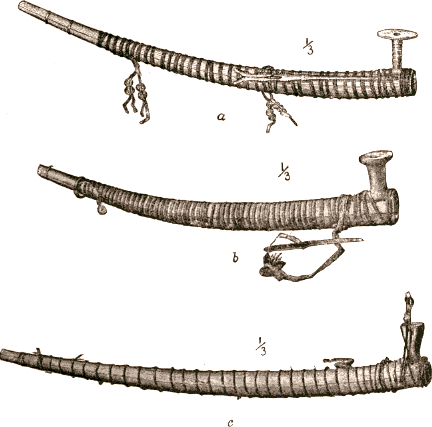
Fig. 6.—Pipes: a, pipe with metal bowl; b, pipe with stone bowl; c, pipe bowl of antler or ivory.
Antler and stone pipes of this pattern and rather small are usually carried by the men out of doors, while the more elaborate metal pipes, which are often very large and handsome (I have seen some with a saucer at least 3 inches in diameter) are more frequently used in the house and by the women. The stem is usually 1 foot or 13 inches long, though pipes at least 18 inches long were seen.
To most pipes are attached pickers, as in the type specimen. The picker is in all cases of metal, usually iron or steel, but sometimes of copper (see the pickers attached to pipes above). When not in use the point is tucked under the lashing on the stem. The pipes are readily taken apart for cleaning.
No. 89292 [1752] (Fig. 7) is an extemporized pipe made in a hurry by a man who wished to smoke, but had no pipe.

Fig. 7.—Pipe made of willow stick.
It is simply a rough willow stick, slightly whittled into shape, split and hollowed out like a pipestem. It is held together by a whipping of sinew thread and a lashing of deerskin thong, fastened by a slip-knot at one end, the other being tucked in as usual. A small funnel-shaped hole at one end serves for a bowl, and shows by its charred surface that it has been actually used. This pipe was bought from one of the “Nunatañmiun,” who were in camp at Pernyû in 1883, and shows its inland origin in the use of the deerskin thong. A coast native would have used seal thong.
The pipe is carried at the girdle, either with the stem thrust inside the breeches or in a bag attached to the belt. No. 56744 [55] (Utkiavwĭñ) is the only specimen of pipe bag in the collection. It is a long, narrow, cylindric bag, made of four white ermine skins, with two hind legs and two tails forming a fringe round the bottom, which is of dressed deerskin, in one piece, flesh side out. The band round the mouth is of gray deerskin, running only two-thirds of the way round. The piece which fills the remaining third runs out into the strap for fastening the bag to the belt. The ornamental strips on two of the longitudinal seams and round the bottom are of deerskin. The seams are all sewed “over and over” on the “wrong” side with sinew thread. This is an unusually handsome bag.
Tobacco is carried in a small pouch of fur attached to the girdle, and tucked inside of the breeches, or sometimes worn under the jacket, slung round the neck by a string or the necklace. The collection contains three of these, of which No. 89803 [889] (Fig. 8a) will serve as a typical specimen.
It is made by sewing together two pieces of wolverine fur, hair out, of the same shape and size, and round the mouth of this a band of short-haired light-colored deerskin, also hair out, with the ends meeting at one side in a seam corresponding to one of the seams of the wolverine fur. The mouth is ornamented with a narrow band of wolverine fur, the flesh side, which is colored red, turned out. It is closed by a piece of seal thong about 5 inches long, one end of which is sewed to the middle of the seam in the deerskin band and the other passed through a large blue glass bead and knotted. This string is wound two or three times round the neck of the bag, and the bight of it tucked under the turns. The seams are all sewed “over and over” on the “wrong” side with sinew thread.
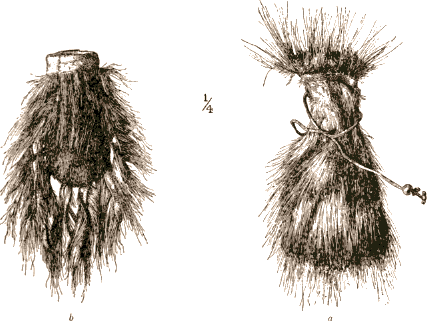
Fig. 8.—Tobacco pouches.
These tobacco pouches are usually of a similar pattern, often slightly narrowed at the neck, and generally fringed round the mouth with a narrow strip of wolverine fur as above. They are often ornamented with tags of wolverine fur on the seams (as in No. 89804 [1341, Fig. 8b]), and borders of different colored skin. No. 89805 [1350] is very elaborately ornamented. It is made of brown deerskin, trimmed with white deerskin clipped close and bordered with narrow braids of blue and red worsted, and little tags of the latter. According to Dr. Simpson,117 these bags are called “del-la-mai´-yu.” We neglected to obtain the proper names for them, as we always made use of the lingua franca “tiba´ púksak,” bag for tiba´ (tobacco). No. 89903 [889] contains a specimen of tobacco as prepared for smoking by the Eskimo. This consists of common black Cavendish or “Navy” tobacco, cut up very fine, and mixed with finely chopped wood in the proportion of about two parts of tobacco to one of wood. We were informed that willow twigs were used for this purpose. Perhaps this may have some slight aromatic flavor, as well as serving to make the tobacco go further, though I did not recognize any such flavor in some tobacco from an Eskimo’s pouch that I once smoked and found exceedingly bad. The smell of an Eskimo’s pipe is different from any other tobacco smoke and is very disagreeable. It has some resemblance to the smell of some of the cheaper brands of North Carolina tobacco which are known to be adulterated with other vegetable substances. The method of smoking is as follows: After clearing out the bowl with the picker, a little wad of deer hair, plucked from the clothes in some inconspicuous place, generally the front skirt of the inner jacket, is rammed down to the bottom of the bowl. This is to prevent the fine tobacco from getting into the stem and clogging it up. The bowl is then filled with tobacco, of which it only holds a very small quantity. The mouthpiece is placed between the lips, the tobacco ignited, and all smoked out in two or three strong inhalations. The smoke is very deeply inhaled and allowed to pass out slowly from the mouth and nostrils, bringing tears to the eyes, often producing giddiness, and almost always a violent fit of coughing. I have seen a man almost prostrated from the effects of a single pipeful. This method of smoking has been in vogue since the time of our first acquaintance with these people.118
Though they smoke little at a time, they smoke frequently when tobacco is plentiful. Of late years, since tobacco has become plentiful, some have adopted white men’s pipes, which they smoke without inhaling, and they are glad to get cigars, and, since our visit, cigarettes. In conversation with us they usually called all means for smoking “pai´pa,” the children sometimes specifying “pai´pa-sigya´” (cigar) or “mûkparapai´pa,” paper-pipe (cigarette). The use of the kui´nyɐ, which name appears to be applied only to the native pipes, seems to be confined to the adults. We knew of no children owning them, though their parents made no objection to their chewing tobacco or owning or using clay or wooden pipes which they obtained from us. They carry their fondness for tobacco so far that they will even eat the foul oily refuse from the bottom of the bowl, the smallest portion of which would produce nausea in a white man. This habit has been observed at Plover Bay, Siberia.119 Tobacco ashes are also eaten, probably for the sake of the potash they contain, as one of the men at Utkiavwīñ was fond of carbonate of soda, which he told the doctor was just like what he got from his pipe. Pipes of this type, differing in details, but all agreeing in having very small bowls, frequently of metal, and some contrivance for opening the stem, are used by the Eskimo from at least as far south as the Yukon delta (as shown by the collections in the National Museum) to the Anderson River and Cape Bathurst,120 and have even been adopted by the Indians of the Yukon, who learned the use of tobacco from the Eskimo. They are undoubtedly of Siberian origin, as will be seen by comparing the figure of a “Chukch” pipe in Nordenskiöld’s Vega, vol. 2, p. 117, Fig. 7, and the figure of a Tunguse pipe in Seebohm’s “Siberia in Asia” (p. 149), with the pipes figured from our collection. Moreover, the method of smoking is precisely that practiced in Siberia, even to the proportion of wood mixed with the tobacco.121
The consideration of the question whence the Siberians acquired this peculiar method of smoking would lead me beyond the bounds of the present work, but I can not leave the subject of pipes without calling attention to the fact that Nordenskiöld122 has alluded to the resemblance of these to the Japanese pipes. A gentleman who has spent many years in China also informs me that the Chinese pipes are of a very similar type and smoked in much the same way.123 The Greenlanders and eastern Eskimo generally, who have learned the use of tobacco directly from the Europeans, use large-bowled pipes, which they smoke in the ordinary manner. In talking with us the people of Point Barrow call tobacco “tiba´” or “tibakĭ,” but among themselves it is still known as ta´wak, which is the word found in use among them by the earliest explorers.124 “Tiba” was evidently learned from the American whalers, as it was not in use in Dr. Simpson’s time. It is merely an attempt to pronounce the word tobacco, but has been adopted into the Eskimo language sufficiently to be used as the radical in compound words such as “tiba´xutikă´ktûñɐ,” “I have a supply of tobacco.” There is no evidence that anything else was smoked before the introduction of tobacco, and no pipes seen or collected appear older than the time when we know them to have had tobacco.125
HABITATIONS.
The winter house (ĭ´glu).—
The permanent winter houses are built of wood126 and thickly covered with clods of earth. Each house consists of a single room, nearly square, entered by an underground passage about 25 feet long and 4 to 4½ feet high. The sloping mound of earth which covers the house, grading off insensibly to the level of the ground, gives the houses the appearance of being underground, especially as the land on which they stand is irregular and hilly. Without very careful measurements, which we were unable to make, it is impossible to tell whether the floor is above or below the surface of the ground. It is certainly not very far either way. I am inclined to think that a space at or near the top of a hillock is simply leveled to receive the floor. In this case the back of the house on a hill side, like some in Utkiavwĭñ, would be underground.
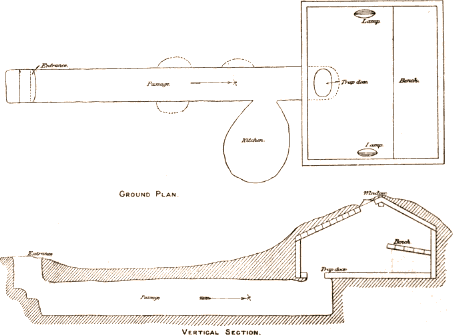
Fig. 9.—Plans of Eskimo-winter house.
The passage is entered at the farther end by a vertical shaft about 6 feet deep in the center of a steep mound of earth. Round the mouth is a square frame or combing of wood, and blocks of wood are placed in the shaft to serve as steps. One or two houses in Utkiavwĭñ had ship’s companion ladders in the shaft. This entrance can be closed with a piece of walrus hide or a wooden cover in severe weather or when the family is away. The passage is about 4 feet wide and the sides and roof are supported by timbers of whalebone. On the right hand near the inner end is a good-sized room opening from the passage, which has a wooden roof covered with earth, forming a second small mound close to the house, with a smoke hole in the middle, and serves as a kitchen, while various dark and irregular recesses on the other side serve as storerooms. The passage is always icy and dark.
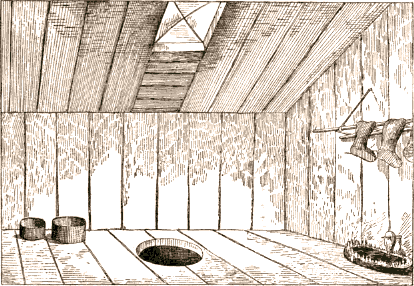
Fig. 10.—Interior of iglu, looking toward door.
At the inner end of the passage a circular trapdoor in the floor opens into the main room of the house, close to the wall at the middle of one end. The floor is at such a height from the bottom of the tunnel that a man standing erect in the tunnel has his head and shoulders in the room. These rooms vary somewhat in dimensions, but are generally about 12 or 14 feet long and 8 or 10 feet wide. The floor, walls, and roof are made of thick planks of driftwood, dressed smooth and neatly fitted together, edge to edge. The ridgepole runs across the house and the roof slopes toward each end. The two slopes are unequal, the front, or that towards the entrance, being considerably the longer. The walls are vertical, those at the ends being between 3 and 4 feet high, while the sides run up to 6 or 7 feet at the ridgepole. The wall planks run up and down, and those of the roof from the ridge to the ends of the house, where there is a stout horizontal timber. In some houses the walls are made of paneled bulkheads from some wrecked whaler.
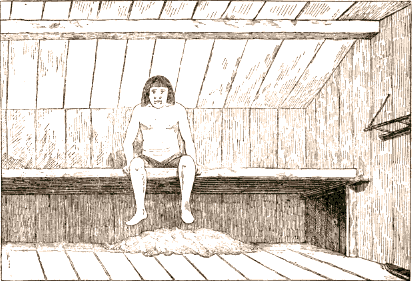
Fig. 11.—Interior of iglu, looking toward bench.
In the front of the house over the trapdoor there are no planks for a space of about 2 feet. The lower part of this space is filled in with short transverse beams, so as to leave a square hole close to the ridge. This hole has a stout transverse beam at the top and bottom and serves as a window. When the house is occupied it is covered by a translucent membrane made of strips of seal entrail sewed together and stretched over two arched sticks of light wood—whalebone was used in Dr. Simpson’s time127—running diagonally across from corner to corner. The window is closed with a wooden shutter when the house is shut up in winter, but both apertures are left open in summer. Just above the window, close to the ridgepole, is a little aperture for ventilation. Across the back of the room runs a platform or banquette, about 30 inches high in front and sloping back a little, which serves as a sleeping and lounging place. It is about 5 feet wide, and the front edge comes nearly under the ridgepole. It is made of thick planks running across the house, and supported at each end by a horizontal beam, the end of which projects somewhat beyond the bench and is supported by a round post. At each side of the house stands a lamp, and over these are suspended racks in the shape of small ladders for drying clothing,128 etc. Deerskin blankets for the bed, which are rolled up and put under the bench when not in use, and a number of wooden tubs of various sizes—I counted nine tubs and buckets in one house in Utkiavwĭñ—complete the furniture.
Two families usually occupy such a house, in which case each wife has her own end of the room and her own lamp, near which on the floor she usually sits to work. Some houses contain but one family and others more. I knew one house in Utkiavwĭñ whose regular occupants were thirteen in number, namely, a father with his wife and adopted daughter, two married sons each with a wife and child, his widowed sister with her son and his wife, and one little girl. This house was also the favorite stopping-place for people who came down from Nuwŭk to spend the night. The furniture is always arranged in the same way. There is only one rack on the right side of the house and two on the left. Of these the farther from the lamp is the place for the lump of snow. In this same corner are kept the tubs, and the large general chamber pot and the small male urinal are near the trap door. Dishes of cooked meat are also kept in this corner. This leaves the other corner of the house vacant for women visitors, who sit there and sew. Male visitors, as well as the men of the house when they have nothing to do, usually sit on the edge of the banquette.
In sleeping they usually lie across the banquette with their feet to the wall, but sometimes, when there are few people in the house, lie lengthwise, and occasionally sleep on the floor under the banquette. Petitot says that in the Mackenzie region only married people sleep with their heads toward the edge of the banquette. Children and visitors lie with their heads the other way.129 (See Fig. 9, ground plan and section of house, and Figs. 10 and 11, interior, from sketches by the writer. For outside see Fig. 12, from a photograph by Lieut. Ray).
At the back of the house is a high oblong scaffolding, made by setting up tall poles of driftwood, four, six, or eight in number, and fastening on cross pieces about 8 or 10 feet from the ground, usually in two tiers, of which the lower supports the frames of the kaiaks and the upper spears and other bulky property. Nothing except very heavy articles, such as sledges, boxes, and barrels, is ever left on the ground. A man can easily reach this scaffold from the top of the house, but it is high enough to be out of reach of the dogs. The cross pieces are usually supported on crotches made by lashing the lower jaw of a walrus to the pole, so that one ramus lies along the latter. Scaffolds of this sort, usually spoken of as “caches” or “cache frames,” are of necessity used among the Eskimos generally, as it is the only way in which they can protect their bulky property.130
Around Norton Sound, however, they use a more elaborate structure, consisting of a regular little house 6 feet square, raised 6 to 10 feet from the ground on four posts.131
Belonging to each household, and usually near the house, are low scaffolds for the large boats, rows of posts for stretching lines of thong, and one or more small cellars or underground rooms framed with whales’ bones, the skull being frequently used for a roof, which serve as storehouses for blubber. These may be called “blubber rooms.”
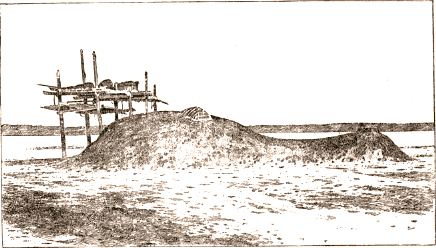
Fig. 12.—House in Utkiavwĭñ.
These winter houses can only be occupied when the weather is cold enough to keep the ground hard frozen. During the summer the passageways are full of water, which freezes at the beginning of winter and is dug out with a pickax. The people of Utkiavwĭñ began to come to us to borrow our pickax to clean out their iglus about September 24, 1882, and all the houses were vacated before July 1, both seasons.
This particular form of winter house, though in general like those built by other Eskimo, nevertheless differs in many respects from any described elsewhere. For instance, the Greenland house was an oblong flat-roofed building of turf and stones, with the passageway in the middle of one side instead of one end, and not underground. Still, the door and windows were all on one side, and the banquette or “brix” only on the side opposite the entrance. The windows were formerly made of seal entrails, and the passage, though not underground, was still lower than the floor of the house, so that it was necessary to step up at each end.132
A detailed description of the peculiar communal house of the East Greenlanders, of which, there is only one at each village, will be found in Capt. Holm’s paper in the Geografisk Tidskrift, vol. 8, pp. 87-89. This is the long house of West Greenland, still further elongated till it will accommodate “half a score of families, that is to say, 30 to 50 people.” John Davis (1586) describes the houses of the Greenlanders “neere the Sea side,” which were made with pieces of wood on both sides, and crossed over with poles and then covered over with earth.133
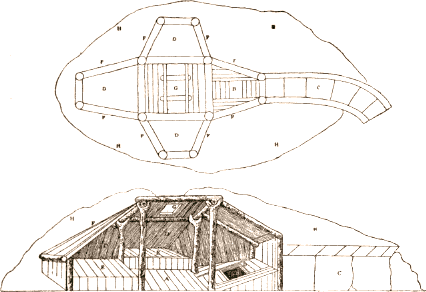
Fig. 13.—Ground plan and section of winter house in Mackenzie region.
At Iglulik the permanent houses were dome shaped, built of bones, with the interstices filled with turf, and had a short, low passage.134 No other descriptions of permanent houses are to be found until we reach the people of the Mackenzie region, who build houses of timbers, of rather a peculiar pattern, covered with turf, made in the form of a cross, of which three or all four of the arms are the sleeping rooms, the floor being raised into a low banquette.135 (See Fig. 13.) Petitot136 gives a very excellent detailed description of the houses of the Anderson River people. According to his account the passageway is built up of blocks of ice. He mentions one house with a single alcove like those at Point Barrow.137
We have no description of the houses at the villages between Point Barrow and Kotzebue Sound, but at the latter place was found the large triple house described by Dr. Simpson, and compared by him with that described by Richardson, though in some respects it more closely resembles those seen by Hooper.138 This house really has a fireplace in the middle, and in this approaches the houses of the southern Eskimo of Alaska. According to Dr. Simpson,139a “a modification of the last form, built of undressed timber, and sometimes of very small dimensions, with two recesses opposite each other, and raised a foot above the middle space, is very common on the shores of Kotzebue Sound,” but he does not make it plain whether houses like those used at Point Barrow are not used there also.
This form of house is very like the large snow houses seen by Lieut. Ray at hunting camps on Kulugrua. Dr. Simpson describes less permanent structures which are used on the rivers, consisting of small trees split and laid “inclining inward in a pyramidal form towards a rude square frame in the center, supported by two or more upright posts. Upon these the smaller branches of the felled trees are placed, and the whole, except the aperture at the top and a small opening on one side, is covered with earth or only snow.”139b These buildings, and especially the temporary ones described by Dr. Simpson, used on the Nunatak, probably gave rise to the statement we heard at Point Barrow that “the people south had no iglus and lived only in tents.” The houses at Norton Sound are quite different from the Point Barrow form. The floor, which is not planked, is 3 or 4 feet under ground, and the passage enters one side of the house, instead of coming up through the floor, and a small shed is built over the outer entrance to the passage. The fire is built in the middle of the house, under the aperture in the roof which serves for chimney and window, and there is seldom any banquette, but the two ends of the room are fenced off by logs laid on the ground, to serve as sleeping places, straw and spruce boughs being laid down and covered with grass mats.140
The houses in the Kuskokwim region are quite similar to those just described, but are said to be built above ground in the interior, though thy are still covered with sods.141 There are no published accounts of the houses of the St. Lawrence islanders, but they are known to inhabit subterranean or partly underground earth-covered houses, built of wood, while the Asiatic Eskimo have abandoned the old underground houses, which were still in use at the end of the last century, and have adopted the double-skin tent of the Chukches.142 In addition to the cases quoted by Dall, Capt. Cook speaks of finding the natives of St. Lawrence Bay in 1778 living in partly underground earth-covered houses.143
Arrangement in villages.—
The village of Utkiavwĭñ occupies a narrow strip of ground along the edge of the cliffs of Cape Smyth, about 1,000 yards long, and extending some 150 yards inland. The houses are scattered among the hillocks without any attempt at regularity and at different distances from each other, sometimes alone, and sometimes in groups of two contiguous houses, which often have a common cache frame. Nuwŭk, from Dr. Simpson’s account144 and what we saw in our hurried visits, is scattered in the same way over the knolls of Point Barrow, but has its greatest extension in an east and west direction. From Simpson’s account (ibid.) double houses appear more common at Nuwŭk than at Utkiavwĭñ, and he even speaks of a few threefold ones. All the houses agree in facing south. This is undoubtedly to admit the greatest amount of light in winter, and seems to be a tolerably general custom, at least among the northern Eskimo.145
The custom of having the dwelling face south appears to be a deeply rooted one, as even the tents in summer all face the same way.146
The tents on the sandspit at Plover Bay all face west. The same was observed by the Krause brothers at East Cape.147 At Utkiavwĭñ there are twenty-six or twenty-seven inhabited houses. The uninhabited are mostly ruins and are chiefly at the southwest end of the village, though the breaking away of the cliffs at the other end has exposed the ruins of a few other old houses. Near these are also the ruins of the buildings destroyed by the ice catastrophe described above (p. 31). The mounds at the site of the United States signal station are also the ruins of old iglus. We were told that “long ago,” before they had any iron, five families who “talked like dogs” inhabited this village. They were called Isû´tkwamiun. Similar mounds are to be seen at Pernyû, near the present summer camp. About these we only learned that people lived there “long ago.” We also heard of ruined houses on the banks of Kulugrua.
Besides the dwellings there are in Utkiavwĭñ three and in Nuwŭk two of the larger buildings used for dancing, and as workrooms for the men, so often spoken of among other Eskimo.
Dr. Simpson states148 that they are nominally the property of some of the more wealthy men. We did not hear of this, nor did we ever hear the different buildings distinguished as “So-and-so’s,” as I am inclined to think would have been the case had the custom still prevailed. They are called kû´dyĭgi or kû´drĭgi (karrigi of Simpson), a word which corresponds, mutatis mutandis, with the Greenlandic kagsse, which means, first, a circle of hills round a small deep valley, and then a circle of people who sit close together (and then, curiously enough, a brothel). At Utkiavwĭñ they are situated about the middle of the village, one close to the bank and the others at the other edge of the village. They are built like the other houses, but are broader than long, with the ridgepole in the middle, so that the two slopes of the roof are equal, and are not covered with turf, like the dwellings, being only partially banked up with earth.
The one visited by Lieut. Ray on the occasion of the “tree dance” was 16 by 20 feet and 7 feet high under the ridge, and held sixty people. In the fall and spring, when it is warm enough to sit in the kû´dyĭgi without fire and with the window open, it is used as a general lounging place or club room by the men. Those who have carpentering and similar work to do bring it there and others come simply to lounge and gossip and hear the latest news, as the hunters when they come in generally repair to the kû´dyĭgi as soon as they have put away their equipments.
They are so fond of this general resort that when nearly the whole village was encamped at Imêkpûñ in the spring of 1883, to be near the whaling ground, they extemporized a club house by arranging four timbers large enough for seats in a hollow square near the middle of the camp. The men take turns in catering for the club, each man’s wife furnishing and cooking the food for the assembled party when her husband’s turn comes. The club house, however, is not used as a sleeping place for the men of the village, as it is said to be in the territory south of Bering Strait,149 nor as a hotel for visitors, as in the Norton Sound region.150 Visitors are either entertained in some dwelling or build temporary snow huts for themselves.
The kû´dyĭgi is not used in the winter, probably on account of the difficulty of warming it, except on the occasions of the dances, festivals, or conjuring ceremonies. Crevices in the walls are then covered with blocks of snow, a slab of transparent ice is fitted into the window, and the house is lighted and heated with lamps. Buildings of this sort and used for essentially the same purposes have been observed among nearly all known Eskimo, except the Greenlanders, who, however, still retain the tradition of such structures.151 Even the Siberian Eskimo, who have abandoned the iglu, still retained the kû´dyĭgi until a recent date at least, as Hooper saw at Oong-wy-sac a performance in a “large tent, apparently erected for and devoted to public purposes (possibly as a council room as well as a theater, for in place of the usual inner apartments only a species of bench of raised earth ran round it).”152 These buildings are numerous and particularly large and much used south of Bering Strait, where they are also used as steam bath houses.153
Snow houses (apúya).—
Houses of snow are used only temporarily, as for instance at the hunting grounds on the rivers, and occasionally by visitors at the village who prefer having their own quarters. For example, a man and his wife who had been living at Nuwŭk decided in the winter of 1882-’83 to come down and settle at Utkiavwĭñ, where the woman’s parents lived. Instead of going to one of the houses in the village, they built themselves a snow house in which they spent the winter. The man said he intended to build a wooden house the next season. These houses are not built on the dome or beehive shape so often described among the Eskimo of the middle region of Dr. Rink.154
The idea naturally suggests itself that this form of building is really a snow tupek or tent, while the form used at Point Barrow is simply the iglu built of snow instead of wood. When built on level ground, as in the village, the snow house consists of an oblong room about 6 feet by 12, with walls made of blocks of snow, and high enough for a person to stand up inside. Beams or poles are laid across the top, and over these is stretched a roof of canvas. At the south end is a low narrow covered passage of snow about 10 feet long leading to a low door not over 2½ feet high, above which is the window, made, as before described, of seal entrail. The opening at the outer end of the passage is at the top, so that one climbs over a low wall of snow to enter the house.
At the right side of the passage, close to the house, is a small fireplace about 2½ feet square and built of slabs of snow, with a smoke hole in the top and a stick stuck across at the proper height to hang a pot on. When the first fire is built in such a fireplace there is considerable melting of the surface of the snow, but as soon as the fire is allowed to go out this freezes to a hard glaze of ice, which afterwards melts only to a trifling extent. Opposite to the door of the house, which is protected by a curtain of canvas, corresponding to the Greenlandic ubkuaĸ, “a skin which is hung up before the entrance of the house,”155 the floor is raised into a banquette about 18 inches high, on which are laid boards and skins. Cupboards are excavated under the banquette, or in the walls, and pegs are driven into the walls to hang things on. As such a house is only large enough for one family, there is only one lamp, which stands at the right-hand side of the house156.
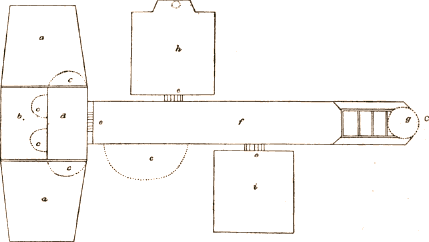
Fig. 14.—Ground plan of large snow house.
At the hunting grounds, or on the road thither in the winter, a place is selected for the house where the snow is deeply drifted under the edge of some bank, so that most of the house can be made by excavation. When necessary, the walls are built up and roofed over with slabs of snow. Such a house is very speedily built. The first party that goes over the road to the hunting ground usually builds houses at the end of each day’s march, and these serve for the parties coming later, who have simply to clear out the drifted snow or perhaps make some slight repairs. On arriving at the hunting ground they establish themselves in larger and more comfortable houses of the same sort; generally for two families. Lieut. Ray, who visited these camps, has drawn the plan represented in Fig. 14. There is a banquette, a, at each end of the room, which is much broader than long (compare the form of house common at Kotzebue Sound, mentioned above, p. 78), but only one lamp, on a low shelf of snow, b, running across the back of the room and excavated below into a sort of cupboard. There are also similar cupboards, c, at different places in the walls, and a long tunnel, f, with the usual storerooms, i, and kitchen, h, from which a branch tunnel often leads to an adjoining house. The floor is marked d, the entrance to the tunnel g, and the door e. The house is lighted by the seal-gut windows of the iglu brought from the village.
On going into camp the railed sled is stuck points down into the snow and net-poles, or ice-picks, thrust through the rails, making a temporary cache frame,157 on which are hung bulky articles—snowshoes and guns.158 Small storehouses of snow or ice are built to contain provisions. In the autumn, many such houses are built in the village, of slabs of clear fresh-water ice about 4 inches thick cemented together by freezing. These resemble the buildings of fresh-water ice at Iglulik, described by Capt. Lyon.159
Other temporary structures of snow, sometimes erected in the village, serve as workshops. One of these, which was built at the edge of the village in April, 1883, was an oblong building long enough to hold an umiak, giving sufficient room to get around it and work, and between 6 and 7 feet high. The walls were of blocks of snow and the roof of canvas stretched over poles. One end was left open, but covered by a canvas curtain, and a banquette of snow ran along each side. It was lighted by oblong slabs of clear ice set into the walls, and warmed by several lamps. Several men in succession used this house for repairing and rigging up their umiaks, and others who had whittling to do brought their work to the same place.
Such boat shops are sometimes built by digging a broad trench in a snowbank and roofing it with canvas. Women dig small holes in the snow, which they roof over with canvas and use for work-rooms in which to dress seal skins. In such cases there is probably some superstitious reason, which we failed to learn, for not doing the work in the iglu. The tools used in building the snow houses are the universal wooden snow-shovel and the ivory snow-knife, for cutting and trimming the blocks. At the present day saws are very much used for cutting the blocks, and also large iron knives (whalemen’s “boarding knives,” etc.) obtained from the ships.
Tents (tupĕk).—
During the summer all the natives live in tents, which are pitched on dry places upon the top of the cliffs or upon the gravel beach, usually in small camps of four or five tents each. A few families go no farther than the dry banks just southwest of the village, while the rest of the inhabitants who have not gone eastward trading or to the rivers hunting reindeer are strung along the coast. The first camp below Utkiavwĭñ is just beyond the double lagoon of Nunava, about 4 miles away, and the rest at intervals of 2 or 3 miles, usually at some little inlet or stream at places called Sê´kqluka, Nakĕ´drixo, Kuosu´gru, Nună´ktuau, Ĭpersua, Wă´lăkpa (Refuge Inlet, according to Capt. Maguire’s map, Parl. Rep. for 1854, opp. p. 186), Er´nĭvwĭñ, Sĭ´ñaru, and Sa´kămna. It is these summer camps seen from passing ships which have given rise to the accounts of numerous villages along this coast. There is usually a small camp on the beach at Sĭ´nnyû and one at Imê´kpûñ, while a few go to Pernyû even early in the season.
As the sea opens the people from the lower camps travel up the coast and concentrate at Pernyû, where they meet the Nuwuñmiun, the Nunatañmiun traders, and the whalemen, and are joined later in the season by the trading parties returning from the east, all of whom stop for a few days at Pernyû. On returning to the village also, in September, the tents are pitched in dry places among the houses and occupied till the latter are dry enough to live in. Tents are used in the autumnal deer hunts, before snow enough falls to build snow houses. In the spring of 1883, when the land floe was very heavy and rough off Utkiavwĭñ, all who were going whaling in the Utkiavwĭñ boats went into camp with their families in tents pitched on the crown of the beach at Imêkpûñ, whence a path led off to the open water.
The tents are nowadays always made of cloth, either sailcloth obtained from wrecks or drilling, which is purchased from the ships. The latter is preferred as it makes a lighter tent and both dark blue and white are used. Reindeer or seal skins were used for tents as lately as 1854. Elson saw tents of sealskin lined with reindeer skin at Refuge Inlet,160 and Hooper mentions sealskin tents at Cape Smyth and Point Barrow.161 Dr. Simpson gives a description of the skin tents at Point Barrow.162 Indeed, it is probable that canvas tents were not common until after the great “wreck seasons” of 1871 and 1876, when so many whaleships were lost. The Nunatañmiun at Pernyû had tents of deerskin, and I remember also seeing one sealskin tent at the same place, which, it is my impression, belonged to a man from Utkiavwĭñ. Deerskin tents are used by the Anderson River natives,163 while sealskins are still in use in Greenland and the east generally.164 The natives south of Kotzebue Sound do not use tents, but have summer houses erected above ground and described as “generally log structures roofed with skins and open in front.”165 That they have not always been ignorant of tents is shown by the use of the word “topek” for a dwelling at Norton Sound.166
The tents at Point Barrow are still constructed in a manner very similar to that described by Dr. Simpson (see reference above). Four or five poles about 12 feet long are fastened together at the top and spread out so as to form a cone, with a base about 12 feet in diameter. Inside of these about 6 feet from the ground is lashed a large hoop, upon which are laid shorter poles (sometimes spears, umiak oars, etc.). The canvas cover, which is now made in one piece, is wrapped spirally round this frame, so that the edges do not meet in front except at the top, leaving a triangular space or doorway, filled in with a curtain of which part is a translucent membrane, which can be covered at night with a piece of cloth. A string runs from the upper corner of the cloth round the apex of the tent and comes obliquely down the front to about the middle of the edge of the other end of the cloth. The two edges are also held together by a string across the entrance. Heavy articles, stones, gravel, etc., are laid on the flap of the tent to keep it down, and spears, paddles, etc., are laid up against the outside. (See Fig. 15, from a photograph by Lieut. Ray.)
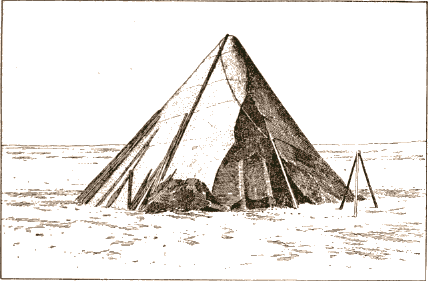
Fig. 15.—Tent on the beach at Utkiavwĭñ.
Inside of the tent there is much less furniture than in the iglu, as the lamp is not needed for heating and lighting, and the cooking is done outdoors on tripods erected over fires. The sleeping place is at the back of the tent, and is usually marked off by laying a log across the floor, and spreading boards on the ground. Not more than one family usually occupy a tent. The tents at the whaling camp mentioned above were, at first, fitted out with snow passages and fireplaces like a snow hut, and many had a low wall of snow around them, but these had all melted before the camp was abandoned.
These tents differ considerably in model from those in use in the east, though all are made by stretching a cover over radiating poles. For example, the tents in Greenland have the front nearly vertical,167 while at Cumberland Gulf two sets of poles connected by a ridgepole are used, those for the front being the shorter.168 The fashion at Iglulik is somewhat similar.169 Small rude tents only large enough to hold one or two people are used as habitations for women during confinement, and for sewing rooms when they are working on deerskins in the autumn. Tents for the latter purpose are called “su´dliwĭñ,” the place for working.
HOUSEHOLD UTENSILS.
FOR HOLDING AND CARRYING FOOD, WATER, ETC.
Canteens (i´mutĭn).—
None of the canteens, the use of which has been described above (under “Drinks”), were obtained for the collection. They were seen only by Lieut. Ray and Capt. Herendeen, who made winter journeys with the natives. They describe them as made of sealskins and of small size. I find no published mention of the use of such canteens among the Eskimo elsewhere, except in Baffin Land.170
Wallets, etc.—
Food and such things are carried in roughly made bags of skin or cloth, or sometimes merely wrapped up in a piece of skin or entrail, or whatever is convenient. Special bags, however, are used for bringing in the small fish which are caught through the ice. These are flat, about 18 inches or 2 feet square, and made of an oblong piece of sealskin, part of an old kaiak cover, doubled at the bottom and sewed up each side, with a thong to sling it over the shoulders.
Buckets and tubs.—
Buckets and tubs of various sizes are used for holding water and other fluids, blubber, flesh, entrails, etc., in the house, and are made by bending a thin plank of wood (spruce or fir) round a nearly circular bottom and sewing the ends together. These are probably all obtained from the Nunatañmiun, as it would be almost impossible to procure suitable wood at Point Barrow. The collection contains four specimens—two tubs and two buckets.
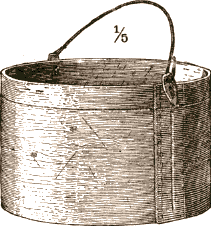
Fig. 16.—Wooden bucket.
No. 56764 [370] (Fig. 16) will serve as a type of the water bucket (kûtau´ɐ). A thin strip of spruce 8 inches wide is bent round a circular bottom of the same wood 10¼ inches in diameter. The edge of the latter is slightly rounded and fits into a shallow croze one-fourth inch from the lower edge of the strip. The ends of the strip overlap 3½ inches and are sewed together with narrow strips of whalebone in two vertical seams of short stitches, one seam close to the outer end, which is steeply chamfered off and painted red, and the other 1.6 inches from this. Both seams are countersunk in shallow grooves on the outer part. The bucket is ornamented with a shallow groove running round the top, and a vertical groove between the seams. These grooves and the seam grooves are painted red. The bail is of stout iron wire fastened on by two ears of white walrus ivory cut into a rude outline of a whale, and secured by neat lashings of whalebone passing through corresponding holes in the ear and the bucket. The bucket has been some time in use.
No. 56763 [369] is a bucket with a bail, and very nearly of the same shape and dimensions. It has, however, a bail made of rope yarns braided together, and the ears are plain flat pieces of ivory. Buckets of this size, with bails, are especially used for water, particularly for bringing it from the ponds and streams. The name “kûtauɐ” corresponds to the Greenlandic kátauaĸ, “a water-pail with which water is brought to the house.”171
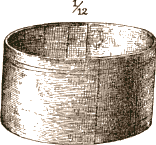
Fig. 17.—Large tub.
No. 89891 [1735] (Fig. 17), which is nearly new, is a very large tub (ilulĭ´kpûñ, which appears to mean “a capacious thing”) without a bail, and is 11 inches high and 20 in diameter. The sides are made of two pieces of plank of equal length, whose ends overlap alternately and are sewed together as before. The bottom is in two pieces, one large and one small, neatly fastened together with two dowels, and is not only held in by having its edge chamfered to fit the croze, but is pegged in with fourteen small treenails. The seams, edges, and two ornamental grooves around the top are painted red as before.
No. 89890 [1753] is smaller, 9.7 inches high and 14.5 in diameter. It has no bail, and is ornamented with two grooves, of which the lower is painted with black lead. The bottom is in two equal pieces, fastened together with three dowels. This is a new tub and has the knotholes neatly plugged with wood. There are a number of these tubs in every house. They are known by the generic name of imusiáru (which is applied also to a barrel, and which means literally “an unusual cup or dipper,” small cups of the same shape being called i´musyû), but have special names signifying their use. For instance, the little tub about 6 inches in diameter, used by the males as a urinal, is called kúvwĭñ (“the place for urine.”) One of these large tubs always stands to catch the drip from the lump of snow in the house, and those of the largest size, like No. 89891 [1735], are the kind used as chamber pots.
Vessels of this sort are in use throughout Alaska, and have been observed among the eastern Eskimo where they have wood enough to make them. For instance, the Eskimo of the Coppermine River “form very neat dishes of fir, the sides being made of thin deal, bent into an oval form, secured at the ends by sewing, and fitted so nicely to the bottom as to be perfectly water-tight.”172 There are specimens in the Museum from the Mackenzie and Anderson Rivers, described in the MacFarlane MS. as “pots for drinking with, pails for carrying and keeping water, and also as chamber pots. Oil is also sometimes carried in them in winter.”
In some places where wood is scarce vessels of a similar pattern are made of whalebone. Vessels “made of whalebone, in a circular form, one piece being bent into the proper shape for the sides,” are mentioned by Capt. Parry on the west shore of Baffins Bay,173 and “circular and oval vessels of whalebone” were in use at Iglulik.174 This is the same as the Greenlandic vessel called pertaĸ (a name which appears to have been transferred in the form pĭ´túño to the wooden meat bowl at Point Barrow), “a dish made of a piece of whalebone bent into a hoop, which makes the sides, with a wooden bottom inserted.”175 Nordenskiöld speaks of vessels of whalebone at Pitlekaj, but does not specify the pattern.176 Whalebone dishes were used at Point Barrow, but at the present day only small ones for drinking-cups are in general service. One large dish was collected. (Fig. 18. No. 89850 [1199]).
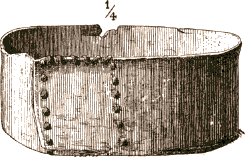
Fig. 18.—Whalebone dish.
A strip of whalebone 4¼ inches wide is bent round a nearly circular bottom of cottonwood so as to form a small tub. The edges of the bottom are chamfered to fit a shallow croze in the whalebone. The overlapping ends of the whalebone are sewed together with a strip of whalebone in long stitches. This dish is quite old and impregnated with grease. Vessels of this kind are uncommon, and it is probable that none have been made since whalebone acquired its present commercial value. They were very likely in much more general use formerly, as when there was no such market for whalebone as at present it would be cheaper to make tubs of this material than to buy wooden ones. In corroboration of this view it may be noted that Dr. Simpson does not mention woodenware among the articles brought for sale by the Nunatañmiun.177 The small whalebone vessels will be described under drinking cups, which see.
Meat bowls.—(Pĭ´tûño, see remarks on p. 88.)
Large wooden bowls are used to hold meat, fat, etc., both raw and cooked, which are generally served on trays. These are of local manufacture and carved from blocks of soft driftwood. The four specimens collected are all made of cottonwood, and, excepting No. 73570 [408], have been long in use and are thoroughly impregnated with grease and blood.
No. 89864 [1322] (Fig. 19) will serve as the type. This is deep and nearly circular, with flat bottom and rounded sides. The brim is ornamented with seven large sky-blue glass beads imbedded in it at equal intervals, except on one side, where there is a broken notch in the place of a bead.
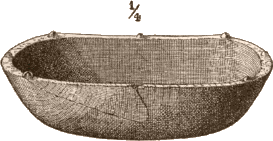
Fig. 19.—Meat bowl.
Another, No. 89863 [1320], is larger and not flattened on the bottom, and the brim is thinner. It is also provided with a bail of seal thong, very neatly made, as follows: One end of the thong is knotted with a single knot into one of the holes so as to leave one long part and one short part (about 3 inches). The long part is then carried across and through the other hole from the outside, back again through the first hole and again across, so that there are three parts of thong stretched across the bowl. The end is then tightly wrapped in a close spiral round all the other parts, including the short end, and the wrapping is finished off by tucking the end under the last turn. The specimen shows the method of mending wooden dishes, boxes, etc., which have split. A hole is bored on each side of the crack, and through the two is worked a neat lashing of narrow strips of whalebone, which draws the parts together.
In No. 89865 [1321], which has been split wholly across, there are six such stitches, nearly equidistant, holding the two parts together. This bowl is strengthened by neatly riveting a thin flat “strap” of walrus ivory along the edge across the end of the crack. These three bowls are of nearly the same shape, which is the common one. The new bowl (No. 73570 [408]) is of a less common shape, being not so nearly hemispherical as the others, but shaped more like a common milk pan. It is ornamented with straight lines drawn in black lead, dividing the surface into quadrants. These were probably put on to catch the white man’s eye, as the bowl was made for the market. Dishes of this description are common throughout Alaska (see the National Museum collections) and have been noted at Plover Bay.178
FOR PREPARING FOOD.
Pots of stone and other materials (u´tkuzĭñ).—
In former times, pots of soapstone resembling those employed by the eastern Eskimo, and probably obtained from the same region as the lamps, were used for cooking food at Point Barrow, but the natives have so long been able to procure metal kettles directly or indirectly from the whites (Elson found copper kettles at Point Barrow in 1826)179 that the former have gone wholly out of use, and at the present day fragments only are to be found. There are four such fragments in the collection, of which three are of the same model and one quite different.
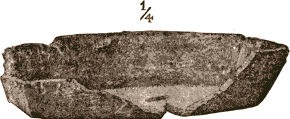
Fig. 20.—Stone pot.
No. 89885-6 [1559] (Fig. 20) is sufficiently whole to show the pattern of the first type. It is of soft gray soapstone. A large angular gap is broken from the middle of one side, taking out about half of this side, and a small angular piece from the bottom. From the corner of this gap the pot has been broken obliquely across the bottom, and mended in three places with stitches of whalebone made as described under No. 89865 [1321]. One end is cut down for about half its height, and the edge carried round in a straight line till it meets the gap in the broken side. This end appears to have been pieced with a fresh piece of stone, as there are holes for stitches in the edge of the whole side and in the upper edge of the broken side. There are also two “stitch holes” at the other side of the gap, showing how it was originally mended. A low transverse ridge across the middle of the whole end was probably an ornament. Holes for strings by which the pot was hung up are bored one-fourth to one-half inch from the brim. Two of these are bored obliquely through the corners, which are now broken off. The holes in the sides close to the corners were probably made to take the place of these. The pot is neatly and smoothly made, and the brim is slightly rounded. It shows signs of great age, and is blackened with soot and crusted with oil and dirt.180
Nos. 89886 [680] and 89868 [1096] are much less complete. They are the broken ends of pots slightly smaller than the above, but of precisely the same pattern, even to the ornamental transverse ridge across the end.181 The string holes are bored through the corners as before, and in both pots are holes showing where they have been mended by whalebone stitches, fragments of which are still sticking in one pot. This method of mending soapstone vessels by sewing is mentioned by Capt. Parry as practiced at Iglulik.182
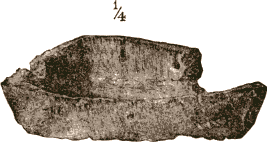
Fig. 21.—Small stone pot.
No. 89883 [1097] (Fig. 21) is a small pot of a quite different shape, best understood from the figure. Round the edge are eight holes for strings nearly equidistant. The outside is rough, especially on the bottom. One of the sides is much gapped, and the acute tip has been broken off obliquely and mended with a stitch of whalebone. The care used in mending these vessels shows that they were valuable and not easily replaced. I can find no previous mention of the use of stone vessels for cooking on the western coast, and there are no specimens in the National Museum collections. The only Eskimo stone vessels are a couple of small stone bowls from Bristol Bay. These are very much the shape of the wooden bowls above described, and appear to have been used as oil dishes and not for cooking, as the inside is crusted with grease, while the outside is not blackened. On the other hand, stone cooking pots are very generally employed even now by the eastern Eskimos, and have been frequently described.183 The close resemblance of the pots from Point Barrow to those described by Capt. Parry, taken in connection with Dr. Simpson’s statement184 that the stone lamps were brought from the east, renders it very probable that the kettles were obtained in the same way. The absence of this utensil among the southern Eskimo of Alaska is probably due to the fact that being inhabitants of a well wooded district they would have no need of contrivances for cooking over a lamp.
I obtained three fragments of pottery, which had every appearance of great age and were said to be pieces of a kind of cooking-pot which they used to make “long ago, when there were no iron kettles.” The material was said to be earth (nu´na), bear’s blood, and feathers,185 and appears to have been baked. They are irregular fragments (No. 89697 [1589], Fig. 22) of perhaps more than one vessel, which appears to have been tall and cylindrical, perhaps shaped like a bean-pot, pretty smooth inside, and coated with dried oil or blood, black from age. The outside is rather rough, and marked with faint rounded transverse ridges, as if a large cord had been wound round the vessel while still soft. The largest shard has been broken obliquely across and mended with two stitches of sinew, and all are very old and black.
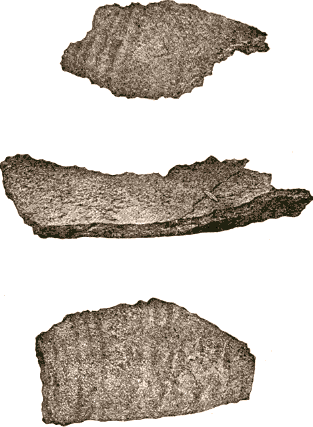
Fig. 22.—Fragments of pottery.
Beechey (Voyage, p. 295) speaks of “earthen jars for cooking” at Hotham Inlet in 1826 and 1827, and Mr. E. W. Nelson has collected a few jars from the Norton Sound region, very like what those used at Point Barrow must have been. Choris figures a similar vessel in his Voyage Pittoresque, Pl. III (2d), Fig. 2, from Kotzebue Sound. Metal kettles of various sorts are now exclusively used for cooking, and are called by the same name as the old soapstone vessels, which it will be observed corresponds to the name used by the eastern Eskimo. Light sheet-iron camp-kettles are eagerly purchased and they are very glad to get any kind of small tin cans, such as preserved meat tins, which they use for holding water, etc., and sometimes fit with bails of string or wire, so as to use them for cooking porridge, etc., over the lamp. They had learned the value of these as early as Maguire’s time,186 as had the people of Plover Bay in 1849.187
Bone crushers.—
In preparing food it is often desirable to break the large bones of the meat, both to obtain the marrow and to facilitate the trying out of the fat for making the pemmican already described. Deer bones are crushed into a sort of coarse bone-meal for feeding the dogs when traveling. For this purpose heavy short-handled stone mauls are used. These tools may have been formerly serviceable as hammers for driving treenails, etc., as the first specimen obtained was described as “savik-pidjûk-nunamisinĭ´ktuɐ-kau´teɐ” (literally “iron-not-dead-hammer”), or the hammer used by those now dead, who had no iron. For this purpose, however, they are wholly superseded by iron hammers, and are now only used for bone crushers. The collection contains a large series of these implements, namely, 13 complete mauls and 13 unhafted heads. All are constructed on the same general plan, consisting of an oblong roughly cylindrical mass of stone, with flat ends, mounted on the expanded end of a short haft, which is applied to the middle of one side of the cylinder and is slightly curved, like the handle of an adz. Such a haft is frequently made of the “branch” of a reindeer antler, and the expanded end is made by cutting off a portion of the “beam” where the branch joins it. A haft so made is naturally elliptical and slightly curved at right angles to the longer diameter of the ellipse, and is applied to the head so that the greatest thickness and therefore the greatest strength comes in the line of the blow, as in a civilized ax or hammer. The head and haft are held together by a lashing of thong or three-ply braid of sinew, passing through a large hole in the large end of the haft and round the head. This lashing is put on wet and dries hard and tight.188 It follows the same general plan in all the specimens, though no two are exactly alike. The material of the heads, with three exceptions (No. 56631 [222], gray porphyry; No. 89654 [906], black quartzite, and No. 89655 [1241], coarse-grained gray syenite), is massive pectolite (see above, p. 60), generally of a pale greenish or bluish gray color and slightly translucent, sometimes dark and opaque. No. 56635 [243] will serve as the type of these implements.189
The head is of light bluish gray pectolite, and is lashed with a three-ply braid of reindeer sinew to a haft of some soft coniferous wood, probably spruce, rather smoothly whittled out and soiled by handling. The transverse ridge on the under side of the butt is to keep the hand from slipping off the grip. The whole is dirty and shows signs of considerable age.
These mauls vary considerable in size. The largest is 7.1 inches long and 2.5 in diameter, and the smallest 2.1 inches long by 2.4. This is a very small hammer, No. 56634 [83] having a haft only 4.7 inches long. The haft is usually about 5 inches long. The longest (belonging to one of the smaller heads, 4 inches by 2) is 7.2 inches long, and the shortest (belonging to a slightly larger head, 4.7 by 3.1 inches) is 4.5 inches. The largest two heads, each 7.1 by 2.5 inches, have hafts 5 inches long.
The lashing of all is put on in the same general way, namely, by securing one end round the head and through the eye, then taking a variable number of turns round the head and through the hole, and tightening these up by wrapping the end spirally round all the parts, where they stretch from head to haft on each side. Seal thong, narrow or broad, is more generally used than sinew braid (only three specimens out of the thirteen have lashings of sinew). When broad thong is used the loop is made by splicing, as follows: A slit is cut about 1½ inches from the end of the thong, and the end is doubled in a bight and passed through this slit. The end is then slit and the other end of the thong passed through it and drawn taut, making a splice which holds all the tighter for drawing on it. A simple loop is tied in sinew braid.