ETHNOLOGICAL RESULTS OF THE POINT BARROW EXPEDITION. (continued 3)
Reading edition
Fig. 370 (No. 56496 [258] from Utkiavwĭñ) represents, rather rudely, a wolf’s face and ears, and is the only animal mask we obtained or saw. It is of cottonwood, old and weathered, and is 4.7 inches long and 6.5 wide. It is painted on the edge with red ocher and has a streak of the same color down the ridge of the nose. The string is of whalebone and unbraided sinew pieced together.
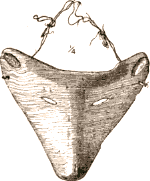
Fig. 370.—Wolf mask of wood.
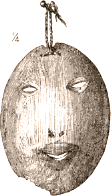
Fig. 371.—Very ancient small mask.
Fig. 371 (No. 89815 [1050] from Utkiavwĭñ) is a mask that seems almost too small to have been worn, being only 6.1 inches long and 4.7 wide. It is very old, made of blackened cottonwood, and is the rudest representation of the human face which we saw. It is simply an oval disk, concavo-convex, with holes cut for the eyes, nostrils, and mouth. The rough cutting about the chin appears to have been done with a stone tool, and the mouth seems to be smeared with blood. The string passed through the holes in the forehead to hang it up by is much newer than the mask, being braided from cotton twine and fastened to a common galvanized boat nail.
The more southern Eskimo of Alaska are in the habit of using in their dances very elaborate and highly ornamented and painted masks, of which the National Museum possesses a very large collection. The ancient Aleuts also used masks.485 On the other hand, no other Eskimo, save those of Alaska, ever use masks in their performances, as far as I can learn, with the solitary exception of the people of Baffin Land, where a mask of the hide of the bearded seal is worn on certain occasions.486 Nordenskiöld saw one wooden mask among the people near the Vega’s winter quarters, but learned that this had been brought from Bering Strait, and probably from America.487
The masks appear to become more numerous and more elaborate the nearer we get to the part of Alaska inhabited by the Indians of the T’linket stock, who, as is well known employ, in their ceremonies remarkably elaborate wooden masks and headdresses. It may be suggested that this custom of using masks came from the influence of these Indians, reaching in the simple form already described as far as Point Barrow, but not beyond.488 With these masks was worn a gorget or breast-plate, consisting of a half-moon shaped piece of board about 18 inches long, painted with rude figures of men and animals, and slung about the neck. We brought home three of these gorgets, all old and weathered.
No. 89818 [1132], Fig. 372a, has been selected as the type of the gorget (sûkĭmûñ). It is made of spruce, is 18.5 inches long, and has two beckets of stout sinew braid, one to go round the neck and the other round the body under the wearer’s arms. The figures are all painted on the front face. In the middle is a man painted with red ocher; all the rest of the figures are black and probably painted with soot. The man with his arms outstretched stands on a large whale, represented as spouting. He holds a small whale in each hand. At his right is a small cross-shaped object which perhaps represents a bird, then a man facing toward the left and darting a harpoon with both hands, and a bear facing to the left. On the left of the red man are two umiaks with five men in each, a whale nearly effaced, and three of the cross-shaped objects already mentioned. Below them, also, freshly drawn with a hard, blunt lead pencil or the point of a bullet, are a whale, an umiak, and a three-cornered object the nature of which I can not make out.
Fig. 372b (No. 56493 [266] from Utkiavwĭñ) is a similar gorget, which has evidently been long exposed to the weather, perhaps at the cemetery, as the figures are all effaced except in the middle, where it was probably covered by a mask as in Fig. 367 (No. 89817 [855] from the same village). There seems to have been a red border on the serrated edge. In the middle is the same red man as before standing on the black whale and holding a whale in each hand. At his right is a black umiak with five men in it, and at his left a partially effaced figure which is perhaps another boat. The strings are put on as before, except that the two beckets are separate. The upper is made of sinew braid, and the lower, which is now broken, of seal thong. This gorget is 15.5 inches long and 4.7 wide. No. 89817 [855] (Fig. 367 already referred to) has a mask tied over the middle by means of the beckets, so that the figures in the middle are much fresher than those on the ends. The edges are painted red. In the middle is the same red man or giant holding the whale. The other figures are painted with soot.
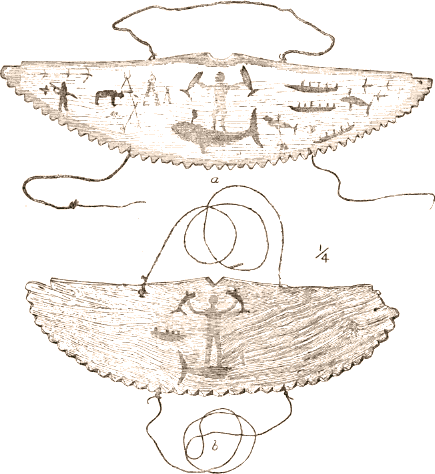
Fig. 372.—Dancing gorgets of wood.
This man or giant, able to hold out a whale, appears to be a legendary character, as we have his image carved in ivory. We unfortunately did not succeed in learning anything more about him, except that his name (apparently) was “kikámigo.” Hanging by the head to each elbow of this figure is a seal, and opposite its thighs two of the usual conventional whale’s tails, one on each side, with the flukes turned from him. The one on his left is attached to his waist by a straight line from its upper corner. At its right hand are a number of objects irregularly grouped. At the top an umiak with five men towing at a three-cornered object, which probably represents a dead whale; then a smaller umiak containing five men and apparently “fast” to a whale, which is spouting. A figure above this, almost obliterated, appears to be a small whale. Below are a large seal, three of the cross-shaped figures, four small whales, and one figure so much effaced that it can not be made out. On the left hand of the figure are two umiaks, and a whale with a line and float attached to him, then four crosses and a large seal in the corner. Below are four whales of different sizes, two bears, and a dog or wolf.
These gorgets appear to have gone out of fashion, as we saw none which were not very old, or which appeared to have been used recently. From the nature of the figures upon them, they were probably used in some of the ceremonies connected with the whale fishing. Kika´mĭgo may be the “divinity” who controls the whales and other sea animals.489
Mechanical contrivances.—
In one of the performances which Capt. Herendeen witnessed, there stood in the middle of the floor facing each other, the stuffed skins of a fox and a raven. These were mounted on whalebone springs and moved by strings, so that the fox sprang at the raven and the raven pecked at the fox, while the singing and dancing went on. These animals were never offered for sale, but they brought over a stuffed fox very cleverly mounted so as to spring at a lemming, which by means of strings was made to run in and out of two holes in the board on which the fox was mounted. (No. 89893 [1378] from Utkiavwĭñ.) We unfortunately did not learn the story or myth connected with this representation.490 It was the skin of an Arctic fox in the summer pelage, with the paws and all the bones removed, and clumsily stuffed with rope yarn, not filling out the legs. A stick was thrust into the tail to within about two inches of the tip, so that it was curled up over the back. The skin was taken off whole by a single opening near the vent, which was left open, and through which was thrust into the body a strip of whalebone 2 inches wide and about ⅛ inch thick, which protruded about 4¼ inches and was fastened to the front edge of the hole by tying the flap of skin to the whalebone with three or four turns of sinew braid, kept from slipping by a notch in each edge of the whalebone.
The fox was attached to a piece of the paneling of a ship’s bulkhead, 29 inches long and 7.5 wide, by bending forward 2¾ inches of the end of the whalebone, and lashing it down parallel to the length of the board with four turns of stout thong, kept from slipping by a notch in each edge of the whalebone and running through holes in the board. The fox was thus held up by the spring parallel to the length of the board with its head and forelegs raised. A string of sinew braid 10 feet long was passed through a hole in the septum of the fox’s nose and knotted once so as to leave two equal ends. These ends were carried down through two holes, one in each edge of the board 9½ inches from the forward end, and each was tied to a roughly-rounded bit of pine stick round which it was reeled when not in use. By pulling these strings together, the fox was made to dart down his head, which was raised by the spring as soon as the string was slackened. By pulling one or the other string the fox could be made to dart to one or the other side of the board.
One man manipulated the fox, pulling a string with each hand. The lemming’s holes were about 1¼ inches in diameter, one in each edge of the board and at such a distance from the end that when the string, which was 7 feet 4 inches long, was drawn through them, it crossed the board just where the fox’s nose struck, when it was pulled down. The ends of the string were reeled round bits of stick. The lemming was a narrow strip of wolf’s fur, about 3 inches long, doubled in the middle, with the middle of the string hitched into the bight. By pulling the ends of the string alternately, the lemming was made to jump out of the hole on one side, run across the board and into the other, very much as a live lemming runs from one tunnel to another on the tundra. It took two persons, one on each side, to handle the lemming. The foxskin and spring appeared to be older than the rest of the machine. The board was originally 10 inches or 1 foot longer at each end, but had to be cut off to pack it.
Petroff mentions a similar custom among the “Nushegagmute” of Bristol Bay, of introducing stuffed animals moved with hidden strings in their performances;491 and Dall492 describes a festival at Norton Sound, where a dead seal was brought in and moved about with strings.
Description of festivals.—
It is greatly to be regretted that we had not established such intimate relations with the natives, as afterwards was the case, in the winter of 1881-’82, since this was the only one of the two seasons that the great winter festival was held at Utkiavwĭñ. In the winter of 1882-’83 there had been so many deaths in the village that the natives did not feel like celebrating any regular festival, and only indulged in a few impromptu dances late in the season. These were unfortunately held in the evening when the writer’s tour of duty at the station prevented his witnessing them. Those of the party who did go over brought back only fragmentary and rather vague accounts of the performance. The confining nature of the work at the station prevented our witnessing any of the celebrations at Nuwŭk or at Pernyû, when the “Nunatañmiun” visitors were entertained.
The best accounts we have of any performance is given by Lieut. Ray. He and Capt. Herendeen went over to Utkiavwĭñ by special invitation on December 3, 1881, and witnessed one scene of the “wood,” or “tree dance.” Many visitors were present from Nuwŭk on the occasion of this dance, which lasted for two days and nights. On arriving at the village they found a crowd of upwards of 200 people assembled round the entrance of the kû´dyĭgĭ. In front of the entrance were drawn up in line five men and two women dancing to the music of a drum and two singers.
They were all dressed in new deerskin clothes, with the snow-white flesh side turned out, and wore conical dance caps like that already described. They kept time to the music with their feet, moving their bodies to right and left with spasmodic jerks. To quote from Lieut. Ray’s MS. notes:
Each dancer in turn sprang to the front and in extravagant gestures went through the motions of killing seal, walrus, and deer, and the pursuit of the whale. Each, as he finished, took his place in the line, was cheered by the crowd, then added his voice to the monotonous chant of the singers.
After all had finished as many as could get in entered the “dance house.” At one end of this a small space was partitioned off with a piece of an old sail, and from the roof in the middle hung an object intended to represent a tree. This was made of two oblong boxes about 6 inches in diameter, open at both ends, the lower about 2½ feet long and the upper about 1½, hinged together with seal thong. At one side hung a wolf’s skull, and on the other a dried raven. Two performers sat in the middle of the floor with their legs extended one between the other’s legs, with his nose touching the tree. A row of old men beat drums and sang, while the performers chanted a monotonous song, in which could be heard the words “rum, tobacco, seal, deer, and whale.”
Presently the bottom of the curtain was lifted and out crawled five men on all fours, wearing on their heads the stuffed skins of the heads of different animals—the wolf, bear, fox, lynx, and dog. They swung their heads from side to side in unison, keeping time to the music, uttering a low growl at each swing and shaking their rattle mittens. This they kept up for fifteen or twenty minutes, while the chant still went on, and the chief performer, with excited gestures, embraced the tree and rubbed his nose against it from time to time. At last all “sprang to their feet with a howl, and ended the dance with wild gestures.” Similar scenes, with new performers, which our party did not stay to witness, succeeded this, with feasting in the different houses.
Capt. Herendeen also witnessed a small dance, lasting only one evening, which bore a curious resemblance to some of the so-called “favor figures” performed in the “German cotillon” of civilized dancers. This kind of dance was performed purely for pleasure, and had nothing religious or dramatic about it. The music was furnished by the usual orchestra of old men, who beat drums and sang a monotonous song. Each person who intended to take part in the dance came provided with some small article to be given away as a “favor,” and rising in his turn, danced a few minutes, and then called out the name of the partner he wished to give it to. The latter then rose, and having received the “favor,” danced a while with him, and then both resumed their places among the spectators.
We never heard of any such elaborate “donation parties” as are described at Norton Sound and the Yukon region, where a man “saves up his property for years” to distribute it among his guests.493 A festival, however, was held at Nuwŭk in June, 1883, which apparently resembled the second kind described by Dall.494 Two men came down from Nuwŭk to invite Lieut. Ray and Capt. Herendeen, telling them what presents they were expected to bring. Unfortunately it was considered that too much was asked and the invitation was declined. The messengers carried “notched sticks.”495
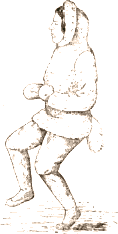
Fig. 373.—Youth dancing to the aurora.
Dances in which the children only take part, entirely for amusement, sometimes take place in the kû´dyĭgĭ, and people occasionally amuse themselves by dancing in the iglu. I have often seen the natives, especially the children and young people, dancing in the open air, and the dancing was always of very much the same character. The feet were but slightly moved, keeping time to the music, while the body swayed gracefully and the arms were waved from side to side. All the dancing which I saw was rather quiet and graceful, but they told us that when they got warmed up at a great dance they went at it with tremendous vigor, throwing off their garments to the waist. The dance which accompanies the song sung by the children to the aurora, however, is more violent. The dancer clenches his fists and, bending his elbows, strikes them against the sides of his body, keeping time to the song and stamping vigorously with the right foot, springing up and down with the left knee (see Fig. 373, from a sketch by the writer).
The festivals of the eastern Eskimo appear to be less formal and elaborate than those in the west, consisting simply of singing and dancing.498
TOYS AND SPORTS FOR CHILDREN AND OTHERS.
Playthings.—
Though the children amuse themselves with a great many sports and plays, we saw very few toys or playthings in use. We brought home six objects which appear to have no use except as playthings.
Fig. 374a (No. 89806 [1189] from Nuwŭk) is a whirligig in principle very like that made for civilized children. It is a block of spruce, fitted with a shaft of narwhal ivory. This fits loosely in the straight tubular handle, which is a section of the branch of an antler, with the soft inside tissue cut out. A string of seal thong passes through a hole in the middle of the handle and is fastened to the shaft. This string is about 8 feet long, and about half of it is tied up into the hank to make a handle for pulling it. It works very much like a civilized child’s whirligig. The string is wound around the shaft and a smart pull on the handle unwinds it, making the block spin round rapidly. The reaction, spinning it in the opposite direction, winds up the string again. A couple of loose hawk’s feathers are stuck into the tip of the block, which is painted with red ocher for about an inch. Four equidistant stripes of the same color run down the sides to a border of the same width round the base. This was made for sale and appears to be an unusual toy. I do not recollect ever seeing the children play with such a toy. It is called kai´psa (Gr. kâvsâk, “a whirligig or similar toy”).
Fig. 374b is a similar whirligig from Utkiavwĭñ (No. 89807 [1356]). The block, which is 4.2 inches long, is made of the solid tip of a mountain sheep’s horn, and is elaborately ornamented with a conventional pattern of lines and “circles and dots,” incised and colored red with ocher. The shaft is of hard bone, and the line has a little wooden handle at the end. The block is so heavy that it will hardly spin.
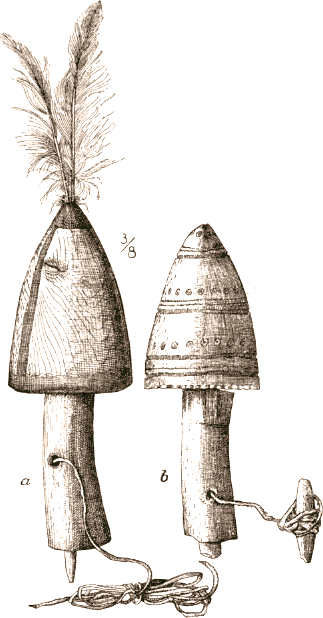
Fig. 374.—Whirligigs.
Fig. 375 (No. 56491 [46] from Utkiavwĭñ) is a teetotum (also called kaipsa). The shaft is of pine and the disk of spruce and is ornamented with black lead marks, forming a border about one-quarter inch broad on each face. The upper face is divided into quadrants by four narrow lines radiating from the hole, and each quadrant is divided into two by bands one-quarter inch broad. The order of these lines is reversed on the under face. This is spun, like a common teetotum, with the fingers, and does not seem to be common. I do not recollect ever seeing anyone except the maker of this toy spinning one.
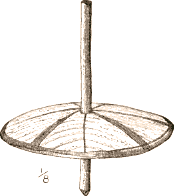
Fig. 375.—Teetotum.
The same is true of No. 89722 [1087] (Fig. 376, from Utkiavwĭñ) which is what American boys would call a “buzz” toy. It is of pine wood, and through two round holes in the middle are passed the ends of a piece of stout sinew braid, which are knotted together. When the board is placed in the middle of the string it can be made to spin round and whiz by alternately pulling and relaxing the ends of the string. The board is rather elaborately painted. One end has a border of black lead on both faces, the other a similar border of red paint, which appears to be red lead. Broad red bands form a square 1 inch across around the holes, with lines radiating from each corner to the corners of the board, on both faces. On the spaces between these lines are figures rudely drawn with black lead. On one face, in the first space, is a goose; in the second, a man with a staff; in the third, the conventional figure of a whale’s tail; and in the fourth, a whale with line and float attached to him, pursued by a whaling umiak. On the other side, the first space contains a dog or wolf walking; the second, two of these animals, sitting on their haunches, facing each other; the third, another walking; and the fourth, a reindeer in the same attitude.
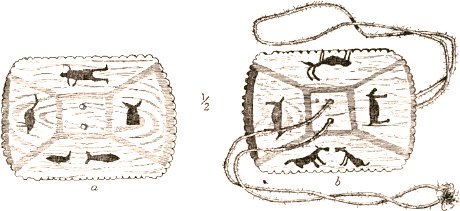
Fig. 376.—Buzz toy.
Fig. 377 (No. 89800 [1331] from Utkiavwĭñ), on the other hand, is a toy which the children often play with. It is the well known “whizzing-stick” found among savages in so many widely distant parts of the world, and often used in religious ceremonies. The Eskimo name is ĭmĭglúta. It consists of a thin board of pine wood, fastened by a string of sinew braid about 1 foot long to the end of a slender rod, which serves as a handle. When swung rapidly round by the handle it makes a loud, whizzing sound. It is very neatly made, and painted with black lead and red ocher. The tips of the board are black for about one-half inch and the rest is red, and the upper half of the handle marked with five rings about one-half inch wide and 1 inch apart, alternately black and red. This appears to be purely a child’s toy and has no mystical signification. I never saw one in the hands of an adult. This specimen was made and brought over for sale by a lad about thirteen or fourteen years old.
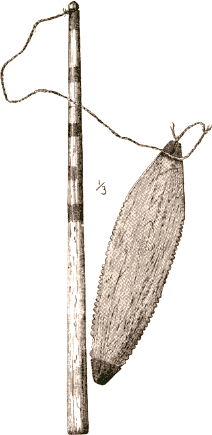
Fig. 377.—Whizzing stick.

Fig. 378.—Pebble snapper.
Fig. 378 (No. 56687 [181] from Utkiavwĭñ) is another plaything rather common with the boys, which takes the place of the American boy’s “bean snapper.” It is known by the name of mĭtĭ´glĭgaun, and is a rod of whalebone, stiff and black, 4.8 inches long and 0.5 wide, narrowed and bent sharply up for about an inch at one end. On the upper side of this end, close to the tip, is a little hollow, large enough to hold a small pebble, and the other is cut into sharp teeth. This is purely an instrument of mischief and is used for shooting tiny pebbles at people when they are looking the other way. Mûñialu showed us, with great glee, in an expressive pantomime, how a boy would hit a person in the eye with a little pebble, and, when the man turned round angrily, would have the snapper slipped up his sleeve and be looking earnestly in another direction. The toothed end, he said, was for mischievously scratching hairs out of a man’s coat when he was looking another way. The “snapper” is used as follows: It is held in the left hand, a little pebble is set in the socket, and the tip of the whalebone bent back with the right hand. When this end is let go the elasticity of the whalebone drives the pebble at the mark with considerable force. As far as I can learn this mischievous toy is peculiar to the Northwest.
Dolls.—
Though several dolls and various suits of miniature clothing were made and brought over for sale, they do not appear to be popular with the little girls. I do not recollect ever seeing a child playing with a doll. Those in the collection, indeed, seem rather less intended for playthings than as, so to speak, works of art to catch the fancy of the strangers. Such an object is No. 89728 [1304] (Fig. 379 from Utkiavwĭñ.) This is a human head carved out of pine wood, and shouldered off at the neck into a stout round peg, which is fitted into the middle of a thick elliptical pedestal of the same wood, flat on the bottom and convex on top. The head is dressed in a neatly made hood of thin deerskin with the flesh side cut off round the shoulders and exposing only the face. The face is very neatly carved, and has bits of green oxidized copper inlaid for the eyes. The cheeks, gums, and inside of the mouth are colored with red ocher, and the hair, eyebrows, and beard with black lead. The top of the pedestal is painted red and divided into eight equal parts by shallow grooves colored with black lead. The height of the whole object is 4½ inches, and the workmanship is remarkably good.
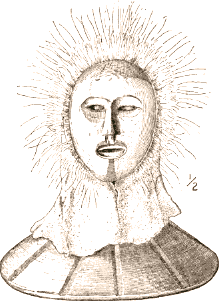
Fig. 379.—Carving of human head.
No. 89827 [1138] (from Utkiavwĭñ), on the other hand, is very roughly and carelessly made. It is 18.2 inches long, roughly whittled out of a flat piece of redwood board into the shape of a man with his legs wide apart and holding up his hands on each side of his head. The arms are very short and broad, with five fingers all nearly of the same length, and the legs are simply two straight four-sided pegs rounded on the edges. It is dressed in a hooded frock of seal gut reaching to the knees and leaving only the face and hands uncovered, and has sealskin knee boots on the legs. The face is rudely in relief, with two narrow bits of ivory inlaid for eyes, and a long canine tusk of the same material inserted in each corner of the mouth. Three small round bits of wood are inlaid in the forehead, one in the middle and one over each eye, and one in the right cheek above the corner of the mouth. The gut frock is carelessly made of irregular pieces. It is trimmed round the bottom and the edge of the hood with a strip of dogskin, but is left with a raw edge round the wrists. The boots are rather well made models of the regular waterproof boots, with soles of white sealskin and a band round the top 1 inch wide of the same material. A short peg projects from the top of the forehead. A string of stout sinew braid about 2 feet long is passed through a hole in the middle of the body and a knot tied in the end in front. Though the design is elaborate the workmanship is very rude, and the clothes seem to be made of odds and ends. The maker perhaps had in mind a fabulous man with teeth like a walrus, about whom we heard some fragmentary traditions.
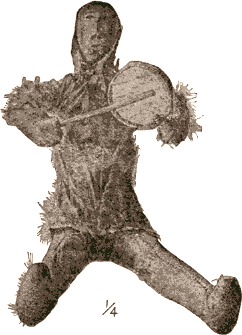
Fig. 380.—Mechanical doll: drum player.
Fig. 380 (No. 89826 [1358] from Utkiavwĭñ) is a clever, though somewhat roughly made, mechanical doll. It represents a man dressed in deerskins sitting with his legs outstretched and holding in his extended left hand a drum and in his right a stick, as if beating the drum. The arms are of whalebone, and by pressing them he can be made to beat the drum. The doll is made of a single piece of wood—a knot with two branches, which make the legs. (I learned this from Capt. Herendeen, who saw this doll at the village before it was finished.) The height of the sitting figure is 11½ inches.
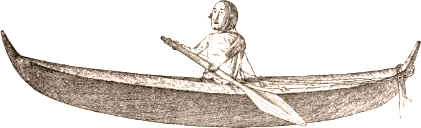
Fig. 381.—Mechanical toy: kaiak paddler.
A still more ingenious mechanical toy which, however, like the preceding, was made for sale, is shown in Fig. 381 (No. 89855 [1351] from Utkiavwĭñ). This is a man sitting in a kaiak in the attitude of paddling on the left side with a single-bladed paddle. His arms are of whalebone, and by means of strings he can be made to paddle and turn his head from side to side. The kaiak is 29 inches long, very neatly carved from a single block of wood, and solid except at the cockpit. The bottom is flat, to allow it to stand on the floor, but it is otherwise precisely of the model of the kaiaks in the Museum from the Mackenzie and Anderson region. The nation who made it called it a “Kûñmû´d’lĭñ” kaiak. It is painted all over with red ocher, except on the bottom. The figure has no legs and fits into the cockpit, which is without any coaming. The head is separate and mounted on a long, slender pivot, which is fitted into a hole in the neck just loosely enough to allow it to turn easily. It is dressed in a hood of seal gut. The face is very natural, though rather rudely carved, and is lightly colored all over with red ocher, with the mouth painted deeply red, and the eyebrows, eyes, nostrils, and beard marked with black lead. The arms are narrow strips of whalebone, the ends of which protrude at the wrists, and are tied to the paddle by the ends of the strings which work it. The body is covered with a gut shirt.

Fig. 382.—Kaiak carved from a block of wood.
The paddle is of the common shape, and has the blade and the lower end of the shaft painted red. The strings for working this contrivance are of fine sinew braid. One string is tied into a little hole in the edge of the hood, where the left ear would be, the other passes round the edge of the hood, and is tied at the right ear. These strings cross back of the head, and pass through two neat little ivory eyebolts inserted in the deck, 1 inch abaft the cockpit, and 1 inch apart. The strings from the hands are not crossed, but pass through two similar eyebolts, one at each edge of the deck, 2.5 inches from the cockpit. The ends of each set of strings are tied together. When the right pair and left pair of strings are pulled alternately, the man makes a stroke and looks to the right, then “recovers” and looks to the left. Both stroke and “recovery” are aided by the elasticity of the arms. This specimen shows a great deal of mechanical ingenuity, and was the only finished object of the kind seen.
Fig. 382 (No. 89856 [783] from Utkiavwĭñ) is a kaiak intended for a similar toy, which, when brought over for sale, had an unfinished armless doll in the cockpit. This was, unfortunately, lost in unpacking. The kaiak, which is 27.6 inches long, is not new, but has been freshly scraped and painted on deck. It is also a foreign kaiak, being precisely like a model brought by Mr. Nelson from Norton Sound. It is not unlikely that this boat itself came from that region through the “Nunatañmiun,” unless, possibly, a southern kaiak had passed through the hands of enough people to reach a point where some Point Barrow native might see it. As far as we know no Point Barrow natives visit the regions where this form is used, and the model seems too accurate to have been made from a description.
Juvenile implements.—
We sometimes saw the children playing with little models of the implements and utensils used by their parents. Perhaps the commonest thing of this sort is the boy’s bow. As soon as a boy is able to walk his father makes him a little bow suited to his strength, with blunt arrows, with which he plays with the other boys, shooting at marks—for instance, the fetal reindeer brought home from the spring hunt—till he is old enough to shoot small birds and lemmings. We also saw children playing with little drums, and one man made his little boy an elaborate kă´moti about 4 feet long. In the collection are a number of miniature implements, spears, etc., some of which have been already described, which were perhaps intended as playthings for the children. As, however, they were all newly made, it is possible that they were merely intended to catch the fancy of the strangers.
No. 89451 [1113], from Nuwŭk, is a little snow shovel 4.5 inches long, with a blade 2.1 inches wide, rather roughly carved from a piece of walrus ivory.
No. 89695 [1280] from Utkiavwĭñ, is a similar model of a deer lance, 7 inches long, all in one piece and made of reindeer antler.
No. 89797 [1186] from Utkiavwĭñ, is a quite well made model of the drum used for accompanying singing and dancing, and is almost large enough to have been used for a plaything. The stick is entirely out of proportion, being merely a roughly whittled bit of lath, 13 inches long.
Games and sports.—
The men have very few sports, though I have sometimes known them to amuse themselves by shooting at a mark with their rifles, and I once heard of a number of them wrestling. As far as I could learn, they wrestle “catch-as-catch-can” without any particular system. We never heard of anything like the athletic sports mentioned by Egede499 and Crantz500 or the pugilism described by Schwatka among the people of King William’s Land, when two men stand up to each other and exchange buffets till one or the other gives in.501 The women are very fond of playing “cat’s cradle” whenever they have leisure, and make a number of complicated figures with the string, many of which represent various animals. One favorite figure is a very clever representation of a reindeer, which is made by moving the fingers to run down hill from one hand to the other.502 Another favorite amusement with the women and children is tossing three bullets or small pebbles with the right hand, after the manner of a juggler, keeping one ball constantly in the air. Some of the women are very skillful at this, keeping the balls up for a long time. This play is accompanied by a chant sung to a monotonous tune with very little air, but strongly marked time. I never succeeded in catching the words of this chant, which are uttered with considerable rapidity, and do not appear to be ordinary words. It begins “yúɐ yúɐ yuká, yúɐ yúɐ yuká;” and some of the words are certainly indelicate to judge from the unequivocal gestures by which I once saw them accompanied.
In the winter the young women and girls are often to be seen tossing a snowball with their feet. A girl wets some snow and makes a ball about as big as her two fists, which of course immediately becomes a lump of ice. This she balances on the toe of one foot and with a kick and a jump tosses it over to the other foot which catches it and tosses it back. Some women will keep this up for a number of strokes.
The young people of both sexes also sometimes play football, kicking about an old mitten or boot stuffed with rags or bits of waste skin. I never saw them set up goals and play a regular game as they did in Greenland.503
The little girls also play with the skipping rope. I once watched three little girls jumping. Two swung the rope and the other stood in the middle and jumped. First they swung the rope under her feet to the right, then back under her feet to the left, and then once or twice wholly round under her feet and over her head, and then began again.504 They also play at housekeeping, laying sticks round to represent the sides of the house, or outlining the house by pressing up ridges of snow between their feet. Sometimes they mark out a complicated labyrinth on the snow in this way, and the game appears to be that one shall guard this and try to catch the others if they come in, as in many of the games of civilized children.
I have already spoken of the formal children’s dances. They often also dance by themselves, beating on old tin cans for drums. One night I saw a party of children having quite an elaborate performance near our station. The snow at the time was drifted up close under the eaves of the house. On the edge of the roof sat three little boys, each beating vigorously on an empty tomato can and singing at the top of his lungs, while another boy and a little girl were dancing on the snow waving their arms and singing as usual, and at the same time trying to avoid another girl about thirteen years old, who represented a demon. She was stooping forward, and moving slowly round in time with the music, turning from side to side and rolling her eyes fiercely, while she licked the blade of an open clasp knife, drawing it slowly across her lips. They seemed intensely in earnest, and were enjoying themselves hugely. After dancing a while at the station they went over to the village, and as they told me the next day spent the whole night singing in a vacant snow-house.
They also amuse themselves in the winter by sliding on their knees down the steepest snowdrifts under the cliffs. A good deal of the time, however, they are following their parents or other grown people, catching little fish or fetching twigs for firewood or helping drive the dogs, though as a rule they are not made to do any regular work until they are pretty well grown.
MUSIC.
Musical instruments.—
The only musical instrument in use among these people is the universal drum505 or tambourine (kĕlyau), consisting of a membrane stretched over a hoop with a handle on one side, and used from Greenland to Siberia. It is always accompanied by the voice singing or chanting. The player holds the handle in his left hand with the membrane away from him, and strikes alternately on each side of the rim with a short heavy piece of ivory, or a long slender wand, rotating the drum slightly at the same time to meet the stroke. This produces a loud, resonant, and somewhat musical note. There appears, however, to be no system of tuning these drums, the pitch of the note depending entirely on accident.
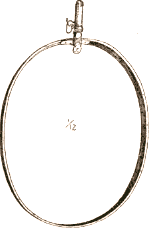
Fig. 383.—Drum.
We collected four of these drums, of which every household possesses at least one. They are all of essentially the same construction, but vary in size. No. 56741 [79], Fig. 383, has been selected as the type. The frame is a flat strip of willow 67 inches long, 1 inch wide, and 0.3 inch thick, bent till the two ends meet, thus making a hoop 22.2 inches long and 19 inches wide. The ends are fastened together by a strap of walrus ivory on the inside of the hoop, secured to the wood by neat stitches of black whalebone. The handle is of walrus ivory 5.2 inches long. The larger end is rather rudely carved into a human face. Back of this head and 1 inch from the large end of the handle is a square transverse notch, deep and sufficiently wide to fit over both rim and strap at the joint. It is held on by a lashing of sinew braid passing through holes in rim and strap, one on each side of the handle, and a large transverse hole in the latter, below and a little in front of the notch. The membrane, which appears to be a sheet of the peritoneum of a seal, is stretched over the other side of the hoop, which is beveled on the outside edge, and its edge is brought down to a deep groove 0.2 inch from the edge of the hoop and 0.3 inch wide, running round the hoop, where it is secured by three or four turns of sinew braid. The end of this string is crossed back and forth four or five times round the handle, where it is fitted to the hoop and then wrapped around it and finished off with a knot.
No. 56742 [514], from Utkiavwĭñ, is a similar drum, but somewhat larger, the hoop being 24.6 inches long and 22 inches wide. It is of the same materials, except that the strap at the joint is of reindeer antler. Opposite the joint the hoop appears to have shown signs of weakness, as it has been strengthened with two straps of walrus ivory, one on the inside and one on the outside of the hoop, fastened together by stitches of sinew which pass through the wood and through both straps. The inside strap is 4.7 inches long, the outer 3.5 inches long, and only half the width of the rim, and is let into the latter. This strap appears to have been put on first, as at each end there is a stitch which only runs through the wood. The handle is fastened on as before, but has two transverse holes instead of one, and has four deep rounded notches for the fingers. (See Fig. 384.) The joint is tightened by driving a thin sliver of wood in at the bottom of the notch.
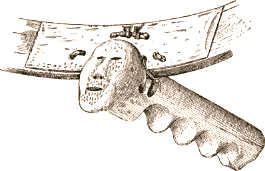
Fig. 384.—Handle of drum secured to rim.
No. 56743 [31], from Utkiavwĭñ, closely resembles the type, but has a notch for the thumb as well as for the forefinger on the handle. The hoop is 23.5 inches long and 21 wide. No. 56740 [80] from the same village is rather smaller than the ordinary drums, having a hoop 16.2 inches long and 14.7 wide. The handle is of antler, but has the usual face on the large end.
We also brought home eight handles for these drums, which exhibit but slight variations. The commonest material for the handle is walrus ivory. Only two out of the twelve are of antler. They are usually about 5 inches long (the longest is 5.4 inches and the shortest 4.6). Handles with grooves for the fingers and sometimes for the thumb seem to be quite as common as the plain handles. Fig. 385a represents an ivory handle from Nuwŭk (No. 89267 [898]), which has a groove for each finger and a shallow one on the right side for the thumb. It is 5 inches long.
With one exception all these handles have the large end more or less neatly carved into a human face, with the mouth open as if singing, probably from an idea similar to that which makes the decorative artists of civilized countries ornament the pipes of a great organ with singing faces. This face is usually in the position shown in the specimens figured, but No. 89266 [784] (Fig. 385b), a handle of antler from Utkiavwĭñ, has the axis of the face parallel to that of the handle. Nos. 89269 [975] and 56515 [76], both from Utkiavwĭñ, are peculiar in their ornamentation. They are both of walrus ivory. The former has a well-carved face at the large end with small blue beads inlaid for eyes. In addition to this the small end has been rather freshly carved into a rather rude seal’s head, and an ornamental pattern has been incised round the middle. This specimen exhibits the grooves for the fingers very well. The latter is a plain handle, but has a little sharp tusk inserted at each corner of the mouth. The only handle without a human face on the large end (No. 56514 [65] Fig. 385c, from Utkiavwĭñ) is peculiar in many respects. It is the butt end of a small walrus tusk, with a large pulp cavity, the edges of which are much notched and irregularly broken. The notch for fitting it to the handle is at the smaller end, which is neatly carved into a very good figure of a walrus head, with the tusks bent back to the under side of the handle. The head has oval bits of wood inlaid for eyes. None of the drums or handles in the collection are newly made.
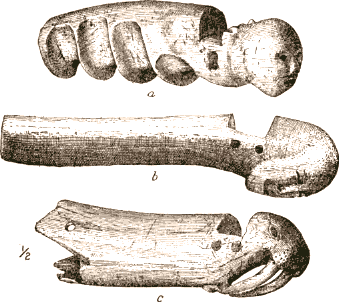
Fig. 385.—Drum handles.
The stick employed for beating these drums is commonly a slender elastic wand about 2½ feet long, but they also sometimes use a short thick stick of ivory resembling that used by the eastern Eskimo.506 We brought home two of these sticks, both of which belong with the drum No. 56743 [31]. Fig. 386a (No. 56540 [31]) is a roughly cylindrical rod of ivory with a hole for a lanyard. The larger end is ornamented by rudely incised and darkened lines which represent the eyes and outline of the mouth of a “bow-head” whale. Fig. 386b (No. 56540 [31a]) is a plain round stick of ivory 9.4 inches long. It is rather roughly made and somewhat warped. The use of the long stick is perhaps derived from Siberia, where the short thick stick does not appear to be used.507
Holes in the membrane of the drum are sometimes mended with pieces of the crop of the ptarmigan. At any rate, this is what I was told by a native, who begged from me the crops of two of these birds that I was skinning, saying that he wanted them to mend his drum. These drums are always beaten as an accompaniment to invocations of spirits or incantations. This practice is so common that some authors are in the habit of always speaking of them as “shaman drums”. As I have already stated, their most common use is purely as a musical instrument, and they are used not only by the so-called “shamans” but by everybody.
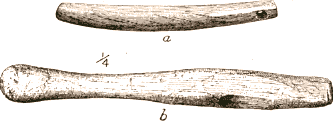
Fig. 386.—Ivory drumsticks.
Character and frequency of music.—
Their music consists of monotonous chants, usually with very little perceptible air, and pitched generally in a minor key. I could not perceive that they had any idea of “tune,” in the musical sense, but when several sang together each pitched the tune to suit himself. They, however, keep excellent time. The ordinary songs are in “common” or time.508 The words are often extemporaneous, and at tolerably regular intervals comes the refrain, “A yáña yáña, a yáña ya,” which takes the place of the “ámna aja” of the eastern Eskimo. Sometimes, when they are humming or singing to themselves, the words are nothing but this refrain. Their voices, as a general thing, are musical.
Like all Eskimo, they are very fond of music, and are constantly singing and humming to themselves, sometimes, according to Capt. Herendeen, waking up in the night to sing. Besides their regular festivals they often amuse themselves in their houses by singing to the drum. They are fond of civilized music, and, having usually very quick and rather acute ears, readily catch the tunes, which they sing with curiously mutilated words. We found “Shoo Fly” and “Little Brown Jug” great favorites at the time of our arrival, and one old woman from Nuwŭk, told us with great glee, how Magwa (Maguire) used to sing “Tolderolderol.” Our two violins, the doctor’s and the cook’s, were a constant source of delight to them.
I regret extremely that I was not enough of a musician to write down on the spot the different tunes sung by these people. The ordinary monotonous chant is so devoid of air that I can not possibly recollect it, and the same is true of the chant which accompanies the game of pebble-tossing. I was able, however, to catch by ear the song sung by the children when they dance to the aurora. I never had the whole of this song, which we were told had a large number of stanzas. The first three are as follows:
1. Kióya ke, kióya ke,
A, yáñɐ, yañɐ, ya,
Hwi, hwi, hwi, hwi!
2. Túdlĭmaná, túdlĭmaná,
A yáñɐ, yañɐ, ya,
Hwi, hwi, hwi, hwi!
3. Kálutaná, kalutaná,
A yáñɐ, yáñɐ, ya,
Hwi, hwi, hwi, hwi!
We did not succeed in learning the meaning of these words, except, of course, that the first word, kióya, is aurora. When there is a bright aurora, the children often keep on dancing and singing this song till late into the night. A tune was introduced in the spring of 1883 by a party of men from Kĭlauwĭtáwĭñ, who came up to take part in the whale-fishing at Utkiavwĭñ. It became at once exceedingly popular, and everybody was singing or humming it. It is peculiar in being in waltz or time, and has considerably more air than the ordinary tunes. I heard no words sung to it except: “O hai hai yáña, O hai yáña, O haíja he, haíja he.” Mr. Dall informs me that he recognizes this tune as one sung by the Indians on the Yukon.
ART.
The artistic sense appears to be much more highly developed among the western Eskimo than among those of the east. Among the latter, decoration appears to be applied almost solely to the clothing, while tools and utensils are usually left plain, and if ornamented are only adorned with carving or incised lines.511 West of the Mackenzie River, and especially south of Bering Strait, Eskimo decorative art reaches its highest development, as shown by the collections in the National Museum. Not only is everything finished with the most extreme care, but all wooden objects are gaily painted with various pigments, and all articles of bone and ivory are covered with ornamental carvings and incised lines forming conventional patterns.
There are in the collections also many objects that appear to have been made simply for the pleasure of exercising the ingenuity in representing natural or fanciful objects, and are thus purely works of art. Want of space forbids any further discussion of these interesting objects. There is in the Museum sufficient material for a large monograph on Eskimo art. As would naturally be expected, art at Point Barrow occupies a somewhat intermediate position between the highly developed art of the southwest and the simple art of the east. I have given sufficient figures in my description of their clothing and various implements to illustrate the condition of purely decorative art. A few words may be added by way of résumé. It will be noticed that whenever the bone or ivory parts of weapons are decorated the ornamentation is usually in the form of incised lines colored with red ocher or soot. These lines rarely represent any natural objects, but generally form rather elegant conventional patterns, most commonly double or single borders, often joined by oblique cross lines or fringed with short, pointed parallel lines.
A common ornament is the incised “circle and dot,” so often referred to in the foregoing descriptions. This is a circle about one-quarter inch in diameter, described as accurately as if done with compasses, with a deeply incised dot exactly in the center. This ornament is much more common south of Bering Strait, where, as Mr. L. M. Turner informs me, it is a conventionalized representation of a flower. Some of the older implements in our collection, ornamented with this figure, may have been obtained by trade from the southern natives, but the Point Barrow people certainly know how to make it, as there are a number of newly made articles in the collection thus ornamented. Unfortunately, we saw none of these objects in the process of manufacture, as they were made by the natives during odd moments of leisure, and at the time I did not realize the importance of finding out the process. No tool by which these figures could be made so accurately was ever offered for sale.
Neither Mr. Turner nor Mr. Dall, both of whom, as is well known, spent long periods among the natives of the Yukon region, ever observed the process of making this ornament. The latter, however, suggests that it is perhaps done with an improvised centerbit, made by sticking two iron points close together in the end of a handle. While weapons are decorated only with conventional patterns, other implements of bone or ivory, especially those pertaining to the chase, like the seal drags, etc., already mentioned, are frequently carved into the shape of animals, as well as being ornamented with conventional patterns. Carvings of animals’ heads usually have the mouth, nostrils, etc., indicated by blackened incisions, and often have small, colored beads, bits of wood, or ivory inlaid for the eyes. When beads are used, the perforation of the bead is generally made to represent the pupil of the eye. Beads were also used for ornamenting dishes and other wooden objects.
The harpoon blade boxes of wood carved into the shape of the animal to be pursued have been already described. Other wooden objects, like the shafts of lances, and arrows, paddles, boxes, dishes, the woodwork of snowshoes, sledges, umiaks, etc., are frequently painted either all over, or in stripes or bands. The pigment generally used is red ocher, sometimes set off with stripes of black lead. The only case in which a different pigment is used is that of some arrows from Sidaru, which, in addition to the usual black or red rings, have a rather dingy green ring round the shaft. This green looks as if it might have been derived from the “green fungus or peziza,” mentioned by Dall as in use among the ancient Aleuts.512 The red ocher is applied smoothly in a rather thin coat which looks as if it were always put on in the manner observed by Capt. Herendeen, who saw a man painting a new sled at Utkiavwĭñ. He licked the freshly scraped wood with his tongue, so as to moisten it with saliva and then rubbed it with a lump of red ocher. The custom of painting wooden objects with red ocher seemed to be rather more common among the “Nunatañmiun,” from whom perhaps the Point Barrow people borrowed the fashion, which is not mentioned among the eastern Eskimo. Nordenskiöld states that red is the favorite color among the natives of Pitlekaj.513
The painting of the arrow shafts in many cases curiously resembles the marks used by modern archers to distinguish the ownership of their shafts, and may have formerly served the same purpose. We made no inquiries about the matter on the spot, and there is no certain evidence in the series of arrows collected that these are or are not marks of ownership. Some arrows, apparently the property of the same man, have different marks, while arrows from different villages are similarly marked. On examining our series of fifty arrows from the three villages (fourteen from Nuwŭk, twenty from Utkiavwĭñ, and sixteen from Sidaru) it will be seen that the commonest style of painting is to have the shaft painted red from the beginning or middle of the feathering to about one-fifth of its length from the head. Twenty arrows are marked in this way—eleven from Nuwŭk, belonging to at least two distinct sets, and nine from Utkiavwĭñ, belonging to three sets. Nine have about 8 inches of the middle of the shaft painted red, with a black ring at the middle of the feathering. Seven of these are from Sidaru, one from Nuwŭk, and one from Utkiavwĭñ. Five from Sidaru have a red ring round the middle, and a green one about the middle of the feathering, and four of the same set have also a red ring in front of the green one. Three from Utkiavwĭñ, belonging to different sets, have the shaft painted red from the middle to the beginning of the feathering, and three red rings 2 inches from the nock. Seven belonging to these sets from the two northern villages are unpainted.
A set of two small arrows which belong with the boy’s bow No. 89904 [786] are peculiar in their marking. About 5½ inches of the middle of the shaft is painted red, there is a black ring round the middle, and a black spiral running the whole length of the feathering.
The only decorative work in metal is to be seen in the pipes and their accompanying picks and fire steel which have already been described.
In addition to these illustrations of decorative art, we brought home a series of seventy-nine objects which may be considered as purely works of art without reference to decoration. Some of the older objects in this series perhaps also served the purpose of amulets or charms,514 but a number of the new ones were made simply as works of fancy for sale to us. These objects are all carvings of various materials, sometimes very rude and sometimes very neatly finished, but in most cases even when rudely made highly characteristic of the object represented.515 Walrus ivory, usually from the tusks, but sometimes from the teeth, is the commonest material for these carvings. Thirty-six of the series are made of this material, which is very well suited for the purpose, being worked with tolerable ease, and capable of receiving a high finish. Soapstone, from the ease with which it can be cut, is also rather a favorite material. Seventeen of these carvings are made of soapstone, in many cases evidently pieces of an old lamp or kettle. Other mineral substances appear to be rarely used. Three images, all made for sale and by the same hand, are of soft white gypsum and one tiny image of a bear is rudely flaked out of gray flint. (There are in the collection a number of rude images of whales, made by flaking from flint, jasper, and glass, but as these were ascertained without doubt to be amulets, they will be described under that head.) Eleven are made of wood, nine of bone, one of antler, and one of the tooth of the polar bear. Twenty-three of these carvings represent human beings, sometimes intentionally grotesque and caricatured; twenty-one, bowhead whales; fourteen, polar bears; five, seals; three, walruses; one, a beluga; one, a fish; and seven, fanciful monsters. Four are ornamented objects made for sale; not, strictly speaking, images.
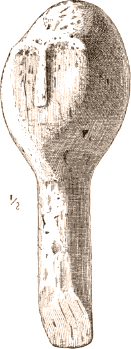
Fig. 387.—Ancient carving, human head.
Six of the representations of the human face or figure are of wood, and with one exception were all freshly made for sale. Fig. 387 represents the only antique specimen of this kind (No. 56496 [655]). This was found among the débris in one of the old ruined houses in Utkiavwĭñ by Lieut. Ray, and is very old, blackened, and dirty. The carving was evidently done with a blunt instrument, probably a stone tool. This specimen, which was perhaps the head of a doll, is 7.1 inches in total length, with a head 3.4 inches long. We saw no similar object of modern construction.
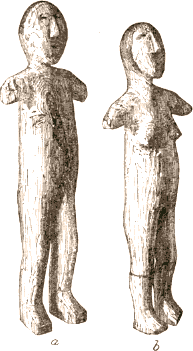
Fig. 388.—Wooden figures.
Figs. 388a and 388b (Nos. 89726 [1192] and 89727 [1193], from Utkiavwĭñ) are a pair of rather roughly whittled human figures, a man and woman, respectively, both without clothes (except that the woman has a black-lead mark round the calf of each leg to indicate the tops of the boots). They were made for sale, and are perhaps unfinished dolls. The man (No. 89726 [1192]) is 11 inches long and tolerably well proportioned, except about the feet, which are very clumsily made. The eyes and mouth are incised and the hair colored with black-lead. The woman (No. 89727 [1193]) is a very similar figure, but only 9.2 inches long. She has prominent breasts, and her legs are shorter in proportion than the man’s.
No. 89725 [1185], from Utkiavwĭñ, is a clumsy image of a man, rudely whittled out of a flat, hardwood stick, 7¼ inches long. The body and legs are long, the latter somewhat straddling, with clumsy feet. The outstretched arms are very short and stumpy. It has been painted all over with a thin coat of red ocher, and the legs and feet have a coat of black lead over this. The hair also is marked out with black lead, and a small opaque white bead is fastened with a peg to the middle of the breast. This image was made for the market.
No. 56495a [203], from Utkiavwĭñ, is of a pair of very rude images, also made solely for the market. Each is 8 inches long, and is merely an oblong piece of board, flat and rough on the back, roughly beveled from the middle to each side in front. One end is surmounted by a rather rudely carved human head, with the features in relief and the eyes and mouth incised. The eyebrows are marked out with black lead, and there is a longitudinal line of black lead down the middle of the front.
Fig. 389 (No. 89724 [1123] from Nuwŭk) is the face of a male Eskimo, 3.2 inches long, carved out of a flat piece of some coniferous wood weathered to a dark, reddish brown. The labrets are represented by two small, red glass beads with white centers, fastened on in the proper position with wooden pegs. There is a deep groove around the edge of the face into which is fastened a strip of yellowish wolfskin with long fur to represent the trimming around the hood of the jacket. This specimen was made for sale, and the carving is well executed. It is a characteristic Eskimo face, and would pass for a portrait of Apaidyáo, a well known young Eskimo, who was employed by Lieut. Ray as a guide and hunter.
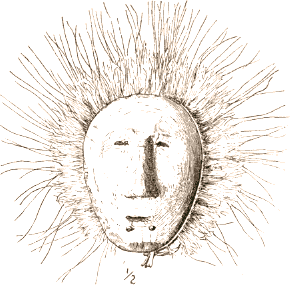
Fig. 389.—Carving, face of Eskimo man.
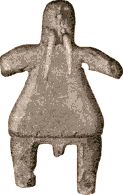
Fig. 390.—Grotesque soapstone image, “walrus man.”
We collected only two soap-stone carvings representing men, both of which were newly made. One of these, Fig. 390 (No. 89569 [1095] from Nuwŭk), is a grotesque image 2.9 inches long, roughly carved from a flat piece of an old lamp or pot. This is almost exactly the form in which the Eskimo, especially the children, usually draw a man. The writer’s portrait has been drawn in very much the same shape. The features are very rudely indicated, and a long projecting tusk of bone is inserted at each corner of the mouth and glued in with refuse oil. This figure is probably meant to represent the “man with tusks,” before referred to, who figures in several of the legendary fragments which we obtained.
No. 89568 [1108], from Utkiavwĭñ, probably represents the same being. It is a mask of soapstone, a piece of an old lamp, 2.8 inches long, with very characteristic features in low relief, and a pair of sharp, projecting, decurved tusks, about 1 inch long, which appear to be made of the vibrissæ of the walrus. The back of the mask is roughly hollowed out. No. 89575 [1014], from Nuwŭk, is a clumsy and carelessly made image of a man, 3.4 inches long, whittled out of a flat, rough piece of soft, white gypsum. The arms are short and clumsy and the legs straddling, and there is a large elliptical hole through the middle of the body. The features are indicated only by digging little cavities for the eyes, nostrils, and mouth. This and two other images of the same material, a bear equally rude, and a very well carved and characteristic beluga, were made by the ingenious young native, Yöksa, previously mentioned.
The best bone figure of a man is shown in Fig. 391 (No. 89353 [1025], from Nuwŭk), also newly made. This is an image, 5 inches long, of the giant “Kikámigo,” previously mentioned, and is a very excellent piece of workmanship. The material is rather vascular compact bone. On the head is a conical dancing cap, 1.4 inches high, made of deerskin, with the flesh side out, and colored with red ocher, with a tuft of wolf hairs, 3 inches long, protruding from the apex. Around the middle of the cap is a narrow strip of the same material fringed on the lower edge with fifteen flat, narrow pendants of ivory, made to represent mountain-sheep teeth. To the back of this strip is fastened a half-downy feather nearly 4 inches long. A slender wooden stick is stuck into the strip behind, so that the tip reaches just above the apex of the cap. To a notch in the end of this is tied a bit of dressed deerskin, 1¼ inches long, cut into three strips.
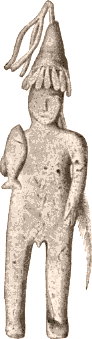
Fig. 391.—Bone image of dancer.
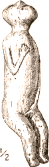
Fig. 392.—Bone image of man.
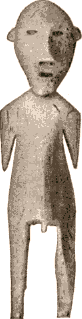
Fig. 393.—Grotesque bone image.
Fig. 392 (No. 89348 [1127], from Utkiavwĭñ) is an image neatly carved from whale’s bone, which may have been meant for an amulet, or possibly the handle of a drill cord, as it is not new, and has two oblique holes in the middle of the back, which meet so as to form a longitudinal channel for a string. The eyes, mouth, and labret holes are incised and filled with black dirt. The total length is 3.3 inches.
Fig. 393 (No. 89344 [1272], from Utkiavwĭñ) is a very grotesque image of a naked man, rudely carved from compact, rather porous bone, impregnated with oil, but scraped smooth. It is 5 inches long. The mouth and eyes are incised and blackened, and the nostrils simply bored out.
The ivory carvings representing human figures are all of rather rude workmanship. No. 89352 [1100], Fig. 394, from Nuwŭk, is a tolerably good figure, 3.3 inches long, of a sitting man holding up his hands before his face. This specimen is old and is made of walrus ivory yellow from age and oil. No. 89351 [1085] from Nuwŭk, is a similar image, 3.8 inches long, newly made, with the arms at the sides, roughly carved from coarse walrus ivory. The eyes and mouth are incised and filled with dark colored dirt. Fig. 395 (No. 89349 [980], from Nuwŭk) is an old image made of yellow walrus ivory and closely resembling the bone image (No. 89348 [1127]) already figured, but with the hands by the sides. It is 2.7 inches long and has a string 4 inches long tied into the channel in the back.
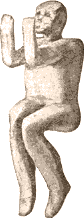
Fig. 394.—Ivory image, sitting man.
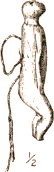
Fig. 395.—Human figure carved from walrus ivory.
Nos. 89346 and 89347 [990], from Nuwŭk, are a pair of little men, standing erect, about 2 inches high, rather roughly carved, of slightly yellow walrus ivory. Both have large, clumsy feet and legs, and the eyes, nostrils, and mouth incised and filled in as usual with dark colored dirt. The arms are in high relief. No. 89346 [990b] has his hands clasped in front of him, while No. 89347 [990a] has them clasped behind his back. The legs of the latter are excavated on the inside as if to fit it upon the end of some object. It is more probable, however, that this image was carved from the foreshaft of a seal-dart, and that the excavation is merely the slot in the end of the latter. These two images are evidently modern, but do not appear freshly made. No. 89345 [1273] from Utkiavwĭñ is a very rude image, 2.6 inches long, having a very small head and no arms. It is somewhat discolored walrus ivory and quite dirty, and though evidently modern, from the appearance of the ivory, does not appear to be freshly made. This figure is even ruder in design than those from Siberia figured by Nordenskiöld.516
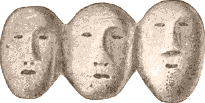
Fig. 396.—Ivory carving, three human heads.
The best of our human figures from Point Barrow show much greater art, both in workmanship and design, than those just mentioned, but can not compare with the elegant figures in the museum from the more southern parts of Alaska. The four remaining ivory carvings represent the human face alone. No. 89342 [989], Fig. 396, from Nuwŭk, is a thick piece of walrus ivory 3.3 inches long and 1.6 wide, carved into three human faces, a man in the middle and a woman on each side, joined together at the side of the head. Though the workmanship is rough, the faces are characteristic. The man has labrets and a curved line of tattooing at each corner of the mouth, indicating the successful whaleman, and the women, the usual tattooing on the chin. The eyes, nostrils, mouths, labrets, and tattooing are incised and blackened as usual. This specimen, though apparently modern, does not seem fresh enough to have been made for sale. The seller called it “a man and his two wives” without giving them any names. It may be intended as a portrait of some celebrated whaleman.
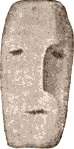
Fig. 397.—Human head carved from a walrus tooth.
Fig. 397 is one of a pair of very rude faces (No. 56523 [52] from Utkiavwĭñ), 1½ inches long, which were made for sale. It is simply a walrus-tooth cut off square on the ends and on one side rudely carved into a face, with the eyes and mouth incised and filled in with dark colored dirt. Fig. 398 (No. 89343 [1124] from Nuwŭk) is a flat piece of ivory (a bit of an old snow shovel edge), 4 inches long and 1.2 inches wide, roughly carved and covered with incised figures. The upper edge is carved into five heads: First, a rude bear’s head, with the eyes and nostrils incised and blackened as usual; then four human heads, with a face on each side. The front faces have the noses and brows in low relief and the eyes, nostrils, and mouths incised and blackened; the back ones are flat, with the last three features indicated as before. At the end is a rude figure of a bear, heading toward the right, with the ears in relief, the eyes and mouth roughly incised and blackened, and the legs indicated by roughly incised and blackened lines on the obverse face. Both faces are covered with rudely incised and blackened lines.
On the obverse there is a single vertical line between each pair of heads. Below the bear’s head is a bear heading toward the right; under the first human head, an umiak with four men; under the second, a “killer” (Orca) heading toward the right; under the third, two of the usual conventionalized whales’ tails suspended from a cross-line; and under the last, a “killer” with very large “flukes” heading toward the left.
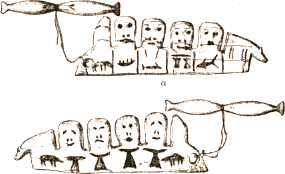
Fig. 398.—Elaborate ivory carving.
On the reverse there are, below the bear, a bear heading toward the right, below each of the human heads a whale’s tail with the flukes up, and under the bear’s head a bear heading toward the right. This end is perforated with a large round hole, into which is knotted a bit of deer sinew about 3 inches long, the other end of which is tied round the junction of two little bowhead whales, each about 1 inch long and carved out of a single piece of ivory, head to head. They are rather rudely carved and have the spiracles incised and blackened. This object appears freshly made, but perhaps commemorates the exploits of some four hunters. It was purchased along with other objects and its history was not learned at the time.
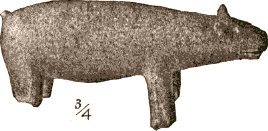
Fig. 399.—Bear carved of soapstone.
Perhaps the best image of a polar bear is No. 89566 [1252], Fig. 399, from Utkiavwĭñ, which is quite characteristic. It represents the bear standing and was carved out of soft, gray soapstone with a knife, and finished off smoothly with a file. It is 4 inches long. No. 89571 [116b], from Nuwŭk, is a very rude flat soapstone bear, 1.9 inches long, in profile, showing only one fore and one hind leg. It was made for sale, but No. 89576 [966], from the same village, which is almost exactly like this, though smaller, is old. No. 89574 [1027], from Nuwŭk, is the gypsum carving of a bear, above referred to, which is very like the preceding two specimens. It is 2.5 inches long and has a large tail and large clumsy legs.
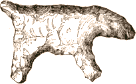
Fig. 400.—Bear flaked from flint.
No. 89578 [1051], Fig. 400, from Utkiavwĭñ, is a thin profile figure of a polar bear, made by flaking from dark gray flint. It is 1.4 inches long, and the tail is disproportionately long. The specimen does not appear to be new, and was perhaps intended for an amulet, like the flint whales already mentioned.
The only bone figure of a bear in the collection, No. 89335 [1275], Fig. 401a, from Utkiavwĭñ, is very crude. It has a very long, slim body and neck, and short, slender legs. The mouth, eyes, and nostrils are incised and are blackened as usual. The carving is rudely done, but the specimen, which was made for sale, has been scraped smooth. It is 5.5 inches long, and made of whale’s bone, soaked in oil to make it appear old.
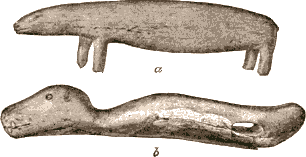
Fig. 401.—Bone figures: (a) bear; (b) bear’s head.
Fig. 401b (No. 89471 [997], from Utkiavwĭñ) is the end of some old implement, 6 inches long, one end of which is carved into a rather rude bear’s head, with the ears, nostrils, outline of the mouth, and the vibrissæ incised and blackened. Sky-blue glass beads are inlaid for the eyes and bits of tooth for the canine tusks. On the throat is a conventional figure with two “circles and dots,” all incised and blackened. The carving is freshly done, but soiled, to make it look old.
The three newly made ivory bears are all represented standing and are quite characteristic. All have the eyes, nostrils, and mouth incised and blackened. Fig. 402a (No. 89337 [1274], from Utkiavwĭñ) is the best in execution. It is made of white ivory and is 3.3 inches long. No. 56524, [92], from Nuwŭk, is a small bear, 1.7 inches long, not quite so well carved, and disproportionally long-legged. The left hind leg has been broken off close to the body and doweled on with a wooden peg. Another little bear from Nuwŭk (No. 89841 [992]) is still more rudely carved, but closely resembles the preceding.
A larger carving, rather roughly executed (No. 89338 [1098], from Nuwŭk), represents a standing bear 3.2 inches long, holding a whale crosswise in his mouth. The whale is a separate piece, held in by a wooden peg driven through the bear’s lower jaw. This specimen is newly made from rather coarse walrus ivory.
Fig. 402b (No. 89340 [953], from Utkiavwĭñ) is a very ancient ivory image of a bear, 3.4 inches long, which was evidently intended for an amulet, as there is a stout lug on the belly, into which are bored two oblique holes, so as to make a longitudinal channel for a string. Into this is knotted a stout cord of loosely twisted sinew. The execution of the image is particularly good, but the design is very rude. The specimen is so ancient that the ivory of which it is made has become almost black.
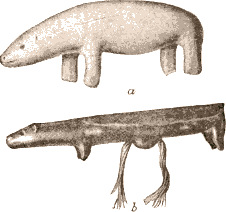
Fig. 402.—Ivory figures of bears.
No. 56528a [56a] from Utkiavwĭñ is a walrus tooth, 1.6 inches long, carved into the shape of a bear’s head. Both design and execution are very rude. Light blue glass beads are inlaid for the eyes, and the nostrils and outline of the mouth are incised and filled in with black dirt. It was made for sale. A still more rude carving, also made for sale, is No. 56528, from Utkiavwĭñ, which is an old and weathered canine tooth of the polar bear, with the point freshly whittled so as to look something like a bear’s head. Two sky-blue glass beads are inlaid to represent the eyes and one for the nose, and the mouth is incised and blackened.
The walrus does not appear to be a favorite subject for representation. The part of the collection already described shows that it occurs very seldom as a decoration, and we obtained only three images of this animal, one in soapstone and two in ivory, all small and very rude, both in design and execution. They are all newly made. The best image is shown in Fig. 403a (No. 89333 [1384] from Utkiavwĭñ). This is 2.3 inches long and made of coarse walrus ivory. The head is rather good, but the body simply tapers to a broken point. A bit of wood is inlaid for the left eye, but the right is merely represented by a hole.
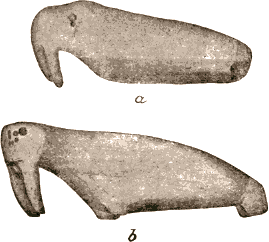
Fig. 403.—Rude ivory figures of walrus.
Fig. 403b (No. 89334 [1067], from Utkiavwĭñ) is exceedingly rude. The eyes, nostrils, and mouth are incised and blackened as usual, and the vibrissæ (“whiskers”) are represented by rather large round pits on the snout, also filled in with black dirt. It is 2.9 inches long, and appears to have been dipped in the oil-bucket to make it look old. Both the images bear a strong resemblance to the rude carvings of walruses from Siberia figured by Nordenskiöld.517a No. 89570 [1271] from Nuwŭk is of soapstone, 2 inches long, with tusks rudely carved from walrus ivory. The head is but roughly indicated, while the body is shaped like a slug, and is bifid at the pointed end to represent the hind flippers. The eyes and nostrils are roughly incised.
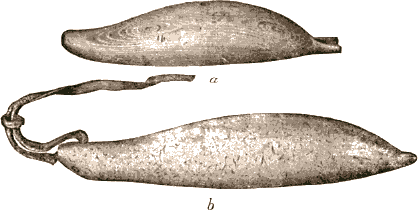
Fig. 404.—Images of seal—wood and bone.
The seal, on the other hand, is a favorite object for artistic representation. It is seen often, as already described, as a decoration on various implements, especially the drag lines, generally in a very characteristic shape, and the five seal images in the collection are excellent in design and execution. Almost all are decidedly superior to those from Pitlekaj, figured by Nordenskiöld.517b All are newly made except No. 89737 [857a]. Fig. 404a, from Utkiavwĭñ, which is 4.2 inches long, and made of spruce, very old, weathered, and discolored with dirt and grease. It is nicely carved and scraped smooth, and is very good in its general proportions, though the details are not represented as in the other images.
The best figure (No. 89330 [999] figured in the Point Barrow Rept. Ethnol., Pl. V, Fig. 6, from Utkiavwĭñ) is carved from walrus ivory and is 4.3 inches long. It represents a male rough seal, and is exceedingly accurate and highly finished. The lower jaw is perforated and a bit of sinew thread tied in to represent the drag line. Small red glass beads with white centers are inlaid for the eyes. The other three are all of bone and represent dead male seals stretched on their backs with the drag line in their jaw as they are dragged home.
No. 56579 [75], Fig. 404b, from Utkiavwĭñ, is 5.7 inches long, and very smoothly carved from walrus jaw bone, with round bits of wood inlaid for the eyes. The proportions are excellent, but the details are not strongly brought out. This specimen is a little older than the rest, and may have been an amulet for good luck in seal catching. The other two are of compact white bone, perhaps that of the reindeer.
No. 89331 [1143], from Utkiavwĭñ, is 3.4 inches long, and has the breast and back flattened and the flippers in high relief. The anus, genital opening, and eyes are incised, the latter two filled in, as usual, with black dirt. The drag line is of sinew braid and has an ivory cylinder slipped over it.
No. 89328 [1167], from Utkiavwĭñ, is the poorest in design. It is 5.6 inches long and has the neck bent up as in dragging. The back of a freshly caught seal is always somewhat flattened by dragging it over the ice, and this flattening is very much exaggerated in this carving by the natural shape of the bone. The fore flippers are in high relief, with three toes to each flipper, colored round the edge with red ocher. The tips of the hind flippers are joined together, and each has only two toes. The eyes, genital opening, and the spots on the back and belly are indicated by shallow round pits colored with red ocher. The drag line is a double bit of sinew braid, which has on it two ivory cylinders, one ornamented with an incised pattern.
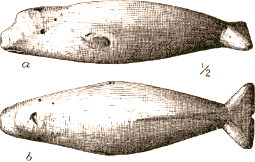
Fig. 405.—White whale carved from gypsum.
We found but a single figure of the beluga, which is such a favorite subject for Eskimo artists farther south. This is the gypsum carving already mentioned (No. 89573 [1015], Fig. 405, from Nuwŭk). It is 3.5 inches long and is very characteristic, though rather short in proportion to its girth. It was neatly carved with a knife.
The “bow-head” whale (Balæna mysticetus), is a very favorite subject, appearing often as a decoration and represented by 21 carvings. Three of these are of wood, very much resembling in design and execution the harpoon boxes already described. They are all very old, and perhaps were charms to be carried in the boat to secure good luck in whaling. No. 89736 [857b], Fig. 406, from Utkiavwĭñ, is perhaps the best proportioned of these figures, though the only details represented are the flukes (which are broken), and the incised spiracles. It is 5.4 inches long and made of spruce or hemlock, stained almost black by dirt, grease, and weathering. A long string of sinew braid is tied round the “small.”
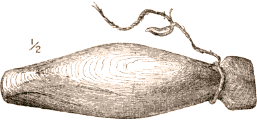
Fig. 406.—Wooden carving—whale.
No. 89735 [1036] from Utkiavwĭñ, is also a rather well proportioned figure, rude in execution, with no details carved out except the flukes, one of which is broken. An angular bit of iron pyrites is inlaid to represent the left eye, and a similar piece appears to have been lost from the right eye. The anus is represented by a light blue glass bead inlaid in the belly. It is 8.8 inches long and made of soft wood, probably cottonwood, weathered and stained to a dark brown. It is very old and much chipped and cracked. Two small oblique holes in the middle of the back make a transverse channel for a string. This specimen was said by the man who sold it to have been dug up among the ruins of one of the old houses in the village.
No. 89734 [987] from Nuwŭk, is 12 inches long, very broad in proportion to its length, and rather rude in design, with a flat belly, though neatly carved and scraped smooth. The spiracles and the outline of the mouth are incised and little angular bits of brown quartz are inlaid for the eyes. Both flukes have been split off and part of the right fluke has been fastened on again with a single wooden treenail. It is of spruce or hemlock and has weathered to a brown color.
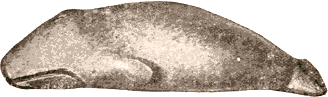
Fig. 407.—Whale carved from soapstone.
Fig. 407 (No. 89561 [1253] from Utkiavwĭñ) represents the best image of a whale in the collection. It is very well proportioned, though perhaps a little clumsy about the flukes, with the external details correctly represented. It is 4.5 inches long, neatly carved from soapstone, scraped smooth and oiled. It was made for sale. There are five other round soapstone carvings of whales in the collection, but none so good as this except a little one from Nuwŭk, (No. 89563 [986]) 2 inches long, which is almost an exact miniature of the preceding. This specimen is not new. Fig. 408 (No. 89557 [1267] from Utkiavwĭñ) is a rude flat representation of a whale seen from above. It is 5.2 inches long and roughly whittled out of the bottom of an old stone pot. The flippers are large and clumsy, and the spiracles slightly incised. The specimen appears to be old, as does a similar one from Nuwŭk (No. 89559 [1188a]).
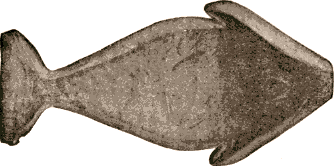
Fig. 408.—Rude flat image of whale.
No. 89558 [1266] from Utkiavwĭñ, and No. 89572 from Nuwŭk, both flat images, are carelessly made for sale. The latter is simply a representation in soapstone of the conventional “whale’s tail” with the “small” cut off to an angular point. No. 89325 [1160] from Utkiavwĭñ is a clumsy, broad whale with a flat belly, 4.1 inches long, freshly carved from whale’s bone, and soaked in oil to make it look old. The eyes, spiracles, and outline of the mouth are incised and filled in with dark oil lees.
None of the ivory carvings of whales have any special artistic merit. Fig. 409 (No. 89323 [1024a] from Nuwŭk) is the best of these. It is a little better in design and execution than the preceding, which it resembles considerably. It is the female of a pair of little whales made of old brown walrus ivory, which is much cracked. The male differs from the female only in the shape of the external sexual organs, the male having a little round pit and the female a long sulcus. This, as well as the eyes, spiracles, and outline of the mouth, is incised and filled in with dark colored dirt. The female is 3.1 inches long, the male (No. 89324 [1024b]) 0.1 inch longer. These specimens appear to be quite ancient.
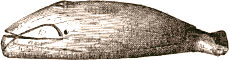
Fig. 409.—Ivory image of whale.
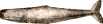
Fig. 410.—Ivory image of whale.
Fig. 410 (No. 89326 [1086] from Nuwŭk) is very long and slender—4.3 inches long and only 0.7 inch wide—with the belly perfectly flat, but otherwise a very good representation, neatly carved. The flukes in particular are especially well done, and the flippers are in high relief. The eyes, the spiracles, and the outline of the mouth are incised and the first blackened. The material is a rather poor quality of walrus ivory, about half “core.” The specimen was made for sale. No. 89327 [991] from Nuwŭk was also made for sale. It is a little whale 1.6 inches long, rudely carved in walrus ivory.
Fig. 411 (No. 56619 [66] from Utkiavwĭñ) represents a pair of little whales, each carved from a walrus tooth, which probably served for buttons or toggles of some sort, though I do not recollect ever seeing such objects in use. The belly of each is flat and has in the middle a stout lug perforated with a transverse eye, and they are tied together by a piece of thong about 14 inches long. They are quite well designed and executed, but rather “stumpy” in outline, with the outline of the mouth and the spiracles incised and blackened, and little round bits of tooth inlaid for eyes. In the middle of the back of each was inlaid a small blue glass bead, which still remains in one of them. They are old and dirty and somewhat chipped about the flukes.
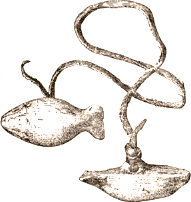
Fig. 411.—Pair of little ivory whales.

Fig. 412.—Soapstone image of imaginary animal.
Fig. 412 (No. 89567 [904] from Nuwŭk) represents an imaginary quadruped 2.5 inches long, with a short, thick body and legs, no neck, and a human head, with the eyes and mouth incised. It is roughly carved from light gray soapstone, and ground pretty smooth. This figure is not new, and has probably connected with it some story which we did not succeed in learning. The seller called it an “old man.” No. 89332 [994] from Nuwŭk, is a fanciful monster, 4.2 inches long, carved in ivory. It has a human head with the tusks of a walrus, the body, tail, and flippers of a seal, with human arms. The hands, each of which has four fingers, clasp some round object against the belly. It is not old, but apparently was not made for the market. It was called a “walrus man;” but we did not learn whether it was simply a fancy figure or whether there was any story connected with it.
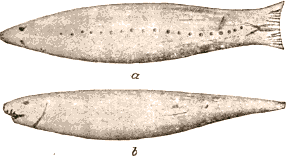
Fig. 413.—Ivory carving, seal with fish’s head.
Fig. 413 (No. 89329 [1101] from Nuwŭk) is another monster, 3.9 inches long, carved in ivory. It has a fish’s head with large canine teeth, and a seal’s body, tail, and hind flippers. The eyes, nostrils, gill slits, the outlines of the tail, and the toes, of which there are six on each flipper, are incised and blackened. A row of nineteen small round pits, filled with dark colored dirt runs nearly straight from the nape to the tail.
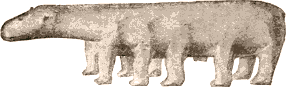
Fig. 414.—Ivory carving, ten-legged bear.
Fig. 414 (No. 89339 [1099] from Nuwŭk) is a newly made ivory figure, which is interesting from its resemblance to one of the fabulous animals which figure in the Greenland legends. It is 4 inches long and represents a long-necked bear with ten legs, an animal which the maker gave us to understand had once been seen at Point Barrow. The resemblance of this animal to the “kiliopak” or “kilifvak” of the Greenland stories, which is described as “an animal with six or even ten feet”518 is quite striking.
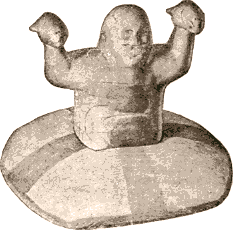
Fig. 415.—Ivory carving, giant holding whales.
Fig. 415 (No. 89723 [1084] from Nuwŭk) is another representation of the giant who holds a whale in each hand. He was called in this instance “Kaióasu,” and not “Kikámigo.” This image is carved from very old pale brown walrus ivory, and is 2.3 inches high. A transverse incised line across each cheek from the wing of the nose, indicates the whaleman’s tattoo mark of the Eastern fashion. The image is ancient, but is mounted in a socket in the middle of a newly made wooden stand, which has a broad border of red ocher and a broad streak of the same paint along each diameter.
Fig. 416 (No. 89336 [1369]) is a curious piece of carving, which Nĭkawdalu said he found in one of the ruined houses on the river Kulugrua. The carving is well executed and really seems to be old, although it has evidently been retouched in a good many places. It is made from an irregularly flattened bit of reindeer antler, 3.6 inches long, blackened by the weather on the flat surfaces, and represents an animal with four legs, which appear to be dog’s legs, and at each end what appears to be a dog’s head. One of these is smaller than the other and both have the ears in relief, and the eyes, nostrils, and outlines of the mouth incised.
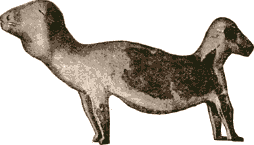
Fig. 416.—Double-headed animal, carved from antler.
Fig. 417 (No. 56520 [85] from Nuwŭk) is a fanciful object made solely for the market. It consists of the rudely carved head of some carnivorous animal, made of ivory, and 2.6 inches long, fitted to the broad end of a flat pointed wooden handle, painted red. The head was called a “dog”, but it looks more like a bear. Small bits of wood are inlaid for the eyes, and the outline of the mouth is deeply incised and colored with red ocher, having bits of white ivory inlaid to represent the canine teeth. The ears, nostrils, vibrissæ, and hairs on the muzzle are indicated by blackened incisions. There is an ornamented collar round the neck, to which is joined a conventional pattern of triangular form on the throat, and a somewhat similar pattern on the top of the head between the ears.
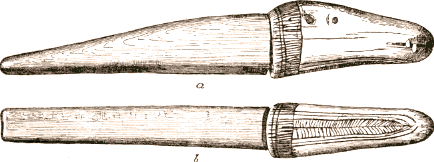
Fig. 417.—Ivory carving, dog.
One of the natives at Utkiavwĭñ, in May, 1882, conceived the fancy of smoothing off the tip of a walrus tusk into the shape of a pyramid, surmounted by a little conical cap and ornamenting it with incised figures, which he colored with red ocher. It appears to have been purely an individual fancy, as it has no utility, nor are such objects made by the Eskimo elsewhere, as far as I know. Having succeeded in finding a sale for this object, either he or one of his friends, I do not now recollect which, made another, which was brought over for sale about ten days later. We saw no others afterwards.
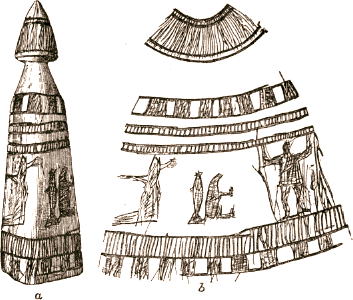
Fig. 418.—Engraved ivory: (a) piece engraved with figures; (b) development of pattern.
Fig. 418a (pattern developed in Fig. 418b, No. 56530 [220]) represents the first of these. It is made of solid white walrus ivory. The workmanship is quite rude, and the cap has been broken off and neatly fastened on with a wooden dowel. The other, Fig. 419a, 419b (No. 56529 [254]) is 3.7 inches long.
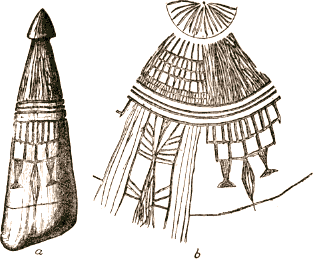
Fig. 419.—Engraved ivory: (a) piece with engraving; (b) development of pattern.
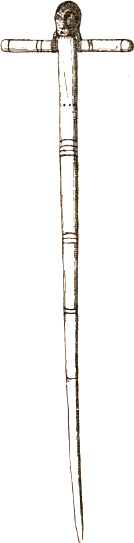
Fig. 420.—Ivory doll.
Fig. 420 (No. 89741 [1012] from Nuwŭk) is an ivory cross 15.5 inches long. The cross is ornamented by incised rings and dots colored with red ocher. The shaft of the cross is surmounted by a female human head neatly carved from soapstone, fastened on by a lashing of sinew braid, which passes through a transverse hole in the head and round the crosspiece. No. 89742 [1091], also from Nuwŭk, closely resembles the preceding, but is slightly shorter and has a four-sided shaft. The head, moreover, which is made of bone, represents a man, as is shown by the little pits, which indicate the labrets. The cheeks and crown of the head are colored slightly red with red ocher.
The ingenious Yöksa, so often mentioned, made the first image and brought it down for sale. All he could or would tell us about it was that it was “tună´ktûp kuni´a,” “A kuni´a (jargon for woman) of soapstone.” The successful sale of this first cross encouraged him to make the second, but we saw no others before or after. Other natives who saw these objects only laughed. The whole may be simply a fanciful doll, perhaps meant for a caricature, the shaft representing the body, and the crosspiece the outstretched arms. The object is very suggestive of a crucifix, and there is a bare possibility that the maker may have seen something of the sort in the possession of some of the eastern natives who have been visited by a missionary of the Roman Catholic Church (Father Petitot).
Under the head of works of art may properly be included No. 89823 [1130], from Utkiavwĭñ. This is the skeleton of the jaws of a polar bear, cut off just back of the nose, neatly sewed up in a piece of sealskin with the hair out, so as to leave uncovered only the tips of the jawbones and the canine teeth. This specimen was put up by the same quick-witted young native after his removal from Nuwŭk to Utkiavwĭñ, evidently in imitation of the work of preparing specimens of natural history, which he had seen done at the station. For the same reason he dried and carefully preserved in a little box whittled out of a block of wood and tied up with sinew a little fresh-water sculpin (Cottus quadricornis), which he had caught at Kulugrua (No. 89536 [1145]).
I regret much that we did not save and bring home any of the pencil drawings made by these people. The children especially were anxious to get lead pencils, and made themselves rather a nuisance by covering the painted walls of the observatory with scrawls of ships and various other objects, perhaps rather more accurately done than they would have been by white children of the same age. The style of the figures on the hunting scores already described, however, is very like that of the pencil drawings.519