ETHNOLOGICAL RESULTS OF THE POINT BARROW EXPEDITION. (continued 4)
Reading edition
DOMESTIC LIFE.
Marriage.—
As far as we could learn, the marriage relation was entered upon generally from reasons of interest or convenience, with very little regard for affection, as we understand it, though there often appeared to be a warm attachment between married people. A man desires to obtain a wife who will perform her household duties well and faithfully, and will be at the same time an agreeable companion, while he often plans to marry into a rich or influential family. The woman, on the other hand, appears to desire a husband who is industrious and a good hunter. There were, nevertheless, some indications that real love matches sometimes took place. Marriages are usually arranged by the parents of the contracting parties, sometimes when the principals are mere children. We knew of one case when a young man of about twenty-two offered himself as the prospective husband of a girl of eight or ten, when she should reach a marriageable age. This practice of child betrothal seems to be practically universal among the Eskimo everywhere.520
Dr. Simpson, in describing the marriage customs at Point Barrow, says:
The usual case is, that as soon as the young man desires a partner and is able to support one, his mother selects a girl according to her judgment or fancy, and invites her to the hut, where she first takes the part of a “kivgak” or servant, having all the cooking and other kitchen duties to perform during the day, and returns to her home at night. If her conduct proves satisfactory, she is further invited to become a member of the family.521
We only knew this to be done on one occasion; and on the contrary knew of several cases where the bridegroom became a member of the wife’s family.
One youth, who had had his lips pierced for the labrets just previously to our arrival, was, we soon learned, betrothed to a young girl at Nuwŭk. This girl frequently came down from Nuwŭk and visited her lover’s family, staying several days at a time, but we could not discover that she was treated as a servant. She went with them to the spring deer hunt, but we were distinctly given to understand that the young couple would not be married till after the return from this hunt, and that no intercourse would take place between them before that time. When the season came for catching reindeer fawns, the couple started off together, with sled and dogs and camp equipage in pursuit of them, and always afterwards were considered as man and wife.
Most of the marriages took place before we heard of them, so that we had no opportunity for learning what ceremony, if any, occurred at the time. Some of the party, however, who went over to make a visit at Utkiavwĭñ one evening, found the house full of people, who were singing and dancing, and were told that this was to celebrate the marriage of the daughter of the house. Marriage ceremonies appear to be rare among the Eskimo. A pretended abduction, with the consent of the parents, is spoken of by Bessels at Smith Sound522 and Egede in Greenland (p. 142), and Kumlien was informed that certain ceremonies were sometimes practiced at Cumberland Gulf.523 Elsewhere I have not been able to find any reference to the subject. A man usually selects a wife of about his own age, but reasons of interest sometimes lead to a great disparity of age between the two. I do not recollect any case where an old man had a wife very much younger than himself, but we knew of several men who had married widows or divorced women old enough to be their mothers,524 and in one remarkable case the bride was a girl of sixteen or seventeen, and the husband a lad apparently not over thirteen, who could barely have reached the age of puberty.
This couple were married late in the winter of 1882-’83, and immediately started off to the rivers, deer hunting, where the young husband was very successful. This union, however, appeared to have been dissolved in the summer, as I believe the girl was living with another and older man when we left the station. In this case, the husband came to live with the wife’s family.
As is the case with most Eskimo, most of the men content themselves with one wife, though a few of the wealthy men have two each. I do not recollect over half a dozen men in the two villages who had more than one wife each, and one of these dismissed his younger wife during our stay. We never heard of a case of more than two wives. As well as we could judge, the marriage bond was regarded simply as a contract entered into by the agreement of the contracting parties and, without any formal ceremony of divorce, easily dissolved in the same way, on account of incompatibility of temper, or even on account of temporary disagreements.
We knew of one or two cases where wives left their husbands on account of ill treatment. One of these cases resulted in a permanent separation, each of the couple finally marrying again, though the husband for a long time tried his best to get his wife to come back to him. In another case, where the wife after receiving a beating ran away to Nuwŭk, and, as we were told, married another man, her first husband followed her in a day or two and either by violence or persuasion made her come back with him. They afterwards appeared to live together on perfectly good terms.
On the other hand, we know of several cases where men discarded wives who were unsatisfactory or made themselves disagreeable. For instance, the younger Tuñazu, when we first made his acquaintance, was married to a widow very much his senior, who seemed to have a disagreeable and querulous temper, so that we were not surprised to hear in the spring of 1882 that they were separated and Tuñazu married to a young girl. His second matrimonial venture was no more successful than his first, for his young wife proved to be a great talker. As he told us: “She talked all the time, so that he could not eat and could not sleep.” So he discarded her, and when we left the station he had been for some time married to another old widow.
In the case above mentioned, where the man with two wives discarded the younger of them, the reason he assigned was that she was lazy, would not make her own clothes, and was disobedient to the older wife, to whom he was much attached. As he said, Kakaguna (the older wife) told her, “Give me a drink of water,” and she said, “No!” so Kakaguna said, “Go!” and she went. He did not show any particular concern about it.
Dr. Simpson says, “A great many changes take place before a permanent choice is made;” and again, “A union once apparently settled between parties grown up is rarely dissolved.”525 And this agrees with our experience. The same appears to have been the case in Greenland. Crantz526 says, “Such quarrels and separations only happen between people in their younger years, who have married without due forethought. The older they grow, the more they love one another.”
Easy and unceremonious divorce appears to be the usual custom among Eskimo generally, and the divorced parties are always free to marry again.527 The only writer who mentions any ceremony of divorce is Bessels, who witnessed such among the so-called “Arctic Highlanders” of Smith Sound (Naturalist, vol. 18, pt. 9, p. 877). Dr. Simpson, in the paragraph referred to above, says that “A man of mature age chooses a wife for himself and fetches her home, frequently, to all appearance, much against her will.” The only case of the kind which came to our notice was in 1883, when one of the Kĭlauwitawĭñmeun attempted by blows to coerce Adwû´na, an Utkiavwĭñ girl, to live with him, but was unsuccessful.
A curious custom, not peculiar to these people, is the habit of exchanging wives temporarily. For instance, one man of our acquaintance planned to go to the rivers deer hunting in the summer of 1882, and borrowed his cousin’s wife for the expedition, as she was a good shot and a good hand at deer hunting, while his own wife went with his cousin on the trading expedition to the eastward. On their return the wives went back to their respective husbands.
The couples sometimes find themselves better pleased with their new mates than with the former association, in which case the exchange is made permanent. This happened once in Utkiavwĭñ to our certain knowledge. This custom has been observed at Fury and Hecla Straits,528 Cumberland Gulf,529 and in the region around Repulse Bay, where it seems to be carried to an extreme.
According to Gilder530 it is a usual thing among friends in that region to exchange wives for a week or two about every two months. Among the Greenlanders the only custom of the kind mentioned is the temporary exchange of wives at certain festivals described by Egede.531
Holm also describes “the game of putting out the lamps,” or “changing wives,” as a common winter sport in East Greenland. He also, however, speaks of the temporary exchange of wives among these people much as described elsewhere.532
I am informed by some of the whalemen who winter in the neighborhood of Repulse Bay, that at certain times there is a general exchange of wives throughout the village, each woman passing from man to man till she has been through the hands of all, and finally returns to her husband. All these cases seem to me to indicate that the Eskimo have not wholly emerged from the state called communal marriage, in which each woman is considered as the wife of every man in the community.
Standing and treatment of women.—
The women appear to stand on a footing of perfect equality with the men both in the family and in the community. The wife is the constant and trusted companion of the man in everything except the hunt, and her opinion is sought in every bargain or other important undertaking.533
Dr. Simpson’s description534 of the standing of the women at Point Barrow in his time is so true at the present day that I may be pardoned for quoting the whole of it:
A man seems to have unlimited authority in his own hut, but, as with few exceptions his rule is mild, the domestic and social position of the women is one of comfort and enjoyment. As there is no affected dignity or importance in the men, they do not make mere slaves and drudges of the women; on the contrary, they endure their full share of fatigue and hardship in the coldest season of the year, only calling in the assistance of the women if too wearied themselves to bring in the fruits of their own industry and patience; and at other seasons the women appear to think it a privation not to share the labors of the men. A woman’s ordinary occupations are sewing, the preparation of skins for making and mending, cooking, and the general care of the supplies of provisions. Occasionally in the winter she is sent out on the ice for a seal which her husband has taken, to which she is guided by his footmarks; and in spring and summer she takes her place in the boat if required.
The statement in the first sentence that the husband’s rule is mild is hardly consistent with that on the following page that “obedience seems to be the great virtue required, and is enforced by blows when necessary, until the man’s authority is established.” According to our experience the first statement is nearer the truth. We heard of few cases of wife-beating, and those chiefly among the younger men. Two brothers, who habitually ill-treated their wives, were looked upon with disfavor, by some of our friends at least. We heard of one case where a stalwart wife turned the tables on her husband who attempted to abuse her, giving him a thorough beating and then leaving his house.
Wife-beating was not uncommon among the Greenlanders.535 We did not learn whether a woman brought anything like a dowry, but Simpson536 says: “The woman’s property, consisting of her beads and other ornaments, her needlecase, knife, etc., are considered her own; and if a separation takes place the clothes and presents are returned and she merely takes away with her whatever she brought.” According to Crantz537 a widow in Greenland had no share of her husband’s property, but owns only what she brought with her, and I am inclined to believe that this is the case at Point Barrow.
One widow of my acquaintance, who appeared to have no relatives in the village, was reduced almost to beggary, though her husband had been quite well-to-do. All his property and even his boy were taken from her by some of the other natives. Widows who have well-to-do relatives, especially grown-up sons, are well taken care of and often marry again. According to Captain Parry,538 unprotected widows were robbed at Iglulik.
Children.—
From the small number of births which occurred during our stay at Point Barrow, we were able to ascertain little in regard to this subject. When a woman is about to be confined, she is isolated in a little snow hut in winter or a little tent in summer, in which she remains for some time—just how long we were unable to learn. Captain Herendeen saw a pregnant woman in Utkiavwĭñ engaged, on March 31, in building a little snow house, which she told him was meant for her confinement, but she had evidently somehow miscalculated her time, as her child was not born till much later, when the people had moved into the tents. She and her child lived in a little tent on the beach close to her husband’s tent, evidently in a sitting position, as the tent was not large enough for her to lie down in. Her husband was desirous of going off on the summer deer hunt, but, under the circumstances, custom forbade his leaving the neighborhood of the village till the ice at sea broke up. The same custom of isolating the women during childbirth has been observed by Kumlien and Boas at Cumberland Gulf539, and in Greenland the mother was not allowed to eat or drink in the open air.540 Lisiansky describes a similar practice in Kadiak in 1805,541 and Klutschak also notes it among the Aivillirmiut.542
The custom of shutting up the mother and child in a snow house in winter must be very dangerous to the infant, and, in fact, the only child that was born in winter during our stay lived but a short time. Capt. Herendeen visited this family at Nuwŭk shortly after the death of the child, and saw the snow house in which the woman had been confined. He was about to take a drink of water from a dipper which he saw in the iglu, but was prevented by the other people, who told him that this belonged to the mother and that it was “bad” for anyone else to use it. In Greenland the mother had a separate water pail.543 For a time, our visitors from Utkiavwĭñ were very much afraid to drink out of the tin pannikin in our washroom, for fear it had been used by Niăksăra, a woman who had recently suffered a miscarriage. One man told us that a sore on his face was caused by his having inadvertently done so. This same woman was forbidden to go out among the broken ice of the land floe, during the spring succeeding her miscarriage, though she might go out on the smooth shore ice. Her husband also was forbidden to work with a hammer or adz or to go seal-catching for some time after the mishap.
Children are nursed until they are 3 or 4 years old, according to what appears to be the universal habit among Eskimo, and which is probably due, as generally supposed, to the fact that the animal food on which the parents subsist is not fit for the nourishment of young children. The child is carried naked on the mother’s back under her clothes, and held up by the girdle, tied higher than usual. When she wishes to nurse it, she loosens her girdle and slips it round to the breast without bringing it out into the air. Children are carried in this way until they are able to walk and often later.
A large child sits astride of his mother’s back, with one leg under each of her arms, and has a little suit of clothes in which he is dressed when the mother wishes to set him down. When the child is awake, this hood is thrown back and the child raised quite high so that he looks over his mother’s shoulder, who then covers her head with a cloth or something of the sort. The woman appears to be very little inconvenienced by her burden, and goes about her work as usual, and the child does not seem to be disturbed by her movements. The little girls often act as nurses and carry the infants around on their backs, in the same way. It is no unusual sight to see a little girl of ten or twelve carrying a well grown, heavy child in this way.
This custom or a very similar one seems to prevail among the Eskimo generally. In Greenland, the nurse wears a garment especially designed for carrying the child, an amaut, i.e., a garment that is so wide in the back as to hold a child, which generally tumbles in it quite naked and is accommodated with no other swaddling clothes or cradle.544 In East Greenland, according to Capt. Holm, “Saa længe Børnene ere smaa, bæres de i det fri paa Moderens Ryg.”545
Petitot’s description of the method of carrying the children in the Mackenzie district is so naïve that it deserves to be quoted entire.546
Les mères qui allaitent portent une jaquette ample et serrée autour des reins par une ceinture. Elles y enferment leur chère progéniture qu’elles peuvent, par ce moyen, allaiter sans l’exposer à un froid qui lui serait mortel. Ces jeunes enfants sont sans aucun vêtement jusqu’à l’âge d’environ deux ans. Quant aux incongruités que ces petites créatures peuvent se permettre sur le dos de leur mère, qui leur sert de calorifère, l’amour maternel, le même chez tous les peuples, les endure patiemment et avec indifférence.
At Fury and Hecla Straits, according to Parry547, the children are carried in the hood, which is made specially large on purpose, but sometimes also on the back, as at Point Barrow. The enormous hoods of the Eskimo women in Labrador also served to hold the child. The same custom prevails at Cumberland Gulf.548 In some localities, for instance the north shore of Hudson’s Straits, where the woman wear very long and loose boots, the children are said to be carried in these.549 Franklin550 refers to the same custom “east of the Mackenzie River.” The Siberian children, however, are dressed in regular swaddling clothes of deerskin, with a sort of diaper of dried moss.551
We never heard of a single case of infanticide, and, indeed, children were so scarce and seemed so highly prized that we never even thought of inquiring if infanticide was ever practiced. Nevertheless, Simpson speaks of the occurrence of a case during the Plover’s visit; “but a child, they say, is destroyed only when afflicted with disease of a fatal tendency, or, in scarce seasons, when one or both parents die.552” Infanticide, according to Bessels, is frequently practiced among the Eskimo of Smith Sound, without regard of sex,553 and Schwatka speaks of female infanticide to a limited extent among the people of King William’s Land.554
The affection of parents for their children is extreme, and the children seem to be thoroughly worthy of it. They show hardly a trace of the fretfulness and petulance so common among civilized children, and though indulged to an extreme extent are remarkably obedient. Corporal punishment appears to be absolutely unknown and the children are rarely chidden or punished in any way. Indeed, they seldom deserve it, for, in spite of the freedom which they are allowed, they do not often get into any mischief, especially of a malicious sort, but attend quietly to their own affairs and their own amusements.
The older children take very good care of the smaller ones. It is an amusing sight to see a little boy of six or seven patronizing and protecting a little toddler of two or three. Children rarely cry except from actual pain or terror, and even then little ones are remarkably patient and plucky. The young children appear to receive little or no instruction except what they pick up in their play or from watching their elders.
Boys of six or seven begin to shoot small birds and animals and to hunt for birds’ eggs, and when they reach the age of twelve or fourteen are usually intrusted with a gun and seal spear and accompany their fathers to the hunt. Some of them soon learn to be very skillful hunters. We know one boy not over thirteen years old who, during the winter of 1881-’82, had his seal nets set like the men and used to visit them regularly, even in the roughest weather. Lads of fourteen or fifteen are sometimes regular members of the whaling crews. In the meantime the little girls are learning to sew, in imitation of their mothers, and by the time they are twelve years old they take their share of the cooking and other housework and assist in making the clothes for the family. They still, however, have plenty of leisure to play with the other children until they are old enough to be married.
Affection for their children seems a universal trait among the Eskimo and there is scarcely an author who does not speak in terms of commendation of the behavior and disposition of the Eskimo children. Some of these passages are so applicable to the people of Point Barrow that I can not forbear quoting them. Egede says:555
They have a very tender Love for their Children, and the Mother always carries the infant Child about with her upon her back. * * * They suck them till they are three or four years old or more, because, in their tender Infancy, they cannot digest the strong Victuals that the rest must live upon. The Education of their Children is what they seem little concerned about, for they never make use of whipping or hard words to correct them when they do anything amiss, but leave them to their own Discretion. Notwithstanding which, when they are grown, they never seem inclined to Vice or Roguery, which is to be admired. It is true, they show no great Respect to their Parents in any outward Forms, but always are very willing to do what they order them, though sometimes they will bid their Parents do it themselves.
According to Capt. Holm,556 in East Greenland, “De opvoxe i den mest ubundne Frihed. Forældrene nære en ubeskrivelig Kjærlighed til dem og straffe dem derfor aldrig, selv om de ere nok saa gjenstridige. Man maa imidlertid beundre, hvor velopdragne de smaa alligevel ere.”
Parry speaks still more strongly:557
The affection of parents for their children was frequently displayed by these people, not only in the mere passive indulgence and abstinence from corporal punishment for which Esquimaux have been before remarked, but by a thousand playful endearments also, such as parents and nurses practice in our own country. Nothing, indeed can well exceed the kindness with which they treat their children. * * * It must be confessed, indeed, that the gentleness and docility of the children are such as to occasion their parents little trouble and to render severity towards them quite unnecessary. Even from their earliest infancy, they possess that quiet disposition, gentleness of demeanor, and uncommon evenness of temper, for which in more mature age they are for the most part distinguished. Disobedience is scarcely ever known; a word or even a look from a parent is enough; and I never saw a single instance of that frowardness and disposition to mischief which, in our youth, so often requires the whole attention of a parent to watch over and to correct. They never cry from trifling accidents, and sometimes not even from very severe hurts, at which an English child would sob for an hour. It is, indeed, astonishing to see the indifference with which, even as tender infants, they bear the numerous blows they accidentally receive when carried at their mothers’ backs.
I should be willing to allow this passage to stand as a description of the Point Barrow children. It is interesting to compare with these passages Nordenskiöld’s account558 of the children at Pitlekaj, who, if not as he and other writers believe, of pure Chukch blood, are at any rate of mixed Chukch and Eskimo descent:
The children are neither chastised nor scolded. They are, however, the best behaved I have ever seen. Their behavior in the tent is equal to that of the best brought up European children in the parlor. They are not perhaps so wild as ours, but are addicted to games which closely resemble those common among us in the country. Playthings are also in use. * * * If the parents get any delicacy they always give each of their children a bit, and there is never any quarrel as to the size of each child’s portion. If a piece of sugar is given to one of the children in a crowd it goes from mouth to mouth round the whole company. In the same way the child offers its father and mother a taste of the bit of sugar or piece of bread it has got. Even in childhood the Chukchs are exceedingly patient. A girl who fell down from the ship’s stairs head foremost and thus got so violent a blow that she was almost deprived of hearing scarcely uttered a cry. A boy three or four years of age, much rolled up in furs, who fell down into a ditch cut in the ice on the ship’s deck, and in consequence of his inconvenient dress could not get up, lay quietly still until he was observed and helped up by one of the crew.
The only extraordinary thing about the Chukch children is their large number, mentioned by the same author.559 This looks as if the infusion of new blood had increased the fertility of the race. All authors who have described Eskimo of unmixed descent agree in regard to the generally small number of their offspring. Other accounts of Eskimo children are to be found in the writings of Bessels,560 Crantz,561 Schwatka,562 Gilder,563 J. Simpson,564 and Hooper.565
The custom of adoption is as universal at Point Barrow as it appears to be among the Eskimo generally, and the adopted children are treated by the parents precisely as if they were their own flesh and blood. Orphans are readily provided for, as there are always plenty of families ready and willing to take them, and women who have several children frequently give away one or more of them. Families that have nothing but boys often adopt a girl, and, of course, vice versa, and we know of one case where a woman who had lost a young infant had another given her by one of her friends.
This very general custom of giving away children, as well as the habit already mentioned of temporarily exchanging wives, rendered it quite difficult to ascertain the parentage of any person, especially as it seems to be the custom with them to speak of first cousins as “mĭlu ataúzĭk” (“one breast,” that is, brothers and sisters). While a boy is desired in the family, since he will be the support of his father when the latter grows too old to hunt, a girl is almost as highly prized, for not only will she help her mother with the cares of housekeeping when she grows up, but she is likely to obtain a good husband who may be induced to become a member of his father-in-law’s family.566
RIGHTS AND WRONGS.
I have already spoken of the feelings of these people in regard to offenses against property and crimes of violence. As to the relations between the sexes there seems to be the most complete absence of what we consider moral feelings. Promiscuous sexual intercourse between married or unmarried people, or even among children, appears to be looked upon simply as a matter for amusement. As far as we could learn unchastity in a girl was considered nothing against her, and in fact one girl who was a most abandoned and shameless prostitute among the sailors, and who, we were told, had had improper relations with some of her own race, had no difficulty in obtaining an excellent husband.
Remarks of the most indecent character are freely bandied back and forth between the sexes in public, and are received with shouts of laughter by the bystanders. Nevertheless, some of the women, especially those of the wealthier class, preserve a very tolerable degree of conjugal fidelity and certainly do not prostitute themselves to the sailors. I believe that prostitution for gain is unknown among themselves, but it is carried to a most shameless extent with the sailors of the whaling fleet by many of the women, and is even considered a laudable thing by the husbands and fathers, who are perfectly willing to receive the price of their wives’ or daughters’ frailty, especially if it takes the form of liquor. Dr. Simpson567 says: “It is said by themselves that the women are very continent before marriage, as well as faithful afterward to their husbands; and this seems to a certain extent true.” But he goes on to add: “In their conduct toward strangers the elderly women frequently exhibit a shameless want of modesty, and the men an equally shameless indifference, except for the reward of their partner’s frailty.” It seems to me that he must have been deceived by the natives concerning the first statement, since the immorality of these people among themselves, as we witnessed it, seems too purely animal and natural to be of recent growth or the result of foreign influence. Moreover, a similar state of affairs has been observed among Eskimo elsewhere, notably at Iglulik at the time of Parry’s visit.568
SOCIAL LIFE AND CUSTOMS.
Personal habits, cleanliness, etc.—
Though the idea of cleanliness among these people differs considerably from our ideas, they are as a rule far from being as filthy as they appear at first sight. Considering the difficulty of obtaining water, even for purposes of drinking, in the winter season, the iglu, unless dirty work, like the dressing of skins, etc., is going on, is kept remarkably clean. The floor and walls are scrupulously scraped and all dirt is immediately wiped up. They are particularly careful not to bring in any snow or dirt on their feet, and the snow and hoar frost is carefully brushed off from the outer garment, which is often removed before entering the room and left in the passage. They are also careful not to spit on the floor or in the passage, but use for this purpose the large urine tub. This is practically the only offensive object in the house, as it is freely used by both sexes in the presence of the rest. This is done, however, with less exposure and immodesty than one would suppose.569
The contents of this vessel, being mixed with feces, is not fit for tanning skins, etc., and is consequently thrown out doors. The men use a small tub (kuovwĭñ) as a urinal, and the contents of this is carefully saved. Though the interior of the house is thus kept clean, as much can not be said for its surroundings. All manner of rubbish and filth is simply thrown out upon the ground, without regard to decency or comfort, and this becomes exceedingly offensive when the snow melts in summer. The only scavengers are the dogs, who greedily devour old pieces of skin, refuse meat, and even feces. In regard to personal cleanliness, there is considerable difference between individuals. Some people, especially the poorer women and children, are not only careless about their clothes, going about dressed in ragged, greasy, filthy garments, but seldom wash even their faces and hands, much less their whole persons. One of these women, indeed, was described by her grown-up daughter as “That woman with the black on her nose.”
On the other hand most of the wealthier people appear to take pride in being neatly clad, and, except when actually engaged in some dirty work, always have their faces and hands, at least, scrupulously clean and their hair neatly combed. Even the whole person is sometimes washed in spite of the scarcity of water. Many are glad to get soap (íɐkăkun) and use it freely. Lieut. Ray says that his two guides, Mû´ñialu and Apaidyào, at the end of a day’s march would never sit down to supper without washing their faces and hands with soap and water, and combing their hair, and I recollect that once, when I went over to the village to get a young man to start with Lieut. Ray on a boat journey, he would not start until he had hunted up a piece of soap and washed his face and hands. These people, of course, practice the usual Eskimo habit of washing themselves with freshly passed urine. This custom arises not only from the scarcity of water and the difficulty of heating it, but from the fact that the ammonia of the urine is an excellent substitute for soap in removing the grease with which the skin necessarily becomes soiled.570 This fact is well known to our whalemen, who are in the habit of saving their urine to wash the oily clothes with. The same habit is practiced by the “Chukches” of eastern Siberia.571 All, however, get more or less shabby and dirty in the summer, when they are living in tents and boats. All are more or less infested with lice, and they are in the habit of searching each others’ heads for these, which they eat, after the fashion of so many other savages. They have also another filthy habit—that of eating the mucus from the nostrils. A similar practice was noticed in Greenland by Egede,572 who goes on quaintly to say: “Thus they make good the old proverb, ‘What drips from the nose falls into the mouth, that nothing may be lost.’”
Salutation.—
We had no opportunity of witnessing any meeting between these people and strange Eskimo, so that it is impossible to tell whether they practice any particular form of salutation on such occasions. We saw nothing of the kind among themselves. White men are saluted with shouts of “Nakurúk!” (good), and some Eskimo have learned to shake hands. They no longer practice the common Eskimo salutation of rubbing noses, but say that they once did. Sergt. Middleton Smith, of our party, informs me that he once saw a couple of natives in Capt. Herendeen’s trading store give an exhibition of the way this salutation was formerly practiced.
This custom was perhaps falling into disuse as early as 1837, since Thomas Simpson,573 in describing his reception at Point Barrow, says: “We were not, however, either upon this or any other occasion, favored with the kooniks or nose-rubbing salutations that have so annoyed other travelers.” Mr. Elson, however, expressly states that the people, probably Utkiavwĭñmiun, whom he met at Refuge Inlet eleven years before, rubbed noses and cheeks with him574 and Maguire575 narrates how the head of the party of visitors from Point Hope saluted him. He says: “He fixed his forehead against mine and used it as a fulcrum to rub noses several times.”
Healing.—
As is the case with Eskimo generally, these people rely for curing disease chiefly upon the efforts of certain persons who have the power of exorcising the supernatural beings by whom the disease is caused. A large number of men and, I believe, some women were supposed to have this power and exercise it in cases of sickness, in some instances, at least, upon the payment of a fee. These people correspond closely to the angekut of the Greenlanders and Eastern Eskimo, and the so-called “shamans” of southern Alaska, but, as far as we could see, do not possess the power and influence usually elsewhere ascribed to this class.
It was exceedingly difficult to obtain any definite information concerning these people, and we only discovered casually that such and such a person was a “doctor” by hearing that he had been employed in a certain case of sickness, or to perform some ceremony of incantation. We did not even succeed in learning the name of this class of people, who, in talking with us, would call themselves “tûktĕ,” as they did our surgeon. On one occasion some of the party happened to visit the house of a sick man where one of these “doctors” was at work. He sat facing the entrance of the house, beating his drum at intervals, and making a babbling noise with his lips, followed by long speeches addressed to something down the trapdoor, bidding it “go!” We were given to understand that these speeches were addressed to a tuɐña or supernatural being.576 Their only idea of direct treatment of disease is apparently to apply a counterirritant by scarification of the surface of the part affected.
We know of one case where a sufferer from some liver complaint had inflicted on himself, or had had inflicted upon him, quite a considerable cut on the right side with a view of relieving the pain. We also know of several cases where the patients had themselves cut on the scalp or back to relieve headache or rheumatism, and one case where the latter disorder, I believe, had been treated by a severe cut on the side of the knee. A similar practice has been observed at Plover Bay, Siberia, by Hooper,577 who also mentions the use of a kind of seton for the relief of headache.
They also practice a sort of rough-and-ready surgery, as in the case of the man already mentioned, whose feet had both been amputated. One of the men who lost the tip of his forefinger by the explosion of a cartridge was left with a stump of bone protruding at the end of the finger. Our surgeon attempted to treat this, but after two unsuccessful trials to etherize the patient he was obliged to give it up. When, however, the young man’s father-in-law, who was a noted “doctor,” came home he said at once that the stump must come off, and the patient had to submit to the operation without ether. The “doctor” tried to borrow Dr. Oldmixon’s bone forceps, and when these were refused him cut the bone off, I believe, with a chisel. They appear to have no cure for blindness. We heard nothing of the curious process of “couching” described by Egede in Greenland, p. 121. We had no opportunity of observing their methods of treating wounds or other external injuries. Sufferers were very glad to be treated by our surgeon, and eagerly accepted his medicines, though he had considerable difficulty in making them obey his directions about taking care of themselves.
After they had been in the habit of receiving the surgeon’s medicine for some time, one of the Utkiavwĭñ natives gave Capt. Herendeen what he said was their own medicine. It is a tiny bit of turf which they called nuna kĭñmölq, and which, therefore, probably came from the highland of the upper Meade River, which region bears the name of Kĭñmölq. We were able to get very little information about this substance, but my impression is that it was said to be administered internally, and I believe was specially recommended for bleeding at the lungs. Possibly this is the same as “the black moss that grows on the mountain,” which, according to Crantz578 was eaten by the Greenlanders to stop blood-spitting.
CUSTOMS CONCERNING THE DEAD.
Abstentions.—
From the fact that we did not hear of any of the deaths until after their occurrence, we were able to learn very few of their customs concerning the dead. The few observations we were able to make agree in the main with those made elsewhere. For instance, we learned with tolerable certainty that the relatives of the dead, at least, must abstain from working on wood with an ax or hammer for a certain period—I believe, four or five days. According to Dall,579 in the region about Norton Sound the men can not cut wood with an ax for five days after a death has occurred. In Greenland the household of the deceased were obliged to abstain for a while from certain kinds of food and work.580
A woman from Utkiavwĭñ, who came over to the station one day in the autumn of 1881, declined to sew on clothing, even at our house, because, as she told Lieut. Ray, there was a dead man in the village who had not yet been carried out to the cemetery and “he would see her.” After consulting with her husband, however, she concluded she could protect herself from him by tracing a circle about her on the floor with a snow-knife. In this circle she did the sewing required, and was careful to keep all her work inside of it.
One of the natives informed me that when a man died his labrets were taken out and thrown away. I remember, however, seeing a young man wearing a plug labret of syenite, which he said had belonged to an old man who died early in the winter of 1881-’82. It was perhaps removed before he actually died.
Manner of disposing of the dead.—
The corpse is wrapped up in a piece of sailcloth (deerskin was formerly used), laid upon a flat sled, and dragged out by a small party of people—perhaps the immediate relatives of the deceased, though we never happened to see one of these funeral processions except from a distance—to the cemetery, the place where “they sleep on the ground.” This place at Utkiavwĭñ is a rising ground about a mile and a half east of the village, near the head of the southwest branch of the Isûtkwa lagoon. At Nuwŭk the main cemetery is at “Nexeurá,” between the village and Pernyû. The bodies are laid out upon the ground without any regular arrangement apparently, though it is difficult to be sure of this, as most of the remains have been broken up and scattered by dogs and foxes. With a freshly wrapped body it is almost impossible to tell which is the head and which the feet. We unfortunately never noticed whether the heads were laid toward any particular point of the compass, as has been observed in other localities. Dr. Simpson says that the head is laid to the east at Point Barrow.
Various implements belonging to the deceased are broken and laid beside the corpse, and the sled is sometimes broken and laid over it. Sometimes, however, the latter is withdrawn a short distance from the cemetery and left on the tundra for one moon, after which it is brought back to the village. Most people do not seem to be troubled at having the bodies of their relatives disturbed by the dogs or other animals,581 but we know of one case where the parents of two children who died very nearly at the same time, finding that the dogs were getting at the bodies, raised them on stages of driftwood about 4 or 5 feet high. Similar stages were observed by Hooper at Plover Bay;582 but this method of disposing of the dead appears to have gone out of use at the present day, since Dall583 describes the ordinary Siberian method of laying out the dead in ovals of stone as in use at Plover Bay at the time of his visit.
The cemetery at Utkiavwĭñ is not confined to the spot I have mentioned, though most of the bodies are exposed there. A few bodies are also exposed on the other side of the lagoon, and one body, that of a man, was laid out at the edge of the higher tundra, about a mile due east from the station. The body was covered with canvas, staked down all round with broken paddles, and over it was laid a flat sledge with one runner broken.584 At one end of the body lay a wooden dish, and under the edge of the canvas were broken seal-darts and other spears. The body lay in an east and west line, but we could not tell which end was the head. All sorts of objects were scattered round the cemetery—tools, dishes, and even a few guns—though we saw none that appeared to have been serviceable when exposed, except one Snider rifle. If, as is the case among Eskimo in a good many other places, all the personal property of the deceased is supposed to become unclean and must be exposed with him, it is probable that his friends manage to remove the more valuable articles before he is actually dead.585
The method of disposing of the dead varies slightly among the Eskimo in different localities, but the weapons or other implements belonging to the deceased are always laid beside the corpse. The custom at Smith Sound, as described by Bessels,586 is remarkably like that at Point Barrow. The corpse was wrapped in furs, placed on a sledge, and dragged out and buried in the snow with the face to the west. The sledge was laid over the body and the weapons of the deceased were deposited beside it. Unlike the Point Barrow natives, however, they usually cover the body with stones. In the same passage Dr. Bessels describes a peculiar symbol of mourning, not employed, so far as I can learn, elsewhere. The male mourners plugged up the right nostril with hay and the females the left, and these plugs were worn for several days. The custom of covering the body with stones appears to be universally prevalent east of the Mackenzie region.587
The bodies seen by Dr. Richardson in the delta of the Mackenzie were wrapped in skins and loosely covered with driftwood,588 and a similar arrangement was noticed at Kotzebue Sound by Beechey, who figures589 a sort of little wigwam of driftwood built over the dead man. At Port Clarence Nordenskiöld590 saw two corpses “laid on the ground, fully clothed, without protection of any coffin, but surrounded by a close fence consisting of a number of tent-poles driven crosswise into the ground. Alongside one of the corpses lay a kayak with oars, a loaded double-barreled gun with locks at half-cock and caps on, various other weapons, clothes, tinder-box, snowshoes, drinking-vessels, two masks, * * * and strangely shaped animal figures.” On the Siberian coast the dead are sometimes burned.591
Nordenskiöld believes that the coast Chukches have perhaps begun to abandon the custom of burning the dead, but I am rather inclined to think that is a custom of the “deermen,” which the people of the coast of pure or mixed Eskimo blood never fully adopted. Dall, indeed, was explicitly informed that the custom was only used with the bodies of “good” men, and at the time of Nordenskiöld’s visit he found it “at least certain that the people of Pitlekaj exclusively bury their dead by laying them out on the tundra.” The body is surrounded by an oval of stones, but apparently not covered with them as in the east.592 The Krause brothers observed by the bodies, besides “die erwähnten Geräthschaften” [Lanzen, Bogen und Pfeile für die Männer, Koch- und Hausgeräthe für die Weiber], “unter einen kleinen Steinhaufen ein Hunde-, Renthier-, Bären- oder Walross-Schädel.” This custom shows a curious resemblance to that described by Egede593 in Greenland: “When little Children die and are buried, they put the Head of a Dog near the Grave, fancying that Children, having no Understanding, they can not by themselves find the Way, but the Dog must guide them to the Land of the Souls.” The body is usually laid out at full length upon the ground. Among the ancient Greenlanders,594 however, and in the Yukon region the body was doubled up. In the latter region the body was laid on its side in a box of planks four feet long and raised on four supports595 or wrapped up in mats and covered with rocks or driftwood.596 The custom of inclosing the dead in a short coffin, to judge from the figures given by the latter writer in P1. VI. of his report, appears also to prevail at the mouth of the Kuskokwim. In the island of Kadiak, according to Dall and Lisiansky,597 the dead were buried.
Two lines near the bottom of the page were reversed in print:

GOVERNMENT.
In the family.—
I can hardly do better than quote Dr. Simpson’s words, already referred to (op. cit. page 252), on this subject: “A man seems to have unlimited authority in his own hut.” Nevertheless, his rule seems to be founded on respect and mutual agreement, rather than on despotic authority. The wife appears to be consulted, as already stated, on all important occasions, and, to quote Dr. Simpson again (ibid.): “Seniority gives precedence when there are several women in one hut, and the sway of the elder in the direction of everything connected with her duties seems never disputed.” When more than one family inhabit the same house the head of each family appears to have authority over his own relatives, while the relations between the two are governed solely by mutual agreement.
In the village.—
These people have no established form of government nor any chiefs in the ordinary sense of the word, but appear to be ruled by a strong public opinion, combined with a certain amount of respect for the opinions of the elder people, both men and women, and by a large number of traditional observances like those concerning the whale fishery, the deceased, etc., already described. In the ordinary relations of life a person, as a rule, avoids doing anything to his neighbor which he would not wish to have done to himself, and affairs which concern the community as a whole, as for instance their relations with us at the station, are settled by a general and apparently informal discussion, when the opinion of the majority carries the day. The majority appears to have no means, short of individual violence, of enforcing obedience to its decisions, but, as far as we could see, the matter is left to the good sense of the parties concerned. Respect for the opinions of elders is so great that the people may be said to be practically under what is called “simple elder rule.”598 Public opinion has formulated certain rules in regard to some kinds of property and the division of game, which are remarkably like those noticed among Eskimo elsewhere, and which may be supposed to have grown up among the ancestors of the Eskimo, before their separation.
For instance, in Greenland,599 “Anyone picking up pieces of driftwood or goods lost at sea or on land was considered the rightful owner of them; and to make good his possession he had only to carry them up above high-water mark and put stones upon them, no matter where his homestead might be.” Now, at Point Barrow we often saw the natives dragging driftwood up to the high-water mark, and the owner seemed perfectly able to prove his claim. Lieut. Ray informs me that he has seen men mark such sticks of timber by cutting them with their adzes and that sticks so marked were respected by the other natives. On one occasion, when he was about to have a large piece of drift-timber dragged up to the station, a woman came up and proved that the timber belonged to her by pointing out the freshly cut mark. I have myself seen a native claim a barrel which had been washed ashore, by setting it up on end.
As far as we could learn, the smaller animals, as for instance, birds, the smaller seals, reindeer, etc., are the property of the hunter, instead of being divided as in some other localities, for example at Smith Sound,600. The larger seals and walruses appeared to be divided among the boat’s crew, the owner of the boat apparently keeping the tusks of the walrus and perhaps the skin. A bear, however, both flesh and skin, is equally divided among all who in any way had a hand in the killing. We learned this with certainty from having to purchase the skin of a bear killed at the village, where a number of men had been engaged in the hunt. When a whale is taken, as I have already said, the whalebone is equally divided among the crews of all the boats in sight at the time of killing. All comers, however, have a right to all the flesh, blubber, and blackskin that they can cut off.601
Dr. Rink, in describing the social order of the ancient Greenlanders,602 says: “Looking at what has been said regarding the rights of property and the division of the people into certain communities, in connection with the division of property into the classes just given, we are led to the conclusion that the right of any individual to hold more than a certain amount of property was, if not regulated by law, at least jealously watched by the rest of the community, and that virtually the surplus of any individual or community, fixed by the arbitrary rate which tradition or custom had assigned, was made over to those who had less.” At Point Barrow, however, the idea of individual ownership appears to be much more strongly developed. As far as we could learn, there is no limit to the amount of property which an individual, at least the head of a family, may accumulate. Even though the whalebone be, as already described, divided among all the boats’ crews “in at the death,” no objection is made to one man buying it all up, if he has the means, for his own private use.
This has given rise to a regular wealthy and aristocratic class, who, however, are not yet sufficiently differentiated from the poorer people to refuse to associate on any terms but those of social equality. The men of this class are the umialiks, a word which appears in many corrupted forms on the coast of Western America and is often supposed to mean “chief.” Dr. Simpson603 says: “The chief men are called O-mé-liks (wealthy),” but “wealthy” is an explanation of the position of these men, and not a translation of the title, which, as we obtained it, is precisely the same as the Greenland word for owner of a boat, umialik (from umia(k), and the termination lĭk or lĭ-ñ. This is one of the few cases in which the final k is sounded at Point Barrow as in Greenland).
Dr. Rink has already observed604 that the word used by Simpson “no doubt must be the same as the Greenlandish umialik, signifying owner of a boat,” and as I heard the title more than once carefully pronounced at Point Barrow it was the identical word. The umialiks, as Simpson says,605 “have acquired their position by being more thrifty and intelligent, better traders, and usually better hunters, as well as physically stronger and more daring.”606 They have acquired a certain amount of influence and respect from these reasons, as well as from their wealth, which enables them to purchase the services of others to man their boats, but appear to have absolutely no authority outside of their own families.607 Petroff608 considers them as a sort of “middlemen or spokesmen,” who make themselves “prominent by superintending all intercourse and traffic with visitors.”
This sort of prominence, however, appears to have been conferred upon them by the traders, who, ignorant of the very democratic state of Eskimo society, naturally look for “chiefs” to deal with. They pick out the best looking and best dressed man in the village and endeavor to win his favor by giving him presents, receiving him into the cabin, and conducting all their dealings with the natives through him. The chief, thus selected, is generally shrewd enough to make the most of the greatness thrust upon him, and no doubt often pretends to more influence and power than he actually possesses.609
As to the story of the whalemen, that the “chieftainship” is the reward of the best fighter, who holds it like a “challenge cup,” subject to being called out at any time to defend his rank in a duel, as far as concerns Point Barrow, this is a sheer fable, perhaps invented by the Eskimo to impose upon the strangers, but more likely the result of misunderstanding and a vivid imagination on the part of the whites. Among umialiks, one or two appear to have more wealth and influence than the rest. Tcuñaura in Utkiavwĭñ and the late Katiga at Nuwŭk were said, according to Captain Herendeen, to be “great umialiks” and Tcuñaura was always spoken of as the foremost man in Utkiavwĭñ. We knew of one party coming up from Sidaru with presents for Tcuñaura, and were informed that the other Eskimo never sold to him, but only gave him presents. It was also said that Katiga’s infant son would one day be a “great umialik.”
All these men are or have been captains of whaling umiaks, and the title umialiks appears to be applied to them in this capacity, since many of the poorer men, who, as far as we could learn, were not considered umialiks, own umiaks which they do not fit out for whaling, but use only to transport their families from place to place in the summer.
RELIGION.
General ideas.—
It was exceedingly difficult to get any idea of the religious belief of the people, partly from our inability to make ourselves understood in regard to abstract ideas and partly from ignorance on our part of the proper method of conducting such inquiries. For instance, in trying to get at their ideas of a future life, we could only ask “Where does a man go when he dies?” to which we, of course, received the obvious answer, “To the cemetery!” Moreover, such a multitude of other and easier lines of investigation presented themselves for our attention that we were naturally inclined to neglect the difficult field of religion, and besides under the circumstances of our intercourse it was almost impossible to get the attention of the natives when their minds were not full of other subjects.
Nevertheless, many of the fragments of superstition and tradition that we were able to collect agree remarkably with what has been observed among the Eskimo elsewhere, so that it is highly probable that their religion is of the same general character as that of the Greenlanders, namely, a belief in a multitude of supernatural beings, who are to be exorcised or propitiated by various observances, especially by the performances of certain specially gifted people, who are something of the nature of wizards. So much has been written by many authors about these wizards or “doctors,” the angekut of the eastern Eskimo, the so-called “shamans” of Alaska and Siberia, that I need make no special reference to their writings except where they happen to throw light on our own observations. Dr. Simpson succeeded in obtaining more information concerning the religious belief of these people than our party was able to do, and his observations,610 to which ours are in some degree supplementary, tend to corroborate the conclusion at which I have arrived.
Our information in regard to the special class of wizards was rather vague. We learned that many men in the village, distinguishable from the rest by no visible characteristics, were able to heal the sick, procure good weather, favorable winds, plenty of game, and do other things by “talking” and beating the drum. We did not learn the number of these men in either village, but we heard of very many different men doing one or the other of these things, while others of our acquaintance never attempted them. Neither did we learn that any one of these men was considered superior to the rest, as appears to be the case in some regions, nor how a man could attain this power. Some of these men, who appeared to give particular attention to curing the sick, called themselves “tû´ktĕ” (“doctor”), but, probably for want of properly directed inquiries, we did not learn the Eskimo name of these people. We were definitely informed, however, that their “talk,” when treating disease or trying to obtain fair weather, etc., was addressed to “tu´ɐña,” or a supernatural being. This name, of course, differs only in dialectic form from that applied in other places to the universal familiar spirits of Eskimo superstition.
We at first supposed that “tuɐña” meant some particular individual demon, but Dr. Simpson is probably right in saying that the Point Barrow natives, like the rest of the Eskimo, recognize a host of tuɐñain, since “tuɐña” was described to us under a variety of forms. Most of the natives whom we asked if they had seen tuɐña, said that they had not, but that other men, mentioning certain “doctors,” had seen him. One man, however, said that he had seen tuɐña in the kûdyĭgĭ, when the people “talked” sitting in the dark, with their heads bowed and faces covered, and tuɐña came with a noise like a great bird.611 He had raised his head and saw tuɐña, like a man with bloodless cheeks.612 Tuɐña again was called “a bad man, dead” (apparently a ghost), sometimes as large as a man and sometimes dwarfish, sometimes a fleshless skeleton, while one man, to describe him, made the same grimace that a white man would use to indicate a hobgoblin, with staring eyes, gaping mouth, and hands outstretched like claws. Apparently “tuɐña” in conversation with us was used to designate all the various supernatural objects of their belief, ghosts as well as familiar spirits. For instance, in Greenland, according to Rink,613 a ghost “manifests himself by whistling or singing in the ears.” Now, Lieut. Ray was walking rapidly one day in the winter with an Eskimo and his wife, and the woman suddenly stopped and said she “heard tuɐña”—that he made a noise like singing in the ears.
The people generally have a great dread of “tuɐña,” who they say would kill them, and are very averse to going out alone in the dark. One of each party that came over from the village in the evening usually carried a drawn knife, preferably one of the large double-edged knives, supposed to be Siberian and already described, in his hand as defense against tuɐña, and a drawn knife was sometimes even carried in the daylight “nanumunlu tuɐñamunlu,” “for bear and demon.” Notwithstanding their apparently genuine dread of “tuɐña,” they are by no means averse to talking or even joking about him.
The knife also serves as a protection against the aurora, which most of them agree is bad, and when bright likely to kill a person by striking him in the back of the neck. However, brandishing the knife at it will keep it off. Besides, as a woman told me one night, you can drive off a “bad” aurora by throwing at it dog’s excrement and urine.614
Lieut. Ray saw in one of the houses in Utkaiwiñ, a contrivance for frightening away a “tuɐña” from the entrance to a house should he try to get in. The man had hung in the trapdoor the handle of a seal-drag by means of a thong spiked to the wall with a large knife, and told Lieut. Ray that if “tuɐña” tried to get into the house he would undoubtedly catch hold of the handle to help himself up, which would pull down the knife upon his head and frighten him off. We never had an opportunity of witnessing the ceremony of summoning “tuɐña,” nor did we ever hear of the ceremony taking place during our stay at the station, but we were fortunate enough to observe several other performances, though they do not appear to be frequent. The ceremony of healing the sick and the ceremonies connected with the whale-fishery have already been described.
On the 21st of February, 1883, Lieut. Ray and Capt. Herendeen happened to be at the village on time to see the tuɐña, who had been causing the bad weather, expelled from the village. Some of the natives said the next day that they had killed the tuɐña, but they said at the same time he had gone “a long way off.” When Lieut. Ray reached the village, women were standing at the doors of the houses armed with snow-knives and clubs with which they made passes over the entrance when the people inside called out. He entered one house and found a woman vigorously driving the tuɐña out of every corner with a knife. They then repaired to the kûdyĭgi, where there were ten or twelve people, each of whom, to quote from Lieut. Ray’s note book, “made a charge against the evil spirit, telling what injuries they had received from it.” Then they went into the open air, where a fire had been built in front of the entrance, and formed a half circle around the fire. Each then went up and made a speech, bending over the fire (according to Simpson, who describes a similar ceremony at Nuwŭk on p. 274 of his paper, coaxing the tuɐña to come under the fire to warm himself). Then they brought out a large tub full of urine, to which, Simpson says, each man present had contributed, and held it ready near the fire, while two men stood with their rifles in readiness, and a boy stood near the fire with a large stone in his hands, bracing himself firmly with his feet spread apart for a vigorous throw. Then they chanted as follows (the words of this chant were obtained afterward by the writer):
Tâk tâk tâk tohâ!
Nìju´a hâ!
He! he! he!
Haiyahe!
Yaiyahe!
Hwi!
And instantly the contents of the tub were dashed on the fire, the stone thrown into the embers, and both men discharged their rifles, one into the embers, and one into the cloud of steam as it rose. Then all brushed their clothes violently and shouted, and the tuɐña was killed. By a fortunate coincidence, the next day was the finest we had had for a long time.
Sacrifices are also occasionally made to these supernatural beings as in Greenland “gifts were offered to the inue of certain rocks, capes and ice firths, principally when traveling and passing those places.”615
Capt. Herendeen, in the fall of 1882, went to the rivers in company with one of the “doctors.” When they arrived at the river Kuaru, where the latter intended to stay for the fishing, he got out his drum and “talked” for a long time, and breaking off very small pieces of tobacco threw them into the air, crying out, “Tuɐña, tuɐña, I give you tobacco! give me plenty of fish.” When they passed the dead men at the cemetery, he gave them tobacco in the same way, asking them also for fish.616 We noticed but few other superstitious observances which have not been already described. As in Greenland and elsewhere, superstition requires certain persons to abstain from certain kinds of food. For instance, Mûñialu, and apparently many others, were not permitted to eat the burbot, another man was denied ptarmigan, and a woman617 at Nuwŭk was not allowed to eat “earth food,” that is, anything which grew upon the ground. Lieut. Ray also mentions a man who was forbidden bear’s flesh.618
We observed some traces of the superstition concerning the heads of seals and other marine animals taken in the chase, which has been noticed elsewhere. Crantz says:619 “The heads of seals must not be fractured, nor must they be thrown into the sea, but be piled in a heap before the door,620 that the souls of the seals may not be enraged and scare their brethren from the coast.” And Capt. Parry found that at Winter Island they carefully preserved the heads of all the animals killed during the winter, except two or three of the walrus which he obtained with great difficulty. The natives told him that they were to be thrown into the sea in the summer, but at Iglulik they readily sold them before the summer arrived.621
I tried very hard to get a full series of skulls from the seals taken at Utkiavwĭñ in the winter of 1882-’83, but though I frequently asked the natives to bring them over for sale, they never did so, till at last one young woman promised to bring me all I wanted at the price of half a pound of gunpowder a skull. Nevertheless, she brought over only two or three at that price. We did not observe what was done with the skulls, but frequently observed quantities of the smaller bones of the seals carefully tucked away in the crevices of the ice at some distance from the shore. We had comparatively little difficulty in obtaining skulls of the walrus, but I observed that the bottom of Tûseráru, the little pond at the edge of the village, was covered with old walrus skulls, as if they had been deposited there for years. The superstition appears to be in full force among the Chukches, who live near the place where the Vega wintered. Nordenskiöld was unable to purchase a pair of fresh walrus heads at the first village he visited, though the tusks were offered for sale the next day622 and at Pitlekaj.623 “Some prejudice * * * prevented the Chukches from parting with the heads of the seal, though * * * we offered a high price for them. ‘Irgatti’ (to-morrow) was the usual answer. But the promise was never kept.”
Amulets.—
Like the Greenlanders624 and other Eskimos, they place great reliance on amulets or talismans, which are carried on the person, in the boat, or even inserted in weapons, each apparently with some specific purpose, which indeed we learned in the case of some of those in the collection. Like the amulets of the Greenlanders, they appear to be625 “certain animals or things which had belonged to or been in contact with certain persons (e.g., the people of ancient times, or fortunate hunters) or supernatural beings,” and “objects which merely by their appearance recalled the effect expected from the amulet, such as figures of various objects.” To the latter class belong the rudely flaked flint images of whales, already mentioned, and probably many of the other small images of men and animals already described, especially those fitted with holes for strings to hang them up by.
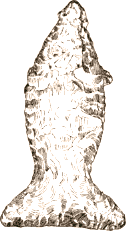
Fig. 421.—Whale flaked from glass.
The flint whale is a very common amulet, intended, as we understood, to give good luck, in whaling, and is worn habitually by many of the men and boys under the clothes, suspended around the neck by a string. The captain and harpooner of a whaling crew also wear them as pendants on the fillets already described, and on the breast of the jacket. We obtained five of these objects, all of very nearly the same shape, but of different materials and varying somewhat in size. Fig. 421 represents one of these (No. 56703 [208] from Utkiavwĭñ) made of a piece of hard colorless glass, probably a fragment of a ship’s “deadlight.” It is rather roughly flaked into a figure of a “bowhead” whale, 3.4 inches long, as seen from above and very much flattened with exaggerated flukes. The flippers were rudely indicated in the outline, but the left one is broken off.
No. 89613 [771] from Utkiavwĭñ is a very similar image, 2.4 inches long, which perhaps is of the same material, though it may be made of rock crystal. No. 56707 [159] from Utkiavwĭñ is a very small whale (1.4 inches long), chipped in large flakes out of a water-worn pebble of smoky quartz, while No. 89577 [939] Fig. 422, from the same village, which is a trifle larger (2 inches long), is made of dark crimson jasper. The large black flint whale, No. 56683 [61], also from Utkiavwĭñ, which is 3.9 inches long, is the rudest of all the figures of the whales. It is precisely the shape of the blade of a skin scraper, except for the roughly indicated flukes.
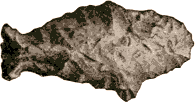
Fig. 422.—Whale flaked from red jasper.
Fig. 423 (No. 89524 [1299] from Utkiavwĭñ) is a rude wooden image of the same animal, 3½ inches long, very broad and flat-bellied. It is smoothly carved and has a fragment of sky-blue glass inlaid to represent the left eye and a bit of iron pyrites for the right. The flukes have been split wholly off and fastened on with a lashing of narrow whalebone passing through a vertical hole in the “small” and round the edge of the flukes. The flukes themselves have been split across and appear to have been doweled together. This shows that the owner attached considerable value to the object, or he would not have taken the trouble to mend it when another could have been so easily whittled out. In the middle of the belly is an oblong cavity, containing something which probably adds greater power to the charm. What this is can not be seen, as a band of sealskin with the hair shaved off has been shrunk on round the hinder half of the body and secured by a seam on the right side. A double turn of sinew braid is knotted round the middle of the body, leaving two ends which are tied together in a loop, showing that this object was meant to be attached somewhere about the person.
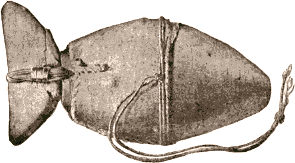
Fig. 423.—Ancient whale amulet, of wood.
To this class also probably belong the skins or pieces of animals worn as amulets, probably with a view of obtaining the powers of the particular animal, as in so many cases in the stories related in Rink’s Tales and Traditions. We frequently saw men wearing at the belt bunches of the claws of the bear or wolverine, or the metacarpal bones of the wolf.626 The head or beak of the gull or raven627 is also a common personal amulet, and one man wore a small dried flounder.628
We collected a number of these animal amulets to be worn on the person, but only succeeded in learning the special purpose of one of them, No. 89532 [1307], from Utkiavwĭñ, which was said to be intended to give good luck in deer hunting. It is a young unbranched antler of a reindeer, 6 inches long, and apparently separated from the skull at the “bur,” with the “velvet” skin still adhering, though most of the hair is worn off except at the tip. A bit of sinew is tied round the base.
No. 89522 [1573], from Utkiavwĭñ, is an amulet consisting of the last three joints of the foot of a reindeer fawn, with the skin and hoof and about 1½ inches of tendon attached behind, through a hole in the end of which is knotted about 3 inches of seal thong. No. 89525 [1314] from the same village, is a precisely similar charm. No. 89699 [779] from Utkiavwĭñ, is the subfossil incisor tooth of some ruminant with a hole drilled through the root for a string to hang it up by. It was said to be the tooth of the “ug’ru´nû,” a large animal, long extinct. As the natives said, “Here on the land are none, only the bones remain.” No. 89743 [1110], from Utkiavwĭñ, is a molar tooth of the same animal, probably, weathered and old, with a hole freshly drilled through one root and a long piece of sinew braid with the ends knotted together looped into it. There are also in the collection two very old teeth which probably were inclosed in little sacks of skin and worn as amulets.
No. 89698 [1580], from Utkiavwĭñ, is the tusk of a very young walrus, only 2½ inches long, and No. 89452 [1148] from Utkiavwĭñ, is the canine tooth of a polar bear. No. 56547 [656], from the same village, is a similar tooth.629
The only amulet attached to a weapon, which we collected, is the tern’s bill, already alluded to, placed under the whalebone lashing on the seal-spear, No. 89910 [1694]. Perhaps the idea of this charm is that the spear should plunge down upon the seal with as sure an aim as the tern does upon its prey.630
A number of amulets of this class are always carried in the whaling-umiak. I have already mentioned the wolf-skulls, stuffed ravens and eagles, fox-tails631 and bunches of feathers used for this purpose. Most of these charms are parts of some rapacious animal or bird, but parts of other animals seem to have some virtue on these occasions.
For instance, I noticed the axis vertebra of a seal in one whaling-umiak, and we collected a rudely stuffed skin of a godwit (Limosa lapponica baueri), which, we were informed, was “for whales.” This specimen (No. 89526 [1328], Fig. 424, from Utkiavwĭñ) is soiled and ragged, and has a stick thrust through the neck to hold it out. The neck is wrapped around with a narrow strip of whalebone and some coarse thread, part of which serves to lash on a slip of wood, apparently to splice the stick inside. A bit of white man’s string is passed around the body and tied in a loop to hang it up by. This charm is perhaps to keep the boat from capsizing, since Crantz says that the Greenlanders “like to fasten to their kajak a model of it * * * or only a dead sparrow or snipe, or a bit of wood, stone, some feathers or hair, that they may not overset” (vol. 1, p. 216), and perhaps the bone of a marine animal, like the seal, is to protect the crew from drowning should the boat upset, after all.
No. 89529 [1150] from Utkiavwĭñ is a bunch of feathers to be carried in the boat. It consists of nine wing feathers of the golden eagle, four tied in a bunch with a bit of sinew round the quills, four tied up with one end of the short bit of seal thong which serves to tie the whole bundle together, one of which has all the light-colored parts of the feather stained with red ocher, and a single feather shaft carefully wrapped up in a piece of entrail and wound spirally with a piece of sinew braid.
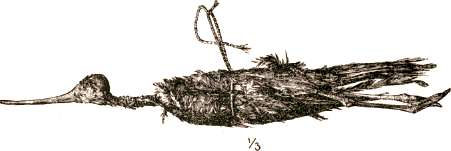
Fig. 424.—Amulet of whaling; stuffed godwit.
No. 89527-8 [1327] from Utkiavwĭñ is the charm which will secure good success in deerhunting if it is hung up outside of the snow house in which the family is encamped. It consists of two roughly stuffed skins of the black bellied plover (Charadrius squatarola), each with a stick run through the body so that one end supports the neck and the other the tail, and the necks wound with sinew. One has no head. A string of sinew braid is tied around the body of each, so as to leave a free end at the back, to which is fastened a little cross piece of bone, by which it may be secured to a becket. Like the rest of the amulets in the collection this has evidently seen service, being very old, worn, and faded.
The other class of amulets, namely objects which have belonged to or been in contact with certain persons or supernatural beings, or I may add apparently certain localities, is represented by a number of specimens. To the custom of using such things as amulets, we undoubtedly owe the preservation of most of the ancient weapons and other implements, especially those made of wood, bone, or other perishable substances, like the ancient harpoon heads already described, one of which, No. 89544 [1419], is still attached to the belt on which it was worn.
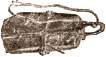
Fig. 425.—Amulet consisting of ancient jade adz.
Fig. 425, No. 56668 [308], from Utkiavwĭñ is one of the ancient black jade adzes 5.1 inches, slung with thong and whalebone, making a becket by which it can be hung up. We did not learn the history of this amulet, which at the time of collecting it was supposed to be a net sinker. There would, however, be no reason for using so valuable an object for such a purpose, when a common beach pebble would do just as well, unless it was intended as a charm to insure success in fishing. It may even have been carried as a charm on the person, since we afterwards saw a still more bulky object used for such a purpose.
Such an object seems rather heavy to be carried on the person, but a well known man in Utkiavwĭñ always carried with him when he went sealing a large pear-shaped stone, which must have weighed upwards of two pounds, suspended somewhere about his person. It is not unlikely that this stone acquired its virtue as an amulet from having been a sinker used by some lucky fisherman in former time or in a distant country. Mr. H. W. Henshaw has already referred to the resemblance of this amulet to the plummet-like “medicine stones” of some of our Indians.632
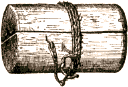
Fig. 426.—Little box containing amulet for whaling.
Fig. 426, (No. 89534 [1306] from Utkiavwĭñ) is an amulet for success in whaling. It consists of three little irregular water-worn fragments of amber carefully wrapped in a bit of parchment and inclosed in a little wooden box 1½ inches long, made of two semicylindrical bits of cottonwood, with the flat faces hollowed out and put together and fastened up by three turns of sinew braid round the middle, tied in a loose knot. The box is old and brown from age and handling. We heard of other pieces of amber and earth (“nuna”) worn as amulets, wrapped up in bits of leather and hung on the belt.
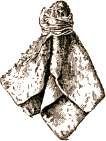
Fig. 427.—Amulet for catching fowl with bolas.
No. 89533 [1247], from Utkiavwĭñ, is simply a nearly square pebble, 1.4 inches long, of dark red jasper, slung in a bit of sinew braid so that it can be hung on the belt. Fig. 427 (No. 89525 [1308] from Utkiavwĭñ) is some small object, placed in the center of the grain side of a square bit of white sealskin, the edges of which are folded up around it and tied tightly round with deer sinew, so as to make a little round knob. I collected this amulet, and was particularly informed how it was to be used. If it be fastened on the right shoulder it will insure success in taking ducks with the “bolas.” Fig. 428 (No. 89535 [1244] from Utkiavwĭñ) is an amulet whose history we did not learn. It is a little oblong box 3.3 inches long, carved from a block of cottonwood, with a flat cover tied on with nine turns of sinew braid, and contains twenty-one dried humble-bees, which it was said came from the river Kulugrua. The natives have a great dread, apparently superstitious, of these bees and the large gadflies (Œstens tarandi), one of which I have seen scatter half a dozen people. A man one day caught one of these, and whittled out a little box of wood, in which he shut the insect up and tied it up with a shred of sinew, telling Capt. Herendeen that it was “tuɐñamun,” for “tuɐña.”
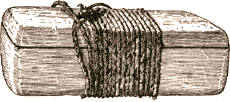
Fig. 428.—Box of dried bees—amulet.
A small lump of indurated gravel (No. 56725) [273] was one day brought over from Utkiavwĭñ, with the story that it was a “medicine” for driving away the ice. The man who uses this charm stands on the high bank at the village, and breaking off grains of the gravel throws them seaward. This will cause the ice to move off from the shore.
The essential identity of the amulets of the Point Barrow natives with those used by the Eskimo elsewhere is shown by the following passages from other writers. Egede says:633
A Superstition very common among them is to load themselves with Amulets or Pomanders, dangling about their Necks and Arms, which consist in some Pieces of old Wood, Stones or Bones, Bills and Claws of Birds, or Anything else which their Fancy suggests to them.
Crantz says:634
They are so different in the amulets or charms they hang on people, that one laughs at another’s. These powerful preventives consist in a bit of old wood hung around their necks, or a stone, or a bone, or a beak or claw of a bird, or else a leather strap tied round their forehead, breast, or arm.
Parry speaks635 of what he supposes were amulets at Iglulik, consisting of teeth of the fox, wolf, and musk-ox, bones of the “kablĕĕarioo” (supposed to be the wolverine), and foxes’ noses. Kumlien says636 that at Cumberland Gulf, “among the many superstitious notions, the wearing of charms about the person is one of the most curious. These are called angoouk or amusit, and may be nothing but pieces of bone or wood, birds’ bills or claws, or an animal’s teeth or skin.” A little girl “had a small envelope of sealskin that was worn on the back of her inside jacket” containing two small stones.
Such little pockets of skin sewed to the inner jacket are very common at Point Barrow, but we did not succeed in any case in learning their contents. At Kotzebue Sound, Beechey saw ravens’ skins on which the natives set a high value, while the beaks and claws of these birds were attached to their belts and headbands.637 Petitot describes638 the amulets used in the Mackenzie district, in the passage already quoted, as “défroques empaillées de corbeau, de faucon ou d’hermine.” It is not likely that the use of these is confined to the women, as his words, “Elles y portent,” would seem to imply. Among the sedentary Chukches of Siberia amulets were seen consisting of wooden forks and wood or ivory carvings.639 A wolf’s skull, hung up by a thong; the skin, together with the whole cartilaginous portion of a wolf’s nose, and a flat stone, are also mentioned.640 Capt. Holm also found wonderfully similar customs among the East Greenlanders. He says,641 “bære alle Folk Amuletter af de mest forskjelligartede Ting” to guard against sickness and to insure long life, and also for specific purposes. The men wear them slung round the neck or tied round the upper arm, the women in their knot of hair or “i Snippen foran paa Pelsen.”
Errors in this section:
BOW-AND-ARROW MAKING. / A complete set printed as paragraph header: Bow-and-arrow making.—A complete set ...
the narrowest being 0.3 and the widest 0.7 broad width
perforated with two large transverse eyes tranverse
into a groove in the top of the ivory edge grove
Ice picks.—The ivory ice pick (tu´u) always attached Ice picks—
most of the men and boys, especially the latter epecially
Twisting and braiding.—We had no opportunity Twisting and braiding—
is admirably adapted to give the blade admirally
detailed information regarding the umiaks informtion
a small share of meat from camp to camp.471 footnote anchor missing: best guess
Fig. 358.—Small sledge with ivory runners. 2/21 number unambiguous
with cries of “Añ! añ! tû´lla! tû´lla!” (Come! come on!) close quote missing
cries of “Kŭ! kŭ!” (Get on! get on!) close quote missing
bow and arrow toward a line of reindeer text has “a a” at line break
brown deerskin with the flesh side out. final . missing
these masks (ki´nau, from ki´na, face). masks.
Another “commercial” mask (No. 89813 [1074] from Utkiavwĭñ) (No. 89813) with superfluous closing parenthesis
fourteen from Nuwŭk, twenty from Utkiavwĭñ, and sixteen from Sidaru fourteeen
of a sitting man holding up his hands text has “hold / ing” without hyphen at line break
Fig. 400.—Bear flaked from flint. flaker
On the throat is a conventional figure text has “a a” at mid-line
for example at Smith Sound.600 Sound,
Footnote N600: Bessels, Naturalist, vol. 23, pt. p. 873. missing number or superfluous pt.
Nordenskiöld was unable to purchase a pair of fresh walrus heads Nordenskjöld
No. 89699 [779] from Utkiavwĭñ Utkavwĭñ
Her milk supply cannot fail while she wears this.” (Cumberland Gulf.) close quote missing