ETHNOLOGICAL RESULTS OF THE POINT BARROW EXPEDITION. (continued 2)
Reading edition
Curiously enough the Greenlanders had a superstition of a sort of malevolent spirits called kajariak, who were “kayakmen of an extraordinary size, who always seem to be met with at a distance from land beyond the usual hunting grounds. They were skilled in the arts of sorcery, particularly in the way of raising storms and bringing bad weather. Like the umiarissat [other fabulous beings], they use one-bladed paddles, like those of the Indians.”432 This tradition either refers back to a time when the ancestors of the Greenlanders used the single paddle or to occasional and perhaps hostile meetings between eastern and western Eskimo.
Though the kaiak is essentially the same wherever used, it differs considerably in size and external appearance in different localties. The kaiak of the Greenlanders is perhaps the best-known model, as it has been figured and described by many authors. It is quite as light and sharp as the Point Barrow model, but has a flat floor, the bilge being angular instead of rounded, and it has considerably more sheer to the deck, the stem and stern being prolonged into long curved points, which project above the water, and are often shod with bone or ivory. The coaming of the cockpit also is level, or only slightly raised forward. The kaiaks used in Baffin Land, Hudson Straits, and Labrador are of a very similar model, but larger and heavier, having the projecting points at the bow and stern rather shorter and less sharp, and the coaming of the cockpit somewhat more raised forward. Both of these forms are represented by specimens and numerous models in the museum collections. I have seen one flat-floored kaiak at Point Barrow. It belonged to a youth and was very narrow and light.
The kaiak in use at Fury and Hecla Straits, as described by Capt. Lyon433 and Capt. Parry434 is of a somewhat different model, approaching that used at the Anderson River. It is a large kaiak 25 feet long, with the bow and stern sharp and considerably more bent up than in the Greenland kaiaks, but round-bottomed, like the western kaiaks. The deck is flat, with the cockpit coaming somewhat raised forward.435
In the kaiaks used at the Anderson and Mackenzie rivers, as shown by the models in the National Museum, the bending up of the stem and stern posts is carried to an extreme, so that they make an angle of about 130° with the level of the deck. The bottom is round and the cockpit nearly level, but sufficient room for the knees and feet is obtained by arching not only the deck beams just forward of the cockpit, but all of them from stem to stern, so that the deck slopes away to each side like the roof of a house. At Point Barrow, as already described, the deck beams are arched only just forward of the cockpit, and the stem and stern are not prolonged. This appears to be the prevailing form of canoe at least as far south as Kotzebue Sound and is sometimes used by the Malemiut of Norton Sound. At Port Clarence the heavy, large kaiak, so common from Norton Sound southward, appears to be in use from Nordenskiöld’s description, as he speaks of the kaiaks holding two persons, sitting back to back in the cockpit.436 The kaiaks of the southwestern Eskimo are, as far as I have been able to learn, large and heavy, with level coamings, with the deck quite steeply arched fore and aft, and with bow and stern usually of some peculiar shape, as shown by models in the Museum. See also Dall’s figure (Alaska, p. 15.)437
While the kaiak, however, differs so much in external appearance in different localities, it is probable that in structure it is everywhere essentially the same. Only two writers have given a detailed description of the frame of a kaiak, and these are from widely distant localities, Iglulik and western Greenland, both still more widely distant from Point Barrow, and yet both give essentially the same component parts as are to be found at Point Barrow, namely, two comparatively stout gunwales running from stem to stern, braced with transverse deckbeams,438 seven streaks running fore and aft along the bottom, knees, or ribs in the form of hoops, and a hoop for the coaming, bound together with whalebone or sinew.439
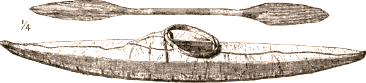
Fig. 341.—Model kaiak and paddle.
The double-bladed paddle is almost exclusively an Eskimo contrivance. The only other hyperborean race, besides the Aleuts, who use it, are the Yukagirs, who employ it in their narrow dugout canoes on the River Kolyma in Siberia.440 Double-bladed paddles have also been observed in the Malay Archipelago.
Fig. 341, (No. 56561 [224] from Utkiavwiñ) is a very neatly made model of a kaiak, 13.3 inches long. It is quite accurate in all its details, but has only five streaks on the bottom, and its width and depth are about twice what they should be in proportion to the length. The frame is lashed together with fine sinew and covered with seal entrail. The paddle is also out of proportion. Many similar neatly finished models were made for sale. The natives are so skillful in making them that it is possible that they are in the habit of making them for the children to play with. I do not, however, recollect ever seeing a child with one.
Umiaks and fittings.—
The large skin-covered open boat, essentially the same in model as that employed by almost all Eskimo, as well as the Aleuts and some Siberian races, is the chief means of conveyance by water, for traveling, hunting, and fishing. Though the women do a great share of the work of navigating the boat when a single family or a small party is making a journey, it is by no means considered as a woman’s boat, as appears to be the case among the Greenlanders and eastern Eskimo generally.441 On the contrary, women are not admitted into the regularly organized whaling crews, unless the umialik can not procure men enough, and in the “scratch” crews assembled for walrus hunting or sealing there are usually at least as many men as women, and the men work as hard as the women. I do not, however, recollect that I ever saw a man pull an oar in the umiak. They appear always to use paddles alone. This is interesting in connection with the Greenland custom mentioned by Egede in the continuation of the passage just quoted: “And when they first set out for the whale fishing, the men sit in a very negligent posture, with their faces turned towards the prow, pulling with their little ordinary paddle; but the women sit in the ordinary way, with their faces towards the stern, rowing with long oars.”
We were unable to bring home any specimen of these boats on account of their size, but Fig. 342, from a photograph by Lieut. Ray, will give a good idea of the framework. These boats vary considerably in size, but are usually very nearly the dimensions of an ordinary whaleboat—that is, about 30 feet in length, with a beam of 5 or 6 feet and a depth of about 2½ feet. The boat resembles very much in model the American fisherman’s dory, having a narrow flat bottom, sharp at both ends, with flaring sides, and considerable rake at stem and stern. Both floor and rail have a strong sheer, fore and aft, and the gunwales extend beyond the stem so as to meet at the bow. Both stem and stern are sharp nearly to the rail, where they flare out and are cut off square. These boats are exceedingly light and buoyant, and capable of considerable speed when fully manned. They are very “quick” in their motion and quite crank till they get down to their bearings, but beyond that appear to be very stiff.
I never heard of one being capsized, though the natives move about aboard of them with perfect freedom. The frame is neatly made of pieces of driftwood, which it usually takes a considerable time to accumulate.442
A stout square timber, of perhaps 3 inches scantling, runs along the middle of the bottom forming a keel or keelson. This of necessity is usually made of several pieces of wood scarfed together and fastened with treenails and whalebone lashings. At each end it is fastened in the same way to the stem and sternpost, which are both of the same shape, broad and flat above or inside, but beveled off to a keel outside, and curving up in a knee, at the same time tapering off to the point where the bow (or stern) begins to flare. Here it is mortised into the under side of a trapezoidal block of wood, widest and thickest on the inboard end, and concaved off on the under face, to a thin edge outboard. It is held on by a transverse lashing passing through holes in the end of the post and the thickest part of the block. Along each side of the bottom, at what would be the bilge of a round bottom boat, runs a stout streak, thinner and wider than the keelson and set up edgewise. These are spread apart amidships, but bent together fore and aft so as to be scarfed into the stem and sternpost (see diagram, Fig. 343a).
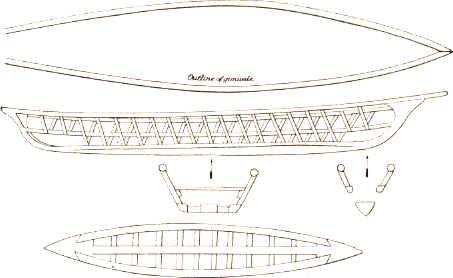
Fig. 342.—Frame of umiak.
On the model they are fastened here with treenails, and this is probably also the case on the large canoes. They are spread apart by cross pieces or floor timbers, flat rather broad boards laid across the keelson with their ends mortised into the bilge streaks. These are longest amidships and decrease regularly in length fore and aft. There were fifteen of them on Nikawáalu’s umiak. On the model they are pegged to the keelson and bilge streaks. The ribs are straight, slender, square timbers, eighteen on each side (on Nikawáalu’s umiak; the canoe photographed has fifteen). These are all of the same length, but fitted obliquely to the outer edge of the bilge-streaks in such a way (see diagram, Fig. 343b) that those amidships slant considerably outward while the others become gradually more and more erect fore and aft, thus producing the sheer in the lines. To these ribs, inside, a little below the middle of each, is fastened a streak on each side, of about the dimensions of the bilge streak, running from stem to stern, and the gunwales are fitted into the notched ends of the ribs, where they are secured by lashings of whalebone. These on Nikawáalu’s umiak were each a single round pole about 2 inches in diameter. Such long pieces of wood as this were probably obtained by trade from the Nunatañmeun. These extend about 2½ or 3 feet beyond the stem, to which they are fastened on each side by whalebone lashings, and meet at a sharp angle, being lashed together with whalebone. On the model, this lashing passes through holes in both gunwales and round underneath. The gunwales are fastened to the sternpost in the same way as to the stem, in both cases resting on the upper surface of the block so as to form a low rail, but project only 5 or 6 inches.
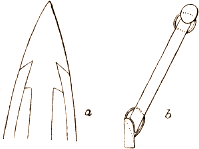
Fig. 343.—Construction of umiak: (a) method of fastening bilge streaks to stem; (b) method of framing rib to gunwale, etc.
Between the post and the last pair of long ribs at each end are two pairs of short ribs running only from the gunwale to the inside streak. The frame is still further strengthened by an outside streak between the bilge streak and the inside streak, and Nikawáalu’s canoe had an extra streak of “half-round” willow outside of the latter. The thwarts rest on the inside streak and are secured by whalebone lashings. The block or head of the stern-post serves as a high seat for the steersman. Crantz’s443 description and diagram show that the frame of the Greenland umiak consists of essentially the same timbers, lacking only the two outside streaks.
The cover is made of the skins of the larger marine animals. Walrus hide is often used and sometimes the skin of the polar bear, which makes a beautifully white cover, but the skin of the bearded seal is preferred, the people from Point Barrow sometimes making journeys to Wainwright Inlet in search of such skins, which are dressed with their oil in them in the manner already referred to. We were informed that six of these skins were required to cover one umiak. They are put together in the same way as the skins for the kaiak and sewed with the same seam. The edges of the cover are stretched over the gunwale, and laced to the inside streak with a stout thong, which passes through holes in the edge of the cover. At stem and stern the cover is laced with a separate thong to a stout transverse lashing of thong running from gunwale to gunwale close to the edge of the posthead.
The cover is removed in the winter and stowed away on the cache frame or some other safe place (Mûñialu, when preparing to start for the spring deer hunt in 1883, carefully buried his boat cover in a snowbank) out of reach of the dogs, and the frame is placed bottom upwards on a staging 4 or 5 feet from the ground.
When they are ready to refit the canoe for the spring whaling, a hole is cut in the sea ice close to the shore, and the cover immersed in the sea water for several days to soften it, the hole being covered with slabs of snow to keep it from freezing up. Crantz444 mentions a similar custom in Greenland. After removing the hair from the boat-skins “they lay them in salt water for some days to soften them again, and so cover the women’s boats and kajaks with them.” When not in use, the umiak is drawn up on the beach and usually laid bottom upward with the gear, spears, etc., underneath it, but sometimes propped up on one gunwale to make a shelter against the wind. This is a common practice in the camp at Pernyû, where there is usually at least one boat set up edgewise, sheltered by which the men sit to whittle and gossip.
In the whaling camp at Imêkpûñ in 1883, the boats which were not ready to go out to the open water were laid up bottom up with one end resting on a sled set up on its side and the other supported by a block of snow. They do not appear to be in the habit of using the canoe for a tent, as is said to be the custom among the more southern natives,445 as they always carry a tent with them on their journeys. The umiak is propelled by paddles, oars, and a sail, and in smooth weather when the shore is clear of ice by “tracking” along the beach with men and dogs, one person at least always remaining on board to steer with a paddle at the stern.
The sail, which they are only able to use with a free wind, is square, narrow, and rather high, and is nowadays always made of drilling. Dark blue drilling appeared to be the most popular sort at the time of our visit. The head of the sail is laced to a light yard, and hoisted to the masthead by a halyard through a hole in the latter. The mast is a stout square pole 10 or 12 feet long and is set up well forward of amidships, without a step, the square butt resting against a bottom board, and held up by two forestays and two backstays, running from the masthead to the inside streak. All the rigging, stays, halyards, towing line, etc., are made of stout thong. The Greenlanders set up the mast in the bow of the umiak—as a sailor would say, “in the very eyes of her,”446 but as far as I can learn the Western Eskimo all set it up as at Point Barrow.
The oars are very clumsily made with very narrow blades not over 3 inches broad. They are about 7 feet long and somewhat enlarged at the loom. Instead of resting in rowlocks, they are secured by two long loops of thong as in the diagram Fig. 344. To keep the oar from chafing the skin on the gunwale, they lash to the latter a long plate of bone. No. 89696 [1197] from Utkiavwĭñ is one of these plates. Two of these oars are commonly used in an umiak, one forward and one aft, and the women row with great vigor, swinging well from the hips, but do not keep stroke. The use of oars is so unusual among savages that it would be natural to suppose that these people had adopted the custom from the whites. If this be the case, the custom reached them long ago, and through very indirect channels.
When Thomas Simpson, in 1837, bought an umiak from some Point Barrow natives at Dease Inlet, he bought with it “four of their slender oars, which they used as tent poles, besides a couple of paddles; fitted the oars with lashings, and arranged our strange vessel so well that the ladies were in raptures, declaring us to be genuine Esquimaux, and not poor white men.”447 The custom, moreover, appears to be widespread since Lyon speaks of seeing in 1821, “two very clumsy oars with flat blades, pulled by women,” in the umiaks at Hudson Strait.448 It was practiced at a still earlier date in Greenland.449
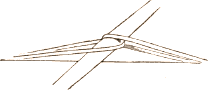
Fig. 344.—Method of slinging the oar of umiak.
While at Point Barrow the oars have very narrow blades and the double paddles very broad ones, the reverse seemed to be the case in Greenland, where the double paddle, as already noticed, has blades not over 3 or 4 inches broad. Crantz describes the oars as “short and broad before, pretty much like a shovel, but only longer, and * * confined to their places on the gunnel with a strap of seal’s leather.” (Vol. 2, p. 149 and pl. VI) Although both oars and sails are undoubtedly quite ancient inventions (Frobisher in his description of Meta Incognita in Hakluyt’s Voyages (1589) pp. 621 and 628, speaks of skin boats with sails of entrail),450 I am strongly inclined to believe that they are both considerably more recent than the paddles, not only on general principles, but from the fact that the whaling umiaks at Point Barrow use only paddles. There is no practical reason against using either oars or sails, and in fact the latter would often be of great advantage in silently approaching a whale, as the American whalemen have long ago discovered. It seems to me that this is merely another case of adhering to an obsolete custom on semireligious grounds. The paddles are usually about 4 or 5 feet long, made of one piece of driftwood, with slender round shafts, and lanceolate blades about 6 inches broad, and a short rounded cross handle at the upper end. (Fig. 345 shows two of the paddles belonging to the model.) The steersman uses a longer paddle, and stands in the stern or sits up on the head of the sternpost.
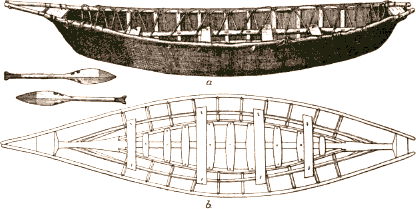
Fig. 345.—Model of umiak and paddles: (a) side view; (b) inside plan.
Fig. 345a represents the model (No. 56563 [225] from Utkiavwĭñ), which gives a very good idea of the shape of one of these boats. It is quite correct in all its parts, though the timbers are rather too heavy, and there are not so many ribs and floor timbers as in a full-sized canoe. The breadth of beam, 6.2 inches, is at least 1 inch too great in proportion to the length, 25 inches. The cover is one piece of seal skin which has been partially tanned by the “white-tanning” process, and put on wet. In drying it has turned almost exactly the color of a genuine boat cover. The frame, as is often the case with a full-sized boat, is painted all over with red ocher. (See Fig. 345b, inside plan.)

Fig. 346.—Ivory bailer for umiak.
For bailing these boats a long narrow dipper of ivory or bone is used, of such a shape as to be especially well suited for working in between the floor timbers. Fig. 346 represents one of these (No. 56536 [40] from Utkiavwĭñ). It is a piece of walrus tusk 16.3 inches long. The cavity is 1.1 inches deep and was excavated by drilling vertical holes and cutting away the substance between them. Some of the holes have not been completely worked out. A similar bailer (No. 89835 [1010] also from Utkiavwĭñ) is made of reindeer antler, a substance much more easily worked than the ivory, as the soft interior tissue exposed by cutting the upper side flat is readily carved out. As with the walrus tusk, the natural curve of the material gives the proper inclination to the handle. It is 18.3 inches long.
When the umiak is fitted out for whaling a stout U-shaped crotch of ivory or bone, about 7 inches long and 5 wide, is lashed between the gunwales where they meet at the bow. In this the heavy harpoon rests when they are approaching a whale. It is only used when whaling. The Museum collection contains specimens of this sort from as far south as the Diomede Islands.
We brought home five specimens of these kû´nnɐ, of which No. 56510 [117] Fig. 347 has been selected as the type. This is made of two bilaterally symmetrical pieces of white walrus ivory, each piece consisting of one arm of the crotch and half the shank. Its total length is 7.8 inches. The two pieces are held together by a stout wooden tree-nail, and above this a lashing of sinew-braid, lodged in two deep vertical channels one on each side of the shank just below the arms, and wedged above and below on both sides with slips of wood. A hole is drilled through each side of the butt close to the end, and through these a lashing is stretched across the reentering angle of the butt consisting of four turns of sinew braid with the end closely wrapped round the parts between the holes, and neatly tucked in.
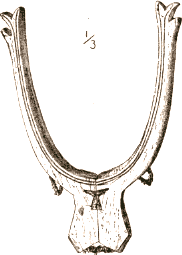
Fig. 347.—Ivory crotch for harpoon.
Just at the bend of each arm is a small round becket hole, running obliquely from the back to the outer side. In each of these is a neat becket, about ¾ inches long, made of several turns of sinew braid, with the end neatly wrapped around them. These beckets serve to receive the lashings for attaching the crotch to the gunwales. All the ornamental figures are incised and blackened.
Three of the remaining four specimens are of walrus-ivory, and of essentially the same pattern, differing only in ornamentation and other minor details. No. 56511 [116], from Utkiavwĭñ, is almost exactly like the type and of very nearly the same size. It is fastened together with a lashing only, but no treenail, and the beckets have been removed from the becket holes. The border is colored with red ocher, and there are two whales’ tails instead of one on the shank. The other two have the tips of the arms carved into the shape of whales’ heads. No. 89418 [1224], Fig. 348, from Utkiavwĭñ, is otherwise of the same shape as those already described, but is lashed together with stout seal thong, and has four beckets of the same material, two in the usual position and two at the widest part of the shank. These take the place of the loop running across the butt. On the middle of the back of each arm is a small cross incised and blackened with a small blue glass bead inlaid in the center, and there are two whale’s tails on the opposite face of the shank. It is 8 inches long.
No. 89419 [926], from Nuwŭk, has a nearly straight shank with a flange on each side at the butt. It is lashed together with whalebone and has also a treenail, like the type. The upper beckets are of sinew-braid. A large becket at the butt is made by looping and knotting the ends of a bit of thong into a hole in each flange. There is one whale’s tail engraved on the front of the shank. When lashed in position the front or ornamental side faces inboard, as is indicated by the shape of the shank, which is slightly narrower behind than in front, so as to fit between the converging gunwales. No. 8917 [1104], Fig. 349, from Nuwuk, the only one of the kind seen, is a very interesting form. It is made by cutting a horizontal slice out of the lower jaw of a walrus, so that it form the arms of the crotch, while the thick symphysis is cut into a shank of the usual shape, with the two upper beckets in the usual place and a large one at the butt, passing through a transverse hole. These beckets are roughly made of thong. Its total length is 6.6 inches.
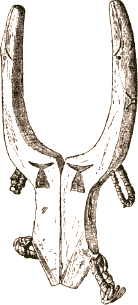
Fig. 348.—Ivory crotch for harpoon.
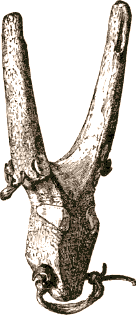
Fig. 349.—Crotch for harpoon made of walrus jaw.
This specimen from its soiled condition is undoubtedly quite ancient, and probably of an older type than the highly ornamented ivory crotches of the present day. The latter are evidently only copies of the jawbone crotch in a material susceptible of a higher finish than the coarse bone. The only reason for making them in two pieces is that it is impossible to get a single piece of walrus ivory large enough for a whole one. It seems to me highly probable that the crotch was suggested by the natural shape of the walrus jaw, since these are frequently used for crotches to receive the cross pieces of the cache frames. Perhaps, for a while, the whole jaw was simply lashed to the bow of the boat. The next step would obviously be to cut out the shank and reduce the weight of the crotch by trimming off the superfluous material. The reason for making the crotch of ivory is perhaps purely esthetic; but more likely connected with the notions already referred to which lead them to clean up their boats and gear and adorn themselves and paint their faces when they go to the whale fishery.
Although, as I have already stated, there appears to be no essential difference in the general plan of the frame of the Greenland umiaks and those used at Point Barrow, there seems to be considerable difference in the size and outward appearance. As well as can be judged from the brief descriptions and rude figures of various authors451 and various models in the National Museum (the correctness of which, however, I can not be sure of, without having seen the originals) the umiak not only in Greenland, but among the Eskimo generally as far west as the Mackenzie, is a much more wall sided square ended boat than at Point Barrow, having less sheer to the gunwales with the stem and stern-post nearly vertical.452 Mr. L. M. Turner informs me that this is the case at Ungava Bay. It was also a larger boat. Egede says that they “are large and open * * * some of them 20 yards long;”453 Crantz gives their length as “commonly 6, nay 8 or 9 fathoms long;”454 Kumlien says that it required “about fifteen skins of Phoca barbata” to cover an umiak at Cumberland Gulf,455 and Mr. Turner informs me that eight are used at Ungava. Capt. Parry found no umiaks at Fury and Hecla straits456 and Kumlien says that they are becoming rare at Cumberland Gulf. The so-called Arctic Highlanders of Smith Sound have no boats of any kind. The model used at Point Barrow probably prevails as far south as Kotzebue Sound. The boats that boarded us off Wainwright Inlet in the autumn of 1883, and those of the Nunatañmiun who visited Point Barrow, seemed not to differ from those with which we were familiar, except that the latter were rather light and low sided, nor do I remember anything peculiar about the boats which we saw at Plover Bay in 1881.
There is very little accessible detailed information regarding the umiaks used in the rest of Alaska. From Dall’s figure457 and a few models in the Museum, the Norton Sound umiak appears to have the gunwales united at both stem and stern. Those that we saw at St. Michael’s in 1883, were so much modified by Russian ideas as to be wholly out of the line of comparison. The same is true of the Aleutian “baidara,” if, indeed, the latter be an umiak at all.
TRAVELING ON FOOT.
Snowshoes (tûglu.)—
Snowshoes of a very efficient pattern and very well made are now universally employed at Point Barrow. Although the snow never lies very deep on the ground, and is apt to pile up in hard drifts, it is sufficiently deep and soft in many places, especially on the grassy parts of the tundra, to make walking without snowshoes very inconvenient and fatiguing. I have even seen them used on the sea ice for crossing level spaces when a few inches of snow had fallen. Practically, every man in the two villages, and many of the women and boys, have each their own pair of snowshoes, fitted to their size. Each shoe consists of a rim of light wood, bent into the shape of a pointed oval, about five times as long as the greatest breadth, and much bent up at the rounded end, which is the toe. The sides are braced apart by two stout cross-bars (toe and heel bar) a little farther apart than the length of the wearer’s foot. The space between these two bars is netted in large meshes (foot netting) with stout thong for the foot to rest upon, and the spaces at the ends are closely netted with fine deerskin “babiche”458 (toe and heel netting). The straps for the foot are fastened to the foot netting in such a way that while the strap is firmly fastened round the ankle the snowshoe is slung to the toe. The wearer walks with long swinging strides, lifting the toe of the shoe at each step, while the tail or heel drags in the snow. The straps are so contrived that the foot can be slipped in and out of them without touching them with the fingers, a great advantage in cold weather. When deer hunting, according to Lieut. Ray, they take a long piece of thong and knot each end of it to the toe of one snowshoe. The bight is then looped into the belt behind so that the snowshoes drag out of the way of the heels. When they wish to put on the shoes they draw them up, insert their feet in the straps, and fasten the slack of the lines into the belt in front with a slip knot. When, however, they come to a piece of ground where snowshoes are not needed, they kick them off, slip the knots, and let them “drop astern.”
We brought home three pairs of snowshoes, which represent very well the form in general use. No. 89912 [1736], Fig. 350, has been selected as the type. The rim is of willow, 51 inches long and 10½ inches wide at the broadest part, and is made of two strips about 1 inch thick and ¾ wide, joined at the toe by a long lap-splice, held together by four short horizontal or slightly oblique stitches of thong. Each strip is elliptical in section, with the long axis vertical, and keeled on the inner face, except between the bars. Each is tapered off considerably from the toe bar to the toe, and slightly tapered toward the heel. The two points are fastened together by a short horizontal stitch of whalebone. The tip is produced into a slight “tail,” and the inner side of each shoe is slightly straighter than the outer—that is to say, they are “rights and lefts.”
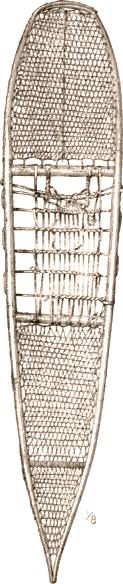
Fig. 350.—Snowshoe.
The bars are elliptical in section, flattened, and have their ends mortised into the rim. They are about a foot apart, and of oak, the toe bar 9.2 inches long and the heel bar 8.5. Both are of the same breadth and thickness, 1 by ½ inch. There is also an extra bar for strengthening the back part of the shoe 10 inches from the point. It is also of oak, 4.8 inches long, 0.5 wide, and 0.3 thick. The toe and heel nettings are put on first. Small equidistant vertical holes run round the inside of each space. Those in the rim are drilled through the keel already mentioned, and joined by a shallow groove above and below; those in the bars are about ½ inch from the edge and joined by a groove on the under side of the toe bar only. Into these holes is laced a piece of babiche, which is knotted once into each hole, making a series of beckets about ¾ inch wide round the inside of the space. There are no lacing holes in the parts spliced at the toe, but the lacing passes through a bight of each stitch. At the toe bar the lacing is carried straight across from rim to rim about three times, the last part being wound round the others.
On the left shoe the end is brought back on the left-hand side, passed through the first hole in the bar from above, carried along in the groove on the underside to the next hole, up through this and round the lacing, and back through the same hole, the two parts being twisted together between the bar and lacing. This is continued, “stopping” the lacing in festoons to the bar, to the last hole on the right, where it is finished off by knotting the end round the last “stop.” The stops are made, apparently, by a separate piece on the right shoe. The lacing on the heel bar is also double or triple, but the last part, which is wound round the others, is knotted into each hole as on the rim. The lacings on the rim of the heel space are knotted with a single knot round each end of the extra bar.
In describing the nettings it will always be understood that the upper surface of the shoe is toward the workman, with the point upward, if describing the heel nettings, and vice versa for the toe. To begin with the heel netting, which is the simpler: This is in two parts, one from the heel bar to the extra bar (heel netting proper) and one from the latter to the point (point netting). The netting is invariably fastened to the lacing by passing the end through the becket from above and bringing it back over itself. In making the point netting the end of the babiche is knotted round the bar at the right-hand lower corner with a single knot. The other end goes up to the lacing at the point and comes down to the left-hand lower corner, where it is hitched round the bar, as in Fig. 351, then goes up to the lowest becket on the left side, crosses to the corresponding one on the right, and comes down and is hitched as before round the bar inside of the starting point. This makes a series of strands round the outside of the space, two running obliquely from right to left, a long one on the right side and a short one on the left side; two similar strands from left to right, the long one on the left and the short one on the right, and one transverse strand at the base of the triangle (see diagram, Fig. 352a). The next round goes up to the first becket at the top on the left hand, crosses to the corresponding one on the right, and then makes the same strands as the first round, running parallel to them and about half an inch nearer the center of the space (see diagram, Fig. 352b). Each successive round follows the last, coming each time about ½ inch nearer the center, till the space is all filled in, which brings the end of the last round to the middle of the bar, round which it is knotted with a single knot. This makes three sets of strands, two obliquely longitudinal, one set from right to left and one from left to right, and one transverse, all of each set parallel and equidistant, or nearly so, and each interwoven alternately over and under each successive strand it meets.
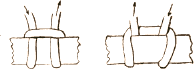
Fig. 351.—Knot in snowshoe.
The right shoe has fourteen longitudinal strands in each set and thirteen transverse; the left, one less in each set. On the left shoe the end is carried up from the last knot to the lacing at the point, and then comes back to the bar, fastening the other part to the netting with six equidistant half-hitches. The heel netting proper is put on in a slightly different fashion, as the space to be filled is no longer triangular. It starts as before in the right hand lower corner, where it is knotted into the becket, running across from the rim to the heel-bar; goes up to the middle of the extra bar, round which it is hitched as already described, then down to the left hand lower corner; up to the first becket on the left rim, across to the corresponding one on the right, and down to the first becket on the heel bar. This completes the first round (see diagram, Fig. 353a). The second round goes up to the hind bar at the left of the first, comes down only to the transverse strand of the first round on the left, goes up to the becket on the rim above the first, crosses to the right, and comes back to the transverse turn of the first rounds. All these strands except the transverse one are on the left of the first round. The third round follows the first, which brings all its strands except the transverse one to the right of the first round (see diagram, Fig. 353b). The successive odd rounds follow the first and the even rounds the second, bringing the longitudinal strands alternately to the right and left of the first round, until the ends of the hind bar are reached—that is to say, till the space outside of the first round is filled—each transverse strand coming above the preceding. This is done regularly on the left shoe, the tenth round coming to the left end of the bar, and the eleventh to the right. The twelfth round comes to the becket in the left hand upper corner, and crosses to the corresponding becket on the other side. It then follows the odd rounds, thus making six strands, four longitudinal and two transverse, as in the point nettings. All the remaining rounds follow this till the whole space is filled in, which brings the end of the last round to the middle of the heel bar, where it is knotted to the becket.
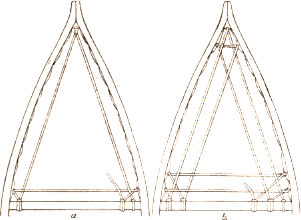
Fig. 352.—Point netting of snowshoe heel: (a) first round; (b) first and second rounds.
On the right shoe the maker seems to have made a mistake at the eighth round, which obliged him to alter the order of the other strands and finish with half a round. Instead of taking the end of the eighth round down to the preceding transverse strand only, he has brought it down to the heel bar, which brings the ninth round to the left, following the even rounds, and coming to the end of the hind bar, the tenth to the right end of the bar, so that it is the eleventh which makes the first transverse turn at the top. The pattern is the same as in the point nettings. The right shoe has 25, 24, and 19 strands in the three sets respectively, and the left, 25, 25, and 19. The toe nettings are put on in the same way, the first round going to the middle becket at the toe, and crossing to the first becket on the right hand, the second going to the first becket on the left hand and crossing on the right to the first round, and the third going to the first round at the toe and crossing on the right to the becket.
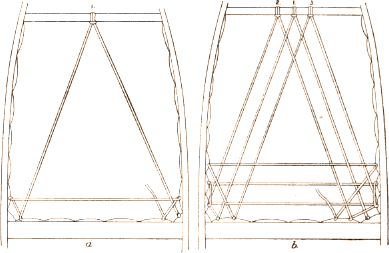
Fig. 353.—Heel netting of snow shoe; (a) first round; (b) first, second, and third rounds.
All the even rounds go to the becket at the toe and cross to the preceding even round, and all the odd rounds go to the preceding odd round at the toe and cross to the becket, until the space outside of the first round is filled with longitudinal strands, when they begin to make descending transverse turns across the toe, going from the becket on the left to the corresponding one on the right and thus following the odd rounds. The fourteenth round on the right shoe begins this, the twelfth on the left. This brings the end of the last round to the middle of the toe bar. It is then carried up to the becket at the toe, brought down and up again, and the end is used to fasten these three parts to the netting with equidistant half hitches—fourteen on the right shoe and thirteen on the left. The pattern, of course, is the same as before, with 33, 33, and 26 strands on the right shoe, and 31, 31, and 25 on the left, in each set respectively.
The foot-netting is of a very different pattern, and consists of seven transverse and thirteen longitudinal strands, of which six, in the middle, do not reach the toe bar, leaving an oblong transverse hole, through which the toe presses against the snow at the beginning of the step. The cross strands are a piece of stout thong (the skin of the walrus or bearded seal), to the end of which is spliced with double slits a long piece of thinner seal thong, which makes the longitudinal ones. The seven transverse strands pass in and out through holes in the rim, while the longitudinal strands pass over the bars, except the middle three pairs, which pass round the horizontal strand behind the toe hole, drawing it down to the next strand. The end of the thirteenth strand wattles these two firmly together, as it does also the two pairs of longitudinal strands on each side of the toe hole, and finishes off the netting by whipping the two sets of strands together with a “birdcage stitch.”
The object of the complicated wattling round the toe hole is, first, to strengthen the hind border against which the toe presses in walking, and second to give a firm attachment for the straps, which are fastened at the junction of the doubled and twisted longitudinal strands with the first and second transverse ones. Each strap is a single piece of stout seal thong fastened to the shoe with two loops as follows: At the inner side of the shoe the end is passed into the toe hole and makes a round turn about the doubled longitudinal strands, and then goes under the two cross strands, coming out behind them and between the twelfth and thirteenth longitudinal strands. It is then spliced into the standing part with two slits, making a becket about 3 inches in diameter. The other end, leaving a loop large enough to go round the wearer’s heel, is passed through the becket just made, wound in the same way as before round the strands at the other corner of the toe hole, and made into a similar becket by knotting the end to the standing part with a marlinghitch with the bight left in. On the right shoe this hitch is made in a slit in the standing part. The end is probably left long for the purpose of adjusting the length of the strap to the wearer’s foot.
In putting on the shoe, the toe is thrust sideways through the loop till the bight comes well up over the heel, and then turned round and stuck under the two beckets, which together form a strap to fasten the toe down to the shoe, leaving the latter free to swing when the heel is raised. By reversing the process the shoe is easily kicked off. These straps must be fitted very nicely or else the shoe is apt to come off. This is a very neatly made pair of shoes, and the woodwork is all painted red above.
No. 89913 [1737] is a pair of similar shoes also from Utkiavwĭñ. The frame is made in the same way and is wholly of willow except the extra hind bar, which is of walrus ivory. These shoes are shorter and somewhat broader than the preceding and not so well made. They are 48.5 inches long and 11 broad. The two shoes are not perceptibly different in shape. The lacing, which is of sinew braid, is put on in the same way as on the preceding pair, except that it is fastened directly into the holes on the toe bars. The whole of the heel netting is in one piece, and made precisely in the same way as the point nettings of the first pair, the end being carried up the middle to the point of the heel and brought down again to the bar as on the toe nettings, but fastened with marling hitches. The number of strands is the same in each shoe, twenty-three in each set. The toe nettings follow quite regularly the pattern of the preceding pair.
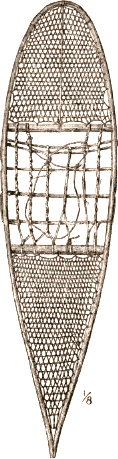
Fig. 354.—Small snowshoe.
The shoes are not quite the same size, as the right has 35, 35, and 28 strands, and the left 33, 33, and 25, in each set respectively. There is no regular rule about the number of strands in any part of the netting, the object being simply to make the meshes always about the same size. The foot netting is made of stout and very white thong from the bearded seal. These shoes have no strings.
No. 89914 [1738] is a pair of rather small shoes from Utkiavwĭñ, one of which is shown in Fig. 354. They are rights and lefts, and are 42 inches long by 10 broad. The frame is wholly of oak, and differs from the type only in having no extra hind bar, and having the heel and toe bars about equal in length. The points are fastened together with a treenail, as well as with a whalebone stitch. The heel-nettings are put on with perfect regularity, as on the pair last described, but the toe-nettings, though they start in the usual way, do not follow any regular rule of sucession, the rounds being put on sometimes inside and sometimes outside of the preceding, till the whole space is filled. The foot-nettings are somewhat clumsily made, especially on the right shoe, which appears to have been broken in several places, and “cobbled” by an unskillful workman. There are only five transverse strands which are double on the left shoe, and the longitudinal strands are not whipped to these, but interwoven, and each pair twisted together between the transverse strands. There is no wattling back of the toe hole, and one pair of longitudinal strands at the side of the latter is not doubled on the left shoe. The strings are put on as on the type except that the ends are knotted instead of being spliced. This pair of shoes was used by the writer on many short excursions around the station during the winters of 1881-’82 and 1882-’83. They were old when purchased.
I had but one opportunity of seeing the process of making the frames of the snowshoes. Ilûbw’ga, the “inland” native frequently mentioned, a particularly skillful workman, undertook to make a pair of snowshoes for Lieut. Ray at our quarters, but did not succeed in finishing them, as the ash lumber which we brought from San Francisco proved too brittle for the purpose. Having a long piece of wood, he “got out” the whole rim in one piece. Ordinarily the splice at the toe must be made, at least temporarily, before the frame can be bent into shape. He softened up the wood by wrapping it in rags wet with hot water. Some of the other natives, however, recommended that the wood should be immersed in the salt water for a day or two, from which I infer that this is a common practice. After slowly bending the toe, with great care, nearly into shape, he inserted into the bend a flat block of wood of the proper shape for the toe and lashed the frame to this. A pointed block was also used to give the proper shape to the heel; the bars being inserted in the mortises before the ends were brought together. The temporary lashings are kept on till the wood dries into shape. The toes are turned up by tying the shoes together, sole to sole, and inserting a transverse stick between the tips of the toes.
The use of finely finished snowshoes of this pattern is of comparatively recent date at Point Barrow. Dr. Simpson459 is explicit concerning the use of snowshoes in his time (1853-’55). He says: “Snowshoes are so seldom used in the north where the drifted snow presents a hard frozen surface to walk upon, that certainly not half a dozen pairs were in existence at Point Barrow at the time of our arrival, and those were of an inferior sort.” I have already mentioned the universal employment of these snowshoes at the present day, so that the custom must have arisen in the last thirty years. The pattern of shoe now used is identical with those of the Tinné or Athabascan Indians (as is plainly shown by the National Museum collections), and I am inclined to believe that the Point Barrow natives have learned to use them from the “Nunatañmiun,” from whom, indeed, they purchase ready-made snowshoes at the present day, as we ourselves observed. The “Nunatañmiun,” or the closely related people of the Kuwûk River, are known to have intimate trading relations with the Indians, and even in Simpson’s time460 used the Indian shoe, sometimes at least. The fact that in recent times families of the “Nunatañmiun” have established the habit of spending the winter with the people of Point Barrow and associating with them in the winter deer-hunt, would explain how the latter came to recognize the superior excellence of the Indian shoe.
This is more likely than that they learned to use them from the eastern natives, whom they only meet for a short time in summer, though the latter used the Indian style of snowshoes at least as early as 1826. Franklin461 speaks of seeing, at Demarcation Point, a pair of snowshoes netted with cords of deerskin and shaped like those of the Indians of the Mackenzie.
Most of the other Eskimo of Alaska, who need to use snowshoes at all, use a style of shoe very much less efficient and more roughly made, the rim being of heavy, rather crooked pieces of willow or alder. Simpson’s description will apply very well to this form, which is used even as far north as Icy Cape, whence Mr. Nelson brought home a pair. It also appears to be the prevailing, if not the only, form on the Siberian coast and St. Lawrence Island, judging from Nordinskiöld’s figure462 and Mr. Nelson’s collections.
Simpson says:463 “The most common one is two pieces of alder, about two feet and a half long, curved towards each other at the ends, where they are bound together, and kept apart in the middle by two crosspieces, each end of which is held in a mortise. Between the crosspieces is stretched a stout thong, lengthwise and across, for the foot to rest upon, with another which first forms a loop to allow the toes to pass beneath; this is carried round the back of the ankle to the opposite side of the foot, so as to sling the snowshoe under the joint of the great toe.”
When there are toe and heel nettings, they are of seal thong with a large open mesh. The snowshoe from Norton Sound, figured by Dall,464 is a rather neatly made variety of this form. South of the Yukon, the use of the snowshoe appears to be confined to the Indians. As shown by the Museum collections, the strings are always of the pattern described throughout the whole northwestern region.465
Snowshoes appear to be rarely used among the eastern Eskimo. The only writer who mentions them is Kumlien.466 He says: “When traveling over the frozen wastes in winter, they [i.e., the natives of Cumberland Gulf] use snowshoes. These are half-moon shaped, of whalebone, with sealskin thongs tightly drawn across. They are about 16 inches long. Another pattern is merely a frame of wood, about the same length and 8 or 10 inches wide, with sealskin thongs for the foot to rest on.”
The latter is apparently quite like the western snowshoes described by Simpson.
Staff.—
The only staff used by the young and vigorous is the shaft of the spear, when one is carried. The aged and feeble, however, support their steps with one or two staffs about 5 feet long, often shod with bone or ivory. (The old man whom Franklin met on the Coppermine River walked with the help of two sticks.467) Fig. 355 from a photograph represents old Yûksĭña from Nuwŭk, with his two staffs, without which he was hardly able to walk.
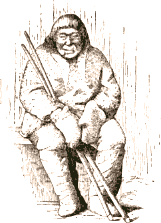
Fig. 355.—Old “Chief” with staffs.
LAND CONVEYANCES.
Sledges.—
The only land conveyance employed at Point Barrow is the universal sledge of the Eskimo, of which there are two forms in general use, one, kă´motĭ, with a high rail on each side, and especially intended for carrying loads of the smaller articles, clothing, camp equipage, etc., and the other (unia) low and flat, without rail or “upstander,” for carrying bulky objects, like whole carcasses of deer, frozen seals, rough dried deerskins, etc., and especially used for carrying the umiak across the land or solid ice. Both kinds are made without nails, but are fastened together by mortises and lashings and stitches of thong and whalebone. I have, however, seen one unia, which was made in 1883, fastened together with nails, a rather inferior substitute for the lashings, as they not only would not hold so firmly, but would also be liable to break in cold weather.
Both kinds of sledge are made of driftwood and shod with strips of whale’s jaw, about three-fourths of an inch thick, fastened on with bone treenails. These bone runners, which are about 2 inches wide, run sufficiently well over ice, hard snow, the frozen gravel of the beach or even on the bare tundra, but for carrying a heavy load over the softer snow of the interior they are shod with ice in a manner peculiar to this region.
It is well known that not only the Eskimo generally, but other hyperborean people coat the runners of their sleds with ice to make them run more smoothly, but this is usually only a comparatively thin crust, produced by pouring water on the runners or applying a mixture of snow or mud and water.468 Mr. Turner informs me that at Ungava they are particular to use fine black vegetable mold for this purpose.
The method at Point Barrow is quite different from this. To each runner is fitted a heavy shoe of clear ice, as long as the runner, and fully 1 foot high by 6 inches thick. The sledge with these ice runners is estimated to weigh, even when unloaded, upwards of 200 or 300 pounds, but it appears that the smoothness of running more than counterbalances the extra weight. At any rate these shoes are almost universally employed on the sleds which make the long journey from the rivers in the spring with heavy loads of meat, fish, and skins. One native, in 1883, shod his sledges with salt-water ice in this way before starting for the hunting grounds. As these ice shoes are usually put on at the rivers, I had no opportunity of seeing the process, though I have seen the sledges thus shod after their return to the village. Lieut. Ray, who saw the process, describes it as follows:
“From the ice on a pond that is free from fracture they cut the pieces the length of a sled runner, 8 inches thick and 10 inches wide; into these they cut a groove deep enough to receive the sled runner up to the beam; the sled is carefully fitted into the groove, and secured by pouring in water, a little at a time and allowing it to freeze. Great care is taken in this part of the operation, for should the workman apply more than a few drops at a time, the slab of ice would be split and the work all to do over again; after the ice is firmly secured the sled is turned bottom up and the ice-shoe is carefully rounded with a knife, and then smoothed by wetting the naked hand and passing it over the surface until it becomes perfectly glazed.”469
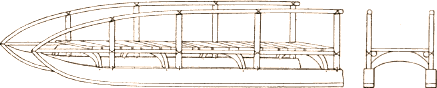
Fig. 356.—Railed sledge, diagrammatic (from photograph).
In traveling they take great care of these runners, keeping them smooth and polished, and mending all cracks by pouring in fresh water. They are also careful to shade them from the noonday sun, which at this season of the year is warm enough to loosen the shoes, for this purpose hanging a cloth or skin over the sunny side of the sled.470
We were unfortunately not able to bring home specimens of either style of large sled. The rail sled (kămotĭ) is usually about 8 or 9 feet long, and 2½ to 3 feet wide, and the rail at the back not over 2½ feet high. The thick curved runners, about 5 or 6 inches wide (see diagram, Fig. 356, made from a small photograph) meet the curved slender rails (which are usually round) in front, but are separated from them behind by four stout vertical posts on each side, increasing in length toward the other end and mortised into the runners and rails. An equal number of stout wooden arches half the height of the posts are mortised into the runners, each arch a little in front of each pair of posts. A longitudinal strip runs along the middle of each side, and slats are laid across these, supported by the arches. The sledge is rather heavy and clumsy, but usually carefully made and often painted with red ocher.

Fig. 357.—Flat sledge.
Of the unia or flat sledge we have, fortunately a good photograph, Fig. 357. To the thick straight wooden runners are fastened directly seven cross slats, which project about 2 inches at each end beyond the runner, to which they are fastened by two stitches of whalebone each. A longitudinal strip runs along above the slats on each side. These sledges are generally made on the same pattern, varying somewhat in size. A common size is about 6 feet long, about 2½ feet wide, and 9 or 10 inches high. Very small sledges of this pattern are sometimes made, especially for the purpose, as we were told, of carrying provisions, perhaps when one or two persons desire to make a rapid journey of some length, or for carrying a small share of meat from camp to camp.471
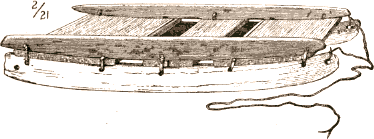
Fig. 358.—Small sledge with ivory runners.
One of these (Fig. 358, No. 89889 [1140], from Utkiavwĭñ), which shows signs of long use, was brought home. It is 20.7 inches long and 13 broad, and has ivory runners, with three wooden slats across them, held down by a low wooden rail on each side. Each runner is a slice from a single large walrus tusk, with the butt at the back of the sled. The slats, which are pieces of a ship’s paneling, are lashed to the upper edge of the runners so as to project about one-half inch on each side. The rails flare slightly outward. The whole is fastened together by lashings of rather broad whalebone, passing through a hole near the upper edge of the runner, a notch in the end of the slat and a hole in the slat inside of the rail. There are two lashings at each end of each broad slat and one in the middle, at each end of the narrow one. The last and the ones at each end of the sled also secure the rail by passing through a hole near its edge, in which are cut square notches to make room for the other lashings. The trace is a strip of seal thong about 5 feet long and one-fourth inch wide, split at one end for about 1 foot into two parts. The other end is slit in two for about 3 inches. This is probably a broken loop, which served for fastening the trace to a dog’s harness.
I do not recollect ever seeing so small a sled in actual use, though Lieut. Ray says he has frequently seen them drawn by one dog. The people who came down from Nuwŭk with a small load of things for trade sometimes used a small unía about 3 feet long, with one dog, and the same was often used by the girls for bringing in firewood from the beach.
A very peculiar sled was formerly used at Point Barrow, but we have no means of knowing how common it was. It was a sort of toboggan, made by lashing together lengthwise slabs of whalebone, but is now wholly obsolete, since whalebone has too high a market value to permit of its being used for any such purpose. We obtained one specimen about 10 feet long, but it was unfortunately in such a dilapidated condition that we were unable to bring it home. I find no previous mention of the use of such sleds by any Eskimo. It is not necessary to suppose that this sled is modeled after the toboggan of the Hudson Bay voyagers, of which these people might have obtained knowledge through the eastern natives, since the simple act of dragging home a “slab” of whalebone would naturally suggest this contrivance.
We did bring home one small sled of this kind (No. 89875 [772], Fig. 359, from Utkiavwĭñ), which from its size was probably a child’s toy, though from its greasy condition it seems to have been used for dragging pieces of blubber. It is made of the tips of 6 small “slabs” of black whalebone, each about 2 inches wide at the broad end, and put together side by side so as to form a triangle 19¼ inches long and 9¾ wide, the apex being the front of the sled, and the left-hand edge of each slab slightly overlapping the edge of the preceding. They are fastened together by three transverse bands, passing through loops in the upper surface of each slot, made by cutting two parallel longitudinal slits about one-half inch long and one-fourth inch apart part way through, and raising up the surface between them. The hindmost band is a strip of whalebone nearly one-half inch wide, passing through these loops, and wound closely in a spiral around a straight rod of whalebone, 0.4 inch wide and 0.1 inch thick, as long as the band. The ends of the band are knotted into rings or beckets about 2¼ inches in diameter. The other two bands are simple, narrow strips of whalebone, running straight across through the loops and knotted at the ends into similar beckets. These beckets were obviously for tying on the load.
The sled with side rails does not appear to be used east of the Mackenzie region, but is found only slightly modified at least as far south as Norton Sound.472 The sledge used on the Asiatic coast, however, as shown in Nordenskiöld’s figure,473 belongs to a totally different family, being undoubtedly borrowed from the reindeer Chukches.474 The sleds of the eastern Eskimo vary somewhat in pattern and material, but may be described in general terms as essentially the same as the unía, but usually provided with what is called an “upstander,” namely, two upright posts at each side of the back of the sled, often connected by a cross rail, which serve to guide the sled from behind. Many descriptions and figures of these sleds will be found in the various descriptions of the eastern Eskimo.
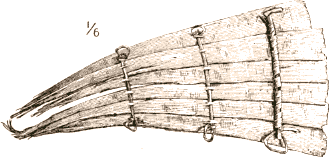
Fig. 359.—Small toboggan of whalebone.
Dogs and harness.—
These sledges are drawn by dogs, which, as far as I am able to judge, are of the same breed as those used by the eastern Eskimo. They are, as a rule, rather large and stout. A number of the dogs at Utkiavwĭñ would compare favorably in size with the average Newfoundland dogs, and they appear to be capable of well sustained exertion. The commonest color is the regular “brindle” of the wolf, though white, brindle-and-white, and black-and-white dogs are not uncommon. There was, however, but one wholly black dog in the two villages. This was a very handsome animal known by the name of Allúa (“coal”).
Every dog has his name and knows it. Their disposition is rather quarrelsome, especially among themselves, but they are not particularly ferocious, seldom doing more than howl and yelp at a stranger, and it is not difficult usually to make friends with them. There was very little difficulty in petting the half dozen dogs which we had at the station, and they grew to be very much attached to the laborer who used to feed them. The natives treat their dogs well as a rule, seldom beating them wantonly or severely. Though they do not allow them to come into the houses, the dogs seem to have considerable attachment to their masters. Considerable care is bestowed on the puppies. Those born in winter are frequently reared in the iglu, and the women often carry a young puppy around in the jacket as they would a child.
We saw no traces of the disease resembling hydrophobia, which has wrought such havoc in Greenland and Baffin Land. I once, however, saw a puppy apparently suffering from fits of some kind, running wildly round and round, yelping furiously, and occasionally rolling over and kicking. The natives said, “Mûlukû´lĭrua, asi´rua”, (“He is howling[?];475 he is bad”), and some of the boys finally took it out on the tundra and knocked it on the head.
The dog harness, ánun (Gr. anut), consists of a broad strip of stout rawhide (from the bearded seal or walrus), with three parallel loops at one end, frequently made by simply cutting long slits side by side in the thong and bending it into shape. The head is passed through the middle loop and a foreleg through each of the side-loops, bringing the main part of the thong over the back. This serves as a trace, and is furnished at the end with a toggle of bone or wood, by which it is fastened to beckets in a long line of thong, the end of which is usually made fast to the middle of the first slat of the sledge. The dogs are attached in a long line, alternately on opposite sides of this trace, just so far apart that one dog can not reach his leader when both are pulling.
The most spirited dog is usually put at the head of the line as leader, and the natives sometimes select a bitch in heat for this position, as the dogs are sure to follow her. The same custom has been observed by Kumlien at Cumberland Gulf.476 Ten dogs are considered a large team, and few of the natives can muster so many. When the sledge is heavily loaded men and women frequently help to drag it. The dogs are never driven, and except over a well known trail, like that between Utkiavwĭñ and the whaling camp in 1883, will not travel unless a woman trots along in front, encouraging them with cries of “Añ! añ! tû´lla! tû´lla!” (Come! come on!), while the man or woman who runs behind the sled to guide it and keep it from capsizing, urges them on with cries of “Kŭ! kŭ!” (Get on! get on!), occasionally reproving an individual dog by name. After they are well started, they go on without much urging if nothing distracts their attention. It is not easy to stop a dog team when the destination is reached. Commands and shouts of “Lie down!” are seldom sufficient, and the people generally have to pull back on the sled and drag back on the harness till the team comes to a halt.
The leader, who is usually a woman or child sometimes guides the team by a line attached to the trace, and Lieut. Ray says he has seen them, when traveling in the interior, tie a piece of blubber or meat on the end of a string and drag it on the snow just ahead of the leader. The natives seldom ride on the sledge except with a light load on a smooth road. A few old and decrepit people like Yû´ksĭña always traveled on sledges between the villages, and the people who came down with empty sledges for provisions from the whaling camp, always rode on the well beaten trail where the dogs would run without leading.477 The dog whip so universally employed by the eastern Eskimo, is not used at Point Barrow, but when Lieut. Ray made a whip for driving his team, the natives called it ĭpirau´ta, a name essentially identical with that used in the east. They especially distinguished ĭpirau´ta, a whip with a lash, from a cudgel, anau´ta. The latter word has also the same meaning in the eastern dialects.
We saw nothing of the custom of protecting the dogs’ feet with sealskin shoes, so prevalent on the Siberian coast.478 Curiously enough the only other localities in which the use of this contrivance is mentioned are in the extreme east.479 During the first warm weather in the spring, before the dogs have shed their heavy winter coats, they suffer a great deal from the heat and can go only a short distance without lying down to rest.
The method of harnessing and driving the dogs varies considerably in different localities. Among the eastern natives the dogs are usually harnessed abreast, each with a separate trace running to the sledge, and the driver generally rides, guiding the dogs with a whip. The leader usually has a longer trace than the rest. The harness used at Fury and Hecla Straits is precisely the same as that at Point Barrow, but in Greenland, according to Dr. Kane, it consists of a “simple breast-strap,” with a single trace. The illustration, however, in Rink’s Tales and Traditions, opposite p. 232, which was drawn by a native Greenlander, shows a pattern of harness similar to that used in Siberia and described by Nordenskiöld480 as “made of inch-wide straps of skin, forming a neck or shoulder band, united on both sides by a strap to a girth, to one side of which the draft strap is fastened.” It is a curious fact that the two extremes of the Eskimo race (for even if the people of Pitlekaj be Chukchi in blood, they are Eskimo in culture) should use the same pattern of harness, while a different form prevails between them. The Siberians also habitually ride upon the sledges, and use a whip, and on some parts of the coast, at least, harness the dogs abreast. In the region about Pitlekaj, however, the dogs are harnessed “tandem” in pairs, as is the case at Norton Sound, where a more efficient harness is also used, which is probably not Eskimo, but learned from the whites.481 Nordenskiöld482 expresses the opinion that the Eskimo method of harnessing the dogs abreast indicates that the Eskimos have lived longer than the Chukchis north of the limit of trees; in other words, that the method of harnessing the dogs tandem is the older one, and that the Eskimo have learned to harness them abreast since they left the woodland regions. I can hardly agree with these conclusions, for it seems to me that the easiest and most natural method of attaching the dogs would be to fasten each directly to the sled by its own trace. Now, when many dogs are attached to the sled in this way, the outer dogs can not apply their strength in a direct line but must pull obliquely, and, moreover, as we know to be the case, so many long traces are constantly becoming entangled, and each individual dog has to be kept straight by the driver. If, however, the dogs be made fast to a long line, one behind the other, not only does each pull straight ahead, but if the leader be kept to the track he pulls the other dogs after him, relieving the driver of the greater part of the care of them.
It seems to me therefore, that the tandem method is an improvement in dog harnessing, which has been adopted only by the natives of northeastern Siberia, and northwestern America, and has no connection with the wooded or unwooded state of the country.483
HUNTING SCORES.
The only thing that we saw of the nature of numerical records were the series of animals engraved upon ivory, already alluded to. In most cases we were unable to learn whether the figures really represented an actual record or not, though the bag handle, No. 89424 [890] already figured, was said to contain the actual score of whales killed by old Yú´ksĭña. The custom does not appear to be so prevalent as at Norton Sound (see above, p. 117). Many of these possible scores being engraved on ivory implements have already been described. With one exception they only record the capture of whales or reindeer. The exception (No. 89425 [1732], Fig. 153b) presents a series of ten bearded seals. The reindeer are usually depicted in a natural attitude, and some of the circumstances of the hunt are usually represented. For instance, a man is figured aiming with a bow and arrow toward a line of reindeer, indicating that such a number were taken by shooting, while a string of deer, represented without legs as they would appear swimming, followed by a rude figure of a man in a kaiak, means that so many were lanced in the water. Other incidents of the excursion are also sometimes represented. On these records the whale is always represented by a rude figure of the tail cut off at the “small,” and often represented as hanging from a horizontal line.
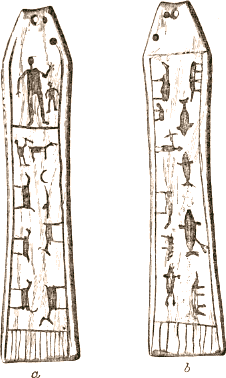
Fig. 360.—Hunting score engraved on ivory.
We also brought home four engraved pieces of ivory, which are nothing else than records of real or imaginary scenes. I have figured all of these. Fig. 360 (No. 89487 [1026] from Nuwŭk) is a narrow flat tablet of ivory, 4.8 inches long and 1 inch wide, with a string at one end to hang it up by. On each face is an ornamental border inclosing a number of incised figures, which probably represent actual scenes, as the tablet is not new.
The figures on the obverse face are colored with red ocher. At the upper end, standing on a cross line, with his head toward the end, is a rudely drawn man, holding his right hand up and his left down, with the fingers outspread. At his left stands a boy with both hands down. These figures probably represent the hunter and his son. Just below the cross line is a man raising a spear to strike an animal which is perhaps meant for a reindeer without horns. Three deer, also without horns, stand with their feet on one border with their heads toward the upper end, and on the other border near the other end are two bucks with large antlers heading the other way, and behind them a man in a kaiak. Between him and the animal which the first man is spearing is an object which may represent the crescent moon. The story may perhaps be freely translated as follows: “When the moon was young the man and his son killed six reindeer, two of them bucks with large antlers. One they speared on land, the rest they chased with the kaiak.”
On the reverse the figures and border are colored black with soot. In the left-hand lower corner is a she bear and her cub heading to the left, followed by a man who is about to shoot an arrow at them. Then come two more bears heading toward the right, and in the right-hand lower corner is a whale with two floats attached to him by a harpoon line. Above this is an umiak with four men in it approaching another whale which has already received one harpoon with its two floats. The harpoon which is to be thrust at him may be seen sticking out over the bow of the boat. Then come two whales in a line, one heading to the left and one to the right. In the left-hand upper corner is a figure which may represent a boat, bottom up, on the staging of four posts. We did not learn the actual history of this tablet, which was brought down for sale with a number of other things.
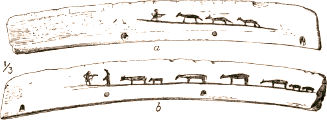
Fig. 361.—Hunting score engraved on ivory, obverse and reverse.
Fig. 361 (No. 89473 [1349] from Utkiavwĭñ) is a piece of an old snow-shovel edge with freshly incised figures on both faces, which the artist said represented his own record. The figures are all colored with red ocher. On the obverse the figures all stand on a roughly drawn ground line. At the left is a man pointing his rifle at a bear, which stands on its hind legs facing him. Then comes a she bear walking toward the left followed by a cub, then two large bears also walking to the left, and a she bear in the same attitude, followed by two cubs, one behind the other. This was explained by the artist as follows: “These are all the bears I have killed. This one alone (pointing to the ‘rampant’ one) was bad. All the others were good.” We heard at the time of his giving the death shot to the last bear as it was charging his comrade, who had wounded it with his muzzle-loader. On the reverse, the figures are in the same position. The same man points his rifle at a string of three wolves. His explanation was: “These are the wolves I have killed.”
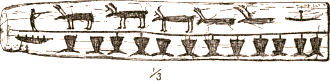
Fig. 362.—Hunting score engraved on ivory.
Fig. 362 (No. 89474 [1334] from Utkiavwĭñ) is newly made, but was said to be the record of a man of our acquaintance named Mûñĭñolu. It is a flat piece of the outside of a walrus tusk 9.7 inches long and 1.8 wide at the broader end. The figures are incised on one face only, and colored with red ocher. The face is divided lengthwise into two panels by a horizontal line. In the upper panel, at the left, is a man facing to the right and pointing a gun at a line of three standing deer, facing toward the left. Two are bucks and one a doe. Then come two bucks, represented without legs, as if swimming in the water, followed by a rude figure of a man in a kaiak. Below the line at the left is an umiak with five men, and then a row of twelve conventionalized whales’ tails, of which all but the first, second, and fifth are joined to the horizontal line by a short straight line. The record may be freely translated as follows: “I went out with my gun and killed three large reindeer, two bucks and a doe. I also speared two large bucks in the water. My whaling crew have taken twelve whales.” The number of whales is open to suspicion, as they just fill up the board.
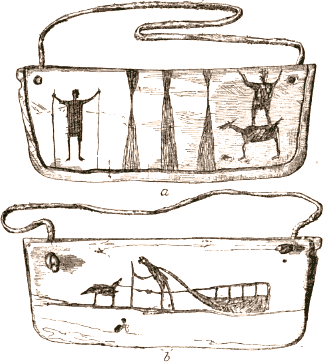
Fig. 363.—Hunting score engraved on ivory, obverse and reverse.
Fig. 363 (No. 56517 [121] from Utkiavwĭñ) is a piece of an old snow-shovel edge 4.2 inches long, with a loop of thong at the upper side to hang it up by. It is covered on both faces with freshly incised figures, colored with red ocher, representing some real or imaginary occurrence.
The obverse is bordered with a single narrow line. At the left is a man standing with arms outstretched supporting himself by two slender staffs as long as he is. In the middle are three rude figures of tents, very high and slender. At the right is a hornless reindeer heading to the left, with a man standing on its back with his legs straddled apart and his arms uplifted. On the reverse, there is no border, but a single dog and a man who supports himself with a long staff are dragging an empty rail sledge toward the left.
I find no mention of the use of any such scores among the eastern Eskimo, but they are very common among those of the west, as shown by the Museum collections. They record in this way, not only hunting exploits but all sorts of trivial occurrences.
GAMES AND PASTIMES.
Gambling.—
These people have only one game which appears to be of the nature of gambling. It is played with the twisters and marline spikes used for backing the bow, and already described, though Lieut. Ray says he has seen it played with any bits of stick or bone. I never had an opportunity of watching a game of this sort played, as it is not often played at the village. It is a very popular amusement at the deer-hunting camps, where Lieut. Ray often saw it played. According to him the players are divided into sides, who sit on the ground about 3 yards apart, each side sticking up one of the marline spikes for a mark to throw the twisters at. Six of the latter, he believes, make a full set. One side tosses the whole set one at a time at the opposite stake, and the points which they make are counted up by their opponents from the position of the twisters as they fall. He did not learn how the points were reckoned, except that twisters with a mark on them counted differently from the plain ones, or how long the game lasted, each side taking its turn of casting at the opposite stake. He, however, got the impression that the winning side kept the twisters belonging to their opponents. Mr. Nelson informs me in a letter that a similar game is played with the same implements at Norton Sound.
No. 56532 [9], from Utkiavwĭñ, is a bag full of these tools as used for playing this game. It contains 18 twisters, of different patterns, and 7 marline spikes. The bag is of membrane, perhaps a bladder. It is ovoid in shape, all in one piece, with a long opening in one side, which is closed by a piece of sinew braid about 40 inches long. This is knotted by one end round a fold of membrane at one end of the mouth, and when the bag is shut up is wrapped round the middle of it.
Some of these people have learned what cards are from the Nunatañmiun, though they do not know how to use them. They described how they were used by the “Nunatañmiun,” however, going through the motions of dealing cards. They told us that the latter played a great deal, and “gave much.” This “giving much” evidently referred to gambling, for they told Capt. Herendeen how two of the “Nunatañmiun” would sit down to play, one with a big pile of furs and one without any, and when they got up the furs would all belong to the other man.
Fig. 364 (No. 56531 [21]) represents some of a bunch of 25 little ivory images which were strung on a bit of seal thong. One is a neatly carved fox, 2.7 inches long, and the rest are ducks or geese, rather roughly carved, with flat bellies. The largest of these is 1.3 inches long and the smallest 0.8 inch. These were purchased at Plover Bay, eastern Siberia, during our brief visit in August, 1881, and were supposed to be merely works of art. I was, however, very much interested on my return to Washington to find that Dr. Franz Boas had brought from Cumberland Gulf a number of precisely similar images, which are there used for playing a game of the nature of “jackstones.” The player tosses up a handful of these images, and scores points for the number that sit upright when they fall.484 It is therefore quite likely that they are used for a similar purpose at Plover Bay. If this be so, it is a remarkable point of similarity between these widely separated Eskimo, for I can learn nothing of a similar custom at any intermediate point.
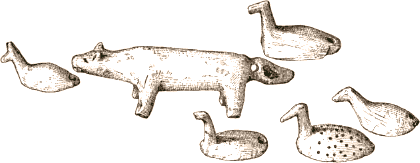
Fig. 364.—Game of fox and geese, from Plover Bay.
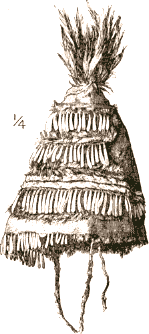
Fig. 365.—Dancing cap.
Festivals.—
The most important festivals are apparently semireligious in character and partake strongly of the nature of dramatic representations. At these festivals they make use of many articles of dress and adornment, not worn on other occasions, and even some “properties” and mechanical contrivances to add to the dramatic effect. All festivals are accompanied by singing, drumming, and dancing.
At the formal festivals, in the early winter, the performers are dressed in new deerskin clothing, with the snow-white flesh side outward, and in certain parts of the performance wear on their heads tall conical caps covered with rows of mountain sheep teeth which rattle as the wearer dances.
We brought home one of these dancing caps (kă´brû, käluka´) (No. 89820 [863] Fig. 365), made of deerskin with the hair inward and clipped close. The outside is painted all over with red ocher. The front is nearly all in one piece, but the back is irregularly pieced and gored. It is surmounted by a thick tuft of brown and white wolverine fur about 5 inches long, sewed into the apex. To the middle of one side at the edge is sewed a narrow strip of deerskin with the hair clipped close, which is long enough to go under the wearer’s chin and be knotted into a slit close to the edge of the other side of the cap. On the front edge is sewed a row of thirty-five incisor teeth of the mountain sheep by a thread running through a hole drilled through the root of each.
The series is regularly graduated, having the largest teeth in the middle and the smallest on the ends. Above this is a narrow strip of brown deerskin running two-thirds round the cap and sewed on flesh side out so that the hair projects as a fringe below. Above this are three ornamental bands about 2 inches apart running two-thirds round the cap, each fringed on the lower edge with sheep teeth strung as on the edge of the cap. The lower row contains 54 teeth, the middle 29, and the upper 31. The lowest band is made of 2 strips of mountain sheepskin with a narrow strip of black sealskin between them, and a narrow strip of brown deerskin with the hair out; the next is of coarse gray deerskin with the hair out; and the uppermost of brown deerskin with the flesh side out. The cap is old and dirty, and has been long in use.
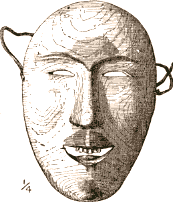
Fig. 366.—Wooden mask.
The custom of wearing this style of cap appears to be peculiar to the northwestern Eskimo, as I find no mention for it elsewhere. It is perhaps derived indirectly from the northern Indians, some of whom are represented as wearing a similar headdress.
In certain parts of the same ceremony as witnessed by Lieut. Ray the dancers also wore rattle mittens, which were shaken in time to the music. A pair of these were offered for sale once, but Lieut. Ray did not consider them sufficiently of pure Eskimo manufacture to be worth the price asked for them. They were made of sealskin and covered all over the back with empty Winchester cartridge shells loosely attached by a string through a hole in the bottom, so as to strike against each other when the mitten was shaken. The five men who wore these mittens wore on their heads the stuffed skins of various animals, the wolf, bear, fox, lynx, and dog, which they were supposed to represent. These articles were never offered for sale, as they were probably too highly valued.
We collected twelve wooden masks, which we were told were worn in some of these ceremonies, though none of our party ever witnessed any performance in which they were used. Some of them are of undoubted age. No. 56499 [6] (Fig. 366) has been selected as the type of these masks (ki´nau, from ki´na, face). This is a rather good representation of a male human face, 8.8 inches long and 5.8 wide. It is quite smoothly carved out of cottonwood, and the back is neatly hollowed out, being more deeply excavated round the eyes and mouth and inside of the nose. The mouth is represented as wide open, showing the tip of the tongue attached to the underlip, and has six small teeth which look like dog’s incisors inserted in a row in the middle of the upper lip. The eyebrows and moustache are marked out with blacklead, and there are traces of red ocher on the cheeks. The holes for the strings are in the edge about on a level with the eyes. One end of a string of seal thong long enough to go around the wearer’s head is passed out through the hole on the right side, slit close to the tip, and the other end passed through this. The other end is passed out through the hole on the left and made fast with two half hitches. A row of small holes round the edge of the mask shows where a hood has been tacked on. This mask is rather old and somewhat soiled.
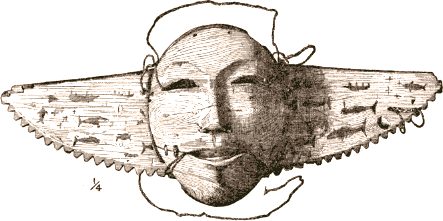
Fig. 367.—Wooden mask and dancing gorget.
A very old weathered mask (No. 56497 [235] from Utkiavwĭñ), 7.8 inches long, and made of soft wood, apparently pine, is similar to the preceding, but has no tongue, and the teeth in both jaws are represented as a continuous ridge. It has an “imperial” as well as a moustache, marked with blacklead like the eyebrows. The cheeks are colored with red ocher. The edge is much gapped and broken, but shows the remains of a deep narrow groove running round on the outside about ¼ inch from the edge, and pierced with small holes for fastening on a hood.
Figure 367 (No. 89817 [856] also from Utkiavwĭñ) is a mask much like the preceding, 7.5 inches long, and made of spruce. It is peculiar in having the outer corners of the eyes rather depressed, and in addition to the moustache and imperial has a broad “whaleman’s mark” drawn with black lead across the eyes. It is grooved round the edge for fastening on a hood. The lower part of the face has been split off at the corners of the mouth and mended on with two stitches of whalebone, and a piece which was broken out at the left-hand corner of the mouth is secured by a wooden peg at the inner edge and a stitch of whalebone on the lower side. This mask has been for a long time fastened to an ornamented wooden gorget, and appeared to have been exposed to the weather, perhaps at the cemetery. The string is made of unusually stout sinew braid.
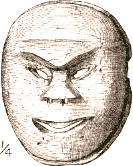
Fig. 368.—Old grotesque mask.
The remaining four ancient human masks are all masculine, and only one has any indication of labrets. On this mask, No. 89812 [1063], there are two small holes in the position of the labrets. It is probable that the wearers of these masks are supposed to represent the ancient Eskimo, who wore no labrets. A mask which was carelessly made for sale (No. 89814 [1056] from Utkiavwĭñ), however, has large plug-labrets carved out. Though roughly carved this mask is a very characteristic Eskimo face, and would almost pass as the portrait of a man of our acquaintance in Utkiavwĭñ. The two little roughly carved human faces on the top of this mask are probably merely for ornament. No such things are to be seen on any of the old masks which have been actually used. This mask seems to have been whittled out of the bottom of an old meat tray, and has a string of whalebone. Most of the genuine masks are of excellent workmanship, but two are quite roughly carved. One of these especially is such a bungling piece of work that it would be set down as commercial were it not weathered and evidently old. The painting never goes farther than marking out the beard and eyebrows with soot or black lead, and sometimes reddening the cheeks with ocher. Fig. 368 (No. 89816 [1583] from Utkiavwĭñ) is a very old mask of cottonwood, blackened with age and so rudely carved that the work was probably done with a stone tool. It is grooved around the edge for fastening on a hood and is 6.8 inches long.
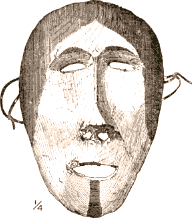
Fig. 369.—Rude mask of wood.
The only female human masks seen are new and made for sale. One of these (No. 89819 [1057], Fig. 369, from Utkiavwĭñ) is roughly whittled from the bottom of an old meat tray, and has the hair, eyebrows, and a single line of tattooing on the chin painted with soot. It is 8.7 inches long and has strings of whalebone.
Another (No. 56498 [73] from Utkiavwĭñ) is about the size of the common masks and tolerably well made. It has the hair and eyebrows marked with black lead. The last is a foot long, and like the one figured is roughly whittled out of the bottom of an old meat tray. It has the hair, eyebrows, and a single stripe of tattooing on the chin marked with black lead. This came from Utkiavwĭñ (No. 89811 [1037]).
Another “commercial” mask (No. 89813 [1074] from Utkiavwĭñ) is very elaborate, but roughly and carelessly made. It is almost flat, with the features hardly raised in relief. In each corner of the mouth is inserted a slender ivory tusk about 1 inch long, and besides the eyebrows, moustache, and imperial, there is a broad “whaleman’s mark” running obliquely across the right cheek from the bridge of the nose. Six long feathers are stuck in the edge of the forehead. Curiously enough these are the feathers of the South American ostrich, and came from the feather duster in use at our station.