ETHNOLOGICAL RESULTS OF THE POINT BARROW EXPEDITION. (continued 2)
Reading edition
We collected a single specimen of a kind of slung shot, No. 89472 [905] (Fig. 173), made of a roughly ovoid lump of heavy bone, the symphysis of the lower jaw of a walrus, 3⅓ inches long. At the smaller end two large holes are bored in obliquely so as to meet under the surface and form a channel through which is passed a slip of white seal skin about 15 inches long, the ends of which fasten together with two slits, so as to make a loop. This may be compared with the stone balls used by the ancient Aleuts for striking a man on the temple.
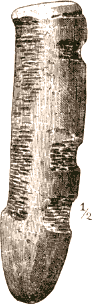
Fig. 172.—Little hand-club.
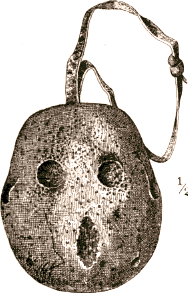
Fig. 173.—Slungshot made of walrus jaw.
The commonest weapon of offense was a broad dagger made of a bone of the polar bear. This was said to be especially meant for killing a “bad man,” possibly for certain specified offenses or perhaps in cases of insanity. Insane persons were sometimes killed in Greenland, and the act was considered “neither decidedly admissible nor altogether unlawful.”288 The use of bears’ bones for these weapons points to some superstitious idea, perhaps having reference to the ferocity of the animal. We collected five specimens of these daggers, of which No. 89484 [767], Fig. 174, has been selected as the type. It is the distal end of the ulna of a polar bear, with the neck and condyles forming the hilt, and the shaft split so as to expose the medullary cavity and cut into a pointed blade. It is very old, blackened, and crumbling on the surface, and is a foot long.
Fig. 175a, No. 89475 [988], from Nuwŭk, is made of a straight splinter from the shaft of one of the long bones, 9¾ inches long. No. 89480 [1141], from Utkiavwĭñ, has a roughly whittled hilt and a somewhat twisted blade, rather narrow, but widened to a sharp lanceolate point. It is 12 inches long. No. 89481 [1175], from the same place, has the roughly shaped hilt whipped with two turns of sinew. No. 89482 [1709], Fig. 175b, also from Utkiavwĭñ, is dirk-shaped, having but one edge and a straight back. The hilt, as before, is roughly sawed from the solid head of the bone. No. 89485 [965], Fig. 176, from Nuwŭk, was also said to be a dagger, but could not have been a very effective weapon. It is of whale’s bone, 5 inches long. It is rather rudely carved, old, and dirty, but the notches on the haft are newly cut.

Fig. 174.—Dagger of bear’s bone.
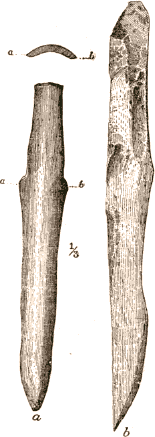
Fig. 175.—Bone daggers.
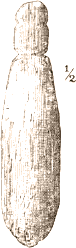
Fig. 176.—So-called dagger of bone.
Dirks or daggers of bear’s bone, like those described, are really rather formidable weapons, as it is easy to give the splinter of bone a very keen point. The Museum contains a bone dagger curiously like these Eskimo weapons, but made of the bone of the grizzly bear, and used by the Indians of the McCloud River, northern California. They believe that the peculiar shape of the point, having a hollow (the medullary cavity) on one face, like the Eskimo daggers, causes the wound to bleed internally.
PROJECTILE WEAPONS.
Firearms.—
When Dease and Simpson first met these people, in 1837, they had no firearms, but the next party of whites who came in contact with them (Pullen and Hooper, in 1849) found the “chief” in possession of an old shaky musket of English make, with the name “Barnett” on the lock.289 Hooper believed this to be the gun lost by Sir John Franklin’s party in 1826.290 This gun was, however, often seen by the people of the Plover (in fact, Capt. Maguire kept it on board of the Plover for some time291), and was found to have on the lock, besides the name “Barnett,” also the date, “1843,” so that of course it was not lost in 1826. Armstrong292 also mentions seeing this gun, which, the natives told him, they had procured “from the other tribes to the southward.” In the summer of 1853 they began to purchase guns and ammunition from the eastern natives. Yûksĭña and two other men each bought a gun this year.293
As the whalers began to go to Point Barrow in 1854, the opportunity for obtaining firearms has been afforded the natives every year since then, so that they are now well supplied with guns, chiefly of American manufacture. That all their firearms have not been obtained from this source is probable from the fact they have still in their possession a number of smoothbore percussion guns, double and single barreled, of Russian manufacture. They are all stamped in Russian with the name of Tula, a town on the Oopa, 105 miles south of Moscow, which has received the name of the “Sheffield and Birmingham of Russia,” from its vast manufactory of arms, established by Peter the Great. These guns must have come from the “Nunatañmiun,” who obtained them either from the Siberian traders or from the Russians at Norton Sound through the Malemiut. Both smoothbore and rifled guns are in general use. The smoothbores are of all sorts and descriptions, from an old flintlock musket to more or less valuable single and double percussion fowling-pieces. Three of the natives now (1883) have cheap double breechloaders and one a single breechloader (made by John P. Lovell, of Boston). Guns in general are called “cupûñ,” an onomatopœic word in general use in western America, but many of the different kinds have special names. For instance, a double gun is called madro´lĭñ (from madro, two). The rifles are also of many different patterns. The kind preferred by the natives is the ordinary Winchester brass-mounted 15-shot repeater, which the whalers and traders purchase cheaply at wholesale. This is called akĭmiɐlĭñ (“that which has fifteen,” sc., shots). The whalers are also in the habit of buying up all sorts of cheap or second-hand guns for the Arctic trade, so that many other kinds of guns are also common. Of breechloaders, we saw the Sharpe’s rifle, savĭgro´lĭñ (from a fancied resemblance between the crooked lever of this gun and the crooked knife, savigro´n); other patterns of Winchester; the Spencer repeater, kai´psualĭñ (from kaipsĭ, cartridge); the peculiar Sharps-Hankins, once used in the U.S. Navy, and which was the favorite weapon of the rebel Boers in South Africa; the Peabody-Martini, made in America for the Turkish Government, marked on the rear sight with Turkish figures, and, exposed with a corpse at the cemetery, one English Snider. The regulation Springfield rifles belonging to the post, which were often loaned to the natives for the purpose of hunting, were called mûkpara´lĭñ (from mûkpara´, book, referring to the breech action, which opens like a book).
They formerly had very few muzzle-loading rifles, but of late years, since the law against trading arms to the natives has been construed to refer solely to breech-loading rifles, the whalers have sold them yäger rifles, of the old U.S. Army pattern, Enfield rifles, ship’s muskets with the Tower mark on them, and a sort of bogus rifle made especially for trade, in imitation of the old-fashioned Kentucky rifle, but with grooves extending only a short distance from the muzzle. They of course depend on the ships for their supplies of ammunition, though the Nunatañmiun sometimes bring a few cartridges smuggled across from Siberia. They naturally are most desirous to procure cartridges for the rim-fire Winchester guns, as these are not intended to be used more than once. They have, however, invented a method of priming these rim-fire shells so that they can be reloaded. A common “G. D.” percussion cap is neatly fitted into the rim of the shell by cutting the sides into strips which are folded into slits in the shell, a little hole being drilled under the center of the cap to allow the flash to reach the powder. This is a very laborious process, but enables the natives to use a rifle which would otherwise be useless. Such cartridges reloaded with powder and home-made bullets—they have many bullet molds and know how to use them—are tolerably effective. Great care must be taken to insert the cartridge right side up, so that the cap shall be struck by the firing pin, which interferes with using the gun as a repeater.
They are very careless with their rifles, allowing them to get rusty, and otherwise misusing them, especially by firing small shot from them in the duck-shooting season. As a rule they are very fair shots with the rifle, but extremely lavish of ammunition when they have a supply. The only economy is shown in reloading cartridges and in loading their shotguns, into which they seldom put a sufficient charge. In spite of this some of them shoot very well with the shotgun, though many of them show great stupidity in judging distance, firing light charges of shot at short rifle range (100 to 200 yards). Though they mold their own bullets, I have never known any of them to attempt making shot or slugs. This, which they call kăkrúra (little bullets, from kă´kru, originally meaning arrow and now used for bullet as well) is always obtained from the whites. The gun is habitually carried in a case or holster long enough to cover the whole gun, made of sealskin, either black-tanned or with the hair on the outside. This, like the bow case, from which it is evidently copied, is slung across the back by a thong passing round the shoulders and across the chest. This is the method universally practiced for carrying burdens of all sorts. The butt of the gun is on the right side, so that it can be easily slipped out of the holster under the right arm without unslinging it. Revolvers are also carried slung in holsters on the back in the same way. Ammunition is carried in a pouch slung over the shoulder. They are careless in handling firearms and ammunition. We knew two men who shot off the tip of the forefinger while filing cartridges which had failed to explode in the gun.
Whaling guns.—
In addition to the kinds of firearms for land hunting above described a number of the natives have procured from the whalemen, either by purchase or from wrecks, whaling guns, such as are used by the American whalers, in place of the steel lance for dispatching the whale after it is harpooned. These are of various patterns, both muzzle and breech loading, and they are able to procure nearly every year a small supply of the explosive lances to be shot from them. They use them as the white men do for killing harpooned whales, and also, when the leads of open water are narrow, for shooting them as they pass close to the edge of the ice.
Bows (pízĭ´ksĕ).—
In former times the bow was the only projectile weapon which these people possessed that could be used at a longer range than the “dart” of a harpoon. It was accordingly used for hunting the bear, the wolf, and the reindeer, for shooting birds, and in case of necessity, for warfare. It is worthy of note, in this connection, as showing that the use of the bow for fighting was only a secondary consideration, that none of their arrows are regular “war arrows” like those made by the Sioux or other Indians; that is, arrows to be shot with the breadth of the head horizontal, so as to pass between the horizontal ribs of a man. Firearms have now almost completely superseded the bow for actual work, though a few men, too poor to obtain guns, still use them.
Every boy has a bow for a plaything, with which he shoots small birds and practices at marks. Very few boys, however, show any great skill with it. We never had an opportunity of seeing an adult shoot with the bow and arrow; but they have not yet lost the art of bow-making. The newest boys’ bows are as skillfully and ingeniously constructed as the old bows, but are of course smaller and weaker. The bow in use among these people was the universal sinew-backed bow of the Eskimo carried to its highest degree of efficiency.294 It was of what I have called the “Arctic type,” namely, a rather short bow of spruce, from 43 to 52 inches in length, nearly elliptical in section, but flatter on the back than on the belly, and slightly narrowed and thickened at the handle. The greatest breadth was usually about 1¼ inches and the thickness at the handle about three-fourths of an inch. The ends were often bent up as in the Tatar bow, and were sometimes separate pieces mortised on. Strength and elasticity was given to the brittle spruce by applying a number of strands of sinew to the back of the bow in such a way that drawing the bowstring stretched all these elastic cords, thus adding their elasticity to that of the wood. This backing was always a continuous piece of a three-ply braid of sinew, about the size of stout pack thread, and on a large bow often 40 or 50 yards long. It began, as on all Eskimo bows which I have been able to examine (except those from St. Lawrence Island and the mainland of Siberia—my “western type”), with an eye at one end of the cord looped over one nock of the bow, usually the upper. The cord was then laid on the back of the bow in long strands running up and down and round the nocks, as usual on the other types of bow, but after putting on a number of these, began running backward and forward between the bends (if the bow was of the Tatar shape), or between corresponding points on a straight bow, where they were fastened with complicated hitches around the bow in such a way that the shortest strands came to the top of the backing, which was thus made to grow thicker gradually toward the middle of the bow, where the greatest strength and elasticity were needed. When enough strands had been laid on they were divided into two equal parcels and twisted from the middle into two tight cables, thus greatly increasing the tension to be overcome in drawing the bow. These cables being secured to the handle of the bow, the end of the cord was used to seize the whole securely to the bow.
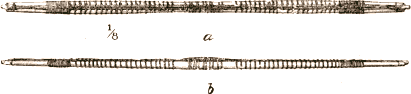
Fig. 177.—Boy’s bow from Utkiavwĭñ.
This seizing and the hitches already mentioned served to incorporate the backing very thoroughly with the bow, thus equalizing the strain and preventing the bow from cracking. This made a very stiff and powerful bow, capable of sending an arrow with great force. We were told by a reliable native that a stone-headed arrow was often driven by one of these bows wholly through a polar bear, “if there was no bone.” Three bows only were obtained: One from Nuwŭk, one from Utkiavwĭñ (a lad’s bow), and one from Sidaru.

Fig. 179.—Large bow from Nuwŭk.
The bow from Utkiavwĭñ, No. 89904 [786] (Fig. 177), though small, is in some respects nearer the type than the other two, and has been selected for description. The body of the bow is a single piece of the heart of a log of spruce driftwood 36¼ inches long, elliptical in section, flattened more on the back than on the belly. It is tapered to the nocks, which are small club-shaped knobs, and narrowed and thickened at the handle. The backing is of round three-ply braid of sinew in one continuous piece. The string is a round four-ply braid with a loop at each end, made by tying a single knot in the standing part, passing the end through this and taking a half hitch with it round the standing part (Fig. 178). The upper loop is a little the larger.

Fig. 178.—Loop at end of bowstring.
No. 89245 [25] (Fig. 179), from Nuwŭk, is a full-sized man’s bow, which is old and has been long in use. It is of the same material, and is 47.3 inches long. Its greatest breadth is 1⅓ inches, and it is 0.8 inch thick at the handle. It is slightly narrowed and thinned off from the broadest part to about 6 inches from each tip, and is then gradually thickened to the nocks and bent up so that the ends make an angle of about 45° with the bow when unstrung. The ends are separate pieces fitted on at the bends. The ends of the body are chamfered off laterally to a wedge which fits into a corresponding notch in the end piece, making a scarf 3¼ inches long, which is strengthened by a curved strap of antler, convex above and thickest in the middle, fitting into the bend on the back. The joint is held together wholly by the backing.
We never saw bows of this pattern made and consequently did not learn how the bending was accomplished. The method is probably the same as that seen by Capt. Beechey in 1826, at Kotzebue Sound (Voyage, p. 575). The bow was wrapped in wet shavings and held over the fire, and then pegged down on the ground (probably on one side), into shape. A strip of rawhide (the split skin of the bearded seal, with the grain side out), 1 inch wide, runs along the back from bend to bend under the backing. The chief peculiarity of this bow is the third cable, above the other two, and the great and apparently unnecessary complication of the hitches.
No. 72771 [234], from Sidaru (Fig. 180a and b), is a bow with bent ends like the last, but all in one piece and smaller. Its length is 43½ inches and its greatest breadth 1⅓. The backing has only two cables, and its chief peculiarity is in having the loose end of the last strand twisted into one of the cables, while the seizing, of the same pattern as in the last bow, is made of a separate piece. The workmanship of this bow is particularly neat, and it is further strengthened with strips of rawhide (the skin of the bearded seal, split), under the backing. The method of making the string is very ingenious. It appears to have been made on the bow, as follows: Having the bow sprung back one end of a long piece of sinew twine was made fast temporarily to the upper nock, leaving an end long enough to finish off the bowstring. The other end was carried round the lower nock and the returning strand half-hitched round the first snugly up to the nock, and then carried round the upper nock and back again. This was repeated, each strand being half-hitched round all the preceding at the lower nock until there were eight parallel strands, and an eye fitted snugly to the lower nock. The bight was then slipped off the upper nock, the end untied and the whole twisted tight. This twisted string is now about 2 inches too long, so the upper eye is made by doubling over 2 inches of the end and stopping it down with the free end mentioned above, thus making a long eye of seven strands. With the end, six similar strands are added to the eye, each being stopped to the twist with a half hitch. The end is neatly tucked in and the strands of the eye twisted tightly together.
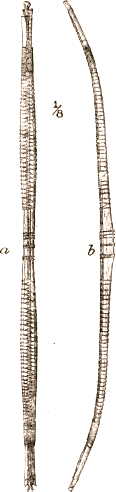
Fig. 180.—Large bow from Sidaru.
In my paper on Eskimo bows, already mentioned, I came to the conclusion that the bows formerly used by the Eskimo of western North America and the opposite coast of Asia were constructed upon three well defined types of definite geographical distribution, and each easily recognized as a development of a simple original type still to be found in Baffin Land in a slightly modified form. These three types are:
I. The Southern type, which was the only form used from the island of Kadiak to Cape Romanzoff, and continued in frequent use as far as Norton Sound, though separated by no hard and fast line from
II. The Arctic type, to which the bows just described belong, in use from the Kaviak peninsula to the Mackenzie and Anderson rivers; and
III. The Western type, confined to St. Lawrence Island and the mainland of Siberia.
I have shown how these three types differ from each other and from the original type, and have expressed the opinion that these differences result from the different resources at the command of the people of different regions. I have also endeavored to account for the fact that we find sporadic examples of the Arctic type, for instance as far south as the Yukon, by the well known habits of the Eskimo in regard to trading expeditions.
Outside of the region treated in my paper above referred to, there is very little material for a comparative study of Eskimo bows, either in the Museum or in the writings of travelers. Most writers have contented themselves with a casual reference to some of the more salient peculiarities of the weapon without giving any detailed information. Beginning at the extreme north of Greenland, we find that the so-called “Arctic Highlanders” have hardly any knowledge of the bow. Dr. Kane saw none during his intercourse with them, but Dr. Bessels295 mentions seeing one bow, made of pieces of antler spliced together, in the possession of a man at Ita. In Danish Greenland, the use of the bow has been abandoned for many years. When Crantz296 wrote it had already gone out of use, though in Egede’s297 time it was still employed. It appears to have been longer than the other Eskimo bows. Nordenskiöld298 reproduces a picture of a group of Greenlanders from an old painting of the date of 1654 in the Ethnographical Museum of Copenhagen. The man holds in his left hand a straight bow, which appears to have the backing reaching only part way to the ends like a western bow without the end cables, and yet twisted into two cables. If this representation be a correct one, this arrangement of the backing, taken in connection with what Crantz and Egede say of the great length of the bow, would be an argument in favor of my theory that the St. Lawrence Island bow was developed from the primitive form by lengthening the ends of the bow without lengthening the backing. The addition of the end cables would then be an after invention, peculiar to the western bow. In Baffin Land the bow is very rudely made, and approaches very closely to my supposed primitive form. Owing to the scarcity of wood in this region the bow was frequently made of reindeer antler, a substance still more unsuitable for the purpose than the soft coniferous woods used elsewhere. There are in the Museum three specimens of such antler bows, brought from Cumberland Gulf by Mr. Kumlien.
The first mention of the Eskimo bow with sinew backing will be found in Frobisher’s account of his visit to Meta Incognita in 1577:299 “Their bowes are of wood of a yard long, sinewed on the back with strong sinewes, not glued too, but fast girded and tyed on. Their bowe strings are likewise sinewes.”
Of the bow used at the straits of Fury and Hecla we have a most excellent figure in Parry’s Second Voyage (Pl. opposite p. 550, Fig. 22), and the most accurate description to be found in any author. It is, in fact, as exact a description as could be made from an external examination of the bow. From the figure the bow appears to have been almost of the arctic type, having an unusual number of strands (sometimes sixty, p. 511) which are not, however, twisted, but secured with a spiral wrapping, as on southern bows. The backing is stopped to the handle, but not otherwise seized. It appears to have been rather a large bow, as Parry gives the length of one of their best bows, made of a single piece of fir, as “4 feet 8 inches” (p. 510). “A bow of one piece is, however, very rare; they generally consist of from two to five pieces of bone of unequal lengths, fastened together by rivets and treenails” (p. 511). Parry also speaks of the use of wedges for tightening the backing. Schwatka300 speaks of the Netyĭlĭk of King Williams Land as using bows of spliced pieces of musk-ox horn or driftwood, but gives no further description of them. Ellis301 describes the bow in use at Hudson’s Strait in 1746 as follows:
Their greatest Ingenuity is shown in the Structure of their Bows, made commonly of three Pieces of Wood, each making a part of the same Arch, very nicely and exactly joined together. They are commonly of Fir or Larch, which the English there call Juniper, and as this wants Strength and Elasticity, they supply both by bracing the Back of the Bow with a kind of Thread or Line made of the Sinew of their Deer, and the Bowstring of the same material. To make them draw more stiffly, they dip them into Water, which causes both the Back of the Bow and the String to contract, and consequently gives it the greater force.302
Ellis’s figure (plate opposite p. 132) shows a bow of the Tatar shape, but gives no details of the backing, except that the latter appears to be twisted.
We have no published descriptions of the bows used in other regions.
As far as I have been able to ascertain, the practice of backing the bow with cords of sinew is peculiar to the Eskimo, though some American Indians stiffen the bow by gluing flat pieces of sinew upon the back.
One tribe of Indians, the “Loucheux” of the Mackenzie district, however, used bows like those of the Eskimos, but Sir Alexander Mackenzie303 expressly states that these were obtained from the Eskimo.
Arrows.—
With these bows were used arrows of various patterns adapted for different kinds of game. There are in the collection fifty-one arrows, which are all about the same length, 25 to 30 inches. In describing these arrows I shall employ the terms used in modern archery304 for the parts of the arrow. The greatest variation is in the shape and size of the pile. The stele is almost always a straight cylindrical rod, almost invariably 0.4 inch in diameter, and ranging in length from 20 to 28 inches. Twenty-five inches is the commonest length, and the short steles, when not intended for a boy’s bow, are generally fitted with an unusually long pile. From the beginning of the feathering the stele is gradually flattened above and below to the nock, which is a simple notch almost always 0.2 inch wide and of the same depth. The stele is sometimes slightly widened just in front of the nock to give a better hold for the fingers. The feathering is 6 or 7 inches long, consisting of two, or less often, three feathers. (The set of sixteen arrows from Sidaru, two from Nuwŭk, and one from Utkiavwĭñ, have three feathers. The rest of the fifty-one have two.) The shaft of the feather is split and the web is cut narrow, and tapered off to a point at each end (Fig. 181). The ends of the feathers are fastened to the stele with whippings of fine sinew, the small end of the feather which, of course, comes at the nock, being often wedged into a slit in the wood (with a special tool to be described below), or else doubled back over a few turns of the whipping and lashed down with the rest. The small end of the feather is almost always twisted about one turn, evidently to make the arrow revolve in flight, like a rifle ball. Generally, if not universally, the feathering was made of the feathers of some bird of prey, falcon, eagle, or raven, probably with some notion of giving to the arrow the death-dealing quality of the bird. Out of the fifty-one arrows in the collection, only nine are feathered with gull’s feathers, and of these all but two are new, or newly feathered for sale to us.305 Dr. Simpson306 says that in his time “feathers for arrows and head-dresses,” probably the eagles’ feathers previously mentioned, were obtained in trade from the “Nunatañmiun.”

Fig. 181.—Feathering of the Eskimo arrow.
Four kinds of arrows were used: the bear arrow, of which there were three varieties, the deer arrow, the arrow for geese, gulls, and other large fowl, and the blunt headed arrow for killing small birds without mangling them.
Bear arrows.—
These are of three kinds, all having a broad, sharp pile, often barbed. The first kind has a pile of flaked flint, called kūki (“claw” or “nail”), and was known as kukĭ´ksadlĭñ (“provided or fitted with claw material”). Of this kind we have eight complete arrows and one shaft.
No. 89240 [25], Fig. 182, will serve as the type. The pile is of black flint, double edged and sharp pointed, 2 inches long, with a short tang inserted into a cleft in the end of the stele, and secured by a whipping of about fifteen turns of fine sinew. The stele is of spruce, 25½ inches long and four-tenths inch in diameter, and painted with red ocher from the feathering to 5 inches from the pile. The three feathers, apparently those of the gyrfalcon, have their ends simply whipped to the stele. They are 6 inches long. This is one of the two arrows from Nuwŭk with three feathers.

Fig. 182.—Flint-headed arrow (kukĭksadlĭñ).
No. 72780 [234a], from Sidaru, is feathered with three raven feathers, of which the small ends are wedged into slits in the wood. The pile is of brown jasper, long and lancet-tipped, expanding into rounded wings at each side of the base. The stele is peculiar only in being slightly widened in front of the nock. It is of pine, 26.8 inches long, and painted with two rings, one red and one green, at the middle of the feathering.

Fig. 183.—Long flint pile.
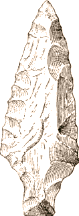
Fig. 184.—Short flint pile.
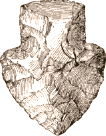
Fig. 185.—Heart-shaped flint pile.
The only variations of importance in these arrows are in the shape of the pile, which is made of black or gray flint, or less often of jasper, mostly variegated, brown and gray. There are four patterns to be found in the series of eight arrows and twenty-two stone piles. The first is long and narrow, like No. 56704 [232], Fig. 183, from Utkiavwĭñ, which is of gray flint. The next is similar in shape, but shorter, as shown in Fig. 182 (No. 89240 [25], from Nuwŭk), which is only 2 inches long, exclusive of the tang. The third pattern, which is less common than the others, is about the size of the last, but rhomboidal in shape (Fig. 184, No. 56691c [64c], from Utkiavwĭñ, of dark grayish brown flint, rather coarsely flaked). The fourth kind is very short, being not over 1½ inches, including the half-inch tang, but is 1 inch broad, thick and convex on both faces. It is triangular, with a square base and curved edges (Fig. 185, No. 56702b [113b], from Utkiavwĭñ, newly made for sale).
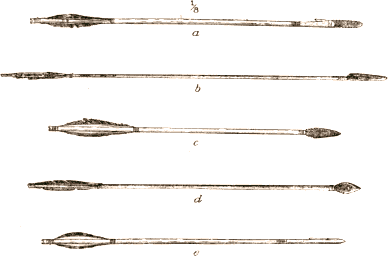
Fig. 186.—Arrows: (a) Arrow with “after-pile” (ipudlĭgadlĭñ); (b) arrow with iron pile (savidlĭñ); (c) arrow with iron pile (savidlĭñ); (d) arrow with copper pile (savidlĭñ); (e) deer-arrow (nûtkodlĭñ).
No stone arrow or dart heads made by these people have anything like barbs except the square shoulders at the base. They seem never to have attained to the skill in flint-working which enabled many other savages to make the beautiful barbed heads so often seen. To keep the flint-headed arrow from dropping out of the wound they hit upon the contrivance of mounting it not directly in the stele but in a piece of bone upon which barbs could be cut, or, as is not unlikely, having already the deer arrow with the barbed head of antler, they added the flint head to this, thus combining the penetration of the flint arrow with the holding power of the other. I was at first inclined to think that this piece of bone bore the same relation to the rest of the arrow as the fore shaft of many Indian arrows, and was to be considered as part of the stele. Considering, however, that its sole function is to furnish the pile with barbs, it evidently must be considered as part of the latter. I shall designate it as “after-pile.” Arrows with this barbed “after-pile” form the second kind of bear arrows, which are called ipudlĭ´gadlĭñ (“having the ipu´dlĭgɐ” [Gr. ipuligak, the similar bone head of a seal lance with iron tip]). After the introduction of iron, metal piles sometimes replaced the flint in arrows of this kind. We collected eight with flint and two with metal piles. No. 72787 [234a], Fig. 186a, has been selected to illustrate this form of arrow. This pile is of gray flint with the tang wedged by a slip of sealskin into the tip of the after-pile, which is cleft to receive it and kept from splitting by a whipping of sinew. The after-pile is fitted into the tip of the stele with a rounded sharp-pointed tang, slightly enlarged just above the tip. It is of reindeer antler. The rest of the arrow does not differ from those previously described. The stele is of pine and is feathered with three gyrfalcon feathers.
Two others from Sidaru have only a single barb on the after-pile, but the other four have two, one behind the other on the same side. No. 89237 [164], from Utkiavwĭñ, differs in no respect from the single-barbed flint arrows from Sidaru, but No. 72763 [164], from the same village, has four small barbs on the after-pile, which is unusually (nearly 7 inches) long, and a pile of sheet brass. This has the basal angles on each side cut into three small, sharp, backward-pointing teeth. The total length of this arrow is 28 inches.
The after-piles of all arrows except one were of reindeer antler, which is another reason for supposing that this form of arrow is a modification of the deer arrow. After the introduction of iron, this metal or copper was substituted for the flint pile of the kukĭ´ksadlĭñ, making the third and last form of bear arrow, the sa´vĭdlĭñ (“fitted with iron”). This arrow differs from the others only in the form of the pile, which is generally broad and flat, and either rhomboidal, with the base cut into numerous small teeth, or else triangular, with a shank. The barbs are usually bilateral.
No. 72758 [25], from Nuwŭk, represents the first form. The pile is of iron, rough and flat, 2½ inches long. No. 72770 [241b], from Utkiavwĭñ, is of the same form. No. 72760 [165], Fig. 186c, from Utkiavwĭñ, has a similar pile 3.3 inches long, but has each of the under edges cut into four sharp, backward-pointing teeth. No. 72778 [234b], Fig. 186d, has a pile of sheet copper 2.3 inches long, of the same shape, but with six teeth. This arrow came from Sidaru. No. 72765 [25], from Nuwŭk, is a long, narrow iron pile with three bilateral barbs, all simple.
Nos. 72755 [25], from Nuwŭk, 72759 [25], also from Nuwŭk, and 72764 [165], from Utkiavwĭñ, show the shanked form. The first is triangular, with a flat shank and a simple barb at each angle of the base. It is of steel (piece of a saw) and 2.8 inches long. The second resembles No. 72760 [165], with more teeth, mounted on a slender cylindrical shank 1½ inches long. It is of iron and 3.9 inches long. The third is a long pile with a sinuate outline and one pair of simple bilateral barbs, and a flat shank one-half inch long. Nos. 72757 [25] (Fig. 186b) and 72762 [25], both from Nuwŭk, are peculiar in being the only iron-pointed arrows with unilateral barbs. The piles are made of the two blades of a pair of large scissors, cut off at the point, with enough of the handle left to make a tang. The unilateral barb is filed out on the back of the blade, which has been beveled down on both faces to a sharp edge. All of these broadheaded arrows have the breadth of the pile at right angles to the plane of the nock, showing that they are not meant to fly like the Sioux war arrows. Although iron makes a better material for arrow piles and is more easily worked than flint, the quivers which some men still carry at Point Barrow contain flint as well as iron headed arrows. They are probably kept in use from the superstitious conservatism already mentioned. It is certain that the man who raised a couple of wolf cubs for the sake of their fur was obliged by tradition to have a flint-headed arrow to kill them with. These arrows, we were informed, were especially designed for hunting “nä´nu,” the polar bear, but of course they also served for use against other dangerous game, like the wolf and brown bear, and there is no reason to believe that they were not also shot at reindeer, though the hunter would naturally use his deer arrows first.

Fig. 187.—Pile of deer arrow (nûtkăñ).
Deer arrows have a long trihedral pile of antler from 4 to 8 inches long, with a sharp thin-edged point slightly concaved on the faces like the point of a bayonet. Two of the edges are rounded, but the third is sharp and cut into one or more simple barbs. Behind the barb the pile takes the form of a rounded shank, ending in a shoulder and a sharp rounded tang a little enlarged above the point.
No. 72768 [162], Fig. 186e from Utkiavwĭñ, has a pile 3½ inches long with two barbs. The pile of No. 89238 [162] from the same village is 3½ inches long and has but one barb, while that of No. 89241a [162] is 7.8 inches long and has three barbs. The rudely incised figure on the shank of No. 89238 [162] represents a wolf, probably a talisman to make the arrow as fatal to the deer as the wolf is. No. 56588 [13], Fig. 187, is a pile for one of these arrows slightly peculiar in shape, being elliptical in section, with one edge sharp and two-barbed and a four-sided point. The figure shows well the shape of the tang. The peculiarity of these arrows is that the pile is not fastened to the shaft, but can easily be detached.307 When such an arrow was shot into a deer the shaft would easily be shaken out, leaving the sharp barbed pile in the wound.

Fig. 188.—Kûñmûdlĭñ arrow pile.
The Eskimo told us that a deer wounded in this way would “sleep once and die,” meaning, apparently, that death would ensue in about twenty-four hours, probably from peritonitis. The bone pile is called nû´tkăñ, whence comes the name of the arrow, nû´tko´dlĭñ. We collected ten arrows and three piles of this pattern. No. 89460 [1263], Fig. 188, is a peculiar bone arrow pile, perhaps intended for a deer arrow. It is 7 inches long and made of one of the long bones of some large bird, split lengthwise so that it is rounded on one side and deeply concave on the other, with two thin rounded edges tapered to a sharp point. Each edge has three little barbs about the middle of the pile. This was the only arrowhead of the kind seen at Point Barrow, and the native who sold it said it was a “Kûñmûd´lĭñ” arrow. I was pleased to find the truth of this corroborated by the Museum collection. There are two arrows from the Mackenzie region (Nos. 1106 and 1906) with bone piles of almost the same form.
For shooting gulls, geese, and other large fowl they used an arrow with a straight polygonal pile of walrus ivory, 5 or 6 inches long and about one-half inch in diameter, terminating in a somewhat obtuse polygonal point, and having one or more unilateral barbs. These piles are generally five-sided, though sometimes trihedral, and have a long, rounded tang inserted into the end of the shaft. Fig. 189a (No. 89349 [119] from Utkiavwĭñ), represents one of these arrows with a five-sided pile 5.5 inches long, with four simple barbs. The rest of the arrow does not differ from the others described. No. 89238 [25], from Nuwŭk, has a trihedral pile 6.6 inches long, with a single barb. Another from Nuwŭk (No. 89241 [25]) has a trihedral pile 5.3 inches long, with two barbs, and one from Utkiavwĭñ (No. 89241 [119]) has a five-sided pile with three barbs. The remaining three, from Sidaru, all have five-sided piles with one barb.
Arrows of this pattern are called tuga´lĭñ (from tu´ga, walrus ivory). There are also in the collection two small arrows of this pattern suited for a boy’s bow. They are only 25 inches long, and have roughly trihedral sharp-pointed ivory piles about 4 inches long, without barbs. (No. 89904a [786] from Utkiavwĭñ). These arrows are new and rather carelessly made, and were intended for the lad’s bow (No. 89904 [786]) already described. The three kinds of arrows which have been described all have the pile secured to the stele by a tang fitting into a cleft or hole in the end of the latter, which is kept from splitting by whipping it with sinew for about one-half inch.
The fourth kind, the blunt bird arrow (kĭ´xodwain), on the other hand, has the pile cleft to receive the wedge-shaped tip of the stele and secured by a whipping of sinew. The four arrows of this kind in the collection are almost exactly alike, except that three of them, belonging to the set from Sidaru, have three feathers. Fig. 189b, No. 72773 [234c] from Sidaru represents the form of arrow. The pile is of hard bone 2.3 inches long. A little rim at each side of the butt keeps the whipping of sinew from slipping off. The rest of the arrow differs from the others described only in having the end of the stele chamfered down to a wedge-shaped point to fit into the pile.

Fig. 189.—Arrows: (a) fowl arrow (tugalĭñ); (b) bird arrow (kixodwain).
This is the kind of arrow mostly used by the boys, whose game is almost exclusively small birds or lemmings. Nowadays the bone pile is often replaced by an empty cartridge shell, which makes a very good head. I have seen a phalarope transfixed at short range by one of these cartridge-headed arrows. An assortment of the different kind of arrows is usually carried in the quiver. The lot numbered 25, from Nuwŭk, which I believe to be a fairly average set, contains two flint-headed bear arrows, one barbed bear arrow with a steel pile, six bear arrows with iron piles, one deer arrow, two fowl arrows, and one bird arrow.
As I have already said, all these arrows are flattened above and below at the nocks. This indicates that they were intended to be held to the string and let go after the manner of what is called the “Saxon release,” namely, by hooking the ends of the index and second fingers round the string and holding the arrow between them, the string being released by straightening the fingers. This is the “release” which we actually saw employed both by the boys and one or two men who showed us how to draw the bow. This method of release has been observed at Cumberland Gulf308 and at East Cape, Siberia, and is probably universal among the Eskimo, as all the Eskimo arrows in the National Museum are fitted for this release. There is ample material in the Museum collections for a comparative study of Eskimo arrows, which I hope some day to be able to undertake, when the material is in a more available condition. One or two references to other regions will not, however, be out of place. The arrow with a barbed bone after-pile seems a very general form, being represented in the Museum from most of the Alaskan regions, as well as from the Mackenzie. Scoresby mentions finding the head of one of these at the ancient settlements in east Greenland.309 The arrow, however, described by Capt. Parry310 has a real foreshaft of bone, not a barbed after pile. One of these arrows from the Mackenzie has the after pile barbed on both sides, the only instance, I believe, in the Museum of a bilaterally-barbed Eskimo arrow where the pile is not wholly of metal.
Bow cases and quivers.—
The bow and arrows were carried in a bow case and quiver of black sealskin, tied together side by side and slung across the back in the same manner as the gun holster already described. We obtained one case and quiver which belong with the bow and arrows (No. 25, from Nuwŭk) and a single quiver with the bow and arrows (No. 234, from Sidaru.) The case, No. 89245 [25], Fig. 190a (pizĭ´ksĭzax), is of such a shape that the bow can be carried in it strung and ready for use. It is made by folding lengthwise a piece of black sealskin with the flesh side in and sewing up one side “over and over” from the outside. The bag is wide enough—6 inches at the widest part—to allow the bow to slip in easily when strung, and the small end is bent up into the shape of the end of the bow. Along the folded edge are three round holes about 10 inches apart, through which a round stick was formerly thrust, coming out from the inside through the first hole, in through the second and out through the third again. This served to hold the case in shape when the bow was withdrawn, and to its ends were fastened the thong for slinging it across the shoulders. It was gone from the specimen before we obtained it.
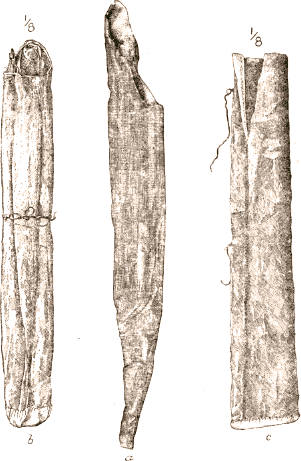
Fig. 190.—Bow case and quivers.
The quiver (No. 89240-1 [25], Fig. 190b) is a long, straight bag of the same material, open at one end, with a seam down one side, and the edge of the mouth opposite to the seam forming a rounded flap 2 inches long. The other end is closed by an elliptical cap of white tanned seal skin, turned up about 2 inches all round, and crimped round the ends like a boot sole. Its extreme length is 30 inches, and its circumference 1 foot. Inside along the seam is a roughly rounded rod of wood about ½ inch in diameter, with one end, which is pointed, projecting about 1½ inches through a hole in the bottom, and the other projecting about 1 inch beyond the mouth, where it is secured by a bit of thong knotted through a couple of small holes in the bag close to the edge and passing round a notch on the stick. The stick serves to stiffen the quiver when there are no arrows in it. A bit of thong is knotted round the middle, one end being hitched into a loop on the other, for tightening up the quiver and confining the arrows.

Fig. 191.—Quiver rod.
The quiver from Sidaru (No. 72788 [234] Fig. 190c) is like the preceding, but larger at the bottom than at the mouth. The latter is 8½ inches in circumference and the former 12¾, and the seam is left open for about 7½ inches from the mouth to facilitate getting at the arrows. The stiffening rod is made of pine, and does not project through the bottom or reach the edge of the mouth. It is held in by two pieces of thong about 10 inches long, which also serve to fasten it to the bow case. This quiver is nearly new.
It is probable that the form of the bow case and quiver varied but little, among the American Eskimo at least. Those figured by Capt. Lyon311 are almost exactly like the ones we collected at Point Barrow, even to the crimped cap on the bottom of the quiver. A similar set belong with a lad’s bow in the Museum from Point Hope (No. 63611). Nordenskiöld, however, figures a very elaborate flat quiver312, in use at Pitlekaj, which is evidently of genuine Asiatic origin.
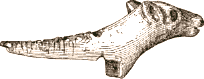
Fig. 192.—Cap for quiver rod.
Some pains seem to have been bestowed on ornamenting the quiver in former times, when the bow was in more general use. Fig. 191, No. 56505 [231], from Nuwŭk, represents what we understood had been a stiffening rod for a quiver or bow case. It is of reindeer antler, 17 inches long, and one end is very neatly carved into the head and shoulders of a reindeer, with small, blue glass beads inserted for the eyes. The lanceolate point at the tip was probably made with an idea of improving it for sale. The hole at the back of the neck is for a thong to fasten it on with. A similar reindeer head of antler, Fig. 192, No. 89449 [1066], also from Nuwŭk, seems to have been a cap for a quiver stick. The back of the neck makes a half-ferrule, in which are three holes for rivets or treenails.
Bracers.—
In shooting the bow, the wrist of the bow hand was protected from being chafed by the bowstring by a small shield or “bracer” of bone or horn, strapped on with a thong. We never saw these in use, as the bow is so seldom employed except by the children. Two of these, newly made, were offered for sale. I will describe one of these, No. 89410b [1233], Fig. 193.
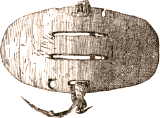
Fig. 193.—Bracer.
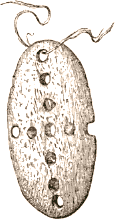
Fig. 194.—Bracer of bone.
It is of pale yellow mountain sheep horn, convex on the outer face and concave on the inner and considerably arched lengthwise. In the middle are two straight longitudinal narrow slots, which serve no apparent purpose except ornament. The short slot near the edge at the middle of each side, however, is for the thongs which strap the bracer to the wrist. One of these is short and made into a becket by fastening the ends together with double slits. One end of the other is passed through the slot, slit, and the other end passed through this and drawn taut. A knot is tied on the free end. This thong is just long enough to fasten on the bracer by passing round the wrist and catching the knot in the loop opposite. The other, No. 89410a [1233], is like this, but 1 inch shorter and nearly flat. The arch of the specimen figured is probably unintentional and due to the natural shape of the material, as it does not fit well to the wrist. It is probable that these people used a flat bracer, as Fig. 194, No. 89350 [1382], from Utkiavwĭñ, is apparently such an implement. It is a thin elliptical plate of hard bone, 2½ inches long and 1½ wide, with two rows of holes crossing at right angles in the middle. The holes at the side were probably for the thong and the others for ornament, as some of them go only part way through. Four small pebbles are lodged in the four holes around the center in the form of a cross.
Mr. Nelson collected several specimens of bracers from Kotzebue Sound and St. Lawrence Island. These are all slightly larger than our specimens, and bent round to fit the wrist. They are of bone or copper. When Beechey visited Kotzebue Sound, in 1826, he found the bracer in general use.313 I find no other mention of this implement in the writers who have described the Eskimo.
Bird darts.—
For capturing large birds like ducks or geese, sitting on the water, especially when they have molted their wing feathers so as to be unable to escape by flight, they use the universal Eskimo weapon, found from Greenland to Siberia, namely, a dart with one or more points at the tip, but carrying a second set of three ivory prongs in a circle round the middle of the shaft. The object of these prongs is to increase the chance of hitting the bird if he is missed by the head of the dart. They always curve forward, so that the points stand out a few inches from the shaft, and are barbed on the inner edge in such a way that, though the neck of a fowl will easily pass in between the prong and the shaft, it is impossible to draw it back again. The weapon is in very general use at Point Barrow, and is always thrown from the boat with a handboard (to be described below). It can be darted with considerable accuracy 20 or 30 yards. We seldom saw this spear used, as it is chiefly employed in catching molting fowl, in the summer season, away from the immediate neighborhood of the station. It is called nuiă´kpai, which is a plural referring to the number of points, one of which is called nuiă´kpûk (“the great nuiăk”).314

Fig. 195.—Bird dart.
No. 89244 [1325], Fig. 195, from Utkiavwĭñ, has been selected as the type of this weapon. The shaft is of spruce, 61⅓ inches long and 0.7 inch in diameter at the head. The end of the butt is hollowed out to fit the catch of the throwing board. The head, of white walrus ivory, is fitted into the cleft end of the shaft with a wedge-shaped tang as broad as the shaft. The head and shaft are held together by a spaced lashing of braided sinew. To the enlargement of the shaft, 22 inches from the butt, are fastened three curved prongs of walrus ivory at equal distances from each other round the shaft. The inner side of each prong is cut away obliquely for about 2 inches, so that when this edge is applied to the shaft, with the point of the prong forward, the latter is about 1 inch from the shaft. Each prong has two little ridges on the outside, one at the lower end and the other about 1 inch above this. They are secured to the shaft by three separate lashings of sinew braid, two narrow ones above the ridges just mentioned and one broad one just below the barb. In making this the line is knotted round one prong, then carried one-third of the distance round the shaft to the prong; half hitched round this, and carried round next the next prong; half hitched round this, and carried round to the starting point, and half hitched round this. It goes around in this way seven times, and then is carried one prong farther, half hitched again, and the end taken down and made fast to the first narrow lashing. The shaft is painted with red ocher to within 13½ inches (the length of the throwing board) from the butt. This is an old shaft and head fitted with new prongs, and was made by Nĭkawa´alu, who was anxious to borrow it again when getting ready to start on his summer trip to the east, where he would find young ducks and molting fowl.

Fig. 196.—Point for bird dart.

Fig. 197.—Ancient point for bird dart.

Fig. 198.—Point for bird dart.

Fig. 199.—Bird dart with double point.
The form of head seen in this dart appears to be the commonest. It is called by the same name, nû´tkăñ, as the bone head of the deer arrow. There is considerable variation in the number of barbs, which are always bilateral, except in one instance, No. 56590 [122], Fig. 196, from Utkiavwĭñ, which has four barbs on one side only. It is 7¼ inches long exclusive of the tang. Out of eight specimens of such heads one has one pair of barbs, one two pairs, two three pairs, one four unilateral barbs, one five pairs, one six pairs, and one seven pairs. The total length of these heads is from 9 inches to 1 foot, of which the tang makes about 2 inches, and they are generally made of walrus ivory, wherein they differ from the nugfit of the Greenlanders, which, since Crantz’s time315 has always had a head of iron. Iron is also used at Cumberland Gulf, as shown by the specimens in the National Museum. Fig. 197 represents a very ancient spearhead from Utkiavwĭñ, No. 89372 [760]. It is of compact whale’s bone, darkened with age and impregnated with oil. It is 8.7 inches long and the other end is beveled off into a wedge-shaped tang roughened with crosscuts on both faces, with a small hole for the end of a lashing as on the head of No. 89244 [1325]. This was called by the native who sold it the head of a seal spear, ă´kqlĭgûk, and it does bear some slight resemblance to the head of weapon used in Greenland and called by a similar name316 (agdligaḵ). The roughened tang, however, indicates that it was intended to be fixed permanently in the shaft, and this, taken in connection with its strong resemblance to the one-barbed head of the Greenland nugfit317 as well as to the head of the Siberian bird dart figured by Nordenskiöld318, makes it probable that it is really the form of bird dart head anciently used at Point Barrow. It is possible that this pattern has been so long out of use that the natives have forgotten what this old point was made for and supposed it to belong to a seal spear.
One of the eight heads of the ordinary pattern in the collection, No. 56592 [284], a genuine one, old and dirty, is made of coarse-grained whale’s bone, an unusual material. No. 89373 [948], from Utkiavwĭñ, an ivory head of a good typical shape, has been figured (Fig. 198) to show a common style of ornamenting these heads. A narrow incised line, colored with red ocher, runs along the base of the barbs on each side for about three-fourths the length of the blade. These heads are sometimes secured by treenails as well as by a simple lashing, as is shown by the holes through the tang of this specimen.
An improvement on this style of dart, which appears to be less common, has two prongs at the tip instead of a sharp head, so that the bird may be caught if struck on the neck with the point of the spear. No. 89905 [1326], Fig. 199, from Utkiavwĭñ, is one of this pattern. The two prongs are fastened on with a lashing of fine sinew braid. The rest of the dart does not differ from the one described except in the method of attaching the three prongs at the middle (Fig. 199b). These are fitted into slight grooves in the wood and secured by two neat lashings of narrow strips of whalebone, one just above a little ridge at the lower end of each prong and one through little holes in each prong at the top of the oblique edge. Each lashing consists of several turns with the end closely wrapped around them. There is one specimen, No. 89242 [526], in the collection which not only has not the prongs at the middle, but lacks the enlargement of the shaft to receive them. The head is undoubtedly old and genuine, but the shaft and fittings, though dirty, look suspiciously fresh. I am inclined to believe that this head was mounted for sale by a man who had no prongs ready made, and was in too much of a hurry to get his price to stop to make them. Imperfect or unfinished objects were frequently offered for sale.
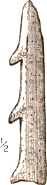
Fig. 200.—Ancient ivory dart head.
The bird darts used at Point Barrow, and by the western Eskimo generally, are lighter and better finished than those used in the east. The latter have a heavy shaft, which is four-sided in Baffin Land, and the prongs are crooked and clumsy.319
Fig. 200, No. 89380 [793], is a fragment of a very ancient narwhal ivory spearhead, dark brown from age and shiny from much handling, which appears to have been worn as an amulet. It was said to have come from the east and to belong to a bird dart, though it does not resemble any in use at the present day in this region. It is a slender four-sided rod, having on one side three short oblique equidistant simple barbs. The resemblance of this specimen to the bone dart heads from Scania figured by Dr. Rau320 is very striking.
Seal darts.—
The Eskimo of nearly all localities use a dart or small harpoon to capture the smaller marine animals, with a loose, barbed head of bone fitted into a socket in the end of the shaft, to which it is attached by a line of greater or less length. It is always contrived so that when the head is struck into the quarry, the shaft is detached from the head and acts as a drag upon the animal. This is effected by attaching an inflated bladder to the shaft, or else by attaching the line with a martingale so that the shaft is dragged sideways through the water. Nearly all Eskimo except those of Point Barrow, as shown in the National Museum collections and the figures in Crantz321 and Rink322, use weapons of this kind of considerable size, adapted not only to the capture of the small seals (Phoca vitulina and P. fœtida), but also to the pursuit of the larger seals, the narwhal and beluga. At Point Barrow, however, at the present day, they employ only a small form of this dart, not over 5 feet long, with a little head, adapted only for holding the smallest seals. That they formerly used the larger weapon is shown by our finding a single specimen of the head of such a spear, No. 89374 [1281] Fig. 201. It is of hard, compact bone, impregnated with oil, 8.1 inches long. The flat shank is evidently intended to fit into a socket. The two holes through the widest part of the shank are for attaching the line.

Fig. 201.—Bone dart head.
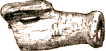
Fig. 202.—Nozzle for bladder float.
This is very like the head of the weapon called agligak (modern Greenlandic agdligak), figured by Crantz, and referred to above, except that the barbs are opposite each other. Mr. Lucien M. Turner tells me that it is precisely like the head of the dart used at Norton Sound for capturing the beluga. The native who sold this specimen called it “nuiă´kpai nû´tkoa,” “the point of a bird dart,” to which it does bear some resemblance, though the shape of the butt and the line holes indicate plainly that it was a detachable dart head. Probably, as in the case of the ancient bird dart point, No. 89372 [760], referred to above, this weapon has been so long disused that the natives have forgotten what it was. The name ă´kqlĭgûk, evidently the same as the Greenlandic agdligak, is still in use, but was always applied to the old bone harpoon heads, which are, however, of the toggle-head pattern (described below). It seems as if the Point Barrow natives had forgotten all about the ă´kqlĭgûk except that it was a harpoon with a bone head for taking seals. At the present time the small bladder float, permanently attached to the shaft of the harpoon, is never used at Point Barrow. That it was used in ancient times is shown by our finding in one of the ruined houses in Utkiavwĭñ a very old broken nozzle for inflating one of these floats. Fig. 202, No. 89720 [756], is this specimen, which was picked up by Capt. Herendeen. This is a rounded tube of fossil ivory, 1.3 inches long and about one-half inch in diameter, slightly contracted toward one end and then expanded into a stout collar. At the other is a stout longitudinal flange, three-fourths inch long, perforated with an oblong slot. Between the flange and the collar the surface is roughened with crosscuts, and the other end is still choked with the remains of a wooden plug. This nozzle was inserted into a hole in the bladder as far as the flange and secured by tying the bladder above the collar. The whole was then secured to the shaft by a lashing through the slot, and could be inflated at pleasure and corked up with the wooden plug.
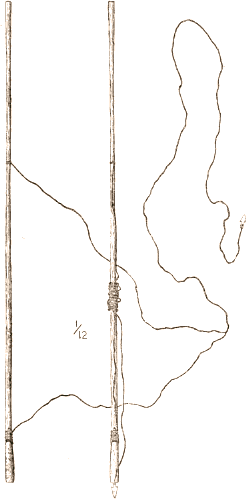
Fig. 203.—Seal dart.
As I have already said, the only harpoon of this kind now used at Point Barrow is a small one intended only for the capture of small seals. It has no bladder, but the rather long line is attached to the shaft by a martingale which makes the shaft drag sideways through the water. Three of these little darts, which are thrown with a handboard like the bird dart, make a set. The resistance of the shafts of these three spears darted into the seal in succession is said to be sufficient to fatigue the seal so that he can be easily approached and dispatched. We never saw these weapons used, though they are very common, as they are intended only for use from the kaiak, which these people seldom use in the neighborhood of the villages. When in the umiak, shooting with the rifle is a more expeditious means of taking seals. We collected three sets of these darts (kúkigû).
No. 89249b [523], Fig. 203, has been selected for description. The shaft is of spruce, 54½ inches long, and 0.8 inch in diameter at the tip, tapering slightly almost to the butt, which is hollowed on the end to fit the catch of the throwing board. The foreshaft is of white walrus ivory 5 inches long, and is fitted into the tip of the shaft with a wedge-shaped tang. This foreshaft, which has a deep oblong slot to receive the head in the middle of its flat tip, serves the double purpose of making a strong solid socket for the head and giving sufficient weight to the end of the dart to make it fly straight. The head is a simple flat barbed arrowhead of hard bone 2.3 inches long and one-half inch broad across the barbs, with a flat tang, broadest in the middle, where there is a hole for attaching the line. This head simply serves to attach the drag of the shaft to the seal as it is too small to inflict a serious wound. It is fastened to the shaft by a martingale made as follows: One end of a stout line of sinew braid 5½ feet long is passed through the hole in the head and secured by tying a knot in the end. The other end of this line divides into two parts not quite so stout, one 3 feet long, the other 2 feet 8 inches. The latter is fastened to the shaft 18½ inches from the butt by a single marling hitch with the end wedged into a slit in the wood and seized down with fine sinew. The longer part serves to fasten the foreshaft to the shaft, and was probably put on separately and worked into the braiding of the rest of the line at the junction. The foreshaft is kept from slipping out by a little transverse ridge on each side of the tang. When the weapon is mounted for use the two parts of the bridle are brought together at the middle of the shaft and wrapped spirally around it till only enough line is left to permit the head to be inserted in the socket, and the bight of the line is secured by tucking it under the last turn. When a seal is struck with this dart his sudden plunge to escape unships the head. The catch of the martingale immediately slips; the latter unrolls and drags the shaft through the water at right angles to the line. The shaft, besides acting as a drag on the seal’s motions, also serves as a float to indicate his position to the hunter, as its buoyancy brings it to the surface before the seal when the latter rises for air.
The shaft is usually painted red except so much of the end as lies in the groove of the throwing-board, in the act of darting. These darts vary but little in size and material, and are all of essentially the same pattern. They are always about 5 feet in length when mounted for use. (The longest is 64⅓ inches, and the shortest 57.) The head, as well as the foreshaft, is sometimes made of walrus ivory, and the latter sometimes of whale’s bone. The chief variation is in the length of the martingale, and the details of the method of attaching it. No two are precisely alike. The foreshaft is generally plain, but is occasionally highly ornamented, as is shown in Fig. 204, No. 56516 [105]. The figures are all incised and colored, some with ocher and some with soot.

Fig. 204.—Foreshaft of seal dart.
Both of the kinds of darts above described are thrown by means of a hand board or throwing-board. This is a flat, narrow board, from 15 to 18 inches long, with a handle at one end and a groove along the upper surface in which the spear lies with the butt resting against a catch at the other end. The dart is propelled by a quick motion of the wrist, as in casting with a fly-rod, which swings up the tip of the board and launches the dart forward. This contrivance, which practically makes of the hand a lever 18 inches long, enables the thrower by a slight motion of the wrist to impart great velocity to the dart. The use of this implement is universal among the Eskimo, though not peculiar to them. The Greenlanders, however, not only use it for the two kinds of darts already mentioned, but have adapted it to the large harpoon.323 This is undoubtedly to adapt the large harpoon for use from the kaiak, which the Greenlanders use more habitually than most other Eskimo. On the other hand, the people of Baffin Land and the adjoining regions, as well as the inhabitants of northeastern Siberia, use it only with the bird dart.324 Throughout western North America the throwing-board is used essentially as at Point Barrow. Prof. O. T. Mason has given325 an interesting account of the different forms of throwing-board used by the Eskimo and Aleuts of North America.
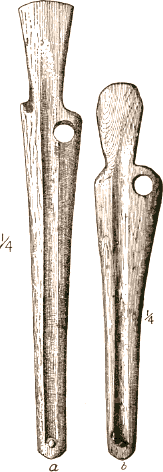
Fig. 205.—Throwing board for darts.
We obtained five specimens of the form used at Point Barrow. No. 89233 [523], Fig. 205a, belonging to the set of seal darts bearing the same collector’s number, has been selected as the type. This is made of spruce, and the hole is for the forefinger. A little peg of walrus ivory, shaped like a flat-headed nail, is driven through the middle of the tip so that the edge of the head just projects into the groove. This fits into the hollow in the butt of the dart and serves to steady it. It is painted red on the back and sides. Fig. 205b, No. 89235 [60], differs from this in having a double curve instead of being flat. A slight advantage is gained by this as in a crooked lever. The catch is a small iron nail. The others are essentially the same as the type. No. 89234 [528], has a small brass screw for the catch, and No. 89902 [1326], has an ivory peg of a slightly different shape, the head having only a projecting point on one side. They are generally painted with red ocher except on the inside of the groove. There appears to be no difference between throwing-boards meant for seal darts and those used with the bird dart.
Unfortunately I had no opportunity of observing accurately how the handle was grasped, but it is probably held as seen by Beechey at Eschscholtz Bay,326 namely, with the forefinger in the hole, the thumb and middle finger clasped round the spear, and the third and little fingers clasping the handle under the spear. This seems a very natural way of holding it. Of course, the fingers release the spear at the moment of casting. All the throwing-boards from Point Barrow are right-handed.
Harpoons.—
All kinds of marine animals, including the smaller seals, which are also captured with the darts just described and with nets, are pursued with harpoons of the same general type, but of different patterns for the different animals. They may be divided into two classes—those intended for throwing, which come under the head of projectile weapons, and those which do not leave the hand, but are thrust into the animal. These fall properly under the head of thrusting weapons. Both classes agree in having the head only attached permanently to the line, fitted loosely to the end of the shaft, and arranged so that when struck into the animal it is detached from the shaft, and turns under the skin at right angles to the line, like a toggle, so that it is almost impossible for it to draw out.
No. 89793 [873], Fig. 206, is a typical toggle head of this kind, intended for a walrus harpoon (túkɐ), and will be described in full, as the names of the different parts will apply to all heads of this class. The body is a conoidal piece, 4½ inches in length, and flattened laterally so that at the widest part it is 1 inch wide and 0.7 thick. On one side, which may be called the lower, it is cut off straight for about half the longer diameter, while the upper side is produced into a long, four-sided spur, the barb. The line hole is a round hole about one-fourth inch in diameter, a little back of the middle of the body, at right angles to its longer diameter. From this, on each side, run shallow line grooves to the base of the body, gradually deepening as they run into the line hole. In the middle of the base of the body is the deep, cup-shaped shaft-socket, which fits the conical tip of the shaft or fore shaft. In the tip of the body is cut, at right angles to the longer diameter of the body, and therefore at right angles to the plane of the barb, the narrow blade slit, 1.1 inches deep, into which fits, secured by a single median rivet of whalebone, the flat, thin blade of metal (brass in this case). This is triangular, with curved edges, narrowly beveled on both faces, and is 1.9 inches long and 1 broad.
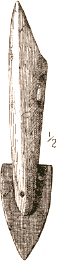
Fig. 206.—Harpoon head.
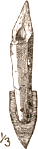
Fig. 207.—Harpoon head.
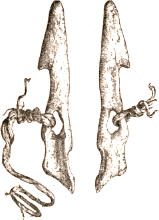
Fig. 208.—Ancient bone harpoon head.
The body is sometimes cut into faces so as to be hexagonal instead of elliptical in section as in Fig. 207 (No. 89791 [873]), and intermediate forms are common. When such a head is mounted for use a bight of the line or leader, a short line for connecting the head with the main line, runs through the line hole so that the head is slung in a loop in the end of the line. The tip of the shaft is then fitted into the shaft socket and the line brought down the shaft with the parts of the loop on each side resting in the line grooves and is made fast, usually so that a slight pull will detach it from the shaft. When the animal is struck the blade cuts a wound large enough to allow the head to pass in beyond the barb. The struggles of the animal make the head slip off the tip of the shaft and the strain on the line immediately toggles it across the wound. The toggle head of the whale harpoon is called kia¢ron, of the walrus harpoon, tukɐ, and of the seal harpoon, naulɐ. They are all of essentially the same pattern, differing chiefly in size.
There is in the collection an interesting series of old harpoon heads, showing a number of steps in the development of the modern pattern of harpoon head from an ancient form. These heads seem to have been preserved as amulets; in fact one of them is still attached to a belt. They are not all of the same kind, but since the different kinds as mentioned above practically differ only in size, their development was probably the same. The earliest form in the collection is No. 89382 [1383], Fig. 208, from Nuwŭk, which is evidently very old, as it is much worn and weathered. It is a single flat piece of fine-grained bone 3 inches long, pointed at the end and provided with a single unilateral barb. Behind this it is narrowed and then widened into a broad flat base produced on one side into a sharp barb, in the same plane as the other barb, which represents the blade, but on the opposite side. The line hole is large and irregularly triangular, and there are no line grooves. Instead of a shaft socket bored in the solid body, one side of the body is excavated into a deep longitudinal groove, which was evidently converted into a socket by a transverse band, probably of sealskin, running round the body, and kept in place by a shallow transverse groove on the convex side of it. A harpoon head with the socket made by inclosing a groove with thongs was seen by Dr. Kane at Smith Sound.327
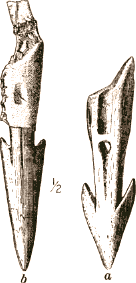
Fig. 209.—Harpoon heads: (a) ancient bone harpoon head: (b) variant of the type.
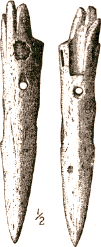
Fig. 210.—Bone harpoon head.
The next form, No. 89331 [932], Fig. 209a, has two bilateral barbs to the blade part, thus increasing its holding power. Instead of an open transverse groove to hold the thong, it has two slots parallel to the socket groove running obliquely to the other side, where they open into a shallow depression. Figs. 209b and 210, Nos. 89544 [1419] and 89377 [766], are variants of this form, probably intended for the larger seal, as the blade part is very long in proportion. No. 89544 [1419] is interesting from its close resemblance to the spear head figured by Nordenskiöld328 from the ancient “Onkilon” house at North Cape. No. 89377 [766] is a peculiar form, which was perhaps not general, as it has left no descendants among the modern harpoon. Instead of the bilateral blade barbs it has an irregular slot on each side, which evidently served to hold a blade of stone, and the single barb of the body is replaced by a cluster of four, which are neither in the plane of the blade nor at right angles to it, but between the two. No modern harpoon heads from Point Barrow have more than two barbs on the body. The next improvement was to bore the shaft socket instead of making it by inclosing a groove with thongs. This is shown in Fig. 211 (No. 89379 [795], from Utkiavwĭñ), which is just like No. 89544 [1419] except in this respect. The line grooves first appear at this stage of the development.
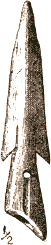
Fig. 211.—Bone harpoon head.
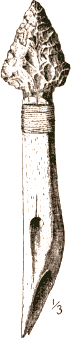
Fig. 212.—Harpoon head, bone and stone.
The next step was to obtain greater penetration by substituting a triangular blade of stone for the barbed bone point, with its breadth still in the plane of the body barb. This blade was either of slate (No. 89744 [969] from Nuwŭk) or of flint, as in Fig. 212 (No. 89748 [928], also from Nuwŭk). Both of these are whale harpoons, such as are sometimes used even at the present day.
Before the introduction of iron it was discovered that if the blade were inserted at right angles to the plane of the body barb the harpoon would have a surer hold, since the strain on the line would always draw it at right angles to the length of the wound cut by the blade. This is shown in Fig. 213 (No. 56620 [199], a walrus harpoon head from Utkiavwĭñ), which has the slate blade inserted in this position. Substituting a metal blade for the stone one gives us the modern toggle head, as already described. That the insertion of the stone blade preceded the rotation of the plane of the latter is, I think, conclusively shown by the whale harpoons329 already mentioned, in spite of the fact that we have a bone harpoon head in the collection, No. 89378 [1261], figured in Point Barrow report, which is exactly like No. 89379 [795], except that it has the blade at right angles to the plane of the body barb. This is, however, a newly made model in reindeer antler of the ancient harpoon, and was evidently made by a man so used to the modern pattern that he forgot this important distinction. The development of this spear head has been carried no further at Point Barrow. At one or two places, however, namely, at Cumberland Gulf in the east330 and at Sledge Island in the west (as shown in Mr. Nelson’s collection), they go a step further in making the head of the seal harpoon, body and blade, of one piece of iron. The shape, however, is the same as those with the ivory or bone body.
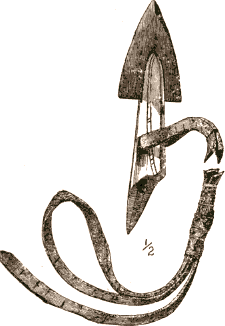
Fig. 213.—Harpoon head, bone and stone.
All of the Eskimo race, as far as I have any definite information, use toggle harpoon-heads. There are specimens in the National Museum from Greenland, Cumberland Gulf, the Anderson and Mackenzie region, and from the Alaskan coast from Point Barrow to Kadiak, as well as from St. Lawrence Island, which are all of essentially the same type, but slightly modified in different localities. The harpoon head in use at Smith Sound is of the same form as the walrus harpoon heads used at Point Barrow, but appears always to have the shaft socket made by a groove closed with thongs.331 In Danish Greenland, however, the body has an extra pair of bilateral barbs below the blade. The Greenlanders have, as it were, substituted a metal blade for the point only of the barbed blade portion of such a bone head as No. 89379 [795].332
Curiously enough, this form of the toggle head appears again in the Mackenzie and Anderson region, as shown by the extensive collections of Ross, MacFarlane, and others. In this region the metal blade itself is often cut into one or more pairs of bilateral barbs. At the Straits of Fury and Hecla, Parry found the harpoon head, with a body like the walrus harpoon heads at Point Barrow,333 but with the blade in the plane of the body barb. Most of the pictures scattered through the work represent the blade in this position, but Fig. 19 on the same plate has the blade at right angles to the barb, so that the older form may not be universal. At Cumberland Gulf the form of the body is considerably modified, though the blade is of the usual shape and in the ordinary position. The body is flattened at right angles to the usual direction, so that the thickness is much greater than the width. It always has two body barbs. On the western coast the harpoon heads are much less modified, though there is a tendency to increase the number of body barbs, at the same time ornamenting the body more elaborately as we go south from Bering Strait. Walrus harpoon heads with a single barb, hardly distinguishable from those used at Point Barrow, are in the collection from the Diomedes and all along the northern shore of Norton Sound, and one also from the mouth of the Kuskoquim. They are probably also used from Point Barrow to Kotzebue Sound. At St. Lawrence Island and on the Asiatic shore they are the common if not the universal form.334 The seal harpoon head (naulɐ) at Point Barrow appears always to have the body barb split at the tip into two, and this is the case rarely with the tu´kɐ. This form, which appears occasionally north of Norton Sound (Port Clarence, Cape Nome), appears to be more common south of this locality, where, however, a pattern with the barb divided into three points seems to be the prevailing form. I will now proceed to the description of the different forms of harpoon with which these toggle heads are used.
Throwing-harpoons are always thrown from the hand without a throwing-board or other assistance, and are of two sizes, one for the walrus and bearded seal, and one for the small seals. Both have a long shaft of wood to the tip of which is attached a heavy bone or ivory foreshaft, usually of greater diameter than the shaft and somewhat club-shaped. This serves the special purpose of giving weight to the head of the harpoon, so it can be darted with a sure aim. The native name of this part of the spear, ukumailuta (Greenlandic, okimailutaĸ, weight), indicates its design. This contrivance of weighting the head of the harpoon with a heavy foreshaft is peculiar to the western Eskimo. On all the eastern harpoons (see figures referred to above and the Museum collections) the foreshaft is a simple cap of bone no larger than the shaft the tip of which it protects. Between the foreshaft and the toggle-head is interposed the loose shaft (i´gimû), a slender rod of bone whose tip fits into the shaft socket of the head, while its butt fits loosely in a socket in the tip of the foreshaft. It is secured to the shaft by a thong just long enough to allow it to be unshipped from the foreshaft. This not only prevents the loose shaft from breaking under a lateral strain, but by its play facilitates unshipping the head. On these harpoons intended for throwing, this loose shaft is always short. This brings the weight of the foreshaft close to the head, while it leaves space enough for the head to penetrate beyond the barb.
The walrus harpoon varies in size, being adapted to the strength and stature of the owner. Of the six in our collection, the longest, when mounted for use, is 9 feet 6 inches long, and the shortest 5 feet 8 inches. The ordinary length appears to be about 7 feet. It has a long, heavy shaft (ipua) of wood, usually between 5 and 6 feet long and tapering from a diameter of 1½ inches at the head to about 1 inch at the butt. The head is not usually fastened directly to the line, but has a leader of double thong 1 to 2 feet long, with a becket at the end into which the main line is looped or hitched. At the other end of the line, which is about 30 feet long, is another becket to which is fastened a float consisting of a whole sealskin inflated. When the head is fitted on the tip of the loose shaft the line is brought down to the middle of the shaft and hooked by means of a little becket to an ivory peg (ki´lerbwĭñ) projecting from the side of the shaft. The eastern Eskimo have, in place of the simple becket, a neat little contrivance consisting of a plate of ivory lashed to the line with a large slot in it which hooks over the catch, but nothing of the sort was observed at Point Barrow.
The harpoon thus mounted is poised in the right hand with the forefinger resting against a curved ivory projection (ti´ka) and darted like a white man’s harpoon, the float and line being thrown overboard at the same time. When a walrus is struck the head slips off and toggles as already described; the line detaches itself from the catch, leaving the shaft free to float and be picked up. The float is now fastened to the walrus, and, like the shaft of the seal dart, both shows his whereabouts and acts as a drag on his movements until he is “played” enough for the hunters to come up and dispatch him. This weapon is called u´nakpûk, “the great u´na or spear.” U´na (unâk, u´nañ) appears to be a generic term in Eskimo for harpoon, but at Point Barrow is now restricted to the harpoon used for stabbing seals as they come up to their breathing holes.
We collected six of these walrus harpoons complete and forty-two separate heads. Of these, No. 56770 [534], Fig. 214a, has the most typical shaft and loose shaft. The shaft is of spruce 71 inches long, roughly rounded, and tapering from a diameter of 1½ inches at the tip to 0.8 at the butt. The foreshaft is of white walrus ivory, 6.7 inches long, exclusive of the wedge-shaped tang which fits into a cleft in the tip of the shaft. It is somewhat club-shaped, being 1.6 inches in diameter at the tip and tapering to 1.3 just above the butt, which expands to the diameter of the shaft, and is separated from the tang by a square transverse shoulder. The shaft and foreshaft are fastened together by a whipping of broad seal thong, put on wet, one end passing through a hole in the foreshaft one-quarter inch from the shaft, and kept from slipping by a low transverse ridge on each side of the tang. In the tip of the foreshaft is a deep, round socket to receive the loose shaft, which is a tapering rod of walrus ivory 4.4 inches long, shouldered off at the butt, which is 0.7 inch in diameter, to a blunt, rounded tang 0.9 inch long. It fits loosely into the foreshaft up to the shoulder, and is secured by a piece of narrow seal thong which passes through a transverse hole one-half inch above the shoulder. The end is spliced to the standing part with double slits about 6 inches from the loose shaft, and the other end makes a couple of turns outside of the lashing on the shaft mentioned above and is secured with two half-hitches.
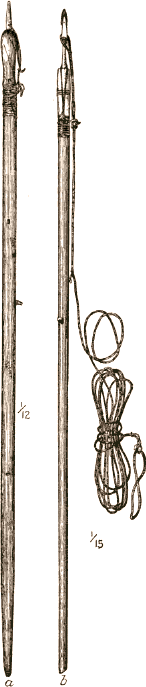
Fig. 214.—Walrus harpoons.
The line catch (ki´lerbwĭñ) is a little, blunt, backward-pointing hook of ivory inserted in the shaft 17 inches from the tip and projecting about one-third inch. Ten and one-fourth inches farther back and 90 degrees round the shaft from the line catch is the finger rest—a conical recurved piece of ivory 1 inch high, with a flat base, resting against the shaft and secured by a lashing of whalebone, which passes through two corresponding holes, one in the rest and one in the shaft. The head and line belonging to this harpoon are intended for hunting the bearded seal, and will be described below. No. 56772 [536], Fig. 214b, from Utkiavwĭñ, is fitted with fairly typical walrus gear. The head is of the typical form, 6 inches long, with a conoidal body of walrus ivory, ornamented with incised lines colored with red ocher, and a blade of steel secured by a whalebone rivet. The “leader,” which is about 15 inches long, is made by passing one end of a piece of stout walrus-hide thong about one-quarter inch wide through the line hole and doubling it with the head in the bight, so that one part is about 6 inches the longer. The two parts are stopped together about 2 inches from the head with a bit of sinew braid. The ends are joined and made into a becket, as follows: The longer end is doubled back for 7 inches and a slit cut through both parts about 2 inches from the end. The shorter end is passed through this slit, and a slit is cut 5 inches from the end of this, through which the loop of the other end is passed and all drawn taut. The whole joint is then tightly seized with sinew braid so as to leave a becket 3 inches and a free end 4 inches long. This becket is looped into an eye 1½ inches long at the end of the main line, made by doubling over 5 inches of the end and stopping the two parts firmly together with sinew braid. The line is of the hide of the bearded seal, about the same diameter as the leader, and 27 feet long. It is in two nearly equal parts, spliced together with double slits, firmly seized with sinew braid. There is a becket about 8 inches long at the other end of the line for attaching the float, made by doubling over the end and tying a carrick bend, the end of which is stopped back to the standing part with sinew braid. The becket to hook upon the line catch is a bit of sinew braid, fastened to the line 2½ feet from the head, as follows: One end being laid against the line it is doubled in a bight and the end is whipped down to the line by the other end, which makes five turns round them.
I will now consider the variations of the different parts of these harpoons in detail, beginning with the head. Our series is so large, containing in all forty-eight heads, besides some spare blades, that it probably gives a fair representation of the common variations. The longest of this series is 6 inches long and the shortest 3½, but by far the greater number are from 4½ to 5 inches long. Their proportions are usually about as in the types figured, but the long head just figured (No. 56772 [534]) is also unusually slender. Sheet brass is the commonest material for the blade (thirty blades are of this material), though iron or steel is sometimes used, and rarely, at present, slate. There is one slate-bladed head in the series (No. 56620 [199]) figured above, and four blades for such heads. The blade is commonly of the shape of the type figured, triangular with curved edges, varying from a rather long triangle like the slate blade just mentioned to a rather short one with very strongly curved edges like Fig. 215a (No. 89750 [1038]), which is peculiar as the only walrus harpoon head with a body of reindeer antler. It also has an iron blade and a rivet of iron, not seldom with rounded basal angles so as to be almost heart-shaped, like Fig. 215b (No. 56621 [283]). A less common shape of blade is lanceolate, with the base cut off square as in Fig. 216a (No. 89764 [940]). Only eight blades out of the series are of this shape. A still more peculiar shape of blade, of which we saw only one specimen, is shown in Fig. 216b (No. 89790 [943]). This is made of brass. It was perhaps meant for an imitation of the barbed blades used at the Mackenzie, of which I have already spoken.
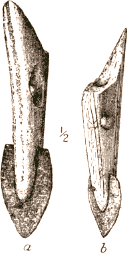
Fig. 215.—Typical walrus-harpoon heads.
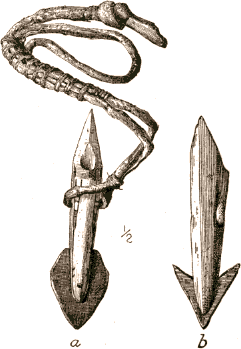
Fig. 216.—Typical walrus-harpoon heads.
The blade, when of metal, is generally fastened in with a single rivet. One only out of the whole number has two rivets, and three are simply wedged into the blade slit. The slate blades appear never to have been riveted; Nordenskiöld, however, figures a walrus harpoon from Port Clarence335 with a jade blade riveted in. The rivet is generally made of whalebone, but other materials are sometimes used. For instance, in the series collected two have rivets of iron, two of wood, and five of rawhide. The body is generally made of white walrus ivory, (five of those collected are of hard bone, and one already mentioned and figured, No. 89750 [1038], Fig. 215a, is of reindeer antler), and the hexagonal shape, often with rounded edges, and the line grooves continued to the tip, as in Fig. 217a, No. 89757 [947], appears to be the commonest. Three out of the forty-eight have four-sided bodies. It is unusual for the body barb to be bifurcated, as is common farther south. Only three out of the forty-eight show this peculiarity, of which No. 56613 [53], Fig. 217b, is an example.