ETHNOLOGICAL RESULTS OF THE POINT BARROW EXPEDITION. (continued 3)
Reading edition
The specimens figured show the different styles of ornamentation, which always consist of incised patterns colored with red ocher or rarely with soot. These never represent natural objects, but are always conventional patterns, generally a single or double border on two or more faces with short oblique cross-lines and branches. Harpoon heads at Point Barrow are probably never ornamented with the “circles and dots,” so common on other implements and on the harpoons of the southern Eskimo.
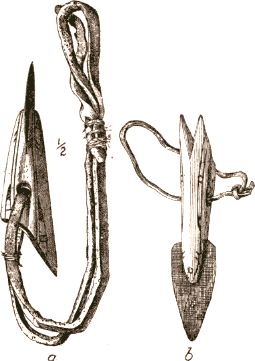
Fig. 217.—Typical walrus-harpoon heads.
Twenty-eight of the heads still have the leaders attached to them. The object of this short line is to enable the hunter to readily detach a broken head and put on a fresh one without going to the trouble of undoing a splice, which must be made strong to keep the head from separating from the line. It is made of a stout piece of rawhide thong, the skin of the walrus or bearded seal, about one-third inch in diameter, and usually from 2 to 3 feet long. It is always passed through the line hole, as in the specimen described, and the ends are made into a becket for attaching the line, with an end left to serve as a handle for pulling the two beckets apart when the main line ends in a becket. Occasionally (two are made this way) the longer end is simply doubled in a bight, and the three parts are then seized together with sinew braid, but it is generally made with a splice, the details of which differ slightly on the different leaders.
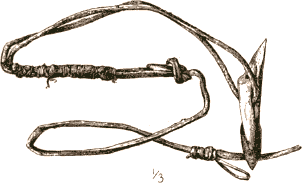
Fig. 218.—Walrus-harpoon head, with leader.
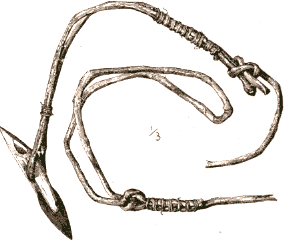
Fig. 220.—Walrus-harpoon head, with line.
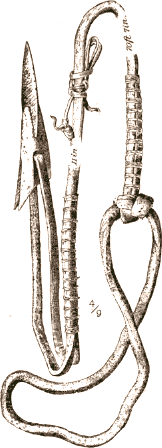
Fig. 219.—Walrus-harpoon head, with line.
The commonest method is that already described. When the longer end is doubled over, a slit is cut through both parts close to the end of this through which the shorter end is passed. A slit is then cut a few inches from the tip of this part, the bight of the becket passed through this slit and all drawn taut. This makes a very strong splice. Fourteen beckets are spliced in this way. A variation of this splice has a slit only through the end part of the longer end, the shorter end being passed through and slit as before. In one becket the standing part of the longer end is passed through the slit of the end part before going through the line hole, while the rest of the becket is made as before. A reversed splice is found on three of the leaders, which is made as follows: When the long end is doubled over, the short end is slit as usual and the longer end passed through this and slit close to the tip. Through this slit is passed the head and all drawn taut. The splice is always firmly seized with sinew braid. The main line, which serves to attach the head to the float, is always made of stout thong, preferably the skin of the bearded seal (very fine lines are sometimes made of beluga skin), about one-third inch square, and, when properly made, trimmed off on the edges so as to be almost round. It is about 10 yards long. It is fastened into the becket of the leader with a becket hitch tied upside down (No. 56771 [535], Fig. 218), or by means of a small becket, made either as on the specimen described (No. 56770 [536], Fig. 219), or spliced with double slits. The long becket at the other end for attaching the float is made either by tying a carrick bend with the end stopped back to the standing part (Fig. 220, No. 56767 [531]), or by splicing (Fig. 221, No. 56769).
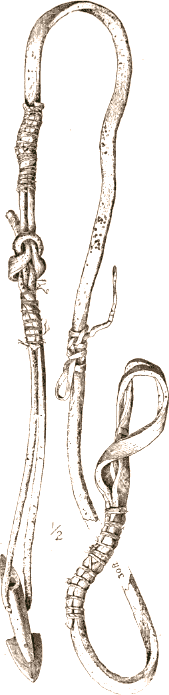
Fig. 221.—Walrus-harpoon head, with line.
The loose shaft varies very little in shape, though it is sometimes rounded off at the butt without a shoulder, but the line which secures this to the foreshaft is put on differently on each of the six spears. Five of them have the end simply passed through the hole in the loose shaft and spliced to the standing part, but two (the type figured and No. 56768 [532]) have the other end carried down and hitched round the tip of the shaft; another has it passed through a hole in the foreshaft, taken 1½ turns round this and knotted (No. 56771 [535]); another has a loop as long as the foreshaft with the short end passed under the first turn of the shaft lashing before it is spliced, and the long end secured as on the first mentioned; and the fifth has the end passed through a hole in the foreshaft and carried down and wrapped round the shaft lashing. The sixth has one end passed through a hole in the smallest part of the foreshaft and knotted at the end, the other end carried up through the hole in the loose shaft and down to a second hole in the foreshaft close to the first, then up through the loose shaft, and down through the first hole, and tucked under the two parts on the other side.
The foreshaft is made of walrus ivory or the hard bone of the walrus jaw and varies little in form and dimensions. It is sometimes ornamented by carving, as in No. 56772 [536], or by incised patterns, as in Fig. 222, No. 56538 [98], and generally has one or two deep longitudinal notches in the thickest part, in which the lines can be drawn snugly down. It usually is joined to the shaft by a stout, wedge-shaped tang, which fits into a corresponding cleft in the shaft, and is secured by wooden treenails and a wrapping of seal thong or sinew braid, sometimes made more secure by passing one end through holes in the foreshaft. No. 56768 [532] is peculiar in having the tang on the shaft and the corresponding cleft in the foreshaft. The shaft itself varies little in shape and proportions, and at the present day is sometimes made of ash or other hard wood obtained from the ships. The line catch is generally a little hook of ivory or hard bone like the one described, but two specimens have small screws fastened into the shaft to serve this purpose. The finger rest is ordinarily of the same shape as on the type and fastened on in the same way, but No. 56771 [535] has this made of a knob of ivory elaborately carved into a seal’s head. The eyes are represented by round bits of ivory with pupils drilled in them inlaid in the head. This is evidently the knob of a seal drag (see below) as the longitudinal perforation from chin to nape now serves no purpose. It is fastened on by a lashing of whalebone, which runs round the shaft and through a transverse hole in the knob.
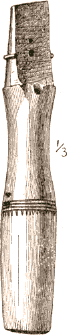
Fig. 222.—Foreshaft of walrus harpoon.
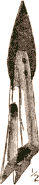
Fig. 223.—Harpoon head for large seals.
Harpoons closely resembling these in type are used by the Eskimo of western North America wherever they habitually hunt the walrus. At many places this heavy spear is armed at the butt with a long sharp pick of ivory like the smaller seal spear. Two of these large harpoons appear to be rigged especially for the pursuit of the bearded seal, as they have heads which are of precisely the same shape and material as the small seal harpoons in the collection. Both these heads have lanceolate iron blades, conoidal antler bodies with double barbs, and are more slender than the walrus harpoon heads. No. 56770 [534], Fig. 219, has a head 4 inches long and 0.7 broad at the widest part, and fastened to a very long line (12 fathoms long) without a leader, the end being simply passed through the line hole and seized down to the standing part with sinew braid. This is the method of attaching the head of the small seal harpoons. This line is so long that it may have been held in the boat and not attached to a float. No. 56768 [532], however, has a leader with a becket of the ordinary style. Fig. 223, No. 56611 [89], is a head similar to those just described, and probably, from its size, intended for large seals. It is highly ornamented with the usual reddened incised pattern.
The throwing harpoon for small seals is an exact copy in miniature of the walrus harpoon, with the addition of a long bayonet-shaped pick of ivory at the butt. The line, however, is upwards of 30 yards long, and the end never leaves the hand. The line is hitched round the shaft back of the line catch, which now only serves to keep the line from slipping forward, as the shaft is never detached from the line. This harpoon is used exclusively for retrieving seals that have been shot in open holes or leads of water within darting distance from the edge of the solid ice, and is thrown precisely as the walrus harpoon is, except that the end of the line is held in the left hand. In traveling over the ice the line with the head attached is folded in long hanks and slung on the gun case at the back. The rest of the weapon is carried in the hand and serves as a staff in walking and climbing among the ice, where the sharp pick is useful to prevent slipping and to try doubtful ice, and also enables the hunter to break away thin ice at the edge of the hole, so as to draw his game up to the solid floe. It can also serve as a bayonet in case of necessity. This peculiar form of harpoon is confined to the coast from Point Barrow to Bering Strait, the only region where the seal is hunted with the rifle in the small open holes of water.336
Since my note in the Naturalist was written, I have learned from Mr. Henry Balfour, of the museum at Oxford, that their collection contains two or three specimens of this very pattern of harpoon, undoubtedly collected by some of the officers of the Blossom. Consequently, my theory that the retrieving harpoon was a modern invention, due to the introduction of firearms, becomes untenable, as the Blossom visited this region before firearms were known to the Eskimo. It was probably originally intended for the capture of seals “hauled out” on the ice in the early summer. There is no doubt, however, that it is at the present day used for nothing but retrieving.

Fig. 224.—Retrieving seal harpoon.
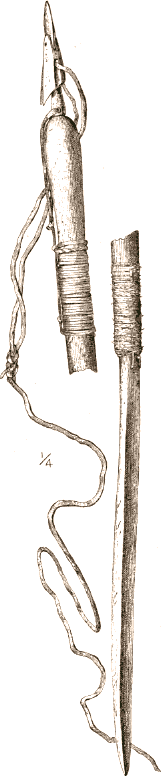
Fig. 225.—Details of retrieving seal harpoon.
Though this weapon was universally used at Point Barrow, we happened to obtain only two specimens, possibly because the natives thought them too necessary an implement to part with lightly. No. 89907 [1695], Figs. 224, 225, has a new shaft, etc., but was used several times by the maker before it was offered for sale. Such a retrieving harpoon is called naúlĭgɐ. The shaft (ipúa) is of ash, 4 feet 5 inches long and 1 inch in diameter, tapering very slightly to each end. The ice pick (túu) of walrus ivory, 14 inches long and 1 inch wide, has a round tang fitting into a hole in the butt of the shaft. Close to the shaft a small hole is drilled in one edge of the pick, and through this is passed a bit of seal thong, the ends of which are laid along the shaft and neatly whipped down with sinew braid, with the end wedged into a slit in the wood. The foreshaft (ukumailuta) is of walrus ivory, 4½ inches long and 1½ inches in diameter at the thickest part, and secured to the shaft by a whipping (nĭ´mxa) of seal thong. The loose shaft (ígimû) is also of ivory and 2 inches long and secured by a thong (ĭpíuta) spliced into a loop through the hole at the butt, as previously described. The end is hitched round the tip of the shaft with a marling hitch, followed by a clove hitch below the whipping. The ivory finger rest (ti´ka) is fastened on with a lashing of whip cord (white man’s) passing round the shaft. The line catch (ki´lerbwĭñ), which was of ivory and shaped like those on the walrus harpoons, has been lost in transportation. The head differs only in size from those just described as intended for the bearded seal, except in having a hexagonal body. It is 3.3 inches long and has a blade of iron fastened into a body of walrus ivory with a single wooden rivet. While there is no detachable leader, the head is attached by a separate piece of the same material to the line (tûkăksia), which is 86 feet 10 inches long and made of a single piece of fine seal thong about one-eighth inch thick. This shorter piece is about 27 inches long and is passed through the line hole and doubled so that one part is a little the longer. It is fastened strongly to the end of the line by a complicated splice made as follows: A slit is cut in the end of the main line through which are passed both ends of the short line. The longer part is then slit about 2 inches from the end and the shorter part passed through the slit, and a slit cut close to the end of it, through which the longer end is passed. The whole is then drawn taut and the longer end clove hitched round the main line.
No. 89908 [1058] is one of these spears rigged ready for darting. The line is secured at about the middle of the shaft with a couple of marling hitches. This specimen, except the head, is new and was rather carelessly made for the market. It has neither line catch nor finger rest. The foreshaft and ice pick are lashed in with sinew braid, which is first knotted round the tip of the shaft and then hitched round with a series of left-handed soldier’s hitches. The end of the thong which holds the loose shaft is passed through the hole in it and knotted and the other end hitched into the pulley at the smallest part of the foreshaft. The head is like that of the preceding, but has a conoidal body of reindeer antler, a common material for seal-harpoon heads, and the line, which is of stout sinew braid 43 feet long, is attached to it simply by passing the end through the line hole and tying it with a clove hitch to the standing part 9½ inches from the head. This spear is about the same size as the preceding. These weapons are all of the same general pattern, but vary in length according to the height of the owner. The heads for these harpoons, as well as for the other form of seal harpoon, are usually about 3 inches long, and, as a rule, have lanceolate blades. The body is generally conoidal, often made of reindeer antler, and always, apparently, with a double barb. It is generally plain, but sometimes ornamented like the walrus-harpoon heads.
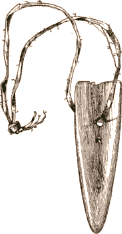
Fig. 226.—Jade blade for seal harpoon.
No. 89784 [1008] was made by Ilû´bw’ga, the Nunatañmeun, when thinking of coming to winter at Utkiavwĭñ. He had had no experience in sealing, having apparently spent all his winters on the rivers inland, and this harpoon head seems to have been condemned as unsatisfactory by his new friends at Utkiavwĭñ. It looks like a very tolerable naula, but is unusually small, being only 2½ inches long.
We saw only one stone blade for a seal harpoon, No. 89623 [1418], Fig. 226. This is of light olive green jade, and triangular, with peculiarly dull edges and point. Each face is concaved, and there is a hole for a rivet. (Compare the jade-bladed harpoon figured by Nordenskiöld and referred to above.) It is 2 inches long and 0.7 inch wide at the base. It appears to have been kept as an amulet. The other form of seal harpoon comes properly under the next head.
THRUSTING WEAPONS.

Fig. 227.—Seal harpoon for thrusting.
Harpoons.—
For the capture of seals as they come up for air to their breathing holes or cracks in the ice a harpoon is used which has a short wooden shaft, armed, as before, with an ice pick and a long, slender, loose shaft suited for thrusting down through the small breathing hole. It carries a núalɐ like the other harpoon, but has only a short line, the end of which is made fast permanently to the shaft. Such harpoons are used by all Eskimo wherever they are in the habit of watching for seals at their breathing holes. The slender part of the shaft, however, is not always loose.337 The foreshaft is simply a stout ferrule for the end of the shaft. These weapons are in general use at Point Barrow and are very neatly made.
We obtained two specimens, of which No. 89910 [1694], Fig. 227, will serve as the type. The total length of this spear when rigged for use is 5 feet 3 inches. The shaft is of spruce, 20½ inches long and 1.1 inches in the middle, tapering to 0.9 at the ends. At the butt is inserted, as before, an ivory ice pick (túu) of the form already described, 13¾ inches long and lashed in with sinew braid. The foreshaft (kátû) is of walrus ivory, nearly cylindrical, 5¾ inches long and 0.9 inch in diameter, shouldered at the butt and fitted into the tip of the shaft with a round tang. The latter is very neatly whipped with a narrow strip of white whalebone, which makes eleven turns and has the end of the last turn forced into a slit in the wood and wedged with a round wooden peg. Under this whipping is the bill of a tern as a charm for good luck. (As the boy who pointed this out to me said, “Lots of seals.”)

Fig. 228.—Diagram of lashing on shaft.
The loose shaft (ígimû) is of bone, whale’s rib or jaw, and has two transverse holes above the shoulder to receive the end of the assembling line (sábromia), which not only holds the loose shaft in place, but also connects the other parts of the shaft so that in case the wood breaks the pieces will not be dropped. It is a long piece of seal thong, of which one end makes a turn round the loose shaft between the holes; the other end is passed through the lower hole, then through the upper and carried down to the tip of the shaft, where it is hitched just below the whalebone whipping, as follows: three turns are made round the shaft, the first over the standing part, the second under, and the third over it; the end then is passed under 3, over 2, and under 1 (Fig. 228), and all drawn taut; it then runs down the shaft almost to the butt-lashing and is secured with the same hitch, and the end is whipped around the butt of the ice pick with five turns. The head (naúlɐ) is of the ordinary pattern, 2.8 inches long, with a copper blade and antler body. The line (túkăktĭn) is a single piece of seal thong 9 feet long, and is fastened to the head without a leader, by simply passing the end through the line-hole, doubling it over and stopping it to the standing part so as to make a becket 21 inches long. The other end is made fast round the shaft and assembling line just back of the middle, as follows: An eye is made at the end of the line, by cutting a slit close to the tip and pushing a bight of the line through this. The end then makes a turn round the shaft, and the other end, with the head, is passed through this eye and drawn taut. When mounted for use, the head is fitted on the tip of the loose shaft as usual and the line brought down to the tip of the shaft and made fast by two or three round turns with a bight tucked under, so that it can be easily slipped. It is also confined to the loose shaft by the end of the assembling line, which makes one or two loose turns round it. The slack of the line is doubled into “fakes” and tucked between the shaft and assembling line.
The other specimen is of the same pattern, but slightly different proportions, having a shaft 18½ inches long and a pick 19 inches long. The loose shaft is of ivory, and there are lashings of white whalebone at each end of the shaft. The assembling line is hitched round the foreshaft as well as round the two ends of the shaft, and simply knotted round the pick. The line is of very stout sinew braid, and has an eye neatly spliced in the end for looping it round the shaft. Fig. 229, No. 89551 [1082], is a model of one of these harpoons, made for sale. It is 16¼ inches long, and correct in all its parts, except that the whole head is of ivory, even to having the ends of the shaft whipped with light-colored whalebone. The shaft is of pine and the rest of walrus ivory, with lines of sinew braid. We also collected four loose shafts for such harpoons. One of these, No. 89489 [802], is of whale’s bone and unusually short, only 14 inches long. It perhaps belonged to a lad’s spear. The other three are long, 20 to 25 inches, and are made of narwhal ivory, as is shown by the spiral twist in the grain.

Fig. 229.—Model of a seal harpoon.

Fig. 230.—Large model of a whale harpoon.
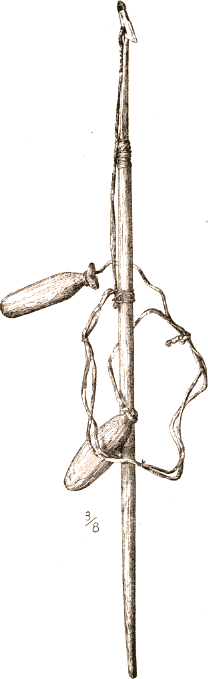
Fig. 231.—Model of whale harpoon with floats.
The harpoon used for the whale fishery is a heavy, bulky weapon, which is never thrown, but thrust with both hands as the whale rises under the bows of the umiak. When not in use it rests in a large ivory crotch, shaped like a rowlock, in the bow. The shaft is of wood and 8 or 9 feet long, and there is no loose shaft, the bone or ivory foreshaft being tapered off to a slender point of such a shape that the head easily unships. This foreshaft is not weighted, as in the walrus harpoon, since this is not necessary in a weapon which does not leave the hand. The harpoon line is fitted with two inflated sealskin floats.
No complete, genuine whaling harpoons were ever offered for sale, but a man at Nuwûk made a very excellent reduced model about two-thirds the usual size (No. 89909 [1023], Fig. 230), which will serve as the type of this weapon (a´jyûñ). This is 6 feet 11 inches in length when rigged for use. The shaft is of pine, 5 feet 8½ inches long, with its greatest diameter (1½ inches) well forward of the middle and tapered more toward the butt than toward the tip, which is chamfered off on one side to fit the butt of the foreshaft (igimû), and shouldered to keep the lashing in place. The foreshaft is of whale’s bone, 11½ inches long, three-sided with one edge rounded off, and tapers from a diameter of 1 inch to a tapering rounded point 1½ inches long, and slightly curved away from the flat face of the foreshaft. It will easily be seen that the shape of this tip facilitates the unshipping of the head. The butt is chamfered off on the flat face to fit the chamfer of the shaft, and the whole foreshaft is slightly curved in the same direction as the tip. It is secured to the shaft by a stout whipping of seal thong. The head is 7 inches long, and has a body of walrus ivory, which is ornamented with incised patterns colored red with ocher, and a blade of dark reddish brown jasper, neatly flaked. This blade is not unlike a large arrow head, being triangular, with curved edges, and a short, broad tang imbedded in the tip of the body, which is seized round with sinew braid. The body is unusually long and slender and is four sided, with a single long, sharp barb, keeled on the outer face. The line hole and line grooves are in the usual position, but the peculiarity of the head is that the blade is inserted with its breadth in the plane of the body barb. In other words, this head has not reached the last stage in the development of the toggle-head. The line is of stout thong (the skin of the bearded seal) and about 8½ feet long. It is passed through the line hole, doubled in the middle, the two parts are firmly stopped together with sinew in four places, and in the ends are cut long slits for looping on the floats. When the head is fitted on the foreshaft the line is secured to the flat face of the foreshaft by a little stop made of a single strand of sinew, easily broken. About 28 inches from the tip of the shaft the line is doubled forward and the bight stopped to the shaft with six turns of seal thong, so that the line is held in place and yet can be easily detached by a straight pull. The ends are then doubled back over the lashing and stopped to the shaft with a single thread of sinew.
Fig. 231 is a toy model of the whale harpoon, No. 56562 [233], 18½ inches long, made of pine and ivory, and shows the manner of attaching the floats, which are little blocks of spruce roughly whittled into the shape of inflated sealskins. A piece of seal thong 13½ inches long has its ends looped round the neck of the floats and the harpoon-line is looped into a slit in the middle of this line.
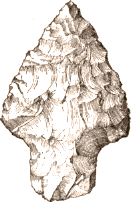
Fig. 232.—Flint blade for whale harpoon.
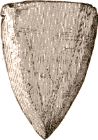
Fig. 233.—Slate blade for whale harpoon.
We collected thirteen heads for such harpoons, which have been in actual use, of which two have flint blades like the one described, two have brass blades, and the rest either blades of slate or else no blades. The flint blades are either triangular like the one described or lanceolate and are about 3 inches long exclusive of the tang. The three separate flint blades which we obtained (Fig. 232, No. 56708 [114], from Utkiavwĭñ, is one of these, made of black flint) are about 1 inch shorter and were perhaps intended for walrus harpoons, though we saw none of these with flint blades. They are all newly made for the market.
The slate blades of which we collected eleven, some old and some new, besides those in the heads, are all triangular, with curved edges, as in Fig. 233 (No. 56709 [139] from Utkiavwĭñ, made of soft purple slate), except one new one, No. 56697a [188a], which has the corners cut off so as to give it a rhomboidal shape. The corners are sometimes rounded off so that they are nearly heart-shaped. These blades are usually about 2¾ inches long and 2 broad; two unusually large ones are 3 inches long and nearly 2¼ broad, and one small one 2.1 by 1.6 inches, and are simply wedged into the blade slit without a rivet. The brass blades are of the same shape.
The common material for the body seems to have been rather coarse whale’s bone, from the rib or jaw. Only two out of the thirteen have ivory bodies, and these are both of the newer brass-bladed pattern. The body is very long and slender, being usually about 8 or 8½ inches long (one is 9¼ inches long) and not over 1½ inches broad at the widest part. It is always cut off very obliquely at the base, and the part in front of the line hole is contracted to a sort of shank, as in Fig. 234 (No. 89747 [1044]), a head with slate blade (broken) and bone body. This represents a very common form in which the shank is four-sided, while back of the middle the outer face of the barb rises into a ridge, making this part of the body five-sided. The edges of the shank are sometimes rounded off so as to make this part elliptical in section, and all the edges of the body except the keel, on the outer face of the barb, are frequently rounded off as in Fig. 235a, No. 89745 [1044], which has a slate blade wedged into the bone body with a bit of old cloth and a wooden wedge. Fig. 235b, No. 56602 [157], from Utkiavwĭñ, is a head of the same shape, but has a brass blade and a body of ivory. This blade is wedged in with deer hair, but the other brass-bladed harpoon, No. 56601 [137], has a single rivet of whalebone.
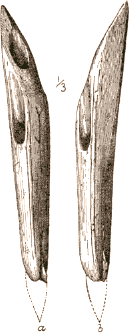
Fig. 234.—Body of whale harpoon head.
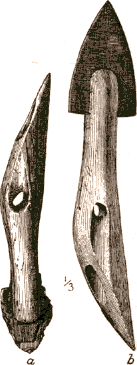
Fig. 235.—Whale harpoon heads.
The blade slit, and consequently the blade, is always in the plane of the barb, which position, as I have said before, corresponds to the last step but one in the development of the harpoon-head. When the blade is of flint and inserted with a tang, the tip of the body is always whipped with sinew braid, as in Fig. 212, No. 89748 [928], from Nuwŭk. This specimen is remarkable as being the only one in the series with a double point to the barb. These bodies are sometimes ornamented with incised lines, in conventional patterns, as shown in the different figures. A short incised mark somewhat resembling an arrow (see above, Fig. 234, No. 89747 [1044]) may have some significance as it is repeated on several of the heads. Harpoon-heads of this peculiar pattern are to be found in the Museum collection from other localities. As we should naturally expect, they have been found at the Diomede Islands, St. Lawrence Island, and Plover Bay. It is very interesting, however, to find a specimen of precisely the same type from Greenland, where the modern harpoons are so different from those used in the west.
That the line connecting the head with the float line is not always so long in proportion as represented on the two models is shown by Fig. 236, No. 89744 [969], the only specimen obtained with any part of the line attached. A piece of stout walrus-hide thong 2 feet long is passed through the line-hole and doubled in two equal parts, which are firmly stopped together with sinew about 2 inches from the head. Another piece of similar thong 4 feet 2 inches long is also doubled into two equal parts and the ends firmly spliced to those of the short piece thus: The two ends of the long piece are slit and one end of the short piece passed through each slit. One of these ends is then slit and through it are passed the other end of the short piece and the bight of the long piece, and all is drawn taut and securely seized with sinew. The becket thus formed was probably looped directly into the bight of the float line.
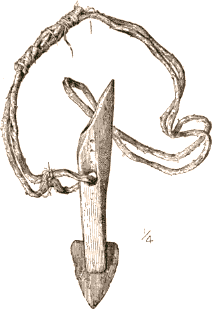
Fig. 236.—Whale harpoon head with a “leader.”
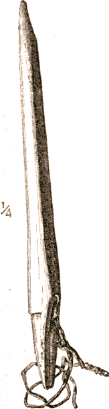
Fig. 237.—Foreshaft of whale harpoon.
The foreshaft is much larger than that of the model, though of the same shape. No. 56537 [97], Fig. 237, from Utkiavwĭñ, is of walrus-ivory and 15.8 inches long with a diameter of 1½ inches at the butt. The oblong slot at the beginning of the chamfer is to receive the end of the lashing which secured this to the shaft. This form of foreshaft is very well adapted to insure the unshipping of the toggle-head, but lacks the special advantage of the loose-shaft, namely, that under a violent lateral strain it unships without breaking. The question at once suggests itself, why was not the improvement that is used on all the other harpoons applied to this one? In my opinion, the reason for this is the same as for retaining the form of toggle-head, which, as I have shown, is of an ancient pattern.
That is to say, the modern whale harpoon is the same pattern that was once used for all harpoons, preserved for superstitious reasons. It is a well known fact, that among many peoples implements, ideas, and language have been preserved in connection with religious ceremonies long after they have gone out of use in every-day life. Now, the whale fishing at Port Barrow, in many respects the most important undertaking in the life of the natives, is so surrounded by superstitious observances, ceremonies to be performed, and other things of the same nature as really to assume a distinctly religious character. Hence, we should naturally expect to find the implements used in it more or less archaic in form. That this is the case in regard to the toggle-head I think I have already shown. It seems to me equally evident that this foreshaft, which contains the loose shaft and foreshaft, undifferentiated, is also the older form.
Why the development of the harpoon was arrested at this particular stage is not so easily determined. A natural supposition would be that this was the form of harpoon used by their ancestors when they first began to be successful whalemen.
That they connect the idea of good luck with these ancient stone harpoons is shown by what occurred at Point Barrow in 1883. Of late years they have obtained from the ships many ordinary “whale-irons,” and some people at least had got into the habit of using them.
Now, the bad luck of the season of 1882, when the boats of both villages together caught only one small whale, was attributed to the use of these “irons,” and it was decided by the elders that the first harpoon struck into the whale must be a stone-bladed one such as their forefathers used when they killed many whales.
In this connection, it is interesting to note a parallel custom observed at Point Hope. Hooper338 says that at this place the beluga must always be struck with a flint spear, even if it has been killed by a rifle shot.


Fig. 238.—Whale lance.
Fig. 241.—Bear lance.
Lances.—
As I have said on a preceding page, some of the natives now use bomb-guns for dispatching the harpooned whale, and all the whaleboats are provided with steel whale lances obtained from the ships. In former times they used a large and powerful lance with a broad flint head. They seem to have continued the use of this weapon, probably for the same reasons that led them to retain the ancient harpoon for whaling until they obtained their present supply of steel lances, as we found no signs of iron whale lances of native manufacture, such as are found in Greenland and elsewhere. We obtained nine heads for stone lances (kaluwiɐ) and one complete lance, a very fine specimen (No. 56765 [537], Fig. 238), which was brought down as a present from Nuwŭk. The broad, sharp head is of light gray flint, mounted on a shaft of spruce 12 feet 6 inches long. It has a broad, stout tang inserted in the cleft end of the shaft. The shaft is rhomboidal in section with rounded edges, and tapers from a breadth of 2 inches and a thickness of 1 at the tip to a butt of 0.7 inch broad and 1 thick. The tip of the shaft has a whipping of sinew-braid 1¾ inches deep, “kackled” down on both edges, one end of the twine on each edge, so that the hitch made by one end crosses the round turn of the other, making in all twenty-six turns. The shaft has been painted red for 1½ inches below the whipping.
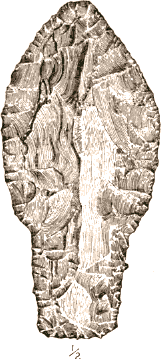
Fig. 239.—Flint head of whale lance.
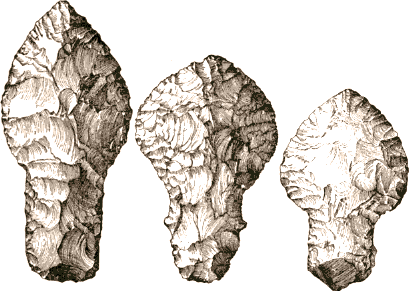
Fig. 240.—Flint heads for whale lances.
No. 89596 [1032] is the head and 5 inches of the shaft of a similar lance. The head is of black flint, and the sinew-braid forms a simple whipping. The remaining heads are all unmounted. I have figured several of them to show the variations of this now obsolete weapon. Fig. 239, No. 56677 [49], from Utkiavwĭñ, is of gray flint chipped in large flakes. The total length is 6.9 inches. The small lugs on the edges of the tang are to keep it from slipping out of the whipping. No. 56679 [239], also from Utkiavwĭñ, is of black flint and broader than the preceding. Its length is 6.3 inches. No. 56680 [394], from the same village, is of light bluish gray flint and very broad. It is 5.4 inches long. No. 56681 [5], from Utkiavwĭñ, is another broad head of black flint, 6 inches long. Fig. 240a, No. 89597 [1034], from Nuwŭk, is of black flint, and unusually long in proportion, running into the tang with less shoulder than usual. Much of the original surface is left untouched on one face. This is probably very old. No. 89598 [1361] is a head of similar shape of dark gray flint from Sidaru. It is 6 inches long. Fig. 240b, No. 89599 [1373], from the same place and of similar material, is shaped very like the head of a steel lance. It is 5 inches long. Fig. 240c, No. 89600 [1069], from Utkiavwĭñ, is still broader in proportion and almost heart-shaped. It is of bluish gray flint and 4.8 inches long. These heads probably represent most of the different forms in use. Only two types are to be recognized among them, the long-pointed oval with a short tang, and the broad leaf-shaped head with a rather long tang, which appears to be the commoner form.
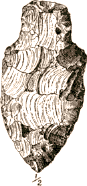
Fig. 242.—Flint head for bear lance.
We obtained one newly made lance of a pattern similar to the above, but smaller, which was said to be a model of the weapon used in attacking the polar bear before the introduction of firearms. The name, pû´nnû, is curiously like the name panna given by Dr. Simpson and Capt. Parry to the large double-edged knife. The specimen, No. 89895 [1230], Fig. 241, came from Utkiavwĭñ. It has a head of gray flint 3½ inches long, exclusive of the tang, roughly convex on one face, but flat and merely beveled at the edges on the other. The edges are finely serrate. The shaft is of spruce, 6 feet 8 inches long, rounded and somewhat flattened at the tip, which is 1 inch wide and tapering to a diameter of 0.7 at the butt, and is painted red with ocher. The tip has a slight shoulder to keep the whipping in place. The tang is wedged in with bits of leather and secured by a close whipping of sinew braid 1¼ inches deep. Fig. 242, No. 89611 [1034], from Nuwŭk, was probably the head of such a lance, although it is somewhat narrower and slightly shorter. Its total length is 3.4 inches. The other two large lance-heads, No. 56708a [114a] and No. 56708b [114b], are both new, but were probably meant for the bear lance. They are of gray flint, 3½ inches long, and have the edges regularly serrate.
One form of lance is still in general use. It has a sharp metal head, and a light wooden shaft about 6 feet long. It is used in the kaiak for stabbing deer swimming in the water, after the manner frequently noticed among other Eskimo.339 A pair of these spears is carried in beckets on the forward deck of the kaiak. On approaching a deer one of them is slipped out of the becket and laid on the deck, with the butt resting on the combing of the cockpit. The hunter then paddles rapidly up alongside of the deer, grasps the lance near the butt, as he would a dagger, and stabs the animal with a quick downward thrust. This spear is called kă´pun, which in the Point Barrow dialect exactly corresponds to the Greenlandic word kapût, which is applied to the long-bladed spear or long knife used for dispatching a harpooned seal.340 The word kă´pun means simply “an instrument for stabbing.”


Fig. 243.—Deer Lance.
Fig. 245.—Deer lance, flint head.
No. 73183 [524], Figs. 243a, 243b (head enlarged), will serve as a type of this weapon, of which we have two specimens. All that we saw were essentially like this. The head is iron, 4¾ inches long exclusive of the tang, and 1½ inches broad. The edges are narrowly beveled on both faces. The shaft is 6 feet 2 inches long, and tapers from a diameter of 0.8 inch about the middle to about one-half inch at each end. The tip is cleft to receive the tang of the head, and shouldered to keep the whipping from slipping off. The latter was of sinew braid and 2 inches deep. The shaft is painted with red ocher. The other has a shaft 6 feet 4 inches long, but otherwise resembles the preceding. The heads for these lances are not always made of iron. Copper, brass, etc., are sometimes used. No. 56699 [166] is one of a pair of neatly made copper lance heads. It is 5.9 inches long and 1½ wide, and ground down on each face to a sharp edge without a bevel, except just at the point. Before the introduction of iron these lances had stone heads, but were otherwise of the same shape. Fig. 244 represents the head and 6 inches of the shaft of one of these (No. 89900 [1157] from Nuwŭk). The shaft is new and rather carelessly made of a rough, knotty piece of spruce, and is 5 feet 5¾ inches long. The head is of black flint and 2 inches long, exclusive of the tang, and the tip of the shaft is whipped with a narrow strip of light-colored whalebone, the end of which is secured by passing it through a slit in the side of the shaft and wedging it into a crack on the opposite side. This is an old head newly mounted for the market, and the head is wedged in with a bit of blue flannel.
No. 89897 [1324], Fig. 245, from Utkiavwĭñ, on the other hand, is an old shaft 5 feet 7½ inches long, fitted with a new head, which is very broad, and shaped like the head of a bear lance. It is of variegated jasper, brown and gray, and has a piece of white sealskin lapped over the cleft of the shaft at each side of the tang so that the edges of the two pieces almost meet in the middle. They are secured by a spaced whipping of sinew braid. This shaft, which is painted red, evidently had a broad head formerly, as it is expanded at the tip. No. 89896 [1324] is the mate to this, evidently made to match it. We also obtained one other flint-headed lance. The mate to No. 89900 [1157], No. 89898 [1157], has a head of dark gray slate 2.3 inches long. This spear appears to be wholly old, except the whipping of sinew braid. The shaft is of spruce, 5 feet 4¾ inches long, and painted red with ocher. We also collected three stone heads for such lances. Fig. 246, No. 38711 [148], from Utkiavwĭñ, shows the shape of the tang. It is of gray flint, and 3.7 inches long. No. 89610 [1154] is a beautiful lance head of polished olive green jade, 4.3 inches long. The hole in the tang is probably not intended for a rivet, as none of the lance heads which we saw were fastened in this way. It is more likely that it was perforated for attaching it to the belt as an amulet. We were told that this lance head was brought from the west. A large slate lance head found by Nordenskiöld341 in the old “Onkilon” house at North Cape is of precisely the same shape as these deer-lance heads, but from its size was probably intended for a whale lance.
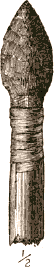
Fig. 244.—Part of deer lance, with flint head.
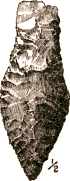
Fig. 246.—Flint head for deer lance.
THROWING WEAPONS.

Fig. 247.—Bird bolas, looped up for carrying.
The only throwing weapon which these people use is a small bolas, designed for catching birds on the wing. This consists of six or seven small ivory balls, each attached to a string about 30 inches long, the ends of which are fastened together to a tuft of feathers, which serves as a handle and perhaps directs the flight of the missile. When not in use the strings are shortened up, as in Fig. 247, No. 75969 [1793], for convenience in carrying and to keep them from tangling, by tying them into slip knots, as follows: All the strings being straightened out and laid parallel to each other, they are doubled in a bight, with the end under the standing part, the bight of the end passed through the preceding bight, which is drawn up close, and so on, usually five or six times, till the strings are sufficiently shortened. A pull on the two ends slips all these knots and the strings come out straight and untangled.
The bolas is carried knotted up in a pouch slung round the neck, a native frequently carrying several sets. When a flock of ducks is seen approaching, the handle is grasped in the right hand, the balls in the left, and the strings are straightened out with a quick pull. Letting go with the left hand the balls are whirled round the head and let fly at the passing flock. The balls spread apart in flying through the air, so as to cover considerable space, like a charge of shot, and if they are stopped by striking a duck, the strings immediately wrap around him and hamper his flight so that he comes to the ground. The natives said that the balls flew with sufficient force to stun a duck or break his wing, but we never happened to see any taken except in the way just described. A duck is occasionally left with sufficient freedom of motion to escape with the bolas hanging to him. The weapon is effective up to 30 or 40 yards, but the natives often throw it to a longer distance, frequently missing their aim. It is universally employed, especially by those who have no guns, and a good many ducks are captured with it. In the spring, when the ducks are flying, the women and children hardly ever stir out of the house without one or more of these.
We brought home one specimen of this implement (kelauĭtau´tĭn), No. 75969 [1793], Fig. 248, which is new and has the balls rather carelessly made. The balls, which are six in number, are of walrus ivory, 1.6 to 1.8 inches long and 1 inch in diameter (except one which is flattened, 2 inches long and 1.3 wide; they are usually all of the same shape). Through the larger end is drilled a small hole, the ends of which are joined by a shallow groove running over the end, into which the ends of the strings are fastened by three half-hitches each. There is one string of sinew braid to each set of two balls, doubled in the middle so that all six parts are equal and about 28 inches long. They are fastened to the feather handle as follows: Nine wing feathers of the eider duck are laid side by side, butt to point, and doubled in the middle so that the quills and vanes stand up on all sides. The middle of each string is laid across the bight of the feathers, so that the six parts come out on all sides between the feathers. The latter are then lashed tightly together with a bit of sinew braid, by passing the end over the bend of the feathers and tying with the rest of the string round the feathers.
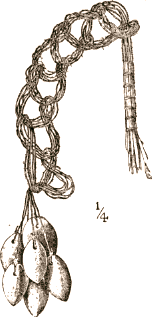
Fig. 248.—Bird bolas, ready for use.
These weapons are generally very much like the specimen described, but vary somewhat in the shape and material of the balls, which are sometimes simply ovoid or spherical, and often made of single teeth of the walrus, instead of tusk ivory. Bone is also sometimes used. In former times, the astragalus bones of the reindeer, perforated through the ridge on one end were used for balls. No. 89490 [1342], is a pair of such bones tied together with a bit of thong, which appear to have been actually used. No. 89537 [1251] from Utkiavwĭñ is a very old ball, which is small (1.1 inches long) and unusually flat. It appears to have been kept as a relic.
There is very little information to be found concerning the extent of the region in which this implement is used, either in the Museum collections or in the writings of authors. A few points, however, have been made out with certainty. The bolas are unknown among all the Eskimo east of the Anderson River, and the only evidence that we have of their use at this point is an entry in the Museum catalogue, to which I have been unable to find a corresponding specimen. Dease and Simpson, in 1837, did not observe them till they reached Point Barrow.342 They were first noticed by Beechey at Kotzebue Sound in 1826.343 Mr. Nelson’s collections show that they are used from Point Barrow along the Alaskan coast, at least as far south as the Yukon delta, and on St. Lawrence Island, while for their use on the coast of Siberia as far as Cape North, we have the authority of Nordenskiöld,344 and the Krause Brothers.345
HUNTING IMPLEMENTS OTHER THAN WEAPONS.
Floats.—
I have already spoken of the floats (apotû´kpûñ) of inflated sealskin used in capturing the whale and walrus. We obtained one specimen, No. 73578 [538] Fig. 249. This is the whole skin, except the head, of a male rough seal (Phoca fœtida), with the hair out. The carcass was carefully removed without making any incision except round the neck and a few inches down the throat, and skinned to the very toes, leaving the claws on. All natural or accidental apertures are carefully sewed up, except the genital opening, into which is inserted a ring of ivory, which serves as a mouthpiece for inflating the skin and is corked with a plug of wood. The cut in the throat is carefully sewed up, and the neck puckered together, and wrapped with seal thong into a slender shank about 1 inch long, leaving a flap of skin which is wrapped round a rod of bone 4 inches long and 1 in diameter, set across the shank, and wound with thong. This makes a handle for looping on the harpoon line.
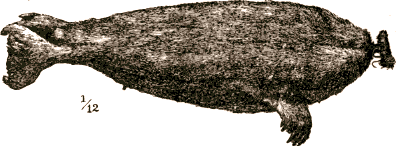
Fig. 249.—Seal skin float.
All the floats used at Point Barrow are of the same general pattern as this, and are generally made of the skin of the rough seal, though skins of the harbor seal (P. vitulina) are sometimes used. One of these floats is attached to the walrus harpoon, but two are used in whaling.346 Five or six floats are carried in each boat, and are inflated before starting out. I have seen them used for seats during a halt on the ice, when the boat was being taken out to the “lead.” The use of these large floats is not peculiar to Point Barrow. They are employed by all Eskimo who pursue the larger marine mammals.
Flipper toggles.—
We collected two pairs of peculiar implements, in the shape of ivory whales about 5 inches long, with a perforation in the belly through which a large thong could be attached. We understood that they were to be fastened to the ends of a stout thong and used when a whale was killed to toggle his flippers together so as to keep them in place while towing him to the ice, by cutting holes in the flippers and passing the ivory through. We unfortunately never had an opportunity of verifying this story. Neither pair is new. Fig. 250a represents a pair of these implements (kă´gotĭñ) (No. 56580 [227]). They are of white walrus ivory. In the middle of each belly is excavated a deep, oblong cavity about three-fourths of an inch long and one-half wide, across the middle of which is a stout transverse bar for the attachment of the line. One is a “bow-head” whale (Balæna mysticetus), 4½ inches long, and the other evidently intended for a “California gray” (Rhachinectes glaucus). It has light blue glass beads inserted for eyes and is the same length as the other.
Fig. 250 (No. 56598 [407]) is a similar pair, which are both “bowheads” nearly 5 inches long. Both have cylindrical plugs of ivory inserted for eyes, and are made of a piece of ivory so old that the surface is a light chocolate color. The name, kăgotĭñ, means literally “a pair of toggles.”
Harpoon boxes (u´dlun or u´blun, literally “a nest.”)—
The slate harpoon blades already described were very apt to be lost or broken, so they always carried in the boat a supply of spare blades. These were kept in a small box carved out of a block of soft wood, in the shape of the animal to be pursued.
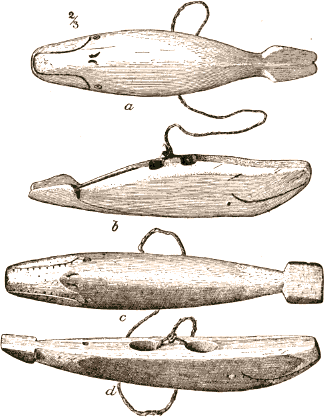
Fig. 250.—Flipper toggles.
Fig. 251a represents one of these boxes (No. 56505 [138]) intended for spare blades for the whale harpoon. This is rather neatly carved from a single block of soft wood, apparently spruce, though it is very old and much weathered, in the shape of a “bowhead” whale, 9½ inches long. The ends of the flukes are broken short off, and show traces of having been mended with wooden pegs or dowels. The right eye is indicated by a simple incision, but a tiny bit of crystal is inlaid for the left. Two little bits of crystal are also inlaid in the middle of the back. The belly is flat and excavated into a deep triangular cavity, with its base just forward of the angle of the mouth and the apex at the “small.” It is beveled round the edge, with a shoulder at the base and apex, and is covered with a flat triangular piece of wood beveled on the under face to fit the edge of the cavity. About half of one side of the cover has been split off and mended on with two “stitches” of whalebone fiber. The cover is held on by three strings of seal thong passing through holes in each corner of the cover and secured by a knot in the end of each string. They then pass through three corresponding holes in the bottom of the cavity, leaving outside of the back two ends 7 inches and one 15 long, which are tied together. The cover can be lifted wholly off and then drawn back into its place by pulling the string.
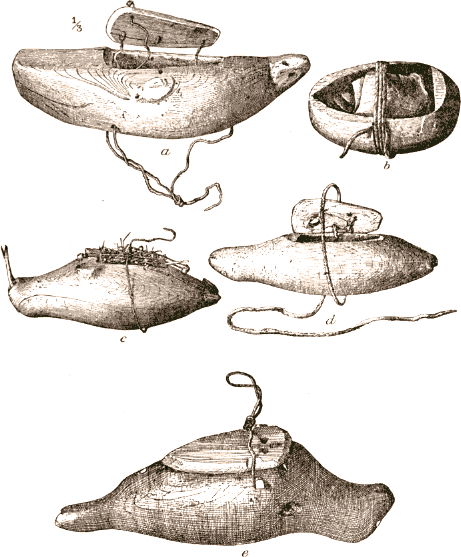
Fig. 251.—Boxes for harpoon heads.
We collected seven such whale-harpoon boxes, usually about 9 to 9¾ inches long. Nearly all have bits of crystal, amber, or pyrite, inlaid for the eyes and in the middle of the back, and the cover is generally rigged in the way described. No. 56502 [198], from Utkiavwĭñ, is a large whale, a foot long, and has the tail bent up, while the animal is usually represented as if lying still. It has good-sized sky-blue beads inlaid for the eyes.
Fig. 251b (No. 89733 [1161], from Nuwŭk) represents a small box 4⅓ inches long, probably older than the others, and the only one not carved into the shape of a whale. It is roughly egg-shaped and has no wooden cover to the cavity, which is covered with a piece of deerskin, held on by a string of seal thong wrapped three times around the body in a rough, deep groove, with the end tucked under. In this box are five slate blades for the whale harpoon.
We also collected two boxes for walrus harpoons made in the shape of the walrus, with ivory or bone tusks. No. 89732 [860], Fig. 251c, from Nuwŭk, is old, and 7 inches long, and has two oval bits of ivory, with holes bored to represent the pupils, inlaid for the eyes. There is no cover, but the cavity is filled with a number of slate blades, carefully packed in whalebone shavings. There is a little eyebolt of ivory at each end of the cavity. One end of a bit of sinew braid is tied to the anterior of these, and the other carried down through the hinder one, and then brought up and fastened round the body with a marling hitch. The other, No. 56489 [127], is new and rather roughly made, 5 inches long and painted all over with red ocher. It has a cover, but no strings.
No. 56501 [142], Fig. 251d, from Utkiavwĭñ, is for carrying harpoon blades for the chase of the bearded seal (Erignathus barbatus), and is neatly carved into the shape of that animal. It is 7.4 inches long and has ivory eyes like the walrus box, No. 89732 [860]. The cover is fitted to the cavity like those of the whale boxes, but is held on by one string only, a piece of seal thong about 3 feet long passing through the middle of the cover and out at a hole on the left side, about one-fourth inch from the cavity. The box is filled with raveled rope-yarns. Fig. 251e (No. 89730 [981], from Utkiavwĭñ) is like this, but very large, 9.3 inches long. The cover is thick and a little larger than the cavity, beveled on the upper face and notched on each side to receive the string, which is a bit of sinew braid fastened to two little ivory hooks, one on each side of the body. It is fastened to the right hook, carried across and hooked around the left-hand one, then carried over and hooked round the other, and secured by tucking a bight of the end under the last part. The box contains several slate blades. We also collected one other large seal box (No. 89731 [859], from Nuwŭk), very roughly carved, and 9.8 inches long. The cover is fitted into the cavity and held on by a narrow strip of whalebone running across in a transverse groove in the cover and through a hole in each side of the box.
Nets (ku´bra).—
The smaller seals are captured in large-meshed nets of rawhide. We brought home one of these, No. 56756 [109], Figs 252a-252b (detail of mesh). This is a rectangular net, eighteen meshes long and twelve deep, netted of fine seal thong with the ordinary netting knot. The length of the mesh is 14 inches.
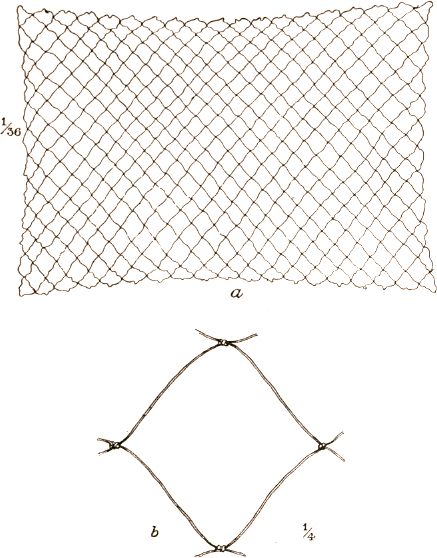
Fig. 252.—Seal net.
Such nets are set under the ice in winter, or in shoal water along the shore by means of stakes in summer. In the ordinary method of setting the net under the ice two small holes are cut through the ice the length of the net apart, and between them in the same straight line is cut a third large enough to permit a seal to be drawn up through it. A line with a plummet on the end is let down through one of the small holes, and is hooked through the middle hole, with a long slender pole of willow, often made of several pieces spliced together, with a small wooden hook on the end. The line is then detached from the plummet and fastened to one upper corner of the net, and a second line is let down through the other small hole and made fast in the same way to the other upper corner. By pulling on these lines the net is drawn down through the middle and stretched like a curtain under the ice, while a line at the middle serves to haul it up again. The end lines are but loosely made fast to lumps of ice, so that when a seal strikes the net nothing hinders his wrapping it completely around him in his struggles to escape. When the hunter, who is usually watching his net, thinks the seal is sufficiently entangled he hauls him up through the large hole and sets the net again.
I had no opportunity of observing whether any weights or plummets were used to keep down the lower edge of the net. These nets are now universally employed, but one native spoke of a time “long ago” when there were no nets and they captured seals with the spear (u´nɐ) alone. The net was used in seal catching in Dr. Simpson’s time, though he makes but a casual reference to it,347 and Beechey found seal nets at Kotzebue Sound in 1826.348 The net is very generally used for sealing among the Eskimo of western America and in Siberia. We observed seal nets set with stakes along the shore of the sandspit at Plover Bay, and Nordenskiöld speaks of seal nets “set in summer among the ground ices along the shore,”349 and at open leads in the winter, but gives no description of the method of setting these nets beyond mentioning the “long pole which was used in setting the net,”350 as none of his party ever witnessed the seal fishery.351 I am informed by Mr. W. H. Dall that the winter nets in Norton Sound are not set under the ice as at Point Barrow, but with stakes in shoal water wherever there are open holes in the ice. “Ice nets” are spoken of as in use for sealing in Greenland, but I have been able to find no description of them. As they are not spoken of by either Egede or Crantz I am inclined to believe that they were introduced by the Europeans.352 Mr. L. M. Turner informs me that such is the case at Ungava Bay on the southern shore of Hudson Strait, where they use a very long net set under the ice very much as at Point Barrow. I can find no mention of the use of seal nets among any other of the eastern Eskimo.
It is well known that seals have a great deal of curiosity, and are easily attracted by any unusual sounds, especially if they are gentle and long-continued. It is therefore easy to entice them into the nets by making such noises, for instance, gentle whistling, rattling on the ice with the pick, and so forth. Two special implements are also used for this purpose. The first kind I have called:
Seal calls (adrigautĭn).—
This implement consists of three or four claws mounted on the end of a short wooden handle, and is used to make a gentle noise by scratching on the ice. It is a common implement, though I never happened to see it in use. We obtained six specimens, of which No. 56555 [90] Fig. 253a, is the type. It is 11½ inches long. The round handle is of ash, the claws are those of the bearded seal, secured by a lashing of sinew braid, with the end brought down on the under side to a little blunt, backward-pointing hook of ivory, set into the wood about 1 inch from the base of the arms.
Fig. 253b (No. 56557 [93] from Utkiavwĭñ is 9½ inches long and has four prongs. The haft is of spruce, and instead of an ivory hook there is a round-headed stud of the same material, which is driven wholly through the wood, having the point cut off flush with the upper surface. It has a lanyard of seal twine knotted into the hole in the haft. The other two specimens of this pattern, Nos. 56556 [100] and 56558 [51] have each three claws, and hafts of soft wood, painted with red ocher, with lanyards, and are respectively 10.4 and 10.7 inches long. One has an ivory hook, but the other in place of this has a small iron nail, and is ornamented with a medium-sized sky-blue glass bead inlaid in the back. The other two are both new and small, being respectively 7.5 and 7.6 inches long. The hafts are made of reindeer antler and have only two prongs. No. 89467 [1312] from Utkiavwĭñ, has the haft notched on each side, and has an irregular stud of bone for securing the lashing.
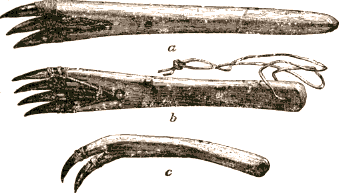
Fig. 253.—Scratchers for decoying seals.
No. 89468 [1354], Fig. 253c, from Utkiavwĭñ, has no stud and the claws are simply held on by a slight lashing of twisted sinew. Both of these were made for the market, but may be models of a form once used. There are two old seal calls in the Museum from near St. Michaels, made of a piece of reindeer antler, apparently the spreading brow antler, in which the sharp points of the antler take the place of claws. The use of this implement, as shown by Mr. Nelson’s collection, extends or extended from Point Barrow to Norton Sound. He collected specimens from St. Lawrence Island and Cape Wankarem in Siberia. Nordenskiöld speaks of the use of this implement at Pitlekaj and figures a specimen.353 The other instrument appears to be less common. I have called it a seal rattle.
Seal rattle.—
We obtained only two specimens, No. 56533 [409], which seem to be a pair. Fig. 254 is one of these. It is of cottonwood and 4 inches long, roughly carved into the shape of a seal’s head and painted red, with two small transparent blue glass beads inlaid for the eyes. The neat becket of seal thong consists of three or four turns with the end wrapped spirally around them. The staple on which the ivory pendants hang is of iron. This is believed to be a rattle to be shaken on the ice by a string tied to the becket for the purpose of attracting seals to the ice net. It was brought in for sale at a time during our first year when we were very busy with zoological work, and as something was said about “nĕtyĭ” and “kubra” (“seal” and “net”) the collector concluded that they must be floats for seal nets, and they were accordingly catalogued as such and laid away. We never happened to see another specimen, and as these were sent home in 1882 we learned no more of their history. The late Dr. Emil Bessels, however, on my return called my attention to the fact that in the museum at Copenhagen there is a single specimen very similar to these, which was said to have been used in the manner described above. It came from somewhere in eastern America. There is one, he told me, in the British Museum from Bering Strait. The National Museum contains several specimens collected by Mr. Nelson at Point Hope. It is very probable that this is the correct explanation of the use of these objects, as it assigns a function to the ivory pendants which would otherwise be useless. They have been called “dog bells,” but the Eskimo, at Point Barrow, at least, are not in the habit of marking their dogs in any way.
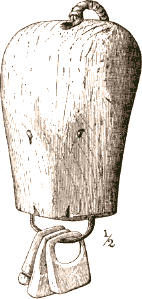
Fig. 254.—Seal rattle.
Seal indicators.—
When watching for a seal at his breathing hole a native inserts in the hole a slender rod of ivory, which is held loosely in place by a cross piece or a bunch of feathers on the end. When the seal rises he pushes up this rod, which is so light that he does not notice it, and thus warns the hunter when to shoot or strike with his spear. Most of the seal hunting was done at such a distance from the station that I remember only one occasion when this implement was seen in use. We collected two specimens, of which No. 56507 [104], Fig. 255a, will serve as the type. It is of walrus ivory, 14½ inches long and 0.3 in diameter, with a small lanyard of sinew. The curved cross piece of ivory, 1⅓ inches long, is inserted into a slot one-fourth of an inch from the end and secured by a little treenail of wood.
Fig. 255b (No. 89454 [1114], from Nuwŭk) is a similar indicator, 13½ inches long and flat (0.3 inch wide and 0.1 thick). The upper end is carved into scallops for ornament and has a small eye into which was knotted a bit of whalebone fiber. The tip is beveled off with a concave bevel on both faces to a sharp edge, so that it can be used for a “feather setter” (ĭgugwau) in feathering arrows. Such implements are mentioned in most popular accounts of the Eskimo of the east, and Capt. Parry describes it from personal observation at Iglulik.354 I have been unable to find any mention of its use in western America, and have seen no specimens in the National Museum.

Fig. 255.—Seal indicators.
Sealing stools.—
When a native is watching a seal-hole he frequently has to stand for hours motionless on the ice. His feet would become exceedingly cold, in spite of the excellence of his foot covering, were it not for a little three-legged stool about 10 inches high upon which he stands. This stool is made of wood, with a triangular top just large enough to accommodate a man’s feet, with the heels together over one leg of the stool, and the other two legs supporting the toes of each foot, respectively. The stool is neatly made, and is as light as is consistent with strength. It is universally employed and carried by the hunter, slung on the gun cover with the legs projecting behind.
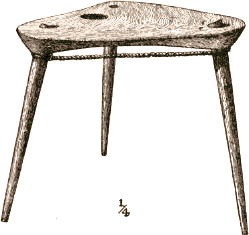
Fig. 256.—Sealing stool.
When the hunter has a long time to wait he generally squats down so as almost to sit on his heels, holding his gun and spear in readiness, and wholly covered with one of the deerskin cloaks already described. They sometimes use this stool to sit on when waiting for ducks to fly over the ice in the spring.
We brought home two specimens of this common object (nĭgawaúotĭn). No. 89887 [1411], Fig. 250, will serve as the type. The top is of spruce, 8¾ inches long and 10¾ wide. The upper surface is flat and smooth, the lower broadly beveled off on the edges and deeply excavated in the middle, so that there are three straight ridges joining the three legs, each of which stands in the middle of a slight prominence. The object of cutting away the wood in this way is to make the stool lighter, leaving it thick only at the points where the pressure comes. The large round hole in the middle, near the front, is for convenience in picking it up and hanging it on the cache frame, where it is generally kept. The three legs are set into holes at each corner, spreading out so as to stand on a base larger than the top of the stool. Where they fit into the holes they are 0.7 inch in diameter, tapered slightly to fit the hole, and then tapering down to a diameter of one-third inch at the tip. On the under side of the top they are braced with a lashing of stout seal thong. A split on the right-hand edge of the top has been mended, as usual, with a stitch of whalebone. This stool is quite old and has been actually used.
No. 89888 [1412], from the same village, is new and a little larger, but differs from the type only in having a triangular instead of a round hole in the top and no lashing. Those of our party who landed at Sidaru September 7, 1881, saw one of these stools hanging up in the then vacant village, and there is a precisely similar stool in the Museum from the Anderson region.
MacFarlane, in his manuscript notes, describes the use of these stools as follows: “Both tribes kill seals under ice; that is, they watch for them at their holes (breathing) or wherever open water appears. At the former they generally build a small snow house somewhat like a sentinel’s box, on the bottom of which they fix a portable three-cornered stool, made of wood. They stand on this and thereby escape getting cold feet, as would be the case were they to remain for any time on ice or snow in the same immovable position.” Beyond this I find no mention of the use of any such a utensil, east or west, except in Greenland, where, however, they used a sort of one-legged chair to sit on, as well as a footstool, which Egede pictures (Pl. 9) as oval, with very short legs.355
Seal drags (uksiu´tiñ.)—
Every seal hunter carries with him a line for dragging home his game, consisting of a stout thong doubled in a bight about 18 inches long, with an ivory handle or knob at the other end. The bight is looped into an incision in the seal’s lower jaw, while the knob serves for attaching a longer line or the end of a dog’s harness. The seal is dragged on his back and runs as smoothly as a sled. We collected eight of these drag lines, from which I have selected No. 56624 [44], Fig. 257a, as the type.
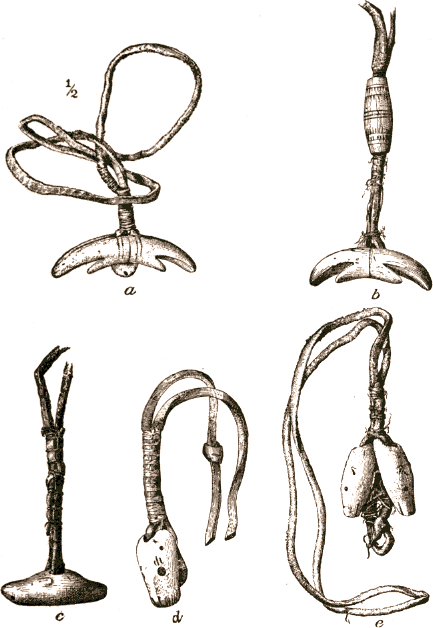
Fig. 257.—Seal drags and handles.
This consists of a stout thong of rawhide (the skin of the bearded seal) 0.3 inch wide and 37 inches long, and doubled in a bight so that one end is about 2½ inches the longer. These ends are fastened into a handle of walrus ivory, consisting of three pieces, namely: a pair of neatly carved mittens, respectively 1.9 and 1.8 inches long, put together wrist to wrist with the palms up; and lying across the joint above, a little seal 1¼ inches long, belly down. A hole runs through each wrist and through the belly of the seal. The mittens are ornamented on the back with a blackened incised pattern, and the seal has blue glass beads for eyes and blackened incised spots on the back. The longer end of the thong runs up through the right mitten, across through the seal, and down through the left mitten. It is then passed through a slit 1 inch from the end of the shorter part and slit itself. Through this slit is passed the bight of the thong, all drawn up taut and seized with sinew braid.
No. 89467 [755], from Utkiavwĭñ, is a similar drag, put together in much the same way, but it has the mittens doweled together with two wooden pins, and a seal’s head with round bits of wood inlaid for eyes, ears, and nostrils, in place of the seal. The longitudinal perforation in this head shows that it was originally strung lengthwise on one of these lines. The “double slit splice” of the two ends of the thong is worked into a complicated round knot, between which and the handle the two parts of the line are confined by a tube of ivory 1 inch long, ornamented with deeply incised patterns. Fig. 257b is the upper part of a line (No. 56622 [36], from Utkiavwĭñ), with a similar tube 1¾ inches long, and a handle carved from a single piece into a pair of mittens like the others.
No. 56625 [81], also from Utkiavwĭñ, is almost exactly similar to the one first described, but has the seal belly up. Fig. 257c (No. 89470 [1337], from the same village) has a seal 2.3 inches long for the handle, and No. 56626 [212], from Utkiavwĭñ, is like it. No. 89469a, [755a] Fig. 257d, from Utkiavwĭñ, has for a handle the head of a bearded seal 1.6 inches long, neatly carved from walrus ivory, with round bits of wood inlaid for the eyes and ears. It is perforated longitudinally from the chin to the back of the head, and a large hole at the throat opens into this. The longer end of the thong is passed in at the chin and out at the back of the head; the shorter, in at the back of the head and out at the throat; the two ends brought together between the standing parts and all stopped together with sinew braid.
No. 56627 [45], Fig. 257e, has a handle made of two ivory bears’ heads, very neatly carved, with circular bits of wood inlaid for eyes, and perforated like the seal’s head just described. The thong is doubled in the middle and each end passed through one of the heads lengthwise, so as to protrude about 7 inches. About 4 inches of end is then doubled over, thrust through the throat hole of the opposite head, and brought down along the standing parts. All the parts are stopped together with sinew braid. This makes a small becket above the handle.
We collected seven knobs for these drag lines, of which six are seals’ heads and one a bear’s. They are all made of walrus ivory, apparently each a single tooth, and not a piece of tusk, and are about 1½ inches to 2 inches long. They are generally carved with considerable skill, and often have the ears, roots of the whiskers, nostrils, and outline of the mouth incised and blackened, while small blue beads, bits of ivory, or wood are inlaid for the eyes. Implements of this sort are in common use among Eskimo generally wherever they are so situated as to be able to engage in seal-hunting. Mr. Nelson’s collection contains specimens from as far south as Cape Darby.
Whalebone wolf-killers (ĭsĭbru).—
Before the introduction of the steel traps, which they now obtain by trade, these people used a peculiar contrivance for catching the wolf. This consists of a stout rod of whalebone about 1 foot long and one-half inch broad, with a sharp point at each end. One of these was folded lengthwise in the form of a Z,356 wrapped in blubber (whale’s blubber was used, according to our informant, Nĭkawáalu), and frozen solid. It was then thrown out on the snow where the wolf could find and swallow it. The heat of the animal’s body would thaw out the blubber, releasing the whalebone, which would straighten out and pierce the walls of the stomach, thus causing the animal’s death. Nikawáalu says that a wolf would not go far after swallowing one of these blubber balls.
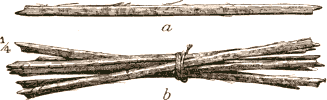
Fig. 258.—Whalebone wolf-killers.
We collected four sets of these contrivances, one set containing seven rods and the others four each. Fig. 258a gives a good idea of the shape of one of these. It belongs to a set of seven, No. 89538 [1229], Fig. 258b, from Utkiavwĭñ, which are old and show the marks of having been doubled up. It is 12½ inches long, 0.4 broad, and 0.2 thick. The little notches on the opposite edges of each end were probably to hold a lashing of sinew which kept the folded rod in shape while the blubber was freezing, being cut by thrusting a knife through the partially frozen blubber, as is stated by Schwatka.357 Two of the sets are new, but made like the others.
This contrivance is also used by the Eskimo of Hudson Bay358 and at Norton Sound, where, according to Petroff,359 the rods are 2 feet long and wrapped in seal blubber. The name ĭsĭ´bru appears to be the same as the Greenlandic (isavssok), found only in the diminutive isavssoraĸ, a provincial name for the somewhat similar sharp-pointed stick baited with blubber and used for catching gulls. The diminutive form of this word in Greenlandic may indicate that their ancestors once used the large wolf-killer, when they lived where wolves were found. The definition of uju´kuaĸ, the ordinary word for the gull-catcher (see below)—in the Grønlandske Ordbog—is the only evidence we have of the use of this contrivance in Greenland. This is one of the several cases in which we only learn of the occurrence of customs, etc., noted at Point Barrow, in Greenland, by finding the name of the thing in question defined in the dictionary.
Traps.—
Foxes are caught in the winter by deadfalls or steel traps (nänori´a), set generally along the beach, where the foxes are wandering about in search of carrion thrown up by the sea. In setting the deadfalls a little house about 2 feet high is built, in which is placed the bait of meat or blubber. A heavy log of driftwood is placed across the entrance, with one end raised high enough to allow a fox to pass under it, and supported by a regular “figure of four” of sticks. The fox can not get at the bait without passing under the log, and in doing so he must touch the trigger of the “figure of four” (4), which brings down the log across his back. When a steel trap is used it is not baited itself, but buried in the snow at the entrance of a similar little house, so that the fox can not reach the bait without stepping on the plate of the trap and thus springing it. Many foxes are taken with such traps in the course of the winter.
The boys use a sort of snare for catching setting birds. This is simply a strip of whalebone made into a slip-noose, which is set over the eggs, with the end fastened to the ground, so that the bird is caught by the leg. Once or twice, when there was a light snow on the beach, we saw a native catching the large gulls as follows: He had a stick of hard wood, pointed at each end, to the middle of which was fastened one end of a stout string about 6 feet long. The other end was secured to a stake driven into the frozen gravel, and the stick wrapped with blubber and laid on the beach, with the string carefully hidden in the snow. The gull came along, swallowed the lump of blubber, and as soon as he tried to fly away the string made the sharp stick turn like a toggle across his gullet, the points forcing their way through, so that he was held fast. A similar contrivance, but somewhat smaller and made of bone, is used at Norton Sound for catching gulls and murres, a number of them being attached to a trawl line and baited with fish. Mr. Nelson collected a large number of these.360 In regard to the use of this contrivance in Greenland, see above under “wolf-killers.”
Snow-goggles.—
The wooden goggles worn to protect the eyes from snow-blindness may be considered as accessories to hunting, as they are worn chiefly by those engaged in hunting or fishing, especially when deer-hunting in the spring on the snow-covered tundra or when in the whaleboats among the ice. They are simply a wooden cover for the eyes, admitting the light by a narrow horizontal slit, which allows only a small amount of light to reach the eye and at the same time gives sufficient range of vision. Such goggles are universally employed by the Eskimos everywhere361 except in Siberia, where they use a simple shade for the eyes.362
We brought home four pairs of these goggles (í´dyĭgûñ), of which No. 89894 [1708], Fig. 259, represents the common form. These are of pine wood, 5.8 inches long and 1.1 inches broad, and deeply excavated on the inside, with a narrow horizontal slit with thin edges on each side of the middle. In the middle are two notches to fit the nose, the one in the lower edge deep and rounded, the upper very shallow. The two holes in each end are for strings of sinew braid to pass round the head. They are neatly made and the outside is scraped smooth and shows traces of a coat of red ocher.
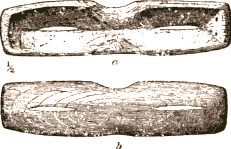
Fig. 259.—Wooden snow goggles.
The history of this particular pair of goggles is peculiarly interesting. Though differing in no important respect from those used at the present day, they were found on the site of the ancient village of Isû´tkwa, where our station stood, buried at a depth of 27 feet in undisturbed frozen ground, and were uncovered in digging the shaft sunk by Lieut. Ray for obtaining earth temperatures.363 The layer in which they were found was evidently an old sea beach, consisting of sand and gravel mixed with broken shells, among which Mya truncata was recognized. The amount of the superincumbent gravel and similar material above this object does not necessarily indicate any very great length of time since they were first buried, as will be readily understood from what I have said above (p. 28) about the rapidity with which high hummocks of gravel are pushed up by the ice. The unbroken layer of turf, however, nearly a foot thick, with which the ground was covered at this point, shows that a considerable period must have elapsed since the gravel had reached nearly to its present level.
The pattern of these goggles is to my mind a very decided proof that at that early date this region was inhabited by Eskimo not essentially different from its present inhabitants. Goggles worn at the present day are almost always of the shape of these, though I remember seeing one pair made in two pieces joined by short strings of beads across the nose. They are, I think, universally painted with red ocher on the outside and blackened inside. They were not always made of wood, as there are two specimens in the collection made of a piece of antler, following the natural curve of the beam, divided longitudinally, with the softer inside tissue hollowed out.
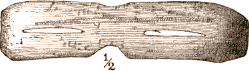
Fig. 260.—Bone snow goggles.
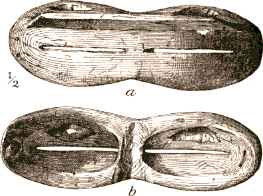
Fig. 261.—Wooden snow goggles, unusual form.
Fig. 260 (No. 89701 [763], from Utkiavwĭñ) represents one of these specimens. I do not recollect ever seeing goggles of this material in actual use. No. 89703 [754], Fig. 261, is an unusual pattern, having along the top a horizontal brim about one-half inch high, which serves for an additional shade to the eyes. Above this are two oblique holes opening into the cavity inside, which are probably for the purpose of ventilation, to prevent the moisture from the skin from being deposited as frost on the inside of the goggles or on the eyelashes. I do not remember having seen such goggles worn. Dall figures a similar pair from Norton Sound, and those brought by Mr. Turner from Ungava have a similar brim and ventilating holes. The snow goggles mentioned in Parry’s Second Voyage (p. 547) as occasionally seen at Iglulik, but more common in Hudson’s Strait, appear to have resembled these, but had a brim 3 or 4 inches deep.
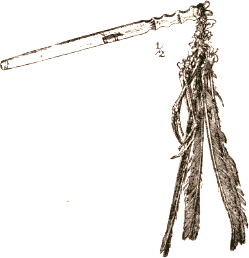
Fig. 262.—Marker for meat cache.
Meat-cache markers.—
We purchased a couple of little ivory rods, each with a little bunch of feathers tied to one end, which we were told were used by the deer hunters to mark the place where they had buried the flesh of a deer in the snow. This implement is called tû´kusia.
Fig. 262, represents one of these (No. 89531 [978] from Nuwŭk). It is a flat, slender rod of white walrus ivory, 11½ inches long, and evidently broken off at the tip. The other end is cut into ornamental notches, and ornamented with an incised pattern colored with red ocher, consisting of conventional lines and the figure of a reindeer on each face, a buck on one face and a doe on the other. Tied by a bit of sinew to the uppermost notch are four legs and three wing tips (three or four primaries, with the skin at the base) of the buff-breasted sandpiper (Tryngites subruficollis). This was evidently longer when new and perhaps was originally used for a seal indicator (which see above). Fig. 263 (No. 89453 [1581] from Utkiavwĭñ) is a similar rod, the tip of which has been brought to an edge so that it can be used as a “feather-setter” in feathering arrows. The remains of two wing tips of some small bird are tied to one of the notches at the upper end.
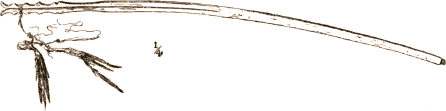
Fig. 263.—Marker for meat cache.
METHODS OF HUNTING.
Having now described in detail all the weapons and other implements used in hunting, I am prepared to give an account of the time and methods of pursuing the different kinds of game.
The polar bear.—
Bears are occasionally met with in the winter by the seal hunters, roaming about the ice fields at some distance from the shore. They usually run from a man and often do not make a stand even when wounded. Occasionally, however, a bear rendered bold by hunger comes in from the sea and makes an attack on some native’s storehouse of seal meat even in the midst of the village. Of course, in such a case he has very little chance of escape, as the natives all turn out with their rifles and cut off his retreat. Two bears were killed in this way at Utkiavwĭñ in the winter of 1882-’83. The bear is always attacked with the rifle, often with the help of dogs to bring him to bay. The umiaks when walrus hunting sometimes meet with bears among the loose ice. If the bear is caught in the water, there is very little difficulty in paddling up close enough to him to shoot him.
The wolf.—
The wolf can hardly be considered a regular object of pursuit. Wolves are often seen and occasionally shot by deer hunters in the winter, and one family in the summer of 1883 managed to catch a couple of young wolf cubs alive, somewhere between Point Barrow and the Colville. These they brought home with them and kept them picketed on the tundra just outside of the village, with a little kennel of snow to shelter them, carefully feeding them till winter, when their fur had grown long enough for use in trimming hoods. They were then killed with a stone-headed arrow, which we were told was necessary for the purpose, and their skins dressed and cut into strips which were sold around the village. Superstition required that the man who killed these wolves should sleep outside of the house in a tent or snow hut for “one moon” after killing them. We did not learn the reason for this practice beyond that it would be “bad” to do otherwise.
The fox.—
Foxes are sometimes shot, but are generally taken in the traps described above, which are usually set some distance from the village so as to avoid catching prowling dogs. Though generally exceedingly shy, the fox is sometimes rendered careless by hunger. One of the women at the deer-hunters’ camp in the spring of 1882 caught one in the little snow house built to store the meat and killed him with a stick.
The reindeer.—
Reindeer are comparatively scarce within the radius of a day’s march from Point Barrow, though solitary animals and small parties are to be seen almost any day in the winter a few miles inland from the seacoast. In the autumn, which is the rutting season, they occasionally wander down to the lagoons back of the beach. Nearly every day in the autumn and winter, when the weather is not stormy, one or more natives are out looking for reindeer, usually traveling on snowshoes and carrying their rifles slung on their backs. The deer are generally very wild and often perceive a man and begin to run at a distance of a mile or two, though a rutting buck will sometimes fancy that a skin-clad Eskimo is a rival buck, and come toward him, especially if the hunter crouches down and keeps perfectly still.
The usual method of hunting is to walk off inland until a deer is sighted, when the hunter moves directly toward him at a rapid pace, without regard to the wind or attempting to conceal himself, which would be almost hopeless in such open country. As soon as the deer starts to run, the hunter quickens his pace—to a run, if he has “wind” enough—and follows the game as long as he can keep it in sight, trusting that the well known curiosity of the deer will induce it to “circle” round, in order to see what it is that is following him with such pertinacity. Should the deer turn, as often happens, especially if there is more than one of them, the hunter alters his course so as to head him off, and as soon as he gets within long rifle range opens fire, and keeps it up till the animal is hit or escapes out of range. Strange as it may seem, a number of deer are killed every winter in this way.
If a deer be killed, the hunter usually “butchers” him on the spot, and brings in as much of the meat as he can carry on his back, leaving the rest, carefully covered with slabs of snow to protect it from the foxes, to be brought in as soon as convenient by a dog sled, which follows the hunter’s tracks to the place.
During the spring the deer retire some distance from the Point, and the does then drop their fawns. At this season nearly all the natives are busily engaged in the whale fishery, and pay little attention to the reindeer, so that we did not learn where they went to. When the fawns are perhaps a month old a small party, say a young man and his wife, sometimes makes a short journey to the eastward to procure fawn skins for clothing. They say that the fawns at this age can be caught by running them down. During the summer again the deer come down to the coast in small numbers, taking to the water in the lagoons, or even in the sea, when the flies become troublesome.
Sometimes in warm, calm weather the flies are so numerous that the deer is driven perfectly frantic, and runs along without looking where he is going, so that, as the natives say, a hunter who places himself in the deer’s path has no difficulty in shooting him. Flies were unusually scarce both summers that we were at the station, so that we never had an opportunity of seeing this done. When a deer is seen swimming he is pursued with the kaiak and lanced in the manner already described. In July, 1883, one man from Utkiavwĭñ made a short journey inland, “carrying” his kaiak from lake to lake, and killed two deer in this way without firing a shot. I believe this method of hunting is frequently practiced by the parties who go east for trading in the summer, and those who visit the rivers for the purpose of hunting.
The natives seemed to expect deer in summer at the lagoons, as along the isthmus between Imê´kpûñ and Imêkpûnĭglu they had set up a range of stakes, evidently intended to turn the deer up the beach where he would be seen from the camp at Pernijû. Only one deer, however, came down either summer, and he escaped without being seen. This contrivance of setting up stakes to guide the deer in a certain direction is very commonly used by the Eskimo. Egede gives a curious description of the practice in Greenland in his day: They “chase them [i.e., the reindeer] by Clap-hunting, setting upon them on all sides and surrounding them with all their Women and Children to force them into Defiles and Narrow Passages, where the Men armed lay in wait for them and kill them. And when they have not People enough to surround them, then they put up white Poles (to make up the Number that is wanted) with Pieces of Turf to head them, which frightens the Deer and hinders it from escaping.”364 Pl. 4, of the same work, is a very curious illustration of this style of hunting.