ETHNOLOGICAL RESULTS OF THE POINT BARROW EXPEDITION. (continued 4)
Reading edition
A similar method is practiced at the Coppermine River, where the deer are led by ranges of turf toward the spot where the archer is hidden.365 Franklin also noticed between the Mackenzie and the Colville similar ranges of driftwood stumps leading across the plain to two cairns on a hill,366 and Thomas Simpson mentions a similar range near Herschel Island,367 and double rows of turf to represent men leading down to a small lake near Point Pitt, for the purpose of driving the deer into the water where they could be speared.368 This is similar to the practice described by Schwatka369 among the “Netschilluk” of King William’s Land, where a line of cairns as high as a man and 50 to 100 yards apart is built along a ridge running obliquely to the water. When deer are seen feeding near the water the men form a skirmish line from the last cairn to the water and advance slowly. The deer mistake the cairns for men and take to the water, where they are easily speared.
The most important deer hunt takes place in the late fall and early spring, when the natives go inland 50 or 75 miles to the upper waters of Kuaru and Kulugrua, where the deer are exceedingly plentiful at this season. Capt. Herendeen, who went inland with the deer hunters in the autumn of 1882, reports that the bottom lands of Kulugrua “looked like a cattle yard,” from the tracks of the reindeer. They start as soon as it is possible to travel across the country with sledges, usually about the first of October, taking guns, ammunition, fishing tackle, and the necessary household utensils for themselves and their families, and stay till the daylight gets too short for hunting. In 1882, many parties got home about October 27 or 28. At this season there is seldom snow enough to build snow huts, so they generally live in tents, always close to the rivers from which they procure water for household use. The men spend their time hunting the deer, while the women bring in the game, attend to drying the skins and the household work, and catch whitefish and burbot through the ice of the rivers, which are now frozen hard enough for this purpose. Some of the old men and those who have not a supply of ammunition engage in the same pursuit.
A comparatively small number of the people go out to this fall deer hunt, which appears to be a new custom, adopted since Dr. Simpson’s time. It was probably not worth while to go out after deer at seasons when there was not enough snow for digging pitfalls, since they depended chiefly on these for the capture of the reindeer before the introduction of firearms. Fully half of each village go out on the spring deer hunt, as they did in Maguire’s time, the first parties starting out with the return of the sun, about January 23, and the others following in the course of two or three weeks, and remain out till about the middle of April, when it is time to come back for the whale fishery. The people of Utkiavwĭñ always travel to the hunting grounds by a regular road, which is the same as that followed by Lieut. Ray in his exploring trips. They travel along the coast on the ice wherever it is smooth enough till they reach Sĭ´ñaru, and then strike across country, crossing Kuaru and reaching Kulugrua near the hill Nuasu´knan. (See map, Pl. II.)
The people from Nuwŭk travel straight across Elson Bay to the south till they reach nearly the same region. Some parties from Nuwŭk also hunt in the rough country between Kulugrua and Ikpĭkpûñ. As the sledges are heavily laden with camp equipage, provisions and oil for the lamps, they travel slowly, taking four or five days for the journey, stopping for the night with tolerable regularity at certain stations where the first party that travels over the trail build snow huts, which are used by those who follow them. At the rivers they are scattered in small camps of four or five families, about a day’s journey apart. As well as we could learn these camps are in regularly established places, where the same people return every year, if they hunt at all. It even seemed as if these localities were considered the property of certain influential families, who could allow any others they pleased to join their parties.370 It is certain, at all events, that the people of Utkiavwĭñ did not hunt on the Ikpĭkpûñ with the men of Nuwŭk. At this season they live entirely in snow huts, often excavated in the deep drifts under the river bluffs, and the men hunt deer while the women, as before, catch fish in Kuaru and Kulugrua. None are taken in Ikpĭkpûñ. (See above, p. 58.)
Deer are generally very plentiful at this season, though sometimes, as happened in February, 1883, there comes a warm southerly wind which makes them all retreat farther inland for a few days. They are generally hunted by chasing them on snowshoes, in the manner already described, but with much better chances of success, since when a number of hunters are out in the same region the deer are kept moving, so that a herd started by one hunter is very apt to run within gunshot of another. The natives have generally very good success in this spring hunt. Two men who were hunting on shares for the station killed upward of ninety reindeer in the season of 1883. A great deal of the meat is, of course, consumed on the spot, but a good many deer are brought home frozen. They are skinned and brought home whole, only the heads and legs being cut off. The latter are disjointed at the knee and elbow. These frozen carcasses are usually cut up with a saw for cooking. At this season the does are pregnant, and many good-sized fetuses are brought home frozen. We were told that these were excellent food, though we never saw them eaten. For the first two or three days after the return of the deer hunters to the village all the little boys are playing with these fetuses, which they set up as targets for their blunt arrows.
Before starting for the deer hunt the hunters generally take the movable property which they do not mean to carry with them out of the house and bury it in the snow for safe keeping, apparently thinking that while a dishonest person might help himself to small articles left around the house, he could hardly go to work and dig up a cache without attracting the attention of the neighbors. If both families from a house go deer hunting, they either close it up entirely or else get some family who have no house of their own to take care of it during their absence. During the season, small parties, traveling light, with very little baggage, make flying trips to the village, usually to get a fresh supply of ammunition or oil, and at the end of the season a lucky hunter almost always sends in to borrow extra dogs and hire women and children to help bring in his game. The skins, which at this season are very thick and heavy, suitable only for blankets, heavy stockings, etc., are simply rough dried in the open air, and brought in stacked up on a flat sled. Lieut. Ray met a Nuwŭk party returning in 1882 with a pile of these skins that looked like a load of hay. With such heavy loads they, of course, travel very slowly. A few natives, especially when short of ammunition, still use at this season the snow pitfalls mentioned by Capt. Maguire.371
The following is the description of those seen by Lieut. Ray in 1883: A round hole is dug in the drifted snow, along the bank of a stream or lake. This is about 5 feet in diameter and 5 or 6 feet deep, and is brought up to within 2 or 3 inches of the surface, where there is only a small hole, through which the snow was removed. This is carefully closed with a thin slab of snow and baited by strewing reindeer moss and bunches of grass over the thin surface, through which the deer breaks as soon as he steps on it. The natives say that they sometimes get two deer at once.
This method of hunting the reindeer appears uncommon among the Eskimo. I find no mention of it except at Repulse Bay,372 and among the Netsillingmiut, where dogs’ urine is said to be sprinkled on the snow as a bait to attract the deer by its “Salzgehalt.”373 Lieut. Ray was informed by the natives that the “Nunatañmiun” also captured deer by means of a rawhide noose set across a regular deer path, when they discovered such. The noose is held up and spread by a couple of sticks, and the end staked to the ground with a piece of antler. A similar method was practiced by the natives of Norton Sound.374 A few parties visit the rivers in summer for the purpose of hunting reindeer, but most of the natives are either off on the trading expeditions previously mentioned or else settled in the small camps along the coast, 3 or 4 miles apart, whence they occasionally go a short distance inland in search of reindeer.
The seal.—
The flesh of the smaller seals forms such a staple of food, and their blubber and skin serve so many important purposes, that their capture is one of the most necessary pursuits at Point Barrow, and is carried on at all seasons of the year and in many different methods. During the season of open water many seals are shot from the umiaks engaged in whaling and walrus hunting or caught in nets set along the shore at Elson Bay. This is also the only season when seals can be captured with the small kaiak darts.
The principal seal fishery, however, begins with the closing of the sea, usually about the middle of October. When the pack ice comes in there are usually many small open pools, to which the seals resort for air. Most of the able-bodied men in the village are out every day armed with the rifle and retrieving harpoon, traveling many miles among the ice hummocks in search of such holes. When a seal shows his head he is shot at with the rifle, and the hunter, if successful, secures his game with the harpoon. This method of hunting is practiced throughout the winter wherever open holes form in the ice. A native going to visit his nets or to examine the condition of the ice always carries his rifle and retrieving harpoon, in case he should come across an open hole where seals might be found. The hunt at this season is accompanied with considerable danger, as the ice pack is not yet firmly consolidated and portions of it frequently move offshore with a shift of the wind, so that the hunter runs the risk of being carried out to sea. The natives exercise considerable care, and generally avoid crossing a crack if the wind, however light, is blowing offshore; but in spite of their precautions men are every now and then carried off to sea and never return.
The hunters meet with many exciting adventures. On the morning of November 24, 1882, all the heavy ice outside of the bar broke away from the shore, leaving a wide lead, and began to move rapidly to the northeast, carrying with it three seal hunters. They were fortunately near enough to the village to be seen by the loungers on the village hill, who gave the alarm. An umiak was immediately mounted on a flat sled and carried out over the shore ice with great rapidity, so that the men were easily rescued. The promptness and energy with which the people at the village acted showed how well the danger was appreciated.
At this season of the year a single calm night is sufficient to cover all the holes and leads with young ice strong enough to support a man, and occasionally before the pack comes in the open sea freezes over. In this young ice the seals make their breathing holes (adlu), “about the Bigness of a Halfpenny,” as Egede says, and the natives employ the stabbing harpoon for their capture. At the present day this is seldom used alone, but the seal is shot through the head as he comes to the surface, and the spear only used to secure him. Seals which have been shot in this way are sometimes carried off by the current before they can be harpooned. As far as I can learn, this practice of shooting seals at the adlu is peculiar to Point Barrow (including probably the rest of the Arctic coast as far as Kotzebue Sound), though the use of the una, as already stated, is very general.
This method of hunting can generally be prosecuted only a few days at a time, as the movements of the pack soon break up the fields of young ice, though new fields frequently form in the course of the season. After the January gales the pack is so firmly consolidated that there are no longer any open holes or leads, and when the spring leads open young ice seldom forms, so that this method of hunting is as a rule confined to the period between the middle of October and the early part of January.
With the departure of the sun, about the middle of November, begins the netting, which is the most important fishery of the year, but which can be prosecuted with success only in the darkest nights. The natives say that even a bright aurora interferes with the netting. At this season narrow leads of open water are often formed parallel to the shore, and frequently remain open for several days. The natives are constantly reconnoitering the ice in search of such leads, and when one is found nearly all the men in the village go out to it with their nets. A place is sought where the ice is tolerably level and not too thick for about a hundred yards back from the lead, at which distance the nets are set, often a number of them close together, in the manner already described, so that they hang like curtains under the ice, parallel to the edge of the open water. When darkness comes on the hunters begin to rattle on the ice with their ice picks, scratch with the seal call, or make some other gentle and continuous noise, which soon excites the curiosity of the seals that are swimming about in the open lead. One at length dives under the ice and swims in the direction of the sound, which of course leads him directly into the net, where he is entangled.
On favorable nights a great many seals are captured in this way. For instance, on the night of December 2, 1882, the netters from Utkiavwĭñ alone took at least one hundred seals. Such lucky hauls are not common, however. As the weather at this season is often excessively cold, the seals freeze stiff soon after they are taken from the net, and if sufficient snow has fallen they are stacked up by sticking their hind flippers in the snow. This keeps them from being covered up and lost if the snow begins to drift. I have counted thirty seals, the property of one native, piled up in this way into a single stack. The women and children go out at their convenience with dog sleds and bring in the seals. A woman, however, who is at work on deerskin clothing must not touch a hand to the seals or the sled on which they are loaded, but may lend a hand at hauling on the drag line. When the seals are brought to the edge of the beach they must not be taken on land till each has been given a mouthful of fresh water. We did not learn the object of this practice, but Nordenskiöld, who observed a similar custom at Pitlekaj, was informed that it was to keep the leads from closing.375
When the lead keeps open for several days, or there is a prospect of its opening again, the hunter leaves his gear out on the ice, sometimes bringing his ice pick, scoop, and setting pole part way home and sticking them up in the snow alongside of the path. In 1884 a lead remained open for several days about 3 or 4 miles from the village, and the natives made a regular beaten trail out to it. When we visited the netting ground the lead had closed, but nearly all the men had left their gear sticking up near it, with the nets tied up and hung upon the ice picks. They had built little walls of snow slabs as a protection against the wind. The season for this netting ends with the January gales, which close the leads permanently.
Later in the winter the seals resort to very inconsiderable cracks among the hummocks for air, and nets are set hanging around these cracks, so that a seal can not approach the crack without being caught. There was such a crack just in the edge of the rough land floe, not half a mile from Utkiavwĭñ, in February, 1883, from which two men took several seals, visiting the nets every day or two. Those men who do not go off on the deer hunt keep one or more seal nets set all winter, either in this way or in the third method, which can be practiced only after the daylight has come back, when the ice is thick. At this season there are frequently to be found among the hummocks what the natives call i´glus, dome-shaped snow houses about 6 feet in diameter and 2 or 3 feet high, with a smooth round hole in the top, and communicating with the water. These are undoubtedly the same as the snow burrows described by Kumlien,376 which the female seal builds to bring forth her young in.377 They are curious constructions, looking astonishingly like a man’s work. The natives told me that nets set at these places were for the capture of young seals (nĕtyiáru). It appears that these houses are the property of a single female only until her young one is able to take to the water, as a net is kept set at one of these holes, as well as I could understand, sometimes capturing several seals. The net is set flat under the hole, the corners being drawn out by cords let down through small holes in a circle round the main opening, through which the net is drawn. A seal rising to the surface runs his head through the meshes of the net. The small holes and sometimes the middle one are carefully covered with slabs of snow.
The officers of the revenue steamer Corwin, who made the sledge journey along the northeast coast of Siberia in the early summer of 1881, saw seal nets set in this way, flat, under air holes in the ice, with a hole for each corner of the net. When a seal was caught the net was drawn up through the middle hole with a hooked pole.378 In 1883 they began setting these nets at Point Barrow about March 4, and probably about the same date the year before, though we did not happen to observe this method of netting until considerably later.
In June and July, when the ice becomes rotten and worn into holes, the seals “haul out” to bask in the sun, and are then stalked and shot. They are exceedingly wary at this season. The seal usually taken in the methods above described is the rough or ringed seal (Phoca fœtida), but in 1881 a single male ribbon seal (Histriophoca fasciata) was netted, and in 1882 a native shot one at the breathing hole, but it was carried away by the current before he could secure it. The natives said that they sometimes caught the harbor seal (P. vitulina) in the shore nets in Elson Bay. The bearded seal (Erignathus barbatus), whose skin is especially prized for making harpoon lines, boot soles, umiak covers, etc., is never very abundant, and occurs chiefly in the season of open water, when it is captured from the umiak with harpoon and rifle, but they are sometimes found in the winter, as two were killed at breathing holes in the rough ice January 8, 1883.
The walrus.—
The walrus occurs only during the season of open water, and is almost always captured from the umiak with the large harpoon and rifle. The whaling boats usually find a few, especially late in the season, and after the trading parties have gone in the summer the natives who remain are generally out in the boats a good deal of the time looking for walrus and seals. As a general thing walrus are especially plenty in September, when much loose ice is moving backwards and forwards with the current, frequently sleeping in large herds upon cakes of ice. The boats, which are out nearly every day at this season with volunteer crews, not regularly organized as for whaling, paddle as near as they can to these sleeping herds and try to shoot them in the head, aiming also to “fasten” to as many as they can with the harpoon and float as they hurry into the water. A harpooned walrus is followed up with the boat and shot with the rifle when a chance is offered. Swimming walruses are chased with the boat and “fastened to” by darting the harpoon. When a walrus is killed it is towed up to the nearest cake of ice and cut up on the spot. We never knew of the kaiak being used in walrus-hunting, as is the custom among the eastern Eskimo.
The whale.—
The pursuit of the “bowhead” whale (Balæna mysticetus), so valuable not only for the food furnished by its flesh and “blackskin” and the oil from its blubber, but for the whalebone, which serves so many useful purposes in the arts of the Eskimo and is besides the chief article of trade with the ships, is carried on with great regularity and formality. In the first place all the umialĭks (boat-owners) or those who are to be the captains of whaling umiaks, before the deer hunters start out in January, bring all the gear to be used in the whale fishery to the kû´dyĭgĭ, where it is consecrated by a ceremony consisting of drumming and singing, perhaps partaking of the nature of an incantation.
Capt. Herendeen was the only one of our party who witnessed this ceremony, which took place at Utkiavwĭñ on January 9, 1883, and he did not bring back a detailed account of the proceedings. During part of the ceremony all the umialĭks were seated in a row upon the floor, and a woman passed down the line marking each across the face with an oblique streak of blacklead. As soon as the deer hunters return in the spring they begin getting ready for the whales, covering the boats, fitting lines to harpoons, and putting gear of all sorts in perfect order. Every article to be used in whaling—harpoons, lances, paddles, and even the timbers of the boats—must be scraped perfectly clean.379 This work is generally done by the umialĭk himself and his family, as the crews do not enter on their duties till the whaling actually commences. The crews are regularly organized for the season, and are made up during the winter and early spring. They consist of eight or ten persons to each boat, including the captain, who is always the owner of the boat, and sits in the stern and steers, using a larger paddle than the rest, and the harpooner, who occupies the bow. When a bombgun is carried it is intrusted to a third man, who sits in the waist of the boat, and whose duty it is to shoot the whale whenever he sees a favorable opportunity, whether it has been harpooned or not. The rest are simply paddlers.
When used for whaling, the umiak is propelled by paddles alone, sails and oars never being even taken on board. Men are preferred for the whaling crews when enough can be secured, otherwise the vacancies are filled by women, who make efficient paddlers. Some umialĭks hire their crews, paying them a stipulated price in tobacco and other articles, and providing them with food during the season. Others ship men on shares. We did not learn the exact proportions of these shares in any case. They appear to concern the whalebone alone, as all seem to be entitled to as much of the flesh and blubber as they can cut off in the general scramble. At this season exploring parties are out every day examining the state of the ice to ascertain when the pack is likely to break away from the landfloe, and also to find the best path for the umiaks through the hummocks.
In 1882 the condition of the ice was such that the boats could be taken out directly from Utkiavwĭñ, by a somewhat winding path, to the edge of the land floe about five or six miles from the shore. This path was marked out by the seal-hunters during the winter, and some of the natives spent their leisure time widening and improving it, knocking off projecting points of ice with picks and whale spades, and filling up the worst of the inequalities. Much of the path, however, was exceedingly rough and difficult when it was considered finished. In 1883 the land floe was so rough and wide abreast of the village that no practicable path could be made, so all the whalemen with their families moved up to Imê´kpûñ and encamped in tents as already described (see p. 84) for the season. From this point a tolerably straight and easy path was made out to the edge of the land floe. The natives informed me as early as April 1 that it would be necessary for them to move up to Imê´kpûñ, adding that the ice abreast of the village was very heavy and would move only when warm weather came. This prediction was correct, as the season of 1883 was so late that no ships reached the station until August 1.
About the middle of April the natives begin anxiously to expect an east or southeast wind (nígyǝ) to drive off the pack and open the leads, and should it not speedily blow from that quarter recourse is had to supernatural means to bring it. A party of men go out and sit in a semicircle facing the sea on the village cliff, while one man in the middle beats a drum and sings a monotonous chant, interrupted by curious vibrating cries, accompanied with a violent shaking of the head from side to side. This ceremony is conducted with great solemnity, and the natives seemed disinclined to have us witness it, so that we learned very little about it. They, however, told us that the chant was addressed to a tuaña or spirit, requesting him to make the desired wind blow.380 It does not appear to be necessary that the man who delivers the invocation should be a regular magician or “doctor.” A succession of unsuccessful attempts were made in 1882, some of them by men who never to our knowledge practiced incantations on other occasions. During this period, and while the whaling is going on, no pounding must be done in the village, and it is not allowable even to rap with the knuckles on wood for fear of frightening away the whales.381 It is interesting to find that at Norton Sound, where the whale is not pursued, this superstition has been transferred to the salmon fishery, one of the most important industries of the year. Mr. Dall382 says: “While the fishery lasts no wood must be cut with an axe, or the salmon will disappear.”
As soon as the lead opens, and sometimes before when the prospect looks promising, the boats are taken out to the edge of the land floe and kept out there during the season, which lasts till about the last week in June, when they are brought in and got ready for the summer expeditions. When the lead closes, as often happens, the boats are hauled up on the ice and many or all of the crews come home until there are prospects of open water. When there is open water, the boats are always on the lookout for whales, either cruising about in the lead or lying up at the edge of the floe, the crews eating and sleeping when they can get a chance and shooting seals and ducks when there are no whales in sight. The women and children travel back and forth between the village and the boats, carrying supplies of food for the whalemen.
In 1883, there was a regular beaten trail along the smooth shore ice between Imê´kpûñ and Utkiavwĭñ, where people were constantly traveling back and forth. When the boats are out no woman is allowed to sew, as was noticed by Dr. Simpson.383 To carry the umiak out over the ice it is lashed on a flat sled and drawn by dogs and men. A description of one of these boats which I accompanied for part of its journey out to the open water, will show how a whaleboat is fitted out. The rifles, harpoons, lances, and other gear of the party were sent on ahead on a sled drawn by half a dozen dogs, with a woman to lead them. After these had made a short stage, they were unfastened from this sled and brought back and harnessed to the flat sled on which the umiak was lashed. The party, which consisted of five men and two women, one of whom remained with the sled load of gear, then started ahead, the women running in front of the dogs and the men pushing at the sides of the boat. The boat travels very easily and rapidly on smooth ice, but among the hummocks the men have hard work pushing and scrambling, and occasional stops have to be made to widen narrow places in the path and to chisel off projecting points of ice which might pierce the skin cover of the boat. When they came up to the first sled the women were again sent on with this while the men rested. The inflated sealskin floats, five or six in number, the whale harpoon, and whale spades, and ice picks were carried in the boats.
A whaling umiak always carries a number of amulets to insure success. These consisted in this case of two wolf skulls, a dried raven, the axis vertebra of a seal, and numerous feathers. The skin of a golden eagle is considered an excellent charm for whaling, and Nĭkawaalu was particularly desirous to secure the tip of a red fox’s tail, which he said was a powerful amulet. The captain and harpooner wore fillets of mountain sheepskin, with a little crystal or stone image of a whale dangling at each side of the face, and the captain’s fillet was also fringed with the incisor teeth of the mountain sheep. Both wore little stone whales attached to the breast of the jacket, and one woman and one or two of the men had streaks of black lead on their faces.384
When they are on the watch for whales the great harpoon is kept always rigged and resting in a crotch of ivory in the bow of the boat. When a whale is sighted they paddle up as close as possible and the harpooner thrusts the harpoon into him. The whale dives, with the floats attached to him, and the shaft, which is retained, is rigged for striking him when he rises again. The other boats, if any are near, join in the chase until the whale is so wearied that he can be lanced or a favorable opportunity occurs for shooting him. All boats in sight at the time the whale is struck, as I understood, are entitled to an equal share of the whalebone.
As soon as the whale is killed he is towed up to the edge of the land floe and everybody standing on the edge of the ice and in the boats begins hacking away, at random, at the flesh and blubber, some of them going to work more carefully to cut out the whalebone. The “cutting in” is managed without order or control, everybody who can be on the spot being apparently entitled to all the meat, blubber, and blackskin he or she can cut off. The same custom was practiced in Greenland, and is to this day in eastern Siberia.
While they are very particular in all superstitious observances regarding the whales, they are less careful about certain things, such as loud talking and firing guns at seals and fowl when they are waiting for whales, which really hurt their chances with the timid animals. They are less energetic than one would suppose in pursuit of the whale, according to Capt. Herendeen, who spent several days each season with the whaleboats. Instead of cruising about the lead in search of whales they are rather inclined to lie in wait for them at the edge of the floe, so that when the open water is wide many whales escape.
When the leads are very narrow the whales are sometimes shot with the bombgun from the edge of the ice. Success in this appears to be variable. In 1882 only one small whale was secured, and in 1883 one full-grown one, though several were struck and lost each season. The veteran whaling-master, Capt. L. C. Owen, informs me that one season the boats of these two villages captured ten. The season of 1885 was very successful. The natives of the two villages are reported to have taken twenty-eight whales. Capt. E. E. Smith, however, informs me that only seven of these were full-grown.
When actually engaged in whaling the umialik exercises a very fair degree of discipline, but at other times he seems hardly able to keep his men from straggling off to go home or to visit their seal nets, etc., so that he sometimes has to chase a whale “short-handed.”
Nowhere else among the Eskimo does the whale fishery appear to be conducted in such regular manner with formally organized crews as upon this northwest coast. From all accounts the animal is only casually pursued elsewhere with fleets of kaiaks or umiaks manned by volunteer crews.385
The beluga or white whale is only casually pursued, and as far as I could learn is always shot with the rifle. It is not abundant.
Fowl.—
During the winter months a few ptarmigan are occasionally shot, but the natives pay no special attention to birds until the spring migrations. The first ducks appear a little later than the whales, about the end of April or the first week of May, and from that time till the middle of June scarcely a day passes when they are not more or less plenty. The king ducks (Somateria spectabilis) are the first to appear, while the Pacific eiders (S. v-nigra) arrive somewhat later, and are more abundant towards the end of the migrations. At this season all women and children, and many men, go armed with the bolas, and everybody is always on the lookout for flocks of ducks. On four or five favorable days each season, at intervals of a week or ten days, there are great flights of eiders coming up in huge flocks of two or three hundred, stretched out in long diagonal lines. These flocks follow one another in rapid succession and keep the line of the coast, apparently striking straight across Peard Bay from the Seahorse Islands to a point four or five miles below Utkiavwĭñ, and most of them fly up along the smooth shore-ice to Pernyû or Point Barrow. Some flocks always fly up among the hummocks of the land floe, and a few others turn eastward below the village and continue their course to the northeast across the land.
On the days between the great flights there are always a few flocks passing, and some days when there is no flight along shore they are very abundant out at the open water, where the whalemen shoot them in the intervals of whaling. When a great flight begins the people at the village hasten out and form a sort of skirmish line across the shore ice from the shore to the hummocks, a few sometimes stationing themselves among the latter. They take but little pains to conceal themselves, frequently sitting out on the open ice-field on sealing stools or squares of bearskins. The ducks generally keep on their course without paying much attention to the men, and in fact one may often get a shot by running so as to head off an approaching flock. Firing, however, frightens them and makes them rise to a considerable height, often out of gunshot. Many ducks are taken with guns and bolas in these flights.
Rather late in the season the old squaws (Clangula hyemalis) pass to the northeast in large flocks, but usually go so high than none are taken. A good many of these, however, with a few eiders, geese, brant, and loons, remain and breed on the tundra, and are occasionally shot by the natives, though most of them are too busy with whaling and seal and walrus hunting to pay much attention to birds. Small parties of two or three lads or young men, sometimes with their wives, make short excursions inland to the small streams and sand islands east of Point Barrow, after birds and eggs, and the boys from the small camps along the coast towards Woody Inlet are always on the lookout for eggs and small birds, such as they can kill with their bows and arrows or catch in snares. They say that the parties which go east, and those which visit the rivers in summer, get many eggs and find plenty of ducks, geese, and swans, which have molted their flight feathers so that they are unable fly.
About the end of July the return migration of the ducks begins. At this season the flocks, which are generally smaller and more compact than in the spring, come from the east along the northern shore, and cross out to sea at the isthmus of Pernyû, where the natives assemble in large numbers to shoot them as well as to meet with the Nunatañmiun. All the people who have been scattered along the coast in small camps gradually collect at this season at Pernyû, and the returning eastern parties generally stop there two or three days; while, after they have brought their families back to the village, the men frequently walk up to Pernyû for a day or two of duck shooting. The tents are pitched just in the bend of Elson Bay, and north of them is a narrow place in the sandspit over which the ducks often pass. Here the natives dig shallow pits in the gravel, in which they post themselves with guns and bolas. A line of posts is set up along the bend of the beach from the tents almost to the outlet of Imêkpûniglu.
When a light breeze is blowing from the northeast the ducks, no matter how far off shore they are when first seen, always head for the point of land on the other side of this outlet, probably with the intention of following the line of lagoons and going out to sea farther down the coast, as they sometimes do. When, however, they reach this critical point they catch sight of the posts, and the natives who are watching them sharply set up a shrill yell. Frightened by this and by the line of posts, nine times out of ten, if the cry is given at the right moment, the ducks will falter, become confused, and, finally, collecting into a compact body will whirl along the line of posts, past the tents, flying close to the water, and turn out to sea at the first open space, which is just where the gunners are posted. This habit of yelling to frighten the ducks and bring them within gunshot has been observed on the Siberian coast in places where the ducks are in the habit of flying in and out from lagoons over low bars.386 Should the wind blow hard from the east, however, or blow from any other quarter, the ducks do not fly in such abundance, nor do they pay much attention to the posts or the yelling, but often keep on their course down the lagoons, or head straight for the beach and cross wherever they strike it. The latter is generally the habit with the old squaws, who come rather late in the migrations, while the black brant (Branta nigricans) are more apt to go down the lagoons. A few pintail ducks (Dafila acuta), are occasionally shot at this season, and are sometimes found in the two little village ponds (Tûseraru). The shooting at Pernyû usually lasts till the middle or end of September, during which month the natives also shoot a good many gulls (Larus barrovianus and Rhodostethia rosea) as they fly along the shore.
IMPLEMENTS FOR FISHING.
Hooks and lines.—
The streams and lakes in the immediate neighborhood of Point Barrow contain no fish, and there is comparatively little fishing in the sea. When the water first closes in the autumn narrow tide cracks often form at the very edge of the beach. At these cracks the natives frequently catch considerable numbers of Polar cod (Boreogadus saida) and small sculpins (Cottus quadricornis and C. decastrensis), with the hook and line. The tackle for this fishing consists of a short line of whalebone, provided with a little “squid” or artificial bait of ivory, and fastened to a wooden rod about 18 inches or 2 feet long. The lure, which is apparently meant to represent a small shrimp, is kept moving, and the fish bite at it. We brought home two complete sets of tackle for this kind of fishing, two lines without rods and twelve lures or hooks. No. 89548 [1733] Fig. 264, has been selected for description.
The line is 40 inches long and made of four strips of whalebone 0.1 inch wide, fastened together with what appear to be “waterknots.” Two of these strips are of black whalebone, respectively 4½ and 9 inches long; the other two are of light colored whalebone and 15½ and 11 inches long. The light colored end is made fast to the eye in the small end of the hook as follows: The end is passed through the eye, doubled back and passed through a single knot in the standing part, and knotted round the latter with a similar knot (Fig. 265). This knot is the one generally used in fastening a fishing line to the hook. The other end is doubled in a short bight into which is becket-hitched one end of a bit of sinew thread about 3 inches long, and the other end is knotted into a notch at one end of the rod, as the whalebone would be too stiff to tie securely to the stick. The rod is a roughly whittled splinter of California redwood, 14½ inches long. The body of the lure is a piece of walrus ivory 1½ inches long. Through a hole in the large end of this is driven the barbless brass hook, with a broad thin plate at one end bent up, flush with the convex side. When not in use the line is reeled lengthwise on the rod, secured by a notch at each end of the latter, and the hook stuck into the wood on one side of the rod. The hook is wedged into the body of the lure with a bit of whalebone. The other specimen, No. 89547, [1733] from the same village, is almost exactly like this, but has a slightly shorter line, made of three strips of bone, of which the lower two, as before, are of light colored whalebone. The object of using this material is probably to render the part of the line which is under water less conspicuous, as we use leaders and casting lines of transparent silkworm gut. The body of the lure is made of old brown walrus ivory. These lures are 1 inch to 1½ inches long, and vary little in the shape of the body which is usually made of walrus ivory, in most cases darkened on the surface by age or charring, so that when carved into shape it is parti-colored, black and white. The body is often ornamented with small colored beads inlaid for eyes and along the back (Fig. 266a, No. 56609 [153], from Utkiavwĭñ).

Fig. 264.—Tackle for shore fishing.

Fig. 265.—Knot of line into hook.
The hook is usually of the shape described but is sometimes simply a slightly recurved spur about ½-inch long as in Fig. 266b (No. 56610 [160], also from Utkiavwĭñ). It is usually of brass or copper, rarely of iron. Two peculiar lures from Utkiavwĭñ, are No. 56705 [150a and 150b]. The first, a, has a body of brass of the usual shape, and a copper hook, and the other, b, has the body made of a strip of thin brass to the back of which is fastened a lump of lead or pewter. The hook appears to be made of a common copper tack. We were informed that these lures were also used for catching small fish, trout, smelts, and perhaps grayling in the rivers in summer. No. 89554 [950], Fig. 267a, from Utkiavwĭñ, is perhaps intended exclusively for this purpose, as it is larger than the others, (1.9 inch long) and highly ornamented with beads. Fig. 267b, No. 89783 [1007], is one of these beaded lures (2½ inches long), with an iron hook, undoubtedly for river fishing, as it belonged to the “inland” native, Ilû´bw’ga. It differs slightly in shape from the others, having two eyes at the small end into which is fastened a leader of sinew braid 3 inches long. On this are strung four blue glass beads and one red one.
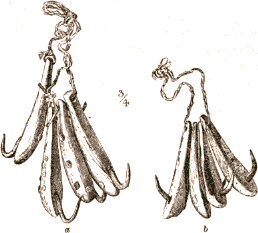
Fig. 266.—Small fishhooks.
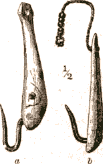
Fig. 267.—Hooks for river fishing.
No. ——387 [151] Fig. 268, from Utkiavwĭñ, is a rod rigged for fishing in the rivers. The rod is a roughly whittled stick of spruce or pine, 27 inches long. One line is 43 and the other 36 inches long and each is made of two strips of whalebone of which the lower is light colored as usual. The shorter line carries a small plain ivory lure of the common pattern, and the longer one a little flat barbless hook of copper with a broad flat shank. This was probably scraped bright and used without bait. The lines are reeled in the usual manner on the rod, and the hooks caught into notches on the sides of it. The small lures are called nĭ´ksĭñ.
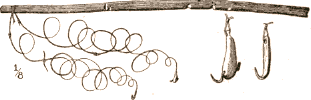
Fig. 268.—Tackle for river fishing.
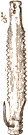
Fig. 269.—Burbot hook, 1st pattern.
When at the rivers in the autumn and early spring, they fish for burbot with a line carrying a peculiar large hook called iɐkqlûñ, which is baited with a piece of whitefish. There are two forms of this hook, which is from 3 to 5¼ inches long. One form differs in size only from the small nĭ´ksĭn, but is always of white ivory and not beaded (Fig. 269, No. 89550 [780] from Utkiavwĭñ, which is 4½ inches long and has a copper hook). The hook is of copper, brass or iron. The other form, which is perhaps the commoner, has a narrow flat body, slightly bent, and serrated on the edges to give a firm attachment to the bait. This body is usually of antler, and has a copper or iron hook either spur-shaped or of the common form as in Fig. 270, No. 89553 [764] from Utkiavwĭñ, which has a body of walrus ivory 4 inches long and a copper hook. Of late years, small cod hooks obtained from the ships have been adapted to these bodies, as is seen in Fig. 271, No. 89552 [841] from Utkiavwĭñ. The shank of the hook has been half imbedded in a longitudinal groove on the flatter side of the body, with the bend of the hook projecting about ¼ inch beyond the tip of the latter. The ring of the hook has been bent open and the end sunk into the body. The hook is held on by two lashings of sinew, one at each end of the shank.
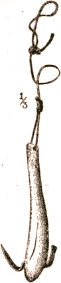
Fig. 270.—Burbot hook, 2d pattern.
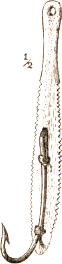
Fig. 271.—Burbot hook, made of cod hook.
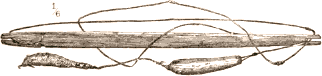
Fig. 272.—Burbot tackle, baited.
No. 56594 [32] from Utkiavwĭñ is like the preceding, but has a larger hook, which from the bend to the point is wrapped in a piece of deer skin with the flesh side out, and wound with sinew having a tuft of hair at the point of the hook. This is probably to hide the point when the hook is baited. No. 56594 [167] from Utkiavwĭñ, has the hook fastened to the back of the body instead of the flat side. The manner in which these hooks are baited is shown in Fig. 272, which represents a complete set of burbot tackle (No. 89546 [946]) brought in and sold by some Utkiavwĭñ natives, just as they had been using it in the autumn of 1882 at Kuaru or Kulugrua. A piece of whitefish, flesh and skin, with the scales removed is wrapped round the hook so as to make a club-shaped body 4½ inches long and is sewed up along one side with cotton twine. The copper spur projects through the skin on the other side. This hook would not hold the fish unless it were “gorged,” but the voracious burbot always swallows its prey. In dressing these fish for the table, whitefish of considerable size were frequently found in them. The line is of whalebone like those already described but a little stouter, 78 inches long, and made of seven pieces, all black. The end of the line is fastened into an eye in the small end of a rough club-shaped sinker of walrus ivory, 4¾ inches long. There is another eye at the large end of the sinker, for the attachment of a leader of double sinew braid 5½ inches long connecting the hook with the sinker.
The reel, which serves also as a short rod, is of yellow pine 19½ inches long. When the line is reeled up, the hook is caught into the wood on one side of the reel. No. 89545 [946] is a similar set of baited tackle, bought from the same natives, differing from the preceding only in proportions, having a longer line—9 feet and 6 inches—and a somewhat larger bait. We also procured two sets of burbot tackle unbaited.
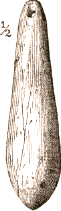
Fig. 273.—Ivory sinker.
One of these (No. 56543 [33] from Utkiavwĭñ) has a whalebone line 14 feet long, and a roughly octahedral sinker of walrus ivory 3 inches long and 1½ in diameter. The hook, which is joined to the sinker as before by a leader of stout sinew braid, is of the second pattern, with serrated edges, and a copper hook. The leader is neatly spliced into this. The other, No. 56544 [187], also from Utkiavwĭñ, has no sinker and a hook with a club-shaped body and iron spur. It was probably put together for sale, as it is new. The sinkers, of which we collected five, besides those already mentioned, are always about the same weight and either club-shaped or roughly octahedral. They are always of walrus ivory and usually carelessly made. Fig. 273 (No. 56577 [260]) represents one of these sinkers (kíbica), on which there is some attempt at ornamentation. On the larger are two eyes and the outline of a mouth like a shark’s, incised and filled in with black refuse oil.
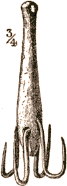
Fig. 274.—Ivory jigger for polar cod.
A similar line and reel are used for catching polar cod in the spring and late winter through the ice at some distance from the shore. These lines are 10 or 15 fathoms long, and provided with a heavy sinker of ivory, copper, or rarely lead, to which are attached by whalebone leaders of unequal length, two little jiggers like Fig. 274 (the property of the writer, from Utkiavwĭñ). This is of white walrus ivory, 2⅛ inches long and ⅜ in diameter at the largest part. The two slender hooks are of copper and are secured by wedges of whalebone. This makes a contrivance resembling the squid jigs used by our fishermen. These jiggers are sometimes made wholly of copper, which is scraped bright.
This fishery begins with the return of the sun, about the 1st of February, and continues when the ice is favorable until the season is so far advanced that the ice has begun to melt and become rotten. The fish are especially to be found in places where there is a good-sized field of the season’s ice, 3 or 4 feet thick, inclosed by hummocks, and they sometimes occur in very great numbers. In 1882 there was a large field of this kind about 2 miles from the village and the fishing was carried on with great success, but in 1883 the ice was so much broken that the fish were very scarce. Some lads caught a few early in the season, but the fishery was soon abandoned.
A hole about a foot in diameter is made through the ice with an ice pick, and the fragments dipped out either with the long-handled whalebone scoop, or the little dipper made of two pieces of antler mounted on a handle about 2 feet long, which everybody carries in the winter. The line is unreeled and let down through the hole till the jigs hang about a foot from the bottom. The fisherman holds in his left hand the dipper above mentioned, with which he keeps the hole clear of the ice crystals, which form very quickly, and in his right the reel which he jerks continually up and down. The fish, attracted by the white “jiggers,” begin nosing around them, when the upward jerk of the line hooks one of them in the under jaw or the belly. As soon as the fisherman feels the fish, he catches a bight of the line with the scoop in his left hand and draws it over to the left; then catches the line below this with the reel and draws it over to the right, and so on, thus reeling the line up in long hanks on these two sticks, without touching the wet line with his fingers.
When the fish is brought to the surface of the ice, he is detached from the barbless hook with a dextrous jerk, and almost instantly freezes solid. The elastic whalebone line is thrown off the stick without kinking and let down again through the hole. When fish are plentiful, they are caught as fast as they can be hauled up, sometimes one on each “jigger.” If the fisherman finds no fish at the first hole he moves to another part of the field and tries again until he succeeds in “striking a school.” The fish vary in abundance on different days, being sometimes so plentiful that I have known two or three children to catch a bushel in a few hours, while some days very few are to be taken. In addition to the polar cod, a few sculpins are also caught, and occasionally the two species of Lycodes (L. turnerii and coccineus) which voracious fish sometimes seize the little polar cod struggling on the “jigger” and are thus caught themselves. This fishery is chiefly carried on by the women, children, and old men, who go out in parties of five or six, though the hunters sometimes go fishing when they have nothing else to do. There were generally thirty or forty people out at the fishing-ground every day in 1882.
Jiggers of this pattern appear to be used at Pitlekaj, from Nordendskiöld’s description388, but I have seen no account either there or elsewhere of the peculiar method of reeling up the line such as we saw at Point Barrow. Lines of whalebone are very common among the Eskimo generally,389 and perhaps this material is preferable to any other for fishing in this cold region, for not only does the elastic whalebone prevent kinking, but the ice which forms instantly on the wet line in winter does not adhere to it, but can easily be shaken off. No. 56545 [410] is a line 51 feet and 10 inches long and 0.05 inch in diameter, made of human hair, neatly braided in a round braid with four strands. This was called a fishing line, but was the only one of the kind seen. Fishhooks of the kind described, with a body of bone or ivory, which serves for a lure, armed with a spur or bent hook of metal, without a barb, seem to be the prevailing type amongst the Eskimo. In the region about Norton Sound (as shown by the extensive collections of Mr. Nelson and others) this is often converted into an elaborate lure by attaching pendants of beads, bits of the red beak of the puffin, etc. Crantz mentions a similar custom in Greenland of baiting a hook with beads.390
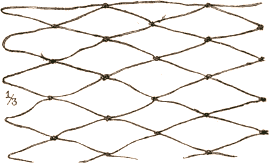
Fig. 275.—Section of whalebone net.
Nets (Kubra).—
The most important fishery at the rivers is carried on by means of gill-nets, set under the ice, and visited every few days. In these are taken large numbers of all three species of whitefish (Coregonus kenicotti, C. nelsoni, and C. laurettæ.) The collection contains three specimens of these nets, two of whalebone and one of sinew. No. 56754 [147], Fig. 275, is a typical whalebone net. It is long and shallow, 79 meshes long and 21 deep, made of fine strips of whalebone fastened together as in the whalebone fishing lines. Most of the whalebone is black, but a few light colored strips are intermixed at random. The length of the mesh is 3¼ inches, and the knot used in making them is the ordinary netting-knot. When not in use the net is rolled up into a compact ball and tied up with a bit of string. When set, this net is 21 feet 7 inches long and 3 feet 4 inches deep. The other whalebone net (No. 56753 [172], also from Utkiavwĭñ), is similar to this, but slightly larger, being 87 meshes (25 feet) long and 22 (3 feet 9 inches) deep. The length of mesh is 3½ inches. Fig. 276 (unit of web) is a net (No. 56752 [171] from the same village) of the same mesh and depth, but 284 meshes (60 feet) long and made of twisted sinew twine.
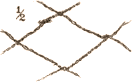
Fig. 276.—Mesh of sinew net.
I had no opportunity of seeing the method of setting these nets under the ice, but it is probably the same as that used in setting the seal nets. When in camp at Pernyû in the summer, the natives set these nets in the shoal water of Elson Bay, at right angles to the beach, with a stake at each end of the net. They are set by a man in a kayak, and in them are gilled considerable numbers of whitefish, two species of salmon (Oncorhynchus gorbuscha and O. nerka) and an occasional trout (Salvelinus malma). They take these nets east with them on their summer expeditions, but we did not learn the method of using them at this season. Perhaps they are sometimes used for seining on the beach, as Thomas Simpson says that the Eskimo at Herschel Island (probably Kûñmûd´lĭñ) sold his party “some fine salmon trout, taken in a seine of whalebone, which they dragged ashore by means of several slender poles spliced together to a great length.”391
An Utkiavwĭñ native told us that he found trout (Salvelinus malma) so plentiful at or near the mouth of the Colville, in 1882, that he fed his dogs with them.
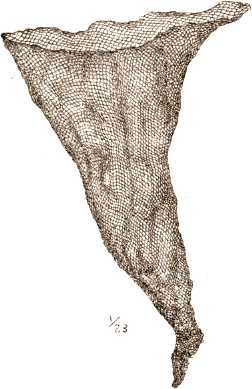
Fig. 277.—Fish trap.
Fig. 277 is a peculiar net or fish-trap (No. 56755 [190]) from Utkiavwĭñ, the only specimen of the kind seen. It is a conical, wide-mouthed bag, 8 feet 4 inches long and 5½ feet wide at the mouth, netted all in one piece of twisted sinew, with a 2¼-inch mesh. This was brought over for sale at an early date, before we were well acquainted with the natives, and we only learned that it was set permanently for catching fish. Unfortunately, we never saw another specimen, and through the press of other duties never happened to make further inquiries about it. From its shape it would appear as if it were meant to be set in a stream with the mouth towards the current. This contrivance is called sápotĭn, which corresponds to the Greenlandic saputit, a dam for catching fish.
From all accounts, the natives east of the Anderson River region were ignorant of the use of the net before they made the acquaintance of the whites,392 though they now use it in several places, as in Greenland and Labrador. The earliest explorers on the northwest coast, however, found both fish and seal nets in use, though, as I have already mentioned, the seal net was spoken of at Point Barrow as a comparatively recent invention. At the present day, nets are used all along the coast from the Mackenzie and Anderson rivers (see MacFarlane’s Collection) as far south at least as the Yukon delta.393 I have not been able to learn whether gill nets are used in the delta of the Kuskoquim. Petroff394 mentions fish traps and dip nets merely. That the natives of Kadiak formerly had no nets I infer from Petroff’s statement395 that “of late they have begun to use seines of whale sinew.” Nets are generally used on the Siberian coast. We observed them ourselves at Plover Bay, and Nordenskiöld396 describes the nets used at Pitlekaj, which are made of sinew thread. It is almost certain that the American Eskimo learned the use of the net from the Siberians, as they did the habit of smoking, since the use of the gill net appears to have been limited to precisely the same region as the Siberian form of tobacco pipe.397

Fig. 278.—Fish spear.
Spears.—
The only evidence which we have of the use of spears for catching fish in this region is a single specimen, No. 89901 [1227], Fig. 278, from Utkiavwĭñ, which was newly and rather carelessly made for sale, but intended, as we were told, for spearing fish. This has a roughly whittled shaft, of spruce, 21½ inches long, armed at one end with three prongs. The middle prong is of whalebone, 4⅓ inches long, inserted into the tip of the shaft, which is cut into a short neck and whipped with sinew. The side prongs are also of bone, 9 inches long. Through the tip of each is driven a sharp, slender slightly recurved spur of bone, about 1½ inches long. Each prong is fastened to the shaft with two small wooden treenails, and they are braced with a figure-of-eight lashing of sinew through holes in the side prongs and around the middle one. The side prongs are somewhat elastic, so that when the spear is struck down on the back of a fish they spring apart and allow the middle prong to pierce him, and then spring back so that the spurs either catch in his sides or meet below his belly, precisely on the principle of the “patent eel spear.” This implement is almost identical with one in the National Museum from Hudson Bay, which appears to be in general use among the eastern Eskimo.398 The name, kăki´bua, is very nearly the same as that used by the eastern natives (kākkĭe-wĕi, Parry, and kakívak, Kumlien). This spear is admirably adapted for catching large fish in shallow rocky streams where a net can not be used, or where they are caught by dams in tidal streams in the manner described by Egede and Crantz. There is so little tide, however, on the northwest coast, that this method of fishing can not be practiced, and, as far as I know, there is no locality in the range of the Point Barrow natives, a region of open shoal beaches, and rivers free of rocks, where this spear could be used in which a net would not serve the purpose much better. Taking into consideration the scarcity of these spears and the general use of nets, I am inclined to believe that this spear is an ancient weapon, formerly in general use, but driven out of fashion by the introduction of nets.
FLINT WORKING.
These people still retain the art of making flint arrow and spearheads, and other implements such as the blades for the skin scrapers to be hereafter described. Many of the flint arrowheads and spear points already described were made at Nuwŭk or Utkiavwĭñ especially for sale to us and are as finely formed and neatly finished as any of the ancient ones. The flints, in many cases water-worn pebbles, appear to have been splintered by percussion into fragments of suitable sizes, and these sharp-edged spalls are flaked into shape by means of a little instrument consisting of a short, straight rod of some hard material mounted in a short curved haft. We collected nine of these tools (kĭ´gli) of which two have no blades. No. 89262 [1223] figured in Point Barrow Report, Ethnology, Pl. III, Fig. 7, has been selected as the type. The handle is of walrus ivory, 7.8 inches long, straight and nearly cylindrical for about 4½ inches, then bending down like a saw handle and spread out into a spatulate butt. Fitted into a deep groove on the top of the handle so that its tip projects 1.8 inches beyond the tip of the latter is a slender four-sided rod of whale’s bone, 4.7 inches long. This is held in place by two simple lashings, one of cotton twine and the other of seal thong. The flint to be flaked is held in the left hand and pressed against the fleshy part of the palm which serves as a cushion and is protected by wearing a thick deer-skin mitten. The tool is firmly grasped well forward in the right hand with the thumb on top of the blade and by pressing the point steadily on the edge of the flint, flakes of the desired size are made to fly off from the under surface.
These tools vary little in pattern, but are made of different materials. Hard bone appears to have been the commonest material for the blade, as three out of the seven blades are of this substance. One specimen (No. 89263 [796] from Utkiavwĭñ) has a blade of iron of the same shape but only 2 inches long. No. 89264 [1001] also from Utkiavwĭñ, Fig. 279a, has a short blade of black flint flaked into a four-sided rod 1½ inches long. This is held in place by a whipping of stout seal thong tightened by thrusting a splinter of wood in at the back of the groove.
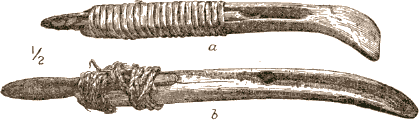
Fig. 279.—Flint flakers.
Two specimens (Nos. 89260 [794] Fig. 279b and 89261 [1216] both from Utkiavwĭñ) have blades of the peculiar Nuɐsuknan concretions previously described. Each is an oblong pebble wedged into the groove and secured by a lashing as usual. No. 89260 [794] has a haft of antler. This is rather the commonest material for the haft. Two specimens have hafts of walrus ivory and three of fossil ivory. The length of the haft is from 6 to 8 inches, of the blade 1.5 to 4.7 inches. Fig. 280 (No. 89265 [979] from Nuwŭk) is the haft of one of these tools, made of fossil ivory, yellow from age and stained brown in blotches, which shows the way in which the groove for the blade was excavated, namely, by boring a series of large round holes and cutting away the material between them. The remains of the holes are still to be seen in the bottom of the groove. The tip of this haft has been roughly carved into a bear’s head with the eyes and nostrils incised and filled with black dirt, and the eyes, nostrils, and mouth of a human face have been rudely incised on the under side of the butt and also blackened. All this carving is new and was done with the view of increasing the market value of the object. The original ornamentation consists of an incised pattern on the upper surface of the butt, colored with red ocher which has turned black from age and dirt.
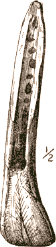
Fig. 280.—Haft of flint flaker.
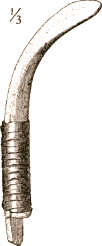
Fig. 281.—Flint flaker with bone blade.
Fig. 281 (No. 89782 [1004e]) is one of these tools, very neatly made, with a haft of reindeer antler and a bone blade, secured by a whipping of seal thong which belongs with the “kit” of tools owned by the “inland” native, Ilû´bw’ga. Mr. Nelson collected a number of specimens of this tool at various points on the northwest coast from Point Hope as far south as Norton Bay, but I can find no evidence of its use elsewhere.
FIRE MAKING.
Drills.—
In former times fire was obtained in the method common to so many savages, from the heat developed by the friction of the end of a stick worked like a drill against a piece of soft wood. This instrument was still in use at least as late as 1837,399 but appears to have been wholly abandoned at Point Barrow at the time of the Plover’s visit, though still in use at Kotzebue Sound.400
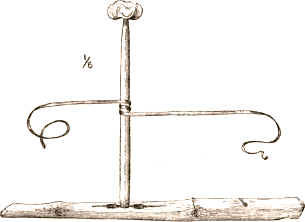
Fig. 282.—Fire drill with mouthpiece and stock.
A native of Nuwŭk one day brought down for sale what he said was an exact model of the ancient fire drill, nióotĭñ. This is No. 89822 [1080], Fig. 282. The drill is a stick of pine 12 inches long, shaped like the shaft of a common perforating drill, brought to a blunt but rounded point. This is worked by a string, without bow or handles, consisting of a strip of the skin of the bearded seal, 40 inches long, and has for a mouthpiece the astragalus bone of a reindeer, the natural hollow on one side serving as a socket for the butt of the drill.401 The point of the drill is made to work against the split surface of a stick of spruce 18 inches long, along the middle of which is cut a gash, to give the drill a start. Three equidistant circular pits, charred and blackened, were bored out by the tip of the drill, which developed heat enough to set fire to the sawdust produced. Tinder was probably used to catch and hold the fire.
Most authors who have treated of the Eskimo have described an instrument of this sort in use either in former times or at the present day.402
Among most Eskimo, however, a bow is used to work the drill. The only exceptions to this rule appears to have been the ancient Greenlanders and the people of Hudson Bay (see the passages from Hakluyt, Crantz, and Ellis, just quoted.) Chamisso, however,403 speaks of seeing the Aleutians at Unalaska produce fire by means of a stick worked by a string making two turns about the stick and held and drawn with both hands, with the upper end of the stick turning in a piece of wood held in the mouth. When a piece of fir was turned against another piece of the same wood fire was often produced in a few seconds. This passage appears to have escaped the usually keen observation of Mr. W. H. Dall, who, speaking of the ancient Aleutians, says: “The ‘fiddle-bow drill’ was an instrument largely used in their carving and working bone and ivory; but for obtaining fire but two pieces of quarz were struck together,” etc.404
I had no opportunity of seeing this drill manipulated, but I have convinced myself by experiment that the stick or “light-stock,” to use Nordenskiöld’s expression, must be held down by one foot, the workman kneeling on the other knee.
Flint and steel.—
Fire is usually obtained nowadays by striking a spark in the ordinary method from a bit of flint with a steel, usually a bit of some white man’s tool. Both are carried, as in Dr. Simpson’s time, in a little bag slung around the neck, along with some tinder made of the down of willow catkins mixed with charcoal or perhaps gunpowder. The flints usually carried for lighting the pipe, the only ones I have seen, are very small, and only a tiny fragment of tinder is lighted which is placed on the tobacco. Lucifer matches (kĭlĭăksagan) were eagerly begged, but they did not appear to care enough for them to purchase them. Our friend Nĭkawáalu, from whom we obtained much information about the ancient customs of these people, told us that long ago, “when there was no iron and no flint”—“savik píñmût, ánma píñmût”405—they used to get “great fire” by striking together two pieces of iron pyrites. Dr. Simpson speaks406 of two lumps of iron pyrites being used for striking fire, but he does not make it clear whether he saw this at Point Barrow or only at Kotzebue Sound. Iron pyrites appears to have been used quite generally among the Eskimo. Bessels saw it used with quartz at Smith Sound, with willow catkins for tinder407 and Lyon mentions the use of two pieces of the same material, with the same kind of tinder, at Iglulik.408 Willow catkins are also used for tinder at the Coppermine River.409
No. 89825 [1133 and 1722] are some of the catkins used for making the tinder, which were gathered in considerable quantities at the rivers. They are called kĭmmiuru, which perhaps means “little dogs,” as we say “catkins” or “pussy willows.”
Kindlings.—
From the same place they also brought home willow twigs, 9 inches long, and tied with sinews into bunches or fagots of about a dozen or a dozen and a half each, which they said were used for kindling fires. (No. 89824 [1725].)
The following section was printed with a run-in, italicized header. It has been changed to agree with the structure shown in the Table of Contents.
BOW-AND-ARROW MAKING.
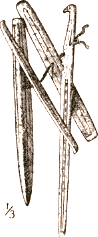
Fig. 283.—Set of bow-and-arrow tools.
A complete set of bow-and-arrow tools consists of 4 pieces, viz: a marline spike, two twisters, and a feather setter, as shown in Fig. 283, No. 89465 [962], from Utkiavwĭñ. The pieces of this set are perforated and strung on a piece of sinew braid, 4 inches long, with a knot at each end.
The Marline spike.—
This is a flat, four-sided rod of walrus ivory, 5-6 inches long, tapering to a sharp rounded point at one end, and tapered slightly to the other, which terminates in a small rounded knob. It is very neatly made from, rather old yellow ivory, and ornamented on all four faces with conventional incised patterns colored with red ochre.
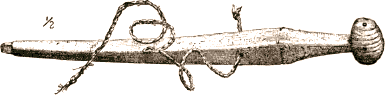
Fig. 284.—Marline spike.
This implement is used in putting on the backing of a bow to raise parts of the cord when an end is to be passed under and in tucking in the ends in finishing off a whipping. It was probably also used in putting whippings or seizings on any other implements. We collected 10 of these tools, all quite similar, and made of walrus ivory, yellow from age and handling. They vary in length from 4½ to 6 inches, and are always contracted at the upper end into a sort of neck or handle, surmounted by a knob or crossbar. No. 89463 [836] Fig. 284, from Utkiavwĭñ has the crossbar carved very neatly into the figure of an Amphipod crustacean without the legs. The eyes, mouth, and vent are indicated by small round holes filled with some black substance, and there is a row of eight similar holes down the middle of the back. The tip of this tool, which is 5.9 inches long, has been concaved to an edge so as to make a feather-setter of it. Through the knob at the butt there is sometimes a large round eye, as in Fig. 285 (No. 89464 [842] from Utkiavwĭñ, 4.7 inches long). These tools are sometimes plain, like the specimens last figured, and sometimes ornamented with conventional patterns of incised lines, colored with red ocher, like the others.

Fig. 285.—Marline spike.
The twisters
(No. 89465 [962]) are flat four-sided rods of walrus ivory, respectively 4.4 and 4.7 inches long. At each end one broad face is raised into a low transverse ridge about 0.1 inch high and the other rounded off, with the ridge on opposite faces at the two ends. They are ornamented on all four faces with longitudinal incised lines, colored with red ocher.
The use of these tools, which was discovered by actual experiment after our return to this country410 is for twisting the strands of the sinew backing after it has been put on the bow into the cables already described. The manner in which this tool is used is as follows: The end is inserted between the strands at the middle of the bow, so that the ridge or hook catches the lower strands, and the end is carried over through an arc of 180°, which gives the cable a half turn of twist. This brings the twister against the bow, so that the twisting can be carried no further in this direction, and if the tool were to be removed for a fresh start the strands would have to be held or fastened in some way, making the process a slow one. Instead, the tool is slid back between the strands till the other end comes where the first was, so that the hook at this end catches the strand, and the workman can give to the cable another half turn of twist. This is continued until the cable is sufficiently twisted, the tool sliding back and forth like the handle of a vise. The tools are used in pairs, one being inserted in each cable and manipulated with each hand, so as to give the same amount of twist to each cable. At the present day, these tools are seldom used for bow making, since the sinew-backed bow is so nearly obsolete, but are employed in playing a game of the nature of pitch-penny. (See below, under games and pastimes.)
These tools, of which we collected twenty-six specimens, are all of walrus ivory, and of almost exactly the same shape, varying a little in size and ornamentation. They vary in length from 3 to 5.7 inches, but are usually about 4½ inches long. The commonest width is 0.4 inches, the narrowest being 0.3 and the widest 0.7 broad, while the thickness is almost always 0.3, varying hardly 0.1 inch. Most of them are plain, but a few are ornamented with incised lines, and two are marked with “circles and dots” as in Fig. 286, one of a rather large pair (No. 56521 [249] from Utkiavwĭñ). These are 5.4 inches long, neatly made and quite clean. All the others show signs of age and use.

Fig. 286.—Twister for working sinew backing of bow.
There are large numbers of these tools in the National Museum from various points in the region where bows of the Arctic type are used, namely, from the Anderson River to Norton Sound, and one from St. Lawrence Island, whence we have received no twisted bows. Their use was, however, not definitely understood, as they are described simply as “bow tools,” “bow string twisters” or even “arrow polishers.” Mr. Nelson informs me that the tool is now not used in Norton Sound, except for playing a game, as at Point Barrow, but that the natives told him that they were formerly used for tightening the backing on a bow and also for twisting the hard-laid sinew cord, which is quite as much, if not more, used at Norton Sound as the braid so common at Point Barrow. I find no mention of the use of this tool in any of the authors who have treated of the Eskimo, except the following in Capt. Beechey’s vocabulary, collected at Kotzebue Sound: “Marline spike, small of ivory, for lacing bows—ke-poot-tak.” The specimens from the Mackenzie and Anderson rivers are almost without exception made of hard bone, while walrus ivory is the common material elsewhere. The name (kaputɐ) means simply a “twister.”
The feather-setter
(ĭ´gugwau) (No. 89465 [962]) is a flat, slender, rounded rod of walrus ivory, 7 inches long, with the tip abruptly concaved to a thin, rounded edge. The faces are ornamented with a pattern of straight incised lines, colored with red ocher. This tool is used for squeezing the small ends of the feathering into the wood of the arrow shaft close to the nock. Fig. 287 is a similar tool (No. 89486 [1285] from Utkiavwĭñ) also of walrus ivory, 6 inches long, with the upper end roughly whittled to a sharp point. It is probably made of a broken seal indicator or meat-cache marker. Several other ivory tools previously mentioned have been concaved to an edge at the tip so that they can be used as feather-setters. I do not find this tool mentioned by previous observers, nor have I seen any specimens in the National Museum.

Fig. 287.—“Feather-setter.”
Fig. 288 (No. 89459 [1282] from Utkiavwĭñ) represents an unusual tool, the use of which was not ascertained in the hurry of trade. It has a point like that of a graver, and is made of reindeer antler, ornamented with a pattern of incised lines and bands, colored with red ocher, and was perhaps a marline spike for working with sinew cord.
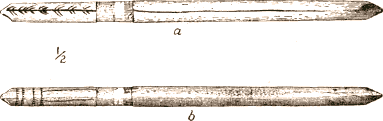
Fig. 288.—Tool of antler.
Errors in this section:
on the crown of the beach at Imêkpûñ, text has “Imêk / pûñ” (without hyphen) at line break
in the diagrams (Fig. 59, a, b, c), c,)
trimmed boots held up by drawstrings. final . missing
a simple strip of skin or the wolverine belt wolvervine
des defroques empaillées de corbeau spelling unchanged
de permettre au soleil de rechauffer leur cerveau spelling unchanged
cross or circle tattooed under each corner of the mouth tattoed
the small hair comb (ĭdlai´utĭn), usually made of walrus ivory anomalous superscript in original
of which only <> can be made out the mark <> is a diamond-shaped symbol
made of iron or steel and are of two sizes text has “two two” at line break
Fig. 135.—Adz-head of bone and iron text has “and and” at line break
The implement,284 which Nordenskiöld calls a “stone chisel,” Nordenskjöld
(No. 89858 [1319], from Utkiavwĭñ), is a similar box Utkiavwĭñ,)
a slender filament of black whale-bone. anomalous hyphen in original
the whalers have sold them yäger rifles spelling unchanged
Fig. 186. ... (b) arrow with iron pile (savidlĭñ); last closing parenthesis missing
as shown by the specimens in the National Museum. Musuem
a similar name316 (agdligaḵ). letter “k” printed with anomalous double underline
the natives have forgotten what it was forgotton
Footnote 334: ... in the plane of the barb, in he plane
Fig. 238.—Whale lance. “ce” in “lance” invisible
The other, No. 56489 [127], is new and rather roughly made The other (No.
of which No. 89894 [1708], Fig. 259, represents the common form No 89894
Footnote 398: ... “en Lyster (med to eller tre Pigge)” Pigge”)