ETHNOLOGICAL RESULTS OF THE POINT BARROW EXPEDITION. (continued 4)
Reading edition
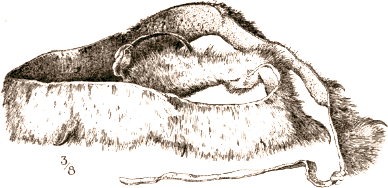
Fig. 85.—Woman’s belt of wolverine toes.
The women never wear anything except a simple strip of skin or the wolverine belt mentioned above. No. 89542 [1421], Fig. 85, is one of these. It is made of nine strips of dark brown skin from round the foot of the wolverine, sewed together end to end. Each strip, except the one at the end, has a claw at the lower corner (on some of the strips the bit of skin bearing the claws is pieced in) so that there are eight nearly equidistant claws making a fringe round the lower edge of the belt. There is a hole at each end into which is half-hitched the end of a narrow strip of deerskin about 8 inches long. These strings serve to tie the girdle. This belt is 33 inches long and 1½ inches wide, and has been worn so long that the inside is very dirty. Such belts are very valuable and highly prized, and are worn exclusively by the women.

Fig. 86.—Belt-fastener.
Fig. 86, No. 89718 [1055], is an object which is quite uncommon and seldom if ever now seen in use. It is of walrus ivory, very old and yellow. It served as a belt-fastener (tápsĭgɐ). I have seen a brass clock wheel used on a girl’s belt for the same purpose. This specimen is very old, neatly made, and polished smooth, probably from long use.
Ornaments.—
In addition to the trimmings above described there are certain ornamental appendages which belong to the dress, but can not be considered as essential parts of any garments, like the trimmings. For instance, nearly every male in the two villages wears dangling from his back between the shoulders an ermine skin either brown or white, or an eagle’s feather, which is transferred to the new garment when the old one is worn out. This is perhaps an amulet as well as an ornament, as Dr. Simpson states.237 An eagle’s feather is often worn on the outside of the hood, pendant from the crown of the head. Attached to the belt are various amulets (to be described under the head of “Religion”) and at the back always the tail of an animal, usually a wolverine’s. Very seldom a wolf’s tail is worn, but nearly all, even the boys, have wolverine tails, which are always saved for this purpose and used for no other. This habit among the Eskimo of western America of wearing a tail at the girdle has been noticed by many travelers, and prevails at least as far as the Anderson River, since Petitot,238 in describing the dress of the Anderson River “chief,” says: “par derrière il portait aux reins une queue épaisse et ondoyante de renard noir.” According to him239 it is the women of that region, who wear, “à titre de talismans, des defroques empaillées de corbeau, de faucon, ou d’hermine.” The custom of wearing an ermine skin on the jacket was observed by Dr. Armstrong of the Investigator at Cape Bathurst.240
PERSONAL ADORNMENT.
SKIN ORNAMENTATION.
Tattooing.—
The custom of tattooing is almost universal among the women, but the marks are confined almost exclusively to the chin and form a very simple pattern. This consists of one, three, five, or perhaps as many as seven vertical lines from the under lip to the tip of the chin, slightly radiating when there are more than one. When there is a single line, which is rather rare, it is generally broad, and the middle line is sometimes broader than the others. The women as a rule are not tattooed until they reach a marriageable age, though there were a few little girls in the two villages who had a single line on the chin. I remember seeing but one married woman in either village who was not tattooed, and she had come from a distant settlement, from Point Hope, as well as we could understand.
Tattooing on a man is a mark of distinction. Those men who are, or have been, captains of whaling umiaks that have taken whales have marks to indicate this tattooed somewhere on their persons, sometimes forming a definite tally. For instance, Añoru had a broad band across each cheek from the corners of the mouth (Fig. 87, from a sketch by the writer), made up of many indistinct lines, which was said to indicate “many whales.” Amaiyuna had the “flukes” of seven whales in a line across his chest, and Mû´ñialu had a couple of small marks on one forearm. Niăksára, the wife of Añoru, also had a little mark tattooed in each corner of her mouth, which she said were “whale marks,” indicating that she was the wife of a successful whaleman. Such marks, according to Petitot (Monographie, etc., p. xv) are a part of the usual pattern in the Mackenzie district—“deux traits aux commissures de la bouche.” One or two men at Nuwŭk had each a narrow line across the face, over the bridge of the nose, which were probably also “whale marks,” though we never could get a definite answer concerning them.241
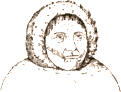
Fig. 87.—Man with tattooed cheeks.
The tattooing is done with a needle and thread, smeared with soot or gunpowder, giving a peculiar pitted appearance to the lines. It is rather a painful operation, producing considerable inflammation and swelling, which lasts several days. The practice of tattooing the women is almost universal among the Eskimo, from Greenland to Kadiak, including the Eskimo of Siberia, the only exception being the natives of Smith Sound, though the custom is falling into disuse among the Eskimo who have much intercourse with the whites.242
The simple pattern of straight, slightly diverging lines on the chin seems to prevail from the Mackenzie district to Kadiak, and similar chin lines appear always to form part of the more elaborate patterns, sometimes extending to the arms and other parts of the body, in fashion among the eastern Eskimo243 and those of Siberia, St. Lawrence Island, and the Diomedes.

Fig. 88.—Woman with ordinary tattooing.
Fig. 88, from a sketch made on the spot by the writer, shows the Point Barrow pattern.
Painting.—
On great occasions, such as dances, etc., or when going whaling, the face is marked with a broad streak of black lead, put on with the finger, and usually running obliquely across the nose or one cheek.244 Children, when dressed up in new clothes, are also frequently marked in this way. This may be compared with the ancient custom among the people of Kadiak of painting their faces “before festivities or games and before any important undertaking, such as the crossing of a wide strait or arm of the sea, the sea-otter chase, etc.”245
HEAD ORNAMENTS.
Method of wearing the hair.—
The men and boys wear their hair combed down straight over the forehead and cut off square across in front, but hanging in rather long locks on the sides, so as to cover the ears. There is always a small circular tonsure on the crown of the head, and a strip is generally clipped down to the nape of the neck. (See Fig. 89, from a sketch from life by the writer.) The natives believe that this clipping of the back of the head prevents snow blindness in the spring. The people of the Mackenzie district have a different theory. “La large tonsure que portent nos Tchiglit a pour but, m’ont-ils dit, de permettre au soleil de rechauffer leur cerveau et de transmettre par ce moyen sa bienfaisante chaleur à leur cœur pour les faire vivre.”246 Some of the Nunatañmiun and one man from Kilauwĭtaiwĭñ that we saw wore their front hair long, parted in the middle, and confined by a narrow fillet of leather round the brow. The hair on the tonsure is not always kept clipped very close, but sometimes allowed to grow as much as an inch long, which probably led Hooper to believe that the tonsure was not common at Point Barrow.247 It is universal at the present day, as it was in Dr. Simpson’s time.248 The western Eskimo generally crop or shave the crown of the head, while those of the east allow their hair to grow pretty long, sometimes clipping it on the forehead. The practice of clipping the crown appears to be general in the Mackenzie district,249 and was occasionally observed at Iglulik by Capt. Parry (2d Voy., p. 493). The natives of St. Lawrence Island and the Siberian coast carry this custom to an extreme, clipping the whole crown, so as to leave only a fringe round the head.250 The women dress their hair in the fashion common to all the Eskimo except the Greenlanders and the people about the Mackenzie and Anderson Rivers, where the women bring the hair up from behind into a sort of high top-knot, with the addition in the latter district of large bows or pigtails on the sides.251 The hair is parted in the middle from the forehead to the nape of the neck, and gathered into a club on each side behind the ear. The club is either simply braided or without further dressing twisted and lengthened out with strips of leather, and wound spirally for its whole length with a long string of small beads of various colors, a large flat brass button being stuck into the hair above each club. The wife of the captain of a whaling umiak wears a strip of wolfskin in place of the string of beads when the boat is “in commission” (as Capt. Herendeen observed).
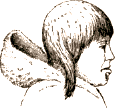
Fig. 89.—Man’s method of wearing the hair.
Some of the little girls wear their hair cut short behind. The hair is not arranged every day. Both sexes are rather tidy about arranging their hair, but there is much difference in this between individuals. The marrow of the reindeer is sometimes used for pomatum. Baldness in either sex is rare. I do not remember ever seeing a bald woman, and there were only two bald men at the two villages. Neither of these men was very old.
Head-bands.—
Some of the men and boys wear across the forehead a string of large blue glass beads, sometimes sewed on a strip of deerskin. Occasionally, also a fillet is worn made of the skin of the head of a fox or a dog, with the nose coming in the middle of the forehead. Such head-dresses are by no means common and seem to be highly prized, as they were never offered for sale. MacFarlane (MS.) speaks of a similar head-dress worn at the Anderson River, “generally made of the skin of the fore part of the head skins of wolves, wolverines, and marmots. Very often, however, a string of beads is made use of instead.” Another style of head-dress is the badge of a whaleman, and is worn only when whaling (and, I believe, at the ceremonies in the spring preparatory to the whaling). This seems to be very highly prized, and is, perhaps, “looked upon with superstitious regard.”252 None were ever offered for sale and we had only two or three opportunities of seeing it. It consists of a broad fillet of mountain-sheep skin, with pendants of flint, jasper, or crystal, rudely flaked into the shape of a whale (see under “Amulets,” where specimens are described and figured), one in the middle of the brow and one over each ear. Some of them are also fringed with the incisor teeth of the mountain sheep attached by means of a small hole drilled through the end of the root, as on the dancing cap (see under “Games and Pastimes”). The captain and harpooner of a whaling crew which I saw starting out in the spring of 1882 each wore one of these fillets. The harpooner’s had only the whale pendants, but the captain’s was also fringed with teeth. This ornament closely resembles the fillet fringed with deer’s teeth, observed by Capt. Parry at Iglulik,253 which “was understood to be worn on the head by men, though we did not learn on what occasions.”
Earrings (nógolu).—
Nearly all the women and girls perforate the lobes of the ears and wear earrings. The commonest pattern is a little hook of ivory to which are attached pendants, short strings of beads, etc. Large, oblong, dark-blue beads and bugles are specially desired for this purpose. Cheap brass or “brummagem” earrings are sometimes worn nowadays. The fashion in earrings seems to have changed somewhat since Dr. Simpson’s time, as I do not remember ever having seen the long strings of beads hanging across the breast or looped up behind as he describes them.254 At present, one earring is much more frequently worn than a pair. There are in the collection two pairs of the ivory hooks for earrings, which, though made for sale, are of the ordinary pattern. Of these No. 89387 [1340] (Fig. 90) will serve as the type. They are of coarse, white walrus ivory.
No. 89386 [1340] is a similar pair of earrings, in which the hook projects at right angles and terminates in a flat, round button. Both of the specimens are of the usual pattern, but very roughly made. The custom of wearing earrings is very general among the Eskimo. I need only refer to the descriptions of dress and ornaments already quoted.
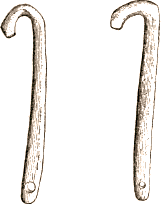
Fig. 90.—Earrings.
Labrets.—
As has been stated by all travelers who have visited Point Barrow since the time of Elson, all the adult males wear the labrets or stud-shaped lip ornaments. The discussion of the origin and extent of this habit, or even a comparison of the forms of labrets in use among the Eskimo, would lead me far beyond the scope of the present work.255 They are or have been worn by all the Eskimo of western America, including St. Lawrence Island and the Diomedes, from the most southern point of their range to the Mackenzie and Anderson district, and were also worn by Aleuts in ancient times.256 East of the Mackenzie district no traces of the habit are to be observed. Petitot257 says that Cape Bathurst is the most eastern point at which labrets are worn. The custom of wearing them at this place is perhaps recent, as Dr. Armstrong, of the Investigator, expressly states that he saw none there in 1850. At Plover Bay, eastern Siberia, however, I noticed one or two men with a little cross or circle tattooed under each corner of the mouth, just in the position of the labret. This may be a reminiscence of an ancient habit of wearing labrets, or may have been done in imitation of the people of the Diomedes and the American coast.
At Point Barrow at the present day the lip is always pierced for two labrets, one at each corner of the mouth, though one or both of them are frequently left out. They told us, however, that in ancient times a single labret only was worn, for which the lip was pierced directly in the middle. Certain old and large-sized labrets in the collection are said to have been thus worn. The incisions for the labrets appear to be made about the age of puberty, though I knew one young man who had been married for some months before he had the operation performed. From the young man’s character, I fancy shyness or timidity, as suggested by Dr. Simpson,258 had something to do with the delay. Contrary to Dr. Simpson’s experience, I did not see a single man above the age of 18 or 19 who did not wear the labrets. It seems hardly probable that ability to take a seal entitles a boy to wear labrets, as he suggests. We knew a number of boys who were excellent seal hunters and even able to manage a kaiak, but none had their lips pierced under the age of 14 or 15, when they may be supposed to have reached manhood. The incisions are at first only large enough to admit a flat-headed pin of walrus ivory, about the diameter of a crow quill, worn with the head resting against the gum. These are soon replaced by a slightly stouter pair, and these again by stouter ones, until the holes are stretched to a diameter of about one-half inch, when they are ready for the labrets.
We heard of no special ceremonies or festivals connected with the making of these incisions, such as Dall observed at Norton Sound,259 but in the one case where the operation was performed at the village of Utkiavwĭñ during our stay, we learned that it was done by a man outside of the family of the youth operated upon. We were also informed that the incisions must be made with a little lancet of slate. The employment of an implement of ancient form and obsolete material for this purpose indicates, as Dall says in the passage referred to above, “some greater significance than mere ornamentation.”
The collection contains two specimens of such lancets. No. 89721 [1153] (figured in Rept. Point Barrow Expedition, Ethnology, Pl. V, Fig. 4) is the type. A little blade of soft gray slate is carefully inclosed in a neat case of cottonwood. The blade is lanceolate, 1.3 inches long, 0.6 broad, and 0.1 thick, with a short, broad tang. The faces are somewhat rough, and ground with a broad bevel to very sharp cutting edges. The case is made of two similar pieces of wood, flat on one side and rounded on the other, so that when put together they make a rounded body 3 inches long, slightly flattened, and tapering toward the rounded ends, of which one is somewhat larger than the other. Round each end is a narrow, deep, transverse groove for a string to hold the two parts together. A shallow median groove connects these cross grooves on one piece, which is hollowed out on the flat face into a rough cavity of a shape and size suitable to receive the blade, which is produced into a narrow, deep groove at the point, probably to keep the point of the blade from being dulled by touching the wood. The other piece, which serves as a cover, has merely a rough, shallow, oval depression near the middle. The whole is evidently very old, and the case is browned with age and dirt.
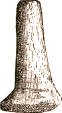
Fig. 91.—Plug for enlarging labret hole.
No. 89579 [1200] is a similar blade of reddish purple slate, mounted in a rough haft of bone. Fig. 91, No. 89715 [1211], is one of a pair of bone models, made for sale, of the ivory plugs used for enlarging the holes for the labrets, corresponding in size to about the second pair used. It is roughly whittled out of a coarse-grained compact bone, and closely resembles the plugs figured by Dall from Norton Sound,260 but lacks the hole in the tip for the transverse wooden peg, which is not used at Point Barrow. One youth was wearing the final size of plugs when we landed at the station. These were brought to a point like the tip of a walrus tusk, and had exactly the appearance of the tusks of a young walrus when they first protrude beyond the lip. The labrets worn at Point Barrow at the present day are usually of two patterns. One is a large, flat, circular disk about 1½ inches in diameter, with a flat stud on the back something like that of a sleevebutton, and the other a thick cylindrical plug about 1 inch long, and one-half inch in diameter, with the protruded end rounded and the other expanded into an oblong flange, presenting a slightly curved surface to the gum. These plug labrets are the common fashion for everyday wear, and at the present day, as in Dr. Simpson’s time, are almost without exception made of stone, Granite or syenite, porphyry, white marble, and sometimes coal (rarely jade) are used for this purpose.
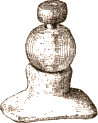
Fig. 92.—Labret of beads and ivory.
One of the Nunatañmiun wore a glass cruet-stopper for a labret, and many natives of Utkiavwĭñ took the glass stopples of Worcestershire sauce bottles, which were thrown away at the station, and inserted them in the labret holes for everyday wear, sometimes grinding the round top into an oblong stud. There is one specimen of the plug labret in the collection. Labrets of all kinds are very highly prized, and it was almost impossible to obtain them.261 Though we repeatedly asked for them and promised to pay a good price, genuine labrets that had been worn or that were intended for actual use were very rarely offered for sale, though at one time a large number of roughly made models or imitations were brought in. The single specimen of the plug labret (tu´tɐ) is No. 89700 [1163] (figured in Point Barrow Report, Ethnology, Pl. V, Fig. 3). It is a cylindrical plug of hard, bright green stone (jade or hypochlorite), 1.1 inches long and 0.6 in diameter at the outer end, which is rounded off, tapering slightly inward and expanded at the base into an elliptical disk 1.2 inches long and 0.9 broad, slightly concave on the surface which rests against the teeth and gum. The specimen is old and of a material very unusual at Point Barrow. Fig. 92, No. 89719 [1166], from Nuwŭk, may also be called a plug labret, but is of a very unusual pattern, and said to be very old. It has an oblong stud of walrus ivory surmounted by a large, transparent, slightly greenish glass bead, on top of which is a small, translucent, sky-blue bead. The beads are held on by a short wooden peg, running through the perforations of the beads and a hole drilled through the ivory. There is a somewhat similar labret in the Museum collection (No. 48202) from Cape Prince of Wales, also very old. It is surmounted by a single oblong blue bead.
I saw but one other labret made of whole beads, and this had three good sized oval blue beads, in a cluster, projecting from the hole. It was worn by a man from Nuwŭk. This may be compared with a specimen from the Mackenzie district, No. 7714, to which two similar beads are attached in the same way. The disk labret is the pattern worn on full-dress occasions, seldom when working or hunting. One disk and one plug labret are frequently worn. Disk labrets are made of stone, sometimes of syenite or porphyry, but the most fashionable kind is made of white marble, and has half of a large, blue glass bead cemented on the center of the disk. These are as highly prized as they were in Dr. Simpson’s time, and we consequently did not succeed in procuring a specimen.
I obtained one pair of syenite disk labrets, No. 56716 [197] (figured in Point Barrow Rept., Ethnology, Pl. V, Fig. 2). Each is a flat circular disk (1.7 and 1.6 inches in diameter, respectively) of rather coarse-grained black and white syenite, ground very smooth, but not polished. On the back of each is an elliptical stud, like that of a sleeve-button, 1.2 and 1.1 inches long and 0.8 and 0.6 broad, respectively.
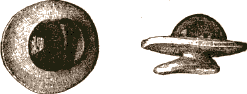
Fig. 93.—Blue and white labret from Anderson River.
Fig. 93, No. 2083, is one of the blue and white disks said to come from the Anderson River. This is introduced to represent those worn at Point Barrow, which are of precisely the same pattern. The disk is of white marble, 1½ inches in diameter, and in the center of it is cemented, apparently with oil dregs, half of a transparent blue glass bead, three-quarters of an inch in diameter, around the middle of which is cut a shallow groove. Similar marble disks without the bead are sometimes worn. These blue and white labrets appear to be worn from Cape Bathurst to the Kaniag peninsula, including the Diomede Islands (see figure on p. 140 of Dall’s Alaska). There are specimens in the Museum from the Anderson River and from the north shore of Norton Sound and we saw them worn by the Nunatañmiun, as well as the natives of Point Barrow and Wainwright Inlet. The beads, which are larger than those sold by the American traders, were undoubtedly obtained from Siberia, as Kotzebue, in 1816, found the people of the sound which bears his name wearing labrets “ornamented with blue glass beads.”262 The high value set on these blue-bead labrets has been mentioned by Franklin263 and T. Simpson,264 as well as by Dr. Simpson.265 The last named seems to be the first to recognize that the disks were made of marble. All previous writers speak of them as made of walrus ivory.
There are still at Point Barrow a few labrets of a very ancient pattern, such as are said to have been worn in the middle of the lip. These are very rarely put on, but are often carried by the owners on the belt as amulets. All that we saw were of light green translucent jade, highly polished. I obtained one specimen, No. 89705 [866] (figured in Point Barrow Rept., Ethnology, Pl. V, Fig. 1), a thin oblong disk of light green, translucent, polished jade, 2.6 inches long, 1.1 wide in the middle, and 0.8 wide at the ends, with the outer face slightly convex. On the back is an oblong stud with rounded ends, slightly curved to fit the gums.
Labrets of this material and pattern do not seem to be common anywhere. Beechey saw one in Kotzebue Sound 3 inches long and 1½ wide,266 and there is a large and handsome one in the Museum brought by Mr. Nelson from the lower Yukon. A similar one has recently been received from Kotzebue Sound.
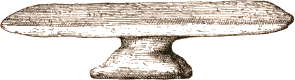
Fig. 94.—Oblong labret of bone.
Fig. 94, No. 89712 [1169], from Sidaru is a labret of similar shape, 3 inches long and 1½ broad, but made of compact bone, rather neatly carved and ground smooth. It shows some signs of having been worn. There are marks on the stud where it appears to have been rubbed against the teeth, and it is probably genuine. The purchase of this specimen apparently started the manufacture of bone labrets at Utkiavwĭñ, where no bone labrets, old or new, had previously been seen. For several days after we bought the specimen from Sidaru the natives continued to bring over bone labrets, but all so newly and clumsily made that we declined to purchase any more than four specimens. About the same time they began to make oblong labrets out of soapstone (a material which we never saw used for genuine labrets), like Fig. 95, No. 89707 [1215]. The purchase of three specimens of these started a wholesale manufacture of them, and we stopped purchasing.
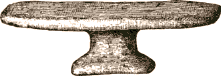
Fig. 95.—Oblong labret of soapstone.
The oblong labret appears to have been still in fashion as late as 1826, for Elson saw many of the men at Point Barrow wearing oblong labrets of bone (cf. No. 89712 [1169] and stone, 3 inches long and 1 broad.267 Unfortunately, he does not specify whether they were worn in pairs or singly, and if singly, as would be natural from their size and shape, whether in the middle of the lip or at one side.
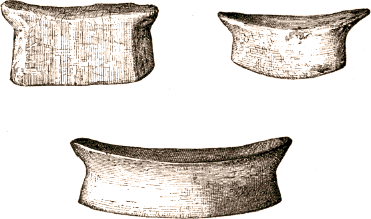
Fig. 96.—Ancient labrets.
Nos. 89304 [1713], 89716 [1042], and 89717 [1031] (Fig. 96) are very old labrets, which are interesting from their resemblance to the ancient Aleutian single labrets found by Dall in the cave on Amaknak Island.268 No. 89304 [1713] is an elliptical plug of bituminous coal, with a projecting flange round the base, which is slightly concave to fit the curve of the jaw. This labret is very old and was said to have been found in one of the ruined houses in Utkiavwĭñ. The other two labrets are of walrus ivory and of similar shape, but have the flange only at the ends of the base. All of these three are large, the largest being 2.2 inches wide and 0.7 thick, and the smallest 1.3 by 0.5, so that they required a much larger incision in the lip than is at present made. In connection with what has been said of the ancient habit of wearing labrets in the middle of the lip, it is interesting to note that Nordenskiöld saw men at Port Clarence who had, besides the ordinary labret holes, “a similar hole forward in the lip.”269 The various portraits of natives previously inserted show the present manner of wearing the labrets at Point Barrow.
NECK ORNAMENTS.
Most of the women and girls wear necklaces made of strings of beads, large or small, frequently strung together with much taste. The tobacco pouch is often attached to this necklace.
ORNAMENTS OF THE LIMBS.
Bracelets.—
The women all wear bracelets, which are sometimes strings of beads, but more commonly circles of iron, brass, or copper wire, of which several are often worn on the same wrist, after the fashion of bangles. The men also sometimes wear bracelets. These consist of circles of narrow thong, upon which are strung one or two large beads or a couple of Dentalium shells (pû´tû).270
We brought home one pair of men’s bracelets (newly made), one of which (89388 [1355]) is figured in Point Barrow Rept. Ethnology, Pl. I, Fig. 4. They are made of strips of seal thong 0.2 inch broad, bent into rings (9.4 and 8.6 inches in circumference, respectively), with the ends slightly overlapping and sewed together. On each is strung a cylindrical bead of soapstone about one-half inch long and of the same diameter. A single bracelet is generally worn.
Finger-rings.—
Both sexes now frequently wear brass finger-rings, called katû´kqlĕrûñ, from katû´kqlûñ, the middle finger, upon which the ring is always worn.
MISCELLANEOUS ORNAMENTS.
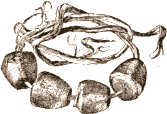
Fig. 97.—Beads of amber.
Beads.—
In addition to the ornaments already described, the women use short strings of beads, buttons, etc., to ornament various parts of the dress, especially the outer side of the inner frock (i´lupa), and strings of beads are often attached to various objects, such as pipes, tobacco pouches, etc. One or two women were also observed to wear large bunches of beads and buttons attached to the inner girdle in front so as to hang down between the legs inside of the pantaloons. A similar strange custom was observed by Beechey at Hotham Inlet, where a young woman wore a good-sized metal bell in the same uncomfortable manner.271 These people appear to have attempted the manufacture of beads in former times, when they were not so easily obtained as at present. There is in the collection a string of four small beads made from amber picked up on the beach (Fig. 97, No. 89700 [1716]). They are of dark honey-colored transparent amber, about one-third inch long and one-half inch diameter at the base. Such beads are very rare at the present day. The above specimens were the only ones seen.
TOILET ARTICLES.
The only object in use among these people that can be considered a toilet article is the small hair comb (ĭdlai´utĭn), usually made of walrus ivory.
The collection contains ten specimens, from which No. 56566b [182] (Fig. 98a) has been selected as the type. It is made of walrus ivory (from near the root of the tusk). When in use, it is held with the tip of the forefinger in the ring, the thumb and middle finger resting on each side of the neck. This is perhaps the commonest form of the comb, though it is often made with two curved arms at the top instead of a ring, as in Fig. 98b, No. 56569 [194], or sometimes with a plain top, like No. 56572 [210] (Fig. 98c). Nine of the ten combs, all from Utkiavwĭñ, are of walrus ivory, but No. 89785 [1006], which was the property of Ilû´bwga, the Nunatañmiun, who spent the winter of 1882-’83 at Utkiavwĭñ, is made of reindeer antler. This was probably made in the interior, where antler is more plentiful than ivory. All these combs are made with great care and patience. The teeth are usually cut with a saw, but on one specimen the maker used the sharp edge of a piece of tin, as we had refused to loan him a fine saw. This kind of comb is very like that described by Parry from Iglulik.272
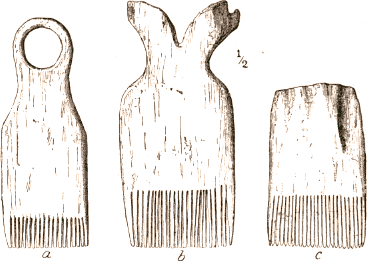
Fig. 98.—Hair combs.
Errors in this section:
Holm, G., and Garde, V. G. and
ihrem Verhältnisse zu den übrigen Eskimostämmen. ubrigen
Footnote 12: Op. cit., p. 264. footnote printed on following page (new section) and numbered as 1 on that page
The retrieving harpoon; an undescribed type of Eskimo weapon. final . missing
Footnote 49: ... spelled Kρamalit. final . missing
Footnote 55: ... 6^e sér., vol. 10, p. 182. 6 sér.,
Petitot also gives this word as itkpe´lit in his vocabulary (p. 42.) printed as shown, with “p” for expected ρ (p. 42.)
C’ést pourquoi nous les nommons Itkρe´le´it.’” inner close quote missing
Footnote 107: observed by Nordenskiöld in Siberia (Vega, vol. 2, p. 114). final . missing
Footnote 113: Op. cit., pp. 235, 236, 266. pp.,
A slight acquaintance with the work of Dall text has “of of” at line break
“Epi´ana” (Vernon), who had “lots of guns.” (Vernon,)
Mammals.—The wolf, amáxo (Canis lupus griseo-albus) printed as shown, but may be meant for ‘amaχo’ (chi for x)
have abandoned the old underground houses abandonded
The man said he intended to build a wooden house built
Kumlien, Contributions, etc., p. 31 Kumlien Contributions
Footnote 157: ... Kane’s 2d Exp., where two sleds Exp,