ETHNOLOGICAL RESULTS OF THE POINT BARROW EXPEDITION.
Reading edition
By John Murdoch.
INTRODUCTION.
The International Polar Expedition to Point Barrow, Alaska, was organized in 1881 by the Chief Signal Officer of the Army, for the purpose of cooperating in the work of circumpolar observation proposed by the International Polar Conference. The expedition, which was commanded by Lieut. P. H. Ray, Eighth Infantry, U.S. Army, sailed from San Francisco July 18, 1881, and reached Cape Smyth, 11 miles southwest of Point Barrow, on September 8 of the same year. Here a permanent station was established, where the party remained until August 28, 1883, when the station was abandoned, and the party sailed for San Francisco, arriving there October 7.
Though the main object of the expedition was the prosecution of the observations in terrestrial magnetism and meteorology, it was possible to obtain a large collection of articles illustrating the arts and industries of the Eskimo of the region, with whom the most friendly relations were early established. Nearly all of the collection was made by barter, the natives bringing their weapons, clothing, and other objects to the station for sale. Full notes on the habits and customs of the Eskimo also were collected by the different members of the party, especially by the commanding officer; the interpreter, Capt. E. P. Herendeen; the surgeon, Dr. George Scott Oldmixon, and myself, who served as one of the naturalists and observers of the expedition. It fell to my share to take charge of and catalogue all the collections made by the expedition, and therefore I had especially favorable opportunities for becoming acquainted with the ethnography of the region. Consequently, upon the return of the expedition, when it was found that the ethnological observations would occupy too much space for publication in the official report,1 all the collections and notes were intrusted to me for the purpose of preparing a special report. The Smithsonian Institution, through the kindness of the late Prof. Spencer F. Baird, then secretary, furnished a room where the work of studying the collection could be carried on, and allowed me access to its libraries and to the extensive collections of the National Museum for the purposes of comparison. The Director of the Bureau of Ethnology, Maj. J. W. Powell, kindly agreed to furnish the illustrations for the work and to publish it as part of his annual report, while the Chief Signal Officer, with the greatest consideration, permitted me to remain in the employ of his Bureau until the completion of the work.
Two years were spent in a detailed analytical study of the articles in the collection, until all the information that could be gathered from the objects themselves and from the notes of the collectors had been recorded. Careful comparisons were made with the arts and industries of the Eskimo race as illustrated by the collections in the National Museum and the writings of various explorers, and these frequently resulted in the elucidation of obscure points in the history of the Point Barrow Eskimo. In the form in which it is presented this work contains, it is believed, all that is known at the present day of the ethnography of this interesting people.
Much linguistic material was also collected, which I hope some time to be able to prepare for publication.
The observations are arranged according to the plan proposed by Prof. Otis T. Mason in his “Ethnological Directions, etc.,” somewhat modified to suit the circumstances. In writing Eskimo words the alphabet given in Powell’s “Introduction to the Study of Indian Languages” has been used, with the addition ɐ for an obscure a (like the final a in soda), ǝ for a similar obscure e, and ö for the sound of the German ö or French eu.
I desire to express my gratitude to the late Prof. Spencer F. Baird, Secretary of the Smithsonian Institution, to the late Gen. William B. Hazen, Chief Signal Officer of the Army, and to Maj. J. W. Powell, Director of the Bureau of Ethnology, for their kindness in enabling me to carry on these investigations. Grateful acknowledgment is due for valuable assistance to various members of the scientific staff of the National Museum, especially to the curator of ethnology, Prof. Otis T. Mason, and to Mr. William H. Dall. Valuable suggestions were received from Mr. Lucien M. Turner, Dr. Franz Boas, the late Dr. Emil Bessels, and Dr. H. Rink, of Christiania.
LIST OF WORKS CONSULTED.
The following list is not intended for a complete bibliography of what has been written on the ethnography of the Eskimo, but it is believed that it contains most of the important works by authors who have treated of these people from personal observation. Such of the less important works have been included as contain any references bearing upon the subject of the study.
As it has been my object to go, whenever possible, to the original sources of information, compilations, whether scientific or popular, have not been referred to or included in this list, which also contains only the editions referred to in the text.
Armstrong, Alexander. A personal narrative of the discovery of the Northwest Passage; with numerous incidents of travel and adventure during nearly five years’ continuous service in the Arctic regions while in search of the expedition under Sir John Franklin. London, 1857.
Back, George. Narrative of the Arctic land expedition to the mouth of the Great Fish River and along the shores of the Arctic Ocean, in the years 1833, 1834, and 1835. Philadelphia, 1836.
Beechey, Frederick William. Narrative of a voyage to the Pacific and Beering’s Strait to cooperate with the polar expeditions: performed in His Majesty’s ship Blossom, under the command of Capt. F. W. Beechey, etc., etc., etc., in the years 1825, 1826, 1827, and 1828. London, 1831.
Bessels, Emil. Die amerikanische Nordpol-Expedition. Leipzig, 1878.
—— The northernmost inhabitants of the earth. An ethnographic sketch. < American Naturalist, vol. 18, pp. 861-882. 1884.
—— Einige Worte über die Inuit (Eskimo) des Smith-Sundes, nebst Bemerkungen über Inuit-Schädel. < Archiv für Anthropologie, vol. 8, pp. 107-122. Braunschweig, 1875.
Boas, Franz. The Central Eskimo. In Sixth Annual Report of the Bureau of Ethnology, pp. 399-669. Washington, Government Printing Office, 1888.
Brodbeck, J. Nach Osten. Untersuchungsfahrt nach der Ostküste Grönlands, vom 2. bis 12. August 1881. Niesky, 1882.
Chappell, E. (Lieut., R.N.). Narrative of a voyage to Hudson’s Bay in His Majesty’s ship Rosamond, containing some account of the northeastern coast of America, and of the tribes inhabiting that remote region. London, 1817.
Choris, L. Voyage Pittoresque autour du Monde, avec des portraits des sauvages d’Amérique, d’Asie, d’Afrique, et des iles du Grand Océan; des paysages, des vues maritimes, et plusieurs objets d’histoire naturelle; accompagné de descriptions par M. le Baron Cuvier, et M. A. de Chamisso, et d’observations sur les crânes humains par M. le Docteur Gall. Paris, 1822.
Cook, James, and King, James. A voyage to the Pacific Ocean, undertaken by the command of His Majesty for making discoveries in the northern hemisphere, to determine the position and extent of the west side of North America; its distance from Asia; and the practicability of a northern passage to Europe, in the years 1776, 1777, 1778, 1779, and 1780. London, 1784. 3 vols. (Commonly called “Cook’s Third Voyage.”)
“Corwin.” Cruise of the revenue steamer Corwin in Alaska and the N.W. Arctic Ocean in 1881. Notes and memoranda. Medical and anthropological; botanical; ornithological. Washington, Government Printing Office, 1883.
Crantz, David. The history of Greenland: containing a description of the country and its inhabitants; and particularly a relation of the mission carried on for above these thirty years by the Unitas Fratrum, at New Herrnhuth and Lichtenfels, in that country. 2 volumes. London, 1767.
Dall, William Healy. Alaska and its Resources. Boston, 1870.
—— On masks, labrets, and certain aboriginal customs, with an inquiry into the bearing of their geographical distribution. < Third Annual Report of the Bureau of Ethnology to the Secretary of the Smithsonian Institution, 1881. Washington, Government Printing Office, 1884.
—— Tribes of the extreme northwest. < Contributions to North American Ethnology, vol. 1. Washington, Government Printing Office, 1877.
[Davis, John]. The first voyage of Master John Dauis, vndertaken in June 1585: for the discoverie of the Northwest Passage. Written by John Janes Marchant Seruant to the worshipfull M. William Sanderson. < Hakluyt, “The principal navigations, voiages, etc.,” pp. 776-780. London, 1589.
—— The second voyage attempted by Master John Davis with others for the discoverie of the Northwest passage, in Anno 1586. < Hakluyt, “The principal navigations, voiages, etc.,” pp. 781-786. London, 1589.
—— The third voyage Northwestward, made by John Dauis, Gentleman, as chiefe Captaine and Pilot generall, for the discoverie of a passage to the Isles of the Molucca, or the coast of China, in the yeere 1587. Written by John Janes, Seruant to the aforesayd M. William Sanderson. < Hakluyt, “The principal navigations, voiages, etc.,” pp. 789-792. London, 1589.
Dease, Peter W., and Simpson, Thomas. An account of the recent arctic discoveries by Messrs. Dease and Simpson. < Journal of the Royal Geographical Society of London, vol. 8, pp. 213-225. London, 1838.
Egede, Hans. A description of Greenland. Showing the natural history, situation, boundaries, and face of the country; the nature of the soil; the rise and progress of the old Norwegian colonies; the ancient and modern inhabitants; their genius and way of life, and produce of the soil; their plants, beasts, fishes, etc. Translated from the Danish. London, 1745.
Ellis, H. A voyage to Hudson’s Bay, by the Dobbs Galley and California, in the years 1746 and 1747, for discovering a northwest passage. London, 1748.
Franklin, Sir John. Narrative of a journey to the shores of the Polar Sea in the years 1819-20-21-22. Third edition, 2 vols. London, 1824.
—— Narrative of a second expedition to the shores of the Polar Sea in the years 1825, 1826, and 1827. Including an account of the progress of a detachment to the eastward, by John Richardson. London, 1828.
[Frobisher, Martin]. The first voyage of M. Martine Frobisher to the Northwest for the search of the straight or passage to China, written by Christopher Hall, and made in the yeere of our Lord 1576. < Hakluyt, “The principal navigations, voiages, etc.,” pp. 615-622. London, 1589.
—— The second voyage of Master Martin Frobisher, made to the West and Northwest Regions, in the yeere 1577. With a description of the Countrey and people. Written by Dionise Settle. < Hakluyt, “The principal navigations, voiages, etc.,” pp. 622-630. London, 1589.
—— The third and last voyage into Meta Incognita, made by M. Martin Frobisher, in the year 1578. Written by Thomas Ellis. < Hakluyt, “The principal navigations, voiages, etc.,” pp. 630-635. London, 1589.
Gilder, W. H. Schwatka’s search. Sledging in the arctic in quest of the Franklin records. New York, 1881.
Graah, W. A. (Capt.). Narrative of an expedition to the east coast of Greenland, sent by order of the King of Denmark, in search of the lost colonies. Translated from the Danish. London, 1837.
Hakluyt, Richard. The principall navigations, voiages and discoveries of the English nation, made by Sea or over Land, to the most remote and farthest distant Quarters of the earth at any time within the compasse of these 100 yeeres. London, 1589.
Hall, Charles Francis. Arctic researches and life among the Esquimaux: being the narrative of an expedition in search of Sir John Franklin, in the years 1860, 1861, and 1862. New York, 1865.
—— Narrative of the second arctic expedition made by Charles F. Hall: his voyage to Repulse Bay, sledge journeys to the Straits of Fury and Hecla and to King William’s Land, and residence among the Eskimos during the years 1864-’69. Washington, Government Printing Office, 1879.
Healy, M. A. Report of the cruise of the revenue marine steamer Corwin in the Arctic Ocean in the year 1885. Washington, Government Printing Office, 1887.
Holm, G. Konebaads-Expeditionen til Grønlands Østkyst 1883-’85. < Geografisk Tidskrift, vol. 8, pp. 79-98. Copenhagen, 1886.
Holm, G., and Garde, V. Den danske Konebaads-Expeditionen til Grønlands Østkyst, populært beskreven. Copenhagen, 1887.
Hooper, C. L. (Capt.). Report of the cruise of the U.S. revenue steamer Thomas Corwin, in the Arctic Ocean, 1881. Washington, Government Printing Office, 1884.
Hooper, William Hulme (Lieut.). Ten months among the tents of the Tuski, with incidents of an arctic boat expedition in search of Sir John Franklin, as far as the Mackenzie River and Cape Bathurst. London, 1853.
Kane, Elisha Kent (Dr.). Arctic explorations in the years 1853, ’54, ’55. Two vols. Philadelphia, 1856.
—— The U.S. Grinnell expedition in search of Sir John Franklin. A personal narrative. New York, 1853.
Kirkby, W. W. (Archdeacon). A journey to the Youcan, Russian America. < Annual Report of the Board of Regents of the Smithsonian Institution for the year 1864, pp. 416-420. Washington, 1865.
Klutschak, Heinrich W. Als Eskimo unter den Eskimos. Eine Schilderung der Erlebnisse der Schwatka’schen Franklin-aufsuchungs-expedition in den Jahren 1878-’80. Wien, Pest, Leipzig, 1881.
Kotzebue, O. von. A voyage of discovery into the South Sea and Beering’s Straits, for the purpose of exploring a northeast passage, undertaken in the years 1815-1818. Three volumes. London, 1821.
Krause, Aurel (Dr.). Die Bevolkerungsverhältnisse der Tschuktscher-Halbinsel. < Deutsche geographische Blätter, vol. 6, pp. 248-278. Bremen, 1883.
—— and Arthur, Die Expedition der Bremer geographischen Gesellschaft nach der Tschuktscher-Halbinsel. < Deutsche geographische Blätter, vol. 5, pp. 1-35, 111-133. Bremen, 1882.
—— Die wissenschaftliche Expedition der Bremer geographischen Gesellschaft nach dem Küstengebiete an der Beringsstrasse. < Deutsche geographische Blätter, vol. 4, pp. 245-281. Bremen, 1881.
Kumlien, Ludwig, Contributions to the natural history of Arctic America, made in connection with the Howgate polar expedition, 1877-78. Bulletin of the U.S. National Museum, No. 15. Washington, Government Printing Office, 1879.
Lisiansky, Urey, A voyage round the world, in the years 1803, ’4, ’5, and ’6, performed by order of His Imperial Majesty Alexander the First, Emperor of Russia, in the ship Neva. London, 1814.
Lyon, G. F. (Capt.). The private journal of Captain G. F. Lyon, of H.M.S. Hecla, during the recent voyage of discovery under Captain Parry. Boston, 1824.
M’Clure, Robert le Mesurier (Capt.). See Osborn, Sherard (editor).
Mackenzie, Alexander. Voyages from Montreal, on the river St. Lawrence, through the continent of North America, to the Frozen and Pacific Oceans, in the years 1789 and 1793. London, 1802.
Maguire, Rochfort (Commander). Proceedings of Commander Maguire, H.M. discovery ship “Plover.” < Parliamentary Reports, 1854, XLII, pp. 165-185. London, 1854.
—— Proceedings of Commander Maguire, Her Majesty’s discovery ship “Plover.” < Further papers relative to the recent arctic expedition in search of Sir John Franklin, etc., p. 905 (second year). Presented to both houses of Parliament, January, 1855. London.
Morgan, Henry. The relation of the course which the Sunshine, a bark of fiftie tunnes, and the Northstarre, a small pinnesse, being two vessels of the fleet of M. John Dauis, held after he had sent them from him to discouer the passage between Groenland and Island. Written by Henry Morgan, seruant to M. William Sanderson, of London. < Hakluyt, “The principall navigations, voiages, etc.,” pp. 787-9. London, 1589.
Murdoch, John. The retrieving harpoon; an undescribed type of Eskimo weapon. < American Naturalist, vol. 19, 1885, pp. 423-425.
Murdoch, John. On the Siberian origin of some customs of the western Eskimos. < American Anthropologist, vol. 1, pp. 325-336. Washington, 1888.
—— A study of the Eskimo bows in the U.S. National Museum. < Smithsonian Report for 1884, pt. II, pp. 307-316. Washington, Government Printing Office, 1885.
Nordenskiöld, Adolf Eric. The voyage of the Vega round Asia and Europe. Translated by Alexander Leslie. 2 vols. London, 1881.
Osborn, Sherard (editor). The discovery of the northwest passage by H.M.S. Investigator, Capt. R. M’Clure, 1850, 1851, 1852, 1853, 1854. Edited by Commander Sherard Osborn, from the logs and journals of Capt. Robert Le M. M’Clure. Appendix: Narrative of Commander Maguire, wintering at Point Barrow. London, 1856.
Parry, William Edward (Sir). Journal of a voyage for the discovery of a northwest passage from the Atlantic to the Pacific; performed in the years 1819-’20, in His Majesty’s ships Hecla and Griper. Second edition. London, 1821.
—— Journal of a second voyage for the discovery of a northwest passage from the Atlantic to the Pacific; performed in the years 1821-’22-’23, in His Majesty’s ships Fury and Hecla. London, 1824.
Petitot, Emile Fortuné Stanislas Joseph, (Rev.). Géographie de l’Athabascaw-Mackenzie. < Bulletin de la Société de Géographie, [6] vol. 10, pp. 5-12, 126-183, 242-290. Paris, 1875.
—— Vocabulaire Français-Esquimaux, dialecte des Tchiglit des bouches du Mackenzie et de l’Anderson, précédé d’une monographie de cette tribu et de notes grammaticales. Vol. 3 of Pinart’s “Bibliothèque de Linguistique et d’Ethnographie Américaines.”
Petroff, Ivan. Report on the population, industries, and resources of Alaska. < Tenth Census of the U.S. Washington, Government Printing Office, 1884.
Powell, Joseph S. (Lieut.). Report of Lieut. Joseph S. Powell: Relief expedition to Point Barrow, Alaska. < Signal Service Notes, No. V, pp. 13-23. Washington, Office of the Chief Signal Officer, 1883.
Rae, John (Dr.). Narrative of an expedition to the shores of the Arctic Sea in 1846 and 1847. London, 1850.
Ray, Patrick Henry (Lieut.). Report of the International Polar Expedition to Point Barrow, Alaska. Washington, Government Printing Office, 1885.
—— Report of Lieut. P. Henry Ray: Work at Point Barrow, Alaska, from September 16, 1881, to August 25, 1882. < Signal Service Notes, No. V, pp. 35-40. Washington, Office of the Chief Signal Officer, 1883.
Richardson, John (Sir.). Arctic searching expedition: A journal of a boat voyage through Rupert’s Land and the Arctic Sea, in search of the discovery ships under command of Sir John Franklin. 2 volumes. London, 1851.
—— Eskimos, their geographical distribution. < Edinburgh New Philosophical Journal, vol. 52, pp. 322-323. Edinburgh, 1852.
—— The polar regions. Edinburgh, 1861.
Rink, Henrik [Johan] (Dr.). Die dänische Expedition nach der Ostküste Grönlands, 1883-1885. < Deutsche geographische Blätter, vol. 8, pp. 341-353. Bremen, 1885.
—— Danish Greenland, its people and its products. London. 1877.
—— The Eskimo tribes. Their distribution and characteristics, especially in regard to language. Meddelelser om Grønland, vol. 11. Copenhagen, 1887.
—— Die Östgrönlander in ihrem Verhältnisse zu den übrigen Eskimostämmen. < Deutsche geographische Blätter, vol. 9, pp. 228-239. Bremen, 1886.
—— Østgrønlænderne i deres Forhold til Vestgrønlænderne og de øvrige Eskimostammer. < Geografisk Tidskrift, vol. 8, pp. 139-145. Copenhagen, 1886. (Nearly the same as the above.)
—— Tales and Traditions of the Eskimo, with a sketch of their habits, language, and other peculiarities. Translated from the Danish. Edinburgh, 1875.
Ross, John. Appendix to the narrative of a second voyage in search of a Northwest passage, and of a residence in the arctic regions during the years 1829, 1830, 1831, 1832, 1833. London, 1835.
—— Narrative of a second voyage in search of a northwest passage, and of a residence in the arctic regions during the years 1829, 1830, 1831, 1832, 1833. Philadelphia, 1835.
—— A voyage of discovery, made under the orders of the admiralty in His Majesty’s ships Isabella and Alexander, for the purpose of exploring Baffin’s Bay, and inquiring into the probability of a northwest passage. London, 1819.
Schwatka, Frederick. The Netschilluk Innuit. < Science, vol. 4, pp. 543-5. New York, 1884.
—— Nimrod in the North, or hunting and fishing adventures in the arctic regions. New York, 1885.
Scoresby, William, Jr. (Captain). Journal of a voyage to the northern whale-fishery; including researches and discoveries on the eastern coast of Greenland, made in the summer of 1822, in the ship Baffin, of Liverpool. Edinburgh, 1823.
Seemann, Berthold. Narrative of the voyage of H.M.S. Herald, during the years 1845-’51, under the command of Captain Henry Kellett, R.N., C.B.; being a circumnavigation of the globe and three cruises to the arctic regions in search of Sir John Franklin. Two vols. London, 1853.
Simpson, John (Dr.). Observations on the western Eskimo, and the country they inhabit; from notes taken during two years at Point Barrow. < A selection of papers on arctic geography and ethnology. Reprinted and presented to the arctic expedition of 1875 by the Royal Geographical Society (“Arctic Blue Book”), pp. 233-275. London, 1875. (Reprinted from “Further papers,” etc., Parl. Rep., 1855.)
Simpson, Thomas. Narrative of the discoveries on the north coast of America, effected by the officers of the Hudson’s Bay Company during the years 1836-39. London, 1843.
Sollas, W. J. On some Eskimos’ bone implements from the east coast of Greenland. Journal of the Anthropological Institute of Great Britain and Ireland, vol. 9, pp. 329-336. London, 1880.
Sutherland, P. C. (Dr.). On the Esquimaux. Journal of the Ethnological Society of London, vol. 4, pp. 193-214. London, 1856.
Wrangell, Ferdinand von. Narrative of an expedition to the Polar Sea in the years 1820, 1821, 1822, and 1823. Edited by Maj. Edward Sabine. London, 1840.
SITUATION AND SURROUNDINGS.
The people whose arts and industries are represented by the collection to be described are the Eskimo of the northwestern extremity of the continent of North America, who make permanent homes at the two villages of Nuwŭk and Utkiavwĭñ. Small contributions to the collection were obtained from natives of Wainwright Inlet and from people of the Inland River (Nunatañmiun) who visited the northern villages.
Nuwŭk, “the Point,” is situated on a slightly elevated knoll at the extremity of Point Barrow, in lat. 71° 23´ N., long. 156° 17´ W., and Utkiavwĭñ, “the Cliffs,” at the beginning of the high land at Cape Smyth, 11 miles southwest from Nuwŭk. The name Utkiavwĭñ was explained as meaning “the high place, whence one can look out,” and was said to be equivalent to ĭkpĭk, a cliff. This name appears on the various maps of this region under several corrupted forms, due to carelessness or inability to catch the finer distinctions of sound. It first appears on Capt. Maguire’s map2 as “Ot-ki-a-wing,” a form of the word very near the Eskimo pronunciation. On Dr. Simpson’s map3 it is changed to “Ot-ke-a-vik,” which on the admiralty chart is misprinted “Otkiovik.” Petroff on his map4 calls it “Ootiwakh,” while he gives an imaginary village “Ootkaiowik, Arctic Ocean,” of 55 inhabitants, in his census of the Arctic Division (op. cit., p. 4), which does not appear upon his map.
Our party, I regret to say, is responsible for the name “Ooglaamie” or “Uglaamie,” which has appeared on many maps since our return. Strictly speaking this name should be used only as the official name of the United States signal station. It arose from a misunderstanding of the name as heard the day after we arrived, and was even adopted by the natives in talking with us. It was not until the second year that we learned the correct form of the word, which has been carefully verified.
The inhabitants of these two villages are so widely separated from their neighbors—the nearest permanent villages are at Point Belcher and Wainwright Inlet, 75 miles southwest, and Demarcation Point, 350 miles east5—and so closely connected with each other by intermarriage and common interests, that they may be considered as a single people. In their hunting and trading expeditions they habitually range from the neighborhood of Refuge Inlet along the coast to Barter Island, going inland to the upper waters of the large rivers which flow northward into the Arctic Ocean east of Point Barrow. Small parties occasionally travel as far as Wainwright Inlet and more rarely to Point Hope, and some times as far as the Mackenzie River. The extent of their wanderings will be treated of more fully in connection with their relations to the other natives of the Northwest. They appear to be unacquainted with the interior except for about 100 miles south of Point Barrow.
The coast from Refuge Inlet runs nearly straight in a generally northeast direction to Point Barrow, and consists of steep banks of clay, gravel, and pebbles, in appearance closely resembling glacial drift, bordered by a narrow, steep beach of pebbles and gravel, and broken at intervals by steep gulleys which are the channels of temporary streams running only during the period of melting snow, and by long, narrow, and shallow lagoons, to whose edges the cliffs slope gradually down, sometimes ending in low, steep banks. The mouths of these lagoons are generally rather wide, and closed by a bar of gravel thrown up by the waves during the season of open water. In the spring, the snow and ice on the land melt months before the sea opens and flood the ice on the lagoons, which also melts gradually around the edges until there is a sufficient head of water in the lagoon to break through the bar at the lowest point. This stream soon cuts itself a channel, usually about 20 or 30 yards wide, through which the lagoon is rapidly drained, soon cutting out an open space of greater or less extent in the sea ice. Before the sea opens the lagoon is drained down to its level, and the tide ebbs and flows through the channel, which is usually from knee-deep to waist-deep, so that the lagoon becomes more or less brackish. When the sea gets sufficiently open for waves to break upon the beach, they in a short time bring in enough gravel to close the outlet. The cliffs gradually decrease in height till they reach Cape Smyth, where they are about 25 feet high, and terminate in low knolls sloping down to the banks of the broad lagoon Isûtkwɐ, which is made by the confluence of two narrow, sinuous gulleys, and is only 10 feet deep in the deepest part.
Rising from the beach beyond the mouth of this lagoon is a slight elevation, 12 feet above the sea level, which was anciently the site of a small village, called by the same name as the lagoon. On this elevation was situated the United States signal station of Ooglaamie. Beyond this the land is level with the top of the beach, which is broad and nearly flat, raised into a slight ridge on the outer edge. About half a mile from the station, just at the edge of the beach, is the small lagoon Imérnyɐ, about 200 yards in diameter, and nearly filled up with marsh. From this point the land slopes down to Elson Bay, a shallow body of water inclosed by the sandspit which forms Point Barrow. This is a continuation of the line of the beach, varying in breadth from 200 to 600 yards and running northeast for 5 miles, then turning sharply to the east-southeast and running out in a narrow gravel spit, 2 miles long, which is continued eastward by a chain of narrow, low, sandy islands, which extend as far as Point Tangent. At the angle of the point the land is slightly elevated into irregular turf-covered knolls, on which the village of Nuwŭk is situated. At various points along the beach are heaps of gravel, sometimes 5 or 6 feet in height, which are raised by the ice. Masses of old ice, bearing large quantities of gravel, are pushed up on the beach during severe storms and melt rapidly in the summer, depositing their load of gravel and pebbles in a heap. These masses are often pushed up out of reach of the waves, so that the heaps of gravel are left thenceforth undisturbed.
Between Imernyɐ and Elson Bay (Tă´syûk) is a series of large shallow lagoons, nearly circular and close to the beach, which rises in a regular sea-wall. All have low steep banks on the land side, bordered with a narrow beach. The first of these, I´kpĭlĭñ (“that which has high banks”), breaks out in the spring through a narrow channel in the beach in the manner already described, and is salt or brackish. The next is fresh and connected with I´kpĭlĭñ by a small stream running along behind the beach. It is called Sĭ´n-nyû, and receives a rivulet from a small fresh-water lake 3 or 4 miles inland. The third, Imê´kpûñ (“great water”), is also fresh, and has neither tributary nor outlet. The fourth, Imêkpû´niglu, is brackish, and empties into Elson Bay by a small stream. Between this stream and the beach is a little fresh-water pond close to the bend of Elson Bay, which is called Kĭkyûktă´ktoro, from one or two little islands (kĭkyû´ktɐ) near one end of it.
Back from the shore the land is but slightly elevated, and is marshy and interspersed with many small lakes and ponds, sometimes connected by inconsiderable streams. This marsh passes gradually into a somewhat higher and drier rolling plain, stretching back inland from the cliffs and growing gradually higher to the south. Dr. Simpson, on the authority of the Point Barrow natives, describes the country as “uniformly low, and full of small lakes or pools of fresh water to a distance of about 50 miles from the north shore, where the surface becomes undulating and hilly, and, farther south, mountainous.”6 This description has been substantially verified by Lieut. Ray’s explorations. South of the usual deer-hunting ground of the natives he found the land decidedly broken and hilly, and rising gradually to a considerable range of mountains, running approximately east and west, which could be seen from the farthest point he reached.7
The natives also speak of high rocky land “a long way off to the east,” which some of them have visited for the purpose of hunting the mountain sheep. The low rolling plain in the immediate vicinity of Point Barrow, which is all of the country that could be visited by our party when the land was clear of snow, presents the general appearance of a country overspread with glacial drift. The landscape is strikingly like the rolling drift hills of Cape Cod, and this resemblance is increased by the absence of trees and the occurrence of ponds in all the depressions. There are no rocks in situ visible in this region, and large bowlders are absent, while pebbles larger than the fist are rare. The surface of the ground is covered with a thin soil, supporting a rather sparse vegetation of grass, flowering plants, creeping willows, and mosses, which is thicker on the higher hillsides and forms a layer of turf about a foot thick. Large tracts of comparatively level ground are almost bare of grass, and consist of irregular hummocks of black, muddy soil, scantily covered with light-colored lichens and full of small pools. The lowlands, especially those back of the beach lagoons, are marshes, thickly covered with grass and sphagnum. The whole surface of the land is exceedingly wet in summer, except the higher knolls and hillsides, and for about 100 yards back from the edge of the cliffs. The thawing, however, extends down only about a foot or eighteen inches. Beyond this depth the ground is perpetually frozen for an unknown distance. There are no streams of any importance in the immediate neighborhood of Point Barrow. On the other hand, three of the rivers emptying into the Arctic Ocean between Point Barrow and the Colville, which Dr. Simpson speaks of as “small and hardly known except to persons who have visited them,”8 have been found to be considerable streams. Two of these were visited by Lieut. Ray in his exploring trips in 1882 and 1883. The first, Kua´ru, is reached after traveling about 50 miles from Point Barrow in a southerly direction. It has been traced only for a small part of its course, and there is reason to believe, from what the natives say, that it is a tributary of the second named river. Lieut. Ray visited the upper part of the second river, Kulugrua (named by him “Meade River”), in March, 1882, when he went out to join the native deer hunters encamped on its banks, just on the edge of the hilly country. On his return he visited what the natives assured him was the mouth of this river, and obtained observations for its geographical position. Early in April, 1883, he again visited the upper portion of the stream, and traced it back some distance into the hilly country. The intermediate portion has never been surveyed. At the time of each of his visits the river was, of course, frozen and the ground covered with snow, but he was able to see that the river was of considerable size, upwards of 200 yards wide where he first reached it, about 60 miles from its mouth, and showing evidences of a large volume of water in the spring. It receives several tributaries. (See maps, Pls. I and II.)
The third river is known only by hearsay from the natives. It is called Ĭ´kpĭkpûñ (Great Cliff), and is about 40 miles (estimated from day’s journeys) east of Kulu´grua. It is described as being a larger and more rapid stream than the other two, and so deep that it does not freeze down to the bottom on the shallow bars, as they say Kulu´grua does. Not far from its mouth it is said to receive a tributary from the east flowing out of a great lake of fresh water, called Tă´syûkpûñ (Great Lake.) This lake is separated from the sea by a comparatively narrow strip of land, and is so large that a man standing on the northern shore can not see the “very high” land on the southern. It takes an umiak a day to travel the length of the lake under sail with a fair wind, and when the Nunatañmiun coming from the south first saw the lake they said “Taxaio!” (the sea).
On Capt. Maguire’s map9 this lake is laid down by the name “Taso´kpoh” “from native report.” It is represented as lying between Smith Bay and Harrison Bay, and connected with each by a stream. Maguire seems to have heard nothing of Ikpikpûñ. This lake is not mentioned in the body of the report. Dr. Simpson, however,10 speaks of it in the following words: “They [i.e., the trading parties when they reach Smith Bay] enter a river which conducts them to a lake, or rather series of lakes, and descend another stream which joins the sea in Harrison Bay.” They are well acquainted with the Colville River, which in their intercourse with us they usually called “the river at Nĭ´galĕk,” Nĭ´galĕk being the well known name of the trading camp at the mouth. It was also sometimes spoken of as the “river of the Nunatañmiun.” The Mackenzie River is known as “Kupûñ” (great river). We found them also acquainted with the large unexplored river called “Kok” on the maps, which flows into Wainwright Inlet. They called it “Ku” (the river). The river “Cogrua,” which is laid down on the charts as emptying into Peard Bay, was never mentioned by the Point Barrow natives, but we were informed by Capt. Gifford, of the whaler Daniel Webster, who traveled along the coast from Point Barrow to Cape Lisburne after the loss of his vessel in 1881, that it is quite a considerable stream. He had to ascend it for about a day’s journey—20 miles, according to Capt. Hooper11—before he found it shallow enough to ford.
CLIMATE.
The climate of this region is thoroughly arctic in character, the mean annual temperature being 8° F., ranging from 65° to -52° F. Such temperatures as the last mentioned are, however, rare, the ordinary winter temperature being between -20° and -30° F., rarely rising during December, January, February, and March as high as zero, and still more rarely passing beyond it. The winter merges insensibly by slow degrees into summer, with occasional “cold snaps,” and frosty nights begin again by the 1st of September.
The sun is entirely below the horizon at Point Barrow for 72 days in the winter, beginning November 15, though visible by refraction a day or two later at the beginning of this period and a day or two earlier at the end. The midday darkness is never complete even at the winter solstice, as the sun is such a short distance below the horizon, but the time suitable for outdoor employments is limited to a short twilight from 9 a.m. to 3 p.m. There is, of course, an equal time in the summer when the sun is continually above the horizon, and for about a month before and after this period the twilight is so bright all night that no stars are visible.
The snowfall during the winter is comparatively small. There is probably not more than a foot of snow on a level anywhere on the land, though it is extremely difficult to measure or estimate, as it is so fine and dry that it is easily moved by the wind and is constantly in motion, forming deep, heavy, hard drifts under all the banks, while many exposed places, especially the top of the sand beach, are swept entirely clean. The snow begins to soften and melt about the first week in April, but goes off very slowly, so that the ground is not wholly bare before the middle or end of June. The grass, however, begins to turn green early in June, and a few flowers are seen in blossom as early as June 7 or 8.
Rain begins to fall as early as April, but cold, snowy days are not uncommon later than that date. There is a good deal of clear, calm weather during the winter, and extremely low temperatures are seldom accompanied by high wind. Violent storms are not uncommon, however, especially in November, during the latter part of January, and in February. One gale from the south and southwest, which occurred January 22, 1882, reached a velocity of 100 miles an hour. The most agreeable season of the year is between the middle of May and the end of July, when the sea opens. After this there is much foggy and cloudy weather.
Fresh-water ponds begin to freeze about the last week in September, and by the first or second week in October everything is sufficiently frozen for the natives to travel with sledges to fish through the ice of the inland rivers. Melting begins with the thawing of the snow, but the larger ponds are not clear of ice till the middle or end of July. The sea in most seasons is permanently closed by freezing and the moving in of heavy ice fields from about the middle of October to the end of July. The heavy ice in ordinary seasons does not move very far from the shore, while the sea is more or less encumbered with floating masses all summer. These usually ground on a bar which runs from the Seahorse Islands along the shore parallel to it and about 1,000 yards distant, forming a “barrier” or “land-floe” of high, broken hummocks, inshore of which the sea freezes over smooth and undisturbed by the pressure of the outer pack.
Sometimes, however, the heavy pack, under the pressure of violent and long-continued westerly winds, pushes across the bar and is forced up on the beach. The ice sometimes comes in with great rapidity. The natives informed us that a year or two before the station was established the heavy ice came in against the village cliffs, tearing away part of the bank and destroying a house on the edge of the cliff so suddenly that one of the inmates, a large, stout man, was unable to escape through the trap-door and was crushed to death. Outside of the land-floe the ice is a broken pack, consisting of hummocks of fragmentary old and new ice, interspersed with comparatively level fields of the former. During the early part of the winter this pack is most of the time in motion, sometimes moving northeastward with the prevailing current and grinding along the edge of the barrier, sometimes moving off to sea before an offshore wind, leaving “leads” of open water, which in calm weather are immediately covered with new ice (at the rate of 6 inches in 24 hours), and again coming in with greater or less violence against the edges of this new ice, crushing and crumpling it up against the barrier. Portions of the land-floe even float off and move away with the pack at this season.
The westerly gales of the later winter, however, bring in great quantities of ice, which, pressing against the land-floe, are pushed up into hummocks and ground firmly in deeper water, thus increasing the breadth of the fixed land-floe until the line of separation between the land-floe and the moving pack is 4 or 5 or sometimes even 8 miles from land. The hummocks of the land-floe show a tendency to arrange themselves in lines parallel to the shore, and if the pressure has not been too great there are often fields of ice of the season not over 4 feet thick between the ranges of hummocks, as was the case in the winter of 1881-’82. In the following year, however, the pressure was so great that there were no such fields, and even the level ice inside of the barrier was crushed into hummocks in many places.
After the gales are over there is generally less motion in the pack, until about the middle of April, when easterly winds usually cause leads to open at the edge of the land-floe. These leads now continue to open and shut, varying in size with the direction and force of the wind. As the season advances, especially in July, the melting of the ice on the surface loosens portions of the land-floe, which float off and join the pack, bringing the leads nearer to the shore. In the meantime the level shore ice has been cut away from the beach by the warm water running down from the land and has grown “rotten” and full of holes from the heat of the sun. By the time the outside ice has moved away so as to leave only the floes grounded on the bar the inside ice breaks up into loose masses, moving up and down with wind and current and ready to move off through the first break in the barrier. Portions of the remaining barrier gradually break off and at last the whole finally floats and moves out with the pack, sometimes, as in 1881—a very remarkable season—moving out of sight from the land.
This final departure of the ice may take place at any time between the middle of July and the middle of August. East of Point Barrow we had opportunities only for hasty and superficial observations of the state of the ice. The land floe appears to form some distance outside of the sandy islands, and from the account of the natives there is much open water along shore early in the season, caused by the breaking up of the rivers. Dr. Simpson12 learned from the natives that the trading parties which left the Point about the 1st of July found open water at Dease Inlet. This is more definite information than we were able to obtain. We only learned that they counted on finding open water a few days’ journey east.
THE PEOPLE.
PHYSICAL CHARACTERISTICS.
In stature these people are of a medium height, robust and muscular, “inclining rather to spareness than corpulence,”13 though the fullness of the face and the thick fur clothing often gives the impression of the latter. There is, however, considerable individual variation among them in this respect. The women are as a rule shorter than the men, occasionally almost dwarfish, though some women are taller than many of the men. The tallest man observed measured 5 feet 9½ inches, and the shortest 4 feet 11 inches. The tallest woman was 5 feet 3 inches in height, and the shortest 4 feet ½ inch. The heaviest man weighed 204 pounds and the lightest 126 pounds. One woman weighed 192 pounds and the shortest woman was also the lightest, weighing only 100 pounds.14 The hands and feet are small and well shaped, though the former soon become distorted and roughened by work. We did not observe the peculiar breadth of hands noticed by Dr. Simpson, nor is the shortness of the thumb which he mentions sufficient to attract attention.15 Their feet are so small that only one of our party, who is much below the ordinary size, was able to wear the boots made by the natives for themselves. Small and delicate hands and feet appear to be a universal characteristic of the Eskimo race and have been mentioned by most observers from Greenland to Alaska.16
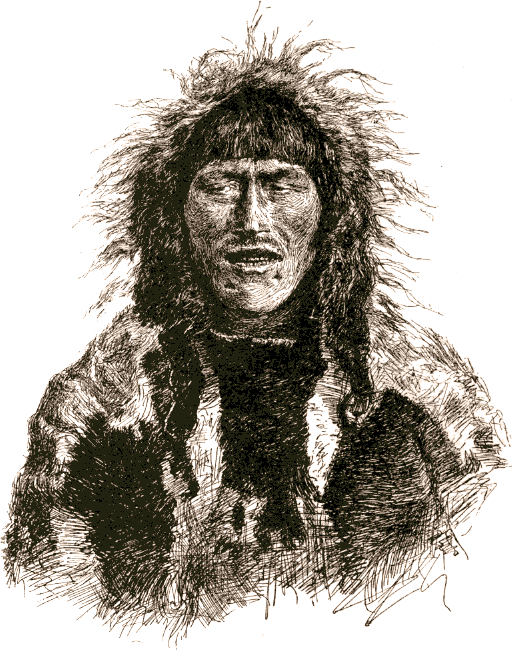
Fig. 1. Unalina, a man of Nuwŭk.
The features of these people have been described by Dr. Simpson,17 and are distinctively Eskimo in type, as will be seen by comparing the accompanying portraits (Figs. 1, 2, 3, and 4, from photographs by Lieut. Ray) with the many pictures brought from the eastern Arctic regions by various explorers, some of which might easily pass for portraits of persons of our acquaintance at Point Barrow.18
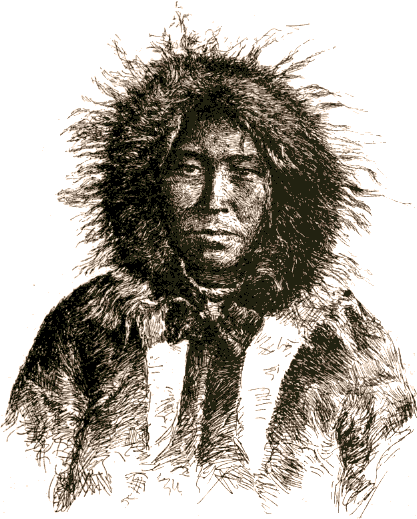
Fig. 2.—Mûmûñina, a woman of Nuwŭk.
The face is broad, flat, and round, with high cheek bones and rather low forehead, broad across the brow and narrowing above, while the head is somewhat pointed toward the crown. The peculiar shape of the head is somewhat masked by the way of wearing the hair, and is best seen in the skull. The nose is short, with little or no bridge (few Eskimo were able to wear our spring eye-glasses), and broad, especially across the alæ nasæ, with a peculiar rounded, somewhat bulbous tip, and large nostrils. The eyes are horizontal,19 with rather full lids, and are but slightly sunken below the level of the face.
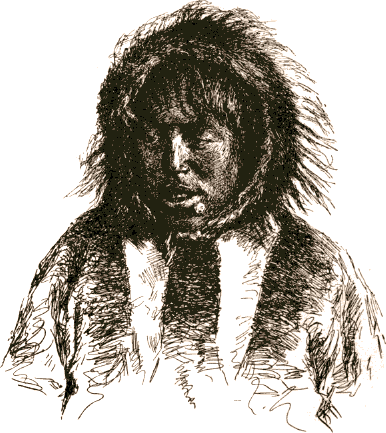
Fig. 3.—Akabiana, a youth of Utkiavwiñ.
The mouth is large and the lips full, especially the under one. The teeth are naturally large, and in youth are white and generally regular, but by middle age they are generally worn down to flat-crowned stumps, as is usual among the Eskimo. The color of the skin is a light yellowish brown, with often considerable ruddy color on the cheeks and lips. There appears to be much natural variation in the complexion, some women being nearly as fair as Europeans, while other individuals seem to have naturally a coppery color.20 In most cases the complexion appears darker than it really is from the effects of exposure to the weather. All sunburn very easily, especially in the spring when there is a strong reflection from the snow.
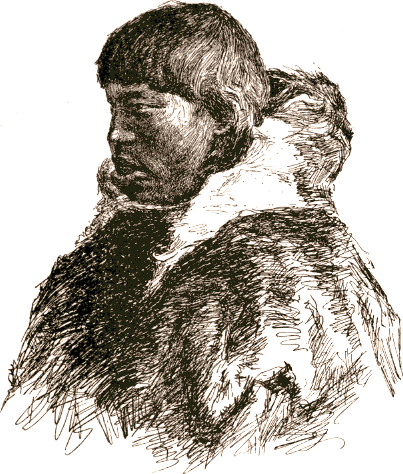
Fig. 4.—Puka, a young man of Utkiavwiñ.
The old are much wrinkled, and they frequently suffer from watery eyes, with large sacks under them, which begin to form at a comparatively early age. There is considerable variation in features, as well as complexion, among them, even in cases where there seems to be no suspicion of mixed blood. There were several men among them with decided aquiline noses and something of a Hebrew cast of countenance. The eyes are of various shades of dark brown—two pairs of light hazel eyes were observed—and are often handsome. The hair is black, perfectly straight, and very thick. With the men it is generally coarser than with the women, who sometimes have very long and silky hair, though it generally does not reach much below the shoulders. The eyebrows are thin and the beard scanty, growing mostly upon the upper lip and chin, and seldom appearing under the age of 20. In this they resemble most Eskimo. Back,21 however, speaks of the “luxuriant beards and flowing mustaches” of the Eskimo of the Great Fish River. Some of the older men have rather heavy black mustaches, but there is much variation in this respect. The upper part of the body (as much is commonly exposed in the house) is remarkably free from hair. The general expression is good humored and attractive.
The males, even when very young, are remarkable for their graceful and dignified carriage. The body is held erect, with the shoulders square and chest well thrown out, the knees straight, and the feet firmly planted on the ground. In walking they move with long swinging elastic strides, the toes well turned out and the arms swinging.
I can not agree with Dr. Simpson that the turning out of the toes gives “a certain peculiarity to their gait difficult to describe.”22 I should say that they walked like well built athletic white men. The women, on the other hand, although possessing good physiques, are singularly ungraceful in their movements. They walk at a sort of shuffling half-trot, with the toes turned in, the body leaning forward, and the arms hanging awkwardly.23
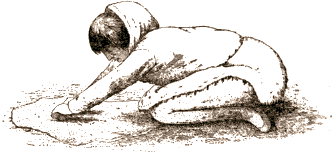
Fig. 5.—Woman stretching skins.
A noticeable thing about the women is the remarkable flexibility of the body and limbs, and the great length of time they can stand in a stooping posture. (See Fig. 5 for a posture often assumed in working.) Both men and women have a very fair share of muscular strength. Some of the women, especially, showed a power of carrying heavy loads superior to most white men. We were able to make no other comparisons of their strength with ours. Their power of endurance is very great, and both sexes are capable of making long distances on foot. Two men sometimes spend 24 hours tramping through the rough ice in search of seals, and we knew of instances where small parties made journeys of 50 or 75 miles on foot without stopping to sleep.
The women are not prolific. Although all the adults are or have been married, many of them are childless, and few have more than two children. One woman was known to have at least four, but investigations of this sort were rendered extremely difficult by the universal custom of adoption. Dr. Simpson heard of a “rare case” where one woman had borne seven children.24 We heard of no twins at either village, though we obtained the Eskimo word for twins. It was impossible to learn with certainty the age at which the women first bear children, from the impossibility of learning the age of any individuals in the absence of any fixed method of reckoning time. Dr. Simpson states that they do not commonly bear children before the age of 20,25 and we certainly saw no mothers who appeared younger than this. We knew of but five cases of pregnancy in the two villages during the 2 years of our stay. Of these, one suffered miscarriage, and of the other four, only two of the infants lived more than a short time. It is exceedingly difficult, for the reasons stated above, to form any estimate of the age to which these people live, though it is natural to suppose that the arduous and often precarious existence which they lead must prevent any great longevity. Men and women who appeared to be 60 or over were rare. Yûksĭ´ña, the so-called “chief” of Nuwŭk, who was old enough to be a man of considerable influence at the time the Plover wintered at Point Barrow (1852-’54), was in 1881 a feeble, bowed, tottering old man, very deaf and almost blind, but with his mental faculties apparently unimpaired. Gray hair appears uncommon. Even the oldest are, as a rule, but slightly gray.
PATHOLOGY.
Diseases of the respiratory and digestive organs are the most frequent and serious ailments from which they suffer. The former are most prevalent toward the end of summer and early in winter, and are due to the natives sleeping on the damp ground and to their extreme carelessness in exposing themselves to drafts of wind when overheated. Nearly everyone suffers from coughs and colds in the latter part of August, and many deaths occur at this season and the beginning of winter from a disease which appears to be pneumonia. A few cases, one fatal, of hemorrhage of the lungs were observed, which were probably aggravated by the universal habit of inhaling tobacco smoke. The people suffer from diarrhea, indigestion, and especially from constipation.
Gonorrhea appears common in both sexes, but syphilis seems to be unknown in spite of the promiscuous intercourse of the women with the whalemen. One case of uterine hemorrhage was observed. Cutaneous diseases are rare. A severe ulcer on the leg, of long standing, was cured by our surgeon, to whose observations I am chiefly indebted for what I have to say about the diseases of these people; and one man had lost the cartilage of his nose and was marked all over the body with hideous scars from what appeared to be some form of scrofulous disease. A single case of tumor on the deltoid muscle was observed. Rheumatism is rather frequent. All are subject to snow blindness in the spring, and sores on the face from neglected frost bites are common. Many are blind in one eye from what appears to be cataract or leucoma, but only one case of complete blindness was noticed. Dr. Sutherland states that he does not recollect a single instance of total blindness among the Eskimo that he saw in Baffin Land, and expresses the opinion that “An individual in such a state would be quite unfit for the life of toil and hardship to which the hardy Esquimaux is exposed. The neglect consequent upon this helpless condition most probably cuts off its afflicted objects.”26
This seems quite reasonable on a priori grounds, but nevertheless the blind man at Cape Smyth had lived to middle age in very comfortable circumstances, and though supported to a great extent by his relatives he was nevertheless able to do a certain share of work, and had the reputation of being a good paddler for a whaling umiak.
Injuries are rare. One man had lost both feet at the ankle and moved about with great ease and rapidity on his knees. All are subject to bleeding at the nose and usually plug the bleeding nostril with a bunch of deer hair.27
This habit, as it has been termed, of vicarious hemorrhage seems to be characteristic of the Eskimo race wherever they have been met with, and has been supposed to be a process of nature for relieving the fullness of the circulatory system caused by their exclusively animal diet.28
Natural deformities and abnormalities of structure are uncommon, except strabismus, which is common and often, at least, congenital. One boy in Utkiavwĭñ had his forehead twisted to one side, probably from some accident or difficulty during delivery. His intelligence did not seem to be impaired. The people are, as a rule, right handed, but that left-handed persons occasionally occur is shown by their having a word for a left-handed man. We also collected a “crooked knife,” fitted for use with the left hand.29
PSYCHICAL CHARACTERISTICS.
As a rule they are quick-witted and intelligent, and show a great capacity for appreciating and learning useful things, especially mechanical arts. In disposition they are light-hearted and cheerful, not easily cast down by sorrow or misfortune, and though sometimes quick-tempered, their anger seldom lasts long.30 They have a very keen sense of humor, and are fond of practical jokes, which they take in good part, even when practiced on themselves. They are generally peaceable. We did not witness a single quarrel among the men during the two years of our stay, though they told us stories of fatal quarrels in former years, in which firearms were used. Liquor may have been the cause of these fights, as it is said to have been of the only suicide I ever heard of among them, which I am informed by Capt. E. E. Smith, the whaling master already referred to, occurred in 1885 at Nuwŭk. Disagreements between man and wife, however, sometimes lead to blows, in which the man does not always get the best of it.
When the station was first established many of the natives began pilfering from our stores, but they soon learned that by so doing they cut themselves off from the privilege of visiting the station and enjoying the opportunity for trading which it afforded, and were glad to promise to refrain from the practice. This promise was very well observed, though I think wholly from feelings of self-interest, as the thieves when detected seemed to have no feeling of shame. Some, I believe, never yielded to the temptation. There was seldom any difficulty in obtaining restitution of stolen articles, as the thief’s comrades would not attempt to shield him, but often voluntarily betrayed him. They acknowledged that there was considerable thieving on board of the ships, but the men of Utkiavwĭñ tried to lay the blame on the Nuwŭk people, and we may suppose that the charge was reciprocated, as was the case regarding the theft of the Plover’s sails.31 We also heard of occasional thefts among themselves, especially of seals left on the ice or venison buried in the snow, but men who were said to be thieves did not appear to lose any social consideration.
Robbery with violence appears to be unknown. We never saw or heard of the “burglar-alarm” described by Dr. Simpson,32 which I am inclined to believe was really a “demon trap” like that described by Lieut. Ray (see below, under Religion).
They are in the main truthful, though a detected lie is hardly considered more than a good joke, and considerable trickery is practiced in trading. For instance, soon after the station was established they brought over the carcass of a dog, with the skin, head, feet, and tail removed, and attempted to sell it for a young reindeer; and when we began to purchase seal-oil for the lamps one woman brought over a tin can nearly filled with ice, with merely a layer of oil on top.
Clothing and other articles made especially for sale to us were often very carelessly and hastily made, while their own things were always carefully finished.33
Their affection for each other, especially for their children, is strong, though they make little show of grief for bereavement, and their minds are easily diverted by amusements. I am inclined to believe, however, from some cases I have observed, that grief is deeper and more permanent than superficial appearances would indicate.
Their curiosity is unbounded, and they have no hesitation in gratifying it by unlimited questioning. All who have read the accounts of the Eskimo character given by explorers in other parts of the Arctic regions will recognize this as a familiar trait. We also found the habit of begging at first quite as offensive among some of these people as other travelers have found it, but as they grew better acquainted with us they ceased to beg except for trifling things, such as a chew of tobacco or a match. Some of the better class never begged at all. Some of them seemed to feel truly grateful for the benefits and gifts received, and endeavored by their general behavior, as well as in more substantial ways, to make some adequate return. Others appeared to think only of what they might receive.
Hospitality is a universal virtue. Many of them, from the beginning of our acquaintance with them, showed the greatest friendliness and willingness to assist us in every way, while others, especially if there were many of them together, were inclined to be insolent, and knives were occasionally drawn in sudden fits of passion. These “roughs,” however, soon learned that behavior of this sort was punished by prompt ostracism and threats of severer discipline, and before the first nine months were past we had established the most friendly relations with the whole village at Cape Smyth. Some of those who were at first most insolent became afterwards our best friends. Living as these people do at peace with their neighbors, they would not be expected to exhibit the fierce martial courage of many other savages, but bold whalemen and venturous ice-hunters can not be said to lack bravery.
In their dealings with white men the richer and more influential among them at least consider themselves their equals if not their superiors, and they do not appreciate the attitude of arrogant superiority adopted by many white men in their intercourse with so-called savages. Many of them show a grace of manner and a natural delicacy and politeness which is quite surprising. I have known a young Eskimo so polite that in conversing with Lieut. Ray he would take pains to mispronounce his words in the same way as the latter did, so as not to hurt his feelings by correcting him bluntly.34
TRIBAL PHENOMENA.
We were unable to discover among these people the slightest trace of tribal organization or of division into gentes, and in this our observations agree with those of all who have studied the Eskimos elsewhere. They call themselves as a race “In´uĭn,” a term corresponding to the “Inuit” of other dialects, and meaning “people”, or “human beings”. Under this name they include white men and Indians as well as Eskimo, as is the case in Greenland and the Mackenzie River district, and probably also everywhere else, though many writers have supposed it to be applied by them only to their own race.
They have however special names for the former two races. The people of any village are known as “the inhabitants of such and such a place;” for instance, Nuwŭ´ñmiun, “the inhabitants of the point;” Utkiavwĭñmiun, “the inhabitants of Utkiávwĭñ;” Kuñmiun (in Greenlandic “Kungmiut”), “the people who live on the river.” The people about Norton Sound speak of the northern Eskimo, especially those of Point Barrow and Cape Smyth, as “Kûñmû´dlĭñ,” which is not a name derived from a location, but a sort of nickname, the meaning of which was not ascertained. The Point Barrow natives do not call themselves by this name, but apply it to those people whose winter village is at Demarcation Point (or Herschel Island, see above, p. 26). This word appears in the corrupted form “Kokmullit,” as the name of the village at Nuwŭk on Petroff’s map. Petroff derived his information regarding the northern coast at second-hand from people who had obtained their knowledge of names, etc., from the natives of Norton Sound.
The people of the two villages under consideration frequently go backward and forward, sometimes removing permanently from one village to the other, while strangers from distant villages sometimes winter here, so that it was not until the end of the second year, when we were intimately acquainted with everybody at Utkiavwĭñ, that we could form anything like a correct estimate of the population of this village.35 This we found to be about 140 souls. As well as we could judge, there were about 150 or 160 at Nuwŭk. These figures show a great decrease in numbers since the end of 1853, when Dr. Simpson36 reckoned the population of Nuwŭk at 309. During the 2 years from September, 1881, to August, 1883, there were fifteen deaths that we heard of in the village of Utkiavwĭñ alone, and only two children born in that period survived. With this ratio between the number of births and deaths, even in a period of comparative plenty, it is difficult to see how the race can escape speedy extinction, unless by accessions from without, which in their isolated situation they are not likely to receive.37
SOCIAL SURROUNDINGS.
CONTACT WITH UNCIVILIZED PEOPLE.
Other Eskimo.—
The nearest neighbors of these people, as has been stated above, are the Eskimo living at Demarcation Point (or Herschel Island), eastward, and those who inhabit the small villages between Point Belcher and Wainwright Inlet. These villages are three in number. The nearest to Point Belcher, Nuna´ria, is now deserted, and its inhabitants have established the new village of Sida´ru nearer the inlet. The third village consists of a few houses only, and is called A´tûnĕ. The people of these villages are so closely connected that they are sometimes spoken of collectively as Sida´ruñmiun. At a distance up the river, which flows into Wainwright Inlet, live the Ku´ñmiun, “the people who live on the river.” These appear to be closely related to the people of the first village below Wainwright Inlet, which is named Kĭlauwitawĭñ. At any rate, a party of them who came to Cape Smyth in the spring of 1883 were spoken of indifferently as Kuñmiun or Kĭlauwitawĭ´ñmiun.
Small parties from all the villages occasionally visit Point Barrow during the winter for the purpose of trade and amusement, traveling with sledges along the land ice where it is smooth, otherwise along the edge of the cliffs; and similar parties from the two northern villages return these visits. No special article of trade appears to be sought at either village, though perhaps the southern villages have a greater supply of skins of the bearded seal, fit for making umiak covers, as I knew of a load of these brought up for sale, and in the spring of 1883 a party went down to the inlet in search of such skins. Single families and small parties like that from Kĭlauwitawĭñ, mentioned above, sometimes spend the whaling season at Point Barrow, joining some of the whaling crews at the northern villages. The people that we saw from these settlements were very like the northern Eskimos but many of them spoke a perceptibly harsher dialect, sounding the final consonants distinctly.
The people at Point Hope are known as Tĭkera´ñmiun “inhabitants of the forefinger (Point Hope)”, and their settlement is occasionally visited by straggling parties. No natives from Point Hope came north during the 2 years of our stay, but a party of them visited the Plover in 1853.38 We found some people acquainted by name with the Kuwû´ñmiun and Silawĭ´ñmiun of the Kuwûk (Kowak or “Putnam”) and Silawik Rivers emptying into Hotham Inlet, and one man was familiar with the name of Sisualĭñ, the great trading camp at Kotzebue Sound. We were unable to find that they had any knowledge of Asia (“Kokhlitnuna,”) or the Siberian Eskimo, but this was probably due to lack of properly directed inquiries, as they seem to have been well informed on the subject in the Plover’s time.39
With the people of the Nu´natăk (Inland) River, the Nunatañmiun, they are well acquainted, as they meet them every summer for purposes of trading, and a family or two of Nunatañmiun sometimes spend the winter at the northern villages. One family wintered at Nuwŭk in 1881-’82, and another at Utkiavĭñ the following winter, while a widower of this “tribe” was also settled there for the same winter, having married a widow in the village. We obtained very little definite information about these people except that they came from the south and descended the Colville River. Our investigations were rendered difficult by the engrossing nature of the work of the station, and the trouble we experienced, at first, in learning enough of the language to make ourselves clearly understood. Dr. Simpson was able to learn definitely that the homes of these people are on the Nunatăk and that some of them visit Kotzebue Sound in the summer, while trading parties make a portage between the Nunatăk and Colville, descending the latter river to the Arctic Ocean.40 I have been informed by the captain of one of the American whalers that he has, in different seasons, met the same people at Kotzebue Sound and the mouth of the Colville. We also received articles of Siberian tame reindeer skin from the east, which must have come across the country from Kotzebue Sound.
These people differ from the northern natives in some habits, which will be described later, and speak a harsher dialect. We were informed that in traveling east after passing the mouth of the Colville they came to the Kûñmû´dlĭñ (“Kangmali enyuin” of Dr. Simpson and other authors) and still further off “a great distance” to the Kupûñ or “Great River”—the Mackenzie—near the mouth of which is the village of the Kupûñmiun, whence it is but a short distance inland to the “great house” (iglu´kpûk) of the white men on the great river (probably Fort Macpherson). Beyond this we only heard confused stories of people without posteriors and of sledges that run by themselves without dogs to draw them. We heard nothing of the country of Kĭtiga´ru41 or of the stone-lamp country mentioned by Dr. Simpson.42 The Kûñmûdlĭñ are probably, as Dr. Simpson believes, the people whose winter houses were seen by Franklin at Demarcation Point,43 near which, at Icy Reef, Hooper also saw a few houses.44
As already stated, Capt. E. E. Smith was informed by the natives that there is now no village farther west than Herschel Island, where there is one of considerable size. If he was correctly informed, this must be a new village, since the older explorers who passed along the coast found only a summer camp at this point. He also states that he found large numbers of ruined iglus on the outlying sandy islands along the coast, especially near Anxiety Point. We have scarcely any information about these people, as the only white men who have seen them had little intercourse with them in passing along the coast.45 The Point Barrow people have but slight acquaintance with them, as they see them only a short time each summer. Captain Smith, however, informs me that in the summer of 1885 one boat load of them came back with the Point Barrow traders to Point Barrow, where he saw them on board of his ship. There was a man at Utkiavwĭñ who was called “the Kûñmû´dlĭñ.” He came there when a child, probably, by adoption, and was in no way distinguishable from the other people.
Father Petitot appears to include these people in the “Taρèoρmeut” division of his “Tchiglit” Eskimo, whom he loosely describes as inhabiting the coast from Herschel Island to Liverpool Bay, including the delta of the Mackenzie,46 without locating their permanent villages. In another place, however, he excludes the “Taρèoρmeut” from the “Tchiglit,” saying, “Dans l’ouest, les Tchiglit communiquaient avec leurs plus proches voisins les Taρèoρ-meut,”47 while in a third place48 he gives the country of the “Tchiglit” as extending from the Coppermine River to the Colville, and on his map in the same volume, the “Tareormeut” are laid down in the Mackenzie delta only. According to his own account, however, he had no personal knowledge of any Eskimo west of the Mackenzie delta. These people undoubtedly have a local name derived from that of their winter village, but it is yet to be learned.
It is possible that they do consider themselves the same people with the Eskimo of the Mackenzie delta, and call themselves by the general name of “Taρèoρmeut” (= Taxaiomiun in the Point Barrow dialect), “those who live by the sea.” That they do not call themselves “Kûñmû´dlĭñ” or “Kanmali-enyuin” or “Kangmaligmeut” is to my mind quite certain. The word “Kûñmû´dlĭñ,” as already stated, is used at Norton Sound to designate the people of Point Barrow (I was called a “Kûñmû´dlĭñ” by some Eskimo at St. Michaels because I spoke the Point Barrow dialect), who do not recognize the name as belonging to themselves, but have transferred it to the people under consideration. Now, “Kûñmû´dlĭñ” is a word formed after the analogy of many Eskimo words from a noun kûñme and the affix lĭñ or dlĭñ (in Greenlandic lik), “one who has a ——.” The radical noun, the meaning of which I can not ascertain, would become in the Mackenzie dialect kρagmaρk (using Petitot’s orthography), which with -lik in the plural would make kρagmalit. (According to Petitot’s “Grammaire” the plural of -lik in the Mackenzie dialect is -lit, and not -gdlit, as in Greenlandic). This is the name given by Petitot on his map to the people of the Anderson River,49 while he calls the Anderson River itself Kρagmalik.50 The father, however, had but little personal knowledge of the natives of the Anderson, having made but two, apparently brief, visits to their village in 1865, when he first made the acquaintance of the Eskimo. He afterwards became fairly intimate with the Eskimo of the Mackenzie delta, parties of whom spent the summers of 1869 and 1870 with him. From these parties he appears to have obtained the greater part of the information embodied in his Monographie and Vocabulaire, as he explicitly states that he brought the last party to Fort Good Hope “autant pour les instruire à loisir que pour apprendre d’eux leur idiome.”51 Nothing seems to me more probable than that he learned from these Mackenzie people the names of their neighbors of the Anderson, which he had failed to obtain in his flying visits 5 years before, and that it is the same name, “Kûñmû´dlĭñ,” which we have followed from Norton Sound and found always applied to the people just beyond us. Could we learn the meaning of this word the question might be settled, but the only possible derivation I can see for it is from the Greenlandic Karmaĸ, a wall, which throws no light upon the subject. Petitot calls the people of Cape Bathurst Kρagmaliveit, which appears to mean “the real Kûñmû´dlĭñ” (“Kûñmû´dlĭñ” and the affix -vik, “the real”).
The Kupûñmiun appear to inhabit the permanent villages which have been seen near the western mouth of the Mackenzie, at Shingle Point52 and Point Sabine,53 with an outlying village, supposed to be deserted, at Point Kay.54 They are the natives described by Petitot in his Monographie as the Taρèoρmeut division of the Tchiglit, to whom, from the reasons already stated, most of his account seems to apply. There appears to me no reasonable doubt, considering his opportunities for observing these people, that Taρèoρmeut, “those who dwell by the sea,” is the name that they actually apply to themselves, and that Kupûñmiun, or Kopagmut, “those who live on the Great River,” is a name bestowed upon them by their neighbors, perhaps their western neighbors alone, since all the references to this name seem to be traceable to the authority of Dr. Simpson. Should they apply to themselves a name of similar meaning, it would probably be of a different form, as, according to Petitot,55 they call the Mackenzie Kuρvik, instead of Kupûk or Kupûñ.
These are the people who visit Fort Macpherson every spring and summer,56 and are well known to the Hudson Bay traders as the Mackenzie River Eskimo. They are the Eskimo encountered between Herschel Island and the mouth of the Mackenzie by Franklin, by Dease and Simpson, and by Hooper and Pullen, all of whom have published brief notes concerning them.57
We are still somewhat at a loss for the proper local names of the last labret-wearing Eskimo, those, namely, of the Anderson River and Cape Bathurst. That they are not considered by the Taρèoρmeut as belonging to the same “tribe” with themselves is evident from the names Kρagmalit and Kρagmalivëit, applied to them by Petitot. Sir John Richardson, the first white man to encounter them (in 1826), says that they called themselves “Kitte-garrœ-oot,”58 and the Point Barrow people told Dr. Simpson of country called “Kit-te-ga´-ru” beyond the Mackenzie.59 These people, as well as the Taρèoρmeut, whom they closely resemble, are described in Petitot’s Monographie, and brief notices of them are given by Sir John Richardson,60 McClure,61 Armstrong,62 and Hooper.63 The arts and industries of these people from the Mackenzie to the Anderson, especially the latter region, are well represented in the National Museum by the collections of Messrs. Kennicott, Ross, and MacFarlane. The Point Barrow people say that the Kupûñmiun are “bad;”64 but notwithstanding this small parties from the two villages occasionally travel east to the Mackenzie, and spend the winter at the Kupûñmiun village, whence they visit the “great house,” returning the following season. Such a party left Point Barrow June 15, 1882, declaring their intention of going all the way to the Mackenzie. They returned August 25 or 26, 1883, when we were in the midst of the confusion of closing the station, so that we learned no details of their journey. A letter with which they were intrusted to be forwarded to the United States through the Mackenzie River posts reached the Chief Signal Officer in the summer of 1883 by way of the Rampart House, on the Porcupine River, whence we received an answer by the bearer from the factor in charge. The Eskimo probably sent the letter to the Rampart House by the Indians who visit that post.
The intercourse between these people is purely commercial. Dr. Simpson, in the paper so often quoted, gives an excellent detailed description of the course of this trade, which agrees in the main with our observations, though we did not learn the particulars of time and distance as accurately as he did. There have been some important changes, however, since his time. A small party, perhaps five or six families, of “Nunatañmiun” now come every summer to Point Barrow about the end of July, or as soon as the shallow bays along shore are open. They establish themselves at the summer camping ground at Pérnyɐ, at the southwest corner of Elson Bay, and stay two or three weeks, trading with the natives and the ships, dancing, and shooting ducks. The eastward-bound parties seem to start a little earlier than formerly (July 7, 1853, July 3, 1854,65 June 18, 1882, and June 29, 1883). From all accounts their relations with the eastern people are now perfectly friendly. We heard nothing of the precautionary measures described by Dr. Simpson,66 and the women talked frequently of their trading with the Kûñmû´dlĭñ and even with the Kupûñmiun.67 We did not learn definitely whether they met the latter at Barter Point or whether they went still farther east.
Some of the Point Barrow parties do not go east of the Colville. The articles of trade have changed somewhat in the last 30 years, from the fact that the western natives can now buy directly from the whalers iron articles, arms, and ammunition, beads, tobacco, etc. The Nunatañmiun now sell chiefly furs, deerskins, and clothing ready made from them, woodenware (buckets and tubs), willow poles for setting nets, and sometimes fossil ivory. The double-edged Siberian knives are no longer in the market and appear to be going out of fashion, though a few of them are still in use. Ready-made stone articles, like the whetstones mentioned by Dr. Simpson,68 are rarely, if ever, in the market. We did not hear of the purchase of stone lamps from the eastern natives. This is probably due to a cessation of the demand for them at Point Barrow, owing to the falling off in the population.
The Kûñmû´dlĭñ no longer furnish guns and ammunition, as the western natives prefer the breech-loading arms they obtain from the whalers to the flintlock guns sold by the Hudson Bay Company. The trade with these people seems to be almost entirely for furs and skins, notably black and red fox skins and wolverine skins. Skins of the narwhal or beluga are no longer mentioned as important articles of trade.
In return for these things the western natives give sealskins, etc., especially oil, as formerly, though I believe that very little, if any, whalebone is now carried east, since the natives prefer to save it for trading with the ships in the hope of getting liquor, or arms and ammunition, and various articles of American manufacture, beads, kettles, etc. I was told by an intelligent native of Utkiavwĭñ that brass kettles were highly prized by the Kupûñmiun, and that a large one would bring three wolverine skins,69 three black foxskins, or five red ones. One woman was anxious to get all the empty tin cans she could, saying that she could sell them to the Kûñmû´dlĭñ for a foxskin apiece. We were told that the eastern natives were glad to buy gun flints and bright-colored handkerchiefs, and that the Nunatañmiun wanted blankets and playing cards.
Indians.—
They informed us that east of the Colville they sometimes met “Itkû´dlĭñ,” people with whom they could not converse, but who were friendly and traded with them, buying oil for fox skins. They were said to live back of the coast between the Colville and the Mackenzie, and were described as wearing no labrets, but rings in their ears and noses. They wear their hair long, do not tonsure the crown, and are dressed in jackets of skin with the hair removed, without hoods, and ornamented with beads and fringe. We saw one or two such jackets in Utkiavwĭñ apparently made of moose skin, and a few pouches of the same material, highly ornamented with beads. They have long flintlock guns, white man’s wooden pipes, which they value highly, and axes—not adzes—with which they “break many trees.” We easily understood from this description that Indians were meant, and since our return I have been able to identify one or two of the tribes with tolerable certainty.
They seem better acquainted with these people than in Dr. Simpson’s time, and know the word “kŭtchin,” people, in which many of the tribal names end. We did not hear the names Ko´yukan or Itkalya´ruin which Dr. Simpson learned, apparently from the Nunatañmiun.70 I heard one man speak of the Kŭtcha Kutchin, who inhabit the “Yukon from the Birch River to the Kotlo River on the east and the Porcupine River on the north, ascending the latter a short distance.”71
One of the tribes with which they have dealings is the “Rat Indians” of the Hudson Bay men, probably the Vunta´-Kŭtchin,72 from the fact that they visit Fort Yukon. These are the people whom Capt. Maguire met on his unsuccessful sledge journey to the eastward to communicate with Collinson. The Point Barrow people told us that “Magwa” went east to see “Colli´k-sina,” but did not see him, only saw the Itkûdlĭñ. Collinson,73 speaking of Maguire’s second winter at Point Barrow, says: “In attempting to prosecute the search easterly, an armed body of Indians of the Koyukun tribe were met with, and were so hostile that he was compelled to return.” Maguire himself, in his official report,74 speaks of meeting four Indians who had followed his party for several days. He says nothing of any hostile demonstration; in fact, says they showed signs of disappointment at his having nothing to trade with them, but his Eskimo, he says, called them Koyukun, which he knew was the tribe that had so barbarously murdered Lieut. Barnard at Nulato in 1851. Moreover, each Indian had a musket, and he had only two with a party of eight men, so he thought it safer to turn back. However, he seems to have distributed among them printed “information slips,” which they immediately carried to Fort Yukon, and returning to the coast with a letter from the clerk in charge, delivered it to Capt. Collinson on board of the Enterprise at Barter Island, July 18, 1854. The letter is as follows:
Fort Youcon, June 27, 1854.
The printed slips of paper delivered by the officers of H.M.S. Plover on the 25th of April, 1854, to the Rat Indians were received on the 27th of June, 1854, at the Hudson Bay Company’s establishment, Fort Youcon. The Rat Indians are in the habit of making periodical trading excursions to the Esquimaux along the coast. They are a harmless, inoffensive set of Indians, ever ready and willing to render any assistance they can to the whites.
Wm. Lucas Hardisty,
Clerk in charge.75
Capt. Collinson evidently never dreamed of identifying this “harmless, inoffensive set of Indians” with “an armed body of Indians of the Koyukun tribe.” It is important that his statement, quoted above, should be corrected lest it serve as authority for extending the range of the Koyukun Indians76 to the Arctic Ocean. The Point Barrow people also know the name of the U´na-kho-tānā,77 or En´akotina, as they pronounce it. Their intercourse with all these Indians appears to be rather slight and purely commercial. Friendly relations existed between the Rat Indians and the “Eskimos who live somewhere near the Colville” as early as 1849,78 while it was still “war to the knife” between the Peel River Indians and the Kupûñmiun.79
The name Itkû´dlĭñ, of which I´t-ka-lyi of Dr. Simpson appears to be the plural, is a generic word for an Indian, and is undoubtedly the same as the Greenland word erĸileĸ—plural erĸigdlit—which means a fabulous “inlander” with a face like a dog. “They are martial spirits and inhuman foes to mankind; however, they only inhabit the east side of the land.”80 Dr. Rink81 has already pointed out that this name is in use as far as the Mackenzie River—for instance, the Indians are called “eert-kai-lee” (Parry), or “it-kagh-lie” (Lyon), at Fury and Hecla Strait; ik-kil-lin (Gilder), at the west shore of Hudson Bay, and “itkρe´le´it” (Petitot) at the Mackenzie. Petitot also gives this word as itkpe´lit in his vocabulary (p. 42). These words, including the term Ingalik, or In-ka-lik, applied by the natives of Norton Sound to the Indians,82 and which Mr. Dall was informed meant “children of a louse’s egg,” all appear to be compounds of the word erĸeĸ, a louse egg, and the affix lik. (I suspect erĸileĸ, from the form of its plural, to be a corruption of “erĸiliĸ,” since there is no recognized affix -leĸ in Greenlandic.)
Petitot83 gives an interesting tradition in regard to the origin of this name: “La tradition Innok dédaigne de parler ici des Peaux-Rouges. L’áyant fait observer á mon narrateur Aρviuna: ‘Oh!’ me repondait-il, ‘il ne vaut pas la peine d’en parler. Ils naquirent aussi dans l’ouest, sur l’ile du Castor, des larves de nos poux. C’ést pourquoi nous les nommons Itkρe´le´it.’”
CONTACT WITH CIVILIZED PEOPLE.
Until the visit of the Blossom’s barge in 1826 these people had never seen a white man, although they were already in possession of tobacco and articles of Russian manufacture, such as copper kettles, which they had obtained from Siberia by way of the Diomedes. Mr. Elson’s party landed only at Refuge Inlet, and had but little intercourse with the natives. His visit seemed to have been forgotten by the time of the Plover’s stay at Point Barrow, though Dr. Simpson found people who recollected the visit of Thomas Simpson in 1837.84 The latter, after he had left the boats and was proceeding on foot with his party, first met the Nuwŭñmiun at Point Tangent, where there was a small party encamped, from whom he purchased the umiak in which he went on to Point Barrow. He landed there early in the morning of August 4, and went down to the summer camp at Pernyɐ, where he stayed till 1 o’clock in the afternoon, trading with the natives and watching them dance. On his return to Point Tangent some of the natives accompanied him to Boat Extreme, where he parted from them August 6, so that his whole intercourse with them was confined to less than a week.85
The next white men who landed at Point Barrow were the party in the Plover’s boats, under Lieuts. Pullen and Hooper, on their way to the Mackenzie, and the crew of Mr. Sheddon’s yacht, the Nancy Dawson, in the summer of 1849. The boats were from July 29 to August 3 getting from Cape Smyth past Point Barrow, when the crews were ashore for a couple of days and did a little trading with the natives, whom they found very friendly. They afterwards had one or two skirmishes with evil-disposed parties of Nuwŭñmiun returning from the east in the neighborhood of Return Reef. The exploring ships Enterprise and Investigator also had casual meetings with the natives, who received tobacco, etc., from the ships.
The depot ship Plover, Commander Maguire, spent the winters of 1852-’53 and 1853-’54 at Point Barrow, and the officers and crew, after some misunderstandings and skirmishes, established very friendly and sociable relations with the natives. The only published accounts of the Plover’s stay at Point Barrow are Commander Maguire’s official reports, published in the Parliamentary Reports (Blue Books) for 1854, pp. 165-185, and 1855, pp. 905 et seq., and Dr. Simpson’s paper, already mentioned. Maguire’s report of the first winter’s proceedings is also published as an appendix to Sherard Osborne’s “Discovery of the Northwest Passage.”
We found that the elder natives remembered Maguire, whom they called “Magwa,” very well. They gave us the names of many of his people and a very correct account of the most important proceedings, though they did not make it clear that the death of the man mentioned in his report was accidental. They described “Magwa” as short and fat, with a very thick neck, and all seemed very much impressed with the height of his first lieutenant, “Epi´ana” (Vernon), who had “lots of guns.”
It was difficult to see that the Plover’s visit had exerted any permanent influence on these people. In fact, Dr. Simpson’s account of their habits and customs would serve very well for the present time, except in regard to the use of firearms. They certainly remembered no English. Indeed, Dr. Simpson says86 that they learned hardly any. The Plover’s people probably found it very easy to do as we did and adopt a sort of jargon of Eskimo words and “pigeon English” grammar for general intercourse. Although, according to the account of the natives, there was considerable intercourse between the sailors and the Eskimo women, there are now no people living at either village who we could be sure were born from such intercourse, though one woman was suspected of being half English. She was remarkable only for her large build, and was not lighter than many pure-blooded women.
Since 1854, when the first whalers came as far north as the Point, there has hardly been a season in which ships have not visited this region, and for a couple of months every year the natives have had considerable intercourse with the whites, going off to the ships to trade, while the sailors come ashore occasionally. We found that they usually spoke of white men as “kablu´na;” but they informed us that they had another word, “tû´n-nyĭn,” which they used to employ among themselves when they saw a ship. Dr. Simpson87 says that they learned the word “kabluna” from the eastern natives, but that the latter (he gives it Tan´-ning or Tan´-gin) came from the Nunata´ñmiun. He supposes it to apply to the Russians, who had regular bath days at their posts, and says it is derived from tan-nikh-lu-go, to wash or cleanse the person.
The chief change resulting from their intercourse with the whites has been the introduction of firearms. Nearly all the natives are now provided with guns, some of them of the best modern patterns of breechloaders, and they usually succeed in procuring a supply of ammunition. This is in some respects a disadvantage, as the reindeer have become so wild that the natives would no longer be able to procure a sufficient number of them for food and clothing with their former appliances, and they are thus rendered dependent on the ships. On the other hand, with a plentiful supply of ammunition it is easier for them to procure abundance of food, both deer and seals, and they are less liable to famine than in former times.
There is no reason to fear, as has been suggested, that they will lose the art of making any of their own weapons except in the case of the bow. With firearms alone they would be unable to obtain any seals, a much more important source of food than the reindeer, and their own appliances for sealing are much better than any civilized contrivances. Although they have plenty of the most improved modern whaling gear, they are not likely to forget the manufacture of their own implements for this purpose, as this important fishery is ruled by tradition and superstition, which insists that at least one harpoon of the ancient pattern must be used in taking every whale. All are now rich in iron, civilized tools, canvas and wreck wood, and in this respect their condition is improved.
They have, however, adopted very few civilized habits. They have contracted a taste for civilized food, especially hard bread and flour, but this they are unable to obtain for 10 months of the year, and they are thus obliged to adhere to their former habits. In fact, except in regard to the use of firearms and mechanics’ tools, they struck me as essentially a conservative people.
Petroff88 makes the assertion that in late years their movements have been guided chiefly by those of the whalers. As far as we could observe they have not changed the course or time of their journeys since Dr. Simpson’s time, except that they have given up the autumn whaling, possibly on account of the presence of the ships at that season. Of course, men who are rich in whalebone now stay to trade with the ships, while those who have plenty of oil go east. They are not absolutely dependent on the ships for anything except ammunition, and even during the short time the ships are with them they hardly neglect their own pursuits.
The one unmitigated evil of their intercourse with the whites has been the introduction of spirits. Apart from the direct injury which liquor does to their health, their passionate fondness for it leads them to barter away valuable articles which should have served to procure ammunition or other things of permanent use. It is to be hoped, however, that the liquor traffic is decreasing. The vigilance of the revenue cutter prevents regular whisky traders from reaching the Arctic Ocean, and public opinion among the whaling captains seems to be growing in the right direction.
Another serious evil, which it would be almost impossible to check, is the unlimited intercourse of the sailors with the Eskimo women. The whites can hardly be said to have introduced laxity of sexual morals, but they have encouraged a natural savage tendency, and have taught them prostitution for gain, which has brought about great excesses, fortunately confined to a short season. This may have something to do with the want of fertility among the women.
Our two years of friendly relations with these people were greatly to their advantage. Not only were our house and our doings a constant source of amusement to them, but they learned to respect and trust the whites. Without becoming dependent on us or receiving any favors without some adequate return either in work or goods, they were able to obtain tobacco, hard bread, and many other things of use to them, all through the year. Our presence prevented their procuring more than trifling quantities of spirits, and though the supply of breech-loading ammunition was pretty well cut off, they could get plenty of powder and shot for their muzzle loaders. The abundance of civilized food was undoubtedly good for them, and our surgeon was able to give them a great deal of help in sickness.
In all their intercourse with the whites they have learned very little English, chiefly a few oaths and exclamations like “Get out of here,” and the words of such songs as “Little Brown Jug” and “Shoo Fly,” curiously distorted. They have as a rule invented genuine Eskimo words for civilized articles which are new to them.89 Even in their intimate relations with us they learned but few more phrases and in most cases without a knowledge of their meaning.
There are a few Hawaiian words introduced by the Kanaka sailors on the whaleships, which are universally employed between whites and Eskimo along the whole of the Arctic coast, and occasionally at least among the Eskimo themselves. These are kau-kau,90 food, or to eat; hana-hana, work; pûnĭ-pûnĭ, coitus, and pau, not. Wahíne, woman, is also used, but is less common. Another foreign word now universally employed among them in their intercourse with the whites, and even, I believe, among themselves, is “kuníɐ” for woman or wife. They themselves told us that it was not an Eskimo word—“When there were no white men, there was no kuníɐ”—and some of the whalemen who had been at Hudson Bay said it was the “Greenland” word for woman. It was not until our return to this country that we discovered it to be the Danish word kone, woman, which in the corrupted form “coony” is in common use among the eastern Eskimo generally in the jargon they employ in dealing with the whites. Kuníɐ is “coony” with the suffix of the third person, and therefore means “his wife.” It is sometimes used at Point Barrow for either of a married couple in the sense of our word “spouse.”