Front matter (continued 18)
Reading edition
BRUNTON, MARY (1778-1818), Scottish novelist, was born on the 1st of November 1778 in the island of Varra, Orkney. She was the daughter of Captain Thomas Balfour of Elwick. At the age of twenty she married Alexander Brunton, minister of Bolton in Haddingtonshire, and afterwards professor of oriental languages at Edinburgh. Mrs Brunton died on the 19th of December 1818. She was the author of two novels, popular in their day, Self-control (1810), and Discipline (1814; 1832 edition with memoir); and of a posthumous fragment, Emmeline (1819).
BRUSA, or Broussa (anc. Prusa), the capital of the Brusa (Khudavendikiar) vilayet of Asia Minor, which includes parts of ancient Mysia, Bithynia, and Phrygia, and extends in a southeasterly direction from Mudania, on the Sea of Marmora, to Afium-Kara-Hissar on the Smyrna-Konia railway. The vilayet is one of the most important in Asiatic Turkey, has great mineral and agricultural wealth, many mineral springs, large forests, and valuable industries. It exports cereals, silk, cotton, opium, tobacco, olive-oil, meerschaum, boracite, &c. The Ismid-Angora and Eskishehr-Konia railways pass through the province. Population of the province, 1,600,000 (Moslems, 1,280,000; Christians, 317,000; Jews, 3000).
The city stretches along the lower slopes of the Mysian Olympus or Kechish Dagh, occupying a position above the valley of the Nilufer (Odrysses) not unlike that of Great Malvern above the vale of the Severn. It is divided by ravines into three quarters, and in the centre, on a bold terrace of rock, stood the ancient Prusa. The modern town has clean streets and good roads made by Ahmed Vefyk Pasha when Vali, and it contains mosques and tombs of great historic and architectural interest; the more important are those of the sultans Murad I., Bayezid (Bajazet) I., Mahommed I., and Murad II., 1403-1451, and the Ulu Jami'. The mosques show traces of Byzantine, Persian and Arab influence in their plan, architecture and decorative details. The circular church of St Elias, in which the first two sultans, Osman and Orkhan, were buried, was destroyed by fire and earthquake, and rebuilt by Ahmed Vefyk Pasha. There are in the town an American mission and school, and a British orphanage. Silk-spinning is an important industry, the export of silk in 1902 being valued at £620,000. There are also manufactories of silk stuffs, towels, burnús, carpets, felt prayer-carpets embroidered in silk and gold. The hot iron and sulphur springs near Brusa, varying in temperature from 112° to 178° F., are still much used. The town is connected with its port, Mudania, by a railway and a road. There is a British vice-consul. Pop. 75,000 (Moslems, 40,000; Christians, 33,000; Jews, 2000).
Prusa, founded, it is said, at the suggestion of Hannibal, was for a long time the seat of the Bithynian kings. It continued to flourish under the Roman and Byzantine emperors till the 10th century, when it was captured and destroyed by Saif-addaula of Aleppo. Restored by the Byzantines, it was again taken in 1327 by the Ottomans after a siege of ten years, and continued to be their capital till Murad I. removed to Adrianople. In 1402 it was pillaged by the Tatars; in 1413 it resisted an attack of the Karamanians; in 1512 it fell into the power of Ala ed-Din; and in 1607 it was burnt by the rebellious Kalenderogli. In 1883 it was occupied by the Egyptians under Ibrahim Pasha, and from 1852-1855 afforded an asylum to Abd-el-Kader.
See L. de Laborde, Voyage de l'Asie Mineure (Paris, 1838); C. Texier, Asie Mineure (Paris, 1839).
BRUSH, GEORGE DE FOREST (1855- ), American painter, was born at Shelbyville, Tennessee, on the 28th of September 1855. He was a pupil of J.L. Gérôme at Paris, and became a member of the National Academy of Design, New York. From 1883 onwards, he attracted much attention by his paintings of North American Indians, his "Moose Hunt," "Aztec King" and "Mourning her Brave" achieving great popularity and showing the strong influence of Gérôme. These were followed by picture portraits, particularly of mother and child, largely suggestive of the work of the Dutch, Flemish and German masters, carefully arranged as to line and mass, and worked out in great detail with consummate technical skill. Several of his paintings have for subject his own children and his wife; one of these is in the Boston Museum of Fine Arts.
BRUSH (from Fr. brosse, which, like the English word, means both the undergrowth of a wood and the instrument; if the word in both these meanings is ultimately the same, then the origin is from a bundle of brushwood used as a brush or broom, but this is historically doubtful, and others connect it with the Ger. Borste, bristle), an instrument for removing dust or dirt from surfaces or for applying paint, whitewash, &c., composed of a tuft or tufts of some fibrous or flexible material secured to a solid basis or stock. Brushes made of the twigs of trees like the birch and provided with long handles are often called brooms, and the same term is applied to some brushes used in the household for removing dust (e.g. carpet-broom, whisk-broom) but not to those used for applying paint. Among the numerous materials employed for the manufacture of brushes of various kinds are feathers, pig's bristles, the hair of certain animals, whalebone, rubber, split-cane, broom-corn (a variety of sorghum) and coir.
Brushes are of two kinds, simple and compound. The former consist of but one tuft, as hair pencils and painters' tools. The latter have more than one tuft. Brushes with the tufts placed side by side on flat boards, as plasterers' brushes, are called stock-brushes. The single tuft brushes, or pencils for artists, are made of the hair of the camel, badger, goat and other animals for the smaller kind, and pig's bristles for the larger. The hairs for pencils are carefully arranged so as to form a point in the centre, and, when tied together, are passed into the wide end of the quill or metal tube and drawn out at the other end to the extent required. The small ends of the quills, having been previously moistened, contract as they dry and bind the hair. A similar effect is produced with metal tubes by compression. Compound brushes are—first, set or pan-work; second, drawn-work. Of the former, an example is the common house-broom, into the stock of which holes are drilled of the size wanted. The necessary quantity of bristles, hair, or fibre to fill each hole being collected together, the thick ends are dipped into molten cement chiefly composed of pitch, bound round with thread, dipped again, and then set into a hole of the stock with a peculiar twisting motion. In drawn-brushes, of which those for shoes, teeth, nails and clothes are examples, the holes are more neatly bored, and have smaller ones at the top communicating with the back of the brush, through which a bight or loop of wire passes from the back of the stock. Half the number of hairs of fibres needed for the tufts to fill the holes are passed into the bight of the wire, which is then pulled smartly so as to double the hairs and force them into the loop-hole as far as possible. With all brushes, when the holes have been properly filled, the ends of the fibres outside are cut with shears, either to an even length or such form as may be desired. The backs are then covered with veneer or other material to conceal the wire and other crudities of the work. In trepanned brushes the bristles are inserted in holes that do not pass right through the stock, and are secured by threads or wires running in drawholes which are drilled through the stock at right angles to them. The ends of these drawholes are plugged so as to be as inconspicuous as possible, and the method avoids the necessity of a veneer on the back. The Woodbury machine, one of the earliest mechanical devices for the manufacture of brushes, which was invented in America about 1870, produced brushes of this kind. One of the most important purposes to which brushes have been applied is that of sweeping chimneys, and so far back as 1789 John Elin patented an arrangement of brushes for this purpose. Revolving brushes for sweeping rooms were patented in 1811, and the first patent in which they were applied to hair-dressing appears in 1862. Many inventions for sweeping and cleaning roads by means of revolving brushes and other contrivances have been introduced, one of the first being that of Edmund Henning in 1699 for "a new engine for sweeping the streets of London, or any city or town."
Brushes with tufts formed of steel wire are used for cleaning tubes and flues of steam boilers, for the purpose of removing the scale formed by the products of combustion. Steel-wire brushes are also used for cleaning scale from the interior surfaces of a boiler, and for removing the sand from the surface of a casting. Occasionally such brushes are revolved in a machine, for more convenient use on the article to be cleaned or polished. Snyer's patent elastic clutch or coupling, used for such purposes as coupling up or disconnecting a steam-engine from a line of shafting or dynamo, consists essentially of two disks, the adjacent faces of which are provided, one with a ring of brushes made of flat steel wire, the other with a number of finely serrated teeth. One of the disks is movable longitudinally on its shaft, and with the brushes clear of the serrations the clutch is free. On bringing the disks together, which may be done with the engine running at speed, the elasticity of the brush permits the motion to be imparted gradually and without shock to the standing part, until both rotate and are locked together. These clutches are very powerful, and are capable of transmitting as much as 3000 horse-power.
In dynamo-electric machinery the device used to conduct current into or out of the rotating armature is termed a "brush." There are usually two brushes to each dynamo or motor, and they are placed diametrically opposite, lightly touching the commutator of the armature. It is important that there should be good metallic contact between the brushes and the commutator, and at the same time the frictional resistance resulting from the contact must be a minimum. To effect this result brushes are variously made. A kind of brush frequently used consists of a number of copper wires laid side by side and soldered together at one end, where the brush is held. Brushes are also made of strips of spongy copper cut like a comb, which give a number of bearing points on the commutator. Very good results are obtained from brushes made of copper gauze wound closely until it takes the exterior form of a rectangular block, which is held radially in a spring holder, and bears at the end on the commutator. In place of the gauze block "brushes" of hard carbon blocks are frequently used (see Dynamo).
BRUSSELS (Fr. Bruxelles, Flem. Brussel), the capital of the kingdom of Belgium, and of the province of Brabant, situated in 50° 51′ N., 4° 22′ E., about 70 m. from the sea at Ostend. It occupies the plain or valley of the Senne, and the sides and crest of the hill lying to the east and south-east of that valley. It is now extending over the hills west of the valley, and to the north is the town or commune of Laeken, which is practically part of the city. Brussels suffered severely in 1695 from the bombardment of the French under Villeroi, who fired into the town with red-hot shot. Sixteen churches and 4000 houses were burnt down, and the historic buildings on the Grand Place were seriously injured, the houses of the Nine Nations on the eastern side being completely destroyed. In 1731 the famous palace of the Netherlands was destroyed by fire, and the only remains of this edifice are some ruined arches and walls in a remote comer of the grounds of the king's palace. The Porte de Hal is the only one of the eight gates in the old wall left standing. It dates from 1381, and is well worth more careful examination than it receives. In the latter half of the 18th century it served as a kind of bastille for political prisoners, and is now used as a museum in which a rather nondescript collection of articles, some from Mexico, has been allowed to accumulate. With regard to the fine boulevards of the Upper Town, it may be mentioned that about 1765 they were planted with the double row of lime trees which still constitute their chief ornament by Prince Charles of Lorraine while governing the Netherlands for his sister-in-law, the empress Maria Theresa. The residence of this prince was the palace of William the Silent, before he declared against Spam, and it is now used partly for the royal library, which contains the famous librairie de Bourgogne, and partly for the museum of modern pictures. The only other "hotel" or palace in Brussels is that of the duke d'Arenberg. In the 16th century this was the residence of Count Egmont, but very little of the building of his day remains. In the same street, the rue des Petits Carmes, was the Hôtel Culembourg in which the famous oath of the beggars was taken. It has long been demolished and the new barracks of the Grenadier regiment have been erected on the site.
The only other buildings of importance dating from medieval times are the three churches of Ste Gudule (often erroneously called the cathedral), Notre-Dame des Victoires or Church of the Sablon, and Notre-Dame de la Chapelle, or simply la Chapelle, and the hotel de ville and the Maison du Roi on the Grand Place. The church of Ste Gudule, also dedicated to St Michael, is built on the side of the hill originally called St Michael's Mount, and now covered by the fashionable quarters which are included under the comprehensive description, of the Upper Town. It was begun about the year 1220, and is considered one of the finest specimens left of pointed Gothic. It is said to have been completed in 1273, with the exception of the two towers which were added in the 14th or 15th century. Some of the stained glass is very rich, dating from the 13th to the 15th century. In many of the windows there are figures of leading members of the houses of Burgundy and Habsburg. The curious oak pulpit representing Adam and Eve expelled from the Garden of Eden came originally from the Jesuit church at Louvain, and is considered the masterpiece of Verbruggen. The church of the Sablon is said to have been founded in 1304 by the gild of Crossbowmen to celebrate the battle of Woeringen. In a side chapel is a fine monument to the princely family of Thurn and Taxis, which had the monopoly of the postal service in the old empire. La Chapelle is still older, dating nominally from 1210, the choir and transept being considered to date from about fifty years later. There are some fine monuments, especially one to the duke de Croy who died in 1624. The two churches last named have undergone much renovation both outside and inside.
The Grand Place is by its associations one of the most interesting public squares in Europe. On its flags were fought out many feuds between rival gilds; Egmont and Horn, and many other gallant men whose names have been forgotten, were executed here under the shadow of its ancient buildings, and in more recent times Dumouriez proclaimed the French Republic where the dukes of Brabant and Burgundy were wont to hold their jousts. Apart from its associations the Grand Place contains two of the finest and most ornate buildings not merely in the capital but in Belgium. Of these the hôtel de ville, which is far the larger of the two, occupies the greater part of the south side of the square. Its facade has the disadvantage of having had one half begun about half a century before the other. The older, which is the richer in design, forms the left side of the building and dates from 1410, while the right, less rich and shorter, was begun in 1443. The fine tower, 360 ft. in height, is crowned by the golden copper figure of St Michael, 16 ft. in height, erected here as early as 1454. This tower lies behind the extremity of the left wing of the building. Opposite the town-hall is the smaller but extremely ornate Maison du Roi. This was never a royal residence as the name would seem to imply, but its description appears to have been derived from the fact that it was usually in this building that the royal address was read to the states-general. As this building was almost destroyed by Villeroi's bombardment it possesses no claim to antiquity, indeed the existing building was only completed in 1877. Egmont and Horn were sentenced in the hôtel de ville, and passed their last night in the Maison du Roi.
Among the principal buildings erected in the city during the 18th century are the king's palace and the house of parliament or Palais de la Nation, which face the south and north sides of the park respectively. The palace occupies part of the site covered by the old palace burnt down in 1731, and it was built in the reign of the empress Maria Theresa. It originally consisted of two detached buildings, but in 1826-1827 King William I. of the Netherlands caused them to be connected. The palace contains two fine rooms used for court ceremonies, and a considerable number of pictures. In 1904 a bill was passed in the chambers for the enlargement and embellishment of the palace. The adjacent buildings, viz. the department of the civil list, formerly the residence of the marquis d'Assche, and the Hôtel de Bellevue, held under a kind of perpetual lease granted by the empress Maria Theresa, were absorbed in the palace, and a new façade was constructed which occupies the entire length of the Place du Palais. At the same time a piece was cut off the park to prevent the undue contraction of the Place by the necessary bringing forward of the palace, and the pits which played a certain part in the revolution of 1830 when the Dutch defended the park for a few days against the Belgians were filled up. The Palais de la Nation was constructed between 1779 and 1783, also during the Austrian period. It was intended for the states-general and government offices. During the French occupation the law courts sat there, and from 1817 to 1830 it was assigned for the sittings of the states-general. It is now divided between the senate and the chamber of representatives. In 1833 the part assigned to the latter was burnt out, and has since been reconstructed. The buildings flanking the chambers and nearer the park are government offices with residences for the ministers attached.
The improvements effected in Brussels during the 19th century were enormous, and completely transformed the city. The removal of the old wall was followed by the creation of the quartier Léopold, and at a later period of the quartier Louis in the Upper Town. In the lower, under the energetic direction of two burgomasters, De Brouckere and Anspach, not less sweeping changes were effected. The Senne was bricked in, and the fine boulevards du Nord, Anspach, Hainaut and Midi took the place of slums. The Bourse and the post-office are two fine modern buildings in this quarter of the city. The Column of the Congress—i.e. of the Belgian representatives who founded the kingdom of Belgium—surmounted by a statue of King Leopold I., was erected in 1859, and in 1866 the foundation-stone was laid of the Palais de Justice, which was not finished till 1883, at a cost of sixty million francs. This edifice, the design of the architect Poelaert, is in the style of Karnak and Nineveh, but surmounted with a dome, and impresses by its grandiose proportions (see Architecture, Plate XI. fig. 121). It is well placed on the brow of the hill at the southern extremity of the rue de la Régence (the prolongation of the rue Royale), and can be seen from great distances. In the rue de la Régence are the new picture gallery, a fine building with an exceedingly good collection of pictures, the palace of the count of Flanders, and the garden of the Petit Sablon, which contains statues of Egmont and Horn, and a large number of statuettes representing the various gilds and handicrafts. Immediately above this garden is the Palais d'Arenberg. Perhaps the memorial that attracts the greatest amount of public interest in Brussels is that to the Belgians who were killed during the fighting with the Dutch in September 1830. This has been erected in a little square called the Place des Martyrs, not far from the Monnaie theatre. Outside Brussels at Evere is the chief cemetery, with fine monuments to the British officers killed at Waterloo (removed from the church in that village), to the French soldiers who died on Belgian soil in 1870-71, and another to the Prussians.
Many as were the changes in Brussels during the 19th century, those in progress at its close and at the beginning of the 20th have effected a marked alteration in the town. These have been rendered possible only by the excellent system of electric tramways which have brought districts formerly classed as pure country within reach of the citizens. The construction of the fine Avenue de Louise (1½ m. long) from the Boulevard de Waterloo to the Bois de la Cambre was the first of these efforts to bring the remote suburbs within easy reach, at the same time furnishing an approach to the "bois" of Brussels that might in some degree be compared with the Champs Élysées in Paris. Another avenue of later construction (6½ m. in length) connects the park of the Cinquantenaire with Tervueren. This route is extremely picturesque, traverses part of the forest of Soignies, and is lined by many fashionable villas and country houses. Other improvements projected in 1908 on the slope of the hill immediately below the Place Royale included the removal of the old tortuous and steep street called the "Montagne de la Cour" to give place to a Mont des Arts. A little lower down and not far from the university (which occupies the house of the famous cardinal Granvelle of the 16th century) a central railway terminus was designed on a vast scale. These improvements connote the obliteration of the insanitary and overcrowded courts and alleys which were to be found between all the main streets, few in number, connecting the upper and the lower towns. The ridge on the west and north-west of the Senne valley never formed part of the town, and it was from it that Villeroi bombarded the city. The suburbs on this ridge, from south to north, are Anderlecht, Molenbeek and Koekelberg, and Laeken with its royal château and park forms the northern part of the Brussels conglomeration. Brussels has been growing at such a rapid rate that the inclusion of this ridge, and more particularly at Koekelberg, within the town limits, was contemplated in 1908.
The completion of the harbour works, making Brussels a seaport by giving sea-going vessels access thereto, was taken in hand in 1897. The completed work provides for a waterway for steamers drawing 24 ft. by the Willibroek Canal into the Ruppel and the Scheldt. There are steamers plying direct from Brussels to London, and 372 vessels of a total tonnage of 76,000 entered and left the port in 1905. The Willibroek Canal was made in the 16th century, and William I. of the Netherlands is entitled to the credit of having first thought of converting it into a ship canal from Brussels to the Scheldt. Nothing was done, however, in his time to carry out the scheme. The distance from Brussels to the Ruppel is only 20 m., and thus Brussels is only about 33 m. farther from the sea than Antwerp.
In addition to the advantages it enjoys from being the seat of the court and the government, Brussels is the centre of many prosperous industries. The manufactures of lace, carpets and curtains, furniture and carriages may be particularly mentioned, but it is chiefly as a place of residence for the well-to-do that the city has increased in size and population. Schools of all kinds are abundant. At the École Militaire youths are trained nominally for the army, but many go there who intend to enter one of the professions or the public service. This school used to occupy part of the old abbey of the Cambre, situated in a hollow near the bois and the avenue Louise, but owing to its insanitary position it has been removed to a new building near the Cinquantenaire. There is a university, to which admission is easy and where the fees are moderate, and the Conservatoire provides as good musical teaching as can be found in Europe. Music can be enjoyed every day in the year either out of doors or under cover. During the winter and spring the opera continues without a break at the Théâtre de la Monnaie, which may be called the national theatre. Concerts are held frequently, as the Belgians are a musical people. Of late years sport has taken a prominent part in Belgian life. There are athletic institutions, and football is quite a popular game. Horse-racing has also come into vogue, and Boitsfort, in the bois, and Groenendael, farther off in the Forêt de Soignies, are fashionable places of reunion for society.
The town of Brussels has a separate administration, which is directed by a burgomaster and sheriffs at the head of a town council, whose headquarters are in the hôtel de ville. In the Brussels agglomeration are nine suburbs or communes, each self-governing with burgomaster and sheriffs located in a Maison Communale. These suburbs (beginning on the north and following the circumference eastward) are Schaerbeek, St Josse-ten-Noode, Etterbeek, Ixelles, St Gilles, Cureghem, Anderlecht, Molenbeek and Koekelberg. Laeken, which is really a tenth suburb, is classified as a town. In 1856 the population of Brussels alone was 152,828, and by 1880 it had only increased to 162,498. In 1890 the figures were 176,138; in 1900, 183,686; and in December 1904, 194,196. The great increase has been in the suburbs, amounting to nearly 80% in twenty-five years. In 1880 the population of the ten suburbs including Laeken was 248,079. In 1904 the total was 436,453, thus giving for the whole of Brussels a grand total of 630,649.
History.—The name Brussel seems to have been derived from Broeksele, the village on the marsh or brook, and probably it was the most used point for crossing the Senne on the main Roman and Frank road between Tournai and Cologne. The Senne, a small tributary of the Scheldt, flows through the lower town, but since 1868 it has been covered in, and some of the finest boulevards in the lower town have been constructed over the course of the little river. The name Broeksele is mentioned by the chroniclers in the 8th century, and in the 10th the church of Ste Gudule is said to have been endowed by the emperor Otto I. In the next two centuries Brussels grew in size and importance, and its trade gilds were formed on lines similar to those of Ghent. In 1312 Duke John II. of Brabant granted the citizens their charter, distinguished from others as that of Cortenberg. In 1356 Duke Wenceslas confirmed this charter and also the Golden Bull of the emperor Charles IV. of 1349 by his famous "Joyous Entry" into Louvain, the capital of the duchy. These three deeds or enactments constituted the early constitution of the South Netherlands, which, with one important modification in the time of Charles V., remained intact till the Brabant revolution in the reign of Joseph II. In 1357 Wenceslas ordered a new wall embracing a greater area than the earlier one to be constructed round Brussels, and this was practically intact until after the Belgian revolution in 1830-1831. It took twelve, or, according to others, twenty-two years to build. In 1383 the dukes of Brabant transferred their capital from Louvain to Brussels, although for some time they did not trust themselves out of the strong castle which they had erected at Vilvorde, half-way between the two turbulent cities. During this period the population of Brussels is supposed to have been 50,000, or one-fifth of that of Ghent. In 1420 the gilds of Brussels obtained a further charter recognizing their status as the Nine Nations, a division still existing. Having fixed their seat of government at Brussels the dukes of Brabant proceeded to build a castle and place of residence on the Caudenberg hill, which is practically the site of the Place Royale and the king's palace to-day. This ducal residence, enlarged and embellished by its subsequent occupants, became eventually the famous palace of the Netherlands which witnessed the abdication of Charles V. in 1555, and was destroyed by fire in 1731. In 1430 died Philip, last duke of Brabant as a separate ruler, and the duchy was merged in the possessions of the duke of Burgundy.
In the 17th century Brussels was described (Comte de Ségur, quoting the memoirs of M. de la Serre) as "one of the finest, largest and best-situated cities not only of Brabant but of the whole of Europe. The old quarters which preserve in our time an aspect so singularly picturesque with their sloping and tortuous streets, the fine hotels of darkened stone sculptured in the Spanish fashion, and the magnificence of the Place of the hôtel de ville were buried behind an enceinte of walls pierced by eight lofty gates flanked with one hundred and twenty-seven round towers at almost equal distance from each other like the balls of a crown. At a distance of less than a mile was the forest of Soignies with great numbers of stags, red and roe deer, that were hunted on horseback even under the ramparts of the town. On the promenade of the court there circulated in a long file ceaselessly during fashionable hours five or six hundred carriages, the servants in showy liveries. In the numerous churches the music was renowned, the archduke Leopold being passionately given to the art, maintaining at his own cost forty or fifty musicians, the best of Italy and Germany. Under the windows of the palace stretched the same park that we admire to-day, open all the year to privileged persons and twice a year to the public, a park filled with trees of rare essences and the most delicious flowers so artistically disposed, and so refreshing to the eyes, that M. de la Serre declared that if he had seen there an apple tree he would assuredly have taken it for an earthly Paradise."
(D. C. B.)
BRUT, Brute, or Brutus the Trojan, a legendary British character, who, according to Geoffrey of Monmouth and others, was the eponymous hero of Britain. He was reputed to be grandson of Aeneas, and the legend was that he was banished from Italy and made his way to Britain, where he founded New Troy (London). The name is an obvious confusion between Bryt (a Briton) and the classical name Brutus.
For the romance literature of the subject see Wace; and Barbour.
BRUTÉ, SIMON WILLIAM GABRIEL (1779-1839), American prelate, first Roman Catholic bishop of the diocese of Vincennes, Indiana, U.S.A., was born at Rennes, France, on the 20th of March 1779, his father, Simon Gabriel Guillaume Bruté de Remur (1729-1786), being superintendent of the crown lands in Brittany. He was educated for the medical profession, but entered the Sulpician Seminary of Paris in November 1803, was ordained priest in 1808, refused the post of chaplain to Napoleon, was professor of theology in the Diocesan Seminary at Rennes in 1808-1810, and in August 1810 settled in Baltimore, Maryland, whither his long general interest in missions, and particularly his acquaintance with Bishop Flaget of Kentucky, had drawn him. After teaching for two years (1810-1812) in Baltimore, he was sent to Mount St Mary's College, Emmitsburg, Maryland, where he remained until 1815, acting both as teacher and as pastor. He next visited France in the interest of American missions, and on his return in November 1815, became president of St Mary's College, Baltimore. In 1818 he resumed his labours at Emmitsburg, and from this time until 1834 he held an almost unparalleled place in the American church, being constantly consulted by clergy throughout the country, besides lecturing, teaching, preaching and caring for his parish. The see of Vincennes was created in 1834; and Bruté, nominated its first bishop and consecrated in the same year, went to France for financial aid, with which he built his cathedral and several useful institutions. Here, too, he was professor of theology in his seminary, teacher in one of his academies, as well as pastor and bishop. Interesting stories are told of the high respect in which he was held by the neighbouring Indians, who called him "chief of the Black robes" and "man of the true prayer." He died in Vincennes, Indiana, on the 26th of June 1839. His great influence on the entire church, his wonderful success in planning, financing, and carrying out necessary ecclesiastical reforms, and the constructive and executive ability he displayed in his diocese, make him one of the foremost Catholic emigrants to the United States. He wrote Brief Notes on his experiences in France in 1793, in which he describes state persecution of Catholic priests.
See James Roosevelt Bayley, The Memoirs of the Rt. Rev. Simon William Gabriel Bruté, First Bishop of Vincennes (New York, 1861), containing much autobiographical matter.
BRUTTII, an ancient tribe of lower Italy. This tribe, called Bruttii and Brittii in Latin inscriptions, and Βρέττιοι on Greek coins and by Greek authors, occupied the south-western peninsula of Italy in historical times, the ager Bruttius (wrongly called Bruttium) corresponding almost exactly to the modern Calabria. It was separated from Lucania on the north by a line drawn from the mouth of the river Lāus on the west to a point a little south of the river Crathis on the east. To part or the whole of this peninsula the name Italia was first applied. In alliance with the Lucanians the Bruttii made war on the Greek colonies of the coast and seized on Vibo in 356 B.C., and, though for a time overcome by the Greeks who were aided by Alexander of Epirus and Agathocles of Syracuse, they reasserted their mastery of the town from about the beginning of the 3rd century B.C., and held it until it became a Latin colony at the end of the same century (see Corp. Inscr. Lat. x. p. 7, and the references there given). At this time they were speaking Oscan as well as Greek, and two of three Oscan inscriptions in Greek alphabet still testify to the language spoken in the town in the 3rd century B.C. We know, however, that the Bruttians, though at this date speaking the same language (Oscan) as the Samnite tribe of the Lucani, were not actually akin to them. The name Bruttii was used by the Lucanians to mean "runaway slaves," but it is considerably more likely that this signification was attached to the tribal name of the Bruttii from the historical fact that they had been conquered and expelled by the Samnite invaders (cf. the use of Σκύθαι to mean "policemen" at Athens, and still more closely the German, French and English word "slave" derived from "Slav"), than that the tribe when living in territory it could call its own should have adopted an opprobrious name taken from the language of hostile neighbours (see Strabo vi. I, 4; Diod. Sic. xvi. 15). Mommsen pointed out (Unterital. Dialekte, p. 97) the evidence of tradition (especially Aristotle, Pol. 4 [7] 10) showing that the customs of the Bruttii had a certain affinity with those of the pre-Hellenic inhabitants of Greece, and it has been argued (Ridgeway apud Conway, Ital. Dialects, p. 16) that a tradition (preserved in Stephanus of Byzantium, s.v. Χῖοι) made it probable that they were called Πέλασγοι. This evidence points to the conjecture that they were part of what is now generally called the Mediterranean race (see, e.g. G. Sergi, The Mediterranean Race, Eng. trans., 1901; W.Z. Ripley, Races of Europe, p. 128). Many Indo-European elements appear in their place-names (e.g. Sila=Latin silva, Greek ὕλη; Temesa, cf. Gr. τέμενος or Sanskrit tamas, darkness, shadow), and none that suggest a non-Indo-European origin. A priori considerations suggest that they may have been akin to the Siceli, but of this at present no positive evidence can be given.
As we have seen, the Bruttii were at the height of their power during the 3rd century B.C. Their chief towns were Consentia (Cosenza), Petelia (near Strongoli), and Clampetia (Amantea). To this period (about the time of the Roman War against Pyrrhus) is to be assigned the series of their coins, and they appear to have retained the right of coinage even after their final subjugation by the Romans (see B.V. Head, Historia Numorum, p. 77). The influence of Hellenism over them is shown by finds in the tombs and the fact that they spoke the Greek language as well as their own (bilingues in Ennius). The mountainous country, ill-suited for agricultural purposes, was well adapted for these hardy warriors, whose training was Spartan in its simplicity and severity.
The Bruttii first came into collision with the Romans during the war with Pyrrhus, to whom they sent auxiliaries; after his defeat, they submitted, and were deprived of half their territory in the Sila forest, which was declared state property. In the war with Hannibal, they were among the first to declare in his favour after the battle of Cannae, and it was in their country that Hannibal held his ground during the last stage of the war (at Castrum Hannibalis on the gulf of Scylacium).
(R. S. C.)
The Bruttii entirely lost their freedom at the end of the Hannibalic war; in 194 colonies of Roman citizens were founded at Tempsa and Croton, and a colony with Latin rights at Hipponium called henceforward Vibo Valentia. In 132 the consul P. Popillius built the great inland road from Capua through Vibo and Consentia to Rhegium, while the date of the construction of the east and west coast roads is uncertain. Neither in the Social War, nor in the rising of Spartacus, who held out a long time in the Sila (71 B.C.), do the Bruttii play a part as a people. Vibo was the naval base of Octavian in the conflict with Sextus Pompeius (42-36 B.C.).
The most important product of the district was the wood from the forests of the Sila, and the pitch produced from it. The Sila also contained minerals, which were worked out in very early times. The coast plains were in parts very fertile, especially the (now malarious) lower valley of the Crathis. Under the empire, however, the whole district remained backward and was remarkable for the absence of important towns, as the scarcity of ancient inscriptions, both Greek and Latin, shows: the Sila was state domain, and most of the rest in the hands of large proprietors. Augustus joined it with Lucania (from which it was divided by the rivers Laus and Crathis) to form the third region of Italy. In the 2nd and 3rd centuries, for administrative and juridical purposes, it was sometimes (with Lucania) joined to Apulia and Calabria. Diocletian placed Lucania and Brittii (as the name was then spelt) under a corrector, whose residence was at Rhegium. The boundaries of the original third Augustan region had by that time become somewhat altered, Metapontum belonging to Calabria, and Salernum and the territory of the Picentini to the third region instead of the first (Campania). From the 6th century, after the fall of the Ostrogothic power, and the establishment of that of Byzantium in its place in south Italy, the name Calabria was applied to the whole of the south Italian possessions of the Eastern empire, and the name of the Brittii entirely disappeared; and after the eastern peninsula (the ancient Calabria) had been taken by the Lombards about A.D. 668, the western retained the name, and has kept it till the present day.
(T. As.)
See Strabo vi. p. 253-265; Dion. Halic. xx. I, 4, 15; Pliny, Nat. Hist. iii. 71-74; Justin xii. 2, xxiii. 1; F. Lenormant, La Grande-Grèce, i. (1881-1884); H. Nissen, Italische Landeskunde (1883-1902); C. Hulsen in Pauly-Wissowa's Realencyclopädie, iii. pt. i. (1897); E.H. Bunbury in Smith's Dictionary of Greek and Roman Geography; R.S. Conway, The Italic Dialects (1897), for Bruttian inscriptions and local and personal names; P. Orsi in Atti del congresso storico (Rome, 1904), v. 193 seq.; M. Schipa, La Migrazione del nome Calabria (1895), whose conclusions are summarized in J.B. Bury's edition of Gibbon's Decline and Fall, v. p. 24, note; other authorities in J. Jung, "Geographie von Italien" (1897) in I. Müller's Handbuch der klassischen Altertumswissenschaft, iii. Abteilung 3.
BRUTUS (originally an adjective meaning "heavy," "stupid," kindred with Gr. βαρύς, cf. Eng. "brute," "brutal"), the surname of several distinguished Romans belonging to the Junian gens.
I. Lucius Junius Brutus, one of the first two consuls, 509 B.C. According to the legends, his mother was the sister of Tarquinius Superbus, the last of the Roman kings, and his father and his elder brother had been put to death by the reigning family in order to get possession of his wealth. Junius, the younger, owed his safety to his reputed dullness of intellect (whence his surname), which character, however, he had only assumed for prudential reasons (Dion. Halic. iv. 67, 77). The story is probably an invention to account for his name; in any case his dullness did not prevent his appointment as master of the horse. When Lucretia, wife of Collatinus, was outraged by Sextus Tarquinius (the incident which inspired Shakespeare's Rape of Lucrece), Brutus, together with her husband and father, took a leading part in expelling the Tarquinii from Rome. He and Collatinus were therefore elected consuls—or rather praetors, which was the original title (Livy i. 59). In a conspiracy formed for the restoration of the dynasty, the two sons of Brutus were deeply implicated, and were executed by sentence of their father, and in his sight (Livy ii. 3). The Etruscans of Veii and Tarquinii making an attempt to restore Tarquinius, a battle took place between them and the Romans, in which Junius Brutus engaged Aruns, son of the deposed king, in single combat on horseback, and each fell by the other's hand (Livy ii. 6; Dion. Halic. v. 14). The Roman matrons mourned a year for him, as "the avenger of woman's honour," and a statue was erected to him on the Capitol. The conspiracy of his sons is the subject of a tragedy by Voltaire.
The patrician branch of the family appears to have become extinct with L. Junius Brutus; the chief representatives of the plebeian branch in later times are dealt with below.
II. Decimus Junius Brutus, consul 138, surnamed Gallaecus from his victory over the Gallaeci (136) in the north-west of Spain (Plutarch, Tib. Gracchus, 21). He was a highly educated man, a patron of literature, and a friend of the poet Accius (Livy, Epit. 55; Appian, Hisp. 71-73; Vell. Pat. ii. 5; Cicero, Brutus, 28).
III. Marcus Junius Brutus, a jurist of high authority, was considered as one of the founders of Roman civil law (Cicero, De Oratore, ii. 33, 55).
IV. His son, of the same name, made a great reputation at the bar, and from the vehemence and bitterness of his speeches became known as "the Accuser" (Cicero, De Officiis, ii. 15).
V. Decimus Junius Brutus (Albinus), born about 84 B.C., first served under Caesar in Gaul, and afterwards commanded his fleet. Caesar, who esteemed him very highly, made him his master of the horse and governor of Gaul, and, in case of Octavian's death, nominated him as one of his heirs. Nevertheless he joined in the conspiracy against his patron, and, like his relative Marcus Junius Brutus (see below), was one of his assassins. He afterwards resisted the attempt of Antony to obtain absolute power; and after heading the republican armies against him for some time with success, was deserted by his soldiers in Gaul, betrayed by one of the native chiefs, and put to death by order of Antony (43), while attempting to escape to Brutus and Cassius in Macedonia. He figures in Cicero's correspondence. (See Appian, B.C. iii. 97; Dio Cassius xlvi. 53; Caesar, B.G. iii. 11, B.C. i. 36, 45.)
VI. Marcus Junius Brutus (85, according to some, 79 or 78-42 B.C.), son of a father of the same name and of Servilia, half-sister of Cato of Utica, is the most famous of the name, and is the real hero of Shakespeare's Julius Caesar. His father had been treacherously put to death by order of Pompey during the civil wars. At that time young Marcus was only eight years old, and was educated with great care by his mother and uncles. He at first practised as an advocate. In spite of his father's fate, he supported the cause of Pompey against Caesar, but was pardoned by the latter after the victory of Pharsalus, and subsequently appointed by him to the government of Cisalpine Gaul (46). His justice and moderation won him great honour from the provincials under his rule. In 44 he was city praetor, and Caesar promised him the governorship of Macedonia at the expiration of his term of office. Influenced probably by his friend Gaius Cassius, he afterwards joined in the conspiracy against the great dictator, and was one of the foremost in his assassination. He maintained the cause of the republic by seizing and holding against Antony's forces the province of Macedonia, where he was joined by Cassius. But at Philippi (42) they were defeated by Antony and Octavian, and, rather than be taken prisoner, he fell on his sword. His wife Porcia, daughter of Cato of Utica, afterwards committed suicide, it is said, by swallowing red-hot coals (Dio Cassius xlvii. 20-49; Plutarch, Brutus; Appian, B.C. iv.; Vell. Paterculus ii. 72).
Brutus was an earnest student through all his active life, and is said to have been working on an abridgment of Pausanias the night before Pharsalus. He was generally friendly with Cicero, who dedicated several of his works to him (amongst them his Orator), and gave the name of Brutus to his dialogue on famous orators; but there were frequent disagreements between them, and Cicero frequently speaks of his coldness and lack of enthusiasm. It is difficult to understand his great influence over the Romans (he was only forty-three when he died); probably they admired him for his respectability, the old-fashioned gravitas. He was slow in decision, amazingly obstinate, lacking in sympathy save towards his womenkind—who unduly influenced him—and in his financial dealings with the provincials both extortionate and cruel (Cic. ad Att. vi. 1. 7). Shakespeare's portrait of him is far too flattering. It has been held that he was really an illegitimate son of Julius Caesar. If so we may find an explanation of his joining the conspirators by the fact that in 45 Caesar had appointed Octavian as his heir. He wrote several philosophical treatises (de Virtute, de Officiis, de Patientia) and some poetry, but nothing has survived. On the other hand, we possess part of his correspondence with Cicero (two books out of an original nine), the authenticity of which, though formerly disputed, is now regarded as firmly established, with the possible exception of two of the letters. The letters of Brutus written in Greek are probably the composition of some rhetorician.
See E.T. Bynum, Das Leben des M.J. Brutus (Halle a/S., 1898); Tyrrell and Purser's edition of Cicero's Letters (refs. in index vol. s.v., "Iunius Brutus," especially introductions to vols. iii. and v.); G. Boissier, Cicero and his Friends (Eng. trans. 1897); J.L. Strachan-Davidson, Cicero (1894); other authorities under Caesar; Cicero.
BRÜX, a town of Bohemia, Austria, 93 m. N.N.W. of Prague by rail. Pop. (1900) 21,525. It is dominated by the Schlossberg (1307 ft.), on which is situated the ruins of an old castle, demolished in 1651, and possesses a very interesting church, in late-Gothic style, built in 1517. Brüx is situated in the centre of a region very rich in lignite deposits and has, besides, important sugar, iron and hardware, distilling, brewing and milling industries. To the south of Brüx are the villages of Püllna, Seidlitz and Seidschutz with well-known saline springs. Brüx is mentioned in documents of the early 11th century. It fell to the crown under Přemysl I. or Wenceslaus II. and was made a royal city by Ottakar II. in the 13th century. In 1421 the Hussites were defeated here by King Sigismund and the Saxons, and in 1426 besieged the town in vain. In 1456 George of Poděbrad captured the town and castle, which had for some time been occupied by the Saxon princes.
BRY, THEODORUS [Dirk] DE (1528-1598), German engraver and publisher, was born at Liége in 1528. In the earlier years of his career he worked at Strassburg. Later he established an engraving and publishing business at Frankfort-On-Main, and also visited London in or before 1587. Here he became acquainted with the geographer Richard Hakluyt, with whose assistance he collected materials for a finely illustrated collection of voyages and travels, Collectiones Peregrinationum in Indiam Orientalem et Indiam Occidentalem (25 parts, 1590-1634). Among other works he engraved a set of 12 plates illustrating the Procession of the Knights of the Garter in 1576, and a set of 34 plates illustrating the Procession at the Obsequies of Sir Philip Sidney; plates for T. Hariot's Briefe and True Report of the new found Land of Virginia (Frankfort, 1595); the plates for the first four volumes of J.J. Boissard's Romanae Urbis Topographia et Antiquitates (1597-1598), and a series of portraits entitled Icones Virorum Illustrium (1597-1599). De Bry died at Frankfort on the 27th of March 1598. He had been assisted by his eldest son Johannes Theodorus de Bry (1561-1623), who after his father's death carried on the Collectiones and the illustration of Boissard's work, and also added to the Icones. His brother Johannes Israel de Bry (d. 1611) collaborated with him.
BRYAN, WILLIAM JENNINGS (1860- ), American political leader, son of Silas Lillard Bryan, a native of Culpeper county, Virginia, who was a lawyer and from 1860 to 1897 a state circuit judge, was born at Salem, Marion county, Illinois, on the 19th of March 1860. He graduated from Illinois College as valedictorian in 1881, and from the Union College of Law, Chicago, in 1883; during his course he studied in the law office of Lyman Trumbull. He practised law at Jacksonville from 1883 to 1887, when he removed to Lincoln, Nebraska. There he soon became conspicuous both as a lawyer and as a politician, attracting particular attention by his speeches during the presidential campaign of 1888 on behalf of the candidates of the Democratic party. From 1891 to 1895 he represented the First Congressional District of Nebraska, normally Republican, in the national House of Representatives, and received the unusual honour of being placed on the important Committee on Ways and Means during his first term. He was a hard and conscientious worker and became widely known for his ability in debate. Two of his speeches in particular attracted attention, one against the policy of protection (16th of March 1892), and the other against the repeal of the silver purchase clause of the Sherman Act (16th of August 1893). In the latter he advocated the unlimited coinage of silver, irrespective of international agreement, at a ratio of 16 to 1, a policy with which his name was afterwards most prominently associated. In a campaign largely restricted to the question of free-silver coinage he was defeated for re-election in 1894, and subsequently was also defeated as the Democratic candidate for the United States Senate. As editor of the Omaha World-Herald he then championed the cause of bimetallism in the press as vigorously as he had in Congress and on the platform, his articles being widely quoted and discussed.
The Democratic party was even more radically divided on the question of monetary policy than the Republican; and President Cleveland, by securing the repeal of the silver purchase clause in the Sherman Act by Republican votes, had alienated a great majority of his party. In the Democratic national convention at Chicago in 1896, during a long and heated debate with regard to the party platform, Bryan, in advocating the "plank" declaring for the free coinage of silver, of which he was the author, delivered a celebrated speech containing the passage, "You shall not press down upon the brow of labour this crown of thorns; you shall not crucify mankind upon a cross of gold." This speech made him the idol of the "silver" majority of the convention and brought him the Democratic nomination for the presidency on the following day. Subsequently he received the nominations of the People's and National Silver parties. In the ensuing presidential campaign he travelled over 18,000 m. and made altogether 600 speeches in 27 different states—an unprecedented number. In the election, however, he was defeated by William McKinley, the Republican candidate, receiving 176 electoral votes to 271. But though defeated, he remained the leader of his party. Between 1896 and 1900, except during the Spanish-American War when he was colonel of the 3rd Nebraska Volunteers, though he saw no active service, he devoted his time to the interest of his party. His ability, sincerity of character, and wide information, and his attitude towards the new issues arising from the war, in which he took the side opposed to "imperialism," increased his following. Although he had advised the ratification of the Peace Treaty, he opposed the permanent acquisition of the Philippine Islands. In 1900 he was nominated for the presidency by the Democratic, Silver Republican, and Populist party conventions; but although "imperialism" was declared to be the paramount issue, he had insisted that the "platforms" should contain explicit advocacy of free-coinage, and this declaration, combined with the popularity of President McKinley, the Republican candidate for re-election, again turned the scales against him. In the November election after a canvass that almost equalled in activity that of 1896 he was again defeated, receiving only 155 electoral votes to 292.
After the 1900 election he established and edited at Lincoln a weekly political journal, The Commoner, which attained a wide circulation. In 1904 although not actively a candidate for the Democratic nomination (which eventually went to Judge Parker), he was to the very last considered a possible nominee; and he strenuously opposed in the convention the repudiation by the conservative element of the stand taken in the two previous campaigns. The decisive defeat of Parker by President Roosevelt did much to bring back the Democrats to Mr Bryan's banner. In 1905-1906 he made a trip round the world, and in London was cordially received as a great American orator. He was again nominated for the presidency by the Democratic party in 1908. The free-silver theory was now dead, and while the main question was that of the attitude to be taken towards the Trusts it was much confused by personal issues, Mr Roosevelt himself intervening strongly in favour of the Republican nominee, Mr Taft. After a heated contest Mr Bryan again suffered a decisive defeat, President Taft securing 321 electoral votes to Mr Bryan's 162.
BRYANSK, a town of Russia, in the government of Orel, 83 m. by rail W.N.W. of the city of that name, in 53° 15′ N. and 34° 10′ E. on the river Desna. It is mentioned in 1146, being then also known as Debryansk. It afterwards formed a separate principality, which came to an end in 1356 with the death of the prince. After the Mongol invasion of 1241, Bryansk fell into the power of the Lithuanians; and finally became incorporated with the Russian empire in the beginning of the 17th century. Bryansk was taken by the followers of the first false Demetrius, but it successfully resisted the attacks of the second impostor of that name. Under the empress Anne a dock was constructed for the building of ships, but it was closed in 1739. In 1783 an arsenal was established for the founding of cannon. The cathedral was built in 1526, and restored in the end of the 17th century. There are two high schools; and the industrial establishments include iron, rope, brick and tallow-boiling works, saw-mills and flour-mills, tobacco-factories and a brewery. Some distance north of the town are the Maltsov iron-works, with glass factories and rope-walks, employing 20,000 men. A considerable trade is carried on, especially in wood, tar, hemp, pitch, hemp-seed-oil and cattle. In 1867 the population numbered 13,881, and in 1897 23,520.
BRYANT, JACOB (1715-1804), English antiquarian and writer on mythological subjects, was born at Plymouth. His father had a place in the customs there, but was afterwards stationed at Chatham. The son was first sent to a school near Rochester, whence he was removed to Eton. In 1736 he was elected to a scholarship at King's College, Cambridge, where he took his degrees of B.A. (1740) and M.A. (1744), subsequently being elected a fellow. He returned to Eton as private tutor to the duke of Marlborough, then marquess of Blandford; and in 1756 he accompanied the duke, then master-general of ordnance and commander-in-chief of the forces in Germany, to the continent as private secretary. He was rewarded by a lucrative appointment in the ordnance department, which allowed him ample leisure to indulge his literary tastes. He twice refused the mastership of the Charterhouse. Bryant died on the 14th of November 1804 at Cippenham near Windsor. He left his library to King's College, having, however, previously made some valuable presents from it to the king and the duke of Marlborough. He bequeathed £2000 to the Society for the Propagation of the Gospel, and £1000 for the use of the superannuated collegers of Eton.
His principal works are: Observations and Inquiries relating to various Parts of Ancient History (1767); A New System, or an Analysis, of Ancient Mythology, wherein an attempt is made to divest Tradition of Fable, and to reduce Truth to its original Purity (1774-1776), which is fantastic and now wholly valueless; Vindication of the Apamean Medal (1775), which obtained the support of the great numismatist Eckhel; An Address to Dr Priestley upon his Doctrine of Philosophical Necessity (1780); Vindiciae Flavianae, a Vindication of the Testimony of Josephus concerning Jesus Christ (1780); Observations on the Poems of Thomas Rowley, in which the Authenticity of those Poems is ascertained (1781); Treatise upon the Authenticity of the Scriptures, and the Truth of the Christian Religion (1792); Observations upon the Plagues inflicted upon the Egyptians (1794); Observations on a Treatise, entitled Description of the Plain of Troy, by Mr de Chevalier (1795); A Dissertation concerning the War of Troy, and the Expedition of the Grecians, as described by Homer, with the view of showing that no such expedition was ever undertaken, and that no such city as Phrygia existed (1796); The Sentiments of Philo Judaeus concerning the Λόγος or Word of God (1797).
BRYANT, WILLIAM CULLEN (1794-1878), American poet and journalist, was born at Cummington, a farming village in the Hampshire hills of western Massachusetts, on the 3rd of November 1794. He was the second son of Peter Bryant, a physician and surgeon of no mean scholarship, refined in all his tastes, and a public-spirited citizen. Peter Bryant was the great-grandson of Stephen Bryant, an English Puritan emigrant to Massachusetts Bay about the year 1632. The poet's mother, Sarah Snell, was a descendant of "Mayflower" pilgrims. He was born in the log farmhouse built by his father two years before, at the edge of the pioneer settlement among those boundless forests, the deep stamp of whose beauty and majesty he carried on his own mind and reprinted upon the emotions of others throughout a long life spent mainly amid the activities of his country's growing metropolis. By parentage, by religious and political faith, and by hardness of fortune, the earliest of important American poets was appointed to a life typical of the first century of American national existence, and of the strongest single racial element by which that nation's social order has been moulded and promoted. Rated by the amount of time given to school books and college classes, Bryant's early education was limited. After the village school he received a year of exceptionally good training in Latin under his mother's brother, the Rev. Dr Thomas Snell, of Brookfield, followed by a year of Greek under the Rev. Moses Hallock, of Plainfield, and at sixteen entered the sophomore class of Williams College. Here he was an apt and diligent student through two sessions, and then, owing to the straitness of his father's means, he withdrew without graduating, and studied classics and mathematics for a year, in the vain hope that his father might yet be able to send him to Yale College. But the length of his school and college days would be a very misleading measure of his training. He was endowed by nature with many of those traits which it is often only the final triumph of books and institutional regimen to establish in character, and a double impulse toward scholarship and citizenship showed its ruling influence with a precocity and an ardour which gave every day of systematic schooling many times its ordinary value. It is his own word that, two months after beginning with the Greek alphabet, he had read the New Testament through. On abandoning his hope to enter Yale, the poet turned to and pursued, under private guidance at Worthington and at Bridgewater, the study of law. At twenty-one he was admitted to the bar, opened an office in Plainfield, presently withdrew from there, and at Great Barrington settled for nine years in the attorney's calling, with an aversion for it which he never lost. His first book of verse, The Embargo, or Sketches of the Times; A Satire by a Youth of thirteen, had been printed at Boston in 1808.
At the age of twenty-six Bryant married, at Great Barrington, Miss Frances Fairchild, with whom he enjoyed a happy union until her death nearly half a century later. In the year of his marriage he suffered the bereavement of his father's death. In 1825 he ventured to lay aside the practice of law, and removed to New York City to assume a literary editorship. Here for some months his fortunes were precarious, until in the next year he became one of the editors of the Evening Post. In the third year following, 1829, he came into undivided editorial control, and became also chief owner. He enjoyed his occupation, fulfilling its duties with an unflagging devotion to every worthy public interest till he died in 1878, in the month of his choice, as indicated in his beautiful poem entitled "June."
Though Bryant's retiring and contemplative nature could not overpower his warm human sympathies, it yet dominated them to an extent that made him always, even in his journalistic capacity and in the strenuous prose of daily debate, a councillor rather than a leader. It was after the manner of the poet, the seer, that he was a patriot, standing for principles much more than for measures, and, with an exquisite correctness which belonged to every phase of his being, never prevailing by the accommodation of himself to inferiors in foresight, insight or rectitude. His vigorous and stately mind found voice in one of the most admirable models of journalistic style known in America. He was founder of a distinct school of American journalism, characterized by an equal fidelity and temperance, energy and dignity. Though it is as a poet that he most emphatically belongs to history, his verse was the expression of only the gentler motions of his mind; and it gathers influence, if not lustre, when behind it is seen a life intrepid, upright, glad, and ever potent for the nobler choice in all the largest affairs of his time. His renown as a poet antedated the appearance of his first volume by some four or five years. "American poetry," says Richard Henry Stoddard, "may be said to have commenced in 1817 with ... (Bryant's) 'Thanatopsis' and 'Inscription for the entrance of a wood.'" "Thanatopsis," which revealed a voice at once as new and as old as the wilderness out of which it reverberated, had been written at Cummington in the poet's eighteenth year, and was printed in 1817 in the North American Review; the "Inscription" was written in his nineteenth, and in his twenty-first, while a student of law at Bridgewater, he had composed his lines "To a Water-fowl," whose exquisite beauty and exalted faith his own pen rarely, if ever, surpassed. The poet's gift for language made him a frequent translator, and among his works of this sort his rendering of Homer is the most noted and most valuable. But the muse of Bryant, at her very best, is always brief-spoken and an interpreter initially of his own spirit. Much of the charm of his poems lies in the equal purity of their artistic and their moral beauty. On the ethical side they are more than pure, they are—it may be said without derogation—Puritan. He never commerces with unloveliness for any loveliness that may be plucked out of it, and rarely or never discovers moral beauty under any sort of mask. As free from effeminacy as from indelicacy, his highest and his deepest emotions are so dominated by a perfect self-restraint that they never rise (or stoop) to transports. There is scarcely a distempered utterance in the whole body of his poetical works, scarcely one passionate exaggeration. He faces life with an invincible courage, an inextinguishable hope and heavenward trust, and the dignity of a benevolent will which no compulsion can break or bend. The billows of his soul are not waves, but hills which tempests ruffle but can never heave. Even when he essays to speak for spirits unlike his own—characters of history or conceptions of his own imagination—he never with signal success portrays them in the bonds, however transient, of any overmastering passion. For merriment he has a generous smile, for sorrow a royal one; but the nearest he ever comes to mirth is in his dainty rhyme, "Robert of Lincoln," and the nearest to a wail in those exquisite notes of grief for the loss of his young sister, "The Death of the Flowers," which only draw the tear to fill it with the light of a perfect resignation. As a seer of large and noble contemplation, in whose pictures of earth and sky the presence and care of the Divine mind, and every tender and beautiful relation of man to his Creator and to his fellow, are melodiously celebrated, his rank is among the master poets of America, of whom he is historically the first.
Bryant published volumes of Poems in 1821 (Cambridge) and 1832 (New York), and many other collections were issued under his supervision, the last being the Poetical Works (New York, 1876). Among his volumes of verse were "The Fountain" and other poems (New York, 1842); The White-Footed Deer and Other Poems (New York, 1844); Thirty Poems (New York, 1864); and blank-verse translations of The Iliad of Homer (Boston, 1870) and of The Odyssey of Homer (Boston, 1871). His Poetical Works and his Complete Prose Writings (New York, 1883 and 1884) were edited by Parke Godwin, who also wrote A Biography of William Cullen Bryant, with Extracts from his private Correspondence (New York, 1883). See also J. Grant Wilson, Bryant and his Friends (New York, 1886); John Bigelow, William Cullen Bryant (Boston, 1890), in the "American Men of Letters" series; W.A. Bradley, Bryant, in the "English Men of Letters" series (1905); E.C. Stedman, Poets of America (1885); and biographical and bibliographical introductions by Henry C. Sturges and Richard Henry Stoddard to the "Roslyn edition" of his Poetical Works (New York, 1903).
(G. W. Ca.)
BRYAXIS, one of the four great sculptors who worked on the mausoleum at Halicarnassus, about 350 B.C. His work on that monument cannot be separated from that of his companions, but a basis has been discovered at Athens bearing his signature, and adorned with figures of horsemen in relief. He is said to have made a great statue of Serapis for Sinope, but as to this there are grave historic difficulties. He also made a great statue of Apollo, set up at Daphne near Antioch (see E.A. Gardner, Handbook of Greek Sculpture, ii. 374).
BRYCE, JAMES (1838- ), British jurist, historian and politician, son of James Bryce (LL.D. of Glasgow, who had a school in Belfast for many years), was born at Belfast, Ireland, on the 10th of May 1838. After going through the high school and university courses at Glasgow, he went to Trinity College, Oxford, and in 1862 was elected a fellow of Oriel. He went to the bar and practised in London for a few years, but he was soon called back to Oxford as regius professor of civil law (1870-1893). His reputation as a historian had been made as early as 1864 by his Holy Roman Empire. He was an ardent Liberal in politics, and in 1880 he was elected to parliament for the Tower Hamlets division of London; in 1885 he was returned for South Aberdeen, where he was re-elected on succeeding occasions. His intellectual distinction and political industry made him a valuable member of the Liberal party. In 1886 he was made under secretary for foreign affairs; in 1892 he joined the cabinet as chancellor of the duchy of Lancaster; in 1894 he was president of the Board of Trade, and acted as chairman of the royal commission on secondary education; and in Sir Henry Campbell-Bannerman's cabinet (1905) he was made chief secretary for Ireland; but in February 1907 he was appointed British ambassador at Washington, and took leave of party politics, his last political act being a speech outlining what was then the government scheme for university reform in Dublin—a scheme which was promptly discarded by his successor Mr Birrell. As a man of letters Mr Bryce was already well known in America. His great work The American Commonwealth (1888; revised edition, 1910) was the first in which the institutions of the United States had been thoroughly discussed from the point of view of a historian and a constitutional lawyer, and it at once became a classic. His Studies in History and Jurisprudence (1901) and Studies in Contemporary Biography (1903) were republications of essays, and in 1897, after a visit to South Africa, he published a volume of Impressions of that country, which had considerable weight in Liberal circles when the Boer War was being discussed. Meanwhile his academic honours from home and foreign universities multiplied, and he became a fellow of the Royal Society in 1894. In earlier life he was a notable mountain-climber, ascending Mount Ararat in 1876, and publishing a volume on Transcaucasia and Ararat in 1877; in 1899-1901 he was president of the Alpine Club.
BRYDGES, SIR SAMUEL EGERTON (1762-1837), English genealogist and miscellaneous writer, was born on the 30th of November 1762. He studied at Queens' College, Cambridge, and was entered at the Middle Temple in 1782, being called to the bar in 1787. In 1789 he persuaded his elder brother that their family were the heirs to the barony of Chandos, being descended from a younger branch of the Brydges who first held the title. The case was tried and lost, but Brydges never gave up his claim, and used to sign himself Per legem terrae B.C. of S. (i.e. Baron Chandos of Sudeley). He re-edited Collins's Peerage, inserting a statement about his supposed right. In 1814 he was made a baronet, and in 1818 he left England. He died at Geneva on the 8th of September 1837. Sir Egerton was a most prolific author; he is said to have written 2000 sonnets in one year. His numerous works include Poems (1785); Centura Literaria (1805-1809); The British Bibliographer (4 vols., 1810-1814), with J. Haslewood; Restituta (4 vols., 1814-1816), containing accounts of old books; and Autobiography, Times, Opinions and Contemporaries of Sir S.E. Brydges (1834). In 1813 Brydges began to supply material to a private printing press established at Lee Priory, Kent, by a compositor and a pressman, who were to receive any profits which might arise from the sale of the works published. In this way Brydges published various Elizabethan texts, at considerable expense to himself, which increased the services he had already rendered to the study of Elizabethan literature by his bibliographical works.
For a full list of his works see W.T. Lowndes, Bibliographer's Manual (ed. H.G. Bohn, 1857-1864).
BRYENNIUS, NICEPHORUS (1062-1137), Byzantine soldier, statesman and historian, was born at Orestias (Adrianople). His father, of the same name, had revolted against the feeble Michael VII., but had been defeated and deprived of his eyesight. The son, who was distinguished for his learning, personal beauty and engaging qualities, gained the favour of Alexius I. (Comnenus) and the hand of his daughter Anna, with the titles of Caesar (then ranking third) and Panhypersebastos (one of the new dignities introduced by Alexius). Bryennius successfully defended the walls of Constantinople against the attacks of Godfrey of Bouillon (1097); conducted the peace negotiations between Alexius and Bohemund, prince of Antioch (1108); and played an important part in the defeat of Malik-Shah, the Seljuk sultan of Iconium (1116). After the death of Alexius, he refused to enter into the conspiracy set on foot by his mother-in-law and wife to depose John, the son of Alexius, and raise himself to the throne. His wife attributed his refusal to cowardice, but it seems from certain passages in his own work that he really regarded it as a crime to revolt against the rightful heir; the only reproach that can be brought against him is that he did not nip the conspiracy in the bud. He was on very friendly terms with the new emperor John, whom he accompanied on his Syrian campaign (1137), but was forced by illness to return to Byzantium, where he died in the same year. At the suggestion of his mother-in-law he wrote a history (called by him Ὕλη Ἱστορίας, materials for a history) of the period from 1057 to 1081, from the victory of Isaac I. (Comnenus) over Michael VI. to the dethronement of Nicephorus Botaneiates by Alexius. The work has been described as rather a family chronicle than a history, the object of which was the glorification of the house of Comnenus. Part of the introduction is probably a later addition. In addition to information derived from older contemporaries (such as his father and father-in-law) Bryennius made use of the works of Michael Psellus, John Scylitza and Michael Attaliota. As might be expected, his views are biased by personal considerations and his intimacy with the royal family, which at the same time, however, afforded him unusual facilities for obtaining material. His model was Xenophon, whom he has imitated with a tolerable measure of success; he abstains from an excessive use of simile and metaphor, and his style is concise and simple.
Editio princeps, P. Possinus, 1661; in Bonn Corpus Scriptorum Hist. Byz., by E. Meincke (1836), with du Cange's valuable commentary; Migne, Patrologia Graeca, cxxvii.; see also J. Seger, Byzantinische Historiker des 10. und 11. Jahrhunderts (1888), and C. Krumbacher, Geschichte der byzantinischen Litteratur (1897). The estimate of his work in R. Nicolai, Griechische Literaturgeschichte, iii. p. 76 (1878), is too unfavourable.
BRYNMAWR, a market town of Brecknockshire, Wales, 14½ m. S.E. of Brecknock and 156 m. from London by rail. Pop. of urban district (1901) 6833. It is on the London & North-Western and Rhymney joint railway connecting Rhymney and Abergavenny, being also a junction for a branch line to Pontypool via Blaenavon, and the terminus of the Great Western line from Newport via Nantyglo. The town owes its origin to the development during the first half of the 19th century of ironworks at the upper ends of the valleys that converge in its neighbourhood, its site being previously known as Waun Helygen (Willow-tree Common). The Nantyglo ironworks afford occupation to large numbers of the inhabitants of Brynmawr. Both coal and iron ore were formerly worked, but the coal is exhausted and the ore unsuitable for modern processes. Brynmawr was formed into an ecclesiastical parish in 1875 out of portions of the civil parishes of Llanelly and Llangattock. In 1894 this was formed into an urban district, which was enlarged in 1900 by the addition of a portion of the parish of Aberystruth in Monmouthshire, the whole being at the same time consolidated into a civil parish.
BRYN MAWR COLLEGE, an institution of advanced learning for women, at Bryn Mawr, Pennsylvania, U.S.A., 5 m. W. of Philadelphia. The site occupies 52 acres and overlooks a broad expanse of rolling country. The buildings are of grey stone in the Jacobean Gothic style, and consist of an administration and lecture hall, a science hall, a library containing in 1908 about 55,000 volumes mostly for special study, a gymnasium, a hospital and six halls of residence. The requirements for matriculation are high; students are required to choose their studies according to the "group system," which permits them to specialize in two or more subjects; and instruction is given largely by means of lectures. The college is open to "hearers" who are not required to matriculate, to undergraduate matriculated students who are not studying for a degree, to undergraduate matriculated students who are candidates for the degree of B.A., and to graduate students who are candidates for the degree of M.A. or Ph.D. The government rests in a board of thirteen trustees and sixteen directors, all the trustees being members of the board of directors. The president of the college is a trustee and director. The institution was founded by Dr Joseph W. Taylor (1810-1880), a member of the Society of Orthodox Friends, and he provided that the trustees also should be members, but otherwise Bryn Mawr College is non-sectarian. It was incorporated in 1880, and was opened for instruction in 1885. In 1908 it had 419 students.
BRYOPHYTA, the botanical name of the second great subdivision of the vegetable kingdom, which includes the mosses and liverworts. They are all plants of small, often minute, size, and, as the absence of popular names indicates, the different kinds are not commonly recognized. Even the distinction between liverworts and mosses is not clearly made, not only the former but other small plants of higher groups being popularly called mosses. A little careful observation soon shows, however, that the Bryophytes form a well-defined class, including several subordinate groups. Though their study necessarily involves minute observation they possess many features of interest. The adaptations they show to their conditions of life are often very perfect and present interesting analogies with the adaptive characters of the higher plants. They are of great scientific interest not only as representing a special type of life-history and organization, but because in several of the subordinate groups series of forms can be traced, which enable the general course of their evolution to be inferred even in the practical absence of fossil remains of any antiquity.
Bryophytes are very generally distributed over the earth, and those of a single country, such as Britain, afford examples of all the chief natural groups. Sometimes, as is the case with the bog-mosses and some arctic mosses, they may cover considerable tracts. As a rule, however, they occupy a subordinate place in the vegetation, and the different kinds require to be carefully looked for. Covering, as they often do, what would otherwise be bare ground, they are of value in assisting to retain moisture in the soil and in preparing the way for its colonization by higher plants. Although many forms are capable of withstanding periods of drought they succeed best in relatively moist climates and localities. This is shown both by their unequal abundance in different localities of one country and in their scarcity in certain geographical regions as compared with their luxuriance in others.
The external appearance and general organization show great variety. In all mosses and many liverworts (figs. 8, 11) the plant consists of a stem bearing small leaves. In a number of liverworts (figs. 2, 7), on the other hand, it presents no distinction of stem and leaf, but is a flat, dorsiventral body usually closely applied to the substratum on which it grows. This, in contradistinction to the leafy shoot, is termed a thallus. True roots are never present, the plants being attached to the soil by rhizoids, which resemble the root-hairs of higher plants.
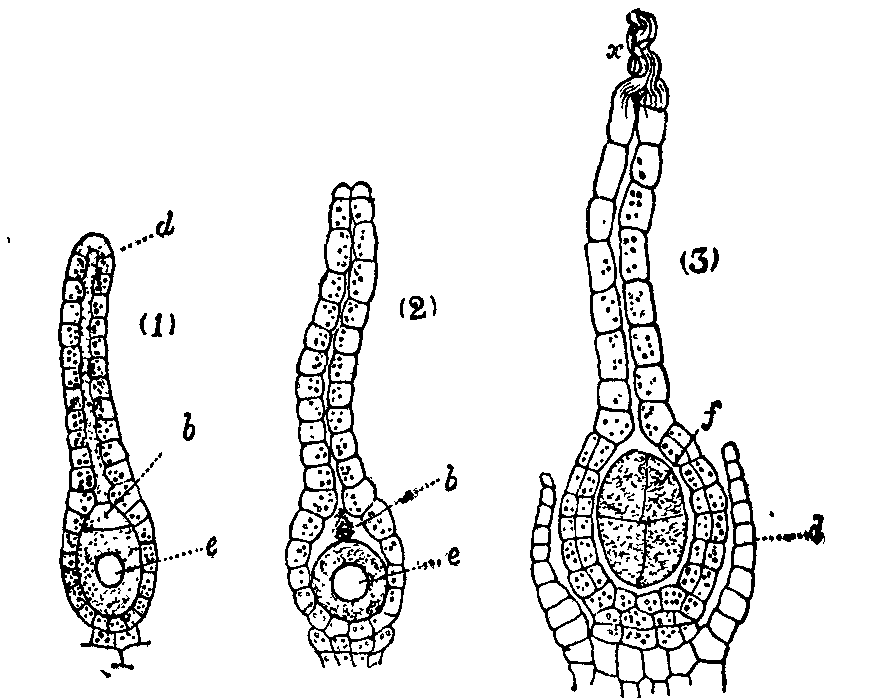
Fig. 1.—Archegonia of Marchantia polymorpha. (After Sachs.)
1. Mature but unopened archegonium. e, Ovum; b, ventral-canal cell; d, lid-cells of neck.
2. Archegonium ready for fertilization; a passage leads down to the rounded ovum e.
3. Archegonium after fertilization; the fertilized ovum is developing into a sporogonium f; d, perianth.
The reproductive organs borne by the thallus or plant are called antheridia and archegonia, and serve for sexual reproduction. The antheridium (figs. 5, 15) has a longer or shorter stalk and consists of a wall formed of a single layer of flat cells enclosing a mass of minute cells from which the spermatozoids are developed. In the cases which have been most carefully investigated two spermatozoids have been found to arise from each of the small cubical cells of the central tissue. When mature the antheridium opens on being moistened and the spermatozoids become free in the water by the dissolution of the mucilaginous cell-walls enclosing them. Each has the form (fig. 5, D) of a more or less spirally twisted, club-shaped body, bearing at the pointed anterior end two long cilia by means of which it moves through the water. The archegonium (fig. 1) has the form of a narrow flask with a long neck. It usually has a short stalk and consists of a central row of cells enclosed by a layer of cells forming the wall. The egg-cell or ovum lies within the wider basal region or venter, and above it come the ventral canal-cell and canal-cells within the neck of the archegonium. When the archegonium opens by the separation of the cells at the tip, the disorganized canal-cells escape, leaving a narrow tubular passage leading down to the ovum. Each antheridium or archegonium arises from a single cell, and while the mature structure is similar in the two groups, the development presents differences in liverworts and mosses. Without entering into details it may be mentioned that in the mosses it proceeds both in the archegonium and antheridium by the segmentation of an apical cell, while this is not the case in the liverworts. Fertilization is effected by the passage of a spermatozoid, attracted probably by means of a chemical stimulus, down the passage of the archegonial neck and its fusion with the ovum. It thus, as in other cases of sexual reproduction, involves the union of two cells, and the vegetative plant, since it bears the sexual organs, is called the sexual generation or gametophyte.
From the fertilized ovum another and very different stage arises, which remains attached to the sexual plant and has thus the appearance of a fruit borne on it. It consists of a capsule usually borne on a longer or shorter stalk or seta, the base of which is inserted into the tissues of the gametophyte. This basal region, which serves to absorb nourishment, is called the foot. Within the capsule numerous reproductive cells, the spores, are developed. In contrast to the sexual generation this stage is called the spore-bearing generation (sporogonium, sporophyte). The examination of any moss "in fruit" (fig. 11, B) will show the readily detachable sporogonium borne on the leafy sexual plant, and the relation existing between the two generations will be evident from figs. 2, 3, 9, and 16. In liverworts (with one or two exceptions) the mature capsule is filled with spores mingled with sterile cells or elaters and opens by splitting into valves. In mosses (fig. 11, C) the sporogonium is more highly organized; a central column of sterile tissue (the columella) is found in the capsule, which opens by the removal of a lid or operculum, and there are no elaters among the spores. By the opening of the capsule the spores are set free, and under suitable conditions germinate and give rise to the sexual generation. In mosses (fig. 12) a filamentous growth, the protonema, is first formed, and the leafy plants arise upon this. In liverworts this preliminary phase of the sexual generation is as a rule ill-marked or absent, and the plant may be said to develop directly from the spore.
It will be evident that the two generations exhibit a regular succession or alternation in the life-history of all Bryophytes. The gametophyte is developed from the spore and bears the sexual organs; the sporogonium is developed from the fertilized egg and produces spores. An important cytological difference between the two generations can only be mentioned here. By the union of the nuclei of the spermatozoid and ovum in fertilization the number of chromosomes in the resulting nucleus is doubled, and this double number is maintained throughout all the cell-divisions of the sporogonium. On the development of the spores, which takes place by the division of each spore-mother-cell into four, the number of chromosomes becomes one half of what it has been in all the nuclei of the sporogonium. This reduced number is maintained throughout the development of the sexual generation. Thus in Pellia the nuclei of the gametophyte have eight chromosomes and those of the sporophyte sixteen. The relation in which the two generations stand to one another is the most important common characteristic of the Bryophyta. The gametophyte is always the independently living individual upon which the spore-bearing generation is throughout its life dependent. In all plants higher than the Bryophyta the sporophyte becomes an independently rooted plant and is the conspicuous stage in the life-history. Thus in the fern the sexual generation is the small prothallus developed from the spore, while the familiar fern-plant is the spore-bearing generation (see Pteridophyta). On the other hand a corresponding alternation of generations is only indicated in the lower plants (Thallophyta).
The Bryophyta are divided into the Hepaticae (liverworts) and Musci (mosses). In the Hepaticae we can recognize three subordinate groups—the Marchantiales, Jungermanniales and Anthocerotales; and in the Musci also three groups—the Sphagnales, Andreaeales and Bryales. Since these series of forms differ considerably among themselves, it is difficult to express in a definition the distinction between a liverwort and a moss which is readily made in practice. We may therefore leave it to the description of the several groups of Hepaticae and Musci to supplement the differences mentioned above and to bring out the exceptions which exist.
Hepaticae (Liverworts).
The range of form and structure of both generations in the liverworts is so great that no one form can be taken as a satisfactory type. It will, however, be of use to preface the more general description by a brief account of a particular example, and we may take for this purpose a very common and easily recognized thalloid liverwort belonging to the Jungermanniales.
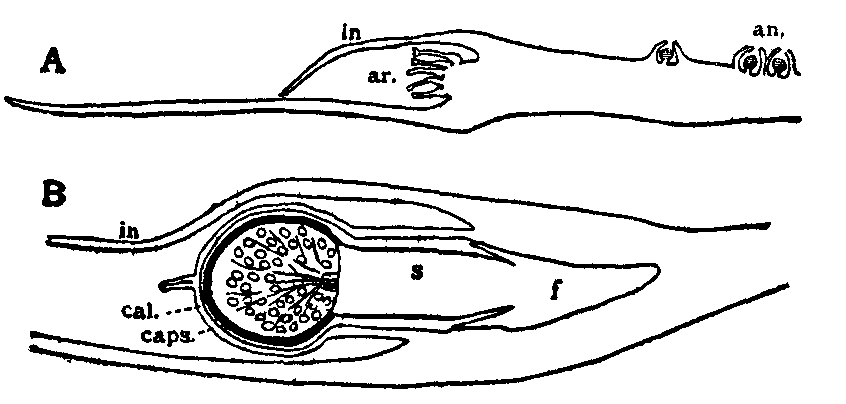
Fig.
3.—
Pellia epiphylla
.
A, Longitudinal section of thallus at the time of fertilization. an, Antheridia; ar, archegonia; in, involucre.
B, Longitudinal section of almost mature sporogonium attached to the thallus. in, Involucre; cal, calyptra; f, foot; s, seta; caps, capsule (semi-diagrammatic).
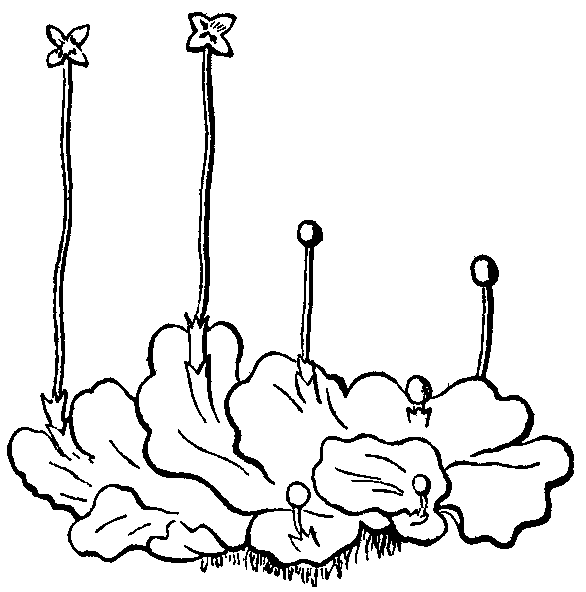
Fig. 2.—Pellia epiphylla. Group of plants bearing mature sporogonia.
From Cooke, Handbook of British Hepaticae.
Pellia epiphylla (fig. 2) can be found at any season growing in large patches on the damp soil of woods, banks, &c. The broad flat thallus is green and may be a couple of inches long. It is sparingly branched, the branching being apparently dichotomous; the growing point is situated in a depression at the anterior end of each branch. The wing-like lateral portions of the thallus gradually thin out from the midrib; from the projecting lower surface of this numerous rhizoids spring. These are elongated superficial cells, and serve to fix the thallus to the soil and obtain water and salts from it. No leaf-like appendages are borne on the thallus, but short glandular hairs occur behind the apex. The plant is composed throughout of very similar living cells, the more superficial ones containing numerous chlorophyll grains, while starch is stored in the internal cells of the midrib. The cells contain a number of oil-bodies the function of which is imperfectly understood. The growth of the thallus proceeds by the regular segmentation of a single apical cell. The sexual organs are borne on the upper surface, and both antheridia and archegonia occur on the same branch (fig. 3, A). The antheridia (an) are scattered over the middle region of the thallus, and each is surrounded by a tubular upgrowth from the surface. The archegonia (ar) are developed in a group behind the apex, and the latter continues to grow for a time after their formation, so that they come to be seated in a depression of the upper surface. They are further protected by the growth of the hinder margin of the depression to form a scale-like involucre (in). Fertilization takes place about June, and the sporogonium is fully developed by the winter. The embryo developed from the fertilized ovum consists at first of a number of tiers of cells. Its terminal tier gives rise to the capsule, the first divisions in the four cells of the tier marking off the wall of the capsule from the cells destined to produce the spores. In fig. 4, C, which represents a longitudinal section of a young embryo of Pellia, these archesporial cells are shaded. The tiers below give rise to the seta and foot. The mature sporogonium (fig. 3, B) consists of the foot embedded in the tissue of the thallus, the seta, which remains short until just before the shedding of the spores, and the spherical capsule. It remains for long enclosed within the calyptra formed by the further development of the archegonial wall and surmounted by the neck of the archegonium. The calyptra is ultimately burst through, and in early spring the seta elongates rapidly, raising the dark-coloured capsule (fig. 2). In the young condition the wall of the capsule, which consists of two layers of cells, encloses a mass of similar cells developed from the archesporium. Some of these become spore-mother-cells and give rise by cell division to four spores, while others remain undivided and become the elaters. The latter are elongated spindle-shaped cells with thick brown spiral bands on the inside of their thin walls. They radiate out from a small plug of sterile cells projecting into the base of the capsule, and some are attached to this, while others lie free among the spores. The latter are large, and at first are unicellular; but in Pellia, which in this respect is exceptional, they commence their further development within the capsule, and thus consist of several cells when shed. The cells of the capsule wall have incomplete, brown, thickened rings on their walls, and the capsule opens by splitting into four valves, which bend away from one another, allowing the loose spores to be readily dispersed by the wind, assisted by the hygroscopic movements of the elaters. On falling upon damp soil the spores germinate, growing into a thallus, which gradually attains its full size and bears sexual organs.
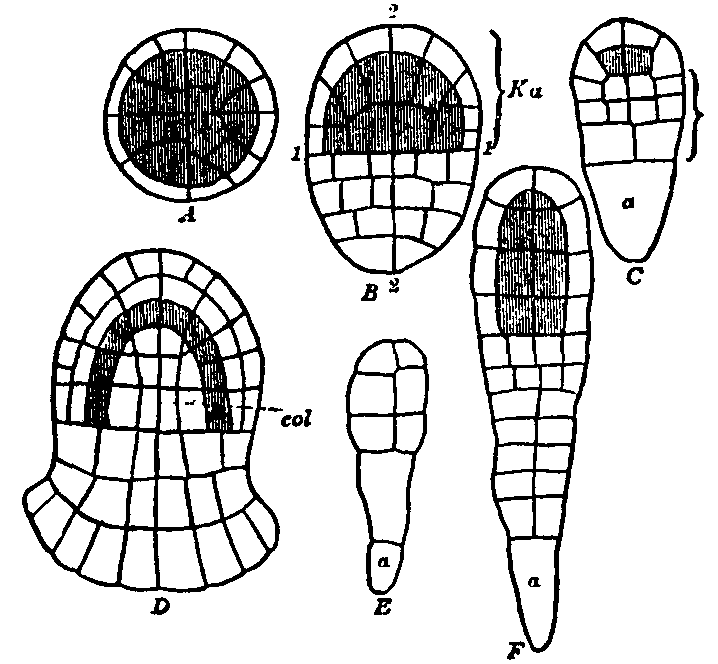
Fig. 4.—Semi-diagrammatic figures of young embryos of Liverworts in longitudinal section. The cells which will produce the sporogenous tissue are shaded. (After Kienitz-Gerloff and Leitgeb.)
A, Riccia.
B, Marchantia polymorpha.
C, Pellia epiphylla.
D, Anthoceros laevis.
E, Cephalozia bicuspidata.
F, Radula complanata.
While the general course of the life-history of all liverworts resembles that of Pellia, the three great groups into which they are divided differ from one another in the characters of both generations. Each group exhibits a series leading from more simple to more highly organized forms, and the differentiation has proceeded on distinct and to some extent divergent lines in the three groups. The Marchantiales are a series of thalloid forms, in which the structure of the thallus is specialized to enable them to live in more exposed situations. The lowest members of the series (Riccia) possess the simplest sporogonia known, consisting of a wall of one layer of cells enclosing the spores. In the higher forms a sterile foot and seta is present, and sterile cells or elaters occur with the spores. The lower members of the Jungermanniales are also thalloid, but the thallus never has the complicated structure characteristic of the Marchantiales, and progress is in the direction of the differentiation of the plant into stem and leaf. Indications of how this may have come about are afforded by the lower group of the Anacrogynous Jungermanniaceae, and throughout the Acrogynous Jungermanniacae the plant has well-marked stem and leaves. The sporogonium even in the simplest forms has a sterile foot, but in this series also the origin of elaters from sterile cells can be traced. The Anthocerotales are a small and very distinct group, in which the gametophyte is a thallus, while the sporogonium possesses a sterile columella and is capable of long-continued growth and spore production. The mode of development of the sporogonium presents important differences in the three series that may be briefly referred to here. In fig. 4 young sporogonia of a number of liverworts are shown in longitudinal section, and the archesporial cells from which the spores and elaters will arise are shaded. In Riccia (fig. 4, A) the whole mass of cells derived from the ovum forms a spherical capsule, the only sterile tissue being the single layer of peripheral cells forming the wall. In other Marchantiales (fig. 4, B) the lower half of the embryo separated by the first transverse wall (1, I) forms the sterile foot and seta, while in the upper half (ka) the peripheral layer forms the wall of the capsule, enclosing the archesporial cells from which spores and elaters arise. In the Jungermanniales (fig. 4, C, E, F) the embryo is formed of a number of tiers of cells, and the archesporium is defined by the first divisions parallel to the surface in the cells of one or more of the upper tiers; a number of tiers go to form the seta and foot, while the lowest segment (a) usually forms a small appendage of the latter. In the Anthocerotales (fig. 4, D) the lowest tiers form the foot, and the terminal tier the capsule. The first periclinal divisions in the cells of the terminal tier separate a central group of cells which form the sterile columella (col). The archesporium arises by the next divisions in the outer layer of cells, and thus extends over the summit of the columella. In none of the liverworts does the sporogonium develop by means of an apical cell, as is the rule in mosses.