Front matter (continued 12)
Reading edition
BROCKLESBY, RICHARD (1722-1797), English physician, was born at Minehead, Somersetshire, on the 11th of August 1722. He was educated at Ballitore, in Ireland, where Edmund Burke was one of his schoolfellows, studied medicine at Edinburgh, and finally graduated at Leiden in 1745. Appointed physician to the army in 1758, he served in Germany during part of the Seven Years' War, and on his return settled down to practise in London. In 1764 he published Economical and Medical Observations, which contained suggestions for improving the hygiene of army hospitals. In his latter years he withdrew altogether into private life. The circle of his friends included some of the most distinguished literary men of the age. He was warmly attached to Dr Johnson, to whom about 1784 he offered an annuity of £100 for life, and whom he attended on his death-bed, while in 1788 he presented Burke, of whom he was an intimate friend, with £1000, and offered to repeat the gift "every year until your merit is rewarded as it ought to be at court." He died on the 11th of December 1797, leaving his house and part of his fortune to his grand-nephew, Dr Thomas Young.
BROCKTON, a city of Plymouth county, Massachusetts, U.S.A., about 20 m. S. of Boston, and containing an area of 21 sq. m. of rolling surface. Pop. (1870) 8007; (1880)13,608; (1890) 27,294; (1900) 40,063, of whom 9484 were foreign-born, including 2667 Irish, 2199 English Canadians and 1973 Swedes; (1910, census) 56,878. It is served by the New York, New Haven & Hartford railway. Brockton has a public library, with 54,000 volumes, in 1908. By popular vote, beginning in 1886 (except in 1898), the liquor traffic was prohibited annually. The death-rate, 13.18 in 1907, is very low for a manufacturing city of its size. Brockton is the industrial centre of a large population surrounding it (East and West Bridgewater, North Easton, Avon, Randolph, Holbrook and Whitman), and is an important manufacturing place. Both in 1900 and in 1905 it ranked first among the cities of the United States in the manufacture of boots and shoes. The city's total factory product in 1900 was valued at $24,855,362, and in 1905 at $37,790,982, an increase during the five years of 52%. The boot and shoe product in 1905 was valued at $30,073,014 (9.4% of the value of the total boot and shoe product of the United States), the boot and shoe cut stock at $1,344,977, and the boot and shoe findings at $2,435,137—the three combined representing 89.6% of the city's total manufactured product. In 1908 there were 35 shoe factories, including the W.L. Douglas, the Ralston, the Walkover, the Eaton, the Keith and the Packard establishments, and, in 1905, 14,000,000 (in 1907 about 17,000,000) pairs of shoes were produced in the city. Among the other products are lasts, blacking, paper and wooden packing boxes, nails and spikes, and shoe fittings and tools. The assessed valuation of the city rose from $6,876,427 in 1881 to $37,408,332 in 1907. Brockton was a part of Bridgewater until 1821, when it was incorporated as the township of North Bridgewater. Its present name was adopted in 1874, and it was chartered as a city in 1881. Brockton was the first city in Massachusetts to abolish all grade crossings (1896) within its limits.
BROCKVILLE, a town and port of entry of Ontario, Canada, and capital of Leeds county, named after General Sir Isaac Brock, situated 119 m. S.W. of Montreal, on the left bank of the St Lawrence, and on the Grand Trunk, and Brockville & Westport railways. A branch line connects it with the Canadian Pacific. It has steamer communication with the St Lawrence and Lake Ontario ports, and is a summer resort. The principal manufactures are hardware, furnaces, agricultural implements, carriages and chemicals. It is the centre of one of the chief dairy districts of Canada, and ships large quantities of cheese and butter. Pop. (1881) 7609; (1901) 8940.
BROD, a town of Croatia-Slavonia, in the county of Pozega, on the left bank of the river Save, 124 m. by rail S.E. by E. of Agram. Pop. (1900) 7310. The principal Bosnian railway here crosses the river, to meet the Hungarian system. Brod has thus a considerable transit trade, especially in cereals, wine, spirits, prunes and wood. It is sometimes called Slavonisch-Brod, to distinguish it from Bosna-Brod, or Bosnisch-Brod, across the river. The town owes its name to a ford (Servian brod) of the Save, and dates at least from the 15th century. Brod was frequently captured and recaptured in the wars between Turkey and Austria; and it was here that the Austrian army mustered, in 1879, for the occupation of Bosnia.
BRODERIP, WILLIAM JOHN (1789-1859), English naturalist, was born in Bristol on the 21st of November 1789. After graduating at Oxford he was called to the bar in 1817, and for some years was engaged in law-reporting. In 1822 he was appointed a metropolitan police magistrate, and filled that office until 1856, first at the Thames police court and then at Westminster. His leisure was devoted to natural history, and his writings did much to further the study of zoology in England. The zoological articles in the Penny Cyclopaedia were written by him, and a series of articles contributed to Fraser's Magazine were reprinted in 1848 as Zoological Recreations, and were followed in 1852 by Leaves from the Note-book of a Naturalist. He was one of the founders of the Zoological Society of London, and a large collection of shells which he formed was ultimately bought by the British Museum. He died in London on the 27th of February 1859.
BRODHEAD, JOHN ROMEYN (1814-1873), American historical scholar, was born in Philadelphia, Pennsylvania, on the 2nd of January 1814, the son of Jacob Brodhead (1782-1855), a prominent clergyman of the Dutch Reformed Church. He graduated at Rutgers College in 1831, and in 1835 was admitted to the bar in New York City. After 1837, however, he devoted himself principally to the study of American colonial history, and in order to have access to the records of the early Dutch settlements in America he obtained in 1839 an appointment as attaché of the American legation at the Hague. His investigations here soon proved that the Dutch archives were rich in material on the early history of New York, and led the state legislature to appropriate funds for the systematic gathering from various European archives of transcripts of documents relating to New York. Brodhead was appointed (1841) by Governor William H. Seward to undertake the work, and within several years gathered from England, France and Holland some eighty manuscript volumes of transcriptions, largely of documents which had not hitherto been used by historians. These transcriptions were subsequently edited by Edward O'Callaghan (vols. i.-xi. incl.) and by Berthold Fernow (vols. xii.-xv., incl.), and published by the state under the title Documents relating to the Colonial History of New York (15 vols., 1853-1883). From 1846 to 1849, while George Bancroft was minister to Great Britain, Brodhead held under him the post of secretary of legation. In 1853-1857 he was naval officer of the port of New York. He published several addresses and a scholarly History of the State of New York (2 vols., 1853-1871), generally considered the best for the brief period covered (1609-1690). He died in New York City on the 6th of May 1873.
BRODIE, SIR BENJAMIN COLLINS, 1st Bart. (1783-1862), English physiologist and surgeon, was born in 1783 at Winterslow, Wiltshire. He received his early education from his father; then choosing medicine as his profession he went to London in 1801, and attended the lectures of John Abernethy. Two years later he became a pupil of Sir Everard Home at St George's hospital, and in 1808 was appointed assistant surgeon at that institution, on the staff of which he served for over thirty years. In 1810 he was elected a fellow of the Royal Society, to which in the next four or five years he contributed several papers describing original investigations in physiology. At this period also he rapidly obtained a large and lucrative practice, and from time to time he wrote on surgical questions, contributing numerous papers to the Medical and Chirurgical Society, and to the medical journals. Probably his most important work is that entitled Pathological and Surgical Observations on the Diseases of the Joints, in which he attempts to trace the beginnings of disease in the different tissues that form a joint, and to give an exact value to the symptom of pain as evidence of organic disease. This volume led to the adoption by surgeons of measures of a conservative nature in the treatment of diseases of the joints, with consequent reduction in the number of amputations and the saving of many limbs and lives. He also wrote on diseases of the urinary organs, and on local nervous affections of a surgical character. In 1854 he published anonymously a volume of Psychological Inquiries; to a second volume which appeared in 1862 his name was attached. He received many honours during his career. He attended George IV., was sergeant-surgeon to William IV. and Queen Victoria, and was made a baronet in 1834. He became a corresponding member of the French Institute in 1844, D.C.L. of Oxford in 1855, and president of the Royal Society in 1858, and he was the first president of the general medical council. He died at Broome Park, Surrey, on the 21st of October 1862. His collected works, with autobiography, were published in 1865 under the editorship of Charles Hawkins.
His eldest son, Sir Benjamin Collins Brodie, 2nd Bart. (1817-1880), was appointed professor of chemistry at Oxford in 1865, and is chiefly known for his investigations on the allotropic states of carbon and for his discovery of graphitic acid.
BRODIE, PETER BELLINGER (1815-1897), English geologist, son of P.B. Brodie, barrister, and nephew of Sir Benjamin C. Brodie, was born in London in 1815. While still residing with his father at Lincoln's Inn Fields, he gained some knowledge of natural history and an interest in fossils from visits to the museum of the Royal College of Surgeons, at a time when W. Clift was curator. Through the influence of Clift he was elected a fellow of the Geological Society early in 1834. Proceeding afterwards to Emmanuel College, Cambridge, he came under the spell of Sedgwick, and henceforth devoted all his leisure time to geology. Entering the church in 1838, he was curate at Wylye in Wiltshire, and for a short time at Steeple Claydon in Buckinghamshire, becoming later rector of Down Hatherley in Gloucestershire, and finally (1855) vicar of Rowington in Warwickshire, and rural dean. Records of geological observations in all these districts were published by him. At Cambridge he obtained fossil shells from the Pleistocene deposit at Barn well; in the Vale of Wardour he discovered in Purbeck Beds the isopod named by Milne-Edwards Archaeoniscus Brodiei; in Buckinghamshire he described the outliers of Purbeck and Portland Beds; and in the Vale of Gloucester the Lias and Oolites claimed his attention. Fossil insects, however, formed the subject of his special studies (History of the Fossil Insects of the Secondary Rocks of England, 1845), and many of his published papers relate to them. He was an active member of the Cotteswold Naturalists' Club and of the Warwickshire Natural History and Archaeological Society, and in 1854 he was chief founder of the Warwickshire Naturalists' and Archaeologists' Field Club. In 1887 the Murchison medal was awarded to him by the Geological Society of London. He died at Rowington, on the 1st of November 1897.
See Memoir by H. B. Woodward in Geological Magazine, 1897, p. 481 (with portrait).
BRODY, a town of Austria, in Galicia, 62 m. E. of Lemberg by rail. Pop. (1900) 17,360, of which about two-thirds are Jews. It is situated near the Russian frontier, and has been one of the most important commercial centres in Galicia, especially for the trade with Russia. But since 1879, when its charter as a free commercial city was withdrawn, its trade has also greatly diminished. Brody was created a town in 1684, and was raised to the rank of a free commercial city in 1779.
BROEKHUIZEN, JAN VAN [Janus Broukhusius], (1649-1707), Dutch classical scholar and poet, was born on the 20th of November 1649, at Amsterdam. Having lost his father when very young, he was placed with an apothecary, with whom he lived several years. Not liking this employment, he entered the army, and in 1674 was sent with his regiment to America, in the fleet under Admiral de Ruyter, but returned to Holland the same year. In 1678 he was sent to the garrison at Utrecht, where he contracted a friendship with the celebrated Graevius; here he had the misfortune to be so deeply implicated in a duel that, according to the laws of Holland, his life was forfeited. Graevius, however, wrote immediately to Nicholas Heinsius, who obtained his pardon. Not long afterwards he became a captain of one of the companies then at Amsterdam. After the peace of Ryswick, 1697, his company was disbanded, and he retired on a pension to a country house near Amsterdam and pursued his classical and literary studies at leisure. His Dutch poems, in which he followed the model of Pieter Hooft, were first published in 1677; a later edition, with a biography by D. van Hoogstraten, appeared in 1712, the last edition, 1883, was edited by R.A. Kollewijn. His classical reputation rests on his editions of Propertius (1702) and Tibullus (1707). His Latin poems (Carmina) appeared in 1684; a later edition(Poemata) by D. van Hoogstraten appeared in 1711. The Select Letters (Jani Browkhusii Epistolae Selectae, 1889 and 1893) were edited by J.A. Worp, who also wrote his biography, 1891. Broekhuizen died on the 15th of December 1707.
BRÖGGER, WALDEMAR CHRISTOFER (1851- ), Norwegian geologist, was born in Christiania on the 10th of November 1851, and educated in that city. In 1876 he was appointed curator of the geological museum in his native city, and assistant on the Geological Survey. He was professor of mineralogy and geology from 1881 to 1890 in the university of Stockholm, and from 1890 in the university of Christiania. He also became rector and president of the senate of the royal university of Christiania. His observations on the igneous rocks of south Tirol compared with those of Christiania afford much information on the relations of the granitic and basic rocks. The subject of the differentiation of rock-types in the process of solidification as plutonic or volcanic rocks from a particular magma received much attention from him. He dealt also with the Palaeozoic rocks of Norway, and with the late glacial and post-glacial changes of level in the Christiania region. The honorary degree of Ph.D. was conferred upon him by the university of Heidelberg and that of LL.D. by the university of Glasgow. The Murchison medal of the Geological Society of London was awarded to him in 1891.
BROGLIE, DE, the name of a noble French family which, originally Piedmontese, emigrated to France in the year 1643. The head of the family, François Marie (1611-1656), then took the title of comte de Broglie. He had already distinguished himself as a soldier, and died, as a lieutenant-general, at the siege of Valenza on the 2nd of July 1656. His son, Victor Maurice, Comte de Broglie (1647-1727), served under Condé, Turenne and other great commanders of the age of Louis XIV., becoming maréchal de camp in 1676, lieutenant-general in 1688, and finally marshal of France in 1724.
The eldest son of Victor Marie, François Marie, afterwards Duc de Broglie (1671-1745), entered the army at an early age, and had a varied career of active service before he was made, at the age of twenty-three, lieutenant-colonel of the king's regiment of cavalry. He served continuously in the War of the Spanish Succession and was present at Malplaquet. He was made lieutenant-general in 1710, and served with Villars in the last campaign of the war and at the battle of Denain. During the peace he continued in military employment, and in 1719 he was made director-general of cavalry and dragoons. He was also employed in diplomatic missions, and was ambassador in England in 1724. The war in Italy called him into the field again in 1733, and in the following year he was made marshal of France. In the campaign of 1734 he was one of the chief commanders on the French side, and he fought the battles of Parma and Guastalla. A famous episode was his narrow personal escape when his quarters on the Secchia were raided by the enemy on the night of the 14th of September 1734. In 1735 he directed a war of positions with credit, but he was soon replaced by Marshal de Noailles. He was governor-general of Alsace when Frederick the Great paid a secret visit to Strassburg (1740). In 1742 de Broglie was appointed to command the French army in Germany, but such powers as he had possessed were failing him, and he had always been the "man of small means," safe and cautious, but lacking in elasticity and daring. The only success obtained was in the action of Sahay (25th May 1742), for which he was made a duke. He returned to France in 1743, and died two years later.
His son, Victor François, Duc de Broglie (1718-1804), served with his father at Parma and Guastalla, and in 1734 obtained a colonelcy. In the German War he took part in the storming of Prague in 1742, and was made a brigadier. In 1744 and 1745 he saw further service on the Rhine, and in 1756 he was made maréchal de camp. He subsequently served with Marshal Saxe in the low countries, and was present at Roucoux, Val and Maastricht. At the end of the war he was made a lieutenant-general. During the Seven Years' War he served successively under d'Estrées, Soubise and Contades, being present at all the battles from Hastenbeck onwards. His victory over Prince Ferdinand at Bergen (1759) won him the rank of marshal of France from his own sovereign and that of prince of the empire from the emperor Francis I. In 1760 he won an action at Corbach, but was defeated at Vellinghausen in 1761. After the war he fell into disgrace and was not recalled to active employment until 1778, when he was given command of the troops designed to operate against England. He played a prominent part in the Revolution, which he opposed with determination. After his emigration, de Broglie commanded the "army of the princes" for a short time (1792). He died at Münster in 1804.
Another son of the first duke, Charles François, Comte de Broglie (1719-1781), served for some years in the army, and afterwards became one of the foremost diplomatists in the service of Louis XV. He is chiefly remembered in connexion with the Secret du Roi, the private, as distinct from the official, diplomatic service of Louis, of which he was the ablest and most important member. The son of Victor François, Victor Claude, Prince de Broglie (1757-1794), served in the army, attaining the rank of maréchal de camp. He adopted revolutionary opinions, served with Lafayette and Rochambeau in America, was a member of the Jacobin Club, and sat in the Constituent Assembly, constantly voting on the Liberal side. He served as chief of the staff to the Republican army on the Rhine; but in the Terror he was denounced, arrested and executed at Paris on the 27th of June 1794. His dying admonition to his little son was to remain faithful to the principles of the Revolution, however unjust and ungrateful.
Achille Charles Léonce Victor, Duc de Broglie (1785-1870), statesman and diplomatist, son of the last-named, was born at Paris on the 28th of November 1785. His mother had shared her husband's imprisonment, but managed to escape to Switzerland, where she remained till the fall of Robespierre. She now returned to Paris with her children and lived there quietly until 1796, when she married a M. d'Argenson, grandson of Louis XV.'s minister of war. Under the care of his step-father young de Broglie received a careful and liberal education and made his entrée into the aristocratic and literary society of Paris under the Empire. In 1809, he was appointed a member of the council of state, over which Napoleon presided in person; and was sent by the emperor on diplomatic missions, as attaché, to various countries. Though he had never been in sympathy with the principles of the Empire, de Broglie was not one of those who rejoiced at its downfall. In common with all men of experience and sense he realized the danger to France of the rise to power of the forces of violent reaction. With Decazes and Richelieu he saw that the only hope for a calm future lay in "the reconciliation of the Restoration with the Revolution." By the influence of his uncle, Prince Amédée de Broglie, his right to a peerage had been recognized; and to his own great surprise he received, in June 1814, a summons from Louis XVIII. to the Chamber of Peers. There, after the Hundred Days, he distinguished himself by his courageous defence of Marshal Ney, for whose acquittal he, alone of all the peers, both spoke and voted. After this defiant act of opposition it was perhaps fortunate that his impending marriage gave him an excuse for leaving the country. On the 15th of February 1816, he was married at Leghorn to the daughter of Madame de Staël. He returned to Paris at the end of the year, but took no part in politics until the elections of September 1817 broke the power of the "ultra-royalists" and substituted for the Chambre introuvable a moderate assembly. De Broglie's political attitude during the years that followed is best summed up in his own words: "From 1812 to 1822 all the efforts of men of sense and character were directed to reconciling the Restoration and the Revolution, the old régime and the new France. From 1822 to 1827 all their efforts were directed to resisting the growing power of the counter-revolution. From 1827 to 1830 all their efforts aimed at moderating and regulating the reaction in a contrary sense." During the last critical years of Charles X.'s reign, de Broglie identified himself with the doctrinaires, among whom Royer-Collard and Guizot were the most prominent. The July revolution placed him in a difficult position; he knew nothing of the intrigues which placed Louis Philippe on the throne; but, the revolution once accomplished, he was ready to uphold the fait accompli with characteristic loyalty, and on the 9th of August took office in the new government as minister of public worship and education. As he had foreseen, the ministry was short-lived, and on the 2nd of November he was once more out of office. During the critical time that followed he consistently supported the principles which triumphed with the fall of Laffitte and the accession to power of Casimir Périer in March 1832. After the death of the latter and the insurrection of June 1832, de Broglie took office once more as minister for foreign affairs (October 11th). His tenure of the foreign office was coincident with a very critical period in international relations. But for the sympathy of Great Britain under Palmerston, the July monarchy would have been completely isolated in Europe; and this sympathy the aggressive policy of France in Belgium and on the Mediterranean coast of Africa had been in danger of alienating. The Belgian crisis had been settled, so far as the two powers were concerned, before de Broglie took office; but the concerted military and naval action for the coercion of the Dutch, which led to the French occupation of Antwerp, was carried out under his auspices. The good understanding of which this was the symbol characterized also the relations of de Broglie and Palmerston during the crisis of the first war of Mehemet Ali (q.v.) with the Porte, and in the affairs of the Spanish peninsula their common sympathy with constitutional liberty led to an agreement for common action, which took shape in the treaty of alliance between Great Britain, France, Spain and Portugal, signed at London on the 22nd of April 1834. De Broglie had retired from office in the March preceding, and did not return to power till March of the following year, when he became head of the cabinet. In 1836, the government having been defeated on a proposal to reduce the five per cents, he once more resigned, and never returned to official life. He had remained in power long enough to prove what honesty of purpose, experience of affairs, and common sense can accomplish when allied with authority. The debt that France and Europe owed him may be measured by comparing the results of his policy with that of his successors under not dissimilar circumstances. He had found France isolated and Europe full of the rumours of war; he left her strong in the English alliance and the respect of Liberal Europe, and Europe freed from the restless apprehensions which were to be stirred into life again by the attitude of Thiers in the Eastern Question and of Guizot in the affair of the "Spanish marriages." From 1836 to 1848 de Broglie held almost completely aloof from politics, to which his scholarly temperament little inclined him, a disinclination strengthened by the death of his wife on the 22nd of September 1838. His friendship for Guizot, however, induced him to accept a temporary mission in 1845, and in 1847 to go as French ambassador to London. The revolution of 1848 was a great blow to him, for he realized that it meant the final ruin of the Liberal monarchy—in his view the political system best suited to France. He took his seat, however, in the republican National Assembly and in the Convention of 1848, and, as a member of the section known as the "Burgraves," did his best to stem the tide of socialism and to avert the reaction in favour of autocracy which he foresaw. He shared with his colleagues the indignity of the coup d'état of the 2nd of December 1851, and remained for the remainder of his life one of the bitterest enemies of the imperial regime, though he was heard to remark, with that caustic wit for which he was famous, that the empire was "the government which the poorer classes in France desired and the rich deserved." The last twenty years of his life were devoted chiefly to philosophical and literary pursuits. Having been brought up by his step-father in the sceptical opinions of the time, he gradually arrived at a sincere belief in the Christian religion. "I shall die," said he, "a penitent Christian and an impenitent Liberal." His literary works, though few of them have been published, were rewarded in 1856 by a seat in the French Academy, and he was also a member of another branch of the French Institute, the Academy of Moral and Political Science. In the labours of those learned bodies he took an active and assiduous part. He died on the 25th of January 1870.
Besides his Souvenirs, in 4 vols. (Paris, 1885-1888), the duc de Broglie left numerous works, of which only some have been published. Of these may be mentioned Écrits et discours (3 vols., Paris, 1863); Le Libre Échange et l'impôt (Paris, 1879); Vues sur le gouvernement de la France (Paris, 1861). This last was confiscated before publication by the imperial government. See Guizot, Le Duc de Broglie (Paris, 1870), and Mémoires (Paris, 1858-1867); and the histories of Thureau-Dangin and Duvergier de Hauranne.
Jacques Victor Albert, Duc de Broglie (1821-1901), his eldest son, was born at Paris on the 13th of June 1821. After a brief diplomatic career at Madrid and Rome, the revolution of 1848 caused him to withdraw from public life and devote himself to literature. He had already published a translation of the religious system of Leibnitz (1846). He now at once made his mark by his contributions to the Revue des deux Mondes and the Orleanist and clerical organ Le Correspondant, which were afterwards collected under the titles of Études morales et littéraires (1853) and Questions de religion et d'histoire (1860). These were supplemented in 1869 by a volume of Nouvelles études de littérature et de morale. His L'Église et l'empire romain au IVe siècle (1856-1866) brought him the succession to Lacordaire's seat in the Academy in 1862. In 1870 he succeeded his father in the dukedom, having previously been known as the prince de Broglie. In the following year he was elected to the National Assembly for the department of the Eure, and a few days later (on the 19th of February) was appointed ambassador in London; but in March 1872, in consequence of criticisms upon his negotiations concerning the commercial treaties between England and France, he resigned his post and took his seat in the National Assembly, where he became the leading spirit of the monarchical campaign against Thiers. On the replacement of the latter by Marshal MacMahon, the duc de Broglie became president of the council and minister for foreign affairs (May 1873), but in the reconstruction of the ministry on the 26th of November, after the passing of the septennate, transferred himself to the ministry of the interior. His tenure of office was marked by an extreme conservatism, which roused the bitter hatred of the Republicans, while he alienated the Legitimist party by his friendly relations with the Bonapartists, and the Bonapartists by an attempt to effect a compromise between the rival claimants to the monarchy. The result was the fall of the cabinet on the 16th of May 1874. Three years later (on the 16th of May 1877) he was entrusted with the formation of a new cabinet, with the object of appealing to the country and securing a new chamber more favourable to the reactionaries than its predecessor had been. The result, however, was a decisive Republican majority. The duc de Broglie was defeated in his own district, and resigned office on the 20th of November. Not being re-elected in 1885, he abandoned politics and reverted to his historical work, publishing a series of historical studies and biographies written in a most pleasing style, and especially valuable for their extensive documentation. He died in Paris on the 19th of January 1901.
Besides editing the Souvenirs of his father (1886, &c.), the Mémoires of Talleyrand (1891, &c.), and the Letters of the Duchess Albertine de Broglie (1896), he published Le Secret du roi, Correspondance secrète de Louis XV avec ses agents diplomatiques, 1752-1774 (1878); Frédéric II et Marie Thérèse (1883); Frédéric II et Louis XV (1885); Marie Thérèse Impératrice (1888); Le Père Lacordaire (1889); Maurice de Saxe et le marquis d'Argenson (1891); La Paix d'Aix-la-Chapelle (1892); L'Alliance autrichienne (1895); La Mission de M. de Gontaut-Biron à Berlin (1896); Voltaire avant et pendant la Guerre de Sept Ans (1898); Saint Ambroise, translated by Margaret Maitland in the series of "The Saints" (1899).
BROGUE, (1) A rough shoe of raw leather (from the Gael. brog, a shoe) worn in the wilder parts of Ireland and the Scottish Highlands. (2) A dialectical accent or pronunciation (of uncertain origin), especially used of the Irish accent in speaking English.
BROHAN, AUGUSTINE SUSANNE (1807-1887), French actress, was born in Paris on the 22nd of January 1807. She entered the Conservatoire at the age of eleven, and took the second prize for comedy in 1820, and the first in 1821. She served her apprenticeship in the provinces, making her first Paris appearance at the Odéon in 1832 as Dorine in Tartuffe. Her success there and elsewhere brought her a summons to the Comédie Française, where she made her début on the 15th of February 1834, as Madelon in Les Précieuses ridicules, and Suzanne in Le Mariage de Figaro. She retired in 1842, and died on the 16th of August 1887.
Her elder daughter, Josephine Félicité Augustine Brohan (1824-1893), was admitted to the Conservatoire when very young, twice taking the second prize for comedy. The soubrette part, entrusted for more than 150 years at the Comédie Française to a succession of artists of the first rank, was at the moment without a representative, and Mdlle Augustine Brohan made her début there on the 19th of May 1841, as Dorine in Tartuffe, and Lise in Rivaux d'eux-mêmes. She was immediately admitted pensionnaire, and at the end of eighteen months unanimously elected sociétaire. She soon became a great favourite, not only in the plays of Molière and de Regnard, but also in those of Marivaux. On her retirement from the stage in 1866, she made an unhappy marriage with Edmond David de Gheest (d. 1885), secretary to the Belgian legation in Paris.
Susanne Brohan's second daughter, Émilie Madeleine Brohan (1833-1900), also took first prize for comedy at the Conservatoire (1850). She was engaged at once by the Comédie Française, but instead of making her début in some play of the répertoire of the theatre, the management put on for her benefit a new comedy by Scribe and Legouvé, Les Contes de la reine de Navarre, in which she created the part of Marguerite on the 1st of September 1850. Her talents and beauty made her a success from the first, and in less than two years from her début she was elected sociétaire. In 1853 she married Mario Uchard, from whom she was soon separated, and in 1858 she returned to the Comédie Française in leading parts, until her retirement in 1886. Her name is associated with a great number of plays, besides those in the classical répertoire, notably Le Monde où l'on s'ennuie, Par droit de conquête, Les Deux Veuves, and Le Lion amoureux, in which, as the "marquise de Maupas", she had one of her greatest successes.
BROKE, or Brooke, ARTHUR (d. 1563), English author, wrote the first English version of the story of Romeo and Juliet. The Tragicall Historye of Romeus and Julieit (1562) is a rhymed account of the story, taken, not directly from Bandello's collection of novels (1554), but from the French translation (Histoires tragiques) of Pierre Boaistuau or Boisteau, surnamed Launay, and François de Belleforest. Broke adds some detail to the story as told by Boisteau. As the poem contains many scenes which are not known to exist elsewhere, but which were adopted by Shakespeare in Romeo and Juliet, there is no reasonable doubt that it may be regarded as the main source of the play. Broke perished by shipwreck in 1563, on his way from Newhaven to join the English troops fighting on the Huguenot side in France.
The genesis of the Juliet story, and a close comparison of Shakespeare's play with Broke's version, are to be found in a reprint of the poem and of William Paynter's prose translation from the Palace of Pleasure, edited by Mr P. A. Daniel for the New Shakespere Society (1875).
BROKE, SIR PHILIP BOWES VERE, BART. (1776-1841), British rear-admiral, was born at Broke Hall, near Ipswich, on the 9th of September 1776, a member of an old Suffolk family. Entering the navy in June 1792, he saw active service in the Mediterranean from 1793 to 1795, and was with the British fleet at the battle of Cape St Vincent, 1797. In 1798 he was present at the defeat and capture of the French squadron off the north coast of Ireland. From 1799 to 1801 he served with the North Sea fleet, and in the latter year was made captain. Unemployed for the next four years, he commanded in 1805 a frigate in the English and Irish Channels. In 1806 he was appointed to the command of the "Shannon", 38-gun frigate, remaining afloat, principally in the Bay of Biscay, till 1811. The "Shannon" was then ordered to Halifax, Nova Scotia. For a year after the declaration of war between Great Britain and the United States in 1812, the frigate saw no important service, though she captured several prizes. Broke utilized this period of comparative inactivity to train his men thoroughly. He paid particular attention to gunnery, and the "Shannon" ere long gained a unique reputation for excellence of shooting. Broke's opportunity came in 1813. In May of that year the "Shannon" was cruising off Boston, watching the "Chesapeake", an American frigate of the same nominal force but heavier armament. On the 1st of June Broke, finding his water supply getting low, wrote to Lawrence, the commander of the "Chesapeake", asking for a meeting between the two ships, stating the "Shannon's" force, and guaranteeing that no other British ship should take part in the engagement. Before this letter could be delivered, however, the "Chesapeake", under full sail, ran out of Boston harbour, crowds of pleasure-boats accompanying her to witness the engagement. Broke briefly addressed his men. "Don't cheer," he concluded, "go quietly to your quarters. I feel sure you will all do your duty." As the "Chesapeake" rounded to on the "Shannon's" weather quarter, at a distance of about fifty yards, the British frigate received her with a broadside. A hundred of the "Chesapeake's" crew were struck down at once, Lawrence himself being mortally wounded. A second broadside, equally well-aimed, increased the confusion, and, her tiller-ropes being shot away, the American frigate drifted foul of the "Shannon". Broke sprang on board with some sixty of his men following him. After a brief struggle the fight was over. Within fifteen minutes of the firing of the first shot, the "Chesapeake" struck her flag, but Broke himself was seriously wounded. For his services he was rewarded with a baronetcy, and subsequently was made a K.C.B. His exploit captivated the public fancy, and his popular title of "Brave Broke" gives the standard by which his action was judged. Its true significance, however, lies deeper. Broke's victory was due not so much to courage as to forethought. "The 'Shannon,'" said Admiral Jurien de La Gravière, "captured the 'Chesapeake' on the 1st of June 1813; but on the 14th of September 1806, when he took command of his frigate, Captain Broke had begun to prepare the glorious termination to this bloody affair." Broke's wound incapacitated him from further service, and for the rest of his life caused him serious suffering. He died in London on the 2nd of January 1841.
BROKEN HILL, a silver-mining town of Yancowinna county, New South Wales, Australia, 925 m. directly W. by N. of Sydney, and connected with Adelaide by rail. Pop. (1901) 27,518. One of the neighbouring mines, the Proprietary, is the richest in the world; gold is associated with the silver; large quantities of lead, good copper lodes, zinc and tin are also found. The problem of the profitable treatment of the sulphide ores has been practically solved here. In addition Broken Hill is the centre of one of the largest pastoral districts in Australia. The town is the seat of the Roman Catholic bishop of Wilcannia.
BROKER (according to the New English Dictionary, from Lat. brocca, spit, spike, broccare, to "broach"—another Eng. form of the same word; hence O. Fr. vendre à broche, to retail, e.g. wine, from the tap, and thus the general sense of dealing; see also for a discussion of the etymology and early history of the use of the word, J.R. Dos Passos, Law of Stockbrokers, chap. i., New York, 1905). In the primary sense of the word, a broker is a mercantile agent, of the class known as general agents, whose office is to bring together intending buyers and sellers and make a contract between them, for a remuneration called brokerage or commission; e.g. cotton brokers, wool brokers or produce brokers. Originally the only contracts negotiated by brokers were for the sale or purchase of commodities; but the word in its present use includes other classes of mercantile agents, such as stockbrokers, insurance-brokers, ship-brokers or bill-brokers. Pawnbrokers are not brokers in any proper sense of the word; they deal as principals and do not act as agents. In discussing the chief questions of modern legal interest in connexion with brokers, we shall deal with them, firstly, in the original sense of agents for the purchase and sale of goods.
Relations between Broker and Principal.—A broker has not, like a factor, possession of his principal's goods, and, unless expressly authorized, cannot buy or sell in his own name; his business is to bring into privity of contract his principal and the third party. When the contract is made, ordinarily he drops out altogether. Brokers very frequently act as factors also, but, when they do so, their rights and duties as factors must be distinguished from their rights and duties as brokers. It is a broker's duty to carry out his principal's instructions with diligence, skill and perfect good faith. He must see that the terms of the bargain accord with his principal's orders from a commercial point of view, e.g. as to quality, quantity and price; he must ensure that the contract of sale effected by him be legally enforceable by his principal against the third party; and he must not accept any commission from the third party, or put himself in any position in which his own interest may become opposed to his principal's. As soon as he has made the contract which he was employed to make, in most respects his duty to, and his authority from, his principal alike cease; and consequently the law of brokers relates principally to the formation of contracts by them.
The most important formality in English law, in making contracts for the sale of goods, with which a broker must comply, in order to make the contract legally enforceable by his principal against the third party, is contained in section 4 of the Sale of Goods Act 1893, which (in substance re-enacting section 17 of the Statute of Frauds) provides as follows:—"A contract for the sale of any goods of the value of ten pounds or upwards shall not be enforceable by action unless the buyer shall accept part of the goods as sold, and actually receive the same, or give something in earnest to bind the contract, or in part payment, or unless some note or memorandum in writing of the contract be made and signed by the party to be charged or his agent in that behalf."
From the reign of James I. till 1884 brokers in London were admitted and licensed by the corporation, and regulated by statute; and it was common to employ one broker only, who acted as intermediary between, and was the agent of both buyer and seller. When the Statute of Frauds was passed in the reign of Charles II., it became the practice for the broker, acting for both parties, to insert in a formal book, kept for the purpose, a memorandum of each contract effected by him, and to sign such memorandum on behalf of both parties, in order that there might be a written memorandum of the contract of sale, signed by the agent of the parties as required by the statute. He would then send to the buyer a copy of this memorandum, called the "bought note", and to the seller a "sold note", which would run as follows:—
"I have this day bought for you from A B [or "my principal"] ..." [signed] "M, Broker." "I have this day sold for you to A B [or "my principal"] ..." [signed] "M, Broker."
There was in the earlier part of the 19th century considerable discussion in the courts as to whether the entry in a broker's book, or the bought and sold notes (singly or together), constituted the statutory memorandum; and judicial opinion was not unanimous on the point. But at the present day brokers are no longer regulated by statute, either in London or elsewhere, and keep no formal book; and as an entry made in a private book kept by the broker for another purpose, even if signed, would probably not be regarded as a memorandum signed by the agent of the parties in that behalf, the old discussion is now of little practical interest.
Under modern conditions of business the written memorandum of the contract of sale effected by the broker is usually to be found in a "contract note"; but the question whether, in the particular circumstances of each case, the contract note affords a sufficient memorandum in writing, depends upon a variety of considerations—e.g. whether the transaction is effected through one or through two brokers; whether the contract notes are rendered by one broker only, or by both; and, if the latter, whether exchanged between the brokers, or rendered by each broker to his own client; for under present practice any one of these methods may obtain, according to the trade in which the transaction is effected, and the nature of the particular transaction.
Where one and the same broker is employed by both seller and buyer, bought and sold notes rendered in the old form provide the necessary memorandum of the contract. Where two brokers are employed, one by the seller and one by the buyer, sometimes one drops out as soon as the terms are negotiated, and the other makes out, signs and sends to the parties the bought and sold notes. The latter then becomes the agent of both parties for the purpose of signing the statutory memorandum, and the position is the same as if one broker only had been employed. On the other hand, if one broker does not drop out of the transaction, each broker remains to the end the agent of his own principal only, and neither becomes the agent of the other party for the purpose of signing the memorandum. In such a case it is the usual practice for the buyer's broker to send to the seller's broker a note of the contract,—"I, acting on account of A. B. [or, "of my principal,"], have this day bought from you, acting on account of C. D. [or, "of your principal"],"—and to receive a corresponding note from the seller's broker. Thus each of the parties receives through his own agent a memorandum signed by the other party's agent. These contract notes are usually known as, and serve the purpose of, "bought" and "sold" notes. In all the above three cases the broker's duty of compliance with all formalities necessary to make the contract of sale legally enforceable is performed, and both parties obtain a written memorandum of the contract upon which they can sue.
The broker, on performing his duty in accordance with the terms upon which he is employed, is entitled to be paid his "brokerage." This usually takes the form of a percentage, varying according to the nature and conditions of the business, upon the total price of the goods bought or sold through him. When he guarantees the solvency of the other party, he is said to be employed upon del credere terms, and is entitled to a higher rate of remuneration. In some trades it is the custom for the selling broker to receive payment from the buyer or his broker; and in such case it is his duty to account to his principal for the purchase money. A broker who properly expends money or incurs liability on his principal's behalf in the course of his employment, is entitled to be reimbursed the money, and indemnified against the liability. Not having, like a factor, possession of the goods, a broker has no lien by which to enforce his rights against his principal. If he fails to perform his duty, he loses his right to remuneration, reimbursement and indemnity, and further becomes liable to an action for damages for breach of his contract of employment, at the suit of his principal.
Relations between Broker and Third Party.—A broker who signs a contract note as broker on behalf of a principal, whether named or not, is not personally liable on the contract to the third party. But if he makes the contract in such a way as to make himself a party to it, the third party may sue either the broker or his principal, subject to the limitation that the third party, by his election to treat one as the party to the contract, may preclude himself from suing the other. In this respect the ordinary rules of the law of agency apply to a broker. Generally, a broker has not authority to receive payment, but in trades in which it is customary for him to do so, if the buyer pays the seller's broker, and is then sued by the seller for the price by reason of the broker having become insolvent or absconded, he may set up the payment to the broker as a defence to the action by the broker's principal. Brokers may render themselves liable for damages in tort for the conversion of the goods at the suit of the true owner if they negotiate a sale of the goods for a selling principal who has no title to the goods.
The Influence of Exchanges.—The relations between brokers and their principals, and also between brokers and third parties as above defined, have been to some extent modified in practice by the institution since the middle of the 19th century in important commercial centres of "Exchanges," where persons interested in a particular trade, whether as merchants or as brokers, meet for the transaction of business. By the contract of membership of the association in whose hands is vested the control of the exchange, every person on becoming a member agrees to be bound by the rules of the association, and to make his contracts on the market in accordance with them. A governing body or committee elected by the members enforces observance of the rules, and members who fail to meet their engagements on the market, or to conform to the rules, are liable to suspension or expulsion by the committee. All disputes between members on their contracts are submitted to an arbitration tribunal composed of members; and the arbitrators in deciding the questions submitted to them are guided by the rules. A printed book of rules is available for reference; and various printed forms of contract suited to the various requirements of the business are specified by the rules and supplied by the association for the use of members. In order to simplify the settlement of accounts between members, particularly in respect of "futures," i.e. contracts for future delivery, a weekly or other periodical settlement is effected by means of a clearing-house; each member paying or receiving in respect of all his contracts which are still open, the balance of his weekly "differences," i.e. the difference between the contract price and the market price fixed for the settlement, or between the last and the present settlement prices.
As all contracts on the market are made subject to the rules, it follows that so far as the rules alter the rights and liabilities attached by law, the ordinary law is modified. The most important modification in the position of brokers effected by membership of such an exchange is due to the rule that as, between themselves, all members are principals, on the market no agents are recognized; a broker employed by a non-member to buy for him on the market is treated by the rules as buying for himself, and is, therefore, personally liable on the contract. If it be a contract in futures, he is required to conform to the weekly settlement rules. If his principal fails to take delivery, the engagement is his and he is required to make good to the member who sold to him any difference between the contract and market price at the date of delivery. But whilst this practice alters directly the relations of the broker to the third party, it also affects or tends to affect indirectly the relations of the broker to his own principal. The terms of the contract of employment being a matter of negotiation and agreement between them, it is open to a broker, if he chooses, to stipulate for particular terms; and it is the usual practice of exchanges to supply printed contract forms for the use of members in their dealings with non-members who employ them as brokers, containing a stipulation that the contract is made subject to the rules of the exchange; and frequently also a clause that the contract is made with the broker as principal. In addition to these express terms, there is in the contract of employment the term, implied by law in all trade contracts, that the parties consent to be bound by such trade usages as are consistent with the express terms of the contract, and reasonable. On executing an order the broker sends to his client a contract-note either in the form of the old bought and sold notes "I have this day [bought / sold] for you," or, when the principal clause is inserted, "I have this day [sold to / bought] from you." These are not bought and sold notes proper, for the broker is not the agent of the third party for the purpose of signing them as statutory memoranda of the sale. But they purport to record the terms of the contract of employment, and the principal may treat himself as bound by their provisions. Sometimes they are accompanied by a detachable form, known as the "client's return contract note," to be filled in, signed and returned by the client; but even the "client's return contract note" is retained by the client's own broker, and is only a memorandum of the terms of employment. The following is a form of contract note rendered by a broker to his client for American cotton, bought on the Liverpool Cotton Exchange for future delivery. The client's contract note is attached to it, and is in precisely corresponding form.
AMERICAN COTTON
Delivery Contract Note.
Liverpool,................
M................
DEAR SIRS,
We have this day.............. to/from you .............. lb American Cotton, net weight, to be contained in .............. American Bales, more or less, to be delivered in Liverpool, during .............. on the basis of .......... per lb for ............ on the terms of the rules, bye-laws, and Clearing House regulations of the Liverpool Cotton Association, Limited, whether endorsed hereon or not.
The contract, of which this is a note, is made between ourselves and yourselves, and not by or with any person, whether disclosed or not, on whose instructions or for whose benefit the same may have been entered into. Yours faithfully,
...................
The contract, of which the above is a note, was made on the date specified, within the business hours fixed by the Liverpool Cotton Association, Limited.
......... per cent to us.
Please confirm by signing and returning the contract attached.
The above form of contract note illustrates the tendency of exchanges to alter the relations between the broker and his principal. The object of inserting in the printed form the provision that the contract is made subject to the rules of the Liverpool Cotton Association is to make those rules binding upon the principal, and if he employs his broker upon the basis of the printed form, he does bind himself to any modification of the relations between himself and his broker which those rules may effect. The object of the principal clause in the above and similar printed forms is apparently to entitle the broker to sell to or buy from his principal on his own account and not as agent at all, thus disregarding the duty incumbent upon him as broker of making for his principal a contract with a third party.
It is not possible, except very generally, to state how far exchanges have succeeded in imposing their own rules and usages on non-members, but it is probably correct to say that in most cases if the question came before the courts, the outside client would be held to have accepted the rules of the exchange so far as they did not alter the fundamental duties to him of his broker. On the other hand, provisions purporting to entitle the broker in disregard of his duties as broker himself to act as principal, would be rejected by the courts as radically inconsistent with the primary object of the contract of brokerage and, therefore, meaningless. But it is undoubtedly too often the practice of brokers who are members of exchanges to consider themselves entitled to act as principals and sell on their own account to their own clients, particularly in futures. The causes of this opinion, erroneously, though quite honestly held, are probably to be looked for partly in the habit of acting as principal on the market in accordance with the rules, partly in the forms of contract notes containing "principal clauses" which they send to their clients, and perhaps, also, in the occasional difficulty of effecting actual contracts on the market at the time when they are instructed so to do.
A stockbroker is a broker who contracts for the sale of stocks and shares. Stockbrokers differ from brokers proper chiefly in that stocks and shares are not "goods," and the requirement of a memorandum in writing, enacted by the Sale of Goods Act 1893, does not apply. Hence actions may be brought by the principals to a contract for the sale of stocks and shares although no memorandum in writing exists. For instance, the jobber, on failing to recover from the buyer's broker the price of shares sold, by reason of the broker having failed and been declared a defaulter, may sue the buyer whose "name was passed" by the broker. The employment of a stockbroker is subject to the rules and customs of the Stock Exchange, in accordance with the principles discussed above, which apply to the employment of brokers proper. A custom which is illegal, such as the Stock Exchange practice of disregarding Leeman's Act (1867), which enacts that contracts for the sale of joint-stock bank shares shall be void unless the registered numbers of the shares are stated therein, is not binding on the client to the extent of making the contract of sale valid. But if a client choose to instruct his broker to buy bank shares in accordance with that practice, the broker is entitled to be indemnified by his client for money which he pays on his behalf, even though the contract of sale so made is unenforceable. For further information the reader is referred to the article Stock Exchange and to the treatises on stock exchange law.
An insurance broker is an agent whose business is to effect policies of marine insurance. He is employed by the person who has an interest to insure, pays the premiums to the underwriter, takes up the policy, and receives from the underwriter payment in the event of a loss under the policy. By the custom of the trade the underwriter looks solely to the broker for payment of premiums, and has no right of action against the assured; and, on the other hand, the broker is paid his commission by the underwriter, although he is employed by the assured. Usually the broker keeps a current account with the underwriter, and premiums and losses are dealt with in account. It is only in the event of the underwriter refusing to pay on a loss, that the broker drops out and the assured sues the underwriter direct. Agents who effect life, fire or other policies, are not known as insurance brokers.
Ship-brokers are, firstly, "commission agents," and, secondly, very often also ships' managers. Their office is to act as agents for owners of ships to procure purchasers for ships, or ships for intending purchasers, in precisely the same manner as house-agents act in respect of houses. They also act as agents for ship-owners in finding charterers for their ships, or for charterers in finding ships available for charter, and in either case they effect the charter-party (see Affreightment).
Chartering brokers are customarily paid by the ship-owner, when the charter-party is effected, whether originally employed by him or by the charterer. Charter-parties effected through brokers often contain a provision—"2½% on estimated amount of freight to be paid to A B, broker, on the signing of this charter-party, and the ship to be consigned to him for ship's business at the port of X [inserting the name of the port where A B carries on business]." The broker cannot sue on the charter-party contract because he is not a party to it, but the insertion of the clause practically prevents his right from being disputed by the ship-owner. When the broker does the ship's business in port, it is his duty to clear her at the customs and generally to act as "ship's husband."
A bill-broker was originally an agent who, for a commission, procured for country bankers the discounting of their bills in London. But the practice arose of the broker guaranteeing the London banker or financier; and finally the brokers ceased to deposit with the London bankers the bills they received, and at the present day a bill-broker, as a rule, buys bills on his own account at a discount, borrows money on his own account and upon his own security at interest, and makes his profit out of the difference between the discount and the interest. When acting thus the bill-broker is not a broker at all, as he deals as principal and does not act as agent.
Authorities.—Story, Commentaries on the Law of Agency (Boston, 1882); Brodhurst, Law and Practice of the Stock Exchange (London, 1897); Gow, Handbook of Marine Insurance (London, 1900); Arnould, On Marine Insurance, edited by Messrs Hart & Simey (1901); J.R. Dos Passos, Law of Stock-Brokers and Stock Exchanges (New York, 1905).
(L. F. S.)
BROMBERG, a town of Germany, in the Prussian province of Posen, 32 m. by rail W.N.W. from the fortress of Thorn, 7 m. W. from the bank of the Vistula, and at the centre of an important network of railways, connecting it with the strategical points on the Prusso-Russian frontier. Pop. (1900) 52,082; (1905) 54,229. Its public buildings comprise two Roman Catholic and three Protestant churches, a Jewish synagogue, a seminary, high grade schools and a theatre. The town also possesses a bronze statue of the emperor William I., a monument of the war of 1870-71, and a statue of Benkenhoff, the constructor of the Bromberg Canal. This engineering work, constructed in 1773-1774, by command of Frederick II., connects the Brahe with the Netze, and thus establishes communication between the Vistula, the Oder and the Elbe. The principal industrial works are iron foundries and machine shops, paper factories and flour mills; the town has, moreover, an active trade in agricultural and other products. In view of its strategical position, a large garrison is concentrated in and about the town. Bromberg is mentioned as early as 1252. It fell soon afterwards into the hands of the Poles, from whom it was taken in 1327 by the Teutonic Order, which held it till 1343, when the Poles recaptured it. Destroyed in the course of these struggles, it was restored by Casimir of Poland in 1346, and down to the close of the 16th century it continued to be a flourishing commercial city. It afterwards suffered so much from war and pestilence that about 1772, when the Prussians took possession, it contained only from five to six hundred inhabitants. By the treaty of Tilsit it was transferred to the duchy of Warsaw; in 1813 it was occupied by the Russians, and in 1815 was restored to Prussia.
BROME, ALEXANDER (1620-1666), English poet, was by profession an attorney, and was the author of many drinking songs and of satirical verses in favour of the Royalists and against the Rump. He published in 1661 Songs and other Poems, containing songs on various subjects, followed by a series of political songs; ballads, epistles, elegies and epitaphs; epigrams and translations. Izaak Walton wrote an introductory eclogue for this volume in praise of the writer, and his gaiety and wit won for him the title of the "English Anacreon" in Edward Phillips's Theatrum Poetarum. Brome published in 1666 a translation of Horace by himself and others, and was the author of a comedy entitled The Cunning Lovers (1654). He also edited two volumes of Richard Brome's plays.
BROME, RICHARD (d. 1652), English dramatist, was originally a servant of Ben Jonson, and owed much to his master. The development of his plots, the strongly marked characters and the amount of curious information to be found in his work, all show Jonson's influence. The relation of master and servant developed into friendship, and our knowledge of Brome's personal character is chiefly drawn from Ben Jonson's lines to him, prefixed to The Northern Lasse (1632), the play which made Brome's reputation. Brome's genius lay entirely in comedy. He has left fifteen pieces. Five New Playes (ed. by Alex. Brome, 1652?) contained Madd Couple Well Matcht (acted 1639?); Novella (acted 1632); Court Begger (acted 1632); City Witt; The Damoiselle or the New Ordinary. Five New Playes (1659) included The English Moor, or The Mock Marriage; The Love-Sick Court, or The Ambitious Politique; Covent Garden Weeded; The New Academy, or The New Exchange; and The Queen and Concubine. The Antipodes (acted 1638, pr. 1640); The Sparagus Garden (acted 1635, pr. 1640); A Joviall Crew, or the Merry Beggars (acted 1641, pr. 1652, revised in 1731 as an "opera"), and The Queenes Exchange (pr. 1657), were published separately. He collaborated with Thomas Heywood in The late Lancashire Witches (pr. 1634).
See A.W. Ward, History of English Dramatic Literature, vol. iii. pp. 125-131 (1899). The Dramatic Works of Richard Brome ... were published in 1873.
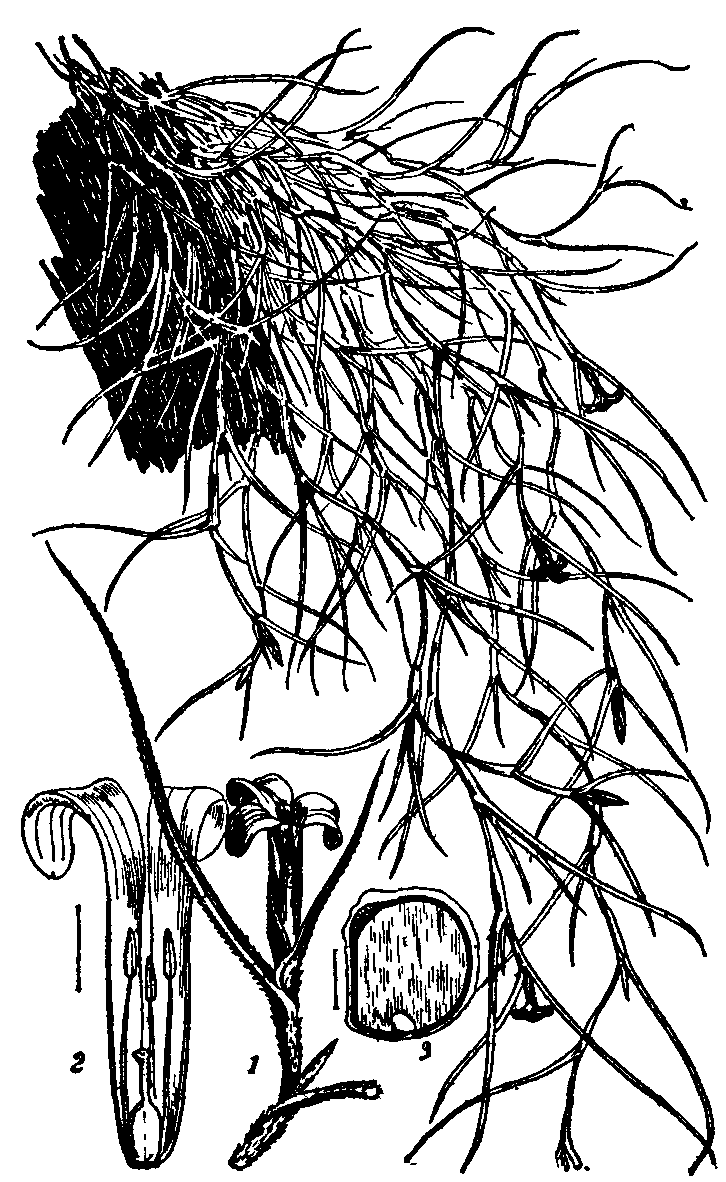
Fig. 2.—Tillandsia usneoides, Spanish moss, slightly reduced. 1, Small branch with flower; 2, flower cut vertically; 3, section of seed of Bromelia.
(From The Botanical Magazine, by permission of Lovell, Reeve & Co)
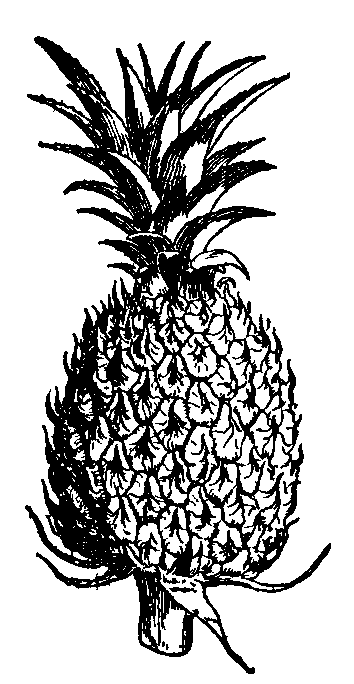
Fig. 1.—Fruit of the pine-apple (Ananas sativa), consisting of numerous flowers and bracts united together so as to form a collective or anthocarpous fruit. The crown of the pine-apple, c, consists of a series of empty bracts prolonged beyond the fruit.
BROMELIACEAE, in botany, a natural order of Monocotyledons, confined to tropical and sub-tropical America. It includes the pine-apple (fig. 1) and the so-called Spanish moss (fig. 2), a rootless plant, which hangs in long grey lichen-like festoons from the branches of trees, a native of Mexico and the southern United States; the water required for food is absorbed from the moisture in the air by peculiar hairs which cover the surface of the shoots. The plants are generally herbs with a much shortened stem bearing a rosette of leaves and a spike or panicle of flowers. They are eminently dry-country plants (xerophytes); the narrow leaves are protected from loss of water by a thick cuticle, and have a well-developed sheath which embraces the stem and forms, with the sheaths of the other leaves of the rosette, a basin in which water collects, with fragments of rotting leaves and the like. Peculiar hairs are developed on the inner surface of the sheath by which the water and dissolved substances are absorbed, thus helping to feed the plant. The leaf-margins are often spiny, and the leaf-spines of Puya chilensis are used by the natives as fish-hooks. Several species are grown as hot-house plants for the bright colour of their flowers or flower-bracts, e.g. species of Tillandsia, Billbergia, Aechmea and others.
BROMINE (symbol Br, atomic weight 79.96), a chemical element of the halogen group, which takes its name from its pungent unpleasant smell (βρῶμος, a stench). It was first isolated by A.J. Balard in 1826 from the salts in the waters of the Mediterranean. He established its elementary character, and his researches were amplified by K.J. Löwig (1803-1890) in Das Brom und seine chemischen Verhaltnisse (1829). Bromine does not occur in nature in the uncombined condition, but in combination with various metals is very widely but sparingly distributed. Potassium, sodium and magnesium bromides are found in mineral waters, in river and sea-water, and occasionally in marine plants and animals. Its chief commercial sources are the salt deposits at Stassfurt in Prussian Saxony, in which magnesium bromide is found associated with various chlorides, and the brines of Michigan, Ohio, Pennsylvania and West Virginia, U.S.A.; small quantities are obtained from the mother liquors of Chile saltpetre and kelp. In combination with silver it is found as the mineral bromargyrite (bromite).
Manufacture.—The chief centres of the bromine industry are Stassfurt and the central district of Michigan. It is manufactured from the magnesium bromide contained in "bittern" (the mother liquor of the salt industry), by two processes, the continuous and the periodic. The continuous process depends upon the decomposition of the bromide by chlorine, which is generated in special stills. A regular current of chlorine mixed with steam is led in at the bottom of a tall tower filled with broken bricks, and there meets a descending stream of hot bittern: bromine is liberated and is swept out of the tower together with some chlorine, by the current of steam, and then condensed in a worm. Any uncondensed bromine vapour is absorbed by moist iron borings, and the resulting iron bromide is used for the manufacture of potassium bromide. The periodic process depends on the interaction between manganese dioxide (pyrolusite), sulphuric acid, and a bromide, and the operation is carried out in sandstone stills heated to 60° C., the product being condensed as in the continuous process. The substitution of potassium chlorate for pyrolusite is recommended when calcium chloride is present in the bittern. The crude bromine is purified by repeated shaking with potassium, sodium or ferrous bromide and subsequent redistillation. Commercial bromine is rarely pure, the chief impurities present in it being chlorine, hydrobromic acid, and bromoform (M. Hermann, Annalen, 1855, 95, p. 211). E. Gessner (Berichte, 1876, 9, p. 1507) removes chlorine by repeated shaking with water, followed by distillation over sulphuric acid; hydrobromic acid is removed by distillation with pure manganese dioxide, or mercuric oxide, and the product dried over sulphuric acid. J.S. Stas, in his stoichiometric researches, prepared chemically pure bromine from potassium bromide, by converting it into the bromate which was purified by repeated crystallization. By heating the bromate it was partially converted into the bromide, and the resulting mixture was distilled with sulphuric acid. The distillate was further purified by digestion with milk of lime, precipitation with water, and further digestion with calcium bromide and barium oxide, and was finally redistilled.
Characters.—Bromine at ordinary temperatures is a mobile liquid of fine red colour, which appears almost black in thick layers. It boils at 59° C. According to Sir W. Ramsay and S. Young, bromine, when dried over sulphuric acid, boils at 57.65° C., and when dried over phosphorus pentoxide, boils at 58.85° C. (under a pressure of 755.8 mm.), forming a deep red vapour, which exerts an irritating and directly poisonous action on the respiratory organs. It solidifies at -21° C. (Quincke) to a dark brown solid. Its specific gravity is 3.18828 (0/4°), latent heat of fusion 16.185 calories, latent heat of vaporization 45.6 calories, specific heat 0.1071. The specific heat of bromine vapour, at constant pressure, is 0.05504 and at constant volume is 0.04251 (K. Strecker). Bromine is soluble in water, to the extent of 3.226 grammes of bromine per 100 grammes of solution at 15° C., the solubility being slightly increased by the presence of potassium bromide. The solution is of an orange-red colour, and is quite permanent in the dark, but on exposure to light, gradually becomes colourless, owing to decomposition into hydrobromic acid and oxygen. By cooling the aqueous solution, hyacinth-red octahedra of a crystalline hydrate of composition Br·4H2O or Br2·8H2O are obtained (Bakhuis Roozeboom, Zeits. phys. Chem., 1888, 2. p. 449). Bromine is readily soluble in chloroform, alcohol and ether.
Its chemical properties are in general intermediate between those of chlorine and iodine; thus it requires the presence of a catalytic agent, or a fairly high temperature, to bring about its union with hydrogen. It does not combine directly with oxygen, nitrogen or carbon. With the other elements it unites to form bromides, often with explosive violence; phosphorus detonates in liquid bromine and inflames in the vapour; iron is occasionally used to absorb bromine vapour, potassium reacts energetically, but sodium requires to be heated to 200° C. The chief use of bromine in analytical chemistry is based upon the oxidizing action of bromine water. Bromine and bromine water both bleach organic colouring matters. The use of bromine in the extraction of gold (q.v.) was proposed by R. Wagner (Dingler's Journal, 218, p. 253) and others, but its cost has restricted its general application. Bromine is used extensively in organic chemistry as a substituting and oxidizing agent and also for the preparation of addition compounds. Reactions in which it is used in the liquid form, in vapour, in solution, and in the presence of the so-called "bromine carriers," have been studied. Sunlight affects the action of bromine vapour on organic compounds in various ways, sometimes retarding or accelerating the reaction, while in some cases the products are different (J. Schramm, Monatshefte fur Chemie, 1887, 8, p. 101). Some reactions, which are only possible by the aid of nascent bromine, are carried out by using solutions of sodium bromide and bromate, with the amount of sulphuric acid calculated according to the equation 5NaBr + NaBrO3 + 6H2SO4 = 6NaHSO4 + 3H2O + 6Br. (German Patent, 26642.) The diluents in which bromine is employed are usually ether, chloroform, acetic acid, hydrochloric acid, carbon bisulphide and water, and, less commonly, alcohol, potassium bromide and hydrobromic acid; the excess of bromine being removed by heating, by sulphurous acid or by shaking with mercury. The choice of solvent is important, for the velocity of the reaction and the nature of the product may vary according to the solvent used, thus A. Baeyer and F. Blom found that on brominating orthoacetamido-acetophenone in presence of water or acetic acid, the bromine goes into the benzene nucleus, whilst in chloroform or sulphuric acid or by use of bromine vapour it goes into the side chain as well. The action of bromine is sometimes accelerated by the use of compounds which behave catalytically, the more important of these substances being iodine, iron, ferric chloride, ferric bromide, aluminium bromide and phosphorus. For oxidizing purposes bromine is generally employed in aqueous and in alkaline solutions, one of its most important applications being by Emil Fischer (Berichte, 1889, 22, p. 362) in his researches on the sugars. The atomic weight of bromine has been determined by J.S. Stas and C. Marignac from the analysis of potassium bromide, and of silver bromide. G.P. Baxter (Zeit. anorg. Chem. 1906, 50, p. 389) determined the ratios Ag: AgBr, and AgCl: Ag Br.
Hydrobromic Acid.—This acid, HBr, the only compound of hydrogen and bromine, is in many respects similar to hydrochloric acid, but is rather less stable. It may be prepared by passing hydrogen gas and bromine vapour through a tube containing a heated platinum spiral. It cannot be prepared with any degree of purity by the action of concentrated sulphuric acid on bromides, since secondary reactions take place, leading to the liberation of free bromine and formation of sulphur dioxide. The usual method employed for the preparation of the gas consists in dropping bromine on to a mixture of amorphous phosphorus and water, when a violent reaction takes place and the gas is rapidly liberated. It can be obtained also, although in a somewhat impure condition, by the direct action of bromine on various saturated hydrocarbons (e.g. paraffin-wax), while an aqueous solution may be obtained by passing sulphuretted hydrogen through bromine water. Alexander Scott (Journal of Chem. Soc., 1900, 77, p. 648) prepares pure hydrobromic acid by covering bromine, which is contained in a large flask, with a layer of water, and passing sulphur dioxide into the water above the surface of the bromine, until the whole is of a pale yellow colour; the resulting solution is then distilled in a slow current of air and finally purified by distillation over barium bromide. At ordinary temperatures hydrobromic acid is a colourless gas which fumes strongly in moist air, and has an acid taste and reaction. It can be condensed to a liquid, which boils at -64.9° C. (under a pressure of 738.2 mm.), and, by still further cooling, gives colourless crystals which melt at -88.5° C. It is readily soluble in water, forming the aqueous acid, which when saturated at 0° C. has a specific gravity of 1.78. When boiled, the aqueous acid loses either acid or water until a solution of constant boiling point is obtained, containing 48% of the acid and boiling at 126° C. under atmospheric pressure; should the pressure, however, vary, the strength of the solution boiling at a constant temperature varies also. Hydrobromic acid is one of the "strong" acids, being ionized to a very large extent even in concentrated solution, as shown by the molecular conductivity increasing by only a small amount over a wide range of dilution.
Bromides.—Hydrobromic acid reacts with metallic oxides, hydroxides and carbonates to form bromides, which can in many cases be obtained also by the direct union of the metals with bromine. As a class, the metallic bromides are solids at ordinary temperatures, which fuse readily and volatilize on heating. The majority are soluble in water, the chief exceptions being silver bromide, mercurous bromide, palladious bromide and lead bromide; the last is, however, soluble in hot water. They are decomposed by chlorine, with liberation of bromine and formation of metallic chlorides; concentrated sulphuric acid also decomposes them, with formation of a metallic sulphate and liberation of bromine and sulphur dioxide. The non-metallic bromides are usually liquids, which are readily decomposed by water. Hydrobromic acid and its salts can be readily detected by the addition of chlorine water to their aqueous solutions, when bromine is liberated; or by warming with concentrated sulphuric acid and manganese dioxide, the same result being obtained. Silver nitrate in the presence of nitric acid gives with bromides a pale yellow precipitate of silver bromide, AgBr, which is sparingly soluble in ammonia. For their quantitative determination they are precipitated in nitric acid solution by means of silver nitrate, and the silver bromide well washed, dried and weighed.
No oxides of bromine have as yet been isolated, but three oxy-acids are known, namely hypobromous acid, HBrO, bromous acid, HBrO2, and bromic acid, HBrO3. Hypobromous acid is obtained by shaking together bromine water and precipitated mercuric oxide, followed by distillation of the dilute solution in vacuo at low temperature (about 40° C.). It is a very unstable compound, breaking up, on heating, into bromine and oxygen. The aqueous solution is light yellow in colour, and possesses strong bleaching properties. Bromous acid is formed by adding bromine to a saturated solution of silver nitrate (A. H. Richards, J. Soc Chem. Ind., 1906, 25, p. 4). Bromic acid is obtained by the addition of the calculated amount of sulphuric acid (previously diluted with water) to the barium salt; by the action of bromine on the silver salt, in the presence of water, 5AgBrO3 + 3Br2 + 3H2O = 5AgBr + 6HBrO3, or by passing chlorine through a solution of bromine in water. The acid is only known in the form of its aqueous solution; this is, however, very unstable, decomposing on being heated to 100° C. into water, oxygen and bromine. By reducing agents such, for example, as sulphuretted hydrogen and sulphur-dioxide, it is rapidly converted into hydrobromic acid. Hydrobromic acid decomposes it according to the equation HBrO3 + 5HBr = 3H2O + 3Br2. Its salts are known as bromates, and are as a general rule difficultly soluble in water, and decomposed by heat, with evolution of oxygen.
Applications.—The salts of bromine are widely used in photography, especially bromide of silver. For antiseptic purposes it has been prepared as "bromum solidificatum," which consists of kieselguhr or similar substance impregnated with about 75% of its weight of bromine. In medicine it is largely employed in the form of bromides of potassium, sodium and ammonium, as well as in combination with alkaloids and other substances.
Medicinal Use.—Bromide of potassium is the safest and most generally applicable sedative of the nervous system. Whilst very weak, its action is perfectly balanced throughout all nervous tissue, so much so that Sir Thomas Lauder Brunton has suggested its action to be due to its replacement of sodium chloride (common salt) in the fluids of the nervous system. Hence bromide of potassium—or bromide of sodium, which is possibly somewhat safer still though not quite so certain in its action—is used as a hypnotic, as the standard anaphrodisiac, as a sedative in mania and all forms of morbid mental excitement, and in hyperaesthesia of all kinds. Its most striking success is in epilepsy, for which it is the specific remedy. It may be given in doses of from ten to fifty grains or more, and may be continued without ill effect for long periods in grave cases of epilepsy (grand mal). Of the three bromides in common use the potassium salt is the most rapid and certain in its action, but may depress the heart in morbid states of that organ; in such cases the sodium salt—of which the base is inert—may be employed. In whooping-cough, when a sedative is required but a stimulant is also indicated, ammonium bromide is often invaluable. The conditions in which bromides are most frequently used are insomnia, epilepsy, whooping-cough, delirium tremens, asthma, migraine, laryngismus stridulus, the symptoms often attendant upon the climacteric in women, hysteria, neuralgia, certain nervous disorders of the heart, strychnine poisoning, nymphomania and spermatorrhoea. Hydrobromic acid is often used to relieve or prevent the headache and singing in the ears that may follow the administration of quinine and of salicylic acid or salicylates.
BROMLEY, SIR THOMAS (1530-1587), English lord chancellor, was born in Staffordshire in 1530. He was educated at Oxford University and called to the bar at the Middle Temple. Through family influence as well as the patronage of Sir Nicholas Bacon, the lord keeper, he quickly made progress in his profession. In 1566 he was appointed recorder of London, and in 1569 he became solicitor-general. He sat in parliament successively for Bridgnorth, Wigan and Guildford. On the death of Sir Nicholas Bacon in 1579 he was appointed lord chancellor. As an equity judge he showed great and profound knowledge, and his judgment in Shelley's case (q.v.) is a landmark in the history of English real property law. He presided over the commission which tried Mary, queen of Scots, in 1586, but the strain of the trial, coupled with the responsibility which her execution involved upon him, proved too much for his strength, and he died on the 12th of April 1587. He was buried in Westminster Abbey.
See Foss, Lives of the Judges; Campbell, Lives of the Lord Chancellors.
BROMLEY, a municipal borough in the Sevenoaks parliamentary division of Kent, England, 10½ m. S.E. by S. of London by the South Eastern & Chatham railway. Pop. (1901) 27,354. It lies on high ground north of the small river Ravensbourne, in a well-wooded district, and has become a favourite residential locality for those whose business lies in London. The former palace of the bishops of Rochester was erected in 1777 in room of an older structure. The manor belonged to this see as early as the reign of Ethelbert. In the gardens is a chalybeate spring known as St Blaize's Well, which was in high repute before the Reformation. The church of St Peter and St Paul, mainly Perpendicular, retains a Norman font and other remains of an earlier building. Here is the gravestone of the wife of Dr Johnson. Bromley College, founded by Bishop Warner in 1666 for "twenty poor widows of loyal and orthodox clergymen," has been much enlarged, and forty widows are in receipt of support. Sheppard College (1840) is an affiliated foundation for unmarried daughters of these widows. In the vicinity of Bromley, Bickley is a similar residential township, Hayes Common is a favourite place of excursion, and at Holwood Hill near Keston are remains of a large encampment known as Caesar's Camp. Bromley was incorporated in 1903, and is governed by a mayor, 6 aldermen and 18 councillors. Area, 4703 acres.
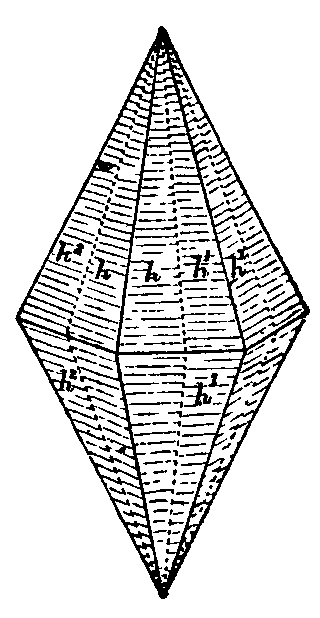
BROMLITE, a member of the aragonite group of minerals. It consists of an isomorphous mixture of calcium and barium carbonates in various proportions, (Ca, Ba) CO3, and thus differs chemically from barytocalcite (q.v.) which is a double salt of these carbonates in equal molecular proportions. Being isomorphous with aragonite, it crystallizes in the orthorhombic system, but simple crystals are not known. The crystals are invariably complex twins, and have the form of doubly terminated pseudo-hexagonal pyramids, like those of witherite but more acute; the faces are horizontally striated and are divided down their centre by a twin-suture, as represented in the adjoining figure. The examination in polarized light of a transverse section shows that each compound crystal is built up of six differently orientated individuals arranged in twelve segments. The crystals are translucent and white, sometimes with a shade of pink. Sp. gr. 3.706; hardness 4-4½. The mineral has been found at only two localities, both of which are in the north of England. At the Fallowfield lead mine, near Hexham in Northumberland, it is associated with witherite; and at Bromley Hill, near Alston in Cumberland, it occurs in veins with galena. The species was named bromlite by T. Thomson in 1837, and alstonite by A. Breithaupt in 1841, both of which names, derived from the locality, have been in common use.
(L. J. S.)
BROMPTON, a western district of London, England, in the south-east of the metropolitan borough of Kensington. Brompton Road, leading south-west from Knightsbridge, is continued as Old Brompton Road and Richmond Road, to join Lillie Road, at which point are the District and West London railway stations of West Brompton. The Oratory of St Philip Neri, commonly called Brompton Oratory, close by the Victoria and Albert Museum, the Brompton consumption hospital and the West London or Brompton cemetery are included in this district, which is mainly occupied by residences of the better class. (See Kensington.)
BROMSGROVE, a market town in the Eastern parliamentary division of Worcestershire, England, 12 m. N.N.E. of Worcester, with a station 1 m. from the town on the Bristol-Birmingham line of the Midland railway. Pop. of urban district (1901) 8418. It lies in a pleasant undulating district near the foot of the Lickey Hills, to surmount which the railway towards Birmingham here ascends for 2 m. one of the steepest gradients in England over such a distance. There remain several picturesque half-timbered houses, dating from 1572 and later. The church of St John is a fine building, Perpendicular and earlier in date, picturesquely placed on an elevation above the town, with a lofty tower and spire. There are a well-known grammar-school, founded by Edward VI., with university scholarships; a college school, a literary institute, and a school of art. Birmingham Sanatorium stands in the parish. Cloth was formerly a staple of trade, but manufactures of nails and buttons are now pre-eminent, while the river Salwarpe works a number of mills in the neighbourhood, and near the town are carriage works belonging to the Midland railway.
BRONCHIECTASIS (Gr. βρόγχια, bronchial tubes, and ἒκτασις, extension), dilatation of the bronchi, a condition occurring in connexion with many diseases of the lungs. Bronchitis both acute and chronic, chronic pneumonia and phthisis, acute pneumonia and broncho-pneumonia, may all leave after them a bronchiectasis whose position is determined by the primary lesion. Other causes, acting mechanically, are tracheal and bronchial obstruction, as from the pressure of an aneurism, new growth, &c. It used to be considered a disease of middle age, but of late years Dr Walter Carr has shown that the condition is a fairly common one among debilitated children after measles, whooping cough, &c. The dilatation is commonly cylindrical, more rarely saccular, and it is the medium and smaller sized tubes that are generally affected, except where the cause is mechanical. The affection is usually of one lung only. Emphysema is a very common accompaniment. Though at first the symptoms somewhat resemble those of bronchitis, later they are quite distinctive. Cough is very markedly paroxysmal in character, and though severe is intermittent, the patient being entirely free for many hours at the time. The effect of posture is very marked. If the patient lie on the affected side, he may be free from cough the whole night, but if he turn to the sound side, or if he rises and bends forward, he brings up large quantities of bronchial secretion. The expectoration is characterized by its abundance and manner of expulsion. Where the dilatation is of the saccular variety, it may come up in such quantities and with so much suddenness as to gush from the mouth. It is very commonly foetid, as it is retained and decomposed in situ. Dyspnoea and haemoptysis occasionally occur, but are by no means the rule. If pyrexia is present, it is a serious symptom, as it is a sign of septic absorption in the bronchi, and may be the forerunner of gangrene. If gangrene does set in, it will be accompanied by severe attacks of shivering and sweating. Where the disease has lasted long, clubbing of fingers and toes is very common. The diagnosis from putrid bronchitis is usually fairly easily made, but at times it may be a matter of extreme difficulty to distinguish between this condition and a tuberculous cavity in the lung. Nothing can be done directly to cure this disease, but the patient's condition can be greatly alleviated. Creosote vapour baths are eminently satisfactory. A mechanical treatment much recommended by some of the German physicians is that of forced expiration.
BRONCHITIS, the name given to inflammation of the mucous membrane of the bronchial tubes (see Respiratory System: Pathology). Two main varieties are described, specific and non-specific bronchitis. The bronchitis which occurs in infectious or specific disorders, as diphtheria, influenza, measles, pneumonia, &c., due to the micro-organisms observed in these diseases, is known as specific; whereas that which results from extension from above, or from chemical or mechanical irritation, is known as non-specific. It is convenient to describe it, however, under the chemical divisions of acute and chronic bronchitis.
Acute bronchitis, like other inflammatory affections of the chest, generally arises as the result of exposure to cold, particularly if accompanied with damp, or of sudden change from a heated to a cool atmosphere. The symptoms vary according to the severity of the attack, and more especially according to the extent to which the inflammatory action spreads in the bronchial tubes. The disease usually manifests itself at first in the form of a catarrh, or common cold; but the accompanying feverishness and general constitutional disturbance proclaim the attack to be something more severe, and symptoms denoting the onset of bronchitis soon present themselves. A short, painful, dry cough, accompanied with rapid and wheezing respiration, a feeling of rawness and pain in the throat and behind the breast bone, and of oppression or tightness throughout the chest, mark the early stages of the disease. In some cases, from the first, symptoms of the form of asthma (q.v.) known as the bronchitic are superadded, and greatly aggravate the patient's suffering.
After a few days expectoration begins to come with the cough, at first scanty and viscid or frothy, but soon becoming copious and of purulent character. In general, after free expectoration has been established the more urgent and painful symptoms abate; and while the cough may persist for a length of time, often extending to three or four weeks, in the majority of instances convalescence advances, and the patient is ultimately restored to health, although there is not unfrequently left a tendency to a recurrence of the disease on exposure to its exciting causes.
When the ear or the stethoscope is applied to the chest of a person suffering from such an attack as that now described, there are heard in the earlier stages snoring or cooing sounds, mixed up with others of wheezing or fine whistling quality, accompanying respiration. These are denominated dry sounds, and they are occasionally so abundant and distinct, as to convey their vibrations to the hand applied to the chest, as well as to be audible to a bystander at some distance. As the disease progresses these sounds become to a large extent replaced by others of crackling or bubbling character, which are termed moist sounds or râles. Both these kinds of abnormal sounds are readily explained by a reference to the pathological condition of the parts. One of the first effects of inflammation upon the bronchial mucous membrane is to cause some degree of swelling, which, together with the presence of a tough secretion closely adhering to it, tends to diminish the calibre of the tubes. The respired air as it passes over this surface gives rise to the dry or sonorous breath sounds, the coarser being generated in the large, and the finer or wheezing sounds in the small divisions of the bronchi. Before long, however, the discharge from the bronchial mucous membrane becomes more abundant and less glutinous, and accumulates in the tubes till dislodged by coughing. The respired air, as it passes through this fluid, causes the moist râles above described. In most instances both moist and dry sounds are heard abundantly in the same case, since different portions of the bronchial tubes are affected at different times in the course of the disease.
Such are briefly the main characteristics presented by an ordinary attack of acute bronchitis running a favourable course. The case is, however, very different when the inflammation spreads into, or when it primarily affects, the minute ramifications of the bronchial tubes which are in immediate relation to the air-cells of the lungs, giving rise to that form of the disease known as capillary bronchitis or broncho-pneumonia (see Respiratory System: Pathology; and Pneumonia). When this takes place all the symptoms already detailed become greatly intensified, and the patient's life is placed in imminent peril in consequence of the interruption to the entrance of air into the lungs, and thus to the due aeration of the blood. The feverishness and restlessness increase, the cough becomes incessant, the respiration extremely rapid and laboured, the nostrils dilating with each effort, and evidence of impending suffocation appears. The surface of the body is pale or dusky, the lips are livid, while breathing becomes increasingly difficult, and is attended with suffocative paroxysms which render the recumbent posture impossible. Unless speedy relief is obtained by successful efforts to clear the chest by coughing and expectoration, the patient's strength gives way, somnolence and delirium set in and death ensues. All this may be brought about in the space of a few days, and such cases, particularly among the very young, sometimes prove fatal within forty-eight hours.
Acute bronchitis must at all times be looked upon as a severe and even serious ailment, but there are certain circumstances under which its occurrence is a matter of special anxiety to the physician. It is pre-eminently dangerous at the extremes of life, and mortality statistics show it to be one of the most fatal of the diseases of those periods. This is to be explained not only by the well-recognized fact that all acute diseases tell with great severity on the feeble frames alike of infants and aged people, but more particularly by the tendency which bronchitis undoubtedly has in attacking them to assume the capillary form, and when it does so to prove quickly fatal. The importance, therefore, of early attention to the slightest evidence of bronchitis among the very young or the aged can scarcely be overrated.