Front matter (continued 14)
Reading edition
See H.F. Woods, Historical Sketches of Brookline (Boston, 1874); C.K. Bolton, Brookline, The History of a Favored Town (Brookline, 1897); and J.W. Denehy, History of Brookline, 1630-1906(Allston, Mass., 1907).
BROOKLYN, formerly a city of New York state, U.S.A., but since 1898 a borough of New York City (q.v.), situated at the S.W. extremity of Long Island. It is conterminous with Kings county, and is bounded N. by the borough of Queens, from which it is in part separated by Newtown Creek; E. by the borough of Queens and Jamaica Bay; S. by the Atlantic Ocean; W. by Gravesend Bay, the Narrows, Upper New York Bay and East river, which separate it from Staten Island, Jersey City and the borough of Manhattan. It has a water-front of 33 m. and extends over an area of 77.62 sq. m. Pop. (1860) 279,122; (1870) 419,921; (1880) 599,495; (1890, then Kings county) 838,547; (1900) 1,166,582; (1905, state census) 1,358,686; (1910) 1,634.351. In 1900 only 310,501, or 26.6%, were native-born of native white parents; 355,697 were foreign-born, 18,367 were negroes, and 1206 were Chinese. Out of 332,715 males of voting age (21 years and over), 15,415 were illiterate (unable to write), and of these 14,159 were foreign-born.
Brooklyn is connected with Manhattan by three bridges across the East river—the lowest, known as the Brooklyn, opened in 1883; another, known as the Williamsburg or East River bridge, opened in 1903; and a third, the Manhattan, was opened in 1909. And a tunnel directly across from the south terminus of Manhattan was completed in 1907. Ferries ply at frequent intervals between numerous points on its west water-front and points in Manhattan; there is also ferry connexion with Jersey City. Brooklyn is served directly by the Long Island railway; by about fifty regular coast-wise and trans-Atlantic steamship lines; and by elevated or surface car lines on a large number of its streets. Subway lines, begun in 1904, connect Brooklyn with the subway system of Manhattan.
Streets and Buildings.—The surface of Brooklyn in the west section, from the lower course of the East river to Gravesend Bay, varies in elevation from a few inches to nearly 200 ft. above sea-level, the highest points being in Prospect Park; but steep street grades even in this section are rare, and elsewhere the surface is either only slightly undulating or, as in the east and south, flat. Most of the streets are from 60 to 100 ft. wide. The principal business thoroughfare is Fulton Street, which begins at Fulton ferry nearly under the Brooklyn bridge, runs to City Hall Park, and thence across the north central section of the borough. In the City Hall Park are the old city hall (now the borough hall), the hall of records, and the county court-house. Two blocks to the north (on Washington Street) is the post-office, a fine granite Romanesque building. The manufacturing and shipping districts are mostly along the west water-front. Here, on Wallabout Bay at the bend of the East river to the westward, is the New York navy yard, the principal navy yard of the United States, established in 1801, and commonly but incorrectly called the Brooklyn navy yard. It occupies altogether about 144 acres, contains a trophy park, parade grounds, the United States Naval Lyceum (founded 1833), officers' quarters, barracks, and three large dry docks (respectively 564, 465 and 307 ft. long), foundries and machine shops. A naval hospital (having accommodation for about 500 patients) to the east is separated from the navy yard by the largest and most interesting of Brooklyn's markets, the Wallabout (about 45 acres). The buildings of this market are Dutch in style and have a quaint clock tower. A little to the north of the navy yard are immense refineries of sugar. About 2 m. to the south, opposite Governor's Island, is the Atlantic Basin of 40 acres, with a wharfage of about 3 m. and brick and granite warehouses used largely for the storage of grain. A little farther south, on Gowanus Bay, is another basin, the Erie, of 161 acres, protected by a breakwater 1 m. in length, occupied by piers, warehouses, lumber depots and some of the largest dry docks in the United States; it also provides protection during winter to hundreds of canal boats. In this vicinity, too, are several yards for building yachts, launches and other boats. At the lower end of the west water-front, facing the Narrows, are a United States reservation and the harbour defences of Fort Hamilton.
For a considerable portion of its inhabitants Brooklyn is only a place of residence, their business interests being in the borough of Manhattan; hence Brooklyn has been called the "city of homes" and the "dormitory of New York." Residential districts with social lines more or less distinctly drawn are numerous. The oldest is that on Brooklyn (or Columbia) Heights, west of City Hall Park, rising abruptly from the river to a height of from 70 to 100 ft., and commanding a delightful view of the harbour. Here are hotels, large apartment-houses, many private residences and a number of clubs, including the Brooklyn, the Crescent, the Hamilton, the Jefferson and the Germania. On Park Slope, immediately west of Prospect Park, and St Mark's Avenue, in another part of the borough, are also attractive residential districts. The south shore of the borough has various summer pleasure resorts, of which Coney Island is the most popular.
Parks and Cemeteries.—One of the most attractive features of Brooklyn is Prospect Park, occupying about 516 acres of high ground in the west central part of the borough, on a site made memorable by the battle of Long Island. Its large variety of trees and shrubs, including oak, hickory, elm, maple, chestnut, birch, ash, cedar, pine, larch and sumach, its flower gardens, a palm house, ponds, a lake of 61 acres for boating, skating and curling, a parade ground of 40 acres for other athletic sports, a menagerie, and numerous pieces of statuary, are among its objects of interest or beauty. From the southern entrance to this park, Ocean Parkway, a fine boulevard, 210 ft. wide and planted with six rows of trees, extends 5½ m. south to Seaside Park (15 acres), on Brighton Beach, Coney Island. From the same entrance Fort Hamilton Parkway extends 4½ m. south-east to Fort Hamilton, and to Dyker Beach Park (144 acres) which face the lower end of the Narrows; and from Fort Hamilton, Shore Road and Bay Ridge Parkway extend north 4½ m. to Bay Ridge Park overlooking Upper New York Bay. From the northern entrance to Prospect Park, Eastern Parkway, another fine boulevard, 200 ft. wide, extends east 2½ m. to a point from which Rockaway Parkway runs 3 m. south-east to Canarsie Beach Park (40 acres), on Jamaica Bay; and extensions of Eastern Parkway run north-east through Highland Park (55 acres), to Brooklyn Forest Park (535 acres, on the border of the borough of Queens), abounding in beautiful trees and delightful views. Half a mile east of the borough hall is Washington or Fort Greene Park (30 acres), laid out on the site of earthworks (known as Fort Greene) constructed during the War of Independence, and commanding good views.
Greenwood cemetery, one of the most beautiful cemeteries in the United States, ½ m. east of Prospect Park, occupies about 478 acres. Among the principal monuments are those erected to Roger Williams, S.F.B. Morse, Elias Howe, De Witt Clinton (colossal bronze statue by Henry Kirke Brown), Henry Ward Beecher, Peter Cooper, Horace Greeley, Henry Bergh, Henry George and James Gordon Bennett. At the main entrance is a beautiful gateway (of elaborately wrought brown stone), 142 ft. wide and having a central tower 100 ft. in height. Along the north-east border of the borough are Cypress Hills cemetery (400 acres), adjoining Brooklyn Forest Park, and the cemetery of the Evergreens (about 375 acres), adjoining Highland Park and partly in the borough of Queens.
In the plaza at the northern entrance to Prospect Park is a soldiers' and sailors' memorial arch (80 ft. in width and 71 ft. in height), adorned with high-reliefs of Lincoln and Grant on horseback (by O'Donovan and Eakins) and with three large bronze groups (by Frederick MacMonnies). Immediately within the park there is a statue (also by MacMonnies) of J.S.T. Stranahan (1808-1898), who did more than any other man for the development of Brooklyn's system of parks and boulevards. On the slope of Lookout Hill (185 ft.) within the park is a shaft erected in 1895 to the memory of the Maryland soldiers who valiantly defended the rear of the American army at the battle of Long Island. A bronze statue of Abraham Lincoln overlooks the lake. In Fort Greene Park is a monument to the memory of the soldiers who died in the British prison ships during the War of Independence, many of them having been buried in a vault below. Facing the borough hall is a statue in bronze (by J.Q.A. Ward) of Henry Ward Beecher, mounted on a granite pedestal with a figure at one side to commemorate Beecher's sympathy for the slave. A fine bronze statue of Alexander Hamilton (by W.O. Partridge, b. 1861) stands at the entrance of the Hamilton Club in Clinton Street and one of U.S. Grant (also by Partridge) stands at the entrance of the Union League Club in Bedford Avenue.
Education.—The Brooklyn Institute of Arts and Sciences embraces twenty-six departments, of which those of music, philology and the fine arts have each more than 1000 members; the total membership of all departments in 1906 was 5894. The museum building of this institution is in Institute Park, which is separated from Prospect Park on the north-east by Flatbush Avenue. It contains, besides paintings and statuary, special collections for service in nearly all of the departments; among its purely art collections the most notable is that of J.J.J. Tissot's water-colour drawings, to illustrate the life of Christ. Since 1890 the Institute has received appropriations from the city, but it is maintained chiefly by private contributions. It is the outgrowth of the Apprentices' Library Association, founded in 1824, of which General Lafayette laid the corner-stone on the 4th of July of that year. In 1888 Franklin W. Hooper (b. 1851), who did much to increase the efficiency of the work of the Institute, became director. Pratt Institute, founded in 1887 by Charles Pratt (1830-1891), and the residuary legatee of his wife, who died in 1907, is one of the most successful manual and industrial training schools in the country, and its kindergarten normal is one of the best known in the United States. The Polytechnic Institute, opened in 1855, is a high-grade school of science and liberal arts. It has two general departments, the college of arts and engineering and the preparatory school, which are conducted independently of one another. In connexion with the college there is provision for graduate study and for night courses, and there are teachers' courses to which women are admitted. The Packer Collegiate Institute, opened as the successor of the Brooklyn Female Academy, in 1854, and endowed by Mrs Harriet L. Packer, an institution for women, has primary, preparatory, academic and collegiate departments. Adelphi College, opened in 1896, is for both sexes and gives special attention to normal training; it is the outgrowth of Adelphi Academy, founded in 1869, now the preparatory department. St Francis' College, opened in 1858, and St John's College, opened in 1870, are institutions maintained by Roman Catholics. Here, too, are the law school of St Lawrence University, the Long Island Hospital Medical College, with a training school for nurses, the Brooklyn College of Pharmacy and several schools of music. Brooklyn's public schools rank especially high; among them there is a commercial high school and a manual training high school. Among the larger libraries of the borough are the Brooklyn public library, those of the Long Island Historical Society, on Brooklyn Heights, of Pratt Institute, and of the King's County Medical Society, and a good law library. The Brooklyn Daily Eagle, which occupies an attractive building near the borough hall, has been a newspaper of strong influence in the community. It was established in 1841 as a Democratic organ, and Walt Whitman was its editor for about a year during its early history.
Brooklyn is well provided with charitable institutions, and has long been known as the "city of churches," probably from the famous clergymen who have lived there. Among them were Henry Ward Beecher, pastor of Plymouth church (Congregational) from 1847 to 1887; Lyman Abbott, pastor of the same church from 1887 to 1898; Thomas De Witt Talmage, pastor of the Brooklyn Tabernacle (Presbyterian) from 1869 to 1894; Richard Salter Storrs (1821-1900), pastor of the church of the Pilgrims (Congregational) from 1846 to 1899; and Theodore L. Cuyler (1822-1909), pastor of the Lafayette Avenue Presbyterian church from 1860 to 1890.
Manufactures and Commerce.—The borough of Brooklyn is one of the most important manufacturing centres in the United States, most of the factories being located along or near the East river north of the Brooklyn bridge. The total value of the manufactured products in 1890 was $270,823,754 and in 1900, $342,127,124, an increase during the decade of 26.3%. In 1905 the total value of the borough's manufactured product (under the factory system) was $373,462,930, or 15% of the total manufactured product of the state of New York. Brooklyn's largest manufacturing industry is the refining of sugar, about one-half of the sugar consumed in the United States being refined here; in 1900 the product of the sugar and molasses refining establishments was valued at $77,942,997. Brooklyn is also an important place for the milling of coffee and spices (the 1905 product was valued at $15,274,092), the building of small boats, and the manufacture of foundry and machine shop products, malt liquors, barrels, shoes, chemicals, paints, cordage, twine, and hosiery and other knitted goods. Of its large commerce, grain is the chief commodity; it is estimated that about four-fifths of that exported from the port of New York is shipped from here, and the borough's grain elevators have an estimated storage capacity of about 20,000,000 bushels.
The water-supply system is owned and operated by the borough; the water is derived from streams flowing southward in the sparsely settled area east of the borough, and also from driven wells in the same region; it is pumped by ten engines at Ridgewood to a reservoir having a capacity of about 300,000,000 gallons, while a part of it is re-pumped to a high service reservoir near the north entrance to Prospect Park for the service of the most elevated part of the borough. Besides this system some towns in the south section recently annexed have their own water-supply.
History.—The first settlement within the present limits of Brooklyn was made in 1636, when some Dutch farmers took up their residence along the shore of Gowanus Bay. About the same time other Dutch farmers founded Flatlands (at first called Amersfoort), on Jamaica Bay, and a few Walloons founded Wallabout, where the navy yard now is. In 1642 a ferry was established across East river from the present foot of Fulton Street, and a settlement grew up here which was known as The Ferry. The next year Lady Deborah Moody with some followers from New England founded Gravesend near the southern extremity of the borough. Finally, in the year 1645, a settlement was established near the site of the present borough hall, and was called Breuckelen (also spelled Breucklyn, Breuckland, Brucklyn, Broucklyn, Brookland and Brookline) until about the close of the 18th century, when its orthography became fixed as Brooklyn. The name, Breuckelen, meaning marsh land, seems to have been suggested by the resemblance of the situation of the settlement to that of Breuckelen, Holland. Of the other towns which were later united to form the borough, New Utrecht was settled about 1650, Flatbush (at first called Medwoud, Midwout or Midwood) about 1651, Bushwick and Williamsburg in 1660. All of the settlements were for a long time chiefly agricultural communities. Flatbush was for a few years immediately preceding 1675 the largest; but Brooklyn was the first (1646) to have a township organization, and within a few years Wallabout, Gowanus, The Ferry, and Bedford—a new settlement to the south-east of Wallabout, established in 1662—were included within its jurisdiction. In 1654 the municipal privileges of Brooklyn as well as of two of the other towns were enlarged, but with Dutch rule there was general discontent, and when, in 1664, Colonel Richard Nicolls came to overthrow it and establish English rule these towns offered no resistance. Nicolls erected the region composed of Long Island, Staten Island and Westchester into a county under the name of Yorkshire, and divided it into three ridings, of which Staten Island, the present county of Kings, and the town of Newtown in Queens, formed one. In 1683 the present county of Kings was organized by the first colonial legislature. During the War of Independence the chief event was the battle of Long Island, fought on the 27th of August 1776. In 1816, when the population of the town of Brooklyn was about 4500, its most populous section was incorporated as a village; and in 1834, when its population had increased to 23,310, the whole town was incorporated as a city. By 1850 its population had increased to 138,882. In 1855 Williamsburg, which had been incorporated as a city in 1851, and the town of Bushwick were annexed. Other annexations followed until the city of Brooklyn was conterminous with Kings county; and finally, on the 1st of January 1898, the city of Brooklyn became a borough of New York City.
See S.M. Ostrander, A History of Brooklyn and Kings County (Brooklyn, 1894); H.W.B. Howard (ed.), History of the City of Brooklyn (Brooklyn, 1893); and H. Putnam, Brooklyn, in L.P. Powell's Historic Towns of the Middle States (New York, 1899).
BROOKS, CHARLES WILLIAM SHIRLEY (1816-1874), English novelist, playwright and journalist, was born on the 29th of April 1816. He was the son of a London architect, and was articled in 1832 to a solicitor for five years. He became parliamentary reporter for the Morning Chronicle, and in 1853 was sent by that paper as special commissioner to investigate the subject of labour and the poor in southern Russia, Egypt and Syria; the result of his inquiries appearing first in the form of letters to the editor, and afterwards in a separate volume, under the title of The Russians of the South (1856). He wrote, sometimes alone, sometimes in conjunction with others, slight dramatic pieces of the burlesque kind, among which may be mentioned Anything for a Change (1848), The Daughter of the Stars (1850). Brooks was for many years on the staff of the Illustrated London News, contributing the weekly article on the politics of the day, and the two series entitled "Nothing in the Papers" and "By the Way." In 1851 he joined the staff of Punch, and noteworthy among his numerous contributions were the weekly satirical summaries of the parliamentary debates, entitled "The Essence of Parliament." His long service as newspaper reporter gave him special aptitude for this playful parody. In 1870, on the death of Mark Lemon, "dear old Shirley," as his friends used to call him, was chosen to succeed to the editorial chair. His first novel, Aspen Court, was published in 1855. It was followed by The Gordian Knot (1860), The Silver Cord (1861) and Sooner or Later (1868). Brooks was a great letter-writer, deliberately cultivating the practice as an art, and imitating the style in vogue before newspapers and telegraphs suppressed private letters. He had an astonishing memory, was brilliant as an epigrammatist, was a great reader and a most genial companion. He was in his element with a group of children, reading to them, sharing their fun and always remembering the birthdays. He died in London, on the 23rd of February 1874, and was buried near his friends Leech and Thackeray, in Kensal Green cemetery.
See G.S. Layard, A Great "Punch" Editor: Being the Life, Letters and Diaries of Shirley Brooks (1907.)
BROOKS, PHILLIPS (1835-1893), American clergyman and author, was born in Boston, Mass., on the 13th of December 1835. Through his father, William Gray Brooks, he was descended from the Rev. John Cotton; through his mother, Mary Ann Phillips, a woman of rare force of character and religious faith, he was a great-grandson of the founder of Phillips Academy, Andover, Mass. Of the six sons, four—Phillips, Frederic, Arthur and John Cotton—entered the ministry of the Protestant Episcopal Church. Phillips Brooks prepared for college at the Boston Latin school and graduated at Harvard in 1855. After a short and unsuccessful experience as a teacher in the Boston Latin school, he began in 1856 to study for the ministry of the Protestant Episcopal Church in the theological seminary at Alexandria, Virginia. In 1859 he graduated, was ordained deacon by Bishop William Meade of Virginia, and became rector of the church of the Advent, Philadelphia. In 1860 he was ordained priest, and in 1862 became rector of the church of the Holy Trinity, Philadelphia, where he remained seven years, gaining an increasing name as preacher and patriot. Endowed by inheritance with a rich religious character, evangelical traditions, ethical temper and strong intellect, he developed, by wide reading in ancient and modern literature, a personality and attitude of mind which appealed to the characteristic thought and life of the period. With Tennyson, Coleridge, Frederic D. Maurice and F. W. Robertson he was in strong sympathy. During the Civil War he upheld with power the cause of the North and the negro, and his sermon on the death of President Lincoln was an eloquent expression of the character of both men. In 1869 he became rector of Trinity church, Boston. In 1877 the present church was finished, the architect being his friend H. H. Richardson. Here Phillips Brooks preached Sunday after Sunday to great congregations, until he was consecrated bishop of Massachusetts in 1891. In 1886 he declined an election as assistant bishop of Pennsylvania. He was for many years an overseer and preacher of Harvard University, his influence upon the religious life of the university being deep and wide. In 1881 he declined an invitation to be the sole preacher to the university and professor of Christian ethics. On the 30th of April 1891 he was elected sixth bishop of Massachusetts, and on the 14th of October was consecrated to that office in Trinity church, Boston. After a brief but great episcopate of fifteen months, he died, unmarried, on the 23rd of January 1893. Phillips Brooks was a tall, well-proportioned man of fine physique, his height being six feet four inches. In character he was pure, simple, endowed with excellent judgment and a keen sense of humour, and quick to respond to any call for sympathy. When kindled by his subject it seemed to take possession of him and pour itself out with overwhelming speed of utterance, with heat and power. His sympathy with men of other ways and thought, and with the truth in other ecclesiastical systems gained for him the confidence and affection of men of varied habits of mind and religious traditions, and was thus a great factor in gaining increasing support for the Episcopal Church. As years went by his influence as a religious leader became unique. The degree of S.T.D. had been conferred upon him by the universities of Harvard (1877), and of Columbia (1887), and the degree of D.D. by the university of Oxford, England (1885). In 1877 he published a course of lectures upon preaching, which he had delivered at the theological school of Yale University, and which are an expression of his own experience. In 1879 appeared the Bohlen Lectures on "The Influence of Jesus." In 1878 he published his first volume of sermons, and from time to time issued other volumes, including Sermons Preached in English Churches (1883).
In 1901, at New York, was published, in two volumes, Phillips Brooks, Life and Letters, by the Rev. A.V.G. Allen, D.D., professor of ecclesiastical history, Episcopal Theological school, Cambridge, Mass., who in 1907 published at New York, in a single volume, Phillips Brooks, an abbreviation and revision of the earlier biography.
(W. L.)
BROOKS'S, a London club in St James's Street. It was founded in 1764 by the dukes of Roxburghe and Portland. The building had been previously opened as a gaming-house by William Macall (Almack), and afterwards by Brooks, a wine merchant and money-lender, whose name it retained.
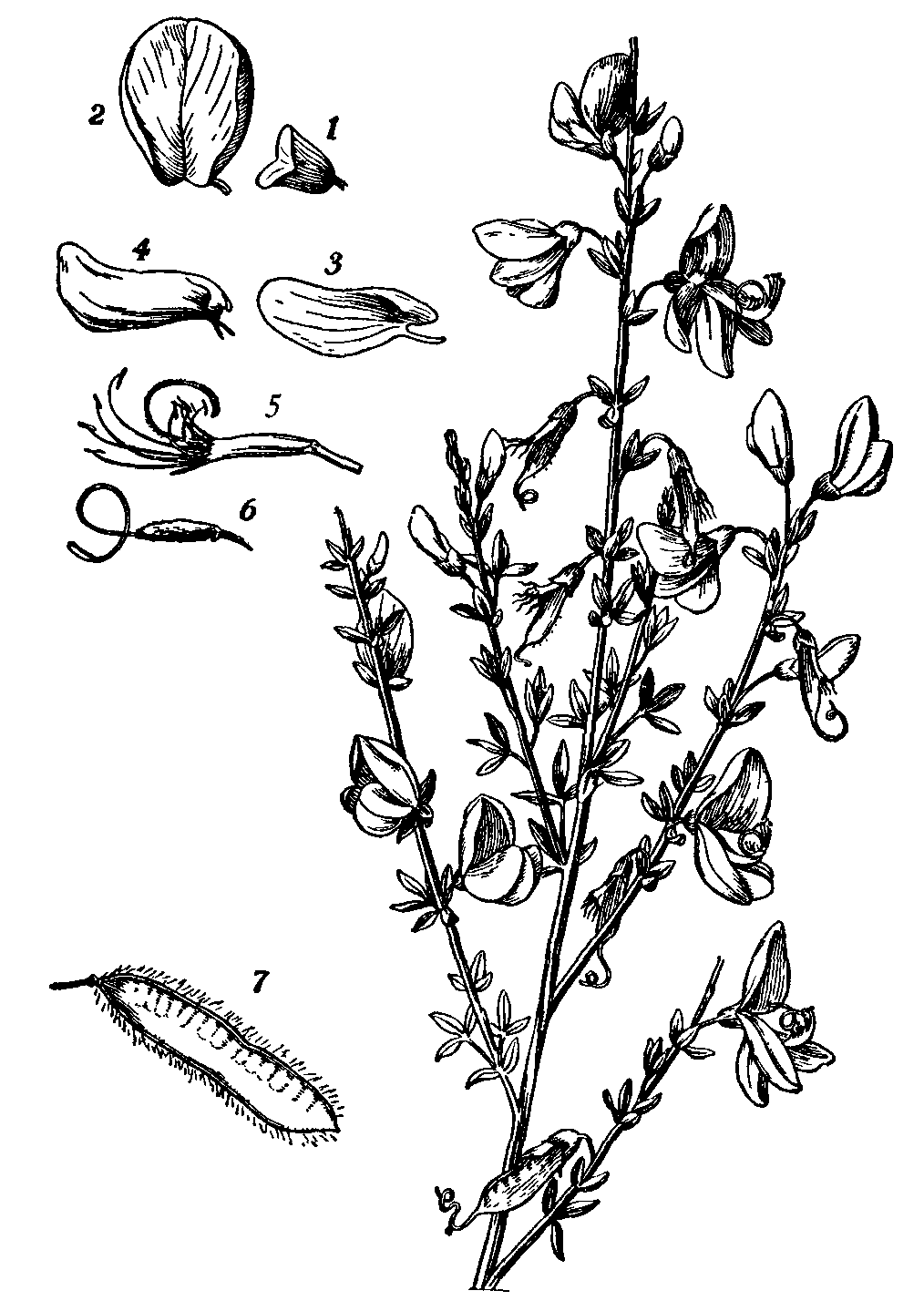
Cytisus scoparius
, Common Broom.
1. Two-lipped calyx.
2. Broadly ovate vexillum or standard.
3. One of the alae or wings of the corolla.
4. Carina or keel.
5. Monadelphous stamens.
6. Hairy ovary with the long style, thickened upwards, and spirally curved.
7. Legume or pod.
BROOM, known botanically as Cytisus, or Sarothamnus, scoparius, a member of the natural order Leguminosae, a shrub found on heaths and commons in the British Isles, and also in Europe (except the north) and temperate Asia. The leaves are small, and the function of carbon-assimilating is shared by the green stems. The bright yellow flowers scatter their pollen by an explosive mechanism; the weight of a bee alighting on the flower causes the keel to split and the pollen to be shot out on to the insect's body. When ripe the black pods explode with a sudden twisting of the valves and scatter the seeds. The twigs have a bitter and nauseous taste and have long had a popular reputation as a diuretic; the seeds have similar properties.
"Butcher's broom," a very different plant, known botanically as Ruscus aculeatus, is a member of the natural order Liliaceae. It is a small evergreen shrub found in copses and woods, but rare in the southern half of England. The stout angular stems bear leaves reduced to small scales, which subtend flattened leaf-like branches (cladodes) with a sharp apex. The small whitish flowers are borne on the face of the cladodes, and are succeeded by a bright red berry.
BROOME, WILLIAM (1689-1745), English scholar and poet, the son of a farmer, was born at Haslington, Cheshire, where he was baptized on the 3rd of May 1689. He was educated at Eton, where he became captain of the school, and at St John's College, Cambridge. He collaborated with John Ozell and William Oldisworth in a translation (1712) of the Iliad from the French version of Madame Dacier, and he contributed in the same year some verses to Lintot's Miscellany. He was introduced to Pope, who was at that time engaged on his translation of the Iliad. Pope asked Broome to make a digest for him of the notes of Eustathius, the 12th-century annotator of Homer. This task Broome executed to Pope's entire satisfaction, refusing any payment. He was rector of Sturston, Norfolk, and his prosperity was further assured by his marriage in 1716 with a rich widow, Mrs Elizabeth Clarke. When Pope undertook the translation of the Odyssey, he engaged Elijah Fenton and Broome to assist him. Broome's facility in verse had gained for him at college the nickname of "the poet," and he adapted his style very closely to Pope's. He translated the 2nd, 6th, 8th, 11th, 12th, 16th, 18th and 23rd books, and practically provided all the notes. He was a vain, talkative man, and did not fail to make known his real share in the translation, of which Pope had given a very misleading account in the "proposals" issued to subscribers. He casually mentioned Broome as his coadjutor, as though his assistance was of an entirely subsidiary character. His influence over Broome was so strong that the latter was induced to write a note at the end of the translation minimizing his own share and implicating Fenton, who, moreover, had not wished his name to appear, in the deception. "If my performance," he said, "has merit either in these [the notes] or in any part of the translation, namely the 6th, 11th and 18th books, it is but just to attribute it to the judgment and care of Mr Pope, by whose hand every sheet was corrected." For the Odyssey Pope received £4500, of which Broome, who had provided a third of the text and the notes, received £570. He had hoped to secure fame from his connexion with Pope, and when he found that Pope had no intention of praising him he complained bitterly of being underpaid. Pope thought that Broome's garrulity had caused the reports which were being circulated to his disadvantage, and ungenerously made satirical allusions to him in the Dunciad[1] and the Bathos. After these insults Broome's patience gave way, and there is a gap in his correspondence with Pope, but in 1730 the intercourse was renewed on friendly terms. In 1728 the degree of LL.D. was conferred on him by the university of Cambridge, and he was presented to the rectory of Pulham, Norfolk, and subsequently by Charles, 1st Earl Cornwallis, who had been his friend at Cambridge, to two livings, Oakley Magna in Essex, and Eye in Suffolk. He died at Bath on the 16th of November 1745.
Broome was also the author of some translations from Anacreon printed in the Gentleman's Magazine, and of Poems on Several Occasions (1727). His poems are included in Johnson's and other collections of the British poets. His connexion with Pope is exhaustively discussed in Elwin and Courthope's edition of Pope's Works (viii. pp. 30-186), where the correspondence between the two is reproduced.
"Hibernian politics, O Swift, thy doom, And Pope's, translating ten whole years with Broome."
In the Bathos he was classed with the parrots and the tortoises.
BROOM-RAPE, known botanically as Orobanche, a genus of brown leafless herbs growing attached to the roots of other plants from which they derive their nourishment. The usually stout stem bears brownish scales, and ends in a spike of yellow, reddish-brown or purplish flowers, with a gaping two-lipped corolla. Several species occur in the British Isles; the largest, Orobanche major, is parasitic on roots of shrubby leguminous plants, and has a stout stem 1 to 2 ft. high.
BROSCH, MORITZ (1829-1907), German historian, was born at Prague on the 7th of April 1829, was educated at Prague and Vienna, and became a journalist. Later he devoted himself to historical study, and he died on the 14th of July 1907 at Venice, where he had resided for over thirty years. To the series Geschichte der europäischen Staaten Brosch contributed England 1509-1550 (6 vols., Gotha, 1884-1899), a continuation of the work of J.M. Lappenberg and R. Pauli, and Der Kirchenstaat (Gotha, 1880-1882). He gave further proof of his interest in English history by writing Lord Bolingbroke und die Whigs und Tories seiner Zeit (Frankfort, 1883), and Oliver Cromwell und die puritanische Revolution (Frankfort, 1886). He also wrote Julius II. und die Gründung des Kirchenstaats (Gotha, 1878), while one of his last pieces of work was to contribute a chapter on "The height of the Ottoman power" to vol. iii. of the Cambridge Modern History.
See A.W. Ward in the English Historical Review, vol. xxii. (1907).
BROSELEY, a market town in the municipal borough of Wenlock (q.v.) and the Wellington (Mid) parliamentary division of Shropshire, England, on the right bank of the Severn. It has a station (Ironbridge and Broseley) on the Great Western railway, 158 m. N.W. from London. There is trade in coal, but the town is most famous for the manufacture of tobacco-pipes, a long-established industry. Pottery and bricks are also produced, and at Benthall, 1 m. W., are large encaustic tile works. The early name of the town was Burwardesley.
BROSSES, CHARLES DE (1709-1777), French magistrate and scholar, was born at Dijon and studied law with a view to the magistracy. The bent of his mind, however, was towards literature and science, and, after a visit to Italy in 1739 in company with his friend Jean Baptiste de Lacurne de Sainte-Palaye, he published his Lettres sur l'état actuel de la mile souterraine d'Herculée (Dijon, 1750), the first work upon the ruins of Herculaneum. It was during this Italian tour that he wrote his famous letters on Italy, which remained in MS. till long after his death. In 1760 he published a dissertation, Du culte des dieux fétiches, which was afterwards inserted in the Encyclopédie méthodique. At the solicitation of his friend Buffon, he undertook his Histoire des navigations aux terres australes, which was published in 1756, in two vols. 4to, with maps. It was in this work that de Brosses first laid down the geographical divisions of Australasia and Polynesia, which were afterwards adopted by John Pinkerton and succeeding geographers. He also contributed to the Encyclopédie the articles "Langues," "Musique," "Étymologic." In 1765 appeared his work on the origin of language, Traite de la formation mécanique des langues, the merits of which are recognized by E. B. Tylor in Primitive Culture. De Brosses had been occupied, during a great part of his life, on a translation of Sallust, and in attempting to supply the lost chapters in that celebrated historian. At length in 1777 he published L'Histoire du septième siècle de la république romaine, 3 vols. 4to, to which is prefixed a learned life of Sallust, reprinted at the commencement of the translation of that historian by Jean Baptiste Dureau de La Malle. These literary occupations did not prevent the author from discharging with ability his official duties as first president of the parliament of Burgundy, nor from carrying on a constant and extensive correspondence with the most distinguished literary characters of his time. In 1758 he succeeded the marquis de Caumont in the Académie des Belles-lettres; but when in 1770 he presented himself at the French Academy, his candidature was rejected owing to Voltaire's opposition on personal grounds. Besides the works already mentioned, he wrote several memoirs and dissertations in the collections of the Academy of Inscriptions, and in those of the Academy of Dijon, and he left behind him several MSS., which were unfortunately lost during the Revolution. His letters on Italy were, however, found in MS. in the confiscated library by his son, the émigré officer René de Brosses, and were first published in 1799, in the uncritical edition of Antoine Serieys, under the title of Lettres historiques et critiques. A fresh edition, freed from errors and interpolations, by R. Colomb, with the title L'Italie il y a cent ans, was issued in 1836; and two subsequent reprints appeared, one edited by Poulet-Malassis, under the title Lettres familières (1858); the other, a re-impression of Colomb's edition, under that of Le Président de Brosses en Italic (1858).
See H. Mamet, Le President de Brosses, sa vie et ses ouvrages (Lille, 1874); also Cunisset-Carnot, "La Querelle de Voltaire et du président de Brosses," in the Revue des Deux Mondes (February 15, 1888).
BROTHER, a male person in his relation to the other children of the same father and mother. "Brother" represents in English the Teutonic branch of a word common to the Indo-European languages, of. Ger. Bruder, Dutch broeder, Dan. and Swed. broder, &c. In Celtic languages, Gaelic and Irish have brathair, and Welsh brawd; in Greek the word is φράτηρ, in Lat. frater, from which come the Romanic forms, Fr. frère, Ital. fratello; the Span. fray, Port. frei, like the Ital. frate, fra, are only used of "friars." The Span. hermano and the Port. irmāo, the regular words for brother, are from Lat. germanus, born of the same father and mother. The Sanskrit word is bhrātār, and the ultimate Indo-European root is generally taken to be bhar, to bear (cf. M. H. Ger. barn, Scot, bairn, child, and such words as "birth," "burden"). "Brother" has often been loosely used of kinsmen generally, or for members of the same tribe; also for quite fictitious relationships, e.g. "blood-brothers," through a sacramental rite of mutual blood-tasting, "foster-brothers," because suckled by the same nurse. Christianity, through the idea of the universal fatherhood of God, conceives all men as brothers; but in a narrower sense "the brethren" are the members of the Church, or, in a narrower still, of a confraternity or "brotherhood" within the Church. This latter idea is reproduced in those fraternal societies, e.g. the Freemasons, the members of which become "brothers" by initiation. "Brother" is also used symbolically, as implying equality, by sovereigns in addressing one another, and also by bishops.
BROTHERS, RICHARD (1757-1824), British religious fanatic, was born in Newfoundland on Christmas day, 1757, and educated at Woolwich. He entered the navy and served under Keppel and Rodney. In 1783 he became lieutenant, and was discharged on half-pay. He travelled on the continent, made an unhappy marriage in 1786, and again went to sea. But he felt that the military calling and Christianity were incompatible and abandoned the former (1789). Further scruples as to the oath required on the receipt of his half-pay reduced him to serious pecuniary straits (1791), and he divided his time between the open air and the workhouse, where he developed the idea that he had a special divine commission, and wrote to the king and the parliament to that effect. In 1793 he declared himself the apostle of a new religion, "the nephew of the Almighty, and prince of the Hebrews, appointed to lead them to the land of Canaan." At the end of 1794 he began to print his interpretations of prophecy, his first book being A Revealed Knowledge of the Prophecies and Times. In consequence of prophesying the death of the king and the end of the monarchy, he was arrested for treason in 1795, and confined as a criminal lunatic. His case was, however, brought before parliament by his ardent disciple, Nathaniel Halhed, the orientalist, a member of the House of Commons, and he was removed to a private asylum in Islington. Here he wrote a variety of prophetic pamphlets, which gained him many believers, amongst them William Sharp, the engraver, who afterwards deserted him for Joanna Southcott. Brothers, however, had announced that on the 19th of November 1795 he was to be "revealed" as prince of the Hebrews and ruler of the world; and when this date passed without any such manifestation, what enthusiasm he had aroused rapidly dwindled, despite the fact that some of his earlier political predictions (e.g. the violent death of Louis XVI.) had been fulfilled. He died in London on the 25th of January 1824, in the house of John Finlayson, who had secured his release, and who afterwards pestered the government with an enormous claim for Brothers's maintenance. The supporters of the Anglo-Israelite theory claim him as the first writer on their side.
BROTHERS OF COMMON LIFE, a religious community formerly existing in the Catholic Church. Towards the end of his career Gerhard Groot (q.v.) retired to his native town of Deventer, in the province of Overyssel and the diocese of Utrecht, and gathered about him a number of those who had been "converted" by his preaching or wished to place themselves under his spiritual guidance. With the assistance of Florentius Radewyn, who resigned for the purpose a canonry at Utrecht, he was able to carry out a long-cherished idea of establishing a house wherein devout men might live in community without the monastic vows. The first such community was established at Deventer in the house of Floentius himself (c. 1380); and Thomas à Kempis, who lived in it from 1392 to 1399, has left a description of the manner of life pursued:—
"They humbly imitated the manner of the Apostolic life, and having one heart and mind in God, brought every man what was his own into the common stock, and receiving simple food and clothing avoided taking thought for the morrow. Of their own will they devoted themselves to God, and all busied themselves in obeying their rector or his vicar .... They laboured carefully in copying books, being instant continually in sacred study and devout meditation. In the morning, having said Matins, they went to the church (for Mass) .... Some who were priests and were learned in the divine law preached earnestly in the church."
Other houses of the Brothers of Common Life, otherwise called the "Modern Devotion," were in rapid succession established in the chief cities of the Low Countries and north and central Germany, so that there were in all upwards of forty houses of men; while those of women doubled that figure, the first having been founded by Groot himself at Deventer.
The ground-idea was to reproduce the life of the first Christians as described in Acts iv. The members took no vows and were free to leave when they chose; but so long as they remained they were bound to observe chastity, to practise personal poverty, putting all their money and earnings into the common fund, to obey the rules of the house and the commands of the rector, and to exercise themselves in self-denial, humility and piety. The rector was chosen by the community and was not necessarily a priest, though in each house there were a few priests and clerics. The majority, however, were laymen, of all kinds and degrees—nobles, artisans, scholars, students, labouring men. The clerics preached and instructed the people, working chiefly among the poor; they also devoted themselves to the copying of manuscripts, in order thereby to earn something for the common fund; and some of them taught in the schools. Of the laymen, the educated copied manuscripts, the others worked at various handicrafts or at agriculture. After the religious services of the morning the Brothers scattered for the day's work, the artisans going to the workshops in the city,—for the idea was to live and work in the world, and not separated from it, like the monks. Their rule was that they had to earn their livelihood, and must not beg. This feature seemed a reflection on the mendicant orders, and the idea of a community life without vows and not in isolation from everyday life, was looked upon as something new and strange, and even as bearing affinities to the Beghards and other sects, at that time causing trouble to both Church and state. And so opposition arose to the Modern Devotion, and the controversy was carried to the legal faculty at Cologne University, which gave a judgment strongly in their favour. The question, for all that, was not finally settled until the council of Constance (1414), when their cause was triumphantly defended by Pierre d'Ailly and Gerson. For a century after this the Modern Devotion flourished exceedingly, and its influence on the revival of religion in the Netherlands and north Germany in the 15th century was wide and deep. It has been the fashion to treat Groot and the Brothers of Common Life as "Reformers before the Reformation"; but Schulze, in the Protestant Realencyklopädie, is surely right in pronouncing this view quite unhistorical—except on the theory that all interior spiritual religion is Protestant: he shows that at the Reformation hardly any of the Brothers embraced Lutheranism, only a single community going over as a body to the new religion. During the second half of the 16th century the institute gradually declined, and by the middle of the 17th all its houses had ceased to exist.
Authorities.—The chief authorities are Thomas à Kempis, Lives of Groot and his Disciples and Chronicle of Mount St Agnes (both works translated by J.P. Arthur, the former under the title Founders of the New Devotion, 1905); Busch, Chronicle of Windesheim (ed. Grube, 1887). Much has been written on the subject in Dutch and German; in English, S. Kettlewell, Thomas à Kempis and the Brothers of Common Life (1882) (but see Arthur in the Prefaces to above-named books); for a shorter sketch, F.R. Cruise, Thomas à Kempis (1887). An excellent article in Herzog-Hauck, Realencyklopädie (3rd ed.), "Brüder des gemeinsamen Lebens," supplies copious information with references to all the literature; see also Max Heimbucher, Orden und Kongregationen (1897), ii. § 123. The part played by the Brothers of Common Life in the religious and educational movements of the time may be studied in Ludwig Pastor's History of the Popes from the close of the Middle Ages, or J. Janssen's History of the German People.
(E. C. B.)
BROUGH, ROBERT (1872-1905), British painter, was born at Invergordon, Ross-shire. He was educated at Aberdeen, and, whilst apprenticed for over six years as lithographer to Messrs Gibb & Co., attended the night classes at the local art school. He then entered the Royal Scottish Academy, and in the first year took the Stuart prize for figure painting, the Chalmers painting bursary, and the Maclaine-Walters medal for composition. After two years in Paris under J.P. Laurens and Benjamin-Constant at Julian's atelier, he settled in Aberdeen in 1894 as a portrait painter and political cartoonist. A portrait of Mr W.D. Ross first drew attention to his talent in 1896, and in the following year he scored a marked success at the Royal Academy with his "Fantaisie en Folie," now at the National Gallery of British Art (Tate Gallery). Two of his paintings, "'Twixt Sun and Moon" and "Childhood of St Anne of Brittany," are at the Venice municipal gallery. Brough's art is influenced by Raeburn and by modern French training, but it strikes a very personal note. Robert Brough met his death from injuries received in a railway disaster in 1905, his early death being a notable loss to British art.
BROUGHAM, JOHN (1814-1880), British actor, was born at Dublin on the 9th of May 1814, and was educated for a surgeon. Owing to family misfortunes he was thrown upon his own resources and made his first appearance on the London stage in 1830, at the Tottenham Street theatre in Tom and Jerry, in which he played six characters. In 1831 he was a member of Madame Vestris's company, and wrote his first play, a burlesque. He remained with Madame Vestris as long as she and Charles Mathews retained Covent Garden, and he collaborated with Dion Boucicault in writing London Assurance, Dazzle being one of his best parts. In 1840 he managed the Lyceum theatre, for which he wrote several light burlesques, but in 1842 he moved to the United States, where he became a member of W.E. Burton's company, for which he wrote several comedies. Later he was the manager of Niblo's Garden, and in 1850 opened Brougham's Lyceum, which, like his next speculation, the lease of the Bowery theatre, was not financially a success. He was later connected with Wallack's and Daly's theatres, and wrote plays for both. In 1860 he returned to London, where he adapted or wrote several plays, including The Duke's Motto for Fechter. After the Civil War he returned to New York. Brougham's theatre was opened in 1869 with his comedy Better Late than Never, but this managerial experience was also unfortunate, and he took to playing with various stock companies. His last appearance was in 1879 as O'Reilly, the detective, in Boucicault's Rescued, and he died in New York on the 7th of June 1880. Brougham was the author of nearly 100 plays, most of them now forgotten. He was the founder of the Lotus Club in New York, and for a time its president. He also edited there in 1852 a comic paper called The Lantern, and published two collections of miscellaneous writings, A Basket of Chips and The Bunsby Papers. Brougham is said to have been the original of Harry Lorrequer in Charles Lever's novel. He was twice married, in 1838 to Emma Williams (d. 1865), and in 1844 to Mrs Annette Hawley (d. 1870), both actresses.
BROUGHAM, a four-wheeled closed carriage, seating two or more persons, and drawn by a single horse or pair, or propelled by motor. The modern "brougham" has developed and taken its name from the "odd little kind of garden-chair" described by Thomas Moore, which the first Lord Brougham had made by a coachmaker to his own design.
BROUGHAM AND VAUX, HENRY PETER BROUGHAM, 1st Baron (1778-1868), lord chancellor of England, was born at Edinburgh on the 19th of September 1778. He was the eldest son of Henry Brougham and Eleanora, daughter of the Rev. James Syme. In his later years he was wont to trace his paternal descent to Uduardus de Broham, in the reign of Henry II., but no real connexion has been established between the ancient lords of Brougham castle, whose inheritance passed by marriage from the Viponts into the family of the De Cliffords, and the Broughams of Scales Hall, from whom the chancellor was really descended. Entering the high school of Edinburgh when barely seven, he left, having risen to be head of the school, in 1791. He entered the university of Edinburgh in 1792, and devoted himself chiefly to the study of natural science and mathematics, contributing in 1795 a paper to the Royal Society on some new phenomenon of light and colours, which was printed in the Transactions of that body. A paper on porisms was published in the same manner in 1798, and in 1803 his scientific reputation was so far established that he was elected F.R.S., But in spite of his taste for mathematical reasoning, Brougham's mind was not an accurate or exact one; and his pursuit of physical science was rather a favourite recreation than a solid advantage to him.
For two years of his university career he had attended lectures in civil law, and having adopted law as a profession he was admitted to the faculty of advocates in 1800. It does not appear that he ever held a brief in the court of session, but he went a circuit or two, where he defended or prosecuted a few prisoners, and played a series of tricks on the presiding judge, Lord Eskgrove, which almost drove that learned person to distraction. The Scottish bar, however, as he soon perceived, offered no field sufficiently ample for his talents and his ambition. He resolved to go to London, where he had already appeared as junior counsel in a Scottish appeal to the House of Lords. In 1803 he entered at Lincoln's Inn, and in 1808 he was called to the English bar. In the meantime he had turned to literature as a means of subsistence. When in 1802 the Edinburgh Review was founded by the young and aspiring lights of the northern metropolis, Brougham was the most ready, the most versatile and the most satirical of all its contributors. To the first twenty numbers he contributed eighty articles, wandering through every imaginable subject,—science, politics, colonial policy, literature, poetry, surgery, mathematics and the fine arts. The prodigious success of the Review, and the power he was known to wield in it, made him a man of mark from his first arrival in London. He obtained the friendship of Lord Grey and the leading Whig politicians. His wit and gaiety made him an ornament of society, and he sought to extend his literary and political reputation by the publication of an elaborate work on the colonial policy of the empire. In 1806, Fox being then in office, he was appointed secretary to a mission of Lord Rosslyn and Lord St Vincent to the court of Lisbon, with a view to counteract the anticipated French invasion of Portugal. The mission lasted two or three months; Brougham came home out of humour and out of pocket; and meantime the death of Fox put an end to the hopes of the Whigs.
Brougham was disappointed by the abrupt fall of the ministry, and piqued that his Whig friends had not provided him with a seat in parliament. Nevertheless, he exerted his pen with prodigious activity during the election of 1809; and Lord Holland declared that he had filled the booksellers' shops with articles and pamphlets. The result was small. No seat was placed at his disposal, and he was too poor to contest a borough. He was fortunate at this time to ally himself with the movement for the abolition of the slave-trade, and he remained through life not only faithful, but passionately attached to the cause. Indeed, one of the first measures he carried in the House of Commons was a bill to make the slave-trade felony, and he had the happiness, as chancellor of England, to take a part in the final measure of negro emancipation throughout the colonies.
Previous to his entering on practice at the English bar, Brougham had acquired some knowledge of international law, and some experience of the prize courts. This circumstance probably led to his being retained as counsel for the Liverpool merchants who had petitioned both Houses of Parliament against the Orders in Council. Brougham conducted the lengthened inquiry which took place at the bar of the House, and he displayed on this occasion a mastery over the principles of political economy and international law which at that time was rare. Nevertheless, he was unsuccessful, and it was not until 1812, when he was himself in parliament, that he resumed his attack on the Orders in Council, and ultimately conquered. It was considered inexpedient and impossible that a man so gifted, and so popular as Brougham had now become, should remain out of parliament, and by the influence of Lord Holland the duke of Bedford was induced to return him to the House of Commons for the borough of Camelford. He took his seat early in 1810, having made a vow that he would not open his mouth for a month. The vow was kept, but kept for that month only. He spoke in March in condemnation of the conduct of Lord Chatham at Walcheren, and he went on speaking for the rest of his life. In four months, such was the position he had acquired in the House that he was regarded as a candidate for the leadership of the Liberal party, then in the feeble hands of George Ponsonby. However, the Tories continued in power. Parliament was dissolved. Camelford passed into other hands. Brougham was induced to stand for Liverpool, with Thomas Creevey against Canning and General Gascoyne. The Liberals were defeated by a large majority, and what made the sting of defeat more keen was that Creevey retained his old seat for Thetford, while Brougham was left out in the cold.
He remained out of parliament during the four eventful years from 1812 to 1816, which witnessed the termination of the war, and he did not conceal his resentment against the Whigs. But in the years he spent out of parliament occurrences took place which gave ample employment to his bustling activity, and led the way to one of the most important passages of his life. He had been introduced in 1809 to the princess of Wales (afterwards Queen Caroline). But it was not till 1812 that the princess consulted him on her private affairs, after the rupture between the prince regent and the Whigs had become more decided. From that time, Brougham, in conjunction with Samuel Whitbread, became one of the princess's chief advisers; he was attached to her service, not so much from any great liking or respect for herself, as from an indignant sense of the wrongs and insults inflicted upon her by her husband. Brougham strongly opposed her departure from England in 1814, as well as her return in 1820 on the accession of George IV.
In 1816 he had again been returned to parliament for Winchelsea, a borough of the earl of Darlington, and he instantly resumed a commanding position in the House of Commons. He succeeded in defeating the continuance of the income-tax; he distinguished himself as an advocate for the education of the people; and on the death of Romilly he took up with ardour the great work of the reform of the law. Nothing exasperated the Tory party more than the select committee which sat, with Brougham in the chair, in 1816 and the three following years, to investigate the state of education of the poor in the metropolis. But he was as far as ever from obtaining the leadership of the party to which he aspired. Indeed, as was pointed out by Lord Lansdowne in 1817, the opposition had no recognized efficient leaders; their warfare was carried on in separate courses, indulging their own tastes and tempers, without combined action. Nor was Brougham much more successful at the bar. The death of George III. suddenly changed this state of things. Queen Caroline at once, in April 1820, appointed Brougham her attorney-general, and Denman her solicitor-general; and they immediately took their rank in court accordingly; this was indeed the sole act of royal authority on the part of the unhappy queen. In July Queen Caroline came from St Omer to England; ministers sent down to both Houses of Parliament the secret evidence which they had long been collecting against her; and a bill was brought into the House of Lords for the deposition of the queen, and the dissolution of the king's marriage. The defence of the queen was conducted by Brougham, assisted by Denman, Lushington and Wilde, with equal courage and ability. His conduct of the defence was most able, and he wound up the proceedings with a speech of extraordinary power and effect. The peroration was said to have been written and rewritten by him seventeen times. At moments of great excitement such declamation may be of value, and in 1820 it was both heard and read with enthusiasm. But to the calmer judgment of later generations this celebrated oration seems turgid and overstrained. Such immense popular sympathy prevailed on the queen's behalf, that the ministry did not proceed with the bill in the Commons, and the result was a virtual triumph for the queen.
This victory over the court and the ministry raised Henry Brougham at once to the pinnacle of fame. He shared the triumph of the queen. His portrait was in every shop window. A piece of plate was presented to him, paid for by a penny subscription of peasants and mechanics. He refused to accept a sum of £4000 which the queen herself placed at his disposal; he took no more than the usual fees of counsel, while his salary as Her Majesty's attorney-general remained unpaid, until it was discharged by the treasury after her death. But from that moment his fortune was made at the bar. His practice on the northern circuit quintupled. One of his finest speeches was a defence of a Durham newspaper which had attacked the clergy for refusing to allow the bells of churches to be tolled on the queen's death; and by the admission of Lord Campbell, a rival advocate and an unfriendly critic, he rose suddenly to a position unexampled in the profession. The meanness of George IV. and of Lord Eldon refused him the silk gown to which his position at the bar entitled him, and for some years he led the circuit as an outer barrister, to the great loss of the senior members of the circuit, who could only be employed against him. His practice rose to about £7000 a year, but it was again falling off before he became chancellor.
It may here be mentioned that in 1825 the first steps were taken, under the auspices of Brougham, for the establishment of a university in London, absolutely free from all religious or sectarian distinctions. In 1827 he contributed to found the "Society for the Diffusion of Useful Knowledge"—an association which gave an immense impulse to sound popular literature. Its first publication was an essay on the "Pleasures and Advantages of Science" written by himself. In the following year (1828) he delivered his great speech on law reform, which lasted six hours, in a thin and exhausted House,—a marvellous effort, embracing every part of the existing system of judicature.
The death of Canning, the failure of Lord Goderich, and the accession of the duke of Wellington to power, again changed the aspect of affairs. The progress of the movement for parliamentary reform had numbered the days of the Tory government. At the general election of 1830 the county of York spontaneously returned Brougham to the new House of Commons as their representative. The parliament met in November. Brougham's first act was to move for leave to bring in a bill to amend the representation of the people; but before the debate came on the government was defeated on another question; the duke resigned, and Earl Grey was commanded by William IV. to form an administration.
Amongst the difficulties of the new premier and the Whig party were the position and attitude of Brougham. He was not the leader of any party, and had no personal following in the House of Commons. Moreover, he himself had repeatedly declared that nothing would induce him to exchange his position as an independent member of parliament for any office, however great. On the day following the resignation of the Tory government, he reluctantly consented to postpone for one week his motion on parliamentary reform. The attorney-generalship was offered to him and indignantly refused. He himself affirms that he desired to be master of the rolls, which would have left him free to sit in the House of Commons. But this was positively interdicted by the king, and objected to by Lord Althorp, who declared that he could not undertake to lead the House with so insubordinate a follower behind him. But as it was impossible to leave Brougham out of the ministry, it was determined to offer him the chancellorship. Brougham himself hesitated, or affected to hesitate, but finally yielded to the representations of Lord Grey and Lord Althorp. On the 22nd of November the great seal was delivered to him by the king, and he was raised to the peerage as Baron Brougham and Vaux. His chancellorship lasted exactly four years.
Lord Brougham took a most active and prominent part in all the great measures promoted by Grey's government, and the passing of the Reform Bill was due in a great measure to the vigour with which he defended it. But success developed traits which had hitherto been kept in the background. His manner became dictatorial and he exhibited a restless eccentricity, and a passion for interfering with every department of state, which alarmed the king. By his insatiable activity he had contrived to monopolize the authority and popularity of the government, and notwithstanding the immense majority by which it was supported in the reformed parliament, a crisis was not long in arriving. Lord Grey resigned, but very much by Brougham's exertions the cabinet was reconstructed under Lord Melbourne, and he appeared to think that his own influence in it would be increased. But the irritability of his temper and the egotism of his character made it impossible for his colleagues to work with him, and the extreme mental excitement under which he laboured at this time culminated during a journey to Scotland in a behaviour so extravagant, that it gave the final stroke to the confidence of the king. At Lancaster he joined the bar-mess, and spent the night in an orgy. In a country house he lost the great seal, and found it again in a game of blindman's-buff. At Edinburgh, in spite of the coldness which had sprung up between himself and the Grey family, he was present at a banquet given to the late premier, and delivered a harangue on his own services and his public virtue. All this time he continued to correspond with the king in a strain which created the utmost irritation and amazement at Windsor.
Shortly after the meeting of parliament in November the king dismissed his ministers. The chancellor, who had dined at Holland House, called on Lord Melbourne on his way home, and learned the intelligence. Melbourne made him promise that he would keep it a secret until the morrow, but the moment he quitted the ex-premier he sent a paragraph to The Times relating the occurrence, and adding that "the queen had done it all." That statement, which was totally unfounded, was the last act of his official life. The Peel ministry, prematurely and rashly summoned to power, was of no long duration, and Brougham naturally took an active part in overthrowing it. Lord Melbourne was called upon in April 1835 to reconstruct the Whig government with his former colleagues. But, formidable as he might be as an opponent, the Whigs had learned by experience that Brougham was even more dangerous to them as an ally, and with one accord they resolved that he should not hold the great seal or any other office. The great seal was put in commission, to divert for a time his resentment, and leave him, if he chose, to entertain hopes of recovering it. These hopes, however, were soon dissipated; and although the late chancellor assumed an independent position in the House of Lords, and even affected to protect the government, his resentment against his "noble friends" soon broke out with uncontrolled vehemence. Throughout the session of 1835 his activity was undiminished. Bills for every imaginable purpose were thrown by him on the table of the House, and it stands recorded in Hansard that he made no less than 221 reported speeches in parliament in that year. But in the course of the vacation a heavier blow was struck: Lord Cottenham was made lord chancellor. Brougham's daring and arrogant spirit sank for a time under the shock, and during the year 1836 he never spoke in parliament. Among the numerous expedients resorted to in order to keep his name before the public, was a false report of his death by a carriage accident, sent up from Westmorland in 1839. He was accused, with great probability, of being himself the author of the report. Such credence did it obtain that all the newspapers of October 22, excepting The Times, had obituary notices. However, for more than thirty years after his fall he continued to take an active part in the judicial business of the House of Lords, and in its debates; but it would have been better for his reputation if he had died earlier. His reappearance in parliament on the accession of Queen Victoria was marked by sneers at the court, and violent attacks on the Whigs for their loyal and enthusiastic attachment to their young sovereign; and upon the outbreak of the insurrection in Canada, and the miscarriage of Lord Durham's mission, he overwhelmed his former colleagues, and especially Lord Glenelg, with a torrent of invective and sarcasm, equal in point of oratory to the greatest of his earlier speeches. Indeed, without avowedly relinquishing his political principles, Brougham estranged himself from the whole party by which those principles were defended; and his conduct in general during the years following his loss of office revealed his character in a very unfavourable light. He continued, however, to render judicial services in the privy council, and the House of Lords. The privy council, especially when hearing appeals from the colonies, India, and the courts maritime and ecclesiastical was his favourite tribunal; its vast range of jurisdiction, varied by questions of foreign and international law, suited his discursive genius. He had remodelled the judicial committee in 1833, and it still remains one of the most useful of his creations.
In the year 1860 a second patent was conferred upon him by Queen Victoria, with a reversion of his peerage to his youngest brother, William Brougham (d. 1886). The preamble of this patent stated that this unusual mark of honour was conferred upon him by the crown as an acknowledgment of the great services he had rendered, more especially in promoting the abolition of slavery, and the emancipation of the negro race. The peerage was thus perpetuated in a junior branch of the family, Lord Brougham himself being without an heir. He had married in 1821 Mrs Spalding (d. 1865), daughter of Thomas Eden, and had two daughters, the survivor of whom died in 1839. Brougham's last days were passed at Cannes, in the south of France. An accident having attracted his attention to the spot about the year 1838, when it was little more than a fishing village on a picturesque coast, he bought there a tract of land and built on it. His choice and his example made it the sanatorium of Europe. He died there on the 7th of May 1868, in the ninetieth year of his age.
The verdict of the time has proved that there was nothing of permanence, and little of originality in the prodigious efforts of Brougham's genius. He filled the office of chancellor during times burning with excitement, and he himself embodied and expressed the fervour of the times. He affected at first to treat the business of the court of chancery as a light affair, though in truth he had to work hard to master the principles of equity, of which he had no experience. His manner in court was desultory and dictatorial. Sometimes he would crouch in his chair, muffled in his wig and robes, like a man asleep; at other times he would burst into restless activity, writing letters, working problems, interrupting counsel. But upon the whole Brougham was a just and able judge, though few of his decisions are cited as landmarks of the law.
As a parliamentary figure Brougham's personality excited for many years an immense amount of public interest, now somewhat hard to comprehend. His boundless command of language, his animal spirits and social powers, his audacity and well-stored memory enabled him to dominate the situation. His striking and almost grotesque personal appearance, added to the effect of his voice and manner—a tall disjointed frame, with strong bony limbs and hands, that seemed to interpret the power of his address; strange angular motions of the arms; the incessant jerk of his harsh but expressive features; the modulations of his voice, now thundering in the loudest tones of indignation, now subdued to a whisper—all contributed to give him the magical influence such as is excited by a great actor. But his eccentricity rose at times to the verge of insanity; and with all his powers he lacked the moral elevation which inspires confidence and wins respect.
The activity of Lord Brougham's pen was only second to the volubility of his tongue. He carried on a vast and incessant correspondence of incredible extent. For thirty years he contributed largely to the Edinburgh Review, and he continued to write in that journal even after he held the great seal. The best of his writings, entitled "Sketches of the Statesmen of the time of George III.", first appeared in the Review. These were followed by the "Lives of Men of Letters and Science," of the same period. Later in life he edited Paley's Natural Theology; and he published a work on political philosophy, besides innumerable pamphlets and letters to public men on the events of the day. He published an incorrect translation of Demosthenes' De Corona. A novel entitled Albert Lunel was attributed to him. A fragment of the History of England under the House of Lancaster employed his retirement. In 1838 was published an edition of his speeches in four volumes, elaborately corrected by himself. The last of his works was his posthumous Autobiography. Ambitious as he was of literary fame, and jealous of the success of other authors, he has failed to obtain any lasting place in English literature. His style was slovenly, involved and incorrect; and his composition bore marks of haste and carelessness, and nowhere shows any genuine originality of thought. The collected edition of his works and speeches carefully revised by himself (Edinburgh, 1857 and 1872) is the best. His Autobiography is of some value from the original letters with which it is interspersed. But Lord Brougham's memory was so much impaired when he began to write his recollections that no reliance can be placed on his statements, and the work abounds in manifest errors. Nor was his regard for truth at any time unimpeachable, and the accounts which he gave of more than one transaction in which he played a prominent part were found on investigation to be unfounded.
The best modern account of Brougham is J.B. Atlay's, in his Victorian Chancellors (1906); Lord Campbell's, in Lives of the Chancellors, is spiteful, and by an unfriendly though well-informed critic; the Rev. W. Hunt's judicious and careful biography in the D.N.B. is somewhat lacking in colour; Henry Reeve's article in the 9th ed. of the Ency. Brit., which is frequently drawn upon above, now requires a good many corrections in points of fact and perspective, but gives a brilliant picture by an appreciative critic, much "behind the scenes." See also references in the Greville Memoirs and Creevey Papers; S. Walpole, History of England (1890); J.A. Roebuck, History of the Whig Ministry (1852); Lord Holland, Memoirs of the Whig Party (1854); Brougham and his Early Friends: Letters to James Loch, 1798-1809 (3 vols., London, 1908, privately printed).
BROUGHTON, HUGH (1549-1612), English scholar and divine, was born at Owlbury, Bishop's Castle, Shropshire, in 1549. He was educated by Bernard Gilpin at Houghton-le-Spring and at Cambridge, where he became fellow of St John's and then of Christ's, and took orders. Here he laid the foundation of the Hebrew scholarship for which he was afterwards so distinguished. From Cambridge he went to London, where his eloquence gained him many and powerful friends. In 1588 he published his first work, "a little book of great pains," entitled A Concent of Scripture. This work, dealing with biblical chronology and textual criticism, was attacked at both universities, and the author was obliged to defend it in a series of lectures. In 1589 he went to Germany, where he frequently engaged in discussions both with Romanists and with the learned Jews whom he met at Frankfort and elsewhere. In 1591 he returned to England, but his Puritan leanings incurred the hostility of Whitgift. Accordingly in 1592 he once more went abroad, and cultivated the acquaintance of the principal scholars of Europe, including Scaligeri and Rabbi Elias. Such was the esteem in which he was held, even by his opponents, that he might have had a cardinal's hat if he had been willing to change his faith. In 1599 he published his "Explication" of the article "He descended into hell," in which he maintained that Hades means simply the abode of departed spirits, not the place of torment. On the accession of James he returned to England; but not being engaged to co-operate in the new translation of the Bible (though he had for some years planned a similar work), he retired to Middleburg in Holland, where he preached to the English congregation. In 1611 he returned to England, where he died on the 4th of August 1612.
Some of his works were collected and published in a large folio volume in 1662, with a sketch of his life by John Lightfoot, but many of his theological MSS. remain still unedited in the British Museum.
BROUGHTON, JOHN CAM HOBHOUSE, Baron (1786-1869), English writer and politician, was the eldest son of Sir Benjamin Hobhouse, Bart., by his wife Charlotte, daughter of Samuel Cam of Chantry House, Bradford, Wiltshire. Born at Bristol on the 27th of June 1786, he was educated at Westminster school and Trinity College, Cambridge, where he graduated in 1808. He took the Hulsean prize in 1808 for his Essay on the Origin and Intention of Sacrifices. At Cambridge he founded the "Whig Club," and the "Amicable Society," and became very intimate with Byron, who accompanied him on a tour in Spain, Greece and Turkey in 1809. Hobhouse was present at the battle of Dresden in August 1813, and, following the allied army into France, saw Louis XVIII. enter Paris in May 1814. He was again in Paris after the return of Napoleon from Elba, and showed his dislike of the Bourbons and his sympathy with Bonaparte by writing in 1816 a pamphlet entitled The substance of some letters written by an Englishman resident in Paris during the last reign of the emperor Napoleon. This caused some offence in England and more in France, and the French translation was seized by the government and both translator and printer were imprisoned. A further period of travel with Byron followed, and at this time Hobhouse wrote some notes to the fourth canto of Childe Harold. This canto was afterwards dedicated to him, and a revised edition of a part of his notes entitled Historical illustrations of the fourth canto of "Childe Harold" containing dissertations on the ruins of Rome and an essay on Italian literature, was published in 1818. In February 1819 Hobhouse was the Radical candidate at a by-election for the representation of the city of Westminster, but he failed to secure election. He had already gained some popularity by writing in favour of reform, and in 1819 he issued A defence of the People in reply to Lord Erskine's "Two Defences of the Whigs," followed by A trifling mistake in Thomas, Lord Erskine's recent preface. The House of Commons declared this latter pamphlet a breach of privilege; its author was arrested on the 14th of December 1819, and in spite of an appeal to the court of king's bench he remained in custody until the end of the following February. But this proceeding only increased his popularity, and at the general election of 1820 he was returned for Westminster. Hobhouse shared Byron's enthusiasm for the liberation of Greece; after the poet's death in 1824 he proved his will, and superintended the arrangements for his funeral. In parliament he proved a valuable recruit to the party of reform; and having succeeded his father as 2nd baronet in 1831, was appointed secretary at war in the ministry of Earl Grey in February 1832, and was made a privy councillor. He effected some reforms and economies during his tenure of this office, but, unable to carry out all his wishes, became chief secretary for Ireland in March 1833. He had only held this post for a few weeks when, in consequence of his refusal to vote with the government against the abolition of the house and window tax, he resigned both his office and his seat in parliament. At the subsequent election he was defeated, but joined the cabinet as first commissioner of woods and forests when Lord Melbourne took office in July 1834, and about the same time was returned at a by-election as one of the members for Nottingham. In Melbourne's government of 1835 he was president of the board of control, in which position he strongly supported the Indian policy of Lord Auckland; he returned to the same office in July 1846 as a member of Lord John Russell's cabinet; and in February 1851 he went to the House of Lords as Baron Broughton of Broughton Gyfford. He left office when Russell resigned in February 1852, and took little part in political life, being mainly occupied in literary pursuits and in correspondence. He died in London on the 3rd of June 1869.
He had married in July 1828 Lady Julia Tomlinson Hay, daughter of George, 7th marquess of Tweeddale, by whom he had three daughters, but being without heir male the barony lapsed on his death, the baronetcy passing to his nephew, Charles Parry Hobhouse. Lord Broughton was a partner in Whitbread's brewery, a fellow of the Royal Society, and one of the founders of the Royal Geographical Society. He was responsible for the passing of the Vestry Act of 1831, and is said to have first used the phrase "his majesty's opposition." He was a good classical scholar, and although not eloquent, an able debater. In addition to the works already enumerated he wrote A journey through Albania and other provinces of Turkey in Europe and Asia to Constantinople during the years 1809 and 1810 (London, 1813), revised edition (London, 1855); and Italy: Remarks made in Several Visits from the Year 1816 to 1854 (London, 1859). A collection of his diaries, correspondence and memoranda is in the British Museum.
See T. Moore, Life of Lord Byron (London, 1837-1840); Greville Memoirs (London, 1896); Dictionary of National Biography, vol. xxvii. (London, 1891); The Times, June 4, 1869; Spencer Walpole, History of England (London, 1890). Broughton also wrote Recollections of a Long Life, printed privately in 1865, and in 1909 published with additions in 2 vols. edited by his daughter, Lady Dorchester, with a preface by the earl of Rosebery.
BROUGHTY FERRY, a municipal and police burgh, seaport and watering-place of Forfarshire, Scotland, on the Firth of Tay, 4 m. E. of Dundee by the North British railway. Pop. (1901) 10,484. The name is a corruption of Brugh or Burgh Tay, in allusion to the fortress standing on the rock that juts into the Firth. It is believed that a stronghold has occupied this site since Pictish times. The later castle, built in 1498, fell into the hands of the English in 1547 and was held by them for three years. Gradually growing more or less ruinous it was acquired by government in 1855, repaired, strengthened and converted into a Tay defence, mounting several heavy guns. Owing to its healthy and convenient situation, Broughty Ferry has become a favourite residence of Dundee merchants. Fishery and shipping are carried on to a limited extent. Before the erection of the Tay Bridge the town was the scene of much traffic, as the railway ferry from Tayport was then the customary access to Dundee from the south. Monifieth (pop. 2134), 2¼ m. north-east of Broughty Ferry, with a station on the North British railway, is noted for its golf links. About 2 m. north rises the conical hill of Laws (400 ft. high), on the top of which are the remains of a vitrified fort, 390 ft. long by 198 ft. in breadth.
BROUSSAIS, FRANÇOIS JOSEPH VICTOR (1772-1838), French physician, was born at St Malo on the 17th of December 1772. From his father, who was also a physician, he received his first instructions in medicine, and he studied for some years at the college of Dinan. At the age of seventeen he entered one of the newly-formed republican regiments, but ill-health compelled him to withdraw after two years. He resumed his medical studies, and then obtained an appointment as surgeon in the navy. In 1799 he proceeded to Paris, wherein 1803 he graduated as M.D. In 1805 he again joined the army in a professional capacity, and served in Germany and Holland. Returning to Paris in 1808 he published his Histoire des phlegmasies ou inflammations chroniques; then left again for active service in Spain. In 1814 he returned to Paris, and was appointed assistant-professor to the military hospital of the Val-de-Grace, where he first promulgated his peculiar doctrines on the relation between "life" and "stimulus," and on the physiological interdependence and sympathies of the various organs. His lectures were attended by great numbers of students, who received with the utmost enthusiasm the new theories which he propounded. In 1816 he published his Examen de la doctrine médicale généralement adoptée, which drew down upon its author the hatred of the whole medical faculty of Paris; but by degrees his doctrines triumphed, and in 1831 he was appointed professor of general pathology in the academy of medicine. In 1828 he published a work De l'irritation et de la folie, and towards the end of his life he attracted large audiences by his lectures on phrenology. He died at Vitry-sur-Seine on the 17th of November 1838.
BROUSSONET, PIERRE MARIE AUGUSTE (1761-1807), French naturalist, was born at Montpellier on the 28th of February 1761, and was educated for the medical profession. Visiting England, he was admitted in 1872 an honorary member of the Royal Society, and in the same year published at London the first part of his work on fishes, Ichthyologiae Decas I, material for which was communicated to him by Sir Joseph Banks. On his return to Paris he was appointed perpetual secretary to the Society of Agriculture, and in 1789 became a member of the National Assembly. Under the convention he had to leave Paris, and after some dangers he made his way to Madrid. The enmity of the French emigrants, however, drove him from Spain, and afterwards from Lisbon, but at last he found a refuge in Morocco as physician to an embassy sent out by the United States. Later he obtained permission from the Directory to return to France, and in 1805 was appointed professor of botany at Montpellier, where he died on the 17th of January 1807.
BROUWER, or Brauwer, ADRIAN (1608-1640), Dutch painter, was born at Haarlem, of very humble parents, who bound him apprentice to the painter Frans Hals. Brouwer had an admirable eye for colour, and much spirit in design; and these gifts his master appears to have turned to his own profit, while his pupil was half starved. As the result of this ungenerous treatment, Brouwer was frequently brought into low company and dissipated scenes, which he delineated with great spirit and vivid colouring in his pictures. The unfortunate artist died in a hospital at Antwerp at the early age of thirty-two, consequently his works are few and rarely met with. The largest collection of his masterpieces is in the Pinakothek at Munich.
BROWN, CHARLES BROCKDEN (1771-1810), American novelist, was born of Quaker parents in Philadelphia, on the 17th of January 1771. Of delicate constitution and retiring habits, he early devoted himself to study; his principal amusement was the invention of ideal architectural designs, devised on the most extensive and elaborate scale. This characteristic talent for construction subsequently assumed the shape of Utopian projects for perfect commonwealths, and at a later period of a series of novels distinguished by the ingenuity and consistent evolution of the plot. The transition between these intellectual phases is marked by a juvenile romance entitled Carsol, not published until after the author's death, which professes to depict an imaginary community, and shows how thoroughly the young American was inspired by Godwin and Mary Wollstonecraft, whose principal writings had recently made their appearance. From the latter he derived the idea of his next work, The Dialogue of Alcuin (1797), an enthusiastic but inexperienced essay on the question of woman's rights and liberties. From Godwin he learned his terse style, condensed to a fault, but too laconic for eloquence or modulation, and the art of developing a plot from a single psychological problem or mysterious circumstance. The novels which he now rapidly produced offer the strongest affinity to Caleb Williams, and if inferior to that remarkable work in subtlety of mental analysis, greatly surpass it in affluence of invention and intensity of poetical feeling. All are wild and weird in conception, with incidents bordering on the preternatural, yet the limit of possibility is never transgressed. In Wieland; or the Transformation (1798), the first and most striking, a seemingly inexplicable mystery is resolved into a case of ventriloquism. Arthur Mervyn; or Memoirs of the Year 1793 (1798-1800), is remarkable for the description of the epidemic of yellow fever in Philadelphia. Edgar Huntly (Philadelphia, 1801), a romance rich in local colouring, is remarkable for the effective use made of somnambulism, and anticipates Cooper's introduction of the American Indian into fiction. Ormond (1799) is less powerful, but contains one character, Constantia Dudley, which excited the enthusiastic admiration of Shelley. Two subsequent novels, Clara Howard (1801) and Jane Talbot (1804), dealing with ordinary life, proved failures, and Brown betook himself to compiling a general system of geography, editing a periodical, and an annual register, and writing political pamphlets. He died of consumption on the 22nd of February 1810. He is depicted by his biographer as the purest and most amiable of men, and in spite of a certain formality, due perhaps to his Quaker education, the statement is borne out by his correspondence.
The life of Charles Brockden Brown was written by his friend William Dunlap (Philadelphia, 1815). See also William H. Prescott, Biographical and Critical Miscellanies (New York, 1845). His works in 6 vols. were published at Philadelphia in 1857 with a "life," and in a limited and more elaborate edition (1887).
BROWN, FORD MADOX (1821-1893), English painter, was born at Calais on the 16th of April 1821. His father was Ford Brown, a retired purser in the navy; his mother, Caroline Madox, of an old Kentish family. His paternal grandfather was Dr John Brown, who established the Brunonian Theory of Medicine. Ford Madox Brown was the only child of his parents, save for a daughter who died young. In childhood he was shifted about a good deal between France and England; and having shown from the age of six or seven a turn for drawing he was taken, when fourteen years old, and with meagre acquirements in the way of general tuition, to Bruges, and placed under the instruction of Gregorius, a pupil of David. His principal instructor, however, from about 1837, was Baron Wappers, of Antwerp, then regarded as a great light of the Belgian school. From him the youth learned the technique not only of oil painting but of various other branches of art. At a very early age Brown attained a remarkable degree of force in drawing and painting, as attested by an extant oil-portrait of his father, done at an age not exceeding fifteen. His first composition, towards 1836, represented a blind beggar and his child; his first exhibited work, 1837, was "Job on the Ash-heap"; the first exhibited work in London (at the Royal Academy, 1840), "The Giaour's Confession," from Byron's poem. Both his parents died before 1840, leaving to the young painter a moderate competence, which soon was materially reduced. In 1840 Brown completed a large picture, "The Execution of Mary, queen of Scots," strong in dramatic effect and in handling, with rather sombre colour; from this time forth he must be regarded as a proficient artist, independent in his point of view and strenuous in execution. He contributed to the cartoon competitions, 1844 and 1845, for the Houses of Parliament—"Adam and Eve after the Fall," "The Body of Harold brought to William the Conqueror," and "The Spirit of Justice." These highly remarkable cartoons passed not wholly unobserved, but not one of them obtained a prize. The years 1840 to 1845 were passed in Paris, London and Rome: towards the middle of 1846 Brown settled permanently in London. In 1841 he had married his cousin Elizabeth Bromley, who died of consumption in 1846, leaving a daughter, Lucy, who in 1874 became the wife of William M. Rossetti. Not long after being left a widower, Brown took a second wife, Emma Hill, who figures in many of his pictures. She had two children who grew up: Catherine, who married Dr Franz Hueffer, the musical scholar and critic, and Oliver, who died in 1874 in his twentieth year. All three children showed considerable ability in painting, and Oliver in romance as well. The second Mrs Brown died in 1890.
The most marked distinction of Brown as an artist may be defined as vigorous invention of historic or dramatic scenes, carried out with a great regard to individuality in the personages, expressions and accessories of incident and detail, not excluding the familiar, the peculiar and the semi-grotesque, when these seem to subserve the general intent. Owing, however, to his association with artists of the so-called "pre-Raphaelite" movement (which began late in 1848), and especially with Dante Gabriel Rossetti, who received some training in his studio in the spring of that year, he has been regarded sometimes as the precursor or initiator of this movement, and sometimes as a direct co-operator in it. His claim to be regarded as a precursor or initiator is not strong; though it is true that even before 1841 he had pondered the theory (not then much in vogue) that a picture ought to present the veritable light and shade proper to some one moment in the day, and his "Manfred on the Jungfrau" (1841) exemplifies this principle to some extent; it reappears in his very large picture of "Chaucer at the Court of Edward III." (now in the public gallery of Sydney, Australia), which, although projected in 1845, was not brought to completion until 1851. As to becoming a direct co-operator in the pre-Raphaelite movement, he did not join the "Brotherhood," though it would have been open to him to do so; but for some years his works exhibited a marked influence derived from the movement, not on the whole to their clear advantage. The principal pictures of this class are: "The Pretty Baa-lambs"; "Work" (a street scene at Hampstead); and "The Last of England" (an emigration subject, one of his most excellent achievements): dating between 1851 and 1863. "Christ Washing Peter's Feet" (now in the National Gallery of British Art) comes within the same range of dates, and is a masterly work; here the pre-Raphaelite influence is less manifest. Altogether it may be averred that the conception and introduction of the pre-Raphaelite scheme, such as it appeared to the public eye in 1849 and 1850, belong to Millais, Holman Hunt and Rossetti, rather than to Brown.
Other leading pictures by Brown are the following:—"Cordelia at the Bedside of Lear"; "Shakespeare"; "Jacob and Joseph's Coat"; "Elijah and the Widow's Son"; "Cordelia's Portion"; "The Entombment"; "Romeo and Juliet" (the parting on the balcony); "Don Juan and Haidee"; "Cromwell on his Farm"; "Cromwell, Protector of the Vaudois":—covering the period from 1849 to 1877. "Sardanapalus and Myrrha," begun within the same period, was finished later. He produced, moreover, a great number of excellent cartoons for stained glass, being up to 1874 a member of the firm of decorative art, Morris, Marshall, Faulkner and Co. He also executed, in colours or in crayons, various portraits, including his own. From 1878 he was almost engrossed by work which he undertook for the town hall of Manchester, and which entailed his living for some few years in that city—twelve large wall paintings, some of them done in a modified form of the Gambier-Parry process, and others in oils on canvas applied to the wall surface. They present a compendium of the history of Manchester and its district, from the building of the Roman camp at Mancunium to the experimental work of Dalton in elaborating the atomic theory. This is an extremely fine series, though with some diversity of individual merit in the paintings, and is certainly the chief representative, in the United Kingdom, of any such form of artistic effort—if we leave out of count the works (by various painters) in the Houses of Parliament.
Madox Brown was never a popular or highly remunerated artist. Up to near middle age he went through trying straits in money matters; afterwards his circumstances improved, but he was not really well off at any time. In youth he followed the usual course as an exhibiting painter, but after some mortifications and heart-burnings he did little in this way after 1852. He held, however, in 1865, an exhibition of his own then numerous paintings and designs. He also delivered a few lectures on fine art from time to time. From 1868 he suffered from gout; and this led to an attack of apoplexy, from which he died in London on the 6th of October 1893. He was a man of upright, independent and honourable character, of warm affections, a steady and self-sacrificing friend; but he took offence rather readily, and viewed various persons and institutions with a degree of suspicion which may be pronounced excessive. He felt interest in many questions outside the range of his art, and, being a good and varied talker, had often something apposite and suggestive to say about them. On more than one occasion he exerted himself very zealously for the benefit of the working classes. In politics he was a consistent Democrat, and on religious questions an Agnostic.