Front matter (continued 11)
Reading edition
It is not too much to say that trade has been at once the most active cause of expansion and the most potent bond of union in the development of the empire. Trade with the tropical and settlement in the temperate regions of the world formed the basis upon which the foundations of the empire were laid. Trading companies founded most of the American and West Indian colonies; a trading company won India; a trading company colonized the north-western districts of Canada; commercial wars during the greater part of the 18th century established the British command of the sea, which rendered the settlement of Australasia possible. The same wars gave Great Britain South Africa, and chartered companies in the 19th century carried the British flag into the interior of the African continent from south and east and west. Trading companies developed Borneo and Fiji. The bonds of prosperous trade have kept the Australasian colonies within the empire. The protection of colonial commerce by the imperial navy is one of the strongest of material links which connect the crown with the outlying possessions of the empire.
The trade of the empire, like the other developments of imperial public life, has been profoundly influenced by the variety of Imperial trade policy. local conditions under which it has flourished. In the early settlement of the North American colonies their trade was left practically free; but by the famous Navigation Act of 1660 the importation and exportation of goods from British colonies were restricted to British ships, of which the master and three-fourths of the mariners were English. This act, of which the intention was to encourage British shipping and to keep the monopoly of British colonial trade for the benefit of British merchants, was followed by many others of a similar nature up to the time of the repeal of the Corn Laws in 1846 and the introduction of free trade into Great Britain. The Navigation Acts were repealed in 1849. Thus for very nearly two hundred years British trade was subject to restrictions, of which the avowed intention was to curtail the commercial intercourse of the empire with the world. During this period the commercial or mercantile system, of which the fallacies were exposed by the economists of the latter half of the 18th century, continued to govern the principles of British trade. Under this system monopolies were common, and among them few were more important than that of the East India Company. In 1813 the trade of India was, however, thrown open to competition, and in 1846, after the introduction of free trade at home, the principal British colonies which had not yet at that date received the grant of responsible government were specially empowered to abolish differential duties upon foreign trade. A first result of the commercial emancipation of the colonies was the not altogether unnatural rise in the manufacturing centres of the political school known as the Manchester school, which was disposed to question the value to Great Britain of the retention of colonies which were no longer bound to give her the monopoly of their commercial markets. An equally natural desire on the part of the larger colonies to profit by the opportunity which was opened to them of establishing local manufactures of their own, combined with the convenience in new countries of using the customs as an instrument of taxation, led to something like a reciprocal feeling of resentment, and there followed a period during which the policy of Great Britain was to show no consideration for colonial trade, and the policy of the principal colonies was to impose heavy duties upon British trade. By a gradual process of better understanding, largely helped by the development of means of communication, the antagonistic extreme was abandoned, and a tendency towards a system of preferential duties within the empire displayed itself.
At the Colonial Conference held in London in 1887 a proposal was formally submitted by the South Colonial preference. African delegate for the establishment within the empire of a preferential system, imposing a duty of 2% upon all foreign goods, the proceeds to be directed to the maintenance of the imperial navy. To this end it was requested that certain treaties with foreign nations which imposed restrictions on the trade of various parts of the empire with each other should be denounced. Some years later, a strong feeling having been manifested in England against any foreign engagement standing in the way of new domestic trade arrangements between a colony and the mother-country, the German and Belgian treaties in question were denounced (1897). Meanwhile, simultaneously with the movement in favour of reciprocal fiscal advantages to be granted within the empire by the many local governments to each other, there was a growth of the perception that an increase of the foreign trade of Great Britain, carried on chiefly in manufactured goods, was accompanied by a corresponding enlargement of the home markets for colonial raw material, and consequently that injury to the foreign trade of Great Britain, while as yet it so largely outweighed the trade between the United Kingdom and the colonies, must necessarily react upon the colonies. This view was definitely expressed at the Colonial Conference at Ottawa in 1894, and was one of the factors which led to the relinquishment of the demand that in return for colonial concessions there should be an imposition on the part of Great Britain of a differential duty upon foreign goods. Canada was the first important British colony to give substantial expression to the new imperial sentiment in commercial matters by the introduction in 1897 of an imperial tariff, granting without any reciprocal advantage a deduction of 25% upon customs duties imposed upon British goods. The same advantage was offered to all British colonies trading with her upon equal terms. In later years the South African states, Australia and New Zealand also granted preferential treatment to British goods. Meanwhile in Great Britain the system of free imports, regarded as "free trade" (though only one-sided free trade), had become the established policy, customs duties being only imposed for purposes of revenue on a few selected articles, and about half the national income was derived from customs and excise. In most of the colonies customs form of necessity one of the important sources of revenue. It is, however, worthy of remark that in the self-governing colonies, even those which are avowedly protectionist, a smaller proportion of the public revenue was derived from customs and excise than was derived from these sources in the United Kingdom. The proportion in Australasia before federation was about one quarter. In Canada it is more difficult to estimate it, as customs and excise form the principal provision made for federal finance, and note must therefore be taken of the separate sources of revenue in the provinces. With these reservations it will still be seen that customs, or, in other words, a tax upon the movements of trade, forms one of the chief sources of imperial revenue.
The development of steam shipping and electricity gave to the movements of trade a stimulus no less remarkable than that given by the introduction of railroads and industrial machinery to production and manufactures. Whereas at the beginning of the 19th century the journey to Australia occupied eight months, and business communications between Sydney and London could not receive answers within the year, at the beginning of the 20th century the journey could be accomplished in thirty-one days, and telegraphic despatches enabled the most important business to be transacted within twenty-four hours. For one cargo carried in the year at the beginning of the 19th century at least six could now be carried by the same ship, and from the point of view of trade the difference of a venture which realizes its profits in two months, as compared with one which occupied a whole year, does not need to be insisted on. The increased rapidity of the voyage and the power of daily communication by telegraph with the most distant markets have introduced a wholly new element into the national trade of the empire, and commercial intercourse between the southern and the northern hemispheres has received a development from the natural alternation of the seasons, of which until quite recent years the value was not even conceived. Fruit, eggs, butter, meat, poultry and other perishable commodities pass in daily increasing quantities between the northern and the southern hemispheres with an alternate flow which contributes to raise in no inconsiderable degree the volume of profitable trade. Thus the butter season of Australasia is from October to March, while the butter season of Ireland and northern Europe is from March to October. In three years after the introduction of ice-chambers into the steamers of the great shipping lines, Victoria and New South Wales built up a yearly butter trade of £1,000,000 with Great Britain without seriously affecting the Irish and Danish markets whence the summer supply is drawn. These facilities, combined with the enormous additions made to the public stock of land and labour, contributed to raise the volume of trade of the empire from a total of less than £100,000,000 in the year 1800 to a total of nearly £1,500,000,000 in 1900. The declared volume of British exports to all parts of the world in 1800 was £38,120,120, and the value of British imports from all parts of the world was £30,570,605; total, £68,690,725. As in those days the colonies were not allowed to trade with any other country this must be taken as representing imperial trade. The exact figures of the trade of India, the colonies, and the United Kingdom for 1900 were: imports, £809,178,209; exports, £657,899,363; total, £1,467,077,572.
A question of sovereign importance to the continued existence of the empire is the question of defence. A country of which Imperial defence. the main thoroughfares are the oceans of the world demands in the first instance a strong navy. It has of late years been accepted as a fundamental axiom of defence that the British navy should exceed in strength any reasonable combination of foreign navies which could be brought against it, the accepted formula being the "two-power standard," i.e. a 10% margin over the joint strength of the two next powers. The expense of maintaining such a floating armament must be colossal, and until within the decade 1890-1900 it was borne exclusively by the taxpayers of the United Kingdom. As the benefits of united empire have become more consciously appreciated in the colonies, and the value of the fleet as an insurance for British commerce has been recognized, a desire has manifested itself on the part of the self-governing colonies to contribute towards the formation of a truly imperial navy. In 1895 the Australasian colonies voted a subsidy of £126,000 per annum for the maintenance of an Australasian squadron, and in 1897 the Cape Colony also offered a contribution of £30,000 a year to be used at the discretion of the imperial government for naval purposes. The Australian contribution was in 1902 increased to £240,000, and that of the Cape to £50,000, while Natal voted £35,000 a year and Newfoundland £3000. But apart from these comparatively slight contributions, and the local up-keep of colonial fortifications,—and the beginning in 1908-1909 of an Australian torpedo-boat flotilla provided by the Commonwealth,—the whole cost of the imperial navy, on which ultimately the security of the empire rested, remained to be borne by the taxpayers in the British islands. The extent of this burden was emphasized in 1909 by the revelations as to the increase of the German (and the allied Austrian) fleet. At this crisis in the history of the two-power standard a wave of enthusiasm started in the colonies, resulting in the offer of "Dreadnoughts" from New Zealand and elsewhere; and the British government called an Imperial Conference to consider the whole question afresh.
Land defence, though a secondary branch of the great question of imperial defence, has been intimately connected with the development and internal growth of the empire. In the case of the first settlement of the American colonies they were expected to provide for their own land defence. To some extent in the early part of their career they carried out this expectation, and even on occasion, as in the taking of Louisburg, which was subsequently given back at the peace of Aix-la-Chapelle as the price of the French evacuation of Madras, rendered public service to the empire at large. In India the principle of local self-defence was from the beginning carried into practice by the East India Company. But in America the claim of the French wars proved too heavy for local resources. In 1755 Great Britain intervened with troops sent from home under General Braddock, and up to the outbreak of the American War the cost of the defence of the North American colonies was borne by the imperial exchequer. To meet this expense the imperial parliament took upon itself the right to tax the American colonies. In 1765 a Quartering Act was passed by which 10,000 imperial troops were quartered in the colonies. As a result of the American War which followed and led to the loss of the colonies affected, the imperial authorities accepted the charge of the land defences of the empire, and with the exception of India and the Hudson Bay territories, where the trading companies determined to pay their own expenses, the whole cost of imperial defence was borne, like the cost of the navy, by the taxpayers of the United Kingdom. This condition of affairs lasted till the end of the Napoleonic Wars. During the thirty years' peace which followed there came time for consideration. The fiscal changes which towards the middle of the 19th century gave to the self-governing colonies the command of their own resources very naturally carried with them the consequence that a call should be made on colonial exchequers to provide for their own governing expenses. Of these defence is obviously one of the most essential. Coincidently, therefore, with the movements of free trade at home, the renunciation of what was known as the mercantile system and the accompanying grants of constitutional freedom to the colonies, a movement for the reorganization of imperial defence was set on foot. In the decade which elapsed between 1846 and 1856 the movement as regards the colonies was confined chiefly to calls made upon them to contribute to their own defence by providing barracks, fortifications, &c., for the accommodation of imperial troops, and in some cases paying for the use of troops not strictly required for imperial purposes. In 1857 the Australian colonies agreed to pay the expenses of the imperial garrison quartered in Australia. This was a very wide step from the imperial attempt to tax the American colonies for a similar purpose in the preceding century. Nevertheless, in evidence given before a departmental committee in 1859, it was shown that at that time the colonies of Great Britain were free from almost every obligation of contributing either by personal service or money payment towards their own defence, and that the cost of military expenditure in the colonies in the preceding year had amounted in round figures to £4,000,000. A committee of the House of Commons sat in 1861 to consider the question, and in 1862 it was resolved, without a division, that "colonies exercising the right of self-government ought to undertake the main responsibility of providing for their own internal order and security, and ought to assist in their own external defence." The decision was accepted as the basis of imperial policy. The first effect was the gradual withdrawing of imperial troops from the self-governing colonies, together with the encouragement of the development of local military systems by the loan, when desired, of imperial military experts. A call was also made for larger military contributions from some of the crown colonies. The committee of 1859 had emphasized in its report the fact that the principal dependence of the colonies for defence is necessarily upon the British navy, and in 1865, exactly 100 years after the Quartering Act, which had been the cause of the troubles that led to the independence of the United States, a Colonial Naval Defence Act was passed which gave power to the colonies to provide ships of war, steamers, and volunteers for their own defence, and in case of necessity to place them at the disposal of the crown. In 1868 the Canadian Militia Act gave the fully organized nucleus of a local army to Canada. In the same year the imperial troops were withdrawn from New Zealand, leaving the colonial militia to deal with the native war still in progress. In 1870 the last imperial troops were withdrawn from Australia, and in 1873 it was officially announced that military expenditure in the colonies was almost "wholly for imperial purposes." In 1875 an imperial officer went to Australia to report for the Australian government upon Australian defence. The appointment in 1879 of a royal commission to consider the question of imperial defence, which presented its report in 1882, led to a considerable development and reorganization of the system of imperial fortifications. Coaling stations were also selected with reference to the trade routes. In 1885 rumours of war roused a very strong feeling in connexion with the still unfinished and in many cases unarmed condition of the fortifications recommended by the commission of 1879. Military activity was stimulated throughout the empire, and the Colonial Defence Committee was created to supply a much-felt need for organized direction and advice to colonial administrations acting necessarily in independence of each other. The question of colonial defence was among the most important of the subjects discussed at the colonial conference held in London in 1887, and it was at this conference that the Australasian colonies first agreed to contribute to the expense of their own naval defence. From this date the principle of local responsibility for self-defence has been fully accepted. India has its own native army, and pays for the maintenance within its frontiers of an imperial garrison. Early in the summer of 1899, when hostilities in South Africa appeared to be imminent, the governments of the principal colonies took occasion to express their approval of the South African policy pursued by the imperial government, and offers were made by the governments of India, the Australasian colonies, Canada, Hong-Kong, the Federal Malay states, some of the West African and other colonies, to send contingents for active service in the event of war. On the outbreak of hostilities these offers, on the part of the self-governing colonies, were accepted, and colonial contingents upwards of 30,000 strong were among the most efficient sections of the British fighting force. The manner in which these colonial contingents were raised, their admirable fighting qualities, and the service rendered by them in the field, disclosed altogether new possibilities of military organization within the empire, and in subsequent years the subject continued to engage the attention of the statesmen of the empire. Progress in this field lay chiefly in the increased support given in the colonial states to the separate local movements for self-defence; but in 1909 a scheme was arranged by Mr Haldane, by which the British War Office should co-operate with the colonial governments in providing for the training of officers and an interchange of views on a common military policy.
The important questions of justice, religion and instruction will be found dealt with in detail under the headings of separate Justice, &c. sections of the empire. Systems of justice throughout the empire have a close resemblance to each other, and the judicial committee of the privy council, on which the self-governing colonies and India are represented, constitutes a supreme court of appeal (q.v.) for the entire empire. In the matter of religion, while no imperial organization in the strict sense is possible, the progress made by the Lambeth Conferences and otherwise (see Anglican Communion) has done much to bring the work of the Church of England in different parts of the world into a co-operative system. Religion, of which the forms are infinitely varied, is however everywhere free, except in cases where the exercise of religious rites leads to practices foreign to accepted laws of humanity. It is perhaps interesting to state that the number of persons in the empire nominally professing the Christian religion is 58,000,000, of Mahommedans 94,000,000, of Buddhists 12,000,000, of Hindus 208,000,000, of pagans and others 25,000,000. Systems of instruction, of which the aim is generally similar in the white portions of the empire and is directed towards giving to every individual the basis of a liberal education, are governed wholly by local requirements. Native schools are established in all settled communities under British rule.
Literature.—In recent years the subject of British imperialism has inspired a growing literature, and it is only possible here to name a selected number of the more important works which may usefully be consulted on different topics: Sir C.P. Lucas, Historical Geography of the British Colonies (1888, et seq.); H.E. Egerton, Short History of British Colonial Policy (1897); H.J. Mackinder, Britain and the British Seas (1902); Sir J.R. Seeley, Expansion of England (1883); Growth of British Policy (1895); Sir Charles Dilke, Greater Britain (1869), Problems of Greater Britain (1890), The British Empire (1899); G.R. Parkin, Imperial Federation (1892); Sir John Colomb, Imperial Federation, Naval and Military (1886); Sir G.S. Clarke, Imperial Defence (1897); Sidney Goldmann and others, The Empire and the Century (1905); J.L. Garvin, Imperial Reciprocity (1903); J.W. Welsford, The Strength of a Nation (1907); Compatriots Club Essays (1906); Sir H. Jenkyns, British Rule and Jurisdiction beyond the Seas (1902); Bernard Holland, Imperium et libertas (1901); (for an anti-imperialist view) J.A. Hobson, Imperialism (1902). See also the Reports of the various colonial conferences, especially that of the Imperial Conference of 1907; and for trade statistics, J. Holt Schooling's British Trade Book. For the tariff reform movement in England see the articles Free Trade and Protection.
(F. L. L.)
BRITISH HONDURAS, formerly called Balize, or Belize, a British crown colony in Central America; bounded on the N. and N.W. by the Mexican province of Yucatan, N.E. and E. by the Bay of Honduras, an inlet of the Caribbean Sea, and S. and W. by Guatemala. (For map, see Central America.) Pop. (1905) 40,372; area, 7562 sq. m. The frontier of British Honduras, as defined by the conventions of 1859 and 1893 between Great Britain and Guatemala, begins at the mouth of the river Sarstoon or Sarstun, in the Bay of Honduras; ascends that river as far as the rapids of Gracias à Dios; and thence, turning to the right, runs in a straight line to Garbutt's Rapids, on the Belize river. From this point it proceeds due north to the Mexican frontier, where it follows the river Hondo to its mouth in Chetumal Bay.
British Honduras differs little from the rest of the Yucatan peninsula. The approach to the coast is through the islets known as cays, and through coral reefs. It is both difficult and dangerous. For some miles inland the ground is low and swampy, thickly covered with mangroves and tropical jungle. Next succeeds a narrow belt of rich alluvial land, not exceeding a mile in width, beyond which, and parallel to the rivers, are vast tracts of sandy, arid land, called "pine ridges," from the red pines with which they are covered. Farther inland these give place, first, to the less elevated "broken ridges," and then to what are called "cahoon ridges," with a deep rich soil covered with myriads of palm trees. Next come broad savannas, studded with clumps of, trees, through which the streams descending from the mountains wind in every direction. The mountains themselves rise in a succession of ridges parallel to the coast. The first are the Manatee Hills, from 800 to 1000 ft. high; and beyond these are the Cockscomb Mountains, which are about 4000 ft. high. No less than sixteen streams, large enough to be called rivers, descend from these mountains to the sea, between the Hondo and Sarstoon. The uninhabited country between Garbutt's Rapids and the coast south of Deep river was first explored in 1879, by Henry Fowler, the colonial secretary of British Honduras; it was then found to consist of open and undulating grasslands, affording fine pasturage in the west and of forests full of valuable timber in the east. Its elevation varies from 1200 to 3300 ft. Auriferous quartz and traces of other minerals have been discovered, but not in sufficient quantity to repay the cost of mining. The geology, fauna and flora of British Honduras do not materially differ from those of the neighbouring regions (see Central America).
Although the colony is in the tropics, its climate is subtropical. The highest shade temperature recorded is 98° F., the lowest 50°. Easterly sea-winds prevail during the greater part of the year. The dry season lasts from the middle of February to the middle of May; rain occurs at intervals during the other months, and almost continuously in October, November and December. The annual rainfall averages about 81½ in., but rises in some districts to 150 in. or more. Cholera, yellow fever and other tropical diseases occur sporadically, but, on the whole, the country is not unhealthy by comparison with the West Indies or Central American states.
Inhabitants.—British Honduras is a little larger than Wales, and has a population smaller than that of Chester (England). In 1904 the inhabitants of European descent numbered 1500, the Europeans 253, and the white Americans 118. The majority belong to the hybrid race descended from negro slaves, aboriginal Indians and white settlers. At least six distinct racial groups can be traced. These consist of (1) native Indians, to be found chiefly in forest villages in the west and north of the colony away from the sea coast; (2) descendants of the English buccaneers, mixed with Scottish and German traders; (3) the woodcutting class known as "Belize Creoles," of more or less pure descent from African negroes imported, as slaves or as labourers, from the West Indies; (4) the Caribs of the southern districts, descendants of the population deported in 1796 from St Vincent, who were of mixed African and Carib origin; (5) a mixed population in the south, of Spanish-Indian origin, from Guatemala and Honduras; and (6) in the north another Spanish-Indian group which came from Yucatan in 1848. The population tends slowly to increase; about 45% of the births are illegitimate, and males are more numerous than females. Many tracts of fallow land and forest were once thickly populated, for British Honduras has its ruined cities, and other traces of a lost Indian civilization, in common with the rest of Central America.
Natural Products.—-For more than two centuries British Honduras has been supported by its trade in timber, especially in mahogany, logwood, cedar and other dye-woods and cabinet-woods, such as lignum-vitae, fustic, bullet-wood, santa-maria, ironwood, rosewood, &c. The coloured inhabitants are unsurpassed as woodmen, and averse from agriculture; so that there are only about 90 sq. m. of tilled land. Sugar-cane, bananas, cocoanut-palms, plantains, and various other fruits are cultivated; vanilla, sarsaparilla, sapodilla or chewing-gum, rubber, and the cahoon or coyol palm, valuable for its oil, grow wild in large quantities. In September 1903 all the pine trees on crown lands were sold to Mr B. Chipley, a citizen of the United States, at one cent (½ d.) per tree; the object of the sale being to secure the opening up of undeveloped territory. Unsuccessful attempts have been made to establish sponge fisheries on a large scale.
Chief Towns and Communications.—Belize (pop. in 1904, 9969), the capital and principal seaport, is described in a separate article. Other towns are Stann Creek (2459), Corosal (1696), Orange Walk (1244), Punta Gorda (706), the Cayo (421), Monkey River (384) and Mullins River (243). All these are administered by local boards, whose aggregate revenue amounts to some £7000. Telegraph and telephone lines connect the capital with Corosal in the north, and Punta Gorda in the south; but there are no railways, and few good roads beyond municipal limits. Thus the principal means of communication are the steamers which ply along the coast. Mail steamers from New Orleans, Liverpool, Colon and Puerto Cortes in Honduras, regularly visit Belize.
Commerce and Finance.—Between 1901 and 1905 the tonnage of vessels accommodated at the ports of British Honduras rose from 300,000 to 496,465; the imports rose from £252,500 to £386,123; the exports from £285,500 to £377,623. The exports consist of the timber, fruit and other vegetable products already mentioned, besides rum, deerskins, tortoiseshell, turtles and sponges, while the principal imports are cotton goods, hardware, beer, wine, spirits, groceries and specie. The sea-borne trade is mainly shared by Great Britain and the United States. On the 14th of October 1894, the American gold dollar was adopted as the standard coin, in place of the Guatemalan dollar; and the silver of North, South and Central America ceased to be legal tender. Government notes are issued to the value of 1, 2, 5, 10, 50 and 100 dollars, and there is a local currency of one cent bronze pieces, and of 5, 10, 25 and 50 cent silver pieces. The British sovereign and half sovereign are legal tender. In 1846 the government savings bank was founded in Belize; branches were afterwards opened in the principal towns; and in 1903 the British Bank of Honduras was established at Belize. The revenue, chiefly derived from customs, rose from £60,150 in 1901 to £68,335 in 1905. The expenditure, in which the cost of police and education are important items, rose, during the same period, from £51,210 to £61,800. The public debt, amounting in 1905 to £34,736, represents the balance due on three loans which were raised in 1885, 1887, and 1891, for public works in Belize. The loans are repayable between 1916 and 1923.
Constitution and Administration.—From 1638 to 1786 the colonists were completely independent, and elected their own magistrates, who performed all judicial and executive functions. The customs and precedents thus established were codified and published under the name of "Burnaby's Laws," after the visit of Admiral Sir W. Burnaby, in 1756, and were recognized as valid by the crown. In 1786 a superintendent was appointed by the home government, and although this office was vacant from 1790 to 1797, it was revived until 1862. An executive council was established in 1839, and a legislative assembly, of three nominated and eighteen elected members, in 1853. British Honduras was declared a colony in 1862, with a lieutenant governor, subject to the governor of Jamaica, as its chief magistrate. In 1870 the legislative assembly was abolished, and a legislative council substituted—the constitution of this body being fixed, in 1892, at three official and five unofficial members. In 1884 the lieutenant governor was created governor and commander-in-chief, and rendered independent of Jamaica. He is assisted by an executive council of three official and three unofficial members. For administrative purposes the colony is divided into six districts—Belize, Corosal, Orange Walk, the Cayo, Stann Creek and Toledo. The capital of the last named is Punta Gorda; the other districts take the names of their chief towns. English common law is valid throughout British Honduras, subject to modification by local enactments, and to the operation of the Consolidated Laws of British Honduras. This collection of ordinances, customs, &c., was officially revised and published between 1884 and 1888. Appeals may be carried before the privy council or the supreme court of Jamaica,
Religion and Education.—The churches represented are Roman Catholic, Anglican, Wesleyan, Baptist and Presbyterian; but none of them receives assistance from public funds. The bishopric of British Honduras is part of the West Indian province of the Church of England. Almost all the schools, secondary as well as primary, are denominational. School fees are charged, and grants-in-aid are made to elementary schools. Most of these, since 1894, have been under the control of a board, on which the religious bodies managing the schools are represented.
Defence.—The Belize volunteer light infantry corps, raised in 1897, consists of about 200 officers and men; a mounted section, numbering about 40, was created in 1904. For the whole colony, the police Dumber about 120. There is also a volunteer fire brigade of 335 officers and men.
History.—"His Majesty's Settlement in the Bay of Honduras," as the territory was formerly styled in official documents, owes, its origin, in 1638, to log-wood cutters who had formerly been buccaneers. These were afterwards joined by agents of the Chartered Company which exploited the pearl fisheries of the Mosquito coast. Although thus industriously occupied, the settlers so far retained their old habits as to make frequent descents on the logwood establishments of the Spaniards, whose attempts to expel them were generally successfully resisted. The most formidable of these was made by the Spaniards in April 1754, when, in consequence of the difficulty of approaching the position from the sea, an expedition, consisting of 1500 men, was organized inland at the town of Peten. As it neared the coast, it was met by 250 British, and completely routed. The log-wood cutters were not again disturbed for a number of years, and their position had become so well established that, in the treaty of 1763 with Spain, Great Britain, while agreeing to demolish "all fortifications which English subjects had erected in the Bay of Honduras," insisted on a clause in favour of the cutters of logwood, that "they or their Workmen were not to be disturbed or molested, under any pretext whatever, in their said places of cutting and loading logwood." Strengthened by the recognition of the crown, the British settlers made fresh encroachments on Spanish territory. The Spaniards, asserting that they were engaged in smuggling and other illicit practices, organized a large force, and on the 15th of September 1779, suddenly attacked and destroyed the establishment at Belize, taking the inhabitants prisoners to Mérida in Yucatan, and afterwards to Havana, where most of them died, The survivors were liberated in 1782, and allowed to go to Jamaica. In 1783 they returned with many new adventurers, and were soon engaged in cutting woods. On the 3rd of September in that year a new treaty was signed between Great Britain and Spain, in which it was expressly agreed that his Britannic Majesty's subjects should have "the right of cutting, loading, and carrying away logwood in the district lying between the river Wallis or Belize and Rio Hondo, taking the course of these two rivers for unalterable boundaries." These concessions "were not to be considered as derogating from the rights of sovereignty of the king of Spain" over the district in question, where all the English dispersed in the Spanish territories were to concentrate themselves within eighteen months. This did not prove a satisfactory arrangement; for in 1786 a new treaty was concluded, in which the king of Spain made an additional grant of territory, embracing the area between the rivers Sibun or Jabon and Belize. But these extended limits were coupled with still more rigid restrictions. It is not to be supposed that a population composed of so lawless a set of men was remarkably exact in its observance of the treaty. They seem to have greatly annoyed their Spanish neighbours, who eagerly availed themselves of the breaking out of war between the two countries in 1796 to concert a formidable attack on Belize. They concentrated a force of 2000 men at Campeachy, which, under the command of General O'Neill, set sail in thirteen vessels for Belize, and arrived on the 10th of July, 1798. The settlers, aided by the British sloop of war "Merlin," had strongly fortified a small island in the harbour, called St George's Cay. They maintained a determined resistance against the Spanish forces, which were obliged to retire to Campeachy. This was the last attempt to dislodge the British.
The defeat of the Spanish attempt of 1798 has been adduced as an act of conquest, thereby permanently establishing British sovereignty. But those who take this view overlook the important fact that, in 1814, by a new treaty with Spain, the provisions of the earlier treaty were revived. They forget also that for many years the British government never laid claim to any rights acquired in virtue of the successful defence; for so late as 1817-1819 the acts of parliament relating to Belize always refer to it as "a settlement, for certain purposes, under the protection of His Majesty." After Central America had attained its independence (1819-1822) Great Britain secured its position by incorporating the provisions of the treaty of 1786 in a new treaty with Mexico (1826), and in the drafts of treaties with New Granada (1825) and the United States of Central America (1831). The territories between the Belize and Sarstoon rivers were claimed by the British in 1836. The subsequent peaceful progress of the country under British rule; the exception of Belize from that provision of the Clayton-Bulwer Treaty (q.v.) of 1850 which forbade Great Britain and the United States to fortify or colonize any point on the Central American mainland; and the settlement of the boundary disputes with Guatemala in 1859, finally confirmed the legal sovereignty of Great Britain over the whole colony, including the territories claimed in 1836. The Bay Islands were recognized as part of the republic of Honduras in 1859. Between 1849, when the Indians beyond the Hondo rose against their Mexican rulers, and 1901, when they were finally subjugated, rebel bands occasionally attacked the northern and north-western marches of the colony. The last serious raid was foiled in 1872.
Bibliography.—For all statistical matter relating to the colony, see the annual reports to the British Colonial Office (London). For the progress of exploration, see A Narrative of a Journey across the unexplored Portion of British Honduras, by H. Fowler (Belize, 1879); and "An Expedition to the Cockscomb Mountains," by J. Bellamy, in Proceedings of the Royal Geographical Society, vol. xi. (London, 1889). A good general description is given in the Handbook of British Honduras, by L.W. Bristowe and P.B. Wright (Edinburgh, 1892); and the local history is recounted in the History of British Honduras, by A.R. Gibbs (London, 1883); in Notes on Central America, by E.J. Squier (New York, 1855); and in Belize or British Honduras, a paper read before the Society of Arts by Chief Justice Temple (London, 1847).
(K. G. J.)
BRITOMARTIS ("sweet maiden"), an old Cretan goddess, later identified with Artemis. According to Callimachus (Hymn to Diana, 190), she was a nymph, the daughter of Zeus and Carme, and a favourite companion of Artemis. Being pursued by Minos, king of Crete, who was enamoured of her, she sprang from a rock into the sea, but was saved from drowning by falling into some fishermen's nets. She was afterwards made a goddess by Artemis under the name of Dictynna (δίκτυον, "a net"). She was the patroness of hunters, fishermen and sailors, and also a goddess of birth and health. The centre of her worship was Cydonia, whence it extended to Sparta and Aegina (where she was known as Aphaea) and the islands of the Mediterranean. By some she is considered to have been a moon-goddess, her flight from Minos and her leap into the sea signifying the revolution and disappearance of the moon (Pausanias ii. 30, iii. 14; Antoninus Liberalis 40).
BRITON-FERRY, a seaport in the mid-parliamentary division of Glamorganshire, Wales, on the eastern bank of the estuary of the Neath river in Swansea Bay, with stations on the Great Western and the Rhondda & Swansea Bay railways, being 174 m. by rail from London. Pop. of urban district (1901) 6973. A tram-line connects it with Neath, 2 m. distant, and the Vale of Neath Canal (made in 1797) has its terminus here. The district was formerly celebrated for its scenery, but this has been considerably marred by industrial development which received its chief impetus from the construction in 1861 of a dock of 13 acres, the property of the Great Western Railway Company, and the opening up about the same time of the mining districts of Glyncorrwg and Maesteg by means of the South Wales mineral railway, which connects them with the dock and supplies it with its chief export, coal. Steel and tinplates are manufactured here on a large scale. There are also iron-works and a foundry.
The name La Brittone was given by the Norman settlers of the 12th century to its ferry across the estuary of the Neath (where Archbishop Baldwin and Giraldus crossed in 1188, and which is still used), but the Welsh name of the town from at least the 16th century has been Llansawel.
BRITTANY, or Britanny (Fr. Bretagne), known as Armorica (q.v.) until the influx of Celts from Britain, an ancient province and duchy of France, consisting of the north-west peninsula, and nearly corresponding to the departments of Finistère, Côtes-du-Nord, Morbihan, Ille-et-Vilaine and Lower Loire. It is popularly divided into Upper or Western, and Lower or Eastern Brittany. Its greatest length between the English Channel and the Atlantic Ocean is 250 kilometres (about 155 English miles), and its superficial extent is 30,000 sq. kilometres (about 18,630 English sq. m.). It comprises two distinct zones, a maritime zone and an inland zone. In the centre there are two plateaus, partly covered with landes, unproductive moorland: the southern plateau is continued by the Montagnes Noires, and the northern is dominated by the Monts d'Arrée. These ranges nowhere exceed 1150 ft. in height, but from their wild nature they recall the aspect of high mountains. The waterways of Brittany are for the most part of little value owing to their torrent-like character. The only river basin of any importance is that of the Vilaine, which flows through Rennes. The coast is very much indented, especially along the English Channel, and is rocky and lined with reefs and islets. The mouths of the rivers form deep estuaries. Thus nature itself condemned Brittany to remain for a long time shut out from civilization. But in the 19th century the development of railways and other means of communication drew Brittany from its isolation. In the 19th century also agriculture developed in a remarkable manner. Many of the landes were cleared and converted into excellent pasturage, and on the coast market-gardening made great progress. In the fertile districts cereals too are cultivated. Industrial pursuits, except in a few seaport towns, which are rather French than Breton, have hitherto received but little attention.
The Bretons are by nature conservative. They cling with almost equal attachment to their local customs and their religious superstitions. It was not till the 17th century that paganism was even nominally abolished in some parts, and there is probably no district in Europe where the popular Christianity has assimilated more from earlier creeds. Witchcraft and the influence of fairies are still often believed in. The costume of both sexes is very peculiar both in cut and colour, but varies considerably in different districts. Bright red, violet and blue are much used, not only by the women, but in the coats and waistcoats of the men. The reader will find full illustrations of the different styles in Bouet's Breiz-izel, ou vie des Breions de l'Armorique (1844). The Celtic language is still spoken in lower Brittany. Four dialects are pretty clearly marked (see the article Celt: Language, "Breton," p. 328). Nowhere has the taste for marvellous legends been kept so green as in Brittany; and an entire folk-literature still flourishes there, as is manifested by the large number of folk-tales and folk-songs which have been collected of late years.
The whole duchy was formerly divided into nine bishoprics:—Rennes, Dol, Nantes, St Malo and St Brieuc, in Upper Brittany and Tréguier, Vannes, Quimper and St Pol de Léon in Lower.
History.—Of Brittany before the coming of the Romans we have no exact knowledge. The only traces left by the primitive populations are the megalithic monuments (dolmens, menhirs and cromlechs), which remain to this day in great numbers (see Stone Monuments). In 56 B.C. the Romans destroyed the fleet of the Veneti, and in 52 the inhabitants of Armorica took part in the great insurrection of the Gauls against Caesar, but were subdued finally by him in 51. Roman civilization was then established for several centuries in Brittany.
In the 5th century numbers of the Celtic inhabitants of Britain, flying from the Angles and Saxons, emigrated to Armorica, and populated a great part of the peninsula. Converted to Christianity, the new-comers founded monasteries which helped to clear the land, the greater part of which was barren and wild. The Celtic immigrants formed the counties of Vannes, Cornouaille, Léon and Domnonée. A powerful aristocracy was constituted, which owned estates and had them cultivated by serfs or villeins. The Celts sustained a long struggle against the Frankish kings, who only nominally occupied Brittany. Louis the Pious placed a native chief Nomenoë at the head of Brittany. There was then a fairly long period of peace; but Nomenoë rebelled against Charles the Bald, defeated him, and forced him, in 846, to recognize the independence of Brittany. The end of the 9th century and the beginning of the 10th were remarkable for the invasions of the Northmen. On several occasions they were driven back—by Salomon (d. 874) and afterwards by Alain, count of Vannes (d. 907)—but it was Alain Barbetorte (d. 952) who gained the decisive victory over them.
In the second half of the 10th century and in the 11th century the counts of Rennes were predominant in Brittany. Geoffrey, son of Conan, took the title of duke of Brittany in 992. Conan II., Geoffrey's grandson, threatened by the revolts of the nobles, was attacked also by the duke of Normandy (afterwards William I. of England). Alain Fergent, one of his successors, defeated William in 1085, and forced him to make peace. But in the following century the Plantagenets succeeded in establishing themselves in Brittany. Conan IV., defeated by the revolted Breton nobles, appealed to Henry II. of England, who, in reward for his help, forced Conan to give his daughter in marriage to his son Geoffrey. Thus Henry II. became master of Brittany, and Geoffrey was recognized as duke of Brittany. But this new dynasty was not destined to last long. Geoffrey's posthumous son, Arthur, was assassinated by John of England in 1203, and Arthur's sister Alix, who succeeded to his rights, was married in 1212 to Pierre de Dreux, who became duke. This was the beginning of a ducal dynasty of French origin, which lasted till the end of the 15th century.
From that moment the ducal power gained strength in Brittany and succeeded in curbing the feudal nobles. Under French influence civilization made notable progress. For more than a century peace reigned undisturbed in Brittany. But in 1341 the death of John III., without direct heir, provoked a war of succession between the houses of Blois and Montfort, which lasted till 1364. This war of succession was, in reality, an incident of the Hundred Years' War, the partisans of Blois and Montfort supporting respectively the kings of France and England. In 1364 John of Montfort (d. 1399) was recognized as duke of Brittany under the style of John IV.[1], but his reign was constantly troubled, notably by his struggle with Olivier de Clisson (1336-1407). John V. (d. 1442), on the other hand, distinguished himself by his able and pacific policy. During his reign and the reigns of his successors, Francis I., Peter II. and Arthur III., the ducal authority developed in a remarkable manner. The dukes formed a standing army, and succeeded in levying hearth taxes (fouages) throughout Brittany. Francis II. (1435-1488) fought against Louis XI., notably during the War of the Public Weal, and afterwards engaged in the struggle against Charles VIII., known as "The Mad War" (La Guerre Folle). After the death of Francis II. the king of France invaded Brittany, and forced Francis's daughter, Anne of Brittany, to marry him in 1491. Thus the reunion of Brittany and France was prepared. After the death of Charles VIII. Anne married Louis XII. Francis I., who married Claude, the daughter of Louis XII. and Anne, settled the definitive annexation of the duchy by the contract of 1532, by which the maintenance of the privileges and liberties of Brittany was guaranteed. Until the Revolution Brittany retained its own estates. The royal power, however, was exerted to reduce the privileges of the province as much as possible. It often met with vigorous resistance, notably in the 18th century. The struggle was particularly keen between 1760 and 1769, when E. A. de V. du Plessis Richelieu, duc d'Aiguillon, had to fight simultaneously the estates and the parliament, and had a formidable adversary in L. R. de C. de la Chalotais. But under the monarchy the only civil war in Brittany in which blood was shed was the revolt of the duc de Mercœur (d. 1602) against the crown at the time of the troubles of the League, a revolt which lasted from 1589 to 1598. Mention, however, must also be made of a serious popular revolt which broke out in 1675—"the revolt of the stamped paper."
See Bertrand d'Argentré, Histoire de Bretagne (Paris, 1586); Dom Lobineau, Histoire de Bretagne (Paris, 1702); Dom Morice, Histoire de Bretagne (1742-1756); T. A. Trollope, A Summer in Brittany (1840); A. du Chatellier, L'Agriculture et les classes agricoles de la Bretagne (1862); F. M. Luzel, Légendes chrétiennes de la Basse-Bretagne (Paris, 1881), and Veillées bretonnes (Paris, 1879); A. Dupuy, La Réunion de la Bretagne à la France (Paris, 1880), and Études sur l'administration municipale en Bretagne au XVIIIe siècle (1891); J. Loth, L'Émigration bretonne en Armorique du Ve au VIIe siècle (Rennes, 1883); H. du Cleuziou, Bretagne artistique et pittoresque (Paris, 1886); Arthur de la Borderie, Histoire de Bretagne (Rennes, 1896 seq.); J. Lemoine, La Révolte du papier timbré ou des bonnets rouges en Bretagne en 1675 (1898); M. Marion, La Bretagne et le duc d'Aiguillon (Paris, 1898); B. Pocquet, Le Duc d'Aiguillon et la Chalotais (Paris, 1900-1902); Anatole le Braz, Vieilles Histoires du pays breton (1897), and La Légende de la mort (Paris, 1902); Ernest Lavisse, Histoire de France, vol. i. (Paris, 1903); Henri Sée, Étude sur les classes rurales en Bretagne au moyen âge (1896), and Les Classes rurales en Bretagne du XVIe siècle à la Revolution (1906).
BRITTON, JOHN (1771-1857), English antiquary, was born on the 7th of July 1771 at Kington-St-Michael, near Chippenham. His parents were in humble circumstances, and he was left an orphan at an early age. At sixteen he went to London and was apprenticed to a wine merchant. Prevented by ill-health from serving his full term, he found himself adrift in the world, without money or friends. In his fight with poverty he was put to strange shifts, becoming cellarman at a tavern and clerk to a lawyer, reciting and singing at a small theatre, and compiling a collection of common songs. After some slight successes as a writer, a Salisbury publisher commissioned him to compile an account of Wiltshire and, in conjunction with his friend Edward Wedlake Brayley, Britton produced The Beauties of Wiltshire (1801; 2 vols., a third added in 1825), the first of the series The Beauties of England and Wales, nine volumes of which Britton and his friend wrote. Britton was the originator of a new class of literary works. "Before his time," says Digby Wyatt, "popular topography was unknown." In 1805 Britton published the first part of his Architectural Antiquities of Great Britain (9 vols., 1805-1814); and this was followed by Cathedral Antiquities of England (14 vols., 1814-1835). In 1845 a Britton Club was formed, and a sum of £1000 was subscribed and given to Britton, who was subsequently granted a civil list pension by Disraeli, then chancellor of the exchequer. Britton was an earnest advocate of the preservation of national monuments, proposing in 1837 the formation of a society such as the modern Society for the Preservation of Ancient Monuments. Britton himself supervised the reparation of Waltham Cross and Stratford-on-Avon church. He died in London on the 1st of January 1857.
Among other works with which Britton was associated either as author or editor are Historical Account of Redcliffe Church, Bristol (1813); Illustrations of Fonthill Abbey (1823); Architectural Antiquities of Normandy, with illustrations by Pugin (1825-1827); Picturesque Antiquities of English Cities (1830); and History of the Palace and Houses of Parliament at Westminster (1834-1836), the joint work of Britton and Brayley. He contributed much to the Gentleman's Magazine and other periodicals.
His Autobiography was published in 1850. A Descriptive Account of his Literary Works was published by his assistant T.E. Jones.
BRITTON, the title of the earliest summary of the law of England in the French tongue, which purports to have been written by command of King Edward I. The origin and authorship of the work have been much disputed. It has been attributed to John le Breton, bishop of Hereford, on the authority of a passage found in some MSS. of the history of Matthew of Westminster; there are difficulties, however, involved in this theory, inasmuch as the bishop of Hereford died in 1275, whereas allusions are made in Britton to several statutes passed after that time, and more particularly to the well-known statute Quia emptores terrarum, which was passed in 1290. It was the opinion of Selden that the book derived its title from Henry de Bracton, the last of the chief justiciaries, whose name is sometimes spelled in the fine Rolls "Bratton" and "Bretton", and that it was a royal abridgment of Bracton's great work on the customs and laws of England, with the addition of certain subsequent statutes. The arrangement, however, of the two works is different, and but a small proportion of Bracton's work is incorporated in Britton. The work is entitled in an early MS. of the 14th century, which was once in the possession of Selden, and is now in the Cambridge university library, Summa de legibus Anglie que vocatur Bretone; and it is described as "a book called Bretoun" in the will of Andrew Horn, the learned chamberlain of the city of London, who bequeathed it to the chamber of the Guildhall in 1329, together with another book called Mirroir des Justices.
Britton was first printed in London by Robert Redman, without a date, probably about the year 1530. Another edition of it was printed in 1640, corrected by E. Wingate. A third edition of it, with an English translation, was published at the University Press, Oxford, 1865, by F. M. Nichol. An English translation of the work without the Latin text had been previously published by R. Kelham in 1762.
BRITZSKA, or Britska (from the Polish bryczka; a diminutive of bryka, a goods-wagon), a form of carriage, copied in England from Austria early in the 19th century; as used in Poland and Russia it had four wheels, with a long wicker-work body constructed for reclining and a calash (hooded) top.
BRIVE, or Brives-la-Gaillarde, a town of south-central France, capital of an arrondissement in the department of Corrèze, 62 m. S.S.E. of Limoges on the main line of the Orléans railway from Paris to Montauban. Pop. (1906) town 14,954; commune 20,636. It lies on the left bank of the Corrèze in an ample and fertile plain, which is the meeting-place of important roads and railways. The enceinte which formerly surrounded the town has been replaced by shady boulevards, and a few wide thoroughfares have been made, but many narrow winding streets and ancient houses still remain. Outside the boulevards lie the modern quarters, also the fine promenade planted with plane trees which stretches to the Corrèze and contains the chief restaurants and the theatre. Here also is the statue of Marshal Guillaume Marie Anne Brune, who was a native of Brive. A fine bridge leads over the river to suburbs on its right bank. The public buildings are of little interest apart from the church of St Martin, which stands in the heart of the old town. It is a building of the 12th century in the Romanesque style of Limousin, with three narrow naves of almost equal height. The ecclesiastical seminary occupies a graceful mansion of the 16th century, with a façade, a staircase and fireplaces of fine Renaissance workmanship. Brive is the seat of a sub-prefect and has a tribunal of first instance, a tribunal of commerce, a communal college and a school of industry. Its position makes it a market of importance, and it has a very large trade in the early vegetables and fruit of the valley of the Corrèze, and in grain, live-stock and truffles. Table-delicacies, paper, wooden shoes, hats, wax and earthenware are manufactured, and there are slate and millstone workings and dye-works.
In the vicinity are numerous rock caves, many of them having been used as dwellings in prehistoric times. The best known are those of Lamouroux, excavated in stages in a vertical wall of rock, and four grotto-chapels resorted to by pilgrims in memory of St Anthony of Padua, who founded a Franciscan monastery at Brive in 1226. Under the Romans Brive was known as Briva Curretiae (bridge of the Corrèze). In the middle ages it was the capital of lower Limousin.
BRIXEN (Ital. Bressanone), a small city in the Austrian province of Tirol, and the chief town of the administrative district of Brixen. Pop. (1900) 5767. It is situated in the valley of the Eisack, at the confluence of that stream with the Rienz, and is a station on the Brenner railway, being 34 m. south-east of that pass, and 24 m. north-east of Botzen. The aspect of the city is very ecclesiastical; it is still the see of a bishop, and contains an 18th-century cathedral church, an episcopal palace and seminary, twelve churches and five monasteries. The see was founded at the end of the 8th century (possibly of the 6th century) at Säben on the rocky heights above the town of Klausen (some way to the south of Brixen), but in 992 was transferred to Brixen, which, perhaps a Roman station, became later a royal estate, under the name of Prichsna, and in 901 was given by Louis the Child to the bishop. In 1027 the bishop received from the emperor Conrad II. very extensive temporal powers, which he only lost to Austria in 1803. The town was surrounded in 1030 by walls. In 1525 it was the scene of the first outbreak of the great peasants' revolt. About 5½ m. north of Brixen is the great fortress of Franzensfeste, built 1833-1838, to guard the route over the Brenner and the way to the east up the Pusterthal.
(W. A. B. C.)
BRIXHAM, a seaport and market town in the Torquay parliamentary division of Devonshire, England, 33 m. S. of Exeter, on a branch of the Great Western railway. Pop. of urban district (1901) 8092. The town is irregularly built on the cliffs to the south of Torbay, and its harbour is sheltered by a breakwater. Early in the 19th century it was an important military post, with fortified barracks on Berry Head. It is the headquarters of the Devonshire sea-fisheries, having also a large coasting trade. Shipbuilding and the manufacture of ropes, paint and sails are industries. There is excellent bathing, and Brixham is in favour as a seaside resort. St Mary's, the ancient parish church, has an elaborate 14th-century font and some monuments of interest. At the British Seamen's Orphans' home boys are fed, clothed and trained as apprentices for the merchant service. A statue commemorates the landing, in 1688, of William of Orange.
Brixham Cave, called also Windmill Hill Cavern, is a well-known ossiferous cave situated near Brixham, on the brow of a hill composed of Devonian limestone. It was discovered by chance in 1858, having been until then hermetically sealed by a mass of limestone breccia. Dr Hugh Falconer with the assistance of a committee of geologists excavated it. The succession of beds in descending order is as follows:—(1) Shingle consisting of pebbles of limestone, slate and other local rocks, with fragments of stalagmite and containing a few bones and worked flints. The thickness varies from five to sixteen feet. (2) Red cave earth with angular fragments of limestone, bones and worked flints, and having a thickness of 3 to 4 ft. (3) Remnants (in situ) of an old stalagmitic floor about nine inches thick. (4) Black peaty soil varying in thickness, the maximum being about a foot. (5) Angular debris fallen from above varying in thickness from one to ten feet. (6) Stalagmite with a few bones and antlers of reindeer, the thickness varying from one to fifteen inches. Of particular interest is the presence of patches or ledges of an old stalagmitic floor, three to four feet above the present floor. On the under-side, there are found attached fragments of limestone and quartz, showing that the shingle bed once extended up to it, and that it then formed the original floor. The shingle therefore stood some feet higher than it does now, and it is supposed that a shock or jar, such as that of an earthquake, broke up the stalagmite, and the pebbles and sand composing the shingle sunk deeper into the fissures in the limestone. This addition to the size of the cave was partially filled up by the cave earth. At a later period the fall of angular fragments at the entrance finally closed the cave, and it ceased to be accessible except to a few burrowing animals, whose remains are found above the second and newer stalagmite floor.
The fauna of Brixham cavern closely resembles that of Kent's Hole. The bones of the bear, horse, rhinoceros, lion, elephant, hyena and of many birds and small rodents were unearthed. Altogether 1621 bones, nearly all broken and gnawed, were found; of these 691 belonged to birds and small rodents of more recent times. The implements are of a roughly-chipped type resembling those of the Mousterian period. From these structural and palaeontological evidences, geologists suppose that the formation of the cave was carried on simultaneously with the excavation of the valley; that the small streams, flowing down the upper ramifications of the valley, entered the western opening of the cave, and traversing the fissures in the limestone, escaped by the lower openings in the chief valley; and that the rounded pebbles found in the shingle bed were carried in by these streams. It would be only at times of drought that the cave was frequented by animals, a theory which explains the small quantity of animal remains in the shingle. The implements of man are relatively more common, seventeen chipped flints having been found. As the excavation of the valley proceeded, the level of the stream was lowered and its course diverted; the cave consequently became drier and was far more frequently inhabited by predatory animals. It was now essentially an animal den, the occasional visits of man being indicated by the rare occurrence of flint-implements. Finally, the cave became a resort of bears; the remains of 334 specimens, in all stages of growth, including even sucking cubs, being discovered.
See Sir Joseph Prestwich, Geology (1888); Sir John Evans, Ancient Stone Implements of Great Britain, p. 512; Report on the Cave, Phil. Trans. (Royal Society, 1873).
BRIXTON, a district in the south of London, England, included in the metropolitan borough of Lambeth (q.v.).
BRIZEUX, JULIEN AUGUSTE PÉLAGE (1803-1858), French poet, was born at Lorient (Morbihan) on the 12th of September 1803. He belonged to a family of Irish origin, long settled in Brittany, and was educated for the law, but in 1827 he produced at the Théâtre Français a one-act verse comedy, Racine, in collaboration with Philippe Busoni. A journey to Italy in company with Auguste Barbier made a great impression on him, and a second visit (1834) resulted in 1841 in the publication of a complete translation of the Divina Commedia in terza rima. With Primel el Nola (1852) he included poems written under Italian influence, entitled Les Ternaires (1841), but in the rustic idyl of Marie (1836) turned to Breton country life; in Les Bretons (1845) he found his inspiration in the folklore and legends of his native province, and in Telen-Aroor (1844) he used the Breton dialect. His Histoires poétiques (1855) was crowned by the French Academy. His work is small in bulk, but is characterized by simplicity and sincerity. Brizeux was an ardent student of the philology and archaeology of Brittany, and had collected materials for a dictionary of Breton place-names He died at Montpellier on the 3rd of May 1858.
His Œuvres complètes (2 vols., 1860) were edited with a notice of the author by Saint-René Taillandier. Another edition appeared in 1880-1884 (4 vols.). A long list of articles on his work may be consulted in an exhaustive monograph, Brizeux; sa vie et ses œuvres (1898), by the abbé C. Lecigne.
BRIZO, an ancient goddess worshipped in Delos. She delivered oracles in dreams to those who consulted her about fishery and seafaring. The women of Delos offered her presents consisting of little boats filled with all kinds of eatables (with the exception of fish) in order to obtain her protection for those engaged on the sea (Athenaeus viii. p. 335).
BROACH, or Bharuch, an ancient city and modern district of British India, in the northern division of Bombay. The city is on the right bank of the Nerbudda, about 30 m. from the sea, and 203 m. N. of Bombay. The area, including suburbs, occupies 2-1/6 sq. m. Pop. (1901) 42,896. The sea-borne trade is confined to a few coasting vessels. Handloom-weaving is almost extinct, but several cotton mills have been opened. There are also large flour-mills. Broach is the Barakacheva of the Chinese traveller Hsüan Tsang and the Barygaza of Ptolemy and Arrian. Upon the conquest of Gujarat by the Mahommedans, and the formation of the state of that name, Broach formed part of the new kingdom. On its overthrow by Akbar in 1572, it was annexed to the Mogul empire and governed by a Nawab. The Mahrattas became its masters in 1685, from which period it was held in subordination to the peshwa until 1772, when it was captured by a force under General Wedderburn (brother to Lord Loughborough), who was killed in the assault. In 1783 it was ceded by the British to Sindhia in acknowledgment of certain services. It was stormed in 1803 by a detachment commanded by Colonel Woodington, and was finally ceded to the East India Company by Sindhia under the treaty of Sarji Anjangaom.
The District of Broach contains an area of 1467 sq. m. Consisting chiefly of the alluvial plain at the mouth of the river Nerbudda, the land is rich and highly cultivated, and though it is without forests it is not wanting in trees. The district is well supplied with rivers, having in addition to the Nerbudda the Mahi in the north and the Kim in the south. The population comprises several distinct races or castes, who, while speaking a common dialect, Gujarati, inhabit separate villages. Thus there are Koli, Kunbi or Voro (Bora) villages, and others whose lands are almost entirely held and cultivated by high castes, such as Rajputs, Brahmans or Parsees. In 1901 the population was 291,763, showing a decrease of 15%, compared with an increase of 5% in the preceding decade. The principal crops are cotton, millet, wheat and pulse. Dealing in cotton is the chief industry, the dealers being organized in a gild. Besides the cotton mills in Broach city there are several factories for ginning and pressing cotton, some of them on a very large scale. The district is traversed throughout its length by the Bombay & Baroda railway, which crosses the Nerbudda opposite Broach city on an iron-girder bridge of 67 spans. The district suffered severely from the famine of 1899-1900.
BROACH (Fr. broche, a pointed instrument, Med. Lat. brocca, cf. the Latin adjective brochus or broccus, projecting, used of teeth), a word, of which the doublet "brooch" (q.v.) has a special meaning, for many forms of pointed instruments, such as a bodkin, a wooden needle used in tapestry-making, a spit for roasting meat, and a tool, also called a "rimer," used with a wrench for enlarging or smoothing holes (see Tool). From the use of a similar instrument to tap casks, comes "to broach" or "tap" a cask. A particular use in architecture is that of "broach-spire," a term employed to designate a particular form of spire, found only in England, which takes its name from the stone roof of the lower portion. The stone spire being octagonal and the tower square on plan, there remained four angles to be covered over. This was done with a stone roof of slight pitch, compared with that of the spire, and it is the intersection of this roof with the octagonal faces of the spire which forms the broach.
BROADSIDE, sometimes termed Broadsheet, a single sheet of paper containing printed matter on one side only. The broadside seems to have been employed from the very beginning of printing for royal proclamations, papal indulgences and similar documents. England appears to have been its chief home, where it was used chiefly for ballads, particularly in the 16th century, but also as a means of political agitation and for personal statements of all kinds, especially for the dissemination of the dying speeches and confessions of criminals. It is prominent in the history of literature because, particularly during the later part of the 17th century, several important poems, by Dryden, Butler and others, originally appeared printed on the "broad side" of a sheet. The term is also used of the simultaneous discharge of the guns on one side of a ship of war.
BROADSTAIRS, a watering-place, in the Isle of Thanet parliamentary division of Kent, England, 3 m. S.E. of Margate, on the South-Eastern & Chatham railway. Pop. of urban district, Broadstairs and St Peter's (1901) 6466. From 1837 to 1851 Broadstairs was a favourite summer resort of Charles Dickens, who, in a sketch called "Our English Watering-Place," described it as a place "left high and dry by the tide of years." This seaside village, with its "semicircular sweep of houses," grew into a considerable town owing to the influx of summer visitors, for whose entertainment there are, besides the "Albion" mentioned by Dickens, numerous hotels and boarding-houses, libraries, a bathing establishment and a fine promenade. Dickens' residence was called Fort House, but it became known as Bleak House, through association with his novel of that name, though this was written after his last visit to Broadstairs in 1851. Broadstairs has a small pier for fishing-boats, first built in the reign of Henry VIII. An archway leading down to the shore bears an inscription showing that it was erected by George Culmer in 1540, and not far off is the site of a chapel of the Virgin, to which ships were accustomed to lower their top-sails as they passed. St Peter's parish, lying on the landward side of Broadstairs, and included in the urban district, has a church dating from the 12th to the end of the 16th century. Kingsgate, on the North Foreland, north of Broadstairs on the coast, changed its name from St Bartholomew's Gate in honour of Charles II.'s landing here with the duke of York in 1683 on his way from London to Dover. Stonehouse, close by, now a preparatory school for boys, was the residence of Archbishop Tait, whose wife established the orphanage here.
BROCA, PAUL (1824-1880), French surgeon and anthropologist, was born at Sainte-Foy la Grande, Gironde, on the 28th of June 1824. He early developed a taste for higher mathematics, but circumstances decided him in adopting medicine as his profession. Beginning his studies at Paris in 1841, he made rapid progress, becoming house-surgeon in 1844, assistant anatomical lecturer in 1846, and three years later professor of surgical anatomy. He had already gained a reputation by his pathological researches. In 1853 he was named fellow of the Faculty of Medicine, and in 1867 became member of the Academy of Medicine and professor of surgical pathology to the Faculty. During the years occupied in winning his way to the head of his profession he had published treatises of much value on cancer, aneurism and other subjects. It was in 1861 that he announced his discovery of the seat of articulate speech in the left side of the frontal region of the brain, since known as the convolution of Broca. But famous as he was as a surgeon, his name is associated most closely with the modern school of anthropology. Establishing the Anthropological Society of Paris in 1859, of which he was secretary till his death, he was practically the inventor of the modern science of craniology. He rendered distinguished service in the Franco-German War, and during the Commune by his organization and administration of the public hospitals. He founded La Revue d'Anthropologie in 1872, and it was in its pages that the larger portion of his writings appeared. In his last years Broca turned from his labours in the region of craniology to the exclusive study of the brain, in which his greatest triumphs were achieved (see Aphasia). He was decorated with the Legion of Honour in 1868, and was honorary fellow of the leading anatomical, biological and anthropological societies of the world. He died on the 9th of July 1880. A statue of him by Choppin was erected in 1887 in front of the Faculty of Medicine in Paris.
BROCADE, the name usually given to a class of richly decorative shuttle-woven fabrics, often made in coloured silks and with or without gold and silver threads. Ornamental features in brocade are emphasized and wrought as additions to the main fabric, sometimes stiffening it, though more frequently producing on its face the effect of low relief. These additions present a distinctive appearance on the back of the stuff where the weft or floating threads of the brocaded or broached parts hang in loose groups or are clipped away.
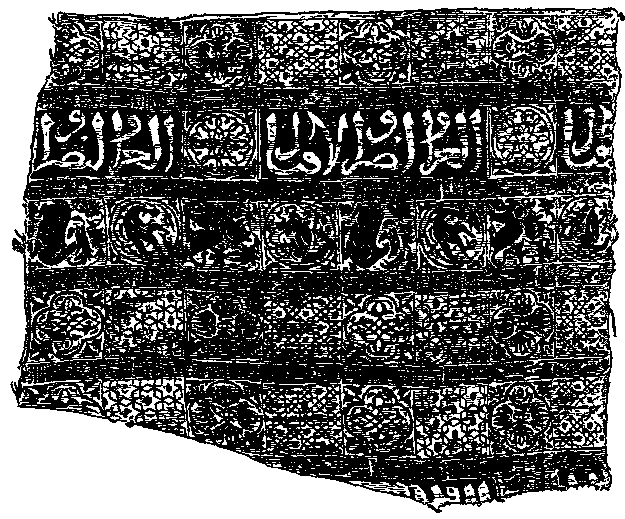
Fig. 2.—Part of a Siculo-Saracenic brocade woven in the 12th century. l6½ in. wide.
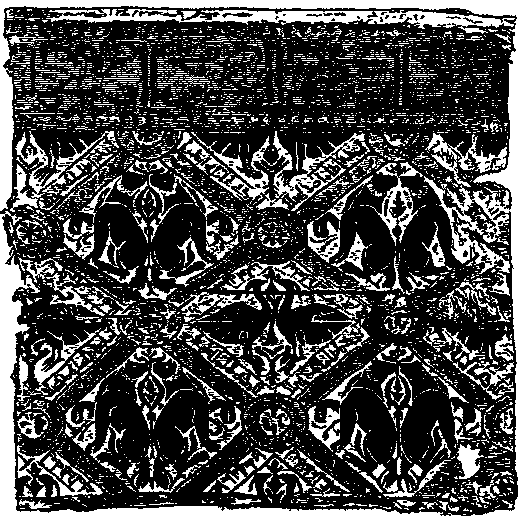
Fig. 1.—Brocade woven in red and olive green silks and gold thread on a cream-coloured ground. Along the top is the Kufic inscription "Arrahmān" (The Merciful) several times repeated in olive green on a gold-thread ground. Pairs of seated animals, addorsed regardant and geese vis-à-vis are worked within the lozenge-shaped compartments of the trellis framework which regulates the pattern. Both animals and birds are separated by conventional trees, and the latter are enclosed in inscriptions of Kufic characters. Siculo-Saracenic; 11th or 12th century. 5½ in. sq.
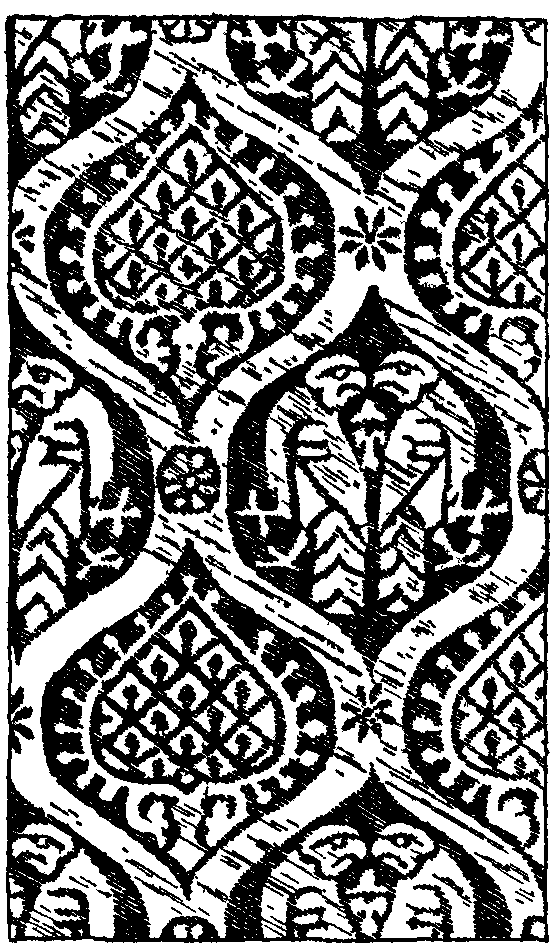
Fig. 3.—Piece of stuff woven or brocaded with red silk and gold thread, with an ogival framing enclosing alternately, pairs of parrots, addorsed regardant, and a well-known Persian (or Sassanian) leaf-shaped fruit device. Probably of Rhenish-Byzantine manufacture in the 12th or 13th century. 9 in. long.
The Latin word broccus is related equally to the Italian brocato, the Spanish brocar and the French brocarts and brocher, and implies a form of stitching or broaching, so that textile fabrics woven with an appearance of stitching or broaching have consequently come to be termed "brocades." A Spanish document dated 1375 distinguishes between los draps d'or é d'argent o de seda and brocats d'or é d'argent, a difference which is readily perceived, upon comparing for instance cloths of gold, Indian kincobs, with Lyons silks that are brochés with threads of gold, silk or other material. Notwithstanding this, many Indian kincobs and dainty gold and coloured silk-weavings of Persian workmanship, both without floating threads, are often called brocades, although in neither is the ornamentation really broché or brocaded. Contemporary in use with the Spanish brocats is the word brocado. In addition to brocarts the French now use the word brocher in connexion with certain silk stuffs which however are not brocades in the same sense as the brocarts. A wardrobe account of King Edward IV. (1480) has an entry of "satyn broched with gold"—a description that fairly applies to such an enriched satin as that for instance shown in fig. 4. But some three centuries earlier than the date of that specimen, decorative stuffs were partly brochés with gold threads by oriental weavers, especially those of Persia, Syria and parts of southern Europe and northern Africa under the domination of the Saracens, to whom the earlier germs, so to speak, of brocading may be traced. Of such is the 11th or 12th century Siculo-Saracenic specimen in fig. 1, in which the heads only of the pairs of animals and birds are broched with gold thread. Another sort of brocaded material is indicated in fig. 2, taken from a part of a sumptuous Siculo-Saracenic weaving produced in coloured silks and gold threads at the famous Hotel des Tiraz in Palermo for an official robe of Henry IV. (1165-1197) as emperor of the Holy Roman Empire, and still preserved in the cathedral of Regensburg. Fig. 3 is a further variety of textile that would be classed as brocat. This is of the 12th or 13th century manufacture, possibly by German or Rhenish-Byzantine weavers, or even by Spanish weavers, many of whom at Almeria, Malaga, Grenada and Seville rivalled those at Palermo. In the 14th century the making of satins heavily brocaded with gold threads was associated conspicuously with such Italian towns as Lucca, Genoa, Venice and Florence. Fig. 4 is from a piece of 14th-century dark-blue satin broached in relief with gold thread in a design the like of which appears in the background of Orcagna's "Coronation of the Virgin," now in the National Gallery, London. During the 17th century Genoa, Florence and Lyons vied with each other in making brocades in which the enrichments were as frequently of coloured silks as of gold intermixed with silken threads. Fig. 5 is from a piece of crimson silk damask flatly brocaded with flowers, scroll forms, fruit and birds in gold. This is probably of Florentine workmanship. Rather more closely allied to modern brocades is the Lyons specimen given in fig. 6, in which the brocading is done not only with silver but also with coloured silks. Early in the 18th century Spitalfields was busy as a competitor with Lyons in manufacturing many sorts of brocades, specified in a collection of designs preserved in the national art library of the Victoria and Albert Museum, under such trade titles as "brocade lutstring, brocade tabby, brocade tissue, brocade damask, brocade satin, Venetian brocade, and India figured brocade." Brocading in China seems to be of considerable antiquity, and Dr Bushell in his valuable handbook on Chinese art cites a notice of five rolls of brocade with dragons woven upon a crimson ground, presented by the emperor Ming Ti of the Wei dynasty, in the year A.D. 238, to the reigning empress of Japan; and varieties of brocade patterns are recorded as being in use during the Sung dynasty (960-1279). The first edition of an illustrated work upon tillage and weaving was published in China in 1210, and contains an engraving of a loom constructed to weave flowered-silk brocades such as are woven at the present time at Suchow and Hangchow and elsewhere. On the other hand, although they are described usually as brocades, certain specimens of imperial Chinese robes sumptuous in ornament, sheen of coloured silks and the glisten of golden threads, are woven in the tapestry-weaving manner and without any floating threads. It seems reasonable to infer that Persians and Syrians derived the art of weaving brocades from the Chinese, and as has been indicated, passed it on to Saracens as well as Europeans.
(A. S. C.)
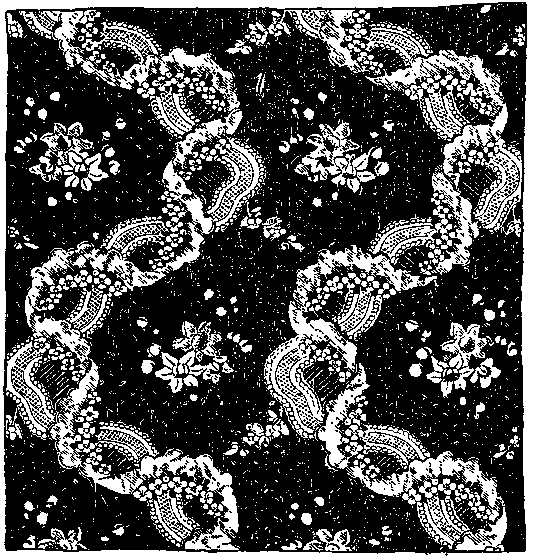
Fig. 6.—Piece of pink silk brocaded in silver and white and coloured silks. French middle 18th century; about 15 in. square.
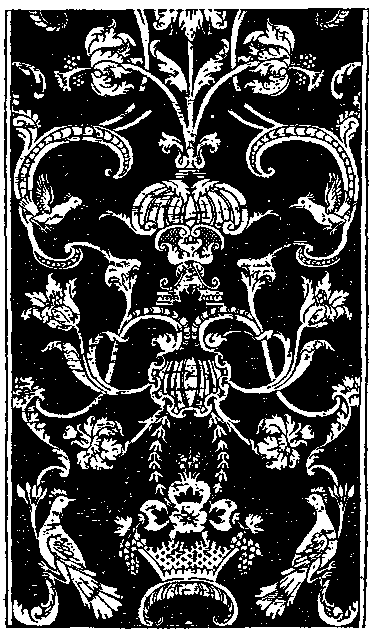
Fig. 5.—Piece of crimson silk damask brocaded in gold thread with symmetrically arranged flowers, scrolls, birds, &c. Italian (?Florentine). Late 17th century; about 2 ft. 6 in. long.
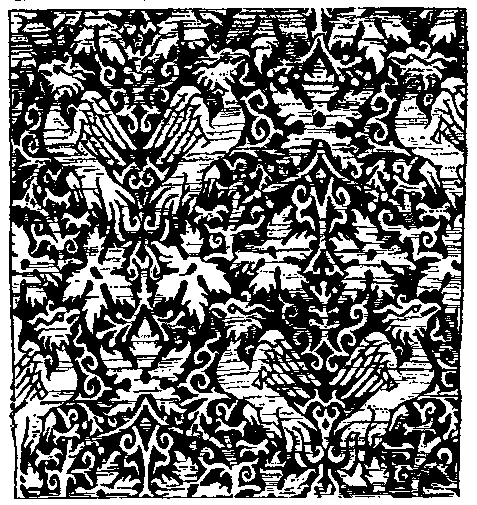
Fig. 4.—Piece of blue satin brocaded with gold threads. The unit of the pattern is a symmetrical arrangement of fantastic birds, vine leaves and curving stems. The bird shapes are remotely related to, if not derived from, the Chinese mystical "fonghoang." North Italian weaving of the 14th century; about 11 in. square.
BROCCHI, GIOVANNI BATTISTA (1772-1826), Italian mineralogist and geologist, was born at Bassano on the 18th of February 1772. He studied at the university of Pisa, where his attention was turned to mineralogy and botany. In 1802 he was appointed professor of botany in the new lyceum of Brescia; but he more especially devoted himself to geological researches in the adjacent districts. The fruits of these labours appeared in different publications, particularly in his Trattato mineralogico e chemico sulle miniere di ferro del dipartimento del Mella (1808)—treatise on the iron mines of Mella. These researches procured him the office of inspector of mines in the recently established kingdom of Italy, and enabled him to extend his investigations over great part of the country. In 1811 he produced a valuable essay entitled Memoria mineralogica sulla Valle di Fassa in Tirolo; but his most important work is the Conchiologia fossile subapennina con osservazioni geologiche sugli Apennini, e sul suolo adiacente (2 vols., 4to, Milan, 1814), containing accurate details of the structure of the Apennine range, and an account of the fossils of the Italian Tertiary strata compared with existing species. These subjects were further illustrated by his geognostic map, and his Catalogo ragionato di una raccolta di rocce, disposto con ordine geografico, per servire alla geognosia dell' Italia (Milan, 1817). His work Dello stato fisico del suolo di Roma (1820), with its accompanying map, is likewise noteworthy. In it he corrected the erroneous views of Breislak, who conceived that Rome occupies the site of a volcano, to which he ascribed the volcanic materials that cover the seven hills. Brocchi pointed out that these materials were derived either from Mont Albano, an extinct volcano, 12 m. from the city, or from Mont Cimini, still farther to the north. Several papers by him, on mineralogical subjects, appeared in the Biblioteca Italiana from 1816 to 1823. In the latter year Brocchi sailed for Egypt, in order to explore the geology of that country and report on its mineral resources. Every facility was granted by Mehemet Ali, who in 1823 appointed him one of a commission to examine the district of Sennaar; but Brocchi, unfortunately for science, fell a victim to the climate, and died at Khartum on the 25th of September 1826.
BROCHANT DE VILLIERS, ANDRÉ JEAN FRANÇOIS MARIE (1772-1840), French mineralogist and geologist, was born at Villiers, near Nantes, on the 6th of August 1772. After studying at the École Polytechnique, he was in 1794 the first pupil admitted to the École des Mines. In 1804 he was appointed professor of geology and mineralogy in the École des Mines, which had been temporarily transferred to Pezay in Savoy, and he returned with the school to Paris in 1815. Later on he became inspector general of mines and a member of the Academy of Sciences. He investigated the transition strata of the Tarantaise, wrote on the position of the granite rocks of Mont Blanc, and on the lead minerals of Derbyshire and Cumberland. He was charged with the superintendence of the construction of the geological map of France, undertaken by his pupils Dufrénoy and Elie de Beaumont. He died in Paris on the 16th of May 1840. His publications include Traité élémentaire de minéralogie (2 vols., 1801-1802; 2nd ed., 1808), and Traité abrégé de cristallographie (Paris, 1818).
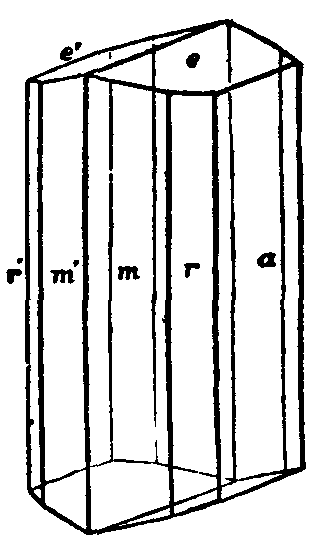
BROCHANTITE, a mineral species consisting of a basic copper sulphate Cu4(OH)6SO4, crystallizing in the orthorhombic system. The crystals are usually small and are prismatic or acicular in habit; they have a perfect cleavage parallel to the face lettered a in the adjoining figure. They are transparent to translucent, with a vitreous lustre, and are of an emerald-green to blackish-green colour. Specific gravity 3.907; hardness 3½-4. The mineral was first found associated with malachite and native copper in the copper mines of the Urals, and was named by A. Lévy in 1824 after A.J.M. Brochant de Villiers. Several varieties, differing somewhat in crystalline form, have been distinguished, some of them having originally been described as distinct species, but afterwards proved to be essentially identical with brochantite; these are königine from the Urals, brongniartine from Mexico, krisuvigite from Iceland, and warringtonite from Cornwall. Of other localities, mention may be made of Roughten Gill, Caldbeck Fells, Cumberland, where small brilliant crystals are associated with malachite and chrysocolla in a quartzose rock; Rézbánya in the Bihar Mountains, Hungary; Atacama in Chile, with atacamite, which closely resembles brochantite in general appearance; the Tintic district in Utah. A microscopical examination of the green copper ores of secondary origin in the Clifton and Morenci district of Arizona proves brochantite to be of extremely common occurrence mostly intergrown with malachite which effectually masks its presence: it is not unlikely that the malachite of other localities will on examination be found to be intergrown with brochantite.
Mention may be here made of another orthorhombic basic copper sulphate not unlike brochantite in general characters, but differing from it in containing water of crystallization and in its fine blue colour; this is the Cornish mineral langite, which has the composition CuSO4·3Cu(OH)2+H2O.
(L. J. S.)
BROCK, SIR ISAAC (1769-1812), British soldier and administrator, was born at St Peter Port, Guernsey, on the 6th of October 1769. Joining the army at the age of fifteen as an ensign of the 8th regiment, he became a lieutenant-colonel in 1797, after less than thirteen years' service. He commanded the 49th regiment in the expedition to North Holland in 1799, was wounded at the battle of Egmont-op-Zee, and subsequently served on board the British fleet at the battle of Copenhagen. From 1802 to 1805 he was with his regiment in Canada, returning thither in 1806 in view of the imminence of war between Great Britain and the United States. From September 1806 till August 1810 he was in charge of the garrison at Quebec; in the latter year he assumed the command of the troops in Upper Canada, and soon afterwards took over the civil administration of that province as provisional lieutenant-governor. On the outbreak of the war of 1812 Brock had to defend Upper Canada against invasion by the United States. In the face of many difficulties and not a little disaffection, he organized the militia of the province, drove back the invaders, and on the 16th of August 1812, with about 730 men and 600 Indians commanded by their chief Tecumseh, compelled the American force of 2500 men under General William Hull (1753-1825) to surrender at Detroit, an achievement which gained him a knighthood of the Bath and the popular title of "the hero of Upper Canada" From Detroit he hurried to the Niagara frontier, but on the 13th of October in the same year was killed at the battle of Queenston Heights. The House of Commons voted a public monument to his memory, which was erected in Saint Paul's cathedral, London. On the 13th of October 1824, the twelfth anniversary of his death, his remains were removed from the bastions of Fort George, where they had been originally interred, and placed beneath a monument on Queenston Heights, erected by the provincial legislature. This was blown up by a fanatic in 1840, but as the result of a mass-meeting of over 8000 citizens held on the spot, a new and more stately monument was erected.
His Life and Correspondence by his nephew, Ferdinand Brock Tupper (2nd edition, London, 1847), still remains the best; later lives are by D.R. Read (Toronto, 1894), and by Lady Edgar (Toronto and London,1905).
(W. L. G.)
BROCK, THOMAS (1847- ), English sculptor, was the chief pupil of Foley, and later became influenced by the new romantic movement. His group "The Moment of Peril" was followed by "The Genius of Poetry," "Eve," and other ideal works that mark his development. His busts, such as those of Lord Leighton and Queen Victoria; his statues, such as "Sir Richard Owen" and "Dr Philpott, bishop of Worcester"; his sepulchral monuments, such as that to Lord Leighton in St Paul's cathedral, a work of singular significance, refinement and beauty; and his memorial statues of Queen Victoria, at Hove and elsewhere, are examples of his power as a portraitist, sympathetic in feeling, sound and restrained in execution, and dignified and decorative in arrangement. The colossal equestrian statue of "Edward the Black Prince" was set up in the City Square in Leeds in 1901, the year in which the sculptor was awarded the commission to execute the vast Imperial Memorial to Queen Victoria in front of Buckingham Palace. Brock was elected an associate of the Royal Academy in 1883 and full member in 1891.
BROCKEN, a mountain of Germany, in Prussian Saxony, the highest point (3733 ft.) of the Harz. It is a huge, bare, granite-strewn, dome-shaped mass and, owing to its being the greatest elevation in north Germany, commands magnificent views in all directions. From it Magdeburg and the Elbe, the towers of Leipzig and the Thuringian forest are distinctly visible in clear weather. Access to the summit is attained by a mountain railway (12 m.) from Dreiannen-Hohne, a station on the normal gauge line Wernigerode-Nordhausen, and by two carriage roads from the Bodetal and Ilsenburg respectively. In the folklore of north Germany the Brocken holds an important place, and to it cling many legends. Long after Christianity had penetrated to these regions, the Brocken remained a place of heathen worship. Annually, on Walpurgis night (1st of May), curious rites were here enacted, which, condemned by the priests of the Christian church, led to the belief that the devil and witches here held their orgies. Even to this day, this superstition possesses the minds of many country people around, who believe the mountain to be haunted on this night. In literature it is represented by the famous "Brocken scene" in Goethe's Faust.
See Jacobs, Der Brocken in Geschichte und Sage (Halle, 1878); and Pröhle, Brockensagen (Magdeburg, 1888).
BROCKEN, SPECTRE OF THE (so named from having been first observed in 1780 on the Brocken), an enormously magnified shadow of an observer cast upon a bank of cloud when the sun is low in high mountain regions, reproducing every motion of the observer in the form of a gigantic but misty image of himself.
BROCKES, BARTHOLD HEINRICH (1680-1747), German poet, was born at Hamburg on the 22nd of September 1680. He studied jurisprudence at Halle, and after extensive travels in Italy, France and Holland, settled in his native town in 1704. In 1720 he was appointed a member of the Hamburg senate, and entrusted with several important offices. Six years (from 1735 to 1741) he spent as Amtmann (magistrate) at Ritzebtütel. He died in Hamburg on the 16th of January 1747. Brockes' poetic works were published in a series of nine volumes under the fantastic title Irdisches Vergnügen in Gott (1721-1748); he also translated Marini's La Strage degli innocenti (1715), Pope's Essay on Man (1740) and Thomson's Seasons (1745). His poetry has small intrinsic value, but it is symptomatic of the change which came over German literature at the beginning of the 18th century. He was one of the first German poets to substitute for the bombastic imitations of Marini, to which he himself had begun by contributing, a clear and simple diction. He was also a pioneer in directing the attention of his countrymen to the new poetry of nature which originated in England. His verses, artificial and crude as they often are, express a reverential attitude towards nature and a religious interpretation of natural phenomena which was new to German poetry and prepared the way for Klopstock.
Brockes' autobiography was published by J.M. Lappenberg in the Zeitschrift des Vereins für Hamburger Geschichte, ii. pp. 167 ff. (1847). See also A. Brandl, B. H. Brockes (1878), and D.F. Strauss, Brockes und H.S. Reimarus (Gesammelte Schriften, ii.). A short selection of his poetry will be found in vol. 39 (1883) of Kürschner's Deutsche Nationalliteratur.
BROCKHAUS, FRIEDRICH ARNOLD (1772-1823), German publisher, was born at Dortmund, on the 4th of May 1772. He was educated at the gymnasium of his native place, and from 1788 to 1793 served an apprenticeship in a mercantile house at Düsseldorf. He then devoted two years at Leipzig to the study of modern languages and literature, after which he set up at Dortmund an emporium for English goods. In 1801 he transferred this business to Arnheim, and in the following year to Amsterdam. In 1805, having given up his first line of trade, he began business as a publisher. Two journals projected by him were not allowed by the government to survive for any length of time, and in 1810 the complications in the affairs of Holland induced him to return homewards. In 1811 he settled at Altenburg. About three years previously he had purchased the copyright of the Konversations-Lexikon, started in 1796, and in 1810-1811 he completed the first edition of this celebrated work (14th ed. 1901-4). A second edition under his own editorship was begun in 1812, and was received with universal favour. His business extended rapidly, and in 1818 Brockhaus removed to Leipzig, where he established a large printing-house. Among the more extensive of his many literary undertakings were the critical periodicals—Hermes, the Literarisches Konversationsblatt (afterwards the Blätter für literarische Unterhaltung), and the Zeitgenossen, and some large historical and bibliographical works, such as Raumer's Geschichte der Hohenstaufen, and Ebert's Allgemeines bibliographisches Lexikon. F.A. Brockhaus died at Leipzig on the 20th of August 1823. The business was carried on by his sons, Friedrich Brockhaus (1800-1865) who retired in 1850, and Heinrich Brockhaus (1804-1874), under whom it was considerably extended. The latter especially rendered great services to literature and science, which the university of Jena recognized by making him, in 1858, honorary doctor of philosophy. In the years 1842-1848, Heinrich Brockhaus was member of the Saxon second chamber, as representative for Leipzig, was made honorary citizen of that city in 1872, and died there on the 15th of November 1874.
See H. E. Brockhaus, Friedrich A. Brockhaus, sein Leben und Wirken nach Briefen und andern Aufzeichnungen (3 vols., Leipzig, 1872-1881); also by the same author, Die Firma F. A. Brockhaus von der Begrundung bis zum hundertjahrigen Jubilaum (1805-1905, Leipzig, 1905).
Another of Friedrich's sons, Hermann Brockhaus (1806-1877), German Orientalist, was born at Amsterdam on the 28th of January 1806. While his two brothers carried on the business he devoted himself to an academic career. He was appointed extraordinary professor in Jena in 1838, and in 1841 received a call in a similar capacity to Leipzig, where in 1848 he was made ordinary professor of ancient Semitic. He died at Leipzig on the 5th of January 1877. Brockhaus was an Oriental scholar in the old sense of the word, devoting his attention, not to one language only, but to acquiring a familiarity with the principal languages and literature of the East. He studied Hebrew, Arabic and Persian, and was able to lecture on Sanskrit, afterwards his specialty, Pali, Zend and even on Chinese. His most important work was the editio princeps of the Katha-sarit-sagara, "The Ocean of the Streams of Story," the large collection of Sanskrit stories made by Soma Deva in the 12th century. By this publication he gave the first impetus to a really scientific study of the origin and spreading of popular tales, and enabled Prof. Benfey and others to trace the great bulk of Eastern and Western stories to an Indian, and more especially to a Buddhistic source. Among Prof. Brockhaus's other publications were his edition of the curious philosophical play Prabodhachandrodaya, "The Rise of the Moon of Intelligence," his critical edition of the "Songs of Hafiz," and his publication in Latin letters of the text of the "Zend-Avesta."