Front matter (continued 13)
Reading edition
Bronchitis is also apt to be very severe when it occurs in persons who are addicted to intemperance. Again, in those who suffer from any disease affecting directly or indirectly the respiratory functions, such as consumption or heart disease, the supervention of an attack of acute bronchitis is an alarming complication, increasing, as it necessarily does, the embarrassment of breathing. The same remark is applicable to those numerous instances of its occurrence in children who are or have been suffering from such diseases as have always associated with them a certain degree of bronchial irritation, such as measles and whooping-cough.
One other source of danger of a special character in bronchitis remains to be mentioned, viz. collapse of the lung. Occasionally a branch of a bronchial tube becomes plugged up with secretion, so that the area of the lung to which this branch conducts ceases to be inflated on inspiration. The small quantity of air imprisoned in the portion of lung gradually escapes, but no fresh air enters, and the part collapses and becomes of solid consistence. Increased difficulty of breathing is the result, and where a large portion of lung is affected by the plugging up of a large bronchus, a fatal result may rapidly follow, the danger being specially great in the case of children. Fortunately, the obstruction may sometimes be removed by vigorous coughing, and relief is then obtained.
With respect to the treatment of acute bronchitis, in those mild cases which are more of the nature of a simple catarrh, little else will be found necessary than confinement in a warm room, or in bed, for a few days, and the use of light diet, together with warm diluent drinks. Additional measures are however called for when the disease is more markedly developed. Medicines to allay fever and promote perspiration are highly serviceable in the earlier stages. Later, with the view of soothing the pain of the cough, and favouring expectoration, mixtures of tolu, with the addition of some opiate, such as the ordinary paregorics, may be advantageously employed. The use of opium, however, in any form should not be resorted to in the case of young children without medical advice, since its action on them is much more potent and less under control than it is in adults. Not a few of the so-called "soothing mixtures" have been found to contain opium in quantity sufficient to prove dangerous when administered to children, and caution is necessary in using them.
From the outset of the attack the employment of fomentations, or especially a turpentine stupe, gives great relief, and occasionally in the non-specific form this treatment, combined with a good dose of calomel and salts, may render the attack abortive. Some relief is always obtained by inhalations, and theoretically, an acute specific bronchitis should be successfully treated by inhalation of antiseptic and soothing remedies. In practice, however, it is found that the strength cannot be sufficiently strong to destroy the bacteria in the bronchial tubes. However, much relief is obtained from the use of steam atomizers filled with an aqueous solution of compound tincture of benzoin, creosote or guaiacol. A still more practicable means of introducing volatile antiseptic oils is the globe nebulizer, which throws oleaginous solutions in the form of a fine fog, that can be deeply inhaled. Menthol, eucalyptol and white pine extract are some of the remedies that may be tried dissolved in benzoinol, to which cocaine or opium may be added if the cough is troublesome.
When the bronchitis is of the capillary form, the great object is to maintain the patient's strength, and to endeavour to secure the expulsion of the morbid secretion from the fine bronchi. In addition to the remedies already alluded to, stimulants are called for from the first; and should the cough be ineffectual in relieving the bronchial tubes, the administration of an emetic dose of sulphate of zinc may produce a good effect.
During the whole course of any attack of bronchitis attention must be paid to the due nourishment of the patient; and during the subsequent convalescence, which, particularly in elderly persons, is apt to be slow, tonics and stimulants may have to be prescribed.
Chronic bronchitis may arise as the result of repeated attacks of the acute form, or it may exist altogether independently. It occurs more frequently among persons advanced in life than among the young, although no age is exempt from it. The usual history of this form of bronchitis is that of a cough recurring during the colder seasons of the year, and in its earlier stages, departing entirely in summer, so that it is frequently called "winter cough." In many persons subject to it, however, attacks are apt to be excited at any time by very slight causes, such as changes in the weather; and in advanced cases of the disease the cough is seldom altogether absent. The symptoms and auscultatory signs of chronic bronchitis are on the whole similar to those pertaining to the acute form, except that the febrile disturbance and pain are much less marked. The cough is usually more troublesome in the morning than during the day. There is usually free and copious expectoration, and occasionally this is so abundant as to constitute what is termed bronchorrhoea.
Chronic bronchitis leads to alterations of structure in the affected bronchial tubes, their mucous membrane becoming thickened or even ulcerated, while occasionally permanent dilatation of the bronchi takes place, often accompanied with profuse foetid expectoration. In long-standing cases of chronic bronchitis the nutrition of the lungs becomes impaired, and dilatation of the air-tubes (emphysema) and other complications result, giving rise to more or less constant breathlessness.
Chronic bronchitis may arise secondarily to some other ailment. This is especially the case in Bright's disease of the kidneys and in heart disease, of both of which maladies it often proves a serious complication, also in gout and syphilis. The influence of occupation is seen in the frequency in which persons following certain employments suffer from chronic bronchitis. Hirt has shown that the inhalation of vegetable dust is very liable to produce bronchitis through the irritation produced by the dust particles and the growth of organisms carried in with the dust. Consequently, millers and grain-shovellers are especially liable to it, while next in order come weavers and workers in cotton factories.
The treatment to be adopted in chronic bronchitis depends upon the severity of the case, the age of the patient and the presence or absence of complications. Attention to the general health is a matter of prime importance in all cases of the disease, more particularly among persons whose avocations entail exposure, and tonics with cod-liver oil will be found highly advantageous. The use of a respirator in very cold or damp weather is a valuable means of protection. In those aggravated forms of chronic bronchitis, where the slightest exposure to cold air brings on fresh attacks, it may become necessary, where circumstances permit, to enjoin confinement to a warm room or removal to a more genial climate during the winter months.
BRONCHOTOMY (Gr. βρόγχος, wind-pipe, and τέμνειν, to cut), a medical term used to describe a surgical incision into the throat; now largely superseded by the terms laryngotomy, thyrotomy and tracheotomy, which indicate more accurately the place of incision.
BRONCO, usually incorrectly spelt Broncho (a Spanish word meaning rough, rude), an unbroken or untamed horse, especially in the United States, a mustang; the word entered America by way of Mexico.
BRÖNDSTED, PETER OLUF (1780-1842), Danish archaeologist and traveller, was born at Fruering in Jutland on the 17th of November 1780. After studying at the university of Copenhagen he visited Paris in 1806 with his friend Georg Koes. After remaining there two years, they went together to Italy. Both were zealously attached to the study of antiquities; and congeniality of tastes and pursuits induced them, in 1810, to join an expedition to Greece, where they excavated the temples of Zeus in Aegina and of Apollo at Bassae in Arcadia. After three years of active researches in Greece, Bröndsted returned to Copenhagen, where, as a reward for his labours, he was appointed professor of Greek in the university. He then began to arrange and prepare for publication the vast materials he had collected during his travels; but finding that Copenhagen did not afford him the desired facilities, he exchanged his professorship for the office of Danish envoy at the papal court in 1818, and took up his abode at Rome. In 1820 and 1821 he visited Sicily and the Ionian Isles to collect additional materials for his great work. In 1826 he went to London, chiefly with a view of studying the Elgin marbles and other remains of antiquity in the British Museum, and became acquainted with the principal archaeologists of England. From 1828-1832 he resided in Paris, to superintend the publication of his Travels, and then returned to Copenhagen on being appointed director of the museum of antiquities and the collection of coins and medals. In 1842 he became rector of the university; but a fall from his horse caused his death on the 26th of June. His principal work was the Travels and Archaeological Researches in Greece (in German and French, 1826-1830), of which only two volumes were published, dealing with the island of Ceos and the metopes of the Parthenon.
BRONGNIART, ADOLPHE THÉODORE (1801-1876), French botanist, son of the geologist Alexandre Brongniart, was born in Paris on the 14th of January 1801. He soon showed an inclination towards the study of natural science, devoting himself at first more particularly to geology, and later to botany, thus equipping himself for what was to be the main occupation of his life—the investigation of fossil plants. In 1826 he graduated as doctor of medicine with a dissertation on the Rhamnaceae; but the career which he adopted was botanical, not medical. In 1831 he became assistant to R.L. Desfontaines at the Musée d'Histoire Naturelle, and two years later succeeded him as professor, a position which he continued to hold until his death in Paris on the 18th of February 1876.
Brongniart was an indefatigable investigator and a prolific writer, so that he left behind him, as the fruit of his labours, a large number of books and memoirs. As early as 1822 he published a paper on the classification and distribution of fossil plants (Mém. Mus. Hist. Nat. viii.). This was followed by several papers chiefly bearing upon the relation between extinct and existing forms—a line of research which culminated in the publication of the Histoire des végétaux fossiles, which has earned for him the title of "father of palaeobotany." This great work was heralded by a small but most important "Prodrome" (contributed to the Grand Dictionnaire d'Hist. Nat., 1828, t. lvii.) which brought order into chaos by a classification in which the fossil plants were arranged, with remarkably correct insight, along with their nearest living allies, and which forms the basis of all subsequent progress in this direction. It is of especial botanical interest, because, in accordance with Robert Brown's discoveries, the Cycadeae and Coniferae were placed in the new group Phanérogames gymnospermes. In this book attention was also directed to the succession of forms in the various geological periods, with the important result (stated in modern terms) that in the Palaeozoic period the Pteridophyta are found to predominate; in the Mesozoic, the Gymnosperms; in the Cainozoic, the Angiosperms, a result subsequently more fully stated in his "Tableau des genres de végétaux fossiles" (D'Orbigny, Dict. Univ. d'Hist. Nat., 1849). But the great Histoire itself was not destined to be more than a colossal fragment; the publication of successive parts proceeded regularly from 1828 to 1837, when the first volume was completed, but after that only three parts of the second volume appeared. Brongniart, no doubt, was overwhelmed with the continually increasing magnitude of the task that he had undertaken. Apart from his more comprehensive works, his most important palaeontological contributions are perhaps his observations on the structure of Sigillaria (Arch. Mus. Hist. Nat. i., 1839) and his researches (almost the last he undertook) on fossil seeds, of which a full account was published posthumously in 1880. His activity was by no means confined to palaeobotany, but extended into all branches of botany, more particularly anatomy and phanerogamic taxonomy. Among his achievements in these directions the most notable is the memoir "Sur la génération et le développement de l'embryon des Phanérogames" (Ann. Sci. Nat. xii., 1827). This is remarkable in that it contains the first account of any value of the development of the pollen; as also a description of the structure of the pollen-grain, the confirmation of G. B. Amici's (1823) discovery of the pollen-tube, the confirmation of R. Brown's views as to the structure of the unimpregnated ovule (with the introduction of the term "sac embryonnaire"); and in that it shows how nearly Brongniart anticipated Amici's subsequent (1846) discovery of the entrance of the pollen-tube into the micropyle, fertilizing the female cell which then develops into the embryo. Of his anatomical works, those of the greatest value are probably the "Recherches sur la structure et les fonctions des feuilles" (Ann. Sci. Nat. xxi., 1830), and the "Nouvelles Recherches sur l'Épiderme" (Ann. Sci. Nat. i., 1834), in which, among other important observations, the discovery of the cuticle is recorded; and, further, the "Recherches sur l'organisation des tiges des Cycadées" (Ann. Sci. Nat. xvi., 1829), giving the results of the first investigation of the anatomy of those plants. His systematic work is represented by a large number of papers and monographs, many of which relate to the flora of New Caledonia; and by his Énumération des genres de plantes cultivées au Musée d'Histoire Naturelle de Paris (1843), which is an interesting landmark in the history of classification in that it forms the starting-point of the system, modified successively by A. Braun, A.W. Eichler and A. Engler, which is now adopted in Germany. In addition to his scientific and professorial labours, Brongniart held various important official posts in connexion with the department of education, and interested himself greatly in agricultural and horticultural matters. With J.V. Audouin and J.B.A. Dumas, his future brothers-in-law, he established the Annales des Sciences Naturelles in 1824; he also founded the Société Botanique de France in 1854, and was its first president.
For accounts of his life and work see Bull. de la Soc. Géol. de France, 1876, and La Nature, 1876; the Bulletin de la Soc. Bot. de France for 1876, vol. xxiii., contains a list of his works and the orations pronounced at his funeral.
(S. H. V.*)
BRONGNIART, ALEXANDRE (1770-1847), French mineralogist and geologist, son of the eminent architect who designed the Bourse and other public buildings of Paris, was born in that city on the 5th of February 1770. At an early age he studied chemistry, under Lavoisier, and after passing through the École des Mines he took honours at the École de Médecine; subsequently he joined the army of the Pyrenees as pharmacien; but having committed some slight political offence, he was thrown into prison and detained there for some time. Soon after his release he was appointed professor of natural history in the Collège des Quatre Nations. In 1800 he was made director of the Sèvres porcelain factory, a post which he retained to his death, and in which he achieved his greatest work. In his hands Sèvres became the leading porcelain factory in Europe, and the researches of an able band of assistants enabled him to lay the foundations of ceramic chemistry. In addition to his work at Sèvres, quite enough to engross the entire energy of any ordinary man, he continued his more purely scientific work. He succeeded Haüy as professor of mineralogy in the Museum of Natural History; but he did not confine himself to mineralogy, for it is to him that we owe the division of Reptiles into the four orders of Saurians, Batrachians, Chelonians and Ophidians. Fossil as well as living animals engaged his attention, and in his studies of the strata around Paris he was instrumental in establishing the Tertiary formations. In 1816 he was elected to the Academy; and in the following year he visited the Alps of Switzerland and Italy, and afterwards Sweden and Norway. The result of his observations was published from time to time in the Journal des Mines and other scientific journals. Wide as was the range of his interests his most famous work was accomplished at Sèvres, and his most enduring monument is his classic Traité des arts céramiques (1844). He died in Paris on the 7th of October 1847.
His other principal works are :—Traité élémentaire de minéralogie, avec des applications aux arts (2 vols., Paris, 1807); Histoire naturelle des crustacés fossiles (Paris, 1822); Classification et caractères minéralogiques des roches homogènes et hétérogènes (Paris, 1827); the Tableau des terrains qui composent l'écorce du globe, ou Essai sur la structure de la partie connue de la terre (Paris, 1829); and the Traité des arts céramiques (1844). Brongniart was also the coadjutor of Cuvier in the admirable Essai sur la géographie minéralogique des environs de Paris (Paris, 1811); originally published in Ann. Mus. Hist. Nat. (Paris, xi. 1808).
BRONN, HEINRICH GEORG (1800-1862), German geologist, was born on the 3rd of March 1800 at Ziegelhausen near Heidelberg. Studying at the university at Heidelberg he took his doctor's degree in the faculty of medicine in 1821, and in the following year was appointed professor of natural history. He now devoted himself to palaeontological studies, and to fieldwork in various parts of Germany, Italy and France. From its commencement in 1830 to 1862 he assisted in editing the Jahrbuch für Mineralogie, &c., continued as Neues Jahrbuch. His principal work, Lethaea Geognostica (2 vols., Stuttgart, 1834-1838; 3rd ed. with F. Römer, 3 vols., 1851-1856), has been regarded as one of the foundations of German stratigraphical geology. His Handbuch einer Geschichte der Natur, of which the first part was issued in 1841, gave a general account of the physical history of the earth, while the second part dealt with the life-history, species being regarded as direct acts of creation. The third part included his famous Index Palaeontologicus, and was issued in 3 vols., 1848-1849, with the assistance of H. von Meyer and H. R. Göppert. This record of fossils has proved of inestimable value to all palaeontologists. An important work on recent and fossil zoology, Die Klassen und Ordnungen des Thier-Reichs, was commenced by Bronn. He wrote the volumes dealing with Amorphozoa, Actinozoa, and Malacozoa, published 1859-1862; the work was continued by other naturalists. In 1861 Bronn was awarded the Wollaston medal by the Geological Society of London. He died at Heidelberg on the 5th of July 1862.
BRONSART VON SCHELLENDORF, PAUL (1832-1891), Prussian general, was born at Danzig in 1832. He entered the Prussian Guards in 1849, and was appointed to the general staff in 1861 as a captain; after three years of staff service he returned to regimental duty, but was soon reappointed to the staff, and lectured at the war academy, becoming major in 1865 and lieut.-colonel in 1869. During the war of 1870 he was chief of a section on the Great General Staff, and conducted the preliminary negotiations for the surrender of the French at Sedan. After the war Bronsart was made a colonel and chief of staff of the Guard army corps, becoming major-general in 1876 and lieut.-general (with a division command) in 1881. Two years later he became war minister, and during his tenure of the post (1883-1889) many important reforms were carried out in the Prussian army, in particular the introduction of the magazine rifle. He was appointed in 1889 to command the I. army corps at Königsberg. He died on the 23rd of June 1891 at his estate near Braunsberg. Bronsart's military writings include two works of great importance—Ein Rückblick auf die taktischen Ruckblicke (2nd ed., Berlin, 1870), a pamphlet written in reply to Captain May's Tactical Retrospect of 1866; and Der Dienst des Generalstabes (1st ed., Berlin, 1876; 3rd ed. revised by General Meckel, 1893; new ed. by the author's son, Major Bronsart von Schellendorf, Berlin, 1904), a comprehensive treatise on the duties of the general staff. The third edition of this work was soon after its publication translated into English and issued officially to the British army as The Duties of the General Staff. Major Bronsart's new edition of 1904 was reissued in English by the General Staff, under the same title, in 1905.
BRONTË, CHARLOTTE (1816-1855), EMILY (1818-1848), and ANNE (1820-1849), English novelists, were three of the six children of Patrick Brontë, a clergyman of the Church of England, who for the last forty-one years of his life was perpetual incumbent of the parish of Haworth in the West Riding of Yorkshire. Patrick Brontë was born at Emsdale, Co. Down, Ireland, on the 17th of March 1777. His parents were of the peasant class, their original name of Brunty apparently having been changed by their son on his entry at St John's College, Cambridge, in 1802. In the intervening years he had been successively a weaver and schoolmaster in his native country. From Cambridge he became a curate, first at Wethersfield in Essex, in 1806, then for a few months at Wellington, Salop, in 1809. At the end of 1809 he accepted a curacy at Dewsbury, Yorkshire, following up this by one at Hartshead-cum-Clifton in the same county. At Hartshead Patrick Brontë married in 1812 Maria Branwell, a Cornishwoman, and there two children were born to him, Maria (1813-1825) and Elizabeth (1814-1825). Thence Patrick Brontë removed to Thornton, some 3 m. from Bradford, and here his wife gave birth to four children, Charlotte, Patrick Branwell (1817-1848), Emily Jane, and Anne, three of whom were to attain literary distinction.
In April 1820, three months after the birth of Anne Brontë, her father accepted the living of Haworth, a village near Keighley in Yorkshire, which will always be associated with the romantic story of the Brontës. In September of the following year his wife died. Maria Brontë lives for us in her daughter's biography only as the writer of certain letters to her "dear saucy Pat," as she calls her lover, and as the author of a recently published manuscript, an essay entitled The Advantages of Poverty in Religious Concerns, full of a sententiousness much affected at the time.
Upon the death of Mrs Brontë her husband invited his sister-in-law, Elizabeth Branwell, to leave Penzance and to take up her residence with his family at Haworth. Miss Branwell accepted the trust and would seem to have watched over her nephew and five nieces with conscientious care. The two eldest of those nieces were not long in following their mother. Maria and Elizabeth, Charlotte and Emily, were all sent to the Clergy Daughters' school at Cowan Bridge in 1824, and Maria and Elizabeth returned home in the following year to die. How far the bad food and drastic discipline were responsible cannot be accurately demonstrated. Charlotte gibbeted the school long years afterwards in Jane Eyre, under the thin disguise of "Lowood," and the principal, the Rev. William Carus Wilson (1792-1859), has been universally accepted as the counterpart of Mr Naomi Brocklehurst in the same novel. But congenital disease more probably accounts for the tragedy from which happily Charlotte and Emily escaped, both returning in 1825 to a prolonged home life at Haworth. Here the four surviving children amused themselves in intervals of study under their aunt's guidance with precocious literary aspirations. The many tiny booklets upon which they laboured in the succeeding years have been happily preserved. We find stories, verses and essays, all in the minutest handwriting, none giving any indication of the genius which in the case of two of the four children was to add to the indisputably permanent in literature.
At sixteen years of age—in 1831—Charlotte Brontë became a pupil at the school of Miss Margaret Wooler (1792-1885) at Roe Head, Dewsbury. She left in the following year to assist in the education of the younger sisters, bringing with her much additional proficiency in drawing, French and composition; she took with her also the devoted friendship of two out of her ten fellow-pupils—Mary Taylor (1817-1893) and Ellen Nussey (1817-1897). With Miss Taylor and Miss Nussey she corresponded for the remainder of her life, and her letters to the latter make up no small part of what has been revealed to us of her life story. Her next three years at Haworth were varied by occasional visits to one or other of these friends. In 1835 she returned to Miss Wooler's school at Roe Head as a governess, her sister Emily accompanying her as a pupil, but remaining only three months, and Anne then taking her place. The year following the school was removed to Dewsbury. In 1838 Charlotte went back to Haworth and soon afterwards received her first offer of marriage—from a clergyman, Henry Nussey, the brother of her friend Ellen. This was followed a little later by a second offer from a curate named Bryce. She refused both and took a situation as nursery governess, first with the Sidgwicks of Stonegappe, Yorkshire, and later with the Whites at Rawdon in the same county. A few months of this, however, filled her with an ambition to try and secure greater independence as the possessor of a school of her own, and she planned to acquire more proficiency in "languages" on the continent, as a preliminary step. The aunt advanced some money, and accompanied by her sister Emily she became in February 1842 a pupil at the Pensionnat Héger, Brussels. Here both girls worked hard, and won the goodwill and indeed admiration of the principal teacher, M. Héger, whose wife was at the head of the establishment. But the two girls were hastily called back to England before the year had expired by the announcement of the critical illness of their aunt. Miss Branwell died on the 29th of October 1842. She bequeathed sufficient money to her nieces to enable them to reconsider their plan of life. Instead of a school at Bridlington which had been talked of, they could now remain with their father, utilize their aunt's room as a classroom, and take pupils. But Charlotte was not yet satisfied with what the few months on Belgian soil had done for her, and determined to accept M. Héger's offer that she should return to Brussels as a governess. Hence the year 1843 was passed by her at the Pensionnat Héger in that capacity, and in this period she undoubtedly widened her intellectual sphere by reading the many books in French literature that her friend M. Héger lent her. But life took on a very sombre shade in the lonely environment in which she found herself. She became so depressed that on one occasion she took refuge in the confessional precisely as did her heroine Lucy Snowe in Villette. In 1844 she returned to her father's house at Haworth, and the three sisters began immediately to discuss the possibilities of converting the vicarage into a school. Prospectuses were issued, but no pupils were forthcoming.
Matters were complicated by the fact that the only brother, Patrick Branwell, had about this time become a confirmed drunkard. Branwell had been the idol of his aunt and of his sisters. Educated under his father's care, he had early shown artistic leanings, and the slender resources of the family had been strained to provide him with the means of entering at the Royal Academy as a pupil. This was in 1835. Branwell, it would seem, indulged in a glorious month of extravagance in London and then returned home. His art studies were continued for a time at Leeds, but it may be assumed that no commissions came to him, and at last he became tutor to the son of a Mr Postlethwaite at Barrow-in-Furness. Ten months later he was a booking-clerk at Sowerby Bridge station on the Leeds & Manchester railway, and later at Luddenden Foot. Then he became tutor in the family of a clergyman named Robinson at Thorp Green, where his sister Anne was governess. Finally he returned to Haworth to loaf at the village inn, shock his sisters by his excesses, and to fritter his life away in painful sottishness. He died in September 1848, having achieved nothing reputable, and having disappointed all the hopes that had been centred in him. "My poor father naturally thought more of his only son than of his daughters," is one of Charlotte's dreary comments on the tragedy. In early years he had himself written both prose and verse; and a foolish story invented long afterwards attributed to him some share in his sisters' novels, particularly in Emily Brontë's Wuthering Heights. But Charlotte distinctly tells us that her brother never knew that his sisters had published a line. He was too much under the effects of drink, too besotted and muddled in that last year or two of life, to have any share in their intellectual enthusiasms.
The literary life had, however, opened bravely for the three girls during those years. In 1846 a volume of verse appeared from the shop of Aylott & Jones of Paternoster Row; "Poems, by Currer, Ellis and Acton Bell," was on the title-page. These names disguised the identity of Charlotte, Emily and Anne Brontë. The venture cost the sisters about £50 in all, but only two copies were sold. There were nineteen poems by Charlotte, twenty-one by Emily, and the same number by Anne. A consensus of criticism has accepted the fact that Emily's verse alone revealed true poetic genius. This was unrecognized then except by her sister Charlotte. It is obvious now to all.
The failure of the poems did not deter the authors from further effort. They had each a novel to dispose of. Charlotte Brontë's was called The Master, which before it was sent off to London was retitled The Professor. Emily's story was entitled Wuthering Heights, and Anne's Agnes Gray. All these stories travelled from publisher to publisher. At last The Professor reached the firm of Smith, Elder & Co., of Cornhill. The "reader" for that firm, R. Smith Williams (1800-1875), was impressed, as were also his employers. Charlotte Brontë received in August 1847 a letter informing her that whatever the merits of The Professor—and it was hinted that it lacked "varied interest"—it was too short for the three-volume form then counted imperative. The author was further told that a longer novel would be gladly considered. She replied in the same month with this longer novel, and Jane Eyre appeared in October 1847, to be wildly acclaimed on every hand, although enthusiasm was to receive a counterblast when more than a year later, in December 1848, Miss Rigby, afterwards Lady Eastlake (1809-1893), reviewed it in the Quarterly.
Meanwhile the novels of Emily and Anne had been accepted by T. C. Newby. They were published together in three volumes in December 1847, two months later than Jane Eyre, although the proof sheets had been passed by the authors before their sister's novel had been sent to the publishers. The dilatoriness of Mr Newby was followed up by considerable energy when he saw the possibility of the novels by Ellis and Acton Bell sailing on the wave of Currer Bell's popularity, and he would seem very quickly to have accepted another manuscript by Anne Brontë, for The Tenant of Wildfell Hall was published by Newby in three volumes in June 1848. It was Newby's clever efforts to persuade the public that the books he published were by the author of Jane Eyre that led Charlotte and Anne to visit London this summer and interview Charlotte's publishers in Cornhill with a view to establishing their separate identity. Soon after their return home Branwell died (the 24th of September 1848), and less than three months later Emily died also at Haworth (the 19th December 1848). Then Anne became ill and on the 24th of May 1849 Charlotte accompanied her to Scarborough in the hope that the sea air would revive her. Anne died there on the 28th of May, and was buried in Scarborough churchyard. Thus in exactly eight months Charlotte Brontë lost all the three companions of her youth, and returned to sustain her father, fast becoming blind, in the now desolate home at Haworth.
In the interval between the death of Branwell and of Emily, Charlotte had been engaged upon a new novel—Shirley. Two-thirds were written, but the story was then laid aside while its author was nursing her sister Anne. She completed the book after Anne's death, and it was published in October 1849. The following winter she visited London as the guest of her publisher, Mr George Smith, and was introduced to Thackerary, to whom she had dedicated Jane Eyre. The following year she repeated the visit, sat for her portrait to George Richmond, and was considerably lionized by a host of admirers. In August 1850 she visited the English lakes as the guest of Sir James Kay-Shuttleworth, and met Mrs Gaskell, Miss Martineau, Matthew Arnold and other interesting men and women. During this period her publishers assiduously lent her books, and her criticisms of them contained in many letters to Mr George Smith and Mr Smith Williams make very interesting reading. In 1851 she received a third offer of marriage, this time from Mr James Taylor, who was in the employment of her publishers. A visit to Miss Martineau at Ambleside and also to London to the Great Exhibition made up the events of this year. On her way home she visited Manchester and spent two days with Mrs Gaskell. During the year 1852 she worked hard with a new novel, Villette, which was published in January of 1853. In September of that year she received a visit from Mrs Gaskell at Haworth; in May 1854 she returned it, remaining three days at Manchester, and planning with her hostess the details of her marriage, for at this time she had promised to unite herself with her father's curate, Arthur Bell Nicholls (1817-1906), who had long been a pertinacious suitor for her hand but had been discouraged by Mr Brontë. The marriage took place in Haworth church on the 29th of June 1854, the ceremony being performed by the Rev. Sutcliffe Sowden, Miss Wooler and Miss Nussey acting as witnesses. The wedded pair spent their honeymoon in Ireland, returning to Haworth, where they made their home with Mr Brontë, Mr Nicholls having pledged himself to continue in his position as curate to his father-in-law. After less than a year of married life, however, Charlotte Nicholls died of an illness incidental to childbirth, on the 31st of March 1855. She was buried in Haworth church by the side of her mother, Branwell and Emily. The father followed in 1861, and then her husband returned to Ireland, where he remained some years afterwards, dying in 1906.
The bare recital of the Brontë story can give no idea of its undying interest, its exceeding pathos. Their life as told by their biographer Mrs Gaskell is as interesting as any novel. Their achievement, however, will stand on its own merits. Anne Brontë's two novels, it is true, though constantly reprinted, survive principally through the exceeding vitality of the Brontë tradition. As a hymn writer she still has a place in most religious communities. Emily is great alike as a novelist and as a poet. Her "Old Stoic" and "Last Lines" are probably the finest achievement of poetry that any woman has given to English literature. Her novel Wuthering Heights stands alone as a monument of intensity owing nothing to tradition, nothing to the achievement of earlier writers. It was a thing apart, passionate, unforgettable, haunting in its grimness, its grey melancholy. Among women writers Emily Brontë has a sure and certain place for all time. As a poet or maker of verse Charlotte Brontë is undistinguished, but there are passages of pure poetry of great magnificence in her four novels, and particularly in Villette. The novels Jane Eyre and Villette will always command attention whatever the future of English fiction, by virtue of their intensity, their independence, their rough individuality.
The Life of Charlotte Brontë, by Mrs Gaskell, was first published in 1857. Owing to the many controversial questions it aroused, as to the identity of Lowood in Jane Eyre with Cowan Bridge school, as to the relations of Branwell Brontë with his employer's wife, as to the supposed peculiarities of Mr Brontë, and certain other minor points, the third edition was considerably changed. The Life has been many times reprinted, but may be read in its most satisfactory form in the Haworth edition (1902), issued by the original publishers, Smith, Elder & Co. To this edition are attached a great number of letters written by Miss Brontë to her publisher, George Smith. The first new material supplied to supplement Mrs Gaskell's Life was contained in Charlotte Brontë: a Monograph, by T. Wemyss Reid (1877). This book inspired Mr A.C. Swinburne to issue separately a forcible essay on Charlotte and Emily Brontë, under the title of A Note on Charlotte Brontë (1877). A further collection of letters written by Miss Brontë was contained in Charlotte Brontë and her Circle, by Clement Shorter (1896), and interesting details can be gathered from the Life of Charlotte Brontë, by Augustine Birrell (1887), The Brontës in Ireland, by William Wright, D.D. (1893), Charlotte Brontë and her Sisters, by Clement Shorter (1906), and the Brontë Society publications, edited by Butler Wood (1895-1907). Miss A. Mary F. Robinson (Madame Duclaux) wrote a separate biography of Emily Brontë in 1883, and an essay in her Grands Écrivains d'outre-Manche. The Brontës: Life and Letters, by Clement Shorter (1907), contains the whole of C. Brontë's letters in chronological order.
(C. K. S.)
BRONTE, a town of the province of Catania, Sicily, on the western slopes of Mt. Etna, 24 m. N.N.W. of Catania direct, and 34 m. by rail. Pop. (1901) 20,366. It was founded by the emperor Charles V. The town, with an extensive estate which originally belonged to the monastery of Maniacium (Maniace), was granted, as a dukedom, to Nelson by Ferdinand IV. of Naples in 1799.
BRONX, THE, formerly a district comprising several towns in Westchester county, New York, U.S.A., now (since 1898) the northernmost of the five boroughs of New York City (q.v.). Several settlements in the Bronx were made by the English and the Dutch between 1640 and 1650.
BRONZE, an alloy formed wholly or chiefly of copper and tin in variable proportions. The word has been etymologically connected with the same root as appears in "brown," but according to M.P.E. Berthelot (La Chimie au moyen âge) it is a place-name derived from aes Brundusianum (cf. Pliny, Nat. Hist. xxxiii. ch. ix. §45, "specula optima apud majores fuerunt Brundusiana, stanno et aere mixtis"). A Greek MS. of about the 11th century in the library of St Mark's, Venice, contains the form βροντήσιον, and gives the composition of the alloy as 1 lb of copper with 2 oz. of tin. The product obtained by adding tin to copper is more fusible than copper and thus better suited for casting; it is also harder and less malleable. A soft bronze or gun-metal is formed with 16 parts of copper to 1 of tin, and a harder gun-metal, such as was used for bronze ordnance, when the proportion of tin is about doubled. The steel bronze of Colonel Franz Uchatius (1811-1881) consisted of copper alloyed with 8% of tin, the tenacity and hardness being increased by cold-rolling. Bronze containing about 7 parts of copper to 1 of tin is hard, brittle and sonorous, and can be tempered to take a fine edge. Bell-metal varies considerably in composition, from about 3 to 5 parts of copper to 1 of tin. In speculum metal there are 2 to 2½ parts of copper to 1 of tin. Statuary bronze may contain from 80 to 90% of copper, the residue being tin, or tin with zinc and lead in various proportions. The bronze used for the British and French copper coinage consists of 95% copper, 4% tin and 1% zinc. Many copper-tin alloys employed for machinery-bearings contain a small proportion of zinc, which gives increased hardness. "Anti-friction metals," also used in bearings, are copper-tin alloys in which the amount of copper is small and there is antimony in addition. Of this class an example is "Babbitt's metal," invented by Isaac Babbitt (1799-1862); it originally consisted of 24 parts of tin, 8 parts of antimony and 4 parts of copper, but in later compositions for the same purpose the proportion of tin is often considerably higher. Bronze is improved in quality and strength when fluxed with phosphorus. Alloys prepared in this way, and known as phosphor bronze, may contain only about 1% of phosphorus in the ingot, reduced to a mere trace after casting, but their value is nevertheless enhanced for purposes in which a hard strong metal is required, as for pump plungers, valves, the bushes of bearings, &c. Bronze again is improved by the presence of manganese in small quantity, and various grades of manganese bronze, in some of which there is little or no tin but a considerable percentage of zinc, are extensively used in mechanical engineering. Alloys of copper with aluminium, though often nearly or completely destitute of tin, are known as aluminium bronze, and are valuable for their strength and the resistance they offer to corrosion. By the addition of a small quantity of silicon the tensile strength of copper is much increased; a sample of such silicon bronze, used for telegraph wires, on analysis was found to consist of 99.94% of copper, 0.03% of tin, and traces of iron and silicon.
The bronze (Gr. χαλκός, Lat. aes) of classical antiquity consisted chiefly of copper, alloyed with one or more of the metals, zinc, tin, lead and silver, in proportions that varied as times changed, or according to the purposes for which the alloy was required. Among bronze remains the copper is found to vary from 67 to 95%. From the analysis of coins it appears that for their bronze coins the Greeks adhered to an alloy of copper and tin till 400 B.C., after which time they used also lead with increasing frequency. Silver is rare in their bronze coins. The Romans also used lead as an alloy in their bronze coins, but gradually reduced the quantity, and under Caligula, Nero, Vespasian and Domitian, coined pure copper coins; afterwards they reverted to the mixture of lead. So far the words χαλκός and aes may be translated as bronze. Originally, no doubt, χαλκός was the name for pure copper. It is so employed by Homer, who calls it ἐρυθρός (red), αἴθυψ (glittering), φαεννός (shining), terms which apply only to copper. But instead of its following from this that the process of alloying copper with other metals was not practised in the time of the poet, or was unknown to him, the contrary would seem to be the case from the passage (Iliad xviii. 474) where he describes Hephaestus as throwing into his furnace copper, tin, silver and gold to make the shield of Achilles, so that it is not always possible to know whether when he uses the word χαλκός he means copper pure or alloyed. Still more difficult is it to make this distinction when we read of the mythical Dactyls of Ida in Crete or the Telchines or Cyclopes being acquainted with the smelting of χαλκός. It is not, however, likely that later Greek writers, who knew bronze in its true sense, and called it χαλκός, would have employed this word without qualification for objects which they had seen unless they had meant it to be taken as bronze. When Pausanias (iii. 17. 6) speaks of a statue, one of the oldest figures he had seen of this material, made of separate pieces fastened together with nails, we understand him to mean literally bronze, the more readily since there exist very early figures and utensils of bronze so made.
For the use of bronze in art, see Metal-work.
BRONZE AGE, the name given by archaeologists to that stage in human culture, intermediate between the Stone and Iron Ages, when weapons, utensils and implements were, as a general rule, made of bronze. The term has no absolute chronological value, but marks a period of civilization through which it is believed that most races passed at one time or another. The "finds" of stone and bronze, of bronze and iron, and even of stone and iron implements together in tumuli and sepulchral mounds, suggest that in many countries the three stages in man's progress overlapped. From the similarity of types of weapons and implements of the period found throughout Europe a relatively synchronous commencement has been inferred for the Bronze Age in Europe, fixed by most authorities at between 2000 B.C. to 1800 B.C. But it must have been earlier in some countries, and is certainly known to have been later in others; while the Mexicans and Peruvians were still in their bronze age in recent times. Not a few archaeologists have denied that there ever was a distinct Bronze Age. They have found their chief argument in the fact that weapons of these ages have been found side by side in prehistoric burial-places. But when it is admitted that the ages must have overlapped, it is fairly easy to undertand the mixed "finds." The beginning, the prevalence and duration of the Bronze Age in each country would have been ordered by the accessibility of the metals which form the alloy. Thus in some lands bronze may have continued to be a substance of extreme value until the Iron Age was reached, and in tumuli in which more than one body was interred, as was frequently the case, it would only be with the remains of the richer tenants of the tomb that the more valuable objects would be placed. There is, moreover, much reason to believe that sepulchral mounds were opened from age to age and fresh interments made, and in such a practice would be found a simple explanation of the mixing of implements. Another curious fact has been seized on by those who argue against the existence of a Bronze Age. Among all the "finds" examined in Europe there is a most remarkable absence of copper implements. The sources of tin in Europe are practically restricted to Cornwall and Saxony. How then are we to explain on the one hand the apparent stride made by primitive man when from a Stone Age civilization he passed to a comparatively advanced metallurgical skill? On the other, how account for a comparatively synchronous commencement of bronze civilization when one at least of the metals needed for the alloy would have been naturally difficult of access, if not unknown to many races? The answer is that there can be but little doubt that the knowledge of bronze came to the races of Europe from outside. Either by the Phoenicians or by the Greeks metallurgy was taught to men who no sooner recognized the nature and malleable properties of copper than they learnt that by application of heat a substance could be manufactured with tin far better suited to their purposes. Copper would thus have been but seldom used unalloyed; and the relatively synchronous appearance of bronze in Europe, and the scanty "finds" of copper implements, are explained. We may conclude then that there was a Bronze Age in most countries; that it was the direct result of increasing intercommunication of races and the spread of commerce; and that the discovery of metals was due to information brought to Stone-Age man in Europe by races which were already skilful metallurgists.
The Bronze Age in Europe is characterized by weapons, utensils and implements, distinct in design and size from those in use in the preceding or succeeding stage of man's civilization. Moreover—and this has been employed as an argument in favour of the foreign origin of the knowledge of bronze—all the objects in one part of Europe are identical in pattern and size with those found in another part. The implements of the Bronze Age include swords, awls, knives, gouges, hammers, daggers and arrow-heads. A remarkable confirmation of the theory that the Bronze Age culture came from the East is to be found in the patterns of the arms, which are distinctly oriental; while the handles of swords and daggers are so narrow and short as to make it unlikely that they would be made for use by the large-handed races of Europe. The Bronze Age is also characterized by the fact that cremation was the mode of disposal of the dead, whereas in the Stone Age burial was the rule. Barrows and sepulchral mounds strictly of the Bronze Age are smaller and less imposing than those of the Stone Age. Besides varied and beautiful weapons, frequently exhibiting high workmanship, amulets, coronets, diadems of solid gold, and vases of elegant form and ornamentation in gold and bronze are found in the barrows. These latter appear to have been used as tribal or family cemeteries. In Denmark as many as seventy deposits of burnt bones have been found in a single mound, indicating its use through a long succession of years. The ornamentation of the period is as a rule confined to spirals, bosses and concentric circles. What is remarkable is that the swords not only show the design of the cross in the shape of the handle, but also in tracery what is believed to be an imitation of the Svastika, that ancient Aryan symbol which was probably the first to be made with a definite intention and a consecutive meaning. The pottery is all "hand-made," and the bulk of the objects excavated are cinerary urns, usually found full of burnt bones. These vary from 12 to 18 in. in height. Their decoration is confined to a band round the upper part of the pot, or often only a projecting flange lapped round the whole rim. A few have small handles, formed of pierced knobs of clay and sometimes projecting rolls of clay, looped, as it were, all round the urn. The ornamentation consists of dots, zigzags, chevrons or crosses. The lines were frequently made by pressing a twisted thong of skin against the moist clay; the patterns in all cases being stamped into the pot before it was hardened by fire.
See Archaeology, &c. Also Lord Avebury, Prehistoric Times (1900); Sir J. Evans, Ancient Bronze Implements of Great Britain (1881); Chartre's Age du bronze en France.
BRONZING, a process by which a bronze-like surface is imparted to objects of metal, plaster, wood, &c. On metals a green bronze colour is sometimes produced by the action of such substances as vinegar, dilute nitric acid and sal-ammoniac. An antique appearance may be given to new bronze articles by brushing over the clean bright metal with a solution of sal-ammoniac and salt of sorrel in vinegar, and rubbing the surface dry, the operation being repeated as often as necessary. Another solution for the same purpose is made with sal-ammoniac, cream of tartar, common salt and silver nitrate. With a solution of platinic chloride almost any colour can be produced on copper, iron, brass or new bronze, according to the dilution and the number of applications. Articles of plaster and wood may be bronzed by coating them with size and then covering them with a bronze powder, such as Dutch metal, beaten into fine leaves and powdered. The bronzing of gun-barrels may be effected by the use of a strong solution of antimony trichloride.
BRONZINO, IL, the name given to Angelo Allori (1502-1572), the Florentine painter. He became the favourite pupil of J. da Pontormo. He painted the portraits of some of the most famous men of his day, such as Dante, Petrarch and Boccaccio. Most of his best works are in Florence, but examples are in the National Gallery, London, and elsewhere.
BRONZITE, a member of the pyroxene group of minerals, belonging with enstatite and hypersthene to the orthorhombic series of the group. Rather than a distinct species, it is really a ferriferous variety of enstatite, which owing to partial alteration has acquired a bronze-like sub-metallic lustre on the cleavage surfaces. Enstatite is magnesium metasilicate, MgSiO3, with the magnesia partly replaced by small amounts (up to about 5%) of ferrous oxide; in the bronzite variety, (Mg,Fe)SiO3, the ferrous oxide ranges from about 5 to 14%, and with still more iron there is a passage to hypersthene. The ferriferous varieties are liable to a particular kind of alteration, known as "schillerization," which results in the separation of the iron as very fine films of oxide and hydroxides along the cleavage cracks of the mineral. The cleavage surfaces therefore exhibit a metallic sheen or "schiller," which is even more pronounced in hypersthene than in bronzite. The colour of bronzite is green or brown; its specific gravity is about 3.2-3.3, varying with the amount of iron present. Like enstatite, bronzite is a constituent of many basic igneous rocks, such as norites, gabbros, and especially peridotites, and of the serpentines which have been derived from them. It also occurs in some crystalline schists.
Bronzite is sometimes cut and polished, usually in convex forms, for small ornamental objects, but its use for this purpose is less extensive than that of hypersthene. It often has a more or less distinct fibrous structure, and when this is pronounced the sheen has a certain resemblance to that of cat's-eye. Masses sufficiently large for cutting are found in the norite of the Kupferberg in the Fichtelgebirge, and in the serpentine of Kraubat near Leoben in Styria. In this connexion mention may be made of an altered form of enstatite or bronzite known as bastite or schiller-spar. Here, in addition to schillerization, the original enstatite has been altered by hydration and the product has approximately the composition of serpentine. In colour bastite is brown or green with the same metallic sheen as bronzite. The typical locality is Baste in the Radauthal, Harz, where patches of pale greyish-green bastite are embedded in a darker-coloured serpentine. This rock when cut and polished makes an effective decorative stone, although little used for that purpose.
(L. J. S.)
BROOCH, or Broach (from the Fr. broche, originally an awl or bodkin; a spit is sometimes called a broach, and hence the phrase "to broach a barrel"; see Broker), a term now used to denote a clasp or fastener for the dress, provided with a pin, having a hinge or spring at one end, and a catch or loop at the other.
Brooches of the safety-pin type (fibulae) were extensively used in antiquity, but only within definite limits of time and place. They seem to have been unknown to the Egyptians, and to the oriental nations untouched by Greek influence. In lands adjacent to Greece, they do not occur in Crete or at Hissarlik. The place of origin cannot as yet be exactly determined, but it would seem to have been in central Europe, towards the close of the Bronze Age, somewhat before 1000 B.C. The earliest form is little more than a pin, bent round for security, with the point caught against the head. One such actual pin has been found. In its next simplest form, very similar to that of the modern safety-pin (in which the coiled spring forces the point against the catch), it occurs in the lower city of Mycenae, and in late deposits of the Mycenaean Age, such as at Enkomi in Cyprus. It occurs also (though rarely) in the "terramare" deposits of the Po valley, in the Swiss lake-dwellings of the later Bronze Age, in central Italy, in Hungary and in Bosnia. (fig. 1).[1]
Fig. 1.—Early type from Peschiera.
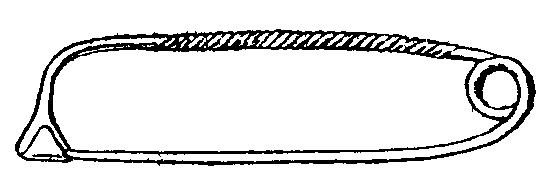
From the comparatively simple initial form, the fibula developed in different lines of descent, into different shapes, varying according to the structural feature which was emphasized. On account of the number of local variations, the subject is extremely complex, but the main lines of development were approximately as follows.
Towards the end of the Bronze Age the safety-pin was arched into a bow, so as to include a greater amount of stuff in its compass.
In the older Iron Age or "Hallstatt period" the bow and its accessories are thickened and modified in various directions, so as to give greater rigidity, and prominences or surfaces for decoration. The chief types have been conveniently classed by Montelius in four main groups, according to the characteristic forms:—
I. The wire of the catch-plate is hammered into a flat disk, on which the pin rests (fig. 2)
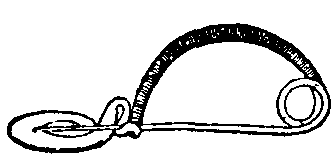
Fig. 2.—Type I. with disk for catch-plate.
II. The bow is thickened towards the middle, so as to assume the "leech" shape, or it is hollowed out underneath, into the "boat" form. The catch-plate is only slightly turned up, but it becomes elongated, in order to mask the end of a long pin (fig. 3).
III. The catch-plate is flattened out as in group I., but additional convolutions are added to the bow (fig. 4).
IV. The bow is convoluted (but the convolutions are sometimes represented by knobs); the catch-plate develops as in group II. (fig. 5). For further examples of the four types, see Antiquities of Early Iron Age in British Museum, p. 32.
Among the special variations of the early form, mention should be made of the fibulae of the geometric age of Greece, with an exaggerated development of the vertical portion of the catch-plate (fig. 6).
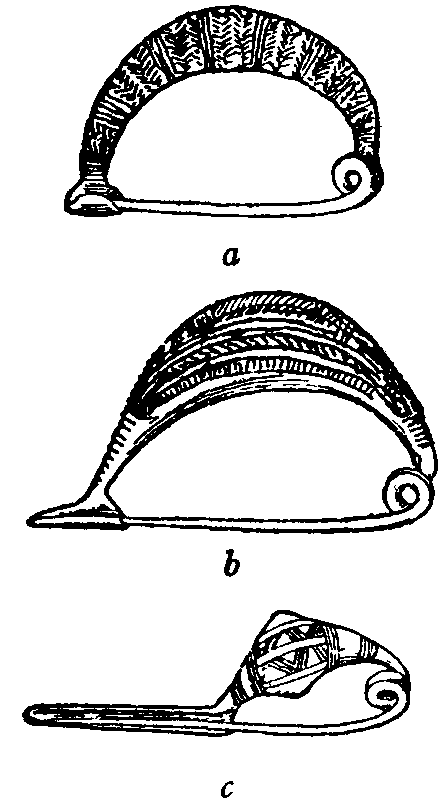
Fig. 3.—Type II. with turned-up and elongated catch-plate. a, "Leech" fibula; b, "Boat" fibula; c. variation of "Boat" fibula.
The example shown in fig. 7 is an ornate development of type II. above.
In the later Iron Age (or early La Tène period) the prolongation of the catch-plate described in the second and fourth groups above has a terminal knob ornament, which is reflexed upwards, at first slightly (fig. 8), and then to a marked extent, turning back towards the bow.
A far-reaching change in the design was at the same time brought about by a simple improvement in principle, apparently introduced within the area of the La Tène culture. Instead of a unilateral spring—that is, of one coiled on one side only of the bow as commonly in the modern safety-pin—the brooch became bilateral. The spring was coiled on one side of the axis of the bow, and thence the wire was taken to the other side of the axis, and again coiled in a corresponding manner before starting in a straight line to form the pin. Once invented, the bilateral spring became almost universal, and its introduction serves to divide the whole mass of ancient fibulae into an older and a younger group.
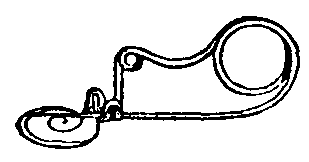
Fig. 4.—Type III with disk for catch-plate, and convoluted bow.
With the progress of the La Tène period (300-1 B.C.) the reflection of the catch-plate terminal became yet more marked, until it became practically merged in the bow (fig. 9). Meanwhile, the bilateral spring described above was developing into two marked projections on each side of the axis. In order to give the double spring strength and protection it was given a metal core, and a containing tube. When the core had been provided the pin was no longer necessarily a continuation of the bow, and it became in fact a separate member, as in a modern brooch of a non-safety-pin type, and was no longer actuated by its own spring.
The T-shaped or "cross-bow" fibula was thus developed. During the first centuries of the Empire it attained great size and importance (figs. 10-12). The form is conveniently dated at its highest development by its occurrence on the ivory diptych of Stilicho at Monza (c. A.D. 400).
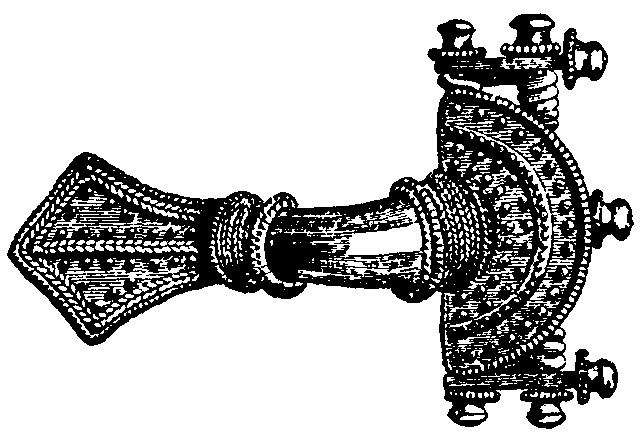
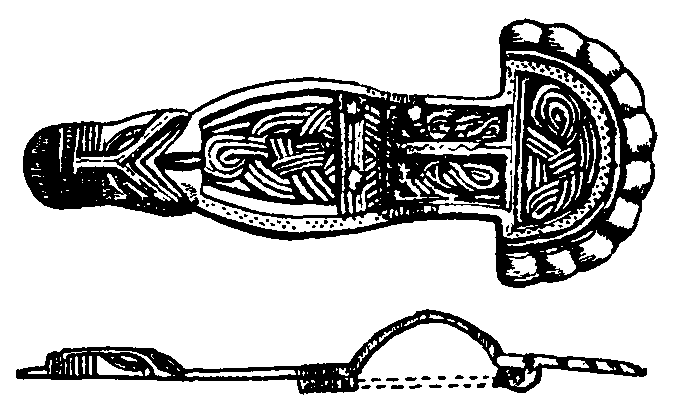
In the tombs of the Frankish and kindred Teutonic tribes between the 5th and 9th centuries the crossbar of the T becomes a yet more elaborately decorated semicircle, often surrounded by radial knobs and a chased surface. The base of the shaft is flattened out, and is no less ornate (fig. 13). At the beginning of this period the fibula of King Childeric (A.D. 481) has a singularly complicated pin-fastening.
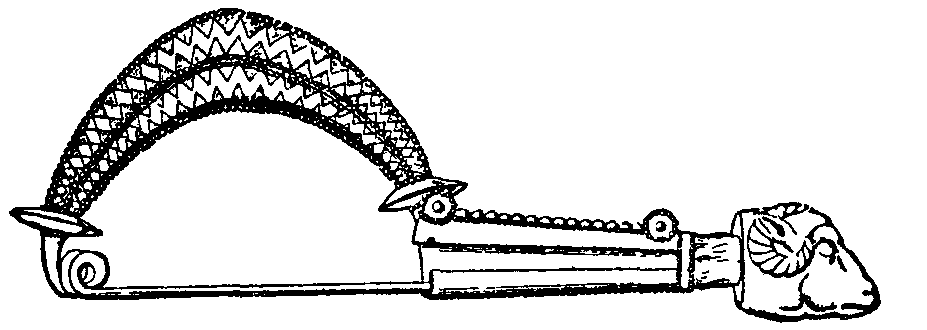
Fig. 7.—Gold fibula from Naples.
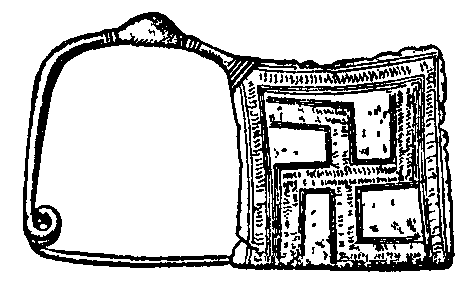
Fig. 6.—Greek geometric fibula.
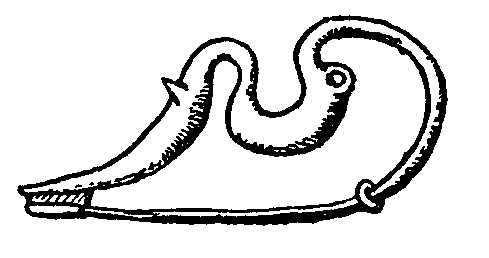
Fig. 5.—Type IV. with turned-up catch-plate and convoluted bow.
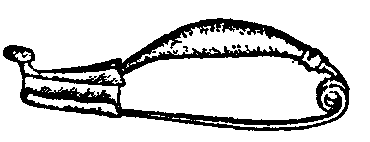
Fig. 8.—Early La Tène period. Reflexed terminal ornament.
So far we have traced the history of the safety-pin form of brooch. Concurrently with it, other forms of brooch were developed in which the safety-pin principle is either absent or effectually disguised. One such form is that of the circular medallion brooch. It is found in Etruscan deposits of a fully developed style, and is commonly represented in Greek and Roman sculptures as a stud to fasten the cloak on the shoulder. In the Roman provinces the circular brooches are very numerous, and are frequently decorated with inlaid stone, paste or enamel. Another kind of brooch, also known from early times, is in the form of an animal. In the early types the animal is a decorative appendage, but in later examples it forms the body of the brooch, to which a pin like the modern brooch-pin is attached underneath. Both of these shapes, namely the medallion and the animal form, are found in Frankish cemeteries, together with the later variations of the T-shaped brooch described above. Such brooches were made in gold, silver or bronze, adorned with precious stones, filigree work, or enamel; but whatever the richness of the material, the pin was nearly always of iron. The Scandinavian or northern group of T-shaped brooches are in their early forms indistinguishable from those of the Frankish tombs, but as time went on they became more massive, and richly decorated with intricate devices (perhaps brought in by Irish missionary influence), into which animal forms were introduced. The period covered is from the 5th to the 8th centuries.
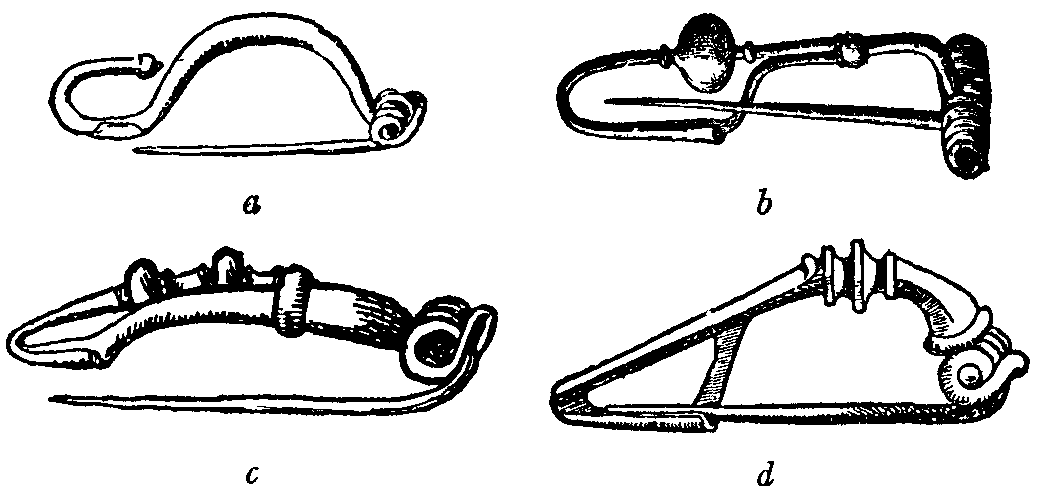
Fig. 9, a-d.—Fibula of the La Tène period, showing the development of the reflexed terminal, and the bilateral spring.
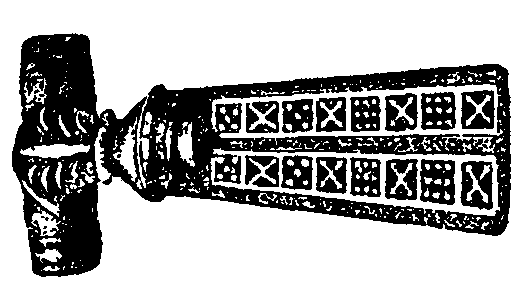
Fig. 11.—Fibula with niello work. 3rd century A.D.
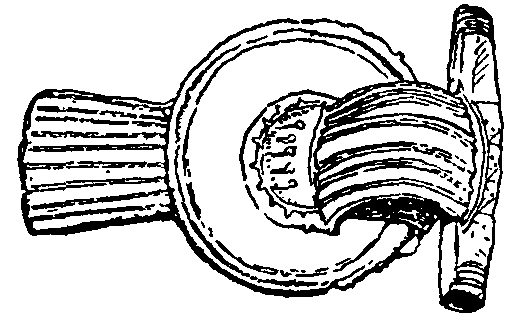
Fig. 10.—Military Fibula. 3rd century A.D.
The T-form, the medallion-form, and (occasionally) the animal forms occur in Anglo-Saxon graves in England. In Kent the medallion-form predominates. The Anglo-Saxon brooches were exquisite works of art, ingeniously and tastefully constructed. They are often of gold, with a central boss, exquisitely decorated, the flat part of the brooch being a mosaic of turquoises, garnets on gold foil, mother of pearl, &c. arranged in geometric patterns, and the gold work enriched with filigree or decorated with dragonesque engravings.
Fig. 12.—Gold Fibula. 4th century A.D.
The Scandinavian brooches of the Viking period (A.D. 800-1050) were oval and convex, somewhat in the form of a tortoise. In their earliest form they occur in the form of a frog-like animal, itself developed from the previous Teutonic T-shaped type. With the introduction of the intricate system of ornament described above, the frog-like animal is gradually superseded by purely decorative lines. The convex bowls are then worked à jour with a perforated upper shell of chased work over an under shell of impure bronze, gilt on the convex side. These outer cases are at last decorated with open crown-like ornament and massive projecting bosses. The geographical distribution of these peculiar brooches indicates the extent of the conquests of the Northmen. They occur in northern Scotland, England, Ireland, Iceland, Normandy and Livonia.
Fig. 13.—Fibula of the Frankish period.
The Celtic group is characterized by the penannular form of the ring of the brooch and the greater length of the pin. The penannular ring, inserted through a hole at the head of the long pin, could be partially turned when the pin had been thrust through the material in such a way that the brooch became in effect a buckle. These brooches are usually of bronze or silver, chased or engraved with intricate designs of interlaced or dragonesque work in the style of the illuminated Celtic manuscripts of the 7th, 8th and 9th centuries. The Hunterston brooch, which was found at Hawking Craig in Ayrshire, is a well-known example of this style. Silver brooches of immense size, some having pins 15 in. in length, and the penannular ring of the brooch terminating in large knobs resembling thistle heads, are occasionally found in Viking hoards of this period, consisting of bullion, brooches and Cufic and Anglo-Saxon coins buried on Scottish soil. In medieval times the form of the brooch was usually a simple, flat circular disk, with open centre, the pin being equal in length to the diameter of the brooch. They were often inscribed with religious and talismanic formulae. The Highland brooches were commonly of this form, but the disk was broader, and the central opening smaller in proportion to the size of the brooch. They were ornamented in the style so common on Highland powder-horns, with engraved patterns of interlacing work and foliage, arranged in geometrical spaces, and sometimes mingled with figures of animals.
(A. H. Sm.)
BROOKE, FRANCES (1724-1789), English novelist and dramatist, whose maiden name was Moore, was born in 1724. Of her novels, some of which enjoyed considerable popularity in their day, the most important were The History of Lady Julia Mandeville (1763), Emily Montague (1769) and The Excursion (1777). Her dramatic pieces and translations from the French are now forgotten. She died in January 1789.
BROOKE, FULKE GREVILLE, 1ST BARON (1554-1628), English poet, only son of Sir Fulke Greville, was born at Beauchamp Court, Warwickshire. He was sent in 1564, on the same day as his life-long friend, Philip Sidney, to Shrewsbury school. He matriculated at Jesus College, Cambridge, in 1568. Sir Henry Sidney, president of Wales, gave him in 1576 a post connected with the court of the Marches, but he resigned it in 1577 to go to court with Philip Sidney. Young Greville became a great favourite with Queen Elizabeth, who treated him with less than her usual caprice, but he was more than once disgraced for leaving the country against her wishes. Philip Sidney, Sir Edward Dyer and Greville were members of the "Areopagus," the literary clique which, under the leadership of Gabriel Harvey, supported the introduction of classical metres into English verse. Sidney and Greville arranged to sail with Sir Francis Drake in 1585 in his expedition against the Spanish West Indies, but Elizabeth peremptorily forbade Drake to take them with him, and also refused Greville's request to be allowed to join Leicester's army in the Netherlands. Philip Sidney, who took part in the campaign, was killed on the 17th of October 1586, and Greville shared with Dyer the legacy of his books, while in his Life of the Renowned Sir Philip Sidney he raised an enduring monument to his friend's memory. About 1591 Greville served for a short time in Normandy under Henry of Navarre. This was his last experience of war. In 1583 he became secretary to the principality of Wales, and he represented Warwickshire in parliament in 1592-1593, 1597, 1601 and 1620. In 1598 he was made treasurer of the navy, and he retained the office through the early years of the reign of James I. In 1614 he became chancellor and under-treasurer of the exchequer, and throughout the reign he was a valued supporter of the king's party, although in 1615 he advocated the summoning of a parliament. In 1618 he became commissioner of the treasury, and in 1621 he was raised to the peerage with the title of Baron Brooke, a title which had belonged to the family of his paternal grandmother, Elizabeth Willoughby. He received from James I. the grant of Warwick Castle, in the restoration of which he is said to have spent £20,000. He died on the 30th of September 1628 in consequence of a wound inflicted by a servant who was disappointed at not being named in his master's will. Brooke was buried in St Mary's church, Warwick, and on his tomb was inscribed the epitaph he had composed for himself: "Folk Grevill Servant to Queene Elizabeth Conceller to King James Frend to Sir Philip Sidney. Trophaeum Peccati."
A rhyming elegy on Brooke, published in Huth's Inedited Poetical Miscellanies, brings charges of extreme penuriousness against him, but of his generous treatment of contemporary writers there is abundant testimony. His only works published during his lifetime were four poems, one of which is the elegy on Sidney which appeared in The Phoenix Nest (1593), and the Tragedy of Mustapha. A volume of his works appeared in 1633, another of Remains in 1670, and his biography of Sidney in 1652. He wrote two tragedies on the Senecan model, Alaham and Mustapha. The scene of Alaham is laid in Ormuz. The development of the piece fully bears out the gloom of the prologue, in which the ghost of a former king of Ormuz reveals the magnitude of the curse about to descend on the doomed family. The theme of Mustapha is borrowed from Madeleine de Scudéry's Ibrahim ou l'illustre Bassa, and turns on the ambition of the sultana Rossa. The choruses of these plays are really philosophical dissertations, and the connexion with the rest of the drama is often very slight. In Mustapha, for instance, the third chorus is a dialogue between Time and Eternity, while the fifth consists of an invective against the evils of superstition, followed by a chorus of priests that does nothing to dispel the impression of scepticism contained in the first part. He tells us himself that the tragedies were not intended for the stage. Charles Lamb says they should rather be called political treatises. Of Brooke Lamb says, "He is nine parts Machiavel and Tacitus, for one of Sophocles and Seneca.... Whether we look into his plays or his most passionate love-poems, we shall find all frozen and made rigid with intellect." He goes on to speak of the obscurity of expression that runs through all Brooke's poetry, an obscurity which is, however, due more to the intensity and subtlety of the thought than to any lack of mere verbal lucidity.
It is by his biography of Sidney that Fulke Greville is best known. The full title expresses the scope of the work. It runs: The Life of the Renowned Sr. Philip Sidney. With the true Interest of England as it then stood in relation to all Forrain Princes: And particularly for suppressing the power of Spain Stated by Him: His principall Actions, Counsels, Designes, and Death. Together with a short account of the Maximes and Policies used by Queen Elizabeth in her Government. He includes some autobiographical matter in what amounts to a treatise on government. He had intended to write a history of England under the Tudors, but Robert Cecil refused him access to the necessary state papers.
Brooke left no sons, and his barony passed to his cousin, Robert Greville (c. 1608-1643), who thus became 2nd Lord Brooke. This nobleman was imprisoned by Charles I. at York in 1639 for refusing to take the oath to fight for the king, and soon became an active member of the parliamentary party; taking part in the Civil War he defeated the Royalists in a skirmish at Kineton in August 1642. He was soon given a command in the midland counties, and having seized Lichfield he was killed there on the 2nd of March 1643. Brooke, who is eulogized as a friend of toleration by Milton, wrote on philosophical, theological and current political topics. In 1746 his descendant, Francis Greville, the 8th baron (1710-1773), was created earl of Warwick, a title still in his family.
Dr A.B. Grosart edited the complete works of Fulke Greville for the Fuller Worthies Library in 1870, and made a small selection, published in the Elizabethan Library (1894). Besides the works above mentioned, the volumes include Poems of Monarchy, A Treatise of Religion, A Treatie of Humane Learning, An Inquisition upon Fame and Honour, A Treatie of Warres, Caelica in CX Sonnets, a collection of lyrics in various forms, a letter to an "Honourable Lady," a letter to Grevill Varney in France, and a short speech delivered on behalf of Francis Bacon, some minor poems, and an introduction including some of the author's letters. The life of Sidney was reprinted by Sir S. Egerton Brydges in 1816; and with an introduction by N. Smith in the "Tudor and Stuart Library" in 1907; Caelica was reprinted in M.F. Crow's "Elizabethan Sonnet Cycles" in 1898. See also an essay in Mrs. C.C. Stopes's Shakespeare's Warwickshire Contemporaries (1907).
BROOKE, HENRY (c. 1703-1783), Irish author, son of William Brooke, rector of Killinkere, Co. Cavan, was born at Rantavan in the same county, about 1703. His mother was a daughter of Simon Digby, bishop of Elphin. Dr Thomas Sheridan was one of his schoolmasters, and he was entered at Trinity College, Dublin, in 1720; in 1724 he was sent to London to study law. He married his cousin and ward, Catherine Meares, before she was fourteen. Returning to London he published a philosophical poem in six books entitled Universal Beauty (1735). He attached himself to the party of the prince of Wales, and took a small house at Twickenham near to Alexander Pope. In 1738 he translated the first and second books of Tasso's Gerusalemme liberata, and in the next year he produced a tragedy, Gustavas Vasa, the Deliverer of his Country. This play had been rehearsed for five weeks at Drury Lane, but at the last moment the performance was forbidden. The reason of this prohibition was a supposed portrait of Sir Robert Walpole in the part of Trollio. In any case the spirit of fervent patriotism which pervaded the play was probably disliked by the government. The piece was printed and sold largely, being afterwards put on the Irish stage under the title of The Patriot. This affair provoked a satirical pamphlet from Samuel Johnson, entitled "A Complete Vindication of the Licensers of the Stage from the malicious and scandalous Aspersions of Mr Brooke" (1739). His wife feared that his connexion with the opposition was imprudent, and induced him to return to Ireland. He interested himself in Irish history and literature, but a projected collection of Irish stories and a history of Ireland from the earliest times were abandoned in consequence of disputes about the ownership of the materials. During the Jacobite rebellion of 1745 Brooke issued his Farmer's Six Letters to the Protestants of Ireland (collected 1746) the form of which was suggested by Swift's Drapier's Letters. For this service he received from the government the post of barrack-master at Mullingar, which he held till his death. He wrote other pamphlets on the Protestant side, and was secretary to an association for promoting projects of national utility. About 1760 he entered into negotiations with leading Roman Catholics, and in 1761 he wrote a pamphlet advocating alleviation of the penal laws against them. He is said to have been the first editor of the Freeman's Journal, established at Dublin in 1763. Meanwhile he had been obliged to mortgage his property in Cavan, and had removed to Co. Kildare. Subsequently a bequest from Colonel Robert Brooke enabled him to purchase an estate near his old home, and he spent large sums in attempting to reclaim the waste-land. His best-known work is the novel entitled The Fool of Quality; or the History of Henry Earl of Moreland, the first part of which was published in 1765; and the fifth and last in 1770. The characters of this book, which relates the education of an ideal nobleman by an ideal merchant-prince, are gifted with a "passionate and tearful sensibility," and reflect the real humour and tenderness of the writer. Brooke's religious and philanthropic temper recommended the book to John Wesley, who edited (1780) an abridged edition, and to Charles Kingsley, who published it with a eulogistic notice in 1859. Brooke had a large family, but only two children survived him. His wife's death seriously affected him, and he died at Dublin in a state of mental infirmity on the 10th of October 1783.
His daughter, Charlotte Brooke, published The Poetical Works of Henry Brooke in 1792, but was able to supply very little biographical material. Other sources for Brooke's biography are C. H. Wilson, Brookiana (2 vols., 1804), and a biographical preface by E. A. Baker prefixed to a new edition (1906) of The Fool of Quality. Brooke's other works include several tragedies, only some of which were actually staged. He also wrote: Jack the Giant Queller (1748), an operatic satire, the repetition of which was forbidden on account of its political allusions; "Constantia, or the Man of Lawe's Tale" (1741), contributed to George Ogle's Canterbury Tales modernized; Juliet Grenville; or the History of the Human Heart (1773), a novel; and some fables contributed to Edward Moore's Fables for the Female Sex (1744).
BROOKE, SIR JAMES (1803-1868), English soldier, traveller and raja of Sarawak, was born at Coombe Grove near Bath, on the 29th of April 1803. His father, a member of the civil service of the East India Company, had long lived in Bengal. His mother was a woman of superior mind, and to her care he owed his careful early training. He received the ordinary school education, entered the service of the East India Company, and was sent out to India about 1825. On the outbreak of the Burmese War he was despatched with his regiment to the valley of the Brahmaputra; and, being dangerously wounded in an engagement near Rungpore, was compelled to return home (1826). After his recovery he travelled on the continent before going to India, and circumstances led him soon after to leave the service of the company. In 1830 he made a voyage to China, and during his passage among the islands of the Indian Archipelago, so rich in natural beauty, magnificence and fertility, but occupied by a population of savage tribes, continually at war with each other, and carrying on a system of piracy on a vast scale and with relentless ferocity, he conceived the great design of rescuing them from barbarism and bringing them within the pale of civilization. His purpose was confirmed by observations made during a second visit to China, and on his return to England he applied himself in earnest to making the necessary preparations. Having succeeded on the death of his father to a large property, he bought and equipped a yacht, the "Royalist," of 140 tons burden, and for three years tested its capacities and trained his crew of twenty men, chiefly in the Mediterranean. At length, on the 27th of October 1838, he sailed from the Thames on his great adventure. On reaching Borneo, after various delays, he found the raja Muda Hassim, uncle of the reigning sultan, engaged in war in the province of Sarawak with several of the Dyak tribes, who had revolted against the sultan. He offered his aid to the raja; and with his crew, and some Javanese who had joined them, he took part in a battle with the insurgents, and they were defeated. For his services the title of raja of Sarawak was conferred on him by Muda Hassim, the former raja being deprived in his favour. It was, however, some time before the sultan could be induced to confirm his title (September 1841). During the next five years Raja Brooke was engaged in establishing his power, in making just reforms in administration, preparing a code of laws and introducing just and humane modes of dealing with the degraded subjects of his rule. But this was not all. He looked forward to the development of commerce as the most effective means of putting an end to the worst evils that afflicted the archipelago; and in order to make this possible, the way must first be cleared by the suppression, or a considerable diminution, of the prevailing piracy, which was not only a curse to the savage tribes engaged in it, but a standing danger to European and American traders in those seas. Various expeditions were therefore organized and sent out against the marauders, Dyaks and Malays, and sometimes even Arabs. Captain (afterwards Admiral Sir Harry) Keppel, and other commanders of British ships of war, received permission to co-operate with Raja Brooke in these expeditions. The pirates were attacked in their strongholds, they fought desperately, and the slaughter was immense. Negotiations with the chiefs had been tried, and tried in vain. The capital of the sultan of Borneo was bombarded and stormed, and the sultan with his army routed. He was, however, soon after restored to his dominion. So large was the number of natives, pirates and others, slain in these expeditions, that the "head-money" awarded by the British government to those who had taken part in them amounted to no less than £20,000. In October 1847 Raja Brooke returned to England, where he was well received by the government; and the corporation of London conferred on him the freedom of the city. The island of Labuan, with its dependencies, having been acquired by purchase from the sultan of Borneo, was erected into a British colony, and Raja Brooke was appointed governor and commander-in-chief. He was also named consul-general in Borneo. These appointments had been made before his arrival in England. The university of Oxford conferred on him the honorary degree of D.C.L., and in 1848 he was created K.C.B. He soon after returned to Sarawak, and was carried thither by a British man-of-war. In the summer of 1849 he led an expedition against the Seribas and Sakuran Dyaks, who still persisted in their piratical practices and refused to submit to British authority. Their defeat and wholesale slaughter was a matter of course. At the time of this engagement Sir James Brooke was lying ill with dysentery. He visited twice the capital of the sultan of Sala, and concluded a treaty with him, which had for one of its objects the expulsion of the sea-gypsies and other tribes from his dominions. In 1851 grave charges with respect to the operations in Borneo were brought against Sir James Brooke in the House of Commons by Joseph Hume and other members, especially as to the "head-money" received. To meet these accusations, and to vindicate his proceedings, he came to England. The evidence adduced was so conflicting that the matter was at length referred to a royal commission, to sit at Singapore. As the result of its investigation the charges were declared to be "not proven." Sir James, however, was soon after deprived of the governorship of Labuan, and the head-money was abolished. In 1867 his house in Sarawak was attacked and burnt by Chinese pirates, and he had to fly from the capital, Kuching. With a small force he attacked the Chinese, recovered the town, made a great slaughter of them, and drove away the rest. In the following year he came to England, and remained there for three years. During this time he was attacked by paralysis, a public subscription was raised, and an estate in Devonshire was bought and presented to him. He made two more visits to Sarawak, and on each occasion had a rebellion to suppress. He spent his last days on his estate at Burrator in Devonshire, and died there, on the 11th of June 1868, being succeeded as raja of Sarawak by his nephew. Sir James Brooke was a man of the highest personal character, and he displayed rare courage both in his conflicts in the East and under the charges advanced against him in England.
His Private Letters (1838 to 1853) were published in 1853. Portions of his Journal were edited by Captains Munday and Keppel. (See also Sarawak.)
BROOKE, STOPFORD AUGUSTUS (1832- ), English divine and man of letters, born at Letterkenny, Donegal, Ireland, in 1832, was educated at Trinity College, Dublin. He was ordained in the Church of England in 1857, and held various charges in London. From 1863 to 1865 he was chaplain to the empress Frederick in Berlin, and in 1872 he became chaplain in ordinary to Queen Victoria. But in 1880 he seceded from the Church, being no longer able to accept its leading dogmas, and officiated as a Unitarian minister for some years at Bedford chapel, Bloomsbury. Bedford chapel was pulled down about 1894, and from that time he had no church of his own, but his eloquence and powerful religious personality continued to make themselves felt among a wide circle. A man of independent means, he was always keenly interested in literature and art, and a fine critic of both. He published in 1865 his Life and Letters of F. W. Robertson (of Brighton), and in 1876 wrote an admirable primer of English Literature (new and revised ed., 1900), followed in 1892 by The History of Early English Literature (2 vols., 1892) down to the accession of Alfred, and English Literature from the Beginnings to the Norman Conquest (1898). His other works include various volumes of sermons; Poems (1888); Dove Cottage (1890); Theology in the English Poets—Cowper, Coleridge, Wordsworth, Burns (1874); Tennyson, his Art and Relation to Modern Life (1894); The Poetry of Robert Browning (1902); On Ten Plays of Shakespeare (1905); and The Life Superlative (1906).
BROOK FARM, the name applied to a tract of land in West Roxbury, Massachusetts, on which in 1841-1847 a communistic experiment was unsuccessfully tried. The experiment was one of the practical manifestations of the spirit of "Transcendentalism," in New England, though many of the more prominent transcendentalists took no direct part in it. The project was originated by George Ripley, who also virtually directed it throughout. In his words it was intended "to insure a more natural union between intellectual and manual labour than now exists; to combine the thinker and the worker, as far as possible, in the same individual; to guarantee the highest mental freedom by providing all with labour adapted to their tastes and talents, and securing to them the fruits of their industry; to do away with the necessity of menial services by opening the benefits of education and the profits of labour to all; and thus to prepare a society of liberal, intelligent and cultivated persons whose relations with each other would permit a more simple and wholesome life than can be led amidst the pressure of our competitive institutions." In short, its aim was to bring about the best conditions for an ideal civilization, reducing to a minimum the labour necessary for mere existence, and by this and by the simplicity of its social machinery saving the maximum of time for mental and spiritual education and development. At a time when Ralph Waldo Emerson could write to Thomas Carlyle, "We are all a little wild here with numberless projects of social reform; not a reading man but has a draft of a new community in his waistcoat pocket,"—the Brook Farm project certainly did not appear as impossible a scheme as many others that were in the air. At all events it enlisted the co-operation of men whose subsequent careers show them to have been something more than visionaries. The association bought a tract of land about 10 m. from Boston, and in the summer of 1841 began its enterprise with about twenty members. In September the "Brook Farm Institute of Agriculture and Education" was formally organized, the members signing the Articles of Association and forming an unincorporated joint-stock company. The farm was assiduously, if not very skilfully, cultivated, and other industries were established—most of the members paying by labour for their board—but nearly all of the income, and sometimes all of it, was derived from the school, which deservedly took high rank and attracted many pupils. Among these were included George William Curtis and his brother James Burrill Curtis, Father Isaac Thomas Hecker (1819-1888), General Francis C. Barlow (1834-1896), who as attorney-general of New York in 1871-1873 took a leading part in the prosecution of the "Tweed Ring." For three years the undertaking went on quietly and simply, subject to few outward troubles other than financial, the number of associates increasing to seventy or eighty. It was during this period that Nathaniel Hawthorne had his short experience of Brook Farm, of which so many suggestions appear in the Blithedale Romance, though his preface to later editions effectually disposed of the idea—which gave him great pain—that he had either drawn his characters from persons there, or had meant to give any actual description of the colony. Emerson refused, in a kind and characteristic letter, to join the undertaking, and though he afterwards wrote of Brook Farm with not uncharitable humour as "a perpetual picnic, a French Revolution in small, an age of reason in a patty-pan," among its founders were many of his near friends. In 1844 the growing need of a more scientific organization, and the influence which F.M.C. Fourier's doctrines, as modified by Albert Brisbane (1809-1890), had gained in the minds of Ripley and many of his associates, combined to change the whole plan of the community. It was transformed, with the strong approval of all its chief members and the consent of the rest, into a Fourierist "phalanx" in 1845. There was an accession of new members, a momentary increase of prosperity, a brilliant new undertaking in the publication of a weekly journal, the Harbinger, in which Ripley, Charles A. Dana, Francis G. Shaw and John S. Dwight were the chief writers, and to which James Russell Lowell, J.G. Whittier, George William Curtis, Parke Godwin, T.W. Higginson, Horace Greeley and many more now and then contributed. But the individuality of the old Brook Farm was gone. The association was not rescued even from financial troubles by the change. With increasing difficulty it kept on till the spring of 1846, when a fire which destroyed its nearly completed "phalanstery" brought losses which caused, or certainly gave the final ostensible reason for, its dissolution. The experiment was abandoned in the autumn of 1847. Besides Ripley and Hawthorne, the principal members of the community were Charles A. Dana, John S. Dwight, Minot Pratt (c. 1805-1878), the head farmer, who, like George Partridge Bradford (1808-1890), left in 1845, and Warren Burton (1810-1866) a preacher and, later, a writer on educational subjects. Indirectly connected with the experiment, also, as visitors for longer or shorter periods but never as regular members, were Emerson, Amos Bronson Alcott, Orestes A. Brownson, Theodore Parker and William Henry Channing, Margaret Fuller and Elizabeth Palmer Peabody. The estate itself, after passing through various hands, came in 1870 into the possession of the "Association of the Evangelical Lutheran Church for Works of Mercy," which established here an orphanage, known as the "Martin Luther Orphan Home."
The best account of Brook Farm is Lindsay Swift's Brook Farm, Its Members, Scholars and Visitors (New York, 1900). Brook Farm: Historic and Personal Memoirs (Boston, 1894), is by Dr J.T. Codman, one of the pupils in the school. See also Morris Hillquit's History of Socialism in the United States (New York, 1903).
(E. L. B.)
Fig. 2.
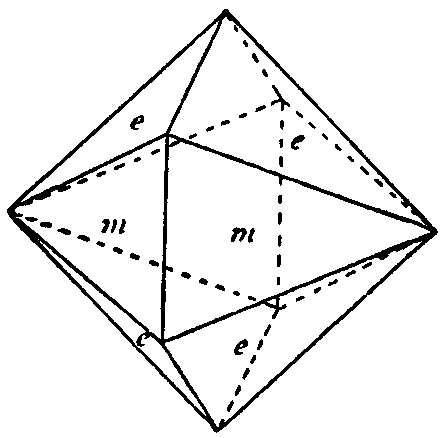
Fig. 1.
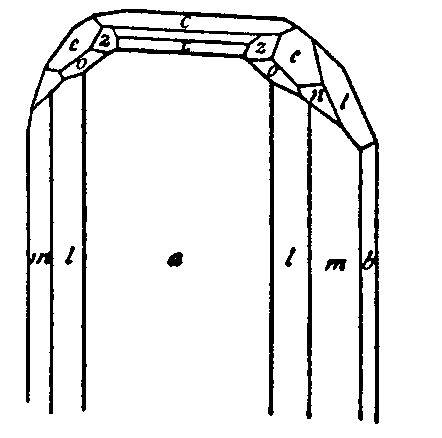
BROOKITE, one of the three modifications in which titanium dioxide (TiO2) occurs in nature; the other minerals with the same chemical composition, but with different physical and crystallographic characters, being rutile (q.v.) and anatase (q.v.) The two latter are tetragonal in crystallization, whilst brookite is orthorhombic. The name was given by A. Lévy in 1825 in honour of the English mineralogist H.J. Brooke (1771-1857). Two types of brookite crystals may be distinguished. The commoner type of crystals are thin and tabular, and often terminated by numerous small and brilliant faces (fig. 1); the faces of the orthopinacoid (a) and of the prisms (m, l) are vertically striated. These crystals are of a rich reddish-brown colour and are often translucent. Crystals of the second type have the appearance of six-sided bipyramids (fig. 2) owing to the equal development of the prism m {110} and the pyramid e {122}; these crystals are black and opaque, and constitute the variety known as arkansite.
The lustre of brookite is metallic-adamantine. There is no distinct cleavage (rutile and anatase have cleavages); hardness 5½-6; sp. gr. 4.0. The optical characters are interesting: the optic axes for red and for blue light lie in planes at right angles to each other, whilst for yellow-green light the crystals are uniaxial. The acute bisectrix of the optic axes is perpendicular to the orthopinacoid (a) for all colours, so that this phenomenon of the crossing of the optic axial planes may be readily observed in the thin tabular crystals of the first-mentioned type.
Brookite occurs only as crystals, never in compact masses, and is usually associated with either anatase or rutile. The crystals are found attached to the walls of cavities in decomposed igneous rocks and crystalline schists; it is also found as minute isolated crystals in many sedimentary rocks. The best-known locality is Fronolen near Tremadoc in North Wales, where crystals of the thin tabular habit occur with crystallized quartz, albite and anatase on the walls of crevices in diabase. Similar crystals of relatively large size are found attached to gneiss at several places in the Swiss and Tirolese Alps. Thicker crystals of prismatic, rather than tabular, habit and of a rich red colour combined with considerable transparency and brilliancy are found in the gold-washings of the Sanarka river in the southern Urals. The arkansite variety occurs with rutile in the elaeolite-syenite of Magnet Cove in Hot Spring county, Arkansas. Minute crystals of brookite have been detected with anatase and rutile in the iron-ore of Cleveland in Yorkshire.
Crystals of brookite, as well as of anatase and rutile, have been prepared artificially by the interaction of steam and titanium fluoride, the particular modification of titanium dioxide which results depending on the temperature at which the reaction takes place. Brookite is liable to become altered to rutile: aggregates of rutile needles with the form of brookite (arkansite) are not uncommon at Magnet Cove, Arkansas.
(L. J. S.)
BROOKLIME, known botanically as Veronica Beccabunga (natural order Scrophulariaceae), a succulent herb growing on margins of brooks and ditches in the British Isles, and a native of Europe, north Africa and north and western Asia. It has smooth spreading branches, blunt oblong leaves and small bright blue or pink flowers.
BROOKLINE, a township of Norfolk county, Massachusetts, U.S.A., about 3 m. S.W. of Boston, lying immediately S. of the Back Bay district. Pop. (1890) 12,103; (1900) 19,935, of whom 6536 were foreign-born; (1910, census) 27,792. The area of the township in 1906 was 6.75 sq. m. It is served by the Boston & Albany railway, and is connected with Boston by an electric line. Brookline is the wealthiest of the residential suburbs of Boston; and contains a number of beautiful estates and homes. Within its limits are the villages of Cottage Farm, Longwood, and Reservoir Station, or Chestnut Hill—the Chestnut Hill reservoir is just beyond the township. Brookline has an excellent public library. At Clyde Park are the grounds and club-house of the Boston Country Club. Brookline has long been regarded as a model city suburb. It is connected with Boston Common by boulevards of the Metropolitan Park System. The first settlement was probably made about 1635, and it was called Muddy River until 1705, when it was created a township under the name of Brookline. Up to 1793 it belonged to Suffolk county, of which Boston is a part, and since that time it has belonged to Norfolk county; but Boston has in its growth almost surrounded it, and because of its great wealth there has been a long struggle for and against its merger in Boston. Frederick Law Olmsted, the famous landscape gardener, had his home in Brookline, where there are various examples of his work.