ERNEST ALFRED VIZETELLY (continued 7)
Reading edition
Before passing the series in review one may say a few words respecting the two names, Rougon and Macquart, which, linked together, have supplied it with a general title. Some years ago those names were noticed by the present writer in sundry old documents relating to an abbey in Champagne, but Zola declared them to be common names in Provence. As for Macquart—long familiar to Parisians in connection with the knacker's trade—it is a suggestive circumstance that in Zola's younger days there was a bookseller at Aix, named Makaire, whom he may well have known. Makaire, of course is merely a variant of Macaire; and it is not necessary to be familiar with the famous "Auberge des Adrets," and the wonderful impersonation of Frédérick Lemaître, to know that "Robert Macaire" is regarded by the French as a type of braggart rascal, as cynical, as impudent as "Tartuffe" is hypocritical and sneakish. Zola, then, in the writer's opinion, adopted that vulgar name Macquart because it resembled Macaire, and put Rougon before it in lieu of Robert. He pictured the Rougon-Macquarts as the Robert-Macaires of the Second Empire, and the idea came to him, perhaps, the more readily as Napoleon III. had been repeatedly caricatured as Robert Macaire, a brazen knave repeating abracadabrant axioms amid the applause of his followers. Thus the title of the Rougon-Macquarts, if taken as synonymous with the Robert-Macaires, will suffice to explain a good deal of Zola's series.
Let us now glance at the volumes. In "La Fortune des Rougon" (I) the author describes the origin of the Rougons and the Macquarts. One Adélaïde Fouque, a woman of hysterical nature who eventually goes mad,—a variety of disorders being transmitted to most of her descendants,—marries a man named Rougon, and on his death lives with another named Macquart. By the former she has a son, Pierre Rougon; by the latter a son, Antoine, and a daughter, Ursule Macquart. This daughter marries a hatter named Mouret, and thus at the outset of the series the second generation of the family is shown divided into three branches. In the third generation it increases to eleven members; in the fourth to thirteen. In the fifth it dwindles, its vitiated energies now being largely spent; and though there are indications of its continuance in sundry children who do not appear on the scene, the hope of regeneration rests virtually in only one child, a boy three months old when the curtain finally descends. In "La Fortune des Rougon," then, we are shown old Adélaïde Fouque, her children and some of theirs, all more or less poverty-stricken and striving for wealth, which comes with the foundation of the Second Empire. The scene is laid at Plassans—Aix, as was formerly explained—and one sees the Imperial régime established there by craft and bloodshed.
Next comes "Son Excellence Eugène Rougon" (II) which carries one to Paris, where the fortunes of the eldest of the Rougon brothers, first an advocate and at last an all-powerful minister of state, are followed in official and political circles. The court of Napoleon III appears at the Tuileries and at Compiègne, where one meets, among others, a beautiful Italian adventuress, Clorinde Balbi—suggestive of the notorious Countess de Castiglione—with a mother reminiscent of Madame de Montijo. And in other chapters of the volume the scheming and plotting of the reign, the official jobbery and corruption, are traced for several years.
"La Curée" (III) follows, and one turns to Eugène Rougon's younger brother, Aristide, who has assumed the pseudonym of Saccard. With him the reader joins in the great rush for the spoils of the new régime. A passion for money and enjoyment seizes on one and all, debauchery reigns in society, and a fever of reckless speculation is kindled by the transformation of Paris under Baron Haussmann and his acolytes. Men and women sell themselves. Renée, Saccard's second wife, passes from mere adultery to incest, becoming a modern Phædra, while Saccard himself leads the life of an eager, gluttonous bird of prey, which he continues in the ensuing volume, "L'Argent" (IV), where the Bourse—the money-market—is shown with all its gambling, its thousand tricks and frauds.
So far the series might seem a mere record of roguery, vice, and corruption, but those who know the books are aware that such is not the case. Silvère and Miette stand for love and all the better qualities of humanity in the first volume; there are at least the Martinots and the Berauds in the second and third; and the devoted Madame Caroline, the honest Hamelin, the pious Princess d'Orviedo, the dreamy, generous-hearted Sigismond, the loving Jordans, and the unfortunate Mazaud, all figure in the fourth, amid the scramble for gold in which the other characters participate.
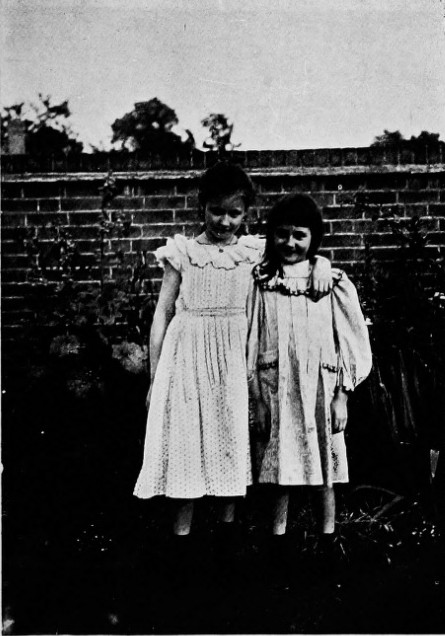
Denise and Jacques.—Photo by Émile Zola.
In sharp contrast with that greed for gain is the picture offered by the next volume, "Le Rêve" (V), where an immaculate lily arises from the hot-bed of vice, whence later, and as a further contrast, a type of foul shamelessness, Nana, the harlot, is also to spring. But it is best not to anticipate. In the first four volumes the Rougons, under the influence of heredity and surroundings, have shown themselves scoundrels, whereas in Angélique, the heroine of "Le Rêve," a girl of their blood appears who is all purity and candour. She comes upon the scene, precisely at this moment, to emphasise the author's conviction that, whatever he may have had to depict in his solicitude for truth, all is not vice, degradation, and materialism, that there are other aspirations in life besides the thirst for wealth, enjoyment and power. And here, too, the priesthood is shown in its better aspect: the good Abbé Cornille, the proud, heartbroken Bishop d'Hautecœur, in contrast with whom the scheming, unscrupulous Abbé Faujas appears in the next section of the series.
This is "La Conquête de Plassans" (VI) which retains one in the provinces (whither one is carried from Paris in "Le Rêve"), and one is confronted by a carefully painted picture of middle-class society in a small town, this in its turn contrasting with the previous pictures of life in Paris. And now the baleful results which may attend marriages between cousins are exemplified. Marthe Rougon has married François Mouret, and both have inherited lesions from their common ancestress, Adélaïde Fouque. One of their children, Désirée, physically strong and healthy, is mentally an "innocent"; and they themselves are unhinged, the workings of their heredity being accentuated and hastened by the wiles of Faujas, the priest, who gains access to their home. He is a secret agent of the imperial government, and thus one again sees the Empire at work in the provinces, utilising the clergy to enforce its authority, and as often as not betrayed by it. In the end all collapses. The maddened Mouret sets fire to his home and perishes in the flames with Abbé Faujas, while Marthe dies of a disorder springing from her inherited hysteria.
Then, the middle class of the provinces having been sketched, that of the metropolis is depicted with an unsparing hand. The career of the Mourets' eldest son, Octave, is followed, first through the pages of "Pot-Bouille" (VII), in which he appears as a kind of modern Don Juan, a Don Juan stripped of all poetry, all glamour, a sensualist of our great cities, the man who prowls, not among the unhappy creatures of the streets, but among the women of outward respectability who may help him to acquire position and fortune. The scene is laid in a house of the Rue de Choiseul, in the centre of Paris; and all around Octave gravitate depraved, venal, egotistical, and sickly beings, adulterous households, unscrupulous match-making mothers, demi-vierges who will only marry for money, dowry hunters, slatternly servant girls, and that type of the middle-class debauchee who makes those girls his prey. And the pleasing figures in the work are few—poor old Josserand, for instance, and the charming Madame Hédouin, with the prosperous author on the first floor, who drives in his carriage and has two handsome children. At the same time the book pours a stream of light first on all the ignoble shifts to which middle-class folk of small means are put in their insane endeavours to ape their wealthier neighbours, and secondly on the evils that arise from that dowry system which superficial people regard as proving the foresight and wisdom of the French when they embark on the sea of matrimony. As a matter of fact, it frequently happens that this dowry system entirely blights married life. As often as not the dowry itself is a mere snare and delusion—the bride's parents retaining the principal, and merely serving the interest until their death, when, as in the case of Zola's old Vabre, the parental fortune may have entirely disappeared!
In "Au Bonheur des Dames" (VIII) Octave Mouret appears again, a sensualist still but also a man of enterprise, at the head of a "Grand Magasin de Nouveautés," a Temple of Temptation, which revolutionises trade and panders to the feminine love of finery. Here the bourgeoisie is shown elbowing the class immediately below it, a world of employés, clerks, shopmen and shop-girls, whose lives, likewise, are full of evil. But again a girl of admirable rectitude, Denise Baudu, comes forward to illumine the novelist's pages, and redeem and ennoble the man who has hitherto regarded her sex as an instrument or a toy.
When Zola has cast Octave Mouret at the feet of Denise, thereby exemplifying a pure woman's influence over man, he again transfers his scene from bustling Paris to a lonely region of the southern provinces, there to follow the career of Octave's brother, Serge. In "La Faute de l'Abbé Mouret" (IX) the battle is again one between woman, love, and man; but a new factor appears—religion—for Serge is a priest, bound by the unnatural vow of his calling, one of hysterical, mystical temperament also, enslaved by the superstitions of his creed. In his tumble-down parsonage and his little, decaying, forsaken church, amid a semi-savage, brutish peasantry, he long strives to resist the cry of nature. But she at last asserts her might, and the novelist carries the reader into the enchanted garden of the Paradou, where love reigns supreme. Yet the golden hours are brief: the priest is recalled to his religion of death, and he cannot resist the call, for all the training of years which has confirmed and increased his mystical tendency comes back, and he is helpless. Thus the natural life is forsaken for the illusions and dogmas of a creed; and Albine, whom Serge has loved, is left forlorn with her unborn babe, to lie down and die amid the perfume of the flowers with which she has strewn her bed. Serge it is who casts the symbolical pinch of earth upon her coffin, for he has resumed his ministry among the brutish peasants, dedicating all his efforts to slay the sex given him by his God, for instead of living as a man he must obey the command of his Church and live as an eunuch.
After that battle with nature and love, there comes a companion picture: the fall of Hélène Mouret in "Une Page d'Amour" (X). She has hitherto led an absolutely blameless life, but a sudden passion sweeps her off her feet. A tragic sombreness attends the episode. No glamour is cast over woman's frailty in Zola's pages. If Hélène tastes an hour of intoxication she is punished for it as frightfully as any moralist could desire. Jeanne, her fondly loved daughter, who is devoured by jealous hysteria, dies as the result of her lapse, and it is only afterwards, in pity as it were, that Hélène is granted the chance of beginning her life afresh.
Then the series continues. All the Rougons—excepting one, Pascal, whom the novelist keeps back till the end—have now been dealt with, the Mourets also, and the chronicle of the bastard Macquart branch begins. Antoine Macquart has three children, Lisa, Gervaise, and Jean, and it is Lisa who supplies the next volume of the series, "Le Ventre de Paris" (XI), which carries one through and around the great markets of the French metropolis, as well as into the fine pork-butcher's shop, which Lisa keeps with her husband, Quenu. This is a volume redolent of victuals certainly, marked also by the egotism of the shopkeeping and petty trading classes, with yet a glimpse of one of those conspiracies which were frequent in the time of Napoleon III, and a backward glance at the coup d'état by which that sovereign had risen to power. The chief figure in the story is Quenu's brother, the unhappy Florent, who has escaped from Cayenne, and whom Lisa, that comfortable egotist, ends by betraying to the authorities. For that ultra-righteous deed,—counselled by Lisa's confessor,—and for the savagery of all the fat fishwives, one is consoled by the presence of honest Madame François and of Cadine, the little flower-girl, and Marjolin, her youthful lover, whose smile brightens many a page.
Then, in "La Joie de Vivre" (XII), comes Pauline, whose nature is so different from that of her mother, Lisa. She has no egotism in her composition, she would never betray anybody; she is all human devotion and self-sacrifice. With her we are carried to the seashore, to a little fisher hamlet, where her guardian Chanteau dwells; and he, his wife, and his son prey upon her, wrecking her life, though she remains brave and smiling till the end. And how little joy there may be in life is shown not only by her case, but by that of the crippled Chanteau, his embittered, covetous, suspicious wife, his jealous servant, and his weak-minded son, who tries to be this and that, but succeeds in nothing and is consumed by a foolish, unreasoning dread of death. It is to these that Pauline has to minister, for these that she has to sacrifice herself, even as it often happens that the good have to lay down their lives for the unworthy.
Pauline, one has said, is very different from her mother, Lisa. Equally different is Lisa's sister, Gervaise, the pathetic heroine of "L'Assommoir" (XIII), with which the family chronicle is continued. Lisa rises, Gervaise falls; so does it happen in many of the world's families. Zola has now descended through several strata of society, and has come to the working classes. A deep pathos lies beneath the picture he traces of them under the bane of drink. At first Gervaise appears so courageous amid her misfortunes that one can readily grant her the compassionate sympathy accorded to every trusting woman whom a coward abandons. There seems hope for her at the outset of her marriage with Coupeau; a possibility, too, that she may prove successful when, industrious and energetic, she starts her little laundry business. But her husband's lazy, drunken ways recoil on her, the return of the rascally Lantier completes her misfortune, and then she rolls down hill, to die at last of starvation. The stage of "L'Assommoir" is crowded with typical figures, some of them perchance imperishable, for their names have passed into the French language to serve as designations for one and another degraded character that one encounters in every-day life. Yet all the personages of Zola's work are not depraved. Even in this dark book there are a few who point to the brighter side of human nature, honest Goujet, for instance, and Lalie, the poor, pitiful "little mother." Gervaise and Coupeau themselves are not wholly vile. In the midst of their degradation, when she prowls the boulevard in the snow, when he is dancing madly in his padded cell, one instinctively retraces their careers back to the early days when both had looked so hopefully on life; and one recognises that a fatal environment, more than natural worthlessness, has been the great cause of their downfall.
Nana already appears—in her childhood and her youth—in the pages of "L'Assommoir," but Zola does not pass direct from that work to the later career of Gervaise's daughter. He first takes Gervaise's elder children, her sons by Lantier; and "L'Œuvre" (XIV) unfolds the painful story of Claude, the painter, a glimpse of whom has been given previously in "Le Ventre de Paris." Again in "L'Œuvre," one finds a record of downfall, but, whereas in "L'Assommoir" it has largely resulted from environment and circumstances, it now proceeds more directly from an evil heredity. Claude stands virtually on the border line that parts insanity from genius, and thus in his career, the old hypotheses of Moreau of Tours, and those subsequently enunciated in England by Nesbit, might find play. In the end, after a life of conflict and misery, insanity triumphs and Claude destroys himself. His tale, as one has stated previously, is linked with a picture of the French art-world. Fortunately a current of human interest flows through the book, for beside Claude the unhappy Christine, his wife, appears: she, like Gervaise, at first being a good, true, and courageous woman, one who commits the irremediable mistake of linking her life with that of a man fated to failure and insanity.
In these last sections of Zola's series the march of degenerescence is hastened; downfall follows downfall; before long that of individuals is to be succeeded by a supreme collapse, that of the régime under which they live. Thus, after "L'Œuvre," comes "La Bête Humaine" (XV), Claude's brother Jacques, an engine-driver, in whom a murderer appears among the Rougon-Macquarts. The hereditary virus, transmitted from Adélaïde Fouque, has turned in him to an insensate craving for woman's blood, and, frankly, his story is horrible. At the same time, while one follows the growth of his abominable disease, many a vivid page arrests attention: awful, yet a masterpiece of colloquial narrative and full of a penetrating psychology, is Severine's account of the murder of President Grandmorin; very human is Jacques' love for his engine, La Lison; and striking are the pictures of the snowstorm, the railway accident, and the death of Jacques and the stoker Pecqueux, at the end of the volume, when their train, crowded with soldiers, is seen rushing driverless, like some great, maddened, blind beast, towards catastrophe and annihilation.
Next the story of Gervaise's third son, Étienne, is unfolded in "Germinal" (XVI), this again a tale of the workers, the hardships, the misery, the degradation of the sweated toilers of the coal-pits, who are maddened by want to revolt. And then, of course, they are shot down by the soldiers at the disposal of the capitalists who batten on the sufferings of labour. A tribute of compassion, a call for justice, a cry of warning to the rich and powerful—such, as Zola himself said, is "Germinal." Those who wonder at the hatred of the workers for those above them, at the spread of socialism throughout France, need merely read his pages to understand why and how such things have come to pass.
But "Nana" (XVII) now confronts the reader. He has just passed through the world of labour: drunkenness, degradation, insanity, crime, revolution have been indicated successively as resultants of the condition of the masses; and here comes another product of an evil social system, the low-born harlot who, like an unconscious instrument of retribution, ascends from her native dung-heap to poison the bourgeoisie and aristocracy—the rulers, the law-givers, to whom the existence of that dung-heap and its evil ferments is due. In "Nana" depravity coruscates. Here is the so-called "life of pleasure" of the world's great cities, the life of indulgence which recruits its votaries among all the aristocracies, all the plutocracies, all the bourgeoisies, all the bohemias. To some, Nana may seem to be "a scourge of God"—assuredly the world's Nanas have wrought more evil than its Attilas—"a punishment on men for their lewd and lawless sensuality." In Zola's pages one does not witness merely the ruin and disgrace of the professedly profligate; one sees also how natural, youthful desire when exposed to temptation may ripen into depravity and end in misery. One sees, again, the reflex action of libertinism on married life—how wives end at times by following the example of their husbands, and even "bettering the instruction."[1] From first to last this much-maligned book is a stupendous warning for both sexes, as great a denunciation of the social evil as ever was penned.
But the scene changes, and in "La Terre" (XVIII) appears Jean Macquart, soldier and artisan, who becomes a peasant. He, though a brother of Gervaise, has escaped the hereditary taint, is strong, sensible, hard-working, a man destined, one might think, to a life of useful and happy obscurity. But fate casts him among the Fouans, a family of untutored peasants, barely raised above animality; and a drama of savage greed and egotism is unfolded around him. Old Fouan, being no longer able to till his fields himself, divides his property among his children, who agree to make him an allowance. But he is cheated, ill-treated, robbed of his savings by them, and finally murdered by one of his sons. That same son, Buteau, is consumed by a ravenous earth-hunger, but animal desire is also strong within him. He is both enamoured and jealous of his wife's sister, Françoise, who is Jean Macquart's wife, his passion for her being blended with a craving to appropriate her land. At last she, by violence, becomes his victim, and in a struggle with her sister, who is present, is thrown upon a scythe and mortally injured. That crime is witnessed by old Fouan, and it is for fear lest he should reveal it that he is stifled—then burnt.
From "La Terre" Jean Macquart passes to "La Débâcle" (XIX), for the time has now come for the great smash-up of that Empire all tinsel without and all rottenness within. War and invasion descend upon France. You follow the retreating soldiers from the Rhine to the Meuse, on that terrible, woeful march to Sedan, where all becomes disaster. You see the wretched Emperor borne along in the baggage train of his army, carried, it was thought, to certain death in the hope that France might then forgive, and allow his son to reign. And you see him under fire, vainly courting death, which will not take him. Then the horrors of Bazeilles, the struggle for the Calvary, the great charge, the hoisting of the white flag, the truce, and the abject surrender follow in swift succession. Next comes the battlefield after the slaughter, with the dreadful Camp of Misery, and later, the efforts of the National Defence, the peace imposed on the vanquished, and then the Commune's horrors crowning all. But from first to last human interest is never absent: one finds it in the friendship of Jean for the unlucky and degenerate Maurice, in the story of Silvine and Prosper, in the bravery of Weiss, the heroism of Henriette, Jean's love for her, and the hope that both, hereafter, may be able to begin life afresh and together, a hope which is blasted by the fatality of civil war, when brother rushes on brother and blindly slays him.
At last comes "Le Docteur Pascal" (XX), the zealous scientist who sits in judgment on his family. You see him among his documents, sifting evidence, explaining the heredity of one and another relative, expounding the whole theory of atavism which underlies Zola's series. The old ancestress, Adélaïde Fouque, is still alive, a centenarian, mad, confined for many years in a lunatic asylum. Her son, Antoine Macquart, also survives, still an unscrupulous knave and a confirmed drunkard, until spontaneous combustion destroys him, while hemorrhage carries off little Charles, the last delicate, degenerate scion of the exhausted stock. Pascal himself would seem to have escaped the hereditary taint; but after a long life of celibacy, spent in the study and practice of medicine, his passions awaken, and he falls in love with Clotilde, his niece. He strives to overcome that passion, he wishes to marry the girl to his friend Ramond, but she will not have it so, and in her turn becomes a temptress. Then the impetuous blood of the Rougons masters them both, and they fall into each other's arms. Previously, old Madame Félicité, Pascal's mother, has tried to use Clotilde as an instrument to effect the destruction of the documents which the doctor has collected, for the family would be dishonoured should they ever see the light. The girl has also tried to convert Pascal to her own religious views; but all in vain. A period of delirious folly ensues, Pascal turns prodigal in his old age, and is at last brought to ruin by a dishonest notary. Then Clotilde and he have to part, and he dies, struck down by heart disease. The young woman survives with a child, his son and hers, who, perhaps, may yet rejuvenate the dwindling race. And we see her nursing her babe and indulging in a thousand hopes, as the curtain at last descends on the history of the Rougon-Macquarts.[2]
Such, then, is Zola's great series: one work in twenty volumes, in whose pages appear twelve hundred human characters besides many others, such as La Lison, the engine which Jacques Lantier worships and which seems to be endowed with life; such, too, as old Bonhomme, Pascal's horse; Bataille and Trompette, the horses of the coal-pit; Zephyr, who falls in the great cavalry charge at Sedan; Mathieu and Bertrand, the two big dogs; Pologne, the unlucky rabbit; Minouche, the egotistical cat; Gédéon, the comical donkey who gets drunk in the vintage scene of "La Terre"; César, the great bull at La Borderie; La Coliche and her calves; Mathieu, Désirée's pig; Alexandre, her big lusty rooster, and a score of others. Zola always loved animals; he put them into his books, and they entered largely into his life. As for the human characters of his great series these are of all classes, all kinds. Napoleon III appears in various volumes, at the Tuileries, at Compiègne, at St. Cloud, and again and again during the war of 1870. The Empress is seen also, like the Duke de Morny and other high personages of state. Members of one and another aristocracy, politicians and functionaries, judges and lawyers, medical men and other scientists, bishops and priests, generals and soldiers, company promoters, speculators and shareholders, schoolmasters and revolutionaries, bourgeois of Paris and the provinces, artists and shopkeepers, street hawkers, peasants and miners, workmen of innumerable callings, pass across Zola's stage. The reader enters the homes of all those classes; he goes from the palace to the hovel, from the dancing-hall to the coal-pit, from the cathedral to the boozing-ken, from the artist's studio to the Chamber of Deputies, from the great drapery shop to the harlot's boudoir; he sees Paris, her boulevards, her slums, her promenades, her theatres, her quays, under twenty different aspects, at dawn, at noon, at night, in shine and rain and snow; he travels to the rocky shore of a boisterous and predatory sea; he finds fairyland in the magic garden of the Paradou, he roams the bleak coal country of the north; he is buffeted by the mistral and scorched by the blazing sun of Provence; he gazes on La Beauce, an ocean of waving corn, and on the battlefield of Sedan, strewn with the dead and dying. Religion, politics, sociology, art, science, trade, agriculture, military affairs, life's characteristics, duties, functions, errors and aims, love, marriage, eating, drinking, and a hundred other matters are discussed before him. Beautiful friendships, confiding loves, ardent passions, terrible jealousies and rivalries, lofty aspirations, horrid lusts, generous sacrifices, deeds of bravery and virtue, cruelty and vengeance, greed, craft, and cowardice,—in a word, both the nobility and the mire of life in turn confront one, in such wise that this Rougon-Macquart series is like a miniature world.
It has been previously shown that Zola began to study and plan the series in the middle of 1868, and commenced his first volume in May, 1869. For some seven or eight months, during the war of 1870-1871, he had been obliged to set his work aside, but apart from that break it had occupied the greater part of his attention during all the years that elapsed until "Le Docteur Pascal" appeared in 1893. Every year, as a rule, some months were occupied in framing a new volume, then several were given to the actual writing of it. In the first instance it was usually necessary to visit places and people, and in some cases certain branches of the chosen subject had to be studied in books, chiefly of a technical nature. This brings one to the consideration of a legend which has grown up around Zola and much of his work. It has been assumed, and repeated ad nauseam, by some critics, that he was a very ignorant man with little or no real experience of life, one who, aided by a little imagination, concocted his books out of others, basing his narratives entirely on printed documents. But that assumption is fallacious. It was helped on, certainly, by some of Zola's friends, notably by Paul Alexis, who in his account of the earlier Rougon-Macquart volumes expatiated at length on some of the novelist's sources of information.[3] This Alexis did with Zola's sanction, in a spirit of literary honesty, but his insistence on the subject perverted the judgment of several critics, in such wise that Zola has been largely described as a writer who acquired his information merely by cramming. That such a view of the man and his work is erroneous may be easily shown.
He certainly had to study certain subjects in books, and rely, occasionally, on information given him by friends, but few writers ever put more actual experience and personal knowledge into their works. Even his original acquaintance with "society" was more considerable than some have admitted. In Michelet's drawing-room, which was the first he frequented, he met, it is true, only serious men, while Flaubert's was but a superlative Bohemia; but in Madame Meurice's salon, to which, whatever his poverty, he had his entrée during the last years of the Empire, he found not only republicanism and literary culture, but many of the graces of life, a high standard of comfort if not luxury, charming women who added a touch of pleasant frivolity to the serious talk of the older men, and young fellows in good circumstances, whose minds were more intent on amusement than politics or literature or art. After the Empire his favourite salon became for a time that of Madame Charpentier, a lady of culture, whose circle of acquaintance extended far beyond literary men and their wives. Among the former, be it noted, were academicians, but there were also statesmen,—Gambetta, Jules Ferry, and numerous others, with many people who, in one way or another, represented the new Republican society. Another drawing-room of high standing in Republican Paris which Zola frequented, was that of Madame Menard-Dorian.
Besides, his experiences during the Franco-German war, when he became secretary to Glais-Bizoin, his participation in newspaper life, his position as parliamentary correspondent to "La Cloche," as general Paris correspondent of "Le Sémaphore" of Marseilles, made him acquainted with scores of people, instructed him in a hundred different ways. Further, his dramatic efforts brought him in contact with the stage; his artistic friendships carried him among painters, sculptors, and their critics; his intercourse with the Goncourts led him occasionally into peculiar company, like that of Nina de Villars, and other semi-literary women of questionable repute; the dinner parties with the Goncourts, Flaubert, and Daudet took him to restaurants and cafés where he elbowed the flash set; and we know also that the circumstances of his early manhood had brought him in touch with the poor. Finally, it is obvious that his actual experience of the emotions was large: he had known sorrow in many forms; the pangs that come from defeat and contumely, the gloom which hope deferred casts over the spirit, followed by the delight which arises at an unexpected success. No doubt, when he first planned "Les Rougon Macquart," in 1868, he was still very imperfectly equipped for his selected task; and the fact that he should have attempted it under such circumstances shows that he possessed more than the usual amount of confidence that a young man usually places in his powers. But his experiences during the next four or five years altered everything, for they greatly increased his equipment and rendered the successful prosecution of his task a possibility.
Each time he turned to a fresh volume of his series he began by preparing an ébauche, or as he generally preferred to say in his letters, a maquette, that is a rough model of the intended work. The Rougon or the Macquart who was to figure most prominently in it had been previously chosen; he knew what was to be that character's environment, and the philosophical idea which was to govern the volume. Taking his pen in hand, he now pictured such secondary characters as the proposed milieu suggested, and set down such facts and incidents as might logically ensue from the chosen characters and their surroundings. Briefly, in a broad and somewhat vague way, he built up a subject. Those general notes having been placed in a portfolio by themselves he next took his characters in hand, one by one, noting their respective histories, ages, health, physical appearance and nature, disposition, habits, and associations. That work having been completed was placed in a second portfolio, and Zola next passed to the question of environment, collecting a variety of information respecting the different localities where the scenes of his narrative were to be laid. Next he started an inquiry into the professions or trades of his characters, and such other technical matters as might be useful to him, and his notes on those subjects were also gathered together in portfolios. They were often based on personal observation, but naturally enough Zola consulted technical works and friends whom he knew to be well informed on certain points. Their letters and quotations from the books he had consulted were added to his personal memoranda.
By the time all this was done his materials were often in excess of what he required. Nevertheless he based himself upon them in planning his book. He decided on the number of chapters the volume should contain, and distributed the materials among them. This entailed much minute labour. For instance, he took his first rough draft of his subject, and distributed the principal incidents mentioned in it among the proposed chapters; then he took his notes on his characters and apportioned them in a similar manner; in one chapter, for instance, the appearance of some individual must be described; in another some particular characteristic must be brought to the front; in yet another the changes effected in the same personage by environment or other causes must be dealt with. Thus borrowing notes from one and another of his first portfolios, and distributing them as the narrative and its situations might suggest, Zola gradually planned his chapters from the first to the last.
All this was still rough work, and before committing a chapter to paper, Zola re-examined his materials, set them in what seemed the best order, both with respect to what he might have said in previous chapters and with respect to the effect he desired to produce in the new one. Now and again he would find some note superfluous, and reject it altogether; at other times he might transfer it to a subsequent chapter, where the fact, incident, problem, or theory it enunciated would have a more logical place. Moreover, while he was writing, it occasionally occurred to him that some incident he was describing, or some remark he attributed to one of his characters, would have a certain effect farther on; and thereupon he at once made a note of the circumstance, and, his chapter finished, transferred all such notes to their proper places. "It will be seen," says Alexis, from whom these particulars have been borrowed,[4] "that this method of proceeding from the general to the special is complicated, but logical and safe. A friend of Zola's (M. Bruneau?) told me that it reminded him of Wagner's learned and novel orchestration. I do not know how far that comparison may be accurate; but it is certain that Zola's works, when read for the first time by the profane, must have a little of the disconcerting effect of the Wagnerian operas. The first impression is one of great confusion; the reader is on the point of exclaiming that there is no sign of composition or rule; but on penetrating to the structure of the work you find that everything is mathematical; you discover a deep science, and recognise that the outcome is really the result of prolonged labour fraught with strenuous patience and determination."
Edmondo de Amicis, in an appreciation of Zola, included in his "Recollections of Paris," mentions that the novelist showed him a number of notes he had prepared for "L'Assommoir," and as Amicis's account of them throws light on Zola's methods of work, a quotation from his pages may be added to the particulars taken from Alexis.
"On the first sheets of paper were sketches of the personages, notes about their appearance, temperament, and character. I found the miroirs caracteristiques of Gervaise, Coupeau, Mother Coupeau, the Lorilleux, the Boches, Goujet, and Madame Lerat. All the figures of the book were there. The notes were laconic, like those of a court registrar, but free like those of a novelist, and sprinkled with short arguments, such as this: 'Born under those circumstances, educated in that manner, he must conduct himself in such or such a way.' In one place was the query: 'What else can a rascal of this stamp do?'... I was struck by a sketch of Lantier's character, which was nothing but a string of adjectives, each stronger than the other, such as 'gross, sensual, brutal, egotistical, smutty.' In some places appeared the words: 'Use So and So,' meaning somebody known to the author. And the whole was penned in proper sequence in a large, clear handwriting. Then I saw sketches of places outlined in ink, and as accurate as the drawings of an engineer. There were a number. The whole book was drawn: the streets of the district in which the plot was laid, with their corners and indications of their shops; the zigzags which Gervaise made to avoid her creditors, the direction taken by Nana in her Sunday escapades, the tipplers' peregrinations from music-hall to boozing-ken, and the hospital and slaughter-house, between which one terrible evening the poor ironing woman went maddened by hunger. Then Marescot's big house was drawn in minute detail; there was the whole of the top floor with the landings, the windows, the mute's den, old Bru's hole—all those dark passages in which one detected the gasp of death, those walls which resounded as if only empty paunches were within, those doors through which came an everlasting music of blows and the cries of little ones dying from starvation. There was also a plan of Gervaise's shop and home, room by room, with indications of the beds and tables, and here and there erasures and corrections, which suggested that Zola had amused himself by the hour, perhaps quite forgetting his story, immersed in his creation as if it were something he actually remembered. On other pages were notes of various kinds. I recollect two particularly—'twenty pages of description of such a thing, twelve pages of description of such a scene, to be divided into three parts.' One could divine that Zola had the description in his head, formulated before it was set on paper; that he could hear it resounding rhythmically within him, like music which only lacked words. This system of working with the compasses, as it were, even at things of the imagination, is not so rare as some may imagine. Zola, for his part, is a great mechanic. One can see how his descriptions proceed, symmetrically, spaced out, separated at times by some padding to give the reader breathing time, and divided into almost equal sections, like that of the flowers of the Paradou in 'La Faute de l'Abbé Mouret,' that of the thunder storm in 'Une Page d'Amour,' and that of the death of Coupeau in 'L'Assommoir.' One might say that for his mind to work at ease it is necessary Zola should first trace the precise limits of his work, know exactly at what points he may rest, and what will be the extent and aspect of his work when printed. When his materials are too large he cuts them down in order to get them within those limits; when they are small he makes an effort to spin them out to the allotted point. He has an unconquerable passion for due proportions which may occasionally tend to prolixity, but which frequently, by compelling his mind to dwell on his subject, renders his work deeper, more complete."
Zola's books were written on small, unruled quarto paper, almost invariably of a very stout quality and highly glazed. Though his handwriting was large and bold he did not use a quill like Hugo and others, but the French equivalent of the J pen, and for some thirty years he invariably employed the same thick ivory holder, so heavy a one that the present writer, who had occasion to use it now and again when Zola was in England, could not help remarking that the hand might well feel tired after carrying it to paper for three or four successive hours. But with Zola it was a question of habit; he could hardly write at all unless he had a weight of nearly three ounces in his hand, and he would be in quite a state of distress if an urgent letter had to be written and he lacked his usual implement.
The script of his books was as a rule beautifully clear and open. On each slip he left a margin about two-thirds of an inch in width; his lines, on an average one and twenty per slip, were very straight and regular. The general character of his handwriting is shown by the fac-simile of a letter given in this volume, the concluding portion being more like his book "copy," for on the first page the script is rather smaller than usual. It will be noticed that the writing is of a distinctly personal character. On consulting a large number of autographs we have found little like it, but the disconnected letters and syllables recall the writing of Boileau, Chateaubriand, Michelet, Jules Janin, and Victor Hugo. Some specimens from Hugo's pen seem to indicate that if, instead of a sloping, he had written an upright hand, it might well have resembled Zola's. The latter, it may be remarked, never departed from his upright hand, whereas in autographs of some French authors—Dumas père and George Sand, for instance—one finds now an upright and now a sloping writing, the former being used in formal letters, the latter in notes to intimate friends, when the writers were not en représentation, but allowed their feelings full play. In Zola's case the upright hand appears in the most intimate letters as well as in his "copy" for the press, and thus it would seem to have been with him a natural, not an artificial, writing. One may add, without asserting any particular faith in graphology, that on applying its rules, without prejudice, to Zola's writing, the latter will be found to indicate despotivity, stubbornness, insight, and orderliness, combined with poetry. Perhaps, then, there may be some truth in that alleged science.
Here and there in Zola's book "copy" one finds words crossed out with double lines, and there are some interlinear corrections, with occasionally a marginal addition, but these alterations are surprisingly few. If one judged Zola by his manuscripts only, one would take him to be a man who wrote au courant de la plume, without the slightest effort. But should his manuscripts ever be open to public inspection[5] it will be found that they differ largely from his printed works. His proof corrections were most extensive, whole sheets of his first proofs were sometimes cut to pieces, and numerous additional corrections and alterations appeared in his first revises. It was from second revises that the translations of his books were usually made, but further corrections often ensued. One has not yet reached his novel "Paris," nevertheless one may mention here that he modified the names of several characters in it at the last moment, altering Harn to Harth, Duthil to Dutheil, Sagnier to Sanier, and so forth; and as, amid the great rush of the Dreyfus affair, he forgot to send any warning of what he had done, the English version appeared with the names unaltered. It may be added that Zola always welcomed suggestion and correction. The writer pointed out to him that two characters in "La Débâcle" had the same Christian names, and that some confusion might arise respecting them. Forthwith—in this case also at the last moment—he altered one of the names, delaying the printing of the book for some days in order that the correction might be made. Again, on reading the proofs of "Rome" the writer detected a few topographical errors and called attention to them. Zola consulted his plans of the city and, finding he had erred, altered what he had written, at the same time requesting his translator to point out any further slips he might notice. Those were trifling matters, and are only mentioned here as instances of Zola's desire to make his books as perfect as possible.
Naturally enough, they contain some blunders. For instance, Zola was in error when, at the outset of "Son Excellence Eugène Rougon," he pictured an official of the Corps Législatif reading the minutes of a previous sitting, whereas the minutes were always taken as read, for otherwise hours would have been consumed in their perusal. He also erred with respect to the betting odds on a horse in "Nana," which was not surprising, the turf being virtually terra incognita to him. Again,—and this was a bad blunder,—in "La Faute de l'Abbé Mouret,"[6] he spoke of lizards hatching their eggs on the rocks, instead of depositing them there and leaving them to be hatched by the warmth of the atmosphere. Critics made much of that unfortunate slip, which reminds one of a curious mistake made by Alexandre Dumas père, who relates in a novel that the peritonitis (!) of one of his characters was perforated by a sword thrust. Dumas certainly wrote rapidly, at times anyhow; but we must remember that the most painstaking works often fall short of perfection. Mérimée rewrote "Colomba" sixteen times before he sent it to the press; nevertheless several slips have been found in it. Flaubert devoted six years to "Madame Bovary," and yet pictured one of its characters paying another exactly eighty-five francs in two-franc pieces. Briefly, lapses are to be found in the most carefully written books as well as in the best-regulated families.[7]
In Zola's short stories, particularly the earlier ones, his style often remains light even when it is most ornate. In the Rougon-Macquart novels, the insistence on a multiplicity of details tends to heaviness. Zola was well aware of it, for as far back as 1884, in conversation with Edmond de Goncourt, Maupassant, Huysmans, Alexis, and an English friend,[8] he said: "I am in the habit of feeling the pulse of the public, and am compelled to say that I notice signs of a reaction against us.... Our books will be regarded as heavy, and we cannot hide from ourselves that they are not easy to read. To follow us the reader has to make a determined mental effort." There is no little truth in that remark, but one may add that Zola is easier to read and follow than many of his brother realists. Fifty pages of the pyrotechnics of the Goncourts—the labour connected with which killed the younger one, Jules, as Edmond often acknowledged—may interest the reader, but after a few hundred of them one often feels dizzy and fagged. The brothers Margueritte, who proceeded from the Goncourts, have sometimes carried the passion for literary fireworks even further. Zola was quite unable to read their chief work, "Le Désastre." "I have taken up that book a dozen times," he said one day to the present writer, "but on each occasion, after picking my way through a few pages, I have had to put it down. There is some trick of style in every sentence. One is never allowed a moment's rest. After each of those trials it has seemed to me as if my head would split."
On another occasion he remarked: "Nothing changes more frequently than the fashion in literary style. That is why so many books, although often not very old, are quite unreadable. Our décadents insist on polishing and repolishing their style till their writings become mere jewellery work, which will please nobody a few years hence. I myself dabbled in such work formerly. When it does not run to any great length it amuses one, and it may interest the critic, even please the reader, like something fresh and novel. But the latter soon sickens of it. He does not want to be obliged to cudgel his brain at every sentence."
It is generally held by the critics that the descriptions of Paris appended to each section of "Une Page d'Amour" are among the finest passages to be found in the Rougon-Macquart novels. But the present writer after reperusing them, is inclined to regard their beauty as being somewhat too artificial, too elaborate. One may well prefer the panorama of the quays of Paris in "L'Œuvre," the picture of daybreak at the central markets in "Le Ventre de Paris," the descente and the rentrée of the workers in "L'Assommoir," and the march of the pitmen in "Germinal." In the former instances the spectacle which Zola sets before the reader has a vividness that leaves a lasting impression; in the latter you are borne along with the crowds which the author has conjured forth, you can see and hear their tramp, the sensation of motion being rendered with a skill which few writers have ever equalled. Further, as a superb example of the horrible blended with the pathetic, one may cite the wonderful description of the death of little Charles, in "Le Docteur Pascal."
"Germinal," "L'Assommoir," "La Débâcle," and "La Terre" are ranked as the four pillars of the Rougon-Macquart series. From a purely literary standpoint the first is superior to the second, because it contains less slang. The use of slang in dialogue is often advisable, even necessary; but in narrative and descriptive passages it is difficult to defend it unless the story be told in the first person by one who habitually speaks slang. Zola had some such idea in writing "L'Assommoir" (which he pictured as a book about the people by one of them), but shrank from carrying it to its logical conclusion, and the result, in a literary sense, was not quite pleasing.[9] However, both "Germinal" and "L'Assommoir" are living books, the greatest their author ever penned.
Passing to "La Débâcle," this is certainly a wonderfully truthful panorama of war and its horrors, though the psychology of several of its characters is open to criticism. Too many of them lack robustness; they seem too full of nerves to be regarded as typical. In the case of Maurice, a mere degenerate, the picture is accurate enough; but assuredly many feelings which Zola and others have attributed to soldiers are little known in actual war. The majority of military men are far less sensitive than some have said, and incident often follows incident so rapidly in real battle that there is no time for thought or emotion at all. "La Terre" also has faults, the outcome of Zola's reforming purpose, which led him to assemble too many black characters within a small circle; had they been more dispersed among people of an average kind the effect would have been more lifelike. In "Nana" the general blackness of the characters does not seem out of place, for only men and women of a sorry sort gravitate around a harlot. A few more average characters in "La Terre," or, rather, more prominence given to some who scarcely appear in its pages would have greatly improved the book. Here, however, as in "Pot-Bouille," Zola, carried away by his feelings, overlooked that doctrine of average truth, of which Ste.-Beuve had reminded him apropos of "Thérèse Raquin." He then admitted that he had piled on the agony unduly, and he made the same mistake in two or three volumes of "Les Rougon-Macquart." But when all is said "La Terre" remains one of his strongest and most truthful books.[10]
The savage brutishness of the chief characters in the work may well seem impossible to the ignorant; but although in reading "La Terre" one should always bear in mind that Zola never pretended that all peasants were like those in his grim picture, it is certain that his personages, individually, are accurately drawn. Awful is the record of parricides, matricides, fratricides, common murders, murderous assaults, rapes, and offences of inferior degree perpetrated in rural France. And earth hunger, disputes about property, boundaries, inheritances, and so forth, will be found at the bottom of the great majority of cases. But "La Terre" does not deal exclusively with the criminal side of peasant life. It pictures many other features: it describes the drawbacks of the small-holdings system, shows agriculture hampered by the extreme subdivision of the soil, traces the march of revolutionary and socialist principles among those who till it; sketching, too, on the way, the treatment which the imperial régime accorded to the peasantry.
There is not space here to pass all the Rougon-Macquart volumes in review from a critical point of view. One may say, however, that generally, though not invariably, those dealing with a multiplicity of characters are superior to those in which Zola analyses the feelings and actions of a few. It is acknowledged he excelled in portraying the "crowd." Structural faults are to be found in various volumes. For instance, the long idyll of Silvère and Miette interrupts the narrative of "La Fortune des Rougon" unduly; and the poetical Paradou portion of "La Faute de l'Abbé Mouret" is hardly compatible with the realism of the opening and concluding chapters. Then "Le Rêve" is almost out of place in the series, for though the Naturalist writer must take account of the dreamy aspirations and imaginings of certain hearts and minds, it is perhaps excessive to picture those dreams fulfilled in actual happenings. Again, there is some artificiality in "Une Page d'Amour." Innumerable as are the love intrigues in French society one may well doubt if an analysis of any would yield the psychology of Zola's work. "La Curée," on the other hand, within the limitations imposed on the author by circumstances and personal knowledge, is a sound piece of work, quite irrespective of the poetical intentions which some critics have ascribed to it. Passing to such volumes as "La Conquête de Plassans," "Le Ventre de Paris," and "Son Excellence," one finds that though they may be minor works they are very near to life and historical truth. Then "Nana," a great book from the social standpoint, is almost one in the literary sense also. But while freely admitting the greatness of "L'Assommoir" and "Germinal," the volume which particularly appeals to the present writer is "Le Docteur Pascal," perhaps because Zola therein expounds and defends his theory of life. The love of uncle and niece, pictured in this book, may offend the feelings of English and American Protestants, but they ought to remember that in Catholic countries marriages often take place between people connected by that tie of relationship. The writer, for his part, has nothing whatever to say against them from the moral standpoint; he deprecates them, even as he deprecates all marriages between relations, on physiological grounds. But the affections bow neither to legal enactments nor to scientific rules; love, as we are all aware, has no master; and if, therefore, one accept the position of Dr. Pascal and his niece Clotilde, Zola's work will be found one of absorbing interest for the thinking mind. True, it is disfigured by an error which the reader must set aside: the death of the old drunkard Macquart by spontaneous combustion, for scientists have declared such a death to be impossible. Zola, however, long before writing "Le Docteur Pascal," had found a case of the kind recorded in a scientific work; and for years, as several of his letters and utterances show, he had nursed the idea of bringing it into his final volume. Nobody then warned him of his error, but directly his book appeared several scientists protested that, whatever might be the effects of alcoholism, it could not lead to a death like Macquart's. That episode, then, must be dismissed, but the bulk of the book remains, with its terrible lessons, its pages of vivid and merciless analysis, its pictures of the evils of life relieved by a glowing faith in nature's power for good, an optimism which nothing dismays, which points to the dawn of a brighter day for humanity, whatever may be its present condition. And from the purely literary standpoint "Le Docteur Pascal" is admirable. Its style is perfect. The descriptive and the analytical passages are replete with beauty, depth, and force of expression. Poetry is here so thoroughly welded with prose that one cannot object to it as one may in some other volumes, such, for instance, as "Une Page d'Amour," where it seems merely a beautiful excrescence. The psychology of the characters in "Le Docteur Pascal" is also good. In point of fact, no doubt, this was a long meditated work. Almost from the time when Zola began his series—at least as soon as the Empire had fallen—he pictured the finale ahead of him, he thought of it during all the years when he was writing the intervening volumes, he gradually planned and perfected it in his mind long before he actually wrote it. It is not a book for the vulgar, who come and go, heedless of the problems, possibilities, and purposes of life; but though the love of Pascal and Clotilde may offend moral prejudices, though from the standpoint of scientific accuracy the narrative may be disfigured by the error of Macquart's death, we hold this to be the noblest, the most convincing, the most consoling book that Zola ever wrote. Such an opinion, however, may not find much acceptance in England and America where the bias in favour of revealed religion is so strong.
Without insisting further on the merits or demerits of particular volumes, if we glance at the series as a whole we shall find it to be an unexampled achievement. It is more self-contained than "La Comédie Humaine," in writing which Balzac really had no definite plan. As M. Chaumié, French Minister of Public Instruction, has said: "In Zola's work one finds all society... with the milieux in which it displays its activity, the men composing it, the passions which stir and sway them, their vices, sorrows, and miseries, the sufferings too of the disinherited,—the whole forming so striking and so true a picture that after contemplating it those with the poorest like those with the keenest sight must realise the necessity of remedying those sufferings, contending against those vices, and assuaging those sorrows.... Thus, what might have been only an admirable literary achievement, an inestimable document on a period, an ever-living picture of a given time... acquires greater grandeur, is insured of yet loftier glory, by the generous spirit which inspired it."[11]
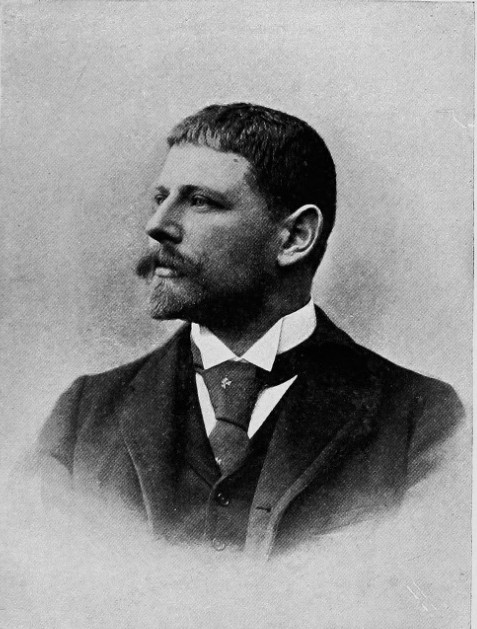
Maître Labori
Further, though it has been suggested here that some exaggeration and some flaws may appear in the psychology of certain individual characters, the series as a whole responds to Taine's definition of literature as "a living psychology." As M. Paul Bourget has said: "Zola regarded the novel as a kind of hypothetical experiment, attempted on positive bases, the first condition for success being that the bases should be accurate and the hypothesis logical. When the hour of justice strikes for that unwearying toiler people will recognise what immense preliminary toil and study lay beneath each of his books. They will also discern his unwavering purpose to inquire fully into the condition of contemporary France, to carry his inquiry as far as possible in order to set the social problem completely and accurately before one. His right to depict all reality (la réalité totale), which is that of every sociologist, even of every historian, will not be disputed then."
It is scarcely necessary to remind the reader that the Rougon-Macquart novels should be studied, whenever possible, in the original French, and not in translations. There have been many versions of the books in the English language; the present writer has made himself responsible for not a few of them; and certainly translations are in a measure useful, for as yet a knowledge of foreign languages is limited to a minority of the reading public. Besides, it is usually possible to transmit in a translation, at least in essential particulars, the lesson which a book is intended to convey. But at the same time much is lost, and in a good many instances translations which have even taken rank as literature do not adequately represent their originals. At the present day, with respect to contemporary works, excellence in translation is scarcely to be obtained, for commercial conditions militate against it. An author may give years to the writing of a book, whereas the English translator is compelled to prepare his version in a few months, at times even in a few weeks, for it is often stipulated by the publisher that the translation must appear at the same time as the original. It may be necessary also for the English translator to attend to some serial publication, and to provide for copyright in America, with the result that the work has to be done hastily, in a rough and ready manner. Again, the prices paid for translations are usually so low that few men of real ability are willing to undertake them. The writer, though he has had great experience in these matters, can suggest no remedy, for undoubtedly the commercial as well as the literary side of the question has to be considered, and even if a translator, regardless of gain, were to bestow on his work all the time and care it might deserve, the chances would be that no publisher would look at it, for the market would be gone—so swiftly do even very able books perish in these modern days.
With respect to the writer's own work, as translator or as editor of various English versions of Zola's novels, he is fully aware of its many imperfections, due in some instances to the time limit imposed on him, and in others to pecuniary and similar considerations. Again, British pharisaism being what it is he had never been able to give an absolutely complete version of any of Zola's books. Still he has always tried to preserve the spirit of the original, even when he has been compelled to throw off his "copy" at express speed. And in any case his versions, like those of others, will at least have served the purpose of making most of Zola's views known to thousands who are unable to read French.
But to properly appreciate and judge any one of the works of the great novelist it must be read in the original and in its entirety. That demands a good sound knowledge of French. Nothing has amazed the writer more than to receive from time to time during the last twelve years a note to this effect: "Dear Sir,—I am learning French, and in order to gain a better knowledge of it, I think of trying to read one of Zola's books with the help of a dictionary. Which volume would you recommend me to try? Which is an easy one?" Such an idea is, of course, ludicrous. Zola's style is not particularly involved, his vocabulary if large is not recondite, but to understand him properly the reader must possess more than a mere smattering of French. In some volumes, too, he deals with technical subjects, while in others he occasionally uses slang or purely Parisian expressions, in which cases dictionaries are of very little help. The present writer found it necessary to study certain subjects carefully before attempting to translate some of Zola's volumes: for it was only by doing so that he could avoid mistakes. For instance, the English version of "Travail" necessitated the perusal of several text-books on metallurgy, and a visit to some large English steel works. An American version of the same book was made by a person who did not take that precaution, with the result that it literally bristled with technical errors. When one considers the vast range of Zola's subjects, it must be obvious that the work of translating his books amounts to little less than a liberal education. The writer must confess that for his part he learnt a great deal by the work, so that if he conferred no particular advantage on his readers he at least benefited himself.
In previous chapters some mention has been made of Zola's repeated efforts as a playwright, and as after 1893 he only penned some libretti for the music of his friend, M. Bruneau, one may here add a few words respecting his plays. None of those which he wrote without assistance proved a success, though he often claimed that some of the public were favourable to "Le Bouton de Rose," which, said he, was damned mainly by the critics. On the other hand the stage-craft of M. Busnach made a success of "L'Assommoir" and of one or two other adaptations. In all probability the correct view to take of Zola's writings for and about the French stage is that their influence, however considerable, was chiefly indirect. Realism has come to dramatic literature—on which the novel always reacts—but the younger French dramatists rightly regard M. Henri Becque as their more immediate sponsor. At the same time several things that Zola desired to see have come to pass; a good many of his philosophical and social ideas are to be found in the contemporary French drama. Now and again they appear somewhat conspicuously, as in M. Octave Mirbeau's play "Les Mauvais Bergers," and in some of the works of M. Brieux. Again, M. Gustave Charpentier's famous roman musical, "Louise," produced in 1900, was distinctly Zolaesque in its inspiration; one of its chief features, the frequent evocation of Paris, proceeding directly from "Une Page d'Amour." Further Zola's influence was at times destructive. Soon after "La Terre" had been published in Paris the Comédie Française revived George Sand's peasant-play "François le Champi," which since its first production in 1849 had been frequently played with success at the Odéon Theatre. But the revival at the Comédie proved a complete failure, the play which had lived for nearly forty years being slain in a few nights. Originally regarded as ultra-realistic, it appeared quite insipid to the generation which had just perused "La Terre." To sum up, even as the influence of Balzac (though he wrote little for the stage) was apparent in dramatic productions from 1850 to 1870, something similar though, perhaps, less pronounced may be observed with respect to the more recent influence of Zola. He, by the way, was once asked his opinion of the influence of Ibsen on the French stage, and of Tolstoï and other Russians on the French novel, and he replied that he did not attach much importance to the question, for he held that the ideas which were supposed to rain on Paris from the North were in reality French ones, which had been disseminated by French writers, and had come back to their place of origin, occasionally crystallised or intensified by the more sombre imagination of Scandinavian and Russian minds.
XII
THE MAN—HIS LIFE DRAMA—A NEW DEPARTURE.
1893-1897
Zola's personal appearance—A palmist's reading of his hand—Some of his petty manias and superstitions—His powers of observation—His memory—Characteristics of his intellect—His daily life—His orderliness—His "confession"—The drama of his life—A childless home—Birth of an illegitimate daughter and son—Some great men and the moral law—Some eminent women and the popular standard of morality—The alleged "new Zola"—Sermonising novels—"L'Attaque du Moulin" as an opera—The trilogy of "Lourdes," "Rome," and "Paris"—Faith, hope, and charity to be replaced by fruitfulness, work, truth, and justice—Attacks on "Lourdes"—Arrest of Dreyfus—Zola, his book "Rome," and Pope Leo XIII.—His stay in the Eternal City—He visits his Italian relatives—Difficulties of writing "Rome"—Its publication—Charges of plagiarism and Zola's answer—His volume "Nouvelle Campagne—His opinion of a clairvoyante"—His first defence of the Jews.
In middle age Zola was about five feet seven inches high. His trunk was short, his legs being rather long for a man of the stature indicated, but he had a broad and prominent chest, and his shoulders were well set. His left foot was sensibly shorter than the right, his instep was very arched. He had small wrists, but large though shapely hands with small round nails. According to Dr. Édouard Toulouse[1] all the diameters of his skull were distinctly above the average, but his brain was never weighed, for at the time of his death his friends resisted applications made to them by certain scientists to whom, it seems, Zola himself had almost promised that his remains would be at their disposal.
Being very short-sighted, he usually wore glasses, seen though which his eyes seemed deep and somewhat stern; but in intimacy they softened and sparkled freely. At one period he wore his hair short, at another long, and according to these variations his forehead seemed to change, assuming at one time an appearance of abnormal height. His lips were somewhat thick and sensual, inclined to pout. He had large ears, and heard better with the left than with the right. For music, in spite of his long association with M. Bruneau, the composer, he really had little ear, though he possessed a keen sense of rhythm. On looking at him the feature that most struck one was certainly his nose, which had a gradually broadening, lobulated tip. Edmond de Goncourt declared that Zola's physiognomy was summed up in this somewhat peculiar nasal organ,[2] which, he jestingly remarked, resembled the muzzle of a sporting dog, and assumed all sorts of expressions—indicating, in turn, approval, condemnation, wonder, amusement, sadness, or whatever else might be its owner's opinion or mood. While making all allowance for humoristic exaggeration, there was certainly some truth in Goncourt's words.[3]
Zola's hands, to which reference has been made above, were examined on one occasion by a "palmist"; and for the benefit of those who believe in chiromancy one may mention that the sibyl's pronouncement was to this effect: " A great change at forty years of age; a long life; a sudden death; fond of family life and travelling; proficient in art and partial to military music; confident in the future but having little confidence in himself personally; a large heart but more philanthropically inclined towards collectivities than towards individuals; possessed of a deep sense of justice, the slightest injustice exasperating him; admiring audacity, strength, and authority while fond of liberty for himself; influenced more by his mind than by sensual passion at the outset of his love affairs, but afterwards extremely ardent."[4]
The lack of self-confidence indicated by the palmist was confirmed by Zola to Dr. Toulouse, who found that the novelist's doubt of himself was excessive and unreasonable. He frequently feared that he might be unable to accomplish his daily task, finish the book he had begun, or conclude the speech he was delivering. At one period, before he could go to bed he had to satisfy a peculiar craving to touch and retouch certain articles of furniture, open and reopen certain drawers. Arithmomania pursued him: he was for ever counting the gas lamps in one or another street, and the number of the houses. He long believed multiples of three to be of good augury, but later, as he told Goncourt, multiples of seven inspired him with most confidence. Moreover, he was so susceptible to thunder and lightning that whenever a storm burst over Médan all the shutters had to be closed and all the lamps lighted, after which he would often bandage his eyes with a handkerchief. Even when there was no storm and he found himself in absolute darkness, he was occasionally troubled by what seemed to be luminous phenomena.
A dreadful idea came to him now and then: it was that his heart had moved into his arm or his thigh, and that he could feel it beating there. It must be said, too, that he was most sensitive to physical pain[5] and extremely subject to emotion, which brought on attacks of a form of angina from which he suffered, periodically, over a period of thirty years. The insults levelled at him by unscrupulous journalists, as much with respect to the alleged obscenity of his writings as to his share in the Dreyfus case, constantly led to such attacks, but his mind being always superior to his body, he never swerved from what he regarded as his duty—the enunciation of inconvenient truths—even though he knew he would be savagely denounced for it and that his ailment would necessarily return. Briefly, as Dr. Toulouse has said, his émotivité, although morbid, always left his mind in a state of perfect lucidity and equilibrium. To the psychologist and the physician his example demonstrated, in the most unimpeachable manner, the authority of the mind over the body, the power of the will over disease.
His powers of observation were exceptionally keen. Dr. Toulouse, in the course of an experiment he made with him, placed a photograph of an idiot child before his eyes for a few moments. He immediately noticed certain anatomical peculiarities which as a rule would only strike a medical man, and he noticed them although they were scarcely perceptible in the photograph, which had greatly faded. But, adds Dr. Toulouse, as soon as Zola ceased to observe consciously, his attention flagged, and at times he did not even recognise acquaintances whom he met in the street. "They think," he said to the doctor, "that when I forget to acknowledge them I am absorbed in deep meditation about my next novel, but as a matter of fact I am not thinking of anything." It was the same with his memory. When he wished to remember any object or scene, the details became printed on his mind as clearly and fully as if they had been photographed. But unless he made a voluntary effort, his memory did not serve him. When he was Président de la Société des Gens de Lettres three months elapsed before he could repeat the names of the twenty-four members of the committee. If he had been as deeply interested in those gentlemen as he was in the facts he collected for his books, he would certainly have recalled their names at once.
Some novelists note everything around them,—people, places, and occurrences,—and store them up for subsequent use in one or another book; but that was not Zola's system. If he were writing about peasants, other matters scarcely interested him. You might have told him something curious about soldiers or financiers, he would have given it little heed. He isolated his mind, as it were, concentrated it entirely on the subject he had in hand. Moreover, his imagination was as systematic as his memory. As stated in a previous chapter, he first decided on the general ideas he would illustrate, then, by deduction, he imagined the characters likely to illustrate those ideas. A thousand concrete facts thereupon arose in his mind, grouped themselves in his system, and imparted life to his philosophical abstractions. That faculty, that power of assembling affinitive images, tending to a logical end, was preponderant in Zola. By its means the psychical processus is canalised, mental effort and waste are diminished, and the will is able to act in a well-defined manner. In Zola such power was developed to the highest degree, and therein will be found the reason of his intellectual superiority. It links him with all the great creators possessed of systematic minds, the men who have gone, not groping darkly, but with patient effort and in full light, towards their objects. Hugo and Balzac showed by their writings that their brains were organised in the same manner. The quick and inconsiderate mind, so unequal in its inspirations, which is often attributed to artists, does not seem compatible with great creative power, the latter acting in a much more uniform manner. Zola's particular mentality explains both his life and his work. He systematised in literature the realistic tendencies of the philosophy of Comte and Taine; and he carried that systematisation to its farthest limit by creating the novel of complete observation (le roman d'observation intégrale), in which he studied heredity under all its aspects, recoiling from no audacity either of observation or of expression.
By mere reasoning, adds Dr. Toulouse, whom we still follow,[6] Zola's systematic mind traced for itself a course of action which was often at variance with his instincts, yet he followed it perseveringly, sustained merely by his conception of duty. His tendency to gout and corpulence (which last he overcame by sheer determination) must have predisposed him to laziness, but he mastered any such inclination by compelling himself to do a certain amount of work every day. As a rule he then wrote quite sufficient "copy" to form three pages of one of his books, in addition to occasional newspaper articles. He also carried on an extensive correspondence, yet the only time when he had recourse to secretarial help was the period of the Dreyfus case. Nulla dies sine linea was a motto he had adopted early in life, and lest it should be forgotten it was graven in letters of gold over the fireplace of his large study at Médan, where most of his books were written.
At Médan he rose at eight o'clock, went for an hour's stroll, seating himself at his writing table at nine and writing till one o'clock, usually on an empty stomach, for after he had resolved to conquer his corpulence his first meal consisted generally of a mere crust of bread, though now and again he might partake of a couple of eggs "on the plate," which to please him had to be cooked to a nicety. At one o'clock he lunched; and then, perhaps, came a short nap, after which he either read the papers or worked at an article or went out walking, cycling, or boating. If he were at home in the afternoon, he drank a cup of tea, and this carried him on till dinner, which was served at half-past seven. Afterwards, if friends were staying with him, there might be a game of billiards or a quiet chat over another cup of tea. For some years he drank nothing at all with his meals, at which he preferred his fish fried and his meat grilled; but later he allowed himself a glass of water, and on a hot afternoon, if he were thirsty, he now and then indulged in a little white wine and eau de Seltz. Red wine he did not touch from 1887 till the time of his death; but occasionally, after a meal or in the evening, he treated himself to a thimbleful of old cognac or some liqueur. This happened perhaps once a week, not more frequently, so it will be seen that he was almost a total abstainer.
Both at Médan and in Paris (unless he were spending the evening in society or at a theatre) Zola retired to his bedroom between ten and eleven o'clock, but he generally remained reading there for some hours before he actually went to bed. His mornings in Paris like those at Médan were given to writing; and as he could not boat or conveniently cycle in the metropolis, his afternoon outings resolved themselves into visits or strolls to sundry places which he might wish to describe in some forthcoming book. Six o'clock in the evening was the hour usually appointed for receiving newspaper interviewers or those who brought him letters of introduction. His Sundays were spent much like his week-days, except that instead of working at a book he then often gave the morning to letter-writing. Glancing through a large collection of his letters we find some scores of them written on one and another Sunday. These particulars will show the general orderliness of his life, which was further exemplified by his extremely tidy habits, the regularity with which he changed his clothes directly he came home, substituting a loose flannel shirt, a working jacket, and slippers for his linen, his black coat, and his boots. And he never left the slightest litter of papers in his workroom, such documents as he might be using were set out tidily on various tables; the newspapers he read were always neatly folded directly he had finished perusing them; the very string of the parcels he received was at once rolled up and put aside in a drawer; he liked to have everything spick and span, and it was he himself who attended to virtually all the ménage of his Parisian and country workrooms.
About 1893 a "confession" of the drawing-room order was extracted from Zola, and on consulting it one finds him stating that his favourite colour (like Daudet's) was red and his favourite flower the rose, though he also had a taste for peonies and dahlias, which he grew in profusion at Médan. Contrary to Daudet, who expressed a liking for no animals or birds whatever, he declared that he liked them all. Work, he wrote, was his favourite occupation, while his dream of happiness was to do nothing. The quality he preferred in man was kind-heartedness, in woman tenderness. His favourite authors, painters, and composers were those who saw and expressed things clearly. His favourite heroes and heroines in fiction were those who were not heroes or heroines; in real life, those who earned their bread. The greatest misfortune he knew was to remain in doubt respecting anything; the historical characters he most despised were traitors; the gift he most desired to possess was eloquence; and the way he would like to die was "suddenly."
Of one longing which possessed Zola for several years there is no mention in the "confession"; neither is it indicated in Dr. Toulouse's "Enquête." But its nature and its consequences must be stated here. Eminent writers have more than once laid down the rule that if in writing an account of any living individual it is best to preserve reticence and avoid everything offensive, on the other hand it is essential that the biographer of one who is dead and gone should tell the truth respecting him. Of course it may prove advisable, and indeed justice itself may require, that one should be kind to his virtues and a little blind to his faults, for the former may be many and exemplary, and the latter few and unimportant; but if one were to ignore the last completely a very erroneous impression would be conveyed, the suppressio veri being equivalent to the suggestio falsi. Nevertheless in this present age, when so many agree to shun the truth because it offends the superfine delicacy of their degenerate natures, one is constantly confronted by so-called biographies of eminent men, and notable women also, in which a variety of facts are suppressed, the world at large being taught to look at these people through deceptive glasses which show them perfect, whereas, in reality, their flaws were often great. At times, indeed, one is invited to contemplate such beings as can never have existed, and though the falsity of the picture may merely irritate the scholar, it utterly misleads the uninitiated, tending to absolutely erroneous conceptions and adding yet another lie to the many on which present-day society is based.
In the case of Zola, he was such an impassioned servant of truth that to conceal the truth concerning him, to paint him in false colours, would be doing him a wrong. Besides, he never claimed that he was perfect, he knew that he was very human. Further, the facts which must now be mentioned were written about more or less accurately, but openly, in several Parisian newspapers at the time of his death, the present writer also had occasion to refer to them in a newspaper article; and some American journals likewise gave them currency. Thus the omission of all mention of them here would be as ridiculous as misleading. At the same time it is quite unnecessary to go beyond the essential facts, which may be recounted with comparative brevity.
When Zola married, about the time he began his Rougon-Macquart novels, he certainly looked forward to a life of unalloyed happiness. But though he achieved celebrity and became possessed of comparative wealth, though his wife was all love and devotion, there remained a great void in his existence. He had no child, and the desire for paternity was strong within him. One can trace it through many of his books, and there is no doubt whatever that it became a fixed idea with him, was responsible for some of his petty superstitions, and entered even into that dread of death which the loss of his mother and of his friend Flaubert at one time suggested. He would die and would leave no posterity. Of what value was life, then? He had always regarded transmission as being its first essential function; and it tortured him at times to think that he was famous, that he was rich, and that he would leave no offspring behind him.
It may be said that this happens to many men, that some become more or less reconciled to it; that some go, quietly grieving, to their graves. Others, however, are egotistical enough to experience no desire for paternity. There are also instances of men to whom an extreme culture imparts a kind of self-sufficingness: for example, all the unmarried philosophers, from those of Greece to those of our own times. Even among the great men who have married one will find many unblessed with offspring. Scientists have occasionally tried to explain this in one way or another, but no explanation seems to be of general applicability. In that connection one must remember that there have also been many men, distinguished by the exceptional activity of their minds, who have left large families. Occasionally they may have survived their children, as in the case of that untiring worker, Victor Hugo, but none the less, even if they have had the grief of losing both sons and daughters, they have known the happiness of paternity.
That a craving for such happiness should have become intense in a man like Zola, with all the emotional tendencies of his temperament, was natural, perhaps fatal. It was one of the sufferings that made him seek a refuge in steady, all-absorbing work, and for years, by immersing himself in his task, he contrived to dull his pain and silence all the suggestions of a rebellious nature. Goncourt, one day after returning from a visit to Médan, jotted down in his diary some remarks about the gloom, the emptiness of that spacious abode. There were plenty of dogs, but there were no children, and children were necessary to such a home. It is evident that Goncourt with his keen penetration had divined the secret grief of its master and mistress. But years rolled on, and hopes first fondly cherished, then clung to with despairing tenacity, remained unfulfilled. The moralist will say undoubtedly that resignation was the one right course, but human nature seldom resigns itself willingly to anything, and certainly Zola's nature was not one to do so. As he approached his fiftieth year it began to assert itself, as Goncourt shows us in another passage of his "Journal"; and then, after long years of battling, however strong the spirit might still be, the flesh finally triumphed over it.
It is unnecessary to review what the Bible and Buckstone, Taylor and Kent, Montesquieu and Potier have to say respecting the violation of the marriage vow, and the distinctions which may be drawn between the action of husband and of wife. Nor need there be any defence on the lines of the théorie des deux morales as interpreted by Nisard. One may allow that there is strictly only one moral law for both sexes and for all stations in life, royal as well as plebeian. At the same time one is entitled to indicate whatever extenuating circumstances may exist. One may think of the position of Thomas and Jane Carlyle, as enunciated by the supporters of the former, and then picture a very different sequel, for in Zola's case a time came when he was carried away from the path of strict duty, and in the result a child was born to him, a daughter called Denise. Later came the birth of a son, called Jacques. An echo of what happened—the tempestuous passion of a man of ripe years for a young woman—resounded through the pages of "Le Docteur Pascal," while "Fécondité," published much later, revealed many of the sufferings, much of the yearning, that had led to this crisis in Zola's life.
Those who are perfect may now throw stones. Many who are not will, of course, do so, regardless of permission, and with the greater alacrity as the dead man cannot answer them. But he was forgiven long ago by the one person who was entitled to complain. There was much suffering, much unhappiness, of which the world heard nothing, but at last her broad nobility of mind rose above the personal wrong and the common prejudice, and in these later days she has transferred much of the devotion with which she encompassed her husband to the children whose birth followed the crisis which, at one time, threatened to sweep the home away.
Let us remember, too, that the case of Zola was in no wise exceptional. Our great men have to be taken with their faults as with their virtues. Englishmen will remember that Nelson, Wellington, and Lord Melbourne violated the popular standard of morality, and yet rendered great services to their country. Americans will remember the same of Franklin, Daniel Webster, and Henry Clay. A recent President of the United States was not above reproach when he was elected to the supreme magistracy. There is an English statesman of commanding abilities, on one page of whose career a blot appears and who for that reason has been pursued with unrelenting hatred by canting Pharisees—those to whom one owes the monstrous and inhuman doctrine that an error in a man's life must never be forgiven, that if he stumble but once he must always remain damned. With their narrow bigotry those people arrogate to themselves a greater righteousness than that of the Christ whose precepts they pretend to follow. To love one another, to forget and to forgive, are no maxims of theirs. Though the name of the Deity is so constantly on their lips, they really seem to be men after the devil's own heart, for they play the part of his imps, ever intent on persecution.
If the world were to reject all the great men who have erred, would not the pantheons of the nations be well-nigh empty? If it were to reject the works of every writer whose life was not absolutely immaculate, what literature would be left? Masterpieces of the human mind, writings that have wrought an infinity of good, would be cast aside. One may remind the reader that a good many English authors even of that age of specious respectability, the Victorian era, were by no means perfect in their private lives. In France, no doubt, more laxity has prevailed. Take that champion of Christianity, Chateaubriand, and remember the many liaisons of his married life; take that great deist, Victor Hugo, also a married man, and with no such excuse as Chateaubriand and Zola may have had, and remember his long connection with Madame Juliette Drouet. And as examples of moral laxity among men outside the matrimonial pale, take Alfred de Musset and both the Dumas, particularly the elder. Old Parisians, like the writer, will remember the day in or about 1869 when even the boulevards were scandalised by the sight which confronted one and all in the windows of every shop where photographs were sold. There was the portrait of the prince of romancers with Adah Isaacs Menken, the circus-rider, seated, in her fleshings, on his knees, her arms cast lovingly about his neck. Happily in the afternoon the son appeared upon the scene and carried off all such photographs that he could find, and thereupon Paris, which had been laughing a pornographic laugh, applauded him, recalling the story of Japhet and his father Noah.
But it is not only men who have thrust the moral law aside. The lives of George Eliot and others are known to us. They were as nothing beside that of George Sand, who in the matter of her private life was perhaps the nearest approach to Byron to be found among female writers. She passed from Baron Dudevant, her husband, to Jules Sandeau, then to Mérimée, then to Musset, then to Pagello, then to Michel de Bourges, then to Pierre Leroux, then to Chopin, and at last to Manceau, the engraver, those passions being interspersed with platonic interludes with Lamennais and Liszt. Yet Emerson, "one of the purest of men, dwelt on the rare and beautiful sentiment that runs through George Sand's 'Consuelo.' And who can deny the evidence of keen political insight, lofty ideas, and pure morality in the writings of Mary Wollstonecraft, Frances Wright, and George Eliot?"[7] People still read "Consuelo," even as they read "Les Trois Mousquetaires." They also read "Les Contemplations" and even dip into "Le Génie du Christianisme." They ostracise none of the great writers because there was error in their lives. Besides, it must be acknowledged as true that a counsel of perfection, or what we regard as perfection from our social standpoint, may well come from the imperfect. In fact it could not be otherwise, since we are all imperfect in one or another way
Thus to reject Zola's books and his teaching on the ground that there came a lapse in his life after fifty years of strenuous endeavour would be ridiculous, for it would entail the rejection of hundreds of others. The subject may be dismissed, then, without further comment from the moral point of view. Undoubtedly it will always be a source of regret to Zola's friends that this happened, even though it satisfied the great craving of his life. In spite of all our knowledge of human imperfection we always try to picture an ideal being, and we sorrow when the flaw in our ideal is discovered, even though reason tells us that we ought to have been prepared for it.
That the occurrences referred to caused great perturbation in Zola's life goes without saying; and as, about this time or soon afterwards, some change appeared in his writings, a certain co-relation between that change and his domestic troubles might be suspected. But beyond what is apparent in parts of "Le Docteur Pascal," and much later in "Fécondité" and "Travail," Zola's writings show no trace of the passing storm. It was assumed by some critics, after the completion of the Rougon-Macquart novels, that "a new Zola" had arisen, the man who wrote "Lourdes," "Rome," and "Paris" being, said they, evidently very different from the one who had penned "Nana," "Pot-Bouille," and "La Terre." It was even asserted that this novelist who had been so obscene was becoming quite moral, at least for a man with such shocking antecedents. But the inanity of that contention is demonstrated by the facts of the case. The so-called obscene books were written by one who led a life of the most rigid personal rectitude, whereas the later volumes, which were received far more favourably, were the work of one whom passion had conquered. That should suffice to show how worthless is a certain kind of criticism. Moreover, any change that was noticed in Zola's writings was in one respect more apparent than real. In some of his books he had set down horrible and loathsome things because he had found them involved in his subject. Subsequently, being confronted by less mire, he naturally gave it less prominence. At the same time "Le Docteur Pascal" certainly marked a new departure in his manner. In his previous works, as we have remarked before, he had sunk his personality and had never preached. In "Le Docteur Pascal" he began to do so, and this gradually became a habit with him. The reason is not far to seek. For more than twenty years the critics had constantly said to him: "If you must show the vileness of life, you should at least point the moral. You should deplore such terrible things, denounce them, thunder at them in your pages." Remarks of that kind having been repeated hundreds of times, it is not surprising that Zola, who had long felt annoyed at seeing his books misinterpreted, should have ended by complying with the clamour. Curiously enough, however, the very critics who had called on him for moral ejaculations, who had begged for sermons, then became mightily indignant. "This man," they said, "has no imagination left, he does nothing but preach, his books are as dull as ditch water. After all, we liked 'Nana' better." Such was the result of Zola's change of manner, a result which might have been foreseen.