ERNEST ALFRED VIZETELLY (continued 2)
Reading edition
Here Zola's room was one of a few lightly built garrets, raised over the house-roof proper, and constituting a seventh "floor"; the leads in front forming a terrace whence the view embraced nearly all Paris. While Zola was lodging here, living very precariously and trying by fits and starts to secure some remunerative work, his friend Paul Cézanne arrived from Aix with the hope of making his way in the art world of the capital. Cézanne was more fortunately circumstanced than Zola, having a small monthly allowance to depend upon; and it was perhaps by way of helping his friend that he at first took up his residence with him in that seventh-floor garret. Zola was wonderfully cheered by the companionship; before long he again became as enthusiastic as Cézanne, and the two friends dreamt of conquering Paris, one as a poet, the other as a painter.
When the summer arrived they often laid a paillasse on the terrace outside their attic, and spent the mild and starry night in discussing art and literature. Moreover, while Cézanne began to paint, Zola wrote another poem à la Musset, which he entitled "Paolo"; as well as a tale, "Le Carnet de Danse," which was subsequently included in "Les Contes à Ninon." But there was no improvement in his position. Indeed, things went from bad to worse; and in the autumn of the year, as he had too much delicacy to sponge on Cézanne, whose allowance, moreover, was only just sufficient for himself, they ceased to live together, though they remained close friends.
About the same time Zola and his mother separated. She, over a term of years, had now and again secured some trifling sum of money by compromising one or another law-suit—sacrificing a considerable claim for little more than a morsel of bread. For the rest, she was helped by a few relatives of her own and by some friends of her deceased husband. In October, 1860, as her son could not as yet provide for her, she went to live at a pension in the Quartier Latin, assisted there, perhaps, by some friends, or else obtaining some employment in the house, for she was skilful with her needle. At all events, her son found himself for a time quite alone.
He now went to reside in the Rue Neuve St. Étienne du Mont, near the ancient church of that name, and his lodging, as usual, was at the very top of the house. This time it was a kind of belvedere or glass cage in which Bernardin de St. Pierre, the author of "Paul and Virginia," was said to have sought a refuge from the guillotine during the Reign of Terror. It was there, then, amid all the breezes of heaven, and inspired perhaps by the position of his retreat, that Zola wrote another poem, called "L'Aérienne," which he added to the pieces entitled "Rodolpho" and "Paolo," the first written at Aix, the second in the Rue St. Victor. These three compositions formed, as it were, a trilogy which he named "L'Amoureuse Comédie,"—"Rodolpho" representing the hell, "L'Aérienne" the purgatory, and "Paolo" the paradise of love.[3] This done, he sought a publisher, or, as Paul Alexis puts it, he imagined he sought one.
As a matter of fact, this slim, pale-faced poet, in his twenty-first year, with an incipient beard and long hair falling over his neck, had become extremely timid in everything that pertained to ordinary life. He was not deficient in will power, but misfortune—repeated rebuffs of all sorts—had deprived him of the ordinary confidence of youth in his intercourse with others. His circumstances were desperate enough. Alexis, when telling us that he composed his poem "L'Aérienne" in his glass cage near the sky, during the terribly severe winter of 1860-1861, shows him tireless, shivering in bed, with every garment he possesses piled over his legs, and his fingers red with the cold while he writes his verses with the stump of a pencil.
How does he live? it may be asked. He himself hardly knows. Everything of the slightest value that he possesses goes to the Mont-de-Piété; he timidly borrows trifling sums of a few friends and acquaintances, he dines off a penn'orth of bread and a penn'orth of cheese, or a penn'orth of bread and a penn'orth of apples, at times he has to content himself with the bread alone. His one beverage is Adam's ale; it is only at intervals that he can afford a pipeful of tobacco; his great desire when he awakes of a morning is to procure that day, by hook or crook, the princely sum of three sous in order that he may buy a candle for his next evening's work. At times he is in despair: he is forced to commit his lines to memory during the long winter night, for lack of the candle which would have enabled him to confide them to paper.
Yet he is not discouraged. When "L'Aérienne" is finished, he plans another poetic trilogy, which he intends to call "Genesis." He is still at a loss for bread, but his chief concern is to beg, borrow, or, if possible, buy the books which he desires to study before beginning his new poems. At last he plunges into the perusal of scientific works, consults Flourens on such subjects as longevity, instinct and intelligence, genius and madness, dips into Zimmermann's account of the origin of mankind and the marvels of human nature, reads Lucretius and Montaigne again, and prepares a plan of his intended composition. The first poem is to narrate "The Birth of the World" according to the views of modern science; the second—to be called "Mankind"—is to form a synthesis of universal history, while the third, the logical outcome of the previous ones, is to be written in a prophetic strain showing "The Man of the Future" rising ever higher and higher, mastering every force of nature, and at last becoming godlike.
But though that stupendous composition is long meditated, only eight lines of it are actually written. The long winter ends, the spring comes, and Zola turns to enjoy the sun-rays—at times in the Jardin des Plantes, which is near his lodging, at others along the quays of the Seine, where he spends hours among the thousands of second-hand books displayed for sale on the parapets. And all the life of the river, the whole picturesque panorama of the quays as they were then, becomes fixed in his mind, to supply, many years afterwards, the admirable descriptive passages given in the fourth chapter of his novel "L'Œuvre." There it is Claude Lantier who is shown walking the quays with his sweetheart Christine. And Zola was certainly not alone every time that he himself paced them. We know to what a young man's fancy turns in springtime, and he was as human as others. He lived, moreover, in the Quartier Latin, which still retained some of its old freedom of life, in spite of the many changes it was undergoing.
Baron Haussmann had set pick and spade to work there, and many an ancient tenement and court had been swept away in piercing the Rue des Écoles and the Boulevard St. Michel, then called "Boulevard Sebastopol, Rive Gauche." At that time the Chaumière was dead, the Prado also had disappeared, and the Closerie des Lilas—afterwards known as the Bal Bullier—had lately been renovated, in fact transformed, as Privat d'Anglemont recorded in one of the last sketches he wrote prior to his death in 1859. And with the disappearance or alteration of the old dancing places and tabagies, with the demolition of many an ancient den and haunt, the inhabitants of the Quartier and their manners and customs were likewise altering. In fact, there was a great crisis in la vie de Bohême. But though it was no longer such as it had been pictured by Murger, such as it had appeared to Théodore de Banville, who, recalling his youth, described it briefly yet forcibly a few years later,[4] it would be a mistake to imagine that it was altogether dead. Alphonse Daudet, who arrived in Paris from Nîmes a few months before Zola entered the Lycée St. Louis, has shown that many of the old habits and customs remained. Again, the writer of these pages, who knew the Quartier Latin well in the last years of the Second Empire, can recall that vestiges of its former life clung to it even till the war of 1870. There were still a few tenth-year students, still a few rapins, still a few grisettes, of a kind, lingering within its precincts. But the war proved the final coup de grâce; and the Quartier of the Third Republic with its chic students, its gambling hells, its demi-monde, its filles de brasserie, its garish vulgarity, its mock propriety, has resembled the old one in little save its studiousness, for, however much, for centuries past, its young men may have amused themselves, whatever their eccentricities, whatever their excesses, they have also studied, accumulated in that same Quartier a rich store of scholarship and science, which has enabled many of them to confer benefits on mankind.
Zola, then, knew the former Quartier in its last lingering hours, when there were no longer any taverners who sold books for hard cash and bought them back for a snack or a drink, but when old clo'men still perambulated the streets, when La Californie and other bibines still existed on the confines, and when L'Académie, the grimy absinthe den, still flourished in the Rue St. Jacques under the patronage of littérateurs who never wrote, painters who never painted, and spurious students in law and medicine and what not besides. Those were the men of whom one said: "When they are not talking they drink, when they are not drinking they talk." How they lived nobody knew, but one of them, a notorious character, who after a few glasses of absinthe would improvise the most extraordinary comic songs with rattling tunes, slept for some years in a stable. He was turned out of it one winter, and a few days later was found frozen to death in the moat of the fortifications near Montrouge.
Zola, for his part, indulged in no such bibulous dissipation, but he elbowed it often enough. And in his distressful poverty, without guide or support, it was fatal that he should turn to such consolation as might be offered him. Thus he went the way of many another young man dwelling in the Quartier, finding at last a companion for his penury, not the ideal Ninon of whom he had dreamt in Provence, not the Musette nor the Mimi whom Murger portrayed with the help rather of his imagination than of his memory, but such a one as the Bohemia of the time still had to offer.
A glimpse of his life at that moment is given in a few early newspaper articles, and particularly in one of his first books, "La Confession de Claude," which pictured the shameless immorality prevailing in certain sets of the Quartier Latin, and the weakness that came upon even a well-meaning young man when cast into such a sphere. At the same time romance is blended with fact in the "Confession"; and it would be quite a mistake to regard Claude's mistress, Laurence, as a portrait of the young woman to whom Zola became attached. At the same time, the aspirations of his nature are well revealed in that book, which beneath some literary exaggeration remains instinct with the genuine disappointment of one who has found the reality of love very different from his dream of it.
Some passages are certainly autobiographical. The scene is a maison meublée, which stood near the Pantheon, in the Rue Soufflot before that street was widened and rebuilt. Zola betook himself thither on being expelled from his glass cage near St. Étienne du Mont for non-payment of rent. The house was tenanted by students, their mistresses and other women, and the life led there was so riotous and disorderly that more than once the police came down on the place and removed some of the female tenants to the prison of St. Lazare. Here, then, Zola gathered materials for "La Confession de Claude"; here he elbowed his characters Jacques, Paquerette, Laurence, and Marie, while sharing a life of the greatest privation with the companion who had come to him. "Provence, the broad, sunlit country-side, the tears, the laughter, the hopes, the dreams, the innocence and pride of the past had all departed, only Paris with its mire, a garret and its misery, remained."[5]
Again, real episodes find a place in the "Confession,"—memories of early days, rambles in the valley of the Bièvre, amid the foetid stench of that sewer-like stream and the acreous odour of its tanneries; the first visit to the Closerie des Lilas, the disgust inspired there by the sight of all the harlots with their paint, their cracked voices, and their impudent gestures, and then the excursion through the waste lands of Montrouge, the paths and fields of Arcueil and Bourg-la-Reine, to Fontenay-aux-Roses, Sceaux, and the Bois de Verrières. But one need not imagine that this trip was made with such a creature as the callous, shameless, helpless Laurence, for, in recounting the episode elsewhere, Zola expressed himself as follows:
"I thought of my last excursion to Fontenay-aux-Roses with the loved one, the good fairy of my twentieth year. Springtime was budding into birth, the path was bordered by large fields of violets.... She leant on my arm, languishing with love from the sweet odour of the flowers.... Deep silence fell from the heavens, and so faint was the sound of our kisses that not a bird in all the hedges showed sign of fear.... We ascended to the woods of Verrières, and there, in the grass under the soft, fresh foliage, we discovered some tiny violets.... Directly I found a fresh one I carried it to her. She bought it of me, and the price I exacted was a kiss.... And now amid the hubbub of the Paris markets I thought of all those things, of all that happiness.... I remembered my good fairy, now dead and gone, and the little bouquet of dry violets which I still preserve in a drawer. When I returned home I counted their withered stems there were twenty, and over my lips there passed the gentle warmth of my loved one's twenty kisses."[6]
The man who has lived with a Laurence—the creature who robs youth of all its flame and degrades it to the mire—does not afterwards call her his good fairy. But whatever the liaison, whatever its origin and its ending, it was certainly marked by most distressful circumstances. As the winter of 1861 approached, Zola's poverty became terrible. It was then, as he afterwards told Guy de Maupassant,[7] that he lived for days together on a little bread, which, in Provençal fashion, he dipped in oil, that he set himself to catch sparrows from his window, roasting them on a curtain rod; and that he "played the Arab," remaining indoors for a week at a time, draped in a coverlet, because he had no garments to wear. Not only did he himself starve, but the girl who shared his poverty starved with him; and Paul Alexis and Maupassant and "Claude's Confession" relate how, at one moment of desperation, on a bitter winter evening, after an unbroken fast of thirty-six hours, he took off his coat on the Place du Panthéon and bade his tearful companion carry it to the pawnshop.
"It was freezing. I went home at the run, perspiring the while with fear and anguish. Two days later my trousers followed my coat, and I was bare. I wrapped myself in a blanket, covered myself as well as possible, and took such exercise as I could in my room, to prevent my limbs from stiffening. "When anybody came to see me I jumped into bed, pretending that I was indisposed."
Very little money can have been lent him on his few garments. He often used to say in after-life that the only coat he possessed in that year of misery ended by fading from black to a rusty green. Thus, when he went hither and thither soliciting employment, he was very badly received. "I gathered that people thought me too shabby. I was told, too, that my handwriting was very bad; briefly, I was good for nothing.... Good for nothing—that was the answer to my endeavours; good for nothing—unless it were to suffer, to sob, to weep over my youth and my heart. I had grown up dreaming of glory and fortune, I awoke to find myself stranded in the mire."
But it is a long lane that has no turning. At the close of 1861, an eminent medical man, Dr. Boudet of the Academy of Medicine, who had either been connected with the Lycée St. Louis or had acted as one of the examiners when Zola had attempted to secure a bachelor's degree, gave the young man a letter of recommendation to M. Louis Hachette, the founder of the well-known publishing business. Zola called at the firm's offices, but, for the time, he could only obtain a promise of the first suitable vacancy. Meantime, Dr. Boudet, moved by the sight of his pitiable poverty, came to his help in an ingenious manner. On the occasion of a new year the Parisians of the more prosperous classes invariably exchange visiting cards, and the doctor asked Zola to distribute those which he intended for his friends. At the same time the worthy scientist slipped a twenty-franc piece into the young man's hand as remuneration for his trouble. This discreetly veiled charity at least saved Zola from actual starvation during the festive season; but his heart remained heavy, and his feelings were not devoid of envy when he found that several of the doctor's cards were addressed to the prosperous parents of his former school-fellows at St. Louis.
However, a month later, February, 1862, he entered the "Bureau du Matériel" at Hachette's establishment, his salary being fixed at a hundred francs a month, an average of 2s. 8d. per diem;[8] and his duties, during the first few weeks, being confined to packing books for delivery. A little later he was promoted to the advertising department, with a slightly increased salary. He was now at least "assured of daily bread. Naturally painstaking and conscientious, he had done with Bohemia for ever; he had begun life, he was saved."[9]
Yet it was only by force of will that he accustomed himself to a round of comparative drudgery. If Bohemianism implied poverty, it meant liberty also; and, like many of us, Zola found it hard to have to work regularly, at set tasks and set hours. Again, it worried him that he had no opportunity to read all the books that passed through his hands. But necessity compelled obedience to discipline, and he ended by discharging his clerkly duties fairly well, while allowing full rein to his literary bent every evening and every Sunday. He turned, however, from poetry to prose, not, it would seem, because he doubted his poetical faculty, but because after all his sufferings he was impatient for success. Until that success should arrive he felt, rightly enough, that for ten publishers who might be willing to buy a volume of his prose he would not find one inclined to risk money on a volume of his verse. Everything tends to show, indeed, that the dreamer of the belvedere in the Rue St. Étienne du Mont was awaking to full consciousness of the stern and often unjust laws of the modern world, that, enlightened, instructed by his sojourn in Bohemia, he was ripening into a practical man.
In the advertising department of Messrs. Hachette's business the young clerk became acquainted with some of the authors whose works were published by the firm. He only occasionally caught sight of such celebrities as Guizot, Lamartine, Michelet, Littré, and Duruy, the Minister of Public Instruction; but other writers dropped in to inquire what arrangements were being made for launching some forthcoming work, or how the sales of a recent book were progressing, for that also was a matter with which Zola had to deal. Among the men with whom he thus had some intercourse were miscellaneous writers like Francis Wey, travellers like Ferdinand de Lanoye, popular novelists like Amédée Achard, a dozen of whose fifty romances—largely of Dumas' semi-historical pattern—were published by Hachette. Then there was the scholarly Prévost-Paradol, to whom Zola was attracted, for he had been professor of French literature at the faculty of Aix before embracing journalism and becoming a leading exponent of Orleanist doctrines,—liberal, though scarcely democratic, views. His chief work, "La France Nouvelle," a classic for all who would study the condition of French society in the middle period of the nineteenth century, was not yet written; but Hachette already issued his "Études sur les Moralistes Français" and his "Essai sur l'Histoire Universelle."
Another visitor, one who called as a reviewer of the provincial press, not as an author, for he published his books elsewhere, was Duranty, a young novelist with an original, strongly marked personal talent, whose first book, "Le Malheur d'Henriette Gérard," had proved fairly successful, but who, in the end, failed to secure public recognition, though Zola became quite an admirer of his work—in a measure, perhaps, because it departed from most of the recognised canons and showed Duranty to be a man who, appreciated or not, followed his own bent and disdained to copy others.
But one of Hachette's leading authors at that time was Edmond About, the "nephew of Voltaire," who a few months before Zola was engaged by the firm had given it his vivid "Lettres d'un bon jeune homme," written au pas de charge, to the music, as it were, of a flourish of trumpets. Then, in 1862, in Zola's time, Hachette published About's fanciful "Cas de M. Guérin," and in the following year his novel "Madelon," which would be perhaps his best book had he not insisted unduly on its setting, with the result that it now seems somewhat old-fashioned. "Madelon," however, is to About what "La Dame aux Camélias" is to Dumas fils, "La Fille Élisa" to the Goncourts, "Sapho" to Daudet, and "Nana" to Zola. The young clerk read this book with keen and appreciative interest.
But of all the authors calling at his office, the one who most frequently lingered there to chat for a few minutes was the great critic Taine. He was then writing his "Histoire de la Littérature Anglaise" (1863-1864), and, on account, perhaps, of his contributions to the French reviews or of his "Philosophes classiques du XIXe Siècle" he occasionally found letters awaiting him at Hachette's. These were handed him by Zola, in whose presence he opened them. At times they were simply abusive, at others they warned him to be careful of his soul, and in either case they were anonymous. But Taine on receiving any such missive merely laughed and shrugged his shoulders. "It is of no account," he would say, "it only comes from some poor benighted country priest. I am anathema to the village curés."
Zola received no help or encouragement from the authors he met at Hachette's, but this is not surprising; in the first years, at all events, they knew nothing of his literary proclivities, and he was too timid to reveal them. He had now moved from the den in the Rue Soufflot to an old house, a former convent, in the Impasse St. Dominique, near the Rue Royer Collard, where he occupied a monastic room, overlooking a large garden. Thence he betook himself to the Rue Neuve de la Pépinière, between the fortifications and the Montparnasse cemetery, over which the view from his window extended. But his peregrinations were incessant, and at the beginning of the winter of 1863 he moved again, this time to 7, Rue des Feuillantines, a turning out of the Rue St. Jacques. Nearly all his spare time was given to writing. Thinking of the Bohemianism from which he had lately emerged, he began his novel "La Confession de Claude"; then put it by for a time, and devoted himself to short stories. His "Fée Amoureuse"[10] had been printed in an Aix newspaper, "La Provence"; and he now (1863) secured the insertion of a story called "Simplice," and another, "Le Sang," in the "Revue du Mois," issued at Lille. Others followed: "Les Voleurs et l'Ane," reminiscent of Bohemia; "Sœur des Pauvres," written in full view of the Montparnasse cemetery; and "Celle qui m'aime," in which, after féerie, parable, and pure romance, a touch of realism first appeared in Zola's work. He sent this last tale to Henri de Villemessant for the latter's then weekly journal, "Le Figaro," but the manuscript came back "declined with thanks."
Another attempt to secure the honours of print, this time with his poetic trilogy, "L'Amoureuse Comédie," proved equally unsuccessful. One Saturday evening, says Alexis, he timidly deposited the manuscript on M. Hachette's table, and on the Monday morning his employer sent for him. He had glanced at the poems, and though he was not disposed to publish them, he spoke to the young author in a kindly and encouraging manner, raised his salary to two hundred francs a month, and even offered him some supplementary work. For instance, he commissioned him to write a tale for one of his periodicals, one intended for children, and it was then that Zola penned his touching "Sœur des Pauvres"; but M. Hachette deemed it too revolutionary in spirit, and did not use it.
Zola's circumstances having now improved, he again sought a new home, and finding commodious quarters at 278, Rue St. Jacques, near the military hospital of the Val de Grâce, he took his mother to live with him. Her father, the aged M. Aubert, who, it seems probable, had retained or recovered some slender means in the course of the canal lawsuits, had died in 1862; but around the mother and her son were now gathered the latter's early friends, who, like him, had come from Aix to Paris. Paul Cézanne, Jean-Baptiste Baille, Marius Roux, and Solari, with Zola himself, formed a small, enthusiastic, ambitious band, such as was afterwards described so faithfully in "L'Œuvre." From time to time also, Antony Valabrègue, the future poet and critic, visited the capital, and on returning to Aix corresponded with Zola, whose letters[11] were very interesting.
One gleans from them that in 1864 Zola submitted some of his poetical pieces to L'Académie des Jeux Floraux of Toulouse, which "crowned" none of them; that he attended the evening literary lectures at the Salle des Conférences in the Rue de la Paix, and "reported," for some paper which is not specified, the accounts given of Chopin, "Gil Blas," Shakespeare, Aristophanes, La Bruyère's "Caractères," Michelet's "L'Amour" and the philosophy of Molière.[12] In April that year he had as yet done nothing with the various short stories to which reference has been made; and he thought of leaving them in abeyance while he completed the novel, "La Confession de Claude," which he had begun in 1862. Three months later, however, the stories were sold, and Zola wrote to Valabrègue: "The battle has been short, and I am astonished that I have not suffered more. I am now on the threshold: the plain is vast and I may yet break my neck in crossing it; but no matter, as it only remains for me to march onward I will march."
Besides the tales already enumerated, Zola's first volume, which opened with a glowing dedication to Ninon, the ideal love of his youth,—some passages being inspired, however, by the riper knowledge that had come to him from the more material love of Bohemian days,—included "Les Aventures du Grand Sidoine et du Petit Médéric," an entertaining fable of a giant and his tiny brother. Zola had sent his manuscript to M. Hetzel, then associated in business with M. Albert Lacroix, a scholarly man of letters who, a little later, founded the well-known Librairie Internationale and published several of the works of Victor Hugo: in return for which the great poet, whose own books were profitable, virtually compelled M. Lacroix to issue the works of his sons and his hangers-on, with the result that heavy losses frequently occurred.
Hetzel and Lacroix agreed to publish Zola's tales (under the collective title of "Contes à Ninon") without exacting anything for the cost of production, but the author was to receive no immediate payment. He, all eagerness to see his work in book-form, subscribed to every condition that was enunciated, and then ran home to tell his mother the good news. The volume was issued on October 24, 1864,[13] which became a red letter day in Zola's life. Writing to Valabrègue in the following January, he told him that more than half of the first edition (probably one of fifteen hundred copies) was then sold; and as the book at least made him known, procured him journalistic and literary work, he felt greatly inspirited, though he still remained at Hachette's, intending, he said, to keep his post for several years if possible, in order to increase "the circle of his relations." Meantime, as it was necessary he should "make haste, and rhyming might delay him," he left the Muse for ulterior wooing,—that is, if she should not then have grown angry, or have eloped with some more naïf and tender lover than himself. Briefly, as he was writing prose to his personal advantage, he intended to persevere with it.
It may be said of Zola's first volume that it was gracefully, prettily written; that more than one of the tales contained in it was a poem in prose. Brimful of the author's early life in Provence, his youthful fancies and aspirations, those "Contes à Ninon" gave no warning of what was to follow from his pen. And yet at the very time of writing most of them he was being weaned from romance and fable and idyl. Not only had he taken considerable interest in About's "Madelon," but he had been studying Balzac, and particularly Flaubert's "Madame Bovary," the perusal of which had quite stirred him. A man had come, axe in hand, into the huge and often tangled forest which Balzac had left behind him; and the formula of the modern novel now appeared in a blaze of light. When "Madame Bovary" was issued in 1860, the average Parisian, the average literary man even, regarded it merely as a succès de scandale. Many of those who praised the book failed to understand its real import; and when Flaubert was satirised in the popular theatrical révue, "Ohé! les petits Agneaux," half Paris, by way of deriding him, hummed the trivial lines sung by the actress who impersonated "Madame Bovary":
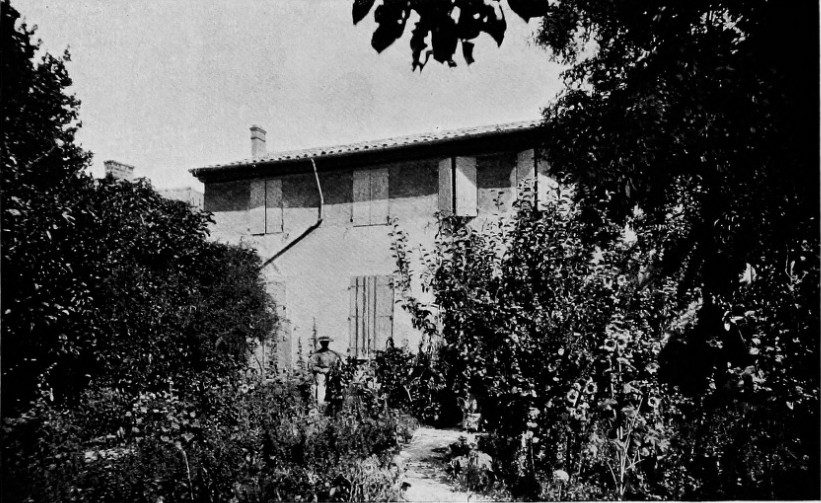
Émile Zola's Home, Impasse Sylvacanne, Aix-in-Provence.—Photo by C. Martinet
Qu'importe! c'est officiel, Ou vit quatre éditeurs me suivre: Oui, Paul, Mathieu, Pierre, et Michel Voulurent imprimer mon livre!... Craignant mes excentricités Mathieu ne vit pas mon mérite; Paul ne vit pas mes qualités, Pierre ne vit pas mes beautés, Mais Michel les vit Mais Michel les vit[14] Tout de suite!"
Zola, however, did not laugh or jeer at "Madame Bovary"; he felt that a literary evolution might be at hand, as is shown by his subsequent correspondence with Valabrègue. The struggle which was to last all his life, one between his reason and his imagination, was beginning, if indeed it had not begun previously; for the oscillation which one observes in his writings between romanticism and realism—or naturalism as the latter became in its advanced stage—would indeed seem to be only a continuation of what had happened in his school days, when, in spite of proficiency in literary subjects, he had elected to follow a scientific course of study, in the midst of which, however, his literary bent had still and ever asserted itself. Novalis has said: "Every person who consists of more than one person is a person of the second power—or a genius." If that be true, then Zola was certainly a genius; for there were always two men in him. And, in any case, those who desire to understand him aright should never lose sight of the duality of his nature.
But at the stage of his career which one has now reached, the realist, the naturalist, had not fully arisen. We find him appearing in Zola's next book, "La Confession de Claude," and in sundry newspaper articles, which, like the "Confession," were issued in 1865. After working ten hours a day at Hachette's, the young man, on returning to his home—which in the year mentioned was first at 142, Boulevard Montparnasse, near a shooting gallery which prevented him from working, and a little later at 10, Rue de Vaugirard, where he had a balcony overlooking the Luxembourg gardens—at once turned to the "Confession," or else to the press-work he had secured. Every week he wrote an article of from one hundred to one hundred and fifty lines for the "Petit Journal," and often another, running from five to six hundred lines for the "Salut Public," then the chief organ of the Lyons press. The former newspaper paid him twenty francs for each article, the latter, from fifty to sixty francs. Thus he now made an average of two hundred francs a month by his pen.[15] It was also at this period that he contributed a few short tales, notably "La Vierge au Cirage," to that somewhat demi-mondain periodical "La Vie Parisienne," and that he wrote a one-act comedy, "La Laide," which he sent to the Odéon Theatre, whose manager declined to stage it.
But the articles in the "Salut Public" attracted attention, and Zola afterwards reprinted some of them in a volume called "Mes Haines." The germ of the Zola of later times will be found in several of those early papers. The one on Taine is perhaps the best; and, when one remembers that it was written by a young man in his twenty-fifth year, the real understanding and critical insight which it discloses appear all the more creditable. Another notable article was a bold, disdainful review of Napoleon III's "Histoire de Jules César," containing, in the usual veiled language of the times, the first indication that Zola held Republican opinions. Again, two articles on "Le Supplice d'une Femme" and the Dumas-Girardin scandal connected with that tragedy are in their way interesting, while another on the "Germinie Lacerteux" of Edmond and Jules de Goncourt is particularly noteworthy as showing the progress of Zola's evolution towards naturalism in literature.
This article was favourable to the book, whose authors it pleased, and some communications having been exchanged, the young journalist secured a seat for that famous first performance of "Henriette Maréchal," which ranks as one of the most uproarious nights in the history of the Comédie Française. The audience, Zola tells us,[16] began to hiss before the curtain rose; the storm burst forth at the first words spoken by the actors. The opening scene, laid at the opera-house on the night of a masked ball, scandalised the old habitués of the Comédie. Modern masqueraders and slang in the home of Racine and Corneille! What sacrilege! But the greatest opposition to the piece came from the young Republicans of the time, who were not influenced by the merits or faults of the play, but simply by the fact that its performance at the Comédie was due to the influence of the Emperor's cousin, the Princess Mathilde.
Yet whatever might be the public dislike of that member of the reigning house, to whom a horrid nickname was currently given, whatever the notoriety of her liaison with the Count de Nieuwerkerke, the "Superintendent of Fine Arts," it was somewhat hard for the Goncourts that their play should be rendered responsible for her lapses. But good came out of evil, as the saying goes; if "Henriette Maréchal" was hissed off the stage, the fracas made the Goncourts famous. Two nights of uproar contributed more to popularise their name and to win readers for their works than years of zealous toil. They had long been esteemed in literary circles, but hitherto they had remained unknown to the great public. Their novels, like their historical works, had secured no large sales, whereas now all was altered, and the change, and the circumstances which wrought it, produced a deep impression on Émile Zola, confirmed him in the view which he had already begun to entertain, that fame in the modern literary world depended largely on a resounding coup-de-pistolet.
He was fairly well pleased with the result of his volume of "Contes," but prior to the "Henriette Maréchal" scandal[17] he had already declared that he would greatly have preferred a severe "slating" to some of the milk-and-water praise of his reviewers. As he wrote to Valabrègue, however, he lived in the hope that his next book, "La Confession de Claude," would almost "decide his reputation." It was published by Lacroix, on November 25, 1865,[18] at the Librairie Internationale, which he had now established in conjunction with a Flemish confrère, Verboeckhoven; and this time the arrangement with Zola was that the latter should receive a royalty of ten per cent, or thirty centimes,[19] for every copy sold. As, however, only fifteen hundred copies were printed, the sale of the entire edition represented less than twenty pounds[20] for the author, and it so happened that the book was not reissued till 1880.
From this it might be inferred that it proved an absolute failure, but such was hardly the case. Certainly it was not a perfect book. Zola himself afterwards wrote that the observer occasionally vanished from its pages, allowing the poet to appear, a poet who had drunk too much milk and eaten too much sugar. "It was not," said he, "a virile work; it was the cry of a weeping, rebellious child." But with all its faults it bore the impress of sincerity; Daudet's "Sapho," though far superior as literature, leaves one cold when one turns to it after perusing Zola's feverish pages. If the public did not rush to buy the "Confession," the critics, at all events, paid it considerable attention, and several assailed it unmercifully. For instance, Barbey d'Aurévilly, writing in the "Nain Jaune," declared that its "hero" was a toad, and that the author had simply spun out, over three hundred and twenty pages, what Cambronne, who commanded the Old Guard at Waterloo, had expressed in a single word. But what particularly roused Zola's ire was that "le Catholique hystérique," as he subsequently nicknamed Barbey d'Aurévilly, maliciously referred to the "Confession" as "Hachette's little book," whereas that firm had nothing to do with it. Zola therefore addressed a letter of protest to the "Nain Jaune."[21]
But he had already decided to sever his connection with his employers. Since the death of M. Louis Hachette in the summer of 1864, the young man's position in the firm had been growing difficult. His superiors looked askance at his literary efforts, as if they thought that he wrote stories and articles in the time for which they paid him. Moreover, as they themselves did not deal in revolutionary literature, they did not care to have one of their clerks associated with such work. "La Confession de Claude" seemed to them too outspoken; and a few days after its publication, that is, at the end of November, 1865, one of the partners said to Zola: "You earn two hundred francs a month here. It is ridiculous! You have plenty of talent, and would do better to take up literature altogether. You would find glory and profit in it."[22]
Zola took the hint (conveyed pleasantly enough) and gave notice to leave at the end of the following January. And he was the better pleased at having adopted that course, and having averted, perhaps, a direct dismissal, as a few weeks after the appearance of "La Confession de Claude" the Procureur Impérial, otherwise the public prosecutor, influenced by certain reviews of the book, caused some inquiries to be made at Hachette's with respect to its author. No prosecution ensued, and "Madame Bovary" having escaped scot free, it is extremely doubtful if one would have succeeded even in those days of judicial subserviency to the behests of the authorities, particularly as, whatever might be the subject-matter of the "Confession," it was instinct throughout with loathing and censure of the incidents it narrated. In any case, Zola, on writing to Valabrègue early in January, 1866, with thoughts, perhaps, of "Henriette Maréchal" and the Goncourts in his mind, was by no means alarmed or cast down. If, said he, the "Confession" had damaged him in the opinion of respectable folk, it had also made him known; he was feared and insulted, classed among the writers whose works were read with horror. For his part, he did not mean to pander to the likes or the dislikes of the crowd; he intended to force the public to caress or insult him. Doubtless, indifference would be loftier, more dignified; but he belonged to an impatient age, and if he and his fellows did not trample the others under foot, the others would certainly pass over them, and, personally, he did not desire to be crushed by fools.
And now, then, having published two volumes, the first fairly well received, the second virulently attacked, he quitted Hachette's, to give himself up entirely to journalism and literature.
IV
IN THE FURNACE OF PARIS
1866-1868
Henri de Villemessant, the Barnum of the Parisian press—His papers, "L'Événement" and "Le Figaro"—The first interviews in French journalism—Millaud and Timothée Trimm—Girardin's fresh idea every day—Zola inaugurates "Literary Gossip"—A glance at French literature in 1866—Zola, Littré, and Michelet—Zola's first impression of Alphonse Daudet—The Librairie Nouvelle and the Librairie Internationale—Zola and the Open-Air School of Art—Léopold Tabar and "L'Œuvre"—Zola's articles on the Salon of 1866—The great sensation in the art-world—A holiday at Bennecourt—"Le Vœu d'une Morte"—"Marbres et Plâtres"—"La Madeleine"—A "definition of the novel"—Hard times—Zola in love—More writings on art—"Les Mystères de Marseille"—"Thérèse Raquin"—Arsène Houssaye and his moral tag—Ulbach and "putrid literature"—Ste.-Beuve's criticism and Zola's reply—"Les Mystères de Marseille" as a play—"La Honte," otherwise "Madeleine Férat"—First idea of the Rougon Macquarts.
One of the best-known Parisians of those days was Henri de Villemessant, a man typical of the period, with something of Barnum and Balzac's "Mercadet" in his composition. He was the son of one of the first Napoleon's dashing plebeian colonels by a young woman of noble birth, whose name he had to take and retain, after engaging in an unsuccessful law-suit to prove the legitimacy of his birth and thereby secure a right to the name of his father. Coming to Paris as a young man, in the early days of Louis Philippe's reign, Villemessant conceived the idea that a fortune might be made by running a fashions journal on new lines; and, under the patronage of La Taglioni, the famous ballet dancer, he founded one called "La Sylphide," in which dressmakers and their creations, hairdressers and their restorers, corsets and cosmetics, in fact "beautifiers" of every description, were puffed in a skilful and amusing manner. "La Sylphide" did not make Villemessant a millionaire, but the money and the experience he acquired in conducting it launched him into a very successful career. In the days of Charles X. there had been a newspaper called "Le Figaro," which had died as many newspapers die. The title having lapsed, anybody could appropriate it, and Villemessant, finding it to his liking, did so. He started, then, a weekly journal called "Le Figaro," which at first was devoted largely to things theatrical, and in particular to the charms, the wit, and the merits of actresses, not forgetting those of the demi-monde.
The contents of "Le Figaro," in its early period, were often scurrilous; unpleasant stories were current respecting the means by which paragraphs of green-room gossip were inserted or suppressed, but Villemessant, paying no heed, went his way, prosperous and rejoicing. In course of time, like many another adventurer, he assumed some semblance of respectability, and imparted a literary touch to his journal. But, as its questionable days were still too recent for many folk to take to it, he decided to start, or rather revive for a time, another derelict newspaper, "L'Événement," which he made a non-political morning daily.
Villemessant had a remarkable scent for actualité and talent. Almost every French writer popular from 1864 onward, contributed for a time to "L'Événement" or to "Le Figaro," which eventually took the other journal's place. Villemessant liked to capture his contributors young, when they were beginning to show their mettle, run them for a year or two, then toss them aside in order to make room for other promising débutants. From special circumstances a few men remained with him till the last, but the number of those whose connection with Villemessant's journals proved as brief as brilliant, was extraordinary. It may be said of him that if he did not originate he at least accentuated the personal note in French newspaper writing; and, in conjunction with his collaborateur, Adrien Marx, he was certainly the very first to introduce the "interview" into European journalism.[1] Later he became the sponsor of Henri Rochefort, who did so much to demolish the Second Empire.
It was into the hands of Villemessant that Zola fell on quitting Hachette's. He, Zola, had already had some dealings with another singular and prominent newspaper promoter, Millaud, the first to produce a popular halfpenny daily in Paris, "Le Petit Journal," in whose columns Léo Lespès, a Parisian hairdresser, achieved journalistic celebrity as "Timothée Trimm." There was as much of a Barnum in Millaud as there was in Villemessant, but while the former was a thorough Hebrew Jew, the latter was a Christian one, who, whenever it suited his purpose, could be a liberal pay-master. And, besides, his manners were pleasant, even jovial; his greatest vice being an extreme partiality for the pleasures of the table, in which respect his contemporaries contrasted him with Dr. Véron, another famous newspaper man of those times, saying, "Véron is a gourmet, and Villemessant a glutton."
Émile de Girardin, the father of the modern French press, who at the period one has now reached, 1866, was conducting a paper called "La Liberté," which had little influence in Paris, had made himself responsible, in Louis Philippe's time, for a fresh idea every day—not, it must be said, altogether successfully, for many of the ideas which he enunciated were mere paradoxes. Villemessant, who owed much to Girardin, was an equally great believer in novelty; but being less versatile, and suffering, moreover, from a laborious digestion, which consumed much of his time, he did not often have ideas of his own. So he purchased those of others. He had taken a wife while he was yet in his teens, and had two daughters, one married to his musical critic, Jouvin, the other to a M. Bourdin, who attended to some of his business matters, such as advertising and puffery. Bourdin called upon the Paris publishers, and at Hachette's offices he met Zola. The latter, having decided to quit the firm, told Bourdin of an idea he had formed; it was communicated to Villemessant, who at once offered to give Zola a trial.
The matter was very simple, and will even appear trivial to present-day English and American journalists. Under the title of "Books of To-day and To-morrow," Zola proposed to contribute a variety of literary gossip to "L'Événement," after the style of the theatrical gossip, already printed by that and other newspapers. Though publishers' puffs appeared here and there, nobody had previously thought of doing for books and writers what many were already doing for plays, operas, actors, and especially actresses. The innovation took Villemessant's fancy; and Zola, quitting Hachette's on January 31, 1866, published his first gossip in "L'Événement" two days later. In one important respect his articles differed from the theatrical gossip of the time. Much of the latter was paid for by managers or performers; whereas Zola neither sought nor accepted bribes from authors or publishers, but looked to "L'Événement" for his entire remuneration. As mentioned previously, he had been engaged on trial, and thus no actual scale of payment had been arranged. When at the end of a month he called upon the cashier at "L'Événement" office he was both amazed and delighted to receive five hundred francs.[2]
Villemessant, for his part, was well pleased with the contributions. Though the time was not one of exceptional literary brilliancy, it had its interesting features, and the activity in the book-world was the greater as the first period of the Second Empire, that of personal rule, had not yet quite ended, the second period, that of the so-called "Empire libéral," dating only from the ensuing year, 1867. The French still possessed few liberties, the Government kept a strong curb on the political newspapers that were tolerated, and thus literature at least had a chance of attracting that wide attention of which politics so often despoil it. But it was also a degenerate time, the time of Clodoche at the opera-balls, of Offenbach's "Orphée" and "La Belle Hélène." Only a few months previously (November, 1865), Victorien Sardou had produced his "Famille Benoîton," one of the very best of his many theatrical efforts, a stinging but truthful satire of some of the manners of the day, such as they had become in the atmosphere of the imperial régime.
To the conditions of the time may be largely attributed certain features of its journalism, and of at least one branch of its literature, fiction. Again and again the most prominent articles in the majority of the Paris newspapers (only five or six of which were serious political organs) dealt with such women as Cora Pearl, Giulia Barucci, Anna Deslions, and Esther Guimond; such men as Worth, the dressmaker, Markowski, the dancing master, Gramont-Caderousse, the spendthrift, and Mangin, the charlatan. The average boulevardian novel beautified vice, set it amid all the glamour of romance. The adulterous woman was an angel, the courtesan quite a delightful creature, her trade a mere péché mignon. The lovers, the seducers, were always handsome, high-minded, exceptionally virile, irresistible; while the deceived husbands were of every kind,—odious, tragic, pathetic, débonnair, or simply ridiculous. And every "intrigue" was steeped in an odour of musk and suffused with a cloud of poudre-de-riz.
At the same time some of the great writers of the July Monarchy were still living. But if Hugo, the Olympian veteran, showed little sign of decay, either with his "Chansons des Rues et des Bois," or his "Travailleurs de la Mer," Dumas the elder was now at his last stage, and George Sand, bound by an agreement to the "Revue des Deux Mondes," was deluging its readers with the mere milk and water of "Laura" and similar productions, though she treated others—as a result, perhaps, of the vitiated taste of the hour—to such strong and unsavoury meat as "Elle et Lui," to which Paul de Musset retorted with his pungent relevé, "Lui et Elle." The recluse of Nohant was to produce good work yet, but that she herself should publicly flaunt the least excusable of her many amours was sad and repulsive.
Meantime other great workers, as diligent as she, were steadily pursuing their life work. Littré, whom Zola knew slightly, for Hachettes were his publishers, and on whom he called in his modest second-floor rooms in the Rue d'Assas, was continuing his great dictionary of the French language,[3] and making his first attempt to enter the Academy, to be foiled, however, by the frantic bigotry of Bishop Dupanloup, whereas those minor lights, Camille Doucet and Prévost-Paradol, secured without difficulty the honours of election. Then Littré's neighbour, Michelet,—another of Hachette's authors—whose quiet soireés Zola, like other young literary men, occasionally attended, was completing his History of France. And there was much activity among historical writers generally, and, in particular, a large output of books throwing light on phases and personages of the great Revolution.
At that period also a little band of so-called Parnassian poets, inspired, some by Leconte de Lisle, and others by Baudelaire, but, for the most part, gifted with little breadth of thought, was imparting to French verse an extreme literary polish, at times attaining real beauty of expression, and at others lapsing into a préciosité, which neither sonority of sound nor wealth of imagery could save from being ridiculous. Meanwhile, in dramatic literature, Ponsard was producing his version of "Le Lion Amoureux," and Augier his "Contagion," the latter's success being due, however, more to political reasons than to any intrinsic merit.[4] Then, in fiction, if Edmond About seemed to have run to seed prematurely with his interminable novel, "La Vieille Roche," Octave Feuillet was writing his best book, "Monsieur de Camors." And if the historical novel, as Dumas had conceived it, had declined to mere trash, those well-known literary partners, Erckmann-Chatrian, by transforming it and dealing exclusively with the period of the Revolution and the First Empire, were achieving repeated successes, their popularity being the greater among the Parisians on account of the Republican spirit of their writings. Then the foibles of the time were vividly illustrated by Taine's amusing "Graindorge," and Droz's "Monsieur, Madame, et Bébé," the last as strange a medley of immorality, wit, and true and honest feeling as ever issued from the press. But there was no redeeming feature in the nonsensical stories of semi-courtesans to which the brilliant Arsène Houssaye had declined; no shade of literary merit in the wild, unending romances with which Ponson du Terrail harrowed the feelings of every Parisian doorkeeper and apprentice. Perhaps the best serial writer of the time was Émile Gaboriau, for though his style was devoid of any literary quality, he was ingenious and plausible, and by the exercise of these gifts raised the detective novel of commerce from the depths in which he found it.
But a delightful story-teller was coming to the front in the person of young Alphonse Daudet, who, since his arrival in Paris some nine years previously, had made his way sufficiently well to secure the performance of a one-act comedy, "L'Œillet blanc," at the Comédie Française, and of another, "La Dernière Idole," at the Odéon. He had also contributed to "Le Petit Moniteur,"—a one-sou adjunct of the official journal—in whose columns he signed either "Baptiste" or "Jehan de l'Isle." Further, he had begun his familiar "Tartarin" under the title of "Le Don Quichotte provençal"; and he gave his charming "Lettres de mon Moulin" to "L'Événement," at the very time when Zola was providing that journal with literary gossip. The young men met occasionally at the offices as well as at Villemessant's country house at Seine-Port, and Zola was greatly struck by Daudet's handsomeness,—"his abundant mane of hair, his silky, pointed beard, his large eyes, slender nose, and amorous mouth, the whole illumined by a ray of light, instinct with a soft voluptuousness, in such wise that his face beamed with a smile at once witty and sensual. Something of the French gamin and something of the woman of the East, were blended in him."[5]
But Daudet and Zola, afterwards such good friends, did not become intimate at this time. They merely elbowed one another on a few chance occasions, then followed the different roads they had chosen, roads which seemed likely to part them for ever, but which ended by bringing them as near one to the other as their natures allowed.
In those days one of the institutions of literary and boulevardian Paris was the Librairie Nouvelle, which had been founded in 1853 or 1854, at the corner of the Boulevard des Italiens and the Rue de Grammont, by a M. Bourdilliat, who subsequently sold the enterprise to Michel Lévy, the well-known publisher. This Librairie Nouvelle was both a publishing and a book-selling centre, and was much patronised by literary men, who made it a kind of lounge, meeting there of an afternoon, towards the absinthe hour, and again at night when the theatres closed. You might meet there such men as the two Dumas, the Goncourts, Paul de Musset, Nestor Roqueplan, Gautier, About, Lambert-Thiboust, Jules Noriac, a brilliant chroniqueur, who never went to bed till sunrise, Xavier Aubryet, who combined literature with business, penning prose as full of sparkle as the champagne he sold, and Dr. Cerise, a fashionable and eccentric medical man, who shrewdly "physicked" his lady patients with amusing books. Chatrian also came to the Librairie Nouvelle, with Offenbach, Clésinger, Auber, Halévy, and Meilhac; and among all these one might occasionally espy amiable diplomatists like the Chevalier Nigra and the Prince de Metternich, the husband of "the wittiest woman of the age."
Now, when M. Albert Lacroix, the publisher of Zola's "Contes à Ninon" and "Confession de Claude," established the Librairie Internationale, in a very similar position, that is at the corner of the Boulevard Montmartre and the Rue Vivienne, he wished to make it a literary centre of the same description as the Librairie Nouvelle. And he largely succeeded in his endeavour, attracting many patrons of the older establishment, and drawing numerous others around him. Indeed, the Librairie Internationale became almost a revolutionary centre; for besides issuing many translations of foreign works, such as those of Grote, Buckle, Dean Merivale, Bancroft, Motley, Prescott, Gervinus, Duncker, and Herder, it published many of the writings of Hugo and Michelet, Eugène Pelletan and Edgar Quinet, Lamartine and Laveleye, Jules Simon, Ernest Hamel, and Proudhon,—briefly of men whose principles were opposed to those of the Second Empire.[6] Occasionally M. Lacroix was led into hot water by his democratic tendencies, as, for instance, when he incurred fine and imprisonment for issuing Proudhon's annotated edition of the Gospels, whereupon he became so alarmed that for some time he would not continue the publication of Hamel's whitewashing of Robespierre, of which he had already issued the first volume. In fiction he was often venturesome; for he not only produced "Manette Salomon" and "Madame Gervaisais" for the Goncourts, but he issued "Le Maudit" and other notorious volumes by the Abbé ***,—really the Abbé Michon,—an author whom Zola did not hesitate to "slate" in a provincial newspaper, though Lacroix was his own publisher. "Disgust," he wrote, "rises to the lips when one reads these novels[7] floundering through filth, as vulgar in form as they are in thought, and pandering to the gross appetites of the multitude. One must assume that all this vileness and vulgarity is intentional on the author's part: he has written for a certain public and has served it the spicy and evil-smelling ragoûts which he knows will please it."
On the other hand, calling now and again at the Librairie Internationale, Zola there acquired no little information which became useful for his contributions to "L'Événement," besides making the acquaintance of various literary men. But his old friends remained his favourite ones, and Cézanne, the painter, ranked foremost among them. He, Cézanne, had become a fervent partisan of the new school of art, the school which Zola called that of the Open Air, and which led to Impressionism. Zola himself had strong artistic leanings and sympathies; he spent hours in the studio of his friend, who introduced him to several other young painters, first Guillemet, then Édouard Béliard, Pissarro, Claude Monet, Degas, Renoir, Fantin-Latour,—as well as Théodore Duret, art critic and subsequently historian—with all whom he often discussed art at the famous Café Guerbois at Batignolles. A little later, Guillemet and Duranty the novelist,[8] with whom Zola had kept up an intercourse since leaving Hachette's, introduced him to Édouard Manet, the recognised leader of the new school; and in all likelihood Zola, about the same time, came across the unlucky Léopold Tabar, a born colourist, whom Delacroix had favoured and helped.
Tabar produced one striking and almost perfect painting, a "Saint Sebastian," but the rest of his life was consumed in ineffectual efforts. His sketches were admirable, but he could never finish a picture, and his failures were accentuated by his constant ambition to produce something huge, something colossal. Yet for years he was regarded as a coming great man. He had failed with his last picture, no doubt, but his next would be a masterpiece. He died at last in misery. And so much of his story corresponds with that of Zola's novel, "L'Œuvre," that it seems certain the author must have met the unfortunate painter, and have blended his life with that of Cézanne and others when preparing his study on the art-world of Paris.[9]
It was undoubtedly because Zola found himself thrown so much among the young painters of the new school that he asked Villemessant to let him write some critical articles on the Salon of 1866, a request which the editor of "L'Événement" seems to have granted readily enough. It is a curious circumstance that scores of prominent French authors, including famous poets, historians, novelists, and playwrights, have written on one or another Salon at some period of their careers. It used to be said in Paris, half in jest, half in earnest, that nobody could aspire to literary fame of any kind without having criticised at least one of the annual fine-art shows in the Champs Élysées. In any case the admission of "non-professionals," so to say, among the critics, has been beneficial with respect both to the quality of art and the diffusion of artistic perception in France. It has more than once led painting out of the beaten track, checked the pontiffs of narrow formulas, encouraged the young, helped on the new schools. At times the professional art critic has found his harsh dogmas and slavish traditions shattered by the common sense of his non-professional rival. In England it happens far too often that the same men write on art in the same jargon and in the same newspapers and periodicals for years and years. In the long run, they fail to interest their readers: they are for ever repeating the same things. They cannot appreciate any novelty: their vision has become too prejudiced. And they exercise no healthy, educating, vivifying influence. It is no wonder, then, that the diffusion of artistic culture in England should proceed very slowly.
Of course, even in France, the partisans of old and recognised schools do not immediately welcome a new one. For the most part they defend their acquired position with all the vigour they possess. And the battle may go on for some years before a new formula triumphs, soon to find, perhaps, yet another one preparing to challenge its hard-earned victory. When Zola, whose eyes treasured memories of the bright sunlight of Provence, who could recall the limpid atmosphere of the hillsides that girdled Aix, entered the lists to do battle for the new realists of that time he encountered a terrific opposition. It had been arranged with Villemessant that he should write from sixteen to eighteen articles, passing the entire Salon in review; but he penned and published seven only—the first two, which dealt with the exhibition jury and its system of admitting and excluding pictures, being written prior to May 1, the opening day. These articles, which accused the jury of manifest injustice in excluding Édouard Manet, and almost every artist who shared his tendencies, created quite an uproar in the Parisian art-world, which increased when a third article denounced the absolute mediocrity of some eighteen hundred and ninety of the two thousand pictures which had been "hung." A fourth article, in vindication of Manet and his methods, and a fifth praising Claude Monet's "Camille," and attacking Vollon, Ribot, Bonvin, and Roybet as spurious realists, brought matters to a climax. Villemessant and Zola himself were assailed with letters of complaint, some hundreds of readers (inspired for the most part by the artistic enemies of the "Open-Air" school) demanding the critic's immediate dismissal or withdrawal. Zola's articles, it may be said, were signed with the nom de plume of "Claude,"—in memory, no doubt, of "Claude's Confession," and in anticipation of the "Claude Lantier" of "L'Œuvre,"—nevertheless, his identity having been divulged, he was freely abused by the critics of rival newspapers, and was even threatened with a duel.
At that time, it should be mentioned, Édouard Manet, whose high talent needs no praise nowadays, was generally regarded as a mystifier, an impudent scamp who delighted to play jokes with the public, and it followed that this man Zola, who defended him, must be either another mystifier or else a mere ignorant jackass. Villemessant, however, less alarmed than amused by the storm which had been raised, was unwilling to dismiss him. In lieu thereof he decided to run a second series of articles on the Salon, one of the orthodox type, by Théodore Pelloquet, which it was thought would counterbalance the revolutionary utterances emanating from Zola. But this decision, although almost worthy of Solomon, did not satisfy the readers of "L'Événement." They would not have Zola as art critic at any price, and so he brought his campaign to an end after two more strongly written articles. In the first, truthfully enough, and in a regretful spirit, he pointed out the decline of Courbet, Millet, and particularly Théodore Rousseau, whose pictures that year were of an inferior quality, while, in the second, after attacking Fromentin for painting Oriental scenes with plenty of colour, but with an absolute lack of light, he turned the now-forgotten Nazon's sunsets into ridicule, and dismissed Gérome and Dubuffe with a few stinging words. On the other hand, he praised Daubigny, Pissarro (then a newcomer among the realists), and Corot, observing of the last, however, that he would like his work far better if he would only slaughter the nymphs with which he peopled his woods, and set real peasants in their places. And he wound up as follows, in words which, applied to much of his after-life, were almost prophetic:——
"In these articles I have defended M. Manet as, throughout my life, I shall always defend every frank personality that may be assailed. I shall always be on the side of the vanquished. There is always a contest between men of unconquerable temperaments and the herd. I am on the side of the temperaments, and I attack the herd. Thus my case is judged, and I am condemned. I have been guilty of such enormity as to fail to admire M. Dubuffe, after admiring Courbet—the enormity of complying with inexorable logic. Such has been my guilt and simplicity that I have been unable to swallow without disgust the fadeurs of the period, and have demanded power and originality in artistic work. I have blasphemed in declaring that the history of art proves that only temperaments dominate the ages, and that the paintings we treasure are those which have been lived and felt. I have committed such horrible sacrilege as to speak with scant respect of the petty reputations of the day and to predict their approaching demise, their passage into eternal nothingness. I have behaved as a heretic in demolishing the paltry religions of coteries and firmly setting forth the great religion of art, that which says to every painter: 'Open your eyes, behold nature. Open your heart, behold life.' I have also displayed crass ignorance because I have not shared the opinions of the patented critics, and have neglected to speak of the foreshortening of a torso, the modelling of a belly, draughtsmanship and colour, schools and precepts. I have behaved, too, like a ruffian in marching straight towards my goal without thinking of the poor devils whom I might crush on the way. I sought Truth and I acted so badly as to hurt people while trying to reach it. In a word, I have shown cruelty, foolishness, and ignorance, I have been guilty of sacrilege and heresy, because, weary of falsehood and mediocrity, I looked for men in a crowd of eunuchs. And that is why I am condemned."
Such writing as this was bound to ruffle many dovecotes. There had previously been various efforts on behalf of the new school of painting, the complaints of injustice having led one year to the granting of a Salon des Réfusés, but never had any writer hit out so vigorously, with such disregard for the pretentious vanity of the artistic demigods of the hour. If, however, Zola was banished from "L'Événement" as an art critic, he was not silenced, for he republished his articles in pamphlet form,[10] with a dedicatory preface addressed to Paul Cézanne, in which he said: "I have faith in the views I profess; I know that in a few years everybody will hold me to be right. So I have no fear that they may be cast in my face hereafter." In this again he was fairly accurate: at least several of the views then held to be not merely revolutionary but ridiculous have become commonplaces of criticism.
Though this campaign did not improve Zola's material position, it brought him into notoriety among the public, and gave him quite a position among the young men of the French art-world. At this time he still had his home in the Rue de Vaugirard, overlooking the Luxembourg gardens, but in the summer of 1866 he was able to spend several weeks at Bennecourt, a little village on the right bank of the Seine, near Bonnières, and—as the crow flies—about half-way between Paris and Rouen. Here he was joined at intervals by some of his Provençal friends, Baille, Cézanne, Marius Roux, and Numa Coste;[11] and they roamed and boated, rested on the pleasant river islets and formed the grandest plans for the future, while Paris became all excitement about the war which had broken out between Prussia and Austria. The crash of Kœnigsgratz echoed but faintly in that pleasant valley of the Seine, among those young men whose minds were intent on art and literature. But politically the year was an important one for France, for, from that time, the Franco-German War became inevitable. The Napoleonic prestige was departing. The recall of the expeditionary force from Mexico had become imperative. In vain did the unhappy Empress Charlotte hasten to Paris and beg and pray and weep; Napoleon III, who had placed her husband Maximilian in his dangerous position, would give him no further help, and she, poor woman, was soon to lose her reason and sink into living death.
The year which had opened so brightly for Zola was to end badly for him also. After shocking the readers of "L'Événement" as an art critic, he imagined he might be more successful with them as a story writer. So he proposed a serial to Villemessant, who after examining a synopsis of the suggested narrative, accepted the offer. The story which Zola then wrote was called "Le Vœu d'une Morte," but it met with no more success than the art criticisms, and after issuing the first part, Villemessant stopped the publication. The second part was never written; yet the abortion—for it was nothing else—was issued in volume form,[12] and of recent years has even been translated into English,[13] and reviewed approvingly by English critics! Zola himself always regarded it as the very worst of his productions. "What a wretched thing, my friend!" he remarked in a letter to M. George Charpentier twenty years after this story's first appearance. "Nowadays young men of eighteen turn out work ten times superior in craftsmanship to what we produced when we were five and twenty."
This second failure to catch the public fancy injured Zola considerably in the opinion of Villemessant, but the latter continued to take various articles from him, such as a series of literary character-sketches, entitled "Marbres et Plâtres," in which figured such men as Flaubert, Janin, Taine, Paradol, and About. These articles were merely signed "Simplice,"—Zola's name having become odious to the readers of "L'Événement,"—and portions were worked by the author into later studies on French literary men.
About this time Villemessant found himself in serious difficulties with the authorities, through having sailed too near to politics in a journal only authorised for literature and news. "L'Événement" was suppressed, but its editor turned "Le Figaro" into a daily organ, and Zola's services were transferred to the latter journal. He contributed to it a number of Parisian and other sketches, portions of which will be found under the title "Souvenirs," in a second volume of "Contes à Ninon," published in 1874.
In the latter part of 1866 his pecuniary position was a declining one. As he wrote to his friend, Antony Valabrègue, he found himself in a period of transition. He had penned a pretty and pathetic nouvelle, "Les Quatre Journées de Jean Gourdon," for "L'Illustration,"[14] but he was chiefly turning his thoughts to dramatic art, going, he said, as often as possible to the theatre—with the idea, undoubtedly, that, as he had failed to conquer Paris as an art critic and a novelist, he might yet do so as a playwright. The young man was certainly indomitable; after each repulse he came up, smiling, to try the effect of another attack. Already in 1865, although his comedy, "La Laide," had been declined by the Odéon Theatre, he had started on a three-act drama, called "La Madeleine," and this now being finished he sent it to Montigny, the director of the Gymnase Theatre, who replied, however, that the play was "impossible, mad, and would bring down the very chandeliers if an attempt were made to perform it." Harmant of the Vaudeville also declined "La Madeleine," but on the ground that the piece was "too colourless," from which, as Alexis points out, one may surmise that he had not troubled to read it.
After this experience Zola slipped his manuscript into a drawer and turned to other matters. In December, 1866, he is found informing Valabrègue that he has received a very flattering invitation to the Scientific Congress of France,[15] and asking him, as he cannot attend personally, to read on his behalf a paper he has written for it. This was a "definition of the novel," prepared, said Zola, according to the methods of Taine,[16] and it embodied at least the germs of the theories which he afterwards applied to his own work. When writing to Valabrègue on the subject he was in a somewhat despondent mood, for his position on "Le Figaro" had now become very precarious. He wished to undertake some serious work, he said, but it was imperative that he should raise money, and he was "very unskilful in such matters." Indeed, in spite of every effort, he did not earn more than an average of three hundred francs a month. Nevertheless, he still received his friends every Thursday, when Pissarro, Baille, Solari, and others went "to complain with him about the hardness of the times."[17] And he at least had a ray of comfort amid his difficulties, for he was now in love, was loved in return, and hoped to marry at the first favourable opportunity. The young person was tall, dark haired, very charming, very intelligent, with a gift, too, of that prudent thrift which makes so many Frenchwomen the most desirable of companions for the men who have to fight for position and fame. Her name was Alexandrine Gabrielle Mesley; before very long she became Madame Zola.
In 1867 Zola put forth a large quantity of work. Early in the year he quitted "Le Figaro," and bade good-bye to the Quartier Latin, removing to Batignolles, quite at the other end of Paris; his new address being 1, Rue Moncey, at the corner of the Avenue de Clichy. He was now near his artistic friends of Montmartre, and complained to Valabrègue of having only painters around him, without a single literary chum to join him in his battle. His association with artists led, however, to the production of a fresh study on Manet,[18] and to another abortive effort to write a "Salon," this time in a newspaper called "La Situation," which the blind, despoiled King of Hanover had started in Paris for the purpose of inciting the French against the Prussians. This journal was edited by Édouard Grénier, a publiciste and minor poet of the time, who was well disposed towards Zola, but the latter's articles again called forth so many protests, that Grénier, fearing the newspaper would be wrecked when it was barely launched, cast his contributor overboard.
Zola fortunately had other work in hand, having arranged with the director of a Marseillese newspaper, "Le Messager de Provence," to supply him with a serial story, based (so Zola wrote to Valabrègue), on certain criminal trials, respecting which he had received such an infinity of documents that he hardly knew how to reduce so much chaos to order and invest it with life. He hoped, however, that the story, which he called "Les Mystères de Marseille," might give him a reputation in the south of France, even if from a pecuniary standpoint it provided little beyond bread and cheese, the remuneration being fixed at no more than two sous a line. That, perhaps, was full value for such matter, at all events the London Sunday papers and halfpenny evening journals often pay no more, if indeed as much, for the serials they issue nowadays, the majority of which are no whit better than was Zola's tale. It was not literature certainly, but it was clearly and concisely written, and generally good as narrative, in spite of some sentimental mawkishness and sensational absurdity. As often happens with hack work of this description the tale opens better than it ends. Long, indeed, before it was finished, the writer had grown heartily tired of it, as many of its readers must have perceived. At the same time it was not a work to be ashamed of, particularly in the case of an author fighting for his daily bread, and Zola, when at the height of his reputation, showed that he was not ashamed of it, for on his adversaries casting this forgotten "pot boiler" in his face, he caused it to be reprinted, with a vigorous preface, in which he recounted under what circumstances the story had been written.[19]
The money paid for it had been very acceptable to him, for it had meant an income of two hundred francs a month for nine months in succession; and it had enabled him to give time to some real literary work, the writing of his first notable novel, "Thérèse Raquin." This he had begun in 1866; the idea of it then being suggested to him by Adolphe Belot and Ernest Daudet's "Vénus de Gordes," in which a husband is killed by the wife's lover, who, with his mistress, is sent to the Assizes. Zola, for his part, pictured a similar crime in which the paramours escaped detection, but suffered all the torment of remorse, and ended by punishing each other. An article, a kind of nouvelle which he contributed to "Le Figaro" on the subject, led him to develop this theme in the form of a novel. In parts, "Thérèse Raquin," as the author afterwards remarked, was neither more nor less than a study of the animality existing in human nature. It was, therefore, bound to be repulsive to many folk. But if one accept the subject, the book will be found to possess considerable literary merit, a quality which cannot be claimed for Émile Gaboriau's "Crime d'Orcival," with which it has been compared by Mr. Andrew Lang. Gaboriau was a clever man in his way, but he wrote in commonplace language for the folk of little education who patronised the feuilletons of "Le Petit Journal." No French critic, except, perhaps, the ineffable M. de Brunetière, who has declared the illiterate Ponson du Terrail to be infinitely superior to the Goncourts, would think of associating Gaboriau's name with that of Émile Zola.
Under the title of "Un Mariage d'Amour," "Thérèse Raquin" was published during the summer and autumn of 1867, in Arsène Houssaye's review, "L'Artiste," which paid Zola the sum of six hundred francs[20] for the serial rights. There was some delay and difficulty in the matter. Houssaye, who was bien en cour, as the French say, and desirous of doing nothing that might interfere with his admission to the Tuileries, informed Zola that the Empress Eugénie read the review, and on that ground obtained his assent to the omission of certain strongly worded passages from the serial issue. But the author rebelled indignantly when he found that Houssaye, not content with this expurgation, had written a fine moral tag at the end of the last sheet of proofs. Zola would have none of it, and he was right; yet for years the great quarrel between him and his critics arose less from the outspokenness with which he treated certain subjects than from his refusal to interlard his references to evil with pious ejaculations and moral precepts. But for all intelligent folk the statement of fact should carry its own moral, and books are usually written for intelligent folk, not for idiots. In the case in point the spectacle of Arsène Houssaye, a curled, dyed, perfumed ex-lady killer, tendering moral reflections to the author of "Thérèse Raquin," was extremely amusing. Here was a man who for years had pandered to vice, adorned, beautified, and worshipped it, not only in a score of novels, but also in numerous semi-historical sketches. For him it was all "roses and rapture," whereas under Zola's pen it appeared absolutely vile. In the end Houssaye had to give way, and the moral tag was deleted.
Zola took his story to M. Albert Lacroix, who in the autumn of 1867 published it as a volume. Naturally it was attacked; and notably by Louis Ulbach, a writer with whom Zola frequently came in contact, for Ulbach did a large amount of work for Lacroix, and was often to be met at the afternoon gatherings at the Librairie Internationale. It was he who had initiated the most popular book of that year: Lacroix's famous "Paris Guide by the principal authors and artists of France"; but at the same time he did not neglect journalism, and just then he was one of the principal contributors to "Le Figaro," for which he wrote under the pseudonym of "Ferragus." In an article printed by that journal he frankly denounced "Thérèse Raquin" as "putrid literature," and Zola, with Villemessant's sanction, issued a slashing reply. This certainly attracted attention to the book, with the result that a second edition was called for at the end of the year, which had not been a remunerative one for the book-selling world, for it was that of the great Exhibition when Paris, receiving visits from almost every ruler and prince of Europe, gave nearly all its attention to sight-seeing and festivity.[21]
Zola had sent a copy of his book to Ste.-Beuve, for whom, as for Taine, he always professed considerable deference, though he reproached him somewhat sharply for having failed to understand Balzac, Flaubert, and others. Ste.-Beuve, having read "Thérèse Raquin," pronounced it to be a "remarkable and conscientious" work, but objected to certain of its features. Some years afterwards Zola had occasion to refer to this subject, and the remarks he then penned[22] may be quoted with the more advantage as they embody his own criticism of his book:——
"I had sent 'Thérèse Raquin' to Ste.-Beuve, and he replied to me with a critical letter, in which I find that desire for average truth, of which I have just spoken. Nothing could be fairer than that criticism. For instance, he remarked of my description of the Passage du Pont Neuf [the chief scene of the novel]: 'It is not accurate, it is a fantastic description, like Balzac's of the Rue Soli. The passage is bald, commonplace, ugly, and, in particular, narrow, but it has not the dense blackness, the shades à la Rembrandt which you impute to it. This also is a way of being unfaithful [to the truth].' He was right; only it must be admitted that places merely have such mournfulness or gaiety of aspect as we may attribute to them. One passes with a shudder before the house where a murder has just been committed, and which seemed quite commonplace only the previous day. None the less, Ste.-Beuve's criticism holds good. It is certain that things are carried to the point of nightmare in 'Thérèse Raquin,' and that the strict truth falls short of so many horrors. In making this admission I wish to show that I perfectly understand and even accept Ste.-Beuve's standpoint of average truth. He is also right when he expresses his astonishment that Thérèse and Laurent [the wife and lover] do not content their passion immediately after the murder of Camille [the husband]; the case is open to argument, but in the ordinary course of things they would live in each other's arms before being maddened by remorse. It will be seen then that, in spite of my own books, I share this respect for logic and truth, and do not try to defend myself against criticism which seems quite just. Yes, certainly, it is a bad thing to forsake the substantial ground of reality to plunge into exaggerations of draughtsmanship and colouring."
About the time of the publication of "Thérèse Raquin" Zola at last obtained the coveted honours of the footlights. In conjunction with his friend Marius Roux he wrote a drama based on his "Mystères de Marseille," and the director of the Marseillese Gymnase consented to stage it. It is possible that this arrangement was effected during a visit which the director made to Paris, for, according to some accounts, a trial performance of the play took place in the capital.[23] Zola and Roux, being anxious to witness its production at Marseilles, afterwards repaired thither, and superintended the last rehearsals; but their hopes were scarcely fulfilled, for although, as Alexis points out rather naïvely, the first performance[24] "proceeded fairly well, enlivened by only a little hissing," no more than two others were ever given. And while it is true that a "run" could hardly be expected in a provincial city, particularly in those days, three solitary performances, followed by no revival, could not be interpreted as signifying success.
Perhaps it was the failure of this effort that caused Zola to abandon for some years all hope of making his way as a dramatic author. Judging by the comparative success of "Thérèse Raquin," novel writing seemed the safer course for him. Accordingly, he transformed his rejected play, "La Madeleine," into a novel, which he entitled "La Honte," and offered as a serial to a certain M. Bauer, who had established a new "Evénement." Bauer accepted it, but its minute descriptions of the working of sensual passion in a woman shocked his readers, and the publication ceased abruptly. On the whole, this story, written in a large degree on the same lines as "Thérèse Raquin," was not a good piece of work. When Lacroix published it, however, in volume form, under the title of "Madeleine Férat," it soon went into a second edition.[25]
This was the chief literary work accomplished by Zola in 1868, when he also published a variety of articles in different Paris newspapers. And as his books were now selling fairly well, he began to think of giving some fulfilment to an old and once vague project, to which the example of Balzac's works had at last imparted shape. Writing in May, 1867, to his friend Valabrègue, he had then said: "By the way, have you read all Balzac? What a man he was! I am reperusing him at this moment. To my mind, Victor Hugo and the others dwindle away beside him, I am thinking of a book on Balzac, a great study, a kind of real romance."
That book was never written, but the perusal of "La Comédie Humaine" and its haunting influence at least largely inspired "Les Rougon-Macquart."
V
THE FIRST "ROUGON-MACQUARTS"
1868-1872
The Goncourts, Zola, and his proposed "family history"—Origin of this idea—Degeneration and heredity—Zola's agreement with M. Lacroix—He begins "La Fortune des Rougon"—His intercourse with Meurice, Coppée, etc.—His work on "Le Rappel," "La Tribune," "Le Gaulois"—Sincerity of his democratic views—Goncourt's allegation that he would have sold his pen to the Empire—Some venal French journalists—Zola's marriage and opinion of the married state—His home in the Rue de La Condamine—"Le Siècle" and "La Fortune des Rougon"—"La Curée" begun—Zola takes his ailing wife to Provence—Outbreak of war with Germany—Zola and military service—He conducts a newspaper at Marseilles, becomes Secretary to Glais-Bizoin at Bordeaux, and is offered a Sub-Prefecture—His chances as a state functionary—He reverts to journalism and literature—His work on "La Cloche" and "Le Corsaire"—Publication of "La Fortune des Rougon"—The public prosecutor and "La Curée"—Its issue in book form—Failure of Zola's publisher, Lacroix—The novelist's dire distress—The wool of his mattresses sold to buy bread—He is recommended by Théophile Gautier to M. Charpentier—His "slop" clothes and his new publishing contract—M. Charpentier's generous honesty—How Zola passed from penury to affluence.
It has been mentioned already that when the Goncourts' novel, "Germinie Lacerteux," was published in 1865, some little correspondence took place between Zola and the authors, they being really grateful to him for the favourable review of their work which he had contributed to "Le Salut Public," of Lyons. They told him that he alone had understood the book, that his frankness consoled them for much of the literary hypocrisy of the times, and that they admired his courage in daring to confess his likings.[1] Subsequently, wishing to become personally acquainted with Zola, they called on him, but found him absent. In February, 1868, however, still remembering his article on their book, they wrote to him in praise of "Thérèse Raquin," in which they detected the hand of an artist, one who had probed human truth and crime to the core.[2]
From Alexis's account it has been inferred by several writers that Zola and the Goncourts became intimate in 1865; but the latter's "Journal" shows, peremptorily, that they did not actually meet till December 14, 1868,[3] when Zola lunched with the brothers at their house on the Boulevard Montmorency, at Auteuil. This time the approaches probably came from Zola.[4] The Goncourts were preparing their novel "Madame Gervaisais," and he, with the idea of writing an anticipatory article on it, seems to have applied for information, whereupon he was invited to the Goncourts' house. They had pictured him as somewhat of a Normalien, a pedagogue, and they found him sickly, nervous, anxious, deep, intricate, in fact almost a riddle! He told them of the difficulties of his position, admitted that his novel, "Madeleine Férat," ran off the rails and ought to have been limited to three characters; complained of having to conform to idiotic editorial opinions in some articles he was then contributing to "La Tribune," a weekly opposition journal, and expressed a keen desire to find a publisher who, over a term of six years, would pay him a sum of thirty thousand francs for eight novels, in which the history of a family would be recounted.[5] This history, of course, was that of the Rougon-Macquarts, which finally expanded into a series of twenty volumes.
Boulevard Zola, Aix-in-Provence.—Photo by C. Martinet.
On the Banks of the Arc, near Aix.—Photo by C. Martinet
At a later date, on August 27, 1870, while lunching with Edmond de Goncourt,[6]—Jules had died in the previous June—Zola reverted to this subject and expressed his conviction that, after all which had been accomplished by others, such as by Flaubert in "Madame Bovary," after all the analysis of petty shades of feeling, all the minute jewelry work, so to say, which had been done in literature, there was no longer any call for the younger men to imagine and build up any one or two characters, they could only appeal to the public by the power and the breadth of their creations,—briefly, they must work on a large scale. And Zola allowed it to be inferred that it was this view which had prompted his scheme of a family history
But he had not been influenced solely by that consideration. The original germ of his idea lay far back, in that projected poetic trilogy, "Genèse," which was to have recounted the advent, development, and destiny of mankind. That vague scheme, suggested by the pages of Lucretius, had been resuscitated, transformed, modernised, so to say, by the repeated perusal of Balzac's "Comédie Humaine"; and there is little doubt that, from the practical standpoint of personal advantage, Zola was also influenced by the success of many connected series of books. It is a question whether Balzac's novels were widely read at that moment. Cheap, badly printed on the vilest paper, they were to be seen in almost every bookseller's shop, but their covers, soiled and fading, often spoke of long continuance in the dealers' custody, whereas there could be no doubt of the ready sale, the immense vogue, of Erckmann-Chatrian's numerous productions. Those so-called "Romans Nationaux" hung well together, thanks to a variety of connecting links, and in their prodigious circulation Zola constantly had before his eyes an example of the great success which might attend a series of novels leading skilfully one from the other.
But he did not propose to write about the past, even the near past, such as the First Republic and the First Empire, which had supplied Erckmann-Chatrian with their themes; his aim was to describe contemporary manners, those of the then-existing Second Empire. That régime had begun in blood, and had passed through some remarkable phases, which would provide him with suitable backgrounds for several stories. And it followed—purely and simply as a matter of course—that the series he contemplated must be largely a record of social and natural degeneration. The degeneracy of the times was a stock subject, a commonplace of contemporary literature. The playwrights—Ponsard, Augier, Feuillet, Barrière, Sardou, Dumas fils, and others, had harped upon it for years. It had figured in numerous novels; it had formed the subject of many volumes of so-called "serious" literature; it had appeared in the pages of Tocqueville, it had found an echo amid even the hopefulness of Prévost-Paradol's "France Nouvelle"; it was a theme repeatedly selected by those newspapers which did not pander to the supporters of the demi-monde. No doubt, there has never been a time, since men began to write, when some of them have not pictured the world and the human species as degenerate. The cry, O! tempora, O! mores, has re-echoed through all the centuries indiscriminately. But under a régime so base and corrupt as the Second French Empire it was justifiable. There could then be no doubt that degeneracy was indeed attacking the nation.
What Zola himself thought on the subject was indicated by him with vigorous indignation in a newspaper article apropos of the licentious operettas of the time. Protesting against all the clappers who went into ecstasies when a so-called actress emphasised "some obscene expression by her contortions," he exclaimed: "Ah, misère! on the day when the sublime idea occurs to some woman to play the part of a——, au naturel, on the stage, Paris will fall ill with enthusiasm. But what else can you expect? We have grown up amid shame, we are the bastard progeny of an accursed age. As yet we have only reached jerking of the hips, exhibition of the bosom; but the slope is fatal, and we shall roll down it to the very gutter unless we promptly draw ourselves erect and become free men."[7]