ERNEST ALFRED VIZETELLY (continued 6)
Reading edition
Thus the case was never argued on its merits. Of course the Solicitor-general held that the previous undertaking had been violated, and asked that the defendant's recognisances in two hundred pounds should be estreated. Then Mr. Cock spoke of the expurgation of the books, which in his opinion "had not gone sufficiently far," and added that the defendant was in his seventieth year and in very delicate health. On that point Ernest Vizetelly testified on oath that his father had suffered for some years from a complaint which had lately assumed a very serious character and necessitated the constant employment of surgical instruments. He then imagined his examination to be over, and was about to leave the witness-box when Sir Edward Clarke inquired if he were a member of the firm of Vizetelly & Co. The witness answered in the negative, he was a journalist by profession, and if previously employed by the firm he had then ceased to be so. But the Solicitor-general pressed him for the purpose, so it seemed, of extracting some undertaking with respect to the future sale of Zola's works or the destruction of the existing stock. This the witness had no power to give, and he was determined to say nothing that might lead to it being given by others. As the pertinacity of counsel continued, the witness, feeling somewhat ruffled, could not refrain from retorting: "You have made the defendant a pauper! What more do you want?" "Now, now," Sir Edward Clarke shouted back, "we want none of that!" "Well, I have nothing else to say," the witness added. "I do not belong to the firm of Vizetelly & Co., and I now know nothing about it." Thereupon the Solicitor-general, somewhat discomfited, had to let him go.
The Recorder then passed sentence. It was useless, he said, to fine the defendant, as he had no means to pay a fine. But his recognisances must be estreated, and he must go to prison, as a first-class misdemeanant, for three months. Vizetelly was at once led below; and his son applied, through counsel, for leave to speak with him before he was removed to jail. The Recorder granted permission, but the son was not allowed to follow his father. He and Mr. Lickfold (Vizetelly's solicitor) were told to apply at the small barred gate of Newgate, immediately adjoining the Old Bailey. They went thither and were admitted. A warder, or attendant, was told of the permission the judge had given, and went to make inquiries. Mr. Lickfold retired, and the writer remained waiting. Presently the attendant returned and said to him: "The Governor's answer is that you cannot see the prisoner. The judge has no power to give leave to see any prisoner when once he has left the court." It was useless to expostulate. Ernest Vizetelly could only withdraw, in considerable distress, for he knew that his father in the state of his health would require prompt attention and relief; and he had been anxious to do what he could in that and other matters.[32]
However, he met his brothers, and various arrangements were made to provide for their father's comfort. As the case was to have been fought, there had been no anticipation that it would end that same day, and nothing was actually ready. At last, Holloway being the jail where first-class misdemeanants are usually lodged, application was made there; but the officials knew nothing whatever of Vizetelly, he had not been sent to them. After some discussion Ernest and his brother Frank Vizetelly, proceeded to Pentonville, where they were received very courteously by the deputy governor, who said to them: "Yes, your father is here. Why he was sent I do not know, we have no accommodation for first-class misdemeanants. None has ever been sent here before. Your father is in a shocking state, he had been suffering for hours when he arrived here; I have placed him temporarily in our infirmary. I telegraphed to the Prison Commissioners but have had no answer. You should go to them at once at Whitehall, and ask them to remove him to Holloway."
This was done. The facts were set out in writing and sent in to some of the Commissioners, who, after an interval of an hour or so, received Frank Vizetelly, and airily told him that there was no mistake at all, that his father had been sent to Holloway and would be found there! The fact is that, while the sons were waiting, telegraphic instructions had been sent to Pentonville for Vizetelly's removal. That could not be effected in an instant on account of his serious condition, but when he was lodged in the infirmary at Holloway the Commissioners felt they were safe from any charge of neglect. Ernest Vizetelly, however, was not disposed to let the matter drop, and having drafted a question for the Home Secretary (Mr. Matthews) he wrote to Mr. Labouchere, M. P., to inquire if he would ask it in the House of Commons. He received the following characteristic reply:
Dear Sir,—I do not think that the clerks at the table would accept the question as written, for it enters too fully into details. However, be this as it may, I should not be the proper person to ask it, for I have had many actions for libels, and it would be thought that I had an eye to my future accommodation. As a matter of tactics, I should advise that no question be asked, for the only person who can reduce the sentence is the Home Secretary. I do not know if he will, but he certainly will not if his hack be put up.—Yours faithfully,
H. LABOUCHERE.
24 Grosvenor Gardens, S. W. June 1. [1889].
Mr. Labouchere's advice was certainly good, and it was followed. That is why the facts have never been disclosed till now.
Little more need be added here. Henry Vizetelly left a long account of his prison experiences which the writer may some day print. He was fairly well treated at Holloway,[33] but he writes that after he had left the infirmary (of which he was long an inmate, as the result of the neglect in which he was left immediately after his trial) he had great difficulty in obtaining water of the requisite heat for the treatment of his complaint, his room (previously occupied by Edmund Yates) being so far from the kitchens that, as a rule, the water was almost cold by the time it reached him. His health naturally deteriorated in confinement, but he did his best to look at things cheerfully, and found occupation in planning various literary enterprises. Several friends, notably Edmund Yates, showed great kindness at this time. Mr. George Moore did his best to ventilate the whole question of the prosecution and Robert Buchanan wrote an able pamphlet under the grim title of "On Descending into Hell." Ernest Vizetelly was then chiefly occupied in preparing and circulating a memorial to the Home Secretary, praying for his father's release on various grounds. Though two or three of the newspapers were already beginning to think that matters had been carried too far, few journalists, unless friends, were asked for their signatures; but Vizetelly's son had the satisfaction of securing the support of several notable authors with whom he had never previously held communication. Their letters of sympathy touched him deeply, and showed him that though the newspaper press might be so largely under the thumb of the "National Vigilants," there were men of letters of high standing who retained all their independence of thought. A few, it is true, made certain reserves with respect to Zola's works, but all felt that Henry Vizetelly ought not to have been treated so harshly. The writer, unfortunately, has preserved no complete list of those who signed the petition (from one hundred to one hundred and fifty in number), and he must apologise for the many omissions in the one that follows. It will be noticed that it contains the names of half a dozen lady writers, as well as those of some prominent artists, who remembered Vizetelly's work as a wood-engraver, and all he had done for the pictorial press:
"Sir Algernon Borthwick (now Lord Glenesk), M. P., Sir E. W. Watkin, M. P., T. P. O'Connor, M. P., Samuel Storey, M. P., Charles Bradlaugh, M. P., Dr. C. Cameron, M. P., The Earl of Desart, Sir J. E. Millais, R. A., Sir John Gilbert, R. A., W P. Frith, R. A., Birket Foster, Linley Sambourne, Harry Furniss, George du Maurier, Prof. Henry Morley, Prof. Geddes, J. Arthur Thomson, Edmund Gosse, Dr. R. Garnett, Dr. F. J. Furnivall, Oscar Browning, John Addington Symonds, Leslie Stephen, Dr. R. Maitland Coffin, Norman Maccoll, James S. Cotton, St. Loe Strachey, Hon. Roden Noel, Havelock Ellis, Robert Buchanan, Walter Besant, Hon. Lewis Wingfield, Thomas Hardy, George Moore, W. Clark Russell, H. Rider Haggard, Hall Caine, 'Ouida,' Mrs. Frances Hodgson Burnett, Mrs. E. Lynn Linton, Mrs. Mona Caird, 'John Strange Winter,' Olive Schreiner, Mabel Collins, Harriett Jay, G. A. Sala, Edmund Yates, Frank Harris, Archibald Forbes, H. W. Lucy, H. D. Traill, A. W. Pinero, William Archer, Augustus Harris, Sir Henry Irving, Henry Arthur Jones, Fitzgerald Molloy, Ernest Rhys, S. W. Orson, Hon. F. C. Lawley, H. Sutherland Edwards, J. C. Parkinson, D. L., Arthur Symons, Alex. C. Ewald, W. R. S. Ralston, Max O'Rell, Savile Clarke, Brinsley Nicholson, G. Laurence Gomme, Frank A. Marshall, Grant Allen, Frederick and James Greenwood, G. B. Le Fanu, F. C. Philips, William Sharp, C. N. Williamson, William Senior, H. T. Wharton, Julius Mayhew, W. H. Dircks, Frank T. Marzials, W. Faux, of W. H. Smith & Sons."
Various persons in official positions, whom etiquette prevented from signing the memorial—for instance Lord Lytton ("Owen Meredith"), then British Ambassador in Paris,—conveyed privately to Ernest Vizetelly their hope that it might prove successful, but the only response of the Home Secretary was that he could not advise her Majesty to interfere in the case. Thus Vizetelly completed his "time" at Holloway, being released at the end of August, 1889. He returned to his home at Putney, and afterwards removed with his daughter and his son Arthur to Heatherlands, near Tilford, Surrey, where he spent, in suffering, the few years that were left him. They happily sufficed for him to see in England a considerable revulsion of feeling with respect to Émile Zola—of whom he had prophesied, in his letter to Sir A. K. Stephenson, that time would bring round its revenges. It will be necessary to allude to him hereafter in connection with Zola's first stay in London, but here one need only add that he died on January 1, 1894, after a final distressing illness. And the little graveyard of the village of Churt became the last resting-place of the man who was persecuted by the Pecksniffs of Great Britain, and whom the "Dictionary of National Biography" describes as the pioneer of the world's pictorial press.
X
THE LAST ROUGON-MACQUARTS—THE FRENCH ACADEMY—A VISIT TO LONDON
1888-1893
"Le Rêve"—How Zola rid himself of his obesity—"Germinal" as a play—"La Bête Humaine"—Zola longs to stagger the world—He becomes a candidate for the Academy—Why he failed to secure election—His novels "L'Argent" and "La Débâcle"—Ernest Vizetelly's position—He resolves to revive Zola in England—Translation of "La Débâcle"—Its reception in England—English opinion and Zola—French attacks on him—He visits Genoa—He writes "Le Docteur Pascal"—Conclusion of the Rougon-Macquart series—A few figures respecting it—Zola is made an Officer of the Legion of Honour—A reception in the Bois de Boulogne—An address to the Paris students—Zola and the Société des Gens de Lettres—He is invited to London by the Institute of Journalists—He hesitates to accept the invitation—Correspondence with Vizetelly—His reception in London—His paper on "Anonymity in Journalism"—At the Crystal Palace, the Imperial Institute, and the Guildhall—The Authors' Club dinner—Visits to Westminster Abbey, the National Gallery, and the British Museum—Some general impressions of London—The English visit and the French Academy.
In 1888, while Zola was being attacked so virulently in England he produced his story "Le Rêve," which some people regarded as indicating not only a new departure on his part but an endeavour to conciliate his enemies. In the first place, however, with regard to literary style, "Le Rêve" was merely a return to the idyllic manner of "Les Contes à Ninon," and "La Faute de l'Abbé Mouret"; and secondly it has been shown[1] that the idea of this work occurred to the novelist even before he had finished "La Terre," and that he started on it immediately his book on the peasantry was completed. It seems certain, therefore, that "Le Rêve" was not the forced outcome of any outcry, as many have supposed,—as a matter of fact Zola never yielded to any outcries,—but came from him spontaneously, as part of his general scheme. Beginning the book in August, 1887, he finished it in August the following year, when it ran serially (from April till October) in a publication called "La Revue Illustrée."
About the time when Vizetelly's difficulties with his English translations were just beginning, the British rights in "Le Rêve" were purchased by others, who issued a version of the story in a few newspapers under their control, and subsequently offered the book-rights at a somewhat high figure to Vizetelly. He—the proceedings against him having now commenced—declined them, without troubling even to look at the book; and this was very unfortunate, for whatever may have been Zola's purpose in writing "Le Rêve," it was a work to make even Pecksniffs reflect that this much-abused French author might not really be so pornographically inclined as they imagined. In any case, if the translation of "Le Rêve," instead of running merely through sundry provincial newspapers, had appeared in volume form in London during the agitation raised by the "Vigilants," it might well have proved a useful auxiliary to the defence.
If it were a mistake to regard "Le Rêve" as the outcome of any transformation of Zola's literary views, there occurred about this time a change in his personal appearance of the reality of which there could be no doubt. One evening, in the winter of 1887-1888, when he was at the Théâtre Libre,[2] he found, while walking down a passage, that his corpulence, which after steadily increasing for several years had now become extreme, made it difficult for him to get past Raffaelli, the artist, who happened to be standing there. "It's a horrid nuisance to have such a corporation," said Zola, apologising to Raffaelli, whom he had involuntarily squeezed. "But it's easily got rid of," the other answered. "If you wish to reduce your figure, you will merely have to cease drinking while you eat." And forthwith he gave some particulars concerning a form of treatment,[3] which he himself had followed, for ridding oneself of obesity. On the following morning Zola told his wife of it, but she laughed at him, declaring there was no sense in such a story. Besides, she said, he would never be able to abstain from drinking while he ate. Zola contended the contrary, and at last both husband and wife became impatient, and without exactly quarrelling, had, as the saying goes, "a few words together." But at last the morning roll and coffee, to which the first breakfast is usually limited in Paris, was served, and Zola thereupon took up his roll and began to eat. As for the coffee, in spite of all his wife's expostulations, he would not touch it; and for three months he persevered with this new treatment, drinking very sparingly and never at meals. Moreover, after a week or two he eschewed bread altogether. One Sunday in March (1888) when he arrived at M. Charpentier's house to dine there, Goncourt, who was present, could scarcely recognise him. He had lost over thirty pounds in weight, and his face, so round and flabby of recent years, once more recalled the portrait which Manet had painted of him in his early manhood. After marvelling at this great change Goncourt lost sight of Zola for another eight months or so, and when he met him again in November he did not recognise him at all. Zola no longer resembled even the Manet portrait; he was quite emaciated, his cheekbones projected, and under his hair, which he now wore rather long and brushed back, his forehead showed forth like a lofty tower. The same energy and determination which he brought to bear in his literary undertakings had enabled him to effect this great change. He was then about eight and forty, and although, in later years, he broadened and put on additional flesh, he never again became obese. After a time he allowed himself a draught of water at his meals, but for the remainder of his life he ate very little bread.
It was in 1888 (April 21) that "Germinal," the play based on his novel, was at last produced at the Théâtre du Châtelet in Paris. There was then a lull in the political unrest of France; nevertheless the Censorship had insisted on multitudinous alterations in the piece, for fear lest "revolutionary passions" should be aroused. To all the changes and suppressions suggested by timorous politicians one may largely attribute the failure of the play. The expenses were one hundred and twenty pounds[4] a night, and at the fifth performance the receipts had fallen to one hundred and twelve pounds. Thus a change of programme soon became imperative. Zola naturally was vexed. "It is largely the fault of the newspapers," said he to Edmond de Goncourt; "they din into their readers' ears that only amusing plays are worth seeing. But the misfortune is that on account of this piece I have had to put my novel 'Le Rêve' on one side and have thus lost time."
"Le Rêve" appeared in volume form in the autumn of 1888,[5] and subsequently, in conjunction with M. Louis Gallet, Zola drew from his story a libretto for his friend M. Alfred Bruneau, the composer, from whom the much-discussed opera "Le Rêve" came three years later.[6] Meantime Zola had written his novel, "La Bête Humaine," which was suggested in part, undoubtedly, by "Jack the Ripper" and the theory of "homicidal mania," and in part by the mysterious death of a certain French prefect, named Barrême, who had been found assassinated in a railway carriage. We know that Zola had contemplated a book on the railway world for several years, but had been at a loss how to utilize such a subject in fiction. The Barrême affair extricated him from his difficulty, and was clearly indicated as one of his sources of inspiration in the "puff preliminary" which "La Vie Populaire" printed before beginning to publish the story in November, 1889: "The principal episode of 'La Bête Humaine,'" said this announcement, "is a murder in a railway train; and there are so many points of similarity between the terrible scene depicted by Zola and the mysterious death of Prefect Barrême, that one may well inquire if the novelist, with an intuition superior to that of the police, has not supplied the most probable explanation of that dark affair."
In a letter addressed to M. Charpentier in August, 1889, while he was writing "La Bête Humaine," at Médan, Zola said:
"I am working on my novel passionately and shall certainly have finished it by December 1.... I hope to take Fasquelle[7] the first seven chapters on September 15, in order that they may be immediately set in type.... I have a desperate desire to finish my Rougon-Macquart series as soon as possible. I should like to be rid of it in January, '92. This may be managed, but I shall have to work very hard. I am fortunately in a good condition for work, I enjoy the most perfect health, and feel again as I did when I was twenty.[8]... We shall return to Paris on September 10, and settle quietly in our new quarters.[9] That will take us quite six weeks, and we should like to be settled before the cold weather comes. There is a great deal to be done, but we shall do it leisurely, even if we have to postpone furnishing the place completely until later. In December we shall return to Médan to kill the pig, and, if it suits you, you shall come with us.[10] The weather here is horrible.... I hope you will have some sunshine as you have gone yonder [to the Riviera] in search of it.... Ah! my friend if I were only thirty, you should see what I would do! I would stagger the world!"
It was in the spring of 1890 that "La Bête Humaine" appeared in volume form; and to some readers it might seem that Zola showed great boldness in coming forward as a candidate for the French Academy at the very time of issuing such a work,[11] one of his most audacious. That however, would be in some degree an error, as we propose to show.
A great deal has been written on the subject of the Academy and the failure of eminent men to secure admission to its ranks. Various considerations have influenced it at different times, but it has generally shown a marked dislike for innovators, men of independent character, and pushing proclivities. To have presented oneself for election, even repeatedly, and to have failed to find acceptance, can be counted no dishonour. Victor Hugo came forward four times in succession, but only on the fourth did he secure the necessary number of votes. In the old days, to quote only a few instances, the doors of the Academy were shut to great men like Descartes and Molière, and even to men of high standing, like La Rochefoucauld, the moralist. In our days Balzac was several times an unsuccessful candidate; while if Dumas fils found favour with the Immortals his father was always rigidly excluded from their midst. And apropos of the authors of "Eugénie Grandet" and "Les Trois Mousquetaires," as of Zola also, one may point out that it is only of recent years that novelists have figured, in any number, among the Academicians. Even at this time (1903) one can find merely four men who are essentially novelists among the forty.
It has been mentioned above that the Academy has shown no liking for innovators and men of independent and self-assertive character; now Zola was all that, and from the outset, therefore, difficulties beset him. His views on matters of religion were not at first the great obstacle which they subsequently became. There had always been a Voltairean element in the Academy; and Littré and Renan had eventually secured election in spite of all the bitter hostility of Monseigneur Dupanloup, the "Eagle of Orleans." True it is that Dupanloup had failed to keep them out by the very violence of his opposition, and since 1882 the Church had been represented in the Academy by a prelate of a different character, an unctuous man, Cardinal Perraud, who did not bluster like Dupanloup but exerted his influence in a stealthy way, after the fashion usually ascribed to the Jesuits. To him and his gradually acquired ascendancy, Zola's final defeat in the struggle for Academical honours was largely due. In that respect "Lourdes" and "Rome" sealed his fate, as he himself freely acknowledged to his friends. But when he first came forward as a candidate he had written nothing irretrievable from the Catholic standpoint. Though he had "The Conquest of Plassans" and "Abbé Mouret's Transgression" behind him, the former dealt only with the political and worldly intrigues of a priest, and the latter, if it questioned the vow of perpetual chastity, at least ended with the repentance and submission of the offender. Besides, "The Dream," with all its mysticism and religiosity, was of a nature to propitiate rather than offend the clericals.
On the other hand, however, Zola's political and social views gave great offence to conservatives generally, and in the eighties the Dukes de Broglie and d'Audiffret-Pasquier were very powerful in the Academy. They and those who followed them regarded the author of "Les Rougon-Macquart" as a revolutionist. His turbulence and self-assertiveness alarmed them, and it is indeed quite likely that if he had been elected he would have disturbed their quietude in many ways and possibly have seized the lion's share in the control of the Academy's labours. There was also, of course, the question of the outspokenness of Naturalism, which weighed considerably with one section of the Academy;[12] though it was never—as some English writers have assumed it to be—the chief cause of Zola's failure. Their error sprang from their ignorance of the French character. If among those who voted against Zola there were half a dozen Academicians who firmly objected to his bluntness of expression, the majority was not disposed to magnify molehills into mountains, particularly as the Rabelaisian sense is common to many Frenchmen. But there were a score of Academicians who hated what they called the "revolutionary spirit" of Zola's writings, and who feared, too, that this pushing, energetic man who had been called "the Shark," as he himself admitted with a chuckle, might swallow them up if he became a member of their body. At all events such is the explanation given privately to the writer by some who supported Zola's earlier candidatures, and they ought to know the truth. Later, as already indicated, the religious question arose, and the opposition to Zola then became the more determined owing to the influence which Cardinal Perraud and his first lieutenant, the Count de Mun, exerted at every opportunity.
Zola's earliest Academical patrons were his friends, François Coppée and Ludovic Halévy. Dumas fils likewise supported him, as mentioned in a previous chapter. So did Jules Claretie, to the very end. Over a term of years he presented himself nearly a score of times, and on each occasion the votes cast for him dwindled, until at last only Claretie's was left. His other friends shrewdly regarded the struggle as hopeless. Some people have thought that if Zola had lived a few years longer he might have proved successful, but the writer does not share that view. For the last thirty years—to go back no farther—the Academy has been essentially conservative in its political and social views. To preserve a kind of reputation for fairness it has elected, now and again, a man of more or less advanced opinions; but the majority has always remained much the same, the "liberal" members never being more than ten or twelve in number. On consulting the list for 1903 one can only find nine who by some possibility might have combined together to vote for a man like Zola. On the other hand, it is not unlikely that time will bring certain revenges. Comparatively few years ago the Academy, which had repeatedly closed its doors to the author of "La Comédie Humaine," selected the "Eulogy of Honoré de Balzac" as the subject of its "Prize for Eloquence"; and at some future date the "Eulogy of Émile Zola" may be similarly chosen.
Zola was in nowise cast down when, at his first attempt to gain admittance (1890), M. Charles de Freycinet, a clever man, who did some good work during the war of 1870, but who afterwards degenerated into one of the hack politicians of the Third Republic, was chosen in preference to himself.[13] He had anticipated it, but he was resolved to offer himself for election at each fresh opportunity "I am making history, literary history," he would say after one and another rebuff. "So much the worse for the Academy! Our grandnephews will learn that it refused me admittance twenty or thirty times in succession."
After "La Bête Humaine" in the summer of 1890, Zola turned to "L'Argent," a tale of the Paris financial world, inspired chiefly by the crash of the Union Générale Bank some years before. Of all the subjects he had hitherto approached he found this the most difficult to treat. He had no financiers among his friends, he had never dabbled in Bourse gambling, and was at a loss for information respecting much of the inner working of what the French call la haute banque. However, while frequenting the Bourse almost daily for a whole month, he obtained enlightenment from some gentlemen of the stock-broking world, to whom he was introduced. He also studied the detailed reports of the great swindles of previous years, going back as far as the time of the notorious Mirès, which was, of course, legitimate, the period of his story being that of the Second Empire. One may add that in writing his book he did not spare some of the Jew financiers of Paris. "L'Argent" appeared serially in the "Gil Blas," which paid twelve hundred pounds for the privilege, and was issued as a volume in 1891.[14] Goncourt mentions that while Zola was writing the work he again expressed his anxiety to finish his series. There were to be only two more volumes, one on the Franco-German war of 1870, and the other, in which he then took most interest, a general summing-up of his "family history" by a scientific man, Dr. Pascal Rougon, whom he thought of marrying to some retrograde, bigoted woman who would destroy successively everything he wrote. And Zola sighed that he wished he could obtain permission to inspect the papers of Claude Bernard, on whose published writings he had reared, as will be remembered, his theory of le roman expérimental. As for his projected "war" book, he did not think he could make much of a novel of it. His idea at that moment was to show some character "promenading" through the siege of Paris and the Commune.[15]
When, however, he took the subject in hand—spending the greater part of 1891 in collecting and classifying materials[16]—his views changed, and he decided rightly to make the battle of Sedan the keystone of the work. The expression "la débâcle" occurs already in Alexis's "Notes d'un Ami," published in 1882, but at a later stage Zola thought of calling his book "La Guerre" ("War"). It is just possible that this was because a couple of French novels bearing the title of "La Débâcle" were in existence already.[17] However, French authors are much less punctilious than English ones with respect to titles, and it would be easy to mention several instances in which the same has been used—by different writers—three or four times over. In any case, Zola reverted to the title of "La Débâcle" as being the most appropriate to his series, signifying as it did the "smash-up" of that imperial régime whose society he had been describing so long; and though charges of plagiarism were so often brought against him, it would not appear that any arose on this occasion.
Zola had found "L'Argent" a difficult subject, and now the preparation of "La Débâcle" proved a herculean task for him. He had never witnessed an engagement in the field; military matters were almost as foreign to him as financial ones. He had dealt with them in a few short stories only, such as "Le Capitaine Burle" and "Les Quatre Journées de Jean Gourdon." But he now visited all the battlefields which were to figure in his narrative, he followed the line of march of the Seventh Army Corps, whose sufferings he intended to describe, he studied everything that had been printed and published in France on his subject, and he was fortunate enough to secure a large number of letters and manuscripts in which eye-witnesses recounted one and another episode of the battle of Sedan. Some of those communications emanated from "privates," who set down their own curious personal experiences and often naïve impressions; and for Zola's purpose these were even more valuable than the reports of generals and other officers. What he made of his subject the world knows; of all the books he ever wrote "La Débâcle" has circulated the most widely.
One notable effect of that great epic on war was to determine some revulsion of feeling in England with respect to the novelist. Directly the liquidation of Vizetelly & Co.'s business had been decided on, Ernest Vizetelly had found his occupation gone, for there were no new books to be initiated or seen through the press, and even most of those already in hand were abandoned, at least for the time. Vizetelly was therefore reduced to very great straits. At a moment's notice, so to say, he had to seek a living elsewhere. He was a journalist by profession, but for two or three years he had virtually severed his connection with newspapers. Moreover, his press work had almost invariably been that of a foreign correspondent, and his experience of such duties, even with some knowledge of European languages and politics thrown in, did not give him much chance of securing work in London. Again, one editor under whom he had written for eleven years had retired; another was dead. He knocked at a few editorial doors and encountered an unpromising reception. There was a decided prejudice against anybody bearing his name. After the release of his father from Holloway he helped him in a few little ventures, but was unable to secure any regular remunerative work. Many young men with only themselves to think of often find it hard to begin life; it is harder still to begin it afresh when one is seven and thirty and has given hostages to fortune. Vizetelly was married, had two children, and was expecting the advent of another child. Robert Buchanan, whom he often saw in connection with his father's troubles, inquired about his own private circumstances, and on learning the position generously helped him. "As you know," said Buchanan, "there are certain people who taunt me in the papers because I draw a Civil List pension and yet make a considerable income by my pen. Well, the truth is, Vizetelly, that the pension often proves very useful. It will help me to assist you, as it has helped me to assist a good many others."
When the baby was born and Vizetelly's wife was on foot again, "they took their courage in both hands," as the French say, and moved to a neighbourhood where living was cheap. And though their street was "slummy," and from their front windows ragged urchins were constantly to be seen fetching penn'orths of porter in pewter cans, and often sampling the liquor on their way home, there lay behind the little house they rented a large cabbage field, beyond which were the grounds of Carnwath House and all the trees of Hurlingham. Vizetelly chose for his work a first-floor room, whence one looked out on the cabbage patch and the trees, and tried to devise some means of earning a living. For a while the sale of his books and the pawnshop helped him, and he gradually contrived to dispose of a few articles to newspapers. But the one idea that haunted him was to bring Zola to the front again in England. It was neither friendship for Zola nor an overpowering admiration for his writings that inspired that idea. Vizetelly thought chiefly of the ruin of his family and the odium cast on it by all that had happened. At the same time he knew that Zola as well as his father had been cruelly maligned by the Pecksniffs and those who had abetted them.
Unfortunately nothing could be done at once. The next book that Zola wrote (after "Le Rêve") was "La Bête Humaine," and such was the state of public opinion that it seemed impossible to produce even a bowdlerised version of that work in England. Vizetelly felt—as he had felt with respect to the earlier translations—that one must proceed cautiously, that the ground must be well prepared in advance if the doctrine of outspokenness were ever to triumph. His father had acted too audaciously, too precipitately, with little or no diplomacy. And diplomacy was needed. It was useless to run against a wall of Cootes and Clarkes, an outflanking movement must be tried.
After "La Bête Humaine" came "L'Argent," and that book and its subject did not seem attractive enough to pave the way for a genuine revival of Zola in England. So Vizetelly again had to wait. It was a dreary time, but his wife was as plucky a woman as lived, and between them they managed to keep the wolf from the door. At last, in the summer of 1891, on hearing that Zola had begun a novel on the Franco-German war, it occurred to Vizetelly that the opportunity for which he had been waiting since 1889 might be at hand. There were great possibilities in the subject chosen by Zola, and it was one which had much attraction for Vizetelly, who with boyish ambition had tried what he could do with his pen and his pencil amid the fierce struggle which was now to be Zola's theme.
Communications ensued between them, but though the novelist speedily assented to the suggestions made to him, Vizetelly had much difficulty in finding an English newspaper willing to publish a translation of "La Débâcle" while the original was appearing in "La Vie Populaire." "Le Figaro," one may mention, had offered Zola a very large sum for the privilege of serialising that work; but he had declined the proposal, saying that it would be absurd to publish his narrative of the battle of Sedan, some two hundred pages long, in short daily "snippets." He preferred to take the twelve hundred pounds offered him by "La Vie Populaire," which appeared weekly, and was able to allot several pages of each number to his work.
Vizetelly naturally desired to issue his translation in an English journal, but editors feared apparently that they might soil their immaculate hands if they had anything to do with the loathsome Zola. Thus there were repulses upon every side, until Mr. Kibblewhite, of the "Weekly Times and Echo," rising above the general prejudice, accepted the proposals made to him. The translation as inserted in the "Weekly Times" was anonymous, for Vizetelly was too shrewd to thrust himself forward after all that had happened. However, he now tried to find a firm willing to publish "The Downfall," as the translation was called, in a volume; and again, in this respect also, he encountered several rebuffs. Two publishers to whom proofs were sent returned the parcels unopened; others, who were visited, curtly declined to negotiate, one made a low offer, so low as to give the author little and the translator virtually nothing. Thus the book went begging. Vizetelly became disheartened, and his wife eventually suggested that he should cease his efforts, since they only consumed time in which he might have earned a little money. He felt she was right, but as a last attempt he sent a few of his proofs, with a letter, to Messrs. Chatto and Windus. This was a kind of forlorn hope. Judging by the firm's catalogue, there was apparently little prospect that it would accept anything by Zola. But Mr. Andrew Chatto and his partner, Mr. Percy Spalding, set prejudices aside and took the trouble to look at what was submitted to them. They agreed to publish the book, and were recompensed for their enterprise by its very great success. Such, then, was the origin of a connection which, as some readers may know, resulted in Messrs. Chatto publishing nearly all the Zola translations and "revisions" attempted by Ernest Vizetelly.
In the case of a new work by a foreign author of established reputation, it is usually advisable that the translation should appear at the same time as the original; but, owing to circumstances, the success of "The Downfall" was helped materially by the earlier issue of the French volume. Directly the latter appeared in Paris[18] Vizetelly recommended it to a few former war correspondents; and as the praise which Archibald Forbes bestowed upon Zola's work in a literary journal exercised some influence, a dozen laudatory articles soon found their way into the newspapers.
Moreover "La Débâcle" created an extraordinary sensation in France, Germany, and other parts of Europe. The foreign correspondents of the English press repeatedly had occasion to refer to it, thus virtually compelling attention to the book. In Paris Zola's enemies assailed him fiercely. They wanted to know what he himself had done during the Franco-German war. The Imperialists accused him of having slandered Napoleon III. The more zealous patriots declared it was disgraceful to have written such a book, which, said they, was a mere speculation on the country's misfortunes. And some took particular offence at the title of "La Débâcle." Why indeed had not the author chosen another? Zola, mildly astonished by this question, made answer that it was not he but the Emperor and his generals who had lost the battle of Sedan, and that he would infinitely have preferred to write a very different book if the military men had only allowed him to do so.
The work had been published as a volume in June (1892), and in August Zola, accompanied by his wife, betook himself, to Lourdes to witness the more important pilgrimages there, a glimpse of which he had obtained the previous autumn. From Lourdes he made his way to Italy, where he now set foot for the first time. On this occasion he would seem to have gone no further than Genoa, where he remained a short time, and where some attention was shown him. Early in October he arrived at Monte Carlo on his way home and wrote to Vizetelly, saying, "I am about to return to Paris to begin my next book, 'Dr. Pascal.' It will be a story of private life and passion in the style of 'Une Page d'Amour' and 'La Joie de Vivre.' Its chief interest will lie in its being the last volume of the 'Rougon-Macquart' series. In France it will hardly appear serially before February next, but you may already try to place an English translation of it. It will not offend the modesty of your fellow-countrymen."
The translation was promptly offered to the "Weekly Times" and accepted by it, the book rights being reserved. Under date November 4, Zola confirmed this arrangement, and writing again, ten days later, he said: "I can undertake to say that the story will contain nothing to offend the prudery of your compatriots, and, besides, I give you full authority to modify any passages which may seem to you to be inquiétants." As some may be aware, there were certain passages of that nature; and Vizetelly, bent on proceeding cautiously and diplomatically, deleted them.
Zola naturally took great pleasure in writing this book for, as he remarked to his friend, Mr. Sherard, it gave him an opportunity to pass his entire series in review and defend himself against many of the accusations brought against him.
"It is not a book to stir the passions of the multitude," he said; "it is a scientific work, the logical outcome and conclusion of all my previous volumes; and at the same time it is my speech for the defence before the court of public opinion. It will be a sermon on atavism and will set forth my theory that when men know how to master its influence they will be masters of their own destinies. And the conclusion will be the philosophical one which I have sought ever since I first took pen in hand to write the series: that we ought to have faith in life and confidence in Nature.... Yes, that despite all that is cruel and ugly and incomprehensible in Nature, despite all the suffering and injustice of life, all that is bad and seems irremediable in the world, we ought to preserve confidence in Nature, and stake our hopes on effort and work. Further, that, though we may not see it, we are surely pushing forward towards a certain end and object; that there is a field of hope in Nature, and that good will come out of all that is bad, that justice will emerge from the slough of injustice, that a day of beauty will dawn after a night of hideous darkness, and that the result of all our efforts and our suffering must surely be one that will reward the first and compensate us for the other."[19]
Zola sold the first French serial rights in "Le Docteur Pascal" to a periodical called "La Revue hebdomadaire,"[20] in which the story appeared from March till June, 1893. With the volume, issued a few weeks later,[21] a new genealogical tree of the Rougon-Macquart family was given, this including the names of the additional members created by Zola's fancy since his first inception of the series.
To celebrate its completion his publishers gave a déjeuner champêtre at the Chalet restaurant on the larger of the Grand Lac islands in the Bois de Boulogne. A numerous company of literary men and artists assembled there, but the proceedings may have aroused some jealousy among a few old friends, for men like Daudet and Goncourt were absent. The former, who had long since renounced the Academy and all its pomps, did not approve of Zola's "perpetual candidature"—he was, by the way, then offering himself for three fauteuils simultaneously—and thus there was a coldness between them. Goncourt also was opposed to the Academy, and meditated the establishment of a rival one of his own "for novelists only." So in this case again there was some coldness, particularly as Zola felt that certain references to himself in the earlier volumes of the "Journal des Goncourt," then lately issued, were not quite such as one might have expected from a bosom friend. We know, however, by later entries in the "Journal," that Zola and Goncourt continued to meet virtually until the latter's death. True it is that Goncourt at one time meant to appoint Zola to the chief position in his so-called "Academy," and that he afterwards renounced that intention. But, contrary to what some writers have asserted, Zola was by no means disappointed at being left out of it. As a matter of fact, he had deliberately rendered himself ineligible by seeking admittance to the real Academy; and, besides, from the outset he had put very little faith in Goncourt's scheme. However, his friendship with Goncourt and Daudet, whatever their differences, subsisted till the last. Of the part which he took when Daudet died some mention will be made hereafter.
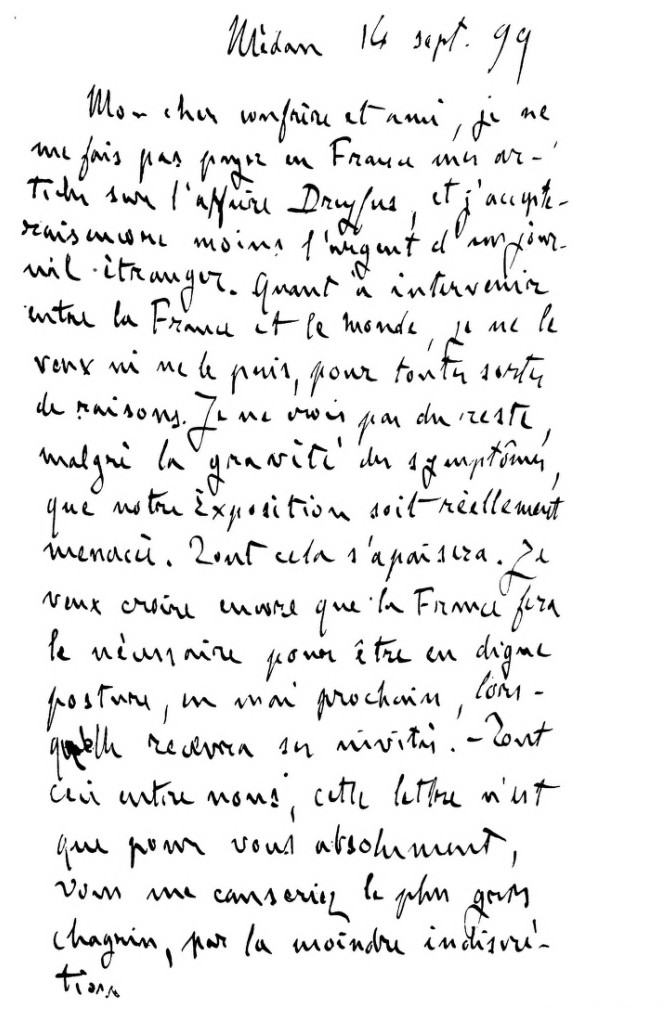
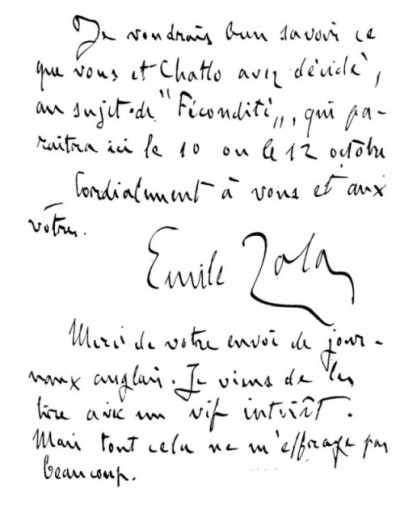
Fac-simile letter from Zola to Vizetelly.
At the lunch at the Chalet des Iles the novelist's health was proposed by his old friend and publisher, M. Charpentier, and after the toast had been acknowledged, M. Catulle Mendès, who, as will be remembered, had gallantly assisted Zola when the columns of "La Cloche" and "Le Bien Public" were closed to "La Curée" and "L'Assommoir," spoke of the old quarrels between the Naturalists and the Parnassians, to which latter sect he, Mendès, had belonged. And, said he, though he still looked upon poetry as a much superior art to prose, he was anxious to declare publicly that he regarded Zola as one of the great literary glories of France. This was very pretty; and the novelist, not to be left behind in a matter of compliments, responded by referring to Mendès as a perfect artist and a good friend. Finally he proposed a toast to work, his old hobby, as he called it, the only one in which true happiness could be found. For some inscrutable reason General Iung—whose researches into the Iron Mask mystery may be remembered, and who happened to be among the guests on this occasion—thought the moment appropriate to re-echo a remark which had run through the newspapers, and to which one has already referred. "Monsieur Zola," said he, "you have written 'The Smash-up' ('La Débâcle'), let us hope that you will soon write 'Victory.'" "Ah, general!" replied Zola, raising his forefinger, "that is your business." And thereupon he sat down.
The value of books is not to be estimated by their length or even by their popularity. Yet it may not be inappropriate to point out that the Rougon-Macquart series, which Zola had now completed, was really a colossal performance. Besides a large variety of other work, the novelist had written the twenty volumes of that series in about five and twenty years, introducing, as he proceeded, no fewer than twelve hundred characters to his readers. The twenty volumes represented nine thousand pages of print, each of three and thirty lines, and, assuming an average of nine words per line and making allowance for "blanks,"—by no means numerous in Zola's works,—one may say that they contained quite two million five hundred thousand words. Passing to another matter, one finds that at the time of the appearance of "Le Docteur Pascal" there had been sold over half a million copies of the ordinary Charpentier edition of the series. The popular illustrated editions of several of the stories, first sold in what one may call "penny parts," had also circulated very widely, at least to the extent of a quarter of a million copies; and further there had been some éditions de luxe, copies on special papers, and so forth. Moreover, there were five novels written before the Rougon-Macquart series was begun, with four volumes of short stories and seven volumes of essays and other papers, issued at various times, and one may therefore assume that between eight and nine hundred thousand copies of Zola's books had been sold at the period we now deal with. And of course thousands and thousands of readers had been reached by serial publication. Of the circulation of the many translations it is impossible to give even an idea, but some of the English and American volumes had sold by tens of thousands, and there were versions of many of Zola's writings in German, Italian, Russian, Dutch, Hungarian, and other languages. But books, as we know, by no means represented the whole of Zola's work; there were also many scores, if not hundreds, of ephemeral uncollected newspaper articles to be added to them, as well as several plays, so that his output stood at quite five million words. It was evident then that he practised what he preached,—that gospel of work, which others, such as Tolstoï, the prophet of resignation, occasionally derided but which he himself found all-sustaining.
He took it as a part of his text when speaking at a gathering of the Paris Students' Association, over which he presided that year, 1893,[22] for though the Academy still refused him admittance, some recognition of his labours was coming from other quarters. On the occasion of the National Fête, following the completion of his great series, he was raised from the rank of chevalier to that of officer of the Legion of Honour; and for some years in succession, a very rare occurrence, he was chosen as Président de la Société des Gens de Lettres. It was this circumstance that caused the English Institute of Journalists to invite him and other representative French writers to attend one of its congresses in London. Zola's connection with Ernest Vizetelly had now become a close one. A translation of "Le Docteur Pascal" had followed that of "La Débâcle," and arrangements had been made for an English version of a previous work, "L'Argent," Zola indorsing all Vizetelly's proposals in a letter in which he said: "My dear confrère, I leave translation matters entirely to you, and it is sufficient you should tell me that an arrangement is good for me to accept it. I know you to be devoted to my interests, and you are well placed to decide everything."[23] Under these circumstances, early in August 1893, soon after receiving the invitation of the Institute of Journalists, Zola communicated with Vizetelly and asked him for certain information. "I should like to know," he wrote, "what will be the importance of this congress, and whether it will offer much interest. You know my position in London; my work is still very much questioned there, almost denied. It certainly seems to me that my presence, and the words I might speak, might efface much of the misunderstanding, and that it would be politic to accept, in order to influence opinion. But what is your view? Reply to me at once at Médan."
Vizetelly, in his reply, reviewed the situation such as it had become since the "The Downfall" which had conduced to a movement in Zola's favour. The English critics, he said, still made all sorts of reserves, asserting, for instance, that a new Zola had come into being and one of them even claiming that there were three Zolas, the author of "La Terre," the author of "Le Rêve," and the author of "La Débâcle"; for they were still so far from the truth, so unable to grasp the significance of the Rougon-Macquart series as a whole, that they could only explain the latter works by picturing some wonderful change in the novelist. Had they looked into the matter more closely they would have found "Le Rêve," with all its mysticism and poetry, followed by one of Zola's most naturalist volumes, "La Bête Humaine," which alone, by reason of its place in the series, demonstrated the fallacy of their assumption. But as Vizetelly pointed out, they, and English people generally, had to be taken as they were. The position had certainly improved, and Zola's presence in London might well make it better still, for in conversation as well as in his speeches he might be able to clear up many misunderstandings. At the same time it was proper to bear in mind that the Institute of Journalists had members in all parts of the country, and Vizetelly did not know how far the provincial districts might share the views of the London district, whence the invitation had emanated. Personally he was very much in favour of Zola accepting it, but he would make some inquiries before anything further was done. Zola himself thought that course advisable, for he at once replied: "If I did not immediately answer the invitation it was precisely because I felt somewhat distrustful, though it is difficult to believe that they have invited me with the intention of receiving me badly. I do not wish the English press to promise it will sing my praises, but I should like to be quite certain it will be polite while I am its guest. Please make the inquiries you propose, and tell me frankly what you think of the situation." And he added in a postscript: "I forgot to tell you that the invitation is addressed to M. Émile Zola, Président de la Société des Gens de Lettres."
That postscript was all important, for it explained the character of the invitation. Various amenities had passed between the French Society and the Institute of Journalists already, and now the Institute, being about to hold a conference in London, had courteously invited the officials of various foreign organisations. It so happened that Zola was one of the officials in question. If some other man had held his position in the Société des Gens de Lettres in 1893 that other man would certainly have been invited, and Zola in all likelihood would not have been asked at all. But the circumstances were not fully understood at the time, and some badly informed controversialists, in their anger at finding the hateful Zola a guest of an English newspaper organisation, subsequently heaped undeserved abuse on the Institute of Journalists. Vizetelly, however, made various inquiries of the Institute's officials, and having satisfied himself that Zola would have no reason to complain of his reception, he again wrote suggesting that the invitation should be accepted. On August 18 Zola, who meantime had also consulted M. George Petilleau, the official delegate of the Société des Gens de Lettres in England,[24] responded:
"I have just accepted, officially, the invitation of the English journalists, so it is quite decided that I shall attend their congress. It would be very kind of you to keep me informed of any incidents that may arise, and I also rely on you to let me know as soon as possible what toast I shall have to acknowledge [at the Institute's dinner]. I understand also that I shall be asked to speak on the question of anonymity in journalism. That is a big question in England, is it not? It would be very kind of you to tell me what you think of it, and what the majority of English journalists think. I want to know the ground beforehand."
Then on August 22 he wrote:
My dear Confrère,—I am preparing the few pages I wish to read on anonymity in English journalism, and I should like to have what information you can give me. I forgot to insist on one point: Is literary and artistic criticism anonymous, like other things, in England? Do your critics, I mean those who judge books and works of art, also refrain from signing their articles? Give me a little information on that point. Tell me clearly what is the position of criticism on your side (chez vous), if it numbers any remarkable men, if they are known, and if people become impassioned for or against them as in France. Again thanks, and very cordially yours, É. Z.
Vizetelly replied by sending him a memorandum, running to perhaps a thousand words, and Zola was further primed with information by others, some London correspondents of the French press, and also M. Petilleau, who took a prominent part in the proceedings. Writing again to Vizetelly on August 27, Zola said: "A thousand thanks for your excellent notes, they will enable me to write something interesting." In the same letter he gave some information respecting "Lourdes" which he was then preparing, and he again referred to that work in a note dated August 30, when he said: "I shall try every effort to make it one-fifth shorter than 'La Débâcle,' for such long novels are disastrous in France." Those efforts, however, were hardly successful, for when "Lourdes" was finished it proved to be only forty pages shorter than the novel on the war.
Though Vizetelly now had plenty of work before him—for besides completing the edition of "The Heptameron" on which he had been engaged in 1889, he was helping his father with his reminiscences,—he was anxious to make early arrangements with respect to "Lourdes" in the hope of profiting by any reaction in Zola's favour which the forthcoming visit to London might promote. In that respect, while he observed with pleasure that English newspaper men seemed to be recovering from their former aberration, he thought it hardly right to leave Zola entirely in the hands of a profession, many of whose members, only a few years previously, had covered him with unmitigated abuse. In these circumstances he communicated with Mr. afterwards Sir Walter Besant, whom he knew to be well informed respecting Zola and his works,[25] and who had also shown great personal kindness at the time of the Vizetelly prosecution. Besant took the hint immediately, but was almost at a loss what to suggest, for in all probability in the latter part of September, when Zola would arrive in London, few English authors of note would be there. However, he saw Mr. Oswald Crawfurd, chairman of the Authors' Club, and Mr. Crawfurd, a man of broad views like Besant himself, took up the matter with alacrity. During the interval which ensued, Mr. Besant wrote several times to Ernest Vizetelly, going so far, on one occasion, as to say, "A dinner will be given at the club to M. Zola and yourself on any day to be named—as quickly as possible—by yourself." But Vizetelly, while accepting the invitation on Zola's behalf, and also quite willing to attend the dinner, felt that he must not attempt to take any prominent part in the proceedings. If he had foreseen that his father, who was still living in retirement near Tilford, would be dead some three months later, he might have adopted quite another course, in order to procure some personal satisfaction for the poor old man who had been pelted with mud, ruined, and sent to prison. But he thought it premature to bring his father forward at that juncture, and therefore he said nothing to him or to anybody else on the subject. Thus it came to pass that after Zola's visit, the inquiry, "Where was Vizetelly?"—started, the writer believes, by Mr. Joseph Hatton—went the round of the newspapers; but while some raised it with the best of intentions, others repeated it with a malicious sneer, a circumstance which seemed to indicate that Vizetelly's son had really taken the wisest course. When the Journalists' arrangements had been ascertained, the Authors' Club dinner was fixed for September 28; and Zola, writing to Ernest Vizetelly on the twelfth, to express his approval, said: "Let me add, that I leave you full liberty. Whether those gentlemen invite me as a novelist or as President of the Société des Gens de Lettres, I shall in either case feel deeply touched and flattered. I am not a formalist; all genuine sympathy, in whatever respect, will go to my heart."
It was on September 20 that the novelist arrived in London[26] in the company of a dozen French journalists,—MM. Magnard, Scholl, Robbe, Xau, Mille, and others. Madame Zola and a few other ladies were likewise of the party. At Victoria station Sir Edward Lawson, now Lord Burnham, read in French an address of welcome, and Zola, when—like others—he had briefly responded, drove to the Savoy Hotel, where rooms had been engaged for him. The paper on anonymity which he read a couple of days afterwards to the journalists assembled in Lincoln's Inn Hall was, on the whole, well received. He admitted that the practice of signing political articles in France had undermined the authority of the press there, and tended to the destruction of parties; but, at the same time, said he, it had to be recognised that much of the inspiriting ardour of the political battle sprang from that same practice. On the other hand, as it was the custom for English political journalists to write anonymously, it might be well if they continued to do so, in order to preserve the power and authority of their press. But Zola pleaded strongly for signed articles in the departments of literary and dramatic criticism, pointing out, by the way, that such articles were indeed beginning to appear in certain English journals. One remark of his, to the effect that English newspaper men were well paid, elicited a loud roar of laughter, and there was considerable dissent when he likened some journalists to mere writing-machines at the beck and call of a superior. On that question some newspapers afterwards pointed out that on two occasions when there had been a change in the proprietorship of "The Pall Mall Gazette" the editors and the bulk of their staff had quitted the paper to uphold their opinions elsewhere. One may add that later, during the Boer war, various editors and others threw up their posts rather than write contrary to their convictions. One passage of Zola's address certainly seemed to have the full approval of his audience. It ran as follows: "To my thinking, when a writer does not sign his work, and becomes a mere wheel in a great machine, he ought to share the income earned by that machine. Have you retiring pensions for your aged journalists? After they have devoted their anonymous labour to the common task, year after year, is the bread of their old age assured to them? If they signed their work, surely they would find their reward elsewhere; they would have laboured for themselves. But when they have given their all, even their fame, strict justice demands that they should be treated like those old servants whose whole life has been spent in the service of the same family."
The journalists present having derided the suggestion that they were well paid, it seemed only natural that they should approve the idea of old-age pensions. At that time, of course, there already existed such organisations as the Newspaper Press Fund; and since then various pensions have been established by the Institute of Journalists; yet one may well wonder if there be even nowadays anything approaching adequate provision for the old age of journalists, of whom the great majority are able to save little or nothing of their earnings. It was undoubtedly this side of the question that most influenced Zola in his remarks on anonymity, which he regarded as being entirely in the newspaper proprietor's favour, for it enabled him, if he chose, to cast a writer adrift with nothing of the position which he might have held in public esteem as the result of his labours, if his articles had been signed. Briefly, in journalism as in other matters, Zola was on the side of the worker and against the capitalist.
No doubt when he was invited to London, purely and simply on account of the office he held, it was not foreseen that his visit would develop as it did. But although he was accompanied by several notable men he speedily dwarfed them all, becoming the centre of attraction at every gathering of the Institute of Journalists. There was a great dinner at the Crystal Palace, a reception at the Imperial Institute, and another, which was given to the journalists by the Lord Mayor, at the Guildhall. That historic building was then thronged to overflowing, and it was strange indeed—remembering all that had gone before—to see Zola and his wife marching in a kind of state procession, preceded by the City's trumpeters and followed by the Lord Mayor, the President of the Institute and other dignitaries, while some official who cleared the way called persistently: "Monsieur Zola! Madame Zola!" as though a couple of royalties were approaching.
Other entertainments were given at this time. Some of the theatres were thrown open to the guests of the Institute of Journalists; Sir Edward Lawson gave them a lunch at Taplow, there was a cordial little reception at the Press Club; while the Athenæum Club conferred honorary membership on Zola for the period of his stay in London. That last distinction was the most unexpected of all, and assuredly the Bishops belonging to the Athenæum cannot have known of it. At the Authors' Club dinner, which closed the round of "semi-official" gatherings, there were some eighty men of letters, with a sprinkling of publishers and others, present. When Mr. Oswald Crawfurd had proposed Zola's health—which he did in excellent French and very laudatory terms—the novelist, no orator, as he had carefully stated at the outset of his sojourn, read his reply, which may be given here as a specimen of his few public utterances, for he did not read or make more than a score of speeches in the whole course of his career.
"Since I reached London," he said, "I have received so many greetings and have so often been called upon to respond thereto, that I am a little ashamed to speak again. I need not, however, solicit your indulgent attention for any length of time. Indeed, in all modesty, I ask your permission to be very brief on this occasion. Nothing could have touched me more deeply than your very flattering invitation. I know that eminent writers are here assembled to extend to me the right hand of fellowship, and I feel that it is no longer the journalist but the novelist that is being entertained. (Applause.) Moreover, you have reminded me that in Paris I am the president of the Société des Gens de Lettres; so that in my person you honour all French literature. (Applause.) I should wish, therefore, to allow my own personality to disappear, and be nothing more than the delegate of my French brethren, to whom I shall attribute by far the greater part of the very cordial homage you have paid to me. I desire, indeed, gentlemen, to insist upon the feeling of fitting modesty that I shall carry away with me from all these functions. You have told me, Mr. Chairman, that, after conquering the world, I have come to conquer England. Will you allow me to reply that I know what I ought to think of my conquest? Amidst all the plaudits, I well understand that the opinion of your critics has not changed in regard to my works. Only, you have now seen their author, and have found him less black than report painted him. (Laughter and applause.) Then, too, you have reflected—'Here is a man who has fought hard and worked a great deal'; and belonging as you do to a great nation of workers, you have honoured work in me. (Applause.) Lastly, it has occurred to you that a man cannot have conquered the world—according to the facetious expression of two of your number—without being worthy of some praise. Works of a different order in art to your own may have affronted you, but you were too sensible to refrain from according them some recognition as soon as you understood how much effort and sincerity they embodied. I am leaving London, not, indeed, as one who has triumphed, but as a man who is happy at leaving some sympathetic feelings behind him. My heart overflows with gratitude for the hospitality, so extensive and so refined, that you have accorded me. Here I say good-bye, or rather au revoir (loud applause); and I say it, through you, to your compatriots. I wish, through you, to assure my brother authors, my fellow-novelists, that I shall never forget the truly royal reception that a mere French writer has received in this huge city of London, throbbing with life and so worthy of inspiring masterpieces. And, gentlemen, as at the close of every banquet it is right to propose a toast, I drink now alike to the novelists of England and the novelists of France, to the good-fellowship of all authors in one universal republic of letters. (Loud applause.)"[27]
Ernest Vizetelly was present at the Authors' Club dinner, and spent half an hour in the crush at the Guildhall, besides hearing Zola read his paper on anonymity. But he abstained from attending most of the other festivities. Every morning at an early hour he arrived at the Savoy Hotel to assist the novelist with his correspondence, the hundreds of applications for autographs and interviews, which poured in upon him, and after the first few days,—as soon as Zola had a little leisure,—he took him to see one and another of the sights of London. Mr. George Moore also escorted the Zolas to Greenwich; Mr. Andrew Chatto gave them a friendly luncheon; Mr. afterwards Sir Campbell Clarke acted as their cicerone at the National Gallery, and Dr. Garnett at the British Museum Library. There were also some interesting visits to the French Hospital and the French Club under M. Petilleau's guidance, an excursion with Vizetelly and a fellow-journalist to County Council and Rowton lodging-houses, Rothschild almshouses, various sweaters' dens, sundry Jewish homes in Whitechapel, and Italian ones at Saffron Hill. On the whole, however, Zola was not impressed by what he saw of London poverty; he declared it to be nothing in comparison with what might be found in Paris. There was much want, no doubt, but it struck him that the passer-by saw little of it. And to emphasise his meaning he reminded Vizetelly of the Parisian ragpickers' "Ile des Singes" and the woeful Route de la Révolte, which certainly has never had its parallel in modern London.
Westminster Abbey naturally interested him, though his visit was a very perfunctory one, owing to the haste of the usual verger with the sing-song voice. When one first entered the abbey, however, some afternoon service was in progress, and after standing and watching for a time, Zola whispered to Vizetelly: "I did not know this was still a Catholic Church." "It is Church of England—Protestant," Vizetelly answered, whereupon Zola seemed lost in astonishment. "Protestant?" he whispered again, "well, all that is very much like Mass to me." Then he shrugged his shoulders and led the way outside, where one waited till the service was over. At the National Gallery he was most interested in Turner, whom he called la palette incarnée and whom he regarded as being far superior to Claude. And he greatly admired Turner's water-colour sketches in the little rooms in the basement of the building, where he lingered for nearly a couple of hours. The British Museum Library also pleased him immensely, notably on account of its perfect arrangements which, were so superior, said he, to those of the Bibliothèque Nationale in Paris. However, what he admired in London most of all was the Thames, at Westminster, at Waterloo Bridge, and again at the docks and away towards Greenwich. Of Hyde Park he formed a very poor opinion, while that royal barracks, Buckingham Palace, seemed to him a national disgrace: a view which most intelligent foreigners share.
On the whole, Zola was extremely well pleased with his stay in London, he had been received there with perfect courtesy, Sir Edward Lawson, Mr. Oswald Crawfurd, Mr. Charles Williams, then president of the London district of the Institute of Journalists, Mr. Lucien Wolf, and others had done all that lay in their power; and Zola on his side had at least made a breach in the wall of British prejudice. The result could not be otherwise than good, he said to Vizetelly; there would probably be less antagonism to his writings among English people in the future; but the point which interested him most of all was the effect his reception might have in Paris, notably among the members of the French Academy. He had been denounced more hotly in England than in any other country, he remarked, and the fact that English people were now beginning to take a more reasonable view of his work might possibly react on French opinion. But, as we know, the Academy did not disarm. The majority of its members would not suffer his presence among them on any consideration.
Moreover, he had scarcely quitted England when the fanatics once more raised their heads. At the Church Congress which assembled at Birmingham that year, Dr. Perowne, the Bishop of Worcester, had the effrontery to declare that "Zola had spent his life in corrupting the minds and souls not only of thousands of his fellow-countrymen and especially of the young but also, by the translation of his works, thousands and hundreds of thousands of young souls elsewhere." At the same gathering Mr. J. E. C. Welldon, then Headmaster of Harrow School and later Bishop of Bombay, denounced the novelist as "infamous," and besought the aid of Churchmen for the "National Vigilant Association," of which, according to "The National Observer," he, Mr. Welldon, was "a conspicuous ornament."[28] The Bishop of Truro, speaking at a church gathering in the west of England took a similar line, and complained bitterly that translations of Zola's horrible books were sold at the railway-station bookstalls, which, said he, would never have been allowed in the lifetime of that good man, Mr. W. H. Smith. Ernest Vizetelly answered the prelate in a newspaper of his diocese, pointing out that the only Zola translations sold at Messrs. Smith's bookstalls were those of "La Débâcle" and "Le Docteur Pascal" by himself, and that of "Le Rêve" by Miss Eliza Chase; and he defied the bishop to find in any one of those three books a single sentence that could give offence to any sensible man. Other correspondents reinforced Vizetelly; but the bishop, quite content with having uttered his slander, preserved absolute silence, that being a characteristic trait with some bishops—of various churches and countries—who, regarding themselves as very superior persons, seldom if ever offer reparation for the aspersions they may cast upon laymen. Yet the law of libel applies to them as to others, and it is perhaps a pity it is not enforced against them. But the lawyers say, or at least they said to Vizetelly: "It is useless to proceed against an English bishop. There is so much cant in this country that you would never obtain a verdict against him, however complete your evidence might be."
As for Bishop Perowne of Worcester he was answered in "The Speaker" by its contributor, Mr. A. T. Quiller-Couch, as well as by sundry correspondents, one of whom pointed out that this chartered slanderer "had not so much evidence to back his insinuations and assertions as would wrap round a mustard seed." Mr. Welldon was also dealt with at length and very ably by Mr. Quiller-Couch, the controversy in "The Speaker" being prolonged until the latter part of November.[29] Ernest Vizetelly was at first unaware of it, but a friend who, having little acquaintance with literature, read that Liberal weekly chiefly for its political articles, said to him one day: "You ought to see 'The Speaker.' There's a lawyer who is defending Zola and your father in it very vigorously. He is the kind of man your father ought to have had as counsel at his trial." "A lawyer?" Vizetelly replied, "why, what is his name?" "Oh! he only appends his initials 'A. T.' to his articles; but I felt interested, and so I consulted the law-list at my club. He's a Queen's counsel, by the way; and the only Queen's counsel whose initials are A. T. is the Hon. Alfred Thesiger, so he undoubtedly is the man." The truth, however, had suddenly dawned on Vizetelly, who began to laugh as he answered: "The initials are A. T., you say; but the writer puts Q. C. after them, does he not? I thought so. Well, I am much obliged to you for your information, but you are all at sea. Your Hon. Alfred Thesiger, Q. C., is none other than Mr. A. T. Quiller-Couch!" Then, while his friend was expressing his astonishment, Vizetelly began to think of fame.
In the controversy in question Mr. Welldon, who ended by admitting that he had read only three of Zola's books, received the support of clerics of various denominations. One of them, Canon MacColl, of Ripon, who would seem to have been then very fond of writing to the newspapers on all sorts of subjects, raised the old argument that even if Zola might have had some justification for publishing, for instance, "La Terre" in France, there could have been none for its issue in English and in England by Henry Vizetelly. No doubt the canon was right. As was set forth in a previous chapter the rural districts of England were and are terrestrial paradises, where immorality and beastliness were and are absolutely unknown. The observers who assert the contrary must be either liars or deluded fools. The clergy who are to be found in every village vouch for the high moral tone of their parishioners, and it follows that one must not believe those who chance to sit on juries at provincial assizes to try the various horrible cases, frequently from the aforesaid rural districts, which are never reported by a decorous press. Everything is for the best, then, in rural England, and the most perfect men in the whole world are the truth-speaking bishops who begin life in modest circumstances and end by leaving huge fortunes to their families, the many-sided canons fond of joining in every controversy, and the dogmatic clerical schoolmasters who take as their guide the saying attributed, perhaps erroneously,[30] to Richelieu: "Give me six lines written by the most honest man in the world, and I will find in them enough to have him hanged."
Henry Vizetelly, to whom his son forwarded "The Speaker" while the controversy continued, observed with some surprise Mr. Quiller-Couch's assertion that the public conscience would not permit a repetition of such proceedings as had been taken against him. He thereupon wrote to Mr. Quiller-Couch saying that in his opinion the public conscience could only find expression through the press, and that in the event of a new prosecution the press would again remain silent until the "National Vigilants" had secured a verdict, when it would once more join in approving the "vindication of the law." That view was shared by Vizetelly's son. Indeed, though Zola had been so well received in London, even by some of the provincial journalists who attended the Institute's Congress, though, too, newspaper men of education had come to a truer perception of his aims, and several wrote very favourably about his more recent books, it remained quite certain that he still had numerous enemies on all sides. At the close of that year, 1893, or more correctly on the first morning of the ensuing one, Henry Vizetelly died, and immediately afterwards another controversy began, this time in the London "Daily Chronicle." The chief features of the prosecutions of 1888 and 1889 were recalled by Robert Buchanan, Frank Harris, and George Moore, the first of whom dwelt on the attitude of the press with respect both to those proceedings and to Zola generally. Various protests arose, and, according to some people, it was quite untrue that the English press had ever flung mud at Zola or his publisher. The absurdity of that contention was made manifest by the publication, at that very moment, of several articles in which all the old lies and aspersions were repeated. These, it is true, appeared mostly in provincial journals; but two or three London prints did not hesitate to befoul yet once again the dead publisher as well as the recently banqueted novelist, whom G. W. Story, when recounting the controversy in "The New York Tribune," foolishly described as being "the most lewd writer in the world." It must be said, to Story's credit, that his article was a signed one, whereas the valiant scribes of the British press remained anonymous. They found, undoubtedly, that "anonymity in journalism" had its advantages, and wisely decided to cling to it. Since that time, however, the practice of signing critical articles has spread considerably and may some day become the general rule.
XI
A CRITICAL GLANCE
1893
Zola's short stories—His early novels—His sense of poetry and his realism—Poetry and science—The futility of literary dogmas—The law of change—The influence of science on literature—Why Zola became a novelist—His attitude towards life and his fellow-men—The Rougon-Macquart series—The order in which it was published and the order in which it should be read—"Rougon-Macquart" and "Robert Macaire"—A survey of the volumes—Their human and animal characters—Great variety of their contents—How they were prepared—Zola's alleged ignorance—His handwriting—His style—Some fine pages—Some blunders—Various critical remarks—The series as a whole—A living psychology—Some remarks on translations—A glance at Zola as a playwright.
In previous chapters one has enumerated the many books—novels, volumes of tales and essays—put forth by Zola from the time he began to write until he completed the Rougon-Macquart series. That completion marks a date in his career, and it is now fit one should glance back at the work he had accomplished. His minor writings may be noticed briefly. His first volume, "Les Contes à Ninon," suggests the influence of Victor Hugo largely tempered by that of Alfred de Musset, with here and there, too, some sign of incipient realism. It is immediately apparent that much time and care were spent on the writing of these tales, the style of which is often perfect and always charming. The companion volume, "Nouveaux Contes à Ninon," published ten years later, is inferior to the earlier one, much of the matter contained within its covers being but newspaper work. Nevertheless "Les Quatre Journées de Jean Gourdon" is in its way admirable; and in "Le Petit Manteau bleu" one recognises the spirit which presided over the former tales. Realism is often quite manifest in this second volume, and the explanations given in its preface are almost superfluous, for one can easily tell that it is the work of a man who has passed through the furnace, whereas the first volume was all youth, buoyant, aspiring, with wings unclipt.
Zola's other tales, those in the volumes entitled "Le Capitaine Burle" and "Naïs Micoulin," belong to a later date and are very different from the early ones. If the influence of the poets appears in them at intervals, it is in diction rather than ideas. Even the poetic suggestion lurking in the tale "Pour une nuit d'amour," which Poe might almost have written, can only be traced with difficulty, for it is wrapped in a ghastly realism. The story of "Nantas" is perhaps the best of these later little efforts, as it is certainly the most powerful; but "Naïs Micoulin" is also one of the present writer's favourites, perhaps because, whatever its ardour, it does no violence to possibilities. Placed beside the tales of Guy de Maupassant, those of Zola, in spite of all the naturalism of their details, strike one as being more romantic, more imaginative; and this is as it should be, for Zola was largely a child of the sun, whereas Maupassant, however passionate his temperament, was always a Norman, deficient in the purely imaginative faculty but possessed of great shrewdness—intuition, so to say,—which assisted his powers of observation and his superb craftsmanship. Thus he excelled in transcribing the human document such as it appears to most Northern minds.
As it is with Zola's short stories so it is with his earlier novels: "La Confession de Claude" is a struggle between poetry and reality, the presentment of a soul longing for the empyrean but forced to surrender to all the horrors of degradation. The fragmentary "Vœu d'une Morte" contains indications of the same battle continuing. "Les Mystères de Marseilles" is a thing apart; but, at last, in "Thérèse Raquin" and "Madeleine Férat" realism triumphs brutally and in its first victorious hour blackens the canvas to excess. Average truth is disregarded—as Zola himself admits—and the agony is piled on to the point of nightmare. This is done, perchance, by the realist in Zola in order that no loophole may be left for the poet, also within him, to rise again.
But take the Rougon-Macquart series, and there, amid all the realism of twenty volumes, a revival of the poetic sense will be found displaying itself repeatedly. Remember the idyll of Silvère and Miette, that of Marjolin and Cadine, that of Angélique and Félicien, that of Serge and Albine, the Paradou, Hélène and Henri, the vistas of Paris from the heights of Passy, the love of Goujet for Gervaise, even that of Georges Hugon for Nana, the epic march of the miners in "Germinal," the epic charge of the cavalry at Sedan, Clotilde's communion with herself while giving suck to her babe, and all the other instances. There may be no trace of poetry and romance in "Thérèse Raquin," but Zola when writing that book must have known full well that he had only scotched, not killed, his poetic tendencies. To understand him aright, let us remember that he made his débuts at a time when science was enlarging her domain daily. For him she exercised a fascination equal to that of art. In his youth he had turned eagerly to certain scientific studies even while he was steeping himself in poetry, and later he devoured Flourens, Zimmermann, translations of the great scientists of England and Germany. He saw that there was often a deep poetry in science; he dreamt of making it manifest,—of going further,—of associating science and art, of establishing their co-relation, welding them together even in instances when to some folk they seemed to be antagonistic. His nature, as one has remarked previously, was a compound, a hybrid one, by no means unique, but such as is not often observed. "Lewis Carroll" supplies a somewhat approximate instance: in him one found the mathematician elbowing the romancer, only he did not dream of importing "Euclid" into "Alice." Zola, in doing so, or rather in doing something similar, was not entirely influenced by his own special nature, but was carried along by the spirit of his age, in which everything tended towards science. Those who remember Darwin and Faraday and Huxley and the others, and the thirst that came on so many young men in those days, will not gainsay it.
The literary critics declared, of course, and many of them declare still, that Zola was altogether wrong. Regarding Art as being so distinct, so different from Science that no amalgam could be effected, they laid down and still lay down certain rules as being necessary to salvation. That attitude was and is preposterous to the open mind which holds that no dogmas are of any account, and that of those who frame them one may say in Dante's words:
"Non ragionam di lor, ma guarda e passa."
It is true that some critics have asserted that if there be no finality in science there is a finality in art. But in fiction, with which alone one is concerned here, the form has changed repeatedly, and on each such occasion the loud protests raised by the representatives of old and recognised schools have proved ineffectual. One rule, one dogma after another, has been set aside, and still and ever the evolution has continued. To say that the artist in fiction must do this and must not do that is to expose oneself to the ridicule, at times, even of one's contemporaries, and certainly of posterity. Take a comparatively recent epoch and think of the dogmas and the protests brought forward by the Classiques in their great contest with the Romantiques in France, and remember who, in the end, were vanquished. Thus men of conservative views may protest, but if there be a good cause for any evolution, which one or another writer may essay, it will end by triumphing in spite of all the opposition offered to it.
The art of the novelist has been often likened to that of the painter, but it does not follow that this is the only possible comparison. A novelist may liken himself to a sculptor, in fact to anybody he chooses. Nothing, moreover, is final. The world, as modern scientists have just rediscovered, and as Heraclitus asserted three and twenty centuries ago, is not a being but a becoming. Change is the universal law, even in matter; and if some minds, imprisoned within narrow ideas and formulas, find it impossible to contemplate the possibility of certain changes, they must yield to the broader minds for which everything is possible. The world's changes are reflected in its literature. Science within our own time has profoundly modified the study and the writing of history. As for the novel, the Romanticists spoke no last word, for it was not in their power to do so. Whether Zola had arisen or not, it was fatal that the novel should at last embrace many things which earlier writers of fiction had never dreamt of including in it, that it should, in a word, follow the trend of the modern mind.
Among writers, moreover, there are always many whose aim is not mere amusement. Some openly declare instruction, enlightenment, to be their purpose. Some are only half conscious of their mission, some not at all, and it happens not unfrequently that a lesson is conveyed in books where it has been never intended. At one time the drama was the form of literature which appealed most successfully to the greater number. The novel at last acquired a similar position, and it followed that the writer who wished to reach the greater number had to approach them as a novelist. That had been done long before the time of Zola, who was both a writer with a purpose and one who wished to reach the majority. Now, if an author desire to bring about some reformation of the community, it is natural that he should begin by portraying it. If he wish to elucidate certain social, scientific, and psychological problems for the common good, it is essential that he should in the first case state them. In that event, say some pedants, he must confine himself to treatises of the accepted form. But the author answers no, for such treatises would not reach the greater number, and his purpose would then remain unfulfilled. To reach them he must approach them in the only literary form for which they care: he must embody his views in novels. "I have, in my estimation," said Zola, "certain contributions to make to the thought of the world on certain subjects, and I have chosen the novel as the best means of communication. To tell me that I must not do so is nonsense. I claim it as my right, and who are you to gainsay it?"
But let us pass to another point. The oft-repeated assertion that Zola confined himself to portraying the ulcers and sores of life is contrary to fact. He undoubtedly found more evil than good in the community, and he insisted on the evil because it was that which needed remedying. But he blamed nobody for extolling the higher side of life. He denounced the writers who cast a deceptive and often poisonous glamour over the imperfections of the world, he railed at many of the people who pretended to be very good, for he was not deceived by hypocrisy and cant; but, at the same time, he never held that mankind was naturally evil. He attributed its blemishes to its social systems, its superstitions, the thousand fallacies amid which it was reared, and his whole life was a battle with those fallacies, those superstitions, and those systems.
As he contended against so many generally accepted opinions it was inevitable that his work and even his purpose should be greatly misjudged. Critics took in turn one and another volume of his Rougon-Macquart series, and pronounced condemnation on it. It was only when, after long years, the series was at last finished that some little justice was shown to the author. It should be remembered that no volume of the series is in itself a really complete work. The series indeed is the book, the volumes are but chapters of it. Besides, they ought not to be taken nowadays in the order in which they were originally published. It occasionally happens that writers are unable to produce their works in proper sequence. There have been instances when the second and fourth volumes of some literary undertaking have been published before the first and the third. So it was with the Rougon-Macquart novels. Zola was no walking encyclopædia. Every now and again it happened that he was not ready for the volume which by rights should have followed the one he had just finished. He lacked, at the moment, sufficient knowledge of the subject which that next volume was to embrace. Or else, as also happened at times, his fancy or his feelings or some combination of circumstances carried him onward, inducing him to skip a volume for a time. But he always reverted to it afterwards, like an author who, writing not twenty volumes, but one, has passed over some troublesome chapter, yet harks back and writes it at last, well knowing that his work will lack completeness and intelligibility if the gap be not filled up.
In the chronicle of Zola's career given in our previous chapters, the Rougon-Macquart volumes have been mentioned in their chronological order; but the example of the critics who, even since the completion of the series, have followed that same order in judging Zola's work is not one to imitate. By adopting that system one may certainly trace the variations in Zola's general style over a term of years; but if the series is to be judged as a whole one must take its sections in the order in which the author himself desired they should be read. This he indicated in "Le Docteur Pascal," and confirmed by word of mouth to the present writer; and it is unfortunate, perhaps, that the French publishers should still "list" the volumes chronologically, thereby leading many readers astray. Some volumes of course—notably the first and the last—occupy their proper places in the lists, but others have to be taken in a very different order.