ERNEST ALFRED VIZETELLY
Reading edition
ILLUSTRATED BY PORTRAITS, VIEWS, & FAC-SIMILES
JOHN LANE: THE BODLEY HEAD LONDON & NEW YORK MDCCCCIV
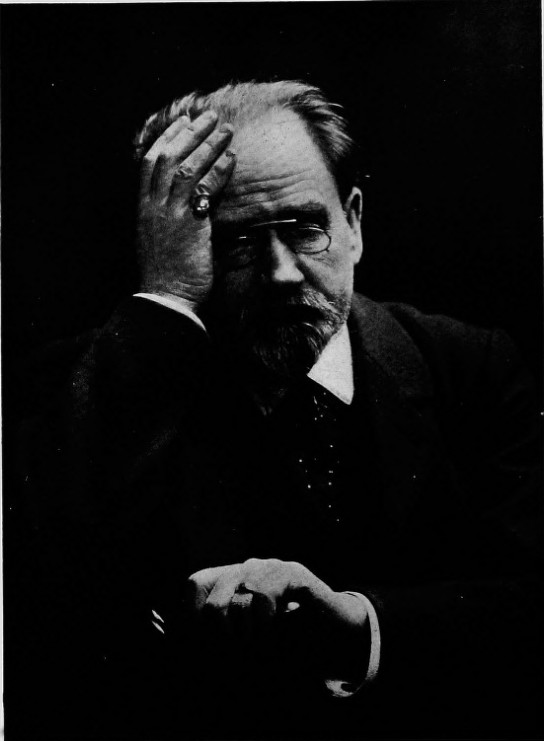
Émile Zola in his last days—Photo by Cautin & Berger.
TO HIS MEMORY
"If, upon your side, you have the testimony of your conscience, and, against you, that of the multitude, take comfort, rest assured that time will do justice."— DIDEROT
PREFACE
This book is an attempt to chronicle the chief incidents in the life of the late Émile Zola, and to set out the various aims he had in view at different periods of a career which was one of the most strenuous the modern world has known. Virtually all his work is enumerated in the following pages, which, though some are given to argument and criticism, will be found crowded with facts. The result may not be very artistic, but it has been partially my object to show what a tremendous worker Zola was, how incessantly, how stubbornly, he practised the gospel which he preached. An attempt has been made also to show the growth of humanitarian and reforming passions in his heart and mind, passions which became so powerful at last that the "novelist" in Zola seemed as nothing. Yet I do not think I can be charged with having neglected the literary side of his career. It is that which bulks most largely in the present volume, and that I think is as it should be, for while Zola was certainly, and in some respects essentially, a Reformer, the pen was the weapon with which he strove to effect his purposes.
Designed more particularly for British and American readers, the book contains some passages which I should have abbreviated—omitted perhaps—if I had been addressing a French audience. And some subjects, which, in that case, I might have treated more fully, have here been dealt with briefly. For instance, though I have enumerated all the plays that Zola wrote, and most of those founded by others on his works, I have not entered into any real discussion of his views respecting the stage, or of his indirect influence on it in France. I have thought it sufficient to indicate that such influence was exercised. A full examination of Zola's relations with the stage would have materially increased the length of a work which is long already, and which I have been anxious to keep within the scope of one volume—a desire which has made my task more difficult than it would have been had I used my materials in all their fulness. But I am distinctly of opinion that biographies in several volumes have nowadays little chance of surviving, even for a moderate number of years.
With respect to Zola's share in the Dreyfus case everybody will recognise, I think, how difficult it is to narrate the doings of any one individual in such an intricate mêlée without constant reference to the other combatants and explanation of the many points at issue. Nevertheless, though I fully recognise that the deliverance of Captain Dreyfus was not effected by Zola only, that many other able and whole-hearted men co-operated in that great achievement, I have endeavoured to disentangle Zola's share in the battle from that of the others, saying of them only what has seemed to me strictly necessary to explain his actions. I mention this in order that none may think me unjust towards Zola's fellow-fighters. And though in some introductory pages I have endeavoured to indicate the primary causes of the Affair, such as I think them to have been, in the hope that the reader may be better able to understand the fury of the fray, I have not plunged into a discussion of the Affair itself. Besides, M. Dreyfus's case is now once more before the Cour de Cassation, and reserve on a variety of matters has therefore become advisable. Further, for some years already, a far abler pen than mine, wielded by one of far greater authority, M. Joseph Reinach, has been retracing the many episodes of the Affair, and one may take it, I think, that "L'Histoire de l'Affaire Dreyfus" will not end without casting light even on matters which may still seem obscure.
In one of my chapters I mention an episode in Zola's private life, which is already known to so many people that it would have been ridiculous on my part to have attempted to conceal it, even if it had been right to do so. I will not enlarge on the subject here, for it is discussed in its proper place, I will merely reiterate my conviction that if a biographer may well be kind to the virtues and a little blind to the errors of a man he has loved it is nevertheless his duty to his readers to omit nothing that may be essential for a right understanding of the man's life.
Further, in another section of the book, I have recounted the incidents of the prosecution instituted against my father with respect to certain translations of Zola's novels. And in this connection I have had occasion to say something about certain fanatics, and also about the attitude of the majority of the British newspaper press before it realised that Zola was not so black as it had painted him. Even after the lapse of long years, such matters and their consequences cannot be recalled by one who suffered by them without some feeling of resentment. It is true that in my preface to the English version of Zola's last book I expressed my acknowledgments to the press generally for the leniency, patience, and even favour that had been shown to me from the time I began to re-introduce Zola's works to the British public. Those acknowledgments I am quite ready to reiterate, in despite of the matters with which I deal in a chapter of the present book, for those matters belong to an earlier period. But a sense of duty and justice to my father, to my brothers and other relatives, to myself as well, has made it impossible for me to overlook the period in question, and what I regard largely as its aberrations. Besides, in a book intended for English readers, it is only fit that the attitude of the English public towards Zola should be dealt with.
Most of the illustrations accompanying my text are from photographs, several of them taken specially for this book; but I have to express my acknowledgments to the proprietors of the Illustrated London News for their kind permission to reproduce various views of the rooms in which much of Zola's life was spent.
E. A. V.
"MERTON, SURREY March, 1904
CONTENTS
IINTRODUCTORY—THE ZOLA FAMILY—BIRTH OF ÉMILE ZOLA 1
IIEARLY YEARS: 1840-1860 24
IIIBOHEMIA—DRUDGERY—FIRST BOOKS: 1860-1866 53
IVIN THE FURNACE OF PARIS: 1866-1868 80
VTHE FIRST "ROUGON-MACQUARTS": 1868-1872109
VITHE PATH OF SUCCESS 1872-1877140
VIITHE ADVANCE OF NATURALISM: 1877-1881166
VIIITHE BATTLE CONTINUED: 1881-1887206
IXTHE BRITISH PHARISEES: 1884-1893242
XTHE LAST "ROUGON-MACQUARTS"—THE FRENCH ACADEMY—A VISIT TO LONDON: 1888-1893300
XIA CRITICAL GLANCE: 1893342
XIITHE MAN—HIS LIFE DRAMA—A NEW DEPARTURE 1893-1897390
XIIITHE DREYFUS CASE: 1894-1900419
XIVLAST YEARS—DEATH: 1901-1902493
XVCONCLUSION—THE INFLUENCE AND SURVIVAL OF ZOLA'S WORKS527
APPENDIX
A.—Declaration of Zola's birth
B.—Declaration of his death
C.—Note on some English translations of his novels
INDEX
ILLUSTRATIONS
1. Émile Zola in his Last Days Frontispiece
2. The Birthplace of Émile Zola
3. Dam and Reservoir of the Zola Canal
4. Zola's Home, Impasse Sylvacanne, Aix
5. The Boulevard Zola and the Banks of the Arc, Aix
6. Émile Zola, 1876-1880
7. Zola's Home at Médan
8. Zola in his Study
9. Émile Zola, 1888-1890
10.Aix-in-Provence, the Plassans of the Rougon-Macquarts
11. Fac-simile Letter from Zola to E. A. Vizetelly
12. Denise and Jacques
13. Maître Labori
14. Zola writing "Fécondité" at Walton
15. Penn, and Summerfield, Surrey
16. Penn from the Garden, and Fac-simile Card from Zola to Vizetelly
17. Émile Zola, September, 1898
18. Zola's Dining-room
19. Mme. Zola at the Queen's Hotel, Norwood
20. Zola's Bedroom
21. M. Anatole France speaking at Zola's Funeral
ÉMILE ZOLA
NOVELIST AND REFORMER
I
INTRODUCTORY
THE ZOLA FAMILY—BIRTH OF ÉMILE ZOLA
The meaning of "Zola"—Localities of that name—The Zola family of Brescia and Venice—Giovanni Battista Zola, saint and martyr—The Abate Giuseppe Zola and his chequered career—The military Zolas of Venice—Benedetta Kiariaki and her offspring—Francesco, father of Émile Zola—His military training—He becomes an engineer and plans one of the first "railways" in Europe—His service in the French Foreign Legion and its strange ending—He plans new docks for the port of Marseilles—His schemes for fortifying Paris and providing Aix in Provence with water—He meets Françoise Émilie Aubert—His romantic courtship and marriage—His home in the Rue St. Joseph, Paris—Birth of Émile Zola—Literature in England, America, and France in 1840—The birth of Émile Zola followed by that of Alphonse Daudet—Contrasting characteristics of those writers.
It has been contended, with some plausibility, that the Italian word zola is simply a variant of zolla, which means, in a restricted sense, a clod or lump of earth, and, in a broader one, the glebe or soil This circumstance has suggested to certain detractors of Émile Zola and his writings the scornful remark that he was at least well named, having been, indeed, of the earth earthy. Others have retorted, however, that he may well have taken pride in such association, for, far from disowning his Mother Earth, he acknowledged and proclaimed her beneficence, showed himself her worthy son, and a true and zealous brother to all compounded of her clay. In the course of the present memoir it will become necessary to examine the blame and praise so freely showered upon Zola by his enemies and his admirers; but this can be done irrespective of any such fanciful consideration as the alleged meaning of his name. All discussion of that meaning may be left to philologists and those who are superstitiously inclined to detect predestination in nomenclature. At the same time, it may be as well to point out that the name of Zola is borne by several localities in Northern Italy. For instance, there are two villages so called in Lombardy,—one near Palestro in the province of Pavia, and another in the Valle di sotto, province of Sondrio. In the Emilia, moreover, towards Bologna, there is the small but ancient township of Zola-Predosa, which takes its name from two castellanies united early in the fourteenth century. And as far south as Tuscany, in the province of Florence, one finds a village called Zola incorporated in the Comune di Terra del Sole, and yet another which is named Zola di Modigliana. If, as is possible, the family to which Émile Zola belonged derived its patronymic from some specific locality, this may well have been one of the Lombardian Zolas; for though all the published accounts of the great novelist's progenitors associate them chiefly with Venice, it is certain that they were long connected with Brescia, Lombardy's fairest city, and one which passed for a time under Venetian rule.
The first notable Zola of whom some account has been preserved was a certain Giovanni Battista, born at Brescia between 1570 and 1580. Educated for the Church, he joined the Society of Jesus, and, in or about 1600, proceeded to Goa as a missionary. From India he made his way to Japan, whither St. Francis Xavier and others, following Mendez Pinto, had carried the cross half a century earlier. Remarkable success attended the first endeavours of the Jesuit missionaries among the Japanese, but their principles were incompatible with tolerance. Throwing caution to the winds, they dictated when they should have been content to teach and persuade, destroyed native shrines, and plotted with disaffected nobles, in such wise that Christianity, after recruiting, it is said, some two hundred thousand adherents in the realm of the Rising Sun, was placed under interdict by the Emperor. Terrible slaughter ensued, and among those who perished at the hands of the Shintoists and Buddhists was the zealous Giovanni Battista Zola. In our own times, under the pontificate of Pius IX, he was placed, like the other holy martyrs of Japan, among the saints of the Roman Catholic Church.
At the confluence of the eighteenth and nineteenth centuries, another Zola, likewise a Churchman, rose to a position of some eminence. This was the Abate Giuseppe Zola, born in 1739 at Concesio, near Brescia, in which city he became successively librarian, professor of morals, and rector of the university. But he was a man of broad views, one whose dream was to reform and rejuvenate the Church—even like Abbé Pierre Froment in Émile Zola's "Lourdes" and "Rome." In 1771 the theological views professed by Giuseppe Zola brought him into conflict with his Bishop and the Jesuits. He was forced to quit the university; a three-volume work which he had written on the early Christians prior to Constantine and two volumes of his theological lectures were denounced to the Congregation of the "Index expurgatorius"; and—in this instance also like Abbé Pierre Froment—he journeyed to Rome in the hope of justifying himself. In the end—once more anticipating Abbé Pierre—he had to make his submission. Then, for three years, he remained at Rome, teaching morals; but the influence of his enemies, the Jesuits, was waning, and not long after the promulgation of Ganganelli's historic brief suppressing Loyola's Order, Zola obtained an appointment as rector and professor of ecclesiastical history at a seminary for Hungarian students, established at Pavia by the Emperor Joseph II.
He proved a zealous partisan of that monarch's reforms; he imagined, too, that the suppression of the Jesuits meant the dawn of a new era for the Church. Thus he indulged fearlessly in advanced religious and political views, his persuasive eloquence carrying most of the professors of Pavia with him. The Church then again treated him as a rebel; he was accused of infecting his seminary with heresy; and not only was he deprived of his rectorship, but the institution itself was closed. At last came the French Revolution; and the victories of the Republican arms in Italy brought Zola the professorships of history, jurisprudence, and diplomacy at the Pavian University. During the brief revival of Austrian rule (1799-1800) he was once more cast out, to be reinstated, however, immediately after Marengo. The last important incident of his life was a journey to Lyons as one of the Lombardian deputies whom Napoleon summoned thither when he constituted his Kingdom of Italy. A year later, 1806, Giuseppe Zola passed away at his native place. He was a man of considerable erudition, broad sympathies, and untiring energy. Besides writing a dozen volumes on theological and historical subjects, he edited and annotated numerous books,[1] invariably turning to literature for consolation amid the vicissitudes of his career, which has been recounted here at some little length because it is of a suggestive nature when one remembers that the Abate Giuseppe was a kinsman of the progenitors of Émile Zola.
Those progenitors belonged to a branch of the family which had established itself at Venice, and which became noted for its men of the sword, even as the Brescian branch was noted for its Churchmen. The Zolas of Venice held military rank under the last Doges, then under the Cisalpine Republic, and eventually under Napoleon as King of Italy. Two of them fell in the great conqueror's service, one then holding the rank of colonel, the other that of major. A third, who became a colonel of engineers and inspector of military buildings, married a young girl of the island of Corfu, which had been subject to Venice since the close of the fourteenth century. Her name was Benedetta Kiariaki, and she introduced a Greek element into the Zola blood. It seems probable that she had several children, among whom were certainly two sons. The elder, called Marco, became a civil engineer, and rose to the highest rank in the State roads-and-bridges service. He had three children, two daughters named respectively Benedetta and Catarina, and a son, Carlo. Benedetta died unmarried, while Catarina was wedded to Cavaliere Antonio Petrapoli of Venice; but their only offspring, a daughter, was snatched from them in her childhood.
Carlo Zola, meantime, followed the profession of the law, and, after the foundation of the present Kingdom of Italy (1866), was appointed a judge of the Appeal Court of Brescia. He died comparatively few years ago. Contemporary with him there were other Venetian and Brescian Zolas, cousins, presumably, of various degrees. In family letters of the first half of the last century, one reads of a Lorenzo, a Giuseppa, a Marius, and a Dorina Zola, but all these have passed away, and at the present time (1903) the only representative of the family in Italy would seem to be the Signora Emma Fratta, née Zola, a widow lady with four children.
But, besides Marco Zola, Benedetta Kiariaki, the Corfiote, had a son called Francesco in his earlier years, and François after he took up his residence in France. As a matter of fact he bore four Christian names, Francesco Antonio Giuseppe Maria—which may be taken as some indication of the family's gentle status. In the present narrative, in which it is necessary to speak of him at some little length, for he became the father of Émile Zola, it may be best to call him François. He was born at Venice on August 8, 1795, and entered the Royal Military School of Pavia in October, 1810. A corporal-cadet in March, 1811, a serjeant two months later, he obtained his first commission, as a sub-lieutenant in the Fourth Light Infantry, in April, 1812. In July of the same year he was transferred to the Royal Italian Artillery, with the rank of lieutenant. He was then only seventeen. Until the collapse of the Napoleonic Kingdom of Italy in 1814 he served under the viceroy Prince Eugène Beauharnais, and his regiment being afterwards incorporated in the Austro-Italian forces, he remained with it till 1820.[2]
But the exile of Napoleon to St. Helena had brought Europe a period of peace, and some leisure fell to the lot even of military men in active service. In all probability the "First Light Battery," to which François Zola belonged, was stationed at Padua; in any case, while still in the army, the young man perfected his studies at the Paduan University and secured the degree of doctor in mathematics. In 1818 he published a treatise on levelling ground,[3] which was adopted by the authorities at Milan (the capital of the Austrian dominions in Italy) as a text-book for the engineers of their roads-and-bridges service, and which procured for the young author, then three and twenty, the title of Associate of the Academy of Sciences, Letters, and Arts of Padua.[4]
If in 1820 he withdrew from military service, it was, as shown by a document in his own handwriting, preserved at the French War Office, because the Austrian Emperor "had been graciously pleased to order the introduction of the bastinado into his Italian regiments"; but although François Zola denounced this as a barbarous proceeding, he does not appear to have entertained any hatred of the Austrians generally. From a speech delivered at his funeral, one gathers that on quitting the army he worked under his brother Marco, then chief inspector of roads and bridges, became a properly qualified engineer, and was eventually sent to Upper Austria on some official surveying business. While there, he became acquainted with the Ritter von Gerstner and an engineer named Bergauer, in conjunction with whom he constructed the first tramway line laid down on the continent of Europe.[5]
It has been called a railway, and such it undoubtedly was, though not in the sense usually given to the word "railway" nowadays; for relays of horses were employed for traction. The line extended from Linz on the Danube to Budweis in Bohemia, a distance of seventy-eight miles; and though it seems to have been largely devised for the transport of timber from the Bohemian forests to the great waterway, there was also a passenger service, which still existed in our time.[6]
While constructing this line, Zola, in June, 1823, obtained personally the imperial authorisation to make another one, connecting Linz with Gmunden and the Salzkammergut—the so-called "Austrian Switzerland," industrially important for its extensive salt-works. But he became disappointed with the financial results of the Budweis line, and, accordingly, in September, 1830, he sold the Gmunden concession. It seems likely that he had then already quitted Austria. There are indications that he may have visited England with Ritter von Gerstner, and have sojourned for a time in Holland; but before the end of 1830 he was certainly in France, writing to King Louis Philippe respecting a scheme he had devised for the fortification of Paris. In the spring of 1831 he was in communication with the French War Office on this same subject, whilst also soliciting an appointment in the Foreign Legion, in Algeria, with the rank of captain.[7] The fortification scheme was shelved, but the appointment was granted, excepting in one respect: it was as a lieutenant, not as a captain, that François Zola entered the Foreign Legion in July, 1831.
His career in that corps proved very brief, and ended strangely. Many years afterwards an unprincipled journalist, anxious to discredit Émile Zola's championship of Captain Dreyfus, raked up the episode in order to denounce the novelist as the son of a thief. But it is certain that some documents cited at the time were entirely forged, that others were falsified in part, and that others, again, were suppressed. This can occasion no surprise when it is remembered that one of the dossiers concerning François Zola, preserved at the French War Office, passed for a time into the possession of the notorious forger, Colonel Henry;[8] and that an unscrupulous Minister, General Billot, by asserting authoritatively that certain papers did not exist,[9] contrived to delay their discovery. Those matters will require notice hereafter; at this stage one need only mention that the attack on François Zola's memory was answered first in a work called "Le Père d'Émile Zola" by a Socialist journalist, writing under the name of "Jacques Dhur," and secondly by Émile Zola himself in a series of newspaper articles, which he reprinted in a volume entitled "La Vérité en Marche."
After studying those books and the documents they quote, nobody of impartial mind can entertain the graver charges preferred against the novelist's father. In his time (1831-1832) great confusion prevailed in the Algerian army of occupation. Commanders and officers were constantly being changed, and Zola himself, after serving at first as a company officer, was temporarily entrusted with wardrobe matters, in his management of which some irregularities appear to have arisen, in consequence, perhaps, of the aforesaid confusion, or of Zola's inexperience of such duties, or even neglect of them. In this connection, it is asserted that he became involved in an intrigue with a married woman, the wife of an ex-non-commissioned officer, of German origin, named Fischer. It is alleged that in May, 1832, when this woman and her husband were on the point of sailing for France, Zola disappeared from his quarters; and that, some garments belonging to him having been found on the seashore near Algiers, it was at first thought he had committed suicide, or had been drowned while bathing. Somebody suggested, however, that he might be with the Fischers, and accordingly the vessel on which they had taken passage was searched. Zola was not there, but the Fischers acknowledged that a sum of fifteen hundred francs, out of four thousand found in their possession, belonged to him. This seemed a matter for investigation, particularly as a deficit in the wardrobe accounts had now been discovered. The Fischers, therefore, were arrested and brought on shore.
But Zola, from some unknown retreat,—unknown, that is, at the present time,—wrote to the Commander-in-Chief, General the Duke of Rovigo, offering to come forward, make up his accounts, and pay whatever deficit might be found. According to the Duke of Rovigo, as Zola was only suspected of bad management, and no judicial complaint had been laid against him, this offer was accepted. No court-martial was held, though the lieutenant, on presenting himself, was placed under arrest until his accounts had been adjusted. He then paid over what was due, and the conseil d'administration of the Foreign Legion having given him a discharge in full, the Duke of Rovigo ordered his release.
Meantime, Zola had tendered the resignation of his commission, and Marshal Soult, the Minister of War, who had been informed of the whole affair, objected that he ought not to have been set at liberty while this was still under consideration. Rovigo then wrote to the Minister justifying his own action;[10] and, in the result, after reference to the King in person, Zola's resignation was accepted.
Such are those facts of the case which seem to be well authenticated. It is known that several documents have disappeared from one of the Zola dossiers at the French Ministry of War, and that at least one letter attributed to Colonel Combe, who commanded the Foreign Legion in Zola's time, was forged; while another, couched in the strangest and wildest language, was doctored if not entirely invented. In such circumstances it is impossible to ascertain the whole truth concerning the affair, but the lenient view taken of it by the Duke of Rovigo, the life of high rectitude and able work which Zola led in after as in earlier years, the favour subsequently shown him by King Louis Philippe, to whom his case had been submitted, his later correspondence with Marshal Soult, to whom every particular was also known,—all tend to show that whatever may have been the exact nature of his delinquency, it was far less grave than his son's enemies wished one to imagine.
It is even possible that the documents which have disappeared from his dossier would have shown that he ended by completely justifying himself. Indeed, those documents may have been abstracted for the express purpose of leaving suspicion on his memory. On the other hand, there may have been some imprudence on his part, some neglect or infringement of the cast-iron military regulations; and, as Émile Zola himself has admitted, if it be true that his father became infatuated with Madame Fischer, he may for a moment have lost his head—particularly, one may add, at the thought of her approaching departure from Algiers. None can say how it really happened that the Fischers had some of Zola's money in their possession. Had it been coaxed, or extorted, or, indeed, perhaps stolen from him?[11] In such a case many suppositions are allowable. Even if Zola absconded from his regiment in a moment of madness, it does not necessarily follow that he intended to flee with the woman; in fact, his subsequent behaviour suggests other conclusions. Moreover, the assertions respecting the amount of the deficit in Zola's accounts are contradictory; and when it is observed that he can only have been charged temporarily with the wardrobe department of the Foreign Legion, in the place, it would seem, of a certain Lieutenant Ridoux,[12] the question even arises how far he himself was really responsible for the deficit. In any case, he speedily discharged his liability.
On quitting the service, if there had been anything particularly reprehensible in Zola's conduct, any reason why he should have shunned all who knew the particulars of his case, he would scarcely have established himself at Marseilles, the chief port by which France communicated with Algeria, one whose intercourse with the new colony was continuous. Yet that is what he did. He is found practising the profession of a civil engineer at Marseilles, residing in the Rue de l'Arbre till 1835, then on the Cannebière till 1838, and employing three draughtsmen and two pupils. He takes part in all sorts of enterprises, a scheme to improve the lighting of the city streets, another to increase its supply of fresh water, and a third to develop its port, in which last affair he proposed the construction of new maritime docks. He first turned his attention to that matter in 1834, and it gave him occupation for over four years, during which he busied himself with surveying and sounding work, drew up fourteen explanatory memoirs, prepared innumerable plans, journeyed four or five times to Paris, obtained private audiences of the King and the Prince de Joinville, held converse with statesmen and members of parliament, disbursed in expenses of divers kinds a hundred thousand francs—partly earned and partly inherited from his mother, who died in or about 1836—and carried on, meantime, an incessant newspaper campaign in support of his ideas.
But Marseilles preferred to construct the present Port de la Joliette, which has proved neither so safe nor so commodious an anchorage as was then anticipated, in such wise that more than once, of recent years, there has been talk of reverting to the skilful but contemned plans of François Zola. The latter was born before his time. In his various engineering enterprises, he constantly showed himself to be in advance of his age,—such as it was in France,—full of faith in science, gifted with remarkable foresight as to possible developments, and possessed of an energy which no rebuff could overcome. In 1831 his schemes for the fortification of Paris had been shelved; but directly that question was publicly revived by the French government (1839-1840), François Zola, undismayed by the failure of his long efforts at Marseilles, again did battle for his ideas. It is a curious circumstance, established by his writings and supplying strong proof of his foresight, that he was opposed to the construction of a rampart round the city, and advocated a system of detached forts. Long years afterwards, the Franco-German War of 1870 demonstrated the general accuracy of his views; the rampart, raised contrary to his advice, then proved absolutely useless, and is now being removed, in part at all events; while the advanced forts of the time, though their system was imperfect, alone rendered efficient service against the besiegers. But it is remarkable to find that of recent years, in adding to the forts which did duty during the German investment, in erecting others in advance of them so as to enclose a larger stretch of country, whence the city might derive supplies of food in time of siege, the French military authorities have followed in all noteworthy respects the line traced by François Zola, first in 1831, and secondly in 1840!
Thus time brings round its revenges. François Zola was a gifted and able man, and well might a son be proud of having such a father. How proud Émile Zola was to have sprung from one who showed such practical and far-seeing genius, how he vindicated his memory, and smote his traducers, all may read in the little volume entitled "Truth on the March."
But before François Zola made fresh efforts in the matter of fortifying Paris, he had quitted Marseilles for Aix, the old capital of Provence, having observed in the course of some visits how greatly that ancient city and some of the surrounding country suffered from a lack of water. The idea of damming certain gorges, forming huge reservoirs into which the mountain torrents might fall, and bringing the water to Aix by a canal, occurred to him, and he had already studied the matter for some months, when, in September, 1838, the chief local journal, "Le Mémorial d'Aix," gave publicity to his views. A preliminary agreement with the Municipal Council followed in December, and from that moment, what with this canal scheme, the Marseilles project, and the plans for fortifying Paris, Zola had his hands full. He was frequently compelled to visit the capital, and on one such occasion he fell in love and married.
This occurred early in 1839. François Zola, who is described as being a genuine Italian in appearance, dark, with a very expressive face, a delicately curved mouth, a well-shaped nose, and piercing eyes, was then three and forty, while his bride was in her twentieth year, simple, gentle, and very pretty. Their first meeting recalled that of Faust and Marguerite. He perceived her as she was leaving church, fell in love with her on the spot, sought her home and her parents in the Rue de Cléry, and wooed her with all the ardour of his Italian temperament. Her name was Françoise Émilie Aubert. Born in 1819, under the shadow of the tower of Philip Augustus, in the little town of Dourdan,[13] between the forest of that name and the great grain-producing plain of La Beauce—where Émile Zola laid the scene of his novel "La Terre"—she was of modest condition, her father having retired from business as a tradesman at Dourdan, and made his home in Paris, where he lived on a small income. But François Zola was no dowry hunter. He loved Émilie Aubert, and that sufficed. Her parents consenting to the match, everything was settled in a few weeks, the marriage taking place at the town hall of the First Arrondissement of Paris, on March 16, 1839.
Immediately afterwards the engineer carried his bride southward, and their honeymoon was spent amid the glowing scenery of Provence. For a twelvemonth they remained at Aix and Marseilles, Zola busying himself the while with his canal and dock plans; the first then beginning to take shape and the second approaching final rejection. At last, early in 1840, he repaired to Paris again, probably on account of the fortification scheme; and this time, accompanied as he was by his wife, who now expected to become a mother, and foreseeing that their sojourn in the capital might prove a long one, he did not, as previously, betake himself to any maison meublée, but rented and furnished the fourth floor of a house in the Rue St. Joseph, a narrow lane-like street, running from the Rue Montmartre to the Rue du Sentier, at two minutes' walk from the Boulevards and within a stone's throw of the Bourse.
Parisian historians tell us that in mediæval days this Rue St. Joseph was called the Rue du Temps Perdu, the Street of Lost Time, a name which none of them has been able to explain. In 1640, at the end near the Rue Montmartre, a chapel dedicated to St. Joseph was erected in a graveyard apportioned to the parishioners of St. Eustache. And here were buried in succession two men of genius, whose names will endure with the French language. The first was the great Molière, the second the good La Fontaine. But the Revolution swept both chapel and graveyard away,—a market and houses arose in their place,—and the tombs of the illustrious dead were consigned to a museum, to be removed ultimately to Père-Lachaise.
The new home of François Zola stood, then, on an historic and once consecrated spot. It was a house erected in 1839, with five stories above its ground floor. The fifth and uppermost stood back a little, being faced by a terrace with iron railings. Beneath this terrace were the five front windows of Zola's flat, for which he paid an annual rental of twelve hundred francs; and the window nearest to the Rue du Sentier was that of the bedroom which he occupied with his wife, the dining-room being in the rear, where it overlooked the Rue du Croissant, famous in the history of French journalism. Nowadays the Rue St. Joseph itself—including the very house where François Zola resided[14]—harbours several publishing offices; in fact, newspapers, periodicals, and books pour forth from these streets incessantly. But such would not seem to have been the case in 1840, when the newspaper trade of Paris was carried on chiefly in and about the Rue de la Victoire.
Directly the Zolas were installed in their new abode the young wife had to make preparations for her expected babe. In this matter she was assisted by her mother, Madame Aubert, a bright and sturdy woman, who had sprung from that peasantry which is the backbone of France. And soon afterwards, at eleven o'clock on the night of Wednesday, April 2, on a camp-bedstead, placed near the bedroom window already mentioned, there was born a child, who to the great delight of parents and grandparents was found to be a boy. Two days later the birth was registered at the Municipal Offices of the district, and the babe then received the names of Émile Édouard Charles Antoine.[15]
Born on the spot where Molière and La Fontaine had slumbered, that boy was destined like them to rise to literary celebrity. The laugh which Molière cast over human vileness, the light archness of La Fontaine, were never his. It was with deep earnestness that he stripped every Tartuffe of his last shred of clothing, that he bared every social sore to the gaze of a shrinking world. And the moral of his disclosures was not pointed in any vein of half-indulgent sarcasm, but writ large, in letters of fire, which burnt and branded. Moreover, a supreme destiny was reserved for him: his voice became at one moment that of the conscience of mankind.[16]
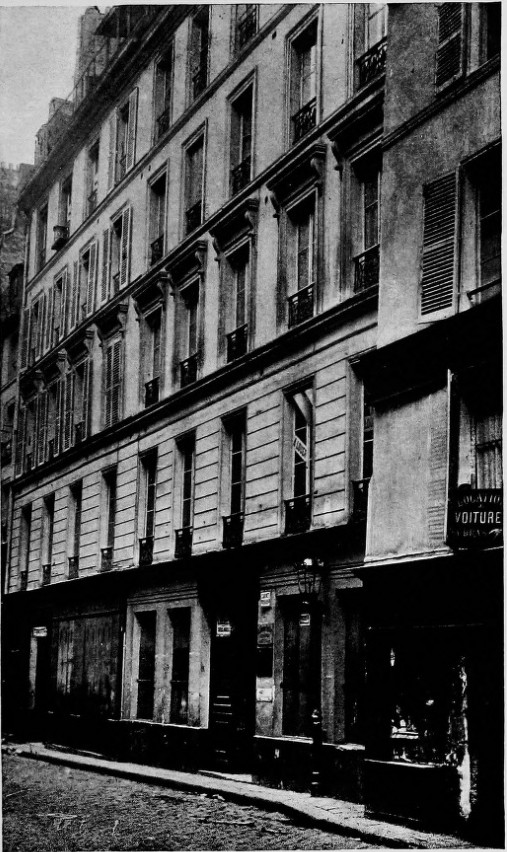
The Birthplace of Émile Zola—10, Rue St. Joseph, Paris—Photo by E. Waser.
At the time of his birth the Victorian age was dawning in England. The Queen had lately married. Most of Tennyson's work was still undone, and so was Ruskin's. Bailey had just leapt into renown with "Festus." Browning, in 1840, produced his "Sordello," and his wife her "Drama of Exile"; while Hood meandered "Up the Rhine," and Tupper basked in the continued popularity of his book of platitudes, already two years old. Meantime Faraday had published the first edition of his "Experimental Researches in Electricity"; Darwin, advancing slowly and methodically towards great pronouncements, was preparing the "Zoology of the Voyage of the Beagle"; John Stuart Mill was meditating on his "System of Logic." And while Southey completed his naval History, while Agnes Strickland began to issue her "Lives of the Queens," and Harriet Martineau her History of thirty years, Macaulay wrote his Essays, and Carlyle discoursed on "Heroes and Hero-worship."
For the bon ton of London, the Countess of Blessington's now forgotten "Belle of the Season" was one of the novels of the day; but in that same year, 1840, Dickens published his "Old Curiosity Shop," Thackeray his "Catherine" and his "Paris Sketch Book," Ainsworth his "Tower," James his "Man at Arms," Marryat his "Poor Jack," Hook his "Cousin Geoffrey," and Frances Trollope her "Widow Married," with which she hoped to repeat the success of her clever "Widow Barnaby." Bulwer, for his part, was writing "Night and Morning," and Lever was recording the exploits of "Charles O'Malley," while Disraeli, who had produced his tragedy "Alarcos" the previous year, turned for a time from literature. The Brontës and Kingsley had given nothing as yet; the Rossettis were children, like George Meredith, then twelve years old; and among those who in 1840 first saw the light were John Addington Symonds and Thomas Hardy.
Meantime, across the Atlantic, Van Buren being President of the United States, Emerson was writing his "Method of Nature"; Longfellow his "Voices of the Night"; Lowell, "A Year's Life"; Irving on his side contributing "Wolfert's Roost" to the "Knickerbocker," Willis publishing his "Corsair," and Poe his "Tales of the Grotesque."
To English and American readers those imperfect summaries may give some idea of the "literary movement" in Great Britain and the United States at the time when Émile Zola was born. But what of his own country, France? During nearly ten years Louis Philippe had been reigning there; and a few months later the ashes of Napoleon were to be brought back from St. Helena; for the Orléans monarchy, which had now reached its zenith, imagined itself to be quite secure. Indeed, when in August, that same year, the great conqueror's nephew descended on Boulogne, with a tame eagle upon his arm and a proclamation in his pocket, he covered himself with ridicule instead of the glory he had anticipated. And, again, though it was in 1840 that Louis Blanc first issued his "Organisation du Travail," before beginning his "Histoire de Dix Ans," Republican and Socialist propaganda was not as yet sufficiently advanced to bear much fruit.
Literature flourished, and cast upon the reign the glory which it failed to glean on other fields, for little came from Algerian exploits, however dashing, and none at all was harvested by an adventurous diplomacy. But a generation of remarkable writers had arisen, some among them great, many of them eminent in their respective spheres. In 1840, no doubt, the shadows were gathering around Chateaubriand, Casimir Delavigne could see his transient popularity declining, Alfred de Vigny's best work was already done; but Hugo, "Victor in drama, victor in romance," pursued with undimmed lustre his triumphal course. Moreover, Lamartine had just issued his "Recueillements poétiques," and Musset was publishing his tales in prose. Meantime, Michelet and the Thierrys gave life to History; while Ste. Beuve—when not wandering after petticoats, and meditating on that "Livre d'Amour" which he was to produce three years later, and afterwards to destroy, as far as possible, with his own hands—was penning those Monday criticisms which may still be read with so much profit as well as pleasure.
Gautier was in Spain, having left the critical arm-chair of "La Presse" to the gifted and ill-fated Gérard de Nerval; but Janin discoursed in the "Débats" with his usual flippancy, at one moment suggesting (in ignorance that any "Mrs. Grundy" would ever assert herself) that Paul de Kock and his indecorum were best suited to the English taste, whereas Monsieur de Balzac might well seek popularity in Russia. Thither, as it happened, the great delineator of "La Comédie Humaine" repaired for the first time towards the close of that year, which found him in a despondent mood. In March, "Vautrin" had been produced and promptly laid under interdict, because Frédérick Lemaître, who impersonated the great rascal, had "made himself a head" like the King's. And sixteen volumes and twenty acts, written in a twelvemonth, Balzac complained, had not brought him freedom from pecuniary worries, even though the proceeds amounted to one hundred and fifty thousand francs.
If Balzac took his pecuniary cares to heart, there was little if any fretting on the part of that splendid prodigal the great Dumas, who now issued his "Chevalier d'Harmental," an inferior work, no doubt, yet one which showed traces of the lion's paw. Sue's contribution to the literature of 1840, "La Vigie de Koat-Ven," is now almost forgotten; so is Legouvé's "Edith de Falsen," though it ran through several editions. Doubtless one of the most popular novels of the day was still Charles de Bernard's best work, "Gerfaut," the fifth edition of which now came from the press. George Sand, for her part, was penning a minor work, "Pauline"; Soulié was building his "Château des Pyrénées"; and Mérimée, diffident and painstaking, was copying and modifying, sixteen times in succession, his still familiar tale of "Colomba." Stendhal had given his "Chartreuse de Parme" to the world in the previous year. Flaubert was but a young man of nineteen, travelling in southern France and plunging, at Marseilles, into a transient love affair, which was to suggest an episode of "Madame Bovary." Finally, in that same year, 1840,—within six weeks after the birth of Émile Zola,—Alphonse Daudet, who was destined to become his friend, and, in a sense, his rival for fame, came into the world at Nîmes in Provence.
In these two, Zola and Daudet, was repeated a phenomenon often observed in the history of French literature: the advent of a superior man of strong masculinity, attended or soon followed by that of another, distinguished by femininity of mind. Thus Corneille and Racine, Voltaire and Rousseau, Hugo and Lamartine. Very similar was the accouplement of Zola and Daudet, who, the one appealing to the reason, the other to the heart, stood in the domain of fiction, at least at one period of their careers, head and shoulders above every contemporary. Daudet waged his battle with a quick and slender rapier, Zola brandished a heavy mace—akin to those redoubtable weapons with which the warriors of mediæval days beat down the helms of their antagonists. Some, too, have likened Daudet to an Arab horse, all eagerness and nerves, while Zola has been called a cactus of Provence that had sprouted between the paving-stones of Paris. The great city was his birthplace, and he was proud of it; yet Provence certainly had many claims on him, for there he was conceived, and there, as the following pages will show, he spent the greater part of his childhood under circumstances which exercised no little influence on his disposition, life, and work.
II
EARLY YEARS
1840-1860
François Zola in Paris—A rebuff and a success—Progress of his canal scheme—He is struck down by the "mistral" and dies—His obsequies and his grave—Difficulties of his widow and son—Lawsuits—Aix, a city of Philistines or of enlightenment?—Émile Zola, a spoilt child—His first schooling and first chums—He plays the truant—Declining family circumstances—Zola is sent to the Aix College—His many prizes, and his first literary attempts—The college and its masters—Zola, Baille, and Cézanne; their pranks and their rambles—The country round Aix—Zola's lines on Provence—He is influenced by Hugo and Musset—Ideal love: Gratienne and Ninon—Increasing family penury—Madame Zola seeks help in Paris—She is joined there by her son—Zola at the Lycée St. Louis—He is "ploughed" for a degree in Paris—His vacations in Provence—Early poetry—He is "ploughed" at Marseilles—His studies stopped—A gloomy outlook.
The infancy of Émile Zola was spent in Paris, his father's enterprises compelling the family to remain there till 1843. Throughout 1840 the engineer was preparing plans of his fortification scheme, issuing pamphlets, corresponding with Thiers, and interviewing General Despans-Cubières, Minister of War. He renewed his efforts when Thiers fell from power and was succeeded by Marshal Soult; but he was unable to overcome the stolid indifference of General Dode, the war-office director of fortifications, who, without even examining his plans, reported against them on the ground that the government and the defence committee had made up their minds four years previously with respect to what system should be adopted. As Soult accepted this view of the matter, Zola's efforts again came to nothing. His only consolation was that, early in 1841, when the Paris fortification bill was finally discussed by the legislature, his ideas found supporters in General Schneider and M. Dufaure, a subsequent prime minister of France.[1] A better result attended Zola's invention of an appliance for removing the masses of earth, which, he foresaw, would be thrown up in digging the moat of the Paris rampart. He patented this invention in June, 1841, and after his appliance had been constructed at some works in the Rue de Miromesnil in 1842, it was employed successfully in the excavations at Clignancourt.[2]
A few months later the indomitable engineer again turned to his scheme for providing Aix with water. Removing thither with his wife and child, he signed, in April, 1843, a new agreement with the municipality, followed in June by another with the mayor of Le Tholonet, for a large dam was to be constructed near that village, at the entrance of the Infernet gorges. But although Zola's earlier suggestions had now prompted the neighbouring city of Marseilles to cut a canal from Pertuis on the Durance,—an enterprise carried out by a distinguished engineer named Montrichet between 1839 and 1849,—some of the good people of Aix and its vicinity remained uninfluenced by the example, and a long battle ensued.
The waters which Zola had finally decided to bring to Aix were those of the little rivers Causse and Bayou, and the interested villages were gradually won over, though, now and again, territorial magnates like the Marquis de Galliffet, Prince de Martigues,—father of the well-known general officer and owner of the château of Le Tholonet,—remained hostile to the scheme. Fortunately Zola, besides having a good friend in M. Aude, the mayor of Aix, obtained support in Paris, notably from Thiers and Mignet, whose association with the old Provençal city is well known; and thus, in May, 1844, he obtained a royal declaration of the public utility of his project, with leave to expropriate landowners, purchase land, and capture water on terms which were to be arranged. The landowners, however, often set extravagant prices on their property, bitter disputes arose over valuations, and all sorts of authorities, with interests at stake, raised one and another claim and difficulty, the Council of State at last having to re-adjust Zola's agreements with municipalities and others, in such wise that a final covenant was only signed in June, 1845. Zola then returned to Paris with his wife and son, for, apart from all municipal help, a considerable amount of money had to be raised for the enterprise, and it was not until midsummer, 1846, that the Zola Canal Company was at last constituted.[3]
Then the engineer went southward once more. One reads in contemporary newspapers that the great struggle had affected his health, that he was no longer so strong as formerly, but it is certain that he felt full of confidence. His courageous efforts were about to yield fruit: the work was begun, the first sod was cut, the first blasting operations were carried out successfully. Zola stood, as it were, on the threshold of the promised land. And then, all at once, destiny struck him down. One morning, after three months' toil, while he was superintending his men, the "mistral" wind, that scourge of southern France, descended upon the valley where they were working. The icy blast laid its clutch upon Zola, but, although he already felt its chill, he would not defer a business visit to Marseilles. He repaired thither, installing himself, as was his habit, at the Hôtel de la Méditerranée kept by one Moulet, in the Rue de l'Arbre. That same night he was attacked by pleurisy, and on the morrow it became necessary to summon his wife, who had remained at Aix. All remedies proved unavailing, and within a week he expired in her arms. Thirty years afterwards that sudden death, in a second-class hotel, amid unpacked trunks and the coming and going of heedless travellers, suggested to Zola's son the account of Charles Grandjean's death given in "Une Page d'Amour."[4]
It was on Saturday, March 27,1847, that François Zola thus passed away. His remains were embalmed, and the obsequies took place at Aix on the ensuing Tuesday, when the clergy went in procession to the Place de la Rotonde, beyond the walls, to receive the body on its arrival. The pall-bearers were the sub-prefect, the mayor, the government district engineer, and Maître Labot, an eminent advocate of the Council of State and the Court of Cassation, who had been one of Zola's leading supporters. The capitular clergy, headed by a Canon-bishop of St. Denis, officiated at the rites in the cathedral; and, as chief mourner, immediately behind the hearse, when escorted by the civil and military authorities it took the road to the cemetery, between crowds of spectators, there walked a pale-faced little boy, barely seven years of age, who moved as in a dream. In after years he retained little recollection of his father. He pictured him best, he was wont to say, by the aid of all that his mother had related of his affectionate tenderness, his unflagging energy, his high and noble views. Thus how great was the son's amazement, indignation, and sorrow when, long years afterwards, unscrupulous enemies tried to make the world believe that his father had been a thief.
On that matter the reader will form his own opinion, and it is largely to enable him to do so that the chief facts of François Zola's career of honourable and untiring industry have been recapitulated in these pages. But another purpose also has been served. As the narrative of Émile Zola's life proceeds, it will be observed how truly he was his father's son, evincing in manhood the same energy, industry, and perseverance, the same passion to strive against obstacles, and, by striving, overcome them. In his case, the prompting of inherited nature is the more manifest as he was of such tender years when his father died, and thus escaped the influence of companionship and example, which so often increase the resemblance of father and son. Ah, that poor contemned doctrine of heredity, as old as the world itself, how could Émile Zola fail to believe in it when he himself was a striking illustration of its workings?
François Zola's widow placed a modest slab upon her husband's grave in the cemetery of Aix, in which she herself was to be laid three and thirty years later. A cedar shades the tomb from the flaring sky poised over that glowing field of death, whence the view spreads to many a hill and mountain, clad in blue and purple. And on the slab, which is protected by iron chains dangling from granite billets, one reads: "François Zola, 1795-1847. Françoise Émilie Zola, née Aubert, 1819-1880." Aix, however, does not need the presence of that tomb to remind it of one of its most notable benefactors. Although François Zola died when his work was only in its first stage, although a little later his original scheme was foolishly cut down, in such wise as to necessitate other subsequent costly undertakings, and although thirty-one years elapsed before the water he had coveted at last entered Aix, the enterprise he planned has always been known popularly as the Zola Canal. Further, after its completion in 1868, the local municipality then in office, to efface in a measure the inconsiderate treatment of his widow and his son by previous municipalities, bestowed the name of Boulevard François Zola on a thoroughfare till then called the Boulevard du Chemin-neuf.[5]
The expression "inconsiderate treatment" is certainly not too severe a one to be applied to the action of some of the authorities of Aix in their dealings with Zola's widow, who, in her own name and her son's, inherited her husband's interest in the canal scheme. But she had to contend also with others associated with the work. It was virtually a repetition, or rather a variation, of the familiar story of the confiding inventor and the greedy capitalist. In this instance the inventor was dead, and only his heirs remained. He had fully disclosed his scheme, prepared his plans, and others were eager to profit by them. Thus his widow and his little boy were gradually regarded as incumbrances, nuisances. Why not set them aside? Why not rob them? Are not the widow and the orphan robbed every day? Besides, it is often easy to bamboozle a young and inexperienced woman in matters of law. Already at this time Madame Zola's parents had come to live with her at Aix; but her father was aged, and deficient, it would seem, in business capacity; while her mother, however bright, active, and thrifty, was not the woman to give unimpeachable advice on intricate legal questions. As for little Émile, now seven years old, he did not even know his letters; he spent happy, careless days in the sunshine, blissfully ignorant that trouble was assailing the home, and would some day destroy it. Yet it was he who, long years afterwards, avenged his father and his mother, in the only manner possibly in which they could be avenged. Perhaps it did not affect the despoilers personally; many of them, indeed, must have been dead at the time, and those who survived may have only sneered, for the gold was theirs. None the less the pictures of Aix and its society, traced in four or five volumes of the Rougon-Macquart novels, were instinct with retribution. Aix still raises ineffectual protests whenever it hears that name of Plassans which the novelist gave it, and which, though its origin was simple enough,—for it was merely a modification of Plassans, the name of a village near Brignoles, southeast of Aix,—acquired under Zola's caustic pen an element of opprobrium.
The displeasure of Aix in this respect has been the more marked as the city's past is not destitute of grandeur. One of the earliest stations of the Romans in Gaul, it became the metropolis of the Second Narbonensis, but its walls, porticoes, thermæ, arena, and temples were largely destroyed when the Saracens sacked it in the eighth century, and few memorials of its classic era now exist. As the capital of Provence in the days of "good King René," whose court was described by Scott in "Anne of Geierstein," Aix regained some lustre, followed half a century later by a period of trouble, many of its mediæval monuments being wrecked during the struggle between Francis I and Charles V, who was crowned King of Arles in the fane of St. Sauveur. Nevertheless, girdled by picturesque mountains, with its old town, new town, and faubourg, rich in stately edifices, pleasant promenades, and elegant fountains, Aix remains one of the notable cities of southern France. And if, administratively, as the French say, it is now only a sub-prefecture of the department of the Bouches-du-Rhône, it continues to be an archbishop's see, and retains its courts of justice and its faculties of theology, law, and letters. Its university is perhaps its greatest boast, though it is also proud of its museum and its splendid library, which is known to scholars all the world over. Thus Aix claims to be a city of enlightenment, not a town of Philistines, as it was largely pictured by Émile Zola; but one must remember that he described things as they were in his time, and that if a new and more active generation has arisen nowadays, it was preceded by others, somnolent and neglectful.
Aix has given several distinguished sons to France: the elder Vanloo; Vauvenargues, the moralist; Mignet, the historian; Brueys, the poet, and Brueys, the admiral who fell at the battle of the Nile; Michel Adanson and Piton de Tournefort, the eminent naturalists; François Granet, who translated Newton into French, and François Marius Granet, his nephew, who distinguished himself in art, and became one of the city's benefactors. Again, Portalis, the great jurisconsult, who prepared the Concordat which still binds France and the Papal See, was for a time one of the shining lights of the city, and Thiers, though born at Marseilles, completed his studies at Aix, took his degrees, and was called to the bar there. Curiously enough, the house where Thiers had lived in his student days was the first home of the Zolas at Aix. It stood at the end of a strip of road, a "no thoroughfare," called picturesquely the Impasse Sylvacanne. There was a large garden to the house, and in that garden little Émile disported himself as he listed.
His mother and grandmother spoilt him, as the saying goes. His father's death filled them with indulgence for his childish faults. He was a boy to be petted and humoured, for the greatest of misfortunes had fallen on him. Spending so much of his time in the open air, he was becoming quite a sturdy little fellow, sun-tanned, with soft, thoughtful eyes and a perky nose, and his incessant questions seemed to indicate the possession of an intelligent and eager mind. But, as yet, no attempt was made to educate him. His mother was already busy with her lawyers, striving to enforce her claims, and endeavouring also to obtain influential support. When Thiers came to Aix some four months after François Zola's death, the widow presented her little son to the great man in the hope of thereby arousing his sympathy. And Thiers certainly responded with fair words, though whether he went further is doubtful. At all events, lawsuits were started, and to the worry they entailed one must ascribe the comparative neglect in which young Émile remained a little longer.
At last, in the autumn of 1847, it was decided to send him to school. Some doubt as to the result of the lawsuits was already arising in the minds of Madame Zola and her parents, and they felt that they must at least provide for the boy's future by giving him a sound education. It was suggested that he should be sent immediately to the College of Aix—now called the Lycée Mignet; but as he did not even know his letters, Madame Aubert, his grandmother, sensibly decided to select a preparatory school. One was found near the Notre Dame gate, from which it derived its appellation of Pension Notre Dame. It was kept by a worthy and indulgent pedagogue, named Isoard, who after infinite trouble—for the boy was stubborn and bitterly regretted his careless life in the open air—contrived to teach him to read the Fables of La Fontaine. It was at this time that young Émile formed his earliest life-friendships; he became attached to two of his school-fellows, one of whom, Solari, a sculptor of distinguished talent, is still alive, while the other, Marius Roux, acquired a passing reputation as a "popular" novel writer.[6] These two were Zola's usual playmates at marbles, tops, and leap-frog, his first companions also in the rambles in which he began to indulge.
For some reason or other, Madame Zola and the Auberts moved from the Impasse Sylvacanne to the Pont-de-Beraud, in the open country, on the road to Toulon, and then young Émile had fields before him with a picturesque stream, the Torse, so called on account of its capricious windings—"a torrent in December, the most timid of rivulets in the fine weather," as he called it afterwards in his "Contes à Ninon." And the charms of the country, the inviting banks of the Torse, often made a truant of him,—a truant who remained unpunished, for as his grandparents generally said "It was not right to cross the poor fatherless boy."
The position of the family was now, however, becoming difficult. The widow's savings were dwindling away in legal and living expenses; and some who had been willing to help her were at present unable to do so, having lost authority, influence, and, at times, even means. France had passed through a revolution, Louis Philippe had been overthrown; unrest was widespread throughout the period of the Second Republic; and when Louis Napoleon strangled that régime in the night, Provence became convulsed, there were risings, excesses, bloodshed, even as Émile Zola subsequently depicted in the pages of "La Fortune des Rougon." The new municipality of Aix, appointed after the Coup d'État, was not inclined to effect any reasonable compromise with those Orléanist protégés, the Zolas. One on whom they had largely relied, Thiers, was himself virtually a fugitive. Again, in those days of trouble the law's delays became greater than ever; apart from which it would seem that Madame Zola's actions were altogether ill-conducted. Nevertheless, in the summer of 1852, though her affairs were taking a very unfavourable course, and it was becoming necessary to trench upon the investments whence the Auberts derived their modest personal income, it was at last decided to send Émile to the College of Aix as a boarder, and the family, in order to be nearer to him, moved into the town, its new home being in the Rue Bellegarde.
The boy could now see that the family resources were diminishing. The last servant had been dismissed, and it was his grandmother, the still lively and sturdy Beauceronne, who attended to most of the housework. Moreover, she and her daughter had largely taken the lad into their confidence, and he, precociously realising that his future would most likely depend on his own exertions, resolved to turn over a new leaf. Though his love for the open air in no wise diminished, he studied profitably from the time of entering the College of Aix in October, 1852. He was placed in the seventh class (the lowest but one), and at the expiration of the school year, in August, 1853, he was awarded first prizes for history and geography, recitation, and the translation of Latin into French, and second prizes for grammar, arithmetic, religious instruction, and the translation of French into Latin.[7] In the following year, in the sixth class, he was less successful, some antipathy, it is said, existing between him and one of the professors.[8] Nevertheless, his name was inscribed on the tableau d'honneur, and he obtained a first prize for history and geography, a first accessit[9] in religious instruction, and third accessits in excellence and recitation.
Next, 1854-1855, he passed into the fifth class, in which he gained two first prizes for Latin, translation and composition; a second prize for the translation of Greek into French, a first accessit in excellence, and third accessits in French, history, geography, and recitation. At the end of the ensuing school year, when he joined the fourth class, he secured four first prizes—excellence, Latin composition, Latin verse, translation from Latin into French; and three second prizes—history and geography, grammar, and Greek exercise. Finally, in 1856-1857 (his last completed year, spent in the third class) he was awarded: the tableau d'honneur prize, first prizes for excellence, French composition, arithmetic, geometry, physics, chemistry, natural history, and recitation; second prizes for religious instruction and translation from the Latin; with a first accessit in history and geography. He was then in his eighteenth year, and if prize-winning might be taken as a criterion, there was every likelihood that he would achieve a distinguished career.
But one must now go back a little, for other matters marked those school days at Aix. At first the boy boarded at the college, then he became a half-boarder, and finally an externe, or day pupil, taking his meals at home; these changes being necessitated by the gradually declining position of his family. Already while he was a boarder, that is, barely in his teens, his literary bent began to assert itself, a perusal of Michaud's "Histoire des Croisades" inspiring him to write a romance of the middle ages, copiously provided with knights, Saracens, and fair damsels in distress. That boyish effort, though the almost illegible manuscript was preserved through life by its author, remained unprinted, and a like fate attended a three-act comedy in verse, entitled "Enfoncé le Pion," or "The Usher Outwitted." However, given these literary leanings, and a fervent admiration for some of the poets, as will presently be shown, it may at first seem strange that on entering the third class in 1856, and being called upon to choose between letters and sciences, Zola, then over seventeen, should have selected the latter. In this respect, as Paul Alexis says, he was influenced in part by the fact that, however proficient he might be in the dead languages, he had no real taste for them, whereas the natural sciences interested him; but his choice was also partially governed by the fact that he was the son of an engineer, and that a scientific career would be in accordance with his parentage. In his studies he was guided by one simple, self-imposed rule, a rule which he carried into his after-life, and which largely proved the making of him. He did not eschew play and other recreation, he did not spend interminable hours in poring over books, there was nothing "goody-goody" about him; but he invariably learnt his lessons, prepared his exercises, before he went to play. And, all considered, no more golden rule can be offered to the schoolboy.
Zola and his disciple Paul Alexis, who also studied at the Aix College, have sketched it as it was at that time—a former convent, old and dank, with a somewhat forbidding frontage, a dark chapel, and grimly barred windows facing a quiet little square, on which still stands the rococo fountain of the Four Dolphins. Within the gate were two large yards, one planted with huge plane trees, and the other reserved chiefly for gymnastic exercises, while all around were the class-rooms, the lower ones dismal, damp, and stuffy, and the upper ones more cheerful of aspect, with windows overlooking the greenery of neighbouring gardens. The refectory again was quite a den, always redolent of dish-water; but comparative comfort might be found in the infirmary, managed by some "gentle sisters in black gowns and white coifs." The masters, if Zola's subsequent account of them in "L'Œuvre" may be trusted, were generally ridiculed by the boys, who gave them opprobrious nicknames. One, never known to smile, was called "Rhadamantus"; another, "who by the constant rubbing of his head had left his mark on the wall behind every seat he occupied, was named, plumply, 'Filth'"; and a third had his wife's repeated infidelity openly cast in his face.
Of course, the boys also had their nicknames, Zola, says Paul Alexis, acquiring that of "Franciot," or "Frenchy," which was given him because his pronunciation of various words differed from that of his Provençal school-fellows. This was not to be wondered at, the parent to whom he owed his mother tongue being a Beauceronne. Other anecdotes which picture him suffering from an impediment in his speech may be taken with a grain of salt, perhaps, as the official records show that he gained prizes and accessits for recitation. As had been the case at the Pension Notre Dame, he formed a close friendship with a few of his school-fellows. One of these was a lawyer's son, named Marguery, a bright, merry lad with musical tastes, who a few years later, to the general amazement, blew his brains out in a fit of insanity. Another was Antony Valabrègue, afterwards a tasteful poet, whose family, curiously enough, became connected with that of Captain Dreyfus. Valabrègue being some years younger than Zola, their companionship at school did not go very far, but they subsequently corresponded, and intimacy ensued between them. At the college Zola's more particular chums were Cézanne and Baille, the former afterwards well known as an impressionist painter, the second as a professor at the École Polytechnique. Baille, Cézanne, and Zola became inseparables, and though all three were fairly diligent pupils in class-time, they indulged in many a boyish prank together during the earlier years of their sojourn at the college.
One morning, in a spirit of mischievousness, they burnt the shoes of a school-fellow, a lank lad called Mimi-la-Mort, alias the Skeleton Day Boarder, who smuggled snuff into the school. Then one winter evening they purloined some matches in the chapel and smoked dry chestnut leaves in reed pipes there. Zola, who was the ringleader on that occasion, afterwards frankly confessed his terror; owning that a cold perspiration had come upon him as he scrambled out of the dark choir. Again, another day, Cézanne hit upon the idea of roasting some cock-chafers in his desk to see whether they were good to eat, as people said they were. So terrible became the stench, so dense the smoke, that the usher rushed for some water, under the impression that the place was on fire. At another time they sawed off the wooden seats in one of the courtyards, and carried them like corpses round the basin of so-called ornamental water in the centre of the yard, other boys joining them, forming in procession, and singing funeral dirges. But in the midst of it all, Baille, who played the priest, tumbled into the basin while trying to scoop some water into his cap, which was to have served as a holy-water pot.[10]
The three inseparables engaged also in many a stone-throwing fight with the town lads, clambered over the old, crumbling, ivy-clad ramparts, and basked on "King René's chimney"[11] on occasions when the mistral thundered by,—"buffeting the houses, carrying away their roofs, dishevelling the trees, and raising great clouds of dust, while the sky became a livid blue, and the sun turned pale."[12] There were excursions also, sometimes by way of escorting regiments, which on changing garrison passed through the town, at other moments on the occasion of religious processions when the clergy appeared in their finest vestments, their acolytes swinging censers and ringing hells, the military and municipal bands discoursing music, the white-gowned girls carrying banners, and the boys scattering roses and golden broom.
Although Émile Zola eventually lost all faith in the dogmas of the Roman Church, the pomp of its cult impressed him throughout his life, as is shown by many passages in his works. And in his boyhood the processions of Aix delighted him. He himself sometimes took part in them—acting on at least one occasion, in 1856, as a clarionet player of the college fanfare, for his friend Marguery had imparted to him some taste for music.
Then as now Aix had its theatre, which Zola and his young friends patronised whenever they could afford a franc for a pit seat, but they eschewed café life and the gambling which usually attends it in the provinces, for whenever they had time at their disposal they infinitely preferred to roam the country. The environs of Aix are strangely picturesque. There is the famous Mont Ste. Victoire, ascended through thickets of evergreen oaks and holly, pines, wild roses, and junipers, till at last only some box plants dot the precipitous slopes, veined like marble; while in a cavern near the summit is the weird bottomless pit of Le Garagay, whose demon-spirits Margaret of Anjou vainly interrogated in "Anne of Geierstein." Again, there is the historic castle of Vauvenargues, the ruined castle of Puyricard, the hermitage of St. Honorat, and there are other mountainous hills with goat paths, gorges, and ravines, and also stretches of plain, watered now by the Arc or the Torse, now by the canal which François Zola planned. In his son's youth that canal had not yet transformed the thirsty expanse; when Émile roamed the region with his friends "the red and yellow ochreous fields, spreading under the oppressive sun, were for the most part planted merely with stunted almond and olive trees, with branches twisted in positions which seemed to suggest suffering and revolt. Afar off, like dots on the bare stripped hills, one saw only the white-walled bastides, each flanked by dark, bar-like cypresses. The vast expanse was devoid of greenery; but on the other hand, with the broad folds and sharply defined tints of its desolate fields, it possessed some fine outlines of a severe, classic grandeur."[13]
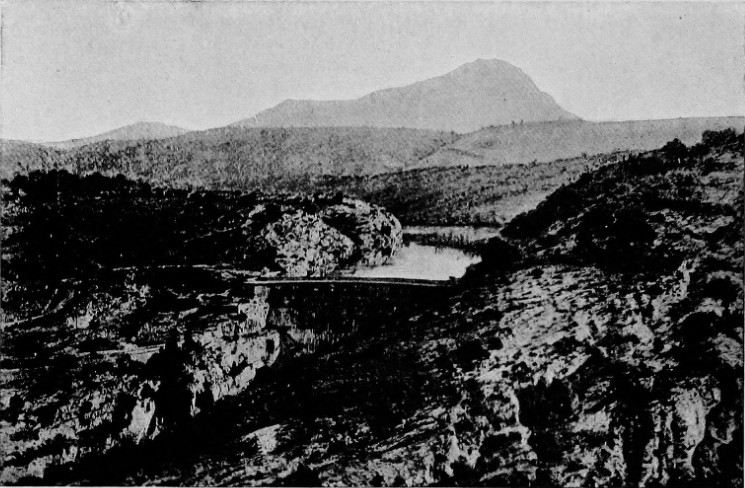
Dam and Reservoir of the Zola Canal.—Photo by Martinet & Jouven.
Apart from the plain, but very characteristic of the region, were the Infernet gorges, near which François Zola planned one of his huge reservoirs. There one found "a narrow defile between giant walls of rock which the blazing sun had baked and gilded. Pines had sprung up in the clefts. Plumes of trees, appearing from below no larger than tufts of herbage, fringed the crests and waved above the chasm. This was a perfect chaos. With its many sudden twists, its streams of blood-red soil, pouring from each gash in its sides, its desolation and its solitude, disturbed only by the eagles hovering on high, it looked like some spot riven by the bolts of heaven, some gallery of hell."[14]
There were also the villages, whose houses, at times, were mere hovels of rubble and boards, some squatting amid muck-heaps, and dingy with woeful want; others more roomy and cheerful, with roofs of pinkish tiles. Strips of garden, victoriously planted amid stony soil, displayed plots of vegetables enclosed by quickset hedges. Much of the aridity of the region had arisen from the ruthless deforesting of the hills; formerly the falling leaves had spread rich vegetable soil over the mountain flanks, there had been good pasture for sheep where barren crags alone were left, and the climate, equalised by the moisture of the woods, had been less abrupt and violent in its changes.[15] Yet, in Zola's youth, as now, "wherever there was the smallest spring, the smallest brook, the glowing land still burst into powerful vegetation, and a dense shade prevailed, with paths lying deep and delightfully cool between plane trees, horse-chestnuts, and elms, all growing vigorously."[16]
Those various scenes were a delight to Zola and his friends. "They craved for the open air, the broad sunlight, the sequestered paths in the ravines. They roamed the hills, rested in green nooks, returned home at night through the thick dusk of the highways. In winter they relished the cold, the frosty, gaily echoing ground, the pure sky, and the sharp atmosphere. In summer they always assembled beside the river—the willow-fringed Arc—for the water then became their supreme passion, and they spent whole afternoons bathing, swimming, paddling, and stretching themselves to dry on the fine sun-warmed sand. In the autumn they became sportsmen—inoffensive ones, for there is virtually no game, scarcely even a rabbit, in the district, and at the most one might bring down an occasional petty-chap, fig-pecker, or some other small bird. But if, now and again, they fired a shot, it was chiefly for the pleasure of making a noise, and their expeditions always ended in the shade of a tree, where they lay on their backs, chatting freely of their preferences."[17]
A little later, when Zola's young muse essayed her flight, he recalled those days of Provence, singing:
"O Provence, des pleurs s'échappent de mes yeux Quand vibre sur mon luth ton nom mélodieux.... O région d'amour, de parfum, de lumière, Il me serait bien doux de t'appeler ma mère.... Autour d'Aix, la romaine, il n'est pas de ravines, Pas de rochers perdus au penchant des collines, Dans la vallée en fleur pas de lointains sentiers, Où, l'on ne puisse voir l'empreinte de mes pieds.... Écolier échappé de la docte prison, Et jetant aux échos son rire et sa chanson, Adolescent rêveur poursuivant sous tes saules La nymphe dont il croit voir blanchir les épaules, Jusqu'aux derniers taillis j'ai couru tes forêts, O Provence, et foulé tes lieux les plus secrets. Mes lèvres nommeraient chacune de tes pierres, Chacun de tes buissons perdus dans tes clairières. J'ai joué si longtemps sur tes coteaux fleuris, Que brins d'herbe et graviers me sont de vieux amis."[18]
Those rambles undoubtedly helped to rouse a sense of poetry in Zola and his companions. Besides providing themselves with provisions,—at times a small joint of raw mutton and some salad plants, which they cooked or dressed in the wilds,—they carried books, volumes of the poets, in their pockets or their bags. One year, 1856, Victor Hugo reigned over them like an absolute monarch. They were conquered by the majesty of his compositions, enraptured by his powerful rhetoric. His dramas haunted them like splendid visions. After being chilled by the classic monologues which they were compelled to learn by heart at the college, they felt warmed, transported into an orgy of quivering ecstacy, when they lodged passages of "Hernani" and "Ruy Blas" in their minds. Many a time, on the river-bank, after bathing, they acted some scenes together.[19] Indeed, they knew entire plays, and on the way home, in the twilight, they would adapt their steps to the rhythm of those lines which were sonorous like trumpet-blasts. But a day came when one of them produced a volume of Alfred de Musset's poems, the perusal of which set their hearts quivering. From that hour their worship for Hugo received a great blow, his lines fled from their memories, and Musset alone reigned over them. He became their constant companion in the hollows, the grottoes, the little village inns where they rested; and, again and again, they read "Rolla" or the "Nights," aloud.[20]
Thus their young natures awoke to love. Cézanne and Baille were then about eighteen years of age, Zola was seventeen. But their aspirations remained full of ideality. There were a few brief, uncertain attempts at love-making, nipped in the bud by circumstances. Already, before the time we have now reached, Zola, or his musically minded friend Marguery, or perhaps both, had nursed a boyish flame for the fair-haired daughter of a local haberdasher, and had serenaded her in company, the former with his clarionet, the latter with a cornet-à-piston, until one evening the indignant parents emptied their water-jugs over them. Later Zola dreamt of encountering "fair beings in his rambles, beautiful maidens, who would suddenly spring up in some strange wood, charm him for a whole day, and melt into air at dusk."[21] And at last a young girl, Gratienne, flits by in the moonlight near the Clos des Chartreux, with her heavy tresses of raven hair resting on her young white neck;[22] but even she remains little more than a vision, and as yet, neither into Zola's life nor his friends' does woman, the real creature of flesh and blood, really enter, to achieve that work of disillusion by which she almost invariably destroys the youthful ecstacy which she, or her semblance, has inspired. Ninon, the Ninon of the "Contes"[23], comes later. As yet she is only dreamt of, though the name by which she is to be known to the world is already suggested by an old gravestone in the cemetery, with only the word "Nina" remaining of its time-worn inscription:
"Ami, te souviens-tu de la tombe noircie, Tout au bord d'une allée, à demi sous les fleurs, Qui nous retint longtemps, et nous laissa rêveurs? Le marbre en est rongé par les vents et la pluie. Elle songe dans l'herbe et, discrête, se tait, Souriante et sereine au blond soleil de mai. "Elle songe dans l'herbe, et, de sa rêverie, La tombe, chastement, à ceux qui passent là, Ne livre que le nom effacé de NINA. . . . . Ami, te souviens-tu, nous la rêvâmes belle, Et depuis, bien souvent, sans jamais parler d'elle, Nos regards se sont dit, dans un dernier regret: 'Si je l'avais connue, oh! Ninette vivrait!'"[24]
But serious trouble was now impending in Zola's home. While he studied at the college, while his heart opened and his mind expanded, the position of his mother and grandparents gradually became desperate. All the savings, even the Auberts' funds, were exhausted; the lawsuits still dragged on, entailing heavy costs, which drained the home of all resources. Already in 1855, the rent in the Rue Bellegarde proving too heavy, it became necessary to take a cheaper lodging on the Cours des Minimes. Then, early in 1857, that also was found too dear, and two little rooms were rented at the corner of the Rue Mazarine. They overlooked the Barri[25], a lane-like chemin-de-ronde encompassing the old town, with small and sordid houses on one hand, and the crumbling ramparts on the other.
Here black ruin fell upon the Zolas and the Auberts. The aged but active grandmother toiled to the very last, managing the household, raising money on goods and chattels, resisting the wolf at the door with all the energy of despair. Bit by bit, every superfluous article of furniture was sold; remnants of former finery were carried to the wardrobe dealers, to obtain the means of purchasing daily bread and paying Émile's college fees. As for the lawsuits, they remained in abeyance from lack of funds. And blow following blow, poor Madame Aubert could at last resist no longer, but sickened and died. That happened in November, 1857. During the previous month Émile Zola had returned to the college, entering the second class. Towards Christmas his despairing mother started, alone, for Paris, to implore the help of some of the personages who had formerly favoured her husband. The old and almost helpless Monsieur Aubert remained at Aix with his young grandson, who, after an anxious period of suspense, received in February a letter from his mother, running much as follows:
"It is no longer possible to continue living at Aix. Sell the little furniture that is left. You will in any case obtain sufficient money to enable you to take third-class tickets to Paris for yourself and your grandfather. Manage it as soon as possible. I shall be waiting for you."
Young Émile acted in accordance with those instructions, but he could not tear himself away from Aix and his friends without making with the latter a farewell excursion to Le Tholonet and the barrage of the canal reservoir planned by his father. When he at last took the train with old M. Aubert, his heart was heavy at the thought that he might never see Provence again. But in that respect his fears were not realised.
On reaching Paris, he found his mother residing at No. 63 Rue Monsieur-le-Prince, near the Luxembourg palace. She had obtained some assistance from friends, one of whom, Maître Labot[26], recommended Émile to Désiré Nisard, the critic and historian, famous for having tried to demonstrate that there were two moralities, and Nisard speedily procured him a free scholarship at the Lycée or college of St. Louis. This was by Madame Zola's express wish, for, however great might be her misfortunes, she desired that her son might continue his studies.
But Paris now seemed a horrible place to the youthful Émile. All was gloom there. Orsini, Pieri, and Rudio had attempted the life of Napoleon III outside the opera-house a few weeks previously, and a kind of terror prevailed under the iron rule of General Espinasse and the new Law of Public Safety. Zola regretted the hills and the sun of Provence, the companionship of Baille and Cézanne; he felt lost among his new school-fellows, four hundred in number, and his poverty and shabbiness increased his bitterness of spirit, for the lads attending St. Louis were all more fortunately circumstanced than himself. That Lycée, which then faced the Rue de la Harpe—the transformation of the old Quartier Latin by the tracing of the Boulevard St. Michel being as yet uneffected—ranked third among the great colleges of Paris; and among those who had sat on its benches were the second Dr. Baron Corvisart, Gounod the composer, Egger the Hellenist and poet, Havet the Latinist and historian of early Christianity, and Nettement, whose account of French literature under the Restoration is still worthy of perusal. Other pupils, before Zola's time, were Henri Rochefort the erratic journalist and politician, Charles Floquet the advocate, who became prime minister of France; Dr. Tripier, one of the pioneers in the application of electricity to medicine, and the well-known General de Galliffet. Many of the professors also were able men who rose to eminence, and in such a college one might have thought that Zola would have made decisive progress.
As it happened, he not only got on badly with his school-fellows,—who on account of the southern accent he had acquired in Provence nicknamed him the "Marseillese,"—but, yielding to a brooding spirit, he neglected his lessons. It was only in French composition that he occasionally distinguished himself. One day, it appears, when the allotted subject was "Milton dictating 'Paradise Lost' to his daughter," he treated it so ably that the professor, M. Levasseur,—the eminent historian of the French working classes,—publicly complimented him. Truth to tell, he now read a great deal, even in class time, still devouring the poets, but finding a delight also in Rabelais, Montaigne, and other prose authors. And he carried on an interminable correspondence with his friends in Provence, at times addressing them in verse, at others launching into discussions on philosophy, morals, and æsthetics. It was now, too, that he wrote his tale, "La Fée Amoureuse," which was therefore the earliest of his "Contes à Ninon," in which volume it afterwards appeared. Thus, in spite of his declared preference for a scientific career, his literary bent was steadily asserting itself.
At the end of his school year his only award was a second prize for French composition. Nevertheless, his mother, having scraped a little money together, allowed him to go to Provence for the vacation, which he spent with Baille and Cézanne. But on coming back to Paris in October he fell ill with a mucous fever of such severity that more than once a fatal issue was feared. When, after a period of convalescence, he returned to St. Louis, there entering the rhetoric class, two months had been lost and he still felt weak. Thus, though his new master, M. Lalanne, commended some of his work, notably his compositions, his progress was not great, particularly as his mind turned so frequently to Provence and his friends there, and hesitated between the scientific avocations of his choice and an increasing ambition to become a poet. When, however, the school year ended in August, 1859, his mother's position being as precarious as ever, he resolved to make an effort. He would skip the philosophy class and at once offer himself as a candidate for the degree of bachelor in sciences—that, or a corresponding degree in letters, being a necessary passport for eventual admission into the recognised professions or the government service.
The result of Zola's attempt was singular. In his written examination he proved very successful, his name appearing second on the list, but in the ensuing vivâ-voce examination, after securing good marks in physics, chemistry, and natural history, fair ones in pure mathematics, algebra, and trigonometry, he collapsed in literature and modern languages. He post-dated Charlemagne's death by five hundred years, scandalised the examiner by a romantic interpretation of one of La Fontaine's fables, and virtually confessed his utter ignorance of German. Thus his mark was zero; and though, it would seem, the examiners in sciences interceded in his favour with the examiner in belles lettres, the latter remained obdurate and would not modify the mark. Zola was therefore "sent back," for it was not allowable that a bachelor in sciences should be absolutely nul en littérature.[27]
Several years previously Alexandre Dumas fils had been "ploughed" for the very same reason. Two distinguished men of Zola's own generation, Alphonse Daudet and François Coppée, also failed to secure bachelors' degrees; yet, like Zola himself, they became eminent writers. Of course it is impossible to found any valid argument for or against degrees on a few isolated instances. It may be doubted, perhaps, whether they are any great recommendation to the literary man who is a dramatist or a novelist or a poet. But Zola's literary aspirations did not enter into his scheme when he offered himself for examination; he merely wished to secure a certificate, as it were, qualifying him for employment in one of the semi-scientific branches of the government service. In that respect his failure was a severe disappointment, particularly to his mother, who had set all her hopes upon him, and was distressed to find that the promise of his college days at Aix remained unfulfilled. At the same time, mother-like, she blamed the examiners more than she blamed him, and once more she provided him with enough money to spend the summer vacation in Provence.[28] A week after he had been "ploughed" at the Sorbonne, Zola was again roaming the hills, in a blouse and hob-nailed boots, accompanied by his usual intimates.
There was also no little writing of poetry on Zola's part during those holidays, the influence of Musset still being in the ascendant, as is shown by a piece entitled "Rodolpho," in which one can further detect the change which Parisian life, particularly that of the Quartier Latin, where he had his home, was now effecting in the youth who had awoke, in Provence, to little more than ideal love. Musset likewise inspires some verses entitled "Vision," also dating from this time; but a perusal of the "Contes de La Fontaine," a book which no discipline seems able to keep out of French colleges, plainly suggested "Le Diable ermite," in which the good Abbé's erotic style was imitated only too successfully. Another piece, entitled "Religion," shows that the young versifier, the former winner of prizes for "religious instruction," was already losing his faith under the influence, no doubt, of Parisian surroundings. In this effort he is found calling on the Deity to manifest himself in order that he may believe in him, asking the why and the wherefore of things, and displaying a grim consciousness of the wretchedness of mankind. There are lines in this poem of his twentieth year which suggest the Zola of the last stage:
"Hélas! que tout est noir dans la vallée humaine! Les hommes en troupeaux se parquent dans la plaine, Vivant sur des égouts, qu'entoure un mur croulant."
As his vacation drew to a close, Zola once more bestirred himself, and, after consultation with his friends, decided to make another attempt to secure the diploma which would prove an "open sesame" to regular employment. But he did not care to face the Paris examiners again, he preferred to try those of Marseilles, thinking, perhaps, that they might prove more indulgent. So, taking up his books to refresh his memory, he lingered in Provence till November. At Marseilles, however, even his comparative success in Paris was denied him. He failed with his preliminary papers and was not even summoned for the vivâ-voce examination. That defeat was decisive. When he returned to Paris he found his mother cast down by it; the friends who helped her had lost all faith in his ability. It was useless for him to return to the Lycée. In another four months he would be twenty years of age, he must no longer remain a burden on others, it was time for him to earn his own living. But how was he to do so? The outlook was gloomy indeed.
III
BOHEMIA—DRUDGERY—FIRST BOOKS
1860-1866
A clerkship at the Docks Napoléon—Peregrinations through the Quartier Latin—Zola joined there by Cézanne—He lives in a glass cage—"L'Amoureuse Comédie"—Poetry and poverty—"Genesis"—Spring rambles—The Quartier Latin in 1860—Love in a garret—"La Confession de Claude," and the den in the Rue Soufflot—The fairy of one's twentieth year—Terrible straits—"Playing the Arab"—"Good for nothing"—Help from Dr. Boudet—Zola is engaged by M. Hachette and emerges from Bohemia—Hachette's authors and Zola—Fresh Peregrinations—Short stories—Zola's "band"—His correspondence with Antony Valabrègue—"Contes à Ninon"—Zola weaned from idyl and fable—"Madame Bovary"—Duality of Zola's nature—His improved circumstances—Newspaper articles—The lesson of "Henriette Maréchal—"La Confession de Claude" published—Zola's opinion of it—Barbey d'Aurévilly's attack and a threatened prosecution—Zola quits Hachette's, and refuses to pander to fools.
After choosing a scientific career, and then aspiring to poetic fame as great as that of Hugo or Musset, to sink even momentarily to a junior clerkship, worth sixty francs a month,[1] at the "Docks" in the Rue de la Douane, was hard indeed. Yet such became Zola's fate. Some who have written of the episode have fallen into various errors. An American account says that the young man became a dock labourer; an English biographer has referred to his place of employment as a business house. But on consulting any plan of Paris as it was in 1860 or thereabouts, it will be seen that a great entrepôt, with offices for the collection of the state customs and the municipal dues, then adjoined the "Docks Napoléon," where goods, coming into Paris by the St. Martin Canal, were landed. The establishment of this entrepôt and its adjuncts was carried out between 1833 and 1840;[2] the adjoining Rue de la Douane took its name from the enterprise, and it was there, then, that Zola, after failing at his examinations, secured employment as a clerk, the situation being found for him by his father's friend, Maître Labot, the advocate.
But the salary was the barest pittance. How could a young man of twenty live, in Paris, on two francs a day? Moreover, there was no prospect whatever of any "rise." At the expiration, therefore, of two months,—after trudging a couple of miles twice a day between the "Docks" and the Quartier Latin, passing on the road the great Central Markets, whose wondrous life he now began to observe,—Zola threw up this employment; and from the beginning of March, 1860, till the end of that year, then all through 1861, and the first three months of 1862, he led a life of dire Bohemian poverty. On arriving in Paris in February, 1858, he had lived with his mother at 63, Rue Monsieur-le-Prince. Thence, in January, 1859, they had moved to 241, Rue St. Jacques, a narrow and ancient thoroughfare, long one of the main arteries of Paris, intimately associated, too, with the student history of the original Quartier Latin. But in April, 1860, at the time when Zola quitted the "Docks," he and his mother found a cheaper lodging at 35, Rue St. Victor, another old street, on the slope of the "Montagne Ste. Geneviève," towards the Halle aux Vins and the Jardin des Plantes.