ERNEST ALFRED VIZETELLY (continued 5)
Reading edition
In June Zola returned to Médan, and throughout that year and indeed until August, 1887, one finds him busy with this book from which he turned only for a short time in February and April to attend to the production, first of a dramatic version of "Le Ventre de Paris,"[63] which had at least a succès de curiosité, and secondly of a play called "Renée"—based on "La Curée"—which proved a resounding failure and was attended by an acrimonious controversy in the press. In the opinion of the critics, apparently, Racine's "Phædra" sufficed for all time, and the idea of a modern one in the person of "Renée" was monstrous: thus Zola sinned both against the great classic writer and against modern society.[64]
While he was dividing his attention between those plays and his novel "La Terre," France was becoming more and more absorbed in political questions. General Boulanger, who had been Minister of War in the Freycinet administration of 1886 had lost that position, but his popularity remained extreme, fanned as it was by a large party of malcontents of various political schools. Many were actuated solely by patriotic considerations, for there had been trouble with Germany over an Alsatian frontier incident known historically as the Schnæbelé Affair. Some people who believed the general to be sincerely Republican only wished him to relieve them of certain men of the hour, such as President Grévy, for rumours were already abroad respecting the nefarious practices of the latter's son-in-law, M. Wilson. But others were intent on purposes of their own, the overthrow of the Republic and the establishment of a monarchy or a dictatorship, into which enterprise they hoped to inveigle the popular ex-Minister of War. Briefly, at this time a great crisis was gradually approaching.
Nevertheless, though the unrest penetrated to the literary world, the latter did not neglect the subjects which more particularly concerned it, and there was some commotion among men of letters when on August 18 that year (1887) "Le Figaro" published a manifesto directed against Zola's new work, which had been appearing in the "Gil Blas" since May, and the concluding pages of which were at that very moment being written at Médan. This manifesto (which, when one recalls the presumptuous preface to "Les Soirées de Médan," may be regarded as a Roland for an Oliver) was signed by five young writers, Paul Bonnetain, J. H. Rosny, Lucien Descaves, Paul Margueritte, and Gustave Guiches, who, "in the name of their supreme respect for art, protested against a literature devoid of all nobility." The factum was of some length, diffuse, bristling with scientific jargon, and disfigured by a ridiculous attack on the personal appearance of Zola, whose leadership these young men solemnly renounced.
At that time the best known of the five was Paul Bonnetain, a Provençal of Nîmes, and a friend of Alphonse Daudet, who came from the same city. Bonnetain had then published four or five books, the first of which, "Chariot s'amuse," had so out-Zola'd anything written by Zola himself that its author had been prosecuted for it. M. Rosny on his side had at that date written two books, "Nell Horn," a ridiculous story of "English manners," and "Le Bilatéral," a study of Anarchism and Collectivism which showed marked improvement. M. Gustave Guiches was the author of three volumes, none of which had attracted attention, while Lucien Descaves had published four novels, and was gradually emerging from obscurity, though another two years were to elapse before his venturesome book, "Sous-Off,"—for which he was tried and acquitted—made his name at all widely known. Finally, M. Paul Margueritte—destined like M. Rosny to acquire a high position in literature, in conjunction, be it said, with his younger brother, Victor—was as yet only known by an estimable book on his father, the gallant general killed at Sedan, and a couple of works of fiction, "Tous Quatre" and "Une Confession posthume." The eldest of the band, Bonnetain, was in his thirtieth year, the others were six or seven and twenty.
A comical feature of the affair was that of these five indignant writers, who so solemnly disowned "the Master of Médan," only one, Bonnetain, was personally known to him. They had met just twice. With the others Zola had no acquaintance at all. This appears clearly from the statements he made to M. Fernand Xau of the "Gil Blas," who, directly the manifesto appeared and Zola's enemies raised a cry of jubilation at the so-called "great Naturalist schism," hurried to Médan to interview the author of "La Terre." A portion of Zola's declarations to M. Xau may well be given here:
"I do not know what is thought in Paris of this protest which has brought me some very kind letters from my confrères, but it has stupefied me. I do not know those young men. They do not belong to my entourage, they have never sat at my table, they are not my friends. If they are disciples of mine—and remember I do not seek to make disciples—they are so without my knowledge. Why then do they repudiate me? The situation is original. It is as if a woman with whom a man never had any intercourse were to write him: 'I have had quite enough of you, let us separate!' The man would certainly reply to that: 'It's all one to me.' Well, the position is very similar.
"If friends of mine, if Maupassant, Huysmans, and Céard, had addressed me in such language publicly, I should certainly have felt somewhat offended. But this declaration can have no such effect on me. I shall make no answer to it at all. It would be giving importance to a matter which has none. When I am fighting a theatrical battle I write an open letter to Sarcey because Sarcey certainly exercises great authority. In some literary discussions I have written in a similar way to Albert Wolff, because he is an old chroniqueur to whom people listen. But whatever may be my feelings towards the five gentlemen who have signed the document we are speaking of, they must excuse me if I don't answer, for I have nothing to say to them.... One thing I cannot understand is why these young men should pass themselves off as soldiers of mine deserting my flag. The only one I know a very, very little is Bonnetain, whose 'Opium' I have read, and whose talent I esteem. He once called on me; and when he appeared before the Tribunal of Correctional Police, after 'Chariot s'amuse,' he wrote asking me to let him have a letter to be read in court. I sent him one, but I advised him not to use it, for the judges, I fancy, hold me in slight esteem. Well, I met Bonnetain again at Daudet's, at the 'Sapho' dinner, and that is all!... The comical part of the affair is that people used to reproach me with what they called 'my tail.' They were willing to tolerate what I wrote, but they refused to accept the productions of the young men who claimed to be my disciples—though I cried from the house roofs that I had none. 'Cut your tail off!' people repeated. Well, it is cut off at last. It has taken itself off of its own accord, and now, perhaps, folk will be satisfied."[65]
While conversing with M. Xau, Zola mentioned that some of his friends believed the manifesto to be an echo of the opinions of certain persons whom he held in high esteem, both personally and from a literary standpoint; but he had reason to know that the persons in question were really grieved by the factum to which they had given neither inspiration nor assent. The allusion was in part to Alphonse Daudet, by reason of his friendship with Bonnetain, but more particularly to Edmond de Goncourt, as the latter's "Journal" explains. Goncourt's house, his grenier, as one said in those days, had become the meeting-place of a number of young authors, who looked up to him much as others had looked up to Flaubert. And Goncourt, on reading the manifesto in "Le Figaro," had immediately exclaimed, "Diable, why four of them belong to my grenier!"[66] It naturally occurred to him that Zola might think the plot had been hatched there, under his auspices, and he felt extremely annoyed. A journalist who called on him suggested an article showing that he had no responsibility in the matter, but Goncourt declined to hide behind others. If anything had to be said he would say it himself. However, he went to dine at Champrosay with Daudet, and after they had decided that the manifesto was very badly written and outrageously insulting, they communicated privately with Zola, who was thus able to tell M. Xau that whatever might be said elsewhere, he knew that "the certain persons whom he held in high esteem" had nothing to do with the affair.
On the other hand, some minor literary men adhered to the protest, and the incident was so sedulously exaggerated by Zola's enemies that one might have imagined the manifesto had come from novelists of high reputation instead of from beginners, who, with the exception of Bonnetain, had not yet half-won their spurs. The affair has been related in some detail here, first because a kind of legend has gathered round it, a legend repeated in many of the memoirs issued after Zola's death, and secondly because it ultimately had a notable result: the nomination of Zola as a knight of the Legion of Honour.
Before recounting how that occurred it must be mentioned that "La Terre" was published in volume form late in 1887.[67] The attacks made upon it ever since the so-called "Manifesto of the Five" then acquired yet greater intensity, which a little later was checked somewhat by the uproar attending the decorations scandal in which President Grévy's son-in-law was implicated, followed by the President's resignation, the election of Carnot, and the increase of the Boulangist propaganda. However, at every pause in that turmoil the denunciation of Zola began afresh.
It was still going on when M. Edmond Lockroy, who had known the novelist in the old days of "Le Rappel," became Minister of Public Instruction. Married to Charles Hugo's widow, guardian of the great poet's grandchildren, artist, author, Garibaldian volunteer, politician, deputy, and minister, M. Lockroy was—and is still—a man of very broad views. He had formed a poor opinion of the "Manifesto of the Five" at the time of its appearance, and he was disgusted by the ensuing attacks, which emanated for the most part from the reactionary press. In these circumstances he resolved on a somewhat bold course, that of offering the red ribbon to the much-abused author, as an official recognition of his literary attainments, and as a kind of solatium for the insults heaped upon him.
At the same time M. Lockroy realised that as Zola, angered by the behaviour of Bardoux in 1878, had then declared he would not accept a decoration, it would be advisable to sound him unofficially in the first instance. The minister ended by selecting as his intermediary a lady who knew the novelist well, and she at once repaired to Médan to ascertain his views.[68] At her first words Zola began to protest, reminding her of the public declaration he had formerly made, and adding that if he now accepted the red ribbon he would surely cover himself with ridicule. But the minister's messenger insisted, pointing out, notably, that prejudiced and ignorant people were on all sides accusing him of deliberate immorality, even obscenity, and that his official nomination to the Legion of Honour might act as a check on his insulters and rehabilitate him in the eyes of the vulgar. At last Zola began to waver, and after consulting his wife, who favoured the proposal, he gave his assent to it. At the same time, mindful of M. Bardoux' shilly-shallying, he insisted that he should have a formal promise from the minister immediately. It was given him, and very soon afterwards, the time having come to draw up the list of those who should be decorated on the occasion of the National Fête that year, 1888, M. Lockroy brought Zola's name before the Council of Ministers. Later, the decree having been signed and gazetted, he personally fixed the red ribbon to Zola's buttonhole in the drawing-room of the lady who had acted as intermediary.
She, it would appear, was not a little astonished some time afterwards when on receiving a visit from the novelist he told her that he had decided to offer himself as a candidate for the French Academy. And he explained the position thus: "I had the choice of two paths, one leading to the recognition of my readers only, the other leading to official recognition also. I never troubled about the latter, but you turned me into that path, and I am not the man to halt half way on any road. As there is an Academy I shall offer myself as a candidate directly a suitable opportunity occurs. And," he added jocularly, "as there is a Senate also I may even offer myself as a candidate for that as well. Why not? Ste.-Beuve was a senator, and perhaps I myself shall be one."
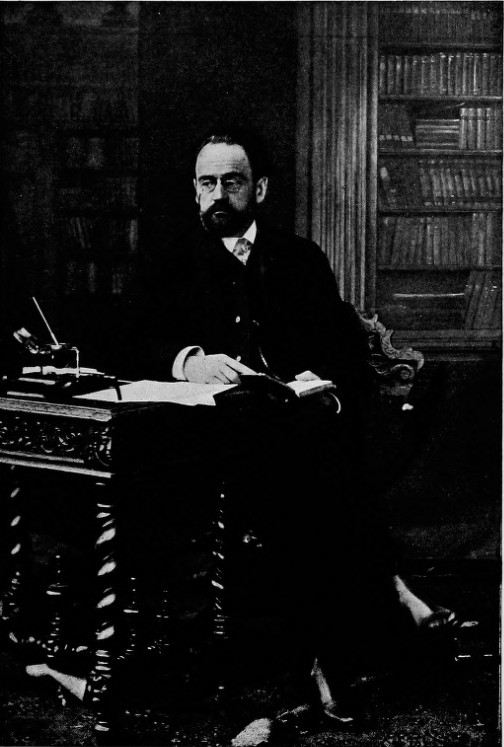
Émile Zola 1888-1890.—Photo by Nadar.
Neither of those aspirations was realised; and, in later years, even, Zola's decoration of the Legion of Honour was almost taken from him. It had come to him, not as some have said as the result of "Le Rêve," which was not published till some months afterwards, but as the result of "La Terre." Elsewhere, however, that same book had very different consequences for another man, for it led to proceedings at law which ruined him, cast him into prison, and hastened his death. How that happened the following chapter will tell.
IX
THE BRITISH PHARISEES
1884-1893
First English translations of Zola—Attacks on Zola in England—The Vizetellys, glassmakers and printers—Henry Vizetelly and his career—His publishing business—The six-shilling novel—Ernest Vizetelly's work for Vizetelly & Co.—His acquaintance with Zola—His opinion of the Zola translations—He becomes reader and editor to Vizetelly & Co.—He partially expurgates the English version of "La Terre"—W. T. Stead solicits information from Vizetelly—The sales of the Zola translations—The "National Vigilants"—"The Maiden Tribute"—Publicity v. Secrecy—Zola's aim—Mendacity of some English newspapers—Vizetelly's catalogue—Samuel Smith, M. P., and "pernicious literature"—A debate in the House of Commons—More newspaper lies—Vizetelly committed for trial—"The Decameron" prosecuted—The Government takes up the Vizetelly prosecution—Vizetelly's letter to Sir A. K. Stephenson—"Heaven save us from our friends!"—Vizetelly's difficulties—His trial, October, 1888—Purity of the rural districts of England—The case stopped—Sentence—Vizetelly's undertaking respecting the Zola books—Zola's view of the case—Expurgation and reissue of the translations—Vizetelly again summoned—He assigns his property to his creditors—Mr. George Moore on the "National Vigilants"—Mr. Frank Harris's offer—Ernest Vizetelly and the responsibility of the new trial—Mr. Cock, Q. C.—His notion of duty to a client—The trial, May 30, 1889—The plea of "guilty"—Vizetelly's collapse—Sir E. Clarke and Ernest Vizetelly—Sentence on Henry Vizetelly—He is sent to the wrong prison—The legerdemain of the Prison Commissioners—A question for the House of Commons—A letter from Mr. Labouchere—A memorial for Henry Vizetelly's release—Robert Buchanan defends him—His last years and death.
The earliest versions of Zola's novels in our language offered for sale in Great Britain were of American origin. Some American translations are ably done—that is well known—but the particular ones here referred to were for the most part ridiculous, full of errors, and so defaced by excisions and alterations as to give no idea of what the books might be like in French. There were translations of much greater merit in Germany, Italy, and Russia, but until a Mr. Turner produced in London a version of "Au Bonheur des Dames,"[1] the English reader, ignorant of French, really had no opportunity of forming any personal opinion of Zola's writings. He had to rest content with the views expressed in various newspapers and periodicals by men who had read Zola in the original. Among those who wrote on him in the English reviews were Mr. Andrew Lang and Mr. Henry James, but most of the articles that appeared were conveniently anonymous, and therefore, perhaps, essentially abusive, as, for instance, an unsigned paper in "Blackwood's Magazine," the writer of which, not content with attacking Zola's books, thought it as well to libel him as a man. At long intervals there appeared some article in his defence, some statement of his principles and his aims, the best of these being another anonymous paper called "The Literary Creed of Émile Zola,"[2] though even this had a foolishly worded "note" attached to it, showing how little Zola was understood by the average English editor. Such, then, was the position: a dozen or more worthless American versions on the market, and frequent attacks in reviews, magazines, and newspapers, when, in 1884, the first English series of Zola translations was begun by a London publisher, Henry Vizetelly, who, assisted by two of his sons, traded as "Vizetelly & Co."
Before proceeding further the writer desires to enter a plea pro domo sua. He, like others, has his weak spot, and the present may be the only opportunity he will ever have of setting forth certain facts concerning his family, which, in spite of considerable association with English journalism and literature, has frequently been described—chiefly in connection with Zola and his writings—as Greek, Hungarian, Polish, Italian, or Jewish. That the Vizetellys are of Italian origin is indisputable, but one may well inquire how long it takes to make a family English? Some are accepted as such after a few years. Surely, then, four centuries ought to suffice.
The forerunners of Henry Vizetelly came from Venice[3] to England in the spacious days of Queen Elizabeth; and until the end of the seventeenth century were concerned in the manufacture of glass. One of them became connected with some works established at Lambeth in or about 1673 by George Villiers, second Duke of Buckingham. The first sheets of blown glass for mirrors and coach-windows made in Great Britain came from those works, which Evelyn visited, as mentioned in his "Diary" But in the early part of the eighteenth century the Vizetellys became printers, and the family papers describe them as of "the parish of St. Bride's in the city of London." The Vizetelly, or Vizzetelli, of Elizabethan days having been called James (Jacopo), it became until recent years the family rule that the eldest son of the eldest son should bear that Christian name.
Another name, given to daughters, was the Biblical one of Mehetabel, a survival, perhaps, of some family Puritanism in Commonwealth days. But if there were a Puritan, there was certainly no Jewish strain in the family, the men of which in the eighteenth century married girls with good old English names, some of them London born and others coming from counties as far away as Cheshire. Thus, although the Vizetellys seem to have never forgotten their origin and to have cultivated friendship with sundry notable Italians who settled in England, it is certain that, as generation followed generation, English blood predominated in their veins.
The status of the eighteenth-century Vizetellys as printers is difficult to determine. They were apparently in fair circumstances, but the writer knows of no eighteenth-century book bearing their imprint. He believes they were associated in business with others whose names alone appeared. The first found actually trading in his own name was James Henry Vizetelly,[4] born in 1790, and son of James Vizetelly, "printer, of St. Bride's parish and of Duke Street, Lincoln's Inn Fields." James Henry's eldest son, James Thomas George, was apprenticed to him as a printer; and his second son, Henry Richard, after acquiring a knowledge of the same trade, was placed first with Bonner and afterwards with Orrin Smith, two noted wood-engravers. He proved one of the latter's best pupils, and ultimately joined his brother James in the printing and engraving firm known as Vizetelly Brothers.
While thus engaged, Henry Vizetelly[5] was approached by Mr. Herbert Ingram, a former news-agent of Nottingham, on the subject of founding an illustrated newspaper. The outcome (1842) was "The Illustrated London News," the first journal of its kind in any country. Vizetelly afterwards quarrelled with Ingram, and, in 1843, in conjunction with Mr. Andrew Spottiswoode, started an opposition paper, "The Pictorial Times," to which some notable men, including Douglas Jerrold and Thackeray, contributed. As, however, the printing and engraving business which he carried on with his brother was becoming a large one, Vizetelly eventually severed his connection with journalism for some years, and either with his brother, or later on his own account, produced a large number of illustrated books, which from typographical and other technical standpoints were often among the best of their time. He was also (this may interest American readers) the first to introduce Poe's "Tales" and—through C. H. Clarke—Mrs. Stowe's "Uncle Tom's Cabin," to the English public, and, having virtually discovered Birket Foster, he also did much to popularise Longfellow in England. Perhaps his best work as a wood-engraver was that done for the edition of "Evangeline," illustrated with Foster's designs.
Vizetelly also took a prominent part in the agitation for the repeal of the taxes on knowledge, such as the newspaper stamp and the paper duty, being honorary secretary to the society for the removal of the latter impost; and in 1855, conjointly with David Bogue, the publisher of most of the books he printed, he started "The Illustrated Times," on the staff of which, as had been the case with "The Pictorial Times," there were again many notable writers and artists.[6] This newspaper ran a very successful course for some years, but about 1860 Vizetelly—after losing a large sum over another venture, "The Welcome Guest"—sold his share in the proprietorship to Ingram of "The Illustrated London News." Ultimately, in 1865, he entered into an agreement to represent the last-named journal on the continent of Europe, with headquarters in Paris, to which city he removed with his family. He saw virtually all there was to be seen there during the last years of the Empire, the subsequent siege by the Germans, and, later, the Commune. He afterwards acted for "The Illustrated London News" as a "special" in different parts of Europe, and became British wine juror at various international exhibitions, for he had made a particular study of wines in the regions where they were produced, and wrote on them at length both in "The Pall Mall Gazette" and in a series of popular volumes. Other subjects also attracted his pen; the best of his numerous literary efforts being probably a work on the famous Diamond Necklace scandal, and another on Berlin as it was when Bismarck had constituted the new German Empire.
Such, then, was the man who in 1880 joined the ranks of the London publishers. He was at that time sixty years old but still full of energy, and he gave great personal attention to his business, though, as already mentioned, he had the assistance of two sons. He had been twice married, and of a numerous family four sons and a daughter were then living. The sons whom he had with him were the younger ones, Arthur and Frank Vizetelly;[7] their elder brothers, then abroad, being Edward[8] and Ernest, the present writer, who for convenience proposes to refer to himself by his Christian name throughout this particular narrative.
One of the first ventures of the new business, a series of sketches of English society, entitled "The Social Zoo," and published in parts, was badly launched and dropped before completion, but some sections of it, by E. C. Grenville-Murray, attracted great attention and sold widely on being reissued in volume form. Sala's "Paris Herself Again" and other books were also very successful, but when Vizetelly—who by reason of his long residence in Paris took great interest in French literature—produced a series of cheap translations of works of high repute in France—novels and tales by Daudet, Theuriet, About, Malot, Cherbuliez, George Sand, Mérimée, and others—there was little or no demand for them, though a large amount of money was spent in advertisements. Indeed it soon appeared that if French fiction was to be offered to English readers at all it must at least be sensational; and Vizetelly therefore started a cheap series of Gaboriau's detective stories, which found a large and immediate market. The business gradually expanded, and before long, in addition to miscellaneous works by Sala, Grenville-Murray, and others, the firm took up English fiction in a new form.
Mr. George Moore, the novelist, having found the circulating libraries opposed to some of his books, protested vigorously against the three-volume system which placed English fiction at the libraries' mercy. He held that all novels ought to be sold direct to the public, and many other writers agreed with him. Mr. Moore became one of Vizetelly & Co.'s authors, and the firm thereupon put the theory of direct sale to the public into practice. They abandoned the three-volume system altogether, issuing their new novels in one volume only, and it was Henry Vizetelly who fixed the price at six shillings, to be lowered, after the earlier editions, to three shillings and sixpence—those being the figures which still prevail to-day. When therefore in later years the three-volume novel was finally slain it was somewhat impudent on the part of certain publishers to issue advertisements claiming all the merit of the change; for long before they or others joined the movement, Vizetelly & Co., as their catalogues show, were issuing a whole series of novels at the popular price, and quoting, in cordial approval of their initiative, an extract from an article in "The Saturday Review." Doubtless the one-volume system has not done all that was predicted for it, but it has certainly been an improvement on the old one, and it may be fairly claimed that Mr. George Moore and Henry Vizetelly were its pioneers.
After the establishment of his publishing business, Vizetelly had communicated with his son Ernest,[9] who was then living in Paris and had friends and acquaintances among writers, publishers, and booksellers there. Several suggestions which he made in the course of the next few years were adopted by the firm. However the idea of publishing English translations of Zola's works did not originate with him. As a journalist he had to keep himself informed respecting everything that occurred in Paris; and he was fairly familiar with what had been done, written, and said there over a long term of years, particularly as even in his school-days he had begun to assist his father as a newspaper correspondent. Thus he was already acquainted with the salient features of Zola's career, the novelist's long and arduous battle for mastery. He had not read all the Rougon-Macquart volumes then published, but he had followed the exponent of Naturalism in his various newspaper campaigns, and he had seen most of the plays based on his books. Again, he was the only member of his family who, at that time, had ever met the novelist. Not long after the Franco-German War Zola had been pointed out to him by an artist as "the man who had championed Manet"; and since then Vizetelly had seen and elbowed him on various occasions in places of public resort. But only once had there been any real conversation between them, in the presence of others, at the Théâtre des Folies-Bergère, with which Vizetelly had been for a time connected.[10]
It may be added that Vizetelly's life in France had inclined him to the outspokenness of the French, and that experience had shown him there was much rottenness in Parisian society. Thus he had no personal prejudice against Zola's writings, which contained, he knew, a vast amount of truth. But he also knew, likewise by experience, that whenever any horrible scandal arose in Paris, the English newspapers would only print a small portion of the truth, and he, as a correspondent, was thus often debarred from making a plain statement of facts of general interest, such as sometimes affected the moral status of men of very high position. Moreover, although Vizetelly had left England in his boyhood, and in subsequent years had only now and again spent a few days or weeks there (apart from one sojourn of about twelve months' duration), his own work, and the frequent perusal of English books and publications had kept him to a certain point in touch with his kinsfolk. And, so far as he could judge, English literature, like English journalism, was under the thumb of Mrs. Grundy. He had seen no sign indicating that Naturalism would even secure a hearing in England. When, therefore, in 1884, he suddenly heard that Vizetelly & Co. were about to produce "L'Assommoir" and "Nana" in an English dress, it seemed to him that the firm was taking an audacious course, and he did not hesitate to write and say so. He was answered, that, being resident abroad, he did not fully understand the position, and, as some difficulty had arisen with the translation of "L'Assommoir," he was asked to translate a small portion of it, some chapter towards the end of the book, which he did. That, for the time, was the extent of his share in the Zola translations.
The idea of publishing those translations originated, then, with Henry Vizetelly, unless, indeed, it was suggested to him by somebody else. In 1885 his son Ernest, on going to London, found the firm doing a large and increasing business. In addition to French and English writers, several Russian authors, Tolstoï, Dostoieffsky, and Lermontoff,—who were followed a little later by Gogol,—had been added to the firm's catalogue. A series of reprints of the old dramatists, the well-known "Mermaid Series," was being projected;[11] and the Zola translations, so far as they then went, were in wide demand. This surprised Ernest Vizetelly, whose anticipations had been so different. But he yielded to evidence, and even began to think that there was at last some prospect of English people dropping the hypocrisy which had clung to them so long and looking unpleasant facts in the face.
He returned to Paris, where he remained till 1887, when various reasons induced him to take up his residence in London. He had married some years previously, and though his wife was French he particularly desired that his children should retain his nationality. Moreover, he now had the offer of a great deal of work from his father, who was projecting various reprints of French eighteenth-century books, as well as expensive and sumptuous editions of "The Heptameron," "The Decameron," and the works of Rabelais. Some thousands of pounds were spent on those undertakings, but only the first-named eventually saw the light.[12] Arriving in London, Ernest Vizetelly became one of the readers and editors of his father's firm, but for one reason or another he still had little to do with the Zola translations. His father contemplating a new edition of the Gramont Memoirs, he revised the translation alleged to have been edited by Sir Walter Scott, and corrected some scores of errors which he found in it. For the rest, his time was largely spent in researches respecting the proposed version of "The Heptameron," of which he was editor.
Meanwhile Vizetelly & Co. were still issuing translations of modern French fiction, and Mr. George Moore, having occasion to go to Paris, spoke on the firm's behalf to Zola respecting "La Terre," which book the novelist was then preparing. An arrangement was made for the sale of the British rights to Vizetelly & Co., who then knew virtually nothing of the work, apart from the fact that it would deal with the French peasantry. Some time afterwards, however, Zola supplied a brief outline of his book in a letter which has been already quoted.[13] Then various delays ensued, several months elapsing before proofs of the earlier chapters were forwarded to Vizetelly & Co. Those proofs were handed to a translator with whom some difficulty arose, in such wise that they were transferred to another, and Ernest Vizetelly was requested to read and check the English proofs, a task which he occasionally undertook in connection with various translations. He was immediately struck by the boldness of Zola's story, which seemed to surpass in outspokenness any of the novelist's previous works. And at the very outset he deemed certain excisions and alterations advisable.
For instance, he found one of the characters, Hyacinthe Fouan, called by the nickname of "Jesus Christ," and afflicted with a nasty infirmity. The nickname did not particularly surprise him, for during the many years he had spent in Paris, he had known more than one young artist cultivating, notably as regards hair and beard, a resemblance to the traditional portraits of the Christ, and going by that nickname both in the studios and the cafés frequented by artists. It seemed to him quite possible that Zola had found it among the peasantry whom he described. But, however that might be, Vizetelly felt that the nickname would give offence to English readers, and so he did not hesitate to expunge it from the proofs submitted to him. He felt also, that although Hyacinthe's infirmity might be true to life, it would also give offence to people who no longer read Sterne, and who knew little or nothing of Rabelais. Accordingly expurgation again ensued.
But as successive instalments of the proofs reached Ernest Vizetelly, he found in them a good deal of matter, which in his opinion needed "toning" for the English reader. And he was confronted by a difficulty which pursued him subsequently when he himself translated some of Zola's works; that is to say, the French proofs arrived in sections, the translation was supplied in the same manner, and it was therefore difficult to determine what incidents and facts might be really essential, and how far expurgation might be carried without rendering the book unintelligible. Vizetelly spoke on the matter to one of his brothers, and ultimately he put the work on one side, deciding to wait for its completion. Considerable delay ensued in the publication of the translation. Meantime, towards the close of 1887, the original work appeared in Paris, and was virulently attacked by Zola's enemies; while a rumour, subsequently contradicted, spread to the effect that translations had been stopped in various countries. It therefore seemed advisable to proceed cautiously. Finally the matter was laid before Henry Vizetelly, the proofs of the English version were examined from beginning to end, and in conjunction with his son Ernest, he struck out or modified a very large number of passages, with the result that much of the work had to be reimposed. It may be said, then, that the translation as published was undoubtedly an expurgated one.
About this time, that is in March, 1888, Mr. W T. Stead, then editor of "The Pall Mall Gazette," who had made himself notorious some time previously by a series of articles on "The Maiden Tribute of Modern Babylon," applied to Vizetelly & Co. for some information respecting the sales of the various translations from the French, which the firm was publishing, and which certainly circulated widely and attracted great attention. When the matter was laid before Henry Vizetelly, his son Arthur, who took a large part in the management of the business, suggested that the request should not be entertained, for, said he, it was a very unusual one, and publishers were not in the habit of supplying the public with all sorts of particulars about their affairs. That, at the time in question, was quite true, but Henry Vizetelly, who saw no objection to the request, supplied Mr. Stead with an article in which he gave numerous particulars concerning the sales of his publications. The article, as the sequel showed, was somewhat injudiciously worded in various respects. For instance, it conveyed an impression that—unlike the crude and mangled American versions of Zola which were then in the market—the Vizetelly translations of that author were absolutely unmutilated. As a matter of fact, none of them was an exact replica of the original, all had been expurgated more or less, though care had invariably been taken to preserve the continuity of the narrative. Further, though Vizetelly had very good grounds for asserting that he reckoned it a bad week when the sale of the Zola translations fell below a thousand volumes, this statement, which seemed at first sight to indicate a very large circulation,[14] was again indiscreet, and was eagerly seized hold of and magnified by those who were already lying in wait to destroy him.
Of the inner workings of that conspiracy the writer might perhaps say a good deal, but for the purposes of this narrative, the facts which appeared on the surface are sufficient. A campaign was started, chiefly against Vizetelly & Co., and ostensibly for the purpose of protecting boys and girls, against what was called "pernicious literature." A society styling itself the "National Vigilance Association" eventually took the matter in hand. Its secretary, the person usually representing it in public, was a man named Coote; the agent for its publications was a Protestant fanatic named Kensit;[15] among those who gave it their countenance was W. T. Stead, then, as already mentioned, editor of "The Pall Mall Gazette." The publications of Kensit on "The High Church Confessional," and those of Stead on "The Maiden Tribute of Modern Babylon," would have seemed to indicate that both Kensit and Stead favoured the doctrine of outspokenness or publicity to which Zola gave effect in his novels, the doctrine which he summed up in the words, "Let all be set forth so that all may be healed." But although in the estimation of Kensit and Stead it was quite right that they should speak out, the idea of allowing Zola the same privilege was nonsense. He was Belial, whereas of them it might be said: "Mark the perfect men, and behold the upright." Thus they might circulate descriptions of vice,—even allow them, as in the case of "The Maiden Tribute," to be hawked about the streets in penny numbers[16]; but Zola must not picture vice in his books.
Among the members of the so-called "National Vigilance Association" were various parsons and priests who naturally abominated such an infidel as Zola, and some of whom subsequently traduced him freely. These might accept the outspokenness of a Stead, but, generally speaking, they represented the doctrine of reticence and secrecy as opposed to that of publicity. Theirs was the policy, pursued through the ages, of wrapping everything up, cloaking everything over, and they were lost in anger, horror, and amazement when they found a different course being pursued. They ignored Zola's position altogether, though for years he had been calling to them and those who resembled them: "You claim to reform the world, you preach and you prate; but although your endeavours may be honest you do little or no good. Evil exists on all sides, society is rotten at the core; but you merely cover up abominations, you even feign at times to ignore their existence, though they lie little below the surface and poison all around them. The system of reticence and concealment which you pursue is a profound mistake. It is one of the many consequences of that system that thousands of girls are cast every year into the arms of seducers, that thousands of young men kneel at the feet of harlots. Abortion is practised among the married as among the unmarried. Drunkenness is in your midst. Your prisons are full. Your gibbets and guillotines are always in use. Cheating and swindling are commonplaces of your every-day life. Well, I am resolved to tear the veil asunder, to set forth everything, to conceal nothing. I shall shock the world undoubtedly, but it is only by bringing things to light, by disgusting people with themselves and their surroundings, that there will be a possibility of remedying the many evils which prey on the community at large. Eighteen hundred years have elapsed since the carpenter of Nazareth walked the earth. You and your forerunners have had those eighteen hundred years at your disposal. What have you done in them? How much, or rather how little real good have you effected with all your organisations, your great authority, your exceeding wealth, your devotion, your piety, your talent, which at times has blossomed into genius? You have extirpated nothing whatever; your system has tended chiefly to the dissemination of hypocrisy and cant; you have failed egregiously; and to explain your failure you preach the ridiculous doctrine of the Fall, invented expressly to account for the impotency of priestcraft. I have nothing to say—as yet—on the subject of your belief in a future state, of your system of rewards or penalties after life, for good or evil conduct in the world, though it is one, half threat and half bribe, for which there should be no occasion. But I take human society as it is, and by exposing the errors of its ways I hope to set afoot, to encourage among practical reformers, a movement of social regeneration, which will perhaps achieve, in a few centuries, a happier result than you, even though appealing to the supernatural, have achieved in so many. And in any case I intend to try, whatever abuse you may shower on me, whatever mud you may fling at me, mud which will some day, perhaps, recoil upon yourselves."
But how could men, trained to teach one and another superstition, wrapt in all the prejudices of their heredity and their caste, accept such arguments as those even if they had heard of them? The mere idea that man might regenerate himself without the aid of the supernatural was impious to their minds; the idea of stating the truth plainly, of rousing people by shocking them, was horrible to their delicacy of feeling, for they belonged to a white-livered generation, whence all robustness had departed. Perhaps if this Zola had been one of themselves they might have tolerated him, but he did not bow to the supernatural, his creed was different, and he was therefore a rival, an enemy, particularly as he contemplated a world whence they would be banished, as it would need none of their ministrations.
Thus the campaign began and soon found an echo in the newspapers. At that time probably there were not twenty journalists in all England who had read Zola's essays and critical papers in which he defined his position and the purport of his novels. In the latter, as is well known, he abstained from preaching. There is nothing of the nature of a sermon in the whole series of "Les Rougon-Macquart" until one reaches "Le Docteur Pascal"; and one must admit that, although Zola had freely expounded his views elsewhere, the omission of those views from his novels was detrimental to him and them among those people who could not rightly understand any exposure of vice unless it were accompanied by preaching. Had he preached, the clergy, so many of whom believe preaching to be the chief function of their ministry, might well have been on his side, and even "Blackwood's Magazine" might then have hesitated to describe him as a man without a conscience. But he contented himself with picturing vice as vile, and the viler he made it appear, the more was he abused, the more was he accused of wallowing in it, of giving full rein to filthy libidinous propensities for the express purpose of corrupting all who read him! That charge was repeated widely by the English press, as is shown by the hundreds of cuttings from London and provincial newspapers in the writer's possession. And Vizetelly & Co. were accused of having deliberately chosen "the very worst" of Zola's books for translation.
As a matter of fact, in 1888 they were selling all the novels that Zola had then written, with the exception of "Les Mystères de Marseille," "La Confession de Claude," and "Le Rêve," which last only appeared in Paris in the latter part of that year. The publication of those books had been going on for four years, unchallenged. Each new volume as it appeared was priced at six shillings, and subsequently lowered to three shillings and sixpence. A few volumes, in picture boards, were sold at two shillings and sixpence. But the critics rushed upon "The Soil," the English version of "La Terre," and one man, who can never have compared it with the original, had the impudence to assert that it was "an almost word for word translation of Zola's bestial book." Readers who had never seen Vizetelly & Co.'s catalogue were also allowed to infer that the firm traded exclusively in "pornographic literature." Now, in that catalogue, two hundred and forty works were enumerated, and the Zola volumes were eighteen in number. But it may be said that other books were denounced also, the translations of Flaubert's "Madame Bovary" and "Salammbo"; Goncourt's "Germinie Lacerteux" and "Renée Mauperin"; Gautier's "Mlle. de Maupin"; Murger's "Vie de Bohême"; Maupassant's "Bel-Ami" and "Une Vie"; Daudet's "Sapho"; Paul Bourget's "Crime d'Amour" and his "Cruelle Énigme," which last the firm had issued in consequence of a laudatory notice in the staid old "Athenæum," surely the last journal in the world to recommend anything suggestive of pornography. But counting even all the works belonging more or less to the French realistic schools which Vizetelly & Co. issued, one reached only a total of about thirty, leaving some two hundred and ten books of other classes. Thirteen of those were certainly volumes of "The Mermaid Series of the old Dramatists" which some anonymous scribes likewise regarded as "pornographic" in that hour when cant and hypocrisy poured venom on virtually every form of literature that had not received the imprimatur of Pecksniff & Company
The public having been prepared for developments, the question of "pernicious literature" was brought before the House of Commons by one of its members, Mr. Samuel Smith, who sat for Flintshire. He had married the daughter of a clergyman, and had a reputation for extreme piety. He was described at the time as "an enthusiast without enthusiasm, with a tall, expansive frame, a huge beard, a placid-life-like expression, and a mild feminine voice,"[17] which, said another journal, was "peculiarly suited to the expression of lamentation."[18] There was some fear, it seems, that there might be a poor attendance at the debate on the motion he meant to submit, indeed a "count out" was feared, but arrangements were made to keep a house for the occasion, when the aspect of the benches was apparently such as the following diagram indicates:
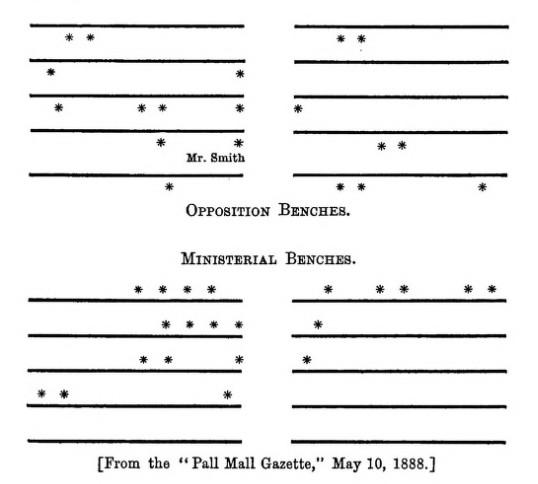
Thus, of an assembly numbering between six and seven hundred members, just forty were found sufficiently interested in the morals of their constituents to discuss the motion submitted by Mr. Smith, which was: "That this House deplores the rapid spread of demoralising literature in this country, and is of opinion that the law against obscene publications and indecent pictures and prints should be vigorously enforced and, if necessary, strengthened." In the speech with which the member for Flintshire opened the debate he did not hesitate to describe Henry Vizetelly as "the chief culprit in the spread of pernicious literature"; and, according to a "Pall Mall Gazette" report, which he never contradicted, he said of the works of Zola that "nothing more diabolical had ever been written by the pen of man; they were only fit for swine, and those who read them must turn their minds into cesspools."[19] In this fashion does the Puritan prate when he goes on the warpath. For the rest, Mr. Smith talked de omni re scibili, "flinging his accusations broadcast. All kinds of literature, including daily newspapers, came under his ban. He wanted everything—books, magazines, and newspapers,—to be subject to some sort of restraint." He spoke in the "spirit which assumes that what is evilly suggestive to itself must be evilly suggestive to others." But as was added by the journal from which these remarks are quoted:[20] "What sort of literature should we have if it were all brought down to such a level as would satisfy the ascetic tastes of the Smiths? Where would the Bible be? What would become of Shakespeare?"
After Mr. Smith's motion had been seconded by Mr. T. W. Russell, and endorsed by Sir Robert Fowler and Mr. De Lisle, another member, Mr. (afterwards Sir F. S.) Powell, leaving French novels on one side, called attention to certain circulars "headed with Scriptural texts and looking like religious tracts" which were circulated in English homes, apropos of the spread of contagious disease in India, and which, in his opinion, were calculated to do much harm.
Then came the Government spokesman, Mr. Henry Matthews, one of the most unpopular Home Secretaries that Great Britain has known since the time of the Walpole under whose effete administration the public tore down the railings of Hyde Park. Mr. Matthews, a lawyer and a Roman Catholic, was subsequently given a peerage; but in 1888 he sat in the House of Commons for the city of Birmingham. He agreed very largely with what Mr. Smith had said, and he asserted that "in comparing French modern literature with classical literature it had to be borne in mind that, while the latter was written with no evil purpose(!), the former was written with the object of directing attention to the foulest passions of which human nature was capable, and to depict them in the most attractive forms"—an allegation which, applied to Zola's works, can only be described as astounding. But the Home Secretary also denounced the "penny dreadfuls," the quack advertisements, and the full reports of divorce cases which appeared in the daily press. And on the question of instituting prosecutions he said:
"The reason why the law was not more frequently put in force was the difficulty that was experienced in getting juries to draw a hard and fast line, and to convict in all cases that crossed that line. He had given careful attention to this question, and he should deprecate handing over to the Public Prosecutor, or anybody else, the task of deciding what was the straight and narrow line which divided what was punishable, criminal, and obscene within the meaning of the law, and what was merely indelicate and coarse. The public judgment was a safer guide than that of any official, and if the general moral sense of the community did not compel individuals to prosecute, no good would be done by trying to create an artificial moral sense by the action of the Public Prosecutor.... Serious evils arose from the failure of attempts to obtain convictions. So far, however, as he could influence the Public Prosecutor, who was, to some extent, independent of any Public Office and acted on his own discretion, he would certainly urge prosecutions in any cases in which it did not appear that more harm than good would result.... He was sure, however, that the hon. Member and all those who had honest convictions would not shrink from the slight personal inconvenience of putting the law in motion in any case of real public mischief."
The debate was continued by three or four members, one of whom, Mr. H. J Wilson (Holmfirth) apologetically and naïvely declared with respect to the pious circulars on the working of the Contagious Diseases Act, of which Mr. Powell had complained, that their distribution was the only method of making the truth known, and that the only way to stop them would be to put an end to the horrible system that rendered their dissemination necessary. To this Zola, if he had been present, might have retorted that the circulation of the plain statements of fact contained in his books was likewise, in his estimation, the only way to make known the degradation of society at large, in order that remedies might be applied.
Mr. Smith's motion was carried unanimously, however, by the forty gentlemen present, matters being left in this position: The Government hesitated to institute prosecutions, and thought that private individuals should do so.
Meanwhile the campaign went on. Mr. Smith wrote a letter to the newspapers; another came from Lord Mount-Temple; and the press, with few exceptions, endorsed everything that was said by the commoner and the nobleman. The vigilant "Guardian" of the Church of England availed itself of the occasion to thunder against Sir Richard Burton and his "Arabian Nights"; "The Tablet" of the Roman Catholics jesuitically signified its approval of the agitation, because Zola's whole tendency was "suspected"(!) to be immoral; the conscientious Nonconformist journals, as was to be expected, said ditto to everything that Smith said. Some righteous contributor to "The Globe" wrote of Zola's books that they were characterised by "dangerous lubricity," that they "sapped the foundations of manhood and womanhood, not only destroyed innocence, but corroded the moral nature." "The Birmingham Daily Mail" declared that "Zola simply wallowed in immorality." "The Whitehall Review" openly clamoured for the prosecution of his publisher. "The Weekly Dispatch" impudently inquired, "If Mr. Vizetelly gives us Zola, why does he pick 'La Terre'? And if Daudet, why pick 'Sapho'?"—thus ignoring the fact that the firm published virtually all of the former's stories, and several of the latter's, and conveying, for its own purposes, a false impression to its readers. Indeed, misrepresentation of the facts was to be found in many directions. A few newspapers wrapped themselves in their dignity and said nothing, and a few remained fairly cool and sensible: "The Standard," "The Scottish Leader," "The Scotsman," "The Radical Leader," "The Bradford Observer," "The Country Gentleman," "Piccadilly," "The Newcastle Chronicle," and "The Western Daily Press." There may have been a few others, for the writer does not claim that his collection of press cuttings is absolutely complete; but after examining some hundreds of extracts he finds little that is not mendacious or steeped in religious bigotry, puritanical prudery, or gross ignorance. And at all events it is certain that an overwhelming majority of British editors and "leader-writers" endorsed the views of the Pharisees.
The campaign was then carried to a decisive stage. A firm of solicitors, Collette & Collette, applied at Bow Street police-court for a summons against Henry Vizetelly for having published three obscene books, to wit, "Nana," "The Soil" ("La Terre"), and "Piping-Hot" ("Pot-Bouille"), by Émile Zola. The summons was granted, and on August 10, 1888, Vizetelly appeared to answer it. The prosecution had been entrusted to Mr. Asquith,—now best known as a politician,—and he, in opening his case, was about to deal with "Nana," when the magistrate, Mr. (afterwards Sir) John Bridge, who evidently had already made up his mind respecting the case, suggested that he should take the worst of the three books, namely "The Soil,"—for which, by the way, Zola had received the decoration of the Legion of Honour three weeks previously! Counsel assented, referred the magistrate to various pages, and then solemnly declared that this book and the two others were "the three most immoral books ever published!" But having thus revealed how very limited was his knowledge of literature, he added, fairly enough, that it was claimed for "The Soil" that it had been published with a high moral object—namely, to show the degradation of the French peasant and the necessity of alteration in the laws by which he was governed.
Vizetelly's solicitor, Mr. Lickfold (of Messrs. Lewis & Lewis), argued on his client's behalf that he had a perfect right to publish these translations, the French originals of which were circulated in Great Britain without let or hindrance; and he contrasted them with English works which were sold widely and freely, such as Byron's "Don Juan," and Shakespeare's "Merry Wives of Windsor." Far from the incriminated books being the three most immoral ever written, said Mr. Lickfold, there were many within the cognisance of all men of any education which were very much worse. But the magistrate curtly intimated that it was a case for a jury to decide, and he forthwith committed the defendant for trial at the Central Criminal Court, admitting him, meanwhile, to bail in his own recognisances.
Vizetelly's committal led to great rejoicing among the Pharisees; and to improve the occasion the "National Vigilants" summoned a bookseller named Thomson at Guildhall (September 7) for selling an English version of Boccaccio's "Decameron." Mr. Forrest Fulton—subsequently knighted and appointed Common Sergeant of the City of London—prosecuted and asked for a committal, but Mr. Horace Avory, defendant's counsel, replied that the "Decameron" had been in circulation for over four hundred years, that there were three copies of the work in the English language in the Guildhall Library and some two hundred in the British Museum; and he contended that this classical work was not indecent in the eyes of the law. Mr. Alderman Phillips, who heard the case, quietly remarked that he himself had read the book both in Italian and in English, and he refused to send the defendant for trial, as he did not believe that any jury would return a conviction.
This was a rebuff for the fanatics, who now concentrated their energy on the prosecution of Vizetelly. The latter had taken his committal in a defiant spirit, promptly issuing the following notice to his customers: "The trade is informed that there are no legal restrictions on the sale of 'Nana,' 'Piping Hot,' and 'The Soil,' and that none can be imposed until a jury has pronounced adversely against these books which the publishers still continue to supply." This announcement, which was perhaps ill advised—though in counsel's opinion well within one's legal rights—momentarily enraged the "Vigilants," but they were about to receive important help. The Government, encouraged by the press, took up the prosecution, thus relieving the agitators of the cost of their suit.
Affairs now began to assume a more serious aspect, the question was no longer one of fighting a band of fanatics, but of contending against the law-officers of the Crown who would bring all the weight of their authority to bear upon the jury. In these circumstances Vizetelly decided to print a series of extracts from the works of English classic authors,[21] by way of showing that if Zola's novels were suppressed one ought also to suppress some of the greatest works in English literature. These extracts, which were preceded by quotations from Macaulay on the suggested suppression of the works of Congreve, Wycherley, etc., and by Zola's own explanation of the scope and purpose of his Rougon-Macquart series, covered a very wide field. Among the many authors laid under contribution were Shakespeare, Beaumont and Fletcher, Massinger, John Ford, Thomas Carew, Sir George Etherege, Dryden, Congreve, Otway, Prior, Defoe, Swift, Sterne, Fielding, Smollett, Byron, etc., the series running from the time of Elizabeth to the early part of the nineteenth century. At the same time Vizetelly drafted an open letter to Sir A. K. Stephenson, the Solicitor to the Treasury, who now conducted the prosecution, and copies of the letter and of the extracts were forwarded to all the members of the Government and the leading London newspapers. The letter ran as follows:——
SIR,—As the Treasury, after a lapse of four years since the first appearance of the translations of M. Zola's novels, has taken upon itself the prosecution instituted for the suppression of these books, I beg leave to submit to your notice some hundreds of Extracts, chiefly from English classics, and to ask you if in the event of M. Zola's novels being pronounced "obscene libels," publishers will be allowed to continue issuing in their present form the plays of Shakespeare, Beaumont and Fletcher, Massinger, and other old dramatists, and the works of Defoe, Dryden, Swift, Prior, Sterne, Fielding, Smollett, and a score of other writers—all containing passages far more objectionable than any that can be picked out from the Zola translations published by me.
I admit that the majority of the works above referred to were written many years ago, still they are largely reprinted at the present day—at times in Éditions de luxe at a guinea per volume, and at others in People's Editions, priced as low as sixpence,—so that while at the period they were written their circulation was comparatively small, of late years it has increased almost a hundred-fold.
So long as the present prosecution was in the hands of the fanatics who initiated "The Maiden Tribute" of "The Pall Mall Gazette," and whose mouthpieces in both Houses of Parliament have gulled the Legislature with cock and bull sensational stories of there being ten houses in a single London street where young girls are accommodated with private rooms and supplied with indecent books for perusal,... so long as the prosecution remained in those hands, I was content to leave the decision to the sound common-sense of an English jury. Now, however, that the Government has thought proper to throw its weight into the scale, with the view of suppressing a class of books which the law has never previously interfered with—otherwise the works I have quoted from could only be issued in secret and circulated by stealth—circumstances are changed, and I ask for my own and other publishers' guidance whether, if Zola's novels are to be interdicted, "Tom Jones" and "Roderick Random," "Moll Flanders" and "The Country Wife," "The Maid's Tragedy" and "The Relapse," in all of which the grossest passages are to be met with will still be allowed to circulate without risk of legal proceedings.
In the Extracts now submitted to your notice, and which you must be well aware could be multiplied almost a hundred-fold, I have made no selections from cheap translations of the classics with their manifold obscenities... nor from popular versions of foreign authors, whose indecency surpasses anything contained in the English versions of "Nana" and "The Soil," and who, unlike M. Zola, exhibit no moral tendency whatever in their writings.
The Temperance cause never before found so potential an advocate as M. Zola proved himself to be in "L'Assommoir." A great writer who has exercised the wide influence on contemporary literature that M. Zola has done, whose works have been rendered into all the principal European languages, and who commands a larger audience than any previous author has ever before secured, is not to be extinguished by having recourse to the old form of legal condemnation, and especially at the bidding of a fanatical party, the disastrous effects of whose agitation on the health of our soldiers is recognised and lamented by all military, and by most sensible, men.
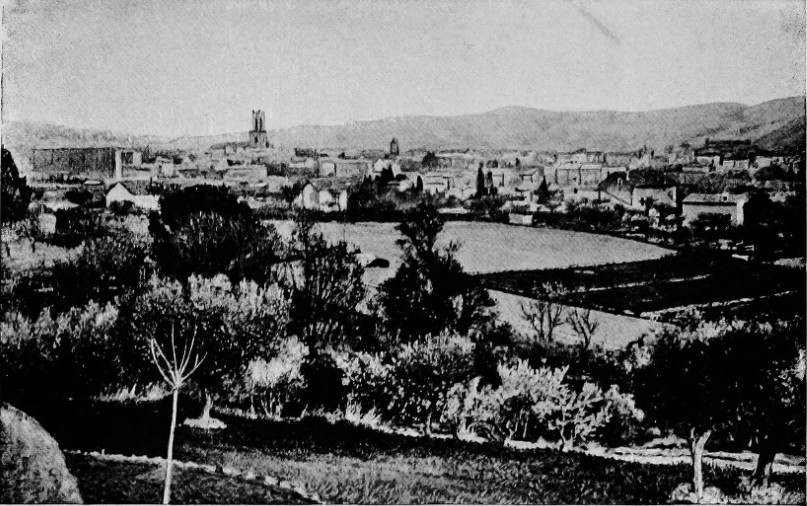
Aix-in-Provence, the Plassans of the Rougon-Macquarts—Photo by Martinet & Jouven
Is life as it really exists—with the vice and degradation current among the lower classes, and the greed, the selfishness, and the sensuality prevalent in the classes above—to be in future ignored by the novelist who, in the case of M. Zola, really holds the historian's pen? Is actual life to be no longer described in fiction, simply because the withdrawal of the veil that shrouds it displays a state of things unadapted to the contemplation—not of grown-up men and women, but of "the young person of fifteen," who has the works of all Mr. Mudie's novelists to feast upon? This certainly was not the law in the days of Defoe, Swift, and Fielding, and it needed a canting age, that can gloat over the filthiest Divorce cases, while pretending to be greatly shocked at M. Zola's bluntness; but above all, it required a weak-kneed Government, with one who was once a literary man himself at its head, [Lord Salisbury] to strain the law in a way that an educated alderman refused to do the other day in reference to Boccaccio's "Decameron."
Time, we are told, brings round its revenges, and the books burnt by the common hangman in one age come to be honoured in the next. England may render itself ridiculous in the eyes of Europe by visiting the works of M. Zola with the same kind of condemnation which the civilised world has accorded to the writings of the degraded Marquis de Sade; still it requires no particular foresight to predict that a couple of generations hence, when the tribe of prejudiced scribes—who, ignorant for the most part of their own country's literature, now join in the hue and cry against M. Zola—are relegated to their proper obscurity, the works of the author of the Rougon-Macquart Family will take rank as classics among the productions of the great writers of the past.
I am, Sir, your obedient servant,
HENRY VIZETELLY.
The letter was dated September 18, 1888, on which very day the sessions of the Central Criminal Court began, but the Crown applied for a postponement of the trial, and as Vizetelly's counsel, who had been instructed to oppose any postponement, failed to attend, and Vizetelly himself was refused admittance by an officious policeman, the case was at once put off until October. This was very prejudicial to Vizetelly's business, particularly as the attacks of certain prints did not cease. Looking back, it greatly astonishes the writer that no application was ever made to commit the publishers of several London and provincial newspapers for circulating comments on a case which was sub judice, comments well calculated to prevent the defendant from obtaining a fair trial. But that idea does not seem to have occurred either to Vizetelly or to anybody about him. He at first had felt fairly confident respecting the issue of the case, and, as an old journalist, had entertained nothing but contempt for the terriers of the profession who barked at his heels. But his confidence had been shaken by the intervention of the Government and was finally undermined by well-meaning friends who, owing to the postponement of the proceedings, had many an opportunity to tender counsel. Their motives were most honourable and praiseworthy, no doubt. But the effects of their solicitude were disastrous. "In the multitude of counsellors there is wisdom," it has been said, but in Vizetelly's case there came chaos. While some urged him to fight, others begged that he would do no such thing. There was an incessant chassê-croisê of advice; and Vizetelly, now resolving on one course, and now on another, was at last at a loss what to do. Had he been a younger man the case would have been very different, for in his prime he had evinced much energy of disposition, and in difficult moments had relied on his own sound common-sense. But he was now sixty-eight years old, and though he was still of most industrious habits, the strenuous life he had led had left its mark upon him. Moreover, a complaint from which he suffered had taken a very serious turn, and frequent physical suffering was not conducive to perspicuity and energy of mind. Again, there was the position of his business to be considered. In consequence of the prosecution and the misrepresentations of the newspapers, the trade became afraid to handle any books he published, and thus his sales rapidly decreased. Besides, he found it difficult to obtain efficient counsel for his trial. The Parnell Commission was then sitting, and most of the great men of the bar were retained in it. Mr. (now Sir Robert) Finlay, Q. C., who was applied to, could not take the brief, having in hand already a large number, which the barristers engaged before the commission had been obliged to decline. Other men were similarly circumstanced, and there was one who honestly admitted that he did not like the case, and would therefore prove a very poor advocate. Eventually Mr. Francis B. Williams, Q. C., Recorder of Cardiff, was retained, with Mr. A. R. Cluer, now a London police magistrate, as his junior.
Beset as he was by various friends, who held that in the state of public opinion he was not likely to secure an acquittal, Vizetelly at last allowed some inquiries to be made as to what would happen if he pleaded guilty and withdrew the three incriminated Zola translations, such as they were then, from circulation. A letter bearing on this question, says: "If the rest of Zola's works that are open to objection are withdrawn, the Solicitor-general will be content that the defendant be not sentenced to imprisonment. He thinks that the taxed costs of the prosecution should be paid, and will leave the amount of fine (if any) to the judge, not pressing for a heavy one if the defendant is a man of small means." This communication gave a new aspect to the case. The question was no longer one of three of Zola's works, all of them might have to be withdrawn. Private testimony respecting the narrow puritanism animating the authorities at that moment indicated that they would show no fairness in considering the matter of other books by Zola, at least in the form of translations; for it is a fact that while Vizetelly's expurgated English versions were being prosecuted, the French volumes still entered the country and were freely sold there and circulated by libraries! Thus all who knew French were privileged to read Zola verbatim, whereas those who did not know that language were not allowed to peruse expurgated renderings of his books. Under the circumstances set forth above, Vizetelly finally resolved to contest the case; but, unfortunately, the inquiries instituted on his behalf had made his hesitation known to the prosecution and inclined it therefore to vigorous courses.
The trial took place on October 31, 1888, at the Old Bailey, before the Recorder, Sir Thomas Chambers, whose literary bent may be indicated in a few words: his favourite poet was Hannah More. The jury appeared to be of the usual petty-trading class. The prosecution was conducted by the Solicitor-general, then Sir Edward Clarke, who had already made a considerable reputation by certain cross-examinations, and who at a subsequent period defended the unhappy Oscar Wilde, when the latter was convicted of unnatural offences. Sir Edward opened the proceedings at no great length. He first pointed out that, in the case of "The Queen v. Hicklin," Lord Chief Justice Cockburn had ruled that the object for which a publication might be issued had nothing to do with the question of its obscenity, the test of which was whether the matter so published had a tendency to deprave and corrupt those into whose hands the publication might fall. He also mentioned that it had been ruled in the Hicklin case that no excuse was supplied by the circumstance that other literature—especially that of two or three centuries previously—might contain passages conflicting with one's judgment as to what was fit for circulation. Then he passed to "The Soil," asserting that it was full of bestial obscenity, without a spark of literary genius or the expression of an elevated thought. That, of course, was his opinion of the book; and several years later he amused a great many people by giving his opinions on literature at large, thereby arousing the ire of a distinguished writer, Mr. Edmund Gosse, who unfortunately made the mistake of telling Sir Edward Clarke that he was a lawyer and not a littérateur—even as Mr. Chamberlain in his fiscal campaign subsequently reproached Mr. Asquith for discussing business when he was not a business man. But whatever might be Sir Edward Clarke's calling, he had a right to hold opinions on literature and to express them. Even a tinker may have literary views and may make them known, though it does not follow that they will be adopted by the community generally.
Having concluded his address, the Solicitor-general proceeded to read some passages from "The Soil," and he had scarcely begun when a faint stir among the public brought a loud cry of "Silence!" from the ushers. Ernest Vizetelly, who was seated at the solicitors' table, then turned and perceived several French newspaper correspondents and others striving to preserve their gravity, which had been disturbed by the curious manner in which Sir Edward Clarke pronounced the French names confronting him in the pages of "The Soil." For a time one might have imagined he was reading a novel of the kail-yard, for he persistently pronounced "Jean" as if it were a Scottish name. For instance:
"There was a lass, and she was fair, At kirk and market to be seen; When a' the fairest maids were met, The fairest maid was bonnie Jean."[22]
The effect was the more curious as in Zola's book Jean, of course, is a man, whereas from Sir Edward Clarke's pronunciation it might have been inferred that he was a woman! However, the slaughter of French names did not continue long. The jurymen expressed their views clearly enough by interrupting a passage describing how the girl Françoise Mouche brings the cow, La Coliche, to the bull at the farm of La Borderie. The mere idea that such a thing could happen evidently amazed and disgusted them; but their surprise would probably have been less great if, instead of being Londoners, they had been yokels from the country, for, as various correspondents informed the writer subsequent to the trial, instances of the same kind could have been easily adduced from different parts of the United Kingdom, notably Wales.
One of the Pecksniffian arguments at that time was that Zola wrote for his own countrymen, and that even if he were justified in addressing them as he did, there was no excuse for placing translations of his works in the hands of English people, to whom those works did not apply. This was ridiculous, English society being quite as deeply, though by reason of the national hypocrisy, not so openly corrupt as French society. As for the case of Françoise Mouche and the cow, La Coliche, one might have found, as already stated, numerous instances of young girls being similarly employed in Great Britain. But of course such matters were not to be spoken of or written about! They must be cloaked over, covered up, so that they might continue unhindered! Besides, it was abominable to assert such things. The rural districts of England were moral paradises, safe in the guardianship of parson and squire! Only London was immoral, poor, wicked London, which bears the weight of many a sin which is not its own. It would be interesting, indeed, to know how far those moral paradises, the rural districts, contribute to the illegitimate births with which London is at times reproached. Is there even a single day in the year when London does not witness the arrival in its midst of some unfortunate country girls who have left their homes to hide their shame among the multitude of its inhabitants?
But one must return to the trial. When Sir Edward Clarke had read a few of his extracts the demeanour of the jury and their repeated interruptions plainly indicated what their verdict would be. Even then, no doubt, the better course would have been to let the trial proceed, in order that counsel might have his opportunity of presenting the defence, if not for the enlightenment of the jury, at least for that of the public at large. Mere passages,—there were twenty-five, some, no doubt, rather long ones, incriminated in a volume of hundreds of pages—proved nothing. One might find scores and scores of passages in the Bible which if taken without the context and the general knowledge one has of the book might make it appear undesirable. In the case of "The Soil," the facts should have been expounded, whether they influenced the jury or not. But Vizetelly's counsel, Mr. Williams, was evidently quite disheartened; he deemed it useless to prolong the case; and so after the briefest of consultations the plea of "not guilty" was withdrawn for one of "guilty." It was a complete collapse.
Mr. Williams, however, began to address the Recorder in mitigation of punishment, and in doing so referred to Zola as "a great French writer." "Oh, no, a voluminous French writer, if you like," said Sir Edward Clarke. "A popular French writer," the Recorder suggested. "A writer who certainly stands high among the literary men of France," Mr. Williams retorted; whereupon Sir Edward Clarke exclaimed in a pompous way, "Do not malign the literature of France!" Whether the Solicitor-general was qualified to express any opinion of weight on the literature of France might well have been doubted by all who had heard him pronounce the name "Jean." But Mr. Williams got in a last word. Confirming his description of Zola, he said: "It is apparent to all who have studied the literature of France at the present day."[23] And he might have added that Zola had but lately been made a knight of the Legion of Honour for the very book, for having issued an expurgated edition of which Vizetelly was about to be punished. On that subject Sir Edward Clarke stated that he did not ask for imprisonment, and however much one may differ from him, particularly in literary matters, it is essential one should recognise that, having won the day, he showed some forbearance. Vizetelly had naturally pleaded guilty, not only to the indictment respecting "The Soil," but to those respecting "Nana" and "Piping Hot," which were not gone into. The Recorder admonished him and then sentenced him to pay a fine of a hundred pounds and to enter into his recognisances in two hundred pounds to be of good behaviour for twelve months.[24]
But a very important matter has still to be mentioned. A certain undertaking was given in court respecting the Zola translations published by Vizetelly. The present writer, his brothers, and many friends who were present, as well as the defendant himself, distinctly understood that undertaking to be that the three incriminated volumes and all other works by Zola which were as objectionable as those three should be withdrawn from circulation; but it was not said that none of Zola's books should ever be sold. On that point it is advisable to quote the shorthand writers' transcript, which shows how the Solicitor-general interpreted the undertaking: "Sir Edward Clarke: Of course I am very glad that a course has been taken which will not only stop from circulation the three books contained in these indictments, but which carries with it an undertaking by Mr. Vizetelly that he will be no party to the circulation of any other of the works which M. Zola has produced, any others—I should like to say—which are at least as objectionable as those which are indicted before your Lordship to-day."
According to the writer's recollection, and that of his relatives and friends, Mr. Williams in giving the undertaking applied to the incriminated books the expression, "in their present form"; but these words do not appear in the shorthand notes which the writer holds. Nevertheless the language of Sir Edward Clarke suggests that some similar words had been used. It followed that Vizetelly, in all good faith, believed that he was entitled to sell Zola's books if he rendered them unobjectionable by further expurgation. But when other proceedings ensued it was even suggested that he was not entitled to sell them under any circumstances; and he was actually admonished for having inserted in his catalogue the words "Undergoing revision" after the titles of "La Terre" and "Nana." This plainly showed that the real secret desire of the authorities and the "Vigilants" was to suppress translations of Zola altogether. They cared not a jot what Vizetelly might attempt in order to satisfy their narrow puritanism, they were determined to regard all expurgation as inadequate, to pursue and persecute Vizetelly till he abandoned that author altogether. And to effect this they were ready to strain the law as it had never, perhaps, been strained before.
Meantime Zola, who naturally heard of Vizetelly's trial, attached, personally, little importance to it. He held that the English were making themselves ridiculous by setting up a puritanical standard of morality when their own literature contained many examples of outspokenness going far beyond anything that he had ventured upon. Apart from the writers of the past, he had some acquaintance with modern English novels such as had been translated into French, there being various series of that kind;[25] and he took the view that many of them, with the glamour they cast over vice and even their artful reticence, were certainly calculated to demoralise people, whereas his own rough frankness could only give the reader a shock, as indeed it was intended to do. At the same time he was not surprised at the outcry, for there had been one in France, where the ground was far better prepared for outspokenness than in England, where the cant of the Victorian era had ever striven to set restrictions on the novelist's art. Thackeray, we know, had chafed under them, and had written on his preface to "Pendennis": "Even the gentlemen of our age... we cannot show as they are, with the notorious foibles and selfishness of their lives and their education. Since the author of 'Tom Jones' was buried no writer of fiction among us has been permitted to depict to his utmost power a MAN. We must drape him, and give him a certain conventional simper, Society will not tolerate the Natural[26] in our Art."
As for the issue of the affair for the Vizetellys, of whom Zola then knew little, having only had a few business transactions with them, he did not feel deeply affected, for the matter seemed to him to resolve itself into a moderate pecuniary loss which, he imagined, the defendant would be well able to incur, having made considerable profits on the incriminated books.[27] For the rest, when in later years Ernest Vizetelly showed him various newspaper cuttings imputing to him a variety of statements, Zola remarked that some he had never made, while as for others his words had evidently been misconstrued.
As it happened, the affair proved far more serious for Vizetelly & Co. than Zola had thought possible. The firm then had several thousand pounds locked up in illustrated books which were not nearly ready for publication. The sales of its existing books had been declining for several months, so that its receipts had become small, though its expenses remained heavy and it had liabilities such as are always incurred in trade. Under these circumstances it was felt that the Zola translations, being a valuable property, could not be entirely sacrificed. The undertaking given in court was interpreted in the sense previously indicated, and, though the books were absolutely withdrawn for a time, it was decided to put them on the market again after they had been adequately expurgated.
A good deal of this work was entrusted to Ernest Vizetelly, but he was hampered by important restrictions. He learnt that the books were stereotyped and that his alterations must be such as might be effected in the plates, for it would be too expensive to reset the books in their entirety, though a few pages might be reset here and there. Under these conditions, as sentences and paragraphs often had to be struck out or considerably abbreviated, it became very difficult to fill the gaps which occurred. Ernest Vizetelly at least did the best he could. He spent two months on the work and deleted or modified three hundred and twenty-five pages of the fifteen volumes handed to him. Henry Vizetelly was in poor health at the time; but he himself attended to a few volumes, and his son's work was sent to him for inspection before it was forwarded to the printers. Whether he himself went through it in its entirety or not cannot be stated positively; but at all events the work was passed, and some of the Zola volumes were reissued.
Soon afterwards the "National Vigilants," elated by their previous easy victory, returned to the warpath. Henry Vizetelly was again summoned, this time for selling the following books: "The Assommoir," "Germinal," "Fat and Thin" ("Le Ventre de Paris"), "The Rush for the Spoil" ("La Curée"), "Abbé Mouret's Transgression," "How Jolly Life is" ("La Joie de Vivre"), "The Fortune of the Rougons," and "His Excellency E. Rougon," by Zola; "Madame Bovary," by Gustave Flaubert; "A Love Crime," by Paul Bourget; "A Woman's Life" and "A Ladies' Man" ("Bel Ami"), by Guy de Maupassant. At the same time W. M. Thomson, discharged when summoned for "The Decameron," was prosecuted for selling a translation of "The Heptameron," as well as other works, and other booksellers were likewise proceeded against in connection with some of the American versions of Zola's novels. The cases were heard by Mr. Vaughan, a testy old magistrate who long presided at Bow Street, and who committed Vizetelly for trial with respect to the following works: Zola's "Abbé Mouret's Transgression," "The Rush for the Spoil," "Fat and Thin," "His Excellency E. Rougon," "How Jolly Life is"; Bourget's "Love Crime" and Maupassant's "Ladies' Man." A few objections had been raised in the press apropos of the prosecution of "Madame Bovary," and with the gracious approval of the great Stead of the "Maiden Tribute," the summons respecting that work was eventually adjourned sine die.[28]
When Vizetelly returned to his office from Bow Street on the day of his committal, he took the only course consistent with integrity. He assigned everything he possessed for the benefit of his creditors, in order that his business might be liquidated. It was impossible to carry it on any longer. The wreckers had resolved to ruin him, and had succeeded to their hearts' desire. Friends came and expressed their sympathy—among others, Sir Henry Irving, the late Sir John Gilbert, and Mr. Birket Foster—but there was virtually no opportunity for any public protest. Not a newspaper now dared to print a word on behalf of this old servant of the press whom the "Vigilants" had chosen for their victim. On the morrow of the first trial the "leader" writers had hastened to avail themselves of his plea of guilty to pass unanimous condemnation on him. The delighted "Vigilants" had promptly printed and circulated extracts from the "Times," "St. James's Gazette," "Whitehall Review," "Star," "Globe," "Morning Advertiser," "Saturday Review," "Methodist Times," "Liverpool Mercury," and "Western Morning News"; and those samples of English press opinion might have been multiplied indefinitely. They showed all parties in agreement: the Tories and the Radicals, the Puritans and the Publicans. Coote, the secretary to the "Vigilants," had become censor morum, and all bowed to his authority. Yet some members of this so-called "National Vigilance Association" had been mixed up in various nefarious matters. There had been, as Mr. George Moore subsequently wrote, "the case of an unfortunate foreign prince, who was dragged into court on a charge of abduction or seduction, or both; when the matter came to be sifted it was found that he was absolutely and wholly innocent. So conclusive and so unimpeachable was the evidence, that Mr. Besley, who prosecuted for the Association, had to admit that he had nothing to say, and the judge replied, 'I should think not, indeed.'"[29]
Again there was a notorious Leamington case in which the "Vigilants" prosecuted, and in which, as Mr. Moore again pointed out, it was proved that two women clandestinely took an innocent girl from her employment, plied her with filthy questions, threatened her, and induced her to sign a paper which might have led to a boy of fifteen being sent to prison for two years![30]
And this was the class of person that assumed the prerogative of Literary Censorship. The press prostrated itself before the new Terror, and the Government supported it by again taking up the prosecution of Vizetelly. The trustees of his estate resolved to fight the case and provided funds for that purpose, but while the selection of counsel was in abeyance, Mr. Frank Harris, then editor of "The Fortnightly Review," and one of the few who realised that an odious tyranny was being established, generously offered to bear all Vizetelly's expenses. Mr. Harris desired, however, that the defence should now be entrusted entirely to Mr. Cluer, who had acted as Vizetelly's junior counsel at the first trial, and who had also appeared for him at the recent police court proceedings. There were various advantages in such a course. Mr. Cluer's knowledge of the French language was perfect; he had read Zola's works in the original, and he knew with what a lofty purpose Zola wrote. The present writer favoured the suggested arrangement, but he had no power in the matter. Any suggestions he made were invariably set aside throughout the affair, on the ground that he had not been long resident in England, that there were many things which he did not properly understand, and so forth. There was some truth, no doubt, in those objections; but it often happens that a person who stands a little apart from a battle has a clearer perception of its chances than those who are actually engaged in it. The writer feared that a fresh conviction was virtually inevitable, but he also felt that Mr. Cluer would do his best for his client, and that the ship, though it might well go down, would then at least do so with colours flying. But it was held imperative that a Queen's Counsel must be engaged, for it would be ridiculous to pit a stuff-gownsman against the Solicitor-general! And so, after various delays and difficulties, as on the former occasion, the late Mr. Cock, Q. C., was retained, Mr. Cluer again being secured as junior counsel.
Henry Vizetelly and his trustees were still resolved to fight the case, after their own fashion; and by way of answering any charge of having broken the previous undertaking it was proposed that Ernest Vizetelly should give evidence respecting the recent expurgation of Zola's books. His father inquiring if he were prepared to do so, he immediately assented. He went further: he agreed to take, so far as the Zola volumes were concerned, at least the odium of this second affair on himself by assuming responsibility for what had been done. It was impossible for him to hesitate,—no son would hesitate to shield his father as far as might be possible,[31]—but now that the time has come to write of these matters he owes it to himself, and particularly to his children, to point out that the responsibility which he assumed was not really his. The expurgatory work he had accomplished had been limited by the conditions imposed on him; within them he had done his best; but, even then, he had submitted his work for approval, saying: "This is all I can do. If anything further is required another must do it." He knows, by the "proof" slips in his possession, that a few further alterations were made in his work, the bulk of which, however, was passed, and sent to the printers. He was not surprised by that, and would not be surprised by it now, for he holds that the alterations he made were sufficient to satisfy everybody except fanatical Puritans. At the same time, in that hour of frenzied cant and unscrupulous injustice the responsibility he assumed was no light one, for even though he could not be proceeded against at law, the odium attaching to it might be very prejudicial to him. And while he had a wife and children to support, he had no interest in his father's business beyond being its paid servant; he knew that it had been established for the benefit of his younger brothers; which consideration had largely deterred him from pressing his own advice during the affair, for he did not wish to be accused of attempting to supplant anybody. If, to-day, he has pointed out the actual circumstances it is because he does not wish anybody to believe, as many have inferred for years, that his father's ruin and imprisonment proceeded from any neglect of his. It is true he has long allowed that to be thought,—it might be assumed from the account of his father in the "Dictionary of National Biography,"—but the facts were really such as have been stated here.
Vizetelly & Co. intending to fight the case, as soon as the amount of Mr. Cock's fee had been ascertained it was voluntarily increased to a larger one in order to induce him to do his utmost. An attempt was made to arrange a consultation some days before the trial, but as a matter of fact Mr. Cock was not seen until about half an hour before the case opened at the Central Criminal Court, on May 30, 1889. Ernest Vizetelly accompanied his father, who was now in very bad health indeed. Mr. Cluer introduced them to Mr. Cock, and a conversation took place in a room adjoining the robing room at the Old Bailey. At the first words, Mr. Cock declared there could be no defence. He did not pause to argue. It was plain he wished to dispose of the case as quickly as possible. The defendant, said he, must throw himself on the mercy of the court, that was the only thing to do. Henry Vizetelly, who had come to the Old Bailey expecting something very different, was overwhelmed by this intimation. The blow was a coup de massue for him, and at first he could say nothing. His son, likewise very much amazed, and, in particular, disgusted with this blustering barrister who threw up the sponge at the moment of going into court, tried to interject a few words, but was curtly silenced. There was nothing, nothing to be done, so Cock, Q. C., repeated. Under the circumstances he might have returned the extra fee which had been sent him to induce him to make a good fight, but he never did. There was, however, one course that he was willing to take when he saw the distress of his ailing old client. He offered to ascertain what would be the result of a plea of "guilty." To Vizetelly's son that seemed a strange course to pursue. He did not like hanky-panky or aught suggestive of it. However, Mr. Cock rose—he was a fat, unwieldy man, with a startling red face—and rolled out of the room. Whom did he actually see? The writer is not certain, and in a case of uncertainty it is best to stay one's pen. But when Mr. Cock returned he said in presence of the defendant, his son, and Mr. Cluer, that the Solicitor-general was not leniently inclined and that Vizetelly's recognisances "to be of good behaviour" would have to be estreated; while the Recorder, Sir Thomas Chambers, held that there must be some imprisonment. Did Henry Vizetelly hear those last words? According to his own account, afterwards, he never did; for had he done so, in spite of all Mr. Cock's bluster, he would never, he said, have pleaded guilty. But the poor man may well have misunderstood his counsel. He was in a condition little short of actual physical collapse. In a dreamy way, as it were, he gave, or seemed to give, a feeble assent to everything. Had there been time, his son would have made an effort to reopen the question, for it occurred to him that, even then, one might perhaps have dispensed with Mr. Cock's services and have induced Mr. Cluer to undertake the defence unaided. But there was no opportunity for further deliberation; the court was almost waiting, and one went downstairs to meet the inevitable.
The proceedings were brief. Vizetelly took his stand at the foot of the solicitors' table, his son who sat there, and who at every moment feared to see him fall, holding his hand the while. For an instant, when challenged, he hesitated, then ejaculated the word "guilty," much as if he were expectorating.