ERNEST ALFRED VIZETELLY (continued 9)
Reading edition
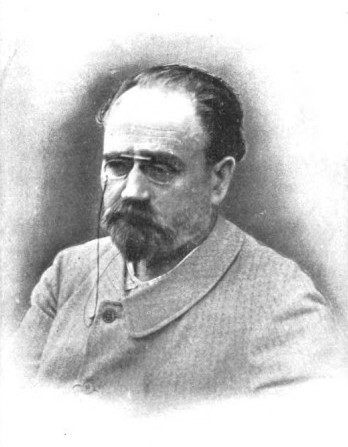
Émile Zola, Sept. 1898—Photo by V. R. Vizetelly.
Thus on July 18, at Versailles, Maître Labori raised a fresh demurrer, claiming that as a court-martial was not a civil personality holding property it could not sue. This being disallowed, an application for leave to prove the whole of Zola's "J'Accuse" instead of merely the three indicted lines was submitted. Again came an adverse ruling, whereupon Zola, Perrenx, and their counsel quitted the court, allowing judgment to go by default.
There was some commotion, but as soon as the novelist and Maître Labori had entered their carriage, a squadron of cavalry swept down on the crowd, and this enabling the vehicle to escape, its occupants were driven to the residence of M. Charpentier, Zola's friend and former publisher, in the Avenue du Bois de Boulogne, Paris. There, Madame Zola and M. Clemenceau being present, a council of war was held. It was shown that Zola must not remain in France, for if the sentence by default were signified to him personally he would have to enter an appearance against it within a few days, and would not be entitled to make default a second time. In order to keep the Affair open he must avoid service for a while, which was only to be done by quitting France. He consented to that course, and London was chosen as his destination.[27] A few toilet articles were pressed upon him, and his wife emptied her purse into his; then, after dining, he drove to the Northern Railway Station, where he caught the express starting for Calais at nine P. M. He secured a compartment which had no other occupant, and journeyed to London without mishap, putting up at the Grosvenor Hotel, which M. Clemenceau had recommended to him.[28] The same day (July 19) he posted the following note to Ernest Vizetelly at Merton:
"Tell nobody in the world, and particularly no newspaper, that I am in London. And oblige me by coming to see me to-morrow, Wednesday, at Grosvenor Hotel. You will ask for M. Pascal And, above all, absolute silence, for the most serious interests are at stake."
Vizetelly kept the appointment, and found Zola with M. Desmoulin and M. Bernard Lazare, who had followed him to London. The last named returned to Paris immediately, but M. Desmoulin, who spoke a little English, remained with his friend for about a fortnight. The first question that arose was whether the English law would afford any facilities for the service of the sentence on Zola, and Vizetelly therefore fetched a legal friend, Mr. F. W. Wareham,[29] with whom a consultation was held at the Grosvenor Hotel Mr. Wareham had already dealt indirectly with the Dreyfus case at a time when a mysterious adventurer had proposed to Vizetelly to fit out a ship at Bristol, and attempt (à la Captain Kettle) to rescue the prisoner from Devil's Island. Vizetelly had then had some reason to doubt the bona fides of the proposer of the scheme, who, it had seemed to him, might be an emissary of Dreyfus's enemies, anxious to inveigle Zola through his English representative into some illegal action which might ruin the cause. And indeed, after being subjected to a severe examination, the man vanished, as Hans Breitman would have said, into the Ewigkeit.
At the consultation with Mr. Wareham it was found that, quite apart from the English laws, the French authorities claimed the right to serve process on their own subjects all the world over; and it therefore seemed best to remove Zola from London immediately, particularly as that very day he had been recognised by an English lady in the Buckingham Palace Road,[30] besides which some suspicion seemed to have been roused at the Grosvenor Hotel. Finally Mr. Wareham, whose services at this time were of great value, offered his own house, 1 Prince's Road, Wimbledon, as a provisional retreat. Zola's stay there was brief, however, for Wimbledon soon seemed to be too populous a place and too near both to London and to Merton, where Vizetelly resided, for it was virtually a certainty that the latter would soon be besieged by journalists eager to know what had become of Zola. His disappearance from France had created an extraordinary sensation. His presence was reported now in Switzerland, now in Norway, now in Holland, now in Belgium, now in other parts of the world, but at last some English newspapers found the right track, which they were good enough to follow no farther than the Oatlands Park Hotel, near Weybridge, whither Zola and his friend Desmoulin were removed on quitting Wimbledon.
Through the agency of Mr. Wareham, a furnished country-house was next secured for the novelist, this being Penn, Oatlands Chase, the residence of Mr. E. G. Venables, and it was there that Zola settled down to write his novel "Fécondité," the first volume of his new series, "Les Quatre Évangiles," which he had been quietly planning amid all the turmoil of the Dreyfus Affair,—a positive proof of the superiority of his mind, for not one man in a hundred would have had the courage, the coolness, or the power to take up a great literary task and isolate himself in study at every available moment in such extraordinary circumstances as those in which Zola had found himself,—insulted, befouled, and condemned. He had now also been suspended from the Legion of Honour, he had sacrificed large sums of money, and his prospects were by no means bright. He could only hope that time might elicit the truth and bring about a revulsion of feeling in his favour. Meanwhile, he turned to his usual panacea, work, diverted his mind as far as possible from the great campaign, which he knew would be conducted ably by all his fellow-fighters in Paris, and began to pen his book on the causes of the depopulation of France.
M. Desmoulin went to Paris to fetch the materials for "Fécondité"; servants were engaged and other arrangements made by Mrs. Vizetelly; and her daughter, Violette,—a Parisienne by birth, whose first words had been lisped in French,—went to live with Zola to act as his interpreter, and so far as her youthfulness permitted, take charge of housekeeping matters. A bicycle was provided for Zola, and when he was not writing or reading he and his young ward pedalled through the country around Walton and Weybridge. On those occasions Zola made frequent use of a camera which M. Desmoulin had brought from France, and the writer holds a large collection of photographs taken by him,—little views of villages, commons, farms, churches, reaches of the Thames, glimpses of the Wye, Windsor Castle, the Crystal Palace, and so forth.
Eventually, to give him some solace amid his loneliness, it was arranged that the little boy and girl to whom reference has been made in a previous chapter should be brought to England and stay with him for a short time. Madame Zola also managed to travel backward and forward on various occasions. When the tenancy at Penn expired, another house called "Summerfield," with large secluded grounds, on Spinney Hill at Addlestone, was secured for Zola. Here, still writing "Fécondité," he remained until late in the autumn of 1898. M. Charpentier was for a few days a visitor; an excursion was made to Windsor and a few other places; but the novelist's life would have been not only very retired but also quite peaceful if it had not been for the acute emotion into which he was thrown, the shocks he experienced every now and then, as the result of some important news from Paris. The friends who wished to communicate with him had to forward their letters to Mr. Wareham, Zola's actual address being known only to the latter, the Vizetellys, M. Charpentier, and a Wimbledon gentleman, Mr. A. W Pamplin, whose services had been required. The "master," as one often called him, assumed at that time a variety of names which were suggested by Vizetelly,—the latter objecting to "Pascal," the first Zola had taken, for it might have proved a guide to any French process-server acquainted with "Le Docteur Pascal," the novelist's well-known book. Vizetelly therefore proposed some names which would not attract much attention and might pass as being either English or French. At Oatlands Park and Penn, therefore, Zola was known as Beauchamp; at Summerfield as Roger (akin to Rogers); and at the Queen's Hotel, Norwood, whither he ultimately removed, as Richard, which suggested Richards. Vizetelly was in constant communication with him and frequently at Penn and Summerfield. At other times hardly a day passed without an exchange of notes, mostly, however, on trivial little matters connected with Zola's requirements,—his bicycle, his photographs, the books he wanted, a supply of manuscript paper, some passing trouble with a servant, the difficulty of getting fish, or the replies to be given to journalists or others. Here is a rather more interesting note which Zola wrote on July 29, when he was moving from the Oatlands Park Hotel, where he had attracted some little attention:
I am worried that I cannot occupy Penn until Monday, for I feel that my stay here without Madame Beauchamp,[31] whose arrival I announced, is beginning to seem strange. However it is necessary to accept the situation. To throw people off the scent this is what we must do. Let me be fetched on Monday between two and three in the afternoon with one of the conveyances at the station [Walton-on-Thames], not one belonging to the hotel. The vehicle can wait while I pay my bill, and afterwards we can all drive to the station as if I were going to London. At the station you will have left the trunk which will then certainly have arrived from Paris at Wareham's house or yours. On reaching the station from the hotel, one can claim the valise, wait awhile, then take another conveyance and drive to the house [Penn]. For my part I will not get into that second conveyance, I will go to the house on foot. I think that will be the wisest course.
On the other hand, we shall have to tell a little tale here. For instance, you might say that as Madame Beauchamp is detained in France beside a sick relative for a longer time than I anticipated and I feel very much bored alone [M. Desmoulin had gone to France], I am going back to London to stay with some friends till she arrives. And you might add that if we wish to come back and spend a month here, we will warn them by letter, inquiring if they have a suitable room. When you come you might bring me forty postage stamps for France and ten for London. Again thanks for your devotion, and very cordially yours.
EM. BEAUCHAMP.
If you read any serious news from France in the newspapers, let me know at once—Desmoulin has arrived at this very moment with the trunk. I shall be better able to wait now that my friend is here.
Among other notes of about the same date are the following:
My dear Confrère—What French books have you? Can you lend me La Bruyère's "Caractères" and Stendhal's "Chartreuse de Parme"—not his "Rouge et Noir"?
I have received the books, and thank you infiniment, for they helped me to spend a good day yesterday. I shall expect you to-morrow at six o'clock, and we will take a decision about the house. My homage to Madame Vizetelly. Affectionately yours.[32]
My dear Confrère,—Please let me have six boxes of photographic plates similar to the others. Can you lend me "Les Chouans," "César Birotteau," "La Recherche de l'Absolu," "Les Illusions perdues," by Balzac. If not, please buy them—the edition at 1 fr. 25 c.
In addition to books, Zola was of course kept well supplied with newspapers, both French and English. Vizetelly procured him an English grammar for French students and other works, and with this help he picked up sufficient knowledge of the English language to understand the news telegraphed from Paris about the Dreyfus case. In all such news he naturally took the keenest interest. On August 31 Vizetelly received from Paris a telegram to be transmitted to him,—a telegram to this effect: "Be prepared for a great success." It greatly puzzled Zola when it reached him, for there was nothing in the newspapers he had seen to which it could refer. However, a score of possibilities in connection with the Dreyfus case immediately occurred to him, and he spoke of them in presence of Vizetelly's daughter, passing from one surmise to another and becoming quite feverish as his impatience to know the meaning of the mysterious "wire" increased. His young companion was undoubtedly upset by his strange excitement, which gained on her also, in such wise that she passed a very restless night, beset repeatedly by a dream in which she fancied herself in some strange, big, dark place where a man lay on the ground surrounded by people who raised numerous exclamations in the French language. In the midst of it all, moreover, she saw Zola waving his arms and looking well satisfied. He, on the following morning, having heard her calling in her sleep, spoke to her of it with some concern, and she then told him of her dream, of which at first he could make neither head nor tail. But shortly afterwards, when the newspapers arrived, he found in them an account of the arrest and confession of Colonel Henry, the forger, followed by a brief telegram "Paris, Midnight. Colonel Henry has been found dead in his cell at Mont Valérien."
The telegram which Vizetelly had transmitted to him was then explained: it had certainly referred to Henry's arrest and confession. As for the announcement of the colonel's death following the story of Violette Vizetelly's curious dream, one can only say that this may have been merely a coincidence, though Zola and others were certainly impressed by it. When the writer related the incident in a previous work,[33] in a more detailed manner than he has done here, some critics declared that he taxed their credulity, particularly as he was unwilling to allow the case to be tested. But he must adhere to what he stated then. If he deprecated investigation it was solely because, as a parent, he did not wish to perturb or to encourage any morbidity of mind in a curiously impressionable girl of sixteen, on whose account, and in much the same connection, he had previously experienced some anxiety, which later years have happily dispelled.
After Henry's death Zola was in hopes of soon returning to France, but his friends urged him to remain where he was, for his name was still like a torch which might rekindle the conflagration. Moreover, as the revision of the Dreyfus case was delayed for some weeks longer, Zola again began to feel anxious. Important incidents were certainly occurring in France. Scarcely had General Zurlinden replaced M. Cavaignac as War Minister when Esterhazy took to flight, anticipating, no doubt, the important communications respecting certain forgeries in the Dreyfus case which Colonel Picquart made to the Minister of Justice a few days later. At last, on Sunday, September 15, some indication of what was about to occur in Paris appeared in a few of the London papers which Vizetelly sent to Zola, who replied:
"Thank you for sending the papers by René.[34] Details are wanting evidently; but, to my mind, the report is decisive, revision is certain. It is now only necessary to have patience,—patience which will perhaps have to be of some duration.... I am rather poorly to-day, it is one of those nervous crises which torture me whenever I work too much or when I have undergone too great a shock."
Two days later General Zurlinden, who had stubbornly opposed revision at the Council of Ministers, resigned the office of War Minister (in which he was succeeded by General Chanoine) and resumed the duties of Military Governor of Paris; in which capacity, to revenge himself for the recent disclosures of Colonel Picquart, he cast the latter into a military prison. Then, on September 23, a process-server appeared at Zola's house to levy execution in virtue of the judgment obtained by the handwriting experts.[35] All those incidents—and also the Fashoda trouble, which if it had ended badly would have compelled Zola to leave England—affected the novelist's health, but he fretted more particularly on account of the ailing state of a pet dog,—a toy Pomeranian named the Chevalier de Perlinpinpin, but familiarly called Pinpin only—which he had been obliged to leave in Paris, foreign dogs not being admitted into England. Madame Zola was then in Paris in charge of the little animal and did everything possible for it, but it pined for its master, whose constant companion it had been, on whose writing-table and in whose wastepaper basket it had been for years accustomed to lie.
Zola was passionately attached to his dogs and other animals, as his writings testify;[36] and when he learnt the truth about Pinpin, which was kept from him for a time, he grieved exceedingly and became quite ill, experiencing an attack of the angina from which he suffered periodically. As he would not see a doctor some medicine he was accustomed to take in such cases was obtained from France. But more than once Vizetelly became alarmed respecting him, for the stifling fits left him quite exhausted. "I shall die like this some day," he said more than once, "but it is useless to get a doctor. There is nothing to be done beyond what I do."
Thus, still and ever, he fretted about his dog, particularly if a day or two passed without the receipt of a letter or a telegram respecting its condition. On or about September 26 Vizetelly went to him with the important news that M. Brisson had at last referred the revision of the Dreyfus case to the Cour de Cassation. Such tidings seemed likely to cheer him; but directly he caught sight of Vizetelly he exclaimed, "A telegram! About Pinpin?" And when Vizetelly answered no, his face fell, and scarcely listening to the good news he sank back on the sofa, muttering, "Ah! if it had only been about my poor dog!" A few days later he learnt that Pinpin was dead. Then for a moment he remained grieving piteously. But all at once, shaking his fist, he shouted, "The scoundrels! it was they who killed him!"—referring of course to the anti-Dreyfusites.
But it was only suspense that unnerved Zola either with regard to the episodes of the Affair or in connection with his dog. Confronted by the inevitable in the case of Pinpin, he braced himself and began to mend. Soon afterwards (October 10), an execution having been duly levied at his house in the Rue de Bruxelles, a sale took place there. In the throng which then assembled were many admirers who hoped to be able to purchase souvenirs. But Zola had previously arranged that whatever might be the article first offered for sale, M. Fasquelle, his publisher, should bid the full amount of the execution. This was done; the auctioneer put up a Louis XIII table and M. Fasquelle bid thirty-two thousand francs[37] for it, at which price it became nominally his property. The sale was then finished, and the would-be buyers of souvenirs retired disappointed.
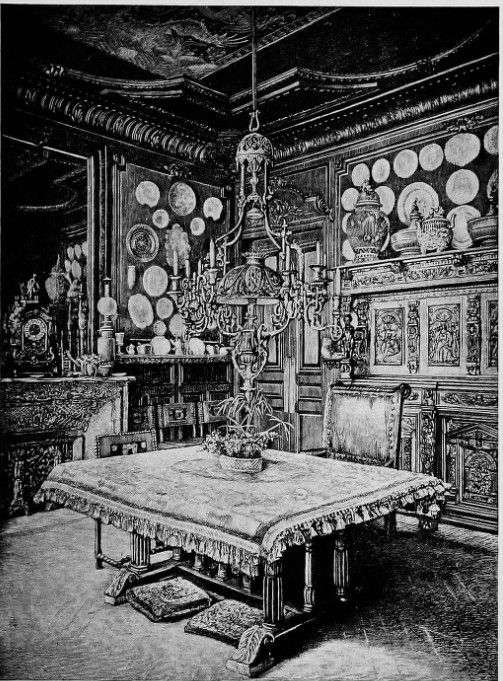
Zola's Dining-Room
Late in October, when the Cour de Cassation, accepting the question of revision in principle, began its famous inquiry, and when M. Brisson fell from office to be succeeded by M. Dupuy, Zola was removed from Addlestone[38] to the Queen's Hotel, Upper Norwood, where he remained till the end of his stay in England. He was still writing "Fécondité," to which he devoted all his mornings; and occupying a small suite of rooms in one of the pavilions of the hotel, taking his meals in private and holding no intercourse with his neighbours, his loneliness increased, though Norwood around him was teeming with life. At intervals, however, he now received a few visits from friends. The first who came was M. Yves Guyot, who had championed the cause of Dreyfus in "Le Siècle," which he directed, from the outset. With him was an English friend, Mr. J. H. Levy, of the Personal Rights' Association. Later came M. Jaurès, the famous French Socialist leader, another champion of the good cause; later still, Zola's old friend, M. Théodore Duret, the historian of the early years of the Third Republic. M. Fasquelle and M. Octave Mirbeau also saw the novelist at this time; and about Easter, 1899, Maître Labori paid a flying visit to England to consult him. There was one American visitor, Mr. Brett of the New York Macmillan Company, and a few English ones: Mr. George Moore, Mr. Lucien Wolf, Mr. Chatto and his partner, Mr. Percy Spalding. But those visits, besides being brief, were spread over a period of seven or eight months. Madame Zola certainly joined her husband for some part of the time, but the travelling, and more particularly the English climate, tried her health exceedingly, and for some weeks she was laid up. For the rest, the Vizetellys and the Warehams were frequently at Norwood, and there was still no little correspondence between the novelist and his translator. Here are a couple of notes written by Zola early in 1899:
January 3, '99.
My dear Confrère and Friend,—I have just telegraphed to you that the whole story about an English journalist having interviewed me is purely and simply a lie. I have seen nobody. Besides, there can be no question of extraditing me: they could only serve me with the judgment of the Assize Court. Those people don't even know what they write about. As for ——'s indiscretion, this is much to be regretted. I am writing to him. For the sake of our communications I have always desired that Wareham's name and address should be known only to those on whom one can depend. Tell Wareham to remain on his guard and never acknowledge that he knows my address.[39] Persevere in that course yourself. That will suffice for the moment. I will wait a few days to see if anything occurs, before deciding whether the correspondence arrangements should be altered. It would be a big affair; and I should afterwards regret a change if it were to prove uncalled for. So I repeat, let us wait.
Thursday, February 16, '99.
My dear Confrère,—You did right to refuse Mr. —— my address. I absolutely decline to see anybody. Whoever may call on you, under whatever pretext, show him the door and preserve the silence of the tomb. Less than ever am I in a humour to let people disturb me! As for Mr. Chatto and his partner, as you and they know, I shall be delighted to see them; but as you are also aware, my wife is at this moment very poorly indeed, and I am in a very low state myself. We should be sorry hosts, so kindly ask our friends to postpone the visit till a little later. Our amitiés to you and yours. Z.
On the day the second of the above letters was written, President Félix Faure died suddenly and under what seemed to be suspicious circumstances. It is probable that his seizure was caused by the shock he had experienced a few hours previously when certain revelations made to him by a foreign visitor of princely rank had dispelled his confidence in some of the prominent military men whom he had so long trusted and supported. The news naturally filled Zola with anxiety, for the future course of events might largely depend on the character of M. Faure's successor. Fortunately the choice of the French Congress fell on M. Émile Loubet, then President of the Senate. Other important incidents—M. Déroulède's attempt at a coup d'état, the transference of the revision of the Dreyfus case from the Criminal Chamber of the Cour de Cassation to the entire body—kept Zola in a nervous state throughout February and March. His birthday fell on April 2, and Vizetelly, finding it impossible to be with him on that occasion, wrote him a note to which he replied as follows:
My dear Confrère and Friend,—Thanks for your good wishes on the occasion of the anniversary of my birth. I feel deeply touched by them in the state of sorrowful emotion in which I am. You write me some very good and true things which go straight to my heart. And I thank you to-day for the devotion and the discreet attention which you have never ceased to show me since the day when I set foot on this land of exile. I shall expect you the day you please to select, and with kind remembrances to your family, I cordially press your hand.
ÉMILE ZOLA.
As the time for the decision of the Cour de Cassation drew near, the novelist became more and more restless. He finished "Fécondité" in May, and on the twenty-seventh of that month decided that whatever might be the judgment of the court, he would return to France directly it was given. Everything pointed to a favourable issue, and in that anticipation he drafted a declaration which he proposed to issue in "L'Aurore" on his arrival in Paris. On the evening of June 3 he received a telegram worded, "Cheque postponed," which, in accordance with previous arrangements, signified that revision had been granted and that Dreyfus would have to appear before a new court-martial. Had the words been "Cheque unpaid," they would have meant "Revision refused," while "Cheque paid" would have signified not only that revision was accorded but that Dreyfus would not even be tried afresh. For a long time previously Zola had been receiving similar telegrams which, in accordance with a plan devised by him, were full of hidden meaning.
M. Fasquelle and his wife were then in London, and it was speedily arranged that Zola, who was now in high spirits, should return to France with them on the following night, Sunday, June 4. This he did, quitting England without regret since he was going home; though he repeatedly acknowledged that everything possible had been done for his comfort, and that he had seen a great deal that interested him keenly. He appreciated the wonderful change which seemed to have come over the English press with respect to himself, and he was grateful also to the various persons who had recognised him and preserved discretion.[40]
About the hour when he reached Paris on the morning of June 5, "L'Aurore" appeared with his declaration "Justice!" a translation of which was issued the same day in "The Westminster Gazette."[41] After recalling under what circumstances he had been obliged to leave France, mentioning how he had been threatened and insulted and how cruelly he had suffered both before and during his exile, Zola reviewed the many developments of the Dreyfus case. And he continued:
"Now, as truth has been made manifest and justice has been granted, I return. I desire to do so as quietly as possible, in the serenity of victory, without giving any occasion for public disturbances. Those treat me unworthily who would confound me with the base folk who batten on public demonstrations. Even as I remained quiet abroad, so shall I resume my seat at the national hearth like a peaceful citizen who wishes to disturb none, but only desires to resume his usual work without giving people any occasion to occupy themselves further about him."
He disclaimed, he said, all reward or applause, for no merit attached to what he had done. The cause was so beautiful, so human. Truth had conquered, and it could not have been otherwise. Then he added:
"Moreover, my reward I have it already; it is that of thinking of the innocent man whom I have helped to extricate from the living tomb in which he had been plunged in agony for four long years. Ah! I confess that the idea of his return, the thought of seeing him free and of pressing his hands in mine, overwhelms me with extraordinary emotion, fills my eyes with happy tears! That moment will suffice to repay me for all my worries. My friends and I will have done a good deed for which every good heart in France will remember us gratefully. And what more could one desire?—a family that will love us, a wife and children who will bless us, a man who will owe it to us that in him has become embodied the triumph of equity and human solidarity."
Afterwards, referring to "J'Accuse," he said:
"Do people remember the abominable clamour which greeted my Letter to the President of the Republic? I was the insulter of the Army, a man who had sold himself, a man without fatherland! Literary friends, in their consternation and fright, drew away from me, abandoned me to the horror of my crime. Articles were indeed written which will weigh heavily on the consciences of those who signed them. Never, it was urged, had the most brutal of writers, a madman full of sickly pride, dared to address a more insulting and more mendacious letter to the Chief of the State! And now just reperuse my poor letter. I have become a trifle ashamed of it—ashamed of its discretion, its opportunism, I will almost say its cowardice.... I had greatly softened things in it; I had even passed some by in silence,—some which are manifest to-day and acknowledged, but of which I then still wished to doubt. To tell the truth, yes, I already suspected Henry, but I had no proofs. So I thought it best to leave him out of the case. And I divined other matters, for confidential information had come to me unsolicited,—information so terrible that, fearing its frightful consequences, I did not think that I ought to make it public. Yet now those confidences have been revealed, have become commonplace truisms. And my poor letter is no longer up to date; it seems quite childish, a mere skit, the paltry invention of some timid novelist, by the side of the truth, so superb and fierce.... There was not an unnecessary word in it, there was nothing but the grief of a citizen respectfully soliciting justice of the Chief of his country. But such has been the everlasting history of my writings—I have never been able to pen a book, a page even, without being covered with falsehood and insult, though on the morrow my assailants have been constrained to admit that I was in the right."
After indicating that he personally harboured no anger or rancour against anybody, Zola pointed out that, in the public interest, some example ought to be made of the wrong-doers, for otherwise the masses would never believe in the immensity of the crime. "But," said he, "I leave to Nemesis the task of completing her work. I shall not aid her." Then came an impassioned appeal on behalf of the noble and persecuted Colonel Picquart, for the good work would only be complete when justice had been done him. And Zola continued:
"All former political parties have now collapsed, and there remain but two camps,—that of the reactionary forces of the past, and that of the men bent on inquiry, truth, and uprightness, who are marching towards the future. That order of battle alone is logical; it must be retained in order that to-morrow may be ours. To work, then! By pen, by speech, and by action! To work for progress and deliverance! 'Twill be the completion of the task of 1789, a pacific revolution in mind and in heart, the democracy welded together, freed from evil passions, based at last on the just law of labour which will permit an equitable apportionment of wealth. Thenceforward France a free country, France a dispenser of justice, the harbinger of the equitable society of the coming century, will once more find herself a sovereign among the nations. And there exists no empire, however cased in mail it be, but will crumble when France shall have given justice to the world even as she has already given it liberty. I believe in no other historical rôle for her henceforward; never yet will she have known such a splendour of glory."
The conclusion followed:
"I am at home. The Public Prosecutor may therefore signify to me, whenever he pleases, the sentence of the Versailles Assizes condemning me by default to a year's imprisonment and three thousand francs fine. And we shall once more find ourselves before a jury. In provoking a prosecution I only desired truth and justice. To-day they are here. My case can now serve no useful purpose; it no longer even interests me. Justice simply has to say whether it be a crime to desire truth."[42]
Unfortunately subsequent events confirmed only some of Zola's generous anticipations. M. Dupuy fell from power on June 12, M. Waldeck-Rousseau succeeded him on the 22d, Dreyfus landed in France on July 1, and the new court-martial on him assembled at Rennes on August 8. His partisans were at first full of hope, but various incidents supervening (among others, a dastardly attempt to assassinate Maître Labori), no little anxiety returned. Zola had remained in seclusion at Médan,[43] glancing at the final proofs of "Fécondité," which was appearing serially in "L'Aurore," and thinking of his next work, "Travail." Meantime Vizetelly was repeatedly solicited by English editors to induce him to write something about the court-martial, but he was unwilling to do so for any foreign newspapers, and besides, as he put it, it was neither right nor possible to say anything until the verdict was given. He communicated with Vizetelly several times on these matters, on one occasion sending a card on which, in spite of all the bad rumours, he indicated his confidence in the result of the proceedings: "My dear friend," he said, "I will say nothing, and I beg you to say nothing in my name. One must wait firmly for victory."[44]
On September 9, however, the unfortunate Dreyfus was once more found guilty of the crime he had never committed. Zola, still at Médan, was profoundly shocked and horrified by the verdict, and again he published a declaration, "Le Cinquième Acte,"[45] in which he expressed his fear that the truth might fall on France from Germany in a manner which might have the most terrible consequences. The result of the trial certainly caused amazement all the world over. In Great Britain the indignation was extreme, and a proposal to boycott the Exhibition which was to be held in Paris in 1900 was agitated by several newspapers. Vizetelly was appealed to by some who felt that Zola might be able to quiet the outcry, and an offer of two shillings a word for an article which might run to ten thousand words, was made to him by the editor of a London newspaper. But even this proposal was declined by Zola, who wrote to Vizetelly on September 14:
My dear Confrère and Friend,—I do not take payment in France for my articles on the Dreyfus case, and still less would I accept money from a foreign newspaper. As for intervening between France and the world, I will not and cannot do so, for all sorts of reasons. Besides, in spite of the gravity of the symptoms, I do not believe that our Exhibition is seriously threatened. I still wish to believe that France will do what may be necessary to be in a position of dignity next May when she will receive her guests. All this between ourselves, this letter is absolutely for you alone. You would cause me the greatest grief by the slightest indiscretion.... Thanks for the English newspapers you have sent. I have just read them with keen interest. But all that does not frighten me much.[46]
Five days later the unhappy Dreyfus accepted the pardon offered him by President Loubet, and Zola then addressed a beautiful, pathetic letter to the poor martyr's wife, in which he gave her the assurance that his friends and himself would continue the battle until both her husband and France should be fully rehabilitated.[47]
In October "Fécondité" was published as a volume, and dealing as it did with a problem of national importance, the decline in the birth-rate and the massacre of infantile life in France, it attracted widespread attention. It was a very outspoken book, but a necessary one, and its exposure of the vices of married life was one to be applied to other countries besides France. But Vizetelly, who remembered the past and knew that Pecksniffs and Podsnaps still flourished in England, felt that the national cant would not suffer a plain statement of the truth. Some difficulty occurred therefore with respect to the translation of "Fécondité," the English version of which had to be considerably curtailed. In France the sale of the original work was assisted by the fact that after all the abominations of the Affair a certain number of Zola's former admirers were now gradually returning to him.[48]
His remaining share in the Dreyfus case may be dealt with briefly. The victim was at last free, restored to his wife and children; and thus a great part of Zola's object had been achieved. The charge against the novelist of having libelled the Esterhazy court-martial still had to be considered, but his trial was repeatedly postponed in consequence of the government bringing an Amnesty Bill before the legislature. Zola repeatedly protested against the measure, addressing long letters to both the Senate and President Loubet on the subject.[49] He did not wish to be amnestied but judged, and he thought it abominable that the same law should be applied to him and other defenders of the truth as to all the evil-doers who had persecuted Dreyfus, screened the scoundrel Esterhazy, and made use of every possible lie, forgery, and fraud, in order to obscure the truth, deceive the nation, and prevent justice from being done. But Zola's protests, whether by letter or by word of mouth, before the Senatorial Committee, which received him on March 14, 1900, were of no more avail than those of Dreyfus himself, M. Joseph Reinach, and Colonel Picquart. In point of fact M. Waldeck-Rousseau, the Prime Minister, was most concerned about the Clericalist peril behind the Affair,—the strenuous efforts which bishops, priests, and particularly religious orders had been making to capture France. They had used the Dreyfus case as a weapon; under their secret direction it had proved indeed a powerful one, and in M. Waldeck-Rousseau's opinion, before all else, it was necessary to deprive them of it. For that purpose he devised the Amnesty in the hope that he would thereby kill the Affair, put it out of the way, before dealing with the religious orders. The right course would have been to proceed against the compromised members of the General Staff, but after the Rennes verdict M. Waldeck-Rousseau had not the courage to do so. Besides, in that matter he was largely in the hands of his own War Minister, General de Galliffet. France was committed to the Amnesty long before General André arose to enforce obedience in the higher ranks of the army. And thus for political reasons a crowning iniquity was perpetrated. Impunity was assured to the Merciers, the Boisdeffres, the Billots, and all the others. At the most they lost their military positions. Every criminal action in the Affair was stopped and prohibited by the Amnesty Bill, which became law in November, 1900. The privileges of parties in civil actions were alone reserved, though at the same time Captain Dreyfus retained the right to apply for further revision and even rehabilitation whenever he might discover the necessary new facts. At that moment it was scarcely imagined in high places that he would do so. M. Waldeck-Rousseau, like many another before him, fancied that he had indeed killed the Affair; but at the time of writing these lines it is once more before the Cour de Cassation.
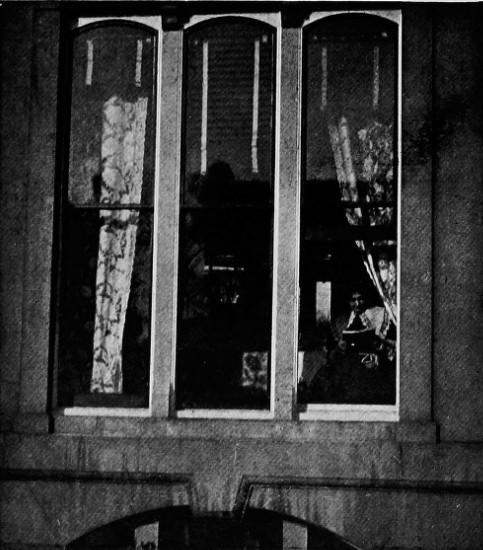
Mme. Zola at the Queen's Hotel, Upper Norwood January, 1899.—Photo by Émile Zola.
It should be added that, prior to the Amnesty, Zola had been acquitted of the charge of traducing Judet of "Le Petit Journal," who had so foully attacked his father's memory; and had moreover secured a judgment condemning the unprincipled journalist to pay him five thousand francs' damages. Judet, however, carried the case to the Appeal Court, and it long remained in abeyance. Finally, in a letter addressed to Maître Labori on March 7, 1901, Zola renounced all further action in this case as well as in one instituted against the handwriting experts for the purpose of setting aside the judgment by which they had levied an execution on the novelist's furniture. "Let them keep the money, let them go off with their pockets full," wrote Zola; "the bitter irony of it all will be the greater, and there will be yet a little more baseness in the Affair." For his part he did not wish that the great battle in a high and noble cause should end in sordid squabbles about sums of money. Though it was said that the Amnesty effaced everything, the Public Prosecution Office had retained the fines and costs levied upon him, and this, again, he regarded as monstrous; but he repeated that he did not wish to drag the cause through petty proceedings based on personal interest. The truth would not come from them, though assuredly it would come eventually.
That Zola spent a large amount of money in connection with the Dreyfus case is certain; for besides the costs of all the legal proceedings (criminal and civil) against him, which remained heavy notwithstanding the disinterestedness of Maître Labori, he often contributed considerable sums for objects connected with the cause. Moreover, although both "Paris" and "Fécondité" sold fairly well, thanks to the foreign demand, a very great drop occurred in the circulation of the novelist's earlier works, for which there had been a steady sale in previous years. It may be estimated that in 1897 Zola's income was between seven and eight thousand pounds. In 1898, the year of "J'Accuse," it was not more than a third of that figure. He sold the serial rights of "Fécondité" to "L'Aurore" for about half the amount he had been receiving for his works from other journals previous to the Affair; and it was not published as a volume till late in 1899, in which year also his income remained a low one. Indeed, it never rose again to its former figure. His book "Travail," of which something will be said in our next chapter, was only a demi-succès from the pecuniary standpoint. And as all this was, in the main, the result of his participation in the Dreyfus case, it will be seen that he made no small sacrifices for the cause he championed.
He found a sufficient reward, he said, in a quieter conscience, in the knowledge that he had done his duty as a man. Sympathy came to him, as one has mentioned, from many a foreign land, and of course he was not without sympathisers in France, his fellow-fighters of that bataillon sacré which by degrees became a small army. Subsequent to his condemnation in Paris in 1898, the newly founded Ligue des Droits de l'Homme, which was destined to recruit many soldiers for the good cause, opened, in conjunction with the newspapers which supported it, a subscription for a medal to be offered to Zola in recognition of his courage. In a few days over ten thousand francs were collected, and a superb gold medal, bearing the effigy of the novelist designed by M. Alexandre Charpentier, and by its size, weight, and the quality of the metal unique in numismatics, was struck.[50] Zola however, was long unwilling to accept it, for victory was not yet won. At last, some time after Dreyfus was pardoned, he consented to do so; and the presentation took place at the offices of "Le Siècle," whose editor, M. Yves Guyot, was president of the subscription committee. Besides the Dreyfus family, Colonel Picquart, and the Laboris, many others who had fought the good fight were present; and in response to M. Guyot's address, Zola pronounced a short and feeling speech, towards the close of which he said: "Undoubtedly, if the question had only been one of saving an innocent man from his torturers, of restoring Dreyfus to his wife and children, our victory would be complete. The whole world holds him to be a martyr, his legal rehabilitation will soon follow—all that frightful story is surely ended! But there was another dear to us, one who was poisoned, in peril of death, and that dear and great and noble one was France. We dreamt of seeing her freed from ancient servitude, rising, with her artisans, her savants, her thinkers, to a new ideal, reconquering old Europe, not indeed by arms but by the ideas that liberate. Never had there occurred such an opportunity to give her a sound practical lesson, for we had set our hands upon the very rottenness that was eating into the cracking, decaying edifice, and we thought if we pointed it out that would be sufficient, that the house would be cleansed, rebuilt, properly and substantially. But in that respect we have been beaten. They have decided merely to pass a sponge over the rottenness, so that the timbers will continue to crack and decay till the house at last comes down. For that reason I am sad, for that reason I cannot sing victory. Dreyfus is free, but our France remains ill, feeling that she has not strength enough to bear the splendour of truth and justice. And yet I am hopeful, for I believe in her labour, in the power of her genius. A somewhat long period would have elapsed, perhaps, had I decided to await her complete recovery before accepting the medal which has been laid aside for so many months in the expectation of a beautiful dawn. So I accept it now with emotion and with gratitude. And I hope that I shall not die before I see, reflected in its pure gold, that rising dawn of supreme national glory which we have all desired."
XIV
LAST YEARS—DEATH
1901-1902
Zola's attempts at constructive writing—His evolution toward Socialism—Some further remarks on "Fécondité"—"Travail" and the pacific evolution of the working classes—Zola and the tastes of his readers—Publication of "Travail"—"L'Ouragan"—Zola's difficulties with "Vérité"—He is haunted by the Dreyfus case—He adapts it to "Vérité"—His evolution in religious matters—His Positivism—His opinion of the French Protestants—His last days—Announcement of his death—Account and cause of it—The autopsy—Madame Zola's illness—Reception of the news in France and abroad—Insults and tributes of sympathy—Preparations for the funeral—The question of military honours—Difficulties with Captain Dreyfus—The obsequies—A great demonstration—The speeches at the graveside—M. Anatole France's stirring oration.
Until Zola began his last series, "Les Quatre Évangiles," he had been, virtually all his life, a writer of the so-called destructive school, that is to say he had directed attention to an infinity of things which in his opinion ought to be swept away, but he had said little indeed of what he would set in their place. In like manner, within narrower limits, Charles Dickens and Charles Reade had exposed abuses without indicating remedies. Zola for his part long held that remedial measures were not of his province. It was for the legislator to devise them, and there was no call for the author to go beyond an exposé of the abuses which required redress. Time and circumstances gradually modified that view, and in his last years, while persevering in his destructive work, Zola made some attempt to couple re-construction with it. A suggestion of what was coming appeared already in the pages of his novel, "Paris," which concluded the trilogy of "Les Trois Villes." In that series he had shown Faith expiring, Hope a delusion, Charity a mockery, but at the same time he had felt that if those guiding principles were to be discarded, they must be replaced by others,—Fruitfulness, Work, Truth, and Justice.
The scheme was of earlier date than the Dreyfus agitation, and no trace of the latter is to be found in "Fécondité," the first volume in which it was unfolded. But as Zola proceeded with his work he was naturally influenced by all he had experienced and witnessed during the turmoil. As will presently be seen, the Affair eventually invaded his pages, but apart from that matter it hastened an evolution of his mind. He had begun life as an Individualist, it was as an unattached Socialist that he ended it, and this would have happened, no doubt, whether there had been a Dreyfus case or not. Without the Affair, however, the evolution might have remained less definite, less complete. The Affair showed him that the existing social edifice was in some respects even more rotten than he had previously believed. There could be no doubt of it, the facts were manifest; and it followed that there was now less call for exposure than for remedial measures. As his opinions with regard to such measures differed largely from those of the men in power, the call upon him was all the greater. He therefore tried to indicate broadly on what lines reforms might proceed, and to sketch the future effect which such reforms might have on the community.
It has been said that in his last works his imagination failed him, that it was quite spent, and that he could no longer have produced a work of art had he tried. That theory is wrong, based on ignorance of what was then in Zola's mind. If he had lived long enough to write the novel on the "Rat de l'Opéra,"[1] of which he talked so often to the present writer, the world would have seen that the powers of the novelist were undiminished. But in the great crisis through which France was passing Zola held that for a time, at all events, his duty lay in other work.
"Fécondité," of which some mention was made in the previous chapter, treated a subject which had long haunted him—in a measure for personal reasons—but it was, of course, from the national standpoint that he dealt with it in his book. The question of the decline in the birth rate and the mortality among infants had not only occupied the attention of French sociologists and scientists for several years, but various novels based upon it had already been written—novels indicating that the whole tendency of the times was to transform matrimony into legalised prostitution, in accordance with certain specious neo-Malthusian theories. Zola rightly held that unless that tendency were checked there could be no social regeneration at all. Thus he placed the subject in question at the head of his series. While he was preparing "Fécondité" in England the present writer was often able to glance at the documents, medical works, reports, letters from eminent scientists, and so forth, on which the novelist based his account of the noxious practices prevalent in various strata of French society, and he holds that far from "Fécondité" being an exaggerated picture it did not represent more than two-thirds of the actual truth. On the other hand, when Zola proceeded to sketch the healthy life which ought to replace the existing one, enthusiasm led him further than was necessary, though, after all, he did not go beyond the provisions of the "marriage-books" which the French authorities hand to every bridegroom at the conclusion of the marriage ceremony—books beginning with a signed and stamped certificate of the union just celebrated and continuing with enough blank forms to register the birth of twelve children—the number which Zola bestowed on his hero and heroine, Mathieu and Marianne.
Fruitfulness, said he, created the home, whence sprang the city; and from the idea of citizenship that of the fatherland proceeded. There could be no nation unless there were fruitfulness, which became, then, a first national duty. The second was work, which Zola considered under various aspects in his next novel, "Travail." He held that every man ought to work for his own support and that of his family, and he also regarded work as a panacea for many ills. But he turned more particularly to the consideration of the circumstances under which work was done in the modern world, to the condition of the toilers generally, the great capital and labour problem. In that connection he was greatly influenced by the state of France at the time he wrote, the onward march of Socialism, the innumerable strikes, the complaints, the demands rising on all sides. He felt that matters could not remain as they were. But though he was in the higher sense a great fighter he was the adversary of mere brute force; and dreading an armed collision between the classes, he tried to devise, to suggest, a pacific remedial evolution.
As he was unwilling to imprison himself or anybody else within the narrow and stringent bonds of certain forms of Socialism, it was to the broader and more generous ideas of Charles Fourier that he finally inclined, striving to adapt them to the needs of a new century. It is certain that some of his suggestions remained nebulous, that several were not strictly practical, but it should be remembered that at the outset of "Les Quatre Évangiles" he had announced that the series would form a kind of "poem in prose, divided into four chants." It would be unfair to neglect that statement, for it shows he did not intend "Fécondité" and "Travail" to be taken as severely practical works. They partook, as one has said, of a constructive character—-as opposed to Zola's earlier and purely destructive writings—but they were not intended to be the final plans of an architect or an engineer, or the ultimate provisions of a new code. They were the roughest of sketches, so to say, suggestions which here and there might be found useful by those who might have to solve the problems which they reviewed. And it must be at least admitted that their tendency was good. In "Fécondité" it was most healthful; in "Travail" it was most pacific and calming, Zola's manifest intention being to quiet the angry passions of the hour, to direct Labour towards peaceable courses in its quest for the fulfilment of its aspirations.
Such books cannot be judged as one would judge ordinary novels. They were, to a certain point, drafted in the form of novels in order that they might reach the great majority; but Zola, with superb disdain, now cast many of the rules and conventions of novel-writing aside. After the publication of "Travail," Vizetelly sent him word that the English translation had been regarded less as a work of fiction than as a combination of sermon and pamphlet, to which the reviewers and the public did not seem to take very kindly. Zola replied under date of May 8, 1901:
"I have never consulted the tastes of the public, and I am too old nowadays to modify my work in order to please it. I am writing these books with a certain purpose before me, a purpose in which the question of form is of secondary importance. I have no intention of trying to amuse people or thrill them with excitement. I am merely placing certain problems before them, and suggesting in some respects certain solutions, showing what I hold to be wrong and what I think would be right. When I have finished these 'Évangiles,' when 'Vérité' and 'Justice' are written, it is quite possible that I shall write shorter and livelier books. Personally I should have everything to gain by doing so, but for the present I am fulfilling a duty which the state of my country imposes on me."
Most of "Travail" was written in 1900, in December of which year it began to appear in "L'Aurore." In April, 1901, it was published as a volume.[2] A little later in the same year, the virulence of the Dreyfus agitation having subsided and public attention being turned to the Assumptionists and other religious orders, in connection with M. Waldeck-Rousseau's Association Bill, the director of the Opéra Comique in Paris thought the moment favourable for the production of a one-act lyrical drama, entitled "L'Ouragan," the prose libretto of which, set to music by M. Bruneau, had been written by Zola some years previously. "L'Ouragan" was not a particularly ambitious work and the moderate success it achieved was perhaps all that could have been expected for it.
After the production of that piece Zola began to consider the subject of his next book, "Vérité," which gave him no little trouble. It seems likely that when he first planned his series he had thought of showing in this particular volume that scientific truth, and not the assertions, delusions, and errors of religious systems, should be taken as the guiding principle of life. But the Dreyfus case, which had intruded into a few pages of "Travail," haunted him. He knew that it had supplied one of the most shocking exhibitions of mendacity that the world had ever witnessed; and it followed that "Vérité" ought not merely to inculcate a belief in scientific truth. It also ought to recall people to the practice of truthfulness in their every-day life. Thus Zola's subject expanded. He had always intended to show the evil effects of the training given to children in certain so-called religious schools, where, according to his view, their minds were perverted, deprived of all self-reliance by the intrusion of the supernatural. But the Dreyfus case had shown him there was more than that. The mendacity so current throughout the period of the Affair had come almost entirely from men trained by the Roman Church. Moreover that Church's share in the Affair, its hostility and its intrigues against the Republic under cover of the anti-Semitic agitation, were now every day more apparent. Zola had repeatedly declared that he would write no novel on the Dreyfus case, for he did not wish anybody to say that he had earned a single sou, directly or indirectly, by the Affair. But it was ever beside him, with its influence, its revelations, its lessons. And it seemed to him fit that everybody should understand that in one way and another such turmoil, frenzy, and mendacity would never have been possible if it had not been for the Roman Church. The case haunting him more and more, he gradually yielded to the obsession, resolving, however, to cast the military men on one side, for after all they had only been agents, in some degree the victims of their training. In lieu of them he would depict those whom he regarded as the real culprits. It had been settled that the book should deal with school life; and it would be easy to adapt a kind of Dreyfus case to such surroundings. A Jewish schoolmaster might be substituted for a Jewish officer, while as for the crime which it would be necessary to impute to him, there had been a terrible affair at Lille, not long previously, the murder of a little boy, in which a certain Brother Flamidien—who was spirited away by his colleagues—had been implicated. Some such brother would represent Esterhazy in Zola's work, Dreyfus being represented by Simon, the Jewish schoolmaster.
That Zola repeatedly hesitated with respect to this pastiche of the Dreyfus case is certain. In the summer of 1901 he wrote to Vizetelly that he was preparing "Vérité," but that none of it would be ready for several months, for he was still doubtful whether he would introduce certain elements into the work or not. Finally, as the only means, perhaps, of relieving his mind, he took the plunge, resolving upon an adaptation of the Affair on the lines one has indicated. Yet he again paused more than once, as he mentioned in another letter. That was written on September 12, when he further stated that he would have nothing ready until the ensuing month of January, 1902, when he wrote to Vizetelly:
"Thanks for your good wishes for the New Year, and pray accept ours for yourself and all your family. I find I shall not have 'Vérité' ready for publication as a book until next October, and that the feuilleton will not begin to appear until the early days of June. As you would like to have a few chapters in advance, however, I think I may be able to send the first ones about the end of next month.... I wish you good health, good work, and am very cordially yours,
"ÉMILE ZOLA."
Again there came delays, perhaps, because for the purposes of his book Zola was following the campaign against the religious orders.[3] At all events the proofs of the first four chapters were not sent to Messrs. Chatto till July 10, on which date the novelist wrote to Vizetelly that the serial issue would begin in "L'Aurore" on September 10. About this time, July, Zola had completed the actual writing of the work, and revised the proofs of Book I, the first forty pages of which were as good as anything he had ever penned. But as the work proceeded its hybrid character became manifest. As the Affaire Flamidien had suggested itself to Zola's mind it would have been better if the criminal part of the work had been confined to it. The grafting of the Dreyfus case upon another one led to various difficulties in the narrative, and the very restraint which Zola imposed upon himself in his veiled account of the real Affair was prejudicial to the general effect. In the writer's opinion the best part of the work was that describing the conflict between the hero Marc and his wife, Geneviève, the former a free-thinker, the latter a product of Catholic training, who after forgetting her faith amid her love, remembered it when the question of training and educating her daughter arose.
In that connection it may be mentioned that while Zola was in England during the Dreyfus case, he and Vizetelly in their strolls together discussed such matters more than once. Vizetelly had occasion to mention incidents well within his knowledge, which showed what serious trouble sometimes supervened when husband and wife were not of the same belief. Those conversations were doubtless remembered by Zola while he was writing "Vérité," in which, however, he described a far more dramatic and more painful situation than had been sketched to him. Chats of that kind led to discussions on religion generally. Vizetelly having mentioned various changes which had come over him in matters of belief, Zola replied by recounting some of his own experiences. Baptised a Catholic, he had made his First Communion, and though it was not true that he had ever been a choir-boy he had walked in religious processions. But a little later, rejecting now one dogma and now another, he had gradually freed himself from all such bonds, merely clinging for a time to such Deism as Voltaire suggested when he said or wrote: "Si Dieu n'existait pas il faudrait l'inventer." Would Voltaire have used such words, however, if he had lived in the nineteenth century, the age of science? Zola thought not. For his part, in religion as in literature and other matters, he had been unable to tarry long in any half-way house. He had at last largely embraced the Positivism which acknowledges only that which is manifest, and which neither accepts nor denies that which is hypothesis only. Zola had known Littré, Wybouroff, and others, and he had at least met Pierre Laffitte; but his creed, apparently, had come to him less directly than indirectly, that is filtered through the philosophy of Taine. For the rest, as a great admirer of M. Berthelot, he was a fervent believer in Science. In spite of the many limits to our knowledge nowadays, he held that Science would some day succeed in solving directly or indirectly the whole riddle of the universe. Nevertheless, though he could not believe in the supernatural such as it was expounded by the Christian churches, he fully understood that many should cling to such beliefs in their craving for some certainty and consolation. It seemed to him monstrous, however, that so many grossly superstitious practices should have been grafted on the elementary principles of Christianity, and that the Roman Catholic Church should be primarily an engine of political domination. At the same time he held the opinion that there was far more broadness of views among Catholics generally than among Protestants. The latter certainly had one good trait, their minds might be narrower, their self-righteousness might be almost repulsive, but their rigidity of principles at least stimulated them to truthfulness, whereof, said Zola, they had given conspicuous proof during the Dreyfus case. The French Protestants were only a handful, but they possessed the courage of their convictions; they had not hesitated to testify to the truth, whatever risk they ran in doing so.
The reader may think it curious that Zola should have expressed himself as a Positivist, and yet have harboured sundry petty superstitions, such as were enumerated in a previous chapter. That contradiction may well have proceeded from the duality of his nature, to which reference has been made more than once. However, in the novelist's later years the writer never observed any particular trace of the curious practices recorded by Dr. Toulouse. He had at least largely rid himself of them. The only sign he gave of arithmomania while he was in England was to count the women's hairpins which he saw littering the streets when he took his walks abroad; but he did that, he explained, to occupy his mind when he was alone and because he was struck by the vast number of hairpins which Englishwomen contrived to lose. Once or twice, too, in conversation he spoke of his luck, but people often do that without putting any particular faith in luck. In England he had certainly relinquished the practice of fingering things or setting them in particular positions before he left a room, and he gave no sign that he was haunted by any fear of death. Of that, on the occasions when he was ill, he spoke quite calmly, though in the spirit of a man who held that when one died it was for ever. At various times he had given some attention to spiritualism, but had found no little imposture in it, and nothing, said he, had convinced him of the survival of the individual soul.
Throughout the summer of 1902 he remained at Médan, correcting further proofs of "Vérité," and making a few preparations for "Justice," which was to have been the last of his "Évangiles." In August he wrote half a dozen times to Vizetelly respecting the translation of "Vérité" and its publication in England and America. Such business letters are of little interest, however, to the general public. It may just be mentioned that he said on one occasion, "Times are still very hard, but one consoles oneself by working"; the reference in this case being less to pecuniary matters than to his position in France generally, for he still remained under a cloud, as it were, in consequence of his participation in the Affair. In the early part of September he once more wrote to Vizetelly about "Vérité," and then came silence. At that moment, however, there was no occasion for further correspondence. So a few weeks passed, Vizetelly steadily proceeding with his translation of "Vérité" which had begun to appear in "Reynolds's Newspaper." But all at once, on September 29, telegrams from Paris startled the world with the news that Émile Zola had been found dead in his bedroom and that his wife had narrowly escaped dying with him. Circulation was also given to an absurd rumour that the case was one of suicide. On receipt of the news, Vizetelly, naturally enough, started for Paris.
On the previous day, Sunday, September 28, Zola and his wife had quitted Médan to take up their autumn and winter quarters at 21 bis Rue de Bruxelles, Paris, of which house they rented the ground and the first floors, the upper stories being tenanted by other persons, who by means of a communicating doorway came and went by the staircase of the adjoining house, in such wise that the Zolas were isolated from those who dwelt above them. Their chief apartment on the ground floor was a spacious dining-room, with a verandah whence one looked into a pleasant garden. Upstairs were two drawing-rooms, two principal bedrooms, a dressing and bath room, and the novelist's study, and in the winter all these apartments were warmed by hot air from an apparatus in the cellars. Naturally that apparatus had not been used during the summer, and thus the rooms were chilly when the Zolas returned from Médan. A fire was therefore lighted in their bedroom—with some difficulty, it would seem, for the chimney did not draw well. This chimney was common both to the Zolas' bedroom and to some apartments overhead, occupied by other tenants, one of whom had recently had it swept in its upper part. The sweeping, it is thought, may have brought down sundry fragments of brickwork and cement, which remained obstructing the lower part of the chimney, the Zolas on their side having given no orders for sweeping it, as, on account of the heating apparatus in the cellars, it was seldom used by them. In any case, whatever may have been the exact cause, the chimney was certainly obstructed, and on the evening of September 28 Madame Zola, observing that the fire burnt very badly, expressed an intention of having the chimney examined by some workmen who were engaged on various repairs in the rooms.
She and her husband sat down to dinner that evening about eight o'clock. They were very hungry and made a hearty meal. Then, at an early hour, being somewhat tired by their removal from the country to town, they retired to rest. At that moment Madame Zola observed that the bedroom fire was smouldering, and asked her husband if he wished it to be extinguished. He answered that he did not think it necessary, for it would soon burn out. Then one or the other lowered to within a few inches of the hearth the sheet-iron tablier, a kind of screen or shutter with which most French fireplaces are provided. They went to bed and fell asleep, but about three o'clock in the morning Madame Zola suddenly awoke, experiencing a feeling of great oppression. Her head was heavy and she was seized with nausea. She managed to get out of bed for the purpose of going to the adjoining dressing-room, but was no sooner on her feet than faintness came over her and she had to cling to the bedstead for support. At last she contrived to drag herself to the dressing-room, where she was able to breathe more freely. But the feeling of nausea persisted, and at last came violent vomiting, which kept her in the dressing-room for three quarters of an hour. This, however, helped to save her life, and feeling considerably relieved, she quitted the dressing-room and returned to bed. Her coming and going had wakened her husband, and after scolding a little pet dog which slept in the room on an arm-chair, from which it had climbed upon the bed, Madame Zola, thinking that she heard her husband complain, turned to him and inquired if he also felt unwell. "It is curious, but I do," he answered, explaining that his symptoms were akin to hers. She thereupon suggested that she should summon the servants, but he replied: "It is not worth while. We are both suffering from indigestion. It will be nothing, we shall be all right to-morrow." Then, intending to open a window or go to the dressing-room as his wife had done, he rose, looked for his slippers, and took a few steps. But all at once a fainting fit came upon him, and he was too far from the bedstead to use it as a support. His wife heard him gasp, then fall upon the floor. She called him, but he did not answer. She wished to go to his help, but again an oppressive stifling sensation suddenly came upon her and she was unable to rise or even press the electric bell in order to summon assistance. By a last despairing effort she managed to sit up in bed, but immediately fell back again, losing consciousness. That was all she was able to relate when she was subsequently questioned; she could remember nothing more.
At eight o'clock in the morning the two workmen who were making repairs in the house arrived, and Madame Monnier, the doorkeeper, set them on some quiet little jobs in order that her employers might not be disturbed. They, the Zolas, usually rose between eight and nine, but that morning time went by and they gave no sign of life. About nine o'clock Madame Monnier's husband, one of the two men-servants, knocked repeatedly at the bedroom door but obtained no answer. He and his wife then became alarmed, and with the help of one of the workmen burst the door open. To their horror and amazement they saw Zola lying in his nightgown on the floor, his feet just touching the rug beside the bed. One of the party at once opened a window, while Madame Monnier went to the bed where her mistress was lying unconscious. There was a second bedstead in the room, a small iron one, and to this some of the servants carried their master's body, then hurried in search of a doctor. The first to arrive was Dr. Marc Berman, a practitioner of Russian origin, who happened to be in a chemist's shop in the vicinity. He at once examined Zola and found no signs of life, though the body was still warm. Death had occurred little more than an hour previously, in all likelihood shortly after eight o'clock. Turning to Madame Zola, the doctor found her in an extremely weak state, but some hope of saving her remained, and indeed at the expiration of some twenty minutes the efforts to revive her to consciousness began to take effect, though they had to be continued for fully another hour.
Dr. Berman had sent to the chemist's for oxygen, ether, and an electrical battery; and in the hope that Zola might not be quite dead every possible effort to stimulate life was made. Artificial respiration, rhythmical tractoration of the tongue, injections of ether, frictions, the application of hot-water bottles, the electrisation of the diaphragm,—all the devices known to medical science were put into practice and persevered with for three hours by Dr. Berman and Drs. Lenormand and Main, who joined him. But nothing had any effect: Zola was indeed dead.[4]
Meantime telegrams were despatched to the novelist's intimate friends and his wife's relatives. The district Commissary of Police who had been summoned, communicated with the Prefect, and an official inquiry into the tragedy was at once ordered. Madame Laborde, a cousin of the Zolas, was soon on the spot, followed by M. Charpentier, M. Fasquelle, M. Desmoulin, and others; and late in the afternoon Madame Zola was removed to Dr. Defaut's Maison de Santé in the Avenue du Roule, Neuilly, in such wise that the investigations were pursued in all freedom. The bedroom chimney proved to be both defective and obstructed; and when a fire was lighted and some guinea-pigs were left in the room for a night, the animals, though still alive on the morrow, were then found in a hebetated state.[5] Meantime an examination of Zola's remains was made, the doctors afterwards reporting that all the vital organs were sound, though the blood was saturated with oxide of carbon.[6] This, it may be mentioned, fixes on the globules of the blood, whence it expels all oxygen, thereby producing drowsiness, numbness, and at last a species of paralysis. Perhaps in Zola's case the blood-poisoning may not have been the only cause of death, for it is possible that he might have survived in spite of it, if, like his wife, he had been able to relieve himself, and if he had not fallen on the floor of the room, where the atmosphere, impregnated with carbonic acid gas, may have been almost unbreathable. However, the experts virtually agreed in ascribing the death to the poisoning of the blood by carbonic oxide.
Madame Zola remained at Dr. Defaut's house for some days, regaining her strength very slowly. At first her husband's death was concealed from her, she believed that he was only ill like herself. But the sad truth had to be told, and then, after a violent explosion of grief, realising that she had duties to fulfil, she insisted on returning home in spite of her weakness. It was a terrible home-coming. Her husband's body had been embalmed with more or less success—for signs of decomposition had set in directly after the post-mortem examination—and laid in its coffin, which was placed in the study, where much of the novelist's work had been done. And it was there that the unhappy widow found it. But she gave proof of no little fortitude, and speedily signified her wishes and those which she knew to have been her husband's, in order that proper arrangements might be made in the dolorous circumstances which had now arisen.
The tragic character of Zola's death had created a sensation throughout the civilised world. Every day for an entire week the vestibule of the house in the Rue de Bruxelles was crowded with notabilities in literature, science, art, and politics, who came to inscribe their names in the registers. Telegrams, letters, and addresses of sympathy were continually arriving from all parts of France and from well-nigh every foreign country, emanating now from societies and associations, now from eminent men, now too from members of the French and foreign Governments. Wreaths and coronals and other combinations of flowers followed in profusion, and a public subscription was speedily started for a monument in Zola's honour. But the enemy did not disarm. Vile libels were sold on the boulevards. Henri Rochefort wrote a foul article in "L'Intransigeant," insinuating that Zola had committed suicide because he had discovered Dreyfus to be really guilty. Édouard Drumont declared in "La Libre Parole" that the name of Zola inspired horror in all who possessed French hearts. "La Patrie" shrieked that the dead man had defended treason and vilified the flag. The renegade Jews of "Le Gaulois," after asserting that he had shown no pity for France, declared, "Nevertheless we are Christians, and we therefore hope that God will show some mercy to this wretched creature who knew no compassion." The said Jews, by the way, after the usual fashion of renegades, had never evinced the slightest pity for the martyr of Devil's Island, but in their Catholic fervour had fiendishly approved of the abominable tortures devised by the Under Secretary for the Colonies, the strangely named Lebon. As for "La Croix," the organ of the religious orders, it viewed Zola's death with unctuous complacency, admitting that the occurrence might well have been "a merciful accident by which at least one crime had been spared that wretched man." But another clerical rag, calling itself "Le Peuple Français," declared with all solemnity that God had stifled Zola in punishment for his sins. Others enlarged on that theme: it was by no mere coincidence, they said, that Zola had died on Michaelmas Day, St. Michael had really descended in the Rue de Bruxelles! Thus Paris was again divided into two hostile camps, Dreyfusites and anti-Dreyfusites confronting one another threateningly as if the Affair had sprung to life again from Zola's ashes.
There had been great changes, however, in government circles. An insidious malady having compelled M. Waldeck-Rousseau to resign office after carrying the policy of Republican defence no further than its first stage, the prime ministership had passed to M. Combes, a man then very much misunderstood by most people, who ascribed to him a vacillating character, whereas his friends were aware that he really possessed a remarkably strong will, and that if he now and again seemed to follow rather than direct the course of events this was mere diplomacy on the part of one who never lost sight of the goal he desired to attain. M. Combes and his colleagues were undoubtedly on the side of truth and justice, and though, in the state of public opinion, they felt they could not appeal to the Legislature to accord a national funeral to Zola's remains, they at once decided that the Government should participate in the obsequies.
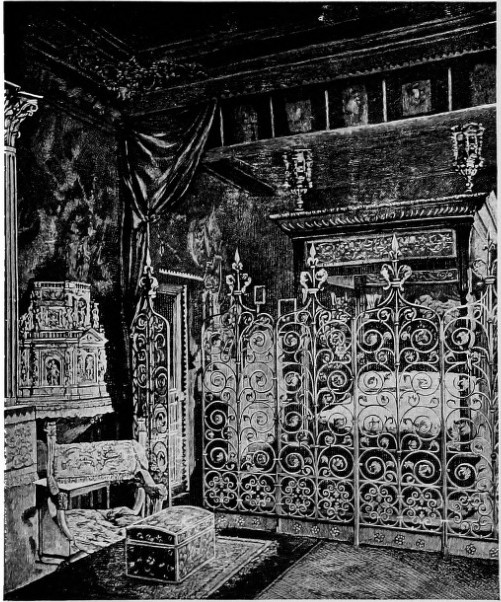
Zola's Bedroom
Zola's will, a very brief one, executed in 1883 and bequeathing all his property to his wife, contained no indication of where or how he desired to be buried. But the widow was well acquainted with his desires, and gave instructions that the interment should take place in Paris and, as in Hugo's case, without any religious rites. The question was raised whether an application should be made to the authorities for the military honours to which Zola was entitled as an officer of the Legion of Honour, his suspension from which had ceased with the Amnesty. It was decided to make no such application, but to accept the honours if they were tendered, which decision was scarcely taken when the Minister of War, General André, signified his resolve that they should be accorded. He further sent his chef de cabinet, General Percin, to the Rue de Bruxelles to tender his condolences, whereupon the Nationalist newspapers began to shriek that the army was disgraced. As it was also asserted by a writer of "Le Gaulois," a renegade Jew named Pollonnais, that General Percin, having met ex-Captain Dreyfus at the house, had shaken hands with him, Count Boniface de Castellane, the notorious husband of a daughter of Jay Gould, wrote to General Percin inquiring if this were true. The contemptuous answer which ensued led to a duel in which each combatant slightly wounded the other. As a matter of fact, General Percin had not met M. Dreyfus when he called in the Rue de Bruxelles, and had therefore had no occasion either to offer or refuse him his hand.
The victim of the military and clerical factions had naturally been admitted to view the remains of the man who had so ably championed his cause, and it was also natural that he should desire to attend the funeral. But every effort was now being made to rouse anti-Semitic passions, and Madame Zola dreaded lest the interment should be disturbed by some horrible riot. She therefore begged M. Dreyfus to refrain from attending, pointing out to him that the police authorities, like herself, were of opinion that his presence would give rise to great disturbances. M. Dreyfus was deeply affected by the request; he regarded his attendance at the obsequies as a matter of duty to his defender, and felt that everybody would accuse him of cowardice should he hide himself away. At last Madame Zola's entreaties prevailed, and he consented to do as she desired. The reports of this interview which appeared in the newspapers checked the Nationalist outcry, and on the eve of the funeral, when it had been ascertained that the authorities had decided to take every possible precaution to preserve order, it was felt that the decision with respect to M. Dreyfus might be altered. He was therefore informed that he might attend, and he gladly availed himself of the permission.
The obsequies were celebrated on Sunday, October 5, in the presence of a vast concourse of people. The distance from the Rue de Bruxelles to the place of interment, the Montmartre cemetery, was fortunately short, and to keep the crowd in check the Place Moncey and the Boulevard de Clichy were lined with police and municipal guards. Two squadrons of cavalry were also kept in readiness, though virtually out of sight, one assembling on the Place Vintimille, within a stone's-throw of the Rue de Bruxelles. Access to that street was afforded only to the bearers of special "laissez-passers," the numerous deputations assembling in neighboring thoroughfares and joining the procession on the road. In front of the house in the Rue de Bruxelles a detachment of the Twenty-eighth Infantry of the Line was mustered, under the command of Captain Olivier, an officer who had always believed in the innocence of Dreyfus, and who after refusing to participate in a subscription in honour of the forger Henry had fought a duel with one of the latter's partisans. Three cars bearing a profusion of wreaths, many extremely large,—splendid chrysanthemums of various hues being the predominant flowers,—preceded the hearse, on which a few other wreaths were placed. The drums beat and the soldiers presented arms when the coffin was brought from the house, escorted by the pall-bearers and followed by relatives and intimate friends. The pall-bearers were MM. Ludovic Halévy and Abel Hermant, respectively Presidents of the Société des Auteurs Dramatiques and the Société des Gens de Lettres, MM. Charpentier and Fasquelle, Zola's publishers, M. Théodore Duret, the historian, M. Alfred Bruneau, the composer, M. Octave Mirbeau, the novelist and playwright, who had held Zola's power of attorney during his exile in England, and M. Briat, the secretary of the Labour Exchange. Immediately behind the hearse walked MM. Laborde and Loiseau, relatives of the deceased, M. Fernand Desmoulin and Dr. Larat, intimate friends, followed by M. Anatole France and a few others. Then came Dr. Le Prince and Vizetelly, between whom, with his hands in theirs, was little Jacques.... The representatives of the Government followed. All the state departments were represented, and M. Chaumié, Minister of Public Instruction, attended in person. Then, after a crowd of celebrities in literature, science, art, politics, and law, came innumerable deputations, many of them carrying wreaths and coronals, a cortège of fifty thousand persons, advancing amid the concourse of spectators whom the military and police held back. The order was perfect, all heads were uncovered, all voices stilled. As the hearse passed on, the police saluted, the military presented arms. Again, inside the cemetery, on either hand, all along the Avenue St. Charles, and the Avenue de Montmorency, men of the Garde Républicaine stood at attention and presented arms until the cortège at last halted on an open space, where a tribune had been erected for the funeral orations.
The first address was delivered by M. Chaumié, who began by speaking of the terribly sudden death of the departed author, which had sent a thrill of stupefaction through the world. From all quarters, both at home and abroad, there had come messages of condolence, and the Government of the Republic had made it a point of honour to be represented at the obsequies. As others would speak of Zola's literary genius, he (the Minister) would refer more particularly to the mission which the deceased had set himself,—that of painting so striking a picture of society, with its sufferings, its passions, and its vices, that even those with the poorest sight would perceive that remedial measures were imperatively needed. Whenever a cause had seemed to him just he had espoused it without hesitation, braving all furious or perfidious anger, the wildest insults, the most unjust hatred, the most painful betrayals. And thus the humble and the wretched, feeling that they had lost a great friend, were now mingling their gratitude and their grief with the admiration of those who deplored the immense loss which had befallen literature.
It was particularly from the literary standpoint that M. Abel Hermant next addressed the throng, and he did so admirably, setting forth both the characteristics and the limitations of the genius of Zola, who had perhaps failed to show sufficient penetration when dealing with the psychology of certain individual characters, but who had excelled in depicting what was called "the crowd." He had been a master in the art of assembling facts and personages: his crowds and his paintings of nature were full of life. And he had never sought common popularity. He had sacrificed nothing in order to curry favour with the multitude, as was done by those who were eager for success at any price. Far from flattering the masses, he had braved them, measured himself against them fearlessly, and not only in connection with the terrible truths enunciated in his novels had a clamour of anger and menace arisen around him. At last, passing to his peroration,—a very appropriate one,—M. Hermant said:
"At the close of one of his finest works[7] Zola describes a ceremony such as this, one unattended by a great concourse of people, but none the less painful for the few friends pressing around the remains of an unappreciated artist. On retiring from the graveside one of that artist's most notable companions, one who resembles Zola like a brother,[8] speaks a few words,—words of duty, comfort, and hope. Those words are certainly the only farewell that Zola himself desires from us, gentlemen, and I should feel I had failed in giving expression to one of his last desires, did I leave this spot without repeating those words to you. I certainly did not think that the duty would come so soon, nor did I think it would be for me to lend my humble voice to my master in order to remind the multitude around me of the humble yet magnificent device of his whole life: 'Let us work!'"
Only discreet marks of approval had attended M. Chaumié's speech. Now, however, for the first time in the day's proceedings, a burst of applause rang out. But M. Hermant had quitted the tribune, and in his place appeared M. Anatole France, who came to bid Zola farewell on behalf of all his friends. M. France had testified for him at the Paris Assizes, he had supported the cause of truth and justice from the outset, and moreover, now that Zola was gone, his own eminent position in literature seemed all the greater. Thus, from every standpoint, it was well that he should have been selected to say the last words. He spoke as follows:
"Gentlemen,—In rendering to Émile Zola on behalf of his friends the honours which are due to him I will say nothing of my grief and theirs. Those who leave great names should not be celebrated by lamentations, but by manly praise and a sincere picturing of their life and work. The literary work of Zola was immense.... When one saw that work arising, stone by stone, its immensity caused surprise. Some admired, some were astonished, some praised, some blamed it. Praise and blame were bestowed with equal vehemence. The great writer was occasionally assailed—I know it by my own example—with reproaches which were sincere and yet unjust. Invectives and apologies intermingled, and still and ever the work grew. Now that one can contemplate the whole of its colossal structure the spirit pervading it may also be discerned. It was a spirit of kindliness. Zola had a kindly nature. The candour and the simplicity of great souls were his. He pictured vice with a rough and virtuous hand. His seeming pessimism, the sombre humour cast over more than one of his pages, scarcely conceals his real optimism, his stubborn faith in the advance of human intelligence and knowledge. In his novels, those social studies, he pursued with vigorous hatred an idle and frivolous society, a base and baleful aristocracy; he fought against the evil of the age,—the power of money. Though a democrat, he never flattered the multitude, he strove to show it what slavery proceeds from ignorance, what dangers come from strong drink, which delivers it over, senseless and defenceless, to every form of oppression, every kind of wretchedness, every sort of shame. He fought against social evils wherever he met them. They were the things he hated. But in his last books he showed the whole of his love for mankind. He strove to divine, to foresee, a better social state. He desired that an ever increasing number of the human race might be called to happiness in the world. He set his hopes on the human mind, on science. He awaited from new powers of machinery the progressive enfranchisement of toiling humanity. A sincere realist, he was nevertheless an ardent idealist. In grandeur his work can only be compared to that of Tolstoï. At the two extremities of European thought the lyre has raised two vast ideal cities. Both are generous and pacific; but whereas Tolstoï's is the city of resignation, Zola's is the city of work.
"While he was still young, Zola acquired fame. In quietude and celebrity he was enjoying the fruits of his labour when he suddenly wrested himself from all repose, from the work which he loved, from the peaceful pleasures of his life. Doubtless, in presence of a coffin only grave and serene words should be spoken, calmness and harmony should be preserved. But you are aware, gentlemen, that calmness is found only in justice, that repose is found only in truth. I speak not of philosophical truth, the subject of our endless discussions, but of that moral truth which we can all detect because it is relative, sensible, in conformity with our nature, and so near to us that a child can touch it with the hand. I will not fail, then, in my duty to justice which orders me to praise that which is praiseworthy. I will not hide the truth beneath cowardly silence. Why, indeed, should we be silent? Are they, his slanderers, silent? I will say only what is necessary before this bier, but I will say all that is necessary."
At this point M. Anatole France paused, interrupted by repeated cries of "Bravo!" Those who were gathered around the tribune had listened in attentive silence to the earlier part of his discourse, but from this point almost every sentence was punctuated by applause. The crowd in the cemetery was so dense, stretching away to the very gates, that thousands were unable to hear a word of the speech, and the "Bravos!" which rang out from those who were more fortunately placed, naturally excited the others, whom the police restrained with considerable difficulty. Meantime M. Anatole France was continuing:
"Having to recall the struggle upon which Zola entered in the cause of truth and justice, is it possible for me to preserve silence respecting those who were bent on ruining the cause of an innocent man, those who felt that if he should be saved, they would be lost, and who with all the desperate audacity of fear therefore strove to overwhelm him. How can I remove them from your gaze when I have to show you Zola rising, weak and unarmed, before them? Can I remain silent about their lies? That would mean silence as to his heroic rectitude. Can I remain silent about their crimes? That would mean silence as to his virtues. Can I remain silent about the outrages and slanders with which they pursued him? That would mean silence as to his reward and honours. Can I remain silent about their shame? That would mean silence as to his glory. No! I will speak out.
"With the calmness and firmness which the spectacle of death imparts, I will recall the dim days when egotism and fear had their seats in the government councils. People were beginning to know something of the iniquity, but it was supported, defended, by such public and secret powers that the most resolute hesitated. Those whose duty it was to speak out remained silent. Some of the best, who feared nothing personally, dreaded lest they should involve their party in frightful dangers. Led astray by monstrous lies, excited by odious declamation, the multitude of the people, believing they were betrayed, grew exasperated.... The darkness thickened. Sinister silence reigned. And it was then that Zola addressed to the President of the Republic that well-measured yet terrible letter which denounced falsity and collusion.