ERNEST ALFRED VIZETELLY (continued 8)
Reading edition
After his departure from England in 1893, the present writer remained without news of him for some weeks; but in November he wrote that he had been ill and unable to attend to anything: the fact being that this was a critical time in connection with his domestic affairs. Nevertheless he gave some attention to an opera which his friend M. Alfred Bruneau based on "L'Attaque du Moulin," the libretto being partly the work of M. Louis Gallet and partly that of Zola himself. The first performance took place at the Opéra Comique, then under M. Carvalho's management, on November 23, with a result gratifying to all concerned; and Zola afterwards turned to the writing of his novel, "Lourdes," which he intended to make the first of three volumes to be called "Les Trois Villes," that is, Lourdes, Rome, and Paris.
The writing of those works was inspired by the trend of French literature and also of opinion in France at that time. A few years previously, on being interviewed on the question whether Naturalism were an expiring school or not, Zola had laughingly answered in the negative.[8] Nevertheless he had observed the rise of the Symbolist, Occultist, and Décadent schools,—a wave of returning mysticism, as it were, which, as he had remarked in an address to the Paris students, was invading art as well as literature. No little balderdash was being written about the alleged bankruptcy of science, Rome was coquetting with the Republic, there was much talk of a new Catholicism adapted to the modern world, the clergy were showing extreme activity, and a good many universitaires and normaliens, among whom the Voltairean spirit had formerly predominated, seemed won over to the Church's side and anxious to co-operate with it in securing the return of France to the fold, as if, indeed, agnosticism had been carried too far and must now be checked. The Lourdes and similar pilgrimages represented a notable phase of the agitation, and Zola, who had attended them two years running as a spectator, found in them some illustration of the first of the Christian virtues, Faith. It thereupon occurred to him that Rome would illustrate Hope, for it was in her and in her pontiff, Leo XIII, that all who desired to see the world reconquered by a rejuvenated Catholicism set their hopes. Finally Paris would afford abundant illustration of Charity in its various senses. Now the question whether religion might flourish anew in France depended, at least largely, on the practice of the aforesaid virtues and the light in which they were regarded by the community at large. Was the faith of Lourdes justified, was any real hope to be found in Rome, was the charity of Paris adequate or not? Zola returned a negative answer to all those questions; and at an early stage of the writing of "Les Trois Villes" he resolved to supplement this series by a further one which would enunciate the principles in which he himself believed, that is, Fruitfulness, Work, Truth, and Justice, all springing from the fundamental basis of Love.
"Lourdes" gave him occupation throughout the winter of 1893-1894. It appeared first in the "Gil-Blas," which paid fifty thousand francs for the serial rights, and early in the autumn of 1894 it was issued as a volume,[9] whereupon a prelate of the papal household, a certain Monseigneur Ricard, vicar-general of the diocese of Aix, in Provence, arose to answer Zola, which he did in a very blundering way.[10] The fathers of the Lourdes grotto also attempted some direct denials of Zola's accusations of greed and imposture, and being all powerful in the town prevented the sale of the book there, while as a crowning stroke of condemnation it was deferred to Rome and promptly placed, like some of Zola's previous works, in the famous "Index Librorum Prohibitorum." Once again, also, abusive letters rained upon the author, some emanating from deluded believers in the Lourdes miracles, and others from angry priests and monks. Several of those correspondents interlarded their effusions with the language of the gutter, while others contented themselves with briefly cursing the man who presumed to doubt the sanctity of the unfortunate Bernadette, and the virtues of the spring which the Assumptionist Fathers had turned into a river of gold. That money was used in part for the purpose of subsidising Leo XIII, but the bulk was employed in fighting the French Republic with the object of restoring a monarchy under which the Church, and particularly its monks, would have been all powerful.
Soon after "Lourdes" was finished Zola turned to "Rome," which necessitated a great deal of study. He was immersed in it when there came an incident fraught with grave future consequences for France. An artillery captain named Alfred Dreyfus, attached to the General Staff of the army, was arrested on a charge of communicating military secrets to the German embassy. The arrest took place on October 15, 1894, but did not become known until the end of the month, when it was divulged by two newspapers, "La Libre Parole" and "L'Éclair." Zola gave little or no heed to it, for quitting his books and papers he was at that very moment preparing for a visit to Rome, which he had projected for some time past.
About the middle of October he had told Vizetelly, who was then with him at Médan, that he had some hope the Pope would receive him, and that he certainly intended to apply for an audience. Vizetelly gave publicity to this statement, which was quoted on all sides. But almost immediately afterwards, Vizetelly having returned to England, Zola on talking the matter over with some friends found that no audience with the Pope was possible. The reason was simple enough. "Lourdes," "La Faute de l'Abbé Mouret," and several other volumes of his writings—just like the novels of Dumas père, that "accursed Garibaldian"—were in the "Index," and accordingly, before even applying for an audience, he would have to withdraw and annihilate those books so far as lay in his power, and make a full submission to Holy Church.
Such were the facts. A little investigation of the subject showed peremptorily that the popes made it an inflexible rule to receive no authors whose writings figured among the prohibited books unless and until those authors had withdrawn their writings and submitted. Abbé Alfred Loisy, the author of "La Question Biblique" and "L'Évangile et l'Église," has of more recent times discovered the procédure to be such as is here stated. He, like Zola's Abbé Pierre Froment, repaired to Rome to plead his cause, but though cardinals may have received him, he was not allowed to approach the Pope. Zola, in his "Rome," used a novelist's license when he brought Abbé Pierre face to face with Leo XIII; and all readers of the book are aware that the interview is pictured as a secret one, obtained by surreptitious means, such as Zola could never have employed. Had he asked for an audience he must have done so through the usual channel, that of the French embassy to the Vatican; and we have before us that embassy's express statement that no such application was ever made. Thus, contrary to the assertions which went the round of the world's press, Zola did not ask to see the Pope, and the Pope did not have occasion to refuse him.
Leaving Paris at the end of October, he remained in Rome till December 15. He applied for an audience at the Quirinal, and was received with a gracious cordiality by King Umberto. Both the French ambassador to the Italian court and the ambassador to the Vatican placed themselves at his disposal, and furnished him either personally or through their attachés with a quantity of information. Some of the Italian ministers took a similar course. He was welcomed, too, in several drawing-rooms. M. Hébert, the great French painter, accompanied him on his visits to the Palatine, the Sistine Chapel, the stanze of Raffaelle, and the Vatican Museum. Signor Bernabei, director-general of the excavations, accompanied him on other occasions, and supplied him with a quantity of notes. As for the foolish tale that he bribed Vatican servants for information, a tale which went the round of the press, it was purely imaginative. With two ambassadors, half a dozen attachés, and a score of prominent Italian officials at his disposal, Zola had no need to apply to any servants whatever.
On quitting Rome he betook himself to Venice and Brescia with the object of visiting the Italian members of his family, the Venetian Petrapolis and Frattas, and particularly his cousin, Carlo Zola, then a judge of the Brescian Appeal Court. Venice gave him a public reception, and at Brescia his cousin greeted him with open arms. Unfortunately, though the novelist, assisted by his knowledge of Latin and Provençal, was able to read Italian fairly accurately, he could not speak it; and as on the other hand the judge knew no French, an interpreter had to be provided. In spite of this drawback the intercourse was very pleasant, and when after a sojourn of some days at Brescia Zola set out on his journey to Paris, he repeatedly promised to return. He was never able to do so, but his wife, who revisited Italy on more than one occasion subsequently, took care to keep up the family intercourse which had been renewed after the lapse of so many years.
While Zola was visiting Rome the French military authorities had been busy with the case of Captain Dreyfus, but the latter's court-martial did not begin till December 19, that is, about the time of the novelist's return to Paris; the degradation of the unfortunate officer following on January 5, 1895. Zola, however, was now busy classifying all the materials he had brought from Rome and revolving in his mind the tremendous task which lay before him. Thus, once again, he gave comparatively little attention to the proceedings against Dreyfus. Moreover there was nothing in the newspapers to indicate any probability of a miscarriage of justice. Like everybody else,—except the members of the Dreyfus family, whom he did not know,—Zola assumed that the convicted officer was guilty, and thereupon dismissed the matter from his mind.
Writing to Vizetelly on January 11, he said that he hoped to make "Rome" a work of European interest, and if possible he should include in it some account of the wonderful progress which the Catholic Church claimed to be effecting in Great Britain and the United States of America. He hoped the book would be shorter than "Lourdes," and he intended to keep it "absolutely chaste, though very passionné, for while Abbé Froment would be the central figure, a very tragic drame passionnel would be unfolded beside him." However, the historic, descriptive, and controversial parts of the work expanded in Zola's hands, and far from "Rome" proving shorter than "Lourdes," it exceeded that book in length by a hundred and fifty pages. The drame passionnel which was to have been so prominent a feature, became nearly lost among the surrounding matter, so that by the time the work was finished little suggested that it was intended to be a novel. At the same time it was certainly one of the books on which Zola expended most time and study He had begun to examine his subject in the summer of 1894, and his proofs were not finally passed for press till the end of February, 1896. It may be said that he gave the whole of 1895 to the writing of "Rome." As he had not been able to remain very long in the Eternal City, Madame Zola returned thither to collect further information on various points, and a perfect mountain of documents at last encompassed the struggling novelist, who had no little difficulty in shaping his course. In December, 1895, the work began to appear as a feuilleton in "Le Journal," the organ of Zola's friend, M. Fernand Xau, and about the same time an English translation was issued by various provincial and colonial journals, Vizetelly having to perform a tour de force in order to ensure this early publication. In the case of "Lourdes" he had been assisted by his personal knowledge of the spot, and a similar knowledge helped him with "Rome," the actual translation of which had to be made in about nine weeks in order to meet commercial requirements. That little fact will serve to illustrate the remarks made in a previous chapter concerning the imperfection of the translations issued under the conditions which nowadays prevail in the publishing world.
When "Rome" appeared as a volume early in the spring of 1896,[11] M. Gaston Deschamps, writing in "Le Temps," roundly accused Zola of plagiarism, and it is certain that here and there "Rome" contained sentences taken from Firmin Didot's publication, "Le Vatican," and Gaston Boissier's "Promenades archéologiques." Zola, on being accused, replied in "Le Figaro" to the effect that when he was writing a book he invariably consulted every available work bearing on his subject. He passed several of his former novels in review, mentioning the books by others which had been useful to him, and also naming the politicians, merchants, scientists, lawyers, architects, and others who had provided him with detailed memoranda on various points. For instance Jules Ferry had given him some information about the Haussmannization of Paris for "La Curée," M. Chauchard, the director of the "Grands Magasins du Louvre," had largely assisted him with "Au Bonheur des Dames," M. Edmond Perrier, the scientist, had helped him with the passages about seaweed and bromide of potassium in "La Joie de Vivre," M. Frantz-Jourdain, the eminent architect, had constantly befriended him in architectural matters, M. Henri Céard had supplied him with notes on music, and M. Thyébaut with consultations on points of law, while the theory of an "elixir of life," embodied in "Le Docteur Pascal," had been built for him by his friend Dr. Maurice de Fleury. Indeed Zola claimed that he had never discussed a scientific question or written about an illness in his books without first taking the opinion of scientists and medical men. But he claimed that he had assimilated, adapted, and in a sense transmuted all the information he had derived from persons and books. As for "Rome" he was charged with having borrowed some sentences from two or three well-known works, but, in fact, he had consulted some scores of volumes, the titles of many of which he gave. Briefly, he pictured himself as an architect or a sculptor, and his materials as building stones or modelling clay; suggesting also the example of those masters of the Renaissance who employed a swarm of workers to prepare their paints, their "grounds," and so forth. And he contended that what he had done was perfectly legitimate, the only question being whether he had so used his materials as to produce a substantial, harmonious result, and had infused into it the spirit of life. "If it were usual," he added, "to indicate one's authorities in a novel, I would willingly stud the bottom of my pages with foot-notes. And if a line from a fellow-writer remains intact in one of my pages, this simply proves that I am not hypocrite enough to hide my borrowing, which it would be so easy to conceal"
In spite of that last remark there is reason to believe that, in the case of "Rome," Zola had a difficulty in wrestling with his mountain of "notes," and that when confronted by some memorandum made many months previously, he sometimes imagined its phraseology to be his own and not the actual language of one of his authorities. It seems quite likely that if the latter had been patent to him he would have paraphrased the memorandum. With respect to the actual principle for which he contended it is obvious that the novelist possessed of any conscientiousness ought often to read up certain subjects and consult a variety of authorities. It is indeed a pity that the practice is not followed more generally, for one would then be spared the thousands of blunders in elementary questions of law, science, history, precedence, titles, etc., which appear in so much contemporary fiction.
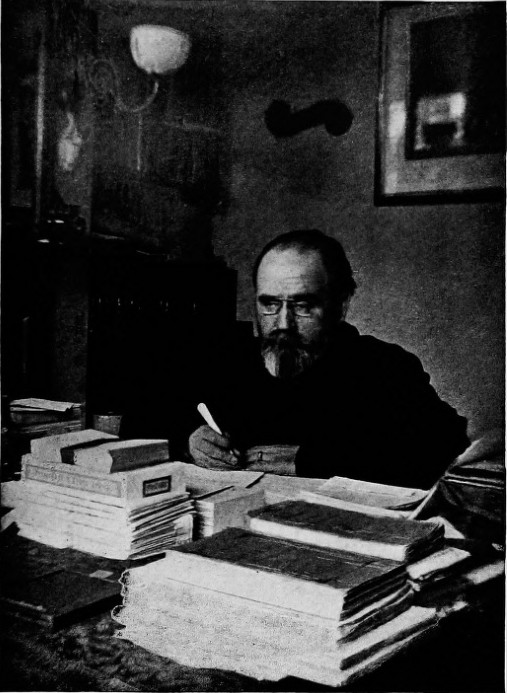
Émile Zola writing "Fécondité" at Walton-on-Thames, 1898 —Photo by V. R. Vizetelly
Zola's defence with respect to "Rome" will be found in a volume called "Nouvelle Campagne,"[12] which contains a number of articles he contributed to "Le Figaro" in 1896. They are of all sorts. The first, on the opportunism of Leo XIII, foreshadows the denunciation of the Roman Catholic Church which eventually appeared in "Vérité"; while another, called "Dépopulation," contains the germ of "Fécondité." There are various papers on the professional interests of literary men; a couple on Zola's love of animals, which was very marked throughout his life, and an incisive one, called "The Toad," in which he railed at the people who sent him abusive letters and the newspaper men who pursued him with pinpricks. Then, in a paper on a Parisian clairvoyante, a certain Mademoiselle Couesdon, who pretended to be in direct communication with the archangel Gabriel, he commented on the childishness of the imposture and deplored the senseless eagerness with which people imagined they would discover the secrets of the invisible by consulting a semi-hysterical girl. At the same time he admitted that such was the trend of the modern mind; and, after all, as people could only satisfy their yearnings in this way, one must let them do so, said he, pending the time when science would nourish the world with the bread of truth. However, the most notable article in the volume was certainly the one entitled "For the Jews," in which for the first time Zola gave expression to his surprise and disgust at the progress of anti-Semitism in France. In that campaign, the Dreyfus case, which at first had been merely an incident, was soon to become everything, for Colonel Picquart was now (July, 1896) making important discoveries which convinced him of the innocence of Dreyfus and the guilt of Esterhazy. That was as yet unknown to Zola, who did not begin to intervene until late in the autumn of the following year. Thus, in protesting against the anti-Jewish agitation which had been growing and spreading for some years past, he treated the question from a general point of view without mentioning the unhappy prisoner of Devil's Island. And here one may well call a halt to consider the state of affairs which had prompted Zola to raise his voice on behalf of a community with which he had no connection whatever, either racial or religious, but which he defended by virtue entirely of the guiding principles of his life,—the principles of truth and justice.
XIII
THE DREYFUS CASE
1894-1900
The growth of anti-Semitism in France—The Jews in Paris—The Union Générale—Drumont, "La France Juive," and "La Libre Parole"—Clerical plotting—Accusations against the Jews—Anti-Semitism in the army—Zola begins his novel "Paris"—His idea of a novel on ballet girls—"Messidor"—Facts and documents concerning Dreyfus submitted to Zola—He resolves to intervene—His articles in "Le Figaro"—His "Letter to Young Men"—He is hissed at Daudet's funeral—His "Letter to France"—The Esterhazy court-martial—Character of Esterhazy—Zola writes his letter "J'Accuse"—Some extracts from it—Its reception—Riots in the provinces and Algeria—Incidents of the turmoil in Paris—Zola prosecuted—Foreign sympathy—His counsel, Maître Labori—Clericals and Nationalists at work—The trial at the Paris Assize Court—A few of the facts it elicited—Zola mobbed—His body-guard—Madame Zola at the trial—Zola's declaration to the jury—A glance at Labori's great speech—Reception of the verdict—Publication of "Paris"—Zola's conviction quashed—New proceedings—First trial at Versailles—Incidents of the campaign—The handwriting experts secure judgment against Zola—Zola's letter to M. Brisson—Second trial at Versailles—Zola leaves for London—His sojourn in England—His English homes—Some of his notes to Vizetelly—Death of his pet dog—His visitors—Incidents in France—Zola's return to Paris—His manifesto "Justice"—Return of Dreyfus to France—The Rennes court-martial—Zola's manifesto "The Fifth Act"—His letter to Madame Dreyfus—Dreyfus pardoned—"Fécondité" published—Zola's trial repeatedly postponed—Zola's protests against the Amnesty—His sacrifices for the cause—The medal struck in his honour.
The emancipation of the French Jews dates from the great Revolution. At the assembling of the States-General in 1789 they entered on a brief and victorious struggle, in which their chief ally, curiously enough, was a Catholic priest, the famous Abbé Grégoire. From that period until the Third Republic, established in 1870, there was never, it would seem, any really considerable Jewish question in France. A little trouble occurred in the time of the first Napoleon. Some Jews were certainly mixed up in the financial scandals of Louis Philippe's reign, and Toussenel's work, "Les Juifs, Rois de l'Époque," was the result. Rascality was occasionally manifested also by some of the Jews who became prominent in finance during the Second Empire; but the presence of the Jews generally, in the midst of the community, excited no alarm. After the war of 1870, however, the number of Jews in France increased considerably, the new arrivals being chiefly of German, Austrian, Swiss, or Alsatian nationality. Most of them settled in Paris, where they engaged in a variety of professions and avocations, showing themselves, as a rule, shrewd, hard-working, and orderly members of society. About the same time some thousands of French Jews—participating in a movement which characterised the earlier years of the Third Republic, the so-called conquest of northern by southern France—also flocked to the capital. "Le Midi monte" was in those days a favourite saying, echoed by Alphonse Daudet in his "Numa Roumestan" with reference to all the Gascons and Provençals who then invaded Paris and came to the front there in politics, art, literature, and social life. The descendants of the Spanish and Portuguese Jews, who in the sixteenth century had settled in southern France, at Bordeaux, Avignon, and other cities, joined in the great migration to the capital, and thus ten years after the Franco-German war there were three or four times as many Jews in Paris as there had been previously.
But they were peaceable citizens and for the most part stanch Republicans. They remembered that the Revolution had given them emancipation, and they did not desire the restoration of any monarchy which might take it from them, or of any empire with an adventurous policy which might plunge the country into war and interfere with their avocations. Many of them, no doubt, had a comparatively low ideal in view, that of quietly prospering in their business; but an element of that kind is desirable in a community like that of Paris, which numbers many firebrands in its midst. Besides, it is not too much to say that, on more than one occasion, the Jews of Paris helped to save the Republic by throwing all their influence into the balance on the side of law and order, as, for instance, during the Boulangist turmoil.
However, for some years previous to that agitation, an anti-Jewish feeling had been growing up in Paris. The ultra-Catholics, the Royalists, and other malcontents resented the spread of Jewish influence; and two financiers, named Bontoux and Féder, availed themselves of that disposition to found a great Christian Bank, the Union Générale, which, it was hoped, would deprive the Jewish—and also the Protestant—financiers of a large proportion of their customers. Pope Leo XIII blessed that bank, and invested in it some millions of francs—the fruits of Peter's pence—which the pious Bontoux promised to restore to him fourfold. But the director of the Union Générale unluckily fell out with a great financier, M. Lebaudy, the millionaire sugar refiner, who though he was nominally a Catholic cared nothing for the advancement of the Church or of the French aristocracy, which had invested large sums of money in the Bontoux bank. At last, after some prodigious Bourse gambling,—such as Zola described in "L'Argent,"—the Union Générale was smashed by M. Lebaudy, who raked in by far the greater part of the spoils.
Undoubtedly there were some Jewish and also Protestant financiers with him, but it was he who engineered the work of destruction which ruined several members of the French aristocracy, and swallowed up the savings of many good Catholics in modest circumstances who had foolishly taken financial advice from their priests. Nine out of ten attributed the disaster to the Jews exclusively, and it was virtually from that hour that people began to talk of the so-called Jewish question. It was discussed at first in the Royalist and Clerical newspapers, which pictured the Israelites as the great enemies of those who wished to restore France to her ancient kings and her ancient faith. In another way the cry was taken up by some of the Radicals and Socialists opposed to Gambetta, in whose entourage several Jews figured prominently. These men, it was said, had nobbled the ex-dictator and were preying upon France. Thus the "question" gradually spread, assisted largely by the many unpopular tergiversations of the Opportunist party, first in Gambetta's time, and then over a term of years, some folk detecting the hand of the Jews, precisely as others detected that of the Jesuits, in everything that happened.
Moreover books were written on the question. Under the title of "Les Rois de la République," Toussenel's forgotten work was hashed up for popular consumption; and about the time when General Boulanger was coming to the front (1886), there appeared a book called "La France Juive," written by a certain Édouard Drumont, a scholarly man, who had long dabbled in antiquarian research. It so happened that nature had given Drumont a characteristically Jewish face, while his slovenly habits had imparted to him much of the appearance of one of those "old clo'" men, who, forty or fifty years ago, still perambulated the streets of London and Paris. He has repeatedly disclaimed, however, all connection with Jewry; and his personal appearance may therefore be merely some spiteful freak on the part of nature, which has cast him in the very mould of some of those whom he loathes and denounces.
"La France Juive," which as an attack on the so-called chosen race has never been surpassed in virulence and mendacity, created an uproar in some political and financial circles; but it did not at first make much impression on the general public. The Panama scandals began, however; millions of money were lost, the victims often being needy people; and helped by the circumstance that three or four of the principal culprits in those affairs were unquestionably Jews, and by the reissue of large portions of "La France Juive" in "Le Petit Journal," Drumont and his writings achieved great notoriety. A newspaper established by him, "La Libre Parole," became the recognised organ of anti-Semitism in Paris; and as this journal was financed by a certain M. Odelin, the administrator of the famous Jesuit school in the Rue des Postes, one may conclude that at an early stage at least some part of the French clergy gave support to the agitation; for the position of M. Odelin as a mere intermediary, or man of straw, was notorious.[1]
As time elapsed the attitude of the Clericals became yet more pronounced. Pope Leo XIII made advances to the French Republic. From his standpoint they may have been sincere; but in any case they tended to the supremacy of the Roman Catholic Church in France. On their side, the French Reactionaries, clergy and religious orders as well as laymen, could not give any frank and loyal support to the papal policy such as it was publicly stated to be, for it was foreign to their ideas, sympathies, and aspirations. If they made some outward show of acquiescence, this was only with the secret object of obtaining the mastery by feigning friendship and afterwards destroying the Republican régime. But the Republic of 1848 was not forgotten; the clergy had then adhered to the new order of things the better to strangle it; and thus, in spite of all the fair words of Leo XIII and the protestations of those who professed that they had rallied to the Republic in all sincerity, the more clear-sighted Republicans, like the advanced Radicals and the Socialists, remained full of distrust. Some years elapsed before matters really took shape. At first, indeed, the Pope merely coquetted with the Republic, reserving a formal pronouncement of his adhesion until an apparently decisive moment, and the clergy worked somewhat stealthily, assisted by those university men and others who abetted or accepted the retour offensif of mysticism in literature. Then, as time went by, the residue of the Boulangist party raised its head to propound various theories of Nationalism, Militarism, and anti-Parliamentarism, to the last of which the Panama scandals lent some force. For many years, undoubtedly, the trend of the masses had been towards free thought, but the sentiments of Nationalism and Chauvinisme appealed to many. The clergy had been striving to win France back to the fold by such devices as the Sacred Heart of Jesus, the Lourdes miracles, and the money-boxes of Saint Antony, but whatever success might be achieved by those means here and there, it was not great enough to satisfy priestly aspirations. To all appearance there was not sufficient faith left among the masses for supernatural considerations to influence them in the required degree. Only earthly matters seemed to interest them, and it followed, therefore, that these must be put to use. Thus the clergy aided, abetted, and finally slipped into the Nationalist movement, which seemed the one most likely to yield the desired result.
It has been indicated that the great bulk of Jewish influence had hitherto been cast on the side of the Republic; and thus, although the Freemasons and the Protestants were also regarded as enemies by the Clericals, it was felt that they might be dealt with later, and that the first thing, the principal thing, was to destroy the power of the Jews. The ground, then, was gradually prepared for a campaign. Helped by the Panama scandals, "La Libre Parole," following "La France Juive," neglected no opportunity to traduce the Jews generally.[2] The Nationalist journals joined in the outcry, pointing out that many of the Jews domiciled in France bore German names, and arguing that, although they often asserted they were Alsatians, the assertion was usually a lie. In some instances, perhaps, they conspired with foreign Jews; and at all events they formed an imperium in imperio, clinging to their own kith and kin, their particular rites and usages, leading, as it were, a life apart from the rest of the community. Briefly, they were not Frenchmen, and were therefore not entitled to a Frenchman's rights.
As a matter of fact, many thousands of the Jews domiciled in Paris did not adhere strictly to Jewish practices. In the financial world several prominent families had not only become Catholic, but had contracted matrimonial alliances with the French aristocracy; while the whole tendency of those whom one may call the Boulevardian Jews, the members of the liberal professions, the authors, journalists, artists, and actors, was towards free thought and an intermingling with the bulk of the community.[3] In fact, in the present writer's opinion, before the more violent explosion of anti-Semitism in France, Paris was the city where one saw most sign of a blending of the Jews with the rest of the population—a very slow and gradual blending, no doubt, but none the less evident to careful observers.
But that was not taken into account by the Clerical and the Nationalist leaders in the campaign which both parties carried on, not, perhaps, by virtue of any formal alliance, but because both desired an effective war-cry which would appeal to popular passions and gain them recruits. In the end the Nationalists, though they denied it, were generally directed by the leaders of the Clerical party, who were men of much greater shrewdness and ability than the Déroulèdes, the Millevoyes, the Haberts, and the Guérins, and who thus contrived, in an indirect way, to employ the Nationalist movement for their own advantage. Both parties had the same immediate object in view—the destruction of the Republic, such as it existed—and thus they could well work together; but the Clerical leaders were resolved that, whatever might be the subsequent form of government, the real mastery should belong to Holy Church. Moreover some Nationalists were Clericals also. In 1891 Déroulède, the Nationalist chief, expressly accused the Jews of trying to "dechristianise" France; and in the following year a journal belonging to Deputy Delahaye, another Nationalist, fabricated a charge of "ritual murder," perpetrated, it was alleged, at Chatellerault. A little later the Marquis de Morès, Clerical, Nationalist, and anti-Semite all in one, insulted and challenged a number of Jewish army officers. "La Libre Parole" espoused his cause, and a movement to prevent Jews from serving as officers slowly set in, leading a couple of years later to the Dreyfus case.
In this connection one may remind the reader that an overwhelming proportion of the officers of the French army belonged to devout Catholic families, often aristocratic and royalist ones, which while thinking that a young man ought not to serve the government of the Republic in any political or administrative post were willing that he should accept a diplomatic appointment or join the army as an officer, for in such cases it was really France that he served, and not the hateful Republican régime. That distinction had been drawn already in MacMahon's time and was adhered to for many years, indeed until the clergy saw how advisable it was for their protégés to accept other public functions in order to fight the influence of the Jews and the Freemasons in various State departments. Thus many young men, trained by the Jesuits and others, were helped as far as possible into official positions without being restricted as previously to the diplomatic service and the army. Nevertheless, the last remained the favourite carrière among young aristocrats as well as among many young men of the upper bourgeoisie; and the great majority of these having been educated by ecclesiastics were, without doubt, prejudiced against the young Jews whom the regulations admitted among them. The prejudice was not, however, entirely religious, it was also a racial and a caste prejudice among those who belonged more or less to the old noblesse, and it was often in a sense patriotic, being inspired by a kind of distrust of Jewish rectitude. Indeed, even Jewish courage was questioned by some who forgot, or were not aware, that no little Jewish blood had flowed in the veins of such great fighters as Masséna, Soult, and Bernadotte.
The agitation against the French Jews had been growing slowly, then, for several years. An explosion was bound to come in any case, particularly as, with the exception of the one ministry which put down General Boulanger, the various French administrations over a lengthy period were deplorably weak. In the end the Dreyfus case became the battlefield of the parties which were contending for mastery. The outcry against the Jews was prompted, even among the Clericals, less by genuine religious motives than by political ones. The Jews were the pretext. Behind the onslaught on them, one on the Republic was being engineered. One may add that the anti-Semitism which arose in France was naturally assisted by that which prevailed in Austria and in Russia. Moreover, the Russian alliance became in certain respects a factor of importance; and the slumbering hatred of Germany on being roused in connection with Dreyfus influenced thousands of patriotic people.
Into the more intricate details of the case the writer does not propose to enter.[4] When this book was first projected he had some thought of reviewing a few curious points, but since then the victim of the great iniquity has applied for the revision of the proceedings at Rennes, and the matter is now before the judicial authorities. It is therefore best that one should confine oneself to narrating what Zola himself did to rescue Dreyfus from the hell in which he suffered for so many years—just recapitulating, as one proceeds, the facts which are essential for a proper understanding of Zola's rôle. At the same time one must not neglect his literary work, and the more important incidents, which, apart from the Dreyfus case, marked his career at this period.
It has been shown previously that the novelist paid little heed to the anti-Semites—whom he regarded as more turbulent than dangerous—until 1896, when he campaigned in "Le Figaro" and wrote an article entitled "For the Jews." He afterwards turned to his novel "Paris," concerning which he wrote to Vizetelly on December 11, 1896:
"My plan is finished, and I am about to begin the book. 'Paris' will be a novel, full of action, on all the different 'worlds' of Paris—the political, the intellectual, the society, the working-class worlds, etc. There will be no digressions or dissertations, but as much life and action as possible. You know that I never make promises without keeping them. The story will begin to appear in 'Le Journal' between October 15 and 31 (1897), and will be published as a volume at the end of January, 1898. Try to find an English newspaper to publish it, and you may also sound the Americans, telling them that you will supply the most lively and interesting book I have yet written."
About this time Zola also gave some attention to a four-act lyrical drama entitled "Messidor"[5], the music of which was composed by his friend M. Alfred Bruneau.[6] This work took the novelist to the Grand Opera House, where it was to be produced. He attended all the rehearsals, and evinced particular interest in the young women of the ballet, about whom—their appearance, manners, conversation, and lives—he accumulated a quantity of notes, with the object, so he afterwards told Vizetelly, of writing a novel about them, a novel which he would probably have called "Le Rat,"—rats de l'Opéra being the name under which the minor dancers of the house have long been known in Paris. It may be mentioned that a ballet designed for expressive character-dancing was a prominent feature of "Messidor," and that success largely depended on its efficient performance. But the authors found the corps de ballet wedded to the stereotyped forms of stage-dancing, the customary insipid jétés, pas de chales, entrechats, pirouettes, and so forth. Either from incapacity or in a spirit of obstinacy, the ladies of the opera would not modify their methods, and Zola, who had dreamt of revolutionising stage-dancing, of infusing into it some of the old Grecian fervour, which expressed the various passions so powerfully, was greatly disappointed. When "Messidor" was produced on February 19, 1897, it achieved little more than a succès d'estime. The ballet was praised by the critics, who judged it from the customary standpoint, but it was not what the composer and Zola had desired. Of course, no other result was possible. Years would be required to effect a revolution in stage-dancing, at least at the Paris Opera House.
After the production of "Messidor," Zola confined his attention to "Paris" for several months, and it was only on quitting Médan for his town residence late in the autumn of 1897 that he began to give serious attention to the Dreyfus case. The various attempts which both the Dreyfus family, through M. Bernard Lazare, and Colonel Picquart, influenced by his own discoveries, had made in 1896 to bring about a careful inquiry into the whole affair had yielded little result; but in 1897 the matter was taken up by M. Scheurer-Kestner, a much respected vice-president of the Senate, who came to the conclusion that the offence for which Dreyfus had been convicted had really been perpetrated by Major Walsin-Esterhazy. The latter received warning of what was brewing, and about the time when Zola moved from Médan into Paris, as mentioned above, the anti-Semitic press, having espoused Esterhazy's cause, was again thundering against the Jews. Some of Zola's friends interested in the Affair—as everybody called it—spoke to him about it at length. Before long, indeed, several documents were shown him at his house, and left a deep impression on his mind. He had no personal acquaintance with the Dreyfus family; he never saw Madame Dreyfus till she appeared in court during his own trial in February, 1898; and if on a dozen occasions, at the utmost, he met M. Mathieu Dreyfus and discussed the case with him, all such interviews took place posterior to his intervention. This was based on a dispassionate study of the facts and documents laid before him. He weighed them with his usual care, exactly as he weighed the documents he collected for his books; and it must not be imagined that the charges he eventually formulated were brought in any haphazard fashion. Zola's intellect, one may repeat it, was essentially systematic, and his judgment of facts and his logical powers were exceptionally good.[7] At the time of his trial in Paris there were many gaps in his information, undoubtedly, but its full extent was not then revealed, owing to the extraordinary course imparted to the proceedings by the judge and the military men. Various facts which were not publicly divulged until much later were kept back deliberately by the novelist's counsel, Maître Labori, as a matter of strategy, and it follows that Zola's action was far less quixotic than some people then took it to be.
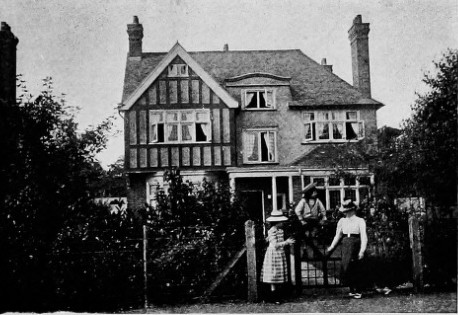
Penn, Oatlands Chase, Surrey (Denise, Jacques, Violette Vizetelly)—Photo by Ê. Zola.
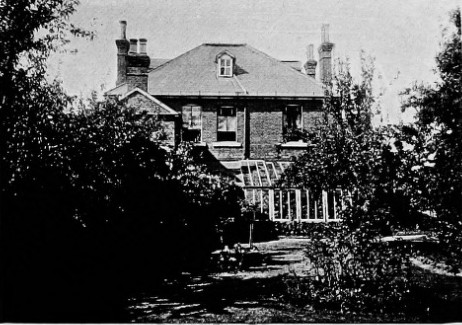
Summerfield, Addlestone, Surrey.—Photo by É. Zola.
It has been assumed occasionally that the novelist's intervention began with his famous letter, "J'Accuse." That, of course, is an error. One day in November, 1897, while he was out walking, he met M. Fernand de Rodays, the director of "Le Figaro," and they talked of the Affair together. Zola realised that M. de Rodays had arrived at much the same conclusions as himself, and he thereupon offered to write some articles. M. de Rodays assented, and on November 25—ten days after M. Mathieu Dreyfus had formally denounced Major Walsin-Esterhazy as author of the notorious bordereau[8]—"Le Figaro" printed a first contribution from Zola's pen, an article entitled "M. Scheurer-Kestner." On December 1 came a second, "Le Syndicat," which was followed on December 5 by a third, called "Procès-Verbal." Those articles were temperately worded; they appealed to the reader's judgment, and protested in a sober way against all attempts to inflame the popular passions. They certainly indicated a belief in Dreyfus's innocence, and asked for full inquiry; and on that account they angered the readers of "Le Figaro," who, being for the most part society people, sympathised with the Jew-baiters. Moreover the anti-Semitic and Nationalist prints, alarmed to find such a capable man as Zola espousing the cause of Dreyfus, at once attacked him savagely. He then had to withdraw from "Le Figaro," whose director, while adhering to his personal opinion in favour of Dreyfus, was unable to withstand the clamour of his readers and shareholders.
As it seemed doubtful whether any other paper of standing would print what Zola might write about the case, and as he desired to retain full liberty of action, he decided to continue his campaign with pamphlets, and a first was published on December 14. It was called a "Letter to Young Men"—that is the students and others, who at one moment ran about the streets shouting "Long live the army! Down with the Jews!" and at another assembled outside the homes of M. Scheurer-Kestner and others and hooted them. Zola expostulated with these young fellows, pointed out the folly and baseness of their conduct, and exhorted them to strive for truth, humanity, and justice. He declared, too, en passant, that the Chamber of Deputies had just covered itself with shame by a vote of censure which it had presumed to pass on those whom it accused of "troubling the public conscience by an odious campaign,"—that campaign being simply the appeal for truth and equity made by himself and others.
The pamphlet[9] stirred up the feelings of those for whom it was intended. They resented it, and began to demonstrate against Zola himself. Two days later, December 16, his good friend and fellow-novelist, Alphonse Daudet, died; and when Zola appeared as one of the pall-bearers at the funeral, so angry were the passions of the crowd that the respect due to the dead was forgotten, and groans and hisses were heard again and again as the cortège took its way to the cemetery of Père-Lachaise.
There, by the graveside, Zola read a pathetic farewell to his departed friend and comrade, of whose corpse, in accordance with usage, he had been one of the watchers a few nights previously. His hand shook as he fingered his manuscript, and there was poignant emotion in his voice when he evoked the memory not only of Daudet, but also of those who had gone before,—Flaubert and Edmond de Goncourt. "They were giants, good giants, artisans of truth and beauty," he said; "and now, great even as they were, of equal stature by virtue of the work he accomplished, Daudet has gone to join them in the grave, to repose beside them like a brother, in the same glory. We were four brothers: three have departed already, I remain alone."
Doubtless his feelings of loneliness were intensified by the groans, the cries he had heard, the ill-disguised hostility also of some of the mourners around him. But Zola was a stubborn man, great by reason of that very stubbornness. No attacks, no insults, no sufferings, could ever turn him from any purpose that he resolved upon in the plenitude of his intellect, guided by his sense of right and wrong. Soon after Daudet's funeral, that is on January 6, 1898, he issued another pamphlet, this time a "Letter to France,"[10] in which, after referring to the approaching arraignment of Major Walsin-Esterhazy before a court-martial, he protested against the violence of the press, and while disclaiming all idea of insulting the army, pointed out the dangers of militarism, the threatening shadow of the sword, which, unless France were careful, would lead her to dictatorship. Behind all else he showed the Church bent on reviving theocracy and intolerance. And with respect to the Affair itself, after complaining that the public mind had been poisoned against those who had resolved to elucidate the truth, he pointed out that if Dreyfus had been condemned on a document written by another (Esterhazy), whose guilt could be proved thereby, a revision of his case would be an imperative, logical necessity, for there could not be two persons condemned for the same crime. Besides, Dreyfus had been legally condemned on the bordereau alone—the only paper shown to his counsel—and even if there were other papers which in defiance of the law had been kept secret, who could refuse revision if it were proved that the bordereau, the one known, acknowledged document, was from the hand of another man?
But the French War Office was determined that the authorship of the bordereau should not be brought home to Walsin-Esterhazy. General Saussier, Military Governor of Paris, one of the few unprejudiced army chiefs of that time, had ordered a prosecution, but the investigations were carried out by the unscrupulous General de Pellieux, behind whom was the even more unscrupulous Colonel Henry of the Intelligence Bureau, and the acquittal of Esterhazy was virtually prearranged. The charge against him—as preferred by M. Mathieu Dreyfus—was that of having written the bordereau for which Alfred Dreyfus had been condemned, but at the court-martial of January 10 and 11, 1898, that definite accusation was never considered. The proceedings were turned against another officer, the gallant Colonel Picquart, who had been the first to discover indications of Esterhazy's guilt. For the rest, there was a deal of nonsense about a "veiled lady" and a "liberating document"; and at last Walsin-Esterhazy was unanimously acquitted.
He was, one may remind the reader, an illegitimate descendant of a famous Hungarian house, by reason of which connection he had assumed the title of Count. Bold, clever, cunning, unscrupulous, a thorough spendthrift, he had squandered his means and much of his wife's, also, in the gambling hells of Paris. He had begun his military career as a Papal Zouave. As a French soldier he was known to have been guilty of malversation in Algeria and to have forged certificates of his own exploits. He had written infamous letters about the French army to a relative, Madame de Boulancy. He had repeatedly found himself in desperate straits financially and had then borrowed money of Jews whom he had never repaid. He had practically deserted his wife and lived with a woman known as Mademoiselle Pays, who had been an habituée of the notorious Parisian dancing saloon, the Moulin-Rouge. She was certainly devoted to him, and he did not hesitate to eat her bread. There is nowadays no doubt at all that he and none other perpetrated the crimes for which Dreyfus had been sentenced. He had insulted and jeered at France in his private letters, and he had sold such of her military secrets as he could discover, not once nor twice, but repeatedly, over a considerable period, to Colonel von Schwarzkoppen, the German military attaché in Paris, and perhaps to Colonel Panizzardi, the Italian, and Colonel Schneider, the Austrian attaché, also. His guilt with respect to the bordereau was not perhaps absolutely established at the time of his acquittal, but his frauds and his general laxity of life were well known even then. Yet he was acclaimed as the "martyr of the Jews," cheered by a delirious crowd of officers and anti-Semites, embraced in public by young Prince Henri d'Orléans as though he were the very embodiment of the national honour. And on the morrow the gallant Colonel Picquart, who had striven to prove his unworthiness, was arrested and imprisoned in the fortress of Mont Valérien.
Zola now fully realised that the military authorities were resolved on a denial of justice. They dreaded an exposure of their blunders, their lies, and their illegal practices at the time of the conviction of Dreyfus. No ordinary means could bring about a manifestation of the truth. There remained "the sacred right of insurrection," which was not to be exercised lightly, for only in a great extremity could it be justifiably put to use. In Zola's opinion such an extremity had arrived. The sole means of eliciting the truth lay in carrying the Affair from the military tribunals to a civil court of justice, where some equity might perhaps be found; but this was only to be achieved by a virtually revolutionary method. Zola felt he must employ such a method. He could not hesitate. The call of truth and justice was too imperative. At once, therefore, directly he heard of the acquittal of Esterhazy, telling nobody but his wife of his intention, Zola drew up an open letter to M. Félix Faure, the President of the Republic. It was speedily despatched to the printing firm which had already printed the "Lettre à la Jeunesse" and the "Lettre à la France," the intention being to publish it as a pamphlet. A proof was already corrected when Zola thought of giving the letter a wider publicity by issuing it in a newspaper. A Radical journal called "L'Aurore," established in 1896 by M. Ernest Vaughan, previously one of the coadjutors of Henri Rochefort, had already taken up the cause of Dreyfus in a very courageous manner. Zola therefore offered his letter to M. Vaughan, who at once decided to publish it; and though it was also printed as a pamphlet it was never offered for sale in the latter form.[11] It appeared in "L'Aurore" on the morning of January 13, 1898, with the following heading—what French journalists call technically a manchette— in bold type: "J'Accuse...!" The idea was M. Vaughan's, and though the proper title, "A Letter to the President of the Republic from Émile Zola," was duly given, it was as "J'Accuse" ("I Accuse") that the letter became known all the world over.
It was a powerful piece of writing; those who only knew the Affair by what appeared on the surface judged it at the time to be too violent, excessive, but it was fully justified by subsequent events and discoveries. After expressing solicitude for M. Félix Faure and his presidency, on which so much mud had been cast by the Affair and its abominations, and setting forth that a court-martial had just dared to acquit, by order, an Esterhazy, a supreme blow to all truth and justice, Zola declared that on his side he would dare to do something, that is speak the truth, as he did not wish to be a tacit accomplice, for in that case his nights would be haunted by the spectre of an innocent man who was expiating beyond the seas, in frightful torture, a crime he had not committed. Next came an interesting summary of the Dreyfus case, a denunciation of the extraordinary methods and machinations of Colonel du Paty de Clam, by whom Dreyfus had been arrested, an account of the support which Du Paty had received from Generals de Boisdeffre, Mercier, and Gonse, a scathing exposure of the emptiness of the indictment on which Dreyfus had been convicted, and a scornful rejection of a certain secret document about "a scoundrel named D."[12] Passing to Esterhazy's case, Zola showed Picquart unravelling the truth but thwarted in his endeavours by Generals Billot, de Boisdeffre, and Gonse, because the condemnation of Esterhazy would necessarily imply a revision of the proceedings against Dreyfus. General Billot had not been compromised in them, he was a newcomer, but had taken the crimes of others under his wing in order to save what he deemed to be the interests of the military party. However, M. Mathieu Dreyfus had denounced Esterhazy, who after being greatly alarmed, ready for suicide or flight, had all at once become audacious, having received help from "a veiled lady," otherwise Du Paty de Clam, whose work, the conviction of Dreyfus, was now seriously imperilled, and who therefore had to defend it. Then Zola referred to the struggle between Colonels du Paty and Picquart, the latter of whom was at last accused of forging a petit bleu, otherwise a card-telegram, in order to ruin Esterhazy, in such wise that the one honest military man in the whole Affair was made a victim. The proceedings at the Esterhazy court-martial had been iniquitous, and yet in a sense only natural, for as Zola wrote:
"How could one hope that one court-martial would undo what another had done?... Does not the superior idea of discipline, which is in the very blood of those soldiers, suffice to weaken their capacity for equity? Whoever says discipline says obedience. When the Minister of War, the supreme chief, had publicly established, amid the acclamations of the National Representatives [the Chamber of Deputies] the authority of a decided case [la chose jugée], could one expect that a court-martial would give him the lie direct?... General Billot had given the judges [of Esterhazy] a hint, and they gave their decision in the same way as they might go into battle, that is, without arguing. The preconceived opinion which they brought to the bench was evidently this: 'Dreyfus was convicted of treason by a court-martial; he is therefore guilty, and we, as a court-martial, cannot declare him innocent; we know that to proclaim the guilt of Esterhazy would be to proclaim the innocence of Dreyfus.' Nothing could move them from this view.
"They have pronounced an iniquitous sentence which will forever weigh on our courts-martial, and cast suspicion on all their decisions. The first court-martial [that on Dreyfus] may have been wanting in intelligence, the second [on Esterhazy] was criminal, perforce. Its excuse, I repeat, is that the supreme chief had spoken, declaring the chose jugée to be unassailable, holy, and superior to man, in such wise that subordinates dared not affirm the contrary. People speak of the honour of the army, they wish us to love and respect it. Ah! certainly, yes, the army which would rise at the first threat, which would defend our French soil, the army which is compounded of the whole people, for that we have only affection and respect. But it is no question of that army, for the dignity of which we are justly anxious in our desire for justice. It is a question of the sword, the master that may be given us, perhaps, to-morrow. And to kiss devoutly the hilt of the sword, the fetish—no!
"As I have shown, the Dreyfus Affair was the War Office Affair. An officer of the Staff, denounced by his comrades on the Staff, and condemned by the pressure of the Chiefs of the Staff, cannot come back as an innocent man without virtually showing the whole Staff to be guilty. And so the War Office, by every imaginable means, by campaigns in the press, by communications, by influence, has screened Esterhazy in order to ruin Dreyfus a second time. Ah! what a vigorous sweep the Republican Government ought to effect in that Jesuits' den, as General Billot himself once styled it! Where can we find a truly strong and wisely patriotic Ministry daring enough to recast and renew it entirely? How many are the people who, at the thought of war, tremble with anguish, knowing in what hands the national defence is placed! And what a den of base intrigue, tittle-tattle, and waste has been made of that sacred asylum, where the fate of the country is decided! We are scared by the terrible light cast upon it by the Dreyfus Affair, that human sacrifice of an unfortunate man, a 'dirty Jew!' Ah! what a seething there has been there of madness and folly, silly fancies, practices only fit for some base police service, customs worthy of the inquisition and despotism, the good pleasure of a few gold-braided individuals setting their heels on the nation, and stifling its cry for truth and justice, under the mendacious and sacrilegious pretext of the interest of the State!"
Then, after censuring the press and the riff-raff of Paris, which supported the evil-doers, Zola declared it was a crime to poison the minds of the poor and lowly, to inflame reactionary passions and intolerance, sheltered the while behind that odious anti-Semitism of which France—the great France of the Rights of Man—would die if she were not cured of it. "It is a crime," he added, "to exploit patriotism for works of hatred, and finally it is a crime to make the sword one's God, when all human science is working for the coming sway of truth and justice." Next he praised M. Scheurer-Kestner, the great, good, upright man who, in his honest simplicity, had believed that a statement of the truth would suffice for justice to be done, and who was cruelly punished for his delusion. In like way Colonel Picquart, in reward for his scrupulousness and respectfulness, was covered with mud by his superiors. "One even saw this ignoble thing," said Zola, referring to Colonel Picquart, "a French tribunal, after allowing the prosecuting counsel to heap charges on a witness, to accuse him publicly of every kind of transgression, ordered the court to be cleared directly that witness was called in to explain and defend himself. I declare that this is one crime the more, a crime which will rouse the public conscience. Decidedly, the military tribunals have a strange idea of justice!"
Then after a final appeal to President Faure, who if he were the prisoner of the Constitution and his entourage, still had to discharge the duties of a man, Zola declared that he in no wise despaired of triumph, for truth was on the march and nothing would stop it. The Affair was only beginning. On one side were the guilty who wished to withhold the light; on the other the servants of justice who would lay down their lives in order that it might appear. When truth was buried underground, it gathered strength there, acquired such explosive force that on bursting forth it blew up everything. One would see, then, if present secrecy had not prepared the most resounding of disasters for some future date. And Zola concluded:
"I accuse Lieutenant-Colonel du Paty de Clam of having been the diabolical author of the judicial error, unconsciously I am willing to believe, and of having defended his baleful work for three years by the most absurd and culpable machinations. I accuse General Mercier of having rendered himself an accomplice, at least through want of firmness, in one of the greatest iniquities of the century. I accuse General Billot of having held positive proofs of the innocence of Dreyfus, and of having suppressed them, of having perpetrated this crime against humanity and against justice with a political object, and in order to save the compromised Staff. I accuse General de Boisdeffre and General Gonse of having become accomplices in the same crime, the former doubtless from clerical passion,[13] the other, perhaps, from that esprit de corps which makes the War Office a sacred and unassailable ark. I accuse General de Pellieux and Major Ravary of having made a wicked inquiry, that is an inquiry of the most monstrous partiality, of which we have, in the latter's report, an imperishable monument of naïve audacity. I accuse the three handwriting experts,[14] Sieurs Belhomme, Varinard, and Couard, of having made lying and fraudulent reports, unless medical examination should prove that they suffer from diseased sight and judgment. I accuse the War Office of having carried on in the press, particularly in 'L'Éclair' and 'L'Echo de Paris,' an abominable campaign in order to mislead public opinion and screen its transgressions. Lastly I accuse the first court-martial of having violated the law by condemning an accused man on a document which was kept secret; and I accuse the second court-martial of having covered that illegality by order; in its turn committing the judicial crime of knowingly acquitting a guilty person.
"In preferring these charges I am not ignorant of the fact that I expose myself to the penalties of Clauses 30 and 31 of the Press Law of July 29, 1881, which punishes libel. And it is voluntarily that I expose myself. As for the men whom I accuse, I do not know them. I have never seen them. I have no resentment or hatred against them. They are for me mere entities, spirits of social maleficence. And the act which I accomplish here is only a revolutionary means of hastening the explosion of truth and justice. I have but one passion—one for light, in the name of humanity, which has suffered so much, and which has a right to happiness. My passionate protest is but the cry of my soul. Let them have the courage to bring me before an Assize Court, and let the inquiry be held in broad daylight! I wait."
This manifesto threw Paris into a state of uproar. Three hundred thousand copies of the number of "L'Aurore" containing it were sold,[15] and long extracts were reproduced by "Le Siècle," "La Petite République," and the few other newspapers which supported the cause of Dreyfus: the great bulk of the press, it should be mentioned, being on the other side. The Clericalists in particular now threw off all disguise. That same afternoon Count Albert de Mun, the Papal Nuncio's henchman, "interpellated" the government in the Chamber of Deputies, and by 312 votes against 122 carried a resolution calling on the authorities to put a stop to "the attacks on the honour of the army." The Prime Minister, M. Méline, announced on this occasion that it had been decided to prosecute Zola, but this hardly satisfied the more ardent Clericalists, one of whom, M. de Pontbriand, deputy for Nantes and an acolyte of the Archbishop of Paris, suggested a few days afterwards that all the members of the Dreyfus family and the leaders of the "Jew Syndicate"[16] should be cast into Mazas at once! Moreover, a public meeting held at the Tivoli Hall was largely attended by priests, Christian brothers, and seminarists of Saint Sulpice, who were granted special leave for the occasion; and long and eager were the shouts of "Down with the Jews!" raised by these ecclesiastics, who were finally routed by some Anarchists among the audience.
During the ensuing fortnight demonstrations and riots took place in various parts of France, notably in cities where the priestly cause was strongly represented: Lyons, the city of Notre Dame de Fourvières; Marseilles, the city of Notre Dame de la Garde; Nantes, which had sent the anti-Semitic Pontbriand to represent it in parliament, and Bordeaux, where clericalism likewise numbered many adherents. Still more serious disturbances followed in Algeria, where Jews were beaten, wounded, in a few cases actually killed, their houses and shops sacked, and a quantity of their property burnt, or, in some instances at Algiers, thrown into the sea. Meanwhile Paris was in a state of turmoil, full of shouting crowds who, when they were not demonstrating before some Dreyfusite newspaper office, acclaimed every uniform with the cry of "Vive l'armée!" and pursued every suspicious nose with that of "Down with the Jews!" Zola was hooted under his windows, a few of which were broken, and the police had to protect his house. At the same time, while there was no little ferocity and violence, a great deal of Chauvinisme, as well as abundant hypocrisy and cowardice in certain political and bourgeois circles, the Esterhazy court-martial had quite disgusted a number of sensible, educated, thinking people, and ten members of the Institute of France, eight professors of the Paris Faculty of Medicine, a dozen of the Sorbonne, the Collège de France, and the École Normale, who were joined by numerous professors of provincial faculties and a good many scientific and literary men, now for the first time declared in favour of a revision of the Dreyfus case, thus bringing a welcome support to the cause for which Yves Guyot, Jean Jaurès, Francis de Pressensé, Georges Clemenceau, Joseph Reinach, Raoul Allier, and others were fighting in the press. This accession of strength to the Dreyfusite cause was greeted with sneers by the professional Jew-baiters, the Clericalist leaders, and the retrograde littérateurs of the Brunetière coterie who led or influenced the majority of the Parisians. They nicknamed their adversaries "the intellectuals," applying the word derisively; but it was a welcome nickname, and one well deserved by the little party of sensible men which counted in its ranks such notabilities as Bréal, Berthelot, Duclaux, Giry, Grimaux, Réville, Havet, Trarieux, Monod, Ranc, Passy, Paul Meyer, Anatole France, and Leroy-Beaulieu.
On January 20 Zola at last received a copy of the citation, which at the suit of the War Minister, General Billot, summoned him and M. Perrenx, the nominal manager of "L'Aurore," before the Assize Court of the Seine to answer, not the long string of charges contained in the letter to President Félix Faure, but only fifteen lines of it—those which denounced the Esterhazy court-martial for having acquitted the major "by order." All the rest was ignored. The desire of the military authorities was evident, they still wished to prevent any discussion of the Dreyfus case. Zola thereupon wrote to General Billot reiterating all his charges, but the only effect of this letter, which appeared in "L'Aurore," was to induce the three handwriting experts, Belhomme, Varinard, and Couard, to bring an action against the novelist claiming damages for libel. On January 22 the conduct of the military authorities in shirking Zola's principal accusations was raised in the Chamber of Deputies,[17] and wild uproar and fighting ensued until order was restored by the military guard. Two days later Count von Bulow, the German Foreign Secretary, declared in the Reichstag: "Between Captain Dreyfus and any German organs or authorities, no relations of whatever kind have ever existed." The Italian and Austrian governments made similar declarations; but nothing could check the folly of the French Militarists, or even of the Government, which well knew through the diplomatic agents of France abroad that in every court and chancellery of Europe Dreyfus was regarded as innocent and Esterhazy believed to be guilty. The foreign press shared that view, and expressions and testimonials of sympathy began to reach Zola from all parts of the world.[18] He received them gratefully; but could the sympathy of foreigners afford adequate solace when four out of every six Parisians were covering him with mud? Besides, that very sympathy led to yet more virulent attacks on him. It was fitting, said his enemies, that he should be supported by foreigners, who for the most part rejoiced to see the French army attacked and insulted! Well, he was welcome to their support. France cared nothing what foreigners might say. She would settle her own affairs in her own manner, regardless of the opinions of this man Zola, who was himself a foreigner, some kind of dirty Italian.
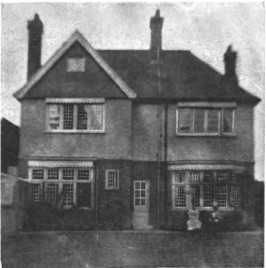
Penn, from the Garden—É. Zola, Miss & Mrs. Vizetelly
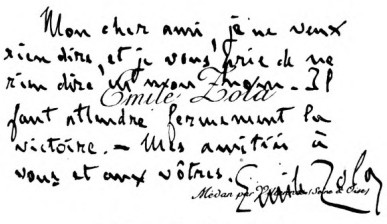
Fac-simile card from Zola to Vizetelly
He had entrusted his defence to an advocate still young in years, esteemed by all who knew him, but not as yet of high public reputation. Born at Rheims, of Alsatian parents, his father being one of the chief inspectors of the East of France Railway Company, Maître Labori had married a lady of Irish extraction, at one time well known in London musical circles. He was possessed of a tall, commanding figure, a bright, sunny face, a warm, penetrating voice. And he was not only very talented and extremely courageous, but he had the best of qualifications for the task he undertook: he believed absolutely in the innocence of Dreyfus; and thus he threw himself into the struggle with a whole-hearted devotion. The reader who knows something of the great fight he made both for Zola and for the unhappy Jewish officer, may be surprised to learn that if Maître Labori made himself a great name during that struggle, he reaped little or no immediate pecuniary gain. Zola's being a genuine political case, he would take no fee; he was only willing to accept a comparatively modest sum for his expenses and the services of the young advocates, his secretaries. In this he was following one of the lofty traditions on which the French bar prides itself. Berryer asked no fee when he defended either the ministers of Charles X or Louis Napoléon before the peers of Louis Philippe's time; Jules Favre asked none, whether he defended Orsini or other conspirators, or one of the many journalists or politicians arraigned during the Second Empire. The same may be said of Joly, who defended Henri Rochefort; of Gambetta when he defended Delescluze, and of many others. Occasionally a present in kind may be accepted by counsel; and from a few words that Zola once let fall, the writer thinks that Maître Labori may have been eventually persuaded to accept the title-deed of a little property which several of those indebted for his services thought of purchasing and presenting to him.
At the suit of Zola and his fellow-defendant nearly a hundred witnesses—ministers, officers, deputies, senators, diplomatists, authors, journalists, handwriting experts, and others—were summoned to appear at the approaching trial; but great efforts were made to prevent many from attending. Directly the jury-roll was issued, the names and addresses of those who might have to pronounce on the case were published by "Le Petit Journal" and other scurrilous prints; and numerous threatening letters were sent to these men, intimating that vengeance would follow if they should dare to acquit "the Italian." Moreover the Nationalist and Clerical leaders prepared for demonstrations on a large scale. A kind of employment office was established on the boulevards, where hirelings were engaged at the rate of five francs a day or two francs an evening to shout "Vive l'armée," "À bas les Juifs," and "Conspuez Zola!" These men met with little or no interference from the authorities, who contented themselves with massing police and municipal guards in and around the Palais de Justice.
The trial began on February 7. The Assize Court was crowded, Nationalists and anti-Semites preponderating among the audience. There were fifteen sittings altogether, the last being held on February 23. The presiding judge, M. Delegorgue,[19] did his utmost to prevent the witnesses from giving evidence respecting the Dreyfus case; and again and again, when Maître Labori wished to ask a question, Delegorgue snappishly exclaimed: "The question shall not be put!" Nevertheless the judge could not prevent the witnesses and Labori from establishing a number of facts—among others the illegality of Dreyfus's condemnation, the insignificance of the evidence upon which he had been officially condemned, the error committed by the military judges in respect of the bordereau, and the certainty that it was Esterhazy's work. The evidence was, indeed, of such immense significance that the General Staff thought it necessary to strike a decisive blow. General de Pellieux gave the jury a summary of a forged correspondence between Colonels von Schwarzkoppen and Panizzardi, the former German and Italian military attachés, this correspondence, in which Dreyfus was mentioned, having been manufactured by a certain Lemercier-Picard with the knowledge of the notorious Colonel Henry. General de Boisdeffre, however, virtually certified its authenticity, and at the same time threatened the jury with the resignation of the whole General Staff if Zola were acquitted. Then Colonel Henry and Major Lauth accused Picquart of having asserted Dreyfus's innocence without knowledge of the papers in the case, and of having invented one of them in order to ruin Esterhazy. Maître Labori was not allowed to question the generals, or answer them. Great indignation was expressed when Picquart had the courage to say that a Panizzardi-Schwarzkoppen letter mentioned by General de Pellieux was a forgery. Yet not only was such the case, but some weeks previously the forgery had been revealed to the embassies of Italy and Germany, most probably by Lemercier-Picard, the forger himself. Count Tornielli and Count Münster in their turn had revealed it to M. Hanotaux, the French Foreign Minister, demanding his word of honour that no use should be made of it. M. Hanotaux communicated this revelation to his colleagues, and even sent a written note about it to the Ministry of War. It has been said, too, that on the day after General de Pellieux's deposition M. Hanotaux proposed to suspend the proceedings in Zola's trial in order to look for and prosecute the forgers, but that his fellow-ministers hesitated from fear of a military movement. Anyhow, the episode ended disastrously for Lemercier-Picard. On March 3 he was found hanging in his room, his feet dangling on the floor. All his papers had disappeared before the police came to take possession of the corpse. Yet, according to the authorities, it was a case of suicide![20] The trial was full of stirring episodes. The Nationalists who crowded the court vented their passions freely, shouting, jeering, and groaning at almost everybody who expressed any view favourable to Dreyfus or derogatory to the swaggering, gold-laced officers, who when questioned either refused to answer or perjured themselves with the audacity of men confident of impunity. Zola, who was insulted day after day, put a brave face on it all, and only on a few occasions did he give utterance to his disgust, protesting against the manner in which he was mobbed in the streets, and against the denial of justice which he encountered in court, where he claimed the same liberty to defend himself as was accorded to thieves and assassins. At one sitting, when General de Pellieux made a slighting remark, the novelist turned on him haughtily: "There are several ways of serving France," said he. "A man may do so with the sword or with the pen. If you have won victories, so have I. I bequeath the name of Émile Zola to posterity, which will choose between us!" De Pellieux made no retort to those proud words. In that hour of mendacious triumph he did not foresee the day when he would be virtually disgraced, consigned to an obscure garrison in Brittany, to die there, tortured, as we know, by the deepest remorse. Again, at one moment towards the close of the trial, when the storm of execration thundered more loudly than usual in Zola's ears, the novelist turned towards the bellowers, and with one word branded them: "You cannibals!" he cried, "you cannibals!"
Except on two or three occasions when the rain fell in torrents, great precautions had to be taken for Zola's safety. Senator Ranc, an old conspirator and no mean judge of danger, subsequently stated that to his knowledge the novelist repeatedly had some very narrow escapes. The carriage in which he drove to and from the Palais de Justice was often pursued by a hostile mob, which the police had to charge and disperse. On some occasions policemen mounted on bicycles escorted the carriage, and Zola was always accompanied by a little body-guard of friends: M. Fasquelle, his publisher, M. Bruneau, the composer, and particularly M. Fernand Desmoulin, the accomplished engraver, to whom one owes a fine portrait of Zola, produced at the time when the Rougon-Macquart series was completed. Throughout the tumultuous period of the trial M. Desmoulin was invariably by his friend's side with a six-shooter in readiness. Madame Zola, who also attended the proceedings, was in like way escorted by vigilant friends. The horror of it all had at first seemed more than she could bear, but she strove to be brave and calm. After all, as she repeated, her husband was doing his duty.
On the thirteenth day of the trial, after the speech for the prosecution, Zola read an address to the jury, in which, after referring to all the pressure employed to secure his conviction, he sketched broadly and graphically the situation into which the Affair had cast France. He denied that he had insulted the army: those who had done so were the men who mingled with their acclamations the cry of "Down with the Jews!" "And they have even shouted, 'Vive Esterhazy!'" he added. "Great God! the nation of Saint Louis, of Bayard, of Condé, and of Hoche; the nation that can boast a hundred gigantic victories; the nation of the great wars of Republican and Imperial days; the nation whose strength, grace, and generosity have dazzled the world, has shouted 'Long live Esterhazy!' That is a stain of which only our effort for truth and justice can wash us clean." Then after speaking sarcastically of the alleged "Jewish Syndicate," said to have been formed to bribe people and buy evidence, he appealed to the common sense of the jury, warning them they would make a great mistake if they imagined that the campaign would be stopped by any verdict of guilty in his case. As for himself, he shrugged his shoulders at the insinuations that he had sold himself to the Jews, that he was a liar and a traitor. Then he continued:
"I have no political, no sectarian passions. I am a writer. I have toiled all my life, and shall return to the ranks to-morrow to resume my interrupted work. How stupid it is of some to call me an Italian, I the son of a French mother, brought up by Beauceron grandparents.... I lost my father when I was seven years old and did not visit Italy till I was fifty-four.... Still that does not prevent me from feeling very proud that my father belonged to Venice, the resplendent city whose ancient glory rings through every mind. But, even if I were not French, would not the forty volumes in the French language which I have scattered by millions of copies throughout the world, would not they suffice to make me a Frenchman, one useful to the glory of France?"
Having thus dealt with the personal question, Zola proceeded to plead for Dreyfus, for equity and enlightenment which alone could restore peace and order in France. And, asking the jurymen if they wished to see France isolated in Europe, he showed them the foreign nations already casting doubts on French humanity and equity. Next, amid increasing interruptions, he continued as follows:
"Alas! gentlemen, like so many others, you await perhaps a flash of lightning, the proof of the innocence of Dreyfus descending from heaven like a thunderbolt. Truth does not come upon us in that way; as a rule, some research and intelligence are needed to find her. (Jeers.) The proof! Ah! we well know where it might be found. But it is only in the depths of our souls that we think of that, and our patriotic anguish proceeds from a dread lest France should have exposed herself to receiving that proof as a slap, after compromising the honour of her army by a lie. (Loud protests.) But I wish to declare plainly that if we notified to the prosecution the names of certain members of foreign embassies as witnesses, we had no intention of summoning those persons to this court. Some people smiled at our audacity. But I do not think that anybody smiled at the Ministry of Foreign Affairs, for there they must have understood our object. (Protests.) We merely wished to indicate to those who know the whole truth that we knew it also. It is circulating in all the embassies, it will soon be known to everybody.... The Government which is ignorant of nothing, the Government which, like ourselves, is convinced of the innocence of Dreyfus (Loud protests.) can, without any risk, and whenever it pleases, find witnesses who will at last throw light on everything.
"Dreyfus is innocent, I swear it. (The proof! The proof!) I stake my life on it, I stake my honour on it. At this solemn hour, in presence of this tribunal which represents human justice, before you, gentlemen of the jury, who personify the nation, before all France, before the whole world, I swear that Dreyfus is innocent. (Uproar.) And by my forty years of labour, by the authority which that labour may have given me, I swear that Dreyfus is innocent. (Violent protests.) And by all I have acquired, by the name I have made for myself, by my works which have contributed to the expansion of French literature, I swear that Dreyfus is innocent. (Protests and hisses.) May all that crumble, may my works perish, if Dreyfus is not innocent. He is innocent! (Prolonged uproar.)
"Everything seems to be against me, the two Chambers, the civil authorities, the military authorities, the newspapers which circulate the most widely, and public opinion which they have poisoned. And on my side I have only an ideal of truth and justice. And I am quite easy in mind, for I shall conquer. I did not wish my country to remain amid mendacity and injustice. You may strike me here. France will some day thank me for having helped to save her honour." (General tumult. Repeated shouts of "The proof! Give the proof!")
Zola, as we know, was not an orator. Emotion made his voice tremble as he began to read his declaration, but composure gradually came to him, followed towards the close by real strength of manner. And though, as the foregoing extracts indicate, many sentences were followed by violent protests and ridiculous shouts of "Proof! proof!"—ridiculous by reason of the fact that the judge and the military witnesses had done their utmost to prevent any proof from being supplied—the audience listened with great attention. Once Zola's voice cracked as he tried to give emphasis to a word, and his listeners then jeered him, but, on the whole, he did far better than had been expected by those who knew how difficult it was for him to speak in public.
He was followed by Maître Labori, who had fought most manfully and skilfully throughout the whole proceedings, and who now speedily subdued the hostile and noisy audience. Whenever, at the outset of his great speech, the Nationalists laughed at a statement or an argument, counsel repeated it in a yet more emphatic manner than before. Groans arose when, referring to his client, he said: "A patriot like Zola"; and at once, turning like a lion, he repeated the words: "Yes, a patriot like Zola—a patriot with a braver heart, a clearer vision, a loftier love of his own land than is owned by any of the shallow-minded swallowers of phrases who rage at him. One of these days you will recognise your own folly and his greatness." Then the brave advocate paused for a few seconds, as if challenging a new outburst. But there was complete silence. "Ah, well, then," he said, with a touch of fighting laughter in his voice, "I will continue." And having conquered his audience he reverted to his argument. His address was continued on the morrow, February 22, when, demonstrating the accuracy of Zola's assertion that Dreyfus was innocent, he showed that the whole procedure of the 1894 trial had been carried out by officers whose excitement of mind had verged on positive derangement, and that it was consequently valueless. Towards the end of his argument, which was very close and pregnant, the anti-Semites once more became uproarious, but the manifestations against the advocate brought on counter-manifestations in his favour from the Dreyfusites, who had mustered in some force that day. The account of Dreyfus's degradation, the unhappy man's letters and protests, which Maître Labori read, produced a powerful impression. When he referred to the extraordinary traps which Du Paty de Clam had set in the hope of extracting from his prisoner something which might be interpreted as a confession, everybody seemed suddenly won over to the Dreyfusite cause, and acclamations again followed a passage in which counsel reminded those in high places, who assumed such a hypocritical "non possumus" attitude towards the case, that the most pilloried and execrated name in all history was that of Pontius Pilate. Again, on the morrow, Maître Labori took up the thread of his discourse, which ended with a fine peroration. But this time, the Dreyfusites being altogether outnumbered, vehement protests mingled with the applause which saluted him. After M. Clemenceau had spoken amid frequent tumultuous interruptions for Zola's fellow-defendant, M. Perrenx of "L'Aurore," the jurors withdrew to consider their verdict which, by a majority of seven to five,[21] was one of guilty. It was seven o'clock in the evening, the court-room, the whole Palais de Justice indeed, its precincts and the adjoining streets, were crowded with people among whom the professional anti-Semites and many officers were conspicuous. Yells of triumph greeted the news of the verdict, and were renewed when it was known that in Zola's case the maximum penalty of a year's imprisonment with a fine of three thousand francs had been applied.[22] And there came loud and ominous shouts of "Death to the Jews! death to the dirty Jews!" followed by scuffles and affrays which the police, two thousand in number, could scarcely check.
Zola took his sentence quietly, his wife fell weeping on his neck and his friends surrounded him, pressing his hands. At last he was smuggled out of court and carried to a friend's house, where he spent the evening, while half Paris was demonstrating in one and another direction. The verdict and sentence were naturally approved by the great majority of people who, having as yet no notion that several officers of the General Staff had deliberately perjured themselves, still put all their trust in those brave defenders of the country. On the following day, however, the foreman of the jury stated, significantly enough, that the verdict had been given on the sole ground that Zola had gone beyond what was permissible by insulting a court-martial. As for the revision of the Dreyfus case, he, the foreman, was not opposed to it, indeed he hoped it would be brought about by legal means. Thus the triumph of the Militarists was really only surface deep.
Zola gave notice of appeal on various grounds, and then turned to his novel "Paris," the last proofs of which he had quietly corrected during the interval between his letter, "J'Accuse," and his trial. The work was originally to have appeared in January, but was delayed by Zola's participation in the Dreyfus case. Writing to Vizetelly on February 6, the evening before he went into court, he said: "'Paris,' will only be published on March 1. Please therefore warn Mr. Chatto at once and tell him that this date is final.... I am not of your opinion.[23] I think that the book will be more successful if we allow the public emotion to calm down a little. Besides, we shall not be ready till March 1."
"Paris," which had been appearing serially in "Le Journal," was issued, then, on that date.[24] In France the sales were small, for many who had long read Zola with approval now turned from the alleged insulter of the army, the defender of Jewish traitors. But the demand from abroad, whence addresses of sympathy had been raining upon the novelist for six weeks past, was a large one, and thus he did not immediately suffer any great pecuniary loss from his championship of an obnoxious cause. Unfortunately the lessons which the work inculcated scarcely reached those for whom they were primarily intended, that is the Parisians themselves, all "good patriots" having now agreed to shun Zola and his works.
A period of less disorder but of much controversy, marked by some more revelations, followed his trial. Then on April 2, the Cour de Cassation, having examined his appeal, quashed his conviction on the ground that the proceedings ought to have been instituted, not by the Minister of War, but by the court-martial which he had been accused of libelling. This decision quite enraged the military authorities. The court-martial in question became alarmed and almost shrank from taking proceedings, but pressure was put on it by General de Pellieux and others who on April 8 prevailed on its members to take the necessary action, and at the same time apply to the Grand Chancellor of the Legion of Honour to strike Zola off the roll—a suggestion which the ineffable Drumont had repeatedly made in "La Libre Parole." When on April 11 Zola received a fresh citation, he found that he was summoned before the Versailles Assizes, and that only three lines of his famous letter, "J'Accuse," were now incriminated! The trial was fixed for May 23, on which day anti-Semites and Dreyfusites flocked to Versailles. But Maître Labori impeached the jurisdiction of the court on the ground that Zola's offence had been committed in a newspaper printed and published in Paris, and on a decision being given against him, the Cour de Cassation was again appealed to. A further delay then ensued.
On May 29, however, an ignoble attack was made on Zola by a certain Ernest Judet of "Le Petit Journal," in which he had been carrying on an unscrupulous campaign against the cause of justice. The attack took the form of some alleged revelations respecting the novelist's father, who was said to have been a thief. Judet printed documents derived from somebody at the War Office—presumably Colonel Henry—which were subsequently shown to have been doctored or forged; and the story which he told, in his own fashion, was that of François Zola's connection with the French Foreign Legion. It has been dealt with in the first chapter of this volume; but the incident must be mentioned here, for it gave the accused man's son a great and painful shock. The undoubted object of this infamous publication was to discredit his efforts on behalf of Dreyfus and to damn him in public opinion. But Zola retorted with a glowing protest in "L'Aurore," and before long he and Judet were prosecuting one another for libel. The sequel will be told hereafter.
Pending the decision in the second appeal made to the Cour de Cassation, the turmoil in France continued. Numerous illegal and iniquitous acts were perpetrated, professors who had espoused the cause of justice were summarily dismissed, Colonel Picquart was turned out of the army, M. Joseph Reinach lost his rank as an officer of reserves, the General Staff virtually ruling the country in spite of the various discoveries and revelations which tended, in an increasing degree, to prove the innocence of Dreyfus and the guilt of Esterhazy. At the general elections, which supervened about this time, only a few candidates, such as M. Jaurès and M. Reinach, dared to speak of justice. It was a fear of those elections and the constituencies that had previously led many deputies to shrink from the cause of revision. However, though the Nationalists gained by the elections, they did not swamp the Republic. M. Méline, falling from power, was replaced as Prime Minister by M. Brisson, and General Billot as War Minister by M. Cavaignac. This politician, a man of some ability but much greater self-conceit, imagined that he would put an end to the Affair once and for all. On July 7, primed with papers provided by Colonel Henry and in which he foolishly believed, he delivered an extraordinary speech which the Chamber of Deputies enthusiastically ordered to be placarded throughout France. In this effusion, in which Dreyfus was alleged to have confessed his guilt, use was again made of the Schwarzkoppen-Panizzardi forgeries, as well as of the paper about a spy called D, to which reference has been made previously. According to Cavaignac, those documents ended the affair for ever, and Zola therefore might be finally judged and condemned.
The novelist's appeal on the question of jurisdiction had been rejected on June 16, a new trial at Versailles being fixed for July 18. In the interval, that is on July 9, two days after Cavaignac's declarations, the three handwriting experts succeeded in the proceedings they had brought against Zola for libel. He was sentenced to undergo two months' imprisonment, to pay a fine of two thousand francs, and damages to the extent of five thousand francs to each plaintiff. But an appeal being entered, execution did not follow immediately. On July 16, two days before returning to Versailles, Zola issued a fresh manifesto, this time in the form of a letter to M. Brisson, the new Prime Minister, whom he upbraided for lending himself to Cavaignac's mock inquiry into the Dreyfus case and attaching importance to the alleged confession of the unhappy prisoner of Devil's Island. Since then we have learnt from M. Brisson himself[25] that he had to contend with many difficulties, the pressure exercised by President Faure, who was entirely on the side of the Militarists, the deceit and trickery of his colleague Cavaignac, the diffidence of other ministers, and the mendacity of various officers. M. Brisson was sincerely desirous of doing his duty by furthering the revision of the Dreyfus case, and would have done it sooner than he did if so many obstacles had not been placed in his way. One part of the novelist's letter he certainly took to heart. Zola protested against being mobbed by hireling anti-Semites, and as he knew that a great expedition of those roughs to Versailles had been planned for the day of the new trial, he asked that proper measures might be taken for the preservation of order. This was done, gendarmes and troops, as well as police, being assembled.
The novelist returned, then, to Versailles with his counsel and his co-defendant, M. Perrenx, the publisher of "L'Aurore," who remained a kind of lay figure throughout the whole proceedings, being properly remunerated by his newspaper for the inconvenience he incurred. Zola and his advisers had now resolved to keep the Affair open as long as possible, this being the more advisable as Esterhazy, in consequence of the denunciations of a relative, had now been arrested with his mistress by order of an investigating magistrate; a similar fate also befalling Colonel Picquart, against whom M. Cavaignac had preferred a frivolous charge in consequence of his public declaration that two of the documents read by the minister to the Chamber on July 7 did not apply to Dreyfus at all and that a third was a forgery. Those incidents pointed to further developments, and moreover, already at this date, Zola and others had reason to suspect that the forgery in question might be the work of Colonel Henry,[26] whom they had come to regard with great suspicion, he being at the head of that Secret Intelligence Bureau whence so many strange documents emanated.