ERNEST ALFRED VIZETELLY (continued 4)
Reading edition
As for Zola, his literary views certainly became more liberal as he grew older; but at the period one has now reached he was in his most arbitrary and dogmatic mood, going so far as to suggest in a pamphlet that each régime must have its appropriate literature, that Naturalist literature alone was suited to the Republic, and that the Republic itself must prove Naturalist, or otherwise would assuredly collapse. "By Naturalism," said he, "I mean analytical and experimental methods based on facts and human documents. There must be agreement between the social movement, which is the cause, and literature, which is the effect. If the Republic, blind as to itself, and failing to understand that it exists by the force of a scientific formula, should begin to persecute that formula in literature, this would be a sign that the Republic is not ripe for facts, and that it must once again give place to one, that is dictatorship."[7]
The pamphlet we have quoted was issued early in 1879. Some months previously both Gustave Flaubert and Alphonse Daudet, being well acquainted with M. Agénor Bardoux, an Auvergnat poetaster and politician appointed Minister of Public Instruction, had suggested to him that Zola, who by "L'Assommoir" had now risen to a conspicuous position, ought to be made a knight of the Legion of Honour.[8] Daudet, in this matter, was actuated by friendship and admiration, and Flaubert deemed himself to be under a great obligation to Zola. It seems that while Flaubert was writing his "Bouvard et Pécuchet" (which did not appear till after his death), he had often spoken of it to his friends in a somewhat mysterious manner, never actually giving the names of his characters, but referring to them merely by their initials, B. and P. Zola was then working on "Son Excellence Eugène Rougon," and one day, when he and Flaubert met at a lunch given by M. Charpentier, he mentioned that a capital name had occurred to him for one of his characters, this name being Bouvard, which, with its suggestion of blotting-paper, was certainly a fit appellation for a civil service scribe. It so happened—such is coincidence—that Zola and Flaubert proposed to bestow it on much the same type of man; but the former, of course, was quite ignorant of his friend's intentions, for Flaubert, restricting himself to the initial B., had never allowed the word Bouvard to escape his lips. When it fell from Zola's, the author of "Madame Bovary" was greatly upset. "He became quite strange," wrote Zola on subsequently relating the incident, "and after lunch he took me to the bottom of Charpentier's garden, where, with a great show of emotion, he implored me to surrender the name of Bouvard to him. I assented, laughing; but he remained very grave, plainly touched, and even declared that he would not have persevered with his book if I had insisted on using the name. He looked upon his work as being entirely in those two names Bouvard and Pécuchet, and could not picture it without them."[9]
Now Flaubert was one of the best-hearted men in the world. He regarded Zola's trifling concession as an act of great generosity, and it was to mark his sense of it that he solicited for his friend the Cross of the Legion of Honour. Pressed both by Daudet and Flaubert, M. Bardoux showed himself very favourably disposed, and when, in accordance with usage, he was visited by Zola, he told him straightly he would be gazetted on the next National Fête-day July 14, 1878. That date came and went, however, and Zola's name did not appear in the "Journal Officiel"—the cross promised to him going, instead, to Ferdinand Fabre. Other occasions presented themselves, Bardoux was often urged to keep his promise, but as often evaded it, and of course when the uproar provoked by Zola's paper on his fellow-novelists supervened, it afforded a good excuse for shelving the matter altogether. Meantime the affair had become common talk in certain literary circles, and Zola, who felt that he was being made ridiculous, had more than once threatened to fling the cross in Bardoux's face if he should eventually tender it. Alexis, in recounting the affair, throws virtually all the blame on the Minister; but the latter, after various paltry and untruthful excuses, which certainly put him in a bad light, told Edmond de Goncourt that if he had failed to keep his promise it was not his fault, but really that of his colleagues in the Government.[10]
It really seems to be the case that the question whether Zola should be decorated was made an affair of State, solemnly debated by the Council of Ministers at the Élysée Palace, Marshal MacMahon being in the chair, probably with his usual cigar between his lips, and his usual bottle of green Chartreuse standing handy on a cheffonnier, in order that he might help himself whenever "he felt so disposed," which, according to the scandal-mongers of the day, was pretty often. And the brave, honest, and narrow-minded Marshal, who—perhaps at his wife's instigation—absolutely refused to promote the impious Renan from the rank of chevalier to that of officer of the Legion of Honour, was in thorough agreement with all the Ministers who opposed the unlucky Bardoux when he asked that the red ribbon might be conferred on the obscene Zola. On his side, the latter, ignorant of the real circumstances of the case, and more and more annoyed by the spiteful allusions to the affair which appeared in some of the newspapers, issued an open letter formally signifying his renunciation of the red ribbon, with the result that for some years there was no further question of "decorating" the foremost novelist of France.
On January 18, 1879, the Ambigu Theatre gave the first performance of the dramatic version of "L'Assommoir" prepared by Messrs. Busnach and Gastineau, who, in point of fact, had been largely assisted by Zola, though his name did not appear on the bills, and he allowed all the merit of the play's success to be attributed to his colleagues. Goncourt tells us that during the rehearsals his melancholy mien quite chilled the actors, who by no means anticipated a success.[11] While the first performance was in progress Zola sat reading in the manager's private room, and on the fall of the curtain his friends repaired thither to inform him that, apart from a little hissing, everything had gone off satisfactorily. Nevertheless, the critics attacked the play, an English writer, George Augustus Sala, evincing particular distress in a long article which recalled Sarcey's customary brief verdict: "That man Zola makes me ill."[12]
But all Paris had read "L'Assommoir" as a novel, and wished to see it on the stage;[13] and, besides, even the critics could not deny that Madame Hélène Petit's impersonation of the unhappy Gervaise was a great personal triumph. Thus crowds flocked to the Théâtre de l'Ambigu, whose director, Henri Chabrillat, an ex-journalist and novelist, who had commanded the Francs-tireurs de la Presse during the Franco-German War, suddenly found himself making a fortune.
In honour of the staff and company of the Ambigu, the authors of the play ended by giving a ball at the Élysée Montmartre, which, by the way, figured in Zola's story, and Mr. George Moore, the well-known author of "A Mummer's Wife" and "Esther Waters," has related that his first meeting with Zola—of whom he became for several years the chief English supporter—occurred at this particular entertainment.[14] Mr. Moore—who had then only produced his "Flowers of Passion," and was therefore known in Parisian literary and art circles as a young poet—attended the ball dressed as a Parisian workman, and was engaged to dance with Gervaise. He had no opportunity for conversation when Manet introduced him to Zola, but he called at Médan a few weeks afterwards, and a close friendship sprang up between him and the author of "L'Assommoir." Each, however, was possessed of strong personal convictions, and, as years went by, Zola's life and work gradually took a course of which Mr. Moore did not approve, perhaps because—as admitted by himself—he failed to understand it.
The law of the world is evolution. L'homme absurde est celui qui ne change jamais; and Zola, amid the very triumph of "L'Assommoir," at the very moment when he was expounding the principles of Naturalism in the "Viestnik Yevropi" and "Le Voltaire" (which he joined when "Le Bien Public" ceased publication), was already, and quite unconsciously, perhaps, undergoing a change. He was in some degree carried away by the sudden accession of ample means after years of poverty and years of battle. In the long run he showed himself superior to fortune, whether it were favourable or adverse, but he found its first smile irresistible, as so often happens with those who have long toiled and suffered and cursed their fate. Briefly, he proved no exception to the general rule, and he was taunted with having failed to depart from it, being candidly told in print that, like Herbert Spencer and Gustave Flaubert, he ought to have been quite content with mere lodging-house surroundings, and that he made a ridiculous use of his comparative wealth.
Most of his money, it may be mentioned, was lavished on his property at Médan, to which he made many additions, building, for instance, a large square tower in which he fitted up a spacious workroom, whose huge window suggested that of a studio. In that room in later years most of his books were written. And as wealth accrued a second large tower was added to the first, followed by some smaller ones flanking the entrance of the property. All this was denounced as bad taste; and unquestionably, from an architectural point of view, Médan, with one bit of building added here and another there, became a strange-looking place. At the same time it remains an interesting memorial of the rise of Zola's fortunes. One knows, for instance, that the first tower was built with money derived from "L'Assommoir," that the second was erected with some of the proceeds of "Nana," that this and that enlargement were paid for by "La Terre" or "La Débâcle." Certainly no common parvenu would have left such a tell-tale record. It is doubtful whether he would have been content to dwell during the greater part of the year in an out-of-the way village like Médan; and even had he retained possession of the property he would surely have demolished the original humble little house and have erected some grand Louis Treize château on the site.
But another charge preferred against Zola was that he wasted time and money in collecting works of art and curios—the latter more often than the former. In his novel, "L'Œuvre," he gave an explanation of this which is worth quoting:
"His [Sandoz's, otherwise Zola's] drawing-room was becoming crowded with old furniture, old tapestry, nick-nacks of all countries and all times—an overflowing torrent of things which had begun at Batignolles with an old pot of Rouen ware, which Henriette [Madame Zola] had given her husband on one of his fête days. They ran about the curiosity shops together; they felt a joyful passion for buying; and he now satisfied the old longings of his youth, the romanticist aspirations which the first books he had read had engendered. Thus this writer, who was so fiercely modern, lived amid the worm-eaten middle ages which he had dreamt of when he was a lad of fifteen. As an excuse, he laughingly declared that handsome modern furniture cost too much, whereas with old things, even common ones, you immediately obtained some effect and colour. There was nothing of the collector about him, his one concern was decoration, broad effects; and to tell the truth, the drawing-room, lighted by two lamps of old Delft ware, derived quite a soft, warm tone from the dull gold of the dalmaticas used for upholstering the seats, the yellowish incrustations of the Italian cabinets and Dutch show-cases, the faded hues of the Oriental door-hangings, the hundred little notes of the ivory, the crockery and the enamel work, pale with age, which showed against the dull red hangings."[15]
No doubt, among the great quantity of tapestry, carved wood, old furniture, pottery, church embroideries, and so forth, which Zola thus gathered together, there were occasionally things which did not suggest the best taste or the greatest accuracy of judgment. But the statement quoted above shows that he disclaimed collecting in the ordinary sense, and made purchases solely for decorative purposes. And, in any case, even if he bought a few things whose only recommendation was their quaintness, or accepted an object as genuine when an expert would have known it to be spurious, his transgressions in those matters were of no importance to the world at large, and one is surprised that some of his "candid friends" should have thought it worth while to expatiate on them.
It has been urged, however, that directly money came to Zola, instead of yielding to a desire for comfort, he ought to have devoted himself to travel and study, and particularly have restrained his literary output. He would have derived benefit from foreign travel undoubtedly, but his self-set task of the Rougon-Macquart series long riveted him to France. As for study, he was always studying, books as well as men, and Mr. George Moore's suggestion that he had little acquaintance with the heart of French literature[16] was erroneous, for abundant proof of the contrary will be found in the eight volumes of his collected essays and articles. These also show that he kept abreast of the literature of his time, and all his friends are aware that new books and literary periodicals, to say nothing of a profusion of newspapers, encompassed him during the last twenty years of his life. But, in a large degree, he certainly set the literature of the past behind him, regarding it as being chiefly of historical value. And whether he were right or wrong in that matter, it must be obvious that his attitude was in keeping with his character as an evolutionist. In a word, he was more concerned respecting the future of literature than respecting its antecedents.
But it has been said that a change began to appear in Zola about the time of "L'Assommoir," and the change we more particularly mean is that by which the novelist expanded into a reformer. As scores of his newspaper articles, collected and uncollected, testify, the injustice of the social system had always been manifest to him. With the degradation of many individual lives he was well acquainted. His own rise to affluence made him yet more conscious of the difference between the rich and the poor. His descent into the mire of life, to seek there his Coupeau, his Lantier, and his Gervaise, left on his mind some impress of the horror which he imparted to others. And thus, with him, art no longer remained art for art's sake only,—a broad humanitarianism gradually entered into his literary conceptions.
At the outset the novelist and the reformer were certainly more or less at variance. The cuisine of politics still remained distasteful to Zola, and he is often found protesting that he is merely a literary man and does not wish to intervene in passing events. But as the years elapse the reforming instinct becomes more and more powerful, gathers increased strength from such works as "Germinal" and "La Terre," till at last the humanitarian feeling, triumphing over everything else, trampling unrestrained upon all literary canons, finds voice in "Lourdes" and "Paris," "Fécondité" and "Travail," and at a supreme moment impels Zola to champion the chosen victim of Roman Catholic fanaticism and military infallibility.
At an early stage of his gradual transformation he is seen defining the novelist as an exponent, an analyst, a dissector of human life. His work is to be accomplished in strict accordance with science, and the methods of the great scientist, Claude Bernard, are held up to him as examples. This idea of "le Roman Expérimental," as Zola finally called the scientific fiction he expounded, had long haunted him; but when he wished to give it really adequate expression he was momentarily at a loss as to where he might find the most forcible and most modern exposition of scientific principles and methods. It was his friend M. Yves Guyot, a many-sided man, then only a journalist, later a Minister of State, and now eminent as a political economist, who recommended him to study Claude Bernard.[17] On that study Zola based one of the most famous of his essays. Science, which appeals so little to some minds, particularly literary minds of the average calibre, is really the greatest humanitarian agency we possess. The man who experiments, the man who dissects, does not do so for mere pleasure; his aim is the increase and diffusion of knowledge, the benefit of the world, the advantage of his fellow-men. That which is learnt in the laboratory, the workshop, the operating room is put to use in a thousand ways. In physiological and medical science the work may often be very repulsive, yet it reveals the causes of many flaws and ailments, and points to the means of cure. A similar aim became Zola's as he proceeded with his novels. He made it his purpose to inquire into all social sores, all the imperfections and lapses of collective and individual life that seemed to him to require remedying. That everything should be made manifest in order that everything might be healed, such was the motto he adopted.
Yet in the first instance he did not preach, he did not denounce, he contented himself with stating the facts; he confined himself to analysis, dissection, and demonstration, and he used the novel as his vehicle, because the novel alone appealed to the great majority of people to whom it was necessary that the facts should be made patent if any remedy were to be applied.
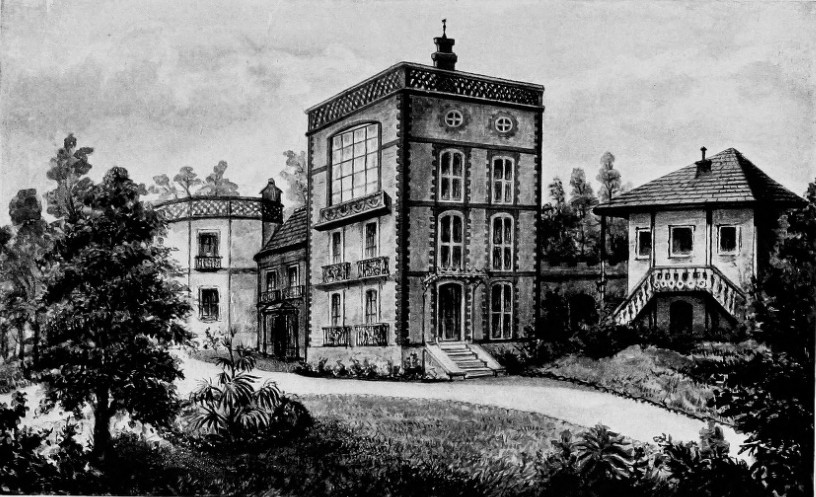
Zola's Home at Médan, showing the "Assommoir" & "Nana" Towers. —Chamet, del.
But the prejudiced, the purblind, and the foolish, the hundreds of so-called critics who had glanced at his novels but had never perused a line of the essays in which he enunciated his principles, responded by accusing him of a degraded partiality for filth, of wallowing in mire, because such was his favourite element. The sensation created by "L'Assommoir" had been great, that which attended the production of "Nana" was perhaps greater.
Much of the year 1878 was spent by Zola in making preparations for that book. Incredible as it may seem, his critics have actually reproached him for his previous ignorance of the "successful" Parisian courtesan. His knowledge of her had certainly been limited to her out-door life; like others he had seen her, elbowed her at the theatres, in the Bois, and at other places of public resort. That was all. He therefore applied to friends and acquaintances for information. Edmond de Goncourt, who had repeatedly dined at the table of La Païva[18] before she became the wife of Henckel von Donnersmarck, gave him a variety of information; Ludovic Halévy initiated him into the demi-mondaine side of theatrical life, to which, given all his intercourse with Hortense Schneider, Zulma Bouffar, and others, he was the most competent of guides; men of fashion, who had wasted their best years and much of their money among the harlots of the Second Empire, told him tales of their experiences; he visited the house of one belle impure from basement to attic, and he supped at the house of another. Of the lower-class unfortunate he had, perforce, seen a good deal during his bohemian years in the Quartier Latin, and all observers of women of that category are aware that in most cases, though they may acquire some superficial polish on rising to wealth, their real natures undergo little change.
Zola's enemies naturally imputed the writing of "Nana" to his partiality for vice and scandal, but those who are acquainted with "L'Assommoir" will recognise that, in such a series as "Les Rougon-Macquart," a study of the courtesan was the necessary corollary of the study on drink and the general degradation of the working class. It is from such homes as those of Coupeau and Gervaise that spring nine-tenths of the unhappy creatures so grimly denominated filles de joie. Nana's childhood and youth had already been recounted in "L'Assommoir," and it was certain that Zola would not leave her there. How could he picture the degenerescence of a period if he omitted the harlot, who had played—people hardly seem to recognise it nowadays—such a prominent, such a commanding part, during the years when Napoleon III.—dallying himself with La Castiglione, La Bellanger, and a dozen others, while his cousin Prince Napoleon Jérôme kept the notorious Cora Pearl—had transformed the proud city of Paris into the brothel of Europe? Again, scores of Zola's contemporaries, writers of various degrees, by trying to poetise the courtesan, had increased her influence a hundred-fold, and the time had come to check her encroachments by exhibiting her in her true colours, with all her vulgarity, her greed, her degradation, her shamelessness and heartlessness.
In September, 1879, when Zola had written about half of "Nana," he arranged with M. Laffitte, editor of "Le Voltaire," which was then publishing his articles on "scientific fiction," to produce the story in that newspaper, and M. Laffitte at once advertised it in a fashion worthy of Barnum himself. Huge posters appeared on all the walls of Paris, "displayed" announcements invaded the newspapers, sandwich men patrolled the streets, ticket-advertisements were even affixed to the gutta-percha tubes of the pipe-lights in the tobacconists' shops; and, indeed, upon every side one found the imperious injunction: Read Nana! Nana!! Nana!![19] All this greatly vexed Zola, who had shut himself up at Médan to finish the book, and who did not at all desire to be advertised in such an extravagant fashion. To make matters worse, the serial issue had scarcely commenced (October 16, 1879) when several newspapers began to discuss the story, all the quidnuncs demonstrating by A plus B that the opening chapter was not at all such as it ought to be, and that the work was bound to prove a failure. Then, too, letters full of suggestions or criticism or denunciation rained upon Zola at Médan, putting his nerves to the severest test. Nevertheless, he worked on steadily, taking the greatest care over even the most trifling details, employing a friend to obtain precise information on such matters as phaetons and tandems, the decorations of Mabille, the aspect of the rooms on the top-floor of the Grand Hotel, the view from them, and the facial mask of a woman dying (as Nana died) from small-pox.[20]
As the publication proceeded in "Le Voltaire" the complaints became more numerous. A good many people professed to be shocked, Gambetta presently complained to the editor that the story was "too strong"; and the editor requested Zola's permission to curtail or omit certain passages. This was accorded, the latter half of the work appearing in "Le Voltaire" in a bowdlerized form. On January 2, 1880, Zola started on the fourteenth and last chapter, and on January 7 he completed it. "Let me tell you a great piece of news," he wrote to a friend that day, "I finished 'Nana' this morning.... What relief! Never did any previous work of mine upset me as this has done. At present let it be worth what it may, it has ceased to exist for me. I write to you in the joy of deliverance. My last chapter seems to me to be the most weird and successful thing I have ever written."[21]
A few weeks later, that is on February 15, "Nana" appeared in book form, the passages omitted from "Le Voltaire" being reinstated in the text. Large orders having been received from various parts of the world, M. Charpentier had ordered fifty-five thousand copies to be printed, but on the very day of publication he found it necessary to order ten thousand more.[22] In the case of "Nana," as in that of "L'Assommoir," the public gave no heed to the critics, who, of course, raised their customary protests. In certain matters of detail their objections were well founded. Zola had made a few mistakes in dealing with some of the minutiæœ of theatrical and turf life, and, as Madame Edmond Adam remarked in the "Nouvelle Revue"—and as the author himself subsequently admitted—Nana was shown accomplishing in few years what, in actual life, would have taken a woman much longer to accomplish. That, however, was forced upon Zola by the scheme of his series, the incidents recorded in which had to occur between the years 1852 and 1870.[23] When all is said, taking "Nana" in its ensemble, it was certainly the most truthful picture ever traced of the so-called Parisian world of pleasure in Imperial times. Of course the book was denounced as immoral. The Parisian smart set shrieked loudly, many a Boulevardian journalist, whose looseness of life was notorious, perorated in club and café respecting the amazing depravity of that man Zola, and in addition to abusive newspaper articles, there again came scurrilous pamphlets and parodies after the fashion of those which had followed "L'Assommoir."
Zola did not reply immediately; but in 1881, when "Nana" had been dramatised, he contributed a few articles to "Le Figaro" on the subject, besides penning a longer paper on "Immorality in Literature," in which he contended that writers of the Idealist school made vice all roses and rapture, whereas the Naturalists made it repulsive. And he was absolutely convinced, he said, that far more heads had been turned, more young men and girls and women led into dangerous courses, by the works of George Sand, Octave Feuillet, Barbey d'Aurévilly, and even Sir Walter Scott, than by the writings of Flaubert, Balzac, Goncourt, and their followers. As for "Nana," said he, it had given offence because it was a true picture, and therefore spoilt the pleasure of the viveurs of Paris, who wished to see everything couleur de rose beneath a cloud of poudre-de-riz.[24]
In 1880, after the publication of "Nana," Zola wrote several short stories. He had published one, "Naïs Micoulin," in a paper called "La Réforme," towards the close of the previous year; and he now gave "La Fête à Coqueville," "L'Inondation," and "Nantas," to "Le Voltaire," to which journal he also contributed some papers on Théophile Gautier, Ste.-Beuve, and others. But a better known publication in which he was interested appeared during the spring. This was the collection of stories called "Les Soirées de Médan,"[25] to which Zola contributed his well-known tale, "L'Attaque du Moulin," which he had previously published in Russia, and which subsequently provided his friend M. Alfred Bruneau with the subject for an opera. Nowadays in its form as a story "L'Attaque du Moulin" has become a reading book in many French and English schools.
As mentioned in a previous chapter, five younger writers, Alexis, Huysmans, Maupassant, Céard, and Hennique, had gathered round Zola, whose literary views they largely shared.[26] Each of them contributed to the so-called "Soirées de Médan," the preface of which stated: "The following stories have been published previously, some in France, others abroad. It has seemed to us that they have sprung from one and the same idea, that their philosophy is identical. We therefore unite them. We are prepared for all the attacks, the bad faith, and the ignorance of which current criticism has already given us so many examples. Our only concern has been to affirm publicly what are really our friendships and our literary tendencies."
At that time, of the six writers responsible for that preface, only Zola had acquired a position; and such a solemn manifesto seemed therefore somewhat presumptuous, the more particularly as, apart from Zola's tale, the only other of real merit in the book was Guy de Maupassant's. For him, so far as the book-reading public was concerned, "Les Soirées de Médan" proved virtually a début, whose promise his subsequent writings confirmed. "Boule de Suif," as he called his contribution to the volume, was the tale of a woman, who is shown sacrificing herself, during the Franco-German War, for the convenience and safety of others. They entreat her in that sense, and yet as soon as they are free they spurn her and abandon her to her shame. This woman, like the other people figuring in the story, actually lived,[27] and indeed it would be difficult to find half a dozen really imaginary characters in all Guy de Maupassant's tales. He carried the passion for personalities even farther than Alphonse Daudet did, and there exists, it is said, a set of his writings, on the margins of which he himself wrote the real names of almost every person and locality he ever described. One may conclude that he was perhaps a more genuine Naturalist than Zola, his work being invariably based on "human documents," the fruit of personal observation and experience. This occasionally tended to make his art unduly photographic; but, at the same time, as is well known, his literary style was excellent, and from that standpoint some of his tales are undoubtedly masterpieces of their kind.
Unfortunately there was insanity in Guy de Maupassant's family, which was old, of good nobility, but limited means. His father, who had been a painter and had played a prominent part in founding a famous Paris art club, had died in a lunatic asylum. The same fate befell his brother; and, according to some accounts, there was insanity on his mother's side also. In any case, from birth onward a dreadful threat hung over Guy de Maupassant, and the life he led from the time he became his own master was not calculated to ward off the danger. He was a man of the strongest passions, a beau male, as the French say; and women began the work which absinthe, opium, and morphia completed. At last, still young in years, at the height of his celebrity, he attempted his life, and was only saved from immediate death to languish awhile in an asylum. One cannot think of him, as of some others, without feeling the force of the contention that very little may at times separate genius from insanity.
Immediately "Les Soirées de Médan" appeared, its contributors were chaffed by the newspapers for attributing undue importance to themselves; and Zola was said to be bringing up these young men in leading-strings for the express advancement of his literary theories. A rather acrimonious controversy ensued, Zola repeatedly declaring that he was not, and did not wish to be, a chef d'école, and that those with whom he was associated were his friends and not his disciples. But the discussion suddenly ceased, for the literary world of Paris was startled by the unexpected news of Gustave Flaubert's death at Croisset, near Rouen.
During the previous Easter (March, 1880) the veteran author had received Daudet, Zola, Charpentier, Maupassant, and Goncourt at his country place, and Goncourt has related in his "Journal" how thoroughly they enjoyed Flaubert's paternal hospitality, and how on Easter Monday they lingered in Rouen, ferreting among old curiosity shops, playing billiards, and planning a diner fin at the principal hotel. When, however, they wished to give their order, consternation fell on them: it was a holiday, all the provision shops were closed, the hotel larder was virtually empty, and the diner fin resolved itself into veal cutlets and cheese. That amusing experience was still in Zola's mind when, on May 8, he received at Médan this laconic telegram from Maupassant: "Flaubert dead." Dead—and they had left him so gay and so full of life and health! Zola was profoundly attached to Flaubert, and the tidings quite unmanned him. On May 11 he started for Le Croisset and attended the funeral, of which he has left a deeply interesting account, instinct with all the grief of one who has lost a near and dear friend. In these later years various English versions of some of Flaubert's books have been published, but, so far as the present writer is aware, no editor or publisher has thought of utilising Zola's account of Flaubert as an introduction to a translation. Yet that account is perhaps Zola's best work as an essayist,—full of interest, and much of it admirable in tone and style. One may say, too, that anybody wishing to form an accurate opinion of Gustave Flaubert, both as a writer and as a man, cannot do better than read the hundred pages which Zola devoted to him in his "Romanciers Naturalistes."
But another blow fell on Zola in 1880. In October his mother, long ailing and crippled, passed away at Médan. Various painful circumstances attended the death and the funeral; and Goncourt, writing at the end of the year, pictures Zola as having become a perfect hypochondriac in consequence of this loss. He complained of all sorts of ailments, kidney disease and palpitations of the heart, talked of his own death as being near at hand, and feared that he would not have time to finish anything. Briefly, "he was filling the world with his name, his books were selling by the hundred thousand, no other author, perhaps, had ever created such a stir, and yet he felt profoundly miserable."[28]
About the time when his mother died his articles on "scientific fiction," previously issued, some in "Le Voltaire" and others in the "Viestnik Yevropi," were republished in a volume.[29] One of them had greatly offended Laffitte, the editor of "Le Voltaire," who being mixed up in sundry transactions with some of Gambetta's satellites, resented Zola's caustic allusions to them. Nor was an article on some scandal occasioned by the erotic publications of the "Gil Blas" to his liking. He ended by accusing his contributor of defending obscenity and of treating public men with disrespect. A rupture followed. Zola castigated Laffitte in a foot-note to one of the incriminated articles when he reissued them in a book, and turned to "Le Figaro," which gave him all liberty to defend his ideas. He then began a series of articles, republished in a volume the following year under the title of "Une Campagne."[30] They dealt with a great variety of subjects, political, literary, and social, and show how wide was the interest which Zola took in the affairs of his time. One of them on Victor Hugo and his poem "L'Ane" caused a sensation, for most people deemed it positive sacrilege to attack the greatest literary glory of the age. The uproar was even heard across the channel, and Mr. Swinburne, who admired "L'Ane," and held Zola to be mere "stench," manifested particular indignation. But a quarter of a century has elapsed since then, and it is a question whether many people would be inclined nowadays to regard "L'Ane" as a great poem. In a sense, Zola's attack was unkind, but it was essentially one on fetish worship, on the habit of lavishing indiscriminate praise on everything, good, bad, or indifferent, that might come from the pen of a writer of eminence. Let us remember that there has never yet been a poet of whom one might say his every line is a masterpiece. Homer nodded, so did Hugo, and so has even Mr. Swinburne himself.
Some of Zola's articles in "Le Figaro" dealt with his own work; others with that of his friends Goncourt, Huysmans, Maupassant, and Daudet; but several were political—attacks on Gambetta and so forth, written in the same spirit which had prompted the article on Hugo. Gambetta, as will be remembered, had now (1880-1881) reached the crisis of his life. The Tunisian debt scandal, the frauds of the Union Générale,—a Catholic bank established with the papal blessing for the purpose of wresting financial power from the Jews,—were associated by some folk with his "great ministry." Besides, his proposals for changing the electoral system, his patronage of reactionary generals, able men, it must be admitted, divided the Republican party. He was accused, too, of acting as a drag, of checking the progress of the democracy, of sacrificing principles to personal interest. He had certainly become somewhat sluggish so far as measures were concerned, and, as Zola put it, he seemingly imagined that orations sufficed for everything. "It was not his actions which gave him his position, but his phrases," Zola wrote. "He has always defeated his adversaries by phrases. He has acquired authority by phrases. If there be any question of taking a forward step he makes a speech. If there be a question of warding off a danger he makes a speech. If there be a question of making his authority felt he again makes a speech. He speechifies without a break, and all over the country."[31]
Later, after Gambetta had come into conflict with his constituents, and the elections of 1881 had shown that the so-called Opportunist cause was seriously compromised, Zola returned to the attack, and one may the more appropriately quote a passage from his article called "Drunken Slaves," as it shows how deftly he profited by an opportunity to defend his literary cause while dealing with a political subject. Before giving that passage, however, it is as well to explain that Gambetta, having encountered a hostile reception at an electoral meeting at Charonne, had completely lost his head. Threatening his adversaries (all working-men) with his walking stick he shouted to them furiously: "Silence, you squallers! silence, you brawlers!... You pack of drunken slaves, I will track you to your lairs!" And as if this were not sufficient, his newspaper, "La République Française," added in its next issue such choice epithets as: "Cowards, incapables, prostitutes' bullies, jail-birds, and pot-house loafers." All who might not vote for the great man having been thus stigmatised in advance, it might be assumed when Gambetta, in lieu of his usual great majority, polled only 9,404 votes against 8,799, that about half the electorate was given over to drink, crime, and depravity. Taking this as his text Zola wrote as follows:
"The figures on either side are nearly equal, so it is established that at Belleville and Charonne one of every two citizens is never sober.... Yes, one half of the masses is composed of brawlers, drunkards, and cowards. M. Gambetta said to them: 'We will see which side is the most numerous'; and they have seen. Of 20,000 citizens 10,000 are drunken slaves... 10,000 drunken slaves! The figures make me thoughtful. I remember a novelist who wrote a novel called 'L'Assommoir.' It was a conscientious study of the ravages caused by drink among the working classes of Paris. It was instinct with pity and affection, it solicited mercy for womanhood and for childhood, it showed labour vanquished by sloth and alcohol, it begged for air and light and instruction for the unhappy poor, more social comfort, and less political agitation. Now do you know in what fashion M. Gambetta's friends and newspapers greeted that book? They denounced it as an evil action, a crime. They dragged its author through the mire.... Pamphlets did not suffice them, they even delivered lectures, and declared publicly that the author had insulted the people of Paris. They would have hanged him had they been able, in the hope that by so doing they might secure a hundred additional votes at the next elections. Yes, it was so. M. Gambetta's friends and newspapers were then all tenderness for the people. M. Gambetta had invariably secured a large majority at Belleville, and it was consequently impossible that there could be a single tippler among those who dwelt on the sacred mount of the democracy... What! a paltry novelist dared to insinuate that there were dram-shops in the faubourgs! The man lied, he insulted M. Gambetta's electors, he could only be a scoundrel. To the cess-pool with him, sweep him away! And all the hounds who were waiting for their master to toss them a bone, all the curs who lived on the crumbs from his table, executed his orders, and sprang, snarling, after the unlucky writer.... Ah! I laugh. There suddenly comes a change.... The masses, whose evolution never ceases, grow tired of M. Gambetta, accuse him of acting contrary to his programme, of seeking personal enjoyment, of waxing fat in the seat of power and keeping none of his most express promises.... And on the day when they hoot him, he is maddened by rage, he forgets that the Rancs and the Floquets have vouched for the temperance of Belleville, and he furiously calls the electors drunken slaves! All brawlers, and all sots!
"Now the author of 'L'Assommoir' had not insulted them. He had never called them squallers or cowards, nor, in particular, had he threatened to track them to their lairs.... He was less severe: he pitied them.... Leave the literary men in peace then, you political gentlemen, you majestic humbugs, who prate with your tongues in your cheeks, and yet wish to be respected! You can see now how shameful it was to heap insults upon a peaceable writer whose one concern was truth, to hunt him down as if he had been a common malefactor, and this solely by way of electoral advertisement; for directly an obstacle is offered to your own ambition, you rush upon the masses to suppress them, whereas the novelist only spoke of curing them.... And you, good people, go and vote for all those humbugs who, so long as you work for their benefit, promise to give you jam! You are great, you are noble, and if a passer-by ventures to advise you to work, those humbugs declare it to be sacrilege, and hasten to immolate him before you, to prove to you that you are indeed perfect. But on the day when you refuse to be duped any longer, when you claim the jam they have so often promised, they turn round on you and insult you, call you drunken slaves, and threaten to have you shot down in your lairs! With a fine show of indignation they formerly denied that My-Boots existed; but, all at once, if they are to be credited, it is actually My-Boots who reigns as King over a Belleville of brawlers and toss-pots."[32]
The foregoing extracts will give some idea of the passionate vigour which Zola occasionally displayed in controversy. To some readers it may seem beside the mark to dwell at length upon a series of newspaper articles like "Une Campagne," but it is in such writings, more than in the majority of his novels, that one finds the real Zola with his superb confidence in himself, his disregard for conventionalities, and his glowing passion for truth and rectitude. His pen was certainly not always so virulent as in the passages one has quoted, but it was almost invariably incisive, and when treating sociological subjects it showed that, however impersonal his novels might be, his heart really bled at the thought of the degradation he described in them. Looking back, it seems extraordinary that for so many years his critics, and particularly foreign ones, and among them notably those of England and America, should have persisted in the ridiculous assertion that if he pictured filth, it was solely in order to pander to readers of gross instincts. His articles, his declarations, his explanations, were all before the world, and easily accessible; but through carelessness, or laziness, or ignorance, the great majority of English and American critics never turned to them, and the legend of the filthy Zola, whose favourite habitat was the muck heap or the cess-pool, spread upon all sides.
The humanitarian purpose, the reforming instinct that is to be found in Zola, appears clearly in some of the articles contained in "Une Campagne." The meaning of "L'Assommoir" is indicated in the passages that have been quoted here, and light is thrown on some of his subsequent works, such as "Nana" and "Pot-Bouille," by the papers entitled: "The Harlot on the Stage," "How the Girls grow up," "Adultery in the Middle Classes," "Virtuous Women," and "Divorce and Literature." Some of those articles were written apropos of the performance of "Nana," which was dramatised by M. Busnach in conjunction with Zola (whose name, however, did not appear on the bills) and produced at the Ambigu on January 29, 1881. Zola tells us there had been no little trouble with the theatrical censors, who, when the play was submitted to them in manuscript, deleted the word "night" wherever it appeared, and wished to strike out in its entirety the chief scene between Nana and Count Muffat—a scene of temptation such as had been given in a score of earlier plays. What particularly alarmed the censors, according to Zola, was Nana's consent, the "yes" with which the scene ended; they wished to substitute some such answer as, "Well, we will see," which would have been ridiculous.
Edmond de Goncourt says that the audience at the first performance was on the whole favourably inclined; but Zola points out that it was composed of two distinct elements, on one hand the literary men, friendly or inimical, who came to judge the play, and on the other the faded harlots of Paris, the white-gloved bullies, the men of pleasure and finance who had sunk to the streets, in fact all the characters that figured in the play itself, multiplied fifty times over. And these looked and listened with pale faces, sneering at the representation of their own depravity. However, there was considerable applause when the play ended; and Zola and Busnach received the congratulations of their friends in the manager's private room, where Madame Zola, suddenly turning towards her husband, scolded him for having failed to order any supper to celebrate the happy event. "My dear," Zola answered, remembering, no doubt, the supper intended to celebrate the success of "Le Bouton de Rose," which had become a fiasco, "I'm superstitious, you know, and I'm convinced that if I had ordered a supper the piece would have failed."[33]
It was attacked by the critics on the morrow, some complaining that they had been imposed upon, that they had been led to expect a masterpiece of revolutionary audacity, and that only a repugnant play, base and crapulous in its fidelity to life, had been offered them. Others, of course, protested against the exhibition of the harlot on the stage; and to them Zola responded that he was by no means the first to set her there. He recalled Victor Hugo, with "Marion Delorme" and "La Esmeralda"; Dumas fils, with "La Dame aux Camélias"; Barrière and Thiboust with "Les Filles de Marbre," and Émile Augier with "Le Mariage d'Olympe." They and their imitators had lied, however; they had pictured harlots such as had never existed since the world was world, and his sin was that he had done his best to portray such a creature as she really was. "Besides," he added, "it seems to me cowardice to shun certain problems under the pretext that they disturb one. That is turning egotism and hypocrisy into a system. Let be, people say, let us cover up vice and celebrate virtue even when it is not to be found.... I have a different idea of morality. It is not served by rhetorical declamation but by an accurate knowledge of facts. And therein lies that Naturalism which provokes so much laughter, and at which so much mud is foolishly thrown."
The actress who played the rôle of Nana was Léontine Massin. Fair, with a coaxing glance, a sensual mouth and nose, and a superb figure, she quite looked the part, in spite of her forty years; and, truth to tell, she had in some measure lived it. She had also long been known to the stage in minor rôles; and now, yielding to her natural instincts, she sprang to the front, impersonating Nana with a power and a truth which stirred one deeply. All Paris flocked to see her. But she was not content with acting. She became Nana in reality, and her chosen victim was the manager of the Ambigu, Henri Chabrillat, a bright, talented, gallant man, who had shown his bravery in the Franco-German War, and his literary skill in half a dozen novels. Unhappily he was carried away by a mad infatuation for the temptress; as fast as money poured into his coffers he squandered it upon her; embarrassment followed, and when the end came he put a pistol to his head. Never, perhaps, has the truth of a play, and the disregard of the passions for the most obvious lessons, been exemplified more terribly. Amid the uproar which ensued La Massin vanished, Paris for a week remained lost in amazement, and then, as always happens, the tragedy was forgotten.
In that same year, 1881, Zola republished in book form most of the biographical and literary papers which he had written of recent years. "Le Roman Expérimental" had led the way in 1880, and now there came four more volumes: first "Les Romanciers Naturalistes,"[34] a series of papers on Balzac, Stendhal, Flaubert, Daudet, and the Goncourts, to which was added the much discussed review of contemporary novelists; secondly, "Documents Littéraires: Études et Portraits,"[35] in which will be found papers on Chateaubriand, Hugo, Musset, Gautier, George Sand, Dumas fils, Ste.-Beuve, contemporary poets such as Leconte de Lisle, Baudelaire, Banville, Catulle Mendès, Dierx, Anatole France, Mallarmé, Hérédia, Coppée, Bouchor, Richepin, and Sully-Prudhomme; and critics such as Taine, Pontmartin, Levallois, Babou, Barbey d'Aurévilly, and Sarcey, with some curious notes on Buloz, the founder of the famous "Revue des Deux-Mondes." Next there came "Le Naturalisme au Théâtre," divided into two sections, theory and example; the former including papers on the special gift alleged to be necessary in all writers for the stage, on acting, costumes, scenery, government subventions, etc.; and the latter running through the whole scale of the playwright's art, tragedy, drama, comedy, vaudeville and pantomime, with selections from the many articles which Zola had written as a dramatic critic between 1876 and 1880. Finally there was a fourth volume entitled, "Nos Auteurs Dramatiques," in which plays by Hugo, Augier, Dumas fils, Sardou, Labiche, Halévy, Gondinet, Pailleron, D'Ennery, Barrière, Feuillet, and others, were analysed and discussed.[36]
To some of the theories set forth in those four volumes it may be necessary to refer when we survey Zola's work generally. The books have been mentioned here because they were issued at the period we have now reached, and because it is advisable that the reader should realise how energetic, how zealous Zola always was, how great was his versatility, and how strenuous his life. This man who subsequently preached the gospel of work had practised it unremittingly since the day he emerged from Bohemia. Fortune might frown or success might come, he did not alter in his industrious habits. In spite of every rebuff, every attack, he continued striving undauntedly, even as his father had striven before him. He was a living example of the axiom that life is a battle. He fought for his ideas, his principles, without a pause, until his last hour.
VIII
THE BATTLE CONTINUED
1881-1887
"La Joie de Vivre" begun and put aside—"Pot-Bouille"—The outlay at Médan—Zola's first franc—His hypochondria and dread of death—His opinion of drawing-rooms—His idea of writing a book which would never end—"Au Bonheur des Dames" begun—Zola falls seriously ill—He recovers and finishes "Au Bonheur des Dames"—"Le Capitaine Burle"—The decline of Zola's sales—He is still stage-struck—Alphonse Daudet and the French Academy—His popularity and friendship with Zola—"La Joie de Vivre" finished—"Pot-Bouille" as a play—First ideas of "La Terre"—"Germinal"—Zola among the pitmen—A charge of plagiarism—The reception of "Germinal"—"L'Œuvre"—Zola on politicians and young writers—Death of Victor Hugo—Zola's telegram to George Hugo—"Germinal" forbidden as a play—The purport of "Germinal"—Zola, humanitarianism, and artistry—Publication of "L'Œuvre"—Zola prepares "La Terre"—A glance at the French peasantry—Sketch of "La Terre" by Zola—His tour of investigation—Various plays: "Le Ventre de Paris," "Renée," "Jacques Damour," "Tout pour l'Honneur,"—The "Manifesto of the Five" against Zola and "La Terre"—Zola's opinion of it—Daudet and Goncourt unconnected with it—Prolonged denunciation of Zola—M. Lockroy to the rescue—How Zola became a knight of the Legion of Honour.
In the year 1881, besides launching the critical volumes enumerated in the last chapter, Zola carried his Rougon-Macquart series a step further. Early in the spring he planned "La Joie de Vivre," a tale of pain and suffering, containing numerous autobiographical passages, descriptive of some of his feelings and peculiarities. But while he was preparing his notes the recollection of his mother's recent death constantly pursued him, and he felt it would be impossible for him at that time to write such a book as he wished. So, after a few attempts, he decided to postpone this particular work. It will be remembered that he had first intended to make the Rougon-Macquart series one of eight volumes only. Next, he had decided on twelve, to which figure he had adhered until the time of "L'Assommoir." But plenty of characters for additional volumes figured on the leaves of the genealogical tree which he had long since prepared,[37] and now that success had come he felt that he might extend his series. "Nana" was its ninth volume, and he resolved to add eleven more. "La Joie de Vivre" having been put aside, he was thinking of what subject he might take in hand when, in the course of his "Figaro" campaign, he had occasion to write an article on "Adultery in the Middle Class." The idea that this was the great evil preying on the bourgeoisie seized hold of him, and he began to prepare the book which he called "Pot-Bouille," a title which might be Englished, perhaps, as "The Stockpot," and which signifies every-day cuisine and by extension every-day life. Some of the incidents that he wove into this work had come under his personal observation, others were suggested by friends, some of whom also collected special information which he needed, Huysmans, for instance, supplying notes about the church of St. Roch, and Céard inquiring into diocesan architects, government clerks, judges, and others, their earnings, their duties, their pensions, and so forth.[38]
Begun at Médan, continued at Grandcamp on the Norman coast, whither Zola betook himself during the summer, and eventually finished at Médan in the autumn, "Pot-Bouille" first appeared, somewhat bowdlerised, in "Le Gaulois," which paid the author thirty thousand francs[39] for the serial rights. But even Zola's best friends did not receive the work very favourably. In writing it he had made a trial of his own scientific formula, keeping his descriptions as short as possible, dividing the narrative into acts, as it were, like a play, curbing his fancy throughout, allowing no exuberance of style; and he was afterwards amazed to find so many cavillers. "It is the clearest and most condensed of my novels," he wrote to a friend early in 1882.[40] Nevertheless, this time the public seemed to share the opinion of the critics. The sale of "Pot-Bouille" in volume form[41] was much smaller than that of "L'Assommoir" and "Nana," a circumstance which is worthy of note, for Zola's adversaries had argued that if "Nana" had sold so largely it was solely on account of all the depravity depicted in its pages. But here was a book which, in that respect, actually surpassed "Nana," and yet it had nothing like the same sale. It has been suggested by way of explanation that middle-class people were the chief purchasers of Zola's works, and that while they appreciated his delineation of depravity among others, they were offended by his description of it among themselves. In that respect "Pot-Bouille" certainly brought Zola some worry; for as a gentleman of the law declared he recognised himself in a certain character, legal proceedings supervened, and Zola had to make certain alterations in his work.
Shortly before the publication of "Pot-Bouille," Edmond de Goncourt had suggested to Zola that their monthly dinners, abandoned since the death of Flaubert, might be resumed, and Zola, like Tourgeneff and Alphonse Daudet, immediately assented. Goncourt, by the way, would seem to have then seen little of Zola for some time past. He mentions that he read the first chapters of his novel, "La Faustin," to the Zolas, the Daudets, Hérédia, Charpentier, and the "young men of Médan," on which occasion he was amazed to find that the passages based on study and research produced no effect on his little audience, whereas the chapters in which he had relied on his imagination carried them away. And he was particularly amused when Zola declared that a certain imaginary Greek, called Athaasiadas, must really have been drawn from the life.[42] A little later, when Goncourt, the Daudets, and Charpentier visited Zola at Médan, they found that he had already spent two hundred thousand francs on his house there, besides buying one of the islands on the Seine near the property and building a chalet on it. In talking of those matters, Zola evinced a superb contempt for money. It was impossible for him to hoard, he said; he remembered the first franc-piece given him when he was a very little boy. He had immediately gone to buy a purse, which had cost him nineteen sous, in such wise that he had only one sou left to put in it.[43]
When the monthly "Diner des Auteurs Sifflés" was resumed in March, 1882, the two stock subjects of conversation, says Goncourt, were death and love. And the hypochondriasis from which Zola was suffering, which had declared itself at the time of his mother's death and had recently compelled him to put "La Joie de Vivre" aside, now became painfully manifest. An unreasoning fear of death, and, it would seem, even of suffering pursued him. Somewhat later (in 1885) and apropos of the terrible, lingering death of Jules Vallès, who in the midst of a friendly conversation would suddenly blanch with dread as if he could see death approaching him, Zola said to Goncourt: "Ah! to be struck down suddenly, as Flaubert was, that is the death one should desire."[44] This wish, we know, was ultimately granted. But in 1882, according to Goncourt, Zola, who believed that he had a complaint of the heart, was tortured by the idea of "a sudden and violent death which would fall upon him before he had finished his work." Again, we know that such a fate did ultimately befall him; but Goncourt tells us that, at the period we have now reached, the thought of it haunted him to such a degree that "since the death of his mother, whose coffin it had been necessary to bring down by way of the window (there being only a narrow, winding staircase at Médan, in spite of all its embellishments), he had never since been able to set eyes on that window without wondering who would soon be lowered from it, himself or his wife. 'Yes,' he said, 'since that day the thought of death is always lurking in our minds. We now invariably keep a light burning in our bedroom, and very often, when I look at my wife before she falls asleep, I feel that she is thinking of it even as I am. And we remain like that, a certain feeling of delicacy preventing us from making any allusion to what we are both thinking of. Oh! the thought is terrible! There are nights when I suddenly spring out of bed on both feet, and remain for a moment in a state of indescribable fright.'"[45]
And this, it will be observed, was the leading French novelist of the time, a man in the prime of life, whose name was already known all over the world, who had risen from poverty to affluence, and who, if attacked by some, was also envied by thousands!
A few days after telling his friends how he suffered at the thought of death, Zola gave a diner fin at his Paris residence. There was great display, and Goncourt tells us that the menu included potage au blé vert, reindeers' tongues, mullet à la Provençale, and truffled guineafowl.[46] But Zola was still out of sorts. Success had no charms for him, he said, and, in his estimation, literature was a mere dog's trade. Less than a month afterwards, on April 6, the day when "Pot-Bouille" was published, and when the first orders seemed to indicate a large demand for the book, Goncourt met Zola again and found him as morose as ever. The truth would appear to be that he resented some of the criticisms already levelled at his work. He kept on growling, and finally exclaimed that it was not so necessary to have had actual experience of things as some folk imagined; and as for incessant reading, well, he had not the time for it. "Society?" he added, "why, what does a drawing-room reveal of life? It shows one nothing at all! I have five and twenty men now working at Médan who teach me a hundred times more than any drawing-room would teach me."
Again on April 18, when lunching with Madame Zola at Goncourt's, he was full of spleen, complaining of a score of worries, and notably of some plot, engineered by sundry members of the French Academy, to stop the circulation of "Pot-Bouille." He had now already begun to write the next instalment of the Rougon-Macquarts, that is, "Au Bonheur des Dames," but according to his statements to Goncourt, this story really had no great attraction for him. He dreamt of undertaking some work which he would never be able to finish, he said, something which would give him occupation, and at the same time enable him to retire from the every-day battle without saying so—for instance, some colossal and endless history of French literature. In July that same year—1882—when Goncourt, Daudet, and Charpentier were at Médan, Zola reiterated his dissatisfaction with "Au Bonheur des Dames." His previous success had spoilt his life, he declared; he would never again be able to write a book which would make as much stir as "L'Assommoir" or command such a multitude of readers as "Nana."[47]
Writing to a friend a fortnight previously, he had evinced less pessimism. Indeed, though he referred to "Au Bonheur des Dames" as a tour de force which would end by disgusting people "with the complicated state of French literature," he had expressed himself as being generally satisfied, and as enjoying the solitude in which he found himself at Médan, for it lent him great lucidity of mind. But it is certain that his nerves were overstrained, and that Goncourt's opinion of his condition was accurate; for a little later, in August, he collapsed and had to cease work entirely. His friends were very much alarmed, for his weakness became extreme and a fatal issue seemed possible. But his constitution slowly triumphed over that nervous prostration, and at the end of October, one finds him writing to a friend: "I am a little better. I have been able to get back to work. Nevertheless I am not at all strong. I fancy that something very grave brushed past me but spared me.... How heavy is the pen! For the next two or three years I ought to lead the life of an idiot [i. e. a purely animal life without mental exertion] in order to recover my strength. I have become such a coward that the prospect of having to finish my book terrifies me."[48]
But he compelled himself to resume it, for as is well known he regarded work as the panacea for all evils, physical as well as mental. Thus, by the middle of November, he was able to announce that he had taken up his task again with a sufficiency of courage and intellectual health. It was about this time that M. Charpentier published a volume of his short stories, previously contributed to various periodicals.[49] Moreover "Au Bonheur des Dames" was now appearing serially in the "Gil Blas," which paid twenty thousand francs for the right of publication, or two-thirds of the amount which it had given for "Pot-Bouille." "Au Bonheur des Dames" had naturally necessitated considerable preliminary study and investigation in order that a truthful picture might be presented of the trade of a great city, as exemplified by one of those huge drapery establishments,—the Louvre, the Bon Marché, and the Printemps. Some such leviathan, devouring all the small fry around it and teeming with restless life, was depicted in Zola's pages, which introduced the reader to a world of counter-jumpers beneath whose superficial gloss lay much rank brutishness. And the subject also embraced the hard, the often cruel lot of the girls employed in such places, the ambition and commercial daring of the master, and the ways of all the customers, not forgetting the kleptomaniacs. But though the book was full of interest of a particular kind and deserved the attention of all thinking people, it was perhaps scarcely one to fascinate the great majority of readers. Zola finished it at the end of January, 1883, and in March it was published by M. Charpentier.[50] Most of the newspapers dealt with it sharply; and Schérer, the Protestant critic of "Le Temps," still smarting from the attacks which Zola had made upon the French Protestants, their alleged self-righteousness and narrow bigotry, during his "Figaro" campaign, revengefully described the book as "the attempt of an illiterate individual to lower literature to his own level."[51] The general public did not take very kindly to the work. With "Pot-Bouille" there had at least been a moment when a very large sale had seemed probable, but the demand for "Au Bonheur des Dames" was distinctly moderate, and the wiseacres of the bookselling world opined that Zola, after going up like a rocket, might presently come down like a stick. It is true that the sudden and melodramatic death of Gambetta a short time previously (December 31, 1882) had left the French political world in some confusion; and it is known that the bookselling trade invariably suffers when there is any political unrest. Yet the conditions of the time did not sufficiently explain the drop in the demand for Zola's writings.
Goncourt, who met him a short time after the publication of "Au Bonheur des Dames," found him lugubrious. "The big sales are all over," said he, in much the same tone as a Trappist might have ejaculated the customary greeting, "Brother, one must die." Nevertheless, though he had several excellent subjects in his mind,—books which under favourable circumstances might well have compelled a renewal of public attention,—he deliberately postponed them, and turned to a work which he must have known would appeal to only a small audience, that study of suffering, egotism, and sacrifice which he called satirically "La Joie de Vivre," and which he had put aside in 1881.
After all, in his estimation apparently, it mattered little what book he took in hand, for as he remarked to Goncourt at the Comédie Française on the night of the revival of Victor Hugo's "Le Roi s'amuse" (November 23, 1882), novels were always the same thing over and over again; and it would only be possible to take an interest in the writing of them if one could invent a new form. Personally his great desire was an opportunity to produce a play, one really all his own. In a word he was as stage-struck as ever, and it seemed unlikely that he would feel content until he had given the world an acknowledged dramatic masterpiece. That comparative disregard for the work for which one is best fitted, that craving to excel in something else, and to be praised for it, has appeared in many men, in various degrees and ways. There was Thackeray, who always longed to see his drawings commended; there was Ingres, who courted more applause for his proficiency as a violinist than for his gifts as a painter.
At the opening of the Salon of 1883, Zola lunched with Daudet and Goncourt, and Daudet unbosoming himself, as was often his wont, solicited the advice of his friends as to whether he should offer himself as a candidate for the French Academy. Both Zola and Goncourt urged him to do so, and there was no reason why they should have acted otherwise, for he had many chances in his favour. He occupied a high position as a novelist, and though nowadays no thinking critic can place him in the same rank as Zola, he was at that time far more popular, for if, here and there, he had lampooned one or another individual in his books, he had never given anything like the offence which Zola had given in many directions.
It may be said, perhaps, that in 1883 Alphonse Daudet had reached the height of his reputation. In any case his best work was already done. His novel, "Le Nabab," published in 1878, had been followed the next year by "Les Rois en Exil," and in 1880 by "Numa Roumestan," which would seem to mark the apogee of his career, for a decline was already observable in "L'Évangéliste," published in 1882, and although "Sapho," issued two years later, sold prodigiously, it was not really a great book in the opinion of the present writer, who, cast young into the vortex of Paris, knows something of the existence depicted in Daudet's pages, and has always held that picture to be artificial, untrue to nature in many essential respects, and absolutely deficient in depth. Indeed "Sapho" is a mere skimming of the surface; it never probes. But when all is said, Daudet could be an admirable story-teller when he chose, and the very gifts, which on one hand led to some adverse criticism,—his veneer of poetry, his sentimentality, his inclination to moralise,—won him favour far and wide among people of average intellects.
As was suggested earlier in these pages, Daudet brought a feminine talent into competition with the masculine talent of Zola. Each had his champions in the Parisian world of those days, and nothing would have given some folk greater pleasure than a fierce battle for supremacy between the two men who had become the most widely read novelists of their time. But as a matter of fact they were the best of friends. One has only to glance at Zola's collected essays to see how he praised some of Daudet's writings; while on consulting the pages of Goncourt's "Journal" one will find the two rivals constantly together, dining and lunching and making excursions. Daudet frequently went to Médan, where he boated on the Seine, singing gaily while he rowed, for his health was still good, his spirits were still those of the joyous South, all brightness and geniality, which often helped to dispel his friend's hypochondria. That he was worthy of a place in the French Academy goes without saying, and it was only natural that he should have thought of offering himself as a candidate and have solicited his friends' advice. But, as will be remembered, his views on the subject changed entirely; he allowed it to be known that he regarded the Academy as beneath his notice, and then, in a contradictory spirit, went out of his way to lampoon it in a third-rate book, "L'Immortel." As for Zola, in 1883 there could be no question of an Academical seat for him. He was still in the midst of his battle, with his work only half done.
His novel "La Joie de Vivre," begun at Médan, was written chiefly amid the wild, primitive surroundings of the Anse de Benodet, a creek on the rocky coast of Finistère; but the scene of the book was laid on the Norman shore, between St. Aubin and Grandcamp, where Zola had stayed in previous years. In Lazare Chanteau, the "hero" of his story, he depicted much of his own hypochondria, at which he had already glanced in a tale called "La Mort d'Olivier Bécaille." Lazare's fear of death, his petty superstitions, his irresolution, were all based on Zola's personal experience. So gray a work, which only the devotion and self-sacrifice of Pauline, the heroine, occasionally brightens, could not attract the mass of the reading public. It was published first by the "Gil Blas," which again paid twenty thousand francs for the serial rights; but when it appeared as a volume its sales were small.[52] In fact, from the standpoint of circulation, Zola now relapsed into the position he had occupied before "L'Assommoir."
But he had made a fresh effort as a playwright, having prepared a dramatic version of "Pot-Bouille," in conjunction with M. Busnach. This, which was produced at the Ambigu Theatre on December 13, 1883, proved less successful than its forerunners, "L'Assommoir" and "Nana," and Zola, in a grumpish mood, decided to remain at "the mill," that is, write another novel. This time, however, he hesitated awhile as to his subject. Among those he had selected for consideration was the railway world, but he was still at a loss how he might work it into a novel. It would be better to turn to the peasantry, to whom he must certainly devote a book; and so, after telling Goncourt that his next novel would be called "La Terre," and that in order to obtain the requisite local colour he would have to spend at least a month on a farm in La Beauce, he asked his friend if it would be possible to procure him a letter of recommendation from some large landowner to one of his farmers, who might be willing to give a lodging to a lady in poor health and in need of country air. The lady in question—Madame Zola—would naturally be accompanied by her husband, and, added Zola, a double-bedded room with whitewashed walls would be ample accommodation, though it must be arranged that he and his wife should take their meals with the farmer and his family, for otherwise he would learn virtually nothing.[53] He realised, apparently, that folks unbutton themselves (in the figurative sense) more readily at meal-time than at any other.
Goncourt was unable to help his friend in this matter, at all events immediately; so Zola turned to another subject which he mentioned on the same occasion, that of a strike in a mining district, such as was in progress among the pitmen of northern France at that very moment. Forthwith he started for the scene of the trouble. "At Valenciennes since Saturday, among the strikers, who are remarkably calm," he wrote in February, 1884. "A splendid country as a scene for my book." This time his subject fairly carried him away. "He spent," says Mr. Sherard, "the best part of six months in travelling about, note-book in hand, through the various mining districts of the north of France and of Belgium, interviewing miners, exploring mines from pit-mouth to lowest depths, attending political meetings among the miners, studying various types of Socialist lecturers, drinking horrible beer and still more horrible brandy in the forlorn cabarets of the corons[miners' villages], interrogating miners' wives, and wandering about the fields in the neighbourhood of these corons to watch the lads and lassies taking their poor pastimes when the day's drudgery was over."[54]
Some eight or nine years subsequently, Mr. Sherard, on visiting the Borinage, as the coal district round Mons is called, fell in with an old porion or "viewer" who had acted as one of Zola's guides, and who pronounced him to have been the most inquisitive gentleman he had ever met. Never had he known anybody who asked more questions, said he, unless, indeed, it were an investigating magistrate. Mr. Sherard mentions also that "Germinal"—for that was the book which proceeded from Zola's sojourn among the pitmen—was known in every mining village which he visited. There was not a coron where at least one well-thumbed copy of the work could not be found: a proof of the appreciation in which it was held by the toilers on whose behalf it had been written.
The preliminary study which "Germinal" necessitated, the long sojourn among new and strange scenes, the strong interest, the compassion roused by all Zola saw and heard, most certainly proved very beneficial to him, reinvigorating him, checking his hypochondriacal tendency, diverting his mind from self, renewing and enlarging his ideas. Thus he was again in possession of physical and mental strength when he began the actual writing of the book. Like his more recent novels it was published en feuilleton by the "Gil Blas";[55] and an English version, prepared by Mr. Albert Vandam, appeared in a London weekly newspaper, "The People."[56]
While the serial issue was in progress Zola was once again accused of plagiarism. This time he was said to have borrowed the idea of "Germinal" from a story called "Le Grisou" ("Firedamp"), by M. Maurice Talmeyre—a story which likewise dealt with the coal-pits of northern France, and which when published a few years previously had attracted some attention, being full of interest and written with literary ability. But the idea that Zola had stolen his idea of "Germinal" from it was ridiculous. It had been pointed out long since by Alexis that he proposed to add a second volume on the masses to the study he had made of them in "L'Assommoir," intending on the second occasion to deal more particularly with their social and political aspirations. That intention was partially carried into effect in "Germinal," and the idea of laying the scene of his story in the "black country" of northern France was a sudden inspiration which came to Zola when he found it difficult to proceed immediately with his proposed work on some of the French peasantry—an inspiration which was not derived from M. Talmeyre's book at all, but from the circumstance that some thousands of pitmen were on strike at that very time.
Surely no author can claim a monopoly of any subject or any locality. One writer, for instance, may lay a scene in Regent Street; another is equally entitled to do so; and in the result there may well be some resemblance between their descriptions of the thoroughfare. Moreover, in giving an account of any form of life, all writers are confronted by the same essential facts. They may regard them, interpret them, differently, but each must take them into account. Thus if somewhat similar scenes and corresponding facts figure occasionally in "Le Grisou" and "Germinal" it does not follow that the second is stolen from the first. But Zola, unfortunately, was a much-hated man, and the flimsiest peg was good enough for his enemies. As a matter of fact, with respect to "Germinal," he gave nearly six months to personal study of his subject on the spot, and though he derived a few incidents, as he was well entitled to do, from officially recorded instances of the horrors and dangers of the pitman's life,[57] his work well deserved to be regarded not only as an original one but even as a livre vécu. When "Germinal" appeared as a volume there was a large demand for it, though its circulation did not approach that of "L'Assommoir" or "Nana." This has surprised several writers on Zola, who hold "Germinal" to be his masterpiece, but it has already been pointed out in these pages that his sales had been declining for some time past, books like "Pot-Bouille" having angered many of his readers. It was hardly to be expected that he would regain all his lost ground at one leap, and under the circumstances the reception given to "Germinal" was distinctly cheering. Moreover, whereas there had been no popular illustrated edition of "Au Bonheur des Dames" or "La Joie de Vivre," one of "Germinal" in parts soon made its appearance, and sold very widely, in such wise that the full extent of the book's circulation cannot be gauged by M. Charpentier's printings.[58]
The next work which Zola took in hand was "L'Œuvre," the most autobiographical of all his novels, and one for which he had no need to collect documents, for his materials were stored away in his memory. A little of his hypochondria had now returned to him, and the writing of "Germinal" having compelled him to give some attention to politics, he did not cease to rail at politicians. At the "Henriette Maréchal" anniversary dinner (May 6, 1885) he made quite a sortie against them, declaring that they were the sworn foes of literary men, in which opinion Edmond de Goncourt cordially agreed. About that time "L'Assommoir" was revived as a play, and at a dinner given at the Maison Dorée to celebrate the event, Zola turned from the politicians to rate some of the young authors of the time, their alacrity of speech, and on the other hand their unwillingness to take the trouble of writing, unless they were positively assured of publication. One of these young men, said Zola, would expound an idea that had come to him, depict in glowing terms all the interest which such or such a book would have, and then conclude coldly: "Ah! if a publisher would only order it of me!" For young men of that stamp there was no question of striving. They would work to order or not at all. Thus literature was becoming a mere commercial pursuit.
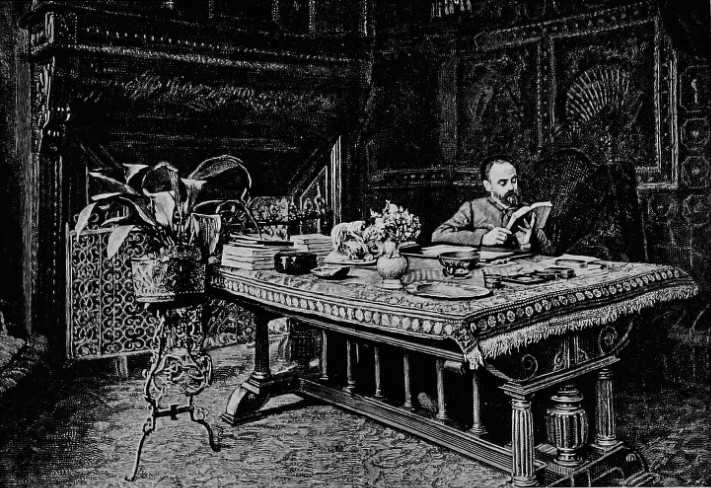
Zola in his Study
On May 22, 1885, France lost her great poet, Victor Hugo. He had been sinking for some time; nevertheless the news that he was really dead quite startled Paris. During his last illness he had declined the ministrations of "any priest of any religion," and the announcement that he would be buried without rites or prayers angered the Church party exceedingly, and led to unseemly scenes in the Chamber of Deputies when it was proposed that the Pantheon should be restored to its former destination as the resting-place of the great men of France, and that Hugo's remains should be laid in it. This proposal having been shelved by the Chamber, the popular indignation became so great that President Grévy virtually took the law into his own hands, and issued a decree in accordance with public opinion. The obsequies became a great anticlerical demonstration. Of course, for years past, many free-thinkers had been buried without the celebration of religious rites, but there had been only a few great secular public funerals, such as that of Félicien David, the composer, in 1876, later that of M. Hérold, Prefect of the Seine, and, later still, that of Gambetta. The enterrement civil of Victor Hugo marked another step in the same direction and it impressed thousands. More, even, than any of its forerunners, it set an example largely followed in later years.
When Zola heard of the death of Hugo he felt deeply stirred. He remembered the days of long ago, the happy days of Provence when he had learnt by heart page after page of the poet's writings. He had then drunk deeply of Hugo's sonorous rhetoric, and he had not ceased to admire his genius. The virtual failure of "Le Roi s'amuse" when it was revived in 1882 had pleased him from the Naturalist standpoint; yet he had not concealed his opinion that many passages of the play deserved applause, and in fact he had applauded them. "Why not, indeed?" he had ejaculated, turning to Edmond de Goncourt who had accompanied him to the Théâtre Français. And whatever criticism Zola had levelled at the productions of Hugo's declining years, whatever reservations he might make respecting even some of the poet's prime, he knew that this man had been a Master, the most powerful that his age had produced in France. So Zola immediately despatched the following telegram to M. George Hugo, the poet's young grandson:
You will learn, perhaps, some day, Monsieur, that even with respect to Victor Hugo, I claimed the rights of criticism. And this is why, amid the frightful grief that has befallen you, I desire to tell you that every heart has broken with yours.
Victor Hugo was my youth. I remember what I owe him. No discussion is possible on such a day as this; all hands must unite, all the writers of France must rise to do honour to a Master, and affirm the absolute triumph of literary genius.
Pray believe, Monsieur, in my deep and dolorous sympathy,
ÉMILE ZOLA.[59]
PARIS, May 22, 1885.
Besides writing his novel "L'Œuvre" that year, Zola helped M. Busnach to adapt "Germinal" for the stage; but when the play was ready in the autumn, the censorship forbade its performance on the ground that it would excite revolutionary passions. Zola's indignation boiled over at this rebuff, and with the approval of Alphonse Daudet and Edmond de Goncourt, whom he consulted, he issued a protest in "Le Figaro," trouncing M. René Goblet, the responsible Minister, a fussy little advocate who played the part of a Radical when it suited his purposes, but who was really a Philistine dans l'âme. However, the protest had no effect, nor had an offer to allow all reasonable alterations in the play for the sake of M. Busnach, whose interests were chiefly at stake; and it was only in the spring of 1888, when other ministers were in office, that "Germinal" was at last produced at the Théâtre du Châtelet. It may be convenient to mention here that for some years subsequent to the publication of "Germinal" as a novel there was never a strike in France without some foolish and prejudiced journalists casting the blame on Zola and his book. When in 1887 Décazeville became the scene of some terrible disturbances, Zola was charged in many directions—even in the Chamber of Deputies by some of its reactionary members—with the responsibility of those misfortunes. He disdained to reply to such ridiculous accusations; but it so happened that a few months previously (December 27, 1886) when authorising "Le Petit Rouennais" to publish "Germinal" serially, he had written the following prefatory note, in which he explained the book's real purport, which of course had never been doubtful for sensible minds:
"'Germinal' is a work of compassion, not a revolutionary work. In writing it my desire was to cry aloud to the happy ones of this world, to those who are the masters: 'Take heed! Look underground, observe all those unhappy beings toiling and suffering there. Perhaps there is still time to avoid a great catastrophe. But hasten to act justly, for, otherwise, the peril is there: the earth will open, and the nations will be swallowed up in one of the most frightful convulsions known to the world's history.'
"I descended into the hell of Labour, and if I concealed nothing, not even the degradation of that sphere, the shameful things engendered by misery and the huddling of human beings together as if they were mere cattle, it was because I wished the picture to be complete, with all its abominations, so as to draw tears from every eye at the spectacle of such a dolorous and pariah-like existence. Those things, no doubt, are not for young girls, but family people should read me. All of you who work, read what I have written, and when you raise your voices for pity and justice my task will be accomplished.
"Yes, a cry of pity, an appeal for justice, I ask no more. Should the soil still crack, should the disasters predicted convulse the world to-morrow, it will be because my voice will have remained unheard."
Thus, in "Germinal," Zola gave rein to his humanitarian feelings, and in recognition thereof prudes shrieked indignantly: "That man is at it again! What a beast he must be!" And on their side capitalists, battening on the labour of the poor and alarmed for the safety of their pelf, howled in chorus: "This book ought to be suppressed, it certainly must not be allowed as a play. It means revolution, robbery, rascality of every kind."
But Zola, though he suffered secretly,—all unjust attacks brought him the keenest suffering,—hid it, and passed on.
There was a touch of humanitarianism even in his next book, "L'Œuvre," for it set forth many of the evils of bohemian life, and embraced an appeal for woman in the person of the unhappy Christine, its heroine. Critics may shake their heads, indeed some have done so, and say sapiently: "All this was not art." They may laugh, too, at the idea of reforming the world by novels. But even if, judging Zola by some of his books, one may occasionally feel inclined to set no very lofty estimate on his artistry, surely the trend of his works, the knowledge of their aim, the circumstances under which they were written, must increase one's respect for their author as a man. And, after all, what is the mere artist? As often as not he is penned within a fanatical creed, bound to narrow formulas, blind to everything beyond them, full of prejudice, and even more ridiculous at times than the Philistines at whom he rails.
As "L'Œuvre" dealt chiefly with the art-world of Paris at a certain period of the Second Empire, it revived some of the passions which Zola had kindled by his championship of Manet. By certain painters the book was roundly abused when M. Charpentier published it early in 1886,[60] on the completion of the issue in the "Gil Blas." This time the demand was not great, for by its nature "L'Œuvre" appealed more particularly to a limited class of readers. Perhaps its sales would have been even smaller had not Zola woven into his narrative so much interesting information concerning himself in his earlier years.
No sooner was he delivered of this book than he turned to the novel on the French peasantry which had been in his mind at the beginning of 1884. Already at that time he had given it considerable thought, made notes, studied his subject in books and periodicals; and he now took up the work of preparation in real earnest. At the very outset he had decided to lay the scene in or near the great grain-producing region of La Beauce, in some degree because this would enable him to deal, en passant, with certain economic questions, such as the importation of American wheat, but more particularly because both his mother and his grandmother, Madame Aubert, had been Beauceronnes, and in his younger days he had often heard them talk of that part of the country, which presents various features of interest. La Beauce proper is certainly flat and monotonous, but its confines are picturesque, and Dourdan, Auneau, Orgères, and other localities are associated historically with the horrible crimes of the desperadoes known as chauffeurs, who roamed the region early in the nineteenth century. A strain of brutishness was long to be observed among some of the inhabitants. Withal, they are essentially French, that is of the borders of the Ile de France, for there is no fixed type of French peasant. Those of Provence, Languedoc, Burgundy, Normandy, Brittany, and other parts, all differ from one another in important characteristics. Thus generalisations on the subject of the French peasantry may occasionally become ridiculous.
Nevertheless, at the period selected for Zola's work, that of the Second Empire, a general resemblance was to be found among them in two respects. In the first place their ignorance was very great. The Imperial Government which did a good deal to ameliorate their lot materially, did as little as possible to enlighten and elevate their minds. They were, so to say, the backbone of the régime, and their ignorance was its safeguard. At the elections they were led like sheep to the polling places to vote for the official candidates. All that, however, belongs to the past. Many changes have occurred during the last thirty years, and without entering here into the question of the religious and secular schools, it may be said that under the Third Republic more has been done than at any previous time for the education of the peasantry. Some brutishness persists in various regions, but all who remember how widespread was illiteracy before the War of 1870 know that great improvement has been effected.
To-day, however, even as was formerly the case, there is still one trait common to the French peasantry generally. As in other countries there has been, and is still, a great exodus from the rural districts to the towns; but those who remain at home are distinguished by their earth-hunger, their all-consuming passion for the soil. The historical explanation of this is perhaps as follows: For centuries the peasantry possessed little or nothing, and when the Revolution at last placed the land in their hands absolutely, a craving which had descended from generation to generation was satisfied. They seized the land eagerly, they clung to it fiercely, fearful lest it should be taken from them, as, for instance, when the Bourbons returned, and many of the old noblesse sought the resumption of their estates. And old-time feelings, the covetous cravings of ancestors, the desperate tenacity of the generation of 1815, have descended to the peasants of to-day, and were perhaps even stronger among those of the Second Empire, with whom Zola proposed to deal in his novel "La Terre."
It was in part on the peasant's brutish ignorance, and more particularly on his earth-hunger, that he resolved to base his book. The following extract from one of his letters[61] will show his intentions:
"'La Terre' will treat of the French peasant's passion for the soil, his long struggle to acquire possession of it, his crushing labour, his brief joys and his great wretchedness. He will be studied too in connection with religion and politics, his present condition being explained by his past history; even his future will be indicated, that is the part he may possibly play in a Socialist revolution. All that, of course, will lie beneath the drama unfolded in the book, the drama of a father dividing his land among his children before his death, whence slow and abominable martyrdom will ensue, a perfect tragedy setting some sixty characters, an entire village of La Beauce, in motion; without counting a secondary plot, the passionnel side of the story, a quarrel between two sisters, separated by the advent of a man, still and ever in connection with a question of land. To sum up, I wish to do for the peasant what I did in 'L'Assommoir' for the Paris workman, that is, recount his history, manners, passions, and sufferings, such as environment and circumstances have fatally made them."
In the spring of 1886 Zola started on a tour of investigation. He already had some personal knowledge of the region where he proposed to lay the scene of his story, having gone there in his mother's time, but that was long before he thought of writing "La Terre." Among the places he now visited was Châteaudun, where one finds him early in May, whence he writes a friend an interesting letter which Mr. Sherard prints, and a portion of which one may venture to quote here:
"I have been here [Châteaudun] since yesterday, and have found the spot I need. It is a little valley, four leagues hence, in the canton of Cloyes, between Le Perche and La Beauce, and on the confines of the latter. I shall introduce a little brook into it, which will flow into the Loir—such a brook, by the way, exists. I shall there have all I require—large farms and small, a central spot, thoroughly French, a typical and very characteristic horizon, gay people speaking patois—in short what I always hoped for.... I shall return to Cloyes to-morrow and shall go thence to visit my valley and my bit of Beauce frontier in detail. For the day after to-morrow I have an appointment with a farmer living three leagues from here, in La Beauce, and shall visit his farm in detail.... I remained to-day at Châteaudun to attend a big cattle-market."[62]