ERNEST ALFRED VIZETELLY (continued 3)
Reading edition
But another point has to be considered. At the very outset of Zola's scheme the predisposition towards certain branches of science which he had shown in his youth revived. The question of hereditary influence had already attracted his attention while he was writing "Madeleine Férat," and it assumed larger proportions and greater complexity when he began to think of his projected family history. The members of the family in question (like all others) would be affected not merely by their actual environment but also by psychological conditions coming from their progenitors. Zola felt that he must study the question carefully, and for some months his spare time was spent at the Bibliothèque Impériale (now Nationale) where he read every book he could discover treating of hereditary influence. As he himself subsequently stated, among the works which most impressed him, there was particularly one by a now almost forgotten scientist, Dr. Prosper Lucas,[8] the brother of Charles Lucas, the eminent pioneer in criminology.
At the end of 1868 Zola drew up a scheme of his proposed "family history," even then preparing the original genealogical tree of the Rougon-Macquarts such as he conceived it.[9] He set down also the terms on which he would write the series, which at this date he proposed to limit to twelve volumes. And he carried everything to his publisher, M. Lacroix, who, while regarding the offer favourably, would not bind himself at the outset for more than the first four volumes. An agreement in that sense was signed in the spring of 1869; it being stipulated that Zola was to write two volumes each year and to receive five hundred francs a month from Lacroix, not in actual payment for his work but as an advance. The stories were to be sold in the first instance to newspapers for serial issue, and with the proceeds of those sales the publisher was to be refunded his advances, wholly or in part. On the subsequent publication in book form (each volume being priced at three francs[10]) the author was to receive a royalty of forty centimes (or about thirteen per cent) on every copy sold. But if the publisher's advances had not been fully repaid with the newspaper money he was to reimburse himself out of the book royalties as they accrued.
So far, the arrangement, though somewhat unusual, would not seem to have been unduly intricate, but it was rendered so by the further stipulation that every month, on receiving his advance of five hundred francs, Zola should hand Lacroix a promissory note for that amount, at three months' date, those notes being renewable until each volume was issued, when a proper account was to be drawn up. But with this system confusion set in, particularly as after a long delay in the serial issue of the first volume the War of 1870 supervened, in consequence of which M. Lacroix found himself in serious financial difficulties.
To Zola, at the outset, everything seemed clear sailing. He had ensured himself an annual income of six thousand francs[11] for at least two years, and he had only to set to work. Thus, in May, 1869, he started on his first volume, "La Fortune des Rougon," in which he pictured the origin of the family whose history he proposed to recount, and its first ignoble rise to position with the help of Louis Napoleon's coup d'état. The scene of the narrative was laid at Aix, which had so long been Zola's home and which, for his literary purposes, he now called Plassans.[12]
His book was written in a Republican spirit with considerable boldness for those Imperial times. And in this connection, by way both of refuting a suggestion made by Edmond de Goncourt, that Zola, in his penury, would willingly have sold himself to the Empire, had it chosen to buy him, and of showing the young author's participation in the journalism of the period, it is as well that one should momentarily retrace one's steps.
Already in 1867, through M. Albert Lacroix, his publisher, Zola had become acquainted with M. Paul Meurice, an able novelist and playwright, best known, however, by his connection with Victor Hugo. The great man had a horror of proof-correcting, and even in his lifetime much of his writing was passed for the press and, one may add, revised by M. Meurice, to whom, since then, has fallen the task of editing both the poet's correspondence and the éditions définitives of his books. In the last years of the third Napoleon's reign Hugo lived at Brussels, M. Meurice acting in many matters as his Parisian representative.[13] Madame Meurice's drawing-room was thrown open to all the Hugolâtres of the time; and Zola often attended her receptions, accompanied on some occasions by Duranty, on others by Manet. He then met several of the so-called Parnassian poets,[14] who, though their methods were often very different from those of the master, professed great admiration for him. Such were Sully Prudhomme and François Coppée, both of whom Zola first met in Madame Meurice's drawing-room. With M. Coppée, his relations became and remained intimate until the great Dreyfus case, when the so-called "poet of the humble," suffering from a serious chronic disorder, and fearful of losing the services of an expert medical attendant devoted to the priestly cause, resolved to save both soul and body by joining the great crusade against the Jews.
Towards the close of 1868 politics passed before literature in Madame Meurice's salon, for the tide of opposition to the Empire was then rising rapidly. In May, that year, Henri Rochefort, thanks to a new press law and the help of Villemessant, had started his famous periodical, "La Lanterne"; and in all directions the liberal newspapers had become more and more outspoken, in spite of the many sentences to fine and imprisonment which were heaped on their managers, writers, and printers. The grant of the right of public meeting added to the general unrest, and when 1869 arrived the excitement of the Parisians became the greater as general elections were appointed to take place in May. "La Lanterne" having been crushed—Rochefort seeking an asylum in Belgium where Hugo gave him hospitality—many suggestions of starting another opposition journal were made in Madame Meurice's salon. A certain Barbieux, a victim of the Coup d'État, carried the idea to Hugo at Brussels, and no satisfactory title having been as yet suggested, the poet undertook to provide one. The next morning, says Rochefort in his autobiography,[15] he proposed "Le Rappel"—a speaking title for those times, signifying a call to arms, the mustering of all who wished to shake off the rule of Napoleon III.
From the first gossip at Madame Meurice's it had been arranged that Zola should belong to the staff of the proposed journal, the principal contributors to which were Charles and François Hugo, the great man's sons; Louis Blanc the historian; Auguste Vacquerie, perhaps the ablest and most fervent of all the Hugolâtres;[16] Paul Meurice, of whom one has already spoken; Rochefort, who reprinted portions of his "Lanternes" in "Le Rappel"; Édouard Lockroy, who subsequently married Charles Hugo's widow, and since those days has been a member of more than one Republican Chamber and Ministry; Laferrière, who under the Republic became President of the Council of State, and later Governor-general of Algeria; and finally Zola.
It has already been shown that the latter was by no means a frantic partisan of Victor Hugo, but he was drawn towards the great man's band by circumstances, by an admiration for the poet, which if tempered by his critical sense was within its limits perfectly sincere, and also by a genuine sympathy with the object which the projected newspaper was to further. In one of his earliest contributions to the press, one dealing with Napoleon III's "Life of Cæsar," he had shown that he in no wise admired the Man of Destiny. Other early writings, even passages of "Les Contes à Ninon," breathed a spirit incompatible with Bonapartist imperialism. Further, life in the Quartier Latin had helped to republicanise Zola, and when he took to journalism for a livelihood, it was to the popular opposition press that he naturally turned. Even if "L'Événement" and "Le Figaro" were originally non-political, their tendencies at any rate were against the Empire. Again, "Le Salut Public," of Lyons, was not a government journal, nor was "Le Gaulois," to which Zola contributed several articles on social subjects, literature, and literary men soon after its establishment by Edmond Tarbé. Then, too, "La Tribune," a weekly journal for which he wrote regularly, was certainly most democratic, if rather eccentric in some of its views.[17]
Nevertheless, a few years after the invasion and revolution, Edmond de Goncourt, lunching one day with Princess Mathilde Bonaparte, did not hesitate to declare that the Empire might have secured Zola's services had it chosen. "He was penniless, he had a mother and a wife to keep. At the outset he had no public opinions. You could have had him on your side like many others, had you chosen. He could only find democratic newspapers to take his copy. Living among all those folk, he became a democrat. It was quite natural." And Goncourt added that the Princess Mathilde had disarmed many hatreds and angers by her friendship, graciousness, and attentions, winning over such men as himself, his brother, and Flaubert to the Empire which, otherwise, they also would have attacked.[18]
Those allegations, so far as they concern Zola, cannot be left unanswered. The Goncourts' "Journal" shows that the brothers, with all their gifts, were not men of the highest principles; and it is evident that they often judged others by their own standard. As a matter of fact there is no shred of evidence that Zola would ever have sold himself to the Empire. At the time of that régime, as subsequently, his chief interest lay in literature and art, politics came afterwards; but so far as he concerned himself in them his opinions were essentially democratic. In all respects Edmond de Goncourt's assertions were erroneous. If Zola had cared to sell his pen for political purposes he might have done so with the greatest ease. In 1868-1869, when he first began to give real attention to politics, the authorities were only too anxious to secure clever men who might reply to Rochefort and all the other opposition writers. Large sums were spent in bribing journalists. Villemessant was paid ten thousand pounds to shake off Rochefort and support the authorities; Émile de Girardin was bought with the promise of a senatorship; Clément Duvernois was secured by being placed at the head of a new journal, "Le Peuple Français," on which the Privy-purse, in little more than one year, expended over fifty-six thousand pounds.[19] More money was spent on other journals, new ones like "L'Étendard," for which Auguste Vitu (one of the original characters of Murger's "Vie de Bohème") was engaged; "Le Public," whose editor, Ernest Dréolle, was financed; and "L'Époque," whose nominal proprietor was Dusautoy, the Emperor's tailor. For these and other newspapers contributors were required, and a good many clever but needy men of lax principles presented themselves. The less brazen among them found their excuse in the pretended transformation of the régime; they would never have served the "personal Empire"—of course not!—but the "liberal Empire" commanded their sympathies.
It follows that Edmond de Goncourt's estimate of Zola's democratic tendencies was arrant nonsense. Paris had been the young writer's home for several years now; he knew what to think of the Empire, and was against, not with, it. However, he placed literature before politics, particularly as all he saw of the political cuisine of the times inclined him to regard many professional politicians with contempt. And his Republicanism was not so intense as to restrict him exclusively to Republican society. He admired the Goncourts and Flaubert—to whom the former introduced him in 1869—as literary masters, and associated with them freely. Again, he saw no reason why he should not contribute stories to "L'Artiste" and "L'Illustration," even if their editors did not think politically as he did. With respect to "Le Rappel," though his contributions were at times political they more frequently dealt with literary subjects; and the independence of his character was illustrated by the boldness with which he praised Balzac in a journal patronised and in some degree financed by Victor Hugo, who held that Balzac was fated to early and absolute oblivion, because he could not even write French. The result of Zola's championship of Balzac in "Le Rappel" was the severance of his connection with that journal. This, however, did not take place till the last months of the Empire, when much of the paper's purpose was already accomplished.
In the summer of 1869, after signing his contract with Lacroix for the first Rougon-Macquart volumes, Zola felt that he might at last venture to marry, and in July Mademoiselle Mesley, to whom reference has been made already,[20] became his wife. As he afterwards explained, apart from the question of love, he held "the married state to be an indispensable condition for the accomplishment of all good and substantial work. The theory which pictured woman as a destructive creature, one who killed an artist, pounded his heart, and fed upon his brain—was a romantic idea which facts controverted. For his own part, he needed an affection that would guarantee him tranquillity, a loving home, where he might shut himself up, so as to devote his life to the great series of books which he dreamt of. Everything, said he, depended upon a man's choice, and he believed he had found what he needed,—an orphan, the daughter of tradespeople, without a penny, but handsome and intelligent."[21]
At this time, after removing from the corner of the Avenue de Clichy and the Rue Moncey to 23, Rue Truffaut, Zola had secured a little house or "pavilion" in the Rue de La Condamine,—likewise at Batignolles,—a house reached by crossing the courtyards of a larger building divided into flats and facing the street. By opening an iron gate one gained admittance to a small garden with a tiny lawn, over which a large plum-tree cast its shade, while directly in front of the pavilion was an arbour of Virginia creeper. Three rooms on the ground floor, and three on the first, "all like little drawers with partitions as flimsy as paper," such was the accommodation which the house offered, and the dining-room was so small that when a little later Zola purchased a piano, the necessary space for it could only be obtained by transforming a kind of china cupboard into an alcove.[22] The inmates of this band-box were four in number: Zola, his young wife, his aged mother, now in very indifferent health, and his dog, a cross between a sheep-dog and a Newfoundland,—in a word the faithful Mathieu, of whose last years and death the novelist afterwards wrote so pathetically in "La Joie de Vivre." A servant-woman, who slept out, attended to the harder and dirtier housework; Madame Zola the younger took charge of most of the cooking, and it was amid these conditions, in this little pavilion behind No. 14, Rue de La Condamine, that the young author, who had but lately completed his twenty-ninth year, resolutely set to work upon one of the greatest literary efforts ever made, one which not only embraced a most painstaking study of a period and its people, but imported into fiction, for the first time in its history, virtually every application of the scientific theory of atavism.
Thus Zola gave effect to his old desire to try to reconcile science and poetry—which he had only recently enunciated once more in an article in "La Tribune." And in the prosecution of this self-chosen task over a long term of years, amid many difficulties, the greatest ridicule, the most impudent misrepresentation, the most savage abuse that every white-livered critic could think of, he did not once swerve from the view he expressed in "Le Gaulois" about the time when he was signing his contract with Lacroix: "If I kept a school of morals I would hasten to place 'Madame Bovary' or 'Germinie Lacerteux' in my pupils' hands, convinced as I am that only truth can instruct and fortify generous souls."[23]
That view remained Zola's till his last hour.
Early in the summer of 1869 he handed the opening chapters of his first volume, "La Fortune des Rougon," to the acting-editor of "Le Siècle," with which journal he had negotiated its serial issue. "Le Siècle" then held in Paris a position similar to that of "The Morning Advertiser" in London. That is to say, it was largely the organ of the licensed victuallers, without, however, belonging to them. Even as in England, there is sometimes said to be a Beer and Bible alliance between the brewers and the clergy, so "Le Siècle" represented a kind of Wine and Democracy compact. It was found in every Parisian wine shop, and during the earlier years of the Empire it had been the only journal of democratic tendencies which the authorities tolerated. Léonor Havin, who became an Opposition deputy in the Corps Législatif, conducted the paper with great ability for several years, but he was dead when Zola negotiated the publication of his novel, and "Le Siècle" had fallen into the hands of that journalistic abomination, an "editorial board." Zola had a friend at court in the person of M. Castagnary, who many years previously had done for Courbet what Zola, comparatively recently, had done for Manet. But Castagnary, while exercising considerable influence, helping to impart a more resolute Republican tone to the paper, was not all powerful in the board room; and not only had Zola already made a good many enemies in his own profession, but a recollection of the opposition which his earlier novels had encountered from the readers of other newspapers, so influenced "Le Siècle's" editorial committee that it again and again postponed the publication of "La Fortune des Rougon."
Thus Zola found himself in an unpleasant position at the very moment when he hoped to live in a little quietude and comfort. M. Lacroix, for some months, made the stipulated advances without raising any difficulty, but when 1870 arrived the position became more and more uncertain. Zola was reduced to such a state of anxiety that for weeks at a time he could hardly write, and it was only the encouragement he received from his brave young wife that gave him enough energy to persevere.
Thanks to newspaper work, he earned just sufficient money to live on meagrely from day to day and keep the home together, and at last, the publication of "La Fortune des Rougon" being still deferred, he turned from that work, which he had not quite completed, in order to begin another. This was "La Curée," into which some of his critics have read a great many things which he never put in it. Politically and financially, it was simply the story of the Haussmanisation of Paris, while morally its central intrigue was neither more nor less than an adaptation of the ancient legend of Phædra to the corrupt times of the Empire. Of this second book Zola had just written the first chapter, at the end of May, 1870, when "Le Siècle" suddenly decided to publish his earlier work. So once again the young author reverted to "La Fortune des Rougon," correcting the proofs of the commencement and penning the conclusion.
Things looked brighter now, but after that year of keen anxiety Madame Zola was in a very ailing state and needed change and rest. Zola himself felt a longing to get away from Paris for a time, and so, after making various pecuniary arrangements with M. Lacroix and "Le Siècle," he started with his wife and mother for Provence. Then, all at once, came the thunderclap: Napoleon III declared war against Prussia, France was invaded; her armies were surprised at Wissemburg, overthrown at Woerth, thrust back from Borny and Gravelotte under Metz, routed at Beaumont, surrounded and captured at Sedan. The Empire fell, and a fortnight later the Germans invested Paris. Zola, now in his thirty-first year, was not called upon to undertake any military duties like others of that age, for, being the only son of a widow, the law exempted him from service. It is true, no doubt, that other widows' sons at that time occasionally joined the colours as volunteers, in spite of the legal exemption. And on that account, at a subsequent period, directly after the publication of "La Débâcle," Zola's enemies made much of the fact that he had not done likewise.
But proper allowance should be made for his circumstances at the time. The investment of Paris had cut him off from his usual sources of income, he found himself virtually adrift, at Marseilles, with his sick wife and his old mother, who had become more or less infirm. They had little or no money, there was no relative with whom they might seek a refuge, and if Zola, in a fine spirit of patriotism, had gone to join the army, the two women would have become dependent on the charity of the public. At first Zola was at a loss what to do. But meeting M. Arnaud, who had published his "Mystères de Marseilles" in the "Messager de Provence," he prevailed on him to run a popular halfpenny war journal, which was called "La Marseillaise." Zola's friend, Marius Roux, who was then also in the city, joined him in the venture, and between them they wrote the whole paper, which at the outset seemed likely to prove successful, its sales amounting to ten and fifteen thousand copies; but typographical and other difficulties arose, and at last, instead of money being earned, it was lost.
In December (1870) Zola's position at Marseilles being once more little short of desperate, he went to Bordeaux to seek some work there, that city having lately become the capital of France by the removal of the National Defence Delegation from Tours. At Bordeaux he found Glais-Bizoin, under whom he had formerly contributed to "La Tribune," and Glais-Bizoin, who was now a member of the Government, a colleague of Gambetta, Crémieux, and Fourichon, made him his secretary. Short, lean, a septuagenarian, with a glistening cranium and a nose like a hawk's beak, this Breton proconsul was one of the amusing personalities of the time. An ardent democrat, he had sat in the legislative chambers of the July Monarchy, the Second Republic, and the Second Empire, making himself quite a parliamentary reputation, not by his own speeches, but by the caustic, galling, and irrelevant manner in which he interrupted the speeches of others. Under his ægis Zola became acquainted with the whole entourage of the National Defence Delegation, from the astute and prim Clément Laurier, who had negotiated the notorious Morgan Loan, to the dishevelled, bohemian, and nicotian Georges Cavalié, otherwise Pipe-en-Bois, who, tapping the British ambassador, Lord Lyons, on the shoulder one morning, while his excellency was somewhat impatiently waiting for Gambetta, had suggested familiarly: "I say, old man, don't bother about the governor, let's go and have a good glass of beer!"[24]
In these circumstances Zola summoned his wife and mother to Bordeaux, and set himself to write letters and prepare reports for Glais-Bizoin, pending another appointment; for the old democrat, on introducing him to Clément Laurier, who disposed of most of the civil patronage, had said: "I want a prefecture for this young man,—the first one that may fall vacant." In Glais-Bizoin's estimation, Zola's claim to such a post was self-evident; for he had belonged to the staff of "La Tribune," and since the Revolution of September 4 all the writers on that journal had become members of the Government, ambassadors, or prefects. In Zola's case the first vacancies which occurred were the prefectures of Bayonne and Auch, but both were secured by more eager and active candidates, and all that Laurier could ultimately offer was a sub-prefecture, that of Castel-Sarrasin, a pleasant little town of seven thousand inhabitants, on the Garonne, not far from Montauban.
This incident in Zola's career has been turned by some of his detractors into an exciting romance which it is unnecessary to recapitulate. The main facts have been given by Alexis, to whose account a few particulars may be added. The war at that time was drawing to an end. Gambetta was anxious to prevent any partisans of the fallen Empire from being returned at the elections for an Assembly, which were becoming more and more inevitable and imminent. There was a sub-prefect at Castel-Sarrasin named Camille Delthil. He was a young poet, the author of a volume of "Poëmes Parisiens," to which he afterwards added "Les Rustiques" and "Les Lambrusques." He discharged his duties with the literary grace of a true Parnassian, and a mildness which arose from the circumstance that he was himself a native of Castel-Sarrasin. Gambetta deemed him altogether too mild. According to the Dictator, to ensure the return of a Republican in that constituency a strong-fisted sub-prefect was needed, a man, too, who could pen vigorous and stirring proclamations. Now it occurred to Clément Laurier that Zola had a vigorous style and a stern mien, so why should not the novelist be set in the place of the poet, the latter being gently transferred to some other office? But Delthil would not consent to this arrangement. Having been born at Castel-Sarrasin, he gloried in ruling it.
According to the legend, he now threw off all his mildness, barricaded himself in his sub-prefecture, and defied both the Government and Zola, in such wise that the latter, although duly "gazetted," was unable to take possession of his post when he repaired to Castel-Sarrasin. But he never went there. The truth is that he had barely accepted the appointment when Paris capitulated, and Jules Simon arrived at Bordeaux to put an end to some of Gambetta's high-handed proceedings. Forthwith, in presence of the general "muddle" which arose, and with the thought, also, that now communications with Paris were restored, he might revert to journalism, and ultimately to literature, Zola called on Laurier and withdrew his acceptance of the appointment.
It may be idle and unprofitable to speculate concerning "the might-have-been," yet a few remarks may well be offered respecting this curious episode in Zola's career. His original acceptance of Laurier's offer was explained by him to Alexis. Those were wild times, and every mind was more or less unhinged. "For my part," said Zola, "I imagined that it was the end of the world, and that there would be no more literature. I had brought the manuscript of the first chapter of 'La Curée' with me from Paris, and I occasionally looked at it as I might have looked at some very old papers which had become mere souvenirs. Paris seemed to me very far away, lost in the clouds, and, as I had my wife and mother with me and no certain prospect of money, I ended by thinking it quite natural and advisable that I should plunge into politics, for which I had felt so much contempt previously,—a contempt which speedily returned."[25]
There was some little exaggeration in those last words as the sequel will show, though as Zola was a man of absolute convictions, one who detested compromises, it was only natural that he should look unfavourably on many politicians and their methods. But, whatever his views, it happened that politics repeatedly played an important part in his life, even at the time when he appeared most devoted to purely literary pursuits. It does not seem very difficult to divine how his career would have shaped itself had he become a functionary. As he had too independent a character to execute any orders unless he regarded them as right, he would soon have found himself at loggerheads with his superiors, dismissed or compelled to resign; and unlike the majority of the discarded functionaries of the period he could hardly have sought compensation in a parliamentary seat, for he was no orator. Thus, like some others, he might have become a mere hanger-on of the Republican party, one of those who only secured a real livelihood subsequent to Thiers and MacMahon, when Gambetta's influence again became paramount in France.
His refusal, at the first opportunity, of the sub-prefectoral appointment which he had only accepted as a pis-aller, was therefore wise. He could not get rid of politics, whatever may have been his desires, but he at least confined himself to the duties of a political journalist. He became a correspondent of "Le Sémaphore," the chief daily paper of Marseilles, his connection with which lasted seven years. Further he placed himself in communication with "La Cloche" of Paris, for which he had written a few articles previous to the Siege, and which, curiously enough, was directed by Louis Ulbach,—the novelist and critic who had denounced "Thérèse Raquin" as "putrid literature." That quarrel, apparently, had been patched up, and Zola and Ulbach, while remaining of antagonistic literary schools, had found some basis of agreement in politics. At all events the former now became the descriptive parliamentary correspondent of "La Cloche," recording the doings of the National Assembly, first at Bordeaux, later at Versailles, his connection with this journal lasting till the summer of 1872, when he carried his pen to "Le Corsaire," for which he wrote several fiery political articles, one of which, called "The Morrow of the Crisis"[26] almost led to the paper's suppression.
Leaving Bordeaux for Paris about the time when the Assembly removed to Versailles, Zola who had seen nothing of the German siege, at least witnessed various incidents of the Commune.[27] The little house in the Rue de La Condamine was now again his home, and at times he went about the city, and at others betook himself to Versailles, zealously attending to his duties for "La Cloche." At that moment there could be no thought of book-writing; but after the fall of the Commune at the end of May, 1871, he again turned to "La Curée," and prevailed upon Ulbach to print that story as a serial. Considerable confusion still prevailed in Paris, and he was put to many shifts for information which he needed—shifts which some of his critics afterwards imputed to him as crimes, though the wonder is that he should have been able to write such a book at all, in the hurly-burly through which France was passing.
"La Curée" began to appear in "La Cloche" towards the end of September (1871), and about the same time Lacroix at last published the initial volume of the series, "La Fortune des Rougon," the final chapter of which had remained lying in the offices of "Le Siècle" throughout the war, much to the alarm of Zola, who had regarded it as lost. The book met with little sale, little recognition, but this is not surprising. France had not yet recovered from the great convulsions of the war and the Commune, and small was the attention vouchsafed to literature. Moreover, as Paris slowly settled down to a degree of quietude, it desired amusement more than anything else—the sprightliest music, the gayest songs, the very lightest literature obtainable. It was the usual reaction, the same which had come with all the frivolity of the Directory after the Terror's bath of blood. Produced, then, under the most unfavourable conditions, "La Fortune des Rougon" did not even secure the honour of a real second edition, for the copies which may be found bearing the mention "second edition" on their covers and title-pages, were merely a residue of the first one, only a portion of which was bound when the book originally appeared.[28]
This was bad, and it seemed really as if Zola would never reach the end of his troubles, for the Public Prosecution service took note of "La Curée" as it appeared in "La Cloche," and adjudged a certain account of a supper at the Café Riche to be immoral. It was early in November when Zola received an intimation from the Public Prosecutor requesting him to call at his office. He did so and was received by an official who "advised" him to cease publishing his story in a newspaper. Zola protested the purity of his intentions, explained that his one desire was to show the corruption of society under the fallen Empire, but he finally accepted the official "advice." On November 8, then, he wrote to Ulbach, asking him to suspend publication, his letter being printed in "La Cloche" with the following editorial comment: "We desire that the public should fully know that whatever may be our personal opinion of Zola's analytical method, and whatever danger he may incur from the audacity of his studies, his imprudence is that of a most upright character, sincerely attached to truth in art."
As it happened, the serial issue, if suspended in "La Cloche," was completed in a periodical called "La République des Lettres" which Catulle Mendès, the poet and son-in-law of Théophile Gautier, was then editing. Mendès placed himself at Zola's disposal directly he heard of the affair, and curiously enough he rendered him a similar service some years later with respect to "L'Assommoir." The first edition of "La Curée" was produced by Lacroix early in 1872,[29] and soon afterwards the publisher, whose interests had been greatly affected by the war, was forced to suspend business. Thus once more the demon of ill-luck fell upon Zola's home. The "Lettres parisiennes" which he was then writing for "La Cloche," his correspondence for "Le Sémaphore," did not supply all his needs; terrible times came back, numerous bills given to Lacroix were protested, executions followed, and on one desperate occasion, there being nothing pawnable, for everything had been seized except the bedding, which according to the law could not be attached, the very wool of the mattresses on which Zola and his wife slept was sold by the latter to a dealer in order to procure the necessary money for bread.
In these distressful circumstances a great service was rendered to Zola by a man for whose literary style he had no great admiration, though curiously enough it was in more than one respect akin to his own. This was Théophile Gautier to whose connection with Catulle Mendès reference has just been made. Gautier had a fair knowledge of the young man's literary work, and he heard, probably from Mendès, of his terrible position. Now Gautier's publisher was M. Georges Charpentier, who had lately taken over his father's business, and one evening when they and Francisque Sarcey were together at the Comédie Française, their conversation, during one of the entr'actes, fell on the young writers of the time. "There is one among them," said Gautier,[30] "who is very unlucky, and who is different from most of the others. You should admit him among your authors, my dear Charpentier. If I am not vastly mistaken he possesses a touch of genius. His name is Émile Zola. Have you ever heard of him?"
Yes, both Charpentier and Sarcey had often heard of Zola, and had remarked his repeated efforts to get to the front. Nevertheless they were somewhat surprised by the praise which had fallen from Gautier's lips. He, subsequent to this conversation, caused Zola to be informed of the recommendation he had given him, and the young novelist soon called on M. Charpentier, whose establishment was then on the Quai du Louvre. For just one moment there had been a little hesitation on Zola's part. His only suit of clothes was quite disreputable, and both he and his devoted young wife felt that he ought, at least, to appear decently clad before this publisher on whom his fate depended. There was very little money in the house, but Madame Zola took it and hurried to the "slop" market of the Temple, where she purchased a second-hand suit of black, the nearest approach to a fit that she could find. In those slop garments—which remind one of Daudet's black trousers, similarly acquired, which suddenly became a military red, having been very imperfectly dyed—Zola presented himself before Charpentier, and was pleased to find that he had to deal, not with the stern founder of the business, whom some authors regarded as a kind of terror, but with the son, a pleasant, cordial man of about his own age.
The position was explained: Lacroix was ruined, and Zola wished to transfer his contract with certain modifications. M. Charpentier asked for twenty-four hours to consider the matter, and on the morrow an agreement was arrived at. During a period of five years Zola was to supply two novels every twelvemonth, and Charpentier was to hand him five hundred francs every month; that is to say, in addition to the two volumes published by Lacroix there would be ten others, representing in the aggregate a sum of thirty thousand francs. Whereas, however, in the contract with Lacroix, the money received by Zola was regarded as an advance, in that with M. Charpentier it was to be actual payment, in return for which the full copyright in each of the ten novels which Zola engaged to write would belong to M. Charpentier for ten years. During that period he would be at liberty to produce them in whatever manner he pleased, both serially and in book form, as well as to sell the rights of translation to foreign publishers, without paying Zola a single franc beyond the stipulated monthly allowance.[31] As Zola desired that the entire series should be in the hands of one publisher, a desire which Charpentier shared, there was also an understanding respecting "La Fortune des Rougon" and "La Curée," the right to republish which was secured from Lacroix by a payment of eight hundred francs.
The agreement with Charpentier certainly extricated Zola from an extremely difficult position, and it is unlikely that he would have secured better terms, or even as good, elsewhere. But what did they amount to? To the prospect of an income of two hundred and forty pounds[32] a year for five years, in exchange for ten novels. As the sequel showed, such an income would hardly have sufficed for Zola's wants, particularly as there were many claims on him with respect to the bills he had given Lacroix. No less than thirty thousand francs' worth of paper bearing his signature or endorsement was in circulation about this time, says Alexis, and Zola had the greatest difficulty to prove that he had not been the ruined publisher's "man of straw." The nominal amount of his indebtedness was swollen, and the intricacy of the position increased, by the circumstance that many a time when a bill had been renewed it had not been returned to him, though the new bill was placed in circulation. It was only in 1875 that Zola was able to recover his notes and acceptances, and generally liquidate his position, by the payment of various amounts in accordance with an arrangement entered into with M. Lacroix. The latter, be it said, was an honourable but unlucky man, a victim both of circumstances and of misplaced confidence in others.
But, to return to Zola. His contract with M. Charpentier did not free him from the necessity of doing his utmost to increase his income by journalism, to which he devoted no little time. This threw him back with his novels, which, as will be shown, often necessitated considerable preliminary study, and which he refused to "scamp." The publishing arrangement he had made partook undoubtedly of a "pot-boiling" character; but he was resolved that there should be nothing of the nature of pot-boiling about his literary work. He found at last that he could not write more than one novel a year, and thus, though he drew his money regularly enough, the time came—in or about 1875—when he owed M. Charpentier two or three volumes. Mustering his courage, he called on his publisher to explain his position. But at the first words he spoke with respect to his overdraughts, M. Charpentier interrupted him.
"My dear friend," said he, "I do not wish to rob you. I do not want to derive more than my usual profits from your work. I have lately had an account of your sales drawn up on the basis of an author's royalty of forty centimes per volume,[33] and according to this account, it is not you who owe me money, it is I who owe you some ten thousand francs. Here is our agreement, I tear it up, and all you have to do is to see my cashier."
As Alexis remarks, after telling this story, what other publisher would have done such a thing? In Zola's case it raised him from modest circumstances to affluence. Had the original contract remained in force he would have earned, inclusive of the earlier payments from Lacroix, no more than forty thousand francs by the first twelve volumes of his "Rougon-Macquart" series. At least he would have earned no more during the first ten years of their circulation. But thanks to M. Charpentier's generous honesty,—the successive increase, too, of Zola's royalty from forty to fifty and sixty centimes per volume, the various sums accruing from special issues, illustrated editions, popular editions, éditions de luxe, serial rights and translation rights—all of which, under the agreement, would have belonged to the publisher—he earned by those twelve books fully twenty times the amount of money he had covenanted to take for them.
That said, it is as well to return to the year 1872, and show how, his long spell of absolute ill-luck ceasing, Zola, while still encountering much hostility, which presently was to grow into a furious storm, gradually advanced along the path of success, assisted by literature's handmaiden, journalism, and cheered by the friendship of some of the foremost men of letters of his time.
VI
THE PATH OF SUCCESS
1872-1877
Flaubert and his intimates: Zola, Goncourt, Tourgeneff, Daudet, and Maupassant—"Thérèse Raquin" as a play—"Le Ventre de Paris" and the sensitive critics—A first charge of plagiarism—The "Dinners of the Hissed Authors"—Zola and good fare—Sunday gatherings at Flaubert's—"La Conquête de Plassans"—"Les Héritiers Rabourdin"—Zola in the Rue St. Georges—His contributions to a Russian review—"La Faute de l'Abbé Mouret"—"Nouveaux Contes à Ninon"—"Son Excellence Eugène Rougon"—The truth about "back-stairs gossip"—Flaubert's mimicry of Napoleon III—Zola, Daudet, and "personalities" in fiction—Zola "sees mice and birds"—His stay at St Aubin-sur-Mer—He plans "L'Assommoir"—Publication of "Son Excellence"—Dramatic criticism for "Le Bien Public"—Zola's income early in 1876—Serial issue of "L'Assommoir"—The outcry and the cessation of publication—Catulle Mendès to the rescue—"L'Assommoir" as a book—Its large sales—A furious controversy—Articles, pamphlets, poems, parodies, and lectures—The years of "L'Assommoir" a date in French Literature—Other writings of the time—Zola's "band," Alexis, Huysmans, Maupassant, Céard, and Hennique—Flaubert, "L'Assommoir" and "Naturalism"—Zola's hammer, journalism—Self-assertion and pushfulness the weapons of the age.
After the Franco-German War, Gustave Flaubert, who during fifteen years of the imperial régime had resided, when in Paris, on the Boulevard du Temple, found a pied-à-terre in the Rue Murillo, near the Parc Monceau, thereby becoming one of Zola's neighbours, for the Rue Murillo is only a few minutes' walk from the Rue de La Condamine. Zola frequently called on Flaubert, whom he at first found very downcast, for the fall of the Empire seemed to him the end of the world, and besides, he had not yet recovered from the failure of his book, "L'Education sentimentale," published in 1869. It was at Flaubert's that Zola again met Edmond de Goncourt, who was still mourning his brother, and feeling so discouraged that he hardly dared to take pen in hand. With Zola and Goncourt came Flaubert's young disciple, Guy de Maupassant, at that moment little more than one-and-twenty, then Ivan Tourgeneff and Alphonse Daudet, whom Zola had already met in the days of "L'Événement," these five being for a time the only intimates of the author of "Madame Bovary." They were not a very gay party, it would seem. One Shrove Sunday, says Zola, while the carnival horns were resounding in the streets, he sat till nightfall listening to Goncourt and Flaubert, who for hours did not cease recalling the past and lamenting its disappearance.[1] Goncourt, on his side, receiving Zola about this time (June, 1872), once more found him sickly and neurotic, complaining confusedly of rheumatism, heart and bladder trouble, and mastered by such acute nervous trembling that he had to employ both hands to carry his glass to his lips.[2]
At that date Zola was planning a novel on the Paris markets—"Le Ventre de Paris"—and dramatising his earlier book, "Thérèse Raquin," working, so he told Goncourt, some nine hours and a half every day. When his play was finished he offered it to M. Hostein, the director of a new Parisian theatre, La Renaissance, and after numerous alterations had been effected, its five acts being reduced to four, it was staged and produced on July 11, 1873, when it met with a curious reception. The more frivolous, the "society" section of the audience, could not endure such tragic sombreness, and Francisque Sarcey, who held that the stage only existed for the amusement of the public, declared that "this man Zola" made him feel "quite ill." If, however, there was some hissing at the first performance of "Thérèse Raquin," there was also some applause, and when the curtain fell the question of success or failure seemed still to be hanging in the balance. But the professional critics agreed to slate the play, and moreover the "dog-days" were just beginning, the heat emptying even those theatres which had hitherto drawn large audiences, in such wise that after nine performances La Renaissance closed its doors for the summer vacation, and "Thérèse Raquin," as a play, was heard of no more.
Zola consoled himself with the comparative success of his novel, "Le Ventre de Paris,"[3] which reached a second edition deservedly, for its kaleidoscopic pictures of the Paris markets were the best descriptive work that the author had as yet penned. Nevertheless, the book encountered some severe criticism at the hands of the few reviewers who condescended to notice it. Writers devoid of any Rabelaisian sense denounced it as the apotheosis of gluttony; the transference of a pork-butcher's shop to literature was regarded as outrageous; and a certain "symphony of cheeses" gave one critic such a fit of nausea, that an unsuspecting foreigner reading his remarks might have imagined cheese to be an abomination to the delicately constituted Parisians, whereas, in fact, they then consumed—and still consume to-day—a greater amount and a greater variety of cheese, often with the strangest flavours and odours, than any other community in the world.
But, apropos of this same "symphony," a Parnassian poet,—one who was then regarded as a neo-Grecian, neither more nor less,—M. Anatole France, pointed out rightly enough that the imagery in which Zola indulged was inconsistent with his claim already put forward, though not definitely enunciated, to be a realistic writer. "Such vain, empty, and detestable virtuosité" had no place, said M. France, in the realist system, and indeed, taking that system as it was defined by Zola under the name of naturalism a little later, M. France was assuredly correct. As a matter of fact the duality of Zola's nature was always appearing. He was for ever straying beyond the limits of the doctrines he propounded, having quaffed too deeply of Hugo's rhetoric in his youth to be able to restrain himself. And it was as well, perhaps, to show that even at this early stage of his great series, his vagaries, his deviations from his self-chosen principles, already attracted attention.
It was also apropos of this same "Ventre de Paris," that the first of many charges of plagiarism was preferred against Zola. In this instance it was M. Nadar, photographer, aeronaut, caricaturist, and author, who declared that "the colour scale" of the sea of vegetables which Zola showed spreading around the Paris markets had been borrowed from something which he, Nadar, had written. But Zola had merely expanded a passage of one of his own early articles; and the suggestion of plagiarism was the more ridiculous as the first thing which strikes anybody, even with only a little artistic perception, when witnessing daybreak at the Paris markets, is the diversity of the picture's hues, the great medley of colour gradually accentuated by the light of the rising sun. M. Nadar probably realised that his contention could not be regarded seriously. At all events the matter dropped, and Zola turned to his next volume, "La Conquête de Plassans," as well as to a new play, a three-act comedy, which he entitled "Les Héritiers Rabourdin."
Meantime, it had occurred to Flaubert to unite his intimates in a monthly dinner, which, said he, might be called "the Dinner of the Hissed Authors." He himself had been hissed for his play, "Le Candidat," Zola had encountered a similar experience with "Thérèse Raquin," Alphonse Daudet with "L'Arlésienne," and Edmond de Goncourt with "Henriette Maréchal." Tourgeneff, also, was admitted to the company on the strength of his assertion that he had been hissed in Russia; but, according to Daudet, when Émile de Girardin, hearing of the project, wished to join the others—pleading, no doubt, the reception given to the notorious "Supplice d'une Femme"—they promptly blackballed him on the ground that he was not a littérateur.[4]
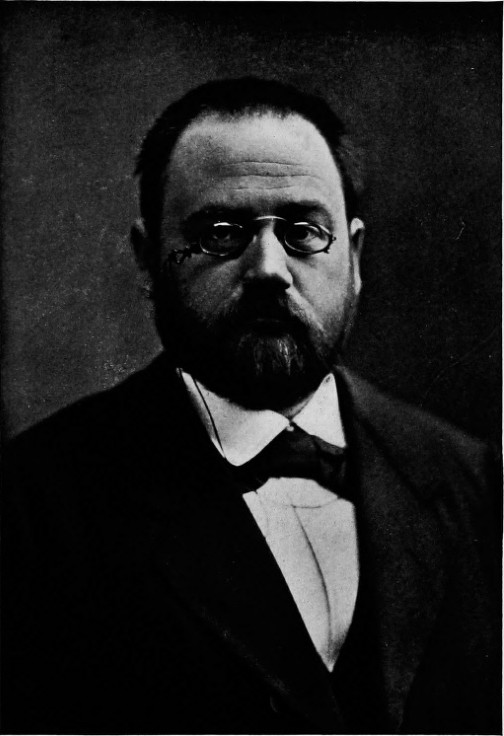
Émile Zola, 1876-1880—Photo by Nadar
Thanks to the wine provided at those monthly dinners, they were livelier, though perhaps not more interesting, than the Sunday meetings in Flaubert's rooms. They took place at various restaurants, the first at the Café Riche, on April 14, 1874.[5] Then, as Flaubert was starting for Le Croisset, near Rouen, the next was adjourned till the winter months. As Zola tells us, during the years over which these dinners were spread, the choice of a restaurant for the next repast invariably led to great discussion among the five convives. Anxious apparently to sample every kind of cuisine, they went from the Café Riche to Voisin's in the Rue St. Honoré; from Voisin's to Adolphe and Pelé's near the Grand Opera House, and thence to the Byron on the Place de l'Opéra Comique. They feasted now on bouillabaisse, now on poulet au kari. Tourgeneff naturally required caviar to whet his appetite; Flaubert always insisted on having Normandy butter, and revelled in Rouen ducklings à l'étouffade; while Goncourt evinced a depraved taste for preserved ginger. As for Zola, he, according to Alphonse Daudet, was addicted to shellfish and sea-urchins! His friends occasionally twitted him respecting the partiality he began to evince for good fare,—which cast, they said, a lurid light on his novel, "Le Ventre de Paris"—and he frankly acknowledged his gourmandise, pleading, however, that it was his only vice, and that he had gone hungry so many years!
Of course there was no ceremony at those monthly dinners. Flaubert and Zola often took off their coats and sat down at table "in their shirt-sleeves," as the phrase goes, while between the courses Tourgeneff would sprawl on a sofa. And directly the coffee was served the waiters were turned out of the room, and a long discussion on literary subjects began, that is when it had not been started already at the outset of the repast. "I remember," wrote Zola, in his recollections of Flaubert,[6] "a terrible discussion on Chateaubriand, which lasted from seven in the evening till one o'clock in the morning. Flaubert and Daudet defended him, Tourgeneff and I attacked him, while Goncourt remained neutral. At other times we took up the subject of the passions, talked of women and love, and on those occasions the waiters looked at us aghast. Then, as Flaubert detested having to walk home alone, I accompanied him through the dark streets, and did not get to bed till three o'clock in the morning, for we halted at the corner of every open space to philosophise."
Meantime the Sunday gatherings at Flaubert's had become far less gloomy. The author of "Madame Bovary" had gradually accustomed himself to the new order of things, and when he removed from the Rue Murillo to the Faubourg St. Honoré, a number of admirers surrounded him, as well as his half-dozen chosen intimates.[7] On some occasions as many as twenty visitors assembled in his half-furnished white and gold drawing-room, which from three till six o'clock became full of tobacco-smoke, everybody except Zola freely indulging in pipe, cigar, or cigarette. He had ceased smoking under compulsion, in his days of dire necessity, and though no such compulsion existed now, even Flaubert seldom succeeded in forcing a pipe upon him.
In his account of those Sunday gatherings, he allows us to understand that the speech often suggested the style of Rabelais, perhaps even of Villon, that spades were called plumply spades, which will not surprise those who know the Cambronnesque epithet that Flaubert—the stylist—applied to his own work, "Madame Bovary," in his anger and weariness at being incessantly complimented on it. For the rest, Zola tells us that the company "rattled through every subject, always reverting to literature, to the book or the play of the hour, or to some general question or venturesome theory; but, at the same time, excursions were made into every field, and neither men nor things were spared. Flaubert thundered, Tourgeneff told stories of exquisite originality and savour, Goncourt pronounced judgment on one matter and another with all his shrewdness and personal style of phraseology. Then Daudet acted his anecdotes in that charming manner of his, which made him the best of companions; while as for myself I did not shine at all, for I am a very poor conversationalist, and only worth anything when I feel a deep conviction on some subject, and fly into a passion."
To some of the aforementioned gatherings and dinners it will be necessary to refer again in the course of this narrative. What has been set down here will, however, indicate the nature of the companionship which came to Zola as he toiled along the path leading to success. He had not shaken off his old friends, he still gave his weekly dinners which one or another—Alexis, Marius Roux, Coste, Duranty, and Béliard, the painter,—attended, though some began to fall out of the ranks, carried hither and thither by their private interests. Meantime, he worked very zealously. In 1874, he completed his story, "La Conquête de Plassans,"—the fourth volume of the Rougon-Macquart series—and ran it through "Le Siècle" as a serial. When it was published, soon afterwards, in volume form by Charpentier, there was a sufficient demand to justify the printing of a second edition of this tale of priestly intrigue in public and private life.[8]
But Zola's eyes were still turned towards the stage, partly because he desired to apply certain theories to play-writing, and partly because he knew that the successful dramatist advanced far more rapidly than the successful novelist along the path to fortune. Thus, having finished his three-act comedy, "Les Héritiers Rabourdin,"[9] in which the gruesome was mingled with the farcical, he offered it to the Palais Royal Theatre. But the manager of that house only cared for amusing plays free from all lugubrious taint, his chief author being Labiche, whose name was synonymous with unadulterated merriment; so Zola soon carried his manuscript to M. Montigny of the Gymnase. Writing on July 23, 1874, to his friend and publisher, M. Charpentier, he gave the following account of the issue of his endeavours:——
"My negotiations with Montigny have fallen through. He handed me back my manuscript in the most charming manner, vowing that he had a keen desire to stage a play of mine. He even gave me my entrées to the Gymnase, by way of consolation, no doubt. Briefly, my play frightened him, but it is certain that he long hesitated about it, and that the doors of his theatre will be open to me if I only undertake 'to be good.' As soon as my manuscript was returned to me I was eager to carry it elsewhere. Decidedly, it is a disease; one wants to be 'played,' whatever may be the chances. The only thing left for me to do was to knock at the door of the Théâtre de Cluny. I went there. And, yesterday, Weinschenk [the manager] accepted my play. It will pass before Flaubert's,[10] about the middle of September, heaven knows under what conditions, for the company frightens me terribly. But what would you have had me do? I had no alternative, I had to go to that galley to ensure myself some little peace of mind. It would have rendered me so unhappy to have left the manuscript lying in a drawer."
The Théâtre de Cluny was then a third or fourth rate little house in the Quartier Latin, and Zola's fears respecting its company were fully justified. To give an idea of the fate which befell his play it will be enough to mention that one of the "parts," that of Chapuzot, an octogenarian, was confided to a young fellow named Olona, who in his efforts to imitate an old man's voice ended by speaking like a "Punch." Nevertheless, there was no hissing at the first performance which was delayed until the 3d of November (1874); the demeanour of the audience being rather one of bewilderment, particularly when in the third act illness and death suddenly intruded into the midst of farce. But the critics did not hesitate. They damned the play even as they had damned "Thérèse Raquin," "Le Figaro" curtly declaring that it was repulsive, tiresome, and immoral; and after seventeen performances, given to well-nigh empty houses, except on Sundays when the shopkeepers and working-people of the district attended and laughed good-naturedly,[11] "Les Héritiers Rabourdin" disappeared from the stage without hope of revival.
But this was not Zola's only work during the year 1874. He had now moved from the Rue de La Condamine to 21, Rue St. Georges (now Rue des Apennins) at Batignolles. Here again, unlike most Parisians, who live in flats, he had a house to himself, with a garden, both considerably larger than the previous ones. In the Rue de La Condamine he himself had attended to his garden, made a kennel for his dog, erected his own fowl and rabbit houses—for he was skilful with his hands—just like any other modestly circumstanced dweller in Suburbia. But in the Rue St. Georges his prosperity increased, and instead of employing a mere femme-de-ménage to help his wife in the housework, he was soon able to engage two servants, man and wife.
His increased prosperity was due to the good offices of his friend, Ivan Tourgeneff, who took no little interest in him. At this time Zola no longer wrote political articles for the Paris press, for editors deemed his pen too violent; and as he also carried revolutionary methods into literary discussion, he was unable to find in France any satisfactory outlet either for certain critical studies on eminent writers which he had often thought of undertaking, or for any adequate expression of his theories respecting fiction. In these circumstances Tourgeneff recommended him to a St. Petersburg review, the "Viestnik Yevropi," otherwise "The European Messenger." To this periodical Zola became a regular and well-paid contributor for several years. The essays and short stories which he wrote for it were naturally translated into Russian, in which language they became known long before the French text was printed.
It was also this Russian review that first issued "La Faute de l'Abbé Mouret," the fifth instalment of the "Rougon-Macquarts" and one of the most romantic of all Zola's novels. He wrote it in the Rue St. Georges in the summer of 1874, after arranging for the publication in book form of ten short stories which he had contributed during recent years to newspapers, almanacs, and other periodicals. The little volume was called "Nouveaux Contes à Ninon," and the reception given to it by both the critics and the public was distinctly encouraging.[12] The former, however, cold-shouldered "La Faute de l'Abbé Mouret," which was published by Charpentier in 1875, though this was the first of Zola's novels that reached, not a great sale certainly, but one which may fairly be called considerable for that period. In 1876 a sixth edition of it was reached, followed by another in the ensuing year.[13]
When "Abbé Mouret" was placed on the market, Zola, who seldom if ever rested, was already working on his next book, "Son Excellence Eugène Rougon," in which he dealt with the political side of the Second Empire and sketched the life of the Imperial Court at Compiègne. Some years previously, in 1865, when he was writing for "L'Événement," that journal had published a series of articles signed "D," chronicling the imperial sojourn at Compiègne; and these had been collected in a volume to which the fanciful subtitle of "Confidences d'un Valet de Chambre"[14] was given, though, in point of fact, the author was simply a journalist, recommended by Théophile Gautier for the express purpose of reporting the doings of the court during its villegiatura, and in that way refuting the thousand rumours of indescribable orgies at Compiègne, which circulated among the more credulous Parisians. From the record in question, a very accurate one, Zola, who, of course had never been a guest at Compiègne, derived considerable information, but sundry critics, unacquainted with the truth, twitted him for having placed reliance on back-stairs gossip, when in reality he had taken as his guide statements issued with the Emperor's express approval.
But further information was given him by Flaubert, who had visited Compiègne more than once as a court guest. And Goncourt tells us that Flaubert, when questioned by Zola, proceeded to mimic the late sovereign in characteristic fashion, walking up and down with his figure bent, resting one hand on his back, and twirling his moustache with the other, while mumbling idiotic remarks. "Napoleon III," added Flaubert, by way of comment, "was unadulterated stupidity"; to which proposition Goncourt retorted, wittily and with great truth, that stupidity was usually loquacious, whereas the Emperor's had been silent stupidity. "It was that which made his strength, it allowed one to suppose everything."[15] No better judgment than this was ever passed on Napoleon III. For twenty years the world regarded him as "deep," though, in reality, he was in many respects a fool, one who would never even have reigned over France had it not been for the energy and acumen of his bastard half-brother, the Duke de Morny.
Apropos of the latter, Goncourt mentions that one day when Alphonse Daudet, who had been in the Duke's employment, was giving various particulars about him, Zola expressed a keen regret that he had not possessed this information in time to use it in "Son Excellence," which contains but a very imperfect sketch of Morny under the name of Marsy. In a discussion which ensued, Zola evinced great eagerness to put everything into his books—that is everything he learnt which might be germane to his subjects and likely to cast light upon them. On the whole, however, he was far less "personal" than Daudet. Both in "Son Excellence Eugène Rougon" and in his later novel, "Paris," although many of the characters suggested well-known people, almost every one of them was a blend, so to say, of three or four originals, whereas Daudet, sketching his characters from the life, often modified them so little that those who knew their Paris could not regard some of his books otherwise than as pillories.
The writing of "Son Excellence Eugène Rougon" proved a somewhat laborious task for Zola, the period selected for the story being largely antecedent to his participation in newspaper life, from which he had learnt so much both politically and socially. And his desire to be scrupulously accurate in all essential particulars led him to undertake a variety of fatiguing researches. Hard work, indeed excessive work, for he wrote regularly for the Russian review, and penned some Parisian correspondence every day for "Le Sémaphore" of Marseilles, besides proceeding with his novel, again reduced him to a nervous condition, and one day, when he was with Goncourt and others, he complained that while he wrote he often fancied he could see mice scampering about him, or birds flying away on one hand or the other. That spring (1875) others also felt "run down," as the saying goes. Tourgeneff, for instance, complained of his nerves, and Flaubert was haunted by the idea that there was always somebody behind him while he worked.[16]
At last, when the summer came and his book was finished, Zola resolved to seek a change, though not absolute rest, for idleness was repugnant to him. His circumstances had now greatly improved; M. Charpentier had torn up the original agreement for the Rougon-Macquart series, and opened his cash-box, and Zola had at last liquidated the liabilities which he had incurred by the failure of Lacroix. So, with his wife and mother, he betook himself to a little Norman watering-place, St. Aubin-sur-Mer, lying between the mouth of the Orne and the Calvados rocks, and reached, in those days, by coach from Caen.
It was there, as Alexis relates, that he planned his next book, "L'Assommoir," the idea of which had occurred to him before his departure from Paris. In his previous volumes he had dealt with the Imperial Court, the Parisian society, the political world, the provincial life, the clerical intrigues of the Second Empire, and it was only in "Le Ventre de Paris" that he had cast some side-lights upon the working class of the capital. They, however, deserved an entire volume to themselves, and Zola felt that he could write one, based largely on his own personal knowledge of their habits and customs, for in his days of poverty he had dwelt among them at Montrouge, and in the Rue St. Jacques, and again on the Boulevard Montparnasse. Besides what he had written about them in a few newspaper articles or short stories, such as "Le Chomage," "Mon voisin Jacques" and "Le Forgeron,"[17] which will be found in the "Nouveaux Contes à Ninon," he remembered a great many things, funerals, festivities, and junketings. He had discovered, too, a suitable title—"L'Assommoir"—in Alfred Delvau's slang dictionary, and it was this circumstance which, when he had written two chapters of the book in his usual style, suddenly inspired him with the idea of penning it in the real vernacular of the Parisian masses, not the special slang of thieves and prostitutes, such as Eugène Sue had employed, and, in part, invented, in "Les Mystères de Paris," but in the current langage populaire, understood by everybody.[18]
It was during Zola's stay at St. Aubin, face to face with the sea,—whose influence was not lost upon him for, as will be shown, it suggested in part a later work, "La Joie de Vivre,"—that he mapped out this book on the Parisian prolétaire, which was to raise him to fame, and Alexis tells us that though he already had the chief scenes of the story in his mind he was for a time at a loss for a suitable intrigue which would weld them well together. The idea of taking a girl of the people, who stumbles and has two children by her seducer, then marries another man, establishes herself in business by dint of hard work, but is borne down by the conduct of her husband, who becomes a drunkard, had previously occurred to him, figuring, indeed, in the original genealogical tree which he had drawn up for his series, but he felt that the husband's drunkenness might not fully account for the wife's downfall, and he remained at a loss how to proceed until, all at once, he was inspired to bring the woman's seducer back into her home. That would make everything possible, and he decided to model his story accordingly.
He busied himself with "L'Assommoir" on his return to Paris in the autumn, and arranged for the "serialisation" of his completed novel, "Son Excellence Eugène Rougon," in "Le Siècle" early in the following year, 1876.[19] He was then in high spirits. "Fortune," he said to Edmond de Goncourt, "was at last finding its way to his home." Indeed, a stroke of luck had befallen him. A daily evening paper, "Le Bien Public," had appointed him its dramatic critic at a salary of six thousand francs a year. This journal had been started with the support of Thiers, since whose resignation of the presidency of the Republic in 1873 France had been governed in a reactionary spirit by MacMahon's ministers. During that troublous period "Le Bien Public," whose connection with Thiers was well known, rendered good service to the Republican cause, first rallying many hesitating people, then becoming more and more democratic, and helping on that alliance of the middle class and the proletariat which saved France from monarchical intrigues and resulted in MacMahon's downfall. Zola was delighted to join the paper, particularly as it allowed him all freedom in his dramatic criticisms, which were written in his usual trenchant style. Of course he had to give to them some of the time he had hitherto allotted to his books, but he was not afraid of additional work, particularly when it was of a nature to bring him nearer to the Parisian stage, on which, in spite of every rebuff, he still dreamt of triumphing. Moreover, the increase in his income was very welcome; with the salaries he deceived from "Le Bien Public" and "Le Sémaphore"—for which he still wrote—the proceeds of his contributions to the Russian review, which some months amounted to eight hundred francs, and the money accruing from his books, his income, in the early part of 1876, before the serial publication of "L'Assommoir," represented quite twenty-five thousand francs, and perhaps thirty thousand francs a year.[20] But he decided to offer his new story to "Le Bien Public"; and that he could now command good terms is shown by the fact that the paper agreed to pay him ten thousand francs for the serial rights without even seeing his manuscript, which, by the way, was not ready, though he had given information respecting the subject he meant to treat.
The serial issue began in June (1876) and there was an immediate outcry. Whatever might be thought of Zola's novels in book form, they were not liked by the newspaper readers of those days; and, in the case of "L'Assommoir," there were not only complaints of immorality, but the author was accused, ludicrously enough, of slandering the masses, insulting the working classes. The latter charge alarmed the director of "Le Bien Public" far more than the first did. Important political issues were then at stake, and it was essential that the working-man should not be offended! Of course people judged the story merely by the instalments as they appeared, and these as yet gave little indication of what it would be when completed. Thus a very narrow view was taken by some readers, while others were more particularly horrified by the slang in which the work abounded, complaining notably of its appearance, not only in the dialogue but in the descriptive and narrative passages, into which Zola had introduced it with the express object of suggesting that this was a story of the masses told by one of themselves. Briefly, in all respects, the outcry became so great that in July the director of "Le Bien Public" decided to cease publication. Nevertheless, the paper honestly paid Zola the full amount specified in the agreement
At this moment M. Catulle Mendès again came to the rescue, and, for a nominal sum, a thousand francs or so, Zola handed him the remainder of his manuscript for publication in "La République des Lettres"; then, leaving his literary bombshell to complete its work, betook himself to Piriac, on the Breton coast, between Vannes and St. Nazaire, for a holiday. In Paris the periodical edited by M. Mendès suddenly leaped into notoriety. It supplied the latter part of "L'Assommoir" gratuitously to those subscribers of "Le Bien Public" who desired to read it, but at the same time its sales increased largely, for so much was said about this extraordinary story, so violent were the attacks upon it, that many, who as yet had seen nothing of it, wished to ascertain its character and form their own opinions.
Amid all the hubbub, a well-known Parisian journalist of that period, Tony Révillon, who had catered for the working classes since the latter years of the Empire, meeting Paul Alexis one day in the autumn, said to him: "Tell Zola to make his mind easy. His book will sell like hot cakes.... 'L'Assommoir' will be a wonderful success."
In a pecuniary sense, such was indeed the case directly M. Charpentier published the book in 1877.[21] Of the ordinary edition fifty thousand copies—a very large figure for those days—were soon sold, and at the end of 1879, eighty thousand had been disposed of; these being independent of a "popular" illustrated edition, issued in fifty-nine "parts" at ten centimes apiece, forty thousand copies of which were disseminated chiefly among the Parisian working classes (whom the story was said to libel) in the course of 1878 alone. From 1877 onward an unexampled controversy raged round the book as well as round Zola's principles and methods generally—a controversy to which additional zest was imparted both by a dramatic adaptation of the story, which drew all Paris to the Théâtre de l'Ambigu, and by the publication in French of some of the articles on French literature and literary men which Zola had written for the Russian review. More fuel was added to the fire by a pamphlet he penned and called "La République française et la Littérature," and by a series of papers he contributed to "Le Voltaire" and collected a little later under the title of "Le Roman Expérimental." Wherever one went in Paris one heard allusion to or discussion of Zola, "L'Assommoir," and "naturalism." The newspapers were full of articles: the author was attacked by such men as Henri Fouquier in "Le XIXe Siècle," Francisque Sarcey in "Le Temps," Jules Claretie in "La Presse," Gaucher in "La Revue Bleue." "La Revue de France" joined in the hostile chorus and so, too, did the Olympian "Revue des Deux Mondes"; while "La Vie littéraire" and "La Jeune France" joined "La République des Lettres" in defending the much-abused author.
But pamphlets also rained upon Paris, there was "Zola, Pape et César," by Madame Arnault; "Monsieur Zola," by "Papa Cadet"; a "Petit Traité de Littérature Naturaliste," by "Camille B." and Albert Vanier; "Naturalisme ou Réalisme," by F. de Bus; "M. Zola et son Assommoir," by Frédéric Erbs; "Apropos de l'Assommoir," by Édouard Rod, and several others. But mere pamphlets did not suffice, there came "poems" like "En r'venant d' l'Assommoir," by Galipaux; parodies like "L'Assommoir du Cirque Franconi" and "L'Assommoir pour rire," by Blondelet and Beaumaine; and finally there were lectures both against Zola and in defence of him, the most notable of the latter, one which particularly angered both the conservative critics and the sensitive Parnassians, being delivered by M. Léon Hennique in the Salle des Conférences on the Boulevard des Capucines.
To a few of the matters enumerated above, the production of "L'Assommoir" as a play, and the publication in volume form of some of Zola's literary papers, it will be necessary to refer again in following the thread of this narrative; but they have been mentioned here in order that the reader may at once form some idea of the sensation which the appearance of "L'Assommoir" caused, first in the literary world of Paris, whence it spread throughout the reading public. In the literary annals of France, 1876, 1877, and 1878 must always rank as the years of "L'Assommoir." Yet they were by no means barren in other respects. They cover the period when Victor Hugo published, not only a new series of "La Légende des Siècles," but also "L'Art d'être Grandpère" and "L'Histoire d'un Crime." And other poets were raising their voices: Leconte de Lisle was issuing his translation of Sophocles, Mallarmé his "Après-midi d'un Faune," Dierx his "Amants," Anatole France his "Noces Corinthiennes," Richepin his "Chanson des Gueux." And fiction, as usual, poured from the printing presses of France. Flaubert's "Trois Contes"; Daudet's "Jack" and "Le Nabab"; Goncourt's "La Fille Élisa"; Octave Feuillet's "Amours de Philippe"; George Sand's last stories, "La Tour de Percemont" and "Marianne"; Ferdinand Fabre's best book, "L'Abbé Tigrane," were then first offered to the reading public. And going further afield one finds "Le Train 17" and "La Maison Vide," by Jules Claretie; "Les Batailles du Mariage" and "Sans Famille," by Hector Malot; "Samuel Brohl," by Cherbuliez; "Raymonde," by André Theuriet; "Michel Strogoff," by Jules Verne; "L'Homme de la Croix-aux-Bœufs," by Léon Cladel, also appearing at this time. But none of these, and indeed, briefly, no novel, or play, or poem, or historical or philosophical work of the time stands forth conspicuously, preëminently, as "L'Assommoir" does, to give its name to the date, to mark the period, to indicate a climax or an evolution in French literature.
Before "L'Assommoir," the critics had often treated Zola's books and theories with silent contempt, but they could do so no longer. They were at last compelled to recognise that a new force had arisen, and that they must be up and doing if they wished to prevent it from gaining the mastery. As happens at every literary evolution, as was the case when the Romantic supplanted the Classic school, all the older men, and, indeed, nearly all of any age who had acquired a recognised position, were against Zola, his adherents being mostly young writers whose positions were not yet made. It has been mentioned that some of the friends of his youth and early manhood had dropped away from him, in a measure by the force of circumstances. But "Le Ventre de Paris" and "L'Assommoir" brought him others, and in particular there were five young men of great promise who, for a time, became known as his "band." Taking them by order of seniority, one may place first the ever-faithful Paul Alexis, a Provençal, in 1877 thirty years of age. Second came Joris Karl Huysmans, a Parisian of Dutch origin, nine and twenty years old, and already the author of a volume of prose poems suggestive of Baudelaire, and a novel, "Marthe." Next there was Guy de Maupassant, a Norman, seven and twenty, introduced to Zola by their mutual friend and master, Flaubert; then Henri Céard, a thoroughbred Parisian, six and twenty, who without introduction had called upon Zola one Sunday to tell him that he had read his books and admired them; and, finally, Léon Hennique, a native of Guadeloupe, who numbered but five and twenty years against the seven and thirty which Zola completed at the time when his first great book was published.[22]
Every Thursday, for some years, those five young men, two of whom, Maupassant and Huysmans, afterwards rose to eminence, visited Zola and talked "literature" with him, even as on Sundays he and they visited Gustave Flaubert. The latter, amid all the hubbub and controversy provoked by "L'Assommoir," felt that Zola was going too far, at least farther than he, Flaubert, would have gone. He always underrated his own realism—or naturalism, if one prefer that term—as displayed in "Madame Bovary," as well as his own philosophy, outlined in "L'Education sentimentale" and "La Tentation de St. Antoine"; and if Zola's account of him be accurate, his one ambition was to be known and remembered as a stylist, a master of impeccable French. He even denied that "Madame Bovary" marked any evolution in fiction, he shut his eyes to the deductions which others drew from it, and thus, when he found himself confronted by Zola's venturesome theories, he was at first at a loss to account for them. In one sense his astonishment was amusing: it suggested the surprise of the cause at the sight of so remarkable an effect. But if he twitted Zola about his naturalist professions of faith he did so, as Goncourt observes, "avec de très grands coups de chapeau" for he fully recognised the ability of the man who claimed to be his disciple. One thing which he did not like was the eagerness with which Zola accepted controversy and proclaimed his doctrines on all possible occasions, for this seemed to be too suggestive of self-advertisement.
Zola, however, replied very naturally, frankly, and boldly, that he, Flaubert, possessed a small fortune and was therefore able to disregard all sorts of considerations, whereas he, Zola, had been obliged to earn his living by his pen and undertake at times all kinds of writing, even contemptible work. "What I write," he added, "may be divided into two parts. There are my books by which I am judged, and by which I desire to be judged, and there are my critical notices in 'Le Bien Public,' my Russian articles, and my correspondence for Marseilles which I regard as of no account, which I reject, and which I only undertake in order to help on my books. I first placed a nail in position and with the stroke of a hammer I drove it half an inch into the brain of the public, then with a second blow I drove it in an inch. Well, my hammer is the newspaper work which I myself do round my own books."[23]
Nothing could have been more frank than this, not even his remark on the same occasion—in reply evidently to some criticism of Flaubert's, which Goncourt does not exactly specify,—that he cared not a rap for the word "naturalism," and yet intended to repeat it, because things required christening in order that the public might regard them as new.[24] In all this one traces the determination to succeed at any cost, the fighting spirit which had prompted Zola to write to Antony Valabrègue, more than ten years previously, that he belonged to an impatient age, that if he did not trample others under foot they would pass over him, and that he did not desire to be crushed by fools. Thus, whatever might be his contempt for the weapons of his time—advertisement and pushfulness—he readily made use of them, feeling that if he neglected to do so, amid all the stress, all the fierce competition around him, he might well go under and fail to reach the goal, in spite of the talent of which he was conscious. The battle of the age was the keenest there had ever been, a man could only triumph by incessantly thrusting himself forward, and Zola, for his part, did so without hesitation.
VII
THE ADVANCE OF NATURALISM
1877-1881
"Une Page d'Amour"—The portrayal of Love—Zola buys a house at Médan—His play, "Le Bouton de Rose"—He is accused of stealing the plot of "Une Page d'Amour"—He attacks contemporary French novelists—Opinions of Feuillet and Dumas fils on Zola—"The Republic and Literature"—Zola and the Legion of Honour—Flaubert and "Bouvard"—A Cabinet Council negatives the decoration of Zola—"L'Assommoir" as a play—Zola and Mr. George Moore—The effect of affluence on Zola—The transformation of Médan—Zola's studies—Humanitarianism enters into his literary conceptions—Scientific fiction and its aim—Preparations for "Nana"—La Païva—The courtesans of the Second Empire—"Nana" is published in "Le Voltaire"—The facial mask of small-pox—"Nana" as a book—Idealism and Naturalism: attractive and repulsive vice—"Les Soirées de Médan"—Maupassant's "Boule de Suif"—Hereditary insanity and strong passions—Death of Gustave Flaubert—Zola's essay on Flaubert—Death of Zola's mother—His campaign in "Le Figaro"—His attack on Hugo's "L'Ane"—He assails Gambetta—His article on "Drunken Slaves" and defence of "L'Assommoir"—"Nana" as a play—Léontine Massin plays Nana in real life as well as on the stage—Zola's "Romanciers Naturalistes," "Documents Littéraires," "Naturalisme au Théâtre" and "Auteurs Dramatiques"—His life of unflagging industry.
At an early period of the controversies provoked by "L'Assommoir," that is when its publication had been transferred to "Le Bien Public," Zola quitted Paris for L'Estaque, a tiny village nestling below precipitous mountains on the shore of the Golfe des Crottes, beyond which spreads the Mediterranean, with the various islands, including the Château d'If of "Monte Cristo," which mark the approach to the port of Marseilles. In this quiet retreat, where life among the tunny-fishers was rather primitive, the novelist began to write "Une Page d'Amour," which he had planned before leaving Paris. Edmond de Goncourt mentions an amusing discussion started by Zola, apropos of this book, at a dinner given to Tourgeneff, who was leaving for Russia. Love, in Zola's opinion, did not master one so absolutely as some pretended; and, said he, phenomena similar to those which might be observed in love were also to be found in friendship and patriotism. For his part, he had never been madly in love, and therefore found it difficult to depict such a state of things in others. Flaubert and Goncourt admitted a similar incapacity, arising from the same cause, and it was agreed that the only one of the party whom experience might have qualified to portray the great passion adequately, was Tourgeneff, who, however, was unfortunately deficient in the necessary critical sense.
The question whether Zola's portrayal of love in "Une Page d'Amour" was adequate is certainly open to doubt, and whatever the power and beauty of the book's pictures of Paris, as viewed from the Trocadéro, at sunrise, at sundown, at night, in a storm, and under the snow, one may demur to the often expressed opinion that they were the best he ever limned. They doubtless cost him an effort, but after the great labour which the writing of "L'Assommoir" had involved, "Une Page d'Amour," with its few characters and its narrow scope of action, was almost a restful book. It should be observed, indeed, that Zola seldom penned two great panoramic works in succession. His own explanation of the course he took in writing such comparatively quiet books as "Une Page d'Amour," "La Joie de Vivre" and "Le Rêve" between works of crowded incident like "L'Assommoir," "Nana," "Germinal," "La Terre," and "La Bête Humaine," was that he wished to diversify his series as much as possible; but it is also certain that he often found it necessary to husband his energies, to allow himself breathing time, as it were, between two great efforts.
He spent some months at L'Estaque writing "Une Page d'Amour," and on returning to Paris late in the autumn of 1877, enriched as he was by the sales of "L'Assommoir," he removed his home to a handsome third-floor flat, 23, Rue de Boulogne. Then, while searching the environs of Paris for a country pied-à-terre, a convenient retreat for the following summer—when the first great Exhibition since the Franco-German War was to be held in Paris—he came upon a little house which took his fancy. It stood on the verge of the village of Médan, which overlooks the Seine, beyond Poissy. Zola merely wished to rent it, but the owner desired a purchaser, not a tenant, and in the end the novelist bought the little place for nine thousand francs.[1] A few weeks later, says Alexis, builders, painters, and upholsterers were turned into the house to repair and fit it for occupation, and for several years they remained busy there on the various enlargements which followed and the other work which became necessary.
Already in 1876, having acquired by his contributions to "Le Bien Public" what may be at least called a conspicuous position as a dramatic critic of very absolute views, Zola, still hankering for theatrical success, had written a farce called "Le Bouton de Rose" intended for the Palais Royal Theatre. At the beginning of 1877 the parts were distributed, and some rehearsals even took place; then, however, the success of the work seeming doubtful, it was postponed; and Zola himself, somewhat diffident as to its merit, at last decided to withdraw it altogether. But early in 1878 the great uproar occasioned by "L'Assommoir" inspired the directors of the Palais Royal Theatre with a fresh desire to stage this play by a man whose name was now on everybody's lips. They urged him to consent, and he ultimately did so, making various alterations which the directors deemed to be advisable. The play was then rehearsed again, and both the managers and the actors, now as sanguine as they had previously been doubtful, imagined that it would prove a triumph. But at the first performance (May 6, 1878) the audience, after receiving the first act with favour, became angry during the second, and hissed the third freely. In vain did Geoffroy, the leading comedian, endeavour to announce the author's name according to usage; such a tremendous din arose when he appeared before the footlights, that he was unable to make himself heard. Meantime Zola, in the slips, was saying to the crestfallen directors: "You see I was right. You insisted on staging the piece in spite of me. Your earlier decision to drop it was the better one."
In accordance with custom, he had arranged to celebrate the first performance by a supper at Véfour's. In a sense the repast was a funereal one, though it proved by no means doleful, for Zola took the failure of his play right cheerfully, merely regretting that he would now have to modify the order of the work which he had proposed to undertake that year. Had "Le Bouton de Rose" been successful, he had intended to begin another play, based on his novel "La Curée," but that would now have to wait while he started on the next novel of his series. Some days later, when dining at M. Charpentier's, he told Goncourt that the failure of "Le Bouton de Rose" made him feel quite young again. The success of "L'Assommoir" had unnerved him, whereas he now seemed to have got back to his twentieth year. He needed to be imbued with an angry fighting spirit, said he, in order to write the many volumes which were required to complete his Rougon-Macquart series.
"Une Page d'Amour" was about this time issued serially by "Le Bien Public," whose readers took it more quietly than they had taken "L'Assommoir"; but when it appeared as a volume[2] Zola was accused of having stolen his plot from a novel called "Les Amours d'un Homme Laid," by a Madame Berton, née Samson. It may be said at once that there are several points of resemblance between the plots of these stories. A young widow, a doctor, and a sickly child are prominent characters in both. At the same time there is great difference of treatment, and Zola, on hearing of the accusation, which first emanated from a journal called "La Paix Sociale," at once wrote to it: "I have never read Madame Berton-Samson's story, and until to-day I was ignorant of the existence both of the author and of the work."
To an unprejudiced person it may well seem that the similarity existing between his story and Madame Berton's was due solely to the long arm of coincidence. But of course his enemies asserted that he lied. According to them he was always lying: and indeed everything he wrote, from the time of attaining any prominence, was denounced as being wholly or in part plagiarism. Even "L'Assommoir" was alleged to be merely a crib from Denis Poulot's "Le Sublime";[3] and, briefly, his adversaries would not allow that he was possessed of a single spark of originality.
At this time (1878) he had so many irons in the fire, as the saying goes, that it is difficult to follow his work in strict chronological order. We find him preparing his novel "Nana," collecting materials for it, devising its plot; penning theatrical criticisms for "Le Bien Public," contributing to "Le Voltaire"; planning with Messrs. Busnach and Gastineau a dramatic version of "L'Assommoir"; and writing a series of papers, chiefly on "Les Romanciers Naturalistes," for the "Viestnik Yevropi" of St. Petersburg. One of those papers, a general critique of contemporary French novelists, their methods and their abilities, was a slashing and in some respects unjust onslaught on all who did not conform to the tenets of the Naturalist school. It was published by the Russian review in September (1878), and a month later was denounced by a Swiss periodical, "La Bibliothèque Universelle," which gave a résumé of its contents. Such, however, was then the "insularity" of France with respect to literary happenings abroad, that December arrived before a Parisian journal, "Le Figaro," discovered the obnoxious paper and proceeded to rate its author. This it did in its most virulent style, borrowing for the occasion a variety of slang epithets from the pages of "L'Assommoir." And as a crowning stroke Zola was accused of arrant cowardice. He did not dare to attack his contemporaries in the French language and in a French journal, it was said; he sought a foreign country and a foreign tongue for his venomous outpourings.
His reply to this accusation was characteristic. He offered "Le Figaro" the original French manuscript of his article—which differed in many respects from the résumé issued by the Swiss review—and "Le Figaro," which had denounced some of his remarks as unprintable, speedily inserted the entire paper in its literary supplement.[4] The uproar in literary circles then became terrific. Among those whom Zola assailed were Hector Malot, Ferdinand Fabre, Octave Feuillet, Victor Cherbuliez, Edmond About, Louis Ulbach, Erckmann-Chatrian, Paul Féval, Jules Claretie, and Léon Cladel; and it was pointed out that the only writers whom he praised or spared were those whose works were issued by his own publisher, M. Charpentier! Of course, said the quidnuncs, he must have been paid for this service; M. Charpentier could not have given him less than ten thousand francs for his article, though if M. Calmann-Lévy, for instance, had offered him twenty thousand, he would doubtless have written up that publisher's writers instead of abusing them.
As already mentioned, the article in question was in some measure unjust, for it assumed a priori that only the Naturalist school of fiction was entitled to live; but at the same time it contained some sound criticism. Nobody nowadays would deny the proposition that Hector Malot, in whom at one time many hopes had centred, never produced a really great book; that Jules Claretie also, in spite of his many undoubted gifts, never rose above the second rank as a novelist, that Cladel rendered himself ridiculous by the affectation of his style, and that men like About and Feuillet had greatly declined at the period when Zola wrote. But, naturally enough, these, and all the others whom he named, disliked to be told to their faces that they had always been or had become inferior men; and thus no little wrath was kindled in many directions. There was, however, one man who not only showed no resentment but unhesitatingly acknowledged his own great admiration for Zola's work. And this, strange as it may seem, was Octave Feuillet, who freely expressed himself in that sense both to his friend, Adrien Marx, and to the present writer. The latter had occasion to call upon him with respect to one of his last books, and, some general conversation on literary matters supervening, Feuillet mentioned Zola, saying that he had at first found it almost impossible to read the writings of the Naturalist master, but having forced himself to do so, his feeling of repulsion had departed, leaving sympathy and admiration in its place. Another famous writer whom Zola attacked even more bitterly than he attacked Feuillet, one with whom he had many a literary duel—Alexandre Dumas fils—also ended by expressing very kindly sentiments. "My literary standpoint," he said to the present writer, "is not the same as Zola's. On some matters no agreement between us is possible. But he is a strong man; and," added Dumas bluffly, with a momentary flash of the paternal manner, "what I particularly like about him is his damned frankness."[5] Later, when Zola became a candidate for the French Academy, Dumas fils was one of his most consistent supporters.[6] Jules Claretie also evinced an equally forgiving disposition.