ERNEST ALFRED VIZETELLY (continued 10)
Reading edition
"With what fury was he assailed by the criminals, by their interested defenders, by their involuntary accomplices, by coalitions of all the reactionary parties, by the deceived multitude, you know that full well. You saw innocently minded people joining in all simplicity the hideous cortège of hireling brawlers. You heard the howls of rage and the cries of death whioh pursued him even into the Palais de Justice during that long trial when he was judged in voluntary ignorance, on false testimony, amid the clatter of swords. I see here some of those who then stood beside him, who shared his dangers. Let them say if ever more insult was hurled at a just man! Let them say too with what firmness he endured it! Let them say if his robust kindliness, his manly pity, ever deserted him, if his constancy was for a moment shaken! In those abominable days more than one good citizen despaired of the salvation of the country, of the moral fortune of France. Not only were the Republicans defending the present régime terrified, but one of the most resolute enemies of the régime, an irreconcilable Socialist, exclaimed bitterly, 'If present-day society be so corrupt as this, one will not even be able to found a new society on its fragments!' Indeed, justice, honour, common sense, all seemed lost.
"But all was saved. Zola had not merely revealed a judicial error, he had denounced the conspiracy of all the forces of violence and oppression leagued together to slay social justice, Republicanism, freedom of thought in France. His courageous words awoke the country. The consequences of his deed are incalculable. They unroll themselves to-day in power and majesty, they spread out indefinitely, they have determined a movement of social equity which will not stop. A new order of things is arising, based on a better sense of justice, on a deeper knowledge of the rights of all.
"Gentlemen, there is only one country in the world where such great things could have been accomplished. How beautiful is the genius of our fatherland! How beautiful is that soul of France which in past centuries taught equity to Europe and the world! France is the land of ornate reason and kindly thoughts, the land of equitable magistrates and humane philosophers, the land of Turgot, of Montesquieu, of Voltaire, of Malesherbes. And Zola deserved well of the country by refusing to despair of justice in France. We must not pity him for having endured and suffered. Let us rather envy him! Set above the most prodigious heap of outrages ever raised by folly, ignorance, and malice, his glory attains to inaccessible heights. Let us envy him: he honoured his country and the world by immense literary work and by a great deed. Let us envy him: his destiny and his heart gave him the grandest fate: in him at one moment was set the conscience of mankind!"
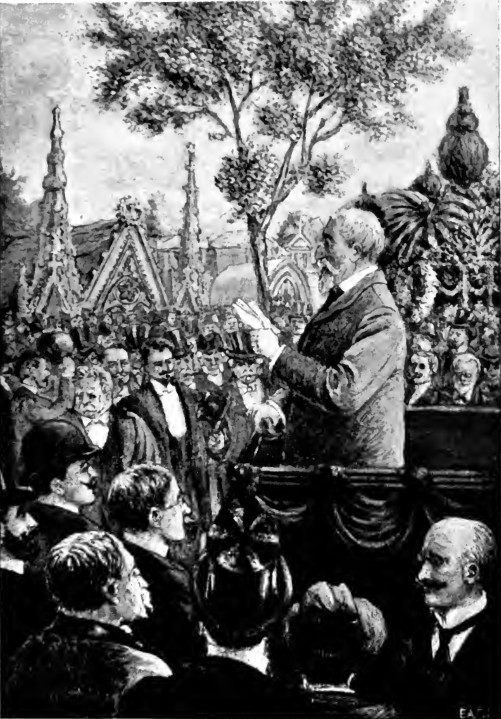
M. Anatole France delivering his oration at the funeral of Émile Zola
The presence of death, all around one in that great cemetery, was quite forgotten when M. Anatole France ceased speaking. Tumultuous applause arose while relatives and friends were taking up their positions for the march past of the thousands attending the obsequies. Several ladies, Mesdames Laborde, Charpentier, Fasquelle, and others,[9] had joined the family party, which stood in line on the verge of a transverse avenue, immediately in front of the tomb of the famous Baron Hirsch. For two hours the march past continued. M. Dreyfus, accompanied by M. Gabriel Monod of the Institute of France, and M. Lalance, a former Alsatian deputy, passed unrecognised by the great majority. But Maître Labori and Colonel Picquart were acclaimed. A host of distinguished men went by, and after them came all the deputations, the town of Denain sending a pitman, a blacksmith, and a peasant, each attired in the costume of his calling,—the first with his "Davy," the second with his leather apron, the third shouldering his scythe. In a like spirit Freemasons wore their insignia, and again and again came wreaths of flowers and "immortelles," silver palms and other tributes, borne in procession as far as the provisional vault. Every now and then, moreover, some deputation halted for a moment before the hearse, and cries were raised of "Glory to Zola! Honour to the apostle of justice!" Others called, "Germinal! Germinal!" in memory of Zola's great book in which he had taken the part of the toilers against the greed of the capitalists. For the rest, the crowd was most orderly, and one was struck by the presence of an immense number of young men about twenty years of age, the electors and artisans of the future, with whom perhaps some day the great principles laid down by Zola may finally triumph. Not until the vast concourse had gone onward, one hundred and fifty persons passing every minute, did the hearse proceed to the temporary vault to which Zola's remains were quietly committed. There were a few disturbances outside the cemetery, where several parties of anti-Semites had now assembled, but these were speedily quelled by the police and the municipal guards. And thus the long ceremony, which had lasted some four hours, came to an end.
For several months, however, the great novelist's widow continued to receive tributes of sympathy. The municipalities of various towns bestowed the name of Rue or Boulevard Zola on one and another thoroughfare, thus testifying to the revulsion of feeling in favour of Dreyfus's champion. A considerable sum was yielded by the subscription[10] for a public monument to be erected in some part of Paris, perhaps the Tuileries garden, and a design for this monument was commissioned. In February, 1903, the novelist's last book "Vérité" was published.[11] Then in March the greater part of his library was sold at the Hôtel Drouot in Paris, some twenty-six hundred volumes being thus dispersed.[12] There was a curious illuminated manuscript breviary of the fourteenth century which Zola had used while writing "Le Rêve," and numerous historical, philosophical, medical, and other scientific works, with some volumes of voyages and travels, and collections of periodicals. None of the above, the breviary excepted, were of much value, but considerable interest attached to a very large collection of presentation copies of modern novels and stories, including all those of Guy de Maupassant and many by the Goncourts, Gustave Flaubert, Alphonse Daudet, Paul Bourget, Halévy, Huysmans, Marcel Prévost, Anatole France, Claretie, and others. All those works were inscribed to Zola by their authors. In a copy of Flaubert's "Tentation de St. Antoine" were written the words, "à Zola un solide que j'aime"; while the "Trois Contes" contained the inscription "à Émile Zola, bon bougre! et du talent! son vieux, Gve. Flaubert." Some interest attached also to M. Waldeck-Rousseau's "Questions Sociales," published in 1900, for it was inscribed "à Émile Zola en témoignage d'admiration"—and yet M. Waldeck-Rousseau was the statesman who in that same year carried the Amnesty Law against which Zola so strongly protested! From this little circumstance one can divine what were M. Waldeck-Rousseau's private sentiments, whatever may have been his public declarations with respect to the Affair. The books sold at the Hôtel Drouot comprised also many of the translations of Zola's novels in different foreign languages, and the sale further included a variety of tapestry, curios, and works of art. The total proceeds were about six thousand one hundred pounds. It may be added that more than eight hundred of the inscribed presentation volumes were purchased by Mr. James Carleton Young, a well-known American book-collector, of Minneapolis, who proposes to establish in that city a magnificent library, in which every work will bear an inscription by its author. Autograph letters and manuscripts are also to be included in the collection, which already comprises several thousand volumes by dead and living writers in virtually all languages.[13]
It remains to be added here that on May 26, 1903, in the presence of a few relatives and friends, Zola's remains were quietly translated from their provisional resting-place to a tomb—designed by M. Frantz-Jourdain—facing the rond-point or open space near the entrance of the Montmartre cemetery There they will probably remain until the French nation decrees their removal to the Pantheon.
XV
CONCLUSION
THE INFLUENCE AND SURVIVAL OF ZOLA'S WORKS
The tragic elements in Zola's life—His place in history—Consequences of his action in the Dreyfus case—Survival of his novels—His influence on other writers—Social influence of some of his books—Zola's apostolic fervour—His prophetic instinct—"Germinal," "Travail," "Paris," and the French masses—Zola's unwritten book "Justice"—Result of his denunciations of vice—Immorality in Paris—Drunkenness in France—Why Zola should be remembered.
Such was the life, such also the death, of the greatest fighter that France produced in the latter half of the nineteenth century. The foregoing narrative, whatever may be its imperfections, will at least have given the reader some idea of that strenuous career which from youth onward was one long battle, an incessant expenditure of will, energy, and talent. It was also, like a battle, a resounding career, most of whose phases echoed all around. In the time of Alexandre Dumas père it used to be said, "When Dumas sneezes, all Paris starts"; and the same might have been subsequently said of Zola, some of whose "sneezes," indeed, reverberated far beyond Paris or even France. Looking at his life from another standpoint it will be found akin to a tragedy in several respects,—not the kind of tragedy which suggests thoughts of blood, thunder, and thrilling horrors, but one of hidden suffering and unrealised aspirations. That may be regarded perhaps as a petty, commonplace sort of tragedy, such as is enacted here and there every day, and left unrecorded. In Zola's case we see aspirations, efforts, struggles, disappointments, domestic trouble, misrepresentation, insult, and hatred, ending in death by accident, with just a few years of popularity and wealth thrown in to deepen, by force of contrast, the shadows of the rest. Even if we regard Zola's tragedy as that of a man's fight for the benefit of his fellowmen against those men themselves—and such it largely was—most of its features will be found to be of a familiar kind. One often perceives heroes and heroines, enthusiastic workers, fighters, and thinkers, who think not like the herd, who strive solely for that which they themselves deem to be right. Few achieve their purpose; the majority fail, disappear, die—as often as not—broken-hearted. Yet with a new generation others always arise to renew the combat. Now and again one of these enthusiasts secures a modicum of success, attains perhaps a hundredth part of his ambition, effects a hundredth part of the good he has dreamt of, leaves among many suggestions a single useful one behind him. But though the success of each individual worker may be very slight, that which he accomplishes is not lost; joined to what is accomplished by other workers, it enlarges the sum of progress. Each additional grain of wheat means an increase of the harvest, and of those who bring that grain to the store it may be said that even if they have failed in nine tenths of their efforts their failure is only relative.
In Zola's career, as in the careers of most men, there was both failure and success. Near as he still is to us, it is difficult to tell how far his measure of success will be permanent, how far his work and memory will survive him. We believe that by his action in the Dreyfus case he carved for himself an imperishable niche in the history of his country. Assuredly no historian, whatever his school, whatever his opinions, will be able to omit Zola's name from any record of the Third French Republic, for, as M. Anatole France said at his graveside, the consequences of Zola's action in the Affair have been immense. Far-reaching changes in the internal policy of France have proceeded from his deed, which led to a disclosure of the real sentiments of those Clericalists and Militarists who were closing in upon the Republic to destroy it. For a time the issue seemed doubtful; but the policy of Republican defence was inaugurated by M. Waldeck-Rousseau and has proceeded and expanded under his successor, M. Combes. To Zola and his letter "J'Accuse," and to the letter's various consequences, many of the events which have occurred in France since 1898 may be easily traced, even by those who know nothing of the novelist's political friendships, of his private intercourse with statesmen who during the Dreyfus turmoil lacked either the opportunity or the energy to intervene, and who, while privately assuring Zola of their sympathy, their conviction even that he was right, repeated to him: "Unfortunately I am not in office and I am therefore powerless. Besides, though I see the danger which you point out, it is very difficult to deal with. One must act with extreme prudence, for the patriotism of the electorate is aroused, and the Republic might be wrecked by precipitate action." Subsequently, after the death of Félix Faure, who was too deeply committed to the military party to take any honest, impartial action, some of the men who had held such language as one has indicated came to the front again, and then, as they gradually took confidence, things slowly changed. When the secret history of the Dreyfus affair from the political standpoint comes to be written, there will doubtless be more than one curious disclosure in which Zola will figure.
We take it, then, that he is assured of a niche in French history. The question of the ultimate survival of his novels is more difficult to determine. He himself declared on one occasion, in a public speech, that it was great honour for a literary man if he were only for one moment the spokesman of his generation and were even fated to oblivion afterward. Of course he, like other writers, aspired to some future fame. At any rate, even as he will figure in national history in connection with the Affair, so must his novels figure—and figure prominently, we think—in literary history. Can one imagine any record of the literary movement in the latter half of the nineteenth century containing no mention of Zola's writings? Independently of the writings themselves account has to be taken of their influence on other authors, not merely in France, but virtually all the world over. Zola always disclaimed any intention of founding a literary school. He protested repeatedly against such a suggestion. He had imitators certainly; all prominent writers have. But apart from those who deliberately set themselves to copy his methods, there were others, more independent, who in one or another respect yielded to his influence. Something of the Naturalism of the Rougon-Macquart series at least found its way into the English novel, in which also there came a reflection of Zola's later manner. Mr. George Moore may deny that he sprang from Zola, and may claim direct descent, as Zola did, from Flaubert and others. But in any case the principles on which Mr. Moore has often worked have been the same as those which Zola adopted. Nearer to Zola in some respects was the late Mr. George Gissing, who in others suggested Maupassant. The late Mr. Frank Norris, the American novelist, was manifestly influenced by Zola's later works; and it seems at least likely that various books by Mr. Hall Caine and Miss Marie Corelli would never have been written if Zola had not raised certain problems in such volumes as "Lourdes" and "Rome." Of Mr. Thomas Hardy it may be said perhaps, as of Mr. George Moore, that he has at least occasionally worked on lines running parallel to those on which Zola worked for years. It would be possible also to enumerate a large number of instances in which Zola's liberating influence has clearly appeared, even when his actual methods have not been followed. One may claim for him that he contributed largely and powerfully to free the modern novel from many shackles, with a result which is conspicuous on all sides. That nothing but Naturalism should remain in fiction as the result of his theories and efforts, was of course out of the question. Zola himself admitted that he had been a mere sectarian when in a dogmatic moment he had once suggested it. But certainly he helped to sweep away many conventionalities, and encourage an accurate presentment of life. Fiction, or at least that branch of it which claims to portray real life, is no longer the same as it was before he arose, and it seems hardly likely that it will ever revert to its former state.
With respect to the actual survival of his books as current literature, that, we think, will depend almost as much on circumstances as on their merits. They are not light reading. He himself was well aware of it, and, as we know, he said of himself, the Goncourts, and others, that future generations might well find their works difficult to read. Many already find it difficult to read Balzac, though he possessed a gift of humour which was lacking in Zola. On the other hand, Zola's style was generally much superior to Balzac's, though the latter was a good grammarian and could write admirable straightforward French when he pleased, as witness many letters in his "Correspondence." In the case both of Balzac and of Zola some knowledge of French history, politics, manners, and other matters is necessary for a proper understanding of their works. "Les Rougon-Macquart," like "La Comédie Humaine," can only be fully appreciated by those who are familiar with the period it treats of; and though Zola usually confined himself to the elemental passions which are also the eternal ones, it is perhaps doubtful whether works of fiction which tax the reader's knowledge in many ways can hope for immortality. Yet possibly the Rougon-Macquart series has a better chance of survival than is possessed by some of Zola's other books, whose social influence has been greater. Influence of that kind has certainly been exercised by some of the Rougon-Macquart volumes, though not in the same degree as by such great machines de guerre as "Lourdes" and "Rome," which reinforced by "Vérité" have proved factors of weight in the great struggle between clericalism and free thought in France. As engines of warfare for use in that struggle, they may survive for many years; but the struggle ceasing they would probably be soon forgotten, as is usually the case with books whose purpose is too ostensible. That example will explain the meaning of our remark that the survival of many of Zola's works will depend on circumstances. In the final triumph of the principles which his last and unfinished series enunciated, we feel considerable confidence. We believe, as Zola did, that the whole world is tending slowly but surely to better things, that we shall come at last to a more natural and more upright life, that increase of knowledge will bring increase of truth, increase of equity, and that the day will come when science will at last confound all superstitions.
One of the men for whom the novelist in his latest years testified the most respect was M. Berthelot, the eminent scientist, long the friend of Renan. It says much for M. Berthelot that he should have exercised considerable influence on two such men, but it should be remembered that if they differed in many ways they also had their points of contact. Though Zola was no priest, whereas Renan remained one in some essential respects until the end, he had in him an apostolic fervour which many a priest might have envied. Even in the days of the Rougon-Macquart novels, which were so impersonal, that fervour displayed itself freely in all Zola's miscellaneous papers, his literary, theatrical, and art criticisms. And it is somewhat remarkable that with this strong fervour within him he should so long have contrived to check and subdue it directly he turned from an essay to a novel. When he ceased to do so and allowed it to invade his novels, the cry of "a new Zola!" arose among those whose knowledge of his writings was confined to his earlier fiction.
Besides his apostolic fervour, Zola, like Renan, possessed a kind of prophetic instinct, which proceeded from the exercise to which he constantly subjected his brain. Every time when in preparing a new novel he had assembled a number of facts, he proceeded to draw deductions from them, to weigh all probabilities and possibilities; and his mind being thus trained, dealt in the same way with all the current events in which he took interest. During his year's stay in England at the time of the Dreyfus case he repeatedly told the writer that he felt sure so-and-so would happen, and in nine cases out of ten his predictions were accurate. At times when the writer went to him with a preconceived opinion or some forecast taken from a newspaper it was particularly interesting to hear him analyse it, examine it under every aspect, and confirm or refute it in accordance with his view of the probabilities. On such occasions his systematical and logical mind was fully revealed; and one may say that the prescience which he often displayed was far more a matter of knowledge and logic than of inspiration. The latter undoubtedly came to his aid on some notable occasions, but even when he so fervently declared his belief in the innocence of Captain Dreyfus—at a time when all positive proof thereof seemed lacking—he at least had some logical basis for his belief which his expertness in deduction had intensified.[1]
It has been pointed out that several of Zola's later books influenced the community, or at least a large section of it, in connection notably with the struggle between Church and State in France. "Germinal" and "Travail," which circulated widely among the working classes, must also have exercised considerable influence. Of recent years the latter work has frequently furnished subjects for lectures delivered to working-class audiences in the French provinces as well as in Paris; and although, as was remarked in a previous chapter, "Travail" may not be in some respects a very practical work, its pacific tendencies are admirable, and the worker who comes under their influence can but reject the more violent courses which some leaders of advanced opinions have preached. Again, "Paris," which is not held to be one of Zola's greatest books, has met with no little favour among the masses, less because it paints the corruption existing in some spheres of society than because it gives voice to the chief demand of the masses, which is for justice. It does not treat the subject fully, being more concerned with the failure of charity to cope with the necessities of the modern world, but it indicates that justice should take charity's place, and this accords so well with the feeling of the multitude that the favour accorded to the book is but natural.
If Zola had lived another year he would have dealt exhaustively with that subject of social justice,—equity between class and class, man and man. It was to have been treated in the last volume of his "Évangiles." Only two days before his death, on the eve of his return from Médan to Paris, he wrote to his publisher, M. Fasquelle, that on the following Monday morning he should begin to prepare that concluding work. He was unable to do so, for on the morning stated he died; and foul-minded bigots, on hearing of his intention, repeated with a sneer, "He was going to begin 'Justice'—well, justice has been done to him." But whatever vileness may have come from men who ever had the words "We are Christians" on the tip of their tongues or at the point of their pens, all those who are in any degree oppressed may well regret that the hand of death robbed them of a powerful statement of their rights.[2]
It would not appear that the flagellation of vice which one finds in the Rougon-Macquart novels has had any widespread effect in France, though it has undoubtedly done good in individual cases. From the general standpoint Paris shows little sign of improvement in some matters. The number of illegitimate births and the number of divorce cases remain extremely large. It may be said, however, that these point less to absolute immorality than to new conceptions of marriage and discontent with existing laws. With respect to the illegitimate births one finds the fathers of the children constantly recognising their paternity in the official declarations of birth, and thereby making themselves responsible for the upbringing of the little ones. The fact is that cohabitation without marriage seems to increase, while there is a falling off both in the number of marriages and in the cases of desertion following seduction.
As regards "L'Assommoir," respecting which the writer has often cordially re-echoed the opinion that it is one of the greatest temperance tracts ever written, one can only say that, like other books of Zola's, it has done good in individual instances, but has failed to stem the general passion for strong drink. The sobriety of the French nation was at one time almost proverbial, but there has been a great change in that matter since the War of 1870. The efforts of various kinds made to check the consumption of alcohol in Paris itself have in a measure proved successful, the average having been reduced during recent years from nine to seven quarts per annum per head of the population. But Normandy tells a terrible tale: At Caen the consumption is fifteen quarts per head, at Rouen it is over sixteen, at Havre it is seventeen, and at Cherbourg, eighteen. It is not surprising, therefore, to find that the depopulation of Normandy is proceeding apace, that the women, who are as much addicted to drink as the men, can seldom bear children, and that even when they become mothers they are unable to suckle their babes. Thus one of the sturdiest races of France is perishing, destroyed by cider and potato spirit. The very children often drink on their way to school, insanity flourishes, and immorality is widespread.[3]
But reforms are not accomplished in a day; and in many instances authors may write in vain, even as the clergy may preach, if legislation does not come to their aid. In some matters even legislation is futile, and then reform can only come gradually, as the result of example and knowledge. To improve the nation you must usually begin by improving the individual. If, then, Zola succeeded in his aims in individual cases—and the writer holds strongly that he did—he effected all that he could reasonably hope for. He did not stamp out vice in France. Neither has the State done so, nor has the Church, nor has any other powerful and wealthy organisation. Zola had only his brain and his pen, and with those weapons he did his best, according to his lights. He was all sincerity; hypocrisy was the thing he most detested. He fought the good fight. After setting forth the evil that was, he preached the cleanly and the fruitful life, brotherliness, equity, rectitude, and truthfulness. He desired the suppression of all noxious agents, and it was because he regarded the Roman Church as such that he assailed it so fiercely. Moreover, he did not share the delusion which imagines a heaven beyond the skies; he wished to set a heaven in this our planet. That was his ideal. He did not believe in resignation. He placed his faith in work and effort. He loved his Mother Earth, he pictured her beauties. He loved his fellowmen; in his harshest moments he sought their good only. The one error of his life showed how human he was. If he were ambitious it was that he might advocate the principles in which he believed, with more and more authority. In a dim and dolorous hour,
"when God himself seemed dumb And all his arching skies were in eclipse,"
this abused and insulted novelist turned from his work and smote for truth and justice. Others shall decide whether he was a man of genius; suffice it for us that, all his life, he was a man of bravery. He feared none. If there was tragedy in his career, he knew how to bear it. He felt, he prophesied, the day would come when justice would be done to him. That day is hastening; and in whatever estimation his writings may be held hereafter, whether some survive, whether all sink into oblivion, his memory will assuredly abide for many generations, for the world does not willingly forget those who teach it courage,—the first, the foremost quality that life demands of man.
APPENDIX
A
DECLARATION OF THE BIRTH OF ÉMILE ZOLA
The year 1840, this fourth day of April, at a quarter past two o'clock in the afternoon, before us, Barthélémy Benoist Decau, knight of the Legion of Honour, Mayor of the Third Arrondissement of Paris, discharging the functions of registrar of births, deaths, and marriages, there has appeared the Sieur François Antoine Joseph Marie Zola, civil engineer, forty-four years of age, residing in Paris at No. 10 bis Rue St. Joseph, who has presented to us a child of the male sex, born the day before yesterday, at eleven o'clock in the evening, at the appearer's residence, being the son of the said appearer and of Françoise Émilie Aubert, his wife, married in Paris at the municipal offices of the First Arrondissement, on March 16, 1839; to which said child the appearer has given the forenames of Émile Édouard Charles Antoine. Entered in the presence of Norbert Lecerf, grocer, age fifty-two years, residing in Paris, at No. 18 Rue St. Joseph, and of Louis Étienne Auguste Aubert, of independent means, age fifty-six years, residing in Paris at No. 106 Rue de Cléry, maternal grandfather of the said child. And after perusal of the present the father and the witnesses have signed, ZOLA, LECERF, AUBERT, DECAU, mayor.
B
DECLARATION OF THE DEATH OF ZOLA
The year 1902, this thirtieth day of September, before us, Mayor of the Ninth Arrondissement of Paris, declaration has been made of the death of Monsieur Émile Zola, officer of the Legion of Honour, homme de lettres, who died the twenty-ninth September in Paris, at his residence, situated No. 21 bis Rue de Bruxelles, at the age of sixty-two years. Son of the deceased François Zola, engineer, and of the deceased Émilie Aubert. Husband of Madame Alexandrine Gabrielle Zola, née Meley. In testimony of which the declaring witnesses have signed with us, LABORI, M. DUTARD, mayor.
C
NOTE ON SOME ENGLISH TRANSLATIONS OF ZOLA'S NOVELS
Some information respecting the first editions, etc., of Zola's writings has been given in a number of foot-notes in the course of the present volume. That information is by no means exhaustive, but pending the appearance of a complete bibliography, which will surely be undertaken before long, it may be acceptable to various readers and book-collectors. For the convenience of those who are unacquainted with French, the author here appends a list of the translations in the English language which are known to him. Unfortunately he has no acquaintance with the great majority of those issued in America. Should the present volume be reprinted, and information concerning American translations be supplied to him through his publisher, he will endeavour to include it in a future edition. He may mention now that he believes several translations of merit have been made in the United States by Mr. Benjamin R. Tucker.
With respect to the English translations those published by Vizetelly & Co. between 1884 and 1889 were the following: "The Fortune of the Rougons," "The Rush for the Spoil" ("La Curée"), "A Love Episode" ("Une Page d'Amour"), "Fat and Thin" ("Ventre de Paris"), "The Conquest of Plassans," "Abbé Mouret's Transgression," "His Excellency E. Rougon," "The Assommoir," "Nana," "Piping-Hot" ("Pot-Bouille"), "The Ladies' Paradise" ("Au Bonheur des Dames"), "How Jolly Life is!" ("La Joie de Vivre"), "Germinal," "His Masterpiece" ("L'Œuvre"), "The Soil" ("La Terre"), "Madeleine Férat," "Thérèse Raquin," and "A Soldier's Honour" (short stories). All the above were issued in crown octavo form. There were also large octavo editions of "Nana," "The Assommoir," and "Piping-Hot," each with about one hundred illustrations. The smaller volumes also contained illustrations or frontispieces. After the first proceedings at law against the publishers, most of the above translations were re-expurgated and reissued. The reissues were distinguished from the earlier editions by the words "A new Edition," and by the heading "The Rougon-Macquart Family," I, II, III, etc., which heading does not appear on the title-pages of the first and fuller editions. There was, however, no such reissue of "Nana," "Piping-Hot," and "The Soil." In some early catalogues "Claude's Confession" was announced by the firm, but the writer does not find that it was ever published. The above translations are all out of print, with the exception of "The Soil," which is sold in France only by the proprietor of the copyright of that translation (Paris, Flammarion). In consequence of the conviction of Henry Vizetelly it may not be sold in the British dominions.
The English translations now in circulation in Great Britain are enumerated below. Here and there in the list the writer has mentioned some American editions known to him. In the case of the Rougon-Macquart series the order in which the volumes are placed is that in which they should be read.
ROUGON-MACQUART SERIES.
I. "The Fortune of the Rougons," edited with an introduction by Ernest A. Vizetelly. London, Chatto and Windus, St. Martin's Lane.
II. "His Excellency" ("Son Exc. E. Rougon"), edited, etc., by E. A. Vizetelly. London, Chatto. The same, published in New York by the Macmillan Co.
"La Curée" should follow here, but there is no English version on sale.
III. "Money" ("L'Argent"), translated by E. A. Vizetelly. London, Chatto.
IV. "The Dream" ("Le Rêve"), translated by Eliza E. Chase. Eight illustrations. London, Chatto.
V. "The Conquest of Plassans," edited, etc., by E. A. Vizetelly. London, Chatto.
"Pot-Bouille" should follow here, but no English version is in circulation.
VI. "The Ladies' Paradise" ("Au Bonheur des Dames"), edited, etc., by E. A. Vizetelly. Frontispiece. London, Hutchinson & Co., Paternoster Row.
VII. "Abbé Mouret's Transgression," edited, etc., by E. A. Vizetelly. London, Chatto.
VIII. "A Love Episode" ("Une Page d'Amour"), translated by E. A. Vizetelly. Ninety-four illustrations. London, Hutchinson.
IX. "The Fat and the Thin" ("Le Ventre de Paris"), translated by E. A. Vizetelly. London, Chatto.
X. "The Joy of Life," edited, etc., by E. A. Vizetelly. London, Chatto.
XI. "The Dram Shop" ("L'Assommoir"), edited, etc., by E. A. Vizetelly. London, Chatto.
XII. "His Masterpiece" ("L'Œuvre"), edited, etc., by E. A. Vizetelly. London, Chatto.
XIII. "The Monomaniac" ("La Bête Humaine"), translated by Edward Vizetelly (see ante, p. 248, foot-note). London, Hutchinson.
XIV. "Germinal," edited by E. A. Vizetelly. London, Chatto.
"Nana" should follow here, but no English version of the slightest value is in circulation, though of this and a few other volumes there are some paltry adaptations, which omit from a third to half of those works as they stand in the original French.
After "Nana" should come "La Terre," no English version of which is sold in Great Britain.
XV. "The Downfall" ("La Débâcle"), translated by E. A. Vizetelly. London, Chatto.
An American translation, under the same title, by E. P. Robins, was published by the Cassell Co., New York, 1893. The Macmillan Co. also catalogues a translation, perhaps the same.
XVI. "Doctor Pascal," translated by E. A. Vizetelly. London, Chatto.
An American translation by Mary J. Serrano is published by the Macmillan Co., New York.
The "TROIS VILLES" series: I, "Lourdes," II, "Rome," and III, "Paris," as translated by Ernest A. Vizetelly, is published in London by Chatto and Windus, in New York by the Macmillan Co.
Of Zola's last series, "LES QUATRE ÉVANGILES," only three volumes were issued, the translations being as follows:
I. "Fruitfulness" ("Fécondité"), translated by E. A. Vizetelly. London, Chatto; New York, Doubleday.
II. "Work" ("Travail"), translated by E. A. Vizetelly. London, Chatto.
An American translation called "Labor" is issued by Messrs. Harper, New York.
III. "Truth" ("Vérité"), translated by E. A. Vizetelly. London, Chatto; New York, John Lane.
There are also the following translations of Zola's miscellaneous novels and short stories:——
I. "Thérèse Raquin," translated by Edward Vizetelly, London, Grant Richards.
II. "A Dead Woman's Wish" ("Le Vœu d'une Morte"), translated by Count C. S. de Soissons. London, Greening.
III. "The Mysteries of Marseilles," translated by Edward Vizetelly. London, Hutchinson.
IV. "The Honour of the Army and other Stories" ("Le Capitaine Burle," "Naïs Micoulin," "Nantas," etc.), edited by E. A. Vizetelly. London, Chatto. This volume is not identical with the one called "A Soldier's Honour," formerly published by Vizetelly & Co., some of the tales contained in the latter having been omitted, and others added.
V. "Stories for Ninon" ("Contes à Ninon" and "Nouveaux Contes à Ninon"), translated by Edward Vizetelly. 2 vols. London, Heinemann.
VI. "The Attack on the Mill," etc. London, Heinemann.
One may also mention Zola's "Letters to France" (Dreyfus case), introduction by L. F. Austin. London and New York, John Lane.
INDEX About, Edmond, 67, 87, 98, 172, 173, 185, 249 Academy, French, 216, 218, 306 et seq., 336 Adam, Mme. Edmond, 189 Addlestone, Zola at, 469, 470, 477 Aix in Provence, Zola Canal at, 15, 25, 26, 29, 40, 41; funeral of F. Zola at, 27, 28; his widow's troubles at, 29, 32 et seq.; is the Plassans of the Rougon-Macquarts, 30, 115; history and celebrities of, 30, 31; Zola's homes at, 32, 33, 34, 46; college of, 32, 35 et seq., 46; King René's "chimney" at, 39; environs of, 40 et seq.; Zola's holidays at, 49, 51; referred to, 350, 351, 409 Alexis, Paul, 37, 63, 146, 147, 158, 162, 191, 367, 371 Algeria, F. Zola in, 8 et seq.; anti-Semitic riots in, 446 Allen, Grant, 298 Allier, Raoul, 447 American Literature in 1840, 19 Amicis, E. de, 371 Amnesty Bill in Dreyfus Case, 487 et seq. André, General, 488, 513 Angina, Zola's, 393, 475, 510 Animals, Zola's love of, 398, 401, 475 et seq. Anonymity in Journalism, Zola on, 327, 330, 331 Anti-Semitism in France, 417 et seq., 431, 442, 445, 446, 450, 459 Arc, river, 40, 42 Archer, William, 298 Arithmomania, Zola's, 392, 504 Army, French, anti-Semitism in the, 427 et seq. See also Staff, Militarism, etc. Asquith, H. H., Q. C., 268, 269, 277 Athenæum Club, 332 Aubert Françoise Émilie, see Zola, F. E. —— Louis Étienne, grandfather of É. Zola, 16, 29, 32, 46, 47, 69, 541 —— Mme., grandmother of É. Zola, 18, 29, 32, 33, 34, 46 Aubryet, Xavier, 89 Audiffret-Pasquier, Duke d', 307 Augier, Émile, 86, 112, 185, 202 Austria, F. Zola in, 7, 8 Authors' Club, the, 328, 329, 332, 333 Avory, H., 270 Baille, J. B., 38, 39, 48, 49, 70, 97, 100 Ballet, Zola and the, 430 Balzac, Honoré de, 21, 105, 106, 108, 111, 121, 190, 306, 384, 389, 395, 532 Banville, T. de, 59 Bar, French, traditions of the, 449, 450 Barbey d'Aurévilly, 77, 190 Bardoux, Agénor, 174 et seq., 239 Barrière, Théodore, 112, 202 Baudelaire, 86 Baudry, 185 Beauce, La, 16, 219, 229, 230, 232 Beauchamp, Zola calls himself, 470 et seq. Beauharnais, Eugène de, 6 Becque, Henri, 388 Béhard, E., 91, 147 Bellanger, Marguerite, 186 Belleville and Gambetta, 198 Belot, Adolphe, 102 Bennecourt, Zola at, 96, 97 Benodet, Anse de, 218 Bergerat, M., 146 Berman, Dr., 508 Bernabei, Signor, 411 Bernadotte, 428 Bernard, Claude, 183, 311 Berryer, 449 Berthelot, M., 447, 533 Berton, Mme., 170 Besant, Sir W., 298, 328 Betham-Edwards, Miss, 381 Billot, General, 9, 435, 440 et seq., 444, 447, 462 Birth of É. Zola, 18, 541 Bogue, David, 247 Boileau, 374 Boisdeffre, General de, 440, 444, 451 Boissier, Gaston, 414 Bonaparte, Princess Mathilde, 75, 119. See also Napoleon Bonnetain, Paul, 234 et seq. Bontoux, financier, 421 Bordeaux, Zola at, 127 et seq., 131; riots at, 446 Bordereau the, 433 Borinage, the, 220 Bornier, Henri de, 310 Borthwick, Sir A. (Lord Glenesk), 297 Bouchor, M., 146 Boudet, Dr., 64 Bouffar, Zulma, 186 Boulancy, Mme. de, 437 Boulanger, General, 233, 234, 421, 422 "Boule de Suif," 192 Bourdilliat, M., 88, 90 Bourget, Paul, 262, 286, 385 "Bovary, Madame," 22, 72, 78, 111, 123, 146, 147, 163, 262, 286 Bow Street Police Court, H. Vizetelly at, 268, 286 Boycott of Paris Exhibition, 485 "Boy's Own Book," the, 245 Bradlaugh, C., 298 Bréal, M., 447 Brescia, 2, 35; Zola at, 412 Brett, G., 477 Bridge, Sir John, 268 Brieux, M., 389 Brisson, Henri, 462 et seq., 476, 477 British Museum, Zola at the, 334, 335 Broglie, Duke de, 307 Brough, R. B., 247 Browning, Oscar, 298 Bruneau, Alfred, 191, 304, 388, 407, 430, 454, 498, 515 Brunetière, F., 103, 310, 323 Buchanan, Robert, 297, 298, 313, 314, 340 Buckingham Palace, Zola's view of, 336 Bulow, Count von, 448 Burnett, Mrs. F. H., 298 Burnham, Lord, see Lawson Burty, Philippe, 146 Busnach, William, 177, 201, 202, 219, 226, 233, 288 Cabanel, M., 185 Caine, Hall, 298, 531 Caird, Mrs. Mona, 298 Cameron, Dr. C., M. P., 297 Carnot, President, 238 "Carroll, Lewis," 345 Castagnary, 124 Castellane, Count B. de, 513 Castel-Sarrazin, Zola and, 128 et seq. Castiglione, Countess de, 186, 351 Cavaignac, Godefroy, 448, 462 et seq., 474 Cavalié, G., 127, 128 Céard, Henri, 146, 162, 191, 207, 233, 415 Censorship, theatrical, 201, 226, 303 Central Criminal Court, H. Vizetelly at the, 269, 274 et seq., 291 et seq. Cerise, Dr., 89 Cézanne, Paul, 38, 39, 48, 49, 55, 70, 91, 92, 96, 97 Chabrillat, Henri, 178, 203 Chamberlain, J., M. P., 277 Chamber of Deputies, Dreyfus case in the, 434, 445, 448, 463 Chambers, Sir T., Recorder, 276, 280, 281, 294 Chanoine, General, 474 Characteristics, personal, of Zola, 391 et seq. Charonne, Gambetta at, 197 et seq. Charpentier, Alexandre, 490 —— George, publisher, 98, 135 et seq., 146, 148, 154, 156, 194, 209, 302, 321, 368, 465, 469, 509, 515 —— Gustave, composer, 389 Chateaubriand, F. R. de, 20, 145, 146, 374, 404 Châteaudun, Zola at, 232 Chatto, Andrew, 316, 334, 460, 477, 478 Chatto and Windus, 284, 316 Chaumié, M., 384, 516 Cheeses, Zola's symphony of, 142, 143 Cherbuliez, V., 161, 172, 249 Children, Zola's, 400 et seq. Chopin, 404 Cladel, Léon, 161, 172, 173 Claretie, Jules, 160, 161, 172, 173, 174, 311 Clarke, Sir E., Q. C., 277 et seq., 291 et seq. —— H. Savile, 298 Clay, Henry, 403 Clemenceau, G., 447, 458, 465, 466 Cluer, A. R., 275, 288, 289, 291, 292 Cock, Mr. Q. C., 289, 291 et seq. Cockburn, Ld. Ch. Justice, 277 Coffin, Dr. R. M., 298 Collins, Mabel, 298 Combe, Colonel, 11 Combes, M., Prime Minister, 512 "Comic Almanack, Cruikshank's," 245 Commons, House of, debate on Zola's novels, etc., 262 et seq. Compiègne, imperial court at, 151, 152 Comte, A., 395 "Confession," Zola's, 398 Coppée, F., 50, 116, 146, 309 Corelli, Marie, 531 Corfu, 5 Corot, 95 Coste, Numa, 97, 147 Cotton, J. S., 298 Couesdon, Mlle., 417 Courbet, 94 Cour de Cassation and Zola, 461, 463; and Revision of Dreyfus case, 476, 479, 480 Crawfurd, O., C. M. G., 328, 332 Dancing, Zola and, 430 Dantan, E., 170 Daubigny, 95 Daudet, Alphonse, 22, 23, 50, 59, 77, 87, 88, 135, 141, 144 et seq., 147, 153, 161, 174 et seq., 194, 209, 216 et seq., 226, 234, 236, 237, 249, 320, 321, 420, 434, 435 —— Ernest, 102 Death, Zola and, 195, 210, 211, 218, 392, 398, 504, 505, 541 "Decameron, the," 253, 269 Defaut, Dr., 509 Degas, 91 Delegorgue, Judge, 451 Delthil, Camille, 128 et seq. Denise, 402 Déroulède, Paul, 427, 479 Desart, Earl of, 298 Descaves, Lucien, 234, 235 Deschamps, Gaston, 414 Desmoulin, Fernand, 191, 454, 466, 468, 469, 471, 509, 515 Dhur, Jacques, 9 et seq. Dickens, C., 493 Dierx, M., 161 Dinners of the Hissed Authors, 144, 145, 209, 210, 368 Dircks, W. H., 298 Docks Napoleon, Zola at the, 53, 54 Dode, General, 24 Dogs, Zola's, 123, 401, 475, 476, 507, 509 Donnersmarck, Henckel von, 185 Dourdan, 15, 230 "Downfall, The," see "La Débâcle," under heading "Zola's Works" Dream of Colonel Henry's death, 472, 473 Dréolle, Ernest, 120 Dreyfus Affair, generally, 116, 419 et seq., 428, 433, 440 —— Captain Alfred, 410, 412, 413, 417, 429, 431, 433, 436, 440, 444, 448, 458, 466, 480, 481, 484, 485 et seq., 513, 514, 522 —— Mme., 431 —— Mathieu, 431, 433, 436 Drouet, Mme., 404 Droz, Gustave, 87 Drumont, Édouard, 423, 461, 511 Dubufe, E., 95 Ducamp, Maxime, 146 Duclaux, M., 447 Du Lac, Father, 444 Dumas, Alexandre, the elder, 22, 85, 89, 306, 374, 376, 404, 410, 527 —— the younger, 50, 89, 112, 173, 174, 202, 204, 306, 404 Du Maurier, George, 297 Dupanloup, Bishop, 86, 307 Du Paty de Clam, Colonel, 433, 439, 440, 443, 458 Dupuy, M., Prime Minister, 477, 484 Duranty, 67, 116, 147 Duret, Théodore, 91, 477, 515 Dusautoy, M., 120 Duvernois, Camille, 120 Edwards, H. Sutherland, 247, 298 Eliot, George, 404 Ellis, Havelock, 298 Emerson, 404 Empire, the Second French, foundation of, 34; law of public safety, 47; Quartier Latin during, 59; opposition to, 75; tyranny and corruption of, 84, 85, 186; its waning prestige, 97; whether Zola would have sold himself to, 115 et seq.; Journalists bribed by, 120; fall of, 125, 126; court of, 151, 152, 186; its treatment of the peasantry, 230; its "Robert Macaires," 350; Its characteristics shown in the Rougon-Macquart series, 351 et seq. England, rural districts of, 279, 339; Zola's first stay in, 329 et seq.; his second stay, 465 to 480 English Literature in 1840, 18 Erckmann-Chatrian, 87, 89, 112, 172 Esterhazy, see Walsin Ewald, A. C., 298 Execution and sale at Zola's Paris house, 474 et seq. Experts, handwriting, in Dreyfus case, 444, 448, 463, 475, 489 "Extracts from English Classics," Vizetelly's, 271 et seq. Fabre, Ferdinand, 161, 172, 176 Fantin-Latour, 91 Fasquelle, Eugène, 305, 453, 476, 477, 480, 509, 515 "Fatalité," play by Quènemeur, 12 Faure, President Félix, 438, 439, 443, 463, 479, 529 Faux, W., 298 Favre, Jules, 449 Féder, financier, 421 Ferry, Jules, 368, 415 Feuillet, Octave, 87, 112, 161, 172, 173, 190 Féval, Paul, 172 Fischer and wife, 10 et seq. Flamidien, Brother, 500 Flassans, 30 Flaubert, Gustave, 22, 72, 98, 105, 111, 119, 121, 140, 141, 144 et seq., 152, 154, 161 et seq., 167, 174 et seq., 179, 190, 193, 194, 286, 367, 377, 435, 525 Fleury, Dr. M. de, 415 Forbes, Archibald, 298, 317 Fortifications, see Paris Fortune, Zola's, 489, 490, 524 Foster, Birket, 247, 287, 298 France, Anatole, 143, 161, 447, 515, 518 et seq. "France Juive, La," 422, 423 Franklin, Benjamin, 403 Frantz-Jourdain, 415, 526 Fratta, Signora, see Zola French Literature in 1840, 20 et seq.; in 1865, 85 et seq.; in 1876-78, 161 Freycinet, C. de, 309 Frith, W. P., R. A., 298 Fromentin, 94 Fulton, Sir F., 269 Funeral of Zola, 514 et seq. Furniss, Harry, 298 Furnivall, Dr. F. J., 298 Gaboriau, Émile, 87, 103 Gallet, L., 304, 407 Galliffet, General-Marquis de, 48, 488 —— Marquis de, 25 Gambetta, Léon, 127 et seq., 196 et seq., 215, 225, 368, 422, 450 Garnett, Dr. R., 298, 334 Gastineau, B., 177 Gaucher, M., 160 Gautier, Théophile, 21, 89, 134, 135, 152, 185, 262 Geddes, Prof., 298 General Staff, French, see Staff Genoa, Zola at, 318 "Germinie Lacerteux," 75, 109, 123 Gérôme, 95, 185 Gerstner, Ritter von, 7, 8 Gilbert, Sir John, 287, 297 Girardin, Émile de, 75, 83, 120, 144, 185 Giry, M., 447 Gissing, George, 531 Glais-Bizoin, 119, 127, 128, 368 Gmunden, 8 Goblet, René, 226 Gomme, G. L., 298 Goncourt Academy, 320 —— Brothers, 75, 76, 79, 89, 90, 109 et seq., 119, 378 Goncourt, Edmond de, 75, 111, 115 et seq., 120, 121, 140, 141, 144 et seq., 152 et seq., 161, 167, 176, 185, 190, 194, 195, 201, 209 et seq., 216, 219, 220, 224 et seq., 236, 237, 262, 302, 320, 377, 378, 401, 435 —— Jules de, 75, 109, 111, 378 Gonse, General, 440, 444 Gosse, Edmund, 277, 298 Gounod, C., 48 Grandcamp, Zola at, 207, 218 Greenwood, Frederick, 247, 298 —— James, 247, 298 Grégoire, Abbé, 420 Grénier, Édouard, 101 Greenville-Murray, E. C., 249 Grévy, President, 225, 234 Grimaux, M., 447 Grosvenor Hotel, Zola at, 466, 467 Grousset, Paschal, 127 Guiches, Gustave, 234, 235 Guildhall, Zola at, 332; police court, 269 Guillemet, M., 91 Guimond, Esther, 185 Guyot, Yves, 183, 184, 447, 477, 491 Hachette, Louis, 64, 69, 78; & Co., 64 et seq., 77, 78 Haggard, H. Rider, 298 Halévy, Ludovic, 89, 185, 309, 515 Hamel, Ernest, 90 Hand, Zola's, and palmistry, 391, 392 Handwriting experts, see Experts —— Zola's, 373, 374 Hannay, James, 247 Hanotaux, M., 452 Hardy, Thomas, 19, 298, 531 Harris, Sir Augustus, 298 —— Frank, 288, 298, 340 Hatton, Joseph, 329 Haussmann, 58, 125, 352 Havet, M., 447 Havin, L., 124 Hébert, M., 411 Hennique, Léon, 146, 160, 162, 191, 233 "Henriette Maréchal," Goncourt's play, 75, 76, 79, 128, 224 Henry, Major, later Colonel, 9, 433, 436, 451, 461, 463, 464, 473, 482 "Heptameron, The," 253, 286, 328 Hérédia, J. M. de, 209 Heredity, in Zola's writings, 113, 123, 351, 353, 359, 363, 364 Hermant, Abel, 515, 517 Herz, pianist, 185 Hollingshead, J., 247 Holloway Jail, 295, 298 Homes, Zola's, at Aix, 32, 33, 34, 36; in Paris, 47, 54, 56, 61, 68, 69, 74, 96, 100, 132, 149, 150, 154, 168, 305, 474, 476, 505. See also Médan House of Commons, see Commons Houssaye, Arsène, 87, 103, 104, 185 Hugo, Victor, 21, 22, 43, 85, 108, 116 et seq., 161, 196, 202, 216, 224 et seq., 306, 373, 374, 395, 401, 404 —— Charles, 117; François, 117; George, 226; Léopoldine, 118 Huysmans, J. K., 146, 162, 163, 191, 207, 377 Ibsen, Dr., 389 "Index Expurgatorius Librorum Prohibitorum," 3, 409, 410 Industry of Zola, 322, 395, 396 Influence of Zola's writings, 530 et seq. Ingram, Herbert, M. P., 246 Ingres, 216 Institute of Journalists and Zola, 323, 325 et seq. Intellectuals, the, 447 Interviews, first, in European journalism, 82 Irving, Sir H., 287, 298 Iung, General, 321 Jacques, 402, 515 James, Henry, 243 Janin, Jules, 21, 98, 374 Japan, 2, 3 Jaurès, Jean, 447, 462, 477 Jay, Harriett, 298 Jeanniot, M., 191, 317 Jerrold, Douglas, 246 Jesuits, the, 423 Jews in France, see Anti-Semitism Jones, H. A., 298 Judet, E., libels Zola's father, 9 et seq., 461, 488, 489 Kean, Edmund, 246 Kensit, 257, 258 Kiariakl, see Zola, Benedetta Kibblewhite, E. J., 316 Laborde, M. and Mme., relatives of Zola, 509, 515 Labori, Fernand, 432, 449 et seq., 457 et seq.; 461, 465, 477, 484, 489, 491, 523 Labot, Maître, 27, 47 Labouchere, H., M. P., 296 Lacroix, Albert, 71, 76, 89, 90, 104, 107, 114, 115, 116, 125, 132, 134, 136, 137 Laffitte, Jules, 187, 195 —— Pierre, 503 La Fontaine, 17, 18, 50, 51 Lalance, M., 522 Lamennais, 404 Lang, Andrew, 103, 243 Larat, Dr., 515 Laurier, C., 127 et seq. Lawley, Hon. F., 298 Lawson, Sir Edward, 330, 332 Lazare, Bernard, 431, 466 Lebaudy père, 421, 422 Leconte de Lisle, 86, 161 Le Fanu, G. B., 298 Legion of Honour and Zola, 173 et seq., 238 et seq., 269, 323, 461, 468, 513 Legouvé, E., 19 Lemaître, Frédérick, 21, 350 Lemercier-Picard, 451, 452 Lenormand, Dr., 509 Leo XIII, Pope, 409, 410, 411, 416, 424 Leroux, Pierre, 404 Leroy-Beaulieu, A., 447 Lespès, L. (T. Trimm), 82 L'Estaque, Zola at, 166 Levasseur, E., 48 Lever, C., 19 Levy, J. H., 477 Lévy, Michel, 73, 88 Librairie Internationale, 76, 89, 90, 91 —— Nouvelle, 88, 89 Library, sale of Zola's, 524, 525 Lickfold, Mr., 269, 294 Lincoln's Inn Hall, Zola at, 330 Linton, Mrs. Lynn, 298 Liszt, 404 Literature, see American, English, French Littré, E., 66, 86, 307, 503 Lockroy, Édouard, 118, 238 et seq. Loiseau, M., 515 Loisy, Abbé, 411 London, Zola in, 329 et seq., 465, 466; Zola on poverty in, 335 Longfellow, 20, 247 Loti, P., 310 Loubet, President, 479, 486 Louis-Philippe, King, 8, 11, 20, 34 Lourdes, Zola at, 311, 318. For his novel "Lourdes" see Zola, Writings Love, Zola, Flaubert, Goncourt, Tourgeneff and, 167 Lowell, J. R., 20 Lucas, Charles, 114; Dr. P., 114 Lucy, H. W., 298 Lyons, Lord, 127, 128 —— riots at, 446 Lytton, Lord ("Owen Meredith"), 298 Macaulay, 19 MacColl, Canon, 339 Maccoll, Norman, 298 MacMahon, Marshal, 156, 177 "Madame Bovary," see Bovary Magnard, F., 329 "Maiden Tribute of Modern Babylon," Stead's, 256, 258, 272 Main, Dr., 509 Macaire and Makaire, 350 Mallarmé, S., 161 Malot, Hector, 161, 172 Manet, Édouard, 91, 93, 95, 101, 116, 179, 303 Manifesto of the Five ("La Terre"), 234 et seq. Margueritte, Paul, 234, 235, 378; Victor, 235, 378 Marriage vow, violations of the, 401 Marryat, Captain, 19 Marseilles, F. Zola at, 13 et seq., 27; É. Zola at, 52; canal to, 25; riots at, 446 Marshall, F. A., 298 Martineau, H., 19 Marx, Adrien, 82, 173 Marzials, F. T., 298 Masséna, 428 Massin, Léontine, as Nana, 203 Mathieu, Zola's dog, 123 Matrimony in France, 354, 355, 495, 536 Matthews, H., Home Secretary, 265 et seq., 296, 298 Maupassant, Guy de, 63, 141, 162, 163, 167, 191, 192, 194, 262, 286, 343, 377 Mayhew, A. and J., 247, 298 Medal struck in Zola's honour, 490 Médan, Zola's house at, 168, 179, 180, 187, 207, 209, 210, 217, 218, 233, 239, 305, 392, 401, 410, 484, 504, 505, 509 Melbourne, Lord, 403 Meley, Alexandrine Gabrielle, see Zola, Mme. Émile Méline, M., 445, 462 Memorial for H. Vizetelly's release, 297, 298 Memory, Zola's, 394 Mendès, Catulle, 134, 146, 158, 321 Menken, Adah I., 404 Mentality, Zola's, 394, 395, 432, 533, 534 Mercier, General, 440, 443 Meredith, George, 19 "—— Owen," 298 Mérimée, Prosper, 22, 249, 377, 404 Mermaid Series of the Old Dramatists, 253, 263 Metternich, Prince Richard, 89 Meurice, Paul, and wife, 116, 117, 118, 367 Meyer, M., 447 Michel de Bourges, 404 Michelet, 21, 66, 86, 89, 367, 374 Michon, Abbé, 90 Mignet, 26, 31 Militarism in France, 438, 441, 442, 452 Mill, J. S., 19 Millais, Sir J. E., 298 Millet, 94 Mirbeau, Octave, 389, 477, 515 Miribel, General de, 444 Mistral, the, 26, 39 Molière, 17, 18 Molloy, Fitzgerald, 298 Monet, Claude, 91, 93 Monod, Gabriel, 447, 522 Montmartre cemetery, Zola buried in, 514, 516, et seq. Monument, projected, to Zola, 524 Moore, George, 178, 179, 182, 249, 250, 254, 258, 287, 288, 297, 298, 334, 340, 477, 530 Moral law, the, and great men, 402 et seq. Morès, Marquis de, 427 Morley, Prof. H., 298 Morny, Duke de, 153 Mun, Count A. de, 445 Münster, Count, later Prince von, 452 Murger, Henri, 59, 60, 262 Murray, D. Christie, 448 Musset, Alfred de, 21, 43, 44, 85, 404, 451 —— Paul de, 85, 89 Nadar, M., 143, 144 Names taken by Zola in England, 466, 469, 470 Nantes, riots at, 446 Napoleon III., 20, 34, 47, 75, 86, 97, 117, 118, 125, 152, 186, 350, 351, 357, 362 —— Jérôme, Prince, 186 National Defence Delegation, French, in 1870, 127 —— Gallery, Zola at the, 334, 335 Nationalists, French, 424 et seq., 452, 457, 462 National Vigilance Association, 257 et seq., 263, 269, 282, 285, 287, 288 Naturalism in Action, 159, 164, 174, 183, 184, 190, 192, 195, 203, 204, 395, 407, 530, 531 Nazon, M., 95 Nelson, 403 Newgate prison, 294 Nicholson, Brinsley, 298 Nieuwerkerke, Count A. E. de, 75 Nigra, Count, 89 Ninon, Zola's, 45; for "Contes à Ninon," see Zola, Writings Nisard, Désiré, 47, 402 Noel, Roden, 298 Normandy, drunkenness in, 537 Norris, Frank, 531 Norwood, Zola at, see Queen's Hotel Novel, the six-shilling, 249, 250 Oatlands Park Hotel, Zola at, 467, 470 Obesity, Zola cures himself of, 302 Obsequies, Zola's, 514 et seq. Observation, Zola's powers of, 393 O'Connor, T. P., 298 Odelin, M., 423 Old Bailey, see Central Criminal Court Olivier, Captain, 515 Orderliness, Zola's, 395 "O'Rell, Max," 298 Orléans, Prince Henri d', 438 Orson, S. W., 298 "Ouida," 298 Païva, Viscount A. de, 185 —— La, 185 Pamplin, A. W., 469 Panizzardi, Colonel, 437, 451, 452, 463 Paris, F. Zola's scheme for fortifying, 8, 14, 15, 16, 24, 25; environs of, 60, 61; É. Zola at lectures in, 70; corruption of, 84, 85, 186, 352, 354, 536; Commune of, 127, 128, 132; markets of, 142 et seq.; some restaurants of, 144, 145; middle classes of, 207, 208, 354, 355; working classes of, 154, 155, 157, 159, 358; Southerners and Jews in, 420 et seq., 426; anti-Semitic disturbances in, 446, 450, 453, 459; Zola's trial in, 450 et seq., 521; boycott of the Exhibition of 1900, 485; cohabitation without marriage in, 536. See also Quartier Latin Parkinson, J. C., 247, 298 Parnassian poets, 86, 116, 129, 321 Pascal, Zola as Monsieur, 466 Passy, M., 447 Paternity and famous men, 400 et seq. Pavia, 4 Pays, Mlle., 437 Pearl, Cora, 186 Peasantry, French, 230, 231, 361, 362, 381 Pellieux, General de, 436, 444, 451, 452, 453, 461 Pelloquet, T., 94 Pelletan, Eugène, 89, 119 Penn, Oatlands Chase, Zola at, 468, 470 Pentonville prison, 295 Percin, General, 513 Periodical Publications (newspapers, reviews, etc.) referred to or quoted American: "New York Herald" (London edition), 258, 288 "—— Tribune," 341 Austrian: "Neue Freie Presse," British: "Athenæum," 42, 262, 381 "Birmingham Daily Mail," 263, 267 "Blackwood's Magazine," 243, 261 "Bradford Observer," 268 "Country Gentleman," 268 "Dally Chronicle," 288, 340 "English Illustrated Magazine," 178, 182 "Fortnightly Review," 288 "Globe," 267, 287 "Guardian," 267 "Illustrated London News," 246, 247 "Illustrated Times," 247 "Liverpool Mercury," 287 "M. A. P.," 466 "Methodist Times," 287 "Morning Advertiser," 287 "National Observer," 337 "Newcastle Chronicle," 268 "New Review," 323 "Notts Daily Express," 263 "Pall Mall Gazette," 248, 250, 256, 263, 330 "—— Magazine," 466 "People," 221 "Piccadilly," 268 "Pictorial Times," 246 "Reynolds's Newspaper," 505 "St. James's Gazette," 287, 377 "Saturday Review," 250, 287 "Scotsman," 265, 268 "Scottish Leader," 268 "Speaker," 338, 340 "Standard," 268 "Star," 287, 477 "Tablet," 267 "Times," 287, 452 "Truth," 257 "Weekly Dispatch," 267 "—— Times and Echo," 316 "Welcome Guest," 247 "Western Daily Press," 268 "—— Morning News," 287 "Westminster Gazette," 432, 481 "Whitehall Review," 267, 287 "Wimbledon Annual," 466 French:[1] "L'Anti-Juif," 425 "L'Artiste," * 103, 121 "L'Aurore," * 434, 439, 445, 447, 448, 480, 481, 487, 501 "La Bibliothèque Universelle," 171 "La Cloche," * 131, 132, 133, 134 "La Croix," 512 "La Grande Revue," * 69, 100, 477 "La Lanterne," 117, 118 "La Liberté," 83 "La Libre Parole," 410, 423, 425, 511 "La Marseillaise," * Zola's, 126, 127 "La Nouvelle Revue," 189 "La Patrie," 511 "La Petite République," 445 "La République des Lettres," * 134, 158, 160 "La République Française," 198 "La Revue bleue, 63, 160 "La Revue des Deux Mondes," 160 "La Revue hebdomadaire," * 319 "La Revue illustrée," * 301, 304, La Situation 101 "La Tribune," * 110, 113, 119, 123, 127, 128 "La Vie Parisienne," * 74 "La Vie populaire," * 304, 315 "La Vraie Parole," 425 "Le Bien Public," * 156 et seq., 164, 170, 171, 184 "Le, Corsaire," * 101, 131 "L'Éclair," 444 "L'Echo de Paris," 444 "L'Époque," 120 "L'Étendard," 120 "L'Événement," * 81 et seq., 91 et seq., 97, 98, 118, 151, 152; another, 107 "Le Figaro," * 63, 69, 80 et seq., 98, 100, 103, 105, 118, 149, 152, 170, 171, 195, 226, 234, 315, 317, 414, 416, 429, 432, 433 "Le Gaulois," * 118, 123, 208, 511, 513 "Le Gil-Blas," * 195, 213, 218, 221, 229, 234, 310 "L'Illustration," * 99, 121 "Le Journal," * 414, 429, 460 "Le Messager de Provence," * 101, 102, 126 "Le Petit Journal," * 74, 82, 423, 450, 461 "Le Peuple Français," 120; another, 512 "Le Public," 120 "Le Rappel," * 117, 118, 121 "Le Salut Public" * (Lyons), 74, 118 "Le Sémaphore" * (Marseilles), 131, 134, 153, 157 "Le Siècle," * 124, 125, 132, 147, 156, 445, 477, 491 "Le Temps," 135 "Le Voltaire," * 159, 171, 179, 187, 188, 195, 204 Russian: "Viestnik Yevropi," * 150, 153, 157, 164, 171, 195, 204
Perlinpinpin, see Pinpin Perowne, see Worcester, Bishop of Perraud, Cardinal, 307 Perrenx, M., 447, 458, 464, 465 Perrier, E., 415 Person, Zola's, 390 Petilleau, G., 326, 327, 335 Petit, Hélène, 178 Petrapoli, Antonio, 5 Philips, F. C., 298 Phillips, Alderman, 269 Photographs by Zola, 469 Picquart, Colonel, 417, 431, 437, 438, 440, 443, 451, 462, 464, 474, 483, 487, 491, 523 Pinero, A. W., 298 Pinpin, Zola's dog, 475, 476 Pipe-en-bois (G. Cavalié), 127 Piriac, Zola at, 156 Pissarro, M., 91, 95, 100 Plagiarism, charges against Zola of, 143, 170, 171, 221, 222, 414 et seq. Plassans suggested by Flassans, 30, 115; see also Aix Poe's Tales, 20, 246 Pollonnais, G., 513 Ponsard, 86, 112, 185 Ponson du Terrail, 87, 103 Pontbriand, M. de, 445 Pont-de-Beraud, Zola at, 33 Positivism and Zola, 502, 503 Post-mortem examination of Zola's remains, 510 Poulot, Denis, 171 Powell, Sir F. S., 265 Pressensé, F. de, 447 Prévost-Paradol, 66, 86, 98, 112 Prison Commissioners and H. Vizetelly, 295 Protestants, French, 214, 503 Proudhon, 90 Provence, Zola in, 23, 25 et seq.; scenery of, 40 et seq. Pseudonyms, Zola's newspaper, 94, 98, 102 Pushfulness, Zola's belief in, 165 Quartier Latin, 48, 51, 54 et seq., 59 et seq., 100 Queen's Hotel, Norwood, Zola at, 470, 477, 480 Quènemeur, E., 12 Quiller-Couch, A. T., 338, 340 Quinet, E., 89 Rabelais, 253, 308 Raffaelli, M., 302 Ralston, W. R. S., 298 Ranc, A., 447, 453 "Rat, Le," Zola's projected novel, 430 Ravary, Major, 444 Reade, Charles, 178, 494 Reichstag, the German, declaration about Dreyfus in, 448 Reinach, Joseph, 429, 447, 462, 487 Religion, Zola's views on, 502, 503 Renan, E., 146, 177, 307, 533 Rennes court-martial on Dreyfus, 484 Renoir, M., 91 Republic, French, and Jews, 420 et seq.; and the Roman Church, 424, 427, 428, 436, 445, 446, 487, 499, 503, 532 Réville, M., 447 Révillon, Tony, 158 Rhys, E., 298 Ricard, Mgr., 409 —— X. de, 116 Richepin, J., 162 Robert Macaire and Rougon-Macquart, 350 Robertson, Tom, 247 Rochefort, Henri, 48, 117, 118, 120, 439, 450, 511 Rod, Édouard, 160 Rodays, F. de, 432, 433 Roman Catholic Church, the, canonizes G. B. Zola, 3; difficulties of Abbé Giuseppe Zola with, 3, 4; in relation to France, 408, 409, 416, 421 et seq., 436, 445, 446, 487, 499, 503, 532, 538 Rome, Zola's visit to, 410 et seq.; see also Zola, Writings Rosny, J. H., 234, 235 Rouen, Zola at, 193, 194 Rougon-Macquart and Robert Macaire, 350 Rousseau, Théodore, 94 Roux, Marius, 33, 70, 97, 106, 126, 146, 147 Rovigo, Duke de, 10, 11 Russell, T. W., M. P., 265 —— W. Clark, 298 Saint Arroman, R. de, 501 —— Aubin, Zola at, 154, 218 —— Joseph, Zola's birthplace, 16, 17, 18 —— Louis, Lycée, Zola at, 47 et seq.; famous pupils of, 48 —— Pierre, Bernardin de, 56 Sainte-Beuve, 21, 105, 106 Sala, G. A., 178, 247, 298 Sambourne, L., 298 Sand, George, 22, 85, 161, 190, 249, 374, 389, 404; Maurice, 146 Sandeau, J., 404 Sandherr, Colonel, 433 "Sapho," Daudet's novel, 217 Sarcey, Francisque, 16, 135, 141, 160, 233, 236 Sardou, V., 84, 112 Saussier, General, 436 Savoy Hotel, Zola at, 330, 335 Schérer, E., 214 Scheurer-Kestner, M., 431, 433, 434, 442 Schneider, Colonel, 437 —— Hortense, 186 Scholl, Aurélien, 329 Schreiner, Olive, 298 Schveninger cure for obesity, 302 Schwarzkoppen, Colonel von, 433, 437, 451, 452, 463 Science, Zola's belief in, 503, 533 Scott, Sir W., 190 Sensitiveness, Zola's physical, 392, 393 Senior, W., 298 Shark, Zola called the, 308 Sharp, William, 298 Sherard, R. H., 77, 188, 207, 208, 213, 220, 232, 319 Simon, Jules, 90, 129 Singer, Dr. I., 425 Six-shilling novel, the, 249, 250 Smith, Samuel, M. P., 262 et seq. Socialism, Zola and, 494 Société des Gens de Lettres and Zola, 323, 326, 329, 394 "Soil, the," translation of La Terre, publication of and proceedings against, 254, 261, 268, 269, 270, 277 Soissons, Count C. S. de, 98 Solari, M., sculptor, 33, 69, 100 Soulié, F., 22 Soult, Marshal, 11, 24, 428 Southey, R., 19 Spalding, Percy, 316, 477; Mrs., 467 Spencer, Herbert, 179 Spontaneous combustion, death by, 383 Spottiswoode, A., 246 Staff, French General, 433, 441, 442, 444, 451, 459, 462 Stage, the, Zola and, 388 Stead, W. T., 256 et seq., 286 Stendhal, 22 Stephen, Sir Leslie, 298 Stephenson, Sir A. K., 271 Storey, S., M. P., 298 Story, G. W., 341 Strachey, J. St. Loe, 298 Strickland, Agnes, 19 Students, Zola's address to the Paris, 323 "Sublime, Le," Poulot's, 171 Sue, Eugène, 22, 155 Sully-Prudhomme, 116 Summerfield, Addlestone, Zola at, 469, 470 Superstitions, Zola's, 392, 400, 503, 504 Survival of Zola's memory, 529 Swinburne, A. C., 196 Symonds, J. A., 19, 298 Symons, Arthur, 298 Syndicate, alleged Jewish, 445, 454 Sylvacanne, Impasse, at Aix, Zola at, 32 Tabar, L., 91, 92 Taglioni, La, 80 Taine, H., 68, 74, 87, 98, 100, 146, 308, 395 Talmeyre, M., 222 Tanera, Captain, 317 "Tartarin of Tarascon," Daudet's, 88 Thackeray, 19, 216, 246, 283 Theatres, chiefly those at which Zola's plays, libretti, or adaptations of his novels were performed:—— Ambigu (Paris), 159, 177, 201 et seq., 219 —— (Marseilles), 106, 107 Châtelet, 227, 303 Cluny, 148, 149 Comédie Française, 75, 88, 135, 215, 225, 389 Gymnase, 99, 148 Odéon, 74, 88, 233, 389 Opéra Comique, 304, 407, 498 —— Grand, 430 Palais Royal, 148, 168, 169 Renaissance, 141, 142 Théâtre Français, see Comédie —— Libre, 233, 301, 302 —— de Paris, 233 Vaudeville, 99 Theuriet, A., 161 Thévenot, E., 170 Thiboust, Lambert, 202 Thiers, A., 24, 26, 31, 32, 34, 131, 156 Thomson, W. M., 269, 286 Tolstoï, Count, 252, 323, 389, 519 Tornielli, Count, 452 Torse, river, 33 Toudouze, M., 146 Toulouse, Dr., on Zola, 390 et seq. Tourgeneff, 141, 144, 145, 146, 147, 150, 154, 209 Toussenel on the Jews, 420, 422 Tragedy in Zola's life, 527, 52 Traill, Dr. H. D., 29 Translations, of English novels in France, 283; of Zola's novels into English, 244-299, 323, 385 et seq., 414, 542 et seq. Trarieux, Senator, 447 Trials of Zola (Dreyfus case), see Paris and Versailles Truro, Bishop of, 337 Turner's paintings and Zola, 335 —— F., 214, 243 Ulbach, L., 104, 105, 131, 132, 133, 172 Umberto, King of Italy, 411 "Uncle Tom's Cabin," 246 Union Générale Bank, 196, 421 Vacquerie, Auguste, 117 —— Charles, 118 Valabrègue, A., 38, 70 et seq., 73, 76, 78, 99, 101, 108, 164 Valenciennes, Zola at, 220 Vallès, Jules, 210 Vandam, Albert, 221, 229 Vaughan, Ernest, 439 —— Mr., magistrate, 286 Venables, E. G., 468 Venice, Zolas of, 2, 5, 6; É. Zola at, 412, 455; Vizetellys from, 244 Verne, Jules, 161 Véron, Dr., 82 Versailles, Zola at, 131, 132; his trials at, 461, 463, 464, 465 Vigny, A. de, 21 Vigilance Association, see National Villars, Nina de, 368 Villemessant, H. de, 69, 80 et seq., 88, 92, 93, 94, 97, 98, 117, 120 Vitu, Auguste, 120 Vizetelly & Co., 243 et seq., 284 —— Arthur, 248, 256, 299 —— Edward Henry, 248 —— Ernest Alfred, 173, 174, 248, 250 et seq., 278, 284, 285, 289 et seq., 295, 313 et seq., 324 et seq., 334, 335, 337, 338, 410, 413, 414, 429, 445, 460, 466, 467, 469, 470, 472 to 479, 484 et seq., 497, 502, 505, 515, 542 et seq.; Marie, wife of, 253, 313, 314, 466, 468; Victor René, son of, 474; Violette, daughter of, 468, 469, 472, 473 —— family, 244 et seq. —— Frank Horace, 248, 290, 295 —— Henry Richard, 90, 243 et seq., 252, 255, 256, 263, 268 et seq., 284 et seq., 301, 329, 340 —— James Henry, 245, 246 —— James Thomas George, 246 Waldeck-Rousseau, M., 484, 487, 488, 512, 525 Walsin-Esterhazy, Major, 417, 431, 433, 435 et seq., 439 et seq., 448, 454, 464, 474 War of 1870, Zola during the, 125 et seq. Wareham, F. W., 466 et seq., 478 Watkin, Sir E. W., 298 Webster, Daniel, 403 Welldon, Rev. J. E. C., 337, 338 Wellington, Duke of, 403 Westminster Abbey, Zola at, 335 Wharton, H. T., 298 Williams, F. B., Q. C., 275, 280, 281, 282 Williamson, C. N., 298 Willis, N. P., 20 Wilson, Daniel, 234 —— H. J., M. P., 267 Wingfield, Hon. L., 298 "Winter, John Strange," 298 Wimbledon, Zola at, 466, 467 Wolf, Lucien, 336, 477 Wolff, Albert, 236 Wollstonecraft, Mary, 405 Worcester, Bishop of, 336, 337, 338 Wybouroff, M., 503 Xau, Fernand, 235, 237, 329, 414 Yates, Edmund, 247, 296, 297, 298 Young, J. Carleton, 525 Zola, Alexandrine Gabrielle, née Mesley, wife of Émile, 100, 121, 122, 123, 125, 126, 128, 134, 135, 150, 154, 180, 202, 210, 212, 219, 240, 302, 311, 329, 332, 375, 401, 402, 412, 413, 454, 465, 469, 470, 475, 477, 478, 505 et seq., 514, 522, 523 —— Benedetta, née Kiariaki, 5, 6 —— Canal, see Aix —— Carlo, judge, 5, 6, 412 —— di, Modigliana, 2 Zola, Émile Édouard Charles Antoine, his birth and destiny, 18; contrasted with A. Daudet, 22;. taken from Paris to Aix, 24, 25; at his father's funeral, 27; his childhood, 30 et seq.; his animus against Aix, 30; his first school and friends, 33; studies at Alx college, 34 et seq.; his first literary attempts, 36; his college friends and their pranks, 39; plays the clarionet, 40; roams the country round Aix, 40 et seq.; his taste for poetry and his early verses, 43 et seq., 51; awakes to love, 44, 45; returns to Paris, 46, 47; studies at Lycée St. Louis, 47 et seq.; his first "Conte & Ninon," 49; his holidays at Aix, 49, 51; ill with fever, 49; fails to secure a degree, 49, 50, 52; is employed at the Docks Napoléon, 53; is stranded in the Quartier Latin, 54 et seq.; his "Amoureuse Comédie," 56; his bitter poverty, 57, plans a poetic trilogy "Genesis," 57, 58; is Quartier Latin life and love affair, 60 et sea.: his "Confession de Claude," 60, 61, 68, 70, 73, 76 et seq.; his rambles round Paris, 61 et seq.; plays the "Arab," 63; pawns his coat, 64; can get no work, 64; employed at Hachette's house, 64 et seq.; becomes acquainted with Hachette's authors, 66; chats with Taine, 67; writes various tales, 68; his verse and prose rejected by Haehette, 69; taljes his mother to live with him, 69; his "band," 70; reports various lectures, 70; sells his "Contes a Ninon," 70, 71; abandons verse for prose, 71; impressed by "Madame Bovary," 72; duality of his nature, 73; early contributions to journalism, 74; writes "La Laide," a comedy, 74; his articles, "Mes Haines," 74, 96, 101; his intercourse with the Goncourts begins, 74, 109 et seq.; his impressions of "Henriette Maréchal," 75; is attacked by Barbey d'Aurévilly, 77; quits Hachette, 77, 78; will not be crushed by fools, 78; serves under Villemessant, 82, 83; his "Books of To-day and To-morrow," 83 et seq.; visits Littré and Michelet, 86; meets A. Daudet, 88; attacks Abbé Michon, 90; visits Librairie Internationale, 90, 91; meets artists and art critics, 91; criticises the Salon and champions Manet, 92 et seq.; stays at Bennecourt, 96, 97; writes "Le Vœu d'une Morte," 97; his "Marbres bres,et Plâtres," 98; passes from "L'Événement" to "Le Figaro," 98; his drama "La Madeleine," 99, 107, 301, 302; writes a definition of the novel, 99, 100; poor and in love, 100; attempts a Salon for "La Situation," 101; his "Mystères de Marseille," 101, 102, 106, 107; his "Thérèse Raquin," 102 et seq.; projects a book on Balzac, 108; writes for "La Tribune," 110, 113, 119, 123, 127, 128; origin of his Rougon-Macquart series, 110 et seq.; arranges for its publication, 114; begins "La Fortune des Rougon," 115, 123; Goncourt's allegation of his venality, 116 et seq.; frequents the Meurices' salon, 116; meets Sully-Prudhomme and F. Coppée, 116; contributes to "Le Rappel," 117, 118; his Republicanism, 118; falsity of Goncourt's charge, 119 et seq.; introduced to Flaubert, 121; marries Mlle. Mesley, 121; his home Rue de La Condamine, 122. 123; his difficulties with "Le Siècle," 124, 125; begins "La Curée," 125; goes to southern France, 125; is exempt from military service, 126; runs a war newspaper at Marseilles, 126; appointed secretary to Glais-Bizoin, 127; almost becomes a sub-prefect, 128, 129; his view of politics, 130; contributes to "Le Sémaphore," "La Cloche," and "Le Corsaire," 131; writes "La Curée," 132, 133, 134; his publisher failing, is reduced to dire poverty, 134; recommended by T. Gautier to G. Charpentier, 134, 135; sells the Rougon-Macquarts to Charpentier, 136 et seq.; is generously treated by him, 138, 139; becomes intimate with Flaubert, Tourgeneff, Daudet, and Goncourt, 140 et seq.; suffers from various ailments, 141, 153, 154, 195, 210, 212, 213, 218, 221, 302, 392, 393, 474, 475, 510; his play "Thérèse Raquin," 141, 142; his "Ventre de Paris," 142, 143; joins the Dinner of the Hissed Authors, 144, 145; becomes partial to good fare, 145; attacks Chateaubriand, 146; does not smoke, 146; a poor conversationalist, 147; his weekly dinners, 147; publishes "La Conquête de Plassans," 147, 148; his comedy "Les Héritiers Rabourdin," 148, 149; his home in the Rue St. Georges, 149, 150; contributes to the "Viestnik Yevropi," 150; writes his "Faute de l'Abbé Mouret," 150, 151; Issues "Nouveaux Contes à Ninon," 151, 152; writes "Son Excellence Eugène Rougon," 151 et seq.; is eager to put everything in his books, 153; sees mice, 154; plans "L'Assommoir" at St. Aubin, 154 et seq.; becomes dramatic critic to "Le Bien Public," 156, 157; his income in 1876, 157; his difficulties with L'Assommoir, 157, 158; transfers it to "La République des Lettres," 158; controversy respecting his work and ideas, 159 et seq.; his adherents, 162, 163; is accused of self-advertisement by Flaubert, 163; his answer, 164; his belief in pushfulness, 165; writes "Une Page d' Amour," 166 et seq.; buys a house at Médan (q. v.), 168; his farce "Le Bouton de Rose," 168 et seq.; again charged with plagiarism, 170; attacks contemporary novelists, 171 et seq.; his pamphlet on Naturalism and the Republic, 174; is promised the cross of the Legion of Honour, 174 et seq.; his novel "L'Assommoir" dramatised, 177, 178; his rise to affluence, 179; his extensions at Médan, 180: his collections, 180, 181; his studies, 182; development of his reforming Instinct, 182 et seq., 200; writes "Nana," 185 et seq.; some of his short stories, 190, 191; contributes to "Les Soirées de Médan." 191; disclaims the foundation of a school, 193; deeply affected by Flaubert's death, 194; and by that of his mother, 194, 195, 210; his hypochondriacal tendency, 195, 210 et seq.; quits "Le Voltaire" for "Le Figaro," 195; attacks Hugo's "L'Ane," 196; assails Gambetta and defends "L'Assommoir," 196 et seq.; his real nature manifest in his newspaper articles, 200; assists Busnach to dramatise "Nana," 201; defends the play, 202; reissues in book form many critical and biographical papers, 203, 204; strenuousness of his life, 205; begins "La Joie de Vivre," 206; enlarges the Rougon-Macquart series, 207; writes "Pot-Bouille," 207; deems it his clearest book, 208; hears Goncourt read "La Paustin," 209; his expenditure at Médan, 209; tale of his first franc, 209; fears a sudden and violent death, 210; gives a diner fin, 211; writes "Au Bonheur des Dames," 212; falls seriously ill, 213; publishes "Le Capitaine Burle" and other tales, 213; finishes "Au Bonheur des Dames," 214; declining sale of his books, 215; still stage-struck, 216; advises Daudet to stand as candidate for the Academy, 216; is cheered by Daudet's companionship, 217, 218; finishes "La Joie de Vivre," 218; helps to dramatise "Pot-Bouille," 219; projects his novel "La Terre," 219; turns to "Germinal," 220; recovers physical and mental strength, 221; again accused of plagiarism, 221, 222; begins "L'Œuvre," 224; his view of some young authors, 224; is stirred by V. Hugo's death, 225; his telegram to George Hugo, 226; resents the interdiction of "Germinal" as a play, 226; writes a prefatory note to "Germinal," 227; publishes "L'Œuvre," 228, 229; begins "La Terre," 229; its purport, 231, 232; goes on a tour of Investigation, 232; dramatises "Le Ventre de Paris" and "La Curée," 233; issues "La Terre" in the "Gil-Blas," 234; treats the Manifesto of the Five with contempt, 234 to 237; becomes a knight of the Legion of Honour, 238 et seq.; resolves to stand for the Academy and, perhaps, the Senate, 240; his works translated in England, 242 et seq.; his view of the failure of Christianity, 258, 259; attacked by "Blackwood's Magazine," 261; his writings denounced in the House of Commons, 263 et seq.; and by the British press, 267, 268; proceedings against the English translations of his works, 268 et seq.; H. Vizetelly's protest in his favour, 271 et seq.; his view of Vizetelly's first trial, 283; he produces "Le Rêve," 300, 304; he cures himself of obesity, 302; his novel "Germinal" as a play, 303; he writes "La Bête Humaine," 304, 305; tries to enter the Academy, 306 et seq.; writes "L'Argent," 310; and "La Débâcle," 311 et seq.; his first visit to Lourdes, 311; his regular intercourse with Ernest Vizetelly begins, 314; reception of his novel "La Débâcle," 317; he returns to Lourdes and visits Genoa, 318; he writes "Le Docteur Pascal," 319; is entertained on completion of the Rougon-Macquart novels, 320; extent of his writings, 322; becomes an officer of the Legion of Honour and president of the Société des Gens de Lettres, 323; is asked to London by the Institute of Journalists, 323 et seq.; his stay there, 329 et seq.; his address on anonymity in Journalism, 330; at dinner with the Authors' Club, 332; sees some London sights, 334 et seq.; again attacked by English Pharisees, 336 et seq.; his work to 1893 surveyed, 342 et seq.; his love of animals (q. v.), 365; panoramic character of his writings, 365; his researches and experience of life, 366; preparation of his novels, 369 et seq.; his handwriting, 373 et seq.; his MSS. and proofs, 375, 376; some of his errors, 376; heaviness of some of his books, 377; his view of literary "fireworks," 378; some of his good "bits," 378, 379; some of his volumes criticised, 379 et seq.; his private slang lexicon, 380; his connection with the stage, 388; his view of Ibsen and Tolstoï, 389; his personal appearance, 390; his hand and palmistry, 391, 392; his superstitions and nervosit6f 392, 393, 504; his powers of observation, 393, 394; his systematic memory and mind, 394, 395, 432; he forces himself to work, 395, 396; his abstemious habits, 396, 397; routine of his life, 397: his "confession," 398; the craving of his life, 398 et seq.; his childless home, 400, 401; his illegitimate children, 402; perturbation in his life, 405, 406; his "Attaque du Moulin" as an opera, 407; his series "Les Trois Villes," 407 et seq.; his "Lourdes," 408, 409; his "Rome," 410 et seq.; he does not ask the Pope for an audience, 411; he is received by King Umberto, 411; visits his Italian relatives, 412; answers charges of plagiarism in "Rome," 414 et seq.; acknowledges help in writing his books, 415; his "Nouvelle Campagne," 416; his view of spiritism, 417; begins to defend the Jews, 417, 429; writes "Paris," and the libretto of "Messidor," 429, 430; projects a novel on ballet-girls, 430; turns to the Dreyfus case, 431; his first intervention, 432, 433; his pamphlet campaign, 434 et seq.; is hissed at Daudet's funeral, 434, 435; his indignation at Bsterhazy's acquittal, 438; his letter "J'Accuse," 438 et seq.; is prosecuted for it, 445, 447 et seq.; his windows broken, 446; writes to Gen. Billot, 447; is sued by the handwriting experts, 448, 463, 474, 475, 476; receives expressions and testimonials of sympathy, 448; entrusts his defence to M. Labori, 449; summons a hundred witnesses, 450; his first trial (Paris), 450 et seq.; his address to the jury, 454 et seq.; he is convicted and sentenced, 458, 459; appeals, 460; publishes "Paris," 460; his conviction quashed, 461; his second trial (Versailles), 461; he answers Judet's attack on his father, 462; issues a letter to M. Brisson, 463; his third trial (Versailles), 464, 465; withdraws to England, 465; entrusts himself to Ernest Vizetelly, 466 et seq.; sensation created by his disappearance, 467; his homes in England, 467 et seq.; is suspended from the Legion of Honour, 468; begins "Fécondité," 468; his life in England, 468 et seq.; names he assumed there, 469, 470; some of his notes to Vizetelly, 470, 471, 472; studies English, 472; receives a strange telegram, 473; is impressed by Violette Vizetelly's dream, 473; his hope of returning to France unfulfilled, 473, 474; falls ill, 474, 475; his grief for his dog, 475, 476; execution and sale at his Paris home, 474, 475, 476; removes to Queen's Hotel, Norwood, 477; Is visited by friends, 477; writes "Angellne," 477; some more of his notes to Vizetelly, 478, 479; his nervous state, 479; learns that Dreyfus is to be retried, 480; returns to France, 480: issues a manifesto, 481 et seq.; remains at Médan during the Rennes court-martial, 484, 485; is horrified by the verdict, 485; issues "Le Cinquième Acte," 485; refuses to write on the case for foreign journals, 485, 486; addresses a letter to Mme. Dreyfus, 486; publishes "Fécondité," 486; protests against the Amnesty, 487 et seq.; renounces proceedings against Judet and the experts, 488, 489; his sacrifices for the cause of Dreyfus, 489, 490; accepts a medal struck in his honour, 490 et seq.; turns from destructive to constructive writing, 493; his evolution towards Socialism, 494; remarks on his "Fécondité," 495; his "Travail," 496 et seq.; his libretto for "L'Ouragan," 499; he begins "Vérité," 499; his difficulties with that work, 500 et seq.; his disinterestedness, 501; his religious views, 502, 503; he rids himself of fads, 504; last weeks of his life, 504, 505; his death, 505 et seq.; attempts to revive him, 509; examination of his remains, 509, 510; tributes to and attacks on his memory, 511, 512; his will, 513; his obsequies, 513 et seq.; orations on his literary work, 516 et seq.; on his rôle in the Dreyfus case, 520 et seq.; his "Vérité" published, 524; projected monument in his honour, 524; his books sold, 524, 525; translation of his remains, 526; tragic elements in his life, 527, 528; survival of his memory and his writings, 528 et seq.; influence of his writings, 530; his apostolic fervour, 533; his prophetic instinct, 534; his projected volume "Justice," 535; his libretto for "L'Enfant Roi," 536; his measure of success, 536; estimate of his career, 538; declaration of his birth, 541; of his death, 542; English translations of his works, 542 et seq. Writings of Émile Zola classified: I. Les Rougon-Macquart, Histoire naturelle d'une Famille sous le second Empire The series generally: 30, 108 et seq., 114, 136 et seq., 154, 167, 168, 207, 305, 320, 322, 323, 344, 348, 349, 350, 364 et seq., 532 The volumes are placed below in the order in which they should be read: 1. "La Fortune des Rougon," 34, 45, 115, 124, 125, 132, 133, 136, 286, 350, 351, 382 2. "Son Excellence Eugène Rougon," 151 et seq., 156, 174, 286, 351, 376, 382 3. "La Curée," 125, 130, 132 et seq., 136, 286, 352, 382, 415 4. "L'Argent," 310, 315, 352 5. "Le Rêve," 240, 261, 300, 301, 304, 325, 352, 382 6. "La Conquête de Plassans," 144, 147, 148, 353, 382 7. "Pot-Bouille," 207, 208, 212, 268, 270, 354, 380 8. "Au Bonheur des Dames," 212, 213, 214, 215, 355, 415 9. "La Faute de l'Abbé Mouret," 150, 151, 286, 355, 373, 376, 382, 410 10. "Une Page d'Amour," 27, 167 et seq., 170, 356, 373, 378, 382, 384 389 11. "Le Ventre de Paris," 141 to 145, 154, 162, 286, 357, 379, 382 12. "La Joie de Vivre," 123, 155, 206, 215, 218, 286, 357, 415 13. "L'Assommoir," 154 et seq., 171, 198 et seq., 212, 252, 285, 358, 371, 372, 379, 536, 537 14. L'Œuvre," 58, 69, 92, 94, 122, 180, 224, 226, 228, 359, 379 15. "La Bête Humaine," 305, 306, 314, 325, 360 16. "Germinal," 220 et seq., 227, 360, 379, 523, 534 17. "Nana," 45, 171, 185 et seq., 189, 212, 252, 268, 353, 359, 360, 376, 380, 382 18. "La Terre," 219, 229 et seq., 238 et seq., 254 et seq., 261, 268, 339, 361, 379, 380, 381 19. "La Débâcle," 126, 311, 312, 315 et seq., 362, 376, 379, 380 20. "Le Docteur Pascal," 261, 311, 318, 319, 320, 363, 379, 382 et seq., 405, 406, 415 II. Les Trois Villes The series generally: 407, 408, 494 1. "Lourdes," 311, 318, 327, 407 to 410, 532 2. "Rome," 376, 407, 408, 410, 411, 413, 414, 416, 532 3. "Paris," 153, 375, 407, 408, 429, 460, 489, 535 III. Les Quatre Évangiles The series generally: 468, 493, 497, 498 1. "Fécondité," 405, 406, 416, 468, 469, 477, 480, 484, 486, 489, 490, 495 2. "Travail," 406, 496 et seq., 534 3. "Vérité," 416, 498 et seq., 504, 505, 524, 532 4. "Justice," 504, 535 IV. Other Novels "La Confession de Claude," 60 et seq., 68, 70, 73, 76 et seq., 344 "Madeleine Férat," 107, 110, 113, 302, 344 "Les Mystères de Marseille," 101, 102, 126, 344 "Thérèse Raquin," 102 et seq., 107, 110, 344, 381 "Le Vœu d'une Morte," 97, 98, 344 V. Tales "Angeline," 477 "Le Capitaine Burle" and other stories, 213, 233, 343 "Contes à Ninon" and "Nouveaux Contes à Ninon," 33, 45, 49, 121, 62, 63, 68 et seq., 99, 118, 151, 155, 342, 343 "Naïs Micoulin" and other stories, 190, 221, 343 "Nantas," 190, 343 "Pour une Nuit d'Amour," 343 "Soirées de Médan" ("L'Attaque du Moulin"), 163, 191 et seq. "La Vierge au Cirage," 73 VI. Plays and Libretti "L'Assommoir," 171, 177, 224 "L'Attaque du Moulin," 191, 407 "Au Bonheur des Dames," adapted by St. Arroman, 501 "Le Bouton de Rose," 168 et seq., 202, 388 "Enfoncé le Pion," 36 "L'Enfant Roi," 536 "Germinal," 226, 303 "Les Héritiers Rabourdin," 144, 148, 149 "Jacques Damour," by Hennique from Zola's tale, 233 "La Laide," 74 "La Madeleine," 99, 107, 301, 302 "Messidor," 430 "Les Mystères de Marseille," 106, 107 "Nana," 201 et seq. "L'Ouragan," 498 "Pot-Bouille," 219 "Renée" ("La Curée"), 233 "Le Rêve," 304 "La Terre," by St. Arroman and Hugot from Zola's novel, 501 "Thérèse Raquin," 141, 142, 144 "Tout pour l'Honneur," by Céard from "Le Capitaine Burle," 233 VII. Verse "L'Amoureuse Comédie," 56, 69 "Genèse," 57, 58, 111 Various, 43, 45, 49, 51, 55, 56, 57, 58 VIII. Critical and Political Writings, etc. "Nos Auteurs dramatiques," 204 "Une Campagne:1880-1881," 195 "Nouvelle Campagne: 1896," 416, 417 "Documents Littéraires," 204 "Mes Haines" (contains "Mon Salon"), 74, 96 "Livres d'aujourd'hui et de demain," 83 et seq. "Le Naturalisme au Théâtre," 204 "La République et la Littérature," 159, 174 "Retour de Voyage," 317 "Le Roman Expérimental," 159, 174, 183, 184, 195, 203 "Les Romanciers Naturalistes, 204 "La Vérité en Marche" (Dreyfus case), 6, 9, 434; the pamphlets, letters, and articles reproduced in this volume, as well as others, are quoted or referred to on pages 432, 434, 435, 438 et seq. (J'accuse), 447, 462, 463, 480 et seq., 485, 486, 487 For references to various uncollected newspaper articles by Zola see Periodical Publications: "La Cloche," "La Marseillaise," "La Situation," "La Tribune," "La Vie Parisienne," "Le Corsaire," "L'Événement," "Le Figaro," "Le Gaulois," "Le Petit Journal," "Le Rappel," "Le Salut Public," "Le Sémaphore" For a list of English translations of his books, see Appendix Zola, Emma, Signora Fratta, 6 —— Francesco, otherwise François, father of Émile, his birth and early military service, 6; becomes an engineer, 7; his horse railway in Austria, 8; his travels; his plans for fortifying Paris, 8, 14 et seq., 24, 25; serves in the French Foreign Legion, 8 et seq.; his memory attacked, 9 et seq., 29, 461, 462, 488; established at Marseilles, 13; some of his schemes there, 13, 14; plans the Aix canal, 15, 25 et seq.; his appearance, 15; his marriage, 15, 16; his Paris home, 16 et seq., his death, 27; his grave and memory, 28, 29 Zola, Françoise Émilie, mother of Émile, 15 et seq., 25 et seq., 29, 32 et seq., 46, 47, 52, 54 et seq., 69, 123, 126, 128, 154, 195, 210 Zola, Giovanni Battista, Jesuit, 2, 3 —— Giuseppe, Abate, 3, 4 —— Marco, engineer, 5 —— Name of, 1, 2 —— Predosa, 2 Zolas, Brescian and Venetian, 2 et seq., 6 Zurlinden, General, 474