T (continued 2)
Reading edition
(3) We thoroughly agree with all authorities that the moderate use of alcohol tends to shorten life and increases the hazard incident to life insurance.—Prohibition Year Book.
(3261)
See Abstainers Live Long.
Touch—See Sympathy.
TOUCH, POWER OF
There is a legend, setting forth the power of touch, caught in the amber of old Greek pages. From their palace on Olympus, the gods looked down on barren fields. At last they sent Ceres down, clothing her with the power of touch. She touched the sand plain and it became a clover-field. She touched the bog and it became the spring that widened into a river. She touched the fallen log and it was clothed with moss and snow-drops. She touched a thorn-bush and it became an olive, and the brier ripened figs. Soon the gods, looking down, beheld hillsides soft with flush of grass and clustered food. Oh, wondrous power of the divine touch, setting forth the power of Christ and His disciples upon the souls of men. Jesus touched a prodigal, and he became a beautiful son; touched the Magdalen and she became a sweet saint and the angel of purity; touched the murderer and he became a hero, and dying, Jesus communicated the power of touch to His disciples. Peter and John touched three thousand enemies, and they became a church; touched slaves, gladiators, Roman soldiers, and they became disciples of righteousness and peace. And so the evangel of love spread, like a blest contagion.—N. D. Hillis.
(3262)
TOUCHINESS, FOOLISH
Could any touchiness exceed that of Robert Duke of Normandy? According to Holinshed, the king, in trying on a new cloak, with a hood, and finding it too tight for him, directed that the garment should be taken to his brother (the duke), who was a smaller man. A slight rent, however, had been made in the garment, and the duke perceiving it, and hearing that the cloak had been tried on by the king, indignantly exclaimed, “Now I perceive I have lived too long, since my brother clothes me like an almsman in his cast-rent garments,” and refusing all food, starved himself to death.—London Evening Standard.
(3263)
TOUGHNESS
The path of safety in the moral as in the physical realm is not so much the avoidance of risks as the training of the faculties to resist.
It is a question well worth considering what it is that makes the savage so hardy. He lives nearer to nature than does the civilized man, and that is the reason he is hardier, tougher, and more enduring. Civilized men have departed far from the natural order of life, and they are suffering the penalty—a shortened and a feeble life.
Unfortunately, the majority of civilized human beings subject themselves to a hothouse regimen, apparently thinking that the most important thing in winter is to keep away the cold. A cold day is a dangerous thing to one who is not ready for it. January and February are deadly months to those who are not prepared for them. During these months many people are carried off by pneumonia. After people have reached the age of forty or fifty years, they are particularly susceptible to this disease, because of the lowered power of resistance. Toughness is the result of the body’s power of resistance. (Text.)—Dr. J. H. Kellogg, Good Health.
(3264)
Trades Exempt from Disease—See Disease, Exemption from.
TRADITION
Custom makes laws harder to break than those of the land in which we may happen to live. It frequently happens that these laws are founded on experience, on mature judgment, on good sense, but occasionally they are founded on old superstitions which in other forms have passed away. Among the unfortunate customs that still linger is the habit of crippling the left hand.
If a child in shaking hands offers the left, the horrified mother or nurse at once corrects the blunder and apologizes for it to the bystanders. She does not know why she does this beyond the fact that “it is the custom”; she does not know that in medieval times the right hand was the “dextrous” hand, the hand of good faith, while the left was the “sinister” hand, the hand of bad faith. We have crystallized these beliefs in our present interpretation of these words; if we are “dextrous” we are doing things in a right-handed way, while the mildest meaning given to “sinister” is “unfortunate or awkward.” So the child is crippled in its left hand to conform to a custom which has been discarded and forgotten. (Text.)—The Medical Times.
(3265)
See Custom.
TRADITION, UNMEANING
One of the oldest customs in the navy and one that is often puzzling to the landsman is that of “saluting the quarter-deck.” Many have the hazy idea that the national colors are its object and that it is merely a naval fad. While to a certain extent it is a fad, it is one of hoary antiquity, being a survival of the days when a crucifix was placed on the stern of a ship and was always saluted as a matter of course. When the crucifix was taken away the old feeling still remained, and men continued to salute the place where it had been. The younger generation imitated their elders, and the salute became a habit and continues until this day, (Text.)
(3266)
TRAINING
Commander Robert E. Peary was asked what training was necessary for arctic exploration work. This was his reply:
One can train for arctic exploration as one would train for a prize-fight. The training consists of good habits, with sound, healthy body as a basis to work on. One must be sound of wind and limb, to use the horseman’s phrase, and he must not be a quitter. That’s the kind of training that finds the pole. (Text.)
(3267)
There is little room, or only inferior positions in the world for men who are not trained, at least in some respects.
Look at the well-trained blacksmith; he goes across the shop, picks up the horse’s foot, takes a squint, returns to his anvil, forges the shoe, and it exactly fits the foot. Contrast him with the bungler who looks at the foot, then forges a shoe, then fits the foot to it, often to the ruin of a fine horse. Now, the fault lies in ever allowing himself to put a shoe on that is not in proper shape for the foot; he should determine to make the shoe fit the foot in place of the foot fitting the shoe, and he should follow it up until the object is accomplished. A very good way to discipline the mechanical eye is to first measure an inch with the eye, and then prove it with the rule, then measure a half inch, then an eighth, and so on, and you will soon be able to discover at a glance the difference between a twelfth and a sixteenth of an inch; then go to three inches, six, twelve, and so on. Some call this guessing; there is no guesswork about it. It is measuring with the eye and the mind. If you can not see things mechanically, do not blame the eye for it; it is no more to blame than the mouth is because we can not read, or the fingers because we can not write. Every occupation in life requires a mechanically-trained eye, and we should realize more than we do the great importance of properly training that organ.—Mining and Scientific Press.
(3268)
Training counts, culture adds strength. Sixty per cent of our Congressmen have been college men; 79 per cent of our Senators have been college men; 90 per cent of our supreme judges have been college men; 92 per cent of our presidents have been college men. Training counts; training makes leadership.—N. McGee Waters.
(3269)
See Practise, Graduated.
TRAINING CHILDREN
It is hard to conceive of a more unpromising specimen of a child than one who was placed a few years ago in the Babies’ Hospital of New York. “Criminal” was plainly marked on the face of this eighteen-months-old boy. Heredity and environment had done their worst for him. He was actually vicious. He slapt, pinched, scratched the other children without provocation. At meal time, after satisfying his own hunger, he would grab the food from the others, or with one or two sweeps of his small arms shove the food from the low table to the floor, and then would either step on it or, lying flat on his stomach, gather it under him in order to deprive the others.
A careful eye was kept on him to keep him from doing harm, and whenever he started out on his little journeyings of lawlessness and mischief he was not forcibly restrained, but his attention was diverted in some pleasant way from his wrong intentions. The attendants were not allowed, by word, look or action, ever to be hasty or unkind; coercion in any form or under any circumstances was to be avoided.
The superintendent of the hospital says of him: “In a surprizingly short time this child began to yield to the influence which surrounded him; one by one his little vicious tricks or habits were forgotten, and an occasional smile—a sweet one it was, too—began to reward our efforts, instead of the snarls and frowns which had heretofore greeted us. Absolute cleanliness and regular habits were instituted as a part of the cure.
“For nearly five years it was my good fortune to be able to keep the boy with me, and a more attractive, happy and lovable child it would be hard to find anywhere. He was absolutely obedient; in fact, it never seemed to occur to him to be otherwise.
“In the course of time our little charge not only grew to be the oldest inhabitant, but the oldest in point of age, and as new little ones came and went, his attitude toward them was lovely. He looked well after the needs of the tiny ones and took great pains to initiate the older ones into orderly and careful habits. He shared with them, without a thought of selfishness, toys, books, or dainties. Surely, heredity did not endow this child with all his good qualities; they were cultivated at an early age, and so deeply rooted were these good habits that they are likely to remain with him through life.”—Jewish Exponent.
(3270)
See Prodigy, A.
Traits Revealed—See Character, Test of.
Transfigured Ugliness—See Beauty in Common Life.
TRANSFORMATION
When Central Park, New York, was laid out the engineers encountered an immense heap of rocks. What to do with it was the question. To move it would cost thousands of dollars. Finally, honeysuckles and other vines were planted about it and made to climb up and shade it. And now that spot in the park is the loveliest and most fragrant anywhere about.
The best education is that which in like manner makes use of even unlovely traits in building character.
(3271)
The emergence of the soul clothed in its spiritual body is suggested by this account of the May-flies by Vernon L. Kellogg:
Young May-flies—the ones that don’t get eaten by dragons, stone-flies, water-tigers, and other May-flies—grow larger slowly, and wing-pads begin to grow on their backs. In a year, maybe, or two years for some kinds, they are ready for their great change. And this comes very suddenly. Some late afternoon or early evening thousands of young May-flies of the same kind, living in the same lake or river, swim up to the surface of the water, and, after resting there a few moments, suddenly split their skin along the back of the head and perhaps a little way farther along the back, and like a flash squirm out of this old skin, spread out their gauzy wings and fly away.—“Insect Stories.”
(3272)
Here is a hint of what Christianity is constantly trying to do with wild human nature—transforming it by training off its moral “spines” and prickles:
The spineless cactus, the latest plant marvel originated by Mr. Burbank, probably gives greater promise of usefulness to man than any other of Mr. Burbank’s creations. The spineless cactus is an improved variety of the ordinary wild cactus known as the prickly pear, of which there are numerous species and more than a thousand varieties. (Text.)—The World To-day.
(3273)
The transformation accomplished by true religion is complete. It changes the whole nature by the importation of a new agency, a conquering power, an overmastering principle. We become incandescent by the energy of the Holy Spirit.
A carbon coil is a perfectly black substance. It is an emblem of utter darkness. But into it is poured an electric current and instantly it becomes a reservoir of light. There once lay in the earth a dull, dark bit of carbon. It suddenly became the subject of the intense transforming energy of volcanic fire. Ever since that it has been a diamond in which lives dazzling light. (Text.)
(3274)
Tohong (Peach-red) was a low-class dancing-girl, bought and sold. Restoration was a word not applicable to her, for she never was right. She was born lapsed and lived lapsed. Over the walls of the world that encircled her came the story of Jesus, a man, a wise and pure man, pure as God is pure; in fact, a God as God is God, yet it was said that he loved lost and fallen women. Peach-red had never before heard of such a being. Her soul was sick, and she wondered if she could but meet Him what He would say to “the likes of her,” and if He really could cure soul-sickness. When or where or how Peach-red met Jesus I know not; that she met Him I most assuredly know. Seven years had rolled away, and out of my life passed the name of Peach-red. It was forgotten in the multitude of names that crowded on me. One Sunday, after service in a great meeting-house of some two thousand people, with this and that one coming forward to say “Peace,” there appeared before me a smiling face known and yet not known. “Don’t you remember me? Baptized me seven years ago. My old name was Peach-red.” Here was this woman in value once less than zero, crowned with the light and liberty and growth in grace of seven years.—James S. Gale, “Korea in Transition.”
(3275)
See Beautiful, Influence of the; Beauty, Deceived by; Environment that Transforms; Reformation.
TRANSFORMATION BY RENEWING
It is thought by many that time and discipline are alone wanted to bring out of this poor nature a perfect man. When the good things are planted in us they may be cherished and trained into glorious perfection, but they must be planted first. Least of all will any mere decoration suffice. A watch failing to keep time will not be corrected by any jeweling of the case; painting the organ-pipes will not improve the music; whitewashing the pump will not purify the water. Society in various ways seeks to gild the exterior, but what we need is beauty of life springing from truth in the inward parts. (Text.)—W. L. Watkinson, “The Transfigured Sackcloth.”
(3276)
Transformation by Surgery—See Renewal.
TRANSFORMATION OF SOULS
The soul is stored with ungrown seeds and chilled roots and frozen sentiments, and they need only the light and warmth of the love and truth of God to turn bareness into beauty, ignorance into culture, sin into obedience and self-sacrifice. Travelers tell us about the sand wastes in Idaho, that under the soft touch of a stream of water they are turned into a garden, waving with flowers and fruit. All this is a symbol of the transformation of the soul. These far-off lands and darkened peoples that are now deserts shall to-morrow become pools of water, and oases, filled with palm-trees and fountains.—N. D. Hillis.
(3277)
Transformation Through Operation—See Character Conditioned by the Physical.
TRANSIENCY OF THE EARTH
He who said that “Heaven and earth shall pass away” uttered no meaningless hyperbole, as the changes of a few hundred years indicate:
Coast erosion following severe storms within recent years has been so marked at many points on the English coast that after extended press discussion a parliamentary commission has been appointed to thoroughly investigate the subject, and if possible to devise means for the abatement of the injury.... There can be no doubt that coast erosion is causing serious loss of land at many points, particularly on the south and east coasts, notwithstanding that the areas gained artificially at other points almost compensate for it. It has been estimated that in the thousand years from 900 to 1900, an area of nearly 550 square miles has been worn away by the erosive action of the waves and ocean currents. (Text.)—The Scientific American.
(3278)
TRANSIENT, THE
The transient nature of all material things and of all mortal fame is exprest in this poem by Alfred Noyes:
No more, proud singers, boast no more! Your high, immortal throne Will scarce outlast a king’s! Time is a sea that knows no shore Wherein death idly flings Your fame like some small pebble-stone That sinks to rise no more. Then boast no more, proud singers, Your high immortal throne! This earth, this little grain of dust Drifting among the stars With her invisible wars, Her love, her hate, her lust; This microscopic ball Whereof you scan a part so small Outlasts but little even your own dust. Then boast no more, proud singers, Your high immortal throne! That golden spark of light must die Which now you call your sun; Soon will its race be run Around its trivial sky! What hand shall then unroll Dead Maro’s little golden scroll When earth and sun in one wide charnal lie? Boast no more, proud singers; Your high immortal throne Will scarce outlast a king’s! (Text.) —Alfred Noyes, The Bookman.
(3279)
See Perishableness.
Transition—See Eternal, The, at Hand.
Transitoriness—See Permanency.
TRANSMISSION
Even among the lower orders of creation, a law of transmission obtains.
A writer in an Australian quarterly for April, 1906, tells of a magpie near Melbourne, which while a captive had been taught to whistle “Merrily danced the Quaker’s wife, merrily danced the Quaker,” and passed the song on to its young, through whom, in a more or less fragmentary way, it was transmitted to subsequent generations, so that there are “many now in the forest who still conclude their beautiful wild notes with the ascending notes which terminate the old air.” (Text.)
(3280)
TRANSMUTATION
A black character is not changed in a day to white saintliness, any more than a black berry to a white one.
In turning out the white blackberry Mr. Burbank is said to have applied the Darwinian theory inversely. He kept on selecting berries which, in ripening, did not become pure black, and finally got a bush in which the fruit changed from the green of immaturity to pure white. This involved the examination of some 25,000 bushes several times in several succeeding years. The painstaking energy necessary in such a search is merely suggested by such figures.—The Strand Magazine.
(3281)
TRANSMUTATION BY GENIUS
Many of Burns’ songs were already in existence in the lips and minds of the people, rough and coarse, and obscene. Our benefactor takes them, and with a touch of inspired alchemy transmutes them and leaves them pure gold. He loved the old catches and the old tunes, and into these gracious molds he poured his exquisite gifts of thought and expression. But for him these ancient airs, often wedded to words which no decent man could recite, would have perished from that corruption if not from neglect. He rescued them for us by his songs, and in doing so he hallowed life and sweetened the breath of Scotland.—Lord Rosebery.
(3282)
Trap, A Natural—See Devices, Fatal.
Traps—See Barriers; Enemies.
TRAPS FOR GIRLS
Among the many methods used by these fiends in human form to trap girls into houses of sin, is courtship and false marriage. These men go into the country districts, and, under the guise of commercial men, board at the best hotels, dress handsomely, cultivate the most captivating manners, and then look for their prey. Upon the streets they see a pretty girl and immediately lay plans to become acquainted. Then the courtship begins. In the present condition of society it is a very easy thing for well-reared girls to begin a promiscuous acquaintance, with ample opportunity for courtship. There was never a time when the bars were so low. With the public dance, or even the more exclusive german, the skating-rink and the moving-picture arcades, all of which lend themselves to the making of intimate and promiscuous acquaintances under questionable surroundings, it is easy for a man to come into a community and in a few days meet even the best class of girls, to say nothing of the girls who are earning a living and who have no home influence. These girls are flattered by the handsome, well-drest stranger paying them marked attention, and are quick to accept invitations to the theater or to walk or drive with him. If the girl is religious, he is not above using the cloak of religion, expressing fondness for church- and prayer-meetings, and is frequently to be found at such places. When a girl’s confidence and affection have been won, it is a comparatively easy thing to accomplish her ruin, by proposing an elopement. Her scruples and arguments are easily overcome by the skilled deceiver, and trusting him implicitly as her accepted lover, she unwittingly goes to her doom. (Text.)—Ernest A. Bell, “War on the White Slave Trade.”
(3283)
Traveling in the Heights—See Confidence.
TRAVELING, PROGRESS IN
For the first time in the history of transatlantic travel, people were able to leave London on Saturday and Queenstown on Sunday, and eat dinner in New York on Thursday night (September 2, 1909). The six-day boat set the early records more than twenty-five years ago. The five-day boat came along ten years later. Friday landings in New York have been common ever since the christening days of Lucania and Campania, fifteen years ago. Now the four-day boat is a fact.
The remarkable speed made by the Lusitania was attributed to the effect of the new propellers, which were fitted to the four turbine shafts in July.
(3284)
TREACHERY PUNISHED
At Kerman, Persia, is a fortress called Galah i Doukhta, or the Fort of the Maiden, named after the beautiful traitoress of Kerman. When the Moslems laid siege to the city a daughter of the king, a beautiful woman and the idol of her father, fell madly in love with an Arab prince who was an officer among the invaders, and to win him found opportunity to deliver the castle into his hands. Curious to learn the motive of such treachery he asked the maiden why she had betrayed her father. “For love of you,” was the answer. The prince enraged at such guilt ordered his men to bind her with cords, face downward, on the back of a wild horse and turn horse and rider into the desert. So perished without pity the beautiful traitoress of Kerman—an example of remorseless retribution.
(3285)
TREASURES LAID UP
During the reign of King Munbaz there came a most grievous famine. The people had parted with their all and were in the utmost distress. The king, touched by their affliction, ordered his minister to expend the treasures which he and his ancestors had amassed in the purchase of corn and other necessaries and distribute among the needy. The king’s brothers were not of a generous disposition, being grieved to see such vast sums of money spent, reproached him with want of economy. “Thy forefathers,” said they, “took care to add to the treasures which were left them, but thou—thou not only dost not add, but dost squander what they have left thee.” “You are mistaken, my dear brethren,” replied the generous king, “I, too, preserve treasures, as did my ancestors before me. The only difference is this: they preserved earthly, but I heavenly treasures; they preserved gold and silver, but I have preserved lives.”—Baxendale.
(3286)
We allow no immigrant to land in New York as a pauper. He is admitted only when he brings with him a little store, and can be self-supporting. Do not, I beseech of you, go toward the end of your career without having laid up much treasure in heaven, and sent forward great possessions, having made yourself to be waited for, expected, beyond, as you enter into glory and honor and immortal life.—N. D. Hillis.
(3287)
See Rewards, Spiritual.
Treatment All-important—See Tact.
TREE A SPIRITUAL SYMBOL
Undoubtedly you know how it feels to behold a cluster of young birches bending gracefully over a sky-mirroring sheet of blue water. Other trees are somberly beautiful like the pines, or inspiringly majestic like the elms, both of which I love dearly. But the sharply pointed cone of the pine suggests the earth on which its broad base rests rather than the sky toward which its top tends a little too urgently. And the elm represents the material side of man in the utmost development attainable, while the spirit still remains in comparative subordination. The birch, on the other hand, is all spirit, it seems to me—but without sacrifice of the indispensable material foundation. Its subtly tapering lines send the eye irresistibly upward and onward to the things that lie ahead and above—things which are neither alien nor hostile to those of the present place and moment, but which, instead, represent the ideal fulfilment of the latter. The birch, therefore, approaches more closely than anything else I can think of toward being a true symbol of life at its best.—Edwin Bjorkman, Collier’s Weekly.
(3288)
TREE AND FRUIT
There is no frost hath power to blight The tree God shields; The roots are warm beneath soft snows, And when spring comes it surely knows, And every bud to blossom grows. The tree God shields Grows on apace by day and night, Till sweet to taste and fair to sight Its fruit it yields. There is no storm hath power to blast The tree God knows; No thunderbolt, nor beating rain, Nor lightning flash, nor hurricane— When they are spent it doth remain. The tree God knows Through every tempest standeth fast, And from its first day to its last Still fairer grows. (Text.)
(3289)
TRIAL A MEANS OF GRACE
Troubles and afflictions are intended under the dispensation of divine grace to bring out the deeper capacities of the soul. Experiences which are calculated to deaden the careless mind will develop consecration, zeal, and devotion in the thoughtful.
Scientists subject radium to every conceivable test. In an ordinary temperature it never ceases emitting light, heat, and electricity. It was at first imagined that this perpetual threefold emanation would cease, or at any rate be diminished, if the substance were exposed to intense cold. But it was discovered that radium when immersed in liquid air, which is extremely cold, immediately evolved more light, heat, and electricity. Then it was plunged into liquid hydrogen, of which the coldness is almost incalculable and inconceivable. The radium only glowed still more intensely with its emanations of light, heat and electricity.
(3290)
TRIAL REFINES
In the English county of Cornwall are great beds of what is called “china clay.” You may take up a lump of this substance and examine it in vain with the view of discovering anything admirable or beautiful. But one day you may be traveling in the English midlands, where you may be invited to inspect the factories in which are made the exquisite Royal Worcester porcelain or the equally precious Wedgwood ware. You will be fascinated by everything you see. The same dead, cold, repellent, ugly clay you saw in Cornwall you are now admiring with ecstasy. It has been brought to the potteries, and touched by the fire, and painted by the artist, so that it rivals even the loveliest flowers in delicacy and beauty.
(3291)
TRIBULATION THE PATH TO GLORY
But know for all time this: There’s blood upon the way the saints have trod, The singer of a day shall pass and die. The world itself shall pass, who passed them by; But they of the exceeding bitter cry, When Death itself is dead and life is bliss, Shall stand in heaven and sing their songs to God. (Text.) —Ethel Edwards, The Outlook (London).
(3292)
TRIUMPH BY SELECTION
A moral reason for the survival of the fittest is given by Walton W. Battershall in the Critic:
The weak give way that stronger may have room For sovereign brain and soul to quell the brute. Thus, in the epic of this earth, harsh rhythms Are woven, that break the triumph song with moans And death-cries. Still rolls the eternal song, Setting God’s theme to grander, sweeter notes, For us to strike; fighting old savageries That linger in the twilights of the dawn.(Text.)
(3293)
TRIUMPH IN DEATH
In the Boxer riots many Chinese Christian converts laid down their lives with cheerful courage “for the sake of the Name.” One Chinaman who was captured by the Boxers and was told he was about to be put to death, asked permission to put on his best clothes. “For,” said the martyr, “I am going to the palace of the King.” His wonderful and serene faith so imprest the cruel murderers that, after his death, they dug out his heart to try and find the secret of his courage. In North China the blood of the martyrs has proved, indeed, the seed of the Church.
“To the palace of the King” is whither all Christians are wending their way. (Text.)
(3294)
TRIUMPH IN DEFEAT
Out of seeming defeat often springs the truest triumph, and even despair has often been the prelude to genuine victory. Especially does the sacrifice of self achieve glorious conquest.
One of the noblest of the world’s heroes was Vercingetorix, who roused Gaul against Cæsar. Tho he lost his own life, he saved thousands of other lives. When he perceived that the war was lost he had the fortitude to acknowledge defeat and to recognize that he was the man whom the Roman commander most desired to capture. Assembling his officers, he informed them that he was willing to sacrifice himself in order to save them all. In due time he was led in chains through Rome, as part of Cæsar’s triumphant procession and stabbed to death afterward in the darkness of his prison cell. To-day, on his rock-fortress, known now as Alise St. Reine, stands a gigantic bronze statue of him, proud, fearless, and strong, as on that last day of his freedom, with his hands on his sword-hilt, and his head turned toward the little hill across the valley where his allies were scattered and his cause was slain.
(3295)
TRIUMPH OF CHRISTIANITY
The World’s Sunday-school Convention in Rome was a great occasion and a notable success. Poetically significant was the gathering amid the memorable ruins of the Colosseum. Here on the very sands that have been soaked with the blood of early Christian martyrs, where thousands have met the fierce Numidian lion and been torn to pieces for Christ’s sake, over a thousand delegates peacefully assembled to bear witness to the very Nazarene in whose cause those martyrs suffered. The pagan Roman persecutors sought to wipe out the remembrance of His name from the earth; and here this great company of Christian delegates meet to celebrate His name, never before so widely worshiped and adored as to-day.
(3296)
TRIVIAL CAUSES
The clock of the Potsdam Garrison Church, which Frederick the Great in his day had placed in the tower of that cathedral, and which hourly chimed familiar strains, suddenly stopt. The cause of this sudden cessation of both its works and its music was the intrusion of a brown butterfly, which alighted in its wheelworks.
Is it not often thus with the heart of man, out of which well songs of joy and praise—songs suddenly and unexpectedly reduced to silence? The cause of it often is so insignificant a thing as a transient thought, a carking care, which becomes entangled in the delicate spiritual works and brings the heavenly music to a standstill.
(3297)
TROUBLE
Blest is that person who can make the following lines part of his philosophy:
’Tis easy enough to be pleasant When life flows by like a song, But the one worth while Is the one who will smile When everything goes dead wrong. For the test of the heart is trouble, And that always comes with years, And the smile that is worth All the praises of earth Is the smile that smiles through tears.
(3298)
We must not always interpret our destiny by the aspect of the present. If we contend patiently and bravely with current adversity, out of the darkness prosperity may be brought to light.
A certain great company runs a copper-smelting plant. The sulfur fumes generated in this plant were seriously injuring vegetation in the surrounding country. The State brought suit to compel the company to prevent this injury to vegetation, and won the suit. The company was put to much trouble and expense, but in its effort to find some method of preventing that injury to its neighbors it discovered that the gases could be captured and converted into sulfuric acid. Thus, out of what was not only a waste product but an injurious product, this company has discovered a new source of great profit. And all because it “got into trouble.” The “afterward” of all the troubles that come to us in life has never yet been dreamed of by the wisest seer. (Text.)
(3299)
TROUBLE, BORROWED
Dr. S. B. Dunn gives some good advice in this bit of verse:
The heart too often hath quailed with dread, And quite its courage lost, By casting its glance too far ahead For the bridge that never was crossed. The toughest fight, the bitterest dregs, The stormiest sea that tossed, Was the passage-at-arms—no, the passage-at-legs, Of the bridge that never was crossed. A wind that withers wherever it goes, And biting as winter frost; Is the icy blast that constantly blows From the bridge that never was crossed. What folly for mortals to travel that way, As many have found to their cost— To tempt the terrors by night or by day Of the bridge that never was crossed. The adage is old and worn a bit, But worthy of being embossed— Never cross a bridge till you come to it— The bridge that must be crossed.
(3300)
Nobody is made so uncomfortable by borrowing trouble as the borrower himself, altho, of course, everybody in the region is disturbed and vexed by the habit. There is an ancient Welsh legend which has always seemed to us a case in point. “There were two kings formerly in Britain,” the legend says, “named Nynniaw and Peibiaw. As these two ranged the fields one starlit night, ‘See,’ said Nynniaw (who at this point seems something of a poet), ‘what a beautiful and extensive field I possess.’ ‘Where is it?’ said Peibiaw. ‘The whole firmament,’ said Nynniaw, ‘far as vision can extend.’ ‘And dost thou see,’ said Peibiaw, ‘what countless herds and flocks of cattle and sheep I have depasturing thy field?’ ‘Where are they?’ said Nynniaw. ‘Why, the whole host of stars which thou seest,’ said Peibiaw, ‘and each of golden effulgence, with the moon for their shepherdess to superintend their wanderings.’ ‘They shall not graze in my pasture,’ said Nynniaw (who now appears to have been fitly named). ‘They shall,’ said Peibiaw. ‘They shall not,’ said one. ‘They shall,’ said the other, repeatedly, bandying contradiction, until at last it arose to wild contention between them, and from contention it came to furious war, until armies and subjects of both were nearly annihilated in the desolation.”—Harper’s Bazar.
(3301)
TROUBLE BRAVELY MET
There is a manuscript letter written by Thomas More to his wife, Alyce, when the news came that the great mansion at Chelsea, with its offices and huge granaries, had been almost destroyed by fire. Instead of lamenting his loss, he writes, “I pray you, Alyce, with my children, be merry in God. Find out if any poor neighbors stored their corn in the granaries, and recompense them. Discharge no servant until he have another abiding-place. Be of good cheer. Take all the household with you to church, and thank God for what He hath taken and what He hath left.”
(3302)
See Courage in Life.
Trouble Conquered—See Faith.
Trouble, Ignoring—See Evil, Ignoring.
TROUBLE UPLIFTS
The aviators tell us that the first rule of flight is to turn the flying-machine against the wind, and let it lift you into the heights. When the bird is flying for pleasure it flies with the wind, but if you lift a club toward the bird, and it wishes to rise, it turns and flies against the wind, and upward soars toward the sun. Trouble is a divine wind, let loose to lift man into the heights, where eternal beauty hath her dwelling-place.—N. D. Hillis.
(3303)
Troubles—See Tools, Moral.
TROUBLES, MEETING
I have recently read this story about an unhappy woman. She was, indeed, very miserable, and for years her complaints were loud and constant. But one day she happened to read of a naval disaster: the ship was doomed, but the officers set the band playing, the flags flying, and, drest in full uniform, with their white gloves on, waited for the ship to go down.
She thought of herself, and was ashamed. Never had she met disaster except with tears and complaints. “I won’t be as I have been any more,” she said to herself. “When troubles come to me, tho I perish as those officers did, I will meet them as they did, with flags flying, the band playing, and my white gloves on.” And new troubles came; but with each one she said to herself, “The flags must fly to-day, the band play, and I must have my white gloves on.” And, if the trial were very severe, she would actually put on her best clothes, and with smiling face go out to perform some act of cheerful kindness.
And after some years the result is that she seems to be happy and prosperous. People call her fortunate. Another complaining woman said to her, “Oh, it is well enough for you to talk, you who have never known a trouble in your life.”
“A trouble in my life!” the cheerful woman said to herself, and stopt to think. “A trouble! Perhaps not; but now, thank God, those which I thought I had seem no longer to have belonged to me, but to some other person living centuries ago.” And she felt sorry for her fretful friend.—M. O. Simmons.
(3304)
See Death, Christian Attitude Toward.
TRUST
It is a pleasant sight sometimes to see a child and a father at a crowded London crossing; to the child’s imagination the street with its rattle of horses and vehicles is the picture of danger and death—to attempt to get to the other side alone would be certain destruction; but as the father stands at the edge of the pavement, the child looks up to him with a glance of perfect trust and puts its hand in his, and goes with him through the tangled maze of traffic without a thought of danger or fear. This is just what the converted soul does with regard to the Lord Jesus Christ. It looks up into His gentle face with trust, and goes with Him whithersoever He will lead it; there can be no danger and no misgiving; sin and temptation have lost their power; the soul shall pass through the tangled maze of life safely.
(3305)
When the writer was visiting a certain school, a little fellow came up and spoke to the teacher. After he had returned to his seat the teacher said, “There is a boy I can trust.” Think of that commendation! What a character that boy had earned! He had already what would in the future be worth to him more than a fortune. It would be a passport into the best store in the city, and what is better, into the confidence and respect of the entire community.—James T. White, “Character Lessons.”
(3306)
Trust Disarms—See Confidence.
TRUST IN DEATH
Mozart’s dying words were, “From heaven’s mercy alone can I hope for succor; and it will be granted, Emilie (his young daughter), in the time of my utmost need; yes, in the hour of death I will claim His help who is always ready to aid those who trust in Him.
“Take these notes, the last I shall ever pen, and sit down to the instrument. Sing with them the hymn so beloved by your mother and let me once more hear those tones which have been my delight since childhood.”
Emilie closed the second stanza,
“Spirit, how bright is the road For which thou art now on the wing! Thy home it will be with thy Savior and God, Their loud hallelujahs to sing,”
and waited for the mild voice of her father’s praise. But he was gone.
How beautiful is the soul’s farewell to all that is mortal, when we can say as one of old, “Yea, tho I walk through the valley of the shadow of death, I will fear no evil for thou art with me. Thy rod and thy staff they comfort me.”
(3307)
TRUST IN GOD
I recently came from my summer home to New York by the night train. The night was dark, foggy and rainy. I did not know the engineer. I was not sure he could see the curves, the switches, the grades. It was possible that he might fall asleep at his post and ditch the train. And yet, believing he was trustworthy, else he would not be in so responsible a position, I went to my berth, undrest, slept soundly, and when I awoke the bright sun was shining into my window, with my destination reached. I did not feel I did a foolhardy act, tho engineers have slept at their posts, have missed the switches, have ditched their trains. And yet I trusted my life to a man I had never seen, and under most unfavorable circumstances. Thousands are doing that very thing daily. How much more should we trust an overruling Providence guiding His children through all storms and darkness, when our hearts bear witness to His fidelity.—Robert MacDonald.
(3308)
TRUSTWORTHINESS
“Are they fine berries?” asked a lady of the fruit-peddler, who had just rattled off the usual formula, “Blueb’ries, blackb’ries, huckleb’ries, strawb’ries.”
“Well, pretty good,” he answered. “Not so to say the best.”
“I don’t want them, then,” she answered shortly. “If you can’t recommend them yourself, they won’t suit me.” A moment later she opened the window to speak to him on the sidewalk. “You may come to-morrow, tho, or the next time that you do have nice ones. It’s something to be able to trust you to tell the truth about them.”—Selected.
(3309)
Trustworthiness, Human—See Confidence in Men.
Truth—See Lying.
TRUTH AND CRITICISM
Once Mr. Beecher, preaching on war, and the tax burden, spoke of Russia as having a standing army of fifteen hundred billions. One hearer laughed, Mr. Beecher grew red, stamped on the floor, and exclaimed, “I say Russia has fifteen hundred billions of men in her standing army”—that settled it! Well, but Mr. Beecher’s error in mathematics did not invalidate his arguments for patriotism, or duty, or home, or the love of God; nor need you be disturbed by the geology or astronomy or history of the Old Testament.—N. D. Hillis.
(3310)
TRUTH FATAL
Of the great caution with which truth must often be handled, I can not give you a better illustration than the following from my own experience. A young man, accompanied by his young wife, came from a distant place, and sent for me to see him at his hotel. He wanted his chest examined, he told me. Did he wish to be informed of what I might discover? He did. I made the ante mortem autopsy desired. Tubercles; cavities; disease in full blast; death waiting at the door. I did not say this, of course, but waited for his question. “Are there any tubercles?” he asked presently. “Yes, there are.” There was silence for a brief space, and then like Esau, he lifted up his voice and wept; he cried with a great and exceedingly bitter cry, and then the twain, husband and wife, with loud ululation and passionate wringing of hands, shrieked in wild chorus like the keeners of an Irish funeral, and would not be soothed or comforted. The fool! He had brought a letter from his physician, warning me not to give an opinion to the patient himself, but to write it to him, the medical adviser, and this letter the patient had kept back, determined to have my opinion from my own lips, not doubting that it would be favorable. In six weeks he was dead, and I never questioned that his own folly and my telling him the naked truth killed him before his time.
Truth is the breath of life to human society. It is the food of the immortal spirit. Yet a single word of it may kill a man as suddenly as a drop of prussic acid. An old gentleman was sitting at a table when the news that Napoleon had returned from Elba was told him. He started up, repeated a line from a French play, which may be thus Englished:
“The fatal secret is at length revealed,” and fell senseless in apoplexy. You remember the story of the old man who expired on hearing that his sons were crowned at the Olympic games. A worthy inhabitant of a village in New Hampshire fell dead on hearing that he was chosen town clerk.—Oliver Wendell Holmes, Jr.
(3311)
TRUTH, GIRDLE OF
It is the universal custom among the Parsees of the Far East to wear a girdle around their waists, which is twisted into three knots in a most complicated fashion. In performing their daily ablutions this girdle must be removed, and in replacing it certain prayers are repeated for each knot. The three knots represent good thoughts, good words, and good deeds, all constituting a threefold cord that is to be not easily broken.
A good companion to the “girdle of truth” which the Christian may wear. (Text.)
(3312)
Truth in Men—See Confidence in Men.
Truth not Static—See Creeds, Insecurity of.
Truth, Standing for—See Arguing for Truth.
Truth-telling—See Trustworthiness.
Truth Withheld—See Discretion.
TRUTHFULNESS REWARDED
I remember once hearing of a boy who was very, very poor. He lived in a foreign country, and his mother said to him one day that he must go into the great city and start in business, and she took his coat and cut it open and sewed between the lining and the coat forty golden dinars, which she had saved up for many years to start him in life. She told him to take care of robbers as he went across the desert; and as he was going out of the door she said: “My boy, I have only two words for you, ‘Fear God, and never tell a lie.’” The boy started off, and toward evening he saw glittering in the distance the minarets of the great city, but between the city and himself he saw a cloud of dust; it came nearer; presently he saw that it was a band of robbers. One of the robbers left the rest and rode toward him, and said: “Boy, what have you got?” And the boy looked him in the face and said: “I have forty golden dinars sewed up in my coat.” And the robber laughed and wheeled round his horse and went away back. He would not believe the boy. Presently another robber came, and he said: “Boy, what have you got?” “Forty golden dinars sewed up in my coat.” The robber said: “The boy is a fool,” and wheeled his horse and rode away back. By and by the robber captain came, and he said: “Boy, what have you got?” “I have forty golden dinars sewed up in my coat.” And the robber dismounted and put his hand over the boy’s breast, felt something round, counted one, two, three, four, five, till he counted out the forty golden coins. He looked the boy in the face and said: “Why did you tell me that?” The boy said: “Because of God and my mother.” And the robber leaned on his spear and thought, and said: “Wait a moment.” He mounted his horse, rode back to the rest of the robbers, and came back in about five minutes with his dress changed. This time he looked not like a robber, but like a merchant. He took the boy up on his horse and said: “My boy, I have long wanted to do something for my God and for my mother, and I have this moment renounced my robber’s life. I am also a merchant. I have a large business house in the city. I want you to come and live with me, to teach me about your God; and you will be rich, and your mother some day will come and live with us.” And it all happened. (Text.)—Henry Drummond.
(3313)
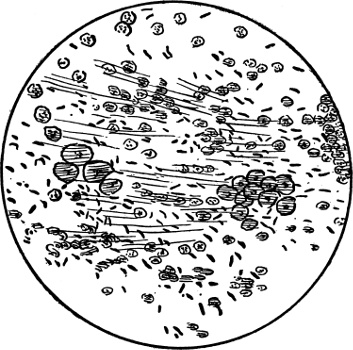
TUBERCLE BACILLI MAGNIFIED SEVERAL THOUSAND TIMES
TUBERCULOSIS
For the following facts and suggestions we are indebted to “The National Association for the Study and Prevention of Tuberculosis,” New York:
Consumption, or tuberculosis, is a disease of the lungs which is taken from others, and is not simply due to catching cold. It is generally caused by germs, known as tubercle bacilli, which enter the body with the air breathed. The matter which consumptives cough or spit up usually contains these germs in great numbers, and if those who have the disease spit upon the floor, walls or elsewhere, the matter will dry, become powdered, and any draught or wind will distribute the germs in it with the dust in the air. Any person may catch the disease by taking in with the air he breathes the germs spread about in this manner. He may also contract the disease by taking into his system the germs contained in the small drops of saliva expelled by a consumptive when coughing or sneezing. It should be known that it is not dangerous to live with a consumptive if the matter coughed up by him is properly disposed of.
Consumption may be cured at home in many instances if it is recognized early and proper means are taken for its treatment. When a member of a family is found to have consumption and can not be sent to a sanatorium, arrangements for taking the cure at home should be made as soon as the disease is discovered.
Open-air treatment is the most approved method of cure. Rest is a most important part of the open-air treatment, and exercise must be regulated by the doctor. Always have at hand an extra wrap, and never remain out if chilled. Cold weather should have a bracing effect, and when it does not, go into a warm room and get a hot drink, preferably milk, remaining indoors until comfortably warm. When going out again use more wraps, and keep behind a shield or screen that breaks the force of the wind, Always be cheerful and hopeful; never waste your strength in anger or by being cross. Lead a temperate life, go to bed early and get up late; do not use alcohol in any form except when prescribed by your doctor. Do away with tobacco if possible, and use only weak tea and coffee in small quantities. Never swallow the matter coughed up, but always destroy every particle by spitting in a paper or cloth which can be burned. Never allow the hands, face or clothing to be soiled by sputum, and if this happens by accident, wash the place soiled with soap and hot water. Men who have consumption should not wear a mustache or beard unless it is trimmed close. Particular care must be taken, when sneezing and coughing, to hold in the hands before the face a cloth which can be burned. Soiled bed-clothes, night-dresses, other washable garments and personal linen should be handled as little as possible until they are boiled prior to their being washed. The dishes used by the patient must be boiled after each meal.
That tuberculosis is particularly fatal to the working men may be clearly seen from the fact that at least one-third of the deaths during the chief working period of life are caused by pulmonary tuberculosis. Every other workman who becomes incapacitated must ascribe his condition to consumption. Dr. Lawrence F. Flick says: “Tuberculosis is peculiarly a disease of the wage-workers, and this is so for the very good reason that one of the causes of the disease is overwork.” In some trades, such as the metal polishers, brass workers, and stone workers, from 35 to 50 per cent. of all deaths are caused by tuberculosis. Dusty trades are particularly dangerous.
Appropriations of over $4,000,000 for the suppression of consumption have been made by twenty-eight State Legislatures in session during 1909, according to a statement issued to-day by the National Association for the Study and Prevention of Tuberculosis.
In 1909–10, forty-three State and Territorial Legislatures were in session. Of this number, 28 passed laws pertaining to tuberculosis; eight others considered such legislation, and in only seven States no measures about consumption were presented. In all, 101 laws relating to the prevention or treatment of human tuberculosis were considered, and out of this number 64 were passed.
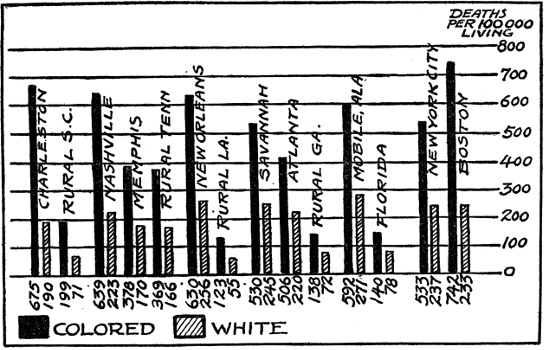
PERCENTAGE OF DEATHS FROM TUBERCULOSIS PER 100,000 WITH RELATIVE MORTALITY PERCENTAGE OF WHITE AND COLORED POPULATION
That the “white plague,” as it is often called, is a national concern is shown by the map on next page.
In 1909, out of the $8,180,621.50 spent for the prevention and treatment of tuberculosis, $4,362,750.03 was spent from public money, and $3,817,871.47 from funds voluntarily contributed. For the carrying on of State, Federal and municipal tuberculosis work in 1910, over $9,000,000 has been appropriated. Of this sum, the State Legislatures have granted $4,100,000, the municipal and county bodies, $3,975,500, and the Federal Government, $1,000,000.
About 800,000 women under the Health Department of the General Federation of Women’s Clubs in every State and Territory of the United States are banded together against this disease, and more than 2,000 clubs are taking a special interest in the crusade. Not less than $500,000 is raised annually by them for tuberculosis work, besides millions that are secured through their efforts in State and municipal appropriations.

MAP SHOWING RELATIVE MORTALITY FROM TUBERCULOSIS IN THE UNITED STATES
Over 4,000,000 churchgoers, nearly 40,000 sermons and preachers, and more than 1,250,000 pieces of literature, are some of the totals given in a preliminary report issued by the National Association for the Study and Prevention of Tuberculosis, of the results of the first National Tuberculosis Sunday ever held, on April 24, 1910.
The report states that fully one-eighth of the 33,000,000 listed communicants of the churches of the United States heard the gospel of health on Tuberculosis Sunday, and that the number of people who were reached by notices and sermons printed in the newspapers will aggregate 25,000,000. Hardly a paper in the country failed to announce the occasion.
(3314)
Tumbles Unimportant—See Defeat.
Turn About Fair Play—See Tongue, The.
Type, Fixt—See Environment, Adaptation to.
TYPES, DISTINCT
Suppose we had Christ’s spirit as an ideal would we not also develop a distinct type? It is this type that is going to conquer the world.
It is said of the actors in the Oberammergau play that through loyalty to ideals the villagers have developed distinct types—the Christ type, the apostle type.
(3315)