L (continued 2)
Reading edition
(1845)
Light in Christ—See Christ the Light.
LIGHT IN HUMILIATION
In the neighborhood of Nice the hills are cut and seamed with remarkable gorges, among which are found deep holes known as “star wells.” They are so called because of the belief that from their bottoms stars can be seen even in daylight. These abysses have been formed by the action of water. It is, often, only when looking up out of the deeps of our own humiliation that we can see the stars of hope shining in the sky.
(1846)
LIGHT, INCREASING
The light to which you come at length in the railway tunnel, and before you reach the end of the tunnel, is the very same light exactly, as far as its nature is concerned, as the light into which you come at the end of the tunnel; and the light which shines from the end into the tunnel increases more and more from its first shining until you reach the full light at the end. So the wise man says that the path of the just is as the shining light that shineth more and more unto the perfect day. The light of the perfect day is the same as the light that shines in the path all along, and that began to shine even ere the sun was up. The lights are in nowise different except in degree.—Alexander Miller, “Heaven and Hell Here.”
(1847)
LIGHT, INJURY FROM
In a moral sense it is better to face the light than to have it shine on us indirectly.
Do not make the mistake of supposing that brilliant lights are harmless except when looked at directly. As a matter of fact they are even more dangerous when so placed as to shine into the eyes sidewise or from above, since the eye is less accustomed to receive bright light from such directions. In other words, light from such direction falls upon the outer parts of the surface of the retina, which, being less accustomed to receive bright light, are the more quickly injured by it. Cases are on record where persons working in the vicinity of bare lamps so placed have entirely lost the sight of one or both eyes.—The Illuminating Engineer.
(1848)
LIGHT OF THE WORLD
Among the Tsimshean Indians of Alaska the following legend is current: “At first it was entirely dark. There was no light in the world. The people could see nothing, but were groping around in a continual night. Then the son of the heavenly chief came down to earth, and the people complained to him that it was so dark. He said he would help them, and then light came.”
A faint reflection, all this, of the story of Him who is indeed the Light of the world. (Text.)
(1849)
LIGHT PREVENTING CRIME
Many banks, stores, and warehouses turn on their lights at night, and leave their window-shutters wide open so that the entire interior may be seen by the policemen or watchman on the beat. This makes it possible to detect any change inside, or the presence of any one who might be bent on robbing. (Text.)
(1850)
LIGHT, SAFETY IN
“Let your light shine.” Do not go to places where your light will not shine. Sam P. Jones says: “Some years ago my father had two Irishmen digging a well for him. They went off on a drinking spree, after they had gotten the well about three-fourths done. They returned to finish up, but long experience and observation had taught them that what is known as ‘fire-damp’ or poisonous gases, sometimes accumulates in the bottom of a well. They came to the house and asked my mother for a bucket and a candle. They set the candle in the bottom of the bucket and lowered it slowly into the well, and the candle went out. Pat said, ‘Ah, Jamie, there is death in that hole.’ They got some pine brush, tied a rope to them and swished the well out with them. They again lowered the candle and it burned brightly clear to the bottom. And the Irishman said, ‘The candle burns bright; she’s safe now.’”—“Famous Stories of Sam P. Jones.”
(1851)
LIGHT, SOURCE OF
Light can not be seen. At great heights reached by aeronauts the heavens seem black, and the stars come out and twinkle against a background of jet. Yet this unfathomed deep of darkness is light and nothing but light. Whatever object the light falls upon shines; every object that produces it shines; but the light itself is not seen.
God is light. No man hath seen him at any time, but there is no glory that does not come from Him. No light shines on earth that did not come from heaven. Yet a man may sit by his little lamp and forget the sun and stars. (Text.)
(1852)
LIGHT THAT CHEERS
The Rev. C. A. S. Dwight says:
“During a damp, foggy evening along the New England shore, a summer resident who had been skirting the beach in a row-boat, was struggling at the oars, trying to drive his little craft through the waters despite the drag upon it of a heavy object towing on behind. It was a dismal evening, and he was tired and weary of his attempted task. But just when his depression was greatest he heard the voice of his little boy hailing him from the beach. Looking through the gloom he could discern the faint glow on the shore, while his boy called encouragingly, ‘Papa, I’ll cheer you with this lantern!’ The heart of the father was gladdened, and his work after that seemed light, for so great is the power of loving sympathy that it illumines all shadows and lightens all tasks.
“I’ll cheer you with this lantern!” We all of us hold in our hands some instrument of blessing, whether it be a lantern or not, by the use of which, if we are alert to note the changing necessities of those about us, we can every now and then cast a gladdening or directing ray over life’s dark waters, or extend some other “help in time of need” to a troubled brother.” (Text.)
(1853)
LIKENESS OF GOD
King Edward of England was driving along a country road in Scotland one day when he overtook an old market-woman struggling under a load which was more than she could well manage. “You might take part of this in your carriage,” she cried to the King whom she did not recognize. “Alas! my good woman,” replied his Majesty with royal courtesy, “I’m very sorry, but I’m not going the same way. However, let me give you the portrait of my mother.” “A lot of good that will do me,” said the woman testily. “Take it all the same,” said the King, smiling, and he put a sovereign, bearing Queen Victoria’s effigy, in the palm of the astonished old peasant.
That is exactly what every kind deed or generous gift is, a likeness of our Father. It is just like Him.
(1854)
Likeness to Christ—See Future Life.
LIMITATION OF THE SENSES
Reasoning from the analogy of stretched strings and membranes, and of air vibrating in tubes, etc., we are justified in concluding that the smaller the drum or the tube the higher will be the note it produces when agitated, and the smaller and the more rapid the aerial wave to which it will respond. The drums of insect ears, and the tubes, etc., connected with them, are so minute that their world of sounds probably begins where ours ceases; that the sound which appears to us as continuous is to them a series of separated blows, just as vibrations of ten or twelve per second appear to us. We begin to hear such vibrations as continuous sounds when they amount to about thirty per second. The insect’s continuous sound probably begins beyond three thousand. The bluebottle fly may thus enjoy a whole world of exquisite music of which we know nothing. (Text.)—W. Mattieu Williams, “Science in Short Chapters.”
(1855)
LIMITATIONS GLORIFIED
We are apt to chafe at restrictions of all kinds, but these may be disguised blessings. Oftener the narrower the outward sphere, the more valuable the outcome. The lenses of a telescope are narrow, but through them we read the story of the stars. Darwin in the earthworm saw wonders which he spent several years in investigating. The wise botanist does not gather all the flowers in the garden at once; he confines himself to single specimens. One of Murillo’s finest pictures is in the Louvre at Paris. It shows us the interior of a convent kitchen; but doing the work there are not mortals in old dresses, but angels, white-winged and beautiful. One serenely puts the kettle on the fire to boil, and one is lifting up a pail of water with heavenly grace, and one is at the kitchen dresser reaching up for plates. As the painter puts it, all on the canvas are so busy, and working with such a will, and so refining the work as they do it, that somehow you forget that pans are pans and pots are pots, and only think of the angels, and how very natural and beautiful kitchen work is—just what the angels would do.
(1856)
Lincoln and Children—See Children, Lincoln’s Regard for.
Lincoln Story—See Good for Evil.
Lincoln’s First Dollar—See Money, Earning.
Liquor—See Money, How We Spend Our.
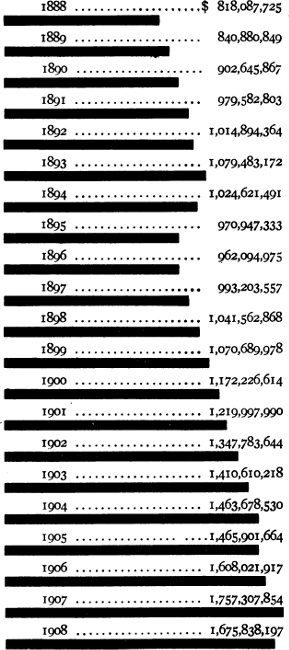
LIQUOR-TRAFFIC
The following chart shows the cost of intoxicating liquors consumed in the United States for twenty years, and the relative yearly increase. The chart is from the American Prohibition Yearbook:
(1858)
LIQUOR REVENUE REFUSED
What a rebuke to this nation receiving millions of dollars annually from its revenue on liquors, is conveyed by the Queen of Madagascar when she says, “I can not consent, as your queen, to take a single penny of revenue from that which destroys the souls and bodies of my subjects.”—Congregationalist.
(1857)
LISTENING FOR SIGNALS
A news item, referring to the wreck of the Republic, and the hearing of the first wireless news of the disaster by the operator at the station on Nantucket Island, says:
Imagine a lonely island in the middle of winter, thereon a lonely Marconi station, therein a lonely Marconi operator, with his telephones glued to his head watching the break of day, thinking of his past and future, listening for any sign of life in his telephones. Imagine that man suddenly startled with a faint, very faint, call from a ship using the recognized distress signal, giving her position and calling for help. Slowly, all too slowly, came the cry for urgent aid, each call seemingly taking an hour’s valuable time, yet in truth but a fraction of a second. Will he never sign? Who can it be? At last came the recognized code letters of the White Star Republic, and again the call for aid. With this information Operator Irwin, of the Marconi force at the station here, who was on duty at the time, immediately got the wires hot, knowing the revenue cutter Acushnet to be lying at Wood’s Hole, and within one minute the captain was informed that his calls had been heard and aid was being rushed to him.
The soul attent to hear the world’s signals that call for help should be ready to serve and save the lost and needy.
(1859)
LITERALISM
“One of the stories of the ‘road’ that Mr. Joseph Jefferson delighted to tell grew out of an experience in an Indiana town, where he was presenting ‘Rip Van Winkle,’ many years ago.
“In the hotel where he stopt was an Irishman who was employed as a porter, but from the serious interest he took in the house he might have been clerk and proprietor rolled into one.
“At six in the morning Mr. Jefferson was startled by a violent thumping at his door. With slowly returning consciousness, he remembered that he had left no call on the night before, and naturally became indignant. His sleep was spoiled for the morning, so he arose and appeared before the clerk.
“‘See here,’ he demanded, ‘why have I been called at this unearthly hour?’
“‘I don’t know,” replied the clerk. ‘I’ll ask Mike.’
“The porter was summoned. ‘Mike, there was no call for Mr. Jefferson. Why did you disturb him?’ he was asked.
“Taking the clerk by his coat-sleeve, the Irishman led him to one side. ‘He was shnoring loike a horse, sir,’ he explained, ‘and I’d heered by the b’yes how onct he were after slapin’ for twinty years, so, says I to myself, it’s a coomin’ on to him agin, an’ it’s yer juty to git the crayther out o’ the house instantly!’”
(1860)
See Knowledge by Indirection; Judgment, Lack of.
Literary Workman—See Acquisition.
LITERATURE AND MIND EXPANSION
When Coleridge was a boy of eight, his father on a starry night explained to him the size and number of the heavenly bodies with their vast movements. He looked for surprize and wonder in the boy. But the poet tells us that he felt no special wonder, because his mind, through long, happy days of reading fairy-stories, had grown accustomed to feelings of the vast, and to having criteria for belief other than those of his senses. Literature accustoms the mind to feelings of sublimity, wonder, intricacy, and the constant workings of higher laws. These are noble contributions to the religious consciousness.—William D. MacClintock, “Proceedings of the Religious Education Association,” 1904.
(1861)
LITERATURE AS AN INSPIRATION
Literature is but one of the forms of art through which man’s aspiration, his ideals, are revealed. The soul of man takes the hues of that which environs it. It is literature which inspires; not linguistics, rhetoric, and grammar, valuable as these may be for other purposes. Witness the tributes of Darwin and Mill to the power of imaginative literature; these men mourned the fact that other things deprived them of that great power of culture of the feelings which the love of literature brought. Barrie has said that a young man may be better employed than in going to college; but when there, he is unfortunate if he does not meet some one who sends his life off at a new angle. “One such professor,” says he, “is the most any university may hope for in a single generation.” He says, “When you looked into my mother’s eyes, you knew why it was that God sent her into the world; it was to open the eyes of all who looked to beautiful thoughts, and that is the beginning and end of literature.” After having opened the eyes of people to beautiful thoughts, we must be willing to wait, for moral results do not come immediately.—A. J. George, “Proceedings of the Religious Education Association.”
(1862)
LITERATURE, CURRENT
Current literature is like a garden I once saw. Its proud owner led me through a maze of smooth-trodden paths, and pointed out a vast number of horticultural achievements. There were sixty-seven varieties of dahlias, there were more than a hundred kinds of roses, there were untold wonders which at last my weary brain refused to record. Finally I escaped, exhausted, and sought refuge on a hillside I knew, from which I could look across the billowing green of a great rye-field, and there, given up to the beauty of its manifold simplicity, I invited my soul.
It is even so with our reading. When I go into one of our public reading-rooms, and survey the serried ranks of magazines and the long shelves full of “Recent fiction, not to be taken out for more than five days”—nay, even when I look at the library tables of some of my friends—my brain grows sick and I long for my rye-field.—The Outlook.
(1863)
Literature in Advertising—See Advertising.
Literature in Prisons—See Prison Literature.
Literature, Short-lived—See Evanescent Literature.
Little Deeds of Kindness—See Cheer, Signals of.
Little Evils—See Destructiveness.
LITTLE GIFTS
An Australian missionary was addressing a band of children on the needs of the people among whom he was working. A little one slipt a sixpence shyly into his hand with the request that he use it for something special. He bought with it a prayer-book, and gave it to a poor workhouse girl who had been sent from England to go into service on an Australian farm. She promised to read it faithfully. Several weeks later a rough-looking man came and asked him if he were the person who had given his servant a prayer-book. His wife was very ill and wanted to see him. Altho it was twenty miles inland, the clergyman went and ministered to the poor woman. A little while later the man came once more to the minister and said that he and his neighbors had built a little church and paid for it and wanted him to come and conduct services among them. Thus an entirely new work was opened as a result of the little child’s sixpence.
(1864)
See Child’s Gift.
LITTLE SINS
And I am afraid of little sins because they grow so great. No one can tell whereunto sin will lead. The beginnings of sin are like the leakings of water from a mighty reservoir; first an innocent ooze, then a drip, then a tiny stream, then a larger vein, then a flood, and the rampart gives way and the town is swept to ruin. The habits of sin are like the habits of burglars, who sometimes take a little fellow and put him through a window too small for a man to enter, and the child must open the door for the burglar gang to pass. So with little sins; they creep in and open the door for larger to enter. A little sin is the thin edge of the wedge, and when once inserted it can be driven home till it splits and ruins the life.—A. H. C. Morse.
(1865)
I remember, when a lad, the so-called army-worms first swept across the fields. They went straight ahead, and moved like a mighty host with captains. They were little things, but when they were gone the fields looked as tho they had been swept by a fire. So a thousand little wrongs in the life can rob it of beauty as really as one great, blazing, public transgression.—A. H. C. Morse.
(1866)
I am afraid of little sins because they involve a great principle. You go into a bank with a check for $1,000, and in his hurry the clerk passes out $1,100, and you walk out of the bank with that sum. You agree with me, I suppose, that you do a dishonest thing—that you have stolen $100. Would it not be the same if your check called for $5, and he gave you $6 by mistake? You ride on a train to Boston, and by some oversight your ticket is not collected, and you ride back on that very same ticket. You agree with me that the thing is wrong. Is it not the same when you ride on a trolley car and elude the conductor, or slip past the gateman and enter the train? In either case the man is a thief.—A. H. C. Morse.
(1867)
LITTLE THINGS
We belong to a scheme of nature in which the chief factor is the infinitesimal. The composition of the elements depends on the multitudinous accretions of particles. We are most in danger when we overlook the power of mere atoms to affect us, and when we despise trivial causes of mischief.
A cathedral clock with its musical chimes suddenly stopt intoning its sacred and beautiful melodies. The cause was for a time a perplexity, as nothing could be discovered to have gone wrong with the machinery of the chimes. But at length it was found that a frail brown butterfly had become entangled in the wheelworks, and had brought to a complete standstill the clock and its chimes. (Text.)
(1868)
Dr. S. P. Henson says:
What a multitude of threads make up a fringe; and yet how beautiful and costly when completed! And here is found a beauty of the real Christian life. There are not a few who may be willing upon rare and notable occasions to do or suffer some great thing, but the ten thousand little things of life are entirely beneath their notice, as they also suppose them to be beneath the notice of the Lord. (Text.)
(1869)
See Faith in God.
Lives Corresponding to the Bible—See Native Converts.
LIVES THAT SHINE
Don’t waste your time in longing For bright, impossible things; Don’t sit supinely yearning For the swiftness of angel wings; Don’t spurn to be a rushlight Because you are not a star; But brighten some bit of darkness By shining just where you are. There is need of the tiniest candle As well as the garish sun; The humblest deed is ennobled When it is worthily done. You may never be called to brighten The darkened regions afar; So fill, for the day, your mission By shining just where you are. Just where you are, my brother, Just where God bids you stand, Tho down in the deepest shadow, Instead of the sunlit land; You may carry a brightness with you That no gloom or darkness can mar, For the light of a Christlike spirit Will be shining wherever you are.(Text.)
(1870)
Living in the Faith of Jesus—See Christ, Faith in.
LIVING IN THE SHADOW
The second Duke of Wellington inherited a great talent for reticence from his father, and did not succeed to his title until he was forty-five. He had served in the army and in the House of Commons without making his mark in either save by conscientious attention to duty. In the House of Lords, however, shortly after taking his seat, he delivered a speech revealing such an intimate knowledge of public business, and of such luminous good sense, as to occasion surprize. Among those who congratulated him was “the candid friend” always present on such occasions. This “candid friend” explained to the duke that the latter had been generally regarded as a “colorless” man, and congratulated him on disproving the charge. The duke made a reply, applicable to many, saying, “If you had sat in the shade of a great tree for almost fifty years very likely people would have regarded you as colorless, too.”
George V, like the second Duke of Wellington, has for almost half a century lived in the shadow of a great tree. From infancy up to his twenty-seventh year he was in the second rank of public interest. Not a negligible quantity, he yet could not be, while the Duke of Clarence lived, conspicuous. Moreover, he was wise to sink his royal personality in the discharge of his duty as a naval officer. The British have peculiar tastes and standards, and they do not altogether like to see a younger member of the royal family very conspicuous in public affairs. A “pushful” prince would be almost obnoxious to their traditions. A royal general or a royal admiral must not lead too much, or the old jealousy of militarism might crop out in the nation, which licenses the existence of its standing army only from year to year. Consequently George V, when Duke of York and subsequently when Prince of Wales, may have been called upon to dissemble, and he may yet demonstrate that his reputation as a colorless man is due to the public inability to understand what constitutes the spectrum of character.—Boston Transcript.
(1871)
LIVING, STRENGTH FOR
There was a time when low on bended knee, With outstretched hand and wet uplifted eye I cried: O Father, teach me how to die, And give me strength Death’s awful face to see And not to fear. Henceforth my prayer shall be; Help me to live. Stern life stalks by Relentless and inexorable, no cry For help or pity moveth her as she Gives to each one the burden of the day. Therefore, let us pray: Give us the strength we need to live, O Lord. —Julia C. R. Dorr.
(1872)
Living, The, as an Asset—See Motive, Mercenary.
LIVING THE GOSPEL
An American teacher was employed in Japan in a government school, on the understanding that during school hours he should not utter a word on the subject of Christianity. The engagement was faithfully kept, and he lived before his students the Christ life, but never spoke of it to them. Not a word was said to influence the young men committed to his care, but so beautiful was his character, and so blameless his example, that forty of the students without his knowledge, met in a grove and signed a secret covenant to abandon idolatry. Twenty-five of them entered the Kyoto Christian Training School and some of them are now preaching the gospel which their teacher unconsciously commended.
(1873)
Loads—See Overloading.
LOADS, BALKING UNDER
This morning I saw a pair of horses which had evidently become discouraged by being hitched to loads that were too heavy for them. At the start they did their best to go forward; when the driver struck them with his whip they made an effort to pull; but one could see that their spirit had been broken; the long struggle with unequal burdens had caused them to lose their confidence and their grip, and after a while they ceased to make any effort to move.
I have often seen other horses loaded beyond their strength; but no matter how heavy their load, they would pull again and again with all their might, stretching to the utmost every muscle, nerve, and fiber in them; and, altho they could not start the load, they would never give up trying.
Everywhere in life we find people like those horses. Some have become discouraged by trying to carry too heavy a load, and finally give up the struggle. They spurt a little now and again, but there is no heart, no spirit in their effort. The buoyancy and cheer and enthusiasm have gone out of their lives. They have been tugging away over heavy loads so long that they have become disheartened. There is no more fight in them.
There are others who, no matter how heavy their load, will never cease in their efforts to go forward. They will try a thousand times with all their might and main; they will tug away until completely exhausted; they will gather their strength and try again and again without losing heart or courage. Nothing will daunt them, or induce them to give up the struggle. When everybody else lets go, they stick because they are made of winning material, the mettle which never gives up.—Success.
(1874)
LOCAL PRIDE
Augustine Burrell tells the following incident which goes to prove that things are great or small to men, according to very local points of view:
Bonnor, the Australian cricketer, told us that until that evening he had never heard of Dr. Johnson. Thereupon somebody was thoughtless enough to titter audibly. “Yes,” added Bonnor, in heightened tones, and drawing himself proudly up, “and what is more, I come from a great country, where you might ride a horse sixty miles a day for three months, and never meet anybody who had.”
(1875)
Location—See Sentiment Mixed.
Location in Animals—See Direction, Sense of.
LOCUSTS AS FOOD
In the East, as elsewhere, since the Biblical days of John’s “locusts and honey,” locusts have been deemed more or less edible. In Palestine to this day they are considered a luxury. The Jews fry them in sesame oil, sesame being the grain of which mention is made in the story of “Ali Baba and the Forty Thieves,” a favorite tale in the Arabian Nights entertainments.
In Arabia Petrea locusts are dried in the sun and then ground into a sort of flour for baking; and in Central Africa certain tribes employ locusts for making a thick brown soup.
In Madagascar they are baked in huge jars, fried in grease, and then mixed with rice, forming a dainty much affected by the dusky inhabitants of that big island.
The Algerians have a simpler method. They merely boil the locusts in water and salt them to the taste. The Arabians grind and bake the locusts as cakes, roast them in butter, or else crush them in a mixture of camel’s cheese and dates.
Locusts are also eaten, in times of famine, in southern Russia, generally by the poorest of the poor, among whom the insects are smoked like fish. In the preparation of locusts for food the legs and wings are invariably detached.
It is said that, while the flavor of locusts is strangely disagreeable in the raw state, this flavor is readily disguised and even becomes agreeable when the insect is cooked. Some of the locust soups are, we are told, scarcely to be distinguished from beef broth; and when the little insects are fried in their own oil and slightly salted they take on a pleasing nutty flavor. (Text.)—Harper’s Weekly.
(1876)
LONELINESS, PERILS OF
Recently a London pastor preached a sermon on the after-business occupations of young people, in which he said that from 6 to 11 P.M. was the danger zone for young folks who are employed during the day. Speaking of the mesmeric glitter of London, and the fascination of its so-called amusements, he made the assertion that he believed that the theaters and music-halls should be controlled by the churches.
The Sunday-school Chronicle sent an interviewer to ask him why he made this statement. His answer follows:
“First of all,” said the pastor, “I have been so deeply imprest by the sense of awful loneliness which is experienced by young people coming to central London from the provinces. I know for a fact that scores of young men and women go to the bad because of the absolute friendlessness of their lives. Six months ago I spent two days at the Old Bailey Sessions House trying to snatch a girl of nineteen from prison. She came to London motherless and friendless, and was spoken to kindly by a young man in Oxford street. She appreciated the apparent sympathy which this stranger extended to her—well, the rest of the story of her downfall may be imagined. Many of these young people have nowhere to go after business hours but the music-hall or the public-house, and the things they take away from these places and retail in their houses of business are the questionable jokes which they have heard. So for these young people I plead for churches that are homes and amusements that are healthy.”—The Advance.
(1877)
Lonesomeness Abated—See Reminders.
LONGEVITY ACCOUNTED FOR
Senator Chauncey M. Depew, entertained at a dinner on the occasion of his seventy-sixth birthday, said:
Fifty-four years in public and semipublic life and upon the platform all over this country and in Europe for all sorts of objects in every department of human interest have given me a larger acquaintance than almost anybody living. The sum of observation and experience growing out of this opportunity is that granted normal conditions, no hereditary troubles, and barring accidents and plagues, the man who dies before seventy commits suicide. Mourning the loss of friends has led me to study the causes of their earlier departure. It could invariably be traced to intemperance in the broadest sense of that word; intemperance in eating, in drinking, in the gratification of desires, in work, and in irregularity of hours, crowning it all with unnecessary worry.—New York Times.
(1878)
Longevity and Work—See Industry and Longevity.
LONGEVITY, EXAMPLE OF
One of the most extraordinary incidents in the whole record of longevity is reported from Pesth, in Hungary, where a beggar, aged eighty-four, tried to commit suicide by throwing himself into the Danube because he was no longer able to support his father and mother, who are one hundred and fifteen and one hundred and ten years old, respectively. When he told this story, after his rescue, it was laughed at, but a police inquiry showed it to be true. The family are Magyars from the extreme south of Hungary.—Public Opinion.
(1879)
LONGEVITY INCREASING
“It is estimated,” said Dr. Felton, the learned Georgia statesman, divine, and M.D., in an address before the graduating class of Atlanta Medical College, “that human life has increased twenty-five per cent in the past fifty years.” The average human life in Rome under Cæsar was eighteen years; now it is forty. The average in France fifty years ago was twenty-eight; the mean duration in 1887 was forty-five and one-half years. In Geneva during the thirteenth century a generation played its part upon the stage and disappeared in fourteen years; now the drama requires forty years before the curtain falls. During the golden reign of good Queen Bess, in London and all the large cities of merry old England, fifty out of every 1,000 paid the last debt to nature early, which means instead of threescore-and-ten, they averaged but one score. Now, in the city of London, the average is forty-seven years.—Dr. Todd.
(1880)
See Improved Conditions.
LONGEVITY, RECIPES FOR
A complete list of infallible prescriptions for the prolongation of human life would fill a voluminous book, and would include some decidedly curious specifics. “To what do you ascribe your hale old age?” the Emperor Augustus asked a centenarian whom he found wrestling in the palestra and bandying jokes with the young athletes. “Intus mulso, foris oleo,” said the old fellow. “Oil for the skin and mead (water and honey) for the inner man.” Cardanus suggests that old age might be indefinitely postponed by a semifluid diet warmed (like mother’s milk) to the exact temperature of the human system; and Voltaire accuses his rival Maupertuis of having hoped to attain a similar result by varnishing his hide with a sort of resinous paint (un poix resineux) that would prevent the vital strength from evaporating by exhalation. Robert Burton recommends “oil of unaphar and dormouse fat”; Paracelsus rectified spirits of alcohol; Horace, olives and marshmallows. Dr. Zimmerman, the medical adviser of Frederick the Great, sums up the “Art of Longevity” in the following words: “Temperate habits, outdoor exercise, and steady industry, sweetened by occasional festivals.”(Text.)—Felix Oswald, Bedford’s Magazine.
(1881)
LONGING
The thing we long for, that we are For one transcendent moment, Before the present, poor and bare, Can make its sneering comment. ***** Longing is God’s fresh heavenward will With our poor earthward striving; We quench it that it may be still— Content with merely living; But, would we learn that heart’s full scope, Which we are hourly wronging, Our lives must climb from hope to hope, And realize the longing. —James Russell Lowell.
(1882)
Look, The Kind—See Face, an Inviting.
LOOKING BOTH UP AND DOWN
“Your way is dark,” the angel said, “Because you downward gaze, Look up; the sun is overhead, Look up and learn to praise.” I looked; I learned. Who looks above Will find in heaven both light and love. “Why upward gaze?” the angel said; “Have you not learned to know The light of God shines overhead That men may work below?” I learned. Who only looks above May miss below the work of love, And thus I learned the lessons twain: The heart whose treasure is above Will gladly turn to earth again Because the heaven is love. Yea, love that framed the starry height Came down to earth and gave it light. —Bishop of Ripon.
(1883)
LOOKING DOWN
It is usually the small-souled and narrow-minded man who can decry faults and failings with an eagle eye, but upon whom all the finer and grander qualities of humanity are lost. To him who ever walks with head bent and eyes on the ground the whole universe appears to be made of dust; but he who goes with head erect and eyes uplifted breathes the pure air and greets the rising sun, and forgets the dust that may be under his feet.—Philadelphia Ledger.
(1884)
LOOKING UP
In the early days of Britain, when the Christian Cuthbert and his companions were driven from the bitter land to sea, and then were cast upon a dreary shore by a terrible storm, they cried, “No path is open for us; let us perish: we are driven from land to sea and from sea to land.” And Cuthbert answered, “Have ye so little faith, my comrades?” and then lifting his eyes to heaven he prayed, “I thank Thee, Lord, that the way to heaven is still open.”
When there is no other way to look for help, we may look up. (Text.)
(1885)
Loquacity—See Verbiage.
LORD’S PRAYER INTERPRETED
A friend tells us an anecdote of Booth, the tragedian:
Booth and several friends had been invited to dine with an old gentleman in Baltimore, of distinguished kindness, urbanity, and piety. The host, altho disapproving of theaters and theater-going, had heard so much of Booth’s remarkable powers that curiosity to see the man had, in this instance, overcome all scruples and prejudices. After the entertainment was over, lamps lighted, and the company reseated in the drawing-room, some one requested Booth as a particular favor, and one which all present would doubtless appreciate, to read aloud the Lord’s Prayer. Booth exprest his willingness to do this, and all eyes were turned expectantly upon him. Booth rose slowly and reverently from his chair. It was wonderful to watch the play of emotions that convulsed his countenance. He became deathly pale, and his eyes, turned tremblingly upward, were wet with tears. And yet he had not spoken. The silence could be felt. It became absolutely painful, till at last the spell was broken as if by an electric shock, as his rich-toned voice, from white lips syllabled forth, “Our Father who art in heaven,” etc., with a pathos and solemnity that thrilled all hearers. He finished. The silence continued. Not a voice was heard or a muscle moved in his rapt audience, till from a remote corner of the room a subdued sob was heard, and the old gentleman, their host, stept forward, with streaming eyes and tottering frame, and seized Booth by the hand. “Sir,” said he, in broken accents, “you have afforded me a pleasure for which my whole future life will feel grateful. I am an old man, and every day from my boyhood to the present time I thought I had repeated the Lord’s prayer; but I have never heard it—never.” “You are right,” replied Booth; “to read that prayer as it should be read has caused me the severest study and labor for thirty years; and I am far from being satisfied with my rendering of that wonderful production.”—The Millenarian.
(1886)
Losing and Saving—See Message, A Timely.
Loss and Gain—See Compensation; Deportment; Fast Living.
LOSS AND PROFIT
It is said that the bursting of a pin in the driving-wheel of an engine in the Illinois Steel Company will cost the company $369,000, since the accident stopt the operation of the whole plant about six days and a half, and the loss involved by the stop was reckoned at about $40 a minute. This fable teaches that great business operations work both ways: where big profits are made big losses stand ready to overwhelm when something goes wrong.
(1887)
Loss Creating Wealth—See Discovery, Accidental.
LOSS, GAIN IN
When Mahamoud, the conqueror of India, took the city of Gujarat, he proceeded, as his custom was, to destroy the idols. One of these, standing fifteen feet high, the attendant priests and devotees begged him to spare. But, deaf to their entreaties, he seized a hammer and smote the idol, when to his amazement from the shattered image there rained a shower of gems—pearls and diamonds—treasures of fabulous value hidden within it. (Text.)
(1888)
Loss Through Disuse—See Talents, Buried.
Lost and Won—See Success.
LOST CHORDS
How few of us have kept the early joy, and have continued in blest peace? Of course, you know the story of the lost chord? A woman, in the shadows of the twilight, when her heart was sad, gently touched the keys of a glorious organ. She did not know nor care what she was playing; her fingers lingered idly but caressingly upon the keys. Suddenly she struck a chord, and its wondrous melody as it filled the room was uplifting and transforming and heavenly.
It flooded the crimson twilight, Like the close of an angel’s psalm, And it lay on her fevered spirit With the touch of infinite calm. It quieted pain and sorrow, Like love overcoming strife; It seemed the harmonious echo From our discordant life. It linked all perplexed meanings Into one perfect peace, And trembled away in silence, As if it were loath to cease.
Something disturbed this woman and called her from the organ. As soon as possible she hurried back and began to play, but this divine chord was gone, and tho she kept on playing she could not bring it back again. (Text.)—Curtis Lee Laws.
(1889)
LOST, CRY OF THE
A drover in Dakota promised to bring home from his cattle sale a doll for his little girl. He was caught in a blizzard, and night found him still miles from home. In the darkness he heard a cry, possibly of a child lost in the storm. He was thankful for the warm house that sheltered his own child, but he could not leave that cry off in the dark, tho he knew he was risking his life lingering. It was hard tracing the feeble cry, and when at last he found it it was not crying. He gathered it up under his big overcoat and struggled homeward, stumbling, nearly perishing, but at last fell in over his own threshold, with his own child saved in his arms.—Franklin Noble, “Sermons in Illustration.”
(1890)
LOST, FINDING THE
Shortly before the death of Eugene Field a friend from one of the Southern States told him a pathetic story of a girl who had wandered away from her home in the country and taken refuge in a large city, with the usual results of that dangerous step:
Her old father mourned for the girl he had lost; but in his simplicity it never occurred to him to try to find her, for the world beyond the limits of his township was vast and forbidding. But word came to him one day that somebody had seen his daughter in the city, one hundred miles away, and with only that to guide him he went in search of her.
Once in the city, he shrank from the noise and confusion of the crowds. He waited until night, and then when the streets were comparatively deserted, he roamed up and down from one street to another, giving the peculiar cry he had always used when looking for a lost lamb—a cry the girl herself had heard and given many times in her better days. A policeman stopt the old man and warned him that he was disturbing the peace, whereupon the father told his story and said:
“She will come to me if she hears that cry.”
The officer was moved by the old man’s simplicity and earnestness, and offered to accompany him in his search. So on they went up and down the thoroughfares and into the most abandoned sections of the city, the farmer giving the plaintive cry and the officer leading the way that seemed the most promising of success.
And success did come. The girl heard the cry, recognized it, and intuitively felt that it was for her. She rushed into the street and straight to her father’s arms. She confest the weariness and misery of her lot, and begged that he would take her back to the farm, where she might begin a new and better life. Together they left the city the next day. (Text.)
(1891)
Lost, Not, but Gone Before—See Evidence, Providential.
LOST, SEEKING THE
Years ago when Charley Ross was kidnapped, his broken-hearted father declared: “I will search for my lost boy while life lasts. I will go up and down the earth, and look into the face of this child and that to see if it is my lost boy.”
The great Father is engaged in a similar search; nor will He rest until the lost is found. (Text.)
(1892)
The Arab Waziers have a tradition as to their origin:
A certain ancestor had two sons, Issa and Missa, which may mean Jesus and Moses. Missa was a shepherd, and one day a lamb wandered away and was not to be found. For three days and nights Missa sought it far and near through the jungle. On the fourth morning he found it in a distant valley, and instead of being angry with the lamb for straying and giving him all his pains and anxiety, he took it in his arms, prest it to his bosom, kissed it tenderly and carried it back to the flock. For this humane act God greatly blest Missa and made him progenitor of the Wazir tribe. (Text.)
(1893)
Lot, Consulting the Bible by—See Bibliomancy.
LOVE
To cease from egotistic ambition and learn love with a humble mind is the lesson of this verse by John G. Neehardt:
For my faith was the faith of dusk and riot, The faith of fevered blood and selfish lust; Until I learned that love is cool and quiet And not akin to dust. For once as in Apocalyptic vision, Above my smoking altars did I see My god’s face, veilless, ugly with derision— The shameless, magnified; projected—Me! And I have left mine ancient fanes to crumble, And I have hurled my false gods from the sky; I wish to grasp the joy of being humble, To build great love an altar ere I die.
(1894)
Love is not merely a sentiment. It will have its material expression if it is real. The following from Dr. W. T. Grenfell refers to the fishermen of the North Sea Coast:
The intense cold of winter, and the inadequacy of the warm clothes with which the men, and especially the boys, were unable to provide themselves, claimed attention, and warm hearts of Christian ladies told all over England were moved by the tales of this great need. Hundreds and thousands of warm mittens, helmets, mufflers, and guernseys have been sent out during these past years, and have been true messages of love.
“Look ’ere,” said a grizzled skipper, pulling out three mufflers from his pocket, to three wild friends of his whom he was visiting, “look ’ere, will yer admit there’s love in those mufflers? Yer see them ladies never see’d yer, nor never knowed yer, yet they jest sent me these mufflers for you. Well, then, how much more must Christ Jesus ’ave loved yer, when He give His life blood to save yer.”
I have it from his own lips as well as one of theirs, that this was the beginning of leading those three men to God; and before he left the ship that night, they were trusting in Christ for pardon, and for strength to live as His children.
(1895)
Joseph Dana Miller shows how love socializes the solitary soul:
God pity those who know not the touch of hands— Who dwell from all their fellows far apart, Who, isolated in unpeopled lands, Know not a friend’s communion, heart to heart! But pity these—oh, pity these the more, Who of the populous town a desert make, Pent in a solitude upon whose shore The tides of sweet compassion never break! These are the dread Saharas we enclose About our lives when love we put away; Amid life’s roses, not a scent of rose; Amid the blossoming, nothing but decay. But if ’tis love we search for, knowledge comes, And love that passeth knowledge—God is there! Who seek the love of hearts find in their homes Peace at the threshold, angels on the stair. (Text.) —Munsey’s Magazine.
(1896)
The old fable of the bar of iron as an illustration of the superior power of love will never be superseded.
The bar of iron lay across a log to be broken. “I can make it yield,” boasted the hammer, but at the first blow the hammer flew from its handle helpless to the ground. The ax followed proudly, “I can succeed.” But after two or three strokes its edge was dulled without leaving any impression on the iron bar. “I, with my sharp teeth, will soon sever it,” said the saw, with a confident air; only to have all its teeth broken in the task. At length a quiet, warm flame said, “Let me try, it may yield to me.” And the little flame twined itself about the iron in a gentle, loving way, imparting an influence that finally made the strong bar yield and fall apart.
(1897)
The power of love to draw out what is best in men is poetically exprest by L. M. Montgomery:
Upon the marsh mud, dank and foul, A golden sunbeam softly fell, And from the noisome depths arose A lily miracle. Upon a dark, bemired life A gleam of human love was flung. And lo, from that ungenial soil A noble deed upsprung.
(1898)
Upon the foundation of love a great work was done in Paris, France:
When Mr. McAll began his work he could utter but two sentences in the tongue of those workingmen. One was “God loves you,” and the other, “I love you”; and upon those two, as pillars, the whole arch rests.—Pierson, “The Miracles of Missions.”
(1899)
See Prodigal, The.
LOVE A FINALITY
In his poem “Virgillia” Edwin Markham has these stanzas:
If this all is a dream, then perhaps our dreaming Can touch life’s height to a finer fire; Who knows but the heavens and all their seeming, Were made by the heart’s desire? One thing shines clear in the heart’s own reason, One lightning over the chasm runs— That to turn from love is the world’s one treason That treads down all the suns. So I go to the long adventure, lifting My face to the far, mysterious goals, To the last assize, to the final sifting Of gods and stars and souls. (Text.) —The Cosmopolitan.
(1900)
LOVE A HARMONIZER
Life’s harmony must have its discords; but, as in music, pathos is tempered into pleasure by the pervading spirit of beauty, so are all life’s sounds tempered by love.—George Henry Lewes.
(1901)
Love, A Mother’s—See Mother-love.
LOVE, A PROOF OF
We can not permanently benefit men until we are willing to get near to them. The Christian method of charity is illustrated in this incident in the career of a notable promoter of London city missions:
Love is not fastidious; her hands are as busy as her heart is full. He (Frank Crossley) found five dirty youngsters (their father a sot, their mother in the sick ward), and he burned their old clothes and clad them in clean ones, and then sent them to play with his own boy! Is it any wonder if both their father and mother were won?—Pierson, “The Miracles of Missions.”
(1902)
LOVE AND LAW
As to which was the first and greatest command, the rabbis were in grave doubt. Most agreed that the smallest and least command was the one concerning the bird’s nest, recorded in Deut. 22:6, 7; but when it came to the first and greatest, they were in doubt, whether it was the one respecting the observance of the Sabbath, or the law concerning circumcision, or the one concerning fringes and phylacteries, while still others contended that the omission of ceremonial ablutions was as bad as homicide. With these distinctions and differences and absurd hair-splittings in mind the young lawyer addrest the master with the question, “Which is the first commandment of all?” What a majestic answer was that which he received! Nothing in it about fringes and phylacteries, nothing about ceremonial washings, nothing about attitudes and genuflections; but the grand answer which will abide for all time to come: “Thou shalt love the Lord thy God with all thy heart, and with all thy soul, and with all thy mind, and with all thy strength, this is the first commandment.” This answer goes to the heart of the matter. Eighteen hundred years have not suggested any improvement or addition to the great answer, nor will eighteen hundred years to come, because it embraces all other answers and is the sum total of morality.—The Golden Rule.
(1903)
LOVE AND TIME
Love that lasts is the power that binds heart to heart with the indissoluble bonds. Such love knows no limit of time. Dr. Van Dyke says:
Time is Too slow for those who wait, Too swift for those who fear, Too long for those who grieve, Too short for those who rejoice; But for those who love Time is not! —Church Advocate.
(1904)
Love as a Converting Power—See Persecution and Prayer.
LOVE AS A SIDING
With our differing hereditary traits, educations, experience, and ways of living and thinking, it is quite impossible that there should not be collisions with those with whom we are living or working. We are like a number of trains trying to go in different directions on the same track. Congestions are certain to come, but a congestion need not degenerate into a collision and a wreck if we will remember that there are plenty of sidings. Now a “siding” is a sort of abbreviated second track whereby trains going in opposite directions may pass each other in safety. In material railways they bear various names; on the invisible pathway of life they are all called love. Sometimes they are nicknamed forbearance, tolerance, patience, or common sense; but these are all translations of the same thing. So in case of danger, remember the sidings.—James M. Stifler, “The Fighting Saint.”
(1905)
Love Compared—See Christ’s Love.
LOVE, CONQUESTS OF
There is a story told In Eastern tents, when autumn nights grow cold And round the fire the Mongol shepherds sit With grave responses listening unto it: Once, on the errands of his mercy bent, Buddha, the holy and benevolent, Met a fell monster, huge and fierce of look, Whose awful voice the hills and forests shook. “O son of peace!” the giant cried, “thy fate Is sealed at last, and love shall yield to hate.” The unarmed Buddha, looking, with no trace Of fear or anger, in the monster’s face, In pity said: “Poor friend, even thee I love.” Lo! as he spake, the sky-tall terror sank To hand-breadth size; the huge abhorrence shrank Into the form and fashion of a dove; And where the thunder of its rage was heard, Circling above him, sweetly sang the bird: “Hate hath no harm for love,” so ran the song. “And peace unweaponed conquers every wrong!” —George Dana Boardman.
(1906)
Love Dissolving Doubts—See Doubts, Dissolving.
LOVE DRIVING OUT FEAR
Mr. Robert E. Speer stopt from a British India steamer at Muscat to visit Rev. Peter Zwemer, who was working there alone. Mr. Zwemer took his visitor up to his house, where, he said, his family were staying. There, sitting on benches about the room, were eighteen little black boys. They had been rescued from a slave-ship that had been coming up the eastern coast of Arabia with those little fellows, to be sold on the date plantations along the Tigris and Euphrates rivers. The British consul had seized them from the traders, and Mr. Zwemer had undertaken to keep them until they were eighteen years old, when they would be given their manumission papers.
“When I got them,” said Mr. Zwemer, “the whole eighteen huddled together in the middle of the floor, like jack-rabbits, and every time I came close, they huddled a little nearer. They mistrusted every one. On each little cheek-bone was the brand of the slave’s iron, and for months and months they had known nothing but hatred and beatings, and had been shut down in the hold of the slave-ship, in order that they might make no noise and betray their presence.”
As Mr. Speer saw them they looked happy and confident, and they sang for him, “Jesus loves me, this I know,” looking as if the realization that all their blessings had come from that divine Source had already sunk deep into their hearts. (Text.)
(1907)
LOVE, FILIAL
A boy of thirteen was often brought to Judge Lindsey’s Juvenile Court in Denver, charged with truancy. Notwithstanding the judge admonished him many times, it did not seem to do him any good. The teacher kept writing, “Tim will stay out of school to work.”
Once, when reproving him, the judge told him that there would be time enough to work when he was a man. “My father was a man,” replied the boy, “and he did not work. He went off and left mother and me. I guess that’s what killed her.”
Finally, Tim appeared in court one day with a happy face, and pulling a soiled and crumpled paper from his pocket, handed it to the judge. “I’m goin’ to remember all the things you told me and I’m goin’ to school regular, now I got that done,” he said, with some pride. Judge Lindsey examined the paper, which proved to be a receipted bill, and found that, little by little, Tim had paid fifty dollars for a headstone at his mother’s grave.
“My boy, is that what you’ve been doing all these months?”
“I wanted her to have a monument, judge.” Tim furtively wiped away the moisture in his eyes. “She done a lot for me; that’s all I could do for her now.”
(1908)
LOVE IN A NAME
James Hargreaves, sitting alone there in his little house in Yorkshire, finding that he could not get enough from the spinners of cotton to supply his wants as a weaver, cast about for a way to spin faster. After many weary days, and weeks, and months, he found out a method by which he could spin eight threads in the same time that one had previously been spun; and being asked for a name for the instrument, he looked lovingly upon his wife, and said: “We’ll call it Jenny”; and the modest Jenny has come down to posterity, and will go to remotest generations with the name of the “Spinning Jenny.”—George Dawson.
(1909)
LOVE IN MAN
That trained horse that I saw in the World’s Fair, in seven years had learned twenty tricks. But that horse loved only one person, the master,/ and rushed with open her cheeks, and she said, “You must love in the animal world is a little tiny stream that trickles. Love in man is an ocean that rolls like the sea. Let us bow the forehead and smite upon the breast, and confess that man’s infinite capacity for love tells us he was made in the image of God.” (Text.)—N. D. Hillis.
(1910)
LOVE INDESTRUCTIBLE
Asbestos is the most extraordinary of all minerals. It is of the nature of alabaster, but it may be drawn out into fine silken threads. It is indissoluble in water and unconsumed in fire. An asbestos handkerchief was presented to the Royal Society of England. It was thrown into an intensely hot fire and lost but two drams of its weight, and when thus heated was laid on white paper and did not burn it. Love is like asbestos. The waves of sorrow will not wash it away. The flames of tribulation will not burn it up. It is eternal and immortal. (Text.)
(1911)
LOVE INESCAPABLE
James Freeman Clarke, on his seventy-eighth birthday, wrote this significant bit of verse:
Be happy now and ever That from the love divine no power the soul shall sever: For not our feeble nor our stormy past, Nor shadows from the future backward cast; Not all the gulfs of evil far below, Nor mountain-peaks of good which soar on high Into the unstained sky, Nor any power the universe can know; Not the vast laws to whose control are given The blades of grass just springing from the sod, And stars within the unsounded depths of heaven— Can touch the spirit hid with Christ in God. For nought that He has made, below, above, Can part us from His love.
(1912)
LOVE, INTERPRETATION BY
A story is told of an artist who painted the picture of the Crucifixion. When it was completed, he called in a lady friend to see it, and pulling the curtain aside, withdrew into the shade that he might see the effect on her face. He saw the tears running down her cheeks, and she said, “You must love Him to paint Him like that.” Her words touched his heart and he replied, “I hope I do, but as I love Him more I will paint Him better.”
(1913)
LOVE IS GOD’S NATURE
Why does this beautiful girl, that once was the center of attraction, in every reception, now hang over the cradle, refuse honors and give herself by day and by night to this little babe that puts helpless arms around the neck, that once flashed with jewels? We can only say that the mother is built that way. Why do robins sing? Why does the sunbeam warm? Why does summer ripen purple clusters? Why is a rose red? And a rainbow beautiful? When we can answer, we may be able to say why God loves His weak and sinful children. He loves them because it is His nature to love them.—N. D. Hillis.
(1914)
LOVE-LETTER, ANCIENT
We possess many love-songs of the old Egyptians, but a genuine love-letter had not heretofore been found. Some years ago in Chaldea there was a love-letter found, written on clay. Tho the letter has much formality for such a missive, the reader can feel the tenderness that lies between its lines. The document was produced, we should say, in the year 2200 B.C., and was found in Sippara, the Biblical Sepharvani. Apparently the lady lived there, while her beloved was a resident of Babylon. The letter reads:
“To the lady, Kasbuya (little ewe) says Gimil Marduk (the favorite of Merodach) this: May the sun god of Marduk afford you eternal life. I write wishing that I may know how your health is. Oh, send me a message about it. I live in Babylon and have not seen you, and for this reason I am very anxious. Send me a message that will tell me when you will come to me, so that I may be happy. Come in Marchesvan. May you live long for my sake.”
(1915)
LOVE MAKES PATIENT
Ellen sat at the piano practising. The big clock in the corner was slowly ticking away the seconds, and the hands pointed to half-past ten.
“Oh, dear!” sighed Ellen. “A whole half hour more; and the clock seems to move more slowly than usual. How I hate this everlasting practising! I wish there were no such things as pianos in the world!”
“Why, Ellen!” said mama, who had entered the room in time to hear the last sentence. “A year ago you were coaxing father to buy you a piano. Are you growing tired of it so soon?”
The little girl’s face flushed. “I did not know it was such hard work, mama; and I can’t bear to stay in the house a whole hour this bright morning, just drumming at exercises. I would like to play pretty pieces.”
“You must be patient, dear,” answered her mother. “The pretty pieces will come in time. Think how delightful it will be, by and by, to entertain father when he comes home tired from the office! You know how he loves music. So keep up your courage, little daughter, for father’s sake.”
The words lingered in the child’s memory. “For father’s sake,” she would say to herself when the hours seemed long. And love gave her patience.
Love always brings patience. Life’s exercises are often hard and unmusical. But, little by little, they are preparing us for the heavenly harmonies above.
(1916)
LOVE OF CHRIST
After Lafayette’s devoted service to our country, he was equally devoted to the cause of liberty in France, helping with wise and unselfish service. But he was opposed bitterly by the extremists, and driven by them out of the country, and was imprisoned by the Emperor of Austria for five years in a loathsome dungeon at Olmutz. All Europe was moved to get him released, and his wife pleaded with ruler after ruler, and at length was permitted to share his dungeon, which she did for about two years. His life was despaired of, but Napoleon Bonaparte compelled his release. Our Lord shares the sinner’s dungeon, and spares no pain for his release. (Text.)
(1917)
LOVE OWNS ALL
We can not go so far That home is out of sight; The morn, the evening star, Will say, “Good-day!” “Good-night!” The heart that loves will never be alone; All earth, all heaven it reckons as its own.
(1918)
LOVE, PRACTICAL
A dutiful son of his widowed mother once said, “I love my mother with all my strength.” “How is that?” he was asked. Said he, “I’ll tell you. We live in a tenement, on the top floor four flights up, with no elevator; and my mother being busy, I carry up the coal in a scuttle, and I tell you, it takes all my strength to do it.” (Text.)
(1919)
LOVE, PRESERVATIVE
Botanists tell us that strongly scented plants are of longer duration than those destitute of smell.
This is as true in the gardens of soul as in the gardens of nature. Lives fragrant with helpfulness endure. Those wanting in the aroma of love, die. (Text.)—Vyrnwy Morgan, “The Cambro-American Pulpit.”
(1920)
LOVE RATHER THAN KNOWLEDGE
“Papa,” said the son of Bishop Berkeley, “what is the meaning of the words ‘cherubim’ and ‘seraphim’ in the Bible?” “Cherubim,” replied his father, “is a Hebrew word signifying knowledge; seraphim is another word of the same language, and signifies flame; whence it is supposed that the cherubim are angels who excel in knowledge, and that the seraphim are angels who excel in loving God.” “I hope, then,” said the little boy, “when I die I shall be a seraph; for I would rather love God than know all things.”
The child had the right sentiment, if not the right theology.
(1921)
LOVE RECLAIMING
Dr. Felix Adler has brought to light an old legend of two brothers who lived and played together. At last one of them left home and got into evil ways, and finally was, by an evil magician, changed into a wolf. For long the bereaved brother sought the wanderer, and one day returning home through the woods, he was set on by a wolf, and by the might of his love under the spell of that continued gaze the features of the wolf began to disappear, until at length the brother was restored to his senses and to his home.
(1922)
Love, Rewards of—See Resignation.
LOVE, THE LANGUAGE OF
When William Duncan went among the Alaskan Indians to convert them to Christianity, he won them first by his kindness. He visited them, helped them with simple advice, and administered to their ailments from his medicine-chest. Long before he could make himself understood in words he spoke intelligibly in his works. They understood the language of his love and sympathy and kindness. By relieving their suffering he found a way at length to relieve their sins, in the gospel that he learned to utter in his message to them from the Word of God.
There is a gospel without words, as there is music without words; and he is the real linguist that can talk from the heart to the heart by a vibrant love.
(1923)
LOVE THE WORLD’S NEED
Ella Wheeler Wilcox, in the Century Magazine, writes thus of the world’s need:
Oh, love is the need of the world! Down under its pride of power, Down under its lust of greed, for the joys that last but an hour, There lies forever its need. For love is the law and the creed; And love is the aim and the goal Of life, from the man to the mole. The need of the world is love.
(1924)
LOVE UPLIFTING
Jacob Riis, in “The Making of an American,” brings from his Danish homeland a most beautiful and significant phrase. There is scant sunlight over there in the long, cold winters, and it is not easy to make plants grow. Yet the poor have their window-boxes and winter blossoms, nevertheless, and their tender winter lesson. For when they speak of their flowers they do not say that they have been grown; instead, with finest insight, they say that they have been “loved up.”
Almost any man can be “loved up.” So it is with the child, the waif of society.
(1925)
LOVE’S ACCEPTABLE OFFERING
One of the family was a little lad who was weak-minded, and him the father and mother specially loved. Yet there was little response to their affection. But one day, when the other children were gathering flowers and bringing them to their parents, the poor little lad gathered a bundle of dry sticks and brought them to his father. “I valued those sticks,” said the father afterward, “far more than the fairest flowers.” We are not all equally gifted—some can bring lovely flowers to God’s service and honor; others can only gather dry sticks. But even the “cup of cold water” is accepted by Him. (Text.)
(1926)
LOVE’S CAREFULNESS
If I knew that a word of mine, A word not kind and true, Might leave its trace On a loved one’s face, I’d never speak harshly, would you? If I knew the light of a smile Might linger the whole day through And brighten some heart With a heavier part, I wouldn’t withhold it, would you? —Unidentified.
(1927)
LOVE’S COMPLETENESS
That God’s love is without measure or limit is illustrated in the following incident:
In the home of a friend one day, as he reclined on the lounge opposite, and I in an easy chair, we were having a pleasant chat until dinner was called, when his little boy, named Neil, about three or four years old, came in. He went to his father’s side, and I heard him whisper, “Papa, get up and show Mr. Shields how much you love me.” I knew at once there was a secret between them, as it is fitting there should be between father and child, and that it was a secret in which the child rejoiced.
His father smiled, and said, “Oh, run away, Neil, and play; we are busy talking, and Mr. Shields knows I love you.” “Yes,” said the little fellow, “but I want you to show him how much.”
Again and again the father tried to put him off, but the child persisted in his plea that the visitor be shown “how much” the father loved.
At length the father yielded, and as he stood, the child stood between us, and, holding up his index-finger, with a glance first at his father, and then at me, he said, “Now you watch, till you see how much my papa loves me.”
His father was a tall and splendidly proportioned man. First he partially extended one arm, but the child exclaimed, “No, more than that.” Then the other arm was extended similarly, but the little fellow was not content, and demanded, “More than that.” Then one after the other both arms were outstretched to the full, only the fingers remaining closed. But still the child insisted, “More than that.” Then, in response to his repeated demands, as he playfully stamped his little foot and clapped his hands and cried, “No! No! It’s more than that!” One finger after another on either hand was extended, until his father’s arms were opened to their utmost reach, and to each was added the full hand-breadth. Then the child turned to me, and, gleefully clapping his hands, exclaimed, “See? That’s how much papa loves me.” Than he ran off to his play content.—C. C. Shields.
(1928)
LOVING ENEMIES
Here is one more illustration of a moral power that occasionally came out of Confucianism. Ieyasu, the founder of the Shogunate, is regarded as perhaps the greatest hero Japan has produced. In his wars, his enemy, Mitsunari, was defeated, and fearing the revenge of Ieyasu’s seven generals, he sent to Ieyasu for pardon. The desired forgiveness was immediately granted, but the seven generals were indignant that such an enemy should escape death, and remonstrated with Ieyasu. The proverb he quoted to them shows how near the best hearts in all ages are to Christ’s “Love your enemies.” His reply was: “Even a hunter will have pity on a distrest bird when it seeks refuge in his bosom.”—John H. De Forest, “Sunrise in the Sunrise Kingdom.”
(1929)
LOYALTY
On the deck of the Republic (January, 1909), when the passengers had all departed, when Captain Sealby was left alone with his men, with his ship, he stood before them. His voice shook a little.
“Men of the Republic,” he said, “I am proud of you. You have acquitted yourselves like men. I look upon no coward. The darkness is drawing on”—it was then four o’clock Saturday afternoon—“and the passengers are gone. You have now the right to leave this vessel. She may sink; she may not—I can not say. But you have done your duty; the boats are at your disposal—”
“How about you, captain?” interrupted a voice.
“I shall stand by the ship,” was the reply.
And then, in chorus, came a great shout:
“And we’ll stand by with you, captain.”
So they did, until, later in the evening, the captain compelled all but fifty men to leave the vessel.
(1930)
The story of a little Boer boy who refused to betray his friends even on the threat of death, is told by Major Seely, M.P., as an illustration of deeply-rooted love of freedom and of country. It happened during the Boer war:
“I was asked,” said Major Seely, “to get some volunteers and try to capture a commandant at a place some twenty miles away. I got the men readily, and we set out. It was a rather desperate enterprise, but we got there all right. The Boer general had got away, but where had he gone? It was even a question of the general catching us, and not we catching the general. We rode down to the farmhouse, and there we saw a good-looking Boer boy and some yeomen. I asked the boy if the commandant had been there, and he said in Dutch, taken by surprize, ‘Yes.’ ‘Where has he gone?’ I said, and the boy became suspicious. He answered, ‘I will not say.’
“I decided to do a thing for which I hope I may be forgiven, because my men’s lives were in danger. I threatened the boy with death if he would not disclose the whereabouts of the general. He still refused, and I put him against a wall, and said I would have him shot. At the same time I whispered to my men, ‘For heaven’s sake, don’t shoot.’ The boy still refused, altho I could see he believed I was going to have him shot. I ordered the men to ‘Aim.’ Every rifle was leveled at the boy.
“‘Now,’ I said, ‘before I give the word, which way has the general gone?’ I remember the look in the boy’s face—a look such as I have never seen but once. He was transfigured before me. Something greater almost than anything human shone from his eyes. He threw back his head, and said in Dutch, ‘I will not say.’ There was nothing for it but to shake hands with the boy and go away.”—Singapore Straits Budget.
(1931)
I remember once taking a walk by the river near where the falls of Niagara are, and I noticed a remarkable figure walking along the river bank. When he came a little closer, I saw he was wearing a kilt; when he came a little nearer still, I saw that he was drest exactly like a Highland soldier. When he came quite near, I said to him, “What are you doing here?” “Why should I not be here?” he said. “Don’t you know this is British soil? When you cross the river you come into Canada.” This soldier was thousands of miles from England, and yet he was in the kingdom of England.
Wherever there is an English heart beating loyal to the ruler of Britain, there is England. Wherever there is a man whose heart is loyal to the King of the kingdom of God, the kingdom of God is within him.—Henry Drummond.
(1932)
A young girl came to headquarters faint and exhausted, her body covered with marks of cruel beatings administered by her father and brother. It was their way of convincing her that she must accept the offer of her former employer to give her more than twice the wages that she had received before the shirt-waist strike in New York, 1909, and to send an automobile to take her to and from work if she would return to her former position. That she could decline an offer of such magnificence was conclusive proof to them that a girl is too stupid to make her own decisions; so they proceeded to decide for her and to communicate their decision in their own vigorous fashion.
“Will you go?” asked the little group surrounding her.
“Never till I die,” was the unfaltering response, “unless the other girls be taken back, and unless we may stay by the union. To that did not we all pledge our word?” “But,” she added wearily, “I think they will kill me. See! Here it is that yesterday they pulled out so much of my hair. To-day, again, they beat me. To-morrow, surely, they will kill me. I can not bear more.”
When offered a place of safety and protection, she hesitated for a little time, then said, “My mother, she is away at work. Not to find me when she comes home at evening—that would trouble her. I must go home to her.”
The will which could not be conquered by force was coupled with loyalty, with love, no less unconquerable. The friend who had offered her protection understood, for she, too, was a woman.
Shall the stone and mortar and machinery of factories or the bank accounts of their owners be ranked as assets of greater value to the nation than the life, the health, the welfare, of such womanhood?—The World To-day.
(1933)
LOYALTY, SPIRIT OF
The spirit that leads to lying for the sake of a member of the clique or gang has been contemptuously called “honor among thieves.” Honor it is rightly styled. Many tests have shown that it is indeed the spirit of loyalty that occasions it. Such a lie is the lie heroic. Many a boy will persist in it and take a punishment cheerfully rather than betray his chum. The lie, of course, is wrong; but the spirit which prompts it is right—indeed, is at the very core of moral character. Instead of asking boy or girl to tell of the misdeeds of another, the one who has glimpsed God’s plan for the shaping of a character will ask the culprit to confess and save his comrades from suspicion. The boy who will lie and take a thrashing to save his friend will confess and take the penalty just as quickly, if the spirit of honor is fostered.
The spirit of hero worship is strong in both sexes at this time. Each one has his concrete ideal. Among the boys it may be the pugilist, the border outlaw, the soldier, or the statesman, but he is surely of the virile and aggressive type. Unconsciously the youth is selecting during these crucial years the models after whom his life is to be shaped.—E. P. St. John, Sunday-school Times.
(1934)
LOYALTY TO CHRIST
In “Gloria Christi” we read this statement concerning some early martyrs of Madagascar:
In 1849 nineteen Christians, four of them from the highest nobility and all of good birth, were condemned to die. Fifteen were ordered to be hurled to death over the cliffs of Ampamarinana, a wall of rock one hundred and fifty feet high, with a rocky ravine below. The queen looked at the sight from her palace windows. Idols were placed before the Christians as they hung suspended by a rope in mid-air over the cliff, and each was asked in turn, “Will you worship this god?” As they refused, the rope was cut, and the victim fell into the abyss.
(1935)
Loyalty to Race—See Race Loyalty.
LOYALTY TO THE CHURCH
President William McKinley was a member of the Sunday-school from the time that he became old enough to attend. He was converted and joined the Church before he was sixteen, and from that day maintained his Christian character through all the vicissitudes of his vigorous and busy life.
After the war he was admitted to the bar, and removed to Canton, Ohio. One of the first things he attended to was to call on the minister of his chosen church, present his church credentials, and, like the soldier he was, ask for assignment to duty. He was given a class in the Sunday-school, and was later elected its superintendent. It was not beneath his dignity to devote his life to the training of the young.
(1936)
See Evangelism, Unheralded.
LUBRICATION EFFECTIVE
An old Quaker was once visited by a garrulous neighbor, who complained that he had the worst servants in the world, and everybody seemed to conspire to make him miserable.
“My dear friend,” said the Quaker, “let me advise you to oil yourself a little.”
“What do you mean?” said the irritated old gentleman.
“Well,” said the Quaker, “I had a door in my house some time ago that was always creaking on its hinges, and I found that everybody avoided it, and altho it was the nearest way to most of the rooms, yet they went round some other way. So I just got some oil, and after a few applications it opened and shut without a creak or a jar, and now everybody just goes to that door and uses the old passage.”
Just oil yourself a little with the oil of kindness. Occasionally praise your servants for something they do well. Encourage your children more than you scold them, and you will be surprized to find that a little sunshine will wear out a lot of fog, and a little molasses is better than a great deal of vinegar.
(1937)
Luck—See Discovery, Fortunate.
Lunacy Undiscovered—See Heads, Losing.
LUMINOSITY
Our characters ought to be like the luminous paint mentioned below and continue to shine in the night of misfortune and disaster just the same.
You have probably seen luminous paints applied to the surfaces of the match-boxes that are permanently fixt on the walls of a room. During their exposure to the light in the daytime, these paints are so affected that they will continue to shine during the greater part of the night, altho there is no other light in the room. One coming into the room can, therefore, readily see where the match-box is.—Edwin J. Houston, Ph.D., “The Wonder Book of Light.”
(1938)
LYING
Admiral Dewey was a great stickler for truth. He has stated of himself, “There is nothing that I detest so much in a man as lying. I don’t think a man ever gained anything by telling a lie.” A blue-jacket says of him, “We had not been at sea long with him before we got next to how he despised a liar.” One of the men was brought before Dewey, and told of being “sunstruck.” “You are lying, my man,” said Dewey. “You were very drunk last night. I don’t expect to find total abstinence, but I do expect to be told the truth. Had you told me candidly that you had taken a drop too much on your liberty, you would have gone free. For lying, you get ten days in irons.”—James T. White, “Character Lessons.”
(1939)
See Loyalty, Spirit of.
LYING AROUND
“Yes, he lied about it. I’m sure of that, and can prove it.”
That’s a pretty serious matter, to call a man a liar. Doubly serious if you can prove it on him. It is very, very bad to be lying about anything whatsoever.
But I’m convinced that lying around is almost as bad as lying about. I said, “You were not out at church yesterday. What were you doing?”
“I was just lying around.” An excuse—offered as a reason—that I’ve heard scores of times.
Late to get out of bed Sunday morning. A very late breakfast. Everything starts behind, and never catches up. The men are lying around unshaved, unbathed, undrest. They look bad, and probably feel worse. An unclean skin and dirty clothes are not good to rest in.
Maybe the women are lying around with hair unbrushed, and dresses and aprons showing the stains of week-day work. Rather frowsy. If they don’t feel any better than they look, they are some points below normal.
Just lying around, not at church, not fit to be seen, not feeling much respect for oneself. Pretty low down, not much above the dirt level. Doing no good, getting no good out of the blest day.
Does plain lying about things hurt one more than this lying around on Sunday? It makes one almost trifling.
Don’t do it. On Sunday morning, get up, wash up, dress up, shave up, shine up, go up to church, think up toward God and the highest and best. The day will be worth much more to you. You’ll feel better Monday morning, better rested, better fitted for the work of the new week. Quit lying around, and try it.—Presbyterian Advance.
(1940)
LYING PUNISHED
Some time ago in a case in New York a man gave false evidence under oath and upon that evidence the point at issue was sent to a referee and costs amounting to $1,759 were incurred. A certain judge to whom these facts became known fined the perjured man the full amount of the costs and directed that when the fine was paid it should be turned over to the aggrieved party. This action has recently been affirmed by the United States Court of Appeals.
“This is hailed as a rebuke to a growing evil, that of lying under oath and nothing being thought of it if one can avoid detection or any civil consequences. The home, the school, the Church and the State should unite and compel greater attention to the dishonor of lying, and business concerns should be held strictly to account wherever misrepresentation or lying form a part of the business methods. Decent men should refuse to trade with the man who scolds his clerks for not making a sale and declares the failure was due to not lying hard enough.”
(1941)