R
Reading edition
Race Improvement—See Improvement.
RACE LOYALTY
Lieut. David J. Gilmer, of the Forty-ninth Volunteer Infantry (colored), commanding a detachment at Linao, was crediting his men for some good work they had done.
When he concluded, one of his men asked the lieutenant if he thought the Forty-ninth would be sent to China. The lieutenant said: “I don’t know, but I hope so.” Then some other soldier said: “Why, lieutenant, don’t you think we are doing enough?” The lieutenant said: “No! I wish that we could take part in all wars for our country; for the more good work we do the more benefit our race derives from it. If to sacrifice my life would cause our race to receive the same consideration in public affairs in the United States as other races, I would gladly walk out to any selected place and accept the death penalty.” (Text.)
(2606)
Race Prejudice Overcome—See Civics.
Race-track, The—See Gambling.
RACE TRAITS
All the white race have teeth vertical, the jaw short; and the manner in which the teeth fit one upon the other is perpendicularly, so that when we close the mouth we bring the lower teeth against the upper teeth in such a juxtaposition that the two sets stand vertical, one above the other. The races of men which have that kind of dentition are called orthognate; that is, straight-jawed races; while there are other races—and, among others, all the inhabitants of the South Sea Islands and all the inhabitants of Africa south of the Atlas—that have their front teeth inclined, so that the upper teeth and the lower teeth, when brought against one another, form an angle and the mouth is more prominent; these men are called prognate. And that difference is a constant one. All the races of men with prognate jaws have also thicker and more prominent lips. They have also flat noses, which I have already described, with broad partitions between the nostrils, and the nostrils opening sideways.—Prof. Louis Agassiz.
(2607)
RADIANCE, REFLECTED
The human soul may see God as veiled in the incarnation, tho we are told that none can look on Him (in His full glory) and live:
Lighting by “glow,” or by the reflection of rays from a dull white surface, is becoming more and more common. According to the writer of an article in The American Magazine, this was first done on a large scale at the Chicago Exposition in 1893, where it was adopted by Luther Stieringer. The cafe of the Adams House in Boston is lighted by a domed ceiling that glows gently and evenly with the reflected light of hundreds of invisible incandescent bulbs hidden around its base. In the great blue dome of the great pillared reading-room of Columbia University Library—the noblest educational building in the country—hangs what is locally known as “the mothball,” a huge globe of ground glass. It is perhaps a hundred feet above the floor, yet at night, when four calcium lights are turned on it, its subdued, reflected radiance fills the whole hall.
(2608)
RADIATION
God is eternally radiating His life into the universe as the sun from its glowing center rays forth heat:
The most recent estimates place the effective temperature of the sun’s radiating surface at about 10,000 degrees Fahrenheit.
This vast globe of gases and vapors is radiating heat into space, is cooling off. The intensely heated particles of the interior rise to the surface, give off their heat, and sink back again, just as do the bubbles of steam in a kettle of boiling water. This circulation from within outward takes place over the whole of the sun and, as a rule, it proceeds steadily and quietly, without any marked disturbance.—Charles Lane Poor, “The Solar System.”
(2609)
RANK, OBSEQUIOUSNESS TO
“In Europe, and especially in France, people have the greatest regard for any one who has received a medal or other decoration of honor,” said Dr. Helms, of Buffalo, in the course of a sermon on “France and the French.” And to prove this he related a little anecdote. “A friend of mine,” said Dr. Helms, “visiting a popular summer resort in southern France, became annoyed at the manner in which he was neglected in the dining-room. Men who came in long after he did would be served, while he sat unnoticed. Finally he became curious to know the reason for this, and slipping a coin into the hand of a friendly-looking waiter, he asked him why it was.
“‘Because,’ replied the waiter, ‘Mr. So-and-So belongs to the Legion of Honor, and Mr. Blank has received the Order of St. Michael, and Mr. Smith and Mr. Jones and all the others have some decoration.’
“My friend was equal to the occasion,” added Mr. Helms. “In his trunk up-stairs was the badge he had worn at the Republican convention which nominated President Taft, and he wore it prominently displaced on his coat lapel when he came down to dine again. Thereafter he had no occasion to complain about the service and nothing in the dining-room was too good for him.”—Buffalo Evening News.
(2610)
Rapidity in Nature—See Growth in Nature.
RAPPORT
In missionary work, first and foremost, confidence must be established and the heart won. The missionary may be learned, may be hard-working and godly, may be earnest as John Knox, and indefatigable as Mr. Moody, but if the people do not love him, they will not listen to his doctrine. It is a terrible fact that there are some missionaries on the field who are not loved by the people. While unlovely and unloved, all they do is as wood, hay, and stubble. As in wireless telegraphy, there must be harmony of note between despatcher and receiver, so, ere messages to the soul pass, despatcher missionary and receiver Oriental must be in tune. What wonders you can do when the heart is won! The multitude may hold you in its grip, from dawn till sunset, still next day you are full of hope again. It is the missionary in tune with God and with the heart of the East who does the work. Let much emphasis be put on the right key as to the heart, for therein lies the secret.—James S. Gale, “Korea in Transition.”
(2611)
Rated High, Brought Low by Drink—See Drink, Peril of.
Reaction, The Law of—See Confidence, Inspiring.
READINESS IN RETORT
Jedediah Burchard, the brilliant evangelist of the middle years of the nineteenth century, who swept like a flame over New York and New England, was holding great prayer-meetings at Danbury, Conn., before his preaching services. At one of these crowded prayer services, when many were asking prayers for unsaved relatives and friends, and a young man had earnestly besought prayer for an aged father, a blatant infidel who haunted the meetings simply to interrupt, jumped up and said, “Mr. Burchard! I want to ask prayers for—the Devil!” “Go right on praying, brethren,” said Mr. Burchard, “this man also wants his father prayed for!” That interrupter never again was heard of at a meeting.
(2612)
READING BY SCHEDULE
Rev. W. H. Fitchett writes about a great Methodist pioneer a paragraph that shows how an education may be acquired by regular and persistent toil.
The Staffordshire peasant, Francis Asbury, traveling five thousand miles a year, preaching incessantly, spending three hours a day in prayer, and without a settled home, yet had it as a fixt rule to read a hundred pages daily. He made himself a scholar, and mastered Latin, Greek, and Hebrew.—“Wesley and His Century.”
(2613)
Reading Current Literature—See Literature, Current.
Reading, Eloquent—See Lord’s Prayer Interpreted.
Reading Indispensable—See Education to be Prized.
Reading the Gospel in Faces—See Face, The, Revealing the Gospel.
REALISM
The art of painting pictures so near to life as to deceive the naked eye is very old. Pliny relates that Zeuxis once painted some grapes so naturally that birds used to come and peck at them, and that Parrhasius once painted a curtain so artfully that Zeuxis desired to draw it aside so that he could see the picture it hid. Discovering his error, he confest himself outdone, as he had only imposed on birds, whereas Parrhasius had deceived the human intellect. Another time Zeuxis painted a boy with some grapes, and when the birds again flew at the grapes he was very angry, saying that he was certainly at fault with the picture. He reasoned that had it been perfect the birds would have been frightened away by the boy.
Caius Valerius Flaccus says that Zeuxis’ death was occasioned by an immoderate fit of laughter on looking at the comic picture he had drawn of an old woman.—Philadelphia Ledger.
(2614)
REALISM, REFRAINING FROM
He came unto the door of heaven, Free as of old and gay; “What hast thou done,” the porter cried, “That thou should’st pass this way?” “Hast fed the hungry, clothed the poor?” The vagrant shook his head. “I drank my wine and I was glad, But I did not give them bread.” “Hast prayed upon the altar steps?” “Nay, but I loved the sun.” “Hast wept?” “The blossoms of the spring I gathered every one.” “But what fair deed can’st thou present? Like light, one radiant beam?” “I robbed no child of his fairy-tale, No dreamer of his dream.” —Anna McClure Sholl, Appleton’s.
(2615)
REALITIES INVISIBLE
The schoolboy writes these figures on his slate: 2+2=4, and says two and two make four. But the two and the two which he has written on the slate do not make the four which he has written on the slate. For both the twos are there unchanged, and the four also. The two and two that make four are in his head—invisible. The figures on the slate are not the realities, they are only symbols which interpret the realities, and the realities are invisible—Lyman Abbott, The Outlook.
(2616)
REALITY
It takes actual experience to bring realization of many things that we thought we knew before. This is the way one of the passengers of the illfated steamship Republic (January 23, 1909) speaks of her experience:
“I have read sea stories,” she said, “and have read time and again of the command, ‘to the boats; women first,’ but, let me tell you, I knew what it meant last Saturday morning for the first time. Out of the fog-hidden night it came; I could not trace the speaker at first, as we all huddled on the deck. Out of the dark it came, straight and true and strong, and with all the chivalry of man at his highest behind it. ‘Women and children will enter the boat first.’ I think more of bravery now that I know what it means; I think more of manhood. I am glad I heard that command, as Captain Sealby hurled it at us through his megaphone.”
(2617)
Reality Exprest in a Dream—See Christ in the Congregation.
REALITY VERSUS ILLUSION
We should steer clear of a credulity that accepts ghosts and visions because some good people testify about them.
A whole ship’s company was thrown into the utmost consternation by the apparition of the cook who had died a few days before. He was distinctly seen walking ahead of the ship, with a peculiar gait by which he was distinguished when alive, through having one of his legs shorter than the other. On steering the ship toward the object, it was found to be a piece of floating wreck.
It is not surprizing, therefore, that there are apparently well-authenticated stories of ghosts who have been seen under different circumstances by people, and, moreover, by people of unquestioned mental ability, people of strong mentality concerning whose integrity and reliability there can be no question.—Edwin J. Houston, “The Wonder Book of Light.”
(2618)
Reason, The Real—See Confidence, Lack of.
REASON VERSUS INSTINCT
A boy was asked to explain the difference between animal instinct and human intelligence. “If we had instinct,” he said, “we should know everything we needed to know without learning it; but we’ve got reason, and so we have to study ourselves ’most blind or be a fool.”
(2619)
REASONABLE RELIGION
Mr. Robert E. Speer tells of going to the house of a friend in Japan to meet a number of old Biblewomen who were being trained for Christian service, some of whom were fifty or sixty years of age before they found Christ. Mr. Speer asked them what they found dearest in Christianity. He supposed they would say that what they valued most was the moral peace and joy that it brought them. Instead, these old women, some of whom had not been able to read before they became Christians, said instantly that what they prized most in Christianity was the intellectual solution of their difficulties that it had brought. They had come into contact with a Savior who had set their minds free. Moral rest and peace were sweet, but it was sweeter still to realize that they were at last serving a reasonable Master. (Text.)
(2620)
REASONING POWER IN ANIMALS
As throwing light upon the question of the intelligence of the animal creation, in the exhibition of memory and reasoning power, beyond the mere pale of recognized instinct, I wish to give a brief account of an interesting incident of which I was the witness. On a very warm day in early summer I happened to be standing near a chicken-coop in a back yard when I noticed the head of a very gray and grizzled rat thrust from a neighboring rat-hole, and concluded to watch the movements of the veteran. After a careful survey of the surroundings, our old rodent seemed to be satisfied that all was right, and made a cautious exit from the home retreat. A fresh pan of water had been recently placed before the chicken-coop for the use of Mother “Chick” and her interesting brood. These all seemed to have satisfied their thirst, and the water looked a friendly invitation to the thirsty old rat, which immediately started toward it. The rat had not reached the pan before five half-grown young ones rushed ahead and tried to be first at the water. The old rat thereupon immediately made a leap like a kangaroo, and was at the edge of the dish in advance of the foremost of her litter. Then ensued a most remarkable occurrence. The mother rat raised herself on her haunches and bit and scratched her offspring so severely, whenever they attempted to reach the water, that they all finally scudded away, evidently very much astonished and also frightened at the strange and unaccountable behavior of their mother. I was as much astonished as they, and waited with renewed interest the outcome of this remarkable performance. When the little ones were at a safe distance, the reason for her extraordinary behavior began to be revealed at once in the intelligent actions of the old mother rat. She first wet her whiskers in the water, looked suspiciously about her, then very cautiously and carefully took a dainty little sip of the liquid. She tasted it as tentatively and critically as a professional tea-taster, and when she was satisfied that it contained no poisonous or other deleterious matter, she gave a couple of squeaks, which quickly brought her young and thirsty brood to her side, and all fearlessly drank to their fill. Now, this old mother rat was experienced, had evidently learned her lesson in that school thoroughly, and so she would not allow her young and untaught litter to taste water which might have contained rat-poison, or what not, until she had satisfied herself that the liquid was harmless. As I witnessed this little scene in lowly animal life the thought would keep coming, does not this look very like reason?—F. Croll Baum, American Naturalist.
(2621)
Reasoning Successful—See Tact.
REASONS
Lord Mansfield, when a friend of his own was appointed governor of a West India island, and complained that he would have also to sit as a judge and decide cases, which he dreaded, advised him to decide according to his notions of common sense, but never to give his reasons; for, said he, “your judgment will probably be right, but your reasons will certainly be wrong.” Many years afterward, Lord Mansfield, while sitting on Privy Council appeals, had a judgment of this governor brought before the court, which seemed so absurd in its reasons that there was a serious clamor for a recall of the governor as incompetent. It was found, however, that the decision itself was perfectly right. It appeared that at first the governor acted on Lord Mansfield’s advice by deciding without giving reasons; and finding that he acquired great reputation by these decisions, began to think himself a great lawyer, and then gave his reasons at length, which had the result above mentioned.
(Text.)—Croake James, “Curiosities of Law and Lawyers.”
(2622)
Reasons, Clear—See Good for Evil.
REASONS VERSUS EXCUSES
“What is the difference between a poor excuse for being late at school and a real reason for being late? Give an example.” Out come examples of oversleeping or dilly-dallying as contrasted with the unavoidable fact that the cars were blocked. “An excuse is hollow; a real reason is stout and whole.” “An excuse is a method of concealment; a good reason is its own justification.” So write my girls. One delightful girl of twelve explained, “This morning I was late but I had a real reason. When I went up-stairs after breakfast to feed my animals, my favorite guinea-pig, Christopher Columbus, was so sick that he could hardly stand up. I had to stay and make him comfortable, and so I was late to school. But the teacher said it was a good reason.” Echoes of the difference between poor excuses and good reasons resound for several weeks. “To-day I have no reason for being late, only an excuse. I didn’t know what time it was, but then I ought to have found out.”
With older pupils I take up more complicated cases illustrating the tendency of any selfish person to deceive himself or herself. “I am traveling from New Hampshire to Boston with a large number of bundles and am delighted to secure an extra seat on which to deposit them. Gradually the car fills up and all who pass by look wistfully at my seat. If I continue to keep my parcels on it by what arguments can I pretend that it is right?” We bring out together all the half-conscious sophistry that clings like a burr to selfishness. “There may be seats farther on; if they want the seat they can ask for it; it would only crowd any one to sit with me; it is really more comfortable for her to stand.” Every one in the class realizes that these excuses are weak subterfuges; for as one girl said, “Such sputtering people deceive themselves.”—Ella Lyman Cabot, “Proceedings of the National Education Association,” 1909.
(2623)
REBUFFS A STIMULANT
I knew a student paying his way through college who was so poor that the wealthier students made fun of him. They were always guying him about his short trousers, seedy clothes, and general out-at-elbow condition. He was so stung by their jibes that he made a vow not only to redeem himself from ridicule, but to make himself a power in the world.
This young man has had most remarkable success, and he says that the rebuffs he met with and the ridicule that was heaped upon him in his student days have been a perpetual stimulus to his ambition to get on in the world.
A successful business man tells me that every victory he has gained in a long career has been the result of hard fighting, so that now he is actually afraid of an easily won success. He feels that there must be something wrong when anything worth while can be obtained without a struggle. Fighting his way to triumph, overcoming obstacles, gives this man pleasure. Difficulties are a tonic to him. He likes to do hard things because it tests his strength, his overcoming ability, his power. He does not like to do easy things because it does not give one the exhilaration, the joy that is felt after a victorious struggle.—Success.
(2624)
Rebuke, Appropriate—See Selfishness Rebuked.
Rebuke, Results of—See Testimony, Fruit of.
RECALL, THE POWER OF
Many persons are under the impression that a letter once mailed is no longer the property of the sender, but belongs to the person to whom it is addrest. This is an error. Under the postal regulations of the United States and the rulings of the highest courts in the land, a letter does not belong to the addressee until it is delivered to him.
The writer has a right to reclaim and regain possession of it provided he can prove to the satisfaction of the postmaster at the office from which it was sent that he was the writer of it.
Even after the letter has arrived in the office which is its destination and before it has been delivered to the addrest it may be recalled by the writer by telegraph through the mailing office.
It would be a great boon to all of us who speak in haste and repent at leisure if we could as easily recall our spoken messages.
(2625)
RECEPTIVENESS
The British Weekly gives a good rule in rime to those who need more openness to good influences and blessings:
Open the door, let in the air; The winds are sweet and the flowers are fair. Joy is abroad in the world to-day; If our door is wide, it may come this way. Open the door! Open the door, let in the sun; He hath a smile for every one; He hath made of the rain-drops gold and gems; He may change our tears to diadems Open the door! Open the door of the soul; let in Strong, pure thoughts which shall banish sin. They will grow and bloom with a grace divine, And their fruit shall be sweeter than that of the vine. Open the door! Open the door to the heart; let in Sympathy sweet for stranger and kin; It will make the halls of the heart so fair That angels may enter unaware. Open the door!
(2626)
Art thou a beggar at God’s door? Be sure thou gettest a great bowl, for as thy bowl is, so will be thy mess. “According to thy faith,” saith He, “be it unto thee.”—Unidentified.
(2627)
RECLAMATION
“There are no useless American acres,” Secretary Wilson is reported to have said. “The Government is seeking in all parts of the world for crops that have become acclimated to dry conditions, and it has been so successful that many places that were once accounted desert land are to-day supporting productive farms.” Says Guy Elliott Mitchell, secretary of the National Irrigation Association, in an article on “Resources of the American Desert,” contributed to The Technical World (Chicago):
“It has been estimated that in the neighborhood of 100,000,000 acres of the American desert can be reclaimed to most intensive agriculture through irrigation; yet Frederick V. Coville, the chief botanist of the Department of Agriculture, does not hesitate to say that in the strictly arid region are many millions of acres, now considered worthless for agriculture, which are as certain to be settled in small farms as were the lands of Illinois; and this without irrigation. This applies particularly to the great plateaus in the northern Rocky Mountain region. ‘I would confidently predict,’ said Mr. Coville, ‘that the transformation of these barren-looking lands into farms, through the introduction of desert plants, will be as extensive a work as the enormous reclamation through irrigation.’”
Moral wastes should be and can be reclaimed, as surely as the American deserts. There is no such thing as a wholly useless life. (Text.)
(2628)
See Irrigation.
Doctor John Clifford, of London, tells this story about Gladstone. It relates to two young men who had got into drinking habits:
Gladstone knew of them, heard of the downward road they were traveling, and felt necessity laid upon him to try and reclaim them. He invited them to Hawarden, impressively appealed to them to mend their ways, and then knelt and fervently asked God to sustain and strengthen them in their resolve to abstain from that which had done them so much harm. “Never,” says one of the men in question, “can I forget the scene, and as long as I have memory the incidents of the meeting will be indelibly imprest upon my mind. The Grand Old Man was profoundly moved by the intensity of his solicitation. Neither of us from that day to this has touched a drop of intoxicating drink, nor are we ever likely to violate an undertaking so impressively ratified in Mr. Gladstone’s library.” (Text.)
(2629)
Recluse Ignorance—See Money, Ignorance of.
RECOGNITION BY ONE’S WORK
Sir Antony Vandyck, the artist, once visited the studio of Frans Hals, a fellow craftsman, disguised as a stranger, and sat for his portrait. Professing surprize at the work, he said: “Painting is doubtless an easier thing than I thought. Let us change places and see what I can do.” When his work was finished, so skilful was it that Hals rushed at his guest, and clasped him round the neck in a fraternal hug. “The man who can do that,” he cried, “must be either Vandyck or the devil.” (Text.)
(2630)
RECOMPENSE
Lizzie L. Baker, in The Watchman, voices a common hope that the life to come will make the suffering of this life seem of no moment to us:
As they who cross with only sails The wave-lashed ocean wide and deep; Slow journey, baffled by the winds, At last strike sail, safe harbor reached, Forget the hardships of the way. So when we reach yon heavenly shore, The toil and suffering undergone Will not find place in memory’s crypt, So fair the port for which we sailed.
(2631)
RECOMPENSE FOR KINDNESS
Ariosto tells us of a gentle fairy, who, by a mysterious law of her nature, was at certain periods compelled to assume the form of a serpent and to crawl upon the ground. Those who in the days of her disguise spurned her and trod upon her were forever debarred from a participation in those gifts that it was her privilege to bestow, but to those who, despite her unsightly aspect, comforted her and encouraged her and aided her, she appeared in the beautiful and celestial form of her true nature, followed them ever after with outstretched arms, lavished upon them her gifts, and filled their homes with happiness and wealth.—Horace Porter.
(2632)
RECORD, KEEPING THE
In “Famous Stories of Sam P. Jones,” appears the following:
Start an engine from New York to San Francisco, and there is attached to its side a little piece of mechanism which indicates the number of miles it has traveled, the stoppages it has made, and how long it stopt at each station; and if you want to know the record of the journey you need not ask the engineer a word. The little piece of mechanism on the side of the engine tells you its record.
In the same way the thoughts, deeds, and progress of a soul are self-registering. (Text.)
(2633)
RECORD, LIVING
The tympanum of the ear will vibrate no longer when the music or the clamor that arrested and aroused it has subsided into silence. But that invisible yet living spirit, which watches through the eye, and harkens through the ear, and which takes instant note of whatever surrounds it, has caught the sight and the sound now vanished, and it will keep them forever. It writes its records, not as the Roman laws were written, first on wood, then on brass, and afterward on ivory; but at once on a tablet more impressible than wood, more vivid than brass, more precious than ivory, and more imperishable than either.—Richard S. Storrs.
(2634)
We are all writing our lives’ histories here, as if with one of these “manifold writers,” a black blank page beneath the flimsy sheet on which we write; but presently the black page will be taken away, and the writing will stand out plain on the page behind that we did not see. Life is the filmy unsubstantial page on which our pen rests; the black page is death; and the page beneath is that indelible transcript of our earthly actions, which we shall find waiting for us to read, with shame and confusion of face, or with humble joy, in another world—Alexander McLaren.
(2635)
Recovery, Difficulty of—See Maturity, Sins of.
Recovery, Instant—See Diabolical Possession.
Recuperation—See Nature’s Recuperative Powers.
Redeemed by Song—See Wanderer’s Return.
REDEMPTION FROM EVIL
Our forefathers sat in despair before yellow fevers, black deaths, sweating-sicknesses, cholera, and similar pestilences, but science is now gradually feeling its way to the minute and obscure causes of epidemic diseases, and year by year we draw closer to the time when it may probably put into our hands the means not only of arresting these epidemics, but of stamping them out altogether. The physician has become familiar with the bacteria; and with ceaseless patience he tracks down the mischief to its origin and birth. The scientist anticipates the time when the whole range of zymotic disease will be conquered. Will any call this foolish dreaming, and argue that because these sad scourges have always been they always will be? Such a pessimist is unworthy of the privilege of living in this glorious age. It is a delightful and legitimate hope that the race may yet master all its physical foes.
But if these physical evils are to be subdued, is not that moral evil, which is the root of all other evils, to be subdued also? Christ came to assure us of this, and the absolute casting out of the demon is the sign of the glorious truth.—W. L. Watkinson, “The Transfigured Sackcloth.”
(2636)
Reductio ad Absurdum—See Art Unappreciated.
REENFORCEMENT FROM WITHOUT
Many a man who, standing alone, fails in fruitfulness, might reenforce his powers by availing himself of the help of others, much as this pear-tree was reenforced:
An ingenious plan to save a dying pear-tree was adopted in the gardens of L. M. Chase, of Boston. The mice had girded the tree so that it seemed bound to die. Mr. Chase planted four small trees around it, and close to it, cut off the tops, pointed the ends, and, making incisions in the bark of the pear, bent the small trees, and grafted them upon the dying trunk. They all lived, and that tree draws its nourishment from the small ones. A bushel of handsome pears were taken from it.—Public Opinion.
(2637)
REFLECTION, DISTURBED
If the sea does not throw up in beautiful reflection the hills and foliage that are along its shore, it is not because they are not mirrored there, it is not because there are not there still reflective depths, but because the tremulousness of its furrowed surface has shattered the reflection and made it indiscernible and unintelligible, and those quiet depths are only waiting for the opportunity.
That is the only reason why the beauty that is in the world does not stir in us our sense of beauty and make us beautiful; why the grandeur of God’s created universe does not move in us mightily and broaden our thoughts to something of the scope of the universe; why the mystery of things does not quicken us into impassioned inquiry and send our thoughts ranging fascinatedly along the aisles of the unknown.—Charles H. Parkhurst.
(2638)
REFLECTION, IMPERFECT
Rector W. B. Salmon gave an apt tho homely illustration of the harm done by the low level on which some Christians live, by saying: “I was traveling by night in a London train, trying to read some small books, and a man opposite leaned across to me. It is not good for the eyes,’ he said, ‘to read by such a bad light,’ and to that I assented. But when I looked up the light was not a bad one at all. There was a good lamp, well trimmed, giving a good light, only the reflector was wrong—broken and dull. We were blaming the light when the fault lay with the reflector.” (Text.)
(2639)
REFLECTION OF GOD
The beauty of character is to reflect God; and just so far as we color this reflection of God with anything of self, so far do we fail of that clarification of inward thought and outward life which makes us like Him. The diamond is the perfect type of character. Every other precious stone reflects the light colored by its own texture. Only the diamond reflects light in its essential purity. This is the secret of its superiority among gems. Other gems may be beautiful, but the diamond is transcendently beautiful.—Zion’s Herald.
(2640)
Reflex Values—See Prayers.
REFORMATION
John E. Gunckel, a very desirable citizen of Toledo, has accomplished a good work through the Newsboys’ Association of Toledo, which he organized. At present (1909) he has 6,267 members on the roll. “Just as you are” is the appeal made to the boy of the street.
Five years ago a prominent business man called Mr. Gunckel on the telephone and inquired what he could say for W—— K——, a young man who had applied for a position. Mr. Gunckel consulted the book of errors and said, “He stole a package of papers thrown from a train, and sold them. Stole twenty-five cents that a man gave him in payment for a paper—”
“That’s enough; this is a position of trust. We must have an honest young man.”
“Hold on, hold on,” said Gunckel, “that record is ten years old; let me give you something up-to-date. Last Christmas eve, just as I was retiring, I was called to the door and there was W—— K—— with a horse and pung. He had twenty-one baskets of turkeys, vegetables, fruit, and all conceivable goodies that he was taking to as many families in the slums of his district. He had raised the money himself, had investigated each case, and was distributing the baskets. He has been an officer for about nine years. Hasn’t stolen, lied, or gambled, used liquor or tobacco for more than nine years. Has brought in scores of valuable articles found that he might have stolen—”
“There, hold up, that’ll do; he is just the fellow I want.” He has made good. (Text.)—The World To-day.
(2641)
With Bunyan’s marriage to a good woman the real reformation in his life began. While still in his teens he married a girl as poor as himself. “We came together,” he says, “as poor as might be, having not so much household stuff as a dish or spoon between us both.” The only dowry which the girl brought to her new home was two old, threadbare books, “The Plain Man’s Pathway to Heaven,” and “The Practise of Piety.” Bunyan read these books, which instantly gave fire to his imagination. He saw new visions and dreamed terrible new dreams of lost souls; his attendance at church grew exemplary; he began slowly and painfully to read the Bible for himself, but because of his own ignorance and the contradictory interpretations of Scripture which he heard on every side, he was tossed about like a feather by all the winds of doctrine.—William J. Long, “English Literature.”
(2642)
REFORMERS, ERRATIC
On the farm there grows a weed called the tumble-weed. When October comes, the wind breaks the stalk. As round as a dandelion puff-ball, the tumble-weed is as large as a bushel basket. When the wind blows from the north the tumble-weeds start across the field, toward the fence-corners. That evening, when the wind changes, the tumble-weed starts rolling across the meadow toward the same fence from which it started in the morning. With the new day, the tumble-weed takes up fresh journeys. At night the wind rises, and tho the farmer and his flocks sleep, not the tumble-weeds. They are still traveling. We all are familiar, alas, with the career of Mr. Tumble Weed, the false radical, tumbling into every public meeting, Sunday-afternoon-gathering reform club. The moment the meeting opens he unrolls his fad and reform, and away he goes—now toward this extreme, now toward that, driven every whither by the new wind, issuing from the puffed-out cheek of any new faddist in reform. (Text.)—N. D. Hillis.
(2643)
Reforms not Sudden—See Impatience of Reformers.
REFRESHING SPRINGS
Prof. C. D. Hitchcock writes interestingly about fresh-water springs that rise under the sea, and near the sea-shore in Hawaii:
Powerful streams discharge millions of gallons of water through the artificial openings very near the sea-shore. If not intercepted, they must continue a considerable distance out to sea, and hence must well up to the surface amid saline billows.
Inquiry about these springs during the past summer in the territory of Hawaii has resulted in the discovery of several upon Oahu; there is one off Diamond Head, a second off Waialae. At the east of Maui, in Hana, there was a fortress named Kaimuke, occupied by soldiers in the ancient times. As it was almost an island, communication with the mainland was not feasible in the time of a siege, and for the lack of water it could not have been held except for the presence of submarine springs. The natives would dive down to collect water in their calabashes, which supplied all the wants of the garrison. (Text.)—The Popular Science Monthly.
(2644)
Refreshment—See Oases.
REFUGE
The old sanctuary of the abbey and palace of Holyrood House was an interesting institution. The debtor was free from arrest during the week. On entering the sanctuary he enrolled himself in a formal manner and obtained a room—that is, if he could pay for it. There was a public house within the boundaries, and it was not uncommon to see the debtor in the inn playing dominoes and his creditors standing looking in at the window with wistful eyes. The debtor was safe, and he knew it, and the face of the creditor told the same tale. Sunday being a dies non, the debtor could leave his sanctuary and visit his family, but he had to be careful to get back to Holyrood on Sunday night. Sometimes a debtor had the temerity to leave on a week day, but he did so at his peril.
Once in the ark, God himself having shut in the occupant, the latter could not be safer. A city of refuge, indeed!
(2645)
REFUGES OF SIN
Caves are found along the sides of the banks of the Jordan that are at first one story high, then two stories and, as the river increases in depth, three-story caves are found.
At certain periods of the year the river overflows its banks. The wild animals native to that country seek a refuge in the one-story caves for a time. As the river swells and grows more turbid, the wild creatures seek shelter in the two-story caves. When the river attains to high-water mark, the animals run for their life to the third-story caves. When these overflow, then these beasts at bay are caught and killed.
How many men are hiding away from God in the caves and strongholds of their transgressions. But when the high tides of misfortune come, their sin will find them out.
(2646)
Refused in Need—See Need, Refused in the Hour of.
REGENERATION
When the first experiments upon the tulips and wild asters were undertaken, some said that it was a sin, because if God had wanted tulips to be double and have different colors, God would have made them that way. But scientists in Holland, and Burbank in California, and a thousand others, are standing over the grains and whispering, “Ye must be born again.” The scientist has touched the wild aster, and it has become the chrysanthemum. He has touched the black tulip, and it has become a flower of many hues and quadruple size. He has whispered to the little field-daisy, and it has become the Shasta daisy, that waves in the fields like a bunch of women’s hats. He has touched the wild sloe, and it has become a luscious plum. He has touched a bitter orange, and, lo! it has lost its seed, doubled its sweetness and quadrupled its size. And to-day the whole world is on tiptoe of expectancy.
There is no new fruit or flower that is not possible, for the horizons have been pulled down. A great, wide vista of possibility opens up. The berries, the vegetables, the fruits, the grains, must all be born again. Now all this is only a revelation of what is possible for the soul.—N. D. Hillis.
(2647)
REGISTER OF LIFE
“An apparatus called a ‘pulse register’ has been devised by a Viennese physician, Dr. Gartner. It is intended,” says The Medical Times, “to watch and register the action of the heart and pulse while the patient is under the influence of chloroform, ether, or cocain. The apparatus consists of a watch-like box, to be attached to the patient’s forearm. The box has a graduated dial and hands, working according to pulse and blood-pressure vibrations, which are registered by an elastic spring in the most precise manner imaginable. The physician in attendance, or operator, is all the time kept informed of the exact degree of the unconscious person’s pulse and heart action. The controller, furthermore, shows the action of pulses which the physician’s fingers can not feel nor find.”
(2648)
REGRET
Mrs. Marion M. Hutson writes a lesson as to appreciating the troubles of friends while they live:
Somewhere in the future, soon or late, My weary feet will reach the outer gate, Where rest begins, and earth’s long highway ends, And then, perhaps, through misty eyes my friends Will see how rough the path has been, and say, “Would we had tried to smooth the rugged way.” Oh, friends and loved ones! do not wait, but give A little help and comfort while I live.
(2649)
See Lost Chords.
Regular Inspection—See Cleanliness.
REGULARITY, ECCLESIASTICAL
Butler, the famous author of Butler’s “Analogy,” himself, with all his high gifts, supplies, in his own person, an expressive proof of the spiritual blindness and death which lay on the churches of Wesley’s day. He forbade Whitefield and the Wesleys to preach in his diocese, tho all around his cathedral city lay the most degraded and hopeless class in England—the coal-miners of Kingswood, as untouched by any of the forces of Christianity as if they had been savages in Central Africa. That the best, the wisest, the most powerful, the most earnestly convinced of the bishops of that day should take this attitude toward Wesley and his work shows what was the general temper of the clergy of that time. Butler’s conscience was not disquieted by the lapse into mere heathenism of a whole class within sound of the bells of his cathedral; but he grows piously indignant at the spectacle of an ecclesiastical irregularity.—W. H. Fitchett, “Wesley and His Century.”
(2650)
Regulation, Timepiece—See Synchronism.
REJECTION OF CHRIST
George Frederick Watts, the great symbolical artist of “Love and Death,” “Hope,” “Time, Death, and Judgment,” and other famous pictures, painted “The Ruler.” Speaking of the picture afterward he said, “Now I am doing a man’s back—little else but his back, to explain ‘he went away sorrowful, for he had great possessions.’ Fancy a man turning his back on Christ rather than give away his goods! They say his back looks sorry; I don’t know. It is what I meant his back to express.” (Text.)
(2651)
RELATIVITY
If we were to note that, suddenly and in the same proportions, the distance between two points on this earth had increased, that all the planets had moved farther from each other, that all objects around us had become larger, that we ourselves had become taller, and that the distance traveled by light in the duration of a vibration had become greater, we should not hesitate to think ourselves the victims of an illusion, that in reality all these distances had remained fixt, and that all these appearances were due to a shortening of the rule which we had used as the standard for measuring the lengths.—Lucian Poincare, “The New Physics and Its Evolution.”
(2652)
Releasing the Word of Life—See Word of God Freed.
RELIC VALUED
Byron’s remains rest in an old leaden coffin, side by side with those of his mother, and close by lies his daughter, Ada, Countess of Lovelace, who died in 1852. When the vault was opened to permit of the interment of Lady Lovelace many persons visited the church in order to catch a glimpse of the coffin. Upon one occasion a little girl was prevailed upon to descend by the stone staircase into the vault and she returned carrying a narrow strip of faded velvet in her hand, torn from the poet’s coffin. Among the group around the mouth of the graves was a tall, dark foreigner, who eagerly questioned the child as to her possession, and finally, in exchange for a piece of gold, received the strip of cloth. That man was Kossuth.—Frank Leslie’s.
(2653)
Relief by Crying—See Crying Beneficial.
Religion—See Altar, The; Character.
RELIGION A GROWTH
Time goes to the making of the oak, and the man and the Christian. Moral development is slow. We must not be surprized nor disappointed to find it so. As one says:
The sunrise is gradual, as we have seen—there are many tremulous gleams before the wheels of his chariot are moving over the sea. And so we should beware in a measure of momentary impulsive religion: the idea that we can pass in a moment from deadness, darkness, worldliness, to the full assurance of the favor of God. There are such cases, but they are rare, and the religion of sudden emotion is apt with many to prove not lasting.
If religion is a growth, let us be patient in the process.
(2654)
RELIGION, A TEST OF
Addressing a big Methodist camp-meeting, Bishop Quayle informed his audience how to discern a Christian by street-car manners. “If you are hanging on a strap in a crowded street-car, and the conductor calls out ‘Step forward, please,’ and there is no place in front where you can step forward, the way you act will be a test of your religion. If you are a woman, and a man gives you his seat, and you act as if you thought it was your right and not his kindness that gave you the seat, the way you act will test you more than answering questions in theology. It is not how you treat some big body, but how you treat a little urchin, dirty in tears, that tests your religion. What you do when you are off duty—that’s what counts. What if the people who see us at church and at weddings should see us in the betweens? What we Christians do ofttimes kills faith in the Church. Anybody can see a rose-garden in the daytime, but we can also smell it in the dark. What we do when nobody sees us ought to be as beautiful as what we do in the open.”
(2655)
RELIGION ALLAYING FEAR
Athens had two cities—down in the plain was the city of work, with shops, ox carts, plows and hoes, on the hillside were the shops where men bought and sold. But the crags above were crowned with temples, where beauty and worship had their home. Oft in the hours of tumult and strife, when the workers feared the coming of enemies, they turned their thoughts upward toward the Parthenon, and drank in the beauty of Athena’s face, and her calm, white hand seemed to fall upon the brow, to allay the fear, and breathe peace to the frightened working men. Greek culture and character represented the interplay of the upper and the lower city. So it is that man’s life of work, and his invisible life of faith and worship are knitted together. The inventor, the statesman, not less than the saint and the martyr, endure, as seeing God. (Text.)—N. D. Hillis.
(2656)
Religion Among Immigrants—See Immigration.
Religion and Dying—See Death, The Christian’s.
Religion and Parents—See Parents as Teachers of Religion.
RELIGION AND POETRY
When will the true prophet, priest, poet, preacher come to us? For we are continually reminded that it is by the voice of the poet only that a nation is permitted to survive. Jerusalem has been permitted to come down to us forever glorified; she cherished the poets; but where is Babylon, who cast the prophets in the lion’s den? Nineveh was a city of three days’ journey; Nineveh would not hear; and where is Nineveh now? But, Jerusalem, city of poetry and song! A little place; you can cover it with a pin’s head on the maps of the world; and yet she covers more space in history, sacred and profane, than all the other cities of the world together. And this is simply because she had faith and hope; and so had her poets, and did not despise them, and her poets made her immortal. The cloven foot of the golden calf is stamping out every page of this great, neglected book. So great is the wealth of the leading families of our cities that almost every hearthstone might be paved with gold. Yet Socrates died for want of money enough to pay a fine. True or false, the Greeks had gods, even the unknown God of which Paul spoke, and they believed. They had faith and hope. And so their poets sang, sang in marble. Song is music, song is the eternal melody of beauty, and their country lives.—Joaquin Miller, Belford’s Magazine.
(2657)
Religion Demanded—See Influence, Personal.
RELIGION DIFFUSED
Three hundred years ago there was but one Bible in a parish in England, and that was chained to a column in the church; and there was but one man to read it—the priest. And the people did not understand it then, and it was a part of official duty to go from house to house on the theory that the average parent did not know enough to teach the children the first principles of morality and of religion. Go to-day over the same community, and on the Sabbath morning you shall see the girls and the young men with Bibles under their arms, themselves teachers, going down to mission-schools, going down to instruct their inferiors. The profession has distributed its functions among the common people. Has it destroyed the profession? It never was stronger, never was as strong as it is to-day.—Henry Ward Beecher.
(2658)
RELIGION, EARLY
The following letter was written by the late Prof. Borden P. Bowne, of Boston University, when he was a boy in Pennington Seminary. It foreshadows his long life of Christian service:
Pennington, October 10.
Dear ——:
His name is still Jesus, for He saves His people from their sins. By His grace I have kept the faith, and have not denied His name. On Sunday night we had service in the chapel of the institution. I told of the power of Jesus’ blood to cleanse from all sin. There seemed to be none that believed my report; at least none gave in such a testimony. I felt rather deprest in spirit; but after service was over, as I was talking to some other brother, I heard a noise in one of the rooms; proceeding thither, we found that a young man had just been blest. We rejoiced with him and we held an impromptu prayer-meeting, and then God was pleased to make Himself known in power to four or five more; and together we glorified the God of Israel. Glory to Jesus! I was comforted and blest. The tempter whispered to me sweetly that I had best not mention the matter of sanctification any more. But by God’s grace I shall hold up the standard of holiness to the Lord. There are one or two who profess it here, but they don’t seem to say much about it. ——, it is my ambition to be one of the best of men. I want to be able to look at the promise alone; and because God has said it I believe it. I have instituted family worship with my room-mate; morning and evening I endeavor to call upon God with him. He is not religious; he is a young boy fifteen or sixteen years old, a very nice young fellow. May the Lord lead him to Himself. Amen and amen.
(2659)
RELIGION, FAMILY
In a sermon on “The Debt Parents Owe to their Children,” Newell Dwight Hillis, D.D., of Plymouth Church, Brooklyn, told of a parent who had said to him: “For twenty years neither myself nor my family have paid attention to Christianity. And now I have learned to my sorrow that the Christian Church is the only place in which to bring up a family. If I had ten sons I would compel them to marry wives reared in the Christian Church and the Christian home, who have the Christian method and Christian spirit of rearing children. (Text.)
(2660)
RELIGION, IMPORTANCE OF
Lecky says that the humble meeting in Aldersgate Street where John Wesley was converted forms an epoch in English history; and he adds that the religious revolution begun in England by the preaching of the Wesleys is of greater historic importance than all the splendid victories by land and sea won under Pitt.—W. H. Fitchett, “Wesley and His Century.”
(2661)
Religion in Work—See Work Proving Religion.
Religion of Great Men—See Prayer by Great Leaders.
Religion, Practical—See Witness of Service.
RELIGION, SHADES OF
It has been well said that as the prism exhibits the various colors contained in light, so mankind displays the various forms and shades of religion.
(2662)
RELIGION, SHALLOW
Religion has not done much for a man if it has not moderated the savage passions of his nature. Prof. Fred. M. Davenport says:
I once spent an evening listening, with a couple of friends, to an old darky’s account of his conversion. He had reached the climax of the recital, was in a considerable state of ecstasy, and was very anxiously seeking to impress us all with his spiritual experience, when suddenly his dog began barking furiously just behind him and utterly broke the continuity of his thought and of his speech. I think no one of us will ever forget the dash of savagery that came into his face as he turned with flashing eye and foaming lip upon that canine intruder. It was a startling transition, revealing the crater of primitive passion just underneath the crust of religious culture and nurture.—The Contemporary Review.
(2663)
RELIGION THAT WEARS
The Persian carpet may be meant for the feet, but few things are so full of lessons for head and heart and life. When choosing one the first thing to do is to make sure that the colors are fast, which is done by moistening a handkerchief and rubbing the carpet to see if the color comes off. Next, count the stitches. A good carpet contains 10,000 stitches to the square foot, while the better ones have as many as 40,000. The weaver does not see the pattern as he works, as the reverse side of the web is toward him. When a native buys a new carpet he immediately puts it down in the bazaars for all the traffic to pass over it; and the more muddy the shoes of the passers-by the greater will be the beauty of the carpet afterward, provided the colors are fast, as it acquires that beautiful silky gloss, so dear to the heart of the carpet-lover.
A man needs a character that will wear, whose colors are fast, and that will grow more beautiful when exposed for the world’s use.
(2664)
RELIGION TO DIE BY
Wesley always insisted on judging religion by the most severely practical tests. Life was one test, and he mistrusted profoundly a religion which did not fill life or its possessor with gladness and strength. But he knew that death, with its mystery and loneliness, was the last and sorest test of religion. Did the religion he preached make that last darkness luminous? Did it put songs on dying lips and gladness in dying hearts? “The world,” wrote Wesley, “may not like our Methodists, but the world can not deny that they die well,” and the religion which teaches men to die well may surely find in that fact its best credentials.—W. H. Fitchett, “Wesley and His Century.”
(2665)
RELIGION UNCHANGEABLE
Farmers once plowed with a forked stick, and now with the steel gang-plow. But Julius Cæsar said, nearly twenty centuries ago, that a soldier should have a pound of wheat per day, and the German Government allows the same pound of wheat per day to its soldiers, for their day’s march. Gone Julius Cæsar’s forked stick for raising the pound of wheat. The Italian plows with a steel mole-board, but he still wants his pound of flour for his hunger. Gone also the old offerings in the temples, and the old creeds, and the old views of the Sabbath. But man still sings, and prays, and struggles with temptation, and weeps, smiting upon his breast, and is forgiven, and dies. This religious nature of man abides unshaken; the credal leaves fall off; but the tree grows on. That vital growth is called religion—the life of God in the soul of man.—N. D. Hillis.
(2666)
RELIGION VERSUS BUSINESS
The improvement of Egypt in the control of inundation by the great Assouan dam of the Nile has unfortunately drowned and is destroying the magnificent temple ruins on the island of Philæ. That only hurts a sentiment of antiquarian reverence and makes bread for many poor. But if our rush of business drowns out our family worship, and tires us too much for a second Sabbath service, it may cost us more than its gains are worth. We need to remember that our life is sacred, for we are the temple of God. (Text.)—Franklin Noble, “Sermons in Illustration.”
(2667)
RELIGIONS CONTRASTED
Seventeen hundred years ago a Christian teacher gave a description of an Egyptian temple, with its porticoes and vestibules and groves and sacred fields adjoining, the walls gleaming with precious stones and artistic paintings, and its shrines veiled with gold-embroidered hangings. “But,” he says, “if you enter the penetralia of the enclosure and ask the officiating priest to unveil the god of this sanctuary, you will find a cat, or a crocodile, or a serpent—a beast—rolling on a purple couch.” And a modern writer asks us to contrast this with the temple of Jehovah at Jerusalem. Here, too, you would find a gorgeous building, a priesthood, altars, and a shrine hidden by a veil. Within the veil stands the Ark of the Covenant, covered by the mercy seat, sprinkled with the blood of atonement, and shadowed by the golden cherubim. Let that covering be lifted, and within that ark, in the very core and center of Israel’s religion, in its most sacred place, you find, what? The two tables of the moral law. There, in a word, you have the contrast of the two religions. The moral law, enforced by the belief in the one true God—that is the religion of Israel—and that religion was interpreted, fulfilled, and consummated by the revelation of the Christ.—Thomas F. Gailor, “Student Volunteer Movement,” 1906.
(2668)
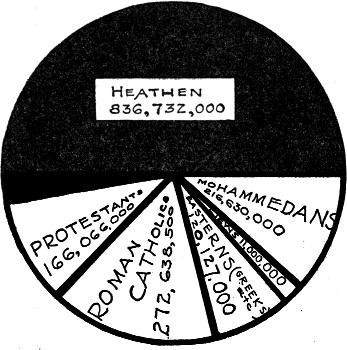
RELIGIOUS CONDITIONS OF THE WORLD
This chart indicates the magnitude of the task before the Christian forces of the world in bringing humanity up to Christian standards. The significance of Christian missionary and evangelizing work may be represented as an attempt of one-third of mankind constituting the Protestant, Roman Catholic and Greek Christian countries through a small band of picked workers, to change the religious habits, opinions and faith of the other two-thirds. But God has provided that this great task shall be accomplished.
(2669)
RELIGIOUS EDUCATION
A friend tells me that one of her earliest childhood memories is of being awakened by her mother before daybreak on a June morning. “Come, child,” she said, “come with me over to the pines, to hear the thrushes sing.” Across the dew-wet meadows they went, in the early flush of morning, and the child, her hand clasped in her mother’s, listened with her to the exquisite music of the thrush in the holy hour and place.
What need of words? It is the spirit that giveth life. The flame was kindled in the heart of the child because it burned undimmed in the mother’s heart. Not by preaching, nor even by much speaking, will our teachers teach religion. But they will surely teach whose lives abide in the shadow of the Almighty. We can not but speak the things we have seen and heard. Striving to do His will in the school-room, we slowly learn of the doctrine, and the truth we have made our own we are enabled to share.—Sarah Louise Arnold, “Proceedings of the Religious Education Association,” 1905.
(2670)
RELIGIOUS INFRACTIONS OF PROPRIETY
There are religious infractions of propriety, and they are serious. The Chinese word for propriety is an ideograph made up of two parts; one means to proclaim, or to reveal; the other means a sacrificial vessel. That is, propriety in the group of countries dominated by Chinese etiquette is a matter of religion and so is not to be lightly regarded. But what does one witness at the temples? Not infrequently one sees a missionary stalk boldly into a temple. He may not take off his shoes in Japan before walking over the polished temple floors. Very possibly he walks up to the idol and familiarly pats him with his ever-present cane. It is to the believer in those faiths like taking hold of the Ark of the Covenant in ancient Jewish times. We should remember that ridiculing the beliefs of people is poor missionary policy. They are usually the best that that country, or people, know. Let us not profane those things which are held most sacred. We may argue against them and reason about the unwisdom of holding them, but let us never laugh at the religious views and practises of the non-Christian world.—H. P. Beach, “Student Volunteer Movement,” 1906.
(2671)
RELIGIOUS INSTRUCTION
“Let the child wait till he has grown and then choose his own religion,” said an English statesman in the hearing of Coleridge. Coleridge, leading his friend into the garden, said: “I have decided not to put out any vegetables this spring, but to wait till August and let the garden decide for itself whether it prefers weeds or strawberries.” This is the logic of the delayed instruction theory.—A. B. Bunn Van Ormer, “Studies in Religious Nurture.”
(2672)
RELIGIOUS INSTRUCTION DENIED
In the psychological confession of a writer (Sentenis), a German philosopher whom his father had submitted to the experiment advised by the author of “Émile,” he tells us that, left alone by the death of a tenderly loved wife, this father, a learned and thoughtful man, had taken his infant son to a retired place in the country; and not allowing him communication with any one, he had cultivated the child’s intelligence through the sight of natural objects placed near him, and by the beauty of language, almost without books, and in carefully concealing from him all idea of God. The child reached his tenth year without having either read or heard that great name. But then his mind formed what had been denied it. The sun which he saw rise each morning seemed the all-powerful benefactor of whom he felt the need. He soon formed the habit of going at dawn to the garden to pay homage to that god that he himself had made. His father surprized him one day, and showed him his error by teaching him that all fixt stars are so many suns distributed in space. But such was the keen disappointment and the grief of the child deprived of his worship, that the father, overcome, acknowledged to him that there is a God, the Creator of the heavens and the earth.—A. B. Bunn Van Ormer, “Studies in Religious Nurture.”
(2673)
Religious Narrowness—See Regularity, Ecclesiastical.
RELIGIOUS TRAINING
Suppose a sculptor should take a piece of marble and stand it in front of his studio on the sidewalk, and should invite every passer-by to have a stroke at it with mallet and chisel, shaping it according to the fancy or the caprice of the moment, and then at the end of the year have it suddenly endowed with life, and ask it to choose what it would be—the shape of a god or of a satyr, of beauty or ugliness, pure and white or stained and soiled—this man would be rational as compared with the one who believes that you can let a child grow up until he is twenty unbiased, without absorbing any religious ideas or convictions, and then freely choose what he will be. If you do not bias the child, the first that he meets on the street, or in his school, or among his companions, will begin the work of biasing, of impression, of education, of training; for this is a continuous process. Whether you will or not, it is something over which you have no choice. It is something that will be done either wisely and well, or unwisely and ill.—Minot J. Savage.
(2674)
Remainders Saved—See Conservation of Remainders.
Remains of Insects—See Insects of Remote Times.
REMEDIES, STRANGE
There are many remedies, real or reputed for physical ills, but there is but one sovereign remedy for body, soul and spirit, namely, the life of God fully received into the human soul. In an article on “Strange Medicines,” in the Nineteenth Century, Miss Cumming quotes a few of the healing spells which to this day are practised by the peasantry of various districts in Great Britain, and which are considered certain remedies:
The Northumbrian cure for warts is to take a large snail, rub the wart well with it, and then impale the snail on a thorn-hedge. As the creature wastes away the warts will surely disappear. In the west of England eel’s blood serves the same purpose. For goiter or wen, the hand of a dead child must be rubbed nine times across the lump, or, still better, the hand of a suicide may be substituted. In the vicinity of Stamfordham, in Northumberland, whooping-cough is cured by putting the head of a live trout into the patient’s mouth, and letting the trout breathe into the latter. Or else a hairy caterpillar is put into a small bag and tied around the child’s neck. The cough ceases as the insect dies. Another cure for whooping-cough is offerings of hair. In Sunderland the crown of the head is shaved and the hair hung upon a bush or tree, with the full faith that as the birds carry away the hair, so will the cough vanish. In Lincolnshire a girl suffering from the ague cuts a lock of her hair and binds it around an aspen-tree, praying the latter to shake in her sted. The remedy for a toothache at Tavistock, in Devonshire, is to bite a tooth from a skull in the churchyard and keep it always in the pocket. At Loch Carron, in Ross-shire, an occasional cure for erysipelas is to cut off half the ear of a cat and let the blood drip on the inflamed surface. In Cornwall the treatment for the removal of whelks or small pimples from the eyelids of children is to pass the tail of a black cat nine times over the part affected. Toads are made to do service in divers manners in Cornwall and Northampton for the cure of nose-bleeding and quinsy, while “toad powder,” or even a live toad or spider shut up in a box, is still in some places accounted as useful a charm against contagion as it was in the days of Sir Kenelm Digby. The old smallpox and dropsy remedy known as pulvis Ethiopicus, was nothing more nor less than powdered toad. In Devonshire any person bitten by a viper is advised to kill the creature at once and rub the wound with its fat. It is said that this practise has survived in some portions of the United States, where the flesh of the rattlesnake is accounted the best cure for its own bite. Black, in his “Folk Medicine,” states that the belief in the power of snake-skin as a cure for rheumatism still exists in New England. Such a belief is probably a direct heritage from Britain.
(2675)
The following is the belief of Eastern Jews in very queer remedies:
For hoarseness and complaints of the throat and air-passages an approved prescription is to take a new plate, write on it with ink the three mystic names compounded of the Hebrew letters, “Ain, Yod, Aelph,” “Vau, Teth,” and “Teth, Yod, Koph”; then wash them out with wine, and after adding three grains of a citron used at the tabernacle festival, drink the beverage. Fits, epileptic, and ordinary, are treated after the following fashion: The patient’s head is covered and a pious neighbor stands by the bedside while the “practitioner” called in recites this invocation: “In the name of the Lord of Israel, in the name of the angel Raphael, and in the name of the hosts of heaven, and in the name of the One hidden and concealed, I adjure you to quit the body of So-and-So, the son of So-and-So, to quit him at once and without doing him hurt; and if you do not go, I curse you with the curse of the tribunal above and of the tribunal below, and with the curse of Joshua, the son of Nun.” In cases of severe prostration and debility, pounded mummy and human bones are administered, but this is considered a very dangerous medicine and great precautions are taken to prevent evil spirits interfering with the patient or hindering his recovery.—Public Opinion.
(2676)
REMEDY FOR PESTS
Is not the remedy for many evils to be found by allowing one destructive force to overcome another? God so makes “the wrath of man to praise him.”
One day a very small orange-tree was taken out of the ground in Australia and sent with many others across the ocean to California. On this small tree there were a few white insects. The little tree was planted again in California and soon put out many fresh, fragrant leaves. The white insects were astonished and rejoiced that day after day went by without the appearance of any red beetles. The white insects increased in numbers; there were thousands of fragrant-leaved orange-trees in California, and in a few years there were millions of white insects in them. One morning a man stood among the trees and said, “Confound these bugs; they’ll ruin me; what shall I do?” and a man who knew said, “Get some red beetles from Australia.” So this orange-grower, with some others, paid a man to go to Australia and collect some live red beetles. The collector went across the ocean, three weeks’ steady steaming, and sent back a few of the voracious little beetles in a pill-box. They were put into a tree in a California orange-orchard in which there were many cottony-cushion scale insects. The red insects promptly began eating the white ones; and their children and grandchildren and great-grandchildren have kept up this eating ever since. And so the orange-growers never tire of telling how the red beetles (whose name is Vedalia) were brought from Australia to save them from ruin by the white insects (whose name is Icerya).—Vernon L. Kellogg, “Insect Stories.”
(2677)
Remembering—See Forgetting and Remembering.
Remembering the Good—See Old Year Memories.
REMINDER, SEVERE
The Burgundians in France, in a statute now eleven hundred years old, attributed valor to the east of France because it had a law that the children should be taken to the limits of the district, and there soundly whipt, in order that they might forever remember the boundary-line.—Wendell Phillips.
(2678)
REMINDERS
A little boy had lost both parents by death. There were no relatives to care for him, and a place had therefore been found for him with a family in the country.
It was a ride of several miles to the strange home, and the farmer, who had agreed to transport him thither noticed that the little fellow sitting so shyly beside him in the great wagon often thrust his hand into his worn blouse as if to make sure of some treasure. Curiosity at last prompted the man to ask what it was. He had been kind during the journey, and so the child hesitatingly confided his secret.
“It’s just a piece of mother’s dress. When I get kind—kind o’ lonesome—I like to feel it. Most seems ’s if she—wasn’t so far off.”
(2679)
REMINDERS, UNPLEASANT
The man in the following incident underwent a painful operation to remove marks that reminded him of unpleasant things. There is a promise of greater blessing from one who said, “Tho your sins be as scarlet they shall be white as snow.”
Dr. Berchon was consulted by a rich man who asked him to remove a tattooed design that had been made in his youth and doubtless reminded him constantly of his humble beginnings. Berchon, a well-read man, used the ancient method of Crito, described by Paul of Ægina. Crito washed the tattooed part with niter and then enveloped it in resin, which was allowed to remain several days to soften the skin. The design was then scraped with a sharp instrument, the wound was washed and rubbed with salt, after which a sort of plaster was applied, consisting of frankincense, nitrate of potash, lye, lime, wax, and honey. Several days later the marks disappeared. (Text.)—La Nature.
(2680)
REMORSE
Haime was a Dorsetshire lad, violent in temper, gross in speech, utterly lawless in conduct. He was visited with what is to-day an almost unthinkable spiritual experience—a very violent temptation to blaspheme God. He yielded at last, in the silence of his heart framed the dreadful words, and was then told by the tempter, “Thou art inevitably damned.” The unhappy youth was broken-hearted. He swung for a time betwixt plans of suicide and wild rushes into vicious pleasure. The terrors of sin haunted him. He had experiences which can hardly be paralleled out of monkish literature.
“One night, as I was going to bed, I durst not lie down without prayer. So, falling upon my knees, I began to consider, ‘What can I pray for? I have neither the will nor the power to do anything good.’ Then it darted into my mind, ‘I will not pray, neither will I be beholden to God for mercy.’ I arose from my knees without prayer, and laid me down; but not in peace. I never had such a night before. I was as if my very body had been in a fire, and I had a hell in my conscience. I was thoroughly persuaded the devil was in the room.”—W. H. Fitchett, “Wesley and His Century.”
(2681)
RENEWAL
M. E. Hume-Griffith, in her “Behind the Veil in Persia and Turkish Arabia,” tells of a little Persian boy badly disfigured from a “hare-lip,” who was brought by his father to the medical mission at Julfa to be operated upon for the trouble.
The Persians believe that this congenital malformation is the mark left by the Evil One, so this afflicted boy was known in his village by the unenviable title “little devil,” and had been a good deal tormented by his playfellows. The operation was a complete success. After ten days’ careful treatment the dressing was finally removed, and the boy was handed a mirror that he might look for the first time upon his “new” face. Tears of joy rolled down his face as he kissed the hand that had wrought the change, and he murmured brokenly: “I am no longer a little devil, I am no longer a little devil!” And he went back to his comrades to be a hero and an idol.
(2682)
The difference between men who are taking in and giving out life and knowledge and men who are living in their own selfish circle is like the difference in lakes stated below:
Fresh-water lakes are always only expansions of rivers, due to the particular topographical configuration of a valley. They are all characterized by the fact that the water that they receive runs out, either continuously or intermittently, and that the chemical constitution of their water remains constantly the same as that of the streams and rivers of the same region.
Salt lakes, on the other hand, are always closed basins, without outlet, and their water is removed only by surface evaporation. These facts being well understood, we see at once why the former lakes contain fresh water and the others salt water.(Text.)—Paul Combes, Cosmos.
(2683)
See Inner Life.
RENEWAL NECESSARY
If I have a certain sum of money, I can calculate what necessities it will meet, and how far it will go; but it will go only so far; beyond that is exhaustion. But if I have a bed of strawberries in my garden, after it has borne the crop of the season, and there is no more to be got from it, I can weed and cultivate and fertilize it, and next year it will bear again. And tho the whole bed shows exhaustion, I can set its runners in new rows and nurture them into new life, tho the old plants are only fit to be dug under; and I can renew the life of my bed and after a season it will be as young and fresh and fertile as ever. I have completely renewed its life. So I can renew the life of a note, or lease, or partnership. So bodily strength, tho exhausted every day, is renewed every night; and even if impaired by disease, it may be recovered. There is nothing necessarily hopeless in the exhaustion of anything that has life in it; but all living things need renewal.—Franklin Noble, “Sermons in Illustration.”
(2684)
RENEWAL, SPIRITUAL
A lady calling upon a friend one day, exprest surprize that she had both windows open while the thermometer was at zero, saying that she never opened her windows in winter, adding that even then she was unable to keep warm.
“I open my windows,” was the explanation, “to warm the rooms by filling them with fresh air. It is impossible to heat dead air. To inhale the same air over and over again is to breathe in poison.”
As “it is impossible to heat dead air,” so it is impossible to incite zeal in a dead church. The breath of the Spirit is first needed to change the spiritual climate. (Text.)
(2685)
Renewing the Faith—See Extremity not Final.
RENOVATION
The verses below by Sam Walter Foss, from a poem on “The Soul Spring Cleaning,” have in them a suggestion that every man may now and then utilize:
Yes, clean yer house, an’ clean yer shed, An’ clean yer barn in ev’ry part; But brush the cobwebs from yer head, An’ sweep the snow-banks from yer heart. Yes, w’en spring cleanin’ comes aroun’ Bring forth the duster an’ the broom, But rake yer fogy notions down, An’ sweep yer dusty soul of gloom. Plant flowers in the soul’s front yard, Set out new shade an’ blossom trees, An’ let the soul once froze an’ hard Sprout crocuses of new idees. Yes, clean yer house, an’ clean yer shed, An’ clean yer barn in ev’ry part; But brush the cobwebs from yer head, An’ sweep the snow-banks from yer heart!(Text.)
(2686)
Each great European cathedral has its regular corps of repairers—architects, engineers, masons, carpenters, every man a master of his craft. The work of renovation goes on at all seasons; crumbling stones must be replaced, fresh cement supplied, broken parts mended; there is always something needing to be done. The inexperienced traveler is at first much annoyed by the sight of the stagings and scaffoldings from which cathedral walls seem never wholly free. “When,” he exclaims, “shall I at last find a façade which is not in the process of repair?” But with larger knowledge and more careful thought his feelings change.
The flimsy, unsightly framework clinging to the ancient gray stone no longer seems a blemish, but a true adornment, since it eloquently tells of the reverent, affectionate care which faithfully preserves for the future these “poems in stone” handed down from the mighty past.—“Monday Club, Sermons on the International Sunday-school Lessons for 1904.”
(2687)
RENUNCIATION
Dr. R. F. Horton, in the Christian Endeavor World, tells this incident concerning a wedding where he officiated:
A very little man had brought to the altar a very big bride, who, moreover, was attired in purple, and certainly bore a formidable aspect.
Whether the situation affected the bridegroom, or in a dreamy reminiscence his mind wandered back to childhood and the catechism when, on the mention of the world and the flesh and the devil, he promised to have nothing to do with them, I can not say. But sure enough, when I put to him the crucial question, “Wilt thou have this woman to be thy wedded wife?” the answer came, low but clear, “I renounce them all!” It was with some compunction that I said to him, “You must say, ‘I will.’”
(2688)
RENUNCIATION, COMPLETE
There is an ancient legend of a devout man who had, among many other virtues, the gift of healing, unto whom divers made resort for cure; among the rest one Chromatius, being sick, sent for him. Being come, he told of his sickness, and desired that he might have the benefit of cure as others had before him. “I can not do it,” said the devout person, “till thou hast beaten all the idols and images in thy house to pieces.” “That shall be done,” said Chromatius. “Here, take my keys, and where you find any images let them be defaced,” which was done accordingly. To prayer went the holy man, but no cure was wrought. “Oh!” saith Chromatius, “I am as sick as ever. I am very sick and weak!” “It can not be otherwise,” replied the holy man; “nor can I help it, for certainly there is one idol more in your house undiscovered, and that must be defaced, too.” “True,” said Chromatius. “There is so, indeed; there is one all of beaten gold. It cost two hundred pounds. I would fain have saved it, but here, take my keys again. You shall find it locked up fast in my chest. Take it and break it in pieces.” Which done, the holy man prayed and Chromatius was healed. (Text.)
(2689)
REPAIR OF CHARACTER
After every trip a locomotive goes into the round-house, where it is overhauled, cleaned, and every bolt and nut is tightened. About every four years it goes into the shop, is taken to pieces and made over anew. The criteria in every case are: Can she haul the load? and can she make schedule time?
It would be a good thing for men thus to overhaul their habits and tendencies, in order to maintain the integrity and efficiency of character. (Text.)
(2690)
Reparation—See Duty, Sense of.
REPARTEE
We rejoice more than all in the constant progress of those liberal ideas to which such an impulse was given by the victory of Yorktown. You remember that Fox is said to have heard of it “with a wild delight”; and even he may not have anticipated its full future outcome. You remember the hissing hate with which he was often assailed, as when the tradesmen of Westminster whose vote he had solicited flung back at him the answer: “I have nothing for you, sir, but a halter,” to which Fox, by the way, with instant wit and imperturbable good nature, smilingly responded: “I could not think, my dear sir, of depriving you of such an interesting family relic.”—Richard S. Storrs.
(2691)
REPAYMENT
The baronet in the following story followed nature’s favorite method of repaying in kind:
James McNeil Whistler, the famous artist, was extravagantly fond of a French poodle that he owned, says the New York Tribune, and once, when the little dog had some trouble with his throat, he sent for Sir Morell Mackenzie, the great throat specialist. Mackenzie was not a bit pleased by being called in to treat a dog, but he prescribed, nevertheless, and had a partial revenge by charging a big fee. The next day he “got even” most effectually by sending for Mr. Whistler in great haste, and the artist, thinking that he had been summoned on some matter connected with his beloved poodle, dropt his work and rushed to Mackenzie’s house. On his arrival, Sir Morell said very gravely: “How do you do, Mr. Whistler? I wished to see you about painting my front door.” (Text.)
(2692)
REPEATED EFFORT
Persuasion is constantly tried, often with no success whatever. The reason of failure is frequently found in the neglect of perseverance.
In a very small Bible class of young men the fall of Jericho was the subject of discussion on a certain Sunday. One of the members suggested that more members might be brought in if some of the faith of the besiegers of old were used. Another member at once suggested that a list of those advisable should be made, and that each should be “encompassed” by calls on seven days, each day by a different man. The suggestion was adopted. Next day a young business man received a visit and an invitation to attend the class next Sunday. He was indifferent and did not promise. On Tuesday the second called and was treated coldly. But on Wednesday when a third man called the effect showed. “Two men have called already; I am considering,” said he. On Thursday when the fourth visitor called, down came the walls. He promised to attend and attended regularly. Others were won. Among them was a musician, who organized a fine orchestra. (Text.)
(2693)
REPENTANCE
When I’ve a quarrel in my mind With one who’s far away To scorching letters I’m inclined, In which I say my say. And then I take those scorching screeds So full of ink and ire, In which I threaten awful deeds, And mail them—in the fire. —Success Magazine.
(2694)
REPENTANCE, LATE
The following striking illustration of the effect of delay in serving God is by James Drummond, in “Parables and Pictures”:
There was once a horse that ran away in the morning and did not return till evening. When the master upbraided him, the horse replied, “But here am I, returned safe and sound. You have your horse.” “True,” answered the master, “but my field is unplowed.” If a man turns to God in old age, God has the man, but He has been defrauded of the man’s work.
(2695)
REPENTANCE, NATURE OF
No more vivid illustration of what evangelical repentance is can be framed than that which is found in the Greek original, “straphate,” rendered “convert,” which means to face about, or turn around, in allusion to the movement of a ship when it is put about on an opposite course; or to the action of a flower when it turns its face toward the sun. The change of mind becomes a change of life.
(2696)
REPENTANCE, PRACTICAL
When Thomas Olivers, the Welsh cobbler who became noted as a Methodist, itinerant and a hymnist, turned from a reckless life, carousing and incurring many debts, to a profession of a change of heart, he deliberately set about settling his financial obligations, nor ceased until the last penny was paid.
He brought forth fruit meet for repentance. (Text.)
(2697)
REPENTANCE THE GIFT OF GOD
John Wesley, that preacher of repentance, sings:
“Lord, I despair myself to heal, I see my sin but can not feel; I can not till thy Spirit blow, And make the obedient waters flow. Speak, gracious Lord, my sickness cure, Make my infected nature pure; Peace, righteousness and joy impart, And pour thyself into my heart.”
(2698)
REPETITION, FORCE OF
Continuous repeated acts of kindness breaking down the pride of an enemy, repeated annoyances that shape the temper; these or similar experiences may be illustrated by this extract:
A stalwart young man at Leavenworth, Kan., recently accepted a wager that he could stand a quart of water dropt into his open hand, drop by drop, from a height of three feet. Before 500 drops had fallen into his hand he almost cried with pain and said he had enough. After a little water had fallen each drop seemed to crush his hand, and a blister in the center of it was the result.—Boston Journal.
(2699)
A minister in his walk saw a stone-mason who was trying to break a large stone with what seemed a very small hammer. “You never can do it,” the minister prophesied. “Sure, sir, that’s all you know about breaking stones,” replied Pat, as he hammered away industriously. After hundreds of these peckings there came a slight crack. A few more, and the great stone fell apart.
“Now,” asked the Irishman, “would your honor tell me which one of these blows it was that broke the stone?” “Why, the last one, to be sure,” said the minister. “There you’re wrong, sir,” was the reply. “It was the first blow, and the last blow, and all the middle ones, sir.”
(2700)
REPLENISHMENT
The moral life of man would soon be exhausted if God by His Spirit did not continually renew it.
Water plunging over the rocks at Niagara is intercepted and made to turn the giant turbines of electric power plants before it is allowed to hurry on its way to the sea. If the waters of the Great Lakes were not replenished Niagara would soon run dry and our mill-wheels stop. But year by year, and day by day, the sun’s rays evaporate the waters of the ocean and lift them back again to the mountain tops, whence they flow downward into the lakes and rivers.—Charles Lane Poor, “The Solar System.”
(2701)
REPORTS TO ORDER
It was my pleasure, some years ago, to report a religious meeting for three papers in New York. A discussion of vital importance to the Presbyterian Church was promised. The lines were closely drawn and the feeling was intense. The day before the meeting I went to the editorial offices for instruction. Mr. A. said: “We want a fair report, but you know we publish a conservative paper, and our space is limited. Give us all that is said by the conservative leaders. Of course, the others must be treated fairly, but we shall not have space enough for any of the addresses on that side; give us a fair report, however.” Mr. B. said: “We want a fair report, but you know we publish a liberal paper, and our space is limited. Give us all that is said by the liberal leaders. Of course, the others must be treated fairly, but we shall not have space for any of the addresses on that side; give us a fair report, however.” Mr. C. said: “We want an absolutely impartial report. Give the leading speeches on both sides as fully as possible, and mention every speaker who takes part in the discussion. We want a true picture of the debate in your report. On the editorial pages we shall express our opinion of the arguments advanced, but your report should be absolutely colorless.”—John Bancroft Devins, “Student Volunteer Movement,” 1906.
(2702)
Repose—See Sounds.
REPRESENTATIVE DIGNITY
There was great wisdom sententiously exprest in the exclamation of a little constable I heard of once who went to arrest a burly offender against the statutes, and was threatened with a shaking if he did not “clear out.” If it had been a matter of fists and muscle, the majesty of the law would have been miserably bruised. But the intrepid officer responded: “Do it if you please; only remember, if you shake me you shake the whole State of Massachusetts.”—Thomas Starr King.
(2703)
Repression—See Power in Self-repression.
REPRISAL
The story of an intelligent dog given below may suggest that the deceits we practise on others will, sooner or later, be repaid against ourselves:
An old lady rented a furnished villa for the summer, and with the villa a large dog also went. In the sitting-room of the villa there was a very comfortable armchair. The old lady liked this chair better than any other in the house. She always made for it the first thing. But, alas! she nearly always found the chair occupied by the large dog. Being afraid of the dog, she never dared bid it harshly to get out of the chair, as she feared it might bite her; but instead she would go to the window and call “Cats!” Then the dog would rush to the window and bark, and the old lady would slip into the vacant chair quietly. One day the dog entered the room and found the old lady in possession of the chair. He strolled over to the window, and, looking out, appeared very much excited, and set up a tremendous barking. The old lady rose and hastened to the window to see what was the matter, and the dog quietly climbed into the chair.
(2704)
REPUTATION
After the Civil War many offers of places of honor and fame came to Gen. Robert E. Lee. He refused them all, says Thomas Nelson Page, in his biography of the soldier. The only position which he finally did accept was the presidency of Washington College, with a small salary.
On one of these occasions Lee was approached with the tender of the presidency of an insurance company at a salary of $50,000 a year. He declined it, saying that it was work with which he was not familiar.
“But, general,” said the representative of the insurance company, “you will not be expected to do any work. What we wish is the use of your name.”
“Don’t you think,” said General Lee, “that if my name is worth $50,000 a year, I ought to be very careful about taking care of it?” (Text.)—The Youth’s Companion.
(2705)
REPUTATION AND CHARACTER
Into a certain London establishment some burglars one night made their way, expecting a big haul of valuables. They commenced operations on an immense and very strong iron safe, feeling sure that tho it would be very difficult to force it open, their strenuous efforts would be rewarded at last. For several hours they used their drills and other implements. When the safe was opened they perceived another safe inside the first one, just as strong and fully as difficult to open. They at once realized that their night’s toil had been all in vain, for it would be impossible to open the inner safe before the world would be resuming work.
So long as the inner life is strong and unbroken, attacks on a man’s reputation can not rob him of his real treasure of a good character.
(2706)
REPUTATION, VALUE OF
The following is related of “Stonewall” Jackson:
He was never an ornamental soldier, being roughly clad and so plain as to be frequently taken for far less than he was. He and his staff were once compelled to ride through
a field of uncut oats. The owner rushed out in great indignation, demanding the name of the leader that he might report him.