M
Reading edition
MACHINE, AN ACCURATE
A fine clock, reminding a community of the lapse of time and of the value of the fleeting minutes and hours, is an object of much public interest. Some clocks have a particular historic interest due to their long and accurate service in behalf of a hurrying and often heedless humanity. A number of invited guests were recently privileged to be present one night in Strasburg Cathedral to observe the mechanism of the famous clock. For the first time since its construction in 1842, the machinery was called upon to indicate the first leap-year of a century, after an eight-year interval. At astronomical midnight the levers and trains of wheels began to move, the movable feasts of the year took their respective places and the admirable mechanism, calculated to indicate in perpetuity all the changes of the calendar, continued its regular movement. The man who can construct a great clock like that is indeed a mechanical genius.
(1942)
Machine-shop Equipment—See Modernity.
MACHINE TESTIMONY
In an article in the Evening Post on “Manners Over the Wire,” the writer says:
Some little thing may reform an age, the adage runs, and so perhaps the phonograph recording device, which was installed recently in the Copenhagen telephone exchange to check the ill-natured remarks of subscribers to central, by convicting offenders out of their own mouths, may bring about a revolution in the Danish city’s manners.
Probably one of the first thoughts of the man who invented the telephone, and knew that he could project sound over distance, was that now he could tell his stronger neighbor his candid opinion without risking the dog and a possible thrashing; one of his second thoughts was to put his new-found power into practise. And who, after all, should be the object of most of the exasperated remarks, shading from complaint to embroidered profanity, but central herself?
This Copenhagen found out, and set herself to remedy. University professors there who discover another flaw in Dr. Cook’s records and ring up the rector right away, only to find that the wire is busy because half a dozen colleagues have similar messages, must not abuse central; the connection will be switched at once to the phonograph, which has no feelings and is an unprejudiced witness in court. Testimony of as a will recorded thus was recently held valid in Russia; and the notaries will invent another form: “Appeared before me this day Phonograph No. 123, said phonograph being turned on, deposed, etc. ... Polonius, notary; Rosencrantz and Guildenstern, witnesses.” Polonius’ advice, “Give thy thoughts no tongue,” holds good, and better for the Danes than in the times when, in language of to-day, the party at Elsinore had no ’phone.
(1943)
Machine versus Purpose—See Purpose Discerned.
Machine Work—See Monotony.
Machinery, Excess of—See Master Hand Lacking.
MAGNANIMITY
The exercise of magnanimity and charity was as natural to General Grant as breathing; and he demonstrated on this occasion that the hand that wielded the sword was moved by kindness as well as by patriotism. The prisoners of war, who so long lived in hunger, now received abundant rations. So much kindness was shown them that when the Union troops entered the city, both sides “fraternized as if they had been fighting for the same cause.” And when the Confederates passed out of town between two lines of Federal soldiers, the scene was solemn and pathetic. Under instructions from General Grant, not a cheer or a word came from the conquerors that would humiliate the fallen foe or give them pain.—Nicholas Smith, “Grant, the Man of Mystery.”
(1944)
Gen. Fitzhugh Lee witnessed the memorable meeting between his uncle, Gen. Robert E. Lee, and Grant, and he frequently exprest his appreciation of the magnanimity displayed by the victorious commander on that occasion. The fact that General Grant refrained from asking for Gen. Robert E. Lee’s sword made a lasting impression on Fitzhugh Lee, who subsequently said: “General Grant not only refrained from demanding my uncle’s sword, as is customary, but he actually apologized to General Lee for not having his own sword on at the time.” (Text.)
(1945)
See Good for Evil.
Magnanimity, A Boy’s—See Vicarious Sacrifice.
Magnanimity, A Nation’s—See America’s Attitude.
MAGNANIMITY, UNDISCIPLINED
Precipitancy of judgment and heat of temper are responsible for all the errors of Walter Savage Landor’s life. To recount these errors is neither wise, necessary, nor generous. One thing, however, is noticeable, that in every case the difficulties which he created for himself arose from a sort of undisciplined magnanimity of nature, a belief in impracticable ideals, a radical inability to adapt himself to the common convictions of life. He sinned against himself in a hundred instances, but against others never. His generosity was extreme and incessant. In his enormous agricultural experiments at Llanthony he squandered seventy thousand pounds in five years—J. W. Dawson, “Makers of English Prose.”
(1946)
MAGNETISM
The use of powerful electromagnets for lifting pieces of iron in foundries is increasing. In The American Machinist, E. F. Lake gives some particulars of recent applications of electromagnetism to lifting, and discusses the economies effected thereby. He says:
“At the West Allis works of the Allis-Chalmers Company, lifting magnets are prest into service for saving the small pieces and even minute particles of iron and steel which have heretofore been allowed to go to waste without thought of the possibility of recovery.
“This is done periodically by hitching the magnets to traveling-cranes and allowing them to sweep over every inch of ground area, both in and around the works. It is a never-failing source of wonder to the shops’ management how much lost metal the magnets can find.” (Text.)
(1947)
Magnificence—See Ice Beauty.
MAGNIFYING A SACRED OFFICE
Increase Mather, in a sermon entitled “Be Very Courageous,” tells the story: “It has been reported that a minister, preaching to the Earl of Stratford, then lord deputy of Ireland, faithfully reproved some corruptions which that governor was known to be guilty of, but at which he was displeased; and the next day, in a great passion, he sent for the minister, and began his discourse thus: ‘Yesterday, when you were before me, you said such and such things.’ The minister replied to him: ‘You are mistaken, sir; I was not before you yesterday. I confess I am before your excellency to-day, but you were before me yesterday. You represent the kingdom; but yesterday I was made representative of the Almighty God, who is infinitely above the greatest kings on earth.’ Upon that, the earl was so affected as to dismiss the minister without saying anything more to him.” Here was a man who magnified his office, who spoke with authority, and not as the scribes.—Christian Register.
(1948)
Magnifying Objects—See Science, Improvements by.
Mail, Handling—See Care in Performing Duties.
Main Objects versus Incidentals—See Tasks, The Real.
Majority Not Always Right—See Conviction, Unyielding.
Majority-rule—See Justice by Majority; Tact.
MAKE-BELIEVE
If all difference could be atoned as easily as that described in this extract from the Popular Magazine, much bloodshed would be saved:
Not long ago a Paris journalist, who had by some criticism offended a politician, received from him the following letter:
“Sir—One does not send a challenge to a bandit of your species: one simply administers a cuff on the ears. Therefore, I hereby cuff both your ears. Be grateful to me for not having recourse to weapons.
“Yours truly, ——”
The journalist answered:
“My Dear Sir and Adversary—I thank you, according to your wish, for having sent me cuffs by post, instead of slaughtering me with weapons. Cuffed by post, I respond by dispatching you by post six bullets in the head. I kill you by letter. Please consider yourself dead from the first line of this epistle.
“With a respectful salutation to your corpse, I am,
“Very truly yours, ——.”
The intent to kill is present. Is not that reckoned in morals as bad as the overt act? (Text.)
(1949)
Malaria, Stamping Out—See Immunity from Disease.
Malice—See Modesty.
Malingery—See Sham.
MAMMON WORSHIP
At Nashville, Tenn., there recently died an eccentric old lady, known in the neighborhood as a miser of the most pronounced type, tho possessing multiplied thousands. After her death the premises were searched for the money, known to be hidden in various places about the house. She had no confidence in banks, and therefore employed this method of concealing her treasures. For seventeen years she never left her home, lest some one get her money. Was ever a life more completely misspent? The joy she might have had by helping others, she missed because of her miserly disposition. She preferred to be poor—really poor—in the midst of her gold. She starved her soul that she might worship at the shrine of Mammon.—The Gospel Messenger.
(1950)
MAN A CREATOR
The fork, the knife, the graver, the spade, they are merely steel fingers, iron hands, accumulating and prolonging the energy of those members. The rudder which the hand holds, it is in effect that hand itself, enlarged, and shielded from the wash of the waves. The telescope, with its wondrous space-penetrating power, the microscope, with its clear and searching lens, in which seems almost an image of Omniscience, are yet only adjutants and servitors to the eye, that more marvelous instrument which no hand can fashion. The soul of man, invisible itself, controls the eye. It creates the telescope, to be its assistant. The locomotive steam-engine, with its connected trains of cars, whose tread is like an earthquake traversing the surface, whose rush outruns in noise and power the plunge of the cataract—the soul has created that as a servant to the body, to move this on its errands, and to carry its burdens. The steamship flashing through night and storm, trampling the riotous waves beneath it, and drowning the strife and uproar of the winds, by its more measured and peremptory stroke, is a similar instrument sent forth on the seas. Each began in a thought. Each was born of the soul. And that which produced them has the power to work with them, for any effects.—Richard S. Storrs.
(1951)
MAN A TIMEKEEPER
There are many ways in which a man is like a watch, as this curious epitaph shows, which can be seen in the churchyard at Lydford, Devonshire, England:
Here lies in a horizontal position The outside case of George Routledge, watchmaker. Integrity was the main-spring and prudence the regulator of all the actions of his life; Humane, generous and liberal, His hand never stopt till he had relieved distress; So nicely regulated were his movements that he never went wrong, Except when set a-going by people who did not know his key;
Even then he was easily set right again. He had the art of disposing of his time so well That his hours glided away in one continued round of pleasure. Till, in an unlucky moment, his pulse stopt beating. He ran down Nov. 14, 1801, aged 57, In hopes of being taken in hand by his Maker, Thoroughly cleaned, repaired, wound up and set a-going, In the world to come, when time shall be no more.
(1952)
MAN AS A TEMPLE
My God, I heard this day That none doth build a stately habitation But he that means to dwell therein. What house more stately hath there been Or can be, than is man? To whose creation All things are in decay. Since then, my God, Thou hast So brave a palace built, O dwell in it, That it may dwell with Thee at last! Till Thou afford us so much wit That, as the world serve us, we may serve Thee, And both Thy servants be. (Text.) —George Herbert.
(1953)
MAN GODLIKE
An unidentified writer here points out the greatness of man even tho often overthrown:
Swarming across the earthly crust, Delving deep in the yellow dust, Raising his ant-hills here and there, Scoring the soil for his humble fare, Braving the sea in his tiny boat— Tireless he struggles, this human mote. Tempests scatter his ant-hills wide, Vainly he braves the boiling tide, Fire will ruin his busy mart, Famine stilleth his throbbing heart, Trembles the earth and prone he falls, Crusht and tombed by his pigmy walls. Heir of the kingdom ’neath the skies, Often he falls, yet falls to rise. Stumbling, bleeding, beaten back, Holding still to the upward track; Playing his part in creation’s plan, Godlike in image—this is man!
(1954)
Man Imitating Nature—See Imitation of Nature.
MAN INDESTRUCTIBLE
Some time ago a Philadelphia anatomist announced to the world that the brain of Walt Whitman, through the carelessness of a hospital employee, had been lost to science. The jar that held the poet’s brain fell to the floor and was broken, so that not even the fragments of the organ were saved. Well, let the poet’s brain be shattered, if you will; the poet himself can not be touched. The flaming star-wheels can not crush him, the maddened oceans can not engulf him, the black caves of night can not hide him, the scorching flames of hell can not destroy him. Man is a spark of divinity the image of deity, an “emotion of God flashed into time.”—F. F. Shannon.
(1955)
MAN MADE FOR ETERNITY
You can tell the difference between sea and land birds by the length and strength of their wings. The wings of the former are intended for long and sustained action in their sweep along the surface of the great ocean.
Man’s soul, in a similar manner, is not intended for this material world, but has long and strong wings of hope and affection wherewith to span the ocean of eternity.—Vyrnwy Morgan, “The Cambro-American Pulpit.”
(1956)
Man Not a Puppet—See Mastery of Circumstances.
Man, Original—See Originality of Man.
MAN POSSESSING NATURE
Thomas Traherne, a poet, whose worth was discovered only after he was dead, is the author of the following:
The orb of light in its wide circuit moves, Corn for our food springs out of very mire. Our fuel grows in woods and groves; Choice herbs and flowers aspire To kiss our feet; beasts court our loves. How glorious is man’s fate! The laws of God, the works He did create, His ancient ways, are His and my estate.
(1957)
MAN, SLOW DEVELOPMENT OF
Robert Loveman takes a wide view of man in this verse:
A thousand years doth nature plan Upon the making of a man; She sweeps the generations through, To find the patient, strong, and true; She rends the surge of seven seas, Rearing an humble Socrates; She burns a hundred years of sun, Sealing the soul of Solomon. A thousand years doth nature plan Upon the making of a Man; She sees the ages dawn apace, Ere Moses rouse his shackled race, Or Homer or sweet Shakespeare sing, Beside his deep eternal spring; The centuries rise in reverence when Buddha doth come unto his men. A thousand years doth nature plan Upon the making of a man; She fills his heart with fire and faith, She leaves him loyal unto death; She lights his lustrous, loving eye With flashes of immortality; She adds one more undying name Upon the heated scroll of fame. —“Songs from a Georgia Garden.”
(1958)
Man, Superiority of—See Speech.
Man, The Manly—See Manliness.
Man the Product of Many Elements—See Diverse Influences.
MAN, VALUE OF A
Years ago a Mr. Campbell, a British subject, was held a prisoner by Theodore, King of Abyssinia. England demanded his release, sending an army of ten thousand men who marched seven hundred miles, to Coomassie, and all at a cost of twenty-five million dollars—just to rescue a single man. (Text.)
(1959)
Maneuvering by Birds—See Stratagem by Birds.
MANHOOD
We need not more machinery or institutions. What the world needs is men, as Rudyard Kipling shows in this verse:
The peace of shocked foundations flew Before his ribald questionings, He broke the oracles in two And bared the paltry wires and strings; He headed desert wanderings; He led his soul, his cause, his clan, A little from the ruck of things. Once on a time there was a man. Thrones, powers, dominions block the view With episodes and underlings; The meek historian deems them true, Nor heeds the song that Clio sings, The simple central truth that stings The mob to boo, the priest to ban, Things never yet created things. Once on a time there was a man. (Text.) —Collier’s Weekly.
(1960)
MANHOOD RECOGNIZED
Jesus saw in the meanest man the possibilities of character. This is what Charles Wagner urges us to do in the following extract:
Maintain toward the poor man and the infirm a courtesy, an attentiveness; find in your heart and in your love a sign that makes him recollect that he is a man. His misery is like a tomb in which his self-respect sleeps buried. It is something to respect this tomb, to approach it with piety, to care for it and to keep a flower growing there; but each of these attentions is addrest to one that is dead, shows that you accept his death, and that you confirm it. Do more and do better. Remember that it is a living man that lies under the dust, slowly amassed, of days of suffering. Breathe upon this dust, disengage the human form; speak to Lazarus and make him come forth from the shrouds that surround him, from the night that covers him. (Text.)—“The Gospel of Life.”
(1961)
MANIFESTATION
Just as creation is the revelation of God—His avowal, as a poet has said—so in the same way the external life of man, when it follows its normal development, is the translation, in signs and symbols, of what he bears at the bottom of his being. It would be easier to keep the sap from mounting, the flowers from opening, the leaves from tearing apart their coverings, than human nature from manifesting itself. It is this need that gives man his distinction as a social and communicative being.—Charles Wagner, “The Gospel of Life.”
(1962)
MANLINESS
The world has room for the manly man, with the spirit of manly cheer; The world delights in the man who smiles when his eyes keep back the tear; It loves the man who, when things go wrong, can take his place and stand With his face to the fight and his eyes to the light, and toil with a willing hand; The manly man is the country’s need, and the moment’s need, forsooth, With a heart that beats to the pulsing tread of the lilied leagues of truth; The world is his and it waits for him, and it leaps to hear the ring Of the blow he strikes and the wheels he turns and the hammers he dares to swing; It likes the forward look in his face, the poise of his noble head, And the onward lunge of his tireless will and the sweeps of his dauntless tread! Hurrah for the manly man who comes with sunlight on his face, And the strength to do and the will to dare and the courage to find his place! The world delights in the manly man, and the weak and evil flee When the manly man goes forth to hold his own on land or sea! (Text.) —American Israelite.
(1963)
Manner, The Orator’s—See Earnestness.
Manners—See Circumstances, Taking Advantage of; Dual Character; Machine Testimony.
Manners, Teaching Bad—See Politeness.
MAN’S AGE ON EARTH
Some scientists reason that the Falls of Niagara must have been formed soon after the Glacial Epoch, and the time occupied in wearing the rock back to the present position therefore furnishes a basis for calculating the age of man on the earth, as he must have begun his career since that epoch:
In an address in Washington before the United States Geological Survey, Professor Gilbert gave the following interesting information regarding the recession of the ground under Niagara Falls: The estimate is that for the past forty-four years the falls have receded at the rate of twenty-four feet in a year. The Horseshoe Falls are at the head of the gorge and the American Falls at the eastern side, but the time was when both were together, before the little point called Goat Island was reached. The recession is more rapid at the center than on the sides. As the crest of the Horseshoe Falls retreats the water tends to concentrate there, and the time will probably come when the sides of the present falls will have become dry shores. The gorge is known to be 35,500 feet long. A calculation has shown that, on this basis, the falls began to wear away the rock of the escarpment near Lewiston about 7,900 years ago.—Public Opinion.
(1964)
MAN’S CONQUEST OF ANIMALS
Man-eating tigers have for so long been regarded by the natives of most parts of India as invincible, or else protected by the native religions, that they have had things pretty much their own way. One determined hunter for every fifty frightened, unarmed men would scarcely serve to intimidate any animal. Many tribes of North American Indians looked upon the bear with veneration; but for all that, any bear so courageous as to let himself be seen by them got an arrow between his ribs right away, and in time the whole tribe of American bears learned that the chances were against them, just as the wolves and cougars arrived at a similar conclusion. Those that turned man-eaters might for a few seasons hunt their prey successfully, and if gifted with unusual cunning get away unscratched for a while, but the vengeance of the tribe would be certain to overtake them before very long, and only the more cowardly ones of their species would survive to perpetuate the race.—Witmer Stone and William Everett Cram, “American Animals.”
(1965)
Man’s Greatness—See Size not Power.
MAN’S IMPORTANCE
The world is one thing to a bird, or a fish, but quite another thing to Cuvier or Agassiz. Then man entered the scene. Stretching out his hand he waved a wonder-working wand. He touched the wood, and it became a wagon; he touched the ore and it became an engine; he touched the boughs and they became the reeds of an organ; he touched the wild animal, and it became a burden-bearer for his weary feet; while his intellect turned the stone into geology, and the stars into astronomy, and the fields into husbandry, and his duties into ethics. When the flint and steel meet, something beyond either appears—a tongue of flame. And when man and nature met, something new emerged—art, industry, ethics, cities and civilization. There is nothing great in nature but man. Take man out of this wondrous city with its cathedrals, galleries, and homes, and Broadway would become a streak of iron-rust. The earth wears man upon her bosom as the circling ring wears a sparkling gem. The bog puts forth a white lily; genius is a flower rooted in earth, but borrowing its bloom and beauty from heaven.—N. D. Hillis.
(1966)
Man’s Part—See Evangelization.
Man’s Part in Religion—See Faith.
MAN’S PREEMINENCE
When you approach a great city at night and see only its tens of thousands of lights, you do not for a moment attach importance to those mechanical contrivances, the lights. The unseen inhabitants in the tens of thousands of lighted homes are the real objects of interest and worth. So the worlds, and not the suns, are the objects of true worth and interest in the universe; the worlds, the lighted and glowing houses of God’s children, not the mechanical contrivances for making them comfortable. Upon these must center our thought and interest. What is the fire which warms the man and cooks his dinner, compared with the man himself? What is the light and fire, compared with the home? What is the sun, compared with the world? Just here we begin to get some breath of assurance. While the worlds in our system differ very greatly in size and glory, while some of the great suns doubtless have correspondingly great worlds circling about them, yet we may reasonably suppose that among the worlds of the universe our earth is somewhere near the middle of the scale. And we earth-dwellers, intelligent children of the Father, are no mean citizens in the kingdom of our God. If He has built such a mansion of light for us, and kindled such a hearth-fire as our sun, and made us lords and masters of such a world as this, why may we not lift up our heads in love and triumph? (Text.)—James H. Ecob.
(1967)
See Speech.
MAN’S SIZE
How big is a man, anyway? Well, he is smaller than an elephant, and an elephant is smaller than a mountain, and a mountain is smaller than the world, and the world is a mustard-seed compared with the sun, and the sun itself is a mere mote in the dust cloud of spheres that stretches out through the universe beyond the reach of thought.
Coleridge said bigness is not greatness. So while mountains and worlds are bigger than men, man can remove mountains if not worlds. It is not mere size that counts, but power and worth. (Text.)
(1968)
MAN’S WORKS
Mabel Earle writes of a bridge flung across from a cliff to an opposite shore as a symbol of man’s service, improving natural formations:
The cliff stood waiting, silent and alone, After the rending shock which gave it birth; Age upon age the waters wore the stone, And the long shadows wheeled across the earth, Swinging from west to east. Through sun and snow It kept God’s secret whispered long ago. Once from its topmost crag a cable swung, And a face laughed against its frowning strength, The life of man in splendid risk outflung Fulfilling the slow centuries at length; On the bare rock to stamp his signet clear, God’s warrant witnessed by the engineer. Then, with a flash of fire and blinding smoke, A peal that shook the mountain, base to crest, The silence of the waiting eons broke Into the thunder of that high behest, And on the steep where never foot had trod Men wrought a pathway for the will of God. God of the cliff, from whom the whisper fell Of hope and hope’s fulfilment yet to be, Make good Thy promise unto us as well; Yoke Thou our pride in love’s captivity; And, tho it come through fire and scar and throe, Give us the crown of service, Lord, to know.
(1969)
The last ten summers have witnessed greater changes than the previous 10,000, for man has learned to work with nature and God. The old manuscripts and the grains and fruits depicted in old frescoes, tell us that the ancient world had all our grains and fruits. Centuries passed, but the same sheaves and boughs were ripened. It could not be otherwise. The wheat had no feet, the flowers had no hands. The tulip needed man. One day man decided to work together with the fruit. He took the most brilliant colors and carried the plants into a glass house and sealed the room tight. Then he went one hundred miles and brought another tulip, being feet thereto, and pollenized the one flower with the seed of the other. When ten years had passed, lo, there were 5,000 new flowers, never seen before, brilliant in hue, and of an unwonted perfume, growing in the fields of Holland. In Minnesota, using similar methods, the scientists have produced 2,000 new kinds of wheat, and three of these wheats have added enormous wealth to Minnesota and Dakota. Out in Illinois a professor selected corn with reference to the increase of the oil that heats, makes muscle and builds tissue. He carried the percentage of oil in a grain of corn from four hundredths to six hundredths, and this added some five hundred millions to the wealth of the great corn States in a single year. And he did it by tying tissue-paper over the tops of his selected cornstalks, after which he journeyed several hundred miles, to bring pollen with which to fertilize the stalks.—N. D. Hillis.
(1970)
Manual-training and Culture—See Comprehensiveness in Education.
Many Strings Required—See String, The Need of More than One.
Margin, The, and Character—See Character, Test of.
MARGINS OF LIFE
It is the little greater care of the extra hour, the additional effort that constitutes the margin of advantage of one man over another. President Garfield said:
When I was in college, a certain young man was leading the class in Latin. I couldn’t see how he got the start of us all so. To us he seemed to have an infinite knowledge. He knew more than we did. Finally, one day, I asked him when he learned his Latin lesson. “At night,” he replied. I learned mine at the same time. His window was not far from mine, and I could see him from my own. I had finished my lesson the next night as well as usual, and, feeling sleepy, was about to go to bed. I happened to saunter to my window, and there I saw my classmate still bending diligently over his book. “There’s where he gets his margin on me,” I thought. “But he shall not have it for once,” I resolved. “I will study just a little longer than he does to night.” So I took down my books again, and, opening to the lesson, went to work with renewed vigor. I watched for the light to go out in my classmate’s room. In fifteen minutes it was all dark. “There is his margin,” I thought. It was fifteen minutes more time. It was hunting out fifteen minutes more of rules and root derivatives. How often, when a lesson is well prepared, just five minutes spent in perfecting it will make one the best in the class. The margin in such a case as that is very small, but it is all-important. The world is made up of little things. (Text.)
(1971)
MARKING TIME
Too much of human effort consists of merely going through motions without ever getting forward:
Bicycle races without leaving the starting-place, which are said to be the latest craze in places of amusement in Paris, are described in Popular Mechanics. Says this paper: “The wheel is fixt in a frame fastened to the floor. When the rider begins to pedal, a belt from the rear wheel drives a small electrical generator. The current thus produced is conducted to a motor on wheels and carrying a flag. The track on which the motor travels is marked in distances, and each foot of track requires as much work by the rider as would have carried the bicycle one mile had it been free to run as under ordinary conditions of use.” (Text.)
(1972)
MARKS, COVERING
When the physician prescribed blisters to Marie Bashkirtseff to check her consumptive tendency, the vain, cynical girl wrote: “I will put on as many blisters as thee like. I shall be able to hide the mark by bodices trimmed with flowers and lace and tulle, and a thousand other delightful things that are worn, without being required; it may even look pretty. Ah! I am comforted.” (Text.)
(1973)
MARKS OF CHARACTER
Admiration is sometimes exprest about the peaceful faces of nuns, sisters of charity, and similar devotees of the secluded life. But if you polish a piece of stone and keep it in a cabinet it will be smooth. The same stone set into a foundation will soon show marks of the weather. So marks on the face, lines of care, traces of sorrow, usually show that one has been doing something; has been of some use; has been developing character.
(1974)
Marks, Removing—See Reminders, Unpleasant.
MARRIAGE
Look at marriage as a divine plan for mutual compensation—each making up for the deficiencies of the other, somewhat as the two lenses of crown-glass and flint-glass combine in the achromatic lens. What one has the other has not, and so, by association, each gets the advantage of the other’s capacity, and finds relief from conscious lack and incompetency.—A. T. Pierson.
(1975)
Marriage and Divorce—See Birth-rate in France; Divorce.
MARRIAGE CUSTOM, BRUTAL
The marriage ceremony of the Australian savages consists often in the simple process of stunning a stray female of a neighboring tribe by means of a club, and then dragging her away an unresisting captive, just as the males of the larger species of seal are said to attack and temporarily disable their intended mates.—Felix Oswald, Good Health.
(1976)
MARRIAGE RACING
A writer in the New York Commercial Advertiser, describing certain curious marriage customs, says:
In some cases the ceremony takes the form of what is called bride-racing. The girl is given a certain start and the lover is expected to overtake her. An observer among the Calmucks assures us that no Calmuck girl is ever caught “unless she have a partiality for her pursuer.” Per contra, Mr. Kennan tells us of a bride-race among the Koriacks (northern Asia) which he witnest, where the girl went scampering, pursued by her lover, through a succession of compartments, called pologs, in a large tent. So nimble was the maid that she distanced her pursuer, but—she waited for him in the last polog! All of which goes to prove that the wise men of old knew what they were talking about when they said that the race is not always to the swift.
(1977)
MARRIAGE RELATIONS IN THE EAST
The third relation in Confucius’ teaching is that of “Husband and Wife.” Confucius expressly teaches that husband and wife are very “different” beings, which is in startling contrast to the teachings of Christ, who called the twain “one.” The husband of the East was carefully cautioned not to love his wife very much, as that showed an effeminate man. The kiss between husband and wife was wholly unknown, and when foreigners were first seen to show affection in this way, it was regarded as extremely funny. “Every time I see foreigners kiss, I catch a sick,” said a student who was trying to air his English.—John H. De Forest, “Sunrise in the Sunrise Kingdom.”
(1978)
MARTYR SPIRIT
Bad things are said against the Japanese, with more or less truth. But yet, a nation whose history has so many moral heroes can not be bad at heart. Japan has produced one man who gave his life to save the people of his province from oppression and ruin. He was cruelly crucified, his innocent wife with him, and their children were barbarously executed before the parents’ eyes. Yet this man’s dying words on the cross were: “Had I five hundred lives, I’d gladly give them all for you, my people.” So far as I know, there is no other story in all history so closely resembling that of the crucifixion of Christ as this. The nation that can produce one such hero has the potency and promise of noble morality. This fearlessness of death in the face of duty runs all through the history of the people, which tells of wives who willingly died for their husbands, of children for their parents, of parents for their children, and of subjects for their lords.—John H. De Forest, “Sunrise in the Sunrise Kingdom.”
(1979)
Martyrdom—See Missionary Martyrdom.
MARTYRS
They never fail who die In a great cause; the block may soak their gore, Their heads may sodden in the sun, their limbs Be strung to city gates and castle walls, But still their spirits walk abroad, tho years Elapse, and others share as dark a doom; They but augment the deep and swelling thoughts That overpower all others, and conduct The world at last to freedom. —Byron.
(1980)
Masks—See Evil, Disguised.
MASSES, AMONG THE
Alexander Irvine, author and lecturer, speaking before the Brooklyn Society for Ethical Culture, said in part:
Speaking for the mass of the laborers, the men and women of the underworld, men and women not knowing or appreciating beauty in any form, men who know only the whip and spur, I speak feelingly, for I was one of them. I began work caring for the horses of a rich man and I wondered then why a horse was of more value than a man. I had then the ambition to have as good a life as the horse. I quit and went to a coalpit and worked for a shilling a day in merry England, and I saw there the same disparity. I was a miner’s mucker, and the mules were better and far more considered than the men. There was at the time a labor leader trying to organize the men to work for better wages and better hours. I tried to teach them the way to heaven. He was doing the better work, as those workmen in the mines could not have appreciated heaven.
In a lumber-camp I saw peonage at its worst. I was a peon myself, under the whip and lash and the butt-end of the whip was held in Wall Street, and the lash cut the backs of Anglo-Saxon men. Could I find a magazine to print my story of what I saw? I could not. The stocks of the magazine company were owned by the capitalists.—Brooklyn Standard Union.
(1981)
MASTER HAND, LACKING THE
Some years ago I was chairman of a church committee to purchase a new pipe-organ. We were an ambitious congregation, and nothing but the biggest and the best would suffice. We purchased a magnificent instrument—three manuals, tracker, pneumatic action, 1,944 pipes, and all the necessary swells and stops; cost $5,000. It was a “thing of beauty,” and we expected it to be a “joy forever.” The congregation was pleased; the committee was delighted.
But somehow things did not go well. Sister Jones, the old organist, would not touch the new-fangled thing. “Too much machinery and too much show,” she said. Of course, we were adverse to going outside of the congregation for an organist. So we tried Minnie Wright, the deacon’s daughter; but Minnie could not manipulate the stops and swells. We next tried Josie Grayson, an orphan girl, who really needed the place. Now, Josie could play with her hands, but when it came to playing with her feet also she could not do it. We next tried Seth McGraw, who had been to college and who, in addition to his musical ability, was able-bodied and strong. Seth put all the power on the motor, pulled out all the stops, and kicked and pawed with might and main. The organ shrieked and bellowed and roared. As for noise, the bulls of Bashan were outclassed. But as for music—well, it requires more than a big organ and a big man to produce that. The congregation was disappointed, disgusted, and fast becoming desperate. They said that the organ was too big, too complicated, and that it had at least nineteen hundred pipes too many. There were charges of mismanagement and even fraud against the committee, and hints that “something might be doing.” Now, Indiana lies in the north central portion of the lynching belt of the United States, so the committee felt a trifle uncomfortable.
To my way of thinking, there is a marked similarity between the musical experience of this congregation and the educational experience of many communities in this country. We have built great schoolhouses and prepared elaborate courses of study, with more manuals, stops, and swells than characterized the great organ of Newtown. The old course of study, which was so simple that even Sister Jones could play it by ear, has given place to a new, elaborate, and highly organized course which is difficult—entirely too difficult—for the Minnie Wrights and Josie Graysons, no difference if the one is a relative of some member of the school-board and the other is the daughter of a poor widow. It requires more, too, than an able-bodied man to get proper results from the course of study, even if he has been to college and played fullback on the football team. He may make a great ado about it, but the results will be very similar to Seth McGraw’s music on the pipe-organ—calculated to incite a riot.—J. W. Carr.
(1982)
MASTER MIND, THE
Jesus, as the Master mind of the world, rules in it by controlling many other minds, as the master clock in this account controls many other clocks:
“A German has invented a new clock system which has some original features worthy of mention,” says The American Inventor. “The system is that of a master clock which controls electrically as many individual clock installations as may be required. The clock, which is installed in the house or place of business of the subscriber to the system, is similar to the ordinary one, inasmuch as it has a face and two hands; but the works are replaced by a couple of magnets and a balance-wheel. The master clock is provided with a transmitting apparatus designed to be operated by the movement of the hands. An impulse is sent from the wires when the hands of the master clock advance one minute on the face of the dial. This impulse affects the magnets in the small clocks in such a way that the hands are advanced the same amount as were the hands of the master clock. This operation is kept up indefinitely, and, of course, all of the small clocks keep exactly the same time as the master clock.” (Text.)
(1983)
Master Revealed—See Captain, The Divine.
Master, Thinking About His—See Duty.
MASTERY
One of those strong currents, always mysterious, and sometimes impossible to foresee, had set us into shore out of our course, and the ship was blindly beating on a dreary coast of sharp and craggy rocks.
Suddenly we heard a voice up in the fog in the direction of the wheel-house, ringing like a clarion above the roar of the waves, and the clashing sounds on shipboard, and it had in it an assuring, not a fearful tone. As the orders came distinctly and deliberately through the captain’s trumpet, to “shift the cargo,” to “back her,” to “keep her steady,” we felt somehow that the commander up there in the thick mist on the wheel-house knew what he was about, and that through his skill and courage, by the blessing of heaven, we should all be rescued. The man who saved us so far as human aid ever saves drowning mortals, was one fully competent to command a ship; and when, after weary days of anxious suspense, the vessel leaking badly, and the fires in danger of being put out, we arrived safely in Halifax, old Mr. Cunard, agent of the line, on hearing from the mail officer that the steamer had struck on the rocks and had been saved only by the captain’s presence of mind and courage, simply replied: “Just what might have been expected in such a disaster; Captain Harrison is always master of the situation.”—James T. Fields.
(1984)
MASTERY BY INTELLIGENCE
The devil can always be beaten if we go about it seriously:
Morphy, the American chess-player, looking at the picture of a youth playing chess with Satan, and, apparently, doomed to inevitable defeat, studied the position, called for chessmen and board in reality, and by one move won the hypothetical game.
(1985)
Mastery Necessary to Progress—See Conquest by Man.
MASTERY OF CIRCUMSTANCES
One of Mr. Ingersoll’s most eloquent chapters is on “Man as an Automaton,” played upon by the blind forces of nature. A clot in the brain explains Benedict Arnold’s treason. A foul taint in the arteries that is like a fungus luring a merchant ship on the rocks. Penury and vicious environment fill our jails and must fill them. But the argument was born of a great man’s beautiful sympathy for his fellow sufferers. It did not issue from logic or nature or events. Indeed, all life and daily experience stood up and shouted against his affirmation. What! Man a puppet with whom nature plays an endless game of battledore and shuttlecock! Man a victim of heredity and environment! Some years ago I met a successful merchant, living in a beautiful house on one of the best avenues in his great city. His mother was an evil woman, his father a river thief, he was kicked around the river front until he was eight, slept in the loft of a livery stable until he was nine, killed a man when he was ten, taken home by one of the participants in the trial, became the partner of his benefactor and achieved universal recognition and honor.—N. D. Hillis.
(1986)
See College or Experience.
MASTERY OF NATURE
Until a generation ago our great lakes of the north were closed with the ice, which stopt all navigation until the thaw of the spring came. Now there are ice-boats, made of steel with powerful engines, that not only cut paths for themselves and the heavy freight which they carry, but also make a path for less powerful craft. They pound their way through the ice-fields, and thus make all-the-year-round navigation possible. The ports of northern Europe used to be locked with ice until these great ice-breaking ships were brought into use. There is nothing short of an iceberg which they can not overcome. Our lakes do not have bergs, of course, and hence these great ice-cutting ships have a marvelous mastery over the obstacles.
The mastery of the ice-fields by the hardy men and powerful ships of the north is another illustration of human genius and sovereignty. (Text.)
(1987)
MATERIAL FOR A GREAT LIFE
Do not try to do a great thing; you may waste all your life waiting for the opportunity which may never come. To be content to be a fountain in the midst of a wild valley of stones, nourishing a few lichens and wild flowers or now and again a thirsty sheep; and to do this always and not for the praise of man, but for the sake of God—this makes a great life.—F. B. Meyer.
(1988)
Material, The, and the Spiritual—See Mystery in Religion.
MATERIALISM INADEQUATE
A machine can tell us something about its maker, but it can not produce another machine. The gospel of materialism is inadequate to explain the world.
“Give me matter,” said Kant, “and I will explain the formation of a world; but give me matter only, and I can not explain the formation of a caterpillar.”
The glory of the Creator has not descended to man and it will not. Matter, in all its inertia and helplessness but adds to the angelic refrain, “Worship God.”
(1989)
MATERNAL, GOD’S LOVE
The pagan Stoic poet, Cleanthes, who flourished B.C. 260, would seem to have caught a glimpse of the maternal quality of God. One of his prayers is:
“Merciful mother! bestow favor upon me, thy poor worshiper, whatever evil I may be guilty of. Thou hast a maternal nature, art gentle and patient, thou supreme one.” (Text.)
(1990)
Maternal Love and Fiction—See Mothers Not in Fiction.
MATURITY, SINS OF
Remember that the time is short, too short, to recover from mistakes. An old man’s broken limb heals slowly. The butterfly that tears its wing in the morning in August does not heal its wound. The mature goldfish may tear the hook loose, but the hurt can not be cured. The well-grown tree suffers grievously from the gash of an ax. Sin injures youth much, but scars maturity more. Saul pleased God in his youth, and lost his soul in his maturity.—N. D. Hillis.
(1991)
MEALS, SIMPLICITY IN
It is related of Count von Haseler, who for twelve years commanded the Sixteenth German Army Corps at Metz, and enjoyed a high reputation in other countries besides his own, that when on a tour of inspection he arrived at a hotel where a sumptuous meal had been prepared for him. To the proprietor’s infinite disappointment he ordered a glass of milk and some bread and butter to be taken to his room, whence he did not emerge for the rest of the evening. This talented soldier, when nearing his seventieth year, spent whole days in the saddle in all weathers, and his untiring energy is still a favorite theme of conversation in German military circles.—National Review.
(1992)
MEAN, THE GOLDEN
In arctic regions plants, which under more genial conditions would unfold themselves in a delightful perfection, remain stunted and mean, exhausting their vitality in withstanding the severities of the climate. The same is true of animal life. The Newfoundland dogs of Kane, in the Polar seas, became mad through the excruciating severity of the cold. The birds come to a certain strength and glory through the necessity of awareness, but there is often such a fearful blood-thirstiness in the tropical forest, such a profusion of cruel hawks, owls, serpents, and beasts of prey, that a bird’s life is one long terror, and it forgets its music. And this applies equally to man. He is all the better for a regulated conflict with his environment, but all the worse if the conflict attain undue severity. His conflict with nature may exhaust him. (Text.)—W. L. Watkinson, “The Transfigured Sackcloth.”
(1993)
MEANING, LOGICAL
Take the English proverb, “Tenderden steeple is the cause of Goodwin Sands.” We said, “How ignorant a population!” But, when we went deeper into the history, we found that the proverb was not meant for logic, but was meant for sarcasm. One of the bishops had £50,000 given to him to build a breakwater to save the Goodwin Sands from the advancing sea; but the good bishop, instead of building the breakwater to keep out the sea, simply built a steeple; and this proverb was sarcastic, and not logical, that “Tenderden steeple was the cause of the Goodwin Sands.” When you contemplate the motive, there was the closest and best-welded logic in the proverb. So I think a large share of our criticism of old legends and old statements will be found in the end to be the ignorance that overleaps its own saddle and falls on the other side.—Wendell Phillips.
(1994)
Means and End—See Values, Standard of.
MEANS, LIVING WITHIN ONE’S
The man of five hundred dollars income is trying to live as tho he were sure of a thousand. Of course he is in straits and shallows. Instead of sailing on a fair sea, as he might within his own range, he is doomed to struggle perpetually with his head under water. To live generously is desirable when one has the means; but to attempt a scale of expenditure beyond our means is neither wise nor comfortable. How much more sensible to live in a modest way, agreeable to our fortune and suited to our condition! To follow this rule requires more courage than to besiege a city or fight a battle; but it is attainment for which we should aspire as a means of personal comfort and a guard against temptation.—Zion’s Herald.
(1995)
MEASURE FOR MEASURE
“How is it, Mr. Brown,” said a miller to a farmer, “that when I came to measure those ten barrels of apples I bought from you I found them nearly two barrels short?” “Singular, very singular; for I sent them to you in ten of your own flour barrels.” (Text.)
(1996)
MEASUREMENT
Man’s power to solve the problems of the natural world is indicated by the feats of modern photography, of which O. H. Cloudy writes as follows:
Just think for an instant what the twelve-hundredth part of a second really means. A railroad train going sixty miles an hour, or eighty-eight feet per second, would move, in such an interval, less than one inch. A bullet, with a muzzle velocity of twelve hundred feet per second, would get but one short foot from the muzzle before a twelve-hundredth of a second had elapsed. Could two bells be rung, one twelve-hundredth of a second after the other, the sound-waves given out by them both would travel within five feet of each other, too close for any human ear to distinguish that there was more than one sound. Yet in this tiny bit of time the eye of the camera can record on the sensitive plate everything in front of it, with sufficient force to make a good negative. (Text.)—The American Inventor.
(1997)
Measurement of Morals—See Conscience a Moral Mentor.
MEASUREMENT, SPIRITUAL
I must see your motives, your disposition, your loves and hates, your aspirations and longings and hopes, before I can say I see you. How tall are you? How much do you weigh? Six feet, you say, and weigh a hundred and fifty pounds? Both of us are wrong. You can’t measure the self by a foot-rule, nor weigh it in iron scales. Every time you aspire and hope and love you escape the body and live in the heights and distances. To estimate you aright I must gather up all your hopes and aspirations and faiths and loves; and if you have been wise enough to reach up and lay hold of the eternal I must weigh and measure the eternal in order to estimate you.—Robert MacDonald.
(1998)
MECCA, INFLUENCE OF
The pilgrimage to Mecca is not only one of the pillars of the religion of Islam, but it has proved one of the strongest bonds of union and has always exercised a tremendous influence as a missionary agency. Even to-day the pilgrims who return from Mecca to their native villages in Java, India, and west Africa, are fanatical ambassadors of the greatness and glory of Islam. From an ethical standpoint, the Mecca pilgrimage, with its superstitious and childish ritual, is a blot upon Mohammedan monotheism. But as a great magnet to draw the Moslem world together with an annual and ever-widening esprit de corps, the Mecca pilgrimage is without a rival. The number of pilgrims that come to Mecca varies from year to year. The vast majority arrive by sea from Egypt, India, and the Malay Archipelago. The pilgrim caravan from Syria and Arabia by land is growing smaller every year, for the roads are very unsafe. It will probably increase again on the completion of the Hejaz railway from Damascus to Mecca. All told, the present number is from sixty to ninety thousand pilgrims each year.—Samuel M. Zwemer, “The Moslem World.”
(1999)
MEDIATION
King Edward III, in 1347, besieged Calais and the French king, very unwilling to lose his town, sought to come to the help of his people, but in vain. King Edward refused to grant any conditions of peace. The people were hunger-bitten because of the protracted siege. The unrelenting king said, “You must give up yourselves to be dealt with as I will. Let six of the chief citizens of the town come to me with halters around their necks, their heads and feet bare, and the keys of the town and castle in their hands. With these I will deal as I please.” Accordingly these six, led by the governor, came to the king. Dropping on their knees before him, they implored him to spare their lives. King Edward refused to grant them mercy and ordered their instant death. His chief counselors and governor entreated him to spare these brave and valiant men, but his purpose was fixt. No merit that they might plead could cause him to change his mind, until finally, his consort, Queen Philippa knelt before him and said: “I pray you, sire, for the love that you bear me, to have mercy upon the men.” Then the king relented, saying: “I can not refuse the thing which you ask in this way. I give you, therefore, these men to do with them as you please.” The men were then taken to clean apartments to be well clothed and fed. (Text.)
(2000)
Medical Missionaries—See God Sends Gifts; India, Medical Opportunities in; Missionaries, Medical; Surgery in Korea.
MEDICAL MISSIONS
Some of the best surgical work in the world is done by medical missionaries, who often have the poorest kind of equipment in the way of building and apparatus. Dr. H. N. Kinnear, at the head of a hospital in Fuchau, used the sitting-room of his own house for an operating-room, but in one year he performed over eight hundred operations, with only his wife and untrained natives for assistants. Of the nearly 18,000 patients treated last year, several came from high-class families, and they were most appreciative of what was done for them. A distinctive feature of this and all mission hospitals is the person, usually a native Christian, who acts as a kind of chaplain. Many of the patients have never heard the gospel story, and while they are being helped physically they listen willingly to what is told them. Religious services are also held every day in the room where people await their turn and receive the bamboo tallies that decide the order in which they are to be seen. Fees are ridiculously small, according to our American standard, five cents being the maximum, except in special cases, when the munificent sum of twenty cents is charged. This allows precedence to men who wear the long gown of the literati and object to waiting while laborers and women receive attention. Dr. Kinnear is a resourceful man, and often uses the Chinese queue to hold in place dressings of wounds about the head or as a sling for the support of injured or diseased hands and arms. He writes that he considers medical missionaries the most favored of all workers. Yet his salary is far below what he could earn as a surgeon in the United States.—Boston Transcript.
(2001)
See Missions; Missionaries, Medical.
Medical Science—See Life Prolonged.
Meeting of Friends and Foes—See Amity After War.
MELODY FROM DRUDGERY
When you go into some great cathedral across the sea, to watch the player on the keys, which away up in the tower are sounding forth their wondrous chime, down there you hear only the clatter of the wires, the deafening din of the reverberating bells, and the clanging of the wooden shoes he wears upon his hands with which to strike the keyboard, sending out away up there in the belfry the silvery notes which he himself can scarcely hear.
Ah, but they are heard. Many a tired soul stops on the distant hillside in his day’s toil to listen to those strains, and his heart is filled with a strange gladness and peace. And amid the din and tumult of your daily work, it may sometimes seem as tho you were doing naught which was worth the doing; down there in obscurity, unthought of and unnoticed by the great world, simply beating out the allotted task upon the clattering keyboard which the Master has set for you. But do it well. Do it as the violet smiles, as the bird sings, as Jesus lived, and you shall send out over land and sea music, which shall bless the generations afar off.—George T. Dowling.
(2002)
Membership, Church—See Badges.
Membership of Churches, Distribution of—See Church Statistics.
Memorial Day—See Dead, Influence of; Decorating Soldiers’ Graves; Honor’s Roll-call.
MEMORIAL OF LINCOLN
In the museum connected with the monument to Abraham Lincoln, at Springfield, Illinois, among other relics suggestive of the spirit and mission of the great emancipator, is treasured a piece of the rich gown worn by Laura Keene, the actress, in Ford’s Theater, Washington, on the tragic night when Lincoln fell. After the fatal shot of the assassin, Miss Keene sprang to the box and caught in her lap the head of the slain President, while the blood from the oozing wound saturated a portion of her garment. After the event, that blood-stained breadth was cut from the gown, sent to Springfield and preserved as the speaking symbol of the great sacrificial life which Lincoln lived even unto death, on behalf of the redemption of the black slaves of the South.—H. C. Mabie, “Methods in Evangelism.”
(2003)
Memorial to Humble Helpers—See Negro “Mammy” Remembered.
Memorials of Genius—See Economy, Divine.
MEMORIALS OF PATRIOTISM
When the Paris Commune savagely threw down the Vendome column all the civilized world felt a shock of disgust. Why? Certainly not because all the world equally admired Napoleon, whose triumphs the column recorded. Certainly not alone for the reason that it was a noble work of art. It was because all intelligent and unprejudiced people instinctively recognized that the column had been reared as an emblem of patriotism. That column stood for something higher than the fame of an individual conqueror, and for something broader than any theory of government or reaction of parties. It stood for the glory and dignity of France. It typified the love of the native land—patriotism. Take, as another instance, the great Washington shaft at the capital. Long delayed, frequently jeered at before its completion, it now lifts its finished strength toward heaven in everlasting tribute to the great leader of the Revolution and the founder of our nation.—New York Star.
(2004)
MEMORY
God’s precepts should be as thoroughly stamped on the memory as the landscape mentioned below was on the artist’s mind:
A publisher ordered from Gustave Doré a picture, sending him a photograph of some Alpine scenery to be copied. The artist went away without his model, and the publisher was much provoked; but he was astonished when Doré appeared next day with the desired picture, having made it from memory. A few seconds’ examination of the photograph had sufficed to impress on his memory the slightest details and to enable him to reproduce them with not a rock or a tree lacking. (Text.)—L. Menard, Cosmos.
(2005)
“What did I do with that memorandum?” said a distinguished-looking man, speaking half to himself but with his eyes on the clerk, who stood waiting for his order in a large city grocery. “What I’ve done with that memorandum this time I really can not imagine. But you just wait a minute.”
He began searching his pockets. From each of them came scraps of paper, big and little, old letters with pencil notes on them, envelops similarly decorated, two or three small note-books, a theater program, and a number of pieces evidently torn from the margin of a newspaper and covered with writing. He examined the scraps one after another and restored each bunch to its separate pocket. The clerk waited, and a customer farther along the counter eyed the display with curiosity.
“Gone,” said the gentleman, with an air of finality. “I’ll have to trust to memory.”
The clerk nodded.
“Six eggs?” he said, with an interrogative inflection.
“Right,” said the gentleman.
The clerk wrote it down. “A pound of butter?” he continued.
“A pound of butter,” agreed the gentleman.
“Bread?”
“Three loaves.”
“Coffee?”
The gentleman hesitated. “No,” he said, with decision. “Coffee enough on hand to last the rest of the week.” He smiled contentedly, watched the clerk write a name and address at the top of the order, and then went out of the shop whistling.
“How did you know what he wanted?” asked the other customer of the clerk.
“He lives just around the corner in an apartment, and he and his wife get their own breakfasts. Always the same things—never any change—but he always has to have it written down.”
“Do you know who he is?”
“His name is Bertini, I think. He’s a kind of professor. I believe he has a kind of memory system he teaches to people who can’t remember things.”
The other customer smiled, but the clerk was quite serious. He had no sense of humor.—The Youth’s Companion.
(2006)
See Absent-mindedness.
MEMORY AND DISEASE
Many strange defects of memory are known to exist, and of these an interesting example may be given.
A business man of keen mind and good general memory, who was not paralyzed in any way, and was perfectly able to comprehend and engage in conversation, suddenly lost a part of his power of reading and of mathematical calculation.
The letters d, g, q, x, and y, tho seen perfectly, were in this case no longer recognized, and conveyed no more idea to him than Chinese characters would to most of us. He had difficulty in reading—was obliged to spell out all words, and could read no words containing three letters.
He could write the letters which he could read, but could not write the five letters mentioned. He could read and write certain numbers, but 6, 7, and 8, had been lost to him; and when asked to write them his only result, after many attempts, was to begin to write the words six, seven, and eight, not being able to finish these, as the first and last contained letters (x and g) which he did not know.
He could not add 7 and 5, or any two numbers whereof 6, 7, or 8 formed a part, for he could not call them to mind. Other numbers he knew well. He could no longer tell time by the watch.
For a week after the beginning of this curious condition he did not recognize his surroundings. On going out for the first time the streets of the city no longer seemed familiar; on coming back he did not know his own house. After a few weeks, however, all his memories had returned excepting those of the letters and figures named; but as the loss of these put a stop to his reading, and to all his business life, the small defect of memory was to him a serious thing.
Experience has shown that such a defect is due to a small area of disease in one part of the brain.—Harper’s Weekly.
(2007)
Memory Elusive—See Heads, Losing.
MEMORY FACULTY IN FISHES
Experiments recently made at Tortugas show that fishes have the faculty of remembering for at least twenty-four hours.
The fish studied at Tortugas are gray perch, whose favorite food is the little silver sardine. The experimenters painted some of the silver sardines light red; then they offered them to the gray perch mixed with the unpainted sardines. The perch snatched the silver sardines and ate them, then very deliberately and cautiously they nibbled at the painted sardines. Finding that the fish were the same whether red or silver, they devoured the red fish.
Having given proof of their intelligence, they were permitted to rest twenty-four hours. The experimenters offered them silver sardines, sardines painted red, and sardines painted blue. The perch quickly devoured the silver fish, then, without an instant’s hesitation, they devoured the red fish. Finally, gliding cautiously up to the blue fish, they took a bite and darted away. As the taste was favorable they returned to the blue fish, nibbled again, and devoured them.
The experimenters then tied sea-thistles to the blue sardines. The perch nibbled, then, disagreeably surprized, darted away. For twenty-four hours not a fish approached the painted blue fishes. They remembered the sea-thistles. But their memory is short; the day following again they snatched the blue fish.—Harper’s Weekly.
(2008)
MEMORY, MOURNFUL
Renan, in one of his books, recalls an old French legend of a buried city on the coast of Brittany. With its homes, public buildings, churches and thronged streets, it sank instantly into the sea. The legend says that the city’s life goes on as before down beneath the waves. The fishermen, when in calm weather they row over the place, sometimes think they can see the gleaming tips of the church-spires deep in the water, and fancy they can hear the chiming of the bells in the old belfries, and even the murmur of the city’s noises. There are men who in their later years seem to have an experience like this. Their life of youthful hopes, dreams, successes and joys has been sunk out of sight, submerged in misfortunes and adversities and has vanished altogether. All that remains is a memory. In their discouragement they seem to hear the echoes of the old songs of hope and gladness, and to catch visions of the old beauty and splendor, but that is all. They have nothing real left. They have grown hopeless and bitter.
(2009)
MEMORY RENEWED
Instances are on record in which those who had heard passages from a foreign and perfectly unintelligible tongue, which seemed, of course, to have passed at once from out their recollection, as the breath fades off from the polished mirror—have afterward recalled these in delirium or death, or at some moment of extraordinary excitement, with the utmost clearness and fullness of detail. And the instances are frequent, within our observation, in which aged men recall with vivid distinctness the poetry they recited, the problems they studied, the games they played, in the freshness of youth, or the arguments they made in the prime of their manhood; altho a thousand intervening events had taken a prominence before them since that, these never had seemed to have submerged those forever in their thoughts—Richard S. Storrs.
(2010)
MEMORY REVIVED BY SICKNESS
A case cited by Dr. Abercrombie confirms the suggestive theory that the stimulus which fever gives to the circulation (sign of the disease tho it is) may bring dormant mental impression into temporary activity. A boy at the age of four had undergone the operation of trepanning being at the time in a state of stupor from a severe fracture of the skull. After his recovery he retained no recollection either of the accident or of the operation. But at the age of fifteen, during an attack of fever, he gave his mother an account of the operation, describing the persons who were present, and even remembering details of their dress and other minute particulars.—Richard A. Proctor, New York Mail and Express.
(2011)
MEMORY, UNUSUAL
Pepys tells us of an Indian who could repeat a long passage in Greek or Hebrew after it had been recited to him only once, tho he was ignorant of either language. This man would doubtless have been able to repeat, so far as his vocal organs would permit him to imitate the sounds, the song of a nightingale or a lark, through all its ever-varying passages, during ten or twenty minutes, and with as much understanding of its significance as of the meaning of the Greek and Latin words he recited so glibly. We certainly need not envy that particular “poor Indian” his “untutored mind,” tho as certainly the power he possest would be of immense value to a philosopher.—Richard A. Proctor, New York Mail and Express.
(2012)
Memory, Verbal—See Rote versus Reason.
MEN
It would be difficult to think of a time when the sentiment exprest in this poem by J. G. Holland would not be appropriate. The important thing, however, is that it applies to our time.
God, give us men! A time like this demands Strong minds, great hearts, true faith, and ready hands; Men whom the lust of office does not kill; Men whom the spoils of office can not buy; Men who possess opinions and a will, Men who have honor, men who will not lie; Men who can stand before a demagog, And damn his treacherous flatteries without winking; Tall men, sun-crowned, who live above the fog In public duty and in private thinking; For while the rabble, with their thumb-worn creeds, Their large professions and their little deeds, Mingle in selfish strife, lo! Freedom weeps, Wrong rules the land, and waiting Justice sleeps!
(2013)
Men are Gods—See Children’s Religious Ideas.
MENACES TO CIVILIZATION
In ancient Athens the Cave of the Furies was underneath the rock on whose top sat the court of the Areopagus.
May not modern civilization have an underside that harbors many kinds of moral furies?
(2014)
Menagerie, A Moral—See Self-conflict.
Mental Device—See Patience.
Mental Quickness—See Presence of Mind.
Mental States and Dress—See Dress Affecting Moods.
MENTALITY, DEVELOPMENT OF
C. C. Abbot writes in the New York Sun:
Beasts and birds long ago became afraid of man, and afraid of him in a way wholly different from their fear of other forms of animal life. This demonstrates that they recognize a difference, as when I can not approach a snipe that will permit a cow almost to tread upon it. Fear being the sum of disastrous experiences, the birds that soonest learned the lesson of prudence left the most descendants. The fearless ones paid the price of their foolhardiness and died out. Such conditions did not call for anatomical changes, but mental ones, and this increased mentality that led to the preservation of the species is so near the border line of what Goldwin Smith calls self-improvement that it can be looked upon only as its forerunner, as birds and all beasts foreran the man who was to prove their arch enemy.
(2015)
Mercenary Spirit, The—See Gold, Taint of.
MERCY, LIMITATION OF
Says the old hymn:
While the lamp holds out to burn, The vilest sinner may return.
An old Saxon king had some serious trouble with his subjects: they murmured against him and at last rose up in rebellion. The king set out to subdue them, and soon the well-disciplined troops won a decided victory over the tatterdemalion horde opposing them. Having conquered, the king determined to show mercy. He adopted the novel expedient of placing a candle in the window of his castle and proclaiming that all should be pardoned who returned “while the candle burns.” (Text.)
(2016)
Merit—See Praise, Unnecessary.
MERIT COUNTS
An instance of a work published not because of its merit, but “from a cold and calculating publisher’s point of view of very doubtful sale,” is McMaster’s “History of the United States.”
The manuscript of the first volume was sent to the house by the author without introduction or comment of any kind. The author was a young tutor in mathematics at Princeton, had published nothing on any historical subject, and as far as any one knew at Princeton, had made no special historical study. It appeared that one very prominent New York house had declined to risk the publication of the work, and the historical expert of the house could not bring himself to recommend it as a reasonable publishing venture. Finally, the senior member of the firm read the manuscript himself, and decided to undertake the venture, believing in its probable success. The author was written to, he presented himself for the first time, being personally unknown in the office, and arrangements for the publication of this most popular and successful work were concluded within ten minutes.—Appleton’s Magazine.
(2017)
Merit Recognized—See Inconspicuous Workers.
MERIT WINS
Dr. S. Parkes Cadman tells this story of the late Dudley Buck, the well-known musical composer:
He was offered a thousand dollars by the managers of the Cincinnati Festival for a score which should embody solos, choruses and the accompanying orchestration. He promptly refused the offer, because it was not an open one to all competitors. Thereupon the managers threw it open, and the result was that Mr. Buck sent in “Marmion” and his setting of “The Golden Legend” under a nom de plume, and, of course, its merits won the prize.
(2018)
Merriment Misplaced—See Drunkenness, The Tragedy of.
MESSAGE, A TIMELY
In the “Life of Lord Tennyson,” by his son, a story is told of a New England clergyman who once wrote to Tennyson telling him how, one Sabbath, he was strangely imprest to drop his sermon, and recite “The Charge of the Light Brigade.” The congregation were shocked and later dismissed the pastor. Subsequently, a stranger called upon this clergyman, and told him how on that particular Sunday he had wandered into his church and heard him recite the famous poem; that he was in that charge; had fought at Gettysburg; and felt he had done something, and ought to be a man. Said the New England clergyman to the old England poet: “I lost my pulpit, but I saved a soul.”
(2019)
MESSAGE, A WELCOME
It is related that one day, when the arctic explorer Nansen was battling with the ice-floes in the Polar seas, a carrier-pigeon tapped at the window of Mrs. Nansen’s home at Christiania. Instantly the casement was opened, and the wife of the famous arctic explorer in another moment covered the little messenger with kisses and caresses. The carrier-pigeon had been away from the cottage thirty long months, but it had not forgotten the way home. It brought a note from Nansen stating that all was going well with him and his expedition in the Polar regions. He had fastened the message to the frail courier, and turned it loose into the frigid air. It flew like an arrow over a thousand miles of frozen waste, and then sped forward over another thousand miles of ocean and plain and forests, and one morning entered the window of the waiting mistress, and delivered the message for which she had been waiting so anxiously. (Text.)
(2020)
Messengers, Business—See Time-savers.
Meteorites—See Heavenly Visitors.
Meteorological Changes and Crime—See Crime, Epidemics of.
METHOD IN RELIGIOUS INSTRUCTION
Mrs. Wesley carried her principle of method and a time-table into the realm of religion. She began surprizingly early. “The children were early made to distinguish the Sabbath from other days, and were soon taught to be still at family prayers, and to ask a blessing immediately afterward, which they used to do by signs, before they could kneel or speak!” The cells of each infantile brain were diligently stored with passages of Scripture, hymns, collects, etc. Prayer was woven into the fabric of every day’s life. The daily lesson of each child was set in a framework of hymns. Later, certain fixt hours were assigned to each member of the household, during which the mother talked with the particular child for whom that hour was set aside.—W. H. Fitchett, “Wesley and His Century.”
(2021)
Method in Service—See Service, Method of.
Methods, Imperfect—See Gravitation, Law of.
METHODS IN RELIGION
Francis Newman once tried to explain to Dr. Martineau the difference between his own religious attitude and that of his eminent brother, the cardinal. “It is a matter of faith,” he said. “I have faith, and the cardinal has none. The cardinal comes to a river, and believes that he can not possibly cross it unless he takes a particular boat with a particular name painted on it. But I believe that I can swim.” (Text.)—Francis Gribble, The Fortnightly Review.
(2022)
Mettle that Wins—See Loads, Balking Under.
Microbes—See Cleansing, Difficulty of.
MILITANT EVANGELISM
Robert Collyer told me the other day of a big-hearted, big-fisted old clergyman in Yorkshire who was so determined to convert the wild, wicked dwellers on the moors that when they refused to come into church on Sunday, he would rush out of his pulpit, spring into a crowd of cock-fighters outside the chapel, knock some of them down with his brawny fist, collar them, drag them in, and then administer gospel truths right and left to the rascals.—James T. Fields.
(2023)
MILITARISM
This is merely what eight years’ increase in army and navy has cost the American people:
Average annual cost of army and navy for the eight years preceding the Spanish War (1890–1898), $51,500,000.
Average annual cost of army and navy for the eight years since the Spanish War (1902–1910), $185,400,000.
Average yearly increase in the latter period as compared with the former, $134,000,000, making a total increase in eight years of $1,072,000,000, or 360 per cent.
This eight-year increase exceeds the national debt by $158,000,000.
It exceeds the entire budget of the United States for 1910.
It is twice as much as the highest estimate of carrying out the deep water-ways projects.
It is nearly three times the estimated cost of replanting the 56,000,000 acres of denuded forest land in the United States.
It is three times the estimated cost of the Panama Canal, including purchase price from the French company.
It is three times the cost of carrying out the whole irrigation program contemplated within a generation.
It is probably enough to banish tuberculosis from the United States within a reasonable time, if efficiently used to arouse and assist the people in their fight against this dread disease. More than 160,000 are dying yearly from this cause.
It is $60 for every family in the United States.
It lays a yearly tax of 1¼ per cent on the total wages paid in the United States, on the supposition that wages average $600 to the family; and we pay it in the higher price of our goods.
Interest on this sum at 4 per cent would give an income of $1,000 a year forever to 42,880 families—a city of 200,000.
The increase for 190–09 is only $13,000,000 less than all the gifts to charities, libraries, educational institutions, and other public causes in 1909, which reached the vast total of $185,000,000.
The cost of a battleship would build a macadam road of approved construction between the cities of Chicago and New York.
The Congressional Library at Washington, the finest library building in the world, was built for little over half the cost of a battleship, and is maintained for three-fourths the cost of keeping her afloat.
Fifty manual training-schools could be built and equipped with necessary tools and appliances for the cost of a battleship, teaching the rudiments of a trade to 75,000 young people each year.
The cost of a few battleships wisely spent in the fight against tuberculosis in New York City, coupled with proper legislation and cooperation of the people, would probably render this disease as rare in a generation or two as is smallpox to-day.—By courtesy of the Peace Society.
(2024)
See Armies of the World, Naval Powers and Armaments; Navies of the World; War and Racial Fertility.
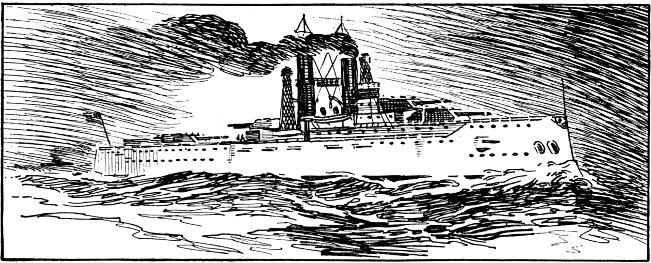
United States S. S. North Dakota
Forty Y. M. C. A. buildings could be built and equipped throughout for the cost of a battleship, each building accommodating the young men in a city of 200,000 people.
One 26,000-ton battleship ($12,000,000) + 20 years’ upkeep at $800,000 a year,—$28,000,000: Then the junk heap.
$28,000,000: 1,400 churches at $20,000 each, 7,000 farms at $4,000 each, a college education for 14,000 men or women at $500 a year for four years.
For past wars and preparation for war, $423,000,000, or 70 per cent.
Left for other purposes, $181,000,000, or 30 per cent.
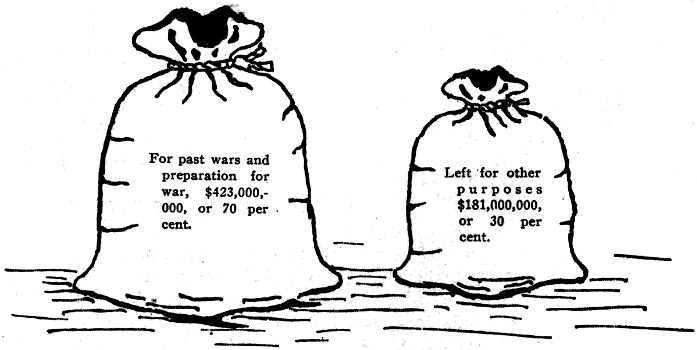
The Way of Militarism
Which benefits a few trusts and contractors and gives temporary and uneconomical employment, but which is rapidly impoverishing the nations.
Ordinary income of the United States for 1908–09, $604,000,000.
Our generation has not accepted Christ’s ideal of non-resistance, gentleness and humility. We believe in Dreadnaughts and armed regiments. At our conferences in The Hague and Mohonk we plead for peace; at our capitals we vote uncounted millions for cannon and bombshells. Disclaiming hypocrisy, we excuse ourselves by saying that the best way to preserve peace is to prepare for war, when in our hearts we know that a man who carries a concealed revolver in his pocket is a thousand times more likely to slay any chance enemy than if he had left his weapon at home or hurled it into the sea. We admire and love the Quaker—but we want him to stay in Philadelphia; the man we send to Washington must argue for us that a nation needs a war about once in thirty years.—N. D. Hillis.
(2025)
Military Sagacity—See Retreat Discouraged.
Millennial Possibilities—See Future Welfare.
Mind—See Mastery.
MIND-ACTIVITY
Dr. R. S. Storrs points out the activity of the mind and its persistence under great limitations in these words:
A universal spasmodic disease masters the organs of locomotion, so that the arm or the limb will remain in any posture, however unnatural, in which it is placed. The senses are usually entirely sealed, of no more avail than if they were obliterated. And the continued pulsation, with the warmth which this maintains in the system, are the only indications that life remains. Yet there have been authentic instances in which the mind, thus shrouded from sight, instead of being destroyed, impaired, or even limited, in its central force, has been stimulated to a more amazing activity, by being thus crowded, as it were, into a corner of its realm; and has feared and agonized, or has triumphed and exulted, with a vividness of experience altogether unaccustomed.
(2026)
Mind and Will Conquering Circumstances—See Physical Weakness Overcome.
MIND-HEALING
The story is told of a woman who called on a physician for nervous trouble. She was a woman whose ailments had worried and excited her to such a degree that she was threatened with nervous prostration. Said the doctor: “Madam, what you need is to read your Bible more.” She promptly began to take offense at the strange prescription. He told her he meant it. “Go home and read your Bible an hour a day; then come back to me a month from to-day.” She thought over the matter, recalled the fact that tho she was a professing Christian she had been neglecting to read her Bible, and so she decided to take his advice. At the end of the month she came back to the office a well woman. She felt like a different person. She needed no medicine. (Text.)
(2027)
MIND, THE HUMAN
In the yard stands the locomotive. It is a masterpiece of the mechanic’s art. Burnished and lubricated journals fit in boxes and connecting-rods are welded to connection. Valves, pistons and wheels are all ready for the harmonious interplay which makes this mass of metal a thing of power. The twin rails beckon it to be on its way; the machine itself pants impatiently; impulsively sobs the pop-valve. But the locomotive waits, must wait for the driver’s will. Not stoutest boiler or greatest head of steam can draw the train until the man reveals his mind to the locomotive.—T. C. McClelland.
(2028)
MINIATURE WORK
I have to-day a paper at home, as long as half my hand, on which was photographed the whole contents of a London newspaper. It was put under a dove’s wing, and sent into Paris, where they enlarged it, and read the news.—Wendell Phillips.
(2029)
Minister, The Little—See Child Religion.
MINISTRY, DIFFICULTIES OF THE
It is sometimes in order for the members of one profession to plume themselves at the expense of another. Especially does it seem to be the thought at times that the ministry is peculiarly a profession of ease. That there is a truer and deeper view, however, is seen in the following:
A barrister, accustomed to practise in criminal courts, made sneering remarks concerning preachers. “If,” said he, “I were to address a jury in the average way you clergymen do I should never get a conviction.” The elderly clergyman to whom he spoke, replied: “If you had to address the same jury 104 times a year, and your object was not to get them to give a verdict against some other person—which they might be willing to do—but to induce them to convict themselves, I doubt if you would do any better than we do.” Silence on the part of the barrister. (Text.)
(2030)
MINUTE, IMPORTANCE OF A
’Twas only a minute that would not stay, But how many noticed its flight? And yet for one it parted the way, Betwixt life’s bloom and its blight. It pointed the new-born baby’s breath, First felt on the mother’s breast; For another it sounded the summons of death And a weary one gone to his rest. At that moment two souls were together wed Till death should call them apart; Another to virtue bowed his head And consecrated his heart. Ah! big was the moment that flitted away, And hardly one noticed its flight; And hundreds of minutes make up the day, And hundreds are lost in the night. —Benjamin Reynolds Bulkeley, New England Magazine.
(2031)
MIRACLES
Whether the miracles of Jesus really happened or are merely legendary I do not know, and, if I may say it without irreverence, I do not care. They are not necessary to my Christianity, which, to say the truth, can better do without them. What is it to me, and to such as me, whether, in the little village of Bethany, Jesus did or did not raise to life one poor dead body, when I know that in the centuries since he has raised to life millions of dead souls? And what, after all, does it matter whether on the shores of the lake of Galilee on a late afternoon nearly two thousand years ago he gave one meal to five thousand persons by feeding them with a few loaves and fishes, when I know that all the world over, every day, every night, this very night, he is feeding countless millions of the poor, the opprest and the broken-hearted, making them forget their hunger and thirst and all the sufferings of their earthly existence in the bread of the Spirit that is the bread of life?—Hall Caine, Christian Commonwealth.
(2032)
Some wealthy Africans, with whom Kruger was traveling in the desert, found the food-hampers gone astray. “You are a great believer in miracles, Oom Paul,” said one of them. “Why can’t you arrange for heaven to send me victuals by the crows, as they were sent by the ravens to Elijah.” “Because,” said Oom, dryly, “Elijah was a prophet with a mission; you are a fool with an appetite.”
(2033)
MIRACLES, EVIDENTIAL VALUE OF
Whatever effect or lack of effect miracles have on modern minds, the following account shows that they are of first value to simple-minded natives. The writer is Sophie B. Titterington:
When the rumor flew around Aniwa that “Missi” (Dr. John G. Paton), was trying to dig water out of the ground, the old Christian chief tenderly labored with him. “Oh, Missi, your head is going wrong. Don’t let our people hear you talking about going down into the earth for rain, or they will never listen to your word, or believe you again.”
But the island was greatly in need of good water, and Dr. Paton dug away at the well, single-handed. It was hard, weary work. He hired some of the natives with fish-hooks to get out three pailfuls each, still doing most of the heavy work himself. But when the well was twelve feet deep, one side of it caved in. This gave the loving, troubled old chief another plea. He represented that if Missi had been in the hole that night, he would have been killed, and an English warship would have come to find out what had happened to the white man. They would not believe that Missi had gone into that hole of his own accord, but would punish them for his supposed murder.
When he was thirty feet down the earth became damp. That evening he said to the old chief with earnest solemnity, “I think that Jehovah God will give us water to-morrow from that hole.”
“No, Missi,” the faithful old fellow sighed. “You will never get rain coming up from the earth in Aniwa. We expect daily, if you reach water, to see you drop into the sea where the sharks will eat you!”
At daybreak. Dr. Paton went down and made a little hole in the center of the bottom of his well. He says: “I trembled in every limb when the water rushed up and began to fill the hole. Muddy tho it was, I eagerly tasted it, and the little cup almost dropt from my hand in sheer joy, and I fell upon my knees in that muddy bottom to praise the Lord. It was water! It was living water from Jehovah’s well!”
With superstitious fear the people gazed upon the jugful their Missi carried up. The old chief shook it, touched it, tasted it. “Rain! rain. Yes, it is rain!”
The back of heathenism was broken. A new order of things began in Aniwa. Family prayers and reverence for the Sabbath spontaneously grew up. The wonderful transformation which was wrought in the Aniwans became household talk all over the world. All this was hastened because the ambassador of Jehovah God had done what none of the gods of the islanders could have done—brought up rain from the ground! (Text.)
(2034)
Mirror, The, as a Revealer—See Self-inspection.
MISCALCULATION
What is said to be the largest plow in the world was made some years ago at Bakersfield, Cal. This plow was the result of the ingenuity of a ranch superintendent, who had authority to make improvements, but not to introduce steam-plows. The superintendent had grown very tired of preparing three thousand acres of land for wheat with ordinary nine- or twelve-inch plows drawn by two horses.
He argued that if two horses could pull a twelve-inch plow, six horses could pull a plow thirty-six inches wide, and that eight horses could pull a plow forty-eight inches wide. He made the calculations carefully, and, being clever with his pencil, made drawings also, and sent for blacksmiths and machinists to construct a plow on his principle.
Some simple folk told him that his great plow would not work, but they contented themselves with saying this dogmatically, without giving any mathematical reason therefore. So the superintendent went on with his plans.
The blacksmiths and machinists finished the plow in due time. The share was made to cut a fifty-inch furrow; the top of it reached five feet above the ground, to give room to throw the earth. The beam was more than a foot thick; but the machine was constructed to run between two great wheels, so that it could be turned around easily; and on the axle between these wheels was the seat for the man who was to drive the ten horses which were hitched to it.
The plow was brought to the great field, the ten horses were attached to it, the handles were raised, the driver mounted his seat, and the team was started. But as soon as the share struck well into the ground the horses stopt short. They were stuck fast. And yet the plow had not gone too deeply into the earth. But it was evident that they could not pull the plow. More horses were brought out, but not until fifty were attached did the plow move along.
Even then it required four men to hold the handles, in order to keep the plow in the furrow. It was an economic failure.
Then the superintendent, through the intervention of some one who was a better mathematician than he, learned that he should have cubed the capacity of his twelve-inch plow every time he doubled the width of it.—Harper’s Weekly.
(2035)
MISER, A WORTHLESS
A certain John Hopkins, familiarly known in his day for his rapacity as “Vulture Hopkins,” lived a worthless life but died possest of a million and a half dollars, left so as not to be inherited until after the second generation, so that, as he said, “his heirs would be as long spending it as he had been in getting it.” Pope preserved his memory in this couplet:
“When Hopkins dies a thousand lights attend The wretch who, living, saved a candle’s end.”
Such a life is properly to be condemned, altho its results may be useful to a subsequent generation.
(2036)
Miserliness—See Mammon-worship; Saving Disapproved.
MISERY AN EDUCATOR
How often I had traced the boy who had robbed the box-car with unerring precision to the big, lawless business man who controlled or directed a trust, debauched a legislature, bought a senatorship or united with the gamblers and dive-keepers to steal a public franchise. Why was there so much kindness and so little justice? Why were men good to children, to churches and universities, and still so unjust? And when the other fights were won, the fights for the playgrounds, the detention home school, the juvenile court and all it implies, the biggest fight of all was yet ahead. But that little fight helped us to see the necessity for the big fight. We were being educated through the misery and misfortune of the children.—Ben B. Lindsey, The Survey.