Cyclopedia of Illustrations For Public Speakers
Reading edition
ABBREVIATION
I remember a lesson in brevity I once received in a barber’s shop. An Irishman came in, and the unsteady gait with which he approached the chair showed that he had been imbibing of the produce of the still run by North Carolina moonshiners. He wanted his hair cut, and while the barber was getting him ready, went off into a drunken sleep. His head got bobbing from one side to the other, and at length the barber, in making a snip, cut off the lower part of his ear. The barber jumped about and howled, and a crowd of neighbors rushed in. Finally, the demonstration became so great that it began to attract the attention of the man in the chair, and he opened one eye and said, “Wh-wh-at’s the matther wid yez?” “Good Lord!” said the barber, “I’ve cut off the whole lower part of your ear.” “Have yez? Ah, thin, go on wid yer bizness—it was too long, anyhow!”—Horace Porter.
(1)
ABDICATION
“Uneasy lies the head that wears a crown.” If men who are obscure and quiet and tempted to envy the glory of kings they might profitably meditate on the speech that Shakespeare puts into the mouth of Richard II while he abandons his crown:
I give this heavy weight from off my head And this unwieldy scepter from my hand, The pride of kingly sway from out my heart; With mine own tears I wash away my value, With mine own hands I give away my crown, With mine own tongue deny my sacred state, With mine own breath release all duteous oaths.
(2)
Aberration, Mental—See Absent-mindedness.
Abhorrence, Instinctive—See Antipathy, Instinctive.
ABILITIES
Lord Bacon says that “natural abilities are like natural plants that need pruning by study.” Conversely untrained talents are like wild plants that degenerate when left to themselves.
(3)
Ability Commanding Trust—See Confidence.
Ability, Determining—See Worth, Estimating.
ABILITY, GAGE OF
Mr. Edmund Driggs, of Brooklyn, gives a motto that came into his life like an influence, and greatly helped him toward success. At the age of fifteen he left home to engage with an older brother in the freighting business on the Hudson River. The first duty he performed on the vessel was to go aloft to reef the pennant-halyards through the truck of the topmast, which was forty feet above the top of the mainmast, without any rigging attached thereto. When the sailing-master had arranged the halyards over his shoulder, with a running bowline under his right arm, he ordered him aloft. The new sailor looked at the sailing-master and then aloft, and then asked the question, “Did anybody ever do that?” “Yes, you fool,” was the answer. “Do you suppose that I would order you to do a thing that was never done before?” The young sailor replied, “If anybody ever did it, I can do it.” He did it. That maxim has been his watchword through life. Tho he is now over seventy years of age, he is still engaged in active business life, and whatever enterprise he undertakes the watchword still is, “If anybody ever did it, I can do it.” (Text.)—Wilbur F. Crafts, “Successful Men of To-day.”
(4)
ABILITY, USELESS
Plutarch says that a traveler at Sparta, standing long upon one leg, said to a Lacedæmonian, “I do not believe you can do as much.” “True,” said he, “but a goose can.”
There are many who have abilities to do greater things who are content to boast of some accomplishment as useless as standing on one leg.
(5)
Abnormality—See Deformity.
ABSENT-MINDEDNESS
A Canadian farmer, noted for his absent-mindedness, went to town one day and transacted his business with the utmost precision. He started on his way home, however, with the firm conviction that he had forgotten something, but what it was he could not recall. As he neared home, the conviction increased, and three times he stopt his horse and went carefully through his pocketbook in a vain endeavor to discover what he had forgotten. In due course he reached home and was met by his daughter, who looked at him in surprize and exclaimed, “Why, father, where have you left mother?”—Leslie’s Weekly.
(6)
There are many firm believers in the theory that most people are crazy at times, and facts seem to support their belief. The following will possibly remind a number of our readers of some incident in their experience, which at the time of its occurrence seemed to them most unaccountable:
A wise man will step backward off a porch or into a mud-puddle, a great philosopher will hunt for the spectacles that are in his hand or on his forehead, a hunter will sometimes shoot himself or his dog. A working girl had been feeding a great clothing knife for ten years. One day she watched the knife come down slowly upon her hand. Too late she woke out of her stupor with one hand gone. For a few seconds her mind had failed, and she sat by her machine a temporary lunatic and had watched the knife approach her own hand. A distinguished professor was teaching near a canal. Walking along one evening in summer, he walked as deliberately into the canal as he had been walking along the path a second before. He was brought to his senses by the water and mud and the absurdity of the situation. He had on a new suit of clothes and a new silk hat, but, tho the damage was thus great, he still laughs over the adventure. Our mail collectors find in the iron boxes along the streets all sorts of papers and articles which have been put in by some hand from whose motions the mind has become detached for a second. A glove, a pair of spectacles, a deed, a mortgage, a theater ticket, goes in, and on goes the person, holding on to the regular letter which should have been deposited. This is called absent-mindedness, but it is a brief lunacy.—Public Opinion.
(7)
Absentees—See Excuses.
Absolution—See Forgiveness, Conditions of.
ABSORPTION
The Italian mothers get for nurses the most beautiful persons, because they believe that by constantly looking into such faces the infant will unconsciously take on some of the beauty of the nurse.
This may be a fiction; but we do know that where there is mutuality of interest and deep affection, persons thrown closely together, in the process of the years, take on traits each of the other.
(8)
See Beautiful Life, Secret of; Language, Formation of.
Absorption in One’s Art—See Thoroughness.
ABSORPTION, MENTAL
The anecdote is a familiar one in the history of painting, of the artist employed upon the frescoes of a dome, who stept back to see from a better point of view the work which he had done, and became so absorbed in comparing the scenes which he had depicted with the forming idea as it lay in his mind, that still proceeding backward he had reached the edge of the lofty scaffolding, when a pupil, observing his instant peril, and afraid even to shout to him, rushed forward and marred the figures with his trowel, so calling back and saving the master. The mind, engrossed in its own operation, had forgotten the body, and was treating it as carelessly as the boy treats the chip which he tosses on the wave.—Richard S. Storrs.
(9)
See Assimilation.
ABSTAINERS LIVE LONG
An interesting investigation was conducted by the Associated Prohibition Press in April, 1909, as to the causes of death in the city of Chicago of all men who had reached the age of sixty years and over, and whose death was reported during that month. Every death reported in Chicago during this month of April was carefully investigated for the purpose of securing an accurate memorandum of the age, nationality, and cause of death.
Out of 155 men concerning whose deaths this data was obtained, it was found that 73 had been total abstainers, 75 moderate drinkers, and 4 were said to be heavy drinkers. The age ranged from 60 to 92 years.
On the basis of the facts secured in this investigation, the drinking men, by their use of alcoholic poison, shortened their lives nearly four years.
In the aggregate, therefore, by means of its subtle poison, alcoholic liquor helped to deprive these 79 victims of a total of more than 334 years of active life which their abstaining contemporaries had lived to enjoy.—“American Prohibition Yearbook.”
(10)
Abstinence as an Example—See Example.
ABSTINENCE, DIFFICULTY OF
There was a certain ancient colored gentleman who was addicted to the habit of excessive drink. When asked why he didn’t quit he replied:
“It’s dis here way, boss. Jus’ as long as I kin quit when I wants ter I ain’t in no danger. Jus’ as soon as I fin’ I kain’t quit I’s gwine t’ swar off.”
There are numbers of drinking men who keep right on because they think they can stop when they want to. They frequently find out too late that they can not quit.
(11)
ABSURD NOTIONS
I stumbled upon an English book of etiquette the other day. In it I found this curious statement: “A gentleman may carry a book through the streets if it is not wrapt, but if it is done up in wrapping paper it becomes a parcel and must be carried by a servant.” The wrapping-paper makes a wonderful difference. And so absurd are the fashionable ideas of refinement and gentility.—Obadiah Oldschool, The Interior.
(12)
ABSURDITY IN NOMENCLATURE
All who have seen the ancient maps of North Carolina will remember Win-gin-da-coa as its name. This was the first thing said by a savage to Raleigh’s men. In reply to the question, “What is the name of this country?” he answered, “Win-gin-da-coa.” It was afterward learned that the North Carolina aborigine said in this phrase, “Those are very fine clothes you have on.” And so North Carolina carried a fashion-plate label to unsuspecting readers.—Edward Eggleston.
(13)
Abundance and Incompetency—See Opportunities Unutilized.
Acceleration of Life—See Fast Living.
Accident as a Minor Thing—See Misfortune, Superiority to.
Accident—See Loss and Profit.
ACCIDENTAL DISCOVERY
Argand, the inventor of the famous lamp which bears his name, had been experimenting for some time in trying to increase the light given out by his lamp, but all to no purpose. On a table before him one night lay an oil-flask which had accidentally got the bottom broken off, leaving a long-necked, funnel-shaped tube. This Argand took up carelessly from the table and placed—almost without thought, as he afterward related—over the flame. A brilliant white light was the magical result. It is needless to add that the hint was not lost by the experimenter, who proceeded to put his discovery into practical use by “inventing” the common glass lamp-chimney. Hundreds of discoveries which have been heralded to the world as the acme of human genius have been the result of merest accident—the auger, calico printing and vulcanization of rubber being among the number.—St. Louis Republic.
(14)
See Discovery, Accidental; Insulation.
ACCIDENTAL SUCCESS
Protogenes, the Greek painter, was an impatient man. In painting a picture of a tired, panting dog, he met with satisfactory success except that he failed in every attempt to imitate the foam that should have been seen on the dog’s mouth. He was so much provoked over it, that he seized the sponge with which he cleansed his brushes, and threw it against the picture with the intention of spoiling it. It happened to strike on the dog’s mouth, and produced, to the astonishment and delight of the painter, the very effect that he had labored so persistently to imitate.—Frank H. Stauffer, The Epoch.
(15)
ACCIDENTS
Man’s increasing wisdom and growing regard for his fellow man will some day result in a better state of things than is here indicated:
According to an estimate made by Mr. Frederick L. Hoffman, of the Prudential Insurance Company, the annual rate of fatal accidents in American cities is between 80 and 85 in each 100,000. On a basis of 80,000,000 population, this would mean a yearly loss of about 65,000 lives. By the same authority it is calculated that 1,664,000 persons are badly injured every year, and that some 4,800,000 receive wounds of a less serious character. We have a yearly list of fatalities somewhere between 64,000 and 80,240, and of serious maimings of 1,600,000; whereas two great armies, employing all the enginery of warfare, could succeed in slaughtering only 62,112 human beings yearly. (Text.)
(16)
ACCOMMODATION
According to a story told by Rev. J. Ed. Shaw, of Hammonton, N. J., a man should always adapt himself to local conditions if he wants to slip along without falling over his feet.
Some time ago, Mr. Shaw said, a little colored congregation over in Jersey invited a preacher friend of his to occupy their pulpit at the coming Sunday evening service, and the good dominie, wishing to encourage the colored brethren, readily complied.
Reaching the church where he was the only paleface present, the preacher delivered a sermon full of helping advice, made an eloquent prayer, and then announced that the service would be closed by singing the hymn, “Wash Me and I Shall Be Whiter Than Snow.” At this point one of the darksome congregation rose to his feet.
“Look heah, pahson,” said he impressively. “Yo’ will hab to ’scuse me, but I rise to a point ob ordah.”
“What is it?” asked the preacher, with large symptoms of surprize floating over his features.
“It am dis way,” replied the parishioner. “Yo’ hab ebidently made a mistake in de crowd. Dis am a cull’ed congregashun, an’ s’nce all de pump watah an’ sof’ soap in de county can’t make de words ob dat hymn come true, I jes’ wish dat yo’ would change her to some uddah tune.”—Philadelphia Evening Telegraph.
(17)
ACCOMPLISHMENT
Among the influential public men who were wild in their unreasonable prejudice against Grant and cried aloud for his dismissal, was Col. Alexander K. McClure, of Philadelphia. He could not see how the President could sustain himself if he persisted in retaining Grant. So he went to Washington to counsel with Mr. Lincoln, and urge him in the name of the people to remove Grant without delay. I will let the Colonel tell in his own way the result of his visit to the President:
“I appealed to Lincoln for his own sake to remove Grant at once, and in giving my reasons for it I simply voiced the admittedly overwhelming protest from the loyal people of the land against Grant’s continuance in command.... When I had said everything that could be said from my standpoint, we lapsed into silence. Lincoln remained silent for what seemed a very long time. He then gathered himself up in his chair and said in a tone of earnestness that I shall never forget: ‘I can’t spare this man; he fights.’ That was all he said, but I knew that it was enough, and that Grant was safe in Lincoln’s hands against the countless hosts of enemies.”—Col. Nicholas Smith, “Grant, the Man of Mystery.”
(18)
See Work versus Worker.
Accounting—See Balance, A Loose.
Accuracy—See Punctiliousness in Little Things.
ACCUSATION INSUFFICIENT
When Numerius, governor of the Narbonnoise Gaul, was impeached for plunder of his province, he defended himself, and denied the charge and explained it away so skilfully that he baffled his accusers. A famous lawyer thereupon exclaimed, “Cæsar, who will ever be found guilty, if it is sufficient for a man to deny the charge?” To which Julian retorted, “But who will appear innocent, if a bare accusation is sufficient?” (Text.)
(19)
ACHIEVEMENT
The Denver Republican recently contained this brief account of a farmer working heroically on a one-man railroad, and remarked that it is typical of the individual spirit that has achieved great things in the West:
The story of the Kansas farmer, who, with a scraper and a pair of mules, is building a fifty-mile railroad, would indicate that the supply of courageous men is not entirely exhausted.
The farmer who is tackling this tremendous job alone and who is serenely indifferent to all the jeers of his neighbors, scorned to admit defeat when he could not interest any one with capital in the road which he deemed necessary. He went to work with such material as he had at hand and, somehow, even without seeing the man or knowing aught of his project, one can not help sharing the farmer’s belief that he is to “carry the thing through.”
(20)
ACKNOWLEDGMENT
Pyrrhus, King of Epirus, was kind and courteous to his army, both to officers and soldiers. He shared the toils and hardships of those who were under his command. He gave them, too, their share of the glory which he acquired, by attributing his success to their courage and fidelity. At one time, after some brilliant campaign in Macedonia, some persons in his army compared his progress to the flight of an eagle. “If I am an eagle,” replied Pyrrhus, “I owe it to you, for you are the wings by means of which I have risen so high.”
(21)
ACQUAINTANCES
If we could prove by statistics the number of acquaintances a man had fifty years ago, and those which the modern man has, the difference would be enormous. The tendency is everywhere to enlarge one’s circle—ambitious people with discernment, but the foolish, blindly, without any interest or inclination to guide them. I once heard a woman announce with pride, “I have 2,000 visits to make this winter.” She flaunted this fact before her less favored friends, who had only 1,000 names on their visiting lists. Could there be anything more futile than this thirst for increasing one’s bowing acquaintances? What useless ballast are these interminable lists, in which no place is left for an hour’s intelligent or affectionate intercourse. The habit of going from drawing-room to drawing-room gives certain persons a style in conversation that is as flat as a well-drest stone, not one spontaneous word in it, not an angle, not a defined form!—Dora Melegari, “Makers of Sorrow and Makers of Joy.”
(22)
Acquiescence in Temptation—See Desires, Inordinate.
ACQUIESCENCE TO PROVIDENCE
Each branch of a vine is bound to a certain point of its wall or its conservatory. It is not growing just where and how it would spontaneously and naturally choose, but is affixt there contrary to its natural bent, in order that it may catch the sunbeams at that point and cover that spot with beautiful foliage and luscious fruit.
Sorrow is like the nail that compels the branch to grow in that direction; inevitable circumstance is like the rough strip of fiber which bends the branch, and pain is like the restraint which is suffered by the branch which would have liked to wander at its own will. We are not to murmur or repine at our lot in life, but are to remember that God has appointed it and placed us there. (Text.)
(23)
ACQUISITION
An interesting side-light on the kind of men who attend the classes of the city evening technical schools was given by a commissioner of the Board of Education in a recent address to young men:
“I visited the forge-room” (said he), “where a class of twenty-five young blacksmiths were shaping and welding various models of iron bars and iron blades. It was an inspiring scene. No man, however indolent or indifferent to the world’s work, could have looked on without having his ambitions revived. The glowing metal yielded to the hammer blows of these youthful artizans, because interest in their work and a desire to become producers directed their bare and brawny arms. I walked about unnoticed. They felt no interest in commissioners of education. At one of the anvils I noticed a particularly fine, well-built young fellow. He was wholly absorbed in his work, so when I picked up the book he had partly hidden under his cap on his toolbench it did not attract his attention. What book do you think it was? Oh, no, not a treatise on tool-work in iron; that would have been fine. It was something even finer than that. The book was a copy of Vergil’s ‘Eneid’ and the marginal notes on the pages show that he was as ambitious to acquire a taste for good literature as for the possession of technical skill.”—New York Press.
(24)
ACTING, ACTOR AFFECTED BY
The following remembrance of Henry Irving is given by his friend and associate Ellen Terry:
My greatest triumph as Desdemona was not gained with the audience, but with Henry Irving! He found my endeavors to accept comfort from Iago so pathetic that they brought the tears to his eyes. It was the oddest sensation, when I said, “Oh, good Iago, what shall I do to win my lord again?” to look up—my own eyes dry, for Desdemona is past crying then—and see Henry’s eyes at their biggest, luminous, soft, and full of tears! He was, in spite of Iago and in spite of his power of identifying himself with the part, very deeply moved by my acting.
(25)
ACTION, INSTANT
I have seen ten years of young men who rush out into the world with messages, and when they find how deaf the world is, they think they must save their strength and get quietly up on some little eminence from which they can make themselves heard. “In a few years,” reasons one of them, “I shall have gained a standing, and then I shall use my power for good.” Next year comes, and with it a strange discovery. The man has lost his horizon of thought. His ambition has evaporated; he has nothing to say. The great occasion that was to have let him loose on society was some little occasion that nobody saw, some moment in which he decided to obtain a standing. The great battle of a lifetime has been fought and lost over a silent scruple. But for this the man might, within a few years, have spoken to the nation with the voice of an archangel. What was he waiting for? Did he think that the laws of nature were to be changed for him? Did he think that a “notice of trial” would be served on him? Or that some spirit would stand at his elbow and say, “Now’s your time?” The time of trial is always. Now is the appointed time. And the compensation for beginning at once is that your voice carries at once. You do not need a standing. It would not help you. Within less time than you can see it, you will have been heard. The air is filled with sounding-boards and the echoes are flying. It is ten to one that you have but to lift your voice to be heard in California, and that from where you stand. A bold plunge will teach you that the visions of the unity of human nature which the poets have sung were not fictions of their imagination, but a record of what they saw. Deal with the world, and you will discover their reality. Speak to the world, and you will hear their echo.—John Jay Chapman.
(26)
Activity and Light-giving—See Light and Activity.
Activity and Thought-training—See Thinking, How Coordinated.
Actors Become Preachers—See Evangelism, Unusual.
ADAPTABILITY
As an illustration of adaptability to circumstances and the willingness to take chances in order to achieve results of any kind, of the men who open up a new country to civilization, a recent incident is instructive:
A little schooner reached Seattle recently from Nome, on Bering Sea. She had made the voyage down during the most tempestuous season of the year in the North Pacific, and had survived storms which tried well-found steamships of the better class. Yet there was not a man on board, from the captain down, who had ever made a voyage at sea, save as passengers, on a boat running to Alaska. There were no navigating instruments on board save a compass and an obsolete Russian chart of the North Pacific.
These men wanted to come out for the winter, and there was no other way within their means to accomplish the trip. They got hold of the schooner and they started with her. They were not seamen or navigators, simply handy men who were accustomed to doing things for themselves. This was out of the routine, but they did it.
(27)
The men who made the voyage down from Nome in a little schooner without any previous knowledge of seamanship probably saw nothing remarkable in the feat. They were used to doing things that had to be done with the material that came to hand, whether they knew anything about how it should be done or not.—Seattle Post-Intelligencer.
(28)
ADAPTATION
If we are unable to bring our surroundings into subjection to our desires, we can often moderate our desires to the measure of our surroundings.
The colonel of a volunteer regiment camping in Virginia came across a private on the outskirts of the camp, painfully munching on something. His face was wry, and his lips seemed to move only with the greatest effort.
“What are you eating?” demanded the colonel.
“Persimmons, sir.”
“Good heavens! Haven’t you got any more sense than to eat persimmons at this time of the year? They’ll pucker the very stomach out of you!”
“I know, sir. That’s why I’m eatin’ them. I’m tryin’ to shrink me stomach to fit me rations.”
(29)
Numerous are the animals that, escaping persecution, have adapted themselves to the altered conditions. Was this adaptation unconscious on their part? There was room and to spare when it was in progress, and did not choice enter into the problem? Or was it mere chance that they stayed near or even in habitations, and with no more volition than the autumn leaves that now filled the air?
It may be mere coincidence, but the skunk that lived under the doorstep yet gave no sign of its presence; the raccoon that occupied a clothes-line box and was not suspected; the opossum that lived in a hollow tree within ten feet of the house and was discovered only by accident—all suggest to me that they considered the several situations, and realizing their advantages in the matter of food supply, were willing to take the chances; yet a fine bit of primitive woodland was not fifty yards away.—C. C. Abbott, New York Sun.
(30)
Why should we not adapt our moral seed-sowing for character to the different types of men as carefully as agriculturists do after close study of the different types of soil?
“The greatest surprize to the agriculturist,” said Mr. David G. Fairchild, “and one which will throw into confusion the calculations of the economist, will come through the utilization of what are now considered desert lands, for the growing of special arid-land crops requiring but a fraction of the moisture necessary for the production of the ordinary plants of the eastern half of the United States, such as corn and wheat.
“We are finding new plants from the far table-lands of Turkestan and the steppes of Russia and Siberia, which grow luxuriantly under such conditions of aridity that the crops of the Mississippi Valley farms would wither and die as tho scorched by the sirocco.”—The Technical World.
(31)
See Poisons and Medicine.
Adaptation, Lack of—See Accommodation.
ADAPTING THE BIBLE
The postulate that any portion of the Scripture is as serviceable as any other portion for the purpose of stimulating and nourishing the moral and religious growth of children, regardless of their age—the Bible itself refutes this postulate. In 1 Peter 2:2, “As new-born babes desire the sincere milk of the word.” We have a very plain assertion of the need of different food for different stages of growth in the spiritual life, the assertion clothing itself in terms of the food for the several stages of the physical life. In 1 Cor. 3:2, “I have fed you with milk and not with meat,” we have the same truth set forth by another writer, who employs the same physical analogy. When we turn to Hebrews we find the author employing in more detail the same analogy to teach the same fact—Heb. 5:12–14. Here we really have granted, embryonically, it may be, the principle that is striving to-day for recognition at the hands of the religious teaching world.—A. B. Bunn Van Ormer, “Studies in Religious Nurture.”
(32)
Adding More—See Margins of Life.
Adjustment—See Unfitness.
Admiration, Unspontaneous—See Praise-seeking.
Adolescence—See Loyalty, Spirit of.
Adolescent Folly—See Kindness.
Adoption—See Sympathy, Practical.
ADVANCEMENT, RAPID
When things all move so fast, Christian men must be wide-awake if they would have morals and religion keep pace with material progress:
Such is the pace at which we live to-day that, while millions of people in this country have not yet got up to the stage of “civilization” represented by the use of gas, but when they encounter it casually employ it suicidally, other millions have outgrown and discarded it, and will have none of it even for a curling-iron or a chafing-dish, let alone for lighting. To put it briefly, the use of electricity for lighting in New York State alone has increased over 2,000 per cent in ten years, and the use of electricity for power, also from central stations, has increased in the decade nearly 1,200 per cent. And yet the electricians are inclined to think they have only just started in. (Text.)—The Electrical World and Engineer.
(33)
ADVANTAGE, WORKING TO THE BEST
If we all worked at what we could do best, not only would more work be done, but most of life’s friction and worry would be eliminated.
The English are a ballad-loving people, and few singers could sing a ballad like Antoinette Sterling. She sometimes, but rarely, sang classical music. She knew where she was the strongest, and she wisely kept in that direction, with the result that she shared the same popularity which the English people extended to Sims Reeves, the favorite tenor balladist. It was enough to insure the success of a new song to have it sung by Madam Sterling, and success in London means heavy royalties to singer as well as composer. (Text.)—Chicago Tribune.
(34)
ADVERSITY
The whole tenor of the New Testament inculcates the principle of resignation under adverse conditions, and more. For the follower of Jesus Christ must not be merely a passive sufferer but a strenuous and persevering combatant against opposing force.
Tourists along the shores of the Mediterranean express their surprize at the insipidity of the fishes served up for food. This flavorless quality is easily accounted for. The fish around the shores of Spain, Italy, Greece, and Asia Minor are mostly caught in the quiet lagoons or calm waters of protected bays and gulfs, where they swim lazily and slowly, or bask indolently in the quietude. How different is the life of battling with storm and tempest on the part of the creatures that inhabit the rough waters around the Orkneys, the Shetlands, and the Hebrides of Scotland! Fish caught there is always delicious. (Text.)
(35)
See Affliction Producing Virtue.
ADVERSITY HELPING GENIUS
There is an apprenticeship to difficulty, which is better for excellence sometimes than years of ease and comfort. A great musician once said of a promising but passionless young singer who was being educated for the stage: “She sings well, but she lacks something which is everything. If she were married to a tyrant who would maltreat her and break her heart, in six months she would be the greatest singer in Europe.”—James T. Fields.
(36)
ADVERTISING
Mr. George Hibbard discovers a new literature in process of development, born of the needs of modern advertising. In The Booklover’s Magazine he writes:
The modern advertisement is worth looking at, whether it is the sounding proclamation of some big corporation, with facts and figures both weighty and impressive, or the light eye-catching notice of some simple trade or contrivance. All forms of literary composition find place in the advertising pages: history, story, verse. Many advertisements measure up to the test of good literature. In truth, there is often an uncommon amount of character in them. A word here or a phrase there is often singularly vivid as “local color,” and behind many an advertisement it is possible to see a vigorous personality. Nor are there lacking in this new literature qualities of humor, both intentional and unintentional. One generation writes an epic, another an advertisement; who shall say that one manifestation is not as important as the other.
(37)
Going into a green field surrounded by beautiful trees, we were once shocked by seeing painted upon a large rock the injunction, “Prepare to meet thy God.” This was the work of some ardent religionist who was entirely unconscious that this was a holy place. God was there, altho he knew it not, else he would not have intruded in that sacred place with his vulgar application of a venerable injunction.—The Christian Register.
(38)
See Publicity; Wholeness.
Advertising, Novel—See Foolishness Sometimes is Wisdom.
ADVERTISING, PERSISTENCY IN
Any patent medicine, however worthless, will make its advocate rich if he will only persist in advertising it. The dear public succumb in the long run. They can not stand up under the continuous force of his big-lettered suggestions. They rather enjoy being humbugged. What splendid advantage the big stores take of this weakness on our part! All they need do is to keep offering suggestions of cheapness or of the supposed worth and imagined usefulness of their wares, and multitudinous innocent ones, whose sole interests the advertiser seems to have at heart, take hold of the tempting bait.—Robert MacDonald.
(39)
Advice, Bad—See Success too Dear.
Advice, Benefiting by—See Mind-healing.
ADVICE, DISREGARDED
We were so sure in the Philippines that we could not get too much light that we built our houses to admit it in floods, and contemptuously disregarded the English and Dutch experience of two centuries. We called people lazy if they hid themselves at midday, and we bravely went abroad in the full glare of the light. Even the heavily pigmented Filipinos darkened their houses, and were astounded at our foolishness in doing what they did not dare to do. Collapse always came in time—if not a real collapse, at least a degree of destruction of nervous vigor which demanded a return to darker climates to escape chronic invalidism or even death.—Major Charles E. Woodruff, Harper’s Weekly.
(40)
ADVICE, UNWELCOME
Andy McTavish was “no feelin’ juist weel,” so he went to the doctor and stated his complaints.
“What do you drink?” demanded the medico.
“Whusky.”
“How much?”
“Maybe a bottle a day.”
“Do you smoke?”
“Yes.”
“How much?”
“Two ounces a day.”
“Well, you give up whisky and tobacco altogether.”
Andy took up his cap and in three steps reached the door.
“Andy,” called the doctor, “you have not paid for my advice!”
“Ahm no’ takkin’ it,” snapt Andy, as he shut the door behind him.
(41)
AERIAL ACHIEVEMENT
Gen. Count Ferdinand von Zeppelin, in the world’s first aerial liner, at the ripe age of nearly seventy-two years, performed a magnificent flight of 250 miles from Friedrichshafen to Düsseldorf. The New York Times says of him:
He presents one of the finest examples in history of effort concentrated on a single object, of failure after failure borne with courage, of refusal to give up, of final triumph.
He has had a career which in the case of most men would have been regarded as sufficiently full of honor many years ago. He served in the American civil war as a cavalry officer on the Union side, becoming an intimate friend of the late Carl Schurz, and when he returned to Europe he took part in the Austro-Prussian War of 1866 and in the Franco-Prussian War of 1870.
As late as 1907 such words as these could be written about Count von Zeppelin and generally regarded as describing him: “He has sacrificed half a century of time, his wealth, his estates, his reputation, his happiness, his family life, in a futile attempt to solve the problem of flying. It is practically certain that after fifty years of unexampled perseverance Count Zeppelin is doomed to complete failure. There is something unspeakably tragic in the fate of this high-minded aristocrat.”
His failures continued for some time after this verdict was written, but at length the world was startled by the splendid flights made by his dirigible “No. 4,” and when that vessel was wrecked in August, 1908, the German Government and the German people combined to aid the old patriot and inventor to make good his loss.
(42)
Aeroplane—See Tendencies, Inherited.
Affection, Disinterested—See Friends, Keeping.
Affection for Animals—See Animals, Absurd Fondness for.
Affections Misplaced—See Animals, Absurd Fondness for.
AFFLICTION
At some famous pottery works a visitor selected for purchase an exquisite model of Dante and Beatrice. The price was, however, far greater than he anticipated, being treble what had been asked for some other specimens of the potter’s handiwork. “Why is this so much more expensive?” he asked. “Because it has passed more often through the furnace,” was the reply.
God sends His children sometimes through repeated furnaces of affliction in order that their characters may attain a rare and priceless perfection. (Text.)
(43)
AFFLICTION PRODUCING VIRTUE
The editor of The United Presbyterian writes thus:
On a recent evening during a severe hailstorm we opened our door to observe the progress of the storm, and were surprized to find the air laden with the odor of nasturtiums. There were porch-boxes containing nasturtiums, geraniums and other flowering and foliage plants. Beds of nasturtiums were by the street’s side and at the side of the lawn, and into these the hail had fallen, beating down and breaking the vines until the porch floor and the ground beneath the boxes and the vines were covered with ends of broken sprays, leaves and bright bits of yellow and gold, scarlet and maroon of the mangled flowers. But the air was full of the sweetness of the crusht and wounded vines. They were returning good for evil in the misfortune that had come upon them. For every wound that the hail had made they were giving out the fragrance of a beautiful spirit. Tho bruised and broken, they were filling the whole atmosphere with an aroma which was in beautiful contrast to the adverse rain of hail that still rattled on the roofs and walks and fell among the prostrate vines. Blest is that life which can yield its sweetest fragrance when the storms are at their highest. We have all known men and women who, when lacerated with pain, prostrate under the hand of God, have made the very atmosphere of the sick-room redolent with the incense of Christian hope and trust.
(44)
AFFLICTION, USES OF
The Scriptures say that “It is good to be afflicted,” and experience has her own confirmatory word:
The waters go out over the fields, leaving a waste, where pasture and corn-field had been, and then gradually subside. What have the waters done? Have they ruined the labors of the year? They who do not know Egypt might think so indeed, but the peasants know that to that yearly flood they owe the fertility of the land, that it is that which makes the crops grow and enables them to gather in the harvest. So it is with the river of the grace of God: the waters at times overflow their banks, and one seems to be overwhelmed; the soul is borne down by the flood, all her fruitful land is covered by the waters—waters of desolation, bereavement, affliction. “I am overwhelmed, undone; God has smitten me; my life is all wrong; I shall never smile again.” Nay, the flood which terrifies thee is the water of the river of God. The water is washing away the impurity of thy soul, giving thee fertility; the fruits of love, patience, charity, shall grow now; it is not a flood of desolation, but of blessing and fruitfulness. (Text.)
(45)
Afraid of the Darkness—See Fear of Man.
AFFLUENCE, THE PRINCIPLE OF
The structural provisions of the living organism are not built on the principle of economy. On the contrary, the superabundance of tissues and mechanisms indicates clearly that safety is the goal of the animal organism. We may safely state that the living animal organism is provided in its structures with factors of safety at least as abundantly as any human-made machine.
The moral drawn from these facts is that to govern the supply of tissue and energy by means of food, nature indicates for us the same principle of affluence which controls the entire construction of the animal for the safety of its life and the perpetuation of its species. In other words, we should eat not just enough to preserve life, but a good deal more. In such cases safety is more important than economy.—S. J. Meltzer, Science.
(46)
AGE
“There are in the suburbs of Rome,” says Cosmos, “two farms where antique medals are made in large quantities. This would seem to be a singular agricultural product, yet nothing is more exact. The people who devote themselves to this odd industry cause to be swallowed by turkeys coins or medals roughly struck with the effigy of Tiberius or Caligula. After remaining for some time in the bodies of the fowls, the little disks of metal become coated with a remarkable ‘patina.’ If this coating were only the result of the gastro-intestinal voyage, it would be easy to secure it by treating the coins to be aged with dilute hydrochloric acid, for instance. But the mechanical action of the tiny stones contained in the gizzard is added to the purely chemical action of the gastric juice, partially effacing the figures and toning down the hardness of the features. It is to be feared that some of the specimens in our public collections have been obtained by this curious process.”
(47)
AGE AND EXPERIENCE
We might find an argument against the “dead line” in such facts as the following:
We make a great mistake in America when we lay our older men on the shelf, while they are still in their prime as counselors. Benjamin Franklin was sent to France as a minister when he was seventy years old, and the best work he did for his country, he did between his seventy-first and seventy-eighth years. The State of New York had an absurd statute which removed Chancellor Kent from the bench because he was sixty-five. After that time he wrote and published his “Commentaries,” a book recognized as one of the most important books in the study of our jurisprudence. So much good did the country gain from one of the frequent absurdities of New York legislation. In England, Lord Palmerston and Mr. Gladstone are recent instances, well remembered, of the force which statesmen gain, almost by the law of geometrical progression, from their memory of the experiments which fail, from what I call organic connection with the national life of the last two generations.—Edward Everett Hale, The Chautauquan.
(48)
AGE AND ORATORY
This is the description of one who had the privilege of hearing Gladstone, in the autumn of 1896, make his last great oration in Liverpool:
See the old man with slow and dragging steps advancing from the door behind the platform to his seat before that sea of eager faces. The figure is shrunken. The eyelids droop. The cheeks are as parchment. Now that he sits, his hands lean heavily upon his staff. We think, “Ah, it is too late; the fire has flickered out; the speech will be but the dead echo of bygone glories.” But lo! he rises. The color mantles to his face. He stands erect, alert. The great eyes open full upon his countrymen. Yes, the first notes are somewhat feeble, somewhat painful; but a few minutes pass, and the noble voice falls as the solemn music of an organ on the throng. The eloquent arms seem to weave a mystic garment for his oratory. The involved sentences unfold themselves with a perfect lucidity. The whole man dilates. The soul breaks out through the marvelous lips. Age? Not so! this is eternal youth. He is pleading for mercy to an outraged people, for fidelity to a national obligation, for courage and for conscience in a tremendous crisis. And the words from the Revised Version of the Psalms seem to print themselves on the listener’s heart: “Thou hast made him but little lower than God, and crownest him with glory and honor.” (Text.)
(49)
AGE, THE NEW
Frederick Lawrence Knowles writes this optimistic outlook for the future:
When memory of battles, At last is strange and old, When nations have one banner And creeds have found one fold, When the Hand that sprinkles midnight With its powdered drift of suns Has hushed this tiny tumult Of sects and swords and guns; Then Hate’s last note of discord In all God’s worlds shall cease, In the conquest which is service, In the victory which is peace! (Text.)
(50)
AGENTS, INSIGNIFICANT
Nature shows how the weakness of God is immeasurably stronger than men; so does history with equal clearness. The oft-quoted saying, “Providence is always on the side of the big battalions,” is one with an imposing sound, but it is disproved by history over and over again. Some of the decisive battles of the world were won by the small battalions. More than once has the sling and the stone prevailed against the Philistine army. Battles are won by the big brain; and wherever that may be, slight weapons and resources are sufficient for splendid victories. Now the all-wise God sits on the throne of the world, and we are often filled with astonishment at the insignificant agents with which heaven smites its foes, and causes victory to settle on the banners of right and justice. The world’s Ruler defeated Pharaoh with frogs and flies; He humbled Israel with the grasshopper; He smeared the splendor of Herod with worms; on the plains of Russia, He broke the power of Napoleon with a snowflake. God has no need to dispatch an archangel; when once He is angry, a microbe will do. (Text.)—W. L. Watkinson, “The Transfigured Sackcloth.”
(51)
AGGREGATION
A drop of rain is a very little thing, but here is a calculation of a rainfall:
The rain fell in buckets, the thunder racketed terribly, and the lightning drew zigzag lines of bright gold upon the violet sky.
“So you, too, don’t know what an inch of rain is exactly,” said the weather clerk, as he looked at his rain-measuring instrument. “Very few people do, it seems. I’ll explain it to you.
“An acre is 6,272,640 square inches. An inch of water on an acre is therefore 6,272,640 cubic inches. That amount, at 227 cubic inches to the gallon, equals 22,000 gallons, or 220,000 pounds, or 100 tons.
“An inch of rain is, in other words, rain falling at the rate of 100 tons to the acre.”
(52)
AGGRESSION
Many fail through over-caution. A course duly weighed, venture all.
In a more recent number of Robert L. Taylor’s magazine, a leading article speaks of Admiral Farragut, at Mobile. The Brooklyn hesitated to go forward. “What’s the matter?” asked the Admiral. “Torpedoes,” replied the captain. “D——n the torpedoes,—full speed against the enemy!” He meant no profanity, but it was a time for action of the most pronounced sort. The best protection against the enemy’s fire is a well-directed fire from our own guns.
General Grant in the civil war of 1861–65 said, “The best defense of Washington is an army before Richmond.” These epigrammatic maxims are the best accepted fighting rules known to warfare to this day.
(53)
Colonel Henderson, of the British Army, says in the Science of War:
The Federal strategy in the last year of the war, with Grant in command and Sherman his lieutenant, stands out in marked relief to the disjointed, partial, and complicated operations of the previous years.... Grant seems to have been the first to recognize that, as von Moltke puts it, the true objective of a campaign is the defeat of the enemy’s main army.... General Sheridan’s summing up of the handling of the Army of the Potomac, before Grant took command, is to the point: “The army was all right; the trouble was that the commanders never went out to lick anybody, but always thought first of keeping from getting licked.” Grant, like Moltke, was always ready to try conclusions.
(54)
Agitation—See Quiet, Study to Be.
AHEAD OF CIRCUMSTANCE
In life there are those who keep just ahead of the breaking wave, and others who halt and it engulfs them. Marshall P. Wilder describes in the extract below the skill of the Hawaiian natives with their canoes:
We donned bathing-suits and took a surf ride. This is the national sport and, being at all times sufficiently thrilling, must be taken in a high surf, a tremendous experience. The boats are long, deep and very narrow canoes, with an outrigger at one side to keep them from tipping.
Two natives, and they must be skilled, usually operate these canoes. Three or four passengers at a time are taken out, the natives rowing with broad paddles a quarter or half mile from the shore, where they wait for a large wave. With the nicest precision they keep ahead of it, just as it breaks, and are carried smoothly in, poised on its crest. I sat facing the stern, and the experience was something to remember, the swift bird-like swoop of the canoe, with the white, seething wall of water behind it, apparently just about to engulf us. After we were safely on shore again they told us stories of how the wave, if the rowers miscalculate, will break over the canoe, driving it to the bottom.—“Smiling ’Round the World.”
(56)
Aim—See Spiritual Gunnery.
AGRICULTURE
The rate at which the people of the United States have been carrying out the divine command to replenish the earth and subdue it may be seen at a glance by the diagram below: (Text.)
(55)
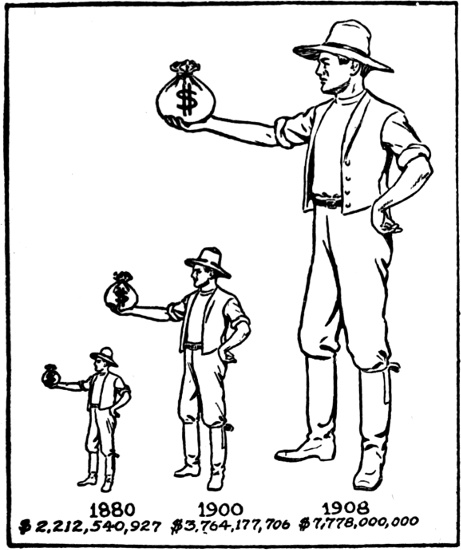
A POPULAR KIND OF RURAL UPLIFT
The total value of farm products in the United States from $2,000,000,000 in 1880 to nearly $8,000,000,000 in 1900.
Ahead, Looking—See Prevision.
AIM HIGH
The following inspiring advice is by Willis Warren Kent:
Aim high! Watch the target with an eye Steady as the eaglet’s glance; Fit your arrow, let it fly, Fear no failure, no mischance! Aim high! Aim high! Tho your arrows hurtle by, Miss the target, sail below, Pick them up, once more to try, Arms a-tangle, eyes aglow! Aim high! Aim high! Learn to laugh and cease to sigh, Learn to hide your deep chagrin! Life’s a test at archery Where the true of heart will win! Aim high!
(57)
AIMLESSNESS
Washington Irving tells a story of a man who tried to jump over a hill. He went back so far to get his start for the great leap and ran so hard that he was completely exhausted when he came to the hill, and had to lie down and rest. Then he got up and walked over the hill.
A great many people exhaust themselves getting ready to do their work. They are always preparing. They spend their lives getting ready to do something which they never do.
It is an excellent thing to keep improving oneself, to keep growing; but there must be a time to begin the great work of life. I know a man who is almost forty years old, who has not yet decided what he is going to do. He has graduated from college, and taken a number of post-graduate courses—but all along general lines. He has not yet begun to specialize. This man fully believes he is going to do great things yet. I hope he may.—O. S. Marden.
(58)
“And he that walketh in the darkness knoweth not whither he goeth.” What a picture comes into the mind as by the aid of the imagination we read these words. I think of a vast forest, with its winding trail, its deep shadows, its tangled underbrush, its decayed trunks here and there. I think of myself at the end of a long day’s tramp. No opening in sight. The sun has gone down. The light coming through the openings above growing less and less. The sky overcast. Soon it is dark. I miss the trail. I get down on my hands and knees to feel for it. Presently no sound but the cracking of the underbrush. Suddenly it dawns upon me that I am lost in the woods. All sense of direction is gone. Any way I turn may be the wrong way. I am utterly aimless. Jesus says the end of the selfish man is utter aimlessness. That as a man in the woods wanders without aim so the selfish man wanders in the moral universe without aim, not knowing whither he goeth.—Robert McLaughlin.
(59)
It is told of Professor Huxley that once, when the British Association met in Dublin, he arrived late in the city; fearing to miss the president’s address, he rushed from the train to the station platform, jumped on a jaunting-car, and said to the Celt in charge, “Drive fast; I’m in a hurry.” Cabby whipt up his horse and proved to be another Jehu. Suddenly it flashed upon the passenger, bounding about the vehicle in a most undignified way, to shout to the driver above the rattle of the car, “Do you know where I want to go?” “No, yer honor,” was Pat’s laughing rejoinder, “but I’m driving fast all the while.”
There are many who keep up a great activity, but who, for want of a definite aim or a great guiding ideal, accomplish little good in the world.
(60)
AIR, EFFECTS OF
Attention has been called to some curious effects of rarefied and of condensed air on human respiration. On high mountains some persons experience distressing shortness of breath, one result of which is that they are unable to whistle. Precisely the same effect is sometimes produced by the condensed air in caissons and diving-bells. Laborers working in comprest air frequently find, however, that their powers of exertion are increased as long as the atmospheric pressure is not more than double that of ordinary air; but beyond that point unpleasant effects are experienced after the men have left the working shafts and returned into the open air. On the other hand, high atmospheric pressure in the case of persons not doing manual labor has been found to act as a mental stimulus, increasing the impulse to talk.—Harper’s Weekly.
(61)
Air of Sea as Purifier—See Purification.
Airship Flight—See Ambition.
ALCOHOLIC BAIT
In May, 1880, on Platt River, in Benzie County, Michigan, an old man was showing an Indian named Pokagon how to catch pigeons in their nesting-place. He led him to an open pole-pen which he called his bait-bed, where he scattered a bucketful of wheat. While the two watched in ambush the pigeons poured into the pen and gorged themselves. “Come on, you redskin,” said the old man to Pokagon, and they caught about a hundred fine birds. “How did you do it?” asked the Indian in surprize. With one eye half shut and a sly wink with the other, the old man replied: “That wheat was soaked in whisky.”
How many other than birds have been snared by the same whisky-bait!
(62)
ALIBI
A distinguished jurist once sat down to a course dinner. He had been waited on by one servant during two courses. He had had the soup. Another servant came to him and said, “Sir, shall I take your order? Will you have some of the chicken soup?” “No, sir; I have been served with chicken soup, but the chicken proved an alibi.”—George M. Palmer.
(63)
Alleviation—See Drudgery Relieved.
ALLUREMENT, FATAL
The Judas-tree, so-called, is a remarkable plant. Its blossoms appear before its leaves, and are a most brilliant crimson. The flowers flaming forth, attract innumerable insects. The bee, for instance, in quest of honey, is drawn to it. But searching the petals for nectar, it imbibes a fatal opiate. Beneath this Judas-tree the ground is strewn with the victims of its deadly fascination.
(64)
Flicker-flick, Above the wick, Burned the candle flame. Through the open window-shutter Young Moth Miller came. Straight he fluttered toward the yellow, Bright, alluring thing. And, alas, poor foolish fellow Scorched his downy wing! Little ones, take lesson from him, Be not overbold; Stop and think that glittering things Are not always gold. (Text.) —Elizabeth Hill.
(65)
The Venus fly trap is small and shaped as if you placed your two open palms side by side. Its surface is plastered with honey and the other palm has sharp needles pointing outward. The “silly fly” yields to the attraction of the sweets and is immediately shut in as the two palms close upon him. He is instantly stung to death by the needles.
How alluring evil can appear at times. Satan himself can pose as an angel of light. Evil often presents its most subtle attraction to the young. But sin in any guise is the soul’s deathtrap. (Text.)
(66)
Allurement to Evil—See Sin, Fascination of.
Allurement to Good—See Fishers of Men.
ALMSGIVING
That is no true alms which the hand can hold; He gives only worthless gold Who gives from a sense of duty; But he who gives but a slender mite And gives to that which is out of sight, The hand can not clasp the whole of his alms. (Text.) —Lowell.
(67)
ALTAR, THE
In the old days a father built a home for his family. It was complete in every part, but the altar around which they gathered in prayer was not yet set in place. The mother wished it in the kitchen; there she was perplexed with her many cares. The father wished it in his study: God seemed nearer to him among his books. The son wished it in the room where guests were received, that the stranger entering might see that they worshiped God. At last they agreed to leave the matter to the youngest, who was a little child. Now the altar was a shaft of polished wood, very fragrant, and the child, who loved most of all to sit before the great fire and see beautiful forms in the flames, said, “See, the fire-log is gone; put the altar there.” So, because one would not yield to the other, they obeyed, and the altar was consumed, while its sweet odors filled the whole house—the kitchen, the study, and the guest hall—and the child saw beautiful forms in the flames.—David Starr Jordan, “The Religion of a Sensible American.”
(68)
ALTRUISM
There is in Cambridge, Mass., an elm-tree of moderate size, which has, according to the estimates of Professor Gray, a leaf surface of 200,000 square feet. This tree exhales seven and three-quarter tons of water every twelve hours. A forest of 500 such trees would return to the atmosphere nearly 4,000 tons in the same time.
Our lives should be like this tree, shedding their refreshment continually. (Text.)
(69)
Good men are not meant to be simply like trees planted by rivers of waters, flourishing in their own pride and for their own sake. They ought to be like the eucalyptus trees which have been set out in the marshes of the Campagna, from which a healthful, tonic influence is said to be diffused to countervail the malaria. They ought to be like the Tree of Paradise, “whose leaves are for the healing of nations.”—Henry Van Dyke.
(70)
The flower blooms not for itself at all, Its joy is the joy that diffuses: Of beauty and balm it is prodigal, And it lives in the life it freely loses; No choice for the rose but glory or doom, To exhale or smother, to wither or bloom. To deny Is to die.
(71)
See Vicariousness.
ALTRUISM AMONG BIRDS
An old gentleman in New England told me of a case he once observed. Noticing a little flock of chewinks or towhee buntings who came about the house for food that was thrown out, he saw that one was larger than the others and that they fed him. To satisfy his curiosity, he threw a stone with such accuracy that his victim fell, and on picking him up he was surprized to see that the bird’s mandibles were crossed so that he could not possibly feed himself. The inference was obvious; his comrades had fed him, and so well that he had grown bigger than any of them.—Olive Thorne Miller, “The Bird Our Brother.”
(72)
ALTRUISM IN INSECTS
A gentleman, while reading the newspaper, feeling bothered by the buzzing of a wasp about his head, beat it down. It fell through the open window and lay on the sill as if dead. A few seconds afterward, to his great surprize, a large wasp flew on to the window-sill, and after buzzing around his wounded brother for a few minutes, began to lick him all over. The sick wasp seemed to revive under this treatment, and his friend then gently dragged him to the edge, grasped him round the body and flew away with him. It was plain that the stranger, finding a wounded comrade, gave him “first aid,” as well as he could, and then bore him away home. This is one of many cases in which the law of altruism is traceable in the world of living things below man. How much more should intelligent man exercise this spirit of helpfulness in the rescue of his fallen brother.
(73)
ALTRUISM IN NATURE
The flower does not live for itself. Beautiful, fragrant-making, the tree an incense-holder, hang the apple-blossoms for a day; to-morrow they have let go their hold upon the tree and are scattered over the ground in order that the fruit may grow. The fruit guards the seed until it is mature, then the fruit goes to decay that the seed may be released; the seed gives up its life that a new tree may come. What a glorious parable is this: life for life, the old dying for the new; every tree in the orchard, every grain-stalk in the corn-field, every dusty weed by the roadside living for others and ready to die for others. The doctrine of unselfish love and of sacrifice comes to us fragrant with the odor of ten thousand blossoms and rich with the yellow fruitage of ten thousand harvests. Self-preservation is no longer the first law of nature. The first law seems to be preparation for that which is coming next.—John K. Willey.
(74)
ALUMNI OCCUPATIONS
Beloit College has been coeducational for about fifteen years. The following list of what its women alumni are doing is given in a current number of the college paper:
Eighty-eight are teaching.
Fifty-four are married.
Nineteen are at home.
Three are librarians.
Four are graduate students.
Two are college instructors.
One is supervisor of domestic economy.
One is vice-president of a bank.
One is a nurse.
One is an editor.
One is an assistant postmaster.
One is a visitor of Associated Charities.
One is superintendent of north-west district of United Charities in Chicago.
Two are high-school principals.
One is a student in the Baptist Missionary Training School, Chicago.
One is the industrial secretary of the Y. W. C. A., Detroit.
One is a bookkeeper in a bank.
One is a teacher in North China Union Woman’s College, American Board.
One is nursery visitor of United Charities in Chicago.
One is a private tutor.
(75)
AMBASSADOR, THE MINISTER AS AN
The minister must be something as well as do something. He must consistently make an impression upon everybody he approaches that he is in something unlike the ordinary run of men. I do not mean that he should be sanctimonious, for that repels; it must be something in his own consciousness. My father was a clergyman. One of the most impressive incidents of my youth occurs to me. He was in a party of gentlemen, when one of them used a profane word unthinkingly. With a start he turned to my father, and said, “I beg your pardon, Dr. Wilson.” My father said, very simply and gently, “Oh, sir, you have not offended me.” The emphasis he laid upon that word “me” brought with it a tremendous impression. All present felt that my father regarded himself as an ambassador of someone higher; their realization of it showed in their faces.—Woodrow Wilson, The Churchman.
(76)
Ambidexterity Favored—See Asymmetry.
AMBITION
When William the Conqueror was born his first exploit was to grasp a handful of straw, and to hold it so tenaciously in his little fist that the nurse could scarcely take it away. This infantile prowess was considered an omen, and the nurse predicted that the babe would some day signalize himself by seizing and holding great possessions. And he did.
But what, after all, were many of the possessions seized by the Norman Conqueror but a handful of straw. And so are not a few of the conquests of earthly ambition, no matter how tenaciously held as well as ardently won. Over many a pile of wealth and massed achievement might be written: “A handful of straw in a baby fist!”
(77)
Daisy Rinehart expresses a very common feeling in this poem:
I’m tired of sailing my little boat Far inside of the harbor bar; I want to be out where the big ships float— Out on the deep, where the great ones are! And should my frail craft prove too slight For storms that sweep those wide seas o’er, Better go down in the stirring fight Than drowse to death by the sheltered shore! —Munsey’s Magazine.
(78)
Glenn H. Curtiss, by his successful and spectacular flight of 150 miles from Albany to this city (May 29, 1910), has jumped into the first rank of aviators.
Curtiss began life as soon as he was of a workable age as a newsboy. He is still remembered as a lad always ambitious in sport, particularly if there were any mechanical contrivances to be worked out that might add to his triumph. His ambition was to “arrive” in anything he undertook, and to do this he was not content to accept the suggestions of others, but sought to work out his own original ideas.
When about ten or eleven years old he was very much perturbed over the fact that one of his chums owned a hand-sled that always coasts down-hill faster than his own. Curtiss set to work to construct a sled that would outdistance his rival’s, and after weeks of quiet work had the satisfaction of leaving his rival far behind.
From sleds he turned his attention to bicycles.
“Why not attach a gasoline engine to it?” he asked one day, and immediately he went to work, using the model of an old gasoline engine to work on, and was soon able to amaze his neighbors by chugging through the country on his hand-made machine. The fever of the motorcycle was right on him, and that early success led him to establish a bicycle shop which soon grew from a mere repair shop to a plant for the manufacture of motor-cycles, and the success of the improved Curtiss motor was what gave him his first real fame.
In 1907 he took one of his machines to Ormond, Fla. It was built solely for speed, for it was Curtiss’ aim to go faster than any one else. The judges, greatly to the disappointment of the inventor, pronounced it a freak and not eligible, with the orthodox machines. It was a big disappointment, but Curtiss announced that he would make an exhibition mile trial, and, to the amazement of the experts, he covered the distance in the remarkable time of 0:26 2/5, the fastest mile that had ever been traveled by a man.
From making motors for bicycles it was an easy step to try the construction of light gasoline motors for flying purposes. Captain Thomas S. Baldwin was the first to see the possibilities of the Curtiss motor for balloon purposes, and at his suggestion Curtiss built one for Baldwin’s dirigible airship. This was successful, and others were built.
Then followed the success of the Wright brothers with heavier-than-air machines and the craze for the heavier-than-air type abroad. Curtiss’ little shop at Hammondsport became the headquarters for the aeronautical students of this country and aerial flight received its first big impetus, next to that given by the Wrights when Dr. Alexander Graham Bell, in November, 1907, organized his Aeronautic Experiment Association, and Curtiss was one of its six members.
(79)
By the sheer force of his ambition Pope won his place, and held it, in spite of religious prejudice, and in the face of physical and temperamental obstacles that would have discouraged a stronger man. For Pope was deformed and sickly, dwarfish in soul and body. He knew little of the world of nature or of the world of the human heart. He was lacking, apparently, in noble feeling, and instinctively chose a lie when the truth had manifestly more advantages. Yet this jealous, peevish, waspish little man became the acknowledged leader of English literature.—William J. Long, “English Literature.”
(80)
AMBITION, A WORTHY
Dr. William H. Thomson, speaking of the tubercle bacillus in his book, “What is Physical Life?” says:
For ages upon ages this mighty microorganism has waged a cruel destructive war upon the human race. After fifty years of observation and study of its ghastly doings, I can say that I would rather have the power to cause the tears shed on its account to cease than to be the greatest official or the greatest owner on the earth.
(81)
AMERICA IN SYMBOL
In the hour when for the first time I stood before the cataracts of Niagara, I seemed to see a vision of the fears and hopes of America. It was midnight, the moon was full, and I saw from the suspension bridge the ceaseless contortion, confusion, whirl, and chaos which burst forth in clouds of foam from that immense central chasm which divides the American from the British dominion; and as I looked on that ever-changing movement, and listened to that everlasting roar, I saw an emblem of the devouring activity, and ceaseless, restless, beating whirlpool of existence in the United States. But into the moonlight sky there rose a cloud of spray twice as high as the falls themselves, silent, majestic, immovable. In that silver column, glittering in the moonlight, I saw an image of the future of American destiny, of the pillar of light which should emerge from the distractions of the present—a likeness of the buoyancy and hopefulness which characterize you both as individuals and as a nation.—Arthur Penrhyn Stanley.
(82)
AMERICA, THE NAME
The meaning of the name Amerigo has been often discust, the only thing certain being that it is one of those names of Teutonic origin, like Humberto, Alfonzo, Grimaldi, or Garibaldi, so common in northern Italy, which testifies to the Gothic or Lombard conquest. Americ, which occurs as early as 744 A.D., is probably a contracted form of the name Amalaric, borne by a king of the Visigoths who died in 531. A Bishop Emrich was present at the Council of Salisbury, in 807, and an Americus Balistarius is mentioned in the Close Rolls (thirteenth century). It has been conjectured that the stem is im, from which we get the name of Emma. The meaning of this is not known with certainty, tho Ferguson thinks it may denote “strife” or “noise.” Since, however, the name is probably of Gothic origin, and since the Amalungs were the royal race of the Ostragoths, it is more likely that the stem is “amal,” which was formerly thought to mean “without spot,” but is now more plausibly connected with the old Norse “aml,” labor, work. The suffix “ric,” cognate with rex, reich, and rick, means “rich” or “powerful,” and, therefore, the most probable signification of Amerigo is “strong for labor.”—Isaac Taylor, Notes and Queries.
(83)
American Citizenship—See Ignorance.
AMERICAN OPPORTUNITY
A young Irishman who settled in Chicago forty years ago, and found his first employment as driver of a baker’s wagon, has just retired from business a millionaire. An Italian, then aged sixteen, who reached Trenton, N. J., thirteen years ago with barely sufficient money to set up in business as a bootblack, now owns twenty-three houses, and announces his intention to take up real estate. Both these passages of contemporary biography are recorded in the same newspaper. Probably they will attract little attention or remark. That is to be explained by the happy circumstance that such progress from poverty is no exceptional thing in this country, and any community could match the stories with many that are equally striking.—Boston Transcript.
(84)
American Prosperity—See Prosperity as an Advertisement.
AMERICANISM, TRUE
Suppose you are a father, and you have five children. One is named Philip, and Philip says to his brothers and sisters: “Now, John, you go and live in the small room at the end of the hall. George, you go and stay up in the garret. Mary, you go and live in the cellar, and, Fannie, you go and live in the kitchen, and don’t any of you come out. I am Philip, and will occupy the parlor; I like it; I like the lambrequins at the window, and I like the pictures on the wall. I am Philip, and, being Philip, the parlor shall only be for the Philipians.” You, the father, come home, and say: “Fannie, what are you doing in the kitchen? Come out of there.” And you say to Mary, “Mary, come out of that cellar.” And you say to John, “John, don’t stay shut up in that small room. Come out of there.” And you say to George, “George, come down out of that garret.” And you say to the children, “This is my house. You can go anywhere in it that you want to.” And you go and haul Philip out of the parlor, and you tell him that his brothers and sisters have just as much right in there as he has, and that they are all to enjoy it. Now, God is our Father, and this world is a house of several rooms, and God has at least five children—the North American continent, the South American continent, the Asiatic continent, the European continent, and the African continent. The North American continent sneaks away, and says: “I prefer the parlor. You South Americans, Asiatics, Europeans, and Africans, you stay in your own rooms; this is the place for me; I prefer it, and I am going to stay in the parlor; I like the front windows facing on the Atlantic, and the side windows facing on the Pacific, and the nice piazza on the south where the sun shines, and the glorious view from the piazza to the north.” And God, the Father, comes in and sends thunder and lightning through the house, and says to his son, the American continent: “You are no more my child than are all these others, and they have just as much right to enjoy this part of my house as you have.”—T. Dewitt Talmage.
(85)
Americans as Spenders—See Missions, Indifference to.
AMERICA’S ATTITUDE
“The attitude of the United States that she was not warring with China in 1900 and that she recognized no spoils of war; the attitude that made her give back to China the large quantity of silver which fell into her possession at Tien-Tsin; that made her give over to the Chinese Government, unmolested, the treasury and its treasures in the Forbidden City; that caused her, without compulsion, to cancel the Boxer indemnity fund, is an attitude too deep, too broad, too high for word expression. Does not this attitude reveal a strong current of sisterly good will, when it is able to sweep away the heavy weights of financial gain? This attitude is not one of spontaneity; the seed was brought over in the Mayflower; it was planted in the virgin soil of liberty, where it rooted, and was watered with treasured dew-drops; was nourished into being in love’s tenderness; was sustained in truth’s fortitude. This is the story of our country’s attitude.”—“Letters from China.”
(86)
Amity—See Kindness.
AMITY AFTER WAR
News of an international event of no little pathos comes from Port Arthur. Around the great fortress were buried thousands of Russians who fell in the siege, and whose graves were unmarked. The Russian Government asked permission to gather these remains in one place and erect a tomb for them which should be a suitable monument to their heroism. The Japanese Government replied by asking for permission to engage in this sad duty as a token of honor to the Russian dead. In this Russia readily acquiesced, and the tomb, which is of noble proportions and Etruscan in design, was recently dedicated. At these solemn services the old foes met once more. General Nogi, the hero of Port Arthur, was by special order of the Emperor the representative of Japan. Russia sent two generals and an admiral, who were supported by many Russian officers who had fought over that very ground. Regiments of Japanese troops stood on guard, as did also representatives of the Japanese navy. These latter, at the moment of unveiling, bore a worn and battle-torn flag to the tomb, and reverently lowered it as a tribute of respect. The religious ceremonies were in charge of the Bishop of Peking, of the Russian Church. (Text.)
(87)
AMUSEMENTS
A news item says:
Mrs. A. B. Sims, of Des Moines, winner of the woman’s whist championship of the United States, stood before an audience of 4,000 at Winona Lake and told why she burned up the forty decks of cards that she had at her home.
“It was not uncommon for me to play whist from 10 A.M. to 11 P.M.,” said Mrs. Sims. “After that I saw what I was really doing. I burned up all the pasteboards, and I should like to speak in every church to the women and tell them what card-playing led me to, and what it will lead them to. It was undermining our church. The whist and euchre parties were sweeping the women of the congregation and the church was sinking because of their neglect. The card craze as it prevails among women is the most serious competitor the Church has to-day.”
Worldliness manifests itself in its games as in other phases of its life. As the fathers saw the horror of the gladiatorial shows and their pernicious effect on morals, so in these latter days is caution necessary and salutary.
(88)
Anarchy, Remedy for—See Evil, Self-destructive.
ANCESTOR WORSHIP
The destructive influence of ancestor worship far outweighs its benefits. It is a ruthless and voracious land-grabber; the best of the hills are for the dead. The living may go to Jericho, or may huddle together down in the malarial flats, while the ancestral shade rests in the high places on the hill. The exhilarating surroundings of the trees and green sod are for the dead, the living are left to the dust and heat and smells of the market-place.
Ancestral piety forbids the digging of the hills for gold or silver or any other treasure. What are the living and what is yellow gold compared with the sweet repose of my father’s ghost? Away with all sordid visions and leave the hills in peace!—James S. Gale, “Korea in Transition.”
(89)
ANCESTRAL EXAMPLE
It was the custom of the primitive Romans to preserve in the halls of their houses the images of all the illustrious men whom their families had produced. These images are supposed to have consisted of a mask exactly representing the countenance of each deceased individual, accompanied with habiliments of like fashion with those worn in his time, and with the armor, badges, and insignia of his offices and exploits; all so disposed around the sides of the hall as to present, in the attitude of living men, the long succession of the departed; and thus to set before the Roman citizen, whenever he entered or left the house, the venerable array of his ancestors revived in this imposing similitude. Whenever, by a death in the family, another distinguished member of it was gathered to his fathers, a strange and awful procession was formed. The ancestral masks, including that of the newly deceased, were fitted upon the servants of the family, selected of the size and appearance of those whom they were intended to represent, and drawn up in solemn array to follow the funeral train of the living mourners, first to the market-place, where the public eulogium was pronounced, and then to the tomb. As he thus moved along, with all the great fathers of his name quickening, as it were, from their urns, to enkindle his emulation, the virtuous Roman renewed his vows of respect to their memory, and his resolution to imitate their fortitude, frugality, and patriotism.—Edward Everett.
(90)
Ancestry—See Pedigree.
ANCHOR, AN
Every ship has an anchor, and there are times when the safety of the ship depends on its right use of its anchors. When I was a boy in Constantinople, an American captain visited our house. He told us that his ship was anchored in an exposed harbor in one of the islands of the Ægean, when a violent storm broke upon them. Both of the anchors which they had down began to drag, and it was only a question of time when they would be cast ashore. They had one little anchor still unused, and tho they did not hope much good could come from dropping it they took the chance. To their great surprize and equal delight, tho the two larger anchors would not hold, the smaller one held, and they rode out the storm in safety. When they came to weigh the anchors, the two large ones came up easily, but the smaller one came with great difficulty. When at last it appeared above the surface of the water, lo and behold, the fluke of the anchor had caught in the ring of a large man-of-war’s anchor that had been lost there long before! The man-of-war’s anchor had been embedded in the soil, and this accounted for the fact that the little anchor held.
Every man voyaging on the ocean of life ought to have an anchor. The apostle speaks about a good hope, which he says we have as an anchor sure and stedfast entering into the unseen, which is within the veil.—A. F. Schauffler, The Christian Herald.
(91)
ANCIENT ART
To the student of architecture it may be surprizing to learn that the arch, until recently supposed to have been unknown to the ancients, was frequently employed by the pre-Babylonians of more than 6,000 years ago. Such an arch, in a poor state of preservation, was, a few years ago, discovered in the lowest stratum, beneath the Babylonian city of Nippur. More recently an arched drain was found beneath the old city of Fara, which the Germans have excavated in central Babylonia. The city, altho one of the earliest known, was built upon an earlier ruin, and provided with an arched drain constructed of small, plano-convex bricks. It measures about one meter in height, and has an equal width.
While delving among the ruins of the oldest cities of the world, we are thus finding that at the time when we supposed that man was primitive and savage, he provided his home and city with “improvements” which we are inclined to call modern, but which we are only reinventing. (Text.)—Prof. Edgar James Banks, The Scientific American.
(92)
Ancient Human Remains—See Prehistoric Women.
Ancient Masters—See Compliment.
Anesthetics—See Benefaction of Anesthetics.
Angel Ministers—See Cooperation, Lack of.
Angel Visitants—See Indifference to the Good.
Angels—See Friend, The Sympathetic.
Angels Astray—See Rescue.
ANGER
A cobbler at Leyden, who used to attend the public disputations held at the Academy, was once asked if he understood Latin. “No,” replied the mechanic, “but I know who is wrong in the argument.” “How?” replied his friend. “Why, by seeing who is angry first.”
Let not your angry passions rise, if you would be a full overcomer. (Text.)
(93)
ANGER, FUTILE
The camel has one very bad fault. He likes to “pay back,” and if his driver has injured him in any way he will not rest till he has got even.
The Arabs, people who wander about the desert, and so use the camel a great deal, know about this fault of his, and have a queer way of keeping themselves from getting hurt.
When a driver has made his camel angry, he first runs away out of sight. Then, choosing a place where the camel will soon pass, he throws down some of his clothes, and fixes them so that the heap will look like a sleeping man.
Pretty soon, along comes the camel, and sees the heap. Thinking to himself, “Now I’ve got him,” he pounces on the clothes, shakes them around, and tramples all over them. After he tires of this and has turned away, the driver can appear and ride him away without harm.
Poor, silly camel! He has been in what we call a “blind rage,” so angry that he can’t tell the difference between a man and a heap of clothes.
(94)
Angle, At the Right—See Place, in the Right.
Anguish—See Suffering Transformed.
ANIMAL ANCESTRY
A simple-minded Irish priest I have been told of, having heard that we were descended from monkeys, yet not quite grasping the chronology of the business, recently visited a menagerie, and gave particular and patient attention to a large cage of our alleged poor relations on exhibition there. He stood for a long time intently scrutinizing their human-like motions, gestures, and expressions. By and by he fancied that the largest of them, an individual of a singularly grave demeanor, seated at the front of the cage, gave him a glance of intelligence. The glance was returned. A palpable wink followed, which also was returned, as were other like signals; and so it went on until his reverence, having cast an eye around to see that nobody was observing him, leaned forward and said, in a low, confidential tone: “Av ye’ll spake one w-u-r-r-d, I’ll baptize ye, begorra!”—Joseph H. Twichell, D.D.
(95)
ANIMAL DOMINION
An English hunter tells the story of a tigress that was known all over India as the man-eater, who once had given her whelps a live man to play with. She carried off the man from an open hut in the forest where some wood-cutters were sleeping. His companions took refuge in trees, and from their place of safety saw her take the man alive to where the whelps were waiting close by, and lay him down before them. As the man attempted to crawl away the whelps would cling to his legs with teeth and claws, the tigress looking on and purring with pleasure. (Text.)—Louis Albert Banks.
(96)
Animal Friendliness—See Protection.
ANIMAL INTELLIGENCE
A recent dispatch from an Indiana town says:
Jeff Clarke, a farmer of Wabash township, owns a mule that plays the part of an alarm-clock every morning with such regularity that Clarke has about discarded the little alarm-clock that hangs on the bed-post and firmly refuses to part with the animal.
Promptly at 4 o’clock this mule kicks the side of the barn four times in succession. At first Clarke thought the animal was ill, and for several mornings he got up and investigated. He took note, however, that the gong of the alarm-clock started buzzing when the mule started kicking.
He put two and two together, and reached the conclusion that the mule knows the hour when the Clarke household should arise and begin the day’s work.
(97)
The criminal classes of Moscow, Russia, are beginning to believe that the police dog “Tref” is possest of an evil spirit.
It was rumored recently, in the night shelters and criminal dens of Moscow, that “Tref” and his keeper were on the track of certain robbers, and were about to scour the town.
It transpired that a number of bank-notes and other valuables had been stolen from a Moscow gentleman named Pokrofsky. “Tref’s” services were immediately requisitioned. He was put on the scent of the thief, and, after taking a circuitous course, entered a night shelter and made straight for an old coat belonging to a house-painter who was known under the name of Alexander. The sum of five hundred rubles, which had been stolen from M. Pokrofsky, was found in one of the pockets of the coat.
“Tref” then left the night shelter, and, still hot on the scent, went to the shop of a second-hand dealer named Gussef, and here a number of silver articles stolen from M. Pokrofsky were discovered. A cabman drove up at this time, and complained that he had just been robbed of a fur coat and an ordinary overcoat. “Tref” was at once taken to the scene of the theft, and within a few minutes found the clothing concealed in the courtyard of a neighboring house.—Philadelphia Record.
(98)
See Conviction Through a Monkey; Direction; Instinct, the Homing.
Animal Instinct—See Faith Better Than Sight.
Animal Retaliation—See Anger, Futile.
ANIMAL SAVES LIFE
St. Clair McClary, a miner, buried deep in a snow-slide, at Seward, Alaska, owed his life to the keen scent of his dog. The snow-slide swept down the mountain. Four men at work on the property were caught without warning and buried under several feet of snow and débris. Two escaped without serious injury. So deep was the slide, however, that difficulty was experienced in reaching the others. The dog led the rescuers to a place several yards distant, where, after hard digging, they came on the men, who had been buried eight hours. Thomas Coales was dead under the icy weight. McClary was barely alive when taken out.—The Associated Press.
(99)
ANIMAL SOLVING PROBLEM
A tiny mouse recently solved the problem of getting an electric wire through a pipe 197 feet long at the Vinery Building (Norfolk, Va.). There were several bends in the pipe, and modern methods, such as blow-pipes, failed to produce results.
A mouse was caught and a thread tied to its leg. A tape was tied to the thread, and the wire to the tape. The mouse was given a start, and went through the pipe in a hurry. Liberty was its reward.—Philadelphia Record.
(100)
Animal Traits—See Peaceful Instinct of Simians.
ANIMALS, ABSURD FONDNESS FOR
A seamstress whom I know was sewing in the home of a wealthy woman in one of the aristocratic suburbs of Boston. She was there every day for nearly a week, when finally her patience became exhausted and she left the house never to return.
She said she could stand being fed on crackers and milk every day at the noon meal, but when she heard the mistress of the house at the telephone ordering half a chicken for her pet dogs she could withhold her wrath no longer.
Of course, the good woman of the house was sweetly unconscious of the absurd comparison between the dogs’ food and the food for the seamstress. Had she had any sense of the meanness of her conduct, she never would have telephoned that message within the hearing of the seamstress.
The truth of the matter was that her heart—as much as she had left of it—was all wrapt up in her pet dogs, and her interest in human beings had become as a matter of habit, simply a question of the amount of service they could render her. She is probably whining to-day about the seamstress who didn’t know her place and who was jealous of people who had means.—George W. Coleman, “Searchlights.”
(101)
Animals as Pest Destroyers—See Barriers.
Animals Before Men—See Heartless Pagans.
Animals, Inferior to Man—See Man’s Conquest of Animals.
Animals not Original—See Originality of Man.
Animals, Reason in—See Reasoning Power in Animals.
ANIMISM
The child’s religious nature, like that of primitive man, is animistic. Professor Dawson, in “The Child and His Religion,” says:
It is hard for children to resist the feeling that a summer shower comes with a sort of personal benevolence to water the dry flowers and grass. A little girl of four years illustrated this feeling on a certain occasion. There was a thunder-shower after a long dry spell. The rain was pattering on the sidewalk outside the house. The child stretched forth her hands toward the rain-drops and said: “Come, good rain, and water our plants!” Flowers and trees have individuality for most children, if not for all. Ruth’s mama found her sitting among the wild geraniums, some distance from the house. “What are you doing, Ruth?” “I’m sitting by the flowers. They are lonesome and like to have me with them, don’t you know?” At another time she said: “Mama, these daisies seem to look up at me and talk to me. Perhaps they want us to kiss them.” On one occasion she said to her brother, who was in the act of gathering some flowers she claimed for herself, “I don’t think it nice to break off those poor flowers. They like to live just as well as you do.” The boy thus chided by his sister for gathering her flowers was generally very fond of plants and trees, and felt a quite human companionship in them. He could not bear to see flowering plants hanging in a broken condition, or lying crusht upon the sidewalk. Even at the age of ten years, he would still work solicitously over flowers like the violets, bluets, and crowfoots, with evident concern for their comfort.
(102)
Announcement, Apt—See Choir, The.
ANSWER, A SOFT
A drunken carter came into a Greenock (Scotland) train and sat opposite a clergyman, who was reading his paper. Recognizing the profession of his vis-a-vis, the carter leaned forward and in a maudlin way remarked, “I don’t believe there’s any heaven.” The clergyman paid no heed. “Do you hear me?” persisted the carter. “I don’t believe there’s any heaven.” Still the clergyman remained behind his newspaper. The carter, shouting his confession loudly, said, “I tell ye to your face, and you’re a minister, that I don’t believe there’s any heaven.” “Very well,” said the clergyman; “if you do not believe there is any heaven, go elsewhere, but please go quietly.” (Text.)—London Graphic.
(103)
Anthem, Extending a National—See Praise, United.
ANTHROPOMORPHISM
Spiritual manhood has put away childish thinking. What, for instance, does a child think about God? Professor Street publishes some first-hand illustrations of childish conceptions of God. He says that children “completely anthropomorphize God, making Him subservient to time, space, and passions, just the same as they themselves are.” I recall an example or two: When a girl was told that the stars were God’s eyes, she at once asked where His legs were. Another saw, for the first time, a cupola on a barn. Gazing at it she asked, “Does God live in that little house?” A boy asked some one if God made the river running back of his house. On receiving an affirmative answer, he promptly replied, “He must have had a big shovel.” When another boy refused to say his prayers, he was asked for the reason. He answered, “Why, they are old. God has heard them so many times that they are old to Him, too. Why, He knows them as well as I do myself.”—F. F. Shannon.