Cyclopedia of Illustrations For Public Speakers (continued 2)
Reading edition
(104)
ANTICIPATING SUCCESS
One may so believe as already in a sense, to possess:
In a little parlor down-stairs of Mencci’s house in Staten Island were three large altar-candles in the Italian colors of red, white and green which, Mencci told us (says a correspondent of the Century) he and Garibaldi had amused themselves at making in a leisure hour “to illuminate the Campidoglio of Rome when the Italian army should enter the Eternal City and make it the capital of United Italy.” When Rome was recovered, three other candles in the Italian colors were actually sent to Garibaldi there. (Text.)
(105)
ANTICIPATION
It was Schelling who said that if he had truth in one hand and the search for truth in the other, he would let truth go in order that he might search for it. Something of this philosophy is in these verses:
For me the loitering of the road, The hidden voice that sings; For me the vernal mysteries, Deep woods and silent springs. I covet not the ended road, The granary, the sheaf; For me the sowing of the grain, The promise of the leaf. (Text.) —Lippincott’s Magazine.
(106)
See Nature’s Antidote.
ANTIPATHIES, INSTINCTIVE
It would be an excellent accomplishment if an abhorrence of moral evils could be bred in men similar to the instinctive antipathies described in this extract:
It seems absolutely incredible that Peter the Great, the father of the Russian navy, should shudder at the sight of water, whether running or still, yet so it was, especially when alone. His palace gardens, beautiful as they were, he never entered, because the river Mosera flowed through them. His coachman had orders to avoid all roads which led past streams, and if compelled to cross a brook or bridge, the great emperor would sit with closed windows, in a cold perspiration. Another monarch, James I, the English Solomon, as he liked to be called, had many antipathies, chiefly tobacco, ling, and pork. He never overcame his inability to look at a drawn sword, and it is said that on one occasion when giving the accolade, the king turned his face aside, nearly wounding the new-made knight. Henry III of France had so great a dislike for cats that he fainted at the sight of one. We suppose that in this case the cat had to waive his proverbial prerogative, and could not look at a king. This will seem as absurd, as extraordinary to lady lovers of that much-petted animal, but what are we to say of the Countess of Lamballe, of unhappy history, to whom a violet was a thing of horror? Even this is not without its precedent, for it is on record that Vincent, the painter, was seized with vertigo and swooned at the smell of roses. Scaliger states that one of his relations was made ill at the sight of a lily, and he himself would turn pale at the sight of watercresses, and could never drink milk. Charles Kingsley, naturalist as he was to the core, had a great horror of spiders, and in “Glaucus,” after saying that every one seems to have his antipathic animal, continues: “I know one (himself), bred from his childhood to zoology by land and sea, and bold in asserting and honest in feeling that all, without exception, is beautiful, who yet can not after handling and petting and examining all day long, every uncouth and venomous beast, avoid a paroxysm of horror at the sight of the common house-spider.” (Text.)—Cassell’s Family Magazine.
(107)
A well-known officer of Her Majesty’s army, who has proved his strength and courage in more than one campaign, turns pale at the sight of a cat. On one occasion, when asked out to dinner, his host, who was rather skeptical as to the reality of this feeling, concealed a cat in an ottoman in the dining-room. Dinner was announced and commenced, but his guest was evidently ill at ease; and at length declared his inability to go on eating, as he was sure there was a cat in the room. An apparently thorough but unavailing search was made; but his visitor was so completely upset that the host, with many apologies for his experiment, “let the cat out of the bag,” and out of the ottoman at the same time.—Cassell’s Family Magazine.
(108)
Antiques, Artificial—See Age.
ANTIQUITY
Sven Hedin has furnished additional evidence of the Chinese invention of paper. On his recent journeys he found Chinese paper that dates back to the second half of the third century after Christ. This lay buried in the sand of the Gobi desert, near the former northern shore of the Lop Nor Sea, where, in the ruins of a city and in the remnants of one of the oldest houses, he discovered a goodly lot of manuscripts, many of paper, covered with Chinese script, preserved for some 1,650 years. The date is Dr. Himly’s conclusion. According to Chinese sources, paper was manufactured as early as the second millennium before the Christian era. The character of the Gobi desert find makes it probable that the making of paper out of vegetable fibers was already an old art in the third Christian century.—The Scientific American.
(109)
See Pedigree.
ANXIETY, COST OF
An English auctioneer tells the following story:
I had eight acres of land to sell, and there was one landowner in the district, whom I will call Mr. Robinson, who was very anxious to secure this particular piece of land because it adjoined his own estate. He had already attempted to acquire it by private arrangement, but the negotiations had fallen through.
Being engaged at the funeral of a relative on the day of the sale, he left very definite instructions with his butler, who had only entered his service a day or two before, to attend the sale and buy the land at any price. The butler duly came to the sale and took up his station in the old chimney-corner, out of sight of every one excepting myself. It so happened, however, that Mr. Robinson was back from the funeral earlier than he expected, and, going to the sale and failing to observe his butler, began the bidding with an offer of $2,500. Up and up went the price, the landowner and the butler bidding against one another like Trojans, until at last the field was knocked down to the latter at $7,500. The feelings of Mr. Robinson and the amusement of the company may be easily imagined when the purchaser remarked in a quiet voice, “For Mr. Robinson. Here’s his check for you to fill in for the deposit.”
Fortunately, Mr. Robinson was anything but a poor man, and he had benefited to the tune of $200,000 in the loss of his relative, so the few extra thousands he paid did not hurt him.
(110)
ANYHOW, THE LAND OF
Beyond the Isle of What’s-the-Use, Where Slipshod Point is now, There used to be, when I was young, The Land of Anyhow. Don’t Care was king of all this realm— A cruel king was he! For those who served him with good heart He treated shamefully! When boys and girls their tasks would slight And cloud poor mother’s brow, He’d say, “Don’t care! It’s good enough! Just do it anyhow.” But when in after life they longed To make proud fortune bow, He let them find that fate ne’er smiles On work done anyhow. For he who would the harvest reap Must learn to use the plow, And pitch his tent a long, long way From the Land of Anyhow! —Canadian Presbyterian.
(111)
APOLOGY APPRECIATED
The Hon. W. P. Fessenden unintentionally made a remark against Seward, which was considered to be highly insulting. When Fessenden was informed of the construction placed upon it, he went frankly to Seward, and said, “Mr. Seward, I have insulted you, but I did not mean it.” Mr. Seward was so delighted with the frank apology that he exclaimed, “God bless you, Fessenden! I wish you would insult me again.”—James T. White, “Character Lessons.”
(112)
APPAREL
The late Mark Twain, in The North American Review, gave a striking “Sartor Resartus” sketch of what might be the Czar’s morning meditations, from which we quote the following paragraph:
“After the Czar’s morning bath it is his habit to meditate an hour before dressing himself.”—London Times Correspondence.
(Viewing himself in the pier-glass.)
Naked, what am I? A lank, skinny, spiderlegged libel on the image of God! Look at the waxwork head—the face, with the expression of a melon—the projecting ears—the knotted elbows—the dished breast—the knife-edged shins—and then the feet, all beads and joints and bonesprays, an imitation X-ray photograph! There is nothing imperial about this, nothing imposing, impressive, nothing to invoke awe and reverence. Is it this that a hundred and forty million Russians kiss the dust before and worship? Manifestly not! No one could worship this spectacle, which is Me. Then who is it, what is it, that they worship? Privately, none knows better than I: it is my clothes. Without my clothes I should be as destitute of authority as any other naked person. Nobody could tell me from a parson, a barber, a dude. Then who is the real Emperor of Russia? My clothes. There is no other. (Text.)
(113)
See Dress Affecting Moods.
APPAREL IN FORMER TIMES
When Governor Bowdoin, a tall, dignified man, reviewed the troops assembled at Cambridge, in 1785, he was drest in a gray wig, cocked hat, a white broadcloth coat and waistcoat, red small-clothes, and black silk stockings. John Hancock, thin in person, six feet in stature, was very fond of ornamental dress. He wore a wig when abroad, and a cap when at home. A gentleman who visited Hancock one day at noon, in June, 1782, describes him as drest in a red velvet cap lined with fine white linen, which was turned up two or three inches over the lower edge of the velvet. He also wore a blue damask gown lined with silk; a white stock, a white satin embroidered waistcoat, black satin small-clothes, white silk stockings, and red morocco slippers. Washington, at his receptions in Philadelphia, was drest in black velvet; his hair was powdered and gathered behind in a large silk bag. His hands were encased in yellow gloves; he held a cocked hat with a cockade on it, and its edges adorned with a black feather. He wore knee and shoe buckles, and at his left hip appeared a long sword in a polished white leather scabbard, with a polished steel hilt. Chief-Justice Dana, of Massachusetts, used to wear in winter a white corduroy surtout, lined with fur, and held his hands in a large muff. The judges of the Supreme Court of Massachusetts wore, till 1793, robes of scarlet, faced with black velvet, in winter, and black silk gowns in summer. At the beginning of this century powder for the hair became unfashionable, tying up the hair was abandoned, colored garments went out of use, buckles disappeared, and knee-breeches gave place to trousers.—Youth’s Companion.
(114)
See Judging from Facts.
APPEAL, A LIVING
Dr. Bernardo, of London, the great philanthropist, was standing at his front door one bitter day, when a ragged urchin came up to him and asked to be admitted to the Orphans’ Home. “How do I know what you tell me is true? Have you any friends to speak for you?” asked Dr. Bernardo, assuming a tone of severity. “Friends!” echoed the little fellow—“friends! No, I ain’t got no friends. But if these ere rags,” holding up his tattered garments, “if these ere rags won’t speak for me, nothing else will.” (Text.)
(115)
Appeal Wasted—See Omniscience.
APPEARANCE
The Late Charles P. Thompson, of the Massachusetts Supreme Court, at one time in his practise had a client named Michael Dougherty, who had been arrested for the illegal sale of liquor, but the police had no evidence except one pint of whisky, which they found in his alleged kitchen barroom. The Boston Herald, in relating this story, says:
In the superior court this evidence was produced and a somewhat vivid claim made of prima facie evidence of guilt by the prosecuting attorney. During all this time Mr. Thompson was silent. When his turn came for the defense he arose and said:
“Michael Dougherty, take the stand.”
And Mike, with big red nose, unshaven face, bleared eyes, and a general appearance of dilapidation and dejection, took the stand.
“Michael Dougherty, look upon the jury. Gentlemen of the jury, look on Michael Dougherty,” said Mr. Thompson. All complied. Mr. Thompson himself silently and steadily gazing at Mike for a moment, slowly and with solemnity turned to the jury and said: “Gentlemen of the jury, do you mean to say to this court and to me that you honestly and truly believe that Michael Dougherty, if he had a pint of whisky, would sell it?”
It is needless to say Mike was acquitted. (Text.)
(116)
APPEARANCES
An officer of a Cunard steamer remarked that there is “a vast difference between the appearance of steerage passengers returning to Europe and those coming to America. On the western voyage the faces of the immigrants are bright with expectancy. You can see that they have been inspired by the roseate visions painted for them by their friends who have succeeded on this side of the water. Those who go back are not many. You can pick them out by their dejected looks. They have not succeeded. They have found that hard work is just as necessary to get along in the States as in Europe.”
The sad faces of those who go back because they failed is an illustration of the gloomy hearts that are carried by those who have turned away from their Christian profession and gone back to their sins.
(117)
See Profession versus Character; Spiritual Declension.
Appearances, Judging by—See Judgments, Indiscriminate.
APPEARANCES MISLEADING
It is the custom in European, if not in all American, prisons to shave the head and face of criminals in order to have the full force of the moral expression furnished by the contour of one and the outlines of the other. A profusion of hair may disguise the head whose shape often reveals a degree of turpitude. A luxuriant mustache may hide a mouth about which lurks the evidence of the basest instincts. (Text.)—San Francisco Chronicle.
(118)
APPETITE
To be slain by appetite is a common fate with men, as it was with this serpent:
A boa-constrictor woke up hungry from a three months’ nap and caught a rabbit, which he bolted whole in the usual way. This did not satisfy the cravings of his capacious stomach, and so he went a-field in search of further victuals, and presently came to a rail fence, which he essayed to get through. But the lump caused by the defunct tho undigested bunny stopt him, like a knot in a rope, when his head and a few feet only of his body had passed between the rails. Lying in this attitude, he caught and swallowed another rabbit which had incautiously ventured within his narrow sphere of action. Now, what was the state of affairs? He could neither go ahead nor astern through the fence, being jammed by his fore-and-aft inside passengers, and in this embarrassing position he was slain with ease.
(119)
APPOINTMENT, GOD’S
Take each disappointment As thy Lord’s appointment Sent in love divine; Check all faithless fretting God is not forgetting Any need of thine.
Appraising the Christian Religion—See Christian Honesty.
Appreciating Patience—See Good, Seeing the.
APPRECIATION
When Sir Godfrey Kneller had painted for Alexander Pope the statues of Apollo, Venus, and Hercules, the poet paid the painter with these lines:
What god, what genius did the pencil move, When Kneller painted these! ’Twas friendship, warm as Phœbus, kind as love, And strong as Hercules.
(120)
The reckless extravagance that has brought Princess Louise, of Belgium, into such trouble with her royal relations is far from being due entirely to selfishness, and Brussels now is discussing, half in admiration, half in despair, the latest story showing the utter inability of the princess to realize the value of money or the things it buys. When in Paris, a few weeks ago, she happened to be in her room in her hotel when a little work-girl from one of the shops in the Rue de la Paix called to deliver a gown. Princess Louise was struck with the girl’s charm of face and manner, and, keeping her for a few minutes in conversation, chanced to admire a small silver medal she was wearing around her neck.
“It is a medal of the virgin of Prague,” said the girl. “Perhaps your Highness will accept it.”
Princess Louise thanked her warmly; but, insisting on giving the girl something to replace the trinket, handed her a rope of pearls. The girl supposed they were only imitations, but the whole story came out in a few days when, on taking them to a jeweler to have the clasp tightened, she was cross-questioned as to how the pearls had come into her possession. They proved to be worth more than $11,000.—New York Press.
(121)
See Compliment; Endeavor; Heroism Recognized; Kinship.
Appreciation, Belated—See Irretrievable, The.
APPRECIATION, DELAYED
Mrs. Marion M. Hutson points out the necessity of appreciating the help of others before it is too late.
Somewhere in the future—God knows when— These tired hands will lie at rest—and then The friends and loved ones will recall with tears Some kindly deed they wrought in bygone years. Will ponder o’er those little acts again, And register them all on heart and brain. My precious ones, why wait? Tell me to-day If ever hands of mine have soothed your way.
(122)
APPRECIATION, LACK OF
The owner of a small country estate decided to sell his property, and consulted an estate agent in the nearest town about the matter. After visiting the place, the agent wrote a description of it, and submitted it to his client for approval.
“Read that again,” said the owner, closing his eyes and leaning back in his chair contentedly.
After the second reading he was silent a few moments, and then said thoughtfully: “I don’t think I’ll sell. I’ve been looking for that kind of a place all my life, but until you read that description I didn’t know I had it! No; I won’t sell now.”
If we could see our own blessings as others see them, would it not add to our contentment with our lot?
(123)
APPRECIATION OF CHARACTER
A shipping merchant said to a boy applying for work, “What can you do?” “I can do my best to do what you are kind enough to let me try,” replied the boy. “What have you done?” “I have sawed and split my mother’s wood for nearly two years.” “What have you not done?” “Well, sir,” the boy replied after a moment’s reflection, “I have not whispered in school for over a year.” “That is enough,” said the merchant. “I will take you aboard my vessel, and I hope some day to see you her captain. A boy who can master a wood-pile and bridle his tongue must have good stuff in him.”—James T. White, “Character Lessons.”
(124)
Appreciation of Poetry—See Poet Appreciated.
Appreciation of the Gospel Story—See Father, Our.
APPRECIATION, SPIRITUAL
An infinite joy is lost to the world by the want of culture of the spiritual endowment. Suppose that I were to visit a cottage and to see its walls lined with the choicest pictures of Raffael, and every spare nook filled with statues of the most exquisite workmanship, and that I were to learn that neither man, woman, nor child ever cast an eye at these miracles of art, how should 1 feel their privation; how should I want to open their eyes, and to help them to comprehend and feel the loveliness and grandeur which in vain courted their notice! But every husbandman is living in sight of the works of a diviner Artist; and how much would his existence be elevated could he see the glory which shines forth in their forms, hues, proportions, and moral expression!—William Ellery Channing.
(125)
APPREHENSION, LINCOLN’S
In Carl Schurtz’ war reminiscences, we find the following, showing the apprehension felt by Lincoln at the outbreak of the war:
One afternoon, after he [President Lincoln] had issued his call for troops, he sat alone in his room, and a feeling came over him as if he were utterly deserted and helpless. He thought any moderately strong body of Secessionist troops, if there were any in the neighborhood, might come over the “long bridge” across the Potomac, and just take him and the members of the Cabinet—the whole lot of them. Then he suddenly heard a sound like the boom of a cannon. “There they are!” he said to himself. He expected every moment that somebody would rush in with the report of an attack. But the White House attendants, whom he interrogated, had heard nothing. Nobody came, and all remained still. Then he thought he would look after the thing himself. So he walked out, and walked and walked until he got to the arsenal. There he found the doors all open, and not a soul to guard them. Anybody might have gone in and helped himself to the arms. There was perfect solitude and stillness all around. Then he walked back to the White House without noticing the slightest sign of disturbance. He met a few persons on the way, some of whom he asked whether they had not heard something like the boom of a cannon. Nobody had heard anything, and so he supposed it must have been a freak of his imagination. It is probable that at least a guard was sent to the arsenal that evening. (Text.)
(126)
Aptitude—See Capacity, Original.
Arch, The—See Ancient Art.
Architecture Imitating Nature—See Nature A Model.
ARGUING FOR TRUTH
To illustrate the extraordinary argumentativeness of the Scots there is a story of a Scotchman who lay dying in a London hospital. A woman visitor wanted to sing to him some hymns, but he told her that he had all his life fought against using hymn tunes in the service of God, but he was willing to argue the question with her as long as his senses remained. I say that when a man in the face of death is willing to stand for the truth as it has been taught to him, it is out of such stuff that heroes are made. (Text.)—John Watson.
(127)
Argument, Ineffectual—See Docility, Spiritual.
ARISTOCRACY, ABSURDITIES OF
It is common to find in American novels such expressions as “great families,” “best society,” “long descended,” and we also hear of the “exclusiveness” of the “fastidious” American aristocracy, who think as much of their positions as the haughtiest vieille noblesse in Europe. “A patrician crush” is, according to one writer, the synonym of what another calls “a tony gathering.” These crushes and gatherings have, however, little of the aristocratic element in their composition. They are, for the most part, but fashionable circles in which prevails “the milliner’s estimate of life.” It is into this society that the young lady makes her “dew-bew,” as debut is startlingly pronounced in America. In no other English-speaking community do the plebeians stickle so for the titles of “gentleman” and “lady.” I was told by an Irish-American laundress that “the lady what did the clear-starching got twelve dollars a week.” And I have heard of a cabman who asked, “Are you the man as wants a gentleman to drive him to the depot?” During an investigation concerning the Cambridge, Mass., workhouse, one of the witnesses spoke of the “ladies’ cell.” And a newspaper reporter writing of a funeral had occasion to say how “the corpse of the dead lady” looked. The plebeian who, by dint of hard work, has accumulated wealth, often aspires to patrician distinction. Tiffany, of New York, is said to have a pattern-book of crests, from which the embryo nobleman may choose an escutcheon emblematic either of his business or of some less worthy characteristic. A shirt-maker of Connecticut, having made a fortune by an improved cutting-machine, announced his intention of getting a coat of arms. An unappreciative commoner asked him if the design would be a shirt rampant. “No,” he gravely replied, “it will be a shirt pendant and washerwoman rampant.”—Harold Brydges, Cosmopolitan.
(128)
ARISTOCRACY, INGRAINED
Tolstoy says:
Speaking of my past I condemn myself unreservedly, for all my faults and errors were the natural result of my aristocratic birth and training, which is the worst thing that can befall a man, as it stifles every human instinct. Turgenef wrote to me: “You have tried for many years to become a peasant in conduct as well as in ideas, but you nevertheless are the same aristocrat. You are good-hearted and have a charming personality, but I have observed that in all your practical dealings with the peasants you remain the patronizing master who likes to be esteemed for his benefactions and to be considered the bounteous patriarch,” in which he was very right.
(129)
Ark, Noah’s Seaworthy—See Bible Re-enforced.
Armament, Costly—See War, After Effects of.
ARMIES OF THE WORLD
The comparative exemption of the United States from great military burdens may be inferred from the chart below. The cost proportionately of maintaining the army in this country is far greater than in Europe. The table below shows the cost of maintaining the armies of some of the principal countries.
British Army (1908–09) $138,800,000
United States Army 103,000,000
German Army 206,000,000
French Army (1907–08) 189,000,000
(130)
See Militarism.
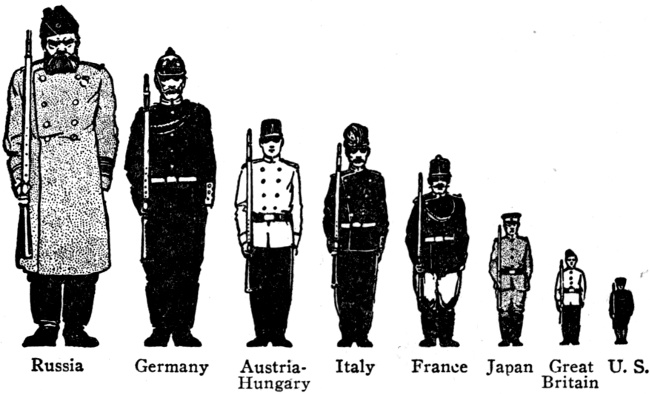
COMPARATIVE SIZE OF THE ARMIES OF THE WORLD
ARMOR
The king-crab, found in the Indian and American seas, is armed with a sword-like weapon at his tail and his head is protected by a sword-shaped helmet, so he is well armed for the battle of life. Since he and his ancestry have assisted in purifying the sea, we can see the wisdom which preserved them from age to age.
In the age-long battle against spiritual enemies, Paul urges the Ephesian Christians to “take unto them the whole armor of God”; “and having done all to stand.” (Text.)
(131)
See Resistance.
ARMOR-PROOF
Paul writes of the “whole armor of God,” proof against “the fiery darts of the wicked.”
Mr. W. T. Stead thinks that armor is certainly about to be revived in the military forces of Europe. A bullet-proof substance has been discovered; and if it be used as a breast-plate like a steel cuirass, it will put a different face on modern warfare. The French Government has tested the new armor, and reports that it has four or five times the resistance of chilled steel, and is invulnerable to rifle bullets. The equipment is not heavier than a cuirass and costs half as much. Of his own observation in this matter, Mr. Stead writes as follows in the London Daily Chronicle:
“I have myself witnessed experiments which go to prove that the soldier provided with this new armor can expose himself to the fire of modern rifles, at a distance of one hundred yards, and suffer as little from their fire as if he were being assailed by pea-shooters. The regiment arrayed in this armor of proof, and marching up to within one hundred yards of the enemy, suffers no more damage from a mitraille of steel bullets than if it were marching through an ordinary hailstorm.”
(132)
Army, Tribute to—See Acknowledgment.
AROUSAL
Sensationalism in the sense of stirring men to greater interest in verities, seems wholly praiseworthy:
Old Peter Cartwright was a famous preacher and circuit-rider many years ago.
The exhorter was holding a camp-meeting in Ohio. There was a great number of campers on the field, and the eccentric speaker addrest vast concourses at every service, but he thought too few were being converted. He felt that something should be done to stir the sinners to repentance, so he prepared a strong sermon on the second coming of Christ. He told how the world would go on in its sin and wickedness, and at last Gabriel would sound his trumpet and time would come to an end. He described the horrors of the lost and the joys of those who were saved. The sermon grew in intensity, and he brought his people up to a grand climax, when suddenly the sound of a trumpet smote the ears of the anxious throng.
There was a great sensation, and many fell upon their knees in terror and began to repent and pray. Women screamed and strong men groaned. Pandemonium was let loose for a few minutes. After the terror had somewhat ceased the preacher called to a man up a tree, and he descended with a long tin horn in his hand. The speaker then turned in fierce wrath and upbraided the people. He cried out in stentorian tones that, if a man with a tin horn up a tree could frighten them so, how would it be in the last great end when Gabriel’s trumpet sounded the knell of the world! The sermon had a great effect upon the vast audience, and many hundreds flocked to the front and were converted.
(133)
AROUSEMENT BY A THOUGHT
It is not infrequent to find a really great mind sunk in apathy for want of a compelling thought, a dominant idea, a commensurate ambition. Then something rouses such a mind, and at the touch of a magic wand its slumber is broken. Some hint drops like a seed into its prepared soil, and the mind becomes so renewed and vitalized that henceforth it scarcely seems the same. This was precisely the history of Gibbon’s intellect. The moment when his imaginative sympathy was touched with the thought of the past glory and present degradation of Rome, was the moment that freed all the latent powers of his genius, as ice is thawed by the sudden burst of summer warmth. And in that moment, also, his years of wide and irregular study bore fruit.—W. J. Dawson, “The Makers of English Prose.”
(134)
Arousing an Undutiful Son—See Worshiper, A Mother.
Arrested Development—See Retardation.
Arriving—See Ambition.
Art—See Home Values; Picture, Record Price for; Realism.
Art, Age in—See Enduring Art.
Art as a Transformer—See Beautiful, Influence of the.
ART, DECLINE OF
As long as a family thought itself comfortably furnished with a chest or two, a wardrobe, a box-bedstead, a dozen earthenware pots of different sizes, and three or four vessels of pewter or copper, each one of these objects of utility might become a vehicle for a good deal of artistic thought. The piece would be handed down from mother to daughter, from father to son. At all events, it would be made with that possibility in mind. It was made to last, and in an artistic community it would be the object of a good deal of careful consideration as to its form and as to the little adornments that might be added to it. Now, however, when the poorest family requires two hundred utensils of one and another kind, and finds, moreover, that these utensils are furnished at an incredibly low price by great companies which make them by the thousand and force them upon the customer with favorable opportunities for immediate delivery and gradual payment, the possibility of having the common objects of life beautiful has gone.—Russell Sturgis, “Lubke’s History of Art.”
(135)
ART, DEVOTION TO
The secret of success in any calling is an enthusiasm for our work like that of this artist:
The steamer was anchored in Glacier Bay, and he [R. Swain Gifford] was alone on the beach near Muir inlet, sketching. He was making a sketch of the Muir glacier, which was 250 feet above water and two miles wide. Suddenly he noticed an enormous mass of ice breaking away from the glacier. It was several hundred yards long, and Gifford quickly realized that he was witnessing something few men had seen. He saw his danger if he stayed on the beach, but he wanted a picture of that huge detached mass of ice. He had his camera with him; he quickly adjusted it and took a snap-shot. He didn’t lose a minute then in collecting his tools and running as fast as he could to the high ground.
He escaped none too soon. The great mass of ice dropt into the water, and then came a return wave that would have swallowed the artist if he hadn’t been on high ground. (Text.)
(136)
Art Highly Valued—See Picture, Record Price for.
Art in Weather Changes—See Ice Beauty.
ART UNAPPRECIATED
The enterprising manager of a Paris theater once called upon Meissonier and asked him to paint a drop-scene for a certain theater and name his own terms. “You have seen my pictures, then?” asked Meissonier. “Oh, yes,” exclaimed the manager; “but it is your name—your name I want; it will draw crowds to my theater.” “And how large is it you wish this curtain to be?” inquired the artist. “Ah, well, we will say fifteen meters by eighteen.” Meissonier took up a pencil and proceeded to make a calculation. At last he looked up and said with imperturbable gravity, “I have calculated and find that my pictures are valued at 80,000 francs per meter. Your curtain, therefore, will cost you just 21,600,000 francs. But that is not all. It takes me twelve months to paint twenty centimeters of canvas. It will, therefore, take me just one hundred and ninety years to finish your curtain. You should have come to me earlier, monsieur; I am too old for the undertaking now. Good-morning.”—Art Amateur.
(137)
See Age.
ARTICULATION
“Clear articulation, not loudness in speech, is what the deaf desire. Remember this, and not only will the deaf hear, but they will be spared the physical pains and embarrassing discomfort occasioned by shouting,” advised Dr. C. J. Blake in a lecture at the Harvard medical school during which he discust hearing and speech.
“People thoughtlessly shout at those who are afflicted with deafness, little realizing the real pain they are causing,” said Dr. Blake. “If you would be thoughtful and considerate of these unfortunates, put emphasis on the articulation. Again and again have deaf persons said to me, ‘How I wish people would not shout at me so,’ and there is a pathetic note in the voice which long suffering creates.”
It was brought out that the so-called drumhead is tough enough to sustain a column of mercury twelve inches high and of its own diameter; but is, nevertheless, delicate enough to record sound waves vibrating 50,000 times a second.
The ordinary human voice, he explained, is vibrating about 152 times, and should be perfectly understood by an ordinary healthy individual. Consonant sounds, he said, are the retarding factor in speech, hence it is the duty of every person to cultivate the habit of clear articulation.
(138)
ARTIFICE
I once discovered a mother cuckoo in charge of an infant, evidently on his first outing. Drawn by his insistent demand for food, I came unexpectedly upon the pair in a retired spot in the woods. At sight of me the mother instantly left her clamorous offspring and flew to the lowest limb of a tree near by, where she treated me to a series of theatrical postures, bows, feathered displays, and acrobatic performances wonderful to see, keeping up at the same time a low cry which had instantly silenced the baby cries I had heard. Never for an instant taking her eyes off me, nor interrupting her remarkable demonstrations, the anxious mother very gradually, almost imperceptibly, moved away, a twig at a time, while I followed, fascinated and far more interested in her dramatic efforts than in finding her youngling. When she had thus drawn me several feet away from the dangerous spot, presto! she took to her wings and was gone.—Olive Thorne Miller, “The Bird Our Brother.”
(139)
There is a pleasant story of a lawyer, who, being refused entrance into heaven by St. Peter, contrived to throw his hat inside the door; and then, being permitted by the kind saint to go in and fetch it, took advantage of his being fixt to his post as doorkeeper to refuse to come back again. (Text.)—Croake James, “Curiosities of Law and Lawyers.”
(140)
A congregation in Connecticut had lost their pastor, and were desirous of filling his place. But their last minister had been self-taught, and the aristocracy—to wit, the deacons, etc.—stipulated that the new minister should have a classical education. In order to be sure of their man, the deacons agreed to let applicants preach a sermon on trial. At last a Welshman heard of the vacancy, but he was less learned than the one who had left; still, he determined to try. The day was arranged, the appointed minute arrived, and the candidate mounted into the pulpit. He got well on in his sermon, when he suddenly recollected that he was expected to show his learning.
“My friends” he said, “I will now quote you a passage in Greek.”
With a solemn look he repeated a verse in his native tongue. The effect was marvelous; approving nods and smiles were exchanged among the deacons. Thus encouraged, he followed up his advantage by saying:
“Perhaps you would also like to hear it in Latin?”
He then repeated another passage in Welsh; this was even more successful than before. The preacher cast his eye over his flock, and saw that he was regarded with looks of increasing respect. Unfortunately, there was also a Welshman in the congregation; he was sitting at the back, almost choked in his efforts to stifle his laughter. The minister’s eye fell on him, and took in the whole situation at a glance. Preserving his countenance, he continued:
“I will also repeat it in Hebrew.”
He then sang out in his broadest Welsh: “My dear fellow, stop laughing, or they will find it out.”
The other understood, stifled his laughter, and afterward dined with his successful countryman.—Tit-Bits.
(141)
See Foolishness Sometimes is Wisdom; Preferred Creditor.
Artifice in Insects—See Simulation.
Ascent of Man—See Blessing the Ropes.
ASCETICISM
The black shadow of asceticism spread over the sky of the Puritan Fathers. Given two coats, they chose the ugliest one. Given two colors for the woman’s garb, they chose the saddest and somberest. Given two roads, they chose the one that held the most thorns and cutting rocks. Given two forms of fear and self-denial, they took both. The favorite text of asceticism is “deny yourself.” The favorite color of asceticism is black; its favorite music, a dirge; its favorite hour is midnight; its favorite theme is a tombstone. The mistake of asceticism is in thinking that pain by itself considered has a moral value.—N. D. Hillis.
(142)
Macaulay said that “the Puritans hated bear-baiting, not because it gave pain to the bear, but because it gave pleasure to the spectators.” I once knew a man of this type who rooted up his wife’s flower-bed on the ground that attention to flowers was a wicked waste of time that ought to be given to the study of the Bible.—W. C. S.
(143)
ASKING AMISS
We ask for so many foolish things. If we should get them we would not know what to do with the answers. “Sophie,” the scrub-woman, of Brooklyn, in her quaint, half-broken English, once said this:
“I heard about a countryman who was in the city for the first time. He went into a restaurant and made up his mind to have something fine, whatever the cost. He saw a man at the next table put a little mustard on his plate, and he said ‘that must be fine and expensive, he has so little, but no matter what it costs, I will haf some.’ So he told the waiter to bring him a dollar’s worth of that stuff. A plate was brought. He took a big spoonful: it bit him; he spit it out and did not want any more. So, we ask for things that if our Father should give them to us we would only be bitten by them and be glad to get rid of them.” (Text.)
(144)
Asking and Receiving—See Faith and Prayer.
ASKING, BOLDNESS IN
The story is told in the Springfield Republican that Andrew Carnegie asked a young man who was about to become a student at Jena to get for him an autograph of Professor Haeckel. When it arrived it read thus: “Ernst Haeckel gratefully acknowledges the receipt from Andrew Carnegie of a Zumpt microscope for the biological laboratory of the Jena University.” Mr. Carnegie made good, admiring the scientist more than ever. (Text.)
(145)
ASLEEP
Tsavo is 133 miles from Mombasa, and during the construction of the line no less than twenty-nine Indians were eaten there by lions. The work was threatened, and a party of three young men—Hubner, Parenti and Ryal—took a car and lay in wait at night for a bold man-eater, who had stalked up and picked up a man on an open railway truck as the train slowed down into the station. Parenti lay on the floor, Hubner was in an upper berth, and Ryal was on the seat of the carriage, with his rifle. Ryal was on guard, but unfortunately he fell asleep. At 2 o’clock in the morning the man-eater they were hunting entered the carriage, picked up Ryal, jumped through the window, and fled to the forest, where the unfortunate man’s whitened bones were long afterward found.—Peter MacQueen, Leslie’s Weekly.
(146)
ASPIRATION
Does not every man at times feel the aspiration to realize the man he “might have been”:
Across the fields of long ago He sometimes comes to me, A little lad with face aglow— The lad I used to be. And yet he smiles so wistfully, Once he has crept within— I think that he still hopes to see The man I might have been!
(147)
Climb on! Climb ever! Ne’er despond, Tho from each summit gained There stretch forth ever heights beyond— Ideals to be attained! Life’s rescript simply is to climb, Unheeding toil and tire; Failure hath no attaint of crime, If we but still aspire. —James T. White, “Character Lessons.”
(148)
The spirit of man is not intended to grovel on low levels or to gravitate downward under carnal influences. Man is the only creature on earth so constructed physically as to be able to gaze upward.
“He died climbing” is the simple inscription on a monument to an Alpine guide, who perished when attempting the ascent of a peak. That record is a noble tribute to a hero. His attitude should be ours—looking upward and pressing forward. He was pressing on in the pathway of duty. Many a splendid career, intercepted at the critical juncture, might be described by the same sententious record. “He died climbing” may be said of many a young and ardent enthusiast—of Mackay, soon cut off in Uganda; of Bishop Hannington, reaching the border of the same land and martyred there; of Patteson, soon slain in Melanesia by islanders who mistook him for a slave-catching captain; of Henry Martyn, who did not live to see any of the results of his mission; of Wyclif, who sent forth the Bible in English but was not permitted to see the beginning of the Reformation. All these “died climbing.” (Text.)
(149)
Theodosia Garrison points out in these verses that aspiration, even when it fails of realization, is good for the soul:
Let me remember that I failed, So I may not forget How dear that goal the distance veiled Toward which my feet were set. Let me forget, if so Thy will, How fair the joy desired, Dear God, so I remember still That one day I aspired. (Text.) —Ainslee’s Magazine.
(150)
W. H. T. Squires expresses the normal law of the soul—that its desires are to rise and climb—in these verses:
Up from the mists of marsh and fen, Up from the gloom of the glen, The mountains rise to kiss the skies, They spurn the plain that lowly lies— Up from the forest’s fitful shade, Up to the heights that God hath made. Up from the stains of sordid strife, Up to a loftier life My spirit cries, “Aspire! aspire!” Climb we the heights from high to higher Up, lest the fleeting daylight fade, “Up!” is the law God hath laid.
(151)
See Discontent, Divine; Focusing the Eye.
ASSIMILATION
The alfalfa plant is a rank species of grass that grows in the western sections of our country. It is valuable for horses and also for enriching waste land. It thrives in a soil where other plants would fail because of its power to find water. Roots in search of moisture have been found that were eighteen inches in length. The stalk makes heavy drafts on the surrounding air for nitrogen. Its powers of assimilation are remarkable. Its rapid and sturdy growth is a result of its habit of drawing upon all the surrounding air and the soil to build itself up.
If we wish to grow we must avail ourselves of every possible means. Soul culture depends not only upon hearing the truth, but upon assimilating the truth. (Text.)
(152)
Are there not moral and religious “bolters and chewers.” Some men try to get their religious pabulum by “bolting” all their experience in a revival; others, with a more quiet deliberation, are intent upon growing in grace through the years.
In an address at the Royal Dental Hospital, London, Dr. Osler, as reported in The Hospital (London), asserted that the public may be divided into two great groups, the bolters and chewers. Says this paper: “He maintains that it is the business of dental students to endeavor to convert the overwhelming percentage of bolters into a select group of chewers. This is their mission of utility; but Professor Osler also affirms that they have a mission to beautify the race. He holds that if there is one thing more beautiful than another under heaven it is a beautiful set of teeth. To promote these missions he would have attached to every elementary school a dental surgeon to inspect the mouths of the children; and total abstainers will learn with a shock, that he considers the question of teeth more a national problem than that of alcohol. If people generally had good teeth instead of bad, the chewers would be many and the bolters few, and a potent cause of human suffering and physical deterioration would be arrested.”
(153)
Assistance—See Helpfulness.
ASSOCIATION
There are localities in Switzerland where the canary is caged with a nightingale so that it may catch the sweetness and breathe into its notes that harmonious melody that delights all tourists in Europe. It is a demonstration of the power of association. This canary-bird had been trained by a nightingale.
So men may make their lives strong, pure, sweet and holy in thought, word and deed by unbroken association with those who live on a higher plane. (Text.)
(154)
Association, Christian—See Warmth, Lost.
ASSOCIATION, LAW OF
My father remembered the last clergyman in New England who still continued to wear the wig. At first it became a singularity and at last a monstrosity, and the good doctor concluded to leave it off. But there was one poor woman among his parishioners who lamented this sadly; and waylaying the clergyman as he came out of church, she said, “Oh, dear doctor, I have always listened to your sermon with the greatest edification and comfort, but now that the wig is gone all is gone.”—James Russell Lowell.
(155)
ASSOCIATION, LEARNING BY
A gentleman had in his bird-room a deformed blue jay, who was reared from the nest and never associated with his kind. In the room was also a cardinal grosbeak, one of the finest singers of his family. The young blue jay learned the song of the cardinal so perfectly that the gentleman could not tell it from the cardinal’s own. “Even when hearing the two performers almost together, I could distinguish only a slight difference, which was not in the cardinal’s favor.”—Olive Thorne Miller, “The Bird Our Brother.”
(156)
ASSOCIATIONS MOLD MEN
Among the doctrines of Belial is the theory that we must familiarize ourselves with evil if we would have power to resist it.
Jean François Millet in the middle of the last century was engaged on his early pictures. As they appeared one after another they astonished and delighted all lovers of art throughout the world. What were the subjects of these wonderful paintings? They were all deeply religious—the “Angelus,” the “Sower,” the “Man with the Hoe,” the “Winnower,” the “Gleaners.” These masterpieces were not only spiritual, but were replete with beauty, pathos, power, and with all the works of the highest genius. Now, the theory had been popular that an artist must revel in fleshly and voluptuous presentations of life. But Millet hated the salaciousness of Greece, and Rome was abhorrent to him. He was a lifelong lover of his Bible, and his life was one of devotion and purity. (Text.)
(157)
ASSURANCE
Among the Hebrews is preserved a legend of two sisters, who on the night of the Exodus, when the destroying angel passed through the land of Egypt, remained indoors with the family.
One was ready for the departure, and filled with assurance and peace, so partaking of the paschal lamb. The other was restless and fearful lest the death angel would not pass them by. “Is the blood sprinkled?” she kept asking anxiously, reproaching her confident sister for being so unconcerned. “Oh, is it sprinkled?” “Why, yes,” said the sister, “the blood has been sprinkled, and we have God’s word that when He sees the blood He will pass over.”
(158)
Assurance from Doing God’s Will—See Temperature.
Astrology—See Birth Ceremonies.
ASYMMETRY
Men are one-sided in their views and opinions as truly as in the use of their hands. There was never but one character that was perfectly symmetrical:
Why shouldn’t we work with two hands just as we walk with two feet? It seems ridiculous that the human family should have been using but one hand, either left or right, when nature provided two good hands with no apparent reason why they should not both be used. This oversight, or neglect, is being remedied at a school in Philadelphia, where the pupils are learning to use either hand with equal facility. The boys and girls are taught to draw with the right and left hand at once, and it is marvelous with what ease, after a little practise, the pupils can draw a design on the blackboard, using the right hand for the right side of the picture and the left hand for the left side, completing the entire design in a few minutes, the two hands working with perfect coordination. Compared with the old method of drawing laboriously and slowly with one hand, the ambidextrous system is infinitely superior.
(159)
ATHEIST’S GIFT TO MISSIONS
In the year 1877, Col. Robert G. Ingersoll made an extended tour of the Pacific coast. He spoke in several of the larger cities, and at length arrived at Portland. There was in the city a certain missionary to the Chinooks. He could not afford a ticket to the lecture, and was greatly disturbed at what he read concerning it. Yet he felt a strong desire to meet Colonel Ingersoll, and a common friend procured a meeting between them.
There was a moment of restraint, relieved by the greater ease of Colonel Ingersoll, who began the conversation by inquiring concerning the work of the missionary. A little mirthfully he questioned him about the advisability of exporting religion, of which there might not be any surplus at home, and inquired, somewhat doubtfully, about the wisdom of a man giving his life to a hopeless task in attempting to teach a small and vanishing tribe things of which we ourselves have perhaps less knowledge than we suppose.
The answers of the missionary, however, interested Colonel Ingersoll. He inquired about the “Chinook jargon,” that mongrel speech, made of English, Canadian French, Chinook and other Indian words, picked up from several tribes, and all softened and modified to suit deficiencies of pronunciation; the r changed into l, after the Chinese manner, and the grammar “made by chopping up words with a tomahawk.”
How could a man preach in a language where one word had to serve as noun, verb and adjective? How could a man of education make himself understood in a language with only four parts of speech and some fragments? How could he tell the story of Peter’s denial in a language which, having only one word for all manner of feathered things, and no verb for the act of crowing, made it necessary for the speaker to imitate the act and sound? How could he tell that Peter swore, in a language that had no verb “to curse,” but had plenty of oaths inherited from traders in various tongues? How could he impart any idea of sacred things in a polyglot of slang?
The missionary told him the story of his work—how he preached as best he could in the poor, meager speech of the people, meantime teaching the children English, encouraging them in useful arts, fighting the vices of civilization as they made inroads among the people, and doing what he could for them as adviser and friend. It was hard work, and not very encouraging, but it was worth doing, and he was happy in it.
In telling his story thus, encouraged and led on by a man trained and skilful in cross-examination, the missionary unconsciously disclosed many of the hardships and privations which his work entailed upon him. Possibly, and indeed probably, he had not thought of them seriously as hardships, and therefore he related with telling simplicity the stories of long journeys by canoe and on horseback, of nights in the open, of poor and sometimes revolting food eaten in savage company. There was no word of complaint, nor even the least expression of regret, except for books and papers and magazines missed.
When the missionary rose to go, Colonel Ingersoll took his hand warmly, and said, “I thank you for coming to see me. This interests me very much. It’s good work you are doing, it’s good work. And here, take this. I am not a frequent contributor to missionary work, but I like this.”
Into the missionary’s hand he dropt a bright twenty-dollar gold piece.—Youth’s Companion.
(160)
Atmosphere—See Impurities.
Atmosphere, City—See Tests.
Atmosphere, The, and Light—See Light-bearers.
Atmosphere, The Christian—See Hospitality in Church.
ATOM, THE, A WITNESS TO GOD
Not only “day unto day, uttereth speech,” but, according to science, there are innumerable voices in the world that also speak of God. A writer finds such in the atom of matter:
How then came they to be what they are? These “myriad types of the same letter”; these unhewn blocks from an unknown quarry; more indestructible than adamant; the substratum of all the phenomena of the universe; and yet, amid the wreck of all things else, this infinitude of discrete atoms alone is found incapable of change or of decay. Who preserves to them their absolute identity, notwithstanding their infinite variety? Who endowed them with their inalienable properties? Who imprest upon them the ineffaceable characters which they are found to bear? At what mint were they struck, on what anvil were they forged, in what loom were they woven, so as to possess, as Huxley declares, “all the characteristics of manufactured articles”?
(161)
ATONEMENT
All the theological interpretations of atonement look back to the Old Testament Hebrew terms kaphar and kasah “to cover.” We are saved by an atoning sacrifice; that is, by a sacrifice which covers us.
A fire on a gentleman’s estate in England destroyed his mansion. It spread to a plantation near by, and trees and bushes were burned and charred. The gentleman next day heard the chirping of little birds in a blackened thicket close by him. He searched among the charred branches and discovered a nest, on which was lying, with outstretched wings, a dead robin. Under her were three fledglings, safe and sound. The mother bird had covered her young, saving them at the cost of her own life. (Text.)
(162)
ATONEMENT COMPELLED
There is a Spanish story of a village where the devil, having made the people excessively wicked, was punished by being compelled to assume the appearance and habit of a friar, and to preach so eloquently, in spite of his internal repugnance and rage, that the inhabitants were completely reformed. (Text.)
(163)
See Sin Without Atonement.
ATROPHY
Professor Dawson, in his book “The Child and His Religion,” says:
I once saw a little girl of three years who was unable to walk, or even stand alone. She would make no attempt to do either, and seemed to have absolutely no interest in getting up on her feet or walking. The child seemed perfectly well, and her parents had become very anxious about her. Inquiry revealed the fact that when she was nine months old the little girl had been injured by a fall, and had been kept very closely confined for six months; at first in her crib, and later in a high chair, never being allowed to stand on her feet. When she was at last put upon the floor, she began her creeping just as she had been in the habit of doing six months before. Nor did she show any disposition to do otherwise than creep, even after her strength had been fully recovered. It required several months of careful attention on the part of the parents, in exercising her in standing and walking, to awaken any interest whatsoever in these activities. This law of atrophy through disuse undoubtedly operates throughout the entire range of human interests, not only in those interests more closely related to organic life, but also in the intellectual, moral, and religious interests. It is manifestly of great concern to parents and others who have the care of children that all normal interests be given a chance to function at the right time and in the right way. (Text.)
(164)
ATTACHMENT REWARDED
In order to secure some token by which to remember a great-aunt to whom she had been much attached, Mlle. Bertha Chevanne, a young French woman, of Paris, attended a sale of the old lady’s effects. The girl was poor and most of the articles were beyond her purse. A shabby old book—a book of devotions—was, however, put up. Nobody bid for it except Mademoiselle Chevanne, and she bought it for next to nothing. In turning over the leaves she came across a folded paper. It was a will bequeathing her the whole of her great-aunt’s estate, valued at $80,000.
(165)
ATTACK, DISCRETION IN
As with a fortress, so with many fortified evils. It is often better to flank them than to exhaust strength by direct attack.
To let a fortress go, so far from being disgraceful, is often one of the best things a general can do. If MacMahon had let Metz go, the Germans could not have got round Paris without tremendous losses and months of fighting. If Lee had abandoned Richmond in 1862 the war might have been protracted indefinitely. The greatest mistake Osman Pasha made in 1877 was holding on to Plevna too long. Napoleon let Genoa go in spite of the fine defense of Massena, but he soon recovered it after he had defeated the Austrians in the field. In the American civil war Burnside was compelled by the press to advance, with the result of the failure at Fredericksburg and the loss of 12,000 men. A field army should never be risked for a fortress.—Dr. Miller Maguire, London News.
(166)
See Aggression; Saloon, Fighting the.
Attainment by Abandonment—See Higher, The.
ATTAINMENT, SUPERFICIAL
There are men who attempt to rise in the social scale without any apparent fitness for the larger place aspired to. Many start off on a course, but lack ability, patience and pluck to persevere and so fail of their goal, as the following somewhat humorous illustration suggests:
Attorney William S. Barnes, of San Francisco, has a new office boy. The last boy with whom he was associated resigned a few days ago because the law business did not suit his peculiar temperament.
“How long have you been here?” asked Barnes, when the small boy made known his intention to engage in a different vocation.
“Six months,” replied the boy.
“And you don’t like the law business?”
“Naw. It’s no good, and I tell you straight, I’m mighty sorry I learned it.”
(167)
Audience Attracted—See Providential Interposition.
AUDIENCE, INSPIRATION FROM
“When a singer is up before an audience, he or she can tell whether the effect of the voice is pleasing or not by watching the countenances of the listeners,” says Thomas A. Edison in Popular Mechanics. “When, however, one sings into a dead instrument like the phonograph, without the slightest recognition as to whether the voice is properly tuned and pitched, the singer becomes rather nervous. I know some very capable singers who can sing splendidly before an audience, but when it comes to getting their voice into the phonograph, they are dumb. I have brought people of great note out to the works, and paid them handsomely for their vocal efforts, only to find, when I came to reproduce these attempts on the phonograph, that the records were utterly worthless. One must have, indeed, a regular phonograph voice in order to make a good record. Some people can sing well into a phonograph who could not get up before an audience to save their lives; and again, as I have said, some people can sing before persons, but they can not perform before a phonograph.”
(168)
Audiences—See Fitness; Opportunities Improved.
AUGURY
The apostle who said “I know in whom I have believed, and am persuaded that he is able, &c.,” had a far better assurance than the philosopher who trusted in a meaningless omen.
Rousseau, in his celebrated “Confessions,” records that he was one day sitting in a grove, meditating whether his soul would probably be saved or lost. How could he settle the question? A supernatural voice seemed to suggest an appeal to a singular kind of augury. “I will,” said he, “throw this stone at that tree. If I hit the tree, it shall be a sign that my soul is to be saved. If I miss it, it shall indicate that I am to be lost.” Selecting a large tree, he took the precaution of standing near to it, and threw his stone plump against the trunk. “After that,” naively says the philosopher, “I never again had a doubt respecting my salvation.”
(169)
Author Encouraged—See Good, Seeing the.
AUTHORITY UNCONSCIOUSLY SOUGHT
The child finds the world so complex and varied with so many unpleasant and pleasant experiences that he soon discovers the usefulness of his elders in providing him with pleasant experiences or in warning or guarding him against the unpleasant whenever he feels uncertain in a new situation. That is, the child tends to fall back on the authority of the older person and automatically to accept, up to a certain point, the dogmatic verdict of his elders as to the desirability or undesirability of a course of action. Neither the child nor the grown person is, as a rule, conscious of his acceptance of the thought of another as his own, but examples of it are evident enough in the spheres of religion, politics, precedent (in law), fashion, and, in fact, all of life’s activities.—Stuart H. Rowe, “Proceedings of the Religious Education Association,” 1907.
(170)
Authority—See Risk Shifted.
AUTHORS, WORK OF
George Eliot is said to have worked harder on “Romola” than on any of her other books. In her own words: “I began it a young woman—I finished it an old woman.” And yet but about seventeen months were consumed in the work. Some authors have lived long. Alexander von Humboldt lived to be over eighty. Goethe was over eighty-one when he died. Kant lived his quiet life for just eighty years, the quietest and most uneventful life known to a man of genius. Titian died at the age of ninety-nine. Michelangelo lived to be more than eighty. Among the royal persons who have become known as authors are Queen Victoria, King Oscar II, of Sweden; Dom Louis, of Portugal; the Shar Nasr-ed Deen, of Persia; Queen Elizabeth, of Rumania; Prince Nicholas, of Montenegro; Dom Pedro II, of Brazil; King Louis II, of Bavaria, and several others. The novelists are at present dominant among us, so far as popular acceptation and remuneration go. It has been lately ascertained that Mr. Tennyson made four thousand pounds a year by his poetry. Walter Besant, who was seduced from the career of a college don by the fascinations of the novelist’s art, earns more for any one of his romances than Carlyle earned in the first ten years of his literary career. Charles Reade averaged, we believe, five pounds per page for his writings. Herbert Spencer’s remuneration scarcely exceeded five shillings per page. Matthew Arnold’s imaginative powers earned him an income at least four times smaller than Wilkie Collins’ imagination could command. A shoemaker’s son, a few years ago, wrote a short comic story which tickled the public taste; his success was so immediate that the public—represented by the publishers—afterward paid him one thousand pounds a year for whatever he chose to write.—Christian At Work.
(171)
Autograph Diplomacy—See Asking, Boldness in.
AUTOMATIC EXPERIENCES
Man early acquires automatic tendencies and abilities quite beyond the compass of his natural equipment. Man is gifted natively with a brief and fleeting form of attention, but by exercise and wise guidance its effectiveness may be greatly increased both as to direction and span. Imagination and memory may be natively vigorous in a desultory and disorganized sort of a way and yet be comparatively helpless when confronted with a situation requiring the organization of details into a system or unit. For example, children may get a great deal of pleasure out of fairy stories long before they understand much from the various disconnected and often incorrect interpretations they make of the words they have heard. This tendency is shown also in childish explanations of things. One young man notices that leaves, sticks, and stones left standing some time on the pond where he skated gradually sink into the ice. He notices, also, that slight scratches and flakes of snow gradually disappear. Such data led him to explain to himself the phenomenon as due to the fact that the water worked through the pores of the ice and froze on the top. It is evident that he had not heard of radiation from dark as compared with light surfaces, but it illustrated an automatic tendency to explain things fairly well developed which was quite beyond the power of man naturally.—Stuart H. Rowe, “Proceedings of the Religious Education Association,” 1907.
(172)
AUTOMATIC LEARNING
Nature has provided plants, animals, and man with many ways of adjusting themselves to their environment, but only animals and man organize their experiences so as to make them of use to them in future situations. Some kinds of mice can learn to go to a little house with a blue-colored front because it suggests food to them as they have always found it there, and not in a similar one with a red front. Another kind of mouse (the Japanese dancing mouse) does not learn this difference, either because it is color-blind or, much more likely, because it has not sufficient intelligence to organize its experiences of blueness by making it suggest food to him. It has been said bees can distinguish colors and associate them with sweetened water. These animals, and, in fact, animals in general, have the ability, as we say, naturally to do thousands of appropriate things whenever the appropriate stimulus presents itself. Given the newly hatched chicken and the attractive piece of corn within easy range, and with a quick dive of the head the corn has been snapt up by a series of muscular movements quite complicated in their totality but all coordinated or organized from the first. The chicken does not have to learn this accomplishment. A young child also can perform many kinds of action without learning, as, for example, movements of head, limbs, and other parts of the body.
Compare the difficulty a year-old child able to walk has in picking up something with his hands. He makes many motions, sometimes overreaching, sometimes falling short, in the end probably falls flat. The child has to learn both to walk and to pick things up, but he learns both without realizing that he is learning them. It is done spontaneously.
There are, then, some things that man and animals can do without learning, and some things they have to learn, but that they learn automatically. Beside these easier tasks there are many others that man may learn, but only through definite thinking or direction with a distinct aim in view, rather than automatically without any consciousness of his learning. The child may recognize his father’s authority instinctively even without learning. He may by imitation think of some things as right or wrong without being taught. There are others he must be taught and learn with a definite purpose and effort or he will not make the distinction.—Stuart H. Rowe, “Proceedings of Religious Education Association,” 1907.
(173)
Auxiliary Strength—See Reenforcement from Without.
Auxiliary Workers—See Supplies, Bringing Up.
AVARICE
When you can put out a fire by throwing oil on it, then, and not till then, can you extinguish avarice by feeding it with millions.—N. D. Hillis.
(174)
See Greed; Money, Greed for.
AVERAGE LIFE
Many an enthusiastic tourist has sacrificed morning sleep to witness a sunrise from some summit, and suffered disappointment. The splendor extended over too wide an area; it lacked concentration—accentuation. The sunrise of the short horizon, seen from the average altitude, appears brighter as well as narrower. It requires no wide ranging of the eye, no shifting of the point of attention. It is not weakened by its own diffusion. You may carry this principle over into the philosophy of life. The short horizon—which is, for the most part, the average—has its distinct advantage. You will doubtless get more out of life at the average altitude than if you live always in some extraordinary height.
(175)