P (continued 3)
Reading edition
(2476)
PREJUDGMENT
It is not uncommon for men to judge a cause before they have heard the facts:
Lord Eldon said, “I remember Mr. Justice Gould trying a case at York, and when he had proceeded for about two hours, he observed, ‘Here are only eleven jurymen; where is the twelfth?’ ‘Please you, my lord,’ said one of the eleven, ‘he is gone away about some business, but he has left his verdict with me.’”—Croake James, “Curiosities of Law and Lawyers.”
(2477)
PREJUDICE
Take equal parts of malice, ignorance and hate, mix well and serve hot, and you have prejudice.—N. D. Hillis.
(2478)
PREJUDICE DISARMED
There is a certain famous preacher, perhaps the leading man in his denomination, against whom I have had a prejudice which has been slowly increasing for the last twenty-five years. When he used his influence a few years ago to prevent the recognition in a great ecclesiastical council of two of the noblest spiritual leaders of this generation, because of their adherence to the old-fashioned faith and methods, my bump of prejudice against that man reached full-sized proportions.
It was my lot very recently to be a member of a house of mourning where this same minister was the officiating clergyman, and I had to meet him personally. But when he had finished his prayer, my prejudice had all melted away like dew before the rising sun, and I felt like rushing up to him, putting an arm in his, and saying, “You didn’t do it, did you? I’m sure I’ve misunderstood; please set me right about yourself.”—George W. Coleman, “Searchlights.”
(2479)
PREJUDICE, RELIGIOUS
An old woman at Jhansi, in North India, a Brahman of strictest sect, and mother of a princess who was very ill, called in Dr. Blanche Monro, of the Woman’s Union Missionary Society. She dismissed the lady doctor each time with smiles, thanks, and rich rewards, then grimly ordered her servants to wash everything the foreign lady had touched—the floor, table, chairs, her own clothes, and finally herself. After she has taken a bath, she feels pure once more.
(2480)
PREPARATION
Many disappointments and failures are simply the results of superficial expectations of easy success without patient preparation of the needed preliminary conditions.
A famous English gardener once heard a nobleman say complainingly, “I can not have a rose garden, tho I often have tried, because the soil around my castle is too poor for roses.” “That is no reason at all,” replied the gardener. “You must go to work and make it better. Any ground can be made fit for roses if pains are taken to prepare it. The poorest soil can be made rich.” It was a wise saying, and it is true in other cases than rose gardens. Some young people say, “I can’t be cheerful,” or, “I can’t be sweet-tempered,” or “I can’t be forgiving,” as if they were not responsible for the growths in their soul-garden because the soil is poor. But “any ground can be made fit for roses,” and any heart can be made fit for the loveliest blossoms of character. (Text.)
(2481)
Preparation a Safeguard Against Loss—See Control of Circumstances.
Preparation, Aimless—See Aimlessness.
Preparation by Training—See Toughness.
PREPARATION CONTINUOUS
Michelangelo, when an old man, said: “I carry my satchel still!” indicating that his life was a perpetual study and preparation.
(2482)
PREPARATION, COSTLY
Alonzo Cano, a Spanish sculptor, being employed by a lawyer of Grenada to make a statue of St. Antonio de Padua, and having mentioned how much it would cost, the lawyer began to reckon how many pistoles per day the artist had earned. “You have,” said he, “been five-and-twenty days carving this statue, and your exorbitant demand makes you charge the rate of four pistoles per day, while I, who am your superior in a profession, do not make half your profits by my talents.” “Wretch!” exclaimed the artist; “do you talk to me of your talents? I have been five-and-twenty years learning to make this statue in five-and-twenty days.” So saying, he dashed it on the pavement.—Croake James, “Curiosities of Law and Lawyers.”
(2483)
PREPARATION, PROPHETIC
Shortly before the death of Mozart, the musician, a stranger brought him an anonymous letter in which a request for a requiem was made. To its composition he gave the full strength of his powers. The conviction seized him that he was composing a requiem for his own obsequies. While engaged in this work and under this strange inspiration, he gathered all his strength to complete his work. And when the task was finished, a strange fire lighted his eye, as the melody, even to his exquisite sensibility, was perfect. It bore an unearthly sweetness that was to him, too truly, a warning of his future and fast-coming doom.
All our life work is, in a way, a preparation for death.
(2484)
PREPARATION SUCCEEDS
A life sketch of Richard Mansfield, the great actor, contains the following account of his first success on the stage:
A noted actor had been offered the part but shrank from it, and finally absolutely refused to take it. Mansfield saw its possibilities and was in a fever of eagerness to get it. In the distress and pressure of the situation the manager reluctantly gave it to him. Then the young man began to prepare for the part. He studied everything which would throw light on the character. He interviewed people, visited the haunts of such men as the character represented, and he rehearsed and rehearsed until his eyes gleamed and his whole being was on fire. When he came on the stage for his first act the people were indifferent, not even paying attention to the play, but talking and laughing. Soon a hush fell upon them. They were spellbound. When the curtain fell there was a roar of applause which shook the building, and at the close of the play the audience went out dazed. Richard Mansfield was never to go hungry again. At a bound he had leapt from the dust to the top of the ladder. It makes one’s heart leap just to read about it.
(2485)
Preparation, Thorough—See Thoroughness in Preparation.
PRESENCE OF GOD
One day a poor leper came to Dr. Pauline Root’s dispensary, in Madura, India, with a small, dirty cloth about his waist. He begged a new garment. It was given and was the cause of great delight. Two weeks later he appeared again, making the same request. Dr. Root asked him, “Where is the cloth I gave you?” “I have it,” the old man replied, “but I am old, and will not live long, and some morning it is probable that the people in passing by my little mud hut to the river will look in and see me lying there dead. When I go into God’s presence I want to be nice. All day long I go about for my food and I am very dirty and very tired, but when I go home I wash myself and I have kept that beautiful long piece of cloth to wrap myself in when I lie down. I commit myself to God thinking that perhaps the next morning I shall have gone into His presence.” (Text.)
(2486)
Beneath the shadow of the Great Protection, The soul sits, hushed and calm. Bathed in the peace of that divine affection, No fever-heats of life or dull dejection Can work the spirit harm. Diviner heavens above Look down on it in love. And, as the varying winds move where they will, In whispers soft, through trackless fields of air, So comes the Spirit’s breath, serene and still, Its tender messages of love to bear, From men of every race and speech and zone, Making the whole world one, Till every sword shall to a sickle bend, And the long, weary strifes of earth shall end. —James Freeman Clarke.
(2487)
This metrical prayer is from the New York Christian Advocate:
Stay with me, Lord; the evening sun declineth, And I am weary of this rugged way. To find repose my fainting spirit pineth— O Lord, be Thou my comfort and my stay! Tremble my steps with age, my hair is gray, And earth-born hopes allure me now no more. But Thou, my Savior, cast me not away. O lead me gently till, my journey o’er, I reach my Father’s house, safe sheltered evermore. Stay with me, Lord; even now to the dark valley My step descendeth, and the chilling gloom Is gathering o’er my pathway deep and dreary— Dread shadows of the ay mysterious tomb. Now may Thy lamp this fearful vale illume; Its light alone these terrors can dispel. Where Thou, my Lord, art guide, no ill can come. Thou mighty Conqueror of death and hell, To Thee I trust my soul and know that all is well.
(2488)
What may be round the next headland we know not; but this we know, that the same sunshine will make a broadening path across the waters right to where we rock on the unknown sea, and the same unmoving mighty star will burn for our guidance. So we may let the waves and currents roll as they list, or rather as He wills, and be little concerned about the incidents or the companions of our voyage, since He is with us.—Alexander McLaren.
(2489)
See Perseverance.
PRESENCE OF MIND
On New-year’s eve at one of the largest restaurants in New York, a woman’s dress caught fire, and, altho surrounded by other diners, the flame was not extinguished until she had received burns from which she subsequently died.
It seems incredible, yet it is a fact. And while the woman blazed, and shrieked in her agony, the men sought to extinguish the flame with napkins and their hands!
As I journey through life in town or in the wilderness, the quality I find most lacking in the human animal is presence of mind; and that is one of the good reasons why I am so persistent and outspoken an advocate of games for boys, especially games where the action is quick and where the boy must needs think, and quickly, under stress of combat, so to say.
Had there been any football players within reach of that poor woman, one of them would probably have had the sense to take off his coat and smother the flame.—Caspar Whitney, Collier’s Weekly.
(2490)
PRESENCES, UNRECOGNIZED
In a German art gallery is a famous canvas entitled “Cloudland.” To a casual glance it looks like a daub of confused color without form or beauty. But upon close examination it reveals a mass of exquisite little cherub faces—an innumerable multitude of angels. So Milton:
“Millions of spiritual creatures walk this earth Unseen, both when we wake and when we sleep.” (Text.)
(2491)
Present Alone is Ours—See To-morrow, Uncertainty of.
Present, The—See Night, God’s Presence in the; Now, Do It.
PRESERVATION
It was one of the coldest days of winter. Benny came home from school, intending to brave the cold and go coasting till dark; but, when he found mama had a sick headache, he said nothing about coasting, but volunteered to amuse four-year-old Lulu while mama lay down for a nap. That’s the kind of a boy Benny was!
“Let’s blow soap-bubbles,” he said, taking Lulu into the kitchen, where he made a cup of beautiful soap-suds. Each had a pipe, and they blew bubbles for a long time. The sun shone in at the window, making them all the colors of the rainbow.
“Oh, I wish I could keep ’em!” sighed Lulu. “They are so pretty!”
An idea came into Benny’s wise young head. He took a piece of an old, soft, woolen blanket, and carrying it out into the shed, spread it very smoothly on the floor in an out-of-the-way corner. Then, going back into the kitchen, he said:
“Now, Lulu, I’m going out into the shed to work a few minutes. It’s too cold for you out there, but, if my plans work well, I’ll wrap you up warm and take you out to see what I have done. You keep on blowing bubbles here.”
“All right,” said Lulu cheerfully.
Benny carried out part of the soap-suds, and as rapidly as possible blew about a dozen bubbles, floating them on to the soft blanket. The cold was so intense that they froze instantly before they could burst; and there they stood, looking like so many delicate glass balls.
When the blanket was well filled, Benny went in and, putting on Lulu’s warm wraps, took her out to see the bubbles. How surprized she was!
“Can’t I roll ’em round?” she asked.
“No indeed!” said Benny. “The least touch would break them all to smash!”
When mama got up with her headache relieved, she had to go out and see the bubbles, and so did papa when he came home.
The night was so cold, and the shed door and windows being closed, so that there was no draught of air, the bubbles were as good as ever in the morning. But before noon they began to crack open and dry away, and, when Benny came home at night, the weather was milder and each bright bubble had vanished, leaving only a bit of soap-suds in its place.
This is a true story, and some sharp day this winter you bright boys and girls can try the experiment for yourselves.—Mattie A. Baker, Youth’s Companion.
(2492)
See Resuscitation.
PRESERVATION, A PROCESS OF
It is not hard to believe that the passage through death will be the occasion for a new blossoming of the flowers of character, after the analogy of the frozen flowers about which this account from Harper’s Weekly is given:
The latest and most approved method of preserving flowers during transportation is that of freezing them. When this process is employed the flowers are picked while in the bud and will keep perfectly for several weeks in refrigerator boxes. No deterioration in their beauty results from this treatment, and after they have been unpacked and placed in water they slowly revive and the blossoms develop fully. During the period of refrigeration all growth is suspended, and so slowly do the flowers return to their natural state that such blossoms will last much longer in a room than would be the case had they been brought directly from the greenhouse or the garden.
The facility with which horticultural specimens have been transported by this new method has led to experiments in South Africa, with a view to determining whether many of their wonderful flowers may not be safely exported in bulk to supply the trade in Europe and America.
(2493)
Preservatives—See Evil, Protection from.
PRESS, OMNISCIENCE OF THE
I have been somewhat of a reader of the newspapers for forty years; I could read very well when I was eight years of age. It has given me forty years of observation of the press; and there is one peculiarity that I have observed from reading it, and that is, in all of the walks of life outside of the press, people have entirely mistaken their profession, their occupation. I never knew the mayor of a city, or even a councilman in any city, any public officer, any government official—I never knew a member of Congress, a Senator or a President of the United States, who could not be enlightened in his duties by the youngest member of the profession. I never knew a general of the army to command a brigade, a division, a corps of the army, who could begin to do it as well as men far away in their sanctums.—U. S. Grant.
(2494)
PRESS, PROSTITUTION OF THE
The Salt Lake Herald abstracts from “The Press of the World” some of the “rules of conduct” which Benjamin Franklin followed in his first journalistic venture. “They are so perfectly applicable to present-day newspapers,” it says, “that they are worth preserving and emphasizing.” He had just begun the publication of his Pennsylvania Gazette when an article was submitted to him that did not meet his views of propriety. With his customary deliberation he did not at once reject it, but told the writer he would sleep over it and give his decision the next day. This is how he applied his rules to the subject:
“I have perused your piece,” he wrote, “and find it to be scurrilous and defamatory. To determine whether I should publish it or not, I went home in the evening, purchased a two-penny loaf at the baker’s, and, with water from the pump, made my supper; I then wrapt myself up in my great coat, and laid down on the floor and slept till morning, when, on another loaf and a mug of water, I made my breakfast. From this regimen I feel no inconvenience whatever. Finding I can live in this manner, I have formed the determination never to prostitute my press to corruption and abuse of this kind for the sake of gaining a more comfortable subsistence.”
(2495)
Press, Using the—See Newspapers and Missionary Intelligence.
PRETENSE
About the time when it was fashionable in France to cut off men’s heads, as we lop away superfluous sprouts from our apple-trees, the public attention was excited by a certain monkey that had been taught to act the part of a patriot to great perfection. If you pointed at him, says the historian, and called him an aristocrat or a monarchist, he would fly at you with great rage and violence; but, if you would do him the justice to call him a good patriot, he manifested every mark and joy of satisfaction. But, tho the whole French nation gazed at this animal as a miracle, he was, after all, no very strange sight. There are, in all countries, a great many monkeys who wish to be thought patriots, and a great many others who believe them such. But, because we are often deceived by appearances, let us not believe that the reality does not exist.—Daniel Webster.
(2496)
At a recent horse-race one of the horses attracted a great deal of attention before the start by his remarkable appearance, and many spectators thought he would surely win. He was so full of life, and so eager to begin the race, that he broke through the barrier and ran several hundred feet before the jockey could stop him. The animal was full of confidence and life, but he finished fifteenth in a race of sixteen.
This horse furnished a pretty good illustration of the human bluffer, the man who struts and brags, who makes great pretensions, lots of noise, but never gets anywhere. The silent, unpretentious man, who keeps pegging away, distances him in the great life race.—Success Magazine.
(2497)
See Envy Gratified.
PRETENSE OF VIRTUE
It is a cynical saying that “every man has his price,” but it is difficult at times to judge what any man might do under stress of unusual circumstances. An illustration of this point is the following:
A Scots business representative called upon a firm whose principal desired to make him a Christmas present. The honest fellow was scandalized. He could not dream of accepting presents. If such a thing were in the minds of the firm, let them transfer their favor in the shape of discount to the house which he represented. They did not mean anything of the sort, they told him; this was a little matter personal to himself. He threw back his shoulders; he was not to be bribed. “Oh, but this is no bribe,” he was answered; “all we propose to do is to offer you a nice box of cigars, for which you shall give us, say, sixpence.” The choler of the virtuous one died away. He put his hand into his pocket and drew forth a coin. “I’m to take a box and give you sixpence? Well, I havena’ a sixpence. Here’s a shillin’; I’ll tak’ twa boxes!”
(2498)
PRETENSE, SELFISH
An English writer thus speaks of an indiscreet adventure of a costermonger and an electric eel:
Before this gymnotus was publicly exhibited it was deposited at a French hotel in the neighborhood of Leicester Square. A burly fishmonger’s man, named Wren, brought in the daily supply of fish to the establishment, when some of the servants told him they had an eel so large that he would be afraid to pick it up. He laughed at the idea of being afraid of an eel, and when taken to the tub boldly plunged in both hands to seize the fish. A hideous roar followed this attempt. Wren had experienced a demonstration of the “psychic force” of the electrical eel, and his terror so largely exaggerated the actual violence of the shock, that he believed for the remainder of his life that he was permanently injured by it. He had periodical spasms across the chest, which could only be removed by taking a half-quarter of gin. As he was continually narrating his adventure to public-house audiences, and always had a spasm on concluding, which his hearers usually contributed to relieve, the poor fellow’s life was actually shortened by the shock from the gymnotus.
The man’s recurring pains usually made their appearance at places and times when thirst could be quenched. Many bodily ills are simulated or imaginary.
(2499)
PREVENTION
John S. Wise records this conversation with Grover Cleveland:
“I ought to have a monument over me when I die.” “I am sure of that, Mr. Cleveland,” I answered; “but for what particular service?” “Oh, not for anything I have ever done,” said he, “but for the foolishness I have put a stop to! If you knew the absurd things proposed to me at various times while I have been in public life—things which I sat down on, and sat down hard on—you would say so, too!”—“Personal Reminiscences of Cleveland,” The Saturday Evening Post.
(2500)
In morals, quite as truly as in physics, the profitable time to deal with any evil is in its incipient stage:
The diseases that occupy the physician most are maladies that have reached an advanced stage, when it is not easy to combat them. On the other hand, the study of diseases at their outset, when they yield best to treatment, is almost neglected. It is certain that if every physician were also a trained physiologist, watching to relieve the slightest functional troubles, he would often be able to recognize small changes that are the common preludes to grave maladies.—Revue Scientifique.
(2501)
See Fear as a Motive; Warning.
PREVISION
Otto Meyer and his wife, Mary, solved the difficulties attending the high cost of living as far as they are concerned. They have lived for years on a thirty-acre farm near the village of Riverside, Cook County. By a deed filed in the Recorder’s office, Meyer, for a consideration of $6,000 in cash, conveyed to his son, Fritz H. Meyer, the farm. But in return for this, the elder Meyer is to be furnished with all the necessities of life, including a house, regardless of the market price, as long as he or his wife lives.
A part of this unique deed reads as follows:
“The grantee is to provide a sufficient supply of fruit, a sufficient supply of vegetables of all kinds, to be delivered on demand; one drest hog of 200 pounds weight, one fore-quarter of fresh beef, to be delivered on December 15 in each year; one-half dozen fat ducks, one-half dozen fat roosters, drest, to be delivered November 1 of each year, and three barrels of best quality of wheat flour, to be delivered, one barrel each time on January 1, May 1, and September 1 of each year; twenty bushels of good eatable potatoes, to be delivered on demand; two pounds of fresh butter each week, one dozen fresh eggs each week, one quart of fresh milk each day, except Saturday; one half-gallon of fresh milk and $40 in cash, $20 on March 1 and $20 on July 1 in each year.”
(2502)
Price as a Test—See Gold, Taint of.
PRICES AND WAGES
The welfare of wage-earners is intimately affected by the relation between the rate of wages and the prices of necessary commodities that wage-earners have to buy. The diagram below from The Literary Digest, gives the comparison of wages and prices for a term of recent years.
(2503)
Prices, Extravagant—See Extravagance, Modern.
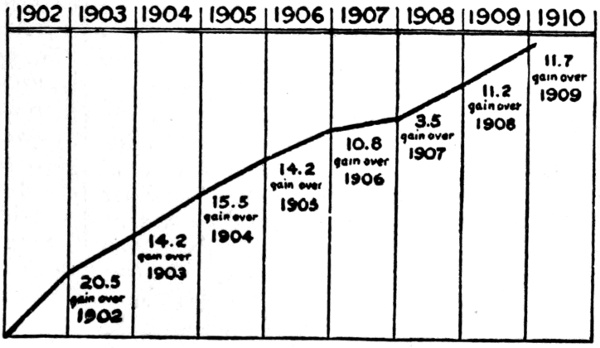
SHOWING THE RISE IN THE AVERAGE PRICE OF 96 STAPLE COMMODITIES.
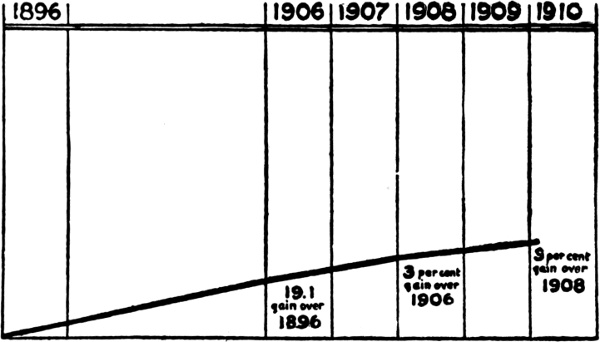
SHOWING THE AVERAGE RISE IN WAGES BASED ON AN INVESTIGATION OF 4,000 LARGE INDUSTRIAL ESTABLISHMENTS.
PRIDE
E. H. Harriman, the railroad magnate, has a big country place in Virginia—a hunting-box, he calls it, but it is more like a hunting Waldorf-Astoria. One morning Mr. Harriman arose early and was sitting on one of the porches.
A milkman drove up and got out to bring in some milk. The milkman started in the front door.
“Here, you,” snapped Harriman. “Take that milk around the back way. What do you mean by bringing it in this way?”
“Mean?” said the milkman. “I mean that I am a Virginia gentleman, and I am not accustomed to be talked to in this manner, suh. I shall deliver this milk where I please, suh. If you do not like it you have a means of obtaining satisfaction, suh. No No’therner like you can talk to me like that, suh.”
Harriman retired. Next morning, when the same milkman arrived, Harriman greeted him with a low bow. “You are right,” he said. “Take the milk in the front way and leave it on the piano.” (Text.)
(2504)
Recently I read the experience of a yachting party on the Mediterranean. A sudden storm had come up and threatened to overwhelm the boat. One of the two women on board lost her head completely and seemed crazed by fear. Suddenly she cried out to the other woman sitting calmly beside her: “You know you are as frightened as I am. Why don’t you show it, too?” “Oh, yes, I am frightened,” replied the other woman, “for I know the danger we are in. But, if we are going to die, do let us at least die like ladies.” And that appeal to pride wrought a complete change in the frightened woman, she became calm and even spoke words of encouragement to the others.—M. O. Simmons.
(2505)
There was once a proud little Icicle who stood all alone out in the cold. She wore a dress that sparkled like diamonds, but for all that, no one cared to go near her. The snowflakes were having a game of tag in the sky. Nearer and nearer the earth they played until some of them espied Miss Icicle.
“Do come and play with us!” they cried.
But the proud Icicle shook her head. “No,” she said, “you are entirely too common to play with me; I am a princess.”
“I’ll show the world what you are, you silly thing,” called Grandfather Sun from his cloud chariot. So he sent some of his children, the Sunbeams, to breathe on Miss Icicle’s head. This made her feel so sick that she wept great tears. The more she wept the thinner she grew, till at last a tiny pool of water was all that was left. (Text.)
(2506)
A gourd wound itself around a lofty palm, and in a few weeks climbed to its very top. “How old mayest thou be?” asked the gourd. “About a hundred years,” was the reply. “A hundred years and no taller! Only look, I have grown as tall as you in less than a hundred days,” said the puffed-up gourd. The stately palm calmly replied: “I know that well. Every summer of my life a gourd has climbed up my body and spread over my branches, as proud as thou art, and as short-lived as thou shalt be.”
(2507)
See Vanity.
PRIDE IN ONE’S TASK
The following is told of John F. Stevens, who was appointed by President Roosevelt to take charge of the Panama Canal:
Sometime in the seventies, and somewhere in Arizona, both the time and place where the Apaches were very seriously on the warpath, it became necessary to send a message across a hundred or two miles of desert. There was offered a reward of five hundred dollars to the man who would carry it. The peril was undeniable and nobody seemed to consider the reward worth the probable cost of it. But presently John Stevens undertook to deliver the message. He eluded the Apaches and made the journey successfully on foot, but declined the five hundred dollars. The thing had been there to do; he preferred to do it for its own sake. (Text.)—American Magazine.
(2508)
Primitive Organisms—See Choice in Primitive Organisms.
PRINCIPLE
One Sunday morning in Genoa a woman whom British people love stood by the dying bed of a man whose memory the world reveres. Josephine Butler stood by the bedside of Garibaldi, the old hero’s gaunt figure still clothed with the scarlet tunic which recalled the day when ten thousand “Garibaldis” swept on to victory and liberty with his name upon their lips. And the dying man said to the living woman:
“Never forget that tho we pass away and the leaders of a cause fall one by one, principles never pass away. They are world-wide, unchangeable and eternal.”—Charles F. Aked.
(2509)
The Rev. W. F. Crafts tells this story of a clerk who stood by his principles:
Stephen Girard, the infidel millionaire of Philadelphia, one Saturday bade his clerks come the following day and unload a vessel which had just arrived. One of the clerks, who had strong convictions and the power to act upon them, refused to comply with the demand. “Well, sir,” said Mr. Girard, “if you can not do as I wish, we can separate.” “I know that, sir,” said the hero; “I also know that I have a widowed mother to care for, but I can not work on Sunday.” “Very well, sir,” said the proprietor, “go to the cashier’s desk, and he will settle with you.” For three weeks the young man tramped the streets of Philadelphia, looking for work. One day a bank president asked Mr. Girard to name a suitable person for cashier for a new bank about to be started. After reflection, Mr. Girard named this young man. “But I thought you discharged him?” “I did,” was the answer, “because he would not work on Sunday, and the man who will lose his situation from principle is the man to whom you can intrust your money.” (Text.)
(2510)
See Feeling and Principle.
PRINCIPLES, MASTERING
Learning must be transformed into life. One would not expect to find the yeast if he made a cross-section of a loaf of bread. A cow eats grass all day, but we do not expect the cow to give grass. She is expected to give milk. A boy may study arithmetic and learn to do a few examples correctly. He can tell if each shoe is to have five nails, how many it will take to shoe a horse. But suppose the horse’s shoes needed six nails? He is baffled because he has found a case which was not met by his example; but when he masters the principle of which his sum is but an illustration, he can address himself to the problems of life as they come.—Everett D. Burr, “Proceedings of the Religious Education Association,” 1905.
(2511)
PRISON LIFE, EASY
French prisons, it is said, are such pleasant places of confinement that at the approach of every winter they are besieged by requests from vagrants for shelter.
Fresnes is notorious for its “hospitality,” and so agreeable is a sojourn there that many criminals, at the approach of winter, regularly arrange to get locked up until it is time to come out into the balmy air of springtime and the genial sunshine.
A short time since, the story goes, a new prison in France was opened to receive its first prisoner, sentenced to six months’ detention. The new establishment had cost nearly $20,000 to build and equip, but unfortunately the prison budget made no allowance for the warders and their “guests.”
The governor finally solved the dilemma by deciding that a policeman, who was married, should take up his quarters in the prison and serve the prisoner with his meals. But after a few days the policeman got tired of this. The profit made on the arrangement was very small, and in a confidential tone he confided to the prisoner that, if he cared to take “French leave,” he would see that every facility was given him to do so. But his charge quickly reassured him on the point.
“I’m all right here,” he said. “Your wife is an excellent cook. You are all very kind to me. This is a nice, new prison. I haven’t been so well off for a long time. You don’t catch me running away. What’s more, if you discharge me, I’ll jolly soon be back.”
Then the chief warder tried to persuade the prisoner that he would be well advised to make himself scarce. But he might as well have saved himself the trouble, for he met with no more success than the policeman. All the doors and windows of the prison were left wide open. He was given permission, he was even asked to go for a walk, in the hope that he would disappear for good. He thanked his jailers, and several times went for a stroll around the neighborhood.
But he always returned again in time for his meals. One night recently, however, he met an old friend when he was out, and after a glass or two of wine they found so many things to talk about that it was three o’clock in the morning when the “prisoner” returned to his lodgings. But altho he hung on to the bell and rung for all he was worth, no one came to the prison gate. At last the policeman opened a window and shouted angrily:
“If you don’t begone, I’ll fire on you.”
The lodger took the hint, but at six o’clock he was back again, and his guardian had to comply with his request to be admitted to his cell. How the affair will end no one knows, but it is said that the Sous-Préfet is seriously thinking of offering the “prisoner” a louis to go elsewhere for his food and lodging.—Baltimore Sun.
(2512)
PRISON LITERATURE
Dumas is of all authors the favorite at Sing Sing, and 1,413 volumes of his work were read by convicts in the course of the year. This shows good literary taste. Other authors, as represented by the number of their books read, ranked as follows: Charles Reade, 720; Collins, 649; Corelli, 596; Doyle, 584; Dickens, 567; Haggard, 481; Crawford, 415, and Henty, 402.
After fiction came biography, of which 1,227 volumes were read; history followed with 953 volumes; religion with 792, and poetry with 205. Of books in foreign languages, German led with 1,686 volumes, Hebrew was next with 1,259; Italian third, with 1,067, and French last, with 545.
What intelligence and vitality is enclosed in the walls of prisons! But it is, at least, something of a comfort to realize that men’s lives no longer drag out in the silence and neglect that once attended punishment. Now the influences of the outside world reach them, conveying still some sense of fellowship, for many, of coming opportunity. (Text.)—The Reader Magazine.
(2513)
Prisoner, A, and His Liberty—See Dead Tho Alive.
PRISONERS, EMPLOYMENT FOR
The Maryland Prisoners’ Aid Association have established a woodyard and novelty manufacturing shop at No. 311 North Street, Baltimore, where steady employment is furnished those desiring to start anew after liberation from penal institutions. Like all work of this kind, the new plant is conducted with the idea of defraying its own expense, and not to realize profits.
All the machinery in the woodyard, which, in full operation, employs twenty men, is driven by electricity. The principal product is kindling, manufactured from cordwood shipped from Anne Arundel County. The wood is unloaded from cars alongside the sawmill, where it is cut, split and loaded on wagons ready for delivery.
An important feature of the plant is the shop on the second floor, where light cabinet articles of all descriptions are manufactured. Many of the men going to the Aid Society for help in obtaining employment are of a mechanical turn, and these are given positions in the shop. In charge of a skilled cabinet-maker and woodworker, John McVauley, tables, chairs, magazine racks, umbrella-stands, settees, stools, upholstered furniture and miscellaneous household articles are turned out for which the men are paid wages about equal to the rates paid by manufacturing plants.—Baltimore Sun.
(2514)
PRIVACY, LACK OF
Korean homes are in a sense open to all the world. Any one who pleases may try the door, push it open, and come in. He needs no first acquaintance, and no introduction. An ordinary Korean guest-room is free to all the world. On the other hand, the inner quarters are separate, and for a male traveler to venture there would be a breach of the most sacred law of society. Into this outer room come gentlemen of leisure, tramps, fortune-tellers, Buddhist priests, all mankind, in fact. Here is located the high seat of the master. As you live in this guest-room, you feel the fearful lack of privacy. You are as tho encamped on the open highway, under the gaze of all men. If you write a letter, the question is, to whom are you writing it. “Why do you write thus and thus? What reference is here? Who? When?” These are the questions that are asked by those who look over your shoulder, without any breach of proper form or infraction of the eternal law that governs things.—James S. Gale, “Korea in Transition.”
(2515)
PRIVATION, COMPARATIVE
While her husband was still lying in prison for debt, the Archbishop of York asked Susannah Wesley:
“Tell me, Mrs. Wesley, whether you were ever really in want of bread?”
“My lord,” she answered, “strictly speaking, I never did want bread. But then I had so much care to get it before it was eaten, and to pay for it after, as has often made it very unpleasant to me; and I think to have bread under such terms is the next degree of wretchedness to having none at all.”—W. H. Fitchett, “Wesley and His Century.”
(2516)
PRIVILEGE
In “The Gospel of Life,” Charles Wagner writes this sound wisdom:
Never is knowledge more touching or art more radiant than when they illumine the brow of the obscure. I am quite familiar with the fact that there are certain privileged ones of the earth who believe that this kind of good is reserved for them, that these are meats too delicate to be set before common folk. Scandalized at seeing the people walking about in the Louvre or in the halls of the Hotel de Ville, some one said to me one day, “Do you think that it was for these people that Puvis de Chavannes painted his ceilings?” “I don’t know as a matter of fact,” I said, “whether it was for them that he painted them. But I know another ceiling more beautiful than are these of earth; that which at night the myriads of stars cover with their constellations, that on which according to the magnificent image of the poet:
“‘God paints the dawn, like a fresco, on the dark wall of night.’” (Text.)
(2517)
PRIVILEGE INVOLVES RESPONSIBILITY
When T. H. Benton was in the House he was of the opinion that the third day of March, and consequently the congressional term, ended at midnight of that day, instead of at noon on the fourth, as unbroken usage had fixt it. So on the last morning he sat with his hat on, talked loudly, loafed about the floor, and finally refused to vote or answer to his name when the roll was called. At last the speaker, the Hon. James L. Orr, of South Carolina, picked him up and put an end to these legislative larks.
“No, sir; no, sir; NO, sir!” shouted the venerable Missourian; “I will not vote. I have no right to vote. This is no House, and I am not a member of it.”
“Then, sir,” said Speaker Orr like a flash, with his sweetest manner, “if the gentleman is not a member of this House, the sergeant-at-arms will please put him out.”
And so this vast constitutional question settled itself.
(2518)
PRIVILEGES SLIGHTED
Mrs. Mary A. Wright, a veteran Sunday-school teacher of New Jersey, relates an odd story of human interest taken from personal observation.
I went to see a beautiful new farmhouse near Fort Wayne, Iowa. A friend who accompanied me explained that the owner, a prosperous ranchman, had been forty years building it. He had started life in a small home of logs—but in his early days had dreamed of a larger and better home for himself and family. Every tree he saw that struck his fancy he cut down and hewed into lumber so that when he was finally ready to erect his mansion he had all the seasoned material at hand. The new home was at last completed and beautifully finished upon the interior in polished natural woods. There were soft carpets for the floors, and rich furnishings; a bath-room, steam heat, and other modern conveniences.
That was several years before my visit, but I learned that, altho surrounded by all of this luxury, the farmer and his family lived in the basement. He had spent the best years of his life striving to build such a beautiful home, but, after getting it, he thought it too good to use and the family kept it to look at. The farmer and his family washed at the old pump in the yard while the costly tiled bath-room, with hot and cold water equipment, stood idle. They drank out of tin cups and ate off of cracked earthenware in their humble abode in the basement, while fine cut-glass and delicate china pieces reposed undisturbed in china-closets in the elegantly furnished dining-room up-stairs.
All the members of the family entered into the spirit of “keeping the house looking nice,” and they kept it so nice that the wife and mother who had worn out her life in helping to secure the luxuries that she afterward thought too good to enjoy, begged to be allowed to die on a straw mattress in the cellar rather than muss the clean linen in the bed-chambers above.
How much that is like some people. They are living in life’s basement, carefully cherishing the higher and nobler things to look at and show their friends, when they might experience life’s fullest joys and privileges for the choosing.
(2519)
Prize—See Discovery, Fortunate.
PROBATION
Judge Mulqueen, of General Sessions, New York City, explained why he had sentenced two prisoners to “go home and serve time with their families.” This “punishment” was imposed when both men pleaded drunkenness as their excuse for trivial offenses.
In the case of the first man, said the judge, the offense had been assault. The prisoner, an employee of the Street Cleaning Department, had a wife and five children to support, and had already spent more than a month in the Tombs, waiting for his trial.
“Now, to send such a man to jail,” continued Judge Mulqueen, “would do decidedly more harm than good. He wasn’t a criminal. I think he was penitent, and he promised to do as I said, to cut out drink and attend to business.
“Still, his offense was a misdemeanor in the eyes of the law, and I might have given him a year in the penitentiary and $500 fine, which usually means another year, since the men pay their fines by working for the State. Instead of that, I placed him on probation for a year.
“He must report once a week to the probation officer. Also, he is watched, not suspiciously, but merely as a matter of precaution. If he is caught entering a saloon—I warned him of this—he will be punished. It’s simply giving him a chance to make good.”
(2520)
See Exclusion from Heaven.
Problems, Gaging—See Distance.
PROCRASTINATION
He meant to insure his house, but it burned before he got around to it.
He was just going to pay a note when it went to protest.
He was just going to help his neighbor when he died.
He was just going to send flowers to a sick friend when it proved too late.
He was just going to reduce his debt when his creditors “shut down” on him.
He was just going to stop drinking and dissipating when his health became wrecked.
He was just going to provide his wife with more help when she took her bed and required a nurse, a doctor and a maid.—Success Magazine.
(2521)
PRODIGAL, THE
Theodosia Garrison shows in these verses the melting power of love:
When I came to you banned, dishonored, Brother of yours no more, And raised my hands where your roof-tree stands, Why did you open the door? When I came to you starving—thirsting, Beggared of aught but sin, Why did you rise with welcoming eyes And lift me and bid me in? You have set me the first at the feast And robed me in tenderness, Yet, brothers of mine, these tears for sign That I would your grace were less. For I had not been crusht by your hate Who courted the pain thereof, But you stab me through when you give anew, O brothers, your love—your love! (Text.)
(2522)
This pathetic incident is told by Dr. J. Wilbur Chapman:
Mr. Moody told me that he was once invited to luncheon in one of the great homes in the city of New York. He noticed that his hostess was continually rising and leaving the room. He said to himself, “She must be in trouble. If she goes again I will follow her.” She did go out again and our great evangelist rose from the table and went out into the next room. When the mother saw him she was plunged into confusion. Her face flushed a fiery red. Seated upon the couch in the room was a boy with dishevelled hair, with bloodshot eyes, with clothing in rags. The mother recovered herself in a moment, walked across the room as if she had been a queen, threw her arms around her boy. Then, walking over to our great preacher, she said: “Mr. Moody, I do not think you have ever met my son. This is my boy, Mr. Moody; he is a prodigal, but I love him.” Mr. Moody said she put her lips up against the boy’s cheek and he suddenly burst into a flood of tears, dropt on his knees and, after Mr. Moody had spoken to him, he came to Christ. (Text.)
(2523)
PRODIGY, A
Professor Boris Sidis has given, in response to requests, an authentic account of the scope and aims of his son’s intellectual career. “I do not believe in the prevailing system of education for children,” writes Professor Sidis. “I have educated my son upon a system of my own, based to some extent upon principles laid down by Professor William James.” This system, Professor Sidis insists, has justified itself by its results in the case of the boy prodigy of Harvard. He knows as much at eleven, the father says, “as a gifted professor of mature years,” and when he grows up “he will amaze the world.” Nor is the result due to heredity or to abnormality of the child’s brain. The results achieved in the case of this eleven-year-old lad are due wholly to the methods of training pursued. To quote the father’s words as given the New York American:
“As the baby grows more rapidly after birth than at any other time, so his brain develops most rapidly then and becomes less sensitive to impressions as he grows older. The process of education can not begin too soon.
“I began to train my boy in the use of his faculties immediately after his birth. He was bound to use them anyway, and therefore I took care that he used them properly. I taught the child to observe accurately, to analyze and synthesize and make sound deductions. Neither his mother nor myself confused him with baby talk, meaningless sounds or foolish gestures, and thus, altho he learned to reason so early, his mind was no more burdened than that of the ordinary child.
“I knew that as soon as he began to speak his first interest would be in the sounds he was uttering, and so I trained him to identify the elements of sound. Taking a box of large alphabet blocks I named each to him day after day.
“In this way he learned to read and spell correctly before he was two years old. What was still more important, he learned to reason correctly.”
(2524)
Productions, Interchange of—See Christianity, Social.
Profanity—See Ambassador, The Minister as an; Swearing.
PROFANITY AND PRAYER
Is not much of our praying of as little significance as the profanity mentioned below:
Mr. Pierson was a man of no religious principles. Without exception he was the most profane man I ever knew. He would hardly utter a word without an oath. His habit of profanity had become so inveterate that it seemed almost as involuntary as his breathing. The wife of a clergyman, for whom he was working at one time, reproved him, when he pleasantly replied:
“Why, madam, I don’t mean anything when I swear, any more than you do when you pray.”—Asa Bullard, “Incidents in a Busy Life.”
(2525)
PROFANITY IN FORMER TIMES
Swearing in the drawing-room and in the “best society” was no uncommon thing ninety years ago. Even the ladies themselves not rarely indulged in it. Dean Ramsey tells an anecdote that well illustrates how it was regarded. A sister was speaking of her brother as much addicted to the habit, and she said, “Our John swears awfu’, and we try to correct him for it; but,” she added, apologetically, “nae doubt it is a great set-off to conversation.”—Minot J. Savage, The Arena.
(2526)
PROFESSION
The lives of some who are estimated as men of holiness are like the bodies in certain ancient tombs, that retain the form and features they had when living, but which crumble at a touch. They are surrounded with all the ornaments of the living, and have the shape of men, but they are only dust. So a touch of temptation or any test of life applied to some men causes their apparent saintliness to crumble.
(2627)
Profession, Empty—See Church, Deadness of the.
PROFESSION VERSUS CHARACTER
In a former pastorate there was a man in my congregation who could talk like Demosthenes or Cicero. He used excellent grammar, and seemed to know the Bible pretty well from Genesis to Revelation. He could quote Longfellow, and Tennyson, and Whittier, and a stranger would be charmed by his eloquent utterances. And yet when he rose to talk in a prayer-meeting, the crowd began to wither, and when his talk was over the prayer-meeting was like a sweet-potato patch on a frosty morning, flat and blue. The people knew that in his life there was something unsavory, that he would drink before the bar with worldly friends, and that he was not as honest as he might be. His good grammar and fluent utterances did not make amends for the unsavoriness of his character. There was another man in that congregation who would sometimes come to prayer-meeting with a circle of coal-dust around his hair. He was a coal-cart driver, and he was now and then so hurried to get to the prayer-meeting that he did not make his toilet with as much care as he ought. But the people leaned over to listen when he talked. And why? Because they knew that he lived every day for God. He would pick up a tramp on the road, and give him a mile ride on his cart, that he might talk with him about Jesus. His religion tasted good. Bad religion in good grammar does not taste good. I would rather have good religion in bad grammar, than good grammar in bad religion. (Text.)—C. A. Dixon.
(2528)
PROFESSIONALISM
The subtle casuistry of Johnson’s reply in this dialog from Boswell’s “Life of Johnson” would excuse any amount of lying, if it were only in the interest of one’s profession.
Boswell—“But, sir, does not affecting a warmth when you have no warmth, and appearing to be clearly of one opinion, when you are, in reality, of another opinion—does not such dissimulation impair one’s honesty? Is there not some danger that a lawyer may put on the same mask in common life, in the intercourse with his friends?” Johnson—“Why, no, sir. Everybody knows you are paid for affecting warmth for your client; and it is, therefore, properly no dissimulation; the moment you come from the bar you resume your usual behavior. Sir, a man will no more carry the artifice of the bar into the common intercourse of society than a man who is paid for tumbling upon his hands will continue to tumble upon his hands when he should walk upon his feet.” (Text.)—Croake James, “Curiosities of Law and Lawyers.”
(2529)
PROFIT
S. E. Kiser expresses in the verse below the thought that our kind words and deeds are helpful to ourselves, no matter how small their objective effect:
You may not profit by my word of cheer, The cares you have may weigh upon you still; My word of kindness may not dry your tear, Nor smooth your path upon the storm-swept hill. The word of hope I speak may not impart To you the courage that I wish it might; But, speaking it, I win new strength of heart And make the burden I am bearing light.
(2530)
PROFIT FROM PESTS
Some points in muskrat-farming are related by a Vermont man in the New England Homestead as his own experience. Some years ago he dammed a small brook on his farm for the purpose of making a trout-pond. The muskrats, however, speedily took possession of it and made it their home, from which they organized forays into the farmer’s corn-field. This suggested a way of getting even. The next year he enlarged his dam, making a shallow pond covering four acres of marsh-land of no use for crops. The rats appreciated the enlarged accommodations and also the marginal corn crop which he planted for their sustenance, and did not suspect the wire traps set for them when the water should be drawn off.
After a couple of seasons he considered the quarry sufficiently mature to test results. The water was drawn off and the game was caught in the netting. A hundred of the largest and darkest of the captives were returned to the pond for breeding purposes, while more than four hundred were put under tribute of their pelts. The result was more than enough to pay for the construction and labor, and he expects a much larger return of better fur next year. Hundreds of New England farms have brook-fed marshes that could be utilized to equal advantage.
The fur market is a rising one; more in proportion, perhaps, for cheap furs than for the more expensive. The trolley and automobile have increased the demand enormously. The people who buy rich furs are constantly becoming more numerous, and they have their imitators among the many who can afford only the lower grades.—Boston Transcript.
(2531)
Prognosis, Cure in—See Wounds, Curious.
PROGNOSTICATION OF WEATHER
Character has its signs, often accurately read by the simple-hearted man, as easily as farmers foretell the weather.
“I reckon we’ll have to stop hay-carting to-morrow,” said a laborer to me one splendid cloudless July day.
“Why?”
“’Cause I heerd one o’ them old woodpeckers hallerin’ fit to bust hisself while I was a-gettin’ my dinner.”
Next morning the daily paper spoke of settled fine weather, but the rustic was right—it rained heavily. He was a man utterly uneducated, who, without reference to any scientific instrument, could forecast the morrow’s weather with accuracy, when the meteorological office, with all its appliances, was at fault. “Hinery” was only a specimen of hundreds of his fellows who can predict to-morrow’s (and often longer) weather with unerring accuracy, merely from noticing common details of natural phenomena open to every one.—Cassell’s Magazine.
(2532)
PROGRESS
Faith in divine progress is exprest in these verses by John Philo Trowbridge:
The eternal truth of God moves on In undisputed sway, While all the narrow creeds of men Decline and pass away. The eternal light of God shines on Beneath an eternal sky, Tho human luminations cease, And human watch-fires die. But faith still mounts the endless years, And truth grows lovelier still, And light shines in upon the soul From some immortal hill.
(2533)
Professor Guyot, of Princeton, says that progress in the world is like the development of plant life. It has three periods of growth. The first is that in the soil—growth by the root. The second is more accelerated—growth by the stem. The third is the most rapid of all—growth by the blossom and fruit. The world has been growing by the root, obscurely, lingeringly, slowly. It is growing by the stem now, very much faster. It is beginning to break into the blossom and fruit, when progress will be wonderful compared with our past experience in all other periods.—Henry Ward Beecher.
(2534)
Modern ministers, while they should not be stagnantly conservative, are sometimes apt to make too little allowance for the inveterate habits in old saints of clinging to the past. These old saints in many cases can not easily get into line with the word “go.” They are not prepared for new eras of thought or the inauguration of new epochs. Hume destroyed the faith of his mother and made it a wreck. Arterial sclerosis is a hardening of the walls of the arteries, so that they become unable to bear the pressure of the blood when impelled by the heart under excitement. A similar process of hardening of the avenues of mental operations characterizes many excellent folk in old age.
(2535)
See Improvement.
Progress, a Sign of—See Surgery, Improvement in.
PROGRESS BY DISPLACEMENT
It is estimated that more than 20,000 families, aggregating 100,000 persons, have been driven from their homes by the steady transformation of New York City which is now near completion. The destruction of homes has not been confined to one locality, nor has it come as the result of one event. Every large undertaking has contributed its quota of persons whose homes literally have been pulled down about their heads.
This transformation is most conspicuous at the approaches to the new bridges across the East River, in the erection of new and stupendous railroad terminals, the encroachment of modern business buildings upon residence property, and the widening of streets.
It is the law of progress that the old shall be displaced by the new and better.
(2536)
Progress by Ideals—See Ideals and Progress.
Progress by Necessity—See Necessity and Progress.
Progress by Struggle—See Struggle.
Progress, Keeping Pace with—See Modernity.
Progress, Lack of—See Motion Without Progress.
PROGRESS, MODERN
The late Professor Dolbear, of Tuft’s College, summed up the progress of the nineteenth century as follows:
The nineteenth century received from its predecessor the horse; we bequeath the locomotive, the bicycle, and the automotor. We received the scythe; we bequeathed the mowing-machine. We received the painter’s brush; we bequeathed lithography, the camera, and color photography. We received twenty-three chemical elements; we bequeathed eighty. We received the sailing ship; we bequeathed the magnificent steamships which are the glory of Belfast and of Ireland. We received the beacon signal-fire; we bequeathed the telephone and wireless telegraphy. Best of all, we received unalleviable pain, and we bequeathed aseptics, chloroform, ether, and cocaine. We received an average duration of life for thirty years; we bequeathed forty years. (Text.)
(2537)
Progress of Indians—See Indians, American.
Progress Resisted—See Drought, Responsibility for.
PROGRESS, TRUE
Surely we should judge of a man’s progress by inquiring what he has been rather than by his present stage alone:
Men march toward civilization in column formation, and by the time the van has learned to admire the masters the rear is drawing reluctantly away from the totem-pole. Anywhere in the middle you may find a veneration for china pugdogs or an enthusiasm for Marie Corelli—still an advance. Literary people seem to think that every time a volume of Hall Caine is sold, Shakespeare is to that extent neglected. It merely means that some semisavage has reached the Hall Caine stage, and we should wish him godspeed on his way to Shakespeare. It is only when a pretended Shakespeare man lapses into Hall Cainery that one need be excited.—Frank Moore Colby, “Imaginary Obligations.”
(2538)
PROGRESS UNFINISHED
To the end of his life, the student whose frame remains unshaken, writes on morals and history, on science and on fine art, and his inquiries in all the departments of nature are marked by as keen and strenuous an enthusiasm as when in his youth he traversed the hills and the valleys on foot. Each process becomes but a basis for higher ones; and each successful and wide research but opens the path to new discoveries. As the skiff which the boy builds grows at last to the steamship, and the hut of the pioneer to the palace which the citizen rears and adorns—while yet neither of these is felt to be final with him, or adequate to the highest conception he can form—so the thought of the child expands and accumulates to the science of manhood, and still is admitted insufficient and transient.—Richard S. Storrs.
(2539)
PROHIBITION
Of course, the experienced drinker can buy liquor in a prohibition State like Maine. Let me say to any old toper present, going to Portland for his summer vacation, that he can find a drink by going into a side street, slipping down a dark alley, rapping three times at a door, wriggling up a back stairway, and by much twisting, convolution and squirming like a serpent, find what he desires. But boys and girls will grow up without the temptation of the open saloon. Of course, prohibition is not ideal. Making man temperate by law is a makeshift. There are men who have not been drunk for ten years—they are in Sing Sing.
Perhaps, however, if you can not keep some men from committing crime in any other way, it is best to build a stone wall around them. The ideal thing is law enthroned in the heart, an automatic commandment in the brain and will. But the necessary thing for poorly born people may be legal restraints.—N. D. Hillis.
(2540)
An English writer refers thus to some impressions of a brother Englishman, traveling through the United States:
When traveling through the United States some years ago, he was much struck with the difference in appearance of the houses in districts where the Maine liquor law was in force, and soon learned to distinguish where it was adopted, by the clean, cheerful look of the workmen’s dwellings, the neatness of the gardens, and the presence of trees and flowers which, in other districts, were wanting. He was not a teetotaler himself, and was not advocating such restrictions; but he could not help noticing the contrast; and he felt sure that in all our large towns great progress in civilization and morals would be effected if such an attraction were offered to the working classes.
It is another of the long line of illustrations showing the intimate connection between moral and material weal.
(2541)
PROHIBITION ARGUED AGAINST
At the fiftieth annual convention of the United States Brewers’ Association, the following absurdity was submitted as part of a report:
The whole vegetable world is in a conspiracy against the prohibitionist. The bees become intoxicated with the distillation of the honeysuckle; the wasps grow dizzy in the drowsy clover-patch, and even the ants wobble in their walk after they have feasted upon the overripe fruit fallen from the tree, which has started a natural fermentation.—New York Evening Post.
(2542)
PROHIBITION AS A BENEFACTOR
“A Swedish teacher going abroad for study,” writes the Karlstadt Tidning, “gave a patriotic lecture in the cabin of a North Sea steamer to Swedish emigrants. After it was over a nice-looking young fellow came up to him and said: ‘Greet the dear old land for me when you return. I should never leave it if the prohibition rescript continued in force. You see, I am a drinking man, tho I have a wife and children to care for. I have a good employment always open to me in Stockholm, but I don’t dare take it. For a whole month under prohibition I have been a free and happy man. If it had continued I should have stayed in Sweden, but now I am making for some American prohibition State where I can’t get drink.’ And he was not the only one. Other passengers said the same thing. The five weeks had brought hope into their life and they were going where the law helped them rather than crusht them.”—The Christian Statesman.
(2543)
PROMISE, AN INDIAN’S
“Sonny” Smith, charged with the murder of Frank Miller, sat in the sheriff’s office at Tulsa, Okla. His two sons were fugitives from justice on the same charge.
“Let me go,” pleaded the half-breed Creek Indian to the sheriff of the county, “and I will go and bring in the two boys you are looking for. If you do not let me go you will never catch those boys.”
Sheriff Newblock smiled grimly.
“What guarantee have I if I let you go after the boys that you will come back? You know you are charged with a capital offense.”
“You have the word of an Indian that he will come back,” replied the half-breed. And the sheriff, with a knowledge of Indian character, let “Sonny” go as a special commissioner to hunt his own boys in the swamps and hills and bring them in.
As time passed there was much grumbling in the community that the sheriff had let a cold-blooded murderer loose among the people. The victim was a young man, popular in the town and connected with the best families in the country. But on the fifth day “Sonny” appeared with his two sons and their wives and all the rest of the kin of the tribe of Smith.
“Here I am,” he announced proudly, “and here are my two boys, whom I arrested in the swamps of the Arkansas, close to Muskogee. I would have written to let you know I was on the trail, but the most of the time I was away from the railroad lines and could not quit the trail long enough to mail you a postal. And if there is anything against me I am going to stay here and fight it out.”
(2544)
Promise, Failing—See Early Promise.
PROMISE, INVIOLABLE
The following is one of Dwight L. Moody’s illustrations, with the exhortation that followed it:
It is recorded in history that some years ago a man was condemned to be put to death. When he came to lay his head on the block, the prince who had charge of the execution asked him if there was any one petition that he could grant him. All that the condemned man asked for was a glass of water. They went and got him a tumbler of water, but his hand trembled so that he could not get it to his mouth. The prince said to him, “Your life is safe until you drink that water.” He took the prince at his word, and dashed the water to the ground. They could not gather it up, and so he saved his life. My friend, you can be saved now by taking God at His word. The water of life is offered to “whosoever will.” Take it now, and live. May God give you grace to do so this moment! Let feelings go! Say in your heart, “I do believe, I will believe, I now believe on the Lord Jesus Christ with all my heart,” and life everlasting is yours!
(2545)
PROMISED LAND, THE
These verses are part of a longer poem by Michael Lynch:
So we sailed and sailed over stormy seas, till we came to a pleasant land, Where forever were peace and happiness, and plenty was on each hand; And no man wronged his brother there, for no man counted it gain To live by the sweat of another’s brow, or to joy at another’s pain,
And the strong man there was a kindly man and aided the one who was weak, And for those who were simple and trusting men their wiser brothers would speak; And creed, or color, or land, or birth, caused no man to hate another, For the same red blood filled each man’s veins, and every man was a brother. ***** And the old man there was a blessed man, for toilless he wanted nought, And vice and toil on the little ones no longer their ruin wrought; And the feeble in body and mind had there no longer a care for bread; For out of the plenty that was for all, ’twas theirs the first to be fed. ***** And peace was forever in that fair land, for no man envied his mate, And no man’s treasures, where all were rich, woke his brother’s sleeping hate, And the kingdom that Christ had promised was now for all men to see, And the name of that happy kingdom was, “The land of the soon be be.” (Text.)
(2546)
PROMISES
“Oh, grandpa,” said Charlie, “see how white the apple-trees are with blossoms.”
“Yes,” replied grandpa; “if the tree keeps its promises, there will be plenty of apples; but if it is like some boys I know there may not be any.”
“What do you mean by keeping its promises?” Charley inquired.
“Why,” returned grandpa, “blossoms are only the tree’s promises, just as the promises little boys make sometimes are blossoms. Sometimes the frost nips these blossoms, both on the tree and in the boy.”
“I see,” Charlie remarked; “then you think when I promise to be a better boy, I am only in blossom. But I’ll show you that the frost can’t nip my blossoms.”—The Young Evangelist.
(2547)
Dr. Alexander MacLaren writes as follows about following the promises:
In the crooked alleys of Venice there is a thin thread of red stone inlaid in the pavement or wall which guides through all the devious turnings to the plaza, in the center where the great church stands. As long as we have the red line of promise on the path faith may follow it, and it will lead to God. (Text.)
(2548)
PROMISES, BROKEN
I remember when I lived in Brooklyn there used to be a fence around the City Hall. A man used to stand there, grasping the iron railing in his hand, and looking up at the clock, every day at noon; and when it struck 12, he would count each stroke and look about him, his face full of joy and hope. But after two or three minutes the light would fade out of his eyes, and he would be turned into an old man, and would drag his feet slowly away. For nine years he did this, until death took him. I was told that at some great business crisis of his life a man had promised to bring him some hundreds of dollars at a particular time, to rescue him from failure. The man did not come, and he found out he never intended to come; and the great disappointment shattered his brain, and day after day he was at the City Hall, looking for the man who never came. The guilt of human hearts has made men give promises to get rid of importunate persons. Some of us have become cynics because we have found men so ready to promise falsely.—D. A. Goodsell.
(2549)
PROMISES, IMPLIED
A promise may sometimes be binding on the conscience even when not made in specific terms:
M. Fallieres was presiding at a banquet at Agen, when a piece of money dropt from his waistcoat pocket to the floor. His neighbor said: “I think you have let fall a 2f. piece.” But he replied, “Let it be; that will be a lucky find for the waiter,” and he called the latter, whispering to him to look out for a 2f. piece, which he would find somewhere under his seat on the floor. Toward the end of dinner M. Fallieres was seen by his neighbor to be feeling with a preoccupied air in his waistcoat pockets. As he rose he looked round, fancied he was not observed, and gently let a 2f. piece slide down to the floor. His neighbor, who had noticed the strange proceeding, asked M. Fallieres afterward if he would tell him what it meant. “The fact is,” Mr. Fallieres answered, “that I remembered that I keep only coppers in my left-hand pocket, from which the piece dropt that you supposed was 2f., whereas it must have been only 2 sous. So I took out of my right pocket, in which I keep my silver, another coin, which that time really was a 2f. piece, and dropt it for the waiter to find. I did not want to disappoint the man after telling him, you see.” (Text.)
(2550)
PROMOTION, HINDRANCES TO
He watched the clock.
He was always grumbling.
He was always behindhand.
He asked too many questions.
His stock excuse was “I forgot.”
He wasn’t ready for the next step.
He did not put his heart into his work.
He learned nothing from his blunders.
He was content to be a second-rate man.
He chose his friends among his inferiors.
He ruined his ability by half-doing things.
He never dared to act on his own judgment.
He did not think it worth while to learn how.
He thought it clever to use coarse and profane language.
He imitated the habits of men who could stand more than he could.
He did not learn that the best part of his salary was not in his pay envelop.—Success.
(2551)
PROOF
A Christian Korean who had his hair cut like a Japanese was met by a company of his fellow countrymen who were out looking for Japanese sympathizers. They accused him of being a traitor, but he insisted that he was not—that he was a Christian. “Have you a Bible and a hymn-book?” they demanded. He produced them. “Repeat the Lord’s Prayer.” He did so. “The Ten Commandments and the Apostles Creed; sing the Doxology.” The Christian was ready with all these, and his captors were satisfied and released him. (Text.)
(2552)
Dr. Ogden, professor of geology at Cambridge, had taken a fancy to a lad, who had been in his service for some years, and used to manage the garden with great cleverness and skill, much to the admiration of his employer. The doctor, however, came, after a few years, to notice that his favorite cherry-tree never seemed to yield any presentable fruit in due season. At last, one year, some twelve cherries seemed to be approaching the long coveted fruition; but as the doctor was returning from a ride one day, what should he behold but these pet cherries gone! He accused the boy rather abruptly and warmly, but the latter with equal warmth replied, “I have not touched them, as true as God’s in heaven.” The doctor at once went to his closet, told the boy to wait, and gave him a strong dose of antimonial wine as a sort of treat. The boy, who was kept in some conversation, soon began to be uneasy, and wanted to go, saying he felt unwell. “No, no, my lad,” said the doctor; “sit thee still, I’ll soon make thee better of that,” and gave him a glass of warm water from a basin also at his elbow. Very soon nature was irresistible. The boy hiccuped, looked pale, and up came all the cherries.—Croake James, “Curiosities of Law and Lawyers.”
(2553)
PROOF BY EXPERIENCE
In a military journal is related this incident of the ill-starred voyage of the Russian fleet to Eastern waters:
One day, during some gunnery practise, Admiral Rozhestvensky was greatly angered by the poor display made by a certain vessel, which he boarded in a towering rage. “Who is in command here?” he asked excitedly. “I am, sir,” replied an officer, stepping forward. “Consider yourself under arrest,” said Rozhestvensky; “your men are trained disgracefully.” “It is not my fault,” answered the officer. “Our shells won’t explode.” “I’ll soon see whether you are right,” thundered the admiral, and, taking up a small shell, he lit the fuse and held it out at arm’s length. If that shell had burst, both men would have been blown to atoms. But the fuse spluttered out, and the admiral remarked simply, “You are right. The fault is not yours. I will see to it that you have proper shells in future.”
The expedient of the admiral was exceedingly dangerous, but it was highly effective. This proof admits of no gainsaying. (Text.)
(2554)
Proof, Sufficient—See Evidence, Christian.
Propagation—See Improvement.
Propagation of Life—See Life, Self-propagating.
PROPAGATION OF THE GOOD
Great minds that are full of light; great hearts that are full of love—their light will go out into the ends of the earth, and their shining unto the ends of the world.
A recent history of the steam engine says Stephenson knew “that if he could get his engine perfected, the rest would take care of itself.” Certainly! That man who discovered the lucifer match did not have to force it upon poor men, shivering in the cold and frost of winter. When James Watt has an engine that will lift coal out of a mine, he does not have to insist that it be accepted by laborers bowed to the very ground by sacks of mineral. Let Gutenberg get his printing-press, and all these copyists, weary of writing, and the millions of men hungry for knowledge, will greet his printed page with shouts and cheers. Get your seedless orange, and it will take feet unto itself and travel over the world. Get the new palm, the new peach or pear, and millions will stretch out their hands pleading for it. Get Luther—the new Germany will follow. Get Livingstone, and the Dark Continent will soon be full of light. Get your Pilgrim Fathers—the republic will tread closely upon their heels. Get your twelve apostles, and you will soon have a New Jerusalem, a new Antioch, a new Ephesus, a new Rome. Get your new Pentecost for the American churches, and you will have a new era and a golden age of industrial peace and commercial prosperity.—N. D. Hillis.
(2555)
PROPAGATION, PROLIFIC
The May-flies, in their flying stage, make up for their frailness and feebleness, their inability to feed—they have really no mouth-parts and do not eat at all in their few hours or days of flying life—by existing in enormous numbers, and millions may be killed, or may die from very feebleness, and yet there are enough left to lay the eggs necessary for a new generation, and that is success in life for them. Nothing else is necessary. Their whole aim and achievement in life seems to be to lay eggs and start a new generation of May-flies.—Vernon L. Kellogg, “Insect Stories.”
(2556)
Property, Church—See Church Statistics.
Property, Unvalued—See Appreciation, Lack of.
PROPHECY
There have been many uninspired prophets, but Joan of Arc was the only one who ever ventured the daring detail of naming, along with a foretold event, the event’s precise nature, the special time-limit within which it would occur, and the place—and scored fulfilment. At Vauchouleurs she said she must go to the king and be made his general, and break the English power, and crown her sovereign—at “Reims.” It all happened. It was all to happen “next year”—and it did. She foretold her first wound and its character and date a month in advance, and the prophecy was recorded in a public record book three weeks in advance. She repeated it the morning of the date named, and it was fulfilled before night. At Tours she foretold the limit of her military career—saying it would end in one year from the time of its utterance—and she was right. She foretold her martyrdom—using that word, and naming a time three months away—and again she was right. At a time when France was hopelessly and permanently in the hands of the English she twice asserted in her prison before her judges that within seven years the English would meet with a mightier disaster than had been the fall of Orleans. It happened within five—the fall of Paris. Other prophecies of hers came true, both as to the event named and the time limit prescribed. (Text.)—Mark Twain, Harper’s Magazine.
(2557)
In the “Autobiography” of Albert Pell, that fine old English gentleman whose whole life was devoted to the reform of the English poor-laws and to the general uplifting and improvement of the condition, moral, social and political, of the English agricultural laborer, it is related that one of the first well-known men whom he met as a small boy was Wilberforce, who used to stay with his father, Sir Albert Pell, in the country.
When one of Pell’s friends was an infant in arms, his nurse was swept by an election mob to the very foot of the York hustings at a famous contest for the county in which Wilberforce was one of the principal actors. With all the earnestness and vigor which distinguished him he was pressing his beneficent views on the abolition of slavery.
Carried away by the depths of his convictions and enthusiastic inspiration, he reached over the balcony, and snatching the baby from the arms of its astonished nurse, held it up over his head in the face of the people, exclaiming:
“See this and hear my prophecy! Before this child dies there will not be a white man in the world owning a slave.”
My friend, adds Mr. Pell, survived the Civil War in the United States, and virtually Wilberforce’s prophecy was fulfilled.—The Youth’s Companion.
(2558)
Propitiation, Evil—See Sacrifice, Pagan.
PROPORTION
“I thought it was a pretty fair sort of telescope for one that wasn’t very big,” said Uncle Silas. “I rigged it up in the attic by the high north window and had it fixt so it would swing around easy. I took a deal of satisfaction in looking through it, the sky seemed so wide and full of wonders; so when Hester was here I thought I’d give her the pleasure, too.
“She stayed a long time up-stairs and seemed to be enjoying it. When she came down I asked her if she’d discovered anything new.
“‘Yes,’ she says; ‘why, it made everybody’s house seem so near that I seemed to be right beside ’em, and I found out what John Pritchard’s folks are doin’ in their out-kitchens. I’ve wondered what they had a light there for night after night, and I just turned the glass on their windows. They are cuttin’ apples to dry—folks as rich as them cuttin’ apples!’
“And actually that was all the woman had seen! With the whole heavens before her to study, she had spent her time prying into the affairs of her neighbors! And there are lots more like her—with and without telescopes.”—Christian Endeavor World.
(2559)
The necessity of having right proportion between the place and the occasion is illustrated by the following:
The only musical sounds which really master vast spaces like the Albert Hall are those of a mighty organ or an immense chorus.
The Handel Festival choruses are fairly proportioned to the Crystal Palace, but on one occasion, when a terrific thunder-storm burst over Sydenham in the middle of “Israel in Egypt,” every one beneath that crystal dome felt that, acoustically, the peal of thunder was very superior to the whole power of the chorus, because the relation between the space to be filled and the volume of sound required to fill it was in better proportion.—H. R. Haweis, “My Musical Memories.”
(2560)
Proportion Distorted by Fatigue—See Fatigue.
Proportion, Sense of—See Fatigue.
PROPRIETY
During the battle of Waterloo a British artillery officer rode up to the Duke of Wellington and said, “Your Grace, I have a distinct view of Napoleon, attended by his staff; my guns are well pointed in that direction; shall I open fire?” The duke replied, “Certainly not; I will not allow it; it is not the business of commanders to fire upon each other.”—Edward Cotton, “A Voice from Waterloo.”
(2561)
The home is where the missionary spends most of the time during the first year. A native of the country to which you go comes in to call, and the first thing noticed may be pictures upon your walls. They may or may not violate the sense of propriety of your caller, but in general one may say that statues, or any pictures approaching the nude, are decidedly out of taste. I recall coming in one Sunday and finding Mrs. Beach hard at work. She was painting, and as we had been brought up as Presbyterians, I was surprized to see her working on Sunday. “Well,” she said, “I must go out to my Sunday-school, and the last time I went they struck. I have been teaching the story of Joseph, and these cartoons of the Religious Tract Society of London represent him with bare calves, and the women simply will not endure them. I have nothing but water-color paints, and I have painted Chinese trousers five times on these legs, and they are bare yet.” We used to have picture-cards sent out by Sunday-school children to help us on in our work. We had to censor those picture-cards, there is no question about that. You can not use every kind of picture-card and preach a pure gospel.—H. P. Beach, “Volunteer Student Movement,” 1906.
(2562)
See Religious Infractions of Propriety.
Propriety a Matter of Religion—See Religious Infractions of Propriety.
Propriety and Taste Violated—See Missionaries’ Mistakes.
Propriety, Lack of—See Accommodation.
PROPRIETY, OBSERVING RULES OF
Leaving the home (in China), you go out into the street, and what is there that first offends your friends—those whom you have come to help? Very possibly it is your dress. You do not have enough of it oftentimes. One function of garments is to conceal the form, and many modes of dress do not conceal but simply reveal it. While we are to remember this, going to the other extreme and walking the streets in bathrobe coats is also questionable. Anything approaching decolleté would weaken a woman’s influence, even if she appeared thus only on a state occasion.
Over against this lack of dress is too much dress, which is quite as offensive. I saw the other day a photograph of Governor Tuan, one of the two commissioners who have just been visiting the United States. He sat in his yamen surrounded by some missionaries and other foreigners living in the governor’s province. It was a very beautiful picture, but one of the missionaries in the group, who was stylishly drest, had a cane—a dapper little pipe-stem cane in China! To Governor Tuan there could be no rational explanation of that sort of thing. If it had been a staff and the missionary had been lame, it would have been appropriate. But he was not lame, no beggars were allowed in the governor’s yamen, there were no dogs to bite him, and why in the world should this man bring a cane? It was just as if native Australians were being received by President Roosevelt and had brought with them boomerangs. Boomerangs have their place, but not in the White House; and to swing a cane causes trouble for China missionaries. Glasses are a necessity, but the missionary to the Chinese unconsciously offends high officials by his glasses, especially if he does not remove them when greeting the official. Many, even of the older missionaries, do not know such a fact as that.—H. P. Beach, “Student Volunteer Movement,” 1906.
(2563)
Prosperity and Temperance—See Prohibition.
PROSPERITY AS AN ADVERTISEMENT
The United States Immigration Commission informs the American Congress that savings of immigrants to the amount of $275,000,000 are annually sent abroad to be used in foreign countries, and the commission says in its report: “The sum is sent abroad for the purpose of supporting families in foreign countries, for bringing other immigrants to the United States, for the payment of debts or for savings and investment in the countries from which the immigrants come.”
More than 2,300,000 persons throughout the United States are doing an unregulated banking business, handling yearly hundreds of millions of dollars, their customers being found wholly among immigrant laborers who for the most part do not speak English.
The money actually sent abroad is thus distributed according to countries: Italy, $85,000,000; Austria-Hungary, $75,000,000; Russia, including Finland, $25,000,000; Great Britain, $25,000,000; Norway, Sweden, and Denmark, $25,000,000; Germany, $15,000,000; Greece, $5,000,000; the Balkan States, $5,000,000; Japan, $5,000,000; China, $5,000,000; all other countries, $5,000,000.
Even reducing the amount estimated as being too large, there must be an immense outflow of money from the United States in the direction indicated, and it helps explain why there is an excess of commodity exports, averaging $400,000,000 annually, over imports, to settle the invisible indebtedness of the country abroad.
The great outflow of cash sent home by immigrants serves one useful purpose: it advertises the general prosperity of the great republic, and so helps keep up the volume of emigration from Europe. A growing country requires people as well as capital.
It has been estimated that every able-bodied immigrant is worth to the country $5,000; the Northern republic is receiving nearly a million immigrants annually, and allowing that a fifth part are workers of sound physique the gain to the United States is $1,000,000,000, gold, value a year.—Mexican Herald.
(2564)
PROSPERITY, PERIL OF
The following extract points a needed caution to those who are blest with prosperity:
Some time ago we saw a tree that had been struck by lightning and actually rent asunder. It had been blown open as perfectly as if the pith of the tree had been lined with gunpowder and touched off. The reason for this is easily explained. The tree had been struck by lightning before it had been wet by the storm. Consequently the lightning bolt followed the line of least resistance, which was the damp wood under the bark. The electric current heated the sap, and, converting it so quickly into steam, the explosion was the result.
How very like that tree are a great many people! Prosperity is the electric current. Coming upon them so suddenly, as is so often the case, they are unable to bear the pressure of elevation and honor and distinction, and are rent asunder with a crash. They “go down” with a thud.
As the forest tree that has been struck by the killing bolt drops only to rot, so does the man who has been overelated by prosperity.
(2565)
PROTECTION
One of the artizan class of Manchester was the owner of a very pretty black spaniel dog. The little thing followed him and nestled to his side as a child might, and by many endearing ways evinced the winsomeness of its disposition. It happened that the man was worse for drink, became irritated by the affectionate attentions of his dog and vowed he would throw her into the lion’s den in Manchester; went there for the purpose, and reaching out, took up the little fawning thing and flung her through the bars of the cage. The spectators expected that the lion with one muscular movement of its paw would stun and kill it, but the dog fawned up to the lion and the lion turned and licked her. They became good friends, and when presently the lion’s food was brought, the dog even snarled at her new protector and began to partake first, keeping the lord of creation waiting. So it went on for some weeks. The papers were full of it; crowds came to see. The news came to the man; he repented of his rash act; he went to the gardens and said to the keeper, “I want my dog.” The keeper said, “I don’t dare to attempt to bring your dog out of the den.” “Oh,” the man said, “of course I must have it.” “Well,” said the keeper, “if you want it, you must get it yourself.” But when he called to the dog, the dog slunk closer to her new protector, and when presently he tried to exert force, the lion gave such an ominous growl that the man shrank back. From that moment the lion and the dog lived together, and any attempt made to extricate the dog was met instantly by the low growl of the lion.
You have been too long the slave of lusts, of passion, of pride, of sin. I want you to get under the covert of the Lion of the tribe of Judah, and then if your old enemy shall endeavor to induce you and get you back, remember that the Lion of the tribe of Judah is going to interpose between you and your old master.—F. B. Meyer.
(2566)
There are ways of escaping evil influences, just as there are of protecting oneself from sunstroke:
Attention is called in the New York Medical Journal to the fact that sunstroke is due to the chemical, and not to the heat rays, as generally supposed. The writer’s argument is based on “the fact that no one ever gets heat-stroke from exposure to a dark source of heat, and when there is an absence of chemical rays. The actinic rays are the dangerous ones. They will pass through anything except an interposed color filter. It is therefore necessary, in order to ward off sunstroke, to treat the body as a photographer treats his plates, and surround it with red or yellow. He mentions the case of an Egyptian army officer, who had had several sunstrokes, and avoided further difficulty of the kind during five years’ exposure by lining his helmet and coat with yellow. (Text.)
(2567)
The queer Chinese change pigeons into song-birds by fastening whistles to their breasts. The wind of their flight then causes a weird and plaintive music that is seldom silenced in the pigeon-haunted cities of Peking and Canton. The Belgians, great pigeon-fliers, fasten whistles beneath the wings of valuable racing carriers, claiming that the shrill noise is a sure protection against hawks and other birds of prey. As a similar protection, reeds, emitting an odd wailing sound, are fixt to the tail-feathers of the dispatch-bearing pigeons of the German army.
Hannibal’s army withdrew from Rome, it is said, at the sound of a tumultuous laughter inside the walls. Luther said: “The devil hates music.” (Text.)
(2568)
Paul speaks of a breast-plate even more secure than that mentioned in the extract:
The authors who tell us of the conquests of Cortez say that to protect his soldiers from the arrows of the Mexicans, which could pierce the cuirasses of hammered iron that they wore, he replaced these with thick breast-plates of wool prest between two layers of linen. In fact, he practically covered his men with mattresses, and they were thus enabled to defy the arrows and lances of the Mexicans. (Text.)—Dr. Battandier, Cosmos.