C (continued 2)
Reading edition
(400)
CHRIST, THE FIGURE OF
Monsignor Bonomelli, in a letter read at the World Missionary Conference held in Edinburgh, June, 1910, said:
Jesus has, in reality, not vanished either from history, or from the life of Christianity. He lives at all times in millions of souls, He is enthroned as King in all hearts. The figure of Christ has not the cold splendor of a distant star, but the warmth of a heart which is near us, a flame burning in the soul of believers and keeping alive their consciences. Putting aside certain opinions, which, honored at the moment, may possibly be abandoned to-morrow, criticism had hoped to effect a complete demolition of the conception of Christ, but what criticism really demolished was merely irrelevant matter. The figure of Christ, after all the onslaughts of criticism, now stands forth more pure and divine than ever and compels our adoration.
(401)
CHRIST, THE INDEFATIGABLE
From the Catholic World we clip Cornelius Clifford’s sonnet on “The Indefatigable Christ”:
Go where thou wilt, His heart shalt find thee out; Be thou in quest of wealth, or power, or fame. Above life’s tumult shall He call thy name; His care shall compass thee with grief about; And thou shalt know Him in thine hours of doubt, When faith shall pierce thy darkness like a flame, O dull of sense to Time’s imperious claim, His love shall prove thy rainfall after drought! For He shall come in many a blinding shower To dye thy sick leaves to a healthier hue, Till the scant years of youth’s once ample dower Requicken with late fruitage rare to view; Yea, He must shape thee by thine own heart’s power, And fashion all this ruined life anew.
(402)
CHRIST THE LAMB
The figure of a lamb slain dominates the whole aspect of the religion of redemption. Nature and grace seem to blend in harmonious echoes of this ideal presentation.
High up on the old German church of Werden is carved the image of a lamb, concerning which the villagers tell this story. Many years ago, a mason was at work on the portion of wall where now this figure stands, when the cord by which his plank seat was suspended snapt, and he was hurled down to what seemed instant death, for masses of rough stone lay thick on the ground below, the building being under repair. He arose unhurt, for there among the stone-heaps a little lamb had been nibbling at scanty tufts of herbage, and on this animal he had fallen safe and softly, while the lamb lay crusht to death. The man so strangely saved had the monument erected in grateful, lasting memory of his deliverance from a cruel death, and of the innocent creature to whom he owed it. (Text.)
(403)
CHRIST THE LEADER
Mrs. A. E. Hawkins sings of “The March of Life” in these lines:
Sometimes the order comes to “Forward march!” And falling into line my step I keep Beside my comrades, o’er the toilsome road, Nor think of rest or sleep. Then suddenly the order comes to “Halt!” And steadily I plant my feet and stand, I know not why or wherefore—I can trust The Captain in command. ***** But suddenly the bugle sounds, “To arms!” I gird my armor on, and join the fray, Following my Leader through the battle-smoke Until we win the day. For well I know that, march and battle o’er, Will come the great Commander’s grand review, And then the lights of home, and the reunion Of loyal hearts and true.
(404)
CHRIST THE LIGHT
In the life story of Helen Keller, a picture of the governess and her famous pupil is shown with the blind girl leaning her head on her teacher’s shoulder. This is a fair representation of the way in which life with its deeper and hidden meaning unfolded itself to the child. She drew so near to her teacher that her hand could touch eye, ear and lip. Before her teacher came to her, existence seemed like a dense fog and a great darkness, while her very soul cried out, Light, light! But when her education began, the way grew clearer and the truth plain as the “light of the teacher’s love shone upon her.”
There are men who are spiritually blind. They are shipwrecked mariners at sea in a dense fog. They are without compass and have nothing stable from which they can take their bearings. But when Christ comes into their lives their heart-cry for light is answered. (Text.)
(405)
CHRIST, THE REJECTED
At the exhibition of the Royal Academy, in London, the great canvas by Sigismund Goetze, entitled “Despised and Rejected of Men,” has created an artistic sensation. It is declared to be a “powerful and terribly realistic presentment of Christ” in a modern setting, and is described by a writer in The Christian Commonwealth (London), as follows:
In the center of the canvas is the Christ, standing on a pedestal, bound with ropes, while on either side passes the heedless crowd. A prominent figure is a richly vested priest, proudly conscious of the perfection of the ritual with which he is starving his higher life. Over the shoulder of the priest looks a stern-faced divine of a very different type. Bible in hand, he turns to look at the divine figure, but the onlooker is conscious that this stern preacher of the letter of the gospel has missed its spirit, and is as far astray as the priest whose ceremonial is to him anathema. The startled look on the face of the hospital nurse in the foreground is very realistic; so is the absorption of the man of science, so intent on the contents of his test-tube that he had not a glance for the Christ at his side. One of the most striking figures is that of the thoughtless beauty hurrying from one scene of pleasure to another; and spurning the sweet-faced little ragged child who is offering a bunch of violets. In rejecting the plea of the child we know that the proud woman is rejecting the Christ who has identified himself forever with the least of these little ones. The only person in the whole picture who has found time to pause is the mother seated on the steps of the pedestal with her baby in her arms, and we can not but feel that when she has ministered to the wants of her child she will spare a moment for the lover of little children who is so close to her. In the background stands an angel with bowed head, holding the cup which the world He loved to the death is still compelling the Christ to drink, while a cloud of angel faces look down upon the scene with wonder. As the visitor turns away he is haunted with the music of Stainer’s “Crucifixion,” “Is it nothing to you, all ye that pass by?” (Text.)
(406)
CHRIST, THE SEARCHING
A pastor tells of a talk he once had with an artist over the unsatisfactoriness of the pictured faces of Christ. In reply, the artist took up a crayon and rapidly sketched the picture of a woman with a broom in one hand and a lighted candle in the other, and a look of intense anxiety on her face.
“It is a fine representation of the woman seeking for the lost bit of silver,” said the pastor.
“You do not understand my picture,” was the quick response. “That is my conception of the Christ.”
Ah, what a conception! A searching Christ! Seeking in dark, dusty corners for His own!—Sophie B. Titterington.
(407)
Christ Transforming—See Changes Wrought by Christ.
CHRIST UNAVOIDABLE
A learned native of Saxony all his life long has attacked Jesus and His gospel. But in his old days he doubted if he had been right, and yet fought against his doubts and against Christ. Often he would stop before a picture of Jesus, and say, “After all, thou wast only a man!” Then, “What dost thou say? that thou camest from above? How terribly thou eyest me! oh, thou art dreadful! But thou art only a man, after all.” He would go away, then with faltering step return and cry out, “What! art thou in reality the Son of God?” That scene was often renewed until the unhappy man, struck by paralysis, died. (Text.)
(408)
CHRIST, UNION WITH
Christ is necessary to the Christian, but is not the obverse true also. If both are bound up in the same life, can one be injured without suffering to the other? This is the lesson which a recent writer finds taught by the ivy:
Some of the creeping plants, it is said, such as the ivy, entwine themselves so intimately with the masonry to which they cling that it would be unsafe to try to remove them—the building would be injured by their being torn away. And so our Lord Christ, with reverence, be it said, can not endure the loss of one of His members: He would be injured, mutilated, by only one of them being taken away, so close is the union between Him and them. (Text.)
(409)
CHRIST’S EFFECT ON BARABBAS
A picture that may not be all imaginary is given by Margaret Ashmun in this poem from The New England Magazine:
And they released Barabbas, and he went Forth from his dungeon, joying in the grace Of life regained; yet, as he passed, a face Shone out from the dim corridor, and bent Its gaze upon him; questioning, intent. He knew that brow where anguish had its place, Those lips prophetic, sealed now for a space, Those eyes, deep-welled with awful, still content. The robber paused to marvel at the Man Whose death should serve for his; nor spoke aloud The foul jest in his throat. He stayed to scan Once more that visage calm; then, trembling, bowed With fear and harsh soul-harrowing grief, he ran And hid himself, sick-hearted, in the crowd.
(410)
CHRIST’S FACE
The hymn beginning:
Jesus, Thy blood and righteousness My beauty are, my glorious dress: ’Midst flaming worlds in these arrayed, With joy shall I lift up my head,
was written by Zinzendorf, whose culture and piety appear so conspicuously in the more than two thousand hymns which came from his pen. It was suggested by a picture in the Düseldorf Gallery, “Ecce Homo,” representing Jesus crowned with thorns. From the pathetic face above he turned to the legend beneath: “All this I have done for thee; what hast thou for me?” The vision and the question led him to adopt for his life motto: “I have but one passion, and that is He, and only He.” (Text.)
(411)
Christ’s Fulness—See Fulness, Christ’s.
CHRIST’S LOVE
Cyrus, the Persian, loved Lysander, one of his great generals, so much that, it is said, he exprest his readiness to melt down his throne of massive gold and give it to him.
But Christ, our King, left His throne for the love of the humblest soul. (Text.)
(412)
Christian Currents—See Currents of Life.
Christian Experience—See Paradox.
CHRISTIAN FULNESS
A Christian is an unfailing spiritual Niagara, not a cow-track pool to be drunk dry by a thirsty sunbeam.—F. F. Shannon.
(413)
CHRISTIAN HONESTY
A Chinese Christian ferryman, poor in money but rich in faith, one night ferried a man over the river. After throwing the cash for his fare into the bottom of the boat, the passenger departed hurriedly. The Christian went to pick up the money and found a magnificent pair of gold bracelets which the man had dropt. He tied up his boat and tried to find his passenger, but he was lost in the crowd. According to the Chinese law, he could keep the bracelets, but he did not feel comfortable in doing this. He went to the preacher and together they took the bracelets to the mandarin, and later it was found that a wealthy Chinese had been robbed and the man who dropt the bracelets was a thief. The owner received them very thankfully and gave the mandarin a small reward for the finder. The incident imprest the official very much. “I have never seen or heard anything like this,” he said. “Your religion must be a true religion and your God a loving God, thus to influence a poor man to give up wealth for conscience sake.” He praised the boatman, who went to his poor, damp, mud hut on the bank of the river with a contented mind.
(414)
CHRISTIAN SPIRIT, THE
The King of Italy displayed a truly royal spirit when he went to the earthquake region at Messina and Reggio, and personally assisted the sufferers. An account in the press says of this:
The King has made himself dear to all his subjects, especially to those in the earthquake zone, by his prompt and personal aid in times of disaster. This makes plausible a story told by his companions to-day, who say that as the royal pair and the crowd surrounding them made their way through the ruins a man pinned under a great block of stone and supposed to be dead raised his head, repeated the cries of acclaim and dropt back dead. (Text.)
(415)
Christian, The, and Christ—See Christ, Union with.
Christian Travelers in Foreign Lands—See Sunday Desecration by Christians.
CHRISTIAN UNITY
The Rev. John Fawcett, D.D., wrote the hymn, “Blest be the tie that binds”—perhaps the noblest hymnic expression of Christian brotherhood; and the author is himself one of the best examples of its sentiment. Brought to God by the Methodists, under the ministry of Whitefield, he joined that body, and became later pastor of a Baptist church in Bradford, England, and finally was settled at Wainsgate. Receiving a call to succeed the celebrated Dr. Gill in London, he had his goods packed ready for removal, when his loving people gathered, weeping, to say farewell, which so touched him and his good wife that he said, “I will stay; you may unpack my goods, and we will live for the Lord lovingly together.” This experience, it was, which led the author to compose the now popular hymn. (Text.)
(416)
CHRISTIANITY AND CIVILIZATION
In Livingstonia, an industrial mission in Africa, an engineering feat was accomplished in bringing a supply of pure water a distance of three miles across a valley 300 feet deep. The natives did not believe the water could possibly travel. They thought the Europeans were deceiving them when they talked of water running down one hill and up another. The two or three preliminary tests did not succeed, and this increased the natives’ incredulity. But one afternoon in January, 1904, a nozzle was screwed on to a hydrant, and the engineering staff awaited results with certainty. The screw was turned and, true enough, the water had climbed over the hill, for a jet of it rose in the air amid cheers. Think of the enormous benefit Christian civilization is in the dark places of the earth. (Text.)
(417)
Christianity and Survival—See Social Strength.
CHRISTIANITY AS A CIVILIZER
James Chalmers, the martyred missionary of New Guinea, said:
I have had twenty-one years’ experience among the South Sea Islanders, and for at least nine years of my life I have lived with the savages of New Guinea. I have seen the semi-civilized and the uncivilized; I have lived with the Christian native, and I have lived, dined and slept with the cannibal. But I have never yet met a single man or woman, or a single people, that your civilization without Christianity has civilized. Wherever there has been the slightest spark of civilized life in the Southern Seas, it has been because the gospel has been preached there; and wherever you find in the island of New Guinea a friendly people, or a people that will welcome you, there the missionaries of the cross have been preaching Christ. (Text.)—Missionary Review of the World.
(418)
CHRISTIANITY, CRITICISM OF
There is a humorous poem by John Godfrey Saxe about the four blind Hindus who went to see an elephant. They could not see the elephant, but they told what they had seen. One happened to lean against the elephant and declared it was much like a wall. Another got hold of his tail and described him as being like a rope. Another got his trunk and said he was like a serpent, and the fourth ran against his tusk and said he was shaped very much like a spear. The fact is that they had not seen the elephant at all.
So there are objectors who have never seen Christianity at all. They have seen mere fragments. Their criticism is correspondingly worthless.
(419)
CHRISTIANITY, EARLY INFLUENCE OF
Let the temperature of a lake fall to the freezing-point; apply a piece of ice to it and see the radiating lines of crystallization shoot singing from that center of force in all directions, while other rays start from their thousand nodes of maximum intensity, until the whole surface of the water becomes a solid sheet of ice. Just so the Roman empires, east and west, were subjected to a superficial crystallization of Christianity started in Judea by Jesus Christ.—J. P. Lesley, The Forum.
(420)
CHRISTIANITY, EFFECT OF
The thoroughgoing effect of the Christian religion upon a black chief of Africa is seen in the following account:
When, after many provocations, the crisis came, and notwithstanding oft-repeated warnings, there was drunken violence and uproar, the good Khama wore a stern face which always meant fixt purpose. He went and saw with his own eyes how his laws were trampled on, and then he said: “You despise my laws because I am a black man. Well, if I am black, I am chief of my own country, and I rule here and shall maintain my laws. Go back to your own country. Take all that is yours, and go. If there is any other white man who does not like my laws, let him go, too. I am trying to lead my people to act according to the Word of God, which we have received from you white people, and you, white people, show them an example of wickedness such as we never knew. You know that some of my own brothers have learned to like the drink, and that I do not want them even to see it that they may forget the habit; and yet you not only bring it and offer it to them, but try to tempt me with it. I make an end of it to-day. Go, leave my town, and never come back!”—Pierson, “The Miracles of Missions.”
(421)
Christianity in the Home—See Family Religion.
CHRISTIANITY INVINCIBLE
In a sawmill in Canada, while the head sawyer was eating his dinner, a big bear came and sat on the log ready for sawing, and began to eat the sawyer’s dinner. As the log moved up the saw gave him a slight rub; he growled and went on eating. Presently the saw gave him another dig and he turned round and hugged it, and there was a bear sawed in two.
This reminds us of the enemies of Christ trying to stop the work He came to do. He uttered truths which cut them, but they continued in their opposition. They have gone to their own place, but the gracious work of Christ continues. (Text.)
(422)
Christianity, Moral—See Moral Satisfaction.
CHRISTIANITY, PRACTICAL PROOF OF
An unbeliever confronted a converted Fiji cannibal chief, saying, “You are a great chief, and it is really a pity that you have been so foolish as to listen to the missionaries. Nobody believes any longer in that old book called the Bible, or in that story of Jesus Christ. They have all learned better, and I am sorry for you that you have been So foolish as to take it in.”
The chief’s eyes flashed as he said: “Do you see that great stone over there? On that stone we smashed the heads of our victims to death. Do you see that native oven yonder? In that oven we roasted the human bodies for our great feasts. Now, if it hadn’t been for the good missionaries, and that old book and the love of Jesus Christ, which has changed us from savages into God’s children, you would never leave this spot. You have to thank God for the gospel, for without it we should have killed you, and roasted you in yonder oven, and have feasted upon you in no time.”
(423)
Christianity, Reasonable—See Reasonable Religion.
CHRISTIANITY SHAMED
Vessels from Christian lands that touched at the Hawaiian group first introduced there the damnable liquid fires of alcohol, and their licentious crews first made the harbors of Hawaii the hells of the most abandoned and shameless vice. Sin was literally bringing forth death.—Pierson, “The Miracles of Missions.”
(424)
CHRISTIANITY, SOCIAL
Civilized man must often go a great distance for many of the things he needs. His wants are too diversified to be met within the small radius of his immediate dwelling-place. As heat and sunshine are unequally distributed over the earth, they produce differences of climate and consequently many varieties of vegetation. There is wheat in the temperate zones, cotton and rubber-plants of warmer regions. Some sections are also far poorer in useful rocks and minerals than others. Thus Holland has no building stone. Switzerland no coal and the United States much less sulfur than it needs. There must be a constant interchange of productions that each nation have its needs supplied.
Paul tells us that each man is the recipient of spiritual gifts differing in kind and degree from that of another. But it is all of the same spirit and all are members of one body. The Christianity of the future will be a brotherhood; it will be social. (Text.)
(425)
CHRISTIANITY SUCCEEDING BARBARISM
Geologists say that the Bay of Naples is in reality the crater of an extinct volcano. In the cycles of ages past it was a great, deep, roaring pit of fire and burning lava. The fires subsided and the lava ceased to flow. The great sea overflowed it and now the calm waters smile back in sunshine by day and in starlight at evening. Christianity is a great calm sea that is gradually quenching and covering the old volcanoes and roaring pits of barbarism. (Text.)
(426)
CHRISTIANITY, SUCCESS OF
Admiral Prevost gives this picture of the change wrought in the British Columbia tribes by the Metlakahtla Mission:
Peter Simpson had been chief of a cannibal tribe. Canoes were all drawn up on the beach on the Lord’s day, and not a sound was heard, save the hurrying of the whole population to the house of prayer. The admiral watched the incoming of throngs—here a notorious gambler, there a reclaimed drunkard, a lecherous leper, a defiant thief, a widow snatched from the jaws of infamy, a murderer who had first slain and then burned his own wife—all converts to Christ and children of God.—Pierson, “The Miracles of Missions.”
(427)
Christianity, Successful—See Church, Success of.
CHRISTIANITY SUPERIOR
Every strong man wants to know what his opponent can say. He covets criticism, asks for investigation, welcomes analysis and contrast. Christianity has won its greatest victory through comparative religion. If you can only get the man with an ox-cart to put his vehicle beside the new locomotive; if you can only get the tallow candle and the gas flame into contrast with the electric light; if you can only get Buddha and Confucius side by side with Jesus—that is all that can be asked. The stickler for a little fire and a tallow candle will have nothing to say after you open the curtain and let the sunshine in.—N. D. Hillis.
(428)
Christianity Traversing Heathenism—See Opportunity in the Orient.
Christianity Vindicated—See Triumph of Christianity.
Christians, Dyspeptic—See Food and Exercise.
CHRISTMAS
What angels sang on that first Christmas morn, “Good will to men,” “The Prince of Peace is born,” Breaks once again in benediction clear, Sure song of God, the climax of the year. Round, round the earth the blessed measures run, Strife sheathes the sword, a thousand think as one, Babes leap for joy, December hearts aglow Burn with the hopes they burned with long ago. Strain urges strain, benevolence is sped, Dives relents and Lazarus is fed. Mirth makes a laugh where sorrow made a sigh, Heart wakes to heart—the Seraphim are nigh. “Good will and peace,” the song is on the air, “Good will and peace,” I hear it everywhere— “Peace on the earth,” in purposes divine, “Good will to men”—and a good will to mine. Oh, friend unseen, no gift is in my power; Gold would be dross in this triumphant hour. Take, then, the strain the angels sing to me, “Good will and peace,” I send it all to thee. —L. O. Williams.
(429)
Scattered snow along the hillside, white as springtime fleeces are, With the whiter wings above them and the glory-streaming star— Guiding-star across the housetops; never fear the shepherd’s felt Till they found the Babe in manger, where the kindly cattle knelt. Oh, the shepherds in Judea!— Do you think the shepherds know How the whole round earth is brightened In the ruddy Christmas glow? How the sighs are lost in laughter, and the laughter brings the tears, As the thoughts of men go seeking back across the darkling years, Till they find the wayside stable that the star-led wise men found, With the shepherds, mute, adoring, and the glory shining round! —Mary Austin.
(430)
CHRISTMAS ABSURDLY OBSERVED
There is danger, unless a discriminating intelligence preside, of carrying otherwise proper observances to absurd lengths as shown in a recent occurrence in Rochester:
A unique Christmas party was given Christmas eve by Mrs. Louis E. Fuller, organist at Brick Church, at her home, No. 105 South Fitzhugh Street. The novel part of the affair was that it was given for Mrs. Fuller’s two pet cats, Limit and Sir Gobelin, and the five dinner guests were all cat-lovers, and each guest who came brought a gift for the two cats of their hostess. The presents were adapted to the amusement and decorative side of the cats’ lives. There were dainty ribbon collars with great satin bows, cunning little packages of catnip wrapt in tissue-paper and tied with ribbon, balls galore, tiny mechanical mice and teddy bears. The invitations were sent out in the name of the cats, and the place-cards were tiny cats, which served as souvenirs, being made of phosphorus and suitable for scratching matches. There was a Christmas tree, on which the gifts were hung.
(431)
CHRISTMAS STAR, THE
There once lived a family in the South whose rigid rule sent the children to bed at sundown and made them rise after daylight. One of the boys grew to the age of seven years before he ever saw the stars, and when he was carried out one dark night and caught his first glimpse of the glorious constellations, he exclaimed rapturously to his mother: “Look! Look! Did you ever see anything so beautiful?”
The return of Christmas brings into view the Star of Bethlehem. How many human eyes have never yet seen this Star!
(432)
Church and Business Men—See Business Men in Church.
Church and Working Men—See Christ Approved.
Church Cheer—See Sunshine in the Church.
CHURCH, DEADNESS OF THE
Perhaps nothing is more common than a profession of spiritual life with very feeble evidence of its existence.
A preacher visiting an infirmary, guided through the institution by a member of the medical staff, described various cases as the two passed along: “Anemic condition,” “creeping paralysis,” “nervous dyspepsia,” “locomotor ataxia,” etc. Having passed through all the wards, the minister said, “I have known a church with just such people in it. It took six hundred members a whole year to bring eleven souls to confess Christ. The prayer-meeting was affected by creeping paralysis and four-fifths of the men seemed to be suffering from locomotor ataxia of the soul.” The doctor replied, “And I one day remember seeing a very beautiful engine at an exhibition, but it was on a table, not on rails. It was only four feet long and about two feet high, and when I asked the man in charge what it was for he said it was not for use in any way, but was simply on exhibition. And,” added the doctor, “I have seen ministers and churches just like that.” (Text.)
(433)
Church-going Enforced—See Worship, Enforced.
CHURCH, GUIDANCE FOR THE
There are no wrecks among the golden ships of the heavens, for a master hand keeps the movements of the fixt spheres in unison. An effort is being made to have unison among the movements of all ships at sea. The proposal is that the Eiffel tower be equipped with a wireless apparatus, powerful enough to send Hertzian waves completely round the world, that ships may not be wrecked by being confused as to the longitude. It is said that all ships in communication with Eiffel tower will harmonize in their movements. Noon and midnight will be indicated by a prearranged signal.
The Church is a ship of state with its members as the crew. Each church is commanded to keep in constant and direct communication with the great Head of the Church, the high tower of righteousness. (Text.)
(434) Church Hospitality—See Hospitality in Church.
CHURCH INDISPENSABLE
A man in his Gethsemane utters words that burn themselves into your memory in letters of fire. The personal experiences of one’s friends are sacred; sacred forever the events of the household, when grief and repentance lay healing hands like angels upon a broken life. But recently I saw with mine own eyes, and heard with mine own ears, and received a charge. The house was a mansion on an avenue, and the man was approaching threescore years and ten. Beside us was the coffin of his dead daughter. On the other side sat his chum, his closest friend. Suddenly the sorrowing man broke into speech, and this was the substance of his soliloquy: “There is nothing in these things. You and I have been living for a good time and success. We have gotten everything we could during the week. We have been good poker-players on Saturday night, we have spent our Sundays in the automobile and driving, and in social pleasures. We have put the club and the bank first, and my son has disgraced me with his shameless marriage, and my daughter is dead. I tell you,” he said, using his friend’s name, “there is only one place in which to bring up a family, and that is the Christian Church. There is only one way to use Sunday for children, and that is to take them to church. What with money, and wine, and poker, and pleasure, all day Sunday, and parties all Sunday night, my family has been ruined. People don’t know what the result of this kind of living will be until the end comes, but I know.”—N. D. Hillis.
(435)
CHURCH, JOINING THE
A physician meeting an evangelist said to him:
“I believe in religion as much as you do, and I accept Christ as my Savior, but I will never join any church.”
“Doctor, you are pension examiner.” “Yes.” “How many applicants for pensions have you examined?” “I do not know, but hundreds.” “Doctor, how many of these received a pension who had never joined the army?” “Not one, not one. My wife and I will unite with the Presbyterian Church.”
They did. This man, seventy odd years old, who had never been at church once, became a devout Christian and died in the faith. (Text.)
(436)
CHURCH, LIGHT AND STRENGTH
Persia has well been called the land of “the Lion and the Sun.” The symbol of “the Lion and the Sun” originated in the days when the Zoroastrians were the inhabitants of the land. The sun, being the emblem of the fire-worshipers, was taken as their national badge. The lion was added later because Ali, the grandson of Mohammed, was called the “Lion of God.” The woman’s face in the sun was inserted some years later by one of the Persian kings as a tribute to his favorite wife.
What is the Church but the land of the Lion and the Sun, the Lion of Judah; the Sun of righteousness? What is its content but the bride of Christ?
(437)
Church, Loyalty to—See Loyalty to the Church.
CHURCH-MEMBERS, WORKING
Henry Ward Beecher was once about to take a ride behind a horse which he had hired from a livery stable. He regarded the horse admiringly, and remarked: “That is a fine-looking animal. Is he as good as he looks?” The owner replied: “Mr. Beecher, that horse will work in any place you put him, and do all that any horse can do.” The preacher eyed the horse still more admiringly, and then remarked: “I wish to goodness he was a member of my church!” (Text.)—Louis Albert Banks.
(438)
CHURCH-MEMBERSHIP
It is not enough to say that you can be a Christian outside of the Church; an occasional boy can be a scholar without going to school; an occasional vine can grow in a lane instead of a vineyard, and an occasional newsboy can sleep in a barrel, and survive, instead of a home. But don’t stand outside of the Church and then crawl out of your barrel, and later on ask for all the privileges of the household. Some men watched the great parade in 1865, and regretted that they had not been in the ranks for the grand review. And if you come to the end of your career, never having shown your colors nor had a part in the fight, you will never cease to feel the regret that you did not die on the battle-field, and were not carried home like the heroes upon their shield.—N. D. Hillis.
(439)
CHURCH, MISSION OF
In a sermon by Dr. James I. Vance in The Christian Observer, on “The Harbor-light on the Church Spire,” he points out the mission of the Church. He gives this as an illustration:
Recently, while on a visit to the old historic, picturesque city of Charleston, on a Saturday afternoon, I was taken for a sail around the harbor and a short distance out to sea. A friend took me to the forward deck and pointing to a light that glowed above the city in the distance, said: “That light is in the spire of St. Philip’s church. It is the harbor-light of Charleston. The channel here is an eddy channel, deep but narrow, and every vessel that enters this harbor must steer by the light in St. Philip’s spire.”
As I stood there in the deepening shadows, I began to think of the many vessels, great and small, which through the long years, had entered the port. Merchantmen and men-of-war, freighters and pleasure-boats, yachts and schooners and excursion steamers, ships of adventure and of exploration, rakish blockaders, boats stript to their decks, grim and threatening, with all the paraphernalia and munitions of war; and ships gay, with bunting flying, with music and laughter resounding, and with decks crowded with merry throngs of pleasure-seekers. For all, the light in the church spire shone to show them a safe port and to guide the ship to its desired haven.
It seemed to me to tell the story of what the Church is for, to answer, in part at least, the question why Christ wanted a church. The light shining over Charleston harbor from St Philip’s spire, and far out to sea, is a picture of the mission of every church in the world.
The mission of the Church is to shine the harbor-light. It is to illuminate the darkness and, through the gathering gloom, to point the true way. It is to show voyagers on the sea of life how to reach the true haven. It is to tell wanderers how to find their Father’s house. It is to guide the soul to God. It is to shine out the harbor-light, so that souls in the offing may reach, in safety, life’s true destination. (Text.)
(440)
CHURCH, NEED OF THE
A message in the form of a letter from Monsignor Bonomelli was read to the delegates attending the World Missionary Conference, held in Edinburgh, June, 1910, part of which reads:
All of you feel the need of a church, which may be the outward manifestation of your faith and religious feeling, the vigilant custodian now and here of Christian doctrine and tradition. It sustains and keeps alive religion and individual activity, in virtue of that strong power of suggestion, which collectively always exercises on the individual.
“Sir,” exclaims Johnson, “it is a very dangerous thing for a man not to belong to any church!”
And this is true. How many of us would fall a thousand times were it not for this support!
From the various churches and religious denominations, into which you Christians are divided, there arises a new unifying element, a noble aspiration, restraining too great impulsiveness, leveling dividing barriers, and working for the realization of the one holy church through all the children of redemption.
(441)
Church, Obligations to the—See Obligations to the Church.
CHURCH ONLY A MEANS
A church is like the steps leading in to a beautiful mansion, but you do not sit down on the steps, you do not set up a tent on the steps, you do not live on the steps—the steps lift you to the level of the warm room, the blazing winter’s fire, the bower of home that receives you out of the driving rain or pelting snow. All the ordinances of the Church are steps that lead to the house of character, adorned with all those rich treasures, named truth, gentleness, meekness and justice and sympathy. The Church is a hostelry in which man stops for a night on his journey home. The end of the Church is character.—N. D. Hillis.
(442)
CHURCH SERVICES
Dr. Donald Sage Mackay remarks on the effects on communities of neglect of church attendance:
One of the papers in New York has been making a personal examination into the political morals of a certain New England State. It has been alleged that politically that State is rotten, that its voters are regularly bought and sold at every election. A detailed description of each of the most corrupt towns in that State was given, and this was the appalling fact brought out: The worst towns (some of them with a few hundred inhabitants), where bribery was most persistent, where illegal liquor-selling was most rampant, where immorality was most flagrant, were those towns in which there was no resident minister and where no Christian service was regularly held. For instance, in one town known as “darkest Exeter,” there were twenty years ago six churches; four of them are in ruins to-day, two are occasionally used, but there is no resident minister. The result is “darkest Exeter”—a New England farming town, once peopled by the sturdy sons of the Pilgrim, heir to all the noble qualities of a sturdy race.—“The Religion of the Threshold.”
(443)
CHURCH STATISTICS
The statistics and charts belonging with this illustration are taken from Bulletin 103 of the United States “Bureau of the Census” “representing conditions as near as may be, at the close of the year 1906.”
The general order or rank of the principal religious bodies in 1906 with respect to organization is presented in Table No. 1. (See page 104.)
The distribution of religious organizations by principal families and separate denominations in 1906, in comparison with similar figures for 1890, is given in Table No. 2. (See page 105).
The seating capacity of the churches is given in Tables No. 3 and No. 4. (See page 106.)
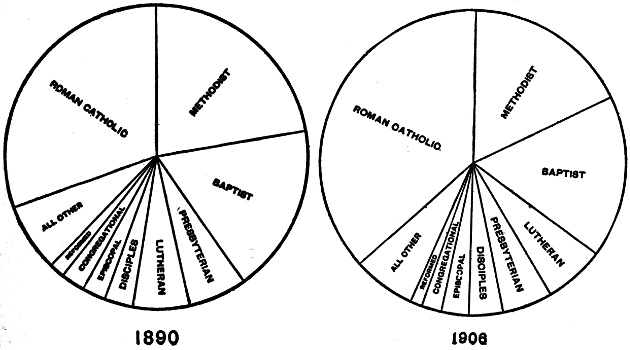
Diagram 1—Distribution of communicants or members, by principal families or denominations, for continental United States: 1890 and 1906.
The value of church property, with gains by decades is shown in Tables No. 5 and No. 6. (See pages 107–108.)
The charts here shown exhibit at a glance (1) the comparative strength of denominations or families for 1890 and 1906 and (2) the relative size of the church and the unchurched population.
[Note.—The designation “not church-members” in diagram 2, p. 104, represents the difference between the number reported as communicants or members and the total population; it embraces, therefore, children too young to become church-members, as well as that portion of the population which is eligible to church-membership, altho not affiliated with any religious denomination.]
Of the total estimated population of continental United States in 1906, 39.1 per cent., or not quite two-fifths, were reported as church-members. The corresponding percentage for 1890 was 32.7, or somewhat less than one-third, showing that the church has gained faster than the population 6.4 per cent.
(444)
CHURCH, SUCCESS OF THE
Mr. Beecher arose in his pulpit Sunday after Sunday for forty years with the invariable fortune of looking at a crowded congregation, tho the most eloquent political orator in the country can not draw the same people to hear him five times in succession. A country town of 3,000 people will support from five to ten churches when it will hardly pay the rent of an amusement hall. For centuries, against intellectual doubt and the weakness of the flesh, the Christian religion has more than held its own in Europe and America, and while the theater could attract only by a continually changing appeal to curiosity, the church has retained its power with slight change and with only enough flexibility to adjust its forms of government to the character of different people.—Kansas City Times.
(445)
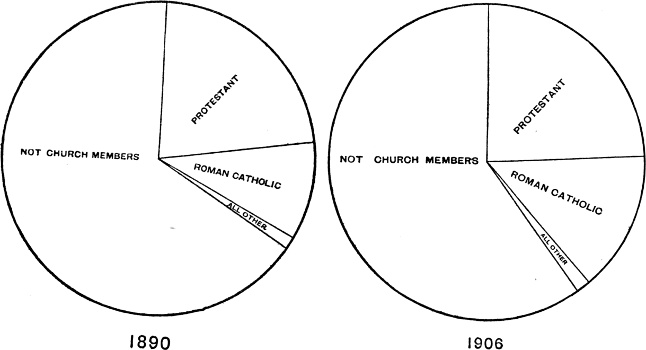
Diagram 2—Proportion of the population reported as Protestant, Roman Catholic, and “all other” church-members, and proportion not reported as church-members, for continental United States: 1890 and 1906.
Table No. 1—Denominational Rank. (See Church Statistics.)
DENOMINATION Number of organizations Rank in number of organizations
Methodist bodies 64,701 1
Baptist bodies 54,880 2
Presbyterian bodies 15,506 3
Lutheran bodies 12,703 4
Roman Catholic Church 12,482 5
Disciples or Christians 10,942 6
Protestant Episcopal Church 6,845 7
Congregationalists 5,713 8
United Brethren bodies 4,304 9
Evangelical bodies 2,738 10
Reformed bodies 2,585 11
Adventist bodies 2,551 12
Jewish congregations 1,769 13
Christians (Christian Connection) 1,379 14
German Evangelical Synod of North America 1,205 15
Latter-day Saints 1,184 16
Friends 1,147 17
Dunkers or German Baptist Brethren 1,097 18
CHURCH, THE
Harriet McEwen Kimball puts into verse a hopeful view of the triumph of the Church:
Be patient! bide His time who will not tarry; A thousand years He measures as a day. All human plans, since human, may mis-carry; His, never; keep His counsel, watch and pray. Put up thy sword, He saith; Be faithful unto death. Since the first saints embraced His cross, and dying No earthly triumph saw, yet were content, On His dear Presence, tho unseen, relying, His holy Church has walked the way He went; Afflicted, destitute, And sore from head to foot. Thou yet shalt see her, all her trials ended, Robed as in garments woven white of flame, When He “by thousand thousand saints attended,” Their lifted foreheads burning with His name, Shall come to claim the rest Who wait His advent blest. She will be glorious; neither spot nor wrinkle To mar the beauty of her holiness, And all the nations which His blood shall sprinkle The bride and bridegroom shall alike confess; Forever one the twain; Forevermore their reign! (Text.)
(446)
CHURCH, THE COUNTRY
J. S. Cheavens remembers the church in the country in a poem, of which a part is here given:
In pillar’d aisles of vast cathedrals old, Ablaze with splendor, garish gilt and gold, Where clouds of incense ever seemed to dwell, And rhythmic waves of music rose and fell— I’ve heard the priest, in pomp of vain attire, Prate ancient prayers that did no soul inspire, Nor reach God’s ear. Religion’s whited tomb, Appalling in its cold sepulchral gloom! How far removed by all vain rules of art, Yet deep enshrined within my loyal heart, Is that plain building, simple, unadorned, Loved by a few, altho by many scorned— Unknown by those who seek wealth, power or place, But very dear to those who seek His face— The Country Church! O holy, holy ground, For there the Lord Himself is sought and found!
(447)
Table No. 2—Distribution by Families and Denominations. (See Church Statistics.)
DENOMINATION Number of bodies: 1906 RELIGIOUS ORGANIZATIONS
Number Per cent distribution Increase from 1890 to 1906
1906 1890 1906 1890 Number Per cent
All denominations 186 212,230 [1]165,151 100.0 100.0 47,079 28.5
Protestant bodies 164 195,618 153,054 92.2 92.7 42,564 27.8
Adventist 7 2,551 1,757 1.2 1.1 794 45.2
Baptist 14 54,880 42,909 25.9 26.0 11,971 27.9
Church of Christ, Scientist 1 638 221 0.3 0.1 417 188.7
Congregationalist 1 5,713 4,868 2.7 2.9 845 17.4
Disciples or Christians 2 10,942 7,746 5.2 4.4 3,696 51.0
Dunkers or German Baptist Brethern 4 1,097 989 0.5 0.6 108 10.9
Evangelical bodies 2 2,738 2,310 1.3 1.4 428 18.5
Friends 4 1,147 1,056 0.5 0.6 91 8.6
German Evangelical Synod of N. A. 1 1,205 870 0.6 0.5 335 38.5
Independent churches 1 1,079 155 0.5 0.1 924 596.1
Lutheran bodies 24 12,703 8,595 6.0 5.2 4,108 47.8
Mennonite bodies 14 604 550 0.3 0.3 54 9.8
Methodist bodies 15 64,701 51,489 30.5 31.2 13,212 25.7
Presbyterian bodies 12 15,506 13,471 7.3 8.2 2,035 15.1
Protestant Episcopal Church 1 6,845 5,018 3.2 3.0 1,827 36.4
Reformed bodies 4 2,585 2,181 1.2 1.3 404 18.5
Unitarians 1 461 421 0.2 0.3 40 9.5
Other Protestant bodies 52 3,694 2,042 1.7 1.2 1,652 80.9
Roman Catholic Church 1 12,482 10,239 5.9 6.2 2,243 21.9
Jewish congregations 1 1,769 533 0.8 0.3 1,236 231.9
Latter-day Saints 2 1,184 856 0.6 0.5 328 38.3
All other bodies 14 766 467 0.4 0.3 299 64.0
CHURCH UNION
If this world is ever taken for God and its sins overthrown it will be by the marching of all the hosts of God in solid column to attack. The sixteen kinds of Methodists will come under one wing, the ten kinds of Baptists must come under another wing, and the seven kinds of Presbyterians under still another wing. After all the branches of each denomination have united then the great denominations nearest of kin will unite, and this absorption shall go on until there shall be one great millennial church, divided only for convenience into geographical sections and as of old it was the “Church of Laodicea” and the “Church of Philadelphia,” and the “Church of Thyatira,” so it shall be the “Church of America” and the “Church of Europe,” and the “Church of Asia,” and the “Church of Africa,” and the “Church of Australia.” Of that world-wide Church there will be only one article of creed—Christ first, Christ last, and Christ forever. (Text.)—T. DeWitt Talmage, Christian Union.
(448)
Table No. 3—Seating Capacity of the Churches (less a percentage not reporting.) (See Church Statistics.)
DENOMINATION ORGANIZATIONS REPORTING SEATING CAPACITY OF CHURCH EDIFICES: 1906 SEATING CAPACITY OF CHURCH EDIFICES REPORTED
Amount Per cent distribution Increase from 1890 to 1906
Number Per ct. of total reporting church edifices 1906 1890 1906 1890 Amount Per cent
All denominations 179,954 97.3 58,536,830 43,560,063 100.0 100.0 14,976,767 34.4
Protestant bodies 167,884 97.4 53,282,445 39,896,330 91.0 91.6 13,386,115 33.6
Adventist bodies 1,431 98.4 287,964 190,748 0.5 0.4 97,216 51.0
Baptist bodies 48,042 97.9 15,702,712 11,568,019 26.8 26.6 4,134,693 35.7
Christian (Christian Connection) 1,221 98.6 383,893 347,697 0.7 0.8 36,196 10.4
Church of Christ, Scientist 245 97.6 81,823 1,500 0.1 ([5]) 80,323 5,354.9
Congregationalists 5,244 98.1 1,794,997 1,553,080 3.1 3.6 241,917 15.6
Disciples or Christians 8,702 97.8 2,776,044 1,609,452 4.7 3.7 1,166,592 72.5
Dunkers or German Bapt. Brethren 969 98.8 508,374 414,036 0.9 1.0 94,338 22.8
Evangelical bodies 2,461 98.1 659,391 479,335 1.1 1.1 180,056 37.6
Friends 1,088 99.4 304,204 302,218 0.5 0.7 1,986 0.7
German Evangelical Synod of N. A. 1,131 99.6 380,465 245,781 0.6 0.6 134,684 54.8
Independent churches 741 94.3 213,096 39,345 0.4 0.1 173,751 441.6
Lutheran bodies 10,493 98.1 3,344,654 2,205,635 5.7 5.1 1,139,019 51.6
Mennonite bodies 497 99.8 171,381 129,340 0.3 0.3 42,041 32.5
Methodist bodies 56,577 96.1 17,053,392 12,863,178 29.1 29.5 4,190,214 32.6
Presbyterian bodies 13,942 99.0 4,892,819 4,037,550 8.4 9.3 855,269 21.2
Protestant Episcopal Church 5,960 99.4 1,675,750 1,336,752 2.9 3.1 338,998 25.4
Reformed bodies 2,472 99.7 990,654 825,931 1.7 1.9 164,723 19.9
United Brethren bodies 3,637 94.4 1,060,560 991,138 1.8 2.3 69,422 7.0
Other Protestant bodies 1,912 97.6 620,133 345,890 1.1 0.8 274,243 79.3
Roman Catholic Church 10,303 95.8 4,494,377 3,370,482 7.7 7.7 1,123,895 33.3
Jewish congregations 717 95.2 364,701 139,234 0.6 0.3 225,467 161.9
Latter-day Saints 837 99.1 280,747 122,892 0.5 0.3 157,855 128.5
Eastern Orthodox Churches 75 89.3 38,995 325 0.1 ([5]) 38,670 11,898.5
All other bodies 138 69.0 75,565 30,800 0.1 0.1 44,765 145.3
Table No. 4—Seating Capacity—Gain by Decades. (See Church Statistics.)
YEAR Population SEATING CAPACITY OF CHURCH EDIFICES
Amount Per cent of population
1906 [7]84,246,252 58,536,830 69.5
1890 [8]62,947,714 43,560,063 69.2
1870 38,558,371 [10]21,665,062 56.2
1860 31,443,321 [11]19,128,751 60.8
1850 23,191,876 14,234,825 61.4
CHURCHES AND THE CROWD
Jane Addams says that on a Sunday night in Chicago one-sixth of the entire population is packed into 466 places of entertainment. Churches? No—moving-picture shows! The churches on Sunday night in Chicago, and, we fear, in many other places, are not conspicuously crowded. The problem is this: If the Chicago churches had presented an up-to-date moving-picture show, instead of a sermon, would the crowd have followed the films? Inasmuch as the church admission is free and the theater admission is from five to twenty-five cents, it is a fair assumption that the churches would have been filled. Now, if the object of the Sunday-night service is primarily to reach the crowd on the street, and if, as has been shown, the moving-picture is a much more vivid and attractive way of reaching that crowd than is a sermon, why, in all seriousness, don’t churches give us the thrilling stories of the Old Testament, its beautiful tales of the New Testament, and its modern illustrations of Christian heroism in this and other lands, in the up-to-date form—in moving pictures? They may answer that they can not get hold of the films and the machine, but this answer is not a good answer. Excellent sacred pictures are shown in the present professional entertainments, and many illustrations of modern heroism, self-sacrifice, and virtue are in every program. Moreover, a demand for films for church use would enlarge the supply. Moving-picture machines are not expensive and can be easily operated. You can do it in your church. Why don’t you?—Woman’s Home Companion.
(449)
Table No. 5—Church Property. (See Church Statistics.)
DENOMINATION ORGANIZATIONS REPORTING VALUE OF CHURCH PROPERTY IN 1906 VALUE OF CHURCH PROPERTY REPORTED
Number Per cent of total Dollar Amount Per cent distribution Increase from 1890 to 1906
1906 1890 1906 1890 Dollar Amount Per cent
All denominations 186,132 87.7 1,257,575,867 679,426,489 100.0 100.0 578,149,378 85.1
Protestant bodies 173,902 89.9 935,942,578 549,695,707 74.4 80.9 386,246,871 70.3
Adventist bodies 1,492 58.5 2,425,209 1,236,345 0.2 0.2 1,188,864 96.2
Baptist bodies 49,339 89.9 139,842,656 82,328,123 11.1 12.1 57,514,533 69.9
Christian (Christian Connection) 1,239 89.8 2,740,322 1,775,202 0.2 0.3 965,120 54.4
Church of Christ, Scientist 401 62.9 8,806,441 40,666 0.7 ([12]) 8,765,775 21,555.5
Congregationalists 5,366 93.9 63,240,305 43,335,437 5.0 6.4 19,904,868 45.9
Disciples or Christians 8,906 81.4 29,995,316 12,206,038 2.4 1.8 17,789,278 145.7
Dunkers or German Bapt. Brethren 974 88.8 2,802,532 1,362,631 0.2 0.2 1,439,901 105.7
Evangelical bodies 2,515 91.9 8,999,979 4,785,680 0.7 0.7 4,214,299 48.1
German Evangelical Synod of N. A. 1,137 94.4 9,376,402 4,614,490 0.7 0.7 4,761,912 103.2
Independent churches 806 74.7 3,934,267 1,486,000 0.3 0.2 2,448,267 164.8
Lutheran bodies 10,779 84.9 74,826,389 35,060,354 6.0 5.2 39,766,035 113.4
Mennonite bodies 497 82.3 1,237,134 643,800 0.1 0.1 593,334 92.2
Methodist bodies 59,083 91.3 229,450,996 132,140,179 18.2 19.4 97,310,817 73.6
Presbyterian bodies 14,161 91.3 150,189,446 94,861,347 11.9 14.0 55,328,099 58.3
Protestant Episcopal Church 6,057 88.5 125,040,498 81,219,117 9.9 12.0 43,821,381 54.0
Reformed bodies 2,477 95.8 30,648,247 18,744,242 2.4 2.8 11,904,005 63.5
Unitarians 406 88.1 14,263,277 10,335,100 1.1 1.5 3,928,177 38.0
United Brethren bodies 3,839 89.2 9,073,791 4,937,583 0.7 0.7 4,136,208 83.8
Universalists 779 92.1 10,575,656 8,054,333 0.8 1.2 2,521,323 31.3
Other Protestant bodies 2,552 69.1 14,616,264 5,987,706 1.2 0.9 8,628,558 144.1
Roman Catholic Church 10,293 82.5 292,638,787 118,123,346 23.3 17.4 174,515,441 147.7
Jewish congregations 747 42.2 23,198,925 9,754,275 1.8 1.4 13,444,650 137.8
Latter-day Saints 909 76.8 3,168,548 1,051,791 0.3 0.2 2,116,757 201.3
Eastern Orthodox Churches 89 21.7 964,791 45,000 0.1 ([12]) 919,791 2,044.0
All other bodies 192 25.1 1,662,238 756,370 0.1 0.1 905,868 119.8
CHURCHES, DEAD
There is a Scandinavian tradition which tells of seven parishes of the Northland that lie buried under snow and ice, but whose church-bells are heard ringing clearly.
May not churches ring their bells and maintain all the forms of life, and yet lie buried under the snow and ice of death? (Text.)
(450)
Table No. 6—Church Property—Gain by Decades. (See Church Statistics.)
YEAR VALUE OF CHURCH PROPERTY REPORTED
Amount Per cent of increase over value at preceding census
1906 $1,257,575,867 85.1
1890 679,426,489 91.7
1870 354,483,581 106.5
1860 171,397,932 90.3
1850 87,328,801 .....
CHURCHES, SELFISH
Most churches are religious cisterns instead of spiritual reservoirs. A cistern has all the trenches dug, the pipes laid, the roofs shaped to catch the showers of the favoring sky, and the water runs into it to be dipped out by the owner or occupant of the building, for the purpose of consumption. A reservoir has streams running into it, but all its trenches are dug and pipes laid in order that the water shall flow away from it, for the purpose of distribution.—Theodore S. Henderson.
(451)
CIGARET SMOKING
Cigaret smoking is the most dangerous form in which tobacco can be used, because combustion goes on so near the mouth that all the products of burning are drawn into the mouth without change and are absorbed by the blood-vessels and carried to the brain. In the pipe and cigar many of the products from burning are condensed in the stem of the pipe and body of the cigar, and never reach the mouth. In the cigaret these poison products, small in amount, are constantly taken by the blood-vessels of the mouth and affect the senses. The sight, the smell and the hearing are all diminished and enfeebled, later the power of reason and muscular control. No form of tobacco is so cumulative in its action as the products from cigaret smoking; the quantity is small, the absorption is more rapid, and the resistance by nature is less active. The cigaret-smoker is slowly and surely poisoning himself, and is largely unconscious of it. In the young the poisoning is very acute and active; in elderly persons it is less prominent, but that it is equally dangerous, in the effects on the nerves, on the brain and on the senses, enfeebling them and destroying their activity, is beyond all question. The pipe- or cigar-smoker may not seem much worse for his addiction, but the cigaret-smoker is always markedly damaged by it.—T. D. Crothers.
(452)
CIRCULATION IMPEDED
The moral and spiritual circulation, the free action of life-forces in character, may be checked and impeded as well as the physical forces, as described below:
From the experiments of Scharling, Gerlach, and others, it has been shown that appreciable quantities of carbonic acid gas are hourly exhaled by the skin. If this process of cutaneous respiration is absolutely interrupted, as by covering the skin with varnish, death follows very soon, the heart and lungs becoming gorged with blood, as in ordinary cases of asphyxiation. In ignorance of this physiological fact, certain monks in the middle ages gilded the skin of a young lad who was to represent an angel (angels being understood, it would seem, to have golden skin); but he did not live through the performance of the “mystery” or “morality” in which he had to play his angelic part. Even if the body be inclosed, all but the head, in a water-proof covering, asphyxiation follows. Some, indeed, present themselves in public gatherings, not within the walls of lunatic asylums, either, with the respiratory, circulatory, and perspiratory organs manifestly obstructed, and, in fact, with the whole economy of the body from head to foot hampered obviously to the eye by powder, paint, enamel, corset, tight gloves, tight shoes, and goodness knows what other contrivances for checking all the processes and movements for whose perfect freedom of action nature has carefully provided. These may, perhaps, be best explained as cases of reversion to the ways of savage progenitors.—R. A. Proctor, Syndicate Letter.
(453)
CIRCUMSTANCES
Circumstances mold character, but character masters circumstances. No true life anywhere needs despair because its surroundings are uncongenial or depressing. A writer finds this lesson in the first flowers of spring, of which he says:
But among what uncongenial surroundings these new flowers have come! Gray, sunless skies, chilling winds, the frosts, the lingering traces of the snow—these are the things which the new flowers see with their opening eyes; courageous flowers indeed to creep forth into a wintry world like this!
If these flowers can brave the trials of the winds and cold and sullen sky, and still smile upon the sun, so can human lives, however bare and difficult their lot.
(454)
CIRCUMSTANCES BEYOND CONTROL
One of the strangest stories of false imprisonment comes from France. A woman was sentenced to imprisonment for life for having caused the death of her husband and brother. The three had lived together at Malaunay, near Rouen, in a cottage. The lower part of it was used as a shop. When the woman was sent to prison, other people occupied the shop, but the new tenants suffered, the man from fainting fits, his wife from nausea, from which she died. Another couple tried their fortune, but they, too, were overcome by the “spell of the accurst place,” as they supposed. They were subject to fainting and loss of memory. At last a scientific examination of the premises was made. Then it was found that adjoining the shop was a lime-kiln. In a wall dividing it from the cottage were many fissures, so that whenever lime was burned monoxide of carbon escaped into the inn. This was the secret of the deaths for which the woman was suffering. She was brought out of prison after six years of servitude.
While we should not put the blame for our sins on circumstances, we should remember that much which we condemn as sin would, if we understood it, be excused as due to circumstances that involve no blame.
(455)
Circumstances, Making the Best of—See Conservation of Remainders.
CIRCUMSTANCES, MASTERY BY
Genius levels mountains, spans rivers, causes wildernesses to blossom, links together with electric chains the ends of the earth. The gifted man cares not for difficulties; like a mountain torrent, he gains momentum from every obstacle; a master athlete, he throws the world. Masters of circumstance in many directions, but how soon we succumb to circumstance when it relates to character! He who is triumphantly strong in other directions is helpless here; he who heroically and magnificently succeeds in fortune ignobly fails in morals. He who successfully battles with circumstances to become a scholar is vanquished by fleshly desires; he who becomes rich in the teeth of circumstances is then mastered and degraded by his riches; he who surmounts circumstances to become great, immediately falls a victim to luxury and pride. Men make a grand fight with a circumstance in the kingdoms of nature and society, but a sorry light with circumstances as these menace the kingdom of the spirit; they fail most where it is exactly most desirable that they should succeed.—W. L. Watkinson, “The Transfigured Sackcloth.”
(456)
CIRCUMSTANCES NOT DECISIVE
The danger of circumstantial evidence is illustrated by the French trial of a maidservant for robbery of some forks from a citizen of Paris. At the trial the circumstances were so strong against her that she was found guilty, and was executed. Six months afterward the forks were found under an old roof, behind a heap of tiles, where a magpie used to go. When it was discovered that the innocent girl had been unjustly condemned, an annual mass was founded at St. John-en-Grese for the repose of her soul.—Croake James, “Curiosities of Law and Lawyers.”
(457)
CIRCUMSTANCES, SUPERIORITY TO
R. H. Haweis tells the following of a celebrated violinist:
Leghorn received him with open arms, altho his appearance was marked by an amusing contretemps. He came on to the stage limping, having run a nail into his heel. At all times odd-looking, he, no doubt, looked all the more peculiar under these circumstances, and there was some tittering among the audience. Just as he began, the candles fell out of his desk—more laughter. He went on playing; the first string broke—more laughter. He played the rest of the concerto through on three strings, but the laughter now changed to vociferous applause at this feat. The beggarly elements seemed of little consequence to this magician. One or more strings, it was all the same to him; indeed, it is recorded that he seldom paused to mend his strings when they broke, which they not infrequently did.
(458)
CIRCUMSTANCES, TAKING ADVANTAGE OF
A well-known lawyer related a good story about himself and his efforts to correct the manners of his office boy:
One morning not long ago, the young autocrat blew into the office, and, tossing his cap at a hook, exclaimed:
“Say, Mr. Blank, there’s a ball-game down at the park to-day and I am going down.”
Now, the attorney is not a hard-hearted man, and was willing the boy should go, but thought he would teach him a little lesson in good manners.
“Jimmie,” he said, “that isn’t the way to ask a favor. Now, you come over here and sit down, and I’ll show you how to do it.”
The boy took the office chair, and his employer picked up his cap and stept outside. He then opened the door softly, and holding the cap in his hand, said, quietly, to the small boy in the big chair:
“Please, sir, there is a ball-game at the park to-day; if you can spare me I would like to get away for the afternoon.”
In a flash the boy responded:
“Why, certainly, Jimmie; and here is fifty cents to pay your way in.” (Text.)
(459)
CITIZENSHIP IN THE KINGDOM
In writing of the Polish women, one author tells how they perform a man’s labor of sowing, tilling and reaping in the field. Their work is preferred to that of men because it is better and cheaper. They work for German land-owners and receive free transportation by the government. Altho they are said to frequently marry Germans, they do not lose their identity, nationality or character.
Every church-member should be a citizen of the kingdom of Heaven. He should make its interests his interests and identify himself so closely with Christ, and show forth His life so that all would know that his nationality was of heaven; and his character Christ-like. (Text.)
(460)
CITY, A HOLY
It would not be expected anywhere that New York would be called a holy city, and yet that is what it was recently called by a convert in one of its mission halls. A correspondent of the New York Tribune gives an account of a meeting he attended on a recent Sunday evening in a gospel mission hall at No. 330 Eighth Avenue. A man with a pronounced foreign accent told the story of his life at this meeting. At the age of eighteen, he said, shortly after his arrival at a German university, because of some fancied slight he was challenged to fight a duel with one of his fellow students. In self-defense he killed the man, and from that day had borne the sorrows of a homicide. Drink had the mastery over him and he was far gone in dissipation when he was shipped to Canada, where he still continued a life of dissipation. To improve his business chances he came to New York and took up residence in the Young Men’s Christian Association Building in Twenty-third Street. Said the speaker: “A good many talk about the wickedness of New York. I call it a holy city, because in that little room, No. 653, in the Young Men’s Christian Association Building, I lost the weight of sin which had been pressing my life out for years and entered a new life in which the past was blotted out.” Several months have passed and the speaker has been led into new evidences of divine favor and usefulness. This case illustrates the familiar fact that one can find what he is looking for almost anywhere, especially in a large city. If he is looking for a saloon or any form of evil he will have little trouble in finding it, but if he wants to find a church or some form of good, it will be found near at hand. A holy man is holy anywhere, and to him even New York is a holy city.—Presbyterian Banner.
(461)
City Children—See Children and Gardens.
CITY, GROWTH OF A GREAT
The growth of population in the area now covered by Greater New York is shown thus in The Tribune:
1910 4,766,883
1900 3,437,202
1890 2,507,414
1880 1,911,698
1870 1,478,103
1860 1,174,779
1850 696,115
1840 391,114
1830 242,278
1820 152,056
1810 119,734
1800 79,216
1790 49,401
The following interesting figures are given by the Washington correspondent of The Times:
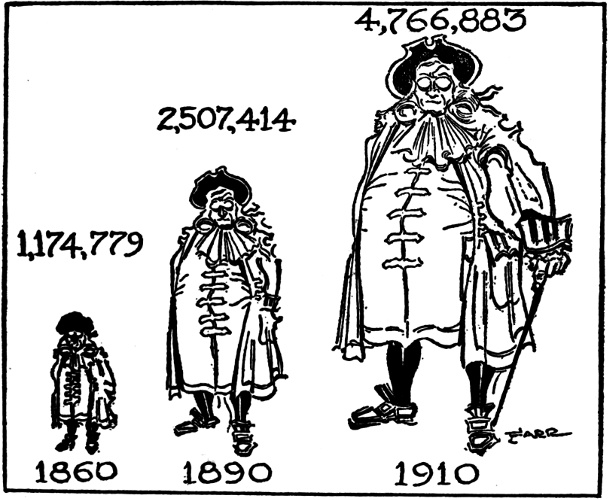
New York now has a population greater than many of the countries of the world, for instance, Australia in 1908 had within its borders 4,275,306 persons, exclusive of the aborigines, while Ireland (1909) had a population of 4,374,158. Bulgaria in 1908 showed a census return of 4,158,409, and Denmark and Greece, respectively, had 2,659,000 and 2,632,000 subjects of their kings. Norway in the same year was populated by 2,350,786 persons, and Switzerland by 3,559,000.
The figures in the cut above exhibit fifty years of New York’s expansion.
The fifteen largest cities of the world, each having more than one million population are as follows:
London 7,537,196
New York 4,766,883
Paris 2,714,068
Tokyo 2,085,160
Berlin 2,040,148
Chicago 1,698,575
St. Petersburg 1,678,000
Vienna 1,674,957
Canton 1,600,000
Peking (estimated) 1,600,000
Moscow 1,359,254
Philadelphia 1,293,697
Constantinople (estimated) 1,125,000
Osaka 1,117,151
Calcutta and suburbs 1,026,987
(462)
Cities and Atmospheric Impurities—See Soot.
Cities Due to Discoveries—See Discovery, Benefits from.
City versus Country—See Society is Man’s Place.
Civic Pride—See Children and Civic Service.
Civic Strength—See Greatness, True, of a City.
CIVICS
It is said that one day recently a committee from a certain college investigated the Jacob Riis Settlement on the East Side of New York and made the criticism that civics were not taught. “I’ll show you how I teach them,” said Riis. “I noticed that the Jews and Irish did not get on together, so I had a straight talk with the leaders and told them they must do something. In a short time this notice appeared on the bulletin board: ‘Come to the Meeting of the Young American Social and Political Club, Dennis O’Sullivan, President; Abraham Browsky, Vice-President.’ That,” answered Riis, “is my way of teaching civics.” And it is a way we should not neglect to follow. (Text.)—The American College.
(463)
Civilization—See Knowledge Values.
Civilization Advancing—See Advancement, Rapid.
CIVILIZED MAN AND SAVAGE
A savage who had been shipwrecked in a river may note certain things which serve him as signs of danger in the future. But civilized man deliberately makes such signs; he sets up in advance of wreckage warning buoys, and builds lighthouses where he sees signs that such events may occur. A savage reads weather signs with great expertness; civilized man institutes a weather service by which signs are artificially secured and information is distributed in advance of the appearance of any signs that could be detected without special methods. A savage finds his way skilfully through a wilderness by reading certain obscure indications; civilized man builds a highway which shows the road to all. The savage learns to detect the signs of fire and thereby to invent methods of producing flame; civilized man invents permanent conditions for producing light and heat just whenever they are needed.—John Dewey, “How We Think.”
(464)
CLAIM, GOD’S
When the late Earl Cairns was a little boy he heard three words which made a memorable impression upon him, “God claims you.” Then came the question, “What am I going to do with the claim?” He answered, “I will own it, and give myself to God.” He went home and told his mother, “God claims me.” At school and college his motto was, “God claims me.” As a member of Parliament, and ultimately as lord chancellor, it was still, “God claims me.” When he was appointed lord chancellor he was teacher of a large Bible class, and his minister, thinking that now he would not have time to devote to that purpose, said to him, “I suppose you will now require to give up your class?” “No,” was the reply, “I will not; God claims me.” (Text.)
(465)
Clamor versus Balance—See Confidence.
CLASSICS, STUDY OF
If I could have my way, every young man who is going to be a newspaper man, and who is not absolutely rebellious against it, should learn Greek and Latin after the good old fashion. I had rather take a young fellow who knows the Ajax of Sophocles, and who has read Tacitus, and can scan every ode of Horace; I would rather take him to report a prize-fight or a spelling-match, for instance, than to take one who has never had those advantages.—Charles A. Dana.
(466)
CLEANLINESS
At Minot’s Ledge lighthouse all “bright work” must be cleaned every morning—lens, lamps, etc. So also all inside copper pots and tin-pans. The inspector comes every three months unannounced, and is handed by the keeper a white linen towel or napkin, and he goes over these bright things. Then he enters the item in his diary: “Service napkin not soiled.”
A man should live such a cleanly moral life that nothing around him can suffer pollution as he uses it. (Text.)
(467)
Cleansing—See Purity of Associations.
Cleansing a Necessity—See Discipline from Change.
Cleansing by Agitation—See Discipline from Change.
CLEANSING, DIFFICULTY OF
It is impossible for the guilty soul to emancipate itself from the consciousness of sin. Dr. Seedham-Green, in his work on “The Sterilization of the Hands,” proves the absolute impossibility of cleansing the hands from bacteria:
Simple washing with soap and hot water, with use of sand or marble dust, however energetically done, does not materially diminish the number of microbes; the mechanical purification is practically useless. Turpentine, benzoline, xylol, alcoholic disinfection, and various antiseptics equally fail to render the hands surgically clean. (Text.)
(468)
CLEANSING THE FOUNTAIN
Sam P. Jones used to tell of a man down in the spring branch trying to clear the water, so that he could get a clear drink. This man was doing all he could to filter the water, when some friend called out to him: “Stranger, come up a little higher and run that hog out of that spring, and it will clear itself.”
Unless life’s sources are clean, it is of little use to labor with external conduct.
(469)
Climates, Different—See Environment, Creating Our Own.
Climbing—See Aspiration; Steps Upward.
CLINGING BY FAITH
There is a little limpet that is found clinging to the rocks along the coast; if you crawl up stealthily and hit one a heavy blow, you may detach it; but after you have struck the rock it is almost impossible to loosen the grasp of another limpet. These little limpets are good for nothing but to cling; but they do that with an awful tenacity. That’s what limpets are for—simply to cling. Oh, that we just knew how to cling to God by faith—nothing more, nothing less.—Bradford V. Bauder.
(470)
CLUB WISDOM
Recently a traveler in Scotland, standing upon a mountain cliff overlooking the sea, found himself in great danger. It seems that the gardener desired to beautify even the steep cliffs and precipices. Loading his double-barreled shot-gun with seeds of flowers and vines, he fired the seeds up into the crevices of the rocks.
Not otherwise, for men and women who have a few moments for rest between hour, has life become dangerous. To-day, one can scarcely turn round the street corner without running into the president of some new culture club, who straightway empties into the victim two volleys of talk about some wisdom, old or new. The old shot-gun is less dangerous than the new club.—Newell Dwight Hillis.
(471)
CLUES
Life would be simplified and made safe if men, like spiders, would always allow their life plans to be dominated by the clue that comes from above.
A great principle never forgotten by the spider is that she must always spin behind her a thread that will enable her to find again the points that she has left; this serves at once as her guiding thread for return, and as the road on which she travels. A consequence of this rule is that the starting-point, the center of the first operations, must be at the top of the web, and often higher still, so as to dominate the whole. From this point the explorer lets herself down, suspended from her inseparable thread, balances herself, and if she does not find the sought-for point, climbs back along the thread which she absorbs in ascending. (Text.)—Maurice Koechlin, La Nature.
(472)
COCAINE RESTRICTIONS
One of the best laws ever enacted in New York State is the bill just signed by Governor Hughes which declares any person having cocaine upon his person, unless secured upon the prescription of a physician, and having a certificate from the druggist from whom he purchased the drug, guilty of a felony. This new law, which is directed against men who financially profit by the diseased appetites of victims of cocaine, will, according to health and police officials, sound the death-knell of the promiscuous sale of the most deadly of drugs. Chief Inspector Fuller, of the New York Health Department, says: “With this law on the statute-books I can promise that with the staff of inspectors I have at my disposal I will wipe out this most vicious evil. The jails are yawning for these criminals who are making fiends out of the New York boys and girls. This law will make possible the placing of those criminals behind the prison bars. Many a mother and sister will to-day rejoice, upon reading of this new law. It will perhaps mean the saving of their boy or girl from death itself. No one is more pleased with this law than myself and my inspectors, who have been fighting night and day to suppress the evil.”—Christian Work.
(473)
Cocksureness—See Self-centered.
COINCIDENCE
From Czenstochowa, the Mecca of Polish pilgrims, comes a story of coincidences. A pilgrim went to one of the priests and complained that some thief had stolen his purse while he was in church, and asked for money. The priest replied that he had no money and that the best thing for the pilgrim to do was to try to find the thief. “I shall go into the church and steal money from somebody else,” said the pilgrim, “for I have nothing to go home with.” He went into the church and seeing a man in the crowd with a wallet on his back slipt his hand into it and pulled out his own stolen purse, with the exact sum he had left in it. He was so glad to find his money that he hurried off to tell the priest and the thief got away.
(474)
See Criminals, Tracing.
COINCIDENCE AND SUPERSTITION
The German Emperor recently made an interesting presentation to the Hohenzollern Museum. It consists of the “death-dice,” by the help of which one of the Emperor’s ancestors decided a difficult case in the seventeenth century. How they came to be known as the “death-dice” is thus related by the London Tatler:
A beautiful young girl had been murdered, and suspicion fell on two soldiers, Ralph and Alfred, who were rival suitors for her hand. As both prisoners denied their guilt, and even torture failed to exact a confession from either, Prince Frederick William, the Kaiser’s ancestor, decided to cut the Gordian knot with the dice-box. The two soldiers should throw for their lives, the loser to be executed as the murderer. The event was celebrated with great pomp and solemnity, and the Prince himself assisted at this appeal to divine intervention, as it was considered by everybody, including the accused themselves.
Ralph was given the first throw, and he threw sixes, the highest number, and no doubt felt jubilant. The dice-box was then given to Alfred, who fell on his knees and prayed aloud: “Almighty God, thou knowest I am innocent. Protect me, I beseech thee!” Rising to his feet, he threw the dice with such force that one of them broke in two. The unbroken one showed six, the broken one also showed six on the larger portion, and the bit that had been split off showed one, giving a total of thirteen, or one more than the throw of Ralph. The whole audience thrilled with astonishment, while the Prince exclaimed, “God has spoken!” Ralph, regarding the miracle as a sign from heaven, confest his guilt, and was sentenced to death. (Text.)
(475)
COINCIDENCE, REMARKABLE
Shortly after Robert Louis Stevenson published his curious psychological story of transformation, a friend of mine, called Mr. Hyde, was in the north of London, and being anxious to get to a railway station, he took what he thought was a short cut, lost his way and found himself in a network of mean, evil-looking streets. Feeling rather nervous he was walking extremely fast, when suddenly out of an archway ran a child right between his legs. The child fell on the pavement, he tript over it, and trampled upon it. Being, of course, very much frightened and not a little hurt, it began to scream, and in a few seconds the whole street was full of rough people who kept pouring out of the houses like ants. They surrounded him and asked him his name. He was just about to give it, when he suddenly remembered the opening incident of Mr. Stevenson’s story. He was so filled with horror at having realized in his own person that terrible scene, and at having done accidentally what the Mr. Hyde of fiction had done with deliberate intent, that he ran away as fast as he could go. He was, however, very closely followed, and he finally took refuge in a surgery, the door of which happened to be open, where he explained to a young man, apparently an assistant, who happened to be there, exactly what had occurred. The crowd was induced to go away on his giving them a small sum of money, and as soon as the coast was clear he left. As he passed out, the name on the brass door-plate of the surgery caught his eye. It was “Mr. Jekyll.”—Nineteenth Century.
(476)
Colds—See Vitality, Low.
Collection, Missionary—See Crowning Christ.
Collection, The—See Generosity, Thoroughgoing.
COLLECTIVE LABOR
A certain King of Scythia, wishing to make an enumeration of the inhabitants of his realm, required every man in his dominions to send him an arrow-head. The vast collection was officially counted, and then laid together in a sort of monumental pile. This primitive mode of census-taking suggested to Darius the idea of his cairn in his march through Thrace. Fixing upon a suitable spot near his camp, he commanded every soldier to bring a stone and place it on the pile. Of course, a vast mound arose commemorating the march and denoting, also, the countless number of soldiers that formed the expedition.
(477)
College Men in Positions of Trust—See Training.
COLLEGE OR EXPERIENCE
The following dispatch from Washington recently appeared in the New York Sun:
Uncle Joe Cannon was in fine form to-day when he received twenty-five young men, representing the Intercollegiate League, now in session here. Uncle Joe complimented his callers on their advantages, but he told them that knowledge gained in college was of little value unless it was crossed by experience and courage.
Years ago, the Speaker said that he received a degree in a law college in Indiana. He started to Chicago to make his fortune, accompanied by his diploma and $6. He was put off the train in central Illinois when his money gave out and that was why he wound up at Danville, instead of Chicago.
Uncle Joe said that he hung up his diploma in his little law office and waited for clients. For six months he had little to do aside from looking at the diploma and twirling his thumbs. Finally, one day, in a fit of rage, he pulled down the diploma and destroyed it.
“The diploma in itself was of no use to me,” said Uncle Joe. “I kept my courage, however, and by and by began to make my way in the world.”
(478)
COLLEGE TRAINING, VALUE OF
Rev. W. F. Crafts says:
I have examined the educational record of the seventy foremost men in American politics—cabinet officers, senators, congressmen, and governors of national reputation—and I find that thirty-seven of them are college graduates, that five more had a part of the college course but did not graduate, while only twenty-eight did not go to college at all. As not more than one young man in five hundred goes to college, and as this one five-hundredth of the young men furnish four-sevenths of our distinguished public officers, it appears that a collegian has seven hundred and fifty times as many chances of being an eminent governor or congressman as other young men.
(479)
See Training.
Collegiate Ambition—See Margins of Life.
COLLISION DUE TO LIFE
Men who never move, never run against anything; and when a man is thoroughly dead and utterly buried nothing ever runs against him. To be run against is a proof of existence and position; to run against something is a proof of motion.—Christian Standard.
(480)
Collision, Ways of Avoiding—See Paths, Keeping One’s Own.
COLOR-BLINDNESS
The great cause of error is imperfect vision. One says, “It looks so to me,” and therefore he concludes that it is so. He acts as if it were so. And, if he is mistaken, it may be a fatal mistake. The color-blind engineer saw the red light, but it looked green to him. He thought it was a safety signal when it was a danger signal. He went on and wrecked the train. Was he to blame? Yes, for if he could not distinguish between red and green he had no business to run a locomotive. Like him is the man who, with his prismatic eye, sees certain dogmas in the Book which God has written. He has persuaded himself that this danger signal is not red, but green. He insists that it looks so to him. Is it so, therefore, and is he safe? When we hear men talk, as we often do, about how it looks to them, and what seems reasonable to them, we can not help thinking of that color-blind engineer who wrecked his train.
But what can we do with these “evil” prismatic eyes of ours? We can not change them into clear and perfect lenses by a wish, or by one earnest effort. It takes an optician a long time to shape and polish a lens. And we must be willing to work patiently and hard to undo the wrong we have done. If there is any suspicion in our hearts that our eyes are “evil,” we must not rest a moment. We must test the matter at once by a close and prayerful study of the truth.—The Interior.
(481)
Color, Protective, in Animals—See Conformity.
COLORS AS EMBLEMS
Colors are emblematic; and in the middle ages were always used by the illuminators and church artists with regard to their significance. Red, blue and yellow, or gold, the primary colors; red, signifying divine love; blue, truth and constancy; gold, divine glory; when united, are supposed to be good emblems of the Holy Trinity. White, signifying light, purity, perfect righteousness, is to be used by the Church from Christmas eve to the octave of the Epiphany, symbolizing the purity of the Infant Savior; but it is not to be used on St. Stephen’s day, Holy Innocents, or Conversion of St. Paul. White, in an illuminated text, may be represented by silver. It is also the color for Maundy Thursday, Trinity Sunday, baptism, confirmation and marriage. Violet is the ecclesiastical color for mourning; it signifies passion, suffering and humility; therefore, martyrs are sometimes clothed in it. It belongs to advent, Holy Innocents (unless that feast falls on Sunday), Septuagesima to Easter eve, Rogation days, and Ember weeks. Red, the symbol of divine love and illumination (as flame) belongs to Pentecost; and as the emblem of blood shed for the Feast of the Martyrs on Whitsuntide. Blue signifies truth and constancy; when sprinkled with gold stars it signifies heaven. It is not an ecclesiastical color, but (as symbolical of heaven or truth) forms a beautiful and significant ground for a text. Green, the emblem of eternal spring, hope, immortality and conquest, is used on all Sundays. Gold or yellow signifies glory, the goodness of God, faith; it should be used on texts only for the divine name. Dingy yellow signifies deceit. Black is used only on Good Friday. It is symbolical of death and extreme grief. It is used also at funerals, frequently combined with white. Purple signifies royalty, love, passion and suffering. It is the color often worn by martyrs as well as by kings. After His resurrection Christ is sometimes represented in a purple mantle, as the symbol of His kingly power. Violet and blue are the colors of penitence, signifying sorrow and constancy. Gray signifies mourning, humility, and innocence unjustly accused.—The Decorator and Furnisher.
(482)
See Emblems.
COLORS, SYMBOLIC
Havelock Ellis, writing in Popular Science Monthly, says:
The classic world had clearly begun, as savages have begun everywhere, with an almost exclusive delight in red, even an almost exclusive attention to it, and for Homer, as for the Arabs, the rainbow was predominantly red; yellow had next been added to the attractive colors; very slowly the other colors of the spectrum began to win attention. Thus Democritus substituted green for yellow in the list of primary colors previously given by Empedocles. It was at a comparatively late period that blue and violet became interesting or even acquired definite names. The invasion of Christianity happened in time to join in this movement along the spectrum.
Yellow became the color of jealousy, of envy, of treachery. Judas was painted in yellow garments, and in some countries Jews were compelled to be so drest. In France, in the sixteenth century, the doors of traitors and felons were daubed with yellow. In Spain, heretics who recanted were enjoined to wear a yellow cross as a penance, and the Inquisition required them to appear at public autos da fé in penitential garments and carrying a yellow candle.
(483)
Combination—See Union.
Comfort from Faith—See Korea, Work Among Women in.
Commander, The, and His Men—See Difficulties, Overcoming.
Commandment, The Greatest—See Love and Law.
Commandments, The Ten—See Guards of the Soul.
Commerce and Missions—See Missions and Commerce.
COMMON PROBLEM, THE
The common problem, yours, mine, every one’s, Is—not to fancy what were fair in life Provided it could be—but, finding first What may be; then find how to make it fair Up to our means; a very different thing! —Browning.
(484)
COMMON SENSE
When drowning men for aid implore, Some people run along the shore, And weep and pray and hope. Till others with some common sense, Come like a blest providence, And throw a saving rope. —Public Opinion.
(485)
Mr. John Clerk, an eminent Scotch counsel, was arguing at the bar of the House of Lords in a Scotch appeal, and turning his periods in the broadest Scotch, and after clinching a point, added, “That’s the whole thing in plain English, ma lorrdds.” Upon which Lord Eldon replied: “You mean in plain Scotch, Mr. Clerk.” The advocate readily retorted, “Nae maitter! in plain common sense, ma lords, and that’s the same in a’ languages, we ken weel eneuch.” (Text.)—Croake James, “Curiosities of Law and Lawyers.”
(486)
COMMON THINGS
Common things have their use which often surpasses the intrinsic value of precious, costly things.
A rich nobleman was once showing a friend a great collection of precious stones whose value was almost beyond counting. There were diamonds and pearls and rubies, and gems from almost every country, and had been gathered by their possessor at the greatest labor and expense. “And yet,” he remarked, “they yield me no income.” His friend replied that he had two stones which had only cost him five pounds each, but which yielded him a very considerable annual income, and he led him down to the mill and pointed to two toiling gray millstones.
(487)
Communication, Easy—See Social Progress.
COMMUNICATION IN FORMER DAYS
The progress of the world can be inferred from facts like the following:
In 1798 the entire business of the Post-office Department was conducted by the Postmaster-General, one assistant, and one clerk. In 1833 it required forty-eight hours to convey news from Washington to Philadelphia. In 1834 New York Saturday papers were not received in Washington until the following Tuesday afternoon. In 1835 the mails were carried between Philadelphia and Pittsburg daily in four-horse coaches, two lines daily, one to go through in a little more than two days, the other in three and a half days. In 1833 a contractor named Reeside carried the mail between Philadelphia and New York, ninety miles, in six hours, making fifteen miles an hour. The railroad, as a factor in the mail service, did not have a beginning before 1835. August 25 of this year the formal opening of the road between Washington and Baltimore took place. Amos Kendall, then Postmaster-General, at first objected to having the mails carried by rail over this road, since it would, as he feared, disarrange connections with existing lines of stages. In October, 1834, a writer in the Boston Atlas says: “We left Philadelphia on the morning of the sixth in a railroad car, and reached Columbia, on the Susquehanna, at dusk—a distance of eighty-two miles.”—John M. Bishop, Magazine of American History.
(488)
Communication of Disease—See Contamination.
COMMUNICATION, PRIMITIVE
Many explorers have commented on the speed with which news travels among savage tribes, says Amateur Work. A curious observation as to a possible solution of the problem of their methods has been made by the Rev. A. Rideout, who, as a missionary among the Basutos, has noticed their method of sending messages from village to village by means of a signal-drum or gourd. This gourd, covered with the dried and stretched skin of a kid, gives out a sound which travels and can be heard at distances from five to eight miles. The transmission and reception of messages on these drums is entrusted to special corps of signalers, some one of whom is always on duty, and who beat on the message in what is practically a Morse alphabet. On hearing the message, says Mr. Rideout, the signaler can always tell whether it is for his chief or for some distant village, and delivers it verbally or sends it on accordingly, and it is thus carried on with surprizing rapidity from one village to another, till it reaches its destination. All that took place in the Boer War, victories and reverses in the Transvaal and Orange Free State, were known to us by gourd-line message hours before the news ever reached us by field telegraph. The natives guarded the secret of their code carefully. To my knowledge, messages have been sent a thousand miles by means of it. This is probably one of the earliest forms of wireless telegraphy.
(489)
COMMUNICATION, PSYCHICAL
Having discovered that we are immersed in the ether, and that it responds instantly, and to untold distances to electric vibrations, the daring inventor said, if I can set the ether ajar with a certain kind of vibration by shooting up into it strong electric impulses, then I can plant yonder in the distance another instrument keyed to that particular kind of vibration, and it will pick out its own from the ether, quivering, as it is, with an infinite number of vibrations. Just as when you run the scale of the piano in a room, each object responds to its own note. When you touch D a certain lampshade will shiver in answer. That is its note. It knows its own vibration, and is silent to all others.
This, then, is what is transpiring now among men. A code of signals being arranged, one here sends up his request or prayer into the heavens, speaks into space. The whole hemisphere of ether is set quivering. Another yonder, a thousand miles distant, picks out of space the syllables of that prayer, one by one, and then throws back through space the answer. Nothing so marvelous as this, so near spiritual conditions, has ever before entered the heart of man. It is not surprizing that the air is full of prophecies, dreams and visions. One says we will yet be able to carry in a pocket, like watches, little vibrators, so that we can communicate with our distant friends without wires or towers, or skilled operators, as readily as we take out our watch and tell the hour of the day. Others, in this prophetic madness, say we may yet learn the vibration of the planets, and fling off into space our “All hail” to Mars and Venus.—James H. Ecob.
(490)
Communion Between Man and Beast—See Kindness to Animals.
COMMUNION NOT BARRED
A board knocked from a dividing fence sometimes leads to pleasant associations, but they are possible with the boards all on. We can look over or through. And souls can thus, even without effort, live together while the bodies are kept apart. Fences, high and barbed, can not separate kindred spirits.—United Presbyterian.
(491)
Communion with God—See God Surrounding the Soul.
Community’s Interests Before Personal Interests—See Convictions, Strong.
COMPANIONS, EVIL
A farmer’s corn was destroyed by the cranes that fed in his field. Greatly annoyed, he declared that he would find a way out of the trouble. A net was set in which the cranes were snared. There was also a beautiful stork among them who had been visiting with the cranes, and had come to them from a neighboring roof.
“Spare me,” plead the stork. “I am innocent; indeed I am. I never touched any of your belongings.”
“That may be true,” answered the farmer; “but I find you among them and I judge you accordingly.”
The only safe way is to keep out of bad company.