I (continued 2)
Reading edition
(1575)
Incorruptible, The—See Purity.
Increase by Civilization—See Conservation.
Increasing and Decreasing—See Self-estimate.
INCREDULITY
Dr. W. H. Thomson, in his book on “What is Physical Life,” says that “once, while talking to a roomful of the naturally bright people of a town in Mount Hermon about the achievements of Western civilization, I happened to tell a toothless old man present that in our country we had skilled persons who could make for him an entirely new set of teeth. Glancing round the room, I noticed some listeners stroking their beards in a fashion which I knew meant that I was telling a preposterous yarn. Fortunately I had with me an elderly Scotch friend who had a set of false teeth, and on explaining the situation to him, he forthwith opened his mouth and pulled the whole set out. The Arabs jumped to their feet in fright, not sure but he might start to unscrew his head next, for had any of their venerated ancestors ever seen such an uncanny performance with teeth? They afterward said that never would they have believed this if they had not seen it.”
(1576)
See Christianity and Civilization.
INDECISION
When the King of Sparta had crossed the Hellespont and was about to march through Thrace, he sent to the people in the different regions, asking them whether he should march through their country as a friend or as an enemy. “By all means as a friend,” said most of the regions; but the King of Macedon replied, “I will take time to consider it.” “Then,” said the King of Sparta, “Let him consider it, but meantime we march, we march.” (Text.)
(1577)
See Sentiment, Mixed.
Indestructibility of Man—See Man Indestructible.
INDIA, MEDICAL OPPORTUNITIES IN
I wish it were possible for me to give you some idea of the amount of suffering and misery there is in India to-day; but I fear that I can not do it, for you have seldom been where you could not obtain the services of a good physician in time of need, or even be taken to a hospital, if it were desirable. But there are millions of people in India who have no such resources as that. Shall I tell you of a man who came to our hospital some time ago suffering from a cataract in one eye? He was an intelligent man, well educated, and he wanted to save his eyesight. He employed some of the native doctors to treat the eye, and when he came to us he said that he thought he had had at least twenty-five pounds of medicine put in his eye. That sounded like such a large story that we asked for the particulars, and I think he was about right. It was all to no purpose, however, so that he changed doctors and got a new remedy that was guaranteed. They opened his eye and sifted it full of pounded glass. If you have ever had a cinder in your eye, perhaps you can to some small extent imagine the agonies which that man endured before he came to us. That is not an uncommon case, and frequently when I go into the dispensary in the morning I find there mothers with their little children. They hold them out to me in their arms and say, “Won’t you look at this child’s eyes?” I say, “Well, mother, what is the matter with the eyes?” “Oh, about two or three weeks ago the child’s eyes were red and it cried a little bit, and we tried to open them to see what was the matter, but the child made so much fuss we couldn’t do anything. Now, they have been shut so long that we are afraid there is something the matter; we want you to look and see.” I open those eyelids with my fingers; I know what I am going to see. The front part of the eyeball is gone—sloughed away, rotted out just in those few days. A few simple remedies, a little cleanliness at the proper time, would have saved those eyes, but often I have to say to those mothers, “Your child is blind for life.” There are many thousands of such little children in India to-day sitting by the side of the road waiting for the coppers which the passer-by will fling to them, and which they must find by feeling around in the dust. It is a very common practise on the part of the native physicians to apply as a counter-irritant to the surface of the body a material which burns like a red-hot iron; and if you have burned your finger recently, you can imagine how it would be to be burned in stripes from the nape of your neck right down to your heels, or to have patterns worked on your body with that fiery material. If you have suffered recently from such a simple ailment as a toothache, imagine a land without any dentists or other means to relieve that ache. The tooth must ache in India, until nature brings its own remedy, and the tooth drops out.—A. S. Wilson, “Student Volunteer Movement,” 1906.
(1578)
Indian, The—See Conservation.
Indian, The Word of an—See Promise, an Indian’s.
INDIANS, AMERICAN
“The ‘noble’ red man of traditional lore was usually a very low-bred, dirty savage, uninteresting except for his blood-thirstiness and capacity for rum and mischief.” What education, mostly under government supervision, has been able to do with the Indian is shown in the extract:
Supt. Friedman of the Carlisle Indian School remarks that thirty years have elapsed since the first group of eighty-two Sioux Indians from the Pine Ridge and Rosebud Reservations of South Dakota arrived at Carlisle, Penn., to receive the benefit of a civilized education. Out of this beginning an elaborate system of Indian schools has grown, including 167 day-schools, 88 reservation boarding schools and 26 non-reservation schools, so that to-day 25,777 Indian students are being educated under the Government’s immediate patronage, at a cost for the fiscal year 1909 of $4,008,825. The students in the contract schools and missions swell this total to 30,630. The Carlisle school, the largest of all, has an enrolment of 1,132, which is not much below the enrolment of Princeton College.—New York Times.
(1579)
Indians’ Receptiveness to the Gospel—See Father, Our.
INDICATOR, AN INSECT
One of the simplest of barometers is a spider’s web. When there is a prospect of rain or wind the spider shortens the filaments from which its web is suspended and leaves things in this state as long as the weather is variable. If the insect elongates its thread it is a sign of fine calm weather, the duration of which may be judged of by the length to which the threads are let out. If the spider remains inactive it is a sign of rain; but if, on the contrary, it keeps at work during the rain the latter will not last long, and will be followed by fine weather. Other observations have taught that the spider makes changes in its web every twenty-four hours, and that if such changes are made in the evening, just before sunset, the night will be clear and beautiful.—La Nature.
(1580)
Indifference—See Ballot, A Duty.
Indifference to Strangers—See Confidence.
INDIFFERENCE TO THE GOOD
Zion’s Herald prints this significant poem:
People tell the story yet, With the pathos of regret, How along the streets one day, Unawares from far away, Angels passed with gifts for need, And no mortal gave them heed. They had cheer for those who weep, They had light for shadows deep, Balm for broken hearts they bore, Rest, deep rest, a boundless store; But the people, so they say, Went the old blind human way,— Fed the quack and hailed the clown When the angels came to town. It has been and will be so: Angels come and angels go, Opportunity and Light, ’Twixt the morning and the night, With their messages divine To your little world and mine. And we wonder why we heard Not a whisper of their word, Caught no glimpse of finer grace In the passing form and face; That our ears were dull as stones To the thrill of spirit tones, And we looked not up, but down, When the angels came to town.
(1581)
INDIFFERENTISM
A German professor of theology is reported to have said in lecturing to his students on the existence of God, that while the doctrine, no doubt, was an important one, it was so difficult and perplexed that it was not advisable to take too certain a position upon it, as many were disposed to do. There were those, he remarked, who were wont in the most unqualified way to affirm that there was a God. There were others who, with equal immoderation, committed themselves to the opposite proposition—that there was no God. The philosophical mind, he added, will look for the truth somewhere between these extremes.—Joseph H. Twichell.
(1582)
INDIVIDUAL INFLUENCE
I met, the other day, a learned judge who told me that for more than twenty years he had met every winter, in his own library, once a week, a club of his neighbors, men and women, who came, and came gladly, that he might guide them in the study of history. “And all those people,” said he, laughing—there are three or four hundred of them now, scattered over the world—“they all know what to read, and how to read it.” You see that village is another place because that one man lived there.—Edward Everett Hale.
(1583)
Individual Initiative—See Need, Meeting Children’s.
Individual, Seeking the—See Personal Evangelism.
Individual Value—See Collective Labor.
INDIVIDUAL, VALUE OF THE
This fine verse is from Canon Farrar:
“I am only one, But I am one. I can not do everything, But I can do something, What I can do I ought to do And what I ought to do By the grace of God I will do.” (Text.)
(1584)
Individualism—See Initiative.
INDIVIDUALISM, EXCESSIVE
Haydon, the painter, was an ill-used man; but it was purely his own fault. He would paint high art when people did not want it—would paint acres of hooked-nosed Romans, and bore the public with Dentatus, Scipio and Co., when they wanted something else. He was like a man taking beautiful pebbles to market when people wanted eggs, and telling that they ought not to want eggs, because they led to carnality and had a nasty and disgusting connection with bacon. But people would not have it—eggs they wanted, and eggs they would have, how beautiful soever the pebbles might be. So with Haydon. He persisted that the people ought to have what they did not want, and he went from a prison to a lunatic asylum, and died a suicide.—George Dawson.
(1585)
INDIVIDUALITY
Rembrandt paints all in a shadow, and Claude Lorraine in sunny light. Petrarch frames with cunning skill his chiming sonnets, and Dante portrays with majestic hand, that makes the page almost tingle with fire, his vision of the future. Shakespeare, with a well-nigh prescient intelligence, interprets the secrets of history and of life, and reads the courses of the future in the past, and Milton rolls, from beneath the great arches of his religious and cathedral-like soul, its sublime oratorios. And the copiousness of experience, the variety, affluence, multiformity of life, as it exists upon earth and arrests our attention, is derived altogether, in the ultimate analysis, from this personal constitution of each individual.—Richard S. Storrs.
(1586)
Jesus said of the Good Shepherd, “He calleth his own sheep by name.” We have each his own personal marks, and are never lost in the mass of humanity.
An inspector of police and, in general, every person unfamiliar with the application of the “verbal portrait,” tho possessing the photograph of an individual, will pass by that individual without recognition, if the photograph is a few years old or if the general appearance has been altered by a gain or loss of flesh, or by a change in the beard or the hair or even the clothes. On the other hand, descriptive identification, which means an accurate description of the immovable parts of the face (forehead, nose, ears, etc.), enables those who are sufficiently familiar with the method to identify a person with certainty, not only with the aid of a photograph, but also simply by means of a printed description of those characteristics of the person in question which are out of the ordinary. (Text.)—L. Ramakers, The Scientific American.
(1587)
No rainbow that paints its arch upon the cloud, no river that courses like liquid silver through emerald banks, no sunset that opens its deeps of splendor, with domes of sapphire and pinnacles of chrysolite, hath any such beauty to him who surveys it as the poem or discourse which speaks the peace, or the triumphing hope, of another human soul. For forever is it true that the life in each stands apart from the life in every other. It hath its center, tho not its cause, within itself; is full-orbed in each; commingled with that of no other being; as separate in each, and as purely individual, as if there were no other besides it in existence!—Richard S. Storrs.
(1588)
Students of social phenomena must allow for the personal equation. Men are certainly as individual as birds:
Every bird sings his own song; no two sing exactly alike, ... the song of every singer is unique. There are, of course, similarities in the songs of birds of the same species.... For lack of intimate acquaintance with the music of a particular bird, we think he sings just like the next one. Why! do all roosters have the same crow? No; any farmer knows better than this.... Every individual sings his own song.
(1589)
See Originality; Personal Element.
INDIVIDUALITY IN INTERPRETATION
On the question as to how far it is permissible for the actor’s own personality to enter into his interpretation of Shakespearian characters, Mr. Herbert Beerbohm Tree said:
“Certain it is that while the actor’s self-suppression is among the most essential factors of success in his art, so also his own individuality, his own personality—in a word, his humanity—are all-important. I mean, you can not imagine a characterless person playing the great characters of Shakespeare. You say: ‘Oh, it doesn’t matter! Shakespeare has taken care of all that!’ ‘Yes,’ I reply, ‘but it requires individuality to interpret individuality—power, force, character, to realize the creations of the master brain.’ Nothing else than individuality will make the humanity of these characters stand out sharp and clear from the mass of humanities grouped behind it.” (Text.)—The Fortnightly Review.
(1590)
Individuality in Nature—See Animism.
INDIVIDUALITY OF GERMS
Change is stamped upon life, but according to science, the opposite also is true. Life, in its minutest subdivisions, is true to itself. It knows no variation nor shadow of turning. Dr. Stirling remarks concerning protoplasm:
Here are several thousand pieces of protoplasm; analysis can detect no difference in them. They are to us, let us say, as they are to Mr. Huxley, identical in power, in form, and in substance; and yet on all these several thousand little bits of apparently indistinguishable matter an element of difference so pervading and so persistent has been imprest, that of them all, not one is interchangeable with another! Each seed feeds its own kind. The protoplasm of the gnat will no more grow into the fly than it will grow into an elephant. Protoplasm is protoplasm; yes, but man’s protoplasm is man’s protoplasm, and the mushroom’s the mushroom’s.
(1591)
INDIVIDUALS, GOD’S CARE OVER
Mrs. Julia Ward Howe was in Washington and brought a case of need before a distinguished Senator, who excused himself, writing that he was so taken up with matters of wide public interest that he could not look after individual cases. Mrs. Howe wrote in her note-book that “at last accounts the Lord God Almighty had not attained to that eminence.” (Text.)—Franklin Noble, “Sermons in Illustration.”
(1592)
Indolence Forerunner of Dishonesty—See Dishonesty.
INDORSEMENT
Old Gorgon, apropos of letters of introduction, hands out a whole string of neat conclusions. “Giving a note of introduction is simply lending your name with a man as collateral, and if he’s no good you can’t have the satisfaction of redeeming your indorsement even; and you’re discredited.... I reckon that the devil invented the habit of indorsing notes and giving letters to catch the fellows he couldn’t reach with whisky and gambling.”—George Horace Lorimer, “Old Gorgon Graham.”
(1593)
Industrial Church Training—See Practise and Industrial Training.
INDUSTRIAL TRAINING
The boy utterly unable, even if he were studious, to keep up in book knowledge and percentage with the brighter boys, becomes discouraged, dull, and moody. Let him go to the work-room for an hour and find that he can make a box or plane a rough piece of board as well as the brighter scholar, nay, very likely better than his brighter neighbor, and you have given him an impulse of self-respect that is of untold benefit to him when he goes back to his studies. He will be a brighter and better boy for finding out something that he can do well.—American Magazine.
(1594)
INDUSTRY AND LONGEVITY
Capt. Robert McCulloch, who was elected president of the United Railways Company at the age of sixty-seven, was asked recently why he does not retire and live comfortably on his income. As general manager of the $90,000,000 corporation, Captain McCulloch is frequently at his office at 5 A.M. and remains until late in the evening.
“I had a friend once,” said Captain McCulloch, answering the inquiry, “who started in life in a very modest way. He sold railway supplies, and to help him along I bought some of his goods. Eventually he branched out, became the general manager of a railway-supply house, and in time got rich.
“I met him two weeks before his fiftieth birthday. He told me he had acquired a competency, having several hundred thousand dollars invested in gilt-edged securities, besides his magnificent home in Chicago, and that on his fiftieth birthday he was going to retire and enjoy life.
“Just a year later I received his funeral notice. If he had kept on working like I have, he would be living yet. Work is necessary to enjoyment, good health, and length of days. That’s why I don’t quit. I prefer to live a while longer, and know I would die if I quit.”—St. Louis Post-Dispatch.
(1595)
INDUSTRY OF BEES
It is estimated that, to collect one pound of honey, 62,000 heads of clover must be deprived of their nectar, necessitating 3,750,000 visits from bees. It would seem from this that the reputation of the wonderful little insect for industry has not been overrated. Wax is a substance secreted by the bees, and is analogous to the fat of higher animals. To produce a single pound of wax, the bees must consume from fifteen to twenty pounds of honey. This expensive substance is used by the thrifty little insects with the greatest economy. (Text.)—Public Opinion.
(1596)
INDUSTRY OF BIRDS
“Our hours,” said a nature student, “are nothing to the birds. Why, some birds work in the summer nineteen hours a day. Indefatigably they clear the crops of insects.
“The thrush gets up at 2:30 every summer morning. He rolls up his sleeves, and falls to work at once, and he never stops until 9:30 at night. A clean nineteen hours. During that time he feeds his voracious young two hundred and six times.
“The blackbird starts work at the same time as the thrush, but he ‘lays off’ earlier. His whistle blows at 7:30, and during his seventeen-hour day he sets about one hundred meals before his kiddies.
“The titmouse is up and about at three in the morning and his stopping time is nine at night. A fast worker, the titmouse is said to feed his young four hundred and seventeen meals—meals of caterpillar mainly—in the long, hard, hot day.”—Green’s Fruit Grower.
(1597)
INDUSTRY VERSUS IDLENESS
There was a great painter named Hogarth, who painted a series of pictures. The first of the series shows two lads starting in life as apprentices under the same master. They are about the same age, are equally clever, and have the same prospect of getting on. Yet in the other pictures, one apprentice, whose name is Tom Idle, is shown to neglect his work for bad company of every kind, gradually sinking from idleness into every crime. The other apprentice, Frank Goodchild, is depicted as always industrious and attentive to his business, and becoming prosperous and rich. Another picture shows that Tom has sunk into poverty and misery; another picture shows that Frank has become a great merchant. One of the last pictures shows Tom in the hands of the constables, brought before Alderman Goodchild, who is now high sheriff, and who is pained and distrest in recognizing his old fellow apprentice in the prisoner at the bar.—James T. White, “Character Lessons.”
(1598)
INEBRIETY, INCURABLE
Is the drunkard curable? Dr. Gill, a British expert, in a recent report says that mental recoveries in a considerable number never go beyond a certain point, and he classes nearly 50 per cent of his patients as higher-grade imbeciles, while many others are weak-minded and unable to work—perhaps congenital neurasthenics. He goes on to say:
Even in the smaller number classed as normal men, the mental recovery is very slow, so that the advertised methods of quick cure are fallacious. Notwithstanding the fact that men of great or average intelligence might be afflicted, most of our inebriates are congenital defectives—even the drunken genius is a warped mental specimen. The inebriety is a result of their condition and not a cause. How dishonest, then, it is, to hold out the promise of cure, as many of the sanatoriums do! The present trend of thought among lawmakers is in the direction of the confinement of inebriates for life, and it seems to be founded on sound pathologic findings.
(1599)
INEQUALITIES
Twenty little maidens Sighing at a hop, Wishing twenty fellows Would come there to stop. Twenty dapper clerklings Sitting in a row, Dipping pens in ink-stands, Much would like to go. Ah! this world’s an odd one, Things don’t even up; When we want a quartful, We only get a cup.
(1600)
Inexperience Re-enforced—See Encouragement.
INFANTICIDE IN CHINA
Missionaries see little bodies floating upon the scum of the ponds or thrown out by the roadside and half-eaten by the wolfish dogs. It is not necessary to open the little bundle of matting lying by the side of the city wall to know what it contains. Shanghai has its hexagonal tower into which their bodies can be cast. Nanking has its temple to which may be brought any little dead body which the parents care not to bury themselves.
(1601)
INFIDELITY ANSWERED
While Ingersoll was still living, in answer to an inquiry by some of his students as to whether the arguments of Ingersoll are unanswerable, a college president answered them in the Andover Review as follows:
An infidel is an abnormal growth, and nature feels funny once in a while and creates a freak, e.g., the living skeleton; the fat woman, the two-headed girl. So there is about one infidel to a million sane men. The most of these noisy fellows are amateur infidels. They talk Ingersoll in fair weather and pray themselves hoarse every time it thunders. A well-developed case of cholera morbus will knock their infidelity out of them, and leave them in a cold sweat like a china dog in an ice-house. I know them. The most of them are like the boy who runs away from home, and comes back to stay with his father nights. Then, again, boys, take a look around you when you invest another fifty cents to hear Ingersoll talk on “liberty,” and compare the crowd with the kind of people you find in almost any church. Is it the odor of sanctity you smell? Hardly, boys, hardly. But you can eat peanuts there, and choke on the shells, while you applaud the funny jokes about heaven where you know in your hearts your dear mother is; or hear the humble Nazarene ridiculed, who, you think, and always will think, gave a home to your weary old father when he left the earth.
(1602)
INFIDELITY REPULSIVE
The nurse who waited upon Voltaire, the French infidel, during his last hours, was requested a few months later to attend another infidel in the same city. Her answer was, “I would not wait upon another infidel for all the gold of Paris.” All infidelity is repulsive. (Text.)
(1603)
Infinitesimal, The—See Little Things.
Infirmity, Blind to—See Considerateness.
INFLUENCE
A little clock in a jeweler’s window in a certain Western town stopt one day for half an hour, at fifteen minutes of nine. School-children, noticing the time, stopt to play; people hurrying to the train, looking at the clock, began to walk leisurely; professional men, after a look at the clock, stopt to chat a minute with one another; working men and women noted the time and lingered a little longer in the sunshine, and all were half an hour late because one small clock stopt. Never had these people known how much they had depended upon that clock till it had led them astray.
Many are thus unconsciously depending upon the influence of Christians; you may think you have no influence, but you can not go wrong in one little act without leading others astray.—Seattle Churchman.
(1604)
See Individual Influence; Mother’s Influence.
INFLUENCE, BAD
As these wild cattle mentioned below soon demoralize the domestic herds, so one or two wild youths may draw away many others from safe paths.
Much has been written lately about wild horses infesting certain mountain ranges of the West and menacing the interest of stockmen. A report from a district in the Shasta National Forest of California states that wild cattle have become a nuisance.
These animals are the descendants of domestic cattle, but having run without restraint for several generations, have become as wild as deer. Stockmen will not apply for ranges infested by these cattle, since tame cattle soon adopt the habits of their wild relatives and become equally as unmanageable. It is impossible to gather young stock in the fall, which have run with these animals even for a season.
The majority of the stockmen desire to shoot them, but certain mountain-dwellers claim them, and shoot an occasional one for winter beef. The forest officers will, in conjunction with the stockmen interested, investigate the matter, and decide upon some plan of ridding the forests of this pest.
(1605)
INFLUENCE, CORRUPT
An American traction-owner, visiting St. Petersburg, was imprest with the inadequacy of the horse-car service and employed engineers to work out a modern system. Failing to make an impression on the local officials, he had abandoned the plan when he fell in with a clever Russian who assured him that his ignorance of the ways of the country was responsible for the failure, and offered to engineer the deal for a part interest in the company. The first step was to purchase, for several thousand rubles, the sympathy and support of a certain danseuse of the capital. Everything went smoothly and Witte, the Czar’s Prime Minister, finally wrote a report recommending the scheme, and the Czar endorsed on the document: “I approve this in every particular.” Thereupon an American rival attempted to blackmail the successful franchise-holder. When the man refused to be held up the rival set various influences at work. A few days later Plehve handed the Emperor a report condemning the traction scheme and favoring its annulment, across which Nicholas wrote: “I approve this report in every particular.” Horse-cars still operate in St. Petersburg. (Text.)
(1606)
INFLUENCE, ENDURING
Whitefield’s influence resembles the gale sweeping over the surface of the sea. The effect is instant, and visible to every sense. But of Wesley’s work the true symbol is the coral reef, built up slowly, and cell by cell, in the sea depths, over which the soil forms, and on which great cities will rise and unborn nations will live. The one stirred the surface; the other built up from the depths, built deeply, and built for all time.—W. H. Fitchett, “Wesley and His Century.”
(1607)
See Greatness Appreciated.
INFLUENCE OF SONG
It was sunset, and a number of girls, some of whom were Sunday-school teachers, were singing at their work in a certain factory Bishop Doane’s verses beginning,
“Softly now the light of day,”
to the tune of “Holley,” when a Christian woman who was visiting the factory was shown the singing girls through an opened door. On being told that the singing was now a regular custom with the girls, she asked, “Has it made a difference?” Said the superintendent who was escorting her around, “There is seldom any quarreling or coarse joking among them now.”
(1608)
INFLUENCE, PERSONAL
Embury was one of a group of Irish-German emigrants to the United States in 1764. He settled in New York, but lacked courage to begin religious work there, and by a natural and inevitable reaction his own religious life began to die. Another party of these German-Irish emigrants, from the same neighborhood, landed in New York the next year. Among them was Barbara Heck, a peasant woman of courageous character and an earnest Methodist. Her zeal kindled in womanly vehemence when she found the first party of emigrants had practically forgotten their Methodism. A familiar but doubtful story relates how she went into a room one day where Embury and his companions were playing cards. She seized the pack, threw it into the fire, and cried to Embury: “You must preach to us or we shall all go to hell together; and God will require our blood at your hands.” “I can not preach,” stammered the rebuked man, “for I have neither chapel nor congregation.” “Preach in your own house,” answered Barbara Heck, “and to our own company.” And so the first Methodist sermon in America was preached under a private roof and to a congregation of five persons.—W. H. Fitchett, “Wesley and His Century.”
(1609)
INFLUENCE, PERVERTING
The Carnegie Institute has built and fitted out the auxiliary steamer Carnegie to investigate the magnetic phenomena of the earth. The ship was specially designed so as to contain less than six hundred pounds of steel or iron, which would tend to deflect her compasses and interfere with the accuracy of her magnetic instruments. What is not built of wood is made of Victor vanadium bronze.
It would aid men in the guidance of their lives if, in a similar way, they could eliminate from the mind and character all those elements that pervert the will and affections toward evil.
(1610)
INFLUENCE, POSTHUMOUS
The good or ill of a man’s life has the habit of following after him, even tho his efforts have ceased in death. The power of influence which visibly abides is illustrated by a writer who describes the tracks of ships at sea being visible by the smooth wakes of oil they leave behind them, long after they have disappeared:
I have frequently seen such tracks as Franklin observed out at sea, and have climbed to the masthead in order to sight the ship that produced them without seeing her. Several of such smooth, shining tracks have been observed at the same time, but no ship visible, and this in places where no sail has been seen for days before or after.
(1611)
It is being said by many that the present prohibition condition in Georgia is due largely to the work of Sam Jones. He died October, 1906. Thinking that he was out of the way, the liquor men of Bartow County, in June of the following year, determined to call a new election under the local option law. It seemed to them that they could now win with Sam Jones eliminated. The anti-liquors also went to work and did all they could, but were not overconfident of victory. The result was astonishing. The vote, approximately, was eighty-five for the liquor men and 1,686 “for Sam Jones and prohibition.” His name had been mounted on the ballots, and it had worked like magic. This news gave courage to other counties and one after another banished liquor, till the whole State shook off the monster. Is there anywhere a more striking example of the influence of the good man who keeps pegging away? A good life can never die. (Text.)
(1612)
Influence, Unconscious—See Consistency.
INFLUENCE, UNNOTICED
Wesley declares that he owed his conversion to the teaching of Peter Bohler. What, then, exactly was that teaching? Bohler did unconsciously the supreme work of his life during these few days in London and at Oxford when he was conversing with Wesley. The humble-minded Moravian, wise only in spiritual science, touches Wesley—and then vanishes! But he helped to change the religious history of England, little as he himself dreamed of it.—W. H. Fitchett, “Wesley and His Century.”
(1613)
Influences—See Environment.
Information, Misleading—See Holding Their Own.
Information, The Passion for—See Book-study.
INGENUITY
To enlist rats in the construction of telephone systems may sound empirical to the electrical engineer, but the familiar pest has been found a valuable assistant in this work. To stimulate, however, it is necessary to introduce his traditional enemy, the ferret. Then the process is simple. The subterranean tubes for the reception of the cables having been laid, a rat is let loose at the starting-point. Having run a little way, a trained ferret, with a string to his leg, is turned in after him. The tubes run into manholes at intervals, and the rat, furtively glancing back, sees the glaring eyes of his arch foe rapidly approaching. By the end of the section of tube the rat is either overtaken or falls into the manhole, and then another rat is requisitioned to run the next block. At the end of each section the string is removed from the ferret’s leg, and a small rope, which is then attached to the other end of the string, is hauled through.—Sound Waves.
(1614)
During some recent investigations of spider life a Washington scientist gained some interesting knowledge concerning the ingenuity of a spider.
It had become necessary in the course of the experiment to employ a basin wherein a stick was fastened upright like a mast. Enough water was placed in the basin to convert the little stick into the only point of safety for the spider.
The spider was placed on the mast. As soon as he was fairly isolated he anxiously commenced to run to find the mainland. He would scamper down the mast to the water, stick out a foot, get it wet, shake it, run around the stick to try the other side, and then run back to the top.
As it very soon became plain to the spider that his position was an extremely delicate one, he sat down to think it over. Suddenly he seemed to have an idea. Up he went, like a rocket, to the top of the mast, where he began a series of gymnastics. He held one foot in the air, then another, and turned round many times. By this time he was thoroughly excited, much to the perplexity of the scientist, who began to wonder what the spider had discovered. Finally, it was apparent that the clever little fellow had found that the draft of air caused by an open window would carry a line ashore whereby he could escape from his perilous position.
Accordingly he pushed out a thread that went floating in the air, and lengthened and lengthened until at last it caught on a near-by table. Then the ingenious spider hauled on his rope till it was tight, struck it several times to ascertain whether it was strong enough to hold his weight, and then walked ashore. The scientist decided that he was entitled to his liberty.—Harper’s Weekly.
(1615)
Haydn and Mozart were great friends. When either had composed a masterpiece, the other was invited to the house of the composer to enjoy the first sweetness. The following story is from The Boy’s World:
It chanced to be Haydn’s turn, and Mozart came full of expectation. Contrary to custom, Haydn invited his guest to give his interpretation of the theme instead of playing it over himself. Much pleased at the compliment, Mozart played brilliantly, for the work was beautiful and his musician’s soul was stirred. Suddenly he halted and looked across the piano at his friend.
“There’s a mistake here,” he said, “a passage written for three hands would be impossible for a soloist. Of course, those notes must come out.
“Oh!” said Haydn, quietly, “I can play it.”
Mozart laughed. “My friend, you have not three hands.”
“Perhaps not,” answered Haydn, with a quiet smile. “Nevertheless, I contend that I can play the passage, otherwise I would not have written it.”
“A challenge!” cried Mozart. “Prove your word.”
He yielded his place at the piano.
His excitement rose as Haydn reached the disputed passage, when, to his amazement, the composer brought his nose to the keyboard, and the notes rang out clear and true.
(1616)
INGRATITUDE
On the plains and along the broad bottoms of the Missouri River are the colonies—often a community of many members, with villages of wide extent—of the American marmots, or prairie-dogs. Merry, cheery, chipper little fellows these gregarious villagers sit on the mound above or beside the open door that leads to their comfortable subterranean dwellings, and hold converse in short not unmusical barks, each greeting his neighbor and rejoicing in the sunshine. But into the sanctity of the home which he and his have constructed with much labor, the burrowing owl comes, uninvited, and becomes a tenant with a life lease, without so much as “by your leave”; and one of the most atrocious results of this swindling arrangement is that the dog (a strict vegetarian) finds that the owl, whose young shares the nest with the infant marmots, feeds upon them and rears its young upon the bodies of the children of its victimized landlord.—Mrs. M. J. Gorton, Popular Science News.
(1617)
INHERITED PECULIARITIES
No study is more fascinating than the study of the laws of heredity. When a baby is born almost the first question is, “Whom does he resemble?” For months and years friends peer into the child’s face to discover, if possible, the family likeness. It has its mother’s eyes or its father’s mouth. If no marked resemblance can be found, the comment is, “How singular that this child is unlike every one in the family.” Resemblance is strange, but the absence of it, is more strange. A physical feature appears and reappears for generations. A delicate ear, looking like a translucent shell, is exactly reproduced. In some instances a generation is skipt, and then the likeness comes out again. A faded portrait or a medallion two hundred years old is brought to light, and in it you see the young man who stands by your side looking at it. Appetite for strong drink is found to exist in a whole family. Many a son inherits from his father tastes which almost inevitably produce the habit of intemperance. One of the most fearful woes of drunkenness is that it is entailed, and may become more terrible in the son than it was in the father. Strong animal passions predominate in some families, so that the sins of the fathers are repeated in the sons and grandsons. The expressions “good blood,” and “bad blood,” bear testimony to these well-known laws. In view of these facts, the questions we ask are in substance the questions of the disciples, “Where does the responsibility rest? Is there any blame? Is there any release? What does the religion of Jesus Christ say to these undeniable facts? Can it do anything to change them?” Upon us, as we are, with our natural and inherited characteristics, Christ performs His saving work. And it is matter of common observation, as undeniable as the facts of which we have been thinking, that those who truly become the servants of Christ are changed in this very respect, that they obtain genuine control over their inherited faults.—George Harris, Andover Review.
(1618)
Inharmony—See Duality.
Inhumanity—See Animals, Absurd Fondness for; Slave Trade, Atrocities of.
INITIATIVE
Charlotte Perkins Stetson writes of an experience in the following lines:
It takes great strength to train To modern service your ancestral brain; To lift the weight of the unnumbered years Of dead men’s habits, methods, and ideas; To hold that back with one hand, and support With the other the weak steps of the new thought. It takes great strength to bring your life up square With your accepted thought and hold it there; Resisting the inertia that drags back From new attempts to the old habit’s track. It is so easy to drift back, to sink; So hard to live abreast of what you think. But the best courage man has ever shown Is daring to cut loose and think alone. Dark are the unlit chambers of clear space Where light shines back from no reflecting face. Our sun’s wide glare, our heaven’s shining blue, We owe to fog and dust they fumble through; And our rich wisdom that we treasure so Shines from the thousand things that we don’t know. But to think new—it takes a courage grim As led Columbus over the world’s rim. To think it cost some courage. And to go— Try it. It takes every power you know.
(1619)
INITIATIVE, LACK OF
That which is recorded of the telephone girl below is true of great numbers of both sexes in every walk of life. Patients in hospitals soon learn that “trained” nurses will never willingly do anything outside the routine of their directions, which they take mostly from the bulletin-boards. It is said of some physicians that they would prefer that their patients should die regularly rather than get well under an unaccredited practitioner.
A Philadelphia telephone girl refused to make connection with the Fire Department because the man at the other end of the line had not the necessary nickel to put in the slot. At the Earlswood Idiot Asylum, England, we saw several idiots who had been trained to “self-support under direction,” but they had no power of self-reliance; indeed, the superintendent informed us that up to that time there had been quite a number who could automatically do things after much training, but only three in the history of the institution (which was then comparatively young) had been trained to be self-reliant. A reasonable amount of common sense ought to be required of telephone girls or men. This girl’s stupid blunder nearly cost a life.
(1620)
INJUDICIOUS KINDNESS
Men ought not only to be kind and friendly, but to be judicious in the way they manifest their regard.
At the camp-fire and dinner of the Eleventh Army Corps in New York recently, Gen. James Grant Wilson, as reported in Tobacco, told how General Grant became the inveterate smoker that he was. He said that after the Fort Donelson fight the newspapers all over the North were filled with the story of how the silent captain had fought that fight with an unlighted cigar in his mouth. “Up to that time,” said General Wilson, “General Grant never smoked more than two cigars a day in his life. When the people of the North found that their commander evidently liked cigars, loyal souls from every great Northern city sent in cigars to Grant’s headquarters until he had piled up in his tent 20,000 cigars. He felt that it would not be polite to return them or to give them away, so the only thing to do was to smoke them. That was the beginning of it, and it ended with the smoking of something like a bunch of cigars every day.”
(1621)
Injurious, The, Made Valuable—See Profit from Pests.
INJURY TO SELF
John Chrysostom, from a little town in the Taurus Mountains named Cucusus, to which he had been banished by Arcadius, addrest a treatise to Olympias entitled, “None Can Hurt a Man Who Will Not Hurt Himself.” Later, dying from cruel exposure, the last moments of this holy man were spent in praising God and admonishing his companions, and his last words were, “I have never been hurt, because I have not hurt myself.” (Text.)
(1622)
INJUSTICE
Judge Ben B. Lindsey, in The Survey, tells of a visit he made to a refined and lovely home in a large city in the East:
The people in that home were wealthy, and undoubtedly sincere in their self-righteousness; and in the happiness they found in the little charities they provided for the children of the workers in the mills and mines near by. The fathers earned $1.50 a day, worked long hours, shared all the hazards of their employment. My ten years’ experience in juvenile court work compelled me to admit that the powers that made valuable the stocks and bonds whence the wealth of this home came would be arrayed against any measure in the Legislature that would do economic justice to the parents of these children. It seemed strange to me that our kind-hearted, wealthy family, with morning prayers and regular church attendance, could not see something in the teaching of the Master beyond the kind of charity I have mentioned. I could not help but find a real meaning in some of the platitudes; “Equal rights to all, special privileges to none”; “Bear ye one another’s burdens”; “Lead us not into temptation, but deliver us from evil”; “Thy kingdom come—on earth.” How much was there of the real doing of the word? How well was it understood?
(1623)
A California paper recently said:
Eight years in prison for stealing eight copper cents from an Oakland store was the punishment dealt out to George Gron, who with a companion entered the store. Gron pleaded guilty. This sentence is in startling contrast to a year and a half given to J. Dalzell Brown, who wrecked the California Safe Deposit and Trust Company and robbed 1,200 depositors of nearly $9,000,000. Brown was tried only on one count, and he is now in charge of a deputy, enjoying the holidays because of his promise to give testimony against others in the bank wreck. All the other indictments against Brown have been dismist.
(1624)
See Women, Injustice to.
Innate Receptivity to Evil—See Disease, Causes of.
INNATE, THE
As in the case of the little girl mentioned below, we have to guard, not alone against the acts of evil men, but against what is in the men themselves:
“Come on! come on!” said a gentleman to a little girl at whom a dog had been barking furiously. “Come on! he’s quiet now.”
“Ah, but,” said the little girl, “the barks are in him still.”
(1625)
INNER LIFE
I was lately in a grove where a number of large sycamores were shedding their bark; at least three layers of the bark showed plainly, the coarse outer bark brown, but this shed in large spots or blotches, exposing the white inner bark, so well known in this great tree; but this also was peeling up, and falling here and there, and showing the clear, green inmost bark of the tree; the outer layers ripening, drying, dying, and falling off, but the inmost bark strengthening and renewing itself day by day.
But I was imprest with the fresh, wholesome look of these sycamores. Many trees of that name seem dying; not so those where the decaying outer bark was loosening and dropping, while the fresh young inner bark was coming out to take its place. I never saw healthier trees. They certainly were not hide-bound. I believe the quick dropping of the old bark gave the vigorous inner bark a chance to come out and strengthen, just as we know trials and afflictions often bring out the inner life in beauty and strength.—Franklin Noble, “Sermons in Illustration.”
(1626)
Inner Strength—See Reputation and Character.
INNER VALUES
Not in the clamor of the crowded street, Not in the shouts and plaudits of the throng, But in ourselves, are triumph and defeat. —Longfellow.
(1627)
Innocence—See Circumstances.
INOCULATION
Jesus taught that human lives can be redeemed from sterility to fruitfulness, by an infusion of diverse life. Why should not this principle be even more valuable in morals than in nature?
“To inoculate sterile ground and make it bring forth fruit in abundance is one of the latest achievements of American science,” says G. H. Grosvenor in The National Geographic Magazine. “Some of man’s most dread diseases—smallpox, diphtheria, plague, rabies—have been vanquished by inoculation, and now inoculation is to cure soil that has been worn out and make it fertile and productive again. The germs that bring fertility are mailed by the Department of Agriculture in a small package like a yeast-cake. The cake contains millions of dried germs. The farmer who receives the cake drops it into a barrel of clean water; the germs are revived and soon turns the water to a milky white. Seeds of clover, peas, alfalfa, or other leguminous plants that are then soaked in this milky preparation are endowed with marvelous strength. Land on which, for instance, the farmer with constant toil had obtained alfalfa only a few inches high, when planted with these inoculated seeds will produce alfalfa several feet high and so rich that the farmer does not recognize his crop.” (Text.)
(1628)
INSANITY
Felix was so crazed by sin as to be incapable of judging of Paul’s sanity. Here is an analogy from nature:
The abominable Mexican plant known as the loco-weed has the peculiar property of making irrational both men and beasts who partake of it. Horses and cattle out on the prairies after grazing upon it go crazy, and a “locoed” pony will perform all kinds of queer antics. It is said that if a man comes under its spell he never regains his senses, the insanity produced by it being incurable. It is said that the loss of mind of the illfated Carlotta was no doubt due to the fact that some enemy drugged her with a preparation of loco, altho history has it that she went insane by reason of her husband’s execution.
(1629)
See Concert, Lack of.
INSANITY CURED
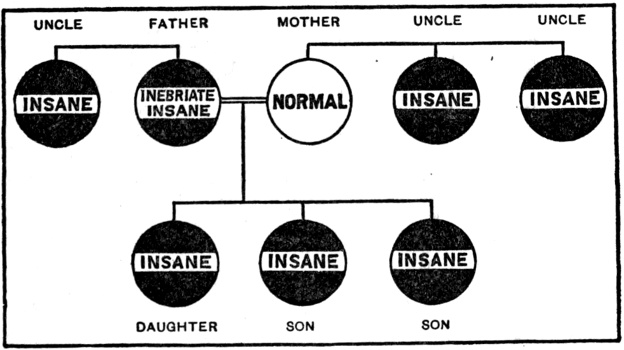
An instance of a family of insane dependents illustrates the operation of stress and strain to render a psychopathic family helpless and make it dependent upon the State. This family consists of an inebriate father who married a normal woman with two insane brothers. The father has an insane brother. From this union sprang three children, all of whom have been insane from time to time, and who alternated in residence at a State hospital as committed insane patients, joined at intervals by their uncles, and once by their father. The superintendent of the hospital retained the father in custody until he could put him in good condition, mentally, morally and physically, and discharged him in such form that for the first time in the recollection of the family he has been sober, industrious and kind. He has paid off a mortgage on the farm and is putting money in the bank. The conditions of this family are shown in above chart.
The two sons are working and there is an atmosphere of peace and happiness in the home. Two uncles remained under care, but all the members of one household are out of the hospital. If a wise hospital superintendent can solve such a difficult problem, the result can be duplicated in many instances by field physicians working in consonance with after-care people. Actual prophylactic work will be impossible under close medical and lay organization, and definite results be reached. The discharged patient will return to fewer difficulties. The improved environment will produce fewer patients.—Albert W. Ferris.
(1630)
INSANITY, STATISTICS OF
The United States Census gives the following facts about insanity in the United States:
Total Insane:
1890 In hospitals 74,028. Total 106,485.
1906 In hospitals 150,151. (Total not given).
1903 Males in Hospital 78,523
Females 71,628
Hospitals:
Public, 226; private, 102.
Twenty-two and one-half per cent. of the insane were persons in some out of door occupation and 16 per cent. in manufacturing or some indoor occupation, but the proportion in each case to the whole number respectively so employed is not given.
The percentage proportioned to population of whites is greater than of blacks. None of the insane reported were under twelve years of age.
(1631)
Inscrutability of God—See God’s Inscrutability.
INSECT, A MODEL
Mark Isambard Brunel, the great engineer, was standing one day, about three-quarters of a century ago, in a ship-yard watching the movements of an animal known as the Teredo navales—in English, the naval wood-worm—when a brilliant thought suddenly occurred to him. He saw that this creature bored its way into the piece of wood upon which it was operating by means of a very extraordinary mechanical apparatus. Looking at the animal attentively through a microscope, he found that it was covered in front with a pair of valvular shells; that with its foot as a purchase, it communicated a rotary motion and a forward impulse to the valves, which, acting upon the wood like a gimlet, penetrated its substance; and that as the particles of wood were loosened, they passed through a fissure in the foot and thence through the body of the borer to its mouth, where they were expelled. “Here,” said Brunel to himself, “is the sort of thing I want. Can I reproduce it in artificial form?” He forthwith set to work, and the final result of his labors, after many failures, was the famous boring-shield with which the Thames tunnel was excavated. This story was told by Brunel himself, and there is no reason to doubt its truth. The keen observer can draw useful lessons from the humblest of the works of God.—New York Ledger.
(1632)
INSECTS OF REMOTE TIMES
Discoveries in the coal-mines of central France have furnished by far the greatest advance that has ever been made in our knowledge of the insects which inhabited the world millions of years, as geologists believe, before the time when man made his appearance upon the earth. In that wonderful age when the carboniferous plants, whose remains constitute the coal-beds of to-day, were alive and flourishing, the air and the soil were animated by the presence of flies, grasshoppers, cockroaches, dragon-flies, spiders, locusts, and scores of other species which exist but slightly changed at the present time. But the insects of those remote times attained a gigantic size, some of the dragon-flies measuring two feet from tip to tip of their expanded wings. The remains of these insects have been marvelously preserved in the strata of coal and rock.—Harper’s Weekly.
(1633)
Insecurity—See Human Nature, Insecurity of.
INSENSITIVENESS TO BEAUTY
I remember walking at night with a good fellow by the side of a transparent sea; nothing was heard but the eternal murmur of the restless waters on the pebbles; a full moon was making a path of heavenly splendor across the waves. It was a night of supernatural beauty—a night in whose silence all the voices of the universe were speaking to the soul. His complaint was that there was no band. (Text.)
(1634)
Insignificance—See Resources, God’s.
INSINCERITY
There is no place where human nature can be studied to better advantage, or public opinion be more quickly ascertained, than in the office of a railroad president. It helps the railway president if he is also a politician and a man of the world. The experience tends to cynicism and cultivates the theory which gives too great prominence to the influence of association and point of view in fixing creeds, faiths, churchmanship and partizanship. The visitor always tried to make the president believe that he came for some other purpose than the real object of his mission. Why men believe they can succeed better in what they seek by this sort of fraud, is a mystery. The most curious exhibit is the man of many millions, who pretends that he wishes to consult you in regard to investments in the securities of your company, and ends by asking for a pass.—Chauncey M. Depew.
(1635)
Inspection, Careful Food—See Buying, Good.
INSPIRATION
The following lines on “Inspiration” were penned by Bishop Doane, of Albany, N. Y.:
Chisel in hand stood a sculptor boy, With his marble block before him; And his face lit up with a smile of joy As an angel dream passed o’er him. He carved that dream on the yielding stone With many a sharp incision; In heaven’s own light the sculptor shone, He had caught that angel vision. Sculptors of life are we, as we stand, With our lives uncarved before us; Waiting the hour when, at God’s command, Our life dream passes o’er us. Let us carve it then on the yielding stone, With many a sharp incision; Its heavenly beauty shall be our own— Our lives, that angel vision.
(1636)
Inspiration from Things Done—See Ability, Gage of.
INSPIRATION OF EVENTS
On the 19th of April, 1861, some of the enthusiastic Southern sympathizers of Baltimore, driven frantic by the passage of Northern troops through the city for the invasion of the South, attacked the Sixth Regiment of Massachusetts volunteers with bricks and stones as they marched along Pratt Street to take the train at Camden Station for Washington. The soldiers, who were fully armed with Springfield rifles, fired upon the citizens, killing several and wounding many others, some of whom had taken no part in the affray, but were merely distant spectators.
When this news was flashed around the land, it reached a young Baltimorean, a professor in Poydras College at Pointe Coupée, one hundred and twenty miles above New Orleans. His heart fired with patriotic enthusiasm and the great thoughts that surged through his mind kept him awake all night. At dawn he sat down at his desk and wrote “Maryland, My Maryland.” It was first published in the New Orleans Delta. In a few weeks it was copied by all the leading newspapers of the South, and James R. Randall, like Byron, awoke one morning and found himself famous.
(1637)
INSPIRATION, SOURCE OF
A soul that is sensitive to truth is easily excited to emotion and incited to effort. Haydn, it is said, had his musical genius aroused by the brilliancy of a diamond ring he wore, the gift of Frederick the Great.
We confer a greater blessing on our fellow men when by any act, or even by any look, we draw out what is in them, than when we bestow any gift or favor upon them.
(1638)
The famous operatic composers had different methods of getting inspiration for their immortal compositions. One could not write the score unless he had a cat upon his shoulders. There are in his symphonies suggestions of an orchestra which every one of us born in the country recognizes as the familiar strain of a summer’s night; another could stir his genius best at the billiard-table, and in his refrains is heard the rattling fire of the ivory balls; while a third, by walks in the woods and communing with nature, transferred to the orchestra and chorus the sublime secrets of creation.—Chauncey M. Depew.
(1639)
INSTABILITY
Society is curst with young men and women who are driven and tossed by every wind. I would as soon think of anchoring an ocean-liner to a fog-bank instead of a rock as to anchor a reform, a useful club, a great movement or church to their lives and leadership.—N. D. Hillis.
(1640)
INSTINCT
Man is gifted with the supreme endowment of reason. This marks humanity off from all the rest of the animal creation. But the Creator institutes a law of compensation. There are certain powers and faculties in inferior creatures which have never been evolved in man, and which are plainly evidences of supernatural power applied for the benefit of beings denied the prerogative of reason.
How does it come about that if a salmon is taken when only a few months old from its native fjord on the coast of Norway, and marked and then sent into the sea again, it may, after traversing the ocean for thousands of miles, be found again the next year in that same fjord? It has returned without fail to its birthplace. The reason is that God gave it a miraculous guide-book called instinct. How comes it that when, in a beehive, the temperature rises so that the wax might melt, every tenth bee glues its feet down to the board, and fans with its wings at a tremendous velocity as long as may be necessary? It is because God gave this little creature the same infallible guide-book. How is it that the same pairs of swallows return all the way from Africa to rear a fresh family in the same old nests under the eaves? It is because that same miraculous instinct led them unerringly. (Text.)
(1641)
INSTINCT ADAPTED TO EMERGENCY
In guarding against evils should we not be as fertile in expedients to adapt our defense to the kind of weapons we possess as some cattle are:
The plainsmen on Western cattle-ranches have called attention to an illustration of the adaptability of animal instinct to emergencies.
The cattle of former days were of the long-horned kind. When the herd was threatened with an attack by wolves, the calves were placed in the middle of the bunch and the older animals formed themselves into a solid phalanx about them, all facing outward.
The cattle of to-day are largely hornless. If, as occasionally happens still, the herd is attacked by wolves, the calves are guarded as before, but the herd faces in instead of out. Their hoofs, not their horns, are now their weapons.
(1642)
Instinct of Animals—See Faith Better Than Sight.
Instinct of Insects—See Shelter.
INSTINCT, THE HOMING
A well-known minister of Austin, Texas, retells a story which was related to him by a friend living in Lawrence, Massachusetts:
“He raised a dog, crossed with hound and pointer, and littered in Lawrence. When a year old he took the young dog to Boston, got on board of a sailing-vessel, went by sea and river to Bangor, Maine, drove forty miles into the woods at Cleveland’s Camp and hunted there two weeks, the dog proving to be a great success for quick, fast runs and returns to camp.
“After the hunting was over and while on his back trip to Bangor, the dog jumped from the wagon into the bushes, having heard or smelled a deer, and went off on a hot chase. The boats ran only once in two weeks, so that, much as he valued the dog, it was necessary to go on. He took the boat at Bangor, returned by river and sea to Boston and back to Lawrence. About two weeks afterward the dog crawled into his yard, footsore and half-starved, but safe at home and glad to get back.” (Text.)—Harper’s Weekly.
(1643)
See Direction, Sense of.
Instruction—See Food and Exercise.
INSTRUMENTS
When Saladin looked at the sword of Richard the Lion-Hearted, he wondered that a blade so ordinary should have wrought such mighty deeds. The English King bared his arm and said: “It was not the sword that did these things; it was the arm of Richard.”
(1644)
INSTRUMENTS, IMPORTANCE OF GOOD
Dr. Z. F. Vaughn, well known in medical and scientific circles, has perfected a process for tempering to the hardness of steel the ductile metals, gold, silver and copper. Already Dr. Vaughn is manufacturing a large number of gold-bladed scalpels, probes, hypodermic and suture needles and other surgical instruments. These are replacing similar articles of steel.
The sharp edge of a gold blade is almost perfectly smooth; that of steel, no matter how fine the edge, is rough and saw-like. Because it is porous, the steel blade has never made a perfect surgical instrument. In the meshes of that metal may be hidden the infinitesimal germs of a virulent disease, or there may be a rust spot so tiny that it could not be discerned by the surgeon, but which might be sufficient seriously to poison the tissues in which the knife makes a wound, resulting in blood-poisoning that would cause death. In gold, being dense, this danger does not exist, and gold does not rust.
Besides, the gold blade divides evenly the flesh or tissue which it cuts; the steel blade really saws or tears its way through. Therefore, even when there is no infection, the wound made with a steel instrument does not heal nearly so readily as that made with gold. Another feature of a gold blade is that the wound which it makes leaves no scar.
(1645)
INSULATION
In 1846 Werner Siemens, of Berlin, discovered the non-conducting properties of gutta-percha. He coated several miles of copper wire with gutta-percha, and submerged it in the Rhine from Deutz to Cologne. Electric communication was thus established beneath the water from shore to shore. In 1850 a submarine cable was laid across the English Channel from Dover to Cape Grisnez. It consisted of a half-inch copper wire covered with nothing but gutta-percha, and loaded with lead to keep it down. The communication was perfect for a day, and then the wire refused to act. The electrical engineers were unable to explain the facts. At last the mystery was dissipated by a fisherman. A French fisherman set his trawl off Cape Grisnez. When he hauled it in, he picked up the submerged cable, from which he cut off a piece. This piece he carried in triumph to Bologne, where he exhibited it as a specimen of rare seaweed with its center filled with gold. The ignorant man had mistaken the copper wire for gold, but unwittingly he had served the electricians. They saw from the accident that it was not sufficient perfectly to insulate the cable, but that it must also be protected. In 1851 there was laid across the Channel a cable twenty-four miles long, consisting of four copper wires, insulated by gutta-percha, covered with tarred yarn, and protected by an outer covering of galvanized iron wires. That submarine cable proved a success, and ocean telegraphy became possible through an accident which compelled invention.—Youth’s Companion.
(1646)
INTEGRITY
Stephen V. White, a New York financier, became involved and only able to pay thirty-five cents on the dollar. His character for honesty and integrity was so established that his creditors gave him an absolute, legal release from an indebtedness of almost a million. Within about a year he repaid principal and interest.—James T. White, “Character Lessons.”
(1647)
INTEGRITY, EVIDENCE OF
Samuel Appleton, when twenty-eight years old, began the business of cotton manufacturing. He was incapable of anything indirect or underhand. He knew but one way of speaking, and that was to speak the truth. As an evidence of the way in which he was regarded: when a note purporting to be signed by him was pronounced by him a forgery, altho no one was able to distinguish one handwriting from the other, the jury found a verdict in his favor, because they were quite sure that Mr. Appleton would not dispute the payment except upon the certainty of his not making it.—James T. White, “Character Lessons.”
(1648)
Intelligence—See Knowledge Values.
INTELLIGENCE, ANIMAL
One of the many delusions engendered by our human self-conceit and habit of considering the world as only such as we know it from our human point of view, is that of supposing human intelligence to be the only kind of intelligence in existence. The fact is, that what we call the lower animals have special intelligence of their own as far transcending our intelligence as our peculiar reasoning intelligence exceeds theirs. We are as incapable of following the track of a friend by the smell of his footsteps as a dog is of writing a metaphysical treatise. (Text.)—W. Mattieu Williams, “Science in Short Chapters.”
(1649)
Intelligence in Creation—See Design in Nature.
Intelligence in Rooks—See Enemies, Avoiding.
INTELLIGENCE IN SOLDIERS
The American Army is regarded as formidable because “its bayonets think.” That they thought and acted to some purpose was shown in many exigencies of the Civil war, as the following, told by Gen. Carl Schurz:
One of General Butler’s staff-officers told me a little story which illustrates the character of our volunteer regiments. When our troops took possession of Annapolis, there was but one locomotive in the railroad shop, and that locomotive had been partly taken to pieces by the “rebel sympathizers” of the place, in order to make it unfit for use. A volunteer regiment was drawn up in line, and men who thought themselves able to repair a locomotive were called for. A dozen or more privates stept forward, and one of them exclaimed: “Why, that locomotive was built in my shop!” In a short time the locomotive was again in working order.
(1650)
Intelligence in Storks—See Family Offense in Storks.
INTELLIGENCE OUTDOING IGNORANCE
In Togoland there is a large tree which is worshiped by all the inhabitants as a god named Azago. He is the giver of children, and crops, and all blessings. No one is permitted to eat fresh yams until the priest of Azago announces that the god has partaken of them. A dreadful fatality will follow such a disobedience. One year a pupil in a mission school ate a yam before the appointed time, and his distracted parents looked for his death and for all calamities to come—but the boy prospered and grew fat, and none of his kindred died. The next year all the children of that mission school ate yams before permission was given by the priest of Azago, and none perished. The people wanted also to eat, but the priest warned them that the God of the mission schools was greater than Azago, so the mission children could eat yams with impunity, but not so the general populace. But from that time the power of the superstition declined, and recently when one of the priests died the elders decided to forsake Azago and serve the living, true God. (Text.)
(1651)
INTEMPERANCE
Lilla N. Cushman furnished to the Chicago Sun a bit of verse for possible blackboard use on the wine glass:
There’s danger in the glass! Beware lest it enslaves. They who have drained it find, alas! too often, early graves. It sparkles to allure, with its rich, ruby light; there is no antidote or cure, only its course to fight. It changes men to brutes; makes women bow their head; fills homes with anguish, want, disputes, and takes from children bread. Then dash the glass away, and from the serpent flee; drink pure, cold water day by day, and walk God’s footstool free.(Text.)
(1652)
“Will alcohol dissolve sugar?”
“It will,” replied Old Soak; “it will dissolve gold and brick houses, and horses, and happiness, and love and everything else worth having.” (Text.)—Houston Post.
(1653)
See Beer, Effect of; Drink, Drunkenness; Evidence, Living; Inebriety, Incurable; Side, Choosing the Right.
INTEMPERANCE IN OLD DAYS
When wooden ship-building was the staple trade of the river Wear, in England, says an English exchange, when an extra-sized ship was launched all the day-schools in the town got a holiday. It was on these occasions that the ship-builders provided an unlimited supply of beer to all comers, and it was a recognized rule of Wearside that members of the churches or chapel were privileged to get drunk without losing their membership.
(1654)
In medieval times the farmers brewed good brown ale and took it to the churchyard in barrels, which were tapped on the spot. The neighbors then said to one another: “Come hither; there be a church-ale toward yonder.” They paid for the beer, and the rector’s churchwarden kept the tale of incoming moneys. Easter-ales, Whitsun-ales, church-ales, even bride-ales to help a penniless marriage—all were merry meetings in churchyard or church which all the inhabitants were bidden to attend at a charge of one penny. Tho they had grown to unruly revels, they were not finally supprest till the time of the Commonwealth.—Edward Gilliat, “Heroes of Modern Crusades.”
(1655)
INTEMPERANCE IN SONS
Rev. W. F. Crafts says:
Recently, in a New England manufacturing city, we noted a change that bodes no good for business or politics or religion. We found that the old men who founded and developed the mills were all total abstainers and had been from youth, but their sons, who were succeeding to these great responsibilities, had nearly all of them come back from college with drinking habits.
Intemperate Living—See Longevity Accounted for.
INTENSITY
In the concluding chapters of Ellen Terry’s memoirs (McClure’s Magazine), she writes of the last days of Henry Irving. The doctor had warned Irving not to play “The Bells” again after an illness that attacked him in the spring of 1905. He saw the “terrible emotional strain ‘The Bells’ put upon Henry”—how he never could play the part of Matthias “on his head,” as he could Louis XI, for example. Miss Terry goes on in words almost implying that Matthias killed him. We read:
“Every time he heard the sound of bells, the throbbing of his heart must have nearly killed him. He used always to turn quite white—there was no trick about it. It was imagination acting physically on the body.
“His death as Matthias—the death of a strong, robust man—was different from all his other stage deaths. He did really almost die—he imagined his death with such horrible intensity. His eyes would disappear upward, his face grow gray, his limbs cold.
“No wonder, then, that the first time that the Wolverhampton doctor’s warning was disregarded, and Henry played ‘The Bells,’ at Bradford, his heart could not stand the strain. Within twenty-four hours of his death as Matthias, he was dead.”
(1657)
INTENTION
While “we have this treasure in earthen vessels” we can never fully manifest the best that is in us. Benjamin R. Bulkeley tells us in the following verse that God knows how much better we intend than we can do:
There was never a song that was sung by thee, But a sweeter one was meant to be. There was never a deed that was grandly done, But a greater was meant by some earnest one, For the sweetest voice can never impart The song that trembles within the heart. And the brain and the hand can never quite do The thing that the soul has fondly in view. And hence are the tears and the burdens of pain, For the shining goals are never to gain, But enough that a God can hear and see The song and the deed that were meant to be.
(1658)
Interception—See Interruption.
Intercession—See Sacrificial Mediation.
INTERDEPENDENCE
Every great newspaper periodically announces its dependence upon immature, half-grown boys, whose nimble steps and strident voices secure its circulation. The brain which forges the editorial, the skill which administers the counting-room, however great, imposing, or commanding, must doff its hat of necessity to the barefooted newsboy and confess its obligation to him in his obscurity for its chance to reach its constituency.—Nehemiah Boynton.
(1659)
See Solidarity; Survival of the Fittest.
Interest in Religious Education—See Adapting the Bible.
Interest, Intense—See Book, Influence of a.
INTEREST, SIGNIFICANT
I have often been appealed to by friends, who said: “Can’t you take this young man and give him employment?” Then I will watch that young man for a month or so and see what it is that he takes up in the morning. If he takes up the newspaper and turns to the political part of the paper, and is interested in that, why that is a good symptom of his intellectual tendencies; but if, instead of that, he takes up a magazine and sits down to read a love story, why you can not make a newspaper man out of him.—Charles A. Dana.
(1660)
Interests, The Functioning of—See Atrophy.
Internationalism—See Statesmanship.
Interpretation and Individuality—See Individuality in Interpretation.
INTERPRETATION BY EXPERIENCE
A little boy who was born blind had an operation performed which enabled him to see. His mother led him out into the fields, and uncovered his eyes for the first time, and let him look upon the sky and trees and grass and flowers. “Oh, mother!” he cried, “why didn’t you tell me it was so beautiful?” “I tried to tell you, dear,” was her answer, “but you could not understand me.”
So it is sometimes with great verses in the Bible. When we read them first or commit them to memory, we do not understand, but after, when they fit the heart life and our eyes are opened, we wonder at the beauty of them.—Phebe Palmer.
(1661)
Interpretation by Love—See Love, Interpretation by.
INTERRUPTION
It is to be feared that much of the force of God’s spirit is cut off by the world’s atmosphere before it reaches a soul that is immersed in worldliness:
The greatest difficulty in arriving at a correct conception of the amount of heat received from the sun lies in the fact that all such measures must be made at the earth’s surface. Before reaching the apparatus the sun’s rays pass through many miles of atmosphere; the heat and light are absorbed and only a small portion of the original energy of the rays actually reaches the surface and becomes effective in heating the water of our apparatus.—Charles Lane Poor, “The Solar System.”
(1662)
In “One Word More” Browning tells us that Dante “once prepared to paint an angel”; but “certain people of importance” broke in upon him, and so, much to the poet’s and the world’s regret, we can never see that angel he might have wrought.
Perhaps the very serious power of interruptions, and what we may call their irreligiousness, has been too little appreciated. Florence Nightingale recognized the possible harm done to an invalid by making any abrupt change in his condition. “You may suffocate him by giving him his food suddenly; but, if you rub his lips gently with a spoon, and thus attract his attention, he will swallow the food with perfect safety. Thus it is with the brain.” Miss Nightingale adds acutely, “I have never known persons who exposed themselves for years to constant interruption who did not muddle away their intellects by it at last.”
(1663)
See Happiness.
INTERVENTION, DIVINE
A large number of Russian criminals were standing in the courtyard of their prison, chained together, and about starting for their long journey to Siberia. Among them was one Christian Stundist, sharing their banishment because he had spoken to his fellow workmen about the faith in Christ he profest. His fellow prisoners were jeering him about it, saying: “You are no better off than we. You are wearing the bracelets (handcuffs) as we do; if your God is of any use to you, why doesn’t he knock off your chains and set you free?” The man reverently replied, “If the Lord will He can set me free even now; and tho my hands are chained my heart is free.” At that moment his name was called; a paper had just been received granting him a full pardon. He was then told to stand aside; his chains were struck off. At the same time the prison gates were thrown open and all the rest of the convicts filed out, the Stundist remaining behind with permission to return to his family and friends. It is said the prisoners were perfectly awestricken with what they had witnessed. Unknown to the Stundist, a Christian lady had obtained his pardon, and God had ordered its arrival at the critical moment.
(1664)
But for the divine vigilance, an unseen Helper, what youth but would go down! In every hour when Achilles is about to be overborne by the number and strength of his enemies, Homer makes some goddess appear to lift a shield above the hero for protection. Again and again Thetis stands between her son and the enemy. Of your youth, how true it is that God hath interfered in your behalf!—N. D. Hillis.
(1665)
INTIMACY WITH CHRIST
When the great artist, Sir Alma-Tadema, was painting his “Heliogabalus,” which made a sensation during its exhibition at the British Royal Academy, and in which roses are a prominent feature, he was in the habit of receiving from Italy a fresh box of roses twice a week, so that he literally and actually had a new model for every individual blossom.
If the painter must live in close and delicate touch with nature, much more must the messenger of Christ abide in direct communion with the Savior if he would catch the virtue, the color and the aroma of celestial things. (Text.)
(1666)
INTOLERANCE
We should be thankful that such conditions as those described below no longer exist:
No religious meetings outside the ordinary services of the Church could be held without a license under the Toleration Act; and those taking part in such meetings, in order to secure the right to hold them, had to register themselves as Dissenters. This law extended to America, and so the first Methodist Church in the United States was adorned with that very unecclesiastical bit of architecture—a chimney. When a Methodist church was built it had to disguise itself as a house in order to secure the right to exist.—W. H. Fitchett, “Wesley and His Century.”
(1667)
In a dark wood where wild beasts lived there once lay a man’s boot. How it came there, I can not say, for no man had been there—at least the wild beasts had not seen one in all their lives. But there the boot was, and when the beasts saw it they all came round to find out what it was. Such a thing was quite new to them; but they were not much at a loss for all that.
“Well, there is no doubt as to what it is, I say,” said the bear.
“Oh, of course not,” said the wolf and the goat and all the beasts and birds in one breath.
“Of course,” said the bear, “it is the rind of some kind of fruit off a tree—the fruit of the cork, I should say. This is cork, it is plain to see,” and he showed the sole of the boot.
“Oh, just hear him! just hear him!” cried all the beasts and birds.
“It is not that at all,” said the wolf, with a glance of scorn at the bear. “Of course it is some kind of nest. Look; here is the hole for the bird to go in at, and here is the deep part for the eggs and young ones to be safe. No doubt at all, of course not!”
“Oh, oh!” cried the bear and the goat and all the birds and beasts, “just hear what he says! It is not that at all.”
“I should think not,” said the goat. “It is quite a plain case. Look at this long root,” and he showed the string at the side of the boot. “It is the root of a plant, of course.”
“Not a bit of it,” cried the wolf and the bear; “not a bit of it. A root? How can you say so? It is not that, we can all see.”
“If I might speak,” said an old owl, who sat in a tree near, “I think I can tell you what it is. I have been in a land where there are more of such things than you could count. It is a man’s boot.”
“A what?” cried all the beasts and birds. “What is a man? and what is a boot?”
“A man,” said the owl, “is a thing with two legs that can walk and eat and talk, like us; but he can do much more than we can.”
“Pooh, pooh!” cried they all.
“That can’t be true,” said the beasts. “How can a thing with two legs do more than we can, who have four? It is false, of course.”
“Of course it is if they have no wings,” said the birds.
“Well,” went on the owl, “they have no wings, and yet it is true. And they can make things like this, and they call them boots and put them on their feet.”
“Oh, oh!” cried all the beasts and birds at once. “How can you? For shame. Fie on you! That is not true, of course. It can not be.”
“A likely story!” said the bear.
“Can do more than we can?” said the wolf.
“Wear things on their feet?” cried they all. “On the face of it your story is not true. We know that such things are not worn on the feet. How could they be?”
“Of course they could not,” said the bear; “it is false.”
“It must be false,” cried all the birds and beasts. “You must leave the wood,” they said to the owl. “What you say can not be true. You are not fit to live with us. You have said what you know is false. It must be, of course.”
And they chased the poor old owl out of the wood, and would not let him come back.
“It is true for all that,” said the owl.
And so it was.—The Nursery.
(1668)
INTRODUCTIONS
Some introductions to sermons, speeches, articles, etc., would gain if they were made as brief as the speech of this mayor:
“Long introductions when a man has a speech to make are a bore,” said former Senator John C. Spooner, according to The Saturday Evening Post. “I have had all kinds, but the most satisfactory one in my career was that of a German mayor of a small town in my State, Wisconsin.
“I was to make a political address, and the opera-house was crowded. When it came time to begin, the mayor got up.
“‘Mine friends,’ he said, ‘I have been asked to introduce Senator Spooner, who is to make a speech, yes. Vell, I haf dit so, und he vill now do so.’”
(1669)
Intruders—See Ingratitude.
Intrusion—See Trivial Causes.
INTUITION
What is true in music, according to R. H. Haweis, is equally true of all intuitive processes:
To accompany well you must not only be a good musician, but you must be mesmeric, sympathetic, intuitive. You must know what I want before I tell you; you must feel which way my spirit sets, for the motions of the soul are swift as an angel’s flight. I can not pause in those quick and subtle transitions of emotion, fancy, passion, to tell you a secret; if it is not yours already, you are unworthy of it. Your finishing lessons in music can do nothing for you. Your case is hopeless. You have not enough music in you to know that you are a failure.
(1670)
INTUITIVE JUDGMENT
Mill cites the following case, which is worth noting as an instance of the extreme delicacy and accuracy to which may be developed this power of sizing up the significant factors of a situation. A Scotch manufacturer procured from England, at a high rate of wages, a working dyer famous for producing very fine colors, with the view of teaching to his other workmen the same skill. The workman came; but his method of proportioning the ingredients, in which lay the secret of the effects he produced, was by taking them up in handfuls, while the common method was to weigh them. The manufacturer sought to make him turn his handling system into an equivalent weighing system, that the general principles of his peculiar mode of proceeding might be ascertained. This, however, the man found himself quite unable to do, and could therefore impart his own skill to nobody. He had, from individual cases of his own experience, established a connection in his mind between fine effects of color and tactual perceptions in handling his dyeing materials; and from these perceptions he could, in any particular case, infer the means to be employed and the effects which would be produced.—John Dewey, “How We Think.”
(1671)
Invention—See Ambition.
Invention and Employment—See Value of One Man.
Inventions—See Labor-saving Devices.
Inventions, Worthless—See Disappointment.
Inventive Possibilities—See Future Possibilities.
INVESTMENT RETURN
The Rev. John F. Goucher established many vernacular Christian schools in the villages of India.
An American traveler in northern India, strolling on the platform when the train had come to a standstill, saw a native who drew near, eyed him closely, then fell before him, clasped him about the ankles, and beating his feet with his head, cried, “I am your servant, and you are my savior!”
The traveler bade the man get up and say what he had to say. The native at length exprest himself: “You are Dr. Goucher, of America, are you not? All that I am and have I owe to you. Hearing that you were traveling through on this train, I walked more than twenty miles just to see your train pass. Now God has let me look into your face.”
Thousands of young Indians in the north-west provinces of India call themselves “Goucher Boys,” and look upon a man in distant America, whom they have never seen, as their friend and emancipator.—William T. Ellis, “Men and Missions.”
(1672)
INVESTMENT, SAFE
One of the Copes had but just written his check for $50 for some local charity, when a messenger announced the wreck of an East Indiaman belonging to the firm, and that the ship and cargo were a total loss. Another check for $500 was substituted at once, and given to the agent of the hospital with the remark: “What I have God gave me, and before it all goes, I had better put some of it where it can never be lost.” (Text.)—Noah Hunt Schenck.
(1673)
Invisible, Answers from the—See Unseen, Response from the.
INVISIBLE, POTENCY OF THE
Material forces called battleships bulk larger, but the invisible spiritual forces go farther, last longer and make cannon seem contemptible and paltry. In cold countries men sometimes build palaces of ice for some public function. In the hour when beautiful women and brilliant military bands assemble for a winter festival, the water, manifest in blocks of ice, seems very imposing. But would you know the real power of water, wait until it becomes invisible. Then lift your eyes to the western sunset, where colors of gold and rose are revealed by this invisible vapor; watch the rain-drop redden in the purple flow of grape and the crimson drops of pomegranate, or see it tossed by a harvester in sheaves of grain. Then, in what water does through its invisible workings, do we know its place in nature and its contributions to man’s happiness. (Text.)—N. D. Hillis.
(1674)
INVISIBLE MADE VISIBLE
On the brightest and sunniest day, millions of tons of black charcoal in an invisible condition are floating in the air. Millions of plants are at the same time restoring it to visible form by the chemical processes going on in the tiny laboratory of every leaf that expands in the sunshine. In the course of time the leaf or the wood it elaborates by its delicate alchemy, may be burned; and this cycle of change may go on indefinitely, the matter becoming visible and invisible again and again. (Text.)—Popular Science News.
(1675)
In chemical operations, whether natural or artificial, matter is often “lost to sight”; but the veriest tyro has learned, as one of the fundamental axioms of science, that it can never be actually lost or destroyed. In its manifold mutations it often disappears from our vision; but it reappears, or can be made to reappear, as palpable to our senses as before. If a piece of silver be put into nitric acid, a clear and colorless liquid, it is rapidly dissolved, and we “see it no more.” The solution may be mixed with water, and apparently no effect is produced. Thus, in a pail of water we may dissolve fifty dollars’ worth of silver, not a particle of which can be seen. Not even the chemist, unless he should apply certain tests to detect its presence, would, by merely looking at the liquid, guess what hidden wealth it contained. Other metals, as we know, can be treated in similar ways with the same result. When charcoal and many other substances are burned, they disappear as completely, no visible ashes even being left from the combustion. In fact, every material, which is visible can, by certain treatment, be rendered invisible. Matter which in one state or condition is perfectly opaque, and will not permit a ray of light to pass through it, will in another form become perfectly transparent. The cause of this wonderful change in matter is utterly inexplicable.—Popular Science News.
(1676)
The progress of science is fast bringing the hitherto invisible universe into man’s view.
Unofficial announcement has been made at Boston that Prof. H. C. Ernst, of the Harvard medical school, has discovered a new method of photographing bacteria, which makes it possible to watch the life of disease germs, to watch the effect of medicine upon them and to see new facts as to the form which has heretofore been clouded in mystery. The Ernst method consists in the use of ultra-violet rays of the spectrum which are invisible to the eye. Under the present method no picture of germs is made until they are colored by chemicals.
(1677)
Invitation—See Help for the Helpless.
Inward Rectification—See Transformation by Renewing.
IRONY OFTEN MISUNDERSTOOD
The fact is that the Carlyles habitually addrest one another with irony. It is no uncommon thing between intimates: it is rather a sign of the security of the affection which unites them. But if, by some unhappy accident, a third person who has no sense of humor hears this gay clash of keen words, and puts them down in dull print, and goes on to point out in his dull fashion that they do not sound affectionate, and are phrases by no means in common use among excellent married persons of average intellects, it is easy to see that the worst sort of mischief may readily be wrought.—W. J. Dawson, “The Makers of English Prose.”
(1678)
IRRATIONAL LAWS
The law of imprisonment for debt, which existed so long in England, the land of freedom, whereby a creditor enforced payment of debt by imprisoning his debtor for unlimited periods, is perhaps the most irrational that ever existed. The purposeless cruelty of imprisonment for debt was demonstrated in 1792, when a woman died in Devon jail, after forty-five years’ imprisonment, for a debt of £19. And when the Thatched House Society set to work to ransom honest debtors by paying their debts, they, in twenty years, released 12,590 at a cost of 45 shillings per head. (Text.)—Croake James, “Curiosities of Law and Lawyers.”
(1679)
Irresolution—See Human Nature, Insecurity of.
IRRESPONSIBILITY
The spectacle of a $100,000,000 “trust” unable to get hay for its horses on credit was seen recently in Sault Ste. Marie, where the Consolidated Lake Superior Company went into liquidation. The liquidation resulted from the failure of the directors of this big concern to raise $5,000,000 to pay a loan from the Speyer syndicate.
Here is a corporation which was paying seven per cent dividends, and which began two or three years ago with a capital of $102,000,000, so destitute of liquid assets or working capital that it can not pay a loan of $5,000,000, for which its very existence was pawned. Nothing appears to be left.
Lake Superior Consolidated, like all the other trusts, was organized under the Connecticut corporation act, which, like that of West Virginia, New Jersey, Delaware, and other States, was expressly drawn to relieve all concerned of responsibility. No one was responsible for anything in the prospectus. No one could be held, in the promotion or direction, for any statements, promises, or representations. The sidewalk vender is more responsible for the razors and remedies that he sells in the flare of his gasoline lamp than the promoters or directors of an American trust to which millions of dollars flow.—New York American.