D (continued 2)
Reading edition
(764)
Differences of Opinion—See Opinions.
DIFFICULTIES, DISPERSING
An old man once said: “I have had a long life full of troubles; most of them never happened.” So most of the giants in the way, if we do not fear them, turn out as in this dream related by the Rev. S. Benson Phillips:
When I first heard the call to the ministry I was about twelve years old. From that time until I was twenty-four years old, it was a question in my mind as to whether I was equal to the responsibilities and requirements of this holy calling. It was one night, after I had been thinking of these things, that I had the following dream: I thought that I was camping by the roadside, and had retired for the night. A great giant stood by my bedside. He offered to do me no harm, but simply stood by my bed. I begged him to go away. This he would not do until I arose and prepared to battle with him. Seeing my intention, he began to walk slowly away. I followed him. To my delight, he became smaller and smaller until he was nothing but a little boy, and unable to do me any harm.
(765)
DIFFICULTIES, OVERCOMING
The difficulties encountered by the Prussians on their march from Havre, by St. Lambert, to the field of Waterloo would have put the endurance of any troops to the test. The roads were ankle-deep from the heavy rains, and the defiles of St. Lambert turned into a regular swamp, almost impassable for men and horses; still worse for the guns and tumbrels of ammunition. These were very numerous and far from being well horsed, sinking at intervals up to the axle-trees. The horses’ floundering caused a stoppage, and the most robust soldiers in endeavoring to extricate the guns and ammunition wagons would drop down, overcome by the fatigue of their exertions, and declare “they could not get on.” “But we must get on,” replied their veteran commander, who seemed to multiply himself, and might be seen at different points along the line of march, exciting his men to exertion by words of encouragement. “I have promised Wellington to be up,” said Blücher, “and up we must get. Surely you will not make me forfeit my word. Exert yourselves a little more, and victory is certain.”—Edward Cotton, “A Voice from Waterloo.”
(766)
See Illiteracy.
DIFFICULTIES, SOCIAL
The only way to get De Quincey to a dinner-party was to send an able-bodied man to find him and bring him by force. Occasionally he revenged himself by making a stay of several weeks, so that the difficulty of getting him into a friend’s house was forgotten in the more appalling difficulty of how to get him out again.—W. J. Dawson, “The Makers of English Prose.”
(767)
Difficulty Aiding Achievement—See Adversity Helping Genius.
Dilemma—See Simple-mindedness.
Dimensions—See Upward Look.
Diminishing Numbers—See Seasickness.
DIMINUTIVES
Some years ago, when the bedding was not supposed to be as fat as it ought to be, and the pillows were accused of being constructed upon the homeopathic principle, a New Englander got on a railroad car one night. Now, it is a remarkable fact that a New Englander never goes to sleep in one of these cars. He lies awake all night, thinking how he can improve upon every device and patent in sight. He poked his head out of the upper berth at midnight, hailed a porter and said, “Say, have you got such a thing as a corkscrew about you?” “We don’t ’low no drinkin’ sperits aboa’d these yer cars, sah,” was the reply. “’Tain’t that,” said the Yankee, “but I want to get hold on to one of your pillows that has kind of worked its way into my ear.”—Horace Porter.
(768)
Diploma Valueless—See College or Experience.
DIPLOMACY, COWARDLY
A distinguished divine was called upon to offer prayer in a mixed company, when in accordance with the custom of the times, he included in his petition to the Almighty a large measure of anathema, as “We beseech thee, O Lord! to overwhelm the tyrant! We beseech thee to overwhelm and to pull down the oppressor! We beseech thee to overwhelm and pull down the Papist!” And then opening his eyes, and seeing that a Roman Catholic archbishop and his secretary were present, he saw he must change the current of his petitions if he would be courteous to his audience, and said vehemently, “We beseech thee, O Lord! we beseech thee—we beseech thee—we beseech thee to pull down and overwhelm the Hottentot!” Said some one to him when the prayer was over, “My dear brother, why were you so hard upon the Hottentot?” “Well,” said he, “the fact is, when I opened my eyes and looked around, between the paragraphs in the prayer, at the assembled guests, I found that the Hottentots were the only people who had not some friends among the company.”—Henry Codman Potter.
(769)
DIPLOMAT, A, AND MISSIONS
Sir Henry Mortimer Durand, at one time ambassador of Great Britain to the United States, gave the following advice to missionaries before the Fifth International Convention of the Student Volunteer Movement, held at Nashville, in 1906:
I beg you to consider earnestly before you go whether you are really fitted for the task before you. Do not be misled by love of excitement or adventure, or by the glamour of the East. It has a wonderful glamour, and any man of thought and feeling who has been out there will “hear the East a-calling” for many a year. But a great part of a missionary’s work, as indeed a great part of the work of every profession, is hard drudgery. To master an Oriental language, as you must master it if you are to be of any use, is itself a labor of years. Judson used often to sit and study his Burmese for twelve hours out of the twenty-four, and, as I have said, it took him twenty-seven years to complete his translation of the Bible. That is the kind of toil you must be ready to face. I once saw a missionary attempt to convert an Afghan. His manner of doing so was to walk up to the Afghan on the road and say in very bad Persian, which was not really the Afghan’s language, “Christ is the Son of God.” He repeated the remark twice, receiving each time a monosyllabic answer, and then he sheered off, having apparently no more Persian at his command. This is the sort of thing which causes the enemy to blaspheme. And remember Judson’s warning. Do not be tempted to spiritual pride. Do not stand aloof and condemn the diplomatist, or the administrator, or the soldier, because their lives and their views are not what yours are. They, too, know some things—some things which you can not know—and they, too, are trying to do their duty. Above all, never look down on the soldier. He may be rough and reckless at times, but he is always ready to lay down his life for his country, and all good missionaries should honor the soldier’s uniform.
(770)
DIRECTION
All life is short in itself. But we do not complain that the night is short if we are looking for the dawn, nor that the winter is short if we are eager for the spring. A short life is long enough to take the right direction, and direction is the main fact about our life. For our children we ask: How are they coming out?—Franklin Noble, “Sermon in Illustration.”
(771)
“I’d have you know, sir,” said the Congressman from one of the tall-grass districts, “that I am walking in the footsteps of George Washington.”
“I see you are,” rejoined the wise guy, “but for some reason unknown to me, you are headed the wrong way.” (Text.)—Chicago News.
(772)
The following verses from an unidentified source carry their own lesson:
One ship drives east and another drives west, While the selfsame breezes blow; It’s the set of the sails and not the gales That bids them where to go. Like the winds of the seas are the ways of the fates, As we voyage along through life; It’s the set of the soul that decides the goal, And not the storm or strife.
(773)
See Destiny; Facing Right; Tendency.
DIRECTION, SENSE OF
No one would suppose that a calf possest any extraordinary amount of intelligence, but that one of these animals had a well-developed bump of location is proven by the facility with which this particular animal found its way home after it had been taken away. A college professor writes of this incident which came under his personal observation:
“I spent my vacation the past summer at my mother’s, three miles from Siler City, N. C. My brother, who lived at Siler City, had a three-months-old calf which he wanted to pasture at my mother’s farm. Accordingly the calf was brought along the road from the town. The next day the animal got out of the open gate and returned home. I followed its trail; it had recently rained. The calf first took almost a bee-line for its home; crossed a small ditch, then came to a large ditch, which it wandered down some distance, but returned and crossed near its direct line. This was at a distance of a quarter of a mile from the road by which it had been delivered, and all the space is covered by thick forest.
“When the calf struck the main road it proceeded along this to its home. This animal never had been out of its lot until it was brought to my mother’s, and yet its sense of direction was so accurate that it took a straight line for home until it reached the road by which it had been brought. Then it depended upon its memory of the road, altho it might have followed a path in a much more direct line.”—Harper’s Weekly.
(774)
DIRECTIONS
Cora S. Day, in The Interior, illustrates in the following paragraphs the value of the Bible as a book of directions:
They were looking through the medicine-chest in search of a needed remedy when there came to light a half-filled vial, whose torn label held but a part of the directions for use.
“Might as well throw this away. I have forgotten what it is, what it is for and how to take it,” said the finder.
“Yes, take it out. It is no good without the directions,” agreed the other. So the medicine was set aside.
There are a good many things that are no good to us without the directions. Without the knowledge of how to use it, the most useful tool or machine is of no more value to a man than so much junk. With the directions, it becomes his assistant, his servant, and does good work for him.
If you buy a sewing-machine, or a typewriter, for instance, you are given a book of instructions which tells how to use it. In addition, the agent usually gives you personal instructions in its operation, making its ordinary workings plain to you. But some day, when you are trying to run it alone, there comes a hitch perhaps—something you do not understand, some new development or complication. Then you are glad to turn to the book of directions for help.
How about the book which gives directions for right living? Preachers and teachers and parents can tell you many good things when they are at hand; but the book can help you at all times. Full of directions for every difficulty and sure to point the way and lead you aright, it can be always near, ready to help in all perplexities. (Text.)
(775)
DIRECTIONS, CONTRASTED
Russell Sage, it is said, directed by his will that his body should be placed in a steel casket, weighing three tons, made burglar-proof, locked and sealed. He made this bequest to himself through fear that his physical remains might be stolen for the sake of getting a ransom. During his long life he accumulated a vast fortune and kept it. He probably spent no more, fared no better, did no more service to his fellow men than many a business man or employee of modest income.
The late Governor Hogg, of Texas, left no fortune to relatives or to charity. He directed that a pecan-tree should be planted at the head of his grave and a walnut-tree at its foot. His purpose was to teach thrift to the people of his State. These fruit-bearing trees suggest comfort and prosperity. There is no fear that any one will steal his body, but a message of wisdom and affection will continue to go out from it after the remains have returned to dust. (Text.)
(776)
Directness—See Singleness of Purpose.
Dirtiness, Removing—See Discipline from Change.
DISAPPOINTMENT
There are thousands upon thousands of models at the Patent-office of inventions that are of absolutely no use whatever. They represent the blasted hopes and often the ruined fortunes of innumerable inventors who invested their time and money in worthless ideas. The models forwarded by these inventors to the Patent-office form a sort of museum by themselves, and those who wish to look a bit beneath the surface can find a story abounding in genuine pathos lurking in pretty nearly every one of these foolish inventions. (Text.)—New York Evening Sun.
(777)
See Appointment.
Discernment—See Interpretation by Experience.
DISCERNMENT, LACK OF SPIRITUAL
You might as well talk to a child of the African jungle about the glitter of New York’s Vanity Fair and expect him to understand you as to talk to an unregenerate person about the Kingdom of God and hope to make him comprehend the mysteries of which you speak. He wouldn’t say or do anything to wound your feelings for the world—he is too much of a gentleman for that; but at the same time he gives you to distinctly understand that the things of the Spirit of God are foolishness to him. And tho, after all, he may appear a much bigger fool to you than you do to him, you must at least admit that his attitude is thoroughly Scriptural.—F. F. Shannon.
(778)
DISCIPLINE
A visitor to a pottery establishment was puzzled by an operation that seemed aimless. In one room there was a mass of clay beside a workman. Every now and then he took up a mallet and struck several smart blows on the surface of the lump. Curiosity led to the question, “Why do you do that?” “Wait a bit, sir, and watch it,” was the answer. The stranger obeyed, and soon the top of the mass began to heave and swell. Bubbles formed upon its face. “Now, sir, you see,” said the modeler, “I could never shape the clay into a vase if these air-bubbles were in it, therefore I gradually beat them out.”
Is not the discipline of life just a beating out of the bubbles of pride and self-will, so that God may form a vessel of earth to hold heavenly treasures? (Text.)
(779)
See Success in Failure.
DISCIPLINE AMONG CHILDREN
It required just one minute and fifteen seconds for three thousand pupils and teachers of Public School 22, at Sheriff and Stanton Streets (New York), to file into the streets after the “four taps signal,” indicating that the building must be vacated with haste, a few minutes after a fire had been discovered. One incident indicated particularly the degree of discipline instilled into the children.
Harry Kagel, one of the smallest boys in the primary department, asked permission to go down-stairs just after the pupils had assembled for the afternoon session. As the boy was passing a room near the vestibule on the ground floor, he scented smoke. Opening the door, he found a fire blazing in waste paper and baskets. He did not cry out or run with fear from the building, but, remembering what his teachers had told him again and again, he ran quietly up-stairs to his class-room and whispered about the fire in the ear of the teacher, Miss Dixey.
She called an older boy and sent him to investigate. In a minute he was back with a verification. Then Miss Dixey hurried to Miss C. Knowl, principal of the primary department, and to John P. Townley, principal of the school, and the signal was sounded.
At once every child in the school went to his or her station, and all were in line or at the post assigned in a few seconds. Altho the thin smoke in the hallways, creeping into the sixty-six classrooms of the four-story building, indicated to pupils and teachers that this was not one of the regular drills, there was no confusion, and with the exception of the faces of pupils and teachers, which were a trifle more serious than at daily drill, the program was carried out perfectly.
One of the teachers, assigned to the piano, began the march, and the pupils began to file out of the rooms after the last bell. Monitors took their places on the stone steps to guard against confusion near the exits. Every door in the building was thrown open by those assigned to that duty.
As soon as they were in the streets, the classes hurried away from the exits, so that the march of those in the rear would not be hampered.
In the meantime the janitor, Duncan Robinson, had gathered a number of large boys of the grammar department and formed a bucket brigade. They made short work of the flames. There was no call sent in for the fire department.
(780)
Discipline, Easy—See Slackness.
DISCIPLINE EVADED
Kassim Pasha, when Minister of War for Egypt, was very particular in regard to the personal appearance of his officers and issued stringent orders that they should never appear unshaven in public. One day he met upon the street a lieutenant who had bearded the pasha and disregarded his orders. “To what regiment do you belong?” demanded the indignant minister. “To the —— regiment, at Abasseuh,” replied the frightened lieutenant. “Get into my carriage at once so that I can carry you to the encampment and have you publicly punished,” was the stern command which followed.
The young man obeyed, and the twain rode along gloomily enough for some time, when the pasha stopt his carriage and entered an office where he would be detained for some time on business. Seizing the opportunity, the culprit sprang from the vehicle, darted into a neighboring barber’s stall and regained his post before the return of his jailer minus his beard. For the remainder of the route the officer buried his face in his hands and seemed the picture of apprehension.
Abasseuh was reached at last, and all the officers were assembled to witness the degradation of their comrade, who all the while kept well in the rear of his chief. “Come forward, you son of a dog!” cried the irate pasha, when there stept before him an officer with a face as clean as a baby’s and a look of the most supreme innocence. His excellency gave one look of blank astonishment and then, with an appreciative smile breaking over his war-worn features, turned to the assembled officers and said, “Here, gentlemen, your old minister is a fool, and your young lieutenant is a captain.”—Pitston Gazette.
(781)
DISCIPLINE FROM CHANGE
God frequently improves men by shaking them up and running them through scouring-machines of misfortune, like the wheat mentioned in this extract:
The grain reaches Port Arthur in carloads, and is examined by a grain-inspector in the service of the Dominion Government. If found to be suffering from smut, it is separated into three grades, according to the amount of smut adhering to it. That which is least dirty is scoured and brushed until all vestige of smut is removed, while the dirtier grain is thoroughly washed and dried before being cleaned. The scouring-machine turns and tosses the wheat so vigorously that every grain becomes highly polished, and is said to be in a better condition for milling than ordinary wheat, since it has lost part of its outer integument, which would have to be removed. (Text.)—Arthur Inkersley, The American Inventor.
(782)
Discipline, Military—See Obedience.
Disclosure—See Utterance.
DISCONTENT, DIVINE
An unidentified author writes thus of discontent:
When the world was formed and the morning stars Upon their paths were sent, The loftiest-browed of the angels was named The Angel of Discontent. And he dwelt with man in the caves of the hills, Where the crested serpent stings, And the tiger tears and the she-wolf howls, And he told of better things. And he led man forth to the towered town, And forth to the fields of corn; And he told of the ampler work ahead For which the race was born. And he whispers to men of those hills he sees In the blush of the golden west; And they look to the light of his lifted eye And they hate the name of rest. In the light of that eye doth the slave behold A hope that is high and brave, And the madness of war comes into his blood For he knows himself a slave. The serfs of wrong in the light of that eye March on with victorious songs; For the strength of their right comes into their hearts When they behold their wrongs. ’Tis by the light of that lifted eye That error’s mists are rent— A guide to the table-land of Truth Is the Angel of Discontent. And still he looks with his lifted eye, And his glance is far away On a light that shines on the glimmering hills Of a diviner day. (Text.)
(783)
Discourtesy—See Bargain-making.
DISCOVERY, ACCIDENTAL
Blotting-paper was discovered purely by accident. Some ordinary paper was being made one day at a mill in Berkshire when a careless workman forgot to put in the sizing material. It may be imagined what angry scenes would take place in that mill, as the whole of the paper made was regarded as being quite useless. The proprietor of the mill desired to write a note shortly afterward, and he took a piece of waste paper, thinking it was good enough for the purpose. To his intense annoyance, the ink spread all over the paper. All of a sudden there flashed over his mind the thought that this paper would do instead of sand for drying ink, and he at once advertised his waste paper as “blotting.”
There was such a big demand that the mill ceased to make ordinary paper and was soon occupied making blotting only, the use of which spread to all countries. The result now is that the descendant of the discoverer owns the largest mills in the world for the manufacture of the special kind of paper. The reason the paper is of use in drying ink is that really it is a mass of hair-like tubes, which suck up liquid by capillary attraction. If a very fine glass tube is put into water the liquid will rise in it owing to capillary attraction. The art of manufacturing blotting-paper has been carried to such a degree that the product has wonderful absorbent qualities.—Boston Herald.
(784)
Whether this story be true or legendary, it is a fact that many great discoveries have been the result of happy accident; or, as the Christian will prefer to say, the result of Providence:
It is said that the two Jansen boys had placed the spectacle lenses, with which they were playing, at the proper distances apart and were looking through them at the weather-cock on the top of a distant church steeple. They were surprized at discovering two things; first, that the weather-cock appeared upside down; and, second, it could be seen much more distinctly through the glasses than with the naked eye. Of course, they called the attention of their father to this curious discovery. Jansen, who was an intelligent man, and well acquainted with the properties of lenses as they were known at that early time, constructed a telescope based on the discovery of his sons.—Edwin J. Houston, “The Wonder-book of Light.”
(785)
DISCOVERY, BENEFITS FROM
In the development of mineral resources and in manufactures, higher education is paying even larger proportionate returns than in agriculture. Practically the entire $2,000,000,000 yearly mineral production of the United States is directly due to a few chemical and electrical processes which were worked out by highly educated scientists. For example, the cyanide process of extracting gold, worked out in the laboratory in 1880 by McArthur and Forrest, is responsible for fully one-third of the world’s gold production, making possible the five million annual production of the Homestake mine in North Dakota and the one hundred and forty-five million of South Africa, and many other similar cases. The Elkinton electrolytic process of refining copper is in the same way used now in producing 700,000,000 pounds of copper annually in the United States. The Bessemer and the open-hearth processes of producing steel, by which nearly all of our 23,000,000 tons are produced annually, are due to the scientific researches of Sir Henry Bessemer, of Thomas and Gilchrist, and of Siemens. Birmingham, Pittsburg, and a host of wealthy cities could never have come into being but for these discoveries. James Gayley’s discovery taught the practical steelworkers how they could save one-third of their coke and at the same time increase the output of their furnaces by a new process of extracting the moisture from the blast. This alone means the saving from now on of 10,000,000 tons of coal annually in the United States.—New York Evening Post.
(786)
DISCOVERY, FORTUNATE
“Here’s the last quarter I’ve got in the world. Give me some oysters, and go as far as you like,” was the combination of announcement and request with which John Olson, a sailor employed on the Scandinavian-American Line, greeted William Gau, proprietor of a market on Washington Street, Hoboken, as he entered that establishment.
Mr. Gau proceeded to open oysters. The sailor looked hungry, so he made haste.
As the third oyster was pried apart Mr. Gau uttered an exclamation. There was a big pearl. “Well, that’s the best luck I’ve had in a long time,” he observed. “Isn’t it a beauty?”
“Wait a minute,” piped up Olson. “Didn’t I buy the oysters, and didn’t you take the money? My oyster, my pearl. Hand ’er over.”
The oysterman protested, but the sailor argued so convincingly that Mr. Gau finally acquiesced. They journeyed at once to a jeweler, who appraised the jewel at $200, and threw in an exclamation of admiration upon its white color for good measure. It weighs about three carats.
(787)
DISCRETION
When I was a boy, a grim old doctor in a neighboring town was struck down and crusht by a loaded sledge. He got up, staggered a few paces, fell and died. He had been in attendance upon an ancient lady, a connection of my own, who at that moment was lying in a most critical condition. The news of the accident reached her, but not its fatal character. Presently the minister of the parish came in, and a brief conversation like this followed: “Is the doctor badly hurt?” “Yes, badly.” “Does he suffer much?” “He does not; he is easy.” And so the old gentlewoman blest God and went off to sleep, to learn the whole story at a fitter and safer moment. I know the minister was a man of truth, and I think he showed himself in this instance a man of wisdom.—Oliver Wendell Holmes.
(788)
Discretion in Attack—See Attack, Discretion in.
DISCRIMINATION IN PUNISHMENT
A farm servant named Auguste Bichet was condemned at Nancy to six days’ imprisonment for stealing a franc, but was complimented by the court for his honesty. Bichet stole a franc from a shop counter and confest to the theft. But about the same time he found a purse containing $125 and at once restored it to its owner, refusing to accept any reward. The court exprest its astonishment and admiration at the man’s honesty, but as he had been convicted before, the president said they were obliged to send him to prison. They did so with great regret and complimented him on his probity.—San Francisco Bulletin.
(789)
DISCRIMINATION, UNFAIR
Taking $1,000,000 is called genius.
„ 100,000 „ „ shortage.
„ 50,000 „ „ litigation.
„ 25,000 „ „ insolvency.
„ 10,000 „ „ irregularity.
„ 5,000 „ „ defalcation.
„ 1,000 „ „ corruption.
„ 500 „ „ embezzlement.
„ 100 „ „ dishonesty.
„ 50 „ „ stealing.
„ 25 „ „ total depravity.
„ one ham „ „ war on society.
—Washington Post.
(790)
See Poison Drink.
DISEASE BENEFICIAL
People have considered every symptom of disease noxious, and that it ought to be stamped out with relentless determination; but, according to Sir Frederick Treves, the motive of disease is benevolent and protective. If it were not for disease, he said, the human race would soon be extinct.
Sir Frederick took examples, such as a wound and the supervening inflammation, which is a process of cure to be imitated rather than hindered. Peritonitis, he said, was an operating surgeon’s best friend; without it every example of appendicitis would be fatal. The phenomena of a cough and cold were in the main manifestations of a cure. Without them a common cold might become fatal. The catarrh and persistent sneezing were practical means of dislodging bacteria from the nasal passage, and the cough of removing the bacteria from the windpipe. Again, the whole of the manifestations of tuberculosis were expressions of unflagging efforts on the part of the body to oppose the progress of invading bacterium. (Text.)—New York Sun.
(791)
DISEASE, CAUSES OF
At the present moment there are two theories in the field to explain the origin of contagious diseases—the parasitic theory and the theory of the innate character of diseases. The parasitic theory assumes that diseases are originated by microbes first diffused in the atmosphere, and then taken into the system by the air we breathe, the water we drink, the things we touch. The advocates of the innate character of diseases hold, on the contrary, that the disease is spontaneously developed in the patient; the first cause is in morbid changes which are purely chemical, changes produced in the actual substance of the tissues and secretions without any external intervention of microbes; the microbes, where they really exist, being only a secondary phenomenon, a complication, and not the scientific cause which actually terminates the disease. Now, whatever may be the exact truth in this biological controversy, it is evident that the first cause of such disease must be sought in a defect of life, a feebleness, a certain untoward disposition and receptivity in the organism itself. The phylloxera devastates the French vineyards because the vines have been exhausted by excessive cultivation; tuberculosis fastens upon man because of obscure conditions of bodily weakness and susceptibility; vigorous plants and robust constitutions defying the foreign destructive bodies which may fill the air—extrinsic influence and excitement counting for little where the intrinsic tendency does not exist.
Revelation assumes that the man morally occupies much the same position. Environment brings the opportunity for evil, the solicitation or provocation to evil, so far do evil communications corrupt good manners; but the first cause of all must be found in the heart itself, in its lack of right direction, sympathy, and force; in a word, the scientific cause of sin is the spiritual cause—W. L. Watkinson, “The Transfigured Sackcloth.”
(792)
DISEASE, EXEMPTION FROM
Breweries and tanneries and printing-ink factories confer exemption from tuberculosis, and employees in turpentine factories never have rheumatism. Copper-mining excludes the possibility of typhoid among the workers.
Shepherds enjoy remarkable health. The odd odor of sheep appears to exercise some influence tending to the prevention of disease. Sheep are especially good for whooping-cough, so that in a sheep country, when a child is taken down with that malady, it is the custom for the mother to put it among the sheep to play. The next day, it is said, the child will be well.
Men and women working in lavender, whether gathering or distilling it, are said never to suffer from neuralgia or nervous headache. Lavender, moreover, is as good as a sea voyage for giving tone to the system. Persons suffering from nervous breakdown frequently give their services gratis to lavender plants, in order that they may build up their vitality.
Salt-miners can wear summer clothes in blizzard weather without fear of catching cold, for colds are unknown among these workers.—Harper’s Weekly.
(793)
Disease Traveling—See Evil, Virulency of.
Disguise of Temptation—See Imagination, Lure of.
DISGUISED DANGER
The dangers to moral integrity most to be guarded against are those which come disguised, and are often hard to detect.
D. W. Whittle tells of a soldier who was posted in a forest to watch the approach of Indians. It was a position of peculiar danger, three different men having been surprized and killed at this post without having had time to fire a shot. The soldier was left with strict orders to observe the utmost vigilance. In a short time an object moving among the trees at some distance caught his eye. He watched it, with gun ready; as it came a little nearer, he saw it to be a wild hog. Another came in sight. He satisfied himself it was a wild hog, rooting under the leaves. Presently, in another direction, the leaves were rustled and a third wild hog appeared. Being now used to these creatures, he paid but little attention. The movements of the last animal, however, soon engaged the man’s thoughts. He observed a slight awkwardness in its movements, and thought possibly an Indian might be approaching, covered in a hog’s skin. If it was an Indian the safest thing was to shoot. If it was not an Indian, and he should shoot, he would run no risk. He raised his rifle and fired. With a bound and a yell, an Indian leapt to his feet and fell back dead. The man had saved his life, and prevented the surprize of the garrison by his watchfulness. (Text.)
(794)
DISHONESTY
Once D. L. Moody was talking to a man who sold soap which he claimed would do all kinds of remarkable things, including the removing of spots caused by grease. The man was, nevertheless, very perturbed, and at last he told Mr. Moody what his trouble was. “The soap accomplishes all that I assert; but the truth is that it also rots all the clothes which it washes. If I become a Christian, I shall have to give up my business, and I can not bring myself to do that.” The evangelist used to say that it was only soap which stood between this man and a Christian life. (Text.)
(795)
Henry Ward Beecher tells a story of a man in the Canadian backwoods, who, during the summer months, had procured a stock of fuel sufficient for the winter. This man had a neighbor who was very indolent, and not very honest, and who, having neglected to provide against the winter storms, was mean enough to avail himself of his neighbor’s supplies without the latter’s permission or knowledge. Mr. Beecher states that it was found, on computation, that the thief had actually spent more time in watching for opportunities to steal, and labored more arduously to remove the wood (to say nothing of the risk and penalty of detection), than the man who in open daylight, and by honest means, had gathered it.
(796)
Dishonesty Discovered—See Evidence, Providential.
Dishonesty in Business—See Business Cheating.
Disillusionment—See Labels, Misleading.
Disobedience—See Conscience a Monitor.
Disobedience Approved—See Higher Law, The.
Disparity—See Masses, Among the.
Disparity in Punishment—See Injustice; Decay.
DISPLACEMENT
A right once surrendered may be lost forever.
A story is told by the Kermanjis of Persia of how the jackals came to inhabit the desert. In olden days the jackals were the domesticated pets of Kerman, while the dogs dwelt among the ruins outside the city walls. The wily dogs asked the noble jackals if they would not exchange places for just three days, in order that the invalids among the dogs might recover their strength and health, at the same time enlarging upon the beauties of the desert life. The generous jackals consented. But when the stipulated period expired the dogs declined to yield their place, saying, “No, thank you, we prefer to stay where we are, and do not wish ever to return to the desert.” So the outwitted jackals went howling away, and have been wailing nightly ever since.
(797)
See Progress by Displacement.
Display, Vain—See Notoriety.
DISPROPORTION
The number of small men in high places is far greater than of large men in low places. The latter do not remain long in cramped conditions.
The Hon. William E. Chandler, Secretary of the Navy under President Arthur, relates this incident of Assistant Surgeon Ver Mulen. The story, as printed in Harper’s Weekly, runs as follows:
That officer was 6 feet 4 inches in height, a fact that occasioned him much discomfort when he was serving on the old Penobscot, the height of the vessel between decks being only 5 feet and 8 inches. As Surgeon Ver Mulen considered the matter, he remembered that long letters to the Navy Department were not always given that prompt attention he thought should be afforded in the present instance, so he determined to approach the authorities in a manner novel enough to impress them with the gravity of the situation. So he addrest his superior officer in this wise:
“The Honorable the Secretary of the Navy.
“Sir: Length of surgeon, 6 feet 4 inches; height of wardroom, 5 feet 8 inches.
“Respectfully,
“E. C. Ver Mulen,
“Assistant Surgeon, U.S.N.”
Shortly after, the Navy Department detached Ver Mulen “until such time as a more suitable ship could be found for his assignment.”
(798)
Artists have a good many queer customers, and they have advantages for observing what vague ideas it is possible for a man to entertain respecting art and nature, too. An ex-soldier went to the studio of D. J. Gue, of Brooklyn, one day, to inspect a picture of Lookout Mountain that the artist had been painting. The picture pleased him, and he evidently had thoughts of purchase, but he was suddenly struck with a brilliant idea that he communicated thus: “I was in that fight, mister, and I’d like you to paint my picture on that. Let’s see. You could paint me right here in this field, facing front, with my left hand resting on top of the mountain.” The man was in thorough earnest. He did not see that if drawn to scale his finger would be about 5,000 feet high, and that he would have a reach of arm that would enable him to grasp at an object six or seven miles away. Mr. Gue precipitately declined the commission.—Brooklyn Eagle.
(799)
DISPROPORTION OF PRAISE
The case of De Quincey in regard to opium-eating, is analogous to the case of a painter who has no hands, and had learned to paint with his toes. Many estimable artists might paint as well with their hands; but it is natural that the man who paints with his toes should be much more talked of, and attract a quite disproportionate share of fame. The wonder is, to quote Dr. Johnson’s phrase, not that the thing is done well, but that it is done at all.—W. J. Dawson, “The Makers of English Prose.”
(800)
Dissipation of Force—See Friction Dissipating Force.
DISTANCE
As I came into your city to-night I saw your great structure [Brooklyn Bridge] across the river here, binding the two great cities together and making them one, and I remember that as I came the last time into your beautiful bay down yonder, I saw what seemed to be a mere web of gossamer, a bare hand’s breadth along the horizon. It seemed as if I might have swept it away with my hand if I could have reached it, so airy and light it was in the distance, but when I came close to it to-night I found that it was one of the greatest structures that human intellect has ever devised. I saw it thrilling and vibrating with every energy of our pulsating, modern life. At a distance it looked as if the vessels nearest would strike it, full head, and carry it away. When I reached it I saw that it was so high, so vast, that the traffic of your great stream passed easily backward and forward under it. So it is with some problems. They may appear very small to you, ladies and gentlemen, or to us, when seen at a distance—as tho merely a handsweep would get rid of them; but nearer at hand they appear too vast to be moved easily.—Thomas Nelson Page.
(801)
See Point of View; Retrospect.
Distance and Nearness—See Retrospect.
Distinctions, Vain—See Selfishness.
Distinctions, Unfair—See Discrimination, Unfair.
Disturbance—See Baptism.
DISUSE
Moored off the famous White Tower of Salonica lay, year after year, a small, dirty, uncared-for, antiquated gunboat, the solitary representative of the Turkish Navy. It never moved. But when Turkey awoke the gunboat was ordered to Constantinople to join in the rejoicings. Steam was got up and preparations were made to raise the anchor, but in vain. It had become wedded to the solid rock. So the chain was cut and the anchor left in its chosen resting-place.
(802)
See Atrophy; Degeneracy Through Disease.
DIVERSE INFLUENCES
Man, after all, is not ripened by virtue alone. Were it so, this world were a paradise of angels. No; like the growth of the earth, he is the fruit of all seasons, the accident of a thousand accidents, a living mystery moving through the seen to the unseen; he is sown in dishonor; he is matured under all the varieties of heat and cold, in mists and wrath, in snow and vapors, in the melancholy of autumn, in the torpor of winter as well as in the rapture and fragrance of summer, or the balmy affluence of spring, its breath, its sunshine; at the end he is reaped, the product not of one climate but of all; not of good alone but of sorrow, perhaps mellowed and ripened, perhaps stricken and withered and sour. How, then, shall we judge any one?—how, at any rate, shall we judge a giant, great in gifts and great in temptation, great in strength, and great in weakness? Let us glory in his strength and be comforted in his weakness, and when we thank heaven for the inestimable gift of Burns, we do not need to remember wherein he was imperfect, we can not bring ourselves to regret that he was made of the same clay as ourselves.—Lord Rosebery.
(803)
DIVERSION BY SMALL THINGS
The story of the way in which John Wesley partly failed in an attempt to gain back certain seceders from his following is told by the Rev. W. H. Fitchett, as follows:
According to the Moravians themselves, the dramatic effect of Wesley’s departure from the building was spoiled by a petty but ingenious trick. As the persons present came into the room they placed their hats all together on the ground in one corner; but Wesley’s hat had been—by design—carried off. When he had finished his paper and called upon all who agreed with him to follow him, he walked across the room, but could not discover his hat! The pause, the search which followed, quite effaced the impressiveness of his departure, and, as Southey puts it, “The wily Molther and his followers had time to arrest many who would have been carried away in his wake.”—“Wesley and His Century.”
(804)
Diversity Desirable—See Talents Differ.
Diversity in Work—See Headwork.
Diverting the Mind—See Offended Feelings.
Divine Wisdom Best—See Playthings, Earth’s.
DIVINITY
All things are mine; to all things I belong; I mingle in them—heeding bounds nor bars— Float in the cloud, melt in the river’s song; In the clear wave from rock to rock I leap, Widen away, and slowly onward creep; I stretch forth glimmering hands beneath the stars And lose my little murmur in the deep. Yea, more than that: whatever I behold— Dark forest, mountain, the o’erarching wheel Of heaven’s solemn turning, all the old Immeasurable air and boundless sea— Yields of its life, builds life and strength in me For tasks to come, while I but see and feel, And merely am, and it is joy to be. Lo, that small spark within us is not blind To its beginning; struck from one vast soul Which, in the framework of the world, doth bind All parts together; small, but still agreeing With That which molded us without our seeing; Since God is all, and all in all—the Whole In whom we live and move and have our being. (Text.) —Samuel V. Cole, The Critic.
(805)
DIVINITY IN PHENOMENA
Not a planet that wheels its circle around its controlling flame, not a sun that pours its blaze upon the black ether, not one of all the constellated chandeliers that burn in the dome of heaven, not a firmament that spots the robe of space with a fringe of light, but is a visible statement of a conception, wish, or purpose in the mind of God, from which it was born, and to which alone it owes its continuance and form.—Thomas Starr King.
(806)
DIVORCE
The growth of the divorce evil in recent years has been a subject of wide comment, and many remedies have been advocated. The diagrams and maps here shown indicate the increase and present status of divorces in the United States as compared with other lands.
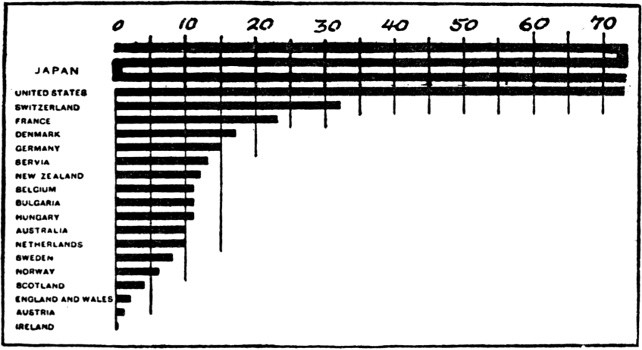
Divorce-rate per 100,000 Population in 1900. (See Divorce.)
This diagram affords a comparison between the divorce-rate in the United States and in certain foreign countries.
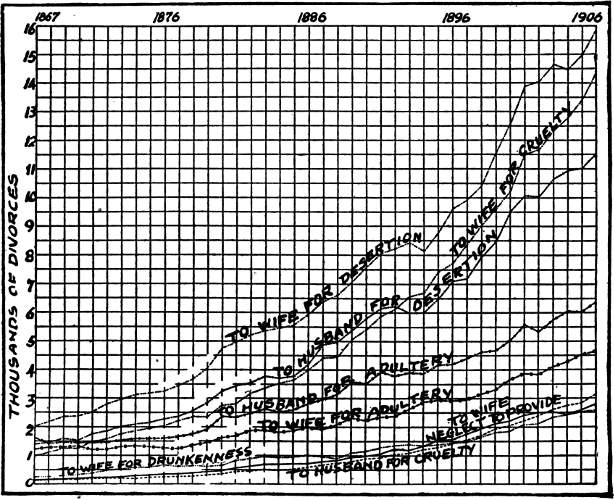
Showing Number of Divorces Granted for Certain Specified Causes, from 1867 to 1906. (See Divorce.)
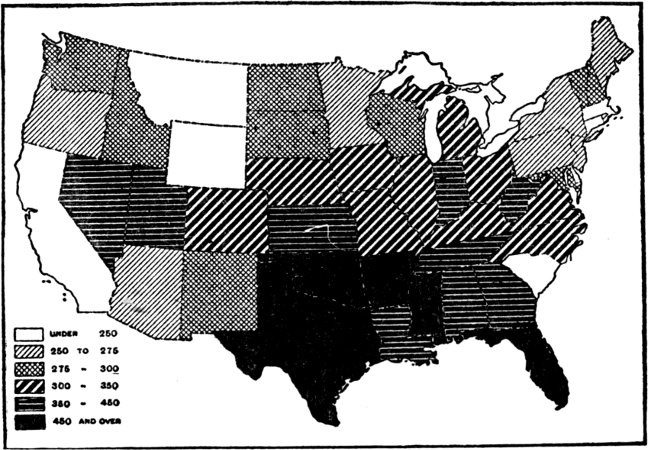
Marriage Map of the United States. (See Divorce.)
This chart is based on the average annual number of marriages per 10,000 adult unmarried population in the various States and Territories.
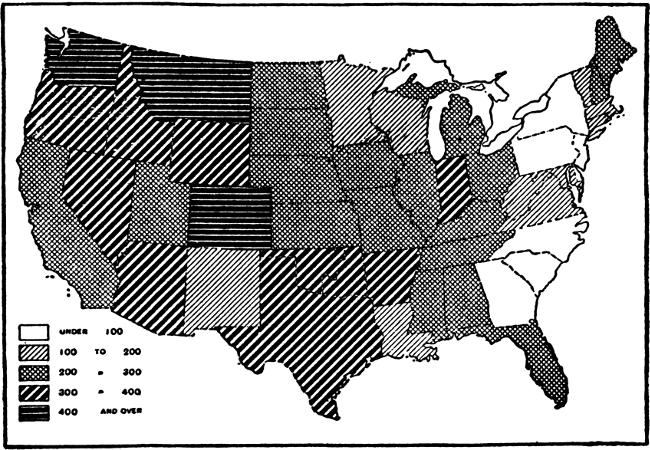
Divorce Map of the United States. (See Divorce.)
This diagram is based on the average annual number of divorces per 100,000 married population in the various States and Territories.
(807)
See Birth-rate in France.
DOCILITY, SPIRITUAL
An argument for man’s spiritual docility ought easily to be seen in his ignorance. He is blind but presumptuous. Nature herself ought to teach him better. As one says:
Just as when the yellow fog broods over London, all the illuminations devised by man can not penetrate it; just as in the dark country road on the misty night, the brightest lamp is of no more avail than a farthing rushlight; so no argument of men can remove the mists which becloud the soul. We only do what we have to do in the physical world—wait till the sun comes back.
If man be so encompassed by ignorance in the physical realm, how can he walk in the spiritual. Let him humble himself, if he would really understand. Let him obey, that he may know.
(808)
Dog as a Detective—See Animal Intelligence.
DOGMATISM, MISTAKEN
I had heard that nothing had been observed in ancient times which could be called by the name of glass—that there had been merely attempts to imitate it. I thought they had proved the proposition. They certainly had elaborated it. In Pompeii, a dozen miles south of Naples, which was covered with ashes by Vesuvius eighteen hundred years ago, they broke into a room full of glass; there was ground-glass, window-glass, cut-glass, and colored-glass of every variety. It was undoubtedly a glass-maker’s factory. So the lie and refutation came face to face. It was like a pamphlet printed in London, in 1836, by Dr. Lardner, which proved that a steamboat could not cross the ocean; and the book came to this country in the first steamboat that came across the Atlantic.—Wendell Phillips.
(809)
Doing—See Feeding, Too Much; Service.
DOING AS AN INCENTIVE
A woman once came to me and asked if it were not possible to give her husband something to do in the church. “He evinces but little interest; just give him something to do, and I think he will attend.” In support of her belief she recounted how her husband, lacking interest in a lodge to which he belonged, was made a very regular attendant. “He was elected,” she said, “the high and mighty potentate of the eastern door. Now he attends the lodge regularly every Thursday night.” Think of it—a sensible man walking up and down in a closet-like room, and challenging all who would enter. All this because he was given something to do. There is much philosophy in this. Young people need direction in the line of that in which they are interested, and in which they particularly are best capable of doing. There should be enough specific work to go around.—Charles Luther Kloss, “Proceedings of the Religious Education Association,” 1904.
(810)
Doing Things for Themselves—See Adaptability.
Doing Without Learning—See Automatic Learning.
DOLL, PLACE OF THE, IN THE CHILD’S LIFE
The delight which a little girl sometimes experiences in getting hold of a doll that belonged to her mother when she was a little girl—a quaint, china-headed and china-haired little creature, with low neck and short sleeves and very full ruffled skirt—is a tame thing when compared with the feelings that any girl must experience over a doll now in the British Museum. This doll is almost three thousand years old.
When some archeologists were exploring an ancient Egyptian royal tomb they came upon a sarcophagus containing the mummy of a little princess seven years old. She was drest and interred in a manner befitting her rank, and in her arms was found a little wooden doll.
The inscription gave the name, rank and age of the little girl and the date of her death, but it said nothing about the quaint little wooden Egyptian doll. This, however, told its own story. It was so tightly clasped in the arms of the mummy that it was evident that the child had died with her beloved doll in her arms.
The simple pathos of this story has touched many hearts after thousands of years. The doll occupies a place in a glass case in the British Museum, and there a great many children have gone to look at it.—Youth’s Companion.
(811)
Dollar, His First—See Money, Earning.
DOMESTIC HEROISM
There are all sorts of heroes and the domestic life knows them as well as some other more conspicuous fields of action. The little things of life afford a field for the exercise of the heroic as well as the larger. A news item, with a touch of the humorous, tells the following:
Some women were discussing over their afternoon tea the statement that a man is no more a hero to his wife than to his valet. There seemed to be no opposition to the idea that a man’s servant did not appreciate him, but all stoutly maintained that their husbands were heroic—in one way or another.
“My husband is very heroic,” said Mrs. Black. “For instance, he will give up his visit to the club to play jackstraws with my old mother, and she is his mother-in-law, you know.”
“I think I can beat that,” remarked Mrs. Gray. “When my milliner’s quarterly bill comes in my husband smiles as he writes a check, and never thinks of looking at the items.”
“I can give you a better example than either of those!” exclaimed Mrs. White. “When the morning paper comes at breakfast-time my husband always offers me the first reading of it.”
An informal vote awarded the last speaker’s husband the medal of heroism.
(812)
DOMINANT ELEMENTS
Every animate or inanimate structure responds to some chord or note of music, called, I believe, the dominant. We have all felt some building vibrate in unison with the pulsation of some note of a musical instrument; we have felt “creepy” shivers run through us as some musical chord is sounded. It is well known that animals are strangely affected by certain harmonies. Some day, when civilization has advanced, I believe that these evidences of psychological structure will be better understood. It will be recognized that vice and virtue are in accord with different harmonies, and yield to the power of different dominants; and, when once the classification is made, and the disclosures of the dominant understood, then the extent and influence of the dominant will be a psychological test to define the character and ruling passions of men’s nature, and to decide the fitness of men for the various pursuits of life, and even for life itself. (Text.)—Arthur Dudley Vinton, American Magazine.
(813)
Dominion of Man—See Mastery of Nature.
Doors, Opening Human—See Receptiveness.
DOUBLE MEANINGS, DANGER OF
The last great martyr to the double meaning in our Constitution, mentioned below, was Lincoln. It was a clause that protected the most gigantic evil of history:
An American historian says of the Constitution of the United States: “Our Constitution in its spirit and legitimate utterance is doubtless the noblest document which ever emanated from the mind of man. It contains not one word hostile to liberty.... But yet ingloriously, guiltily, under sore temptation, we consented to use one phrase susceptible of a double meaning, ‘held to service or labor.’ (Article IV Section 2.) These honest words at the North mean a hired man, an apprentice. At the South they mean a slave, feudal bondage. So small, apparently so insignificant, were those seeds sown in our Constitution which have resulted in such a harvest of misery.”
(814)
DOUBLE-MINDEDNESS
Charles Wagner, in “The Gospel of Life,” remarks thus on the double nature of men:
Duplicity, rending apart, partition of the will and of the heart, lamentable division—that is our life! It is not a continuous chain; it is only links broken and dispersed. We are peace-loving, just, truthful, sober, chaste, disinterested; but we are also malicious, unjust, cunning, intemperate, impure. We are like those ships that carry to the colonies, along with the Bibles and religious tracts, cannon, alcohol, and opium; or those poets full of contrary talents, who play turn by turn on the sacred lyre and on the strident conch-shell.
(815)
DOUBT ISSUING IN PEACE
The peace of God descends more softly shed Than light upon the deep, And sinks below the tumult of my years Deeper than dreams or sleep. And somehow, as of dusk was born the star Whose fire is on the sea, Another star from doubt’s profounder dark Is risen and shines on me. (Text.) —Henry Fletcher Harris, Harper’s Magazine.
(816)
DOUBTS, DISSOLVING
Crossing the Atlantic, a vessel is often encircled by small ice-floes, looking like a flock of white sheep on the blue ocean. When they started on their course southward, those ice-floes were great frozen masses. But the warm Gulf Stream played on them beneath, and the sun melted them from above, till they dwindled as they entered a warm atmosphere. A man’s doubts at first seem large enough to freeze his faith, but let him go steadily onward into the warm atmosphere of Christian love, and gradually his doubts will no more impede his progress than the ice-floes impede an ocean-liner.
(817)
DOURNESS
If I could present the picture of a Scotch Highland cow, with her calf by her side, watching the approach of a tourist whom she thinks is coming too near—could I depict the expression of her face; that, I would say, would fairly represent what is meant by “dour.” Not that the cow would take the aggressive, but, if interfered with, I’ll warrant she would not be the one permanently injured. Led by this trait a certain Scotchman always stood up during prayers when others were kneeling, and sat down when others stood to sing, because, as he exprest it, the ordinary method was the only one used by the English and he wasn’t going to do as they did.—John Watson.
(818)
DOWN GRADE, THE
The terrible crimes and miseries of the East End of London have recently been brought into great prominence, and one of the most distressing features of this subject is that considerable numbers of these appallingly miserable characters were once respectable and happy. They were the children of honorable parents, they were trained in schools and sanctuaries, they were members of rich and influential circles; then they chose the down grade; they were first guilty of unbecomingness, then of acts of graver misconduct; at length their friends lost sight of them, they lost sight of their friends; then ever lower lodging-houses, lower ginshops, lower pawnshops, until at last those who had been tenderly nursed, educated in universities, clothed in scarlet, were submerged in filth, crime, misery, simply unutterable. All this dire catastrophe once seemed impossible to them, as now it seems impossible to us; but forget not that the doubtful ever passes into the bad, the bad into the worse, the worse into the unspeakable.—W. L. Watkinson, “The Transfigured Sackcloth.”
(819)
DREAM, VALUE OF THE
A pillow-dream is a night adventure of your subconscious self. You wander without volition in a weird world and come back with a tantalized and fleeting recollection of fantastic persons and impossible situations. The metaphysical mystery of this sort of dreams has never been cleared, but it is certain that the fruits gathered in these sunless excursions are of doubtful flavor and quickly perishable. Fortunately, we are capable of dreams which are not pillow-dreams—dreams which are best dreamed when the spine is vertical and every fiber of mind, soul, and heart vibrant and vital. On these occasions we are in the clasp of our best mood—the mood of concept and creation. The wine of this mood is red like blood and the resultant intoxication is the holiest experience of which we are capable. In its high hours the soul is never maudlin or fuddled; it grips life strongly and deals with it in divine fashion, whipping its fugitive elements into orderly submission, compelling them to assume a useful steadiness like that of the dependable planets which can be found nightly at a given point in the heavens.—Metropolitan Magazine.
(820)
DREAMS
(“Behold, this dreamer cometh”)
They stript me bare and left me by the way To pine forsaken in a lonely land; They gave me to night-frosts and burning day To griefs none understand. They took my silver from me and my gold, The changing splendors of my rich array; Night’s silver rain of dew escaped their hold, And the fine gold of day. On the world’s highway in vain pomp they tread; By paths unknown I stray and hidden streams; They took all else and left me there for dead; They could not take my dreams. Still, morning comes with marvel as of old; Still in soft rose descends the eventide; Still in the castle of my heart, grown bold, The sweet, swift thoughts abide. Pass by, pass by, O clamorous folk and wild! To this last fortress of the soul I cling; Men gave me winter weather from a child, But God has given me spring. (Text.) —Robin Flower, The London Spectator.
(821)
See Fulfilment Disappointing; Ideals.
DRESS AFFECTING MOODS
Mrs. Bishop, in the Chautauqua Herald, says:
It may never have occurred to some of you that dress has any reactionary influence upon the inner states, but so potent is this influence that frequently we can change the mental states by a change of dress. When tired, gloomy or fretful, a change in apparel often means a change in mood. Many actors say that to be drest for the part is a great help toward feeling the part. An army general once declared that he could not fight without his uniform, that an ordinary hat and coat took all the courage out of him.
(822)
Dress in the East—See Propriety, Observing the rules of.
Drifting Avoided—See Danger, Avoiding.
DRINK
“Many a good story is told of the old bonanza days,” said a San Franciscan. “I liked especially a whisky story.
“A tenderfoot, the story ran, entered a saloon and ordered whisky. Whisky in those days and in those parts was a very weird drink. Queer effects were sure to follow it. The tenderfoot knew he must expect something out of the common, but, for all that, he was taken aback when the bartender handed him a small whisk-broom along with the bottle and glass.
“Tenderfoot-like, he didn’t care to expose his ignorance by asking what the whisk-broom was for, so he just stood there and fidgeted. He didn’t drink. He waited in the hope that somebody would come in and show him what was what.
“Well, in a few minutes a big chap in a red shirt entered. He, too, ordered whisky, and he, too, got a broom.
“The tenderfoot watched him closely. He poured himself a generous drink, tossed it off, and, taking up his whisk-broom, went over into a corner and carefully cleaned, on the floor, a space about 7 feet by 3. There he laid down and had a fit.”—Detroit Free Press.
(823)
See Abstainers Live Long; Beer, Effect of; Alcoholic Bait.
DRINK AND NATIVE RACES
Missionaries are constantly emphasizing the horrors consequent on the drink traffic among the natives of Africa. Bishop Johnson, one of its able native bishops, declared that “European commerce, weighted as this commerce has been for many years with the liquor traffic, has been as great a curse to Africa, a greater than the oceanic slave-trade.” Even still more effective was a statement made by a Christian negro speaking to an audience in England, when he brought out of a bag an ugly idol and said, “This repulsive object is what we worshiped in times past,” and then he added, “Now I will show you what England has sent to be our god to-day,” and produced an empty gin-bottle.—Jesse Page, “The Black Bishop.”
(824)
DRINK, EFFECTS OF
I was standing on the sidewalk in a Southern city where at the time I was engaged in evangelistic work. A physician who was an active helper came along in his buggy, and, stopping his horse, requested me to take a seat at his side.
“I want to take you,” he said as we drove off, “to see a most deplorable and helpless case—a widow and her son. She is totally blind; in fact, she has cried her eyes out. You have heard of people who cried their eyes out, but now you will see one of whom it is literally true. The son is only twenty-four years of age, and a splendid machinist; but he got to fooling with drink and wild young men, until now the habit is so fixt upon him he is almost an imbecile. I have a commitment for him in my pocket to send him to the asylum. It is the only hope for him now.”
We arrived at the house, a poor little desolate-looking place, in painful accord with the pitiful lives within. The woman rose to greet us at the sound of the doctor’s voice. She was of medium size, neatly drest, but plainly. Her white face, without the slightest suggestion of color, was partly framed with grayish-brown hair. Her eyes did not seem sightless to me, but only a dull dark blue.
There sat the young man, his face buried in his hands, the picture of misery, a life surrendered to the evil of drink, and in ruins. “I have brought the minister,” said the doctor, “because I knew you’d like to have him pray with you and talk with your son.” She assented readily, and even with an effort to smile; but the smile died upon her lips. The young man was perfectly sane, and talked willingly of his condition. “I just can’t help it,” he said. “I love mother, and I can easily take care of her; but, when I get where whisky is, I can’t help getting drunk. Then it looks as if I’d never get sober any more. Yes, sir,” he said in reply to the doctor, “I’ll be glad to go. I hate to leave mother,” nodding his head toward the frail creature who sat silent while the tears literally rolled down her face; “but I’m willing to do anything to get right.”
Months passed. I was there again. Meeting the doctor one day in the street, I stopt him.
“Tell me about the poor woman, doctor, and her boy,” I asked. “Get into my buggy, and we will take a drive, and you shall see for yourself.” We drove along, talking as we went; but he did not explain. He continued his drive out of the city, and finally turned his horse’s head into what I saw was the cemetery. Passing monuments and vaults and richly carved marble, we went on to the very outer edge. “Now we will get out and walk a few steps,” he said. I followed him, knowing now, of course, what it meant; but I knew only in part. Stopping at two unmarked graves, not a stone or board or flower, desolate in death as in life, he pointed to one, and said: “That’s the son. He came back from the asylum, and we thought he was cured; but he fell in with his old companions, and a few days later his body was found in a pond near the city, and a bottle half filled with whisky in his pocket. And that’s the mother. She survived him only a few days. When they brought his body into her little home, she sank under her weight of grief, and never rallied. She had cried herself to sleep.”—H. M. Wharton, Christian Endeavor World.
(825)
DRINK, HERITAGE OF
The jovial, genial drunkard of the Anglo-Saxon times is a rare personage nowadays, and tho there may be men as fond of sack as Falstaff himself, they seem to have lost the intense sociability which was the characteristic of the burly knight. Nearly all the great men of the Napoleonic era were drinkers—Pitt, Fox, Sheridan, Wellington himself. Napoleon’s marshals had the soldier’s pet failing, and it is said of stern old Blücher that he slept in his boots and went to bed in a more or less pronounced condition of intoxication for thirty years. Byron boasted of having drank a dozen bottles of wine in a day, and his “Don Juan” was composed under the influence of gin. Thackeray loved the bottle, so did Dickens. The children suffer for the failings of their sires, and many of the nervous symptoms and morbid cravings which perplex physicians in the young men and women of to-day are in reality legacies bequeathed by overbibulous ancestors. (Text.)—Baltimore Herald.
(826)
DRINK, PERIL OF
A number of years ago a certain firm of four men in Boston were rated as “A1.” They were rich, prosperous, young and prompt.
One of them had the curiosity to see how they were rated, and found these facts in Dun’s and was satisfied, but at the end these words were added: “But they all drink.”
He thought it a good joke at the time, but a few years later two of them were dead, another was a drunkard, and the fourth was poor and living partly on charity.
That one little note at the end of their rating was the most important and significant of all the facts collected and embodied in their description. (Text.)
(827)
DROUGHT, RESPONSIBILITY FOR
When the electric trolley-cars were first set running in Seoul, a peculiar result manifested itself in the nation. We quote from The Outlook:
Little by little the heavens grew dry and the earth rolled up clouds of dust; day followed day with no signs of rain, and the caking paddy-fields grinned and gasped. What could be the cause of it? The geomancers and ground-prophets were consulted, and their answer was, “The devil that runs the thunder and lightning wagon has caused the drought.” Eyes no longer looked with curiosity but glared at the trolley-cars, and men swore under their breath and curst the “vile beast” as it went humming by, till, worked up beyond endurance, there was a crash and an explosion, one car had been rolled over, and another was set on fire, while a mob of thousands took possession of the streets foaming and stamping like wild beasts.
(828)
DRUDGERY
It may be that even the work of “holystoning” the deck of a ship could become an act of devotion if done in the right spirit, notwithstanding this seaman’s aversion to it:
“This is what you call the sailor’s prayer-book,” a seaman said bitterly as he kicked a holystone out of the way. “Why is it called that? Well, in the first place, it is called that because in using it, in holystoning the deck, the sailor has to kneel down; and in the second place, because all holystoning is done on Sunday. Don’t you know the chantey?
“‘Six days shalt thou work and do all that thou art able, And on the seventh holystone the decks and scrape the cable.’
“The stone is called holystone because the first holystones were bits of tombs stolen from cemeteries. It’s got a pious, religious sound—holy, and prayer-book, and Sunday and all that—but it is when he is using this stone that the seaman is most profane.”
(829)
See Best, Making the.
Drudgery as a Teacher—See Humdrum Development.
DRUDGERY RELIEVED
When Lucy Larcom was fourteen years old she worked in a cotton-mill in Lowell, Mass. After she had been there a few weeks, says The Youth’s Companion, she asked and received permission to tend some frames which were near a window, through which she might look out on the Merrimac River and its picturesque banks.
After she had worked there a little while longer, she began to make the window-seat and frame into a library. She pasted the grimy paint all over with clippings of verse which she gathered from such newspapers and magazines as fell into her hands.
So the little factory drudge secured for herself three essentials for human happiness: work, the sight of nature, and the beauty of the poet’s vision. No doubt the work was often wearisome. Perhaps some of the poetry was not very good. But the river and its meadows and hills must have been always refreshing, and the spirit which so intelligently desired the best in the world could not have faltered even on a toilsome path.
(830)
Drunkard’s Fate—See Drink, Effects of.
Drunkards Saving Drunkards—See Personal Influence.
Drunkard’s Soul—See Defacement of Soul.
DRUNKARD’S WILL, A
It was written just before he committed suicide. “I leave to the world a wasted character and ruinous example; I leave to my parents as great a sorrow as in their weakness they could possibly bear; I leave to my brothers and sisters as much shame and dishonor as I could have brought them; I leave to my wife a broken heart and a life full of shame; I leave to my children poverty, ignorance, a bad character and the memory of their father lying in a drunkard’s grave and having gone to a drunkard’s hell.” This is typical. Decent men are becoming sick at heart with this thing. We are now in the midst of a war that promises to become world-wide, relentless until our Christian obligation to the world is fully met. Since religion, business, science, education and the State have taken the field against drink there is certain promise of victory.—Methodist Recorder.
(831)
Drunkenness, Disastrous—See Debauch, Fatal.
Drunkenness, Safeguard Against—See Safeguard for Drunkards.
DRUNKENNESS, THE TRAGEDY OF
A recent orator gives this incident:
I think the subject has been kept back very much by the merriment people make over those slain by strong drink. I used to be very merry over these things, having a keen sense of the ludicrous. There was something very grotesque in the gait of a drunkard. It is not so now; for I saw in one of the streets of Philadelphia a sight that changed the whole subject to me. There was a young man being led home. He was very much intoxicated—he was raving with intoxication. Two young men were leading him along. The boys hooted in the street, men laughed, women sneered; but I happened to be very near the door where he went in—it was the door of his father’s house. I saw him go up-stairs. I heard him shouting, hooting and blaspheming. He had lost his hat, and the merriment increased with the mob until he came up to the door, and as the door was opened his mother came out. When I heard her cry, that took all the comedy away from the scene. Since that time, when I see a man walking through the street, reeling, the comedy is all gone, and it is a tragedy of tears and groans and heartbreaks. Never make any fun around me about the grotesqueness of a drunkard. Alas for his home!
(832)
DUAL CHARACTER
Samuel Johnson (1709–1784) who was certainly not the greatest writer of his age, perhaps not even a great writer at all, but who was nevertheless the dictator of English letters, still looms across the centuries of a magnificent literature as its most striking and original figure. Here, moreover, is a huge, fat, awkward man, of vulgar manners and appearance, who monopolizes conversation, abuses everybody, clubs down opposition—“Madam” (speaking to his cultivated hostess at table), “talk no more nonsense”; “Sir” (turning to a distinguished guest), “I perceive you are a vile Whig.” While talking he makes curious animal sounds, “sometimes giving a half whistle, sometimes clucking like a hen”; and when he has concluded a violent dispute and laid his opponents low by dogmatism or ridicule, he leans back to “blow out his breath like a whale” and gulp down numberless cups of hot tea. Yet this curious dictator of an elegant age was a veritable lion, much sought after by society; and around him in his own poor house gathered the foremost artists, scholars, actors, and literary men of London—all honoring the man, loving him, and listening to his dogmatism as the Greeks listened to the voice of their oracle.—William J. Long, “English Literature.”
(833)
DUALITY
The peculiarity of the chameleon here described recalls Paul’s description of the conflict between the natural and spiritual man:
Notwithstanding the strictly symmetrical structure of the chameleon as to its two halves, the eyes move independently of one another and convey separate impressions to their respective centers of perception. The consequence is that when the animal is agitated its movements resemble those of two animals, or rather, perhaps, two halves of animals glued together. Each half wishes to go its own way and there is no concordance of action. The chameleon, therefore, is the only four-legged vertebrate that is unable to swim; it becomes so frightened when dropt into water that all faculty of concentration is lost, and the creature tumbles about as if in a state of intoxication. (Text.)—The Scientific American.
(834)
Duality of Human Nature—See Nature Dual in Man.
Duel by Mail—See Make-believe.
Dutch Trait, A—See Hunger, Enduring.
DUST AND VIOLETS
O sister mine—hold on a space In your dreadnaught campaign; A few weeks more—the selfsame place Will show more dust again; Just take a sniff of springtime air And let the cleaning wait; For, “Dust will keep, but violets won’t,” As some find out too late. —Ada M. Fitts, Unity.
(835)
Dust Particles—See Impurities.
DUTIES, CATCHING ONE’S
“Caleb Cobweb,” of the Christian Endeavor World, gives the following quaint advice:
Some workmen were repairing the Boston Elevated Railway. One of them took a red-hot bolt in his pincers and threw it up to another workman, who was to place it in the hole drilled for it. The second workman failed to catch it, and it fell to the street below. There it struck a truck-load of twenty bales of cotton, a thousand dollars’ worth, that was passing at the moment. The cotton instantly took fire, but the driver knew nothing of it. The flames had made considerable headway when the cries of the onlookers informed the driver of what was going on. He had only enough time to leap out of the way of the flames and save his horse. The Boston Fire Department was summoned and put out the fire.
This is a fair sample of what happens every time one of us workmen on the great edifice of human society misses a bolt that is thrown to him. They are many—these bolts—and they come thick and fast. They are red-hot, too, for they are duties that are in imperative need of getting done. If they are not at once stuck into the proper hole, and the top at once flattened out by sturdy blows, they grow cool and useless. They can not be put into the structure; or, if we go ahead and hammer them in, they are not tight and they may bring about disaster.
No, there is nothing for it but to catch the bolts on the fly. Let one fall, and some one gets hurt—or some thing, which in the end, means some one. No one knows what will be hit when a worker misses a red-hot duty that comes flying at him.
There is only one safety for the workman or for the rest of us: Catch them!
(836)
DUTIES DISTRIBUTED
Here is a short sermon by a woman, tho not preached from a pulpit. It is a good one, and is pretty sure to hit your own case somewhere, whatever may be your age and circumstances:
The best thing to give your enemy is forgiveness; to an opponent, tolerance; to a friend, your heart; to your child, a good example; to your father, deference; to your mother, conduct that will make her proud of you; to yourself, respect; to all men, charity.—The Interior.
(837)
DUTY
There was a boy in Glasgow apprenticed to a gentleman who made telegraphs. The gentleman told me this himself. One day this boy was up on top of a four-story house with a number of men fixing up a telegraph-wire. The work was all but done. It was getting late, and the men said they were going away home, and the boy was to nip off the ends of the wire himself. Before going down they told him to be sure to go back to the workshop, when he was finished, with his master’s tools. “Do not leave any of them lying about, whatever you do,” said the foreman. The boy climbed up the pole and began to nip off the ends of the wire. It was a very cold winter night, and the dusk was gathering. He lost his hold and fell, upon the slates, slid down, and then over and over to the ground below. A clothes-rope, stretched across the “green” on to which he was just about to fall, caught him on the chest and broke his fall; but the shock was terrible, and he lay unconscious among some clothes upon the green. An old woman came out; seeing her rope broken and the clothes all soiled, thought the boy was drunk, shook him, scolded him, and went for a policeman. And the boy with the shaking came back to consciousness, rubbed his eyes, and got upon his feet. What do you think he did? He staggered, half-blind, away up the stairs. He climbed the ladder. He got up onto the roof of the house. He gathered up his tools, put them into his basket, took them down, and when he got to the ground again, fainted dead away. Just then the policeman came, saw there was something seriously wrong, and carried him away to the hospital, where he lay for some time. I am glad to say he got better. What was his first thought at that terrible moment? His duty. He was not thinking of himself; he was thinking about his master.—Henry Drummond.
(838)
See Greatness; Higher Law.
DUTY BEFORE PLEASURE
Dr. Johnson, himself a glutton in talk, complained to Patty Wesley of her brother: “I hate to meet John Wesley,” he said. “The dog enchants you with his conversation, and then breaks away to go and visit some old woman.”
But for Wesley, the “old woman” represented duty. She was an immortal spirit, as precious in the sight of God as Dr. Johnson himself.—W. H. Fitchett, “Wesley and His Century.”
(839)
DUTY, DEVOTION TO
The late Sir Andrew Clarke was once attending a comparatively poor man who was so seriously ill as to need his constant and assiduous attention. He was fighting death step by step, and seeing his efforts meet with success. As he bent over and watched his patient, a telegram was handed him asking him to come over and consult some wealthy idler in the south of France, offering a special train to Dover, a packet chartered to Calais, another special train to Nice, and a fabulous fee. He looked at the patient, folded the telegram, and said to his assistant, “Reply that I am needed here and can not leave,” and turned to tend the poor man again.
Much has been said in praise of this heroic self-abnegation. But, after all, the doctor simply did his duty.
(840)
See Faithfulness.
DUTY, FAITHFUL TO
Emperor William recommended the promotion of a private in his army for the strict observance of orders while acting as sentry at Swinemunde, Germany. The Emperor, accompanied by several officers, the entire party in civilian dress and wearing Panama hats, approached the entrance to the west battery, where the sentry prevented their further progress. His Majesty, much amused, again vainly tried to pass by. He said to the sentry: “You must let me pass. Don’t you know me? I am the Emperor.” The sentry then looked more closely at the Emperor, not quite reassured, but evidently recognized his Majesty’s features, as he presented arms and allowed him to pass.
The distinction of the sentry lay in the fact that, under every circumstance, he was faithful to his duty.
(841)
DUTY IN DEATH
At Gettysburg a soldier in an ambulance heard the sound of battle. He arose to go. “Where are you going?” asked a comrade in a tone of remonstrance. “To the front,” said the wounded man. “What, in your condition!” “If I am to die,” he said, “I would rather die on the battle-field than in an ambulance.” (Text.)
(842)
DUTY MORE THAN GLORY
The citizen on great occasions knows and obeys the voice of his country as he knows and obeys an individual voice, whether it appeal to a base or ignoble, or to a generous or noble passion. “Sons of France, awake to glory,” told the French youth what was the dominant passion in the bosom of France, and it awoke a corresponding sentiment in his own. Under its spell he marched through Europe and overthrew her kingdoms and empires, and felt in Egypt that forty centuries were looking down on him from the pyramids. But, at last, one June morning in Trafalgar Bay there was another utterance, more quiet in its tone, but speaking also with a personal and individual voice: “England expects every man to do his duty.” At the sight of Nelson’s immortal signal, duty-loving England and glory-loving France met as they have met on many an historic battle-field before and since, and the lover of duty proved the stronger. The England that expected every man to do his duty was as real a being to the humblest sailor in Nelson’s fleet as the mother that bore him.—George Frisbie Hoar.
(843)
Duty Plus a Little More—See Overplus of Duty.
DUTY, SENSE OF
Calif Omar, with his venerable teacher, Abou-Zeid, walked forth in the darkness of the night, far from his palace gate, where he saw a feeble fire burning. He sought it and found a poor woman trying to bring a caldron to the boiling-point while two wretched children clung to her, piteously moaning. “Peace unto thee, O woman! What dost thou here alone in the night and the cold?” said the calif. “I am trying to make this water boil that my children may drink, who perish of hunger and cold; but for the misery we have to bear, Allah will surely one day ask reckoning of Omar, the calif.” “But,” said the disguised calif, “dost thou think, O woman, that Omar can know of thy wretchedness?” She answered: “Wherefore, then, is Omar, the calif, if he be unaware of the misery of his people and of each one of his subjects?” The calif was silent. “Let us go hence,” he said to Abou-Zeid. He hastened to the storehouses of his kitchen, and drew forth a sack of flour and a jar of sheep’s fat. “O Abou-Zeid, help thou me to charge these on my back,” said the calif. “Not so,” replied the attendant; “suffer that I carry them on my back, O Commander of the Faithful.” Omar said calmly: “Wilt thou also, O Abou-Zeid, bear the weight of my sins on the day of resurrection?” And Abou-Zeid was obliged to lay the jar of fat and the sack of flour on the back of the calif, who hastened to the woman by the fire, and with his own hands did put the flour and the fat into the caldron over the fire, which fire he quickened with his breath, and the smoke whereof filled his beard. When the food was prepared, with his own breath did he cool it that the children might eat. Then he left the sack and the jar and went his way saying: “O Abou-Zeid, the light from the fire that I have beheld to-day has enlightened me also.”—James T. White, “Character Lessons.”
(844)
See Faithfulness.
Dying Like Ladies—See Pride.
DYNASTIC NAMES
Most royal families have a given name they employ as a sort of distinctive dynastic hallmark. George and Frederick are distinctively Hanoverian, as Edward is distinctively English. The late king selected Edward rather than Albert from motives at once filial and politic. He desired that his father should stand alone in his glory as Albert in English history, and Edward was associated with old and stately traditions of the Plantagenets and Tudors. Similarly the French Bourbons usually have a Louis or a Charles among their string of names, and the Bonapartes never forget Napoleon at the baptismal font. The most striking instance of reverence for a dynastic name is found in the princely family of Reuss, in Germany. There are two principalities of Reuss, respectively representing the elder and the younger lines. Every reigning prince must bear the name of Henry. Henry XXIV reigns over one principality, and Henry XIV over the other. All the heads of the houses for nine hundred years have been Henrys, and in a grand family council early in the eighteenth century it was decreed that the figures should not exceed one hundred, after which a new series should begin with Henry I. As both branches clung to Henry a working arrangement was patched up by which the younger line begins a new group-numbering with each century. The first Henry born in the twentieth century who shall mount the tiny throne must revert to Henry I, and similarly his descendant senior among the Henrys of the twenty-first century is foreordained to be I, too.—Boston Transcript.
(845)