F (continued 2)
Reading edition
(1102)
FIRE, COST OF
Fire levies upon Americans each year an enormous tax, calculated by government officials at almost a million and a half dollars a day and 1,499 lives a year.
As a result of an investigation by officials of the geological survey, it has been ascertained that cheaper fireproof materials can be used to advantage in construction, that three to six times the necessary amount of material is habitually used in structural work, that the building codes are laxly enforced, that the fire loss in the United States is eight times as much per capita as in any country in Europe, and that the great fire waste in the United States is due, principally, to the predominance of frame buildings and to defective construction and equipment.
Contrast between the small losses by fire to government buildings and the immense losses reported from the country as a whole, led the geological survey to make an inquiry.
Not one person in a thousand knows that the United States Government owns buildings that cost more than $300,000,000, and is spending $20,000,000 a year for new buildings. It will be a surprize to every one, too, to learn that not one cent of insurance against loss by fire is carried on these valuable buildings. Insurance at the ordinary rate would cost more than half a million dollars a year, and the government avoids this great tax by constructing buildings that are securely fireproof.
After a careful investigation, it has been determined that the total cost of fires in the United States in 1907, excluding that of forest fires and the marine losses (in themselves extensive), but including excess cost of fire protection due to bad construction and excess premiums over insurance paid, amounted to the enormous sum of $456,485,000, a tax on the American people exceeding the total value of all the gold, silver, copper and petroleum produced in the United States in that year.
The cost of building construction in 1907 in forty-nine leading cities of the United States, reporting a total population of less than 18,000,000, amounted to $661,076,286, and the cost of building construction for the entire country is conservatively estimated at $1,000,000,000. Thus it will be seen that nearly one-half of the value of all the new buildings constructed within one year is destroyed by fire. The annual fire cost is greater than the value of the real property and improvements in either Maine, West Virginia, North Carolina, North Dakota, South Dakota, Alabama, Louisiana or Montana. In addition to this waste of wealth and natural resources, 1,499 persons were killed and many thousands were injured in fires in the United States in 1907.
The actual fire loss in the United States due to destruction of buildings and their contents amounted to $215,084,709 in 1907. This was $2.51 loss per capita. The per capita loss in the cities of the six leading European countries amounted to but 33 cents. Comparisons of the total cost of fires, which includes the items already stated, show that if buildings in the United States were as nearly fireproof as those in Europe, the annual fire cost would be $90,000,000 instead of $456,000,000. (Text.)—Pittsburg Leader.
(1103)
FIRE, HEAVENLY
It was the first engine on the new railroad running through the wilderness. At night, the puffing, snorting monster, belching forth fire and smoke, came dashing out of a dark forest with its one shining eye in front. As it fairly leapt along the track like a thing of life, green reptiles wriggled out of sight, vultures fled to the tree-tops, and wild beasts ran snarling into the jungle. The fire inside of the engine was what did it.
When the fire of inspiration gets inside of a man, how much he is like a steam-engine. He moves straight ahead, keeps on the right track, has his eye single to the forward line and his whole soul is full of light and heat. The creatures of darkness flee before him as he emerges into the light that shall never fade. (Text.)
(1104)
Fire Peril—See Self-restraint.
First Aid—See Knowledge Applied.
FIRST FRUITS
Have you been watching the buds open their eyes these spring days? They seem to have come out just to see what is going on in this wonderful world. Their number is increasing daily, but if you had put your ear close to the first and tiniest bud of spring, it would have whispered: “I am a hint of what all buds will be when waked out of their wintry sleep.” Will not the children sing for joy when the daisies come? Well, if you could somehow find the first daisy that peeps through the sod, it would say: “I am a sample of what the daisy harvest will be when Mother Summer has drest us all up in robes of gold.” On the brow of a certain hill, I once enjoyed more than a passing acquaintance with a June apple-tree. I used to watch for the coming of its fruit as they that watch for the morning. Now, there was a tradition that June apples were not good until they fell of their own accord. Sometimes, in spying out the land, I would find only one apple upon the ground. Of course, one apple to a growing boy is little more than a delusion and a snare, and it required more than Eve-like fortitude not to shake the tree. But after these many years, what I remember most of all is the taste of that one first apple. Precious in itself and very scarce, so it seemed to me, still it told of the good times coming when its luscious, juicy brothers would yield up their secrets, too.—F. F. Shannon.
(1105)
Fishermen Superstitious—See Superstitious.
FISHERS OF MEN
In the Crystal Palace at Munich there is a little picture called “The Red Fisherman.” Satan is elegantly accoutered in red costumes, and he is fishing in a pond for men. For his hook he has a great variety of bait—gold, money, pearls, crowns, swords and wines. Apparently he has been fishing with some success, for the bait is much after the sort that men are wont to follow. To compete with the prince of evil, Christians who would be successful “fishers of men” must use bait that will really allure them. (Text.)
(1106)
In her “Fishin’ Jimmy,” Mrs. Slosson tells of a little French-Canadian girl. Her mother was a tramp, and the girl had developed into a wild little heathen. The mother fell suddenly dead near the village one day, and the child was found clinging to her mother’s body. The girl’s soul was shaken by bitter sobs, and when they tried to take her away she fought like a young tigress. There was in the crowd a small boy who knew “Fishin’ Jimmy.” With a child’s faith in his big friend, he hurried away and brought “Fishin’ Jimmy” to the spot. Very tenderly he lifted the child in his arms and took her away. Nobody seems to have known anything about the taming of the little savage, but a short time afterward she and “Fishin’ Jimmy” were seen on the margin of Black Brook, each with a fish-pole. He kept the child for weeks, and when she went at last to a good home, she had exchanged her wildness for a tender, affectionate nature. Then people wondered how the change was wrought. They asked Jimmy, but his explanation seemed to breathe an air of mystery. “’Twas fishin’ done it,” he said, “on’y fishin’; it allers works. The Christian r’liging itself had to begin with fishin’, ye know.” Yes, the religion of our Master had to begin with fishing; it will continue with fishing, and it will end with fishing, for this is indeed life’s divinest task. (Text.)—F. F. Shannon.
(1107)
FITNESS
One of John Wesley’s friends was terribly shocked to hear him preach to a well-groomed congregation a merciless sermon from the text, “Ye serpents, ye generation of vipers, how can ye escape the damnation of hell?” “Sir,” said Wesley’s friend angrily, “such a sermon would have been suitable in Billingsgate; but it is highly improper here.” Wesley replied, “If I had been in Billingsgate, my text should have been, ‘Behold the lamb of God which taketh away the sins of the world.’”
(1108)
See Unfitness.
Fitness, Lack of—See Accommodation.
Flag, Dishonoring the—See Patriotism, Lack of.
Flag, Rescuing the—See Symbols, the Value of.
Flaws—See Charity.
Flight and Vision—See Elevation and Vision.
Flight of the Soul—See Soul Flight.
FLOOD-TIDE, SPIRITUAL
I stood on the coast of England, and looked out over a stretch of oozy slime and ill-smelling mud. There were the barges high and dry, lying on their sides—no matter what cargo they carried or how skilful the captain, they were on the mud. It would have availed them nothing to heave the anchor or hoist the sail. And I thought, What is the remedy? Were it any use for the corporation to pass a by-law that every citizen should bring kettles filled with water, and pour it out upon the stretch of mud?
But as I watched I saw the remedy. God turned the tide. In swept the waters of the sea, and buried the mud, and then came the breath of sweetness and life. And it flowed in about the barges, and instantly all was activity. Then heave-ho with the anchor, then hoist the sails, then forth upon some errand of good. So it is that we stand looking out upon many a dreadful evil which fills us with dismay—drunkenness, gambling, impurity. Is there any remedy? And the churches, so very respectable, but, alas, high and dry on the muddy beach—for these, too, what is the remedy? We want the flood-tide—the gracious outpouring of the Spirit; then must come the roused and quickened churches, the Christians transformed into Christ-like men and women who shall demand righteousness.—Mark Guy Pearce.
(1109)
Flowers—See Service.
Flowers, Fond of—See Generosity.
FLOWERS, MEANINGS OF
The most remarkable of the floral emblems is the passion-flower—the common blue one. Its leaves are thought to represent the head of the spear by which Christ’s side was pierced; the five points, the five sacred wounds; the tendrils, the cords which bound Him; the ten petals, the ten faithful apostles, omitting the one who denied Him (Peter); the pillar in the center is the cross, the stamens, the hammers; the styles, the nails; the circle around the pillar, the crown of thorns; the radiance, the glory. It is used on Holy Thursday. The fleur-de-lis, or conventional form of the lily, is the symbol of the Virgin Mary, adopted in the Middle Ages. It is also an emblem of purity. It is always placed by the medieval painters in the hand of the Angel Gabriel, and sometimes in the hand of the Infant Savior, and of St. Joseph. Lilies-of-the-valley are the floral emblem of Christ. “The Rose of Sharon” and the “Lily-of-the-valley” are emblems of humility. The rose is also an emblem of Christ. The laurel is an emblem of victory and glory, also of constancy, as the leaf changes only in death. Ivy denotes immortality. The laurestinus has the same meaning. (Text.)—The Decorator and Furnisher.
(1110)
FLUENCY, THE PERIL OF
The fluent speaker is sometimes reminded that his gifts are fatal; and here is a bright tip from the Atlantic to the fluent writer: “The writer who is unusually fluent should take warning from the instruction which accompanies his fountain pen: ‘When this pen flows too freely, it is a sign that it is nearly empty and should be filled.’”
(1111)
FLY, THE COMMON HOUSE.
The house-fly has developed along with the human dwelling. If we had no closed-in dwelling places, it is doubtful if the house-fly, as at present constituted, could continue to exist. It thrives simply because we afford it food, and a breeding-place.
At first he is only a little worm, wriggling his tiny grub-like form in some incubating pile of filth, usually the manure pile, the outhouse, or the mound of rubbish or garbage in the back yard. In this condition he is easily killed, and it should be the duty of every person to kill him then. The house-fly could not exist if everything were kept perfectly clean and sanitary. Exterminate the fly-worms, do away with their breeding places, and there will be no flies.

COMMON HOUSE-FLY
The common house-fly is coming to be known as the “typhoid fly,” and when the term becomes universal, greater care will be exercised in protecting the house from his presence. Flies swallow the germs of typhoid in countless millions while feeding on excreta. They spread a thousand times more typhoid germs in their excreta than on their feet.
As soon as the fly comes out of his shell he is full grown and starts out in the world to make a living, and if your home is not clean, he knows it; for the fly can discern an unclean odor for miles. A pleasant-smelling substance—the fragrance of flowers, geraniums, mignonette, lavender, or any perfumery—will drive them away.
Look at the picture of the fly. The feet, each of them, is equipped with two claws and two light-colored pads. The fly clings to rough surfaces by means of the claws and to smooth surfaces by a combined action of the claws and pads. The fly’s pads are covered with thousands of minute short hairs sticky at the end. There is no suction—merely adhesion. All his grown-up life, the fly has to manage with sticky feet. These are constantly becoming clogged with adhering substances, and this contamination the fly must assiduously remove if his feet are to act properly in supporting him on slippery places. If this contamination is too sticky to rub off, the fly laps it off, and it then passes off through the stomach.
The fly lays her eggs in the manure-pile or some other filthy place. All the germs—all the microbes—fasten themselves on the spongy feet. The fly brings them into the house and wipes them off. The fly that you see walking over your food is covered with filth and germs.
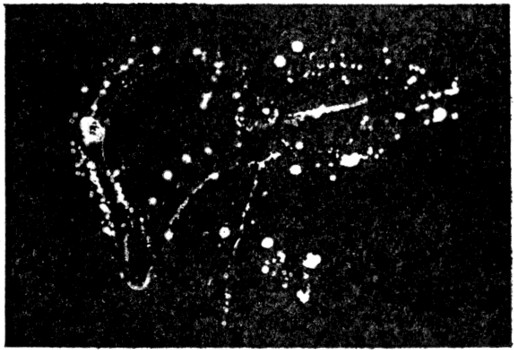
TRACKS OF A FLY, SHOWING THE WAY IN WHICH THEY SPREAD DISEASE GERMS
If there is any dirt in your house, or about your premises, or those of your neighbors, he has just come from it. Watch him, as he stands on the sugar, industriously wiping his feet. He is getting rid of disease germs, rubbing them on the sugar that you are going to eat, leaving the poison for you to swallow.
This does more to spread typhoid-fever, cholera infantum and other intestinal diseases than any other cause.
Intestinal diseases are more frequent whenever and wherever flies are most abundant, and they, and not the summer heat, are the active agents of the spread of such diseases. There is special danger when flies drop into such fluid as milk. This forms an ideal culture material for the bacillus. A few germs washed from the body of one fly may develop into millions within a few hours.—B. M. Clinedinst, The Christian Herald.
(1112)
See Pest, Contagious.
Flying-machine—See Tendencies, Inherited.
FOCUSING THE EYE
I can look one moment at a book six inches from my sight, at the next I can with ease look on a tree 200 yards away, and the next I can raise my eyes and view the sun millions of miles away in the upper heavens. As easily should Christians, compelled to look at the things close at hand, lift their thoughts and prayers to God. But it is hard to refocus the eye of the soul on the divine and eternal if the affections are too much set on things on the earth. “Where your treasure is, there will your heart be also.” (Text.)
(1113)
Foes Fraternize—See Kindness.
FOLD, THE, OF CHRIST
When the Savior proclaimed Himself as the Good Shepherd, He was not only describing His own character in one of its most beautiful aspects, but was by implication suggesting very much more. The fact of a fold implies not only protection and provision, but also restraint, oversight, authority, and order.
A traveler who recently arrived in a remote region of Uganda, relates how amazed he was to see immense numbers of all sorts of wild animals, some in great herds, others in smaller groups. That was not a fold. But if the same traveler had looked across the great pampas or llanos of South America he would have seen vast flocks and herds of horses, cattle, and sheep, roaming and grazing over the immense expanse of prairie. It might seem to him at first that those thousands of animals were wandering about at their own will. But the spectator would quickly discover that they were in reality under close attention on the part of ranchmen, cowboys, and shepherds. Further, he would find that the vast pasture-lands were enclosed by wire. So that here is a fold under shepherds.
(1114)
FOLLOWING CHRIST
A missionary doctor at Shanghai was lying one night in his bed fast asleep, when he was awakened by a loud knocking at his front door. Even Chinese grown men are very much afraid of the dark, so he was very much surprized to see two little lads from a village five miles distant standing at his door. They said their school-teacher had been taken ill, and they had come for some medicine to help him. “Why didn’t some men come on this errand?” the missionary asked. “Because they were afraid,” said the boys. “Why were not you afraid?” “We were,” said the boys, “but we thought it was what Jesus Christ would like us to do, so we came.” (Text.)
(1115)
FOLLOWING, INEXACT
Two persons were walking together one very dark night, when one said to the other, who knew the road well, “I shall follow you so as to be right.” He soon fell into a ditch and blamed the other for his fall. The other said, “Then you did not follow me exactly, for I walked safely.” (Text.)
(1116)
FOLLY
Are there not people comparable to those discribed below, who, instead of seeking the substance of religion, are content with the mere breath of theology; and others who, instead of seeing and facing the world’s evils, “take out their eyes” whenever anything disagreeable happens along?
Lucian says the people on the moon lived on frogs that they cooked over a fire, but that, instead of eating the flesh, they simply breathed in the smell that came from the cooking; and that they had a custom of taking their eyes out of their heads to save them from seeing anything that might displease them.
(1117)
See Carelessness, Cost of; Miracles.
FOOD AND CULTURE
A careful study of historical statistics shows the great influence that food and the laws of menu have exerted on the world’s progress. Did not an uncooked apple drive the human race out of Paradise? Did not a mess of pottage differentiate a nation? Did not a fit of indigestion lose the battle of Leipsic and check the career which threatened to change the face of Europe? Did not tea found the American Republic? The history of the dinner table is the history of civilization. The culture of any people may be gaged by its cooking and the amount of sentiment thrown into and around its daily meals.—Ethel A. Lennon, The Epoch.
(1118)
FOOD AND EXERCISE
The instruction of the pulpit and Sunday-school may well be likened to the food provided at the family table. It is, very likely, abundant in quantity, and nutritious in quality, but food without exercise makes the sickly, dyspeptic child. Food without exercise in the church is apt to produce no better results.
Even the horses in our stables can not long live without exercise. Fill their cribs ever so full of the best feed, they must yet do something to keep healthy. This is a natural law, which is imperative in the spiritual world. There are a great many dyspeptic Christians in all our churches. They are bilious and disappointed and hopeless and useless, except as they become by their continual growling and fault-finding a means of grace to the pastor and other workers. In fact, they have all the symptoms of spiritual dyspepsia. Now, the only remedy for this disease is spiritual activity. “Go to work,” said the famous English doctor to his rich, dyspeptic patient; “go to work. Live on sixpence a day, and earn it.”—Francis E. Clark, “Proceedings of the Religious Education Association,” 1903.
(1119)
Food and Work—See Diet and Endurance.
Food and World’s Progress—See Food and Culture.
Food Economy—See Health, Economies of.
Food in Prehistoric Times—See Prehistoric Woman.
FOOLISH CONFIDENCE
The King of Persia once ordered his visier to make out a list of all the fools in his dominions. He did so, and put his majesty’s name at the head of them. The king asked him why, and he immediately answered: “Because you entrusted a lac of rupees to men you don’t know to buy horses for you a thousand miles off, and who’ll never come back.” “Ay, but suppose they come back?” “Then I shall erase your name and insert theirs.”—Public Opinion.
(1120)
Foolishness Prevented—See Prevention.
FOOLISHNESS SOMETIMES IS WISDOM
The wisdom or unwisdom of things is not always apparent on their face. Paul speaks of “the foolishness of preaching.” Most of the great inventors and discoverers were not considered wise in the initial stages of their great careers. Columbus was misunderstood and ridiculed, Watt was regarded as a dreamer, Morse found few supporters, Ericsson could not get Government support for building the Monitor, yet all these men were great and wise men. A curious instance of wise foolishness is that related of an important advertiser, who said:
We once hit upon a novel expedient for ascertaining over what area our advertisements were read. We published a couple of half-column “ads” in which we purposely misstated half a dozen historical facts. In less than a week we received between 300 and 400 letters from all parts of the country from people wishing to know why on earth we kept such a consummate fool who knew so little about American history. The letters kept pouring in for three or four weeks. It was one of the best-paying “ads” we ever printed. But we did not repeat our experiment because the one I refer to served its purpose. Our letters came from schoolboys, girls, professors, clergymen, school-teachers and in two instances from eminent men who have a world-wide reputation.
(1121)
Foot-gear—See Bible Customs To-day.
FORBEARANCE
These lines by Harry Larkin, in the Scrap Book, seem to breathe a spirit of self-distrust and forbearance for faults in others eminently worthy of perpetuation:
Dare we condemn the ills that others do? Dare we condemn? Their strength is small, their trials are not few, The tide of wrong is difficult to stem, And if, to us more clearly than to them Is given knowledge of the good and true More do they need our help and pity, too! Dare we condemn? God help us all and lead us day by day! God help us all! We can not walk alone the perfect way, Evil allures us, tempts us and we fall! We are but human and our power is small: Not one of us may boast, and not a day Rolls o’er our heads, but each hath need to pray, God help us all! (Text.)
(1122)
The speaker in the following account was Shang, a converted Manchurian missionary:
Over at the “Heavenly Lord Hall” (French mission) I was looking at the new building which is being erected. The boys’ school-teacher was with me. A Roman Catholic objected to our presence and struck us both. One of their principal members, seeing us insulted, blushed very red, and spoke to the offender. But we just came away.
“What would you like me to do?” I asked. “Shall I write to the French priest and complain?”
“Do nothing at all,” he replied. “Not to requite an insult is a blessing.” (Text.)
(1123)
FORCE APPLAUDED
Robert Barr, the author, has a part in an anecdote which throws light upon England’s present craze for the sinews of war:
When Mr. Barr was teaching school in Canada, an old college friend of his came along with a stereopticon, giving talks on Europe. The lecturer always finished with the thrilling recital of an anecdote about Queen Victoria. The Alake of Abeokuta visited her and asked, “What is the cause of England’s greatness?” The good queen handed him a Bible, which was in readiness to present him, saying, “This is the reason of England’s greatness.” The dramatic device was always exceedingly effective.
When the lecturer came around to Barr’s district, the lantern-operator was ill, and Barr was implored to take his place, which he consented to do. All went well until the grand finale arrived, when Barr maliciously substituted another picture for that of the Bible. “This,” cried the fervid orator, “is the secret of England’s greatness!” and was horrified on glancing up at the screen to see before him a picture of the gigantic battleship Consternation. The audience, which did not know the story of the Bible, cheered vociferously, rose to its feet, and sang “Rule Britannia” in a most warlike voice.
(1124)
FORCE, LIVING
Look at a full-sized oak, the rooted Leviathan of the fields. Judging by your senses and by the scales, you would say that the substance of the noble tree was its bulk of bark and bough and branch and leaves and sap, the cords of woody and moist matter that compose it and make it heavy. But really its substance is that which makes it an oak, that which weaves its bark and glues it to the stem, and wraps its rings of fresh wood around the trunk every year, and pushes out its boughs and clothes its twigs with digestive leaves and sucks up nutriment from the soil continually, and makes the roots clench the ground with their fibrous fingers as a purchase against the storm wind, and at last holds aloft its tons of matter against the constant tug and wrath of gravitation, and swings its Briarean arms in triumph over the globe and in defiance of the gale. Were it not for this energetic essence that crouches in the acorn and stretches its limbs every year, there would be no oak; the matter that clothes it would enjoy its stupid slumber; and when the forest monarch stands up in his sinewy lordliest pride, let the pervading life-power, and its vassal forces that weigh nothing at all, be annihilated, and the whole structure would wither in a second to inorganic dust. So every gigantic fact in nature is the index and vesture of a gigantic force.—Thomas Starr King.
(1125)
Force Unavailable—See Loyalty.
FORCES, LATENT
Mighty forces often lie latent in nature until peculiar conditions elicit them. The trembling dew-drop is an electric accumulator, and within its silvery cells is stored a vast energy; the rain-drop and the snowflake are the sport of the wind, but, converted into steam, we are astonished at their potentiality; the tiny seed seems weakness itself, yet, beginning to germinate, it rends the rock like a thunderbolt.
Thus is it, only in a far more eminent degree, with human nature strengthened by the indwelling Spirit of God. In the first hours of trial we may be bewildered, stunned, staggered, but the latent forces of our nature, stimulated into action, render us equal to the most trying situation and the most trying moment.—W. L. Watkinson, “The Transfigured Sackcloth.”
(1126)
FORESIGHT
It would hasten the world’s progress if each generation would consider the welfare of those to follow as carefully as did the church mentioned here:
Anticipating that airships will be in common use in a few years, the officials of Wesley Memorial Methodist Church, of Atlanta, Georgia, when it was in process of building, instructed the building committee to so arrange the roof that there will be no difficulty in adapting it to airship landings.
The officials declared that in future years the communicants of the church would sail to and from the services in airships, just as they now speed their automobiles. They say that as they are erecting a structure that will stand for 100 years it should be modern in every respect.
(1127)
See Prevision.
FORESIGHT IN BIRDS
Some red-headed woodpeckers in South Dakota, preferring their meat fresh, evolved a way to keep it so which compares favorably with the “cold storage” of man. One bird stored nearly one hundred grasshoppers in a long crack in a post. All were living when discovered, but so tightly wedged that they could not escape, and during the long winter of that region it is to be presumed the prudent bird had his provision. The observer found other places of storage full of grasshoppers, and discovered that the red-heads lived upon them nearly all winter.—Olive Thorne Miller, “The Bird Our Brother.”
(1128)
Foresight, Lack of—See Prediction, False.
FORGERY, LITERARY
At the end of the eighteenth century the literary forgers were especially active. The Ossianic poems, the work of a Highland schoolmaster, James McPherson, who pretended to have translated them from the Gaelic, raised a controversy that stirred up much ill-feeling among the rulers of the literary world of England. Then Chatterton, “the sleepless soul that perished in its pride,” as Wordsworth sings, with his remarkable forgeries, deceived many of the antiquarians, among them Horace Walpole, and even Dr. Johnson “wondered how the young whelp could have done it.” Another young forger was Ireland, a most remarkable impostor, who, at the age of 18, not only forged papers and legal documents purporting to be under Shakespeare’s own hand and seal, and so deceived some of the most learned Shakespearian scholars, but also produced a play “Vortigern,” which he claimed was by that great bard, and which was actually performed at Sheridan’s theater. Whether or not Payne Collier tried his hand at correcting Shakespeare is still a matter of question; if guilty, his so-called “corrections” of the poet’s text appear but slight deceptions compared to the forgery of a whole play, altho these notes proved far more deceptive than the spurious drama. Mention must be made of George Paslmanazar, who called himself a native of Formosa, invented a Formosan language, and wrote a history of the island; of the forgeries of ballads by Surtees, who deceived Sir Walter Scott himself, and of the forged letters of Shelley, to which Browning, who supposed them genuine, wrote an introduction. Instances of this kind of forgery have been so frequent of late years that editors and publishers are at last beginning to realize that there is often less in a name than they suppose.—Boston Globe.
(1129)
FORGETFULNESS IN PREACHERS
Sudden forgetfulness is not an unusual thing in the pulpit. Aubrey, the antiquary, says that when he was a freshman at college he heard Dr. Sanderson, bishop of Lincoln, well known for his work, “Nine Cases of Conscience,” break down in the middle of the Lord’s Prayer. Even the great French preacher Massillon once stopt in the middle of a sermon from a defect of memory, and Massillon himself recorded that the same thing happened through an excess of apprehension to two other preachers whom he went to hear in different parts of the same day. Another French preacher stopt in the middle of his sermon and was unable to proceed. The pause was, however, got over ingeniously. “Friends,” said he, “I had forgot that a person much afflicted is recommended to your immediate prayers.” He meant himself. He fell on his knees, and before he rose he had recovered the thread of his discourse, which he concluded without his want of memory being perceived. Chambers’s Journal.
(1130)
FORGETTING AND REMEMBERING
Forget each kindness that you do As soon as you have done it; Forget the praise that falls to you The moment you have won it; Forget the slander that you hear Before you can repeat it; Forget each slight, each spite, each sneer, Wherever you may meet it. Remember every kindness done To you, whate’er its measure; Remember praise by others won And pass it on with pleasure; Remember every promise made, And keep it to the letter; Remember those who lend you aid And be a grateful debtor. Remember all the happiness That comes your way in living; Forget each worry and distress, Be hopeful and forgiving; Remember good, remember truth, Remember heaven’s above you, And you will find, through age and youth, True joys, and hearts to love you. —Youth’s Companion.
(1131)
Forgetting the Past—See Old-year Memories.
FORGIVENESS
Alfred Austin, Poet Laureate of England, writes this verse on forgiveness:
Now bury with the dead years conflicts dead, And with fresh days let all begin anew. Why longer amid shriveled leaf-drifts tread, When buds are swelling, flower-sheaths peeping through? Seen through the vista of the vanished years, How trivial seem the struggle and the crown, How vain past feuds, when reconciling tears Course down the channel worn by vanished frown. How few mean half the bitterness they speak! Words more than feelings keep us still apart, And, in the heat of passion and of pique, The tongue is far more cruel than the heart, Since love alone makes it worth while to live, Let all be now forgiven and forgive. (Text.) —The Independent.
(1132)
In childhood you were guilty of your first deceit. At nightfall, with grieved face, your mother asked if you had disobeyed, and your lips uttered their first lie. Your father was a just man and stern, and he would have lifted the hand in indignation, and as a child you would have hardened your heart. But your mother, with all-comprehending and healing love, was wiser. She met the denial with silence. That night she was, if possible, more tender than ever. She lingered a little longer in the room of her little child. She smoothed the cool sheets with more delicate care, and stooping for the last kiss, she asked, “Is there anything more you want to tell me?” Then she went out and left you, with that lie, your first lie, to be your companion. Do you remember how that lie stood like a ghostly fear at the foot of your little trundle-bed? How terror arched black and sable wings above your pillow? How you tossed to and fro, until at last, broken by your mother’s love, you sprang up, felt your way through the dark hall, opened the door, flung yourself into your mother’s arms, sobbed out your confession, and was forgiven, utterly and squarely and forever forgiven? Don’t analyze your mother’s forgiveness—accept it and be healed thereby. Redemption is a passion flower, crimsoned with the blood of God’s heart. Don’t pick this passion flower to pieces, lest you lose it. The roots of God’s tree of life are fed with red rain, but the leaves of that tree, and the blossoms, heal the wounds of sinners.—N. D. Hillis.
(1133)
Mr. H. J. Whigam, a war correspondent during the Boxer troubles, tells the following incident:
A Christian Chinaman was shot by a Cossack, and, as he lay on his dying bed, a squad of Cossacks was marched up before him that he might identify the murderer. “I am dying,” he said. “What does it matter?” “But,” said the officer, “we are not going to kill your assailant. We are only going to punish him, so that he shall not kill any more of your people.” The dying Chinaman opened his weary eyes and made answer: “When he knows that I have forgiven him, he will not kill again.”
(1134)
John H. De Forest, in his book, “Sunrise in the Sunrise Kingdom,” says that the relation of lord and retainer is the main controlling principle that has shaped the destiny of Japan. It is natural that ideal lords should have ideal retainers whose lives were devoted to their masters. He says occasionally this devotion took the form of rebuking the lord for some unworthy act, even when the advice would bring death to the faithful servant.
For example, an aged retainer of a young Shogun saw with deep anxiety his youthful lord’s frivolous life, his love of games and dances and flowers, and determined to arouse him to his duties as a ruler. So going to the palace, he noticed a most exquisite dwarfed cherry-tree in full blossom in a splendid flowerpot. He rather bluntly asked his lord to give him the cherry-tree. On being refused he seized the pot and dashed it, flowers and all, on the stone steps, saying: “You care more for things than for men.” He expected death, but his lord saw the earnest purpose of his servant and repenting of his own frivolous life, forgave him.
(1135)
FORGIVENESS, CONDITIONS OF
Lorenzo de Medici made confession to Savonarola, on his death-bed, of three special sins, involving plunder done by him to Florence and its citizens. While he confest, Savonarola consoled him by repeating, “God is merciful.” When Lorenzo had finished, he demanded three things of him before absolution could be given. First, that he should have a living faith in God’s mercy. Lorenzo replied that he had such a faith. Second, that he should restore what he had unjustly acquired. Lorenzo, after hesitating, consented. Then Savonarola drew himself up and said, “Give Florence back her liberties.” Lorenzo turned his face to the wall and uttered not a word, and Savonarola left the room without granting the absolution desired. (Text.)
(1136)
Forgiveness of Sin—See Sin Consciousness.
FORGIVENESS, TIMELY
That we should forgive the faults of friends while they are in the flesh and can appreciate it is the lesson taught by Mrs. Marion Hutson in this verse:
Somewhere in the future, my lone grave Will lie where flowers bloom and mosses wave, And friends will stand beside it, speaking low Of things I said and did so long ago. My faults and follies all forgotten—dead— And buried with me in my lowly bed. Oh, loved ones! why not bury them to-day, And let me feel forgiven while I may.
(1137)
FORM VERSUS REALITY
During the Civil War the late Colonel Bouck organized a regiment, says Everybody’s Magazine, which he controlled as a dictator. It was while the army was resting after the colonel’s first campaign that an itinerant evangelist wandered into camp and, approaching the colonel, asked if he was the commanding officer.
“Ugh!” snorted “Old Gabe,” as he was affectionately called, “what do you want?”
“I am a humble servant of the Lord endeavoring to save the souls of the unfortunate. I have just left the camp of the —th Massachusetts, where I was instrumental in leading eight men into paths of righteousness.”
“Adjutant,” thundered Colonel Bouck, after a moment’s pause, “detail ten men for baptism. No Massachusetts regiment shall beat mine for piety.” (Text.)
(1138)
Formation Versus Reformation—See Economy in Work.
Former Days—See Crime in Former Days.
FORMER LIFE, CONSCIOUSNESS OF
Our brains are inherited from our ancestors. Why, then, may it not be that the human brain is a palimpsest, containing more or less faded, yet recoverable records, not only of our entire past life, but of the lives of our ancestors to the remotest periods? Pythagoras profest a distinct recollection of his former lives; the writer of this knows two educated men who have lived before in the persons of rather more famous individuals than their present representatives; Lumen, in Flammarion’s “Stories,” finds that his soul had passed through many previous conditions. Indeed, the idea of transmigration, which is a poetic forecast of the more scientific doctrine here enunciated, is a very familiar one. Coleridge, in his boyhood one day was proceeding through the Strand, stretching out his arms as if swimming, when a passer-by, feeling a hand at his coat-tail, turned rudely round and seized him as a pickpocket. Coleridge denied the charge, and confest that he had forgotten his whereabouts in the impression that he was Leander swimming across the Hellespont—a wretched streetlamp being transformed by his imagination into the signal-light of the beautiful priestess of Sestos.—American Notes and Queries.
(1139)
Forms—See Spirit and Form.
Forms, Value of—See Experience a Hard Teacher.
Fortitude—See Endurance of Pain.
FORWARD
At dawn it called, “Go forward without fear! All paths are open; choose ye, glad and free.” Through morning’s toilsome climb it urged the plea, “Nay, halt not, tho the path ye chose grow dear.” At noon it spake aloud, “Make smooth the way For other feet. Bend to thy task, tho weight Of sorrow press thee. Others dower, tho fate Deny thy secret wish.” Through later day It warns, “Climb on! Heights woo! The waning light Bids haste! Yet scorn not those who lag behind, Confused by lengthening rays that clear thy sight, These, too, have striv’n all day their way to find.” At eve, when flaming sunset fades, O hear Dawn’s echoing call, “Go forward without fear.” —Anna Garlin Spencer.
(1140)
Forward Look, A—See Prevision.
FORWARD, PRESSING
In a poem, “The Second Mile,” by Dr. Oakley E. Van Slyke, occurs the following verse:
Be mine, dear Lord, to think not what I must, But of the power bequeathed to me in trust. Be mine, I pray, to go the second mile, Do better than I need to all the while.
(1141)
FOUNDATIONS
All northern Italy from Genoa to Venice was shaken not long ago by a great earthquake shock. The seismic disturbances continued at intervals during several days. The people were terror-stricken, fearing the worst. It was significant that while the shock was severely felt on both sides of the Adriatic, it was scarcely perceptible in Venice, due probably to the fact that much care, forethought and skill had been exercised in laying the city’s foundations. Every building of importance is supported by piles driven from sixty to one hundred feet into the mud of the lagoons.
In character building our only safety lies in sure foundation. (Text.)
(1142)
FOUNDATIONS, FAULTY
The stone archway spanning a culvert under a railway at a certain point gave way and tumbled in, permitting the tracks to settle and sending trains away around by another line. Workmen came to study the cause of the trouble. One thought that the cement with which the stones had been laid was not properly mixed. Another was of the opinion that the mortar had been chilled, as the wall was laid up in cold weather. Still another examined the keystone and found fault with its shape. “The form of that stone was enough to bring the archway down!” he declared. “Just look at it! The man who made it never knew what a keystone is for!”
So the criticism went on. At last a quiet man who had been digging away at the foundation of things made the statement: “It was not the keystone; that is all right. The foundation gave way, and the wall could not help falling! It was the foundation!” And that was the verdict which stood. The very first stones had been laid on soft earth.
(1143)
FOUNDATIONS, SECURE
One stands before some of the palaces of the old world that have endured for more than one thousand years without a crack or seam, in perfect admiration. The Pantheon at Rome stands just as it did more than two thousand years ago. This would be impossible had not its foundations been right. The Rialto Bridge that spans the Grand Canal in Venice was erected in 1588. It has stood as it now stands for 320 years, but that bridge rests on 12,000 piles driven deeply into the soil. What is true of buildings is true also of life.—George B. Vosburgh.
(1144)
FOUNTAINS, EVER FLOWING
“To-day’s wealth may be to-morrow’s poverty; to-day’s health, to-morrow’s sickness; to-day’s happy companionship of love, to-morrow’s aching solitude of heart; but to-day’s God will be to-morrow’s God, to-day’s Christ will be to-morrow’s Christ. Other fountains may dry up in heat or freeze in winter, but this knows no change; ‘in summer and winter it shall be.’ Other fountains may sink low in their basins after much drawing, but this is ever full, and after a thousand generations have drawn from its stream is broad and deep as ever. Other fountains may be left behind on the march, and the wells and palm-trees of each Elim on our road be succeeded by a dry and thirsty land where no water is, but this spring follows us all through the wilderness, and makes music and spreads freshness ever by our path.”—Alexander McLaren.
(1145)
Fragility—See Ossification; Preservation.
Fragments Reconstituted—See Beauty from Fragments.
Fragrance—See Character Imparted.
Fragrance from Storm—See Affliction Producing Virtue.
Frankness—See Retort, A.
FRATERNITY
When you describe to a blind man what strikes you on the very instant, you really give him the illusion of light. He sees through your eyes. There is in his soul both light and color. The green swell of the forest, the yellow waves of the harvests, that stream that unrolls yonder, across the fields, like a ribbon of silver; that river whose waters are transmuted into liquid gold in the brazier of the setting sun, all this shines before his inward eye. And yet it is not this that most delights the blind man. What moves him, transports him, not only if he is your father, your son, your friend, but even a simple traveling companion, is that he sees through you; that, for an hour, you realize the holy law that man owes himself to man, and that he lives, above all, by your bounty and fraternal exchange.—Charles Wagner, “The Gospel of Life.”
(1146)
FRAUD BY ELECTRICITY
It was noticed some years ago that a large number of light gold coins were in circulation, and the discovery was made that the “sweating” was accomplished by electrolysis. The scientific swindler constructed an electro-deposition plant, using a ten-dollar gold piece as an anode and a small metal plate as a cathode. The battery was “set in motion” and presto! in a few minutes fifty cents’ worth of gold was deposited on the metal plate, and the gold coin was worth so much less than before. As the gold was removed equally from all parts of the surface of the coin, its appearance was scarcely altered by the process, only an expert being able to detect the slight blurring of the design and lettering.—Electrical Review.
(1147)
FREEDOM CHOSEN
After our Civil War a white man suggested to a negro that he had been better off as a slave. He had had more to eat and been more certain of it, a better cabin and less concern about it, better clothes and more of them. The negro agreed, and added, “The place is still open if you want it, sir. As for me, I had rather starve and go cold and naked, and be free.” It is quite impossible for some men to understand that. For that is the heart of liberty. Eating and clothing and dwelling have become all important to some men, and compared with them liberty is not worth having. But there are hearts which have tasted slavery and so know the zest of freedom. (Text.)—C. B. McAfee.
(1148)
FREEDOM, GOD RESPECTS OUR
God, having made man a free moral agent, is a wooer, not a coercionist. If the knowledge of the sacrifice made for man’s redemption will not win man’s love, God will not apply physical force to compel acceptance, love, and obedience. A military chieftain, tho holding the lives of his soldiers in his hands, exhibits his greatest power by refusing to exercise compulsion, and realizes that the best service rendered is that which is prompted by love of the commander. Thus God shows His almighty power.
(1149)
FREEDOM, GRATITUDE FOR
On the 30th of August, 1833, the Emancipation Act passed the House of Lords. It was declared that all children under six years old should be free on the 1st of August, 1834; that all other slaves should be registered as apprenticed laborers and be compelled to labor for their owners for a few years—the time was shortened soon after. Antigua alone has the honor of having said, “We will have no apprentices; all shall be free.”
Meanwhile in all the islands dismal prophecies were made by the planters of rapine and ruin and negro risings; but the missionaries were busy teaching the poor blacks how to receive the coming boon of freedom. The eve of that momentous day, the 1st of August, was kept by the slave population of Antigua as a watch-night in church and chapel. They had been advised to await the midnight hour on their knees with prayers and hymns of gratitude. So, at the first stroke of midnight in the island of Antigua, all fell upon their knees, and nothing was heard but the slow booming of the cathedral bell, save here and there an hysteric sob from some overwrought slave-girl. The final stroke sounded through the clear air, and still the immense crowd kept silence, as tho they could not realize that they had become free. Then a strange thing happened: One awful peal of thunder rattled and crashed from pole to pole, and flash upon flash of lightning seemed to put out the feeble lights of cathedral, church and chapel.
God had spoken! The kneeling crowds sprang to their feet with a shout of joy; they laughed, they cried, they tossed brown arms abroad, and embraced one another in wild and passionate emotion; then they remembered God once more and prayed aloud.—Edward Gilliatt, “Heroes of Modern Crusades.”
(1150)
FREEDOM OF SOUL
What a remarkable invention is the airship! In it are wrapt almost boundless possibilities for good or evil. The Christian bound on his sacred mission may yet be able to use the viewless air for his highway, transport himself through its soundless solitudes, hundreds of miles before the dawning. He may transport himself with ease from place to place and behold all the marvels of creation on earth, having cut loose from gravitation and being free in the infinite ocean of starlight and sunlight.
The ideal of man is perfect freedom of the soul. (Text.)
(1151)
FREEDOM OR SLAVERY
I was in conversation with a man a few days ago, and we were talking with reference to evil propensities and signing pledges and forming firm resolutions to quit bad habits. He said, “I won’t sign a pledge because I won’t sign away my liberty.” I asked him what liberty he meant, and he said: “Liberty to do as I please.” I said to him, “That is not liberty. Any man that does as he pleases, independent of physical, moral and divine law, is a miserable slave.”—U. S. Shrimp, Church Advocate.
(1152)
Freedom, Religious—See Liberty, Individual.
Freedom, The Appeal of—See Earnestness.
FREEDOM THROUGH DRILL
R. H. Haweis gives an experience that would be good for all learners:
He (Oury) taught me Rode’s Air in G—that beautiful melody which has been, with its well-known variations, the pièce de résistance of so many generations of violinists and soprani. I was drilled in every note, the bowing was rigidly fixt for me, the whole piece was marked, bar by bar, with slur, p and f, rall. and crescendo. I was not allowed to depart a hair’s breadth from rule. When I could do this easily and accurately, Oury surprized me one day by saying:
“Now you can play it as you like; you need not attend to a single mark!”
“How so?” I said.
“Don’t you see,” he said, “the marks don’t signify: that is only one way of playing it. If you have any music in you, you can play it in a dozen other ways. Now, I will make it equally good,” and he took the violin and played it through, reversing as nearly as possible all the p’s and f’s, “bowing” the slur and slurring the “bow,” and it sounded just as well. I never forgot that lesson.
(1153)
Free Will—See Will, The.
FRICTION DISSIPATING FORCE
An English writer says:
Three or four years ago an attempt was made to supersede the water-carts of London by laying down on each side of the road a horizontal pipe, perforated with a row of holes opening toward the horse-way. The water was to be turned on, and from these holes it was to jet out to the middle of the road from each side, and thus water it all. I watched the experiment made near the Bank of England.
Instead of spouting across the road from all these holes, as it should have done from any one of them, it merely dribbled; the reason being that, in order to supply them all, the water must run through the whole of the long pipe with considerable velocity, and the viscosity and friction to be overcome in doing this nearly exhausted the whole force of water-head pressure. Many other similar blunders have been made by those who have sought to convey water-power to a distance by means of a pipe of such diameter as should demand a rapid flow through a long pipe.
This is a clear illustration of friction dissipating force. How much life force needed for constructive works of righteousness is wasted by mere friction.
(1154)
FRIEND, A TRUE
At a “home” in the country which the children of the slums are allowed to visit for a short time in the summer, the following incident occurred. A party of about one hundred youngsters was returning to the city. The attendant noticed that one of the girls, Rosie, was walking rather clumsily. This is the way the New York Tribune tells the story:
When the attendant heard a chorus of gibes all aimed at little Rosie, she saw that the girl was wearing a pair of shoes of large size. Then the attendant remembered that Rosie had had a new pair of shoes, and the little girl was asked about it.
“Well,” said Rosie, “you see, the shoes ain’t mine. They’re Katie’s. I know they’re awful big, but her mama ain’t had any work lately, so she couldn’t buy her a new pair. She just gave her own shoes to Katie.
“Katie felt awful bad about it, and cried all the way to the station. The girls all laughed at her. I just lent her my new ones and took hers.
“You see, teacher,” said Rosie, raising her eyes to the attendant’s face, “Katie’s my friend.”
(1155)
Friend, The, of Animals—See Kindness, The Power of.
FRIEND, THE ORPHAN’S
Margaret Gaffney was given the name of the “Orphans’ Friend.” She was an orphan left to the care of Welsh people who were very poor. Charity was the very spring of her being. Having lost her husband, her childless heart caused her to enter the Paydros Orphan Asylum, for which she solicited stores, wheeling them herself in a wheelbarrow when she had no other means of conveyance. She built another orphan asylum, and started a dairy to help its support. Later she established a bakery. She would not indulge herself in anything unnecessary because there “was so much suffering in the world.” New Orleans owes to this poor, ignorant woman her three largest homes for children, which are for orphans, black or white, irrespective of denomination. When the Fourth Louisiana Regiment was taken captive to New Orleans, Margaret went to the fort with a load of bread, and when ordered to halt, she replied, “What for?” When challenged, she jumped out of the wagon, grabbed the sentinel in her arms, and forcibly set him out of her path, and amid the cheers of the men, entered the fort with her baskets of bread. Whenever the Mississippi overflowed, her boat, loaded with bread, went daily to the submerged districts, feeding the needy. This poor woman was followed to her grave by the entire municipal government, merchants, professional men, and the children of eleven orphan asylums, who uncovered their heads to Margaret, the first woman in this country to be honored by the erection of a marble statue to her memory.—James T. White, “Character Lessons.”
(1156)
FRIEND, THE SYMPATHETIC
Angels are good companions for a crisis, but for every-day use the warm, touchable, sympathetic friend is as necessary as oxygen to the blood.—Camden M. Cobern.
(1157)
FRIEND, VALUE OF A
“What is the secret of your life?” asked Mrs. Browning of Charles Kingsley; “tell me, that I may make mine beautiful, too.” He replied, “I had a friend.” Somewhere in her “Middlemarch,” George Eliot puts it well: “There are natures in which, if they love us, we are conscious of having a sort of baptism and consecration; they bind us over to rectitude and purity by their pure belief about us; and our sins become the worst kind of sacrilege, which tears down the invisible altar of trust.”—William C. Gannett.
(1158)
FRIENDLINESS
It is related of Alexander the Great, that he won the hearts of his soldiers by calling them “his fellow footmen.” And of Aristotle, the better to instruct his hearers, that he read not to them—as other philosophers used to do—from a lofty seat, but walking and talking with them familiarly, as with friends, in Apollo’s porch; so he made them great philosophers. (Text.)
(1159)
Friends and Foes Meet—See Amity After War.
Friends Cancelling Debt—See Kindness.
FRIENDS, CHOICE OF
The following poem was written by His Majesty Mutsuhito, the Emperor of Japan, for the students at the Peeresses’ School of Tokyo. It is translated by Arthur Lloyd:
The water placed in goblet, bowl or cup Changes its form to its receptacle; And so our plastic souls take various shapes And characters of good or ill, to fit The good or evil in the friends we choose. Therefore, be ever careful in your choice of friends, And let your special love be given to those Whose strength of character may prove the whip, That drives you ever to fair wisdom’s goal.(Text.) —The Independent.
(1160)
Friends in Heaven—See Heaven, Friends in.
FRIENDS, KEEPING
Somebody once asked the famous Roman Atticus how he managed to keep his friends up to the end of his life. His simple reply was, “I never expected anything from them.”
It is difficult, no doubt to maintain during outbursts of passion the serene indulgence peculiar to friendship, but without attaining to the state of Atticus, who expected nothing, where the desire to give much dominates a soul, the sting of wounded vanity would not be felt in the flesh, for wounded vanity would change its object, making it a matter of pride to give, and not receive.—Dora Melegari, “Makers of Sorrow and Makers of Joy.”
(1161)
FRIENDSHIP
John Macy says in The Atlantic Monthly:
Poe lived, worked, and died in such intellectual solitude that Griswold could write immediately after his death that he left few friends. Tho at the height of his career in New York, “between the appearance of ‘The Raven’ and the time when poverty and illness claimed him irrevocably, he appears as a lion in gatherings of the literati, yet it is asserted that among them his only affectionate friends were two or three women.”
No brilliant fame can atone for the lack of true friendships.
(1162)
A young man who had left home to enter business, and who had only a single acquaintance in the town where he was newly employed, was arrested upon the charge of stealing a pocketbook containing $1,000 from the desk of a man whom he had called upon in a business way the previous day. He was in a desperate plight, for circumstances were strongly against him. The man stated that he had the pocketbook just a few minutes before the young man came in, and upon looking for it immediately afterward, it was gone, and nobody else had been in the room. The young man’s only hope was in the establishment of a previous good character, and he had no one to whom he could at the moment apply. Not knowing what to do he sent for his single acquaintance, and told him of his predicament and the circumstances of the whole affair, and said, “Of course, you have only my word that I did not take the pocketbook, but it is the truth.” His acquaintance looked at him critically for a few minutes, and then said, “No, I don’t believe you did take it, and I am going to stand by you in this, and see that you are cleared.” The new acquaintance immediately gave bail, and told him to go back to work, and say nothing. Then he sent to the home of the boy, and arranged to have some influential men of the place come on at his own expense to testify to the character of his friend, and upon the day of trial, secured his honorable discharge. When asked why he did all this he replied, “Why, I am your friend.” This was his idea of the meaning of a friend.—James T. White, “Character Lessons.”
(1163)
See Kindness.
Friendship and Peace—See Peace Pact.
FRIENDSHIP, CONCEPTIONS OF
The Greek idea of friendship is represented by the figure of a girl, with uncovered head; one hand on her heart, the other resting on an elm struck by a thunderbolt, and about which a vine, heavy with grapes, is entwined. Her dress was high and close fitting, her attitude chaste. The Roman conception of friendship was more complicated and modern. The girl’s dress was cut á la vierge, her head crowned with myrtle and pomegranate flowers; she held in her hand two hearts enchained. On the fringe of her tunic was written, “Life and death”; on her forehead were the words, “Summer and winter.” With her right hand she pointed to her left side; exposed over heart and on it was written, “From far and near.”—Dora Melegari, “Makers of Sorrow and Makers of Joy.”
(1164)
FRIENDSHIP, PERFECT
William Anderson tells us what true friendship is in this poem:
True friendship is a perfect, priceless gem. Its greatest glory is its flawlessness. My friends must give to me, as I to them, Their best or nothing—I’ll accept no less. I want the perfect music, or no song; I want the perfect love, or none at all; Right is not right when coupled with a wrong; Sweet is not sweet when touched with taint of gall.
(1165)
FRIENDSHIP, SELFISH
The motives of some men in cultivating friendships may be compared to that of the foxes mentioned below:
To see a fox get round the farmer’s dogs, in order to make friends with them, is one of the most astonishing revelations of character. Usually the dogs seem hardly to know at first what to make of his advances, but the fox is pretty certain to succeed in bringing him to his side in the end, and after that they may be seen playing together day after day.—Witmer Stone and William Everett Cram, “American Animals.”
(1166)
FRIGHT
One of the numerous incidents connected with the Sicilian earthquake was the escape of an artilleryman named Gashane Valente at Messina which was remarkable. A tidal-wave swept him from inside the barracks out to sea, where a fishing boat rescued him. He was landed near Messina, and ran without stopping eleven hours, reaching Acireale, fifty-five miles away. Terror gave him the necessary endurance.
(1167)
Frowns—See Smiles and Frowns.
Fructification, Spiritual—See Life, New, from God.
FRUIT AND SOIL
A choice variety of plum was purchased and set out in a certain garden. When the tree came to maturity, to the keen disappointment of the owner, there was no fruit on its branches. Investigation showed that the fault was not in the tree. The land in which it was planted proved to be barren and lacking in proper nourishment.
A tree growing in poor soil can not bear, because it requires all the strength it can extract from the soil to barely sustain its life. It takes all the virtue there is in the soil to support the head and foliage so that the fruit is literally starved out.
There are church-members who branch into Christian profession but who are rooted in the world. Such will bring forth nothing but leaves. (Text.)
(1168)
FRUIT-BEARING
Suppose the tree should say: “My roots are strong, my boughs elastic and tough, firm against the stroke of wind and storm. Look at my bark, how smooth and fresh; and where is there a tree whose tides of sap are fuller or richer? What leaves, too, are these that I have woven out of the threads of sun and soil! Little wonder that the birds build nests in my branches, while the cattle find shade beneath my boughs.” Well, this is a good argument—for an apple-tree—but a poor one for a man. The hungry farmer-boy does not leap the fence on his way to the apple-tree looking for apple-sap or apple-boughs or apple-leaves—he is looking for apples. And God has built this world, not for the root moralities that support man. Industry is good—it is good not to lie and not to steal, and not to kill and not to perjure, but these beginnings are fundamental only, the man must go on from the leaf to the fruit. The fruit is truth in the inner parts, justice, measured by God’s standard, and mercy that tempers justice, love, joy, peace, long-suffering, gentleness, goodness, faith that trusts, and will not be confounded. (Text.)—N. D. Hillis.
(1169)
FRUIT LIKE THE TREE
Tho I bestow all my goods to feed the poor, and tho I give my body to be burned, and have not love, it profiteth me nothing. In so giving and so doing, I would be acting merely in a way analogous to the jackdaw that would expect to be turned into a peacock by sticking a few peacock’s feathers into its black coat. This maneuver would not convert the jackdaw into a peacock; it would be still a jackdaw even after it had covered itself all over with peacock’s feathers. Let it first turn, if possible, into a peacock, and then peacock’s feathers will grow naturally upon it; its black coat will then soon be radically changed. To adopt the simile of our Lord, first make the tree good, and then its fruit will be good; you can not produce heaven’s fruit until the tree be first planted in heaven.—Alexander Miller, “Heaven and Hell Here.”
(1170)
FRUITFULNESS
The chayote is in many particulars the most remarkable plant in the vegetable kingdom. It is entirely immune from fungi, and is the only plant known which insects do not attack. Altho it bears fruit, it is a vine. Its growth is surprizingly rapid. It is a perennial and clambers about, clings to and covers fence, barn, tallest tree—anything. It will often bear as many as five hundred fruits, some of them weighing no less than three pounds. It blossoms and ripens fruit every month in the year. It is palatable and nutritious. Its flowers are rich in nectar and a prolific source of honey. (Text.)
(1171)
Fruits, First—See First Fruits.
FULFILMENT DISAPPOINTING
It is the way with all ambitions not to satisfy when they are achieved. Here is a poem by Grantland Rice teaching this truth:
The little boy smiled in his sleep that night, As he wandered to Twilight Town; And his face lit up with a heavenly light Through the shadows that drifted down; But he woke next morning with tear-stained eye In the light of the gray dawn’s gleam, And out from the stillness we heard him cry, “I’ve lost my dream—my dream!” And he told us then, in his childish way, Of the wonderful dream he’d known, He had wandered away from the land of play To the distant Land of the Grown; He had won his share of the fame and fight In the struggle and toil of men; And he sobbed and sighed in the breaking light, “I want my dream again!” As the years passed by the little boy grew Till he came to the Land of the Grown; And the dream of his early youth came true— The dream that he thought had flown; Yet once again he smiled in his sleep— Smiled on till the gray dawn’s gleam When those near by might have heard him weep: “I want my dream—my dream!” For he dreamed of the yesterdays of youth, And the smile on a mother’s face; A hearth of old-time faith and truth In the light of an old home place; He had won his share of the fame and fight In the struggle and toil of men— Yet he sobbed and sighed, in the breaking light: “I want my dream again!” —The Tennesseean.
(1172)
FULNESS, CHRIST’S
The late Charles Cuthbert Hall said:
I recall the wonder and delight with which I saw the ocean tide come up the Bay of Fundy and fill the empty river-bed. Through the hours of the ebb, the Nova Scotian rivers dwindled and shrank within their banks. Broad and barren reaches of sand exposed themselves; ships listed heavily on their sides, deserted by the feeble stream trickling in mid-channel. Then came the tide up the Bay of Fundy, up from the abundance of the unfathomable sea. You could hear it coming with a distant sound of motion and life and unmeasured power. You could see it coming, with a pure white girdle of foam, that looked in sunlight like a zone of fire. It entered the river-bed; it filled the empty channel as one fills a pitcher at the fountain; it covered the barren sands with motion and sparkling life; it lifted the heavy ships, gave back to them their rights of buoyancy, set them free upon the broad water-way of world-wide opportunity; it changed the very face of the land from sadness and apathy and dulness to animation and color and glittering activity. So Christ comes into empty human lives, and fills them with His fulness, which is the very fulness of God. The difference between a life without Christ and a life with Christ is the difference between ebb and flood: the one is growing emptier, the other is growing fuller.
(1173)
FUNCTIONS AND GIFTS IN THE EAST
The function in the non-Christian world must be regarded, because there etiquette and propriety are on dress parade. Presents are another difficulty. Be sure to look into this matter, and do not think that you are doing all that is required when you send a present. You have to be very particular about the number of presents, about the manner in which they are wrapt, about their proper delivering, etc. Receiving gifts is quite as serious a problem to the person who desires to rank as polite, as is the making of presents.—H. P. Beach, “Student Volunteer Movement,” 1906.
(1174)
FUNDAMENTALS
Every life is dominated by a fundamental note, good or bad. All its overtones will ultimately correspond.
The wires strung from pole to pole are set into oscillation by the wind, somewhat as the strings of a violin are set into vibration by the bow. In skilful hands the violin bow can be made to bring forth from the string one powerful fundamental note and several overtones of higher pitch, but in perfect harmony with the fundamental. But the wind is a very skilful performer, and brings forth at the same time not only the deepest fundamental bass note of the wire, but a great variety of overtones, both harmonious and discordant. In fact, the many wires strung overhead, from pole to pole, constitute splendid Eolian harps.—Telephony.
(1175)
See Vital Faiths.
FURY INCREASING STRENGTH
The almost superhuman pluck of certain prize-fighting animals—bulldogs and badgers, for instance—may in reality be founded on a temporary insensibility to pain, and the evident advantages of that negative endowment suggest its development by the agency of natural selection. Individuals gifted with that faculty of emotional anesthesia were less likely to succumb to the terrors of a life-and-death struggle, and therefore more apt to prevail in that struggle for existence which in a state of nature is implied by the frequent necessity of contesting the physical superiority of sexual rivals or alien antagonists. The invigorating tendency of certain passions may have been developed in a similar manner. The formidable and, indeed, quite abnormal strength of infuriated man is so well known that even an athlete will hesitate to try conclusions with an adversary under the influence of raging passions, and in such moments fury-inspired vigor has often accomplished feats which afterward surprized even the hero of the exploit. “The saints do help a man in a desperate plight,” said an old Creole planter, who had rescued his family from the attack of a brutal negro. The same strength-sustaining influence of fury may explain the almost miraculous victories of small bodies of desperate men over large armies of better-armed foes, as in the three murderous battles which the rustic avengers of John Huss gained against the ironclad legions of his enemies, or in that still less expected defeat of an entire Russian army by a few hundred followers of the hero-prophet Shamyl. Religious frenzy has often produced a similar effect, and on any other theory only a miracle could explain the almost constant victories of the Saracens, who, in spite of determined resistance of millions of better disciplined and physically superior opponents, succeeded in less than a century in extending their empire from the Ganges to the Bay of Biscay.—Felix Oswald, The Open Court.
(1176)
FUTURE DISCOVERIES
In view of the marvelous discoveries which the last half century has witnessed no one can doubt that there is quite as much that is marvelous to come. The dweller on the planet in the year 2000 will undoubtedly look back on these times with a good deal of the same feeling that we of the present day have for those who lived in the days of the stage-coach and the weekly mail; and it is quite likely that the philosopher of that period will speak of ours as “the good old times.” But however that may be, and whatever the advance they have made in our condition, we may be sure that they will find all their improvements as necessary to existence as we now find the telegraph and railroad and electric. If they have established intercommunication between the planets, they will be just as dependent on those new features as we are on the latest appliances of our civilization. And if the air line to Jupiter should break down in such a way as to cripple the Mars cut-off or the branch to Saturn, the public will be just as much hindered and embarrassed as we are by a wire-disabling blizzard in the commercial metropolis or a fire in a central telegraph office.—Detroit Free Press.
(1177)
Future, Forcasting the—See Prevision.
FUTURE LIFE
I trace the river, swelling out by degrees from the spring to a rill, from the rill to a brook, from the brook to a mill-stream, from the stream to a river, taking into itself all minor tributaries, and rolling on with a current that bears the ship and the steamboat with the easiest majesty, still cleaving its way through meadow and hill, through forest and mountain, untroubled toward the sea. Shall I believe, then, that when that river has rounded a promontory, beyond which, as yet, I can not follow it, it is all at once dissolved into mist? or emptied into a cavern so deep and obscure that no trace of the stream reappears upon the earth? Nay, but I know—tho I have not seen the end, it is as certain to me as if already my vision embraced it—that that river flows on continuous to the ocean, and mingles its wave with all the waters that gird the globe, and are drawn into the skies!
And so I know that the great soul of man, aspiring from its birth to a nobler development, still matching its companions, still surpassing its circumstances, with ideas within it which no present can unfold, and with a deep self-centered force, to which the body is only an accident, will still go on when this body has decayed, and be only nobler and princelier in each power when mingling with that illustrious concourse of intelligent and pure beings who already have been gathered in the courts of the future! It were to reverse and violently over-ride every palpable probability, to deny or to doubt this! (Text.)—Richard S. Storrs.
(1178)
Sometime—dear hands shall clasp our own once more, And hearts that touched our hearts long years before Shall come to meet us in the morning land; And then, at last, our souls shall understand How, tho He hid His meaning from our sight, Yet God was always true and always right; And how, tho smiles were often changed for tears, Along this tangled pathway of the years, Yet only so these lives of yours and mine Have caught the likeness of the life divine. (Text.)
(1179)
Future Life, Pledge of—See Life a Cycle.
FUTURE POSSIBILITIES
The field of mental effort is not measurable, and so far as we know, is unlimited. To fix its bounds would be to set an arbitrary limit to the progress of the human race. In science, art, literature—in all that exalts and embellishes life—the space yet available for progress comes as near infinitude as anything we are capable of conceiving. To one who stands in a valley, the horizon is near; let him climb a hill, and his view is expanded. When he attains a greater height the prospect appears still wider. The inventive genius of the world is rising higher and higher every day. Its prospect never appeared so utterly boundless as now. All that has been achieved, all the grand conquests that are recorded, are but an atom in the balance weighed when brought against the possibilities of the future.—The Inventive Age.
(1180)
FUTURE REUNION
Richard Watson Gilder is the author of this:
Call me not dead when I, indeed, have gone Into the company of the ever-living High and most glorious poets! Let thanksgiving Rather be made. Say, “He at last hath won” Rest and release, converse supreme and wise, Music and song and light of immortal faces; To-day, perhaps, wandering in starry places, He hath met Keats, and known him by his eyes. To-morrow (who can say) Shakespeare may pass— And our lost friend just catch one syllable Of that three-centuried wit that kept so well— Or Milton, or Dante, looking on the grass Thinking of Beatrice, and listening still To chanted hymns that sound from the heavenly hill.
(1181)
FUTURE, THE
Ethel Ashton writes of the value of the things not yet in view:
Beyond the forms and the faces I see ineffable things, Above the cry of the children I hear the beating of wings; Gracing the graves of the weary are blossoms that never were blown, And over the whole of knowledge stands all that shall yet be known. The city is not my prison—the world can not stay me there; For whole wide earth and its beauty there’s beauty beyond compare. The wealth of the wind-blown music, the gold of the sun are mine. In light of the light men see not—in sight of the things divine. For truer than all that is written is all that has not been told. The yet unlived and unliving are truer than all the old. The fairest is still the furthest; the life that has yet to be Holds ever the past and present—itself the soul of the three. —The Outlook (London).
(1182)
Future Uncertain—See To-morrow, Uncertainty of.
FUTURE WELFARE
A nation may now become educated; a people may now be safe against poverty or famine; the world is even now probably past the critical point and sure of unintermitted future progress. We may be allowed to hope that later generations may continue to see an interminable succession of advances, made by coming men of science and by learned engineers and mechanics that shall continually add to the sum of human happiness in this world, and make it continually easier to prepare for a better world and a brighter. Who knows but that the telescope, the spectroscope, and other as yet uninvented instruments may aid us in this by revealing the secrets of other and more perfect lives in other and more advanced worlds than ours, despite the head-shaking of those who know most of the probabilities? Who can say that the life of the race may not be made in a few generations, by this ever-accelerating progress of which the century has seen but the beginning, a true millennial introduction into the unseen universe and the glorious life that every man, Christian or skeptic, optimist, or pessimist, would gladly hope for and believe possible? (Text.)—R. H. Thurston, North American Review.
(1183)