The Wizard of Vermilion.
Reading edition
While the great billiard tournament was in progress in Chicago, Col. Joe Mann came up from Danville, and saw Maurice Vignaux play his remarkable game. Maurice saw Col. Mann among the spectators, and was so much pleased with his appearance that he asked for an introduction. The result was, that Maurice and Joe got pretty thick, and Maurice gave Joe a good many valuable pointers on “the gentleman’s game.” When Col. Mann got back to Danville, he had a good deal to say about billiards; and he talked so loud, that at last Col. Phocion Howard challenged him to a series of match-games of 15-ball pool. The tournament took place last Saturday night; and it was witnessed by the wealth, fashion, and beauty of Vermilion County. The Hon. William H. Calhoun was referee; and he sends us a full report of the tournament, with diagrams of several of the more remarkable shots. We regret that we have not space for this full report and all these diagrams. We print a few of the latter, in order that our readers may know to what an extraordinary height the billiard-art has risen in the provinces.
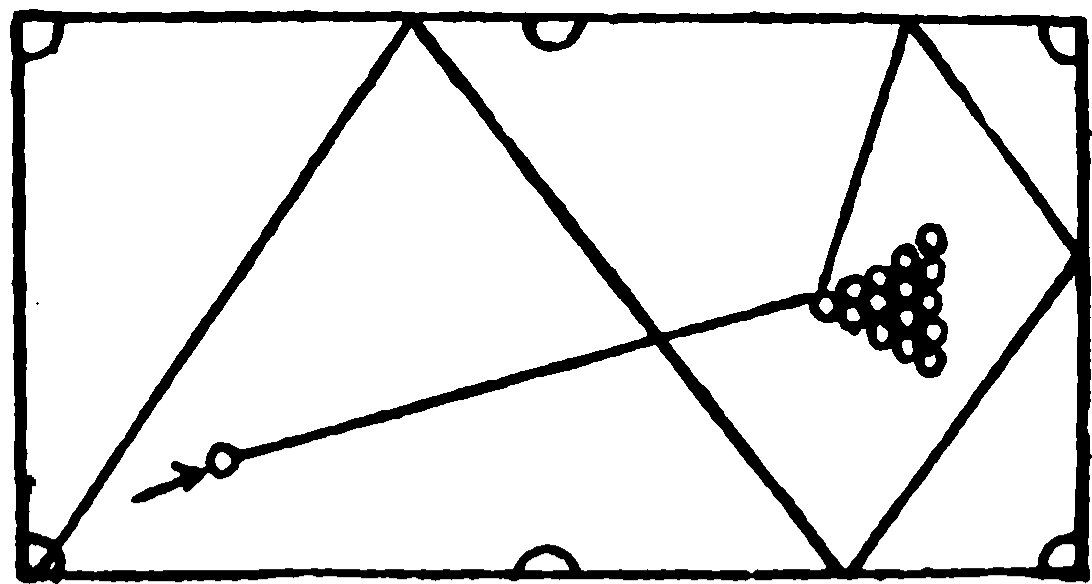
This represents the remarkable around-the-table shot made by Col. Howard at the beginning of the first game. The balls were bunched on the spot at the lower end of the table, and Howard led off 259to break the combination. His cue, not being properly chalked, did not strike the ball full. The ball, therefore, barely touched the maroon-colored ball at the apex of the group, glanced to the left, cushioned to the right, carromed thence to the right cushion, thence to the left across the table, and then shot across into the pocket at the confluence of the right hand and upper rails at the head of the table amid loud applause.
260
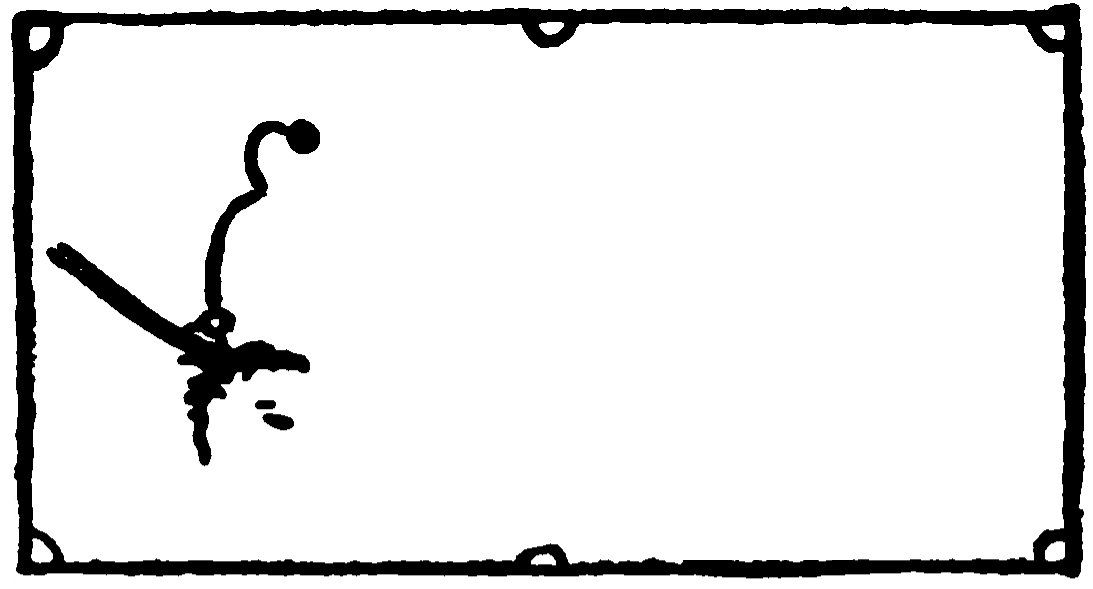
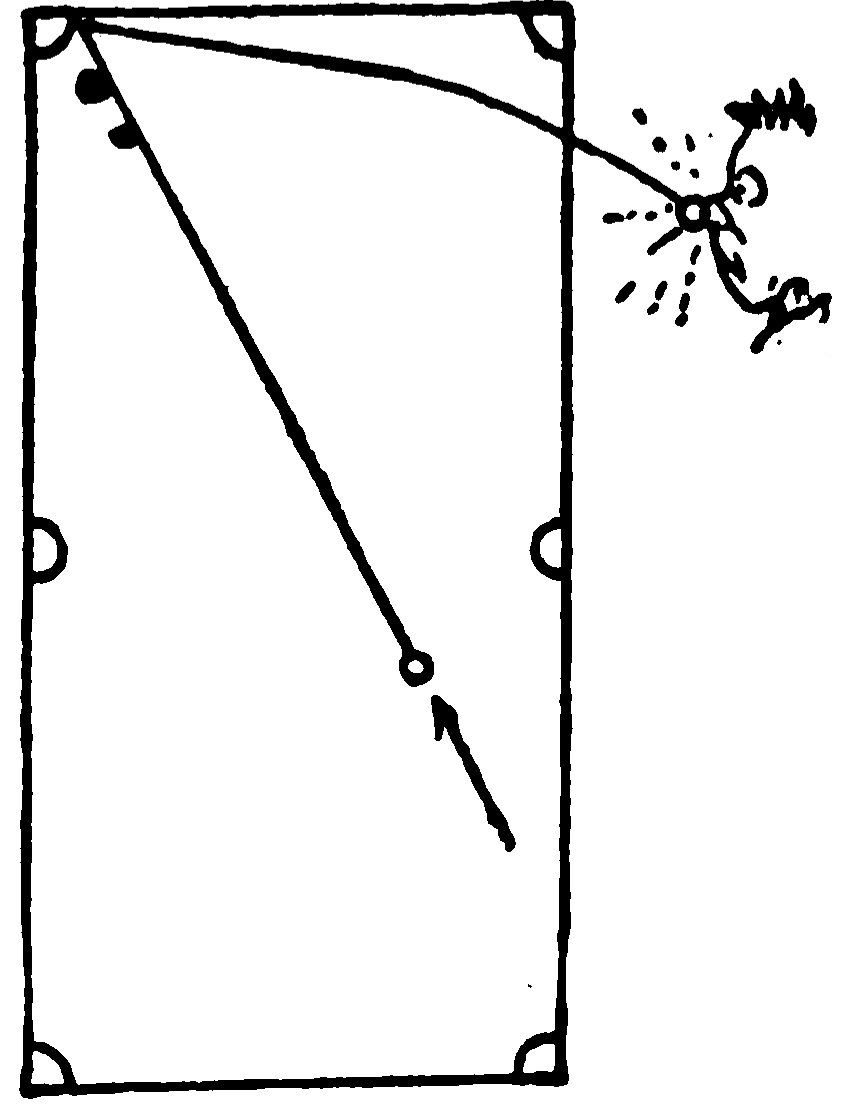
Here we have an extraordinary play made by Col. Mann near the close of the second game. He desired to put the yellow ball in the lower left-corner pocket: to do this, required a long reach across the table; bridges being barred, under the rules of the Danville Billiard Association. Col. Mann overreached himself, and gave his cue-ball such an unusual impetus that it rapidly described two acute angles, bounced across the table and over the right rail, and struck one of the spectators full in the nose. This very properly was accounted one of the marvellous shots of the tourney; and the referee shook hands with Col. Mann, and complimented him in high terms. At the close of the third game, Col. Mann made a remarkable massay shot, the like of which had never before been witnessed in Vermilion County. There were but two balls (the speckled one and the dark-blue) on the table, and Col. Mann determined to try one of the massays Mr. Vignaux had taught him. The dark-blue lay within the 14-inch line, and the speckled ball just outside: the thing was, to tick the speckled one, chassez around it, and strike the dark-blue hard enough to send it into the middle pocket of the left rail. This required a good deal of what is called “English” by the Vermilion-county experts. Col. Mann reached over the table, held his cue perpendicularly over the cue-ball, had jabbed it fiercely down—just as Mr. Vignaux had told him to do. The massay was perfect; but, 261after striking the cue-ball, the cue glanced to the bed of the table, and ploughed up about three cubic inches, or fifteen dollars’ worth, of the cloth.
This ended the tournament; and the championship was awarded to Col. Howard, who is now familiarly known as the “Wizard of the Vermilion-county cue.”