The Cooley Poems.
Reading edition
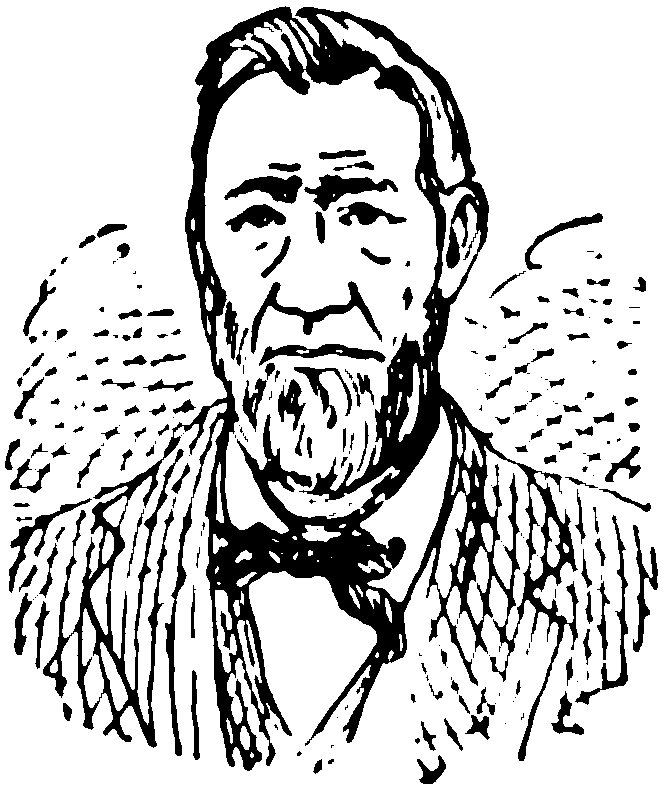
Col. Jasper Eastman, one of the oldest and most respected citizens of Adrian, Mich., sends us twenty-eight poems, which he says were written by Judge Thomas M. Cooley, the venerable and learned jurist recently appointed to the Inter-state Commission. These poems, we are told, were published originally in “The Ann Arbor News,” which paper was owned and conducted twenty-five years ago by one of Judge Cooley’s most intimate friends. The period between the publication of the first of these poems and the publication of the last was eight years (from 1853 to 1861); and, as they appeared, they were cut out, and pasted into Col. Eastman’s scrap-book: it is to this old scrap-book that we are indebted for the specimen gems which we are enabled to put before our readers at this time. Col. Eastman says, that, while it is generally known among his old associates that Judge Cooley used to be a great hand for writing poems, it is not known nor believed outside of that limited circle that the learned jurist ever did, or ever could, unbend to the muse. “People who know him to be a severe moralist and a profound 6scholar,” writes this old friend, “will laugh you to scorn if you try to make them believe that Cooley ever condescended to express his fancies in verse. Yet you will agree with me, I think, when I say that most of the learned men of all ages have written poetry, and that, therefore, there is no positive reason why the leading intellect of Michigan should not write poetry.”
There is among psychologists a very pronounced belief that the practice of writing verse serves as the best escape-valve (if we may so term it) for the emotional nature of man. The emotional nature, albeit it is the lowest part of man’s intellectual being, is earliest developed in the race and in the individual. Hence it is the first to spring to the control of the mind when the intellect is urged in any direction which prevents his nature having an escape-valve. It has been observed from the most ancient times, that the severe legislator and moralist has often exhibited secret vices or peculiarities which were but the expression of his repressed emotional nature. This repression has produced, as its resulting rebound, ruthless and horrible crimes; but very often—even in the cases of illustrious statesmen guilty of monstrous crimes—further crime has been prevented by an outburst of the emotional nature in the direction of poetry, which afforded the escape-valve so imperatively demanded.
It is very probable that Solon’s occasional pursuit 7of the art of poetical composition served to prevent him from falling victim to the laws he himself made, and enabled him to stand for all time as the stern moralist. The poetry of the ancient Spartans, Romans, Germans, Saxons, and Scandinavians did much to preserve those races from the degeneration which must have resulted had their otherwise repressed emotional natures not found a vent in song. It was only his devotion to poetry that prevented Chaucer from becoming the utterly corrupt politician which such court associations as his made others. Had Edward V. stuck to the poetry of his early years, his crimes would not have lost the crown to his descendants. The poetic tendencies of James I. served to prevent his utterly vicious character from fully demonstrating itself. Francis Bacon’s secret poetizing kept him from becoming totally depraved by the court around him. Richelieu’s poetry served to prevent his indulgence in dangerous methods of satisfying the emotional nature, gave him an extended lease of life, and in divers ways assisted him in the accomplishment of his ends. Mazarin’s poetry gave utterance in a healthy way to an emotionalism which would have been dangerous to repress. The poetry of the statesmen of the era of the English revolution—Montague, Somers the jurist, and Harley—saved them the disgrace of finding satisfaction for their emotional natures in secret excesses, like those of Jeffreys. Great lawyers, 8statesmen, and divines—Mansfield, Maule, Mackintosh, Macaulay, Fox, Burke, Beust, Disraeli, Thiers, Seward, Webster, Leo XIII.—have recognized that the proper balance of the intellectual nature required that the emotional nature, repressed by daily tasks and natural environments, should find an escape-valve in some honest and healthy direction; and all found it in poetic composition.
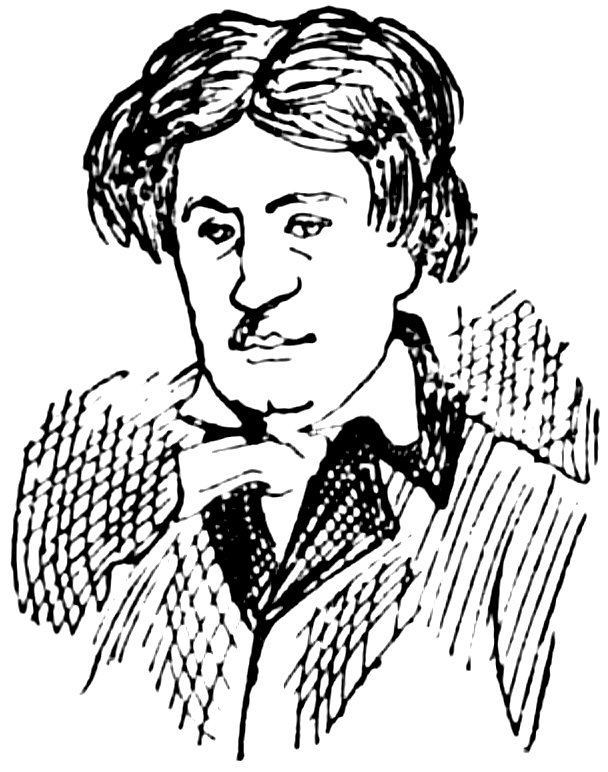
But it is not our purpose to seek to explain, or to apologize for, the poems which Judge Cooley has written: we will say simply, that, environed as he was by a sternly moral community, his emotional nature found vent in song, and these songs speak most eloquently for themselves.
Those who knew Judge Cooley at that time say that he was “a long, awkward boy, with big features, moony eyes, a shock of coarse hair, and the merest shadow of a mustache.” A faded daguerrotype of the young poet is preserved, and from it we have produced a tolerably fair copy, which will surely interest the admirers of good verse. It appears that young Cooley’s first poetical attempts were in the direction of versifications and paraphrases of the ancients. Fully half the specimens before us are illustrations of work of this kind, at which the young man exhibited 9great proficiency. Here is a bit from Menecrates that is really prime; it is as good a piece of versification as any done by the more pretentious dabblers in Greek anthology:—
OLD AGE.
When age is absent, we are eager for it;
But when it comes, oh! how we all abhor it!
So, on the whole, we think we like it better
When it is still a debt, and we the debtor.
In a lighter vein, but with consummate delicacy, and with wonderful fidelity to the text of Lucian, young Cooley thus pays his respects to
A CERTAIN FOOL.
A fool, when plagued by fleas at night,
Quoth, “Since these neighbors so despite me,
I think I will put out the light,
And then they cannot see to bite me!”
And here is Plato’s famous quatrain to
ASTER.
Seeing thee gaze into the night,
I would I were the yonder skies,
That tenderly, dear love, I might
Behold thee with a myriad eyes.
In the collection before us, there are two Latin poems, showing that the young poet was quite as felicitous at Latin composition as in versification in his native tongue. One of these poems 10is entitled “De Consuetudine et de Gustibus,” and treats in hexameter the evils of political methods at that time (1859). The other is a rollicking song which (a foot-note explains) was sung at the junior class supper at Ann Arbor, May 14, 1854. We give a specimen stanza:—
“Nicyllam bellis oculis—
(Videre est amare)
Carminibus et poculis,
Tra la la, tra la la,
Me placet propinare;
Tra la la, tra la la—
Me placet propinare!”
In 1855 the following poem appeared anonymously in “The Ann Arbor News,” and at once elicited general attention. N. P. Willis wrote out from New York to the editor of the “News,” asking the name of the author; and to this inquiry the editor answered, “A young barrister of this village, named Thomas M. Cooley.”
THE DIVINE LULLABY.
I hear thy voice, dear Lord;
I hear it by the stormy sea
When winter nights are black and wild;
And when affright I call to thee,
It calms my fears, and whispers me,
“Sleep well, my child.”
I hear thy voice, dear Lord,
In singing winds, in falling snow,
The curfew chime, the midnight bell:
11“Sleep well, my child,” it murmurs low,
“The guardian angels come and go—
O child, sleep well!”
I hear thy voice, dear Lord:
Ay, though the singing winds be stilled,
Though hushed the tumult of the deep,
My fainting heart with anguish chilled,
By thy assuring tone is thrilled—
“Fear not and sleep.”
Speak on—speak on, dear Lord;
And when the last dread night is near,
With doubts and fears and terrors wild,
Oh, let my soul expiring hear
Only these words of heavenly cheer,
“Sleep well, my child!”
This beautiful hymn was reprinted far and wide, and was incorporated, we are told, in “The Golden Harp” series of choice religious lyrics compiled by Ticknor & Co., Boston, 1857.[1]
But the most pretentious of Cooley’s poems—with the exception of his Latin hexameter discourse—was his “Vision of the Holy Grail,” a graceful imitation of Old English, printed in the holiday edition of “The Ann Arbor News” in 1856. Although this poem is somewhat longer than we could wish at this time, when our space is limited, we are fain to make room for it as a delicately conceived and artistically executed piece of literature.
12THE VISION OF THE HOLY GRAIL.
Deere Chryste, let not the cheere of earth
To-fill our hearts with heedless mirth
This holy Christmasse time,
But give us of thy heavenly cheere,
That we may hold thy love most deere,
And know thy peace sublime.
· · · · ·
Full merry waxed King Pelles court
With yule-tide cheer and yule-tide sport;
And, when the board was spread,
Now wit ye well, twas good to see
So fair and brave a company,
With Pelles at the head.
“Come hence, Elaine,” King Pelles cried,
“Come hence, and sit ye by my side;
For never yet, I trow,
Have gentle virtues like to thine,
Been proved by sword nor pledged in wine,
Nor shall be nevermo.”
“Swote sir, my father,” quoth Elaine,
“Me it repents to give thee pain,
Yet tarry I may not;
For I shall soond and I shall die,
If I behold this company,
And see not Launcelot!
“My heart shall have no love but this—
My lips shall know none others kiss,
Save only, father, thine;
So graunt me leave to seek my bower—
The lonely chamber in the toure,
Where sleeps his child and mine.”
13Then frowned the king in sore despite—
Sais: “May the divell take that knight,
For that the churl hath lied!
A base, unchristian paynim he,
Else, by my beard, he would not be
A recreant to his bride!
“Oh, I had liefer yield my life
Than see thee the deserted wife
Of traitrous Launcelot!
Yet, an thou hast no mind to stay,
Go with thy damosels away—
Lo, I’ll detain ye not.”
Her damosels in goodly train,
Back to her chamber led Elaine;
And, when her eyes were cast
Upon her babe, her tears did flow,
And she did wail and wepe as though
Her heart had like to brast.
The while she grieved, the yule-tide sport
Waxed lustier in King Pelles court,
And louder houre by houre
The echoes of the rout were borne
To where the lady all forlorn
Made moning in the toure.
“Swete Chryste,” she cried, “ne let me hear
These ribald sounds of yule-tide cheer,
That mock at mine and me;
Graunt that my sore affliction cease,
And give me of the heavenly peace
That comes with thoughts of thee.”
14Lo, as she spake, a wondrous light
Made all that lonely chamber bright;
And o’er the infant’s bed
A spirit hand, as samite pale,
Held sodaine forth the Holy Grail
Above the infants head.
And from the sacred golden cup
A subtle incense floated up,
And filled the conscious air;
Which, when she breathed, the fair Elaine
Forgot her grief, forgot her pain,
Forgot her sore despair.
And as the Grails mysterious balm
Wrought in her heart a wondrous calm,
Great mervail twas to see
The sleeping child stretch one hand up,
As if in dreams he held the cup,
Which none mought win but he.
Through all the night King Pelles court
Made mighty cheer and goodly sport,
Nor never recked the joy
That was vouchsafed that Christmasse-tide
To Launcelots deserted bride,
And to her sleeping boy.
· · · · ·
Swete Chryste, let not the cheere of earth
To-fill our hearts with heedless mirth
This present Christmasse night,
But send among us, to and fro,
Thy Holy Grail, that men may know
The joy with wisdom dight!
15It appears that Judge Cooley had, and exhibited ever and anon, a humorous tendency. His “Lines to a Blue Jay” is as delicate a bit of fun as we have ever read. It represents the poet addressing a blue jay that seeks by its querulous carping to keep the poet from plucking plums: having got possession of the disputed branch, the poet facetiously concludes,—
“When I had shooed the bird away,
And plucked the plums, a quart or more,
I noted that the saucy Jay,
Albeit he had naught to say,
Appeared much bluer than before.”
In one of the poems, entitled “The Unknown Bards,” occurs this quatrain, which is another fair illustration of Judge Cooley’s skill in dealing with the anthology of the dead languages:—
TO PHIDIAS, ON HIS STATUE OF JUPITER.
This noble form these godlike features prove
That, when you shaped his figure for our view,
You sought Olympus, there to look on Jove—
Or else Jove came to earth, and posed for you.
The last poem which Judge Cooley printed was a parody on the old song of “Dixie.” It was published in the Ann Arbor paper on July 4, 1861; and from it we take two specimen stanzas:—
16“Undimmed shall float that starry banner
Over Charleston and Savannah;
Far away, etc.
And Bunker Hill and Pensacola
Owe alike its mission holy;
Far away, etc.
Then sound the march! We pledge devotion
In our blood on land or ocean;
Far away, etc.
Till every traitor in the nation
Gains a Haman’s elevation.
Far away, etc.”
It seems a pity that such poetic talent as Judge Cooley evinced was not suffered to develop. His increasing professional duties and his political employments put a quietus to those finer intellectual indulgences with which his earlier years were fruitful. Still, we doubt not that, through all the noble practical service he has rendered to his country, he has carried the old-time fondness for the muse, and that now, in the fulness of his distinguished career, he will view without regret the buds of his poetic genius herein recalled.