The Markeesy di Pullman.
Reading edition
“Il bianco di cazerni della graze fio bella,
Di teruca si mazzoni quel’ antista Somno della.”
Petrarch.
“He who conduces to a fellow’s sleep,
Should noble fame and goodly riches reap.”
Tasso.
“Sleep mocks at death: when weary of the earth,
We do not die—we take an upper berth.”
Dante.
Never since the great fire of 1871 has Chicago society been so profoundly agitated as it was when it became noised about that King Humbert of Italy had created our esteemed fellow-townsman, Col. George M. Pullman, a knight of the first water. At first, grave doubts as to the genuineness of the report were indulged; but when, later in the day, it became known that the rumor was credited at the headquarters of the Italian legation, the joy of the public burst all restraints, and manifested itself in every variety of ebullition.
Col. Pullman is, we believe, the first citizen of Chicago who has been honored in so distinguished a manner by royalty. It is true that the Pshaw of Persia craved the boon of investing the Hon. Frederick H. Winston with the order of the Yellow Dromedary, but the negotiations fell through as soon as the eminent American diplomate 52declined to advance the pshaw the ten thousand golden pistoles which his serene majesty expected as an evidence of Mr. Winston’s good faith in the premises. It is true, also, that there are in the midst of us a number of royal personages—or perhaps we should say a number of persons of noble descent. Very many of our Irish citizens are of high extraction,—descendants of dukes, earls, booyars, barons, and knights, who for political offences have been exiled from the land of their nativity. To our certain knowledge, Col. John F. Finerty is a lineal descendant of Brian Boroihme; and many other fellow-townsmen of ours can boast ancestries almost as noble. Ex-Senator Millard B. Hereley is one of the Bourbons from Bourbon co., France; and we could, if we had the space wherein to tell it, specify who the Duke of Eniscarty, the Earl of Ballanasloe, the Duke of Cork, etc., are, and by what aliases they are known to the people of this city.
In spite of these facts which we have stated, it is true that Mr. Pullman is the first citizen of Chicago to be recognized and honored by a crowned head of Europe. As near as we can come to it, Mr. Pullman’s elevation to knighthood was brought about in this wise: Last year he made a tour through Italy; and when he reached Naples he called upon King Humbert, and made a formal complaint touching the railroad facilities with which his Majesty’s kingdom is, and always has 53been, cursed. His Majesty was struck at once with the learning, the eloquence, the earnestness, the sang froid, and the swaviter in modo, of the petitioner; and he besought him to suggest an improvement, if he could, upon the system of travel then in vogue. Thereupon Mr. Pullman caused to be made by the Herculaneum and Pompeii Manufacturing Company (limited) a palace sleeping-coach, which he presented to King Humbert with his compliments, demanding no recompense for the distinguished gift further than the privilege of appointing and controlling the porters for said car. The grateful potentate readily granted this request; for he was charmed, positively delighted, with the luxurious innovation introduced by the enterprising American. For the next six months King Humbert did nothing but travel around: the chances are that he would be travelling still, if he had not been compelled to suspend operations until after the Senate voted him another appropriation. At the end of the six months, the king found himself out of pocket about 1,500,000 lires; and about this time Mr. Pullman’s porter in Naples, one Giacomo Fiozzo, began buying corner-lots, and erecting ten-story apartment-buildings on the principal Neapolitan thoroughfares. Kings, however, are liberal folk; and well can they afford to be, even when dealing with a Chicago businessman. So when King Humbert fell to thinking of all the pleasures (not to say benefits) he had 54derived from his six months’ experience in Mr. Pullman’s coach, he paid not even the tribute of a passing thought to the financial outlay involved, but rather set his wits to work at inventing some means whereby he might further distinguish the gentleman, whom he viewed in the light of a benefactor. The result is this elevation of Mr. Pullman from the ranks of the hoi polloi to the dignity and the title of a marchese, which, in the Italian tongue, corresponds to the knighthood of Great Britain, the booyars of Roosha, and the flambustules of Siam.
Sig. Pietro Casa del Comma, secretary of the Italian legation in this city, tells us that when the official communication from his Majesty reaches Chicago, it will become the duty of the consul at this point to proceed at once to Mr. Pullman’s palatial residence on Prairie Avenue, and there, in the presence of the Italian legation, and in the name of his Catholic majesty, to dub Mr. Pullman a marchese or (as Mr. Pullman may prefer to be called) a chevalier. Sig. del Comma says that “marchese” is pronounced “mar-kee-sy,” and that “chevalier” is pronounced “shee-val-ya:” we are inclined to think that markeesy sounds just a trifle more bong tong than sheevalya, and we hope that Mr. Pullman will choose that title.
After he has been invested with this honor, Mr. Pullman—or, we should say, the Markeesy Pullman—will be visited by the gardener of the legation 55(for this is an old custom), who will present him with a bouquet, saying, “Io ho l’onore, onorevole signor, di presentarvi le queste fiori e di gratularvi.” Upon receiving this bouquet, the markeesy will be expected to hand the simple gardener fifty francs (or ten dollars), and this is all the money the markeesy will have to pay out for the honor. By a singular coincidence, the gardener of the Italian legation in Chicago at this time is one Patrick Murphy, a kinsman of the late Markeesy di Potata (née Murphy) of San Francisco, who was elevated from obscurity by the late Pope Pius IX.
Sig. del Comma tells us furthermore that one of the first things the Markeesy Pullman will have to do will be to choose a coat-of-arms, for a markeesy without a coat-of-arms would be an anomaly which the Italian potentate could not well endure. With a view to relieving the markeesy of much anxiety and labor, the signor has compiled a coat-of-arms, which he will submit for the markeesy’s approval and adoption.
This chaste design represents a shield engrailed, bordured, and vert, with a supporting figure at each side; the figures are what in the vernacular of heraldry is called expectant and demandant; the shield dexter is quartured—that is to say, divided into four berths, or compartments, which are left blank for posterity to fill; the shield sinister is decorated with the portraiture of a small feather pillow issuant, this being the heraldic symbol of 56luxury and ease; upon this pillow appears the personification of indefatigable industry and ceaseless vigilance, rampant, illustrating not only the means by which the markeesy has achieved his noble ends, but also the still nobler teaching of the most wise Solomon, who said, “Go to the ant, you sluggard, or you will go to the dogs.”
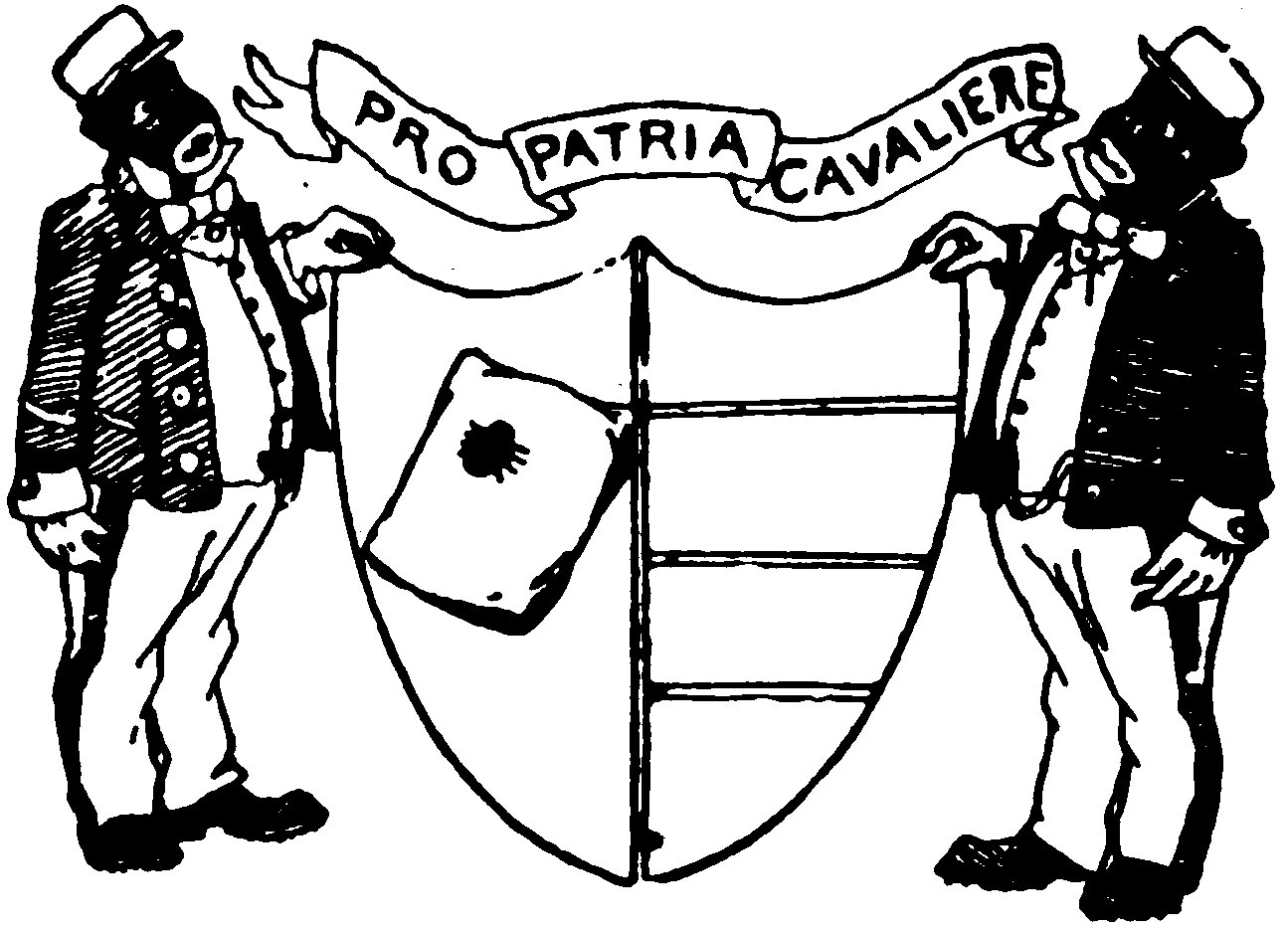
Above the shield appears a motto, “Pro Patria Caveliere,” which is the Latin for “For His Country, a Knight;” but the particular beauty of this motto is, that it can be abridged to P. P. C., and thus be made to serve a business purpose.
As we understand it, the Markeesy di Pullman becomes, immediately upon the acceptance of this title, the local protector, patron, promoter, and chaperon of Italian art. When Col. J. H. Mapleson comes to Chicago with his wheezy old cantatrices and spavined tenors, it will be the markeesy’s duty to go security for advertising, hotel-bills, and 57theatre-rent; it will also be the markeesy’s duty to advance Mapleson and his troupe enough money to take them to St. Louis; this will be a great boon to our Opera Festival Association, and we presume that the markeesy will be glad to make the trifling sacrifice for the dignity of the crown that has honored him. As soon as Mme. Adelina Patti heard of the rumor of the markeesy’s elevation to the peerage, she sent him a bouquet by Sig. Nicolini. The markeesy gracefully acknowledged the compliment in a note made up of polite Italian phrases judiciously culled from the libretto of “Il Trovatore.”
The Italian population of Chicago is highly gratified with the distinguished tribute paid by their monarch to our popular fellow-townsman. At a meeting of the Societa d’Italia in Poggio’s restaurant last evening, several speeches were made in eulogy of the Markeesy di Pullman’s many virtues, his enterprise, his munificence, his philanthropy, etc. An address to his Majesty King Humbert, congratulating him upon having recemented the ties which bind Italy and the United States, was read by Giovanni Bianco, the banana-merchant, and approved by the meeting: it was ordered that the address be cabled to his Majesty, provided that the Markeesy di Pullman would pay the toll.
The effect of the Italian boom has already become apparent in our literary circles. The leading 58book-sellers say that incessant have been the calls for Dante, for Petrarch, and for Tasso, since the news of the Pullman affair reached Chicago. The markeesy’s portrait in the rooms of the dancing-class was draped with Italian flags last evening; and already the caterer at Caveroc’s on Wabash Avenue has invented a new dish of macaroni, which is entitled macaroni di Pullman. We mention these trifling details merely to indicate how generally and how deeply this compliment of royalty to our amiable and gifted townsman is appreciated by his fellow-citizens.