Chicago Palmistry.
Reading edition
Mr. Heron-Allen, the handsome and talented young hand-reader, is making a barrel of money in Chicago. Our most distinguished society leaders are consulting him, and are delighted with the flattering pictures which he finds in their dainty palms. It is understood that the enterprising young professor—who is as ingenious as he is learned—has found it necessary to invent a system particularly adapted to the requirements of the average Chicago hand. It would be quite as unfair to judge the Chicago hand by the ordinary rules of palmistry as it would be to drag the Shakspearian drama down to the level of criticism required in the appreciation of a modern horse-play comedy. The truth seems to be, that the Chicago hand is the ideal one—the realization of the poetic dreams of the palmister: it is the perfection of every thing—not necessarily a purely spiritualized hand, but a beautiful and symmetrical combination or blending of the best features of the human hand.
The line marked A in this accurate exhibit is what Mr. Heron-Allen most felicitously terms the pork-line. In every Chicago hand, it is distinct and long. If at the lower end it rounds off toward the ball of the thumb (the Mons Prudentiœ), it is a sure indication that the patient attends strictly to prudent business methods; that he pursues only 22the vocation in which he has embarked, and that he eschews all those gambling exploits commonly called speculation. If, on the contrary, this pork-line turns to the outside of the palm (the Mons Asinorum), it indicates positively that the subject is inclined to desultory deals in wheat, corn, and other fluctuating staples of trade.
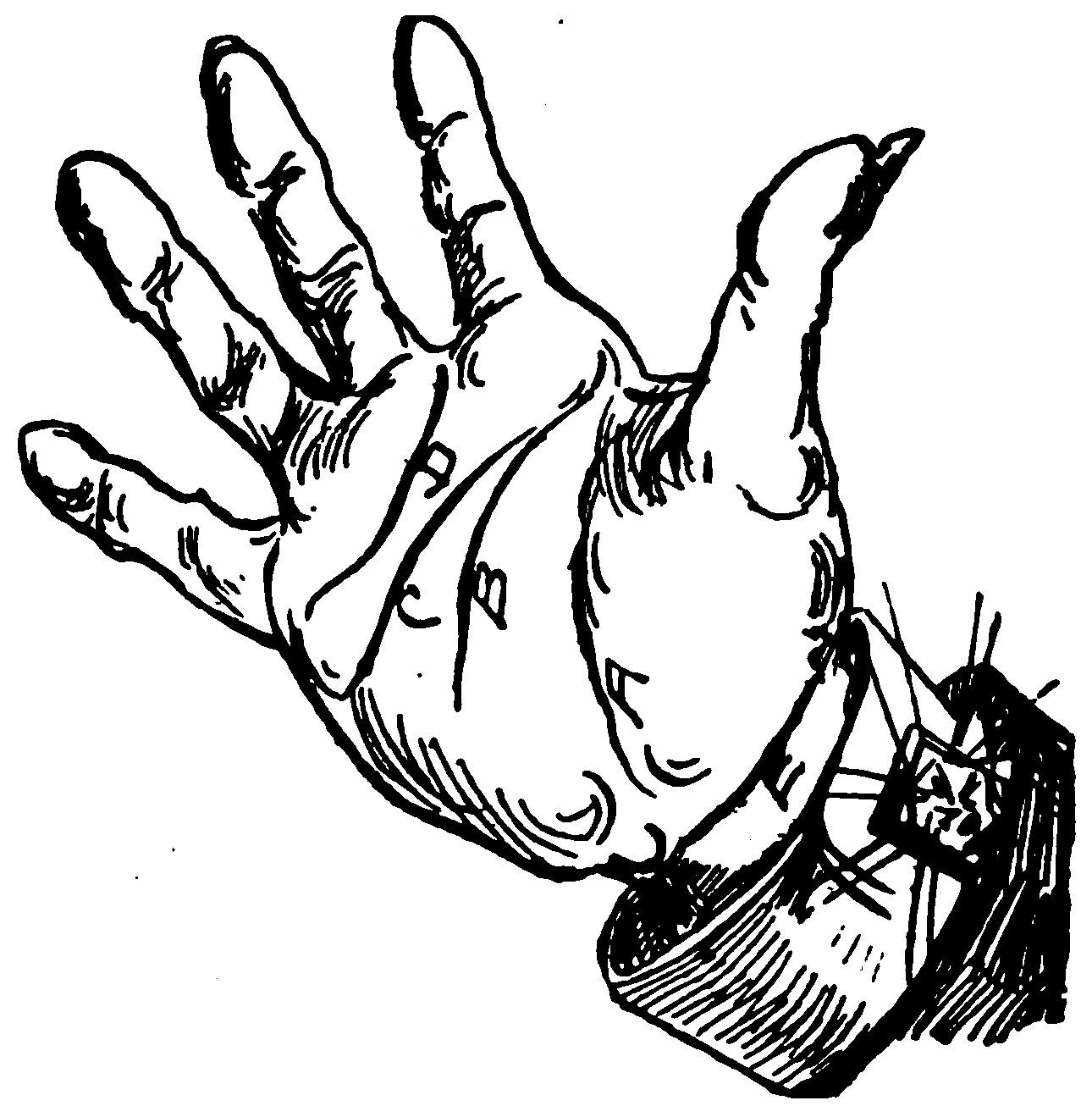
The sand-line is B: it betokens prowess and valor in the execution of those designs inspired by the pork-line (A). This line (B) is deeply marked in the average Chicago hand. It is generally conceded, we think, that in all grades, brands, and departments of business and culture, the Chicagoan exhibits more sand than is to be found anywhere else on the surface of the earth. In a great many 23instances it is so strongly marked that its shadow is plainly outlined on the back of the hand.
These two lines—A and B—exhaust what are called the physical lines. Next comes the intellectual or literary line C. It is this demarcation, broad and distinct, that causes the wearer to take pleasure in literature, to join literary clubs, to inquire into the mysteries of summer philosophy, to subscribe for the local trade weeklies, to buy handsome wall-paper, and to have the seaside novels rebound in half-calf. If it were not for this line in our hands, the newsboys would sell mighty few books on our trains, and Billy Pinkerton would never have become famous as an author.
The line D is common to the Chicago hand: it argues a fondness for the fine arts, for music, and for all articles of vertoo—such as piano-fortes, folding-beds, wax flowers, race-horses, perfumery, $4 opera, pug dogs, statuary, Browning’s poems, dyspepsia, and lawn tennis. Of late this art-line has got so deep in a great many Chicago hands, that it had to be sewed up by a doctor.
The line E is not found in every instance. It is most commonly met with among the wealthiest of our cultured people—those whose culture has come to them with their sudden acquisition of great wealth. It extends about the wrist, and is clearly marked about three times a day. It is called the water-line.
24