As to the Garter of a Markeesy.
Reading edition
Within the last two days we have received a large number of communications touching the handsome coat-of-arms which the secretary of the Italian legation has designed for the marchese di Pullman. Several of the communications contain comment upon the picture of the industrious insect represented as sprawling rampant on the feather pillow in the sinister half of the so-called Pullman shield. One correspondent says that the insect is not an ant, but a potato-bug; another declares that it is a busy bee; and still a third maintains that it is neither a chinch-bug, nor a busy bee, nor yet an ant, but one of those predatory vampires known (by name only) in polite society as “the flat-backed militia.” A gentleman, signing his letter “Scholasticus,” writes that he is deeply learned in heraldic lore, and that he has studied with increasing pleasure and profit the design submitted by Sig. Pietro Casa del Comma. He says, however, that he has one important suggestion to submit, and it is this: That the dexter quartures of the shield, which have been left blank for posterity to fill, should be designated as No. 1 upper, No. 1 lower, No. 2 upper, and No. 2 lower.
The suggestion submitted by “Scholasticus” strikes us most favorably, and we have sent it 60around to the Italian legation. As for the communications of the other correspondents, we have to say this only: That the form of animal life depicted upon the pillow of the shield was designed by the artist to represent an ant, the most industrious, the most frugal, and the most provident, of creatures. It may be that chinch-bugs and busy bees are in the habit of spending their precious time gallivanting around over feather pillows, but we have never met with any of this kind in the course of our travels. On the other hand, the ant is to be found everywhere, and in every employment. As Aristotle truly has it,—
“Whether upon the raging billow,
Or o’er the meads her path be bent,
On buttery shelf or Pullman pillow,
The ant is busy and content.
Full many a bird of rarer beauty
Is heralded by trump of fame:
The ant toils on in line of duty—
And gets there all the same.”
In connection with this little affair, we will say that a matter of much more importance than the marchese di Pullman’s coat-of-arms is bothering us just at present. We are informed that when a man is invested with the order of knighthood, he is expected to wear a garter upon (or around) his left leg. We have been devoting some time to an investigation of the subject of garters, and we think that we are competent to give a pretty able 61opinion thereupon. Garters, we maintain, are divided into three grand divisions or schools. The first is the Elizabethan, the second is the Boston, and the third is the Reform school. This picture will give a pretty fair idea of the three:—
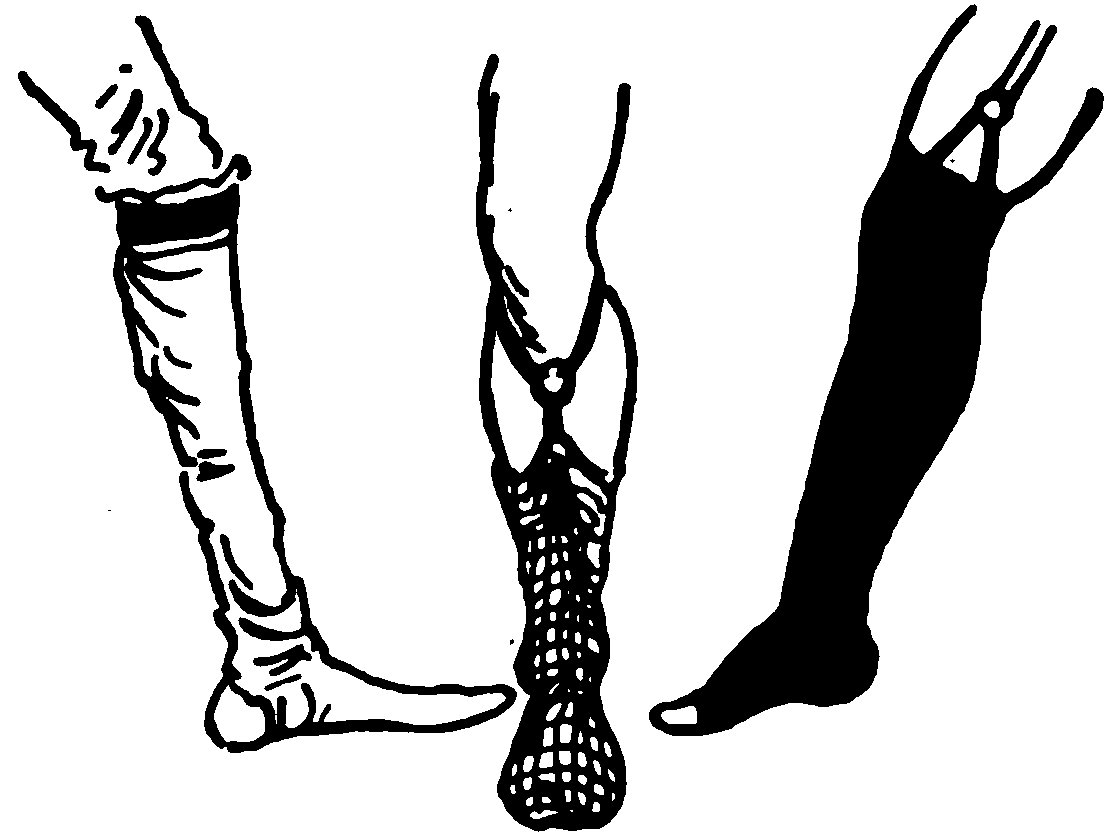
Now, here in Fig. 1 (which is the verisimilitude to the left) is a tableau of the Elizabethan garter upon the left leg of a knight: we will suppose the knight to be the marchese di Pullman. The garter encircles the leg below the knee, and it clasps the leg so tightly as to shut off the blood-supply from that part of the member below it: the result is, that the marchese di Pullman’s left calf shrivels and abates, until it falls to the level of the ankle, and, when that unhappy climax is reached, it becomes necessary to sew the garter to the hose, else it will not retain the position required by the etiquette of the court. We doubt very much whether there could be imagined a more pitiable spectacle 62than that of the marchese di Pullman travelling about the world in his knightly robe, with his right calf normally plump and shapely, and his left calf all wizened and shrunken under the baleful effects of the knightly garter. In Fig. 2 (the illustration in the centre of our design) we have a representation of the marchese’s left leg adorned with the Boston garter, which we consider a great improvement upon the garter of the Elizabethan period. This modern innovation conduces to the development of the muscles in the lower part of the leg, and at the same time it supports the hose in a most ingenious manner. It permits the blood to course unimpeded on its way, thus insuring against cold feet, and proving a very salvation for corns and bunions.
The third illustration is of the Reform garter. We hear it highly spoken of, but we have not looked into its merits. Inasmuch as it is so warmly recommended by those who have tried it, we think we can safely say that we hope to see more of it in the future. As we are told, this machine consists of divers straps and pulleys so ingeniously contrived as to bring its weight upon no particular part of the body, but to distribute it (or diffuse it, if you please) over the whole system. One part of it, as we are told, girds the neck, and the other part holds the hose in a deathlike grip. This establishes such an immediate and close relationship between the pedal and the pectoral regions, that, 63if the wearer have corns, a palpitation of the heart is likely to ensue, or, if the wearer’s feet happen to get wet, a sore throat is invariably the consequence.
We think, therefore, that, viewed from every stand-point, the Boston garter has notable advantages over its competitors; and, if we are called upon, we shall advise the marchese di Pullman to adopt it as the insignia of his noble office.
We heartily sympathize with our ennobled fellow-townsman, the marchese di Pullman, in the sorrow entailed upon him by the official announcement that the Italian olive-crop is almost a total failure this year. Yet when one accepts the burdensome responsibilities of the peerage, he is expected to endure with Spartan fortitude the providential dispensations that remorselessly crush those less honorably fortified.
“The Chicago Tribune” is rather late in the day: still, we are glad to find it lumbering to the front with the venerable information that the Markeesy Giorgio di Pullman is not entitled to the title of sir. This is what we said last week. The title which our cultured and opulent fellow-townsman has, in recognition of his philanthropics, been honored with, is the Italian title of markeesy, which corresponds with the English title of sir; 64but the bearer cannot Anglicize the title: he must remain a markeesy all the days of his natural life, or until, at least, he is promoted to some higher dignity. The Markeesy di Pullman understands this perfectly, and he would not exchange his markeesyship for the cream and flower of English knighthood. In connection with this subject, we beg to say that we deeply deplore the existence of a bitter malice against, and a rancorous envy of, the Markeesy di Pullman in certain local society circles. The existence of this insidious hostility was first brought to our knowledge by means of a song composed by a Chicago poet, and set to music by one of our amateur musicians. The chorus to this ribald song runs as follows:—
“When the party is breezy and wheezy,
And palpably greasy, it’s easy
To coax or to wring,
From a weak-minded king,
The titular prize of markeesy.”